EP4056611A1 - Curable composition set and article - Google Patents
Curable composition set and article Download PDFInfo
- Publication number
- EP4056611A1 EP4056611A1 EP20893504.9A EP20893504A EP4056611A1 EP 4056611 A1 EP4056611 A1 EP 4056611A1 EP 20893504 A EP20893504 A EP 20893504A EP 4056611 A1 EP4056611 A1 EP 4056611A1
- Authority
- EP
- European Patent Office
- Prior art keywords
- meth
- curable composition
- acrylate
- liquid
- composition set
- Prior art date
- Legal status (The legal status is an assumption and is not a legal conclusion. Google has not performed a legal analysis and makes no representation as to the accuracy of the status listed.)
- Pending
Links
Images

Classifications
-
- C—CHEMISTRY; METALLURGY
- C09—DYES; PAINTS; POLISHES; NATURAL RESINS; ADHESIVES; COMPOSITIONS NOT OTHERWISE PROVIDED FOR; APPLICATIONS OF MATERIALS NOT OTHERWISE PROVIDED FOR
- C09K—MATERIALS FOR MISCELLANEOUS APPLICATIONS, NOT PROVIDED FOR ELSEWHERE
- C09K5/00—Heat-transfer, heat-exchange or heat-storage materials, e.g. refrigerants; Materials for the production of heat or cold by chemical reactions other than by combustion
- C09K5/08—Materials not undergoing a change of physical state when used
- C09K5/14—Solid materials, e.g. powdery or granular
-
- C—CHEMISTRY; METALLURGY
- C08—ORGANIC MACROMOLECULAR COMPOUNDS; THEIR PREPARATION OR CHEMICAL WORKING-UP; COMPOSITIONS BASED THEREON
- C08L—COMPOSITIONS OF MACROMOLECULAR COMPOUNDS
- C08L51/00—Compositions of graft polymers in which the grafted component is obtained by reactions only involving carbon-to-carbon unsaturated bonds; Compositions of derivatives of such polymers
- C08L51/08—Compositions of graft polymers in which the grafted component is obtained by reactions only involving carbon-to-carbon unsaturated bonds; Compositions of derivatives of such polymers grafted on to macromolecular compounds obtained otherwise than by reactions only involving unsaturated carbon-to-carbon bonds
-
- C—CHEMISTRY; METALLURGY
- C07—ORGANIC CHEMISTRY
- C07C—ACYCLIC OR CARBOCYCLIC COMPOUNDS
- C07C67/00—Preparation of carboxylic acid esters
- C07C67/14—Preparation of carboxylic acid esters from carboxylic acid halides
-
- C—CHEMISTRY; METALLURGY
- C07—ORGANIC CHEMISTRY
- C07C—ACYCLIC OR CARBOCYCLIC COMPOUNDS
- C07C69/00—Esters of carboxylic acids; Esters of carbonic or haloformic acids
- C07C69/52—Esters of acyclic unsaturated carboxylic acids having the esterified carboxyl group bound to an acyclic carbon atom
- C07C69/602—Dicarboxylic acid esters having at least two carbon-to-carbon double bonds
-
- C—CHEMISTRY; METALLURGY
- C08—ORGANIC MACROMOLECULAR COMPOUNDS; THEIR PREPARATION OR CHEMICAL WORKING-UP; COMPOSITIONS BASED THEREON
- C08F—MACROMOLECULAR COMPOUNDS OBTAINED BY REACTIONS ONLY INVOLVING CARBON-TO-CARBON UNSATURATED BONDS
- C08F2/00—Processes of polymerisation
- C08F2/44—Polymerisation in the presence of compounding ingredients, e.g. plasticisers, dyestuffs, fillers
-
- C—CHEMISTRY; METALLURGY
- C08—ORGANIC MACROMOLECULAR COMPOUNDS; THEIR PREPARATION OR CHEMICAL WORKING-UP; COMPOSITIONS BASED THEREON
- C08F—MACROMOLECULAR COMPOUNDS OBTAINED BY REACTIONS ONLY INVOLVING CARBON-TO-CARBON UNSATURATED BONDS
- C08F222/00—Copolymers of compounds having one or more unsaturated aliphatic radicals, each having only one carbon-to-carbon double bond, and at least one being terminated by a carboxyl radical and containing at least one other carboxyl radical in the molecule; Salts, anhydrides, esters, amides, imides, or nitriles thereof
- C08F222/10—Esters
- C08F222/1006—Esters of polyhydric alcohols or polyhydric phenols
- C08F222/106—Esters of polycondensation macromers
- C08F222/1063—Esters of polycondensation macromers of alcohol terminated polyethers
-
- C—CHEMISTRY; METALLURGY
- C08—ORGANIC MACROMOLECULAR COMPOUNDS; THEIR PREPARATION OR CHEMICAL WORKING-UP; COMPOSITIONS BASED THEREON
- C08F—MACROMOLECULAR COMPOUNDS OBTAINED BY REACTIONS ONLY INVOLVING CARBON-TO-CARBON UNSATURATED BONDS
- C08F290/00—Macromolecular compounds obtained by polymerising monomers on to polymers modified by introduction of aliphatic unsaturated end or side groups
- C08F290/02—Macromolecular compounds obtained by polymerising monomers on to polymers modified by introduction of aliphatic unsaturated end or side groups on to polymers modified by introduction of unsaturated end groups
- C08F290/06—Polymers provided for in subclass C08G
- C08F290/062—Polyethers
-
- C—CHEMISTRY; METALLURGY
- C08—ORGANIC MACROMOLECULAR COMPOUNDS; THEIR PREPARATION OR CHEMICAL WORKING-UP; COMPOSITIONS BASED THEREON
- C08G—MACROMOLECULAR COMPOUNDS OBTAINED OTHERWISE THAN BY REACTIONS ONLY INVOLVING UNSATURATED CARBON-TO-CARBON BONDS
- C08G65/00—Macromolecular compounds obtained by reactions forming an ether link in the main chain of the macromolecule
- C08G65/02—Macromolecular compounds obtained by reactions forming an ether link in the main chain of the macromolecule from cyclic ethers by opening of the heterocyclic ring
- C08G65/32—Polymers modified by chemical after-treatment
- C08G65/329—Polymers modified by chemical after-treatment with organic compounds
- C08G65/331—Polymers modified by chemical after-treatment with organic compounds containing oxygen
- C08G65/332—Polymers modified by chemical after-treatment with organic compounds containing oxygen containing carboxyl groups, or halides, or esters thereof
-
- C—CHEMISTRY; METALLURGY
- C08—ORGANIC MACROMOLECULAR COMPOUNDS; THEIR PREPARATION OR CHEMICAL WORKING-UP; COMPOSITIONS BASED THEREON
- C08K—Use of inorganic or non-macromolecular organic substances as compounding ingredients
- C08K13/00—Use of mixtures of ingredients not covered by one single of the preceding main groups, each of these compounds being essential
- C08K13/02—Organic and inorganic ingredients
-
- C—CHEMISTRY; METALLURGY
- C08—ORGANIC MACROMOLECULAR COMPOUNDS; THEIR PREPARATION OR CHEMICAL WORKING-UP; COMPOSITIONS BASED THEREON
- C08K—Use of inorganic or non-macromolecular organic substances as compounding ingredients
- C08K3/00—Use of inorganic substances as compounding ingredients
- C08K3/01—Use of inorganic substances as compounding ingredients characterized by their specific function
- C08K3/013—Fillers, pigments or reinforcing additives
-
- C—CHEMISTRY; METALLURGY
- C08—ORGANIC MACROMOLECULAR COMPOUNDS; THEIR PREPARATION OR CHEMICAL WORKING-UP; COMPOSITIONS BASED THEREON
- C08K—Use of inorganic or non-macromolecular organic substances as compounding ingredients
- C08K3/00—Use of inorganic substances as compounding ingredients
- C08K3/02—Elements
- C08K3/08—Metals
-
- C—CHEMISTRY; METALLURGY
- C08—ORGANIC MACROMOLECULAR COMPOUNDS; THEIR PREPARATION OR CHEMICAL WORKING-UP; COMPOSITIONS BASED THEREON
- C08K—Use of inorganic or non-macromolecular organic substances as compounding ingredients
- C08K3/00—Use of inorganic substances as compounding ingredients
- C08K3/18—Oxygen-containing compounds, e.g. metal carbonyls
- C08K3/20—Oxides; Hydroxides
- C08K3/22—Oxides; Hydroxides of metals
-
- C—CHEMISTRY; METALLURGY
- C08—ORGANIC MACROMOLECULAR COMPOUNDS; THEIR PREPARATION OR CHEMICAL WORKING-UP; COMPOSITIONS BASED THEREON
- C08K—Use of inorganic or non-macromolecular organic substances as compounding ingredients
- C08K5/00—Use of organic ingredients
- C08K5/04—Oxygen-containing compounds
- C08K5/13—Phenols; Phenolates
-
- C—CHEMISTRY; METALLURGY
- C08—ORGANIC MACROMOLECULAR COMPOUNDS; THEIR PREPARATION OR CHEMICAL WORKING-UP; COMPOSITIONS BASED THEREON
- C08K—Use of inorganic or non-macromolecular organic substances as compounding ingredients
- C08K3/00—Use of inorganic substances as compounding ingredients
- C08K3/02—Elements
- C08K3/08—Metals
- C08K2003/0812—Aluminium
-
- C—CHEMISTRY; METALLURGY
- C08—ORGANIC MACROMOLECULAR COMPOUNDS; THEIR PREPARATION OR CHEMICAL WORKING-UP; COMPOSITIONS BASED THEREON
- C08K—Use of inorganic or non-macromolecular organic substances as compounding ingredients
- C08K3/00—Use of inorganic substances as compounding ingredients
- C08K3/18—Oxygen-containing compounds, e.g. metal carbonyls
- C08K3/20—Oxides; Hydroxides
- C08K3/22—Oxides; Hydroxides of metals
- C08K2003/2227—Oxides; Hydroxides of metals of aluminium
-
- C—CHEMISTRY; METALLURGY
- C08—ORGANIC MACROMOLECULAR COMPOUNDS; THEIR PREPARATION OR CHEMICAL WORKING-UP; COMPOSITIONS BASED THEREON
- C08K—Use of inorganic or non-macromolecular organic substances as compounding ingredients
- C08K2201/00—Specific properties of additives
- C08K2201/001—Conductive additives
-
- H—ELECTRICITY
- H05—ELECTRIC TECHNIQUES NOT OTHERWISE PROVIDED FOR
- H05K—PRINTED CIRCUITS; CASINGS OR CONSTRUCTIONAL DETAILS OF ELECTRIC APPARATUS; MANUFACTURE OF ASSEMBLAGES OF ELECTRICAL COMPONENTS
- H05K7/00—Constructional details common to different types of electric apparatus
- H05K7/20—Modifications to facilitate cooling, ventilating, or heating
- H05K7/2039—Modifications to facilitate cooling, ventilating, or heating characterised by the heat transfer by conduction from the heat generating element to a dissipating body
Definitions
- the present invention relates to a curable composition set and an article.
- a thermally conductive material (may also be referred to as thermal dissipation material) called a thermal interface material (TIM) is a material provided between a heat source and a thermal dissipation member such as a heat sink, and the thermally conductive material reduces the heat resistance between the heat source and the thermal dissipation member and promotes thermal conduction from the heat source. Since the heat generated from the heat source is efficiently conducted to a cooling member via the TIM, the heat is easily dissipated from the thermal dissipation member.
- TIM thermal interface material
- thermally conductive material a large number of liquid materials are known, and they are also referred to as thermal dissipation greases or thermally conductive greases.
- a thermally conductive grease composition containing predetermined amounts of a liquid hydrocarbon oil and/or a fluorinated hydrocarbon oil and a thermally conductive inorganic filler is disclosed.
- Patent Literature 2 a thermally conductive grease containing a specific phenyl ether-based base oil, a specific phenol-based oxidation inhibitor, and an inorganic powder filler is disclosed.
- liquid dripping or a pump-out phenomenon in which the grease is pushed out from between the members due to deformation of the member on which the thermally conductive grease is applied, may occur.
- Liquid dripping or the pump-out phenomenon generates voids between the grease and the member, decreases the adhesiveness of the grease to the member, and causes an increase in heat resistance between the thermal dissipation grease and the member. Due to liquid dripping or the pump-out phenomenon, other members may be contaminated by the grease, and insulation failure may occur.
- a thermally conductive material formed into a solid form such as a sheet may be used. Liquid dripping or the pump-out phenomenon can be suppressed by using a solid-form thermally conductive material.
- a solid-form thermally conductive material in an electronic component containing a member that generates heat and a thermal dissipation member, deformation such as warpage of the members may occur when cooling and heating is repeated. Accordingly, the solid-form thermally conductive material is required to be a material having low elasticity and excellent elongation so that the material can follow deformation of the members.
- an object of the present invention is to provide a curable composition set capable of giving a cured product having low elasticity and excellent elongation.
- the inventors of the present invention conducted a thorough study, and as a result, the inventors found that a cured product of a curable composition set containing a specific compound having a polyoxyalkylene chain and having two (meth)acryloyl groups has low elasticity and excellent elongation. Furthermore, the inventors found that since this curable composition set contains a thermally conductive filler, the curable composition set is suitably used as a thermally conductive material, thus the inventors completing the present invention. According to some aspects, the present invention provides the following [1] to [11].
- a curable composition set capable of giving a cured product having low elasticity and excellent elongation can be provided.
- a curable composition set capable of giving a cured product having excellent elongation as well as low elasticity can be provided.
- (meth)acryloyl means “acryloyl” and “methacryloyl” corresponding thereto, and the same also applies to similar expressions such as “(meth)acrylate” and “(meth)acryl” .
- the weight average molecular weight (Mw) means a value measured using gel permeation chromatography (GPC) under the following conditions and determined by using polystyrene as a standard substance.
- a curable composition set according to an embodiment contains: a first liquid containing an oxidizing agent; and a second liquid containing a reducing agent.
- the oxidizing agent and the reducing agent react with each other to generate free radicals, and polymerization of a polymerizable component such as a compound represented by the formula (1) described below proceeds.
- a cured product of a mixture of the first liquid and the second liquid hereinafter, this cured product is also referred to as a "cured product of the curable composition set" is obtained by mixing the first liquid and the second liquid.
- the oxidizing agent contained in the first liquid plays the role as a polymerization initiator (radical polymerization initiator).
- the oxidizing agent may be, for example, an organic peroxide or an azo compound.
- the organic peroxide may be, for example, a hydroperoxide, a peroxydicarbonate, a peroxy ester, a peroxy ketal, a dialkyl peroxide, or a diacyl peroxide.
- the azo compound may be AIBN (2,2'-azobisisobutyronitrile), ⁇ -65 (azobisdimethylvaleronitrile), or the like.
- AIBN 2,2'-azobisisobutyronitrile
- ⁇ -65 azobisdimethylvaleronitrile
- hydroperoxide examples include diisopropylbenzene hydroperoxide, 1,1,3,3-tetramethylbutyl hydroperoxide, and cumene hydroperoxide.
- peroxydicarbonate examples include di-n-propyl peroxydicarbonate, diisopropyl peroxydicarbonate, bis(4-t-butylcyclohexyl) peroxydicarbonate, di-2-ethoxymethoxy peroxydicarbonate, di(2-ethylhexylperoxy) dicarbonate, dimethoxybutyl peroxydicarbonate, and di(3-methyl-3-methoxybutyl peroxy) dicarbonate.
- peroxy ester examples include cumyl peroxyneodecanoate, 1,1,3,3-tetramethylbutyl peroxyneodecanoate, 1-cyclohexyl-1-methylethyl peroxyneodecanoate, t-hexyl peroxyneodecanoate, t-butyl peroxypivalate, 1,1,3,3-tetramethylbutyl peroxy-2-ethylhexanoate, 2,5-dimethyl-2,5-di(2-ethylhexanoylperoxy)hexane, 1-cyclohexyl-1-methylethyl peroxy-2-ethylhexanoate, t-hexyl peroxy-2-ethylhexanoate, t-butyl peroxy-2-ethylhexanoate, t-butyl peroxyisobutyrate, 1,1-bis(t-butylperoxy)cyclohexan
- peroxy ketal examples include 1,1-bis(t-hexylperoxy)-3,3,5-trimethylcyclohexane, 1,1-bis(t-hexylperoxy)cyclohexane, 1,1-bis(t-butylperoxy)-3,3,5-trimethylcyclohexane, 1,1-bis(t-butylperoxy)cyclododecane, and 2,2-bis(t-butylperoxy)decane.
- dialkyl peroxide examples include ⁇ , ⁇ '-bis(t-butylperoxy)diisopropylbenzene, dicumyl peroxide, 2,5-dimethyl-2,5-di(t-butylperoxy)hexane, and t-butyl cumyl peroxide.
- diacyl peroxide examples include isobutyl peroxide, 2,4-dichlorobenzoyl peroxide, 3,5,5-trimethylhexanoyl peroxide, octanoyl peroxide, lauroyl peroxide, stearoyl peroxide, succinic peroxide, benzoyl peroxytoluene, and benzoyl peroxide.
- the oxidizing agent is preferably a peroxide, more preferably a hydroperoxide, even more preferably 1,1,3,3-tetramethylbutyl hydroperoxide or cumene hydroperoxide, and particularly preferably 1,1,3,3-tetramethylbutyl hydroperoxide.
- the content of the oxidizing agent may be 0.1 % by mass or more, 0.5% by mass or more, or 1% by mass or more, and may be 10% by mass or less, 5% by mass or less, or 3% by mass or less, based on the sum of the first liquid and the second liquid.
- the reducing agent contained in the second liquid may be, for example, a tertiary amine, a thiourea derivative, or a transition metal salt.
- a tertiary amine include triethylamine, tripropylamine, tributylamine, and N,N-dimethyl-para-toluidine.
- the thiourea derivative include 2-mercaptobenzimidazole, methylthiourea, dibutylthiourea, tetramethylthiourea, and ethylenethiourea.
- the transition metal salt include cobalt naphthenate, copper naphthenate, and vanadyl acetylacetonate.
- the reducing agent is preferably a thiourea derivative or a transition metal salt.
- the thiourea derivative may be, for example, ethylenethiourea.
- the transition metal salt is preferably vanadyl acetylacetonate.
- the content of the reducing agent may be 0.05% by mass or more, 0.1% by mass or more, or 0.3% by mass or more, and may be 5% by mass or less, 3% by mass or less, or 1% by mass or less, based on the sum of the first liquid and the second liquid.
- At least one of the first liquid and the second liquid contains a compound represented by the following formula (1): wherein R 11 and R 12 each independently represent a hydrogen atom or a methyl group, and R 13 represents a divalent group having a polyoxyalkylene chain.
- any one of R 11 and R 12 may be a hydrogen atom, while the other may be a methyl group; according to another embodiment, both R 11 and R 12 may be a hydrogen atom; and according to still another embodiment, both R 11 and R 12 may be a methyl group.
- the polyoxyalkylene chain contains a structural unit represented by the following formula (2).
- the strength of the cured product can be increased while suppressing an excessive increase of the viscosity of the curable composition (which refers to one or both of the first liquid and the second liquid; the same applies hereinafter).
- R 13 may be a divalent group having a polyoxyethylene chain
- the compound represented by the formula (1) is preferably a compound represented by the following formula (1-2) (polyethylene glycol di(meth)acrylate): wherein R 11 and R 12 have the same meanings as R 11 and R 12 in the formula (1), respectively; and m represents an integer of 2 or more.
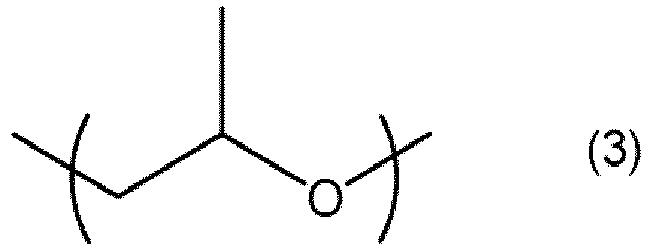
- the polyoxyalkylene chain contains a structural unit represented by the following formula (3).
- R 13 may be a divalent group having a polyoxypropylene chain
- the compound represented by the formula (1) is preferably a compound represented by the following formula (1-3) (polypropylene glycol di(meth)acrylate): wherein R 11 and R 12 have the same meanings as R 11 and R 12 in the formula (1), respectively, and n represents an integer of 2 or more.
- the polyoxyalkylene chain is preferably a copolymer chain containing the above-mentioned structural unit represented by the formula (2) and the above-mentioned structural unit represented by the formula (3).
- the copolymer chain may be any one of an alternating copolymer chain, a block copolymer chain, or a random copolymer chain.
- the copolymer chain is preferably a random copolymer chain.
- the polyoxyalkylene chain may have an oxyalkylene group having 4 or 5 carbon atoms, such as an oxytetramethylene group, an oxybutylene group, or an oxypentylene group, as a structural unit in addition to the structural unit represented by the formula (2) and the structural unit represented by the formula (3).
- R 13 may also be a divalent group further having an additional organic group in addition to the above-mentioned polyoxyalkylene chain.
- the additional organic group may be a chain-like group other than the polyoxyalkylene chain, and the additional organic group may be, for example, a methylene chain (chain having -CH 2 - as a structural unit), a polyester chain (chain containing -COO- in a structural unit), or a polyurethane chain (chain containing -OCON- in a structural unit).
- the compound represented by the formula (1) may be a compound represented by the following formula (1-4): wherein R 11 and R 12 have the same meanings as R 11 and R 12 in the formula (1), respectively; R 14 and R 15 each independently represent an alkylene group having 2 to 5 carbon atoms; and k1, k2, and k3 each independently represent an integer of 2 or more. k2 may be, for example, an integer of 16 or less.
- Each of R 14 and R 15 which are present in plurality, may be identical with each other or may be different from each other.
- Each of R 14 and R 15 , which are present in plurality preferably contains an ethylene group and a propylene group. That is, a polyoxyalkylene chain represented by (R 14 O) k1 and a polyoxyalkylene chain represented by (R 15 O) k3 are each preferably a copolymer chain containing an oxyethylene group (the above-described structural unit represented by the formula (2)) and an oxypropylene group (the above-described structural unit represented by the formula (3)).
- the polyoxyalkylene chain preferably has 100 or more of oxyalkylene groups.
- the number of oxyalkylene groups in the polyoxyalkylene chain is 100 or more, as the main chain of the compound represented by the formula (1) becomes longer, the elongation of the cured product is superior, and the strength of the cured product can also be increased.
- the number of oxyalkylene groups corresponds to each of m in the formula (1-2), n in the formula (1-3), and k1 and k3 in the formula (1-4).
- the number of oxyalkylene groups in the polyoxyalkylene chain is more preferably 130 or more, 180 or more, 200 or more, 220 or more, 250 or more, 270 or more, 300 or more, or 320 or more.
- the number of oxyalkylene groups in the polyoxyalkylene chain may be 600 or less, 570 or less, or 530 or less.
- the weight average molecular weight of the compound represented by the formula (1) is preferably 5000 or more, 6000 or more, 7000 or more, 8000 or more, 9000 or more, 10000 or more, 11000 or more, 12000 or more, 13000 or more, 14000 or more, or 15000 or more.
- the weight average molecular weight of the compound represented by the formula (1) is preferably 100000 or less, 80000 or less, 60000 or less, 34000 or less, 31000 or less, or 28000 or less.
- the compound represented by the formula (1) may be liquid at 25°C.
- the viscosity at 25°C of the compound represented by the formula (1) is preferably 1000 Pa ⁇ s or less, 800 Pa ⁇ s or less, 600 Pa ⁇ s or less, 500 Pa ⁇ s or less, 350 Pa ⁇ s or less, 300 Pa ⁇ s or less, or 200 Pa ⁇ s or less.
- the viscosity at 25°C of the compound represented by the formula (1) may be 0.1 Pa ⁇ s or more, 0.2 Pa ⁇ s or more, 0.3 Pa ⁇ s or more, 1 Pa ⁇ s or more, 2 Pa ⁇ s or more, or 3 Pa ⁇ s or more.
- the compound represented by the formula (1) may be solid at 25°C.
- the compound represented by the formula (1) is preferably liquid at 50°C.
- the viscosity at 50°C of the compound represented by the formula (1) is preferably 100 Pa ⁇ s or less, more preferably 50 Pa ⁇ s or less, even more preferably 30 Pa ⁇ s or less, and particularly preferably 20 Pa ⁇ s or less.
- the viscosity at 50°C of the compound represented by the formula (1) may be 0.1 Pa ⁇ s or more, 0.2 Pa ⁇ s or more, or 0.3 Pa ⁇ s or more.
- the viscosity means a value measured based on JIS Z 8803, and specifically, the viscosity means a value measured by using an E type viscometer (for example, manufactured by Toki Sangyo Co., Ltd., PE-80L). Incidentally, compensation of the viscometer can be carried out based on JIS Z 8809-JS14000.
- the viscosity of the compound represented by the formula (1) can be adjusted by adjusting the weight average molecular weight of the compound.
- the content of the compound represented by the formula (1) is preferably 1% by mass or more, more preferably 1.5% by mass or more, and even more preferably 2% by mass or more, based on the sum of the first liquid and the second liquid.
- the content of the compound represented by the formula (1) may be 20% by mass or less, 17% by mass or less, or 15% by mass or less, based on the sum of the first liquid and the second liquid.
- the curable composition may contain an additional polymerizable compound (the details will be described below) other than the compound represented by the formula (1).
- the content of the compound represented by the formula (1) is preferably 10 parts by mass or more, 20 parts by mass or more, 25 parts by mass or more, 30 parts by mass or more, or 35 parts by mass or more, with respect to 100 parts by mass of the sum of the compound represented by the formula (1) and the additional polymerizable compound (hereinafter, referred to as "sum of the contents of the polymerizable components").
- the content of the compound represented by the formula (1) may be 80 parts by mass or less, 60 parts by mass or less, or 50 parts by mass or less, with respect to 100 parts by mass of the sum of the contents of the polymerizable components.
- the curable composition set at least one of the first liquid and the second liquid contains a thermally conductive filler.
- a thermally conductive filler refers to a filler having a thermal conductivity of 10 W/m ⁇ K or higher.
- Both of the first liquid and the second liquid preferably contain a thermally conductive filler.
- the thermally conductive filler may be insulative or may be electrically conductive, and the thermally conductive filler is preferably an insulative filler.
- the material that constitutes an insulative thermally conductive filler include aluminum oxide, aluminum hydroxide, magnesium oxide, beryllium oxide, boron nitride, aluminum nitride, silicon nitride, silicon carbide, silicon dioxide, aluminum fluoride, calcium fluoride, and zinc oxide.
- Examples of the material that constitutes an electrically conductive thermally conductive filler include aluminum, silver, and copper.
- the shape of the thermally conductive filler may be spherical or may be polyhedral.
- the average particle size of the thermally conductive filler is preferably 50 ⁇ m or less, more preferably 40 ⁇ m or less, even more preferably 30 ⁇ m or less, and may be 0.05 ⁇ m or more, 0.1 ⁇ m or more, or 0.3 ⁇ m or more.
- the average particle size of the thermally conductive filler means the particle size (D50) at which the volume cumulative particle size distribution is 50%, and the average particle size is measured using a laser diffraction type particle size distribution analyzer (for example, SALD-2300 (manufactured by SHIMADZU CORPORATION)).
- the content of the thermally conductive filler is preferably 60% by mass or more, more preferably 70% by mass or more, and even more preferably 80% by mass or more, and may be 97% by mass or less, 95% by mass or less, or 93% by mass or less, based on the sum of the first liquid and the second liquid.
- the content of the thermally conductive filler is preferably 70% by volume or more, more preferably 75% by volume or more, and even more preferably 80% by volume or more, and may be 90% by volume or less, 88% by volume or less, or 85% by volume or less, based on the total volume of the curable composition.
- the curable composition may further contain an additional polymerizable compound that can be copolymerized with the above-mentioned compound represented by the formula (1).
- the additional polymerizable compound may be, for example, a compound having one (meth)acryloyl group.
- This compound may be, for example, an alkyl (meth)acrylate.
- the additional polymerizable compound may also be a compound having an aromatic hydrocarbon group, a group containing a polyoxyalkylene chain, a group containing a heterocyclic ring, an alkoxy group, a phenoxy group, a group containing a silane group, a group containing a siloxane bond, a halogen atom, a hydroxyl group, a carboxyl group, an amino group, or an epoxy group, in addition to the one (meth)acryloyl group.
- the viscosity of the curable composition can be adjusted.
- the curable composition contains a compound having a hydroxyl group, a carboxyl group, an amino group, or an epoxy group in addition to the (meth)acryloyl group, the adhesiveness of the curable composition and a cured product thereof to a member can be further enhanced.
- the alkyl group in the alkyl (meth)acrylate (alkyl group moiety other than the (meth)acryloyl group) may be linear, branched, or alicyclic.
- the number of carbon atoms of the alkyl group may be, for example, 1 to 30.
- the number of carbon atoms of the alkyl group may be 1 to 11, 1 to 8, 1 to 6, or 1 to 4, and may be 12 to 30, 12 to 28, 12 to 24, 12 to 22, 12 to 18, or 12 to 14.
- alkyl (meth)acrylate having a linear alkyl group examples include an alkyl (meth)acrylate having a linear alkyl group having 1 to 11 carbon atoms, such as methyl (meth)acrylate, ethyl (meth)acrylate, propyl (meth)acrylate, butyl (meth)acrylate, pentyl (meth)acrylate, n-hexyl (meth)acrylate, n-heptyl (meth)acrylate, octyl (meth)acrylate, nonyl (meth)acrylate, decyl (meth)acrylate, or undecyl (meth)acrylate; and an alkyl (meth)acrylate having a linear alkyl group having 12 to 30 carbon atoms, such as dodecyl (meth)acrylate (lauryl (meth)acrylate), tetradecyl (meth)acrylate, hexadecyl (meth)acrylate
- alkyl (meth)acrylate having a branched alkyl group examples include an alkyl (meth)acrylate having a branched alkyl group having 1 to 11 carbon atoms, such as s-butyl (meth)acrylate, t-butyl (meth)acrylate, isobutyl (meth)acrylate, isopentyl (meth)acrylate, isoamyl (meth)acrylate, isooctyl (meth)acrylate, 2-ethylhexyl (meth)acrylate, isononyl (meth)acrylate, or isodecyl (meth)acrylate; and an alkyl (meth)acrylate having a branched alkyl group having 12 to 30 carbon atoms, such as isomyristyl (meth)acrylate, 2-propylheptyl (meth)acrylate, isoundecyl (meth)acrylate, isododecyl
- alkyl (meth)acrylate having an alicyclic alkyl group examples include cyclohexyl (meth)acrylate, 3,3,5-trimethylcyclohexyl (meth)acrylate, isobornyl (meth)acrylate, terpene (meth)acrylate, and dicyclopentanyl (meth)acrylate.
- the compound having a (meth)acryloyl group and an aromatic hydrocarbon group may be benzyl (meth)acrylate or the like.
- Examples of the compound having a group containing a (meth)acryloyl group and a group containing a polyoxyalkylene chain include polyethylene glycol (meth)acrylate, methoxy polyethylene glycol (meth)acrylate, polypropylene glycol (meth)acrylate, methoxy polypropylene glycol (meth)acrylate, polybutylene glycol (meth)acrylate, and methoxy polybutylene glycol (meth)acrylate.
- Examples of the compound having a (meth)acryloyl group and a group containing a heterocyclic ring include tetrahydrofurfuryl (meth)acrylate.
- Examples of the compound having a (meth)acryloyl group and an alkoxy group include 2-methoxyethyl acrylate.
- Examples of the compound having a (meth)acryloyl group and a phenoxy group include phenoxyethyl (meth)acrylate.
- Examples of the compound having a (meth)acryloyl group and a group containing a silane group include 3-acryloxypropyltriethoxysilane,
- Examples of the compound having a (meth)acryloyl group and a group containing a siloxane bond include silicone (meth)acrylate.
- Examples of the compound having a (meth)acryloyl group and a halogen atom include (meth)acrylates having fluorine atoms, such as trifluoromethyl (meth)acrylate, 2,2,2-trifluoroethyl (meth)acrylate, 1,1,1,3,3,3-hexafluoro-2-propyl (meth)acrylate, perfluoroethylmethyl (meth)acrylate, perfluoropropylmethyl (meth)acrylate, perfluorobutylmethyl (meth)acrylate, perfluoropentylmethyl (meth)acrylate, perfluorohexylmethyl (meth)acrylate, perfluoroheptylmethyl (meth)acrylate, perfluorooctylmethyl (meth)acrylate, perfluorononylmethyl (meth)acrylate, perfluorodecylmethyl (meth)acrylate, perfluoroundecylmethyl (meth)acrylate, per
- Examples of the compound having a (meth)acryloyl group and a hydroxyl group include a hydroxyalkyl (meth)acrylate such as 2-hydroxyethyl (meth)acrylate, 2-hydroxypropyl (meth)acrylate, 3-hydroxypropyl (meth)acrylate, 2-hydroxybutyl (meth)acrylate, 4-hydroxybutyl (meth)acrylate, 6-hydroxyhexyl (meth)acrylate, 8-hydroxyoctyl (meth)acrylate, 10-hydroxydecyl (meth)acrylate, or 12-hydroxylauryl (meth)acrylate; and a hydroxyalkylcycloalkane (meth)acrylate such as (4-hydroxymethylcyclohexyl)methyl (meth)acrylate.
- a hydroxyalkyl (meth)acrylate such as 2-hydroxyethyl (meth)acrylate, 2-hydroxypropyl (meth)acrylate, 3-hydroxypropyl (meth)acrylate, 2-hydroxybutyl (
- Examples of the compound having a (meth)acryloyl group and a carboxyl group include (meth)acrylic acid, carboxyethyl (meth)acrylate, carboxypentyl (meth)acrylate, phthalic acid monohydroxyethyl acrylate (for example, "ARONIX M5400” manufactured by Toagosei Co., Ltd.), and 2-acryloyloxyethyl succinate (for example, "NK ESTER A-SA” manufactured by Shin-Nakamura Chemical Co., Ltd.).
- Examples of the compound having a (meth)acryloyl group and an amino group include N,N-dimethylaminoethyl (meth)acrylate, N,N-diethylaminoethyl (meth)acrylate, N,N-dimethylaminopropyl (meth)acrylate, and N,N-diethylaminopropyl (meth)acrylate.
- Examples of the compound having a (meth)acryloyl group and an epoxy group include glycidyl (meth)acrylate, glycidyl ⁇ -ethyl (meth)acrylate, glycidyl ⁇ -n-propyl (meth)acrylate, glycidyl ⁇ -n-butyl (meth)acrylate, 3,4-epoxybutyl (meth)acrylate, 4,5-epoxypentyl (meth)acrylate, 6,7-epoxyheptyl (meth)acrylate, 6,7-epoxyheptyl ⁇ -ethyl (meth)acrylate, 3-methyl-3,4-epoxybutyl (meth)acrylate, 4-methyl-4,5-epoxypentyl (meth)acrylate, 5-methyl-5,6-epoxyhexyl (meth)acrylate, ⁇ -methylglycidyl (meth)acrylate, and ⁇ -methylglycidyl
- the content of the additional polymerizable compound is preferably 1% by mass or more, more preferably 3% by mass or more, and even more preferably 5% by mass or more, and may be 20% by mass or less, 15% by mass or less, or 10% by mass or less, based on the sum of the first liquid and the second liquid.
- the content of the additional polymerizable compound is preferably 30 parts by mass or more, more preferably 40 parts by mass or more, and even more preferably 50 parts by mass or more, and may be 90 parts by mass or less, 80 parts by mass or less, or 70 parts by mass or less, based on 100 parts by mass of the sum of the contents of the polymerizable components.
- the curable composition can further contain a plasticizer.
- a plasticizer As the curable composition contains a plasticizer, the adhesiveness of the curable composition and the elongation of the cured product can be further enhanced.
- the plasticizer include tackifiers such as a butadiene rubber, an isoprene rubber, a silicone rubber, a styrenebutadiene rubber, a chloroprene rubber, a nitrile rubber, a butyl rubber, an ethylene-propylene rubber, a urethane rubber, an acrylic resin, a rosin-based resin, and a terpene-based resin; and a polyalkylene glycol.
- tackifiers such as a butadiene rubber, an isoprene rubber, a silicone rubber, a styrenebutadiene rubber, a chloroprene rubber, a nitrile rubber, a butyl rubber, an ethylene-propylene rubber,
- the content of the plasticizer may be 0.1 parts by mass or more, 1 part by mass or more, or 3 parts by mass or more, and may be 20 parts by mass or less, 15 parts by mass or less, 12 parts by mass or less, or 10 parts by mass or less, with respect to 100 parts by mass of the sum of the contents of the polymerizable components.
- the curable composition may further contain an oxidation inhibitor.
- the oxidation inhibitor may be, for example, a phenol-based oxidation inhibitor, a benzophenone-based oxidation inhibitor, a benzoate-based oxidation inhibitor, a hindered amine-based oxidation inhibitor, or a benzotriazole-based oxidation inhibitor, and the oxidation inhibitor is preferably a phenol-based oxidation inhibitor.
- the phenol-based oxidation inhibitor has, for example, a hindered phenol structure (hindered phenol ring).
- the hindered phenol structure (hindered phenol ring) may be, for example, a structure in which a t-butyl group is bonded to any one position or both positions of the ortho-position with respect to the hydroxyl group in a phenol ring.
- the phenol-based oxidation inhibitor has one or more, preferably two or more, more preferably three or more, and even more preferably four or more of such a hindered phenol ring.
- the content of the oxidation inhibitor may be 0.1% by mass or more, 0.2% by mass or more, or 0.3% by mass or more, and may be 5% by mass or less, 4% by mass or less, 3% by mass or less, 2% by mass or less, or 1% by mass or less, based on the sum of the first liquid and the second liquid.
- the curable composition can further contain additional additives as necessary.
- additional additives include a surface treatment agent (for example, a silane coupling agent), a dispersant, a curing accelerator, a colorant, a crystal nucleating agent, a thermal stabilizer, a foaming agent, a flame retardant, a vibration damping agent, a dehydrating agent, and a flame retardant aid (for example, a metal oxide).
- the content of the additional additives may be 0.1% by mass or more and may be 30% by mass or less, based on the sum of the first liquid and the second liquid.
- the first liquid and the second liquid may be liquid at 25°C.
- an object such as a member serving as a heat source, a cooling member, or the like, and it is also possible to increase adhesion to the coated surface.
- each component other than the oxidizing agent and the reducing agent is preferably contained in both the first liquid and the second liquid. That is, in one embodiment, it is preferable that the first liquid contains the oxidizing agent, the compound represented by the formula (1), and the thermally conductive filler (and the additional components used as necessary), and the second liquid contains the reducing agent, the compound represented by the formula (1), and the thermally conductive filler (and the additional components used as necessary).
- a cured product of the above-mentioned curable composition set has thermal conductivity, low elasticity, and excellent elongation
- the cured product is suitably used as a thermally conductive material (also referred to as thermal dissipation material) in electronic components such as power modules, CPUs, and ECUs; batteries, LED lightings, and LED backlights. That is, an embodiment of the present invention provides a thermally conductive material containing the above-mentioned compound represented by the formula (1) and a thermally conductive filler.
- FIG. 1 is a schematic cross-sectional view illustrating an embodiment of an electronic component containing a cured product of the curable composition set.
- the electronic component 1A shown in FIG. 1 contains a semiconductor chip 21 as a heat source and a heat sink 22 as a thermal dissipation part.
- the electronic component 1A contains a cured product 11 of the above-mentioned curable composition set, the cured product being provided between the semiconductor chip 21 and the heat sink 22. Since the cured product 11 has thermal conductivity, the cured product 11 works as a thermally conductive material (thermal interface material) in the electronic component 1A, and heat is conducted from the semiconductor chip 21 to the heat sink 22. Then, heat is dissipated from the heat sink 22 to the outside.
- the cured product 11 has low elasticity and excellent elongation by using the above-mentioned curable composition set. Therefore, the cured product 11 has high followability to the deformation of the electronic component 1A occurring due to heat or the like. Accordingly, the heat generated from the semiconductor chip 21 can be effectively conducted to the heat sink 22. Furthermore, since the cured product 11 is a cured product of the above-mentioned curable composition set, the cured product 11 also has excellent strength (for example, breaking strength).
- the cured product 11 can also be obtained by disposing the first liquid and the second liquid between the semiconductor chip 21 and the heat sink 22. Therefore, the generation of voids by liquid dripping and the pump-out phenomenon can be suppressed, and consequently, the adhesiveness of the cured product 11 (adhesiveness to the surface of the semiconductor chip 21 and the heat sink 22) can be made excellent.
- the cured product 11 is disposed to be in direct contact with the semiconductor chip 21 and the heat sink 22; however, the cured product 11 may be thermally in contact with a heat source, or according to another embodiment, the cured product 11 may be disposed to be in contact with a heat source (semiconductor chip), with another member interposed therebetween.
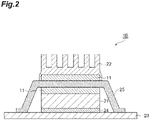
- FIG. 2 is a schematic cross-sectional view illustrating another embodiment of an electronic component containing a cured product of the curable composition set.
- the electronic component 1B shown in FIG. 1 is a processor containing, on one surface of a substrate 23, a semiconductor chip 21 as a heat source disposed with an underfill 24 interposed therebetween, a heat sink 22 as a thermal dissipation part, and a heat spreader 25 provided between the semiconductor chip 21 and the heat sink 22.
- a first cured product 11 provided to be in contact with the semiconductor chip 21.
- a second cured product 11 is Provided between the heat spreader 25 and the heat sink 22 a second cured product 11.
- the substrate 23, the underfill 24, and the heat spreader 25 may be formed from materials that are generally used in the art.
- the substrate 23 may be a laminated substrate or the like
- the underfill 24 may be formed from a resin such as an epoxy resin or the like
- the heat spreader 25 may be a metal plate or the like.
- the first cured product 11 and the second cured product 11 are each a cured product of the above-mentioned curable composition set.
- the first cured product 11 is in direct contact with the semiconductor chip 21 as a heat source; however, the second cured product 11 is thermally in contact with the semiconductor chip 21 as a heat source, with the first cured product 11 and the heat spreader 25 interposed therebetween.
- the cured products work as thermally conductive materials (thermal interface materials) for the electronic component 1B. That is, the first cured product 11 promotes thermal conduction from the semiconductor chip 21 to the heat spreader 25. Furthermore, the second cured product 11 promotes thermal conduction from the heat spreader 25 to the heat sink 22. Then, heat is dissipated from the heat sink 22 to the outside.
- the first cured product 11 and the second cured product 11 have low elasticity and excellent elongation by using the above-mentioned curable composition set. Therefore, the first cured product 11 and the second cured product 11 have high followability to the deformation of the electronic component 1B occurring due to heat. Therefore, the heat generated from the semiconductor chip 21 can be more effectively conducted to the heat spreader 25, and in addition, the heat can be more effectively conducted to the heat sink 22. Furthermore, since the first cured product 11 and the second cured product 11 are cured products of the above-mentioned curable composition set, the cured products also have excellent strength (for example, breaking strength).
- the first cured product 11 and the second cured product 11 can also be obtained by disposing the first liquid and the second liquid between the semiconductor chip 21 and the heat spreader 25, or between the heat spreader 25 and the heat sink 22. Therefore, even in the electronic component 1B, the generation of voids caused by liquid dripping and the pump-out phenomenon of the curable composition can be suppressed, and consequently, excellent adhesiveness of the first cured product 11 and the second cured product 11 (adhesiveness to the surface of the semiconductor chip 21, the heat spreader 25, and/or the heat sink 22) can be obtained.
- a 500-mL flask configured to contain a stirrer, a thermometer, a nitrogen gas inlet tube, a discharge tube, and a heating jacket was used as a reactor, 225 g of a glycol having a polyoxyalkylene chain ("NEWPOL 75H-90000" manufactured by Sanyo Chemical Industries, Ltd.) and 300 g of toluene were added to the reactor, the mixture was stirred at 45°C and a speed of stirring rotation of 250 times/min, nitrogen was caused to flow at a rate of 100 mL/min, and the mixture was stirred for 30 minutes.
- a glycol having a polyoxyalkylene chain (“NEWPOL 75H-90000" manufactured by Sanyo Chemical Industries, Ltd.)
- the compound represented by the formula (1-8) was obtained by the same method as the method for synthesizing the compound represented by the formula (1-7), except that the glycol having a polyoxyalkylene chain ("NEWPOL 75H-90000" manufactured by Sanyo Chemical Industries, Ltd.) was changed to 240 g of polyoxyethylene polyoxypropylene glycol (molecular weight 16000).
- oxidizing agent 1 cumene hydroperoxide (containing about 20% aromatic hydrocarbon) (Tokyo Chemical Industry Co., Ltd.) or oxidizing agent 2: 1,1,3,3-tetramethylbutyl hydroperoxide ("Trigonox TMBH-L" manufactured by Kayaku Nouryon Corporation)
- oxidizing agent 2 1,1,3,3-tetramethylbutyl hydroperoxide ("Trigonox TMBH-L” manufactured by Kayaku Nouryon Corporation)
- the curing time was evaluated using a rheometer (manufactured by Anton Paar).
- the first liquid and the second liquid were mixed at the mixing mass ratio shown in Table 1 to obtain a mixture (curable composition) of the first liquid and the second liquid.
- About 1.5 g of the curable composition was weighed in a disposable sample dish of the rheometer (Anton Paar), and the distance between the disposable dish and the disposable plate D-PP25 (manufactured by Anton Paar) was adjusted so that the thickness of the curable composition was 0.5 mm. After removing the excess curable composition on the disposable dish, the disposable plate was vibrated at 1 Hz with a strain of 2% and the measurement started with the sample kept constant at 25°C. The time from the start of measurement to the rise of the storage modulus value was defined as the curing time.
- the first liquid and the second liquid were mixed at the mixing mass ratio shown in Table 1 to obtain a mixture of the first liquid and the second liquid (curable composition).
- the curable composition was filled in a 10 cm ⁇ 10 cm ⁇ 0.2 mm mold (made of a SUS plate), covered with a SUS plate, and then cured by heating at 50°C for 30 minutes to obtain a cured product of the curable composition set (a cured product of the mixture of the first liquid and the second liquid) having a thickness of 0.2 mm.
- the tensile modulus, elongation at break, and breaking strength of the cured product at 25°C were measured using a tensile tester ("Autograph EZ-TEST EZ-S" manufactured by SHIMADZU CORPORATION). Regarding the measurement, measurement was performed for a cured product having a shape of 0.2 mm (thickness) ⁇ 5 mm (width) ⁇ 30 mm (length) based on JIS K7161 under the conditions of a distance between chucks of 20 mm and a tensile rate of 5 mm/min.
- Example 1 For the cured products of Examples 1 to 9, the measurement results for various physical properties are shown in Table 1. [Table 1] Example 1 2 3 4 5 6 7 8 9 Blending amount (parts by mass) Common components of first liquid and second liquid (A-1) 1.31 1.31 1.31 1.18 1.18 1.18 1.06 - (A-2) - - - - - - - 1.18 (B-1) 0.66 0.66 0.66 0.59 0.59 0.59 0.59 0.53 0.59 (B-2) 2.08 2.08 2.08 1.97 1.97 1.97 1.97 1.77 1.97 (C) 0.33 0.33 0.33 0.33 0.20 0.20 0.20 0.20 0.18 0.20 (D) 0.26 0.26 0.26 0.26 0.24 0.24 0.24 0.21 0.24 (E-1) 31.51 31.51 31.51 31.51 31.51 31.51 31.51 31.51 31.51 31.51 (E-2) 11.46 11.46 11.46 11.46 11.46 11.46 11.46 11.46 (E-3) 4.78 4.78 4.78 4.78 4.78 4.78 4.
- 1A, 1B electronic component
- 11 cured product of curable composition set
- 21 semiconductor chip (heat source)
- 22 heat sink
- 23 substrate
- 24 underfill
- 25 heat spreader
Landscapes
- Chemical & Material Sciences (AREA)
- Organic Chemistry (AREA)
- Chemical Kinetics & Catalysis (AREA)
- Health & Medical Sciences (AREA)
- Medicinal Chemistry (AREA)
- Polymers & Plastics (AREA)
- Engineering & Computer Science (AREA)
- General Chemical & Material Sciences (AREA)
- Physics & Mathematics (AREA)
- Combustion & Propulsion (AREA)
- Thermal Sciences (AREA)
- Materials Engineering (AREA)
- Compositions Of Macromolecular Compounds (AREA)
- Macromonomer-Based Addition Polymer (AREA)
- Addition Polymer Or Copolymer, Post-Treatments, Or Chemical Modifications (AREA)
- Polymerisation Methods In General (AREA)
- Graft Or Block Polymers (AREA)
- Polyethers (AREA)
- Polymerization Catalysts (AREA)
Abstract
Description
- The present invention relates to a curable composition set and an article.
- Electronic components such as processors and power modules, batteries for electric vehicles, and the like are accompanied by heat generation during use. In order to protect such a component from heat, a means that efficiently dissipates the generated heat is required. A thermally conductive material (may also be referred to as thermal dissipation material) called a thermal interface material (TIM) is a material provided between a heat source and a thermal dissipation member such as a heat sink, and the thermally conductive material reduces the heat resistance between the heat source and the thermal dissipation member and promotes thermal conduction from the heat source. Since the heat generated from the heat source is efficiently conducted to a cooling member via the TIM, the heat is easily dissipated from the thermal dissipation member.
- Regarding the thermally conductive material, a large number of liquid materials are known, and they are also referred to as thermal dissipation greases or thermally conductive greases. For example, in Patent Literature 1, a thermally conductive grease composition containing predetermined amounts of a liquid hydrocarbon oil and/or a fluorinated hydrocarbon oil and a thermally conductive inorganic filler is disclosed. Furthermore, in Patent Literature 2, a thermally conductive grease containing a specific phenyl ether-based base oil, a specific phenol-based oxidation inhibitor, and an inorganic powder filler is disclosed.
-
- Patent Literature 1:
Japanese Unexamined Patent Publication No. 11-246885 - Patent Literature 2:
Japanese Unexamined Patent Publication No. 2011-111517 - When a liquid thermally conductive grease is used, liquid dripping or a pump-out phenomenon in which the grease is pushed out from between the members due to deformation of the member on which the thermally conductive grease is applied, may occur. Liquid dripping or the pump-out phenomenon generates voids between the grease and the member, decreases the adhesiveness of the grease to the member, and causes an increase in heat resistance between the thermal dissipation grease and the member. Due to liquid dripping or the pump-out phenomenon, other members may be contaminated by the grease, and insulation failure may occur.
- In order to solve such a problem, a thermally conductive material formed into a solid form such as a sheet may be used. Liquid dripping or the pump-out phenomenon can be suppressed by using a solid-form thermally conductive material. On the other hand, in an electronic component containing a member that generates heat and a thermal dissipation member, deformation such as warpage of the members may occur when cooling and heating is repeated. Accordingly, the solid-form thermally conductive material is required to be a material having low elasticity and excellent elongation so that the material can follow deformation of the members.
- According to an aspect, an object of the present invention is to provide a curable composition set capable of giving a cured product having low elasticity and excellent elongation.
- The inventors of the present invention conducted a thorough study, and as a result, the inventors found that a cured product of a curable composition set containing a specific compound having a polyoxyalkylene chain and having two (meth)acryloyl groups has low elasticity and excellent elongation. Furthermore, the inventors found that since this curable composition set contains a thermally conductive filler, the curable composition set is suitably used as a thermally conductive material, thus the inventors completing the present invention. According to some aspects, the present invention provides the following [1] to [11].
- [1] A curable composition set containing: a first liquid containing an oxidizing agent; and a second liquid containing a reducing agent, wherein at least one of the first liquid and the second liquid contains a compound represented by the following formula (1):

- [2] The curable composition set according to [1], wherein the polyoxyalkylene chain contains a structural unit represented by the following formula (2):

- [3] The curable composition set according to [1], wherein the polyoxyalkylene chain contains a structural unit represented by the following formula (3):
- [4] The curable composition set according to [1], wherein the polyoxyalkylene chain is a copolymer chain containing a structural unit represented by the following formula (2) and a structural unit represented by the following formula (3):


- [5] The curable composition set according to [4], wherein the copolymer chain is a random copolymer chain.
- [6] The curable composition set according to any one of [1] to [5], wherein the compound represented by the formula (1) has a weight average molecular weight of 5000 or more.
- [7] The curable composition set according to any one of [1] to [6], wherein the polyoxyalkylene chain has 100 or more of oxyalkylene groups.
- [8] The curable composition set according to any one of [1] to [7], wherein the compound represented by the formula (1) has a viscosity at 25°C of 1000 Pa·s or less.
- [9] The curable composition set according to any one of [1] to [8], further containing an oxidation inhibitor.
- [10] The curable composition set according to [9], wherein the oxidation inhibitor is a phenol-based oxidation inhibitor.
- [11] An article containing a heat source and a cured product of the curable composition set according to any one of [1] to [10], the cured product being provided to be thermally in contact with the heat source.
- According to an aspect of the present invention, a curable composition set capable of giving a cured product having low elasticity and excellent elongation can be provided. According to another aspect of the present invention, a curable composition set capable of giving a cured product having excellent elongation as well as low elasticity can be provided.
-
-
FIG. 1 is a schematic cross-sectional view illustrating an embodiment of an article containing a cured product of a curable composition set. -
FIG. 2 is a schematic cross-sectional view illustrating another embodiment of an article containing a cured product of a curable composition set. - Hereinafter, embodiments of the present invention will be described in detail with appropriate reference to the drawings. Incidentally, the present invention is not intended to be limited to the following embodiments.
- The term "(meth)acryloyl" according to the present specification means "acryloyl" and "methacryloyl" corresponding thereto, and the same also applies to similar expressions such as "(meth)acrylate" and "(meth)acryl" .
- The weight average molecular weight (Mw) according to the present specification means a value measured using gel permeation chromatography (GPC) under the following conditions and determined by using polystyrene as a standard substance.
- Measuring equipment: HLC-8320GPC (product name, manufactured by Tosoh Corp.)
- Analysis column: TSKgel SuperMultipore HZ-H (three columns connected) (product name, manufactured by Tosoh Corp.)
- Guide column: TSKguardcolumn SuperMP (HZ)-H (product name, manufactured by Tosoh Corp.)
- Eluent: THF
- Measurement temperature: 25°C
- A curable composition set according to an embodiment contains: a first liquid containing an oxidizing agent; and a second liquid containing a reducing agent. By mixing the first liquid and the second liquid, the oxidizing agent and the reducing agent react with each other to generate free radicals, and polymerization of a polymerizable component such as a compound represented by the formula (1) described below proceeds. According to the curable composition set of the present embodiment, a cured product of a mixture of the first liquid and the second liquid (hereinafter, this cured product is also referred to as a "cured product of the curable composition set") is obtained by mixing the first liquid and the second liquid.
- The oxidizing agent contained in the first liquid plays the role as a polymerization initiator (radical polymerization initiator). The oxidizing agent may be, for example, an organic peroxide or an azo compound. The organic peroxide may be, for example, a hydroperoxide, a peroxydicarbonate, a peroxy ester, a peroxy ketal, a dialkyl peroxide, or a diacyl peroxide. The azo compound may be AIBN (2,2'-azobisisobutyronitrile), γ-65 (azobisdimethylvaleronitrile), or the like. Regarding the oxidizing agent, one kind thereof can be used alone, or two or more kinds thereof can be used in combination.
- Examples of the hydroperoxide include diisopropylbenzene hydroperoxide, 1,1,3,3-tetramethylbutyl hydroperoxide, and cumene hydroperoxide.
- Examples of the peroxydicarbonate include di-n-propyl peroxydicarbonate, diisopropyl peroxydicarbonate, bis(4-t-butylcyclohexyl) peroxydicarbonate, di-2-ethoxymethoxy peroxydicarbonate, di(2-ethylhexylperoxy) dicarbonate, dimethoxybutyl peroxydicarbonate, and di(3-methyl-3-methoxybutyl peroxy) dicarbonate.
- Examples of the peroxy ester include cumyl peroxyneodecanoate, 1,1,3,3-tetramethylbutyl peroxyneodecanoate, 1-cyclohexyl-1-methylethyl peroxyneodecanoate, t-hexyl peroxyneodecanoate, t-butyl peroxypivalate, 1,1,3,3-tetramethylbutyl peroxy-2-ethylhexanoate, 2,5-dimethyl-2,5-di(2-ethylhexanoylperoxy)hexane, 1-cyclohexyl-1-methylethyl peroxy-2-ethylhexanoate, t-hexyl peroxy-2-ethylhexanoate, t-butyl peroxy-2-ethylhexanoate, t-butyl peroxyisobutyrate, 1,1-bis(t-butylperoxy)cyclohexane, t-butyl peroxy-3,5,5-trimethylhexanoate, t-butyl peroxylaurate, 2,5-dimethyl-2,5-di(m-toluoylperoxy)hexane, t-hexyl peroxybenzoate, and t-butyl peroxyacetate.
- Examples of the peroxy ketal include 1,1-bis(t-hexylperoxy)-3,3,5-trimethylcyclohexane, 1,1-bis(t-hexylperoxy)cyclohexane, 1,1-bis(t-butylperoxy)-3,3,5-trimethylcyclohexane, 1,1-bis(t-butylperoxy)cyclododecane, and 2,2-bis(t-butylperoxy)decane.
- Examples of the dialkyl peroxide include α,α'-bis(t-butylperoxy)diisopropylbenzene, dicumyl peroxide, 2,5-dimethyl-2,5-di(t-butylperoxy)hexane, and t-butyl cumyl peroxide.
- Examples of the diacyl peroxide include isobutyl peroxide, 2,4-dichlorobenzoyl peroxide, 3,5,5-trimethylhexanoyl peroxide, octanoyl peroxide, lauroyl peroxide, stearoyl peroxide, succinic peroxide, benzoyl peroxytoluene, and benzoyl peroxide.
- From the viewpoint of storage stability, the oxidizing agent is preferably a peroxide, more preferably a hydroperoxide, even more preferably 1,1,3,3-tetramethylbutyl hydroperoxide or cumene hydroperoxide, and particularly preferably 1,1,3,3-tetramethylbutyl hydroperoxide.
- The content of the oxidizing agent may be 0.1 % by mass or more, 0.5% by mass or more, or 1% by mass or more, and may be 10% by mass or less, 5% by mass or less, or 3% by mass or less, based on the sum of the first liquid and the second liquid.
- The reducing agent contained in the second liquid may be, for example, a tertiary amine, a thiourea derivative, or a transition metal salt. Examples of the tertiary amine include triethylamine, tripropylamine, tributylamine, and N,N-dimethyl-para-toluidine. Examples of the thiourea derivative include 2-mercaptobenzimidazole, methylthiourea, dibutylthiourea, tetramethylthiourea, and ethylenethiourea. Examples of the transition metal salt include cobalt naphthenate, copper naphthenate, and vanadyl acetylacetonate.
- From the viewpoint of having an excellent curing rate, the reducing agent is preferably a thiourea derivative or a transition metal salt. The thiourea derivative may be, for example, ethylenethiourea. From a similar viewpoint, the transition metal salt is preferably vanadyl acetylacetonate.
- The content of the reducing agent may be 0.05% by mass or more, 0.1% by mass or more, or 0.3% by mass or more, and may be 5% by mass or less, 3% by mass or less, or 1% by mass or less, based on the sum of the first liquid and the second liquid.
- In the curable composition set, at least one of the first liquid and the second liquid contains a compound represented by the following formula (1):

- According to an embodiment, any one of R11 and R12 may be a hydrogen atom, while the other may be a methyl group; according to another embodiment, both R11 and R12 may be a hydrogen atom; and according to still another embodiment, both R11 and R12 may be a methyl group.
- According to an embodiment, the polyoxyalkylene chain contains a structural unit represented by the following formula (2).

- As a result, the strength of the cured product can be increased while suppressing an excessive increase of the viscosity of the curable composition (which refers to one or both of the first liquid and the second liquid; the same applies hereinafter).
- In this case, R13 may be a divalent group having a polyoxyethylene chain, and the compound represented by the formula (1) is preferably a compound represented by the following formula (1-2) (polyethylene glycol di(meth)acrylate):

- According to another embodiment, the polyoxyalkylene chain contains a structural unit represented by the following formula (3).

- As a result, handling of the curable composition can be facilitated.
- In this case, R13 may be a divalent group having a polyoxypropylene chain, and the compound represented by the formula (1) is preferably a compound represented by the following formula (1-3) (polypropylene glycol di(meth)acrylate):

- According to another embodiment, from the viewpoint of making it easy to achieve both the strength of a cured product of the compound represented by the formula (1) and the handleability of the curable composition, the polyoxyalkylene chain is preferably a copolymer chain containing the above-mentioned structural unit represented by the formula (2) and the above-mentioned structural unit represented by the formula (3). The copolymer chain may be any one of an alternating copolymer chain, a block copolymer chain, or a random copolymer chain. From the viewpoint of further lowering the crystallinity of the compound represented by the formula (1) and further facilitating the handling of the curable composition, the copolymer chain is preferably a random copolymer chain.
- In each of the above-mentioned embodiments, the polyoxyalkylene chain may have an oxyalkylene group having 4 or 5 carbon atoms, such as an oxytetramethylene group, an oxybutylene group, or an oxypentylene group, as a structural unit in addition to the structural unit represented by the formula (2) and the structural unit represented by the formula (3).
- R13 may also be a divalent group further having an additional organic group in addition to the above-mentioned polyoxyalkylene chain. The additional organic group may be a chain-like group other than the polyoxyalkylene chain, and the additional organic group may be, for example, a methylene chain (chain having -CH2- as a structural unit), a polyester chain (chain containing -COO- in a structural unit), or a polyurethane chain (chain containing -OCON- in a structural unit).
- For example, the compound represented by the formula (1) may be a compound represented by the following formula (1-4):
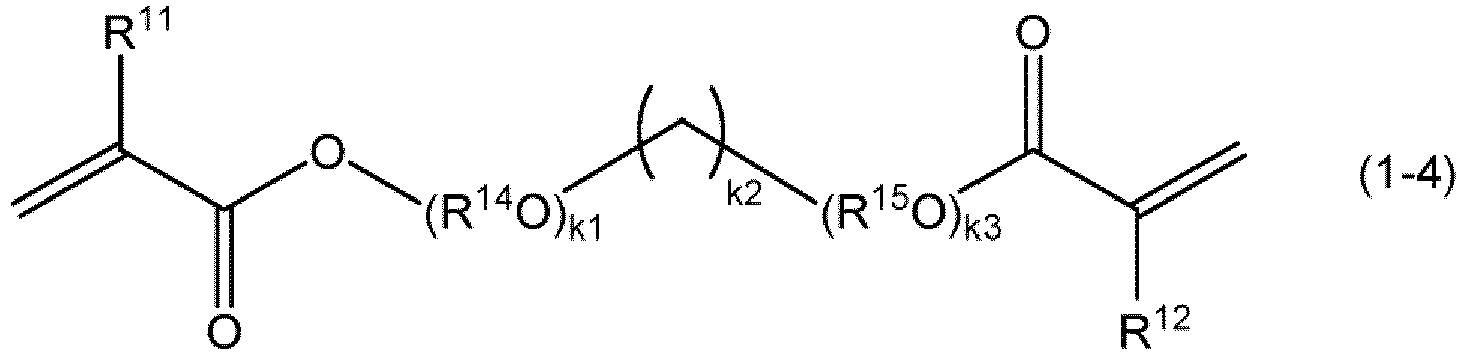
- Each of R14 and R15, which are present in plurality, may be identical with each other or may be different from each other. Each of R14 and R15, which are present in plurality, preferably contains an ethylene group and a propylene group. That is, a polyoxyalkylene chain represented by (R14O)k1 and a polyoxyalkylene chain represented by (R15O)k3 are each preferably a copolymer chain containing an oxyethylene group (the above-described structural unit represented by the formula (2)) and an oxypropylene group (the above-described structural unit represented by the formula (3)).
- In each of the above-described embodiments, the polyoxyalkylene chain preferably has 100 or more of oxyalkylene groups. When the number of oxyalkylene groups in the polyoxyalkylene chain is 100 or more, as the main chain of the compound represented by the formula (1) becomes longer, the elongation of the cured product is superior, and the strength of the cured product can also be increased. The number of oxyalkylene groups corresponds to each of m in the formula (1-2), n in the formula (1-3), and k1 and k3 in the formula (1-4).
- The number of oxyalkylene groups in the polyoxyalkylene chain is more preferably 130 or more, 180 or more, 200 or more, 220 or more, 250 or more, 270 or more, 300 or more, or 320 or more. The number of oxyalkylene groups in the polyoxyalkylene chain may be 600 or less, 570 or less, or 530 or less.
- From the viewpoint that the cured product has lower elasticity and excellent elongation, the weight average molecular weight of the compound represented by the formula (1) is preferably 5000 or more, 6000 or more, 7000 or more, 8000 or more, 9000 or more, 10000 or more, 11000 or more, 12000 or more, 13000 or more, 14000 or more, or 15000 or more. From the viewpoint of facilitating the adjustment of the viscosity of the curable composition, the weight average molecular weight of the compound represented by the formula (1) is preferably 100000 or less, 80000 or less, 60000 or less, 34000 or less, 31000 or less, or 28000 or less.
- The compound represented by the formula (1) may be liquid at 25°C. In this case, from the viewpoint of facilitating the application on a surface to be coated and from the viewpoint of increasing the adhesiveness of the cured product to a surface to be coated, the viscosity at 25°C of the compound represented by the formula (1) is preferably 1000 Pa·s or less, 800 Pa·s or less, 600 Pa·s or less, 500 Pa·s or less, 350 Pa·s or less, 300 Pa·s or less, or 200 Pa·s or less. The viscosity at 25°C of the compound represented by the formula (1) may be 0.1 Pa·s or more, 0.2 Pa·s or more, 0.3 Pa·s or more, 1 Pa·s or more, 2 Pa·s or more, or 3 Pa·s or more.
- The compound represented by the formula (1) may be solid at 25°C. In this case, from the viewpoint of further enhancing the handleability of the curable composition, the compound represented by the formula (1) is preferably liquid at 50°C. Furthermore, in this case, from the viewpoint of further enhancing the handleability of the curable composition, the viscosity at 50°C of the compound represented by the formula (1) is preferably 100 Pa·s or less, more preferably 50 Pa·s or less, even more preferably 30 Pa· s or less, and particularly preferably 20 Pa·s or less. The viscosity at 50°C of the compound represented by the formula (1) may be 0.1 Pa·s or more, 0.2 Pa·s or more, or 0.3 Pa·s or more.
- The viscosity means a value measured based on JIS Z 8803, and specifically, the viscosity means a value measured by using an E type viscometer (for example, manufactured by Toki Sangyo Co., Ltd., PE-80L). Incidentally, compensation of the viscometer can be carried out based on JIS Z 8809-JS14000. The viscosity of the compound represented by the formula (1) can be adjusted by adjusting the weight average molecular weight of the compound.
- From the viewpoint that the cured product has lower elasticity and excellent elongation, the content of the compound represented by the formula (1) is preferably 1% by mass or more, more preferably 1.5% by mass or more, and even more preferably 2% by mass or more, based on the sum of the first liquid and the second liquid. The content of the compound represented by the formula (1) may be 20% by mass or less, 17% by mass or less, or 15% by mass or less, based on the sum of the first liquid and the second liquid.
- The curable composition may contain an additional polymerizable compound (the details will be described below) other than the compound represented by the formula (1). In this case, from the viewpoint that the cured product has lower elasticity and excellent elongation, the content of the compound represented by the formula (1) is preferably 10 parts by mass or more, 20 parts by mass or more, 25 parts by mass or more, 30 parts by mass or more, or 35 parts by mass or more, with respect to 100 parts by mass of the sum of the compound represented by the formula (1) and the additional polymerizable compound (hereinafter, referred to as "sum of the contents of the polymerizable components"). The content of the compound represented by the formula (1) may be 80 parts by mass or less, 60 parts by mass or less, or 50 parts by mass or less, with respect to 100 parts by mass of the sum of the contents of the polymerizable components.
- In the curable composition set, at least one of the first liquid and the second liquid contains a thermally conductive filler. As a result, the thermal conductivity of the curable composition set and a cured product thereof is enhanced, and therefore, the curable composition set can be suitably utilized as a thermally conductive material, a thermal dissipation material, or the like. The thermally conductive filler refers to a filler having a thermal conductivity of 10 W/m·K or higher. Both of the first liquid and the second liquid preferably contain a thermally conductive filler.
- The thermally conductive filler may be insulative or may be electrically conductive, and the thermally conductive filler is preferably an insulative filler. Examples of the material that constitutes an insulative thermally conductive filler include aluminum oxide, aluminum hydroxide, magnesium oxide, beryllium oxide, boron nitride, aluminum nitride, silicon nitride, silicon carbide, silicon dioxide, aluminum fluoride, calcium fluoride, and zinc oxide. Examples of the material that constitutes an electrically conductive thermally conductive filler include aluminum, silver, and copper. The shape of the thermally conductive filler may be spherical or may be polyhedral.
- From the viewpoint that a cured product of the curable composition set can be thinly disposed, the average particle size of the thermally conductive filler is preferably 50 µm or less, more preferably 40 µm or less, even more preferably 30 µm or less, and may be 0.05 µm or more, 0.1 µm or more, or 0.3 µm or more. The average particle size of the thermally conductive filler means the particle size (D50) at which the volume cumulative particle size distribution is 50%, and the average particle size is measured using a laser diffraction type particle size distribution analyzer (for example, SALD-2300 (manufactured by SHIMADZU CORPORATION)).
- From the viewpoint of increasing the thermal conductivity of the curable composition, the content of the thermally conductive filler is preferably 60% by mass or more, more preferably 70% by mass or more, and even more preferably 80% by mass or more, and may be 97% by mass or less, 95% by mass or less, or 93% by mass or less, based on the sum of the first liquid and the second liquid.
- From the viewpoint of increasing the thermal conductivity of the curable composition, the content of the thermally conductive filler is preferably 70% by volume or more, more preferably 75% by volume or more, and even more preferably 80% by volume or more, and may be 90% by volume or less, 88% by volume or less, or 85% by volume or less, based on the total volume of the curable composition.
- For the purpose of adjusting the physical properties of the curable composition and the like, the curable composition may further contain an additional polymerizable compound that can be copolymerized with the above-mentioned compound represented by the formula (1).
- The additional polymerizable compound may be, for example, a compound having one (meth)acryloyl group. This compound may be, for example, an alkyl (meth)acrylate. The additional polymerizable compound may also be a compound having an aromatic hydrocarbon group, a group containing a polyoxyalkylene chain, a group containing a heterocyclic ring, an alkoxy group, a phenoxy group, a group containing a silane group, a group containing a siloxane bond, a halogen atom, a hydroxyl group, a carboxyl group, an amino group, or an epoxy group, in addition to the one (meth)acryloyl group. Particularly, as the curable composition contains an alkyl (meth)acrylate, the viscosity of the curable composition can be adjusted. Furthermore, as the curable composition contains a compound having a hydroxyl group, a carboxyl group, an amino group, or an epoxy group in addition to the (meth)acryloyl group, the adhesiveness of the curable composition and a cured product thereof to a member can be further enhanced.
- The alkyl group in the alkyl (meth)acrylate (alkyl group moiety other than the (meth)acryloyl group) may be linear, branched, or alicyclic. The number of carbon atoms of the alkyl group may be, for example, 1 to 30. The number of carbon atoms of the alkyl group may be 1 to 11, 1 to 8, 1 to 6, or 1 to 4, and may be 12 to 30, 12 to 28, 12 to 24, 12 to 22, 12 to 18, or 12 to 14.
- Examples of the alkyl (meth)acrylate having a linear alkyl group include an alkyl (meth)acrylate having a linear alkyl group having 1 to 11 carbon atoms, such as methyl (meth)acrylate, ethyl (meth)acrylate, propyl (meth)acrylate, butyl (meth)acrylate, pentyl (meth)acrylate, n-hexyl (meth)acrylate, n-heptyl (meth)acrylate, octyl (meth)acrylate, nonyl (meth)acrylate, decyl (meth)acrylate, or undecyl (meth)acrylate; and an alkyl (meth)acrylate having a linear alkyl group having 12 to 30 carbon atoms, such as dodecyl (meth)acrylate (lauryl (meth)acrylate), tetradecyl (meth)acrylate, hexadecyl (meth)acrylate (cetyl (meth)acrylate), octadecyl (meth)acrylate (stearyl (meth)acrylate), docosyl (meth)acrylate (behenyl (meth)acrylate), tetracosyl (meth)acrylate, hexacosyl (meth)acrylate, or octacosyl (meth)acrylate.
- Examples of the alkyl (meth)acrylate having a branched alkyl group include an alkyl (meth)acrylate having a branched alkyl group having 1 to 11 carbon atoms, such as s-butyl (meth)acrylate, t-butyl (meth)acrylate, isobutyl (meth)acrylate, isopentyl (meth)acrylate, isoamyl (meth)acrylate, isooctyl (meth)acrylate, 2-ethylhexyl (meth)acrylate, isononyl (meth)acrylate, or isodecyl (meth)acrylate; and an alkyl (meth)acrylate having a branched alkyl group having 12 to 30 carbon atoms, such as isomyristyl (meth)acrylate, 2-propylheptyl (meth)acrylate, isoundecyl (meth)acrylate, isododecyl (meth)acrylate, isotridecyl (meth)acrylate, isopentadecyl (meth)acrylate isohexadecyl (meth)acrylate, isoheptadecyl (meth)acrylate, isostearyl (meth)acrylate, or decyltetradecanyl (meth)acrylate.
- Examples of the alkyl (meth)acrylate having an alicyclic alkyl group (cycloalkyl group) include cyclohexyl (meth)acrylate, 3,3,5-trimethylcyclohexyl (meth)acrylate, isobornyl (meth)acrylate, terpene (meth)acrylate, and dicyclopentanyl (meth)acrylate.
- The compound having a (meth)acryloyl group and an aromatic hydrocarbon group may be benzyl (meth)acrylate or the like.
- Examples of the compound having a group containing a (meth)acryloyl group and a group containing a polyoxyalkylene chain include polyethylene glycol (meth)acrylate, methoxy polyethylene glycol (meth)acrylate, polypropylene glycol (meth)acrylate, methoxy polypropylene glycol (meth)acrylate, polybutylene glycol (meth)acrylate, and methoxy polybutylene glycol (meth)acrylate.
- Examples of the compound having a (meth)acryloyl group and a group containing a heterocyclic ring include tetrahydrofurfuryl (meth)acrylate.
- Examples of the compound having a (meth)acryloyl group and an alkoxy group include 2-methoxyethyl acrylate.
- Examples of the compound having a (meth)acryloyl group and a phenoxy group include phenoxyethyl (meth)acrylate.
- Examples of the compound having a (meth)acryloyl group and a group containing a silane group include 3-acryloxypropyltriethoxysilane,
- 10-methacryloyloxydecyltrimethoxysilane,
- 10-acryloyloxydecyltrimethoxysilane,
- 10-methacryloyloxydecyltriethoxysilane, and
- 10-acryloyloxydecyltriethoxysilane.
- Examples of the compound having a (meth)acryloyl group and a group containing a siloxane bond include silicone (meth)acrylate.
- Examples of the compound having a (meth)acryloyl group and a halogen atom include (meth)acrylates having fluorine atoms, such as trifluoromethyl (meth)acrylate, 2,2,2-trifluoroethyl (meth)acrylate, 1,1,1,3,3,3-hexafluoro-2-propyl (meth)acrylate, perfluoroethylmethyl (meth)acrylate, perfluoropropylmethyl (meth)acrylate, perfluorobutylmethyl (meth)acrylate, perfluoropentylmethyl (meth)acrylate, perfluorohexylmethyl (meth)acrylate, perfluoroheptylmethyl (meth)acrylate, perfluorooctylmethyl (meth)acrylate, perfluorononylmethyl (meth)acrylate, perfluorodecylmethyl (meth)acrylate, perfluoroundecylmethyl (meth)acrylate, perfluorododecylmethyl (meth)acrylate, perfluorotridecylmethyl (meth)acrylate, perfluorotetradecylmethyl (meth)acrylate, 2-(trifluoromethyl)ethyl (meth)acrylate, 2-(perfluoroethyl)ethyl (meth)acrylate, 2-(perfluoropropyl)ethyl (meth)acrylate, 2-(perfluorobutyl)ethyl (meth)acrylate, 2-(perfluoropentyl)ethyl (meth)acrylate, 2-(perfluorohexyl)ethyl (meth)acrylate, 2-(perfluoroheptyl)ethyl (meth)acrylate, 2-(perfluorooctyl)ethyl (meth)acrylate, 2-(perfluorononyl)ethyl (meth)acrylate, 2-(perfluorotridecyl)ethyl (meth)acrylate, and 2-(perfluorotetradecyl)ethyl (meth)acrylate.
- Examples of the compound having a (meth)acryloyl group and a hydroxyl group include a hydroxyalkyl (meth)acrylate such as 2-hydroxyethyl (meth)acrylate, 2-hydroxypropyl (meth)acrylate, 3-hydroxypropyl (meth)acrylate, 2-hydroxybutyl (meth)acrylate, 4-hydroxybutyl (meth)acrylate, 6-hydroxyhexyl (meth)acrylate, 8-hydroxyoctyl (meth)acrylate, 10-hydroxydecyl (meth)acrylate, or 12-hydroxylauryl (meth)acrylate; and a hydroxyalkylcycloalkane (meth)acrylate such as (4-hydroxymethylcyclohexyl)methyl (meth)acrylate.
- Examples of the compound having a (meth)acryloyl group and a carboxyl group include (meth)acrylic acid, carboxyethyl (meth)acrylate, carboxypentyl (meth)acrylate, phthalic acid monohydroxyethyl acrylate (for example, "ARONIX M5400" manufactured by Toagosei Co., Ltd.), and 2-acryloyloxyethyl succinate (for example, "NK ESTER A-SA" manufactured by Shin-Nakamura Chemical Co., Ltd.).
- Examples of the compound having a (meth)acryloyl group and an amino group include N,N-dimethylaminoethyl (meth)acrylate, N,N-diethylaminoethyl (meth)acrylate, N,N-dimethylaminopropyl (meth)acrylate, and N,N-diethylaminopropyl (meth)acrylate.
- Examples of the compound having a (meth)acryloyl group and an epoxy group include glycidyl (meth)acrylate, glycidyl α-ethyl (meth)acrylate, glycidyl α-n-propyl (meth)acrylate, glycidyl α-n-butyl (meth)acrylate, 3,4-epoxybutyl (meth)acrylate, 4,5-epoxypentyl (meth)acrylate, 6,7-epoxyheptyl (meth)acrylate, 6,7-epoxyheptyl α-ethyl (meth)acrylate, 3-methyl-3,4-epoxybutyl (meth)acrylate, 4-methyl-4,5-epoxypentyl (meth)acrylate, 5-methyl-5,6-epoxyhexyl (meth)acrylate, β-methylglycidyl (meth)acrylate, and β-methylglycidyl α-ethyl (meth)acrylate.
- From the viewpoint of facilitating the adjustment of the viscosity of the curable composition and from the viewpoint of further increasing the adhesiveness of the curable composition, the content of the additional polymerizable compound is preferably 1% by mass or more, more preferably 3% by mass or more, and even more preferably 5% by mass or more, and may be 20% by mass or less, 15% by mass or less, or 10% by mass or less, based on the sum of the first liquid and the second liquid.
- From the viewpoint of facilitating the adjustment of the viscosity of the curable composition, or from the viewpoint of further increasing the adhesiveness of the curable composition, the content of the additional polymerizable compound is preferably 30 parts by mass or more, more preferably 40 parts by mass or more, and even more preferably 50 parts by mass or more, and may be 90 parts by mass or less, 80 parts by mass or less, or 70 parts by mass or less, based on 100 parts by mass of the sum of the contents of the polymerizable components.
- The curable composition can further contain a plasticizer. As the curable composition contains a plasticizer, the adhesiveness of the curable composition and the elongation of the cured product can be further enhanced. Examples of the plasticizer include tackifiers such as a butadiene rubber, an isoprene rubber, a silicone rubber, a styrenebutadiene rubber, a chloroprene rubber, a nitrile rubber, a butyl rubber, an ethylene-propylene rubber, a urethane rubber, an acrylic resin, a rosin-based resin, and a terpene-based resin; and a polyalkylene glycol.
- The content of the plasticizer may be 0.1 parts by mass or more, 1 part by mass or more, or 3 parts by mass or more, and may be 20 parts by mass or less, 15 parts by mass or less, 12 parts by mass or less, or 10 parts by mass or less, with respect to 100 parts by mass of the sum of the contents of the polymerizable components.
- From the viewpoint of enhancing the thermal reliability of a cured product of the curable composition set, the curable composition may further contain an oxidation inhibitor. The oxidation inhibitor may be, for example, a phenol-based oxidation inhibitor, a benzophenone-based oxidation inhibitor, a benzoate-based oxidation inhibitor, a hindered amine-based oxidation inhibitor, or a benzotriazole-based oxidation inhibitor, and the oxidation inhibitor is preferably a phenol-based oxidation inhibitor.
- The phenol-based oxidation inhibitor has, for example, a hindered phenol structure (hindered phenol ring). The hindered phenol structure (hindered phenol ring) may be, for example, a structure in which a t-butyl group is bonded to any one position or both positions of the ortho-position with respect to the hydroxyl group in a phenol ring. The phenol-based oxidation inhibitor has one or more, preferably two or more, more preferably three or more, and even more preferably four or more of such a hindered phenol ring.
- The content of the oxidation inhibitor may be 0.1% by mass or more, 0.2% by mass or more, or 0.3% by mass or more, and may be 5% by mass or less, 4% by mass or less, 3% by mass or less, 2% by mass or less, or 1% by mass or less, based on the sum of the first liquid and the second liquid.
- The curable composition can further contain additional additives as necessary. Examples of the additional additives include a surface treatment agent (for example, a silane coupling agent), a dispersant, a curing accelerator, a colorant, a crystal nucleating agent, a thermal stabilizer, a foaming agent, a flame retardant, a vibration damping agent, a dehydrating agent, and a flame retardant aid (for example, a metal oxide). The content of the additional additives may be 0.1% by mass or more and may be 30% by mass or less, based on the sum of the first liquid and the second liquid.
- The first liquid and the second liquid may be liquid at 25°C. As a result, it is possible to suitably coat the surface of an object such as a member serving as a heat source, a cooling member, or the like, and it is also possible to increase adhesion to the coated surface.
- In the curable composition set, each component other than the oxidizing agent and the reducing agent is preferably contained in both the first liquid and the second liquid. That is, in one embodiment, it is preferable that the first liquid contains the oxidizing agent, the compound represented by the formula (1), and the thermally conductive filler (and the additional components used as necessary), and the second liquid contains the reducing agent, the compound represented by the formula (1), and the thermally conductive filler (and the additional components used as necessary).
- Since a cured product of the above-mentioned curable composition set has thermal conductivity, low elasticity, and excellent elongation, the cured product is suitably used as a thermally conductive material (also referred to as thermal dissipation material) in electronic components such as power modules, CPUs, and ECUs; batteries, LED lightings, and LED backlights. That is, an embodiment of the present invention provides a thermally conductive material containing the above-mentioned compound represented by the formula (1) and a thermally conductive filler.
- Subsequently, an article containing a cured product of the above-mentioned curable composition set will be described by taking an electronic component as an example.
FIG. 1 is a schematic cross-sectional view illustrating an embodiment of an electronic component containing a cured product of the curable composition set. Theelectronic component 1A shown inFIG. 1 contains asemiconductor chip 21 as a heat source and aheat sink 22 as a thermal dissipation part. - The
electronic component 1A contains a curedproduct 11 of the above-mentioned curable composition set, the cured product being provided between thesemiconductor chip 21 and theheat sink 22. Since the curedproduct 11 has thermal conductivity, the curedproduct 11 works as a thermally conductive material (thermal interface material) in theelectronic component 1A, and heat is conducted from thesemiconductor chip 21 to theheat sink 22. Then, heat is dissipated from theheat sink 22 to the outside. - The cured
product 11 has low elasticity and excellent elongation by using the above-mentioned curable composition set. Therefore, the curedproduct 11 has high followability to the deformation of theelectronic component 1A occurring due to heat or the like. Accordingly, the heat generated from thesemiconductor chip 21 can be effectively conducted to theheat sink 22. Furthermore, since the curedproduct 11 is a cured product of the above-mentioned curable composition set, the curedproduct 11 also has excellent strength (for example, breaking strength). - The cured
product 11 can also be obtained by disposing the first liquid and the second liquid between thesemiconductor chip 21 and theheat sink 22. Therefore, the generation of voids by liquid dripping and the pump-out phenomenon can be suppressed, and consequently, the adhesiveness of the cured product 11 (adhesiveness to the surface of thesemiconductor chip 21 and the heat sink 22) can be made excellent. - In the
electronic component 1A described inFIG. 1 , the curedproduct 11 is disposed to be in direct contact with thesemiconductor chip 21 and theheat sink 22; however, the curedproduct 11 may be thermally in contact with a heat source, or according to another embodiment, the curedproduct 11 may be disposed to be in contact with a heat source (semiconductor chip), with another member interposed therebetween. -
FIG. 2 is a schematic cross-sectional view illustrating another embodiment of an electronic component containing a cured product of the curable composition set. Theelectronic component 1B shown inFIG. 1 is a processor containing, on one surface of asubstrate 23, asemiconductor chip 21 as a heat source disposed with anunderfill 24 interposed therebetween, aheat sink 22 as a thermal dissipation part, and aheat spreader 25 provided between thesemiconductor chip 21 and theheat sink 22. Provided between thesemiconductor chip 21 and theheat spreader 25 is a first curedproduct 11 provided to be in contact with thesemiconductor chip 21. Provided between theheat spreader 25 and theheat sink 22 is a second curedproduct 11. - The
substrate 23, theunderfill 24, and theheat spreader 25 may be formed from materials that are generally used in the art. For example, thesubstrate 23 may be a laminated substrate or the like, theunderfill 24 may be formed from a resin such as an epoxy resin or the like, and theheat spreader 25 may be a metal plate or the like. - The first cured
product 11 and the second curedproduct 11 are each a cured product of the above-mentioned curable composition set. The first curedproduct 11 is in direct contact with thesemiconductor chip 21 as a heat source; however, the second curedproduct 11 is thermally in contact with thesemiconductor chip 21 as a heat source, with the first curedproduct 11 and theheat spreader 25 interposed therebetween. - Since the first cured
product 11 and the second curedproduct 11 have thermal conductivity, the cured products work as thermally conductive materials (thermal interface materials) for theelectronic component 1B. That is, the first curedproduct 11 promotes thermal conduction from thesemiconductor chip 21 to theheat spreader 25. Furthermore, the second curedproduct 11 promotes thermal conduction from theheat spreader 25 to theheat sink 22. Then, heat is dissipated from theheat sink 22 to the outside. - The first cured
product 11 and the second curedproduct 11 have low elasticity and excellent elongation by using the above-mentioned curable composition set. Therefore, the first curedproduct 11 and the second curedproduct 11 have high followability to the deformation of theelectronic component 1B occurring due to heat. Therefore, the heat generated from thesemiconductor chip 21 can be more effectively conducted to theheat spreader 25, and in addition, the heat can be more effectively conducted to theheat sink 22. Furthermore, since the first curedproduct 11 and the second curedproduct 11 are cured products of the above-mentioned curable composition set, the cured products also have excellent strength (for example, breaking strength). - The first cured
product 11 and the second curedproduct 11 can also be obtained by disposing the first liquid and the second liquid between thesemiconductor chip 21 and theheat spreader 25, or between theheat spreader 25 and theheat sink 22. Therefore, even in theelectronic component 1B, the generation of voids caused by liquid dripping and the pump-out phenomenon of the curable composition can be suppressed, and consequently, excellent adhesiveness of the first curedproduct 11 and the second cured product 11 (adhesiveness to the surface of thesemiconductor chip 21, theheat spreader 25, and/or the heat sink 22) can be obtained. - Hereinafter, the present invention will be more specifically described by way of Examples; however, the present invention is not intended to be limited to the following Examples.
- In the Examples, the following components were used as common components of the first liquid and the second liquid.
- (A-1) A compound represented by the formula (1-7):

- (A-2) A compound represented by the formula (1-8):

- (B-1) 4-Hydroxybutyl acrylate (manufactured by Osaka Organic Chemical Industry, Ltd.)
- (B-2) Isodecyl acrylate ("FA111A" manufactured by Hitachi Chemical Co., Ltd.)
- (C) Plasticizer ("TACKIFIER KE359" manufactured by Arakawa Chemical Industries, Ltd.)
- (D) Phenol-based oxidation inhibitor ("ADEKASTAB AO-80" manufactured by ADEKA Corp.)
- (E-1) Filler made of alumina ("ADVANCED ALLTMINAAA-18" manufactured by Sumitomo Chemical Co., Ltd.)
- (E-2) Filler made of alumina ("ADVANCED ALUMINA AA-3" manufactured by Sumitomo Chemical Co., Ltd.)
- (E-3) Filler made of alumina ("ADVANCED ALUMINAAA-04" manufactured by Sumitomo Chemical Co., Ltd.)
- (F) Silane coupling agent ("KBM-5803" manufactured by Shin-Etsu Chemical Co., Ltd.)
- A 500-mL flask configured to contain a stirrer, a thermometer, a nitrogen gas inlet tube, a discharge tube, and a heating jacket was used as a reactor, 225 g of a glycol having a polyoxyalkylene chain ("NEWPOL 75H-90000" manufactured by Sanyo Chemical Industries, Ltd.) and 300 g of toluene were added to the reactor, the mixture was stirred at 45°C and a speed of stirring rotation of 250 times/min, nitrogen was caused to flow at a rate of 100 mL/min, and the mixture was stirred for 30 minutes. Subsequently, the temperature was decreased to 25°C, after completion of temperature decrease, 2.9 g of acryloyl chloride was added dropwise to the reactor, and the mixture was stirred for 30 minutes. Subsequently, 3.8 g of triethylamine was added dropwise thereto, and the mixture was stirred for 2 hours. Subsequently, the temperature was increased to 45°C, and the mixture was reacted for 2 hours. The reaction liquid was filtered, the filtrate was subjected to solvent removal, and a compound represented by the formula (1-7) was obtained.
- The compound represented by the formula (1-8) was obtained by the same method as the method for synthesizing the compound represented by the formula (1-7), except that the glycol having a polyoxyalkylene chain ("NEWPOL 75H-90000" manufactured by Sanyo Chemical Industries, Ltd.) was changed to 240 g of polyoxyethylene polyoxypropylene glycol (molecular weight 16000).
- The common components and an oxidizing agent (oxidizing agent 1: cumene hydroperoxide (containing about 20% aromatic hydrocarbon) (Tokyo Chemical Industry Co., Ltd.) or oxidizing agent 2: 1,1,3,3-tetramethylbutyl hydroperoxide ("Trigonox TMBH-L" manufactured by Kayaku Nouryon Corporation)) were mixed in a blending amount (parts by mass) shown in Table 1 to obtain a first liquid. In addition, the common components and a reducing agent (ethylene thiourea) were mixed in a blending amount (parts by mass) shown in Table 1 to obtain a second liquid. The amounts of the common components shown in Table 1 are the amounts of each of the first liquid and second liquid.
- The curing time was evaluated using a rheometer (manufactured by Anton Paar). The first liquid and the second liquid were mixed at the mixing mass ratio shown in Table 1 to obtain a mixture (curable composition) of the first liquid and the second liquid. About 1.5 g of the curable composition was weighed in a disposable sample dish of the rheometer (Anton Paar), and the distance between the disposable dish and the disposable plate D-PP25 (manufactured by Anton Paar) was adjusted so that the thickness of the curable composition was 0.5 mm. After removing the excess curable composition on the disposable dish, the disposable plate was vibrated at 1 Hz with a strain of 2% and the measurement started with the sample kept constant at 25°C. The time from the start of measurement to the rise of the storage modulus value was defined as the curing time.
- The first liquid and the second liquid were mixed at the mixing mass ratio shown in Table 1 to obtain a mixture of the first liquid and the second liquid (curable composition). Next, the curable composition was filled in a 10 cm × 10 cm × 0.2 mm mold (made of a SUS plate), covered with a SUS plate, and then cured by heating at 50°C for 30 minutes to obtain a cured product of the curable composition set (a cured product of the mixture of the first liquid and the second liquid) having a thickness of 0.2 mm. The obtained cured product was cut into a square having a size of 10 mm × 10 mm × 0.2 mm and was subjected to a blackening treatment by graphite spraying, and then the diffusivity of heat was measured by a xenon flash method ("LFA447 nanoflash" manufactured by NETZSCH-Geratebau GmbH, Selb/Bayern) under the conditions of 25°C. From the product of this value, the density measured by the Archimedean method, and the specific heat at 25°C measured with a differential scanning calorimeter ("DSC250" manufactured by TA Instruments, Inc.), the thermal conductivity in the thickness direction of the cured product was determined based on the following formula.

- α: Thermal diffusivity (m2/s)
- ρ: Density (kg/cm3)
- Cp: Specific heat (capacity) (kJ/(kg·K))
- The tensile modulus, elongation at break, and breaking strength of the cured product at 25°C were measured using a tensile tester ("Autograph EZ-TEST EZ-S" manufactured by SHIMADZU CORPORATION). Regarding the measurement, measurement was performed for a cured product having a shape of 0.2 mm (thickness) × 5 mm (width) × 30 mm (length) based on JIS K7161 under the conditions of a distance between chucks of 20 mm and a tensile rate of 5 mm/min.
- For the cured products of Examples 1 to 9, the measurement results for various physical properties are shown in Table 1.
[Table 1] Example 1 2 3 4 5 6 7 8 9 Blending amount (parts by mass) Common components of first liquid and second liquid (A-1) 1.31 1.31 1.31 1.18 1.18 1.18 1.18 1.06 - (A-2) - - - - - - - - 1.18 (B-1) 0.66 0.66 0.66 0.59 0.59 0.59 0.59 0.53 0.59 (B-2) 2.08 2.08 2.08 1.97 1.97 1.97 1.97 1.77 1.97 (C) 0.33 0.33 0.33 0.20 0.20 0.20 0.20 0.18 0.20 (D) 0.26 0.26 0.26 0.24 0.24 0.24 0.24 0.21 0.24 (E-1) 31.51 31.51 31.51 31.51 31.51 31.51 31.51 31.51 31.51 (E-2) 11.46 11.46 11.46 11.46 11.46 11.46 11.46 11.46 11.46 (E-3) 4.78 4.78 4.78 4.78 4.78 4.78 4.78 4.78 4.78 (F) 0.02 0.02 0.02 0.02 0.02 0.02 0.02 0.02 0.02 First liquid Oxidizing agent 1 0.38 0.19 0.10 0.09 0.14 0.18 - - - Oxidizing agent 2 - - - - - - 0.10 0.09 0.10 Second liquid Reducing agent 0.14 0.07 0.04 0.03 0.05 0.07 0.04 0.03 0.04 Mixing mass ratio of first liquid: second liquid 1:1 1:1 1:1 1:1 1:1 1:1 1:1 1:1 1:1 Blending amount of filler (% by volume) 76 76 76 78 78 78 78 80 78 Curing time (minutes) 7 11 25 30 17 10 49 59 48 Thermal conductivity (W/(m·K)) 3 3.1 3 3.1 3.1 3.2 3.9 4.3 3.5 Tensile modulus (MPa) 12 11.5 11.2 14.3 11.9 11.9 7.5 10.1 6.8 Elongation at break (%) 11.2 12.1 11.3 10.9 14.7 14.5 22.6 19.4 25.8 Breaking strength (MPa) 1.3 1.3 1.3 1.6 1.5 1.4 1.1 1.4 1.1 - As can be seen from Table 1, when the curable composition set contained the compound represented by the formula (1), a cured product having low elasticity and excellent elongation (low tensile modulus and high elongation at break) was obtained.
- 1A, 1B: electronic component, 11: cured product of curable composition set, 21: semiconductor chip (heat source), 22: heat sink, 23: substrate, 24: underfill, 25: heat spreader.
Claims (11)
- A curable composition set comprising:a first liquid comprising an oxidizing agent; anda second liquid comprising a reducing agent,wherein at least one of the first liquid and the second liquid comprises a compound represented by the following formula (1):
 wherein R11 and R12 each independently represent a hydrogen atom or a methyl group, and R13 represents a divalent group having a polyoxyalkylene chain, andwherein at least one of the first liquid and the second liquid comprises a thermally conductive filler.
- The curable composition set according to claim 1, wherein the polyoxyalkylene chain comprises a structural unit represented by the following formula (2):

- The curable composition set according to claim 1, wherein the polyoxyalkylene chain comprises a structural unit represented by the following formula (3):

- The curable composition set according to claim 1, wherein the polyoxyalkylene chain is a copolymer chain comprising a structural unit represented by the following formula (2) and a structural unit represented by the following formula (3):

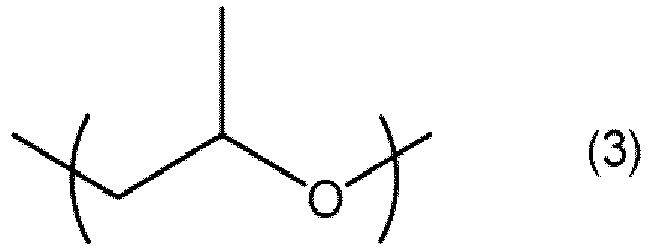
- The curable composition set according to claim 4, wherein the copolymer chain is a random copolymer chain.
- The curable composition set according to any one of claims 1 to 5, wherein the compound represented by the formula (1) has a weight average molecular weight of 5000 or more.
- The curable composition set according to any one of claims 1 to 6, wherein the polyoxyalkylene chain has 100 or more of oxyalkylene groups.
- The curable composition set according to any one of claims 1 to 7, wherein the compound represented by the formula (1) has a viscosity at 25°C of 1000 Pa·s or less.
- The curable composition set according to any one of claims 1 to 8, further comprising an oxidation inhibitor.
- The curable composition set according to claim 9, wherein the oxidation inhibitor is a phenol-based oxidation inhibitor.
- An article comprising:a heat source; anda cured product of the curable composition set according to any one of claims 1 to 10, the cured product being provided to be thermally in contact with the heat source.
Applications Claiming Priority (3)
| Application Number | Priority Date | Filing Date | Title |
|---|---|---|---|
| JP2019216616 | 2019-11-29 | ||
| JP2020019070 | 2020-02-06 | ||
| PCT/JP2020/043978 WO2021106992A1 (en) | 2019-11-29 | 2020-11-26 | Curable composition set and article |
Publications (2)
| Publication Number | Publication Date |
|---|---|
| EP4056611A1 true EP4056611A1 (en) | 2022-09-14 |
| EP4056611A4 EP4056611A4 (en) | 2023-01-18 |
Family
ID=76130535
Family Applications (2)
| Application Number | Title | Priority Date | Filing Date |
|---|---|---|---|
| EP20893504.9A Pending EP4056611A4 (en) | 2019-11-29 | 2020-11-26 | SET COMPOSITION SET AND ARTICLE |
| EP20892901.8A Pending EP4056610A4 (en) | 2019-11-29 | 2020-11-26 | CURABLE COMPOSITION AND ARTICLE |
Family Applications After (1)
| Application Number | Title | Priority Date | Filing Date |
|---|---|---|---|
| EP20892901.8A Pending EP4056610A4 (en) | 2019-11-29 | 2020-11-26 | CURABLE COMPOSITION AND ARTICLE |
Country Status (7)
| Country | Link |
|---|---|
| US (2) | US12729334B2 (en) |
| EP (2) | EP4056611A4 (en) |
| JP (3) | JPWO2021106992A1 (en) |
| KR (2) | KR102988437B1 (en) |
| CN (2) | CN114651021A (en) |
| TW (2) | TW202128951A (en) |
| WO (2) | WO2021106992A1 (en) |
Families Citing this family (8)
| Publication number | Priority date | Publication date | Assignee | Title |
|---|---|---|---|---|
| CN115052915A (en) | 2019-11-29 | 2022-09-13 | 昭和电工材料株式会社 | Composition containing a compound having a polyoxyalkylene chain |
| TW202128951A (en) * | 2019-11-29 | 2021-08-01 | 日商昭和電工材料股份有限公司 | Curable composition set and article |
| WO2022138562A1 (en) * | 2020-12-22 | 2022-06-30 | 昭和電工マテリアルズ株式会社 | Composition and sheet containing cured product of same |
| JP7870608B2 (en) * | 2021-10-15 | 2026-06-05 | 株式会社日本触媒 | Curable resin composition |
| JP7819460B2 (en) * | 2021-10-21 | 2026-02-25 | 株式会社レゾナック | Composition containing a compound having a polyoxyalkylene chain and a thermally conductive filler |
| US20250346702A1 (en) | 2022-05-19 | 2025-11-13 | Resonac Corporation | Composition that contains compound having polyoxyalkylene chain and acrylic copolymer |
| WO2023223978A1 (en) * | 2022-05-19 | 2023-11-23 | 株式会社レゾナック | Composition that contains compound having polyoxyalkylene chain and ester-based thixotropy-imparting agent |
| JPWO2024019001A1 (en) * | 2022-07-19 | 2024-01-25 |
Family Cites Families (81)
| Publication number | Priority date | Publication date | Assignee | Title |
|---|---|---|---|---|
| JP2550345B2 (en) | 1987-05-18 | 1996-11-06 | 三井石油化学工業株式会社 | contact lens |
| JPH01190711A (en) | 1988-01-25 | 1989-07-31 | Mitsubishi Rayon Co Ltd | Composition for plastic lens |
| JP3198285B2 (en) * | 1992-04-20 | 2001-08-13 | ジェイエスアール株式会社 | Liquid curable resin composition |
| US5489624A (en) | 1992-12-01 | 1996-02-06 | Minnesota Mining And Manufacturing Company | Hydrophilic pressure sensitive adhesives |
| JPH07322962A (en) | 1994-05-30 | 1995-12-12 | Kato Kikai Seisakusho:Kk | Food warming equipment |
| US5415896A (en) | 1994-07-20 | 1995-05-16 | Texaco Inc. | Railroad wheel flange lubricating method |
| US6274688B1 (en) * | 1997-07-28 | 2001-08-14 | Kaneka Corporation | Functional groups-terminated vinyl polymers |
| JPH1180723A (en) | 1997-09-05 | 1999-03-26 | Nippon Shokubai Co Ltd | Heat storage agent and its production and production of heat storage material |
| JP2938428B1 (en) | 1998-02-27 | 1999-08-23 | 信越化学工業株式会社 | Thermal conductive grease composition |
| JP4377055B2 (en) | 1998-04-28 | 2009-12-02 | 三菱レイヨン株式会社 | Acrylic premix, acrylic artificial marble, and manufacturing method thereof |
| JP4201945B2 (en) | 2000-01-07 | 2008-12-24 | 中国塗料株式会社 | Photo-curable composition, photo-curable coating composition, coating film formed therefrom, and method for coating woody substrate |
| JP2004026971A (en) | 2002-06-25 | 2004-01-29 | Idemitsu Kosan Co Ltd | Crosslinked heat storage material |
| US7005143B2 (en) | 2002-04-12 | 2006-02-28 | 3M Innovative Properties Company | Gel materials, medical articles, and methods |
| JP2004168740A (en) | 2002-11-22 | 2004-06-17 | Mitsubishi Rayon Co Ltd | (Meth) acrylic esters and their production |
| JP3970783B2 (en) | 2003-02-03 | 2007-09-05 | クラレメディカル株式会社 | Photopolymerizable composition |
| JP4793804B2 (en) | 2004-02-04 | 2011-10-12 | エスケー化研株式会社 | Floor heating structure |
| JP4711699B2 (en) | 2004-03-09 | 2011-06-29 | エスケー化研株式会社 | Damping laminate |
| JP4400268B2 (en) | 2004-03-17 | 2010-01-20 | 東レ株式会社 | Oil for carbon fiber precursor |
| JP2006022163A (en) | 2004-07-06 | 2006-01-26 | Kyocera Chemical Corp | Thermosetting resin molding material |
| JP4260716B2 (en) | 2004-09-30 | 2009-04-30 | 玉井化成株式会社 | Thermal storage material composition containing polyalkylene glycol |
| US7999023B2 (en) | 2004-12-03 | 2011-08-16 | 3M Innovative Properties Company | Process for making pressure sensitive adhesive hydrogels |
| JP5388409B2 (en) | 2006-09-28 | 2014-01-15 | 東レ・ダウコーニング株式会社 | Curable silicone composition and cured product thereof |
| JP2008127421A (en) | 2006-11-17 | 2008-06-05 | Auto Kagaku Kogyo Kk | Curable composition |
| JP2008239860A (en) | 2007-03-28 | 2008-10-09 | Toyokazutada Kk | Heat-storage medium |
| WO2009009009A2 (en) * | 2007-07-06 | 2009-01-15 | Henkel Corporation | Acrylic adhesives |
| DE102007032403A1 (en) | 2007-07-10 | 2009-01-22 | Evonik Röhm Gmbh | Use of a swellable polymer for sealing |
| DE102007032836A1 (en) | 2007-07-12 | 2009-01-15 | Evonik Röhm Gmbh | Emulsion polymer containing activators, processes for its preparation and its use in two- or multi-component systems |
| JP2009120826A (en) | 2007-10-23 | 2009-06-04 | Hitachi Chem Co Ltd | Adhesive composition and semiconductor device |
| JP5556039B2 (en) | 2008-03-31 | 2014-07-23 | 三菱レイヨン株式会社 | Prism sheet |
| JP2009249613A (en) | 2008-04-11 | 2009-10-29 | Three Bond Co Ltd | Curable resin composition |
| JP2009263542A (en) | 2008-04-25 | 2009-11-12 | Three M Innovative Properties Co | (meth)acrylic adhesive foam and method for producing the same |
| US8921490B2 (en) * | 2009-06-30 | 2014-12-30 | Henkel US IP LLC | Ultrafast heat/room temperature adhesive composition for bonding applications |
| US9333148B2 (en) | 2009-10-23 | 2016-05-10 | Kuraray Noritake Dental Inc. | Polymerizable composition and dental material |
| JP5318733B2 (en) | 2009-11-26 | 2013-10-16 | コスモ石油ルブリカンツ株式会社 | Thermally conductive grease |
| US9023932B2 (en) | 2010-01-19 | 2015-05-05 | Kaneka Corporation | Curable composition |
| JP2011195773A (en) | 2010-03-23 | 2011-10-06 | Kaneka Corp | Adhesive sheet |
| JP5565176B2 (en) | 2010-08-02 | 2014-08-06 | Jsr株式会社 | Composition, cured product thereof, and electronic device |
| KR101812830B1 (en) | 2010-08-23 | 2017-12-27 | 닛토덴코 가부시키가이샤 | W/o emulsion, foam, and functional foam |
| TWI520973B (en) | 2010-09-01 | 2016-02-11 | Kaneka Corp | Composition for electrical and electronic component materials and cured product thereof |
| KR20140130234A (en) | 2010-11-17 | 2014-11-07 | 히타치가세이가부시끼가이샤 | Photosensitive resin composition, photosensitive element, method for forming resist pattern, and method for manufacturing printed wiring board |
| JP2012167263A (en) | 2011-01-25 | 2012-09-06 | Sanyo Chem Ind Ltd | Microwave curable composition |
| JP2012188507A (en) * | 2011-03-09 | 2012-10-04 | Kaneka Corp | Composition for heat dissipation sheet and heat dissipation sheet formed by curing the same |
| JP5738641B2 (en) | 2011-03-25 | 2015-06-24 | 株式会社日本触媒 | Optical UV-curable resin composition, cured product, and display device |
| JP2013018842A (en) | 2011-07-08 | 2013-01-31 | Sanyo Chem Ind Ltd | Photosensitive composition |
| CN104053737B (en) * | 2011-08-03 | 2016-09-07 | 汉高知识产权控股有限责任公司 | The construction adhesive of conduction |
| JP2013203977A (en) | 2012-03-29 | 2013-10-07 | Dainippon Printing Co Ltd | Tacky sheet and non-tacky sheet |
| CN104303106B (en) | 2012-05-31 | 2018-08-07 | 日立化成株式会社 | Photosensitive resin composition, photosensitive element, method for forming resist pattern, and method for manufacturing wiring board |
| JP6018108B2 (en) | 2014-03-28 | 2016-11-02 | 富士フイルム株式会社 | Polymer composite piezoelectric material |
| JP6338915B2 (en) | 2014-04-07 | 2018-06-06 | 日本カーバイド工業株式会社 | Adhesive composition and adhesive sheet |
| EP3202796B1 (en) | 2014-09-29 | 2020-01-08 | Three Bond Co., Ltd. | Curable resin composition |
| JP6928314B2 (en) * | 2015-06-02 | 2021-09-01 | 日産化学株式会社 | Solvent-free photocurable adhesive composition |
| JPWO2017002506A1 (en) | 2015-06-29 | 2018-04-26 | 日産化学工業株式会社 | Imprint material |
| JP2017122139A (en) | 2016-01-05 | 2017-07-13 | セメダイン株式会社 | Photocurable composition |
| JP6022094B1 (en) | 2016-01-22 | 2016-11-09 | 共栄社化学株式会社 | Active energy ray-curable resin composition, cured product thereof and lens sheet |
| US11831097B2 (en) | 2016-06-30 | 2023-11-28 | The University Of Akron | UV-curable contact stabilization coating material for electrical contact surfaces |
| WO2018079534A1 (en) | 2016-10-31 | 2018-05-03 | 住友ベークライト株式会社 | Thermally conductive paste and electronic device |
| KR102029853B1 (en) * | 2016-10-31 | 2019-10-08 | 스미또모 베이크라이트 가부시키가이샤 | Thermally Conductive Pastes and Electronic Devices |
| JP6962745B2 (en) | 2017-01-11 | 2021-11-05 | アイカ工業株式会社 | LED curable moisture-proof insulating coating composition |
| JP6560283B2 (en) | 2017-03-17 | 2019-08-14 | 株式会社タムラ製作所 | Flux composition and solder paste |
| JP2018172565A (en) | 2017-03-31 | 2018-11-08 | コニシ株式会社 | Acrylic curable resin composition |
| WO2019193677A1 (en) | 2018-04-04 | 2019-10-10 | 日立化成株式会社 | Resin member, method for producing resin member and heat storage body |
| WO2019220663A1 (en) | 2018-05-15 | 2019-11-21 | 日立化成株式会社 | Resin composition, heat storage material, and article |
| KR102801346B1 (en) | 2018-06-05 | 2025-04-25 | 이데미쓰 고산 가부시키가이샤 | Thermosetting composition, method for producing molded articles using the same, and cured product |
| JP7210218B2 (en) | 2018-10-11 | 2023-01-23 | 日本ペイント株式会社 | paint composition |
| JP7099704B2 (en) | 2018-11-05 | 2022-07-12 | 北川工業株式会社 | Thermal conductive material |
| JP7155900B2 (en) | 2018-11-09 | 2022-10-19 | 東洋インキScホールディングス株式会社 | Composition for forming heat-storage layer, heat-storage layer using the composition, and heat-storage laminate |
| CN109504351B (en) | 2018-12-20 | 2021-03-26 | 大连理工大学 | A kind of polyether-based composite phase change energy storage material and preparation method thereof |
| WO2020149193A1 (en) | 2019-01-15 | 2020-07-23 | コスモ石油ルブリカンツ株式会社 | Curable composition and cured material |
| GB2582002B (en) | 2019-03-07 | 2022-12-28 | Henkel Ag & Co Kgaa | One-part anaerobically curable compositions |
| WO2021044261A1 (en) | 2019-09-03 | 2021-03-11 | National Research Council Of Canada | Spatially controlled functionality of polymeric products |
| CN110706926B (en) | 2019-10-14 | 2020-11-17 | 深圳市峰泳科技有限公司 | Flexible thin film capacitor capable of being used at wide temperature and preparation method thereof |
| CN115052915A (en) | 2019-11-29 | 2022-09-13 | 昭和电工材料株式会社 | Composition containing a compound having a polyoxyalkylene chain |
| TW202128951A (en) * | 2019-11-29 | 2021-08-01 | 日商昭和電工材料股份有限公司 | Curable composition set and article |
| JP2021098772A (en) | 2019-12-20 | 2021-07-01 | 東洋インキScホールディングス株式会社 | Active energy ray-polymerizable composition |
| JP7246733B2 (en) | 2020-01-21 | 2023-03-28 | 協立化学産業株式会社 | Sealant for liquid crystal drop method |
| JP2022055457A (en) | 2020-09-29 | 2022-04-08 | 積水化学工業株式会社 | Coating material, coated body and concrete structure |
| EP4258342B8 (en) * | 2020-12-01 | 2026-05-27 | Cosmo Oil Lubricants Co., Ltd. | Two-component curable composition and cured product thereof |
| KR20230150966A (en) | 2021-02-26 | 2023-10-31 | 가부시끼가이샤 레조낙 | Composition containing a compound having a polyoxyalkylene chain and a (meth)acrylamide compound |
| CN116917363B (en) | 2021-02-26 | 2026-09-22 | 株式会社力森诺科 | Compositions containing compounds having polyoxyalkylene chains and compounds having poly(meth)acrylate chains |
| WO2022209230A1 (en) * | 2021-03-31 | 2022-10-06 | コスモ石油ルブリカンツ株式会社 | Curable composition, and cured product |
| JP7819460B2 (en) | 2021-10-21 | 2026-02-25 | 株式会社レゾナック | Composition containing a compound having a polyoxyalkylene chain and a thermally conductive filler |
-
2020
- 2020-11-26 TW TW109141571A patent/TW202128951A/en unknown
- 2020-11-26 US US17/779,130 patent/US12729334B2/en active Active
- 2020-11-26 WO PCT/JP2020/043978 patent/WO2021106992A1/en not_active Ceased
- 2020-11-26 CN CN202080077985.1A patent/CN114651021A/en active Pending
- 2020-11-26 EP EP20893504.9A patent/EP4056611A4/en active Pending
- 2020-11-26 EP EP20892901.8A patent/EP4056610A4/en active Pending
- 2020-11-26 KR KR1020227020267A patent/KR102988437B1/en active Active
- 2020-11-26 KR KR1020227020268A patent/KR103002032B1/en active Active
- 2020-11-26 CN CN202080080616.8A patent/CN114729091A/en active Pending
- 2020-11-26 JP JP2021561479A patent/JPWO2021106992A1/ja active Pending
- 2020-11-26 US US17/779,129 patent/US20230002661A1/en active Pending
- 2020-11-26 TW TW109141566A patent/TWI853125B/en active
- 2020-11-26 JP JP2021561482A patent/JP7622644B2/en active Active
- 2020-11-26 WO PCT/JP2020/043999 patent/WO2021107001A1/en not_active Ceased
-
2026
- 2026-02-16 JP JP2026023105A patent/JP2026083015A/en active Pending
Also Published As
| Publication number | Publication date |
|---|---|
| CN114729091A (en) | 2022-07-08 |
| TW202128951A (en) | 2021-08-01 |
| JP2026083015A (en) | 2026-05-19 |
| WO2021107001A1 (en) | 2021-06-03 |
| JPWO2021107001A1 (en) | 2021-06-03 |
| KR102988437B1 (en) | 2026-07-07 |
| US20230002661A1 (en) | 2023-01-05 |
| US20230016868A1 (en) | 2023-01-19 |
| EP4056611A4 (en) | 2023-01-18 |
| JP7622644B2 (en) | 2025-01-28 |
| KR103002032B1 (en) | 2026-08-06 |
| TWI853125B (en) | 2024-08-21 |
| EP4056610A1 (en) | 2022-09-14 |
| CN114651021A (en) | 2022-06-21 |
| KR20220108081A (en) | 2022-08-02 |
| KR20220108080A (en) | 2022-08-02 |
| WO2021106992A1 (en) | 2021-06-03 |
| EP4056610A4 (en) | 2023-01-18 |
| TW202124520A (en) | 2021-07-01 |
| JPWO2021106992A1 (en) | 2021-06-03 |
| US12729334B2 (en) | 2026-09-08 |
Similar Documents
| Publication | Publication Date | Title |
|---|---|---|
| US12729334B2 (en) | Curable composition set and article | |
| US20240132646A1 (en) | Composition containing (meth)acrylamide compound and compound having polyoxyalkylene chain | |
| US20240132645A1 (en) | Composition containing compound having polyoxyalkylene chain and compound having poly(meth)acrylate chain | |
| JP2026076327A (en) | A set of compositions containing compounds having polyoxyalkylene chains. | |
| JP7819460B2 (en) | Composition containing a compound having a polyoxyalkylene chain and a thermally conductive filler | |
| US20260193507A1 (en) | Composition containing (meth)acrylic polymer and metal particles | |
| EP4512837A1 (en) | Composition that contains compound having polyoxyalkylene chain and acrylic copolymer | |
| US20250297092A1 (en) | Composition that contains compound having polyoxyalkylene chain and ester-based thixotropy-imparting agent |
Legal Events
| Date | Code | Title | Description |
|---|---|---|---|
| STAA | Information on the status of an ep patent application or granted ep patent |
Free format text: STATUS: THE INTERNATIONAL PUBLICATION HAS BEEN MADE |
|
| PUAI | Public reference made under article 153(3) epc to a published international application that has entered the european phase |
Free format text: ORIGINAL CODE: 0009012 |
|
| STAA | Information on the status of an ep patent application or granted ep patent |
Free format text: STATUS: REQUEST FOR EXAMINATION WAS MADE |
|
| 17P | Request for examination filed |
Effective date: 20220606 |
|
| AK | Designated contracting states |
Kind code of ref document: A1 Designated state(s): AL AT BE BG CH CY CZ DE DK EE ES FI FR GB GR HR HU IE IS IT LI LT LU LV MC MK MT NL NO PL PT RO RS SE SI SK SM TR |
|
| REG | Reference to a national code |
Ref country code: DE Ref legal event code: R079 Free format text: PREVIOUS MAIN CLASS: C08F0290060000 Ipc: C09J0133080000 |
|
| STAA | Information on the status of an ep patent application or granted ep patent |
Free format text: STATUS: EXAMINATION IS IN PROGRESS |
|
| A4 | Supplementary search report drawn up and despatched |
Effective date: 20221219 |
|
| RIC1 | Information provided on ipc code assigned before grant |
Ipc: C08K 3/013 20180101ALI20221214BHEP Ipc: C08G 65/332 20060101ALI20221214BHEP Ipc: C08F 290/06 20060101ALI20221214BHEP Ipc: C09J 133/10 20060101ALI20221214BHEP Ipc: C09J 133/04 20060101ALI20221214BHEP Ipc: C09J 133/08 20060101AFI20221214BHEP |
|
| 17Q | First examination report despatched |
Effective date: 20230109 |
|
| DAV | Request for validation of the european patent (deleted) | ||
| DAX | Request for extension of the european patent (deleted) | ||
| RAP3 | Party data changed (applicant data changed or rights of an application transferred) |
Owner name: RESONAC CORPORATION |
|
| RIN1 | Information on inventor provided before grant (corrected) |
Inventor name: MORIMOTO, TSUYOSHI Inventor name: YOKOTA, HIROSHI Inventor name: FURUKAWA, NAOKI Inventor name: NAKAMURA, YUKI Inventor name: MATSUBARA, NOZOMI |
|
| RAP3 | Party data changed (applicant data changed or rights of an application transferred) |
Owner name: RESONAC CORPORATION |
|
| GRAP | Despatch of communication of intention to grant a patent |
Free format text: ORIGINAL CODE: EPIDOSNIGR1 |
|
| STAA | Information on the status of an ep patent application or granted ep patent |
Free format text: STATUS: GRANT OF PATENT IS INTENDED |
|
| INTG | Intention to grant announced |
Effective date: 20260716 |