EP4056561B1 - Compound having anti-aging and discoloration resistance effects and preparation method therefor - Google Patents
Compound having anti-aging and discoloration resistance effects and preparation method therefor Download PDFInfo
- Publication number
- EP4056561B1 EP4056561B1 EP20884942.2A EP20884942A EP4056561B1 EP 4056561 B1 EP4056561 B1 EP 4056561B1 EP 20884942 A EP20884942 A EP 20884942A EP 4056561 B1 EP4056561 B1 EP 4056561B1
- Authority
- EP
- European Patent Office
- Prior art keywords
- compound
- reaction
- rubber
- alkyl
- phenylenediamine
- Prior art date
- Legal status (The legal status is an assumption and is not a legal conclusion. Google has not performed a legal analysis and makes no representation as to the accuracy of the status listed.)
- Active
Links
Classifications
-
- C—CHEMISTRY; METALLURGY
- C07—ORGANIC CHEMISTRY
- C07D—HETEROCYCLIC COMPOUNDS
- C07D251/00—Heterocyclic compounds containing 1,3,5-triazine rings
- C07D251/02—Heterocyclic compounds containing 1,3,5-triazine rings not condensed with other rings
- C07D251/12—Heterocyclic compounds containing 1,3,5-triazine rings not condensed with other rings having three double bonds between ring members or between ring members and non-ring members
- C07D251/26—Heterocyclic compounds containing 1,3,5-triazine rings not condensed with other rings having three double bonds between ring members or between ring members and non-ring members with only hetero atoms directly attached to ring carbon atoms
- C07D251/40—Nitrogen atoms
- C07D251/54—Three nitrogen atoms
- C07D251/70—Other substituted melamines
-
- B—PERFORMING OPERATIONS; TRANSPORTING
- B60—VEHICLES IN GENERAL
- B60C—VEHICLE TYRES; TYRE INFLATION; TYRE CHANGING; CONNECTING VALVES TO INFLATABLE ELASTIC BODIES IN GENERAL; DEVICES OR ARRANGEMENTS RELATED TO TYRES
- B60C1/00—Tyres characterised by the chemical composition or the physical arrangement or mixture of the composition
-
- C—CHEMISTRY; METALLURGY
- C08—ORGANIC MACROMOLECULAR COMPOUNDS; THEIR PREPARATION OR CHEMICAL WORKING-UP; COMPOSITIONS BASED THEREON
- C08K—Use of inorganic or non-macromolecular organic substances as compounding ingredients
- C08K5/00—Use of organic ingredients
- C08K5/16—Nitrogen-containing compounds
- C08K5/34—Heterocyclic compounds having nitrogen in the ring
- C08K5/3467—Heterocyclic compounds having nitrogen in the ring having more than two nitrogen atoms in the ring
- C08K5/3477—Six-membered rings
- C08K5/3492—Triazines
-
- C—CHEMISTRY; METALLURGY
- C08—ORGANIC MACROMOLECULAR COMPOUNDS; THEIR PREPARATION OR CHEMICAL WORKING-UP; COMPOSITIONS BASED THEREON
- C08K—Use of inorganic or non-macromolecular organic substances as compounding ingredients
- C08K5/00—Use of organic ingredients
- C08K5/16—Nitrogen-containing compounds
- C08K5/34—Heterocyclic compounds having nitrogen in the ring
- C08K5/3467—Heterocyclic compounds having nitrogen in the ring having more than two nitrogen atoms in the ring
- C08K5/3477—Six-membered rings
- C08K5/3492—Triazines
- C08K5/34922—Melamine; Derivatives thereof
-
- C—CHEMISTRY; METALLURGY
- C08—ORGANIC MACROMOLECULAR COMPOUNDS; THEIR PREPARATION OR CHEMICAL WORKING-UP; COMPOSITIONS BASED THEREON
- C08K—Use of inorganic or non-macromolecular organic substances as compounding ingredients
- C08K5/00—Use of organic ingredients
- C08K5/49—Phosphorus-containing compounds
- C08K5/51—Phosphorus bound to oxygen
- C08K5/53—Phosphorus bound to oxygen bound to oxygen and to carbon only
- C08K5/5313—Phosphinic compounds, e.g. R2=P(:O)OR'
-
- C—CHEMISTRY; METALLURGY
- C08—ORGANIC MACROMOLECULAR COMPOUNDS; THEIR PREPARATION OR CHEMICAL WORKING-UP; COMPOSITIONS BASED THEREON
- C08L—COMPOSITIONS OF MACROMOLECULAR COMPOUNDS
- C08L21/00—Compositions of unspecified rubbers
-
- C—CHEMISTRY; METALLURGY
- C08—ORGANIC MACROMOLECULAR COMPOUNDS; THEIR PREPARATION OR CHEMICAL WORKING-UP; COMPOSITIONS BASED THEREON
- C08L—COMPOSITIONS OF MACROMOLECULAR COMPOUNDS
- C08L7/00—Compositions of natural rubber
-
- C—CHEMISTRY; METALLURGY
- C08—ORGANIC MACROMOLECULAR COMPOUNDS; THEIR PREPARATION OR CHEMICAL WORKING-UP; COMPOSITIONS BASED THEREON
- C08L—COMPOSITIONS OF MACROMOLECULAR COMPOUNDS
- C08L9/00—Compositions of homopolymers or copolymers of conjugated diene hydrocarbons
Definitions
- the present invention relates to rubber additive, particularly, compound with anti-aging and discoloration resistance effects and its preparation method.
- rubber articles especially tire articles, usually use p-phenylenediamine compounds as anti-degradants.
- derivatives such as dialkyl-p-phenylenediamines, alkylaryl-p-phenylenediamines and diaryl-p-phenylenediamines, including N-(1,3-dimethylbutyl)-N'-phenyl-p-phenylenediamine (referred to as 6PPD or 4020), N-isopropyl-N'-phenyl-p-phenylenediamine (referred to as IPPD), N,N'-bis-(1,4-dimethylamyl)-p-phenylenediamine (referred to as 77PD), diphenyl p-phenylenediamine mixture (referred to as anti-degradant 3100 or DTPD) and so on.
- 6PPD or 4020 N-(1,3-dimethylbutyl)-N'-phenyl-p-phenylenediamine
- IPPD
- the existing anti-degradant products have a relatively significant effect on anti-aging aspects of tires and other fields
- the anti-degradants in rubber articles or tires will quickly migrate to the surface of rubber articles or tires due to their own discoloration during use, which leads to pollution, discoloration and damage on the surface of rubber articles or tires; at the same time, because the anti-degradants migrate to the surface of rubber products such as tires too fast, resulting in a rapid reduction in the content of anti-degradants in the product, its durable protection performance will be relatively poor.
- JPS6381145 discloses triazine derivatives used as antiageing agents in rubbers.
- the present invention provides a series of compounds with anti-aging and discoloration resistance functions and a preparation method thereof.
- the compound of the present invention has longer-lasting aging resistance and has discoloration resistance, can be used as an anti-degradant in rubber articles, especially rubber tires, and can prevent the aging and deterioration of rubber articles or rubber tires due to light, heat, oxygen, fatigue and so on during use.
- the present invention provides a compound represented by the following formula (I): Wherein:
- R is C3 ⁇ C10 alkyl or C3 ⁇ C10 cycloalkyl, preferably C3 ⁇ C10 branched chain alkyl or C3 ⁇ C10 cycloalkyl, more preferably isopropyl, tert-butyl group, tert-octyl or cyclohexyl.
- R 1 and R 2 are identical or different, each independently being C3 ⁇ C10 alkyl or phenyl, preferably each independently being C3 ⁇ C10 branched chain alkyl or phenyl, more preferably each independently being isopropyl, 1,4-dimethylpentyl or phenyl.
- the compound is selected from: and
- the present invention also provides a method for preparing the compound of any embodiment of the present invention, comprising:
- step (1) in the reaction of step (1), alkaline solid powder is added, and the reaction temperature is 0 to 35°C.
- step (2) in the reaction of step (2), alkaline liquid is added, and the reaction temperature is 50 to 100°C.
- the reaction temperature of step (3) is 80 to 180°C.
- R 1 and R 2 are identical, and step (2) and step (3) are combined into step (2'): making intermediate A and N-Ri-p-phenylenediamine react to prepare the compound of formula (I).
- step (2') in the reaction of step (2'), alkali solution is added, and the reaction is first carried out at 50 to 100°C, and then carried out at 80 to 180°C.
- the present invention also provides a rubber composition comprising the compound according to any embodiment of the present invention.
- the present invention also provides a rubber article, which is prepared by using the rubber composition according to any embodiment of the present invention as a rubber component; preferably, the rubber product is a tire.
- the present invention also provides use of the compound according to any embodiment of the present invention in improving anti-aging properties and/or discoloration resistance of a rubber or a rubber product; preferably, the rubber product is a tire.
- alkyl refers to a straight-chain or branched monovalent saturated hydrocarbon group, usually containing 1 to 16 carbon atoms (C1 ⁇ C16 alkyl), preferably containing 3 to 16 carbon atoms (C3 ⁇ C16 alkyl).
- alkyl groups include but are not limited to methyl, ethyl, n-propyl, isopropyl, n-butyl, isobutyl, tert-butyl, 1,4-dimethylpentyl and tert-octyl.
- the alkyl group can be optionally substituted by aryl or cycloalkyl, and usually the number of substituents is one.
- substituted alkyl groups include but are not limited to cyclohexylmethyl, benzyl and phenethyl.
- alkylene refers to a straight-chain or branched divalent saturated hydrocarbon group, usually containing 1 to 16 carbon atoms (C1 ⁇ C16 alkylene), preferably containing 3 to 16 carbon atoms (C3 ⁇ C16 alkylene).
- alkylene groups include but are not limited to methylene, ethylene and 1,3-propylene.
- cycloalkyl refers to a monovalent saturated hydrocarbon ring containing 3 to 10 carbon atoms, preferably containing 3 to 8 carbon atoms.
- Examples of cycloalkyl groups include but are not limited to cyclopropyl, cyclobutyl, cyclopentyl, cyclohexyl, cycloheptyl, cyclooctyl and adamantyl .
- cycloalkyl may be optionally substituted with alkyl. The number of substituents may be one or two. Examples of substituted cycloalkyl include but are not limited to methylcyclohexyl.
- cycloalkylene refers to a divalent saturated hydrocarbon ring containing 3 to 10 carbon atoms, preferably 3 to 8 carbon atoms.
- Examples of cycloalkylene include but are not limited to 1,2-cyclopentanediyl and 1,2-cyclohexanediyl.
- aryl group refers to a monovalent group left after removing one hydrogen atom from an aromatic nucleus carbon of an aromatic hydrocarbon molecule.
- the number of ring carbon atoms of the aryl group is usually 6 to 14.
- Exemplary aryl groups include phenyl and naphthyl.
- Aryl groups may be optionally substituted with alkyl. The number of substituents is usually one or two. Examples of substituted aryl groups include but are not limited to 25-methylphenyl.
- the present invention finds that the compound having the structure shown in formula (I) can provide better weather resistance, durability and discoloration resistance than conventional anti-degradants, and its specific structure is as follows:
- R is C3 ⁇ C10 alkyl or C3 ⁇ C10 cycloalkyl.
- R is a C3 ⁇ C10 alkyl group, preferably a C3 ⁇ C10 branched chain alkyl group or a C3 ⁇ C10 cycloalkyl group, such as isopropyl, tert-butyl, tert-octyl or cyclohexyl.
- R 1 and R 2 are each independently C3 ⁇ C10 alkyl or phenyl. In a preferred embodiment, R 1 and R 2 are each independently C3 ⁇ C10 branched chain alkyl or phenyl. In certain embodiments, R 1 and R 2 are each independently isopropyl, 1,4-dimethylpentyl, or phenyl.
- R is tert-butyl or tert-octyl
- R 1 and R 2 are each independently 1,4-dimethylpentyl or phenyl.
- the compound of the structure represented by the formula (I) of the present invention can be prepared in three steps:
- excess NH 2 R can be used. Compared to cyanuric chloride, NH 2 R can generally be in excess of 10% or less. In certain embodiments of the present invention, the excess of NH 2 R is equal to or less than 8% or equal to or less than 5%.
- an excess of a certain substance means that the addition amount of the substance is greater than the addition amount of cyanuric chloride.
- the excess percentage value herein is based on the amount of substance. For example, when 1 mol of cyanuric chloride is used, the excess of NH 2 R of equal to or less than 10% means that 1 mol to 1.1 mol of NH 2 R can be used.
- alkaline solid powder is usually used as an acid binding agent to neutralize HCl generated during the reaction.
- the alkaline solid powder suitable for the present invention is not particularly limited, for example, it can be one or more of sodium carbonate, magnesium carbonate, calcium carbonate, calcium oxide, magnesium oxide, magnesium hydroxide and so on.
- excess basic solid powder can be added in the reaction of the first step.
- the excess value of the basic solid powder is not particularly limited, for example, the excess value may be equal to or less than 80%.
- the reaction temperature in the first step is usually controlled at 0 to 35°C.
- the reaction of the first step is usually carried out in a non-polar solvent, such as toluene, xylene, trimethylbenzene, chlorobenzene, methylcyclohexane, dichlorobenzene, trichlorobenzene, dimethylcyclohexane, trimethylbenzene and so on.
- the reaction time of the first step can be determined by detecting the progress of the reaction.
- the method for detecting the progress of the reaction may be known in the art, such as detecting whether the cyanuric chloride is completely reacted by gas chromatography (GC) or high performance liquid chromatography (HPLC). After the reaction, solid is filtered off to obtain a solution of intermediate A.
- N-R 1 -p-phenylenediamine in order to improve the conversion rate of intermediate A, excess N-R 1 -p-phenylenediamine can be used. Compared to cyanuric chloride, N-Ri-p-phenylenediamine can generally be in excess of equal to or less than 20%. In certain embodiments of the present invention, the excess of N-R 1 -p-phenylenediamine is equal to or less than 10%.
- alkaline liquid is usually used as an acid binding agent.
- an excessive amount of alkaline liquid is usually added, for example, alkali in the alkaline liquid can be in excess of equal to or less than 20% or equal to or less than 10% compared to cyanuric chloride.
- the alkaline liquid suitable for the present invention is not particularly limited, for example, it can be one or more of sodium hydroxide solution, potassium hydroxide solution, triethylamine, triisopropylamine, N-isopropyldiethylamine, N,N-diisopropyl ethylamine, etc.
- the alkaline liquid is an aqueous solution of an inorganic alkali (such as sodium hydroxide solution, potassium hydroxide solution)
- concentration is not particularly limited, usually being 10wt% to 50wt%, for example, it can be 25wt%.
- the reaction temperature of the second step is usually controlled at 50 to 100°C.
- the reaction of the second step is usually carried out in a non-polar solvent, such as toluene, xylene, trimethylbenzene, chlorobenzene, methylcyclohexane, dichlorobenzene, trichlorobenzene, dimethylcyclohexane, trimethylcyclohexane and so on.
- the reaction time of the second step can be determined by detecting the progress of the reaction, for example, using GC or HPLC to detect whether the content of N-Ri-p-phenylenediamine continues to decrease. After the reaction, through purification (for example, standing, removing aqueous phase, or washing with water), a solution of intermediate B is obtained.
- N-R 2 -p-phenylenediamine in order to improve the conversion rate of intermediate B, excess N-R 2 -p-phenylenediamine can be used. Compared to cyanuric chloride, N-R 2 -p-phenylenediamine can generally be in excess of equal to or less than 20%. In certain embodiments of the present invention, the excess of N-R 2 -p-phenylenediamine is equal to or less than 10%.
- the reaction temperature of the third step is usually controlled at 80 to 180°C.
- the third-step reaction is usually carried out in a non-polar solvent, such as toluene, xylene, trimethylbenzene, chlorobenzene, methylcyclohexane, dichlorobenzene, trichlorobenzene, dimethylcyclohexane, trimethylcyclohexane and so on.
- the time reaction of the third step can be determined by detecting the progress of the reaction, for example, using GC or HPLC to detect whether the content of N-R 2 -p-phenylenediamine continues to decrease.
- alkaline liquid such as sodium hydroxide solution, potassium hydroxide solution and so on
- alkaline liquid such as sodium hydroxide solution, potassium hydroxide solution and so on
- purification for example, removing aqueous phase, washing organic phase with water, distilling out solvent from organic substance to obtain a crude product, recrystallizing and purifying the crude product, and drying
- the second step and the third step in the above preparation method can be combined into one step, that is, the compound of formula (I) is prepared by reacting intermediate A with N-Ri-p-phenylenediamine.
- the addition of N-Ri-p-phenylenediamine added in the combined reaction is usually the sum of the additions of N-R 1 -p-phenylenediamine in the above-mentioned reactions of the second step and the third step.
- the combined reaction is usually carried out in the form of staged temperature control, that is, the reaction is carried out at 50 to 100°C first, and then at 80 to 180°C.
- the timing of switching the reaction temperature can be determined by detecting the reaction progress, for example, when the content of N-Ri-p-phenylenediamine is detected by GC or HPLC to be reduced to half of the added amount, the temperature is switched from 50 to 100°C to 80 to 180°C.
- the combined reaction is usually carried out in a non-polar solvent, such as toluene, xylene, trimethylbenzene, chlorobenzene, methylcyclohexane, dichlorobenzene, trichlorobenzene, dimethylcyclohexane, trimethylcyclohexane and so on.
- the total time of the combined reaction can be determined by detecting the progress of the reaction, such as using GC or HPLC to detect whether the content of N-Ri-p-phenylenediamine continues to decrease.
- alkaline liquid such as a one or more of sodium hydroxide solution, potassium hydroxide solution, triethylamine, triisopropylamine, N-isopropyldiethylamine, N,N-diisopropylethylamine, etc.
- alkaline liquid such as a one or more of sodium hydroxide solution, potassium hydroxide solution, triethylamine, triisopropylamine, N-isopropyldiethylamine, N,N-diisopropylethylamine, etc.
- alkaline liquid can be added to neutralize and remove HCl, and after purification (for example, removing aqueous phase, washing organic phase with water, distilling out solvent from organic substance to obtain a crude product, recrystallizing and purifying the crude product, and drying) to obtain the compound of formula (I).
- the compounds of the present invention can provide improved aging resistance and discoloration resistance for rubber compositions. Accordingly, the present invention also provides a rubber composition comprising one or more of the compounds of formula I described herein. Typically, the rubber composition also comprises a diene elastomer, a reinforcing filler and a crosslinker.
- a diene elastomer refers to an elastomer with its monomers comprising a diene (such as butadiene and isoprene).
- Diene elastomers suitable for the present invention are known in the field, including but not limited to one or more selected from natural rubber (NR), butadiene rubber (BR), isoprene rubber, styrene butadiene rubber (SBR), chloroprene rubber (CR), nitrile butadiene rubber (NBR), isoprene/butadiene copolymer, isoprene/styrene copolymer and isoprene/butadiene/styrene copolymer.
- NR natural rubber
- BR butadiene rubber
- SBR isoprene rubber
- SBR styrene butadiene rubber
- CR chloroprene rubber
- NBR nitrile butadiene rubber
- the diene elastomer consists of natural rubber (such as SCR5) and butadiene rubber (such as BR9000), and the mass ratio of the natural rubber to the butadiene rubber may be in the ranges of from 1:9 to 9:1, from 2:8 to 8:2, from 3:7 to 7:3, from 4:6 to 6:4, from 4.5:5.5 to 5.5:4.5, or 1: 1.
- the amount of the compound of formula I is 0.1-5 parts by mass, such as 1-5 parts by mass, 1.5-3.5 parts by mass, or 2-3 parts by mass.
- the rubber composition may also comprise other conventionally used components, including but not limited to reinforcing fillers, aids, crosslinkers and promoters, etc.
- the amounts of reinforcing fillers, aids, crosslinkers and promoters can be conventional amounts in the art.
- Reinforcing fillers may be carbon black, titanium oxide, magnesium oxide, calcium carbonate, magnesium carbonate, aluminum hydroxide, magnesium hydroxide, clay, talc and so on. Generally, reinforcing fillers are used in an amount of 40 to 60 parts by weight per 100 parts by weight of diene elastomer.
- Aids may include softeners used to improve processability and other properties.
- Softeners may include petroleum softeners, such as aromatic oil, processing oil, lubricating oil, paraffin, liquid paraffin, petroleum asphalt, and vaseline, etc., and/or fatty oil softeners, such as castor oil, flaxseed oil, rapeseed oil, coconut oil, wax (e.g., beewax, carnauba wax, and lanolin), tall oil, linoleic acid, palmitic acid, stearic acid and lauric acid, etc. Aids may also include activators, such as zinc oxide, which can speed up the vulcanization rate and improve the thermal conductivity, wear resistance, and tear resistance of rubber.
- activators such as zinc oxide, which can speed up the vulcanization rate and improve the thermal conductivity, wear resistance, and tear resistance of rubber.
- aids are used per 100 parts by mass of diene elastomer, for example, 2 to 8 parts by mass of aromatic oil, 2 to 8 parts by mass of zinc oxide and 1 to 4 parts by mass of stearic acid are used.
- a crosslinker can be sulfur. Generally, crosslinkers are used in an amount of 1 to 3 parts by weight per 100 parts by weight of diene elastomer.
- Promoters are generally vulcanization accelerators, which may be selected from at least one of sulfonamide, thiazole, thiuram, thiourea, guanidine, dithiocarbamate, aldimine, aldehyde ammonia, imidazoline, and xanthic acid vulcanization accelerators.
- the promoter may be N-tert-butylbenzothiazole-2-sulphenamide (NS).
- NS N-tert-butylbenzothiazole-2-sulphenamide
- promoters are used in an amount of 0.5 to 1.5 parts by weight per 100 parts by weight of diene elastomer.
- a plasticizer may be used in the rubber composition of the present invention, which includes, but not limited to, dimethyl phthalate (DMP), diethyl phthalate (DEP), dibutyl phthalate (DBP), diheptyl phthalate (DHP), dioctyl phthalate (DOP), di-isononyl phthalate (DINP), di-isodecyl phthalate (DIDP), butyl benzyl phthalate (BBP), dilauryl phthalate (DWP), and dicyclohexyl phthalate (DCHP), etc.
- the plasticizer may be used in a conventional amount that is known in the art.
- the rubber product of the present invention can be prepared by conventional methods.
- it can be prepared by a two-stage mixing method as follows: in the first stage, an internal mixer is used to mix diene elastomers, reinforcing fillers, aids and anti-degradants, and the rubber discharge temperature is 110°C or higher; in the second stage, an open mill is used to mix the rubber with sulfur and promoters.
- a diene elastomer is added into a thermo-mechanical mixer, such as an internal mixer at first. After kneading for a while, a reinforcing filler, an aid, and an anti-degradant are added and the mixture is kept on being kneaded until the mixture is homogeneous.
- the reinforcing filler, the aid, and the anti-degradant may be added in batches.
- the temperature during kneading is controlled to between 110°C and 190°C, preferably between 150°C and 160°C. Then, the mixture is cooled to 100°C or lower.
- a crosslinker and a promoter are added to the mixture and a second kneading is performed during which the temperature is controlled to 110°C or lower, e.g. 70°C, and an unvulcanized rubber is obtained. Tablet pressing can be carried out on the kneaded rubber composition before vulcanization.
- the unvulcanized rubber of the present invention can be vulcanized by a conventional vulcanization method to obtain a vulcanized rubber.
- the vulcanization (curing) temperature is generally 130°C to 200°C, such as 145°C.
- the vulcanization time depends on the vulcanization temperature, vulcanization system, and vulcanization kinetics, and is generally from 15 minutes to 60 minutes, such as 30 minutes.
- the present invention also provides a rubber article prepared by using the rubber composition described herein as a rubber component.
- the rubber article may be a tire, a rubber overshoe, a sealing strip, an acoustic panel, or a crash pad.
- the rubber article is a tire, such as tread, a belt ply, and a sidewall of a tire.
- the rubber article may further comprise a reinforcing material conventionally used in the art in addition to the rubber composition of the present invention.
- the present invention also provides the use of the rubber compositions described herein in improving the aging resistance and/or discoloration resistance of a rubber or a rubber article.
- N-phenyl-p-phenylenediamine (0.72mol) is added to the toluene solution of intermediate B11 obtained in step (2), and the mixture is heated to 80°C for reaction.
- GC detection is performed, and when the content of N-phenyl-p-phenylenediamine is no longer decreased, the temperature is lowered, and the reaction is stopped.
- 112.6g sodium hydroxide solution (25wt%) is added for neutralization, the aqueous phase is removed, the organic phase is washed with water, and then toluene is distilled out to obtain a crude product.
- N-1,4-dimethylpentyl-p-phenylenediamine (0.74mol) is added to the xylene solution of the intermediate B12 obtained in step (2), and the mixture is heated to 110°C for reaction.
- GC detection is performed, and when the content of N-1,4-dimethylpentyl-p-phenylenediamine is no longer decreased, the temperature is lowered, and the reaction is stopped.
- 112.6g sodium hydroxide solution (25wt%) is added for neutralization, the organic phase is washed with water, and then xylene is distilled out to obtain a crude product.
- N-phenyl-p-phenylenediamine (0.71mol) is dissolved in 180g trimethylbenzene, the solution is heated to 65°C, the trimethylbenzene solution of the intermediate A2 obtained in step (1) is added dropwise with vigorous stirring, at the same time 71.1g triethylamine is added dropwise for 1 ⁇ 2h, and the temperature is kept for 1h. Samples are took for GC detection, and when the content of N-phenyl-p-phenylenediamine is no longer decreased, the reaction is stopped. After washing with water, a trimethylbenzene solution containing intermediate B21 is obtained.
- N-phenyl-p-phenylenediamine (0.67mol) is added to the trimethylbenzene solution of intermediate B21 obtained in step (2), and the mixture is heated to 105°C for reaction.
- GC detection is performed, and when the content of N-phenyl-p-phenylenediamine is no longer decreased, the temperature is lowered and the reaction is stopped.
- 71.1g triethylamine is added for neutralization, and after washing with water, trimethylbenzene is distilled out to obtain a crude product.
- N-isopropyl-p-phenylenediamine (0.76mol) is added to the chlorobenzene solution of intermediate B22 obtained in step (2), and the mixture is heated to 80°C for reaction. GC detection is performed, and when the content of N-isopropyl-p-phenylenediamine is no longer decreased, the temperature is lowered and the reaction is stopped. 112.6g sodium hydroxide solution (25wt%) is added for neutralization, the organic phase is washed with water, and then chlorobenzene is distilled out to obtain a crude product.
- N-1,4-dimethylpentyl-p-phenylenediamine (0.72mol) is added to the dichlorobenzene solution of intermediate B23 obtained in step (2), and the mixture is heated to 150°C for reaction.
- GC detection is performed, and when the content of N-1,4-dimethylpentyl-p-phenylenediamine is no longer decreased, the temperature is lowered and the reaction is stopped.
- 112.6g sodium hydroxide solution (25wt%) is added for neutralization to obtain a crude product.
- N-phenyl-p-phenylenediamine (0.67mol) is dissolved in 180g methylcyclohexane, the solution is heated to 50°C, the methylcyclohexane solution of the intermediate A2 obtained in step (1) is added dropwise with vigorous stirring, at the same time 157.6g potassium hydroxide solution (25wt%) is added dropwise for 1 ⁇ 2h, and the temperature is kept for 1h. Samples are took for GC detection, and when the content of N-phenyl-p-phenylenediamine remains unchanged, the reaction is stopped. After washing with water, a methylcyclohexane solution containing intermediate B21 is obtained.
- N-1,4-dimethylpentyl-p-phenylenediamine (0.64mol) is added to the methylcyclohexane solution of the intermediate B21 obtained in step (2), and the mixture is heated to 160°C for reaction.
- GC detection is performed, and when the content of N-1,4-dimethylpentyl-p-phenylenediamine is no longer reduced, the temperature is lowered and the reaction is stopped.
- 112.6g of sodium hydroxide (25wt%) is added for neutralization. After washing with water, methylcyclohexane is distilled out to obtain a crude product.
- N-phenyl-p-phenylenediamine (0.7mol) is dissolved in 180g trichlorobenzene, the mixture is heated to 70°C, the trichlorobenzene solution of the intermediate A3 obtained in step (1) is added dropwise with vigorous stirring, at the same time 157.6g potassium hydroxide (25wt%) is add dropwise for 1 ⁇ 2h, and the temperature is kept for 1h. Samples are took for GC detection, and when the content of N-phenyl-p-phenylenediamine is no longer decreased, the reaction is stopped and left standing. The aqueous phase is removed to obtain a trichlorobenzene solution containing intermediate B31.
- N-phenyl-p-phenylenediamine (0.74 mol) is added to the trichlorobenzene solution of the intermediate B31 obtained in step (2), the mixture is heated to 105°C for reaction. GC detection is performed, and when the content of N-phenyl-p-phenylene is no longer decreased, the temperature is lowered and the reaction is stopped. 112.6g sodium hydroxide solution (25wt%) is added for neutralization, the aqueous phase is removed, the organic phase is distilled to remove trichlorobenzene, and a crude product is obtained.
- N-phenyl-p-phenylenediamine (0.7mol) is dissolved in 180g trimethylcyclohexane, the solution is heated to 70°C, the trimethylcyclohexane solution of the intermediate A3 obtained in step (1) is added dropwise under vigorous stirring, at the same time 157.6g potassium hydroxide (25wt%) is added dropwise for 1 ⁇ 2h, and the temperature is kept for 1h. Samples are took for GC detection, and when the content of N-phenyl-p-phenylenediamine is no longer decreased, the reaction is stopped and left standing. The aqueous phase is removed to obtain a trimethylcyclohexane solution containing intermediate B31.
- N-1,4-dimethylpentyl-p-phenylenediamine (0.64mol) is added to the xylene solution of the intermediate B31 obtained in step (2), and the mixture is heated to 110°C for reaction.
- GC detection is performed, and when the content of N-1,4-dimethylpentyl-p-phenylenediamine is no longer decreased, the temperature is lowered and the reaction is stopped.
- 112.6g sodium hydroxide solution (25wt%) is added for neutralization.
- N-1,4-dimethylpentyl-p-phenylenediamine (0.7mol) is added to the xylene solution of the intermediate B32 obtained in step (2), and the mixture is heated to 120°C for reaction.
- GC detection is performed, and when the content of N-1,4-dimethylpentyl-p-phenylenediamine is no longer decreased, the temperature is lowered and the reaction is stopped.
- 112.6g sodium hydroxide solution (25wt%) is added for neutralization, the organic phase is washed with water, and xylene is distilled out to obtain a crude product.
- N-1,4-dimethylpentyl-p-phenylenediamine (0.7mol) is dissolved in 180g xylene, the solution is heated to 90°C, the xylene solution of the intermediate A3 obtained in step (1) is added dropwise with vigorous stirring, at the same time 112.6g sodium hydroxide solution (25wt%) is added dropwise for 1 ⁇ 2h, and the temperature is kept for 1h. Samples are took for GC detection, and when intermediate A3 can not be detected, the reaction is stopped and left standing. The aqueous phase is removed to obtain a xylene solution containing intermediate B33.
- N-1,4-dimethylpentyl-p-phenylenediamine (0.74mol) is added to the xylene solution of the intermediate B33 obtained in step (2), and the mixture is heated to 180°C for reaction.
- GC detection is performed, and when the content of N-1,4-dimethylpentyl-p-phenylenediamine is no longer decreased, the temperature is lowered and the reaction is stopped.
- 112.6g sodium hydroxide solution (25wt%) is added for neutralization, the organic phase is washed with water, and xylene is distilled out to obtain a crude product.
- N-phenyl-p-phenylenediamine (0.72mol) is added to the toluene solution of the intermediate B43 obtained in step (2), and the mixture is heated to 140°C for the reaction.
- GC detection is performed, and when the content of N-phenyl-p-phenylenediamine is no longer decreased, the temperature is lowered and the reaction is stopped.
- 112.6g sodium hydroxide solution (25wt%) is added for neutralization, the organic phase is washed with water and then toluene is distilled out to obtain a crude product.
- the rubber compositions of testing examples 1-6 are prepared according to the formula shown in Table 1 by a method specifically comprising the following steps:
- the ozone resistance and discoloration resistance of the vulcanized rubber sheets of testing examples 1 to 6 are evaluated according to the following methods, and the results are shown in Table 3.
- the test sheets of various rubber compositions are subjected to ozone deterioration test. After 39 hours, the deterioration state of the test sheet is examined.
- the ozone resistance grade is based on the density of cracks formed and is judged by:
Landscapes
- Chemical & Material Sciences (AREA)
- Organic Chemistry (AREA)
- Health & Medical Sciences (AREA)
- Chemical Kinetics & Catalysis (AREA)
- Medicinal Chemistry (AREA)
- Polymers & Plastics (AREA)
- Engineering & Computer Science (AREA)
- Mechanical Engineering (AREA)
- Compositions Of Macromolecular Compounds (AREA)
- Organic Low-Molecular-Weight Compounds And Preparation Thereof (AREA)
- Tires In General (AREA)
- Cosmetics (AREA)
Description
- The present invention relates to rubber additive, particularly, compound with anti-aging and discoloration resistance effects and its preparation method.
- At present, rubber articles, especially tire articles, usually use p-phenylenediamine compounds as anti-degradants. Among them, widely used are derivatives such as dialkyl-p-phenylenediamines, alkylaryl-p-phenylenediamines and diaryl-p-phenylenediamines, including N-(1,3-dimethylbutyl)-N'-phenyl-p-phenylenediamine (referred to as 6PPD or 4020), N-isopropyl-N'-phenyl-p-phenylenediamine (referred to as IPPD), N,N'-bis-(1,4-dimethylamyl)-p-phenylenediamine (referred to as 77PD), diphenyl p-phenylenediamine mixture (referred to as anti-degradant 3100 or DTPD) and so on.
- Although the existing anti-degradant products have a relatively significant effect on anti-aging aspects of tires and other fields, the anti-degradants in rubber articles or tires will quickly migrate to the surface of rubber articles or tires due to their own discoloration during use, which leads to pollution, discoloration and damage on the surface of rubber articles or tires; at the same time, because the anti-degradants migrate to the surface of rubber products such as tires too fast, resulting in a rapid reduction in the content of anti-degradants in the product, its durable protection performance will be relatively poor.
- In recent years, with the improvement of green and sustainable economic development requirements, users are paying more and more attention to issues such as aging resistance and surface discoloration of tires. Therefore, there is a more urgent need to develop an anti-degradant product with longer-lasting anti-aging property than existing anti-degradants and discoloration resistance JPS6381145 discloses triazine derivatives used as antiageing agents in rubbers.
- Based on the above problems existing in the prior art, the present invention provides a series of compounds with anti-aging and discoloration resistance functions and a preparation method thereof. The compound of the present invention has longer-lasting aging resistance and has discoloration resistance, can be used as an anti-degradant in rubber articles, especially rubber tires, and can prevent the aging and deterioration of rubber articles or rubber tires due to light, heat, oxygen, fatigue and so on during use.
- Specifically, the present invention provides a compound represented by the following formula (I):

- R is C3~C16 alkyl, C3~C16 alkyl substituted by C3~C10 cycloalkyl, C3~C10 cycloalkyl, or C3~C10 cycloalkyl substituted by C3~C16 alkyl;
- R1 and R2 are identical or different, each being independently selected from C3~C10 alkyl, C3~C10 cycloalkyl or C6~C14 aryl substituted C3~C10 alkyl, C3~C10 cycloalkyl, C3~C10 alkyl substituted C3~C10 cycloalkyl, C6~C14 aryl, and C3~C10 alkyl substituted C6~C14 aryl.
- In one or more embodiments of the present invention, R is C3~C10 alkyl or C3~C10 cycloalkyl, preferably C3~C10 branched chain alkyl or C3~C10 cycloalkyl, more preferably isopropyl, tert-butyl group, tert-octyl or cyclohexyl.
- In one or more embodiments of the present invention, R1 and R2 are identical or different, each independently being C3~C10 alkyl or phenyl, preferably each independently being C3~C10 branched chain alkyl or phenyl, more preferably each independently being isopropyl, 1,4-dimethylpentyl or phenyl.
- In one or more embodiments of the present invention, the compound is selected from:


- The present invention also provides a method for preparing the compound of any embodiment of the present invention, comprising:
- (1) making cyanuric chloride and NH2R react to prepare intermediate A shown in the following formula:

- (2) making intermediate A and N-R1-p-phenylenediamine react to prepare intermediate B represented by the following formula:

- (3) making intermediate B and N-R2-p-phenylenediamine react to prepare the compound of formula (I):

- In one or more embodiments of the present invention, in the reaction of step (1), alkaline solid powder is added, and the reaction temperature is 0 to 35°C.
- In one or more embodiments of the present invention, in the reaction of step (2), alkaline liquid is added, and the reaction temperature is 50 to 100°C.
- In one or more embodiments of the present invention, the reaction temperature of step (3) is 80 to 180°C.
- In one or more embodiments of the present invention, R1 and R2 are identical, and step (2) and step (3) are combined into step (2'): making intermediate A and N-Ri-p-phenylenediamine react to prepare the compound of formula (I).
- In one or more embodiments of the present invention, in the reaction of step (2'), alkali solution is added, and the reaction is first carried out at 50 to 100°C, and then carried out at 80 to 180°C.
- The present invention also provides a rubber composition comprising the compound according to any embodiment of the present invention.
- The present invention also provides a rubber article, which is prepared by using the rubber composition according to any embodiment of the present invention as a rubber component; preferably, the rubber product is a tire.
- The present invention also provides use of the compound according to any embodiment of the present invention in improving anti-aging properties and/or discoloration resistance of a rubber or a rubber product; preferably, the rubber product is a tire.
- In order to enable those skilled in the art to understand the characteristics and effects of the present invention, the following only provides general descriptions and definitions on the terms and terms mentioned in the specification and claims. Unless otherwise specified, all technical and scientific terms used herein shall have the usual meanings understood by those skilled in the art for the present invention. In case of conflict, the definition in the specification shall prevail.
- The theory or mechanism described and disclosed herein, whether right or wrong, should not limit the scope of the present invention in any way, that is, the content of the present invention can be implemented without being restricted by any specific theory or mechanism.
- In the present invention, all features such as numerical value, quantity, content and concentration defined in the form of numerical range or percentage range are only for brevity and convenience. Accordingly, the description of the numerical range or percentage range shall be deemed to have covered and specifically disclosed all possible sub-ranges and individual values (including integers and fractions) within the range.
- Here, in order to make the description concise, not all possible combinations of various technical features in each embodiment or embodiment are described. Therefore, as long as there is no contradiction in the combination of these technical features, the various technical features in the various embodiments or examples can be combined arbitrarily, and all possible combinations should be considered within the scope of this specification.
- Herein, alkyl refers to a straight-chain or branched monovalent saturated hydrocarbon group, usually containing 1 to 16 carbon atoms (C1~C16 alkyl), preferably containing 3 to 16 carbon atoms (C3~C16 alkyl). Examples of alkyl groups include but are not limited to methyl, ethyl, n-propyl, isopropyl, n-butyl, isobutyl, tert-butyl, 1,4-dimethylpentyl and tert-octyl. Herein, the alkyl group can be optionally substituted by aryl or cycloalkyl, and usually the number of substituents is one. Examples of substituted alkyl groups include but are not limited to cyclohexylmethyl, benzyl and phenethyl.
- Herein, alkylene refers to a straight-chain or branched divalent saturated hydrocarbon group, usually containing 1 to 16 carbon atoms (C1~C16 alkylene), preferably containing 3 to 16 carbon atoms (C3~C16 alkylene). Examples of alkylene groups include but are not limited to methylene, ethylene and 1,3-propylene.
- Herein, cycloalkyl refers to a monovalent saturated hydrocarbon ring containing 3 to 10 carbon atoms, preferably containing 3 to 8 carbon atoms. Examples of cycloalkyl groups include but are not limited to cyclopropyl, cyclobutyl, cyclopentyl, cyclohexyl, cycloheptyl, cyclooctyl and adamantyl . Herein, cycloalkyl may be optionally substituted with alkyl. The number of substituents may be one or two. Examples of substituted cycloalkyl include but are not limited to methylcyclohexyl.
- Herein, cycloalkylene refers to a divalent saturated hydrocarbon ring containing 3 to 10 carbon atoms, preferably 3 to 8 carbon atoms. Examples of cycloalkylene include but are not limited to 1,2-cyclopentanediyl and 1,2-cyclohexanediyl.
- Herein, aryl group refers to a monovalent group left after removing one hydrogen atom from an aromatic nucleus carbon of an aromatic hydrocarbon molecule. The number of ring carbon atoms of the aryl group is usually 6 to 14. Exemplary aryl groups include phenyl and naphthyl. Aryl groups may be optionally substituted with alkyl. The number of substituents is usually one or two. Examples of substituted aryl groups include but are not limited to 25-methylphenyl.
- The present invention finds that the compound having the structure shown in formula (I) can provide better weather resistance, durability and discoloration resistance than conventional anti-degradants, and its specific structure is as follows:

- Wherein, R is C3~C16 alkyl, C3~C10 cycloalkyl substituted C3~C16 alkyl, C3~C10 cycloalkyl, or C3~C10 cycloalkyl substituted by C3~C16 alkyl;
- R1 and R2 are identical or different, each being independently selected from C3~C10 alkyl, C3~C10 alkyl substituted by C6~C14 aryl or C3~C10 cycloalkyl, C3~C10 cycloalkyl, C3~C10 cycloalkyl substituted by C3~C10 alkyl, C6~C14 aryl, and C6~C14 aryl substituted by C3~C10 alkyl.
- Preferred R is C3~C10 alkyl or C3~C10 cycloalkyl. In certain embodiments, R is a C3~C10 alkyl group, preferably a C3~C10 branched chain alkyl group or a C3~C10 cycloalkyl group, such as isopropyl, tert-butyl, tert-octyl or cyclohexyl.
- Preferred R1 and R2 are each independently C3~C10 alkyl or phenyl. In a preferred embodiment, R1 and R2 are each independently C3~C10 branched chain alkyl or phenyl. In certain embodiments, R1 and R2 are each independently isopropyl, 1,4-dimethylpentyl, or phenyl.
- In certain embodiments of the present invention, R is tert-butyl or tert-octyl, and R1 and R2 are each independently 1,4-dimethylpentyl or phenyl.
- The compound of the structure represented by the formula (I) of the present invention can be prepared in three steps:
- In the first step, intermediate A is prepared by using cyanuric chloride (TCT) and NH2R as reaction raw materials, wherein, R is C3~C16 alkyl, C3~C16 alkyl substituted by C3~C10 cycloalkyl, C3~C10 cycloalkyl or C3~C10 cycloalkyl substituted by C3~C16 alkyl;

- In the second step, intermediate A is reacted with N-R1-p-phenylenediamine to prepare intermediate B, wherein, R1 is C3~C10 alkyl, C3~C10 alkyl substituted by C6~C14 aryl or C3~C10 cycloalkyl, C3~C10 cycloalkyl, C3~C10 cycloalkyl substituted by C3~C10 alkyl, C6~C14 aryl or C6~C14 aryl substituted by C3~C10 alkyl;
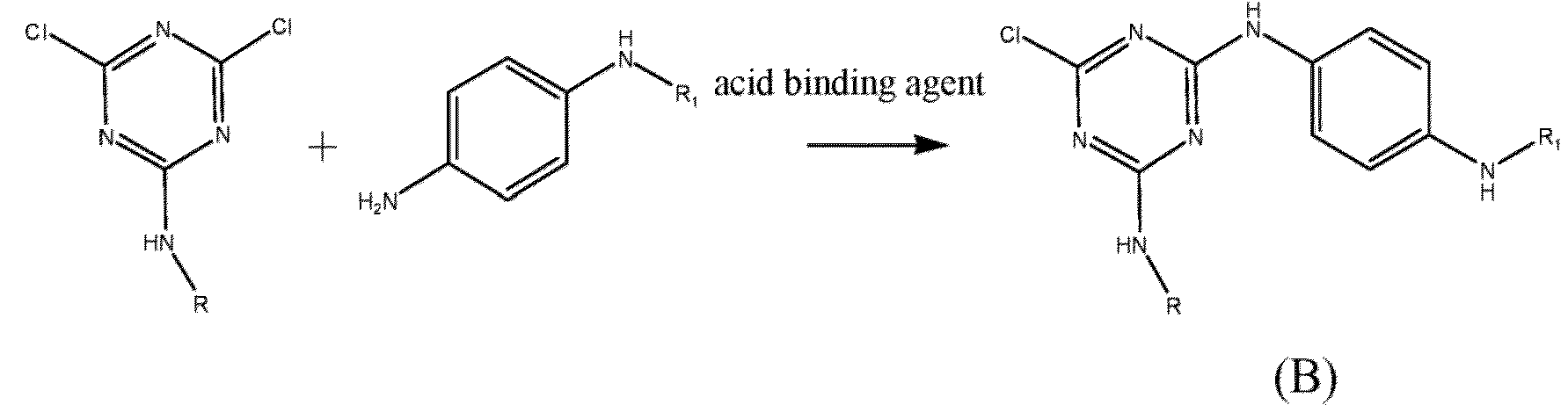
- In the third step, intermediate B is reacted with N-R2-p-phenylenediamine again to prepare the target product compound of formula (I), wherein, R2 is C3~C10 alky, C3~C10 alkyl substituted by C6~C14 aryl or C3~C10 cycloalkyl, C3~C10 cycloalkyl, C3~C10 cycloalkyl substituted by C3~C10 alkyl, C6~C14 aryl or C6~C14 aryl substituted by C3~C10 alkyl;

- In the first step, in order to improve the conversion rate of cyanuric chloride, excess NH2R can be used. Compared to cyanuric chloride, NH2R can generally be in excess of 10% or less. In certain embodiments of the present invention, the excess of NH2R is equal to or less than 8% or equal to or less than 5%. Herein, unless otherwise specified, an excess of a certain substance means that the addition amount of the substance is greater than the addition amount of cyanuric chloride. The excess percentage value herein is based on the amount of substance. For example, when 1 mol of cyanuric chloride is used, the excess of NH2R of equal to or less than 10% means that 1 mol to 1.1 mol of NH2R can be used.
- In the reaction of the first step, alkaline solid powder is usually used as an acid binding agent to neutralize HCl generated during the reaction. The alkaline solid powder suitable for the present invention is not particularly limited, for example, it can be one or more of sodium carbonate, magnesium carbonate, calcium carbonate, calcium oxide, magnesium oxide, magnesium hydroxide and so on. Usually, in order to better neutralize HCl, excess basic solid powder can be added in the reaction of the first step. Compared to cyanuric chloride, the excess value of the basic solid powder is not particularly limited, for example, the excess value may be equal to or less than 80%.
- The reaction temperature in the first step is usually controlled at 0 to 35°C. The reaction of the first step is usually carried out in a non-polar solvent, such as toluene, xylene, trimethylbenzene, chlorobenzene, methylcyclohexane, dichlorobenzene, trichlorobenzene, dimethylcyclohexane, trimethylbenzene and so on. The reaction time of the first step can be determined by detecting the progress of the reaction. Herein, the method for detecting the progress of the reaction may be known in the art, such as detecting whether the cyanuric chloride is completely reacted by gas chromatography (GC) or high performance liquid chromatography (HPLC). After the reaction, solid is filtered off to obtain a solution of intermediate A.
- In the second step, in order to improve the conversion rate of intermediate A, excess N-R1-p-phenylenediamine can be used. Compared to cyanuric chloride, N-Ri-p-phenylenediamine can generally be in excess of equal to or less than 20%. In certain embodiments of the present invention, the excess of N-R1-p-phenylenediamine is equal to or less than 10%.
- In the reaction of the second step, alkaline liquid is usually used as an acid binding agent. In the second step, an excessive amount of alkaline liquid is usually added, for example, alkali in the alkaline liquid can be in excess of equal to or less than 20% or equal to or less than 10% compared to cyanuric chloride. The alkaline liquid suitable for the present invention is not particularly limited, for example, it can be one or more of sodium hydroxide solution, potassium hydroxide solution, triethylamine, triisopropylamine, N-isopropyldiethylamine, N,N-diisopropyl ethylamine, etc. In the present invention, when the alkaline liquid is an aqueous solution of an inorganic alkali (such as sodium hydroxide solution, potassium hydroxide solution), its concentration is not particularly limited, usually being 10wt% to 50wt%, for example, it can be 25wt%.
- The reaction temperature of the second step is usually controlled at 50 to 100°C. The reaction of the second step is usually carried out in a non-polar solvent, such as toluene, xylene, trimethylbenzene, chlorobenzene, methylcyclohexane, dichlorobenzene, trichlorobenzene, dimethylcyclohexane, trimethylcyclohexane and so on. The reaction time of the second step can be determined by detecting the progress of the reaction, for example, using GC or HPLC to detect whether the content of N-Ri-p-phenylenediamine continues to decrease. After the reaction, through purification (for example, standing, removing aqueous phase, or washing with water), a solution of intermediate B is obtained.
- In the third step, in order to improve the conversion rate of intermediate B, excess N-R2-p-phenylenediamine can be used. Compared to cyanuric chloride, N-R2-p-phenylenediamine can generally be in excess of equal to or less than 20%. In certain embodiments of the present invention, the excess of N-R2-p-phenylenediamine is equal to or less than 10%.
- The reaction temperature of the third step is usually controlled at 80 to 180°C. The third-step reaction is usually carried out in a non-polar solvent, such as toluene, xylene, trimethylbenzene, chlorobenzene, methylcyclohexane, dichlorobenzene, trichlorobenzene, dimethylcyclohexane, trimethylcyclohexane and so on. The time reaction of the third step can be determined by detecting the progress of the reaction, for example, using GC or HPLC to detect whether the content of N-R2-p-phenylenediamine continues to decrease. After the reaction is completed, alkaline liquid (such as sodium hydroxide solution, potassium hydroxide solution and so on) is added to neutralize and remove HCl. After neutralization, through purification (for example, removing aqueous phase, washing organic phase with water, distilling out solvent from organic substance to obtain a crude product, recrystallizing and purifying the crude product, and drying) to obtain the compound of formula (I).
- When R1 and R2 of the compound of formula (I) are identical, the second step and the third step in the above preparation method can be combined into one step, that is, the compound of formula (I) is prepared by reacting intermediate A with N-Ri-p-phenylenediamine.
- In the embodiment in which the second step and the third step are combined into one step (hereinafter referred to as the combined reaction), the addition of N-Ri-p-phenylenediamine added in the combined reaction is usually the sum of the additions of N-R1-p-phenylenediamine in the above-mentioned reactions of the second step and the third step. The combined reaction is usually carried out in the form of staged temperature control, that is, the reaction is carried out at 50 to 100°C first, and then at 80 to 180°C. The timing of switching the reaction temperature can be determined by detecting the reaction progress, for example, when the content of N-Ri-p-phenylenediamine is detected by GC or HPLC to be reduced to half of the added amount, the temperature is switched from 50 to 100°C to 80 to 180°C. The combined reaction is usually carried out in a non-polar solvent, such as toluene, xylene, trimethylbenzene, chlorobenzene, methylcyclohexane, dichlorobenzene, trichlorobenzene, dimethylcyclohexane, trimethylcyclohexane and so on. The total time of the combined reaction can be determined by detecting the progress of the reaction, such as using GC or HPLC to detect whether the content of N-Ri-p-phenylenediamine continues to decrease. In the combined reaction, alkaline liquid (such as a one or more of sodium hydroxide solution, potassium hydroxide solution, triethylamine, triisopropylamine, N-isopropyldiethylamine, N,N-diisopropylethylamine, etc.) is usually used as an acid binding agent. After the reaction is completed, alkaline liquid can be added to neutralize and remove HCl, and after purification (for example, removing aqueous phase, washing organic phase with water, distilling out solvent from organic substance to obtain a crude product, recrystallizing and purifying the crude product, and drying) to obtain the compound of formula (I).
- The compounds of the present invention can provide improved aging resistance and discoloration resistance for rubber compositions. Accordingly, the present invention also provides a rubber composition comprising one or more of the compounds of formula I described herein. Typically, the rubber composition also comprises a diene elastomer, a reinforcing filler and a crosslinker.
- A diene elastomer refers to an elastomer with its monomers comprising a diene (such as butadiene and isoprene). Diene elastomers suitable for the present invention are known in the field, including but not limited to one or more selected from natural rubber (NR), butadiene rubber (BR), isoprene rubber, styrene butadiene rubber (SBR), chloroprene rubber (CR), nitrile butadiene rubber (NBR), isoprene/butadiene copolymer, isoprene/styrene copolymer and isoprene/butadiene/styrene copolymer. In some embodiments, in the rubber composition of the present invention, the diene elastomer consists of natural rubber (such as SCR5) and butadiene rubber (such as BR9000), and the mass ratio of the natural rubber to the butadiene rubber may be in the ranges of from 1:9 to 9:1, from 2:8 to 8:2, from 3:7 to 7:3, from 4:6 to 6:4, from 4.5:5.5 to 5.5:4.5, or 1: 1.
- Usually, based on 100 parts by mass of diene elastomer, in the rubber composition, the amount of the compound of formula I is 0.1-5 parts by mass, such as 1-5 parts by mass, 1.5-3.5 parts by mass, or 2-3 parts by mass.
- The rubber composition may also comprise other conventionally used components, including but not limited to reinforcing fillers, aids, crosslinkers and promoters, etc. The amounts of reinforcing fillers, aids, crosslinkers and promoters can be conventional amounts in the art.
- Reinforcing fillers may be carbon black, titanium oxide, magnesium oxide, calcium carbonate, magnesium carbonate, aluminum hydroxide, magnesium hydroxide, clay, talc and so on. Generally, reinforcing fillers are used in an amount of 40 to 60 parts by weight per 100 parts by weight of diene elastomer.
- Aids may include softeners used to improve processability and other properties. Softeners may include petroleum softeners, such as aromatic oil, processing oil, lubricating oil, paraffin, liquid paraffin, petroleum asphalt, and vaseline, etc., and/or fatty oil softeners, such as castor oil, flaxseed oil, rapeseed oil, coconut oil, wax (e.g., beewax, carnauba wax, and lanolin), tall oil, linoleic acid, palmitic acid, stearic acid and lauric acid, etc. Aids may also include activators, such as zinc oxide, which can speed up the vulcanization rate and improve the thermal conductivity, wear resistance, and tear resistance of rubber. Usually, 5 to 20 parts by mass of aids are used per 100 parts by mass of diene elastomer, for example, 2 to 8 parts by mass of aromatic oil, 2 to 8 parts by mass of zinc oxide and 1 to 4 parts by mass of stearic acid are used.
- A crosslinker can be sulfur. Generally, crosslinkers are used in an amount of 1 to 3 parts by weight per 100 parts by weight of diene elastomer.
- Promoters are generally vulcanization accelerators, which may be selected from at least one of sulfonamide, thiazole, thiuram, thiourea, guanidine, dithiocarbamate, aldimine, aldehyde ammonia, imidazoline, and xanthic acid vulcanization accelerators. For example, the promoter may be N-tert-butylbenzothiazole-2-sulphenamide (NS). Generally, promoters are used in an amount of 0.5 to 1.5 parts by weight per 100 parts by weight of diene elastomer.
- In addition, when necessary, a plasticizer may be used in the rubber composition of the present invention, which includes, but not limited to, dimethyl phthalate (DMP), diethyl phthalate (DEP), dibutyl phthalate (DBP), diheptyl phthalate (DHP), dioctyl phthalate (DOP), di-isononyl phthalate (DINP), di-isodecyl phthalate (DIDP), butyl benzyl phthalate (BBP), dilauryl phthalate (DWP), and dicyclohexyl phthalate (DCHP), etc. The plasticizer may be used in a conventional amount that is known in the art.
- The rubber product of the present invention can be prepared by conventional methods. For example, it can be prepared by a two-stage mixing method as follows: in the first stage, an internal mixer is used to mix diene elastomers, reinforcing fillers, aids and anti-degradants, and the rubber discharge temperature is 110°C or higher; in the second stage, an open mill is used to mix the rubber with sulfur and promoters.
- Generally, a diene elastomer is added into a thermo-mechanical mixer, such as an internal mixer at first. After kneading for a while, a reinforcing filler, an aid, and an anti-degradant are added and the mixture is kept on being kneaded until the mixture is homogeneous. The reinforcing filler, the aid, and the anti-degradant may be added in batches. The temperature during kneading is controlled to between 110°C and 190°C, preferably between 150°C and 160°C. Then, the mixture is cooled to 100°C or lower. A crosslinker and a promoter are added to the mixture and a second kneading is performed during which the temperature is controlled to 110°C or lower, e.g. 70°C, and an unvulcanized rubber is obtained. Tablet pressing can be carried out on the kneaded rubber composition before vulcanization. The unvulcanized rubber of the present invention can be vulcanized by a conventional vulcanization method to obtain a vulcanized rubber. The vulcanization (curing) temperature is generally 130°C to 200°C, such as 145°C. The vulcanization time depends on the vulcanization temperature, vulcanization system, and vulcanization kinetics, and is generally from 15 minutes to 60 minutes, such as 30 minutes.
- When the compound of the present invention is used in rubber articles, especially rubber tires, it can render the rubber articles or rubber tires more excellent anti-aging properties; in addition, compared with the existing anti-degradant products, the rubber articles or rubber tires comprising the compound of the present invention is not easy to cause surface pollution and discoloration, and has excellent discoloration resistance. Therefore, the present invention also provides a rubber article prepared by using the rubber composition described herein as a rubber component. The rubber article may be a tire, a rubber overshoe, a sealing strip, an acoustic panel, or a crash pad. In some embodiments, the rubber article is a tire, such as tread, a belt ply, and a sidewall of a tire. As a belt ply of a tire, the rubber article may further comprise a reinforcing material conventionally used in the art in addition to the rubber composition of the present invention. The present invention also provides the use of the rubber compositions described herein in improving the aging resistance and/or discoloration resistance of a rubber or a rubber article.
- The present invention is illustrated by way of specific examples below. It should be understood that these examples are merely explanatory and is not intended to limit the scope of the present invention. Unless otherwise specified, the methods, reagents, and materials used in the examples are conventional in the art. The formulations used in the examples are commercially available.
- 118.1g cyanuric chloride (0.64mol) is dissolved in 360g toluene, 74.2g sodium carbonate solid powder is added, 39.6g toluene solution of isopropylamine (0.67mol isopropylamine+80g toluene) is added dropwise under vigorous stirring at 10°C for 1.5h, and the reaction is continued for 1.5h after dropping. Samples are took for GC detection, and when cyanuric chloride can not be detected, the reaction is stopped. The solid is filtered out, and a colorless and transparent solution of intermediate A1 is obtained.
- 142.6g N-phenyl-p-phenylenediamine (0.77mol) is dissolved in 180g toluene, the solution is heated to 65°C, the toluene solution of the intermediate A1 obtained in step (1) is added dropwise with vigorous stirring, at the same time 112.6g sodium hydroxide solution (25wt%) is added dropwise for 1~2h, and the temperature is kept for 1h. Samples are took for GC detection, and when the content of N-phenyl-p-phenylenediamine is no longer decreased, the reaction is stopped and left standing. The aqueous phase is removed to obtain a toluene solution containing intermediate B 11.
- 132.5g N-phenyl-p-phenylenediamine (0.72mol) is added to the toluene solution of intermediate B11 obtained in step (2), and the mixture is heated to 80°C for reaction. GC detection is performed, and when the content of N-phenyl-p-phenylenediamine is no longer decreased, the temperature is lowered, and the reaction is stopped. 112.6g sodium hydroxide solution (25wt%) is added for neutralization, the aqueous phase is removed, the organic phase is washed with water, and then toluene is distilled out to obtain a crude product. Then the crude product is recrystallized with petroleum ether, and dried to obtain 289.2g (yield 90%) 2-isopropylamine-4,6-bis(4-anilinoaniline)-1,3,5-triazine (compound I-1).

- 1H-HMR (400MHz, DMSO-D6, δ ppm): 8.71(s, 2H), 7.93(s, 2H), 7.64(br, 4H), 7.17(t, 4H), 6.99( q, 8H), 6.73(t, 2H), 6.31(s, 1H), 3.4(s, 1H), 1.41(s, 6H).
- 118.1g cyanuric chloride (0.64mol) is dissolved in 360g xylene, 71.2g ultrafine calcium carbonate solid powder is added, 38.4g xylene solution of isopropylamine (0.65mol isopropylamine+80g xylene) is added dropwise under vigorous stirring at 10°C for 1.5h, and the reaction is continued for 1.5h after dropping. Samples are took for GC detection, and when cyanuric chloride can not be detected, the reaction is stopped. Solid is filtered out, and a colorless and transparent intermediate A1 solution is obtained.
- 152.4g N-1,4-dimethylpentyl-p-phenylenediamine (0.74mol) is dissolved in 180g xylene, the solution is heated to 70°C, xylene solution of the intermediate A1 obtained in step (1) is added dropwise with vigorous stirring, at the same time 157.6g potassium hydroxide solution (25wt%) is added dropwise for 1~2h, and the temperature is kept for 1h. Samples are took for GC detection, and when the content of N-1,4-dimethylpentyl-p-phenylenediamine is no longer reduced, the reaction is stopped and left standing. The aqueous phase is removed to obtain a xylene solution containing intermediate B12.
- 152.5g N-1,4-dimethylpentyl-p-phenylenediamine (0.74mol) is added to the xylene solution of the intermediate B12 obtained in step (2), and the mixture is heated to 110°C for reaction. GC detection is performed, and when the content of N-1,4-dimethylpentyl-p-phenylenediamine is no longer decreased, the temperature is lowered, and the reaction is stopped. 112.6g sodium hydroxide solution (25wt%) is added for neutralization, the organic phase is washed with water, and then xylene is distilled out to obtain a crude product. Then the crude product is recrystallized with petroleum ether and dried to obtain 283g (yield 81%) 2-isopropylamine-4,6-bis(4-(1,4-dimethylpentylamino)aniline)-1,3,5-triazine (compound I-2).

- 1H-HMR (400MHz, DMSO-D6, δ ppm): 8.39(s, 2H), 7.32(d, 4H), 6.48(d, 4H), 6.09(S, 1H), 4.92(t, 3H), 3.31-3.21(m, 2H), 1.56-1.43(m, 4H), 1.42-1.13(m, 12H), 1.06(d, 6H), 0.85(q, 12H).
- 118.1g cyanuric chloride (0.64mol) is dissolved in 360g trimethylbenzene, 71.2g ultrafine magnesium carbonate solid powder is added, 49.1g trimethylbenzene solution of tert-butylamine (0.67mol tert-butylamine+80g toluene) is added dropwise under vigorous stirring at 15°C for 1.5h, and the reaction is continued for 1.5h after dropping. Samples are took for GC detection, and when cyanuric chloride can not be detected, the reaction is stopped. Solid is filtered out, and a colorless and transparent solution of intermediate A2 is obtained.
- 131.5g N-phenyl-p-phenylenediamine (0.71mol) is dissolved in 180g trimethylbenzene, the solution is heated to 65°C, the trimethylbenzene solution of the intermediate A2 obtained in step (1) is added dropwise with vigorous stirring, at the same time 71.1g triethylamine is added dropwise for 1~2h, and the temperature is kept for 1h. Samples are took for GC detection, and when the content of N-phenyl-p-phenylenediamine is no longer decreased, the reaction is stopped. After washing with water, a trimethylbenzene solution containing intermediate B21 is obtained.
- 123.3g N-phenyl-p-phenylenediamine (0.67mol) is added to the trimethylbenzene solution of intermediate B21 obtained in step (2), and the mixture is heated to 105°C for reaction. GC detection is performed, and when the content of N-phenyl-p-phenylenediamine is no longer decreased, the temperature is lowered and the reaction is stopped. 71.1g triethylamine is added for neutralization, and after washing with water, trimethylbenzene is distilled out to obtain a crude product. Then the crude product is recrystallized with petroleum ether, and dried to obtain 280g (yield 85%) 2-tert-butylamine-4,6-bis(4-anilinoaniline)-1,3,5-triazine (compound I-3).

- 1H-NMR (400MHz, DMSO-D6, δ PPm): 8.71(s, 2H), 7.93(s, 2H), 7.64(br, 4H), 7.17(t, 4H), 6.99(q, 8H), 6.73(t, 2H), 6.31(s, 1H), 1.41(s, 9H).
- 118.1g cyanuric chloride (0.64mol) is dissolved in 360g chlorobenzene, 64g calcium oxide solid powder is added, 49.1g toluene solution of tert-butylamine (0.67mol tert-butylamine+80g chlorobenzene) is added dropwise under vigorous stirring at 15°C for 1.5h, and the reaction is continued for 1.5h after dropping. Samples are took for GC detection, and when cyanuric chloride can not be detected, the reaction is stopped. Solid is filtered out, and a colorless and transparent solution of intermediate A2 is obtained.
- 105g N-isopropyl-p-phenylenediamine (0.7mol) is dissolved in 180g chlorobenzene, the solution is heated to 60°C, the chlorobenzene solution of the intermediate A2 obtained in step (1) is added dropwise with vigorous stirring, at the same time 100.5g triisopropylamine is added dropwise for 1~2h, and the temperature is kept for 1h. Samples are took for GC detection, and when the content of N-isopropyl-p-phenylenediamine is no longer decreased, the reaction is stopped and left standing. The aqueous phase is removed to obtain a chlorobenzene solution containing intermediate B22.
- 114g N-isopropyl-p-phenylenediamine (0.76mol) is added to the chlorobenzene solution of intermediate B22 obtained in step (2), and the mixture is heated to 80°C for reaction. GC detection is performed, and when the content of N-isopropyl-p-phenylenediamine is no longer decreased, the temperature is lowered and the reaction is stopped. 112.6g sodium hydroxide solution (25wt%) is added for neutralization, the organic phase is washed with water, and then chlorobenzene is distilled out to obtain a crude product. Then the crude product is recrystallized with petroleum ether and dried to obtain 258g (yield 90%) 2-tert-butylamine-4,6-bis(4-isopropylaminoaniline)-1,3,5-triazine (compound 1-4).

- 1H-HMR (400MHz, DMSO- D6, δ ppm): 8.29(s, 2H), 7.33(d, 4H), 6.44(d, 4H), 6.02(S, 1H), 4.92(d, 2H), 3.4(d, 2H), 1.42-1.13(m, 9H), 0.85(q, 12H).
- 118.1g cyanuric chloride (0.64mol) is dissolved in 360g dichlorobenzene, 38.4g ultrafine magnesium oxide solid powder is added, 51.3g dichlorobenzene solution of tert-butylamine (0.7mol tert-butylamine+80g dichlorobenzene) is added dropwise under vigorous stirring at 20°C for 1.5h, and the reaction is continued for 1.5h after dropping. Samples are took for GC detection, and when cyanuric chloride can not be detected, the reaction is stopped. Solid is filtered out, and a colorless and transparent solution of intermediate A2 is obtained.
- 144.2g N-1,4-dimethylpentyl-p-phenylenediamine (0.7mol) is dissolved in 180g dichlorobenzene, the solution is heated to 70°C, dichlorobenzene solution of the intermediate A2 obtained in step (1) is added with vigorous stirring, at the same time 157.6g potassium hydroxide solution (25wt%) is added dropwise for 1~2h, and the temperature is kept for 1h. Samples are took for GC detection, and when the content of N-1,4-dimethylpentyl-p-phenylenediamine is no longer decreased, the reaction is stopped and left standing. The aqueous phase is removed to obtain a dichlorobenzene solution containing intermediate B23.(3) Synthesis of Compound I-5
- 148.4g N-1,4-dimethylpentyl-p-phenylenediamine (0.72mol) is added to the dichlorobenzene solution of intermediate B23 obtained in step (2), and the mixture is heated to 150°C for reaction. GC detection is performed, and when the content of N-1,4-dimethylpentyl-p-phenylenediamine is no longer decreased, the temperature is lowered and the reaction is stopped. 112.6g sodium hydroxide solution (25wt%) is added for neutralization to obtain a crude product. Then the crude product is recrystallized with petroleum ether, and dried to obtain 286.7g (yield 80%) 2-tert-butylamine-4,6-bis(4-(1,4-dimethylpentylamino)aniline)-1,3,5-triazine (compound 1-5).

- 1H-NMR(400MHz, DMSO-D6, δ ppm): 8.29(s, 2H), 7.33(d, 4H), 6.44(d, 4H), 6.02(S, 1H), 4.92(d, 2H), 3.31-3.21(m, 2H), 1.56-1.43(m, 4H), 1.42-1.13(m, 15H), 1.06(d, 6H), 0.85(q, 12H).
- 118.1g cyanuric chloride (0.64mol) is dissolved in 360g methylcyclohexane, 71.2g ultrafine magnesium hydroxide solid powder is added, 49.1g methylcyclohexane solution of tert-butylamine (0.67mol tert-butylamine+80g methylcyclohexane) is added dropwise under vigorous stirring at 20°C for 1.5h, and the reaction is continued for 1.5h after dropping. Samples are took for GC detection, and when cyanuric chloride can not be detected, the reaction is stopped. Solid is filtered out, and a colorless and transparent solution of intermediate A2 is obtained.
- 124.0g N-phenyl-p-phenylenediamine (0.67mol) is dissolved in 180g methylcyclohexane, the solution is heated to 50°C, the methylcyclohexane solution of the intermediate A2 obtained in step (1) is added dropwise with vigorous stirring, at the same time 157.6g potassium hydroxide solution (25wt%) is added dropwise for 1~2h, and the temperature is kept for 1h. Samples are took for GC detection, and when the content of N-phenyl-p-phenylenediamine remains unchanged, the reaction is stopped. After washing with water, a methylcyclohexane solution containing intermediate B21 is obtained.
- 131.9g N-1,4-dimethylpentyl-p-phenylenediamine (0.64mol) is added to the methylcyclohexane solution of the intermediate B21 obtained in step (2), and the mixture is heated to 160°C for reaction. GC detection is performed, and when the content of N-1,4-dimethylpentyl-p-phenylenediamine is no longer reduced, the temperature is lowered and the reaction is stopped. 112.6g of sodium hydroxide (25wt%) is added for neutralization. After washing with water, methylcyclohexane is distilled out to obtain a crude product. Then the crude product is recrystallized with petroleum ether and dried to obtain 261.7g (yield 76%) 2-tert-butylamine-4-(4-anilinoaniline)-6-(4-(1,4-dimethylpentylamino)aniline)-1,3,5-triazine (compound 1-6).

- 1H-NMR(400MHz, DMSO-D6, δPPm): 8.56(d, 2H), 7.90(s, 1H), 7.68(d, 2H), 7.39(d, 2H), 7.21(t, 2H), 7.02(t, 4H), 6.79(t, 1H), 6.52( d, 2H), 6.22(s, 1H), 5.0 (d, 1H), 3.37(m, 1H), 1.6-1.45(m, 2H), 1.43(s, 9H), 1.31-1.18(m, 3H), 1.11(d, 3H), 0.89(q, 6H).
- 118.1g cyanuric chloride (0.64mol) is dissolved in 360g trichlorobenzene, 71.2g sodium carbonate solid powder is added, 86.5g trichlorobenzene solution of tert-octylamine (0.67mol tert-octylamine+80g trichlorobenzene) is added dropwise under vigorous stirring at 30°C for 1.5h, and the reaction is continued for 1.5h after dripping. Samples are took for GC detection, and when cyanuric chloride can not be detected, the reaction is stopped. Solid is filtered out, and a colorless and transparent solution of intermediate A3 is obtained.
- 129.6g N-phenyl-p-phenylenediamine (0.7mol) is dissolved in 180g trichlorobenzene, the mixture is heated to 70°C, the trichlorobenzene solution of the intermediate A3 obtained in step (1) is added dropwise with vigorous stirring, at the same time 157.6g potassium hydroxide (25wt%) is add dropwise for 1~2h, and the temperature is kept for 1h. Samples are took for GC detection, and when the content of N-phenyl-p-phenylenediamine is no longer decreased, the reaction is stopped and left standing. The aqueous phase is removed to obtain a trichlorobenzene solution containing intermediate B31.
- 136.2g N-phenyl-p-phenylenediamine (0.74 mol) is added to the trichlorobenzene solution of the intermediate B31 obtained in step (2), the mixture is heated to 105°C for reaction. GC detection is performed, and when the content of N-phenyl-p-phenylene is no longer decreased, the temperature is lowered and the reaction is stopped. 112.6g sodium hydroxide solution (25wt%) is added for neutralization, the aqueous phase is removed, the organic phase is distilled to remove trichlorobenzene, and a crude product is obtained. Then the crude product is recrystallized with petroleum ether and dried to obtain 322.1g (yield 88%) 2-tert-octylamine-4,6-bis(4-anilinoaniline)-1,3,5-triazine (compound I-7).

- 1H-NMR(400MHz, DMSO-D6, δ ppm): 8.6(d,2H), 7.95(s,2H), 7.63(s,4H), 7.16(t,4H), 6.99(q,8H), 6.72(t,2H), 6.17(br,1H), 1.9(s,2H), 1.42(s,6H), 0.96(s,9H).
- 118.1g cyanuric chloride (0.64mol) is dissolved in 360g dimethylcyclohexane, 71.2g ultrafine sodium carbonate solid powder is added, 86.5g dimethylcyclohexane solution of tert-octylamine (0.67mol tert-octylamine+80g dimethylcyclohexane) is added dropwise under vigorous stirring at 30°C for 1.5h, and the reaction is continued to react for 1.5h after dropping. Samples are took for GC detection, and when cyanuric chloride can not be detected, the reaction is stopped. Solid is filtered out, and a colorless transparent solution of intermediate A3 is obtained.
- 105g N-isopropyl-p-phenylenediamine (0.7mol) is dissolved in 180g dimethylcyclohexane, the solution is heated to 65°C, the dimethylcyclohexane solution of the intermediate A3 obtained in step (1) is added dropwise with vigorous stirring, at the same time 112.6g sodium hydroxide solution (25wt%) is added dropwise for 1~2h, and the temperature is kept for 1h. Samples are took for GC detection, and when the content of N-isopropyl-p-phenylenediamine is no longer decreased, the reaction is stopped and left standing. The aqueous phase is removed to obtain a dimethylcyclohexane solution containing intermediate B32.
- 108g N-isopropyl-p-phenylenediamine (0.72mol) is added to the dimethylcyclohexane solution of the intermediate B32 obtained in step (2), and the mixture is heated to 90°C for reaction. GC detection is performed, and when the content of propyl-p-phenylenediamine is no longer decreased, the temperature is lowered and the reaction is stopped. 112.6g sodium hydroxide solution (25wt%) is added for neutralization, the organic phase is washed with water, and then dimethylcyclohexane is distilled out to obtain a crude product. Then the crude product is recrystallized with petroleum ether and dried to obtain 293.5g (yield 91%) 2-tert-octylamine-4,6-bis(4-isopropylaminoaniline)-1,3,5-triazine (Compound I- 8).

- 1H-HMR(400MHz, DMSO-D6, δ ppm): 8.29(s,2H), 7.33(d,4H), 6.44(d,4H), 6.02(S,1H), 4.92(d,2H), 3.4(d,2H), 1.9(s,2H), 1.42-1.13 (m,18H), 0.96(s,9H).
- 118.1g cyanuric chloride (0.64mol) is dissolved in 360g trimethylcyclohexane, 71.2g sodium carbonate solid powder is added, 86.5g trimethylcyclohexane solution of tert-octylamine (0.67mol tert-octylamine+80g trimethylcyclohexane) is added dropwise under vigorous stirring at 35°C for 1.5h, and the reaction is continued for 1.5h after dropping. Samples are took for GC detection, and when cyanuric chloride can not be detected, the reaction is stopped. Solid is filtered out, and a colorless and transparent solution of intermediate A3 is obtained.
- 129.6g N-phenyl-p-phenylenediamine (0.7mol) is dissolved in 180g trimethylcyclohexane, the solution is heated to 70°C, the trimethylcyclohexane solution of the intermediate A3 obtained in step (1) is added dropwise under vigorous stirring, at the same time 157.6g potassium hydroxide (25wt%) is added dropwise for 1~2h, and the temperature is kept for 1h. Samples are took for GC detection, and when the content of N-phenyl-p-phenylenediamine is no longer decreased, the reaction is stopped and left standing. The aqueous phase is removed to obtain a trimethylcyclohexane solution containing intermediate B31.
- 105g N-isopropyl-p-phenylenediamine (0.7mol) is added to the trimethylcyclohexane solution of the intermediate B31 obtained in step (2), and the mixture is heated to 100°C for reaction. GC detection is performed, and when the content of propyl-p-phenylenediamine is no longer decreased, the temperature is lowered and the reaction is stopped. 112.6g sodium hydroxide solution (25wt%) is added for neutralization, and after washing with water, trimethylcyclohexane is distilled out to obtain a crude product. Then the crude product is recrystallized with petroleum ether and dried to obtain 296.7g (yield 85%) 2-tert-octylamine-4-(4-anilinoaniline)-6-(4-isopropylaminoaniline)-1,3,5-triazine (compound I-9).
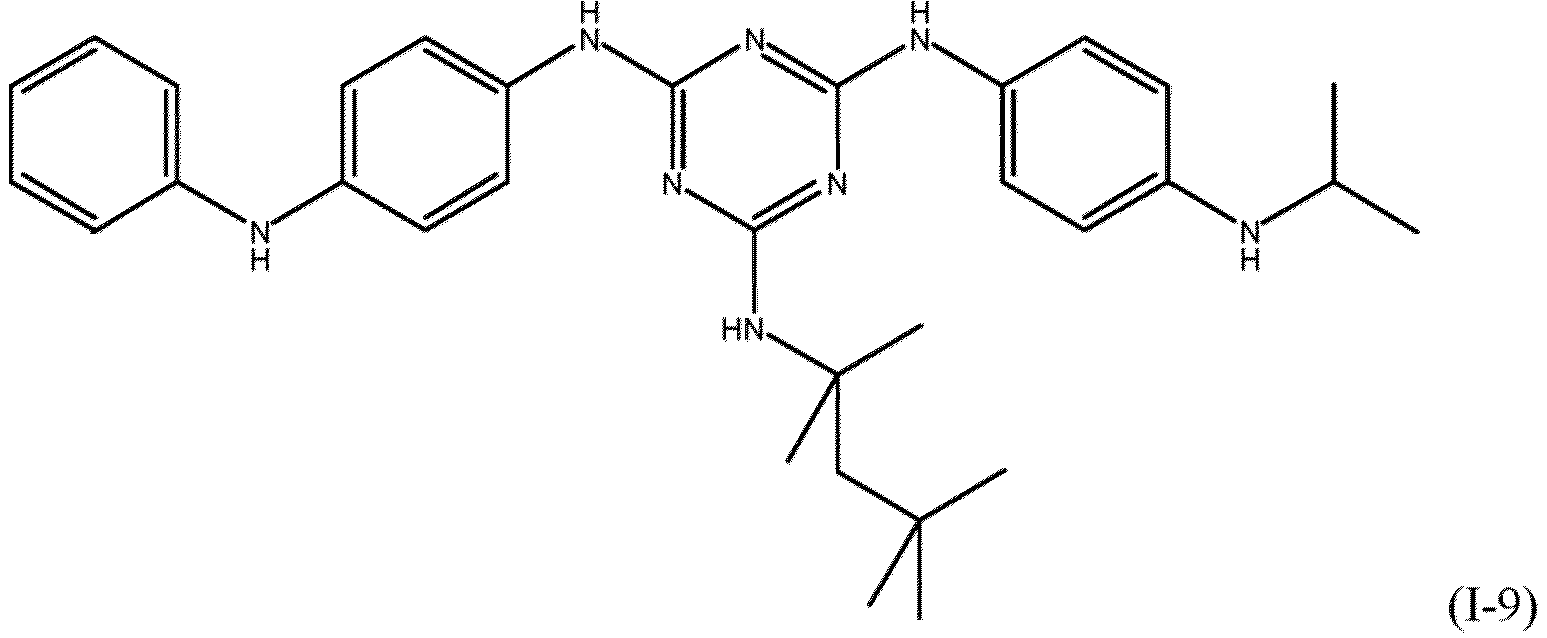
- 1H-HMR(400MHz, DMSO-D6, δ ppm): 8.47(q,2H), 7.93(s,1H), 7.6 (s,2H), 7.38(s,2H), 7.17(t,2H), 6.9 (t,4H), 6.77(t,1H), 6.45(d,2H), 6.14(d, 1H), 4.95(d,1H), 3.29(m,1H), 1.50(m,2H), 1.41-1.31(m,12H), 0.95(s,9H).
- 118.1g cyanuric chloride (0.64mol) is dissolved in 360g xylene, 71.2g sodium carbonate solid powder is added, 86.5g xylene solution of tert-octylamine (0.67mol of tert-octylamine + 80g of xylene) is added dropwise under vigorous stirring at 35°C for 1.5h, and the reaction is continued for 1.5h after dropping. Samples are took for GC detection, and when cyanuric chloride can not be detected, the reaction is stopped. Solid is filtered out the solid, and a colorless and transparent solution of intermediate A3 is obtained.
- 129.6 g N-phenyl-p-phenylenediamine (0.7 mol) is dissolve in 180g xylene, the solution is heated to 80°C, the xylene solution of the intermediate A3 obtained in step (1) is added dropwise with vigorous stirring, at the same time 157.6g potassium hydroxide (25wt%) is added dropwise for 1~2h, and the temperature is kept for 1h. Samples are took for HPLC detection, and when intermediate A3 can not be detected, the reaction is stopped. After washing with water, a xylene solution containing intermediate B31 is obtained
- 131.9g N-1,4-dimethylpentyl-p-phenylenediamine (0.64mol) is added to the xylene solution of the intermediate B31 obtained in step (2), and the mixture is heated to 110°C for reaction. GC detection is performed, and when the content of N-1,4-dimethylpentyl-p-phenylenediamine is no longer decreased, the temperature is lowered and the reaction is stopped. 112.6g sodium hydroxide solution (25wt%) is added for neutralization. After washing with water, xylene is distilled out to obtain a crude product Then the crude product is recrystallized with petroleum ether and dried to obtain 288.9g (yield 76%) 2-tert-octylamine-4-(4-anilinoaniline)-6-(4-(1,4-dimethylpentylamino)aniline)-1,3,5-triazine (compound I-10).

- 1H-NMR(400MHz, DMSO-D6, δ ppm): 8.49(q,2H), 7.91(s,1H), 7.64(s,2H), 7.34(s,2H), 7.17(t,2H), 6.98(t,4H), 6.73(t,1H), 6.48(d,2H), 6.04(d, 1H), 4.95(d,1H), 3.29(m,1H), 1.89(s,1H), 1.50(m,2H), 1.40(s,6H), 1.31-1.18(m,4H), 1.07(d,3H), 0.95(s,9H), 0.86(q,6H).
- 118.1g cyanuric chloride (0.64mol) is dissolved in 360g xylene, 71.2g sodium carbonate solid powder is added, 86.5g xylene solution of tert-octyl amine (0.67mol tert-octyl amine+80g xylene) is added dropwise under vigorous stirring at 35°C for 1.5h, and the reaction is continued for 1.5h after dropping. Samples are took for GC detection, and when cyanuric chloride can not be detected, the reaction is stopped. Solid is filtered out, and a colorless and transparent solution of intermediate A3 is obtained.
- 105g N-isopropyl-p-phenylenediamine (0.7 mol) is dissolved in 180g xylene, the solution is heated to 65°C, the xylene solution of the intermediate A3 obtained in step (1) is added dropwise with vigorous stirring, at the same time 112.6g sodium hydroxide solution (25wt%) is added dropwise for 1~2h, and the temperature is kept for 1h. Samples are took for GC detection, and when intermediate A3 can not be detected, the reaction is stopped and left standing. The aqueous phase is removed to obtain a xylene solution containing intermediate B32.
- 144.2g N-1,4-dimethylpentyl-p-phenylenediamine (0.7mol) is added to the xylene solution of the intermediate B32 obtained in step (2), and the mixture is heated to 120°C for reaction. GC detection is performed, and when the content of N-1,4-dimethylpentyl-p-phenylenediamine is no longer decreased, the temperature is lowered and the reaction is stopped. 112.6g sodium hydroxide solution (25wt%) is added for neutralization, the organic phase is washed with water, and xylene is distilled out to obtain a crude product. Then the crude product is recrystallized with petroleum ether and dried to obtain 286.7g (yield 80%) 2-tert-octylamine-4-(4-isopropylaminoaniline)-6-(4-(1,4-dimethylpentylamino)aniline)-1,3,5-triazine (compound 1-11).

- 1H-HMR(400MHz, DMSO-D6, δ ppm): 8.32(d,2H), 7.39(s,4H), 6.49(d,4H), 6.04(br,1H), 4.99(t,3H), 3.21-3.32(m,2H), 1.36-1.15(m,15H), 1.08-1.13(d,6H), 1.02(s,9H), 0.91(q, 6H).
- 118.1g cyanuric chloride (0.64mol) is dissolved in 360g xylene, 71.2g sodium carbonate solid powder is added, 86.5g xylene solution of tert-octyl amine (0.67mol tert-octyl amine+80g xylene) is added dropwise under vigorous stirring at 25°C for 1.5h, and the reaction is continued for 1.5h after dropping. Samples are took for GC detection, and when cyanuric chloride can not be detected, the reaction is stopped. Solid is filtered out, and a colorless and transparent solution of intermediate A3 is obtained.
- 144.2g N-1,4-dimethylpentyl-p-phenylenediamine (0.7mol) is dissolved in 180g xylene, the solution is heated to 90°C, the xylene solution of the intermediate A3 obtained in step (1) is added dropwise with vigorous stirring, at the same time 112.6g sodium hydroxide solution (25wt%) is added dropwise for 1~2h, and the temperature is kept for 1h. Samples are took for GC detection, and when intermediate A3 can not be detected, the reaction is stopped and left standing. The aqueous phase is removed to obtain a xylene solution containing intermediate B33.
- 152.4g N-1,4-dimethylpentyl-p-phenylenediamine (0.74mol) is added to the xylene solution of the intermediate B33 obtained in step (2), and the mixture is heated to 180°C for reaction. GC detection is performed, and when the content of N-1,4-dimethylpentyl-p-phenylenediamine is no longer decreased, the temperature is lowered and the reaction is stopped. 112.6g sodium hydroxide solution (25wt%) is added for neutralization, the organic phase is washed with water, and xylene is distilled out to obtain a crude product. Then the crude product is recrystallized with petroleum ether and dried to obtain 295.6g (yield 75%) 2-tert-octylamine-4,6-bis(4-(1,4-dimethylpentylamino)aniline)-1,3,5-triazine (compound I-12).

- 1H-NMR(400MHz, DMSO-D6, δ ppm): 8.30(d,2H), 7.38(s,4H), 6.51(d,4H), 5.94(br,1H), 4.99(d, 2H), 3.21-3.32(m, 2H), 1.91(s,2H), 1.58-1.44(m,4H), 1.38(s,6H), 1.36-1.15(m,6H), 1.08-1.13(d,6H), 0.99(s,9H), 0.91(q, 12H).
- 118.1g cyanuric chloride (0.64mol) is dissolved in 360g toluene, 71.2g sodium carbonate solid powder is added, 66.4g toluene solution of cyclohexylamine (0.67mol cyclohexylamine+80g toluene) is added dropwise under vigorous stirring at 25°C for 1.5h, and the reaction is continued for 1.5h after dropping. Samples are took for GC detection, and when cyanuric chloride can not be detected, the reaction is stopped. Solid is filtered out, and a colorless and transparent solution of intermediate A4 is obtained.
- 128.8g N-phenyl-p-phenylenediamine (0.7mol) is dissolved in 180g toluene, the solution is heated to 100°C, the toluene solution of the intermediate A4 obtained in step (1) is added dropwise with vigorous stirring, at the same time 112.6g sodium hydroxide solution (25wt%) is added dropwise for 1~2h, and the temperature is kept for 1h. sSample are took for GC detection, and when intermediate A4 can not be detected, the reaction is stopped and left standing. The aqueous phase is removed to obtain a toluene solution containing intermediate B43.
- 132.5g N-phenyl-p-phenylenediamine (0.72mol) is added to the toluene solution of the intermediate B43 obtained in step (2), and the mixture is heated to 140°C for the reaction. GC detection is performed, and when the content of N-phenyl-p-phenylenediamine is no longer decreased, the temperature is lowered and the reaction is stopped. 112.6g sodium hydroxide solution (25wt%) is added for neutralization, the organic phase is washed with water and then toluene is distilled out to obtain a crude product. Then the crude product is recrystallized with petroleum ether, and dried to obtain 277.5g (yield 80%) 2-cyclohexylamine-4,6-bis(4-anilinoaniline)-1,3,5-triazine (compound 1-13).

- 1H-NMR(400MHz, DMSO-D6, δ ppm): 8.63(s,2H), 7.82(s,2H), 7.64(br, 4H), 7.19(t,4H), 6.89( q, 8H), 6.65(t,2H), 6.21(s,1H), 3.2-3.4(m,5H), 2.41(br,6H).
- The rubber compositions of testing examples 1-6 are prepared according to the formula shown in Table 1 by a method specifically comprising the following steps:
- 1. Natural rubber SCR5 and synthetic rubber BR are added to an internal mixer. After kneading for a while, carbon black N550, aromatic oil, zinc oxide, stearic acid and anti-degradants (6PPD, compound I-5, compound I-3, compound I-6, compound I-10 or compound I-12) are added, and the mixture is kept on being kneaded until the mixture is homogeneous. The temperature during kneading is controlled to between 150°C and 160°C;
- 2. The whole mixture is cooled to 100°C or lower, then a crosslinking system (sulfur S and a promoter NS) is added, followed by kneading the whole mixture while controlling the temperature at 110°C or lower;
- 3. The resulting rubber compositions are calendered into a form of sheet (2-3mm in thickness), and then vulcanized. The vulcanization temperature is 145°C and the time is 30 minutes.
- The sources of the materials in Table 1 are as follows:
- SCR5: Xishuangbanna Sinochem Rubber Co., Ltd., natural rubber SCR5;
- BR: Nanjing Yangzi Petrochemical Rubber Co., Ltd., synthetic rubber BR9000;
- N550: Cabot Corporation, carbon black N550;
- Aromatic oil: Shanghai Titan Technology Co., Ltd., general reagent;
- Stearic acid: Shanghai Titan Scientific Co., Ltd., general reagent, stearic acid (AR);
- Zinc oxide: Shanghai Titan Technology Co., Ltd. general reagent, zinc oxide (AR);
- NS: Sennics Technology Co., Ltd., vulcanization accelerator NS;
- S: Sinopharm Chemical Reagent Company, sublimed sulfur (AR);
- 6PPD: Sennics Technology Co., Ltd., anti-degradant SIRANTOX 6PPD;
- Compound I-5: the compound synthesized in Example 5;
- Compound I-3: the compound synthesized in Example 3;
- Compound I-6: the compound synthesized in Example 6;
- Compound I-10: the compound synthesized in Example 10;
- Compound I-12: the compound synthesized in Example 12.
- The ozone resistance and discoloration resistance of the vulcanized rubber sheets of testing examples 1 to 6 are evaluated according to the following methods, and the results are shown in Table 3.
- Under the conditions of temperature of 40°C, ozone concentration of 50 pphm, and elongation of 20%, the test sheets of various rubber compositions are subjected to ozone deterioration test. After 39 hours, the deterioration state of the test sheet is examined. The ozone resistance grade is based on the density of cracks formed and is judged by:
- 0: no cracks
- 1: few cracks (crack density <10 cracks per cm)
- 2: many cracks (10 cracks per cm≤crack density <40 cracks per cm)
- 3: lots of cracks (crack density≥40 cracks per cm)
- The vulcanized rubber sheet is packed into a ziplock bag, the rubber sheet is pressed against the bag, and the color change of the bag is observed after two weeks of exposure to outdoor. The evaluation criteria of the discoloration resistance grade are shown in Table 2.
Table 2: Description of Discoloration Grade Grade Description 0 No color change 1 Slight discoloration of small area, which can be found only by careful comparison 2 Slight discoloration of large or all area, which can be easily found after comparison 3 Serious discoloration of small area, which can be directly found 4 Serious discoloration of large or all area, which can be directly found Table 3: Rubber Ozone Resistance and Discoloration Resistance Testing Results Testing Example 1 Testing Example 2 Testing Example 3 Testing Example 4 Testing Example 5 Testing Example 6 anti-degradant 6PPD Compound I-5 Compound I-3 Compound I-6 Compound I-10 Compound I-12 Ozone resistance 2 1 2 2 2 2 Discoloration resistance 4 1 1 2 2 1 - It can be seen from Table 1 and Table 2 that compared with the rubber composition containing a conventional anti-degradant, the rubber compositions comprising the compounds of the present invention have the same or better ozone resistance, and the discoloration of the rubber compositions comprising the compounds of the present invention is obviously suppressed.
| Recipes | Testing Example 1 | Testing Example 2 | Testing Example 3 | Testing Example 4 | Testing Example 5 | Testing Example 6 |
| SCR5 | 50.0 | 50.0 | 50.0 | 50.0 | 50.0 | 50.0 |
| BR | 50.0 | 50.0 | 50.0 | 50.0 | 50.0 | 50.0 |
| N550 | 50.0 | 50.0 | 50.0 | 50.0 | 50.0 | 50.0 |
| Aromatic oil | 5.0 | 5.0 | 5.0 | 5.0 | 5.0 | 5.0 |
| Zinc oxide | 5.0 | 5.0 | 5.0 | 5.0 | 5.0 | 5.0 |
| Stearic acid | 2.0 | 2.0 | 2.0 | 2.0 | 2.0 | 2.0 |
| 6PPD | 2.5 | |||||
| Compound I-5 | 2.5 | |||||
| Compound I-3 | 2.5 | |||||
| Compound I-6 | 2.5 | |||||
| Compound I-10 | 2.5 | |||||
| Compound I-12 | 2.5 | |||||
| NS | 0.8 | 0.8 | 0.8 | 0.8 | 0.8 | 0.8 |
| S | 1.5 | 1.5 | 1.5 | 1.5 | 1.5 | 1.5 |
| Total | 166.8 | 166.8 | 166.8 | 166.8 | 166.8 | 166.8 |
Claims (10)
- A compound represented by the following formula (I):
 R is C3~C16 alkyl, C3~C16 alkyl substituted by C3~C10 cycloalkyl, C3~C10 cycloalkyl or C3~C10 cycloalkyl substituted by C3~C16 alkyl;R1 and R2 are identical or different, each being independently selected from C3~C10 alkyl, C3~C10 alkyl substituted by C3~C10 cycloalkyl or C6~C14 aryl, C3~C10 cycloalkyl, C3~C10 cycloalkyl substituted by C3~C10 alkyl, C6~C14 aryl and C6~C14 aryl substituted by C3~C10 alkyl.
 - The compound of claim 1, wherein R is C3~C10 alkyl or C3~C10 cycloalkyl, preferably C3~C10 branched alkyl or C3~C10 cycloalkyl, more preferably isopropyl, tert-butyl, tert-octyl or cyclohexyl.
- The compound of claim 1, wherein R1 and R2 are identical or different, each independently being C3~C10 alkyl or phenyl, preferably each independently being C3~C10 branched alkyl or phenyl, more preferably each independently being isopropyl, 1,4-dimethylpentyl or phenyl.
- The compound according to claim 1, wherein the compound is selected from the group consisting of:


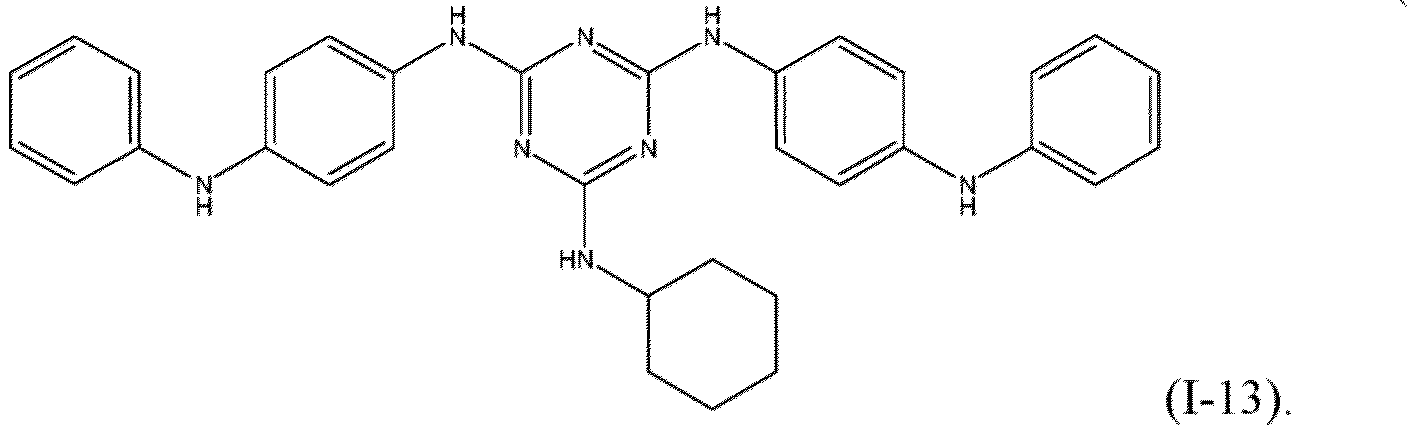
- A method for preparing the compound according to any one of claims 1-4, comprising:(1) making cyanuric chloride and NH2R react to prepare intermediate A shown in the following formula:
 (2) making intermediate A and N-R1-p-phenylenediamine react to prepare intermediate B shown in the following formula:
 (3) making intermediate B and N-R2-p-phenylenediamine react to prepare the compound of formula (I):
- The method according to claim 5, wherein the method has one or more of the following characteristics:(A) in the reaction of step (1), alkaline solid powder is added and the reaction temperature is 0 to 35°C;(B) in the reaction of step (2), alkaline liquid is added and the reaction temperature is 50 to 100°C; and(C) the reaction temperature of step (3) is 80 to 180°C.
- The method according to claim 5, wherein R1 and R2 are identical, and step (2) and step (3) are combined into step (2'): making intermediate A and N-R1-p-phenylenediamine react to prepare the compound of formula (I);preferably, in the reaction of step (1), alkaline solid powder is added and the reaction temperature is 0 to 35°C;preferably, in the reaction of step (2'), alkaline liquid is added, and the reaction is first carried out at 50 to 100 °C, and then carried out at 80 to 180°C.
- A rubber composition comprising the compound according to any one of claims 1-4.
- A rubber article prepared by using the rubber composition of claim 8 as a rubber component; preferably, the rubber article is a tire.
- A method for improving anti-aging property and/or discoloration resistance property of a rubber or a rubber article, comprising applying the compound according to any one of claims 1-4 to a rubber or a rubber article; preferably, the rubber article is a tire.
Priority Applications (1)
| Application Number | Priority Date | Filing Date | Title |
|---|---|---|---|
| RS20241119A RS66123B1 (en) | 2019-11-04 | 2020-10-30 | Compound having anti-aging and discoloration resistance effects and preparation method therefor |
Applications Claiming Priority (2)
| Application Number | Priority Date | Filing Date | Title |
|---|---|---|---|
| CN201911066120.0A CN112759557B (en) | 2019-11-04 | 2019-11-04 | Compound with anti-aging and discoloration-resistant effects and preparation method thereof |
| PCT/CN2020/125100 WO2021088721A1 (en) | 2019-11-04 | 2020-10-30 | Compound having anti-aging and discoloration resistance effects and preparation method therefor |
Publications (4)
| Publication Number | Publication Date |
|---|---|
| EP4056561A1 EP4056561A1 (en) | 2022-09-14 |
| EP4056561A4 EP4056561A4 (en) | 2023-11-22 |
| EP4056561C0 EP4056561C0 (en) | 2024-09-25 |
| EP4056561B1 true EP4056561B1 (en) | 2024-09-25 |
Family
ID=75692288
Family Applications (1)
| Application Number | Title | Priority Date | Filing Date |
|---|---|---|---|
| EP20884942.2A Active EP4056561B1 (en) | 2019-11-04 | 2020-10-30 | Compound having anti-aging and discoloration resistance effects and preparation method therefor |
Country Status (19)
| Country | Link |
|---|---|
| US (1) | US12466797B2 (en) |
| EP (1) | EP4056561B1 (en) |
| JP (1) | JP7623370B2 (en) |
| KR (1) | KR102743773B1 (en) |
| CN (1) | CN112759557B (en) |
| AU (1) | AU2020378456B2 (en) |
| CA (1) | CA3159789A1 (en) |
| CO (1) | CO2022006895A2 (en) |
| EC (1) | ECSP22035128A (en) |
| ES (1) | ES2995157T3 (en) |
| HU (1) | HUE069308T2 (en) |
| IL (1) | IL292560B2 (en) |
| MX (1) | MX2022005174A (en) |
| MY (1) | MY208559A (en) |
| PE (1) | PE20230250A1 (en) |
| PL (1) | PL4056561T3 (en) |
| RS (1) | RS66123B1 (en) |
| WO (1) | WO2021088721A1 (en) |
| ZA (1) | ZA202204679B (en) |
Families Citing this family (1)
| Publication number | Priority date | Publication date | Assignee | Title |
|---|---|---|---|---|
| CN120484609B (en) * | 2025-06-06 | 2026-02-27 | 江苏皓月涂料有限公司 | Protective primer-topcoat water-based paint based on dip coating and preparation process thereof |
Family Cites Families (26)
| Publication number | Priority date | Publication date | Assignee | Title |
|---|---|---|---|---|
| CH490116A (en) * | 1967-08-04 | 1970-05-15 | Ciba Geigy | Use of new triazine derivatives as antioxidants for organic substances |
| BE793389A (en) * | 1971-12-27 | 1973-06-27 | Degussa | PHENYLENEDIAMINE-S-TRIAZINE COMPOUNDS AND THEIR USE |
| JPH0759651B2 (en) * | 1986-09-24 | 1995-06-28 | 川口化学工業株式会社 | Rubber composition containing antioxidant |
| US4794135A (en) | 1987-08-28 | 1988-12-27 | Uniroyal Chemical Company, Inc. | Arylenediamine substituted triazines |
| US4794134A (en) | 1987-08-28 | 1988-12-27 | Uniroyal Chemical Company, Inc. | Ozone resistant elastomeric articles |
| IL87542A (en) * | 1987-08-28 | 1993-01-31 | Uniroyal Chem Co Inc | Arylenediamino substituted triazine derivatives, processes for the preparation thereof and compositions containing the same |
| US4972010A (en) * | 1988-09-21 | 1990-11-20 | Uniroyal Chemical Company, Inc. | Substituted triazines |
| US5120844A (en) * | 1988-09-21 | 1992-06-09 | Uniroyal Chemical Company, Inc. | Substituted triazines |
| US5118807A (en) | 1989-10-13 | 1992-06-02 | Uniroyal Chemical Company, Inc. | N-alkyl-p-quinonediimino triazine compounds |
| EP1293504A3 (en) | 1996-07-08 | 2003-11-05 | Ciba SC Holding AG | Triazine derivatives as UV-filter in cosmetic compositions |
| JP3946839B2 (en) | 1996-12-04 | 2007-07-18 | 株式会社ブリヂストン | Anti-aging agent and rubber composition having improved aging property |
| US7375222B2 (en) * | 2002-02-05 | 2008-05-20 | Astellas Pharma Inc. | 2,4,6-Triamino-1,3,5-triazine derivative |
| US7572850B2 (en) | 2004-06-29 | 2009-08-11 | Michelin Recherche Et Technique S.A. | Rubber composition and tire comprising same |
| US20100010122A1 (en) | 2008-07-10 | 2010-01-14 | Steiber Joseph F | Substituted triazine compositions and methods for producing same |
| JP2013023675A (en) | 2011-07-26 | 2013-02-04 | Yokohama Rubber Co Ltd:The | Rubber composition and pneumatic tire using the same |
| JP6461138B2 (en) | 2013-10-29 | 2019-01-30 | 株式会社ブリヂストン | A new class of anti-aging agent for rubber products |
| US10294423B2 (en) * | 2013-11-22 | 2019-05-21 | Polnox Corporation | Macromolecular antioxidants based on dual type moiety per molecule: structures, methods of making and using the same |
| EP3209717B1 (en) | 2014-10-21 | 2018-12-12 | Bridgestone Corporation | New class of antioxidant agents for polymer products |
| CN106032408B (en) | 2015-03-17 | 2018-08-17 | 中国石油化工股份有限公司 | Antioxidant composition and EP rubbers and preparation method thereof |
| CN106608827A (en) | 2015-10-21 | 2017-05-03 | 江苏圣奥化学科技有限公司 | Preparation method for aryl substituted p-phenylenediamine substance |
| JP2017171838A (en) | 2016-03-25 | 2017-09-28 | 住友化学株式会社 | Anti-aging composition |
| CN107955207B (en) | 2016-10-14 | 2019-08-20 | 中国石油化工股份有限公司 | Rubber antioxidant composition and its preparation method and application |
| CN108203414B (en) * | 2016-12-20 | 2025-07-18 | 圣奥化学科技有限公司 | Process for preparing triazine derivatives |
| CN110272568B (en) | 2018-03-15 | 2023-05-12 | Si集团有限公司 | Phenolic resin composition and use thereof in rubber compositions for reducing hysteresis |
| CN110591151B (en) | 2018-06-12 | 2022-10-18 | 圣奥化学科技有限公司 | Rubber composition for tire comprising novel long-acting rubber antioxidant |
| CN112175248B (en) | 2019-06-14 | 2022-04-05 | 圣奥化学科技有限公司 | Rubber composition for tire comprising novel low-pollution anti-aging agent |
-
2019
- 2019-11-04 CN CN201911066120.0A patent/CN112759557B/en active Active
-
2020
- 2020-10-30 IL IL292560A patent/IL292560B2/en unknown
- 2020-10-30 RS RS20241119A patent/RS66123B1/en unknown
- 2020-10-30 MX MX2022005174A patent/MX2022005174A/en unknown
- 2020-10-30 JP JP2022525000A patent/JP7623370B2/en active Active
- 2020-10-30 MY MYPI2022002205A patent/MY208559A/en unknown
- 2020-10-30 KR KR1020227018541A patent/KR102743773B1/en active Active
- 2020-10-30 EP EP20884942.2A patent/EP4056561B1/en active Active
- 2020-10-30 ES ES20884942T patent/ES2995157T3/en active Active
- 2020-10-30 CA CA3159789A patent/CA3159789A1/en active Pending
- 2020-10-30 PL PL20884942.2T patent/PL4056561T3/en unknown
- 2020-10-30 PE PE2022000714A patent/PE20230250A1/en unknown
- 2020-10-30 WO PCT/CN2020/125100 patent/WO2021088721A1/en not_active Ceased
- 2020-10-30 HU HUE20884942A patent/HUE069308T2/en unknown
- 2020-10-30 AU AU2020378456A patent/AU2020378456B2/en active Active
-
2022
- 2022-04-26 ZA ZA2022/04679A patent/ZA202204679B/en unknown
- 2022-05-03 US US17/736,074 patent/US12466797B2/en active Active
- 2022-05-04 EC ECSENADI202235128A patent/ECSP22035128A/en unknown
- 2022-05-25 CO CONC2022/0006895A patent/CO2022006895A2/en unknown
Also Published As
| Publication number | Publication date |
|---|---|
| ES2995157T3 (en) | 2025-02-07 |
| ECSP22035128A (en) | 2022-06-30 |
| EP4056561C0 (en) | 2024-09-25 |
| CN112759557A (en) | 2021-05-07 |
| US12466797B2 (en) | 2025-11-11 |
| CA3159789A1 (en) | 2021-05-14 |
| EP4056561A4 (en) | 2023-11-22 |
| PL4056561T3 (en) | 2024-12-16 |
| MY208559A (en) | 2025-05-15 |
| KR20220106984A (en) | 2022-08-01 |
| HUE069308T2 (en) | 2025-02-28 |
| JP2023501170A (en) | 2023-01-18 |
| ZA202204679B (en) | 2023-01-25 |
| PE20230250A1 (en) | 2023-02-07 |
| IL292560A (en) | 2022-06-01 |
| KR102743773B1 (en) | 2024-12-18 |
| EP4056561A1 (en) | 2022-09-14 |
| BR112022007951A2 (en) | 2022-07-12 |
| WO2021088721A1 (en) | 2021-05-14 |
| CO2022006895A2 (en) | 2022-07-29 |
| MX2022005174A (en) | 2022-06-08 |
| RS66123B1 (en) | 2024-11-29 |
| IL292560B1 (en) | 2025-03-01 |
| IL292560B2 (en) | 2025-07-01 |
| JP7623370B2 (en) | 2025-01-28 |
| US20220306590A1 (en) | 2022-09-29 |
| AU2020378456A1 (en) | 2022-06-02 |
| CN112759557B (en) | 2023-12-29 |
| AU2020378456B2 (en) | 2025-11-27 |
Similar Documents
| Publication | Publication Date | Title |
|---|---|---|
| US10407562B2 (en) | Compounds with antidegradant and antifatigue efficacy and compositions including said compounds | |
| EP3845591A1 (en) | Rubber composition, rubber material, use of same and additive | |
| JP4598148B2 (en) | Sulfenamide, rubber vulcanization accelerator containing the sulfenamide, and method for producing the same | |
| WO2012147984A1 (en) | Rubber composition | |
| US12466797B2 (en) | Compound having anti-aging and discoloration resistance effects and preparation method therefor | |
| WO2022041528A1 (en) | Novel p-phenylenediamine compound, preparation method therefor, and application thereof | |
| HK40078125A (en) | Compound having anti-aging and discoloration resistance effects and preparation method therefor | |
| CN108291054B (en) | rubber compound | |
| EA046323B1 (en) | COMPOUND PROVIDING ANTI-AGING AND RESISTANCE TO DIScoloration EFFECTS AND METHOD FOR ITS OBTAINING | |
| BR112022007951B1 (en) | COMPOUND EXHIBITING ANTI-AGING AND DISCOLORATION RESISTANCE EFFECTS AND METHOD OF PREPARATION THEREOF | |
| HK40066407B (en) | P-phenylenediamine compound, preparation method therefor, and application thereof | |
| HK40066407A (en) | P-phenylenediamine compound, preparation method therefor, and application thereof | |
| EP3634939A1 (en) | Methods of making compounds having antidegradant and antifatigue efficacy |
Legal Events
| Date | Code | Title | Description |
|---|---|---|---|
| STAA | Information on the status of an ep patent application or granted ep patent |
Free format text: STATUS: THE INTERNATIONAL PUBLICATION HAS BEEN MADE |
|
| PUAI | Public reference made under article 153(3) epc to a published international application that has entered the european phase |
Free format text: ORIGINAL CODE: 0009012 |
|
| STAA | Information on the status of an ep patent application or granted ep patent |
Free format text: STATUS: REQUEST FOR EXAMINATION WAS MADE |
|
| 17P | Request for examination filed |
Effective date: 20220512 |
|
| AK | Designated contracting states |
Kind code of ref document: A1 Designated state(s): AL AT BE BG CH CY CZ DE DK EE ES FI FR GB GR HR HU IE IS IT LI LT LU LV MC MK MT NL NO PL PT RO RS SE SI SK SM TR |
|
| DAV | Request for validation of the european patent (deleted) | ||
| DAX | Request for extension of the european patent (deleted) | ||
| REG | Reference to a national code |
Ref country code: HK Ref legal event code: DE Ref document number: 40078125 Country of ref document: HK |
|
| P01 | Opt-out of the competence of the unified patent court (upc) registered |
Effective date: 20230508 |
|
| A4 | Supplementary search report drawn up and despatched |
Effective date: 20231023 |
|
| RIC1 | Information provided on ipc code assigned before grant |
Ipc: C08L 7/00 20060101ALI20231017BHEP Ipc: C08L 9/00 20060101ALI20231017BHEP Ipc: C08K 5/5313 20060101ALI20231017BHEP Ipc: C08K 5/3492 20060101ALI20231017BHEP Ipc: C07D 251/70 20060101AFI20231017BHEP |
|
| GRAP | Despatch of communication of intention to grant a patent |
Free format text: ORIGINAL CODE: EPIDOSNIGR1 |
|
| STAA | Information on the status of an ep patent application or granted ep patent |
Free format text: STATUS: GRANT OF PATENT IS INTENDED |
|
| INTG | Intention to grant announced |
Effective date: 20240507 |
|
| GRAS | Grant fee paid |
Free format text: ORIGINAL CODE: EPIDOSNIGR3 |
|
| GRAA | (expected) grant |
Free format text: ORIGINAL CODE: 0009210 |
|
| STAA | Information on the status of an ep patent application or granted ep patent |
Free format text: STATUS: THE PATENT HAS BEEN GRANTED |
|
| AK | Designated contracting states |
Kind code of ref document: B1 Designated state(s): AL AT BE BG CH CY CZ DE DK EE ES FI FR GB GR HR HU IE IS IT LI LT LU LV MC MK MT NL NO PL PT RO RS SE SI SK SM TR |
|
| REG | Reference to a national code |
Ref country code: GB Ref legal event code: FG4D |
|
| REG | Reference to a national code |
Ref country code: CH Ref legal event code: EP |
|
| REG | Reference to a national code |
Ref country code: DE Ref legal event code: R096 Ref document number: 602020038492 Country of ref document: DE |
|
| REG | Reference to a national code |
Ref country code: IE Ref legal event code: FG4D |
|
| U01 | Request for unitary effect filed |
Effective date: 20241002 |
|
| P04 | Withdrawal of opt-out of the competence of the unified patent court (upc) registered |
Free format text: CASE NUMBER: APP_57814/2024 Effective date: 20241022 |
|
| U07 | Unitary effect registered |
Designated state(s): AT BE BG DE DK EE FI FR IT LT LU LV MT NL PT RO SE SI Effective date: 20241025 |
|
| REG | Reference to a national code |
Ref country code: SK Ref legal event code: T3 Ref document number: E 45140 Country of ref document: SK |
|
| U20 | Renewal fee for the european patent with unitary effect paid |
Year of fee payment: 5 Effective date: 20241029 |
|
| PG25 | Lapsed in a contracting state [announced via postgrant information from national office to epo] |
Ref country code: NO Free format text: LAPSE BECAUSE OF FAILURE TO SUBMIT A TRANSLATION OF THE DESCRIPTION OR TO PAY THE FEE WITHIN THE PRESCRIBED TIME-LIMIT Effective date: 20241225 |
|
| PG25 | Lapsed in a contracting state [announced via postgrant information from national office to epo] |
Ref country code: GR Free format text: LAPSE BECAUSE OF FAILURE TO SUBMIT A TRANSLATION OF THE DESCRIPTION OR TO PAY THE FEE WITHIN THE PRESCRIBED TIME-LIMIT Effective date: 20241226 |
|
| PG25 | Lapsed in a contracting state [announced via postgrant information from national office to epo] |
Ref country code: NO Free format text: LAPSE BECAUSE OF FAILURE TO SUBMIT A TRANSLATION OF THE DESCRIPTION OR TO PAY THE FEE WITHIN THE PRESCRIBED TIME-LIMIT Effective date: 20241225 Ref country code: GR Free format text: LAPSE BECAUSE OF FAILURE TO SUBMIT A TRANSLATION OF THE DESCRIPTION OR TO PAY THE FEE WITHIN THE PRESCRIBED TIME-LIMIT Effective date: 20241226 |
|
| REG | Reference to a national code |
Ref country code: ES Ref legal event code: FG2A Ref document number: 2995157 Country of ref document: ES Kind code of ref document: T3 Effective date: 20250207 |
|
| REG | Reference to a national code |
Ref country code: HU Ref legal event code: AG4A Ref document number: E069308 Country of ref document: HU |
|
| PG25 | Lapsed in a contracting state [announced via postgrant information from national office to epo] |
Ref country code: IS Free format text: LAPSE BECAUSE OF FAILURE TO SUBMIT A TRANSLATION OF THE DESCRIPTION OR TO PAY THE FEE WITHIN THE PRESCRIBED TIME-LIMIT Effective date: 20250125 |
|
| PG25 | Lapsed in a contracting state [announced via postgrant information from national office to epo] |
Ref country code: SM Free format text: LAPSE BECAUSE OF FAILURE TO SUBMIT A TRANSLATION OF THE DESCRIPTION OR TO PAY THE FEE WITHIN THE PRESCRIBED TIME-LIMIT Effective date: 20240925 |
|
| REG | Reference to a national code |
Ref country code: CH Ref legal event code: PL |
|
| PG25 | Lapsed in a contracting state [announced via postgrant information from national office to epo] |
Ref country code: MC Free format text: LAPSE BECAUSE OF FAILURE TO SUBMIT A TRANSLATION OF THE DESCRIPTION OR TO PAY THE FEE WITHIN THE PRESCRIBED TIME-LIMIT Effective date: 20240925 |
|
| PG25 | Lapsed in a contracting state [announced via postgrant information from national office to epo] |
Ref country code: CH Free format text: LAPSE BECAUSE OF NON-PAYMENT OF DUE FEES Effective date: 20241031 |
|
| PLBE | No opposition filed within time limit |
Free format text: ORIGINAL CODE: 0009261 |
|
| STAA | Information on the status of an ep patent application or granted ep patent |
Free format text: STATUS: NO OPPOSITION FILED WITHIN TIME LIMIT |
|
| 26N | No opposition filed |
Effective date: 20250626 |
|
| PGFP | Annual fee paid to national office [announced via postgrant information from national office to epo] |
Ref country code: PL Payment date: 20250925 Year of fee payment: 6 |
|
| PGFP | Annual fee paid to national office [announced via postgrant information from national office to epo] |
Ref country code: GB Payment date: 20250918 Year of fee payment: 6 |
|
| PG25 | Lapsed in a contracting state [announced via postgrant information from national office to epo] |
Ref country code: IE Free format text: LAPSE BECAUSE OF NON-PAYMENT OF DUE FEES Effective date: 20241030 |
|
| PGFP | Annual fee paid to national office [announced via postgrant information from national office to epo] |
Ref country code: SK Payment date: 20250923 Year of fee payment: 6 |
|
| U20 | Renewal fee for the european patent with unitary effect paid |
Year of fee payment: 6 Effective date: 20250922 |
|
| PGFP | Annual fee paid to national office [announced via postgrant information from national office to epo] |
Ref country code: HU Payment date: 20251013 Year of fee payment: 6 |
|
| PG25 | Lapsed in a contracting state [announced via postgrant information from national office to epo] |
Ref country code: HR Free format text: LAPSE BECAUSE OF FAILURE TO SUBMIT A TRANSLATION OF THE DESCRIPTION OR TO PAY THE FEE WITHIN THE PRESCRIBED TIME-LIMIT Effective date: 20240925 |
|
| PGFP | Annual fee paid to national office [announced via postgrant information from national office to epo] |
Ref country code: TR Payment date: 20251024 Year of fee payment: 6 |
|
| PGFP | Annual fee paid to national office [announced via postgrant information from national office to epo] |
Ref country code: CZ Payment date: 20251021 Year of fee payment: 6 |
|
| PGFP | Annual fee paid to national office [announced via postgrant information from national office to epo] |
Ref country code: RS Payment date: 20251021 Year of fee payment: 6 |
|
| PGFP | Annual fee paid to national office [announced via postgrant information from national office to epo] |
Ref country code: ES Payment date: 20251106 Year of fee payment: 6 |
|
| PG25 | Lapsed in a contracting state [announced via postgrant information from national office to epo] |
Ref country code: CY Free format text: LAPSE BECAUSE OF FAILURE TO SUBMIT A TRANSLATION OF THE DESCRIPTION OR TO PAY THE FEE WITHIN THE PRESCRIBED TIME-LIMIT; INVALID AB INITIO Effective date: 20201030 |