EP4055895B1 - Konfiguration von zugangskontrollparametern in der drahtlosen kommunikation - Google Patents
Konfiguration von zugangskontrollparametern in der drahtlosen kommunikation Download PDFInfo
- Publication number
- EP4055895B1 EP4055895B1 EP20897376.8A EP20897376A EP4055895B1 EP 4055895 B1 EP4055895 B1 EP 4055895B1 EP 20897376 A EP20897376 A EP 20897376A EP 4055895 B1 EP4055895 B1 EP 4055895B1
- Authority
- EP
- European Patent Office
- Prior art keywords
- access
- uac
- parameters
- cell
- access control
- Prior art date
- Legal status (The legal status is an assumption and is not a legal conclusion. Google has not performed a legal analysis and makes no representation as to the accuracy of the status listed.)
- Active
Links
Images


Classifications
-
- H—ELECTRICITY
- H04—ELECTRIC COMMUNICATION TECHNIQUE
- H04W—WIRELESS COMMUNICATION NETWORKS
- H04W48/00—Access restriction; Network selection; Access point selection
- H04W48/16—Discovering, processing access restriction or access information
-
- H—ELECTRICITY
- H04—ELECTRIC COMMUNICATION TECHNIQUE
- H04W—WIRELESS COMMUNICATION NETWORKS
- H04W48/00—Access restriction; Network selection; Access point selection
- H04W48/02—Access restriction performed under specific conditions
-
- H—ELECTRICITY
- H04—ELECTRIC COMMUNICATION TECHNIQUE
- H04W—WIRELESS COMMUNICATION NETWORKS
- H04W48/00—Access restriction; Network selection; Access point selection
- H04W48/08—Access restriction or access information delivery, e.g. discovery data delivery
- H04W48/12—Access restriction or access information delivery, e.g. discovery data delivery using downlink control channel
-
- H—ELECTRICITY
- H04—ELECTRIC COMMUNICATION TECHNIQUE
- H04W—WIRELESS COMMUNICATION NETWORKS
- H04W76/00—Connection management
- H04W76/10—Connection setup
- H04W76/15—Setup of multiple wireless link connections
-
- H—ELECTRICITY
- H04—ELECTRIC COMMUNICATION TECHNIQUE
- H04W—WIRELESS COMMUNICATION NETWORKS
- H04W76/00—Connection management
- H04W76/20—Manipulation of established connections
- H04W76/27—Transitions between radio resource control [RRC] states
Definitions
- This patent document is directed generally to wireless communications.
- US 2019/150061 A1 is a related prior art document.
- Barring information signalling for 5G unified access control 3GPP DRAFT; R2-1804476 , discloses a method whereby UAC is provided to a UE.
- selection assistant information for Access Category 1 is provided to the UE per network by system information in the RRC layer.
- a method for wireless communication includes receiving, by a wireless node, a first message that includes a set of access control parameters from a network node.
- the method also includes performing, by the wireless node, a barring check to determine whether a certain access attempt is allowed using the set of access control parameters.
- a method for wireless communication includes transmitting, by a network node, a first message that includes a set of access control parameters to a wireless node.
- the method also includes receiving, by the network node, a second message from the wireless node, the second message transmitted by the wireless node based on a result of a barring check performed by the wireless node to determine whether a certain access attempt is allowed using the set of access control parameters.
- a wireless communications apparatus comprising a processor.
- the processor is configured to implement a method described herein.
- the various techniques described herein may be embodied as processor-executable code and stored on a computer-readable program medium.
- NR 5G New Radio
- a Unified access control (UAC) mechanism may be primarily used to perform load balance at the network side by configuring the UAC barring parameters.
- the services initiated by UE may be categorized into different access categories and different UEs are categorized into different access identities.
- the UAC parameters (including a barring factor showing the probability that access attempt would be allowed during access barring check and a barring time indicating the minimum time in seconds before a new access attempt is to be performed after an access attempt was barred at access barring check for the same access category) may be configured for each access category and access identity.
- a user equipment may draw a random number 'rand' uniformly distributed in the range: 0 ⁇ rand ⁇ 1 before initiating the access attempt. If 'rand' is lower than the value indicated by uac-BarringFactor included in "UAC barring parameter," UE may consider the access attempt as allowed. Otherwise, the UE may consider the access attempt as barred. In this way, the network may be able to control what kind of UEs and what kind of services are preferred while others are not preferred or even barred to balance the load at network side.
- the UAC parameters may now broadcast per cell, and all UE's that camp on a certain cell may apply the UAC parameters broadcast from this cell to perform barring check.
- the UAC-AccessCategoryl-SelectionAssistanceInfo may be provided from a network to UE to help decide whether access category 1 should be applied in performing unified access control.
- the UAC-AccessCategoryl-SelectionAssistanceInfo may now be provided in two possible ways. A first way may be to broadcast one common UAC-AccessCategoryl-SelectionAssistanceInfo for all the networks. A second way may be to broadcast UAC-AccessCategoryl-SelectionAssistanceInfo for each PLMN. Once the network decides to broadcast UAC-AccessCategoryl-SelectionAssistanceInfo for each PLMN, the UAC-AccessCategoryl-SelectionAssistanceInfo may be present, which may indicate that one PLMN may have to broadcast such a parameter no matter the PLMN supports access category 1 selection or not.
- Unified access control (UAC) parameters generally can be broadcast per cell and each UE that camps on a certain cell can apply the UAC parameters broadcast from each cell to perform a barring check. Broadcasting UAC parameters for a neighbor cell or frequency can be helpful for UE to reselect a cell or frequency in which the services are allowed. In addition, broadcasting different UAC parameters for different types of UE under the same cell can better assist in balancing a load at the network side.
- UAC Unified access control
- the UAC access category selection assistance information (e.g., UAC-AccessCategoryl-SelectionAssistanceInfo) can be provided from a network node to a UE to help decide whether access category 1 should be applied in performing unified access control. For the case when more than one network node (e.g., the network includes a PLMN or NPN) shares the same cell, it may be required that different networks can provide different UAC-AccessCategoryl-SelectionAssistanceInfo separately.
- the present embodiments relate to a network capable of providing UAC parameters to a UE, and the UE performing a barring check based on the received parameters.
- UAC-AccessCategoryl-SelectionAssistanceInfo per network can be configured while still allowing certain network not to broadcast it. Further, the present embodiments can configure UAC parameters per UE type, per frequency, or per network.
- FIG. 1 is an example signaling process 100 for providing UAC parameters to a UE capable of performing a barring check based on the received parameters.
- a network node 104 can send a first message 106 to the UE 102.
- the first message 106 can include UAC parameters.
- the UE 102 can perform a barring check 108 using the UAC parameters.
- THe UE can send a second message 110 based on the results of the barring check to the network node 104.
- the UAC parameters can include a list of barring information set (e.g., uac-BarringInfoSetList).
- barring information set e.g., uac-BarringInfoSetList
- any of a barring factor, barring time and a bit string each bit indicates whether the access is allowed for a certain access identity
- the UAC parameters can include a common barring information (e.g., uac-BarringForCommon) applicable for all the networks (including PLMN or NPN).
- a common barring information e.g., uac-BarringForCommon
- a list of access categories with associated barring information set can be included.
- the UAC parameters can include a list of barring information for different networks (e.g.uac-BarringPerPLMN-List or uac-BarringPerNPN-List).
- a list of access categories with associated barring information set can be configured for each network.
- the UAC parameters can include UAC barring parameters for data transmission in an inactive and/or an idle state.
- a specific Access category e.g., MO data on RRC level resulting from other than paging
- MO data on RRC level resulting from other than paging can be introduced, and the UE can perform access barring check based on the access control parameters associated with this new access category.
- one bit showing data transmission in inactive and/or idle state is allowed or not can be introduced, and the UE can initiate such service when allowed.
- a data transmission in inactive and/or idle state can be supported by default at the network side, and the UE can initiate such service without performing barring check.
- a common uac-AccessCategoryl-SelectionAssistanceInfo may be applicable for all the networks.
- a list of uac-AccessCategoryl-SelectionAssistanceInfo may be configured and each entry may be associated with a certain network (e.g., NPN or PLMN). The following examples are given on configuring uac-AccessCategoryl-SelectionAssistanceInfo for each network individually.
- a new information element UAC-AccessCategoryl-SelectionAssistanceInfo-vlxyz with candidate value: "a, b, c, null” can be introduced and the network can set the corresponding UAC-AccessCategoryl-SelectionAssistanceInfo as "null" when network may not configure assistance information for access category 1 selection.
- a uac-AccessCategoryl-SelectionAssistanceInfoExt-v16xy with value "null" may be introduced and if this field is present, the UE can ignore the legacy field and consider the access barring for delay tolerant service is not configured.
- the UAC-AccessCategoryl-SelectionAssistanceInfo for each network can be provided by one of the following alternatives.
- a first alternative can include a network index, which can identify a PLMN, a PNI-NPN (or CAG), or a SNPN, and the associated UAC-AccessCategoryl-SelectionAssistanceInfo is provided in SIB1. Only the network (a PLMN, a PNI-NPN or a SNPN) with an associated UAC-AccessCategoryl-SelectionAssistanceInfo may be included and provided to UE in SIB1. This may be represented in example 1 below.
- a second alternative may include a bitmap along with a list of UAC-AccessCategoryl-SelectionAssistanceInfo may be provided in SIB1. This may be represented in example 2 below.
- the size of the bitmap may equal the number of the PLMNs or NPNs sharing the same cell.
- the leftmost bit may indicate whether the first PLMN in the PLMN-IdentityInfoList or the first NPN in the NPN-IdentityInfoList is associated with UAC-AccessCategoryl-SelectionAssistanceInfo or not. If a bit in the bit map is set to "1," it can indicate that the corresponding network is associated with UAC-AccessCategoryl-SelectionAssistanceInfo.
- the first UAC-AccessCategoryl-SelectionAssistanceInfo in the list may be associated with the network (a PLMN or an NPN) identified by the first bit with a value of "1.”
- the second UAC-AccessCategoryl-SelectionAssistanceInfo in the list may be associated with the network (a PLMN or a NPN) identified by the second bit with a value of "1.”
- a list of UAC-AccessCategoryl-SelectionAssistanceInfo may equal the number of networks (PLMNs, NPNs or PLMN+NPNs) sharing the cell. If a certain network is not associated with a UAC-AccessCategoryl-SelectionAssistanceInfo, the corresponding entry in the list may be absent. This may be represented in example 3 below.
- the UAC parameters for neighbor cells/frequencies/frequency bands, assistant cells/frequencies/frequency bands/cell groups, secondary cells/frequencies/frequency bands/cell groups, or different UE types may be broadcast or unicast to UE. Broadcast or unicast UAC parameters can be for neighbor cells, neighbor frequencies (or frequency band, secondary cell, or secondary cell group, assistant cell, and/or assistant frequency (or frequency band).
- the assistant cell and assistant frequency may refer to the cell and/or frequencies which can be used for the UE together with the camping cell (e.g., by means of carrier aggregation and/or dual/multiple connectivity).
- An example for the usage can include UE deciding to reselect to a neighbor cell/frequency, secondary cell, or a cell in the secondary cell group, if the UAC parameters of the current cell showing that the cell is over loaded and there is lower possibility that the access attempts will be allowed.
- a network node (or NW) can determine the target cell/frequency based on the UAC parameters of neighbor cells/frequencies, secondary cell, secondary cell group, or different UE types and handover UE to the cell/frequency. With these UAC parameters for neighbor cells/frequencies described above, the UE can initiate the cell reselection based on the UAC parameters.
- the UE can initiate the initial access procedure on the related neighbor cell/frequency directly.
- the UE With these UAC parameters for secondary cell, secondary cell group, assistant cell, and/or assistant frequency (or frequency band), if the UE support carrier aggregation or dual connectivity with the cell/frequencies associated with the UAC parameters, and based on the associated UAC parameters, the access to the concerned "secondary cell, secondary cell group, assistant cell, and/or assistant frequency (or frequency band)" can be allowed, then the UE may be allowed to initiate the access in the camping cell.
- the access to the camping cell may not be allowed based on the UAC parameters associated to the camping cell (e.g., the legacy UAC parameters described in the background).
- the neighbor cell can be used to serve the UE by means of carrier aggregation or dual connectivity. If the UE can support carrier aggregation with the neighbor cell and based on the UAC parameters the access to the neighbor cell is allowed, then the access in camping cell can be allowed, and the NW can provide services to UE through the neighbor cell by means of carrier aggregation. If the UE does not support carrier aggregation/dual connectivity with the neighbor cell, then the access in the camping cell may not be allowed.
- Broadcast or unicast different UAC parameters can be sent for different UE types.
- One or multiple alternatives below, including the combination of multiple alternatives, can be considered.
- the UE can select one or multiple of them based on the rule specified in specs. For example, the processing order and/or the priority for multiple set of UAC parameters should be specified in specs.
- the UE can select one or multiple of them based on the capability. For example, if multiple set of UAC parameters for different frequency/band and/or different services and/or different UE with specific capability (including UE type) are configured, the UE may only consider the corresponding UAC parameters associated to the capability which the UE can support (e.g.
- UE can check the UAC parameters one by one.
- the order of multiple UAC parameters for check can be specified in specs or left to UE implementation.
- An indication may be transmitted to UE saying UE can only initiate access attempt when all of the UAC parameters or some specific UAC parameters (will be listed in specs or indicate to UE) showing the corresponding access is allowed.
- UE can check the first UAC parameters, and if passed the UE check the second set of UAC parameters, and so on until all the UAC parameters or all the UAC parameters in the list have been checked.
- An indication may be transmitted to UE saying UE is allowed to initiate access attempt if any one of the UAC parameters showing permission for the corresponding access attempt.
- UE can check the first UAC parameters and if not passed, UE will check the second UAC parameters and so on.
- the relationship between two or multiple set of UAC parameters can be either "and” or "or", based on the description in specs.
- UE can initiate access attempt if both of the two set UAC parameters show permission.
- the relationship between two or multiple set of UAC parameters is "or”
- UE can initiate access attempt if any of the two set UAC parameters show permission.
- the UE can select the most strict rule or least strict rule/parameters.
- the NW can decide the target cell/frequency based on the UAC parameters of neighbor cells/frequencies, secondary cell, secondary cell group, or different UE types and handover UE to the cell/frequency.
- the UE can initiate the cell reselection based on the UAC parameters. For example, if the access of current camping cell is not allowed (or allowed but with a lower access possibility), but the access of a neighbor cell/frequency is allowed (or with a higher access possibility), then the UE can initiate the cell reselection to the neighbor cell/frequency where the access is allowed.
- the UE can initiate the initial access procedure on the related neighbor cell/frequency directly. For example, if the access of current camping cell is not allowed, but the access of a neighbor cell/frequency is allowed, then the UE can initiate the initial access procedure on the related neighbor cell/frequency directly.
- the UE With the UAC parameters for secondary cell, secondary cell group, assistant cell, and/or assistant frequency (or frequency band), if the UE support carrier aggregation or dual connectivity with the cell/frequencies associated with the UAC parameters, and based on the associated UAC parameters, the access to the concerned "secondary cell, secondary cell group, assistant cell, and/or assistant frequency (or frequency band)" is allowed, then the UE is allowed to initiate the access in the camping cell., even the access to the camping cell is not allowed based on the UAC parameters associated to the camping cell (e.g. the legacy UAC parameters described in the background).
- the UAC parameters associated to the camping cell e.g. the legacy UAC parameters described in the background.
- the neighbor cell can be used to serve the UE by means of carrier aggregation or dual connectivity
- the UE can support carrier aggregation with the neighbor cell and based on the UAC parameters the access to the neighbor cell is allowed, then the access in camping cell should be allowed, and the NW can provide services to UE through the neighbor cell by means of carrier aggregation. If the UE does not support carrier aggregation/dual connectivity with the neighbor cell, then the access in the camping cell may not be allowed.
- Separate broadcast or unicast UAC parameters may be applicable for UE supporting EN-DC and UAC parameters applicable for other UEs. Broadcast or unicast separate UAC parameters for NR light UEs and/or MTC UEs and/or IOT UEs. Separate broadcast or unicast UAC parameters may be applicable for UE supporting NGEN-DC and UAC parameters applicable for other UEs. Separate broadcast or unicast UAC parameters may be applicable for UE supporting NE-DC and UAC parameters for other UEs. Separate broadcast or unicast UAC parameters may be applicable for UE supporting NR-DC and UAC parameters applicable for other UEs. Separate broadcast or unicast UAC parameters may be applicable for UE supporting MR-DC (including EN-DC, NGEN-DC, NE-DC or NR-DC) and UAC parameters for other UEs.
- MR-DC including EN-DC, NGEN-DC, NE-DC or NR-DC
- the UAC parameters for UE supporting EN-DC, NGEN-DC, NE-DC, NR-DC or MR-DC can be set with higher pass rate compared to the UAC parameters for other UEs since UE supporting EN-DC, NGEN-DC, NE-DC, NR-DC or MR-DC can be bypass to the second cell group for service thus will not increase the load in the primary cell who broadcast the UAC parameters.
- the UAC parameters can be broadcast in system information (e.g., SIB1, SIB2, SIB3, SIB4, SIB5 or a new SIB) or dedicated RRC signaling (e.g., RRCRelease message or RRCReconfiguration message).
- system information e.g., SIB1, SIB2, SIB3, SIB4, SIB5 or a new SIB
- dedicated RRC signaling e.g., RRCRelease message or RRCReconfiguration message.
- the NW can configure UE with dedicated signaling that which UAC parameters will be used for UE in IDLE and/or INACTIVE and/or CONNECTED mode.
- a common configuration can be applied for different mode, or separate configuration can be configured for different mode.
- the UAC parameters can be exchanged between two network nodes.
- the UAC parameters for the serving cell/frequency or neighbor cells/frequencies, secondary cell, secondary cell group, or different UE types can be transmitted from a RAN node to another RAN node via any of a XN setup response message, a XN setup request message, a handover request message, a handover request acknowledge message, a handover preparation failure message, a retrieve UE context request message, and a retrieve UE context response message.
- the UAC parameters for the serving cell/frequency or neighbor cells/frequencies, secondary cell, secondary cell group, or different UE types can be transmitted from a RAN node to a core network node via any of an initial context setup response message, an initial context setup failure message, a PDU session resource setup response message, a PDU session resource modify response message, a user equipment (UE) context modification response message, a handover required message, an initial UE message, a handover failure message, a handover request acknowledge message, and a path switch request message.
- UE user equipment
- the UAC parameters for the serving cell/frequency or neighbor cells/frequencies, secondary cell, secondary cell group, or different UE types can be transmitted from a core network node to a RAN node via any of an initial context setup request message, a PDU session resource modify request message, a PDU session resource setup request message, a handover command message, a handover request message, a path switch request acknowledge message, a path switch request failure message, and a UE context modification request message.
- UE behavior upon receiving the UAC parameters for data transmission in INACTIVE and/or IDLE.
- UE may perform access barring check based on the received UAC parameters
- the UAC parameters for data transmission in INACTIVE and/or IDLE can either be an indicator showing allowed or not or a barring information set in which a barring factor and a barring time is included.
- the indicator or barring information set can be configured as a common configuration applicable to all the networks or network specific configuration in which each network is linked to an indicator or a barring information set.
- the UE may start a timer with the value set to the barring time and initiate the access tempt when the timer expires. Alternatively, the UE may initiate RRC connection set up or RRC connection resume procedure.
- UAC can check if multiple set of UAC parameters are applicable to the UE/services.
- the UE can select one or multiple of them based on the rule specified in specs. For example, the processing order and/or the priority for multiple set of UAC parameters can be specified in specs.
- the UE can select one or multiple of them based on the capability. For example, if multiple set of UAC parameters for different frequency/band and/or different services and/or different UE with specific capability (including UE type) are configured, the UE can only consider the corresponding UAC parameters associated to the capability which the UE can support (e.g., the frequency/band the UE can support, the services the UE can support and/or the specific capability the UE can support).
- the capability which the UE can support e.g., the frequency/band the UE can support, the services the UE can support and/or the specific capability the UE can support.
- the UE can check the UAC parameters one by one.
- the order of multiple UAC parameters for check can be specified or left for UE implementation.
- An indication can be transmitted to UE saying UE can only initiate access attempt when all of the UAC parameters or some specific UAC parameters (will be listed or indicated to UE) showing the corresponding access is allowed.
- the UE can check the first UAC parameters, and if passed the UE check the second set of UAC parameters, and so on until all the UAC parameters or all the UAC parameters in the list have been checked.
- An indication can be transmitted to UE indicating that the UE is allowed to initiate access attempt if any one of the UAC parameters showing permission for the corresponding access attempt.
- the UE can check the first UAC parameters and if not passed, UE can check the second UAC parameters and so on.
- the relationship between two or multiple set of UAC parameters can be either "and” or "or.”
- the UE can initiate an access attempt if both of the two set UAC parameters show permission.
- the UE can initiate access attempt if any of the two set UAC parameters show permission.
- the UE can take the most strict rule or the least strict rule/parameters.
- Example 2 Providin UAC parameters for neighbour frequencies in RRCRelease message
- a list of UAC-BarringPerFrequency is provided in RRCRelease message and the size of the list equals to the number of frequencies provided in freqPriorityListNR.
- Each UAC-BarringPerFrequency in the list is linked to a frequency provided in freqPriorityListNR. If a certain frequency is not associated with a UAC-BarringPerFrequency, the corresponding entry in the list is absent.
- UAC parameters may be broadcast for UE supporting MR-DC and NR light UEs.
- a UE not supporting MR-DC or NR light may perform barring check based on the UAC parameters in uac-BarringInfo.
- a UE supporting MR-DC may perform barring check based on the UAC parameters in uac-BarringInfo and uac-BarringInfo-MRDC-r1x and initiate access attempt if either one of the uac-BarringInfo and uac-BarringInfo-MRDC-r1x show permission.
- a UE supporting NR light UE may perform barring check based on the UAC parameters in uac-BarringInfo-NRLight-r1x and initiate access attempt if the uac-BarringInfo-NRLight-r1x show permission.
- UAC barring parameters for small data transmission service can be broadcast in an inactive state.
- Network specific UAC-AccessCategoryl-SelectionAssistanceInfo can be broadcast.
- UAC parameters for neighbor cells/frequencies, secondary cell, secondary cell group, or different UE types can be broadcast.
- UAC parameters can be broadcast in SIB2, SIB3, SIB4, SIB5 or a new SIB.
- Unicast UAC parameters can be transmitted via dedicated signaling (e.g. RRCRelease message).
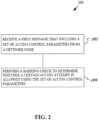
- FIG. 2 is a block diagram of an example method 200 for providing UAC parameters to a UE capable of performing a barring check based on the received parameters.
- the method can include receiving, by a wireless node, a first message that includes a set of access control parameters from a network node (block 202).
- the set of access control parameters can include UAC parameters as described herein.
- the method may also include performing, by the wireless node, a barring check to determine whether a certain access attempt is allowed using the set of access control parameters (block 204).
- the set of access control parameters include UAC parameters that include barring information representative of a listing of access categories with an associated barring information set that is configured for a specific network.
- the set of access control parameters can include a list of barring information set (e.g., uac-BarringInfoSetList). In each barring information set, a barring factor, barring time and a bit string (each bit indicates whether the access is allowed for a certain access identity) can be included.
- the set of access control parameters can include a common barring information (e.g., uac-BarringForCommon) applicable for all the networks (including PLMN or NPN). In this common barring information, a list of access categories with associated barring information set may be included.
- the set of access control parameters can include a list of barring information for different networks (e.g., uac-BarringPerPLMN-List or uac-BarringPerNPN-List).
- a list of access categories with associated barring information set may be configured for each network.
- the set of access control parameters are configured for a data transmission service in an inactive state and/or an idle state.
- the data transmission service in the inactive state and/or the idle state is categorized as access category 7, wherein the wireless node performs the barring check using the set of access control parameters associated with the access category 7.
- the data transmission service in the inactive state and/or the idle state is categorized as a new access category, wherein the wireless node performs the barring check using the set of access control parameters associated with the new access category.
- the set of access control parameters include a bit indicative of whether the data transmission in the inactive state and/or the idle state is allowed, wherein the wireless node initiates data transmission in the inactive state and/or the idle state when the bit indicates the service is allowed.
- the data transmission service in the inactive state and/or the idle state is supported by the network node, and wherein the wireless node initiates the small data transmission service without performing the barring check.
- the UAC parameters that include barring information representative of assistance information for access category selection are provided together with an associated network index.
- the UAC parameters that include barring information representative of assistance information for access category selection are provided together with a bitmap.
- a size of the bitmap equals a number of networks sharing a cell, wherein a first bit indicates whether a first network of the number of networks sharing the cell are associated with the barring information representative of the assistance information for access category selection that is configured for the specific network.
- the leftmost bit can indicate whether the first PLMN in the PLMN-IdentityInfoList or the first NPN in the NPN-IdentityInfoList is associated with UAC-AccessCategoryl-SelectionAssistanceInfo or not. If a bit in the bit map is set to "1," it can indicate that the corresponding network is associated with UAC-AccessCategoryl-SelectionAssistanceInfo.
- the first UAC-AccessCategory1-SelectionAssistanceInfo in the list may be associated with the network (a PLMN or a NPN) identified by the first bit with a value of "1.”
- the second UAC-AccessCategoryl-SelectionAssistanceInfo in the list may be associated with the network (a PLMN or a NPN) identified by the second bit with a value of "1.”
- the UAC parameters that include barring information representative of the assistance information for access category selection that is configured for the specific network are provided in a list of the assistance information for access category selection that is configured for the specific network, wherein a size of the list is equal to a number of networks sharing a cell and each entry inside the list is present.
- the set of access control parameters include a set of parameters for at least one neighboring cell, neighbor frequency or frequency band.
- the set of access control parameters include a set of parameters for a secondary cell or a secondary cell group.
- the set of access control parameters include a set of parameters for an assistant cell, an assistant frequency, or a frequency band, wherein any of the assistant cell, the assistant frequency, and/or assistant frequency band is a cell, frequency, and/or frequency band to be used for the terminal together with a camping cell.
- the method may include selecting, by the wireless node, a neighboring cell, a neighbor frequency, an assistant cell, an assistant frequency, a cell in the assistant cell group, a secondary cell, and/or a cell in the secondary cell group based on determining that the set of access control parameters of a current cell exceeds a threshold level.
- the set of access control parameters include UAC parameters for multiple wireless device types.
- the set of access control parameters include a first subset of parameters for the wireless node that supports Evolved-Universal Terrestrial Radio Access-New Radio Dual Connectivity (EN-DC) communication and a second subset of parameters that are applicable to other types of wireless devices.
- EN-DC Evolved-Universal Terrestrial Radio Access-New Radio Dual Connectivity
- the set of access control parameters include a first subset of parameters for the wireless node that supports Next-Generation Radio Access Network (NG-RAN) Evolved Universal Terrestrial Radio Access New Radio (E-UTRA-NR) Dual Connectivity (NGEN-DC) communication and a second subset of parameters that are applicable to other types of wireless devices.
- NG-RAN Next-Generation Radio Access Network
- E-UTRA-NR Evolved Universal Terrestrial Radio Access New Radio
- NGEN-DC Dual Connectivity
- the set of access control parameters include a first subset of parameters for the wireless node that supports New Radio E-UTRA Dual Connectivity (NE-DC) communication and a second subset of parameters that are applicable to other types of wireless devices.
- NE-DC New Radio E-UTRA Dual Connectivity
- the set of access control parameters include a first subset of parameters for a new radio light terminal, a machine-type communications (MTC) terminal, and/or an internet of things (IoT) terminal.
- MTC machine-type communications
- IoT internet of things
- the set of access control parameters include a first subset of parameters for the wireless node that supports New Radio Dual Connectivity (NR-DC) communication and a second subset of parameters that are applicable to other types of wireless devices.
- NR-DC New Radio Dual Connectivity
- the set of access control parameters include a first subset of parameters for the wireless node that supports Multi-Radio Access Technology Dual Connectivity (MR-DC) communication and a second subset of parameters that are applicable to other types of wireless devices.
- MR-DC Multi-Radio Access Technology Dual Connectivity
- the first subset of parameters for the wireless node include a higher pass rate than a pass rate of the second subset of parameters that are applicable to other types of wireless devices.
- the set of access control parameters are transmitted in a system information block (SIB) in the first message.
- SIB system information block
- the first message is transmitted via dedicated radio resource control (RRC) signaling.
- RRC radio resource control
- the dedicated RRC message can be a RRCRelease message or a RRCReconfiguration message.
- the NW can configure UE with dedicated signaling that which UAC parameters is to be used for UE in IDLE and/or INACTIVE and/or CONNECTED mode.
- a common configuration can be applied for different mode, or separate configuration can be configured for a different mode.
- a method for wireless communication includes transmitting, by a network node, a first message that includes a set of access control parameters to a wireless node.
- the method can also include receiving, by the network node, a second message from the wireless node, the second message transmitted by the wireless node based on a result of a barring check performed by the wireless node to determine whether a certain access attempt is allowed using the set of access control parameters.
- the set of access control parameters are configured for a data transmission service in an inactive state and/or an idle state.
- the data transmission service in the inactive state and/or the idle state is categorized as access category 7, wherein the wireless node is configured to perform the barring check using the set of access control parameters associated with the access category 7.
- the data transmission service in the inactive state and/or the idle state is categorized as a new access category, wherein the wireless node is configured to perform the barring check using the set of access control parameters associated with the new access category.
- the set of access control parameters include a bit indicative of whether the data transmission in the inactive state and/or the idle state is allowed, wherein the wireless node is configured to initiate data transmission in the inactive and/or the idle state responsive to determining that the bit indicates that the data transmission is allowed.
- the data transmission service in the inactive state and/or the idle state is supported by the network node, and wherein the wireless node is configured to initiate the data transmission service without performing the barring check.
- the set of access control parameters include unified access control (UAC) parameters that include barring information representative of assistance information for access category selection are provided together with an associated network index.
- UAC unified access control
- the set of access control parameters include barring information representative of assistance information for access category selection are provided together with a bitmap.
- a size of the bitmap equals a number of networks sharing a cell, wherein a first bit indicates whether a first network of the number of networks sharing the cell are associated with the barring information representative of assistance information for access category selection that is configured for the specific network.
- the set of access control parameters include UAC parameters that include barring information representative of the assistance information for access category selection that is configured for the specific network are provided in a list of the associated barring information set that is configured for the specific network, wherein a size of the list is equal to a number of networks sharing a cell and each entry inside the list is present.
- the set of access control parameters include a set of parameters for any of a neighboring cell, a neighbor frequency, a neighbor frequency band, an assistant cell, an assistant frequency, an assistance frequency band, an assistant cell group, a secondary cell, and a secondary cell group.
- the set of access control parameters include UAC parameters for multiple wireless device types.
- the first message includes the set of access control parameters are transmitted in a system information block (SIB) in the first message.
- SIB system information block
- the first message is transmitted via dedicated radio resource control (RRC) signaling.
- RRC radio resource control
- the dedicated RRC message can be a RRCRelease message or a RRCReconfiguration message.
- the NW configure UE with dedicated signaling that which UAC parameters can be used for UE in IDLE and/or INACTIVE and/or CONNECTED mode.
- a common configuration can be applied for different mode, or separate configuration can be configured for different mode.
- FIG. 3 shows an example of a wireless communication system where techniques in accordance with one or more embodiments of the present technology can be applied.
- a wireless communication system 300 can include one or more base stations (BSs) 305a, 305b, one or more wireless devices 310a, 310b, 310c, 310d, and a core network 325.
- a base station 305a, 305b can provide wireless service to wireless devices 310a, 310b, 310c and 310d in one or more wireless sectors.
- a base station 305a, 305b includes directional antennas to produce two or more directional beams to provide wireless coverage in different sectors.
- the core network 325 can communicate with one or more base stations 305a, 305b.
- the core network 325 provides connectivity with other wireless communication systems and wired communication systems.
- the core network may include one or more service subscription databases to store information related to the subscribed wireless devices 310a, 310b, 310c, and 310d.
- a first base station 305a can provide wireless service based on a first radio access technology
- a second base station 305b can provide wireless service based on a second radio access technology.
- the base stations 305a and 305b may be co-located or may be separately installed in the field according to the deployment scenario.
- the wireless devices 310a, 310b, 310c, and 310d can support multiple different radio access technologies.
- a wireless communication system can include multiple networks using different wireless technologies.
- a dual-mode or multi-mode wireless device includes two or more wireless technologies that could be used to connect to different wireless networks.
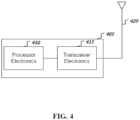
- FIG. 4 is a block diagram representation of a portion of a hardware platform.
- a hardware platform 405 such as a network device or a base station or a wireless device (or UE) can include processor electronics 410 such as a microprocessor that implements one or more of the techniques presented in this document.
- the hardware platform 405 can include transceiver electronics 415 to send and/or receive wired or wireless signals over one or more communication interfaces such as antenna 420 or a wireline interface.
- the hardware platform 405 can implement other communication interfaces with defined protocols for transmitting and receiving data.
- the hardware platform 405 can include one or more memories (not explicitly shown) configured to store information such as data and/or instructions.
- the processor electronics 410 can include at least a portion of the transceiver electronics 415. In some embodiments, at least some of the disclosed techniques, modules or functions are implemented using the hardware platform 405.
- the disclosed and other embodiments, modules and the functional operations described in this document can be implemented in digital electronic circuitry, or in computer software, firmware, or hardware, including the structures disclosed in this document and their structural equivalents, or in combinations of one or more of them.
- the disclosed and other embodiments can be implemented as one or more computer program products, i.e., one or more modules of computer program instructions encoded on a computer readable medium for execution by, or to control the operation of, data processing apparatus.
- the computer readable medium can be a machine-readable storage device, a machine-readable storage substrate, a memory device, a composition of matter effecting a machine-readable propagated signal, or a combination of one or more them.
- data processing apparatus encompasses all apparatus, devices, and machines for processing data, including by way of example a programmable processor, a computer, or multiple processors or computers.
- the apparatus can include, in addition to hardware, code that creates an execution environment for the computer program in question, e.g., code that constitutes processor firmware, a protocol stack, a database management system, an operating system, or a combination of one or more of them.
- a propagated signal is an artificially generated signal, e.g., a machine-generated electrical, optical, or electromagnetic signal, that is generated to encode information for transmission to suitable receiver apparatus.
- a computer program (also known as a program, software, software application, script, or code) can be written in any form of programming language, including compiled or interpreted languages, and it can be deployed in any form, including as a stand-alone program or as a module, component, subroutine, or other unit suitable for use in a computing environment.
- a computer program does not necessarily correspond to a file in a file system.
- a program can be stored in a portion of a file that holds other programs or data (e.g., one or more scripts stored in a markup language document), in a single file dedicated to the program in question, or in multiple coordinated files (e.g., files that store one or more modules, sub programs, or portions of code).
- a computer program can be deployed to be executed on one computer or on multiple computers that are located at one site or distributed across multiple sites and interconnected by a communication network.
- the processes and logic flows described in this document can be performed by one or more programmable processors executing one or more computer programs to perform functions by operating on input data and generating output.
- the processes and logic flows can also be performed by, and apparatus can also be implemented as, special purpose logic circuitry, e.g., an FPGA (field programmable gate array) or an ASIC (application specific integrated circuit).
- processors suitable for the execution of a computer program include, by way of example, both general and special purpose microprocessors, and any one or more processors of any kind of digital computer.
- a processor will receive instructions and data from a read only memory or a random-access memory or both.
- the essential elements of a computer are a processor for performing instructions and one or more memory devices for storing instructions and data.
- a computer will also include, or be operatively coupled to receive data from or transfer data to, or both, one or more mass storage devices for storing data, e.g., magnetic, magneto optical disks, or optical disks.
- mass storage devices for storing data, e.g., magnetic, magneto optical disks, or optical disks.
- a computer need not have such devices.
- Computer readable media suitable for storing computer program instructions and data include all forms of non-volatile memory, media and memory devices, including by way of example semiconductor memory devices, e.g., EPROM, EEPROM, and flash memory devices; magnetic disks, e.g., internal hard disks or removable disks; magneto optical disks; and CD ROM and DVD-ROM disks.
- semiconductor memory devices e.g., EPROM, EEPROM, and flash memory devices
- magnetic disks e.g., internal hard disks or removable disks
- magneto optical disks e.g., CD ROM and DVD-ROM disks.
- the processor and the memory can be supplemented by, or incorporated in, special purpose logic circuitry.
Landscapes
- Engineering & Computer Science (AREA)
- Computer Security & Cryptography (AREA)
- Computer Networks & Wireless Communication (AREA)
- Signal Processing (AREA)
- Mobile Radio Communication Systems (AREA)
Claims (10)
- Verfahren zur drahtlosen Kommunikation, das aufweist:Empfangen, durch einen drahtlosen Knoten, einer ersten Nachricht, die einen Satz von Zugangskontrollparametern von einem Netzwerkknoten aufweist, wobei der Satz von Zugangskontrollparametern einheitliche Zugriffskontroll-, UAC, Parameter aufweist, die eine Auflistung von Zugangskategorien und einen entsprechenden Sperrinformationssatz aufweisen, wobei der Satz von Zugangskontrollparametern ferner eine Liste von Unterstützungsinformationen für die Auswahl von Zugangskategorien für eine Anzahl von Netzwerken aufweist, die sich eine Zelle teilen,wobei eine Größe der Liste von Unterstützungsinformationen für die Auswahl von Zugangskategorien gleich der Anzahl von Netzwerken ist, die sich die Zelle teilen,wobei jeder Eintrag der Liste von Unterstützungsinformationen für die Auswahl der Zugangskategorie mit einem entsprechenden Netzwerk in der Anzahl von Netzwerken assoziiert ist, die sich die Zelle teilen, undwobei ein Wert eines Eintrags der Liste von Unterstützungsinformationen für die Auswahl der Zugangskategorie der Zugangskategorie 1 entspricht, die für das entsprechende Netzwerk nicht konfiguriert ist; undDurchführen, durch den drahtlosen Knoten, einer Zugangssperrprüfung, um zu bestimmen, ob ein bestimmter Zugangsversuch unter Verwendung des Satzes von Zugangskontrollparametern zulässig ist.
- Verfahren nach Anspruch 1, wobei jeder Eintrag innerhalb der Liste von Unterstützungsinformationen für die Auswahl der Zugangskategorie vorhanden ist.
- Verfahren nach Anspruch 1 oder 2, wobei der Satz von Zugangskontrollparametern in einer Systeminformationsblock-, SIB, Nachricht enthalten ist.
- Verfahren zur drahtlosen Kommunikation, das aufweist:Übertragen, durch einen Netzwerkknoten, einer ersten Nachricht, die einen Satz von Zugangskontrollparametern aufweist, an einen drahtlosen Knoten, wobei der Satz von Zugangskontrollparametern einheitliche Zugriffskontroll-, UAC, Parameter aufweist, die eine Auflistung von Zugangskategorien und einen entsprechenden Sperrinformationssatz enthalten, wobei der Satz von Zugangskontrollparametern ferner eine Liste von Unterstützungsinformationen für die Auswahl von Zugangskategorien für eine Anzahl von Netzwerken aufweist, die sich eine Zelle teilen,wobei eine Größe der Liste von Unterstützungsinformationen für die Auswahl von Zugangskategorien gleich der Anzahl von Netzwerken ist, die sich die Zelle teilen,wobei jeder Eintrag der Liste von Unterstützungsinformationen für die Auswahl der Zugangskategorie mit einem entsprechenden Netzwerk in der Anzahl von Netzwerken assoziiert ist, die sich die Zelle teilen, undwobei ein Wert eines Eintrags der Liste von Unterstützungsinformationen für die Auswahl der Zugangskategorie der Zugangskategorie 1 entspricht, die für das entsprechende Netzwerk nicht konfiguriert ist; undEmpfangen, durch den Netzwerkknoten, einer zweiten Nachricht von dem drahtlosen Knoten basierend auf einem Ergebnis einer Zugangssperrprüfung, die durch den drahtlosen Knoten durchgeführt wird, um zu bestimmen, ob ein bestimmter Zugangsversuch unter Verwendung des Satzes von Zugangskontrollparametern zulässig ist.
- Verfahren nach Anspruch 4, wobei jeder Eintrag innerhalb der Liste der Unterstützungsinformationen für die Auswahl der Zugangskategorie vorhanden ist.
- Verfahren nach Anspruch 4 oder 5, wobei der Satz von Zugangskontrollparametern in einer Systeminformationsblock-, SIB, Nachricht enthalten ist.
- Vorrichtung zur drahtlosen Kommunikation, wobei die Vorrichtung mit einem drahtlosen Knoten assoziiert ist und einen Prozessor aufweist, der konfiguriert ist, das Verfahren nach einem der Ansprüche 1 bis 3 auszuführen.
- Nichtflüchtiges computerlesbares Medium mit darauf gespeichertem Code, wobei der Code, wenn er von einem Prozessor ausgeführt wird, der mit einem drahtlosen Knoten assoziiert ist, den drahtlosen Knoten veranlasst, ein Verfahren nach einem der Ansprüche 1 bis 3 zu implementieren.
- Vorrichtung zur drahtlosen Kommunikation, wobei die Vorrichtung mit einem Netzwerkknoten assoziiert ist und einen Prozessor aufweist, der konfiguriert ist, das Verfahren nach einem der Ansprüche 4 bis 6 auszuführen.
- Nichtflüchtiges computerlesbares Medium mit darauf gespeichertem Code, wobei der Code, wenn er von einem Prozessor ausgeführt wird, der mit einem Netzwerkknoten assoziiert ist, den Netzwerkknoten veranlasst, ein Verfahren nach einem der Ansprüche 4 bis 6 zu implementieren.
Priority Applications (1)
| Application Number | Priority Date | Filing Date | Title |
|---|---|---|---|
| EP25155008.3A EP4539550A3 (de) | 2020-04-09 | 2020-04-09 | Konfiguration von zugangssteuerungsparametern in der drahtlosen kommunikation |
Applications Claiming Priority (1)
| Application Number | Priority Date | Filing Date | Title |
|---|---|---|---|
| PCT/CN2020/083913 WO2021109390A1 (en) | 2020-04-09 | 2020-04-09 | Configuring access control parameters in wireless communications |
Related Child Applications (2)
| Application Number | Title | Priority Date | Filing Date |
|---|---|---|---|
| EP25155008.3A Division EP4539550A3 (de) | 2020-04-09 | 2020-04-09 | Konfiguration von zugangssteuerungsparametern in der drahtlosen kommunikation |
| EP25155008.3A Division-Into EP4539550A3 (de) | 2020-04-09 | 2020-04-09 | Konfiguration von zugangssteuerungsparametern in der drahtlosen kommunikation |
Publications (3)
| Publication Number | Publication Date |
|---|---|
| EP4055895A1 EP4055895A1 (de) | 2022-09-14 |
| EP4055895A4 EP4055895A4 (de) | 2023-07-19 |
| EP4055895B1 true EP4055895B1 (de) | 2025-04-09 |
Family
ID=76222381
Family Applications (2)
| Application Number | Title | Priority Date | Filing Date |
|---|---|---|---|
| EP25155008.3A Pending EP4539550A3 (de) | 2020-04-09 | 2020-04-09 | Konfiguration von zugangssteuerungsparametern in der drahtlosen kommunikation |
| EP20897376.8A Active EP4055895B1 (de) | 2020-04-09 | 2020-04-09 | Konfiguration von zugangskontrollparametern in der drahtlosen kommunikation |
Family Applications Before (1)
| Application Number | Title | Priority Date | Filing Date |
|---|---|---|---|
| EP25155008.3A Pending EP4539550A3 (de) | 2020-04-09 | 2020-04-09 | Konfiguration von zugangssteuerungsparametern in der drahtlosen kommunikation |
Country Status (5)
| Country | Link |
|---|---|
| US (2) | US12323906B2 (de) |
| EP (2) | EP4539550A3 (de) |
| CN (2) | CN115023978A (de) |
| ES (1) | ES3019909T3 (de) |
| WO (1) | WO2021109390A1 (de) |
Families Citing this family (8)
| Publication number | Priority date | Publication date | Assignee | Title |
|---|---|---|---|---|
| US12058603B2 (en) * | 2019-08-14 | 2024-08-06 | Google Llc | Systems and methods for preventing undesired access barring alleviation |
| US20230247525A1 (en) * | 2020-06-04 | 2023-08-03 | Telefonaktiebolaget Lm Ericsson (Publ) | Association of network identities and unified access control parameters |
| CN114071741B (zh) * | 2020-08-06 | 2025-07-15 | 维沃移动通信有限公司 | 信息传输方法、装置、终端及网络侧设备 |
| CN117044372A (zh) * | 2021-03-22 | 2023-11-10 | Oppo广东移动通信有限公司 | 接入控制信息的配置方法及装置、终端设备、网络设备 |
| CN115004838B (zh) * | 2022-04-22 | 2025-12-02 | 北京小米移动软件有限公司 | 一种接入控制方法、装置、设备及存储介质 |
| WO2025001172A1 (en) * | 2024-02-07 | 2025-01-02 | Lenovo (Beijing) Limited | Access control mechanism |
| CN121418949A (zh) * | 2024-07-25 | 2026-01-27 | 中国电信股份有限公司技术创新中心 | 终端接入的统一控制方法、装置、和通信设备 |
| CN121751289A (zh) * | 2024-09-26 | 2026-03-27 | 华为技术有限公司 | 一种通信方法及装置 |
Family Cites Families (8)
| Publication number | Priority date | Publication date | Assignee | Title |
|---|---|---|---|---|
| KR102129977B1 (ko) * | 2017-02-02 | 2020-07-06 | 주식회사 케이티 | 액세스 제어 방법 및 장치 |
| EP3619968B1 (de) * | 2017-05-05 | 2021-06-23 | LG Electronics Inc. | Zugangsversuch zu einer zelle von einem drahtlosen kommunikationssystem gemäss der zuordnung einer nr-zugangskategorie zu einer lte-einrichtungsursache |
| MX2019008837A (es) * | 2017-06-23 | 2019-09-09 | Lg Electronics Inc | Metodo y aparato para realizar comprobacion de restriccion de acceso. |
| CN109548077A (zh) * | 2017-08-11 | 2019-03-29 | 华为技术有限公司 | 通信方法、终端设备和网络设备 |
| BR112020009597A2 (pt) * | 2017-11-16 | 2020-11-03 | Sharp Kabushiki Kaisha | terminal sem fio, métodos em um terminal sem fio e nós de acesso de uma rede de acesso por rádio |
| KR102741104B1 (ko) * | 2018-04-05 | 2024-12-10 | 삼성전자 주식회사 | 차세대 이동통신 시스템에서 엑세스 제어 설정 정보를 효율적으로 제공하는 방법 및 장치 |
| CN110475312B (zh) * | 2018-05-11 | 2021-04-06 | 维沃移动通信有限公司 | 一种接入控制方法、消息广播方法及相关设备 |
| CN110505672B (zh) * | 2018-05-17 | 2020-12-15 | 华为技术有限公司 | 接入控制方法、通信设备以及基站 |
-
2020
- 2020-04-09 CN CN202080095267.7A patent/CN115023978A/zh active Pending
- 2020-04-09 WO PCT/CN2020/083913 patent/WO2021109390A1/en not_active Ceased
- 2020-04-09 EP EP25155008.3A patent/EP4539550A3/de active Pending
- 2020-04-09 CN CN202211139698.6A patent/CN115474259B/zh active Active
- 2020-04-09 EP EP20897376.8A patent/EP4055895B1/de active Active
- 2020-04-09 ES ES20897376T patent/ES3019909T3/es active Active
-
2022
- 2022-06-09 US US17/836,292 patent/US12323906B2/en active Active
-
2025
- 2025-04-30 US US19/195,673 patent/US20250358721A1/en active Pending
Also Published As
| Publication number | Publication date |
|---|---|
| CN115474259A (zh) | 2022-12-13 |
| EP4055895A4 (de) | 2023-07-19 |
| CA3164078A1 (en) | 2021-06-10 |
| WO2021109390A1 (en) | 2021-06-10 |
| EP4539550A3 (de) | 2025-07-09 |
| US12323906B2 (en) | 2025-06-03 |
| US20220303883A1 (en) | 2022-09-22 |
| CN115023978A (zh) | 2022-09-06 |
| CN115474259B (zh) | 2025-12-12 |
| EP4055895A1 (de) | 2022-09-14 |
| ES3019909T3 (en) | 2025-05-21 |
| US20250358721A1 (en) | 2025-11-20 |
| EP4539550A2 (de) | 2025-04-16 |
Similar Documents
| Publication | Publication Date | Title |
|---|---|---|
| EP4055895B1 (de) | Konfiguration von zugangskontrollparametern in der drahtlosen kommunikation | |
| US12294897B2 (en) | Mobility enhancement in a connected state | |
| US11297680B2 (en) | Method and apparatus for handling emergency services in a wireless network | |
| US11930442B2 (en) | Reducing wireless device service interruptions | |
| US11477722B2 (en) | Changing access control parameters in a wireless network | |
| CN104798414B (zh) | 用于双模网络选择的系统及方法 | |
| CN115362714B (zh) | 无线电通信网络中的装置和方法 | |
| WO2013186143A1 (en) | Load balancing in a network and between networks | |
| US12615584B2 (en) | Method and apparatus for essential slice service processing and recovery of service | |
| EP3530021A1 (de) | Freigabe von signalisierungsfunkträgern für zellgruppen | |
| US20240073785A1 (en) | Method and apparatus for controlling disaster roaming service in wireless network | |
| US12177810B2 (en) | Reducing unsuccessful paging | |
| WO2023130471A1 (zh) | 小区接入方法、装置、设备及可读存储介质 | |
| EP4136884A1 (de) | Netzwerkknoten, benutzergerät und verfahren in einem funkkommunikationsnetzwerk | |
| US20250024515A1 (en) | Indication of synchronization signal block type for devices with reduced capabilities | |
| US20200112908A1 (en) | Technique for indicating multiple core networks in a message transmission | |
| CN120153759A (zh) | 选择具有DualSteer功能的辅移动网络并向该辅移动网络注册 | |
| US20200322877A1 (en) | Methods, apparatus and systems for indicating a configuration of access control information in a wireless communication | |
| CN108271210A (zh) | 通信方法和通信设备 | |
| US20250031141A1 (en) | Optimized cag cell selection sim commands with cag cell selection | |
| WO2022231505A1 (en) | Radio network node, user equipment, network node and methods performed therein | |
| CA3164078C (en) | Configuring access control parameters in wireless communications | |
| CN120883540A (zh) | 用于管理电信网络中卫星覆盖可用性信息的方法和ue | |
| WO2025085184A1 (en) | Optimized cag cell selection sim commands with cag cell information | |
| WO2022164376A1 (en) | Logging system information request procedure related information and measurements |
Legal Events
| Date | Code | Title | Description |
|---|---|---|---|
| STAA | Information on the status of an ep patent application or granted ep patent |
Free format text: STATUS: THE INTERNATIONAL PUBLICATION HAS BEEN MADE |
|
| PUAI | Public reference made under article 153(3) epc to a published international application that has entered the european phase |
Free format text: ORIGINAL CODE: 0009012 |
|
| STAA | Information on the status of an ep patent application or granted ep patent |
Free format text: STATUS: REQUEST FOR EXAMINATION WAS MADE |
|
| 17P | Request for examination filed |
Effective date: 20220608 |
|
| AK | Designated contracting states |
Kind code of ref document: A1 Designated state(s): AL AT BE BG CH CY CZ DE DK EE ES FI FR GB GR HR HU IE IS IT LI LT LU LV MC MK MT NL NO PL PT RO RS SE SI SK SM TR |
|
| A4 | Supplementary search report drawn up and despatched |
Effective date: 20230616 |
|
| RIC1 | Information provided on ipc code assigned before grant |
Ipc: H04W 48/02 20090101ALI20230612BHEP Ipc: H04W 48/12 20090101ALI20230612BHEP Ipc: H04W 48/10 20090101ALI20230612BHEP Ipc: H04W 48/16 20090101AFI20230612BHEP |
|
| GRAP | Despatch of communication of intention to grant a patent |
Free format text: ORIGINAL CODE: EPIDOSNIGR1 |
|
| STAA | Information on the status of an ep patent application or granted ep patent |
Free format text: STATUS: GRANT OF PATENT IS INTENDED |
|
| RIC1 | Information provided on ipc code assigned before grant |
Ipc: H04W 48/02 20090101ALI20241006BHEP Ipc: H04W 48/12 20090101ALI20241006BHEP Ipc: H04W 48/10 20090101ALI20241006BHEP Ipc: H04W 48/16 20090101AFI20241006BHEP |
|
| INTG | Intention to grant announced |
Effective date: 20241017 |
|
| GRAS | Grant fee paid |
Free format text: ORIGINAL CODE: EPIDOSNIGR3 |
|
| GRAJ | Information related to disapproval of communication of intention to grant by the applicant or resumption of examination proceedings by the epo deleted |
Free format text: ORIGINAL CODE: EPIDOSDIGR1 |
|
| GRAL | Information related to payment of fee for publishing/printing deleted |
Free format text: ORIGINAL CODE: EPIDOSDIGR3 |
|
| STAA | Information on the status of an ep patent application or granted ep patent |
Free format text: STATUS: REQUEST FOR EXAMINATION WAS MADE |
|
| GRAS | Grant fee paid |
Free format text: ORIGINAL CODE: EPIDOSNIGR3 |
|
| STAA | Information on the status of an ep patent application or granted ep patent |
Free format text: STATUS: GRANT OF PATENT IS INTENDED |
|
| GRAP | Despatch of communication of intention to grant a patent |
Free format text: ORIGINAL CODE: EPIDOSNIGR1 |
|
| INTC | Intention to grant announced (deleted) | ||
| GRAA | (expected) grant |
Free format text: ORIGINAL CODE: 0009210 |
|
| STAA | Information on the status of an ep patent application or granted ep patent |
Free format text: STATUS: THE PATENT HAS BEEN GRANTED |
|
| INTG | Intention to grant announced |
Effective date: 20250220 |
|
| AK | Designated contracting states |
Kind code of ref document: B1 Designated state(s): AL AT BE BG CH CY CZ DE DK EE ES FI FR GB GR HR HU IE IS IT LI LT LU LV MC MK MT NL NO PL PT RO RS SE SI SK SM TR |
|
| REG | Reference to a national code |
Ref country code: GB Ref legal event code: FG4D |
|
| REG | Reference to a national code |
Ref country code: CH Ref legal event code: EP |
|
| REG | Reference to a national code |
Ref country code: DE Ref legal event code: R096 Ref document number: 602020049326 Country of ref document: DE |
|
| REG | Reference to a national code |
Ref country code: IE Ref legal event code: FG4D |
|
| REG | Reference to a national code |
Ref country code: ES Ref legal event code: FG2A Ref document number: 3019909 Country of ref document: ES Kind code of ref document: T3 Effective date: 20250521 |
|
| PGFP | Annual fee paid to national office [announced via postgrant information from national office to epo] |
Ref country code: DE Payment date: 20250408 Year of fee payment: 6 |
|
| PGFP | Annual fee paid to national office [announced via postgrant information from national office to epo] |
Ref country code: ES Payment date: 20250507 Year of fee payment: 6 |
|
| PGFP | Annual fee paid to national office [announced via postgrant information from national office to epo] |
Ref country code: CH Payment date: 20250501 Year of fee payment: 6 |
|
| REG | Reference to a national code |
Ref country code: NL Ref legal event code: MP Effective date: 20250409 |
|
| PG25 | Lapsed in a contracting state [announced via postgrant information from national office to epo] |
Ref country code: NL Free format text: LAPSE BECAUSE OF FAILURE TO SUBMIT A TRANSLATION OF THE DESCRIPTION OR TO PAY THE FEE WITHIN THE PRESCRIBED TIME-LIMIT Effective date: 20250409 |
|
| REG | Reference to a national code |
Ref country code: AT Ref legal event code: MK05 Ref document number: 1784732 Country of ref document: AT Kind code of ref document: T Effective date: 20250409 |
|
| PG25 | Lapsed in a contracting state [announced via postgrant information from national office to epo] |
Ref country code: PT Free format text: LAPSE BECAUSE OF FAILURE TO SUBMIT A TRANSLATION OF THE DESCRIPTION OR TO PAY THE FEE WITHIN THE PRESCRIBED TIME-LIMIT Effective date: 20250811 Ref country code: FI Free format text: LAPSE BECAUSE OF FAILURE TO SUBMIT A TRANSLATION OF THE DESCRIPTION OR TO PAY THE FEE WITHIN THE PRESCRIBED TIME-LIMIT Effective date: 20250409 |
|
| REG | Reference to a national code |
Ref country code: LT Ref legal event code: MG9D |
|
| PG25 | Lapsed in a contracting state [announced via postgrant information from national office to epo] |
Ref country code: GR Free format text: LAPSE BECAUSE OF FAILURE TO SUBMIT A TRANSLATION OF THE DESCRIPTION OR TO PAY THE FEE WITHIN THE PRESCRIBED TIME-LIMIT Effective date: 20250710 Ref country code: NO Free format text: LAPSE BECAUSE OF FAILURE TO SUBMIT A TRANSLATION OF THE DESCRIPTION OR TO PAY THE FEE WITHIN THE PRESCRIBED TIME-LIMIT Effective date: 20250709 |
|
| PG25 | Lapsed in a contracting state [announced via postgrant information from national office to epo] |
Ref country code: PL Free format text: LAPSE BECAUSE OF FAILURE TO SUBMIT A TRANSLATION OF THE DESCRIPTION OR TO PAY THE FEE WITHIN THE PRESCRIBED TIME-LIMIT Effective date: 20250409 |
|
| PG25 | Lapsed in a contracting state [announced via postgrant information from national office to epo] |
Ref country code: BG Free format text: LAPSE BECAUSE OF FAILURE TO SUBMIT A TRANSLATION OF THE DESCRIPTION OR TO PAY THE FEE WITHIN THE PRESCRIBED TIME-LIMIT Effective date: 20250409 |
|
| PG25 | Lapsed in a contracting state [announced via postgrant information from national office to epo] |
Ref country code: HR Free format text: LAPSE BECAUSE OF FAILURE TO SUBMIT A TRANSLATION OF THE DESCRIPTION OR TO PAY THE FEE WITHIN THE PRESCRIBED TIME-LIMIT Effective date: 20250409 |
|
| PG25 | Lapsed in a contracting state [announced via postgrant information from national office to epo] |
Ref country code: AT Free format text: LAPSE BECAUSE OF FAILURE TO SUBMIT A TRANSLATION OF THE DESCRIPTION OR TO PAY THE FEE WITHIN THE PRESCRIBED TIME-LIMIT Effective date: 20250409 |
|
| PG25 | Lapsed in a contracting state [announced via postgrant information from national office to epo] |
Ref country code: RS Free format text: LAPSE BECAUSE OF FAILURE TO SUBMIT A TRANSLATION OF THE DESCRIPTION OR TO PAY THE FEE WITHIN THE PRESCRIBED TIME-LIMIT Effective date: 20250709 |
|
| PG25 | Lapsed in a contracting state [announced via postgrant information from national office to epo] |
Ref country code: IS Free format text: LAPSE BECAUSE OF FAILURE TO SUBMIT A TRANSLATION OF THE DESCRIPTION OR TO PAY THE FEE WITHIN THE PRESCRIBED TIME-LIMIT Effective date: 20250809 |
|
| PG25 | Lapsed in a contracting state [announced via postgrant information from national office to epo] |
Ref country code: LV Free format text: LAPSE BECAUSE OF FAILURE TO SUBMIT A TRANSLATION OF THE DESCRIPTION OR TO PAY THE FEE WITHIN THE PRESCRIBED TIME-LIMIT Effective date: 20250409 |
|
| PG25 | Lapsed in a contracting state [announced via postgrant information from national office to epo] |
Ref country code: LU Free format text: LAPSE BECAUSE OF NON-PAYMENT OF DUE FEES Effective date: 20250409 |
|
| REG | Reference to a national code |
Ref country code: BE Ref legal event code: MM Effective date: 20250430 |
|
| REG | Reference to a national code |
Ref country code: DE Ref legal event code: R097 Ref document number: 602020049326 Country of ref document: DE |
|
| PG25 | Lapsed in a contracting state [announced via postgrant information from national office to epo] |
Ref country code: SM Free format text: LAPSE BECAUSE OF FAILURE TO SUBMIT A TRANSLATION OF THE DESCRIPTION OR TO PAY THE FEE WITHIN THE PRESCRIBED TIME-LIMIT Effective date: 20250409 Ref country code: DK Free format text: LAPSE BECAUSE OF FAILURE TO SUBMIT A TRANSLATION OF THE DESCRIPTION OR TO PAY THE FEE WITHIN THE PRESCRIBED TIME-LIMIT Effective date: 20250409 |
|
| PG25 | Lapsed in a contracting state [announced via postgrant information from national office to epo] |
Ref country code: BE Free format text: LAPSE BECAUSE OF NON-PAYMENT OF DUE FEES Effective date: 20250430 |
|
| PG25 | Lapsed in a contracting state [announced via postgrant information from national office to epo] |
Ref country code: CZ Free format text: LAPSE BECAUSE OF FAILURE TO SUBMIT A TRANSLATION OF THE DESCRIPTION OR TO PAY THE FEE WITHIN THE PRESCRIBED TIME-LIMIT Effective date: 20250409 |
|
| PG25 | Lapsed in a contracting state [announced via postgrant information from national office to epo] |
Ref country code: EE Free format text: LAPSE BECAUSE OF FAILURE TO SUBMIT A TRANSLATION OF THE DESCRIPTION OR TO PAY THE FEE WITHIN THE PRESCRIBED TIME-LIMIT Effective date: 20250409 |
|
| PG25 | Lapsed in a contracting state [announced via postgrant information from national office to epo] |
Ref country code: SK Free format text: LAPSE BECAUSE OF FAILURE TO SUBMIT A TRANSLATION OF THE DESCRIPTION OR TO PAY THE FEE WITHIN THE PRESCRIBED TIME-LIMIT Effective date: 20250409 |
|
| PG25 | Lapsed in a contracting state [announced via postgrant information from national office to epo] |
Ref country code: IT Free format text: LAPSE BECAUSE OF FAILURE TO SUBMIT A TRANSLATION OF THE DESCRIPTION OR TO PAY THE FEE WITHIN THE PRESCRIBED TIME-LIMIT Effective date: 20250409 |
|
| PG25 | Lapsed in a contracting state [announced via postgrant information from national office to epo] |
Ref country code: MC Free format text: LAPSE BECAUSE OF FAILURE TO SUBMIT A TRANSLATION OF THE DESCRIPTION OR TO PAY THE FEE WITHIN THE PRESCRIBED TIME-LIMIT Effective date: 20250409 |
|
| PG25 | Lapsed in a contracting state [announced via postgrant information from national office to epo] |
Ref country code: RO Free format text: LAPSE BECAUSE OF FAILURE TO SUBMIT A TRANSLATION OF THE DESCRIPTION OR TO PAY THE FEE WITHIN THE PRESCRIBED TIME-LIMIT Effective date: 20250409 |
|
| PLBE | No opposition filed within time limit |
Free format text: ORIGINAL CODE: 0009261 |
|
| STAA | Information on the status of an ep patent application or granted ep patent |
Free format text: STATUS: NO OPPOSITION FILED WITHIN TIME LIMIT |
|
| REG | Reference to a national code |
Ref country code: CH Ref legal event code: L10 Free format text: ST27 STATUS EVENT CODE: U-0-0-L10-L00 (AS PROVIDED BY THE NATIONAL OFFICE) Effective date: 20260218 |
|
| 26N | No opposition filed |
Effective date: 20260112 |
|
| PGFP | Annual fee paid to national office [announced via postgrant information from national office to epo] |
Ref country code: GB Payment date: 20260312 Year of fee payment: 7 |
|
| PG25 | Lapsed in a contracting state [announced via postgrant information from national office to epo] |
Ref country code: IE Free format text: LAPSE BECAUSE OF NON-PAYMENT OF DUE FEES Effective date: 20250409 |
|
| PGFP | Annual fee paid to national office [announced via postgrant information from national office to epo] |
Ref country code: FR Payment date: 20260309 Year of fee payment: 7 |