EP4055797B1 - Migration von web-anwendungskomponenten in ein cloud-computing-system - Google Patents
Migration von web-anwendungskomponenten in ein cloud-computing-system Download PDFInfo
- Publication number
- EP4055797B1 EP4055797B1 EP19951609.7A EP19951609A EP4055797B1 EP 4055797 B1 EP4055797 B1 EP 4055797B1 EP 19951609 A EP19951609 A EP 19951609A EP 4055797 B1 EP4055797 B1 EP 4055797B1
- Authority
- EP
- European Patent Office
- Prior art keywords
- web application
- web
- cloud service
- manifest
- migration
- Prior art date
- Legal status (The legal status is an assumption and is not a legal conclusion. Google has not performed a legal analysis and makes no representation as to the accuracy of the status listed.)
- Active
Links
Images



Classifications
-
- H—ELECTRICITY
- H04—ELECTRIC COMMUNICATION TECHNIQUE
- H04L—TRANSMISSION OF DIGITAL INFORMATION, e.g. TELEGRAPHIC COMMUNICATION
- H04L67/00—Network arrangements or protocols for supporting network services or applications
- H04L67/01—Protocols
- H04L67/02—Protocols based on web technology, e.g. hypertext transfer protocol [HTTP]
-
- G—PHYSICS
- G06—COMPUTING OR CALCULATING; COUNTING
- G06F—ELECTRIC DIGITAL DATA PROCESSING
- G06F9/00—Arrangements for program control, e.g. control units
- G06F9/06—Arrangements for program control, e.g. control units using stored programs, i.e. using an internal store of processing equipment to receive or retain programs
- G06F9/44—Arrangements for executing specific programs
- G06F9/455—Emulation; Interpretation; Software simulation, e.g. virtualisation or emulation of application or operating system execution engines
- G06F9/45533—Hypervisors; Virtual machine monitors
- G06F9/45558—Hypervisor-specific management and integration aspects
-
- G—PHYSICS
- G06—COMPUTING OR CALCULATING; COUNTING
- G06F—ELECTRIC DIGITAL DATA PROCESSING
- G06F9/00—Arrangements for program control, e.g. control units
- G06F9/06—Arrangements for program control, e.g. control units using stored programs, i.e. using an internal store of processing equipment to receive or retain programs
- G06F9/46—Multiprogramming arrangements
- G06F9/48—Program initiating; Program switching, e.g. by interrupt
- G06F9/4806—Task transfer initiation or dispatching
- G06F9/4843—Task transfer initiation or dispatching by program, e.g. task dispatcher, supervisor, operating system
- G06F9/485—Task life-cycle, e.g. stopping, restarting, resuming execution
- G06F9/4856—Task life-cycle, e.g. stopping, restarting, resuming execution resumption being on a different machine, e.g. task migration, virtual machine migration
-
- G—PHYSICS
- G06—COMPUTING OR CALCULATING; COUNTING
- G06F—ELECTRIC DIGITAL DATA PROCESSING
- G06F9/00—Arrangements for program control, e.g. control units
- G06F9/06—Arrangements for program control, e.g. control units using stored programs, i.e. using an internal store of processing equipment to receive or retain programs
- G06F9/46—Multiprogramming arrangements
- G06F9/50—Allocation of resources, e.g. of the central processing unit [CPU]
- G06F9/5061—Partitioning or combining of resources
- G06F9/5077—Logical partitioning of resources; Management or configuration of virtualized resources
-
- H—ELECTRICITY
- H04—ELECTRIC COMMUNICATION TECHNIQUE
- H04L—TRANSMISSION OF DIGITAL INFORMATION, e.g. TELEGRAPHIC COMMUNICATION
- H04L67/00—Network arrangements or protocols for supporting network services or applications
- H04L67/01—Protocols
- H04L67/10—Protocols in which an application is distributed across nodes in the network
-
- G—PHYSICS
- G06—COMPUTING OR CALCULATING; COUNTING
- G06F—ELECTRIC DIGITAL DATA PROCESSING
- G06F9/00—Arrangements for program control, e.g. control units
- G06F9/06—Arrangements for program control, e.g. control units using stored programs, i.e. using an internal store of processing equipment to receive or retain programs
- G06F9/44—Arrangements for executing specific programs
- G06F9/455—Emulation; Interpretation; Software simulation, e.g. virtualisation or emulation of application or operating system execution engines
- G06F9/45533—Hypervisors; Virtual machine monitors
- G06F9/45558—Hypervisor-specific management and integration aspects
- G06F2009/4557—Distribution of virtual machine instances; Migration and load balancing
Definitions
- Embodiments described herein relate to systems and methods for migrating a web-based application to a cloud-computing service environment.
- AU2017200642A1 describes a method of migrating applications to an application hosting cloud that hosts any applications for access by clients over the Internet, the method comprising: selecting a target application to migrate to the application hosting cloud, the application hosting cloud providing cloud-based virtual platforms wherein applications can execute as if on a hardware platform, the target application, prior to migration, configured to execute on a particular computer host platform; passing the target application to a migration tool, wherein the migration tool is provided with access to a rules library comprising one or more pluralities of migration rules, wherein each plurality of migration rules corresponds to a respective different application hosting cloud, and wherein each plurality of migration rules describes at least one of code rules, operating system rules, semantics rules, database rules, or installer rules; parsing and analyzing source files and configuration files of the target application with the migration tool to identify one or more migration rules from the rules library that are determined to be applicable to the target
- US2019324786 A1 describes a method includes: (a) reading a manifest file containing information regarding an application running on one or more Virtual Machines (VMs), wherein the information includes application topology, credentials, and configuration details; (b) receiving instructions to redeploy the application from the one or more VMs to a container environment; (c) discovering, based on information in the manifest file, application consumption attributes including attributes of storage, computer, and network resources consumed by a workload of the application; (d) deploying the application on the container environment to produce a containerized application; (e) copying configuration details from the manifest file to the containerized application; (f) migrating, based on information in the manifest file and the discovered application consumption attributes, stateful data to the containerized application; and (g) validating the containerized application functionality.
- VMs Virtual Machines
- Moving web applications components to a cloud-computing system can be expensive and tedious often requiring a large number of separate API ("Application Programming Interface") calls to ensure that all components are migrated appropriately to the new environment.
- a web application can include components and meta data stored on multiple different devices including web servers and a local computer, the appearance and functionality of the web application can vary depending on the location from which the web application is access. Accordingly, a web application may appear to have a different look-and-feel to a user after migration to the cloud-computing environment.
- the systems and methods described below provide a mechanism for importing all web application components to a cloud-computing system destination in a single API call.
- an agent computer system analyzes the source content (i.e., the web application running in its current environment) and generates a manifest that summarizes all of the components of the web application and other data that affects the appearance and function of the web application.
- the manifest and all of the identified components of the web application are then included in a migration container (e.g., a temporary container) that is uploaded to a cloud system storage.
- the cloud-computing system When the cloud-computing system receives an API call requesting migration, the cloud-computing system accesses the migration container, reads the manifest, and then proceeds to asynchronously reconstruct the web application in the cloud-computing environment based on the manifest. After migration is complete and the web application has been reconstructed in the cloud-computing environment, the cloud-computing system transmits a response to the API call.
- a device or structure that is "configured" in a certain way is configured in at least that way, but may also be configured in ways that are not listed, as long as they do not depart from the scope of the invention as it is depicted by the appended claims.
- non-transitory computer-readable medium comprises all computer-readable media but does not consist of a transitory, propagating signal. Accordingly, non-transitory computer-readable medium may include, for example, a hard disk, a CD-ROM, an optical storage device, a magnetic storage device, a ROM (Read Only Memory), a RAM (Random Access Memory), register memory, a processor cache, or any combination thereof.
- FIG. 1 illustrates an example of a web application operating environment.
- a web application (or "Web App") is a client-server computer program that the client typically runs in a web browser.
- the client 101 includes a user device such as, for example, a person computer, a tablet computer, or a smart phone.
- the web application software is launched on the client 101 and connects to a web server 103, for example, through the Internet.
- the web application software operating on the client 101 also provides the user interface for the web application (for example, a web page displayed in the web browser of the client device).
- the web server 103 stores additional code and data that interacts with the web application code executed by the client 101 to provide the functionality of the web application.
- the web application in the example of Fig. 1 also includes multiple different Web Parts 105.
- a web part 105 is a reusable component that contains or generates web-based content such as XML, HTML, and scripting code. It has a standard property schema and displays that content in a cohesive unit on a webpage (i.e., the user interface of the web application displayed on the client 101). At least some of the web parts 105 interact with the web application code on the client 101 to cause content to be displayed on the user interface.
- the web application can be distributed across many clients and many web servers.
- some of the individual web parts 105 of the web application may be stored or executed on different web servers.
- many different clients may be configured to run the web application and to interact with the same web server(s) 103.
- the appearance and functionality (i.e., "look-and-feel') of the web application can be influenced by local alterations and customizations to the web application software including, for example, local meta data.
- a cloud-computing environment is one in which software applications are executed by "virtual machines" based on on-demand availability of computer system resources (e.g., data storage and computing power).
- computer system resources e.g., data storage and computing power.
- the application software is generally not stored or executed locally on the client 101. Instead, the application software is executed by cloud computing resources (i.e., a cloud computing service) and the local client 101 operates only as a user interface for displaying data and receiving user inputs.
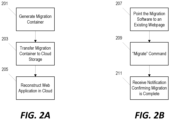
- FIG. 2A illustrates a three-step method for migrating a web application from a source environment (e.g., the web application operating environment of FIG. 1 ) to a cloud-computing service environment (e.g., a "cloud service").
- a migration container is generated (step 201).
- the migration container includes all of the web parts for the web application and a manifest defining the appearance and functionality of the web application and defining how the web part interact with each other and with the user interface.
- the migration container is then transferred to a cloud storage (step 203) and the cloud service accesses the migration container to reconstruct the web application in the cloud-computing environment (step 205).
- the method of FIG. 2A is greatly simplified from the user perspective and user direction is not required to facilitate the individual steps of the migration process.
- the user and the client device are not even aware of the specific steps being performed during the migration process.
- a user points the migration software to an existing webpage (e.g., a web application operating on a server or on a local desktop) (step 207) and inputs a "migrate” commend (e.g., by pressing a "migrate” button on the user interface or by typing a command into a command-line interface) (step 209).
- no further user interaction is required to facilitate the migration process and the user simply receives a notification through the client or another user device when the migration process is complete (step 211).
- FIG. 3 illustrates various different system components that may be involved in the migration of the web application in the method of FIG. 2A including a source computer system 301, an agent computer system 303, a cloud service computer system 305, and a user device 307.
- the source computer system 301 includes a source electronic processor 309 and a source memory 311.
- the source memory 311 stores data and/or instructions that are executed by the source electronic processor 309 to provide the functionality of the source computer system 301.
- the source computer system 301 also includes a source transceiver 313 for wired or wireless communication with other computer systems.
- the agent computer system 303 includes an agent electronic processor 315, an agent memory 317, and an agent transceiver 319;
- the service computer system 305 also includes a service electronic processor 321, a service memory 323, and a service transceiver;
- the user device 307 includes a user device electronic processor 327, a user device memory 329, and a user device transceiver 331.
- the user device 307 includes the client computer system that executes the web application software and provides a user interface for the web application in the web application operating environment of FIG. 1 .
- the arrangement of FIG. 3 may include multiple different user devices 307 each configured to provide a user interface for and execution of the web application software.
- a first user device 307 may include the client for the web application operating environment and a second user device 307 may include a different computing device through which a user initiates the web application migration process.
- the source computer system 301 includes a web server storing one or more web parts of the web application. In other implementations, the web parts of the web application are stored on multiple different source computers.
- a web application in the operating environment such as illustrated in the example of FIG. 1 includes software stored and executed on a client device. Accordingly, unless specified otherwise, the phrase "source computer system" as used herein refers to all of the computer devices that store or execute software code or that store content/data for a web application in its current operating environment prior to migration to the cloud service environment.
- the agent computer system 303 refers to the computer device component or components that perform tasks relating to the migration operation including in some implementations, for example, generating the migration container and/or initiating an API call as discussed in further detail below.
- the service computer system 305 refers to the computer device component or components that performs the reconstruction of the web application in the cloud computing service environment. Accordingly, the system architecture illustrated in FIG. 3 is just one example of a system that might be configure to perform the migration operation of FIG. 2A . Other implementations may include more, fewer, or different components that contribute to or facilitate the migration process as described herein.
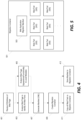
- FIG. 4 illustrates an example of a method for generating a migration container for migrating a web application from a source environment to a cloud environment (e.g., step 201 in FIG. 2A ).
- the method of FIG. 4 may be performed by migration software executed by the cloud-computing service system, by an agent system, by the local client system, or by the web server (e.g., source system).
- an identification of an existing web page is received (step 401). This may be provided, for example, by a user via the user interface on a client device and may be, for example, in the form of a URL.
- the automated software system analyzes the identified web page to identify all web parts that are included or interface with the web application associated with the identified web page (step 403).
- the automated software also analyzes the web page appearance & functionality as defined by the software executed by the local client computer and any additional software stored/executed by one or more web servers (step 405).
- the automated software also analyzes an local metadata stored on the local client that affects the appearance and/or operation of the web application.
- the automated software After analyzing the existing webpage for the web application in its current operating environment, the automated software generates a Migration Manifest (step 407).
- the migration manifest includes a list of all of the "web parts" and any other components (e.g., software or data/content) for the web applications.
- the migration manifest also defines how to reconstruct the webpage to match the appearance and functionality of the web application in its current operating environment.
- the migration manifest is generated based on the analysis of the existing web page and any local metadata on the client computing system that affects the appearance or operation of the web application. In some implementations, the migration manifest is automatically generated as an XML document.
- the automated software creates a migration container (step 409) that includes copies of all web parts for the web application (step 411) and a copy of the migration manifest (step 413).
- FIG. 5 illustrates a block diagram representation of the contents of a migration container 501 including the migration manifest 503 for the web application and copies of all of the web parts 505 and/or other software/data components for the web application.
- the user device 307 communicates with an agent computer system 303 to initiate the creation of the migration container and the method illustrated in FIG. 4 is performed by the agent computer system 303.
- the user device 307 itself is configured to generate the migration container and, in still other implementations, the cloud-computing service computer system 305 is configured to generate the migration container in response to a received request (e.g., from the user device 307).
- the agent computer system 303 both generates the migration container and initiates a migration command to the cloud-computing service computer system 305.
- FIG. 6 illustrates an example of one such method performed by the agent computer system 303.
- a user input identifies an existing webpage of a web application (step 207) and initiates the migration process (step 209) via a user interface.
- the agent computer system 303 receives that user input (step 601) and generates the migration container in response (step 603) (for example, according to the method illustrated in FIG. 4 ).
- the agent computer system 303 then uploads the migration container to a storage location accessible by the cloud-computing service computer system 305 (step 605) such as, for example, a cloud storage system or the service memory 323.
- the agent computer system 303 then transmits an API call to the cloud-computing service (step 607).
- the agent computer system 303 then waits for a response to the API call from the cloud-computing service (step 609).
- the migration process is complete (step 613).
- the agent computer system 303 outputs a visual confirmation notice to the user interface indicating that the migration to the cloud-computing environment is successfully completed.
- the agent computer system 303 transmits a message confirming completion of the migration through another mechanism including, for example, email or text message.
- the agent computer system 303 performs the generation of the migration container and transmits the API call to the cloud-computing service computer system 305.
- these individual steps might be performed by other computer systems.
- a local user device where the web application is currently executed can be configured to serve as the "agent" - in other words, the local user device or client may be configured to generate the migration container and transmit the API call to the cloud-computing service computer system 305.
- the "agent" functionality (e.g., as illustrated in the example of FIG. 6 ) may be divided among multiple different computer systems.
- the user device or client might be configured to first transmit a request to the cloud-computing service computer system 305 requesting generation of a migration container for the web application.
- the cloud-computing service computer system 305 might be configured to automatically initiate the migration process (e.g., as discussed below in reference to FIG. 7 ) in response to completing the generation of the migration container.
- the cloud-computing service computer system 305 may be configured to notify the user device or client that the migration container has been generated and then await further instructions (e.g., an API call from the user device/client) before initiating the rest of the migration process.
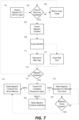
- FIG. 7 illustrates a method performed by the cloud-computing service computer system 305 for completing the migration of the web application to the cloud-computing environment in response to receiving the API call from the agent (i.e., step 607 in FIG. 6 ).
- the cloud-computing service computer system 305 determines whether service resources are available (step 703). In this way, the cloud-computing service computer system 305 may delay completion of the migration or may perform the migration process asynchronously in order to ensure that computing resources required for the migration process are utilized during periods of relatively low usage. If sufficient service resources are not available at the time that the API call is received from the agent (step 703), the cloud-computing service computer system 305 waits for a period of lower resource usage (step 705) before beginning the migration process.
- the cloud-computing service computer system 305 determines that sufficient service resources are available (step 703), it accesses the migration container for the web application (step 707), for example, from a cloud storage or from another location where the migration container had been stored by the agent.
- the cloud-computing service computer system 305 accesses the manifest from the migration container (step 709) and begins to reconstruct the web page (i.e., the appearance and functionality of the web page) based on the information in the manifest (step 711) including importing the web parts from the migration container into the reconstructed web application in the cloud-computing environment as dictated by the manifest (step 713) and establishing interactions and connections between the web parts as dictated by the manifest.
- the migration manifest is an XML document and the cloud-computing service computer system 305 is configured to read and convert the XML of the manifest into a plurality of different elements that together recreate the web page for the web application as it appeared in the original operating environment.
- the migration manifest was generated based, in part, on metadata stored on one or more client devices, that metadata is preserved and reflected in the web application after migration to the cloud-computing environment. Accordingly, the appearance and functionality of the web application in the cloud-computing environment more closely matches the appearance and functionality of the web application on a particular client device in the original operating environment.
- the migration process performed by the cloud-computing service computer system 305 may be automatically halted when resource usage in the cloud-computing service rises above a threshold level.
- the cloud-computing service computer system 305 is configured to resume the migration process at either a specified time or in response to detecting that usage of the cloud-computing service resources has again dropped below the threshold.
- the cloud-computing service computer system 305 transmits a response to the API call received from the agent (step 717).
- the API response is transmitted to the agent and confirms that the migration of the web application to the cloud-computing environment has been completed.
- the migration container used to facilitate the migration process is a temporary container. Accordingly, in some implementations, the cloud-computing service computer system 305 may be configured to automatically delete the migration container in response to completion of the migration process (step 719). In other implementations, the cloud-computing service computer system 305 may instead be configured to retain the migration container in cloud storage for a defined period of time (step 721) and deletes the migration container (step 719) in response to the expiration of the retention period (step 723). In still other implementations, the cloud-computing service computer system 305 is configured instead to retain the migration container in memory indefinitely (step 725). In yet other implementations, the cloud-computing service computer system 305 may be configured to automatically delete or retain the migration container based on terms selected for or by the particular user requesting the migration.
- the entire web application is migrated to the cloud-computing environment in only one API call. Accordingly, the need for frequent and repeated communication between the service and the agent (or between the service and other web servers) is eliminated. This simplifies the process and greatly reduces the burden on communication resources. Furthermore, by using a migration container, the migration process is "source-agnostic.” For example, because the migration manifest and all of the associated web parts for the web application are included in the migration container, the cloud-computing service computer system 305 may be configured to perform the same process for migration regardless of the original source operating environment. The migration manifest serves as the "template for creation" that is used by the cloud-computing service computer system 305 to reconstruct the web application in the cloud-computing environment.
- the embodiments provide, among other things, systems and methods for migrating a web application from a source environment to a cloud-computing service environment using a migration container and a single API call.
Landscapes
- Engineering & Computer Science (AREA)
- Software Systems (AREA)
- Theoretical Computer Science (AREA)
- Computer Networks & Wireless Communication (AREA)
- Signal Processing (AREA)
- Physics & Mathematics (AREA)
- General Engineering & Computer Science (AREA)
- General Physics & Mathematics (AREA)
- Stored Programmes (AREA)
Claims (12)
- Verfahren zum Migrieren einer Web-Anwendung von einer Quellumgebung zu einem Cloud-Service, wobei das Verfahren umfasst:Zugreifen (707) auf einen temporären Container, der ein Manifest und eine Vielzahl von Web-Teilen für die Web-Anwendung enthält, durch ein Cloud-Service-System, wobei jeder Web-Teil der Vielzahl von Web-Teilen eine Software-Komponente ist, die während des Betriebs der Web-Anwendung einen web-basierten Inhalt für die Web-Anwendung erzeugt, wobei das Manifest eine Liste von Inhalten des temporären Containers beinhaltet und ein Erscheinungsbild und eine Funktionalität der in der Quellumgebung betriebenen Web-Anwendung definiert;Rekonstruieren (711) der Web-Anwendung auf dem Cloud-Service durch das Cloud-Service-System durch automatisches Erzeugen einer Benutzerschnittstellen-Umgebung für die Web-Anwendung auf dem Cloud-Service basierend auf dem Manifest, und Importieren jedes Web-Teils der Vielzahl von Web-Teilen in den Cloud-Service durch Konfigurieren jedes Web-Teils und der Benutzerschnittstellen-Umgebung, um so zu interagieren, wie es durch das Manifest definiert ist, wobei die Benutzerschnittstellen-Umgebung auf dem Cloud-Service das Erscheinungsbild und die Funktionalität der Web-Anwendung repliziert, die in der Quellumgebung arbeitet;Empfangen (701) eines einzelnen API-Aufrufs durch das Cloud-Service-System, der die Migration der Web-Anwendung zu dem Cloud-Service anfordert, wobei das Rekonstruieren der Web-Anwendung auf dem Cloud-Service Rekonstruieren der Web-Anwendung auf dem Cloud-Service in Reaktion auf den Empfang des einzelnen API-Aufrufs beinhaltet;Erzeugen einer Antwort auf den einzelnen API-Aufruf durch das Cloud-Service-System, nachdem die Web-Anwendung auf dem Cloud-Service rekonstruiert wurde, wobei die Antwort auf den einzelnen API-Aufruf bestätigt, dass die Migration der Web-Anwendung zu dem Cloud-Service abgeschlossen ist; undIdentifizieren einer oder mehrerer Perioden relativ geringer Nutzung des Cloud-Services nach dem Empfang des einzelnen API-Aufrufs durch das Cloud-Service-System, wobei das Rekonstruieren der Web-Anwendung auf dem Cloud-Service asynchrones Rekonstruieren der Web-Anwendung auf dem Cloud-Service nur während der einen oder mehreren identifizierten Perioden relativ geringer Nutzung des Cloud-Services beinhaltet, wobei die Perioden relativ geringer Nutzung Perioden entsprechen, in denen ausreichende Dienstressourcen, die für die Migration der Web-Anwendung erforderlich sind, verfügbar sind.
- Verfahren nach Anspruch 1, wobei das Manifest eine XML-Datei beinhaltet, die eine funktionale Interaktion zwischen einem ersten Web-Teil der Vielzahl von Web-Teilen und einem zweiten Web-Teil der Vielzahl von Web-Teilen definiert.
- Verfahren nach Anspruch 1, wobei das Manifest Metadaten aus der Quellumgebung beinhaltet, die den Betrieb der Web-Anwendung in der Quellumgebung beeinflusst haben, wobei das Verfahren ferner das automatische Konfigurieren der Web-Anwendung für den Betrieb auf dem Cloud-Service gemäß den Metadaten aus der Quellumgebung umfasst.
- Verfahren nach Anspruch 1, ferner umfassend: Empfangen einer Identifikation einer existierenden Webseite, die die Web-Anwendung beinhaltet, die in der Quellumgebung betrieben wird; Analysieren der existierenden Webseite, die in der Quellumgebung betrieben wird, um alle Web-Teile für die Web-Anwendung zu identifizieren; automatisches Erzeugen des Manifests basierend auf der Analyse der existierenden Webseite, die in der Quellumgebung betrieben wird; Erzeugen des temporären Containers; Hinzufügen des Manifests und von Kopien jedes Web-Teils, der im Manifest aufgeführt ist, zum temporären Container; und Speichern des temporären Containers in einem Cloud-Speicher.
- Verfahren nach Anspruch 4, wobei das Analysieren der existierenden Webseite, die in der Quellumgebung betrieben wird, Analysieren der existierenden Webseite, die in der Quellumgebung betrieben wird, durch den Cloud-Service beinhaltet, und wobei das Erstellen des temporären Containers Erstellen des temporären Containers durch das Cloud-Service-System beinhaltet.
- Verfahren nach Anspruch 1, ferner umfassend Löschen des temporären Containers nach Abschluss der Rekonstruktion der Web-Anwendung auf dem Cloud-Service.
- System zur Migration von Web-Anwendungen, wobei das System ein Cloud-Service-System umfasst, das einen Prozessor umfasst, der konfiguriert ist zum:Zugreifen auf einen temporären Container, der ein Manifest und eine Vielzahl von Web-Teilen für eine Web-Anwendung enthält, wobei jeder Web-Teil der Vielzahl von Web-Teilen eine Software-Komponente ist, die während des Betriebs der Web-Anwendung einen web-basierten Inhalt für die Web-Anwendung erzeugt, wobei das Manifest eine Liste von Inhalten des temporären Containers beinhaltet und ein Erscheinungsbild und eine Funktionalität der in der Quellumgebung betriebenen Web-Anwendung definiert;Rekonstruieren der Web-Anwendung auf dem Cloud-Service durch automatisches Erzeugen einer Benutzerschnittstellen-Umgebung für die Web-Anwendung auf dem Cloud-Service basierend auf dem Manifest, und Importieren jedes Web-Teils der Vielzahl von Web-Teilen in den Cloud-Service durch Konfigurieren jedes Web-Teils und der Benutzerschnittstellen-Umgebung, um so zu interagieren, wie es durch das Manifest definiert ist, wobei die Benutzerschnittstellen-Umgebung auf dem Cloud-Service das Erscheinungsbild und die Funktionalität der Web-Anwendung repliziert, die in der Quellumgebung arbeitet;Empfangen eines einzelnen API-Aufrufs, der die Migration der Web-Anwendung zu dem Cloud-Service anfordert, wobei das Cloud-Service-System konfiguriert ist zum Rekonstruieren der Web-Anwendung auf dem Cloud-Service in Reaktion auf den Empfang des einzelnen API-Aufrufs;Erzeugen einer Antwort auf den einzelnen API-Aufruf, nachdem die Web-Anwendung auf dem Cloud-Service rekonstruiert wurde, wobei die Antwort auf den einzelnen API-Aufruf bestätigt, dass die Migration der Web-Anwendung zu dem Cloud-Service abgeschlossen ist; undIdentifizieren einer oder mehrerer Perioden relativ geringer Nutzung des Cloud-Services nach dem Empfang des einzelnen API-Aufrufs, wobei das Cloud-Service-System ferner konfiguriert ist zum asynchronen Rekonstruieren der Web-Anwendung auf dem Cloud-Service nur während der einen oder mehreren identifizierten Perioden relativ geringer Nutzung des Cloud-Services, wobei die Perioden relativ geringer Nutzung Perioden entsprechen, in denen ausreichende Dienstressourcen, die für die Migration der Web-Anwendung erforderlich sind, verfügbar sind.
- System zur Migration von Web-Anwendungen nach Anspruch 7, wobei das Manifest eine XML-Datei beinhaltet, die eine funktionale Interaktion zwischen einem ersten Web-Teil der Vielzahl von Web-Teilen und einem zweiten Web-Teil der Vielzahl von Web-Teilen definiert.
- System zur Migration von Web-Anwendungen nach Anspruch 7, wobei das Cloud-Service-System ferner konfiguriert ist zum: Empfangen einer Identifikation einer existierenden Webseite, die die Web-Anwendung beinhaltet, die in der Quellumgebung betrieben wird; Analysieren der existierenden Webseite, die in der Quellumgebung betrieben wird, um alle Web-Teile für die Web-Anwendung zu identifizieren; automatisches Erzeugen des Manifests basierend auf der Analyse der existierenden Webseite, die in der Quellumgebung betrieben wird; Erzeugen des temporären Containers; Hinzufügen des Manifests und von Kopien jedes Web-Teils, der im Manifest aufgeführt ist, zum temporären Container; und Speichern des temporären Containers in einem Cloud-Speicher.
- System zur Migration von Web-Anwendungen nach Anspruch 7, ferner umfassend ein Agent-System, wobei das Agent-System ferner konfiguriert ist zum: Empfangen einer Identifikation einer existierenden Webseite, die die Web-Anwendung beinhaltet, die in der Quellumgebung betrieben wird; Analysieren der existierenden Webseite, die in der Quellumgebung betrieben wird, um alle Web-Teile für die Web-Anwendung zu identifizieren; automatisches Erzeugen des Manifests basierend auf der Analyse der existierenden Webseite, die in der Quellumgebung betrieben wird; Erzeugen des temporären Containers; Hinzufügen des Manifests und von Kopien jedes Web-Teils, der im Manifest aufgeführt ist, zum temporären Container; und Übertragen des temporären Containers in ein Cloud-Service-System.
- System zur Migration von Web-Anwendungen nach Anspruch 7, wobei das Cloud-Service-System ferner konfiguriert ist zum Löschen des temporären Containers in Reaktion auf den Abschluss der Rekonstruktion der Web-Anwendung auf dem Cloud-Service.
- System zur Migration von Web-Anwendungen nach Anspruch 7, wobei das Cloud-Service-System ferner konfiguriert ist zum Löschen des temporären Containers in Reaktion auf den Ablauf einer definierten Zeitspanne.
Applications Claiming Priority (1)
| Application Number | Priority Date | Filing Date | Title |
|---|---|---|---|
| PCT/CN2019/116241 WO2021087858A1 (en) | 2019-11-07 | 2019-11-07 | Web application component migration to a cloud computing system |
Publications (3)
| Publication Number | Publication Date |
|---|---|
| EP4055797A1 EP4055797A1 (de) | 2022-09-14 |
| EP4055797A4 EP4055797A4 (de) | 2023-05-17 |
| EP4055797B1 true EP4055797B1 (de) | 2025-01-01 |
Family
ID=75848132
Family Applications (1)
| Application Number | Title | Priority Date | Filing Date |
|---|---|---|---|
| EP19951609.7A Active EP4055797B1 (de) | 2019-11-07 | 2019-11-07 | Migration von web-anwendungskomponenten in ein cloud-computing-system |
Country Status (3)
| Country | Link |
|---|---|
| US (1) | US11729248B2 (de) |
| EP (1) | EP4055797B1 (de) |
| WO (1) | WO2021087858A1 (de) |
Families Citing this family (6)
| Publication number | Priority date | Publication date | Assignee | Title |
|---|---|---|---|---|
| US11853100B2 (en) * | 2021-04-12 | 2023-12-26 | EMC IP Holding Company LLC | Automated delivery of cloud native application updates using one or more user-connection gateways |
| CN113296868B (zh) * | 2021-07-27 | 2021-11-23 | 杭州筋斗腾云科技有限公司 | 应用平台及应用管理方法 |
| US11677852B2 (en) * | 2021-10-11 | 2023-06-13 | Sap Se | Cross-application data migration |
| US12498988B2 (en) * | 2021-10-12 | 2025-12-16 | VMware LLC | Migrating stateful workloads between container clusters with different storage backends |
| US12238170B2 (en) * | 2023-07-28 | 2025-02-25 | Google Llc | On demand serverless container based storage transfer |
| US12452293B1 (en) * | 2025-03-04 | 2025-10-21 | Wiz, Inc. | Detection of stale data objects and associated cybersecurity risk |
Family Cites Families (20)
| Publication number | Priority date | Publication date | Assignee | Title |
|---|---|---|---|---|
| US8627426B2 (en) | 2010-04-26 | 2014-01-07 | Vmware, Inc. | Cloud platform architecture |
| US9176773B2 (en) * | 2011-06-29 | 2015-11-03 | Microsoft Technology Licensing, Llc | Virtual machine migration tool |
| US8412945B2 (en) * | 2011-08-09 | 2013-04-02 | CloudPassage, Inc. | Systems and methods for implementing security in a cloud computing environment |
| WO2013166682A1 (en) | 2012-05-10 | 2013-11-14 | Empire Technology Development Llc | Meta-app to depict cloud environment dependencies |
| US10733358B2 (en) | 2012-09-17 | 2020-08-04 | Salesforce.Com, Inc. | Method and system for site migration |
| US9176678B2 (en) | 2012-11-30 | 2015-11-03 | International Business Machines Corporation | Common contiguous memory region optimized virtual machine migration within a workgroup |
| US20140196022A1 (en) | 2013-01-08 | 2014-07-10 | Alexey Skutin | Cloud Based Application Packaging |
| US8990809B1 (en) | 2014-06-23 | 2015-03-24 | Flexera Software Llc | Creating a virtual appliance using existing installation manifest |
| US9342357B2 (en) * | 2014-09-11 | 2016-05-17 | International Business Machines Corporation | Extending cloud computing to on-premises data |
| US10326826B1 (en) | 2014-09-29 | 2019-06-18 | Amazon Technologies, Inc. | Migrating an on premises workload to a web services platform |
| US9825881B2 (en) | 2014-09-30 | 2017-11-21 | Sony Interactive Entertainment America Llc | Methods and systems for portably deploying applications on one or more cloud systems |
| US10171310B2 (en) | 2015-06-17 | 2019-01-01 | International Business Machines Corporation | Ensuring regulatory compliance during application migration to cloud-based containers |
| US20180246886A1 (en) | 2017-02-27 | 2018-08-30 | OSF Global Services Inc. | Data migration for platform integration |
| US10503493B2 (en) | 2017-05-16 | 2019-12-10 | Oracle International Corporation | Distributed versioning of applications using cloud-based systems |
| US10558533B2 (en) * | 2017-12-07 | 2020-02-11 | Red Hat, Inc. | Reducing service disruptions in a micro-service environment |
| US10613961B2 (en) * | 2018-02-05 | 2020-04-07 | Red Hat, Inc. | Baselining for compute resource allocation |
| US10915349B2 (en) * | 2018-04-23 | 2021-02-09 | Hewlett Packard Enterprise Development Lp | Containerized application deployment |
| CN108667925B (zh) | 2018-05-04 | 2020-10-16 | 北京天元创新科技有限公司 | 一种web应用无缝接入分布式系统的方法和系统 |
| US11422865B2 (en) * | 2020-01-23 | 2022-08-23 | EMC IP Holding Company LLC | Dynamic workload migration to edge stations |
| US12069039B2 (en) * | 2020-10-23 | 2024-08-20 | EMC IP Holding Company LLC | Dynamically unifying disparate user interface applications in a cloud native environment |
-
2019
- 2019-11-07 US US17/775,566 patent/US11729248B2/en active Active
- 2019-11-07 EP EP19951609.7A patent/EP4055797B1/de active Active
- 2019-11-07 WO PCT/CN2019/116241 patent/WO2021087858A1/en not_active Ceased
Also Published As
| Publication number | Publication date |
|---|---|
| US20220407907A1 (en) | 2022-12-22 |
| US11729248B2 (en) | 2023-08-15 |
| WO2021087858A1 (en) | 2021-05-14 |
| EP4055797A1 (de) | 2022-09-14 |
| EP4055797A4 (de) | 2023-05-17 |
Similar Documents
| Publication | Publication Date | Title |
|---|---|---|
| EP4055797B1 (de) | Migration von web-anwendungskomponenten in ein cloud-computing-system | |
| US9195522B2 (en) | Method and device for controlling communication between applications in a web runtime environment | |
| US10419568B2 (en) | Manipulation of browser DOM on server | |
| US10089108B1 (en) | Archival format for incremental deployments and version control | |
| CN109976667B (zh) | 一种镜像管理方法、装置及系统 | |
| KR101991537B1 (ko) | 자율형 네트워크 스트리밍 기법 | |
| WO2019184750A1 (zh) | 深度学习作业调度方法、系统和相关设备 | |
| US8561088B2 (en) | Registering network applications with an API framework | |
| CN110083455B (zh) | 图计算处理方法、装置、介质及电子设备 | |
| Rattanapoka et al. | An MQTT-based IoT cloud platform with flow design by Node-RED | |
| US9590859B2 (en) | Discovering resources of a distributed computing environment | |
| US10506017B2 (en) | Manipulation of PDF file content through HTTP requests | |
| US20140223414A1 (en) | Paige control for enterprise mobile applications | |
| US12563131B2 (en) | Systems and methods for rendering interactive web pages | |
| US10567472B2 (en) | Manipulation of PDF files using HTML authoring tools | |
| US11392433B1 (en) | Generation of asynchronous application programming interface specifications for messaging topics | |
| CN112491940A (zh) | 代理服务器的请求转发方法及装置、存储介质及电子设备 | |
| US20200356720A1 (en) | Rendering Based on a Document Object Model | |
| US10949176B2 (en) | Automatic view generation based on annotations | |
| US11604662B2 (en) | System and method for accelerating modernization of user interfaces in a computing environment | |
| CN113791819B (zh) | 接口文档生成方法和装置、存储介质、电子设备 | |
| US12001458B2 (en) | Multi-cloud object store access | |
| CN112306324B (zh) | 信息处理方法、装置、设备和介质 | |
| CN115795198A (zh) | 一种页面加载方法、装置、系统及存储介质 | |
| CN115858978A (zh) | 一种基于更新资源的页面加载方法和装置 |
Legal Events
| Date | Code | Title | Description |
|---|---|---|---|
| STAA | Information on the status of an ep patent application or granted ep patent |
Free format text: STATUS: THE INTERNATIONAL PUBLICATION HAS BEEN MADE |
|
| PUAI | Public reference made under article 153(3) epc to a published international application that has entered the european phase |
Free format text: ORIGINAL CODE: 0009012 |
|
| STAA | Information on the status of an ep patent application or granted ep patent |
Free format text: STATUS: REQUEST FOR EXAMINATION WAS MADE |
|
| 17P | Request for examination filed |
Effective date: 20220408 |
|
| AK | Designated contracting states |
Kind code of ref document: A1 Designated state(s): AL AT BE BG CH CY CZ DE DK EE ES FI FR GB GR HR HU IE IS IT LI LT LU LV MC MK MT NL NO PL PT RO RS SE SI SK SM TR |
|
| DAV | Request for validation of the european patent (deleted) | ||
| DAX | Request for extension of the european patent (deleted) | ||
| REG | Reference to a national code |
Ref legal event code: R079 Free format text: PREVIOUS MAIN CLASS: H04L0029080000 Ipc: G06F0009480000 Ref country code: DE Ref legal event code: R079 Ref document number: 602019064483 Country of ref document: DE Free format text: PREVIOUS MAIN CLASS: H04L0029080000 Ipc: G06F0009480000 |
|
| A4 | Supplementary search report drawn up and despatched |
Effective date: 20230417 |
|
| RIC1 | Information provided on ipc code assigned before grant |
Ipc: H04L 67/02 20220101ALI20230411BHEP Ipc: G06F 9/455 20180101ALI20230411BHEP Ipc: H04L 67/10 20220101ALI20230411BHEP Ipc: G06F 9/48 20060101AFI20230411BHEP |
|
| GRAP | Despatch of communication of intention to grant a patent |
Free format text: ORIGINAL CODE: EPIDOSNIGR1 |
|
| STAA | Information on the status of an ep patent application or granted ep patent |
Free format text: STATUS: GRANT OF PATENT IS INTENDED |
|
| RIC1 | Information provided on ipc code assigned before grant |
Ipc: G06F 9/50 20060101ALI20240801BHEP Ipc: H04L 67/02 20220101ALI20240801BHEP Ipc: G06F 9/455 20180101ALI20240801BHEP Ipc: H04L 67/10 20220101ALI20240801BHEP Ipc: G06F 9/48 20060101AFI20240801BHEP |
|
| INTG | Intention to grant announced |
Effective date: 20240822 |
|
| P01 | Opt-out of the competence of the unified patent court (upc) registered |
Free format text: CASE NUMBER: APP_55481/2024 Effective date: 20241009 |
|
| GRAS | Grant fee paid |
Free format text: ORIGINAL CODE: EPIDOSNIGR3 |
|
| GRAA | (expected) grant |
Free format text: ORIGINAL CODE: 0009210 |
|
| STAA | Information on the status of an ep patent application or granted ep patent |
Free format text: STATUS: THE PATENT HAS BEEN GRANTED |
|
| AK | Designated contracting states |
Kind code of ref document: B1 Designated state(s): AL AT BE BG CH CY CZ DE DK EE ES FI FR GB GR HR HU IE IS IT LI LT LU LV MC MK MT NL NO PL PT RO RS SE SI SK SM TR |
|
| REG | Reference to a national code |
Ref country code: GB Ref legal event code: FG4D |
|
| REG | Reference to a national code |
Ref country code: CH Ref legal event code: EP |
|
| REG | Reference to a national code |
Ref country code: DE Ref legal event code: R096 Ref document number: 602019064483 Country of ref document: DE |
|
| REG | Reference to a national code |
Ref country code: IE Ref legal event code: FG4D |
|
| REG | Reference to a national code |
Ref country code: LT Ref legal event code: MG9D |
|
| REG | Reference to a national code |
Ref country code: NL Ref legal event code: MP Effective date: 20250101 |
|
| REG | Reference to a national code |
Ref country code: AT Ref legal event code: MK05 Ref document number: 1756973 Country of ref document: AT Kind code of ref document: T Effective date: 20250101 |
|
| PG25 | Lapsed in a contracting state [announced via postgrant information from national office to epo] |
Ref country code: NL Free format text: LAPSE BECAUSE OF FAILURE TO SUBMIT A TRANSLATION OF THE DESCRIPTION OR TO PAY THE FEE WITHIN THE PRESCRIBED TIME-LIMIT Effective date: 20250101 |
|
| PG25 | Lapsed in a contracting state [announced via postgrant information from national office to epo] |
Ref country code: FI Free format text: LAPSE BECAUSE OF FAILURE TO SUBMIT A TRANSLATION OF THE DESCRIPTION OR TO PAY THE FEE WITHIN THE PRESCRIBED TIME-LIMIT Effective date: 20250101 |
|
| PG25 | Lapsed in a contracting state [announced via postgrant information from national office to epo] |
Ref country code: PL Free format text: LAPSE BECAUSE OF FAILURE TO SUBMIT A TRANSLATION OF THE DESCRIPTION OR TO PAY THE FEE WITHIN THE PRESCRIBED TIME-LIMIT Effective date: 20250101 |
|
| PG25 | Lapsed in a contracting state [announced via postgrant information from national office to epo] |
Ref country code: ES Free format text: LAPSE BECAUSE OF FAILURE TO SUBMIT A TRANSLATION OF THE DESCRIPTION OR TO PAY THE FEE WITHIN THE PRESCRIBED TIME-LIMIT Effective date: 20250101 |
|
| PG25 | Lapsed in a contracting state [announced via postgrant information from national office to epo] |
Ref country code: NO Free format text: LAPSE BECAUSE OF FAILURE TO SUBMIT A TRANSLATION OF THE DESCRIPTION OR TO PAY THE FEE WITHIN THE PRESCRIBED TIME-LIMIT Effective date: 20250401 Ref country code: IS Free format text: LAPSE BECAUSE OF FAILURE TO SUBMIT A TRANSLATION OF THE DESCRIPTION OR TO PAY THE FEE WITHIN THE PRESCRIBED TIME-LIMIT Effective date: 20250501 |
|
| PG25 | Lapsed in a contracting state [announced via postgrant information from national office to epo] |
Ref country code: HR Free format text: LAPSE BECAUSE OF FAILURE TO SUBMIT A TRANSLATION OF THE DESCRIPTION OR TO PAY THE FEE WITHIN THE PRESCRIBED TIME-LIMIT Effective date: 20250101 |
|
| PG25 | Lapsed in a contracting state [announced via postgrant information from national office to epo] |
Ref country code: LV Free format text: LAPSE BECAUSE OF FAILURE TO SUBMIT A TRANSLATION OF THE DESCRIPTION OR TO PAY THE FEE WITHIN THE PRESCRIBED TIME-LIMIT Effective date: 20250101 Ref country code: PT Free format text: LAPSE BECAUSE OF FAILURE TO SUBMIT A TRANSLATION OF THE DESCRIPTION OR TO PAY THE FEE WITHIN THE PRESCRIBED TIME-LIMIT Effective date: 20250502 |
|
| PG25 | Lapsed in a contracting state [announced via postgrant information from national office to epo] |
Ref country code: GR Free format text: LAPSE BECAUSE OF FAILURE TO SUBMIT A TRANSLATION OF THE DESCRIPTION OR TO PAY THE FEE WITHIN THE PRESCRIBED TIME-LIMIT Effective date: 20250402 Ref country code: BG Free format text: LAPSE BECAUSE OF FAILURE TO SUBMIT A TRANSLATION OF THE DESCRIPTION OR TO PAY THE FEE WITHIN THE PRESCRIBED TIME-LIMIT Effective date: 20250101 |
|
| PG25 | Lapsed in a contracting state [announced via postgrant information from national office to epo] |
Ref country code: AT Free format text: LAPSE BECAUSE OF FAILURE TO SUBMIT A TRANSLATION OF THE DESCRIPTION OR TO PAY THE FEE WITHIN THE PRESCRIBED TIME-LIMIT Effective date: 20250101 |
|
| PG25 | Lapsed in a contracting state [announced via postgrant information from national office to epo] |
Ref country code: CZ Free format text: LAPSE BECAUSE OF FAILURE TO SUBMIT A TRANSLATION OF THE DESCRIPTION OR TO PAY THE FEE WITHIN THE PRESCRIBED TIME-LIMIT Effective date: 20250101 |
|
| PG25 | Lapsed in a contracting state [announced via postgrant information from national office to epo] |
Ref country code: SE Free format text: LAPSE BECAUSE OF FAILURE TO SUBMIT A TRANSLATION OF THE DESCRIPTION OR TO PAY THE FEE WITHIN THE PRESCRIBED TIME-LIMIT Effective date: 20250101 |
|
| REG | Reference to a national code |
Ref country code: DE Ref legal event code: R097 Ref document number: 602019064483 Country of ref document: DE |
|
| PG25 | Lapsed in a contracting state [announced via postgrant information from national office to epo] |
Ref country code: SM Free format text: LAPSE BECAUSE OF FAILURE TO SUBMIT A TRANSLATION OF THE DESCRIPTION OR TO PAY THE FEE WITHIN THE PRESCRIBED TIME-LIMIT Effective date: 20250101 |
|
| PG25 | Lapsed in a contracting state [announced via postgrant information from national office to epo] |
Ref country code: DK Free format text: LAPSE BECAUSE OF FAILURE TO SUBMIT A TRANSLATION OF THE DESCRIPTION OR TO PAY THE FEE WITHIN THE PRESCRIBED TIME-LIMIT Effective date: 20250101 |
|
| PG25 | Lapsed in a contracting state [announced via postgrant information from national office to epo] |
Ref country code: IT Free format text: LAPSE BECAUSE OF FAILURE TO SUBMIT A TRANSLATION OF THE DESCRIPTION OR TO PAY THE FEE WITHIN THE PRESCRIBED TIME-LIMIT Effective date: 20250101 |
|
| PG25 | Lapsed in a contracting state [announced via postgrant information from national office to epo] |
Ref country code: EE Free format text: LAPSE BECAUSE OF FAILURE TO SUBMIT A TRANSLATION OF THE DESCRIPTION OR TO PAY THE FEE WITHIN THE PRESCRIBED TIME-LIMIT Effective date: 20250101 |
|
| PG25 | Lapsed in a contracting state [announced via postgrant information from national office to epo] |
Ref country code: RO Free format text: LAPSE BECAUSE OF FAILURE TO SUBMIT A TRANSLATION OF THE DESCRIPTION OR TO PAY THE FEE WITHIN THE PRESCRIBED TIME-LIMIT Effective date: 20250101 |
|
| PG25 | Lapsed in a contracting state [announced via postgrant information from national office to epo] |
Ref country code: SK Free format text: LAPSE BECAUSE OF FAILURE TO SUBMIT A TRANSLATION OF THE DESCRIPTION OR TO PAY THE FEE WITHIN THE PRESCRIBED TIME-LIMIT Effective date: 20250101 |
|
| PLBE | No opposition filed within time limit |
Free format text: ORIGINAL CODE: 0009261 |
|
| STAA | Information on the status of an ep patent application or granted ep patent |
Free format text: STATUS: NO OPPOSITION FILED WITHIN TIME LIMIT |
|
| 26N | No opposition filed |
Effective date: 20251002 |
|
| PGFP | Annual fee paid to national office [announced via postgrant information from national office to epo] |
Ref country code: DE Payment date: 20251022 Year of fee payment: 7 |
|
| PGFP | Annual fee paid to national office [announced via postgrant information from national office to epo] |
Ref country code: GB Payment date: 20251022 Year of fee payment: 7 |