EP4053951A1 - System and method for balancing a vanadium redox flow battery - Google Patents
System and method for balancing a vanadium redox flow battery Download PDFInfo
- Publication number
- EP4053951A1 EP4053951A1 EP22158464.2A EP22158464A EP4053951A1 EP 4053951 A1 EP4053951 A1 EP 4053951A1 EP 22158464 A EP22158464 A EP 22158464A EP 4053951 A1 EP4053951 A1 EP 4053951A1
- Authority
- EP
- European Patent Office
- Prior art keywords
- redox flow
- flow battery
- vanadium redox
- electrolyte
- reductant
- Prior art date
- Legal status (The legal status is an assumption and is not a legal conclusion. Google has not performed a legal analysis and makes no representation as to the accuracy of the status listed.)
- Withdrawn
Links
- LEONUFNNVUYDNQ-UHFFFAOYSA-N vanadium atom Chemical compound [V] LEONUFNNVUYDNQ-UHFFFAOYSA-N 0.000 title claims abstract description 150
- 229910052720 vanadium Inorganic materials 0.000 title claims abstract description 145
- 238000000034 method Methods 0.000 title claims abstract description 41
- 239000003638 chemical reducing agent Substances 0.000 claims abstract description 118
- 239000003792 electrolyte Substances 0.000 claims abstract description 87
- 238000012544 monitoring process Methods 0.000 claims abstract description 27
- 238000006722 reduction reaction Methods 0.000 claims abstract description 15
- 238000005259 measurement Methods 0.000 claims description 9
- 230000008859 change Effects 0.000 claims description 5
- MUBZPKHOEPUJKR-UHFFFAOYSA-N Oxalic acid Chemical compound OC(=O)C(O)=O MUBZPKHOEPUJKR-UHFFFAOYSA-N 0.000 description 55
- 239000000243 solution Substances 0.000 description 30
- 238000006243 chemical reaction Methods 0.000 description 19
- 235000006408 oxalic acid Nutrition 0.000 description 18
- 230000003647 oxidation Effects 0.000 description 17
- 238000007254 oxidation reaction Methods 0.000 description 17
- WQZGKKKJIJFFOK-GASJEMHNSA-N Glucose Chemical compound OC[C@H]1OC(O)[C@H](O)[C@@H](O)[C@@H]1O WQZGKKKJIJFFOK-GASJEMHNSA-N 0.000 description 10
- 239000000126 substance Substances 0.000 description 9
- 230000009467 reduction Effects 0.000 description 8
- QVGXLLKOCUKJST-UHFFFAOYSA-N atomic oxygen Chemical compound [O] QVGXLLKOCUKJST-UHFFFAOYSA-N 0.000 description 7
- 239000003014 ion exchange membrane Substances 0.000 description 7
- 229910052760 oxygen Inorganic materials 0.000 description 7
- 239000001301 oxygen Substances 0.000 description 7
- 230000008901 benefit Effects 0.000 description 6
- 239000012528 membrane Substances 0.000 description 6
- 230000007423 decrease Effects 0.000 description 5
- QAOWNCQODCNURD-UHFFFAOYSA-N Sulfuric acid Chemical compound OS(O)(=O)=O QAOWNCQODCNURD-UHFFFAOYSA-N 0.000 description 4
- 238000004364 calculation method Methods 0.000 description 4
- 229910052799 carbon Inorganic materials 0.000 description 4
- 238000007599 discharging Methods 0.000 description 4
- 230000000694 effects Effects 0.000 description 4
- 230000005611 electricity Effects 0.000 description 4
- 206010014418 Electrolyte imbalance Diseases 0.000 description 3
- 239000008151 electrolyte solution Substances 0.000 description 3
- 238000009434 installation Methods 0.000 description 3
- 230000035484 reaction time Effects 0.000 description 3
- 230000001603 reducing effect Effects 0.000 description 3
- 125000000205 L-threonino group Chemical group [H]OC(=O)[C@@]([H])(N([H])[*])[C@](C([H])([H])[H])([H])O[H] 0.000 description 2
- 230000009286 beneficial effect Effects 0.000 description 2
- 230000000254 damaging effect Effects 0.000 description 2
- 230000003247 decreasing effect Effects 0.000 description 2
- 230000001419 dependent effect Effects 0.000 description 2
- 238000005868 electrolysis reaction Methods 0.000 description 2
- 239000012530 fluid Substances 0.000 description 2
- 150000002500 ions Chemical class 0.000 description 2
- 238000012360 testing method Methods 0.000 description 2
- ZOXJGFHDIHLPTG-UHFFFAOYSA-N Boron Chemical group [B] ZOXJGFHDIHLPTG-UHFFFAOYSA-N 0.000 description 1
- OKTJSMMVPCPJKN-UHFFFAOYSA-N Carbon Chemical compound [C] OKTJSMMVPCPJKN-UHFFFAOYSA-N 0.000 description 1
- XOJVVFBFDXDTEG-UHFFFAOYSA-N Norphytane Natural products CC(C)CCCC(C)CCCC(C)CCCC(C)C XOJVVFBFDXDTEG-UHFFFAOYSA-N 0.000 description 1
- 230000003213 activating effect Effects 0.000 description 1
- 238000013459 approach Methods 0.000 description 1
- 150000001768 cations Chemical class 0.000 description 1
- 238000004891 communication Methods 0.000 description 1
- 238000005260 corrosion Methods 0.000 description 1
- 230000007797 corrosion Effects 0.000 description 1
- 239000007772 electrode material Substances 0.000 description 1
- 238000005516 engineering process Methods 0.000 description 1
- 230000003631 expected effect Effects 0.000 description 1
- 239000007789 gas Substances 0.000 description 1
- XLYOFNOQVPJJNP-ZSJDYOACSA-N heavy water Substances [2H]O[2H] XLYOFNOQVPJJNP-ZSJDYOACSA-N 0.000 description 1
- 238000012417 linear regression Methods 0.000 description 1
- 230000007774 longterm Effects 0.000 description 1
- 230000007246 mechanism Effects 0.000 description 1
- MJFJKKXQDNNUJF-UHFFFAOYSA-N metixene Chemical compound C1N(C)CCCC1CC1C2=CC=CC=C2SC2=CC=CC=C21 MJFJKKXQDNNUJF-UHFFFAOYSA-N 0.000 description 1
- 239000007800 oxidant agent Substances 0.000 description 1
- 230000008569 process Effects 0.000 description 1
- 238000006479 redox reaction Methods 0.000 description 1
- 230000002441 reversible effect Effects 0.000 description 1
- 235000011149 sulphuric acid Nutrition 0.000 description 1
- 239000001117 sulphuric acid Substances 0.000 description 1
- 238000004448 titration Methods 0.000 description 1
- XLYOFNOQVPJJNP-UHFFFAOYSA-N water Substances O XLYOFNOQVPJJNP-UHFFFAOYSA-N 0.000 description 1
Images


Classifications
-
- H—ELECTRICITY
- H01—ELECTRIC ELEMENTS
- H01M—PROCESSES OR MEANS, e.g. BATTERIES, FOR THE DIRECT CONVERSION OF CHEMICAL ENERGY INTO ELECTRICAL ENERGY
- H01M8/00—Fuel cells; Manufacture thereof
- H01M8/04—Auxiliary arrangements, e.g. for control of pressure or for circulation of fluids
- H01M8/04082—Arrangements for control of reactant parameters, e.g. pressure or concentration
- H01M8/04186—Arrangements for control of reactant parameters, e.g. pressure or concentration of liquid-charged or electrolyte-charged reactants
-
- H—ELECTRICITY
- H01—ELECTRIC ELEMENTS
- H01M—PROCESSES OR MEANS, e.g. BATTERIES, FOR THE DIRECT CONVERSION OF CHEMICAL ENERGY INTO ELECTRICAL ENERGY
- H01M8/00—Fuel cells; Manufacture thereof
- H01M8/18—Regenerative fuel cells, e.g. redox flow batteries or secondary fuel cells
- H01M8/184—Regeneration by electrochemical means
- H01M8/188—Regeneration by electrochemical means by recharging of redox couples containing fluids; Redox flow type batteries
-
- H—ELECTRICITY
- H01—ELECTRIC ELEMENTS
- H01M—PROCESSES OR MEANS, e.g. BATTERIES, FOR THE DIRECT CONVERSION OF CHEMICAL ENERGY INTO ELECTRICAL ENERGY
- H01M8/00—Fuel cells; Manufacture thereof
- H01M8/04—Auxiliary arrangements, e.g. for control of pressure or for circulation of fluids
- H01M8/04298—Processes for controlling fuel cells or fuel cell systems
- H01M8/04313—Processes for controlling fuel cells or fuel cell systems characterised by the detection or assessment of variables; characterised by the detection or assessment of failure or abnormal function
- H01M8/0444—Concentration; Density
- H01M8/04477—Concentration; Density of the electrolyte
-
- H—ELECTRICITY
- H01—ELECTRIC ELEMENTS
- H01M—PROCESSES OR MEANS, e.g. BATTERIES, FOR THE DIRECT CONVERSION OF CHEMICAL ENERGY INTO ELECTRICAL ENERGY
- H01M8/00—Fuel cells; Manufacture thereof
- H01M8/04—Auxiliary arrangements, e.g. for control of pressure or for circulation of fluids
- H01M8/04298—Processes for controlling fuel cells or fuel cell systems
- H01M8/04313—Processes for controlling fuel cells or fuel cell systems characterised by the detection or assessment of variables; characterised by the detection or assessment of failure or abnormal function
- H01M8/04537—Electric variables
- H01M8/04544—Voltage
- H01M8/04552—Voltage of the individual fuel cell
-
- H—ELECTRICITY
- H01—ELECTRIC ELEMENTS
- H01M—PROCESSES OR MEANS, e.g. BATTERIES, FOR THE DIRECT CONVERSION OF CHEMICAL ENERGY INTO ELECTRICAL ENERGY
- H01M8/00—Fuel cells; Manufacture thereof
- H01M8/04—Auxiliary arrangements, e.g. for control of pressure or for circulation of fluids
- H01M8/04298—Processes for controlling fuel cells or fuel cell systems
- H01M8/04313—Processes for controlling fuel cells or fuel cell systems characterised by the detection or assessment of variables; characterised by the detection or assessment of failure or abnormal function
- H01M8/04537—Electric variables
- H01M8/04604—Power, energy, capacity or load
- H01M8/04611—Power, energy, capacity or load of the individual fuel cell
-
- H—ELECTRICITY
- H01—ELECTRIC ELEMENTS
- H01M—PROCESSES OR MEANS, e.g. BATTERIES, FOR THE DIRECT CONVERSION OF CHEMICAL ENERGY INTO ELECTRICAL ENERGY
- H01M8/00—Fuel cells; Manufacture thereof
- H01M8/04—Auxiliary arrangements, e.g. for control of pressure or for circulation of fluids
- H01M8/04298—Processes for controlling fuel cells or fuel cell systems
- H01M8/04313—Processes for controlling fuel cells or fuel cell systems characterised by the detection or assessment of variables; characterised by the detection or assessment of failure or abnormal function
- H01M8/04664—Failure or abnormal function
- H01M8/04671—Failure or abnormal function of the individual fuel cell
-
- H—ELECTRICITY
- H01—ELECTRIC ELEMENTS
- H01M—PROCESSES OR MEANS, e.g. BATTERIES, FOR THE DIRECT CONVERSION OF CHEMICAL ENERGY INTO ELECTRICAL ENERGY
- H01M8/00—Fuel cells; Manufacture thereof
- H01M8/04—Auxiliary arrangements, e.g. for control of pressure or for circulation of fluids
- H01M8/04298—Processes for controlling fuel cells or fuel cell systems
- H01M8/04694—Processes for controlling fuel cells or fuel cell systems characterised by variables to be controlled
- H01M8/04858—Electric variables
- H01M8/04865—Voltage
- H01M8/04873—Voltage of the individual fuel cell
-
- H—ELECTRICITY
- H01—ELECTRIC ELEMENTS
- H01M—PROCESSES OR MEANS, e.g. BATTERIES, FOR THE DIRECT CONVERSION OF CHEMICAL ENERGY INTO ELECTRICAL ENERGY
- H01M8/00—Fuel cells; Manufacture thereof
- H01M8/04—Auxiliary arrangements, e.g. for control of pressure or for circulation of fluids
- H01M8/04298—Processes for controlling fuel cells or fuel cell systems
- H01M8/04694—Processes for controlling fuel cells or fuel cell systems characterised by variables to be controlled
- H01M8/04858—Electric variables
- H01M8/04925—Power, energy, capacity or load
- H01M8/04932—Power, energy, capacity or load of the individual fuel cell
-
- H—ELECTRICITY
- H01—ELECTRIC ELEMENTS
- H01M—PROCESSES OR MEANS, e.g. BATTERIES, FOR THE DIRECT CONVERSION OF CHEMICAL ENERGY INTO ELECTRICAL ENERGY
- H01M8/00—Fuel cells; Manufacture thereof
- H01M8/20—Indirect fuel cells, e.g. fuel cells with redox couple being irreversible
-
- G—PHYSICS
- G05—CONTROLLING; REGULATING
- G05D—SYSTEMS FOR CONTROLLING OR REGULATING NON-ELECTRIC VARIABLES
- G05D21/00—Control of chemical or physico-chemical variables, e.g. pH value
- G05D21/02—Control of chemical or physico-chemical variables, e.g. pH value characterised by the use of electric means
-
- H—ELECTRICITY
- H01—ELECTRIC ELEMENTS
- H01M—PROCESSES OR MEANS, e.g. BATTERIES, FOR THE DIRECT CONVERSION OF CHEMICAL ENERGY INTO ELECTRICAL ENERGY
- H01M2300/00—Electrolytes
- H01M2300/0002—Aqueous electrolytes
- H01M2300/0005—Acid electrolytes
-
- Y—GENERAL TAGGING OF NEW TECHNOLOGICAL DEVELOPMENTS; GENERAL TAGGING OF CROSS-SECTIONAL TECHNOLOGIES SPANNING OVER SEVERAL SECTIONS OF THE IPC; TECHNICAL SUBJECTS COVERED BY FORMER USPC CROSS-REFERENCE ART COLLECTIONS [XRACs] AND DIGESTS
- Y02—TECHNOLOGIES OR APPLICATIONS FOR MITIGATION OR ADAPTATION AGAINST CLIMATE CHANGE
- Y02E—REDUCTION OF GREENHOUSE GAS [GHG] EMISSIONS, RELATED TO ENERGY GENERATION, TRANSMISSION OR DISTRIBUTION
- Y02E60/00—Enabling technologies; Technologies with a potential or indirect contribution to GHG emissions mitigation
- Y02E60/30—Hydrogen technology
- Y02E60/50—Fuel cells
Definitions
- the present invention relates to a system and a method for balancing an oxidised vanadium redox flow battery.
- the vanadium flow batteries belong to the most matured flow battery technologies and the basic chemical principles are schematically shown in Fig. 10 .
- Electricity is stored electrochemically by changing the oxidation states of vanadium electrolytes (V 3+ /V 2+ and VO 2+ /VO 2 + ) that are dissolved in sulphuric acid and stored in two separate tanks.
- the stack typically consists of two carbon felt electrodes separated by a cation conductive membrane.
- a redox reaction takes place across the membrane with the exchange of a proton. Electrons pass in an external circuit and generate electrical work in an external load ( R L ).
- a stack typically comprises about 40 cells (or more) that are stacked in order to reach nominal stack voltage of 48 V (or higher).
- V state vanadium oxidation state
- V state average vanadium oxidation state
- V 4+ vanadium oxidation state
- CAP Theo C tot ⁇ V ⁇ F , where C tot is the total molar concentration of vanadium, V is the volume of each of the containers and F is Faradays constant (96485 C/mol).
- VFBs are therefore considered to have almost infinite lifetime.
- V 2+ ions in the electrolyte solution react with oxygen. Because oxygen is a strong oxidizing agent and V 2+ is a powerful reducing agent, V 2+ ions can readily be oxidized by oxygen, as shown in equation (2). Hereby, the overall V state of the vanadium solutions on both sides of the membrane increases from the average +3.5. It is widely known that the electrolyte imbalance in the vanadium redox flow battery is an important concern regarding the long-term operation, as it leads to loss of capacity and efficiency as well as increased corrosion of the electrode materials.
- the specified voltages are related to single cell voltages. Accordingly, the values can be multiplied by the number of cells in the stack in order to calculate the total stack voltages.
- SoC state-of-charge
- V state indicates the average oxidation state of vanadium in the electrolyte solution. As illustrated in Fig. 3 , the V state can be divided into two:
- the method according to the invention is a method for balancing an imbalanced vanadium redox flow battery during operation by adding a preferably organic reductant, wherein the vanadium redox flow battery comprises a cathode tank with a cathode electrolyte and an anode tank with an anode electrolyte, wherein the same redox active vanadium solution is present in the cathode tank and the anode tank of the vanadium redox flow battery, wherein the method comprises the following steps:
- the OCV measurements are used to determine the faradaic imbalance of the electrolyte whereafter a first quantity of a residue-free organic reducing agent used for rebalancing the electrolyte is calculated, and a second quantity of the residue-free organic reducing agent is added by an automatic dosing unit.
- a first quantity of a residue-free organic reducing agent used for rebalancing the electrolyte is calculated, and a second quantity of the residue-free organic reducing agent is added by an automatic dosing unit.
- the method comprises the step of providing the open circuit voltage as a function of the discharge capacity of the vanadium redox flow battery of a system according to the invention.
- the method comprises the step of calculating a first quantity of the organic reductant to be added to the electrolyte to balance the vanadium redox flow battery during operation.
- m is the mass of the reductant
- M is the molar mass of the reductant
- ⁇ C the missing capacity of battery
- z is the number of electrons involved in the vanadium reduction reaction.
- the first predefined degree is in the range 70-95% of fully charged.
- the step of monitoring the discharge profile of the vanadium redox flow battery is accomplished by providing a fully discharged battery.
- the first predefined degree is in the range 60-100% of fully discharged (0-40% SoC).
- the second quantity of organic reductant being added has a predefined value preferably in the range between 0.75 and 0.95.
- the monitoring unit comprises an OCV cell configured to monitor the discharge profile of the vanadium redox flow battery by measuring an OCV and determining the SoC of the electrolyte in the vanadium redox flow battery.
- the dosing unit is configured to automatically adding the second quantity of the organic reductant to the electrolyte.
- the second quantity of the organic reductant may differ from the first quantity of the organic reductant to be added to the electrolyte to balance the vanadium redox flow battery during operation.
- the automatic dosing unit is configured to be controlled on the basis of the imbalance calculations. Whenever the overall oxidation state is within the range 3.49 to 3.51 the dosing unit will be activated, and a second quantity will be added.
- control unit is configured to calculate a time period, in which time period no reductant is added to the electrolyte, wherein the time period is selected in dependency of the second quantity.
- the dosing unit is configured to automatically add reductant in a manner in which the first calculated quantity of organic reductant is larger than the second quantity of organic reductant being added to the electrolyte, wherein the ratio between the first calculated quantity and the second quantity of organic reductant being added has a predefined value preferably in the range between 0.6 and 0.95.
- control unit is configured to calculate the first quantity of organic reductant by using the previously mentioned equation 10.
- FIG. 1A a schematic view of the components of a vanadium redox flow battery (VRFB) 2 is illustrated in Fig. 1A .
- VRFB vanadium redox flow battery
- Fig. 1A illustrates a schematic view of a vanadium redox flow battery 2 comprising an anolyte that is present in an anode tank 6 and a catholyte that is present in a cathode tank.
- the vanadium redox flow battery 2 is ideally run without any external oxidation. Hence, the average oxidation state of the electrolyte is maintained at 3.5. This occurs when both the concentration of V 3+ and V 4+ equal 50%.
- Fig. 1B illustrates a schematic view of the vanadium redox flow battery 2 in a configuration, in which overall oxidation state is increased. Oxygen diffuses into the anolyte tank and oxidizes V 2+ /V 3+ to V 3+ /V +4 .
- Fig. 1C illustrates a schematic illustration of some of the essential components of a system 20 for balancing an imbalanced vanadium redox flow battery 2 according to the invention.
- the system 20 comprises a cathode tank 4 with a cathode electrolyte and an anode tank 6 with an anode electrolyte.
- the same redox active vanadium solution is present in the cathode tank 4 and the anode tank 6.
- the system 20 comprises a control unit 16 that is configured to determine the SoC of the electrolyte in the vanadium redox flow battery 2.
- the control unit 16 is configured to determine the faradaic imbalance of the electrolyte and calculating a first quantity of the organic reductant 8 to be added to the electrolyte to balance the vanadium redox flow battery 2 during operation.
- the dosing unit 18 is arranged and configured to a quantity of the organic reductant 8 to the electrolyte on the basis of the data provided by the control unit 16.
- the dosing unit 18 is arranged and configured to dose an organic reductant such as oxalic acid in the cathode tank 4.
- the control unit 16 is configured to monitoring and controlling the operation of the vanadium redox flow battery 2.
- V state 3.5
- V state 3.55, 3.6 and 3.7
- V state 3.55, 3.6 and 3.7
- V state indicates the average oxidation state of vanadium in the electrolyte solution. As illustrated in Fig. 3 , the V state can be divided into two:
- Fig. 4B illustrates the efficiency versus SoC at various times. It can be seen that oxalic acid can reduce both V 5+ and V 4+ with 100% efficiency whereby there are no demanding residues in the electrolyte. Additionally, the reaction rates depend on both whether it is V 5+ or V 4+ that is being reduced and on temperature. The reaction time may be up to 4 weeks.
- Fig. 5A illustrates how the required quantity of oxalic acid to be added can be calculated from the discharge profiles.
- Fig. 5A shows the OCV measured in the OCV cell during discharge in two cases.
- the inverter limits the minimum (U I, min ) and maximum (U I , max ) discharge voltages, being absolute limits OCV limits that can be reached. Still in many cases there is only used from 10% to 90% of the theoretical capacity. This is limited by OCV voltage that defines the fully charged state (U OCV, char ) and fully discharged state (U OCV, dis ).
- ⁇ is a dimensionless number that corrects the fact that ⁇ C is smaller than the theoretical capacity loss because of U OCV, dis . Theoretically, ⁇ > 1 and increases with increasing U OCV, dis .
- Fig. 5B and Fig. 5C show examples of the effect of adding a reductant.
- Fig. 5B 0.63g of oxalic acid is added at cycle 76. By cycle 78 it is fully reacted.
- ⁇ ⁇ 1 For heavily oxidised/imbalanced vanadium solutions a preferred value of ⁇ is in the range 0.7-1.0, while for less oxidised/imbalanced vanadium solutions a preferred value of ⁇ is in the range 0.85-1.0.
- the advantage of this method is that the self-discharge current during charging will cancel out with the self-discharge during discharging if the charge and discharge time are approximately the same.
- the method comprises the step of calculating ⁇ C and the mass of the reductant on the basis of the charge capacity.
- the dosing of the reduction chemical is automated.
- the organic reductant can be dissolved in water and connected with a dosing pump that accurately doses the calculated amount of reductant.
- dosing of the reductant can be controlled remotely.
- Fig. 10 illustrates a system 20 according to the invention.
- the system 20 comprises a vanadium redox flow battery 2 having a cathode tank 4 with with a cathode electrolyte and an anode tank 6 with an anode electrolyte.
- the vanadium redox flow battery 2 comprises a stack 36 with an ion exchange membrane 24 separating the negative and positive electrolyte.
- the ion exchange membrane 24 is in fluid contact with each of the tanks 4, 6.
- a first pump 22 is arranged to circulate cathode electrolyte from the cathode tank 4 to the ion exchange membrane 24 and further from the ion exchange membrane 24 to the cathode tank 4.
- a second pump 22' is arranged to circulate anode electrolyte from the anode tank 6 to the ion exchange membrane 24 and further from the ion exchange membrane 24 to the anode tank 6.
- the vanadium redox flow battery 2 is controlled by a programmable logic controller 26.
- the programmable logic controller 26 is connected to a plurality of sensors that detect various parameters such as temperature, pressure, flow, pump current, redox flow battery current or redox flow battery voltage.
- the programmable logic controller 26 is configured to control the vanadium redox flow battery 2 on the basis of inputs from the sensors.
- the electricity from the vanadium redox flow battery 2 is converted from direct current (DC) to alternating current (AC) in the inverter unit 28 and distributed to the public grid.
- the inverter unit 28 is electrically connected to a solar photovoltaic system that comprises an energy meter 34 and a number of solar panels 30 that are electrically connected to a solar inverter 32.
- the inverter unit 28 and the solar inverter is electrically connected to a local house. Accordingly, electricity produced by the solar photovoltaic system can be used in the house or stored in the vanadium redox flow battery 2.
- the faradaic imbalance of the electrolyte 10 is determined. This allows calculation of first quantity Q1 of organic reductant 8 to be added to the electrolyte 10 to balance the vanadium redox flow battery 2.
- step number two (measurement of the degree of capacity reduction ( ⁇ C) of the vanadium redox flow battery 2) is carried out.
- the initial step is repeated.
Landscapes
- Life Sciences & Earth Sciences (AREA)
- Engineering & Computer Science (AREA)
- Manufacturing & Machinery (AREA)
- Sustainable Development (AREA)
- Sustainable Energy (AREA)
- Chemical & Material Sciences (AREA)
- Chemical Kinetics & Catalysis (AREA)
- Electrochemistry (AREA)
- General Chemical & Material Sciences (AREA)
- Fuel Cell (AREA)
Abstract
A method for chemical reduction of an oxidised vanadium redox flow battery (2) during operation by adding an organic reductant (8), wherein the vanadium redox flow battery (2) comprises a cathode tank (4) with a cathode electrolyte and an anode tank (6) with an anode electrolyte, wherein the same redox active vanadium solution (10) is present in the cathode tank (4) and the anode tank (6) of the vanadium redox flow battery (2). The method comprises the following steps:
- monitoring the state of charge (SoC) of the electrolyte (10) in the vanadium redox flow battery (2) during either:
a) a first configuration, in which the vanadium redox flow battery (2) is charged and performing a discharge of the vanadium redox flow battery (2) or
b) a first configuration, in which the vanadium redox flow battery (2) is discharged and performing a charge of the vanadium redox flow battery (2);
- monitoring a discharge profile (12) and/or charge profile (12) of the vanadium redox flow battery (2);
- determining the faradaic imbalance of the electrolyte (10) and calculating a first quantity (Q1) of the organic reductant (8) to be added to the electrolyte (10) to balance the vanadium redox flow battery (2) during operation and
- adding a second quantity (Q2) of the organic reductant (8) to the electrolyte (10).
- monitoring the state of charge (SoC) of the electrolyte (10) in the vanadium redox flow battery (2) during either:
a) a first configuration, in which the vanadium redox flow battery (2) is charged and performing a discharge of the vanadium redox flow battery (2) or
b) a first configuration, in which the vanadium redox flow battery (2) is discharged and performing a charge of the vanadium redox flow battery (2);
- monitoring a discharge profile (12) and/or charge profile (12) of the vanadium redox flow battery (2);
- determining the faradaic imbalance of the electrolyte (10) and calculating a first quantity (Q1) of the organic reductant (8) to be added to the electrolyte (10) to balance the vanadium redox flow battery (2) during operation and
- adding a second quantity (Q2) of the organic reductant (8) to the electrolyte (10).
Description
- The present invention relates to a system and a method for balancing an oxidised vanadium redox flow battery.
- The vanadium flow batteries (VFBs) belong to the most matured flow battery technologies and the basic chemical principles are schematically shown in
Fig. 10 . Electricity is stored electrochemically by changing the oxidation states of vanadium electrolytes (V3+/V2+ and VO2+/VO2 +) that are dissolved in sulphuric acid and stored in two separate tanks. During charging or discharging the two solutions are circulated into a stack, in which the electrochemical energy is converted into electricity or vice versa. The stack typically consists of two carbon felt electrodes separated by a cation conductive membrane. During charging or discharging a redox reaction takes place across the membrane with the exchange of a proton. Electrons pass in an external circuit and generate electrical work in an external load (R L). A stack typically comprises about 40 cells (or more) that are stacked in order to reach nominal stack voltage of 48 V (or higher). - Initially, the same vanadium solution, with average vanadium oxidation state (Vstate) of +3.5 (50/50 of V3+ and V4+) is used for both the positive and negative side of the VFB. The theoretical capacity of vanadium is given by the following equation:

- Because the same vanadium solution is used on both sides of the membrane, vanadium cross-over in the membrane inside the stack has no damaging effect on the battery. VFBs are therefore considered to have almost infinite lifetime.
- Nonetheless, in real VFBs there are several reversible mechanisms that can degrade the chemical integrity and lead to battery capacity loss over time. One of these is related to slow oxidation where oxygen (O2) from the air diffuses through the vanadium tanks and oxidises the vanadium solution:
(2) O2(g) + 4H+(aq) + 4V2+(aq) ↔ 4V3+(ag) + 2H2O(I)
- The V2+ ions in the electrolyte solution react with oxygen. Because oxygen is a strong oxidizing agent and V2+ is a powerful reducing agent, V2+ ions can readily be oxidized by oxygen, as shown in equation (2). Hereby, the overall Vstate of the vanadium solutions on both sides of the membrane increases from the average +3.5. It is widely known that the electrolyte imbalance in the vanadium redox flow battery is an important concern regarding the long-term operation, as it leads to loss of capacity and efficiency as well as increased corrosion of the electrode materials.
- In the following the specified voltages are related to single cell voltages. Accordingly, the values can be multiplied by the number of cells in the stack in order to calculate the total stack voltages.
- During the charge/discharge reactions the following reactions can occur:



- Reaction (3) is primarily related to the anode side, while reaction (5) primarily is related to the cathode side and
reaction 4 primarily is related to the initial charging step of the pristine Vstate = 3.5 solution or in cases, in which the solution is unbalanced. - The open circuited potential (U OCV) is governed by the following Nernst equations:
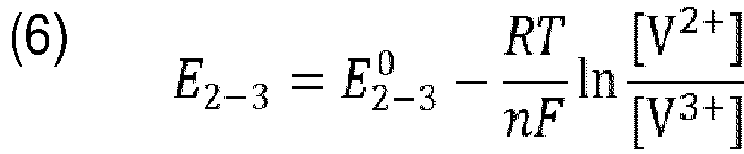


-
Equations reactions 
- As an example,
Fig. 2 shows U OCV vs. the discharge capacity (CAPdis ) relative to the theoretical capacity CAPTheo for a Ctot = 1.6 M vanadium solution in 2 M H2SO4 in four different scenarios. One with a fully balanced (unoxidised) vanadium solution (V state = 3.5) and three cases, in which the vanadium solution has been oxidised (V state = 3.55, 3.6 and 3.7). It can be seen that for the Vstate = 3.5 the curve falls monotonically with CAPdis /CAPTheo until it reaches 1. Here onlyreaction 3 takes place on the anode side and reaction 5 on the cathode side. However, for the oxidised solutions Uocv falls dramatically when CAPdis /CAPTheo < 1. - In the regime where Uocv > 1, it is same reactions as for the Vstate = 3.5 that takes places. When U OCV < 1
reaction 4 starts to take place on the capacity limiting anode side. For the oxidised solutions, it is seen that the battery can be discharged out to CAPdis /CAPTheo = 1. This will, however, be at much lower voltage and much lower energy efficiency and in practice is limited to capacities where Uocv is larger than approximately 0.7 V to 1.1 V because of the lower voltage limit of the inverter. -
Fig. 3 illustrates the ratio between the discharge capacity (CAP dis) and the theoretical capacity (CAPTheo ) as a function of the average vanadium oxidation state, Vstate for U thres = 1 V and C tot = 1.6 M and T = 298 K. Accordingly, the capacity is a function of Vstate. Vstate indicates the average oxidation state of vanadium in the electrolyte solution. As illustrated inFig. 3 , the Vstate can be divided into two: - A reduced region, in which the Vstate is in the range 3.0-3.5 and
- An oxidised region, in which the Vstate is in the range 3.5-4.0.
- It can be seen that the capacity falls almost linearly when Vstate deviates from the balanced state (V state = 3.5) and that the curve is almost symmetrical and independent on whether the solution is oxidised or reduced. If fully oxidised (V state = 4.0) or reduced (V state = 3.0) the accessible capacity becomes zero.
- Thus, to enable full utilisation of the capacity the concentrations of [V2+] and [V3+] on the anode side must always be equal to the concentrations of [V5+] and [V4+] on the cathode side, respectively (i.e. [V2+] = [V5+] and [V3+] = [V4+]), during all times of the battery operation.
- Currently, electrolysis is used for rebalancing oxidised electrolyte. Here a smaller electrolysis cell is connected with the cathode tank. Electrolyte is pumped into the cell where either V4+ or V5+ is reduced to V3+ or V4+, respectively, while oxygen is produced on the other side. This method is very costly and inefficient.
- Furthermore, addition of chemical reductants has also been reported in
WO 2015047079 A1 ,US2015017556 andUS2016056487 . Here one of the main challenges is that the reducing chemicals cannot leave any potentially damaging residues in the solutions. E.g. known reductants like borohydrides can therefore not be used as they will leave a Boron residue. Nonetheless, use of organic reductants have also been described as they in principle during the reduction reaction will only react into H2O and CO2, and since CO2 escapes the solution as bubbles, use of organic reductants leaves the solutions without residues. For this reason, organic reductants are an attractive chemical for rebalancing of vanadium electrolyte. - Nonetheless, to determine the amount of reductant that needs to be added for rebalancing to Vstate = 3.5 requires a technician to go to the battery installation site and take out samples of the anolyte and catholyte, and take it to a laboratory where the Vstate can be determined (typically with redox titration). From the measured Vstate the amount of the reducing chemical needed is calculated and then brought to the installation site and added to the catholyte. Obviously, this procedure is costly as it requires at least two visits by a technician to the installation site and also costly laboratory time for measuring the Vstate.
- Thus, there is a need for a method and a system that reduces or even eliminates the above-mentioned disadvantages of the prior art.
- It is an object of the invention to provide a system and a method for balancing an imbalanced vanadium redox flow battery, in which automated determination of the amount of reductant is detected from data during operation and in which automated addition of reductant is based on these data.
- It is an object of the invention to provide a system and a method for maintaining the capacity of the VRFB constant at an overall oxidation state of 3.5, despite the anolyte being continuously oxidised, by addition of a residue-free organic reducing agent during operation without any downtime.
- The object of the present invention can be achieved by a method as defined in claim 1 and by a system as defined in claim 7. Preferred embodiments are defined in the dependent subclaims, explained in the following description and illustrated in the accompanying drawings.
- The method according to the invention is a method for balancing an imbalanced vanadium redox flow battery during operation by adding a preferably organic reductant, wherein the vanadium redox flow battery comprises a cathode tank with a cathode electrolyte and an anode tank with an anode electrolyte, wherein the same redox active vanadium solution is present in the cathode tank and the anode tank of the vanadium redox flow battery, wherein the method comprises the following steps:
- monitoring the state of charge (SoC) of the electrolyte in the vanadium redox flow battery during either:
- a) a first configuration, in which the vanadium redox flow battery is charged and performing a discharge of the vanadium redox flow battery or
- b) a first configuration, in which the vanadium redox flow battery is discharged and performing a charge of the vanadium redox flow battery;
- _monitoring the discharge profile and/or charge profile of the vanadium redox flow battery;
- determining the faradaic imbalance of the electrolyte and calculating a first quantity of the organic reductant to be added to the electrolyte to balance the vanadium redox flow battery during operation and
- adding a second quantity of the organic reductant to the electrolyte.
- Hereby, it is possible to provide a method that in a very accurate manner determines the SoC of the battery by continuously measuring the open circuited potential using an OCV-cell. The OCV measurement is used to monitor the OCV of a full charge/discharge, despite of changes done during discharge and vice versa during charge. This feature eases the determination of a cycle start and end despite temperature fluctuations and different charge/discharge currents.
- The OCV measurements are used to determine the faradaic imbalance of the electrolyte whereafter a first quantity of a residue-free organic reducing agent used for rebalancing the electrolyte is calculated, and a second quantity of the residue-free organic reducing agent is added by an automatic dosing unit. Hence, the capacity is constantly maintained high, despite the VRFB being continuously oxidised.
- In one embodiment, the discharge profile of the vanadium redox flow battery includes a plurality of corresponding values of the open circuit voltage and the discharge capacity of the vanadium redox flow battery.
- In one embodiment, the charge profile of the vanadium redox flow battery includes a plurality of corresponding values of the open circuit voltage and the charge capacity of the vanadium redox flow battery.
- In one embodiment, the method comprises the step of providing the open circuit voltage as a function of the discharge capacity of the vanadium redox flow battery of a system according to the invention.
- The method comprises the step of determining the SoC of the electrolyte in the vanadium redox flow battery.
- Moreover, the method comprises the step of determining the faradaic imbalance of the electrolyte. As faradaic imbalance is found to significantly affect discharge capacity, maximum power density, cell resistances, and efficiency values are essential to be able to detect the faradaic imbalance.
- The method comprises the step of calculating a first quantity of the organic reductant to be added to the electrolyte to balance the vanadium redox flow battery during operation.
- In one embodiment, the calculation may be carried out by using the following equation:

- Where m is the mass of the reductant, M is the molar mass of the reductant, ΔC the missing capacity of battery and z is the number of electrons involved in the vanadium reduction reaction.
- In one embodiment, the first calculated quantity of organic reductant is calculated by using equation 12 (defined in the detailed description of the invention).
- Vanadium and the reductant oxalic acid react 2:1 (z = 2) shown in the chemical reaction below:

- Hence, the amount of added oxalic acid is easily determined based on the molar mass (equation 10).
- The method comprises the step of adding a second quantity of the organic reductant to the electrolyte. It is important to underline that the second quantity of the organic reductant may differ from the first quantity of the organic reductant to be added to the electrolyte to balance the vanadium redox flow battery during operation.
- In one embodiment, the second quantity of the organic reductant is selected to be smaller than the first quantity of the organic reductant. Hereby, it is possible to avoid that the quantity of the organic reductant to be added to the electrolyte to balance the vanadium redox flow battery during operation is larger than needed. This is important since a decrease in the capacity may be caused by other things than oxidation leading to electrolyte imbalance in the vanadium redox flow battery.
- In one embodiment, the step of monitoring the discharge profile of the vanadium redox flow battery is accomplished by measuring the OCV of the electrolytes in the vanadium redox flow. Hereby, it is possible to determine the SoC of the battery in a very accurate manner. This feature eases the determination of a start and an end of a cycle despite of temperature fluctuations and different charge/discharge currents.
- In one embodiment, the step of monitoring the discharge profile of the vanadium redox flow battery is accomplished by providing a battery that is charged to a first predefined degree and detecting the SoC of the fully charged battery by use of an OCV measurement.
- In one embodiment, the first predefined degree is in the range 60-100% of fully charged.
- In one embodiment, the first predefined degree is in the range 70-95% of fully charged.
- In one embodiment, the first predefined degree is in the range 75-90% of fully charged.
- In one embodiment, the step of monitoring the discharge profile of the vanadium redox flow battery is accomplished by providing a fully charged battery.
- In one embodiment, the step of monitoring the discharge profile of the vanadium redox flow battery is accomplished by providing an at least partially discharged battery and detecting the SoC of the fully discharged battery by use of an OCV measurement.
- In one embodiment, the step of monitoring the discharge profile of the vanadium redox flow battery is accomplished by providing a fully discharged battery.
- In one embodiment, the first predefined degree is in the range 60-100% of fully discharged (0-40% SoC).
- In one embodiment, the first predefined degree is in the range 70-95% of fully discharged (3-30% SoC).
- In one embodiment, the first predefined degree is in the range 75-90% of fully discharged (5-15% SoC).
- In one embodiment, the organic reductant comprises oxalic acid.
- In one embodiment, the organic reductant is oxalic acid.
- It may be an advantage that the step of adding the quantity of the organic reductant to the electrolyte is carried out by using an automated procedure of adding reductant. Hereby, the need for a skilled service staff manually adding the organic reductant is eliminated. Hereby, time and cost can be saved.
- The automated procedure of adding reductant may include activating a dosing pump and instructing the dosing pump to dose a predefined quantity of reductant to the electrolyte.
- It is possible to dose the entire quantity at once.
- In one embodiment, however, the predefined quantity of reductant may be added in two or more separated portions.
- In one embodiment, the automated procedure of adding reductant is carried out in a manner in which the first calculated quantity of organic reductant is larger than the second quantity of organic reductant being added to the electrolyte, wherein the ratio between the first calculated quantity and the second quantity of organic reductant being added, α (see equation 12), has a predefined value preferably in the range between 0.6 and 0.95.
- In one embodiment, the second quantity of organic reductant being added has a predefined value preferably in the range between 0.7 and 0.95.
- In one embodiment, the second quantity of organic reductant being added has a predefined value preferably in the range between 0.75 and 0.95.
- In one embodiment, the second quantity of organic reductant being added has a predefined value preferably in the range between 0.8 and 0.95.
- In one embodiment, the first calculated quantity of organic reductant is calculated by using the equation:

- In one embodiment, the first calculated quantity of organic reductant is calculated by using equation 12 (defined in the detailed description of the invention).
- In one embodiment, the method comprises the step of determining a time period, in which time period no reductant is added to the electrolyte, wherein the time period is selected in dependency of the second quantity.
- In one embodiment, the time period is selected to be proportional to the second quantity.
- The system according to the invention is a system for balancing an imbalanced vanadium redox flow battery during operation by adding an organic reductant, wherein the vanadium redox flow battery comprises a cathode tank with a cathode electrolyte and an anode tank with an anode electrolyte, wherein the same redox active vanadium solution is present in the cathode tank and the anode tank of the vanadium redox flow battery, wherein the system comprises:
- a monitoring unit configured to monitor a discharge profile and/or charge profile of the vanadium redox flow battery;
- a control unit configured to:
- a) determine the state of charge (SOC) of the electrolyte in the vanadium redox flow battery during either:
- a) a first configuration, in which the vanadium redox flow battery is charged and performing a discharge of the vanadium redox flow battery or
- b) a first configuration, in which the vanadium redox flow battery is discharged and performing a charge of the vanadium redox flow battery and
- c) determine the faradaic imbalance of the electrolyte and
- d) calculate a first quantity of the organic reductant to be added to the electrolyte to balance the vanadium redox flow battery during operation and
- a) determine the state of charge (SOC) of the electrolyte in the vanadium redox flow battery during either:
- a dosing unit configured to add a second quantity of the organic reductant to the electrolyte.
- Hereby, it is possible to provide a system that maintains the average oxidation state of the electrolyte at 3.5 ± 0.01 at all times despite being continuously oxidised by oxygen from the air.
- In one embodiment the monitoring unit comprises an OCV cell configured to monitor the discharge profile of the vanadium redox flow battery by measuring an OCV and determining the SoC of the electrolyte in the vanadium redox flow battery.
- In one embodiment, the organic reductant is oxalic acid.
- It may be an advantage that the dosing unit is configured to automatically adding the second quantity of the organic reductant to the electrolyte. The second quantity of the organic reductant may differ from the first quantity of the organic reductant to be added to the electrolyte to balance the vanadium redox flow battery during operation.
- In one embodiment, the second quantity of the organic reductant is selected to be smaller than the first quantity of the organic reductant in order to avoid that the quantity of the organic reductant to be added to the electrolyte to balance the vanadium redox flow battery during operation is larger than needed.
- In one embodiment, the automatic dosing unit is configured to be controlled on the basis of the imbalance calculations. Whenever the overall oxidation state is within the range 3.49 to 3.51 the dosing unit will be activated, and a second quantity will be added.
- In one embodiment, the control unit is configured to calculate a time period, in which time period no reductant is added to the electrolyte, wherein the time period is selected in dependency of the second quantity.
- It may be advantageous that the dosing unit is configured to automatically add reductant in a manner in which the first calculated quantity of organic reductant is larger than the second quantity of organic reductant being added to the electrolyte, wherein the ratio between the first calculated quantity and the second quantity of organic reductant being added has a predefined value preferably in the range between 0.6 and 0.95.
- It may be an advantage that the control unit is configured to calculate the first quantity of organic reductant by using the previously mentioned
equation 10. - It may be beneficial that the control unit is configured to calculate a time period, in which time period no reductant is added to the electrolyte.
- The invention will become more fully understood from the detailed description given herein below. The accompanying drawings are given by way of illustration only, and thus, they are not limitative of the present invention. In the accompanying drawings:
- Fig. 1A
- shows a schematic view of the tanks of a vanadium redox flow battery;
- Fig. 1B
- shows a schematic view of the tanks of the vanadium redox flow battery shown in
Fig. 1A , in a configuration in which the capacity and efficiency has decreased due to an electrolyte imbalance introduced through oxidation; - Fig. 1C
- shows a schematic illustration of a system for balancing an imbalanced vanadium redox flow battery according to the invention;
- Fig. 2
- shows the open circuited potential versus the discharge capacity relative to the theoretical capacity for a Ctot = 1.6 M vanadium solution in 2 M H2SO4 in different scenarios;
- Fig. 3
- shows the ratio between the discharge capacity and the theoretical capacity as function of the average vanadium oxidation state;
- Fig. 4A
- shows the reduction efficiency versus time for a plurality of batch tests of oxalic acid;
- Fig. 4B
- shows the reduction efficiency versus SoC at various times;
- Fig. 5A
- shows how the required quantity of oxalic acid to be added can be calculated;
- Fig. 5B
- shows the effect of oxalic acid being added to the electrolyte;
- Fig. 5C
- shows the effect of oxalic acid being added to the electrolyte;
- Fig. 6
- shows an example of how the current is during a charge and discharge of the battery as a function of time;
- Fig. 7
- shows a charge sequence and a discharge sequence, wherein at t=0 the battery is fully discharged, whereafter the battery is charged with varying current;
- Fig. 8
- shows the discharge capacity as function of time;
- Fig. 9
- shows how the change in CAPD,n after addition of a reductant;
- Fig. 10
- shows a system according to the invention and
- Fig. 11
- shows a flowchart indicating the steps of a method according to the invention.
- Referring now in detail to the drawings for the purpose of illustrating preferred embodiments of the present invention, a schematic view of the components of a vanadium redox flow battery (VRFB) 2 is illustrated in
Fig. 1A . -
Fig. 1A illustrates a schematic view of a vanadiumredox flow battery 2 comprising an anolyte that is present in ananode tank 6 and a catholyte that is present in a cathode tank. The vanadiumredox flow battery 2 is ideally run without any external oxidation. Hence, the average oxidation state of the electrolyte is maintained at 3.5. This occurs when both the concentration of V3+ and V4+ equal 50%. -
Fig. 1B illustrates a schematic view of the vanadiumredox flow battery 2 in a configuration, in which overall oxidation state is increased. Oxygen diffuses into the anolyte tank and oxidizes V2+/V3+ to V3+/V+4. - Hence, an imbalance in the electrolyte is created, as the overall oxidation state is increased >3.5, and the capacity of the vanadium redox flow battery is decreased.
-
Fig. 1C illustrates a schematic illustration of some of the essential components of asystem 20 for balancing an imbalanced vanadiumredox flow battery 2 according to the invention. Thesystem 20 comprises acathode tank 4 with a cathode electrolyte and ananode tank 6 with an anode electrolyte. The same redox active vanadium solution is present in thecathode tank 4 and theanode tank 6. - The
system 20 further comprises adosing unit 18 arranged and configured to add anorganic reductant 8 to at least one of the electrolytes. Thesystem 20 comprises amonitoring unit 14 configured for monitoring a discharge profile of the vanadiumredox flow battery 2. Themonitoring unit 14 is in fluid communication with thecathode tank 4 and with theanode tank 6. - The
system 20 comprises acontrol unit 16 that is configured to determine the SoC of the electrolyte in the vanadiumredox flow battery 2. - The
control unit 16 is configured to determine the faradaic imbalance of the electrolyte and calculating a first quantity of theorganic reductant 8 to be added to the electrolyte to balance the vanadiumredox flow battery 2 during operation. Thedosing unit 18 is arranged and configured to a quantity of theorganic reductant 8 to the electrolyte on the basis of the data provided by thecontrol unit 16. Thedosing unit 18 is arranged and configured to dose an organic reductant such as oxalic acid in thecathode tank 4. Thecontrol unit 16 is configured to monitoring and controlling the operation of the vanadiumredox flow battery 2. -
Fig. 2 illustrates the open circuited potential (U OCV) versus the discharge capacity (CAPdis ) relative to the theoretic discharge, CAPTheo for a Ctot = 1.6 M vanadium solution in 2 M H2SO4 in four different scenarios. One with a fully balanced (unoxidised) vanadium solution (V state = 3.5) and three cases where the vanadium solution has been oxidised (V state = 3.55, 3.6 and 3.7). It is seen that for the Vstate = 3.5 the curve falls monotonically with CAPdis /CAPTheo until it reaches 1. Here onlyreaction 3 takes place on the anode side and reaction 5 on the cathode side. However, for the oxidised solutions, the U OCV falls dramatically when CAPdis /CAPTheo < 1. - In the regime where U OCV > 1, the reactions are the same as for the Vstate = 3.5 that takes places. When U OCV < 1
reaction 4 starts to take place on the capacity limiting anode side. For the oxidised solutions, it is seen that the battery can be discharged out to CAPdis /CAPTheo = 1. This will, however, be at much lower voltage and much lower energy efficiency and in practice is limited to capacities where U OCV is larger than approximately 0.7 V to 1.1 V because of the lower voltage limit of the inverter. -
Fig. 3 illustrates the ratio between the discharge capacity (CAP dis) and the theoretical capacity (CAPTheo ) as function of the average vanadium oxidation state, Vstate for U thres = 1 V and C tot = 1.6 M and T = 298 K. - Accordingly, the capacity is a function of Vstate. Vstate indicates the average oxidation state of vanadium in the electrolyte solution. As illustrated in
Fig. 3 , the Vstate can be divided into two: - A reduced region, in which the Vstate is in the range 3.0-3.5 and
- An oxidised region, in which the Vstate is in the range 3.5-4.0.
- It can be seen that the capacity decreases almost linearly when Vstate deviates from the balanced state (V state = 3.5) and that the curve is almost symmetrical and independent on whether the solution gets oxidised or reduced. If fully oxidised (V state = 4.0) or reduced (V state = 3.0) the accessible capacity becomes zero.
- Thus, to enable full utilisation of the capacity the concentrations of [V2+] and [V3+] on the anode side must always be equal to the concentrations of [V5+] and [V4+] on the cathode side, respectively (i.e. [V2+] = [V5+] and [V3+] = [V4+]), during all times of the battery operation.
- Among the organic reductants in particular oxalic acid appears to have promising reducing properties.
-
Fig. 4A illustrates the efficiency versus time for a plurality of batch tests of oxalic acid. It can be seen that the beneficial effect of adding oxalic acid cannot be detected right away. The effect can be detected by monitoring the conversion efficiency.Fig 4A shows that the efficiency gradually increases until it peaks at the end of a reaction time period. This reaction time period has experimentally been found to be approximately 1-2 weeks depending on temperature and SoC. -
Fig. 4B illustrates the efficiency versus SoC at various times. It can be seen that oxalic acid can reduce both V5+ and V4+ with 100% efficiency whereby there are no demanding residues in the electrolyte. Additionally, the reaction rates depend on both whether it is V5+ or V4+ that is being reduced and on temperature. The reaction time may be up to 4 weeks. -
Fig. 5A illustrates how the required quantity of oxalic acid to be added can be calculated from the discharge profiles.Fig. 5A shows the OCV measured in the OCV cell during discharge in two cases. The inverter limits the minimum (UI, min) and maximum (UI, max) discharge voltages, being absolute limits OCV limits that can be reached. Still in many cases there is only used from 10% to 90% of the theoretical capacity. This is limited by OCV voltage that defines the fully charged state (UOCV, char) and fully discharged state (UOCV, dis). The first discharge cycle is done at a time where it is known that the electrolyte is balanced (V state = 3.5), and the value of CAP0 is registered. At a later time, the electrolyte has been oxidised and the discharge capacity has now changed to CAPt. The difference ΔC = CAP0- CAPt can be used to calculate the needed reductant by the following equation:
-
Fig. 5B andFig. 5C show examples of the effect of adding a reductant. InFig. 5B 0.63g of oxalic acid is added at cycle 76. By cycle 78 it is fully reacted. The table below shows that the capacity increase is 250 mAh if Uocv,dis = 1 V is used. If Uocv,dis = 0.75 V is used the capacity increase is 274 mAh. This corresponds to values of α 93.3% and 102.2%, respectively. - In
Fig. 5C 0.8472 g of oxalic acid is added at cycle 110. By cycle 118 it is fully reacted. The table below shows that the capacity increase is 314 mAh if Uocv,dis = 1 V is used. If Uocv,dis = 0.75 V is used the capacity increase is 341 mAh. This corresponds to values of α 86.6% and 94.7%, respectively. - Theoretically, α > 1 for a fully stoichiometric rebalancing and decreases with increasing UOCV, dis and as the Vstate approaches +3.5.
- Nonetheless, if too much reductant is added the Vstate becomes larger than 3.5 and the capacity will decrease as well and for this reason it is preferred to have a value of α < 1. For heavily oxidised/imbalanced vanadium solutions a preferred value of α is in the range 0.7-1.0, while for less oxidised/imbalanced vanadium solutions a preferred value of α is in the range 0.85-1.0.
Cycle Mass of reductant oxalic acid (g) Uocv,dis (V) Initial discharge cap (mAh) Discharge cap after reductant (mAh) Capacity increase (mAh) Theoretical capacity increase [%] 1/α 76 0.63 1 792 1042 250 267.9 93.3 76 0.63 0.75 819 1093 274 267.9 102.2 110 0.8472 1 1274 1526 312 360.2 86.6 110 0.8472 0.75 1344 1685 341 360.2 94.7 -
Fig. 6 illustrates an upper graph depicting the current I during a charge and discharge of the battery as function of time t.Fig. 6 illustrates a lower graph depicting the open circuit voltage (OCV) as a function of time t.Fig. 6 shows an example of how the current I is during a charge and discharge of the battery as function of time t. During the charging the current (I) is positive and charges the battery until the OCV reaches UOCV,char, at time tC where the battery is fully charged. This is followed by a pause whereafter the battery is discharged with a negative current (I) until the OCV reaches UOCV,dis at time to where the battery is fully discharged. The discharge capacity can be calculated from the following equation:
- Still, in most applications the charge and discharge does not follow simple charge and discharge with constant current. In most cases it varies and can even discharge during a charging cycle.
-
Fig. 7 illustrates a charge sequence and a discharge sequence, wherein at t=0 the battery is fully discharged, where after the battery is charged with varying current I. At t=0 the battery is fully discharged. Hereafter the battery is charged with varying current that even becomes negative (discharge) for short time periods. At time tc the battery is fully charged. This is followed by a period where the battery is discharged, but also with short intervals where the current is positive (charging). This takes place until the battery is fully discharged at time tD. In this case the discharge capacity of the battery is also given by equation (13). However, in some cases the discharge time can be quite significant, whereby the self-discharge of the battery has to be taken into account. In this case CAPD is calculated from the following equation:
- Where ISD is the self-discharge current of the battery (shunt currents and membrane crossover). ISD is dependent of temperature, flow rate, SoC and current, however, for a full discharge cycle of relatively short duration it can be considered to be constant.
- With measurement of the OCV and current during charging/discharging
equations 13 or 14 are used for calculating the initial capacity when the electrolyte is balanced (Vstate = 3.5) CAPD,0. At subsequent discharge cycles/times the discharge capacity is calculated equally (CAPD,n), where n refers to the cycle. After any cycle ΔC is calculated from CAPD,0 - CAPD,n and the mass of the reductant is calculated fromequation 12. - It is preferred to have Vstate in the range 3.49-3.51, acknowledging that the experimental resolution for calculating the imbalance from the battery data during use (and the reduction of amount of chemical) may not be sufficient for reaching 3.49-3.51. In one embodiment, the method comprises the step of monitoring the capacity during time. An example of this is shown in
Fig 8 . -
Fig. 8 illustrates the discharge capacity as function of time.Fig. 8 shows the discharge capacity as function of time. The capacity at t = 0 is the one for Vstate = 3.5, while at subsequent times the electrolyte is oxidised and the capacity decreases. It is possible to determinate ΔC by use of linear regression. -
Fig. 9 illustrates the change in CAPD,n after addition of a reductant. In one embodiment, the method comprises the step of monitoring the change in CAPD,n after addition of the reductant. This is shown infigure 9 , where ΔC is found from the slope of CAPD,n vs. time in the range tD0 to tD4. The reductant is added at tD4 and CAPD,n is monitored until a constant value has been obtained. Hereafter ΔCRED, is calculated and compared to ΔCα, in order to monitor if the added reductant has the expected effect. It may be an advantage that the time (tDn) of the last measurement of the CAPD is at least 14 days as it has been disclosed that the time for all of the reductant in some cases takes up to 2-4 weeks (depending on SoC and temperature) for completing the reaction. - In one embodiment, the method comprises the step of calculating ΔC and the mass of the reductant by an average of the charge and discharge capacity with reference to
Fig. 6 andFig. 7 . This is done by using the following equation:
- The mass of the reductant can be calculated by using eq. 12 where ΔC = CAPCD,0 - CAPCD,n, where CAPCD,0 is the capacity with Vstate = 3.5
- The advantage of this method is that the self-discharge current during charging will cancel out with the self-discharge during discharging if the charge and discharge time are approximately the same.
- In one embodiment, the method comprises the step of calculating ΔC and the mass of the reductant on the basis of the charge capacity. With reference to
Fig. 6 andFig. 7 this can be done by using the following equation:
- The mass of the reductant is again calculated from eq. 12 where ΔC = CAPC,0 - CAPC,n, where CAPC,0 is the capacity with Vstate = 3.5.
- The advantage of this method is that the self-discharge current during charging will overestimate CAPC,n whereby ΔC will be underestimated and there is no risk of adding too much of the reduction chemical.
- In one embodiment of the invention, the dosing of the reduction chemical is automated. As an example, the organic reductant can be dissolved in water and connected with a dosing pump that accurately doses the calculated amount of reductant.
- In one embodiment of the invention, there is remote access to the battery so that a remote monitoring can be carried out hereby enabling calculation of the mass. In one embodiment, dosing of the reductant can be controlled remotely.
-
Fig. 10 illustrates asystem 20 according to the invention. Thesystem 20 comprises a vanadiumredox flow battery 2 having acathode tank 4 with with a cathode electrolyte and ananode tank 6 with an anode electrolyte. The vanadiumredox flow battery 2 comprises astack 36 with anion exchange membrane 24 separating the negative and positive electrolyte. Theion exchange membrane 24 is in fluid contact with each of thetanks first pump 22 is arranged to circulate cathode electrolyte from thecathode tank 4 to theion exchange membrane 24 and further from theion exchange membrane 24 to thecathode tank 4. Likewise, a second pump 22' is arranged to circulate anode electrolyte from theanode tank 6 to theion exchange membrane 24 and further from theion exchange membrane 24 to theanode tank 6. - The same redox active vanadium solution is present in the
cathode tank 4 and theanode tank 6. The vanadiumredox flow battery 2 is controlled by aprogrammable logic controller 26. Theprogrammable logic controller 26 is connected to a plurality of sensors that detect various parameters such as temperature, pressure, flow, pump current, redox flow battery current or redox flow battery voltage. Theprogrammable logic controller 26 is configured to control the vanadiumredox flow battery 2 on the basis of inputs from the sensors. - The electricity from the vanadium
redox flow battery 2 is converted from direct current (DC) to alternating current (AC) in theinverter unit 28 and distributed to the public grid. - The
inverter unit 28 is electrically connected to a solar photovoltaic system that comprises anenergy meter 34 and a number ofsolar panels 30 that are electrically connected to asolar inverter 32. Theinverter unit 28 and the solar inverter is electrically connected to a local house. Accordingly, electricity produced by the solar photovoltaic system can be used in the house or stored in the vanadiumredox flow battery 2. -
Fig. 11 illustrates a flowchart indicating the steps of a method according to the invention. Initially, adischarge profile 12 of the vanadiumredox flow battery 2 is provided. Thedischarge profile 12 may be detected as explained with reference to the previous figures. - The next step is to measure the degree of capacity reduction (ΔC) of the vanadium
redox flow battery 2. - Hereafter, the faradaic imbalance of the
electrolyte 10 is determined. This allows calculation of first quantity Q1 oforganic reductant 8 to be added to theelectrolyte 10 to balance the vanadiumredox flow battery 2. - If the faradaic imbalance is larger than a predefined level L2 a second quantity of the
organic reductant 8 is added to theelectrolyte 10. After a predefined rest period (e.g. one week) the faradaic imbalance is measured again. If the faradaic imbalance is smaller than a predefined level L1 the process is ended. If not, step number two (measurement of the degree of capacity reduction (ΔC) of the vanadium redox flow battery 2) is carried out. - If the faradaic imbalance, however, is not larger than a predefined level L2, the initial step is repeated.
-
- 2
- Vanadium redox flow battery
- 4
- Cathode tank
- 6
- Anode tank
- 8
- Organic reductant
- 10
- Electrolyte (redox active vanadium solution)
- 12
- Discharge profile
- 14
- Monitoring unit
- 16
- Control unit
- 18
- Dosing unit
- 20
- System
- 22, 22'
- Pump
- 24
- Ion exchange membrane
- 26
- Programmable logic controller (PLC)
- 28
- Inverter unit
- 30
- Solar panel
- 32
- Solar inverter
- 34
- Local house load
- 36
- Stack
- Eθ'
- Standard cell potential
- E
- Electrical potential
- R
- The gas constant
- T
- Temperature
- F
- Faradays constant,
- SOC
- State of charge
- Q1
- First quantity
- Q2
- Second quantity
- OCV
- Open circuit voltage
- Trest
- Rest period
- C
- Capacity
- ΔC
- Capacity reduction
- Δt
- Time period
Claims (11)
- A method for chemical reduction of an oxidised vanadium redox flow battery (2) during operation by adding an organic reductant (8), wherein the vanadium redox flow battery (2) comprises a cathode tank (4) with a cathode electrolyte and an anode tank (6) with an anode electrolyte, wherein the same redox active vanadium solution (10) is present in the cathode tank (4) and the anode tank (6) of the vanadium redox flow battery (2), characterised in that the method comprises the following steps:- monitoring the state of charge (SoC) of the electrolyte (10) in the vanadium redox flow battery (2) during either:a) a first configuration, in which the vanadium redox flow battery (2) is charged and performing a discharge of the vanadium redox flow battery (2) orb) a first configuration, in which the vanadium redox flow battery (2) is discharged and performing a charge of the vanadium redox flow battery (2);- monitoring a discharge profile (12) and/or charge profile (12) of the vanadium redox flow battery (2);- determining the faradaic imbalance of the electrolyte (10) and calculating a first quantity (Q1) of the organic reductant (8) to be added to the electrolyte (10) to balance the vanadium redox flow battery (2) during operation and- adding a second quantity (Q2) of the organic reductant (8) to the electrolyte (10).
- A method according to claim 1, characterised in that the step of monitoring the discharge profile (12) of the vanadium redox flow battery (2) is accomplished by measuring an open circuit voltage (OCV) and determining the state of charge (SOC) of the electrolyte (10) in the vanadium redox flow battery (2) based on the measured open circuit voltage (OCV).
- A method according to claim 2, characterised in that the step of monitoring the discharge profile (12) of the vanadium redox flow battery (2) is accomplished by providing a charged battery (2) charged to a first predefined degree and detecting the state of charge (SOC) of the fully charged battery (2) by use of an OCV measurement.
- A method according to claim 2 or 3, characterised in that the step of monitoring the discharge profile (12) of the vanadium redox flow battery (2) is accomplished by providing an at least partially discharged battery (2) and detecting the state of charge (SOC) of the fully discharged battery (2) by use of an OCV measurement.
- A method according to one of the preceding claims, characterised in that the step of adding the quantity of the organic reductant (8) to the electrolyte (10) is carried out by using an automated procedure of adding reductant (8).
- A method according to one of the preceding claims, characterised in that the procedure of adding reductant (8) is carried out in a manner in which the first calculated quantity (Q1) of organic reductant (8) is larger than the second quantity (Q2) of organic reductant (8) being added to the electrolyte (10), wherein the ratio between the first calculated quantity (Q1) and the second quantity (Q2) of organic reductant (8) being added has a predefined value preferably in the range between 0.6 and 0.95, wherein the first calculated quantity (Q1) of organic reductant (8) calculated by using the flowing equation:

- A system (20) for balancing an imbalanced vanadium redox flow battery (2) during operation by adding an organic reductant (8), wherein the vanadium redox flow battery (2) comprises a cathode tank (4) with a cathode electrolyte and an anode tank (6) with an anode electrolyte, wherein the same redox active vanadium solution (10) is present in the cathode tank (4) and the anode tank (6) of the vanadium redox flow battery (2), characterised in that the system (20) comprises:- a monitoring unit (14) configured to monitor a discharge profile (12) and/or charge profile (12) of the vanadium redox flow battery (2);- a control unit (16) configured to:a) determine the state of charge (SOC) of the electrolyte (10) in the vanadium redox flow battery (2) during either:a) a first configuration, in which the vanadium redox flow battery (2) is charged and performing a discharge of the vanadium redox flow battery (2) orb) a first configuration, in which the vanadium redox flow battery (2) is discharged and performing a charge of the vanadium redox flow battery (2) andc) determine the faradaic imbalance of the electrolyte (10) andd) calculate a first quantity (Q1) of the organic reductant (8) to be added to the electrolyte (10) to balance the vanadium redox flow battery (2) during operation and- a dosing unit (18) configured to add a second quantity (Q2) of the organic reductant (8) to the electrolyte (10).
- A system (20) according to claim 7, characterised in that the monitoring unit (14) comprises an open circuit voltage (OCV) cell configured to monitor the discharge profile (12) of the vanadium redox flow battery (2) by measuring an open circuit voltage (OCV) and determining the state of charge (SOC) of the electrolyte (10) in the vanadium redox flow battery (2) based on the measured open circuit voltage (OCV).
- A system (20) according to one of the preceding claims 7-8, characterised in that the dosing unit (18) is configured to automatically adding the second quantity (Q2) of the organic reductant (8) to the electrolyte (10).
- A system (20) according to one of the preceding claims 7-9, characterised in that the control unit (16) is configured to calculate a time period (Δt), in which time period (Δt) no reductant (8) is added to the electrolyte (10), wherein the time period (Δt) is selected in dependency of the second quantity (Q2).
- A system (20) according to one of the preceding claims 7-10, characterised in that the dosing unit (18) is configured to automatically add reductant (8) in a manner in which the first calculated quantity (Q1) of organic reductant (8) is larger than the second quantity (Q2) of organic reductant (8) being added to the electrolyte (10), wherein the ratio between the first calculated quantity (Q1) and the second quantity (Q2) of organic reductant (8) being added has a predefined value preferably in the range between 0.6 and 0.95.
Applications Claiming Priority (1)
| Application Number | Priority Date | Filing Date | Title |
|---|---|---|---|
| DKPA202100200A DK180929B1 (en) | 2021-02-25 | 2021-02-25 | System and method for balancing a vanadium redox flow battery |
Publications (1)
| Publication Number | Publication Date |
|---|---|
| EP4053951A1 true EP4053951A1 (en) | 2022-09-07 |
Family
ID=80448872
Family Applications (1)
| Application Number | Title | Priority Date | Filing Date |
|---|---|---|---|
| EP22158464.2A Withdrawn EP4053951A1 (en) | 2021-02-25 | 2022-02-24 | System and method for balancing a vanadium redox flow battery |
Country Status (2)
| Country | Link |
|---|---|
| EP (1) | EP4053951A1 (en) |
| DK (1) | DK180929B1 (en) |
Cited By (2)
| Publication number | Priority date | Publication date | Assignee | Title |
|---|---|---|---|---|
| CN120103880A (en) * | 2025-05-07 | 2025-06-06 | 苏州毕方智能科技有限公司 | A flow control system for a flow battery |
| WO2025198534A1 (en) * | 2024-03-21 | 2025-09-25 | VFlowtech Pte Ltd. | System and method for reinstating the valance of electrolyte in vanadium redox flow batteries |
Citations (6)
| Publication number | Priority date | Publication date | Assignee | Title |
|---|---|---|---|---|
| WO1990003666A1 (en) * | 1988-09-23 | 1990-04-05 | Unisearch Limited | State of charge of redox cell |
| US20130316199A1 (en) * | 2012-05-25 | 2013-11-28 | Deeya Energy, Inc. | Electrochemical balance in a vanadium flow battery |
| US20150017556A1 (en) | 2013-07-11 | 2015-01-15 | Oci Company Ltd. | Redox flow battery system and control method for the same |
| WO2015047079A2 (en) | 2013-08-27 | 2015-04-02 | Sirim Berhad | Application of enzyme-quantum dots hybrid system for the determination of uric acid |
| US20160056487A1 (en) | 2013-05-03 | 2016-02-25 | United Technologies Corporation | Method of maintaining health of a flow battery |
| CN110911722A (en) * | 2019-10-29 | 2020-03-24 | 大连博融新材料有限公司 | All-vanadium redox flow battery electrolyte capacity recovery agent, preparation method and application |
-
2021
- 2021-02-25 DK DKPA202100200A patent/DK180929B1/en active IP Right Grant
-
2022
- 2022-02-24 EP EP22158464.2A patent/EP4053951A1/en not_active Withdrawn
Patent Citations (6)
| Publication number | Priority date | Publication date | Assignee | Title |
|---|---|---|---|---|
| WO1990003666A1 (en) * | 1988-09-23 | 1990-04-05 | Unisearch Limited | State of charge of redox cell |
| US20130316199A1 (en) * | 2012-05-25 | 2013-11-28 | Deeya Energy, Inc. | Electrochemical balance in a vanadium flow battery |
| US20160056487A1 (en) | 2013-05-03 | 2016-02-25 | United Technologies Corporation | Method of maintaining health of a flow battery |
| US20150017556A1 (en) | 2013-07-11 | 2015-01-15 | Oci Company Ltd. | Redox flow battery system and control method for the same |
| WO2015047079A2 (en) | 2013-08-27 | 2015-04-02 | Sirim Berhad | Application of enzyme-quantum dots hybrid system for the determination of uric acid |
| CN110911722A (en) * | 2019-10-29 | 2020-03-24 | 大连博融新材料有限公司 | All-vanadium redox flow battery electrolyte capacity recovery agent, preparation method and application |
Cited By (2)
| Publication number | Priority date | Publication date | Assignee | Title |
|---|---|---|---|---|
| WO2025198534A1 (en) * | 2024-03-21 | 2025-09-25 | VFlowtech Pte Ltd. | System and method for reinstating the valance of electrolyte in vanadium redox flow batteries |
| CN120103880A (en) * | 2025-05-07 | 2025-06-06 | 苏州毕方智能科技有限公司 | A flow control system for a flow battery |
Also Published As
| Publication number | Publication date |
|---|---|
| DK180929B1 (en) | 2022-06-29 |
| DK202100200A1 (en) | 2022-06-29 |
Similar Documents
| Publication | Publication Date | Title |
|---|---|---|
| JP6549566B2 (en) | Flow cell for operation, electrochemical stack, electrochemical system and method of using flow cell for operation | |
| JP6403009B2 (en) | Redox flow battery system and operating method of redox flow battery | |
| KR101574410B1 (en) | Method and apparatus for evaluating redox flow battery | |
| US8980484B2 (en) | Monitoring electrolyte concentrations in redox flow battery systems | |
| KR102219191B1 (en) | Redox flow battery system, monitoring method for redox flow battery and control method for redox flow battery | |
| CN109417184B (en) | Redox flow battery, electric quantity measuring system and electric quantity measuring method | |
| EP4053951A1 (en) | System and method for balancing a vanadium redox flow battery | |
| JP2006351346A (en) | Redox flow battery system | |
| JP2008218097A (en) | Fuel cell system | |
| KR20160121528A (en) | Redox flow battery system and method for operating redox flow battery | |
| CN112470315B (en) | Redox flow battery system | |
| US20040150405A1 (en) | Method and apparatus for monitoring fuel cell voltages | |
| JP2006147374A (en) | Operation method of vanadium redox flow battery system | |
| JP6378319B2 (en) | Flow battery health maintenance method | |
| US20240201271A1 (en) | Determining state of charge, molarity and oxidation state in a flow battery and controlling a flow battery | |
| WO2022128191A1 (en) | Method and apparatus for determining the electrolyte system state in a redox flow battery | |
| JP3364049B2 (en) | Battery life evaluation method and device | |
| JP2003157883A (en) | Method for regenerating electrolyte for vanadium redox battery | |
| CN112098856B (en) | Method for dynamically measuring endurance time of storage battery pack of transformer substation | |
| US20230131299A1 (en) | Cell for electrochemically determining active species concentrations in redox flow batteries | |
| KR101732817B1 (en) | Method and apparatus for measuring balance level of electrolyte in redox flow battery | |
| KR20180058258A (en) | Method and apparatus for estimating state of battery health | |
| Poli | Design and development of an electrolyte regeneration process for vanadium redox flow batteries | |
| CN119008992A (en) | Method for repairing unbalanced battery electrolyte and method for judging repairing end point of unbalanced battery electrolyte | |
| CN116774067A (en) | Battery screening method, system, electronic device and computer readable storage medium |
Legal Events
| Date | Code | Title | Description |
|---|---|---|---|
| PUAI | Public reference made under article 153(3) epc to a published international application that has entered the european phase |
Free format text: ORIGINAL CODE: 0009012 |
|
| STAA | Information on the status of an ep patent application or granted ep patent |
Free format text: STATUS: THE APPLICATION HAS BEEN PUBLISHED |
|
| AK | Designated contracting states |
Kind code of ref document: A1 Designated state(s): AL AT BE BG CH CY CZ DE DK EE ES FI FR GB GR HR HU IE IS IT LI LT LU LV MC MK MT NL NO PL PT RO RS SE SI SK SM TR |
|
| STAA | Information on the status of an ep patent application or granted ep patent |
Free format text: STATUS: THE APPLICATION IS DEEMED TO BE WITHDRAWN |
|
| 18D | Application deemed to be withdrawn |
Effective date: 20230308 |