EP4053839A1 - Method for contactless readout of magnetic storage media by circularly polarized x-ray beams - Google Patents
Method for contactless readout of magnetic storage media by circularly polarized x-ray beams Download PDFInfo
- Publication number
- EP4053839A1 EP4053839A1 EP21161010.0A EP21161010A EP4053839A1 EP 4053839 A1 EP4053839 A1 EP 4053839A1 EP 21161010 A EP21161010 A EP 21161010A EP 4053839 A1 EP4053839 A1 EP 4053839A1
- Authority
- EP
- European Patent Office
- Prior art keywords
- ray beam
- magnetic
- circularly polarized
- ray
- readout
- Prior art date
- Legal status (The legal status is an assumption and is not a legal conclusion. Google has not performed a legal analysis and makes no representation as to the accuracy of the status listed.)
- Withdrawn
Links
- 238000000034 method Methods 0.000 title claims abstract description 18
- 230000005415 magnetization Effects 0.000 claims abstract description 6
- 238000002983 circular dichroism Methods 0.000 claims abstract description 3
- 239000002245 particle Substances 0.000 claims description 4
- 238000010894 electron beam technology Methods 0.000 claims description 3
- 238000011156 evaluation Methods 0.000 abstract description 2
- UQSXHKLRYXJYBZ-UHFFFAOYSA-N Iron oxide Chemical compound [Fe]=O UQSXHKLRYXJYBZ-UHFFFAOYSA-N 0.000 description 4
- 238000010521 absorption reaction Methods 0.000 description 4
- 239000002223 garnet Substances 0.000 description 4
- 230000005540 biological transmission Effects 0.000 description 3
- 239000011230 binding agent Substances 0.000 description 2
- 230000000694 effects Effects 0.000 description 2
- 230000007062 hydrolysis Effects 0.000 description 2
- 238000006460 hydrolysis reaction Methods 0.000 description 2
- 238000005259 measurement Methods 0.000 description 2
- 230000003647 oxidation Effects 0.000 description 2
- 238000007254 oxidation reaction Methods 0.000 description 2
- NDLPOXTZKUMGOV-UHFFFAOYSA-N oxo(oxoferriooxy)iron hydrate Chemical compound O.O=[Fe]O[Fe]=O NDLPOXTZKUMGOV-UHFFFAOYSA-N 0.000 description 2
- 208000011580 syndromic disease Diseases 0.000 description 2
- QTBSBXVTEAMEQO-UHFFFAOYSA-M Acetate Chemical compound CC([O-])=O QTBSBXVTEAMEQO-UHFFFAOYSA-M 0.000 description 1
- 241000238366 Cephalopoda Species 0.000 description 1
- 238000000384 X-ray magnetic circular dichroism spectroscopy Methods 0.000 description 1
- 230000002238 attenuated effect Effects 0.000 description 1
- 230000015556 catabolic process Effects 0.000 description 1
- 238000002144 chemical decomposition reaction Methods 0.000 description 1
- 239000011247 coating layer Substances 0.000 description 1
- 230000007547 defect Effects 0.000 description 1
- 238000006731 degradation reaction Methods 0.000 description 1
- 238000005516 engineering process Methods 0.000 description 1
- UCNNJGDEJXIUCC-UHFFFAOYSA-L hydroxy(oxo)iron;iron Chemical compound [Fe].O[Fe]=O.O[Fe]=O UCNNJGDEJXIUCC-UHFFFAOYSA-L 0.000 description 1
- 238000003384 imaging method Methods 0.000 description 1
- 239000010410 layer Substances 0.000 description 1
- 239000000696 magnetic material Substances 0.000 description 1
- 239000000463 material Substances 0.000 description 1
- 238000000386 microscopy Methods 0.000 description 1
- 230000003287 optical effect Effects 0.000 description 1
- 239000000049 pigment Substances 0.000 description 1
- 230000010287 polarization Effects 0.000 description 1
- 238000003825 pressing Methods 0.000 description 1
- 238000011084 recovery Methods 0.000 description 1
- 235000021419 vinegar Nutrition 0.000 description 1
- 239000000052 vinegar Substances 0.000 description 1
- 229910006297 γ-Fe2O3 Inorganic materials 0.000 description 1
Images
Classifications
-
- G—PHYSICS
- G11—INFORMATION STORAGE
- G11B—INFORMATION STORAGE BASED ON RELATIVE MOVEMENT BETWEEN RECORD CARRIER AND TRANSDUCER
- G11B5/00—Recording by magnetisation or demagnetisation of a record carrier; Reproducing by magnetic means; Record carriers therefor
- G11B5/008—Recording on, or reproducing or erasing from, magnetic tapes, sheets, e.g. cards, or wires
- G11B5/00813—Recording on, or reproducing or erasing from, magnetic tapes, sheets, e.g. cards, or wires magnetic tapes
-
- G—PHYSICS
- G11—INFORMATION STORAGE
- G11B—INFORMATION STORAGE BASED ON RELATIVE MOVEMENT BETWEEN RECORD CARRIER AND TRANSDUCER
- G11B11/00—Recording on or reproducing from the same record carrier wherein for these two operations the methods are covered by different main groups of groups G11B3/00 - G11B7/00 or by different subgroups of group G11B9/00; Record carriers therefor
- G11B11/10—Recording on or reproducing from the same record carrier wherein for these two operations the methods are covered by different main groups of groups G11B3/00 - G11B7/00 or by different subgroups of group G11B9/00; Record carriers therefor using recording by magnetic means or other means for magnetisation or demagnetisation of a record carrier, e.g. light induced spin magnetisation; Demagnetisation by thermal or stress means in the presence or not of an orienting magnetic field
- G11B11/105—Recording on or reproducing from the same record carrier wherein for these two operations the methods are covered by different main groups of groups G11B3/00 - G11B7/00 or by different subgroups of group G11B9/00; Record carriers therefor using recording by magnetic means or other means for magnetisation or demagnetisation of a record carrier, e.g. light induced spin magnetisation; Demagnetisation by thermal or stress means in the presence or not of an orienting magnetic field using a beam of light or a magnetic field for recording by change of magnetisation and a beam of light for reproducing, i.e. magneto-optical, e.g. light-induced thermomagnetic recording, spin magnetisation recording, Kerr or Faraday effect reproducing
- G11B11/10532—Heads
- G11B11/10541—Heads for reproducing
- G11B11/10543—Heads for reproducing using optical beam of radiation
- G11B11/10545—Heads for reproducing using optical beam of radiation interacting directly with the magnetisation on the record carrier
Definitions
- the present invention is related to a method for contactless readout of magnetic storage media by circularly polarized X-rays.
- magnetic storage media and magnetic recording media are used interchangeably and refer to media where information is stored magnetically.
- This invention relates to magnetic recording media in general but is discussed here in terms of magnetic recording tape.
- Magnetic recording tape refers to tapes for the storage of information, such as audio and video signals and binary data as well as to other forms of magnetic storage media such as disks.
- Magnetic tapes deteriorate over time due to chemical degradation, such as of the binder or the base. This degradation is attributed to oxidation and hydrolysis and, consequently, the tapes exhibit undesirable properties, such as stickiness and excessive shed of the magnetic oxide coating layer. These undesirable properties typically prevent the use of the tapes in equipment for recording or playback.
- Another possibility consists in placing a magneto-optic garnet film in very close proximity of the sample to detect the stray fields along the tape.
- the company 5micron has developed a setup based on this principle, where changes in the magnetic state of the garnet are detected using the Faraday effect.
- This technology has been commercialized.
- it remains impractical for heavily damaged tapes whose magnetic fields might be particularly complex, making it difficult to reconstruct the original information with high fidelity.
- the garnet film needs to be placed very close to the tape surface (ca. 5 microns), which excludes the possibility of reading sections of degraded tapes that are not flat.
- optical defects in the garnet film can equally complicate data recovery.
- the most common problems afflicting magnetic tapes are 'sticky shed' syndrome (where the pigment layer binder breaks down due to oxidation and hydrolysis) and 'vinegar' syndrome, where the acetate carrier is degraded. Consequently, the tapes may stick and shed onto player guides and heads or are too brittle and cannot be played. Practically, the tape can in a large number of cases be unwound, and the magnetic pattern is mostly intact, but can only be read using a contactless technique.
- a real-time readout of the magnetic signal stored on the magnetic tape can be achieved by the evaluation of the intensity signals for the c+ X-ray beam and the c- X-ray beam.
- One of the advantages of this technique is that while the advancing speed of the magnetic tape can match that of a magnetic tape player and allow real-time readout, the readout speed can be varied as required by the state of the magnetic tape.
- an X-ray source for generating a linearly polarized x-ray beam is provided.
- the generated linearly polarized X-ray beam is split into a first linearly polarized X-ray beam and a second linearly polarized X-ray beam.
- the first linearly polarized X-ray beam and the second linearly polarized X-ray beam are then converted into the first circularly polarized beam (c+) and the second circularly polarized beam (c-).
- a particle beam in particular an electron beam, is provided which passes along a first undulator to generate the first circularly polarized X-ray beam and along a second undulator to generate the second circularly polarized X-ray beam.
- the beam spots can be in the range of 2 to 10 microns, preferably corresponding to the recording or playback head gap, in the vertical direction and 20 to 200 microns, preferably 100 microns, in the horizontal direction whereby these values correspond approximately to an audio track size of the magnetic information stored on the magnetic tape in the horizontal direction and to the resolution of a magnetic read head in the vertical direction.
- Suitable characteristics of the x-ray beam can be achieved when the beam energy is in the range from 2 to 50 keV, preferably in the range from 5 to 10 keV.
- the main requirement is that the beam energy is tuned to an appropriate material absorption edge in order to use the XMCD effect. Hence, the energy range is broad. Further, the beam intensity may range from 10 8 to 10 13 photons/second.
- a suitable readout sample rate with sufficient speed can be achieved, when the readout sample rate is in the range from 20 to 200 kHz, preferably around 100 kHz.
- a further preferred embodiment of the present invention provides for an algorithm to identify the magnitude and the direction of the magnetic information in form the stored magnetic field on the magnetic tapes which uses the signal of two detectors; first detector detects the signal from the c+ X-ray beam and the second detector detects the signal from the c- X-ray beam wherein the magnetic information on the magnetic is determined by the division of the two detected signals c-/c+ or vice versa.
- the present invention can be realized by a first setup 2 to mount a magnetic tape 4 and to use circularly polarized hard X-rays in transmission to readout the analog waveform from magnetic music or data tapes 4 (tape spools not illustrated here).
- An X-ray source 6 generates a linearly polarized x-ray beam 8 that is directed through focusing optics 10, such as a zone plate, and two beam splitter gratings 12a, 12b to split the x-ray beam into two x-ray beams 8a, 8b.
- the two x-ray beams 8a and 8b go each through recombiner gratings 14a, 14b, and are converted into two circularly polarized beams c+, c- using circular polarizers.
- the two circularly polarized beams c+, c- are needed to readout the magnetic state of the magnetic tape 4.
- the circularly polarized light can be also obtained by using two undulators.
- the first setup 2 is schematically illustrated in Fig. 2 . It differs from typical magnetic measurement setups (illustrated in Fig. 4 ), where circularly polarized X-rays are used to measure magnetic states. The polarization is normally changed sequentially, which takes time.
- the X-ray beam 8 is split into two beams (circularly polarized c+ and c-), allowing fast readout of the magnetic state.
- Two detectors 16a, 16b are used to readout the signals from the c+ and c- X-ray beams.
- the magnetic tape 4 can therefore be mounted on a custom-made tape machine 18 allowing the two X-ray beams c+, c- to go through the magnetic tape 4 leading to attenuated x-ray beams c+' and c-'. Due to the magnetization of the magnetic tape 4, the polarized X-ray absorption differs for the c+ and c- beams, depending on the magnetic state (information) of the tape. Hence, the c+' and c-' beams differ from c+ and c- beams in terms of their intensity. Based on this beam splitting scheme, real-time readout of the magnetic signal stored on the magnetic tape 4 can be achieved.
- the x-ray beam 8 has a beam energy of 7.127 keV and a wavelength of 1.74 Angstrom.
- the beam energy of 7.127 keV corresponds to the absorption edge of gamma ferric oxide ( ⁇ -Fe2O3), where the magnetic contrast is maximal.
- Ferric oxide was commonly used as magnetic medium in audio tapes. Absorption characteristics of the magnetic material used therefore can be a further relevant criteria for the adjustment of the frequency of the x-ray beam 8.
- the algorithm that is used to identify the magnitude and the direction of the magnetic field on the magnetic tape 4 is straightforward.
- the x-ray beam 8 is split into two circularly polarized beams c+, c- and the two detectors 16a, 16b measure the magnetic signal in terms of the changed beam intensity due to the magnetization of the magnetic tape.
- the detector 16a detects the intensity I c - of the modified beam c-' and the other detector 16b measures the intensity I c+ of the modified beam c+'.
- the two detected quantities are divided: I c- /I c+ .
- the beam spot on the magnetic tape has been established to be of a few microns, preferably the size of the recording or playback head gap, in the vertical direction and 100 microns in the horizontal direction. These values correspond approximately to the resolution of a standard magnetic read head (in the vertical direction)and to the audio track size (in the horizontal direction) on the magnetic tape 4. These values can be adjusted as needed using slits to shape the beams.
- Figure 3 schematically shows a second setup for the generation of the circularly polarized x-ray beams.
- a particle beam typically an electron beam
- Each undulator generates a circularly polarized x-ray beam which is then directed towards and through the magnetic tape which is advanced.
- the remaining parts of the second setup are equal to the components and conditions used for the first setup.
Landscapes
- Analysing Materials By The Use Of Radiation (AREA)
Abstract
It is the objective of the present invention to provide a method to readout magnetic storage media that provides a high throughput for magnetic tapes and readouts the magnetic information with a high fidelity.This objective is achieved according to the present invention by a method for contactless readout of the magnetic information stored on magnetic tapes (4), said magnetic information being encoded by the magnetization value and direction stored on the magnetic tapes (4), comprising the steps of:a) providing a first circularly polarized x-ray beam (c+) and a second circularly polarized x-ray beam (c-);b) orienting the first circularly polarized X-ray beam (c+) and the second circularly polarized X-ray beam (c-) towards the magnetic tape (4);c) reading out the first circularly polarized X-ray beam (c+) and the second circularly polarized X-ray beam (c-) after their passage through the magnetic tape while advancing the magnetic tape, andd) determining the magnetic information by the difference between the two readout signals from the first x-ray beam (c+) and the second x-ray beam (c-) based on X-ray magnetic circular dichroism.Based on this beam splitting scheme, a real-time readout of the magnetic signal stored on the magnetic tape can be achieved by the evaluation of the intensity signals for the c+-X-ray beam and the c- X-ray beam.
Description
- The present invention is related to a method for contactless readout of magnetic storage media by circularly polarized X-rays.
- The terms magnetic storage media and magnetic recording media are used interchangeably and refer to media where information is stored magnetically. This invention relates to magnetic recording media in general but is discussed here in terms of magnetic recording tape.
- Magnetic recording tape refers to tapes for the storage of information, such as audio and video signals and binary data as well as to other forms of magnetic storage media such as disks.
- Magnetic tapes deteriorate over time due to chemical degradation, such as of the binder or the base. This degradation is attributed to oxidation and hydrolysis and, consequently, the tapes exhibit undesirable properties, such as stickiness and excessive shed of the magnetic oxide coating layer. These undesirable properties typically prevent the use of the tapes in equipment for recording or playback.
- In 2008, a fire at Universal Studios Hollywood destroyed a warehouse where hundreds of thousands of master tapes belonging to Universal Music Group, including original recordings of best-selling artists as well as unique masters from the 1930s to the 1950s by artists such as Louis Armstrong and Ella Fitzgerald. A significant fraction of these had not even been classified due to the decaying state of the magnetic tapes, making them unreadable by conventional magnetic read heads. Such events serve as reminders of the pressing need to preserve musical cultural heritage.
- While the loss of the master tapes due to the fire was estimated to $150 million, the cost of 'loss of artistry' due to tape decay is equally considerable, if not greater, as it affects hundreds of thousands of recordings stored in warehouses across the world, belonging to all music labels. Moreover, hundreds of thousands of tapes in possession of academic or cultural institutions, or in private hands, consisting of unique recordings that could become irrecoverable have been identified by the Magnetic Tape Alert Project, supported by UNESCO. In particular, major labels have shown interest in investigating the technical feasibility of recovering degraded archived audio tapes.
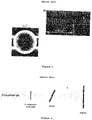
- Over the past decades, a number of attempts have been made to retrieve data from magnetic media, such as music and data tapes, using contactless magnetic contrast imaging. Domain patterns on a magnetic tape can be visualized by using ferrous oxide particles in solution placed above the tape, such as with the 3M 'Plastiform' magnetic viewer (see
Fig. 1a ). However, this technique does not allow recovering magnetic information due to its low resolution and to the fact that the sign of the magnetic field cannot be determined. More recent attempts at recovering the information stored on magnetic tape media include using e.g. magnetoresistive sensors developed for hard disk drives to scan magnetic tapes (seeFig. 1b ) as well as scanning SQUID microscopy. While these techniques enable measuring the sign of the magnetic fields and analog waveforms can be recovered, they are slow, have a limited field of view and only realistically allow inspecting very small portions of tape, of the order of a few millimeters. They have so far remained in the 'academic' realm. - Another possibility consists in placing a magneto-optic garnet film in very close proximity of the sample to detect the stray fields along the tape. Very recently, the company 5micron has developed a setup based on this principle, where changes in the magnetic state of the garnet are detected using the Faraday effect. This technology has been commercialized. However, it remains impractical for heavily damaged tapes whose magnetic fields might be particularly complex, making it difficult to reconstruct the original information with high fidelity. In addition, the garnet film needs to be placed very close to the tape surface (ca. 5 microns), which excludes the possibility of reading sections of degraded tapes that are not flat. Moreover, optical defects in the garnet film can equally complicate data recovery.
- The most common problems afflicting magnetic tapes are 'sticky shed' syndrome (where the pigment layer binder breaks down due to oxidation and hydrolysis) and 'vinegar' syndrome, where the acetate carrier is degraded. Consequently, the tapes may stick and shed onto player guides and heads or are too brittle and cannot be played. Practically, the tape can in a large number of cases be unwound, and the magnetic pattern is mostly intact, but can only be read using a contactless technique.
- It is therefore the objective of the present invention to provide a method to readout magnetic storage media that provides a high throughput for magnetic tapes and directly readouts the magnetic information with a high fidelity.
- This objective is achieved according to the present invention by a method for contactless readout of the magnetic information stored on magnetic tapes, said magnetic information being encoded by the magnetization value and direction stored on the magnetic tapes, comprising the steps of:
- a) providing a first circularly polarized x-ray beam (c+) and a second circularly polarized x-ray beam (c-);
- b) orienting the first circularly polarized X-ray beam (c+) and the second circularly polarized X-ray beam (c-) towards the magnetic tape;
- c) reading out the first circularly polarized X-ray beam (c+) and the second circularly polarized X-ray beam (c-) after their passage through the magnetic tape while advancing the magnetic tape, and
- d) determining the magnetic information by the difference between the two readout signals from the first x-ray beam (c+) and the second x-ray beam (c-) based on X-ray magnetic circular dichroism.
- Based on this beam splitting scheme, a real-time readout of the magnetic signal stored on the magnetic tape can be achieved by the evaluation of the intensity signals for the c+ X-ray beam and the c- X-ray beam. One of the advantages of this technique is that while the advancing speed of the magnetic tape can match that of a magnetic tape player and allow real-time readout, the readout speed can be varied as required by the state of the magnetic tape.
- According to a preferred embodiment of the present invention for the provision of the two circularly polarized x-ray beams (c+) and (c-), an X-ray source for generating a linearly polarized x-ray beam is provided. The generated linearly polarized X-ray beam is split into a first linearly polarized X-ray beam and a second linearly polarized X-ray beam. The first linearly polarized X-ray beam and the second linearly polarized X-ray beam are then converted into the first circularly polarized beam (c+) and the second circularly polarized beam (c-).
- According to another preferred embodiment of the present invention for the provision of the two circularly polarized x-ray beams (c+) and (c-), a particle beam, in particular an electron beam, is provided which passes along a first undulator to generate the first circularly polarized X-ray beam and along a second undulator to generate the second circularly polarized X-ray beam.
- In a preferred embodiment of the present invention, the beam spots can be in the range of 2 to 10 microns, preferably corresponding to the recording or playback head gap, in the vertical direction and 20 to 200 microns, preferably 100 microns, in the horizontal direction whereby these values correspond approximately to an audio track size of the magnetic information stored on the magnetic tape in the horizontal direction and to the resolution of a magnetic read head in the vertical direction.
- Suitable characteristics of the x-ray beam can be achieved when the beam energy is in the range from 2 to 50 keV, preferably in the range from 5 to 10 keV. The main requirement is that the beam energy is tuned to an appropriate material absorption edge in order to use the XMCD effect. Hence, the energy range is broad. Further, the beam intensity may range from 108 to 1013 photons/second.
- A suitable readout sample rate with sufficient speed can be achieved, when the readout sample rate is in the range from 20 to 200 kHz, preferably around 100 kHz.
- A further preferred embodiment of the present invention provides for an algorithm to identify the magnitude and the direction of the magnetic information in form the stored magnetic field on the magnetic tapes which uses the signal of two detectors; first detector detects the signal from the c+ X-ray beam and the second detector detects the signal from the c- X-ray beam wherein the magnetic information on the magnetic is determined by the division of the two detected signals c-/c+ or vice versa.
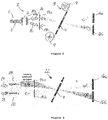
- Preferred embodiments of the present invention are hereinafter discussed in more detail with reference to the attached drawings which depict in:
- Fig. 1
- (a) the readout of the 3M 'Plastiform' magnetic viewer and (b) the readouts of magneto-resistive sensors developed for hard disk drives to scan magnetic tapes according to the prior art;
- Fig. 2
- schematically a first setup to use circularly polarized hard X-rays in transmission to readout the analog waveform from a magnetic music or data tape;
- Fig. 3
- schematically a second setup to use circularly polarized hard X-rays in transmission to readout the analog waveform from a magnetic music or data tape;
- Fig. 4
- schematically a typical magnetic measurement setup using circularly polarized X-rays to measure magnetic states according to the prior art.
- The present invention can be realized by a
first setup 2 to mount amagnetic tape 4 and to use circularly polarized hard X-rays in transmission to readout the analog waveform from magnetic music or data tapes 4 (tape spools not illustrated here). An X-ray source 6 generates a linearly polarizedx-ray beam 8 that is directed through focusingoptics 10, such as a zone plate, and two beam splitter gratings 12a, 12b to split the x-ray beam into two x-raybeams 8a, 8b. - Then, the two x-ray
beams 8a and 8b go each throughrecombiner gratings 14a, 14b, and are converted into two circularly polarized beams c+, c- using circular polarizers. The two circularly polarized beams c+, c- are needed to readout the magnetic state of themagnetic tape 4. The circularly polarized light can be also obtained by using two undulators. - The
first setup 2 is schematically illustrated inFig. 2 . It differs from typical magnetic measurement setups (illustrated inFig. 4 ), where circularly polarized X-rays are used to measure magnetic states. The polarization is normally changed sequentially, which takes time. In the present setup, theX-ray beam 8 is split into two beams (circularly polarized c+ and c-), allowing fast readout of the magnetic state. Twodetectors 16a, 16b are used to readout the signals from the c+ and c- X-ray beams. Themagnetic tape 4 can therefore be mounted on a custom-madetape machine 18 allowing the two X-ray beams c+, c- to go through themagnetic tape 4 leading to attenuated x-ray beams c+' and c-'. Due to the magnetization of themagnetic tape 4, the polarized X-ray absorption differs for the c+ and c- beams, depending on the magnetic state (information) of the tape. Hence, the c+' and c-' beams differ from c+ and c- beams in terms of their intensity. Based on this beam splitting scheme, real-time readout of the magnetic signal stored on themagnetic tape 4 can be achieved. - In this
setup 2, thex-ray beam 8 has a beam energy of 7.127 keV and a wavelength of 1.74 Angstrom. In this example, the beam energy of 7.127 keV corresponds to the absorption edge of gamma ferric oxide (γ-Fe2O3), where the magnetic contrast is maximal. Ferric oxide was commonly used as magnetic medium in audio tapes. Absorption characteristics of the magnetic material used therefore can be a further relevant criteria for the adjustment of the frequency of thex-ray beam 8. The algorithm that is used to identify the magnitude and the direction of the magnetic field on themagnetic tape 4 is straightforward. In the proposedexperimental setup 2, thex-ray beam 8 is split into two circularly polarized beams c+, c- and the twodetectors 16a, 16b measure the magnetic signal in terms of the changed beam intensity due to the magnetization of the magnetic tape. The detector 16a detects the intensity Ic- of the modified beam c-' and theother detector 16b measures the intensity Ic+ of the modified beam c+'. To obtain the magnetic information on the tape (magnetic contrast), the two detected quantities are divided: Ic-/Ic+. - The beam spot on the magnetic tape has been established to be of a few microns, preferably the size of the recording or playback head gap, in the vertical direction and 100 microns in the horizontal direction. These values correspond approximately to the resolution of a standard magnetic read head (in the vertical direction)and to the audio track size (in the horizontal direction) on the
magnetic tape 4. These values can be adjusted as needed using slits to shape the beams. -
Figure 3 schematically shows a second setup for the generation of the circularly polarized x-ray beams. Presently, a particle beam, typically an electron beam, passes along a first undulator and a second undulator. Each undulator generates a circularly polarized x-ray beam which is then directed towards and through the magnetic tape which is advanced. The remaining parts of the second setup are equal to the components and conditions used for the first setup.
Claims (8)
- A method for contactless readout of the magnetic information stored on magnetic tapes (4), said magnetic information being encoded by the magnetization value and direction stored on the magnetic tapes (4), comprising the steps of:a) providing a first circularly polarized x-ray beam (c+) and a second circularly polarized x-ray beam (c-);b) orienting the first circularly polarized X-ray beam (c+) and the second circularly polarized X-ray beam (c-) towards the magnetic tape (4);c) reading out the first circularly polarized X-ray beam (c+) and the second circularly polarized X-ray beam (c-) after their passage through the magnetic tape while advancing the magnetic tape, andd) determining the magnetic information by the difference between the two readout signals from the first x-ray beam (c+) and the second x-ray beam (c-) based on X-ray magnetic circular dichroism.
- The method according to claim 1, wherein
for the provision of the two circularly polarized x-ray beams (c+) and (c-), an X-ray source for generating a linearly polarized x-ray beam is provided and the linearly polarized X-ray beam is split into a first linearly polarized X-ray beam and a second linearly polarized X-ray beam and the first linearly polarized X-ray beam and the second linearly polarized X-ray beam are converted into the first circularly polarized beam (c+) and the second circularly polarized beam (c-) . - The method according to claim 1, wherein
for the provision of the two circularly polarized x-ray beams (c+) and (c-), a particle beam, preferably an electron beam, is provided which passes along a first undulator to generate the first circularly polarized X-ray beam and along a second undulator to generate the second circularly polarized X-ray beam. - The method according to any of the preceding claims,
wherein the beam spots of the first x-ray beam (c+) and the second x-ray beam (c-) when passing through the magnetic tape (4) are in the range of 2 to 20 microns, preferably in the range of 2 microns, or generally matching the read or recording head gap, in the vertical direction and 20 to 200 microns, preferably 100 microns, in the horizontal direction whereby these values correspond approximately to an audio track size of the magnetic information stored on the magnetic tape (4) in the horizontal direction and to the resolution of a magnetic read head in the vertical direction. - The method according to any of the preceding claims,
wherein the beam energy of the x-ray beam (8) is in the range from 2 to 50 keV, preferably in the range from 5 to 10 keV. - The method according to any of the preceding claims,
wherein the beam intensity of the first x-ray beam (c+) and the second x-ray beam (c-) ranges from 108 to 1013 photons/second. - The method according to any of the preceding claims,
wherein the readout sample rate is in the range from 20 to 200 kHz, preferably around 100 kHz. - The method according to any of the preceding claims wherein an algorithm to identify the magnitude and the direction of the magnetic information in form the stored magnetic information being encoded by the magnetization value and direction on the magnetic tapes (4) uses the signal of two detectors (16a, 16b); first detector (16b) detects the signal from the first X-ray beam (c+) and the second detector (16a) detects the signal from the second X-ray beam (c-) wherein the magnetic information on the magnetic tape (4) is determined by the division of the two detected signals c-/c+ or vice versa.
Priority Applications (4)
| Application Number | Priority Date | Filing Date | Title |
|---|---|---|---|
| EP21161010.0A EP4053839A1 (en) | 2021-03-05 | 2021-03-05 | Method for contactless readout of magnetic storage media by circularly polarized x-ray beams |
| PCT/EP2022/054988 WO2022184642A1 (en) | 2021-03-05 | 2022-02-28 | Method for speed-up of magnetic signal readout from magnetic storage media by beam splitting |
| US18/549,015 US12217774B2 (en) | 2021-03-05 | 2022-02-28 | Method for speed-up of magnetic signal readout from magnetic storage media by beam splitting |
| EP22712866.7A EP4302296B1 (en) | 2021-03-05 | 2022-02-28 | Method for speed-up of magnetic signal readout from magnetic storage media by beam splitting |
Applications Claiming Priority (1)
| Application Number | Priority Date | Filing Date | Title |
|---|---|---|---|
| EP21161010.0A EP4053839A1 (en) | 2021-03-05 | 2021-03-05 | Method for contactless readout of magnetic storage media by circularly polarized x-ray beams |
Publications (1)
| Publication Number | Publication Date |
|---|---|
| EP4053839A1 true EP4053839A1 (en) | 2022-09-07 |
Family
ID=74859329
Family Applications (2)
| Application Number | Title | Priority Date | Filing Date |
|---|---|---|---|
| EP21161010.0A Withdrawn EP4053839A1 (en) | 2021-03-05 | 2021-03-05 | Method for contactless readout of magnetic storage media by circularly polarized x-ray beams |
| EP22712866.7A Active EP4302296B1 (en) | 2021-03-05 | 2022-02-28 | Method for speed-up of magnetic signal readout from magnetic storage media by beam splitting |
Family Applications After (1)
| Application Number | Title | Priority Date | Filing Date |
|---|---|---|---|
| EP22712866.7A Active EP4302296B1 (en) | 2021-03-05 | 2022-02-28 | Method for speed-up of magnetic signal readout from magnetic storage media by beam splitting |
Country Status (3)
| Country | Link |
|---|---|
| US (1) | US12217774B2 (en) |
| EP (2) | EP4053839A1 (en) |
| WO (1) | WO2022184642A1 (en) |
Cited By (1)
| Publication number | Priority date | Publication date | Assignee | Title |
|---|---|---|---|---|
| US20240105215A1 (en) * | 2021-03-05 | 2024-03-28 | Paul Scherrer Institut | Method for speed-up of magnetic signal readout from magnetic storage media by beam splitting |
Citations (2)
| Publication number | Priority date | Publication date | Assignee | Title |
|---|---|---|---|---|
| JPH0545304A (en) * | 1991-08-20 | 1993-02-23 | Hitachi Ltd | Magnetic domain observation method using circularly polarized X-rays and apparatus therefor |
| JP2012251797A (en) * | 2011-05-31 | 2012-12-20 | Akita Prefecture | Magnetooptic effect measurement device |
Family Cites Families (5)
| Publication number | Priority date | Publication date | Assignee | Title |
|---|---|---|---|---|
| CA2037428C (en) * | 1990-03-05 | 1997-04-01 | Akira Takahashi | Reproducing optical device for a magneto-optical recording medium |
| JP2010277671A (en) * | 2009-06-01 | 2010-12-09 | Nippon Hoso Kyokai <Nhk> | Magnetic tape reproducing optical head and magnetic tape reproducing method |
| JP6411722B2 (en) * | 2013-09-25 | 2018-10-24 | トヨタ自動車株式会社 | Magnetic property measurement method |
| EP4053839A1 (en) * | 2021-03-05 | 2022-09-07 | Paul Scherrer Institut | Method for contactless readout of magnetic storage media by circularly polarized x-ray beams |
| US20240030675A1 (en) * | 2022-07-21 | 2024-01-25 | Nutech Ventures, Inc. | Ultracompact, ultrashort coherent light sources operating at uv to x-ray wavelengths |
-
2021
- 2021-03-05 EP EP21161010.0A patent/EP4053839A1/en not_active Withdrawn
-
2022
- 2022-02-28 WO PCT/EP2022/054988 patent/WO2022184642A1/en not_active Ceased
- 2022-02-28 US US18/549,015 patent/US12217774B2/en active Active
- 2022-02-28 EP EP22712866.7A patent/EP4302296B1/en active Active
Patent Citations (2)
| Publication number | Priority date | Publication date | Assignee | Title |
|---|---|---|---|---|
| JPH0545304A (en) * | 1991-08-20 | 1993-02-23 | Hitachi Ltd | Magnetic domain observation method using circularly polarized X-rays and apparatus therefor |
| JP2012251797A (en) * | 2011-05-31 | 2012-12-20 | Akita Prefecture | Magnetooptic effect measurement device |
Non-Patent Citations (2)
| Title |
|---|
| STÖHR J. ET AL: "Element-Specific Magnetic Microscopy with Circularly Polarized X-rays", SCIENCE, vol. 259, no. 5095, 29 January 1993 (1993-01-29), US, pages 658 - 661, XP055827884, ISSN: 0036-8075, Retrieved from the Internet <URL:https://science.sciencemag.org/content/259/5095/658.full.pdf> DOI: 10.1126/science.259.5095.658 * |
| VAN DER LAAN G: "Applications of soft x-ray magnetic dichroism", JOURNAL OF PHYSICS: CONFERENCE SERIES, INSTITUTE OF PHYSICS PUBLISHING, BRISTOL, GB, vol. 430, no. 1, 22 April 2013 (2013-04-22), pages 12127, XP020240628, ISSN: 1742-6596, DOI: 10.1088/1742-6596/430/1/012127 * |
Cited By (2)
| Publication number | Priority date | Publication date | Assignee | Title |
|---|---|---|---|---|
| US20240105215A1 (en) * | 2021-03-05 | 2024-03-28 | Paul Scherrer Institut | Method for speed-up of magnetic signal readout from magnetic storage media by beam splitting |
| US12217774B2 (en) * | 2021-03-05 | 2025-02-04 | Paul Scherrer Institut | Method for speed-up of magnetic signal readout from magnetic storage media by beam splitting |
Also Published As
| Publication number | Publication date |
|---|---|
| EP4302296C0 (en) | 2024-11-27 |
| WO2022184642A1 (en) | 2022-09-09 |
| US12217774B2 (en) | 2025-02-04 |
| EP4302296A1 (en) | 2024-01-10 |
| US20240105215A1 (en) | 2024-03-28 |
| EP4302296B1 (en) | 2024-11-27 |
Similar Documents
| Publication | Publication Date | Title |
|---|---|---|
| US20120195176A1 (en) | Method And Apparatus For Evaluating A Magnetic Recording Medium | |
| EP4053839A1 (en) | Method for contactless readout of magnetic storage media by circularly polarized x-ray beams | |
| Sukeda et al. | Thermally assisted magnetic recording on flux-detectable RE-TM media | |
| US20080080587A1 (en) | Method and apparatus for measuring the recording magnetic field strength distribution of a magnetic head and method of manufacturing a magnetic head | |
| US5296989A (en) | High density dual gap magnetic head using polar Kerr effect | |
| JPH11238251A (en) | Optical recording medium, optical recording / reproducing method and apparatus | |
| Liu et al. | Tribo-magnetics and nanometer spaced head-disk systems | |
| JP2007122823A (en) | Measuring method of recording magnetic field strength distribution of magnetic head, measuring apparatus therefor, and manufacturing method of magnetic head | |
| JPH02267733A (en) | Optical information reproducing method and device | |
| JP2661472B2 (en) | Recording medium and its recording / reproducing method | |
| JPS5817546A (en) | Photomagnetic recording and reproducing device | |
| JP2918200B1 (en) | Information recording medium and information storage device using the same | |
| SU1704164A1 (en) | Method of checking magnetic flaws of data medium | |
| JPH09293288A (en) | Magneto-optical recording / reproducing device | |
| JP3236423B2 (en) | Optical memory device and its recording method and reproducing method | |
| Kryder | Magnetic information storage | |
| JP2573575B2 (en) | Magneto-optical head | |
| SU815756A1 (en) | Magnetic tape for optic reproducing of information | |
| CA1063239A (en) | Magnetic bubble read head for record carrier | |
| JPH02177038A (en) | Video recorder | |
| JPS55153142A (en) | Magnetic recording and reproducing device | |
| JPH03189929A (en) | Magnetic card and recording and reproducing method thereof | |
| Eckerman et al. | The Dynamics of Surface Curvature and the Head-to-Disk Interface | |
| JPS60150202A (en) | Regeneration method and device | |
| JP2010277671A (en) | Magnetic tape reproducing optical head and magnetic tape reproducing method |
Legal Events
| Date | Code | Title | Description |
|---|---|---|---|
| PUAI | Public reference made under article 153(3) epc to a published international application that has entered the european phase |
Free format text: ORIGINAL CODE: 0009012 |
|
| STAA | Information on the status of an ep patent application or granted ep patent |
Free format text: STATUS: THE APPLICATION HAS BEEN PUBLISHED |
|
| AK | Designated contracting states |
Kind code of ref document: A1 Designated state(s): AL AT BE BG CH CY CZ DE DK EE ES FI FR GB GR HR HU IE IS IT LI LT LU LV MC MK MT NL NO PL PT RO RS SE SI SK SM TR |
|
| STAA | Information on the status of an ep patent application or granted ep patent |
Free format text: STATUS: THE APPLICATION IS DEEMED TO BE WITHDRAWN |
|
| 18D | Application deemed to be withdrawn |
Effective date: 20230308 |