EP4053174A1 - Method for preparing olefin-polar monomer copolymer - Google Patents
Method for preparing olefin-polar monomer copolymer Download PDFInfo
- Publication number
- EP4053174A1 EP4053174A1 EP20880543.2A EP20880543A EP4053174A1 EP 4053174 A1 EP4053174 A1 EP 4053174A1 EP 20880543 A EP20880543 A EP 20880543A EP 4053174 A1 EP4053174 A1 EP 4053174A1
- Authority
- EP
- European Patent Office
- Prior art keywords
- substituent
- formula
- ethyl
- complex represented
- methyl
- Prior art date
- Legal status (The legal status is an assumption and is not a legal conclusion. Google has not performed a legal analysis and makes no representation as to the accuracy of the status listed.)
- Pending
Links
Images

Classifications
-
- C—CHEMISTRY; METALLURGY
- C08—ORGANIC MACROMOLECULAR COMPOUNDS; THEIR PREPARATION OR CHEMICAL WORKING-UP; COMPOSITIONS BASED THEREON
- C08F—MACROMOLECULAR COMPOUNDS OBTAINED BY REACTIONS ONLY INVOLVING CARBON-TO-CARBON UNSATURATED BONDS
- C08F210/00—Copolymers of unsaturated aliphatic hydrocarbons having only one carbon-to-carbon double bond
- C08F210/02—Ethene
-
- C—CHEMISTRY; METALLURGY
- C08—ORGANIC MACROMOLECULAR COMPOUNDS; THEIR PREPARATION OR CHEMICAL WORKING-UP; COMPOSITIONS BASED THEREON
- C08F—MACROMOLECULAR COMPOUNDS OBTAINED BY REACTIONS ONLY INVOLVING CARBON-TO-CARBON UNSATURATED BONDS
- C08F4/00—Polymerisation catalysts
- C08F4/42—Metals; Metal hydrides; Metallo-organic compounds; Use thereof as catalyst precursors
- C08F4/44—Metals; Metal hydrides; Metallo-organic compounds; Use thereof as catalyst precursors selected from light metals, zinc, cadmium, mercury, copper, silver, gold, boron, gallium, indium, thallium, rare earths or actinides
- C08F4/60—Metals; Metal hydrides; Metallo-organic compounds; Use thereof as catalyst precursors selected from light metals, zinc, cadmium, mercury, copper, silver, gold, boron, gallium, indium, thallium, rare earths or actinides together with refractory metals, iron group metals, platinum group metals, manganese, rhenium technetium or compounds thereof
- C08F4/70—Iron group metals, platinum group metals or compounds thereof
- C08F4/7095—Cobalt, nickel or compounds thereof
- C08F4/7098—Nickel or compounds thereof
-
- C—CHEMISTRY; METALLURGY
- C07—ORGANIC CHEMISTRY
- C07F—ACYCLIC, CARBOCYCLIC OR HETEROCYCLIC COMPOUNDS CONTAINING ELEMENTS OTHER THAN CARBON, HYDROGEN, HALOGEN, OXYGEN, NITROGEN, SULFUR, SELENIUM OR TELLURIUM
- C07F15/00—Compounds containing elements of Groups 8, 9, 10 or 18 of the Periodic Table
- C07F15/04—Nickel compounds
-
- C—CHEMISTRY; METALLURGY
- C08—ORGANIC MACROMOLECULAR COMPOUNDS; THEIR PREPARATION OR CHEMICAL WORKING-UP; COMPOSITIONS BASED THEREON
- C08F—MACROMOLECULAR COMPOUNDS OBTAINED BY REACTIONS ONLY INVOLVING CARBON-TO-CARBON UNSATURATED BONDS
- C08F216/00—Copolymers of compounds having one or more unsaturated aliphatic radicals, each having only one carbon-to-carbon double bond, and at least one being terminated by an alcohol, ether, aldehydo, ketonic, acetal or ketal radical
- C08F216/02—Copolymers of compounds having one or more unsaturated aliphatic radicals, each having only one carbon-to-carbon double bond, and at least one being terminated by an alcohol, ether, aldehydo, ketonic, acetal or ketal radical by an alcohol radical
- C08F216/04—Acyclic compounds
-
- C—CHEMISTRY; METALLURGY
- C08—ORGANIC MACROMOLECULAR COMPOUNDS; THEIR PREPARATION OR CHEMICAL WORKING-UP; COMPOSITIONS BASED THEREON
- C08F—MACROMOLECULAR COMPOUNDS OBTAINED BY REACTIONS ONLY INVOLVING CARBON-TO-CARBON UNSATURATED BONDS
- C08F220/00—Copolymers of compounds having one or more unsaturated aliphatic radicals, each having only one carbon-to-carbon double bond, and only one being terminated by only one carboxyl radical or a salt, anhydride ester, amide, imide or nitrile thereof
- C08F220/02—Monocarboxylic acids having less than ten carbon atoms; Derivatives thereof
- C08F220/04—Acids; Metal salts or ammonium salts thereof
-
- C—CHEMISTRY; METALLURGY
- C08—ORGANIC MACROMOLECULAR COMPOUNDS; THEIR PREPARATION OR CHEMICAL WORKING-UP; COMPOSITIONS BASED THEREON
- C08F—MACROMOLECULAR COMPOUNDS OBTAINED BY REACTIONS ONLY INVOLVING CARBON-TO-CARBON UNSATURATED BONDS
- C08F220/00—Copolymers of compounds having one or more unsaturated aliphatic radicals, each having only one carbon-to-carbon double bond, and only one being terminated by only one carboxyl radical or a salt, anhydride ester, amide, imide or nitrile thereof
- C08F220/02—Monocarboxylic acids having less than ten carbon atoms; Derivatives thereof
- C08F220/04—Acids; Metal salts or ammonium salts thereof
- C08F220/06—Acrylic acid; Methacrylic acid; Metal salts or ammonium salts thereof
-
- C—CHEMISTRY; METALLURGY
- C08—ORGANIC MACROMOLECULAR COMPOUNDS; THEIR PREPARATION OR CHEMICAL WORKING-UP; COMPOSITIONS BASED THEREON
- C08F—MACROMOLECULAR COMPOUNDS OBTAINED BY REACTIONS ONLY INVOLVING CARBON-TO-CARBON UNSATURATED BONDS
- C08F220/00—Copolymers of compounds having one or more unsaturated aliphatic radicals, each having only one carbon-to-carbon double bond, and only one being terminated by only one carboxyl radical or a salt, anhydride ester, amide, imide or nitrile thereof
- C08F220/62—Monocarboxylic acids having ten or more carbon atoms; Derivatives thereof
- C08F220/64—Acids; Metal salts or ammonium salts thereof
-
- C—CHEMISTRY; METALLURGY
- C08—ORGANIC MACROMOLECULAR COMPOUNDS; THEIR PREPARATION OR CHEMICAL WORKING-UP; COMPOSITIONS BASED THEREON
- C08F—MACROMOLECULAR COMPOUNDS OBTAINED BY REACTIONS ONLY INVOLVING CARBON-TO-CARBON UNSATURATED BONDS
- C08F4/00—Polymerisation catalysts
- C08F4/42—Metals; Metal hydrides; Metallo-organic compounds; Use thereof as catalyst precursors
- C08F4/72—Metals; Metal hydrides; Metallo-organic compounds; Use thereof as catalyst precursors selected from metals not provided for in group C08F4/44
- C08F4/80—Metals; Metal hydrides; Metallo-organic compounds; Use thereof as catalyst precursors selected from metals not provided for in group C08F4/44 selected from iron group metals or platinum group metals
-
- C—CHEMISTRY; METALLURGY
- C08—ORGANIC MACROMOLECULAR COMPOUNDS; THEIR PREPARATION OR CHEMICAL WORKING-UP; COMPOSITIONS BASED THEREON
- C08L—COMPOSITIONS OF MACROMOLECULAR COMPOUNDS
- C08L23/00—Compositions of homopolymers or copolymers of unsaturated aliphatic hydrocarbons having only one carbon-to-carbon double bond; Compositions of derivatives of such polymers
- C08L23/02—Compositions of homopolymers or copolymers of unsaturated aliphatic hydrocarbons having only one carbon-to-carbon double bond; Compositions of derivatives of such polymers not modified by chemical after-treatment
- C08L23/04—Homopolymers or copolymers of ethene
- C08L23/08—Copolymers of ethene
-
- B—PERFORMING OPERATIONS; TRANSPORTING
- B01—PHYSICAL OR CHEMICAL PROCESSES OR APPARATUS IN GENERAL
- B01J—CHEMICAL OR PHYSICAL PROCESSES, e.g. CATALYSIS OR COLLOID CHEMISTRY; THEIR RELEVANT APPARATUS
- B01J23/00—Catalysts comprising metals or metal oxides or hydroxides, not provided for in group B01J21/00
- B01J23/38—Catalysts comprising metals or metal oxides or hydroxides, not provided for in group B01J21/00 of noble metals
- B01J23/40—Catalysts comprising metals or metal oxides or hydroxides, not provided for in group B01J21/00 of noble metals of the platinum group metals
-
- B—PERFORMING OPERATIONS; TRANSPORTING
- B01—PHYSICAL OR CHEMICAL PROCESSES OR APPARATUS IN GENERAL
- B01J—CHEMICAL OR PHYSICAL PROCESSES, e.g. CATALYSIS OR COLLOID CHEMISTRY; THEIR RELEVANT APPARATUS
- B01J31/00—Catalysts comprising hydrides, coordination complexes or organic compounds
- B01J31/16—Catalysts comprising hydrides, coordination complexes or organic compounds containing coordination complexes
- B01J31/18—Catalysts comprising hydrides, coordination complexes or organic compounds containing coordination complexes containing nitrogen, phosphorus, arsenic or antimony as complexing atoms, e.g. in pyridine ligands, or in resonance therewith, e.g. in isocyanide ligands C=N-R or as complexed central atoms
- B01J31/1805—Catalysts comprising hydrides, coordination complexes or organic compounds containing coordination complexes containing nitrogen, phosphorus, arsenic or antimony as complexing atoms, e.g. in pyridine ligands, or in resonance therewith, e.g. in isocyanide ligands C=N-R or as complexed central atoms the ligands containing nitrogen
-
- C—CHEMISTRY; METALLURGY
- C08—ORGANIC MACROMOLECULAR COMPOUNDS; THEIR PREPARATION OR CHEMICAL WORKING-UP; COMPOSITIONS BASED THEREON
- C08F—MACROMOLECULAR COMPOUNDS OBTAINED BY REACTIONS ONLY INVOLVING CARBON-TO-CARBON UNSATURATED BONDS
- C08F2410/00—Features related to the catalyst preparation, the catalyst use or to the deactivation of the catalyst
- C08F2410/01—Additive used together with the catalyst, excluding compounds containing Al or B
-
- C—CHEMISTRY; METALLURGY
- C08—ORGANIC MACROMOLECULAR COMPOUNDS; THEIR PREPARATION OR CHEMICAL WORKING-UP; COMPOSITIONS BASED THEREON
- C08F—MACROMOLECULAR COMPOUNDS OBTAINED BY REACTIONS ONLY INVOLVING CARBON-TO-CARBON UNSATURATED BONDS
- C08F2410/00—Features related to the catalyst preparation, the catalyst use or to the deactivation of the catalyst
- C08F2410/03—Multinuclear procatalyst, i.e. containing two or more metals, being different or not
Definitions
- the invention belongs to the field of macromolecular polymer preparation, and specifically relates to a method for preparing an olefin-polar monomer copolymer.
- Polyolefin products are inexpensive and excellent in performance, and have a wide range of applications. Under the condition of retaining the original excellent physical and chemical properties of polyolefin, introducing a polar group into the polyolefin molecular chain through chemical synthesis can improve its chemical inertness, printability, wettability and compatibility with other materials, thereby imposing new characteristics that its raw materials do not possess on the polyolefin.
- high-pressure free radical polymerization is mostly used in industry to promote the direct copolymerization of olefins and polar monomers, and ethylene-vinyl acetate copolymers, ethylene-methyl methacrylate copolymers, and ethylene-acrylic acid copolymers, for example, are produced by such processes.
- high-pressure free radical copolymerization can directly introduce copolymerizable polar monomers into the polyolefin chain, this method requires high temperature and high pressure conditions, high energy consumption, and expensive equipment.
- Ethylene-vinyl alcohol (EVOH or EVAL) copolymer is a novel polymer material that integrates the processability of ethylene polymer and the gas barrier properties of vinyl alcohol polymer. It is currently one of the three major barrier resins industrially produced in the world, and it is widely used to package food, medical solutions and other products. Since vinyl alcohol cannot exist independently as a monomer, ethylene-vinyl alcohol copolymer is usually prepared by preparing an ethylene-vinyl acetate copolymer by free-radical polymerization and then alcoholyzing the ethylene-vinyl acetate copolymer.
- the final saponification product contains a large amount of impurities such as acetic acid and alkali metal salts, which have to be washed off with a large amount of water.
- Coordination catalytic copolymerization as a polymer preparation technology at normal temperature and pressure, has received widespread attention because of its significant role in reducing energy consumption and improving reaction efficiency.
- the catalyst's participation in the reaction process greatly reduces the activation energy of the copolymerization of olefin monomers and polar monomers, which is beneficial to obtain functional polymers with higher molecular weights at lower temperatures and pressures.
- transition metal complexes to catalyze the copolymerization of olefins with unsaturated alcohols or unsaturated carboxylic acids.
- the polymer obtained is a viscous block solid, which is prone to fouling in the polymerization equipment, bringing difficulties to the transportation of the polymer, solvent removal, granulation, etc.
- An object of the present invention is to overcome the shortcomings of the prior art and provide a method for preparing olefin-polar monomer copolymers.
- the method provided by the present invention does not require subsequent processing such as granulation, and can directly obtain spherical and/or spherical-like polymers with good morphology. Therefore, the method of the present invention has good industrial application prospects.
- the present invention provides a method for preparing an olefin-polar monomer copolymer, comprising copolymerizing an olefin and a polar monomer in the presence of a catalyst and optionally a chain transfer agent to produce the olefin-polar monomer copolymer,
- polar monomer refers to a monomer carrying at least one polar group such as hydroxyl group, carboxyl group, acid anhydride group, and at least one coordination polymerizable unsaturated bond.
- the polar monomer has 2-20 carbon atoms, for example 2-16 carbon atoms, for example 2-12 carbon atoms, for example 2-10 carbon atoms.
- the polar monomer is selected from the group consisting of olefin monomers carrying one or more hydroxy groups and/or one or more carboxy groups, preferably from the group consisting of ⁇ -olefinic monomers (also referred to as vinyl monomers) carrying one or more hydroxy groups and/or one or more carboxy groups.
- the polar monomer is selected from the group consisting of olefinic monomers carrying one or more hydroxy groups, or the polar monomer is selected from the group consisting of olefinic monomers carrying one or more carboxyl groups
- the main catalyst comprises a diimine metal complex represented by Formula Ib: wherein, R 1 and R 2 are each independently a C1-C30 hydrocarbyl with or without a substituent Q; R 5 -R 8 are each independently selected from the group consisting of hydrogen, halogen, hydroxy, C1-C20 hydrocarbyl with or without a substituent Q, and R 5 -R 8 are optionally joined to form a ring or ring system; each R 12 is independently a C1-C20 hydrocarbyl with or without a substituent Q; each Y is independently a Group VIA nonmetal atom; each M is independently a Group VIII metal; each X is independently selected from the group consisting of halogen, C1-C10
- R 1 and R 2 are independently selected from the group consisting of C1-C20 alkyl with or without a substituent Q and C6-C20 aryl with or without a substituent Q.
- R 1 and/or R 2 are/is a group represented by Formula A: wherein R 1 -R 5 are each independently selected from the group consisting of hydrogen, halogen, hydroxy, C1-C20 alkyl with or without a substituent Q, C2-C20 alkenyl with or without a substituent Q, C2-C20 alkynyl with or without a substituent Q, C1-C20 alkoxy with or without a substituent Q, C2-C20 alkenoxy with or without a substituent Q, C2-C20 alkynoxy with or without a substituent Q, C6-C20 aryl with or without a substituent Q, C6-C20 aryloxy with or without a substituent Q, C7-C20 aralkyl with or without a substituent Q, C7-C20 aralkoxy with or without a substituent Q, C7-C20 alkaryl with or without a substituent Q and C7-C20 alkaryloxy with or without a
- R 1 -R 5 are each independently selected from the group consisting of hydrogen, halogen, hydroxy, C1-C10 alkyl with or without a substituent Q, C2-C10 alkenyl with or without a substituent Q, C2-C10 alkynyl with or without a substituent Q, C1-C10 alkoxy with or without a substituent Q, C2-C10 alkenoxy with or without a substituent Q, C2-C10 alkynoxy with or without a substituent Q, C6-C15 aryl with or without a substituent Q, C6-C15 aryloxy with or without a substituent Q, C7-C15 aralkyl with or without a substituent Q, C7-C15 aralkoxy with or without a substituent Q, C7-C15 alkaryl with or without a substituent Q and C7-C15 alkaryloxy with or without a substituent Q.
- each M is independently selected from the group consisting of nickel and palladium.
- each Y is independently selected from the group consisting of O and S.
- each X is independently selected from the group consisting of halogen, C1-C10 alkyl with or without a substituent Q and C1-C10 alkoxy with or without a substituent Q, preferably from the group consisting of halogen, C1-C6 alkyl with or without a substituent Q and C1-C6 alkoxy with or without a substituent Q.
- each R 12 is independently a C1-C20 alkyl with or without a substituent Q, preferably a C1-C10 alkyl with or without a substituent Q, and more preferably a C1-C6 alkyl with or without a substituent Q.
- the substituent Q is selected from the group consisting of halogen, hydroxy, C1-C10 alkyl, halogenated C1-C10 alkyl, C1-C10 alkoxy and halogenated C1-C10 alkoxy, preferably from the group consisting of halogen, hydroxy, C1-C6 alkyl, halogenated C1-C6 alkyl, C1-C6 alkoxy and halogenated C1-C6 alkoxy.
- the C1-C6 alkyl is selected from the group consisting of methyl, ethyl, n-propyl, isopropyl, n-butyl, isobutyl, n-pentyl, isopentyl, n-hexyl, isohexyl and 3,3-dimethylbutyl.
- the C1-C6 alkoxy is selected from the group consisting of methoxy, ethoxy, n-propoxy, iso-propoxy, n-butoxy, iso-butoxy, n-pentoxy, iso-pentoxy, n-hexoxy, iso-hexoxy and 3,3-dimethylbutoxy.
- halogen refers to fluorine, chlorine, bromine or iodine.
- the diimine metal complex is represented by Formula IIIb: wherein, R 1 -R 11 are each independently selected from the group consisting of hydrogen, halogen, hydroxy, C1-C20 alkyl with or without a substituent Q, C2-C20 alkenyl with or without a substituent Q, C2-C20 alkynyl with or without a substituent Q, C1-C20 alkoxy with or without a substituent Q, C2-C20 alkenoxy with or without a substituent Q, C2-C20 alkynoxy with or without a substituent Q, C6-C20 aryl with or without a substituent Q, C6-C20 aryloxy with or without a substituent Q, C7-C20 aralkyl with or without a substituent Q, C7-C20 aralkoxy with or without a substituent Q, C7-C20 alkaryl with or without a substituent Q and C7-C20 alkaryloxy with or without
- R 1 -R 11 are each independently selected from the group consisting of hydrogen, halogen, hydroxy, C1-C10 alkyl with or without a substituent Q, C2-C10 alkenyl with or without a substituent Q, C2-C10 alkynyl with or without a substituent Q, C1-C10 alkoxy with or without a substituent Q, C2-C10 alkenoxy with or without a substituent Q, C2-C10 alkynoxy with or without a substituent Q, C6-C15 aryl with or without a substituent Q, C6-C15 aryloxy with or without a substituent Q, C7-C15 aralkyl with or without a substituent Q, C7-C15 aralkoxy with or without a substituent Q, C7-C15 alkaryl with or without a substituent Q and C7-C15 alkaryloxy with or without a substituent Q.
- R 1 -R 11 are each independently selected from the group consisting of hydrogen, C1-C10 alkyl, halogenated C1-C10 alkyl, C1-C10 alkoxy, halogenated C1-C10 alkoxy and halogen, more preferably from the group consisting of hydrogen, C1-C6 alkyl, halogenated C1-C6 alkyl, C1-C6 alkoxy, halogenated C1-C6 alkoxy and halogen.
- the diimine metal complex is selected from the group consisting of:
- the polar monomer is selected from the group consisting of olefinic monomers carrying one or more hydroxy groups, or the polar monomer is selected from the group consisting of olefinic monomers carrying one or more carboxyl groups
- the main catalyst comprises a diimine metal complex represented by Formula Ic: wherein, R 21 -R 24 are each independently selected from the group consisting of hydrogen, halogen, hydroxy, C1-C20 hydrocarbyl with or without a substituent Q and C1-C20 hydrocarbyloxy with or without a substituent Q, and R 21 -R 24 are optionally joined to form a ring or ring system; R 1 , R 2 , R 11 , Y, M and X are as defined above for Formula I.
- R 1 and R 2 are independently selected from the group consisting of C1-C20 alkyl with or without a substituent Q and C6-C20 aryl with or without a substituent Q.
- R 1 and/or R 2 are/is a group represented by Formula A: wherein, R 1 -R 5 are each independently selected from the group consisting of hydrogen, halogen, hydroxy, C1-C20 alkyl with or without a substituent Q, C2-C20 alkenyl with or without a substituent Q, C2-C20 alkynyl with or without a substituent Q, C1-C20 alkoxy with or without a substituent Q, C2-C20 alkenoxy with or without a substituent Q, C2-C20 alkynoxy with or without a substituent Q, C6-C20 aryl with or without a substituent Q, C6-C20 aryloxy with or without a substituent Q, C7-C20 aralkyl with or without a substituent Q, C7-C20 aralkoxy with or without a substituent Q, C7-C20 alkaryl with or without a substituent Q and C7-C20 alkaryloxy with or without a substituent
- R 1 -R 5 are each independently selected from the group consisting of hydrogen, halogen, hydroxy, C1-C10 alkyl with or without a substituent Q, C2-C10 alkenyl with or without a substituent Q, C2-C10 alkynyl with or without a substituent Q, C1-C10 alkoxy with or without a substituent Q, C2-C10 alkenoxy with or without a substituent Q, C2-C10 alkynoxy with or without a substituent Q, C6-C15 aryl with or without a substituent Q, C6-C15 aryloxy with or without a substituent Q, C7-C15 aralkyl with or without a substituent Q, C7-C15 aralkoxy with or without a substituent Q, C7-C15 alkaryl with or without a substituent Q and C7-C15 alkaryloxy with or without a substituent Q.
- each M is independently selected from the group consisting of nickel and palladium.
- each Y is independently selected from the group consisting of O and S.
- each X is independently selected from the group consisting of halogen, C1-C10 alkyl with or without a substituent Q and C1-C10 alkoxy with or without a substituent Q, preferably from the group consisting of halogen, C1-C6 alkyl with or without a substituent Q and C1-C6 alkoxy with or without a substituent Q.
- each R 11 is independently a C1-C20 alkyl with or without a substituent Q, preferably a C1-C10 alkyl with or without a substituent Q, and more preferably a C1-C6 alkyl with or without a substituent Q.
- the substituent Q is selected from the group consisting of halogen, hydroxy, C1-C10 alkyl, halogenated C1-C10 alkyl, C1-C10 alkoxy and halogenated C1-C10 alkoxy, preferably from the group consisting of halogen, hydroxy, C1-C6 alkyl, halogenated C1-C6 alkyl, C1-C6 alkoxy and halogenated C1-C6 alkoxy.
- the C1-C6 alkyl is selected from the group consisting of methyl, ethyl, n-propyl, isopropyl, n-butyl, isobutyl, n-pentyl, isopentyl, n-hexyl, isohexyl and 3,3-dimethylbutyl.
- the C1-C6 alkoxy is selected from the group consisting of methoxy, ethoxy, n-propoxy, iso-propoxy, n-butoxy, iso-butoxy, n-pentoxy, iso-pentoxy, n-hexoxy, iso-hexoxy and 3,3-dimethylbutoxy.
- the diimine metal complex has a structure represented by Formula IIIc: wherein, R 1 -R 10 , R 21 -R 24 are each independently selected from the group consisting of hydrogen, halogen, hydroxy, C1-C20 alkyl with or without a substituent Q, C2-C20 alkenyl with or without a substituent Q, C2-C20 alkynyl with or without a substituent Q, C1-C20 alkoxy with or without a substituent Q, C2-C20 alkenoxy with or without a substituent Q, C2-C20 alkynoxy with or without a substituent Q, C6-C20 aryl with or without a substituent Q, C6-C20 aryloxy with or without a substituent Q, C7-C20 aralkyl with or without a substituent Q, C7-C20 aralkoxy with or without a substituent Q, C7-C20 alkaryl with or without a substituent Q and C
- R 1 -R 10 , R 21 -R 24 are each independently selected from the group consisting of hydrogen, halogen, hydroxy, C1-C10 alkyl with or without a substituent Q, C2-C10 alkenyl with or without a substituent Q, C2-C10 alkynyl with or without a substituent Q, C1-C10 alkoxy with or without a substituent Q, C2-C10 alkenoxy with or without a substituent Q, C2-C10 alkynoxy with or without a substituent Q, C6-C15 aryl with or without a substituent Q, C6-C15 aryloxy with or without a substituent Q, C7-C15 aralkyl with or without a substituent Q, C7-C15 aralkoxy with or without a substituent Q, C7-C15 alkaryl with or without a substituent Q and C7-C15 alka
- R 1 -R 10 , R 21 -R 24 are each independently selected from the group consisting of hydrogen, C1-C10 alkyl, halogenated C1-C10 alkyl, C1-C10 alkoxy, halogenated C1-C10 alkoxy and halogen, more preferably from the group consisting of hydrogen, C1-C6 alkyl, halogenated C1-C6 alkyl, C1-C6 alkoxy, halogenated C1-C6 alkoxy and halogen.
- the diimine metal complex has a structure represented by Formula IIc: wherein, R 31 -R 34 have the same meanings as R 21 -R 24 in Formula Ic, preferably R 33 and R 34 are hydrogen; and R 11 , Y, M and X are as defined above for Formula Ic.
- R 31 -R 34 are each independently selected from the group consisting of hydrogen, hydroxy, C1-C20 alkyl with or without a substituent Q, C2-C20 alkenyl with or without a substituent Q, C2-C20 alkynyl with or without a substituent Q, C1-C20 alkoxy with or without a substituent Q, C2-C20 alkenoxy with or without a substituent Q, C2-C20 alkynoxy with or without a substituent Q, C6-C20 aryl with or without a substituent Q, C6-C20 aryloxy with or without a substituent Q, C7-C20 aralkyl with or without a substituent Q, C7-C20 aralkoxy with or without a substituent Q, C7-C20 alkaryl with or without a substituent Q, C7-C20 alkaryloxy with or without a substituent Q and halogen.
- R 31 -R 34 are each independently selected from the group consisting of hydrogen, halogen, hydroxy, C1-C10 alkyl with or without a substituent Q, C2-C10 alkenyl with or without a substituent Q, C2-C10 alkynyl with or without a substituent Q, C1-C10 alkoxy with or without a substituent Q, C2-C10 alkenoxy with or without a substituent Q, C2-C10 alkynoxy with or without a substituent Q, C6-C15 aryl with or without a substituent Q, C6-C15 aryloxy with or without a substituent Q, C7-C15 aralkyl with or without a substituent Q, C7-C15 aralkoxy with or without a substituent Q, C7-C15 alkaryl with or without a substituent Q and C7-C15 alkaryloxy with or without a substituent Q.
- R 31 -R 34 are each independently selected from the group consisting of hydrogen, C1-C10 alkyl, halogenated C1-C10 alkyl, C1-C10 alkoxy, halogenated C1-C10 alkoxy and halogen, more preferably from the group consisting of hydrogen, C1-C6 alkyl, halogenated C1-C6 alkyl, C1-C6 alkoxy, halogenated C1-C6 alkoxy and halogen.
- the diimine metal complex is selected from the group consisting of:
- the polar monomer is selected from the group consisting of olefinic monomers carrying one or more hydroxy groups, or the polar monomer is selected from the group consisting of olefinic monomers carrying one or more carboxy groups, and the main catalyst comprises the amino-imine metal complex represented by Formula I'.
- R 1 and R 2 are independently selected from the group consisting of C1-C20 alkyl with or without a substituent Q and C6-C20 aryl with or without a substituent Q.
- R 1 and/or R 2 are/is a group represented by Formula A: wherein, R 1 -R 5 are each independently selected from the group consisting of hydrogen, halogen, hydroxy, C1-C20 alkyl with or without a substituent Q, C2-C20 alkenyl with or without a substituent Q, C2-C20 alkynyl with or without a substituent Q, C1-C20 alkoxy with or without a substituent Q, C2-C20 alkenoxy with or without a substituent Q, C2-C20 alkynoxy with or without a substituent Q, C6-C20 aryl with or without a substituent Q, C6-C20 aryloxy with or without a substituent Q, C7-C20 aralkyl with or without a substituent Q, C7-C20 aralkyloxy with or without a substituent Q, C7-C20 alkaryl with or without a substituent Q and C7-C20 alkaryloxy with or without
- R 1 -R 5 are each independently selected from the group consisting of hydrogen, halogen, hydroxy, C1-C10 alkyl with or without a substituent Q, C2-C10 alkenyl with or without a substituent Q, C2-C10 alkynyl with or without a substituent Q, C1-C10 alkoxy with or without a substituent Q, C2-C10 alkenoxy with or without a substituent Q, C2-C10 alkynoxy with or without a substituent Q, C6-C15 aryl with or without a substituent Q, C6-C15 aryloxy with or without a substituent Q, C7-C15 aralkyl with or without a substituent Q, C7-C15 aralkoxy with or without a substituent Q, C7-C15 alkaryl with or without a substituent Q and C7-C15 alkaryloxy with or without a substituent Q.
- each M is independently selected from the group consisting of nickel and palladium.
- each Y is independently selected from the group consisting of O and S.
- each X is independently selected from the group consisting of halogen, C1-C10 alkyl with or without a substituent Q and C1-C10 alkoxy with or without a substituent Q, preferably from the group consisting of halogen, C1-C6 alkyl with or without a substituent Q and C1-C6 alkoxy with or without a substituent Q.
- each R 12 is independently a C1-C20 alkyl with or without a substituent Q, preferably a C1-C10 alkyl with or without a substituent Q, and more preferably a C1-C6 alkyl with or without a substituent Q.
- each R 3 is independently selected from the group consisting of C1-C20 alkyl with or without a substituent Q, C6-C20 aryl with or without a substituent Q, C7-C20 aralkyl with or without a substituent Q and C7-C20 alkaryl with or without a substituent Q.
- each R 3 is independently selected from the group consisting of C1-C10 alkyl with or without a substituent Q, C6-C10 aryl with or without a substituent Q, C7-C15 aralkyl with or without a substituent Q and C7-C15 alkaryl with or without a substituent Q. More preferably, each R 3 is independently a C1-C6 alkyl with or without a substituent Q.
- the substituent Q is selected from halogen, hydroxy, C1-C10 alkyl, halogenated C1-C10 alkyl, C1-C10 alkoxy and halogenated C1-C10 alkoxy, preferably from halogen, hydroxy, C1-C6 alkyl, halogenated C1-C6 alkyl, C1-C6 alkoxy and halogenated C1-C6 alkoxy.
- the C1-C6 alkyl is selected from methyl, ethyl, n-propyl, isopropyl, n-butyl, isobutyl, n-pentyl, isopentyl, n-hexyl, isohexyl and 3,3-dimethylbutyl.
- the C1-C6 alkoxy is selected from methoxy, ethoxy, n-propoxy, isopropoxy, n-butoxy, isobutoxy, n-pentoxy, isopentoxy, n-hexyloxy, isohexyloxy and 3,3-dimethylbutoxy.
- the amino-imine metal complex is represented by Formula III': wherein, R 1 -R 11 are each independently selected from the group consisting of hydrogen, halogen, hydroxy, C1-C20 alkyl with or without a substituent Q, C2-C20 alkenyl with or without a substituent Q, C2-C20 alkynyl with or without a substituent Q, C1-C20 alkoxy with or without a substituent Q, C2-C20 alkenoxy with or without a substituent Q, C2-C20 alkynoxy with or without a substituent Q, C6-C20 aryl with or without a substituent Q, C6-C20 aryloxy with or without a substituent Q, C7-C20 aralkyl with or without a substituent Q, C7-C20 aralkyloxy with or without a substituent Q, C7-C20 alkaryl with or without a substituent Q and C7-C20 alkaryloxy with
- R 1 -R 11 are each independently selected from the group consisting of hydrogen, halogen, hydroxy, C1-C10 alkyl with or without a substituent Q, C2-C10 alkenyl with or without a substituent Q, C2-C10 alkynyl with or without a substituent Q, C1-C10 alkoxy with or without a substituent Q, C2-C10 alkenoxy with or without a substituent Q, C2-C10 alkynoxy with or without a substituent Q, C6-C15 aryl with or without a substituent Q, C6-C15 aryloxy with or without a substituent Q, C7-C15 aralkyl with or without a substituent Q, C7-C15 aralkoxy with or without a substituent Q, C7-C15 alkaryl with or without a substituent Q and C7-C15 alkaryloxy with or without a substituent Q
- R 1 -R 11 are each independently selected from the group consisting of hydrogen, C1-C10 alkyl, halogenated C1-C10 alkyl, C1-C10 alkoxy, halogenated C1-C10 alkoxy and halogen, more preferably from the group consisting of hydrogen, C1-C6 alkyl, halogenated C1-C6 alkyl, C1-C6 alkoxy, halogenated C1-C6 alkoxy and halogen.
- amino-imine metal complex is selected from the group consisting of:
- the amino-imine metal complex has a structure as shown by Formula IV' : wherein, R 1 and R 2 are each independently a C1-C30 hydrocarbyl with or without a substituent Q; R 21 -R 24 are each independently selected from the group consisting of hydrogen, halogen, hydroxy, C1-C20 hydrocarbyl with or without a substituent Q and C1-C20 hydrocarbyloxy with or without a substituent Q, and R 21 -R 24 are optionally joined to form a ring or ring system, preferably a substituted or unsubstituted benzene ring; each R 5 is independently selected from the group consisting of hydrogen and C1-C20 hydrocarbyl with or without a substituent Q; each R 11 is independently a C1-C20 hydrocarbyl with or without a substituent Q; each Y is independently a Group VIA non-metal atom; each M is independently a Group VIII metal; each X is independently selected from
- substituted refers to substitution by a substituent Q, for example.
- R 1 and R 2 are independently selected from the group consisting of C1-C20 alkyl with or without a substituent Q and C6-C20 aryl with or without a substituent Q.
- R 1 and/or R 2 are/is a group represented by Formula A: wherein, R 1 -R 5 are each independently selected from the group consisting of hydrogen, halogen, hydroxy, C1-C20 alkyl with or without a substituent Q, C2-C20 alkenyl with or without a substituent Q, C2-C20 alkynyl with or without a substituent Q, C1-C20 alkoxy with or without a substituent Q, C2-C20 alkenoxy with or without a substituent Q, C2-C20 alkynoxy with or without a substituent Q, C6-C20 aryl with or without a substituent Q, C6-C20 aryloxy with or without a substituent Q, C7-C20 aralkyl with or without a substituent Q, C7-C20 aralkyloxy with or without a substituent Q, C7-C20 alkaryl with or without a substituent Q and C7-C20 alkaryloxy with or without
- R 1 -R 5 are each independently selected from the group consisting of hydrogen, halogen, hydroxy, C1-C10 alkyl with or without a substituent Q, C2-C10 alkenyl with or without a substituent Q, C2-C10 alkynyl with or without a substituent Q, C1-C10 alkoxy with or without a substituent Q, C2-C10 alkenoxy with or without a substituent Q, C2-C10 alkynoxy with or without a substituent Q, C6-C15 aryl with or without a substituent Q, C6-C15 aryloxy with or without a substituent Q, C7-C15 aralkyl with or without a substituent Q, C7-C15 aralkoxy with or without a substituent Q, C7-C15 alkaryl with or without a substituent Q and C7-C15 alkaryloxy with or without a substituent Q.
- R 1 -R 5 are each independently selected from the group consisting of hydrogen, halogen, hydroxy, C1-C6 alkyl with or without a substituent Q, C2-C6 alkenyl with or without a substituent Q, C2-C6 alkynyl with or without a substituent Q, C1-C6 alkoxy with or without a substituent Q, C2-C6 alkenyloxy with or without a substituent Q, C2-C6 alkynyloxy with or without a substituent Q, C6-C10 aryl with or without a substituent Q, C7-C10 aralkyl group with or without a substituent Q, C7-C10 alkaryl with or without a substituent Q, C6-C10 aryloxy with or without a substituent Q, C7-C10 aralkyloxy with or without a substituent Q, and C7-C10 alkaryloxy with or without a substituent Q.
- each M is independently selected from the group consisting of nickel and palladium.
- each Y is independently selected from the group consisting of O and S.
- each X is independently selected from the group consisting of halogen, C1-C10 alkyl with or without a substituent Q and C1-C10 alkoxy with or without a substituent Q, preferably from the group consisting of halogen, C1-C6 alkyl with or without a substituent Q and C1-C6 alkoxy with or without a substituent Q.
- each R 11 is independently a C1-C20 alkyl with or without a substituent Q, preferably a C1-C10 alkyl with or without a substituent Q, and more preferably a C1-C6 alkyl with or without a substituent Q.
- each R 5 is independently selected from the group consisting of C1-C20 alkyl with or without a substituent Q, C6-C20 aryl with or without a substituent Q, C7-C20 aralkyl with or without a substituent Q and C7-C20 alkaryl with or without a substituent Q.
- each R 5 is independently selected from the group consisting of C1-C10 alkyl with or without a substituent Q, C6-C10 aryl with or without a substituent Q, C7-C15 aralkyl with or without a substituent Q and C7-C15 alkaryl with or without a substituent Q.
- each R 5 is independently selected from the group consisting of C1-C6 alkyl with or without a substituent Q.
- the substituent Q is selected from halogen, hydroxy, C1-C10 alkyl, halogenated C1-C10 alkyl, C1-C10 alkoxy and halogenated C1-C10 alkoxy, preferably from halogen, hydroxy, C1-C6 alkyl, halogenated C1-C6 alkyl, C1-C6 alkoxy and halogenated C1-C6 alkoxy.
- the C1-C6 alkyl is selected from methyl, ethyl, n-propyl, isopropyl, n-butyl, isobutyl, n-pentyl, isopentyl, n-hexyl, isohexyl and 3,3-dimethylbutyl.
- the C1-C6 alkoxy is selected from methoxy, ethoxy, n-propoxy, isopropoxy, n-butoxy, isobutoxy, n-pentoxy, isopentoxy, n-hexyloxy, isohexyloxy and 3,3-dimethylbutoxy.
- R 21 -R 24 are each independently selected from the group consisting of hydrogen, halogen, hydroxy, C1-C20 alkyl with or without a substituent Q, C2-C20 alkenyl with or without a substituent Q, C2-C20 alkynyl with or without a substituent Q, C1-C20 alkoxy with or without a substituent Q, C2-C20 alkenoxy with or without a substituent Q, C2-C20 alkynoxy with or without a substituent Q, C6-C20 aryl with or without a substituent Q, C7-C20 aralkyl with or without a substituent Q, C7-C20 alkaryl with or without a substituent Q, C6-C20 aryloxy with or without a substituent Q, C7-C20 aralkyloxy with or without a substituent Q and C7-C20 alkaryloxy with or without a
- R 21 -R 24 are each independently selected from the group consisting of hydrogen, halogen, hydroxy, C1-C10 alkyl with or without a substituent Q, C2-C10 alkenyl with or without a substituent Q, C2-C10 alkynyl with or without a substituent Q, C1-C10 alkoxy with or without a substituent Q, C2-C10 alkenoxy with or without a substituent Q, C2-C10 alkynoxy with or without a substituent Q, C6-C15 aryl with or without a substituent Q, C7-C15 aralkyl with or without a substituent Q, C7-C15 alkaryl with or without a substituent Q, C6-C15 aryloxy with or without a substituent Q, C7-C15 aralkoxy with or without a substituent Q and C7-C15 alkaryloxy with or without a substituent Q.
- R 21 -R 24 are each independently selected from the group consisting of hydrogen, C1-C10 alkyl, halogenated C1-C10 alkyl, C1-C10 alkoxy, halogenated C1-C10 alkoxy and halogen, more preferably from the group consisting of hydrogen, C1-C6 alkyl, halogenated C1-C6 alkyl, C1-C6 alkoxy, halogenated C1-C6 alkoxy and halogen.
- the amino-imine metal complex has a structure as shown by Formula IV' a: wherein R 31 -R 34 have the same meanings as R 21 -R 24 in Formula IV', preferably R 33 and R 34 are hydrogen, and R 1 , R 2 , R 5 , R 11 , Y, M and X are as defined above for Formula IV'.
- the amino-imine metal complex is represented by the following Formula V or V' : wherein the individual symbols are as defined above.
- the amino-imine metal complex is selected from the group consisting of:
- the polar monomer is one or more of the olefinic alcohols represented by Formula G: wherein, L 1 -L 3 are each independently selected from the group consisting of H and C1-C30 alkyl with or without a substituent, L 4 is a C 1 -C 30 alkylene optionally having a pendant group. Preferably, L 4 is a C 1 -C 30 alkylene having a pendant group.
- the content of monomer units derived from the olefinic alcohols represented by Formula G is from 0.4 to 10.0 mol%, based on the total of the monomer units.
- the polar monomer is one or more of the unsaturated carboxylic acids represented by Formula G' : wherein, L 1 -L 3 are each independently selected from the group consisting of H and C1-C30 alkyl with or without a substituent, L 4 is a C 1 -C 30 alkylene optionally having a pendant group. Preferably, L 4 is a C 1 -C 30 alkylene having a pendant group.
- the content of monomer units derived from the unsaturated carboxylic acid represented by Formula G' is from 0.2 to 15.0 mol%, and more preferably from 0.7 to 10.0 mol%, based on the total of the monomer units.
- L 1 and L 2 are H.
- L 3 is H or a C 1 -C 30 alkyl, preferably H or a C 1 -C 20 alkyl, and more preferably H or a C 1 -C 10 alkyl.
- L 4 is a C 1 -C 30 alkylene optionally having a pendant group, preferably a C 1 -C 20 alkylene optionally having a pendant group, more preferably a C 1 -C 10 alkylene optionally having a pendant group, and still more preferably a C 1 -C 6 alkylene optionally having a pendant group.
- the optional substituent in L 1 -L 3 is selected from the group consisting of halogen, C 1 -C 10 alkyl, C 1 -C 10 alkoxy, C 6 -C 10 aryl, cyano and hydroxy, preferably from the group consisting of C1-C6 alkyl, halogen and C1-C6 alkoxy.
- the optional pendant group in L 4 is selected from the group consisting of halogen, C 6 -C 20 aryl, C 1 -C 20 alkyl and C 1 -C 20 alkoxy, with the C 6 -C 20 aryl, C 1 -C 20 alkyl and C 1 -C 20 alkoxy being optionally substituted by a substituent, which is preferably selected from the group consisting of halogen, C 1 -C 10 alkyl, C 1 -C 10 alkoxy, C 6 -C 10 aryl and hydroxy.
- the optional pendant group in L 4 is selected from the group consisting of halogen, C 6 -C 20 aryl, C 1 -C 20 alkyl, hydroxy-substituted C 1 -C 20 alkyl and alkoxy-substituted C 1 -C 20 alkyl.
- the optional pendant group is selected from the group consisting of halogen, C 6 -C 20 aryl, C 1 -C 10 alkyl, hydroxy-substituted C 1 -C 10 alkyl and alkoxy-substituted C 1-10 alkyl; and more preferably, the optional pendant group is selected from the group consisting of halogen, phenyl, C 1 -C 6 alkyl and hydroxy-substituted C 1 -C 6 alkyl.
- Examples of the C 1 -C 6 alkyl include methyl, ethyl, n-propyl, isopropyl, n-butyl, isobutyl, t-butyl, pentyl and hexyl.
- L 1 and L 2 is H, L 3 is H or a C 1 -C 30 alkyl, L 4 is a C 1 -C 30 alkylene optionally having a pendant group; the C 1 -C 30 alkyl is optionally substituted by a substituent, which is preferably selected from the group consisting of halogen, C 1 -C 10 alkyl, C 1 -C 10 alkoxy, C 6 -C 10 aryl, cyano and hydroxy.
- L 1 and L 2 are H, L 3 is H, a C 1 -C 10 alkyl or a halogen-substituted C 1 -C 10 alkyl, preferably L 3 is H or a C 1 -C 10 alkyl;
- L 4 is a C 1 -C 20 alkylene optionally having a pendant group, for example L 4 is methylene group having a pendant group, ethylene group having a pendant group, propylene group having a pendant group, butylene group having a pendant group, C 5 alkylene having a pendant group, C 6 alkylene having a pendant group, C 7 alkylene having a pendant group, C 8 alkylene having a pendant group, C 9 alkylene having a pendant group, and C 10 alkylene having a pendant group, C 12 alkylene having a pendant group, C 14 alkylene having a pendant group, C 18 alkylene having a pendant group, C 20 alkylene having a pendant group,
- L 1 and L 2 are H, L 3 is H or a C 1-6 alkyl; L 4 is a C 1 -C 10 alkylene having a pendant group.
- the carbon number n of the Cn alkylene group refers to the number of C atoms on the straight chain, excluding the number of C atoms on the pendant group.
- isopropylidene -CH 2 -CH(CH 3 )-
- C 2 alkylene group with a pendant group (methyl) is referred to herein as a C 2 alkylene group with a pendant group (methyl).
- olefinic alcohol represented by Formula G include, but are not limited to, 2-methyl-3-buten-1-ol, 2-ethyl-3-buten-1-ol, 1,1-diphenyl-3-buten-1-ol, 2-methyl-3-buten-2-ol, 2,2-dimethyl-3-buten-1-ol, 3-methyl-1-penten-3-ol, 2,4-dimethyl-4-penten-2-ol, 4-penten-2-ol, 4-methyl-4-penten-2-ol, 2-methyl-4-penten-2-ol, 2-phenyl-4-penten-2-ol, 2-allyl-hexafluoroisopropanol, 2-hydroxy-5-hexene, 3-buten-2-ol, 3-methyl-5-hexen-3-ol, 2-methyl-2-hydroxy-5-hexene, 1-allylcyclohexanol, 2,3 -dimethyl-2-hydroxy-5-hexene, 1-hepten
- unsaturated carboxylic acid represented by Formula G' include, but are not limited to, 2-methyl-4-pentenoic acid, 2,3-dimethyl-4-pentenoic acid, 2,2-dimethyl-4-pentenoic acid, 2-ethyl-4-pentenoic acid, 2-isopropyl-4-pentenoic acid, 2,2,3-trimethyl-4-pentenoic acid, 2,3,3-trimethyl-4-pentenoic acid, 2-ethyl-3-methyl-4-pentenoic acid, 2-(2-methylpropyl)-4-pentenoic acid, 2,2-diethyl-4-pentenoic acid, 2-methyl-2-ethyl-4-pentenoic acid, 2,2,3,3-tetramethyl-4-pentenoic acid, 2-methyl-5-hexenoic acid, 2-ethyl-5-hexenoic acid, 2-propyl-5-hexenoic acid, 2,3-dimethyl-5-hexenoic acid, 2,2-dimethyl-5-butxen
- the cocatalyst is selected from the group consisting of organoaluminum compounds and/or organoboron compounds.
- the organoaluminum compounds are selected from the group consisting of alkylaluminoxanes and organoaluminum compounds of general formula AlR n X 1 3-n (alkylaluminums or alkyl aluminum halides), in which R is H, a C 1 -C 20 saturated or unsaturated hydrocarbyl or a C 1 -C 20 saturated or unsaturated hydrocarbyloxy, preferably a C 1 -C 20 alkyl, a C 1 -C 20 alkoxy, a C 7 -C 20 aralkyl or a C 6 -C 20 aryl; X 1 is a halogen, preferably chlorine or bromine; and 0 ⁇ n ⁇ 3.
- the organoaluminum compound include, but are not limited to, trimethylaluminum, triethylaluminum, triisobutylaluminum, tri-n-hexylaluminum, trioctylaluminum, diethyl aluminum hydride, diisobutyl aluminum hydride, diethyl aluminum chloride, diisobutyl aluminum chloride, ethyl aluminum sesquichloride, ethyl aluminum dichloride, methylaluminoxane (MAO), and modified methyl aluminoxane (MMAO).
- the organoaluminum compound is methylaluminoxane (MAO).
- the organoboron compound is selected from the group consisting of aromatic hydrocarbyl boron compounds and borates.
- aromatic hydrocarbyl boron compounds are preferably substituted or unsubstituted phenyl boron, more preferably tris(pentafluorophenyl)boron.
- the borates are preferably N,N-dimethylanilinium tetrakis(pentafluorophenyl)borate and/or triphenylcarbonium tetrakis(pentafluorophenyl)borate.
- the concentration of the main catalyst in the reaction system is from 0.00001 to 100 mmol/L, for example, 0.00001 mmol/L, 0.00005 mmol/L, 0.0001 mmol/L, 0.0005 mmol/L, 0.001 mmol/L, 0.005 mmol/L, 0.01 mmol/L, 0.05 mmol/L, 0.1 mmol/L, 0.3 mmol/L, 0.5 mmol/L, 0.8 mmol/L, 1 mmol/L, 5 mmol/L, 8 mmol/L, 10 mmol/L, 20 mmol/L, 30 mmol/L, 50 mmol/L, 70 mmol/L, 80 mmol/L, 100 mmol/L and any value therebetween, preferably from 0.0001 to 1 mmol/L, and more preferably from 0.001 to 0.5 mmol/L.
- the molar ratio of aluminum in the cocatalyst to M in the main catalyst is (10-10 7 ):1, for example, 10:1, 20:1, 50:1, 100:1, 200:1, 300:1, 500:1, 700:1, 800:1, 1,000:1, 2,000:1, 3,000:1, 5,000:1, 10,000:1, 100,000:1, 1,000,000:1, 10,000,000:1, and any value therebetween, preferably (10-100,000):1, and more preferably (100-10,000):1;
- the cocatalyst is an organoboron compound
- the molar ratio of boron in the cocatalyst to M in the main catalyst is (0.1-1,000):1, for example, 0.1:1, 0.2:1, 0.5:1, 0.8:1, 1:1, 1.2:1, 1.4:1, 1.6:1, 1.8:1, 2:1, 2.5:1, 3:1, 4:1, 5:1, 8:1, 10:1, 20:1, 50:1, 100:1, 200
- the olefin include olefins having 2-16 carbon atoms.
- the olefin includes ethylene or an ⁇ -olefin having 3-16 carbon atoms.
- the olefin is a C 3 -C 16 cyclic olefin, preferably a 5-membered ring or a 6-membered ring.
- the olefin is ethylene or an ⁇ -olefin having 3-16 carbon atoms, more preferably ethylene or C 2 -C 10 ⁇ -olefin, such as ethylene, propylene, 1-butene, 1-pentene, 1-hexene, 1-heptene and 1-octene.
- the concentration of the polar monomer such as the olefinic alcohol monomer represented by Formula G or the unsaturated carboxylic acid monomer represented by Formula G' in the reaction system is from 0.01 to 6,000 mmol/L, preferably from 0.1 to 1,000 mmol/L, more preferably from 1 to 500 mmol/L, for example, 1 mmol/L, 10 mmol/L, 20 mmol/L, 30 mmol/L, 50 mmol/L, 70 mmol/L, 90 mmol/L, 100 mmol/L, 200 mmol/L, 300 mmol/L, 400 mmol/L, 500 mmol/L and any value therebetween.
- the chain transfer agent is one or more selected from aluminum alkyls, magnesium alkyls, boron alkyls and zinc alkyls.
- Some chain transfer agents used herein, such as aluminum alkyls, are also considered scavengers in the art.
- the chain transfer agent is trialkylaluminum and/or dialkylzinc, preferably one or more selected from trimethylaluminum, triethylaluminum, triisopropylaluminum, and triisobutylaluminum , tri-n-hexyl aluminum, tri-n-octyl aluminum, dimethyl zinc and diethyl zinc.
- the molar ratio of the chain transfer agent to M in the main catalyst is (0.1-2,000):1, for example, 0.1:1, 0.2:1, 0.5:1, 1:1, 2:1, 3:1, 5:1, 8:1, 10:1, 20:1, 50:1, 100:1, 200:1, 300:1, 500:1, 600:1, 800:1, 1,000:1, 2,000:1 and any value therebetween, and preferably (10-600):1.
- the polymerization is carried out in an alkane solvent
- the alkane solvent is one or more of C 3 -C 20 alkanes, preferably C 3 -C 10 alkanes, for example, one or more of butane, isobutane, pentane, hexane, heptane, octane and cyclohexane, preferably one or more of hexane, heptane and cyclohexane.
- the polar monomer is at first subjected to pretreatment to remove active hydrogen.
- the above-mentioned cocatalyst or chain transfer agent is used to pretreat the polar monomer to remove its active hydrogen.
- the molar ratio of the functional groups in the polar monomers, such as hydroxyl groups and/or carboxyl groups, to the co-catalyst or chain transfer agent is from 10:1 to 1:10.
- the reaction is carried out under anhydrous and oxygen-free conditions.
- the reaction conditions include: a reaction temperature of from -50°C to 50°C, preferably from -20 to 50°C, more preferably from 0 to 50°C, for example, 0°C, 10°C, 20°C , 30°C, 40°C, 50°C and any value therebetween; and/or, a reaction time of from 10 to 200 min, preferably from 20 to 60 min.
- the reaction pressure is not particularly limited, as long as the monomer can undergo a coordination copolymerization reaction.
- the pressure of ethylene in the reactor is preferably from 1 to 1000 atm, more preferably from 1 to 200 atm, and more preferably from 1 to 50 atm.
- reaction system refers to a whole including the solvent, the olefin, the polar monomer, the catalyst, and the optional chain transfer agent.
- the present invention also provides the olefin-polar monomer copolymer prepared by the above preparation method, which comprises spherical and/or spherical-like polymers.
- the spherical and/or spherical-like polymer has an average particle diameter of from 0.1 to 50.0 mm, for example 0.1 mm, 0.5 mm, 1.0 mm, 2.0 mm, 3.0 mm, 5.0 mm, 8.0 mm, 10.0 mm, 15.0 mm, 20.0 mm, 25.0 mm, 30.0 mm, 35.0 mm, 40.0 mm, 45.0 mm, 50.0 mm and any value therebetween, preferably from 0.5 to 20.0 mm.
- the content of the structural units derived from the olefinic alcohol represented by Formula G in the olefin-olefinic alcohol copolymer is from 0.4 to 30.0 mol%, for example 0.4 mol%, 0.5 mol%, 0.7 mol%, 0.8 mol%, 1.0 mol%, 1.5 mol%, 2.0 mol%, 5.0 mol%, 8.0 mol%, 10.0 mol%, 15.0 mol%, 20.0 mol%, 25.0 mol%, 30.0 mol% and any value therebetween, preferably from 0.7 to 10.0 mol%.
- the olefin-olefinic alcohol copolymer has a weight average molecular weight of from 30,000 to 500,000, and preferably from 50,000 to 400,000.
- the olefin-olefinic alcohol copolymer has a molecular weight distribution no more than 4.0, for example 0.1, 0.5, 1.0, 1.5, 2.0, 2.5, 3.0, 3.5, 4.0 and any value therebetween, and preferably from 1.0 to 4.0.
- the content of the structural units derived from the unsaturated carboxylic acid represented by Formula G' in the olefin-unsaturated carboxylic acid copolymer is from 0.2 to 30.0 mol%, for example 0.4 mol%, 0.5 mol%, 0.7 mol%, 0.8 mol%, 1.0 mol%, 1.5 mol%, 2.0 mol%, 5.0 mol%, 8.0 mol%, 10.0 mol%, 15.0 mol%, 20.0 mol%, 25.0 mol%, 30.0 mol% and any value therebetween, and preferably from 0.7 to 10.0 mol%.
- the olefin-unsaturated carboxylic acid copolymer has a weight average molecular weight of from 30,000 to 500,000, and preferably from 50,000 to 400,000.
- the olefin-unsaturated carboxylic acid copolymer has a molecular weight distribution no more than 4.0, for example 0.1, 0.5, 1.0, 1.5, 2.0, 2.5, 3.0, 3.5, 4.0 and any value therebetween, and preferably from 1.0 to 4.0.
- the particle diameter of the spherical or spherical-like polymer is considered herein to be equal to the diameter of a sphere whose volume is equal to the volume of the particle.
- the use of the olefin-polar monomer copolymer as a polyolefin material is provided.
- alkyl refers to straight chain alkyl, branched chain alkyl or cycloalkyl.
- C 1 -C 20 alkyl refers to C 1 -C 20 straight chain alkyl, C 3 -C 20 branched chain alkyl or C 3 -C 20 cycloalkyl.
- straight chain or branched chain alkyl examples include, but are not limited to, methyl, ethyl, n-propyl, isopropyl, n-butyl, sec-butyl, isobutyl, t-butyl, n-pentyl, isopentyl, tert-pentyl, neopentyl, n-hexyl, n-heptyl, n-octyl, and n-decyl.
- C 3 -C 20 cycloalkyl examples include, but are not limited to, cyclopropyl, cyclopentyl, cyclohexyl, 4-methylcyclohexyl, 4-ethylcyclohexyl, 4-n-propylcyclohexyl and 4-n-butylcyclohexyl.
- C 6 -C 20 aryl examples include, but are not limited to, phenyl, 4-methylphenyl, 4-ethylphenyl, dimethylphenyl, vinylphenyl.
- Alkenyl refers to straight chain alkenyl, branched alkenyl or cycloalkenyl.
- C 2 -C 20 alkenyl refers to C 1 -C 20 straight chain alkenyl, C 3 -C 20 branched alkenyl, or C 3 -C 20 cycloalkenyl.
- alkenyl include, but are not limited to, vinyl, allyl, butenyl.
- C 7 -C 20 aralkyl examples include, but are not limited to, phenylmethyl, phenylethyl, phenyl-n-propyl, phenylisopropyl, phenyl-n-butyl and phenyl-t-butyl.
- C 7 -C 20 alkaryl examples include, but are not limited to, tolyl, ethylphenyl, n-propylphenyl, isopropylphenyl, n-butylphenyl and t-butylphenyl.
- the method for preparing a copolymer of an olefin and a polar monomer such as an olefinic alcohol or an unsaturated carboxylic acid uses a novel catalyst comprising a trinuclear metal complex.
- the catalyst has not been reported. Therefore, the technical problem solved by the present invention is to provide a new preparation method of olefin-polar monomer copolymer.
- a spherical and/or spherical-like polymer with good morphology is directly prepared without subsequent processing steps such as granulation, and the resulting polymerization product is not prone to scale in the reactor and facilitates transportation.
- the method for preparing olefin-olefinic alcohol copolymer eliminates the step of saponification reaction so that the preparation process is simpler than the process for preparing olefin-olefinic alcohol copolymer used in the existing industry.
- a spherical and/or spherical-like polymer with good morphology is directly prepared without subsequent processing steps such as granulation, and the resulting polymerization product is not prone to scale in the reactor and facilitates transportation.
- the method for preparing olefin-unsaturated carboxylic acid copolymer eliminates the step of saponification reaction so that the preparation process is simpler than the process for preparing olefin-unsaturated carboxylic acid copolymer used in the existing industry.
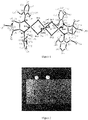
- Fig. 1 is a structural unit diagram of the nickel complex Ni1 of Example 1 of the invention (for clarity, hydrogen atoms, dichloromethane solvent molecules and atoms for symmetry operations are not marked).
- Fig. 2 is a photograph of the spherical and/or spherical-like polymer obtained in Example 2 of the invention.
- Fig. 3 is a photograph of the olefin-unsaturated carboxylic acid polymer obtained in Example 20 of the invention.
- Fig. 4 is a photograph of the spherical and/or spherical-like polymer obtained in Example 70 of the invention.
- the analytical characterization instruments used in the present invention are as follows: Prior to measurement, the polymer sample is washed with a dilute acid solution to make the metal content in the polymer ⁇ 50ppm.
- Copolymerization of ethylene and 2-methyl-2-hydroxy-7-octene was carried out according to the polymerization procedure described in Example 1, except that 30 mmol (5.1 mL) of 2-methyl-2-hydroxy-7-octene and 30mL of AlEt 3 (1.0 mol/L solution in hexane) were used.
- the polymerization activity and polymer performance parameters are shown in Table 1 below.
- Figure 2 shows a photograph of the spherical and/or spherical-like polymer prepared in this Example.
- Copolymerization of ethylene and 2-methyl-2-hydroxy-7-octene was carried out according to the polymerization procedure described in Example 2, except that the polymerization temperature was 60 °C.
- the polymerization activity and polymer performance parameters are shown in Table 1 below.
- Copolymerization of ethylene and 2-methyl-2-hydroxy-7-octene was carried out according to the polymerization procedure described in Example 2, except that 0.5mL of diethyl zinc (1 mol/L solution in hexane) was further added together with the catalyst.
- the polymerization activity and polymer performance parameters are shown in Table 1 below.
- Copolymerization of ethylene and 2-methyl-2-hydroxy-7-octene was carried out according to the polymerization procedure described in Example 4, except that 2 times quantity of the diethylzinc (i.e., 1.0 mL diethylzinc (1 mol/L solution in hexane)) was used.
- the polymerization activity and polymer performance parameters are shown in Table 1 below.
- Copolymerization of ethylene and 2-methyl-2-hydroxy-7-octene was carried out according to the polymerization procedure described in Example 1, except that 3.33 times quantity of the 2-methyl-2-hydroxy-7-octene (i.e., 50 mmol (8.5 mL) of 2-methyl-2-hydroxy-7-octene) and 3.33 times quantity of AlEt 3 (i.e., 50 mL of AlEt 3 (1.0 mol/L solution in hexane)) were used.
- the polymerization activity and polymer performance parameters are shown in Table 1 below.
- Copolymerization of ethylene and 2-methyl-2-hydroxy-7-octene was carried out according to the polymerization procedure described in Example 1, except that 6.67 times quantity of the 2-methyl-2-hydroxy-7-octene (i.e., 100 mmol (17.0 mL) of 2-methyl-2-hydroxy-7-octene) and 6.67 times quantity of the AlEt 3 (i.e., 100mL of AlEt 3 (1.0mol/L solution in hexane)) were used.
- the polymerization activity and polymer performance parameters are shown in Table 1 below.
- Copolymerization of ethylene and 2-methyl-2-hydroxy-7-octene was carried out according to the polymerization procedure described in Example 8, except that the polymerization temperature was 60 °C.
- the polymerization activity and polymer performance parameters are shown in Table 1 below.
- Ethylene copolymerization was carried out according to the polymerization procedure described in Example 8, except that 30 mmol (4.1 mL) of 3-methyl-5-hexen-3-ol was used as a comonomer.
- the polymerization activity and polymer performance parameters are shown in Table 1 below.
- Ethylene copolymerization was carried out according to the polymerization procedure described in Example 11, except that 30 mmol (4.5 mL) of 4-methyl-1-hepten-4-ol as a comonomer was used.
- the polymerization activity and polymer performance parameters are shown in Table 1 below.
- Ethylene copolymerization was carried out according to the polymerization procedure described in Example 2, except that 15 mL of a solution of N,N-dimethylanilinium tetrakis(pentafluorophenyl)borate in toluene (1 mmol/L toluene solution) was used instead of the MAO.
- the results are shown in Table 1 below.
- Ethylene copolymerization was carried out according to the polymerization procedure described in Example 2, except that 500mL of toluene was used instead of the hexane. The results are shown in Table 1 below.
- Ethylene copolymerization was carried out according to the polymerization procedure described in Example 1, except that 15 ⁇ mol of Comparative Catalyst A was used.
- Ethylene copolymerization was carried out according to the polymerization procedure described in Example 1, except that 15 ⁇ mol of Comparative Catalyst B was used.
- Example 1 Ni 1 20.2 34.4 2.02 0.67 Yes 3.5
- Example 2 Ni 1 26.7 48.2 1.92 1.37 Yes 3.8
- Example 3 Ni 1 21.7 20.2 1.98 1.21
- Example 4 Ni 1 15.2 32.4 1.90 1.14 Yes 2.8
- Example 5 Ni 1 12.4 21.7 1.95 1.03 Yes 2.1
- Example 6 Ni 1 28.2 58.2 1.98 2.03 Yes 2.9
- Example 7 Ni 1 15.7 62.4 2.03 3.84 Yes 2.2
- Example 8 Ni 2 21.4 62.7 1.96 1.02 Yes 3.8
- Example 9 Ni 2 20.3 31.6 2.02 0.96 No
- Example 10 Ni 2 11.7 20.6 2.02 0.98 Yes 3.6
- Example 11 Ni 3 16.4 51.2 2.01 0.94 Yes 3.4
- Example 12 Ni 3 13.3 42.7 2.04 0.93 Yes 3.2
- Example 13 Ni 4 33.2 13.4 2.01 1.48 Yes 2.8
- Example 14 Nis 35.1 14.9 1.98 1.46 Yes 2.9
- Example 15 Ni 6 18.4 40.3 2.02 0.94 Yes 3.0
- the reaction mixture was finally neutralized with an ethanol solution acidified with 10 wt% hydrochloric acid to obtain a polymer.
- the polymerization activity and polymer performance parameters are shown in Table 2 below.
- Ethylene copolymerization was carried out according to the polymerization procedure described in Example 19, except that 2 times quantity of 2,2-dimethyl-7-octenoic acid and 2 times quantity of AlEt 3 were used. The results are shown in Table 1 below. The polymerization activity and polymer performance parameters are shown in Table 2 below.
- Ethylene copolymerization was carried out according to the polymerization procedure described in Example 20, except that polymerization temperature was 60 °C.
- the polymerization activity and polymer performance parameters are shown in Table 2 below.
- Ethylene copolymerization was carried out according to the polymerization procedure described in Example 20, except that 0.5 mL of diethylzinc (1 mol/L solution in hexane) was further added together with the catalyst.
- the polymerization activity and polymer performance parameters are shown in Table 2 below.
- Ethylene copolymerization was carried out according to the polymerization procedure described in Example 20, except that 1.0 mL of diethylzinc (1 mol/L solution in hexane) was further added together with the catalyst.
- the polymerization activity and polymer performance parameters are shown in Table 2 below.
- Ethylene copolymerization was carried out according to the polymerization procedure described in Example 19, except that 3.33 times quantity (i.e., 50 mmol (8.51g)) of 2,2-dimethyl-7-octenoic acid and 3.33 times quantity (i.e., 50 mL) of AlEt 3 (1.0 mol/L solution in hexane) were used.
- the polymerization activity and polymer performance parameters are shown in Table 2 below.
- Ethylene copolymerization was carried out according to the polymerization procedure described in Example 19, except that 6.67 times quantity (i.e., 100 mmol (17.02 g)) of 2,2-dimethyl-7-octenoic acid and 6.67 times quantity (i.e., 100 mL) of AlEt 3 (1.0 mol/L solution in hexane) were used.
- 6.67 times quantity i.e., 100 mmol (17.02 g)
- 6.67 times quantity i.e., 100 mmol (17.02 g) of 2,2-dimethyl-7-octenoic acid
- 6.67 times quantity i.e., 100 mL
- AlEt 3 1.0 mol/L solution in hexane
- Ethylene copolymerization was carried out according to the polymerization procedure described in Example 20, except that 8.9 mg (5 ⁇ mol) of the complex Ni 3 was used as a catalyst.
- the polymerization activity and polymer performance parameters are shown in Table 2 below.
- Ethylene copolymerization was carried out according to the polymerization procedure described in Example 20, except that 15 mL of a solution of N,N-dimethylanilinium tetrakis(pentafluorophenyl)borate in toluene (1 mmol/L toluene solution) was used instead of MAO.
- the results are shown in Table 2 below.
- Ethylene copolymerization was carried out according to the polymerization procedure described in Example 20, except that 30 mmol (5.53g) of 10-undecenoic acid was used as a comonomer.
- the polymerization activity and polymer performance parameters are shown in Table 2 below.
- Ethylene copolymerization was carried out according to the polymerization procedure described in Example 2, except that 500mL of toluene was used instead of the hexane.
- the polymerization activity and polymer performance parameters are shown in Table 2 below.
- Example 19 Ni 1 15.3 14.2 0.78 Yes Example 20 Ni 1 17.2 16.3 1.24 Yes Example 21 Ni 1 16.2 9.3 1.02 No Example 22 Ni 1 11.7 10.4 1.21 Yes Example 23 Ni 1 9.3 8.4 1.17 Yes Example 24 Ni 1 20.7 18.4 2.02 Yes Example 25 Ni 1 16.3 16.2 3.72 Yes Example 26 Ni 2 15.8 20.6 1.17 Yes Example 27 Ni 2 11.3 16.4 1.02 No Example 28 Ni 2 15.2 18.9 1.15 Yes Example 29 Ni 3 11.3 10.4 1.01 Yes Example 30 Ni 4 21.7 8.4 1.53 Yes Example 31 Ni 5 13.2 6.3 1.40 Yes Example 32 Ni 6 14.2 17.3 1.02 Yes Example 33 Ni 1 15.4 14.7 1.21 Yes Example 34 Ni 1 14.1 13.0 1.13 No Example 35 Ni 1 17.0 15.4 1.23 No
- the catalyst of the present invention when the catalyst of the present invention catalyzes the copolymerization of ethylene and an unsaturated carboxylic acid, it exhibits higher polymerization activity, and the resulting polymer has a higher molecular weight.
- the catalyst of the present invention can have a copolymerization activity of up to 21.7 ⁇ 10 6 g ⁇ mol -1 (Ni) ⁇ h -1 , and the molecular weight of the polymer can be adjusted in a wide range by the addition of a chain transfer agent. In addition, by adjusting the polymerization conditions, a copolymer product with good particle morphology can be obtained.
- Ethylene copolymerization was carried out according to the polymerization procedure described in Example 37, except that the polymerization temperature was 60°C.
- the polymerization activity and polymer performance parameters are shown in Table 3 below.
- the reaction was stirred at 30 °C for 30 minutes, with ethylene pressure being maintained at 10 atm.
- the reaction mixture was finally neutralized with an ethanol solution acidified with 10 wt% hydrochloric acid to obtain a polymer.
- the polymerization activity and polymer performance parameters are shown in Table 3 below.
- Ethylene copolymerization was carried out according to the polymerization procedure described in Example 39, except that 2 times quantity (1.0 mL) of diethylzinc (1mol/L solution in hexane) was used.
- the polymerization activity and polymer performance parameters are shown in Table 3 below.
- the reaction was stirred at 30 °C for 30 minutes, with ethylene pressure being maintained at 10 atm.
- the reaction mixture was finally neutralized with an ethanol solution acidified with 10 wt% hydrochloric acid to obtain a polymer.
- the polymerization activity and polymer performance parameters are shown in Table 3 below.
- Example 36 Ni 11 3.03 63.2 2.13 0.64 Yes Example 37 Ni 11 4.12 68.2 2.11 1.27 Yes Example 38 Ni 11 2.37 22.5 2.23 1.08 No Example 39 Ni 11 2.64 48.3 2.08 1.04 Yes Example 40 Ni 11 1.92 31.7 2.02 0.96 Yes Example 41 Ni 11 4.94 71.3 2.04 2.01 Yes Example 42 Ni 11 2.12 74.0 2.05 3.71 Yes Example 43 Ni 12 1.96 16.2 2.32 1.33 Yes Example 44 Ni 12 1.27 8.4 2.36 1.00 No Example 45 Ni 12 1.15 13.8 2.24 1.16 Yes Example 46 Ni 13 2.24 6.3 2.42 1.38 Yes Example 47 Ni 13 2.41 6.8 2.31 1.36 Yes Example 48 Ni 14 1.53 15.6 2.14 1.17 Yes Example 49 Ni 15 2.36 17.3 2.10 1.24 Yes Example 50 Ni 11 3.76 63.2 2.27 1.26 Yes Example 51 Ni 11 4.42 73.1 2.02 1.26 No Example 52 Ni 11 4.13 67.0 2.12 1.27 No
- the catalyst of the present invention exhibits higher polymerization activity when catalyzing the copolymerization of ethylene and an enol, and the resulting polymer has a higher molecular weight.
- the catalyst of the invention can have a copolymerization activity of up to 4.94 ⁇ 10 6 g ⁇ mol -1 (Ni) ⁇ h -1 .
- the molecular weight of the polymer can be adjusted in a wide range by the addition of a chain transfer agent. In addition, by adjusting the polymerization conditions, a copolymer product with good particle morphology can be obtained.
- Ethylene copolymerization was carried out according to the procedure described in Example 53, except that 2 times quantity (30 mmol (5. 10g)) of 2,2-dimethyl-7-octenoic acid and 2 times quantity (30mL) of AlEt 3 were used. The results are shown in Table 4 below.
- Ethylene copolymerization was carried out according to the procedure described in Example 54, except that polymerization temperature was 60 °C. The results are shown in Table 4 below.
- Ethylene copolymerization was carried out according to the procedure described in Example 54, except that 0.5 mL of diethylzinc (1 mol/L solution in hexane) was further added into the autoclave. The results are shown in Table 4 below.
- Ethylene copolymerization was carried out according to the procedure described in Example 54, except that 1.0 mL of diethylzinc (1 mol/L solution in hexane) was further added into the autoclave. The results are shown in Table 4 below.
- Ethylene copolymerization was carried out according to the procedure described in Example 53, except that 3.33 times quantity (50 mmol (8.51g)) of 2,2-dimethyl-7-octenoic acid and 3.33 times quantity (50mL) of AlEt 3 (1.0mol/L solution in hexane) were used. The results are shown in Table 4 below.
- Ethylene copolymerization was carried out according to the procedure described in Example 53, except that 6.67 times quantity of 2,2-dimethyl-7-octenoic acid and 6.67 times quantity of AlEt 3 (1.0mol/L solution in hexane) were used. The results are shown in Table 4 below.
- the reaction was stirred at 30 °C for 30 minutes, with ethylene pressure being maintained at 10 atm.
- the reaction mixture was finally neutralized with an ethanol solution acidified with 10 wt% hydrochloric acid to obtain a polymer.
- the polymerization activity and polymer performance parameters are shown in Table 4 below.
- Example 53 Ni 11 1.54 18.4 0.72 Yes
- Example 54 Ni 11 1.86 22.1 1.10 Yes
- Example 55 Ni 11 1.12 10.3 0.92
- Example 56 Ni 11 1.20 13.4 1.04 Yes
- Example 57 Ni 11 0.98 8.4 1.01 Yes
- Example 58 Ni 11 2.12 24.4 1.98 Yes
- Example 59 Ni 11 1.63 19.2 3.20 Yes
- Example 60 Ni 12 1.13 12.6 1.14 Yes
- Example 61 Ni 12 1.20 13.4 2.02
- Example 62 Ni 12 1.22 12.9 1.15 Yes
- Example 63 Ni 13 2.42 8.4 1.41
- Example 64 Ni 14 1.06 10.7 1.10 Yes
- Example 65 Ni 15 1.37 14.4 1.14 Yes
- Example 66 Ni 11 1.70 21.4 1.06 Yes
- Example 67 Ni 11 1.35 20.2 1.10 No
- Example 68 Ni 11 1.38 20.4 1.09 No
- the catalyst of the present invention when the catalyst of the present invention catalyzes the copolymerization of ethylene and an unsaturated carboxylic acid, it exhibits higher polymerization activity, and the resulting polymer has a higher molecular weight.
- the catalyst of the present invention can have a copolymerization activity of up to 2.42 ⁇ 10 6 g ⁇ mol -1 (Ni) ⁇ h -1 , and the molecular weight of the polymer can be adjusted in a wide range by the addition of a chain transfer agent. In addition, by adjusting the polymerization conditions, a copolymer product with good particle morphology can be obtained.
- Fig. 4 shows a photograph of the spherical and/or spherical-like polymer prepared in this example.
- Ethylene copolymerization was carried out according to the procedure described in Example 70, except that polymerization temperature was 60 °C. The results are shown in Table 5 below.
- Ethylene copolymerization was carried out according to the procedure described in Example 70, except that 0.5 mL of diethylzinc (1 mol/L solution in hexane) was further added into the autoclave. The results are shown in Table 5 below.
- Ethylene copolymerization was carried out according to the procedure described in Example 70, except that 1.0 mL of diethylzinc (1 mol/L solution in hexane) was further added into the autoclave. The results are shown in Table 5 below.
- Ethylene copolymerization was carried out according to the procedure described in Example 69, except that 3.33 times quantity (50 mmol (8.5 mL)) of 2-methyl-2-hydroxy-7-octene and 3.33 times quantity (50mL) of AlEt 3 (1.0mol/L solution in hexane) were used. The results are shown in Table 5 below.
- Ethylene copolymerization was carried out according to the procedure described in Example 69, except that 6.67 times quantity of 2-methyl-2-hydroxy-7-octene and 6.67 times quantity of AlEt 3 (1.0mol/L solution in hexane) were used. The results are shown in Table 5 below.
- the reaction was stirred at 30 °C for 30 minutes, with ethylene pressure being maintained at 10 atm.
- the reaction mixture was finally neutralized with an ethanol solution acidified with 10 wt% hydrochloric acid to obtain a polymer.
- the polymerization activity and polymer performance parameters are shown in Table 5 below.
- Example 69 Ni21 2.72 18.4 1.72 0.71 Yes
- Example 70 Ni21 3.02 20.1 1.68 1.14 Yes
- Example 71 Ni21 1.03 6.4 1.60 0.93
- Example 72 Ni21 1.63 12.0 1.50 1.02 Yes
- Example 73 Ni21 1.07 7.6 1.12 0.96 Yes
- Example 74 Ni21 2.96 20.8 1.73 1.42 Yes
- Example 75 Ni21 1.54 21.7 1.86 2.37 Yes
- Example 76 Ni22 5.17 38.6 1.57 1.02 Yes
- Example 77 Ni22 4.12 14.6 1.77 0.92
- Example 78 Ni22 4.33 33.1 1.64 1.01 Yes
- Example 79 Ni23 2.12 18.3 1.67 0.99 Yes
- Example 80 Ni23 2.07 16.4 1.70 1.02 Yes
- Example 81 Ni21 2.76 18.3 1.65 1.11 Yes
- Example 82 Ni21 3.12 21.6 1.66 1.12 No
- Example 83 Ni21 3.04 19.6 1.65 1.15 No
- the catalyst of the present invention when the catalyst of the present invention catalyzes the copolymerization of ethylene and an enol, it exhibits higher polymerization activity, and the resulting polymer has a higher molecular weight.
- the catalyst of the present invention can have a copolymerization activity of up to 5.17 ⁇ 10 6 g ⁇ mol -1 (Ni) ⁇ h -1 , and the molecular weight of the polymer can be adjusted in a wide range by the addition of a chain transfer agent. In addition, by adjusting the polymerization conditions, a copolymer product with good particle morphology can be obtained.
- Ethylene copolymerization was carried out according to the procedure described in Example 85, except that polymerization temperature was 60 °C. The results are shown in Table 6 below.
- Ethylene copolymerization was carried out according to the procedure described in Example 85, except that 0.5 mL of diethylzinc (1 mol/L solution in hexane) was further added into the autoclave. The results are shown in Table 6 below.
- Ethylene copolymerization was carried out according to the procedure described in Example 85, except that 1.0 mL of diethylzinc (1 mol/L solution in hexane) was further added into the autoclave. The results are shown in Table 6 below.
- Ethylene copolymerization was carried out according to the procedure described in Example 84, except that 3.33 times quantity (50 mmol (8.51g)) of 2,2-dimethyl-7-octenoic acid and 3.33 times quantity (50mL) of AlEt 3 (1.0mol/L solution in hexane) were used. The results are shown in Table 6 below.
- Ethylene copolymerization was carried out according to the procedure described in Example 84, except that 6.67 times quantity of 2,2-dimethyl-7-octenoic acid and 6.67 times quantity of AlEt 3 (1.0mol/L solution in hexane) were used. The results are shown in Table 6 below.
- the reaction was stirred at 30 °C for 30 minutes, with ethylene pressure being maintained at 10 atm.
- the reaction mixture was finally neutralized with an ethanol solution acidified with 10 wt% hydrochloric acid to obtain a polymer.
- the polymerization activity and polymer performance parameters are shown in Table 6 below.
- Example 84 Ni21 1.96 5.12 0.67 Yes
- Example 85 Ni21 2.02 5.43 1.10 Yes
- Example 86 Ni21 1.33 2.52 0.96 No
- Example 87 Ni21 1.52 2.72 1.02 Yes
- Example 88 Ni21 1.00 1.63 0.97 Yes
- Example 89 Ni21 2.12 6.33 1.44 Yes
- Example 90 Ni21 1.23 5.10 2.72 Yes
- Example 91 Ni22 4.52 14.7 1.13 Yes
- Example 92 Ni22 4.17 8.6 0.93 No
- Example 93 Ni22 4.07 13.3 1.13 Yes
- Example 94 Ni23 2.32 9.3 1.07 Yes
- Example 95 Ni23 1.21 5.4 0.96 Yes
- Example 96 Ni21 1.97 5.36 1.09 Yes
- Example 97 Ni21 2.07 5.53 1.11
- Example 98 Ni21 2.04 5.36 1.10 No
- the catalyst of the present invention when the catalyst of the present invention catalyzes the copolymerization of ethylene and an unsaturated carboxylic acid, it exhibits higher polymerization activity, and the resulting polymer has a higher molecular weight.
- the catalyst of the present invention can have a copolymerization activity of up to 4.52 ⁇ 10 6 g ⁇ mol -1 (Ni) ⁇ h -1 , and the molecular weight of the polymer can be adjusted in a wide range by the addition of a chain transfer agent. In addition, by adjusting the polymerization conditions, a copolymer product with good particle morphology can be obtained.
- Ethylene copolymerization was carried out according to the procedure described in Example 100, except that polymerization temperature was 60 °C. The results are shown in Table 7 below.
- Ethylene copolymerization was carried out according to the procedure described in Example 100, except that 0.5 mL of diethylzinc (1 mol/L solution in hexane) was further added into the autoclave. The results are shown in Table 7 below.
- Ethylene copolymerization was carried out according to the procedure described in Example 100, except that 1.0 mL of diethylzinc (1 mol/L solution in hexane) was further added into the autoclave. The results are shown in Table 7 below.
- Ethylene copolymerization was carried out according to the procedure described in Example 99, except that 3.33 times quantity of 2-methyl-2-hydroxy-7-octene and 3.33 times quantity of AlEt 3 (1.0mol/L solution in hexane) were used. The results are shown in Table 7 below.
- Ethylene copolymerization was carried out according to the procedure described in Example 99, except that 6.67 times quantity of 2-methyl-2-hydroxy-7-octene and 6.67 times quantity of AlEt 3 (1.0mol/L solution in hexane) were used. The results are shown in Table 7 below.
- the reaction was stirred at 30 °C for 30 minutes, with ethylene pressure being maintained at 10 atm.
- the reaction mixture was finally neutralized with an ethanol solution acidified with 10 wt% hydrochloric acid to obtain a polymer.
- the polymerization activity and polymer performance parameters are shown in Table 7 below.
- Example 99 Ni31 3.66 15.7 1.54 0.78 Yes
- Example 100 Ni31 3.89 16.8 1.42 1.13 Yes
- Example 101 Ni31 2.12 10.1 1.96 0.98 No
- Example 102 Ni31 3.12 11.7 1.24 1.09 Yes
- Example 103 Ni31 2.37 6.9 1.23 1.06 Yes
- Example 104 Ni31 4.04 18.9 1.32 1.43 Yes
- Example 105 Ni31 3.10 14.8 1.40 2.16 Yes
- Example 106 Ni32 5.27 50.4 1.25 1.02 Yes
- Example 107 Ni32 3.96 25.7 2.02 0.96 No
- Example 108 Ni32 4.88 49.2 1.21 1.02 Yes
- Example 109 Ni33 4.16 41.7 1.23 1.01 Yes
- Example 110 Ni34 2.02 13.4 1.40 1.10 Yes
- Example 111 Ni34 2.04 12.7 1.42 1.11 Yes
- Example 112 Ni35 4.46 18.7 1.38 1.19 Yes
- Example 113 Ni31 3.64 15.7 1.45 1.13 Yes
- Example 114 Ni31 3.84 18.7 1.37 1.16 No
- the catalyst of the present invention can have a copolymerization activity of up to 5.27 ⁇ 10 5 g ⁇ mol -1 (Ni) ⁇ h -1 , and the molecular weight of the polymer can be adjusted in a wide range by the addition of a chain transfer agent. In addition, by adjusting the polymerization conditions, a copolymer product with good particle morphology can be obtained.
- Ethylene copolymerization was carried out according to the procedure described in Example 117, except that polymerization temperature was 60 °C. The results are shown in Table 8 below.
- Ethylene copolymerization was carried out according to the procedure described in Example 117, except that 0.5 mL of diethylzinc (1 mol/L solution in hexane) was further added into the autoclave. The results are shown in Table 8 below.
- Ethylene copolymerization was carried out according to the procedure described in Example 117, except that 1.0 mL of diethylzinc (1 mol/L solution in hexane) was further added into the autoclave. The results are shown in Table 8 below.
- Ethylene copolymerization was carried out according to the procedure described in Example 116, except that 3.33 times quantity (50 mmol (8.51g)) of 2,2-dimethyl-7-octenoic acid and 3.33 times quantity (50mL) of AlEt 3 (1.0mol/L solution in hexane) were used. The results are shown in Table 8 below.
- Ethylene copolymerization was carried out according to the procedure described in Example 116, except that 6.67 times quantity of 2,2-dimethyl-7-octenoic acid and 6.67 times quantity of AlEt 3 (1.0mol/L solution in hexane) were used. The results are shown in Table 8 below.
- the reaction was stirred at 30 °C for 30 minutes, with ethylene pressure being maintained at 10 atm.
- the reaction mixture was finally neutralized with an ethanol solution acidified with 10 wt% hydrochloric acid to obtain a polymer.
- the polymerization activity and polymer performance parameters are shown in Table 8 below.
- the catalyst of the present invention when the catalyst of the present invention catalyzes the copolymerization of ethylene and an unsaturated carboxylic acid, it exhibits higher polymerization activity, and the resulting polymer has a higher molecular weight.
- the catalyst of the present invention can have a copolymerization activity of up to 4.64 ⁇ 10 5 g ⁇ mol -1 (Ni) ⁇ h -1 , and the molecular weight of the polymer can be adjusted in a wide range by the addition of a chain transfer agent. In addition, by adjusting the polymerization conditions, a copolymer product with good particle morphology can be obtained.
Landscapes
- Chemical & Material Sciences (AREA)
- Organic Chemistry (AREA)
- Health & Medical Sciences (AREA)
- Chemical Kinetics & Catalysis (AREA)
- Medicinal Chemistry (AREA)
- Polymers & Plastics (AREA)
- Engineering & Computer Science (AREA)
- Materials Engineering (AREA)
- Addition Polymer Or Copolymer, Post-Treatments, Or Chemical Modifications (AREA)
- Catalysts (AREA)
- Transition And Organic Metals Composition Catalysts For Addition Polymerization (AREA)
- Organic Low-Molecular-Weight Compounds And Preparation Thereof (AREA)
- Polymerization Catalysts (AREA)
Abstract

Description
- The invention belongs to the field of macromolecular polymer preparation, and specifically relates to a method for preparing an olefin-polar monomer copolymer.
- Polyolefin products are inexpensive and excellent in performance, and have a wide range of applications. Under the condition of retaining the original excellent physical and chemical properties of polyolefin, introducing a polar group into the polyolefin molecular chain through chemical synthesis can improve its chemical inertness, printability, wettability and compatibility with other materials, thereby imposing new characteristics that its raw materials do not possess on the polyolefin. At present, high-pressure free radical polymerization is mostly used in industry to promote the direct copolymerization of olefins and polar monomers, and ethylene-vinyl acetate copolymers, ethylene-methyl methacrylate copolymers, and ethylene-acrylic acid copolymers, for example, are produced by such processes. Although high-pressure free radical copolymerization can directly introduce copolymerizable polar monomers into the polyolefin chain, this method requires high temperature and high pressure conditions, high energy consumption, and expensive equipment.
- Ethylene-vinyl alcohol (EVOH or EVAL) copolymer is a novel polymer material that integrates the processability of ethylene polymer and the gas barrier properties of vinyl alcohol polymer. It is currently one of the three major barrier resins industrially produced in the world, and it is widely used to package food, medical solutions and other products. Since vinyl alcohol cannot exist independently as a monomer, ethylene-vinyl alcohol copolymer is usually prepared by preparing an ethylene-vinyl acetate copolymer by free-radical polymerization and then alcoholyzing the ethylene-vinyl acetate copolymer. However, a large amount of solvents are needed in the alcoholysis process, and the final saponification product contains a large amount of impurities such as acetic acid and alkali metal salts, which have to be washed off with a large amount of water.
- Coordination catalytic copolymerization, as a polymer preparation technology at normal temperature and pressure, has received widespread attention because of its significant role in reducing energy consumption and improving reaction efficiency. The catalyst's participation in the reaction process greatly reduces the activation energy of the copolymerization of olefin monomers and polar monomers, which is beneficial to obtain functional polymers with higher molecular weights at lower temperatures and pressures. At present, only a small amount of literature reports the use of transition metal complexes to catalyze the copolymerization of olefins with unsaturated alcohols or unsaturated carboxylic acids. However, in the prior art, no matter what method is used for polymerization, the polymer obtained is a viscous block solid, which is prone to fouling in the polymerization equipment, bringing difficulties to the transportation of the polymer, solvent removal, granulation, etc.
- An object of the present invention is to overcome the shortcomings of the prior art and provide a method for preparing olefin-polar monomer copolymers. The method provided by the present invention does not require subsequent processing such as granulation, and can directly obtain spherical and/or spherical-like polymers with good morphology. Therefore, the method of the present invention has good industrial application prospects.
- In a first aspect, the present invention provides a method for preparing an olefin-polar monomer copolymer, comprising copolymerizing an olefin and a polar monomer in the presence of a catalyst and optionally a chain transfer agent to produce the olefin-polar monomer copolymer,
- wherein, the catalyst comprises a main catalyst and optionally a cocatalyst, the main catalyst comprises a diimine-metal complex represented by Formula I:

- wherein, R1 and R2 are each independently a C1-C30 hydrocarbyl with or without a substituent Q; R3 and R4 are each independently selected from the group consisting of hydrogen, halogen, hydroxy, C1-C20 hydrocarbyl with or without a substituent Q, and adjacent R3 and R4 groups are optionally joined to form a ring or ring system; each R11 is independently a C1-C20 hydrocarbyl with or without a substituent Q; each Y is independently a Group VIA non-metal atom; each M is independently a Group VIII metal; each X is independently selected from the group consisting of halogen, C1-C10 hydrocarbyl with or without a substituent Q and C1-C10 hydrocarbyloxy with or without a substituent Q, or
- an amino-imine metal complex represented by Formula I':

- wherein, R1 and R2 are each independently a C1-C30 hydrocarbyl with or without a substituent Q; each R3 is independently selected from the group consisting of hydrogen and C1-C20 hydrocarbyl with or without a substituent Q; R5 to R8 are each independently selected from the group consisting of hydrogen, halogen, hydroxy, and C1-C20 hydrocarbyl with or without a substituent Q, and R5 to R8 groups are optionally joined to form a ring or ring system; each R12 is independently a C1-C20 hydrocarbyl with or without a substituent Q; each Y is independently a Group VIA non-metal atom; each M is independently a Group VIII metal; each X is independently selected from the group consisting of halogen, C1-C10 hydrocarbyl with or without a substituent Q and C1-C10 hydrocarbyloxy with or without a substituent Q.
- As used herein, the term "polar monomer" refers to a monomer carrying at least one polar group such as hydroxyl group, carboxyl group, acid anhydride group, and at least one coordination polymerizable unsaturated bond. The polar monomer has 2-20 carbon atoms, for example 2-16 carbon atoms, for example 2-12 carbon atoms, for example 2-10 carbon atoms. In some embodiments, the polar monomer is selected from the group consisting of olefin monomers carrying one or more hydroxy groups and/or one or more carboxy groups, preferably from the group consisting of α-olefinic monomers (also referred to as vinyl monomers) carrying one or more hydroxy groups and/or one or more carboxy groups.
- In a subaspect of the inventive method, the polar monomer is selected from the group consisting of olefinic monomers carrying one or more hydroxy groups, or the polar monomer is selected from the group consisting of olefinic monomers carrying one or more carboxyl groups, and the main catalyst comprises a diimine metal complex represented by Formula Ib:

- In some embodiments of this subaspect, in the diimine metal complex, R1 and R2 are independently selected from the group consisting of C1-C20 alkyl with or without a substituent Q and C6-C20 aryl with or without a substituent Q. Preferably, R1 and/or R2 are/is a group represented by Formula A:

- In some embodiments of this subaspect, in the diimine metal complex, each M is independently selected from the group consisting of nickel and palladium.
- In some embodiments of this subaspect, in the diimine metal complex, each Y is independently selected from the group consisting of O and S.
- In some embodiments of this subaspect, in the diimine metal complex, each X is independently selected from the group consisting of halogen, C1-C10 alkyl with or without a substituent Q and C1-C10 alkoxy with or without a substituent Q, preferably from the group consisting of halogen, C1-C6 alkyl with or without a substituent Q and C1-C6 alkoxy with or without a substituent Q.
- In some embodiments of this subaspect, in the diimine metal complex, each R12 is independently a C1-C20 alkyl with or without a substituent Q, preferably a C1-C10 alkyl with or without a substituent Q, and more preferably a C1-C6 alkyl with or without a substituent Q.
- In some embodiments of this subaspect, in the diimine metal complex, the substituent Q is selected from the group consisting of halogen, hydroxy, C1-C10 alkyl, halogenated C1-C10 alkyl, C1-C10 alkoxy and halogenated C1-C10 alkoxy, preferably from the group consisting of halogen, hydroxy, C1-C6 alkyl, halogenated C1-C6 alkyl, C1-C6 alkoxy and halogenated C1-C6 alkoxy. Preferably, the C1-C6 alkyl is selected from the group consisting of methyl, ethyl, n-propyl, isopropyl, n-butyl, isobutyl, n-pentyl, isopentyl, n-hexyl, isohexyl and 3,3-dimethylbutyl. Preferably, the C1-C6 alkoxy is selected from the group consisting of methoxy, ethoxy, n-propoxy, iso-propoxy, n-butoxy, iso-butoxy, n-pentoxy, iso-pentoxy, n-hexoxy, iso-hexoxy and 3,3-dimethylbutoxy.
- As used herein, the term "halogen" refers to fluorine, chlorine, bromine or iodine.
- In some embodiments of this subaspect, the diimine metal complex is represented by Formula IIIb:

- In some preferred embodiments, in the diimine metal complex of Formula IIIb, R1-R11 are each independently selected from the group consisting of hydrogen, halogen, hydroxy, C1-C10 alkyl with or without a substituent Q, C2-C10 alkenyl with or without a substituent Q, C2-C10 alkynyl with or without a substituent Q, C1-C10 alkoxy with or without a substituent Q, C2-C10 alkenoxy with or without a substituent Q, C2-C10 alkynoxy with or without a substituent Q, C6-C15 aryl with or without a substituent Q, C6-C15 aryloxy with or without a substituent Q, C7-C15 aralkyl with or without a substituent Q, C7-C15 aralkoxy with or without a substituent Q, C7-C15 alkaryl with or without a substituent Q and C7-C15 alkaryloxy with or without a substituent Q. Preferably, R1-R11 are each independently selected from the group consisting of hydrogen, C1-C10 alkyl, halogenated C1-C10 alkyl, C1-C10 alkoxy, halogenated C1-C10 alkoxy and halogen, more preferably from the group consisting of hydrogen, C1-C6 alkyl, halogenated C1-C6 alkyl, C1-C6 alkoxy, halogenated C1-C6 alkoxy and halogen.
- In some embodiments of this subaspect, the diimine metal complex is selected from the group consisting of:
- 1) the diimine metal complex represented by Formula IIIb, wherein R1= R3=methyl, R2= R4-R7 = R10=H, R8= R9= R11=methyl, R12=ethyl, M=Ni, Y=O, X=Br;
- 2) the diimine metal complex represented by Formula IIIb, wherein R1= R3=ethyl, R2= R4-R7 = R10=H, R8= R9= R11=methyl, R12=ethyl, M=Ni, Y=O, X=Br;
- 3) the diimine metal complex represented by Formula IIIb, wherein R1= R3 =isopropyl, R2= R4-R7 = R10=H, R8= R9= R11=methyl, R12=ethyl, M=Ni, Y=O, X=Br;
- 4) the diimine metal complex represented by Formula IIIb, wherein R1-R3 =methyl, R4-R7 = R10=H, R8= R9= R11=methyl, R12=ethyl, M=Ni, Y=O, X=Br;
- 5) the diimine metal complex represented by Formula IIIb, wherein R1= R3 =methyl, R2=Br, R4-R7 = R10=H, R8= R9= R11=methyl, R12=ethyl, M=Ni, Y=O, X=Br;
- 6) the diimine metal complex represented by Formula IIIb, wherein R1= R3=F, R2= R4-R7 = R10=H, R8= R9= R11=methyl, R12=ethyl, M=Ni, Y=O, X=Br;
- 7) the diimine metal complex represented by Formula IIIb, wherein R1= R3=Cl, R2= R4-R7 = R10=H, R8= R9= R11=methyl, R12=ethyl, M=Ni, Y=O, X=Br;
- 8) the diimine metal complex represented by Formula IIIb, wherein R1= R3=Br, R2= R4-R7 = R10=H, R8= R9= R11=methyl, R12=ethyl, M=Ni, Y=O, X=Br;
- 9) the diimine metal complex represented by Formula IIIb, wherein R1= R3=methyl, R2= R4-R7 = R10=H, R8= R9= R11=methyl, R12=isobutyl, M=Ni, Y=O, X=Br;
- 10) the diimine metal complex represented by Formula IIIb, wherein R1= R3=ethyl, R2= R4-R7 = R10=H, R8= R9= R11=methyl, R12=isobutyl, M=Ni, Y=O, X=Br;
- 11) the diimine metal complex represented by Formula IIIb, wherein R1= R3 =isopropyl, R2= R4-R7 = R10=H, R8= R9= R11=methyl, R12=isobutyl, M=Ni, Y=O, X=Br;
- 12) the diimine metal complex represented by Formula IIIb, wherein R1-R3 =methyl, R4-R7 = R10=H, R8= R9= R11=methyl, R12=isobutyl, M=Ni, Y=O, X=Br;
- 13) the diimine metal complex represented by Formula IIIb, wherein R1= R3 =methyl, R2=Br, R4-R7 = R10=H, R8= R9= R11=methyl, R12=isobutyl, M=Ni, Y=O, X=Br;
- 14) the diimine metal complex represented by Formula IIIb, wherein R1= R3=F, R2= R4-R7 = R10=H, R8= R9= R11=methyl, R12=isobutyl, M=Ni, Y=O, X=Br;
- 15) the diimine metal complex represented by Formula IIIb, wherein R1= R3=Cl, R2= R4-R7 = R10=H, R8= R9= R11=methyl, R12=isobutyl, M=Ni, Y=O, X=Br;
- 16) the diimine metal complex represented by Formula IIIb, wherein R1= R3=Br, R2= R4-R7 = R10=H, R8= R9= R11=methyl, R12=isobutyl, M=Ni, Y=O, X=Br;
- 17) the diimine metal complex represented by Formula IIIb, wherein R1= R3=methyl, R2= R4-R7 = R10=H, R8= R9=methyl, R11=bromomethyl, R12=ethyl, M=Ni, Y=O, X=Br;
- 18) the diimine metal complex represented by Formula IIIb, wherein R1= R3=ethyl, R2= R4-R7 = R10=H, R8= R9=methyl, R11=bromomethyl, R12=ethyl, M=Ni, Y=O, X=Br;
- 19) the diimine metal complex represented by Formula IIIb, wherein R1= R3 =isopropyl, R2= R4-R7 = R10=H, R8= R9=methyl, R11=bromomethyl, R12=ethyl, M=Ni, Y=O, X=Br;
- 20) the diimine metal complex represented by Formula IIIb, wherein R1-R3 =methyl, R4-R7 = R10=H, R8= R9=methyl, R11=bromomethyl, R12=ethyl, M=Ni, Y=O, X=Br;
- 21) the diimine metal complex represented by Formula IIIb, wherein R1= R3 =methyl, R2=Br, R4-R7 = R10=H, R8= R9=methyl, R11=bromomethyl, R12=ethyl, M=Ni, Y=O, X=Br;
- 22) the diimine metal complex represented by Formula IIIb, wherein R1= R3=F, R2=R4-k7=R10=H, R8= R9=methyl, R11=bromomethyl, R12=ethyl, M=Ni, Y=O, X=Br;
- 23) the diimine metal complex represented by Formula IIIb, wherein R1= R3=Cl, R2= R4-R7=R10=H, R8= R9=methyl, R11=bromomethyl, R12=ethyl, M=Ni, Y=O, X=Br;
- 24) the diimine metal complex represented by Formula IIIb, wherein R1= R3=Br, R2= R4-R7 = R10=H, R8= R9=methyl, R11=bromomethyl, R12=ethyl, M=Ni, Y=O, X=Br.
- In another subaspect of the inventive method, the polar monomer is selected from the group consisting of olefinic monomers carrying one or more hydroxy groups, or the polar monomer is selected from the group consisting of olefinic monomers carrying one or more carboxyl groups, and the main catalyst comprises a diimine metal complex represented by Formula Ic:

- In some embodiments of this subaspect, in the diimine metal complex represented by Formula Ic, R1 and R2 are independently selected from the group consisting of C1-C20 alkyl with or without a substituent Q and C6-C20 aryl with or without a substituent Q. Preferably, R1 and/or R2 are/is a group represented by Formula A:

- In some embodiments of this subaspect, in the diimine metal complex represented by Formula Ic, each M is independently selected from the group consisting of nickel and palladium.
- In some embodiments of this subaspect, in the diimine metal complex represented by Formula Ic, each Y is independently selected from the group consisting of O and S.
- In some embodiments of this subaspect, in the diimine metal complex represented by Formula Ic, each X is independently selected from the group consisting of halogen, C1-C10 alkyl with or without a substituent Q and C1-C10 alkoxy with or without a substituent Q, preferably from the group consisting of halogen, C1-C6 alkyl with or without a substituent Q and C1-C6 alkoxy with or without a substituent Q.
- In some embodiments of this subaspect, in the diimine metal complex represented by Formula Ic, each R11 is independently a C1-C20 alkyl with or without a substituent Q, preferably a C1-C10 alkyl with or without a substituent Q, and more preferably a C1-C6 alkyl with or without a substituent Q.
- In some embodiments of this subaspect, in the diimine metal complex represented by Formula Ic, the substituent Q is selected from the group consisting of halogen, hydroxy, C1-C10 alkyl, halogenated C1-C10 alkyl, C1-C10 alkoxy and halogenated C1-C10 alkoxy, preferably from the group consisting of halogen, hydroxy, C1-C6 alkyl, halogenated C1-C6 alkyl, C1-C6 alkoxy and halogenated C1-C6 alkoxy. Preferably, the C1-C6 alkyl is selected from the group consisting of methyl, ethyl, n-propyl, isopropyl, n-butyl, isobutyl, n-pentyl, isopentyl, n-hexyl, isohexyl and 3,3-dimethylbutyl. Preferably, the C1-C6 alkoxy is selected from the group consisting of methoxy, ethoxy, n-propoxy, iso-propoxy, n-butoxy, iso-butoxy, n-pentoxy, iso-pentoxy, n-hexoxy, iso-hexoxy and 3,3-dimethylbutoxy.
- In some embodiments of this subaspect, the diimine metal complex has a structure represented by Formula IIIc:

- In some embodiments of this subaspect, in the diimine metal complex represented by Formula IIIc, R1-R10, R21-R24 are each independently selected from the group consisting of hydrogen, halogen, hydroxy, C1-C10 alkyl with or without a substituent Q, C2-C10 alkenyl with or without a substituent Q, C2-C10 alkynyl with or without a substituent Q, C1-C10 alkoxy with or without a substituent Q, C2-C10 alkenoxy with or without a substituent Q, C2-C10 alkynoxy with or without a substituent Q, C6-C15 aryl with or without a substituent Q, C6-C15 aryloxy with or without a substituent Q, C7-C15 aralkyl with or without a substituent Q, C7-C15 aralkoxy with or without a substituent Q, C7-C15 alkaryl with or without a substituent Q and C7-C15 alkaryloxy with or without a substituent Q. Preferably, R1-R10, R21-R24 are each independently selected from the group consisting of hydrogen, C1-C10 alkyl, halogenated C1-C10 alkyl, C1-C10 alkoxy, halogenated C1-C10 alkoxy and halogen, more preferably from the group consisting of hydrogen, C1-C6 alkyl, halogenated C1-C6 alkyl, C1-C6 alkoxy, halogenated C1-C6 alkoxy and halogen.
- In some embodiments of this subaspect, the diimine metal complex has a structure represented by Formula IIc:

- In some embodiments, R31-R34 are each independently selected from the group consisting of hydrogen, hydroxy, C1-C20 alkyl with or without a substituent Q, C2-C20 alkenyl with or without a substituent Q, C2-C20 alkynyl with or without a substituent Q, C1-C20 alkoxy with or without a substituent Q, C2-C20 alkenoxy with or without a substituent Q, C2-C20 alkynoxy with or without a substituent Q, C6-C20 aryl with or without a substituent Q, C6-C20 aryloxy with or without a substituent Q, C7-C20 aralkyl with or without a substituent Q, C7-C20 aralkoxy with or without a substituent Q, C7-C20 alkaryl with or without a substituent Q, C7-C20 alkaryloxy with or without a substituent Q and halogen. Preferably, R31-R34 are each independently selected from the group consisting of hydrogen, halogen, hydroxy, C1-C10 alkyl with or without a substituent Q, C2-C10 alkenyl with or without a substituent Q, C2-C10 alkynyl with or without a substituent Q, C1-C10 alkoxy with or without a substituent Q, C2-C10 alkenoxy with or without a substituent Q, C2-C10 alkynoxy with or without a substituent Q, C6-C15 aryl with or without a substituent Q, C6-C15 aryloxy with or without a substituent Q, C7-C15 aralkyl with or without a substituent Q, C7-C15 aralkoxy with or without a substituent Q, C7-C15 alkaryl with or without a substituent Q and C7-C15 alkaryloxy with or without a substituent Q. More preferably, R31-R34 are each independently selected from the group consisting of hydrogen, C1-C10 alkyl, halogenated C1-C10 alkyl, C1-C10 alkoxy, halogenated C1-C10 alkoxy and halogen, more preferably from the group consisting of hydrogen, C1-C6 alkyl, halogenated C1-C6 alkyl, C1-C6 alkoxy, halogenated C1-C6 alkoxy and halogen.
- In some embodiments of this subaspect, the diimine metal complex is selected from the group consisting of:
- 1) the complex represented by Formula IIIc, wherein R1=R3=R4=R6=isopropyl, R2=R5=R7-R10=R21=R22=R23=R24=H, R11=ethyl, M=Ni, Y=O, X=Br;
- 2) the complex represented by Formula IIIc, wherein R1=R3=R4=R6=ethyl, R2=R5=R7-R10=R21=R22=R23=R24=H, R11=ethyl, M=Ni, Y=O, X=Br;
- 3) the complex represented by Formula IIIc, wherein R1=R3=R4=R6=methyl, R2=R5=R7-R10=R21=R22=R23=R24=H, R11=ethyl, M=Ni, Y=O, X=Br;
- 4) the complex represented by Formula IIIc, wherein R1-R6=methyl, k7-R10=R21=R22=R23=R24=H, R11=ethyl, M=Ni, Y=O, X=Br;
- 5) the complex represented by Formula IIIc, wherein R1=R3=R4=R6=Br, R2=R5=k7-R10=R21=R22=R23=R24=H, R11=ethyl, M=Ni, Y=O, X=Br;
- 6) the complex represented by Formula IIIc, wherein R1=R3=R4=R6=Cl\, R2=R5=k7-R10=R21=R22=R23=R24=H, R11=ethyl, M=Ni, Y=O, X=Br;
- 7) the complex represented by Formula IIIc, wherein R1=R3=R4=R6=F, R2=R5=k7-R10=R21=R22=R23=R24=H, R11=ethyl, M=Ni, Y=O, X=Br;
- 8) the complex represented by Formula IIIc, wherein R1=R3=R4=R6=isopropyl, R2=R5=k7-R10=R21=R22=R23=R24=H, R11=isobutyl, M=Ni, Y=O, X=Br;
- 9) the complex represented by Formula IIIc, wherein R1=R3=R4=R6=ethyl, R2=R5=k7-R10=R21=R22=R23=R24=H, R11=isobutyl, M=Ni, Y=O, X=Br;
- 10) the complex represented by Formula IIIc, wherein R1=R3=R4=R6=methyl, R2=R5=k7-R10=R21=R22=R23=R24=H, R11=isobutyl, M=Ni, Y=O, X=Br;
- 11) the complex represented by Formula IIIc, wherein R1-R6=methyl, k7-R10=R21=R22=R23=R24=H, R11=isobutyl, M=Ni, Y=O, X=Br;
- 12) the complex represented by Formula IIIc, wherein R1=R3=R4=R6=Br, R2=R5=k7-R10=R21=R22=R23=R24=H, R11=isobutyl, M=Ni, Y=O, X=Br;
- 13) the complex represented by Formula IIIc, wherein R1=R3=R4=R6=Cl\, R2=R5=k7-R10=R21=R22=R23=R24=H, R11=isobutyl, M=Ni, Y=O, X=Br;
- 14) the complex represented by Formula IIIc, wherein R1=R3=R4=R6=F, R2=R5=R7-R10=R21=R22=R23=R24=H, R11=isobutyl, M=Ni, Y=O, X=Br;
- 15) the complex represented by Formula IIIc, wherein R1=R3=R4=R6=isopropyl, R2=R5=R7-R10=R22=H, R21=t-butyl, R23=R24=H, R11=ethyl, M=Ni, Y=O, X=Br;
- 16) the complex represented by Formula IIIc, wherein R1=R3=R4=R6=ethyl, R2=R5=R7-R10=R22=H, R21=t-butyl, R23=R24=H, R11=ethyl, M=Ni, Y=O, X=Br;
- 17) the complex represented by Formula IIIc, wherein R1=R3=R4=R6=methyl, R2=R5=R7-R10=R22=H, R21=t-butyl, R23=R24=H, R11=ethyl, M=Ni, Y=O, X=Br;
- 18) the complex represented by Formula IIIc, wherein R1-R6=methyl, R7-R10=R22=H, R21=t-butyl, R23=R24=H, R11=ethyl, M=Ni, Y=O, X=Br;
- 19) the complex represented by Formula IIIc, wherein R1=R3=R4=R6=Br, R2=R5=R7-R10=R22=H, R21=t-butyl, R23=R24=H, R11=ethyl, M=Ni, Y=O, X=Br;
- 20) the complex represented by Formula IIIc, wherein R1=R3=R4=R6=Cl\, R2=R5=R7-R10=R22=H, R21=t-butyl, R23=R24=H, R11=ethyl, M=Ni, Y=O, X=Br;
- 21) the complex represented by Formula IIIc, wherein R1=R3=R4=R6=F, R2=R5=R7-R10=R22=H, R21=t-butyl, R23=R24=H, R11=ethyl, M=Ni, Y=O, X=Br;
- 22) the complex represented by Formula IIIc, wherein R1=R3=R4=R6=isopropyl, R2=R5=R7-R10=R22=H, R21=t-butyl, R23=R24=H, R11=isobutyl, M=Ni, Y=O, X=Br;
- 23) the complex represented by Formula IIIc, wherein R1=R3=R4=R6=ethyl, R2=R5=R7-R10=R22=H, R21=t-butyl, R23=R24=H, R11=isobutyl, M=Ni, Y=O, X=Br;
- 24) the complex represented by Formula IIIc, wherein R1=R3=R4=R6=methyl, R2=R5=R7-R10=R22=H, R21=t-butyl, R23=R24=H, R11=isobutyl, M=Ni, Y=O, X=Br;
- 25) the complex represented by Formula IIIc, wherein R1-R6=methyl, R7-R10=R22=H, R21=t-butyl, R23=R24=H, R11=isobutyl, M=Ni, Y=O, X=Br;
- 26) the complex represented by Formula IIIc, wherein R1=R3=R4=R6=Br, R2=R5=R7-R10=R22=H, R21=t-butyl, R23=R24=H, R11=isobutyl, M=Ni, Y=O, X=Br;
- 27) the complex represented by Formula IIIc, wherein R1=R3=R4=R6=Cl\, R2=R5=R7-R10=R22=H, R21=t-butyl, R23=R24=H, R11=isobutyl, M=Ni, Y=O, X=Br;
- 28) the complex represented by Formula IIIc, wherein R1=R3=R4=R6=F, R2=R5=R7-R10=R22=H, R21=t-butyl, R23=R24=H, R11=isobutyl, M=Ni, Y=O, X=Br;

- 29) the complex represented by Formula (IIIc'), wherein R1=R3=R4=R6=isopropyl, R2=R5=R7-R10=R31=R32=H, R11=ethyl, M=Ni, Y=O, X=Br;
- 30) the complex represented by Formula (IIIc'), wherein R1=R3=R4=R6=ethyl, R2=R5=R7-R10=R31=R32=H, R11=ethyl, M=Ni, Y=O, X=Br;
- 31) the complex represented by Formula (IIIc'), wherein R1=R3=R4=R6=methyl, R2=R5=R7-R10=R31=R32=H, R11=ethyl, M=Ni, Y=O, X=Br;
- 32) the complex represented by Formula (IIIc'), wherein R1-R6=methyl, R7-R10=R31=R32=H, R11=ethyl, M=Ni, Y=O, X=Br;
- 33) the complex represented by Formula (IIIc'), wherein R1=R3=R4=R6=Br, R2=R5=R7-R10=R31=R32=H, R11=ethyl, M=Ni, Y=O, X=Br;
- 34) the complex represented by Formula (IIIc'), wherein R1=R3=R4=R6=Cl\, R2=R5=R7-R10=R31=R32=H, R11=ethyl, M=Ni, Y=O, X=Br;
- 35) The complex represented by Formula (IIIc'), wherein R1=R3=R4=R6=F, R2=R5=R7-R10=R31=R32=H, R11=ethyl, M=Ni, Y=O, X=Br;
- 36) the complex represented by Formula (IIIc'), wherein R1=R3=R4=R6=isopropyl, R2=R5=R7-R10=R31=R32=H, R11=isobutyl, M=Ni, Y=O, X=Br;
- 37) the complex represented by Formula (IIIc'), wherein R1=R3=R4=R6=ethyl, R2=R5=R7-R10=R31=R32=H, R11=isobutyl, M=Ni, Y=O, X=Br;
- 38) the complex represented by Formula (IIIc'), wherein R1=R3=R4=R6=methyl, R2=R5=R7-R10=R31=R32=H, R11=isobutyl, M=Ni, Y=O, X=Br;
- 39) the complex represented by Formula (IIIc'), wherein R1-R6=methyl, k7-R10=R31=R32=H, R11=isobutyl, M=Ni, Y=O, X=Br;
- 40) the complex represented by Formula (IIIc'), wherein R1=R3=R4=R6=Br, R2=R5=R7-R10=R31=R32=H, R11=isobutyl, M=Ni, Y=O, X=Br;
- 41) the complex represented by Formula (IIIc'), wherein R1=R3=R4=R6=Cl\, R2=R5=R7-R10=R31=R32=H, R11=isobutyl, M=Ni, Y=O, X=Br;
- 42) The complex represented by Formula (IIIc'), wherein R1=R3=R4=R6=F, R2=R5=R7-R10=R31=R32=H, R11=isobutyl, M=Ni, Y=O, X=Br;
- 43) the complex represented by Formula (IIIc'), wherein R1=R3=R4=R6=isopropyl, R2=R5=R7-R10=H R31=R32=R11=ethyl, M=Ni, Y=O, X=Br;
- 44) the complex represented by Formula (IIIc'), wherein R1=R3=R4=R6=ethyl, R2=R5=R7-R10=H, R31=R32=R11=ethyl, M=Ni, Y=O, X=Br;
- 45) the complex represented by Formula (IIIc'), wherein R1=R3=R4=R6=methyl, R2=R5=R7-R10=H, R31=R32=R11=ethyl, M=Ni, Y=O, X=Br;
- 46) the complex represented by Formula (IIIc'), wherein R1-R6=methyl, R7-R10=H, R31=R32=R11=ethyl, M=Ni, Y=O, X=Br;
- 47) the complex represented by Formula (IIIc'), wherein R1=R3=R4=R6=Br, R2=R5=R7-R10=H, R31=R32=R11=ethyl, M=Ni, Y=O, X=Br;
- 48) the complex represented by Formula (IIIc'), wherein R1=R3=R4=R6=Cl\, R2=R5=R7-R10=H, R31=R32=R11=ethyl, M=Ni, Y=O, X=Br;
- 49)The complex represented by Formula (IIIc'), wherein R1=R3=R4=R6=F, R2=R5=R7-R10=H, R31=R32=R11=ethyl, M=Ni, Y=O, X=Br;
- 50) the complex represented by Formula (IIIc'), wherein R1=R3=R4=R6=isopropyl, R2=R5=R7-R10=H, R31=R32=R11=ethyl, M=Ni, Y=O, X=Br;
- 51) the complex represented by Formula (IIIc'), wherein R1=R3=R4=R6=ethyl, R2=R5=R7-R10=H, R31=R32=ethyl, R11=isobutyl, M=Ni, Y=O, X=Br;
- 52) the complex represented by Formula (IIIc'), wherein R1=R3=R4=R6=methyl, R2=R5=R7-R10=H, R31=R32=ethyl, R11=isobutyl, M=Ni, Y=O, X=Br;
- 53) the complex represented by Formula (IIIc'), wherein R1-R6=methyl, k7-R10=H, R31=R32=ethyl, R11=isobutyl, M=Ni, Y=O, X=Br;
- 54) the complex represented by Formula (IIIc'), wherein R1=R3=R4=R6=Br, R2=R5=R7-R10=H, R31=R32=ethyl, R11=isobutyl, M=Ni, Y=O, X=Br;
- 55) the complex represented by Formula (IIIc'), wherein R1=R3=R4=R6=Cl\, R2=R5=R7-R10=H, R31=R32=ethyl, R11=isobutyl, M=Ni, Y=O, X=Br;
- 56) The complex represented by Formula (IIIc'), wherein R1=R3=R4=R6=F, R2=R5=R7-R10=H, R31=R32=ethyl, R11=isobutyl, M=Ni, Y=O, X=Br.
- In another subaspect of the inventive method, the polar monomer is selected from the group consisting of olefinic monomers carrying one or more hydroxy groups, or the polar monomer is selected from the group consisting of olefinic monomers carrying one or more carboxy groups, and the main catalyst comprises the amino-imine metal complex represented by Formula I'.
- In some embodiments of this subaspect, in the amino-imine metal complex, R1 and R2 are independently selected from the group consisting of C1-C20 alkyl with or without a substituent Q and C6-C20 aryl with or without a substituent Q. Preferably, R1 and/or R2 are/is a group represented by Formula A:

- In some embodiments of this subaspect, in the amino-imine metal complex, each M is independently selected from the group consisting of nickel and palladium.
- In some embodiments of this subaspect, in the amino-imine metal complex, each Y is independently selected from the group consisting of O and S.
- In some embodiments of this subaspect, in the amino-imine metal complex, each X is independently selected from the group consisting of halogen, C1-C10 alkyl with or without a substituent Q and C1-C10 alkoxy with or without a substituent Q, preferably from the group consisting of halogen, C1-C6 alkyl with or without a substituent Q and C1-C6 alkoxy with or without a substituent Q.
- In some embodiments of this subaspect, in the amino-imine metal complex, each R12 is independently a C1-C20 alkyl with or without a substituent Q, preferably a C1-C10 alkyl with or without a substituent Q, and more preferably a C1-C6 alkyl with or without a substituent Q.
- In some embodiments of this subaspect, in the amino-imine metal complex, each R3 is independently selected from the group consisting of C1-C20 alkyl with or without a substituent Q, C6-C20 aryl with or without a substituent Q, C7-C20 aralkyl with or without a substituent Q and C7-C20 alkaryl with or without a substituent Q. Preferably, each R3 is independently selected from the group consisting of C1-C10 alkyl with or without a substituent Q, C6-C10 aryl with or without a substituent Q, C7-C15 aralkyl with or without a substituent Q and C7-C15 alkaryl with or without a substituent Q. More preferably, each R3 is independently a C1-C6 alkyl with or without a substituent Q.
- In some embodiments of this subaspect, in the amino-imine metal complex, the substituent Q is selected from halogen, hydroxy, C1-C10 alkyl, halogenated C1-C10 alkyl, C1-C10 alkoxy and halogenated C1-C10 alkoxy, preferably from halogen, hydroxy, C1-C6 alkyl, halogenated C1-C6 alkyl, C1-C6 alkoxy and halogenated C1-C6 alkoxy. Preferably, the C1-C6 alkyl is selected from methyl, ethyl, n-propyl, isopropyl, n-butyl, isobutyl, n-pentyl, isopentyl, n-hexyl, isohexyl and 3,3-dimethylbutyl. Preferably, the C1-C6 alkoxy is selected from methoxy, ethoxy, n-propoxy, isopropoxy, n-butoxy, isobutoxy, n-pentoxy, isopentoxy, n-hexyloxy, isohexyloxy and 3,3-dimethylbutoxy.
- In some embodiments of this subaspect, the amino-imine metal complex is represented by Formula III':

- In some embodiments of this subaspect, in the amino-imine metal complex of Formula III', R1-R11 are each independently selected from the group consisting of hydrogen, halogen, hydroxy, C1-C10 alkyl with or without a substituent Q, C2-C10 alkenyl with or without a substituent Q, C2-C10 alkynyl with or without a substituent Q, C1-C10 alkoxy with or without a substituent Q, C2-C10 alkenoxy with or without a substituent Q, C2-C10 alkynoxy with or without a substituent Q, C6-C15 aryl with or without a substituent Q, C6-C15 aryloxy with or without a substituent Q, C7-C15 aralkyl with or without a substituent Q, C7-C15 aralkoxy with or without a substituent Q, C7-C15 alkaryl with or without a substituent Q and C7-C15 alkaryloxy with or without a substituent Q. Preferably, R1-R11 are each independently selected from the group consisting of hydrogen, C1-C10 alkyl, halogenated C1-C10 alkyl, C1-C10 alkoxy, halogenated C1-C10 alkoxy and halogen, more preferably from the group consisting of hydrogen, C1-C6 alkyl, halogenated C1-C6 alkyl, C1-C6 alkoxy, halogenated C1-C6 alkoxy and halogen.
- In some embodiments of this subaspect, the amino-imine metal complex is selected from the group consisting of:
- the complex represented by Formula III', wherein R1=R3=isopropyl, R2=R4=R5=R6=R7=R10=H, R8=R9=R11=CH3, R3=CH3, R12=methyl, M=Ni, Y=O, X=Br;
- the complex represented by Formula III', wherein R1=R3=isopropyl, R2=R4=R5=R6=R7=R10=H, R8=R9=R11=CH3, R3=ethyl, R12=methyl, M=Ni, Y=O, X=Br;
- the complex represented by Formula III', wherein R1=R3=ethyl, R2=R4=R5=R6=R7=R10=H, R8=R9=R11=CH3, R3=CH3, R12=methyl, M=Ni, Y=O, X=Br;
- the complex represented by Formula III', wherein R1=R3=ethyl, R2=R4=R5=R6=R7=R10=H, R8=R9=R11=CH3, R3=ethyl, R12=methyl, M=Ni, Y=O, X=Br;
- the complex represented by Formula III', wherein R1=R3=methyl, R2=R4=R5=R6=R7=R10=H, R8=R9=R11=CH3, R3=CH3, R12=methyl, M=Ni, Y=O, X=Br;
- the complex represented by Formula III', wherein R1=R3=methyl, R2=R4=R5=R6=R7=R10=H, R8=R9=R11=CH3, R3=ethyl, R12=methyl, M=Ni, Y=O, X=Br;
- the complex represented by Formula III', wherein R1=R3=isopropyl, R2=R4=R5=R6=R7=R10=H, R8=R9=R11=CH3, R3=CH3, R12=ethyl, M=Ni, Y=O, X=Br;
- the complex represented by Formula III', wherein R1=R3=isopropyl, R2=R4=R5=R6=R7=R10=H, R8=R9=R11=CH3, R3=ethyl, R12=ethyl, M=Ni, Y=O, X=Br;
- the complex represented by Formula III', wherein R1=R3=ethyl, R2=R4=R5=R6=R7=R10=H, R8=R9=R11=CH3, R3=CH3, R12=ethyl, M=Ni, Y=O, X=Br;
- the complex represented by Formula III', wherein R1=R3=ethyl, R2=R4=R5=R6=R7=R10=H, R8=R9=R11=CH3, R3=ethyl, R12=ethyl, M=Ni, Y=O, X=Br;
- the complex represented by Formula III', wherein R1=R3=methyl, R2=R4=R5=R6=R7=R10=H, R8=R9=R11=CH3, R3=CH3, R12=ethyl, M=Ni, Y=O, X=Br;
- the complex represented by Formula III', wherein R1=R3=methyl, R2=R4=R5=R6=R7=R10=H, R8=R9=R11=CH3, R3=ethyl, R12=ethyl, M=Ni, Y=O, X=Br;
- the complex represented by Formula III', wherein R1=R3=methyl, R2=R4=R5=R6=R7=R10=H, R8=R9=R11=CH3, R3=CH3, R12=i-Pr, M=Ni, Y=O, X=Br;
- the complex represented by Formula III', wherein R1-R3=methyl, R4-R7=R10=H, R8=R9=R11=CH3, R3=ethyl, R12=ethyl, M=Ni, Y=O, X=Br;
- the complex represented by Formula III', wherein R1-R3=methyl, R4-R7=R10=H, R8=R9=R11=CH3, R3=CH3, R12=ethyl, M=Ni, Y=O, X=Br;
- the complex represented by Formula III', wherein R1=R3=methyl, R2=Br, R4-R7=R10=H,R8=R9=R11=R3=CH3, R12=ethyl, M=Ni, Y=O, X=Br;
- the complex represented by Formula III', wherein R1=R3=methyl, R2=Br, R4-R7=R10=H,R8=R9=R11=CH3, R3=ethyl, R12=ethyl, M=Ni, Y=O, X=Br;
- the complex represented by Formula III', wherein R1=R3=F, R2=R4-R7=R10=H, R8=R9=R11=CH3, R3=ethyl, R12=ethyl, M=Ni, Y=O, X=Br;
- the complex represented by Formula III', wherein R1=R3=Cl, R2=R4-R7=R10=H, R8=R9=R11=CH3, R3=ethyl, R12=ethyl, M=Ni, Y=O, X=Br;
- the complex represented by Formula III', wherein R1=R3=Br, R2=R4-R7=R10=H, R8=R9=R11=CH3, R3=ethyl, R12=ethyl, M=Ni, Y=O, X=Br;
- the complex represented by Formula III', wherein R1=R3=methyl, R2=R4-R7=R10=H, R8=R9=R11=CH3, R3=ethyl, R12=isobutyl, M=Ni, Y=O, X=Br;
- the complex represented by Formula III', wherein R1=R3=ethyl, R2=R4-R7=R10=H, R8=R9=R11=CH3, R3=CH3, R12=isobutyl, M=Ni, Y=O, X=Br;
- the complex represented by Formula III', wherein R1=R3=isopropyl, R2=R4-R7=R10=H, R8=R9=R11=CH3, R3=CH3, R12=isobutyl, M=Ni, Y=O, X=Br;
- the complex represented by Formula III', wherein R1-R3=methyl, R4-R7=R10=H, R8=R9=R11=CH3, R3=CH3, R12=isobutyl, M=Ni, Y=O, X=Br;
- the complex represented by Formula III', wherein R1=R3=methyl, R2=Br, R4-R7=R10=H, R8=R9=R11=methyl, R3=isopropyl, R12=isobutyl, M=Ni, Y=O, X=Br;
- the complex represented by Formula III', wherein R1=R3=F, R2=R4-R7=R10=H, R8=R9=R11=CH3, R3=isopropyl, R12=isobutyl, M=Ni, Y=O, X=Br;
- the complex represented by Formula III', wherein R1=R3=Cl, R2=R4-R7=R10=H, R8=R9=R11=CH3, R3=isopropyl, R12=isobutyl, M=Ni, Y=O, X=Br;
- the complex represented by Formula III', wherein R1=R3=Br, R2=R4-R7=R10=H, R8=R9=R11=CH3, R3=isopropyl, R12=isobutyl, M=Ni, Y=O, X=Br;
- the complex represented by Formula III', wherein R1=R3=methyl, R2=R4-R7=R10=H, R8=R9=CH3, R11=bromomethyl, R3=isopropyl, R12=ethyl, M=Ni, Y=O, X=Br;
- the complex represented by Formula III', wherein R1=R3=ethyl, R2=R4-R7=R10=H, R8=R9=CH3, R11=CH2Br, R3=isopropyl, R12=ethyl, M=Ni, Y=O, X=Br;
- the complex represented by Formula III', wherein R1=R3=isopropyl, R2=R4-R7=R10=H, R8=R9=CH3, R11=CH2Br, R3=ethyl, R12=ethyl, M=Ni, Y=O, X=Br;
- the complex represented by Formula III', wherein R1-R3=methyl, R4-R7=R10=H, R8=R9=CH3, R11=CH2Br, R12=ethyl, M=Ni, Y=O, X=Br;
- the complex represented by Formula III', wherein R1=R3=methyl, R2=Br, R4-R7=R10=H, R8=R9=methyl, R3=ethyl, R11=CH2Br, R12=ethyl, M=Ni, Y=O, X=Br;
- the complex represented by Formula III', wherein R1=R3=F, R2=R4-R7=R10=H, R8=R9=methyl, R11=CH2Br, R3=isobutyl, R12=ethyl, M=Ni, Y=O, X=Br;
- the complex represented by Formula III', wherein R1=R3=Cl, R2=R4-R7=R10=H, R8=R9=methyl, R11=CH2Br, R3=isobutyl, R12=ethyl, M=Ni, Y=O, X=Br;
- the complex represented by Formula III', wherein R1=R3=Br, R2=R4-R7=R10=H, R8=R9=methyl, R11=CH2Br, R3=isobutyl, R12=ethyl, M=Ni, Y=O, X=Br.
- In some embodiments of this subaspect, the amino-imine metal complex has a structure as shown by Formula IV' :

- The term "substituted" as used herein refers to substitution by a substituent Q, for example.
- In some embodiments of this subaspect, in the amino-imine metal complex of Formula IV', R1 and R2 are independently selected from the group consisting of C1-C20 alkyl with or without a substituent Q and C6-C20 aryl with or without a substituent Q. Preferably, R1 and/or R2 are/is a group represented by Formula A:

- In some embodiments of this subaspect, in the amino-imine metal complex of Formula IV', each M is independently selected from the group consisting of nickel and palladium.
- In some embodiments of this subaspect, in the amino-imine metal complex of Formula IV', each Y is independently selected from the group consisting of O and S.
- In some embodiments of this subaspect, in the amino-imine metal complex of Formula IV', each X is independently selected from the group consisting of halogen, C1-C10 alkyl with or without a substituent Q and C1-C10 alkoxy with or without a substituent Q, preferably from the group consisting of halogen, C1-C6 alkyl with or without a substituent Q and C1-C6 alkoxy with or without a substituent Q.
- In some embodiments of this subaspect, in the amino-imine metal complex of Formula IV', each R11 is independently a C1-C20 alkyl with or without a substituent Q, preferably a C1-C10 alkyl with or without a substituent Q, and more preferably a C1-C6 alkyl with or without a substituent Q.
- In some embodiments of this subaspect, in the amino-imine metal complex of Formula IV', each R5 is independently selected from the group consisting of C1-C20 alkyl with or without a substituent Q, C6-C20 aryl with or without a substituent Q, C7-C20 aralkyl with or without a substituent Q and C7-C20 alkaryl with or without a substituent Q. Preferably, each R5 is independently selected from the group consisting of C1-C10 alkyl with or without a substituent Q, C6-C10 aryl with or without a substituent Q, C7-C15 aralkyl with or without a substituent Q and C7-C15 alkaryl with or without a substituent Q. More preferably, each R5 is independently selected from the group consisting of C1-C6 alkyl with or without a substituent Q.
- In some embodiments of this subaspect, in the amino-imine metal complex of Formula IV', the substituent Q is selected from halogen, hydroxy, C1-C10 alkyl, halogenated C1-C10 alkyl, C1-C10 alkoxy and halogenated C1-C10 alkoxy, preferably from halogen, hydroxy, C1-C6 alkyl, halogenated C1-C6 alkyl, C1-C6 alkoxy and halogenated C1-C6 alkoxy. Preferably, the C1-C6 alkyl is selected from methyl, ethyl, n-propyl, isopropyl, n-butyl, isobutyl, n-pentyl, isopentyl, n-hexyl, isohexyl and 3,3-dimethylbutyl. Preferably, the C1-C6 alkoxy is selected from methoxy, ethoxy, n-propoxy, isopropoxy, n-butoxy, isobutoxy, n-pentoxy, isopentoxy, n-hexyloxy, isohexyloxy and 3,3-dimethylbutoxy.
- In some embodiments of this subaspect, in the amino-imine metal complex of Formula IV', R21-R24 are each independently selected from the group consisting of hydrogen, halogen, hydroxy, C1-C20 alkyl with or without a substituent Q, C2-C20 alkenyl with or without a substituent Q, C2-C20 alkynyl with or without a substituent Q, C1-C20 alkoxy with or without a substituent Q, C2-C20 alkenoxy with or without a substituent Q, C2-C20 alkynoxy with or without a substituent Q, C6-C20 aryl with or without a substituent Q, C7-C20 aralkyl with or without a substituent Q, C7-C20 alkaryl with or without a substituent Q, C6-C20 aryloxy with or without a substituent Q, C7-C20 aralkyloxy with or without a substituent Q and C7-C20 alkaryloxy with or without a substituent Q, and R21-R24 are optionally joined to form a ring or ring system. Preferably, R21-R24 are each independently selected from the group consisting of hydrogen, halogen, hydroxy, C1-C10 alkyl with or without a substituent Q, C2-C10 alkenyl with or without a substituent Q, C2-C10 alkynyl with or without a substituent Q, C1-C10 alkoxy with or without a substituent Q, C2-C10 alkenoxy with or without a substituent Q, C2-C10 alkynoxy with or without a substituent Q, C6-C15 aryl with or without a substituent Q, C7-C15 aralkyl with or without a substituent Q, C7-C15 alkaryl with or without a substituent Q, C6-C15 aryloxy with or without a substituent Q, C7-C15 aralkoxy with or without a substituent Q and C7-C15 alkaryloxy with or without a substituent Q. More preferably, R21-R24 are each independently selected from the group consisting of hydrogen, C1-C10 alkyl, halogenated C1-C10 alkyl, C1-C10 alkoxy, halogenated C1-C10 alkoxy and halogen, more preferably from the group consisting of hydrogen, C1-C6 alkyl, halogenated C1-C6 alkyl, C1-C6 alkoxy, halogenated C1-C6 alkoxy and halogen.
- In some embodiments of this subaspect, the amino-imine metal complex has a structure as shown by Formula IV' a:

- In some embodiments of this subaspect, the amino-imine metal complex is represented by the following Formula V or V' :


- 1) the complex represented by Formula V, wherein R1=R3=R4=R6=isopropyl, R2=R5=R7-R10=R21=R22=H, R5=CH3, R11=ethyl, M=Ni, Y=O, X=Br;
- 2) the complex represented by Formula V, wherein R1=R3=R4=R6=ethyl, R2=R5=R7-R10=R21=R22=H, R5=CH3, R11=ethyl, M=Ni, Y=O, X=Br;
- 3) the complex represented by Formula V, wherein R1=R3=R4=R6=methyl, R2=R5=R7-R10=R21=R22=H, R5=CH3, R11=ethyl, M=Ni, Y=O, X=Br;
- 4) the complex represented by Formula V, wherein R1-R6=methyl, k7-R10=R21=R22=H, R5=CH3, R11=ethyl, M=Ni, Y=O, X=Br;
- 5) the complex represented by Formula V, wherein R1=R3=R4=R6=Br, R2=R5=R7-R10=R21=R22=H, R5=CH3, R11=ethyl, M=Ni, Y=O, X=Br;
- 6) the complex represented by Formula V, wherein R1=R3=R4=R6=Cl, R2=R5=R7-R10=R21=R22=H, R5=CH3, R11=ethyl, M=Ni, Y=O, X=Br;
- 7) the complex represented by Formula V, wherein R1=R3=R4=R6=F, R2=R5=R7-R10=R21=R22=H, R5=CH3, R11=ethyl, M=Ni, Y=O, X=Br;
- 8) the complex represented by Formula V, wherein R1=R3=R4=R6=isopropyl, R2=R5=R7-R10=R21=R22=H, R5=R11=ethyl, M=Ni, Y=O, X=Br;
- 9) the complex represented by Formula V, wherein R1=R3=R4=R6=ethyl, R2=R5=R7-R10=R21=R22=H, R5=R11=ethyl, M=Ni, Y=O, X=Br;
- 10) the complex represented by Formula V, wherein R1=R3=R4=R6=methyl, R2=R5=R7-R10=R21=R22=H, R5=R11=ethyl, M=Ni, Y=O, X=Br;
- 11) the complex represented by Formula V, wherein R1-R6=methyl, R7-R10=R21=R22=H, R5=R11=ethyl, M=Ni, Y=O, X=Br;
- 12) the complex represented by Formula V, wherein R1=R3=R4=R6=Br, R2=R5=R7-R10=R21=R22=H, R5=R11=ethyl, M=Ni, Y=O, X=Br;
- 13) the complex represented by Formula V, wherein R1=R3=R4=R6=Cl, R2=R5=k7-R10=R21=R22=H, R5=R11=ethyl, M=Ni, Y=O, X=Br;
- 14) the complex represented by Formula V, wherein R1=R3=R4=R6=F, R2=R5=R7-R10=R21=R22=H, R5=R11=ethyl, M=Ni, Y=O, X=Br;
- 15) the complex represented by Formula V, wherein R1=R3=R4=R6=isopropyl, R2=R5=R7-R10=R21=R22=H, R5=CH3, R11=isobutyl, M=Ni, Y=O, X=Br;
- 16) the complex represented by Formula V, wherein R1=R3=R4=R6=ethyl, R2=R5=R7-R10=R21=R22=H, R5=CH3, R11=isobutyl, M=Ni, Y=O, X=Br;
- 17) the complex represented by Formula V, wherein R1=R3=R4=R6=methyl, R2=R5=R7-R10=R21=R22=H, R5=CH3, R11=isobutyl, M=Ni, Y=O, X=Br;
- 18) the complex represented by Formula V, wherein R1-R6=methyl, R7-R10=R21=R22=H, R5=CH3, R11=isobutyl, M=Ni, Y=O, X=Br;
- 19) the complex represented by Formula V, wherein R1=R3=R4=R6=Br, R2=R5=R7-R10=R21=R22=H, R5=CH3, R11=isobutyl, M=Ni, Y=O, X=Br;
- 20) the complex represented by Formula V, wherein R1=R3=R4=R6=Cl, R2=R5=R7-R10=R21=R22=H, R5=CH3, R11=isobutyl, M=Ni, Y=O, X=Br;
- 21) the complex represented by Formula V, wherein R1=R3=R4=R6=F, R2=R5=R7-R10=R21=R22=H, R5=CH3, R11=isobutyl, M=Ni, Y=O, X=Br;
- 22) the complex represented by Formula V, wherein R1=R3=R4=R6=isopropyl, R2=R5=R7-R10=R22=H, R21=t-butyl, R5=CH3, R11=ethyl, M=Ni, Y=O, X=Br;
- 23) the complex represented by Formula V, wherein R1=R3=R4=R6=ethyl, R2=R5=R7-R10=R22=H, R21=t-butyl, R5=CH3, R11=ethyl, M=Ni, Y=O, X=Br;
- 24) the complex represented by Formula V, wherein R1=R3=R4=R6=methyl, R2=R5=R7-R10=R22=H, R21=t-butyl, R5=CH3, R11=ethyl, M=Ni, Y=O, X=Br;
- 25) the complex represented by Formula V, wherein R1-R6=methyl, R7-R10=R22=H, R21=t-butyl, R5=CH3, R11=ethyl, M=Ni, Y=O, X=Br;
- 26) the complex represented by Formula V, wherein R1=R3=R4=R6=Br, R2=R5=R7-R10=R22=H, R21=t-butyl, R5=CH3, R11=ethyl, M=Ni, Y=O, X=Br;
- 27) the complex represented by Formula V, wherein R1=R3=R4=R6=Cl, R2=R5=R7-R10=R22=H, R21=t-butyl, R5=CH3, R11=ethyl, M=Ni, Y=O, X=Br;
- 28) the complex represented by Formula V, wherein R1=R3=R4=R6=F, R2=R5=R7-R10=R22=H, R21=t-butyl, R5=CH3, R11=ethyl, M=Ni, Y=O, X=Br;
- 29) the complex represented by Formula V, wherein R1=R3=R4=R6=isopropyl, R2=R5=R7-R10=R22=H, R21=t-butyl, R5=CH3, R11=isobutyl, M=Ni, Y=O, X=Br;
- 30) the complex represented by Formula V, wherein R1=R3=R4=R6=ethyl, R2=R5=R7-R10=R22=H, R21=t-butyl, R5=CH3, R11=isobutyl, M=Ni, Y=O, X=Br;
- 31) the complex represented by Formula V, wherein R1=R3=R4=R6=methyl, R2=R5=R7-R10=R22=H, R21=t-butyl, R5=CH3, R11=isobutyl, M=Ni, Y=O, X=Br;
- 32) the complex represented by Formula V, wherein R1-R6=methyl, R7-R10=R22=H, R21=t-butyl, R5=CH3, R11=isobutyl, M=Ni, Y=O, X=Br;
- 33) the complex represented by Formula V, wherein R1=R3=R4=R6=Br, R2=R5=R7-R10=R22=H, R21=t-butyl, R5=CH3, R11=isobutyl, M=Ni, Y=O, X=Br;
- 34) the complex represented by Formula V, wherein R1=R3=R4=R6=Cl, R2=R5=R7-R10=R22=H, R21=t-butyl, R5=CH3, R11=isobutyl, M=Ni, Y=O, X=Br;
- 35) the complex represented by Formula V, wherein R1=R3=R4=R6=F, R2=R5=R7-R10=R22=H, R21=t-butyl, R5=CH3, R11=isobutyl, M=Ni, Y=O, X=Br;
- 36) the complex represented by Formula V', wherein R1=R3=R4=R6=isopropyl, R2=R5=R7-R10=R31=R32=H, R5=CH3, R11=ethyl, M=Ni, Y=O, X=Br;
- 37) the complex represented by Formula V', wherein R1=R3=R4=R6=ethyl, R2=R5=R7-R10=R31=R32=H, R5=CH3, R11=ethyl, M=Ni, Y=O, X=Br;
- 38) the complex represented by Formula V', wherein R1=R3=R4=R6=methyl, R2=R5=R7-R10=R31=R32=H, R5=CH3, R11=ethyl, M=Ni, Y=O, X=Br;
- 39) the complex represented by Formula V', wherein R1-R6=methyl, R7-R10=R31=R32=H, R5=CH3, R11=ethyl, M=Ni, Y=O, X=Br;
- 40) the complex represented by Formula V', wherein R1=R3=R4=R6=Br, R2=R5=R7-R10=R31=R32=H, R5=CH3, R11=ethyl, M=Ni, Y=O, X=Br;
- 41) the complex represented by Formula V', wherein R1=R3=R4=R6=Cl, R2=R5=R7-R10=R31=R32=H, R5=CH3, R11=ethyl, M=Ni, Y=O, X=Br;
- 42) the complex represented by Formula V', wherein R1=R3=R4=R6=F, R2=R5=R7-R10=R31=R32=H, R5=CH3, R11=ethyl, M=Ni, Y=O, X=Br;
- 43) the complex represented by Formula V', wherein R1=R3=R4=R6=isopropyl, R2=R5=R7-R10=R31=R32=H, R5=CH3, R11=isobutyl, M=Ni, Y=O, X=Br;
- 44) the complex represented by Formula V', wherein R1=R3=R4=R6=ethyl, R2=R5=R7-R10=R31=R32=H, R5=CH3, R11=isobutyl, M=Ni, Y=O, X=Br;
- 45) the complex represented by Formula V', wherein R1=R3=R4=R6=methyl, R2=R5=R7-R10=R31=R32=H, R5=CH3, R11=isobutyl, M=Ni, Y=O, X=Br;
- 46) the complex represented by Formula V', wherein R1-R6=methyl, R7-R10=R31=R32=H, R5=CH3, R11=isobutyl, M=Ni, Y=O, X=Br;
- 47) the complex represented by Formula V', wherein R1=R3=R4=R6=Br, R2=R5=R7-R10=R31=R32=H, R5=CH3, R11=isobutyl, M=Ni, Y=O, X=Br;
- 48) the complex represented by Formula V', wherein R1=R3=R4=R6=Cl, R2=R5=R7-R10=R31=R32=H, R5=CH3, R11=isobutyl, M=Ni, Y=O, X=Br;
- 49) the complex represented by Formula V', wherein R1=R3=R4=R6=F, R2=R5=R7-R10=R31=R32=H, R5=CH3, R11=isobutyl, M=Ni, Y=O, X=Br;
- 50) the complex represented by Formula V', wherein R1=R3=R4=R6=isopropyl, R2=R5=R7-R10=H R31=R32=R11=ethyl, R5=CH3, M=Ni, Y=O, X=Br;
- 51) the complex represented by Formula V', wherein R1=R3=R4=R6=ethyl, R2=R5=R7-R10=H, R31=R32=R11=ethyl, R5=CH3, M=Ni, Y=O, X=Br;
- 52) the complex represented by Formula V', wherein R1=R3=R4=R6=methyl, R2=R5=R7-R10=H, R31=R32=R11=ethyl, R5=CH3, M=Ni, Y=O, X=Br;
- 53) the complex represented by Formula V', wherein R1-R6=methyl, R7-R10=H, R31=R32=R11=ethyl, R5=CH3, M=Ni, Y=O, X=Br;
- 54) the complex represented by Formula V', wherein R1=R3=R4=R6=Br, R2=R5=R7-R10=H, R31=R32=R11=ethyl, R5=CH3, M=Ni, Y=O, X=Br;
- 55) the complex represented by Formula V', wherein R1=R3=R4=R6=Cl, R2=R5=R7-R10=H, R31=R32=R11=ethyl, R5=CH3, M=Ni, Y=O, X=Br;
- 56) the complex represented by Formula V', wherein R1=R3=R4=R6=F, R2=R5=R7-R10=H, R31=R32=R11=ethyl, R5=CH3, M=Ni, Y=O, X=Br;
- 57) the complex represented by Formula V', wherein R1=R3=R4=R6=isopropyl, R2=R5=R7-R10=H, R31=R32=R11=ethyl, R5=CH3, M=Ni, Y=O, X=Br;
- 58) the complex represented by Formula V', wherein R1=R3=R4=R6=ethyl, R2=R5=R7-R10=H, R31=R32=ethyl, R5=CH3, R11=isobutyl, M=Ni, Y=O, X=Br;
- 59) the complex represented by Formula V', wherein R1=R3=R4=R6=methyl, R2=R5=R7-R10=H, R31=R32=ethyl, R5=CH3, R11=isobutyl, M=Ni, Y=O, X=Br;
- 60) the complex represented by Formula V', wherein R1-R6=methyl, R7-R10=H, R31=R32=ethyl, R5=CH3, R11=isobutyl, M=Ni, Y=O, X=Br;
- 61) the complex represented by Formula V', wherein R1=R3=R4=R6=Br, R2=R5=R7-R10=H, R31=R32=ethyl, R5=CH3, R11=isobutyl, M=Ni, Y=O, X=Br;
- 62) the complex represented by Formula V', wherein R1=R3=R4=R6=Cl, R2=R5=R7-R10=H, R31=R32=ethyl, R5=CH3, R11=isobutyl, M=Ni, Y=O, X=Br;
- 63) the complex represented by Formula V', wherein R1=R3=R4=R6=F, R2=R5=R7-R10=H, R31=R32=ethyl, R5=CH3, R11=isobutyl, M=Ni, Y=O, X=Br.
- In some embodiments of the invention, the polar monomer is one or more of the olefinic alcohols represented by Formula G:

- In some embodiments of the invention, in the copolymer, the content of monomer units derived from the olefinic alcohols represented by Formula G is from 0.4 to 10.0 mol%, based on the total of the monomer units.
- In some embodiments of the invention, the polar monomer is one or more of the unsaturated carboxylic acids represented by Formula G' :

- In some embodiments of the invention, in the copolymer, the content of monomer units derived from the unsaturated carboxylic acid represented by Formula G' is from 0.2 to 15.0 mol%, and more preferably from 0.7 to 10.0 mol%, based on the total of the monomer units.
- In some embodiments of the invention, in Formula G or G', L1 and L2 are H.
- In some embodiments of the invention, in Formula G or G', L3 is H or a C1-C30 alkyl, preferably H or a C1-C20 alkyl, and more preferably H or a C1-C10 alkyl.
- In some embodiments of the invention, in Formula G or G', L4 is a C1-C30 alkylene optionally having a pendant group, preferably a C1-C20 alkylene optionally having a pendant group, more preferably a C1-C10 alkylene optionally having a pendant group, and still more preferably a C1-C6 alkylene optionally having a pendant group.
- In some embodiments of the invention, the optional substituent in L1-L3 is selected from the group consisting of halogen, C1-C10 alkyl, C1-C10 alkoxy, C6-C10 aryl, cyano and hydroxy, preferably from the group consisting of C1-C6 alkyl, halogen and C1-C6 alkoxy.
- In some embodiments of the invention, the optional pendant group in L4 is selected from the group consisting of halogen, C6-C20 aryl, C1-C20 alkyl and C1-C20 alkoxy, with the C6-C20 aryl, C1-C20 alkyl and C1-C20 alkoxy being optionally substituted by a substituent, which is preferably selected from the group consisting of halogen, C1-C10 alkyl, C1-C10 alkoxy, C6-C10 aryl and hydroxy. Preferably, the optional pendant group in L4 is selected from the group consisting of halogen, C6-C20 aryl, C1-C20 alkyl, hydroxy-substituted C1-C20 alkyl and alkoxy-substituted C1-C20 alkyl. More preferably, the optional pendant group is selected from the group consisting of halogen, C6-C20 aryl, C1-C10 alkyl, hydroxy-substituted C1-C10 alkyl and alkoxy-substituted C1-10 alkyl; and more preferably, the optional pendant group is selected from the group consisting of halogen, phenyl, C1-C6 alkyl and hydroxy-substituted C1-C6 alkyl. Examples of the C1-C6 alkyl include methyl, ethyl, n-propyl, isopropyl, n-butyl, isobutyl, t-butyl, pentyl and hexyl.
- According to a preferred embodiment of the present invention, in Formula G or G', L1 and L2 is H, L3 is H or a C1-C30 alkyl, L4 is a C1-C30 alkylene optionally having a pendant group; the C1-C30 alkyl is optionally substituted by a substituent, which is preferably selected from the group consisting of halogen, C1-C10 alkyl, C1-C10 alkoxy, C6-C10 aryl, cyano and hydroxy.
- According to a preferred embodiment of the present invention, in Formula G or G', L1 and L2 are H, L3 is H, a C1-C10 alkyl or a halogen-substituted C1-C10 alkyl, preferably L3 is H or a C1-C10 alkyl; L4 is a C1-C20 alkylene optionally having a pendant group, for example L4 is methylene group having a pendant group, ethylene group having a pendant group, propylene group having a pendant group, butylene group having a pendant group, C5 alkylene having a pendant group, C6 alkylene having a pendant group, C7 alkylene having a pendant group, C8 alkylene having a pendant group, C9 alkylene having a pendant group, and C10 alkylene having a pendant group, C12 alkylene having a pendant group, C14 alkylene having a pendant group, C18 alkylene having a pendant group, C20 alkylene having a pendant group, preferably a C1-C10 alkylene having a pendant group.
- According to a preferred embodiment of the present invention, in Formula G or G', L1 and L2 are H, L3 is H or a C1-6 alkyl; L4 is a C1-C10 alkylene having a pendant group.
- In the present invention, the carbon number n of the Cn alkylene group refers to the number of C atoms on the straight chain, excluding the number of C atoms on the pendant group. For example, isopropylidene (-CH2-CH(CH3)-) is referred to herein as a C2 alkylene group with a pendant group (methyl).
- According to preferred embodiments of the invention, specific examples of the olefinic alcohol represented by Formula G include, but are not limited to, 2-methyl-3-buten-1-ol, 2-ethyl-3-buten-1-ol, 1,1-diphenyl-3-buten-1-ol, 2-methyl-3-buten-2-ol, 2,2-dimethyl-3-buten-1-ol, 3-methyl-1-penten-3-ol, 2,4-dimethyl-4-penten-2-ol, 4-penten-2-ol, 4-methyl-4-penten-2-ol, 2-methyl-4-penten-2-ol, 2-phenyl-4-penten-2-ol, 2-allyl-hexafluoroisopropanol, 2-hydroxy-5-hexene, 3-buten-2-ol, 3-methyl-5-hexen-3-ol, 2-methyl-2-hydroxy-5-hexene, 1-allylcyclohexanol, 2,3 -dimethyl-2-hydroxy-5-hexene, 1-hepten-4-ol, 4-methyl-1-hepten-4-ol, 4-n-propyl-1-hepten-4-ol, 6-hepten-3-ol, 2-methyl-2-hydroxy-6-heptene, 5-methyl-2-hydroxy-6-heptene, 2-hydroxy-3-methyl-6-heptene, 2-hydroxy-3-ethyl-6-heptene, 2-hydroxy-4-methyl-6-heptene, 2-hydroxy-5-methyl-6-heptene, 2,5-dimethyl-1-hepten-4-ol, 2,6-dimethyl-7-octen-2-ol, 2-hydroxy-2,4,5-trimethyl-6-heptene, 2-methyl-3-hydroxy-7-octene, 3-methyl-3-hydroxy-6-heptene, 2-methyl-2-hydroxy-7-octene, 3-methyl-3-hydroxy-7-octene, 4-methyl-2-hydroxy-7-octene, 4-methyl-3-hydroxy-7-octene, 5-methyl-3-hydroxy-7-octene, 6-methyl-3-hydroxy-7-octene, 3-ethyl-3-hydroxy-7-octene, 1,2-dihydroxy-7-octene, 2,6-dimethyl-2,6-dihydroxy-7-octene, 2,6-dimethyl-2,3-dihydroxy-7-octene, 2-methyl-2-hydroxy-3-chloro-7-octene, 2-methyl-2-hydroxy-3,5-dichloro-7-octene, 3,4-dimethyl-4-hydroxy-8-nonene, 4-methyl-4-hydroxy-8-nonene, 4-ethyl-4-hydroxy-8-nonene, 4-propyl-4-hydroxy-8-nonene, 7-octene-2-ol, 3,5-dichloro-2-methyl-7-octen-2-ol, 3-chloro-2-methyl-7-octen-2,3-diol, and 2,6-dimethyl-7-octen-2,6-diol.
- Specific examples of the unsaturated carboxylic acid represented by Formula G' include, but are not limited to, 2-methyl-4-pentenoic acid, 2,3-dimethyl-4-pentenoic acid, 2,2-dimethyl-4-pentenoic acid, 2-ethyl-4-pentenoic acid, 2-isopropyl-4-pentenoic acid, 2,2,3-trimethyl-4-pentenoic acid, 2,3,3-trimethyl-4-pentenoic acid, 2-ethyl-3-methyl-4-pentenoic acid, 2-(2-methylpropyl)-4-pentenoic acid, 2,2-diethyl-4-pentenoic acid, 2-methyl-2-ethyl-4-pentenoic acid, 2,2,3,3-tetramethyl-4-pentenoic acid, 2-methyl-5-hexenoic acid, 2-ethyl-5-hexenoic acid, 2-propyl-5-hexenoic acid, 2,3-dimethyl-5-hexenoic acid, 2,2-dimethyl-5-hexenoic acid, 2-isopropyl-5-hexenoic acid, 2-methyl-2-ethyl-5-hexenoic acid, 2-(1-methylpropyl)-5-hexenoic acid, 2,2,3-trimethyl-5-hexenoic acid, 2,2-diethyl-5-hexenoic acid, 2-methyl-6-heptenoic acid, 2-ethyl-6-heptenoic acid, 2-propyl-6-heptenoic acid, 2,3-dimethyl-6-heptenoic acid, 2,4-dimethyl-6-heptenoic acid, 2,2-dimethyl-6-heptenoic acid, 2-isopropyl-5-methyl-6-heptenoic acid, 2-isopropyl-6-heptenoic acid, 2,3,4-trimethyl-6-heptenoic acid, 2-methyl-2-ethyl-6-heptenoic acid, 2-(1-methylpropyl)-6-heptenoic acid, 2,2,3-trimethyl-6-heptenoic acid, 2,2-diethyl-6-heptenoic acid, 2-methyl-7-octenoic acid, 2-ethyl-7-octenoic acid, 2-propyl-7-octenoic acid, 2,3-dimethyl-7-octenoic acid, 2,4-dimethyl-7-octenoic acid, 2,2-dimethyl-7-octenoic acid, 2-isopropyl-5-methyl-7-octenoic acid, 2-isopropyl-7-octenoic acid, 2,3,4-trimethyl-7-octenoic acid, 2-methyl-2-ethyl-7-octenoic acid, 2-(1-methylpropyl)-7-octenoic acid, 2,2,3-trimethyl-7-octenoic acid, 2,2-diethyl-7-octenoic acid, 2-methyl-8-nonenoic acid, 2-ethyl-8-nonenoic acid, 2-propyl-8-nonenoic acid, 2,3-dimethyl-8-nonenoic acid, 2,4-dimethyl-8-nonenoic acid, 2,2-dimethyl-8-nonenoic acid, 2,2-diethyl-8-nonenoic acid, 2-isopropyl-5-methyl-8-nonenoic acid, 2-methyl-9-decenoic acid, 2,3-dimethyl-9-decenoic acid, 2,4-dimethyl-9-decenoic acid or 2-methyl-10-undecenoic acid.
- According to preferred embodiments of the invention, the cocatalyst is selected from the group consisting of organoaluminum compounds and/or organoboron compounds.
- According to preferred embodiments of the invention, the organoaluminum compounds are selected from the group consisting of alkylaluminoxanes and organoaluminum compounds of general formula AlRnX1 3-n (alkylaluminums or alkyl aluminum halides), in which R is H, a C1-C20 saturated or unsaturated hydrocarbyl or a C1-C20 saturated or unsaturated hydrocarbyloxy, preferably a C1-C20 alkyl, a C1-C20 alkoxy, a C7-C20 aralkyl or a C6-C20 aryl; X1 is a halogen, preferably chlorine or bromine; and 0<n≤3. Specific examples of the organoaluminum compound include, but are not limited to, trimethylaluminum, triethylaluminum, triisobutylaluminum, tri-n-hexylaluminum, trioctylaluminum, diethyl aluminum hydride, diisobutyl aluminum hydride, diethyl aluminum chloride, diisobutyl aluminum chloride, ethyl aluminum sesquichloride, ethyl aluminum dichloride, methylaluminoxane (MAO), and modified methyl aluminoxane (MMAO). Preferably, the organoaluminum compound is methylaluminoxane (MAO).
- According to preferred embodiments of the invention, the organoboron compound is selected from the group consisting of aromatic hydrocarbyl boron compounds and borates. The aromatic hydrocarbyl boron compounds are preferably substituted or unsubstituted phenyl boron, more preferably tris(pentafluorophenyl)boron. The borates are preferably N,N-dimethylanilinium tetrakis(pentafluorophenyl)borate and/or triphenylcarbonium tetrakis(pentafluorophenyl)borate.
- According to preferred embodiments of the invention, the concentration of the main catalyst in the reaction system is from 0.00001 to 100 mmol/L, for example, 0.00001 mmol/L, 0.00005 mmol/L, 0.0001 mmol/L, 0.0005 mmol/L, 0.001 mmol/L, 0.005 mmol/L, 0.01 mmol/L, 0.05 mmol/L, 0.1 mmol/L, 0.3 mmol/L, 0.5 mmol/L, 0.8 mmol/L, 1 mmol/L, 5 mmol/L, 8 mmol/L, 10 mmol/L, 20 mmol/L, 30 mmol/L, 50 mmol/L, 70 mmol/L, 80 mmol/L, 100 mmol/L and any value therebetween, preferably from 0.0001 to 1 mmol/L, and more preferably from 0.001 to 0.5 mmol/L.
- According to preferred embodiments of the invention, when the cocatalyst is an organoaluminum compound, the molar ratio of aluminum in the cocatalyst to M in the main catalyst is (10-107):1, for example, 10:1, 20:1, 50:1, 100:1, 200:1, 300:1, 500:1, 700:1, 800:1, 1,000:1, 2,000:1, 3,000:1, 5,000:1, 10,000:1, 100,000:1, 1,000,000:1, 10,000,000:1, and any value therebetween, preferably (10-100,000):1, and more preferably (100-10,000):1; when the cocatalyst is an organoboron compound, the molar ratio of boron in the cocatalyst to M in the main catalyst is (0.1-1,000):1, for example, 0.1:1, 0.2:1, 0.5:1, 0.8:1, 1:1, 1.2:1, 1.4:1, 1.6:1, 1.8:1, 2:1, 2.5:1, 3:1, 4:1, 5:1, 8:1, 10:1, 20:1, 50:1, 100:1, 200:1, 300:1, 500:1, 700:1, 800:1, 1,000:1, and any value therebetween, preferably (0.1-500):1.
- According to preferred embodiments of the invention, the olefin include olefins having 2-16 carbon atoms. In some embodiments of the present invention, the olefin includes ethylene or an α-olefin having 3-16 carbon atoms. In other embodiments of the present invention, the olefin is a C3-C16 cyclic olefin, preferably a 5-membered ring or a 6-membered ring. Preferably, the olefin is ethylene or an α-olefin having 3-16 carbon atoms, more preferably ethylene or C2-C10 α-olefin, such as ethylene, propylene, 1-butene, 1-pentene, 1-hexene, 1-heptene and 1-octene.
- According to preferred embodiments of the invention, the concentration of the polar monomer such as the olefinic alcohol monomer represented by Formula G or the unsaturated carboxylic acid monomer represented by Formula G' in the reaction system is from 0.01 to 6,000 mmol/L, preferably from 0.1 to 1,000 mmol/L, more preferably from 1 to 500 mmol/L, for example, 1 mmol/L, 10 mmol/L, 20 mmol/L, 30 mmol/L, 50 mmol/L, 70 mmol/L, 90 mmol/L, 100 mmol/L, 200 mmol/L, 300 mmol/L, 400 mmol/L, 500 mmol/L and any value therebetween.
- According to preferred embodiments of the invention, the chain transfer agent is one or more selected from aluminum alkyls, magnesium alkyls, boron alkyls and zinc alkyls. Some chain transfer agents used herein, such as aluminum alkyls, are also considered scavengers in the art.
- According to preferred embodiments of the invention, the chain transfer agent is trialkylaluminum and/or dialkylzinc, preferably one or more selected from trimethylaluminum, triethylaluminum, triisopropylaluminum, and triisobutylaluminum , tri-n-hexyl aluminum, tri-n-octyl aluminum, dimethyl zinc and diethyl zinc.
- According to preferred embodiments of the invention, the molar ratio of the chain transfer agent to M in the main catalyst is (0.1-2,000):1, for example, 0.1:1, 0.2:1, 0.5:1, 1:1, 2:1, 3:1, 5:1, 8:1, 10:1, 20:1, 50:1, 100:1, 200:1, 300:1, 500:1, 600:1, 800:1, 1,000:1, 2,000:1 and any value therebetween, and preferably (10-600):1.
- According to preferred embodiments of the invention, the polymerization is carried out in an alkane solvent, and the alkane solvent is one or more of C3-C20 alkanes, preferably C3-C10 alkanes, for example, one or more of butane, isobutane, pentane, hexane, heptane, octane and cyclohexane, preferably one or more of hexane, heptane and cyclohexane.
- According to preferred embodiments of the invention, the polar monomer is at first subjected to pretreatment to remove active hydrogen. Preferably, the above-mentioned cocatalyst or chain transfer agent is used to pretreat the polar monomer to remove its active hydrogen. Preferably, during the pretreatment, the molar ratio of the functional groups in the polar monomers, such as hydroxyl groups and/or carboxyl groups, to the co-catalyst or chain transfer agent is from 10:1 to 1:10.
- According to preferred embodiments of the invention, the reaction is carried out under anhydrous and oxygen-free conditions.
- According to preferred embodiments of the invention, the reaction conditions include: a reaction temperature of from -50°C to 50°C, preferably from -20 to 50°C, more preferably from 0 to 50°C, for example, 0°C, 10°C, 20°C , 30°C, 40°C, 50°C and any value therebetween; and/or, a reaction time of from 10 to 200 min, preferably from 20 to 60 min. In the present invention, the reaction pressure is not particularly limited, as long as the monomer can undergo a coordination copolymerization reaction. When the olefin is ethylene, from the viewpoint of cost reduction and simplification of the polymerization process, the pressure of ethylene in the reactor is preferably from 1 to 1000 atm, more preferably from 1 to 200 atm, and more preferably from 1 to 50 atm.
- As used herein, the term "reaction system" refers to a whole including the solvent, the olefin, the polar monomer, the catalyst, and the optional chain transfer agent.
- The present invention also provides the olefin-polar monomer copolymer prepared by the above preparation method, which comprises spherical and/or spherical-like polymers.
- According to preferred embodiments of the invention, the spherical and/or spherical-like polymer has an average particle diameter of from 0.1 to 50.0 mm, for example 0.1 mm, 0.5 mm, 1.0 mm, 2.0 mm, 3.0 mm, 5.0 mm, 8.0 mm, 10.0 mm, 15.0 mm, 20.0 mm, 25.0 mm, 30.0 mm, 35.0 mm, 40.0 mm, 45.0 mm, 50.0 mm and any value therebetween, preferably from 0.5 to 20.0 mm.
- According to preferred embodiments of the invention, the content of the structural units derived from the olefinic alcohol represented by Formula G in the olefin-olefinic alcohol copolymer is from 0.4 to 30.0 mol%, for example 0.4 mol%, 0.5 mol%, 0.7 mol%, 0.8 mol%, 1.0 mol%, 1.5 mol%, 2.0 mol%, 5.0 mol%, 8.0 mol%, 10.0 mol%, 15.0 mol%, 20.0 mol%, 25.0 mol%, 30.0 mol% and any value therebetween, preferably from 0.7 to 10.0 mol%.
- According to preferred embodiments of the invention, the olefin-olefinic alcohol copolymer has a weight average molecular weight of from 30,000 to 500,000, and preferably from 50,000 to 400,000.
- According to preferred embodiments of the invention, the olefin-olefinic alcohol copolymer has a molecular weight distribution no more than 4.0, for example 0.1, 0.5, 1.0, 1.5, 2.0, 2.5, 3.0, 3.5, 4.0 and any value therebetween, and preferably from 1.0 to 4.0.
- According to preferred embodiments of the invention, the content of the structural units derived from the unsaturated carboxylic acid represented by Formula G' in the olefin-unsaturated carboxylic acid copolymer is from 0.2 to 30.0 mol%, for example 0.4 mol%, 0.5 mol%, 0.7 mol%, 0.8 mol%, 1.0 mol%, 1.5 mol%, 2.0 mol%, 5.0 mol%, 8.0 mol%, 10.0 mol%, 15.0 mol%, 20.0 mol%, 25.0 mol%, 30.0 mol% and any value therebetween, and preferably from 0.7 to 10.0 mol%.
- According to preferred embodiments of the invention, the olefin-unsaturated carboxylic acid copolymer has a weight average molecular weight of from 30,000 to 500,000, and preferably from 50,000 to 400,000.
- According to preferred embodiments of the invention, the olefin-unsaturated carboxylic acid copolymer has a molecular weight distribution no more than 4.0, for example 0.1, 0.5, 1.0, 1.5, 2.0, 2.5, 3.0, 3.5, 4.0 and any value therebetween, and preferably from 1.0 to 4.0.
- In the invention, the particle diameter of the spherical or spherical-like polymer is considered herein to be equal to the diameter of a sphere whose volume is equal to the volume of the particle.
- According to another aspect of the invention, the use of the olefin-polar monomer copolymer as a polyolefin material is provided.
- In the present disclosure, the symbols used in different general formulae or structural formulae, such as R1, R2, R3, R4, R5, R6, R7, R8, R9, R10, R11, R12, R3, X, M, A, Y, etc. have the same definitions in each general formula or structural formula, unless specifically indicated.
- In the present invention, the term "alkyl" refers to straight chain alkyl, branched chain alkyl or cycloalkyl. For example, C1-C20 alkyl refers to C1-C20 straight chain alkyl, C3-C20 branched chain alkyl or C3-C20 cycloalkyl. Examples of straight chain or branched chain alkyl include, but are not limited to, methyl, ethyl, n-propyl, isopropyl, n-butyl, sec-butyl, isobutyl, t-butyl, n-pentyl, isopentyl, tert-pentyl, neopentyl, n-hexyl, n-heptyl, n-octyl, and n-decyl.
- Examples of C3-C20 cycloalkyl include, but are not limited to, cyclopropyl, cyclopentyl, cyclohexyl, 4-methylcyclohexyl, 4-ethylcyclohexyl, 4-n-propylcyclohexyl and 4-n-butylcyclohexyl.
- Examples of C6-C20 aryl include, but are not limited to, phenyl, 4-methylphenyl, 4-ethylphenyl, dimethylphenyl, vinylphenyl.
- Alkenyl refers to straight chain alkenyl, branched alkenyl or cycloalkenyl. For example, C2-C20 alkenyl refers to C1-C20 straight chain alkenyl, C3-C20 branched alkenyl, or C3-C20 cycloalkenyl. Examples of alkenyl include, but are not limited to, vinyl, allyl, butenyl.
- Examples of C7-C20 aralkyl include, but are not limited to, phenylmethyl, phenylethyl, phenyl-n-propyl, phenylisopropyl, phenyl-n-butyl and phenyl-t-butyl.
- Examples of C7-C20 alkaryl include, but are not limited to, tolyl, ethylphenyl, n-propylphenyl, isopropylphenyl, n-butylphenyl and t-butylphenyl.
- The method for preparing a copolymer of an olefin and a polar monomer such as an olefinic alcohol or an unsaturated carboxylic acid provided by the present invention uses a novel catalyst comprising a trinuclear metal complex. The catalyst has not been reported. Therefore, the technical problem solved by the present invention is to provide a new preparation method of olefin-polar monomer copolymer.
- Further, in the method for preparing olefin-olefinic alcohol copolymer provided by the present invention, by selecting the reacted olefinic alcohol monomer, the catalyst, and the suitable polymerization process, a spherical and/or spherical-like polymer with good morphology is directly prepared without subsequent processing steps such as granulation, and the resulting polymerization product is not prone to scale in the reactor and facilitates transportation.
- Further, the method for preparing olefin-olefinic alcohol copolymer provided by the present invention eliminates the step of saponification reaction so that the preparation process is simpler than the process for preparing olefin-olefinic alcohol copolymer used in the existing industry.
- Further, in the method for preparing olefin-unsaturated carboxylic acid copolymer provided by the present invention, by selecting the unsaturated carboxylic acid monomer, the catalyst, and the suitable polymerization process, a spherical and/or spherical-like polymer with good morphology is directly prepared without subsequent processing steps such as granulation, and the resulting polymerization product is not prone to scale in the reactor and facilitates transportation.
- Further, the method for preparing olefin-unsaturated carboxylic acid copolymer provided by the present invention eliminates the step of saponification reaction so that the preparation process is simpler than the process for preparing olefin-unsaturated carboxylic acid copolymer used in the existing industry.
-
Fig. 1 is a structural unit diagram of the nickel complex Ni1 of Example 1 of the invention (for clarity, hydrogen atoms, dichloromethane solvent molecules and atoms for symmetry operations are not marked). -
Fig. 2 is a photograph of the spherical and/or spherical-like polymer obtained in Example 2 of the invention. -
Fig. 3 is a photograph of the olefin-unsaturated carboxylic acid polymer obtained in Example 20 of the invention. -
Fig. 4 is a photograph of the spherical and/or spherical-like polymer obtained in Example 70 of the invention. - The present invention will be described in detail below in conjunction with examples and drawings, but it should be understood that the examples and drawings are used only to exemplarily illustrate the present invention, and do not constitute any limitation on the protection scope of the present invention. All reasonable alterations and combinations included in the scope of the inventive concept of the present invention fall into the protection scope of the present invention.
- The analytical characterization instruments used in the present invention are as follows:
Prior to measurement, the polymer sample is washed with a dilute acid solution to make the metal content in the polymer ≤50ppm. - 1. Nuclear magnetic resonance instrument for determining the structure of complex ligand: Bruker DMX 300 (300MHz), with tetramethyl silicon (TMS) as the internal standard, measured at 25°C.
- 2. Analysis of comonomer content of polymer (the content of structural units derived from the olefinic alcohol represented by Formula G): measured through 13C NMR spectra recorded on a 400MHz Bruker Avance 400 nuclear magnetic resonance spectrometer, using a 10mm PASEX 13 probe, with the polymer sample being dissolved in 1,2,4-trichlorobenzene at 120°C.
- 3. Analysis of comonomer content of copolymer (the content of structural units derived from the unsaturated carboxylic acid represented by Formula G'): measured through 13C NMR spectra recorded on a 400MHz Bruker Avance 400 nuclear magnetic resonance spectrometer, using a 10mm PASEX 13 probe, with the polymer sample being dissolved in deuterated tetrachloroethane at 130°C.
- 4. Molecular weight and molecular weight distribution PDI (PDI=Mw/Mn) of polymer: PL-GPC220 chromatograph, with trichlorobenzene as solvent, measured at 150°C (standards: PS; flow rate: 1.0mL/min; Column: 3×PLgel 10um M1×ED-B 300×7.5nm).
- 5. Activity measurement method: gravimetric method, with activity being expressed as polymer weight (g) / nickel (mol) × 2.
- The structure of the complexes involved in the following Examples 1-35 is shown by Formula IIIb:
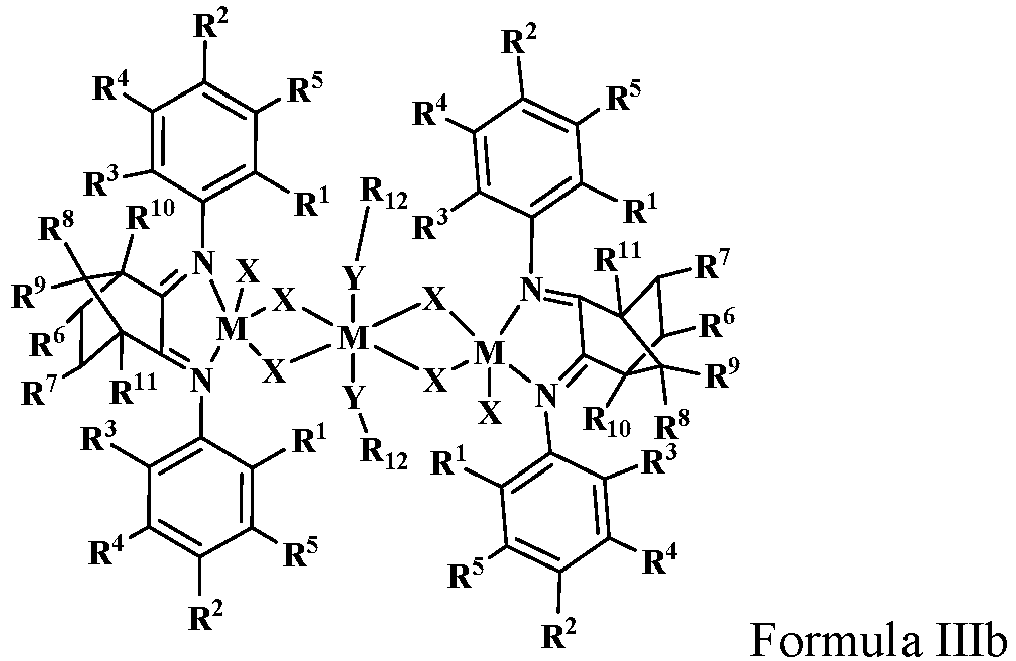
-
- 1) Preparation of ligand L1:
Under nitrogen atmosphere, 2,6-diethylaniline (2.0 ml, 12 mmol) was dissolved in 20 ml of toluene, and 12 ml of trimethylaluminum (1.0M, 12 mmol) was added dropwise at room temperature. The reaction was refluxed for 2 hours, and the system was cooled to room temperature. Camphorquinone (0.831 g, 5 mmol) was added, and the system was refluxed for 6h. The reaction product was neutralized with aqueous sodium hydroxide solution and extracted with dichloromethane, and combined organic layers were dried over anhydrous magnesium sulfate and concentrated. The residues were then subjected to a column chromatography to afford yellow ligand L1. Yield: 69.2 %. 1H-NMR (CDCl3): δ6.94-6.92 (m, 6H, CAr-CH3), 2.56-2.51 (m, 4H, CAr-CH3), 2.36-2.31 (m, 4H, CAr-CH3), 1.82-1.78 (m, 4H, CH2), 1.54 (m, 1H), 1.24-1.18 (m, 12H), 1.09 (s, 3H, CH3), 0.94 (m, 6H, CH3). - 2) Preparation of complex Ni1 (represented by structural Formula IIIb, wherein R1, R3 are ethyl; R2, R4-R7, R10 are hydrogen; R8, R9 and R11 are methyl; R12 is ethyl; M is nickel, Y is O, and X is Br):
A solution of 0.277g (0.9 mmol) of (DME)NiBr2 in ethanol (10mL) was added slowly dropwise to a solution of 0.258 g (0.6 mmol) of ligand L1 in dichloromethane (10mL). The color of the solution immediately changed to deep red, and a large quantity of precipitants was formed. The reaction was stirred at room temperature for 6h, and then anhydrous diethyl ether was added to perform precipitation. A filtration was performed to afford a filter cake, and the filter cake was washed with anhydrous diethyl ether and dried in vacuum to afford Ni1 as brownish-red powdery solids. Yield: 78.2 %. Elemental analysis (calculated for C64H90Br6N4Ni3O2): C, 47.96; H, 5.66; N, 3.50; experimental value (%): C, 47.48; H, 6.00; N, 3.26. - 3) Polymerization:
After having been continuously dried at 130°C for 6hrs, a 1L stainless steel polymerization autoclave equipped with mechanical stirring was evacuated while it was hot and then filled with N2 gas 3 times. 500 mL of hexane was charged into the autoclave, and at the same time, 8.0 mg (5.0 µmol) of the complex Ni1, 15 mmol (2.5 mL) of 2-methyl-2-hydroxy-7-octene, 15mL of AlEt3 (1.0 mol/L solution in hexane), 6.5 mL of MAO (1.53 mol/L solution in toluene) were added. The reaction was stirred at 30 °C for 30 minutes, with ethylene pressure being maintained at 10 atm. The reaction mixture was finally neutralized with an ethanol solution acidified with 10 wt% hydrochloric acid to obtain a polymer. The polymerization activity and polymer performance parameters are shown in Table 1 below. - Copolymerization of ethylene and 2-methyl-2-hydroxy-7-octene was carried out according to the polymerization procedure described in Example 1, except that 30 mmol (5.1 mL) of 2-methyl-2-hydroxy-7-octene and 30mL of AlEt3 (1.0 mol/L solution in hexane) were used. The polymerization activity and polymer performance parameters are shown in Table 1 below.
-
Figure 2 shows a photograph of the spherical and/or spherical-like polymer prepared in this Example. - Copolymerization of ethylene and 2-methyl-2-hydroxy-7-octene was carried out according to the polymerization procedure described in Example 2, except that the polymerization temperature was 60 °C. The polymerization activity and polymer performance parameters are shown in Table 1 below.
- Copolymerization of ethylene and 2-methyl-2-hydroxy-7-octene was carried out according to the polymerization procedure described in Example 2, except that 0.5mL of diethyl zinc (1 mol/L solution in hexane) was further added together with the catalyst. The polymerization activity and polymer performance parameters are shown in Table 1 below.
- Copolymerization of ethylene and 2-methyl-2-hydroxy-7-octene was carried out according to the polymerization procedure described in Example 4, except that 2 times quantity of the diethylzinc (i.e., 1.0 mL diethylzinc (1 mol/L solution in hexane)) was used. The polymerization activity and polymer performance parameters are shown in Table 1 below.
- Copolymerization of ethylene and 2-methyl-2-hydroxy-7-octene was carried out according to the polymerization procedure described in Example 1, except that 3.33 times quantity of the 2-methyl-2-hydroxy-7-octene (i.e., 50 mmol (8.5 mL) of 2-methyl-2-hydroxy-7-octene) and 3.33 times quantity of AlEt3 (i.e., 50 mL of AlEt3 (1.0 mol/L solution in hexane)) were used. The polymerization activity and polymer performance parameters are shown in Table 1 below.
- Copolymerization of ethylene and 2-methyl-2-hydroxy-7-octene was carried out according to the polymerization procedure described in Example 1, except that 6.67 times quantity of the 2-methyl-2-hydroxy-7-octene (i.e., 100 mmol (17.0 mL) of 2-methyl-2-hydroxy-7-octene) and 6.67 times quantity of the AlEt3 (i.e., 100mL of AlEt3 (1.0mol/L solution in hexane)) were used. The polymerization activity and polymer performance parameters are shown in Table 1 below.
-
- 1) Preparation of ligand L2:
Under nitrogen atmosphere, 2,6-diisopropylaniline (2.4 ml, 12 mmol) was dissolved in 20 ml of toluene, and 12 ml of trimethylaluminum (1.0M, 12 mmol) was added dropwise at room temperature. The reaction was refluxed for 2 hours, and the system was cooled to room temperature. Camphorquinone (0.831 g, 5 mmol) was added, and the reaction mixture was refluxed for 6h. The reaction product was neutralized with aqueous sodium hydroxide solution and extracted with dichloromethane, and combined organic layers were dried over anhydrous magnesium sulfate and concentrated. The residues were then subjected to a column chromatography to afford yellow ligand L2. Yield: 41.3%. 1H NMR (300 MHz, CDCl3), δ (ppm): 7.06-6.81 (m, 6H, Ar-H), 2.88 (m, 4H, CH(CH3)2), 2.36 (m, 1H,), 1.86 (m, 4H, CH2), 1.24 (d, 24H, CH(CH3)2), 0.96 (s, 6H, CH3), 0.77 (s, 3H, CH3). - 2) Preparation of complex Ni2 (represented by structural Formula IIIb, wherein R1, R3 are isopropyl; R2, R4-R7, R10 are hydrogen; R8, R9 and R11 are methyl; R12 is ethyl; M is nickel, Y is O, and X is Br):
A solution of 0.277g (0.9 mmol) of (DME)NiBr2 in ethanol (10mL) was added slowly dropwise to a solution of 0.291 g (0.6 mmol) of ligand L2 in dichloromethane (10mL). The color of the solution immediately changed to deep red, and a large quantity of precipitants was formed. The reaction was stirred at room temperature for 6h, and then anhydrous diethyl ether was added to perform precipitation. A filtration was performed to afford a filter cake, and the filter cake was washed with anhydrous diethyl ether and dried in vacuum to afford Ni2 as brownish-red powdery solids. Yield: 74.0 %. Elemental analysis (calculated for C72H106Br6N4Ni3O2): C, 50.42; H, 6.23; N, 3.27; experimental value (%): C, 50.28; H, 6.42; N, 3.18. - 3) Polymerization:
After having been continuously dried at 130°C for 6hrs, a 1L stainless steel polymerization autoclave equipped with mechanical stirring was evacuated while it was hot and then filled with N2 gas 3 times. 500 mL of hexane was charged into the autoclave, and at the same time, 8.6 mg (5.0 µmol) of the complex Ni2, 30 mmol (5.1 mL) of 2-methyl-2-hydroxy-7-octene, 30 mL of AlEt3 (1.0 mol/L solution in hexane), 6.5 mL of MAO (1.53 mol/L solution in toluene) were added. The reaction was stirred at 30 °C for 30 minutes, with ethylene pressure being maintained at 10 atm. The reaction mixture was finally neutralized with an ethanol solution acidified with 10 wt% hydrochloric acid to obtain a polymer. The polymerization activity and polymer performance parameters are shown in Table 1 below. - Copolymerization of ethylene and 2-methyl-2-hydroxy-7-octene was carried out according to the polymerization procedure described in Example 8, except that the polymerization temperature was 60 °C. The polymerization activity and polymer performance parameters are shown in Table 1 below.
- Ethylene copolymerization was carried out according to the polymerization procedure described in Example 8, except that 30 mmol (4.1 mL) of 3-methyl-5-hexen-3-ol was used as a comonomer. The polymerization activity and polymer performance parameters are shown in Table 1 below.
-
- 1) Preparation of complex Ni3 (represented by structural Formula IIIb, wherein R1, R3 are isopropyl; R2, R4-R7, R10 are hydrogen; R8, R9 and R11 are methyl; R12 is isobutyl; M is nickel, Y is O, and X is Br):
A solution of 0.277g (0.9 mmol) of (DME)NiBr2 in 2-methyl-1-propanol (10mL) was added slowly dropwise to a solution of 0.291 g (0.6 mmol) of ligand L2 in dichloromethane (10mL). The color of the solution immediately changed to deep red, and a large quantity of precipitants was formed. The reaction was stirred at room temperature for 6h, and then anhydrous diethyl ether was added to perform precipitation. A filtration was performed to afford a filter cake, and the filter cake was washed with anhydrous diethyl ether and dried in vacuum to afford Ni3 as brownish-red powdery solids. Yield: 76.0 %. Elemental analysis (calculated for C76H114Br6N4Ni3O2): C, 51.54; H, 6.49; N, 3.16; experimental value (%): C, 51.28; H, 6.82; N, 3.19. - 2) Polymerization:
After having been continuously dried at 130°C for 6hrs, a 1L stainless steel polymerization autoclave equipped with mechanical stirring was evacuated while it was hot and then filled with N2 gas 3 times. 500 mL of hexane was charged into the autoclave, and at the same time 8.9 mg (5.0 µmol) of the complex Ni3, 30 mmol (5.1 mL) of 2-methyl-2-hydroxy-7-octene, 30 mL of AlEt3 (1.0 mol/L solution in hexane), and 6.5 mL of MAO (1.53 mol/L solution in toluene) were added. The reaction was stirred at 30 °C for 30 minutes, with ethylene pressure being maintained at 10 atm. The reaction mixture was finally neutralized with an ethanol solution acidified with 10 wt% hydrochloric acid to obtain a polymer. The polymerization activity and polymer performance parameters are shown in Table 1 below. - Ethylene copolymerization was carried out according to the polymerization procedure described in Example 11, except that 30 mmol (4.5 mL) of 4-methyl-1-hepten-4-ol as a comonomer was used. The polymerization activity and polymer performance parameters are shown in Table 1 below.
-
- 1) Preparation of ligand L3:
Under nitrogen atmosphere, 2,4,6-trimethyl-aniline (1.7 ml, 12 mmol) was dissolved in 20 ml of toluene, and 12 ml of trimethylaluminum (1.0M, 12 mmol) was added dropwise at room temperature. The reaction was refluxed for 2 hours, and the system was cooled to room temperature. Camphorquinone (0.831 g, 5 mmol) was added, and the system was refluxed for 6h. The reaction product was neutralized with aqueous sodium hydroxide solution, extracted with dichloromethane, dried, and concentrated, and then subjected to a column chromatography to afford yellow ligand L3 in a yield of 62.5%. 1HNMR (300 MHz, CDCl3), δ (ppm) [with an isomer ratio of 1.2:1]: major isomer: 6.72 (s, 4H, Ar-H), 2.26-2.13 (m, 12H, CAr-CH3), 1.87 (s, 6H, CAr-CH3), 1.79 (m, 4H, CH2), 1.42 (m, 1H), 1.26 (s, 3H, CH3), 1.07 (s, 6H,CH3); minor isomer: 6.67 (s, 4H, Ar-H), 2.09-2.01 (m, 12H, CAr-CH3), 1.85 (s, 6H, CAr-CH3), 1.79 (m, 4H, CH2), 1.40 (m, 1H), 1.26 (s, 3H, CH3), 0.94 (s, 6H, CH3). - 2) Preparation of complex Ni4 (represented by the structural Formula IIIb, wherein R1-R3 are methyl, R4-R7 and R10 are hydrogen, R8, R9 and R11 are methyl, R12 is ethyl, M is nickel, Y is O, and X is Br):
A solution of 0.277g (0.9 mmol) of (DME)NiBr2 in ethanol (10mL) was added slowly dropwise to a solution of 0.240 g (0.6 mmol) of ligand L3 in dichloromethane (10mL). The color of the solution immediately changed to deep red, and a large quantity of precipitants was formed. The reaction was stirred at room temperature for 6h, and then anhydrous diethyl ether was added to perform precipitation. A filtration was performed to afford a filter cake, and the filter cake was washed with anhydrous diethyl ether and dried in vacuum to afford Ni4 as brownish-red powdery solids in a yield of 78.6 %. Elemental analysis (calculated for C60H82Br6N4Ni3O2): C, 46.59; H, 5.34; N, 3.62; experimental value (%): C, 46.24; H, 5.67; N, 3.21. - 3) Polymerization:
After having been continuously dried at 130°C for 6hrs, a 1L stainless steel polymerization autoclave equipped with mechanical stirring was evacuated while it was hot and then filled with N2 gas 3 times. 7.7 mg (5 µmol) of the complex Ni4 was added thereto, followed by evacuating and filling with ethylene to performreplacement 3 times. 500 mL of hexane, 30 mmol (5.1 mL) of 2-methyl-2-hydroxy-7-octene, and 30 mL of AlEt3 (1.0 mol/L solution in hexane) were charged into the autoclave, followed by the addition of 6.5 mL of methylaluminoxane (MAO) (1.53 mol/l solution in toluene). The reaction was vigorously stirred at 30 °C for 30 minutes, with ethylene pressure being maintained at 10 atm. The reaction mixture was neutralized with an ethanol solution acidified with 10 wt% hydrochloric acid to obtain a polymer. The results are shown in Table 1 below. -
- 1) Preparation of ligand L4:
Under nitrogen atmosphere, 2,6-dimethyl-4-bromo-aniline (2.45 g, 12 mmol) was dissolved in 20 ml of toluene, and 12 ml of trimethylaluminum (1.0M, 12 mmol) was added dropwise at room temperature. The reaction was refluxed for 2 hours, and the system was cooled to room temperature. Camphorquinone (0.831 g, 5 mmol) was added, and the system was refluxed for 6h. The reaction product was neutralized with aqueous sodium hydroxide solution, extracted with dichloromethane, dried and concentrated, and then subjected to a column chromatography to afford yellow ligand L4 in a yield of 60.7%. 1HNMR (300 MHz, CDCl3), δ (ppm) [with an isomer ratio of 1.1:1]: major isomer: 7.05 (s, 4H, Ar-H), 2.18 (m, 12H, CAr-CH3), 1.85 (m, 4H, CH2), 1.37 (m, 1H), 1.26 (s, 3H, CH3), 1.06 (s, 6H, CH3); minor isomer: 7.02 (s, 4H, Ar-H), 2.04 (m, 12H, CAr-CH3), 1.85 (m, 4H, CH2), 1.37 (m, 1H), 1.26 (s, 3H, CH3), 0.96 (s, 6H, CH3). - 2) Preparation of complex Ni5 (represented by the structural Formula IIIb, wherein R1 and R3 are methyl, R2 is bromine, R4-R7 and R10 are hydrogen, R8, R9 and R11 are methyl, R12 is ethyl, M is nickel, Y is O, and X is Br):
A solution of 0.278 g (0.9 mmol) of (DME)NiBr2 in ethanol (10mL) was added slowly dropwise to a solution of 0.318 g (0.6 mmol) of ligand L4 in dichloromethane (10mL). The color of the solution immediately changed to deep red, and a large quantity of precipitants was formed. The reaction was stirred at room temperature for 6h, and then anhydrous diethyl ether was added to perform precipitation. A filtration was performed to afford a filter cake, and the filter cake was washed with anhydrous diethyl ether and dried in vacuum to afford Ni5 as brownish-red powdery solids in a yield of 74.1 %. Elemental analysis (calculated for C56H70Br10N4Ni3O2): C, 37.24; H, 3.91; N, 3.10; experimental value (%): C, 37.38; H, 4.30; N, 3.03. - 3) Polymerization:
After having been continuously dried at 130°C for 6hrs, a 1L stainless steel polymerization autoclave equipped with mechanical stirring was evacuated while it was hot and then filled with N2 gas 3 times. 9.0 mg (5 µmol) of the complex Ni5 was added thereto, followed by evacuating and filling with ethylene to performreplacement 3 times. 500 mL of hexane, 30 mmol (5.1 mL) of 2-methyl-2-hydroxy-7-octene, and 30 mL of AlEt3 (1.0 mol/L solution in hexane) were charged into the autoclave, followed by the addition of 6.5 mL of methylaluminoxane (MAO) (1.53 mol/l solution in toluene). The reaction was vigorously stirred at 30 °C for 30 minutes, with ethylene pressure being maintained at 10 atm. The reaction mixture was neutralized with an ethanol solution acidified with 10 wt% hydrochloric acid to obtain a polymer. The results are shown in Table 1 below. -
- 1) Preparation of ligand L5:
Under nitrogen atmosphere, 2,6-diisopropyl-aniline (2.30 ml, 12 mmol) was dissolved in 20 ml of toluene, and 12 ml of trimethylaluminum (1.0M, 12 mmol) was added dropwise at room temperature. The reaction was refluxed for 2 hours, and the system was cooled to room temperature. Dione (1.225 g, 5 mmol) was added, and the system was refluxed for 6h. The reaction product was neutralized with aqueous sodium hydroxide solution, extracted with dichloromethane, dried and concentrated, and then subjected to a column chromatography to afford yellow ligand L5 in a yield of 62.7%. 1H NMR (300 MHz, CDCl3), δ (ppm): 7.05-6.83 (m, 6H, Ar-H), 3.30(m, 2H, CH2), 2.80 (m, 4H, CH(CH3)2), 1.55 (m, 1H), 1.83 (m, 4H, CH2), 1.26 (d, 24H, CH(CH3)2), 0.99 (s, 6H, CH3). - 2) Preparation of complex Ni6 (represented by the structural Formula IIIb, wherein R1 and R3 are isopropyl, R2, R4-R7 and R10 are hydrogen, R8 and R9 are methyl, R11 is CH2Br, R12 is ethyl, M is nickel, Y is O, and X is Br):
A solution of 0.277 g (0.9 mmol) of (DME)NiBr2 in ethanol (10mL) was added slowly dropwise to a solution of 0.338 g (0.6 mmol) of ligand L5 in dichloromethane (10mL). The color of the solution immediately changed to deep red, and a large quantity of precipitants was formed. The reaction was stirred at room temperature for 6h, and then anhydrous diethyl ether was added to perform precipitation. A filtration was performed to afford a filter cake, and the filter cake was washed with anhydrous diethyl ether and dried in vacuum to afford Ni6 as brownish-red powdery solids in a yield of 80.2 %. Elemental analysis (calculated for C72H104Br8N4Ni3O2): C, 46.17; H, 5.60; N, 2.99; experimental value (%): C, 46.24; H, 5.80; N, 3.13. - 3) Polymerization:
After having been continuously dried at 130°C for 6hrs, a 1L stainless steel polymerization autoclave equipped with mechanical stirring was evacuated while it was hot and then filled with N2 gas 3 times. 9.4 mg (5 µmol) of the complex Ni6 was added thereto, followed by evacuating and filling with ethylene to performreplacement 3 times. 500 mL of hexane, 30 mmol (5.1 mL) of 2-methyl-2-hydroxy-7-octene, and 30 mL of AlEt3 (1.0 mol/L solution in hexane) were charged into the autoclave, followed by the addition of 6.5 mL of methylaluminoxane (MAO) (1.53 mol/l solution in toluene). The reaction was vigorously stirred at 30 °C for 30 minutes, with ethylene pressure being maintained at 10 atm. The reaction mixture was neutralized with an ethanol solution acidified with 10 wt% hydrochloric acid to obtain a polymer. The results are shown in Table 1 below. - Ethylene copolymerization was carried out according to the polymerization procedure described in Example 2, except that 15 mL of a solution of N,N-dimethylanilinium tetrakis(pentafluorophenyl)borate in toluene (1 mmol/L toluene solution) was used instead of the MAO. The results are shown in Table 1 below.
- After having been continuously dried at 130°C for 6hrs, a 1L stainless steel polymerization autoclave equipped with mechanical stirring was evacuated while it was hot and then filled with N2 gas 3 times. 500 mL of hexane was charged into the autoclave, and at the same time 8.0 mg (5.0 µmol) of the complex Ni1, 30 mmol (6.0 mL) of 10-undecen-1-ol, 30 mL of AlEt3 (1.0 mol/L solution in hexane), and 6.5 mL of MAO (1.53 mol/L solution in toluene) were added. The reaction was stirred at 30 °C for 30 minutes, with ethylene pressure being maintained at 10 atm. The reaction mixture was finally neutralized with an ethanol solution acidified with 10 wt% hydrochloric acid to obtain a polymer. The polymerization activity and polymer performance parameters are shown in Table 1 below.
- Ethylene copolymerization was carried out according to the polymerization procedure described in Example 2, except that 500mL of toluene was used instead of the hexane. The results are shown in Table 1 below.
- Ethylene copolymerization was carried out according to the polymerization procedure described in Example 1, except that 15 µmol of Comparative Catalyst A was used.

- Ethylene copolymerization was carried out according to the polymerization procedure described in Example 1, except that 15 µmol of Comparative Catalyst B was used.

Table 1 No. Complex Polymerization Activity 106g·mol-1(Ni)·h-1 Mw (x104) PDI Alcohol content (mol %) Whether is there spherical or spherical-like polymer particles in the copolymer? Spherical particle diameter (mm) Example 1 Ni1 20.2 34.4 2.02 0.67 Yes 3.5 Example 2 Ni1 26.7 48.2 1.92 1.37 Yes 3.8 Example 3 Ni1 21.7 20.2 1.98 1.21 No Example 4 Ni1 15.2 32.4 1.90 1.14 Yes 2.8 Example 5 Ni1 12.4 21.7 1.95 1.03 Yes 2.1 Example 6 Ni1 28.2 58.2 1.98 2.03 Yes 2.9 Example 7 Ni1 15.7 62.4 2.03 3.84 Yes 2.2 Example 8 Ni2 21.4 62.7 1.96 1.02 Yes 3.8 Example 9 Ni2 20.3 31.6 2.02 0.96 No Example 10 Ni2 11.7 20.6 2.02 0.98 Yes 3.6 Example 11 Ni3 16.4 51.2 2.01 0.94 Yes 3.4 Example 12 Ni3 13.3 42.7 2.04 0.93 Yes 3.2 Example 13 Ni4 33.2 13.4 2.01 1.48 Yes 2.8 Example 14 Nis 35.1 14.9 1.98 1.46 Yes 2.9 Example 15 Ni6 18.4 40.3 2.02 0.94 Yes 3.0 Example 16 Ni1 24.2 43.3 2.04 1.36 Yes 3.3 Example 17 Ni1 18.2 37.8 2.08 1.52 No Example 18 Ni1 24.1 44.3 2.02 1.36 No Comp. Ex. 1 A 15.2 36.3 2.32 0.97 Yes 3.4 Comp. Ex. 2 B 3.41 64.3 2.35 0.92 No - After having been continuously dried at 130°C for 6hrs, a 1L stainless steel polymerization autoclave equipped with mechanical stirring was evacuated while it was hot and then filled with N2 gas 3 times. 500 mL of hexane was charged into the autoclave, and at the same time 8.0 mg (5.0 µmol) of the complex Ni1, 15 mmol (2.55g) of 2,2-dimethyl-7-octenoic acid, 15 mL of AlEt3 (1.0 mol/L solution in hexane), and 6.5 mL of MAO (1.53 mol/L solution in toluene) were added. The reaction was stirred at 30 °C for 30 minutes, with ethylene pressure being maintained at 10 atm.
- The reaction mixture was finally neutralized with an ethanol solution acidified with 10 wt% hydrochloric acid to obtain a polymer. The polymerization activity and polymer performance parameters are shown in Table 2 below.
- Ethylene copolymerization was carried out according to the polymerization procedure described in Example 19, except that 2 times quantity of 2,2-dimethyl-7-octenoic acid and 2 times quantity of AlEt3 were used. The results are shown in Table 1 below. The polymerization activity and polymer performance parameters are shown in Table 2 below.
- Ethylene copolymerization was carried out according to the polymerization procedure described in Example 20, except that polymerization temperature was 60 °C. The polymerization activity and polymer performance parameters are shown in Table 2 below.
- Ethylene copolymerization was carried out according to the polymerization procedure described in Example 20, except that 0.5 mL of diethylzinc (1 mol/L solution in hexane) was further added together with the catalyst. The polymerization activity and polymer performance parameters are shown in Table 2 below.
- Ethylene copolymerization was carried out according to the polymerization procedure described in Example 20, except that 1.0 mL of diethylzinc (1 mol/L solution in hexane) was further added together with the catalyst. The polymerization activity and polymer performance parameters are shown in Table 2 below.
- Ethylene copolymerization was carried out according to the polymerization procedure described in Example 19, except that 3.33 times quantity (i.e., 50 mmol (8.51g)) of 2,2-dimethyl-7-octenoic acid and 3.33 times quantity (i.e., 50 mL) of AlEt3 (1.0 mol/L solution in hexane) were used. The polymerization activity and polymer performance parameters are shown in Table 2 below.
- Ethylene copolymerization was carried out according to the polymerization procedure described in Example 19, except that 6.67 times quantity (i.e., 100 mmol (17.02 g)) of 2,2-dimethyl-7-octenoic acid and 6.67 times quantity (i.e., 100 mL) of AlEt3 (1.0 mol/L solution in hexane) were used. The polymerization activity and polymer performance parameters are shown in Table 2 below.
- After having been continuously dried at 130°C for 6hrs, a 1L stainless steel polymerization autoclave equipped with mechanical stirring was evacuated while it was hot and then filled with N2 gas 3 times. 500 mL of hexane was charged into the autoclave, and at the same time 8.6 mg (5 µmol) of the complex Ni2, 30 mmol (5.10g) of 2,2-dimethyl-7-octenoic acid, 15 mL of AlEt3 (1.0 mol/L solution in hexane), and 6.5 mL of MAO (1.53 mol/L solution in toluene) were added. The reaction was stirred at 30 °C for 30 minutes, with ethylene pressure being maintained at 10 atm. The reaction mixture was finally neutralized with an ethanol solution acidified with 10 wt% hydrochloric acid to obtain a polymer. The polymerization activity and polymer performance parameters are shown in Table 2 below.
- After having been continuously dried at 130°C for 6hrs, a 1L stainless steel polymerization autoclave equipped with mechanical stirring was evacuated while it was hot and then filled with N2 gas 3 times. 500 mL of hexane was charged into the autoclave, and at the same time 8.6 mg (5 µmol) of the complex Ni2, 50 mmol (8.51g) of 2,2-dimethyl-7-octenoic acid, 50 mL of AlEt3 (1.0 mol/L solution in hexane), and 6.5 mL of MAO (1.53 mol/L solution in toluene) were added. The reaction was stirred at 60 °C for 30 minutes, with ethylene pressure being maintained at 10 atm. The reaction mixture was finally neutralized with an ethanol solution acidified with 10 wt% hydrochloric acid to obtain a polymer. The polymerization activity and polymer performance parameters are shown in Table 2 below.
- After having been continuously dried at 130°C for 6hrs, a 1L stainless steel polymerization autoclave equipped with mechanical stirring was evacuated while it was hot and then filled with N2 gas 3 times. 500 mL of hexane was charged into the autoclave, and at the same time 8.6 mg (5 µmol) of the complex Ni2, 30 mmol (4.69 g) of 2,2-dimethyl-6-heptenoic acid, 30 mL of AlEt3 (1.0 mol/L solution in hexane), and 6.5 mL of MAO (1.53 mol/L solution in toluene) were added. The reaction was stirred at 30 °C for 60 minutes, with ethylene pressure being maintained at 10 atm. The reaction mixture was finally neutralized with an ethanol solution acidified with 10 wt% hydrochloric acid to obtain a polymer. The polymerization activity and polymer performance parameters are shown in Table 2 below.
- Ethylene copolymerization was carried out according to the polymerization procedure described in Example 20, except that 8.9 mg (5 µmol) of the complex Ni3 was used as a catalyst. The polymerization activity and polymer performance parameters are shown in Table 2 below.
- After having been continuously dried at 130°C for 6hrs, a 1L stainless steel polymerization autoclave equipped with mechanical stirring was evacuated while it was hot and then filled with N2 gas 3 times. 7.7 mg (5 µmol) of the complex Ni4 was added thereto, followed by evacuating and filling with ethylene to perform
replacement 3 times. 500 mL of hexane, 30 mmol (5.10g) of 2,2-dimethyl-7-octenoic acid, and 30 mL of AlEt3 (1.0 mol/L solution in hexane) were charged into the autoclave, followed by the addition of 6.5 mL of methylaluminoxane (MAO) (1.53 mol/l solution in toluene). The reaction was vigorously stirred at 30 °C for 30 minutes, with ethylene pressure being maintained at 10 atm. The reaction mixture was neutralized with an ethanol solution acidified with 10 wt% hydrochloric acid to obtain a polymer. The results are shown in Table 2 below. - After having been continuously dried at 130°C for 6hrs, a 1L stainless steel polymerization autoclave equipped with mechanical stirring was evacuated while it was hot and then filled with N2 gas 3 times. 9.0 mg (5 µmol) of the complex Ni5 was added thereto, followed by evacuating and filling with ethylene to perform
replacement 3 times. 500 mL of hexane, 30 mmol (5. 10g) of 2,2-dimethyl-7-octenoic acid, and 30 mL of AlEt3 (1.0 mol/L solution in hexane) were charged into the autoclave, followed by the addition of 6.5 mL of methylaluminoxane (MAO) (1.53 mol/l solution in toluene). The reaction was vigorously stirred at 20 °C for 30 minutes, with ethylene pressure being maintained at 10 atm. The reaction mixture was neutralized with an ethanol solution acidified with 10 wt% hydrochloric acid to obtain a polymer. The results are shown in Table 2 below. - After having been continuously dried at 130°C for 6hrs, a 1L stainless steel polymerization autoclave equipped with mechanical stirring was evacuated while it was hot and then filled with N2 gas 3 times. 9.4 mg (5 µmol) of the complex Ni6 was added thereto, followed by evacuating and filling with ethylene to perform
replacement 3 times. 500 mL of hexane, 30 mmol (5. 10g) of 2,2-dimethyl-7-octenoic acid, and 30 mL of AlEt3 (1.0 mol/L solution in hexane) were charged into the autoclave, followed by the addition of 6.5 mL of methylaluminoxane (MAO) (1.53 mol/l solution in toluene). The reaction was vigorously stirred at 50 °C for 30 minutes, with ethylene pressure being maintained at 10 atm. The reaction mixture was neutralized with an ethanol solution acidified with 10 wt% hydrochloric acid to obtain a polymer. The results are shown in Table 2 below. - Ethylene copolymerization was carried out according to the polymerization procedure described in Example 20, except that 15 mL of a solution of N,N-dimethylanilinium tetrakis(pentafluorophenyl)borate in toluene (1 mmol/L toluene solution) was used instead of MAO. The results are shown in Table 2 below.
- Ethylene copolymerization was carried out according to the polymerization procedure described in Example 20, except that 30 mmol (5.53g) of 10-undecenoic acid was used as a comonomer. The polymerization activity and polymer performance parameters are shown in Table 2 below.
- Ethylene copolymerization was carried out according to the polymerization procedure described in Example 2, except that 500mL of toluene was used instead of the hexane. The polymerization activity and polymer performance parameters are shown in Table 2 below.
Table 2 No. Complex Polymerization Activity 106g·mol-1(Ni)h-1 Mn (x104) Comonomer content (mol %) Whether is there spherical and/or spherical-like polymer particles in the copolymer? Example 19 Ni1 15.3 14.2 0.78 Yes Example 20 Ni1 17.2 16.3 1.24 Yes Example 21 Ni1 16.2 9.3 1.02 No Example 22 Ni1 11.7 10.4 1.21 Yes Example 23 Ni1 9.3 8.4 1.17 Yes Example 24 Ni1 20.7 18.4 2.02 Yes Example 25 Ni1 16.3 16.2 3.72 Yes Example 26 Ni2 15.8 20.6 1.17 Yes Example 27 Ni2 11.3 16.4 1.02 No Example 28 Ni2 15.2 18.9 1.15 Yes Example 29 Ni3 11.3 10.4 1.01 Yes Example 30 Ni4 21.7 8.4 1.53 Yes Example 31 Ni5 13.2 6.3 1.40 Yes Example 32 Ni6 14.2 17.3 1.02 Yes Example 33 Ni1 15.4 14.7 1.21 Yes Example 34 Ni1 14.1 13.0 1.13 No Example 35 Ni1 17.0 15.4 1.23 No - It can be seen from Table 2 that when the catalyst of the present invention catalyzes the copolymerization of ethylene and an unsaturated carboxylic acid, it exhibits higher polymerization activity, and the resulting polymer has a higher molecular weight. The catalyst of the present invention can have a copolymerization activity of up to 21.7×10⁶g·mol-1(Ni)·h-1, and the molecular weight of the polymer can be adjusted in a wide range by the addition of a chain transfer agent. In addition, by adjusting the polymerization conditions, a copolymer product with good particle morphology can be obtained.
- The following structural Formulae of ligands and complexes are mentioned in Example 36-68:

-
- 1) Ligand L11 (represented by the structural Formula B, wherein R1, R3, R4, and R6 are isopropyl, R2, R5, R7-R10, R21, and R22 are hydrogen) was prepared by following the literature Organometallics, 2013, 32, 2291-2299.
- 2) Preparation of complex Ni11 (represented by the structural Formula IIIc, wherein R1, R3, R4, and R6 are isopropyl, R2, R5, R7-R10, R21, and R22 are hydrogen, R11 is ethyl, M is nickel, Y is O, and X is Br):
A solution of 0.277 g (0.9 mmol) of (DME)NiBr2 in ethanol (10mL) was added slowly dropwise to a solution of 0.332 g (0.6 mmol) of ligand L11 in dichloromethane (10mL). The color of the solution immediately changed to deep red, and a large quantity of precipitants was formed. The reaction was stirred at room temperature for 6h, and then anhydrous diethyl ether was added to perform precipitation. A filtration was performed to afford a filter cake, and the filter cake was washed with anhydrous diethyl ether and dried in vacuum to afford Ni11 as brownish-red powdery solids in a yield of 78.2 %. Elemental analysis (calculated for C84H98Br6N4Ni3O2): C, 54.50; H, 5.34; N, 3.03; experimental value (%): C, 54.38; H, 5.72; N, 3.16. - 3) Polymerization:
After having been continuously dried at 130°C for 6hrs, a 1L stainless steel polymerization autoclave equipped with mechanical stirring was evacuated while it was hot and then filled with N2 gas 3 times. 500 mL of hexane was charged into the autoclave, and at the same time 9.3 mg (5 µmol) of the complex Ni11, 15 mmol (2.5 mL) of 2-methyl-2-hydroxy-7-octene, 15 mL of AlEt3 (1.0 mol/L solution in hexane), and 6.5 mL of MAO (1.53 mol/L solution in toluene) were added. The reaction was stirred at 30 °C for 30 minutes, with ethylene pressure being maintained at 10 atm. The reaction mixture was finally neutralized with an ethanol solution acidified with 10 wt% hydrochloric acid to obtain a polymer. The polymerization activity and polymer performance parameters are shown in Table 3 below. - After having been continuously dried at 130°C for 6hrs, a 1L stainless steel polymerization autoclave equipped with mechanical stirring was evacuated while it was hot and then filled with N2 gas 3 times. 500 mL of hexane was charged into the autoclave, and at the same time 9.3 mg (5 µmol) of the complex Ni11, 30 mmol (5.1 mL) of 2-methyl-2-hydroxy-7-octene, 30 mL of AlEt3 (1.0 mol/L solution in hexane), and 6.5 mL of MAO (1.53 mol/L solution in toluene) were added. The reaction was stirred at 30 °C for 30 minutes, with ethylene pressure being maintained at 10 atm. The reaction mixture was finally neutralized with an ethanol solution acidified with 10 wt% hydrochloric acid to obtain a polymer. The polymerization activity and polymer performance parameters are shown in Table 3 below.
- Ethylene copolymerization was carried out according to the polymerization procedure described in Example 37, except that the polymerization temperature was 60°C. The polymerization activity and polymer performance parameters are shown in Table 3 below.
- After having been continuously dried at 130°C for 6hrs, a 1L stainless steel polymerization autoclave equipped with mechanical stirring was evacuated while it was hot and then filled with N2 gas 3 times. 500 mL of hexane was charged into the autoclave, and at the same time 9.3 mg (5 µmol) of the complex Ni11, 30 mmol (5.1 mL) of 2-methyl-2-hydroxy-7-octene, 30 mL of AlEt3 (1.0 mol/L solution in hexane), 0.5 mL of diethylzinc (1mol/L solution in hexane), and 6.5 mL of MAO (1.53 mol/L solution in toluene) were added. The reaction was stirred at 30 °C for 30 minutes, with ethylene pressure being maintained at 10 atm. The reaction mixture was finally neutralized with an ethanol solution acidified with 10 wt% hydrochloric acid to obtain a polymer. The polymerization activity and polymer performance parameters are shown in Table 3 below.
- Ethylene copolymerization was carried out according to the polymerization procedure described in Example 39, except that 2 times quantity (1.0 mL) of diethylzinc (1mol/L solution in hexane) was used. The polymerization activity and polymer performance parameters are shown in Table 3 below.
- After having been continuously dried at 130°C for 6hrs, a 1L stainless steel polymerization autoclave equipped with mechanical stirring was evacuated while it was hot and then filled with N2 gas 3 times. 500 mL of hexane was charged into the autoclave, and at the same time 9.3 mg (5 µmol) of the complex Ni11, 50 mmol (8.5 mL) of 2-methyl-2-hydroxy-7-octene, 50 mL of AlEt3 (1.0 mol/L solution in hexane), and 6.5 mL of MAO (1.53 mol/L solution in toluene) were added. The reaction was stirred at 30 °C for 30 minutes, with ethylene pressure being maintained at 10 atm. The reaction mixture was finally neutralized with an ethanol solution acidified with 10 wt% hydrochloric acid to obtain a polymer. The polymerization activity and polymer performance parameters are shown in Table 3 below.
- After having been continuously dried at 130°C for 6hrs, a 1L stainless steel polymerization autoclave equipped with mechanical stirring was evacuated while it was hot and then filled with N2 gas 3 times. 500 mL of hexane was charged into the autoclave, and at the same time 9.3 mg (5 µmol) of the complex Ni11, 100 mmol (17.0 mL) of 2-methyl-2-hydroxy-7-octene, 100 mL of AlEt3 (1.0 mol/L solution in hexane), and 6.5 mL of MAO (1.53 mol/L solution in toluene) were added. The reaction was stirred at 30 °C for 30 minutes, with ethylene pressure being maintained at 10 atm. The reaction mixture was finally neutralized with an ethanol solution acidified with 10 wt% hydrochloric acid to obtain a polymer. The polymerization activity and polymer performance parameters are shown in Table 3 below.
- Example 43

- 1) Ligand L12 (represented by the structural Formula B, wherein R1, R3, R4 and R6 are ethyl, R2, R5, R7-R10 and R22 are hydrogen, and R21 is tert-butyl) was prepared by following the Patent
CN106397264 as follows. Compound A (2.7 g, 7.8 mmol) and 2,6-diethylaniline (3.0 ml, 17.4 mmol) were refluxed in the presence of p-toluenesulfonic acid (0.02 g) as a catalyst in 100mL of toluene for 1 day, and then the solvent was filtered off. The residue was dissolved in dichloromethane and then separated by over-basic alumina column chromatography with petroleum ether/ethyl acetate (20:1) as an eluant, with the second fraction being the target product. After removing the solvent, a yellow solid product was obtained at a yield of 81%. 1H NMR (CDCl3, δ, ppm):1.06 (t, 12H, J = 7.0Hz), 1.19 ppm (s, 18H), 2.20 (dd, 8H, J = 7.0Hz), 4.70 (s, 2H), 7.04 (m, 10H), 7.13 (s, 2H). - 2) Preparation of complex Ni12 (represented by the structural Formula IIIc, wherein R1, R3, R4 and R6 are ethyl, R2, R5, R7-R10 and R22 are hydrogen, R21 is tert-butyl, R11 is ethyl, M is nickel, Y is O, and X is Br):
A solution of 0.277 g (0.9 mmol) of (DME)NiBr2 in ethanol (10mL) was added slowly dropwise to a solution of 0.365 g (0.6 mmol) of ligand L2 in dichloromethane (10mL). The color of the solution immediately changed to deep red, and a large quantity of precipitants was formed. The reaction was stirred at room temperature for 6h, and then anhydrous diethyl ether was added to perform precipitation. A filtration was performed to afford a filter cake, and the filter cake was washed with anhydrous diethyl ether and dried in vacuum to afford Ni12 as brownish-red powdery solids in a yield of 82.0 %. Elemental analysis (calculated for C92H114Br6N4Ni3O2): C, 56.28; H, 5.85; N, 2.85; experimental value (%): C, 56.43; H, 6.12; N, 3.08. - 3) Polymerization:
After having been continuously dried at 130°C for 6hrs, a 1L stainless steel polymerization autoclave equipped with mechanical stirring was evacuated while it was hot and then filled with N2 gas 3 times. 500 mL of hexane was charged into the autoclave, and at the same time 9.8 mg (5 µmol) of the complex Ni12, 30 mmol (5.1 mL) of 2-methyl-2-hydroxy-7-octene, 30 mL of AlEt3 (1.0 mol/L solution in hexane), and 6.5 mL of MAO (1.53 mol/L solution in toluene) were added. The reaction was stirred at 30 °C for 30 minutes, with ethylene pressure being maintained at 10 atm. The reaction mixture was finally neutralized with an ethanol solution acidified with 10 wt% hydrochloric acid to obtain a polymer. The polymerization activity and polymer performance parameters are shown in Table 3 below. - After having been continuously dried at 130°C for 6hrs, a 1L stainless steel polymerization autoclave equipped with mechanical stirring was evacuated while it was hot and then filled with N2 gas 3 times. 500 mL of hexane was charged into the autoclave, and at the same time 9.8 mg (5 µmol) of the complex Ni1z, 30 mmol (8.5 mL) of 2-methyl-2-hydroxy-7-octene, 30 mL of AlEt3 (1.0 mol/L solution in hexane), and 6.5 mL of MAO (1.53 mol/L solution in toluene) were added. The reaction was stirred at 60 °C for 30 minutes, with ethylene pressure being maintained at 10 atm. The reaction mixture was finally neutralized with an ethanol solution acidified with 10 wt% hydrochloric acid to obtain a polymer. The polymerization activity and polymer performance parameters are shown in Table 3 below.
- After having been continuously dried at 130°C for 6hrs, a 1L stainless steel polymerization autoclave equipped with mechanical stirring was evacuated while it was hot and then filled with N2 gas 3 times. 500 mL of hexane was charged into the autoclave, and at the same time 9.8 mg (5 µmol) of the complex Ni1z, 30 mmol (4.1 mL) of 3-methyl-5-hexen-3-ol, 30 mL of AlEt3 (1.0 mol/L solution in hexane), and 6.5 mL of MAO (1.53 mol/L solution in toluene) were added. The reaction was stirred at 30 °C for 60 minutes, with ethylene pressure being maintained at 10 atm. The reaction mixture was finally neutralized with an ethanol solution acidified with 10 wt% hydrochloric acid to obtain a polymer. The polymerization activity and polymer performance parameters are shown in Table 3 below.
-
- 1) Preparation of ligand L13 (represented by the structural Formula B, wherein R1, R3, R4 and R6 are methyl, R2 and R5 are bromine, R7-R10 and R22 are hydrogen, R21 is t-butyl): Compound A (1.77 g, 5.1 mmol) and 2,6-dimethyl-4-bromo-aniline (2.3 g, 11.3 mmol) were refluxed, in the presence of p-toluenesulfonic acid (0.02g) as a catalyst, in 100mL of toluene for 1 day. The solvent was filtered off, and the residue was dissolved in dichloromethane and separated by column chromatography with petroleum ether/ethyl acetate as an eluant, to afford L13 as yellow solids in a yield of 78 %. 1H NMR (CDCl3, δ, ppm): 1.84 (s, 12H), 1.19 ppm (s, 18H), 4.70 (s, 2H), 7.04 (8H), 7.12 (s, 2H).
- 2) Preparation of complex Ni13 (represented by the structural Formula IIIc, wherein R1, R3, R4 and R6 are methyl, R2 and R5 are bromine, R7-R10 and R22 are hydrogen, R21 is tert-butyl, R11 is ethyl, M is nickel, Y is O, and X is Br):
A solution of 0.277 g (0.9 mmol) of (DME)NiBr2 in ethanol (10mL) was added slowly dropwise to a solution of 0.426 g (0.6 mmol) of ligand L13 in dichloromethane (10mL). The color of the solution immediately changed to deep red, and a large quantity of precipitants was formed. The reaction was stirred at room temperature for 6h, and then anhydrous diethyl ether was added to perform precipitation. A filtration was performed to afford a filter cake, and the filter cake was washed with anhydrous diethyl ether and dried in vacuum to afford Ni13 as brownish-red powdery solids in a yield of 82.0 %. Elemental analysis (calculated for C84H94Br10N4Ni3O2): C, 46.56; H, 4.37; N, 2.59; experimental value (%): C, 46.43; H, 4.72; N, 2.98. - 3) Polymerization:
After having been continuously dried at 130°C for 6hrs, a 1L stainless steel polymerization autoclave equipped with mechanical stirring was evacuated while it was hot and then filled with N2 gas 3 times. 500 mL of hexane was charged into the autoclave, and at the same time 10.8 mg (5 µmol) of the complex Ni13, 30 mmol (5.1 mL) of 2-methyl-2-hydroxy-7-octene, 30 mL of AlEt3 (1.0 mol/L solution in hexane), and 6.5 mL of MAO (1.53 mol/L solution in toluene) were added. The reaction was stirred at 30 °C for 30 minutes, with ethylene pressure being maintained at 10 atm. The reaction mixture was finally neutralized with an ethanol solution acidified with 10 wt% hydrochloric acid to obtain a polymer. The polymerization activity and polymer performance parameters are shown in Table 3 below. - After having been continuously dried at 130°C for 6hrs, a 1L stainless steel polymerization autoclave equipped with mechanical stirring was evacuated while it was hot and then filled with N2 gas 3 times. 500 mL of hexane was charged into the autoclave, and at the same time 10.8 mg (5 µmol) of the complex Ni13, 30 mmol (4.5mL) of 4-methyl-1-heptene-4-ol, 30 mL of AlEt3 (1.0 mol/L solution in hexane), and 6.5 mL of MAO (1.53 mol/L solution in toluene) were added. The reaction was stirred at 30 °C for 30 minutes, with ethylene pressure being maintained at 10 atm. The reaction mixture was finally neutralized with an ethanol solution acidified with 10 wt% hydrochloric acid to obtain a polymer. The polymerization activity and polymer performance parameters are shown in Table 3 below.
-
- 1) Preparation of complex Ni14 (represented by the structural Formula IIIc, wherein R1, R3, R4 and R6 are ethyl, R2, R5, R7-R10 and R22 are hydrogen, R21 is tert-butyl, R11 is isobutyl, M is nickel, Y is O, and X is Br)
A solution of 0.277 g (0.9 mmol) of (DME)NiBr2 in 2-methyl-1-propanol (10mL) was added slowly dropwise to a solution of 0.365 g (0.6 mmol) of ligand L12 in dichloromethane (10mL). The color of the solution immediately changed to deep red, and a large quantity of precipitants was formed. The reaction was stirred at room temperature for 6h, and then anhydrous diethyl ether was added to perform precipitation. A filtration was performed to afford a filter cake, and the filter cake was washed with anhydrous diethyl ether and dried in vacuum to afford Ni14 as brownish-red powdery solids in a yield of 83.0 %. Elemental analysis (calculated for C96H122Br6N4Ni3O2): C, 57.09; H, 6.09; N, 2.77; experimental value (%): C, 57.24; H, 6.32; N, 3.04. - 2) Polymerization:
After having been continuously dried at 130°C for 6hrs, a 1L stainless steel polymerization autoclave equipped with mechanical stirring was evacuated while it was hot and then filled with N2 gas 3 times. 10.1 mg (5 µmol) of the complex Ni14 was added thereto, followed by evacuating and filling with ethylene to performreplacement 3 times. 500 mL of hexane, 30 mmol (5.1 mL) of 2-methyl-2-hydroxy-7-octene, and 30 mL of AlEt3 (1.0 mol/L solution in hexane) were charged into the autoclave, followed by the addition of 6.5 mL of methylaluminoxane (MAO) (1.53 mol/l solution in toluene). The reaction was vigorously stirred at 30 °C for 30 minutes, with ethylene pressure being maintained at 10 atm. The reaction mixture was neutralized with an ethanol solution acidified with 10 wt% hydrochloric acid to obtain a polymer. The results are shown in Table 3 below. - Example 49

- 1) Ligand L19 was prepared by following the method disclosed in patent application
CN201510462932.2 - 2) Preparation of complex Ni15 (represented by Formula IIIc', wherein R1= R3= R4= R6=Et, R2= R5= R7-R10= R31=R32=H, R11=Et, M=Ni, Y=O, X=Br):

- 3) Polymerization:
After having been continuously dried at 130°C for 6hrs, a 1L stainless steel polymerization autoclave equipped with mechanical stirring was evacuated while it was hot and then filled with N2 gas 3 times. 9.7 mg (5 µmol) of the complex Ni15 was added thereto, followed by evacuating and filling with ethylene to performreplacement 3 times. 500 mL of hexane, 30 mmol (5.1 mL) of 2-methyl-2-hydroxy-7-octene, and 30 mL of AlEt3 (1.0 mol/L solution in hexane) were charged into the autoclave, followed by the addition of 6.5 mL of methylaluminoxane (MAO) (1.53 mol/l solution in toluene). The reaction was vigorously stirred at 30 °C for 30 minutes, with ethylene pressure being maintained at 10 atm. The reaction mixture was neutralized with an ethanol solution acidified with 10 wt% hydrochloric acid to obtain a polymer. The results are shown in Table 3 below. - After having been continuously dried at 130°C for 6hrs, a 1L stainless steel polymerization autoclave equipped with mechanical stirring was evacuated while it was hot and then filled with N2 gas 3 times. 500 mL of hexane was charged into the autoclave, and at the same time 9.3 mg (5 µmol) of the complex Ni11, 30 mmol (5.1 mL) of 2-methyl-2-hydroxy-7-octene, and 30 mL of AlEt3 (1.0 mol/L solution in hexane) were added thereto, followed by the addition of 15mL of a solution of N,N-dimethylanilinium tetrakis(pentafluorophenyl)borate in toluene (1 mmol/L toluene solution). The reaction was stirred at 30 °C for 30 minutes, with ethylene pressure being maintained at 10 atm. The reaction mixture was finally neutralized with an ethanol solution acidified with 10 wt% hydrochloric acid to obtain a polymer. The polymerization activity and polymer performance parameters are shown in Table 3 below.
- After having been continuously dried at 130°C for 6hrs, a 1L stainless steel polymerization autoclave equipped with mechanical stirring was evacuated while it was hot and then filled with N2 gas 3 times. 500 mL of hexane was charged into the autoclave, and at the same time 9.3 mg (5 µmol) of the complex Ni11, 30 mmol (6.0 mL) of 10-undecen-1-ol, 30 mL of AlEt3 (1.0 mol/L solution in hexane), and 6.5 mL of MAO (1.53 mol/l solution in toluene) were added thereto. The reaction was stirred at 30 °C for 30 minutes, with ethylene pressure being maintained at 10 atm. The reaction mixture was finally neutralized with an ethanol solution acidified with 10 wt% hydrochloric acid to obtain a polymer. The polymerization activity and polymer performance parameters are shown in Table 3 below.
- After having been continuously dried at 130°C for 6hrs, a 1L stainless steel polymerization autoclave equipped with mechanical stirring was evacuated while it was hot and then filled with N2 gas 3 times. 500 mL of toluene was charged into the autoclave, and at the same time 9.3 mg (5 µmol) of the complex Ni11, 30 mmol (5.1 mL) of 2-methyl-2-hydroxy-7-octene, 30 mL of AlEt3 (1.0 mol/L solution in hexane), and 6.5 mL of MAO (1.53 mol/l solution in toluene) were added thereto. The reaction was stirred at 30 °C for 30 minutes, with ethylene pressure being maintained at 10 atm. The reaction mixture was finally neutralized with an ethanol solution acidified with 10 wt% hydrochloric acid to obtain a polymer. The polymerization activity and polymer performance parameters are shown in Table 3 below.
Table 3 No. Complex Polymerization Activity 106g·mol-1(Ni)·h-1 Mw (x104) PDI Alcohol content (mol %) Whether is there spherical and/or spherical-like polymer particles in the copolymer? Example 36 Ni11 3.03 63.2 2.13 0.64 Yes Example 37 Ni11 4.12 68.2 2.11 1.27 Yes Example 38 Ni11 2.37 22.5 2.23 1.08 No Example 39 Ni11 2.64 48.3 2.08 1.04 Yes Example 40 Ni11 1.92 31.7 2.02 0.96 Yes Example 41 Ni11 4.94 71.3 2.04 2.01 Yes Example 42 Ni11 2.12 74.0 2.05 3.71 Yes Example 43 Ni12 1.96 16.2 2.32 1.33 Yes Example 44 Ni12 1.27 8.4 2.36 1.00 No Example 45 Ni12 1.15 13.8 2.24 1.16 Yes Example 46 Ni13 2.24 6.3 2.42 1.38 Yes Example 47 Ni13 2.41 6.8 2.31 1.36 Yes Example 48 Ni14 1.53 15.6 2.14 1.17 Yes Example 49 Ni15 2.36 17.3 2.10 1.24 Yes Example 50 Ni11 3.76 63.2 2.27 1.26 Yes Example 51 Ni11 4.42 73.1 2.02 1.26 No Example 52 Ni11 4.13 67.0 2.12 1.27 No - It can be seen from Table 3 that the catalyst of the present invention exhibits higher polymerization activity when catalyzing the copolymerization of ethylene and an enol, and the resulting polymer has a higher molecular weight. The catalyst of the invention can have a copolymerization activity of up to 4.94×10⁶g·mol-1(Ni)·h-1. The molecular weight of the polymer can be adjusted in a wide range by the addition of a chain transfer agent. In addition, by adjusting the polymerization conditions, a copolymer product with good particle morphology can be obtained.
- After having been continuously dried at 130°C for 6hrs, a 1L stainless steel polymerization autoclave equipped with mechanical stirring was evacuated while it was hot and then filled with N2 gas 3 times. 500 mL of hexane was charged into the autoclave, and at the same time 9.3 mg (5 µmol) of the complex Ni11, 15 mmol (2.55g) of 2,2-dimethyl-7-octenoic acid, 15 mL of AlEt3 (1.0 mol/L solution in hexane), and 6.5 mL of MAO (1.53 mol/l solution in toluene) were added thereto. The reaction was stirred at 30 °C for 30 minutes, with ethylene pressure being maintained at 10 atm. The reaction mixture was finally neutralized with an ethanol solution acidified with 10 wt% hydrochloric acid to obtain a polymer. The polymerization activity and polymer performance parameters are shown in Table 4 below.
- Ethylene copolymerization was carried out according to the procedure described in Example 53, except that 2 times quantity (30 mmol (5. 10g)) of 2,2-dimethyl-7-octenoic acid and 2 times quantity (30mL) of AlEt3 were used. The results are shown in Table 4 below.
- Ethylene copolymerization was carried out according to the procedure described in Example 54, except that polymerization temperature was 60 °C. The results are shown in Table 4 below.
- Ethylene copolymerization was carried out according to the procedure described in Example 54, except that 0.5 mL of diethylzinc (1 mol/L solution in hexane) was further added into the autoclave. The results are shown in Table 4 below.
- Ethylene copolymerization was carried out according to the procedure described in Example 54, except that 1.0 mL of diethylzinc (1 mol/L solution in hexane) was further added into the autoclave. The results are shown in Table 4 below.
- Ethylene copolymerization was carried out according to the procedure described in Example 53, except that 3.33 times quantity (50 mmol (8.51g)) of 2,2-dimethyl-7-octenoic acid and 3.33 times quantity (50mL) of AlEt3 (1.0mol/L solution in hexane) were used. The results are shown in Table 4 below.
- Ethylene copolymerization was carried out according to the procedure described in Example 53, except that 6.67 times quantity of 2,2-dimethyl-7-octenoic acid and 6.67 times quantity of AlEt3 (1.0mol/L solution in hexane) were used. The results are shown in Table 4 below.
- After having been continuously dried at 130°C for 6hrs, a 1L stainless steel polymerization autoclave equipped with mechanical stirring was evacuated while it was hot and then filled with N2 gas 3 times. 500 mL of hexane was charged into the autoclave, and at the same time 9.8 mg (5 µmol) of the complex Ni1z, 30 mmol (5.10 g) of 2,2-dimethyl-7-octenoic acid, 30 mL of AlEt3 (1.0 mol/L solution in hexane), and 6.5 mL of MAO (1.53 mol/l solution in toluene) were added thereto. The reaction was stirred at 30 °C for 30 minutes, with ethylene pressure being maintained at 10 atm. The reaction mixture was finally neutralized with an ethanol solution acidified with 10 wt% hydrochloric acid to obtain a polymer. The polymerization activity and polymer performance parameters are shown in Table 4 below.
- After having been continuously dried at 130°C for 6hrs, a 1L stainless steel polymerization autoclave equipped with mechanical stirring was evacuated while it was hot and then filled with N2 gas 3 times. 500 mL of hexane was charged into the autoclave, and at the same time 9.8 mg (5 µmol) of the complex Ni12, 50 mmol (8.51 g) of 2,2-dimethyl-7-octenoic acid, 50 mL of AlEt3 (1.0 mol/L solution in hexane), and 6.5 mL of MAO (1.53 mol/l solution in toluene) were added thereto. The reaction was stirred at 60 °C for 30 minutes, with ethylene pressure being maintained at 10 atm. The reaction mixture was finally neutralized with an ethanol solution acidified with 10 wt% hydrochloric acid to obtain a polymer. The polymerization activity and polymer performance parameters are shown in Table 4 below.
- After having been continuously dried at 130°C for 6hrs, a 1L stainless steel polymerization autoclave equipped with mechanical stirring was evacuated while it was hot and then filled with N2 gas 3 times. 500 mL of hexane was charged into the autoclave, and at the same time 9.8 mg (5 µmol) of the complex Ni1z, 30 mmol (4.69 g) of 2,2-dimethyl -6-heptenoic acid, 30 mL of AlEt3 (1.0 mol/L solution in hexane), and 6.5 mL of MAO (1.53 mol/l solution in toluene) were added thereto. The reaction was stirred at 30 °C for 60 minutes, with ethylene pressure being maintained at 10 atm. The reaction mixture was finally neutralized with an ethanol solution acidified with 10 wt% hydrochloric acid to obtain a polymer. The polymerization activity and polymer performance parameters are shown in Table 4 below.
- After having been continuously dried at 130°C for 6hrs, a 1L stainless steel polymerization autoclave equipped with mechanical stirring was evacuated while it was hot and then filled with N2 gas 3 times. 500 mL of hexane was charged into the autoclave, and at the same time 10.8 mg (5 µmol) of the complex Ni13, 30 mmol (5.10 g) of 2,2-dimethyl-7-octenoic acid, 30 mL of AlEt3 (1.0 mol/L solution in hexane), and 6.5 mL of MAO (1.53 mol/l solution in toluene) were added thereto. The reaction was stirred at 30 °C for 30 minutes, with ethylene pressure being maintained at 10 atm. The reaction mixture was finally neutralized with an ethanol solution acidified with 10 wt% hydrochloric acid to obtain a polymer. The polymerization activity and polymer performance parameters are shown in Table 4 below.
- After having been continuously dried at 130°C for 6hrs, a 1L stainless steel polymerization autoclave equipped with mechanical stirring was evacuated while it was hot and then filled with N2 gas 3 times. 10.1 mg (5 µmol) of the complex Ni14 was added thereto, followed by evacuating and filling with ethylene to perform
replacement 3 times. 500 mL of hexane, 30 mmol (5. 10g) of 2,2-dimethyl-7-octenoic acid, and 30 mL of AlEt3 (1.0 mol/L solution in hexane) were charged into the autoclave, followed by the addition of 6.5 mL of methylaluminoxane (MAO) (1.53 mol/l solution in toluene). The reaction was vigorously stirred at 30 °C for 30 minutes, with ethylene pressure being maintained at 10 atm. The reaction mixture was neutralized with an ethanol solution acidified with 10 wt% hydrochloric acid to obtain a polymer. The results are shown in Table 4 below. - After having been continuously dried at 130°C for 6hrs, a 1L stainless steel polymerization autoclave equipped with mechanical stirring was evacuated while it was hot and then filled with N2 gas 3 times. 9.7 mg (5 µmol) of the complex Ni15 was added thereto, followed by evacuating and filling with ethylene to perform
replacement 3 times. 500 mL of hexane, 30 mmol (5. 10g) of 2,2-dimethyl-7-octenoic acid, and 30 mL of AlEt3 (1.0 mol/L solution in hexane) were charged into the autoclave, followed by the addition of 6.5 mL of methylaluminoxane (MAO) (1.53 mol/l solution in toluene). The reaction was vigorously stirred at 20 °C for 30 minutes, with ethylene pressure being maintained at 10 atm. The reaction mixture was neutralized with an ethanol solution acidified with 10 wt% hydrochloric acid to obtain a polymer. The results are shown in Table 4 below. - After having been continuously dried at 130°C for 6hrs, a 1L stainless steel polymerization autoclave equipped with mechanical stirring was evacuated while it was hot and then filled with N2 gas 3 times. 500 mL of hexane was charged into the autoclave, and at the same time 9.3 mg (5 µmol) of the complex Ni11, 30 mmol (5.10 g) of 2,2-dimethyl-7-octenoic acid, and 30 mL of AlEt3 (1.0 mol/L solution in hexane) were added thereto, followed by the addition of 15mL of a solution of N,N-dimethylanilinium tetrakis(pentafluorophenyl)borate in toluene (1 mmol/L toluene solution). The reaction was stirred at 30 °C for 30 minutes, with ethylene pressure being maintained at 10 atm. The reaction mixture was finally neutralized with an ethanol solution acidified with 10 wt% hydrochloric acid to obtain a polymer. The polymerization activity and polymer performance parameters are shown in Table 4 below.
- After having been continuously dried at 130°C for 6hrs, a 1L stainless steel polymerization autoclave equipped with mechanical stirring was evacuated while it was hot and then filled with N2 gas 3 times. 500 mL of hexane was charged into the autoclave, and at the same time 9.3 mg (5 µmol) of the complex Ni11, 30 mmol (5.53 g) of 10-undecenoic acid, 30 mL of AlEt3 (1.0 mol/L solution in hexane), and 6.5 mL of MAO (1.53 mol/l solution in toluene) were added thereto. The reaction was stirred at 30 °C for 30 minutes, with ethylene pressure being maintained at 10 atm. The reaction mixture was finally neutralized with an ethanol solution acidified with 10 wt% hydrochloric acid to obtain a polymer. The polymerization activity and polymer performance parameters are shown in Table 4 below.
- After having been continuously dried at 130°C for 6hrs, a 1L stainless steel polymerization autoclave equipped with mechanical stirring was evacuated while it was hot and then filled with N2 gas 3 times. 500 mL of toluene was charged into the autoclave, and at the same time 9.3 mg (5 µmol) of the complex Ni11, 30 mmol (5.10 g) of 2,2-dimethyl-7-octenoic acid, 30 mL of AlEt3 (1.0 mol/L solution in hexane), and 6.5 mL of MAO (1.53 mol/l solution in toluene) were added thereto. The reaction was stirred at 30 °C for 30 minutes, with ethylene pressure being maintained at 10 atm. The reaction mixture was finally neutralized with an ethanol solution acidified with 10 wt% hydrochloric acid to obtain a polymer. The polymerization activity and polymer performance parameters are shown in Table 4 below.
Table 4 No. Complex Polymerization Activity 106g·mol-1(Ni)h-1 Mn (x104) Comonomer content (mol %) Whether is there spherical and/or spherical-like polymer particles in the copolymer? Example 53 Ni11 1.54 18.4 0.72 Yes Example 54 Ni11 1.86 22.1 1.10 Yes Example 55 Ni11 1.12 10.3 0.92 No Example 56 Ni11 1.20 13.4 1.04 Yes Example 57 Ni11 0.98 8.4 1.01 Yes Example 58 Ni11 2.12 24.4 1.98 Yes Example 59 Ni11 1.63 19.2 3.20 Yes Example 60 Ni12 1.13 12.6 1.14 Yes Example 61 Ni12 1.20 13.4 2.02 No Example 62 Ni12 1.22 12.9 1.15 Yes Example 63 Ni13 2.42 8.4 1.41 Yes Example 64 Ni14 1.06 10.7 1.10 Yes Example 65 Ni15 1.37 14.4 1.14 Yes Example 66 Ni11 1.70 21.4 1.06 Yes Example 67 Ni11 1.35 20.2 1.10 No Example 68 Ni11 1.38 20.4 1.09 No - It can be seen from Table 4 that when the catalyst of the present invention catalyzes the copolymerization of ethylene and an unsaturated carboxylic acid, it exhibits higher polymerization activity, and the resulting polymer has a higher molecular weight. The catalyst of the present invention can have a copolymerization activity of up to 2.42×10⁶g·mol-1(Ni)·h-1, and the molecular weight of the polymer can be adjusted in a wide range by the addition of a chain transfer agent. In addition, by adjusting the polymerization conditions, a copolymer product with good particle morphology can be obtained.
- The compounds of the following structural Formulae are mentioned in the following examples:

- Diimine Compound A21: α-diimine compound represented by Formula VI, wherein R1=R3=Me, R2= R4= R5=R6 = R7= R10 =H, R8=R9=R11 =CH3;
- Diimine Compound A22: α-diimine compound represented by Formula VI, wherein R1=R3=iPr, R2=R4=R5=R6=R7= R10=H, R8=R9=R11=CH3;
- Ligand L21: amino-imine compound represented by Formula V, wherein R1=R3=Me, R2= R4= R5=R6 = R7= R10 =H, R8=R9=R11 =CH3, R3=CH3;
- Ligand L22: amino-imine compound represented by Formula V, wherein R1=R3=iPr, R2=R4=R5=R6=R7= R10=H, R8=R9=R11=CH3; R3=CH3;
- Ligand L23: amino-imine compound represented by Formula V, wherein R1=R3=iPr, R2=R4=R5=R6=R7= R10=H, R8=R9=R11=CH3;R3=Et;
- Complex Ni21: complex represented by Formula III, wherein R1=R3=Me, R2= R4= R5=R6 = R7= R10 =H, R8=R9=R11 =CH3, R3=CH3, R12 =Et, M=Ni, Y=O, X=Br;
- Complex Ni22: complex represented by Formula III, wherein R1=R3=iPr, R2=R4=R5=R6=R7= R10=H, R8=R9=R11=CH3;R3=CH3, R12 =Et, M=Ni, Y=O, X=Br;
- Complex Ni23: complex represented by Formula III, wherein R1=R3=iPr, R2=R4=R5=R6=R7= R10=H, R8=R9=R11=CH3;R3= Et, R12 =Et, M=Ni, Y=O, X=Br.
-
- 1) Preparation of ligand L21:
1.5 mL of 2,6-dimethylaniline (12 mmol) was reacted with 57 ml of 1M trimethylaluminum in toluene under refluxing for 3h. Then, camphorquinone (1.05 g, 5 mmol) was added thereto, and the reaction mixture was refluxed for 8 hours. After cooling, the reaction was terminated with sodium hydroxide/ice water, the reaction mixture was extracted with ethyl acetate, and organic phases were combined and dried over anhydrous magnesium sulfate. The product was separated by column chromatography with petroleum ether/ethyl acetate as an eluent to obtain ligand L21 as colorless crystals in a yield of 70.2%. 1HNMR δ(ppm) 7.00-6.89 (m, 6H, Ar-H), 3.57 (s, 1H, NH), 2.18(s, 6H, CAr-CH3), 2.05(s, 6H, CH3), 1.74 (m, 4H, CH2), 1.44 (s, 3H, CH3), 1.35 (m, 1H), 1.21 (s, 3H, C H3), 1.01 (s, 3H, CH3), 0.87 (s, 3H, CH3). - 2) Preparation of complexNi21:
A solution of (DME)NiBr2 (277 mg, 0.9 mmol) in ethanol (10 mL) was added dropwise to a solution of ligand L21 (233 mg, 0.6 mmol) in dichloromethane (10 mL), and the resulting mixture was stirred at room temperature for 6h, with precipitants being generated. After filtering, the filter cake was washed with diethyl ether and dried to afford red powdery solids in a yield of 70%. Elemental analysis (calculated for C58H82Br6N4Ni3O2): C, 45.75; H, 5.43; N, 3.68; experimental value (%): C, 45.56; H, 5.83; N, 3.46. - 3) Polymerization:
After having been continuously dried at 130°C for 6hrs, a 1L stainless steel polymerization autoclave equipped with mechanical stirring was evacuated while it was hot and then filled with N2 gas 3 times. 500 mL of hexane was charged into the autoclave, and at the same time 7.6 mg (5 µmol) of the complex Ni21, 15 mmol (2.5 mL) of 2-methyl-2-hydroxy-7-octene, 15mL of AlEt3 (1.0 mol/L solution in hexane), and 6.5 mL of methylaluminoxane (MAO) (1.53 mol/l solution in toluene) were added thereto. The reaction was stirred at 30 °C for 30 minutes, with ethylene pressure being maintained at 10 atm. The reaction mixture was finally neutralized with an ethanol solution acidified with 10 wt% hydrochloric acid to obtain a polymer. The polymerization activity and polymer performance parameters are shown in Table 5 below. - After having been continuously dried at 130°C for 6hrs, a 1L stainless steel polymerization autoclave equipped with mechanical stirring was evacuated while it was hot and then filled with N2 gas 3 times. 500 mL of hexane was charged into the autoclave, and at the same time 7.6 mg (5 µmol) of the complex Ni21, 30 mmol (5.1 mL) of 2-methyl-2-hydroxy-7-octene, 30 mL of AlEt3 (1.0 mol/L solution in hexane), and 6.5 mL of MAO (1.53 mol/l solution in toluene) were added thereto. The reaction was stirred at 30 °C for 30 minutes, with ethylene pressure being maintained at 10 atm. The reaction mixture was finally neutralized with an ethanol solution acidified with 10 wt% hydrochloric acid to obtain a polymer. The polymerization activity and polymer performance parameters are shown in Table 5 below.
-
Fig. 4 shows a photograph of the spherical and/or spherical-like polymer prepared in this example. - Ethylene copolymerization was carried out according to the procedure described in Example 70, except that polymerization temperature was 60 °C. The results are shown in Table 5 below.
- Ethylene copolymerization was carried out according to the procedure described in Example 70, except that 0.5 mL of diethylzinc (1 mol/L solution in hexane) was further added into the autoclave. The results are shown in Table 5 below.
- Ethylene copolymerization was carried out according to the procedure described in Example 70, except that 1.0 mL of diethylzinc (1 mol/L solution in hexane) was further added into the autoclave. The results are shown in Table 5 below.
- Ethylene copolymerization was carried out according to the procedure described in Example 69, except that 3.33 times quantity (50 mmol (8.5 mL)) of 2-methyl-2-hydroxy-7-octene and 3.33 times quantity (50mL) of AlEt3 (1.0mol/L solution in hexane) were used. The results are shown in Table 5 below.
- Ethylene copolymerization was carried out according to the procedure described in Example 69, except that 6.67 times quantity of 2-methyl-2-hydroxy-7-octene and 6.67 times quantity of AlEt3 (1.0mol/L solution in hexane) were used. The results are shown in Table 5 below.
-
- 1) Preparation of ligand L22:
To a reaction flask were successively charged with 3.88 g (8 mmol) of α-diimine compound A22, 30 ml of toluene, and 1M trimethylaluminum (16 ml, 16 mmol), and the contents were allowed to react under reflux for 8 hours. The reaction was terminated with sodium hydroxide/ice water and extracted with ethyl acetate, and organic phases were combined and dried over anhydrous magnesium sulfate. The product was separated by column chromatography with petroleum ether/ethyl acetate as an eluent to obtain ligand L22 as colorless crystals in a yield of 84.2%. 1HNMR δ(ppm) 7.19-7.06 (m, 6H, Ar-H), 3.42 (s, 1H, NH), 2.98 (m, 2H, CH(CH3)2), 2.88 (m, 2H, CH(CH3)2), 2.32 (m, 1H), 1.81 (m, 4H, CH2), 1.50(s, 3H, CH3), 1.21 (m, 24H, CH3), 0.92 (s, 3H, CH3), 0.75 (s, 3H, CH3), 0.72 (s, 3H, CH3). - 2) Preparation of complex Ni22:
A solution of (DME)NiBr2 (277 mg, 0.9 mmol) in ethanol (10mL) was added dropwise to a solution of ligand L22 (300 mg, 0.6 mmol) in dichloromethane (10mL), and the resulting mixture was stirred at room temperature for 6h, with precipitants being generated. After filtering, the filter cake was washed with diethyl ether and dried to afford red powdery solids in a yield of 78 %. Elemental analysis (calculated for C74H114Br6N4Ni3O2): C, 50.87; H, 6.58; N, 3.21; experimental value (%): C, 50.57; H, 6.73; N, 3.04. - 3) Polymerization:
After having been continuously dried at 130°C for 6hrs, a 1L stainless steel polymerization autoclave equipped with mechanical stirring was evacuated while it was hot and then filled with N2 gas 3 times. 500 mL of hexane was charged into the autoclave, and at the same time 8.7 mg (5 µmol) of the complex Ni22, 30 mmol (5.1 mL) of 2-methyl-2-hydroxy-7-octene, 30 mL of AlEt3 (1.0 mol/L solution in hexane), and 6.5 mL of MAO (1.53 mol/l solution in toluene) were added thereto. The reaction was stirred at 30 °C for 30 minutes, with ethylene pressure being maintained at 10 atm. The reaction mixture was finally neutralized with an ethanol solution acidified with 10 wt% hydrochloric acid to obtain a polymer. The polymerization activity and polymer performance parameters are shown in Table 5 below. - After having been continuously dried at 130°C for 6hrs, a 1L stainless steel polymerization autoclave equipped with mechanical stirring was evacuated while it was hot and then filled with N2 gas 3 times. 500 mL of hexane was charged into the autoclave, and at the same time 8.7 mg (5 µmol) of the complex Ni22, 30 mmol (8.5 mL) of 2-methyl-2-hydroxy-7-octene, 30 mL of AlEt3 (1.0 mol/L solution in hexane), and 6.5 mL of MAO (1.53 mol/l solution in toluene) were added thereto. The reaction was stirred at 60 °C for 30 minutes, with ethylene pressure being maintained at 10 atm. The reaction mixture was finally neutralized with an ethanol solution acidified with 10 wt% hydrochloric acid to obtain a polymer. The polymerization activity and polymer performance parameters are shown in Table 5 below.
- After having been continuously dried at 130°C for 6hrs, a 1L stainless steel polymerization autoclave equipped with mechanical stirring was evacuated while it was hot and then filled with N2 gas 3 times. 500 mL of hexane was charged into the autoclave, and at the same time 8.7 mg (5 µmol) of the complex Ni22, 30 mmol (4.1 mL) of 3-methyl-5-hexen-3-ol, 30 mL of AlEt3 (1.0 mol/L solution in hexane), and 6.5 mL of MAO (1.53 mol/l solution in toluene) were added thereto. The reaction was stirred at 30 °C for 60 minutes, with ethylene pressure being maintained at 10 atm. The reaction mixture was finally neutralized with an ethanol solution acidified with 10 wt% hydrochloric acid to obtain a polymer. The polymerization activity and polymer performance parameters are shown in Table 5 below.
-
- 1) Preparation of ligand L23:
To a reaction flask were successively charged with 3.88 g (8 mmol) of α-diimine compound A22, 30ml of diethyl ether, and 2M diethylzinc (4 ml, 8 mmol), and the contents were stirred at room temperature for 3 hours. The reaction was terminated with ice water, the reaction mixture was extracted with ethyl acetate, and organic phases were combined and dried over anhydrous magnesium sulfate. The product was separated by column chromatography with petroleum ether/ethyl acetate as an eluent to obtain ligand L23 as colorless crystals with a yield of 52.1%. 1HNMR δ(ppm) 7.17-7.06 (m, 6H, Ar-H), 4.44 (s, 1H, NH), 2.98 (m, 2H, CH(CH3)2), 2.87 (m, 2H, CH(CH3)2), 2.33 (m, 1H), 1.86 (m, 2H, CH2), 1.81 (m, 4H, CH2), 1.21 (m, 24H, CH3), 1.08 (t, 3H, CH3), 0.93 (s, 3H, CH3), 0.75 (s, 3H, CH3), 0.72 (s, 3H, CH3). - 2) Preparation of complex Ni23:
A solution of (DME)NiBr2 (277 mg, 0.9 mmol) in ethanol (10 mL) was added dropwise to a solution of ligand L23 (309 mg, 0.6 mmol) in dichloromethane (10 mL), and the resulting mixture was stirred at room temperature for 6h, with precipitants being generated. After filtering, the filter cake was washed with diethyl ether and dried to afford red powdery solids in a yield of 72%. Elemental analysis (calculated for C76H118Br6N4Ni3O2): C, 51.42; H, 6.70; N, 3.16; experimental value (%): C, 51.29; H, 6.98; N, 3.04. - 3) Polymerization:
After having been continuously dried at 130°C for 6hrs, a 1L stainless steel polymerization autoclave equipped with mechanical stirring was evacuated while it was hot and then filled with N2 gas 3 times. 500 mL of hexane was charged into the autoclave, and at the same time 8.9 mg (5 µmol) of the complex Ni23, 30 mmol (5.1 mL) of 2-methyl-2-hydroxy-7-octene, 30 mL of AlEt3 (1.0 mol/L solution in hexane), and 6.5 mL of MAO (1.53 mol/l solution in toluene) were added thereto. The reaction was stirred at 30 °C for 30 minutes, with ethylene pressure being maintained at 10 atm. The reaction mixture was finally neutralized with an ethanol solution acidified with 10 wt% hydrochloric acid to obtain a polymer. The polymerization activity and polymer performance parameters are shown in Table 5 below. - After having been continuously dried at 130°C for 6hrs, a 1L stainless steel polymerization autoclave equipped with mechanical stirring was evacuated while it was hot and then filled with N2 gas 3 times. 500 mL of hexane was charged into the autoclave, and at the same time 8.9 mg (5 µmol) of the complex Ni23, 30 mmol (4.5 mL) of 4-methyl-1-hepten-4-ol, 30 mL of AlEt3 (1.0 mol/L solution in hexane), and 6.5 mL of MAO (1.53 mol/l solution in toluene) were added thereto. The reaction was stirred at 30 °C for 30 minutes, with ethylene pressure being maintained at 10 atm. The reaction mixture was finally neutralized with an ethanol solution acidified with 10 wt% hydrochloric acid to obtain a polymer. The polymerization activity and polymer performance parameters are shown in Table 5 below.
- After having been continuously dried at 130°C for 6hrs, a 1L stainless steel polymerization autoclave equipped with mechanical stirring was evacuated while it was hot and then filled with N2 gas 3 times. 500 mL of hexane was charged into the autoclave, and at the same time 7.6 mg (5 µmol) of the complex Ni21, 30 mmol (5.1 mL) of 2-methyl-2-hydroxy-7-octene, and 30 mL of AlEt3 (1.0 mol/L solution in hexane) were added thereto, followed by the addition of 15 mL of a solution of N,N-dimethylanilinium tetrakis(pentafluorophenyl)borate in toluene (1 mmol/L toluene solution). The reaction was stirred at 30 °C for 30 minutes, with ethylene pressure being maintained at 10 atm. The reaction mixture was finally neutralized with an ethanol solution acidified with 10 wt% hydrochloric acid to obtain a polymer. The polymerization activity and polymer performance parameters are shown in Table 5 below.
- After having been continuously dried at 130°C for 6hrs, a 1L stainless steel polymerization autoclave equipped with mechanical stirring was evacuated while it was hot and then filled with N2 gas 3 times. 500 mL of hexane was charged into the autoclave, and at the same time 7.6 mg (5 µmol) of the complex Ni21, 30 mmol (6.0 mL) of 10-undecen-1-ol, 30 mL of AlEt3 (1.0 mol/L solution in hexane), and 6.5 mL of MAO (1.53 mol/l solution in toluene) were added thereto. The reaction was stirred at 30 °C for 30 minutes, with ethylene pressure being maintained at 10 atm. The reaction mixture was finally neutralized with an ethanol solution acidified with 10 wt% hydrochloric acid to obtain a polymer. The polymerization activity and polymer performance parameters are shown in Table 5 below.
- After having been continuously dried at 130°C for 6hrs, a 1L stainless steel polymerization autoclave equipped with mechanical stirring was evacuated while it was hot and then filled with N2 gas 3 times. 500 mL of toluene was charged into the autoclave, and at the same time 7.6 mg (5 µmol) of the complex Ni21, 30 mmol (5.1 mL) of 2-methyl-2-hydroxy-7-octene, 30 mL of AlEt3 (1.0 mol/L solution in hexane), and 6.5 mL of MAO (1.53 mol/l solution in toluene) were added thereto. The reaction was stirred at 30 °C for 30 minutes, with ethylene pressure being maintained at 10 atm. The reaction mixture was finally neutralized with an ethanol solution acidified with 10 wt% hydrochloric acid to obtain a polymer. The polymerization activity and polymer performance parameters are shown in Table 5 below.
Table 5 No. Complex Polymerization Activity 106g·mol-1(Ni)·h-1 Mw (x104) PDI Alcohol content (mol %) Whether is there spherical and/or spherical-like polymer particles in the copolymer? Example 69 Ni21 2.72 18.4 1.72 0.71 Yes Example 70 Ni21 3.02 20.1 1.68 1.14 Yes Example 71 Ni21 1.03 6.4 1.60 0.93 No Example 72 Ni21 1.63 12.0 1.50 1.02 Yes Example 73 Ni21 1.07 7.6 1.12 0.96 Yes Example 74 Ni21 2.96 20.8 1.73 1.42 Yes Example 75 Ni21 1.54 21.7 1.86 2.37 Yes Example 76 Ni22 5.17 38.6 1.57 1.02 Yes Example 77 Ni22 4.12 14.6 1.77 0.92 No Example 78 Ni22 4.33 33.1 1.64 1.01 Yes Example 79 Ni23 2.12 18.3 1.67 0.99 Yes Example 80 Ni23 2.07 16.4 1.70 1.02 Yes Example 81 Ni21 2.76 18.3 1.65 1.11 Yes Example 82 Ni21 3.12 21.6 1.66 1.12 No Example 83 Ni21 3.04 19.6 1.65 1.15 No - It can be seen from Table 5 that when the catalyst of the present invention catalyzes the copolymerization of ethylene and an enol, it exhibits higher polymerization activity, and the resulting polymer has a higher molecular weight. The catalyst of the present invention can have a copolymerization activity of up to 5.17×10⁶g·mol-1(Ni)·h-1, and the molecular weight of the polymer can be adjusted in a wide range by the addition of a chain transfer agent. In addition, by adjusting the polymerization conditions, a copolymer product with good particle morphology can be obtained.
- After having been continuously dried at 130°C for 6hrs, a 1L stainless steel polymerization autoclave equipped with mechanical stirring was evacuated while it was hot and then filled with N2 gas 3 times. 500 mL of hexane was charged into the autoclave, and at the same time 7.6 mg (5 µmol) of the complex Ni21, 15 mmol (2.55g) of 2,2-dimethyl-7-octenoic acid, 15mL of AlEt3 (1.0 mol/L solution in hexane), and 6.5 mL of MAO (1.53 mol/l solution in toluene) were added thereto. The reaction was stirred at 30 °C for 30 minutes, with ethylene pressure being maintained at 10 atm. The reaction mixture was finally neutralized with an ethanol solution acidified with 10 wt% hydrochloric acid to obtain a polymer. The polymerization activity and polymer performance parameters are shown in Table 6 below.
- After having been continuously dried at 130°C for 6hrs, a 1L stainless steel polymerization autoclave equipped with mechanical stirring was evacuated while it was hot and then filled with N2 gas 3 times. 500 mL of hexane was charged into the autoclave, and at the same time 7.6 mg (5 µmol) of the complex Ni21, 30 mmol (5.10 g) of 2,2-dimethyl-7-octenoic acid, 30mL of AlEt3 (1.0 mol/L solution in hexane), and 6.5 mL of MAO (1.53 mol/l solution in toluene) were added thereto. The reaction was stirred at 30 °C for 30 minutes, with ethylene pressure being maintained at 10 atm. The reaction mixture was finally neutralized with an ethanol solution acidified with 10 wt% hydrochloric acid to obtain a polymer. The polymerization activity and polymer performance parameters are shown in Table 6 below.
- Ethylene copolymerization was carried out according to the procedure described in Example 85, except that polymerization temperature was 60 °C. The results are shown in Table 6 below.
- Ethylene copolymerization was carried out according to the procedure described in Example 85, except that 0.5 mL of diethylzinc (1 mol/L solution in hexane) was further added into the autoclave. The results are shown in Table 6 below.
- Ethylene copolymerization was carried out according to the procedure described in Example 85, except that 1.0 mL of diethylzinc (1 mol/L solution in hexane) was further added into the autoclave. The results are shown in Table 6 below.
- Ethylene copolymerization was carried out according to the procedure described in Example 84, except that 3.33 times quantity (50 mmol (8.51g)) of 2,2-dimethyl-7-octenoic acid and 3.33 times quantity (50mL) of AlEt3 (1.0mol/L solution in hexane) were used. The results are shown in Table 6 below.
- Ethylene copolymerization was carried out according to the procedure described in Example 84, except that 6.67 times quantity of 2,2-dimethyl-7-octenoic acid and 6.67 times quantity of AlEt3 (1.0mol/L solution in hexane) were used. The results are shown in Table 6 below.
- After having been continuously dried at 130°C for 6hrs, a 1L stainless steel polymerization autoclave equipped with mechanical stirring was evacuated while it was hot and then filled with N2 gas 3 times. 500 mL of hexane was charged into the autoclave, and at the same time 8.7 mg (5 µmol) of the complex Ni22, 30 mmol (5.10 g) of 2,2-dimethyl-7-octenoic acid, 30mL of AlEt3 (1.0 mol/L solution in hexane), and 6.5 mL of MAO (1.53 mol/l solution in toluene) were added thereto. The reaction was stirred at 30 °C for 30 minutes, with ethylene pressure being maintained at 10 atm. The reaction mixture was finally neutralized with an ethanol solution acidified with 10 wt% hydrochloric acid to obtain a polymer. The polymerization activity and polymer performance parameters are shown in Table 6 below.
- After having been continuously dried at 130°C for 6hrs, a 1L stainless steel polymerization autoclave equipped with mechanical stirring was evacuated while it was hot and then filled with N2 gas 3 times. 500 mL of hexane was charged into the autoclave, and at the same time 8.7 mg (5 µmol) of the complex Ni22, 50 mmol (8.51 g) of 2,2-dimethyl-7-octenoic acid, 50mL of AlEt3 (1.0 mol/L solution in hexane), and 6.5 mL of MAO (1.53 mol/l solution in toluene) were added thereto. The reaction was stirred at 60 °C for 30 minutes, with ethylene pressure being maintained at 10 atm. The reaction mixture was finally neutralized with an ethanol solution acidified with 10 wt% hydrochloric acid to obtain a polymer. The polymerization activity and polymer performance parameters are shown in Table 6 below.
- After having been continuously dried at 130°C for 6hrs, a 1L stainless steel polymerization autoclave equipped with mechanical stirring was evacuated while it was hot and then filled with N2 gas 3 times. 500 mL of hexane was charged into the autoclave, and at the same time 8.7 mg (5 µmol) of the complex Ni22, 30 mmol (4.69 g) of 2,2-dimethyl-6-heptenoic acid, 30mL of AlEt3 (1.0 mol/L solution in hexane), and 6.5 mL of MAO (1.53 mol/l solution in toluene) were added thereto. The reaction was stirred at 30 °C for 60 minutes, with ethylene pressure being maintained at 10 atm. The reaction mixture was finally neutralized with an ethanol solution acidified with 10 wt% hydrochloric acid to obtain a polymer. The polymerization activity and polymer performance parameters are shown in Table 6 below.
- After having been continuously dried at 130°C for 6hrs, a 1L stainless steel polymerization autoclave equipped with mechanical stirring was evacuated while it was hot and then filled with N2 gas 3 times. 500 mL of hexane was charged into the autoclave, and at the same time 8.9 mg (5 µmol) of the complex Ni23, 30 mmol (5.10 g) of 2,2-dimethyl-7-octenoic acid, 30mL of AlEt3 (1.0 mol/L solution in hexane), and 6.5 mL of MAO (1.53 mol/l solution in toluene) were added thereto. The reaction was stirred at 30 °C for 30 minutes, with ethylene pressure being maintained at 10 atm. The reaction mixture was finally neutralized with an ethanol solution acidified with 10 wt% hydrochloric acid to obtain a polymer. The polymerization activity and polymer performance parameters are shown in Table 6 below.
- After having been continuously dried at 130°C for 6hrs, a 1L stainless steel polymerization autoclave equipped with mechanical stirring was evacuated while it was hot and then filled with N2 gas 3 times. 500 mL of hexane was charged into the autoclave, and at the same time 8.9 mg (5 µmol) of the complex Ni23, 30 mmol (4.26 g) of 2-isopropyl-4-pentenoic acid, 30mL of AlEt3 (1.0 mol/L solution in hexane), and 6.5 mL of MAO (1.53 mol/l solution in toluene) were added thereto. The reaction was stirred at 30 °C for 30 minutes, with ethylene pressure being maintained at 10 atm. The reaction mixture was finally neutralized with an ethanol solution acidified with 10 wt% hydrochloric acid to obtain a polymer. The polymerization activity and polymer performance parameters are shown in Table 6 below.
- After having been continuously dried at 130°C for 6hrs, a 1L stainless steel polymerization autoclave equipped with mechanical stirring was evacuated while it was hot and then filled with N2 gas 3 times. 500 mL of hexane was charged into the autoclave, and at the same time 7.6 mg (5 µmol) of the complex Ni21, 30 mmol (5.10 g) of 2,2-dimethyl-7-octenoic acid, and 30 mL of AlEt3 (1.0 mol/L solution in hexane) were added thereto, followed by the addition of 15mL of a solution of N,N-dimethylanilinium tetrakis(pentafluorophenyl)borate in toluene (1 mmol/L toluene solution). The reaction was stirred at 30 °C for 30 minutes, with ethylene pressure being maintained at 10 atm. The reaction mixture was finally neutralized with an ethanol solution acidified with 10 wt% hydrochloric acid to obtain a polymer. The polymerization activity and polymer performance parameters are shown in Table 6 below.
- After having been continuously dried at 130°C for 6hrs, a 1L stainless steel polymerization autoclave equipped with mechanical stirring was evacuated while it was hot and then filled with N2 gas 3 times. 500 mL of hexane was charged into the autoclave, and at the same time 7.6 mg (5 µmol) of the complex Ni21, 30 mmol (5.53 g) of 10-undecenoic acid, 30 mL of AlEt3 (1.0 mol/L solution in hexane), and 6.5 mL of MAO (1.53 mol/l solution in toluene) were added thereto. The reaction was stirred at 30 °C for 30 minutes, with ethylene pressure being maintained at 10 atm. The reaction mixture was finally neutralized with an ethanol solution acidified with 10 wt% hydrochloric acid to obtain a polymer. The polymerization activity and polymer performance parameters are shown in Table 6 below.
- After having been continuously dried at 130°C for 6hrs, a 1L stainless steel polymerization autoclave equipped with mechanical stirring was evacuated while it was hot and then filled with N2 gas 3 times. 500 mL of toluene was charged into the autoclave, and at the same time 7.6 mg (5 µmol) of the complex Ni21, 30 mmol (5.10 g) of 2,2-dimethyl-7-octenoic acid, 30 mL of AlEt3 (1.0 mol/L solution in hexane), and 6.5 mL of MAO (1.53 mol/l solution in toluene) were added thereto. The reaction was stirred at 30 °C for 30 minutes, with ethylene pressure being maintained at 10 atm. The reaction mixture was finally neutralized with an ethanol solution acidified with 10 wt% hydrochloric acid to obtain a polymer. The polymerization activity and polymer performance parameters are shown in Table 6 below.
Table 6 No. Complex Polymerization Activity 106g·mol-1(Ni)·h-1 Mn (x104) Comonomer content (mol %) Whether is there spherical and/or spherical-like polymer particles in the copolymer? Example 84 Ni21 1.96 5.12 0.67 Yes Example 85 Ni21 2.02 5.43 1.10 Yes Example 86 Ni21 1.33 2.52 0.96 No Example 87 Ni21 1.52 2.72 1.02 Yes Example 88 Ni21 1.00 1.63 0.97 Yes Example 89 Ni21 2.12 6.33 1.44 Yes Example 90 Ni21 1.23 5.10 2.72 Yes Example 91 Ni22 4.52 14.7 1.13 Yes Example 92 Ni22 4.17 8.6 0.93 No Example 93 Ni22 4.07 13.3 1.13 Yes Example 94 Ni23 2.32 9.3 1.07 Yes Example 95 Ni23 1.21 5.4 0.96 Yes Example 96 Ni21 1.97 5.36 1.09 Yes Example 97 Ni21 2.07 5.53 1.11 No Example 98 Ni21 2.04 5.36 1.10 No - It can be seen from Table 6 that when the catalyst of the present invention catalyzes the copolymerization of ethylene and an unsaturated carboxylic acid, it exhibits higher polymerization activity, and the resulting polymer has a higher molecular weight. The catalyst of the present invention can have a copolymerization activity of up to 4.52×10⁶g·mol-1(Ni)·h-1, and the molecular weight of the polymer can be adjusted in a wide range by the addition of a chain transfer agent. In addition, by adjusting the polymerization conditions, a copolymer product with good particle morphology can be obtained.
- The following compounds, ligands and complexes are mentioned in the following examples:

- Diimine Compound A31: α-diimine compound represented by Formula V, wherein R1=R3=R4=R6= CH3, R2=R5=R7=R8= R9= R10=R21=R22=H;
- Diimine Compound A32: α-diimine compound represented by Formula V, wherein R1=R3=R4=R6= i-Pr, R2= R5= R7=R8= R9= R10=R21=R22=H;
- Diimine Compound A33: α-diimine compound represented by Formula V', wherein R1=R3=R4=R6= Me, R2= R5= R7=R8= R9= R10=R31=R32=H;

- Ligand L31: amino-imine compound represented by Formula VI, wherein R1=R3=R4=R6=CH3, R2=R5=R7=R8= R9=R10=R21=R22=H, R5= CH3;
- Ligand L32: amino-imine compound represented by Formula VI, wherein R1=R3=R4=R6=i-Pr, R2=R5= R7=R8= R9= R10=R21=R22=H, R5= CH3;
- Ligand L33: amino-imine compound represented by Formula VI, wherein R1=R3=R4=R6= CH3, R2=R5= R7=R8= R9= R10=R21=R22=H, R5= Et;
- Ligand L34: amino-imine compound represented by Formula VI', wherein R1=R3=R4=R6= Me, R2= R5= R7=R8= R9= R10=R31=R32=H, R5= CH3;

- Complex Ni31: complex represented by Formula II, wherein R1=R3=R4=R6= CH3, R2=R5=R7=R8= R9= R10=R21=R22=H, R5= CH3, R11= Et, M=Ni, Y=O, X=Br;
- Complex Ni32: complex represented by Formula II, wherein R1=R3=R4=R6=iPr, R2=R5= R7=R8= R9= R10=R21=R22=H; R5= CH3, R11= Et, M=Ni, Y=O, X=Br;
- Complex Ni33: complex represented by Formula II, wherein R1=R3=R4=R6=iPr, R2=R5= R7=R8= R9= R10=R21=R22=H; R5= CH3, R11=isobutyl, M=Ni, Y=O, X=Br;
- Complex Ni34: complex represented by Formula II, wherein R1=R3=R4=R6= CH3, R2=R5= R7=R8= R9= R10=R21=R22=H; R5= Et, R11= Et, M=Ni, Y=O, X=Br;
- Complex Ni35: complex represented by Formula II', wherein R1=R3=R4=R6=CH3, R2=R5= R7=R8= R9= R10=R31=R32=H; R5= Me, R11= Et, M=Ni, Y=O, X=Br.
-
- 1) Preparation of ligand L31:
To a reaction flask were successively charged with 3.52 g (8 mmol) of α-diimine compound A1, 30 ml of toluene, and 1M trimethylaluminum (16 mL, 16 mmol), and the reaction mixture was refluxed for 8 hours. The reaction was terminated with sodium hydroxide/ice water, the reaction mixture was extracted with ethyl acetate, and organic phases were combined and dried over anhydrous magnesium sulfate. The product was separated by column chromatography with petroleum ether/ethyl acetate as an eluent to obtain ligand L31 as colorless crystals with a yield of 85.2%. 1HNMR δ(ppm) 7.23-6.88 (m, 14H), 4.84 (s, 1H), 4.73(s, 1H), 3.85 (s, 1H, NH), 2.02 (s, 3H, CH3), 1.87 (s, 6H, CH3), 1.75 (s, 6H, CH3). - 2) Preparation of complex Ni31:
10 mL solution of (DME)NiBr2 (277 mg, 0.9 mmol) in ethanol was added dropwise to 10 mL solution of ligand L31 (274 mg, 0.6 mmol) in dichloromethane, and the resulting mixture was stirred at room temperature for 6h, with precipitants being generated. After filtering, the filter cake was washed with diethyl ether and dried to afford red powdery solids in a yield of 74 %. Elemental analysis (calculated for C70H74Br6N4Ni3O2): C, 50.68; H, 4.50; N, 3.38; experimental value (%): C, 50.53; H, 4.73; N, 3.21. - 3) After having been continuously dried at 130°C for 6hrs, a 1L stainless steel polymerization autoclave equipped with mechanical stirring was evacuated while it was hot and then filled with N2 gas 3 times. 500 mL of hexane was charged into the autoclave, and at the same time 8.3 mg (5 µmol) of the complex Ni31, 15 mmol (2.5 mL) of 2-methyl-2-hydroxy-7-octene, 15mL of AlEt3 (1.0 mol/L solution in hexane), and 6.5 mL of MAO (1.53 mol/l solution in toluene) were added thereto. The reaction was stirred at 30 °C for 30 minutes, with ethylene pressure being maintained at 10 atm. The reaction mixture was finally neutralized with an ethanol solution acidified with 10 wt% hydrochloric acid to obtain a polymer. The polymerization activity and polymer performance parameters are shown in Table 7 below.
- After having been continuously dried at 130°C for 6hrs, a 1L stainless steel polymerization autoclave equipped with mechanical stirring was evacuated while it was hot and then filled with N2 gas 3 times. 500 mL of hexane was charged into the autoclave, and at the same time 8.3 mg (5 µmol) of the complex Ni31, 30 mmol (5.1 mL) of 2-methyl-2-hydroxy-7-octene, 30 mL of AlEt3 (1.0 mol/L solution in hexane), and 6.5 mL of MAO (1.53 mol/l solution in toluene) were added thereto. The reaction was stirred at 30 °C for 30 minutes, with ethylene pressure being maintained at 10 atm. The reaction mixture was finally neutralized with an ethanol solution acidified with 10 wt% hydrochloric acid to obtain a polymer. The polymerization activity and polymer performance parameters are shown in Table 7 below.
- Ethylene copolymerization was carried out according to the procedure described in Example 100, except that polymerization temperature was 60 °C. The results are shown in Table 7 below.
- Ethylene copolymerization was carried out according to the procedure described in Example 100, except that 0.5 mL of diethylzinc (1 mol/L solution in hexane) was further added into the autoclave. The results are shown in Table 7 below.
- Ethylene copolymerization was carried out according to the procedure described in Example 100, except that 1.0 mL of diethylzinc (1 mol/L solution in hexane) was further added into the autoclave. The results are shown in Table 7 below.
- Ethylene copolymerization was carried out according to the procedure described in Example 99, except that 3.33 times quantity of 2-methyl-2-hydroxy-7-octene and 3.33 times quantity of AlEt3 (1.0mol/L solution in hexane) were used. The results are shown in Table 7 below.
- Ethylene copolymerization was carried out according to the procedure described in Example 99, except that 6.67 times quantity of 2-methyl-2-hydroxy-7-octene and 6.67 times quantity of AlEt3 (1.0mol/L solution in hexane) were used. The results are shown in Table 7 below.
-
- 1) Preparation of ligand L32:
To a reaction flask were successively charged with 4.42 g (8 mmol) of α-diimine compound A32, 30ml of toluene, and 1M trimethylaluminum (16 mL, 16 mmol), and the reaction mixture was refluxed for 8 hours. The reaction was terminated with sodium hydroxide/ice water, the reaction mixture was extracted with ethyl acetate, and organic phases were combined and dried over anhydrous magnesium sulfate. The product was separated by column chromatography with petroleum ether/ethyl acetate as an eluent to obtain ligand L32 as colorless crystals in a yield of 76.2%. 1HNMR δ(ppm) 7.21-6.95 (m, 14H), 4.96(s, 1H), 4.87(s, 1H), 3.85 (s, 1H, NH), 2.51 (m, 4H, CH(CH3)2), 2.02(s, 3H, CH3), 1.18 (d, 3H, CH3), 1.11 (d, 3H, CH3), 1.05 (d, 6H, CH3), 0.98 (d, 6H, CH3), 0.60 (d, 6H, CH3). - 2) Preparation of complex Ni32:
10 mL solution of (DME)NiBr2 (277 mg, 0.9 mmol) in ethanol was added dropwise to 10 mL solution of ligand L2 (341 mg, 0.6 mmol) in dichloromethane, and the resulting mixture was stirred at room temperature for 6h, with precipitants being generated. After filtering, the filter cake was washed with diethyl ether and dried to afford red powdery solids in a yield of 76 %. Elemental analysis (calculated for C86H106Br6N4Ni3O2): C, 54.85; H, 5.67; N, 2.97; experimental value (%): C, 54.61; H, 5.73; N, 3.14. - 3) Polymerization:
After having been continuously dried at 130°C for 6hrs, a 1L stainless steel polymerization autoclave equipped with mechanical stirring was evacuated while it was hot and then filled with N2 gas 3 times. 500 mL of hexane was charged into the autoclave, and at the same time 9.4 mg (5 µmol) of the complex Ni32, 30 mmol (5.1 mL) of 2-methyl-2-hydroxy-7-octene, 30 mL of AlEt3 (1.0 mol/L solution in hexane), and 6.5 mL of MAO (1.53 mol/l solution in toluene) were added thereto. The reaction was stirred at 30 °C for 30 minutes, with ethylene pressure being maintained at 10 atm. The reaction mixture was finally neutralized with an ethanol solution acidified with 10 wt% hydrochloric acid to obtain a polymer. The polymerization activity and polymer performance parameters are shown in Table 7 below. - After having been continuously dried at 130°C for 6hrs, a 1L stainless steel polymerization autoclave equipped with mechanical stirring was evacuated while it was hot and then filled with N2 gas 3 times. 500 mL of hexane was charged into the autoclave, and at the same time 9.4 mg (5 µmol) of the complex Ni32, 30 mmol (8.5 mL) of 2-methyl-2-hydroxy-7-octene, 30 mL of AlEt3 (1.0 mol/L solution in hexane), and 6.5 mL of MAO (1.53 mol/l solution in toluene) were added thereto. The reaction was stirred at 60 °C for 30 minutes, with ethylene pressure being maintained at 10 atm. The reaction mixture was finally neutralized with an ethanol solution acidified with 10 wt% hydrochloric acid to obtain a polymer. The polymerization activity and polymer performance parameters are shown in Table 7 below.
- After having been continuously dried at 130°C for 6hrs, a 1L stainless steel polymerization autoclave equipped with mechanical stirring was evacuated while it was hot and then filled with N2 gas 3 times. 500 mL of hexane was charged into the autoclave, and at the same time 9.4 mg (5 µmol) of the complex Ni32, 30 mmol (4.1 mL) of 3-methyl-5-hexen-3-ol, 30 mL of AlEt3 (1.0 mol/L solution in hexane), and 6.5 mL of MAO (1.53 mol/l solution in toluene) were added thereto. The reaction was stirred at 30 °C for 60 minutes, with ethylene pressure being maintained at 10 atm. The reaction mixture was finally neutralized with an ethanol solution acidified with 10 wt% hydrochloric acid to obtain a polymer. The polymerization activity and polymer performance parameters are shown in Table 7 below.
- A solution of 277 mg (0.9 mmol) of (DME)NiBr2 in 2-methyl-1-propanol (10mL) was added slowly dropwise to a solution of 341 mg (0.6 mmol) of ligand L32 in dichloromethane (10mL). The color of the solution immediately changed to deep red, and a large quantity of precipitants was formed. The reaction was stirred at room temperature for 6h, and then anhydrous diethyl ether was added to perform precipitation. A filtration was performed to afford a filter cake, and the filter cake was washed with anhydrous diethyl ether and dried in vacuum to afford Ni33 as brownish-red powdery solids in a yield of 84.0 %. FT-IR (KBr disc, cm-1) 2969, 1677, 1628, 1462, 1342, 1109, 794, 760. Elemental analysis (calculated for C90H114Br6N4Ni3O2): C, 55.74; H, 5.92; N, 2.89; experimental value (%): C, 56.08; H, 6.12; N, 3.08.
- After having been continuously dried at 130°C for 6hrs, a 1L stainless steel polymerization autoclave equipped with mechanical stirring was evacuated while it was hot and then filled with N2 gas 3 times. 500 mL of hexane was charged into the autoclave, and at the same time 9.7 mg (5 µmol) of the complex Ni33, 30 mmol (5.1 mL) of 2-methyl-2-hydroxy-7-octene, 30 mL of AlEt3 (1.0 mol/L solution in hexane), and 6.5 mL of MAO (1.53 mol/l solution in toluene) were added thereto. The reaction was stirred at 30 °C for 60 minutes, with ethylene pressure being maintained at 10 atm. The reaction mixture was finally neutralized with an ethanol solution acidified with 10 wt% hydrochloric acid to obtain a polymer. The polymerization activity and polymer performance parameters are shown in Table 7 below.
-
- 1) Preparation of ligand L33:
To a reaction flask were successively charged with 3.52 g (8 mmol) of α-diimine compound A31, 30ml of diethyl ether, and 2M diethylzinc (4 mL, 8 mmol), and the reaction mixture was stirred at room temperature for 3 hours. The reaction was terminated with ice water, the reaction mixture was extracted with ethyl acetate, and organic phases were combined and dried over anhydrous magnesium sulfate. The product was separated by column chromatography with petroleum ether/ethyl acetate as an eluent to obtain ligand L33 as colorless crystals in a yield of 50.1%. 1HNMR δ(ppm) 7.22-6.86 (m, 14H), 4.82 (s, 1H), 4.73(s, 1H), 3.85(s, 1H, NH), 2.04 (m, 2H, CH2CH3), 1.89 (s, 6H, CH3), 1.74 (s, 6H, CH3), 0.89 (t, 3H, CH3). - 2) Preparation of complex Ni34:
10 mL solution of (DME)NiBr2 (277 mg, 0.9 mmol) in ethanol was added dropwise to 10 mL solution of ligand L3 (282 mg, 0.6 mmol) in dichloromethane, and the resulting mixture was stirred at room temperature for 6h, with precipitants being generated. After filtering, the filter cake was washed with diethyl ether and dried to afford red powdery solids in a yield 73 %. Elemental analysis (calculated for C72H78Br6N4Ni3O2): C, 51.26; H, 4.66; N, 3.32; experimental value (%): C, 51.39; H, 4.93; N, 3.24. - 3) After having been continuously dried at 130°C for 6hrs, a 1L stainless steel polymerization autoclave equipped with mechanical stirring was evacuated while it was hot and then filled with N2 gas 3 times. 500 mL of hexane was charged into the autoclave, and at the same time 8.4 mg (5 µmol) of the complex Ni34, 30 mmol (5.1 mL) of 2-methyl-2-hydroxy-7-octene, 30 mL of AlEt3 (1.0 mol/L solution in hexane), and 6.5 mL of MAO (1.53 mol/l solution in toluene) were added thereto. The reaction was stirred at 30 °C for 30 minutes, with ethylene pressure being maintained at 10 atm. The reaction mixture was finally neutralized with an ethanol solution acidified with 10 wt% hydrochloric acid to obtain a polymer. The polymerization activity and polymer performance parameters are shown in Table 7 below.
- After having been continuously dried at 130°C for 6hrs, a 1L stainless steel polymerization autoclave equipped with mechanical stirring was evacuated while it was hot and then filled with N2 gas 3 times. 500 mL of hexane was charged into the autoclave, and at the same time 8.4 mg (5 µmol) of the complex Ni34, 30 mmol (4.5 mL) of 4-methyl-1-heptene-4-ol, 30 mL of AlEt3 (1.0 mol/L solution in hexane), and 6.5 mL of MAO (1.53 mol/l solution in toluene) were added thereto. The reaction was stirred at 30 °C for 30 minutes, with ethylene pressure being maintained at 10 atm. The reaction mixture was finally neutralized with an ethanol solution acidified with 10 wt% hydrochloric acid to obtain a polymer. The polymerization activity and polymer performance parameters are shown in Table 7 below.
- Example 112

- 1) Preparation of ligand L34:
To a reaction flask were successively charged with 4.32 g (8 mmol) of α-diimine compound A33, 30ml of toluene, and 1M trimethylaluminum (16 mL, 16 mmol), and the reaction mixture was stirred at room temperature for 3 hours. The reaction was terminated with ice water, the reaction mixture was extracted with ethyl acetate, and organic phases were combined and dried over anhydrous magnesium sulfate. The product was separated by column chromatography with petroleum ether/ethyl acetate as an eluent to obtain ligand L34 as colorless crystals in a yield of 72.1%. 1HNMR δ(ppm) 7.68-7.54 (m, 8H), 7.37 (m, 4H), 7.11-7.04 (m, 6H), 5.16 (s, 1H), 5.08(s, 1H), 4.05(s, 1H, NH), 1.94 (s, 3H, CH3), 1.89 (s, 6H, CH3), 1.73 (s, 6H, CH3). - 2) Preparation of complex Ni35:
10 mL solution of (DME)NiBr2 (277 mg, 0.9 mmol) in ethanol was added dropwise to 10 mL solution of ligand L34 (334 mg, 0.6 mmol) in dichloromethane, and the resulting mixture was stirred at room temperature for 6h, with precipitants being generated. After filtering, the filter cake was washed with diethyl ether and dried to afford red powdery solids in a yield of 72 %. Elemental analysis (calculated for C86H82Br6N4Ni3O2): C, 55.56; H, 4.45; N, 3.01; experimental value (%): C, 55.74; H, 4.73; N, 3.14. - 3) Polymerization:
After having been continuously dried at 130°C for 6hrs, a 1L stainless steel polymerization autoclave equipped with mechanical stirring was evacuated while it was hot and then filled with N2 gas 3 times. 9.3 mg (5 µmol) of the complex Ni35 was added thereto, followed by evacuating and filling with ethylene to performreplacement 3 times. 500 mL of hexane, 30 mmol (5.1 mL) of 2-methyl-2-hydroxy -7-octene, and 30 mL of AlEt3 (1.0 mol/L solution in hexane) were charged into the autoclave, followed by the addition of 6.5 mL of methylaluminoxane (MAO) (1.53 mol/l solution in toluene). The reaction was vigorously stirred at 60 °C for 30 minutes, with ethylene pressure being maintained at 10 atm. The reaction mixture was finally neutralized with an ethanol solution acidified with 10 wt% hydrochloric acid to obtain a polymer. The results are shown in Table 7 below. - After having been continuously dried at 130°C for 6hrs, a 1L stainless steel polymerization autoclave equipped with mechanical stirring was evacuated while it was hot and then filled with N2 gas 3 times. 500 mL of hexane was charged into the autoclave, and at the same time 8.3 mg (5 µmol) of the complex Ni31, 30 mmol (5.1 mL) of 2-methyl-2-hydroxy-7-octene, and 30 mL of AlEt3 (1.0 mol/L solution in hexane) were added thereto, followed by the addition of 15mL of a solution of N,N-dimethylanilinium tetrakis(pentafluorophenyl)borate in toluene (1 mmol/L toluene solution). The reaction was stirred at 30 °C for 30 minutes, with ethylene pressure being maintained at 10 atm. The reaction mixture was finally neutralized with an ethanol solution acidified with 10 wt% hydrochloric acid to obtain a polymer. The polymerization activity and polymer performance parameters are shown in Table 7 below.
- After having been continuously dried at 130°C for 6hrs, a 1L stainless steel polymerization autoclave equipped with mechanical stirring was evacuated while it was hot and then filled with N2 gas 3 times. 500 mL of hexane was charged into the autoclave, and at the same time 8.3 mg (5 µmol) of the complex Ni31, 30 mmol (6.0 mL) of 10-undecen-1-ol, 30 mL of AlEt3 (1.0 mol/L solution in hexane), and 6.5 mL of MAO (1.53 mol/l solution in toluene) were added thereto. The reaction was stirred at 30 °C for 30 minutes, with ethylene pressure being maintained at 10 atm. The reaction mixture was finally neutralized with an ethanol solution acidified with 10 wt% hydrochloric acid to obtain a polymer. The polymerization activity and polymer performance parameters are shown in Table 7 below.
- After having been continuously dried at 130°C for 6hrs, a 1L stainless steel polymerization autoclave equipped with mechanical stirring was evacuated while it was hot and then filled with N2 gas 3 times. 500 mL of toluene was charged into the autoclave, and at the same time 8.3 mg (5 µmol) of the complex Ni31, 30 mmol (5.1 mL) of 2-methyl-2-hydroxy-7-octene, 30 mL of AlEt3 (1.0 mol/L solution in hexane), and 6.5 mL of MAO (1.53 mol/l solution in toluene) were added thereto. The reaction was stirred at 30 °C for 30 minutes, with ethylene pressure being maintained at 10 atm. The reaction mixture was finally neutralized with an ethanol solution acidified with 10 wt% hydrochloric acid to obtain a polymer. The polymerization activity and polymer performance parameters are shown in Table 7 below.
Table 7 No. Complex Polymerization Activity 105g·mol-1(Ni)·h-1 Mw (x104) PDI Alcohol content (mol %) Whether is there spherical and/or spherical-like polymer particles in the copolymer? Example 99 Ni31 3.66 15.7 1.54 0.78 Yes Example 100 Ni31 3.89 16.8 1.42 1.13 Yes Example 101 Ni31 2.12 10.1 1.96 0.98 No Example 102 Ni31 3.12 11.7 1.24 1.09 Yes Example 103 Ni31 2.37 6.9 1.23 1.06 Yes Example 104 Ni31 4.04 18.9 1.32 1.43 Yes Example 105 Ni31 3.10 14.8 1.40 2.16 Yes Example 106 Ni32 5.27 50.4 1.25 1.02 Yes Example 107 Ni32 3.96 25.7 2.02 0.96 No Example 108 Ni32 4.88 49.2 1.21 1.02 Yes Example 109 Ni33 4.16 41.7 1.23 1.01 Yes Example 110 Ni34 2.02 13.4 1.40 1.10 Yes Example 111 Ni34 2.04 12.7 1.42 1.11 Yes Example 112 Ni35 4.46 18.7 1.38 1.19 Yes Example 113 Ni31 3.64 15.7 1.45 1.13 Yes Example 114 Ni31 3.84 18.7 1.37 1.16 No Example 115 Ni31 3.91 16.7 1.40 1.14 No - It can be seen from Table 7 that when the catalyst of the present invention catalyzes the copolymerization of ethylene and an enol, it exhibits higher polymerization activity, and the resulting polymer has a higher molecular weight. The catalyst of the present invention can have a copolymerization activity of up to 5.27×10⁵g·mol-1(Ni)·h-1, and the molecular weight of the polymer can be adjusted in a wide range by the addition of a chain transfer agent. In addition, by adjusting the polymerization conditions, a copolymer product with good particle morphology can be obtained.
- After having been continuously dried at 130°C for 6hrs, a 1L stainless steel polymerization autoclave equipped with mechanical stirring was evacuated while it was hot and then filled with N2 gas 3 times. 500 mL of hexane was charged into the autoclave, and at the same time 8.3 mg (5 µmol) of the complex Ni31, 15 mmol (2.55 g) of 2,2-dimethyl-7-octenoic acid, 15 mL of AlEt3 (1.0 mol/L solution in hexane), and 6.5 mL of MAO (1.53 mol/l solution in toluene) were added thereto. The reaction was stirred at 30 °C for 30 minutes, with ethylene pressure being maintained at 10 atm. The reaction mixture was finally neutralized with an ethanol solution acidified with 10 wt% hydrochloric acid to obtain a polymer. The polymerization activity and polymer performance parameters are shown in Table 8 below.
- After having been continuously dried at 130°C for 6hrs, a 1L stainless steel polymerization autoclave equipped with mechanical stirring was evacuated while it was hot and then filled with N2 gas 3 times. 500 mL of hexane was charged into the autoclave, and at the same time 8.3 mg (5 µmol) of the complex Ni31, 30 mmol (5.10 g) of 2,2-dimethyl-7-octenoic acid, 30mL of AlEt3 (1.0 mol/L solution in hexane), and 6.5 mL of MAO (1.53 mol/l solution in toluene) were added thereto. The reaction was stirred at 30 °C for 30 minutes, with ethylene pressure being maintained at 10 atm. The reaction mixture was finally neutralized with an ethanol solution acidified with 10 wt% hydrochloric acid to obtain a polymer. The polymerization activity and polymer performance parameters are shown in Table 8 below.
- Ethylene copolymerization was carried out according to the procedure described in Example 117, except that polymerization temperature was 60 °C. The results are shown in Table 8 below.
- Ethylene copolymerization was carried out according to the procedure described in Example 117, except that 0.5 mL of diethylzinc (1 mol/L solution in hexane) was further added into the autoclave. The results are shown in Table 8 below.
- Ethylene copolymerization was carried out according to the procedure described in Example 117, except that 1.0 mL of diethylzinc (1 mol/L solution in hexane) was further added into the autoclave. The results are shown in Table 8 below.
- Ethylene copolymerization was carried out according to the procedure described in Example 116, except that 3.33 times quantity (50 mmol (8.51g)) of 2,2-dimethyl-7-octenoic acid and 3.33 times quantity (50mL) of AlEt3 (1.0mol/L solution in hexane) were used. The results are shown in Table 8 below.
- Ethylene copolymerization was carried out according to the procedure described in Example 116, except that 6.67 times quantity of 2,2-dimethyl-7-octenoic acid and 6.67 times quantity of AlEt3 (1.0mol/L solution in hexane) were used. The results are shown in Table 8 below.
- After having been continuously dried at 130°C for 6hrs, a 1L stainless steel polymerization autoclave equipped with mechanical stirring was evacuated while it was hot and then filled with N2 gas 3 times. 500 mL of hexane was charged into the autoclave, and at the same time 9.4 mg (5 µmol) of the complex Ni32, 30 mmol (5.10 g) of 2,2-dimethyl-7-octenoic acid, 30mL of AlEt3 (1.0 mol/L solution in hexane), and 6.5 mL of MAO (1.53 mol/l solution in toluene) were added thereto. The reaction was stirred at 30 °C for 30 minutes, with ethylene pressure being maintained at 10 atm. The reaction mixture was finally neutralized with an ethanol solution acidified with 10 wt% hydrochloric acid to obtain a polymer. The polymerization activity and polymer performance parameters are shown in Table 8 below.
- After having been continuously dried at 130°C for 6hrs, a 1L stainless steel polymerization autoclave equipped with mechanical stirring was evacuated while it was hot and then filled with N2 gas 3 times. 500 mL of hexane was charged into the autoclave, and at the same time 9.4 mg (5 µmol) of the complex Ni32, 50 mmol (8.51 g) of 2,2-dimethyl-7-octenoic acid, 50mL of AlEt3 (1.0 mol/L solution in hexane), and 6.5 mL of MAO (1.53 mol/l solution in toluene) were added thereto. The reaction was stirred at 60 °C for 30 minutes, with ethylene pressure being maintained at 10 atm. The reaction mixture was finally neutralized with an ethanol solution acidified with 10 wt% hydrochloric acid to obtain a polymer. The polymerization activity and polymer performance parameters are shown in Table 8 below.
- After having been continuously dried at 130°C for 6hrs, a 1L stainless steel polymerization autoclave equipped with mechanical stirring was evacuated while it was hot and then filled with N2 gas 3 times. 500 mL of hexane was charged into the autoclave, and at the same time 9.4 mg (5 µmol) of the complex Ni32, 30 mmol (4.69 g) of 2,2-dimethyl-6-heptenoic acid, 30mL of AlEt3 (1.0 mol/L solution in hexane), and 6.5 mL of MAO (1.53 mol/l solution in toluene) were added thereto. The reaction was stirred at 30 °C for 30 minutes, with ethylene pressure being maintained at 10 atm. The reaction mixture was finally neutralized with an ethanol solution acidified with 10 wt% hydrochloric acid to obtain a polymer. The polymerization activity and polymer performance parameters are shown in Table 8 below.
- After having been continuously dried at 130°C for 6hrs, a 1L stainless steel polymerization autoclave equipped with mechanical stirring was evacuated while it was hot and then filled with N2 gas 3 times. 500 mL of hexane was charged into the autoclave, and at the same time 9.7 mg (5 µmol) of the complex Ni33, 30 mmol (5.10 g) of 2,2-dimethyl-7-octenoic acid, 30mL of AlEt3 (1.0 mol/L solution in hexane), and 6.5 mL of MAO (1.53 mol/l solution in toluene) were added thereto. The reaction was stirred at 30 °C for 60 minutes, with ethylene pressure being maintained at 10 atm. The reaction mixture was finally neutralized with an ethanol solution acidified with 10 wt% hydrochloric acid to obtain a polymer. The polymerization activity and polymer performance parameters are shown in Table 8 below.
- After having been continuously dried at 130°C for 6hrs, a 1L stainless steel polymerization autoclave equipped with mechanical stirring was evacuated while it was hot and then filled with N2 gas 3 times. 500 mL of hexane was charged into the autoclave, and at the same time 8.4 mg (5 µmol) of the complex Ni34, 30 mmol (5.10 g) of 2,2-dimethyl-7-octenoic acid, 30mL of AlEt3 (1.0 mol/L solution in hexane), and 6.5 mL of MAO (1.53 mol/l solution in toluene) were added thereto. The reaction was stirred at 30 °C for 30 minutes, with ethylene pressure being maintained at 10 atm. The reaction mixture was finally neutralized with an ethanol solution acidified with 10 wt% hydrochloric acid to obtain a polymer. The polymerization activity and polymer performance parameters are shown in Table 8 below.
- After having been continuously dried at 130°C for 6hrs, a 1L stainless steel polymerization autoclave equipped with mechanical stirring was evacuated while it was hot and then filled with N2 gas 3 times. 500 mL of hexane was charged into the autoclave, and at the same time 8.4 mg (5 µmol) of the complex Ni34, 30 mmol (4.26 g) of 2-isopropyl-4-pentenoic acid, 30mL of AlEt3 (1.0 mol/L solution in hexane), and 6.5 mL of MAO (1.53 mol/l solution in toluene) were added thereto. The reaction was stirred at 30 °C for 30 minutes, with ethylene pressure being maintained at 10 atm. The reaction mixture was finally neutralized with an ethanol solution acidified with 10 wt% hydrochloric acid to obtain a polymer. The polymerization activity and polymer performance parameters are shown in Table 8 below.
- After having been continuously dried at 130°C for 6hrs, a 1L stainless steel polymerization autoclave equipped with mechanical stirring was evacuated while it was hot and then filled with N2 gas 3 times. 500 mL of hexane was charged into the autoclave, and at the same time 9.3 mg (5 µmol) of the complex Ni35, 30 mmol (5.10 g) of 2,2-dimethyl-7-octenoic acid, 30mL of AlEt3 (1.0 mol/L solution in hexane), and 6.5 mL of MAO (1.53 mol/l solution in toluene) were added thereto. The reaction was stirred at 30 °C for 30 minutes, with ethylene pressure being maintained at 10 atm. The reaction mixture was finally neutralized with an ethanol solution acidified with 10 wt% hydrochloric acid to obtain a polymer. The polymerization activity and polymer performance parameters are shown in Table 8 below.
- After having been continuously dried at 130°C for 6hrs, a 1L stainless steel polymerization autoclave equipped with mechanical stirring was evacuated while it was hot and then filled with N2 gas 3 times. 500 mL of hexane was charged into the autoclave, and at the same time 8.3 mg (5 µmol) of the complex Ni31, 30 mmol (5.10 g) of 2,2-dimethyl-7-octenoic acid, 30mL of AlEt3 (1.0 mol/L solution in hexane), and 15 mL of a solution of N,N-dimethylanilinium tetrakis(pentafluorophenyl)borate in toluene (1 mmol/L toluene solution) were added thereto. The reaction was stirred at 30 °C for 30 minutes, with ethylene pressure being maintained at 10 atm. The reaction mixture was finally neutralized with an ethanol solution acidified with 10 wt% hydrochloric acid to obtain a polymer. The polymerization activity and polymer performance parameters are shown in Table 8 below.
- After having been continuously dried at 130°C for 6hrs, a 1L stainless steel polymerization autoclave equipped with mechanical stirring was evacuated while it was hot and then filled with N2 gas 3 times. 500 mL of hexane was charged into the autoclave, and at the same time 8.3 mg (5 µmol) of the complex Ni31, 30 mmol (5.53 g) of 10-undecenoic acid, 30mL of AlEt3 (1.0 mol/L solution in hexane), and 6.5 mL of MAO (1.53 mol/l solution in toluene) were added thereto. The reaction was stirred at 30 °C for 30 minutes, with ethylene pressure being maintained at 10 atm. The reaction mixture was finally neutralized with an ethanol solution acidified with 10 wt% hydrochloric acid to obtain a polymer. The polymerization activity and polymer performance parameters are shown in Table 8 below.
- After having been continuously dried at 130°C for 6hrs, a 1L stainless steel polymerization autoclave equipped with mechanical stirring was evacuated while it was hot and then filled with N2 gas 3 times. 500 mL of toluene was charged into the autoclave, and at the same time 8.3 mg (5 µmol) of the complex Ni31, 30 mmol (5.10 g) of 2,2-dimethyl-7-octenoic acid, 30mL of AlEt3 (1.0 mol/L solution in hexane), and 6.5 mL of MAO (1.53 mol/l solution in toluene) were added thereto. The reaction was stirred at 30 °C for 30 minutes, with ethylene pressure being maintained at 10 atm. The reaction mixture was finally neutralized with an ethanol solution acidified with 10 wt% hydrochloric acid to obtain a polymer. The polymerization activity and polymer performance parameters are shown in Table 8 below.
Table 8 No. Complex Polymerization Activity 105g·mol-1(Ni)·h-1 Mn (x104) Comonomer content (mol %) Whether is there spherical and/or spherical-like polymer particles in the copolymer? Example 116 Ni31 2.67 6.73 0.72 Yes Example 117 Ni31 3.08 7.13 1.16 Yes Example 118 Ni31 2.71 4.64 1.03 No Example 119 Ni31 2.52 5.37 1.09 Yes Example 120 Ni31 1.73 2.86 1.04 Yes Example 121 Ni31 3.32 7.70 1.44 Yes Example 122 Ni31 2.44 6.21 2.38 Yes Example 123 Ni32 4.64 17.26 1.02 Yes Example 124 Ni32 3.27 12.38 0.98 No Example 125 Ni32 4.41 15.82 1.03 Yes Example 126 Ni33 4.07 13.24 1.01 Yes Example 127 Ni34 2.42 4.67 1.02 Yes Example 128 Ni34 2.13 4.24 1.03 Yes Example 129 Ni35 3.68 7.96 1.21 Yes Example 130 Ni31 3.01 7.02 1.14 Yes Example 131 Ni31 3.02 7.14 1.15 No Example 132 Ni31 3.09 7.04 1.15 No - It can be seen from Table 8 that when the catalyst of the present invention catalyzes the copolymerization of ethylene and an unsaturated carboxylic acid, it exhibits higher polymerization activity, and the resulting polymer has a higher molecular weight. The catalyst of the present invention can have a copolymerization activity of up to 4.64× 10⁵g·mol-1(Ni)·h-1, and the molecular weight of the polymer can be adjusted in a wide range by the addition of a chain transfer agent. In addition, by adjusting the polymerization conditions, a copolymer product with good particle morphology can be obtained.
- It should be noted that the above-described examples are only used to illustrate the present invention and do not constitute any limitation to the present invention. The present invention has been described with reference to typical examples, but it should be understood that the words used therein are descriptive and explanatory words, rather than restrictive words. The present invention may be modified within the scope of the claims of the present invention as stipulated, and the present invention may be revised without departing from the scope and spirit of the present invention. Although the present invention described therein relates to specific methods, materials and embodiments, it does not mean that the present invention is limited to the specific examples disclosed therein. On the contrary, the present invention can be extended to all other methods and applications with the same function.
Claims (26)
- A method for preparing an olefin-polar monomer copolymer, comprising copolymerizing an olefin and a polar monomer in the presence of a catalyst and optionally a chain transfer agent to produce the olefin-polar monomer copolymer,wherein, the catalyst comprises a main catalyst and optionally a cocatalyst, the main catalyst comprises a diimine-metal complex represented by Formula I:
 wherein, R1 and R2 are each independently a C1-C30 hydrocarbyl with or without a substituent Q; R3 and R4 are each independently selected from the group consisting of hydrogen, halogen, hydroxy, C1-C20 hydrocarbyl with or without a substituent Q, and adjacent R3 and R4 groups are optionally joined to form a ring or ring system; each R11 is independently a C1-C20 hydrocarbyl with or without a substituent Q; each Y is independently a Group VIA non-metal atom; each M is independently a Group VIII metal; each X is independently selected from the group consisting of halogen, C1-C10 hydrocarbyl with or without a substituent Q and C1-C10 hydrocarbyloxy with or without a substituent Q, oran amino-imine metal complex represented by Formula I' :
 wherein, R1 and R2 are each independently a C1-C30 hydrocarbyl with or without a substituent Q; each R3 is independently selected from the group consisting of hydrogen and C1-C20 hydrocarbyl with or without a substituent Q; R5 to R8 are each independently selected from the group consisting of hydrogen, halogen, hydroxy, and C1-C20 hydrocarbyl with or without a substituent Q, and R5 to R8 groups are optionally joined to form a ring or ring system; each R12 is independently a C1-C20 hydrocarbyl with or without a substituent Q; each Y is independently a Group VIA non-metal atom; each M is independently a Group VIII metal; each X is independently selected from the group consisting of halogen, C1-C10 hydrocarbyl with or without a substituent Q and C1-C10 hydrocarbyloxy with or without a substituent Q,preferably, the polar monomer is a vinyl monomer carrying one or more hydroxy groups and/or one or more carboxy group.
 - The method as claimed in claim 1, having at least one of the following features:- the polar monomer is a vinyl monomer carrying one or more hydroxy groups, or the polar monomer is a vinyl monomer carrying one or more carboxy groups;- the main catalyst comprises a diimine metal complex represented by Formula Ib:wherein, R1 and R2 are each independently a C1-C30 hydrocarbyl with or without a substituent Q; R5-R8 are each independently selected from the group consisting of hydrogen, halogen, hydroxy, C1-C20 hydrocarbyl with or without a substituent Q, and R5-R8 are optionally joined to form a ring or ring system; each R12 is independently a C1-C20 hydrocarbyl with or without a substituent Q; each Y is independently a Group VIA nonmetal atom; each M is independently a Group VIII metal; each X is independently selected from the group consisting of halogen, C1-C10 hydrocarbyl with or without a substituent Q and C1-C10 hydrocarbyloxy with or without a substituent Q.

- The method as claimed in claim 2, having at least one of the following features:- R1 and R2 are independently selected from the group consisting of C1-C20 alkyl with or without a substituent Q and C6-C20 aryl with or without a substituent Q, preferably R1 and/or R2 are/is a group represented by Formula A:
 wherein R1-R5 are each independently selected from the group consisting of hydrogen, halogen, hydroxy, C1-C20 alkyl with or without a substituent Q, C2-C20 alkenyl with or without a substituent Q, C2-C20 alkynyl with or without a substituent Q, C1-C20 alkoxy with or without a substituent Q, C2-C20 alkenoxy with or without a substituent Q, C2-C20 alkynoxy with or without a substituent Q, C6-C20 aryl with or without a substituent Q, C6-C20 aryloxy with or without a substituent Q, C7-C20 aralkyl with or without a substituent Q, C7-C20 aralkoxy with or without a substituent Q, C7-C20 alkaryl with or without a substituent Q and C7-C20 alkaryloxy with or without a substituent Q, and R1-R5 are optionally joined to form a ring or ring system;preferably, R1-R5 are each independently selected from the group consisting of hydrogen, halogen, hydroxy, C1-C10 alkyl with or without a substituent Q, C2-C10 alkenyl with or without a substituent Q, C2-C10 alkynyl with or without a substituent Q, C1-C10 alkoxy with or without a substituent Q, C2-C10 alkenoxy with or without a substituent Q, C2-C10 alkynoxy with or without a substituent Q, C6-C15 aryl with or without a substituent Q, C6-C15 aryloxy with or without a substituent Q, C7-C15 aralkyl with or without a substituent Q, C7-C15 aralkoxy with or without a substituent Q, C7-C15 alkaryl with or without a substituent Q and C7-C15 alkaryloxy with or without a substituent Q;- each M is independently selected from the group consisting of nickel and palladium;- each Y is independently selected from the group consisting of O and S;- each X is independently selected from the group consisting of halogen, C1-C10 alkyl with or without a substituent Q and C1-C10 alkoxy with or without a substituent Q, preferably from the group consisting of halogen, C1-C6 alkyl with or without a substituent Q and C1-C6 alkoxy with or without a substituent Q;- each R12 is independently a C1-C20 alkyl with or without a substituent Q, preferably a C1-C10 alkyl with or without a substituent Q, and more preferably a C1-C6 alkyl with or without a substituent Q; and- the substituent Q is selected from the group consisting of halogen, hydroxy, C1-C10 alkyl, halogenated C1-C10 alkyl, C1-C10 alkoxy and halogenated C1-C10 alkoxy, preferably from the group consisting of halogen, hydroxy, C1-C6 alkyl, halogenated C1-C6 alkyl, C1-C6 alkoxy and halogenated C1-C6 alkoxy;preferably, the C1-C6 alkyl is selected from the group consisting of methyl, ethyl, n-propyl, isopropyl, n-butyl, isobutyl, n-pentyl, isopentyl, n-hexyl, isohexyl and 3,3-dimethylbutyl;preferably, the C1-C6 alkoxy is selected from the group consisting of methoxy, ethoxy, n-propoxy, iso-propoxy, n-butoxy, iso-butoxy, n-pentoxy, iso-pentoxy, n-hexoxy, iso-hexoxy and 3,3-dimethylbutoxy.
 - The method as claimed in claim 2 or 3, wherein the diimine metal complex is represented by Formula IIIb:
 wherein, R1-R11 are each independently selected from the group consisting of hydrogen, halogen, hydroxy, C1-C20 alkyl with or without a substituent Q, C2-C20 alkenyl with or without a substituent Q, C2-C20 alkynyl with or without a substituent Q, C1-C20 alkoxy with or without a substituent Q, C2-C20 alkenoxy with or without a substituent Q, C2-C20 alkynoxy with or without a substituent Q, C6-C20 aryl with or without a substituent Q, C6-C20 aryloxy with or without a substituent Q, C7-C20 aralkyl with or without a substituent Q, C7-C20 aralkoxy with or without a substituent Q, C7-C20 alkaryl with or without a substituent Q and C7-C20 alkaryloxy with or without a substituent Q,M, X, Y and R12 are as defined in claim 2.
 - The method as claimed in any one of claims 2 to 4, wherein in the diimine metal complex, R1-R11 are each independently selected from the group consisting of hydrogen, halogen, hydroxy, C1-C10 alkyl with or without a substituent Q, C2-C10 alkenyl with or without a substituent Q, C2-C10 alkynyl with or without a substituent Q, C1-C10 alkoxy with or without a substituent Q, C2-C10 alkenoxy with or without a substituent Q, C2-C10 alkynoxy with or without a substituent Q, C6-C15 aryl with or without a substituent Q, C6-C15 aryloxy with or without a substituent Q, C7-C15 aralkyl with or without a substituent Q, C7-C15 aralkoxy with or without a substituent Q, C7-C15 alkaryl with or without a substituent Q and C7-C15 alkaryloxy with or without a substituent Q;
preferably, R1-R11 are each independently selected from the group consisting of hydrogen, C1-C10 alkyl, halogenated C1-C10 alkyl, C1-C10 alkoxy, halogenated C1-C10 alkoxy and halogen, more preferably from the group consisting of hydrogen, C1-C6 alkyl, halogenated C1-C6 alkyl, C1-C6 alkoxy, halogenated C1-C6 alkoxy and halogen. - The method as claimed in any one of claims 2 to 5, wherein the diimine metal complex is selected from the group consisting of:1) the diimine metal complex represented by Formula III, wherein R1= R3=methyl, R2= R4-R7 = R10=H, R8= R9= R11=methyl, R12=ethyl, M=Ni, Y=O, X=Br;2) the diimine metal complex represented by Formula III, wherein R1= R3=ethyl, R2= R4-R7 = R10=H, R8= R9= R11=methyl, R12=ethyl, M=Ni, Y=O, X=Br;3) the diimine metal complex represented by Formula III, wherein R1= R3 =isopropyl, R2= R4-R7 = R10=H, R8= R9= R11=methyl, R12=ethyl, M=Ni, Y=O, X=Br;4) the diimine metal complex represented by Formula III, wherein R1-R3 =methyl, R4-R7 = R10=H, R8= R9= R11=methyl, R12=ethyl, M=Ni, Y=O, X=Br;5) the diimine metal complex represented by Formula III, wherein R1= R3 =methyl, R2=Br, R4-R7 = R10=H, R8= R9= R11=methyl, R12=ethyl, M=Ni, Y=O, X=Br;6) the diimine metal complex represented by Formula III, wherein R1= R3=F, R2= R4-R7 = R10=H, R8= R9= R11=methyl, R12=ethyl, M=Ni, Y=O, X=Br;7) the diimine metal complex represented by Formula III, wherein R1= R3=Cl, R2= R4-R7 = R10=H, R8= R9= R11=methyl, R12=ethyl, M=Ni, Y=O, X=Br;8) the diimine metal complex represented by Formula III, wherein R1= R3=Br, R2= R4-R7 = R10=H, R8= R9= R11=methyl, R12=ethyl, M=Ni, Y=O, X=Br;9) the diimine metal complex represented by Formula III, wherein R1= R3=methyl, R2= R4-R7 = R10=H, R8= R9= R11=methyl, R12=isobutyl, M=Ni, Y=O, X=Br;10) the diimine metal complex represented by Formula III, wherein R1= R3=ethyl, R2= R4-R7 = R10=H, R8= R9= R11=methyl, R12=isobutyl, M=Ni, Y=O, X=Br;11) the diimine metal complex represented by Formula III, wherein R1= R3 =isopropyl, R2= R4-R7 = R10=H, R8= R9= R11=methyl, R12=isobutyl, M=Ni, Y=O, X=Br;12) the diimine metal complex represented by Formula III, wherein R1-R3 =methyl, R4-R7 = R10=H, R8= R9= R11=methyl, R12=isobutyl, M=Ni, Y=O, X=Br;13) the diimine metal complex represented by Formula III, wherein R1= R3 =methyl, R2=Br, R4-R7 = R10=H, R8= R9= R11=methyl, R12=isobutyl, M=Ni, Y=O, X=Br;14) the diimine metal complex represented by Formula III, wherein R1= R3=F, R2= R4-R7 = R10=H, R8= R9= R11=methyl, R12=isobutyl, M=Ni, Y=O, X=Br;15) the diimine metal complex represented by Formula III, wherein R1= R3=Cl, R2= R4-R7 = R10=H, R8= R9= R11=methyl, R12=isobutyl, M=Ni, Y=O, X=Br;16) the diimine metal complex represented by Formula III, wherein R1= R3=Br, R2= R4-R7 = R10=H, R8= R9= R11=methyl, R12=isobutyl, M=Ni, Y=O, X=Br;17) the diimine metal complex represented by Formula III, wherein R1= R3=methyl, R2= R4-R7 = R10=H, R8= R9=methyl, R11=bromomethyl, R12=ethyl, M=Ni, Y=O, X=Br;18) the diimine metal complex represented by Formula III, wherein R1= R3=ethyl, R2= R4-R7 = R10=H, R8= R9=methyl, R11=bromomethyl, R12=ethyl, M=Ni, Y=O, X=Br;19) the diimine metal complex represented by Formula III, wherein R1= R3 =isopropyl, R2= R4-R7 = R10=H, R8= R9=methyl, R11=bromomethyl, R12=ethyl, M=Ni, Y=O, X=Br;20) the diimine metal complex represented by Formula III, wherein R1-R3 =methyl, R4-R7 = R10=H, R8= R9=methyl, R11=bromomethyl, R12=ethyl, M=Ni, Y=O, X=Br;21) the diimine metal complex represented by Formula III, wherein R1= R3 =methyl, R2=Br, R4-R7 = R10=H, R8= R9=methyl, R11=bromomethyl, R12=ethyl, M=Ni, Y=O, X=Br;22) the diimine metal complex represented by Formula III, wherein R1= R3=F, R2= R4-R7 = R10=H, R8= R9=methyl, R11=bromomethyl, R12=ethyl, M=Ni, Y=O, X=Br;23) the diimine metal complex represented by Formula III, wherein R1= R3=Cl, R2= R4-R7 = R10=H, R8= R9=methyl, R11=bromomethyl, R12=ethyl, M=Ni, Y=O, X=Br;24) the diimine metal complex represented by Formula III, wherein R1= R3=Br, R2= R4-R7 = R10=H, R8= R9=methyl, R11=bromomethyl, R12=ethyl, M=Ni, Y=O, X=Br.
- The method as claimed in claim 1, having at least one of the following features:- the polar monomer is a vinyl monomer carrying one or more hydroxy groups, or the polar monomer is a vinyl monomer carrying one or more carboxy groups;- the main catalyst comprises a diimine metal complex represented by Formula Ic:
 wherein, R21-R24 are each independently selected from the group consisting of hydrogen, halogen, hydroxy, C1-C20 hydrocarbyl with or without a substituent Q and C1-C20 hydrocarbyloxy with or without a substituent Q, and R21-R24 are optionally joined to form a ring or ring system;R1, R2, R11, Y, M and X are as defined in claim 1.
 - The method as claimed in claim 7, having at least one of the following features:- R1 and R2 are independently selected from the group consisting of C1-C20 alkyl with or without a substituent Q and C6-C20 aryl with or without a substituent Q, preferably R1 and/or R2 are/is a group represented by Formula A:
 wherein, R1-R5 are each independently selected from the group consisting of hydrogen, halogen, hydroxy, C1-C20 alkyl with or without a substituent Q, C2-C20 alkenyl with or without a substituent Q, C2-C20 alkynyl with or without a substituent Q, C1-C20 alkoxy with or without a substituent Q, C2-C20 alkenoxy with or without a substituent Q, C2-C20 alkynoxy with or without a substituent Q, C6-C20 aryl with or without a substituent Q, C6-C20 aryloxy with or without a substituent Q, C7-C20 aralkyl with or without a substituent Q, C7-C20 aralkoxy with or without a substituent Q, C7-C20 alkaryl with or without a substituent Q and C7-C20 alkaryloxy with or without a substituent Q, and R1-R5 are optionally joined to form a ring or ring system;preferably, R1-R5 are each independently selected from the group consisting of hydrogen, halogen, hydroxy, C1-C10 alkyl with or without a substituent Q, C2-C10 alkenyl with or without a substituent Q, C2-C10 alkynyl with or without a substituent Q, C1-C10 alkoxy with or without a substituent Q, C2-C10 alkenoxy with or without a substituent Q, C2-C10 alkynoxy with or without a substituent Q, C6-C15 aryl with or without a substituent Q, C6-C15 aryloxy with or without a substituent Q, C7-C15 aralkyl with or without a substituent Q, C7-C15 aralkoxy with or without a substituent Q, C7-C15 alkaryl with or without a substituent Q and C7-C15 alkaryloxy with or without a substituent Q;- each M is independently selected from the group consisting of nickel and palladium;- each Y is independently selected from the group consisting of O and S;- each X is independently selected from the group consisting of halogen, C1-C10 alkyl with or without a substituent Q and C1-C10 alkoxy with or without a substituent Q, preferably from the group consisting of halogen, C1-C6 alkyl with or without a substituent Q and C1-C6 alkoxy with or without a substituent Q;- each R11 is independently a C1-C20 alkyl with or without a substituent Q, preferably a C1-C10 alkyl with or without a substituent Q, more preferably a C1-C6 alkyl with or without a substituent Q; and- the substituent Q is selected from the group consisting of halogen, hydroxy, C1-C10 alkyl, halogenated C1-C10 alkyl, C1-C10 alkoxy and halogenated C1-C10 alkoxy, preferably from the group consisting of halogen, hydroxy, C1-C6 alkyl, halogenated C1-C6 alkyl, C1-C6 alkoxy and halogenated C1-C6 alkoxy,preferably, the C1-C6 alkyl is selected from the group consisting of methyl, ethyl, n-propyl, isopropyl, n-butyl, isobutyl, n-pentyl, isopentyl, n-hexyl, isohexyl and 3,3-dimethylbutyl;preferably, the C1-C6 alkoxy is selected from the group consisting of methoxy, ethoxy, n-propoxy, iso-propoxy, n-butoxy, iso-butoxy, n-pentoxy, iso-pentoxy, n-hexoxy, iso-hexoxy and 3,3-dimethylbutoxy.
 - The method as claimed in claim 7 or 8, wherein the diimine metal complex has a structure represented by Formula IIIc:
 wherein, R1-R10, R21-R24 are each independently selected from the group consisting of hydrogen, halogen, hydroxy, C1-C20 alkyl with or without a substituent Q, C2-C20 alkenyl with or without a substituent Q, C2-C20 alkynyl with or without a substituent Q, C1-C20 alkoxy with or without a substituent Q, C2-C20 alkenoxy with or without a substituent Q, C2-C20 alkynoxy with or without a substituent Q, C6-C20 aryl with or without a substituent Q, C6-C20 aryloxy with or without a substituent Q, C7-C20 aralkyl with or without a substituent Q, C7-C20 aralkoxy with or without a substituent Q, C7-C20 alkaryl with or without a substituent Q and C7-C20 alkaryloxy with or without a substituent Q, and R1-R10 are optionally joined to form a ring or ring system, R21-R24 are optionally joined to form a ring or ring system;R11, Y, M and X are as defined in claim 7.
 - The method as claimed in any one of claims 7 to 9, wherein in the diimine metal complex, R1-R10, R21-R24 are each independently selected from the group consisting of hydrogen, halogen, hydroxy, C1-C10 alkyl with or without a substituent Q, C2-C10 alkenyl with or without a substituent Q, C2-C10 alkynyl with or without a substituent Q, C1-C10 alkoxy with or without a substituent Q, C2-C10 alkenoxy with or without a substituent Q, C2-C10 alkynoxy with or without a substituent Q, C6-C15 aryl with or without a substituent Q, C6-C15 aryloxy with or without a substituent Q, C7-C15 aralkyl with or without a substituent Q, C7-C15 aralkoxy with or without a substituent Q, C7-C15 alkaryl with or without a substituent Q and C7-C15 alkaryloxy with or without a substituent Q;
preferably, R1-R10, R21-R24 are each independently selected from the group consisting of hydrogen, C1-C10 alkyl, halogenated C1-C10 alkyl, C1-C10 alkoxy, halogenated C1-C10 alkoxy and halogen, more preferably from the group consisting of hydrogen, C1-C6 alkyl, halogenated C1-C6 alkyl, C1-C6 alkoxy, halogenated C1-C6 alkoxy and halogen. - The method as claimed in any one of claims 7 to 10, wherein the diimine metal complex is selected from the group consisting of:1) the complex represented by Formula IIIc, wherein R1=R3=R4=R6=isopropyl, R2=R5=R7-R10=R21=R22=R23=R24=H, R11=ethyl, M=Ni, Y=O, X=Br;2) the complex represented by Formula IIIc, wherein R1=R3=R4=R6=ethyl, R2=R5=R7-R10=R21=R22=R23=R24=H, R11=ethyl, M=Ni, Y=O, X=Br;3) the complex represented by Formula IIIc, wherein R1=R3=R4=R6=methyl, R2=R5=R7-R10=R21=R22=R23=R24=H, R11=ethyl, M=Ni, Y=O, X=Br;4) the complex represented by Formula IIIc, wherein R1-R6=methyl, R7-R10=R21=R22=R23=R24=H, R11=ethyl, M=Ni, Y=O, X=Br;5) the complex represented by Formula IIIc, wherein R1=R3=R4=R6=Br, R2=R5=R7-R10=R21=R22=R23=R24=H, R11=ethyl, M=Ni, Y=O, X=Br;6) the complex represented by Formula IIIc, wherein R1=R3=R4=R6=Cl, R2=R5=R7-R10=R21=R22=R23=R24=H, R11=ethyl, M=Ni, Y=O, X=Br;7) the complex represented by Formula IIIc, wherein R1=R3=R4=R6=F, R2=R5=R7-R10=R21=R22=R23=R24=H, R11=ethyl, M=Ni, Y=O, X=Br;8) the complex represented by Formula IIIc, wherein R1=R3=R4=R6=isopropyl, R2=R5=R7-R10=R21=R22=R23=R24=H, R11=isobutyl, M=Ni, Y=O, X=Br;9) the complex represented by Formula IIIc, wherein R1=R3=R4=R6=ethyl, R2=R5=R7-R10=R21=R22=R23=R24=H, R11=isobutyl, M=Ni, Y=O, X=Br;10) the complex represented by Formula IIIc, wherein R1=R3=R4=R6=methyl, R2=R5=R7-R10=R21=R22=R23=R24=H, R11=isobutyl, M=Ni, Y=O, X=Br;11) the complex represented by Formula IIIc, wherein R1-R6=methyl, R7-R10=R21=R22=R23=R24=H, R11=isobutyl, M=Ni, Y=O, X=Br;12) the complex represented by Formula IIIc, wherein R1=R3=R4=R6=Br, R2=R5=R7-R10=R21=R22=R23=R24=H, R11=isobutyl, M=Ni, Y=O, X=Br;13) the complex represented by Formula IIIc, wherein R1=R3=R4=R6=Cl, R2=R5=R7-R10=R21=R22=R23=R24=H, R11=isobutyl, M=Ni, Y=O, X=Br;14) the complex represented by Formula IIIc, wherein R1=R3=R4=R6=F, R2=R5=R7-R10=R21=R22=R23=R24=H, R11=isobutyl, M=Ni, Y=O, X=Br;15) the complex represented by Formula IIIc, wherein R1=R3=R4=R6=isopropyl, R2=R5=R7-R10=R22=H, R21=t-butyl, R23=R24=H, R11=ethyl, M=Ni, Y=O, X=Br;16) the complex represented by Formula IIIc, wherein R1=R3=R4=R6=ethyl, R2=R5=R7-R10=R22=H, R21=t-butyl, R23=R24=H, R11=ethyl, M=Ni, Y=O, X=Br;17) the complex represented by Formula IIIc, wherein R1=R3=R4=R6=methyl, R2=R5=R7-R10=R22=H, R21=t-butyl, R23=R24=H, R11=ethyl, M=Ni, Y=O, X=Br;18) the complex represented by Formula IIIc, wherein R1-R6=methyl, R7-R10=R22=H, R21=t-butyl, R23=R24=H, R11=ethyl, M=Ni, Y=O, X=Br;19) the complex represented by Formula IIIc, wherein R1=R3=R4=R6=Br, R2=R5=R7-R10=R22=H, R21=t-butyl, R23=R24=H, R11=ethyl, M=Ni, Y=O, X=Br;20) the complex represented by Formula IIIc, wherein R1=R3=R4=R6=Cl, R2=R5=R7-R10=R22=H, R21=t-butyl, R23=R24=H, R11=ethyl, M=Ni, Y=O, X=Br;21) the complex represented by Formula IIIc, wherein R1=R3=R4=R6=F, R2=R5=R7-R10=R22=H, R21=t-butyl, R23=R24=H, R11=ethyl, M=Ni, Y=O, X=Br;22) the complex represented by Formula IIIc, wherein R1=R3=R4=R6=isopropyl, R2=R5=R7-R10=R22=H, R21=t-butyl, R23=R24=H, R11=isobutyl, M=Ni, Y=O, X=Br;23) the complex represented by Formula IIIc, wherein R1=R3=R4=R6=ethyl, R2=R5=R7-R10=R22=H, R21=t-butyl, R23=R24=H, R11=isobutyl, M=Ni, Y=O, X=Br;24) the complex represented by Formula IIIc, wherein R1=R3=R4=R6=methyl, R2=R5=R7-R10=R22=H, R21=t-butyl, R23=R24=H, R11=isobutyl, M=Ni, Y=O, X=Br;25) the complex represented by Formula IIIc, wherein R1-R6=methyl, R7-R10=R22=H, R21=t-butyl, R23=R24=H, R11=isobutyl, M=Ni, Y=O, X=Br;26) the complex represented by Formula IIIc, wherein R1=R3=R4=R6=Br, R2=R5=R7-R10=R22=H, R21=t-butyl, R23=R24=H, R11=isobutyl, M=Ni, Y=O, X=Br;27) the complex represented by Formula IIIc, wherein R1=R3=R4=R6=Cl, R2=R5=R7-R10=R22=H, R21=t-butyl, R23=R24=H, R11=isobutyl, M=Ni, Y=O, X=Br;28) the complex represented by Formula IIIc, wherein R1=R3=R4=R6=F, R2=R5=R7-R10=R22=H, R21=t-butyl, R23=R24=H, R11=isobutyl, M=Ni, Y=O, X=Br;
 29) the complex represented by Formula (IIIc'), wherein R1=R3=R4=R6=isopropyl, R2=R5=R7-R10=R31=R32=H, R11=ethyl, M=Ni, Y=O, X=Br;30) the complex represented by Formula (IIIc'), wherein R1=R3=R4=R6=ethyl, R2=R5=R7-R10=R31=R32=H, R11=ethyl, M=Ni, Y=O, X=Br;31) the complex represented by Formula (IIIc'), wherein R1=R3=R4=R6=methyl, R2=R5=R7-R10=R31=R32=H, R11=ethyl, M=Ni, Y=O, X=Br;32) the complex represented by Formula (IIIc'), wherein R1-R6=methyl, R7-R10=R31=R32=H, R11=ethyl, M=Ni, Y=O, X=Br;33) the complex represented by Formula (IIIc'), wherein R1=R3=R4=R6=Br, R2=R5=R7-R10=R31=R32=H, R11=ethyl, M=Ni, Y=O, X=Br;34) the complex represented by Formula (IIIc'), wherein R1=R3=R4=R6=Cl, R2=R5=R7-R10=R31=R32=H, R11=ethyl, M=Ni, Y=O, X=Br;35) the complex represented by Formula (IIIc'), wherein R1=R3=R4=R6=F, R2=R5=R7-R10=R31=R32=H, R11=ethyl, M=Ni, Y=O, X=Br;36) the complex represented by Formula (IIIc'), wherein R1=R3=R4=R6=isopropyl, R2=R5=R7-R10=R31=R32=H, R11=isobutyl, M=Ni, Y=O, X=Br;37) the complex represented by Formula (IIIc'), wherein R1=R3=R4=R6=ethyl, R2=R5=R7-R10=R31=R32=H, R11=isobutyl, M=Ni, Y=O, X=Br;38) the complex represented by Formula (IIIc'), wherein R1=R3=R4=R6=methyl, R2=R5=R7-R10=R31=R32=H, R11=isobutyl, M=Ni, Y=O, X=Br;39) the complex represented by Formula (IIIc'), wherein R1-R6=methyl, R7-R10=R31=R32=H, R11=isobutyl, M=Ni, Y=O, X=Br;40) the complex represented by Formula (IIIc'), wherein R1=R3=R4=R6=Br, R2=R5=R7-R10=R31=R32=H, R11=isobutyl, M=Ni, Y=O, X=Br;41) the complex represented by Formula (IIIc'), wherein R1=R3=R4=R6=Cl, R2=R5=R7-R10=R31=R32=H, R11=isobutyl, M=Ni, Y=O, X=Br;42) the complex represented by Formula (IIIc'), wherein R1=R3=R4=R6=F, R2=R5=R7-R10=R31=R32=H, R11=isobutyl, M=Ni, Y=O, X=Br;43) the complex represented by Formula (IIIc'), wherein R1=R3=R4=R6=isopropyl, R2=R5=R7-R10=H R31=R32=R11=ethyl, M=Ni, Y=O, X=Br;44) the complex represented by Formula (IIIc'), wherein R1=R3=R4=R6=ethyl, R2=R5=R7-R10=H, R31=R32=R11=ethyl, M=Ni, Y=O, X=Br;45) the complex represented by Formula (IIIc'), wherein R1=R3=R4=R6=methyl, R2=R5=R7-R10=H, R31=R32=R11=ethyl, M=Ni, Y=O, X=Br;46) the complex represented by Formula (IIIc'), wherein R1-R6=methyl, R7-R10=H, R31=R32=R11=ethyl, M=Ni, Y=O, X=Br;47) the complex represented by Formula (IIIc'), wherein R1=R3=R4=R6=Br, R2=R5=R7-R10=H, R31=R32=R11=ethyl, M=Ni, Y=O, X=Br;48) the complex represented by Formula (IIIc'), wherein R1=R3=R4=R6=Cl, R2=R5=R7-R10=H, R31=R32=R11=ethyl, M=Ni, Y=O, X=Br;49) The complex represented by Formula (IIIc'), wherein R1=R3=R4=R6=F, R2=R5=R7-R10=H, R31=R32=R11=ethyl, M=Ni, Y=O, X=Br;50) the complex represented by Formula (IIIc'), wherein R1=R3=R4=R6=isopropyl, R2=R5=R7-R10=H, R31=R32=R11=ethyl, M=Ni, Y=O, X=Br;51) the complex represented by Formula (IIIc'), wherein R1=R3=R4=R6=ethyl, R2=R5=R7-R10=H, R31=R32=ethyl, R11=isobutyl, M=Ni, Y=O, X=Br;52) the complex represented by Formula (IIIc'), wherein R1=R3=R4=R6=methyl, R2=R5=R7-R10=H, R31=R32=ethyl, R11=isobutyl, M=Ni, Y=O, X=Br;53) the complex represented by Formula (IIIc'), wherein R1-R6=methyl, R7-R10=H, R31=R32=ethyl, R11=isobutyl, M=Ni, Y=O, X=Br;54) the complex represented by Formula (IIIc'), wherein R1=R3=R4=R6=Br, R2=R5=R7-R10=H, R31=R32=ethyl, R11=isobutyl, M=Ni, Y=O, X=Br;55) the complex represented by Formula (IIIc'), wherein R1=R3=R4=R6=Cl, R2=R5=R7-R10=H, R31=R32=ethyl, R11=isobutyl, M=Ni, Y=O, X=Br;56) the complex represented by Formula (IIIc'), wherein R1=R3=R4=R6=F, R2=R5=R7-R10=H, R31=R32=ethyl, R11=isobutyl, M=Ni, Y=O, X=Br.
 - The method as claimed in claim 1, wherein the polar monomer is a vinyl monomer carrying one or more hydroxy groups, or the polar monomer is a vinyl monomer carrying one or more carboxy groups, and wherein the main catalyst comprises the amino-imine metal complex represented by Formula I'.
- The method as claimed in claim 1, wherein the amino-imine metal complex has at least one of the following features:- R1 and R2 are independently selected from the group consisting of C1-C20 alkyl with or without a substituent Q and C6-C20 aryl with or without a substituent Q, preferably R1 and/or R2 are/is a group represented by Formula A:
 wherein, R1-R5 are each independently selected from the group consisting of hydrogen, halogen, hydroxy, C1-C20 alkyl with or without a substituent Q, C2-C20 alkenyl with or without a substituent Q, C2-C20 alkynyl with or without a substituent Q, C1-C20 alkoxy with or without a substituent Q, C2-C20 alkenoxy with or without a substituent Q, C2-C20 alkynoxy with or without a substituent Q, C6-C20 aryl with or without a substituent Q, C6-C20 aryloxy with or without a substituent Q, C7-C20 aralkyl with or without a substituent Q, C7-C20 aralkyloxy with or without a substituent Q, C7-C20 alkaryl with or without a substituent Q and C7-C20 alkaryloxy with or without a substituent Q, and R1-R5 are optionally joined to form a ring or ring system;preferably, R1-R5 are each independently selected from the group consisting of hydrogen, halogen, hydroxy, C1-C10 alkyl with or without a substituent Q, C2-C10 alkenyl with or without a substituent Q, C2-C10 alkynyl with or without a substituent Q, C1-C10 alkoxy with or without a substituent Q, C2-C10 alkenoxy with or without a substituent Q, C2-C10 alkynoxy with or without a substituent Q, C6-C15 aryl with or without a substituent Q, C6-C15 aryloxy with or without a substituent Q, C7-C15 aralkyl with or without a substituent Q, C7-C15 aralkoxy with or without a substituent Q, C7-C15 alkaryl with or without a substituent Q and C7-C15 alkaryloxy with or without a substituent Q;- each M is independently selected from the group consisting of nickel and palladium;- each Y is independently selected from the group consisting of O and S;- each X is independently selected from the group consisting of halogen, C1-C10 alkyl with or without a substituent Q and C1-C10 alkoxy with or without a substituent Q, preferably from the group consisting of halogen, C1-C6 alkyl with or without a substituent Q and C1-C6 alkoxy with or without a substituent Q;- each R12 is independently a C1-C20 alkyl with or without a substituent Q, preferably a C1-C10 alkyl with or without a substituent Q, more preferably a C1-C6 alkyl with or without a substituent Q;- each R3 is selected from the group consisting of C1-C20 alkyl with or without a substituent Q, C6-C20 aryl with or without a substituent Q, C7-C20 aralkyl with or without a substituent Q and C7-C20 alkaryl with or without a substituent Q; preferably, each R3 is selected from the group consisting of C1-C10 alkyl with or without a substituent Q, C6-C10 aryl with or without a substituent Q, C7-C15 aralkyl with or without a substituent Q and C7-C15 alkaryl with or without a substituent Q; and more preferably, each R3 is a C1-C6 alkyl with or without a substituent Q;- the substituent Q is selected from the group consisting of halogen, hydroxy, C1-C10 alkyl, halogenated C1-C10 alkyl, C1-C10 alkoxy and halogenated C1-C10 alkoxy, preferably from the group consisting of halogen, hydroxy, C1-C6 alkyl, halogenated C1-C6 alkyl, C1-C6 alkoxy and halogenated C1-C6 alkoxy;preferably, the C1-C6 alkyl is selected from methyl, ethyl, n-propyl, isopropyl, n-butyl, isobutyl, n-pentyl, isopentyl, n-hexyl, isohexyl and 3,3-dimethylbutyl;preferably, the C1-C6 alkoxy is selected from methoxy, ethoxy, n-propoxy, isopropoxy, n-butoxy, isobutoxy, n-pentoxy, isopentoxy, n-hexyloxy, isohexyloxy and 3,3-dimethylbutoxy.
 - The method as claimed in claim 12 or 13, wherein the amino-imine metal complex is represented by Formula III':
 wherein, R1-R11 are each independently selected from the group consisting of hydrogen, halogen, hydroxy, C1-C20 alkyl with or without a substituent Q, C2-C20 alkenyl with or without a substituent Q, C2-C20 alkynyl with or without a substituent Q, C1-C20 alkoxy with or without a substituent Q, C2-C20 alkenoxy with or without a substituent Q, C2-C20 alkynoxy with or without a substituent Q, C6-C20 aryl with or without a substituent Q, C6-C20 aryloxy with or without a substituent Q, C7-C20 aralkyl with or without a substituent Q, C7-C20 aralkyloxy with or without a substituent Q, C7-C20 alkaryl with or without a substituent Q and C7-C20 alkaryloxy with or without a substituent Q;R3, R12, Y, M and X are as defined in claim 12.
 - The method as claimed in claim 14, wherein in the amino-imine metal complex, R1-R11 are each independently selected from the group consisting of hydrogen, halogen, hydroxy, C1-C10 alkyl with or without a substituent Q, C2-C10 alkenyl with or without a substituent Q, C2-C10 alkynyl with or without a substituent Q, C1-C10 alkoxy with or without a substituent Q, C2-C10 alkenoxy with or without a substituent Q, C2-C10 alkynoxy with or without a substituent Q, C6-C15 aryl with or without a substituent Q, C6-C15 aryloxy with or without a substituent Q, C7-C15 aralkyl with or without a substituent Q, C7-C15 aralkoxy with or without a substituent Q, C7-C15 alkaryl with or without a substituent Q and C7-C15 alkaryloxy with or without a substituent Q; preferably, R1-R11 are each independently selected from the group consisting of hydrogen, C1-C10 alkyl, halogenated C1-C10 alkyl, C1-C10 alkoxy, halogenated C1-C10 alkoxy and halogen, and more preferably from the group consisting of hydrogen, C1-C6 alkyl, halogenated C1-C6 alkyl, C1-C6 alkoxy, halogenated C1-C6 alkoxy and halogen.
- The method as claimed in any one of claims 12 to 15, wherein the amino-imine metal complex is selected from the group consisting of:the complex represented by Formula III', wherein R1=R3=isopropyl, R2=R4=R5=R6=R7=R10=H, R8=R9=R11=CH3, R3=CH3, R12=methyl, M=Ni, Y=O, X=Br;the complex represented by Formula III', wherein R1=R3=isopropyl, R2=R4=R5=R6=R7=R10=H, R8=R9=R11=CH3, R3=ethyl, R12=methyl, M=Ni, Y=O, X=Br;the complex represented by Formula III', wherein R1=R3=ethyl, R2=R4=R5=R6=R7=R10=H, R8=R9=R11=CH3, R3=CH3, R12=methyl, M=Ni, Y=O, X=Br;the complex represented by Formula III', wherein R1=R3=ethyl, R2=R4=R5=R6=R7=R10=H, R8=R9=R11=CH3, R3=ethyl, R12=methyl, M=Ni, Y=O, X=Br;the complex represented by Formula III', wherein R1=R3=methyl, R2=R4=R5=R6=R7=R10=H, R8=R9=R11=CH3, R3=CH3, R12=methyl, M=Ni, Y=O, X=Br;the complex represented by Formula III', wherein R1=R3=methyl, R2=R4=R5=R6=R7=R10=H, R8=R9=R11=CH3, R3=ethyl, R12=methyl, M=Ni, Y=O, X=Br;the complex represented by Formula III', wherein R1=R3=isopropyl, R2=R4=R5=R6=R7=R10=H, R8=R9=R11=CH3, R3=CH3, R12=ethyl, M=Ni, Y=O, X=Br;the complex represented by Formula III', wherein R1=R3=isopropyl, R2=R4=R5=R6=R7=R10=H, R8=R9=R11=CH3, R3=ethyl, R12=ethyl, M=Ni, Y=O, X=Br;the complex represented by Formula III', wherein R1=R3=ethyl, R2=R4=R5=R6=R7=R10=H, R8=R9=R11=CH3, R3=CH3, R12=ethyl, M=Ni, Y=O, X=Br;the complex represented by Formula III', wherein R1=R3=ethyl, R2=R4=R5=R6=R7=R10=H, R8=R9=R11=CH3, R3=ethyl, R12=ethyl, M=Ni, Y=O, X=Br;the complex represented by Formula III', wherein R1=R3=methyl, R2=R4=R5=R6=R7=R10=H, R8=R9=R11=CH3, R3=CH3, R12=ethyl, M=Ni, Y=O, X=Br;the complex represented by Formula III', wherein R1=R3=methyl, R2=R4=R5=R6=R7=R10=H, R8=R9=R11=CH3, R3=ethyl, R12=ethyl, M=Ni, Y=O, X=Br;the complex represented by Formula III', wherein R1=R3=methyl, R2=R4=R5=R6=R7=R10=H, R8=R9=R11=CH3, R3=CH3, R12=i-Pr, M=Ni, Y=O, X=Br;the complex represented by Formula III', wherein R1-R3=methyl, R4-R7=R10=H, R8=R9=R11=CH3, R3=ethyl, R12=ethyl, M=Ni, Y=O, X=Br;the complex represented by Formula III', wherein R1-R3=methyl, R4-R7=R10=H, R8=R9=R11=CH3, R3=CH3, R12=ethyl, M=Ni, Y=O, X=Br;the complex represented by Formula III', wherein R1=R3=methyl, R2=Br, R4-R7=R10=H, R8=R9=R11=R3=CH3, R12=ethyl, M=Ni, Y=O, X=Br;the complex represented by Formula III', wherein R1=R3=methyl, R2=Br, R4-R7=R10=H, R8=R9=R11=CH3, R3=ethyl, R12=ethyl, M=Ni, Y=O, X=Br;the complex represented by Formula III', wherein R1=R3=F, R2=R4-R7=R10=H, R8=R9=R11=CH3, R3=ethyl, R12=ethyl, M=Ni, Y=O, X=Br;the complex represented by Formula III', wherein R1=R3=Cl, R2=R4-R7=R10=H, R8=R9=R11=CH3, R3=ethyl, R12=ethyl, M=Ni, Y=O, X=Br;the complex represented by Formula III', wherein R1=R3=Br, R2=R4-R7=R10=H, R8=R9=R11=CH3, R3=ethyl, R12=ethyl, M=Ni, Y=O, X=Br;the complex represented by Formula III', wherein R1=R3=methyl, R2=R4-R7=R10=H, R8=R9=R11=CH3, R3=ethyl, R12=isobutyl, M=Ni, Y=O, X=Br;the complex represented by Formula III', wherein R1=R3=ethyl, R2=R4-R7=R10=H, R8=R9=R11=CH3, R3=CH3, R12=isobutyl, M=Ni, Y=O, X=Br;the complex represented by Formula III', wherein R1=R3=isopropyl, R2=R4-R7=R10=H, R8=R9=R11=CH3, R3=CH3, R12=isobutyl, M=Ni, Y=O, X=Br;the complex represented by Formula III', wherein R1-R3=methyl, R4-R7=R10=H, R8=R9=R11=CH3, R3=CH3, R12=isobutyl, M=Ni, Y=O, X=Br;the complex represented by Formula III', wherein R1=R3=methyl, R2=Br, R4-R7=R10=H, R8=R9=R11=methyl, R3=isopropyl, R12=isobutyl, M=Ni, Y=O, X=Br;the complex represented by Formula III', wherein R1=R3=F, R2=R4-R7=R10=H, R8=R9=R11=CH3, R3=isopropyl, R12=isobutyl, M=Ni, Y=O, X=Br;the complex represented by Formula III', wherein R1=R3=Cl, R2=R4-R7=R10=H, R8=R9=R11=CH3, R3=isopropyl, R12=isobutyl, M=Ni, Y=O, X=Br;the complex represented by Formula III', wherein R1=R3=Br, R2=R4-R7=R10=H, R8=R9=R11=CH3, R3=isopropyl, R12=isobutyl, M=Ni, Y=O, X=Br;the complex represented by Formula III', wherein R1=R3=methyl, R2=R4-R7=R10=H, R8=R9=CH3, R11=bromomethyl, R3=isopropyl, R12=ethyl, M=Ni, Y=O, X=Br;the complex represented by Formula III', wherein R1=R3=ethyl, R2=R4-R7=R10=H, R8=R9=CH3, R11=CH2Br, R3=isopropyl, R12=ethyl, M=Ni, Y=O, X=Br;the complex represented by Formula III', wherein R1=R3=isopropyl, R2=R4-R7=R10=H, R8=R9=CH3, R11=CH2Br, R3=ethyl, R12=ethyl, M=Ni, Y=O, X=Br;the complex represented by Formula III', wherein R1-R3=methyl, R4-R7=R10=H, R8=R9=CH3, R11=CH2Br, R12=ethyl, M=Ni, Y=O, X=Br;the complex represented by Formula III', wherein R1=R3=methyl, R2=Br, R4-R7=R10=H, R8=R9=methyl, R3=ethyl, R11=CH2Br, R12=ethyl, M=Ni, Y=O, X=Br;the complex represented by Formula III', wherein R1=R3=F, R2=R4-R7=R10=H, R8=R9=methyl, R11=CH2Br, R3=isobutyl, R12=ethyl, M=Ni, Y=O, X=Br;the complex represented by Formula III', wherein R1=R3=Cl, R2=R4-R7=R10=H, R8=R9=methyl, R11=CH2Br, R3=isobutyl, R12=ethyl, M=Ni, Y=O, X=Br;the complex represented by Formula III', wherein R1=R3=Br, R2=R4-R7=R10=H, R8=R9=methyl, R11=CH2Br, R3=isobutyl, R12=ethyl, M=Ni, Y=O, X=Br.
- The method as claimed in claim 12, wherein the amino-imine metal complex has a structure represented by Formula IV':
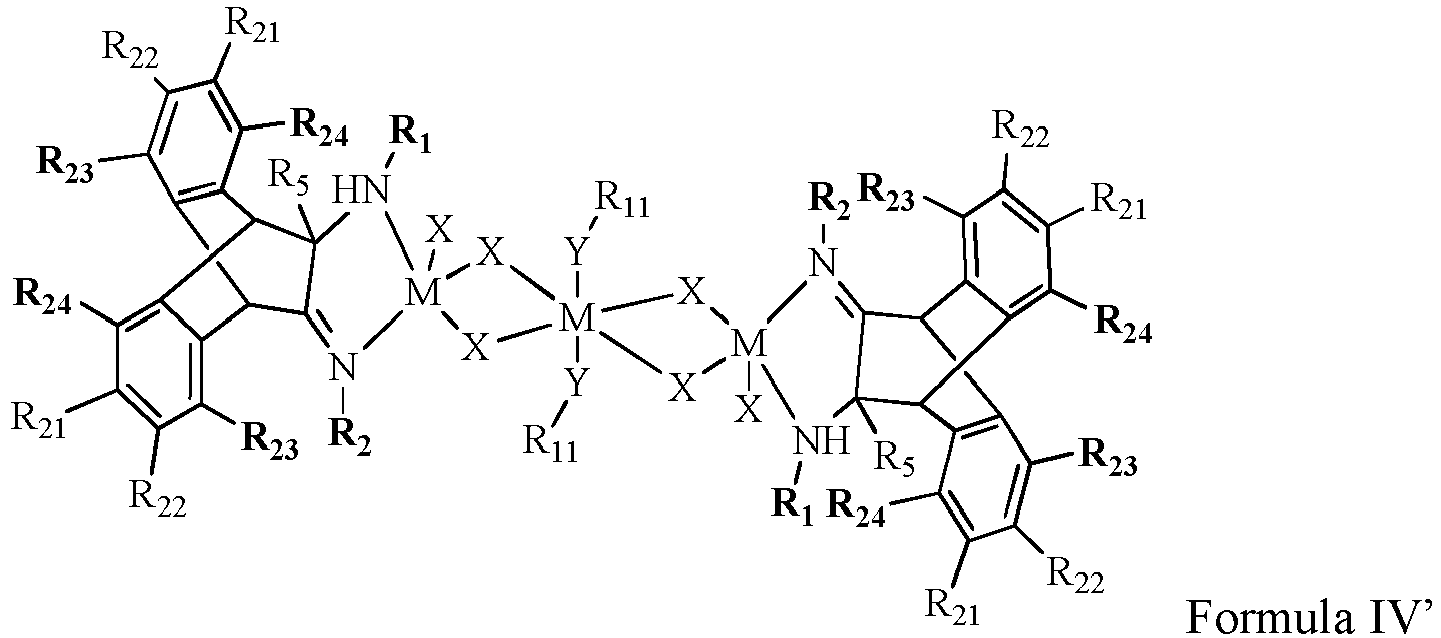
- The method as claimed in claim 17, wherein the amino-imine metal complex has at least one of the following features:- R1 and R2 are independently selected from the group consisting of C1-C20 alkyl with or without a substituent Q and C6-C20 aryl with or without a substituent Q, preferably R1 and/or R2 are/is a group represented by Formula A:
 wherein, R1-R5 are each independently selected from the group consisting of hydrogen, halogen, hydroxy, C1-C20 alkyl with or without a substituent Q, C2-C20 alkenyl with or without a substituent Q, C2-C20 alkynyl with or without a substituent Q, C1-C20 alkoxy with or without a substituent Q, C2-C20 alkenoxy with or without a substituent Q, C2-C20 alkynoxy with or without a substituent Q, C6-C20 aryl with or without a substituent Q, C6-C20 aryloxy with or without a substituent Q, C7-C20 aralkyl with or without a substituent Q, C7-C20 aralkyloxy with or without a substituent Q, C7-C20 alkaryl with or without a substituent Q and C7-C20 alkaryloxy with or without a substituent Q, and R1-R5 are optionally joined to form a ring or ring system;preferably, R1-R5 are each independently selected from the group consisting of hydrogen, halogen, hydroxy, C1-C10 alkyl with or without a substituent Q, C2-C10 alkenyl with or without a substituent Q, C2-C10 alkynyl with or without a substituent Q, C1-C10 alkoxy with or without a substituent Q, C2-C10 alkenoxy with or without a substituent Q, C2-C10 alkynoxy with or without a substituent Q, C6-C15 aryl with or without a substituent Q, C6-C15 aryloxy with or without a substituent Q, C7-C15 aralkyl with or without a substituent Q, C7-C15 aralkoxy with or without a substituent Q, C7-C15 alkaryl with or without a substituent Q and C7-C15 alkaryloxy with or without a substituent Q;more preferably, R1-R5 are each independently selected from the group consisting of hydrogen, halogen, hydroxy, C1-C6 alkyl with or without a substituent Q, C2-C6 alkenyl with or without a substituent Q, C2-C6 alkynyl with or without a substituent Q, C1-C6 alkoxy with or without a substituent Q, C2-C6 alkenyloxy with or without a substituent Q, C2-C6 alkynyloxy with or without a substituent Q, C6-C10 aryl with or without a substituent Q, C7-C10 aralkyl group with or without a substituent Q, C7-C10 alkaryl with or without a substituent Q, C6-C10 aryloxy with or without a substituent Q, C7-C10 aralkyloxy with or without a substituent Q, and C7-C10 alkaryloxy with or without a substituent Q;- each M is independently selected from the group consisting of nickel and palladium;- each Y is independently selected from the group consisting of O and S;- each X is independently selected from the group consisting of halogen, C1-C10 alkyl with or without a substituent Q and C1-C10 alkoxy with or without a substituent Q, preferably from the group consisting of halogen, C1-C6 alkyl with or without a substituent Q and C1-C6 alkoxy with or without a substituent Q;- each R11 is independently a C1-C20 alkyl with or without a substituent Q, preferably a C1-C10 alkyl with or without a substituent Q, and more preferably a C1-C6 alkyl with or without a substituent Q;- each R5 is independently selected from the group consisting of C1-C20 alkyl with or without a substituent Q, C6-C20 aryl with or without a substituent Q, C7-C20 aralkyl with or without a substituent Q and C7-C20 alkaryl with or without a substituent Q; preferably, each R5 is independently selected from the group consisting of C1-C10 alkyl with or without a substituent Q, C6-C10 aryl with or without a substituent Q, C7-C15 aralkyl with or without a substituent Q and C7-C15 alkaryl with or without a substituent Q, and more preferably each R5 is a C1-C6 alkyl with or without a substituent Q; and- the substituent Q is selected from the group consisting of halogen, hydroxy, C1-C10 alkyl, halogenated C1-C10 alkyl, C1-C10 alkoxy and halogenated C1-C10 alkoxy, preferably from the group consisting of halogen, hydroxy, C1-C6 alkyl, halogenated C1-C6 alkyl, C1-C6 alkoxy and halogenated C1-C6 alkoxy; preferably, the C1-C6 alkyl is selected from methyl, ethyl, n-propyl, isopropyl, n-butyl, isobutyl, n-pentyl, isopentyl, n-hexyl, isohexyl and 3,3-dimethylbutyl; preferably, the C1-C6 alkoxy is selected from methoxy, ethoxy, n-propoxy, isopropoxy, n-butoxy, isobutoxy, n-pentoxy, isopentoxy, n-hexyloxy, isohexyloxy and 3,3-dimethylbutoxy; preferably, the halogen is selected from fluorine, chlorine, bromine and iodine;- R21-R24 are each independently selected from the group consisting of hydrogen, halogen, hydroxy, C1-C20 alkyl with or without a substituent Q, C2-C20 alkenyl with or without a substituent Q, C2-C20 alkynyl with or without a substituent Q, C1-C20 alkoxy with or without a substituent Q, C2-C20 alkenoxy with or without a substituent Q, C2-C20 alkynoxy with or without a substituent Q, C6-C20 aryl with or without a substituent Q, C7-C20 aralkyl with or without a substituent Q, C7-C20 alkaryl with or without a substituent Q, C6-C20 aryloxy with or without a substituent Q, C7-C20 aralkyloxy with or without a substituent Q and C7-C20 alkaryloxy with or without a substituent Q, and R21-R24 are optionally joined to form a ring or ring system;preferably, R21-R24 are each independently selected from the group consisting of hydrogen, halogen, hydroxy, C1-C10 alkyl with or without a substituent Q, C2-C10 alkenyl with or without a substituent Q, C2-C10 alkynyl with or without a substituent Q, C1-C10 alkoxy with or without a substituent Q, C2-C10 alkenoxy with or without a substituent Q, C2-C10 alkynoxy with or without a substituent Q, C6-C15 aryl with or without a substituent Q, C7-C15 aralkyl with or without a substituent Q, C7-C15 alkaryl with or without a substituent Q, C6-C15 aryloxy with or without a substituent Q, C7-C15 aralkoxy with or without a substituent Q and C7-C15 alkaryloxy with or without a substituent Q;more preferably, R21-R24 are each independently selected from the group consisting of hydrogen, C1-C10 alkyl, halogenated C1-C10 alkyl, C1-C10 alkoxy, halogenated C1-C10 alkoxy and halogen, more preferably from the group consisting of hydrogen, C1-C6 alkyl, halogenated C1-C6 alkyl, C1-C6 alkoxy, halogenated C1-C6 alkoxy and halogen.
 - The method as claimed in any one of claims 17 to 18, wherein the amino-imine metal complex has a structure represented by Formula IV'A:

- The method as claimed in any one of claims 17 to 19, wherein the amino-imine metal complex is represented by the following Formula V or V':

 wherein the individual symbols are as defined above,preferably, the amino-imine metal complex is selected from the group consisting of:1) the complex represented by Formula V, wherein R1=R3=R4=R6=isopropyl, R2=R5=R7-R10=R21=R22=H, R5=CH3, R11=ethyl, M=Ni, Y=O, X=Br;2) the complex represented by Formula V, wherein R1=R3=R4=R6=ethyl, R2=R5=R7-R10=R21=R22=H, R5=CH3, R11=ethyl, M=Ni, Y=O, X=Br;3) the complex represented by Formula V, wherein R1=R3=R4=R6=methyl, R2=R5=R7-R10=R21=R22=H, R5=CH3, R11=ethyl, M=Ni, Y=O, X=Br;4) the complex represented by Formula V, wherein R1-R6=methyl, R7-R10=R21=R22=H, R5=CH3, R11=ethyl, M=Ni, Y=O, X=Br;5) the complex represented by Formula V, wherein R1=R3=R4=R6=Br, R2=R5=R7-R10=R21=R22=H, R5=CH3, R11=ethyl, M=Ni, Y=O, X=Br;6) the complex represented by Formula V, wherein R1=R3=R4=R6=Cl, R2=R5=R7-R10=R21=R22=H, R5=CH3, R11=ethyl, M=Ni, Y=O, X=Br;7) the complex represented by Formula V, wherein R1=R3=R4=R6=F, R2=R5=R7-R10=R21=R22=H, R5=CH3, R11=ethyl, M=Ni, Y=O, X=Br;8) the complex represented by Formula V, wherein R1=R3=R4=R6=isopropyl, R2=R5=R7-R10=R21=R22=H, R5=R11=ethyl, M=Ni, Y=O, X=Br;9) the complex represented by Formula V, wherein R1=R3=R4=R6=ethyl, R2=R5=R7-R10=R21=R22=H, R5=R11=ethyl, M=Ni, Y=O, X=Br;10) the complex represented by Formula V, wherein R1=R3=R4=R6=methyl, R2=R5=R7-R10=R21=R22=H, R5=R11=ethyl, M=Ni, Y=O, X=Br;11) the complex represented by Formula V, wherein R1-R6=methyl, R7-R10=R21=R22=H, R5=R11=ethyl, M=Ni, Y=O, X=Br;12) the complex represented by Formula V, wherein R1=R3=R4=R6=Br, R2=R5=R7-R10=R21=R22=H, R5=R11=ethyl, M=Ni, Y=O, X=Br;13) the complex represented by Formula V, wherein R1=R3=R4=R6=Cl, R2=R5=R7-R10=R21=R22=H, R5=R11=ethyl, M=Ni, Y=O, X=Br;14) the complex represented by Formula V, wherein R1=R3=R4=R6=F, R2=R5=R7-R10=R21=R22=H, R5=R11=ethyl, M=Ni, Y=O, X=Br;15) the complex represented by Formula V, wherein R1=R3=R4=R6=isopropyl, R2=R5=R7-R10=R21=R22=H, R5=CH3, R11=isobutyl, M=Ni, Y=O, X=Br;16) the complex represented by Formula V, wherein R1=R3=R4=R6=ethyl, R2=R5=R7-R10=R21=R22=H, R5=CH3, R11=isobutyl, M=Ni, Y=O, X=Br;17) the complex represented by Formula V, wherein R1=R3=R4=R6=methyl, R2=R5=R7-R10=R21=R22=H, R5=CH3, R11=isobutyl, M=Ni, Y=O, X=Br;18) the complex represented by Formula V, wherein R1-R6=methyl, R7-R10=R21=R22=H, R5=CH3, R11=isobutyl, M=Ni, Y=O, X=Br;19) the complex represented by Formula V, wherein R1=R3=R4=R6=Br, R2=R5=R7-R10=R21=R22=H, R5=CH3, R11=isobutyl, M=Ni, Y=O, X=Br;20) the complex represented by Formula V, wherein R1=R3=R4=R6=Cl, R2=R5=R7-R10=R21=R22=H, R5=CH3, R11=isobutyl, M=Ni, Y=O, X=Br;21) the complex represented by Formula V, wherein R1=R3=R4=R6=F, R2=R5=R7-R10=R21=R22=H, R5=CH3, R11=isobutyl, M=Ni, Y=O, X=Br;22) the complex represented by Formula V, wherein R1=R3=R4=R6=isopropyl, R2=R5=R7-R10=R22=H, R21=t-butyl, R5=CH3, R11=ethyl, M=Ni, Y=O, X=Br;23) the complex represented by Formula V, wherein R1=R3=R4=R6=ethyl, R2=R5=R7-R10=R22=H, R21=t-butyl, R5=CH3, R11=ethyl, M=Ni, Y=O, X=Br;24) the complex represented by Formula V, wherein R1=R3=R4=R6=methyl, R2=R5=R7-R10=R22=H, R21=t-butyl, R5=CH3, R11=ethyl, M=Ni, Y=O, X=Br;25) the complex represented by Formula V, wherein R1-R6=methyl, R7-R10=R22=H, R21=t-butyl, R5=CH3, R11=ethyl, M=Ni, Y=O, X=Br;26) the complex represented by Formula V, wherein R1=R3=R4=R6=Br, R2=R5=R7-R10=R22=H, R21=t-butyl, R5=CH3, R11=ethyl, M=Ni, Y=O, X=Br;27) the complex represented by Formula V, wherein R1=R3=R4=R6=Cl, R2=R5=R7-R10=R22=H, R21=t-butyl, R5=CH3, R11=ethyl, M=Ni, Y=O, X=Br;28) the complex represented by Formula V, wherein R1=R3=R4=R6=F, R2=R5=R7-R10=R22=H, R21=t-butyl, R5=CH3, R11=ethyl, M=Ni, Y=O, X=Br;29) the complex represented by Formula V, wherein R1=R3=R4=R6=isopropyl, R2=R5=R7-R10=R22=H, R21=t-butyl, R5=CH3, R11=isobutyl, M=Ni, Y=O, X=Br;30) the complex represented by Formula V, wherein R1=R3=R4=R6=ethyl, R2=R5=R7-R10=R22=H, R21=t-butyl, R5=CH3, R11=isobutyl, M=Ni, Y=O, X=Br;31) the complex represented by Formula V, wherein R1=R3=R4=R6=methyl, R2=R5=R7-R10=R22=H, R21=t-butyl, R5=CH3, R11=isobutyl, M=Ni, Y=O, X=Br;32) the complex represented by Formula V, wherein R1-R6=methyl, R7-R10=R22=H, R21=t-butyl, R5=CH3, R11=isobutyl, M=Ni, Y=O, X=Br;33) the complex represented by Formula V, wherein R1=R3=R4=R6=Br, R2=R5=R7-R10=R22=H, R21=t-butyl, R5=CH3, R11=isobutyl, M=Ni, Y=O, X=Br;34) the complex represented by Formula V, wherein R1=R3=R4=R6=Cl, R2=R5=R7-R10=R22=H, R21=t-butyl, R5=CH3, R11=isobutyl, M=Ni, Y=O, X=Br;35) the complex represented by Formula V, wherein R1=R3=R4=R6=F, R2=R5=R7-R10=R22=H, R21=t-butyl, R5=CH3, R11=isobutyl, M=Ni, Y=O, X=Br;29) the complex represented by Formula V', wherein R1=R3=R4=R6=isopropyl, R2=R5=R7-R10=R31=R32=H, R5=CH3, R11=ethyl, M=Ni, Y=O, X=Br;30) the complex represented by Formula V', wherein R1=R3=R4=R6=ethyl, R2=R5=R7-R10=R31=R32=H, R5=CH3, R11=ethyl, M=Ni, Y=O, X=Br;31) the complex represented by Formula V', wherein R1=R3=R4=R6=methyl, R2=R5=R7-R10=R31=R32=H, R5=CH3, R11=ethyl, M=Ni, Y=O, X=Br;32) the complex represented by Formula V', wherein R1-R6=methyl, R7-R10=R31=R32=H, R5=CH3, R11=ethyl, M=Ni, Y=O, X=Br;33) the complex represented by Formula V', wherein R1=R3=R4=R6=Br, R2=R5=R7-R10=R31=R32=H, R5=CH3, R11=ethyl, M=Ni, Y=O, X=Br;34) the complex represented by Formula V', wherein R1=R3=R4=R6=Cl, R2=R5=R7-R10=R31=R32=H, R5=CH3, R11=ethyl, M=Ni, Y=O, X=Br;35) the complex represented by Formula V', wherein R1=R3=R4=R6=F, R2=R5=R7-R10=R31=R32=H, R5=CH3, R11=ethyl, M=Ni, Y=O, X=Br;36) the complex represented by Formula V', wherein R1=R3=R4=R6=isopropyl, R2=R5=R7-R10=R31=R32=H, R5=CH3, R11=isobutyl, M=Ni, Y=O, X=Br;37) the complex represented by Formula V', wherein R1=R3=R4=R6=ethyl, R2=R5=R7-R10=R31=R32=H, R5=CH3, R11=isobutyl, M=Ni, Y=O, X=Br;38) the complex represented by Formula V', wherein R1=R3=R4=R6=methyl, R2=R5=R7-R10=R31=R32=H, R5=CH3, R11=isobutyl, M=Ni, Y=O, X=Br;39) the complex represented by Formula V', wherein R1-R6=methyl, R7-R10=R31=R32=H, R5=CH3, R11=isobutyl, M=Ni, Y=O, X=Br;40) the complex represented by Formula V', wherein R1=R3=R4=R6=Br, R2=R5=R7-R10=R31=R32=H, R5=CH3, R11=isobutyl, M=Ni, Y=O, X=Br;41) the complex represented by Formula V', wherein R1=R3=R4=R6=Cl, R2=R5=R7-R10=R31=R32=H, R5=CH3, R11=isobutyl, M=Ni, Y=O, X=Br;42) the complex represented by Formula V', wherein R1=R3=R4=R6=F, R2=R5=R7-R10=R31=R32=H, R5=CH3, R11=isobutyl, M=Ni, Y=O, X=Br;43) the complex represented by Formula V', wherein R1=R3=R4=R6=isopropyl, R2=R5=R7-R10=H R31=R32=R11=ethyl, R5=CH3, M=Ni, Y=O, X=Br;44) the complex represented by Formula V', wherein R1=R3=R4=R6=ethyl, R2=R5=R7-R10=H, R31=R32=R11=ethyl, R5=CH3, M=Ni, Y=O, X=Br;45) the complex represented by Formula V', wherein R1=R3=R4=R6=methyl, R2=R5=R7-R10=H, R31=R32=R11=ethyl, R5=CH3, M=Ni, Y=O, X=Br;46) the complex represented by Formula V', wherein R1-R6=methyl,R7-R10=H, R31=R32=R11=ethyl, R5=CH3, M=Ni, Y=O, X=Br;47) the complex represented by Formula V', wherein R1=R3=R4=R6=Br, R2=R5=R7-R10=H, R31=R32=R11=ethyl, R5=CH3, M=Ni, Y=O, X=Br;48) the complex represented by Formula V', wherein R1=R3=R4=R6=Cl, R2=R5=R7-R10=H, R31=R32=R11=ethyl, R5=CH3, M=Ni, Y=O, X=Br;49) the complex represented by Formula V', wherein R1=R3=R4=R6=F, R2=R5=R7-R10=H, R31=R32=R11=ethyl, R5=CH3, M=Ni, Y=O, X=Br;50) the complex represented by Formula V', wherein R1=R3=R4=R6=isopropyl, R2=R5=R7-R10=H, R31=R32=R11=ethyl, R5=CH3, M=Ni, Y=O, X=Br;51) the complex represented by Formula V', wherein R1=R3=R4=R6=ethyl, R2=R5=R7-R10=H, R31=R32=ethyl, R5=CH3, R11=isobutyl, M=Ni, Y=O, X=Br;52) the complex represented by Formula V', wherein R1=R3=R4=R6=methyl, R2=R5=R7-R10=H, R31=R32=ethyl, R5=CH3, R11=isobutyl, M=Ni, Y=O, X=Br;53) the complex represented by Formula V', wherein R1-R6=methyl,R7-R10=H, R31=R32=ethyl, R5=CH3, R11=isobutyl, M=Ni, Y=O, X=Br;54) the complex represented by Formula V', wherein R1=R3=R4=R6=Br, R2=R5=R7-R10=H, R31=R32=ethyl, R5=CH3, R11=isobutyl, M=Ni, Y=O, X=Br;55) the complex represented by Formula V', wherein R1=R3=R4=R6=Cl, R2=R5=R7-R10=H, R31=R32=ethyl, R5=CH3, R11=isobutyl, M=Ni, Y=O, X=Br;56) the complex represented by Formula V', wherein R1=R3=R4=R6=F, R2=R5=R7-R10=H, R31=R32=ethyl, R5=CH3, R11=isobutyl, M=Ni, Y=O, X=Br.
 - The method as claimed in any one of claims 1 to 20, having at least one of the following features:- the olefin is an olefin, preferably an α-olefin, having 2 to 16 carbon atoms,- the polar monomer is one or more of olefinic alcohols represented by Formula G:
 wherein, L1-L3 are each independently selected from the group consisting of H and C1-C30 alkyl with or without a substituent, L4 is a C1-C30 alkylene optionally having a pendant group;preferably, in the copolymer, the content of the structure units derived from the olefinic alcohol represented by Formula G is from 0.4 to 10.0 mol%;preferably, L1 and L2 are H, L3 is H or a C1-C30 alkyl, L4 is a C1-C30 alkylene having a pendant group;more preferably, L1 and L2 are H, L3 is H or a C1-C20 alkyl, L4 is a C1-C20 alkylene having a pendant group;still more preferably, L1 and L2 are H, L3 is H or a C1-C10 alkyl, L4 is a C1-C10 alkylene having a pendant group;still more preferably, L1 and L2 are H, L3 is H or a C1-C10 alkyl, L4 is a C1-C6 alkylene having a pendant group.
 - The method as claimed in claim 21, wherein the substituent in L1-L3 is one or more selected from the group consisting of halogen, C1-C10 alkyl, C1-C10 alkoxy, C6-C10 aryl, cyano and hydroxy; more preferably the substituent in L1-L3 is one or more selected from the group consisting of C1-C6 alkyl, halogen and C1-C6 alkoxy;
the pendant group in L4 is one or more selected from the group consisting of halogen, C6-C20 aryl, C1-C20 alkyl and C1-C20 alkoxy, the C6-C20 aryl, C1-C20 alkyl and C1-C20 alkoxy being optionally substituted by a substituent, which is preferably one or more selected from the group consisting of halogen, C1-C10 alkyl, C1-C10 alkoxy, C6-C10 aryl and hydroxy. - The method as claimed in any one of claims 1 to 20, having at least one of the following features:- the olefin is an olefin, preferably an α-olefin, having 2-16 carbon atoms,- the polar monomer is an unsaturated carboxylic acid represented by Formula G':
 wherein, L1-L3 are each independently selected from the group consisting of H and C1-C30 alkyl with or without a substituent, L4 is a C1-C30 alkylene having a pendant group;preferably, in the copolymer, the content of the structure units derived from the unsaturated carboxylic acid represented by Formula G' is from 0.2 to 15.0 mol%, and more preferably from 0.7 to 10.0 mol%;preferably, L1 and L2 are H, L3 is H or a C1-C30 alkyl, L4 is a C1-C30 alkylene having a pendant group;more preferably, L1 and L2 are H, L3 is H or a C1-C20 alkyl, L4 is a C1-C20 alkylene having a pendant group;still more preferably, L1 and L2 are H, L3 is H or a C1-C10 alkyl, L4 is a C1-C10 alkylene having a pendant group;still more preferably, L1 and L2 are H, L3 is H or a C1-C10 alkyl, L4 is a C1-C6 alkylene having a pendant group.
 - The method as claimed in claim 23, characterized in that the substituent in L1-L3 is one or more selected from the group consisting of halogen, C1-C10 alkyl, C1-C10 alkoxy, C6-C10 aryl, cyano and hydroxy; and more preferably the substituent in L1-L3 is one or more selected from the group consisting of C1-C6 alkyl, halogen and C1-C6 alkoxy;
the pendant group in L4 is one or more selected from the group consisting of halogen, C6-C20 aryl, C1-C20 alkyl and C1-C20 alkoxy, the C6-C20 aryl, C1-C20 alkyl and C1-C20 alkoxy being optionally substituted by a substituent, which is preferably one or more selected from the group consisting of halogen, C1-C10 alkyl, C1-C10 alkoxy, C6-C10 aryl and hydroxy. - The method as claimed in any one of claims 1 to 24, wherein the cocatalyst is selected from the group consisting of organoaluminum compounds and organoboron compounds; the organoaluminum compounds are selected from the group consisting of alkylaluminoxanes, aluminum alkyls and alkyl aluminum halides; the organoboron compounds are selected from the group consisting of aromatic hydrocarbyl boron compounds and borates; the chain transfer agent is selected from the group consisting of aluminum alkyls, magnesium alkyls, boron alkyls and zinc alkyls;
preferably, when the cocatalyst is the organoaluminum compound, a molar ratio of aluminum in the cocatalyst to M in the diimine metal complex is (10-107): 1, preferably (10-100000):1, and more preferably (100-10000):1; when the cocatalyst is the organoboron compound, a molar ratio of boron in the cocatalyst to M in the diimine metal complex is (0.1-1000):1, and preferably (0.1-500):1; and a molar ratio of the chain transfer agent to M in the diimine metal complex is (0.1-5000):1, and preferably (1.0-1,000):1. - An olefin-polar monomer copolymer prepared by the method as claimed in any one of claims 1 to 25, which is of spherical and/or spherical-like shape, and/or which has a particle diameter of from 0.1 to 50 mm.
Applications Claiming Priority (9)
| Application Number | Priority Date | Filing Date | Title |
|---|---|---|---|
| CN201911049602.5A CN112745426B (en) | 2019-10-31 | 2019-10-31 | Process for preparing olefin-olefin alcohol copolymers |
| CN201911049603.XA CN112745427B (en) | 2019-10-31 | 2019-10-31 | Method for preparing olefin-olefin alcohol copolymer |
| CN201911049566.2A CN112745423B (en) | 2019-10-31 | 2019-10-31 | Preparation method of olefin-unsaturated carboxylic acid copolymer, olefin-unsaturated carboxylic acid copolymer and application thereof |
| CN201911049900.4A CN112745430B (en) | 2019-10-31 | 2019-10-31 | Preparation method of olefin-unsaturated carboxylic acid copolymer |
| CN201911049741.8A CN112745429B (en) | 2019-10-31 | 2019-10-31 | Process for preparing olefin-unsaturated carboxylic acid copolymers |
| CN201911049567.7A CN112745424B (en) | 2019-10-31 | 2019-10-31 | Method for preparing olefin-unsaturated carboxylic acid copolymer |
| CN201911049604.4A CN112745428B (en) | 2019-10-31 | 2019-10-31 | A kind of preparation method of olefin-olefin alcohol copolymer |
| CN201911049580.2A CN112745425B (en) | 2019-10-31 | 2019-10-31 | Process for preparing olefin-olefin alcohol copolymers |
| PCT/CN2020/125433 WO2021083358A1 (en) | 2019-10-31 | 2020-10-30 | Method for preparing olefin-polar monomer copolymer |
Publications (2)
| Publication Number | Publication Date |
|---|---|
| EP4053174A1 true EP4053174A1 (en) | 2022-09-07 |
| EP4053174A4 EP4053174A4 (en) | 2023-11-15 |
Family
ID=75715841
Family Applications (1)
| Application Number | Title | Priority Date | Filing Date |
|---|---|---|---|
| EP20880543.2A Pending EP4053174A4 (en) | 2019-10-31 | 2020-10-30 | METHOD FOR PRODUCING POLAR OLEFIN MONOMER COPOLYMERS |
Country Status (5)
| Country | Link |
|---|---|
| US (1) | US12428505B2 (en) |
| EP (1) | EP4053174A4 (en) |
| JP (2) | JP2023500504A (en) |
| KR (1) | KR102953256B1 (en) |
| WO (1) | WO2021083358A1 (en) |
Cited By (2)
| Publication number | Priority date | Publication date | Assignee | Title |
|---|---|---|---|---|
| EP4053138A4 (en) * | 2019-10-31 | 2023-11-15 | China Petroleum & Chemical Corporation | AMINO-IMINE METAL COMPLEX AS WELL AS ITS PREPARATION PROCESS AND ITS APPLICATION |
| EP4053139A4 (en) * | 2019-10-31 | 2023-11-15 | China Petroleum & Chemical Corporation | DIIMIN METAL COMPLEX, PRODUCTION PROCESS THEREOF AND APPLICATION THEREOF |
Families Citing this family (1)
| Publication number | Priority date | Publication date | Assignee | Title |
|---|---|---|---|---|
| US20240228680A1 (en) * | 2021-04-28 | 2024-07-11 | China Petroleum & Chemical Corporation | Method for preparing polymer, and obtained polymer |
Citations (1)
| Publication number | Priority date | Publication date | Assignee | Title |
|---|---|---|---|---|
| CN106397264A (en) | 2015-07-31 | 2017-02-15 | 中国石油化工股份有限公司 | Diimine ligand compound, and complex and application thereof |
Family Cites Families (34)
| Publication number | Priority date | Publication date | Assignee | Title |
|---|---|---|---|---|
| DE59409642D1 (en) | 1993-11-24 | 2001-03-01 | Targor Gmbh | Metallocenes, processes for their preparation and their use as catalysts |
| IT1273391B (en) | 1994-03-31 | 1997-07-08 | Boehringer Mannheim Italia | PLATINO TRINUCLEAR CATIONIC COMPLEXES WITH ANTI-CANCER ACTIVITIES AND PHARMACEUTICAL COMPOSITIONS THAT CONTAIN THEM |
| DE4446922A1 (en) | 1994-12-28 | 1996-07-04 | Hoechst Ag | Metallocene compound and its use as a catalyst component |
| DE19741989A1 (en) | 1997-09-24 | 1999-03-25 | Hoechst Ag | Transition metal compounds for olefin polymerisation |
| US5986024A (en) | 1997-10-17 | 1999-11-16 | Sri International | Preparation of multimodal polymer compositions using multinuclear metallocene catalysts |
| JPH11292918A (en) * | 1998-04-08 | 1999-10-26 | Mitsui Chem Inc | Production of olefin-polar monomer copolymer |
| US6403738B1 (en) * | 1998-07-29 | 2002-06-11 | E. I. Du Pont De Nemours And Company | Polymerization of olefins |
| US6544919B1 (en) | 1999-10-06 | 2003-04-08 | Sri International | Multinuclear transition metal catalysts for preparation of multimodal polymer compositions |
| DE10017660A1 (en) | 2000-04-08 | 2001-10-11 | Basf Ag | Process for the preparation of a catalyst system for the polymerization of olefins |
| RU2292343C2 (en) | 2001-08-01 | 2007-01-27 | Шелл Интернэшнл Рисерч Маатсхаппий Б.В. | Ligands and catalytic systems comprising thereof for oligomerization of ethylene for preparing linear alpha-olefins |
| WO2004037415A2 (en) | 2002-09-25 | 2004-05-06 | Shell Internationale Research Maatschappij B.V. | Catalyst systems for ethylene oligomerisation to linear alpha olefins |
| AU2003287434A1 (en) | 2002-12-17 | 2004-07-29 | The Dow Chemical Company | Multinuclear transition metal polymerization catalysts |
| KR20040076965A (en) | 2003-02-27 | 2004-09-04 | 호남석유화학 주식회사 | A supported multinuclear metallocene catalysts for olefin polymerization and a process for preparing the same |
| WO2004108775A1 (en) | 2003-06-05 | 2004-12-16 | Dow Global Technologies Inc. | Activated multinuclear transition metal catalyst compositions |
| US20050014983A1 (en) | 2003-07-07 | 2005-01-20 | De Boer Eric Johannes Maria | Process for producing linear alpha olefins |
| EP1651691A2 (en) | 2003-08-04 | 2006-05-03 | DSM IP Assets B.V. | Process for the preparation of a polyolefin |
| US7034157B2 (en) | 2003-10-23 | 2006-04-25 | Fina Technology, Inc. | Catalyst components, process for their preparation and their use as catalyst components in polymerization of olefins |
| KR100677869B1 (en) | 2004-07-01 | 2007-02-02 | 대림산업 주식회사 | Multinuclear Metal Compounds, Catalyst Systems Comprising the Same, and Polymerization Methods of Olefins Using the Same |
| JP4613853B2 (en) | 2006-03-01 | 2011-01-19 | トヨタ自動車株式会社 | Compound containing metal complex and metal complex |
| WO2013064235A1 (en) | 2011-11-02 | 2013-05-10 | Saudi Basic Industries Corporation (Sabic) | Multinuclear metallocene catalyst compound for olefin polymerisation and copolymerisation and method for making thereof |
| CN105481998B (en) | 2014-09-18 | 2018-05-11 | 中国石油化工股份有限公司 | A kind of olefin polymerization catalysis and its methods for making and using same |
| CN106397262B (en) | 2015-07-31 | 2018-06-12 | 中国石油化工股份有限公司 | Diimide ligand, preparation method and application |
| CN106397261B (en) | 2015-07-31 | 2018-07-20 | 中国石油化工股份有限公司 | A kind of diimide ligand compound, complex and application |
| CN106397259B (en) * | 2015-07-31 | 2018-07-20 | 中国石油化工股份有限公司 | A kind of diimide ligand, diimine nickel complex and application |
| US20180105478A1 (en) * | 2016-10-19 | 2018-04-19 | Chevron Phillips Chemical Company Lp | Process for Reducing the Light Oligomer Content of Polypropylene Oils |
| CN109694432B (en) | 2017-10-24 | 2022-01-04 | 中国石油化工股份有限公司 | Olefin-unsaturated carboxylate polymer and preparation method thereof |
| CN109694433A (en) | 2017-10-24 | 2019-04-30 | 中国石油化工股份有限公司 | For alkene-alkene alcohol copolymerization catalyst system and alkene-alkene alcohol copolymerization process and polymer |
| CN109694436A (en) | 2017-10-24 | 2019-04-30 | 中国石油化工股份有限公司 | A kind of alkene-alkene alkoxide polymer and preparation method thereof |
| CN109694438A (en) | 2017-10-24 | 2019-04-30 | 中国石油化工股份有限公司 | A kind of alkene-alkene alkoxide polymer and preparation method thereof |
| CN109694434A (en) | 2017-10-24 | 2019-04-30 | 中国石油化工股份有限公司 | A kind of alkene-unsaturated carboxylic acid polymer and preparation method thereof |
| CN109694435A (en) | 2017-10-24 | 2019-04-30 | 中国石油化工股份有限公司 | A kind of alkene-unsaturated carboxylic acid polymer and preparation method thereof |
| US10807921B2 (en) | 2017-12-01 | 2020-10-20 | Chevron Phillips Chemical Company Lp | Catalyst systems and ethylene oligomerization method |
| US12404292B2 (en) * | 2019-10-31 | 2025-09-02 | China Petroleum & Chemical Corporation | Amino-imine metal complex and preparation method therefor and application thereof |
| WO2021083350A1 (en) * | 2019-10-31 | 2021-05-06 | 中国石油化工股份有限公司 | Diimine metal complex, preparation method therefor, and application thereof |
-
2020
- 2020-10-30 KR KR1020227018606A patent/KR102953256B1/en active Active
- 2020-10-30 US US17/755,542 patent/US12428505B2/en active Active
- 2020-10-30 JP JP2022525809A patent/JP2023500504A/en active Pending
- 2020-10-30 EP EP20880543.2A patent/EP4053174A4/en active Pending
- 2020-10-30 WO PCT/CN2020/125433 patent/WO2021083358A1/en not_active Ceased
-
2025
- 2025-10-16 JP JP2025174609A patent/JP2026010117A/en active Pending
Patent Citations (1)
| Publication number | Priority date | Publication date | Assignee | Title |
|---|---|---|---|---|
| CN106397264A (en) | 2015-07-31 | 2017-02-15 | 中国石油化工股份有限公司 | Diimine ligand compound, and complex and application thereof |
Non-Patent Citations (1)
| Title |
|---|
| ORGANOMETALLICS, vol. 32, 2013, pages 2291 - 2299 |
Cited By (4)
| Publication number | Priority date | Publication date | Assignee | Title |
|---|---|---|---|---|
| EP4053138A4 (en) * | 2019-10-31 | 2023-11-15 | China Petroleum & Chemical Corporation | AMINO-IMINE METAL COMPLEX AS WELL AS ITS PREPARATION PROCESS AND ITS APPLICATION |
| EP4053139A4 (en) * | 2019-10-31 | 2023-11-15 | China Petroleum & Chemical Corporation | DIIMIN METAL COMPLEX, PRODUCTION PROCESS THEREOF AND APPLICATION THEREOF |
| US12404292B2 (en) | 2019-10-31 | 2025-09-02 | China Petroleum & Chemical Corporation | Amino-imine metal complex and preparation method therefor and application thereof |
| US12454586B2 (en) | 2019-10-31 | 2025-10-28 | China Petroleum & Chemical Corporation | Diimine metal complex, preparation method therefor, and application thereof |
Also Published As
| Publication number | Publication date |
|---|---|
| JP2023500504A (en) | 2023-01-06 |
| KR102953256B1 (en) | 2026-04-15 |
| WO2021083358A1 (en) | 2021-05-06 |
| EP4053174A4 (en) | 2023-11-15 |
| BR112022008300A2 (en) | 2022-08-09 |
| US20220396646A1 (en) | 2022-12-15 |
| US12428505B2 (en) | 2025-09-30 |
| KR20220097939A (en) | 2022-07-08 |
| WO2021083358A8 (en) | 2022-05-27 |
| CA3159659A1 (en) | 2021-05-06 |
| JP2026010117A (en) | 2026-01-21 |
Similar Documents
| Publication | Publication Date | Title |
|---|---|---|
| JP2021500449A (en) | Olefin-olefin alcohol copolymer and its production method | |
| CN111116808B (en) | Preparation method of olefin-olefin alcohol copolymer | |
| CN111116807B (en) | Preparation method of olefin-olefin alcohol copolymer | |
| CN111116806B (en) | Preparation method of olefin-unsaturated carboxylic acid copolymer | |
| JP2026010117A (en) | Process for preparing olefin-polar monomer copolymers | |
| EP4053138B1 (en) | Amino-imine metal complex and preparation method therefor and application thereof | |
| CN111116801A (en) | Preparation method of olefin-unsaturated carboxylic acid copolymer | |
| EP4053139B1 (en) | Diimine metal complex, preparation method therefor, and application thereof | |
| CN112745428A (en) | Preparation method of olefin-olefin alcohol copolymer | |
| CN112745425B (en) | Process for preparing olefin-olefin alcohol copolymers | |
| RU2846037C1 (en) | Method of producing olefin-(polar monomer) copolymer | |
| CA3159659C (en) | Method for preparing olefin-polar monomer copolymer | |
| EP4332135A1 (en) | Method for preparing polymer, and obtained polymer | |
| CN112745429B (en) | Process for preparing olefin-unsaturated carboxylic acid copolymers | |
| CN112745424B (en) | Method for preparing olefin-unsaturated carboxylic acid copolymer | |
| US20240199771A1 (en) | Branched olefin polymer, preparation method therefor and use thereof | |
| BR112022008300B1 (en) | METHOD FOR PREPARING A POLAR OLEFIN MONOMER COPOLYMER | |
| CN115246900B (en) | Polymer preparation method and polymer | |
| CN113754815B (en) | Process for preparing olefin-olefin alcohol copolymers | |
| CN112745423A (en) | Preparation method of olefin-unsaturated carboxylic acid copolymer, olefin-unsaturated carboxylic acid copolymer and application thereof | |
| RU2833273C1 (en) | Diimine metal complex, method for production thereof and use thereof | |
| CN112745422B (en) | Method for preparing olefin-olefin alcohol copolymer | |
| CN112745426B (en) | Process for preparing olefin-olefin alcohol copolymers | |
| CN112745421B (en) | Olefin-olefin alcohol copolymer and method for producing the same | |
| CN112745427A (en) | Method for preparing olefin-olefin alcohol copolymer |
Legal Events
| Date | Code | Title | Description |
|---|---|---|---|
| STAA | Information on the status of an ep patent application or granted ep patent |
Free format text: STATUS: THE INTERNATIONAL PUBLICATION HAS BEEN MADE |
|
| PUAI | Public reference made under article 153(3) epc to a published international application that has entered the european phase |
Free format text: ORIGINAL CODE: 0009012 |
|
| STAA | Information on the status of an ep patent application or granted ep patent |
Free format text: STATUS: REQUEST FOR EXAMINATION WAS MADE |
|
| 17P | Request for examination filed |
Effective date: 20220524 |
|
| AK | Designated contracting states |
Kind code of ref document: A1 Designated state(s): AL AT BE BG CH CY CZ DE DK EE ES FI FR GB GR HR HU IE IS IT LI LT LU LV MC MK MT NL NO PL PT RO RS SE SI SK SM TR |
|
| DAV | Request for validation of the european patent (deleted) | ||
| DAX | Request for extension of the european patent (deleted) | ||
| A4 | Supplementary search report drawn up and despatched |
Effective date: 20231016 |
|
| RIC1 | Information provided on ipc code assigned before grant |
Ipc: C07F 15/04 20060101ALI20231010BHEP Ipc: C08F 216/04 20060101ALI20231010BHEP Ipc: C08L 23/08 20060101ALI20231010BHEP Ipc: C08F 4/70 20060101ALI20231010BHEP Ipc: C08F 220/64 20060101ALI20231010BHEP Ipc: C08F 220/04 20060101ALI20231010BHEP Ipc: C08F 210/02 20060101AFI20231010BHEP |