EP4053134A1 - Method of stabilizing imino-functional silane - Google Patents
Method of stabilizing imino-functional silane Download PDFInfo
- Publication number
- EP4053134A1 EP4053134A1 EP22167587.9A EP22167587A EP4053134A1 EP 4053134 A1 EP4053134 A1 EP 4053134A1 EP 22167587 A EP22167587 A EP 22167587A EP 4053134 A1 EP4053134 A1 EP 4053134A1
- Authority
- EP
- European Patent Office
- Prior art keywords
- imino
- carbon atoms
- functional silane
- specifically
- carbon
- Prior art date
- Legal status (The legal status is an assumption and is not a legal conclusion. Google has not performed a legal analysis and makes no representation as to the accuracy of the status listed.)
- Pending
Links
- BLRPTPMANUNPDV-UHFFFAOYSA-N Silane Chemical compound [SiH4] BLRPTPMANUNPDV-UHFFFAOYSA-N 0.000 title abstract description 176
- 229910000077 silane Inorganic materials 0.000 title abstract description 153
- 238000000034 method Methods 0.000 title abstract description 48
- 230000000087 stabilizing effect Effects 0.000 title abstract description 5
- 150000007528 brønsted-lowry bases Chemical class 0.000 abstract description 58
- 239000011203 carbon fibre reinforced carbon Substances 0.000 abstract description 35
- 150000004756 silanes Chemical class 0.000 abstract description 33
- 238000006481 deamination reaction Methods 0.000 abstract description 15
- 238000007259 addition reaction Methods 0.000 abstract description 14
- 125000004432 carbon atom Chemical group C* 0.000 description 128
- -1 cycloalkynyl Chemical group 0.000 description 49
- 150000002430 hydrocarbons Chemical group 0.000 description 27
- 125000000217 alkyl group Chemical group 0.000 description 25
- 239000000047 product Substances 0.000 description 25
- 238000006243 chemical reaction Methods 0.000 description 23
- 125000005842 heteroatom Chemical group 0.000 description 22
- 239000000203 mixture Substances 0.000 description 22
- 125000004435 hydrogen atom Chemical group [H]* 0.000 description 19
- NTIZESTWPVYFNL-UHFFFAOYSA-N Methyl isobutyl ketone Chemical compound CC(C)CC(C)=O NTIZESTWPVYFNL-UHFFFAOYSA-N 0.000 description 18
- UIHCLUNTQKBZGK-UHFFFAOYSA-N Methyl isobutyl ketone Natural products CCC(C)C(C)=O UIHCLUNTQKBZGK-UHFFFAOYSA-N 0.000 description 18
- HQABUPZFAYXKJW-UHFFFAOYSA-N butan-1-amine Chemical compound CCCCN HQABUPZFAYXKJW-UHFFFAOYSA-N 0.000 description 18
- 229940043265 methyl isobutyl ketone Drugs 0.000 description 18
- 229910052739 hydrogen Inorganic materials 0.000 description 16
- 239000001257 hydrogen Substances 0.000 description 16
- KWYUFKZDYYNOTN-UHFFFAOYSA-M Potassium hydroxide Chemical compound [OH-].[K+] KWYUFKZDYYNOTN-UHFFFAOYSA-M 0.000 description 15
- YXFVVABEGXRONW-UHFFFAOYSA-N Toluene Chemical compound CC1=CC=CC=C1 YXFVVABEGXRONW-UHFFFAOYSA-N 0.000 description 15
- 238000004821 distillation Methods 0.000 description 15
- 238000002360 preparation method Methods 0.000 description 15
- NBBJYMSMWIIQGU-UHFFFAOYSA-N Propionic aldehyde Chemical compound CCC=O NBBJYMSMWIIQGU-UHFFFAOYSA-N 0.000 description 14
- 238000010992 reflux Methods 0.000 description 13
- ZWEHNKRNPOVVGH-UHFFFAOYSA-N 2-Butanone Chemical compound CCC(C)=O ZWEHNKRNPOVVGH-UHFFFAOYSA-N 0.000 description 12
- 150000001299 aldehydes Chemical class 0.000 description 12
- 125000003118 aryl group Chemical group 0.000 description 12
- 150000001875 compounds Chemical class 0.000 description 11
- WYTZZXDRDKSJID-UHFFFAOYSA-N (3-aminopropyl)triethoxysilane Chemical compound CCO[Si](OCC)(OCC)CCCN WYTZZXDRDKSJID-UHFFFAOYSA-N 0.000 description 10
- CSCPPACGZOOCGX-UHFFFAOYSA-N Acetone Chemical compound CC(C)=O CSCPPACGZOOCGX-UHFFFAOYSA-N 0.000 description 10
- LFQSCWFLJHTTHZ-UHFFFAOYSA-N Ethanol Chemical compound CCO LFQSCWFLJHTTHZ-UHFFFAOYSA-N 0.000 description 10
- 229910052783 alkali metal Inorganic materials 0.000 description 10
- 150000001340 alkali metals Chemical class 0.000 description 10
- 229910052784 alkaline earth metal Inorganic materials 0.000 description 10
- 125000003710 aryl alkyl group Chemical group 0.000 description 10
- 239000011541 reaction mixture Substances 0.000 description 10
- OKKJLVBELUTLKV-UHFFFAOYSA-N Methanol Chemical compound OC OKKJLVBELUTLKV-UHFFFAOYSA-N 0.000 description 9
- WQDUMFSSJAZKTM-UHFFFAOYSA-N Sodium methoxide Chemical compound [Na+].[O-]C WQDUMFSSJAZKTM-UHFFFAOYSA-N 0.000 description 9
- 125000000753 cycloalkyl group Chemical group 0.000 description 9
- 125000001495 ethyl group Chemical group [H]C([H])([H])C([H])([H])* 0.000 description 9
- 238000004817 gas chromatography Methods 0.000 description 9
- 150000002576 ketones Chemical class 0.000 description 9
- IJGRMHOSHXDMSA-UHFFFAOYSA-N Atomic nitrogen Chemical compound N#N IJGRMHOSHXDMSA-UHFFFAOYSA-N 0.000 description 8
- 150000001342 alkaline earth metals Chemical class 0.000 description 8
- 125000002947 alkylene group Chemical group 0.000 description 8
- 229910052799 carbon Inorganic materials 0.000 description 8
- 230000000052 comparative effect Effects 0.000 description 8
- SBVCEDLIWDSBGE-UHFFFAOYSA-N iminosilane Chemical class [SiH2]=N SBVCEDLIWDSBGE-UHFFFAOYSA-N 0.000 description 8
- 238000003860 storage Methods 0.000 description 8
- 238000005292 vacuum distillation Methods 0.000 description 8
- XLYOFNOQVPJJNP-UHFFFAOYSA-N water Substances O XLYOFNOQVPJJNP-UHFFFAOYSA-N 0.000 description 8
- PRKPGWQEKNEVEU-UHFFFAOYSA-N 4-methyl-n-(3-triethoxysilylpropyl)pentan-2-imine Chemical compound CCO[Si](OCC)(OCC)CCCN=C(C)CC(C)C PRKPGWQEKNEVEU-UHFFFAOYSA-N 0.000 description 7
- 125000002496 methyl group Chemical group [H]C([H])([H])* 0.000 description 7
- CPLXHLVBOLITMK-UHFFFAOYSA-N Magnesium oxide Chemical compound [Mg]=O CPLXHLVBOLITMK-UHFFFAOYSA-N 0.000 description 6
- HEMHJVSKTPXQMS-UHFFFAOYSA-M Sodium hydroxide Chemical compound [OH-].[Na+] HEMHJVSKTPXQMS-UHFFFAOYSA-M 0.000 description 6
- 239000002253 acid Substances 0.000 description 6
- AXCZMVOFGPJBDE-UHFFFAOYSA-L calcium dihydroxide Chemical compound [OH-].[OH-].[Ca+2] AXCZMVOFGPJBDE-UHFFFAOYSA-L 0.000 description 6
- 239000000920 calcium hydroxide Substances 0.000 description 6
- 229910001861 calcium hydroxide Inorganic materials 0.000 description 6
- 150000001721 carbon Chemical group 0.000 description 6
- 230000000670 limiting effect Effects 0.000 description 6
- 238000004519 manufacturing process Methods 0.000 description 6
- 125000004430 oxygen atom Chemical group O* 0.000 description 6
- 125000001997 phenyl group Chemical group [H]C1=C([H])C([H])=C(*)C([H])=C1[H] 0.000 description 6
- QDRKDTQENPPHOJ-UHFFFAOYSA-N sodium ethoxide Chemical compound [Na+].CC[O-] QDRKDTQENPPHOJ-UHFFFAOYSA-N 0.000 description 6
- CDBYLPFSWZWCQE-UHFFFAOYSA-L Sodium Carbonate Chemical compound [Na+].[Na+].[O-]C([O-])=O CDBYLPFSWZWCQE-UHFFFAOYSA-L 0.000 description 5
- 239000003513 alkali Substances 0.000 description 5
- 125000003342 alkenyl group Chemical group 0.000 description 5
- 150000004703 alkoxides Chemical class 0.000 description 5
- 125000000304 alkynyl group Chemical group 0.000 description 5
- 150000007516 brønsted-lowry acids Chemical class 0.000 description 5
- 125000004122 cyclic group Chemical group 0.000 description 5
- 125000000959 isobutyl group Chemical group [H]C([H])([H])C([H])(C([H])([H])[H])C([H])([H])* 0.000 description 5
- 239000000463 material Substances 0.000 description 5
- 229910052757 nitrogen Inorganic materials 0.000 description 5
- 125000001436 propyl group Chemical group [H]C([*])([H])C([H])([H])C([H])([H])[H] 0.000 description 5
- 239000000376 reactant Substances 0.000 description 5
- FZHAPNGMFPVSLP-UHFFFAOYSA-N silanamine Chemical class [SiH3]N FZHAPNGMFPVSLP-UHFFFAOYSA-N 0.000 description 5
- 125000000547 substituted alkyl group Chemical group 0.000 description 5
- 239000003039 volatile agent Substances 0.000 description 5
- HXVNBWAKAOHACI-UHFFFAOYSA-N 2,4-dimethyl-3-pentanone Chemical compound CC(C)C(=O)C(C)C HXVNBWAKAOHACI-UHFFFAOYSA-N 0.000 description 4
- FTZILAQGHINQQR-UHFFFAOYSA-N 2-Methylpentanal Chemical compound CCCC(C)C=O FTZILAQGHINQQR-UHFFFAOYSA-N 0.000 description 4
- BYGQBDHUGHBGMD-UHFFFAOYSA-N 2-methylbutanal Chemical compound CCC(C)C=O BYGQBDHUGHBGMD-UHFFFAOYSA-N 0.000 description 4
- SYBYTAAJFKOIEJ-UHFFFAOYSA-N 3-Methylbutan-2-one Chemical compound CC(C)C(C)=O SYBYTAAJFKOIEJ-UHFFFAOYSA-N 0.000 description 4
- HSJKGGMUJITCBW-UHFFFAOYSA-N 3-hydroxybutanal Chemical compound CC(O)CC=O HSJKGGMUJITCBW-UHFFFAOYSA-N 0.000 description 4
- SJECZPVISLOESU-UHFFFAOYSA-N 3-trimethoxysilylpropan-1-amine Chemical compound CO[Si](OC)(OC)CCCN SJECZPVISLOESU-UHFFFAOYSA-N 0.000 description 4
- HCFAJYNVAYBARA-UHFFFAOYSA-N 4-heptanone Chemical compound CCCC(=O)CCC HCFAJYNVAYBARA-UHFFFAOYSA-N 0.000 description 4
- AMIMRNSIRUDHCM-UHFFFAOYSA-N Isopropylaldehyde Chemical compound CC(C)C=O AMIMRNSIRUDHCM-UHFFFAOYSA-N 0.000 description 4
- WMFOQBRAJBCJND-UHFFFAOYSA-M Lithium hydroxide Chemical compound [Li+].[OH-] WMFOQBRAJBCJND-UHFFFAOYSA-M 0.000 description 4
- 150000001412 amines Chemical class 0.000 description 4
- 125000000484 butyl group Chemical group [H]C([*])([H])C([H])([H])C([H])([H])C([H])([H])[H] 0.000 description 4
- HUCVOHYBFXVBRW-UHFFFAOYSA-M caesium hydroxide Chemical compound [OH-].[Cs+] HUCVOHYBFXVBRW-UHFFFAOYSA-M 0.000 description 4
- 150000001728 carbonyl compounds Chemical class 0.000 description 4
- JHIVVAPYMSGYDF-UHFFFAOYSA-N cyclohexanone Chemical compound O=C1CCCCC1 JHIVVAPYMSGYDF-UHFFFAOYSA-N 0.000 description 4
- BGTOWKSIORTVQH-UHFFFAOYSA-N cyclopentanone Chemical compound O=C1CCCC1 BGTOWKSIORTVQH-UHFFFAOYSA-N 0.000 description 4
- 125000001511 cyclopentyl group Chemical group [H]C1([H])C([H])([H])C([H])([H])C([H])(*)C1([H])[H] 0.000 description 4
- 125000001449 isopropyl group Chemical group [H]C([H])([H])C([H])(*)C([H])([H])[H] 0.000 description 4
- 239000000395 magnesium oxide Substances 0.000 description 4
- NUJGJRNETVAIRJ-UHFFFAOYSA-N octanal Chemical compound CCCCCCCC=O NUJGJRNETVAIRJ-UHFFFAOYSA-N 0.000 description 4
- XNLICIUVMPYHGG-UHFFFAOYSA-N pentan-2-one Chemical compound CCCC(C)=O XNLICIUVMPYHGG-UHFFFAOYSA-N 0.000 description 4
- FDPIMTJIUBPUKL-UHFFFAOYSA-N pentan-3-one Chemical compound CCC(=O)CC FDPIMTJIUBPUKL-UHFFFAOYSA-N 0.000 description 4
- NWUYHJFMYQTDRP-UHFFFAOYSA-N 1,2-bis(ethenyl)benzene;1-ethenyl-2-ethylbenzene;styrene Chemical compound C=CC1=CC=CC=C1.CCC1=CC=CC=C1C=C.C=CC1=CC=CC=C1C=C NWUYHJFMYQTDRP-UHFFFAOYSA-N 0.000 description 3
- IQVAERDLDAZARL-UHFFFAOYSA-N 2-phenylpropanal Chemical compound O=CC(C)C1=CC=CC=C1 IQVAERDLDAZARL-UHFFFAOYSA-N 0.000 description 3
- NYUOVICEZDPRBR-UHFFFAOYSA-N 3-(dimethylamino)-2,2-dimethylpropanal Chemical compound CN(C)CC(C)(C)C=O NYUOVICEZDPRBR-UHFFFAOYSA-N 0.000 description 3
- QTBSBXVTEAMEQO-UHFFFAOYSA-N Acetic acid Chemical compound CC(O)=O QTBSBXVTEAMEQO-UHFFFAOYSA-N 0.000 description 3
- WSFSSNUMVMOOMR-UHFFFAOYSA-N Formaldehyde Chemical compound O=C WSFSSNUMVMOOMR-UHFFFAOYSA-N 0.000 description 3
- XUIMIQQOPSSXEZ-UHFFFAOYSA-N Silicon Chemical compound [Si] XUIMIQQOPSSXEZ-UHFFFAOYSA-N 0.000 description 3
- 150000007513 acids Chemical class 0.000 description 3
- 230000032683 aging Effects 0.000 description 3
- 125000001931 aliphatic group Chemical group 0.000 description 3
- 125000002877 alkyl aryl group Chemical group 0.000 description 3
- 239000002585 base Substances 0.000 description 3
- ZTQSAGDEMFDKMZ-UHFFFAOYSA-N butyric aldehyde Natural products CCCC=O ZTQSAGDEMFDKMZ-UHFFFAOYSA-N 0.000 description 3
- 239000007795 chemical reaction product Substances 0.000 description 3
- 125000000392 cycloalkenyl group Chemical group 0.000 description 3
- 125000000582 cycloheptyl group Chemical group [H]C1([H])C([H])([H])C([H])([H])C([H])([H])C([H])(*)C([H])([H])C1([H])[H] 0.000 description 3
- 125000000113 cyclohexyl group Chemical group [H]C1([H])C([H])([H])C([H])([H])C([H])(*)C([H])([H])C1([H])[H] 0.000 description 3
- 238000002474 experimental method Methods 0.000 description 3
- XLYOFNOQVPJJNP-UHFFFAOYSA-M hydroxide Chemical group [OH-] XLYOFNOQVPJJNP-UHFFFAOYSA-M 0.000 description 3
- 239000003456 ion exchange resin Substances 0.000 description 3
- 229920003303 ion-exchange polymer Polymers 0.000 description 3
- 125000001972 isopentyl group Chemical group [H]C([H])([H])C([H])(C([H])([H])[H])C([H])([H])C([H])([H])* 0.000 description 3
- 229910052751 metal Inorganic materials 0.000 description 3
- 239000002184 metal Substances 0.000 description 3
- 238000002156 mixing Methods 0.000 description 3
- 125000004123 n-propyl group Chemical group [H]C([H])([H])C([H])([H])C([H])([H])* 0.000 description 3
- 230000003472 neutralizing effect Effects 0.000 description 3
- 230000002829 reductive effect Effects 0.000 description 3
- 125000000467 secondary amino group Chemical group [H]N([*:1])[*:2] 0.000 description 3
- 229910052710 silicon Inorganic materials 0.000 description 3
- 125000000383 tetramethylene group Chemical group [H]C([H])([*:1])C([H])([H])C([H])([H])C([H])([H])[*:2] 0.000 description 3
- 239000001893 (2R)-2-methylbutanal Substances 0.000 description 2
- PZZWOSOKGYPTRO-UHFFFAOYSA-N 1-(hydroxymethyl)cyclohex-3-ene-1-carbaldehyde Chemical compound OCC1(C=O)CCC=CC1 PZZWOSOKGYPTRO-UHFFFAOYSA-N 0.000 description 2
- NBWRHTJEHJHXCK-UHFFFAOYSA-N 1-(hydroxymethyl)cyclohexane-1-carbaldehyde Chemical compound OCC1(C=O)CCCCC1 NBWRHTJEHJHXCK-UHFFFAOYSA-N 0.000 description 2
- TYVMZSWNEDFDKQ-UHFFFAOYSA-N 1-(hydroxymethyl)cyclopentane-1-carbaldehyde Chemical compound OCC1(C=O)CCCC1 TYVMZSWNEDFDKQ-UHFFFAOYSA-N 0.000 description 2
- XPZBNIUWMDJFPW-UHFFFAOYSA-N 2,2,3-trimethylcyclohexan-1-one Chemical compound CC1CCCC(=O)C1(C)C XPZBNIUWMDJFPW-UHFFFAOYSA-N 0.000 description 2
- NUYOJZGKHAGOHW-UHFFFAOYSA-N 2,2-dimethyl-3-(2-phenylethylamino)propanal Chemical compound O=CC(C)(C)CNCCC1=CC=CC=C1 NUYOJZGKHAGOHW-UHFFFAOYSA-N 0.000 description 2
- ITRWKPWUXCSBTI-UHFFFAOYSA-N 2,2-dimethyl-3-(methylamino)propanal Chemical compound CNCC(C)(C)C=O ITRWKPWUXCSBTI-UHFFFAOYSA-N 0.000 description 2
- HLLGFGBLKOIZOM-UHFFFAOYSA-N 2,2-diphenylacetaldehyde Chemical compound C=1C=CC=CC=1C(C=O)C1=CC=CC=C1 HLLGFGBLKOIZOM-UHFFFAOYSA-N 0.000 description 2
- UCEILBKMJKUVFS-UHFFFAOYSA-N 2-(hydroxymethyl)-2-methylbutanal Chemical compound CCC(C)(CO)C=O UCEILBKMJKUVFS-UHFFFAOYSA-N 0.000 description 2
- FKNUYPBTCINVEP-UHFFFAOYSA-N 2-(hydroxymethyl)-2-methylpentanal Chemical compound CCCC(C)(CO)C=O FKNUYPBTCINVEP-UHFFFAOYSA-N 0.000 description 2
- UNNGUFMVYQJGTD-UHFFFAOYSA-N 2-Ethylbutanal Chemical compound CCC(CC)C=O UNNGUFMVYQJGTD-UHFFFAOYSA-N 0.000 description 2
- OBETXYAYXDNJHR-UHFFFAOYSA-N 2-Ethylhexanoic acid Chemical compound CCCCC(CC)C(O)=O OBETXYAYXDNJHR-UHFFFAOYSA-N 0.000 description 2
- PTTPXKJBFFKCEK-UHFFFAOYSA-N 2-Methyl-4-heptanone Chemical compound CC(C)CC(=O)CC(C)C PTTPXKJBFFKCEK-UHFFFAOYSA-N 0.000 description 2
- SLXGMYKTPUPXNX-UHFFFAOYSA-N 2-benzyl-3-hydroxy-2-methylpropanal Chemical compound OCC(C)(C=O)CC1=CC=CC=C1 SLXGMYKTPUPXNX-UHFFFAOYSA-N 0.000 description 2
- RCQAUUCWIIQGEP-UHFFFAOYSA-N 2-ethyl-2-(hydroxymethyl)butanal Chemical compound CCC(CC)(CO)C=O RCQAUUCWIIQGEP-UHFFFAOYSA-N 0.000 description 2
- UVEFAZXHHJHMGK-UHFFFAOYSA-N 2-ethyl-2-(hydroxymethyl)hexanal Chemical compound CCCCC(CC)(CO)C=O UVEFAZXHHJHMGK-UHFFFAOYSA-N 0.000 description 2
- YIWUKEYIRIRTPP-UHFFFAOYSA-N 2-ethylhexan-1-ol Chemical compound CCCCC(CC)CO YIWUKEYIRIRTPP-UHFFFAOYSA-N 0.000 description 2
- LGYNIFWIKSEESD-UHFFFAOYSA-N 2-ethylhexanal Chemical compound CCCCC(CC)C=O LGYNIFWIKSEESD-UHFFFAOYSA-N 0.000 description 2
- HEPHYCJJLAUKSB-UHFFFAOYSA-N 2-methyl-3-phenylpropanal Chemical compound O=CC(C)CC1=CC=CC=C1 HEPHYCJJLAUKSB-UHFFFAOYSA-N 0.000 description 2
- 125000003903 2-propenyl group Chemical group [H]C([*])([H])C([H])=C([H])[H] 0.000 description 2
- 125000001494 2-propynyl group Chemical group [H]C#CC([H])([H])* 0.000 description 2
- XALRESZZEIUHOU-UHFFFAOYSA-N 3-(2-ethylhexylamino)-2,2-dimethylpropanal Chemical compound CCCCC(CC)CNCC(C)(C)C=O XALRESZZEIUHOU-UHFFFAOYSA-N 0.000 description 2
- VSDTWKYESBVCJG-UHFFFAOYSA-N 3-(benzylamino)-2,2-dimethylpropanal Chemical compound O=CC(C)(C)CNCC1=CC=CC=C1 VSDTWKYESBVCJG-UHFFFAOYSA-N 0.000 description 2
- STCFSQYQHGSSJX-UHFFFAOYSA-N 3-(butylamino)-2,2-dimethylpropanal Chemical compound CCCCNCC(C)(C)C=O STCFSQYQHGSSJX-UHFFFAOYSA-N 0.000 description 2
- GQJICVUKSLYPSI-UHFFFAOYSA-N 3-(cyclohexylamino)-2,2-dimethylpropanal Chemical compound O=CC(C)(C)CNC1CCCCC1 GQJICVUKSLYPSI-UHFFFAOYSA-N 0.000 description 2
- DWVNTQGJXLXQFT-UHFFFAOYSA-N 3-(cyclohexylmethylamino)-2,2-dimethylpropanal Chemical compound O=CC(C)(C)CNCC1CCCCC1 DWVNTQGJXLXQFT-UHFFFAOYSA-N 0.000 description 2
- JJYCCTGEIDWIEH-UHFFFAOYSA-N 3-(dibutylamino)-2,2-dimethylpropanal Chemical compound CCCCN(CCCC)CC(C)(C)C=O JJYCCTGEIDWIEH-UHFFFAOYSA-N 0.000 description 2
- AAHIYAKUVPMLMX-UHFFFAOYSA-N 3-(diethylamino)-2,2-dimethylpropanal Chemical compound CCN(CC)CC(C)(C)C=O AAHIYAKUVPMLMX-UHFFFAOYSA-N 0.000 description 2
- UADCNJHRTPVQTP-UHFFFAOYSA-N 3-(dodecylamino)-2,2-dimethylpropanal Chemical compound CCCCCCCCCCCCNCC(C)(C)C=O UADCNJHRTPVQTP-UHFFFAOYSA-N 0.000 description 2
- ACBJRUWAYODKST-UHFFFAOYSA-N 3-(ethylamino)-2,2-dimethylpropanal Chemical compound CCNCC(C)(C)C=O ACBJRUWAYODKST-UHFFFAOYSA-N 0.000 description 2
- XGKVDEPKVFGTDX-UHFFFAOYSA-N 3-(hexylamino)-2,2-dimethylpropanal Chemical compound CCCCCCNCC(C)(C)C=O XGKVDEPKVFGTDX-UHFFFAOYSA-N 0.000 description 2
- AKXKFZDCRYJKTF-UHFFFAOYSA-N 3-Hydroxypropionaldehyde Chemical compound OCCC=O AKXKFZDCRYJKTF-UHFFFAOYSA-N 0.000 description 2
- IXXAQKYHHOOPPI-UHFFFAOYSA-N 3-[benzyl(propan-2-yl)amino]-2,2-dimethylpropanal Chemical compound O=CC(C)(C)CN(C(C)C)CC1=CC=CC=C1 IXXAQKYHHOOPPI-UHFFFAOYSA-N 0.000 description 2
- ZTXGZKKIKVLDNG-UHFFFAOYSA-N 3-[bis(2-methoxyethyl)amino]-2,2-dimethylpropanal Chemical compound COCCN(CCOC)CC(C)(C)C=O ZTXGZKKIKVLDNG-UHFFFAOYSA-N 0.000 description 2
- JJMOMMLADQPZNY-UHFFFAOYSA-N 3-hydroxy-2,2-dimethylpropanal Chemical compound OCC(C)(C)C=O JJMOMMLADQPZNY-UHFFFAOYSA-N 0.000 description 2
- NRUZMSHBQGMUGR-UHFFFAOYSA-N 3-hydroxy-2,2-diphenylpropanal Chemical compound C=1C=CC=CC=1C(C=O)(CO)C1=CC=CC=C1 NRUZMSHBQGMUGR-UHFFFAOYSA-N 0.000 description 2
- DEBRVWHWFXLIRK-UHFFFAOYSA-N 3-hydroxy-2-methyl-2-phenylpropanal Chemical compound OCC(C)(C=O)C1=CC=CC=C1 DEBRVWHWFXLIRK-UHFFFAOYSA-N 0.000 description 2
- JTMCAHGCWBGWRV-UHFFFAOYSA-N 3-hydroxy-2-methylpropanal Chemical compound OCC(C)C=O JTMCAHGCWBGWRV-UHFFFAOYSA-N 0.000 description 2
- WRWLNLBWBJEUPI-UHFFFAOYSA-N 3-hydroxypentanal Chemical compound CCC(O)CC=O WRWLNLBWBJEUPI-UHFFFAOYSA-N 0.000 description 2
- KEHNRUNQZGRQHU-UHFFFAOYSA-N 4-oxopentanal Chemical compound CC(=O)CCC=O KEHNRUNQZGRQHU-UHFFFAOYSA-N 0.000 description 2
- IKHGUXGNUITLKF-UHFFFAOYSA-N Acetaldehyde Chemical compound CC=O IKHGUXGNUITLKF-UHFFFAOYSA-N 0.000 description 2
- FERIUCNNQQJTOY-UHFFFAOYSA-N Butyric acid Chemical compound CCCC(O)=O FERIUCNNQQJTOY-UHFFFAOYSA-N 0.000 description 2
- ODINCKMPIJJUCX-UHFFFAOYSA-N Calcium oxide Chemical compound [Ca]=O ODINCKMPIJJUCX-UHFFFAOYSA-N 0.000 description 2
- CURLTUGMZLYLDI-UHFFFAOYSA-N Carbon dioxide Chemical compound O=C=O CURLTUGMZLYLDI-UHFFFAOYSA-N 0.000 description 2
- 235000001950 Elaeis guineensis Nutrition 0.000 description 2
- 240000003133 Elaeis guineensis Species 0.000 description 2
- VZCYOOQTPOCHFL-OWOJBTEDSA-N Fumaric acid Chemical compound OC(=O)\C=C\C(O)=O VZCYOOQTPOCHFL-OWOJBTEDSA-N 0.000 description 2
- VQTUBCCKSQIDNK-UHFFFAOYSA-N Isobutene Chemical group CC(C)=C VQTUBCCKSQIDNK-UHFFFAOYSA-N 0.000 description 2
- KFZMGEQAYNKOFK-UHFFFAOYSA-N Isopropanol Chemical compound CC(C)O KFZMGEQAYNKOFK-UHFFFAOYSA-N 0.000 description 2
- LRHPLDYGYMQRHN-UHFFFAOYSA-N N-Butanol Chemical compound CCCCO LRHPLDYGYMQRHN-UHFFFAOYSA-N 0.000 description 2
- YRKCREAYFQTBPV-UHFFFAOYSA-N acetylacetone Chemical compound CC(=O)CC(C)=O YRKCREAYFQTBPV-UHFFFAOYSA-N 0.000 description 2
- 230000002378 acidificating effect Effects 0.000 description 2
- 239000002318 adhesion promoter Substances 0.000 description 2
- WNLRTRBMVRJNCN-UHFFFAOYSA-N adipic acid Chemical compound OC(=O)CCCCC(O)=O WNLRTRBMVRJNCN-UHFFFAOYSA-N 0.000 description 2
- 125000003545 alkoxy group Chemical group 0.000 description 2
- 125000005466 alkylenyl group Chemical group 0.000 description 2
- YZXBAPSDXZZRGB-DOFZRALJSA-N arachidonic acid Chemical compound CCCCC\C=C/C\C=C/C\C=C/C\C=C/CCCC(O)=O YZXBAPSDXZZRGB-DOFZRALJSA-N 0.000 description 2
- 125000000732 arylene group Chemical group 0.000 description 2
- RQPZNWPYLFFXCP-UHFFFAOYSA-L barium dihydroxide Chemical compound [OH-].[OH-].[Ba+2] RQPZNWPYLFFXCP-UHFFFAOYSA-L 0.000 description 2
- HUMNYLRZRPPJDN-UHFFFAOYSA-N benzaldehyde Chemical compound O=CC1=CC=CC=C1 HUMNYLRZRPPJDN-UHFFFAOYSA-N 0.000 description 2
- WPYMKLBDIGXBTP-UHFFFAOYSA-N benzoic acid Chemical compound OC(=O)C1=CC=CC=C1 WPYMKLBDIGXBTP-UHFFFAOYSA-N 0.000 description 2
- 125000001797 benzyl group Chemical group [H]C1=C([H])C([H])=C(C([H])=C1[H])C([H])([H])* 0.000 description 2
- 239000006227 byproduct Substances 0.000 description 2
- 125000002837 carbocyclic group Chemical group 0.000 description 2
- 150000001735 carboxylic acids Chemical class 0.000 description 2
- 238000004587 chromatography analysis Methods 0.000 description 2
- 125000002993 cycloalkylene group Chemical group 0.000 description 2
- DCFDVJPDXYGCOK-UHFFFAOYSA-N cyclohex-3-ene-1-carbaldehyde Chemical compound O=CC1CCC=CC1 DCFDVJPDXYGCOK-UHFFFAOYSA-N 0.000 description 2
- KVFDZFBHBWTVID-UHFFFAOYSA-N cyclohexane-carboxaldehyde Natural products O=CC1CCCCC1 KVFDZFBHBWTVID-UHFFFAOYSA-N 0.000 description 2
- 125000000640 cyclooctyl group Chemical group [H]C1([H])C([H])([H])C([H])([H])C([H])([H])C([H])(*)C([H])([H])C([H])([H])C1([H])[H] 0.000 description 2
- VELDYOPRLMJFIK-UHFFFAOYSA-N cyclopentanecarbaldehyde Chemical compound O=CC1CCCC1 VELDYOPRLMJFIK-UHFFFAOYSA-N 0.000 description 2
- XBDQKXXYIPTUBI-UHFFFAOYSA-N dimethylselenoniopropionate Natural products CCC(O)=O XBDQKXXYIPTUBI-UHFFFAOYSA-N 0.000 description 2
- SNRUBQQJIBEYMU-UHFFFAOYSA-N dodecane Chemical compound CCCCCCCCCCCC SNRUBQQJIBEYMU-UHFFFAOYSA-N 0.000 description 2
- POULHZVOKOAJMA-UHFFFAOYSA-N dodecanoic acid Chemical compound CCCCCCCCCCCC(O)=O POULHZVOKOAJMA-UHFFFAOYSA-N 0.000 description 2
- 230000032050 esterification Effects 0.000 description 2
- 238000005886 esterification reaction Methods 0.000 description 2
- KEMQGTRYUADPNZ-UHFFFAOYSA-N heptadecanoic acid Chemical compound CCCCCCCCCCCCCCCCC(O)=O KEMQGTRYUADPNZ-UHFFFAOYSA-N 0.000 description 2
- 125000000623 heterocyclic group Chemical group 0.000 description 2
- IPCSVZSSVZVIGE-UHFFFAOYSA-N hexadecanoic acid Chemical compound CCCCCCCCCCCCCCCC(O)=O IPCSVZSSVZVIGE-UHFFFAOYSA-N 0.000 description 2
- VKOBVWXKNCXXDE-UHFFFAOYSA-N icosanoic acid Chemical compound CCCCCCCCCCCCCCCCCCCC(O)=O VKOBVWXKNCXXDE-UHFFFAOYSA-N 0.000 description 2
- 230000002401 inhibitory effect Effects 0.000 description 2
- 239000000543 intermediate Substances 0.000 description 2
- 239000003014 ion exchange membrane Substances 0.000 description 2
- KQNPFQTWMSNSAP-UHFFFAOYSA-N isobutyric acid Chemical compound CC(C)C(O)=O KQNPFQTWMSNSAP-UHFFFAOYSA-N 0.000 description 2
- VTHJTEIRLNZDEV-UHFFFAOYSA-L magnesium dihydroxide Chemical compound [OH-].[OH-].[Mg+2] VTHJTEIRLNZDEV-UHFFFAOYSA-L 0.000 description 2
- 239000000347 magnesium hydroxide Substances 0.000 description 2
- 229910001862 magnesium hydroxide Inorganic materials 0.000 description 2
- AXZKOIWUVFPNLO-UHFFFAOYSA-N magnesium;oxygen(2-) Chemical compound [O-2].[Mg+2] AXZKOIWUVFPNLO-UHFFFAOYSA-N 0.000 description 2
- 229910000000 metal hydroxide Inorganic materials 0.000 description 2
- 150000004692 metal hydroxides Chemical class 0.000 description 2
- 125000005394 methallyl group Chemical group 0.000 description 2
- BDAGIHXWWSANSR-UHFFFAOYSA-N methanoic acid Natural products OC=O BDAGIHXWWSANSR-UHFFFAOYSA-N 0.000 description 2
- 125000004573 morpholin-4-yl group Chemical group N1(CCOCC1)* 0.000 description 2
- PHQOGHDTIVQXHL-UHFFFAOYSA-N n'-(3-trimethoxysilylpropyl)ethane-1,2-diamine Chemical compound CO[Si](OC)(OC)CCCNCCN PHQOGHDTIVQXHL-UHFFFAOYSA-N 0.000 description 2
- WQEPLUUGTLDZJY-UHFFFAOYSA-N n-Pentadecanoic acid Natural products CCCCCCCCCCCCCCC(O)=O WQEPLUUGTLDZJY-UHFFFAOYSA-N 0.000 description 2
- 125000001624 naphthyl group Chemical group 0.000 description 2
- 238000006386 neutralization reaction Methods 0.000 description 2
- ISYWECDDZWTKFF-UHFFFAOYSA-N nonadecanoic acid Chemical compound CCCCCCCCCCCCCCCCCCC(O)=O ISYWECDDZWTKFF-UHFFFAOYSA-N 0.000 description 2
- WSGCRAOTEDLMFQ-UHFFFAOYSA-N nonan-5-one Chemical compound CCCCC(=O)CCCC WSGCRAOTEDLMFQ-UHFFFAOYSA-N 0.000 description 2
- BDJRBEYXGGNYIS-UHFFFAOYSA-N nonanedioic acid Chemical compound OC(=O)CCCCCCCC(O)=O BDJRBEYXGGNYIS-UHFFFAOYSA-N 0.000 description 2
- 125000003518 norbornenyl group Chemical group C12(C=CC(CC1)C2)* 0.000 description 2
- SECPZKHBENQXJG-FPLPWBNLSA-N palmitoleic acid Chemical compound CCCCCC\C=C/CCCCCCCC(O)=O SECPZKHBENQXJG-FPLPWBNLSA-N 0.000 description 2
- 125000001147 pentyl group Chemical group C(CCCC)* 0.000 description 2
- DTUQWGWMVIHBKE-UHFFFAOYSA-N phenylacetaldehyde Chemical compound O=CCC1=CC=CC=C1 DTUQWGWMVIHBKE-UHFFFAOYSA-N 0.000 description 2
- WLJVNTCWHIRURA-UHFFFAOYSA-N pimelic acid Chemical compound OC(=O)CCCCCC(O)=O WLJVNTCWHIRURA-UHFFFAOYSA-N 0.000 description 2
- RPDAUEIUDPHABB-UHFFFAOYSA-N potassium ethoxide Chemical compound [K+].CC[O-] RPDAUEIUDPHABB-UHFFFAOYSA-N 0.000 description 2
- BDAWXSQJJCIFIK-UHFFFAOYSA-N potassium methoxide Chemical compound [K+].[O-]C BDAWXSQJJCIFIK-UHFFFAOYSA-N 0.000 description 2
- 125000002924 primary amino group Chemical group [H]N([H])* 0.000 description 2
- 125000004368 propenyl group Chemical group C(=CC)* 0.000 description 2
- 125000004805 propylene group Chemical group [H]C([H])([H])C([H])([*:1])C([H])([H])[*:2] 0.000 description 2
- 150000003254 radicals Chemical class 0.000 description 2
- 125000006413 ring segment Chemical group 0.000 description 2
- 150000003839 salts Chemical class 0.000 description 2
- CXMXRPHRNRROMY-UHFFFAOYSA-N sebacic acid Chemical compound OC(=O)CCCCCCCCC(O)=O CXMXRPHRNRROMY-UHFFFAOYSA-N 0.000 description 2
- 238000000926 separation method Methods 0.000 description 2
- 125000003808 silyl group Chemical group [H][Si]([H])([H])[*] 0.000 description 2
- 229910000029 sodium carbonate Inorganic materials 0.000 description 2
- TYFQFVWCELRYAO-UHFFFAOYSA-N suberic acid Chemical compound OC(=O)CCCCCCC(O)=O TYFQFVWCELRYAO-UHFFFAOYSA-N 0.000 description 2
- 239000000126 substance Substances 0.000 description 2
- KUCOHFSKRZZVRO-UHFFFAOYSA-N terephthalaldehyde Chemical compound O=CC1=CC=C(C=O)C=C1 KUCOHFSKRZZVRO-UHFFFAOYSA-N 0.000 description 2
- VZCYOOQTPOCHFL-UHFFFAOYSA-N trans-butenedioic acid Natural products OC(=O)C=CC(O)=O VZCYOOQTPOCHFL-UHFFFAOYSA-N 0.000 description 2
- SZHOJFHSIKHZHA-UHFFFAOYSA-N tridecanoic acid Chemical compound CCCCCCCCCCCCC(O)=O SZHOJFHSIKHZHA-UHFFFAOYSA-N 0.000 description 2
- 125000000391 vinyl group Chemical group [H]C([*])=C([H])[H] 0.000 description 2
- 229920002554 vinyl polymer Polymers 0.000 description 2
- 125000005023 xylyl group Chemical group 0.000 description 2
- CUXYLFPMQMFGPL-UHFFFAOYSA-N (9Z,11E,13E)-9,11,13-Octadecatrienoic acid Natural products CCCCC=CC=CC=CCCCCCCCC(O)=O CUXYLFPMQMFGPL-UHFFFAOYSA-N 0.000 description 1
- OYHQOLUKZRVURQ-NTGFUMLPSA-N (9Z,12Z)-9,10,12,13-tetratritiooctadeca-9,12-dienoic acid Chemical compound C(CCCCCCC\C(=C(/C\C(=C(/CCCCC)\[3H])\[3H])\[3H])\[3H])(=O)O OYHQOLUKZRVURQ-NTGFUMLPSA-N 0.000 description 1
- WRIDQFICGBMAFQ-UHFFFAOYSA-N (E)-8-Octadecenoic acid Natural products CCCCCCCCCC=CCCCCCCC(O)=O WRIDQFICGBMAFQ-UHFFFAOYSA-N 0.000 description 1
- VAIFYHGFLAPCON-UHFFFAOYSA-N 1,3-Diacetylpropane Chemical compound CC(=O)CCCC(C)=O VAIFYHGFLAPCON-UHFFFAOYSA-N 0.000 description 1
- PXGZQGDTEZPERC-UHFFFAOYSA-N 1,4-cyclohexanedicarboxylic acid Chemical compound OC(=O)C1CCC(C(O)=O)CC1 PXGZQGDTEZPERC-UHFFFAOYSA-N 0.000 description 1
- HSOAIPRTHLEQFI-UHFFFAOYSA-N 1-(3,5-diacetylphenyl)ethanone Chemical compound CC(=O)C1=CC(C(C)=O)=CC(C(C)=O)=C1 HSOAIPRTHLEQFI-UHFFFAOYSA-N 0.000 description 1
- SKBBQSLSGRSQAJ-UHFFFAOYSA-N 1-(4-acetylphenyl)ethanone Chemical compound CC(=O)C1=CC=C(C(C)=O)C=C1 SKBBQSLSGRSQAJ-UHFFFAOYSA-N 0.000 description 1
- RTBFRGCFXZNCOE-UHFFFAOYSA-N 1-methylsulfonylpiperidin-4-one Chemical compound CS(=O)(=O)N1CCC(=O)CC1 RTBFRGCFXZNCOE-UHFFFAOYSA-N 0.000 description 1
- CGXGBCIINMEAQW-UHFFFAOYSA-N 1-phenyl-n-(3-triethoxysilylpropyl)ethanimine Chemical compound CCO[Si](OCC)(OCC)CCCN=C(C)C1=CC=CC=C1 CGXGBCIINMEAQW-UHFFFAOYSA-N 0.000 description 1
- KIJDMKUPUUYDLN-UHFFFAOYSA-N 2,2-dimethyl-4-trimethoxysilylbutan-1-amine Chemical compound CO[Si](OC)(OC)CCC(C)(C)CN KIJDMKUPUUYDLN-UHFFFAOYSA-N 0.000 description 1
- OJVAMHKKJGICOG-UHFFFAOYSA-N 2,5-hexanedione Chemical compound CC(=O)CCC(C)=O OJVAMHKKJGICOG-UHFFFAOYSA-N 0.000 description 1
- HJZZQNLKBWJYPD-UHFFFAOYSA-N 2-[2-[2-(carboxymethoxy)ethoxy]ethoxy]acetic acid Chemical compound OC(=O)COCCOCCOCC(O)=O HJZZQNLKBWJYPD-UHFFFAOYSA-N 0.000 description 1
- FWTMTMVDOPTMQB-UHFFFAOYSA-N 2-methyl-3-trimethoxysilylpropan-1-amine Chemical compound CO[Si](OC)(OC)CC(C)CN FWTMTMVDOPTMQB-UHFFFAOYSA-N 0.000 description 1
- KPGQWRKCVVVDGP-UHFFFAOYSA-N 2-methyl-4-trimethoxysilylbutan-1-amine Chemical compound CO[Si](OC)(OC)CCC(C)CN KPGQWRKCVVVDGP-UHFFFAOYSA-N 0.000 description 1
- 125000000094 2-phenylethyl group Chemical group [H]C1=C([H])C([H])=C(C([H])=C1[H])C([H])([H])C([H])([H])* 0.000 description 1
- QHQNYHZHLAAHRW-UHFFFAOYSA-N 2-trimethoxysilylethanamine Chemical compound CO[Si](OC)(OC)CCN QHQNYHZHLAAHRW-UHFFFAOYSA-N 0.000 description 1
- LQJBNNIYVWPHFW-UHFFFAOYSA-N 20:1omega9c fatty acid Natural products CCCCCCCCCCC=CCCCCCCCC(O)=O LQJBNNIYVWPHFW-UHFFFAOYSA-N 0.000 description 1
- HFCHWQRAWARZRT-UHFFFAOYSA-N 3-(2-ethylhexoxy)-2,2-dimethylpropanal Chemical compound CCCCC(CC)COCC(C)(C)C=O HFCHWQRAWARZRT-UHFFFAOYSA-N 0.000 description 1
- QWSYNCGLNGCTQP-UHFFFAOYSA-N 3-[3-(dimethoxymethylsilyl)propoxy]propan-1-amine Chemical compound COC(OC)[SiH2]CCCOCCCN QWSYNCGLNGCTQP-UHFFFAOYSA-N 0.000 description 1
- HXLAEGYMDGUSBD-UHFFFAOYSA-N 3-[diethoxy(methyl)silyl]propan-1-amine Chemical compound CCO[Si](C)(OCC)CCCN HXLAEGYMDGUSBD-UHFFFAOYSA-N 0.000 description 1
- ZYAASQNKCWTPKI-UHFFFAOYSA-N 3-[dimethoxy(methyl)silyl]propan-1-amine Chemical compound CO[Si](C)(OC)CCCN ZYAASQNKCWTPKI-UHFFFAOYSA-N 0.000 description 1
- GLISOBUNKGBQCL-UHFFFAOYSA-N 3-[ethoxy(dimethyl)silyl]propan-1-amine Chemical compound CCO[Si](C)(C)CCCN GLISOBUNKGBQCL-UHFFFAOYSA-N 0.000 description 1
- WTKWFNIIIXNTDO-UHFFFAOYSA-N 3-isocyanato-5-methyl-2-(trifluoromethyl)furan Chemical compound CC1=CC(N=C=O)=C(C(F)(F)F)O1 WTKWFNIIIXNTDO-UHFFFAOYSA-N 0.000 description 1
- OSWFIVFLDKOXQC-UHFFFAOYSA-N 4-(3-methoxyphenyl)aniline Chemical compound COC1=CC=CC(C=2C=CC(N)=CC=2)=C1 OSWFIVFLDKOXQC-UHFFFAOYSA-N 0.000 description 1
- NHIDUYBCYBGHAX-UHFFFAOYSA-N 4-(dimethoxymethylsilyl)butan-1-amine Chemical compound COC(OC)[SiH2]CCCCN NHIDUYBCYBGHAX-UHFFFAOYSA-N 0.000 description 1
- RBVMDQYCJXEJCJ-UHFFFAOYSA-N 4-trimethoxysilylbutan-1-amine Chemical compound CO[Si](OC)(OC)CCCCN RBVMDQYCJXEJCJ-UHFFFAOYSA-N 0.000 description 1
- ZCYVEMRRCGMTRW-UHFFFAOYSA-N 7553-56-2 Chemical compound [I] ZCYVEMRRCGMTRW-UHFFFAOYSA-N 0.000 description 1
- QSBYPNXLFMSGKH-UHFFFAOYSA-N 9-Heptadecensaeure Natural products CCCCCCCC=CCCCCCCCC(O)=O QSBYPNXLFMSGKH-UHFFFAOYSA-N 0.000 description 1
- 239000005711 Benzoic acid Substances 0.000 description 1
- DPUOLQHDNGRHBS-UHFFFAOYSA-N Brassidinsaeure Natural products CCCCCCCCC=CCCCCCCCCCCCC(O)=O DPUOLQHDNGRHBS-UHFFFAOYSA-N 0.000 description 1
- WKBOTKDWSSQWDR-UHFFFAOYSA-N Bromine atom Chemical compound [Br] WKBOTKDWSSQWDR-UHFFFAOYSA-N 0.000 description 1
- DXNZYHPFQVXMHF-UHFFFAOYSA-N COC(OC)[SiH2]CCN Chemical compound COC(OC)[SiH2]CCN DXNZYHPFQVXMHF-UHFFFAOYSA-N 0.000 description 1
- XWSNOMORVOQOKF-UHFFFAOYSA-N COC(OC)[SiH2]CN Chemical compound COC(OC)[SiH2]CN XWSNOMORVOQOKF-UHFFFAOYSA-N 0.000 description 1
- OKTJSMMVPCPJKN-UHFFFAOYSA-N Carbon Chemical compound [C] OKTJSMMVPCPJKN-UHFFFAOYSA-N 0.000 description 1
- 239000004215 Carbon black (E152) Substances 0.000 description 1
- ZAMOUSCENKQFHK-UHFFFAOYSA-N Chlorine atom Chemical compound [Cl] ZAMOUSCENKQFHK-UHFFFAOYSA-N 0.000 description 1
- URXZXNYJPAJJOQ-UHFFFAOYSA-N Erucic acid Natural products CCCCCCC=CCCCCCCCCCCCC(O)=O URXZXNYJPAJJOQ-UHFFFAOYSA-N 0.000 description 1
- PXGOKWXKJXAPGV-UHFFFAOYSA-N Fluorine Chemical compound FF PXGOKWXKJXAPGV-UHFFFAOYSA-N 0.000 description 1
- UFHFLCQGNIYNRP-UHFFFAOYSA-N Hydrogen Chemical compound [H][H] UFHFLCQGNIYNRP-UHFFFAOYSA-N 0.000 description 1
- 239000005639 Lauric acid Substances 0.000 description 1
- MHIOEGWNXOWPOQ-UHFFFAOYSA-N N-(1,1-diethoxy-3-silylbutyl)propan-2-imine Chemical compound C(C)(C)=NC(CC(C)[SiH3])(OCC)OCC MHIOEGWNXOWPOQ-UHFFFAOYSA-N 0.000 description 1
- 239000005642 Oleic acid Substances 0.000 description 1
- ZQPPMHVWECSIRJ-UHFFFAOYSA-N Oleic acid Natural products CCCCCCCCC=CCCCCCCCC(O)=O ZQPPMHVWECSIRJ-UHFFFAOYSA-N 0.000 description 1
- 235000021314 Palmitic acid Nutrition 0.000 description 1
- 235000021319 Palmitoleic acid Nutrition 0.000 description 1
- OAICVXFJPJFONN-UHFFFAOYSA-N Phosphorus Chemical compound [P] OAICVXFJPJFONN-UHFFFAOYSA-N 0.000 description 1
- 239000002202 Polyethylene glycol Substances 0.000 description 1
- OFOBLEOULBTSOW-UHFFFAOYSA-N Propanedioic acid Natural products OC(=O)CC(O)=O OFOBLEOULBTSOW-UHFFFAOYSA-N 0.000 description 1
- 235000019484 Rapeseed oil Nutrition 0.000 description 1
- 235000021355 Stearic acid Nutrition 0.000 description 1
- KDYFGRWQOYBRFD-UHFFFAOYSA-N Succinic acid Natural products OC(=O)CCC(O)=O KDYFGRWQOYBRFD-UHFFFAOYSA-N 0.000 description 1
- NINIDFKCEFEMDL-UHFFFAOYSA-N Sulfur Chemical compound [S] NINIDFKCEFEMDL-UHFFFAOYSA-N 0.000 description 1
- 235000019486 Sunflower oil Nutrition 0.000 description 1
- 239000004809 Teflon Substances 0.000 description 1
- 229920006362 Teflon® Polymers 0.000 description 1
- CBWLQRUXCZLHIA-UHFFFAOYSA-N [methoxy(dimethyl)silyl]methanamine Chemical compound CO[Si](C)(C)CN CBWLQRUXCZLHIA-UHFFFAOYSA-N 0.000 description 1
- 238000010521 absorption reaction Methods 0.000 description 1
- IKHGUXGNUITLKF-XPULMUKRSA-N acetaldehyde Chemical compound [14CH]([14CH3])=O IKHGUXGNUITLKF-XPULMUKRSA-N 0.000 description 1
- 235000011054 acetic acid Nutrition 0.000 description 1
- 239000000853 adhesive Substances 0.000 description 1
- 230000001070 adhesive effect Effects 0.000 description 1
- 239000001361 adipic acid Substances 0.000 description 1
- 235000011037 adipic acid Nutrition 0.000 description 1
- 230000002411 adverse Effects 0.000 description 1
- 150000001298 alcohols Chemical class 0.000 description 1
- 238000005575 aldol reaction Methods 0.000 description 1
- CUXYLFPMQMFGPL-SUTYWZMXSA-N all-trans-octadeca-9,11,13-trienoic acid Chemical compound CCCC\C=C\C=C\C=C\CCCCCCCC(O)=O CUXYLFPMQMFGPL-SUTYWZMXSA-N 0.000 description 1
- DTOSIQBPPRVQHS-PDBXOOCHSA-N alpha-linolenic acid Chemical compound CC\C=C/C\C=C/C\C=C/CCCCCCCC(O)=O DTOSIQBPPRVQHS-PDBXOOCHSA-N 0.000 description 1
- 235000020661 alpha-linolenic acid Nutrition 0.000 description 1
- JFCQEDHGNNZCLN-UHFFFAOYSA-N anhydrous glutaric acid Natural products OC(=O)CCCC(O)=O JFCQEDHGNNZCLN-UHFFFAOYSA-N 0.000 description 1
- 229940114079 arachidonic acid Drugs 0.000 description 1
- 235000021342 arachidonic acid Nutrition 0.000 description 1
- 125000002029 aromatic hydrocarbon group Chemical group 0.000 description 1
- QVGXLLKOCUKJST-UHFFFAOYSA-N atomic oxygen Chemical compound [O] QVGXLLKOCUKJST-UHFFFAOYSA-N 0.000 description 1
- 235000010233 benzoic acid Nutrition 0.000 description 1
- 125000002619 bicyclic group Chemical group 0.000 description 1
- GDTBXPJZTBHREO-UHFFFAOYSA-N bromine Substances BrBr GDTBXPJZTBHREO-UHFFFAOYSA-N 0.000 description 1
- 229910052794 bromium Inorganic materials 0.000 description 1
- KDYFGRWQOYBRFD-NUQCWPJISA-N butanedioic acid Chemical compound O[14C](=O)CC[14C](O)=O KDYFGRWQOYBRFD-NUQCWPJISA-N 0.000 description 1
- 239000001569 carbon dioxide Substances 0.000 description 1
- 229910002092 carbon dioxide Inorganic materials 0.000 description 1
- 125000002915 carbonyl group Chemical group [*:2]C([*:1])=O 0.000 description 1
- 239000012159 carrier gas Substances 0.000 description 1
- 239000000460 chlorine Substances 0.000 description 1
- 229910052801 chlorine Inorganic materials 0.000 description 1
- SECPZKHBENQXJG-UHFFFAOYSA-N cis-palmitoleic acid Natural products CCCCCCC=CCCCCCCCC(O)=O SECPZKHBENQXJG-UHFFFAOYSA-N 0.000 description 1
- 239000011248 coating agent Substances 0.000 description 1
- 238000000576 coating method Methods 0.000 description 1
- 239000003240 coconut oil Substances 0.000 description 1
- 235000019864 coconut oil Nutrition 0.000 description 1
- 239000002131 composite material Substances 0.000 description 1
- 238000006482 condensation reaction Methods 0.000 description 1
- 239000007822 coupling agent Substances 0.000 description 1
- 239000012043 crude product Substances 0.000 description 1
- FIRQYUPQXNPTKO-UHFFFAOYSA-N ctk0i2755 Chemical class N[SiH2]N FIRQYUPQXNPTKO-UHFFFAOYSA-N 0.000 description 1
- 150000003997 cyclic ketones Chemical class 0.000 description 1
- 125000001995 cyclobutyl group Chemical group [H]C1([H])C([H])([H])C([H])(*)C1([H])[H] 0.000 description 1
- 125000001162 cycloheptenyl group Chemical group C1(=CCCCCC1)* 0.000 description 1
- 125000004977 cycloheptylene group Chemical group 0.000 description 1
- QSAWQNUELGIYBC-UHFFFAOYSA-N cyclohexane-1,2-dicarboxylic acid Chemical compound OC(=O)C1CCCCC1C(O)=O QSAWQNUELGIYBC-UHFFFAOYSA-N 0.000 description 1
- XBZSBBLNHFMTEB-UHFFFAOYSA-N cyclohexane-1,3-dicarboxylic acid Chemical compound OC(=O)C1CCCC(C(O)=O)C1 XBZSBBLNHFMTEB-UHFFFAOYSA-N 0.000 description 1
- 125000000596 cyclohexenyl group Chemical group C1(=CCCCC1)* 0.000 description 1
- 125000004956 cyclohexylene group Chemical group 0.000 description 1
- 125000001945 cyclooctatrienyl group Chemical group C1(=CC=CC=CCC1)* 0.000 description 1
- 125000004978 cyclooctylene group Chemical group 0.000 description 1
- 125000002433 cyclopentenyl group Chemical group C1(=CCCC1)* 0.000 description 1
- 125000004979 cyclopentylene group Chemical group 0.000 description 1
- 125000002704 decyl group Chemical group [H]C([H])([H])C([H])([H])C([H])([H])C([H])([H])C([H])([H])C([H])([H])C([H])([H])C([H])([H])C([H])([H])C([H])([H])* 0.000 description 1
- 230000006866 deterioration Effects 0.000 description 1
- 235000014113 dietary fatty acids Nutrition 0.000 description 1
- 230000000694 effects Effects 0.000 description 1
- DPUOLQHDNGRHBS-KTKRTIGZSA-N erucic acid Chemical compound CCCCCCCC\C=C/CCCCCCCCCCCC(O)=O DPUOLQHDNGRHBS-KTKRTIGZSA-N 0.000 description 1
- 150000002170 ethers Chemical class 0.000 description 1
- 238000000605 extraction Methods 0.000 description 1
- 229930195729 fatty acid Natural products 0.000 description 1
- 239000000194 fatty acid Substances 0.000 description 1
- 150000004665 fatty acids Chemical class 0.000 description 1
- 150000002191 fatty alcohols Chemical class 0.000 description 1
- 238000001914 filtration Methods 0.000 description 1
- 229910052731 fluorine Inorganic materials 0.000 description 1
- 239000011737 fluorine Substances 0.000 description 1
- 235000019253 formic acid Nutrition 0.000 description 1
- 239000001530 fumaric acid Substances 0.000 description 1
- 239000011521 glass Substances 0.000 description 1
- 239000001307 helium Substances 0.000 description 1
- 229910052734 helium Inorganic materials 0.000 description 1
- SWQJXJOGLNCZEY-UHFFFAOYSA-N helium atom Chemical compound [He] SWQJXJOGLNCZEY-UHFFFAOYSA-N 0.000 description 1
- 125000003187 heptyl group Chemical group [H]C([*])([H])C([H])([H])C([H])([H])C([H])([H])C([H])([H])C([H])([H])C([H])([H])[H] 0.000 description 1
- 125000004051 hexyl group Chemical group [H]C([H])([H])C([H])([H])C([H])([H])C([H])([H])C([H])([H])C([H])([H])* 0.000 description 1
- 229930195733 hydrocarbon Natural products 0.000 description 1
- 125000001183 hydrocarbyl group Chemical group 0.000 description 1
- 125000001841 imino group Chemical group [H]N=* 0.000 description 1
- 239000012535 impurity Substances 0.000 description 1
- 238000001095 inductively coupled plasma mass spectrometry Methods 0.000 description 1
- 229910052500 inorganic mineral Inorganic materials 0.000 description 1
- 229910052740 iodine Inorganic materials 0.000 description 1
- 239000011630 iodine Substances 0.000 description 1
- YAQXGBBDJYBXKL-UHFFFAOYSA-N iron(2+);1,10-phenanthroline;dicyanide Chemical compound [Fe+2].N#[C-].N#[C-].C1=CN=C2C3=NC=CC=C3C=CC2=C1.C1=CN=C2C3=NC=CC=C3C=CC2=C1 YAQXGBBDJYBXKL-UHFFFAOYSA-N 0.000 description 1
- 239000012948 isocyanate Substances 0.000 description 1
- 150000002513 isocyanates Chemical class 0.000 description 1
- QXJSBBXBKPUZAA-UHFFFAOYSA-N isooleic acid Natural products CCCCCCCC=CCCCCCCCCC(O)=O QXJSBBXBKPUZAA-UHFFFAOYSA-N 0.000 description 1
- 125000003253 isopropoxy group Chemical group [H]C([H])([H])C([H])(O*)C([H])([H])[H] 0.000 description 1
- 229960004488 linolenic acid Drugs 0.000 description 1
- KQQKGWQCNNTQJW-UHFFFAOYSA-N linolenic acid Natural products CC=CCCC=CCC=CCCCCCCCC(O)=O KQQKGWQCNNTQJW-UHFFFAOYSA-N 0.000 description 1
- 239000000944 linseed oil Substances 0.000 description 1
- 235000021388 linseed oil Nutrition 0.000 description 1
- 125000000040 m-tolyl group Chemical group [H]C1=C([H])C(*)=C([H])C(=C1[H])C([H])([H])[H] 0.000 description 1
- VZCYOOQTPOCHFL-UPHRSURJSA-N maleic acid Chemical compound OC(=O)\C=C/C(O)=O VZCYOOQTPOCHFL-UPHRSURJSA-N 0.000 description 1
- 239000011976 maleic acid Substances 0.000 description 1
- VUZPPFZMUPKLLV-UHFFFAOYSA-N methane;hydrate Chemical compound C.O VUZPPFZMUPKLLV-UHFFFAOYSA-N 0.000 description 1
- WSFSSNUMVMOOMR-NJFSPNSNSA-N methanone Chemical compound O=[14CH2] WSFSSNUMVMOOMR-NJFSPNSNSA-N 0.000 description 1
- 239000011707 mineral Substances 0.000 description 1
- INJVFBCDVXYHGQ-UHFFFAOYSA-N n'-(3-triethoxysilylpropyl)ethane-1,2-diamine Chemical compound CCO[Si](OCC)(OCC)CCCNCCN INJVFBCDVXYHGQ-UHFFFAOYSA-N 0.000 description 1
- NHBRUUFBSBSTHM-UHFFFAOYSA-N n'-[2-(3-trimethoxysilylpropylamino)ethyl]ethane-1,2-diamine Chemical compound CO[Si](OC)(OC)CCCNCCNCCN NHBRUUFBSBSTHM-UHFFFAOYSA-N 0.000 description 1
- MQWFLKHKWJMCEN-UHFFFAOYSA-N n'-[3-[dimethoxy(methyl)silyl]propyl]ethane-1,2-diamine Chemical compound CO[Si](C)(OC)CCCNCCN MQWFLKHKWJMCEN-UHFFFAOYSA-N 0.000 description 1
- JHIJIKGKJSBSKN-UHFFFAOYSA-N n'-[3-tri(propan-2-yloxy)silylpropyl]ethane-1,2-diamine Chemical compound CC(C)O[Si](OC(C)C)(OC(C)C)CCCNCCN JHIJIKGKJSBSKN-UHFFFAOYSA-N 0.000 description 1
- TVIDDXQYHWJXFK-UHFFFAOYSA-N n-Dodecanedioic acid Natural products OC(=O)CCCCCCCCCCC(O)=O TVIDDXQYHWJXFK-UHFFFAOYSA-N 0.000 description 1
- 125000004108 n-butyl group Chemical group [H]C([H])([H])C([H])([H])C([H])([H])C([H])([H])* 0.000 description 1
- 125000003136 n-heptyl group Chemical group [H]C([H])([H])C([H])([H])C([H])([H])C([H])([H])C([H])([H])C([H])([H])C([H])([H])* 0.000 description 1
- 125000001280 n-hexyl group Chemical group C(CCCCC)* 0.000 description 1
- 125000000740 n-pentyl group Chemical group [H]C([H])([H])C([H])([H])C([H])([H])C([H])([H])C([H])([H])* 0.000 description 1
- 125000001971 neopentyl group Chemical group [H]C([*])([H])C(C([H])([H])[H])(C([H])([H])[H])C([H])([H])[H] 0.000 description 1
- 125000001400 nonyl group Chemical group [H]C([*])([H])C([H])([H])C([H])([H])C([H])([H])C([H])([H])C([H])([H])C([H])([H])C([H])([H])C([H])([H])[H] 0.000 description 1
- 125000002868 norbornyl group Chemical group C12(CCC(CC1)C2)* 0.000 description 1
- 125000003261 o-tolyl group Chemical group [H]C1=C([H])C(*)=C(C([H])=C1[H])C([H])([H])[H] 0.000 description 1
- QIQXTHQIDYTFRH-UHFFFAOYSA-N octadecanoic acid Chemical compound CCCCCCCCCCCCCCCCCC(O)=O QIQXTHQIDYTFRH-UHFFFAOYSA-N 0.000 description 1
- OQCDKBAXFALNLD-UHFFFAOYSA-N octadecanoic acid Natural products CCCCCCCC(C)CCCCCCCCC(O)=O OQCDKBAXFALNLD-UHFFFAOYSA-N 0.000 description 1
- 125000002347 octyl group Chemical group [H]C([*])([H])C([H])([H])C([H])([H])C([H])([H])C([H])([H])C([H])([H])C([H])([H])C([H])([H])[H] 0.000 description 1
- 235000014593 oils and fats Nutrition 0.000 description 1
- ZQPPMHVWECSIRJ-KTKRTIGZSA-N oleic acid Chemical compound CCCCCCCC\C=C/CCCCCCCC(O)=O ZQPPMHVWECSIRJ-KTKRTIGZSA-N 0.000 description 1
- 239000004006 olive oil Substances 0.000 description 1
- 235000008390 olive oil Nutrition 0.000 description 1
- 229910052760 oxygen Inorganic materials 0.000 description 1
- 239000001301 oxygen Substances 0.000 description 1
- 125000001037 p-tolyl group Chemical group [H]C1=C([H])C(=C([H])C([H])=C1*)C([H])([H])[H] 0.000 description 1
- 239000003346 palm kernel oil Substances 0.000 description 1
- 239000002540 palm oil Substances 0.000 description 1
- QNGNSVIICDLXHT-UHFFFAOYSA-N para-ethylbenzaldehyde Natural products CCC1=CC=C(C=O)C=C1 QNGNSVIICDLXHT-UHFFFAOYSA-N 0.000 description 1
- 239000002245 particle Substances 0.000 description 1
- 229940100595 phenylacetaldehyde Drugs 0.000 description 1
- 239000011574 phosphorus Substances 0.000 description 1
- 229910052698 phosphorus Inorganic materials 0.000 description 1
- 229920001223 polyethylene glycol Polymers 0.000 description 1
- 229920000642 polymer Polymers 0.000 description 1
- BDERNNFJNOPAEC-UHFFFAOYSA-N propan-1-ol Chemical compound CCCO BDERNNFJNOPAEC-UHFFFAOYSA-N 0.000 description 1
- 235000019260 propionic acid Nutrition 0.000 description 1
- IUVKMZGDUIUOCP-BTNSXGMBSA-N quinbolone Chemical compound O([C@H]1CC[C@H]2[C@H]3[C@@H]([C@]4(C=CC(=O)C=C4CC3)C)CC[C@@]21C)C1=CCCC1 IUVKMZGDUIUOCP-BTNSXGMBSA-N 0.000 description 1
- 239000012429 reaction media Substances 0.000 description 1
- 230000000717 retained effect Effects 0.000 description 1
- 238000007127 saponification reaction Methods 0.000 description 1
- 229920006395 saturated elastomer Polymers 0.000 description 1
- 239000000565 sealant Substances 0.000 description 1
- 238000000526 short-path distillation Methods 0.000 description 1
- 239000010703 silicon Substances 0.000 description 1
- 239000008117 stearic acid Substances 0.000 description 1
- 125000003107 substituted aryl group Chemical group 0.000 description 1
- 229910052717 sulfur Inorganic materials 0.000 description 1
- 239000011593 sulfur Substances 0.000 description 1
- 239000002600 sunflower oil Substances 0.000 description 1
- 125000000999 tert-butyl group Chemical group [H]C([H])([H])C(*)(C([H])([H])[H])C([H])([H])[H] 0.000 description 1
- 125000001973 tert-pentyl group Chemical group [H]C([H])([H])C([H])([H])C(*)(C([H])([H])[H])C([H])([H])[H] 0.000 description 1
- HQHCYKULIHKCEB-UHFFFAOYSA-N tetradecanedioic acid Natural products OC(=O)CCCCCCCCCCCCC(O)=O HQHCYKULIHKCEB-UHFFFAOYSA-N 0.000 description 1
- TUNFSRHWOTWDNC-HKGQFRNVSA-N tetradecanoic acid Chemical compound CCCCCCCCCCCCC[14C](O)=O TUNFSRHWOTWDNC-HKGQFRNVSA-N 0.000 description 1
- 125000003396 thiol group Chemical group [H]S* 0.000 description 1
- 125000003944 tolyl group Chemical group 0.000 description 1
- ARKBFSWVHXKMSD-UHFFFAOYSA-N trimethoxysilylmethanamine Chemical compound CO[Si](CN)(OC)OC ARKBFSWVHXKMSD-UHFFFAOYSA-N 0.000 description 1
- HGBOYTHUEUWSSQ-UHFFFAOYSA-N valeric aldehyde Natural products CCCCC=O HGBOYTHUEUWSSQ-UHFFFAOYSA-N 0.000 description 1
Classifications
-
- C—CHEMISTRY; METALLURGY
- C07—ORGANIC CHEMISTRY
- C07F—ACYCLIC, CARBOCYCLIC OR HETEROCYCLIC COMPOUNDS CONTAINING ELEMENTS OTHER THAN CARBON, HYDROGEN, HALOGEN, OXYGEN, NITROGEN, SULFUR, SELENIUM OR TELLURIUM
- C07F7/00—Compounds containing elements of Groups 4 or 14 of the Periodic Table
- C07F7/02—Silicon compounds
- C07F7/08—Compounds having one or more C—Si linkages
- C07F7/18—Compounds having one or more C—Si linkages as well as one or more C—O—Si linkages
- C07F7/1804—Compounds having Si-O-C linkages
- C07F7/1872—Preparation; Treatments not provided for in C07F7/20
-
- C—CHEMISTRY; METALLURGY
- C07—ORGANIC CHEMISTRY
- C07F—ACYCLIC, CARBOCYCLIC OR HETEROCYCLIC COMPOUNDS CONTAINING ELEMENTS OTHER THAN CARBON, HYDROGEN, HALOGEN, OXYGEN, NITROGEN, SULFUR, SELENIUM OR TELLURIUM
- C07F7/00—Compounds containing elements of Groups 4 or 14 of the Periodic Table
- C07F7/02—Silicon compounds
- C07F7/08—Compounds having one or more C—Si linkages
- C07F7/18—Compounds having one or more C—Si linkages as well as one or more C—O—Si linkages
- C07F7/1804—Compounds having Si-O-C linkages
-
- C—CHEMISTRY; METALLURGY
- C07—ORGANIC CHEMISTRY
- C07F—ACYCLIC, CARBOCYCLIC OR HETEROCYCLIC COMPOUNDS CONTAINING ELEMENTS OTHER THAN CARBON, HYDROGEN, HALOGEN, OXYGEN, NITROGEN, SULFUR, SELENIUM OR TELLURIUM
- C07F7/00—Compounds containing elements of Groups 4 or 14 of the Periodic Table
- C07F7/02—Silicon compounds
- C07F7/08—Compounds having one or more C—Si linkages
- C07F7/20—Purification, separation
-
- C—CHEMISTRY; METALLURGY
- C01—INORGANIC CHEMISTRY
- C01D—COMPOUNDS OF ALKALI METALS, i.e. LITHIUM, SODIUM, POTASSIUM, RUBIDIUM, CAESIUM, OR FRANCIUM
- C01D1/00—Oxides or hydroxides of sodium, potassium or alkali metals in general
- C01D1/02—Oxides
-
- C—CHEMISTRY; METALLURGY
- C01—INORGANIC CHEMISTRY
- C01D—COMPOUNDS OF ALKALI METALS, i.e. LITHIUM, SODIUM, POTASSIUM, RUBIDIUM, CAESIUM, OR FRANCIUM
- C01D1/00—Oxides or hydroxides of sodium, potassium or alkali metals in general
- C01D1/04—Hydroxides
-
- C—CHEMISTRY; METALLURGY
- C07—ORGANIC CHEMISTRY
- C07C—ACYCLIC OR CARBOCYCLIC COMPOUNDS
- C07C31/00—Saturated compounds having hydroxy or O-metal groups bound to acyclic carbon atoms
- C07C31/02—Monohydroxylic acyclic alcohols
- C07C31/04—Methanol
Definitions
- This invention relates to imino-functional silanes and, more particularly, to a method of purifying and/or for the post-production treatment of imino-functional silanes to inhibit addition reactions on the imino-functional silanes to produce an imino- and amino- functional silane and the subsequent deamination reaction to produce a conjugated carbon-carbon double bond containing imino-functional silane that occurs therein during storage.
- Iminosilanes of various kinds are known in the art and are known to be useful as, among others, intermediates for the production of amine-containing compounds and silylated polymers, adhesion promoters for coating, adhesive and sealants and as coupling agents for mineral filled composites.
- imino-functional silanes and methods for their preparation are the aldimino-functional silanes, ketimino-functional silanes and preparative methods described in U.S. Patent No. 2,942,019 ; the N,N'-bis[(tri(substituted)silylalkylene]-1,4-xylene- a , a '-diimines and preparative methods described in U.S. Patent No. 3,681,420 ; the imino-functional silanes and preparative methods utilizing isocyanates described in U.S. Patent No. 5,134,234 ; the aldimino-functional silanes and ketimino-functional silanes and preparative methods described in U.S.
- Patent No. 5,739,201 the imino-functional silanes and amine exchange preparative methods described in U.S. Patent Nos. 6,586,612 and 6,998,449 ; the aldimino-functional silanes and preparative methods described in U.S. Patent Nos. 7,906,673 and 8,877,955 ; the ketimino-functional silanes and preparative methods described in U.S. Patent No. 7,923,572 ; and, the amino-functional silanes ("activated silanes") and preparative methods described in WO2009/043599 .
- the contents of each of these patent publications are incorporated herein in their entirety.
- Imino-functional silanes undergo addition reactions to form imido- and amino-functional silanes and these imido- and amino-functional silanes may further undergo deamination reactions to form conjugated carbon-carbon double bond containing imino-functional silanes.
- These undesirable reaction products reduce the content of the desired imino-functional silanes, may generate color making them unsuitable as intermediates or adhesion promoters for clear compositions and curtail their storage stability. Because of these adverse effects on product purity and storage stability, a need has arisen for a method of inhibiting, suppressing or preventing the reactions of imino-functional silanes with themselves and the subsequent deamination reactions.
- the untreated imino-functional silane contains at least one acidic proton source and in the presence thereof and increasingly over time, the imino-functional silane undergoes reaction with itself to form undesirable and unwanted addition and deamination reactions.
- the reactants used in the process for preparing the imino-functional silane such as aldehydes, ketones and/or aminosilanes, may contain a source of protons (H+), e.g., a Bronsted-Lowry acid.
- the method of the invention when applied to freshly prepared iminosilane product effectively inhibits or prevents addition and deamination reactions of the iminosilane from occurring, or if some addition and deamination reactions have already taken place, prevents such reactions from proceeding further.
- the method of the invention therefore preserves, or substantially preserves, the original content of desired imino-functional silane product, suppresses or eliminates the generation of wasteful addition and deamination reaction products and greatly increases the storage stability of the treated imino-functional silane product.
- composition percentages are given in weight percent unless otherwise indicated.
- any compound, material or substance which is expressly or implicitly disclosed in the specification and/or recited in a claim as belonging to a group of structurally, compositionally and/or functionally related compounds, materials or substances includes individual representatives of the group and all combinations thereof.
- proton source means a compound that can release a proton.
- a proton is a nuclear particle with a unit positive electrical charge; it is represented by the symbol H + as it constitutes the nucleus of a hydrogen atom.
- Bronsted-Lowry base shall be understood herein to apply to any compound that accepts a proton, i.e., to a proton acceptor.
- hydrocarbon group means any hydrocarbon compound containing only hydrogen and carbon atoms from which one or more hydrogen atoms has been removed. Hydrocarbon group is inclusive of alkyl, alkenyl, alkynyl, alkylene, cycloalkyl, cycloalkenyl, cycloalkynyl, aryl, aralkyl and arenyl.
- heterocarbon group means a hydrocarbon group containing one or more heteroatoms.
- heteroatom means any of the Group 13-17 elements except carbon and includes, for example, oxygen, nitrogen, silicon, sulfur, phosphorus, fluorine, chlorine, bromine and iodine.
- alkyl means any monovalent, saturated straight chain or branched chain hydrocarbon group
- alkenyl means any monovalent straight chain or branched chain hydrocarbon group containing one or more carbon-carbon double bonds where the site of attachment of the group can be either at a carbon-carbon double bond or elsewhere therein
- alkynyl means any monovalent straight chain or branched chain hydrocarbon group containing one or more carbon-carbon triple bonds and, optionally, one or more carbon-carbon double bonds, where the site of attachment of the group can be either at a carbon-carbon triple bond, a carbon-carbon double bond or elsewhere therein.
- alkyls include methyl, ethyl, propyl and isobutyl.
- alkenyls include vinyl, propenyl, allyl, methallyl, ethylidenyl norbornane, ethylidene norbornyl, ethylidenyl norbornene and ethylidene norbornenyl.
- alkynyls include acetylenyl, propargyl and methylacetylenyl.
- cycloalkyl means any monovalent cyclic aliphatic hydrocarbon group
- cycloalkenyl means any monovalent cyclic aliphatic hydrocarbon group containing one or more carbon-carbon double bonds where the site of attachment of the group can be either at a carbon-carbon double bond or elsewhere therein
- cycloalkynyl means any monovalent cyclic aliphatic hydrocarbon group containing one or more carbon-carbon triple bonds and, optionally, one or more carbon-carbon double bonds, where the site of attachment of the group can be either at a carbon-carbon triple bond, a carbon-carbon double bond or elsewhere therein.
- cycloalkyl examples include cyclopentyl, cyclobutyl, cyclopentyl, cycloheptyl, cyclooctyl.
- cyloalkenyl examples include cyclopentenyl, cycloheptenyl and cyclooctatrienyl.
- An example of cycloalkynyl is cycloheptynyl.
- cycloalkyl examples include bicyclic, tricyclic and higher cyclic structures as well as the aforementioned cyclic structures further substituted with alkyl, alkenyl, and/or alkynyl groups.
- Representative examples include norbornyl, norbornenyl, ethylnorbornyl, ethylnorbornenyl, cyclohexyl, ethylcyclohexyl, ethylcyclohexenyl, cyclohexylcyclohexyl and cyclododecatrienyl.
- aryl means any monovalent aromatic hydrocarbon group
- aralkyl means any alkyl group (as defined herein) in which one or more hydrogen atoms have been substituted by the same number of like and/or different aryl (as defined herein) groups
- arenyl means any aryl group (as defined herein) in which one or more hydrogen atoms have been substituted by the same number of like and/or different alkyl groups (as defined herein).
- aryls include phenyl and naphthalenyl.
- aralkyls include benzyl and phenethyl.
- arenyls include tolyl and xylyl.
- Useful hydrocarbyl groups include alkyl groups examples of which are methyl, ethyl, n-propyl, isopropyl, n-butyl, isobutyl, tert-butyl, n-pentyl, isopentyl, neopentyl and tert-pentyl; hexyl such as n-hexyl; heptyl such as n-heptyl; octyl such as n-octyl, isooctyl and 2,2,4-trimethylpentyl; nonyl such as n-nonyl; decyl such as n-decyl; and cycloalkyl, such as cyclopentyl, cyclohexyl, cycloheptyl and methylcyclohexyl.
- alkenyl groups include vinyl, propenyl, allyl and methallyl.
- Examples of cylcoalkenyl groups include cyclohexenyl, norbornenyl, ethylnorbornenyl, ethylidenyl norbornane, ethylidene norbornyl, ethylidenylnorbomene and ethylidene norbornenyl.
- alkynyl groups include acetylenyl, propargyl and methylacetylenyl.
- Examples of aryl groups include phenyl, naphthyl; o-, m- and p-tolyl, xylyl, ethylphenyl and benzyl.
- imino-functional silanes are those involving the condensation reaction of amino-functional silane and a carbonyl compound, i.e., an aldehyde and/or ketone, either of which may contain additional functionality such as a secondary amino, hydroxyl or sulfhydryl group.
- the reaction splits out water which is advantageously collected as it forms.
- excess reactant(s) are removed advantageously from the product imino-functional silane, for example, by distillation under vacuum.
- These reactions may be catalyzed by acids and/or bases.
- imino-functional silanes are those involving the reactions of imino-functional compounds that do not contain a silyl group with amino-functional silanes.
- the reactions produce imino-functional silanes and the byproduct amines, which do not contain a silyl group. These reactions may be catalyzed by acids and/or bases.
- the imino-functional silane to be treated is an imino-functional silane of general formula (I): wherein:
- Imino-functional silane (I) can be obtained by the reaction in a known manner, e.g., as described in U.S. Patent No. 7,906,673 , the entire contents of which are incorporated by reference herein, of amino-functional silane of general formula (II): in which R 1 , R 2 and R 3 and subscript a have the aforestated meanings, with a carbonyl-containing compound of general formula (III): in which G, R 0 and subscript x have the aforestated meanings, the product imino-functional silane (I) being recovered employing any conventional or otherwise known technique(s), e.g., such as those described in aforementioned U.S. Patent No. 7,906,673 .
- the imino-functional silane to be treated is an aldimino-functional silane of general formula (IV): wherein:
- Aldimino-functional silane (IV) can be obtained by the reaction in a known manner, e.g., as described in aforementioned U.S. Patent No. 7,906,673 , of amino-functional silane of general formula (II): in which R 1 , R 2 and R 3 and subscript a have the aforestated meanings, with aldehyde of general formula (V): in which Y 1 , Y 2 and Y 3 have the aforestated meanings, the product aldimino-functional silane (V) being recovered employing any conventional or otherwise known technique(s), e.g., such as those described in aforementioned U.S. Patent No. 7,906,673 .
- the imino-functional silane to be treated is an aldimino-functional silane of general formula (VI): wherein:
- Aldimino-functional silane (VI) can be obtained by the reaction in a known manner, e.g., as described in U.S. Patent No. 8,877,955 , the entire contents of which are incorporated by reference herein, of aminosilane (II), supra , as described above with aldehyde of general formula (VII) : in which R 5 , R 6 , R 7 , R 8 and R 9 have the aforestated meanings of the aldimino-functional silane (VI), the product aldimino-functional silane (VI) being recovered employing any conventional or otherwise known technique(s), e.g., such as those described in aforementioned U.S. Patent No. 8,877,955 .
- the imino-functional silane to be stabilized by the method of the invention is a ketimino-functional silane of general formula (VIII): wherein:
- Ketimino-functional silane (VIII) can be obtained by the reaction in a known manner, e.g., as described in U.S. Patent No. 7,923,572 , the entire contents of which are incorporated by reference herein, of amino-functional silane (II), supra , as described above with a ketone of general formula (IX): in which R 10 and R 11 have the aforestated meanings, the product ketimino-functional silane (VIII) being recovered employing any conventional or otherwise known technique(s), e.g., such as those described in aforementioned U.S. Patent No. 7,923,572 .
- amino-functional silanes (II) that can be used to prepare imino-functional silane (I), aldimino-functional silanes (IV) and (VI) and ketimino-functional silane (VIII) include 3-aminopropyltrimethoxysilane, 3-aminopropyldimethoxymethylsilane, 3 -amino-2-methylpropyltrimethoxysilane, 4-aminobutyltrimethoxysilane, 4-aminobutyldimethoxymethylsilane, 4-amino-3-methylbutyltrimethoxysilane, 4-amino-3,3-dimethylbutyltrimethoxysilane, 4-amino-3,3-dimethylbutyldimethoxymetyylsilane, 2-aminoethyltrimethoxysilane, 2-aminoethyldimethoxymethylsilane, aminomethyltrimethoxysilane
- carbonyl compounds (III) that can be used to prepare imino-functional silane (I) include formaldehyde, acetaldehyde, propionaldehyde, butyraldehyde, isobutyraldehyde, 2-methylbutyraldehyde, 2-ethylbutyraldehyde, 2-methylvaleraldehyde, 2-ethylcapronaldehyde, cyclopentanecarboxaldehyde, cyclohexanecarboxaldehyde, 1,2,3,6-tetrahydrobenzaldehyde, phenylacetaldehyde, 2-methyl-3-phenylpropionaldehyde, 2-phenylpropionaldehyde, and diphenylacetaldehyde, 2,2-dimethyl-3 -methylaminopropanal, 2,2-dimethyl-3-dimethylaminopropanal, 2,2-dimethyl-3 -ethylamino
- aldehydes (V) that can be used to prepare aldimino-functional silane (VI) include ethers of beta-hydroxyaldehydes as formed from a crossed aldol reaction from formaldehyde and a second aldehyde such as 2-methylbutyraldehyde, 2-ethyl-butyraldehyde, 2-methylvaleraldehyde, 2-ethylcaproaldehyde, cyclopentane-carboxaldehyde, cyclohexanecarboxaldehyde, 1,2,3,6-tetrahydrobenz-aldehyde, 2-methyl-3-phenylpropionaldehyde, 2-phenylpropionaldehyde (hydratropaldehyde), and diphenylacetaldehyde, and alcohols such as methanol, ethanol, propanol, isopropanol, butanol, 2-ethylhexanol or fatty
- aldehydes (VII) that can be used to prepare aldimino-functional silane (VI) include 2,2-dimethyl-3-methylaminopropanal, 2,2-dimethyl-3-dimethylaminopropanal, 2,2-dimethyl-3-ethylaminopropanal, 2,2-dimethyl-3 - diethylaminopropanal, 2,2-dimethyl-3 -bis(2-methoxyethyl)aminopropanal, 2,2-dimethyl-3-butylaminopropanal, 2,2-dimethyl-3 -dibutylaminopropanal, 2,2-dimethyl-3 -hexylaminopropanal, 2,2-dimethyl-3-(2-ethylhexyl)aminopropanal, 2,2-dimethyl-3-dodecylaminopropanal, 2,2-dimethyl-3-(N-pyrrolidino)propanal, 2,2-dimethyl-3-(N-pyrrolidino)
- ketones (IX) that can be used to prepare ketiminosilanes (VIII) include aliphatic ketones such as acetone, methylethylketone, methylpropylketone, methylisopropylketone, methylisobutylketone, dimethylketone, diethyl ketone, dipropylketone, diisopropylketone, dibutylketone and diisobutylketone, and cyclic ketones such as cyclopentanone, triemethylcyclopentanone, cyclohexanone and trimethylcyclohexanone.
- the method of stabilizing imino-functional silane in accordance with the invention comprises:
- the Bronsted-Lowry base added to the imino-functional silane in step (a) should be sufficient to inhibit self-addition and deamination reactions of the imino-functional silane.
- such amount of Bronsted-Lowry base will generally be at least about 1 molar equivalent, more specifically from about 1 to about 10 molar equivalents and even more specifically from about 1.2 to about 10 molar equivalents, based on the moles of proton source present in the imino-functional silane.
- the selected Bronsted-Lowry base must be sufficiently basic to neutralize the proton source.
- the conjugate acid of the Bronsted-Lowry base use to neutralize the proton source will have a pKa in water of greater than about 12, specifically a pKa of from about 12 to about 25, and more specifically a pKa of from about 13 to about 20.
- the pKa values for the conjugate acid of the Bronsted-Lowry base can be found in, inter alia , " Advanced Organic Chemistry", 3rd ed., J. March (1985 ) and in references cited therein, and in " CRC Handbook of Chemistry and Physics", David R. Lide, editor, 72 ed. (CRC Press 1991-92 ).
- pKa values can also be determined by the method of R.G. Bates and G.D. Pinching, J. Am., Chem. Soc., 72, 1393 (1950 ) at 25°C.
- the Bronsted-Lowry base will have sufficient basicity if it is a hydroxide, alkoxide or oxide of an alkali or alkaline metal.
- the expression "substantially free of Bronsted-Lowry base” shall be understood to mean a stabilized imino-functional silane containing less than about 1 weight percent, specifically less than about 0.01 weight percent, more specifically less than about 0.0001 weight percent, and still more specifically from about 0.0001 to about 0.1 weight percent, Bronsted-Lowry base based on the weight of the stabilized imino-functional silane.
- the amount of Bronsted-Lowry base in the stabilized imino-functional silane may be determined using Inductively Coupled Plasma Mass Spectrometry.
- a stabilized imino-functional silane is an imino-functional silane containing less than about 2 weight percent conjugated carbon-carbon double bond-containing imino-functional silane based on the total weight of conjugated carbon-carbon double bond-containing imino-functional silane and imino-functional silane after storage (aging) at 25°C for 4 weeks.
- a stabilized imino-functional silane is an imino-functional silane that contains less than about 0.5 weight percent conjugated carbon-carbon double bond-containing imino-functional silane, and still more specifically, less than 0.1 weight percent of conjugated carbon-carbon double bond-containing imino-functional silane, based on the total weight of conjugated carbon-carbon double bond-containing imino-functional silane and imino-functional silane after storage at 25°C for 4 weeks.
- the stabilized imino-functional silane contains less than about 15 ppm, specifically less than about 1 ppm, proton source based on the weight of the imino-functional silane.
- the weight percent of the conjugated carbon-carbon double bond-containing imino-functional silane in the stabilized imino-functional silane can be determined employing gas chromatography (GC) using dodecane as an internal standard.
- GC gas chromatography
- the GC column is 30 meters long and 0.25 millimeters in diameter and coated with a 0.25 micron film (HP-5 from Agilent), the flow of helium carrier gas is 1 mL per minute, with an initial temperature profile of 50°C for 2 minutes followed by an increase of 8°C per minute up to a temperature of 340°C, holding at the latter temperature for 5 minutes, and using a flame ionization detector (FID).
- FID flame ionization detector
- the proton source present in the iminosilane can come from a variety of sources, for example, as residual acid(s) associated with one or more of the amino-functional silane, aldehyde and/or ketone reactants and may even result from absorption of atmospheric carbon dioxide and water by the imino-functional silane.
- Neutralization of the proton source can be achieved by the addition of a suitable amount of at least one Bronsted-Lowry base to the proton source-containing imino-functional silane.
- a suitable amount of the at least one Bronsted-Lowry base is at least 1 molar equivalent, more specifically from about 1 to about 10 molar equivalents and even more specifically from about 1.2 to about 10 molar equivalents, based on the moles of proton source present in the imino-functional silane.
- the Bronsted-Lowry base is a compound having the general formula (X): M(OR) f (X) wherein M is an alkali metal or alkaline earth metal and R is hydrogen, a hydrocarbon group of from 1 to about 20 carbon atoms, a heterocarbon group of up to about 20 carbon atoms, specifically from 1 to about 12 carbon atoms and still more specifically from 1 to about 6 carbon atoms, a p-orbital of the oxygen atom containing a lone paired electrons, or M, and subscript f is 1 or 2, with the provisos that (i) when M is an alkali metal, then subscript f is 1; (ii) when M is an alkaline earth metal, then subscript f is 2, except when R is a p-orbital of oxygen atom containing a lone pair of electrons; (iii) when R is M, then M is an alkali metal; and (iv) when R is a p-or
- M is an alkali or alkaline earth metal
- R is hydrogen or a hydrocarbon group of from 1 to about 20 carbon atoms, specifically from 1 to about 12 carbon atoms, more specifically from 1 to about 6 carbon atoms, and still more specifically methyl or ethyl
- subscript f is 1 or 2 with the provisos that when M is an alkali metal, subscript f is 1 and when M is an alkaline earth metal, subscript f is 2.
- Bronsted-Lowry base (X) that can be used for this purpose include alkali metal and alkaline metal hydroxides, alkoxides and oxides such as LiOH, NaOH, KOH, CsOH, Mg(OH) 2 , Ca(OH) 2 , Ba(OH) 2 , NaOMe, KOMe, NaOEt, KOEt, CaO, MgO, BaO and any combinations thereof.
- the amount of Bronsted-Lowry base (X) added to the imino-functional silane to be stabilized will generally range from about 0.0001 to about 10 weight percent, specifically from about 0.001 to about 5 weight percent, and more specifically from about 0.1 to about 1 weight percent, based upon the total weight of the imino-functional silane and Bronsted-Lowry base.
- the selected Br ⁇ nsted-Lowry base is one that is soluble in the imino-functional silane at the concentration employed and matches the alkoxy functionality of the silane moiety of the imino-functional silane, for example, sodium methoxide in the case of trimethoxysilane-functional iminosilane, sodium ethoxide in the case of triethoxysilane-functional iminosilane, etc.
- Neutralization of the proton source can be carried out before, during or after distillation of the imino-functional silane reaction medium to recover any unreacted aminosilane, aldehyde and/or ketone reactant(s).
- separation of Bronsted-Lowry base and/or Bronsted-Lowry acid can be achieved either by distillation of the treated imino-functional silane, i.e., a mixture of the imino-functional silane and Bronsted-Lowry base and/or Bronsted-Lowry acid, by extraction, by a preparatory chromatographic method, by filtration or by any other conventional or otherwise known separation method, as well as by a combination of two or more of such methods.
- This example is provided for comparison purposes and illustrates a known process for preparing the ketiminosilane, 3-(1,3-dimethylbutylidene) aminopropyltriethoxysilane:
- MIBK methylisobutylketone
- the reaction mixture was purified by distillation, first removing ⁇ 525mL of volatiles (MIBK and EtOH) at atmospheric pressure. After removal of the lights, a 21 wt% solution of sodium ethoxide in ethanol (0.824 mL, 0.7156 g) was added to the crude (3-(1,3-dimethylbutylidene) aminopropyltriethyoxysilane). The crude product containing sodium ethoxide was further purified via vacuum distillation.
- imino-functional silanes can be prepared from the amines, ketones and aldehydes and stabilized by the addition of the Bronsted-Lowry bases indicated in Table II below: Table II Ex.
- Amine Ketone/Aldehyde Imine Product Base 2 gamma-aminopropyltriethoxysilane methylisobutylketone (1,3 -dimethyl-butylidene)-(3 - triethoxy-silany 1-propyl)-amine sodium ethoxide 3
- gamma-aminopropyltrimethoxysilane methylisobutylketone (1,3 -dimethyl-butylidene)-(3 - trimethoxy-silanyl-propyl)-amine sodium methoxide 4
- methyl isobutyl ketone Into a four neck round bottom flask (1 L) fitted with a Dean Stark trap, condenser, thermocouple, addition funnel and mechanical stirrer was added methyl isobutyl ketone (502 grams, 5 moles). N-butylamine (73.14 grams, 1 mole) was charged into the addition funnel. The reaction mixture was heated to reflux and N-butylamine was added drop wise to the refluxing methyl isobutyl ketone over a period of one hour and ten minutes. The resulting reaction mixture was heated at reflux for an additional one hour and ten minutes after the completion of the N-butylamine addition. Approximately 18 mL of water was collected in the Dean Stark trap during the course of the reaction.
- the crude 3-(1,3-dimethylbutylidene) aminopropyltriethyoxysilane can be treated with a Bronsted-Lowry base during the distillation process.
- 3-aminopropyltriethoxysilane (2,061.5 grams, 9.33 moles) was charged into the reaction mixture.
- N-butylamine and excess 3-aminopropyltriethoxysialne were removed under reduced pressures ranging from 240 to 11 mm Hg with a reaction pot temperature between room temperature and 170°C .
- the crude aldiminosilane adduct was filtered thru a 1 micron filter pad.
- the crude aldiminosilane adduct can be treated with a Bronsted-Lowry base during the distillation process.
- Potassium hydroxide (0.1 gram) was added to 100 grams of 3-(1,3-dimethylbutylidene) aminopropyltriethoxysilane prepared in accordance with Comparative Example I. The mixture was purified via vacuum distillation at 108° C at 1.57 mm Hg to yield a clear colorless solution. The purity of the product was 99.61 percent using GC. After aging for 14 days at 50°C, the purity of the aged product was 99.52 percent. The experiment illustrated that the product can be successfully distilled from potassium hydroxide.
- Example 17 Distillation of 3-(1,3-Dimethylbutylidene) Aminopropyltriethyoxysilane from Magnesium Oxide
- Example 18 Distillation of 3-(1,3-Dimethylbutylidene) Aminopropyltriethyoxysilane from Sodium Carbonate
- the imino-functional silane was prepared as follows:
Landscapes
- Chemical & Material Sciences (AREA)
- Organic Chemistry (AREA)
Abstract
Description
- This application claims the benefit of provisional
U.S. patent application Serial No. 62/362,741 filed July 15, 2016 - This invention relates to imino-functional silanes and, more particularly, to a method of purifying and/or for the post-production treatment of imino-functional silanes to inhibit addition reactions on the imino-functional silanes to produce an imino- and amino- functional silane and the subsequent deamination reaction to produce a conjugated carbon-carbon double bond containing imino-functional silane that occurs therein during storage.
- Iminosilanes of various kinds are known in the art and are known to be useful as, among others, intermediates for the production of amine-containing compounds and silylated polymers, adhesion promoters for coating, adhesive and sealants and as coupling agents for mineral filled composites.
- Among the known imino-functional silanes and methods for their preparation are the aldimino-functional silanes, ketimino-functional silanes and preparative methods described in
U.S. Patent No. 2,942,019 ; the N,N'-bis[(tri(substituted)silylalkylene]-1,4-xylene-a,a'-diimines and preparative methods described inU.S. Patent No. 3,681,420 ; the imino-functional silanes and preparative methods utilizing isocyanates described inU.S. Patent No. 5,134,234 ; the aldimino-functional silanes and ketimino-functional silanes and preparative methods described inU.S. Patent No. 5,739,201 ; the imino-functional silanes and amine exchange preparative methods described inU.S. Patent Nos. 6,586,612 and6,998,449 ; the aldimino-functional silanes and preparative methods described inU.S. Patent Nos. 7,906,673 and8,877,955 ; the ketimino-functional silanes and preparative methods described inU.S. Patent No. 7,923,572 ; and, the amino-functional silanes ("activated silanes") and preparative methods described inWO2009/043599 . The contents of each of these patent publications are incorporated herein in their entirety. - Imino-functional silanes undergo addition reactions to form imido- and amino-functional silanes and these imido- and amino-functional silanes may further undergo deamination reactions to form conjugated carbon-carbon double bond containing imino-functional silanes. These undesirable reaction products reduce the content of the desired imino-functional silanes, may generate color making them unsuitable as intermediates or adhesion promoters for clear compositions and curtail their storage stability. Because of these adverse effects on product purity and storage stability, a need has arisen for a method of inhibiting, suppressing or preventing the reactions of imino-functional silanes with themselves and the subsequent deamination reactions.
- In accordance with the present invention, there is provided a method of stabilizing imino-functional silane comprising:
- a) adding a Bronsted-Lowry base to an imino-functional silane; and,
- b) mixing the imino-functional silane with the at least one Bronsted-Lowry base to provide stabilized imino-functional silane.
- Although not intended to be bound by theory, it is believed that the untreated imino-functional silane contains at least one acidic proton source and in the presence thereof and increasingly over time, the imino-functional silane undergoes reaction with itself to form undesirable and unwanted addition and deamination reactions. The reactants used in the process for preparing the imino-functional silane, such as aldehydes, ketones and/or aminosilanes, may contain a source of protons (H+), e.g., a Bronsted-Lowry acid. Even in trace amounts, these Bronsted-Lowry acids can catalyze the aforementioned undesirable imino-functional silane addition and deamination reactions thereby generating as a reaction product, a conjugated carbon-carbon double bond containing imino-functional silane and as by-product, the amino-functional silane that was originally employed as reactant in the preparation of the desired imino-functional silane. Such undesirable reactions reduce the amount of desired imino-functional silane over time, e.g., during storage, and can result in a significant loss of imino-functional silane product accompanied by a wasteful buildup of conjugated carbon-carbon double bond containing imino-functional silane and amino-functional silane impurities.
- The method of the invention when applied to freshly prepared iminosilane product effectively inhibits or prevents addition and deamination reactions of the iminosilane from occurring, or if some addition and deamination reactions have already taken place, prevents such reactions from proceeding further. In one embodiment, the method of the invention therefore preserves, or substantially preserves, the original content of desired imino-functional silane product, suppresses or eliminates the generation of wasteful addition and deamination reaction products and greatly increases the storage stability of the treated imino-functional silane product.
- In the specification and claims herein, the following terms and expression are to be understood as having the hereinafter indicated meanings.
- The singular forms "a," "an" and "the" include the plural, and reference to a particular numerical value includes at least that particular value unless the context clearly dictates otherwise.
- All methods described herein may be performed in any suitable order unless otherwise indicated herein or otherwise clearly contradicted by context. The use of any and all examples or exemplary language (e.g., "such as") provided herein is intended merely to better illuminate the invention and does not pose a limitation on the scope of the invention unless otherwise claimed.
- No language in the specification should be construed as indicating any non-claimed element as essential to the practice of the invention.
- As used herein, the terms "comprising," "including," "containing," "characterized by" and grammatical equivalents thereof are inclusive or open-ended terms that do not exclude additional, unrecited elements or method steps, but will also be understood to include the more restrictive terms "consisting of" and "consisting essentially of."
- Composition percentages are given in weight percent unless otherwise indicated.
- It will be understood that any numerical range recited herein includes all sub-ranges within that range and any combination of the various endpoints of such ranges or sub-ranges.
- It will be further understood that any compound, material or substance which is expressly or implicitly disclosed in the specification and/or recited in a claim as belonging to a group of structurally, compositionally and/or functionally related compounds, materials or substances includes individual representatives of the group and all combinations thereof.
- The expression, "proton source", means a compound that can release a proton.
- The expression "Bronsted-Lowry acid" shall be understood herein to apply to any compound that can transfer a proton to any other compound, i.e., to a proton donor. A proton is a nuclear particle with a unit positive electrical charge; it is represented by the symbol H+ as it constitutes the nucleus of a hydrogen atom.
- The expression "Bronsted-Lowry base" shall be understood herein to apply to any compound that accepts a proton, i.e., to a proton acceptor.
- The expression "conjugated carbon-carbon double bond containing imino-functional silane" shall be understood herein to mean any molecule containing the bond sequence C=C-C=N where C=C denotes a carbon-carbon double bond and C=N denotes a carbon-nitrogen double bond, i.e., an imino group.
- The term "hydrocarbon group" means any hydrocarbon compound containing only hydrogen and carbon atoms from which one or more hydrogen atoms has been removed. Hydrocarbon group is inclusive of alkyl, alkenyl, alkynyl, alkylene, cycloalkyl, cycloalkenyl, cycloalkynyl, aryl, aralkyl and arenyl.
- A "heterocarbon group" means a hydrocarbon group containing one or more heteroatoms.
- The term "heteroatom" means any of the Group 13-17 elements except carbon and includes, for example, oxygen, nitrogen, silicon, sulfur, phosphorus, fluorine, chlorine, bromine and iodine.
- The term "alkyl" means any monovalent, saturated straight chain or branched chain hydrocarbon group; the term "alkenyl" means any monovalent straight chain or branched chain hydrocarbon group containing one or more carbon-carbon double bonds where the site of attachment of the group can be either at a carbon-carbon double bond or elsewhere therein; and, the term "alkynyl" means any monovalent straight chain or branched chain hydrocarbon group containing one or more carbon-carbon triple bonds and, optionally, one or more carbon-carbon double bonds, where the site of attachment of the group can be either at a carbon-carbon triple bond, a carbon-carbon double bond or elsewhere therein.
- Representative examples of alkyls include methyl, ethyl, propyl and isobutyl. Examples of alkenyls include vinyl, propenyl, allyl, methallyl, ethylidenyl norbornane, ethylidene norbornyl, ethylidenyl norbornene and ethylidene norbornenyl. Examples of alkynyls include acetylenyl, propargyl and methylacetylenyl.
- The term "cycloalkyl" means any monovalent cyclic aliphatic hydrocarbon group; the term "cycloalkenyl" means any monovalent cyclic aliphatic hydrocarbon group containing one or more carbon-carbon double bonds where the site of attachment of the group can be either at a carbon-carbon double bond or elsewhere therein; and, the term "cycloalkynyl" means any monovalent cyclic aliphatic hydrocarbon group containing one or more carbon-carbon triple bonds and, optionally, one or more carbon-carbon double bonds, where the site of attachment of the group can be either at a carbon-carbon triple bond, a carbon-carbon double bond or elsewhere therein.
- Representative examples of cycloalkyl include cyclopentyl, cyclobutyl, cyclopentyl, cycloheptyl, cyclooctyl. Examples of cyloalkenyl include cyclopentenyl, cycloheptenyl and cyclooctatrienyl. An example of cycloalkynyl is cycloheptynyl.
- The terms "cycloalkyl", "cycloalkenyl", and "cycloalkynyl" include bicyclic, tricyclic and higher cyclic structures as well as the aforementioned cyclic structures further substituted with alkyl, alkenyl, and/or alkynyl groups. Representative examples include norbornyl, norbornenyl, ethylnorbornyl, ethylnorbornenyl, cyclohexyl, ethylcyclohexyl, ethylcyclohexenyl, cyclohexylcyclohexyl and cyclododecatrienyl.
- The term "aryl" means any monovalent aromatic hydrocarbon group; the term "aralkyl" means any alkyl group (as defined herein) in which one or more hydrogen atoms have been substituted by the same number of like and/or different aryl (as defined herein) groups; and, the term "arenyl" means any aryl group (as defined herein) in which one or more hydrogen atoms have been substituted by the same number of like and/or different alkyl groups (as defined herein). Examples of aryls include phenyl and naphthalenyl. Examples of aralkyls include benzyl and phenethyl. Examples of arenyls include tolyl and xylyl.
- Other than in the working examples, or where otherwise indicated, all numbers expressing amounts of materials, reaction conditions, time durations, quantified properties of materials, and so forth, stated in the specification and claims are to be understood as being modified in all instances by the term "about".
- Useful hydrocarbyl groups include alkyl groups examples of which are methyl, ethyl, n-propyl, isopropyl, n-butyl, isobutyl, tert-butyl, n-pentyl, isopentyl, neopentyl and tert-pentyl; hexyl such as n-hexyl; heptyl such as n-heptyl; octyl such as n-octyl, isooctyl and 2,2,4-trimethylpentyl; nonyl such as n-nonyl; decyl such as n-decyl; and cycloalkyl, such as cyclopentyl, cyclohexyl, cycloheptyl and methylcyclohexyl. Examples of alkenyl groups include vinyl, propenyl, allyl and methallyl. Examples of cylcoalkenyl groups include cyclohexenyl, norbornenyl, ethylnorbornenyl, ethylidenyl norbornane, ethylidene norbornyl, ethylidenylnorbomene and ethylidene norbornenyl. Examples of alkynyl groups include acetylenyl, propargyl and methylacetylenyl. Examples of aryl groups include phenyl, naphthyl; o-, m- and p-tolyl, xylyl, ethylphenyl and benzyl.
- Among the more common known methods of producing imino-functional silanes are those involving the condensation reaction of amino-functional silane and a carbonyl compound, i.e., an aldehyde and/or ketone, either of which may contain additional functionality such as a secondary amino, hydroxyl or sulfhydryl group. The reaction splits out water which is advantageously collected as it forms. Upon completion of the reaction, excess reactant(s) are removed advantageously from the product imino-functional silane, for example, by distillation under vacuum. These reactions may be catalyzed by acids and/or bases.
- Other methods of producing imino-functional silanes are those involving the reactions of imino-functional compounds that do not contain a silyl group with amino-functional silanes. The reactions produce imino-functional silanes and the byproduct amines, which do not contain a silyl group. These reactions may be catalyzed by acids and/or bases.
- In one embodiment of the present invention, the imino-functional silane to be treated is an imino-functional silane of general formula (I):

- R0 is hydrogen, a monovalent hydrocarbon group of from 1 to about 20 carbon atoms such as an alkyl, cycloalkyl, aryl, alkaryl or aralkyl, group containing up to about 20 carbon atoms, or a monovalent heterocarbon group of from 1 to about 20 carbon atoms containing one or more heteroatoms such as N, O and/or S, specifically a hydrogen, a straight chain alkyl group of from 1 to about 10 carbon atoms, more specifically from 2 to 4 carbon atoms, e.g., ethyl, propyl or butyl, or a branched alkyl group of from 3 to about 10 carbon atoms, more specifically from 3 to about 6 carbon atoms and still more specifically 3 or 4 carbon atoms, e.g., isopropyl or isobutyl;
- R1 is a divalent hydrocarbon group of from 1 to about 20 carbon atoms such as alkylene, cycloalkylene, arylene, alkarylene or aralkylene, group containing up to about 20 carbon atoms or a divalent heterocarbon group of from 1 to about 20 carbon atoms containing one or more heteroatoms such as N, O and/or S, specifically a straight chain alkylene group of from 1 to about 10 carbon atoms, more specifically 2 to about 4 carbon atoms, e.g., ethylene, propylene or butylene, or a branched chain alkylene group of from 2 to about 10 carbon atoms, more specifically from 2 to about 6 carbon atoms and still more specifically 3 or 4 carbon atoms, e.g., isopropylene or isobutylene;
- R2 is an alkyl group of from 1 to about 5 carbon atoms, e.g., methyl, ethyl, propyl, isopropyl, butyl, isobutyl, pentyl or isopentyl;
- R3 is phenyl or an alkyl group of from 1 to about 8 carbon atoms, specifically methyl or ethyl;
- G is a monovalent or polyvalent hydrocarbon group of from 1 to about 30 carbon atoms or a heterocarbon group of from 1 to about 30 carbon atoms containing one or more heteroatoms such as N, O and/or S, specifically a straight chain alkyl group of from 1 to about 10 carbon atoms, more specifically from 2 to 4 carbon atoms, e.g., ethyl, propyl or butyl, a substituted alkyl group containing from 1 to about 10 carbon atoms and one or more heteroatoms such as N, O and/or S, a branched chain alkyl group of from 3 to about 10 carbon atoms, more specifically from 3 to about 6 carbon atoms and still more specifically 3 or 4 carbon atoms, a substituted branched alkyl group of from 3 to about 10 carbon atoms containing one or more heteroatoms such as N, O and/or S, a cycloalkyl group of from 3 to about 10 carbon atoms, more specifically from about 5 to about 8 carbon atoms, e.g. cyclopentyl, cyclohexyl, cycloheptyl or cyclooctyl, an aryl group of from about 6 to about 10 carbon atoms, an arenyl group of from about 7 to about 10 carbon atoms, an aralkyl group of from about 7 to about 10 carbon atoms, a straight chain alkylene group of from 1 to about 10 carbon atoms, more specifically from 2 to 4 carbon atoms, e.g., ethylene, propylene or butylene, or a branched chain alkylene group of from 2 to about 10 carbon atoms, more specifically from 2 to about 6 carbon atoms and still more specifically 3 or 4 carbon atoms, a cycloalkylene group of from 3 to about 10 carbon atoms, more specifically from about 5 to about 8 carbon atoms, e.g., cyclopentylene, cyclohexylene, cycloheptylene or cyclooctylene, an arylene group of from about 6 to about 10 carbon atoms, an arenylene group of from about 7 to about 10 carbon atoms or an aralkylene group of from about 7 to about 10 carbon atoms;
- subscript a is 0, 1 or 2, specifically 1; and,
- subscript x is 1, 2, 3 or 4, specifically 1 or 2 and more specifically 1.
- Imino-functional silane (I) can be obtained by the reaction in a known manner, e.g., as described in
U.S. Patent No. 7,906,673 , the entire contents of which are incorporated by reference herein, of amino-functional silane of general formula (II):

U.S. Patent No. 7,906,673 . - In another embodiment of the present invention, the imino-functional silane to be treated is an aldimino-functional silane of general formula (IV):

- R1 is a divalent hydrocarbon group of up to about 20 carbon atoms or a divalent heterocarbon group of up to about 20 carbon atoms containing one or more heteroatoms such as N, O and/or S, specifically a straight chain alkylene group of from 1 to about 10 carbon atoms, more specifically from 2 to 4 carbon atoms, e.g., ethylene, propylene or butylene, or a branched chain alkylene group of from 2 to about 10 carbon atoms, more specifically from 2 to about 6 carbon atoms and still more specifically 3 or 4 carbon atoms, e.g., isopropylene or isobutylene;
- R2 is an alkyl group of from 1 to about 5 carbon atoms, e.g., methyl, ethyl, propyl, isopropyl, butyl, isobutyl, pentyl or isopentyl;
- R3 is phenyl or an alkyl group of from 1 to about 8 carbon atoms, specifically methyl or ethyl;
- Y1 and Y2 each independently is hydrogen, an organic radical or together with the carbon atom to which they are bonded form a carbocyclic or heterocyclic ring of from about 5 to about 8, and specifically, 6, ring atoms;
- Y3 is a hydrogen, an unsubstituted or substituted alkyl group containing one or more heteroatoms such as N, O and/or S, an unbranched or branched alkyl or alkylenyl group of up to about 10 carbon atoms, a substituted or unsubstituted aryl or arylalkyl group of up to about 20 carbon atoms, specifically from about 6 to about 12 carbon atoms and still more specifically from about 6 to about 8 carbon atoms, or an -OR4, -OC(=O)-R4, -C(=O)OR4 or -C(=O)R4 group in which R4 is an unsubstituted or substituted alkyl group of from 3 to about 20 carbon atoms, specifically from 3 to about 10 carbon atoms and more specifically from 3 to about 6 carbon atoms, or an unsubstituted or substituted aryl or aralkyl group of up to about 20 carbon atoms, specifically from about 6 to about 12 carbon atoms and still more specifically from about 6 to about 8 carbon atoms; and,
- subscript a is 0, 1 or 2
- Aldimino-functional silane (IV) can be obtained by the reaction in a known manner, e.g., as described in aforementioned
U.S. Patent No. 7,906,673 , of amino-functional silane of general formula (II):

U.S. Patent No. 7,906,673 . - In yet another embodiment of the present invention, the imino-functional silane to be treated is an aldimino-functional silane of general formula (VI):

- R1, R2, R3 and subscript a have the aforestated meanings for aldimino-functional silane (IV);
- R5 and R6 each independently is hydrogen, a monovalent hydrocarbon group of from 1 to about 12 carbon atoms or together with the carbon atom to which they are bonded form an unsubstituted or substituted ring of from about 5 to about 12 carbon atoms, specifically from about 5 to about 8 carbon atoms and more specifically, 5 or 6 carbon atoms, or a heterocarbon group containing from 1 to about 12 carbon atoms and one or more heteroatoms such as N, O and/or S;
- R7 is hydrogen, a monovalent hydrocarbon group such as an alkyl, cycloalkyl, aryl, alkaryl or aralkyl group of up to about 20 carbon atoms, more specifically up to about 12 carbon atoms and more specifically up to about 6 carbon atoms, a heterocarbon group containing up to about 20 carbon atoms and one or more heteroatoms such as N, O and/or S, or an alkoxycarboxyl group of from 2 to about 20 carbon atoms, specifically from 2 to about 12 carbon atoms and more specifically from 2 to about 6 carbon atoms; and,
- R8 and R9 each independently is a monovalent hydrocarbon group such as an alkyl, cycloalkyl, aryl, alkaryl or aralkyl group of up to about 20 carbon atoms, more specifically up to about 12 carbon atoms and more specifically up to about 6 carbon atoms, a heterocarbon group containing up to about 20 carbon atoms and one or more heteroatoms such as N, O and/or S, or an alkoxycarboxyl group of from 2 to about 20 carbon atoms, specifically from 2 to about 12 carbon atoms and more specifically from 2 to about 6 carbon atoms, or R8 and R9 and the carbon atom to which they are bonded form an unsubstituted or substituted ring of from about 5 to about 12 carbon atoms containing zero, one or more heteroatoms such as N, O and/or S.
- Aldimino-functional silane (VI) can be obtained by the reaction in a known manner, e.g., as described in
U.S. Patent No. 8,877,955 , the entire contents of which are incorporated by reference herein, of aminosilane (II), supra, as described above with aldehyde of general formula (VII) :
U.S. Patent No. 8,877,955 . - In yet another embodiment of the present invention, the imino-functional silane to be stabilized by the method of the invention is a ketimino-functional silane of general formula (VIII):

- R1, R2, R3 and subscript a each have one of the same meanings stated above for aldimino-functional silane (IV);
- R10 and R11 each independently is a monovalent hydrocarbon group of up to about 20 carbon atoms, specifically up to about 12 carbon atoms and still more specifically up to about 6 carbon atoms, or a monovalent heterocarbon group of up to about 20 carbon atoms, specifically up to about 12 carbon atoms and still more specifically up to about 6 carbon atoms, containing one or more heteroatoms such as N, O and/or S; and,
- subscript a is 0, 1 or 2.
- Ketimino-functional silane (VIII) can be obtained by the reaction in a known manner, e.g., as described in
U.S. Patent No. 7,923,572 , the entire contents of which are incorporated by reference herein, of amino-functional silane (II), supra, as described above with a ketone of general formula (IX):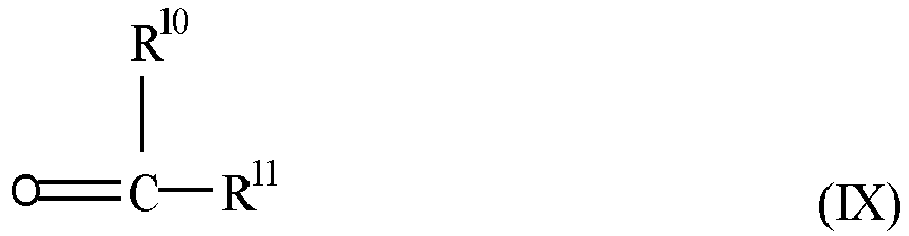
U.S. Patent No. 7,923,572 . - Representative and non-limiting examples of amino-functional silanes (II) that can be used to prepare imino-functional silane (I), aldimino-functional silanes (IV) and (VI) and ketimino-functional silane (VIII) include 3-aminopropyltrimethoxysilane, 3-aminopropyldimethoxymethylsilane, 3 -amino-2-methylpropyltrimethoxysilane, 4-aminobutyltrimethoxysilane, 4-aminobutyldimethoxymethylsilane, 4-amino-3-methylbutyltrimethoxysilane, 4-amino-3,3-dimethylbutyltrimethoxysilane, 4-amino-3,3-dimethylbutyldimethoxymetyylsilane, 2-aminoethyltrimethoxysilane, 2-aminoethyldimethoxymethylsilane, aminomethyltrimethoxysilane, aminomethyldimethoxymethylsilane, aminomethylmethoxydimethylsilane, 7-amino-4-oxaheptyldimethoxymethylsilane as well as their analogs possessing ethoxy, propoxy or isopropoxy groups on the silicon atom; so-called diaminosilanes which in addition to a primary amino group possess a secondary amino group (-NH group) which, for example, is in the gamma position relative to the silicon atom, for example, N-(2-aminoethyl)-3-aminopropyltrimethoxysilane, N-(2-aminoethyl)-3-aminopropylmethyldimethoxysilane, N-(2-aminoethyl)-3-aminopropyltriethoxysilane and N-(2-aminoethyl)-3-aminopropyltriisopropoxysilane; and so-called triaminosilanes, which carry besides a primary amino group, two secondary amino groups (-NH groups) such as N-(2-aminoethyl)-N'-[3-(trimethoxysilyl)propyl]ethylenediamine.
- Representative and non-limiting examples of carbonyl compounds (III) that can be used to prepare imino-functional silane (I) include formaldehyde, acetaldehyde, propionaldehyde, butyraldehyde, isobutyraldehyde, 2-methylbutyraldehyde, 2-ethylbutyraldehyde, 2-methylvaleraldehyde, 2-ethylcapronaldehyde, cyclopentanecarboxaldehyde, cyclohexanecarboxaldehyde, 1,2,3,6-tetrahydrobenzaldehyde, phenylacetaldehyde, 2-methyl-3-phenylpropionaldehyde, 2-phenylpropionaldehyde, and diphenylacetaldehyde, 2,2-dimethyl-3 -methylaminopropanal, 2,2-dimethyl-3-dimethylaminopropanal, 2,2-dimethyl-3 -ethylaminopropanal, 2,2-dimethyl-3-diethylaminopropanal, 2,2-dimethyl-3 -bis(2-methoxyethyl)aminopropanal, 2,2-dimethyl-3-butylaminopropanal, 2,2-dimethyl-3 -dibutylaminopropanal, 2,2-dimethyl-3 -hexylaminopropanal, 2,2-dimethyl-3-(2-ethylhexyl)aminopropanal, 2,2-dimethyl-3-dodecylaminopropanal, 2,2-dimethyl-3-(N-pyrrolidino)propanal, 2,2-dimethyl-3-(N-piperidino)propanal, 2,2-dimethyl-3-(N-morpholino)propanal, 2,2-dimethyl-3-(N-(2,6-dimethyl)morpholino)propanal, 2,2-dimethyl-3-benzylaminopropanal, 2,2-dimethyl-3-(N-benzylmethylamino)propanal, 2,2-dimethyl-3-(N-benzylisopropylamino)propanal, 2,2-dimethyl-3-cyclohexylaminopropanal and 2,2-dimethyl-3-(N-cyclohexylmethylamino)propanal, 4-oxo-pentanal, acetone, methylethylketone, methylpropylketone, methylisopropylketone, methylisobutylketone, dimethylketone, diethyl ketone, dipropylketone, diisopropylketone, dibutylketone and diisobutylketone, cyclopentanone, triemethylcyclopentanone, cyclohexanone, trimethylcyclohexanone, 6-oxo-2-heptanone, 5-oxo-2-hexanone, 1,4-diacetylbenzene, 1,3,5-triacetylbenzene and acetylacetone.
- Representative and non-limiting examples of aldehydes (V) that can be used to prepare aldimino-functional silane (VI) include ethers of beta-hydroxyaldehydes as formed from a crossed aldol reaction from formaldehyde and a second aldehyde such as 2-methylbutyraldehyde, 2-ethyl-butyraldehyde, 2-methylvaleraldehyde, 2-ethylcaproaldehyde, cyclopentane-carboxaldehyde, cyclohexanecarboxaldehyde, 1,2,3,6-tetrahydrobenz-aldehyde, 2-methyl-3-phenylpropionaldehyde, 2-phenylpropionaldehyde (hydratropaldehyde), and diphenylacetaldehyde, and alcohols such as methanol, ethanol, propanol, isopropanol, butanol, 2-ethylhexanol or fatty alcohols, such as, for example, 3-methoxy- and 3-ethoxy- and 3-propoxy- and 3-isopropoxy- and 3-butoxy-, and also 3-(2-ethylhexoxy)-2,2-dimethylpropanal; products of an esterification of the aforementioned β-hydroxyaldehydes such as 3-hydroxy-pivalaldehyde, 3-hydroxyisobutyraldehyde, 3-hydroxypropionaldehyde, 3-hydroxybutyraldehyde, 3-hydroxyvaleraldehyde, 2-hydroxymethyl-2-methyl-butyraldehyde, 2-hydroxymethyl-2-ethylbutyraldehyde, 2-hydroxymethyl-2-methylvaleraldehyde, 2-hydroxymethyl-2-ethylhexanal, 1-hydroxymethyl-cyclopentanecarbaldehyde, 1-hydroxymethylcyclohexanecarbaldehyde, 1-hydroxymethylcyclohex-3-enecarbaldehyde, 2-hydroxymethyl-2-methyl-3-phenylpropionaldehyde, 3-hydroxy-2-methyl-2-phenylpropionaldehyde and 3-hydroxy-2,2-diphenylpropionaldehyde with carboxylic acids such as formic acid, acetic acid, propionic acid, butyric acid, isobutyric acid, 2-ethylcaproic acid, and benzoic acid; and, esterification products of the aforementioned beta-hydroxyaldehydes such as 3-hydroxy-pivalaldehyde, 3-hydroxyisobutyraldehyde, 3-hydroxypropanal, 3-hydroxy-butyraldehyde, 3-hydroxyvaleraldehyde, 2-hydroxymethyl-2-methyl-butyraldehyde, 2-hydroxymethyl-2-ethylbutyraldehyde, 2-hydroxymethyl-2-methylvaleraldehyde, 2-hydroxymethyl-2-ethylhexanal, 1-hydroxymethyl-cyclopentanecarbaldehyde, 1-hydroxymethylcyclohexanecarbaldehyde, 1-hydroxymethylcyclohex-3-enecarbaldehyde, 2-hydroxymethyl-2-methyl-3-phenylpropionaldehyde, 3-hydroxy-2-methyl-2-phenylpropionaldehyde, and 3-hydroxy-2,2-diphenylpropionaldehyde with carboxylic acids such as, for example, lauric acid, tridecanoic acid, myristic acid, pentadecanoic acid, palmitic acid, margaric acid, stearic acid, nonadecanoic acid, arachidic acid, palmitoleic acid, oleic acid, erucic acid, linoleic acid, linolenic acid, eleostearic acid, arachidonic acid, succinic acid, glutaric acid, adipic acid, pimelic acid, suberic acid, azelaic acid, sebacic acid, 1,12-dodecanedioic acid, maleic acid, fumaric acid, hexahydrophthalic acid, hexahydroisophthalic acid, hexahydro-terephthalic acid, 3,6,9-trioxaundecanedioic acid, and similar derivatives of polyethylene glycol, dehydrogenated ricinoleic acids, and also fatty acids from the industrial saponification of natural oils and fats such as, for example, rapeseed oil, sunflower oil, linseed oil, olive oil, coconut oil, oil-palm kernel oil, and oil-palm oil.
- Representative and non-limiting examples of aldehydes (VII) that can be used to prepare aldimino-functional silane (VI) include 2,2-dimethyl-3-methylaminopropanal, 2,2-dimethyl-3-dimethylaminopropanal, 2,2-dimethyl-3-ethylaminopropanal, 2,2-dimethyl-3 - diethylaminopropanal, 2,2-dimethyl-3 -bis(2-methoxyethyl)aminopropanal, 2,2-dimethyl-3-butylaminopropanal, 2,2-dimethyl-3 -dibutylaminopropanal, 2,2-dimethyl-3 -hexylaminopropanal, 2,2-dimethyl-3-(2-ethylhexyl)aminopropanal, 2,2-dimethyl-3-dodecylaminopropanal, 2,2-dimethyl-3-(N-pyrrolidino)propanal, 2,2-dimethyl-3-(N-piperidino)propanal, 2,2-dimethyl-3-(N-morpholino)propanal, 2,2-dimethyl-3-(N-(2,6-dimethyl)morpholino)propanal, 2,2-dimethyl-3-benzylaminopropanal, 2,2-dimethyl-3-(N-benzylmethylamino)propanal, 2,2-dimethyl-3-(N-benzylisopropylamino)propanal, 2,2-dimethyl-3-cyclohexylaminopropanal and 2,2-dimethyl-3-(N-cyclohexylmethylamino)propanal.
- Representative and non-limiting examples of ketones (IX) that can be used to prepare ketiminosilanes (VIII) include aliphatic ketones such as acetone, methylethylketone, methylpropylketone, methylisopropylketone, methylisobutylketone, dimethylketone, diethyl ketone, dipropylketone, diisopropylketone, dibutylketone and diisobutylketone, and cyclic ketones such as cyclopentanone, triemethylcyclopentanone, cyclohexanone and trimethylcyclohexanone.
- In one particular embodiment, the method of stabilizing imino-functional silane in accordance with the invention comprises:
- a) adding a Bronsted-Lowry base to an imino-functional silane that is susceptible to undergoing self-addition and deamination reactions resulting from the presence therein of a proton source; and,
- b) mixing the imino-functional silane with the Bronsted-Lowry base thereby neutralizing the proton source and providing stabilized imino-functional silane.
- In the aforedescribed embodiment of the method of the invention, the Bronsted-Lowry base added to the imino-functional silane in step (a) should be sufficient to inhibit self-addition and deamination reactions of the imino-functional silane. In one embodiment, such amount of Bronsted-Lowry base will generally be at least about 1 molar equivalent, more specifically from about 1 to about 10 molar equivalents and even more specifically from about 1.2 to about 10 molar equivalents, based on the moles of proton source present in the imino-functional silane.
- The foregoing embodiment may additionally comprise:
- c) separating the Bronsted-Lowry base from the mixture of imino-functional silane and Bronsted-Lowry base of step (b) to provide a stabilized, imino-functional silane, preferably one that is substantially free of Bronsted-Lowry base; and,
- d) collecting the stabilized imino-functional silane of step (c).
- It will be appreciated that the selected Bronsted-Lowry base must be sufficiently basic to neutralize the proton source. In one embodiment, the conjugate acid of the Bronsted-Lowry base use to neutralize the proton source will have a pKa in water of greater than about 12, specifically a pKa of from about 12 to about 25, and more specifically a pKa of from about 13 to about 20. The pKa values for the conjugate acid of the Bronsted-Lowry base can be found in, inter alia, "Advanced Organic Chemistry", 3rd ed., J. March (1985) and in references cited therein, and in "CRC Handbook of Chemistry and Physics", David R. Lide, editor, 72 ed. (CRC Press 1991-92). Such pKa values can also be determined by the method of R.G. Bates and G.D. Pinching, J. Am., Chem. Soc., 72, 1393 (1950) at 25°C. The Bronsted-Lowry base will have sufficient basicity if it is a hydroxide, alkoxide or oxide of an alkali or alkaline metal.
- As used herein, the expression "substantially free of Bronsted-Lowry base" shall be understood to mean a stabilized imino-functional silane containing less than about 1 weight percent, specifically less than about 0.01 weight percent, more specifically less than about 0.0001 weight percent, and still more specifically from about 0.0001 to about 0.1 weight percent, Bronsted-Lowry base based on the weight of the stabilized imino-functional silane.
- In one embodiment, the amount of Bronsted-Lowry base in the stabilized imino-functional silane may be determined using Inductively Coupled Plasma Mass Spectrometry.
- In one embodiment, a stabilized imino-functional silane is an imino-functional silane containing less than about 2 weight percent conjugated carbon-carbon double bond-containing imino-functional silane based on the total weight of conjugated carbon-carbon double bond-containing imino-functional silane and imino-functional silane after storage (aging) at 25°C for 4 weeks. More specifically, a stabilized imino-functional silane is an imino-functional silane that contains less than about 0.5 weight percent conjugated carbon-carbon double bond-containing imino-functional silane, and still more specifically, less than 0.1 weight percent of conjugated carbon-carbon double bond-containing imino-functional silane, based on the total weight of conjugated carbon-carbon double bond-containing imino-functional silane and imino-functional silane after storage at 25°C for 4 weeks.
- In another embodiment, the stabilized imino-functional silane contains less than about 15 ppm, specifically less than about 1 ppm, proton source based on the weight of the imino-functional silane.
- In one embodiment, the weight percent of the conjugated carbon-carbon double bond-containing imino-functional silane in the stabilized imino-functional silane can be determined employing gas chromatography (GC) using dodecane as an internal standard. In accordance with one GC procedure, the GC column is 30 meters long and 0.25 millimeters in diameter and coated with a 0.25 micron film (HP-5 from Agilent), the flow of helium carrier gas is 1 mL per minute, with an initial temperature profile of 50°C for 2 minutes followed by an increase of 8°C per minute up to a temperature of 340°C, holding at the latter temperature for 5 minutes, and using a flame ionization detector (FID).
- As indicated above, even trace amounts of acidic proton will result in undesirable addition and deamination reactions of imino-functional silane. The proton source present in the iminosilane can come from a variety of sources, for example, as residual acid(s) associated with one or more of the amino-functional silane, aldehyde and/or ketone reactants and may even result from absorption of atmospheric carbon dioxide and water by the imino-functional silane.
- Neutralization of the proton source can be achieved by the addition of a suitable amount of at least one Bronsted-Lowry base to the proton source-containing imino-functional silane. In one embodiment, a suitable amount of the at least one Bronsted-Lowry base is at least 1 molar equivalent, more specifically from about 1 to about 10 molar equivalents and even more specifically from about 1.2 to about 10 molar equivalents, based on the moles of proton source present in the imino-functional silane.
- In one embodiment, the Bronsted-Lowry base is a compound having the general formula (X):
M(OR)f (X)
wherein M is an alkali metal or alkaline earth metal and R is hydrogen, a hydrocarbon group of from 1 to about 20 carbon atoms, a heterocarbon group of up to about 20 carbon atoms, specifically from 1 to about 12 carbon atoms and still more specifically from 1 to about 6 carbon atoms, a p-orbital of the oxygen atom containing a lone paired electrons, or M, and subscript f is 1 or 2, with the provisos that (i) when M is an alkali metal, then subscript f is 1; (ii) when M is an alkaline earth metal, then subscript f is 2, except when R is a p-orbital of oxygen atom containing a lone pair of electrons; (iii) when R is M, then M is an alkali metal; and (iv) when R is a p-orbital of the oxygen atom containing a lone pair of electrons, then M is an alkaline metal and subscript f is 1. It is understood that the Bronsted-Lowry base of formula (X) is a salt of an alkali or alkaline hydroxide, alkoxide or oxide. - In another embodiment, in a preferred group of Bronsted-Lowry bases (X), M is an alkali or alkaline earth metal, R is hydrogen or a hydrocarbon group of from 1 to about 20 carbon atoms, specifically from 1 to about 12 carbon atoms, more specifically from 1 to about 6 carbon atoms, and still more specifically methyl or ethyl, and subscript f is 1 or 2 with the provisos that when M is an alkali metal, subscript f is 1 and when M is an alkaline earth metal, subscript f is 2.
- Representative and non-limiting examples of Bronsted-Lowry base (X) that can be used for this purpose include alkali metal and alkaline metal hydroxides, alkoxides and oxides such as LiOH, NaOH, KOH, CsOH, Mg(OH)2, Ca(OH)2, Ba(OH)2, NaOMe, KOMe, NaOEt, KOEt, CaO, MgO, BaO and any combinations thereof.
- The amount of Bronsted-Lowry base (X) added to the imino-functional silane to be stabilized will generally range from about 0.0001 to about 10 weight percent, specifically from about 0.001 to about 5 weight percent, and more specifically from about 0.1 to about 1 weight percent, based upon the total weight of the imino-functional silane and Bronsted-Lowry base.
- In one embodiment of the invention, the selected Brønsted-Lowry base is one that is soluble in the imino-functional silane at the concentration employed and matches the alkoxy functionality of the silane moiety of the imino-functional silane, for example, sodium methoxide in the case of trimethoxysilane-functional iminosilane, sodium ethoxide in the case of triethoxysilane-functional iminosilane, etc.
- Neutralization of the proton source can be carried out before, during or after distillation of the imino-functional silane reaction medium to recover any unreacted aminosilane, aldehyde and/or ketone reactant(s). However, in general, it is preferred to add the neutralizing Bronsted-Lowry base to the imino-functional silane during or immediately after such distillation and more preferred, during distillation where the imino-functional silane is distilled from a mixture of the imino-functional silane and the Bronsted-Lowry base (X).
- In embodiments of the present invention, separation of Bronsted-Lowry base and/or Bronsted-Lowry acid can be achieved either by distillation of the treated imino-functional silane, i.e., a mixture of the imino-functional silane and Bronsted-Lowry base and/or Bronsted-Lowry acid, by extraction, by a preparatory chromatographic method, by filtration or by any other conventional or otherwise known separation method, as well as by a combination of two or more of such methods.
- This example is provided for comparison purposes and illustrates a known process for preparing the ketiminosilane, 3-(1,3-dimethylbutylidene) aminopropyltriethoxysilane:

- Into a four neck round bottom flask (5 L) fitted with a Dean Stark trap and condenser, thermocouple, addition funnel and a stopper was added methylisobutylketone (MIBK) (3 L). The Dean Stark trap was filled with MIBK (~125 mL) and the head space of the reaction vessel was flushed with nitrogen. The MIBK was heated to reflux and gamma-aminopropyltriethoxysilane (593.08 g) was added drop wise to the refluxing MIBK over a period of four hours and fifteen minutes. The resulting reaction mixture was heated at reflux for an additional one hour after the completion of the aminosilane. Approximately 37mL of water was collected in the Dean Stark trap during the course of the reaction. The reaction mixture was purified by distillation, first removing ~2.2L of volatiles (MIBK and EtOH) at atmospheric pressure. The resulting crude 3-(1,3-dimethylbutylidene) aminopropyltriethyoxysilane was further purified via vacuum distillation.
- To a three neck round bottom flask (1 L) fitted with a Dean Stark trap and condenser, thermocouple, and addition funnel was added MIBK (585 mL). The Dean Stark trap was filled with MIBK (~25 mL) and the head space of the reaction vessel was flushed with nitrogen. The MIBK was heated to reflux and gamma-aminopropyltriethoxysilane (100 mL) was added drop wise to the refluxing MIBK over a period of one hour and twenty five minutes. The resulting reaction mixture was heated at reflux for an additional one and a half hours after the completion of the aminosilane addition. Approximately 7mL of water was collected in the Dean Stark trap during the course of the reaction. The reaction mixture was purified by distillation, first removing ~525mL of volatiles (MIBK and EtOH) at atmospheric pressure. After removal of the lights, a 21 wt% solution of sodium ethoxide in ethanol (0.824 mL, 0.7156 g) was added to the crude (3-(1,3-dimethylbutylidene) aminopropyltriethyoxysilane). The crude product containing sodium ethoxide was further purified via vacuum distillation.
- To demonstrate the improved storage stability of the iminosilane of Example 1 by comparison to that of Comparative Example 1, samples of both products were analyzed for purity by GC over the course of six weeks. Both materials were stored in -20 mL glass vials with a Teflon lined cap, the head space was purged with nitrogen and the filled vials were stored in a dark cabinet to prevent deterioration by light. As shown in the table below, the iminosilane made by the method of Example 1 retained high purity over the course of six weeks in contrast to the product made by the method of Comparative Example 1 which lost approximately 2% product after 4 weeks of aging.
Table I Preparative Method As Made 1 week 2 week 4 week 6 week Comparative Example I 98.87% No Test 97.90% 96.97% No Test Example 1 99.20% 99.35% 99.47% 99.41% 99.57% - Employing substantially the same procedures as described in Example 1, imino-functional silanes can be prepared from the amines, ketones and aldehydes and stabilized by the addition of the Bronsted-Lowry bases indicated in Table II below:
Table II Ex. Amine Ketone/Aldehyde Imine Product Base 2 gamma-aminopropyltriethoxysilane methylisobutylketone (1,3 -dimethyl-butylidene)-(3 - triethoxy-silany 1-propyl)-amine sodium ethoxide 3 gamma-aminopropyltrimethoxysilane methylisobutylketone (1,3 -dimethyl-butylidene)-(3 - trimethoxy-silanyl-propyl)-amine sodium methoxide 4 4-amino-3-dimethyl-1-butyltriethoxylsilane methylisobutylketone (1,3-dimethyl-butylidene)-(2,2-dimethyl-4-triethoxysilanyl-butyl)-amine sodium ethoxide 5 gamma-aminopropylmethyldiethoxysilane acetone isopropylidene-(3 -methyl-diethoxy-silanyl-propyl)-amine sodium ethoxide 6 gamma-aminopropyltriethoxysilane methylethylketone sec-butylidene-(3-triethoxy-silanyl-propyl)-amine sodium ethoxide 7 gamma-aminopropyltriethoxysilane acetophenone [3 -(triethoxy-silanyl)-propyl] - (1-phenyl-ethylidene)-amine sodium ethoxide 8 gamma-aminopropyldimethylethoxy-silane acetaldehyde ethylidene-(3-dimethyl-ethoxy-silanyl-propyl)-amine sodium ethoxide 9 gamma-aminopropyltriethoxysilane isobutyraldehyde (3-methyl-butylidene)-(3-triethoxy-silany 1-propyl)-amine sodium ethoxide 10 gamma-aminopropyltriethoxysilane benzaldehyde benzylidene-(3-triethoxy-silanyl-propyl)-amine sodium ethoxide 11 gamma-aminopropyltriethoxysilane 3-dimethylamino-2,2-dimethyl-propionaldehyde [2,2-dimethyl-3-(3-triethoxy-silanyl-propylimino)-propyl]-dimethyl-amine sodium ethoxide 12 N-(2-aminoethyl)-3-aminopropy ltrimethoxysilane methylethylketone N-sec-butylidene-N'-(3-trimethoxy-silanyl-propyl)-ethane-1,2-diamine CaO - Into a four neck round bottom flask (1 L) fitted with a Dean Stark trap, condenser, thermocouple, addition funnel and mechanical stirrer was added methyl isobutyl ketone (502 grams, 5 moles). N-butylamine (73.14 grams, 1 mole) was charged into the addition funnel. The reaction mixture was heated to reflux and N-butylamine was added drop wise to the refluxing methyl isobutyl ketone over a period of one hour and ten minutes. The resulting reaction mixture was heated at reflux for an additional one hour and ten minutes after the completion of the N-butylamine addition. Approximately 18 mL of water was collected in the Dean Stark trap during the course of the reaction. The Dean Stark trap and condenser were replaced with a 3" vigreux column and distillation head. Approximately 382 grams of volatiles, which were methyl isobutyl ketone and N-butylamine, were removed by vacuum stripping at a reduced pressed ranging from 280 to 420 mm Hg. After removal of the lights, an equal molar quantity of gamma-aminopropyltriethoxysilane was charged into the reaction mixture. N-butylamine was removed by vacuum at 55°C and 140 mm Hg and the crude 3-(1,3-dimethylbutylidene) aminopropyltriethyoxysilane was filtered thru a 1 micron filter pad.
- The crude 3-(1,3-dimethylbutylidene) aminopropyltriethyoxysilane can be treated with a Bronsted-Lowry base during the distillation process.
- Into a four neck round bottom flask (5 L) fitted with a Dean Stark trap, condenser, thermocouple, addition funnel and mechanical stirrer was added terephthalaldehyde (569 grams 4.24 moles) along with toluene (2,020 grams, 22 moles). N-butylamine (620 grams, 8.48 moles) was charged into the addition funnel. The reaction mixture was heated to reflux and N-butylamine was added drop wise to the refluxing mixture over 3 hour and forty-five minutes. Approximately 150 ml of water was collected during the course of the reaction. The Dean Stark trap and condenser were replaced with a vacuum distillation head. Approximately 1,777 grams of volatiles consisting of toluene and N-butylamine were removed by vacuum stripping at reduced pressures ranging from 18 to 150 mm Hg.
- After removal of the lights, 3-aminopropyltriethoxysilane (2,061.5 grams, 9.33 moles) was charged into the reaction mixture. N-butylamine and excess 3-aminopropyltriethoxysialne were removed under reduced pressures ranging from 240 to 11 mm Hg with a reaction pot temperature between room temperature and 170°C . The crude aldiminosilane adduct was filtered thru a 1 micron filter pad.
- The crude aldiminosilane adduct can be treated with a Bronsted-Lowry base during the distillation process.
- Potassium hydroxide (0.1 gram) was added to 100 grams of 3-(1,3-dimethylbutylidene) aminopropyltriethoxysilane prepared in accordance with Comparative Example I. The mixture was purified via vacuum distillation at 108° C at 1.57 mm Hg to yield a clear colorless solution. The purity of the product was 99.61 percent using GC. After aging for 14 days at 50°C, the purity of the aged product was 99.52 percent. The experiment illustrated that the product can be successfully distilled from potassium hydroxide.
- Calcium hydroxide (0.11 gram) was added to 106.2 grams of 3-(1,3-dimethylbutylidene) aminopropyltriethoxysilane prepared in accordance with Comparative Example I. The mixture was purified via vacuum distillation at a temperature of 124° C and pressure of 2.4 mm Hg to yield a clear colorless solution. The purity of the product was 99.34 percent using GC. The experiment illustrated that the product can be successfully distilled from calcium hydroxide.
- Magnesium oxide (0.10 gram) was added to 100 grams of 3-(1,3-dimethylbutylidene) aminopropyltriethoxysilane prepared in accordance with Comparative Example I. The mixture was purified via vacuum distillation at a temperature of 120° C and pressure of 1.73 mm Hg to yield a clear colorless solution. The purity of the product was 99.57 percent using GC. The experiment illustrated that the product can be successfully distilled from calcium hydroxide.
- Sodium carbonate (anhydrous) (0.1 grams) was added to 100 grams of 3-(1,3-dimethylbutylidene) aminopropyltriethoxysilane prepared in accordance with Comparative Example I. The mixture was purified via vacuum distillation at a temperature of 107° C and a pressure of 1.52 mm Hg to yield a clear colorless solution. The purity of the product was 99.71 percent using GC. This example illustrates that the product can be successfully distilled from sodium carbonate.
- The imino-functional silane

- Into a four neck round bottom flask (2 L) fitted with a Dean Stark trap, condenser, thermocouple, addition funnel and mechanical stirrer was added octanal (96 grams, 0.75 mole) and toluene (800 grams, 8.68 moles). 3-Aminopropyltrimethoxysilane (169 grams, 0.94 mole) was charged into the addition funnel. The reaction mixture was heated to reflux and 3-aminopropyltrimethoxysilane was added drop wise to the refluxing toluene/octanal mixture over a period of two hour and twenty minutes. Approximately 16 mL of water was collected in the Dean Stark trap during the course of the reaction. The Dean Stark trap and condenser were replaced with a short path distillation head. Approximately 780 grams of volatiles, which included toluene and methanol, were removed by distillation at atmospheric pressure followed by vacuum stripping at 350 to 11 mm Hg). After removal of the lights, 1.1 grams of 25 wt% solution of sodium methoxide in methanol was added to 220 grams of crude 3-(1-octylidene) aminopropyltrimethyoxysilane and further purified via vacuum distillation at a temperature range of 126 to 141° C and at a pressure of 1.45 mm Hg to yield a clear colorless solution.
- While the above description contains many specifics, these specifics should not be construed as limitations of the invention, but merely as exemplifications of preferred embodiments thereof. Those skilled in the art will envision many other embodiments within the scope and spirit of the invention as defined by the claims appended thereto.
- Hereafter, the preferred embodiments according to the invention are summarized:
- 1. A method of stabilizing imino-functional silane comprising:
- a) adding a Bronsted-Lowry base to an imino-functional silane; and,
- b) mixing the imino-functional silane with the Bronsted-Lowry base to provide stabilized imino-functional silane.
- 2. The method of Embodiment 1, wherein the imino-functional silane is an imino-functional alkoxysilane of general formula (I):

- R0 is hydrogen, a monovalent hydrocarbon group of from 1 to about 20 carbon atoms or a monovalent heterocarbon group of from 1 to about 20 carbon atoms containing one or more heteroatoms;
- R1 is a divalent hydrocarbon group of from 1 to about 20 carbon atoms or a divalent heterocarbon group of from 1 to about 20 carbon atoms;
- R2 is an alkyl group of from 1 to about 5 carbon atoms;
- R3 is phenyl or an alkyl group of from 1 to about 8 carbon atoms;
- G is a monovalent or polyvalent hydrocarbon group of from 1 to about 30 carbon atoms or a heterocarbon group of from 1 to about 30 carbon atoms containing one or more heteroatoms;
- subscript a is 0, 1 or 2; and,
- subscript x is 1, 2, 3 or 4.
- 3. The method of Embodiment 1, wherein the imino-functional silane is at least one member selected from the group consisting of:
- aldimino-functional silane of general formula (IV):

- wherein:
- R1 is a divalent hydrocarbon group of up to about 20 carbon atoms or a divalent heterocarbon group of up to about 20 carbon atoms containing one or more heteroatoms;
- R2 is an alkyl group of from 1 to about 5 carbon atoms;
- R3 is phenyl or an alkyl group of from 1 to about 8 carbon atoms;
- Y1 and Y2 each independently is hydrogen, an organic radical or together with the carbon atom to which they are bonded form a carbocyclic or heterocyclic ring of from about 5 to about 8 ring atoms;
- Y3 is hydrogen, an unsubstituted or substituted alkyl group of up to about 10 carbon atoms containing one or more heteroatoms, an unbranched or branched alkyl or alkylenyl group of up to about 10 carbon atoms, a substituted or unsubstituted aryl or arylalkyl group of up to about 20 carbon atoms, or an -OR4, -OC(=O)-R4, -C(=O)OR4 or -C(=O)R4 group in which R4 is an unsubstituted or substituted alkyl group of from 3 to about 20 carbon atoms; and,
- subscript a is 0, 1 or 2,
- aldimino-functional silane of general formula (VI):

- wherein:
- R1, R2, R3 and subscript a have the aforestated meanings for aldimino-functional silane (IV);
- R5 and R6 each independently is hydrogen, a monovalent hydrocarbon group of from 1 to about 12 carbon atoms or together with the carbon atom to which they are bonded form an unsubstituted or substituted ring of from about 5 to about 12 carbon atoms, or a heterocarbon group containing from 1 to about 12 carbon atoms;
- R7 is hydrogen, a monovalent hydrocarbon group of up to about 20 carbon atoms, a heterocarbon group containing up to about 20 carbon atoms and one or more heteroatoms, or an alkoxycarboxyl group of from 2 to about 20 carbon atoms; and,
- R8 and R9 each independently is a monovalent hydrocarbon group of up to about 20 carbon atoms, a heterocarbon group containing up to about 20 carbon atoms and one or more heteroatoms, or an alkoxycarboxyl group of from 2 to about 20 carbon atoms, or R8 and R9 and the carbon atom to which they are bonded form an unsubstituted or substituted ring of from about 5 to about 12 carbon atoms containing zero, one or more heteroatoms,
- and ketimino-functional silane of general formula (VIII):

- wherein:
- R1, R2, R3 and subscript a each have one of the same meanings stated above for aldimino-functional silane (IV);
- R10 and R11 each independently is a monovalent hydrocarbon group of up to about 20 carbon atoms or a monovalent heterocarbon group of up to about 20 carbon atoms containing one or more heteroatoms; and,
- subscript a is 0, 1 or 2.
- aldimino-functional silane of general formula (IV):
- 4. The method of Embodiment 1, wherein the Bronsted-Lowry base is a compound having the general formula (X):
M(OR)f (X)
wherein M is an alkali metal or alkaline earth metal and R is hydrogen, a hydrocarbon group of from 1 to about 20 carbon atoms, a heterocarbon group of up to about 20 carbon atoms, specifically from 1 to about 12 carbon atoms and still more specifically from 1 to about 6 carbon atoms, a p-orbital of the oxygen atom containing a lone paired electrons, or M, and subscript f is 1 or 2, with the provisos that (i) when M is an alkali metal, then subscript f is 1; (ii) when M is an alkaline earth metal, then subscript f is 2, except when R is a p-orbital of oxygen atom containing a lone pair of electrons; (iii) when R is M, then M is an alkali metal; and (iv) when R is a p-orbital of the oxygen atom containing a lone pair of electrons, then M is an alkaline metal and subscript f is 1. It is understood that the Bronsted-Lowry base of formula (X) is a salt of an alkali or alkaline hydroxide, alkoxide or oxide. - 5. The method of Embodiment 4, wherein in Bronsted-Lowry base (X), M is an alkali or alkaline earth metal, R is hydrogen or a hydrocarbon group of from 1 to about 20 carbon atoms and subscript f is 1 or 2, with the provisos that when M is an alkali metal, subscript f is 1 and when M is an alkaline earth metal, subscript f is 2.
- 6. The method of Embodiment 1, wherein the Bronsted-Lowry base is at least one member selected from the group consisting of alkali metal and alkaline metal hydroxides, alkoxides and oxides.
- 7. The method of Embodiment 1, wherein the Bronsted-Lowry base is at least one member selected from the group consisting of LiOH, NaOH, KOH, CsOH, Mg(OH)2, Ca(OH)2, Ba(OH)2, NaOMe, KOMe, NaOEt, KOEt, CaO, MgO and BaO.
- 8. The method of Embodiment 1, wherein the amount of Bronsted-Lowry base (X) added to the imino-functional silane ranges from about 0.0001 to about 10 weight percent based upon the total weight of the imino-functional silane and Bronsted-Lowry base.
- 9. The method of Embodiment 1, wherein the Bronsted-Lowry base is soluble in the imino-functional silane at the concentration employed and matches the alkoxy functionality of the silane moiety of the imino-functional silane.
- 10. The method of Embodiment 1, wherein the stabilized imino-functional silane is an imino-functional silane containing less than about 2 weight percent conjugated carbon-carbon double bond-containing imino-functional silane based on the total weight of conjugated carbon-carbon double bond-containing imino-functional silane and imino-functional silane when stored at 25°C for 4 weeks.
- 11. The method of Embodiment 1, wherein the stabilized imino-functional silane contains from about 0.0001 to about 0.1 weight percent of Bronsted-Lowry base based on the weight of the imino-functional silane.
- 12. The method of Embodiment 1, wherein the method further comprises neutralizing a proton source in the mixture from step (b) with at least one Bronsted-Lowry base.
- 13. The method of Embodiment 1 further comprising separating the at least one Bronsted-Lowry base from the mixture of imino-functional silane with the at least one Bronsted-Lowry base after the proton source in the mixture of step (b) has been neutralized with the at least one Bronsted-Lowry base.
- 14. The method of Embodiment 13, wherein the step of separating is at least one of distilling the mixture of the imino-functional silane and the at least one Bronsted-Lowry base, passing such mixture through an ion exchange resin, extracting such mixture, and applying a preparatory chromatographic method to such mixture.
- 15. The method of Embodiment 1, wherein the imino-functional silane is (1,3-dimethyl-butylidene)-(3 -triethoxy-silanyl-propyl)-amine, (1,3 -dimethyl-butylidene)-(3 - trimethoxy-silany1-propyl)-amine, (1,3-dimethyl-butylidene)-(2,2-dimetbyl-4-triethoxysilanyl-butyl)-amine, isopropylidene-(3 -methyl-diethoxy-silanyl-propyl)-amine, sec-butylidene-(3-triethoxy-silanyl-propyl)-amine, [3-(triethoxy-silanyl)-propyl]-(1-phenyl-ethylidene)-amine, ethylidene-(3 -dimethyl-ethoxy-silanyl-propyl)-amine, (3-methyl-butylidene)-(3-triethoxy-silanyl-propyl)-amine, benzylidene-(3-triethoxy-silanyl-propyl)-amine, [2,2-dimethyl-3-(3-triethoxy-silanyl-propylimino)-propyl]-dimethyl-amine, N-sec-butylidene-N'-(3-trimethoxy-silanyl-propyl)-ethane-1,2-diamine or 3-(1-octylidene aminopropyltrimetheoxysilane.
- 16. The method of Embodiment 1, wherein in step (a), the imino-functional silane is susceptible to undergoing self-addition and deamination reactions resulting from the presence therein of a proton source and in step (b) the Bronsted-Lowry base neutralizes the proton source thereby inhibiting such self-addition and deamination reactions.
- 17. The method of Embodiment 1, which further comprises:
- c) separating the Bronsted-Lowry base from the stabilized imino-functional silane; and,
- d) collecting the stabilized imino-functional silane from step (c).
- 18. The method of Embodiment 16, which further comprises:
- c) separating the Bronsted-Lowry base from the stabilized imino-functional silane; and,
- d) collecting the stabilized imino-functional silane from step (c).
- 19. The method of Embodiment 17, wherein separating step (c) is carried out by at least one of distilling the mixture of the imino-functional silane and the at least one Bronsted-Lowry base, and passing such mixture through an ion exchange resin or membrane.
- 20. The method of Embodiment 18, wherein separating step (c) is carried out by at least one of distilling the mixture of the imino-functional silane and the at least one Bronsted-Lowry base, and passing such mixture through an ion exchange resin or membrane.
- 21. The method of Embodiment 16, wherein the amount of Bronsted-Lowry base added to the imino-functional silane is sufficient to inhibit self-addition and deamination reactions of the imino-functional silane.
- 22. The method of Embodiment 16 wherein the amount of Bronsted-Lowry base added to the imino-functional silane is at least 1 molar equivalent based on the moles of proton source present in the imino-functional silane.
- 23. A stabilized imino-functional silane substantially free of a proton source and containing less than about 2 weight percent conjugated carbon-carbon double bond-containing imino-functional silane based on the total weight of conjugated carbon-carbon double bond-containing imino-functional silane and imino-functional silane.
- 24. A stabilized imino-functional silane substantially free of a proton source and containing less than about 0.5 weight percent conjugated carbon-carbon double bond-containing imino-functional silane based on the total weight of conjugated carbon-carbon double bond-containing imino-functional silane and imino-functional silane.
- 25. The stabilized imino-functional silane of Embodiment 23 containing less than about 15 ppm proton source based on the weight of the imino-functional silane.
- 26. The stabilized imino-functional silane of Embodiment 23 containing less than about 1 ppm proton source based on the weight of the imino-functional silane.
- 27. The stabilized imino-functional silane of Embodiment 23 containing less than about 0.5 weight percent conjugated carbon-carbon double bond-containing imino-functional silane based on the total weight of conjugated carbon-carbon double bond-containing imino-functional silane and containing less than about 15 ppm proton source based on the weight of the imino-functional silane.
- 28. The stabilized imino-functional silane of Embodiment 23 containing less than about 0.1 weight percent conjugated carbon-carbon double bond-containing imino-functional silane based on the total weight of conjugated carbon-carbon double bond-containing imino-functional silane and containing less than about 1 ppm proton source based on the weight of the imino-functional silane.
Claims (13)
- A stabilized imino-functional silane substantially free of a proton source and containing less than about 2 weight percent conjugated carbon-carbon double bond-containing imino-functional silane based on the total weight of conjugated carbon-carbon double bond-containing imino-functional silane and imino-functional silane,wherein the imino-functional silane is an imino-functional silane of general formula (I):
 wherein:R0 is hydrogen, a monovalent hydrocarbon group of from 1 to about 20 carbon atoms such as an alkyl, cycloalkyl, aryl, alkaryl or aralkyl, group containing up to about 20 carbon atoms, or a monovalent heterocarbon group of from 1 to about 20 carbon atoms containing one or more heteroatoms such as N, O and/or S, specifically a hydrogen, a straight chain alkyl group of from 1 to about 10 carbon atoms, more specifically from 2 to 4 carbon atoms, e.g., ethyl, propyl or butyl, or a branched alkyl group of from 3 to about 10 carbon atoms, more specifically from 3 to about 6 carbon atoms and still more specifically 3 or 4 carbon atoms, e.g., isopropyl or isobutyl;R1 is a divalent hydrocarbon group of from 1 to about 20 carbon atoms such as alkylene, cycloalkylene, arylene, alkarylene or aralkylene, group containing up to about 20 carbon atoms or a divalent heterocarbon group of from 1 to about 20 carbon atoms containing one or more heteroatoms such as N, O and/or S, specifically a straight chain alkylene group of from 1 to about 10 carbon atoms, more specifically 2 to about 4 carbon atoms, e.g., ethylene, propylene or butylene, or a branched chain alkylene group of from 2 to about 10 carbon atoms, more specifically from 2 to about 6 carbon atoms and still more specifically 3 or 4 carbon atoms, e.g., isopropylene or isobutylene;R2 is an alkyl group of from 1 to about 5 carbon atoms, e.g., methyl, ethyl, propyl, isopropyl, butyl, isobutyl, pentyl or isopentyl;R3 is phenyl or an alkyl group of from 1 to about 8 carbon atoms, specifically methyl or ethyl;G is a monovalent or polyvalent hydrocarbon group of from 1 to about 30 carbon atoms or a heterocarbon group of from 1 to about 30 carbon atoms containing one or more heteroatoms such as N, O and/or S, selected from a straight chain alkyl group of from 1 to about 10 carbon atoms, more specifically from 2 to 4 carbon atoms, e.g., ethyl, propyl or butyl, an aralkyl group of from about 7 to about 10 carbon atoms, a straight chain alkylene group of from 1 to about 10 carbon atoms, more specifically from 2 to 4 carbon atoms, e.g., ethylene, propylene or butylene, aralkylene group of from about 7 to about 10 carbon atoms, where the carbon of G which connects to the imino group is unsubstituted;subscript a is 0, 1 or 2, specifically 1; and,subscript x is 1, 2, 3 or 4, specifically 1 or 2 and more specifically 1;or an aldimino-functional silane of general formula (IV):
 wherein:R1 is a divalent hydrocarbon group of up to about 20 carbon atoms or a divalent heterocarbon group of up to about 20 carbon atoms containing one or more heteroatoms such as N, O and/or S, specifically a straight chain alkylene group of from 1 to about 10 carbon atoms, more specifically from 2 to 4 carbon atoms, e.g., ethylene, propylene or butylene, or a branched chain alkylene group of from 2 to about 10 carbon atoms, more specifically from 2 to about 6 carbon atoms and still more specifically 3 or 4 carbon atoms, e.g., isopropylene or isobutylene;R2 is an alkyl group of from 1 to about 5 carbon atoms, e.g., methyl, ethyl, propyl, isopropyl, butyl, isobutyl, pentyl or isopentyl;R3 is phenyl or an alkyl group of from 1 to about 8 carbon atoms, specifically methyl or ethyl;Y1 and Y2 each is hydrogen;Y3 is a hydrogen, an unsubstituted or substituted alkyl group containing one or more heteroatoms such as N, O and/or S, an unbranched or branched alkyl or alkylenyl group of up to about 10 carbon atoms, a substituted or unsubstituted aryl or arylalkyl group of up to about 20 carbon atoms, specifically from about 6 to about 12 carbon atoms and still more specifically from about 6 to about 8 carbon atoms, or an -OR4, -OC(=O)-R4, -C(=O)OR4 or - C(=O)R4 group in which R4 is an unsubstituted or substituted alkyl group of from 3 to about 20 carbon atoms, specifically from 3 to about 10 carbon atoms and more specifically from 3 to about 6 carbon atoms, or an unsubstituted or substituted aryl or aralkyl group of up to about 20 carbon atoms, specifically from about 6 to about 12 carbon atoms and still more specifically from about 6 to about 8 carbon atoms; and,subscript a is 0, 1 or 2.
oran aldimino-functional silane of general formula (VI): wherein:R1, R2, R3 and subscript a have the aforestated meanings for aldimino-functional silane (IV);R5 is hydrogen, and R6 is hydrogen;R7 is hydrogen, a monovalent hydrocarbon group such as an alkyl, cycloalkyl, aryl, alkaryl or aralkyl group of up to about 20 carbon atoms, more specifically up to about 12 carbon atoms and more specifically up to about 6 carbon atoms, a heterocarbon group containing up to about 20 carbon atoms and one or more heteroatoms such as N, O and/or S, or an alkoxycarboxyl group of from 2 to about 20 carbon atoms, specifically from 2 to about 12 carbon atoms and more specifically from 2 to about 6 carbon atoms; and,R8 and R9 each independently is a monovalent hydrocarbon group such as an alkyl, cycloalkyl, aryl, alkaryl or aralkyl group of up to about 20 carbon atoms, more specifically up to about 12 carbon atoms and more specifically up to about 6 carbon atoms, a heterocarbon group containing up to about 20 carbon atoms and one or more heteroatoms such as N, O and/or S, or an alkoxycarboxyl group of from 2 to about 20 carbon atoms, specifically from 2 to about 12 carbon atoms and more specifically from 2 to about 6 carbon atoms, or R8 and R9 and the carbon atom to which they are bonded form an unsubstituted or substituted ring of from about 5 to about 12 carbon atoms containing zero, one or more heteroatoms such as N, O and/or S.
 - The stabilized imino-functional silane according to claim 1, wherein the stabilized imino-functional silane is an aldimino-functional silane of general formula (IV) as defined above.
- The stabilized imino-functional silane according to claim 1, wherein the stabilized imino-functional silane is aldimino-functional silane of general formula (VI) as defined above.
- The stabilized imino-functional silane according to claim 1, wherein the stabilized imino-functional silane is containing less than about 0.5 weight percent conjugated carbon-carbon double bond-containing imino-functional silane based on the total weight of conjugated carbon-carbon double bond-containing imino-functional silane and imino-functional silane.
- The stabilized imino-functional silane according to claim 1, wherein the stabilized imino-functional silane is an imino-functional silane containing less than about 2 weight percent conjugated carbon-carbon double bond-containing imino-functional silane based on the total weight of conjugated carbon-carbon double bond-containing imino-functional silane and imino-functional silane when stored at 25°C for 4 weeks.
- The stabilized imino-functional silane according to claim 1, wherein the stabilized imino-functional silane is an imino-functional silane containing less than about 0.5 weight percent conjugated carbon-carbon double bond-containing imino-functional silane based on the total weight of conjugated carbon-carbon double bond-containing imino-functional silane and imino-functional silane when stored at 25°C for 4 weeks.
- The stabilized imino-functional silane according to claim 1, wherein the stabilized imino-functional silane is an imino-functional silane containing less than about 0.1 weight percent conjugated carbon-carbon double bond-containing imino-functional silane based on the total weight of conjugated carbon-carbon double bond-containing imino-functional silane and imino-functional silane when stored at 25°C for 4 weeks.
- The stabilized imino-functional silane according to claim 1, wherein the stabilized imino-functional silane is an imino-functional silane containing less than about 0.01 weight percent, more specifically less than about 0.0001 weight percent, and still more specifically from about 0.0001 to about 0.1 weight percent, Brønsted-Lowry base based on the weight of the stabilized imino-functional silane.
- The stabilized imino-functional silane according to claim 1, wherein the imino-functional silane is (1,3-dimethyl-butylidene)-(3-triethoxy-silanyl-propyl)-amine, (1,3-dimethyl-butylidene)-(3-trimethoxy-silanyl-propyl)-amine, (1,3-dimethyl-butylidene)-(2,2-dimethyl-4-triethoxysilanyl-butyl)-amine, isopropylidene-(3-methyl-diethoxy-silanyl-propyl)-amine, sec-butylidene-(3-triethoxy-silanyl-propyl)-amine, [3-(triethoxy-silanyl)-propyl]-(1-phenyl-ethylidene)-amine, ethylidene-(3-dimethyl-ethoxy-silanyl-propyl)-amine, (3-methyl-butylidene)-(3-triethoxy-silanyl-propyl)-amine, N-sec-butylidene-N'-(3-trimethoxy-silanyl-propyl)-ethane-1,2-diamine or 3-(1-octylidene aminopropyltrimetheoxysilane.
- The stabilized imino-functional silane according to claim 1, wherein the imino-functional silane contains less than about 15 ppm proton source based on the weight of the imino-functional silane.
- The stabilized imino-functional silane according to claim 1, wherein the imino-functional silane contains less than about 1 ppm proton source based on the weight of the imino-functional silane.
- The stabilized imino-functional silane according to claim 1, wherein the stabilized imino-functional silane is an imino-functional silane containing less than about 0.5 weight percent conjugated carbon-carbon double bond-containing imino-functional silane based on the total weight of conjugated carbon-carbon double bond-containing imino-functional silane and containing less than about 15 ppm proton source based on the weight of the imino-functional silane.
- The stabilized imino-functional silane according to claim 1, wherein the stabilized imino-functional silane is an imino-functional silane containing less than about 0.1 weight percent conjugated carbon-carbon double bond-containing imino-functional silane based on the total weight of conjugated carbon-carbon double bond-containing imino-functional silane and containing less than about 1 ppm proton source based on the weight of the imino-functional silane.
Applications Claiming Priority (3)
| Application Number | Priority Date | Filing Date | Title |
|---|---|---|---|
| US201662362741P | 2016-07-15 | 2016-07-15 | |
| PCT/US2017/042088 WO2018013900A1 (en) | 2016-07-15 | 2017-07-14 | Method of stabilizing imino-functional silane |
| EP17746239.7A EP3484898B1 (en) | 2016-07-15 | 2017-07-14 | Method of stabilizing imino-functional silane |
Related Parent Applications (2)
| Application Number | Title | Priority Date | Filing Date |
|---|---|---|---|
| EP17746239.7A Division EP3484898B1 (en) | 2016-07-15 | 2017-07-14 | Method of stabilizing imino-functional silane |
| EP17746239.7A Division-Into EP3484898B1 (en) | 2016-07-15 | 2017-07-14 | Method of stabilizing imino-functional silane |
Publications (1)
| Publication Number | Publication Date |
|---|---|
| EP4053134A1 true EP4053134A1 (en) | 2022-09-07 |
Family
ID=59501532
Family Applications (2)
| Application Number | Title | Priority Date | Filing Date |
|---|---|---|---|
| EP17746239.7A Active EP3484898B1 (en) | 2016-07-15 | 2017-07-14 | Method of stabilizing imino-functional silane |
| EP22167587.9A Pending EP4053134A1 (en) | 2016-07-15 | 2017-07-14 | Method of stabilizing imino-functional silane |
Family Applications Before (1)
| Application Number | Title | Priority Date | Filing Date |
|---|---|---|---|
| EP17746239.7A Active EP3484898B1 (en) | 2016-07-15 | 2017-07-14 | Method of stabilizing imino-functional silane |
Country Status (6)
| Country | Link |
|---|---|
| US (2) | US10457697B2 (en) |
| EP (2) | EP3484898B1 (en) |
| JP (1) | JP7274410B2 (en) |
| KR (1) | KR102487691B1 (en) |
| CN (1) | CN109563111B (en) |
| WO (1) | WO2018013900A1 (en) |
Families Citing this family (6)
| Publication number | Priority date | Publication date | Assignee | Title |
|---|---|---|---|---|
| JP6555385B1 (en) * | 2018-05-01 | 2019-08-07 | 信越化学工業株式会社 | Method for producing organosilicon compound having ketimine structure |
| US20230089674A1 (en) * | 2020-02-14 | 2023-03-23 | Evonik Operations Gmbh | Stabilized silane composition |
| JP7322762B2 (en) * | 2020-03-13 | 2023-08-08 | 信越化学工業株式会社 | Method for producing organosilicon compound having ketimine structure |
| EP4309915A4 (en) * | 2021-03-19 | 2024-09-25 | Bridgestone Corporation | Rubber composition and tire |
| WO2022195978A1 (en) * | 2021-03-19 | 2022-09-22 | 株式会社ブリヂストン | Rubber composition and tire |
| TW202519533A (en) | 2023-09-11 | 2025-05-16 | 美商摩曼帝夫特性材料公司 | Silanes for addressing viscosity instability in silane terminated ssbr |
Citations (11)
| Publication number | Priority date | Publication date | Assignee | Title |
|---|---|---|---|---|
| US2942019A (en) | 1956-10-12 | 1960-06-21 | Union Carbide Corp | Organosilicon methylideneamino compounds and process for producing the same |
| US3681420A (en) | 1971-03-03 | 1972-08-01 | Quaker Oats Co | N,n{40 -bis{8 tri (substituted)silylalkylene{9 -1,4-xylene-{60 ,{60 {40 -diimine |
| US5134234A (en) | 1989-08-24 | 1992-07-28 | Ciba-Geigy Corporation | Iminosilanes |
| US5739201A (en) | 1995-01-06 | 1998-04-14 | Sunstar Giken Kabushiki Kaisha | Two-pack crosslinking aqueous adhesive |
| US6586612B2 (en) | 2001-11-16 | 2003-07-01 | Crompton Corporation | Process for the preparation of secondary and tertiary amino-functional silanes, iminoorganosilanes and/or imidoorganosilanes |
| US6998449B2 (en) | 2001-09-14 | 2006-02-14 | Bp Corporation North America | Latent metallocene catalyst systems for olefin polymerization |
| WO2009043599A1 (en) | 2007-10-04 | 2009-04-09 | Saint-Gobain Isover | Activated silane |
| US7906673B2 (en) | 2003-12-18 | 2011-03-15 | Sika Technology Ag | Aldiminoalkylsilanes |
| US7923572B2 (en) | 2005-09-22 | 2011-04-12 | Dow Corning Toray Company, Ltd. | Method for producing ketimine structure-containing alkoxysilane |
| WO2013090885A2 (en) * | 2011-12-15 | 2013-06-20 | Bridgestone Corporation | Stabilized multi-valent anionic polymerization initiators and methods for preparing the same |
| US20130281562A1 (en) * | 2010-12-17 | 2013-10-24 | Sika Technology Ag | Secondary aminosilanes |
Family Cites Families (16)
| Publication number | Priority date | Publication date | Assignee | Title |
|---|---|---|---|---|
| US2498419A (en) * | 1947-12-19 | 1950-02-21 | Shell Dev | Method of preparing unsaturated imines |
| US3424656A (en) | 1966-03-25 | 1969-01-28 | Gen Electric | Method for recovering organoalkoxysilanes by distillation with a base catalyst |
| US3434656A (en) * | 1967-09-14 | 1969-03-25 | Worthington Corp | Lubrication system for rotary vane compressors |
| DE3414877A1 (en) * | 1984-04-19 | 1985-10-24 | Henkel KGaA, 4000 Düsseldorf | POLYURETHANE PREPARATIONS WITH INCORPORATED ADHESIVE |
| JPS6283430A (en) * | 1985-10-08 | 1987-04-16 | Toagosei Chem Ind Co Ltd | Composite for rust prevention |
| US4832748A (en) * | 1986-10-21 | 1989-05-23 | Toagosei Chemical Industry Co., Ltd. | Coating composition |
| DE3641756A1 (en) * | 1986-12-06 | 1988-08-11 | Huels Troisdorf | METHOD FOR PRODUCING KETOXIMOSILANES |
| JPH0757757B2 (en) * | 1990-10-22 | 1995-06-21 | 信越化学工業株式会社 | Method for preventing oxime silane from coloring |
| JP2000265013A (en) * | 1999-03-15 | 2000-09-26 | Sumitomo Bakelite Co Ltd | Flame-retarded crosslinked resin composition and electric wire/cable therefrom |
| JP4240850B2 (en) * | 2001-06-26 | 2009-03-18 | コニカミノルタホールディングス株式会社 | Photothermographic material and image recording method |
| JP5585906B2 (en) * | 2009-09-10 | 2014-09-10 | ヒメノイノベック株式会社 | Aqueous composition for forming a flexible coating |
| JP5671936B2 (en) * | 2010-10-21 | 2015-02-18 | 東レ株式会社 | Negative photosensitive resin composition and cured film using the same |
| JP2012116146A (en) * | 2010-12-02 | 2012-06-21 | Sekisui Chem Co Ltd | Insulating sheet and multilayer structure |
| JP5396415B2 (en) | 2011-02-23 | 2014-01-22 | 株式会社東芝 | Semiconductor device |
| JP5364750B2 (en) | 2011-03-25 | 2013-12-11 | 株式会社東芝 | Memory system and control method of nonvolatile memory device |
| CN102532186B (en) * | 2012-01-05 | 2015-07-15 | 北京天山新材料技术有限公司 | Method for preparing hydroxyimino organosilicon compounds |
-
2017
- 2017-07-14 EP EP17746239.7A patent/EP3484898B1/en active Active
- 2017-07-14 KR KR1020197001394A patent/KR102487691B1/en active Active
- 2017-07-14 CN CN201780047935.7A patent/CN109563111B/en active Active
- 2017-07-14 WO PCT/US2017/042088 patent/WO2018013900A1/en not_active Ceased
- 2017-07-14 EP EP22167587.9A patent/EP4053134A1/en active Pending
- 2017-07-14 US US15/649,919 patent/US10457697B2/en active Active
- 2017-07-14 JP JP2019501951A patent/JP7274410B2/en active Active
-
2019
- 2019-09-18 US US16/574,704 patent/US11230563B2/en active Active
Patent Citations (12)
| Publication number | Priority date | Publication date | Assignee | Title |
|---|---|---|---|---|
| US2942019A (en) | 1956-10-12 | 1960-06-21 | Union Carbide Corp | Organosilicon methylideneamino compounds and process for producing the same |
| US3681420A (en) | 1971-03-03 | 1972-08-01 | Quaker Oats Co | N,n{40 -bis{8 tri (substituted)silylalkylene{9 -1,4-xylene-{60 ,{60 {40 -diimine |
| US5134234A (en) | 1989-08-24 | 1992-07-28 | Ciba-Geigy Corporation | Iminosilanes |
| US5739201A (en) | 1995-01-06 | 1998-04-14 | Sunstar Giken Kabushiki Kaisha | Two-pack crosslinking aqueous adhesive |
| US6998449B2 (en) | 2001-09-14 | 2006-02-14 | Bp Corporation North America | Latent metallocene catalyst systems for olefin polymerization |
| US6586612B2 (en) | 2001-11-16 | 2003-07-01 | Crompton Corporation | Process for the preparation of secondary and tertiary amino-functional silanes, iminoorganosilanes and/or imidoorganosilanes |
| US7906673B2 (en) | 2003-12-18 | 2011-03-15 | Sika Technology Ag | Aldiminoalkylsilanes |
| US7923572B2 (en) | 2005-09-22 | 2011-04-12 | Dow Corning Toray Company, Ltd. | Method for producing ketimine structure-containing alkoxysilane |
| WO2009043599A1 (en) | 2007-10-04 | 2009-04-09 | Saint-Gobain Isover | Activated silane |
| US20130281562A1 (en) * | 2010-12-17 | 2013-10-24 | Sika Technology Ag | Secondary aminosilanes |
| US8877955B2 (en) | 2010-12-17 | 2014-11-04 | Sika Technology Ag | Secondary aminosilanes |
| WO2013090885A2 (en) * | 2011-12-15 | 2013-06-20 | Bridgestone Corporation | Stabilized multi-valent anionic polymerization initiators and methods for preparing the same |
Non-Patent Citations (4)
| Title |
|---|
| "Advanced Organic Chemistry", 1985 |
| LU HSU-TUNG ET AL: "Fabrication of organosilica hollow spheres using organosiloxane-templated sol-gel process", JOURNAL OF SOL-GEL SCIENCE AND TECHNOLOGY, SPRINGER, NEW YORK, NY, US, vol. 76, no. 2, 19 August 2015 (2015-08-19), pages 465 - 468, XP035533382, ISSN: 0928-0707, [retrieved on 20150819], DOI: 10.1007/S10971-015-3842-X * |
| MCKITTRICK MICHAEL W. ET AL: "Toward Single-Site Functional MaterialsPreparation of Amine-Functionalized Surfaces Exhibiting Site-Isolated Behavior", CHEMISTRY OF MATERIALS, vol. 15, no. 5, 11 February 2003 (2003-02-11), US, pages 1132 - 1139, XP055941471, ISSN: 0897-4756, DOI: 10.1021/cm020952z * |
| R.G. BATESG.D. PINCHING, J. AM., CHEM. SOC., vol. 72, 1950, pages 1393 - 92 |
Also Published As
| Publication number | Publication date |
|---|---|
| WO2018013900A1 (en) | 2018-01-18 |
| KR20190029592A (en) | 2019-03-20 |
| EP3484898A1 (en) | 2019-05-22 |
| US20200010490A1 (en) | 2020-01-09 |
| US11230563B2 (en) | 2022-01-25 |
| US20180016287A1 (en) | 2018-01-18 |
| CN109563111A (en) | 2019-04-02 |
| US10457697B2 (en) | 2019-10-29 |
| JP2019524736A (en) | 2019-09-05 |
| CN109563111B (en) | 2022-04-12 |
| JP7274410B2 (en) | 2023-05-16 |
| KR102487691B1 (en) | 2023-01-12 |
| EP3484898B1 (en) | 2023-06-28 |
Similar Documents
| Publication | Publication Date | Title |
|---|---|---|
| US11230563B2 (en) | Method of stabilizing imino-functional silane | |
| CN108602839B (en) | Method for preparing organoaminosilane; method for preparing silylamine from organoaminosilane | |
| JP2000503695A (en) | Method for producing polyglycol (meth) acrylate | |
| CN102532186A (en) | Method for preparing hydroxyimino organosilicon compounds | |
| CN115947750B (en) | Carboxylated silane coupling agent and preparation method thereof | |
| US7923572B2 (en) | Method for producing ketimine structure-containing alkoxysilane | |
| KR101766942B1 (en) | Process for producing solvent-soluble reactive polysiloxanes | |
| JPH0317089A (en) | Organic silicon compound | |
| JP6555385B1 (en) | Method for producing organosilicon compound having ketimine structure | |
| US6187946B1 (en) | Jasmonic acid compounds and process for the preparation thereof | |
| RU2014110192A (en) | METHOD FOR PRODUCING CONDENSATION RESINS AND THEIR APPLICATION | |
| JP5347303B2 (en) | Carbonate compounds, intermediates, production methods and uses thereof | |
| JPS6332336B2 (en) | ||
| EP4217362B1 (en) | Reduction by a silane in the presence of zinc catalyst | |
| CN100387573C (en) | Preparation method of high-purity (methyl) acryloyloxyalkyl isocyanate | |
| JP6828500B2 (en) | Method and composition for producing 2-methyl-2-hydroxy-1-propyl (meth) acrylate and / or 3-methyl-3-hydroxy-1-butyl (meth) acrylate | |
| JPS58177937A (en) | Manufacture of acetal and enol ether | |
| KR20170074894A (en) | Preparation of sorbate ester | |
| US20200223779A1 (en) | Catalytic cycle for production of 1,1-disubstituted alkenes | |
| JP5282732B2 (en) | Method for producing reactive polysiloxane | |
| US6414177B2 (en) | Method of producing cyclopentanone nitriles | |
| KR20110120550A (en) | Silicone adhesive agent for room temperature curing silicone composition | |
| US20170190721A1 (en) | Alkoxysilyl-vinylene group-containing silicon compound |
Legal Events
| Date | Code | Title | Description |
|---|---|---|---|
| PUAI | Public reference made under article 153(3) epc to a published international application that has entered the european phase |
Free format text: ORIGINAL CODE: 0009012 |
|
| STAA | Information on the status of an ep patent application or granted ep patent |
Free format text: STATUS: THE APPLICATION HAS BEEN PUBLISHED |
|
| AC | Divisional application: reference to earlier application |
Ref document number: 3484898 Country of ref document: EP Kind code of ref document: P |
|
| AK | Designated contracting states |
Kind code of ref document: A1 Designated state(s): AL AT BE BG CH CY CZ DE DK EE ES FI FR GB GR HR HU IE IS IT LI LT LU LV MC MK MT NL NO PL PT RO RS SE SI SK SM TR |
|
| STAA | Information on the status of an ep patent application or granted ep patent |
Free format text: STATUS: REQUEST FOR EXAMINATION WAS MADE |
|
| 17P | Request for examination filed |
Effective date: 20230303 |
|
| RBV | Designated contracting states (corrected) |
Designated state(s): AL AT BE BG CH CY CZ DE DK EE ES FI FR GB GR HR HU IE IS IT LI LT LU LV MC MK MT NL NO PL PT RO RS SE SI SK SM TR |