EP4051566B1 - Unterwassermotormodul für ein wassersportgerät - Google Patents
Unterwassermotormodul für ein wassersportgerät Download PDFInfo
- Publication number
- EP4051566B1 EP4051566B1 EP20811532.9A EP20811532A EP4051566B1 EP 4051566 B1 EP4051566 B1 EP 4051566B1 EP 20811532 A EP20811532 A EP 20811532A EP 4051566 B1 EP4051566 B1 EP 4051566B1
- Authority
- EP
- European Patent Office
- Prior art keywords
- underwater
- rotor
- motor module
- module
- motor
- Prior art date
- Legal status (The legal status is an assumption and is not a legal conclusion. Google has not performed a legal analysis and makes no representation as to the accuracy of the status listed.)
- Active
Links
Images






Classifications
-
- B—PERFORMING OPERATIONS; TRANSPORTING
- B63—SHIPS OR OTHER WATERBORNE VESSELS; RELATED EQUIPMENT
- B63B—SHIPS OR OTHER WATERBORNE VESSELS; EQUIPMENT FOR SHIPPING
- B63B32/00—Water sports boards; Accessories therefor
- B63B32/10—Motor-propelled water sports boards
-
- B—PERFORMING OPERATIONS; TRANSPORTING
- B60—VEHICLES IN GENERAL
- B60L—PROPULSION OF ELECTRICALLY-PROPELLED VEHICLES; SUPPLYING ELECTRIC POWER FOR AUXILIARY EQUIPMENT OF ELECTRICALLY-PROPELLED VEHICLES; ELECTRODYNAMIC BRAKE SYSTEMS FOR VEHICLES IN GENERAL; MAGNETIC SUSPENSION OR LEVITATION FOR VEHICLES; MONITORING OPERATING VARIABLES OF ELECTRICALLY-PROPELLED VEHICLES; ELECTRIC SAFETY DEVICES FOR ELECTRICALLY-PROPELLED VEHICLES
- B60L50/00—Electric propulsion with power supplied within the vehicle
- B60L50/50—Electric propulsion with power supplied within the vehicle using propulsion power supplied by batteries or fuel cells
- B60L50/60—Electric propulsion with power supplied within the vehicle using propulsion power supplied by batteries or fuel cells using power supplied by batteries
- B60L50/66—Arrangements of batteries
-
- B—PERFORMING OPERATIONS; TRANSPORTING
- B63—SHIPS OR OTHER WATERBORNE VESSELS; RELATED EQUIPMENT
- B63B—SHIPS OR OTHER WATERBORNE VESSELS; EQUIPMENT FOR SHIPPING
- B63B32/00—Water sports boards; Accessories therefor
- B63B32/60—Board appendages, e.g. fins, hydrofoils or centre boards
-
- B—PERFORMING OPERATIONS; TRANSPORTING
- B63—SHIPS OR OTHER WATERBORNE VESSELS; RELATED EQUIPMENT
- B63H—MARINE PROPULSION OR STEERING
- B63H1/00—Propulsive elements directly acting on water
- B63H1/02—Propulsive elements directly acting on water of rotary type
- B63H1/12—Propulsive elements directly acting on water of rotary type with rotation axis substantially in propulsive direction
- B63H1/14—Propellers
- B63H1/16—Propellers having a shrouding ring attached to blades
-
- B—PERFORMING OPERATIONS; TRANSPORTING
- B63—SHIPS OR OTHER WATERBORNE VESSELS; RELATED EQUIPMENT
- B63H—MARINE PROPULSION OR STEERING
- B63H11/00—Marine propulsion by water jets
- B63H11/02—Marine propulsion by water jets the propulsive medium being ambient water
- B63H11/04—Marine propulsion by water jets the propulsive medium being ambient water by means of pumps
- B63H11/08—Marine propulsion by water jets the propulsive medium being ambient water by means of pumps of rotary type
-
- B—PERFORMING OPERATIONS; TRANSPORTING
- B60—VEHICLES IN GENERAL
- B60L—PROPULSION OF ELECTRICALLY-PROPELLED VEHICLES; SUPPLYING ELECTRIC POWER FOR AUXILIARY EQUIPMENT OF ELECTRICALLY-PROPELLED VEHICLES; ELECTRODYNAMIC BRAKE SYSTEMS FOR VEHICLES IN GENERAL; MAGNETIC SUSPENSION OR LEVITATION FOR VEHICLES; MONITORING OPERATING VARIABLES OF ELECTRICALLY-PROPELLED VEHICLES; ELECTRIC SAFETY DEVICES FOR ELECTRICALLY-PROPELLED VEHICLES
- B60L2200/00—Type of vehicles
- B60L2200/32—Waterborne vessels
-
- B—PERFORMING OPERATIONS; TRANSPORTING
- B60—VEHICLES IN GENERAL
- B60L—PROPULSION OF ELECTRICALLY-PROPELLED VEHICLES; SUPPLYING ELECTRIC POWER FOR AUXILIARY EQUIPMENT OF ELECTRICALLY-PROPELLED VEHICLES; ELECTRODYNAMIC BRAKE SYSTEMS FOR VEHICLES IN GENERAL; MAGNETIC SUSPENSION OR LEVITATION FOR VEHICLES; MONITORING OPERATING VARIABLES OF ELECTRICALLY-PROPELLED VEHICLES; ELECTRIC SAFETY DEVICES FOR ELECTRICALLY-PROPELLED VEHICLES
- B60L2220/00—Electrical machine types; Structures or applications thereof
- B60L2220/50—Structural details of electrical machines
-
- B—PERFORMING OPERATIONS; TRANSPORTING
- B63—SHIPS OR OTHER WATERBORNE VESSELS; RELATED EQUIPMENT
- B63B—SHIPS OR OTHER WATERBORNE VESSELS; EQUIPMENT FOR SHIPPING
- B63B1/00—Hydrodynamic or hydrostatic features of hulls or of hydrofoils
- B63B1/16—Hydrodynamic or hydrostatic features of hulls or of hydrofoils deriving additional lift from hydrodynamic forces
- B63B1/24—Hydrodynamic or hydrostatic features of hulls or of hydrofoils deriving additional lift from hydrodynamic forces of hydrofoil type
-
- B—PERFORMING OPERATIONS; TRANSPORTING
- B63—SHIPS OR OTHER WATERBORNE VESSELS; RELATED EQUIPMENT
- B63H—MARINE PROPULSION OR STEERING
- B63H1/00—Propulsive elements directly acting on water
- B63H1/02—Propulsive elements directly acting on water of rotary type
- B63H1/12—Propulsive elements directly acting on water of rotary type with rotation axis substantially in propulsive direction
- B63H1/14—Propellers
- B63H1/16—Propellers having a shrouding ring attached to blades
- B63H2001/165—Hubless propellers, e.g. peripherally driven shrouds with blades projecting from the shrouds' inside surfaces
-
- Y—GENERAL TAGGING OF NEW TECHNOLOGICAL DEVELOPMENTS; GENERAL TAGGING OF CROSS-SECTIONAL TECHNOLOGIES SPANNING OVER SEVERAL SECTIONS OF THE IPC; TECHNICAL SUBJECTS COVERED BY FORMER USPC CROSS-REFERENCE ART COLLECTIONS [XRACs] AND DIGESTS
- Y02—TECHNOLOGIES OR APPLICATIONS FOR MITIGATION OR ADAPTATION AGAINST CLIMATE CHANGE
- Y02T—CLIMATE CHANGE MITIGATION TECHNOLOGIES RELATED TO TRANSPORTATION
- Y02T10/00—Road transport of goods or passengers
- Y02T10/60—Other road transportation technologies with climate change mitigation effect
- Y02T10/64—Electric machine technologies in electromobility
-
- Y—GENERAL TAGGING OF NEW TECHNOLOGICAL DEVELOPMENTS; GENERAL TAGGING OF CROSS-SECTIONAL TECHNOLOGIES SPANNING OVER SEVERAL SECTIONS OF THE IPC; TECHNICAL SUBJECTS COVERED BY FORMER USPC CROSS-REFERENCE ART COLLECTIONS [XRACs] AND DIGESTS
- Y02—TECHNOLOGIES OR APPLICATIONS FOR MITIGATION OR ADAPTATION AGAINST CLIMATE CHANGE
- Y02T—CLIMATE CHANGE MITIGATION TECHNOLOGIES RELATED TO TRANSPORTATION
- Y02T10/00—Road transport of goods or passengers
- Y02T10/60—Other road transportation technologies with climate change mitigation effect
- Y02T10/70—Energy storage systems for electromobility, e.g. batteries
Definitions
- the invention relates to an underwater motor module for a water sports device.
- Underwater motor modules are used to generate propulsion within water and can be coupled to and decoupled from water sports devices.
- the US 5 722 864 A , the CN 10 716 129 A and the FR 3 029 499 A1 shows drive units for watercraft with a hubless impeller, whereby the drive units are each formed by means of an internal rotor of an electric motor.
- the CN 1 089 445 334 A and the DE 2 02 017 103 703 U1 reveal underwater propulsion units for water sports equipment.
- the object of the present invention is to provide an underwater motor module as well as an underwater drive and a water sports device, each with an underwater module, which can be used in a wide variety of ways while being highly reliable.
- an underwater motor module according to claim 1.
- An underwater motor module forms at least one flow channel with at least one inlet opening and at least one outlet opening.
- the underwater motor module has a motor designed as an internal rotor.
- the motor comprises a hollow rotor, which forms the flow channel on or with its inner side and has blades on its inner side.
- the rotor is mounted outside the flow channel on at least one outer side facing away from the flow channel.
- the motor also comprises an outer stator arranged in a housing.
- the underwater motor module has a module section which has at least one guide vane behind the rotor in the direction of flow and which also forms the flow channel.
- the inside of the module section has the same radius as the inside of the rotor, apart from the guide vane.
- the rotor and module section preferably form a flow channel with a constant cross-section.
- the guide vane serves to guide the water displaced by the rotor, in particular to reduce the swirl introduced into the water flow by the rotor.
- motor electronics in particular having a motor controller, are arranged in the module section. This is arranged around the same part of the axis of rotation as the guide vane and outside the flow channel.
- the flow direction is in particular at least partially parallel to the rotation axis of the rotor and/or in particular opposite to the direction of movement of the underwater motor module.
- the guide vanes are in particular designed as directional vanes.
- the underwater motor module is in particular a drive unit that can be used in conjunction with different water sports equipment.
- the underwater motor module is in particular able to function autonomously and preferably does not require the provision of energy by a water sports device connected to it during operation or other parts of a water sports device that has the underwater motor module.
- the underwater motor module is preferably coupled to water sports equipment via a coupling mechanism and decoupled from it without causing any damage.
- the flow channel is a cavity extending in particular in a propulsion direction of the underwater motor module, within which water is displaced by the blades during operation.
- the flow channel has in particular exactly one outlet opening, the longitudinal center axis of which coincides with the axis of rotation of the rotor at least in one operating case of the underwater motor module.
- the flow channel has in particular exactly one or a plurality of inlet openings through which water enters the flow channel during operation.
- the inlet opening(s) in particular have/have a longitudinal center axis that coincides with the axis of rotation.
- the inlet opening(s) is/are preferably relatively offset in the radial direction from the axis of rotation of the rotor or from the longitudinal center axis of the middle section of the flow channel, ie arranged decentrally.
- the rotor as a component of the motor that rotates during operation and is designed to deliver power, is arranged inside the stator of the motor, which does not rotate during operation.
- the rotor starting from its axis of rotation, is at least partially, in particular completely, surrounded by the stator in the radial direction.
- the stator is arranged in a fixed position relative to the outer housing of the underwater motor module.
- the rotor has in particular at least one round inner cross-section measured transversely to the axis of rotation, which preferably corresponds to the other inner cross-sections of the rotor offset in the direction of the axis of rotation.
- the rotor has an inner side which merges at least continuously in the axial direction into wall elements of the flow channel which are stationary during operation relative to the stator and which in particular have a constant inner diameter in sections which corresponds to that of the rotor.
- the rotor is preferably rotatable, in particular mounted on the stator or on the housing.
- at least one rotary bearing or an inner bearing ring rests on an outer side or surface of the rotor, with the inner side of the rotor being arranged at least partially between the outer surface and the axis of rotation.
- the rotor is preferably mounted by two rotary bearings, which preferably have mutually facing end faces on shoulders of the rotor or a connected bearing ring.
- the at least one rotary bearing therefore preferably has a larger inner diameter than the flow channel or the rotor, regardless of the blades in the same cross-section.
- the rotor in particular carries a plurality of blades that protrude into the flow channel in the direction of the axis of rotation. When the rotor rotates, these are designed to displace water inside the rotor in the direction of at least one outlet opening.
- the axis of rotation in particular does not intersect any of the blades, as a result of which the rotor has a central area that is free for water to pass through in the axial direction.
- the rotor and the blades form a hub- and shaft-less impeller, the blades of which are only mounted on the radially outer area and the radially inner ends of which are freely arranged in the flow channel.
- the above-described design of the rotor in particular makes it possible to provide an underwater motor module that is particularly resistant to faults, the function of which is significantly less restricted by foreign bodies that regularly occur in the water, for example, compared to propeller drives.
- the underwater motor module according to the invention is particularly compact and can therefore be used for a wide variety of applications and water sports equipment.
- the rotor preferably has permanent magnets arranged next to one another in the circumferential direction. These are arranged in particular uniformly and evenly spaced from one another and from the axis of rotation.
- the permanent magnets are also preferably arranged on an outer side of the rotor and thus outside the flow channel.
- the permanent magnets are preferably held on the rotor by or via a bearing ring.
- the bearing ring can preferably be plugged onto the rotor in the direction of the axis of rotation or is plugged onto it during operation, whereby the permanent magnets are positioned in the axial direction between the bearing ring and at least one shoulder of the rotor.
- the permanent magnets in particular have inner and outer surfaces in the shape of cylinder jacket sections, through which the permanent magnets can be inserted into the underwater motor module in a particularly space-saving manner and enable the motor to achieve a high level of efficiency.
- the rotor is supported in particular by two bearings spaced apart from one another in the direction of the axis of rotation.
- the bearings are in particular ball bearings, preferably angular contact ball bearings. They are preferably ceramic ball bearings.
- at least one of the bearings is designed as a hydrodynamic plain bearing. At least one of the two bearings or its outer ring rests on the housing and/or the stator in the radial and/or axial direction.
- the stator preferably has a plurality of coils arranged next to one another in the circumferential direction, which are spaced apart from the permanent magnets in the radial direction.
- the coils are preferably wound around a winding axis arranged perpendicular to the rotation axis of the rotor.
- the axial extension of the Coils preferably correspond essentially to the axial extension of the permanent magnets.
- the motor electronics have a plurality of elongated and preferably cylindrical capacitors arranged next to one another in the circumferential direction. Their longitudinal axes run in particular parallel to a central axis of the underwater motor module, which in particular coincides with the axis of rotation of the rotor.
- This design of the capacitors of the motor electronics also achieves a particularly slim housing shape in the area of the guide vanes.
- the motor electronics have in particular at least one ring-shaped or ring-segment-shaped circuit board, the planar extension of which runs in a plane transverse to the axis of rotation. This is preferably a two- or multi-level circuit board. This adapted circuit board shape allows the capacitors to be optimally connected and the housing to be further slimmed down. To prevent water from penetrating the motor electronics, these are preferably cast within an associated section of the housing.
- the motor electronics and the stator are arranged in a common housing, which is preferably three-part.
- the housing preferably has a cylindrical basic shape and preferably cooling fins on the outside. Due to the multi-part nature of the housing, individual parts can be exchanged without any problems.
- the housing preferably has at least one area for fastening further elements of a water sports device to be designed. On the one hand, these elements relate to the mechanical fastening of the underwater motor module and are designed, for example, in the form of fastening means such as flanges, snap hooks and the like, in particular detachable fastening means. On the other hand, there is at least one electrical or electronic interface for energy and signal transmission.
- the stator is advantageously cast in at least part of the housing.
- the stator is cast in a different part of the housing than the motor electronics. This reliably prevents water from penetrating the area between the rotor and the housing and still achieves the aforementioned advantages.
- the casting compound is arranged in the axial direction, in particular at least between the two bearings.
- the housing has an outer section which widens out in particular from the rotor in the direction of travel, ie in the direction of flow, at the front.
- This outer section has a larger radius than the sections of the underwater motor module which are adjacent in the axial direction.
- the outer section and an inner section of the underwater motor module which lies in the radial direction between the outer section and the axis of rotation, in particular the or one of the inlet openings arranged.
- the at least one inlet opening is in particular ring-shaped or ring-segment-shaped.
- the underwater motor module preferably has inlet openings on opposite sides of the underwater motor module.
- the water flowing to the rotor flows at least partially and at least partially in a radial direction and the flow channel has a branched inlet channel or an inlet channel with an annular cross-section. Due to this design of the inlet opening, it is possible to arrange other components of the water sports device in front of the underwater motor module and coaxially in the direction of travel without hindering the flow of water to the rotor. This allows the underwater motor module to be used in particular with water sports devices of different lengths and equipment.
- the underwater motor module preferably has a front connection area for an energy storage module and/or a control unit.
- the connection area serves in particular for the detachable coupling of these.
- the connection area is in particular formed at least substantially between the inlet opening and the rotor axis. This connection area allows in particular at least substantially cylindrical components to be connected to the underwater motor module, again without endangering the water flow to the rotor.
- an underwater drive comprising an underwater motor module as described above and an energy storage module.
- the energy storage module is arranged in particular in the connection area of the underwater motor module and provides energy for the rotation of the rotor.
- the energy storage module preferably has a plurality of battery packs that are arranged one behind the other in the longitudinal direction in an energy storage module housing.
- the energy storage module housing is in particular the part of the energy storage module that is to be coupled directly to the underwater motor module.
- the energy storage module has at least four and at most ten battery packs, each preferably with a large number of battery cells.
- the energy storage module preferably also has battery control electronics that are positioned between the battery packs and the connectable section of the energy storage module housing. This provides special protection.
- the energy storage module preferably has double blocks in which two outer housing parts and at least one middle housing part are screwed together and thus form a frame for a group of battery cells.
- Both the outer housing parts and the middle housing part of such a double block have in particular guide or fastening webs that are arranged in the assembled state and partly between the battery cells and partly have a receptacle for the fastening means.
- the energy storage module housing preferably has an at least substantially cylindrical cross-section and an elongated extension in the axial direction, whereby it complements the underwater motor module in a streamlined manner.
- the energy storage module preferably has a handle. This is arranged in particular at the end facing away from the underwater motor module. In particular, the handle encloses a continuous recess. The handle makes the underwater drive or the energy storage module easier to handle and also achieves a tapering of the front part of the underwater drive, which leads to lower flow resistance.
- the object is further achieved by an underwater drive with an underwater motor module as described above and a control unit, which is arranged in particular in the connection area of the underwater motor module.
- the control unit is preferably designed to generate control signals for the motor.
- the power or speed of the motor depends on the control signals during operation.
- the underwater motor module is characterized in that the control unit is assigned a headset comprising at least one head sensor for recording movements of at least part of the head of a person operating the underwater motor module during operation.
- the control unit is assigned a headset comprising at least one head sensor for recording movements of at least part of the head of a person operating the underwater motor module during operation.
- the propulsion speed can be increased or reduced by targeted and pre-determined or fixed movement sequences that can be specified or learned by the control unit, for example nodding or shaking the entire head several times.
- the headset has, for example, an acceleration sensor as a head sensor.
- one of the underwater drives according to the invention described above has, in addition to the flow channel, a flow cooling channel that runs through the energy storage module and preferably opens into the flow channel.
- the flow cooling channel allows heat loss that occurs during operation in the area of the energy storage module to be dissipated and the component loads to be limited as a result.
- the flow cooling channel runs coaxially with the flow channel section formed by the rotor and preferably through the battery packs.
- the underwater drive has at least one control element that is designed to influence the direction of a water flow that occurs during operation.
- the control element is formed in particular by at least one alignable part of the underwater motor module and/or a nozzle element.
- the nozzle element forms in particular the outlet opening and has an inner cross-section that tapers in the direction of flow.
- the nozzle element is preferably mounted so that it can pivot in different directions by means of a ball joint.
- the control element preferably comprises an actuator or control element that is connected to the alignable part and is in particular electrically controlled. The control element can be used to change the direction of movement of the underwater drive or the water sports device coupled to it during operation.
- the underwater drive has a rotor with blades that can be rotated about a respective blade axis. This allows different feed rates to be achieved at the same rotational speed.
- Such a rotor is preferably designed in several parts with a blade carrier, for example in the form of an impeller ring, and a sliding ring that is displaceable relative to the blade carrier along a rotation axis, the latter acting on respective blade receptacles with respective sliding pins to rotate the blades.
- a blade carrier for example in the form of an impeller ring
- a sliding ring that is displaceable relative to the blade carrier along a rotation axis, the latter acting on respective blade receptacles with respective sliding pins to rotate the blades.
- the object is further achieved by a water sports device with the underwater drive described above.
- the water sports device preferably has a floating body, which is designed in particular as a swimming board, and a wing device.
- the wing device preferably has a plurality of wings.
- the wing device is attached to the floating body in particular by means of a holding device.
- the holding device preferably has a handlebar on which the wing device is arranged.
- the wing device preferably has at least two wings.
- the wing device comprises a receptacle on which the at least one wing is arranged in a stationary manner and which is directly coupled to the holding device.
- the wing device can be transferred by the holding device from a rest and/or start position close to the floating body into an operating position below the floating body.
- the floating body is in the operating position and during a Forward movement due to a lift generated by the wing device can be transferred in particular into a position spaced from a water surface.
- the underwater module is preferably formed at
- a method for designing and/or manufacturing a water sports device which has a modular structure comprising a float module and whose modules can be connected to one another via interfaces and are connected to one another during operation can be as follows.
- the water sports device is in particular one of the above-described.
- a server device and a program-controlled input interface for user-defined inputs are provided on a preferably mobile terminal device which is arranged in particular remotely from the server device.
- the modules are mapped in a computer program of the server device and/or the terminal device.
- At least one outer contour of the float module of the water sports device is user-defined, at least within certain limits, can be freely defined or selected from a series of predefined modules.
- various sensors such as gyro sensors, speed sensors, position sensors (GPS, Glonass, Beidou etc.), distance sensors (echo sounder, sonar), infrared sensors and inclination sensors can be selected as selection criteria.
- various drives or a plurality of them, associated controls and different human-machine interfaces can be selected.
- the wing device with particular the shape, color and number of wings, the holding device and any control units can be selected. These differ, for example, in the number of storable driving profiles and predefinable driving modes.
- Manufacturing information is created automatically based on the outer contour.
- the float module produced in this way can be connected to one, in particular several modules to complete the water sports device.
- This method expands the applicability of water sports devices according to the invention in that different users can receive and use a water sports device that is optimally suited to them, depending on their physical conditions and abilities.
- a check is carried out automatically on the server device or the terminal device with regard to the structural, in particular swimming properties of the water sports equipment. This immediately shows the user of the method to what extent the configured swimming equipment is suitable for him.
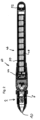
- the Fig. 1 to 3 show an underwater drive 64 composed of an underwater module 2 and an energy storage module 46.
- the underwater motor module 2 has a flow channel 6 with several inlet openings 8 and an outlet opening 10 (cf. Fig.3 ).
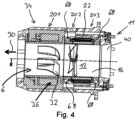
- the underwater motor module 2 has a motor 11 designed as an internal rotor, which comprises a hollow rotor 16, the inner side 12 of which forms the flow channel 6 (cf. Fig.4 ).
- the rotor 16 carries blades 18 which protrude into the flow channel 6. During operation, the rotor 16 rotates about a rotation axis R. On its outer side 14 directed away from the flow channel, the rotor 16 is connected outside the flow channel 6 by two Bearing 68.
- the underwater motor module 2 comprises an outer stator 22 arranged in a housing 20.
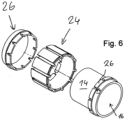
- the rotor 16 comprises a total of ten permanent magnets 24 arranged next to one another in the circumferential direction. These permanent magnets 24 are held by a bearing ring 26 of the rotor 16.
- the stator 22 has a total of twelve coils 28 arranged next to one another in the circumferential direction U, which are arranged in a fixed position relative to the housing 20.
- a module section 34 is arranged which also forms the flow channel 6 and which has a plurality of guide vanes 32.
- motor electronics 36 having a motor controller are arranged.
- the motor electronics 36 comprises a plurality of elongated and cylindrical capacitors 38 arranged next to one another in the circumferential direction U, the longitudinal axes of which run parallel to the axis of rotation (cf. Fig.7 ).
- the housing 20, in which the motor electronics 36 and the stator 22 are arranged, comprises the housing parts 20.1, 20.2 and 20.3 (cf. Fig.4 ).
- the stator 22, as well as the motor electronics 36, is encapsulated within the housing 20.
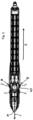
- the housing 20 has a widening outer section 40 at the rear in the direction of flow or at the front in the direction of travel, which forms the several ring-segment-shaped inlet openings 8 or an annular inlet opening 8 interrupted by webs (cf. Fig.2 and 3 , the longitudinal sections of the same underwater drive 64 at different angles of rotation).
- Flow arrows S illustrate the path of the water from the inlet opening out of the rear outlet opening.
- the underwater motor module 2 has a front connection area 44 for the energy storage module 46.
- the energy storage module 46 comprises eight battery packs 48, which are arranged one behind the other in the longitudinal direction L in an energy storage module housing 50, which is connected to the underwater motor module 2 in the connection area 44.
- Alternative energy storage modules 46 have four or ten battery packs 48 (cf. Fig. 8a to 8c ). Irrespective of the number of battery packs 48, the energy storage module 46 has a handle 52 in the front area in the direction of travel F.
- the water sports equipment 3 has an underwater drive 64.
- the water sports device 3 also has a floating body 56 in the form of a swimming board and a wing device 58 with two wings 66.
- the wing device 58 is attached to the floating body 56 by means of a holding device 60.
- the holding device 60 comprises two links 62, by means of which the wing devices 58 are arranged on the floating body 56 in an indirectly movable manner.
- the holding device 60 enables the wing device 58 to be transferred from a rest and/or starting position close to the floating body 56 into an operating position below the floating body 56.
- the floating body 56 In the operating position and during a forward movement of the water sports device 3, the floating body 56 can be transferred into a position spaced apart from the water surface due to a buoyancy caused by the wings 66.
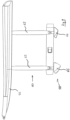
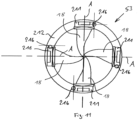
- Fig. 10 to 12 show schematically an advantageous embodiment of an underwater motor module 2 provided with an impeller 53, in which blades 18 can be rotated about a blade axis A - preferably by at least +/- 10° - and thus their angle of attack can be adjusted.
- the individual blades 18 are only indirectly connected to one another.
- the underwater motor module 2 has a motor 11 designed as an internal rotor with a stator 22 and a rotor 16.
- the rotor 16 On its outer side facing away from the flow channel, the rotor 16 is mounted by two radial bearings 68, which in this case are designed as magnetic bearings, and an axial bearing 208, which in this case is also designed as a magnetic bearing.
- the multi-part rotor 16 has an impeller ring 210 which has rotatable blade receptacles 211.
- a blade 18 is arranged on each of the blade receptacles 211.
- the propulsion device 50 has an adjusting ring 212 arranged coaxially along an axis of rotation R to the rotor 16 or the impeller ring 210.
- the adjusting ring 212 is also hollow, forms the flow channel and is mounted on its outer side facing away from the flow channel.
- the distance between the adjusting ring 212 and the impeller ring 210 in the axial direction (axis of rotation R) can be changed. In the present case, this is achieved by an actively electromagnetically confirmable adjusting means in a magnetic bearing 214 of the adjusting ring 212.
- the adjusting ring 212 is in engagement with cylindrical outer sections of the blade holders 211 via individual adjusting pins 216. If the axial distance between the adjusting ring 212 and the impeller ring 210 is changed via the magnetic bearing 214, this translational movement is converted into a rotary movement by the interaction of the adjusting pins 216 and the blade holders 211. of the blades 18, via which the blades 18 can be pivoted. In this way, the angle of attack of the blades 18 can be adjusted and also fixed.
Landscapes
- Engineering & Computer Science (AREA)
- Mechanical Engineering (AREA)
- Chemical & Material Sciences (AREA)
- Combustion & Propulsion (AREA)
- Ocean & Marine Engineering (AREA)
- Fluid Mechanics (AREA)
- Physics & Mathematics (AREA)
- Life Sciences & Earth Sciences (AREA)
- Sustainable Development (AREA)
- Sustainable Energy (AREA)
- Power Engineering (AREA)
- Transportation (AREA)
- Other Liquid Machine Or Engine Such As Wave Power Use (AREA)
- Connection Of Motors, Electrical Generators, Mechanical Devices, And The Like (AREA)
Description
- Die Erfindung betrifft ein Unterwassermotormodul für ein Wassersportgerät. Unterwassermotormodule dienen zur Erzeugung eines Vortriebes innerhalb von Wasser und können mit Wassersportgeräten ge- und davon entkoppelt werden.
- Aus der
DE 20 2017 103 703 U1 und derWO 2013 165 445 sind Wassersportgeräte bekannt, deren Antriebsmodul ausgetauscht werden kann. - Die
US 5 722 864 A , dieCN 10 716 129 A und dieFR 3 029 499 A1 - Die
CN 1 089 445 334 A DE 2 02 017 103 703 U1 offenbaren Unterwasserantriebseinheiten für Wassersportgeräte. - Aufgabe der vorliegenden Erfindung ist die Bereitstellung eines Unterwassermotormoduls sowie eines Unterwasserantriebes und eines Wassersportgerätes jeweils mit einem Unterwassermodul, die bei hoher Zuverlässigkeit vielfältiger einsetzbar ist.
- Erfindungsgemäß wird die Aufgabe durch ein Unterwassermotormodul nach Anspruch 1 gelöst.
- Ein Unterwassermotormodul bildet wenigstens einen Strömungskanal mit zumindest einer Einlassöffnung und zumindest einer Auslassöffnung aus. Das Unterwassermotormodul weist einen als Innenläufer ausgebildeten Motor auf. Der Motor umfasst einen hohlen Rotor, welcher auf bzw. mit seiner Innenseite den Strömungskanal mitausbildet und auf seiner Innenseite Schaufeln trägt. Gelagert ist der Rotor außerhalb des Strömungskanals auf zumindest einer vom Strömungskanal weggerichteten Außenseite. Außerdem umfasst der Motor einen äußeren, in einem Gehäuse angeordneten Stator.
- Erfindungsgemäß weist das Unterwassermotormodul einen Modulabschnitt auf, der in Strömungsrichtung hinter dem Rotor zumindest eine Leitschaufel aufweist und den Strömungskanal mitausbildet. Insbesondere hat die Innenseite des Modulabschnittes abgesehen von der Leitschaufel den gleichen Radius wie die Rotor-Innenseite. Dadurch bilden Rotor und Modulabschnitt bevorzugt einen Strömungskanal mit gleichbleibendem Querschnitt aus. Die Leitschaufel dient zur Leitung des vom Rotor verdrängten Wassers, insbesondere zu einer Reduzierung eines durch den Rotor in den Wasserstrom eingebrachten Dralls. Erfindungsgemäß ist in dem Modulabschnitt eine insbesondere einen Motor-Controller aufweisende Motorelektronik angeordnet. Diese ist um denselben Teil der Rotationsachse wie die Leitschaufel und außerhalb des Strömungskanals angeordnet. Dadurch baut das Unterwassermotormodul noch kompakter und sind die notwendigen Längen elektrischer Leiter durch die benachbarte Anordnung von Motorelektronik und Stator weitestmöglich reduziert. Durch den reduzierten Drall wird bei dem Einsatz des Unterwassermotormoduls ein vereinfachtes Handling des angetriebenen Wassersportgerätes ermöglicht. Die Strömungsrichtung ist insbesondere zumindest teilweise parallel zur Rotationsachse des Rotors gerichtet und/oder der Fortbewegungsrichtung des Unterwassermotormoduls insbesondere entgegengerichtet. Die Leitschaufeln sind insbesondere als Richtschaufeln ausgebildet.
- Das Unterwassermotormodul ist insbesondere eine Antriebseinheit, welche in Verbindung mit unterschiedlichen Wassersportgeräten genutzt werden kann. Das Unterwassermotormodul ist insbesondere autark funktionsfähig und benötigt bevorzugt keine Bereitstellung von Energie durch ein im Betrieb damit verbundenes Wassersportgerät bzw. andere Teile eines das Unterwassermotormodul aufweisenden Wassersportgerätes. Das Unterwassermotormodul ist vorzugsweise über einen Kopplungsmechanismus mit Wassersportgeräten zu koppeln und zerstörungsfrei davon zu entkoppeln.
- Der Strömungskanal ist ein sich insbesondere in einer Vortriebsrichtung des Unterwassermotormoduls erstreckender Hohlraum, innerhalb dessen im Betrieb Wasser durch die Schaufeln verdrängt wird. Der Strömungskanal hat insbesondere genau eine Auslassöffnung, deren Längsmittelachse mit der Rotationsachse des Rotors zumindest in einem Betriebsfall des Unterwassermotormoduls zusammenfällt. Der Strömungskanal hat insbesondere genau eine oder eine Mehrzahl von Einlassöffnungen, durch welche im Betrieb Wasser in den Strömungskanal eintritt. Die Einlassöffnungen) hat/haben insbesondere eine Längsmittelachse, die mit der Rotationsachse zusammenfällt. Alternativ ist/sind die Einlassöffnung(en) bevorzugt relativ zur Rotationsachse des Rotors bzw. zur Längsmittelachse des mittleren Abschnittes des Strömungskanals in radialer Richtung versetzt, d.h. dezentral angeordnet.
- Der Rotor als im Betrieb rotierender und zur Leistungsabgabe ausgebildeter Bestandteil des Motors ist innerhalb des im Betrieb nicht rotierenden Stators des Motors angeordnet. Insbesondere ist der Rotor, ausgehend von seiner Rotationsachse, in radialer Richtung zumindest teilweise, insbesondere vollständig von dem Stator umgeben. Der Stator ist dabei ortsfest zum äußeren Gehäuse des Unterwassermotormoduls angeordnet.
- Der Rotor hat, ungeachtet der Schaufeln, insbesondere zumindest einen quer zur Rotationsachse gemessenen runden Innenquerschnitt, der vorzugsweise mit den weiteren, in Richtung der Rotationsachse versetzten Innenquerschnitten des Rotors übereinstimmt. Insbesondere weist der Rotor eine Innenseite auf, welche in axialer Richtung zumindest stufenlos in im Betrieb relativ zum Stator ortsfeste Wandungselemente des Strömungskanals übergeht, die insbesondere abschnittsweise einen konstanten und mit dem des Rotors übereinstimmenden Innendurchmesser haben.
- Der Rotor ist bevorzugt drehbeweglich, insbesondere am Stator oder am Gehäuse gelagert. Dazu liegt insbesondere zumindest ein Drehlager oder ein Lagerinnenring an einer Außenseite- bzw. -oberfläche des Rotors an, wobei die Innenseite des Rotors zumindest teilweise zwischen der Außenoberfläche und der Rotationsachse angeordnet ist. Bevorzugt ist der Rotor durch zwei Drehlager gelagert, die bevorzugt mit einander zugewandten Stirnflächen an Absätzen des Rotors oder eines damit verbundenen Lagerrings anliegen. Das zumindest eine Drehlager hat somit vorzugsweise einen größeren Innendurchmesser als der Strömungskanal bzw. der Rotor ungeachtet der Schaufeln im gleichen Querschnitt.
- Der Rotor trägt insbesondere eine Mehrzahl von in Richtung der Rotationsachse in den Strömungskanal ragenden Schaufeln. Diese sind bei Rotation des Rotors zu einer Verdrängung innerhalb des Rotors befindlichen Wassers in Richtung der zumindest einen Auslassöffnung vorgesehen. Die Rotationsachse schneidet insbesondere keine der Schaufeln, wodurch der Rotor einen zentralen, für den Durchtritt von Wasser in axialer Richtung freien Bereich aufweist. Insbesondere bildet der Rotor mit den Schaufeln einen naben- und wellenlosen Impeller aus, dessen Schaufeln nur am radial äußeren Bereich gelagert sind und deren radial innere Enden frei im Strömungskanal angeordnet sind. Durch die vorbeschriebene Ausbildung insbesondere des Rotors lässt sich ein besonders fehlerunanfälliges Unterwassermotormodul bereitstellen, dessen Funktion etwa gegenüber Propeller-Antrieben durch regelmäßig im Wasser vorkommende Fremdkörper deutlich weniger eingeschränkt wird. Außerdem baut das erfindungsgemäße Unterwassermotormodul besonders kompakt und ist somit für unterschiedlichste Anwendungsgebiete und Wassersportgeräte anwendbar.
- Vorzugsweise weist der Rotor in Umfangsrichtung nebeneinander angeordnete Permanentmagnete auf. Diese sind insbesondere gleichförmig und gleichmäßig voneinander sowie von der Rotationsachse beabstandet angeordnet. Die Permanentmagnete sind außerdem bevorzugt auf einer Außenseite des Rotors und damit außerhalb des Strömungskanals angeordnet. Bevorzugt werden die Permanentmagnete durch bzw. über einen Lagerring auf dem Rotor gehalten. Der Lagerring ist bevorzugt in Richtung der Rotationsachse auf den Rotor aufsteckbar bzw. im Betrieb aufgesteckt, wodurch sich die Permanentmagnete in axialer Richtung zwischen dem Lagerring und zumindest einem Absatz des Rotors positioniert befinden. Die Permanentmagneten haben insbesondere zylindermantelabschnittsförmige Innen- und Außenflächen, durch die sich die Permanentmagneten besonders platzsparend in das Unterwassermotormodul einfügen und einen hohen Wirkungsgrad des Motors ermöglichen.
- Der Rotor ist insbesondere über zwei in Richtung der Rotationsachse voneinander beabstandete Lager gelagert. Die Lager sind insbesondere Kugellager, bevorzugt Schrägkugellager. Vorzugsweise handelt es sich um Keramik-Kugellager. Alternativ oder ergänzend ist zumindest eines der Lager als hydrodynamisches Gleitlager ausgebildet. Zumindest eines der beiden Lager oder dessen Außenring liegt in radialer und/oder in axialer Richtung am Gehäuse und/oder am Stator an. Durch diese Lagerungen wird ein bestmöglicher Kompromiss zwischen Leichtlauf und Bauraum der Lagerung geschaffen.
- Der Stator weist bevorzugt eine Mehrzahl von in Umfangsrichtung nebeneinander angeordneten Spulen auf, welche in radialer Richtung von den Permanentmagneten beabstandet sind. Die Spulen sind vorzugsweise um eine senkrecht zur Rotationsachse des Rotors angeordnete Wickelachse gewickelt. Die axiale Erstreckung der Spulen entspricht bevorzugt im Wesentlichen der axialen Erstreckung der Permanentmagneten. Durch die Kombination von Spulen und Permanentmagneten in der vorbeschriebenen Geometrie und mit der vorbeschriebenen Lagerung ist ein besonders leistungsfähiger Elektromotor ermöglicht, welcher zugunsten vielfältiger Anwendungen des Unterwassermotormoduls relativ zum Strömungskanal besonders klein baut.
- In einer vorteilhaften Ausgestaltung der Erfindung weist die Motorelektronik eine Mehrzahl von in Umfangsrichtung nebeneinander angeordneten, länglichen und vorzugsweise zylinderförmigen Kondensatoren auf. Deren Längsachsen verlaufen insbesondere parallel zu einer Zentralachse des Unterwassermotormoduls, die insbesondere mit der Rotationsachse des Rotors zusammenfällt. Durch diese Ausbildung der Kondensatoren der Motorelektronik wird auch im Bereich der Leitschaufeln eine besonders schlanke Gehäuseform erreicht. Die Motorelektronik weist insbesondere zumindest eine ring- oder ringsegmentförmige Platine auf, deren flächige Erstreckung in einer Ebene quer zur Rotationsachse verläuft. Bevorzugt handelt es sich dabei um eine doppel- oder mehrstöckige Platine. Durch diese angepasste Platinenform lassen sich die Kondensatoren optimal anbinden und das Gehäuse weiter verschlanken. Zur Verhinderung eines Eindringens von Wasser in die Motorelektronik ist diese vorzugsweise innerhalb eines zugehörigen Abschnittes des Gehäuses vergossen.
- Vorzugsweise sind die Motorelektronik und der Stator in einem gemeinsamen Gehäuse angeordnet, welches vorzugsweise dreiteilig ist. Das Gehäuse hat bevorzugt eine zylindrische Grundform und äußerlich bevorzugt Kühlrippen. Durch die Mehrteiligkeit des Gehäuses sind Einzelteile unkritisch austauschbar. Darüber hinaus weist das Gehäuse bevorzugt wenigstens einen Bereich zur Befestigung weiterer Elemente eines auszubildenden Wassersportgeräts auf. Diese Elemente beziehen sich einerseits auf die mechanische Befestigung des Unterwassermotormoduls und sind zum Beispiel in Form von Befestigungsmitteln wie Flanschen, Schnapphaken und dergleichen insbesondere lösbare Befestigungsmitteln ausgebildet. Andererseits handelt es sich um wenigstens eine elektrische oder elektronische Schnittstelle für die Energie- und Signalübertragung.
- Vorteilhafterweise ist der Stator mit zumindest einem Teil des Gehäuses vergossen. Insbesondere ist der Stator in einem anderen Teil des Gehäuses vergossen als die Motorelektronik. Dadurch wird auch im Bereich zwischen dem Rotor und dem Gehäuse ein Eindringen von Wasser zuverlässig verhindert und werden die vorgenannten Vorteile trotzdem verwirklicht. Die Vergussmasse ist dazu in axialer Richtung insbesondere zumindest zwischen den beiden Lagern angeordnet.
- In einer vorteilhaften Ausgestaltung der Erfindung weist das Gehäuse in Fahrtrichtung vorne, d.h. in Strömungsrichtung hinten, einen sich insbesondere von dem Rotor her aufweitenden Außenabschnitt auf. Dieser Außenabschnitt hat insbesondere einen größeren Radius als die in axialer Richtung benachbarten Abschnitte des Unterwassermotormoduls. Durch den Außenabschnitt und einen in radialer Richtung zwischen dem Außenabschnitt und der Rotationsachse liegenden Innenabschnitt des Unterwassermotormoduls ist insbesondere die oder eine der Einlassöffnungen angeordnet. Die zumindest eine Einlassöffnung ist insbesondere ring- oder ringsegmentförmig. Bevorzugt hat das Unterwassermotormodul Einlassöffnungen auf sich gegenüberliegenden Seiten des Unterwassermotormoduls. Durch diese Ausbildung der Einlassöffnung(en) fließt das dem Rotor zuströmende Wasser zumindest abschnittsweise und zumindest anteilig in radialer Richtung und hat der Strömungskanal einen verzweigten Einlasskanal oder einen Einlasskanal mit ringförmigem Querschnitt. Durch diese Ausbildung der Einlassöffnung ist es möglich, weitere Bauteile des Wassersportgerätes in Fahrtrichtung vor dem Unterwassermotormodul und koaxial anzuordnen, ohne dass dadurch der Zustrom an Wasser zum Rotor behindert wird. Das erlaubt den Einsatz des Unterwassermotormoduls insbesondere bei Wassersportgeräten unterschiedlicher Längen und Ausstattungen.
- Vorzugsweise weist das Unterwassermotormodul einen vorderen Anschlussbereich für ein Energiespeichermodul und/oder eine Steuereinheit auf. Der Anschlussbereich dient insbesondere zur lösbaren Kopplung dieser. Der Anschlussbereich ist insbesondere zumindest im Wesentlichen zwischen Einlassöffnung und Rotorachse ausgebildet. Durch diesen Anschlussbereich lassen sich insbesondere zumindest im Wesentlichen zylinderförmige Komponenten an das Unterwassermotormodul anschließen, wiederum ohne den Wasserzufluss zum Rotor zu gefährden.
- Die Aufgabe wird weiterhin gelöst durch einen Unterwasserantrieb umfassend ein vorbeschriebenes Unterwassermotormodul sowie ein Energiespeichermodul. Das Energiespeichermodul ist insbesondere am Anschlussbereich des Unterwassermotormoduls angeordnet und stellt Energie für die Rotation des Rotors bereit.
- Das Energiespeichermodul weist bevorzugt eine Mehrzahl von Batteriepaketen auf, die in Längsrichtung hintereinander in einem Energiespeichermodulgehäuse angeordnet sind. Das Energiespeichermodulgehäuse ist dabei insbesondere der Teil des Energiespeichermoduls, welcher unmittelbar mit dem Unterwassermotormodul zu koppeln ist. Insbesondere hat das Energiespeichermodul zumindest vier und höchstens zehn Batteriepakete jeweils vorzugsweise mit einer Vielzahl von Batteriezellen. Bevorzugt weist das Energiespeichermodul außerdem eine Batteriesteuerelektronik auf, welche zwischen den Batteriepaketen und dem koppelbaren Abschnitt des Energiespeichermodulgehäuses positioniert ist. Dadurch ist dieser besonders geschützt. Das Energiespeichermodul weist vorzugsweise Doppelblöcke auf, bei denen zwei äußere Gehäuseteile sowie zumindest ein Gehäusemittelteil gegeneinander verschraubt werden und so einen Rahmen für eine Gruppe von Batteriezellen bilden. Sowohl die äußeren Gehäuseteile wie auch der Gehäusemittelteil eines solchen Doppelblocks weisen insbesondere Führungs- bzw. Befestigungsstege auf, die im montierten Zustand und zum Teil zwischen den Batteriezellen angeordnet sind und zum Teil Aufnahme für die Befestigungsmittel aufweisen. Das Energiespeichermodulgehäuse hat vorzugsweise einen zumindest im Wesentlichen zylindrischen Querschnitt und eine in die axiale Richtung längliche Erstreckung, wodurch sie sich stromlinienförmig mit dem Unterwassermotormodul ergänzt.
- Bevorzugt weist das Energiespeichermodul einen Handgriff auf. Dieser ist insbesondere an dem von dem Unterwassermotormodul abgewandten Ende angeordnet. Insbesondere umschließt der Handgriff eine durchgehende Ausnehmung. Durch den Handgriff ist der Unterwasserantrieb bzw. das Energiespeichermodul leichter händelbar und außerdem eine Verjüngung des frontalen Teils des Unterwasserantriebs erreicht, der zu geringeren Strömungswiderständen führt.
- Die Aufgabe wird weiterhin gelöst durch einen Unterwasserantrieb mit einem vorbeschriebenen Unterwassermotormodul und einer Steuereinheit, die insbesondere am Anschlussbereich des Unterwassermotormoduls angeordnet ist. Die Steuereinheit ist bevorzugt zur Erzeugung von Steuersignalen für den Motor ausgebildet. Insbesondere hängt im Betrieb die Leistung bzw. Drehzahl des Motors von den Steuersignalen ab. Durch diesen Aufbau ist der Unterwasserantrieb stromlinienförmig ausgebildet und erlaubt insbesondere die Anwendung unterschiedlicher Steuereinheit für unterschiedliche Benutzer.
- In einer weiteren erfindungsgemäßen Weiterbildung zeichnet sich das Unterwassermotormodul dadurch aus, dass der Steuereinheit ein Headset umfassend zumindest einen Kopfsensor zur Aufnahme von Bewegungen zumindest eines Teils des Kopfes einer im Betrieb das Unterwassermotormodul bedienenden Person zugeordnet ist. Hierdurch können die Arme und Beide frei bewegt werden, ohne etwaige Steuerungsmittel in der Hand zu halten. Beispielsweise kann durch gezielte und vorab festlegbare oder festgelegte Bewegungsabläufe, die von der Steuereinheit vorgegeben oder von dieser erlernt werden können, beispielsweise mehrmaliges Nicken oder Schütteln des gesamten Kopfes die Vortriebsgeschwindigkeit erhöht oder verringert werden. Zur Erkennung dieser Bewegung weist das Headset z.B. einen Beschleunigungssensor als Kopfsensor auf.
- Vorzugsweise weist einer der erfindungsgemäßen, vorbeschriebenen Unterwasserantriebe zusätzlich zum Strömungskanal einen Strömungskühlkanal auf, der durch das Energiespeichermodul führt und bevorzugt in den Strömungskanal mündet. Durch den Strömungskühlkanal lässt sich im Betrieb entstehende Verlustwärme im Bereich des Energiespeichermoduls ableiten und die Bauteilbelastungen dadurch eingrenzen. Insbesondere verläuft der Strömungskühlkanal koaxial mit dem vom Rotor ausgebildeten Strömungskanalabschnitt und bevorzugt durch die Batteriepakete hindurch.
- In einer vorteilhaften Ausgestaltung der Erfindung weist der Unterwasserantrieb wenigstens ein Steuerelement auf, das zur Beeinflussung der Ausrichtung eines im Betrieb entstehenden Wasserstroms ausgebildet ist. Das Steuerelement ist insbesondere durch wenigstens ein ausrichtbares Teil des Unterwassermotormoduls und/oder ein Düsenelement ausgebildet. Das Düsenelement bildet insbesondere die Auslassöffnung und hat einen sich in Strömungsrichtung verjüngenden Innenquerschnitt. Vorzugsweise ist das Düsenelement mittels eines Kugelgelenkes in unterschiedliche Richtungen schwenkbeweglich gelagert. Außerdem umfasst das Steuerelement bevorzugt ein mit dem ausrichtbaren Teil verbundenes und insbesondere elektrisch angesteuertes Stellglied oder Steuerelement. Durch das Steuerelement ist die Fortbewegungsrichtung des Unterwasserantriebs bzw. des damit gekoppelten Wassersportgerätes im Betrieb änderbar.
- Vorzugsweise weist der Unterwasserantrieb einen Rotor mit um eine jeweilige Schaufelachse verdrehbare Schaufeln auf. Hierdurch können unterschiedliche Vorschübe bei gleicher Umdrehungsgeschwindigkeit erzielt werden.
- Ein solcher der Rotor ist vorzugsweise mehrteilig mit einem Schaufelträger beispielsweise in Form eines Impellerrings und einem relativ zum Schaufelträger entlang einer Rotationsachse verschieblichen Verschiebering ausgebildet, wobei letzterer zur Verdrehung der Schaufeln mit jeweiligen Verschiebestiften auf jeweilige Schaufelaufnahmen einwirkt.
- Die Aufgabe wird weiterhin gelöst durch ein Wassersportgerät mit dem vorbeschriebenen Unterwasserantrieb. Das Wassersportgerät weist bevorzugt einen Schwimmkörper auf, der insbesondere als Schwimmbrett ausgebildet ist, und eine Tragflächenvorrichtung. Die Tragflächenvorrichtung hat bevorzugt eine Mehrzahl von Tragflächen. Die Tragflächenvorrichtung ist insbesondere mittels einer Haltevorrichtung am Schwimmkörper befestigt. Die Haltevorrichtung weist vorzugsweise einen Lenker auf, an dem die Tragflächenvorrichtung angeordnet ist. Vorzugsweise hat die Tragflächenvorrichtung zumindest zwei Tragflächen. Insbesondere umfasst die Tragflächenvorrichtung eine Aufnahme, an der die zumindest eine Tragfläche ortsfest angeordnet ist und die unmittelbar mit der Haltevorrichtung gekoppelt ist. Die Tragflächenvorrichtung ist durch die Haltevorrichtung aus einer Ruhe- und/oder Startposition dicht am Schwimmkörper in eine Betriebsstellung unterhalb des Schwimmkörpers überführbar. Der Schwimmkörper ist in der Betriebsstellung und während einer Vorwärtsbewegung aufgrund eines durch die Tragflächenvorrichtung bewegten Auftriebs insbesondere in eine von einer Wasseroberfläche beabstandete Position überführbar. Das Unterwassermodul ist bevorzugt zumindest teilweise als Teil der Tragflächenvorrichtung ausgebildet.
- Ein Verfahren zur Konstruktion und/oder Fertigung eines Wassersportgerätes, welches einen modularen Aufbau umfassend ein Schwimmkörpermodul besitzt und dessen Module über Schnittstellen miteinander verbindbar sind sowie im Betrieb miteinander verbunden sind, kann wie folgt aussehen. Das Wassersportgerät ist insbesondere ein Vorbeschriebenes. Gemäß dem Verfahren sind eine Servervorrichtung und eine programmgesteuerte Eingabeschnittstelle für benutzerdefinierte Eingaben auf einem insbesondere entfernt von der Servervorrichtung angeordneten, bevorzugt mobilen Endgerät vorgesehen. Die Module sind in einem Computerprogramm der Servervorrichtung und/oder des Endgerätes abgebildet. Wenigstens eine Außenkontur des Schwimmkörpermoduls des Wassersportgerätes ist benutzerdefiniert, zumindest innerhalb gewisser Grenzen, frei festlegbar oder aus einer Reihe von vorgegebenen Modulen auswählbar. Weiterhin können als Auswahlkriterien verschiedene Sensoren wie z.B. Gyrosensoren, Geschwindigkeitssensoren, Positionssensoren (GPS, Glonass, Beidou etc.), Abstandssensoren (Echolot, Sonar), Infrarotsensoren und Neigungssensoren ausgewählt werden. Weiterhin sind beispielsweise verschiedene Antriebe oder eine Mehrzahl davon, zugehörige Steuerungen und unterschiedliche Mensch-Maschine-Schnittstellen auswählbar. Bei einem als Hydrofoilboard oder Foilboard ausbildbaren Wassersportgerät sind weiterhin die Tragflächenvorrichtung mit insbesondere Form, Farbe und Anzahl der Tragflächen, die Haltevorrichtung und etwaige Steuereinheiten auswählbar. Diesen unterscheiden sich beispielsweise in der Anzahl der speicherbaren Fahrprofile und vorgebbarer Fahrmodi.
- Auf Basis der Außenkontur werden Fertigungsinformationen automatisiert geschaffen. Das hiernach gefertigte Schwimmkörpermodul ist mit einem, insbesondere mehreren Modulen zur Fertigstellung des Wassersportgerätes verbindbar. Durch dieses Verfahren wird die Anwendbarkeit erfindungsgemäßer Wassersportgeräte insofern erweitert, als dass unterschiedliche Nutzer je nach körperlichen Gegebenheiten und Fähigkeiten ein für sie optimal geeignetes Wassersportgerät erhalten und benutzen können.
- Bevorzugt wird auf der Servervorrichtung oder dem Endgerät automatisiert eine Prüfung hinsichtlich konstruktiver, insbesondere schwimmtechnischer Eigenschaften des Wassersportgerätes vorgenommen. Dadurch wird dem Anwender des Verfahrens unmittelbar angezeigt, inwiefern das konfigurierte Schwimmgerät für ihn geeignet ist.
- Weitere Einzelheiten und Vorteile der Erfindung sind den nachfolgend beschriebenen, schematisch dargestellten Ausführungsbeispielen zu entnehmen; es zeigen:
- Fig. 1
- eine Übersichtsdarstellung eines erfindungsgemäßen Unterwasserantriebes,
- Fig. 2
- einen Längsschnitt des Unterwasserantriebes gemäß
Fig. 1 , - Fig. 3
- einen weiteren Längsschnitt des Unterwasserantriebes gemäß
Fig. 1 , - Fig. 4
- einen Längsschnitt eines Teils des Unterwassermotormoduls des Unterwasserantriebs gemäß
Fig. 1 , - Fig. 5
- eine Explosionsdarstellung eines ersten Teils des in
Fig. 3 dargestellten Teils des Unterwassermotormoduls, - Fig. 6
- eine Explosionsdarstellung eines zweiten Teils des in
Fig. 3 dargestellten Teils des Unterwassermotormoduls, - Fig. 7
- eine Explosionsdarstellung eines dritten Teils des in
Fig. 3 dargestellten Teils des Unterwassermotormoduls, - Fig. 8a bis 8c
- Längsschnitte unterschiedlicher Energiespeichermodule eines erfindungsgemäßen Unterwasserantriebs,
- Fig. 9
- eine Seitenansicht eines erfindungsgemäßen Wassersportgerätes,
- Fig. 10
- eine teilweise Ansicht eines weiteren Ausführungsbeispiels in einem Längsschnitt,
- Fig. 11
- eine teilweise Ansicht des Ausführungsbeispiels nach
Fig. 10 in einem Querschnitt. - Fig. 12
- eine weitere, teilweise Ansicht des erfindungsgemäßen Gegenstands nach
Fig. 11 in einem Längsschnitt. - Die nachfolgend erläuterten Merkmale der erfindungsgemäßen Ausführungsbeispiele können auch einzeln oder in anderen Kombinationen als dargestellt oder beschrieben Gegenstand der Erfindung sein, stets aber zumindest in Kombination mit den Merkmalen einer der Ansprüche 1 und 18. Sofern sinnvoll, sind funktional gleichwirkende Teile mit identischen Bezugsziffern versehen.
- Die
Fig. 1 bis 3 zeigen einen aus einem Unterwassermodul 2 und einem Energiespeichermodul 46 zusammengesetzten Unterwasserantrieb 64. Das Unterwassermotormodul 2 hat einen Strömungskanal 6 mit mehreren Einlassöffnungen 8 und einer Auslassöffnung 10 (vergl.Fig. 3 ). Das Unterwassermotormodul 2 weist einen als Innenläufer ausgebildeten Motor 11 auf, der einen hohlen, mit seiner Innenseite 12 den Strömungskanal 6 mitausbildenden Rotor 16 umfasst (vergl.Fig. 4 ). Der Rotor 16 trägt Schaufeln 18, die in den Strömungskanal 6 hineinragen. Im Betrieb rotiert der Rotor 16 um eine Rotationsachse R. Auf seiner vom Strömungskanal weggerichteten Außenseite 14 ist der Rotor 16 außerhalb des Strömungskanals 6 durch zwei Lager 68 gelagert. Außerdem umfasst das Unterwassermotormodul 2 einen äußeren, in einem Gehäuse 20 angeordneten Stator 22. - Wie in
Fig. 6 gezeigt, umfasst der Rotor 16 insgesamt zehn in Umfangsrichtung nebeneinander angeordnete Permanentmagnete 24. Diese Permanentmagnete 24 werden über einen Lagerring 26 des Rotors 16 gehalten. Wie inFig. 5 gezeigt, hat der Stator 22 insgesamt zwölf in Umfangsrichtung U nebeneinander angeordnete Spulen 28, die ortsfest zum Gehäuse 20 angeordnet sind. In Strömungsrichtung 30 vor bzw. in Fahrtrichtung hinter dem Rotor 16 ist ein den Strömungskanal 6 mitausbildender Modulabschnitt 34 angeordnet, der mehrere Leitschaufeln 32 aufweist. In dem Modulabschnitt 34 ist radial von den Leitschaufeln 32 beabstandet eine einen Motor-Controller aufweisende Motorelektronik 36 angeordnet. - Die Motorelektronik 36 umfasst eine Mehrzahl von in Umfangsrichtung U nebeneinander angeordneten, länglichen und zylinderförmigen Kondensatoren 38, deren Längsachsen parallel zur Rotationsachse verlaufen (vergl.
Fig. 7 ). Das Gehäuse 20, in dem die Motorelektronik 36 und der Stator 22 angeordnet sind, umfasst die Gehäuseteile 20.1, 20.2 und 20.3 (vergl.Fig. 4 ). Der Stator 22 ist ebenso wie die Motorelektronik 36 innerhalb des Gehäuses 20 vergossen. - Das Gehäuse 20 hat in Strömungsrichtung hinten bzw. in Fahrtrichtung vorne einen sich aufweitenden Außenabschnitt 40, der die mehreren ringsegmentförmigen Einlassöffnungen 8 bzw. eine von Stegen unterbrochene, ringförmige Einlassöffnung 8 ausbildet (vergl.
Fig. 2 und3 , die Längsschnitte desselben Unterwasserantriebs 64 bei unterschiedlichen Drehwinkeln zeigen). Strömungspfeile S veranschaulichen den Weg des Wassers von der Einlassöffnung aus der hinteren Auslassöffnung heraus. Zwischen den Einlassöffnungen 8 und nach vorne versetzt hat das Unterwassermotormodul 2 einen vorderen Anschlussbereich 44 für das Energiespeichermodul 46. Das Energiespeichermodul 46 umfasst acht Batteriepakete 48, die in Längsrichtung L hintereinander in einem Energiespeichermodulgehäuse 50 angeordnet sind, welches im Anschlussbereich 44 mit dem Unterwassermotormodul 2 verbunden ist. Alternative Energiespeichermodule 46 haben vier oder zehn Batteriepakete 48 (vergl.Fig. 8a bis 8c ). Das Energiespeichermodul 46 hat unabhängig von der Zahl der Batteriepakete 48 einen Handgriff 52 im in Fahrtrichtung F vorderen Bereich. - Das Wassersportgerät 3 gemäß
Fig. 9 hat einen Unterwasserantrieb 64. Außerdem hat das Wassersportgerät 3 einen Schwimmkörper 56 in Form eines Schwimmbretts und eine Tragflächenvorrichtung 58 mit zwei Tragflächen 66. Die Tragflächenvorrichtung 58 ist mittels einer Haltevorrichtung 60 am Schwimmkörper 56 befestigt. Die Haltevorrichtung 60 umfasst zwei Lenker 62, durch die die Tragflächenvorrichtungen 58 mittelbar beweglich am Schwimmkörper 56 angeordnet sind. Durch die Haltevorrichtung 60 ist die Tragflächenvorrichtung 58 aus einer Ruhe- und/oder Startposition dicht am Schwimmkörper 56 in eine Betriebsstellung unterhalb des Schwimmkörpers 56 überführbar. Der Schwimmkörper 56 ist in der Betriebsstellung und während einer Vorwärtsbewegung des Wassersportgerätes 3 aufgrund eines durch die Tragflächen 66 bewirkten Auftriebs in eine von der Wasseroberfläche beabstandete Position überführbar. Das Unterwassermotormodul 2, welches inFig. 9 lediglich schematisch dargestellt ist, ist als Teil der Tragflächenvorrichtung 58 ausgebildet. -
Fig. 10 bis 12 zeigen schematisch eine vorteilhafte Ausführungsform eines mit einem Impeller 53 versehen Unterwassermotormodul 2, bei dem Schaufeln 18 um eine Schaufelachse A - um vorzugsweise zumindest +/- 10°- verdrehbar und somit in ihrem Anstellwinkel verstellbar sind. Die einzelnen Schaufeln 18 sind hierbei nur mittelbar miteinander verbunden. Hierzu weist die das Unterwassermotormodul 2 einen als Innenläufer ausgebildeten Motor 11 mit einem Stator 22 und einem Rotor 16 auf. Auf seiner vom Strömungskanal weg gerichteten Außenseite ist der Rotor 16 durch zwei Radiallager 68, die vorliegend als Magnetlager ausgebildet sind, sowie ein Axiallager 208, das vorliegend ebenfalls als Magnetlager ausgebildet ist, gelagert. Der mehrteilige Rotor 16 weist einen Impellerring 210 auf, der drehbare Schaufelaufnahmen 211 aufweist. An den Schaufelaufnahmen 211 ist jeweils eine Schaufel 18 angeordnet. Die Vortriebsvorrichtung 50 weist einen koaxial entlang einer Drehachse R zu dem Rotor 16 bzw. dem Impellerring 210 angeordneten Verstellring 212 auf. Der Verstellring 212 ist ebenfalls hohl, bildet den Strömungskanal mit aus und ist auf seiner vom Strömungskanal weg gerichteten Außenseite gelagert. Der Abstand zwischen Verstellring 212 und Impellerring 210 in axialer Richtung (Drehachse R) ist hierbei veränderbar. Vorliegend wird dies durch ein aktiv elektromagnetisch bestätigbares Verstellmittel in einem magnetischen Lager 214 des Verstellrings 212 erreicht. Der Verstellring 212 steht über einzelne Verstellstifte 216 in Eingriff mit zylinderförmigen Außenabschnitten der Schaufelaufnahmen 211. Wenn der axiale Abstand zwischen Verstellring 212 und Impellerring 210 über das magnetischen Lager 214 verändert wird, wird diese translatorische Bewegung durch das Zusammenwirken der Verstellstifte 216 und der Schaufelaufnahmen 211 in eine Drehbewegung der Schaufeln 18 umgesetzt, über die die Schaufeln 18 verschwenkt werden können. Hierdurch kann der Anstellwinkel der Schaufeln 18 eingestellt und ebenfalls festgelegt werden.
Claims (19)
- Unterwassermotormodul (2) für ein Wassersportgerät (3), welches wenigstens einen Strömungskanal (6) mit jeweils zumindest einer Einlass- (8) und einer Auslassöffnung (10) ausbildet und einen als Innenläufer ausgebildeten Motor (11) aufweist, der einen hohlen, mit seiner Innenseite (12) den Strömungskanal (6) mit ausbildenden und an seiner vom Strömungskanal (6) weggerichteten Außenseite (14) außerhalb des Strömungskanals (6) gelagerten Rotor (16), der Schaufeln (18) trägt, sowie einen äußeren in einem Gehäuse (20) angeordneten Stator (22) umfasst, dadurch gekennzeichnet, dass in Strömungsrichtung (30) hinter dem Rotor (16) ein wenigstens eine Leitschaufel (32) aufweisender und den Strömungskanal (6) mit ausbildender Modulabschnitt (34) angeordnet ist, in dem in Strömungsrichtung (30) betrachtet radial von der Leitschaufel (32) aus eine Motorelektronik (36) angeordnet ist.
- Unterwassermotormodul nach Anspruch 1, dadurch gekennzeichnet, dass der Rotor (16) in Umfangsrichtung (U) nebeneinander angeordnete Permanentmagnete (24) aufweist, welche insbesondere über einen Lagerring (26) auf dem Rotor (16) gehalten sind.
- Unterwassermotormodul nach Anspruch 1 oder 2, dadurch gekennzeichnet, dass der Stator (22) eine Mehrzahl von in Umfangsrichtung (U) nebeneinander angeordneten Spulen (28) aufweist.
- Unterwassermotormodul nach einem der vorherigen Ansprüche, dadurch gekennzeichnet, dass die Motorelektronik einen Motor-Controller aufweist.
- Unterwassermotormodul nach einem der vorherigen Ansprüche, dadurch gekennzeichnet, dass die Motorelektronik (36) eine Mehrzahl von in Umfangsrichtung (U) nebeneinander angeordneten, länglichen und vorzugsweise zylinderförmigen Kondensatoren (38) aufweist, insbesondere deren Längsachsen parallel zu einer Zentralachse (R) des Unterwassermotormoduls (2) verläuft.
- Unterwassermotormodul nach einem der vorherigen Ansprüche, dadurch gekennzeichnet, dass die Motorelektronik (36) und der Stator (22) in dem vorzugsweise dreiteiligen Gehäuse (20) angeordnet sind.
- Unterwassermotormodul nach Anspruch 6, dadurch gekennzeichnet, dass der Stator (22) in wenigstens einem der Teile des Gehäuses (20) vergossen ist.
- Unterwassermotormodul nach einem der vorherigen Ansprüche, dadurch gekennzeichnet, dass das Gehäuse (20) in Strömungsrichtung (30) hinten einen sich aufweitenden Außenabschnitt (40) aufweist, der die zumindest eine ring- oder ringsegmentförmige Einlassöffnung (8) ausbildet.
- Unterwassermotormodul nach einem der vorherigen Ansprüche, gekennzeichnet durch einen vorderen Anschlussbereich (44) für ein Energiespeichermodul (46) und/oder eine Steuereinheit.
- Unterwasserantrieb (64) umfassend ein Unterwassermotormodul (2) nach einem der vorherigen Ansprüche sowie ein Energiespeichermodul (46).
- Unterwasserantrieb nach Anspruch 10, dadurch gekennzeichnet, dass das Energiespeichermodul (46) eine Mehrzahl von Batteriepaketen (48) umfasst, die vorzugsweise in Längsrichtung (L) hintereinander in einem Energiespeichermodulgehäuse (50) angeordnet sind, welches lösbar mit dem Unterwassermotormodul (2) verbunden ist.
- Unterwasserantrieb nach Anspruch 10 oder 11, dadurch gekennzeichnet, dass das Energiespeichermodul (46) einen Handgriff (52) aufweist.
- Unterwasserantrieb nach einem der vorherigen Ansprüche, dadurch gekennzeichnet, dass die Steuereinheit zur Erzeugung von Steuersignalen für den Motor ausgebildet ist.
- Unterwasserantrieb nach einem der vorherigen Ansprüche 10 bis 13, dadurch gekennzeichnet, dass zusätzlich zu dem Strömungskanal (6) ein Strömungskühlkanal durch das Energiespeichermodul (46) führt und insbesondere in den Strömungskanal (6) mündet.
- Unterwasserantrieb nach einem der vorherigen Ansprüche 10 bis 13, gekennzeichnet durch wenigstens ein die Ausrichtung eines im Betrieb entstehenden Wasserstroms beeinflussendes Steuerelement, welches durch wenigstens ein ausrichtbares Teil des Unterwassermotormoduls und/oder ein Düsenelement ausgebildet wird.
- Unterwasserantrieb nach einem der vorherigen Ansprüche, dadurch gekennzeichnet, dass der Rotor um eine jeweilige Schaufelachse (A) verdrehbare Schaufeln aufweist.
- Unterwasserantrieb nach Anspruch 16, dadurch gekennzeichnet, dass der Rotor (16) mehrteilig mit einem als Impellerring 210 ausgebildeten Schaufelträger und einem relativ zum Schaufelträger entlang einer Rotationsachse (R) verschieblichen Verstellring (212) ausgebildet ist, welche zur Verschwenkung der Schaufeln mit jeweiligen Verschiebemitteln auf jeweilige Schaufelaufnahmen einwirkt.
- Wassersportgerät (3), gekennzeichnet durch einen Unterwasserantrieb (64) nach einem der Ansprüche 10 bis 15.
- Wassersportgerät nach Anspruch 18, gekennzeichnet durch einen Schwimmkörper (56), vorzugsweise in Form eines Schwimmbretts, und eine Tragflächenvorrichtung (58), die mittels einer Haltevorrichtung (60) am Schwimmkörper (56) befestigt ist,wobei die an einem Lenker (62) der Haltevorrichtung (60) angeordnete Tragflächenvorrichtung (58) wenigstens eine, vorzugsweise zumindest zwei Tragflächen (66) aufweist und über die Haltevorrichtung (60) aus einer Ruhe- und/oder Startposition dicht am Schwimmkörper (56) in eine Betriebsstellung unterhalb des Schwimmkörpers (56) überführbar ist,wobei der Schwimmkörper (56) in der Betriebsstellung und während einer Vorwärtsbewegung aufgrund eines durch die Tragflächenvorrichtung (58) bewirkten Auftriebs in eine von einer Wasseroberfläche beabstandete Position überführbar ist, wobei das Unterwassermotormodul (2) zumindest teilweise als Teil der Tragflächenvorrichtung (58) ausgebildet ist.
Applications Claiming Priority (2)
| Application Number | Priority Date | Filing Date | Title |
|---|---|---|---|
| DE102019129576.9A DE102019129576A1 (de) | 2019-11-01 | 2019-11-01 | Untewassermotormodul für ein Wassersportgerät |
| PCT/EP2020/080700 WO2021084130A1 (de) | 2019-11-01 | 2020-11-02 | Unterwassermotormodul für ein wassersportgerät |
Publications (3)
| Publication Number | Publication Date |
|---|---|
| EP4051566A1 EP4051566A1 (de) | 2022-09-07 |
| EP4051566B1 true EP4051566B1 (de) | 2024-06-12 |
| EP4051566C0 EP4051566C0 (de) | 2024-06-12 |
Family
ID=73544128
Family Applications (1)
| Application Number | Title | Priority Date | Filing Date |
|---|---|---|---|
| EP20811532.9A Active EP4051566B1 (de) | 2019-11-01 | 2020-11-02 | Unterwassermotormodul für ein wassersportgerät |
Country Status (5)
| Country | Link |
|---|---|
| US (1) | US12337937B2 (de) |
| EP (1) | EP4051566B1 (de) |
| CA (1) | CA3156773A1 (de) |
| DE (1) | DE102019129576A1 (de) |
| WO (1) | WO2021084130A1 (de) |
Families Citing this family (5)
| Publication number | Priority date | Publication date | Assignee | Title |
|---|---|---|---|---|
| DE102021111401A1 (de) | 2021-05-03 | 2022-11-03 | Rosen Swiss Ag | Antriebsvorrichtung zum Antrieb eines Wasserfahrzeuges |
| CN113364171A (zh) * | 2021-06-23 | 2021-09-07 | 中国船舶重工集团衡远科技有限公司 | 水下电机转子密封总成 |
| NL2031469B1 (en) * | 2022-03-31 | 2023-10-24 | Insumo B V | Rim driven thruster and method for propelling a ship |
| JP2026505558A (ja) * | 2023-02-06 | 2026-02-13 | ヴァニエ ステファヌ | ハウジング内に支持された軸方向で通流可能な羽根車を含む、液状またはガス状の媒体用の外部駆動されるまたは受動的に駆動される流れ装置、ならびにこのような流れ装置の使用 |
| US20240391575A1 (en) * | 2023-05-26 | 2024-11-28 | The Kinetic Option Pte Ltd | Propulsion module, propulsion system, watercraft and related methods |
Family Cites Families (13)
| Publication number | Priority date | Publication date | Assignee | Title |
|---|---|---|---|---|
| US5722864A (en) | 1996-06-24 | 1998-03-03 | Andiarena; Oscar | Marine propulsion system |
| EP2390173A1 (de) * | 2010-05-27 | 2011-11-30 | Magma Int. Inc. | Elektrisches Segelboot |
| US9439740B2 (en) | 2011-05-05 | 2016-09-13 | Braun Gmbh | Oral hygiene implement |
| DE202014003766U1 (de) * | 2014-04-30 | 2014-06-04 | Gabriele Huber | Wasserfahrzeug mit elektrischem Antrieb |
| DK3483055T3 (da) * | 2014-05-01 | 2024-09-09 | Blue Robotics Inc | Undervandstæt elektrisk trykmotor |
| FR3029499B1 (fr) | 2014-12-08 | 2018-04-13 | Hy-Generation | Helice a entrainement circonferentiel et a pales autoajustables |
| CN107161279A (zh) | 2017-05-09 | 2017-09-15 | 中国东方电气集团有限公司 | 一种带有吸水通道的水力推进系统 |
| US20180346085A1 (en) | 2017-06-05 | 2018-12-06 | Wetboard Inc. | Watercraft and related systems and methods |
| DE202017103703U1 (de) * | 2017-06-21 | 2017-07-12 | Ellergon Antriebstechnik Gesellschaft M.B.H. | Elektrisch angetriebenes Hydrofoil |
| DE102018113137A1 (de) | 2017-08-08 | 2019-02-14 | Michael Katzke | Wasserfahrzeug mit wenigstens einem elektrischen Antrieb |
| JP6865182B2 (ja) * | 2018-02-01 | 2021-04-28 | ヤンマーパワーテクノロジー株式会社 | 電池パック及び推進装置 |
| CN108945334B (zh) | 2018-08-30 | 2020-06-09 | 深圳市苇渡智能科技有限公司 | 一种冲浪装置 |
| US10308336B1 (en) * | 2018-11-08 | 2019-06-04 | Christopher Leonard Vermeulen | Watercraft propulsion system |
-
2019
- 2019-11-01 DE DE102019129576.9A patent/DE102019129576A1/de active Pending
-
2020
- 2020-11-02 EP EP20811532.9A patent/EP4051566B1/de active Active
- 2020-11-02 WO PCT/EP2020/080700 patent/WO2021084130A1/de not_active Ceased
- 2020-11-02 CA CA3156773A patent/CA3156773A1/en active Pending
- 2020-11-02 US US17/755,569 patent/US12337937B2/en active Active
Also Published As
| Publication number | Publication date |
|---|---|
| WO2021084130A1 (de) | 2021-05-06 |
| US12337937B2 (en) | 2025-06-24 |
| CA3156773A1 (en) | 2021-05-06 |
| EP4051566C0 (de) | 2024-06-12 |
| EP4051566A1 (de) | 2022-09-07 |
| US20220363349A1 (en) | 2022-11-17 |
| DE102019129576A1 (de) | 2021-05-06 |
Similar Documents
| Publication | Publication Date | Title |
|---|---|---|
| EP4051566B1 (de) | Unterwassermotormodul für ein wassersportgerät | |
| DE3782817T2 (de) | Elektrische spritzgiessmaschine. | |
| EP2279111B1 (de) | Unterseeboot mit einem propulsionsantrieb mit einem elektroringmotor | |
| DE69410028T2 (de) | Elektrisch angetriebene Hochgeschwindigkeitspumpe | |
| EP3363728B1 (de) | Wasserfahrzeug mit redundantem energiespeicher | |
| DE102022202674B4 (de) | Fluidmaschine und Unterwasserfahrzeug | |
| EP0428652B1 (de) | Verfahren und vorrichtung zum antreiben von wasserfahrzeugen | |
| DE102013217890A1 (de) | Elektromaschinengehäuse und Fahrzeugantrieb-Elektromaschine | |
| WO2022023139A1 (de) | Reluktanzmotorvorrichtung und reluktanzmotor mit der reluktanzmotorvorrichtung | |
| DE102005037518A1 (de) | Gleichstrombürstenmotor | |
| DE3406634A1 (de) | Vorrichtung zum verstellen des anstellwinkels einer luftschraube | |
| DE102007018734A1 (de) | Elektrische Maschine zum Antreiben zweier Achshälften mit unterschiedlichen variablen Momenten | |
| DE102020209428A1 (de) | Elektromotorvorrichtung und Elektromotorsystem mit einer Elektromotorvorrichtung | |
| WO2021151599A1 (de) | Kühlung eines elektrischen antriebs in einem elektrisch angetriebenen fahrzeug | |
| EP4334205B1 (de) | Antriebsvorrichtung zum antrieb eines wasserfahrzeuges | |
| DE19820464A1 (de) | Elektrischer Schwenkmotor, insbesondere für eine Textilmaschine | |
| DE102004045493B4 (de) | Elektrische Maschine | |
| EP1759987B1 (de) | Elektrischer Bootsantrieb | |
| DE60221110T2 (de) | Vorrichtung an einem boot | |
| WO2012168110A1 (de) | Lenksystem in einem fahrzeug | |
| DE102016119593B4 (de) | Mantelströmungsmaschine | |
| DE102019108047A1 (de) | Rotor für einen Permanentmagnet-Synchronmotor, Permanentmagnet-Synchronmotor und Fahrzeug | |
| DE2138752C3 (de) | Flüssigkeitsgekühlte elektrische Maschine mit einem auf einer Hohlwelle angeordneten Läufer | |
| AT514099B1 (de) | Schließeinheit | |
| CH719540A2 (de) | Doppelrotormaschine |
Legal Events
| Date | Code | Title | Description |
|---|---|---|---|
| STAA | Information on the status of an ep patent application or granted ep patent |
Free format text: STATUS: UNKNOWN |
|
| STAA | Information on the status of an ep patent application or granted ep patent |
Free format text: STATUS: THE INTERNATIONAL PUBLICATION HAS BEEN MADE |
|
| PUAI | Public reference made under article 153(3) epc to a published international application that has entered the european phase |
Free format text: ORIGINAL CODE: 0009012 |
|
| STAA | Information on the status of an ep patent application or granted ep patent |
Free format text: STATUS: REQUEST FOR EXAMINATION WAS MADE |
|
| 17P | Request for examination filed |
Effective date: 20220530 |
|
| AK | Designated contracting states |
Kind code of ref document: A1 Designated state(s): AL AT BE BG CH CY CZ DE DK EE ES FI FR GB GR HR HU IE IS IT LI LT LU LV MC MK MT NL NO PL PT RO RS SE SI SK SM TR |
|
| DAV | Request for validation of the european patent (deleted) | ||
| DAX | Request for extension of the european patent (deleted) | ||
| RAP1 | Party data changed (applicant data changed or rights of an application transferred) |
Owner name: ROSEN 2 HOLDING AG |
|
| GRAP | Despatch of communication of intention to grant a patent |
Free format text: ORIGINAL CODE: EPIDOSNIGR1 |
|
| STAA | Information on the status of an ep patent application or granted ep patent |
Free format text: STATUS: GRANT OF PATENT IS INTENDED |
|
| INTG | Intention to grant announced |
Effective date: 20240103 |
|
| GRAS | Grant fee paid |
Free format text: ORIGINAL CODE: EPIDOSNIGR3 |
|
| GRAA | (expected) grant |
Free format text: ORIGINAL CODE: 0009210 |
|
| STAA | Information on the status of an ep patent application or granted ep patent |
Free format text: STATUS: THE PATENT HAS BEEN GRANTED |
|
| AK | Designated contracting states |
Kind code of ref document: B1 Designated state(s): AL AT BE BG CH CY CZ DE DK EE ES FI FR GB GR HR HU IE IS IT LI LT LU LV MC MK MT NL NO PL PT RO RS SE SI SK SM TR |
|
| REG | Reference to a national code |
Ref country code: GB Ref legal event code: FG4D Free format text: NOT ENGLISH |
|
| REG | Reference to a national code |
Ref country code: CH Ref legal event code: EP |
|
| REG | Reference to a national code |
Ref country code: IE Ref legal event code: FG4D Free format text: LANGUAGE OF EP DOCUMENT: GERMAN |
|
| REG | Reference to a national code |
Ref country code: DE Ref legal event code: R096 Ref document number: 502020008285 Country of ref document: DE |
|
| U01 | Request for unitary effect filed |
Effective date: 20240621 |
|
| U07 | Unitary effect registered |
Designated state(s): AT BE BG DE DK EE FI FR IT LT LU LV MT NL PT SE SI Effective date: 20240702 |
|
| PG25 | Lapsed in a contracting state [announced via postgrant information from national office to epo] |
Ref country code: HR Free format text: LAPSE BECAUSE OF FAILURE TO SUBMIT A TRANSLATION OF THE DESCRIPTION OR TO PAY THE FEE WITHIN THE PRESCRIBED TIME-LIMIT Effective date: 20240612 |
|
| PG25 | Lapsed in a contracting state [announced via postgrant information from national office to epo] |
Ref country code: GR Free format text: LAPSE BECAUSE OF FAILURE TO SUBMIT A TRANSLATION OF THE DESCRIPTION OR TO PAY THE FEE WITHIN THE PRESCRIBED TIME-LIMIT Effective date: 20240913 |
|
| PG25 | Lapsed in a contracting state [announced via postgrant information from national office to epo] |
Ref country code: ES Free format text: LAPSE BECAUSE OF FAILURE TO SUBMIT A TRANSLATION OF THE DESCRIPTION OR TO PAY THE FEE WITHIN THE PRESCRIBED TIME-LIMIT Effective date: 20240612 |
|
| PG25 | Lapsed in a contracting state [announced via postgrant information from national office to epo] |
Ref country code: NO Free format text: LAPSE BECAUSE OF FAILURE TO SUBMIT A TRANSLATION OF THE DESCRIPTION OR TO PAY THE FEE WITHIN THE PRESCRIBED TIME-LIMIT Effective date: 20240912 Ref country code: HR Free format text: LAPSE BECAUSE OF FAILURE TO SUBMIT A TRANSLATION OF THE DESCRIPTION OR TO PAY THE FEE WITHIN THE PRESCRIBED TIME-LIMIT Effective date: 20240612 Ref country code: GR Free format text: LAPSE BECAUSE OF FAILURE TO SUBMIT A TRANSLATION OF THE DESCRIPTION OR TO PAY THE FEE WITHIN THE PRESCRIBED TIME-LIMIT Effective date: 20240913 Ref country code: ES Free format text: LAPSE BECAUSE OF FAILURE TO SUBMIT A TRANSLATION OF THE DESCRIPTION OR TO PAY THE FEE WITHIN THE PRESCRIBED TIME-LIMIT Effective date: 20240612 Ref country code: RS Free format text: LAPSE BECAUSE OF FAILURE TO SUBMIT A TRANSLATION OF THE DESCRIPTION OR TO PAY THE FEE WITHIN THE PRESCRIBED TIME-LIMIT Effective date: 20240912 |
|
| RAP4 | Party data changed (patent owner data changed or rights of a patent transferred) |
Owner name: ROSENXT HOLDING AG |
|
| U1H | Name or address of the proprietor changed after the registration of the unitary effect |
Owner name: ROSENXT HOLDING AG; CH |
|
| U20 | Renewal fee for the european patent with unitary effect paid |
Year of fee payment: 5 Effective date: 20241125 |
|
| PG25 | Lapsed in a contracting state [announced via postgrant information from national office to epo] |
Ref country code: PL Free format text: LAPSE BECAUSE OF FAILURE TO SUBMIT A TRANSLATION OF THE DESCRIPTION OR TO PAY THE FEE WITHIN THE PRESCRIBED TIME-LIMIT Effective date: 20240612 |
|
| PG25 | Lapsed in a contracting state [announced via postgrant information from national office to epo] |
Ref country code: IS Free format text: LAPSE BECAUSE OF FAILURE TO SUBMIT A TRANSLATION OF THE DESCRIPTION OR TO PAY THE FEE WITHIN THE PRESCRIBED TIME-LIMIT Effective date: 20241012 |
|
| PG25 | Lapsed in a contracting state [announced via postgrant information from national office to epo] |
Ref country code: CZ Free format text: LAPSE BECAUSE OF FAILURE TO SUBMIT A TRANSLATION OF THE DESCRIPTION OR TO PAY THE FEE WITHIN THE PRESCRIBED TIME-LIMIT Effective date: 20240612 |
|
| PG25 | Lapsed in a contracting state [announced via postgrant information from national office to epo] |
Ref country code: RO Free format text: LAPSE BECAUSE OF FAILURE TO SUBMIT A TRANSLATION OF THE DESCRIPTION OR TO PAY THE FEE WITHIN THE PRESCRIBED TIME-LIMIT Effective date: 20240612 Ref country code: SK Free format text: LAPSE BECAUSE OF FAILURE TO SUBMIT A TRANSLATION OF THE DESCRIPTION OR TO PAY THE FEE WITHIN THE PRESCRIBED TIME-LIMIT Effective date: 20240612 |
|
| PG25 | Lapsed in a contracting state [announced via postgrant information from national office to epo] |
Ref country code: SM Free format text: LAPSE BECAUSE OF FAILURE TO SUBMIT A TRANSLATION OF THE DESCRIPTION OR TO PAY THE FEE WITHIN THE PRESCRIBED TIME-LIMIT Effective date: 20240612 |
|
| PG25 | Lapsed in a contracting state [announced via postgrant information from national office to epo] |
Ref country code: SM Free format text: LAPSE BECAUSE OF FAILURE TO SUBMIT A TRANSLATION OF THE DESCRIPTION OR TO PAY THE FEE WITHIN THE PRESCRIBED TIME-LIMIT Effective date: 20240612 Ref country code: SK Free format text: LAPSE BECAUSE OF FAILURE TO SUBMIT A TRANSLATION OF THE DESCRIPTION OR TO PAY THE FEE WITHIN THE PRESCRIBED TIME-LIMIT Effective date: 20240612 Ref country code: RO Free format text: LAPSE BECAUSE OF FAILURE TO SUBMIT A TRANSLATION OF THE DESCRIPTION OR TO PAY THE FEE WITHIN THE PRESCRIBED TIME-LIMIT Effective date: 20240612 Ref country code: PL Free format text: LAPSE BECAUSE OF FAILURE TO SUBMIT A TRANSLATION OF THE DESCRIPTION OR TO PAY THE FEE WITHIN THE PRESCRIBED TIME-LIMIT Effective date: 20240612 Ref country code: IS Free format text: LAPSE BECAUSE OF FAILURE TO SUBMIT A TRANSLATION OF THE DESCRIPTION OR TO PAY THE FEE WITHIN THE PRESCRIBED TIME-LIMIT Effective date: 20241012 Ref country code: CZ Free format text: LAPSE BECAUSE OF FAILURE TO SUBMIT A TRANSLATION OF THE DESCRIPTION OR TO PAY THE FEE WITHIN THE PRESCRIBED TIME-LIMIT Effective date: 20240612 |
|
| PLBE | No opposition filed within time limit |
Free format text: ORIGINAL CODE: 0009261 |
|
| STAA | Information on the status of an ep patent application or granted ep patent |
Free format text: STATUS: NO OPPOSITION FILED WITHIN TIME LIMIT |
|
| 26N | No opposition filed |
Effective date: 20250313 |
|
| REG | Reference to a national code |
Ref country code: CH Ref legal event code: PL |
|
| PG25 | Lapsed in a contracting state [announced via postgrant information from national office to epo] |
Ref country code: MC Free format text: LAPSE BECAUSE OF FAILURE TO SUBMIT A TRANSLATION OF THE DESCRIPTION OR TO PAY THE FEE WITHIN THE PRESCRIBED TIME-LIMIT Effective date: 20240612 |
|
| REG | Reference to a national code |
Ref country code: CH Ref legal event code: PL |
|
| GBPC | Gb: european patent ceased through non-payment of renewal fee |
Effective date: 20241102 |
|
| PGFP | Annual fee paid to national office [announced via postgrant information from national office to epo] |
Ref country code: CH Payment date: 20250630 Year of fee payment: 5 |
|
| PG25 | Lapsed in a contracting state [announced via postgrant information from national office to epo] |
Ref country code: GB Free format text: LAPSE BECAUSE OF NON-PAYMENT OF DUE FEES Effective date: 20241102 |
|
| PG25 | Lapsed in a contracting state [announced via postgrant information from national office to epo] |
Ref country code: IE Free format text: LAPSE BECAUSE OF NON-PAYMENT OF DUE FEES Effective date: 20241102 |
|
| U20 | Renewal fee for the european patent with unitary effect paid |
Year of fee payment: 6 Effective date: 20251117 |
|
| PG25 | Lapsed in a contracting state [announced via postgrant information from national office to epo] |
Ref country code: HU Free format text: LAPSE BECAUSE OF FAILURE TO SUBMIT A TRANSLATION OF THE DESCRIPTION OR TO PAY THE FEE WITHIN THE PRESCRIBED TIME-LIMIT; INVALID AB INITIO Effective date: 20201102 |
|
| PG25 | Lapsed in a contracting state [announced via postgrant information from national office to epo] |
Ref country code: CY Free format text: LAPSE BECAUSE OF FAILURE TO SUBMIT A TRANSLATION OF THE DESCRIPTION OR TO PAY THE FEE WITHIN THE PRESCRIBED TIME-LIMIT; INVALID AB INITIO Effective date: 20201102 |