EP4051548B1 - Schaltvorrichtung für ein bremssystem für ein fahrzeug, bremssystem mit einer schaltvorrichtung und verfahren zum betreiben einer schaltvorrichtung - Google Patents
Schaltvorrichtung für ein bremssystem für ein fahrzeug, bremssystem mit einer schaltvorrichtung und verfahren zum betreiben einer schaltvorrichtung Download PDFInfo
- Publication number
- EP4051548B1 EP4051548B1 EP20792360.8A EP20792360A EP4051548B1 EP 4051548 B1 EP4051548 B1 EP 4051548B1 EP 20792360 A EP20792360 A EP 20792360A EP 4051548 B1 EP4051548 B1 EP 4051548B1
- Authority
- EP
- European Patent Office
- Prior art keywords
- control unit
- ecu
- redundant
- subsystem
- switching device
- Prior art date
- Legal status (The legal status is an assumption and is not a legal conclusion. Google has not performed a legal analysis and makes no representation as to the accuracy of the status listed.)
- Active
Links
Images

Classifications
-
- B—PERFORMING OPERATIONS; TRANSPORTING
- B60—VEHICLES IN GENERAL
- B60T—VEHICLE BRAKE CONTROL SYSTEMS OR PARTS THEREOF; BRAKE CONTROL SYSTEMS OR PARTS THEREOF, IN GENERAL; ARRANGEMENT OF BRAKING ELEMENTS ON VEHICLES IN GENERAL; PORTABLE DEVICES FOR PREVENTING UNWANTED MOVEMENT OF VEHICLES; VEHICLE MODIFICATIONS TO FACILITATE COOLING OF BRAKES
- B60T13/00—Transmitting braking action from initiating means to ultimate brake actuator with power assistance or drive; Brake systems incorporating such transmitting means, e.g. air-pressure brake systems
- B60T13/10—Transmitting braking action from initiating means to ultimate brake actuator with power assistance or drive; Brake systems incorporating such transmitting means, e.g. air-pressure brake systems with fluid assistance, drive, or release
- B60T13/66—Electrical control in fluid-pressure brake systems
- B60T13/662—Electrical control in fluid-pressure brake systems characterised by specified functions of the control system components
-
- B—PERFORMING OPERATIONS; TRANSPORTING
- B60—VEHICLES IN GENERAL
- B60T—VEHICLE BRAKE CONTROL SYSTEMS OR PARTS THEREOF; BRAKE CONTROL SYSTEMS OR PARTS THEREOF, IN GENERAL; ARRANGEMENT OF BRAKING ELEMENTS ON VEHICLES IN GENERAL; PORTABLE DEVICES FOR PREVENTING UNWANTED MOVEMENT OF VEHICLES; VEHICLE MODIFICATIONS TO FACILITATE COOLING OF BRAKES
- B60T8/00—Arrangements for adjusting wheel-braking force to meet varying vehicular or ground-surface conditions, e.g. limiting or varying distribution of braking force
- B60T8/17—Using electrical or electronic regulation means to control braking
- B60T8/1701—Braking or traction control means specially adapted for particular types of vehicles
- B60T8/1708—Braking or traction control means specially adapted for particular types of vehicles for lorries or tractor-trailer combinations
-
- B—PERFORMING OPERATIONS; TRANSPORTING
- B60—VEHICLES IN GENERAL
- B60T—VEHICLE BRAKE CONTROL SYSTEMS OR PARTS THEREOF; BRAKE CONTROL SYSTEMS OR PARTS THEREOF, IN GENERAL; ARRANGEMENT OF BRAKING ELEMENTS ON VEHICLES IN GENERAL; PORTABLE DEVICES FOR PREVENTING UNWANTED MOVEMENT OF VEHICLES; VEHICLE MODIFICATIONS TO FACILITATE COOLING OF BRAKES
- B60T8/00—Arrangements for adjusting wheel-braking force to meet varying vehicular or ground-surface conditions, e.g. limiting or varying distribution of braking force
- B60T8/32—Arrangements for adjusting wheel-braking force to meet varying vehicular or ground-surface conditions, e.g. limiting or varying distribution of braking force responsive to a speed condition, e.g. acceleration or deceleration
- B60T8/88—Arrangements for adjusting wheel-braking force to meet varying vehicular or ground-surface conditions, e.g. limiting or varying distribution of braking force responsive to a speed condition, e.g. acceleration or deceleration with failure responsive means, i.e. means for detecting and indicating faulty operation of the speed responsive control means
- B60T8/885—Arrangements for adjusting wheel-braking force to meet varying vehicular or ground-surface conditions, e.g. limiting or varying distribution of braking force responsive to a speed condition, e.g. acceleration or deceleration with failure responsive means, i.e. means for detecting and indicating faulty operation of the speed responsive control means using electrical circuitry
-
- B—PERFORMING OPERATIONS; TRANSPORTING
- B60—VEHICLES IN GENERAL
- B60T—VEHICLE BRAKE CONTROL SYSTEMS OR PARTS THEREOF; BRAKE CONTROL SYSTEMS OR PARTS THEREOF, IN GENERAL; ARRANGEMENT OF BRAKING ELEMENTS ON VEHICLES IN GENERAL; PORTABLE DEVICES FOR PREVENTING UNWANTED MOVEMENT OF VEHICLES; VEHICLE MODIFICATIONS TO FACILITATE COOLING OF BRAKES
- B60T8/00—Arrangements for adjusting wheel-braking force to meet varying vehicular or ground-surface conditions, e.g. limiting or varying distribution of braking force
- B60T8/32—Arrangements for adjusting wheel-braking force to meet varying vehicular or ground-surface conditions, e.g. limiting or varying distribution of braking force responsive to a speed condition, e.g. acceleration or deceleration
- B60T8/88—Arrangements for adjusting wheel-braking force to meet varying vehicular or ground-surface conditions, e.g. limiting or varying distribution of braking force responsive to a speed condition, e.g. acceleration or deceleration with failure responsive means, i.e. means for detecting and indicating faulty operation of the speed responsive control means
- B60T8/92—Arrangements for adjusting wheel-braking force to meet varying vehicular or ground-surface conditions, e.g. limiting or varying distribution of braking force responsive to a speed condition, e.g. acceleration or deceleration with failure responsive means, i.e. means for detecting and indicating faulty operation of the speed responsive control means automatically taking corrective action
-
- B—PERFORMING OPERATIONS; TRANSPORTING
- B60—VEHICLES IN GENERAL
- B60T—VEHICLE BRAKE CONTROL SYSTEMS OR PARTS THEREOF; BRAKE CONTROL SYSTEMS OR PARTS THEREOF, IN GENERAL; ARRANGEMENT OF BRAKING ELEMENTS ON VEHICLES IN GENERAL; PORTABLE DEVICES FOR PREVENTING UNWANTED MOVEMENT OF VEHICLES; VEHICLE MODIFICATIONS TO FACILITATE COOLING OF BRAKES
- B60T2270/00—Further aspects of brake control systems not otherwise provided for
- B60T2270/40—Failsafe aspects of brake control systems
- B60T2270/406—Test-mode; Self-diagnosis
-
- B—PERFORMING OPERATIONS; TRANSPORTING
- B60—VEHICLES IN GENERAL
- B60T—VEHICLE BRAKE CONTROL SYSTEMS OR PARTS THEREOF; BRAKE CONTROL SYSTEMS OR PARTS THEREOF, IN GENERAL; ARRANGEMENT OF BRAKING ELEMENTS ON VEHICLES IN GENERAL; PORTABLE DEVICES FOR PREVENTING UNWANTED MOVEMENT OF VEHICLES; VEHICLE MODIFICATIONS TO FACILITATE COOLING OF BRAKES
- B60T2270/00—Further aspects of brake control systems not otherwise provided for
- B60T2270/40—Failsafe aspects of brake control systems
- B60T2270/413—Plausibility monitoring, cross check, redundancy
Definitions
- the present approach relates to a switching device for a braking system for a vehicle, a braking system with a switching device and a method for operating a switching device.
- redundancies In the course of automated or autonomous driving of all types of vehicles, it is necessary to create redundancies. These redundancies must be designed in such a way that the vehicle cannot enter a safety-critical or uncontrollable state. Redundancies are possible, for example, by implementing systems twice or linking them to other systems that perform similar functions. According to the specifications of Functional Safety ISO26262-2, microcontrollers of control units must be monitored by an external instance.
- the DE 10 2008 029 310 A1 discloses a monitoring device for monitoring systems of a vehicle.
- the WO 99/26821 A1 reveals an electromechanical braking system.
- the object of the present approach is to provide an improved switching device for a braking system for a vehicle, an improved braking system with a switching device and an improved method for operating a switching device.
- a switching device for a braking system for a vehicle comprises a central control unit, at least one subsystem control unit and additionally or alternatively a redundant control unit and a monitoring device.
- the central control unit is designed to control the braking system.
- the subsystem control unit is connected or connectable to the central control unit via a data bus and is designed to control a subsystem device of the braking system.
- the redundant control unit is connected or connectable to the central control unit via a further data bus and is designed to control a redundant braking system for the braking system.
- the monitoring device is designed to read in a first test signal from the central control unit in order to check a function of the central control unit and to read in a second test signal from the subsystem control unit in order to check a function of the subsystem control unit and additionally or alternatively to read in a redundant test signal from the redundant control unit in order to check a function of the redundant control unit.
- the braking system can be an electronic braking system, or "EBS" for short.
- the central control unit, the subsystem control unit and, in addition or alternatively, the redundant control unit can each have at least one microcontroller.
- the redundant control unit can be designed to have the same function as the central control unit, for example, it can be structurally identical.
- the subsystem device can be any braking module of the braking system, for example an electropneumatic module or a foot brake module.
- the redundant braking system can have the same function as the braking system, for example, it can be structurally identical.
- the data bus can comprise at least one data line.
- the monitoring device can be designed to carry out at least one watchdog function.
- the functionality of a "watchdog” can be described in such a way that a counter is provided which increments with each step. If it reaches or overflows a limit, the microcontroller is reset. Commands are now integrated into the runtime which reset the watchdog counter. If the program freezes, the watchdog counter is no longer reset and a reset occurs.
- the first test signal can be a signal provided by the central control unit and additionally or alternatively the second test signal can be a signal provided by the subsystem control unit or a signal based on a signal previously sent by the monitoring device. query signal to the central control unit or subsystem control unit.
- the first test signal can include, for example, a measured value, an evaluation result or protocol of the central control unit.
- the second test signal can include a measured value, an evaluation result or protocol of the subsystem control unit and additionally or alternatively the redundancy test signal can include a measured value, an evaluation result or protocol of the redundancy control unit.
- the monitoring device can be designed to check or verify the measured value, the evaluation result or protocol, for example by comparing it with another measured value, evaluation result or protocol, in order to recognize whether the central control unit and additionally or alternatively the subsystem control unit are functioning as expected.
- Such a switching device is advantageously designed to monitor functions of several control units, which are connected to one another via a data bus, using only one monitoring device. This enables cost savings for the braking system and additionally or alternatively for the redundant braking system.
- the monitoring device can be designed to output a first control signal to a component of the braking system using the first test signal, the first control signal indicating the function of the central control unit and additionally or alternatively to output a second control signal to a component of the braking system using the second test signal, the second control signal indicating the function of the subsystem control unit and additionally or alternatively to output a redundant control signal to a component of the braking system using the redundant test signal, the redundant control signal indicating the function of the redundant control unit.
- actions to ensure or restore the function can be initiated or a replacement function can be activated if the test signal indicates, for example, a malfunction of the central control unit, subsystem control unit and additionally or alternatively redundant control unit.
- the respective control signal can initiate a restart or shutdown. a defective control unit and additionally or alternatively activation of another control unit.
- the monitoring device can be implemented in the central control unit and additionally or alternatively in the subsystem control unit.
- the monitoring device can be arranged in a common housing with the central control unit or the subsystem control unit.
- the monitoring device can also be arranged on a common hardware component such as a circuit board of the central control unit and additionally or alternatively in the subsystem control unit.
- the monitoring device is arranged outside of the central control unit and the subsystem control unit.
- the monitoring device can thus be implemented in a further control unit of the braking system.
- the monitoring device can be implemented in the redundant control unit.
- the monitoring device can be arranged in a common housing with the redundant control unit.
- the monitoring device can also be arranged on a common hardware component such as a circuit board of the redundant control unit. An arrangement of the monitoring device in or on the redundant control unit thus advantageously enables monitoring of both the braking system and the redundant braking system.
- the central control unit can be connected or connectable in terms of signal technology to at least one sensor and additionally or alternatively actuator of the braking system and additionally or alternatively electrically to an operating voltage connection and additionally or alternatively a ground connection and additionally or alternatively the redundant control unit can be connected or connectable in terms of signal technology to at least the sensor and additionally or alternatively actuator and additionally or alternatively electrically to a further operating voltage connection and additionally or alternatively a further ground connection.
- the central control unit and the redundant control unit can obtain values from the same sensor and additionally or alternatively the same actuator, which can then be checked, for example compared, by the monitoring device.
- the central control unit can be connected or connectable to at least the subsystem control unit via an electrically conductive connection device. This allows an electrical supply to the control units.
- the switching device has at least one second subsystem control device, which is connected or can be connected to the central control device and additionally or alternatively to the subsystem control device via at least one second data bus, for controlling a second subsystem device of the braking system, wherein the monitoring device is designed to read in a third test signal from the second subsystem control device in order to check a function of the second subsystem control device.
- the second subsystem device can also be any brake module of the braking system. In this way, several subsystem control devices can be checked by the monitoring device, which saves further costs.
- the subsystem controller may be configured to control the subsystem device formed as an electropneumatic module or a foot brake module of the braking system.
- the electropneumatic module may be a single-channel or dual-channel electropneumatic module.
- the second subsystem control unit can be designed to control the second subsystem device, which is designed as an electropneumatic module or a foot brake module of the braking system.
- the electropneumatic module can be a single-channel or two-channel electropneumatic module.
- a braking system has one of the switching devices described above.
- the braking system can be or have a redundant braking system, wherein the Switching device can be implemented in the redundant braking system.
- Such a braking system advantageously requires only one monitoring device, which can nevertheless safely monitor all control devices of the braking system and additionally or alternatively the redundant braking system.
- a method for operating a switching device for a braking system for a vehicle has a reading step and an output step.
- a first test signal is read in from a central control unit which is designed to control the braking system and additionally or alternatively a second test signal from a subsystem control unit which is connected to the central control unit via a data bus and is designed to control a subsystem device of the braking system and additionally or alternatively a redundant test signal from a redundant control unit which is connected or connectable to the central control unit via a further data bus and is designed to control a redundant braking system for the braking system.
- a first control signal is output to a component of the braking system using the first test signal, the first control signal indicating the function of the central control unit, and additionally or alternatively a second control signal is output to a component of the braking system using the second test signal, the second control signal indicating the function of the subsystem control unit, and additionally or alternatively a redundant control signal is output to a component of the braking system using the redundant test signal, the redundant control signal indicating the function of the redundant control unit.
- This method can be carried out using the monitoring device presented above.
- the advantages of the monitoring device described above can also be implemented in a technically simple and cost-effective manner using such a method.
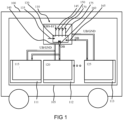
- Fig. 1 shows a schematic representation of a vehicle 100 with a braking system 105 with a switching device 110 according to an embodiment.
- the braking system 105 is designed as an electronic braking system, "EBS” for short, or according to an alternative embodiment as an anti-lock braking system, "ABS" for short.
- the braking system 105 has at least one subsystem device 111, 112, 113 for implementing a braking process.
- the braking system 105 according to this embodiment has three of the subsystem devices 111, 112, 113, which according to this embodiment are designed as a single-channel electropneumatic module, a two-channel electropneumatic module and/or a foot brake module.
- the braking system 105 has any number of any other subsystem devices.
- the switching device 110 has a central control unit EBS-ECU, at least one subsystem control unit 115, 120, 125 and a monitoring device 130.
- the central control unit EBS-ECU and each of the subsystem control units 115, 120, 125 each have a microcontroller.
- the central control unit EBS-ECU is designed to control the braking system 105.
- the subsystem control unit 115, 120, 125 is connected or connectable to the central control unit EBS-ECU via a data bus DB and is designed to control the subsystem device 111, 112, 113 of the braking system 105.
- the monitoring device 130 is designed to read in a first test signal 135 from the central control unit EBS-ECU in order to check a function of the central control unit EBS-ECU and designed to read in a second test signal 140 from the subsystem control unit 115 in order to check a function of the subsystem control unit 115.
- the monitoring device 130 can also be referred to as a "watchdog" and is designed according to this embodiment to carry out at least one watchdog function.
- the first test signal 135 is a signal provided by the central control unit EBS-ECU and/or the second test signal 140 is a signal provided by the subsystem control unit 115 or, according to an alternative embodiment, is a response signal generated in response to a query signal previously sent by the monitoring device 130 to the central control unit EBS-ECU or subsystem control unit 115.
- the first test signal 135 comprises a measured value, an evaluation result or protocol of the central control unit EBS-ECU.
- the second test signal 140 according to this embodiment includes a measured value, an evaluation result or protocol of the subsystem control unit 115.
- the monitoring device 130 is designed according to this embodiment to check or verify the measured value, the evaluation result or protocol, for example by comparing it with another measured value, evaluation result or protocol, in order to recognize whether the central control unit EBS-ECU and/or the subsystem control unit 115 are functioning as expected.
- the monitoring device 130 is implemented in the central control unit EBS-ECU and/or according to an alternative embodiment in one of the subsystem control units 115, 120, 125.
- the monitoring device 130 is in a common housing with the central control unit EBS-ECU or
- the monitoring device 130 is arranged in a common housing with the subsystem control unit 115, 120, 125.
- the monitoring device 130 is arranged on a common hardware component such as a circuit board of the central control unit EBS-ECU and/or subsystem control unit 115, 120, 125.
- the monitoring device 130 is further designed to output a first control signal 145 to a component of the braking system 105 using the first test signal 135, which indicates the function of the central control unit EBS-ECU and/or to output a second control signal 150 to a component of the braking system 105 using the second test signal 140, which indicates the function of the subsystem control unit 115.
- the switching device 110 has at least one second subsystem control device 120 which is connected or connectable to the central control unit EBS-ECU and/or the subsystem control device 120 via at least one second data bus DB for controlling the second subsystem device 112 of the braking system 105, wherein the monitoring device 130 is designed to read in a third test signal 160 from the second subsystem control device 120 in order to check a function of the second subsystem control device 120.
- the switching device 110 has at least one third subsystem control device 125, which is connected or connectable to the central control unit EBS-ECU and/or the subsystem control device 120 via at least one third data bus DB, for controlling the third subsystem device 113 of the braking system 105, wherein the monitoring device 130 is designed to read in a fourth test signal 165 from the third subsystem control device 125 in order to check a function of the third subsystem control device 125.
- the monitoring device 130 is designed to output a third control signal 170 to a component of the braking system 105 using the third test signal 160, which indicates the function of the second subsystem control unit 120 and/or to output a fourth control signal 175 to a component of the braking system 105 using the fourth test signal 165, which indicates the function of the third subsystem control unit 125.
- the central control unit EBS-ECU is connected or connectable to at least the subsystem control unit 115, 120, 125 via an electrically conductive connection device UB/GND.
- the switching device 110 presented here implements ISO26262 conformity using a central watchdog for a distributed electrical system.
- the switching device 110 advantageously optimizes its own monitoring function of an EBS-ECU, 115, 120, 125 control unit, which can communicate with other EBS-ECU, 115, 120, 125 control units in a system via data lines, here via data buses DB.
- EBS-ECU, 115, 120, 125 control units are currently being developed in accordance with the functional safety specifications ISO26262-2. In this case, monitoring of the internal microcontroller of the EBS-ECU, 115, 120, 125 control unit via a second instance is necessary.
- This second instance is implemented by the monitoring device 130, which according to one embodiment uses a "handshake" signal to enable an operation or verify calculations by calculating the same task of the internal microcontroller, wherein a result of the internal microcontroller according to one embodiment is compared with a result of the monitoring device 130 and then enabled accordingly.
- the control signals 145, 150, 170, 175 can be such "handshake" signals.
- a second controller also referred to below as " ⁇ C”, or an integrated circuit, or “IC” for short, with an integrated watchdog per control unit EBS-ECU, 115, 120, 125 to carry out such a monitoring function is advantageously not necessary thanks to the monitoring device 130.
- the switching device 110 thus makes it possible to save high costs for either at least a second controller or an IC with a watchdog.
- a watchdog functionality is implemented in the central control unit EBS-ECU in the switching device 110 presented here, whereby the subsystem control units 115, 120, 125 of the subsystem devices 111, 112, 113 are responsive to the watchdog functionality.
- the watchdog functionality is transferred to one of the attached subsystem devices 111, 112, 113 or a redundancy system, as in Fig. 2
- the IC and/or controller module that maps the watchdog functions can be omitted from one or more control units EBS-ECU, 115, 120, 125.
- Fig. 2 shows a schematic representation of a switching device 110 according to an embodiment. This can be the switching device 110 shown in Fig. 1 described switching device 110, with the difference that the monitoring device 130 according to this embodiment is arranged outside of the central control unit EBS-ECU and the at least one subsystem control unit 115, 120, 125.
- the switching device 110 has, in addition to or as an alternative to the at least one or the subsystem control units 115, 120, 125, a redundant control unit R-ECU, in which the monitoring device 130 is implemented purely by way of example according to this embodiment.
- the monitoring device 130 is as in Fig. 1 described in the central control unit EBS-ECU.
- the redundant control unit R-ECU is connected or can be connected to the central control unit EBS-ECU via a further data bus DB and is designed to control an identical or similar redundant braking system for the braking system or an electronic parking brake.
- the redundant control unit R-ECU is designed to have the same functions as the central control unit EBS-ECU.
- the monitoring device 130 is designed to read in a redundant test signal 200 from the redundant control unit R-ECU in order to check a function of the redundant control unit R-ECU.
- the monitoring device 130 is designed according to this embodiment to use the redundant test signal 200 to output a redundant control signal to a component of the brake system, which checks the function of the redundant control unit R-ECU.
- the monitoring device 130 is further designed according to this embodiment to read in the first, second, third and/or fourth test signal via the further data bus DB.
- the central control unit EBS-ECU is or can be connected in terms of signaling to at least one sensor 205 and/or actuator 210 of the braking system and/or electrically to an operating voltage connection UB1 and/or a ground connection GND.
- the redundant control unit R-ECU is also or can be connected in terms of signaling to at least the sensor 205 and/or actuator 210 and/or electrically to a further operating voltage connection UB2 and/or a further ground connection GND.
- the monitoring function is taken over by the redundant control unit R-ECU.
- this is equipped with the central control unit EBS-ECU by means of data buses DB and shared actuators 205 and sensors 210, which are used for synchronization according to one embodiment.
- a protocol can be transmitted via the shared PCV valve using test pulses from the central control unit EBS-ECU to the redundant control unit R-ECU, which is controlled by means of data bus DB. This can also be used as a "shared" watchdog.
- Fig. 3 shows a flow chart of a method 300 for operating a switching device for a braking system for a vehicle according to an embodiment.
- This method 300 is different from the method described in one of the Figures 1 or 2 described switching devices can be controlled or executed.
- the possibility of inducing a reset of at least one of the switching devices can also be provided.
- the method 300 has a step 305 of reading in and a step 310 of outputting.
- step 305 of reading in a first test signal is read in from a central control unit that is designed to control the braking system and/or a second test signal from a subsystem control unit that is connected to the central control unit via a data bus and is designed to control a subsystem device of the braking system, and/or a redundant test signal from a redundant control unit that is connected to the central control unit via a further data bus and is designed to control a redundant braking system for the braking system.
- step 310 of outputting a first control signal is output to a component of the braking system using the first test signal, wherein the first control signal indicates the function of the central control unit and/or a second control signal is output to a component of the braking system using the second test signal, wherein the second control signal indicates the function of the subsystem control unit and/or a redundant control signal is output to a component of the braking system using the redundant test signal, wherein the redundant control signal indicates the function of the redundant control unit.
- an embodiment includes an "and/or" connection between a first feature and a second feature, this is to be read as meaning that the embodiment according to one embodiment has both the first feature and the second feature and according to another embodiment has either only the first feature or only the second feature.
Landscapes
- Engineering & Computer Science (AREA)
- Transportation (AREA)
- Mechanical Engineering (AREA)
- Valves And Accessory Devices For Braking Systems (AREA)
- Regulating Braking Force (AREA)
Description
- Der vorliegende Ansatz bezieht sich auf eine Schaltvorrichtung für ein Bremssystem für ein Fahrzeug, ein Bremssystem mit einer Schaltvorrichtung und ein Verfahren zum Betreiben einer Schaltvorrichtung.
- Im Zuge des automatisierten oder autonomen Fahrens von Fahrzeugen aller Art ist es notwendig, Redundanzen zu schaffen. Diese Redundanzen sind so auszulegen, dass das Fahrzeug nicht in einen sicherheitskritischen oder unbeherrschbaren Zustand geraten kann. Redundanzen sind beispielsweise durch eine doppelte Ausführung von Systemen oder eine Verknüpfung mit anderen Systemen, welche ähnliche Funktionen ausführen, möglich. Nach den Vorgaben der Funktionalen Sicherheit ISO26262-2 sind Mikrocontroller von Steuergeräten durch eine externe Instanz zu überwachen. Die
DE 10 2008 029 310 A1 offenbart eine Überwachungseinrichtung zur Überwachung von Systemen eines Fahrzeugs. DieWO 99/26821 A1 - Vor diesem Hintergrund ist es die Aufgabe des vorliegenden Ansatzes eine verbesserte Schaltvorrichtung für ein Bremssystem für ein Fahrzeug, ein verbessertes Bremssystem mit einer Schaltvorrichtung und ein verbessertes Verfahren zum Betreiben einer Schaltvorrichtung zu schaffen.
- Diese Aufgabe wird durch eine Schaltvorrichtung mit den Merkmalen des Vorrichtungsanspruchs 1, durch ein Bremssystem nach Anspruch 10, durch ein Verfahren nach Anspruch 11 und durch ein Computerprogramm nach Anspruch 12, sowie durch ein maschinenlesbares Speichermedium nach Anspruch 13 gelöst.
- Die mit dem vorgestellten Ansatz erreichbaren Vorteile bestehen darin, Kosten für zusätzliche Controller oder Integrierte Schaltkreise mit Watchdog zur Überwachung jedes einzelnen Steuergeräts eines Bremssystems einzusparen.
- Eine Schaltvorrichtung für ein Bremssystem für ein Fahrzeug weist ein Zentralsteuergerät, zumindest ein Subsystemsteuergerät und zusätzlich oder alternativ ein Redundant-Steuergerät und eine Überwachungseinrichtung auf. Das Zentralsteuergerät ist zum Steuern des Bremssystems ausgebildet. Das Subsystemsteuergerät ist mit dem Zentralsteuergerät über einen Datenbus verbunden oder verbindbar und zum Steuern einer Subsystemeinrichtung des Bremssystems ausgebildet. Das Redundant-Steuergerät ist mit dem Zentralsteuergerät über einen weiteren Datenbus verbunden oder verbindbar und zum Steuern eines Redundant-Bremssystems für das Bremssystem ausgebildet. Die Überwachungseinrichtung ist dazu ausgebildet, um ein erstes Prüfsignal von dem Zentralsteuergerät einzulesen, um eine Funktion des Zentralsteuergeräts zu überprüfen und, um ein zweites Prüfsignal von dem Subsystemsteuergerät einzulesen, um eine Funktion des Subsystemsteuergeräts zu überprüfen und zusätzlich oder alternativ, um ein Redundant-Prüfsignal von dem Redundant-Steuergerät einzulesen, um eine Funktion des Redundant-Steuergeräts zu überprüfen.
- Bei dem Bremssystem kann es sich um ein elektronisches Bremssystem, kurz "EBS", handeln. Das Zentralsteuergerät, das Subsystemsteuergerät und zusätzlich oder alternativ das Redundant-Steuergerät können je zumindest einen Mikrocontroller aufweisen. Das Redundant-Steuergerät kann funktionsgleich mit dem Zentralsteuergerät ausgebildet sein, beispielsweise auch baugleich. Die Subsystemeinrichtung kann ein beliebiges Bremsmodul des Bremssystems sein, beispielsweise ein elektropneumatisches Modul oder ein Fußbremsmodul. Das Redundant-Bremssystem kann funktionsgleich zu dem Bremssystem ausgebildet sein, beispielsweise baugleich. Der Datenbus kann zumindest eine Datenleitung umfassen. Die Überwachungseinrichtung kann zur Durchführung zumindest einer Watchdogfunktion ausgebildet sein. Die Funktionalität eines "Watchdog" kann dabei derart beschrieben werden, dass ein Counter vorgesehen ist, welcher bei jedem Schritt inkrementiert. Wenn er ein Limit erreicht oder überläuft, wird der Reset des Mikrocontrollers bedient, In der Laufzeit werden nun Befehle integriert, welchen den Watchdog Counter zurücksetzen. Bleibt das Programm hängen wird der Watchdog Counter nichtmehr zurück gesetzt und es kommt zum Reset. In dem hier vorliegenden Fall kann das erste Prüfsignal ein von dem Zentralsteuergerät und zusätzlich oder alternativ das zweite Prüfsignal ein von dem Subsystemsteuergerät bereitgestelltes Signal oder ein auf ein zuvor von der Überwachungseinrichtung gesendetes Abfragesignal an das Zentralsteuergerät oder Subsystemsteuergerät generiertes Antwortsignal sein. Das erste Prüfsignal kann beispielsweise einen Messwert, ein Auswerteergebnis oder Protokoll des Zentralsteuergeräts umfassen. Ebenso kann das zweite Prüfsignal einen Messwert, ein Auswerteergebnis oder Protokoll des Subsystemsteuergeräts und zusätzlich oder alternativ das Redundanz-Prüfsignal einen Messwert, ein Auswerteergebnis oder Protokoll des Redundanz-Steuergeräts umfassen. Die Überwachungseinrichtung kann dazu ausgebildet sein, um den Messwert, das Auswerteergebnis oder Protokoll zu überprüfen oder zu verifizieren, beispielsweise durch einen Vergleich mit einem anderen Messwert, Auswerteergebnis oder Protokoll, um zu erkennen, ob das Zentralsteuergerät und zusätzlich oder alternativ das Subsystemsteuergerät erwartungsgemäß funktionieren.
- Vorteilhafterweise ist eine solche Schaltvorrichtung ausgebildet, um mit nur einer Überwachungseinrichtung Funktionen mehrerer Steuergeräte zu überwachen, welche über einen Datenbus miteinander verbunden sind. Dies ermöglicht eine Kosteneinsparung für das Bremssystem und zusätzlich oder alternativ für das Redundant-Bremssystem.
- Die Überwachungseinrichtung kann dazu ausgebildet sein, um unter Verwendung des ersten Prüfsignals ein erstes Steuersignal an eine Komponente des Bremssystems auszugeben, wobei das erste Steuersignal die Funktion des Zentralsteuergeräts anzeigt und zusätzlich oder alternativ unter Verwendung des zweiten Prüfsignals ein zweites Steuersignal an eine Komponente des Bremssystems auszugeben, wobei das zweite Steuersignal die Funktion des Subsystemsteuergeräts anzeigt und zusätzlich oder alternativ, um unter Verwendung des Redundant-Prüfsignals ein Redundant-Steuersignal an eine Komponente des Bremssystems auszugeben, wobei das Redundant-Steuersignal die Funktion des Redundant-Steuergeräts anzeigt. So können abhängig von der Funktion des Zentralsteuergeräts, Subsystemsteuergeräts und zusätzlich oder alternativ Redundant-Steuergeräts Handlungen zur Sicherstellung oder Wiederherstellung der Funktion initiiert oder eine Ersatzfunktion aktiviert werden, wenn das Prüfsignal beispielsweise eine Fehlfunktion des Zentralsteuergeräts, Subsystemsteuergeräts und zusätzlich oder alternativ Redundant-Steuergeräts anzeigt. Beispielsweise kann durch das jeweilige Steuersignal ein Neustart oder Abschalten eines defekten Steuergeräts und zusätzlich oder alternativ ein Aktivieren eines anderen Steuergeräts bewirkt werden.
- Die Überwachungseinrichtung kann in dem Zentralsteuergerät und zusätzlich oder alternativ dem Subsystemsteuergerät implementiert sein. Beispielsweise kann die Überwachungseinrichtung in einem gemeinsamen Gehäuse mit dem Zentralsteuergerät oder dem Subsystemsteuergerät angeordnet sein. Die Überwachungseinrichtung kann auch auf einem gemeinsamen Hardwarebaustein wie einer Leiterplatte des Zentralsteuergeräts und zusätzlich oder alternativ Subsystemsteuergeräts angeordnet sein.
- Es ist weiterhin von Vorteil, wenn die Überwachungseinrichtung gemäß einer Ausführungsform außerhalb von dem Zentralsteuergerät und dem Subsystemsteuergerät angeordnet ist. So kann die Überwachungseinrichtung in ein weiteres Steuergerät des Bremssystems implementiert sein.
- Die Überwachungseinrichtung kann gemäß einer Ausführungsform in dem Redundant-Steuergerät implementiert sein. Beispielsweise kann die Überwachungseinrichtung in einem gemeinsamen Gehäuse mit dem Redundant-Steuergerät angeordnet sein. Die Überwachungseinrichtung kann auch auf einem gemeinsamen Hardwarebaustein wie einer Leiterplatte des Redundant-Steuergerät angeordnet sein. Eine Anordnung der Überwachungseinrichtung in oder an dem Redundant-Steuergerät ermöglicht somit vorteilhafterweise eine Überwachung sowohl des Bremssystems als auch des Redundant-Bremssystems.
- Gemäß einer Ausführungsform kann das Zentralsteuergerät signaltechnisch mit zumindest einem Sensor und zusätzlich oder alternativ Aktor des Bremssystems und zusätzlich oder alternativ elektrisch mit einem Betriebsspannungsanschluss und zusätzlich oder alternativ einem Masseanschluss verbunden oder verbindbar sein und zusätzlich oder alternativ kann das Redundant-Steuergerät signaltechnisch mit zumindest dem Sensor und zusätzlich oder alternativ Aktor und zusätzlich oder alternativ elektrisch mit einem weiteren Betriebsspannungsanschluss und zusätzlich oder alternativ einem weiteren Masseanschluss verbunden oder verbindbar sein. So können das Zentralsteuergerät und das Redundant-Steuergerät Werte von demselben Sensor und zusätzlich oder alternativ demselben Aktor beziehen, welche dann von der Überwachungseinrichtung überprüft, beispielsweise verglichen, werden können.
- Das Zentralsteuergerät kann mit zumindest dem Subsystemsteuergerät über eine elektrisch leitfähige Verbindungseinrichtung verbunden oder verbindbar ist. Dies erlaubt eine elektrische Versorgung der Steuergeräte.
- Es ist weiterhin von Vorteil, wenn die Schaltvorrichtung gemäß einer Ausführungsform zumindest ein mit dem Zentralsteuergerät und zusätzlich oder alternativ dem Subsystemsteuergerät über zumindest einen zweiten Datenbus verbundenes oder verbindbares zweites Subsystemsteuergerät zum Steuern einer zweiten Subsystemeinrichtung des Bremssystems aufweist, wobei die Überwachungseinrichtung dazu ausgebildet ist, um ein drittes Prüfsignal von dem zweiten Subsystemsteuergerät einzulesen, um eine Funktion des zweiten Subsystemsteuergeräts zu überprüfen. Die zweite Subsystemeinrichtung kann ebenfalls ein beliebiges Bremsmodul des Bremssystems sein. So können mehrere Subsystemsteuergeräte von der Überwachungseinrichtung überprüft werden, was weitere Kosten einspart.
- Das Subsystemsteuergerät kann zum Steuern der Subsystemeinrichtung ausgebildet sein, die als ein elektropneumatisches Modul oder ein Fußbremsmodul des Bremssystems ausgeformt ist. Das elektropneumatische Modul kann ein einkanaliges oder zweikanaliges elektropneumatisches Modul sein.
- Ebenso kann das zweite Subsystemsteuergerät zum Steuern der zweiten Subsystemeinrichtung ausgebildet sein, die als ein elektropneumatisches Modul oder ein Fußbremsmodul des Bremssystems ausgeformt ist. Auch hier kann das elektropneumatische Modul ein einkanaliges oder zweikanaliges elektropneumatisches Modul sein.
- Ein Bremssystem weist eine der vorangehend beschriebenen Schaltvorrichtungen auf. Das Bremssystem kann ein Redundant-Bremssystem sein oder aufweisen, wobei die Schaltvorrichtung in das Redundant-Bremssystem implementiert sein kann. Ein solches Bremssystem kommt vorteilhafterweise mit nur einer Überwachungseinrichtung aus, welches dennoch alle Steuergeräte des Bremssystems und zusätzlich oder alternativ Redundant-Bremssystems sicher überwachen kann.
- Ein Verfahren zum Betreiben einer Schaltvorrichtung für ein Bremssystem für ein Fahrzeug weist einen Schritt des Einlesens und einen Schritt des Ausgebens auf. Im Schritt des Einlesen wird ein erstes Prüfsignal von einem Zentralsteuergerät, das zum Steuern des Bremssystems ausgebildet ist und zusätzlich oder alternativ ein zweites Prüfsignal von einem Subsystemsteuergerät, das mit dem Zentralsteuergerät über einen Datenbus verbunden und zum Steuern einer Subsystemeinrichtung des Bremssystems ausgebildet ist und zusätzlich oder alternativ ein Redundant-Prüfsignal von einem Redundant-Steuergerät, das mit dem Zentralsteuergerät über einen weiteren Datenbus verbunden oder verbindbar und zum Steuern eines Redundant-Bremssystems für das Bremssystem ausgebildet ist, eingelesen. Im Schritt des Ausgebens wird ein erstes Steuersignal an eine Komponente des Bremssystems unter Verwendung des ersten Prüfsignals ausgegeben, wobei das erste Steuersignal die Funktion des Zentralsteuergerät anzeigt und zusätzlich oder alternativ ein zweites Steuersignal an eine Komponente des Bremssystems unter Verwendung des zweiten Prüfsignals ausgegeben, wobei das zweite Steuersignal die Funktion des Subsystemsteuergeräts anzeigt und zusätzlich oder alternativ ein Redundant-Steuersignal an eine Komponente des Bremssystems unter Verwendung des Redundant-Prüfsignals ausgegeben, wobei das Redundant-Steuersignal die Funktion des Redundant-Steuergeräts anzeigt.
- Dieses Verfahren kann unter Verwendung der zuvor vorgestellten Überwachungseinrichtung ausführbar sein. Auch durch ein solches Verfahren können die bereits beschriebenen Vorteile der Überwachungseinrichtung technisch einfach und kostengünstig realisiert werden.
- Ausführungsbeispiele des hier vorgestellten Ansatzes werden in der nachfolgenden Beschreibung mit Bezug zu den Figuren näher erläutert. Es zeigen:
-
Fig. 1 eine schematische Darstellung eines Fahrzeugs mit einem Bremssystem mit einer Schaltvorrichtung gemäß einem Ausführungsbeispiel; -
Fig. 2 eine schematische Darstellung einer Schaltvorrichtung gemäß einem Ausführungsbeispiel; und -
Fig. 3 ein Ablaufdiagramm eines Verfahrens zum Betreiben einer Schaltvorrichtung für ein Bremssystem für ein Fahrzeug gemäß einem Ausführungsbeispiel. - In der nachfolgenden Beschreibung günstiger Ausführungsbeispiele des vorliegenden Ansatzes werden für die in den verschiedenen Figuren dargestellten und ähnlich wirkenden Elemente gleiche oder ähnliche Bezugszeichen verwendet, wobei auf eine wiederholte Beschreibung dieser Elemente verzichtet wird.
-
Fig. 1 zeigt eine schematische Darstellung eines Fahrzeugs 100 mit einem Bremssystem 105 mit einer Schaltvorrichtung 110 gemäß einem Ausführungsbeispiel. - Das Bremssystem 105 ist gemäß diesem Ausführungsbeispiel als ein elektronisches Bremssystem, kurz "EBS", oder gemäß einem alternativen Ausführungsbeispiel als ein Antiblockiersystem, kurz "ABS" ausgeformt. Das Bremssystem 105 weist gemäß diesem Ausführungsbeispiel zumindest eine Subsystemeinrichtung 111, 112, 113 zum Realisieren eines Bremsvorgangs auf. Lediglich beispielhaft weist das Bremssystem 105 gemäß diesem Ausführungsbeispiel drei der Subsystemeinrichtungen 111, 112, 113 auf, welche gemäß diesem Ausführungsbeispiel als ein eineinkanaliges elektropneumatisches Modul, ein zweikanaliges elektropneumatisches Modul und/oder ein Fußbremsmodul ausgeformt sind. Gemäß einem alternativen Ausführungsbeispiel weist das Bremssystem 105 eine beliebige Anzahl an beliebigen weiteren Subsystemeinrichtungen auf.
- Die Schaltvorrichtung 110 weist ein Zentralsteuergerät EBS-ECU, zumindest ein Subsystemsteuergerät 115, 120, 125 und eine Überwachungseinrichtung 130 auf. Das Zentralsteuergerät EBS-ECU und jedes der Subsystemsteuergeräte 115, 120, 125 weisen je einen Mikrocontroller auf. Das Zentralsteuergerät EBS-ECU ist zum Steuern des Bremssystems 105 ausgebildet. Das Subsystemsteuergerät 115, 120, 125 ist mit dem Zentralsteuergerät EBS-ECU über einen Datenbus DB verbunden oder verbindbar und zum Steuern der Subsystemeinrichtung 111, 112, 113 des Bremssystems 105 ausgebildet. Die Überwachungseinrichtung 130 ist dazu ausgebildet, um ein erstes Prüfsignal 135 von dem Zentralsteuergerät EBS-ECU einzulesen, um eine Funktion des Zentralsteuergeräts EBS-ECU zu überprüfen und dazu ausgebildet, um ein zweites Prüfsignal 140 von dem Subsystemsteuergerät 115 einzulesen, um eine Funktion des Subsystemsteuergeräts 115 zu überprüfen.
- Die Überwachungseinrichtung 130 kann auch als ein "Watchdog" bezeichnet werden und ist gemäß diesem Ausführungsbeispiel zur Durchführung zumindest einer Watchdogfunktion ausgebildet. Das erste Prüfsignal 135 ist gemäß einem Ausführungsbeispiel ein von dem Zentralsteuergerät EBS-ECU und/oder das zweite Prüfsignal 140 ein von dem Subsystemsteuergerät 115 bereitgestelltes Signal oder ist gemäß einem alternativen Ausführungsbeispiel ein auf ein zuvor von der Überwachungseinrichtung 130 gesendetes Abfragesignal an das Zentralsteuergerät EBS-ECU oder Subsystemsteuergerät 115 generiertes Antwortsignal. Gemäß diesem Ausführungsbeispiel umfasst das erste Prüfsignal 135 einen Messwert, ein Auswerteergebnis oder Protokoll des Zentralsteuergeräts EBS-ECU. Ebenso umfasst das zweite Prüfsignal 140 gemäß diesem Ausführungsbeispiel einen Messwert, ein Auswerteergebnis oder Protokoll des Subsystemsteuergeräts 115. Die Überwachungseinrichtung 130 ist gemäß diesem Ausführungsbeispiel dazu ausgebildet, um den Messwert, das Auswerteergebnis oder Protokoll zu überprüfen oder zu verifizieren, beispielsweise durch einen Vergleich mit einem anderen Messwert, Auswerteergebnis oder Protokoll, um zu erkennen, ob das Zentralsteuergerät EBS-ECU und/oder das Subsystemsteuergerät 115 erwartungsgemäß funktionieren.
- Lediglich beispielhaft ist die Überwachungseinrichtung 130 gemäß diesem Ausführungsbeispiel in dem Zentralsteuergerät EBS-ECU und/oder gemäß einem alternativen Ausführungsbeispiel in einem der Subsystemsteuergeräte 115, 120, 125 implementiert. Gemäß diesem Ausführungsbeispiel ist die Überwachungseinrichtung 130 in einem gemeinsamen Gehäuse mit dem Zentralsteuergerät EBS-ECU oder gemäß dem alternativen Ausführungsbeispiel in einem gemeinsamen Gehäuse mit dem Subsystemsteuergerät 115, 120, 125 angeordnet. Die Überwachungseinrichtung 130 ist hierbei gemäß diesem Ausführungsbeispiel auf einem gemeinsamen Hardwarebaustein wie einer Leiterplatte des Zentralsteuergeräts EBS-ECU und/oder Subsystemsteuergeräts 115,120, 125 angeordnet.
- Die Überwachungseinrichtung 130 ist gemäß diesem Ausführungsbeispiel ferner dazu ausgebildet, um unter Verwendung des ersten Prüfsignals 135 ein erstes Steuersignal 145 an eine Komponente des Bremssystems 105 auszugeben, das die Funktion des Zentralsteuergeräts EBS-ECU anzeigt und/oder unter Verwendung des zweiten Prüfsignals 140 ein zweites Steuersignal 150 an eine Komponente des Bremssystems 105 auszugeben, das die Funktion des Subsystemsteuergeräts 115 anzeigt.
- Die Schaltvorrichtung 110 weist gemäß diesem Ausführungsbeispiel zumindest ein mit dem Zentralsteuergerät EBS-ECU und/oder dem Subsystemsteuergerät 120 über zumindest einen zweiten Datenbus DB verbundenes oder verbindbares zweites Subsystemsteuergerät 120 zum Steuern der zweiten Subsystemeinrichtung 112 des Bremssystems 105 auf, wobei die Überwachungseinrichtung 130 dazu ausgebildet ist, um ein drittes Prüfsignal 160 von dem zweiten Subsystemsteuergerät 120 einzulesen, um eine Funktion des zweiten Subsystemsteuergeräts 120 zu überprüfen. Die Schaltvorrichtung 110 weist gemäß diesem Ausführungsbeispiel zumindest ein mit dem Zentralsteuergerät EBS-ECU und/oder dem Subsystemsteuergerät 120 über zumindest einen dritten Datenbus DB verbundenes oder verbindbares drittes Subsystemsteuergerät 125 zum Steuern der dritten Subsystemeinrichtung 113 des Bremssystems 105 auf, wobei die Überwachungseinrichtung 130 dazu ausgebildet ist, um ein viertes Prüfsignal 165 von dem dritten Subsystemsteuergerät 125 einzulesen, um eine Funktion des dritten Subsystemsteuergeräts 125 zu überprüfen. Die Überwachungseinrichtung 130 ist gemäß diesem Ausführungsbeispiel dazu ausgebildet, um unter Verwendung des dritten Prüfsignals 160 ein drittes Steuersignal 170 an eine Komponente des Bremssystems 105 auszugeben, das die Funktion des zweiten Subsystemsteuergeräts 120 anzeigt und/oder unter Verwendung des vierten Prüfsignals 165 ein viertes Steuersignal 175 an eine Komponente des Bremssystems 105 auszugeben, das die Funktion des dritten Subsystemsteuergeräts 125 anzeigt.
- Das Zentralsteuergerät EBS-ECU ist gemäß diesem Ausführungsbeispiel mit zumindest dem Subsystemsteuergerät 115, 120, 125 über eine elektrisch leitfähige Verbindungseinrichtung UB/GND verbunden oder verbindbar.
- Die hier vorgestellte Schaltvorrichtung 110 realisiert eine ISO26262-Konformität mittels zentralem Watchdog für ein verteiltes elektrisches System. Die Schaltvorrichtung 110 optimiert hierbei vorteilhafterweise eine eigene Überwachungsfunktion eines Steuergerätes EBS-ECU, 115, 120, 125, welches mit anderen Steuergeräten EBS-ECU, 115, 120, 125 in einem System über Datenleitungen, hier über Datenbusse DB, kommunizieren kann. Grundsätzlich werden Steuergeräte EBS-ECU, 115, 120, 125 aktuell nach den Vorgaben der Funktionalen Sicherheit ISO26262-2 entwickelt. Hierbei ist eine Überwachung des internen Mikrocontrollers des Steuergeräts EBS-ECU, 115, 120, 125 über eine zweite Instanz notwendig. Diese zweite Instanz wird durch die Überwachungseinrichtung 130 realisiert, welche gemäß einem Ausführungsbeispiel mittels eines "Handshake"-Signals eine Operation freigibt oder Berechnungen verifiziert, indem sie die gleiche Aufgabe des internen Mikrocontrollers berechnet, wobei ein Ergebnis des internen Mikrocontrollers gemäß einem Ausführungsbeispiel mit einem Ergebnis der Überwachungseinrichtung 130 verglichen und dann entsprechend freigegeben wird. Die Steuersignale 145, 150, 170, 175 können derartige "Handshake"-Signale sein.
- Ein zweiter Controller, im Folgenden auch als "µC" bezeichnet, oder ein integrierter Schaltkreis, kurz "IC" mit integriertem Watchdog pro Steuergerät EBS-ECU, 115, 120, 125 zur Durchführung einer derartigen Überwachungsfunktion ist dank der Überwachungseinrichtung 130 vorteilhafterweise nicht notwendig. Die Schaltvorrichtung 110 ermöglicht es somit, hohe Kosten für entweder zumindest einen zweiten Controller oder einen IC mit Watchdog einzusparen.
- Um die Überwachungsfunktion in dem Bremssystemen 105 zu optimieren, ist bei der hier vorgestellten Schaltvorrichtung 110 eine Watchdog-Funktionalität in das Zentralsteuergerät EBS-ECU implementiert, wobei die Subsystemsteuergeräte 115, 120, 125 der Subsystemeinrichtungen 111, 112, 113 auf die Watchdog-Funktionalität zurückgreifen. Dies ist möglich, da diese im ständigen Austausch von Daten über den Datenbus DB, hier CAN-BUS (Controller Area Network-Bus), stehen. Gemäß einem alternativen Ausführungsbeispiel ist die Watchdog-Funktionalität an eine der angehängten Subsystemeinrichtungen 111, 112, 113 oder ein Redundanzsystem übernommen, wie es in
Fig. 2 beschrieben ist. In jedem Fall kann somit der Baustein IC und/oder Controller, welcher die Watchdog-Funktionen abbildet, aus einem oder mehreren Steuergeräten EBS-ECU, 115, 120, 125 entfallen. -
Fig. 2 zeigt eine schematische Darstellung einer Schaltvorrichtung 110 gemäß einem Ausführungsbeispiel. Dabei kann es sich die anhand vonFig. 1 beschriebene Schaltvorrichtung 110 handeln, mit dem Unterschied, dass die Überwachungseinrichtung 130 gemäß diesem Ausführungsbeispiel außerhalb von dem Zentralsteuergerät EBS-ECU und dem zumindest einen Subsystemsteuergerät 115, 120, 125 angeordnet ist. - Die Schaltvorrichtung 110 weist gemäß diesem Ausführungsbeispiel zusätzlich oder alternativ zu dem zumindest einen oder den Subsystemsteuergeräten 115, 120, 125 ein Redundant-Steuergerät R-ECU auf, in das die Überwachungseinrichtung 130 lediglich beispielhaft gemäß diesem Ausführungsbeispiel implementiert ist. Gemäß einem alternativen Ausführungsbeispiel ist die Überwachungseinrichtung 130 wie in
Fig. 1 beschrieben in das Zentralsteuergerät EBS-ECU. Das Redundant-Steuergerät R-ECU ist über einen weiteren Datenbus DB mit dem Zentralsteuergerät EBS-ECU verbunden oder verbindbar und zum Steuern eines baugleichen oder bauähnlichen Redundant-Bremssystems für das Bremssystem oder einer elektronischen Parkbremse ausgebildet. Gemäß einem Ausführungsbeispiel ist das Redundant-Steuergerät R-ECU funktionsgleich mit dem Zentralsteuergerät EBS-ECU ausgebildet. - Gemäß diesem Ausführungsbeispiel ist die Überwachungseinrichtung 130 dazu ausgebildet, um ein Redundant-Prüfsignal 200 von dem Redundant-Steuergerät R-ECU einzulesen, um eine Funktion des Redundant-Steuergeräts R-ECU zu überprüfen. Die Überwachungseinrichtung 130 ist gemäß diesem Ausführungsbeispiel dazu ausgebildet, um unter Verwendung des Redundant-Prüfsignals 200 ein Redundant-Steuersignal an eine Komponente des Bremssystems auszugeben, das die Funktion des Redundant-Steuergeräts R-ECU anzeigt. Die Überwachungseinrichtung 130 ist ferner gemäß diesem Ausführungsbeispiel dazu ausgebildet, um das erste, zweite, dritte und/oder vierte Prüfsignal über den weiteren Datenbus DB einzulesen.
- Das Zentralsteuergerät EBS-ECU ist gemäß diesem Ausführungsbeispiel signaltechnisch mit zumindest einem Sensor 205 und/oder Aktor 210 des Bremssystems und/oder elektrisch mit einem Betriebsspannungsanschluss UB1 und/oder einem Masseanschluss GND verbunden oder verbindbar. Das Redundant-Steuergerät R-ECU ist gemäß diesem Ausführungsbeispiel ebenfalls signaltechnisch mit zumindest dem Sensor 205 und/oder Aktor 210 und/oder elektrisch mit einem weiteren Betriebsspannungsanschluss UB2 und/oder einem weiteren Masseanschluss GND verbunden oder verbindbar.
- Zur Realisierung einer Redundanz für Systeme, wie zum Beispiel das elektrische Bremssystem EBS oder ABS, können diese Systeme mehrfach im Fahrzeug platziert werden. Eine andere Möglichkeit ist, das System mit ähnlichen Teilsystemen, welche die Funktionalität abbilden können, zu ergänzen. Ein Beispiel dafür ist ein EBS mit einer elektronischen Parkbremse, kurz "EPB", zu koppeln. Im Fehlerfall wird das fehlerhafte System abgeschaltet und das zweite fehlerfreie System übernimmt dann die Aufgabe und stellt so die Redundanz her. Diese beiden Systeme sind voneinander autark. Sie sind jeweils nach dem Grundsatz der Funktionalen Sicherheit entwickelt und besitzen somit eine umfangreiche Eigenüberwachung. Beide Systeme sind mittels Bus-System sowie gemeinsam genutzter Aktuatoren miteinander verbunden und dienen zum Austausch von Zuständen und Daten.
- Eine Mehrfachplatzierung von Steuergeräten oder Systemen in Fahrzeugen verursacht hohe Kosten. Dieser Ansatz beschreibt eine Möglichkeit, die Kosten für ein bereits bestehendes System mit Redundanzsystem zu senken. Gemäß diesem Ausführungsbeispiel ist das Prinzip des "Shared"-Watchdog auf ein System übertragen, welches redundant ausgelegt ist.
- In diesem Ausführungsbeispiel ist die Überwachungsfunktion durch das Redundant-Steuergerät R-ECU übernommen. Dieses ist gemäß diesem Ausführungsbeispiel mit dem Zentralsteuergerät EBS-ECU mittels Datenbusse DB sowie gemeinsam genutzter Aktuatoren 205 und Sensoren 210 verbunden, welche gemäß einem Ausführungsbeispiel zur Synchronisation verwendet werden. Es kann zum Beispiel über das gemeinsam genutzte PCV-Ventil mittels Testpulse ein Protokoll von dem Zentralsteuergerät EBS-ECU zum Redundant-Steuergerät R-ECU übertragen werden, welches mittels Datenbus DB kontrolliert wird. Dieses kann auch als "Shared"-Watchdog verwendet werden.
-
Fig. 3 zeigt ein Ablaufdiagramm eines Verfahrens 300 zum Betreiben einer Schaltvorrichtung für ein Bremssystem für ein Fahrzeug gemäß einem Ausführungsbeispiel. Dieses Verfahren 300 ist von der in einer derFiguren 1 oder2 beschriebenen Schaltvorrichtungen ansteuerbar oder ausführbar. Speziell kann in diesem Zusammanhang auch die Möglichkeit vorgesehen sein, einen Reset zumindest einer der Schaltvorrichtungen herbeizuführen. - Das Verfahren 300 weist einen Schritt 305 des Einlesens und einen Schritt 310 des Ausgebens auf. Im Schritt 305 des Einlesen wird ein erstes Prüfsignal von einem Zentralsteuergerät, das zum Steuern des Bremssystems ausgebildet ist und/oder ein zweites Prüfsignal von einem Subsystemsteuergerät, das mit dem Zentralsteuergerät über einen Datenbus verbunden und zum Steuern einer Subsystemeinrichtung des Bremssystems ausgebildet ist, und/oder ein Redundant-Prüfsignal von einem Redundant-Steuergerät, das mit dem Zentralsteuergerät über einen weiteren Datenbus verbunden und zum Steuern eines Redundant-Bremssystems für das Bremssystem ausgebildet ist, eingelesen. Im Schritt 310 des Ausgebens wird ein erstes Steuersignal an eine Komponente des Bremssystems unter Verwendung des ersten Prüfsignals ausgegeben, wobei das erste Steuersignal die Funktion des Zentralsteuergerät anzeigt und/oder ein zweites Steuersignal an eine Komponente des Bremssystems unter Verwendung des zweiten Prüfsignals ausgegeben, wobei das zweite Steuersignal die Funktion des Subsystemsteuergeräts anzeigt und/oder ein Redundant-Steuersignal an eine Komponente des Bremssystems unter Verwendung des Redundant-Prüfsignals ausgegeben, wobei das Redundant-Steuersignal die Funktion des Redundant-Steuergeräts anzeigt.
- Die hier vorgestellten Verfahrensschritte können wiederholt sowie in einer anderen als in der beschriebenen Reihenfolge ausgeführt werden.
- Umfasst ein Ausführungsbeispiel eine "und/oder"-Verknüpfung zwischen einem ersten Merkmal und einem zweiten Merkmal, so ist dies so zu lesen, dass das Ausführungsbeispiel gemäß einer Ausführungsform sowohl das erste Merkmal als auch das zweite Merkmal und gemäß einer weiteren Ausführungsform entweder nur das erste Merkmal oder nur das zweite Merkmal aufweist.
-
- DB
- Datenbus
- EBS-ECU
- Zentralsteuergerät
- GND
- Masseanschluss
- R-ECU
- Redundant-Steuergerät
- UB/GND
- elektrisch leitfähige Verbindungseinrichtung
- UB1
- Betriebsspannungsanschluss
- UB2
- weiterer Betriebsspannungsanschluss
- 100
- Fahrzeug
- 105
- Bremssystem
- 110
- Schaltvorrichtung
- 111
- Subsystemeinrichtung
- 112
- zweite Subsystemeinrichtung
- 113
- dritte Subsystemeinrichtung
- 115
- Subsystemsteuergerät
- 120
- zweites Subsystemsteuergerät
- 125
- drittes Subsystemsteuergerät
- 130
- Überwachungseinrichtung
- 135
- erstes Prüfsignal
- 140
- zweites Prüfsignal
- 145
- erstes Steuersignal
- 150
- zweites Steuersignal
- 160
- drittes Prüfsignal
- 165
- viertes Prüfsignal
- 170
- drittes Steuersignal
- 175
- viertes Steuersignal
- 200
- Redundant-Prüfsignal
- 205
- Sensor
- 210
- Aktor
- 300
- Verfahren zum Betreiben einer Schaltvorrichtung für ein Bremssystem für ein Fahrzeug
- 305
- Schritt des Einlesens
- 310
- Schritt des Ausgebens
Claims (13)
- Schaltvorrichtung (110) für ein Bremssystem (105) für ein Fahrzeug (100), wobei die Schaltvorrichtung (110) die folgenden Merkmale aufweist:ein Zentralsteuergerät (EBS-ECU) zum Steuern des Bremssystems (105),zumindest ein mit dem Zentralsteuergerät (EBS-ECU) über einen weiteren Datenbus (DB) verbundenes oder verbindbares Redundant-Steuergerät (R-ECU) zum Steuern eines Redundant-Bremssystems für das Bremssystem (105),gekennzeichnet durcheine Überwachungseinrichtung (130), die dazu ausgebildet ist um ein Redundant-Prüfsignal (200) von dem Redundant-Steuergerät (R-ECU) einzulesen, um eine Funktion des Redundant-Steuergeräts (R-ECU) zu prüfen.
- Schaltvorrichtung (110) gemäß Anspruch 1, die ferner zumindest ein mit dem Zentralsteuergerät (EBS-ECU) über einen Datenbus (DB) verbundenes oder verbindbares Subsystemsteuergerät (115) zum Steuern einer Subsystemeinrichtung (111) des Bremssystems (105) aufweist, wobei die Überwachungseinrichtung (130) dazu ausgebildet ist, um ein erstes Prüfsignal (135) von dem Zentralsteuergerät (EBS-ECU) einzulesen, um eine Funktion des Zentralsteuergeräts (EBS-ECU) zu überprüfen und die dazu ausgebildet ist, um ein zweites Prüfsignal (140) von dem Subsystemsteuergerät (115) einzulesen, um eine Funktion des Subsystemsteuergeräts (115) zu überprüfen und wobei die Überwachungseinrichtung (130) dazu ausgebildet ist, um unter Verwendung des ersten Prüfsignals (135) ein erstes Steuersignal (145) an eine Komponente des Bremssystems (105) auszugeben, wobei das erste Steuersignal (145) die Funktion des Zentralsteuergeräts (EBS-ECU) anzeigt und/oder unter Verwendung des zweiten Prüfsignals (140) ein zweites Steuersignal (150) an eine Komponente des Bremssystems (105) auszugeben, wobei das zweite Steuersignal (150) die Funktion des Subsystemsteuergeräts (115) anzeigt und/oder um unter Verwendung des Redundant-Prüfsignals (200) ein Redundant-Steuersignal an eine Komponente des Bremssystems (105) auszugeben, wobei das Redundant-Steuersignal die Funktion des Redundant-Steuergeräts (R-ECU) anzeigt.
- Schaltvorrichtung (110) gemäß Anspruch 2, bei der die Überwachungseinrichtung (130) in dem Zentralsteuergerät (EBS-ECU) und/oder dem Subsystemsteuergerät (115) implementiert ist.
- Schaltvorrichtung (110) gemäß einem der Ansprüche 2 bis 3, bei der die Überwachungseinrichtung (130) außerhalb von dem Zentralsteuergerät (EBS-ECU) und dem Subsystemsteuergerät (115) angeordnet ist.
- Schaltvorrichtung (110) gemäß einem der vorangegangenen Ansprüche, bei der die Überwachungseinrichtung (130) in dem Redundant-Steuergerät (R-ECU) implementiert ist.
- Schaltvorrichtung (110) gemäß einem der vorangegangenen Ansprüche, bei der das Zentralsteuergerät (EBS-ECU) signaltechnisch mit zumindest einem Sensor (205) und/oder Aktor (210) des Bremssystems (105) und/oder elektrisch mit einem Betriebsspannungsanschluss (UB1) und/oder einem Masseanschluss (GND) verbunden oder verbindbar ist und/oder das Redundant-Steuergerät (R-ECU) signaltechnisch mit zumindest dem Sensor (205) und/oder Aktor (205) und/oder elektrisch mit einem weiteren Betriebsspannungsanschluss (UB2) und/oder einem weiteren Masseanschluss (GND) verbunden oder verbindbar ist.
- Schaltvorrichtung (110) gemäß einem der vorangegangenen Ansprüche, bei der das Zentralsteuergerät (EBS-ECU) mit zumindest dem Subsystemsteuergerät (115) über eine elektrisch leitfähige Verbindungseinrichtung (UB/GND) verbunden oder verbindbar ist.
- Schaltvorrichtung (110) gemäß einem der vorangegangenen Ansprüche, mit zumindest einem mit dem Zentralsteuergerät (EBS-ECU) und/oder dem Subsystemsteuergerät (115) über zumindest einen zweiten Datenbus (DB) verbundenen oder verbindbaren zweiten Subsystemsteuergerät (120) zum Steuern einer zweiten Subsystemeinrichtung (112) des Bremssystems (105), wobei die Überwachungseinrichtung (130) dazu ausgebildet ist, um ein drittes Prüfsignal (160) von dem zweiten Subsystemsteuergerät (120) einzulesen, um eine Funktion des zweiten Subsystemsteuergeräts (120) zu überprüfen.
- Schaltvorrichtung (110) gemäß einem der vorangegangenen Ansprüche, bei der das Subsystemsteuergerät (115) zum Steuern der Subsystemeinrichtung (111) ausgebildet ist, die als ein elektropneumatisches Modul oder ein Fußbremsmodul des Bremssystems (105) ausgeformt ist.
- Bremssystem (105) mit einer Schaltvorrichtung (110) gemäß einem der vorangegangenen Ansprüche.
- Verfahren (300) zum Betreiben einer Schaltvorrichtung (110) für ein Bremssystem (105) für ein Fahrzeug (100), wobei das Verfahren (300) die folgenden Schritte aufweist:Einlesen (305) eines Redundant-Prüfsignals (200) von einem Redundant-Steuergerät (R-ECU), das mit einem Zentralsteuergerät (EBS-ECU) über einen weiteren Datenbus (DB) verbunden oder verbindbar und zum Steuern eines Redundant-Bremssystems für das Bremssystem (105) ausgebildet ist; undAusgeben (310) eines Redundant-Steuersignals an eine Komponente des Bremssystems (105) unter Verwendung des Redundant-Prüfsignals (200), wobei das Redundant-Steuersignal die Funktion des Redundant-Steuergeräts (R-ECU) anzeigt.
- Computerprogramm, das dazu eingerichtet ist, das Verfahren (300) gemäß Anspruch 11 auszuführen und/oder anzusteuern.
- Maschinenlesbares Speichermedium, auf dem das Computerprogramm nach Anspruch 12 gespeichert ist.
Applications Claiming Priority (2)
| Application Number | Priority Date | Filing Date | Title |
|---|---|---|---|
| DE102019129305.7A DE102019129305A1 (de) | 2019-10-30 | 2019-10-30 | Schaltvorrichtung für ein Bremssystem für ein Fahrzeug, Bremssystem mit einer Schaltvorrichtung und Verfahren zum Betreiben einer Schaltvorrichtung |
| PCT/EP2020/078712 WO2021083659A1 (de) | 2019-10-30 | 2020-10-13 | Schaltvorrichtung für ein bremssystem für ein fahrzeug, bremssystem mit einer schaltvorrichtung und verfahren zum betreiben einer schaltvorrichtung |
Publications (2)
| Publication Number | Publication Date |
|---|---|
| EP4051548A1 EP4051548A1 (de) | 2022-09-07 |
| EP4051548B1 true EP4051548B1 (de) | 2025-01-15 |
Family
ID=72885548
Family Applications (1)
| Application Number | Title | Priority Date | Filing Date |
|---|---|---|---|
| EP20792360.8A Active EP4051548B1 (de) | 2019-10-30 | 2020-10-13 | Schaltvorrichtung für ein bremssystem für ein fahrzeug, bremssystem mit einer schaltvorrichtung und verfahren zum betreiben einer schaltvorrichtung |
Country Status (5)
| Country | Link |
|---|---|
| US (1) | US12466376B2 (de) |
| EP (1) | EP4051548B1 (de) |
| CN (1) | CN114616145B (de) |
| DE (1) | DE102019129305A1 (de) |
| WO (1) | WO2021083659A1 (de) |
Families Citing this family (2)
| Publication number | Priority date | Publication date | Assignee | Title |
|---|---|---|---|---|
| KR102883062B1 (ko) * | 2021-03-12 | 2025-11-10 | 현대모비스 주식회사 | 통합 전자제동장치 및 그 제어방법 |
| DE102024121795A1 (de) * | 2024-07-31 | 2026-02-05 | Kb Intellectual Property Gmbh & Co. Kg | Steuerungssystem für wenigstens ein Fluidsystem, Fluidsystem und Fahrzeug |
Family Cites Families (18)
| Publication number | Priority date | Publication date | Assignee | Title |
|---|---|---|---|---|
| EP1034104A1 (de) * | 1997-11-22 | 2000-09-13 | Continental Teves AG & Co. oHG | Elektromechanisches bremssystem |
| DE10009117B4 (de) * | 2000-02-26 | 2009-07-30 | Wabco Gmbh | Konstruktion eines Bremsdruckmodulators für Anhänger mit elektronischer Bremsanlage |
| DE10236921B4 (de) | 2002-08-12 | 2005-09-29 | Knorr-Bremse Systeme für Nutzfahrzeuge GmbH | Elektronisches Bremssystem mit einer Abreissfunktion |
| US20050225165A1 (en) * | 2004-04-13 | 2005-10-13 | Naik Sanjeev M | Brake by-wire control system |
| US7289889B2 (en) * | 2004-04-13 | 2007-10-30 | General Motors Corporation | Vehicle control system and method |
| DE102008024180A1 (de) | 2007-06-19 | 2008-12-24 | Continental Teves Ag & Co. Ohg | Kombinierte Bremsanlage, insbesondere für Kraftfahrzeuge |
| DE102008029310C5 (de) | 2008-06-20 | 2019-01-03 | Knorr-Bremse Systeme für Nutzfahrzeuge GmbH | Überwachungseinrichtung zur Überwachung von Systemen eines Fahrzeugs |
| DE102012204263A1 (de) | 2012-03-19 | 2013-09-19 | Continental Teves Ag & Co. Ohg | Fremdkraftbremsanlage |
| DE102013012497A1 (de) | 2013-07-26 | 2015-01-29 | Wabco Gmbh | Verfahren und elektronische Schaltungsanordnung zur redundanten Signalverarbeitung einer sicherheitsrelevanten Anwendung, Kraftfahrzeugbremssystem und Kraftfahrzeug damit sowie Verwendung einer derartigen elektronischen Schaltungsanordnung |
| DE102014221901A1 (de) | 2014-10-28 | 2016-04-28 | Robert Bosch Gmbh | Verfahren zur Bereitstellung eines Sensorsignals im Bremssystem in einem Fahrzeug |
| DE102016012530A1 (de) | 2016-10-20 | 2018-04-26 | Lucas Automotive Gmbh | System mit getrennten Steuereinheiten für die Stelleinheiten einer elektrischen Parkbremse |
| CN107097806B (zh) | 2016-11-30 | 2019-01-18 | 中车青岛四方车辆研究所有限公司 | 交流传动机车制动系统的电子控制系统 |
| DE102017209721B4 (de) * | 2017-04-07 | 2022-02-03 | Volkswagen Aktiengesellschaft | Vorrichtung für die Steuerung eines sicherheitsrelevanten Vorganges, Verfahren zum Testen der Funktionsfähigkeit der Vorrichtung, sowie Kraftfahrzeug mit der Vorrichtung |
| US10486668B2 (en) * | 2017-08-17 | 2019-11-26 | Robert Bosch Gmbh | Systems and methods for redundant wheel speed sensing |
| DE102018003001A1 (de) | 2018-04-12 | 2019-10-17 | Lucas Automotive Gmbh | Hydraulische Kraftfahrzeug-Bremsanlage und Verfahren zum Betreiben derselben |
| WO2020180140A1 (en) * | 2019-03-06 | 2020-09-10 | Mando Corporation | Brake pedal system for an electrically controlled vehicle brake |
| DE102019130233A1 (de) * | 2019-11-08 | 2021-05-12 | WABCO Global GmbH | Elektrisches Bremssystem für Fahrzeuge |
| KR102773544B1 (ko) * | 2020-05-11 | 2025-02-25 | 현대모비스 주식회사 | 차량용 제동장치 및 그 제어방법 |
-
2019
- 2019-10-30 DE DE102019129305.7A patent/DE102019129305A1/de active Pending
-
2020
- 2020-10-13 CN CN202080076630.0A patent/CN114616145B/zh active Active
- 2020-10-13 EP EP20792360.8A patent/EP4051548B1/de active Active
- 2020-10-13 WO PCT/EP2020/078712 patent/WO2021083659A1/de not_active Ceased
- 2020-10-13 US US17/771,791 patent/US12466376B2/en active Active
Also Published As
| Publication number | Publication date |
|---|---|
| DE102019129305A1 (de) | 2021-05-06 |
| US20220371565A1 (en) | 2022-11-24 |
| CN114616145A (zh) | 2022-06-10 |
| US12466376B2 (en) | 2025-11-11 |
| WO2021083659A1 (de) | 2021-05-06 |
| EP4051548A1 (de) | 2022-09-07 |
| CN114616145B (zh) | 2024-03-15 |
Similar Documents
| Publication | Publication Date | Title |
|---|---|---|
| DE10243713B4 (de) | Redundante Steuergeräteanordnung | |
| EP0610316B1 (de) | Verfahren und vorrichtung zur fehlerbehandlung in elektronischen steuergeräten | |
| DE4240447C1 (de) | Elektronische Kennung und Erkennung einer fahrzeugspezifischen Kombination optionaler elektronischer Steuergeräte | |
| WO1998049038A1 (de) | Schaltungsanordnung für ein kraftfahrzeug-regelungssystem | |
| AT515454A2 (de) | Verfahren zur Behandlung von Fehlern in einem zentralen Steuergerät sowie Steuergerät | |
| EP0525574A2 (de) | System zur Ansteuerung sicherheitsrelevanter Systeme | |
| EP4051548B1 (de) | Schaltvorrichtung für ein bremssystem für ein fahrzeug, bremssystem mit einer schaltvorrichtung und verfahren zum betreiben einer schaltvorrichtung | |
| DE102016220197A1 (de) | Verfahren zum Verarbeiten von Daten für ein automatisiertes Fahrzeug | |
| EP1053153B1 (de) | Verfahren zur behandlung von fehlern in einem elektronischen bremssystem und zugehörige vorrichtung | |
| DE102008009652A1 (de) | Überwachungseinrichtung und Überwachungsverfahren für einen Sensor, sowie Sensor | |
| DE102019201607B4 (de) | Steuerungssystem für ein Kraftfahrzeug | |
| EP2786162B1 (de) | Verfahren zum feststellen eines fehlers in verbindungleitungen zwischen einer zentraleinheit und einer mehrzahl von voreinander unabhängigen elektronischen baueinheiten | |
| WO2005040949A1 (de) | Verfahren zur fehlerbehandlung bei elektronischen steuergeräten | |
| DE102018220788B4 (de) | Vorrichtung und Verfahren zum Steuern einer Signalverbindung eines Fahrzeugs | |
| DE102009001420A1 (de) | Verfahren zur Fehlerbehandlung eines Rechnersystems | |
| DE102005034161B3 (de) | Elektronische Vorrichtung | |
| DE102023111436A1 (de) | Elektronisches bremssystem und verfahren zum steuern dafür | |
| DE102011120954A1 (de) | Multifunktionales Eingangs/Ausgangs-Modul | |
| DE10333966A1 (de) | Verfahren zur Aktivierung einer automatisierten Parkbremse | |
| DE102022116307A1 (de) | Fahrzeugnetzwerk zur Datenkommunikation zwischen Komponenten eines Fahrzeugs sowie System und Fahrzeug damit und Verfahren dafür | |
| DE102021207490A1 (de) | Verfahren zum Betreiben einer Steuereinheit in einem Fahrzeug und Steuereinheit | |
| DE102018203887B4 (de) | Steuergerät für ein Mehrspannungsbordnetz eines Fahrzeugs und Mehrspannungsbordnetz | |
| EP1573293A2 (de) | Verfahren und system zur fehleranalyse von kraftfahrzeug-steuerger ten und entsprechendes steuerger t | |
| DE102024204680A1 (de) | Bremssteuereinrichtung und Verfahren zum Ansteuern einer Bremse | |
| EP1213199B1 (de) | Spannungsversorgung für Logik-und Leistungselektronik eines Radstellers |
Legal Events
| Date | Code | Title | Description |
|---|---|---|---|
| STAA | Information on the status of an ep patent application or granted ep patent |
Free format text: STATUS: UNKNOWN |
|
| STAA | Information on the status of an ep patent application or granted ep patent |
Free format text: STATUS: THE INTERNATIONAL PUBLICATION HAS BEEN MADE |
|
| PUAI | Public reference made under article 153(3) epc to a published international application that has entered the european phase |
Free format text: ORIGINAL CODE: 0009012 |
|
| STAA | Information on the status of an ep patent application or granted ep patent |
Free format text: STATUS: REQUEST FOR EXAMINATION WAS MADE |
|
| 17P | Request for examination filed |
Effective date: 20220530 |
|
| AK | Designated contracting states |
Kind code of ref document: A1 Designated state(s): AL AT BE BG CH CY CZ DE DK EE ES FI FR GB GR HR HU IE IS IT LI LT LU LV MC MK MT NL NO PL PT RO RS SE SI SK SM TR |
|
| DAV | Request for validation of the european patent (deleted) | ||
| DAX | Request for extension of the european patent (deleted) | ||
| STAA | Information on the status of an ep patent application or granted ep patent |
Free format text: STATUS: EXAMINATION IS IN PROGRESS |
|
| 17Q | First examination report despatched |
Effective date: 20230811 |
|
| RAP3 | Party data changed (applicant data changed or rights of an application transferred) |
Owner name: KNORR-BREMSE SYSTEME FUER NUTZFAHRZEUGE GMBH |
|
| GRAP | Despatch of communication of intention to grant a patent |
Free format text: ORIGINAL CODE: EPIDOSNIGR1 |
|
| STAA | Information on the status of an ep patent application or granted ep patent |
Free format text: STATUS: GRANT OF PATENT IS INTENDED |
|
| INTG | Intention to grant announced |
Effective date: 20240503 |
|
| GRAJ | Information related to disapproval of communication of intention to grant by the applicant or resumption of examination proceedings by the epo deleted |
Free format text: ORIGINAL CODE: EPIDOSDIGR1 |
|
| STAA | Information on the status of an ep patent application or granted ep patent |
Free format text: STATUS: EXAMINATION IS IN PROGRESS |
|
| INTC | Intention to grant announced (deleted) | ||
| GRAP | Despatch of communication of intention to grant a patent |
Free format text: ORIGINAL CODE: EPIDOSNIGR1 |
|
| STAA | Information on the status of an ep patent application or granted ep patent |
Free format text: STATUS: GRANT OF PATENT IS INTENDED |
|
| INTG | Intention to grant announced |
Effective date: 20241018 |
|
| GRAS | Grant fee paid |
Free format text: ORIGINAL CODE: EPIDOSNIGR3 |
|
| GRAA | (expected) grant |
Free format text: ORIGINAL CODE: 0009210 |
|
| STAA | Information on the status of an ep patent application or granted ep patent |
Free format text: STATUS: THE PATENT HAS BEEN GRANTED |
|
| AK | Designated contracting states |
Kind code of ref document: B1 Designated state(s): AL AT BE BG CH CY CZ DE DK EE ES FI FR GB GR HR HU IE IS IT LI LT LU LV MC MK MT NL NO PL PT RO RS SE SI SK SM TR |
|
| REG | Reference to a national code |
Ref country code: CH Ref legal event code: EP Ref country code: GB Ref legal event code: FG4D Free format text: NOT ENGLISH |
|
| REG | Reference to a national code |
Ref country code: DE Ref legal event code: R096 Ref document number: 502020010223 Country of ref document: DE |
|
| REG | Reference to a national code |
Ref country code: IE Ref legal event code: FG4D Free format text: LANGUAGE OF EP DOCUMENT: GERMAN |
|
| REG | Reference to a national code |
Ref country code: SE Ref legal event code: TRGR |
|
| P01 | Opt-out of the competence of the unified patent court (upc) registered |
Free format text: CASE NUMBER: APP_10951/2025 Effective date: 20250305 |
|
| REG | Reference to a national code |
Ref country code: NL Ref legal event code: MP Effective date: 20250115 |
|
| PG25 | Lapsed in a contracting state [announced via postgrant information from national office to epo] |
Ref country code: NL Free format text: LAPSE BECAUSE OF FAILURE TO SUBMIT A TRANSLATION OF THE DESCRIPTION OR TO PAY THE FEE WITHIN THE PRESCRIBED TIME-LIMIT Effective date: 20250115 |
|
| PG25 | Lapsed in a contracting state [announced via postgrant information from national office to epo] |
Ref country code: RS Free format text: LAPSE BECAUSE OF FAILURE TO SUBMIT A TRANSLATION OF THE DESCRIPTION OR TO PAY THE FEE WITHIN THE PRESCRIBED TIME-LIMIT Effective date: 20250415 |
|
| PG25 | Lapsed in a contracting state [announced via postgrant information from national office to epo] |
Ref country code: FI Free format text: LAPSE BECAUSE OF FAILURE TO SUBMIT A TRANSLATION OF THE DESCRIPTION OR TO PAY THE FEE WITHIN THE PRESCRIBED TIME-LIMIT Effective date: 20250115 |
|
| PG25 | Lapsed in a contracting state [announced via postgrant information from national office to epo] |
Ref country code: PL Free format text: LAPSE BECAUSE OF FAILURE TO SUBMIT A TRANSLATION OF THE DESCRIPTION OR TO PAY THE FEE WITHIN THE PRESCRIBED TIME-LIMIT Effective date: 20250115 |
|
| PG25 | Lapsed in a contracting state [announced via postgrant information from national office to epo] |
Ref country code: ES Free format text: LAPSE BECAUSE OF FAILURE TO SUBMIT A TRANSLATION OF THE DESCRIPTION OR TO PAY THE FEE WITHIN THE PRESCRIBED TIME-LIMIT Effective date: 20250115 |
|
| REG | Reference to a national code |
Ref country code: LT Ref legal event code: MG9D |
|
| PG25 | Lapsed in a contracting state [announced via postgrant information from national office to epo] |
Ref country code: NO Free format text: LAPSE BECAUSE OF FAILURE TO SUBMIT A TRANSLATION OF THE DESCRIPTION OR TO PAY THE FEE WITHIN THE PRESCRIBED TIME-LIMIT Effective date: 20250415 Ref country code: IS Free format text: LAPSE BECAUSE OF FAILURE TO SUBMIT A TRANSLATION OF THE DESCRIPTION OR TO PAY THE FEE WITHIN THE PRESCRIBED TIME-LIMIT Effective date: 20250515 |
|
| PG25 | Lapsed in a contracting state [announced via postgrant information from national office to epo] |
Ref country code: HR Free format text: LAPSE BECAUSE OF FAILURE TO SUBMIT A TRANSLATION OF THE DESCRIPTION OR TO PAY THE FEE WITHIN THE PRESCRIBED TIME-LIMIT Effective date: 20250115 |
|
| PG25 | Lapsed in a contracting state [announced via postgrant information from national office to epo] |
Ref country code: LV Free format text: LAPSE BECAUSE OF FAILURE TO SUBMIT A TRANSLATION OF THE DESCRIPTION OR TO PAY THE FEE WITHIN THE PRESCRIBED TIME-LIMIT Effective date: 20250115 Ref country code: PT Free format text: LAPSE BECAUSE OF FAILURE TO SUBMIT A TRANSLATION OF THE DESCRIPTION OR TO PAY THE FEE WITHIN THE PRESCRIBED TIME-LIMIT Effective date: 20250515 |
|
| PG25 | Lapsed in a contracting state [announced via postgrant information from national office to epo] |
Ref country code: GR Free format text: LAPSE BECAUSE OF FAILURE TO SUBMIT A TRANSLATION OF THE DESCRIPTION OR TO PAY THE FEE WITHIN THE PRESCRIBED TIME-LIMIT Effective date: 20250416 Ref country code: BG Free format text: LAPSE BECAUSE OF FAILURE TO SUBMIT A TRANSLATION OF THE DESCRIPTION OR TO PAY THE FEE WITHIN THE PRESCRIBED TIME-LIMIT Effective date: 20250115 |
|
| PG25 | Lapsed in a contracting state [announced via postgrant information from national office to epo] |
Ref country code: SM Free format text: LAPSE BECAUSE OF FAILURE TO SUBMIT A TRANSLATION OF THE DESCRIPTION OR TO PAY THE FEE WITHIN THE PRESCRIBED TIME-LIMIT Effective date: 20250115 |
|
| PG25 | Lapsed in a contracting state [announced via postgrant information from national office to epo] |
Ref country code: DK Free format text: LAPSE BECAUSE OF FAILURE TO SUBMIT A TRANSLATION OF THE DESCRIPTION OR TO PAY THE FEE WITHIN THE PRESCRIBED TIME-LIMIT Effective date: 20250115 |
|
| PG25 | Lapsed in a contracting state [announced via postgrant information from national office to epo] |
Ref country code: IT Free format text: LAPSE BECAUSE OF FAILURE TO SUBMIT A TRANSLATION OF THE DESCRIPTION OR TO PAY THE FEE WITHIN THE PRESCRIBED TIME-LIMIT Effective date: 20250115 |
|
| REG | Reference to a national code |
Ref country code: DE Ref legal event code: R097 Ref document number: 502020010223 Country of ref document: DE |
|
| PG25 | Lapsed in a contracting state [announced via postgrant information from national office to epo] |
Ref country code: CZ Free format text: LAPSE BECAUSE OF FAILURE TO SUBMIT A TRANSLATION OF THE DESCRIPTION OR TO PAY THE FEE WITHIN THE PRESCRIBED TIME-LIMIT Effective date: 20250115 Ref country code: EE Free format text: LAPSE BECAUSE OF FAILURE TO SUBMIT A TRANSLATION OF THE DESCRIPTION OR TO PAY THE FEE WITHIN THE PRESCRIBED TIME-LIMIT Effective date: 20250115 |
|
| PG25 | Lapsed in a contracting state [announced via postgrant information from national office to epo] |
Ref country code: RO Free format text: LAPSE BECAUSE OF FAILURE TO SUBMIT A TRANSLATION OF THE DESCRIPTION OR TO PAY THE FEE WITHIN THE PRESCRIBED TIME-LIMIT Effective date: 20250115 |
|
| PG25 | Lapsed in a contracting state [announced via postgrant information from national office to epo] |
Ref country code: SK Free format text: LAPSE BECAUSE OF FAILURE TO SUBMIT A TRANSLATION OF THE DESCRIPTION OR TO PAY THE FEE WITHIN THE PRESCRIBED TIME-LIMIT Effective date: 20250115 |
|
| PLBE | No opposition filed within time limit |
Free format text: ORIGINAL CODE: 0009261 |
|
| STAA | Information on the status of an ep patent application or granted ep patent |
Free format text: STATUS: NO OPPOSITION FILED WITHIN TIME LIMIT |
|
| 26N | No opposition filed |
Effective date: 20251016 |
|
| PGFP | Annual fee paid to national office [announced via postgrant information from national office to epo] |
Ref country code: DE Payment date: 20251028 Year of fee payment: 6 |
|
| PGFP | Annual fee paid to national office [announced via postgrant information from national office to epo] |
Ref country code: FR Payment date: 20251027 Year of fee payment: 6 |
|
| PGFP | Annual fee paid to national office [announced via postgrant information from national office to epo] |
Ref country code: SE Payment date: 20251024 Year of fee payment: 6 |