EP4050130A1 - Alumina grain, preparation method therefor and use thereof - Google Patents
Alumina grain, preparation method therefor and use thereof Download PDFInfo
- Publication number
- EP4050130A1 EP4050130A1 EP20878216.9A EP20878216A EP4050130A1 EP 4050130 A1 EP4050130 A1 EP 4050130A1 EP 20878216 A EP20878216 A EP 20878216A EP 4050130 A1 EP4050130 A1 EP 4050130A1
- Authority
- EP
- European Patent Office
- Prior art keywords
- alumina
- grain
- alumina grain
- preparation
- hours
- Prior art date
- Legal status (The legal status is an assumption and is not a legal conclusion. Google has not performed a legal analysis and makes no representation as to the accuracy of the status listed.)
- Granted
Links
Images


Classifications
-
- C—CHEMISTRY; METALLURGY
- C30—CRYSTAL GROWTH
- C30B—SINGLE-CRYSTAL GROWTH; UNIDIRECTIONAL SOLIDIFICATION OF EUTECTIC MATERIAL OR UNIDIRECTIONAL DEMIXING OF EUTECTOID MATERIAL; REFINING BY ZONE-MELTING OF MATERIAL; PRODUCTION OF A HOMOGENEOUS POLYCRYSTALLINE MATERIAL WITH DEFINED STRUCTURE; SINGLE CRYSTALS OR HOMOGENEOUS POLYCRYSTALLINE MATERIAL WITH DEFINED STRUCTURE; AFTER-TREATMENT OF SINGLE CRYSTALS OR A HOMOGENEOUS POLYCRYSTALLINE MATERIAL WITH DEFINED STRUCTURE; APPARATUS THEREFOR
- C30B29/00—Single crystals or homogeneous polycrystalline material with defined structure characterised by the material or by their shape
- C30B29/10—Inorganic compounds or compositions
- C30B29/16—Oxides
- C30B29/20—Aluminium oxides
-
- B—PERFORMING OPERATIONS; TRANSPORTING
- B01—PHYSICAL OR CHEMICAL PROCESSES OR APPARATUS IN GENERAL
- B01J—CHEMICAL OR PHYSICAL PROCESSES, e.g. CATALYSIS OR COLLOID CHEMISTRY; THEIR RELEVANT APPARATUS
- B01J20/00—Solid sorbent compositions or filter aid compositions; Sorbents for chromatography; Processes for preparing, regenerating or reactivating thereof
- B01J20/02—Solid sorbent compositions or filter aid compositions; Sorbents for chromatography; Processes for preparing, regenerating or reactivating thereof comprising inorganic material
- B01J20/06—Solid sorbent compositions or filter aid compositions; Sorbents for chromatography; Processes for preparing, regenerating or reactivating thereof comprising inorganic material comprising oxides or hydroxides of metals not provided for in group B01J20/04
- B01J20/08—Solid sorbent compositions or filter aid compositions; Sorbents for chromatography; Processes for preparing, regenerating or reactivating thereof comprising inorganic material comprising oxides or hydroxides of metals not provided for in group B01J20/04 comprising aluminium oxide or hydroxide; comprising bauxite
-
- B—PERFORMING OPERATIONS; TRANSPORTING
- B01—PHYSICAL OR CHEMICAL PROCESSES OR APPARATUS IN GENERAL
- B01J—CHEMICAL OR PHYSICAL PROCESSES, e.g. CATALYSIS OR COLLOID CHEMISTRY; THEIR RELEVANT APPARATUS
- B01J20/00—Solid sorbent compositions or filter aid compositions; Sorbents for chromatography; Processes for preparing, regenerating or reactivating thereof
- B01J20/28—Solid sorbent compositions or filter aid compositions; Sorbents for chromatography; Processes for preparing, regenerating or reactivating thereof characterised by their form or physical properties
- B01J20/28002—Solid sorbent compositions or filter aid compositions; Sorbents for chromatography; Processes for preparing, regenerating or reactivating thereof characterised by their form or physical properties characterised by their physical properties
- B01J20/28004—Sorbent size or size distribution, e.g. particle size
-
- B—PERFORMING OPERATIONS; TRANSPORTING
- B01—PHYSICAL OR CHEMICAL PROCESSES OR APPARATUS IN GENERAL
- B01J—CHEMICAL OR PHYSICAL PROCESSES, e.g. CATALYSIS OR COLLOID CHEMISTRY; THEIR RELEVANT APPARATUS
- B01J20/00—Solid sorbent compositions or filter aid compositions; Sorbents for chromatography; Processes for preparing, regenerating or reactivating thereof
- B01J20/28—Solid sorbent compositions or filter aid compositions; Sorbents for chromatography; Processes for preparing, regenerating or reactivating thereof characterised by their form or physical properties
- B01J20/28002—Solid sorbent compositions or filter aid compositions; Sorbents for chromatography; Processes for preparing, regenerating or reactivating thereof characterised by their form or physical properties characterised by their physical properties
- B01J20/28011—Other properties, e.g. density, crush strength
-
- B—PERFORMING OPERATIONS; TRANSPORTING
- B01—PHYSICAL OR CHEMICAL PROCESSES OR APPARATUS IN GENERAL
- B01J—CHEMICAL OR PHYSICAL PROCESSES, e.g. CATALYSIS OR COLLOID CHEMISTRY; THEIR RELEVANT APPARATUS
- B01J20/00—Solid sorbent compositions or filter aid compositions; Sorbents for chromatography; Processes for preparing, regenerating or reactivating thereof
- B01J20/28—Solid sorbent compositions or filter aid compositions; Sorbents for chromatography; Processes for preparing, regenerating or reactivating thereof characterised by their form or physical properties
- B01J20/28014—Solid sorbent compositions or filter aid compositions; Sorbents for chromatography; Processes for preparing, regenerating or reactivating thereof characterised by their form or physical properties characterised by their form
- B01J20/28016—Particle form
-
- B—PERFORMING OPERATIONS; TRANSPORTING
- B01—PHYSICAL OR CHEMICAL PROCESSES OR APPARATUS IN GENERAL
- B01J—CHEMICAL OR PHYSICAL PROCESSES, e.g. CATALYSIS OR COLLOID CHEMISTRY; THEIR RELEVANT APPARATUS
- B01J20/00—Solid sorbent compositions or filter aid compositions; Sorbents for chromatography; Processes for preparing, regenerating or reactivating thereof
- B01J20/30—Processes for preparing, regenerating, or reactivating
- B01J20/3021—Milling, crushing or grinding
-
- B—PERFORMING OPERATIONS; TRANSPORTING
- B01—PHYSICAL OR CHEMICAL PROCESSES OR APPARATUS IN GENERAL
- B01J—CHEMICAL OR PHYSICAL PROCESSES, e.g. CATALYSIS OR COLLOID CHEMISTRY; THEIR RELEVANT APPARATUS
- B01J20/00—Solid sorbent compositions or filter aid compositions; Sorbents for chromatography; Processes for preparing, regenerating or reactivating thereof
- B01J20/30—Processes for preparing, regenerating, or reactivating
- B01J20/3085—Chemical treatments not covered by groups B01J20/3007 - B01J20/3078
-
- B—PERFORMING OPERATIONS; TRANSPORTING
- B01—PHYSICAL OR CHEMICAL PROCESSES OR APPARATUS IN GENERAL
- B01J—CHEMICAL OR PHYSICAL PROCESSES, e.g. CATALYSIS OR COLLOID CHEMISTRY; THEIR RELEVANT APPARATUS
- B01J21/00—Catalysts comprising the elements, oxides, or hydroxides of magnesium, boron, aluminium, carbon, silicon, titanium, zirconium, or hafnium
- B01J21/02—Boron or aluminium; Oxides or hydroxides thereof
- B01J21/04—Alumina
-
- B—PERFORMING OPERATIONS; TRANSPORTING
- B01—PHYSICAL OR CHEMICAL PROCESSES OR APPARATUS IN GENERAL
- B01J—CHEMICAL OR PHYSICAL PROCESSES, e.g. CATALYSIS OR COLLOID CHEMISTRY; THEIR RELEVANT APPARATUS
- B01J23/00—Catalysts comprising metals or metal oxides or hydroxides, not provided for in group B01J21/00
- B01J23/38—Catalysts comprising metals or metal oxides or hydroxides, not provided for in group B01J21/00 of noble metals
- B01J23/54—Catalysts comprising metals or metal oxides or hydroxides, not provided for in group B01J21/00 of noble metals combined with metals, oxides or hydroxides provided for in groups B01J23/02 - B01J23/36
- B01J23/56—Platinum group metals
- B01J23/62—Platinum group metals with gallium, indium, thallium, germanium, tin or lead
- B01J23/622—Platinum group metals with gallium, indium, thallium, germanium, tin or lead with germanium, tin or lead
- B01J23/626—Platinum group metals with gallium, indium, thallium, germanium, tin or lead with germanium, tin or lead with tin
-
- B—PERFORMING OPERATIONS; TRANSPORTING
- B01—PHYSICAL OR CHEMICAL PROCESSES OR APPARATUS IN GENERAL
- B01J—CHEMICAL OR PHYSICAL PROCESSES, e.g. CATALYSIS OR COLLOID CHEMISTRY; THEIR RELEVANT APPARATUS
- B01J23/00—Catalysts comprising metals or metal oxides or hydroxides, not provided for in group B01J21/00
- B01J23/70—Catalysts comprising metals or metal oxides or hydroxides, not provided for in group B01J21/00 of the iron group metals or copper
- B01J23/76—Catalysts comprising metals or metal oxides or hydroxides, not provided for in group B01J21/00 of the iron group metals or copper combined with metals, oxides or hydroxides provided for in groups B01J23/02 - B01J23/36
- B01J23/84—Catalysts comprising metals or metal oxides or hydroxides, not provided for in group B01J21/00 of the iron group metals or copper combined with metals, oxides or hydroxides provided for in groups B01J23/02 - B01J23/36 with arsenic, antimony, bismuth, vanadium, niobium, tantalum, polonium, chromium, molybdenum, tungsten, manganese, technetium or rhenium
- B01J23/85—Chromium, molybdenum or tungsten
- B01J23/88—Molybdenum
- B01J23/883—Molybdenum and nickel
-
- B—PERFORMING OPERATIONS; TRANSPORTING
- B01—PHYSICAL OR CHEMICAL PROCESSES OR APPARATUS IN GENERAL
- B01J—CHEMICAL OR PHYSICAL PROCESSES, e.g. CATALYSIS OR COLLOID CHEMISTRY; THEIR RELEVANT APPARATUS
- B01J23/00—Catalysts comprising metals or metal oxides or hydroxides, not provided for in group B01J21/00
- B01J23/70—Catalysts comprising metals or metal oxides or hydroxides, not provided for in group B01J21/00 of the iron group metals or copper
- B01J23/76—Catalysts comprising metals or metal oxides or hydroxides, not provided for in group B01J21/00 of the iron group metals or copper combined with metals, oxides or hydroxides provided for in groups B01J23/02 - B01J23/36
- B01J23/84—Catalysts comprising metals or metal oxides or hydroxides, not provided for in group B01J21/00 of the iron group metals or copper combined with metals, oxides or hydroxides provided for in groups B01J23/02 - B01J23/36 with arsenic, antimony, bismuth, vanadium, niobium, tantalum, polonium, chromium, molybdenum, tungsten, manganese, technetium or rhenium
- B01J23/85—Chromium, molybdenum or tungsten
- B01J23/888—Tungsten
- B01J23/8885—Tungsten containing also molybdenum
-
- B—PERFORMING OPERATIONS; TRANSPORTING
- B01—PHYSICAL OR CHEMICAL PROCESSES OR APPARATUS IN GENERAL
- B01J—CHEMICAL OR PHYSICAL PROCESSES, e.g. CATALYSIS OR COLLOID CHEMISTRY; THEIR RELEVANT APPARATUS
- B01J37/00—Processes, in general, for preparing catalysts; Processes, in general, for activation of catalysts
- B01J37/0009—Use of binding agents; Moulding; Pressing; Powdering; Granulating; Addition of materials ameliorating the mechanical properties of the product catalyst
-
- B—PERFORMING OPERATIONS; TRANSPORTING
- B01—PHYSICAL OR CHEMICAL PROCESSES OR APPARATUS IN GENERAL
- B01J—CHEMICAL OR PHYSICAL PROCESSES, e.g. CATALYSIS OR COLLOID CHEMISTRY; THEIR RELEVANT APPARATUS
- B01J37/00—Processes, in general, for preparing catalysts; Processes, in general, for activation of catalysts
- B01J37/02—Impregnation, coating or precipitation
- B01J37/0201—Impregnation
-
- B—PERFORMING OPERATIONS; TRANSPORTING
- B01—PHYSICAL OR CHEMICAL PROCESSES OR APPARATUS IN GENERAL
- B01J—CHEMICAL OR PHYSICAL PROCESSES, e.g. CATALYSIS OR COLLOID CHEMISTRY; THEIR RELEVANT APPARATUS
- B01J37/00—Processes, in general, for preparing catalysts; Processes, in general, for activation of catalysts
- B01J37/02—Impregnation, coating or precipitation
- B01J37/024—Multiple impregnation or coating
-
- B—PERFORMING OPERATIONS; TRANSPORTING
- B01—PHYSICAL OR CHEMICAL PROCESSES OR APPARATUS IN GENERAL
- B01J—CHEMICAL OR PHYSICAL PROCESSES, e.g. CATALYSIS OR COLLOID CHEMISTRY; THEIR RELEVANT APPARATUS
- B01J37/00—Processes, in general, for preparing catalysts; Processes, in general, for activation of catalysts
- B01J37/08—Heat treatment
- B01J37/10—Heat treatment in the presence of water, e.g. steam
-
- C—CHEMISTRY; METALLURGY
- C01—INORGANIC CHEMISTRY
- C01F—COMPOUNDS OF THE METALS BERYLLIUM, MAGNESIUM, ALUMINIUM, CALCIUM, STRONTIUM, BARIUM, RADIUM, THORIUM, OR OF THE RARE-EARTH METALS
- C01F7/00—Compounds of aluminium
- C01F7/02—Aluminium oxide; Aluminium hydroxide; Aluminates
-
- C—CHEMISTRY; METALLURGY
- C10—PETROLEUM, GAS OR COKE INDUSTRIES; TECHNICAL GASES CONTAINING CARBON MONOXIDE; FUELS; LUBRICANTS; PEAT
- C10G—CRACKING HYDROCARBON OILS; PRODUCTION OF LIQUID HYDROCARBON MIXTURES, e.g. BY DESTRUCTIVE HYDROGENATION, OLIGOMERISATION, POLYMERISATION; RECOVERY OF HYDROCARBON OILS FROM OIL-SHALE, OIL-SAND, OR GASES; REFINING MIXTURES MAINLY CONSISTING OF HYDROCARBONS; REFORMING OF NAPHTHA; MINERAL WAXES
- C10G45/00—Refining of hydrocarbon oils using hydrogen or hydrogen-generating compounds
- C10G45/02—Refining of hydrocarbon oils using hydrogen or hydrogen-generating compounds to eliminate hetero atoms without changing the skeleton of the hydrocarbon involved and without cracking into lower boiling hydrocarbons; Hydrofinishing
- C10G45/04—Refining of hydrocarbon oils using hydrogen or hydrogen-generating compounds to eliminate hetero atoms without changing the skeleton of the hydrocarbon involved and without cracking into lower boiling hydrocarbons; Hydrofinishing characterised by the catalyst used
- C10G45/06—Refining of hydrocarbon oils using hydrogen or hydrogen-generating compounds to eliminate hetero atoms without changing the skeleton of the hydrocarbon involved and without cracking into lower boiling hydrocarbons; Hydrofinishing characterised by the catalyst used containing nickel or cobalt metal, or compounds thereof
- C10G45/08—Refining of hydrocarbon oils using hydrogen or hydrogen-generating compounds to eliminate hetero atoms without changing the skeleton of the hydrocarbon involved and without cracking into lower boiling hydrocarbons; Hydrofinishing characterised by the catalyst used containing nickel or cobalt metal, or compounds thereof in combination with chromium, molybdenum, or tungsten metals, or compounds thereof
-
- C—CHEMISTRY; METALLURGY
- C30—CRYSTAL GROWTH
- C30B—SINGLE-CRYSTAL GROWTH; UNIDIRECTIONAL SOLIDIFICATION OF EUTECTIC MATERIAL OR UNIDIRECTIONAL DEMIXING OF EUTECTOID MATERIAL; REFINING BY ZONE-MELTING OF MATERIAL; PRODUCTION OF A HOMOGENEOUS POLYCRYSTALLINE MATERIAL WITH DEFINED STRUCTURE; SINGLE CRYSTALS OR HOMOGENEOUS POLYCRYSTALLINE MATERIAL WITH DEFINED STRUCTURE; AFTER-TREATMENT OF SINGLE CRYSTALS OR A HOMOGENEOUS POLYCRYSTALLINE MATERIAL WITH DEFINED STRUCTURE; APPARATUS THEREFOR
- C30B7/00—Single-crystal growth from solutions using solvents which are liquid at normal temperature, e.g. aqueous solutions
- C30B7/10—Single-crystal growth from solutions using solvents which are liquid at normal temperature, e.g. aqueous solutions by application of pressure, e.g. hydrothermal processes
-
- B—PERFORMING OPERATIONS; TRANSPORTING
- B01—PHYSICAL OR CHEMICAL PROCESSES OR APPARATUS IN GENERAL
- B01J—CHEMICAL OR PHYSICAL PROCESSES, e.g. CATALYSIS OR COLLOID CHEMISTRY; THEIR RELEVANT APPARATUS
- B01J2235/00—Indexing scheme associated with group B01J35/00, related to the analysis techniques used to determine the catalysts form or properties
-
- B—PERFORMING OPERATIONS; TRANSPORTING
- B01—PHYSICAL OR CHEMICAL PROCESSES OR APPARATUS IN GENERAL
- B01J—CHEMICAL OR PHYSICAL PROCESSES, e.g. CATALYSIS OR COLLOID CHEMISTRY; THEIR RELEVANT APPARATUS
- B01J2235/00—Indexing scheme associated with group B01J35/00, related to the analysis techniques used to determine the catalysts form or properties
- B01J2235/15—X-ray diffraction
-
- B—PERFORMING OPERATIONS; TRANSPORTING
- B01—PHYSICAL OR CHEMICAL PROCESSES OR APPARATUS IN GENERAL
- B01J—CHEMICAL OR PHYSICAL PROCESSES, e.g. CATALYSIS OR COLLOID CHEMISTRY; THEIR RELEVANT APPARATUS
- B01J2235/00—Indexing scheme associated with group B01J35/00, related to the analysis techniques used to determine the catalysts form or properties
- B01J2235/30—Scanning electron microscopy; Transmission electron microscopy
-
- B—PERFORMING OPERATIONS; TRANSPORTING
- B01—PHYSICAL OR CHEMICAL PROCESSES OR APPARATUS IN GENERAL
- B01J—CHEMICAL OR PHYSICAL PROCESSES, e.g. CATALYSIS OR COLLOID CHEMISTRY; THEIR RELEVANT APPARATUS
- B01J35/00—Catalysts, in general, characterised by their form or physical properties
- B01J35/40—Catalysts, in general, characterised by their form or physical properties characterised by dimensions, e.g. grain size
-
- B—PERFORMING OPERATIONS; TRANSPORTING
- B01—PHYSICAL OR CHEMICAL PROCESSES OR APPARATUS IN GENERAL
- B01J—CHEMICAL OR PHYSICAL PROCESSES, e.g. CATALYSIS OR COLLOID CHEMISTRY; THEIR RELEVANT APPARATUS
- B01J35/00—Catalysts, in general, characterised by their form or physical properties
- B01J35/70—Catalysts, in general, characterised by their form or physical properties characterised by their crystalline properties, e.g. semi-crystalline
-
- B—PERFORMING OPERATIONS; TRANSPORTING
- B01—PHYSICAL OR CHEMICAL PROCESSES OR APPARATUS IN GENERAL
- B01J—CHEMICAL OR PHYSICAL PROCESSES, e.g. CATALYSIS OR COLLOID CHEMISTRY; THEIR RELEVANT APPARATUS
- B01J37/00—Processes, in general, for preparing catalysts; Processes, in general, for activation of catalysts
- B01J37/16—Reducing
- B01J37/18—Reducing with gases containing free hydrogen
-
- B—PERFORMING OPERATIONS; TRANSPORTING
- B01—PHYSICAL OR CHEMICAL PROCESSES OR APPARATUS IN GENERAL
- B01J—CHEMICAL OR PHYSICAL PROCESSES, e.g. CATALYSIS OR COLLOID CHEMISTRY; THEIR RELEVANT APPARATUS
- B01J37/00—Processes, in general, for preparing catalysts; Processes, in general, for activation of catalysts
- B01J37/20—Sulfiding
-
- C—CHEMISTRY; METALLURGY
- C01—INORGANIC CHEMISTRY
- C01P—INDEXING SCHEME RELATING TO STRUCTURAL AND PHYSICAL ASPECTS OF SOLID INORGANIC COMPOUNDS
- C01P2002/00—Crystal-structural characteristics
- C01P2002/60—Compounds characterised by their crystallite size
-
- C—CHEMISTRY; METALLURGY
- C01—INORGANIC CHEMISTRY
- C01P—INDEXING SCHEME RELATING TO STRUCTURAL AND PHYSICAL ASPECTS OF SOLID INORGANIC COMPOUNDS
- C01P2002/00—Crystal-structural characteristics
- C01P2002/70—Crystal-structural characteristics defined by measured X-ray, neutron or electron diffraction data
- C01P2002/72—Crystal-structural characteristics defined by measured X-ray, neutron or electron diffraction data by d-values or two theta-values, e.g. as X-ray diagram
-
- C—CHEMISTRY; METALLURGY
- C01—INORGANIC CHEMISTRY
- C01P—INDEXING SCHEME RELATING TO STRUCTURAL AND PHYSICAL ASPECTS OF SOLID INORGANIC COMPOUNDS
- C01P2002/00—Crystal-structural characteristics
- C01P2002/70—Crystal-structural characteristics defined by measured X-ray, neutron or electron diffraction data
- C01P2002/76—Crystal-structural characteristics defined by measured X-ray, neutron or electron diffraction data by a space-group or by other symmetry indications
-
- C—CHEMISTRY; METALLURGY
- C01—INORGANIC CHEMISTRY
- C01P—INDEXING SCHEME RELATING TO STRUCTURAL AND PHYSICAL ASPECTS OF SOLID INORGANIC COMPOUNDS
- C01P2002/00—Crystal-structural characteristics
- C01P2002/70—Crystal-structural characteristics defined by measured X-ray, neutron or electron diffraction data
- C01P2002/77—Crystal-structural characteristics defined by measured X-ray, neutron or electron diffraction data by unit-cell parameters, atom positions or structure diagrams
-
- C—CHEMISTRY; METALLURGY
- C01—INORGANIC CHEMISTRY
- C01P—INDEXING SCHEME RELATING TO STRUCTURAL AND PHYSICAL ASPECTS OF SOLID INORGANIC COMPOUNDS
- C01P2002/00—Crystal-structural characteristics
- C01P2002/80—Crystal-structural characteristics defined by measured data other than those specified in group C01P2002/70
- C01P2002/85—Crystal-structural characteristics defined by measured data other than those specified in group C01P2002/70 by XPS, EDX or EDAX data
-
- C—CHEMISTRY; METALLURGY
- C01—INORGANIC CHEMISTRY
- C01P—INDEXING SCHEME RELATING TO STRUCTURAL AND PHYSICAL ASPECTS OF SOLID INORGANIC COMPOUNDS
- C01P2004/00—Particle morphology
- C01P2004/01—Particle morphology depicted by an image
- C01P2004/03—Particle morphology depicted by an image obtained by SEM
-
- C—CHEMISTRY; METALLURGY
- C10—PETROLEUM, GAS OR COKE INDUSTRIES; TECHNICAL GASES CONTAINING CARBON MONOXIDE; FUELS; LUBRICANTS; PEAT
- C10G—CRACKING HYDROCARBON OILS; PRODUCTION OF LIQUID HYDROCARBON MIXTURES, e.g. BY DESTRUCTIVE HYDROGENATION, OLIGOMERISATION, POLYMERISATION; RECOVERY OF HYDROCARBON OILS FROM OIL-SHALE, OIL-SAND, OR GASES; REFINING MIXTURES MAINLY CONSISTING OF HYDROCARBONS; REFORMING OF NAPHTHA; MINERAL WAXES
- C10G2300/00—Aspects relating to hydrocarbon processing covered by groups C10G1/00 - C10G99/00
- C10G2300/10—Feedstock materials
- C10G2300/107—Atmospheric residues having a boiling point of at least about 538 °C
-
- C—CHEMISTRY; METALLURGY
- C10—PETROLEUM, GAS OR COKE INDUSTRIES; TECHNICAL GASES CONTAINING CARBON MONOXIDE; FUELS; LUBRICANTS; PEAT
- C10G—CRACKING HYDROCARBON OILS; PRODUCTION OF LIQUID HYDROCARBON MIXTURES, e.g. BY DESTRUCTIVE HYDROGENATION, OLIGOMERISATION, POLYMERISATION; RECOVERY OF HYDROCARBON OILS FROM OIL-SHALE, OIL-SAND, OR GASES; REFINING MIXTURES MAINLY CONSISTING OF HYDROCARBONS; REFORMING OF NAPHTHA; MINERAL WAXES
- C10G2400/00—Products obtained by processes covered by groups C10G9/00 - C10G69/14
- C10G2400/02—Gasoline
Definitions
- the present disclosure pertains to the technical field of inorganic material production, and specifically relates to an alumina grain and the preparation method and use thereof.
- Activated alumina has desirable physicochemical properties such as a large specific surface area, an adjustable pore structure, the presence of acid centers with different properties on the surface, high mechanical strength and thermal stability, thus it is widely used as a carrier material for heterogeneous catalysts.
- the physicochemical property of alumina is one of the key factors determining catalytic performance of the catalysts.
- different crystal planes of alumina have various atomic density and atomic symmetry, resulting in different electronic structure, surface energy, chemical activity and other property of the crystal planes.
- By adjusting and varying the growth environment of alumina grain, modifying the crystal plane type and the distribution ratio of crystal planes on the alumina grain surface it is possible to perform a deep regulation and control from the source in regard to the critical physicochemical properties of alumina, such as specific surface, pore structure, acidity, atomic and/or molecular chemical environment.
- the inventors of the present disclosure have disclosed the methods of preparing a flake polycrystalline ⁇ -alumina, alumina hollow spheres assembled from the flake alumina, and alumina microspheres with a core-shell structure assembled from the flake alumina in their previously filed patent literatures CN106140180B , CN106673030B and CN106673033B .
- the industrial hydrogenation catalysts are supported on the carrier alumina ( ⁇ -alumina) having a surface dominated by the distribution of (110), (111) and (100) crystal planes, wherein the distribution of (110) crystal plane generally accounts for 50%-70%.
- ⁇ -alumina carrier alumina
- Three crystal planes of the alumina surface and their distribution can significantly influence the activity phase of the hydrogenation catalyst, and may cause the catalysts to respectively exhibit distinctive catalytic properties, such as directionally enhanced hydrodesulfurization and olefin saturation property in the technical field of hydrogenation catalysis.
- the present disclosure provides an octahedral alumina crystal grain and a preparation method thereof.
- the alumina grain of the present disclosure which is unique in crystal plane exposure, when it is used as a heterogeneous catalyst carrier, the catalyst provides significantly enhanced catalytic performance.
- the alumina grain of the present disclosure has a single-crystal structure and a regular octahedral or an approximate regular octahedral morphology.
- the eight crystal planes exposed on the surface of the octahedral grain belong to the ⁇ 111 ⁇ family of crystal planes of ⁇ -state alumina, the crystal planes are (111), (-111), (1-11), (11-1), (-1-1-1), (-11-1), and (-1-11) crystal planes, respectively; the eight crystal planes of the alumina grain each has an equilateral triangle or a near-equilateral triangle shape with a side length of 5-70 ⁇ m.
- the alumina grain has a grain size within a range of 7-100 ⁇ m.
- the preparation method of alumina grain comprises the following steps:
- step (2) mixing the suspension obtained in step (1) with a crystal plane growth guiding agent uniformly and subjecting the mixture to a hydrothermal treatment under a hermetic conditions, then performing a solid-liquid separation, and subjecting the solid to drying and roasting.
- the alumina crystal grain material provided by the present disclosure has a promising prospect in the technical fields of heterogeneous catalysis and adsorption, for example, in the aspects of being applied as a hydrogenation catalyst carrier for distillate oil, a hydrogenation demetallization catalyst carrier for residual oil, a propane dehydrogenation catalyst carrier to produce propylene.
- the preparation method provided by the present disclosure is simple and feasible, and has low costs and higher operability.
- any value of the ranges disclosed herein are not limited to the precise ranges or values, such ranges or values shall be comprehended as comprising the values adjacent to the ranges or values.
- numerical ranges the endpoint values of the various ranges, the endpoint values and the individual point value of the various ranges, and the individual point values may be combined with one another to produce one or more new numerical ranges, which should be deemed have been specifically disclosed herein.
- the alumina of the present disclosure is a grain having a single-crystal structure and a regular octahedral or an approximate regular octahedral stereoscopic morphology.
- the eight crystal planes on the surface of the octahedral grain of alumina belong to the ⁇ 111 ⁇ family of crystal planes of ⁇ -state alumina, the crystal planes are (111), (-111), (1-11), (11-1), (-1-1-1), (-11-1), and (-1-11) crystal planes, respectively. Because the ⁇ -alumina has a face-centered cubic crystal structure with high symmetry, the crystal planes have equivalent properties, thus the crystal planes are uniformly expressed by using the (111) crystal plane.
- the eight crystal planes of the octahedral alumina grain surface each has a shape of an equilateral triangle or a near-equilateral triangle shape with a side length of 5-70 ⁇ m.
- the octahedral alumina grain provided by the present disclosure has a grain size of 7-100 ⁇ m.
- the shape and size of alumina grain are observed and measured through a scanning electron microscope.
- the crystal form is characterized by X-ray diffraction, and the sample particle is determined to be monocrystal or polycrystal through the electron diffraction analysis.
- regular octahedra means that each of the eight crystal planes on the octahedral surfaces forms an equilateral triangle, and the side lengths of the eight equilateral triangles are equal.
- near-regular octahedra refers to that each of the eight crystal planes on the octahedral surfaces forms a triangle, and the side lengths of the eight triangles are approximately equal. The relative deviation of any side length of any one of the triangles as compared to an average of the total side lengths of the eight triangles falls into the range of ⁇ 10%.
- the alumina grain of the present disclosure has a percentage of 90% or more, preferably 100% of the (111) crystal plane family surface, a percentage of 5% or less of the (100) crystal plane family surface, and a percentage of 10% or less of the (110) crystal plane family surface, based on a total surface of the (111) crystal plane family surface, the (110) crystal plane family surface and the (100) crystal plane family surface.
- the percentage of surface area of crystal planes is determined by an area method, the percentage relationship of a crystal plane is obtained by dividing the area occupied by a crystal plane on an alumina grain surface by the total area of the crystal planes on the alumina grain surface.
- a scanning electron microscope is used for taking a photograph of the sample, the side length of a triangular crystal plane of an octahedral grain is measured from the photograph, then calculate the area of the triangle, the total area of the outer surface of the entire crystal grain can be calculated, such that the percentage of a specific crystal plane can be calculated based on the proportional relationship of areas.
- the side length of 8 surfaces of the alumina grain is preferably within a range of 14-65 ⁇ m.
- the alumina grain has a grain size within a range of 7-100 ⁇ m, preferably 10-91 ⁇ m, such as 7 ⁇ m, 8 ⁇ m, 10 ⁇ m, 15 ⁇ m, 21 ⁇ m, 25 ⁇ m, 30 ⁇ m, 35 ⁇ m, 40 ⁇ m, 45 ⁇ m, 50 ⁇ m, 55 ⁇ m, 60 ⁇ m, 65 ⁇ m, 70 ⁇ m, 75 ⁇ m, 80 ⁇ m, 85 ⁇ m, 90 ⁇ m and 95 ⁇ m.
- the size of alumina grain refers to the distance between two furthest vertices of the octahedral grain.
- the grain size can be measured directly from the scanning electron microscope.
- the numerical range of the diffraction angle 2 ⁇ is allowed to vary by ⁇ 1°.
- the alumina of step (1) has a particle size of 2,000-20,000 mesh
- the alumina powder is obtained by grinding the commercially available alumina powder or initially roasting the pseudo-boehmite and then grinding the roasted pseudo-boehmite.
- the conditions of roasting may comprise a temperature of 350-650°C, preferably 400-550°C, and a time of 1-12 hours, preferably 2-6 hours.
- 1,000 mesh or more refer to a sieve pore size corresponding to the particle size of the powder which is less than 1,000 mesh.
- the grinding may be carried out by using a high energy ball mill, the operating conditions of which are flexibly adjusted in order to obtain a required particle size of the powder.
- an inorganic lubricant is preferably added during the ball milling process, and the inorganic lubricant is removed after the grinding so as to perform the subsequent operation.
- the inorganic lubricant may be an inorganic sodium salt, and the inorganic sodium salt is preferably one or more selected from the group consisting of sodium nitrate, sodium chloride, sodium sulfate, sodium carbonate, sodium bicarbonate, sodium phosphate, sodium formate, sodium acetate and sodium citrate.
- the inorganic sodium salt is used in an amount of 0.1-10wt%, preferably 2-5wt% of the alumina powder (based on the product obtained after roasting the pseudo-boehmite powder at 550°C for 5 hours).
- the inorganic sodium salt is preferably removed by washing with water, preferably deionized water.
- step (1) is preferably carried out by initially mixing the solvent with alumina powder to form an alumina suspension, then adding a polymerization inhibitor and subjecting the suspension to a shear treatment to obtain a stable suspension.
- the alumina suspension has a mass concentration of 10-200g/L, preferably 15-100g/L, more preferably 20-50 g/L.
- the solvent (of the alumina suspension) in step (1) is typically water or a mixture of water and alcohols.
- the alcohol may be a monohydric, dihydric or polyhydric alcohol having 1-4 carbon atoms, such as methanol, ethanol, n-propanol, isopropanol, ethylene glycol, glycerol, n-butanol, isobutanol or tert-butanol, and preferably methanol and/or ethanol.
- the solvent is preferably a mixture of water and ethanol.
- the mass ratio of water/alcohol is within a range of 1-10.
- the addition and shear treatment of the polymerization inhibitor in step (1) serve to sufficiently break up agglomerates of alumina powder to obtain a stable suspension, wherein the criterion for judging whether the suspension is stable is that the significant (macroscopic) precipitation does not occur after standing still for at least 1 hour under the room temperature and atmospheric pressure conditions.
- the polymerization inhibitor is an organic acid, which may be a monobasic acid, a dibasic acid or a polybasic acid having 1-10 carbon atoms.
- the number of carboxyl is 1-4.
- the organic acid may further comprise one or more hydroxyl groups.
- the organic acid of the present disclosure is one or more selected from the group consisting of formic acid, acetic acid and citric acid.
- the organic acid is used in an amount of 0.1-10 wt%, preferably 0.5-5 wt%, and more preferably 1-3 wt% of the mass of alumina powder.
- the shearing conditions in step (1) comprise a rotation speed of 2,000-50,000 rpm and a time of 1-60 min, preferably a rotation speed of 5,000-50,000 rpm and a time of 5-45 min, more preferably 8,000-25,000 rpm and a time of 10-150 min.
- the shearing temperature is an ambient temperature, i.e. the additional heating or cooling is not required.
- the crystal plane growth guiding agent is used to induce/control crystal plane growth of alumina grain in order to grow into as many ⁇ 111 ⁇ crystal planes as possible.
- the crystal plane growth guiding agent is an organic amine and an organic base.
- the organic amine may be an amine compound having 1-10 carbon atoms, such as a monoamine, a diamine or a polyamine; one or more selected from the group consisting of a primary amine, a secondary amine and a tertiary amine, and it may be an aliphatic amine or an aromatic amine.
- the organic amine may comprise one or more hydroxyl groups, i.e., the organic amine may be an alkanolamine.
- the organic amine of the present disclosure is preferably one or more selected from the group consisting of methylamine, dimethylamine, trimethylamine, ethylamine, diethylamine, N-propylamine, isopropylamine, N-butylamine, ethanolamine, 1,2-propylenediamine, hexamethylenediamine, benzylamine, phenylethylamine.
- the organic base may be various tetraalkylammonium hydroxides, the alkyl group may be straight-chain or branched chain alkyl group having 1-5 carbon atoms, such as methyl, ethyl, n-propyl, isopropyl, n-butyl, isobutyl, t-butyl; the four alkyl groups may be same or different, and the organic base is preferably one or more selected from the group consisting of tetramethylammonium hydroxide, tetraethylammonium hydroxide and tetrapropylammonium hydroxide.
- the crystal plane growth guiding agent is a mixture of an organic amine and an organic base, further preferably the mass ratio of the organic amine to the organic base is preferably 0.1-3:1, preferably 0.5-2:1.
- the concentration of the organic amine in the material system is preferably within a range of 10-300g/L, more preferably 15-100g/L, further preferably 18-40g/L; the concentration of the organic base in the material system is preferably 10-300g/L, more preferably 15-100g/L, further preferably 18-40g/L.
- the conditions of hydrothermal treatment in step (2) comprise a temperature of 60-250°C, preferably 120-280°C, and a time of 2-72 hours, preferably 3-24 hours.
- the hydrothermal treatment is preferably carried out in a hermetic autoclave.
- the drying temperature in step (2) is not more than 200°C, preferably not more than 120°C, and the drying degree is characterized by the constant weight of the material at the drying temperature.
- the conditions of roasting in step (2) comprise a temperature of 450-750°C, preferably 500-650°C, and a time of 1-24 hours, preferably 3-12 hours.
- the alumina grain provided by the present disclosure can be used as the catalyst carriers, or hydrogenation catalyst carrier, or dehydrogenation catalyst carrier.
- the alumina provided by the present disclosure can provide improved catalytic activity of the catalyst compared to the conventional and commercially available alumina carrier.
- the catalyst may be at least one of a hydrodesulfurization catalyst, a hydrogenation demetallization catalyst and a propane dehydrogenation catalyst.
- the active ingredients of the hydrodesulfurization catalyst may be elements W, Mo and Ni and calculated in terms of WO 3 , MoO 3 and NiO, and are respectively contained in amounts of 5-10 wt%, 5-10 wt% and 1-5 wt%, based on the total weight of the catalyst.
- the active metal components of the propane dehydrogenation catalyst are Pt and Sn
- the active components of the hydrogenation demetallization catalyst are Ni and Mo.
- the present disclosure will be described in detail with reference to example.
- the shape and size of alumina grain are observed and measured through a scanning electron microscope.
- the crystal form is characterized by X-ray diffraction, and the sample particle is determined to be monocrystal or polycrystal through the electron diffraction analysis.
- the pseudo-boehmite powder was subjected to roasting at 550°C for 5 hours and uniformly mixed with sodium chloride at an amount of 3% by mass of the pseudo-boehmite, the mixture was subjected to grinding by a ball mill into micro powder, the powder of about 6,000 mesh was sieved, and the sodium chloride was removed by washing with the distilled water, a suspension with a concentration of 22g/L was then prepared by adding a solvent, which was a mixture of water and ethanol in a mass ratio of 4.5. Formic acid was added to the suspension such that the formic acid was used in an amount of 2.0% relative to the mass of an alumina precursor.
- the suspension was subjected to shearing and stirring by a high-speed shear mixer (with a rotation speed of 20,000 rpm) at room temperature for 20 minutes, the suspension did not present an obvious precipitation after standing still for 1.5 hours under the room temperature and ambient pressure.
- Ethanolamine and tetraethylammonium hydroxide were added into the system, the concentration of ethanolamine and tetraethylammonium hydroxide in the finally produced system were 25g/L and 20g/L, respectively, and after stirring uniformly, the system was closed and hermetic and then heated to 200°C and subjected to a hydrothermal treatment for 6 hours.
- the product obtained after drying at 120°C was divided into two parts, which were subjected to drying at 200°C for 6 hours and roasting at 550°C for 6 hours respectively.
- the XRD spectrum of the products obtained at the two treatment temperatures indicated that the products were pseudo-boehmite and ⁇ -alumina, respectively.
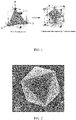
- FIG. 2 illustrated a scanning electron microscope photograph of the alumina grain prepared after roasting at 550°C.
- FIG. 3 illustrated an electron diffraction spectrum of the alumina grain product slice prepared after roasting at 550°C.
- FIG. 4 illustrated an XRD spectrogram of the alumina grain prepared after drying at 200°C.
- FIG. 5 illustrated an XRD spectrogram of the alumina grain prepared in Example 1 after roasting at 550°C.
- FIG. 2 illustrated the typical electron diffraction spectrum for a roasted product.
- the octahedral surface exposed the ⁇ 111 ⁇ family of crystal planes according to the structural relationship of the cubic crystal system shown in FIG. 1.
- the ⁇ 111 ⁇ family of crystal planes of octahedra was approximately equilateral triangle with a side length about 12 ⁇ m (the relative deviation of the side lengths was about 5.7%), such that an approximate regular octahedra was formed.
- the percentage of the exposed ⁇ 111 ⁇ family of crystal planes of octahedral alumina grain was 100%.
- the pseudo-boehmite powder was subjected to roasting at 650°C for 4 hours and uniformly mixed with sodium sulfate at an amount of 5% by mass of the pseudo-boehmite, the mixture was subjected to grinding by a ball mill into micro powder, the powder of about 15,000 mesh was sieved, and the sodium sulfate was removed by washing with the distilled water, a suspension with a mass concentration of 20g/L was then prepared by adding a solvent, which was a mixture of water and methanol in a mass ratio of 1.2. Acetic acid was added to the suspension such that the acetic acid was used in an amount of 3.0% relative to the mass of an alumina precursor.
- the suspension was subjected to shearing and stirring by a high-speed shear mixer (with a rotation speed of 15,000 rpm) at room temperature for 30 minutes, the suspension did not present an obvious precipitation after standing still for 2 hours under the room temperature and ambient pressure.
- Triethanolamine and tetramethylammonium hydroxide were added into the system, the concentration of triethanolamine and tetramethylammonium hydroxide in the finally produced system were 23g/L and 36g/L, respectively, and after stirring uniformly, the system was closed and hermetic and then heated to 180°C and subjected to a hydrothermal treatment for 12 hours.
- the product obtained after drying at 120°C was divided into two parts, which were subjected to drying at 200°C for 6 hours and roasting at 550°C for 6 hours respectively.
- the XRD spectrum of the products obtained at the two treatment temperatures indicated that the products were pseudo-boehmite and ⁇ -alumina, respectively.
- Example 2 The scanning electron micrograph, electron diffraction micrograph and XRD spectrogram of Example 2 were similar to those of Example 1. Both the dried product and the roasted product had a shape of octahedral particle, the electron diffraction spectra for both the dried product and the roasted product were regularly arranged spots, thus both the dried product and the roasted product had the single-crystal structure. With respect to the roasted product, the octahedral surface exposed the ⁇ 111 ⁇ family of crystal planes according to the structural relationship of the cubic crystal system.
- the scanning electron micrograph illustrated an octahedral grain size of about 15 ⁇ m, the ⁇ 111 ⁇ family of crystal planes of octahedra was approximately equilateral triangle with a side length about 11 ⁇ m (the relative deviation of the side lengths was about 5.4%), such that an approximate regular octahedra was formed.
- the percentage of the exposed ⁇ 111 ⁇ family of crystal planes of octahedral alumina grain was 100%.
- the pseudo-boehmite powder was subjected to roasting at 600°C for 4 hours and uniformly mixed with sodium sulfate at an amount of 3% by mass of the pseudo-boehmite, the mixture was subjected to grinding by a ball mill into micro powder, the powder of about 10,000 mesh was sieved, and the sodium sulfate was removed by washing with the distilled water, a suspension with a mass concentration of 35g/L was then prepared by adding a solvent, which was a mixture of water and methanol in a mass ratio of 2.2. A mixture of formic acid and acetic acid in an equal amount by mass added into the suspension such that the mixed acid was used in an amount of 0.5% relative to the mass of an alumina precursor.
- the suspension was subjected to shearing and stirring by a high-speed shear mixer (with a rotation speed of 20,000 rpm) at room temperature for 20 minutes, the suspension did not present an obvious precipitation after standing still for 2 hours under the room temperature and atmospheric pressure.
- Aniline and tetrapropylammonium hydroxide were added into the system, the concentration of aniline and tetrapropylammonium hydroxide in the finally produced system were 30g/L and 25g/L, respectively, and after stirring uniformly, the system was closed and hermetic and then heated to 150°C and subjected to a hydrothermal treatment for 60 hours.
- the product obtained after drying at 120°C was divided into two parts, which were subjected to drying at 200°C for 6 hours and roasting at 550°C for 6 hours respectively.
- the XRD spectrum of the products obtained at the two treatment temperatures indicated that the products were pseudo-boehmite and ⁇ -alumina, respectively.
- Example 3 The scanning electron micrograph, electron diffraction micrograph and XRD spectrogram of Example 3 were similar to those of Example 1. Both the dried product and the roasted product had a shape of octahedral particle, the electron diffraction spectra for both the dried product and the roasted product were regularly arranged spots, thus both the dried product and the roasted product had the single-crystal structure. With respect to the roasted product, the octahedral surface exposed the ⁇ 111 ⁇ family of crystal planes according to the structural relationship of the cubic crystal system.
- the scanning electron micrograph illustrated an octahedral grain size of about 49 ⁇ m, the ⁇ 111 ⁇ family of crystal planes of octahedra was approximately equilateral triangle with a side length about 34 ⁇ m (the relative deviation of the side lengths was about 4.2%), such that an approximate regular octahedra was formed.
- the percentage of the exposed ⁇ 111 ⁇ family of crystal planes of octahedral alumina grain was 100%.
- the pseudo-boehmite powder was subjected to roasting at 580°C for 4 hours and uniformly mixed with sodium nitrate at an amount of 4% by mass of the pseudo-boehmite, the mixture was subjected to grinding by a ball mill into micro powder, the powder of about 10,000 mesh was sieved, and the sodium nitrate was removed by washing with the distilled water, an aqueous suspension with a mass concentration of 100g/L was then prepared by adding water, the solvent in the suspension was water. Citric acid was added into the suspension such that the citric acid was used in an amount of 1.5% relative to the mass of an alumina precursor.
- the suspension was subjected to shearing and stirring by a high-speed shear mixer (with a rotation speed of 10,000 rpm) at room temperature for 150 minutes, the suspension did not present an obvious precipitation after standing still for 1 hour under the room temperature and atmospheric pressure.
- Benzyl amine and tetraethylammonium hydroxide were added into the system, the concentration of benzyl amine and tetraethylammonium hydroxide in the finally produced system were 46g/L and 16g/L, respectively, and after stirring uniformly, the system was closed and hermetic and then heated to 170°C and subjected to a hydrothermal treatment for 24 hours.
- the product obtained after drying at 100°C was divided into two parts, which were subjected to drying at 200°C for 4 hours and roasting at 650°C for 4 hours respectively.
- the XRD spectrum of the products obtained at the two treatment temperatures indicated that the products were pseudo-boehmite and ⁇ -alumina, respectively.
- Example 4 The scanning electron micrograph, electron diffraction micrograph and XRD spectrogram of Example 4 were similar to those of Example 1. Both the dried product and the roasted product had a shape of octahedral particle, the electron diffraction spectra for both the dried product and the roasted product were regularly arranged spots, thus both the dried product and the roasted product had the single-crystal structure. With respect to the roasted product, the octahedral surface exposed the ⁇ 111 ⁇ family of crystal planes according to the structural relationship of the cubic crystal system.
- the scanning electron micrograph illustrated an octahedral grain size of about 86 ⁇ m, the ⁇ 111 ⁇ family of crystal planes of octahedra was approximately equilateral triangle with a side length about 61 ⁇ m (the relative deviation of the side lengths was about 2.6%), such that an approximate regular octahedra was formed.
- the percentage of the exposed ⁇ 111 ⁇ family of crystal planes of octahedral alumina grain was 100%.
- the commercially available alumina powder was uniformly mixed with sodium carbonate at an amount of 3% by mass of the alumina powder, the mixture was subjected to grinding by a ball mill into micro powder, the powder of about 10,000 mesh was sieved, and the sodium carbonate was removed by washing with the distilled water, a suspension with a mass concentration of 15g/L was then prepared by adding a solvent, which was a mixture of water and ethanol in a mass ratio of 3. A portion of acetic acid was added into the suspension such that the acetic acid was used in an amount of 1% relative to the mass of an alumina precursor.
- the suspension was subjected to shearing and stirring by a high-speed shear mixer (with a rotation speed of 20,000 rpm) at room temperature for 20 minutes, the suspension did not present an obvious precipitation after standing still for 3 hours under the room temperature and atmospheric pressure.
- Aniline and tetrapropylammonium hydroxide were added into the system, the concentration of aniline and tetrapropylammonium hydroxide in the finally produced system were 23g/L and 40g/L, respectively, and after stirring uniformly, the system was closed and hermetic and then heated to 270°C and subjected to a hydrothermal treatment for 6 hours.
- the product obtained after drying at 180°C was subsequently subjected to roasting at 500°C for 8 hours.
- Example 5 The scanning electron micrograph, electron diffraction micrograph and XRD spectrogram of Example 5 were similar to those of Example 1.
- the product had a shape of octahedral particle, the electron diffraction spectra for the roasted product illustrated the regularly arranged diffraction spots, thus the roasted product had the single-crystal structure.
- the octahedral surface exposed the ⁇ 111 ⁇ family of crystal planes according to the structural relationship of the cubic crystal system.
- the scanning electron micrograph illustrated an octahedral grain size of about 12 ⁇ m, the ⁇ 111 ⁇ family of crystal planes of octahedra was approximately equilateral triangle with a side length about 8 ⁇ m (the relative deviation of the side lengths was about 6.7%), such that an approximate regular octahedra was formed.
- the percentage of the exposed ⁇ 111 ⁇ family of crystal planes of octahedral alumina grain was 100%.
- the pseudo-boehmite powder was subjected to roasting at 550°C for 5 hours and uniformly mixed with sodium acetate at an amount of 3% by mass of the pseudo-boehmite, the mixture was subjected to grinding by a ball mill into micro powder, the powder of about 6,000 mesh was sieved, and the sodium acetate was removed by washing with the distilled water, a suspension with a mass concentration of 22g/L was then prepared by adding a solvent, which was a mixture of water and ethanol in a mass ratio of 4.5. Formic acid was added into the suspension such that the formic acid was used in an amount of 2.0% relative to the mass of an alumina precursor.
- the suspension was subjected to shearing and stirring by a high-speed shear mixer (with a rotation speed of 20,000 rpm) at room temperature for 20 minutes, the suspension did not present an obvious precipitation after standing still for 1.5 hours under the room temperature and atmospheric pressure.
- Ethanolamine and tetraethylammonium hydroxide were added into the system, the concentration of ethanolamine and tetraethylammonium hydroxide in the finally produced system were 25g/L and 20g/L, respectively, and after stirring uniformly, the system was closed and hermetic and then heated to 200°C and subjected to a hydrothermal treatment for 6 hours.
- the product obtained after drying at 120°C was subjected to roasting at 550°C for 6 hours.
- Example 6 The characterization results of the produced product in Example 6 were similar to those of Example 1, the product was the single-crystal octahedral grain with surface exposed the ⁇ 111 ⁇ family of crystal planes.
- the octahedral grain size was about 26 ⁇ m
- the ⁇ 111 ⁇ family of crystal planes of octahedra was approximately equilateral triangle with a side length about 18 ⁇ m (the relative deviation of the side lengths was about 4.9%), such that an approximate regular octahedra was formed.
- the percentage of the exposed ⁇ 111 ⁇ family of crystal planes of octahedral alumina grain was 100%.
- the pseudo-boehmite powder was subjected to roasting at 650°C for 4 hours and uniformly mixed with sodium sulfate at an amount of 5% by mass of the pseudo-boehmite, the mixture was subjected to grinding by a ball mill into micro powder, the powder of about 15,000 mesh was sieved, and the sodium sulfate was removed by washing with the distilled water, a suspension with a mass concentration of 20g/L was then prepared by adding a solvent, which was a mixture of water and methanol in a mass ratio of 1.2. Citric acid was added into the suspension such that the citric acid was used in an amount of 3.0% relative to the mass of an alumina precursor.
- the suspension was subjected to shearing and stirring by a high-speed shear mixer (with a rotation speed of 15,000 rpm) at room temperature for 30 minutes, the suspension did not present an obvious precipitation after standing still for 2 hours under the room temperature and atmospheric pressure.
- Triethanolamine and tetramethylammonium hydroxide were added into the system, the concentration of triethanolamine and tetramethylammonium hydroxide in the finally produced system were 23g/L and 36g/L, respectively, and after stirring uniformly, the system was closed and hermetic and then heated to 180°C and subjected to a hydrothermal treatment for 12 hours.
- the product obtained after drying at 120°C was subjected to roasting at 550°C for 6 hours.
- Example 7 The characterization results of the produced product in Example 7 were similar to those of Example 1, the product was the single-crystal octahedral grain with surface exposed the ⁇ 111 ⁇ family of crystal planes.
- the octahedral grain size was about 10 ⁇ m
- the ⁇ 111 ⁇ family of crystal planes of octahedra was approximately equilateral triangle with a side length about 7 ⁇ m (the relative deviation of the side lengths was about 8.5%), such that an approximate regular octahedra was formed.
- the percentage of the exposed ⁇ 111 ⁇ family of crystal planes of octahedral alumina grain was 100%.
- the pseudo-boehmite powder was subjected to roasting at 550°C for 5 hours and uniformly mixed with sodium chloride at an amount of 3% by mass of the pseudo-boehmite, the mixture was subjected to grinding by a ball mill into micro powder, the powder of about 6,000 mesh was sieved, and the sodium chloride was removed by washing with the distilled water, a suspension with a mass concentration of 22g/L was then prepared by adding a solvent, which was a mixture of water and ethanol in a mass ratio of 4.5. Formic acid was added into the suspension such that the formic acid was used in an amount of 2.0% relative to the mass of an alumina precursor.
- the suspension was subjected to shearing and stirring by a high-speed shear mixer (with a rotation speed of 20,000 rpm) at room temperature for 20 minutes, the suspension did not present an obvious precipitation after standing still for 1.5 hours under the room temperature and atmospheric pressure.
- Ethanolamine and tetraethylammonium hydroxide were added into the system, the concentration of ethanolamine and tetraethylammonium hydroxide in the finally produced system were 21g/L and 11g/L, respectively.
- Example 8 The characterization results of the produced product in Example 8 were similar to those of Example 1, the product was the single-crystal octahedral grain with surface exposed the ⁇ 111 ⁇ family of crystal planes.
- the octahedral grain size was about 12 ⁇ m
- the ⁇ 111 ⁇ family of crystal planes of octahedra was approximately equilateral triangle with a side length about 8 ⁇ m (the relative deviation of the side lengths was about 6.4%), such that an approximate regular octahedra was formed.
- the percentage of the exposed ⁇ 111 ⁇ family of crystal planes of octahedral alumina grain was nearly 100%.
- Alumina was prepared according to the same method as that of Example 1, except that the ethanolamine was replaced by the same weight of tetraethylammonium hydroxide, i.e., an organic amine was not added; when the characterization results of the produced product were compared with those of Example 1, the particle size was about 31 ⁇ m, but the product did not have a regular morphology, thus the product did not exhibit the determined exposure relationship of the crystal planes on the surface.
- Alumina was prepared according to the same method as that of Example 1, except that ethanolamine and tetraethylammonium hydroxide were not added into the system after the high-speed shearing, the system was then directly subjected to a hermetic hydrothermal treatment and subsequent operations; when the characterization results of the produced product were compared with those of Example 1, the product did not have a regular morphology, thus the product did not exhibit the determined exposure relationship of the crystal planes on the surface.
- the octahedral alumina grain was prepared according to the method provided in Example 1 of CN201610494090.3 .
- the produced product was subjected to drying at 200°C for 5 hours and roasting at 550°C for 5 hours.
- the product obtained from roasting at 200°C did not have a pseudo-boehmite or boehmite structure, and the electron diffraction spectrum of the product obtained from roasting at 550°C was shown in FIG. 6 .
- the product obtained from roasting at 550°C was polycrystalline (ring-shaped electron diffraction spectrum), rather than a single-crystal structure (orderly arranged spot electron diffraction spectrum).
- Alumina was prepared according to the same method as that of Example 1, except that the pseudo-boehmite powder was not subjected to grinding, the 200 mesh pseudo-boehmite was directly used and mixed with water to prepare the suspension to carry out the subsequent operations; when the characterization results of the produced product were compared with those of Example 1, the product did not have a regular morphology, thus the product did not exhibit the determined exposure relationship of the crystal planes on the surface.
- the alumina powder obtained from Examples 1-8 and Comparative examples 1-4 and the pseudo-boehmite powder (after roasting at 550°C for 3 hours) from the Sasol Company were used as the raw materials, the materials were molded into a cylindrical shape with a diameter of 2.5mm, and the molded product was subjected to drying at 120°C for 3 hours and roasting at 550°C for 3 hours to obtain a carrier.
- the carrier was taken, and separately impregnated with an aqueous solution of a mixture of ammonium metatungstate, ammonium molybdate and nickel nitrate, such that the contents of WO 3 , MoO 3 , NiO were 8.2%, 7.1% and 2.8%, respectively.
- the impregnated carrier was subsequently subjected to drying at 120°C for 2 hours and roasting at 550°C for 2 hours to prepare an oxidation state catalyst.
- Various catalysts were subjected to activity evaluation in a hydrodesulfurization of coked naphtha by using a microreactor under the following reaction conditions: a pressure of 5.0MPa, volumetric hydrogen/oil ratio of 300, volume hourly space velocity of 5.0h -1 , a reaction temperature of 280°C and a reaction time of 15 days. The results were shown in Table 1 below.
- alumina powder obtained from Examples 1-8 and Comparative examples 1-4 and the pseudo-boehmite powder (after roasting at 550°C for 3 hours) from the Sasol Company were used as the raw materials, the materials were subjected to ball-rolling molding into spherical particles with a diameter of 2mm, the molded product was subjected to drying at 120°C for 3 hours and roasting at 550°C for 3 hours to obtain a carrier. 0.08g of H 2 PtCl 6 ⁇ 6H 2 O, 0.21g of SnCl 4 ⁇ 5H 2 O, and 0.19g of NaNO 3 were dissolved in 100ml of deionized water, and then stirred sufficiently to form a homogeneous solution.
- the alumina powder obtained from Examples 1-8 and Comparative examples 1-4 and the pseudo-boehmite powder from the Sasol Company were used as the raw materials, the materials were molded into the strip-type carrier, which was subjected to roasting at 900°C for 3 hours.
- the carriers were used, ammonium molybdate, nickel nitrate, phosphoric acid and an organic chelating agent were prepared into a metal salt complex liquid, the carriers were impregnated with the metal salt complex liquid for 2 hours, the carriers were taken out and subjected to drying in the shade, and were subjected to drying at 120°C for 5 hours and roasting at 450°C for 4 hours, such that the oxidation state Ni-Mo/Al 2 O 3 residual oil hydrogenation demetallization catalyst was prepared.
- Catalyst performance evaluation the mixed residue from Maoming Petrochemical Company was applied as the raw material, the catalyst performance evaluation was performed on a 200mL fixed bed reactor.
- Both ends of the reactor was filled with silica sand, and 100mL of catalyst was charged in the middle section.
- the reaction conditions were as follows: after sulfidation of the catalyst, the reaction temperature was 375°C, hydrogen partial pressure was 15MPa, volume ratio of hydrogen/oil was 760, mass hourly space velocity was 5.0h -1 , an oil sample was taken and subjected to testing after that the reaction was performed for 300 hours and the activity of the catalyst was stabilized. The test results were shown in Table 2.
- the demetalization rate (content of metal elements in the raw material - the content of metal elements in the hydrogenated distillate) / content of metal elements in the raw material ⁇ 100%.
- the content of metal elements was measured by inductively coupled plasma (ICP) emission spectrometer method.
- Desulfurization rate (content of sulfur element in the raw material - the content of sulfur element in hydrogenated distillate) / content of sulfur element in the raw material ⁇ 100%.
- the content of sulfur element was measured by energy chromatic dispersion X-ray fluorescence spectroscopy. Table 2.
Landscapes
- Chemical & Material Sciences (AREA)
- Organic Chemistry (AREA)
- Engineering & Computer Science (AREA)
- Chemical Kinetics & Catalysis (AREA)
- Materials Engineering (AREA)
- Inorganic Chemistry (AREA)
- Crystallography & Structural Chemistry (AREA)
- Metallurgy (AREA)
- Analytical Chemistry (AREA)
- Oil, Petroleum & Natural Gas (AREA)
- Life Sciences & Earth Sciences (AREA)
- Geology (AREA)
- General Chemical & Material Sciences (AREA)
- Thermal Sciences (AREA)
- Physics & Mathematics (AREA)
- Compounds Of Alkaline-Earth Elements, Aluminum Or Rare-Earth Metals (AREA)
- Catalysts (AREA)
- Low-Molecular Organic Synthesis Reactions Using Catalysts (AREA)
- Production Of Liquid Hydrocarbon Mixture For Refining Petroleum (AREA)
- Crystals, And After-Treatments Of Crystals (AREA)
- Organic Low-Molecular-Weight Compounds And Preparation Thereof (AREA)
Abstract
Description
- The present disclosure pertains to the technical field of inorganic material production, and specifically relates to an alumina grain and the preparation method and use thereof.
- Activated alumina has desirable physicochemical properties such as a large specific surface area, an adjustable pore structure, the presence of acid centers with different properties on the surface, high mechanical strength and thermal stability, thus it is widely used as a carrier material for heterogeneous catalysts. The physicochemical property of alumina is one of the key factors determining catalytic performance of the catalysts.
- As a crystal material, different crystal planes of alumina have various atomic density and atomic symmetry, resulting in different electronic structure, surface energy, chemical activity and other property of the crystal planes. By adjusting and varying the growth environment of alumina grain, modifying the crystal plane type and the distribution ratio of crystal planes on the alumina grain surface, it is possible to perform a deep regulation and control from the source in regard to the critical physicochemical properties of alumina, such as specific surface, pore structure, acidity, atomic and/or molecular chemical environment. For example, the inventors of the present disclosure have disclosed the methods of preparing a flake polycrystalline γ-alumina, alumina hollow spheres assembled from the flake alumina, and alumina microspheres with a core-shell structure assembled from the flake alumina in their previously filed patent literatures
CN106140180B ,CN106673030B andCN106673033B . - Currently, the industrial hydrogenation catalysts are supported on the carrier alumina (γ-alumina) having a surface dominated by the distribution of (110), (111) and (100) crystal planes, wherein the distribution of (110) crystal plane generally accounts for 50%-70%. Three crystal planes of the alumina surface and their distribution can significantly influence the activity phase of the hydrogenation catalyst, and may cause the catalysts to respectively exhibit distinctive catalytic properties, such as directionally enhanced hydrodesulfurization and olefin saturation property in the technical field of hydrogenation catalysis. Therefore, if the relative proportions of (110), (111) and (100) crystal planes of the alumina surface can be flexibly regulated and controlled such that the crystal planes respectively reach the advantageous distribution, and the law of an influence of the advantageous crystal planes on the catalytic properties of the hydrogenation catalyst is determined, it can provide a theoretical guide for the development of novel heterogeneous catalyst carriers and form the new technical routes for regulating and controlling the catalyst properties. However, because of the limitations and constraints on the growth habit of alumina grains, it is difficult to effectively change the advantageous distribution condition of the (110) crystal planes on the alumina surface through the conventional synthesis methods.
- The regulation and control of the type and distribution of crystal planes on alumina surfaces remains a significant scientific challenge worldwide which urgently needs to be addressed.
- The present disclosure provides an octahedral alumina crystal grain and a preparation method thereof. The alumina grain of the present disclosure, which is unique in crystal plane exposure, when it is used as a heterogeneous catalyst carrier, the catalyst provides significantly enhanced catalytic performance.
- The alumina grain of the present disclosure has a single-crystal structure and a regular octahedral or an approximate regular octahedral morphology. The eight crystal planes exposed on the surface of the octahedral grain belong to the {111} family of crystal planes of γ-state alumina, the crystal planes are (111), (-111), (1-11), (11-1), (-1-1-1), (-11-1), and (-1-11) crystal planes, respectively; the eight crystal planes of the alumina grain each has an equilateral triangle or a near-equilateral triangle shape with a side length of 5-70µm. The alumina grain has a grain size within a range of 7-100µm.
- The preparation method of alumina grain, the method comprises the following steps:
- (1) subjecting the alumina powder having a certain particle size to a shear treatment in the presence of a solvent and a polymerization inhibitor to obtain a stable suspension;
- (2) mixing the suspension obtained in step (1) with a crystal plane growth guiding agent uniformly and subjecting the mixture to a hydrothermal treatment under a hermetic conditions, then performing a solid-liquid separation, and subjecting the solid to drying and roasting.
- The alumina crystal grain material provided by the present disclosure has a promising prospect in the technical fields of heterogeneous catalysis and adsorption, for example, in the aspects of being applied as a hydrogenation catalyst carrier for distillate oil, a hydrogenation demetallization catalyst carrier for residual oil, a propane dehydrogenation catalyst carrier to produce propylene. The preparation method provided by the present disclosure is simple and feasible, and has low costs and higher operability.
-
-
FIG. 1 is a schematic diagram illustrating an octahedral grain surface exposed crystal plane of the cubic crystal system. -
FIG. 2 illustrates a scanning electron microscope photograph of the alumina grain prepared in Example 1 after roasting at 550°C. -
FIG. 3 illustrates an electron diffraction spectrum of the alumina grain prepared in Example 1 after roasting at 550°C. -
FIG. 4 illustrates an XRD spectrogram of the alumina grain prepared in Example 1 after drying at 200°C. -
FIG. 5 illustrates an XRD spectrogram of the alumina grain prepared in Example 1 after roasting at 550°C. -
FIG. 6 illustrates an electron diffraction spectrum of the sample obtained in the Comparative Example 1 after roasting at 550°C. - The terminals and any value of the ranges disclosed herein are not limited to the precise ranges or values, such ranges or values shall be comprehended as comprising the values adjacent to the ranges or values. As for numerical ranges, the endpoint values of the various ranges, the endpoint values and the individual point value of the various ranges, and the individual point values may be combined with one another to produce one or more new numerical ranges, which should be deemed have been specifically disclosed herein.
- The alumina of the present disclosure is a grain having a single-crystal structure and a regular octahedral or an approximate regular octahedral stereoscopic morphology. The eight crystal planes on the surface of the octahedral grain of alumina belong to the {111} family of crystal planes of γ-state alumina, the crystal planes are (111), (-111), (1-11), (11-1), (-1-1-1), (-11-1), and (-1-11) crystal planes, respectively. Because the γ-alumina has a face-centered cubic crystal structure with high symmetry, the crystal planes have equivalent properties, thus the crystal planes are uniformly expressed by using the (111) crystal plane.
- The eight crystal planes of the octahedral alumina grain surface each has a shape of an equilateral triangle or a near-equilateral triangle shape with a side length of 5-70µm.
- The octahedral alumina grain provided by the present disclosure has a grain size of 7-100µm.
- In the present disclosure, the shape and size of alumina grain are observed and measured through a scanning electron microscope. The crystal form is characterized by X-ray diffraction, and the sample particle is determined to be monocrystal or polycrystal through the electron diffraction analysis.
- In the present disclosure, regular octahedra means that each of the eight crystal planes on the octahedral surfaces forms an equilateral triangle, and the side lengths of the eight equilateral triangles are equal. In the present disclosure, near-regular octahedra refers to that each of the eight crystal planes on the octahedral surfaces forms a triangle, and the side lengths of the eight triangles are approximately equal. The relative deviation of any side length of any one of the triangles as compared to an average of the total side lengths of the eight triangles falls into the range of ±10%.
- The alumina grain of the present disclosure has a percentage of 90% or more, preferably 100% of the (111) crystal plane family surface, a percentage of 5% or less of the (100) crystal plane family surface, and a percentage of 10% or less of the (110) crystal plane family surface, based on a total surface of the (111) crystal plane family surface, the (110) crystal plane family surface and the (100) crystal plane family surface.
- The percentage of surface area of crystal planes is determined by an area method, the percentage relationship of a crystal plane is obtained by dividing the area occupied by a crystal plane on an alumina grain surface by the total area of the crystal planes on the alumina grain surface. A scanning electron microscope is used for taking a photograph of the sample, the side length of a triangular crystal plane of an octahedral grain is measured from the photograph, then calculate the area of the triangle, the total area of the outer surface of the entire crystal grain can be calculated, such that the percentage of a specific crystal plane can be calculated based on the proportional relationship of areas.
- The side length of 8 surfaces of the alumina grain is preferably within a range of 14-65µm.
- The alumina grain has a grain size within a range of 7-100µm, preferably 10-91µm, such as 7µm, 8µm, 10µm, 15µm, 21µm, 25µm, 30µm, 35µm, 40µm, 45µm, 50µm, 55µm, 60µm, 65µm, 70µm, 75µm, 80µm, 85µm, 90µm and 95µm.
- In the present disclosure, the size of alumina grain refers to the distance between two furthest vertices of the octahedral grain. The grain size can be measured directly from the scanning electron microscope.
- According to a preferred embodiment of the present disclosure, the XRD spectrogram of the alumina grain provided by the present disclosure after roasting at 500-550°C illustrates that the characteristic diffraction peaks of γ-alumina corresponding to the (220), (311), (222), (400), (511) and (440) crystal planes are presented adjacent to positions of the diffraction angles of 33.53°, 36.82°, 39.49°, 46.38°, 60.89° and 67.01° respectively when the angle 2θ=10-70°. In the present disclosure, the numerical range of the diffraction angle 2θ is allowed to vary by ±1°.
- In the method of the present disclosure, the alumina of step (1) has a particle size of 2,000-20,000 mesh, the alumina powder is obtained by grinding the commercially available alumina powder or initially roasting the pseudo-boehmite and then grinding the roasted pseudo-boehmite.
- The conditions of roasting may comprise a temperature of 350-650°C, preferably 400-550°C, and a time of 1-12 hours, preferably 2-6 hours. In the present disclosure, 1,000 mesh or more refer to a sieve pore size corresponding to the particle size of the powder which is less than 1,000 mesh.
- The grinding may be carried out by using a high energy ball mill, the operating conditions of which are flexibly adjusted in order to obtain a required particle size of the powder.
- In the method of the present disclosure, in order to make the ball milling to be smooth, an inorganic lubricant is preferably added during the ball milling process, and the inorganic lubricant is removed after the grinding so as to perform the subsequent operation. The inorganic lubricant may be an inorganic sodium salt, and the inorganic sodium salt is preferably one or more selected from the group consisting of sodium nitrate, sodium chloride, sodium sulfate, sodium carbonate, sodium bicarbonate, sodium phosphate, sodium formate, sodium acetate and sodium citrate.
- The inorganic sodium salt is used in an amount of 0.1-10wt%, preferably 2-5wt% of the alumina powder (based on the product obtained after roasting the pseudo-boehmite powder at 550°C for 5 hours).
- In the present disclosure, the inorganic sodium salt is preferably removed by washing with water, preferably deionized water.
- In the method of the present disclosure, the operation of step (1) is preferably carried out by initially mixing the solvent with alumina powder to form an alumina suspension, then adding a polymerization inhibitor and subjecting the suspension to a shear treatment to obtain a stable suspension. The alumina suspension has a mass concentration of 10-200g/L, preferably 15-100g/L, more preferably 20-50 g/L.
- In the method of the present disclosure, the solvent (of the alumina suspension) in step (1) is typically water or a mixture of water and alcohols. The alcohol may be a monohydric, dihydric or polyhydric alcohol having 1-4 carbon atoms, such as methanol, ethanol, n-propanol, isopropanol, ethylene glycol, glycerol, n-butanol, isobutanol or tert-butanol, and preferably methanol and/or ethanol. The solvent is preferably a mixture of water and ethanol. The mass ratio of water/alcohol is within a range of 1-10.
- In the method of the present disclosure, the addition and shear treatment of the polymerization inhibitor in step (1) serve to sufficiently break up agglomerates of alumina powder to obtain a stable suspension, wherein the criterion for judging whether the suspension is stable is that the significant (macroscopic) precipitation does not occur after standing still for at least 1 hour under the room temperature and atmospheric pressure conditions. Preferably, the polymerization inhibitor is an organic acid, which may be a monobasic acid, a dibasic acid or a polybasic acid having 1-10 carbon atoms. Preferably, the number of carboxyl is 1-4. In addition to the carboxyl, the organic acid may further comprise one or more hydroxyl groups. Preferably, the organic acid of the present disclosure is one or more selected from the group consisting of formic acid, acetic acid and citric acid. The organic acid is used in an amount of 0.1-10 wt%, preferably 0.5-5 wt%, and more preferably 1-3 wt% of the mass of alumina powder.
- In the method of the present disclosure, the shearing conditions in step (1) comprise a rotation speed of 2,000-50,000 rpm and a time of 1-60 min, preferably a rotation speed of 5,000-50,000 rpm and a time of 5-45 min, more preferably 8,000-25,000 rpm and a time of 10-150 min. The shearing temperature is an ambient temperature, i.e. the additional heating or cooling is not required.
- In the method of the present disclosure, the crystal plane growth guiding agent is used to induce/control crystal plane growth of alumina grain in order to grow into as many {111} crystal planes as possible. Preferably, the crystal plane growth guiding agent is an organic amine and an organic base. The organic amine may be an amine compound having 1-10 carbon atoms, such as a monoamine, a diamine or a polyamine; one or more selected from the group consisting of a primary amine, a secondary amine and a tertiary amine, and it may be an aliphatic amine or an aromatic amine. In addition to nitrogen (N), the organic amine may comprise one or more hydroxyl groups, i.e., the organic amine may be an alkanolamine. The organic amine of the present disclosure is preferably one or more selected from the group consisting of methylamine, dimethylamine, trimethylamine, ethylamine, diethylamine, N-propylamine, isopropylamine, N-butylamine, ethanolamine, 1,2-propylenediamine, hexamethylenediamine, benzylamine, phenylethylamine.
- The organic base may be various tetraalkylammonium hydroxides, the alkyl group may be straight-chain or branched chain alkyl group having 1-5 carbon atoms, such as methyl, ethyl, n-propyl, isopropyl, n-butyl, isobutyl, t-butyl; the four alkyl groups may be same or different, and the organic base is preferably one or more selected from the group consisting of tetramethylammonium hydroxide, tetraethylammonium hydroxide and tetrapropylammonium hydroxide.
- Preferably, the crystal plane growth guiding agent is a mixture of an organic amine and an organic base, further preferably the mass ratio of the organic amine to the organic base is preferably 0.1-3:1, preferably 0.5-2:1.
- The concentration of the organic amine in the material system is preferably within a range of 10-300g/L, more preferably 15-100g/L, further preferably 18-40g/L; the concentration of the organic base in the material system is preferably 10-300g/L, more preferably 15-100g/L, further preferably 18-40g/L.
- In the method of the present disclosure, the conditions of hydrothermal treatment in step (2) comprise a temperature of 60-250°C, preferably 120-280°C, and a time of 2-72 hours, preferably 3-24 hours.
- The hydrothermal treatment is preferably carried out in a hermetic autoclave.
- In the method of the present disclosure, the drying temperature in step (2) is not more than 200°C, preferably not more than 120°C, and the drying degree is characterized by the constant weight of the material at the drying temperature.
- In the method of the present disclosure, the conditions of roasting in step (2) comprise a temperature of 450-750°C, preferably 500-650°C, and a time of 1-24 hours, preferably 3-12 hours.
- The alumina grain provided by the present disclosure can be used as the catalyst carriers, or hydrogenation catalyst carrier, or dehydrogenation catalyst carrier. The alumina provided by the present disclosure can provide improved catalytic activity of the catalyst compared to the conventional and commercially available alumina carrier.
- For example, the catalyst may be at least one of a hydrodesulfurization catalyst, a hydrogenation demetallization catalyst and a propane dehydrogenation catalyst. The varieties, dosages and preparation methods of the active ingredients of the above catalysts can be selected with reference to the prior art. For example, the active ingredients of the hydrodesulfurization catalyst may be elements W, Mo and Ni and calculated in terms of WO3, MoO3 and NiO, and are respectively contained in amounts of 5-10 wt%, 5-10 wt% and 1-5 wt%, based on the total weight of the catalyst. For example, the active metal components of the propane dehydrogenation catalyst are Pt and Sn, and the active components of the hydrogenation demetallization catalyst are Ni and Mo. The present disclosure will not provide unnecessary details in this regard.
- The present disclosure will be described in detail with reference to example. The shape and size of alumina grain are observed and measured through a scanning electron microscope. The crystal form is characterized by X-ray diffraction, and the sample particle is determined to be monocrystal or polycrystal through the electron diffraction analysis.
- The pseudo-boehmite powder was subjected to roasting at 550°C for 5 hours and uniformly mixed with sodium chloride at an amount of 3% by mass of the pseudo-boehmite, the mixture was subjected to grinding by a ball mill into micro powder, the powder of about 6,000 mesh was sieved, and the sodium chloride was removed by washing with the distilled water, a suspension with a concentration of 22g/L was then prepared by adding a solvent, which was a mixture of water and ethanol in a mass ratio of 4.5. Formic acid was added to the suspension such that the formic acid was used in an amount of 2.0% relative to the mass of an alumina precursor. The suspension was subjected to shearing and stirring by a high-speed shear mixer (with a rotation speed of 20,000 rpm) at room temperature for 20 minutes, the suspension did not present an obvious precipitation after standing still for 1.5 hours under the room temperature and ambient pressure. Ethanolamine and tetraethylammonium hydroxide were added into the system, the concentration of ethanolamine and tetraethylammonium hydroxide in the finally produced system were 25g/L and 20g/L, respectively, and after stirring uniformly, the system was closed and hermetic and then heated to 200°C and subjected to a hydrothermal treatment for 6 hours. The product obtained after drying at 120°C was divided into two parts, which were subjected to drying at 200°C for 6 hours and roasting at 550°C for 6 hours respectively. The XRD spectrum of the products obtained at the two treatment temperatures indicated that the products were pseudo-boehmite and γ-alumina, respectively.
-
FIG. 2 illustrated a scanning electron microscope photograph of the alumina grain prepared after roasting at 550°C. -
FIG. 3 illustrated an electron diffraction spectrum of the alumina grain product slice prepared after roasting at 550°C. -
FIG. 4 illustrated an XRD spectrogram of the alumina grain prepared after drying at 200°C. -
FIG. 5 illustrated an XRD spectrogram of the alumina grain prepared in Example 1 after roasting at 550°C. - As observed by the scanning electron microscope, the drying or roasting temperatures did not impose significant influence on the morphology. Both the dried product and the roasted product had a shape of octahedral particle, the electron diffraction spectra for both the dried product and the roasted product were regularly arranged spots, thus both the dried product and the roasted products had the single-crystal structure.
FIG. 2 illustrated the typical electron diffraction spectrum for a roasted product. The octahedral surface exposed the {111} family of crystal planes according to the structural relationship of the cubic crystal system shown inFIG. 1. FIG. 2 illustrated an octahedral grain size of about 17µm, the {111} family of crystal planes of octahedra was approximately equilateral triangle with a side length about 12µm (the relative deviation of the side lengths was about 5.7%), such that an approximate regular octahedra was formed. The percentage of the exposed {111} family of crystal planes of octahedral alumina grain was 100%. - The pseudo-boehmite powder was subjected to roasting at 650°C for 4 hours and uniformly mixed with sodium sulfate at an amount of 5% by mass of the pseudo-boehmite, the mixture was subjected to grinding by a ball mill into micro powder, the powder of about 15,000 mesh was sieved, and the sodium sulfate was removed by washing with the distilled water, a suspension with a mass concentration of 20g/L was then prepared by adding a solvent, which was a mixture of water and methanol in a mass ratio of 1.2. Acetic acid was added to the suspension such that the acetic acid was used in an amount of 3.0% relative to the mass of an alumina precursor. The suspension was subjected to shearing and stirring by a high-speed shear mixer (with a rotation speed of 15,000 rpm) at room temperature for 30 minutes, the suspension did not present an obvious precipitation after standing still for 2 hours under the room temperature and ambient pressure. Triethanolamine and tetramethylammonium hydroxide were added into the system, the concentration of triethanolamine and tetramethylammonium hydroxide in the finally produced system were 23g/L and 36g/L, respectively, and after stirring uniformly, the system was closed and hermetic and then heated to 180°C and subjected to a hydrothermal treatment for 12 hours. The product obtained after drying at 120°C was divided into two parts, which were subjected to drying at 200°C for 6 hours and roasting at 550°C for 6 hours respectively. The XRD spectrum of the products obtained at the two treatment temperatures indicated that the products were pseudo-boehmite and γ-alumina, respectively.
- The scanning electron micrograph, electron diffraction micrograph and XRD spectrogram of Example 2 were similar to those of Example 1. Both the dried product and the roasted product had a shape of octahedral particle, the electron diffraction spectra for both the dried product and the roasted product were regularly arranged spots, thus both the dried product and the roasted product had the single-crystal structure. With respect to the roasted product, the octahedral surface exposed the {111} family of crystal planes according to the structural relationship of the cubic crystal system. The scanning electron micrograph illustrated an octahedral grain size of about 15µm, the {111} family of crystal planes of octahedra was approximately equilateral triangle with a side length about 11µm (the relative deviation of the side lengths was about 5.4%), such that an approximate regular octahedra was formed. The percentage of the exposed {111} family of crystal planes of octahedral alumina grain was 100%.
- The pseudo-boehmite powder was subjected to roasting at 600°C for 4 hours and uniformly mixed with sodium sulfate at an amount of 3% by mass of the pseudo-boehmite, the mixture was subjected to grinding by a ball mill into micro powder, the powder of about 10,000 mesh was sieved, and the sodium sulfate was removed by washing with the distilled water, a suspension with a mass concentration of 35g/L was then prepared by adding a solvent, which was a mixture of water and methanol in a mass ratio of 2.2. A mixture of formic acid and acetic acid in an equal amount by mass added into the suspension such that the mixed acid was used in an amount of 0.5% relative to the mass of an alumina precursor. The suspension was subjected to shearing and stirring by a high-speed shear mixer (with a rotation speed of 20,000 rpm) at room temperature for 20 minutes, the suspension did not present an obvious precipitation after standing still for 2 hours under the room temperature and atmospheric pressure. Aniline and tetrapropylammonium hydroxide were added into the system, the concentration of aniline and tetrapropylammonium hydroxide in the finally produced system were 30g/L and 25g/L, respectively, and after stirring uniformly, the system was closed and hermetic and then heated to 150°C and subjected to a hydrothermal treatment for 60 hours. The product obtained after drying at 120°C was divided into two parts, which were subjected to drying at 200°C for 6 hours and roasting at 550°C for 6 hours respectively. The XRD spectrum of the products obtained at the two treatment temperatures indicated that the products were pseudo-boehmite and γ-alumina, respectively.
- The scanning electron micrograph, electron diffraction micrograph and XRD spectrogram of Example 3 were similar to those of Example 1. Both the dried product and the roasted product had a shape of octahedral particle, the electron diffraction spectra for both the dried product and the roasted product were regularly arranged spots, thus both the dried product and the roasted product had the single-crystal structure. With respect to the roasted product, the octahedral surface exposed the {111} family of crystal planes according to the structural relationship of the cubic crystal system. The scanning electron micrograph illustrated an octahedral grain size of about 49µm, the {111} family of crystal planes of octahedra was approximately equilateral triangle with a side length about 34µm (the relative deviation of the side lengths was about 4.2%), such that an approximate regular octahedra was formed. The percentage of the exposed {111} family of crystal planes of octahedral alumina grain was 100%.
- The pseudo-boehmite powder was subjected to roasting at 580°C for 4 hours and uniformly mixed with sodium nitrate at an amount of 4% by mass of the pseudo-boehmite, the mixture was subjected to grinding by a ball mill into micro powder, the powder of about 10,000 mesh was sieved, and the sodium nitrate was removed by washing with the distilled water, an aqueous suspension with a mass concentration of 100g/L was then prepared by adding water, the solvent in the suspension was water. Citric acid was added into the suspension such that the citric acid was used in an amount of 1.5% relative to the mass of an alumina precursor. The suspension was subjected to shearing and stirring by a high-speed shear mixer (with a rotation speed of 10,000 rpm) at room temperature for 150 minutes, the suspension did not present an obvious precipitation after standing still for 1 hour under the room temperature and atmospheric pressure. Benzyl amine and tetraethylammonium hydroxide were added into the system, the concentration of benzyl amine and tetraethylammonium hydroxide in the finally produced system were 46g/L and 16g/L, respectively, and after stirring uniformly, the system was closed and hermetic and then heated to 170°C and subjected to a hydrothermal treatment for 24 hours. The product obtained after drying at 100°C was divided into two parts, which were subjected to drying at 200°C for 4 hours and roasting at 650°C for 4 hours respectively. The XRD spectrum of the products obtained at the two treatment temperatures indicated that the products were pseudo-boehmite and γ-alumina, respectively.
- The scanning electron micrograph, electron diffraction micrograph and XRD spectrogram of Example 4 were similar to those of Example 1. Both the dried product and the roasted product had a shape of octahedral particle, the electron diffraction spectra for both the dried product and the roasted product were regularly arranged spots, thus both the dried product and the roasted product had the single-crystal structure. With respect to the roasted product, the octahedral surface exposed the {111} family of crystal planes according to the structural relationship of the cubic crystal system. The scanning electron micrograph illustrated an octahedral grain size of about 86µm, the {111} family of crystal planes of octahedra was approximately equilateral triangle with a side length about 61µm (the relative deviation of the side lengths was about 2.6%), such that an approximate regular octahedra was formed. The percentage of the exposed {111} family of crystal planes of octahedral alumina grain was 100%.
- The commercially available alumina powder was uniformly mixed with sodium carbonate at an amount of 3% by mass of the alumina powder, the mixture was subjected to grinding by a ball mill into micro powder, the powder of about 10,000 mesh was sieved, and the sodium carbonate was removed by washing with the distilled water, a suspension with a mass concentration of 15g/L was then prepared by adding a solvent, which was a mixture of water and ethanol in a mass ratio of 3. A portion of acetic acid was added into the suspension such that the acetic acid was used in an amount of 1% relative to the mass of an alumina precursor. The suspension was subjected to shearing and stirring by a high-speed shear mixer (with a rotation speed of 20,000 rpm) at room temperature for 20 minutes, the suspension did not present an obvious precipitation after standing still for 3 hours under the room temperature and atmospheric pressure. Aniline and tetrapropylammonium hydroxide were added into the system, the concentration of aniline and tetrapropylammonium hydroxide in the finally produced system were 23g/L and 40g/L, respectively, and after stirring uniformly, the system was closed and hermetic and then heated to 270°C and subjected to a hydrothermal treatment for 6 hours. The product obtained after drying at 180°C was subsequently subjected to roasting at 500°C for 8 hours.
- The scanning electron micrograph, electron diffraction micrograph and XRD spectrogram of Example 5 were similar to those of Example 1. The product had a shape of octahedral particle, the electron diffraction spectra for the roasted product illustrated the regularly arranged diffraction spots, thus the roasted product had the single-crystal structure. With respect to the roasted product, the octahedral surface exposed the {111} family of crystal planes according to the structural relationship of the cubic crystal system. The scanning electron micrograph illustrated an octahedral grain size of about 12µm, the {111} family of crystal planes of octahedra was approximately equilateral triangle with a side length about 8µm (the relative deviation of the side lengths was about 6.7%), such that an approximate regular octahedra was formed. The percentage of the exposed {111} family of crystal planes of octahedral alumina grain was 100%.
- The pseudo-boehmite powder was subjected to roasting at 550°C for 5 hours and uniformly mixed with sodium acetate at an amount of 3% by mass of the pseudo-boehmite, the mixture was subjected to grinding by a ball mill into micro powder, the powder of about 6,000 mesh was sieved, and the sodium acetate was removed by washing with the distilled water, a suspension with a mass concentration of 22g/L was then prepared by adding a solvent, which was a mixture of water and ethanol in a mass ratio of 4.5. Formic acid was added into the suspension such that the formic acid was used in an amount of 2.0% relative to the mass of an alumina precursor. The suspension was subjected to shearing and stirring by a high-speed shear mixer (with a rotation speed of 20,000 rpm) at room temperature for 20 minutes, the suspension did not present an obvious precipitation after standing still for 1.5 hours under the room temperature and atmospheric pressure. Ethanolamine and tetraethylammonium hydroxide were added into the system, the concentration of ethanolamine and tetraethylammonium hydroxide in the finally produced system were 25g/L and 20g/L, respectively, and after stirring uniformly, the system was closed and hermetic and then heated to 200°C and subjected to a hydrothermal treatment for 6 hours. The product obtained after drying at 120°C was subjected to roasting at 550°C for 6 hours.
- The characterization results of the produced product in Example 6 were similar to those of Example 1, the product was the single-crystal octahedral grain with surface exposed the {111} family of crystal planes. The octahedral grain size was about 26µm, the {111} family of crystal planes of octahedra was approximately equilateral triangle with a side length about 18µm (the relative deviation of the side lengths was about 4.9%), such that an approximate regular octahedra was formed. The percentage of the exposed {111} family of crystal planes of octahedral alumina grain was 100%.
- The pseudo-boehmite powder was subjected to roasting at 650°C for 4 hours and uniformly mixed with sodium sulfate at an amount of 5% by mass of the pseudo-boehmite, the mixture was subjected to grinding by a ball mill into micro powder, the powder of about 15,000 mesh was sieved, and the sodium sulfate was removed by washing with the distilled water, a suspension with a mass concentration of 20g/L was then prepared by adding a solvent, which was a mixture of water and methanol in a mass ratio of 1.2. Citric acid was added into the suspension such that the citric acid was used in an amount of 3.0% relative to the mass of an alumina precursor. The suspension was subjected to shearing and stirring by a high-speed shear mixer (with a rotation speed of 15,000 rpm) at room temperature for 30 minutes, the suspension did not present an obvious precipitation after standing still for 2 hours under the room temperature and atmospheric pressure. Triethanolamine and tetramethylammonium hydroxide were added into the system, the concentration of triethanolamine and tetramethylammonium hydroxide in the finally produced system were 23g/L and 36g/L, respectively, and after stirring uniformly, the system was closed and hermetic and then heated to 180°C and subjected to a hydrothermal treatment for 12 hours. The product obtained after drying at 120°C was subjected to roasting at 550°C for 6 hours.
- The characterization results of the produced product in Example 7 were similar to those of Example 1, the product was the single-crystal octahedral grain with surface exposed the {111} family of crystal planes. The octahedral grain size was about 10µm, the {111} family of crystal planes of octahedra was approximately equilateral triangle with a side length about 7µm (the relative deviation of the side lengths was about 8.5%), such that an approximate regular octahedra was formed. The percentage of the exposed {111} family of crystal planes of octahedral alumina grain was 100%.
- The pseudo-boehmite powder was subjected to roasting at 550°C for 5 hours and uniformly mixed with sodium chloride at an amount of 3% by mass of the pseudo-boehmite, the mixture was subjected to grinding by a ball mill into micro powder, the powder of about 6,000 mesh was sieved, and the sodium chloride was removed by washing with the distilled water, a suspension with a mass concentration of 22g/L was then prepared by adding a solvent, which was a mixture of water and ethanol in a mass ratio of 4.5. Formic acid was added into the suspension such that the formic acid was used in an amount of 2.0% relative to the mass of an alumina precursor. The suspension was subjected to shearing and stirring by a high-speed shear mixer (with a rotation speed of 20,000 rpm) at room temperature for 20 minutes, the suspension did not present an obvious precipitation after standing still for 1.5 hours under the room temperature and atmospheric pressure. Ethanolamine and tetraethylammonium hydroxide were added into the system, the concentration of ethanolamine and tetraethylammonium hydroxide in the finally produced system were 21g/L and 11g/L, respectively.
- The characterization results of the produced product in Example 8 were similar to those of Example 1, the product was the single-crystal octahedral grain with surface exposed the {111} family of crystal planes. The octahedral grain size was about 12µm, the {111} family of crystal planes of octahedra was approximately equilateral triangle with a side length about 8µm (the relative deviation of the side lengths was about 6.4%), such that an approximate regular octahedra was formed. The percentage of the exposed {111} family of crystal planes of octahedral alumina grain was nearly 100%.
- Alumina was prepared according to the same method as that of Example 1, except that the ethanolamine was replaced by the same weight of tetraethylammonium hydroxide, i.e., an organic amine was not added; when the characterization results of the produced product were compared with those of Example 1, the particle size was about 31µm, but the product did not have a regular morphology, thus the product did not exhibit the determined exposure relationship of the crystal planes on the surface.
- Alumina was prepared according to the same method as that of Example 1, except that ethanolamine and tetraethylammonium hydroxide were not added into the system after the high-speed shearing, the system was then directly subjected to a hermetic hydrothermal treatment and subsequent operations; when the characterization results of the produced product were compared with those of Example 1, the product did not have a regular morphology, thus the product did not exhibit the determined exposure relationship of the crystal planes on the surface.
- The octahedral alumina grain was prepared according to the method provided in Example 1 of
CN201610494090.3 FIG. 6 . As can be seen from the graphical characteristics of the electron diffraction spectrogram, the product obtained from roasting at 550°C was polycrystalline (ring-shaped electron diffraction spectrum), rather than a single-crystal structure (orderly arranged spot electron diffraction spectrum). - Alumina was prepared according to the same method as that of Example 1, except that the pseudo-boehmite powder was not subjected to grinding, the 200 mesh pseudo-boehmite was directly used and mixed with water to prepare the suspension to carry out the subsequent operations; when the characterization results of the produced product were compared with those of Example 1, the product did not have a regular morphology, thus the product did not exhibit the determined exposure relationship of the crystal planes on the surface.
- Preparation of the catalyst: the alumina powder obtained from Examples 1-8 and Comparative examples 1-4 and the pseudo-boehmite powder (after roasting at 550°C for 3 hours) from the Sasol Company were used as the raw materials, the materials were molded into a cylindrical shape with a diameter of 2.5mm, and the molded product was subjected to drying at 120°C for 3 hours and roasting at 550°C for 3 hours to obtain a carrier. The carrier was taken, and separately impregnated with an aqueous solution of a mixture of ammonium metatungstate, ammonium molybdate and nickel nitrate, such that the contents of WO3, MoO3, NiO were 8.2%, 7.1% and 2.8%, respectively. The impregnated carrier was subsequently subjected to drying at 120°C for 2 hours and roasting at 550°C for 2 hours to prepare an oxidation state catalyst. Various catalysts were subjected to activity evaluation in a hydrodesulfurization of coked naphtha by using a microreactor under the following reaction conditions: a pressure of 5.0MPa, volumetric hydrogen/oil ratio of 300, volume hourly space velocity of 5.0h-1, a reaction temperature of 280°C and a reaction time of 15 days. The results were shown in Table 1 below.
- The alumina powder obtained from Examples 1-8 and Comparative examples 1-4 and the pseudo-boehmite powder (after roasting at 550°C for 3 hours) from the Sasol Company were used as the raw materials, the materials were subjected to ball-rolling molding into spherical particles with a diameter of 2mm, the molded product was subjected to drying at 120°C for 3 hours and roasting at 550°C for 3 hours to obtain a carrier. 0.08g of H2PtCl6·6H2O, 0.21g of SnCl4·5H2O, and 0.19g of NaNO3 were dissolved in 100ml of deionized water, and then stirred sufficiently to form a homogeneous solution. Eight units of the same solutions were mixed with the spherical carrier, respectively, and then stirred at room temperature for 6 hours, and the water in the system was evaporated by a rotary evaporator to obtain a solid product. The solid product was subjected to drying at 120°C for 3 hours, and subsequently roasting at 600°C for 5 hours, and then subjecting to reduction with H2 to obtain two groups of supported Pt-Sn/Al2O3 catalysts. 0.5g of the catalysts was loaded into a fixed bed quartz reactor, the reaction temperature was controlled to be 610°C, the reaction pressure was 0.1MPa, the molar ratio of propane/hydrogen was 1:1, the mass hourly space velocity of propane was 3.0h-1, and the reaction time was 50 hours. The results were shown in Table 1 below.
-
Table 1. Catalytic performance of the distillate oil hydrodesulfurization catalyst Source of carriers Grain size, µm Side length deviation, % Desulfurization rate of hydrodesulfurization, % Propane dehydrogenation Propane conversion rate, % Propylene selectivity, % Example 1 17 5.7 99.40 27.52 99.20 Example 2 15 5.4 99.62 28.13 99.31 Example 3 49 4.2 95.28 25.34 97.62 Example 4 86 2.6 93.58 23.19 95.18 Example 5 12 6.7 99.80 28.35 99.47 Example 6 26 4.9 97.36 26.42 98.22 Example 7 10 8.5 99.86 29.78 99.63 Example 8 12 6.4 99.42 27.73 99.59 Comparative example 1 31 / 82.57 20.14 62.19 Comparative example 2 35 / 78.18 18.56 59.62 Comparative example 3 18 5.9 91.52 25.47 91.34 Comparative example 4 35 / 80.12 18.26 58.63 Commercially available Sasol product 33 / 89.57 27.28 93.1 - As can be seen from the results in Table 1, when the catalysts produced from the alumina carriers prepared in the present disclosure (Examples 1-8) and Comparative examples 1-4 are compared with the catalyst produced from the commercially available alumina carrier, the catalytic performance of each of the alumina carriers prepared in the Examples 1-8 is superior to that of the alumina carriers in the Comparative examples and the commercially available product in the catalytic reactions of coked naphtha hydrodesulfurization and propane dehydrogenation to produce propylene, respectively.
- The alumina powder obtained from Examples 1-8 and Comparative examples 1-4 and the pseudo-boehmite powder from the Sasol Company were used as the raw materials, the materials were molded into the strip-type carrier, which was subjected to roasting at 900°C for 3 hours. Preparation of the catalysts: the carriers were used, ammonium molybdate, nickel nitrate, phosphoric acid and an organic chelating agent were prepared into a metal salt complex liquid, the carriers were impregnated with the metal salt complex liquid for 2 hours, the carriers were taken out and subjected to drying in the shade, and were subjected to drying at 120°C for 5 hours and roasting at 450°C for 4 hours, such that the oxidation state Ni-Mo/Al2O3 residual oil hydrogenation demetallization catalyst was prepared. Catalyst performance evaluation: the mixed residue from Maoming Petrochemical Company was applied as the raw material, the catalyst performance evaluation was performed on a 200mL fixed bed reactor. Both ends of the reactor was filled with silica sand, and 100mL of catalyst was charged in the middle section. The reaction conditions were as follows: after sulfidation of the catalyst, the reaction temperature was 375°C, hydrogen partial pressure was 15MPa, volume ratio of hydrogen/oil was 760, mass hourly space velocity was 5.0h-1, an oil sample was taken and subjected to testing after that the reaction was performed for 300 hours and the activity of the catalyst was stabilized. The test results were shown in Table 2.
- Wherein the demetalization rate = (content of metal elements in the raw material - the content of metal elements in the hydrogenated distillate) / content of metal elements in the raw material ∗ 100%. The content of metal elements was measured by inductively coupled plasma (ICP) emission spectrometer method. Desulfurization rate = (content of sulfur element in the raw material - the content of sulfur element in hydrogenated distillate) / content of sulfur element in the raw material ∗100%. The content of sulfur element was measured by energy chromatic dispersion X-ray fluorescence spectroscopy.
Table 2. Performance testing of the residue oil hydrogenation demetallization catalyst Sources of carriers Grain size, µm Side length deviation, % demetalization rate, % desulfurization rate, % Example 1 17 5.7 62.52 46.70 Example 2 15 5.4 62.71 47.12 Example 3 49 4.2 61.45 44.90 Example 4 86 2.6 60.52 41.75 Example 5 12 6.7 63.36 48.68 Example 6 26 4.9 62.38 46.59 Example 7 10 8.5 65.28 49.56 Example 8 12 6.4 63.40 48.75 Comparative example 1 31 / 58.25 40.39 Comparative example 2 35 / 52.54 38.35 Comparative example 3 18 5.5 52.15 37.56 Comparative example 4 35 / 57.43 41.53 Commercially available Sasol product 33 / 55.17 36.21 - As can be seen from the results in Table 2, when the catalysts produced from the alumina carriers prepared in the present disclosure (Examples 1-8) and Comparative examples 1-4 are compared with the catalyst produced from the commercially available alumina carrier, the demetallization rate of each of the alumina carriers prepared in the Examples is superior to that of the alumina carriers in the Comparative examples and the commercially available product in the residue oil hydrogenation and demetallization reaction, and the alumina carriers prepared in the Examples have higher desulfurization rate.
- The above content describes in detail the preferred embodiments of the present disclosure, but the present disclosure is not limited thereto. A variety of simple modifications can be made in regard to the technical solutions of the present disclosure within the scope of the technical concept of the present disclosure, including a combination of individual technical features in any other suitable manner, such simple modifications and combinations thereof shall also be regarded as the content disclosed by the present disclosure, each of them falls into the protection scope of the present disclosure.
Claims (15)
- An alumina grain, wherein the alumina grain has a single-crystal structure and an approximate regular octahedral stereoscopic morphology; eight sides of the alumina grain belong to the {111} family of crystal planes of γ-state alumina, and the alumina grain has a grain size within a range of 5-100µm.
- The alumina grain of claim 1, wherein the eight crystal planes of the alumina grain each has a near-equilateral triangle shape with a side length of 5-50µm.
- The alumina grain of claim 1 or 2, wherein the alumina grain has a grain size of 10-80µm, and the relative deviation of the side lengths is within a range of ±-15%.
- The alumina grain of any one of claims 1 to 3, wherein the alumina grain has an X-Ray Diffraction (XRD) spectrogram comprising peaks adjacent to positions of 33.53°, 36.82°, 39.49°, 46.38°, 60.89° and 67.01° when the angle 2θ=10-70°.
- A preparation method of alumina grain comprising the following steps:(1) subjecting the alumina powder having a particle size not exceeding 1,000 mesh to a shear treatment in the presence of a solvent and a polymerization inhibitor to obtain a stable suspension;(2) mixing the suspension obtained in step (1) with a crystal plane growth guiding agent uniformly and subjecting the mixture to a hydrothermal treatment under a hermetic conditions, then performing a solid-liquid separation, and subjecting the solid to drying and roasting.
- The preparation method of claim 5, wherein the polymerization inhibitor is an organic acid, preferably one or more selected from the group consisting of formic acid, acetic acid and citric acid;
preferably, the organic acid is used in an amount of 0.1-10 wt%, preferably 0.5-5 wt%, more preferably 1-3 wt% based on the mass of alumina powder. - The preparation method of claim 5 or 6, wherein the solvent is water or a mixture of water and alcohol; the alcohol is preferably one or more selected from the group consisting of methanol, ethanol, n-propanol, isopropanol, ethylene glycol, glycerol, n-butanol, isobutanol, tert-butanol; preferably, the solvent is a mixture of water and ethanol, and the mass ratio of water/alcohol is within a range of 1-5.
- The preparation method of claim 5 or 6 or 7, wherein the crystal plane growth guiding agent is an organic amine and an organic base, a mass ratio of the organic amine to the organic base is preferably within a range of 0.1-3:1, more preferably 0.5-2:1.
- The preparation method of claim 8, wherein the concentration of the organic amine is within a range of 10-300g/L, more preferably 15-100g/L, further preferably 18-40g/L; the concentration of the organic base in the material system is preferably within a range of 10-300g/L, more preferably 15-100g/L, further preferably 18-40g/L.
- The preparation method of claim 8 or 9, wherein the organic amine is one or more selected from the group consisting of methylamine, dimethylamine, trimethylamine, ethylamine, diethylamine, n-propylamine, isopropylamine, n-butylamine, ethanolamine, 1,2-propyldiamine, hexamethylenediamine, benzylamine, phenethylamine; and the organic base is one or more selected from the group consisting of tetramethylammonium hydroxide, tetraethylammonium hydroxide, tetrapropylammonium hydroxide.
- The preparation method of any of claims 5 to 10, wherein the conditions for hydrothermal treatment comprise: a temperature of 60-250°C, preferably 120-280°C, and a time of 2-72 hours, preferably 3-8 hours.
- The preparation method of any of claims 5 to 11, wherein the conditions of roasting comprise a temperature of 450-750°C, preferably 500-650°C, and a time of 1-24 hours, preferably 3-12 hours.
- The alumina grain obtained with the preparation method of any one of claims 5 to 12, wherein the alumina grain has a single-crystal structure and an approximate regular octahedral stereoscopic morphology; eight sides of the alumina grain belong to the {111} family of crystal planes of γ-state alumina.
- Use of alumina grain of any one of claims 1-4 and 13 as a catalyst carrier.
- The use of claim 14, wherein the catalyst is at least one of a hydrodesulfurization catalyst, a hydrogenation demetallization catalyst and a propane dehydrogenation catalyst.
Applications Claiming Priority (2)
| Application Number | Priority Date | Filing Date | Title |
|---|---|---|---|
| CN201911020895.4A CN112708928B (en) | 2019-10-25 | 2019-10-25 | A kind of alumina grain and preparation method thereof |
| PCT/CN2020/123485 WO2021078292A1 (en) | 2019-10-25 | 2020-10-25 | Alumina grain, preparation method therefor and use thereof |
Publications (3)
| Publication Number | Publication Date |
|---|---|
| EP4050130A1 true EP4050130A1 (en) | 2022-08-31 |
| EP4050130A4 EP4050130A4 (en) | 2022-12-14 |
| EP4050130B1 EP4050130B1 (en) | 2025-12-31 |
Family
ID=75540511
Family Applications (1)
| Application Number | Title | Priority Date | Filing Date |
|---|---|---|---|
| EP20878216.9A Active EP4050130B1 (en) | 2019-10-25 | 2020-10-25 | Aluminum oxide grain, method for its production and its use |
Country Status (6)
| Country | Link |
|---|---|
| US (1) | US20220380933A1 (en) |
| EP (1) | EP4050130B1 (en) |
| JP (1) | JP7368619B2 (en) |
| KR (1) | KR102735447B1 (en) |
| CN (1) | CN112708928B (en) |
| WO (1) | WO2021078292A1 (en) |
Families Citing this family (4)
| Publication number | Priority date | Publication date | Assignee | Title |
|---|---|---|---|---|
| CN114804170B (en) * | 2021-06-30 | 2023-11-17 | 上交赛孚尔(包头)新材料有限公司 | Adsorbent, method for preparing aluminum hydroxide and application |
| CN114197029A (en) * | 2021-10-27 | 2022-03-18 | 南京大学 | Preparation method of gamma alumina exposing high-energy (111) crystal face |
| CN116618002B (en) * | 2023-05-04 | 2024-08-23 | 鲁西催化剂有限公司 | Alumina-based adsorbent and preparation method thereof |
| CN117772167B (en) * | 2023-12-26 | 2026-03-20 | 山西炬华铝业股份有限公司 | A spherical alumina carrier and its preparation method |
Family Cites Families (23)
| Publication number | Priority date | Publication date | Assignee | Title |
|---|---|---|---|---|
| IL109236A (en) * | 1993-04-13 | 1998-01-04 | Sumitomo Chemical Co | Alpha-alumina powder and its production |
| JP3744010B2 (en) * | 1993-06-30 | 2006-02-08 | 住友化学株式会社 | Method for producing α-alumina powder |
| JP3139895B2 (en) * | 1993-09-24 | 2001-03-05 | 触媒化成工業株式会社 | Alumina sol and method for producing the same |
| JP2001187773A (en) * | 2000-01-06 | 2001-07-10 | Mitsubishi Chemicals Corp | Acrylonitrile composition |
| WO2001056926A1 (en) * | 2000-02-04 | 2001-08-09 | Goro Sato | Alumina composition and method for preparing the same |
| TWI348457B (en) * | 2003-03-04 | 2011-09-11 | Sumitomo Chemical Co | Method for producing 帢-alumina particulate |
| US20040198584A1 (en) * | 2003-04-02 | 2004-10-07 | Saint-Gobain Ceramics & Plastic, Inc. | Nanoporous ultrafine alpha-alumina powders and freeze drying process of preparing same |
| KR20060088973A (en) * | 2005-02-02 | 2006-08-07 | 삼성전자주식회사 | Optical unit, methode of manufacturing the optical unit, back light assembly having the optical unit and display apparatus having the optical unit |
| JP5110570B2 (en) * | 2006-11-06 | 2012-12-26 | 独立行政法人産業技術総合研究所 | Method for producing alumina fine particles and alumina sol |
| CN102311132B (en) * | 2010-07-07 | 2013-08-28 | 中国石油化工股份有限公司 | Rod-like one-dimensional polycrystalline gamma-Al2O3 nanocrystal grains and preparation method thereof |
| CN102320638A (en) * | 2011-08-04 | 2012-01-18 | 中国铝业股份有限公司 | Preparation method of low-sodium fine grain alumina |
| JP6253178B2 (en) * | 2013-05-23 | 2017-12-27 | 多木化学株式会社 | Method for producing alumina dispersion |
| FR3023184B1 (en) * | 2014-07-04 | 2019-12-27 | IFP Energies Nouvelles | HIGH MOLYBDEN DENSITY HYDROTREATMENT CATALYST AND PREPARATION METHOD. |
| EP3183214B1 (en) * | 2014-08-22 | 2019-10-09 | W.R. Grace & CO. - CONN. | Method for synthesizing silicoaluminophosphate-34 molecular sieves using monoisopropanolamine |
| CN106140180B (en) | 2015-04-21 | 2018-06-19 | 中国石油化工股份有限公司 | A kind of heavy-oil hydrogenation catalyst and preparation method thereof |
| CN106673030B (en) | 2015-11-05 | 2018-01-16 | 中国石油化工股份有限公司大连石油化工研究院 | A kind of alumina hollow ball and preparation method thereof |
| CN106673033B (en) | 2015-11-11 | 2018-01-16 | 中国石油化工股份有限公司 | A kind of aluminum oxide micro-sphere of core shell structure and preparation method thereof |
| CN107304059B (en) * | 2016-04-21 | 2019-03-19 | 中国石油化工股份有限公司 | A kind of γ-Al2O3Nanometer chip and preparation method thereof |
| CN107540006A (en) * | 2016-06-29 | 2018-01-05 | 中国科学院大连化学物理研究所 | A kind of preparation method of the octahedra aluminum oxide of micron-scale |
| US11512004B2 (en) * | 2016-08-29 | 2022-11-29 | Sasol (Usa) Corporation | Method of producing an alumina dispersible at a pH greater than 8 |
| WO2018056349A1 (en) * | 2016-09-21 | 2018-03-29 | Dic株式会社 | Surface-treated spinel particles, method for producing same, resin composition and molded article |
| CN109718747B (en) * | 2017-10-27 | 2021-10-08 | 中国石油化工股份有限公司 | Dual-pore alumina carrier, demetalization catalyst and preparation method thereof |
| CN112707420B (en) * | 2019-10-25 | 2023-07-28 | 中国石油化工股份有限公司 | Alumina material and preparation method thereof |
-
2019
- 2019-10-25 CN CN201911020895.4A patent/CN112708928B/en active Active
-
2020
- 2020-10-25 WO PCT/CN2020/123485 patent/WO2021078292A1/en not_active Ceased
- 2020-10-25 EP EP20878216.9A patent/EP4050130B1/en active Active
- 2020-10-25 JP JP2022524238A patent/JP7368619B2/en active Active
- 2020-10-25 KR KR1020227017435A patent/KR102735447B1/en active Active
- 2020-10-25 US US17/755,241 patent/US20220380933A1/en not_active Abandoned
Also Published As
| Publication number | Publication date |
|---|---|
| EP4050130A4 (en) | 2022-12-14 |
| KR102735447B1 (en) | 2024-11-29 |
| JP2022554213A (en) | 2022-12-28 |
| EP4050130B1 (en) | 2025-12-31 |
| WO2021078292A1 (en) | 2021-04-29 |
| KR20220103119A (en) | 2022-07-21 |
| US20220380933A1 (en) | 2022-12-01 |
| JP7368619B2 (en) | 2023-10-24 |
| CN112708928A (en) | 2021-04-27 |
| CN112708928B (en) | 2021-10-08 |
Similar Documents
| Publication | Publication Date | Title |
|---|---|---|
| EP4050130B1 (en) | Aluminum oxide grain, method for its production and its use | |
| Sakashita et al. | Effects of surface orientation of alumina supports on the catalytic functionality of molybdenum sulfide catalysts | |
| US20210252598A1 (en) | Synthesis of bimetallic nanoparticle catalysts using microwave irradiation | |
| CN106311263B (en) | High load amount boron modification Hydrobon catalyst and preparation method thereof | |
| EP2500093B1 (en) | Use of a supported composite particle material, production process of said material and process for producing compounds using supported composite particle material as catalyst for chemical synthesis | |
| EP1749075B1 (en) | Method for preparing a core-shell catalyst | |
| US20130143731A1 (en) | Supported noble metal catalyst and process for preparing the same in situ | |
| US9327273B2 (en) | Catalysts | |
| EP1473082B1 (en) | Method for preparing a hydroraffination catalyst | |
| KR20100019569A (en) | Catalyst for carboxylic acid ester production, method for producing the same, and method for producing carboxylic acid ester | |
| WO2004043590A1 (en) | Method for preparing a highly homogeneous amorphous silica-alumina composition | |
| DE102008026094A1 (en) | Process for the preparation of nanocrystalline nickel oxides | |
| EP2704828B1 (en) | Process for preparing a cobalt-containing hydrocarbon synthesis catalyst precursor | |
| EP2704827B1 (en) | A process for preparing a cobalt-containing hydrocarbon synthesis catalyst precursor | |
| CN112707426B (en) | Gamma-alumina crystal grain and preparation method thereof | |
| US20250091890A1 (en) | Alumina grain, preparation method therefor and use thereof | |
| KR100830726B1 (en) | Catalyst for cycloolefin production and process for production | |
| TWI768264B (en) | Method for fabricating nickel-cerium dioxide-aluminum oxide hybrid nanoparticle cluster catalyst, nickel-cerium dioxide-aluminum oxide hybrid nanoparticle cluster catalyst and method for synthesizing polyetheramine | |
| CN112707420A (en) | Alumina material and preparation method thereof | |
| CN117358248B (en) | A C4 fraction selective hydrogenation catalyst and its application | |
| KR101953284B1 (en) | The preparation method of alumina support and manufacturing method of Bimetallic catalyst | |
| EP4316656A1 (en) | Catalyst for production of carboxylic acid ester, method for producing carboxylic acid ester, and method for producing catalyst for production of carboxylic acid ester | |
| CN118767936B (en) | Preparation method of hydrodemetallization catalyst | |
| RU2763889C1 (en) | Diesel fuel hydrotreating catalyst | |
| CN112978772B (en) | Polycrystalline gamma-alumina octahedral particle and preparation method thereof |
Legal Events
| Date | Code | Title | Description |
|---|---|---|---|
| STAA | Information on the status of an ep patent application or granted ep patent |
Free format text: STATUS: THE INTERNATIONAL PUBLICATION HAS BEEN MADE |
|
| PUAI | Public reference made under article 153(3) epc to a published international application that has entered the european phase |
Free format text: ORIGINAL CODE: 0009012 |
|
| STAA | Information on the status of an ep patent application or granted ep patent |
Free format text: STATUS: REQUEST FOR EXAMINATION WAS MADE |
|
| 17P | Request for examination filed |
Effective date: 20220523 |
|
| AK | Designated contracting states |
Kind code of ref document: A1 Designated state(s): AL AT BE BG CH CY CZ DE DK EE ES FI FR GB GR HR HU IE IS IT LI LT LU LV MC MK MT NL NO PL PT RO RS SE SI SK SM TR |
|
| A4 | Supplementary search report drawn up and despatched |
Effective date: 20221116 |
|
| RIC1 | Information provided on ipc code assigned before grant |
Ipc: B01J 20/08 20060101ALI20221110BHEP Ipc: B01J 21/04 20060101ALI20221110BHEP Ipc: C30B 29/20 20060101ALI20221110BHEP Ipc: C30B 7/10 20060101AFI20221110BHEP |
|
| DAV | Request for validation of the european patent (deleted) | ||
| DAX | Request for extension of the european patent (deleted) | ||
| GRAP | Despatch of communication of intention to grant a patent |
Free format text: ORIGINAL CODE: EPIDOSNIGR1 |
|
| STAA | Information on the status of an ep patent application or granted ep patent |
Free format text: STATUS: GRANT OF PATENT IS INTENDED |
|
| RIC1 | Information provided on ipc code assigned before grant |
Ipc: C30B 7/10 20060101AFI20250804BHEP Ipc: C30B 29/20 20060101ALI20250804BHEP Ipc: B01J 20/08 20060101ALI20250804BHEP Ipc: B01J 20/28 20060101ALI20250804BHEP Ipc: B01J 20/30 20060101ALI20250804BHEP Ipc: B01J 21/04 20060101ALI20250804BHEP Ipc: B01J 23/62 20060101ALI20250804BHEP Ipc: B01J 23/883 20060101ALI20250804BHEP Ipc: B01J 23/888 20060101ALI20250804BHEP Ipc: B01J 37/00 20060101ALI20250804BHEP Ipc: B01J 37/02 20060101ALI20250804BHEP Ipc: B01J 37/10 20060101ALI20250804BHEP Ipc: C10G 45/08 20060101ALI20250804BHEP Ipc: B01J 37/18 20060101ALN20250804BHEP Ipc: B01J 37/20 20060101ALN20250804BHEP |
|
| INTG | Intention to grant announced |
Effective date: 20250814 |
|
| GRAS | Grant fee paid |
Free format text: ORIGINAL CODE: EPIDOSNIGR3 |
|
| GRAA | (expected) grant |
Free format text: ORIGINAL CODE: 0009210 |
|
| STAA | Information on the status of an ep patent application or granted ep patent |
Free format text: STATUS: THE PATENT HAS BEEN GRANTED |
|
| P01 | Opt-out of the competence of the unified patent court (upc) registered |
Free format text: CASE NUMBER: UPC_APP_0011279_4050130/2025 Effective date: 20251028 |
|
| AK | Designated contracting states |
Kind code of ref document: B1 Designated state(s): AL AT BE BG CH CY CZ DE DK EE ES FI FR GB GR HR HU IE IS IT LI LT LU LV MC MK MT NL NO PL PT RO RS SE SI SK SM TR |
|
| REG | Reference to a national code |
Ref country code: CH Ref legal event code: F10 Free format text: ST27 STATUS EVENT CODE: U-0-0-F10-F00 (AS PROVIDED BY THE NATIONAL OFFICE) Effective date: 20251231 Ref country code: GB Ref legal event code: FG4D |
|
| REG | Reference to a national code |
Ref country code: DE Ref legal event code: R096 Ref document number: 602020064929 Country of ref document: DE |
|
| REG | Reference to a national code |
Ref country code: IE Ref legal event code: FG4D |
|
| REG | Reference to a national code |
Ref country code: LT Ref legal event code: MG9D |
|
| PG25 | Lapsed in a contracting state [announced via postgrant information from national office to epo] |
Ref country code: NO Free format text: LAPSE BECAUSE OF FAILURE TO SUBMIT A TRANSLATION OF THE DESCRIPTION OR TO PAY THE FEE WITHIN THE PRESCRIBED TIME-LIMIT Effective date: 20260331 |
|
| PG25 | Lapsed in a contracting state [announced via postgrant information from national office to epo] |
Ref country code: HR Free format text: LAPSE BECAUSE OF FAILURE TO SUBMIT A TRANSLATION OF THE DESCRIPTION OR TO PAY THE FEE WITHIN THE PRESCRIBED TIME-LIMIT Effective date: 20251231 Ref country code: FI Free format text: LAPSE BECAUSE OF FAILURE TO SUBMIT A TRANSLATION OF THE DESCRIPTION OR TO PAY THE FEE WITHIN THE PRESCRIBED TIME-LIMIT Effective date: 20251231 |
|
| PG25 | Lapsed in a contracting state [announced via postgrant information from national office to epo] |
Ref country code: RS Free format text: LAPSE BECAUSE OF FAILURE TO SUBMIT A TRANSLATION OF THE DESCRIPTION OR TO PAY THE FEE WITHIN THE PRESCRIBED TIME-LIMIT Effective date: 20260331 |
|
| PG25 | Lapsed in a contracting state [announced via postgrant information from national office to epo] |
Ref country code: LV Free format text: LAPSE BECAUSE OF FAILURE TO SUBMIT A TRANSLATION OF THE DESCRIPTION OR TO PAY THE FEE WITHIN THE PRESCRIBED TIME-LIMIT Effective date: 20251231 |
|
| PG25 | Lapsed in a contracting state [announced via postgrant information from national office to epo] |
Ref country code: BG Free format text: LAPSE BECAUSE OF FAILURE TO SUBMIT A TRANSLATION OF THE DESCRIPTION OR TO PAY THE FEE WITHIN THE PRESCRIBED TIME-LIMIT Effective date: 20251231 |
|
| REG | Reference to a national code |
Ref country code: NL Ref legal event code: MP Effective date: 20251231 |
|
| REG | Reference to a national code |
Ref country code: AT Ref legal event code: MK05 Ref document number: 1873339 Country of ref document: AT Kind code of ref document: T Effective date: 20251231 |
|
| PG25 | Lapsed in a contracting state [announced via postgrant information from national office to epo] |
Ref country code: NL Free format text: LAPSE BECAUSE OF FAILURE TO SUBMIT A TRANSLATION OF THE DESCRIPTION OR TO PAY THE FEE WITHIN THE PRESCRIBED TIME-LIMIT Effective date: 20251231 |
|
| PG25 | Lapsed in a contracting state [announced via postgrant information from national office to epo] |
Ref country code: LT Free format text: LAPSE BECAUSE OF FAILURE TO SUBMIT A TRANSLATION OF THE DESCRIPTION OR TO PAY THE FEE WITHIN THE PRESCRIBED TIME-LIMIT Effective date: 20251231 |
|
| PG25 | Lapsed in a contracting state [announced via postgrant information from national office to epo] |
Ref country code: SM Free format text: LAPSE BECAUSE OF FAILURE TO SUBMIT A TRANSLATION OF THE DESCRIPTION OR TO PAY THE FEE WITHIN THE PRESCRIBED TIME-LIMIT Effective date: 20251231 |
|
| PG25 | Lapsed in a contracting state [announced via postgrant information from national office to epo] |
Ref country code: ES Free format text: LAPSE BECAUSE OF FAILURE TO SUBMIT A TRANSLATION OF THE DESCRIPTION OR TO PAY THE FEE WITHIN THE PRESCRIBED TIME-LIMIT Effective date: 20251231 |
|
| PG25 | Lapsed in a contracting state [announced via postgrant information from national office to epo] |
Ref country code: PL Free format text: LAPSE BECAUSE OF FAILURE TO SUBMIT A TRANSLATION OF THE DESCRIPTION OR TO PAY THE FEE WITHIN THE PRESCRIBED TIME-LIMIT Effective date: 20251231 |
|
| PG25 | Lapsed in a contracting state [announced via postgrant information from national office to epo] |
Ref country code: IT Free format text: LAPSE BECAUSE OF FAILURE TO SUBMIT A TRANSLATION OF THE DESCRIPTION OR TO PAY THE FEE WITHIN THE PRESCRIBED TIME-LIMIT Effective date: 20251231 |
|
| PG25 | Lapsed in a contracting state [announced via postgrant information from national office to epo] |
Ref country code: AT Free format text: LAPSE BECAUSE OF FAILURE TO SUBMIT A TRANSLATION OF THE DESCRIPTION OR TO PAY THE FEE WITHIN THE PRESCRIBED TIME-LIMIT Effective date: 20251231 |
|
| PG25 | Lapsed in a contracting state [announced via postgrant information from national office to epo] |
Ref country code: EE Free format text: LAPSE BECAUSE OF FAILURE TO SUBMIT A TRANSLATION OF THE DESCRIPTION OR TO PAY THE FEE WITHIN THE PRESCRIBED TIME-LIMIT Effective date: 20251231 |
|
| PG25 | Lapsed in a contracting state [announced via postgrant information from national office to epo] |
Ref country code: IS Free format text: LAPSE BECAUSE OF FAILURE TO SUBMIT A TRANSLATION OF THE DESCRIPTION OR TO PAY THE FEE WITHIN THE PRESCRIBED TIME-LIMIT Effective date: 20260430 Ref country code: PT Free format text: LAPSE BECAUSE OF FAILURE TO SUBMIT A TRANSLATION OF THE DESCRIPTION OR TO PAY THE FEE WITHIN THE PRESCRIBED TIME-LIMIT Effective date: 20260430 |
|
| PG25 | Lapsed in a contracting state [announced via postgrant information from national office to epo] |
Ref country code: CZ Free format text: LAPSE BECAUSE OF FAILURE TO SUBMIT A TRANSLATION OF THE DESCRIPTION OR TO PAY THE FEE WITHIN THE PRESCRIBED TIME-LIMIT Effective date: 20251231 |
|
| PG25 | Lapsed in a contracting state [announced via postgrant information from national office to epo] |
Ref country code: SK Free format text: LAPSE BECAUSE OF FAILURE TO SUBMIT A TRANSLATION OF THE DESCRIPTION OR TO PAY THE FEE WITHIN THE PRESCRIBED TIME-LIMIT Effective date: 20251231 |
|
| PG25 | Lapsed in a contracting state [announced via postgrant information from national office to epo] |
Ref country code: SE Free format text: LAPSE BECAUSE OF FAILURE TO SUBMIT A TRANSLATION OF THE DESCRIPTION OR TO PAY THE FEE WITHIN THE PRESCRIBED TIME-LIMIT Effective date: 20251231 |