EP4048564B1 - Electromechanical brake, controlling method for the same, and electromechanical braking system - Google Patents
Electromechanical brake, controlling method for the same, and electromechanical braking system Download PDFInfo
- Publication number
- EP4048564B1 EP4048564B1 EP20793659.2A EP20793659A EP4048564B1 EP 4048564 B1 EP4048564 B1 EP 4048564B1 EP 20793659 A EP20793659 A EP 20793659A EP 4048564 B1 EP4048564 B1 EP 4048564B1
- Authority
- EP
- European Patent Office
- Prior art keywords
- electromagnetic brake
- brake
- current value
- duty cycle
- electromechanical
- Prior art date
- Legal status (The legal status is an assumption and is not a legal conclusion. Google has not performed a legal analysis and makes no representation as to the accuracy of the status listed.)
- Active
Links
Images


Classifications
-
- B—PERFORMING OPERATIONS; TRANSPORTING
- B60—VEHICLES IN GENERAL
- B60T—VEHICLE BRAKE CONTROL SYSTEMS OR PARTS THEREOF; BRAKE CONTROL SYSTEMS OR PARTS THEREOF, IN GENERAL; ARRANGEMENT OF BRAKING ELEMENTS ON VEHICLES IN GENERAL; PORTABLE DEVICES FOR PREVENTING UNWANTED MOVEMENT OF VEHICLES; VEHICLE MODIFICATIONS TO FACILITATE COOLING OF BRAKES
- B60T13/00—Transmitting braking action from initiating means to ultimate brake actuator with power assistance or drive; Brake systems incorporating such transmitting means, e.g. air-pressure brake systems
- B60T13/74—Transmitting braking action from initiating means to ultimate brake actuator with power assistance or drive; Brake systems incorporating such transmitting means, e.g. air-pressure brake systems with electrical assistance or drive
- B60T13/748—Transmitting braking action from initiating means to ultimate brake actuator with power assistance or drive; Brake systems incorporating such transmitting means, e.g. air-pressure brake systems with electrical assistance or drive acting on electro-magnetic brakes
-
- B—PERFORMING OPERATIONS; TRANSPORTING
- B60—VEHICLES IN GENERAL
- B60T—VEHICLE BRAKE CONTROL SYSTEMS OR PARTS THEREOF; BRAKE CONTROL SYSTEMS OR PARTS THEREOF, IN GENERAL; ARRANGEMENT OF BRAKING ELEMENTS ON VEHICLES IN GENERAL; PORTABLE DEVICES FOR PREVENTING UNWANTED MOVEMENT OF VEHICLES; VEHICLE MODIFICATIONS TO FACILITATE COOLING OF BRAKES
- B60T13/00—Transmitting braking action from initiating means to ultimate brake actuator with power assistance or drive; Brake systems incorporating such transmitting means, e.g. air-pressure brake systems
- B60T13/74—Transmitting braking action from initiating means to ultimate brake actuator with power assistance or drive; Brake systems incorporating such transmitting means, e.g. air-pressure brake systems with electrical assistance or drive
- B60T13/741—Transmitting braking action from initiating means to ultimate brake actuator with power assistance or drive; Brake systems incorporating such transmitting means, e.g. air-pressure brake systems with electrical assistance or drive acting on an ultimate actuator
-
- B—PERFORMING OPERATIONS; TRANSPORTING
- B60—VEHICLES IN GENERAL
- B60T—VEHICLE BRAKE CONTROL SYSTEMS OR PARTS THEREOF; BRAKE CONTROL SYSTEMS OR PARTS THEREOF, IN GENERAL; ARRANGEMENT OF BRAKING ELEMENTS ON VEHICLES IN GENERAL; PORTABLE DEVICES FOR PREVENTING UNWANTED MOVEMENT OF VEHICLES; VEHICLE MODIFICATIONS TO FACILITATE COOLING OF BRAKES
- B60T13/00—Transmitting braking action from initiating means to ultimate brake actuator with power assistance or drive; Brake systems incorporating such transmitting means, e.g. air-pressure brake systems
- B60T13/74—Transmitting braking action from initiating means to ultimate brake actuator with power assistance or drive; Brake systems incorporating such transmitting means, e.g. air-pressure brake systems with electrical assistance or drive
- B60T13/746—Transmitting braking action from initiating means to ultimate brake actuator with power assistance or drive; Brake systems incorporating such transmitting means, e.g. air-pressure brake systems with electrical assistance or drive and mechanical transmission of the braking action
-
- B—PERFORMING OPERATIONS; TRANSPORTING
- B60—VEHICLES IN GENERAL
- B60T—VEHICLE BRAKE CONTROL SYSTEMS OR PARTS THEREOF; BRAKE CONTROL SYSTEMS OR PARTS THEREOF, IN GENERAL; ARRANGEMENT OF BRAKING ELEMENTS ON VEHICLES IN GENERAL; PORTABLE DEVICES FOR PREVENTING UNWANTED MOVEMENT OF VEHICLES; VEHICLE MODIFICATIONS TO FACILITATE COOLING OF BRAKES
- B60T17/00—Component parts, details, or accessories of power brake systems not covered by groups B60T8/00, B60T13/00 or B60T15/00, or presenting other characteristic features
- B60T17/18—Safety devices; Monitoring
- B60T17/22—Devices for monitoring or checking brake systems; Signal devices
-
- B—PERFORMING OPERATIONS; TRANSPORTING
- B60—VEHICLES IN GENERAL
- B60T—VEHICLE BRAKE CONTROL SYSTEMS OR PARTS THEREOF; BRAKE CONTROL SYSTEMS OR PARTS THEREOF, IN GENERAL; ARRANGEMENT OF BRAKING ELEMENTS ON VEHICLES IN GENERAL; PORTABLE DEVICES FOR PREVENTING UNWANTED MOVEMENT OF VEHICLES; VEHICLE MODIFICATIONS TO FACILITATE COOLING OF BRAKES
- B60T17/00—Component parts, details, or accessories of power brake systems not covered by groups B60T8/00, B60T13/00 or B60T15/00, or presenting other characteristic features
- B60T17/18—Safety devices; Monitoring
- B60T17/22—Devices for monitoring or checking brake systems; Signal devices
- B60T17/221—Procedure or apparatus for checking or keeping in a correct functioning condition of brake systems
-
- B—PERFORMING OPERATIONS; TRANSPORTING
- B60—VEHICLES IN GENERAL
- B60T—VEHICLE BRAKE CONTROL SYSTEMS OR PARTS THEREOF; BRAKE CONTROL SYSTEMS OR PARTS THEREOF, IN GENERAL; ARRANGEMENT OF BRAKING ELEMENTS ON VEHICLES IN GENERAL; PORTABLE DEVICES FOR PREVENTING UNWANTED MOVEMENT OF VEHICLES; VEHICLE MODIFICATIONS TO FACILITATE COOLING OF BRAKES
- B60T8/00—Arrangements for adjusting wheel-braking force to meet varying vehicular or ground-surface conditions, e.g. limiting or varying distribution of braking force
- B60T8/17—Using electrical or electronic regulation means to control braking
- B60T8/171—Detecting parameters used in the regulation; Measuring values used in the regulation
-
- B—PERFORMING OPERATIONS; TRANSPORTING
- B60—VEHICLES IN GENERAL
- B60T—VEHICLE BRAKE CONTROL SYSTEMS OR PARTS THEREOF; BRAKE CONTROL SYSTEMS OR PARTS THEREOF, IN GENERAL; ARRANGEMENT OF BRAKING ELEMENTS ON VEHICLES IN GENERAL; PORTABLE DEVICES FOR PREVENTING UNWANTED MOVEMENT OF VEHICLES; VEHICLE MODIFICATIONS TO FACILITATE COOLING OF BRAKES
- B60T8/00—Arrangements for adjusting wheel-braking force to meet varying vehicular or ground-surface conditions, e.g. limiting or varying distribution of braking force
- B60T8/17—Using electrical or electronic regulation means to control braking
- B60T8/172—Determining control parameters used in the regulation, e.g. by calculations involving measured or detected parameters
-
- B—PERFORMING OPERATIONS; TRANSPORTING
- B60—VEHICLES IN GENERAL
- B60T—VEHICLE BRAKE CONTROL SYSTEMS OR PARTS THEREOF; BRAKE CONTROL SYSTEMS OR PARTS THEREOF, IN GENERAL; ARRANGEMENT OF BRAKING ELEMENTS ON VEHICLES IN GENERAL; PORTABLE DEVICES FOR PREVENTING UNWANTED MOVEMENT OF VEHICLES; VEHICLE MODIFICATIONS TO FACILITATE COOLING OF BRAKES
- B60T2270/00—Further aspects of brake control systems not otherwise provided for
- B60T2270/40—Failsafe aspects of brake control systems
- B60T2270/406—Test-mode; Self-diagnosis
-
- B—PERFORMING OPERATIONS; TRANSPORTING
- B60—VEHICLES IN GENERAL
- B60T—VEHICLE BRAKE CONTROL SYSTEMS OR PARTS THEREOF; BRAKE CONTROL SYSTEMS OR PARTS THEREOF, IN GENERAL; ARRANGEMENT OF BRAKING ELEMENTS ON VEHICLES IN GENERAL; PORTABLE DEVICES FOR PREVENTING UNWANTED MOVEMENT OF VEHICLES; VEHICLE MODIFICATIONS TO FACILITATE COOLING OF BRAKES
- B60T2270/00—Further aspects of brake control systems not otherwise provided for
- B60T2270/40—Failsafe aspects of brake control systems
- B60T2270/414—Power supply failure
-
- B—PERFORMING OPERATIONS; TRANSPORTING
- B60—VEHICLES IN GENERAL
- B60T—VEHICLE BRAKE CONTROL SYSTEMS OR PARTS THEREOF; BRAKE CONTROL SYSTEMS OR PARTS THEREOF, IN GENERAL; ARRANGEMENT OF BRAKING ELEMENTS ON VEHICLES IN GENERAL; PORTABLE DEVICES FOR PREVENTING UNWANTED MOVEMENT OF VEHICLES; VEHICLE MODIFICATIONS TO FACILITATE COOLING OF BRAKES
- B60T2270/00—Further aspects of brake control systems not otherwise provided for
- B60T2270/82—Brake-by-Wire, EHB
-
- B—PERFORMING OPERATIONS; TRANSPORTING
- B60—VEHICLES IN GENERAL
- B60Y—INDEXING SCHEME RELATING TO ASPECTS CROSS-CUTTING VEHICLE TECHNOLOGY
- B60Y2400/00—Special features of vehicle units
- B60Y2400/81—Braking systems
-
- F—MECHANICAL ENGINEERING; LIGHTING; HEATING; WEAPONS; BLASTING
- F16—ENGINEERING ELEMENTS AND UNITS; GENERAL MEASURES FOR PRODUCING AND MAINTAINING EFFECTIVE FUNCTIONING OF MACHINES OR INSTALLATIONS; THERMAL INSULATION IN GENERAL
- F16D—COUPLINGS FOR TRANSMITTING ROTATION; CLUTCHES; BRAKES
- F16D66/00—Arrangements for monitoring working conditions, e.g. wear, temperature
- F16D2066/001—Temperature
-
- F—MECHANICAL ENGINEERING; LIGHTING; HEATING; WEAPONS; BLASTING
- F16—ENGINEERING ELEMENTS AND UNITS; GENERAL MEASURES FOR PRODUCING AND MAINTAINING EFFECTIVE FUNCTIONING OF MACHINES OR INSTALLATIONS; THERMAL INSULATION IN GENERAL
- F16D—COUPLINGS FOR TRANSMITTING ROTATION; CLUTCHES; BRAKES
- F16D66/00—Arrangements for monitoring working conditions, e.g. wear, temperature
- F16D2066/003—Position, angle or speed
-
- F—MECHANICAL ENGINEERING; LIGHTING; HEATING; WEAPONS; BLASTING
- F16—ENGINEERING ELEMENTS AND UNITS; GENERAL MEASURES FOR PRODUCING AND MAINTAINING EFFECTIVE FUNCTIONING OF MACHINES OR INSTALLATIONS; THERMAL INSULATION IN GENERAL
- F16D—COUPLINGS FOR TRANSMITTING ROTATION; CLUTCHES; BRAKES
- F16D66/00—Arrangements for monitoring working conditions, e.g. wear, temperature
- F16D2066/005—Force, torque, stress or strain
-
- F—MECHANICAL ENGINEERING; LIGHTING; HEATING; WEAPONS; BLASTING
- F16—ENGINEERING ELEMENTS AND UNITS; GENERAL MEASURES FOR PRODUCING AND MAINTAINING EFFECTIVE FUNCTIONING OF MACHINES OR INSTALLATIONS; THERMAL INSULATION IN GENERAL
- F16D—COUPLINGS FOR TRANSMITTING ROTATION; CLUTCHES; BRAKES
- F16D2121/00—Type of actuator operation force
- F16D2121/18—Electric or magnetic
- F16D2121/20—Electric or magnetic using electromagnets
-
- F—MECHANICAL ENGINEERING; LIGHTING; HEATING; WEAPONS; BLASTING
- F16—ENGINEERING ELEMENTS AND UNITS; GENERAL MEASURES FOR PRODUCING AND MAINTAINING EFFECTIVE FUNCTIONING OF MACHINES OR INSTALLATIONS; THERMAL INSULATION IN GENERAL
- F16D—COUPLINGS FOR TRANSMITTING ROTATION; CLUTCHES; BRAKES
- F16D2121/00—Type of actuator operation force
- F16D2121/18—Electric or magnetic
- F16D2121/24—Electric or magnetic using motors
Definitions
- Embodiments of the present invention generally relate to the technical field of a brake, and more particularly relate to a controlling method for an electromechanical brake, an electromechanical brake, and an electromechanical braking system.
- EMB electromechanical brake
- Vehicle brakes are differentiated into a service brake and a parking brake.
- a service brake i.e., a wheel-hub unit
- a braking force holding device i.e., an electromagnetic brake
- the electromagnetic brake controls locking and releasing of its motor shaft based on the principle of electromagnetism, i.e., locking or releasing the motor shaft upon power on. No matter which type of electromagnetic brake is adopted, a relatively large power consumption would be incurred if it is in an energized state for a long time, thereby consuming too much electricity.
- the present invention provides a controlling method for an electromechanical brake, an electromechanical brake, and an electro-mechanical braking system, so as to lower energy consumption of the braking system.
- a controlling method for an electromechanical brake comprising an electric motor and an electromagnetic brake, the electric motor having a shaft and outputting a torque based on a braking demand, and the electromagnetic brake being configured for locking and releasing the shaft, wherein the controlling method comprises:
- the duty cycle of the driving voltage level of the electromagnetic device is adjusted by varying a conduction time length, within a unit time, of a low side switch at the electromagnetic brake.
- the controlling method further comprises: obtaining an initial voltage value of the electromagnetic brake.
- controlling method further comprises: diagnosing the electromagnetic brake.
- the diagnosing is performed based on voltage values when a high side switch and a low side switch provided at the electromagnetic brake are switched on or off.
- the preset range is dynamically adjusted based on power supply of the electromagnetic brake.
- a control device of an electromechanical brake comprising an electric motor and an electromagnetic brake, the electric motor having a shaft and outputting a torque based on a braking demand, and the electromagnetic brake being configured for locking and releasing the shaft, wherein the control device further comprises:
- the duty cycle adjusting unit is configured for: when the real-time current value is smaller than the target current value, increasing the duty cycle of the driving voltage level of the electromagnetic brake; and when the real-time current value is greater than the target current value, decreasing the duty cycle of the driving voltage level of the electromagnetic device.
- the duty cycle adjusting unit is configured for adjusting the duty cycle of the driving voltage level of the electromagnetic device by varying a conduction time length, within a unit time, of a low side switch at the electromagnetic brake.
- controlling device further comprises: a voltage value obtaining unit configured for obtaining an initial voltage value of the electromagnetic brake.
- the controlling device further comprises a diagnosing unit configured for diagnosing the electromagnetic brake.
- the diagnosing unit performs the diagnosing based on voltage values when a high side switch and a low side switch provided at the electromagnetic brake are switched on or off.
- the preset range is dynamically adjusted based on power supply of the electromagnetic brake.
- an electromechanical braking system comprising a plurality of the electromechanical brakes according to any of the alternative embodiments above, each of the electromechanical brakes corresponding to a vehicle wheel.
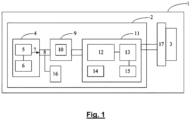
- Fig. 1 is a schematic diagram of a disc-type electromechanical brake adapted to an electro-mechanical braking system.
- an actuator 2 is configured for converting an electric power into an acting force pushing a brake pad 3 towards the brake disc (not shown) to thereby generating a braking force.
- Various possible transmission systems may be arranged between the actuator 2 and the brake pad 3.
- a movable thrust plate 17 may be disposed there to transmit the braking force.
- the actuator 2 comprises an electric motor 4, the electric motor 4 including a rotor 5 and a stator 6.
- a driving torque 7 is generated by actuating the rotor 5, the driving torque 7 being transmitted to a transmission unit 9 via an output shaft 8 of the electric motor 4.
- the transmission unit 9 may play a role of speed reduction and torque boost with an appropriate transmission ratio, e.g., by adopting a planetary gear set 10.
- an additional transmission unit 11 may be further arranged rear to the transmission unit 9.
- the additional transmission unit 11 comprises a roller slope transmission system 12 and/or a thread transmission system 13.
- the additional transmission unit 11 may convert a rotary motion of the transmission unit 9 to a straight-line motion acting on the thrust plate 17.
- sensors are further integrated, for example, a braking force sensor 14 configured for obtaining a magnitude of the braking force, and an angle sensor 15 configured for obtaining a rotating state of the additional transmission unit 11.
- a braking force holding device 16 for locking the output shaft 8 is further provided to hold the braking force in a low power consumption state or in a zero-power consumption state.
- the braking force holding device 16 may also be, for example, a solenoid, a ratchet mechanism, etc.
- the electromechanical brake comprises an electric motor and an electromagnetic brake, the electric motor having a shaft and outputting a torque based on a braking demand, the electromagnetic brake being configured for locking and releasing the shaft, wherein the controlling method further comprises:
- the controlling method for the electromechanical brake according to this embodiment is for controlling the power supply of the electromagnetic brake.
- the controlling principle is described as follows: first, obtaining the present real-time temperature value and the real-time current value of the electromagnetic brake, then determining a target current value corresponding to the real-time temperature value, wherein a too large difference between the obtained target current value and the obtained real-time current value indicates that the electromagnetic brake is currently not at a desired operating state, such that it needs to be controlled by adjusting a power supplying manner of the power supply, so as to enable the electromagnetic brake to enter the desired operating state as quickly as possible, thereby reducing power consumption.
- There are many ways to adjust the power supply In this embodiment, it is implemented by adjusting the duty cycle of the driving voltage level of the power supply output.
- the temperature-current relationship data used in step 24 refer to preset ideal temperature-current correspondence relationships of the electromagnetic brake under different operating states. For example, assuming that the current flowing through the electromagnetic brake under 26 °C is 0.5 A, the electromagnetic brake is in an optimal energy consumption state.
- the relationship data are pre-stored so as to be invokable during the process of controlling the electromagnetic brake according to steps 21-25.
- the controlling method needs to be separately described based on different operating modes.
- the electromagnetic brake To enable the electromagnetic brake to hold locking or releasing of the shaft with as less energy as possible so as to improve energy efficiency of the braking system, it is needed to obtain real-time parameters of the electromagnetic brake and adjust the power supply which supplies power based on the pre-stored data under a desired operating state; in this way, the electromagnetic brake may be always in an ideal power consumption state, thereby achieving an effect of energy conservation.
- Fig. 3 shows a specific manner of adjusting the duty cycle.
- the duty cycle refers to a ratio of the time taken by a pulse within a segment of continuous operating period to the total time.
- the duty cycle is the ratio of the actual time taken by the power supply to output a driving voltage level to the total time.
- step 25 Based on the determination in step 25, if the real-time current value of the current flowing in the electromagnetic brake is smaller than the target current value, in order to maintain the electromagnetic brake at a normal operating condition, the current value of the current flowing in the electromagnetic brake needs to be increased; considering the definition of the duty cycle, it is needed to increase the actual time taken by the power supply to output the driving voltage level, i.e., maintaining power consumption of the electromagnetic brake by increasing the duty cycle. On the contrary, it is needed to reduce the current flowing through the electromagnetic brake by decreasing the duty cycle of the driving voltage level, thereby reducing power consumption of the electromagnetic brake.
- Embodiment 1 has disclosed the controlling method for adjusting the duty cycle to cause the electromagnetic brake to be in an ideal power consumption state as much as possible; on the basis of Embodiment 1, Embodiment 2 exemplarily provides an operating loop of the electromagnetic brake, and a controlling method for the electromagnetic brake based on the loop.
- the duty cycle refers to a ratio of the actual time taken to output the driving voltage level; based on the manner of generating the duty cycle, it is seen that the duty cycle may be adjusted by increasing or decreasing the actual time taken to output the driving voltage level.
- Fig. 4 shows an operating loop of an electromagnetic brake.
- an electromagnetic brake 41 and a power supply 42 powering the electromagnetic brake 41 are provided, wherein the electromagnetic brake 41 has a high side connected to the positive pole of the power supply 42 and a low side connected to a ground end; a high side switch 43 implementing selective circuit conduction is provided between the positive pole of the power supply 42 and the high side of the electromagnetic brake, and a low side switch 44 for implementing selective circuit conduction is provided between the ground end and the low side of the electromagnetic brake.
- the high side switch 43 and the low side switch 44 When the electromagnetic brake is in an operating state, the high side switch 43 and the low side switch 44 will be selectively conducted.
- the conduction time lengths of the high side switch 43 and the low side switch 44 may be varied to implement variation of duration of the driving voltage level within a single power supply period, thereby implementing adjustment of the duty cycle. In other words, by varying the conduction time length, within a unit time, of the high side switch 43 or low side switch 44, the duty cycle of the driving voltage level of the electromagnetic brake may be adjusted.
- Embodiment 3 further provides a step of obtaining an initial voltage value of the electromagnetic brake.
- the initial voltage value in this embodiment refers to a voltage value of the electromagnetic brake when it starts operating. Obtaining the initial voltage value is to determine whether the electromagnetic brake can enter a normal operating state based on the voltage value.
- the controlling method described in Embodiment 1 can be executed only when the electromagnetic brake can enter the normal operating state.
- the initial voltage value After obtaining the initial voltage value, whether the initial voltage value is high or low is determined; if the initial voltage value is beyond a preset range, it indicates that the electromagnetic brake is exceptional, and the driving voltage level outputted by the power supply needs to be adjusted; if necessary, a comprehensive determination is needed in conjunction with the temperature value and the current value of the electromagnetic brake.
- Embodiment 4 further provides a method for diagnosing an electromagnetic brake.
- the diagnosing method shown in Fig. 5 comprises:
- a first voltage value at the high side of the electromagnetic brake is obtained, and after the preset time length, a second voltage value of the low side is obtained while the low side switch is opened.
- the diagnosing method is applied to determine whether a short-circuit or open-circuit fault exists in a loop where the electromagnetic brake is disposed, and voltage values under different switch conduction combinations are obtained by controlling conductions of the high side switch and the low side switch based on preset combinations.
- the electromagnetic brake When the first voltage value is at a low level, or the first voltage value and the second voltage value are both at low levels, it is determined that a short-circuit fault exists between the ground end and the low side of the electromagnetic brake. When the first voltage value is at a high level and the second voltage value is at a low level, it is determined that the electromagnetic brake has an open-circuit fault.
- the switch at a certain side is opened for the first time, it needs to be delayed for a certain time, so as to avoid voltage variation in the loop caused by instantaneous making-opening of the switch; the voltage variation would otherwise cause the subsequently obtained second voltage value inaccurate and then cause a misjudgment on the short-circuit fault.
- the voltage values are obtained from different positions in the operating loop, such that they may characterize actual conditions of more positions in the operating loop; therefore, compared with a conventional method of determining short-circuit simply based on voltage, the present invention may determine specific fault positions in the operating loop based on the obtained voltage values, thereby offering a higher accuracy.
- What has been described above is an exemplary diagnosis manner. By switching on or off the high side switch and the low side switch with different sequences and times and obtaining corresponding voltage values, a plurality of faults may be diagnosed.
- step 25 of Embodiment 1 the difference between the real-time current value and the target current value is compared with a preset range, and a comparison result is used as a basis for determining whether it is needed to adjust the duty cycle of the driving voltage level of the electromagnetic brake.
- the preset range here serves as the basis for determining whether to adjust the duty cycle; during the process of cyclically executing steps 21-25, the preset range in use may also be dynamically adjusted based on power supply of the electromagnetic brake.
- the duty cycle of the driving voltage level outputted by the power supply decreases, it causes decrease of the actual input voltage of the electromagnetic brake and further causes decrease of the current flowing through the electromagnetic brake.
- it is needed to specifically narrow the preset range; in this way, during the subsequent process of adjusting the duty cycle based on step 25, power consumption of the electromagnetic brake may be decreased more quickly.
- the preset range may correspond to the increased current value, thereby reducing power consumption of the electromagnetic brake more quickly.
- This embodiment provides an electromechanical brake 60 comprising a control device 61.
- the electromechanical brake 60 comprises an electric motor 4 and an electromagnetic brake 41, the electric motor 4 having a shaft and outputting a torque based on a braking demand, the electromagnetic brake 41 being configured for locking and releasing the shaft, wherein the control device 61 further comprises:
- the controlling device 61 of the electromechanical brake is configured for controlling the power supply of the electromagnetic brake.
- the implementation principle of the control device 61 is described as follows: first, obtaining the present real-time temperature value and the real-time current value of the electromagnetic brake, then determining a target current value corresponding to the real-time temperature value, wherein a too large difference between the obtained target current value and the obtained real-time current value indicates that the electromagnetic brake is currently not at a desired operating state, such that the duty cycle adjusting unit 615 needs to be invoked to control the electromagnetic brake by adjusting a power supplying manner of the power supply, so as to enable the electromagnetic brake to enter the desired operating state as quickly as possible, thereby reducing power consumption.
- adjusting the power supply In this embodiment, it is implemented by adjusting the duty cycle of the driving voltage level outputted by the power supply.
- the temperature-current relationship data used by the current value obtaining unit 614 refer to preset ideal temperature-current correspondence relationships of the electromagnetic brake under different operating states. For example, assuming that the current flowing through the electromagnetic brake under 26 °C is 0.5 A, the electromagnetic brake is in an optimal energy consumption state.
- the relationship data are pre-stored so as to be retrievable during the process of controlling the electromagnetic brake.
- the controlling method needs to be separately described based on different operating modes.
- the power supply which supplies power to the electromagnetic brake is adjusted based on the pre-stored data under a desired operating state; in this way, the electromagnetic brake may be always in an ideal power consumption state, thereby achieving an effect of energy conservation.
- the duty cycle refers to a ratio of the time taken by a pulse within a segment of continuous operating period to the total time.
- the duty cycle is the ratio of the actual time taken by the power supply to output the driving voltage level to the total time.
- the duty cycle adjusting unit 615 of the control device 61 adjusts the duty cycle specifically in the following manner: if the real-time current value of the current flowing in the electromagnetic brake is smaller than the target current value, in order to maintain the electromagnetic brake at a normal operating condition, the current value of the current flowing in the electromagnetic brake needs to be increased; considering the definition of the duty cycle, it is needed to increase the actual output time taken by the power supply to output the driving voltage level, i.e., maintaining the power consumption of the electromagnetic brake by increasing the duty cycle. On the contrary, it is needed to reduce the current flowing through the electromagnetic brake by decreasing the duty cycle of the driving voltage level, thereby reducing power consumption of the electromagnetic brake.
- the duty cycle adjusting unit 615 is configured for executing the above manner of adjusting the duty cycle based on current. Specifically, the duty cycle of the driving voltage level of the electromagnetic device is adjusted by varying a conduction time length, within a unit time, of a low side switch at the electromagnetic brake. If it is needed to increase the current value of the current flowing in the electromagnetic brake, the duty cycle needs to be increased by prolonging the conduction time length, within a unit time, of the low side switch at the electromagnetic brake, so as to maintain power consumption of the electromagnetic brake.
- Embodiment 5 has described a controlling device of an electromechanical brake, the controlling device enables adjusting the duty cycle to cause the electromagnetic brake to be in an ideal power consumption state as much as possible; based on Embodiment 5, Embodiment 6 exemplarily provides an operating loop of the electromagnetic brake, and a controlling device of the loop-based electromagnetic brake.
- the duty cycle refers to a ratio of the actual time taken to output the driving voltage level to the total time; based on the manner of generating the duty cycle, it is seen that the duty cycle may be adjusted by increasing or decreasing the actual time taken to output the driving voltage level.
- Fig. 4 shows an operating loop of an electromagnetic brake.
- an electromagnetic brake 41 and a power supply 42 powering the electromagnetic brake 41 are provided, wherein the electromagnetic brake 41 is provided with a high side connected to the positive pole of the power supply 42 and a low side connected to a ground end; a high side switch 43 implementing selective circuit conduction is provided between the positive pole of the power supply 42 and the high side of the electromagnetic brake, and a low side switch 44 for implementing selective circuit conduction is provided between the ground end and the low side of the electromagnetic brake.
- the high side switch 43 and the low side switch 44 When the electromagnetic brake is in an operating state, the high side switch 43 and the low side switch 44 will be selectively conducted.
- the conduction time lengths of the high side switch 43 and the low side switch 44 may be varied to implement variation of the driving voltage level duration within a single power supply period. In other words, by varying the conduction time length, within a unit time, of the high side switch 43 or low side switch 44, the duty cycle of the driving voltage level of the electromagnetic brake may be adjusted.
- Embodiment 7 further provides a control device for obtaining an initial voltage value of the electromagnetic brake.
- the control device 61 shown in Fig. 7 further comprises: a voltage value obtaining unit 616 configured for obtaining an initial voltage value of the electromagnetic brake.
- the initial voltage value in this embodiment refers to a voltage value of the electromagnetic brake when it starts operating. Obtaining the initial voltage value is to determine whether the electromagnetic brake can enter a normal operating state based on the voltage value. Only when the electromagnetic brake can enter the normal operating state, can the motor shaft be locked or released thereby.
- the initial voltage value After obtaining the initial voltage value, it may be determined whether the initial voltage value is high or low; if the initial voltage value is beyond a preset range, it indicates that the electromagnetic brake is exceptional, and the driving voltage level outputted by the power supply needs to be adjusted; if necessary, a comprehensive determination is further needed in conjunction with the temperature value and the current value of the electromagnetic brake.
- Embodiment 8 further provides a control device for diagnosing an electromagnetic brake.
- the control device 61 shown in Fig. 8 comprises: a diagnosing unit 617, which performs diagnosis based on voltage values when a high side switch and a low side switch at the electromagnetic brake are switched on or off.
- a diagnosing flow of the diagnosing unit 617 is described as follows:
- a first voltage value at the high side of the electromagnetic brake is obtained, and after the preset time length, a second voltage value of the low side is obtained while the low side switch is opened.
- the diagnosing unit 617 is configured for determining whether a short-circuit or open-circuit fault exists in a loop where the electromagnetic brake is disposed, and voltage values under different switch conduction combinations are obtained by controlling, based on preset combinations, conductions of the high side switch and the low side switch.
- the electromagnetic brake When the first voltage value is at a low level, or the first voltage value and the second voltage value are both at low levels, it is determined that a short-circuit fault exists between a ground end and the low side of the electromagnetic brake. When the first voltage value is at a high level and the second voltage value is at a low level, it is determined that the electromagnetic brake has an open-circuit fault.
- the diagnosis process above after the switch at a certain side is opened for the first time, it needs to be delayed for a certain time, so as to avoid voltage variation in the loop caused by instantaneous making-opening of the switch; the voltage variation would otherwise cause the subsequently obtained second voltage value inaccurate and then cause a misjudgment on the short-circuit fault.
- the voltage values are obtained from different positions in the operating loop, such that they may characterize actual conditions of more positions in the operating loop; therefore, compared with a conventional method which determines short-circuit simply based on voltage, the present invention may determine the specific fault position in the operating loop based on the obtained voltage values, thereby offering a higher accuracy.
- What has been described above is an exemplary diagnosis manner. By switching on or off the high side switch and the low side switch with different sequences and times and obtaining corresponding voltage values, a plurality of faults may be diagnosed.
- the duty cycle adjusting unit 615 is configured for comparing the difference between the real-time current value and the target current value with a preset range, and a comparison result is used as a basis for determining whether it is needed to adjust the duty cycle of the driving voltage level of the electromagnetic brake.
- the preset range here serves as the basis for determining whether to adjust the duty cycle, which may also be dynamically adjusted based on power supply of the electromagnetic brake.
- the duty cycle of the driving voltage level outputted by the power supply decreases, it causes decrease of the actual voltage inputted into the electromagnetic brake and further causes decrease of the current flowing through the electromagnetic brake.
- it is needed to specifically narrow the preset range; in this way, during the subsequent process of adjusting the duty cycle by the duty cycle adjusting unit 615, power consumption of the electromagnetic brake may be decreased more quickly.
- the preset range may correspond to the increased current value, thereby reducing power consumption of the electromagnetic brake more quickly.
- This embodiment further provides an electromechanical braking system, comprises: electromechanical brakes corresponding to wheels, each of the electromechanical brakes including the control device according to any one of Embodiments 5 to 8.
- the electromagnetic brake for locking the electric motor may be a permanent magnet brake, comprising a stator that cannot rotate with a motor shaft and a rotor that rotates synchronously with the motor shaft.
- an electromagnetic force is generated by energizing an electromagnet of the permanent magnet brake so as to neutralize the magnetic force of the permanent magnet, which makes an air gap by causing the stator to be separated from the rotor or an armature connected to the rotor by springs, such that the motor shaft rotates freely.
Landscapes
- Engineering & Computer Science (AREA)
- Transportation (AREA)
- Mechanical Engineering (AREA)
- Regulating Braking Force (AREA)
- Braking Systems And Boosters (AREA)
- Control Of Electric Motors In General (AREA)
- Stopping Of Electric Motors (AREA)
Description
- Embodiments of the present invention generally relate to the technical field of a brake, and more particularly relate to a controlling method for an electromechanical brake, an electromechanical brake, and an electromechanical braking system.
- With development of electronic technologies and improvement of vehicle intelligence, a pure electromechanical brake (EMB)-by-wire system has been gradually replacing conventional hydraulic or pneumatic brakes due to its simplified structure, higher functional integration, and better matching with an unmanned drive system, and thus becomes a development orientation for future vehicle braking technologies.
- Vehicle brakes are differentiated into a service brake and a parking brake. During the parking brake or during some service brake processes, there exists a circumstance of needing to hold a braking force for a long time. To save energy and reduce motor load, an electromechanical brake (i.e., a wheel-hub unit) is generally provided with a braking force holding device (i.e., an electromagnetic brake) which may hold an already generated braking force in a low energy consumption state or a zero-energy consumption state.
- The electromagnetic brake controls locking and releasing of its motor shaft based on the principle of electromagnetism, i.e., locking or releasing the motor shaft upon power on. No matter which type of electromagnetic brake is adopted, a relatively large power consumption would be incurred if it is in an energized state for a long time, thereby consuming too much electricity.
- An example of electro-mechanical brake with an electromagnetic brake of this type is disclosed in document
WO 2019/185890 A1 . - It is the object of the present invention to provide an improved controlling method for an electro-mechanical brake, an improved electromechanical brake and an improved electromechanical braking system, the improvement in particular being related with respect the control accuracy under consideration of different operational conditions and/or the energy consumption of the electromechanical braking system.
- According to the present invention, the object of the invention is solved by the features of the independent claims. Additional preferred embodiments according to the invention are to be seen in the dependent claims.
- To overcome the drawbacks and deficiencies in the prior art, the present invention provides a controlling method for an electromechanical brake, an electromechanical brake, and an electro-mechanical braking system, so as to lower energy consumption of the braking system.
- In a first embodiment of the invention, a controlling method for an electromechanical brake is provided, the electromechanical brake comprising an electric motor and an electromagnetic brake, the electric motor having a shaft and outputting a torque based on a braking demand, and the electromagnetic brake being configured for locking and releasing the shaft, wherein the controlling method comprises:
- controlling the electric motor and the electromagnetic brake based on the braking demand;
- controlling a power supply of the electromagnetic brake when the electromagnetic brake needs to release or lock the shaft;
- obtaining a real-time temperature value and a real-time current value of the electromagnetic brake;
- obtaining a target current value corresponding to the real-time temperature value based on preset temperature-current relationship data; and
- when a difference between the real-time current value and the target current value is greater than a preset range, adjusting a duty cycle of the driving voltage level to narrow down the difference.
- Optionally, when the real-time current value is smaller than the target current value, increasing the duty cycle of the driving voltage level of the electromagnetic brake; and when the real-time current value is greater than the target current value, decreasing the duty cycle of the driving voltage level of the electromagnetic device.
- Optionally, the duty cycle of the driving voltage level of the electromagnetic device is adjusted by varying a conduction time length, within a unit time, of a low side switch at the electromagnetic brake.
- Optionally, the controlling method further comprises: obtaining an initial voltage value of the electromagnetic brake.
- Optionally, the controlling method further comprises: diagnosing the electromagnetic brake.
- Optionally, the diagnosing is performed based on voltage values when a high side switch and a low side switch provided at the electromagnetic brake are switched on or off.
- Optionally, the preset range is dynamically adjusted based on power supply of the electromagnetic brake.
- In a second embodiment of the invention, a control device of an electromechanical brake is provided, the electromechanical brake comprising an electric motor and an electromagnetic brake, the electric motor having a shaft and outputting a torque based on a braking demand, and the electromagnetic brake being configured for locking and releasing the shaft, wherein the control device further comprises:
- a state control unit configured for controlling the electric motor and the electromagnetic brake based on the braking demand;
- a power supply control unit configured for controlling power supply of the electromagnetic brake when the electromagnetic brake needs to release or lock the shaft;
- a parameter obtaining unit configured for obtaining a real-time temperature value and a real-time current value of the electromagnetic brake;
- a current value obtaining unit configured for obtaining a target current value corresponding to the real-time temperature value based on preset temperature-current relationship data; and
- a duty cycle adjusting unit configured for: when a difference between the real-time current value and the target current value is greater than a preset range, adjusting a duty cycle of a driving voltage level of the electromagnetic brake to narrow down the difference.
- Optionally, the duty cycle adjusting unit is configured for: when the real-time current value is smaller than the target current value, increasing the duty cycle of the driving voltage level of the electromagnetic brake; and when the real-time current value is greater than the target current value, decreasing the duty cycle of the driving voltage level of the electromagnetic device.
- Optionally, the duty cycle adjusting unit is configured for adjusting the duty cycle of the driving voltage level of the electromagnetic device by varying a conduction time length, within a unit time, of a low side switch at the electromagnetic brake.
- Optionally, the controlling device further comprises: a voltage value obtaining unit configured for obtaining an initial voltage value of the electromagnetic brake.
- Optionally, the controlling device further comprises a diagnosing unit configured for diagnosing the electromagnetic brake.
- Optionally, the diagnosing unit performs the diagnosing based on voltage values when a high side switch and a low side switch provided at the electromagnetic brake are switched on or off. Optionally, the preset range is dynamically adjusted based on power supply of the electromagnetic brake.
- In a third embodiment of the invention, an electromechanical braking system is provided, the electromechanical braking system comprising a plurality of the electromechanical brakes according to any of the alternative embodiments above, each of the electromechanical brakes corresponding to a vehicle wheel.
- The technical solution of the present invention achieves the following technical effects:
- 1. By obtaining the real-time current value to compare with a target current value to determine whether the driving voltage level of the electromagnetic brake needs to be adjusted or not, and in the case of need, adjusting the driving voltage level by adjusting the duty cycle, the electromagnetic brake can be adjusted to a desired operating state as quickly as possible, thereby reducing the power consumption of the electromagnetic brake;
- 2. Compared with conventional adjustment manners, adjusting of the duty cycle of the conducted switches at two sides of the electromagnetic brake may reduce the energy consumption during the adjustment process;
- 3. By obtaining the initial voltage value of the electromagnetic brake at the initial phase of implementing the controlling method, whether the electromagnetic brake is already in a stable operating state may be determined based on the initial voltage value;
- 4. If the electromagnetic brake is not in a stable operating state, a detailed diagnosis is needed to find a specific cause for that. The specific diagnosing step includes: switching operating states of the electromagnetic brake via the switches provided at two sides of the electromagnetic brake, and obtaining corresponding voltage values under different states, and then performing diagnosis based on variation of the voltage value; and
- 5. To control the electromagnetic brake under different states, it is also needed to adjust a preset range (serving as a reference object) so as to satisfy the need of comparing with the adjusted duty cycle, such that after comparison, the duty cycle adjustment enables the electromagnetic brake to be adjusted to a low power consumption mode more quickly.
- Advantageous developments of the invention result from the claims, the description and the drawings.
- The number of the features mentioned in the claims and in the description is to be understood to cover this exact number and a greater number than the mentioned number without having to explicitly use the adverb "at least". For example, if an element is mentioned, this is to be understood such that there is exactly one element or there are two elements or more elements. Additional features may be added to these features, or these features may be the only features of the respective product.
- The reference signs contained in the claims are not limiting the extent of the matter protected by the claims. Their sole function is to make the claims easier to understand.
- To elucidate the technical solutions of the present invention more clearly, the drawings used in describing the embodiments will be briefly introduced below. It is apparent that the drawings as described only relate to some embodiments of the present invention. To those skilled in the art, different modifications and variations may be derived based on these drawings without exercise of inventive work, wherein:
- Fig. 1
- is a schematic diagram of an electromechanical brake adapted to an electro-mechanical braking system;
- Fig. 2
- is a flow schematic diagram of a controlling method for an electromechanical braking system according to the present invention;
- Fig. 3
- is a flow schematic diagram of adjusting a duty cycle of a driving voltage level of a power supply according to the present invention;
- Fig. 4
- is a structural schematic diagram of an operating loop of the electromagnetic brake according to the present invention; and
- Fig. 5
- is a flow schematic diagram of a diagnosing method for an electromechanical brake according to the present invention;
- Fig. 6
- is a first structural schematic diagram of a control device of an electromechanical brake according to the present invention;
- Fig. 7
- is a second structural schematic diagram of a control device of an electro-mechanical brake according to the present invention; and
- Fig. 8
- is a third structural schematic diagram of a control device of an electromechanical brake according to the present invention.
- To make the technical solution and advantages of the present invention clearer, the technical solution of the present invention will be further described with reference to the drawings.
-
Fig. 1 is a schematic diagram of a disc-type electromechanical brake adapted to an electro-mechanical braking system. Particularly, anactuator 2 is configured for converting an electric power into an acting force pushing abrake pad 3 towards the brake disc (not shown) to thereby generating a braking force. Various possible transmission systems may be arranged between theactuator 2 and thebrake pad 3. For example, amovable thrust plate 17 may be disposed there to transmit the braking force. - The
actuator 2 comprises anelectric motor 4, theelectric motor 4 including arotor 5 and astator 6. A drivingtorque 7 is generated by actuating therotor 5, the drivingtorque 7 being transmitted to atransmission unit 9 via anoutput shaft 8 of theelectric motor 4. Thetransmission unit 9 may play a role of speed reduction and torque boost with an appropriate transmission ratio, e.g., by adopting a planetary gear set 10. - In a power transmission path, an
additional transmission unit 11 may be further arranged rear to thetransmission unit 9. Exemplarily, theadditional transmission unit 11 comprises a rollerslope transmission system 12 and/or athread transmission system 13. Theadditional transmission unit 11 may convert a rotary motion of thetransmission unit 9 to a straight-line motion acting on thethrust plate 17. - Besides, to detect an operating state of the disc brake, sensors are further integrated, for example, a
braking force sensor 14 configured for obtaining a magnitude of the braking force, and anangle sensor 15 configured for obtaining a rotating state of theadditional transmission unit 11. - Finally, a braking
force holding device 16 for locking theoutput shaft 8 is further provided to hold the braking force in a low power consumption state or in a zero-power consumption state. - When a power-off electromagnetic brake is adopted, the braking force may be held for a long time in a zero-power consumption state. When a power-on electromagnetic brake is adopted, the braking force may be held for a long time in a low power consumption state, and release of the motor shaft may be held in a zero-power consumption state. It needs to be noted that the braking
force holding device 16 may also be, for example, a solenoid, a ratchet mechanism, etc. - This embodiment provides a controlling method for an electromechanical brake. As shown in
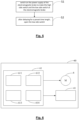
Fig. 2 , the electromechanical brake comprises an electric motor and an electromagnetic brake, the electric motor having a shaft and outputting a torque based on a braking demand, the electromagnetic brake being configured for locking and releasing the shaft, wherein the controlling method further comprises: - 21. controlling the electric motor and the electromagnetic brake based on the braking demand;
- 22. controlling a power supply of the electromagnetic brake when the electromagnetic brake needs to release or lock the shaft;
- 23. obtaining a real-time temperature value and a real-time current value of the electromagnetic brake;
- 24. obtaining a target current value corresponding to the real-time temperature value based on preset temperature-current relationship data; and
- 25. when a difference between the real-time current value and the target current value is greater than a preset range, adjusting a duty cycle of a driving voltage level of the electromagnetic brake to narrow the difference.
- The controlling method for the electromechanical brake according to this embodiment is for controlling the power supply of the electromagnetic brake. The controlling principle is described as follows: first, obtaining the present real-time temperature value and the real-time current value of the electromagnetic brake, then determining a target current value corresponding to the real-time temperature value, wherein a too large difference between the obtained target current value and the obtained real-time current value indicates that the electromagnetic brake is currently not at a desired operating state, such that it needs to be controlled by adjusting a power supplying manner of the power supply, so as to enable the electromagnetic brake to enter the desired operating state as quickly as possible, thereby reducing power consumption. There are many ways to adjust the power supply. In this embodiment, it is implemented by adjusting the duty cycle of the driving voltage level of the power supply output.
- The temperature-current relationship data used in
step 24 refer to preset ideal temperature-current correspondence relationships of the electromagnetic brake under different operating states. For example, assuming that the current flowing through the electromagnetic brake under 26 °C is 0.5 A, the electromagnetic brake is in an optimal energy consumption state. The relationship data are pre-stored so as to be invokable during the process of controlling the electromagnetic brake according to steps 21-25. - Considering that the currently available electromagnetic brakes may be differentiated into a power-on braking type and a power-off braking type, the controlling method needs to be separately described based on different operating modes.
- 1) When the power-on braking type electromagnetic brake is selected:
when the electromagnetic brake is energized, the electromagnetic brake will lock the shaft in the electric motor; for example, in a parking state, the electromagnetic brake is always in a power-on state; at this point, the controlling method in Embodiment 1 is adopted to adjust power supply to the electromagnetic brake based on an actual temperature so as to avoid energy loss due to a too high duty cycle during the whole parking process. - 2) When the power-off braking type electromagnetic brake is selected:
when the electromagnetic brake is in a power off state, the electromagnetic brake locks the shaft in the electric motor. However, only when the electromagnetic brake is in a power-on state, will the electromagnetic brake release the motor shaft. In other words, in a non-braking state, the electromagnetic brake might keep power on for a long time; at this point, the controlling method in Embodiment 1 is adopted to adjust power supply to the electromagnetic brake based on an actual temperature, so as to avoid energy loss due to a too high duty cycle during the whole process. - To enable the electromagnetic brake to hold locking or releasing of the shaft with as less energy as possible so as to improve energy efficiency of the braking system, it is needed to obtain real-time parameters of the electromagnetic brake and adjust the power supply which supplies power based on the pre-stored data under a desired operating state; in this way, the electromagnetic brake may be always in an ideal power consumption state, thereby achieving an effect of energy conservation.
-
Fig. 3 shows a specific manner of adjusting the duty cycle. - 31. When the real-time current value is smaller than the target current value, increasing the duty cycle of the driving voltage level of the electromagnetic brake;
- 32. When the real-time current value is greater than the target current value, decreasing the duty cycle of the driving voltage level of the electromagnetic brake.
- The duty cycle refers to a ratio of the time taken by a pulse within a segment of continuous operating period to the total time. In this embodiment, the duty cycle is the ratio of the actual time taken by the power supply to output a driving voltage level to the total time.
- Based on the determination in
step 25, if the real-time current value of the current flowing in the electromagnetic brake is smaller than the target current value, in order to maintain the electromagnetic brake at a normal operating condition, the current value of the current flowing in the electromagnetic brake needs to be increased; considering the definition of the duty cycle, it is needed to increase the actual time taken by the power supply to output the driving voltage level, i.e., maintaining power consumption of the electromagnetic brake by increasing the duty cycle. On the contrary, it is needed to reduce the current flowing through the electromagnetic brake by decreasing the duty cycle of the driving voltage level, thereby reducing power consumption of the electromagnetic brake. - Embodiment 1 has disclosed the controlling method for adjusting the duty cycle to cause the electromagnetic brake to be in an ideal power consumption state as much as possible; on the basis of Embodiment 1,
Embodiment 2 exemplarily provides an operating loop of the electromagnetic brake, and a controlling method for the electromagnetic brake based on the loop. - The duty cycle refers to a ratio of the actual time taken to output the driving voltage level; based on the manner of generating the duty cycle, it is seen that the duty cycle may be adjusted by increasing or decreasing the actual time taken to output the driving voltage level.
-
Fig. 4 shows an operating loop of an electromagnetic brake. In the operating loop, anelectromagnetic brake 41 and apower supply 42 powering theelectromagnetic brake 41 are provided, wherein theelectromagnetic brake 41 has a high side connected to the positive pole of thepower supply 42 and a low side connected to a ground end; ahigh side switch 43 implementing selective circuit conduction is provided between the positive pole of thepower supply 42 and the high side of the electromagnetic brake, and alow side switch 44 for implementing selective circuit conduction is provided between the ground end and the low side of the electromagnetic brake. - When the electromagnetic brake is in an operating state, the
high side switch 43 and thelow side switch 44 will be selectively conducted. To implement adjustment of the duty cycle, the conduction time lengths of thehigh side switch 43 and thelow side switch 44 may be varied to implement variation of duration of the driving voltage level within a single power supply period, thereby implementing adjustment of the duty cycle. In other words, by varying the conduction time length, within a unit time, of thehigh side switch 43 orlow side switch 44, the duty cycle of the driving voltage level of the electromagnetic brake may be adjusted. - Based on the preceding embodiments,
Embodiment 3 further provides a step of obtaining an initial voltage value of the electromagnetic brake. - The initial voltage value in this embodiment refers to a voltage value of the electromagnetic brake when it starts operating. Obtaining the initial voltage value is to determine whether the electromagnetic brake can enter a normal operating state based on the voltage value. The controlling method described in Embodiment 1 can be executed only when the electromagnetic brake can enter the normal operating state.
- After obtaining the initial voltage value, whether the initial voltage value is high or low is determined; if the initial voltage value is beyond a preset range, it indicates that the electromagnetic brake is exceptional, and the driving voltage level outputted by the power supply needs to be adjusted; if necessary, a comprehensive determination is needed in conjunction with the temperature value and the current value of the electromagnetic brake.
-
Embodiment 4 further provides a method for diagnosing an electromagnetic brake. In conjunction with the operating loop of the electromagnetic brake (as shown inFig. 4 ) provided inEmbodiment 2, the diagnosing method shown inFig. 5 comprises: - 51. Switching on the power supply of the electromagnetic brake to make the high side switch and the low side switch at the electromagnetic brake;
- 52. After delaying for a preset time length, opening the low side switch.
- After making the high side switch and the low side switch at the electromagnetic brake, a first voltage value at the high side of the electromagnetic brake is obtained, and after the preset time length, a second voltage value of the low side is obtained while the low side switch is opened.
- The diagnosing method is applied to determine whether a short-circuit or open-circuit fault exists in a loop where the electromagnetic brake is disposed, and voltage values under different switch conduction combinations are obtained by controlling conductions of the high side switch and the low side switch based on preset combinations.
- When the first voltage value is at a low level, or the first voltage value and the second voltage value are both at low levels, it is determined that a short-circuit fault exists between the ground end and the low side of the electromagnetic brake. When the first voltage value is at a high level and the second voltage value is at a low level, it is determined that the electromagnetic brake has an open-circuit fault. During the diagnosing process above, after the switch at a certain side is opened for the first time, it needs to be delayed for a certain time, so as to avoid voltage variation in the loop caused by instantaneous making-opening of the switch; the voltage variation would otherwise cause the subsequently obtained second voltage value inaccurate and then cause a misjudgment on the short-circuit fault.
- Because short-circuit will cause local over-current and voltage rise, while open- circuit would cause the electromagnetic brake to be unmanipulable, it is needed to determine whether the operating loop has a short-circuit fault or an open-circuit fault based on voltage exception, such that alarm information may be emitted promptly when the fault occurs, which may prevent a brake control error due to electromagnetic brake fault during service of the vehicle.
- In this embodiment, the voltage values are obtained from different positions in the operating loop, such that they may characterize actual conditions of more positions in the operating loop; therefore, compared with a conventional method of determining short-circuit simply based on voltage, the present invention may determine specific fault positions in the operating loop based on the obtained voltage values, thereby offering a higher accuracy. What has been described above is an exemplary diagnosis manner. By switching on or off the high side switch and the low side switch with different sequences and times and obtaining corresponding voltage values, a plurality of faults may be diagnosed.
- In
step 25 of Embodiment 1, the difference between the real-time current value and the target current value is compared with a preset range, and a comparison result is used as a basis for determining whether it is needed to adjust the duty cycle of the driving voltage level of the electromagnetic brake. - The preset range here serves as the basis for determining whether to adjust the duty cycle; during the process of cyclically executing steps 21-25, the preset range in use may also be dynamically adjusted based on power supply of the electromagnetic brake.
- For example, when the duty cycle of the driving voltage level outputted by the power supply decreases, it causes decrease of the actual input voltage of the electromagnetic brake and further causes decrease of the current flowing through the electromagnetic brake. To match a varied current, it is needed to specifically narrow the preset range; in this way, during the subsequent process of adjusting the duty cycle based on
step 25, power consumption of the electromagnetic brake may be decreased more quickly. - On the contrary, when the duty cycle of the driving voltage level outputted by the power supply increases, it indicates that the actual voltage inputted into the electromagnetic brake increases, which further causes increase of the current flowing through the electromagnetic brake. To match a varied current, it is needed to specifically broaden the preset range; in this way, during the subsequent process of adjusting the duty cycle based on
step 25, the preset range may correspond to the increased current value, thereby reducing power consumption of the electromagnetic brake more quickly. - This embodiment provides an
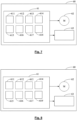
electromechanical brake 60 comprising acontrol device 61. As shown inFig. 6 , theelectromechanical brake 60 comprises anelectric motor 4 and anelectromagnetic brake 41, theelectric motor 4 having a shaft and outputting a torque based on a braking demand, theelectromagnetic brake 41 being configured for locking and releasing the shaft, wherein thecontrol device 61 further comprises: - A
state control unit 611 configured for controlling the electric motor and the electromagnetic brake based on the braking demand; - A power
supply control unit 612 configured for controlling a power supply of the electromagnetic brake when the electromagnetic brake needs to release or lock the shaft; - A
parameter obtaining unit 613 configured for obtaining a real-time temperature value and a real-time current value of the electromagnetic brake; - A current
value obtaining unit 614 configured for obtaining a target current value corresponding to the real-time temperature value based on preset temperature-current relationship data; and - A duty
cycle adjusting unit 615 configured for: when a difference between the real-time current value and the target current value is greater than a preset range, adjusting a duty cycle of a driving voltage level of the electromagnetic brake to narrow the difference. - The controlling
device 61 of the electromechanical brake according to this embodiment is configured for controlling the power supply of the electromagnetic brake. The implementation principle of thecontrol device 61 is described as follows: first, obtaining the present real-time temperature value and the real-time current value of the electromagnetic brake, then determining a target current value corresponding to the real-time temperature value, wherein a too large difference between the obtained target current value and the obtained real-time current value indicates that the electromagnetic brake is currently not at a desired operating state, such that the dutycycle adjusting unit 615 needs to be invoked to control the electromagnetic brake by adjusting a power supplying manner of the power supply, so as to enable the electromagnetic brake to enter the desired operating state as quickly as possible, thereby reducing power consumption. There are many ways of adjusting the power supply. In this embodiment, it is implemented by adjusting the duty cycle of the driving voltage level outputted by the power supply. - The temperature-current relationship data used by the current
value obtaining unit 614 refer to preset ideal temperature-current correspondence relationships of the electromagnetic brake under different operating states. For example, assuming that the current flowing through the electromagnetic brake under 26 °C is 0.5 A, the electromagnetic brake is in an optimal energy consumption state. The relationship data are pre-stored so as to be retrievable during the process of controlling the electromagnetic brake. - Considering that the currently available electromagnetic brakes may be differentiated into a power-on braking type and a power-off braking type, the controlling method needs to be separately described based on different operating modes.
- 1) When the power-on braking type electromagnetic brake is selected:
when the electromagnetic brake is energized, the electromagnetic brake will lock the shaft in the electric motor; for example, in a parking state, the electromagnetic brake is always in a power-on state; at this point, thecontrol device 61 adjusts power supply to the electromagnetic brake based on an actual temperature, thereby avoiding energy loss due to a too high duty cycle during the whole parking process. - 2) When the power-off braking type electromagnetic brake is selected:
when the electromagnetic brake is in a power off state, the electromagnetic brake locks the shaft in the electric motor. However, only when the electromagnetic brake is in a power-on state, will the electromagnetic brake release the motor shaft. In other words, in a non-braking state, the electromagnetic brake might keep power on for a long time; at this point, thecontrol device 61 adjusts power supply based on an actual temperature so as to avoid energy loss due to a too high duty cycle during the whole process. - To enable the electromagnetic brake to hold locking or releasing of the shaft with as less energy as possible so as to improve energy use efficiency of the braking system, the power supply which supplies power to the electromagnetic brake is adjusted based on the pre-stored data under a desired operating state; in this way, the electromagnetic brake may be always in an ideal power consumption state, thereby achieving an effect of energy conservation.
- The duty cycle refers to a ratio of the time taken by a pulse within a segment of continuous operating period to the total time. In this embodiment, the duty cycle is the ratio of the actual time taken by the power supply to output the driving voltage level to the total time.
- The duty
cycle adjusting unit 615 of thecontrol device 61 adjusts the duty cycle specifically in the following manner: if the real-time current value of the current flowing in the electromagnetic brake is smaller than the target current value, in order to maintain the electromagnetic brake at a normal operating condition, the current value of the current flowing in the electromagnetic brake needs to be increased; considering the definition of the duty cycle, it is needed to increase the actual output time taken by the power supply to output the driving voltage level, i.e., maintaining the power consumption of the electromagnetic brake by increasing the duty cycle. On the contrary, it is needed to reduce the current flowing through the electromagnetic brake by decreasing the duty cycle of the driving voltage level, thereby reducing power consumption of the electromagnetic brake. - The duty
cycle adjusting unit 615 is configured for executing the above manner of adjusting the duty cycle based on current. Specifically, the duty cycle of the driving voltage level of the electromagnetic device is adjusted by varying a conduction time length, within a unit time, of a low side switch at the electromagnetic brake. If it is needed to increase the current value of the current flowing in the electromagnetic brake, the duty cycle needs to be increased by prolonging the conduction time length, within a unit time, of the low side switch at the electromagnetic brake, so as to maintain power consumption of the electromagnetic brake. On the contrary, it is needed to shorten the conduction time length, within a unit time, of the low side switch at the electromagnetic brake; in this way, by decreasing the duty cycle of the driving voltage level, the current flowing through the electromagnetic brake is reduced, thereby reducing power consumption of the electromagnetic brake. -
Embodiment 5 has described a controlling device of an electromechanical brake, the controlling device enables adjusting the duty cycle to cause the electromagnetic brake to be in an ideal power consumption state as much as possible; based onEmbodiment 5,Embodiment 6 exemplarily provides an operating loop of the electromagnetic brake, and a controlling device of the loop-based electromagnetic brake. - The duty cycle refers to a ratio of the actual time taken to output the driving voltage level to the total time; based on the manner of generating the duty cycle, it is seen that the duty cycle may be adjusted by increasing or decreasing the actual time taken to output the driving voltage level.
-
Fig. 4 shows an operating loop of an electromagnetic brake. In the operating loop, anelectromagnetic brake 41 and apower supply 42 powering theelectromagnetic brake 41 are provided, wherein theelectromagnetic brake 41 is provided with a high side connected to the positive pole of thepower supply 42 and a low side connected to a ground end; ahigh side switch 43 implementing selective circuit conduction is provided between the positive pole of thepower supply 42 and the high side of the electromagnetic brake, and alow side switch 44 for implementing selective circuit conduction is provided between the ground end and the low side of the electromagnetic brake. - When the electromagnetic brake is in an operating state, the
high side switch 43 and thelow side switch 44 will be selectively conducted. To implement adjustment of the duty cycle, the conduction time lengths of thehigh side switch 43 and thelow side switch 44 may be varied to implement variation of the driving voltage level duration within a single power supply period. In other words, by varying the conduction time length, within a unit time, of thehigh side switch 43 orlow side switch 44, the duty cycle of the driving voltage level of the electromagnetic brake may be adjusted. - Based on any one of the preceding embodiments,
Embodiment 7 further provides a control device for obtaining an initial voltage value of the electromagnetic brake. Thecontrol device 61 shown inFig. 7 further comprises: a voltagevalue obtaining unit 616 configured for obtaining an initial voltage value of the electromagnetic brake. - The initial voltage value in this embodiment refers to a voltage value of the electromagnetic brake when it starts operating. Obtaining the initial voltage value is to determine whether the electromagnetic brake can enter a normal operating state based on the voltage value. Only when the electromagnetic brake can enter the normal operating state, can the motor shaft be locked or released thereby.
- After obtaining the initial voltage value, it may be determined whether the initial voltage value is high or low; if the initial voltage value is beyond a preset range, it indicates that the electromagnetic brake is exceptional, and the driving voltage level outputted by the power supply needs to be adjusted; if necessary, a comprehensive determination is further needed in conjunction with the temperature value and the current value of the electromagnetic brake.
-
Embodiment 8 further provides a control device for diagnosing an electromagnetic brake. In conjunction with the operating loop of the electromagnetic brake (as shown inFig. 4 ) provided inEmbodiment 6, thecontrol device 61 shown inFig. 8 comprises: a diagnosingunit 617, which performs diagnosis based on voltage values when a high side switch and a low side switch at the electromagnetic brake are switched on or off. - A diagnosing flow of the diagnosing
unit 617 is described as follows: - (1) switching on a power supply of the electromagnetic brake to make the high side switch and the low side switch at the electromagnetic brake;
- (2) after delaying for a preset time length, opening the low side switch.
- After making the high side switch and the low side switch at the electromagnetic brake, a first voltage value at the high side of the electromagnetic brake is obtained, and after the preset time length, a second voltage value of the low side is obtained while the low side switch is opened.
- The diagnosing
unit 617 is configured for determining whether a short-circuit or open-circuit fault exists in a loop where the electromagnetic brake is disposed, and voltage values under different switch conduction combinations are obtained by controlling, based on preset combinations, conductions of the high side switch and the low side switch. - When the first voltage value is at a low level, or the first voltage value and the second voltage value are both at low levels, it is determined that a short-circuit fault exists between a ground end and the low side of the electromagnetic brake. When the first voltage value is at a high level and the second voltage value is at a low level, it is determined that the electromagnetic brake has an open-circuit fault. During the diagnosis process above, after the switch at a certain side is opened for the first time, it needs to be delayed for a certain time, so as to avoid voltage variation in the loop caused by instantaneous making-opening of the switch; the voltage variation would otherwise cause the subsequently obtained second voltage value inaccurate and then cause a misjudgment on the short-circuit fault.
- Because short-circuit will cause local over-current and voltage rise, while open-circuit would cause the electromagnetic brake to be unmanipulable, it is needed to determine whether the operating loop has a short-circuit fault or an open-circuit fault based on voltage exception, such that alarm information may be emitted promptly when the fault occurs, thereby preventing a brake control error due to electromagnetic brake fault during use of the vehicle.
- In this embodiment, the voltage values are obtained from different positions in the operating loop, such that they may characterize actual conditions of more positions in the operating loop; therefore, compared with a conventional method which determines short-circuit simply based on voltage, the present invention may determine the specific fault position in the operating loop based on the obtained voltage values, thereby offering a higher accuracy. What has been described above is an exemplary diagnosis manner. By switching on or off the high side switch and the low side switch with different sequences and times and obtaining corresponding voltage values, a plurality of faults may be diagnosed.
- In
Embodiment 5, it has been described that the dutycycle adjusting unit 615 is configured for comparing the difference between the real-time current value and the target current value with a preset range, and a comparison result is used as a basis for determining whether it is needed to adjust the duty cycle of the driving voltage level of the electromagnetic brake. - The preset range here serves as the basis for determining whether to adjust the duty cycle, which may also be dynamically adjusted based on power supply of the electromagnetic brake.
- For example, when the duty cycle of the driving voltage level outputted by the power supply decreases, it causes decrease of the actual voltage inputted into the electromagnetic brake and further causes decrease of the current flowing through the electromagnetic brake. To match a varied current, it is needed to specifically narrow the preset range; in this way, during the subsequent process of adjusting the duty cycle by the duty
cycle adjusting unit 615, power consumption of the electromagnetic brake may be decreased more quickly. - On the contrary, when the duty cycle of the driving voltage level outputted by the power supply increases, it indicates that the actual voltage inputted into the electromagnetic brake increases, thereby further increasing the current flowing through the electromagnetic brake. To match a varied current, it is needed to specifically broaden the preset range; in this way, during the subsequent process of adjusting the duty cycle by the duty
radio adjusting unit 615, the preset range may correspond to the increased current value, thereby reducing power consumption of the electromagnetic brake more quickly. - This embodiment further provides an electromechanical braking system, comprises:
electromechanical brakes corresponding to wheels, each of the electromechanical brakes including the control device according to any one ofEmbodiments 5 to 8. - The electromagnetic brake for locking the electric motor according to this embodiment may be a permanent magnet brake, comprising a stator that cannot rotate with a motor shaft and a rotor that rotates synchronously with the motor shaft. When the electric motor operates normally, an electromagnetic force is generated by energizing an electromagnet of the permanent magnet brake so as to neutralize the magnetic force of the permanent magnet, which makes an air gap by causing the stator to be separated from the rotor or an armature connected to the rotor by springs, such that the motor shaft rotates freely. When it is needed to lock the electric motor, power supply of the electromagnet is interrupted; then the stator and the rotor or the armature connected to the rotor by springs are attracted together due to the magnetic force of the permanent magnet, which produces friction, and then the motor shaft is fixed as the rotor is locked. Adoption of the permanent magnet brake may reduce energy consumption for locking the electric motor; therefore, it may be applied to a scenario where the braking force needs to be held, e.g., parking or maintaining a long-time service braking force. However, the present disclosure is not limited thereto. Any electromagnetic brake type, which generates a mechanical friction leveraging an electromagnetic effect to decelerate or lock motor motion, is applicable to the present invention. Modification of the present invention are possible within the scope of the appended claims.
-
- 1
- disc-type electromechanical brake
- 2
- actuator
- 3
- brake pad
- 4
- electric motor
- 5
- rotor
- 6
- stator
- 7
- driving torque
- 8
- output shaft
- 9
- transmission unit
- 10
- planetary gear set
- 11
- additional transmission unit
- 12
- roller slope transmission system
- 13
- thread transmission system
- 14
- braking force sensor
- 15
- angle sensor
- 16
- braking force holding device
- 17
- thrust plate
- 41
- electromagnetic brake
- 42
- power supply
- 43
- high side switch
- 44
- low side switch
- 60
- electromechanical brake
- 61
- control device
- 611
- state control unit
- 612
- power supply control unit
- 613
- parameter obtaining unit
- 614
- current value obtaining unit
- 615
- duty cycle adjusting unit
- 616
- voltage value obtaining unit
- 617
- diagnosing unit
Claims (15)
- A controlling method for an electromechanical brake (60), the electromechanical brake (60) comprising an electric motor (4) and an electromagnetic brake (41), the electric motor (4) having a shaft and outputting a torque based on a braking demand, and the electromagnetic brake (41) being configured for locking and releasing the shaft, wherein the controlling method comprises:controlling the electric motor (4) and the electromagnetic brake (41) based on the braking demand;controlling a power supply (42) of the electromagnetic brake (41) when the electromagnetic brake (41) needs to release or lock the shaft;the controlling method being characterized byobtaining a real-time temperature value and a real-time current value of the electromagnetic brake (41);obtaining a target current value corresponding to the real-time temperature value based on preset temperature-current relationship data; andwhen a difference between the real-time current value and the target current value is greater than a preset range, adjusting a duty cycle of a driving voltage level of the electromagnetic brake (41) to narrow the difference.
- The controlling method according to claim 1, wherein when the real-time current value is smaller than the target current value, increasing the duty cycle of the driving voltage level of the electromagnetic brake (41); and when the real-time current value is greater than the target current value, decreasing the duty cycle of the driving voltage level of the electromagnetic device (41).
- The controlling method according to claim 1 or 2, wherein the duty cycle of the driving voltage level of the electromagnetic device (41) is adjusted by varying a conduction time length, within a unit time, of a low side switch at the electromagnetic brake (41).
- The controlling method according to any one of claims 1 to 3, wherein the controlling method further comprises: obtaining an initial voltage value of the electromagnetic brake (41).
- The controlling method according to any one of claims 1 to 4, wherein the controlling method further comprises: diagnosing the electromagnetic brake (41).
- The controlling method according to claim 5, wherein the diagnosing is performed based on voltage values when a high side switch (43) and the low side switch (44) provided at the electromagnetic brake (41) are switched on or off.
- The controlling method according to any one of claims 1 to 6, wherein the preset range is dynamically adjusted based on power supply (42) of the electromagnetic brake (41).
- An electromechanical brake (60), wherein the electromechanical brake (60) comprising:a control device (61), an electric motor (4) and an electromagnetic brake (41), the electric motor (4) having a shaft and outputting a torque based on a braking demand, the electromagnetic brake (41) being configured for locking and releasing the shaft, wherein the control device (61) further comprising:a state control unit (611) configured for controlling the electric motor (4) and the electromagnetic brake (41) based on the braking demand;a power supply control unit (612) configured for controlling power supply (42) of the electromagnetic brake (41) when the electromagnetic brake (41) needs to release or lock the shaft;the control device being characterized bya parameter obtaining unit (613) configured for obtaining a real-time temperature value and a real-time current value of the electromagnetic brake (41);a current value obtaining unit (614) configured for obtaining a target current value corresponding to the real-time temperature value based on preset temperature-current relationship data; anda duty cycle adjusting unit (615) configured for: when a difference between the real-time current value and the target current value is greater than a preset range, adjusting a duty cycle of a driving voltage level of the electromagnetic brake (41) to narrow the difference.
- The electromechanical brake (60) according to claim 8, wherein the duty cycle adjusting unit is (615) configured for: when the real-time current value is smaller than the target current value, increasing the duty cycle of the driving voltage level of the electromagnetic brake (41); and when the real-time current value is greater than the target current value, decreasing the duty cycle of the driving voltage level of the electromagnetic device (41).
- The electromechanical brake (60) according to claim 8 or 9, wherein the duty cycle adjusting unit (615) is configured for adjusting the duty cycle of the driving voltage level of the electromagnetic device (41) by varying a conduction time length, within a unit time, of the low side switch (44) at the electromagnetic brake (41).
- The electromechanical brake (60) according to any one of claims 8 to 10, wherein the electromechanical brake(60) further comprises: a voltage value obtaining unit (616) configured for obtaining an initial voltage value of the electromagnetic brake (41).
- The electromechanical brake (60) according to any one of claims 8 to 11, wherein the electromechanical brake (60) further comprises a diagnosing unit (617) configured for diagnosing the electromagnetic brake (41).
- The electromechanical brake (60) according to claim 12, wherein the diagnosing unit (617) performs the diagnosing based on voltage values when a high side switch (43) and a low side switch (44) provided at the electromagnetic brake (41) are switched on or off.
- The electromechanical brake (60) according to any one of claims 8 to 13, wherein the preset range is dynamically adjusted based on power supply of the electromagnetic brake (41).
- An electromechanical braking system, comprising a plurality of the electromechanical brakes (60) according to any of claims 8 to 14, wherein each of the electromechanical brakes (60) corresponds to a vehicle wheel.
Applications Claiming Priority (2)
| Application Number | Priority Date | Filing Date | Title |
|---|---|---|---|
| CN201911023569.9A CN112706735B (en) | 2019-10-25 | 2019-10-25 | Electromechanical brake and its control method, electromechanical brake system |
| PCT/EP2020/079400 WO2021078693A1 (en) | 2019-10-25 | 2020-10-19 | Electromechanical brake, controlling method for the same, and electromechanical braking system |
Publications (2)
| Publication Number | Publication Date |
|---|---|
| EP4048564A1 EP4048564A1 (en) | 2022-08-31 |
| EP4048564B1 true EP4048564B1 (en) | 2023-11-08 |
Family
ID=72964702
Family Applications (1)
| Application Number | Title | Priority Date | Filing Date |
|---|---|---|---|
| EP20793659.2A Active EP4048564B1 (en) | 2019-10-25 | 2020-10-19 | Electromechanical brake, controlling method for the same, and electromechanical braking system |
Country Status (6)
| Country | Link |
|---|---|
| US (1) | US12049208B2 (en) |
| EP (1) | EP4048564B1 (en) |
| JP (1) | JP2022554158A (en) |
| KR (1) | KR20220086605A (en) |
| CN (1) | CN112706735B (en) |
| WO (1) | WO2021078693A1 (en) |
Families Citing this family (2)
| Publication number | Priority date | Publication date | Assignee | Title |
|---|---|---|---|---|
| CN117128266B (en) * | 2023-07-28 | 2026-04-03 | 中国空空导弹研究院 | A reliable method for unlocking a servo system |
| CN119975007B (en) * | 2025-04-17 | 2025-07-08 | 凡己科技(苏州)有限公司 | Vehicle and control method thereof |
Family Cites Families (7)
| Publication number | Priority date | Publication date | Assignee | Title |
|---|---|---|---|---|
| US20030144773A1 (en) * | 2001-12-27 | 2003-07-31 | Tatsuya Sumitomo | Control unit for hybrid vehicle |
| JP2007143311A (en) * | 2005-11-18 | 2007-06-07 | Yaskawa Electric Corp | Motor control device and electromagnetic brake motor |
| CN101049804B (en) * | 2007-05-11 | 2011-03-30 | 江苏大学 | A joint controller and control method of main brake and retarder of automobile |
| EP2503682B1 (en) | 2011-03-22 | 2013-09-25 | Siemens Aktiengesellschaft | Switching assembly |
| CN102664579B (en) * | 2012-04-17 | 2014-10-15 | 燕山大学 | Control device of electromagnetic brake |
| CN102700532B (en) * | 2012-06-05 | 2015-04-22 | 江苏大学 | Braking device adopting magnet brake to realize vehicle locking prevention function and control method |
| CN110319129B (en) * | 2018-03-30 | 2021-06-22 | 瀚德万安(上海)电控制动系统有限公司 | Electromechanical brakes and their electric actuators |
-
2019
- 2019-10-25 CN CN201911023569.9A patent/CN112706735B/en active Active
-
2020
- 2020-10-19 KR KR1020227015774A patent/KR20220086605A/en not_active Withdrawn
- 2020-10-19 JP JP2022523891A patent/JP2022554158A/en active Pending
- 2020-10-19 WO PCT/EP2020/079400 patent/WO2021078693A1/en not_active Ceased
- 2020-10-19 EP EP20793659.2A patent/EP4048564B1/en active Active
-
2022
- 2022-04-25 US US17/727,867 patent/US12049208B2/en active Active
Also Published As
| Publication number | Publication date |
|---|---|
| WO2021078693A1 (en) | 2021-04-29 |
| EP4048564A1 (en) | 2022-08-31 |
| JP2022554158A (en) | 2022-12-28 |
| US12049208B2 (en) | 2024-07-30 |
| CN112706735A (en) | 2021-04-27 |
| US20220242382A1 (en) | 2022-08-04 |
| CN112706735B (en) | 2023-02-28 |
| KR20220086605A (en) | 2022-06-23 |
Similar Documents
| Publication | Publication Date | Title |
|---|---|---|
| US12049208B2 (en) | Electromechanical brake, controlling method for the same, and electromechanical braking system | |
| EP2094549B1 (en) | Reduced power mode for an aircraft electric brake system | |
| US8152247B2 (en) | Method of managing the power supply to a non-reversible actuator for a vehicle wheel brake | |
| US9670917B2 (en) | Aircraft motor drive control apparatus and aircraft actuator hydraulic system | |
| US7052093B2 (en) | Electric parking brake system and method for controlling the same | |
| US10336303B2 (en) | Electronic parking brake system | |
| KR20060091004A (en) | Control method of vehicle brake control device and vehicle brake device | |
| EP2591961B1 (en) | System and method for controlling an electronic brake | |
| US9746041B2 (en) | Electric brake device | |
| EP3051218A1 (en) | Air conditioning system and method for controlling same | |
| JP6313127B2 (en) | Electric brake device and electric brake device system | |
| EP1569326A2 (en) | Control apparatus for electric motor of inverter system and control apparatus for electro mechanical brake | |
| JP5792785B2 (en) | Device for maintaining a pressing force by the combined action of two members | |
| JP2019038531A (en) | Method for braking motor in high lift system of aircraft, and high lift system of aircraft | |
| CN107912052B (en) | Method for controlling a rotor blade adjustment device | |
| CN103078574B (en) | Active brake control method and system of direct-current brushless motor | |
| KR20140147776A (en) | Stepper motor with integrated brake and drive circuit | |
| CN109476297B (en) | Electric Brakes and Electric Brake Systems | |
| JP3568864B2 (en) | Anti-lock control device | |
| WO2020038845A1 (en) | Diagnosis method for an electromagnetic brake, diagnosis apparatus for the same and electromechanical brake system | |
| CN121777868A (en) | Commercial vehicle pneumatic braking parking system, control method and commercial vehicle | |
| JP2025076591A (en) | Electric Brake System |
Legal Events
| Date | Code | Title | Description |
|---|---|---|---|
| STAA | Information on the status of an ep patent application or granted ep patent |
Free format text: STATUS: UNKNOWN |
|
| STAA | Information on the status of an ep patent application or granted ep patent |
Free format text: STATUS: THE INTERNATIONAL PUBLICATION HAS BEEN MADE |
|
| PUAI | Public reference made under article 153(3) epc to a published international application that has entered the european phase |
Free format text: ORIGINAL CODE: 0009012 |
|
| STAA | Information on the status of an ep patent application or granted ep patent |
Free format text: STATUS: REQUEST FOR EXAMINATION WAS MADE |
|
| 17P | Request for examination filed |
Effective date: 20220428 |
|
| AK | Designated contracting states |
Kind code of ref document: A1 Designated state(s): AL AT BE BG CH CY CZ DE DK EE ES FI FR GB GR HR HU IE IS IT LI LT LU LV MC MK MT NL NO PL PT RO RS SE SI SK SM TR |
|
| DAV | Request for validation of the european patent (deleted) | ||
| DAX | Request for extension of the european patent (deleted) | ||
| GRAP | Despatch of communication of intention to grant a patent |
Free format text: ORIGINAL CODE: EPIDOSNIGR1 |
|
| STAA | Information on the status of an ep patent application or granted ep patent |
Free format text: STATUS: GRANT OF PATENT IS INTENDED |
|
| INTG | Intention to grant announced |
Effective date: 20230601 |
|
| GRAS | Grant fee paid |
Free format text: ORIGINAL CODE: EPIDOSNIGR3 |
|
| GRAA | (expected) grant |
Free format text: ORIGINAL CODE: 0009210 |
|
| STAA | Information on the status of an ep patent application or granted ep patent |
Free format text: STATUS: THE PATENT HAS BEEN GRANTED |
|
| RAP1 | Party data changed (applicant data changed or rights of an application transferred) |
Owner name: HALDEX BRAKE PRODUCTS AKTIEBOLAG |
|
| AK | Designated contracting states |
Kind code of ref document: B1 Designated state(s): AL AT BE BG CH CY CZ DE DK EE ES FI FR GB GR HR HU IE IS IT LI LT LU LV MC MK MT NL NO PL PT RO RS SE SI SK SM TR |
|
| REG | Reference to a national code |
Ref country code: GB Ref legal event code: FG4D |
|
| REG | Reference to a national code |
Ref country code: CH Ref legal event code: EP |
|
| REG | Reference to a national code |
Ref country code: DE Ref legal event code: R096 Ref document number: 602020020815 Country of ref document: DE |
|
| REG | Reference to a national code |
Ref country code: IE Ref legal event code: FG4D |
|
| REG | Reference to a national code |
Ref country code: DE Ref legal event code: R082 Ref document number: 602020020815 Country of ref document: DE Representative=s name: MUELLER SCHUPFNER & PARTNER PATENT- UND RECHTS, DE |
|
| REG | Reference to a national code |
Ref country code: LT Ref legal event code: MG9D |
|
| REG | Reference to a national code |
Ref country code: NL Ref legal event code: MP Effective date: 20231108 |
|
| PG25 | Lapsed in a contracting state [announced via postgrant information from national office to epo] |
Ref country code: GR Free format text: LAPSE BECAUSE OF FAILURE TO SUBMIT A TRANSLATION OF THE DESCRIPTION OR TO PAY THE FEE WITHIN THE PRESCRIBED TIME-LIMIT Effective date: 20240209 |
|
| PG25 | Lapsed in a contracting state [announced via postgrant information from national office to epo] |
Ref country code: IS Free format text: LAPSE BECAUSE OF FAILURE TO SUBMIT A TRANSLATION OF THE DESCRIPTION OR TO PAY THE FEE WITHIN THE PRESCRIBED TIME-LIMIT Effective date: 20240308 |
|
| PG25 | Lapsed in a contracting state [announced via postgrant information from national office to epo] |
Ref country code: LT Free format text: LAPSE BECAUSE OF FAILURE TO SUBMIT A TRANSLATION OF THE DESCRIPTION OR TO PAY THE FEE WITHIN THE PRESCRIBED TIME-LIMIT Effective date: 20231108 |
|
| REG | Reference to a national code |
Ref country code: AT Ref legal event code: MK05 Ref document number: 1629361 Country of ref document: AT Kind code of ref document: T Effective date: 20231108 |
|
| PG25 | Lapsed in a contracting state [announced via postgrant information from national office to epo] |
Ref country code: NL Free format text: LAPSE BECAUSE OF FAILURE TO SUBMIT A TRANSLATION OF THE DESCRIPTION OR TO PAY THE FEE WITHIN THE PRESCRIBED TIME-LIMIT Effective date: 20231108 |
|
| PG25 | Lapsed in a contracting state [announced via postgrant information from national office to epo] |
Ref country code: AT Free format text: LAPSE BECAUSE OF FAILURE TO SUBMIT A TRANSLATION OF THE DESCRIPTION OR TO PAY THE FEE WITHIN THE PRESCRIBED TIME-LIMIT Effective date: 20231108 |
|
| PG25 | Lapsed in a contracting state [announced via postgrant information from national office to epo] |
Ref country code: ES Free format text: LAPSE BECAUSE OF FAILURE TO SUBMIT A TRANSLATION OF THE DESCRIPTION OR TO PAY THE FEE WITHIN THE PRESCRIBED TIME-LIMIT Effective date: 20231108 |
|
| PG25 | Lapsed in a contracting state [announced via postgrant information from national office to epo] |
Ref country code: NL Free format text: LAPSE BECAUSE OF FAILURE TO SUBMIT A TRANSLATION OF THE DESCRIPTION OR TO PAY THE FEE WITHIN THE PRESCRIBED TIME-LIMIT Effective date: 20231108 Ref country code: LT Free format text: LAPSE BECAUSE OF FAILURE TO SUBMIT A TRANSLATION OF THE DESCRIPTION OR TO PAY THE FEE WITHIN THE PRESCRIBED TIME-LIMIT Effective date: 20231108 Ref country code: IS Free format text: LAPSE BECAUSE OF FAILURE TO SUBMIT A TRANSLATION OF THE DESCRIPTION OR TO PAY THE FEE WITHIN THE PRESCRIBED TIME-LIMIT Effective date: 20240308 Ref country code: GR Free format text: LAPSE BECAUSE OF FAILURE TO SUBMIT A TRANSLATION OF THE DESCRIPTION OR TO PAY THE FEE WITHIN THE PRESCRIBED TIME-LIMIT Effective date: 20240209 Ref country code: ES Free format text: LAPSE BECAUSE OF FAILURE TO SUBMIT A TRANSLATION OF THE DESCRIPTION OR TO PAY THE FEE WITHIN THE PRESCRIBED TIME-LIMIT Effective date: 20231108 Ref country code: BG Free format text: LAPSE BECAUSE OF FAILURE TO SUBMIT A TRANSLATION OF THE DESCRIPTION OR TO PAY THE FEE WITHIN THE PRESCRIBED TIME-LIMIT Effective date: 20240208 Ref country code: AT Free format text: LAPSE BECAUSE OF FAILURE TO SUBMIT A TRANSLATION OF THE DESCRIPTION OR TO PAY THE FEE WITHIN THE PRESCRIBED TIME-LIMIT Effective date: 20231108 Ref country code: PT Free format text: LAPSE BECAUSE OF FAILURE TO SUBMIT A TRANSLATION OF THE DESCRIPTION OR TO PAY THE FEE WITHIN THE PRESCRIBED TIME-LIMIT Effective date: 20240308 |
|
| PG25 | Lapsed in a contracting state [announced via postgrant information from national office to epo] |
Ref country code: SE Free format text: LAPSE BECAUSE OF FAILURE TO SUBMIT A TRANSLATION OF THE DESCRIPTION OR TO PAY THE FEE WITHIN THE PRESCRIBED TIME-LIMIT Effective date: 20231108 Ref country code: RS Free format text: LAPSE BECAUSE OF FAILURE TO SUBMIT A TRANSLATION OF THE DESCRIPTION OR TO PAY THE FEE WITHIN THE PRESCRIBED TIME-LIMIT Effective date: 20231108 Ref country code: PL Free format text: LAPSE BECAUSE OF FAILURE TO SUBMIT A TRANSLATION OF THE DESCRIPTION OR TO PAY THE FEE WITHIN THE PRESCRIBED TIME-LIMIT Effective date: 20231108 Ref country code: NO Free format text: LAPSE BECAUSE OF FAILURE TO SUBMIT A TRANSLATION OF THE DESCRIPTION OR TO PAY THE FEE WITHIN THE PRESCRIBED TIME-LIMIT Effective date: 20240208 Ref country code: LV Free format text: LAPSE BECAUSE OF FAILURE TO SUBMIT A TRANSLATION OF THE DESCRIPTION OR TO PAY THE FEE WITHIN THE PRESCRIBED TIME-LIMIT Effective date: 20231108 Ref country code: HR Free format text: LAPSE BECAUSE OF FAILURE TO SUBMIT A TRANSLATION OF THE DESCRIPTION OR TO PAY THE FEE WITHIN THE PRESCRIBED TIME-LIMIT Effective date: 20231108 |
|
| REG | Reference to a national code |
Ref country code: DE Ref legal event code: R081 Ref document number: 602020020815 Country of ref document: DE Owner name: HALDEX AB, SE Free format text: FORMER OWNER: HALDEX BRAKE PRODUCTS AKTIEBOLAG, LANDSKRONA, SE |
|
| PG25 | Lapsed in a contracting state [announced via postgrant information from national office to epo] |
Ref country code: DK Free format text: LAPSE BECAUSE OF FAILURE TO SUBMIT A TRANSLATION OF THE DESCRIPTION OR TO PAY THE FEE WITHIN THE PRESCRIBED TIME-LIMIT Effective date: 20231108 |
|
| RAP2 | Party data changed (patent owner data changed or rights of a patent transferred) |
Owner name: HALDEX AKTIEBOLAG |
|
| PG25 | Lapsed in a contracting state [announced via postgrant information from national office to epo] |
Ref country code: CZ Free format text: LAPSE BECAUSE OF FAILURE TO SUBMIT A TRANSLATION OF THE DESCRIPTION OR TO PAY THE FEE WITHIN THE PRESCRIBED TIME-LIMIT Effective date: 20231108 |
|
| PG25 | Lapsed in a contracting state [announced via postgrant information from national office to epo] |
Ref country code: SK Free format text: LAPSE BECAUSE OF FAILURE TO SUBMIT A TRANSLATION OF THE DESCRIPTION OR TO PAY THE FEE WITHIN THE PRESCRIBED TIME-LIMIT Effective date: 20231108 |
|
| PG25 | Lapsed in a contracting state [announced via postgrant information from national office to epo] |
Ref country code: SM Free format text: LAPSE BECAUSE OF FAILURE TO SUBMIT A TRANSLATION OF THE DESCRIPTION OR TO PAY THE FEE WITHIN THE PRESCRIBED TIME-LIMIT Effective date: 20231108 Ref country code: SK Free format text: LAPSE BECAUSE OF FAILURE TO SUBMIT A TRANSLATION OF THE DESCRIPTION OR TO PAY THE FEE WITHIN THE PRESCRIBED TIME-LIMIT Effective date: 20231108 Ref country code: RO Free format text: LAPSE BECAUSE OF FAILURE TO SUBMIT A TRANSLATION OF THE DESCRIPTION OR TO PAY THE FEE WITHIN THE PRESCRIBED TIME-LIMIT Effective date: 20231108 Ref country code: IT Free format text: LAPSE BECAUSE OF FAILURE TO SUBMIT A TRANSLATION OF THE DESCRIPTION OR TO PAY THE FEE WITHIN THE PRESCRIBED TIME-LIMIT Effective date: 20231108 Ref country code: EE Free format text: LAPSE BECAUSE OF FAILURE TO SUBMIT A TRANSLATION OF THE DESCRIPTION OR TO PAY THE FEE WITHIN THE PRESCRIBED TIME-LIMIT Effective date: 20231108 Ref country code: DK Free format text: LAPSE BECAUSE OF FAILURE TO SUBMIT A TRANSLATION OF THE DESCRIPTION OR TO PAY THE FEE WITHIN THE PRESCRIBED TIME-LIMIT Effective date: 20231108 Ref country code: CZ Free format text: LAPSE BECAUSE OF FAILURE TO SUBMIT A TRANSLATION OF THE DESCRIPTION OR TO PAY THE FEE WITHIN THE PRESCRIBED TIME-LIMIT Effective date: 20231108 |
|
| REG | Reference to a national code |
Ref country code: DE Ref legal event code: R097 Ref document number: 602020020815 Country of ref document: DE |
|
| PLBE | No opposition filed within time limit |
Free format text: ORIGINAL CODE: 0009261 |
|
| STAA | Information on the status of an ep patent application or granted ep patent |
Free format text: STATUS: NO OPPOSITION FILED WITHIN TIME LIMIT |
|
| 26N | No opposition filed |
Effective date: 20240809 |
|
| PG25 | Lapsed in a contracting state [announced via postgrant information from national office to epo] |
Ref country code: SI Free format text: LAPSE BECAUSE OF FAILURE TO SUBMIT A TRANSLATION OF THE DESCRIPTION OR TO PAY THE FEE WITHIN THE PRESCRIBED TIME-LIMIT Effective date: 20231108 |
|
| PG25 | Lapsed in a contracting state [announced via postgrant information from national office to epo] |
Ref country code: SI Free format text: LAPSE BECAUSE OF FAILURE TO SUBMIT A TRANSLATION OF THE DESCRIPTION OR TO PAY THE FEE WITHIN THE PRESCRIBED TIME-LIMIT Effective date: 20231108 |
|
| REG | Reference to a national code |
Ref country code: CH Ref legal event code: PL |
|
| GBPC | Gb: european patent ceased through non-payment of renewal fee |
Effective date: 20241019 |
|
| PG25 | Lapsed in a contracting state [announced via postgrant information from national office to epo] |
Ref country code: MC Free format text: LAPSE BECAUSE OF FAILURE TO SUBMIT A TRANSLATION OF THE DESCRIPTION OR TO PAY THE FEE WITHIN THE PRESCRIBED TIME-LIMIT Effective date: 20231108 |
|
| PG25 | Lapsed in a contracting state [announced via postgrant information from national office to epo] |
Ref country code: GB Free format text: LAPSE BECAUSE OF NON-PAYMENT OF DUE FEES Effective date: 20241019 |
|
| PG25 | Lapsed in a contracting state [announced via postgrant information from national office to epo] |
Ref country code: BE Free format text: LAPSE BECAUSE OF NON-PAYMENT OF DUE FEES Effective date: 20241031 Ref country code: LU Free format text: LAPSE BECAUSE OF NON-PAYMENT OF DUE FEES Effective date: 20241019 |
|
| PG25 | Lapsed in a contracting state [announced via postgrant information from national office to epo] |
Ref country code: FR Free format text: LAPSE BECAUSE OF NON-PAYMENT OF DUE FEES Effective date: 20241031 |
|
| PG25 | Lapsed in a contracting state [announced via postgrant information from national office to epo] |
Ref country code: CH Free format text: LAPSE BECAUSE OF NON-PAYMENT OF DUE FEES Effective date: 20241031 |
|
| REG | Reference to a national code |
Ref country code: BE Ref legal event code: MM Effective date: 20241031 |
|
| PG25 | Lapsed in a contracting state [announced via postgrant information from national office to epo] |
Ref country code: FI Free format text: LAPSE BECAUSE OF FAILURE TO SUBMIT A TRANSLATION OF THE DESCRIPTION OR TO PAY THE FEE WITHIN THE PRESCRIBED TIME-LIMIT Effective date: 20231108 |
|
| PG25 | Lapsed in a contracting state [announced via postgrant information from national office to epo] |
Ref country code: IE Free format text: LAPSE BECAUSE OF NON-PAYMENT OF DUE FEES Effective date: 20241019 |
|
| PGFP | Annual fee paid to national office [announced via postgrant information from national office to epo] |
Ref country code: DE Payment date: 20250915 Year of fee payment: 6 |
|
| PG25 | Lapsed in a contracting state [announced via postgrant information from national office to epo] |
Ref country code: CY Free format text: LAPSE BECAUSE OF FAILURE TO SUBMIT A TRANSLATION OF THE DESCRIPTION OR TO PAY THE FEE WITHIN THE PRESCRIBED TIME-LIMIT; INVALID AB INITIO Effective date: 20201019 |
|
| PG25 | Lapsed in a contracting state [announced via postgrant information from national office to epo] |
Ref country code: HU Free format text: LAPSE BECAUSE OF FAILURE TO SUBMIT A TRANSLATION OF THE DESCRIPTION OR TO PAY THE FEE WITHIN THE PRESCRIBED TIME-LIMIT; INVALID AB INITIO Effective date: 20201019 |