EP4048554B1 - Method for managing image data and automotive lighting device - Google Patents
Method for managing image data and automotive lighting device Download PDFInfo
- Publication number
- EP4048554B1 EP4048554B1 EP20800582.7A EP20800582A EP4048554B1 EP 4048554 B1 EP4048554 B1 EP 4048554B1 EP 20800582 A EP20800582 A EP 20800582A EP 4048554 B1 EP4048554 B1 EP 4048554B1
- Authority
- EP
- European Patent Office
- Prior art keywords
- image
- pattern
- difference
- light module
- light
- Prior art date
- Legal status (The legal status is an assumption and is not a legal conclusion. Google has not performed a legal analysis and makes no representation as to the accuracy of the status listed.)
- Active
Links
Images




Classifications
-
- B—PERFORMING OPERATIONS; TRANSPORTING
- B60—VEHICLES IN GENERAL
- B60Q—ARRANGEMENT OF SIGNALLING OR LIGHTING DEVICES, THE MOUNTING OR SUPPORTING THEREOF OR CIRCUITS THEREFOR, FOR VEHICLES IN GENERAL
- B60Q1/00—Arrangement of optical signalling or lighting devices, the mounting or supporting thereof or circuits therefor
- B60Q1/02—Arrangement of optical signalling or lighting devices, the mounting or supporting thereof or circuits therefor the devices being primarily intended to illuminate the way ahead or to illuminate other areas of way or environments
- B60Q1/04—Arrangement of optical signalling or lighting devices, the mounting or supporting thereof or circuits therefor the devices being primarily intended to illuminate the way ahead or to illuminate other areas of way or environments the devices being headlights
- B60Q1/06—Arrangement of optical signalling or lighting devices, the mounting or supporting thereof or circuits therefor the devices being primarily intended to illuminate the way ahead or to illuminate other areas of way or environments the devices being headlights adjustable, e.g. remotely-controlled from inside vehicle
- B60Q1/08—Arrangement of optical signalling or lighting devices, the mounting or supporting thereof or circuits therefor the devices being primarily intended to illuminate the way ahead or to illuminate other areas of way or environments the devices being headlights adjustable, e.g. remotely-controlled from inside vehicle automatically
- B60Q1/12—Arrangement of optical signalling or lighting devices, the mounting or supporting thereof or circuits therefor the devices being primarily intended to illuminate the way ahead or to illuminate other areas of way or environments the devices being headlights adjustable, e.g. remotely-controlled from inside vehicle automatically due to steering position
-
- B—PERFORMING OPERATIONS; TRANSPORTING
- B60—VEHICLES IN GENERAL
- B60Q—ARRANGEMENT OF SIGNALLING OR LIGHTING DEVICES, THE MOUNTING OR SUPPORTING THEREOF OR CIRCUITS THEREFOR, FOR VEHICLES IN GENERAL
- B60Q1/00—Arrangement of optical signalling or lighting devices, the mounting or supporting thereof or circuits therefor
- B60Q1/02—Arrangement of optical signalling or lighting devices, the mounting or supporting thereof or circuits therefor the devices being primarily intended to illuminate the way ahead or to illuminate other areas of way or environments
- B60Q1/04—Arrangement of optical signalling or lighting devices, the mounting or supporting thereof or circuits therefor the devices being primarily intended to illuminate the way ahead or to illuminate other areas of way or environments the devices being headlights
- B60Q1/14—Arrangement of optical signalling or lighting devices, the mounting or supporting thereof or circuits therefor the devices being primarily intended to illuminate the way ahead or to illuminate other areas of way or environments the devices being headlights having dimming means
- B60Q1/1415—Dimming circuits
- B60Q1/1423—Automatic dimming circuits, i.e. switching between high beam and low beam due to change of ambient light or light level in road traffic
- B60Q1/143—Automatic dimming circuits, i.e. switching between high beam and low beam due to change of ambient light or light level in road traffic combined with another condition, e.g. using vehicle recognition from camera images or activation of wipers
-
- H—ELECTRICITY
- H05—ELECTRIC TECHNIQUES NOT OTHERWISE PROVIDED FOR
- H05B—ELECTRIC HEATING; ELECTRIC LIGHT SOURCES NOT OTHERWISE PROVIDED FOR; CIRCUIT ARRANGEMENTS FOR ELECTRIC LIGHT SOURCES, IN GENERAL
- H05B45/00—Circuit arrangements for operating light-emitting diodes [LED]
- H05B45/10—Controlling the intensity of the light
- H05B45/12—Controlling the intensity of the light using optical feedback
-
- B—PERFORMING OPERATIONS; TRANSPORTING
- B60—VEHICLES IN GENERAL
- B60Q—ARRANGEMENT OF SIGNALLING OR LIGHTING DEVICES, THE MOUNTING OR SUPPORTING THEREOF OR CIRCUITS THEREFOR, FOR VEHICLES IN GENERAL
- B60Q2300/00—Indexing codes for automatically adjustable headlamps or automatically dimmable headlamps
- B60Q2300/05—Special features for controlling or switching of the light beam
- B60Q2300/056—Special anti-blinding beams, e.g. a standard beam is chopped or moved in order not to blind
Definitions
- This invention is related to the field of automotive lighting devices, and more particularly, to the management of the electronic data derived from the control of the lighting sources.
- Current lighting devices comprises an increasing number of light sources which has to be controlled, to provide adaptive lighting functionalities.
- CAN-FD is one of the most used ones
- Document DE 10 2013 016904 A1 discloses a solution for the transmission of data between a control unit and a lighting unit by the use of statistic data and a set of assignments of the specific operating parameters of the basic light distributions is deposited in the light source module.
- the invention provides a solution for these problems by means of a method for managing image data according to claim 1 and an automotive lighting device according to claim 5.
- Preferred embodiments of the invention are defined in dependent claims.
- the invention provides a method for managing image data in an automotive lighting device according to claim 1.
- This method is aimed to manage the image data which is exchanged between a control unit and a light module.
- the control unit is in charge of calculating the difference pattern and may be located in any position of the automotive vehicle, not necessarily physically inside the lighting device.
- the lighting module is aimed to provide a light pattern, either for lighting or signalling, and is located inside the lighting device.
- the main advantage of this method is the decrease in the size of the dataset to be sent to the lightmodule, which is extremely useful in the cases of ADB (Adaptive Driving Beam) or DBL (Dynamic Bending Light), where the difference between a frame and the next frame is low.
- ADB Adaptive Driving Beam
- DBL Dynamic Bending Light
- the light pixels of the image pattern are grey scale pixels, and more particularly, the luminous intensity of each pixel is according to a scale from 0 to 255.
- Light modules usually define the light pattern on a grey scale, where the luminous intensity is graded from 0 to 255. This is a way of quantifying the light pattern so that it becomes able to be converted into light data, and then transmitted and managed by the control unit of the vehicle.
- the method further comprises the step of buffering the first image in the light module.
- the method further comprises the steps of
- the method further comprises the steps of
- the method further comprises the steps of
- the step of compressing at least a portion of the difference pattern affects to a zone of the difference pattern smaller than the 20% of the difference pattern.
- the representative values are located in the contour of a black zone, so there is no need to compress a greater portion.
- This cropping step is useful when a big portion of the image is completely dark, so that the compression stage is focused only on the portion which include representative values.
- the invention provides an automotive lighting device according to claim 5.
- This lighting device is able to operate with a lower bandwidth than the traditional ones.
- the light module further comprises a processor unit, the processor unit being configured to decompress the compressed data.
- both the control unit and the processor unit comprise an image buffer to keep the first image.
- the light sources are solid-state light sources, such as LEDs.
- solid state refers to light emitted by solid-state electroluminescence, which uses semiconductors to convert electricity into light. Compared to incandescent lighting, solid state lighting creates visible light with reduced heat generation and less energy dissipation.
- the typically small mass of a solid-state electronic lighting device provides for greater resistance to shock and vibration compared to brittle glass tubes/bulbs and long, thin filament wires. They also eliminate filament evaporation, potentially increasing the life span of the illumination device.
- Some examples of these types of lighting comprise semiconductor light-emitting diodes (LEDs), organic light-emitting diodes (OLED), or polymer light-emitting diodes (PLED) as sources of illumination rather than electrical filaments, plasma or gas.
- FIG 1 shows a first image of the photometry of a high beam module which is to be projected by an automotive lighting device according to the invention.
- This first image may be divided into pixels and each pixel may be characterized by its luminous intensity, in a scale from 0, which would correspond to black, to 255, which would correspond to white.
- This image corresponds to an image of an Adaptive Driving Beam (ADB), which comprises a black zone 3 which travels through the image to keep a vehicle driving in the opposite lane out of reach of the high beam.
- ADB Adaptive Driving Beam
- This first image is sent and buffered in the lighting module, so that the rest of subsequent images are reconstructed from the preceding one.
- FIG. 1 shows a portion of such a pixel matrix, called image pattern 1.
- Each pixel 11 of this image pattern 1 is characterized by a number according to the aforementioned scale.
- this black zone 3 is represented only by four pixels, which does not correspond to a realistic approach, but the correspondence with the real-life images is direct.
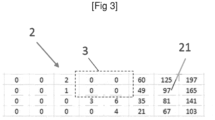
- FIG. 3 shows a portion of a second pixel matrix 2, with pixels 21, which corresponds to a second image of the ADB.
- the black zone 3 has travelled to the left, so the black zone now affects to different pixels, while on the right side of the black zone 3 now appear different light values, corresponding to the original light pattern.
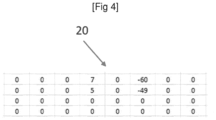
- FIG 4 shows a portion of a difference matrix 20, which is the result of subtracting the second image pattern from the first image pattern.
- This difference matrix will have a lot of zeros, since the only difference between the first and second image patterns are the left and right boundaries of the black zone.
- the next steps would be the transmission of a modified difference matrix to the light module, and the reconstruction of the second image from the buffered first image and the modified difference matrix which is transmitted.
- the modified difference matrix is a matrix which is obtained by applying the ABS function to the difference matrix. With this operation, all the values of the modified difference matrix are positive, and it is easier to be transmitted.
- the transmission may be in a compressed way or without compression.
- FIG 5 shows a portion of a provisional matrix, which is obtained in the light module by subtracting the modified difference matrix from the buffered first image.
- This provisional matrix will be almost equal to the second pattern, but with some negative values.
- the final second image pattern is restored, so that it can be projected by the light module.
- the compensation value has been chosen by adding 1 to the ABS value of the minimum value of the original difference matrix.
- the minimum value was -60
- the ABS value is 60
- the compensation value is 61 (not to leave a zero value in a pixel with a meaningful value).
- this second embodiment is shown with some steps in common with the previous embodiment, this second embodiment is especially advantageous for other applications, such as Dynamic Bending Light (DBL), where the sign information is important, since there is no black zone moving along the image, but the image profile itself is moved to the left or to the right.
- DBL Dynamic Bending Light
- this second embodiment is explained using the ADB structure of [ Fig 1] to [Fig 4 ].
- the normalized difference matrix and the compensation value are sent, either compressed or uncompressed, to the light module.
- the second image is restored by subtracting the compensation value from the normalized difference matrix and subtracting the difference matrix from the first image.
- the data transmission rate of this method is significantly lower than in other methods.
- the data may be transmitted either compressed or uncompressed.
- the data transmission rate is enough to fulfil some car manufacturers' requests, so this data may be sent to the light module compelling with restrictive conditions about the bandwidth.
- FIG 7 shows an automotive lighting device, this lighting device comprising:
- Both the control unit 6 and the processor unit 7 comprise a buffer to store the preceding image, so that this preceding image is used in the restoration of the subsequent image.
Landscapes
- Engineering & Computer Science (AREA)
- Mechanical Engineering (AREA)
- Lighting Device Outwards From Vehicle And Optical Signal (AREA)
- Image Analysis (AREA)
- Traffic Control Systems (AREA)
Description
- This invention is related to the field of automotive lighting devices, and more particularly, to the management of the electronic data derived from the control of the lighting sources.
- Current lighting devices comprises an increasing number of light sources which has to be controlled, to provide adaptive lighting functionalities.
- This number of light sources involves a big amount of data, which has to be managed by the control unit. The CAN protocol is often used, in some of their variants (CAN-FD is one of the most used ones) to transfer data between the PCM and the light module. However, some car manufacturers decide to limit the bandwidth of the CAN protocol, and this affects the management operations, which usually requires about 5 Mbps.
-
Document DE 10 2013 016904 A1 discloses a solution for the transmission of data between a control unit and a lighting unit by the use of statistic data and a set of assignments of the specific operating parameters of the basic light distributions is deposited in the light source module. - In fact, when the system deals with images in movement, the problem of saving data size is crucial, since it affects to the speed in the data transmission and therefore to the speed in images projection.
- A solution for this problem is sought.
- The invention provides a solution for these problems by means of a method for managing image data according to
claim 1 and an automotive lighting device according toclaim 5. Preferred embodiments of the invention are defined in dependent claims. - Unless otherwise defined, all terms (including technical and scientific terms) used herein are to be interpreted as is customary in the art. It will be further understood that terms in common usage should also be interpreted as is customary in the relevant art and not in an idealised or overly formal sense unless expressly so defined herein.
- In this text, the term "comprises" and its derivations (such as "comprising", etc.) should not be understood in an excluding sense, that is, these terms should not be interpreted as excluding the possibility that what is described and defined may include further elements, steps, etc.
- In a first inventive aspect, the invention provides a method for managing image data in an automotive lighting device according to
claim 1. - This method is aimed to manage the image data which is exchanged between a control unit and a light module. The control unit is in charge of calculating the difference pattern and may be located in any position of the automotive vehicle, not necessarily physically inside the lighting device. The lighting module is aimed to provide a light pattern, either for lighting or signalling, and is located inside the lighting device.
- The main advantage of this method is the decrease in the size of the dataset to be sent to the lightmodule, which is extremely useful in the cases of ADB (Adaptive Driving Beam) or DBL (Dynamic Bending Light), where the difference between a frame and the next frame is low. Sometimes, the requirement of compressing the images is not necessary, due to the fact that the data size is small enough to be transmitted without being compressed.
- In some particular embodiments, the light pixels of the image pattern are grey scale pixels, and more particularly, the luminous intensity of each pixel is according to a scale from 0 to 255.
- Light modules usually define the light pattern on a grey scale, where the luminous intensity is graded from 0 to 255. This is a way of quantifying the light pattern so that it becomes able to be converted into light data, and then transmitted and managed by the control unit of the vehicle.
- According to the invention, the method further comprises the step of buffering the first image in the light module.
- Since the first image is buffered, it is easy to prepare the next images based on the difference patterns which are being provided.
- According to the invention, the method further comprises the steps of
- normalizing the difference pattern by adding a compensation value to at least some of the pixels of the difference pattern so that the lower value of the normalized difference pattern is equal or greater than zero;
- sending the compensation value to the light module; and
- recovering the difference pattern by subtracting the compensation value from the normalized difference value.
- These steps are useful in the event there is a variation which involves intensity increases and decreases, such as in the case of DBL.
- In some example, which does not form part of the invention, the method further comprises the steps of
- applying the absolute function ABS to the difference pattern, thus generated a modified difference pattern;
- sending the modified difference pattern to the light module; and
- after reconstructing the second image pattern from the first image pattern and the modified difference pattern, applying the absolute function ABS to the second image pattern.
- These steps are useful in the event there is a variation which involves the movement of a black zone, such as in the case of ADB.
- In some particular embodiments, the method further comprises the steps of
- compressing at least a portion of the difference pattern before sending it to the light module, thus creating a compressed data; and
- decompressing the compressed data by the light module.
- Sometimes, there is no need of compressing the whole difference pattern, since some of the intensity values are zero. As a consequence, only the meaningful values are compressed.
- In some particular embodiments, the step of compressing at least a portion of the difference pattern affects to a zone of the difference pattern smaller than the 20% of the difference pattern.
- In these cases, the representative values are located in the contour of a black zone, so there is no need to compress a greater portion.
- This cropping step is useful when a big portion of the image is completely dark, so that the compression stage is focused only on the portion which include representative values.
- In a second inventive aspect, the invention provides an automotive lighting device according to
claim 5. - This lighting device is able to operate with a lower bandwidth than the traditional ones.
- According to the invention, the light module further comprises a processor unit, the processor unit being configured to decompress the compressed data.
- With a decompression stage in the proper light module, the bandwidth is narrowed until the module itself.
- According to the invention, both the control unit and the processor unit comprise an image buffer to keep the first image.
- In some particular embodiments, the light sources are solid-state light sources, such as LEDs.
- The term "solid state" refers to light emitted by solid-state electroluminescence, which uses semiconductors to convert electricity into light. Compared to incandescent lighting, solid state lighting creates visible light with reduced heat generation and less energy dissipation. The typically small mass of a solid-state electronic lighting device provides for greater resistance to shock and vibration compared to brittle glass tubes/bulbs and long, thin filament wires. They also eliminate filament evaporation, potentially increasing the life span of the illumination device. Some examples of these types of lighting comprise semiconductor light-emitting diodes (LEDs), organic light-emitting diodes (OLED), or polymer light-emitting diodes (PLED) as sources of illumination rather than electrical filaments, plasma or gas.
- To complete the description and in order to provide for a better understanding of the invention, a set of drawings is provided. Said drawings form an integral part of the description and illustrate an embodiment of the invention, which should not be interpreted as restricting the scope of the invention, but just as an example of how the invention can be carried out. The drawings comprise the following figures:
- [
Fig 1 ] shows a first image of the photometry of a high beam module which is projected by an automotive lighting device according to the invention. - [
Fig 2 ] shows a portion of a pixel matrix representing the photometry of [Fig 1 ]. - [
Fig 3 ] shows a portion of a second pixel matrix, which corresponds to a second image of a first embodiment of a method according to the invention. - [
Fig. 4 ] shows a portion of a difference matrix, which corresponds to an intermediate image of a first embodiment of a method according to the invention. - [
Fig. 5 ] shows a portion of a provisional matrix, which corresponds to an intermediate image of a first embodiment of a method which does not form part of the invention. - [
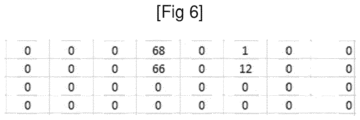
Fig. 6 ] shows a portion of a normalized difference matrix, which corresponds to an intermediate image of a second embodiment of a method according to the invention. - [
Fig. 7 ] shows an automotive lighting device according to the invention. - Elements of the example embodiments are consistently denoted by the same reference numerals throughout the drawings and detailed description where appropriate:
- 1 First image pattern
- 11 Pixel of the first image pattern
- 2 Second image pattern
- 21 Pixel of the second image pattern
- 3 Black zone
- 4 Light module
- 5 LEDs
- 6 Control unit
- 7 Processor unit
- 10 Automotive lighting device
- 20 Difference matrix
- 100 Automotive vehicle
- The example embodiments are described in sufficient detail to enable those of ordinary skill in the art to embody and implement the systems and processes herein described. It is important to understand that embodiments can be provided in many alternate forms and should not be construed as limited to the examples set forth herein.
- Accordingly, while embodiment can be modified in various ways and take on various alternative forms, specific embodiments thereof are shown in the drawings and described in detail below as examples. There is no intent to limit to the particular forms disclosed. On the contrary, the invention is defined by the scope of the appended claims.
- [
Fig 1 ] shows a first image of the photometry of a high beam module which is to be projected by an automotive lighting device according to the invention. - This first image may be divided into pixels and each pixel may be characterized by its luminous intensity, in a scale from 0, which would correspond to black, to 255, which would correspond to white.
- This image corresponds to an image of an Adaptive Driving Beam (ADB), which comprises a
black zone 3 which travels through the image to keep a vehicle driving in the opposite lane out of reach of the high beam. - This first image is sent and buffered in the lighting module, so that the rest of subsequent images are reconstructed from the preceding one.
- [
Fig 2 ] shows a portion of such a pixel matrix, calledimage pattern 1. Eachpixel 11 of thisimage pattern 1 is characterized by a number according to the aforementioned scale. - In this example, for the sake of clarity, this
black zone 3 is represented only by four pixels, which does not correspond to a realistic approach, but the correspondence with the real-life images is direct. - [
Fig 3 ] shows a portion of asecond pixel matrix 2, withpixels 21, which corresponds to a second image of the ADB. As may be seen in this image, theblack zone 3 has travelled to the left, so the black zone now affects to different pixels, while on the right side of theblack zone 3 now appear different light values, corresponding to the original light pattern. - [
Fig 4 ] shows a portion of adifference matrix 20, which is the result of subtracting the second image pattern from the first image pattern. This difference matrix will have a lot of zeros, since the only difference between the first and second image patterns are the left and right boundaries of the black zone. - The next steps would be the transmission of a modified difference matrix to the light module, and the reconstruction of the second image from the buffered first image and the modified difference matrix which is transmitted.
- According to an example, which does not form part of the invention, the modified difference matrix is a matrix which is obtained by applying the ABS function to the difference matrix. With this operation, all the values of the modified difference matrix are positive, and it is easier to be transmitted.
- The transmission may be in a compressed way or without compression.
- [
Fig 5 ] shows a portion of a provisional matrix, which is obtained in the light module by subtracting the modified difference matrix from the buffered first image. This provisional matrix will be almost equal to the second pattern, but with some negative values. - By the application of the ABS function to this provisional matrix, the final second image pattern is restored, so that it can be projected by the light module.
- There is a second embodiment of a method according to the invention. The steps of [
Fig 1] to [Fig 4 ] would be the same, and the difference matrix is calculated. - However, in this second embodiment, instead of applying the ABS function over the difference matrix, a compensation value is added to all the values which are different from zero in this difference matrix, obtaining a normalized difference matrix, as shown in [
Fig 6 ]. In this normalized difference matrix, all the values are greater or equal to zero, but this has been obtained by a different method than in the previous embodiment of the method. - The compensation value has been chosen by adding 1 to the ABS value of the minimum value of the original difference matrix. In this case, the minimum value was -60, the ABS value is 60 and the compensation value is 61 (not to leave a zero value in a pixel with a meaningful value).
- Although this second embodiment is shown with some steps in common with the previous embodiment, this second embodiment is especially advantageous for other applications, such as Dynamic Bending Light (DBL), where the sign information is important, since there is no black zone moving along the image, but the image profile itself is moved to the left or to the right. However, for the sake of convenience, this second embodiment is explained using the ADB structure of [
Fig 1] to [Fig 4 ]. - Following with this second embodiment, the normalized difference matrix and the compensation value are sent, either compressed or uncompressed, to the light module. In the light module, the second image is restored by subtracting the compensation value from the normalized difference matrix and subtracting the difference matrix from the first image.
- The final result is the same. Each embodiment is chosen depending on the light functionality.
- The data transmission rate of this method is significantly lower than in other methods. In fact, the data may be transmitted either compressed or uncompressed. In any case, the data transmission rate is enough to fulfil some car manufacturers' requests, so this data may be sent to the light module compelling with restrictive conditions about the bandwidth.
- [
Fig 7 ] shows an automotive lighting device, this lighting device comprising: - a
light module 4 comprising a plurality ofLEDs 5; - a
control unit 6 to carry out the compression steps described in the previous figures, generating the compressed data; and - a
processor unit 7, theprocessor unit 7 being configured to decompress the compressed data, this processor unit being located in thelight module 4. - Both the
control unit 6 and theprocessor unit 7 comprise a buffer to store the preceding image, so that this preceding image is used in the restoration of the subsequent image.
Claims (6)
- Method for managing image data in an automotive lighting device (10), the method comprising the steps of:- providing by a control unit a first image pattern (1) comprising a plurality of pixels (11), wherein each pixel is characterized by a value related to the luminous intensity of the pixel (11);- sending the first image pattern to a light module;- buffering the first image in the light module;- providing by the control unit a second image pattern (2) comprising a plurality of pixels (21), wherein each pixel is characterized by a value related to the luminous intensity of the pixel (21);- generating a difference pattern (20), which is obtained by subtracting the second image pattern from the first image pattern; characterized by- normalizing the difference pattern by adding a compensation value to at least some of the pixels of the difference pattern so that the lower value of the normalized difference pattern is equal or greater than zero;- sending the compensation value to the light module; and- sending the difference pattern (20) to the light module (4), so the light module (4) is able to recover the difference pattern by subtracting the compensation value from the normalized difference value and reconstruct the second image pattern (2) from the data of the first image pattern (1) and the difference pattern (20).
- Method according to claim 1, wherein the light pixels (11) of the image pattern (1) are greyscale pixels, and more particularly, the luminous intensity of each pixel (11) is characterized by a number according to a scale from 0 to 255.
- Method according to any of the preceding claims, further comprising the steps of:- compressing at least a portion of the difference pattern before sending it to the light module, thus creating a compressed data; and- decompressing the compressed data by the light module.
- Method according to claim 3, wherein the step of compressing at least a portion of the difference pattern affects to a zone of the difference pattern smaller than the 20% of the difference pattern.
- Automotive lighting device (10) comprising:- a light module (4) comprising a plurality of light sources (5) and a processor unit (7) configured to decompress the compressed data, the processing unit comprising an image buffer to keep the first image; and- a control unit (6) to carry out the steps of a method according to any of the preceding claims, the control unit comprising an image buffer to keep the first image.
- Automotive lighting device (10) according to claim 5, wherein the light sources (5) are solid-state light sources, such as LEDs.
Applications Claiming Priority (2)
| Application Number | Priority Date | Filing Date | Title |
|---|---|---|---|
| FR1911966A FR3102536B1 (en) | 2019-10-25 | 2019-10-25 | Image data management method and automobile lighting device |
| PCT/EP2020/080085 WO2021079007A1 (en) | 2019-10-25 | 2020-10-26 | Method for managing image data and automotive lighting device |
Publications (2)
| Publication Number | Publication Date |
|---|---|
| EP4048554A1 EP4048554A1 (en) | 2022-08-31 |
| EP4048554B1 true EP4048554B1 (en) | 2025-01-01 |
Family
ID=72178565
Family Applications (1)
| Application Number | Title | Priority Date | Filing Date |
|---|---|---|---|
| EP20800582.7A Active EP4048554B1 (en) | 2019-10-25 | 2020-10-26 | Method for managing image data and automotive lighting device |
Country Status (6)
| Country | Link |
|---|---|
| US (1) | US12036915B2 (en) |
| EP (1) | EP4048554B1 (en) |
| JP (1) | JP7419518B2 (en) |
| CN (1) | CN114901516B (en) |
| FR (1) | FR3102536B1 (en) |
| WO (1) | WO2021079007A1 (en) |
Family Cites Families (12)
| Publication number | Priority date | Publication date | Assignee | Title |
|---|---|---|---|---|
| JPH06284412A (en) * | 1993-03-26 | 1994-10-07 | Sony Corp | Image signal encoding method, image signal encoding device, image signal decoding method, image signal decoding device, and image signal recording medium |
| JP2004210128A (en) * | 2002-12-27 | 2004-07-29 | Ichikoh Ind Ltd | Digital lighting system for vehicles |
| US6969183B2 (en) | 2002-12-27 | 2005-11-29 | Ichikoh Industries, Ltd. | Digital lighting apparatus for vehicle, controller for digital lighting apparatus, and control program for digital lighting apparatus |
| JP2011087727A (en) * | 2009-10-22 | 2011-05-06 | Konica Minolta Medical & Graphic Inc | Radiographic imaging device and radiographic imaging system |
| GB2499579B (en) | 2012-02-07 | 2014-11-26 | Two Trees Photonics Ltd | Lighting device |
| DE102013016904A1 (en) * | 2013-10-11 | 2014-07-10 | Daimler Ag | Light emitting unit e.g. pixel headlamps for vehicle, has light source module that includes set of assignments of specific operating parameters of basic light distributions in light source module |
| JP6284412B2 (en) | 2014-04-14 | 2018-02-28 | 古河電気工業株式会社 | Thermal storage fuel heater |
| DE102015011024A1 (en) * | 2015-08-22 | 2017-02-23 | Audi Ag | Driving a light source and vehicle |
| DE102016210147A1 (en) * | 2016-06-08 | 2017-12-14 | Osram Gmbh | Controlling a headlight having a controllable light source and an optical unit |
| AT518724B1 (en) * | 2016-06-13 | 2018-02-15 | Zkw Group Gmbh | Vehicle headlight and method for generating a light distribution |
| JP6932610B2 (en) | 2017-10-19 | 2021-09-08 | 株式会社小糸製作所 | Vehicle lighting system, vehicle lighting control device, and vehicle lighting control method |
| JP6952934B2 (en) | 2019-04-12 | 2021-10-27 | 三菱電機株式会社 | Light distribution control system |
-
2019
- 2019-10-25 FR FR1911966A patent/FR3102536B1/en active Active
-
2020
- 2020-10-26 EP EP20800582.7A patent/EP4048554B1/en active Active
- 2020-10-26 WO PCT/EP2020/080085 patent/WO2021079007A1/en not_active Ceased
- 2020-10-26 US US17/770,169 patent/US12036915B2/en active Active
- 2020-10-26 JP JP2022523976A patent/JP7419518B2/en active Active
- 2020-10-26 CN CN202080090753.XA patent/CN114901516B/en active Active
Also Published As
| Publication number | Publication date |
|---|---|
| CN114901516A (en) | 2022-08-12 |
| FR3102536B1 (en) | 2022-06-17 |
| US12036915B2 (en) | 2024-07-16 |
| US20220388443A1 (en) | 2022-12-08 |
| JP7419518B2 (en) | 2024-01-22 |
| EP4048554A1 (en) | 2022-08-31 |
| FR3102536A1 (en) | 2021-04-30 |
| CN114901516B (en) | 2025-09-23 |
| WO2021079007A1 (en) | 2021-04-29 |
| JP2022553098A (en) | 2022-12-21 |
Similar Documents
| Publication | Publication Date | Title |
|---|---|---|
| EP4048554B1 (en) | Method for managing image data and automotive lighting device | |
| US20230382293A1 (en) | Method for managing image data and automotive lighting device | |
| WO2021079008A1 (en) | Method for managing image data and automotive lighting device | |
| US20240181956A1 (en) | Method for controlling a light pattern and automotive lighting device | |
| WO2022207582A9 (en) | Method for managing image data and automotive lighting device | |
| JP7439262B2 (en) | Image data management method and automotive lighting device | |
| US12262026B2 (en) | Method for managing image data and automotive lighting device | |
| US12361595B2 (en) | Method for managing image data and automotive lighting device | |
| WO2022207583A1 (en) | Method for managing image data and automotive lighting device | |
| WO2021079009A1 (en) | Method for managing image data and automotive lighting device | |
| FR3102629A1 (en) | Image data management method and automotive lighting device | |
| WO2021079006A1 (en) | Method for managing image data and automotive lighting device |
Legal Events
| Date | Code | Title | Description |
|---|---|---|---|
| STAA | Information on the status of an ep patent application or granted ep patent |
Free format text: STATUS: UNKNOWN |
|
| STAA | Information on the status of an ep patent application or granted ep patent |
Free format text: STATUS: THE INTERNATIONAL PUBLICATION HAS BEEN MADE |
|
| PUAI | Public reference made under article 153(3) epc to a published international application that has entered the european phase |
Free format text: ORIGINAL CODE: 0009012 |
|
| STAA | Information on the status of an ep patent application or granted ep patent |
Free format text: STATUS: REQUEST FOR EXAMINATION WAS MADE |
|
| 17P | Request for examination filed |
Effective date: 20220506 |
|
| AK | Designated contracting states |
Kind code of ref document: A1 Designated state(s): AL AT BE BG CH CY CZ DE DK EE ES FI FR GB GR HR HU IE IS IT LI LT LU LV MC MK MT NL NO PL PT RO RS SE SI SK SM TR |
|
| DAV | Request for validation of the european patent (deleted) | ||
| DAX | Request for extension of the european patent (deleted) | ||
| P01 | Opt-out of the competence of the unified patent court (upc) registered |
Effective date: 20230528 |
|
| GRAP | Despatch of communication of intention to grant a patent |
Free format text: ORIGINAL CODE: EPIDOSNIGR1 |
|
| STAA | Information on the status of an ep patent application or granted ep patent |
Free format text: STATUS: GRANT OF PATENT IS INTENDED |
|
| INTG | Intention to grant announced |
Effective date: 20240726 |
|
| GRAS | Grant fee paid |
Free format text: ORIGINAL CODE: EPIDOSNIGR3 |
|
| GRAA | (expected) grant |
Free format text: ORIGINAL CODE: 0009210 |
|
| STAA | Information on the status of an ep patent application or granted ep patent |
Free format text: STATUS: THE PATENT HAS BEEN GRANTED |
|
| AK | Designated contracting states |
Kind code of ref document: B1 Designated state(s): AL AT BE BG CH CY CZ DE DK EE ES FI FR GB GR HR HU IE IS IT LI LT LU LV MC MK MT NL NO PL PT RO RS SE SI SK SM TR |
|
| REG | Reference to a national code |
Ref country code: GB Ref legal event code: FG4D |
|
| REG | Reference to a national code |
Ref country code: CH Ref legal event code: EP |
|
| REG | Reference to a national code |
Ref country code: DE Ref legal event code: R096 Ref document number: 602020044136 Country of ref document: DE |
|
| REG | Reference to a national code |
Ref country code: IE Ref legal event code: FG4D |
|
| REG | Reference to a national code |
Ref country code: LT Ref legal event code: MG9D |
|
| REG | Reference to a national code |
Ref country code: NL Ref legal event code: MP Effective date: 20250101 |
|
| REG | Reference to a national code |
Ref country code: AT Ref legal event code: MK05 Ref document number: 1755931 Country of ref document: AT Kind code of ref document: T Effective date: 20250101 |
|
| PG25 | Lapsed in a contracting state [announced via postgrant information from national office to epo] |
Ref country code: NL Free format text: LAPSE BECAUSE OF FAILURE TO SUBMIT A TRANSLATION OF THE DESCRIPTION OR TO PAY THE FEE WITHIN THE PRESCRIBED TIME-LIMIT Effective date: 20250101 |
|
| PG25 | Lapsed in a contracting state [announced via postgrant information from national office to epo] |
Ref country code: FI Free format text: LAPSE BECAUSE OF FAILURE TO SUBMIT A TRANSLATION OF THE DESCRIPTION OR TO PAY THE FEE WITHIN THE PRESCRIBED TIME-LIMIT Effective date: 20250101 |
|
| PG25 | Lapsed in a contracting state [announced via postgrant information from national office to epo] |
Ref country code: PL Free format text: LAPSE BECAUSE OF FAILURE TO SUBMIT A TRANSLATION OF THE DESCRIPTION OR TO PAY THE FEE WITHIN THE PRESCRIBED TIME-LIMIT Effective date: 20250101 |
|
| PG25 | Lapsed in a contracting state [announced via postgrant information from national office to epo] |
Ref country code: ES Free format text: LAPSE BECAUSE OF FAILURE TO SUBMIT A TRANSLATION OF THE DESCRIPTION OR TO PAY THE FEE WITHIN THE PRESCRIBED TIME-LIMIT Effective date: 20250101 |
|
| PG25 | Lapsed in a contracting state [announced via postgrant information from national office to epo] |
Ref country code: NO Free format text: LAPSE BECAUSE OF FAILURE TO SUBMIT A TRANSLATION OF THE DESCRIPTION OR TO PAY THE FEE WITHIN THE PRESCRIBED TIME-LIMIT Effective date: 20250401 Ref country code: IS Free format text: LAPSE BECAUSE OF FAILURE TO SUBMIT A TRANSLATION OF THE DESCRIPTION OR TO PAY THE FEE WITHIN THE PRESCRIBED TIME-LIMIT Effective date: 20250501 |
|
| PG25 | Lapsed in a contracting state [announced via postgrant information from national office to epo] |
Ref country code: HR Free format text: LAPSE BECAUSE OF FAILURE TO SUBMIT A TRANSLATION OF THE DESCRIPTION OR TO PAY THE FEE WITHIN THE PRESCRIBED TIME-LIMIT Effective date: 20250101 |
|
| PG25 | Lapsed in a contracting state [announced via postgrant information from national office to epo] |
Ref country code: LV Free format text: LAPSE BECAUSE OF FAILURE TO SUBMIT A TRANSLATION OF THE DESCRIPTION OR TO PAY THE FEE WITHIN THE PRESCRIBED TIME-LIMIT Effective date: 20250101 Ref country code: PT Free format text: LAPSE BECAUSE OF FAILURE TO SUBMIT A TRANSLATION OF THE DESCRIPTION OR TO PAY THE FEE WITHIN THE PRESCRIBED TIME-LIMIT Effective date: 20250502 |
|
| PG25 | Lapsed in a contracting state [announced via postgrant information from national office to epo] |
Ref country code: GR Free format text: LAPSE BECAUSE OF FAILURE TO SUBMIT A TRANSLATION OF THE DESCRIPTION OR TO PAY THE FEE WITHIN THE PRESCRIBED TIME-LIMIT Effective date: 20250402 Ref country code: BG Free format text: LAPSE BECAUSE OF FAILURE TO SUBMIT A TRANSLATION OF THE DESCRIPTION OR TO PAY THE FEE WITHIN THE PRESCRIBED TIME-LIMIT Effective date: 20250101 |
|
| PG25 | Lapsed in a contracting state [announced via postgrant information from national office to epo] |
Ref country code: AT Free format text: LAPSE BECAUSE OF FAILURE TO SUBMIT A TRANSLATION OF THE DESCRIPTION OR TO PAY THE FEE WITHIN THE PRESCRIBED TIME-LIMIT Effective date: 20250101 |
|
| PG25 | Lapsed in a contracting state [announced via postgrant information from national office to epo] |
Ref country code: CZ Free format text: LAPSE BECAUSE OF FAILURE TO SUBMIT A TRANSLATION OF THE DESCRIPTION OR TO PAY THE FEE WITHIN THE PRESCRIBED TIME-LIMIT Effective date: 20250101 |
|
| PG25 | Lapsed in a contracting state [announced via postgrant information from national office to epo] |
Ref country code: SE Free format text: LAPSE BECAUSE OF FAILURE TO SUBMIT A TRANSLATION OF THE DESCRIPTION OR TO PAY THE FEE WITHIN THE PRESCRIBED TIME-LIMIT Effective date: 20250101 |
|
| REG | Reference to a national code |
Ref country code: DE Ref legal event code: R097 Ref document number: 602020044136 Country of ref document: DE |
|
| PG25 | Lapsed in a contracting state [announced via postgrant information from national office to epo] |
Ref country code: SM Free format text: LAPSE BECAUSE OF FAILURE TO SUBMIT A TRANSLATION OF THE DESCRIPTION OR TO PAY THE FEE WITHIN THE PRESCRIBED TIME-LIMIT Effective date: 20250101 |
|
| PG25 | Lapsed in a contracting state [announced via postgrant information from national office to epo] |
Ref country code: DK Free format text: LAPSE BECAUSE OF FAILURE TO SUBMIT A TRANSLATION OF THE DESCRIPTION OR TO PAY THE FEE WITHIN THE PRESCRIBED TIME-LIMIT Effective date: 20250101 |
|
| PG25 | Lapsed in a contracting state [announced via postgrant information from national office to epo] |
Ref country code: IT Free format text: LAPSE BECAUSE OF FAILURE TO SUBMIT A TRANSLATION OF THE DESCRIPTION OR TO PAY THE FEE WITHIN THE PRESCRIBED TIME-LIMIT Effective date: 20250101 |
|
| PG25 | Lapsed in a contracting state [announced via postgrant information from national office to epo] |
Ref country code: EE Free format text: LAPSE BECAUSE OF FAILURE TO SUBMIT A TRANSLATION OF THE DESCRIPTION OR TO PAY THE FEE WITHIN THE PRESCRIBED TIME-LIMIT Effective date: 20250101 |
|
| PG25 | Lapsed in a contracting state [announced via postgrant information from national office to epo] |
Ref country code: RO Free format text: LAPSE BECAUSE OF FAILURE TO SUBMIT A TRANSLATION OF THE DESCRIPTION OR TO PAY THE FEE WITHIN THE PRESCRIBED TIME-LIMIT Effective date: 20250101 |
|
| PG25 | Lapsed in a contracting state [announced via postgrant information from national office to epo] |
Ref country code: SK Free format text: LAPSE BECAUSE OF FAILURE TO SUBMIT A TRANSLATION OF THE DESCRIPTION OR TO PAY THE FEE WITHIN THE PRESCRIBED TIME-LIMIT Effective date: 20250101 |
|
| PLBE | No opposition filed within time limit |
Free format text: ORIGINAL CODE: 0009261 |
|
| STAA | Information on the status of an ep patent application or granted ep patent |
Free format text: STATUS: NO OPPOSITION FILED WITHIN TIME LIMIT |
|
| 26N | No opposition filed |
Effective date: 20251002 |
|
| PGFP | Annual fee paid to national office [announced via postgrant information from national office to epo] |
Ref country code: DE Payment date: 20251015 Year of fee payment: 6 |
|
| PGFP | Annual fee paid to national office [announced via postgrant information from national office to epo] |
Ref country code: FR Payment date: 20251027 Year of fee payment: 6 |