EP4045781B1 - Fluidic command device of a vehicle - Google Patents
Fluidic command device of a vehicle Download PDFInfo
- Publication number
- EP4045781B1 EP4045781B1 EP20799825.3A EP20799825A EP4045781B1 EP 4045781 B1 EP4045781 B1 EP 4045781B1 EP 20799825 A EP20799825 A EP 20799825A EP 4045781 B1 EP4045781 B1 EP 4045781B1
- Authority
- EP
- European Patent Office
- Prior art keywords
- group
- command
- duct
- fluidic
- valve element
- Prior art date
- Legal status (The legal status is an assumption and is not a legal conclusion. Google has not performed a legal analysis and makes no representation as to the accuracy of the status listed.)
- Active
Links
Images





Classifications
-
- B—PERFORMING OPERATIONS; TRANSPORTING
- B60—VEHICLES IN GENERAL
- B60K—ARRANGEMENT OR MOUNTING OF PROPULSION UNITS OR OF TRANSMISSIONS IN VEHICLES; ARRANGEMENT OR MOUNTING OF PLURAL DIVERSE PRIME-MOVERS IN VEHICLES; AUXILIARY DRIVES FOR VEHICLES; INSTRUMENTATION OR DASHBOARDS FOR VEHICLES; ARRANGEMENTS IN CONNECTION WITH COOLING, AIR INTAKE, GAS EXHAUST OR FUEL SUPPLY OF PROPULSION UNITS IN VEHICLES
- B60K11/00—Arrangement in connection with cooling of propulsion units
- B60K11/02—Arrangement in connection with cooling of propulsion units with liquid cooling
-
- F—MECHANICAL ENGINEERING; LIGHTING; HEATING; WEAPONS; BLASTING
- F01—MACHINES OR ENGINES IN GENERAL; ENGINE PLANTS IN GENERAL; STEAM ENGINES
- F01P—COOLING OF MACHINES OR ENGINES IN GENERAL; COOLING OF INTERNAL-COMBUSTION ENGINES
- F01P7/00—Controlling of coolant flow
- F01P7/14—Controlling of coolant flow the coolant being liquid
- F01P7/16—Controlling of coolant flow the coolant being liquid by thermostatic control
- F01P7/165—Controlling of coolant flow the coolant being liquid by thermostatic control characterised by systems with two or more loops
-
- F—MECHANICAL ENGINEERING; LIGHTING; HEATING; WEAPONS; BLASTING
- F16—ENGINEERING ELEMENTS AND UNITS; GENERAL MEASURES FOR PRODUCING AND MAINTAINING EFFECTIVE FUNCTIONING OF MACHINES OR INSTALLATIONS; THERMAL INSULATION IN GENERAL
- F16K—VALVES; TAPS; COCKS; ACTUATING-FLOATS; DEVICES FOR VENTING OR AERATING
- F16K11/00—Multiple-way valves, e.g. mixing valves; Pipe fittings incorporating such valves
- F16K11/02—Multiple-way valves, e.g. mixing valves; Pipe fittings incorporating such valves with all movable sealing faces moving as one unit
- F16K11/08—Multiple-way valves, e.g. mixing valves; Pipe fittings incorporating such valves with all movable sealing faces moving as one unit comprising only taps or cocks
- F16K11/085—Multiple-way valves, e.g. mixing valves; Pipe fittings incorporating such valves with all movable sealing faces moving as one unit comprising only taps or cocks with cylindrical plug
-
- F—MECHANICAL ENGINEERING; LIGHTING; HEATING; WEAPONS; BLASTING
- F16—ENGINEERING ELEMENTS AND UNITS; GENERAL MEASURES FOR PRODUCING AND MAINTAINING EFFECTIVE FUNCTIONING OF MACHINES OR INSTALLATIONS; THERMAL INSULATION IN GENERAL
- F16K—VALVES; TAPS; COCKS; ACTUATING-FLOATS; DEVICES FOR VENTING OR AERATING
- F16K11/00—Multiple-way valves, e.g. mixing valves; Pipe fittings incorporating such valves
- F16K11/10—Multiple-way valves, e.g. mixing valves; Pipe fittings incorporating such valves with two or more closure members not moving as a unit
- F16K11/14—Multiple-way valves, e.g. mixing valves; Pipe fittings incorporating such valves with two or more closure members not moving as a unit operated by one actuating member, e.g. a handle
- F16K11/16—Multiple-way valves, e.g. mixing valves; Pipe fittings incorporating such valves with two or more closure members not moving as a unit operated by one actuating member, e.g. a handle which only slides, or only turns, or only swings in one plane
- F16K11/163—Multiple-way valves, e.g. mixing valves; Pipe fittings incorporating such valves with two or more closure members not moving as a unit operated by one actuating member, e.g. a handle which only slides, or only turns, or only swings in one plane only turns
- F16K11/165—Multiple-way valves, e.g. mixing valves; Pipe fittings incorporating such valves with two or more closure members not moving as a unit operated by one actuating member, e.g. a handle which only slides, or only turns, or only swings in one plane only turns with the rotating spindles parallel to the closure members
-
- F—MECHANICAL ENGINEERING; LIGHTING; HEATING; WEAPONS; BLASTING
- F16—ENGINEERING ELEMENTS AND UNITS; GENERAL MEASURES FOR PRODUCING AND MAINTAINING EFFECTIVE FUNCTIONING OF MACHINES OR INSTALLATIONS; THERMAL INSULATION IN GENERAL
- F16K—VALVES; TAPS; COCKS; ACTUATING-FLOATS; DEVICES FOR VENTING OR AERATING
- F16K31/00—Actuating devices; Operating means; Releasing devices
- F16K31/44—Mechanical actuating means
- F16K31/53—Mechanical actuating means with toothed gearing
- F16K31/535—Mechanical actuating means with toothed gearing for rotating valves
-
- F—MECHANICAL ENGINEERING; LIGHTING; HEATING; WEAPONS; BLASTING
- F01—MACHINES OR ENGINES IN GENERAL; ENGINE PLANTS IN GENERAL; STEAM ENGINES
- F01P—COOLING OF MACHINES OR ENGINES IN GENERAL; COOLING OF INTERNAL-COMBUSTION ENGINES
- F01P5/00—Pumping cooling-air or liquid coolants
- F01P5/10—Pumping liquid coolant; Arrangements of coolant pumps
- F01P2005/105—Using two or more pumps
-
- F—MECHANICAL ENGINEERING; LIGHTING; HEATING; WEAPONS; BLASTING
- F01—MACHINES OR ENGINES IN GENERAL; ENGINE PLANTS IN GENERAL; STEAM ENGINES
- F01P—COOLING OF MACHINES OR ENGINES IN GENERAL; COOLING OF INTERNAL-COMBUSTION ENGINES
- F01P2050/00—Applications
- F01P2050/24—Hybrid vehicles
Definitions
- the present invention relates to a fluidic command device of a thermal management assembly of a thermal regulation system of a vehicle. Furthermore, the present invention also relates to a thermal management assembly that comprises said fluidic command device. Additionally, the present invention relates to the thermal regulation system of a vehicle, which comprises said thermal management assembly. Furthermore, the present invention also relates to a vehicle, which comprises said system and comprises said thermal management assembly.
- the present invention relates to the automotive field and in detail to the thermal regulation system of a vehicle.
- vehicle relates to any means of transport without any limitation as to type or size, i.e. a motor vehicle or a semi-articulated vehicle.
- operating group means a specific component or group of components for carrying out a given operation required for the motion of the vehicle. Therefore, for example, operating group means the endothermic engine group, or the battery group, or the gearbox group, or the transmission group, or the electric motor group, or the battery group.
- an "operating group” comprises one or more components or groups of components also comprised in other distinct “operating groups”.
- each operating group has different needs.
- each of said operating groups has a mutually different operating behavior; while both the vehicle is in motion and when it is stationary (e.g. the electric motor operates in situations with the endothermic engine in standby). Therefore, it is apparent that each operating group has different needs for thermal management, cooling and/or heating, as a function of the different operating situations of the vehicle and as a function of its physical features.
- Vehicle solutions which comprise a specific thermal regulation system for each operating group, in which a specific amount of working fluid circulates.
- each specific thermal regulation system is designed independently, requiring specific components (e.g. specific pump groups).
- GB2 383 840 shows an arrangement for the cooling system of a hybrid vehicle.
- the main problem present in this field is that of having, accommodating, and managing a multitude of components required for the thermal management of each operating group comprised in the same vehicle.
- Such an object is achieved by a fluidic command device as claimed in claim 1. Furthermore, such an object is achieved by a thermal management assembly as claimed in claim 12. Similarly, such an object is achieved by a thermal regulation system of a vehicle, which comprises such a thermal management assembly, as claimed in claim 13. Furthermore, such an object is achieved by a vehicle, which comprises the thermal regulation system according to claim 14.
- reference numeral 500 indicates as a whole a thermal management assembly of a thermal regulation system 600 of a vehicle 900 (diagrammatically shown in the figures), according to the present invention.
- the present invention also relates to the thermal regulation system 600 that comprises the thermal management assembly 500.
- the present invention also relates to the vehicle 900 that comprises the thermal regulation system 600.
- said vehicle 900 is hybrid-powered, i.e. is powered in combination by an endothermic engine group and at least one electric motor group electrically supplied by a respective battery group.
- the vehicle 900 comprises an endothermic engine group with power supply and two electric motor groups powered by two battery groups, respectively.
- the vehicle 900 comprises a first operating group 910, a second operating group 920, a third operating group 930, and a fourth operating group 940.
- Each operating group corresponds to a "load”.
- each operating group corresponds to a respective component or group of components comprised in the vehicle and preferably belonging to the power supply of the vehicle.
- the first operating group 910 is an endothermic engine group.
- the second operating group 920 comprises a first battery group and a second battery group.
- the third operating group 930 comprises the first battery group and a first electric motor group.
- the fourth operating group 940 comprises the second battery group and a second electric motor group.
- the first operating group 910, the second operating group 920, the third operating group 930, and the fourth operating group 940 are fluidically connected to the thermal regulation system 600.
- the first operating group 910, the second operating group 920, the third operating group 930, and the fourth operating group 940 are fluidically connected by means of a plurality of system ducts 601, 602, 603, 604, 611, 612, 613, 614 comprised in the thermal regulation system 600.
- the thermal regulation system 600 further comprises specific heat exchanger groups (not shown).
- the thermal regulation system 600 comprises at least one system inlet duct and at least one system outlet duct in fluid connection with each operating group.
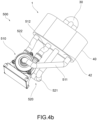
- the thermal management assembly 500 comprises a first pump group 510 suitable to command the motion of the working fluid comprising a first inlet duct 511 and a first outlet duct 512.
- the thermal management assembly 500 comprises a second pump group 520 suitable, in turn, to command the motion of the working fluid comprising a second inlet duct 521 and a second outlet duct 522.
- the first pump group 510 comprises a first command unit 513 comprising a first impeller, which intercepts the working fluid flowing in the first inlet duct 511 to send it into the first outlet duct 512.
- said first impeller is of the radial type, aspirating working fluid axially through the first inlet duct 511 to push it out tangentially towards the first outlet duct 512.
- the first pump group 510 further comprises a first stabilization tank 514, which divides the first inlet duct 511 into a first duct upstream section 511' and a first duct downstream section 511".
- said first stabilization tank 514 unifies the pressure of the flowing liquid before it reaches the first impeller comprised in the first command unit 513.
- the working fluid reaches the first command unit 513 after having flowed in the first stabilization tank 514.
- the second pump group 520 comprises a second command group 523 comprising a second impeller, which intercepts the working fluid flowing in the second inlet duct 521 to send it into the second outlet duct 522.
- said second impeller is of the radial type, aspirating working fluid axially through the second inlet duct 521 to push it out tangentially towards the second outlet duct 522.
- the second pump group 520 further comprises a second stabilization tank 524, which divides the second inlet duct 521 into a second duct upstream section 521' and a second duct downstream section 521".
- said second stabilization tank 524 unifies the pressure of the flowing liquid before it reaches the second impeller comprised in the second command unit 523.
- the working fluid reaches the second command unit 523 after having flowed in the second stabilization tank 524.
- the thermal management assembly 500 further comprises a fluidic command device 1 suitable to manage the amounts of working fluid flowing in the thermal management assembly 500.
- the fluidic command device 1 is fluidically connected to the first pair of ducts 511, 512 and to the second pair of ducts 521, 522. Thereby, the fluidic command device 1 is suitable for managing through which of these ducts the working fluid flows.
- fluidic command device 1 is fluidically connectable by means of system ducts to the respective operating groups.
- the fluidic command device 1 comprises four inlet ports I1, I2, I3, I4, each one being fluidically connectable to a respective operating group 910, 920, 930, 940 to allow the working fluid to enter into the fluidic command device 1.
- the fluidic command device 1 receives working fluid from the respective operating groups 910, 920, 930, 940.
- the fluidic command device 1 comprises four outlet ports O1, O2, O3, O4, each one being fluidically connectable to a respective operating group 910, 920, 930, 940 to allow the working fluid to exit from the fluidic command device 1.
- the fluidic command device 1 releases working fluid to the respective operating groups 910, 920, 930, 940.
- the fluidic command device 1 comprises an auxiliary duct 30, which fluidically connects the first pump group 510 and the second pump group 520.
- the auxiliary duct 30 is a bypass duct, which directly connects the first pump group 510 and the second pump group 520.
- the auxiliary duct 30 connects the first pump group 510 directly to the second pump group 520 so that no operating group is fluidically present between the two pump groups.
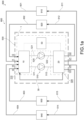
- the fluidic command device 1 is configurable in a first working configuration, in which the working fluid flows into the first inlet port I1 and flows out from the first outlet port O1, thus preventing the flow through the other inlet ports and the other outlet ports; in said first configuration, the working fluid flows between the first inlet port I1 and the first outlet port O1 into the first pump group 510, the auxiliary duct 30 and the second pump group 520.
- the first working configuration is diagrammatically shown by way of example in figures 2a and 2a' .
- the fluidic command device 1 in the first working configuration, is configured to identify a single fluid circuit in which the temperature of the first operating group 910 is managed. In yet other words, in the first working configuration, the fluidic command device 1 is configured to manage the temperature of the first operating group 910 using the first pump group 510 and the second pump group 520 in series.
- the fluidic command device 1 is configurable in a second working configuration, in which the working fluid flows into the second inlet port I2 and flows out from the second outlet port O2, thus preventing the flow through the other inlet ports and the other outlet ports; in which, between the second inlet port I2 and the second outlet port O2, the working fluid flows both in the first pump group 510 and in the second pump group 520, thus preventing the flow in the auxiliary duct 30.
- the second working configuration is diagrammatically shown by way of example in figures 2b and 2b' .
- the fluidic command device 1 in the second working configuration, is configured to identify a single fluid circuit in which the temperature of the second operating group 920 is managed. In yet other words, in the second working configuration, the fluidic command device 1 is configured to manage the temperature of the second operating group 920 using the first pump group 510 and the second pump group 520 in parallel.
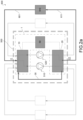
- the fluidic command device 1 is configurable in a third working configuration, in which the working fluid flows into the third inlet port I3 and flows out from the third outlet port O3, in which between the third inlet port I3 and the third outlet port O3, the working fluid flows into the first pump group 510, and in which the working fluid flows into the fourth inlet port I4 and flows out from the fourth outlet port O4, in which between the fourth inlet port I4 and the fourth outlet port O4, the working fluid flows into the second pump group 520.
- the third working configuration is diagrammatically shown by way of example in figures 2c and 2c' .
- the fluidic command device 1 in the third working configuration, is configured to identify two distinct fluidic circuits, in which the temperature of the third operating group 930 and of the fourth operating group 940 is managed. In other words, in the third working configuration, the fluidic command device 1 is configured to manage the temperature of the third operating group 930 using one of the two pump groups, e.g. the first pump group 510, and to manage the temperature of the fourth operating group 940 using the remaining pump group, e.g. the second pump group 520.
- the fluidic command device 1 comprises a first command valve element 10 and a second command valve element 20.
- each working configuration corresponds to the regulation of each command valve element 10, 20 to a predetermined position.
- the first command valve element 10 is fluidically connected on one side to the four inlet ports I1, I2, I3, I4 and to the first end of the auxiliary duct 31 and on the other side to the first inlet duct 511 and to the second inlet duct 521.
- the first command valve element 10 is fluidically connected on one side to the operating groups and on the other side to the first pump group 510 and the second pump group 520.
- the first command valve element 10 is suitable for receiving working fluid from the operating groups to direct it towards the first pump group 510 and/or the second pump group 520.
- the second command valve element 20 is fluidically connected on one side to the first outlet duct 512 and second outlet duct 522 and on the other side to a second end of the auxiliary duct 32 and the four outlet ports O1, O2, O3, O4.
- the second command valve element 20 is fluidically connected on one side to the first pump group 510 and to the second pump group 520 and on the other side to the operating groups.
- the second command valve element 20 is suitable for receiving working fluid from the first pump group 510 and/or the second pump group 520 to direct it towards the operating groups.
- both the first command valve element 10 and the second command valve element 20 comprise therein a plurality of command sections, the positioning of which is such as to direct the flow of the working fluid from one side to the other of the respective command valve element.
- the first command valve element 10 extends along a first axis X1-X1.
- the aforesaid different working configurations correspond to different angular positions of the first command valve element 10 with respect to the first axis X1-X1.
- the second command valve element 20 extends along a second axis X2-X2.
- the aforesaid different working configurations correspond to different angular positions of the second command valve element 20 with respect to the second axis X2-X2.
- first axis X1-X1 and the second axis X2-X2 extend parallel to each other.
- the first command valve element 10 and the second command valve element 20 are angularly positionable independently of each other.
- the first command valve element 10 and the second command valve element 20 are angularly positionable at an angle simultaneously with each other.
- the fluidic command device 1 comprises command means 50 operatively connected to the first command valve element 10 and the second command valve element 20 suitable to command them to a preferred angular position.
- said command means 50 comprise an active member 51, a first passive member 52' engaged with the active member 51 and the first valve command element 10, and a second passive member 52" engaged with the active member 51 and the second valve command element 20.
- the action of the active member 51 corresponds to a rotation of the first passive member 52' and, therefore, of the first command valve element 10, and to a rotation of the second passive member 52" and, therefore, of the second command valve element 20.
- the active member 51 comprises a gear and the first passive member 52' and the second passive member 52" comprise further gears, respectively, meshing with the active member 51.
- the first passive member 52' and the second passive member 52" extend about the first axis X1-X1 and the second axis X2-X2, respectively.
- the active member 51 is positioned between the first command valve element 10 and the second command valve element 20.
- the active member 51 and the passive members 52', 52" are directly engaged with each other.
- the active member 51 and the passive members 52', 52" are indirectly engaged with each other, e.g. by means of additional motion transmission components, such as other gears or belt elements.
- the fluidic command device 1 comprising a device body 40 suitable to contain the first command valve element 10 and the second command valve element 20.
- the device body 40 comprises a first connecting flange 41 and a second connecting flange 42.
- the first command valve element 10 and the second command valve element 20 are mounted between the first connecting flange 41 and the second connecting flange 42.
- the first connecting flange 41 comprises the four inlet ports I1, I2, I3, I4, and the four outlet ports O1, O2, O3, O4.
- the first connecting flange 41 further comprises the first auxiliary port 310, which is connectable to the first end of the auxiliary duct 31, and the second auxiliary port 320, which is connectable to the second end of the auxiliary duct 32.
- the second connecting flange 42 comprises two pairs of ports for the connection with the first pump group 510 and the second pump group 520, respectively.
- first pair of connection ports 5110, 5210 are suitable for connecting fluidically the first inlet duct 511 and the second inlet duct 521.
- Said first pair of connection ports 5110, 5210 is fluidically connected to the first command valve element 10.
- the second pair of connection ports 5120, 5220 is suitable for putting the first inlet duct 512 and the second inlet duct 522 into fluid communication.
- Said second pair of connection ports 5120, 5220 is fluidically connected to the second command valve element 20.
- the first command valve element 10 and the second command valve element 20 comprise said command sections, the development of which is such as to direct the flow of working fluid between one connecting flange and the other, and, therefore, between the various components fluidically connected to said flanges.
- some command sections are suitable for joining two inlet flows into a single outlet flow, or vice versa.
- some command sections are suitable for connecting a respective inlet with a respective outlet.
- the fluidic command device 1 is highly compact in size so that it is suitable for being accommodated in the engine compartment of a vehicle.
- the two pump groups have the features described in document 102018000010971 to the Applicant, as also shown as an example in the accompanying figures.
- the present invention further relates to the thermal regulation system 600 of a vehicle, which comprises said thermal management assembly 500 having the features described above.
- Said vehicle comprises a first operating group 910, a second operating group 920, a third operating group 930, and a fourth operating group 940
- the thermal regulation system 600 comprises a plurality of system ducts 601, 602, 603, 604, 611, 612, 613, 614 suitable to be fluidically connected the first operating group 910, the second operating group 920, the third operating group 930 and with the fourth operating group 940.
- said system ducts 601, 602, 603, 604, 611, 612, 613, 614 are suitable for being fluidically connected to the described thermal management assembly 500.
- the present invention also relates to a vehicle 900, which comprises a first operating group 910, e.g. an endothermic engine group, a second operating group 920, e.g. a first battery group and a second battery group, a third operating group 930, e.g. comprising the first battery group and a first electric motor group, a fourth operating group 940, e.g. comprising the second battery group and a second electric motor group.
- the vehicle 900 of the present invention further comprises a thermal regulation system 600.
- said vehicle 900 is hybrid-powered, in which the first operating group 910 is an endothermic engine group, the second operating group 920 is a first battery group and a second battery group, the third operating group 930 is the first battery group and a first electric motor group, the fourth operating group 940 is the second battery group and a second electric motor group.
- an embodiment of the vehicle 900 of this type is a vehicle with an endothermic engine group, and which has, for example on an electrically driven axle, an electric power group (with respective battery group) for each wheel group.
- the thermal management assembly the thermal regulation system of a vehicle, which comprises such a management assembly and the vehicle which comprises the thermal regulation system largely fulfill the purpose of the present invention by solving the problems which emerged in typical solutions of the prior art.
- the fluidic command device of the present invention allows the regulation of a plurality of operating groups of the vehicle.
- the fluidic command device of the present invention allows simple management of the temperature of different operating groups of the vehicle, using only two pump groups.
- the fluidic command device is of simple positioning in the vehicle, having compact dimensions and, therefore, compact overall dimensions.
- the fluidic command device is cost-effective to manufacture.
- the fluidic command device of the present invention manages the temperature of the vehicle in a highly effective and flexible manner.
- the fluidic command device of the present invention manages the temperature of the vehicle in a plurality of different operating conditions, i.e. both in motion and stationary.
- the fluidic command device is suitable, in the first working configuration, for managing the temperature of the endothermic engine group.
- the thermal management assembly exclusively manages the temperature of said "endothermic drive part".
- the fluidic command device is suitable, in the first configuration, for managing the temperature of an operating group such as the endothermic engine group by virtue of a double working fluid flow.
- the fluidic command device is suitable, in the second configuration, for managing the temperature of two electric motor groups and respective battery groups.
- the thermal management assembly exclusively manages the temperature of said "electric drive part".
- the fluidic command device is suitable, in the second configuration, to manage the temperature of an operating group with high load losses, such as the battery group, the battery groups, by virtue of a double head.
- the temperature of the battery groups is managed separately from the temperature of the respective electric motor groups and, obviously, of the endothermic engine group; for example, this configuration applies in situations in which the vehicle is stationary, e.g. when recharging the battery group, or when starting the vehicle and starting the battery group.
- the fluid management device is suitable for switching from one configuration to another.
- the fluid management device is configurable in the desired working configuration.
Landscapes
- Engineering & Computer Science (AREA)
- General Engineering & Computer Science (AREA)
- Mechanical Engineering (AREA)
- Chemical & Material Sciences (AREA)
- Combustion & Propulsion (AREA)
- Transportation (AREA)
- Air-Conditioning For Vehicles (AREA)
- Exhaust Gas After Treatment (AREA)
- Cooling, Air Intake And Gas Exhaust, And Fuel Tank Arrangements In Propulsion Units (AREA)
- Quick-Acting Or Multi-Walled Pipe Joints (AREA)
- Arrangement And Mounting Of Devices That Control Transmission Of Motive Force (AREA)
- Multiple-Way Valves (AREA)
Description
- The present invention relates to a fluidic command device of a thermal management assembly of a thermal regulation system of a vehicle. Furthermore, the present invention also relates to a thermal management assembly that comprises said fluidic command device. Additionally, the present invention relates to the thermal regulation system of a vehicle, which comprises said thermal management assembly. Furthermore, the present invention also relates to a vehicle, which comprises said system and comprises said thermal management assembly.
- In other words, the present invention relates to the automotive field and in detail to the thermal regulation system of a vehicle. In particular, the term "vehicle" relates to any means of transport without any limitation as to type or size, i.e. a motor vehicle or a semi-articulated vehicle.
- The need to manage the temperature of the operating groups of the vehicle to take them to and/or keep them in the best possible operating conditions (by cooling and/or heating them) is known from the prior art. In particular, hereinafter, "operating group" means a specific component or group of components for carrying out a given operation required for the motion of the vehicle. Therefore, for example, operating group means the endothermic engine group, or the battery group, or the gearbox group, or the transmission group, or the electric motor group, or the battery group. In particular, in the present discussion, as described in detail below, in some embodiments, an "operating group" comprises one or more components or groups of components also comprised in other distinct "operating groups".
- In recent years, hybrid-powered vehicle solutions have proliferated, in which a plurality of operating groups, such as the endothermic engine group, the battery group, and the electric motor group connected to said battery group, are necessarily present, each operating group having different needs. Indeed, each of said operating groups has a mutually different operating behavior; while both the vehicle is in motion and when it is stationary (e.g. the electric motor operates in situations with the endothermic engine in standby). Therefore, it is apparent that each operating group has different needs for thermal management, cooling and/or heating, as a function of the different operating situations of the vehicle and as a function of its physical features.
- Vehicle solutions are thus known which comprise a specific thermal regulation system for each operating group, in which a specific amount of working fluid circulates. In such embodiments, each specific thermal regulation system is designed independently, requiring specific components (e.g. specific pump groups).
GB2 383 840 - In this context, the problem of having, managing, providing, and producing a plurality of thermal regulation systems in the same vehicle is thus apparent.
- Therefore, the main problem present in this field is that of having, accommodating, and managing a multitude of components required for the thermal management of each operating group comprised in the same vehicle.
- Given the above, the need to solve the aforesaid technical problems is strongly felt.
- It is thus the object of the present invention to provide a new fluidic command device by means of which such a need is met.
- Such an object is achieved by a fluidic command device as claimed in
claim 1. Furthermore, such an object is achieved by a thermal management assembly as claimed inclaim 12. Similarly, such an object is achieved by a thermal regulation system of a vehicle, which comprises such a thermal management assembly, as claimed inclaim 13. Furthermore, such an object is achieved by a vehicle, which comprises the thermal regulation system according toclaim 14. - The claims dependent on these show preferred variants implying further advantageous aspects.
- Further features and advantages of the invention will become apparent from the description provided below of preferred exemplary embodiments thereof, given by way of non-limiting example, with reference to the accompanying drawings, in which:
-
figure 1a is a diagrammatic view of a vehicle according to a preferred embodiment of the present invention; -
figure 1b is a diagrammatic view of a vehicle according to a preferred embodiment of the present invention; -
figure 2a is a diagrammatic view of a thermal regulation system according to a first working configuration; -
figure 2a' is a further diagrammatic view of the thermal regulation system infigure 2a ; -
figure 2b is a diagrammatic view of a thermal regulation system according to a second working configuration; -
figure 2b' is a further diagrammatic view of the thermal regulation system infigure 2b ; -
figure 2c is a diagrammatic view of a thermal regulation system according to a third working configuration; -
figure 2c' is a further diagrammatic view of the thermal regulation system infigure 2c ; -
figures 3a and3b are two diagrammatic, perspective views of the thermal regulation system of the present invention; -
figures 4a and4b are two perspective views of the thermal management assembly of the present invention according to a preferred embodiment; -
figures 5a and 5b are two perspective views of the fluidic command device comprised in the thermal management assembly shown in the figures above; -
figures 6a and 6b are two perspective views of some components comprised in the fluidic command device shown infigures 5a and 5b . - With reference to the accompanying figures,
reference numeral 500 indicates as a whole a thermal management assembly of athermal regulation system 600 of a vehicle 900 (diagrammatically shown in the figures), according to the present invention. - The present invention also relates to the
thermal regulation system 600 that comprises thethermal management assembly 500. - The present invention also relates to the
vehicle 900 that comprises thethermal regulation system 600. Preferably, saidvehicle 900 is hybrid-powered, i.e. is powered in combination by an endothermic engine group and at least one electric motor group electrically supplied by a respective battery group. In particular, in the present invention, thevehicle 900 comprises an endothermic engine group with power supply and two electric motor groups powered by two battery groups, respectively. - Preferably, according to the present invention, the
vehicle 900 comprises afirst operating group 910, asecond operating group 920, athird operating group 930, and afourth operating group 940. - Each operating group corresponds to a "load". In particular, each operating group corresponds to a respective component or group of components comprised in the vehicle and preferably belonging to the power supply of the vehicle.
- Preferably, the
first operating group 910 is an endothermic engine group. - Preferably, the
second operating group 920 comprises a first battery group and a second battery group. - Preferably, the
third operating group 930 comprises the first battery group and a first electric motor group. - Preferably, the
fourth operating group 940 comprises the second battery group and a second electric motor group. - According to the present invention, the
first operating group 910, thesecond operating group 920, thethird operating group 930, and thefourth operating group 940 are fluidically connected to thethermal regulation system 600. - Preferably, the
first operating group 910, thesecond operating group 920, thethird operating group 930, and thefourth operating group 940 are fluidically connected by means of a plurality ofsystem ducts thermal regulation system 600. Preferably, thethermal regulation system 600 further comprises specific heat exchanger groups (not shown). - According to a preferred embodiment, as shown in the accompanying figures, the
thermal regulation system 600 comprises at least one system inlet duct and at least one system outlet duct in fluid connection with each operating group. - According to the present invention, the
thermal management assembly 500 comprises afirst pump group 510 suitable to command the motion of the working fluid comprising afirst inlet duct 511 and afirst outlet duct 512. - Furthermore, according to the present invention, the
thermal management assembly 500 comprises asecond pump group 520 suitable, in turn, to command the motion of the working fluid comprising asecond inlet duct 521 and asecond outlet duct 522. - According to a preferred embodiment, the
first pump group 510 comprises afirst command unit 513 comprising a first impeller, which intercepts the working fluid flowing in thefirst inlet duct 511 to send it into thefirst outlet duct 512. Preferably, said first impeller is of the radial type, aspirating working fluid axially through thefirst inlet duct 511 to push it out tangentially towards thefirst outlet duct 512. - According to a preferred embodiment, the
first pump group 510 further comprises afirst stabilization tank 514, which divides thefirst inlet duct 511 into a first duct upstream section 511' and a first ductdownstream section 511". In particular, saidfirst stabilization tank 514 unifies the pressure of the flowing liquid before it reaches the first impeller comprised in thefirst command unit 513. In other words, the working fluid reaches thefirst command unit 513 after having flowed in thefirst stabilization tank 514. - According to a preferred embodiment, the
second pump group 520 comprises asecond command group 523 comprising a second impeller, which intercepts the working fluid flowing in thesecond inlet duct 521 to send it into thesecond outlet duct 522. Preferably, said second impeller is of the radial type, aspirating working fluid axially through thesecond inlet duct 521 to push it out tangentially towards thesecond outlet duct 522. - According to a preferred embodiment, the
second pump group 520 further comprises asecond stabilization tank 524, which divides thesecond inlet duct 521 into a second duct upstream section 521' and a second ductdownstream section 521". In particular, saidsecond stabilization tank 524 unifies the pressure of the flowing liquid before it reaches the second impeller comprised in thesecond command unit 523. In other words, the working fluid reaches thesecond command unit 523 after having flowed in thesecond stabilization tank 524. - According to a preferred embodiment, the
thermal management assembly 500 further comprises afluidic command device 1 suitable to manage the amounts of working fluid flowing in thethermal management assembly 500. - In particular, the
fluidic command device 1 is fluidically connected to the first pair ofducts ducts fluidic command device 1 is suitable for managing through which of these ducts the working fluid flows. - Furthermore, the
fluidic command device 1 is fluidically connectable by means of system ducts to the respective operating groups. - Indeed, the
fluidic command device 1 comprises four inlet ports I1, I2, I3, I4, each one being fluidically connectable to arespective operating group fluidic command device 1. In other words, through the four inlet ports I1, I2, I3, I4, thefluidic command device 1 receives working fluid from therespective operating groups - Furthermore, the
fluidic command device 1 comprises four outlet ports O1, O2, O3, O4, each one being fluidically connectable to arespective operating group fluidic command device 1. In other words, through the four outlet ports O1, O2, O3, O4, thefluidic command device 1 releases working fluid to therespective operating groups - Furthermore, the
fluidic command device 1 comprises anauxiliary duct 30, which fluidically connects thefirst pump group 510 and thesecond pump group 520. Preferably, theauxiliary duct 30 is a bypass duct, which directly connects thefirst pump group 510 and thesecond pump group 520. In other words, theauxiliary duct 30 connects thefirst pump group 510 directly to thesecond pump group 520 so that no operating group is fluidically present between the two pump groups. - According to the present invention, the
fluidic command device 1 is configurable in a first working configuration, in which the working fluid flows into the first inlet port I1 and flows out from the first outlet port O1, thus preventing the flow through the other inlet ports and the other outlet ports; in said first configuration, the working fluid flows between the first inlet port I1 and the first outlet port O1 into thefirst pump group 510, theauxiliary duct 30 and thesecond pump group 520. - Preferably, the first working configuration is diagrammatically shown by way of example in
figures 2a and2a' . - In other words, in the first working configuration, the
fluidic command device 1 is configured to identify a single fluid circuit in which the temperature of thefirst operating group 910 is managed. In yet other words, in the first working configuration, thefluidic command device 1 is configured to manage the temperature of thefirst operating group 910 using thefirst pump group 510 and thesecond pump group 520 in series. - Furthermore, according to the present invention, the
fluidic command device 1 is configurable in a second working configuration, in which the working fluid flows into the second inlet port I2 and flows out from the second outlet port O2, thus preventing the flow through the other inlet ports and the other outlet ports; in which, between the second inlet port I2 and the second outlet port O2, the working fluid flows both in thefirst pump group 510 and in thesecond pump group 520, thus preventing the flow in theauxiliary duct 30. - Preferably, the second working configuration is diagrammatically shown by way of example in
figures 2b and2b' . - In other words, in the second working configuration, the
fluidic command device 1 is configured to identify a single fluid circuit in which the temperature of thesecond operating group 920 is managed. In yet other words, in the second working configuration, thefluidic command device 1 is configured to manage the temperature of thesecond operating group 920 using thefirst pump group 510 and thesecond pump group 520 in parallel. - Furthermore, according to the present invention, the
fluidic command device 1 is configurable in a third working configuration, in which the working fluid flows into the third inlet port I3 and flows out from the third outlet port O3, in which between the third inlet port I3 and the third outlet port O3, the working fluid flows into thefirst pump group 510, and in which the working fluid flows into the fourth inlet port I4 and flows out from the fourth outlet port O4, in which between the fourth inlet port I4 and the fourth outlet port O4, the working fluid flows into thesecond pump group 520. - Preferably, the third working configuration is diagrammatically shown by way of example in
figures 2c and2c' . - In other words, in the third working configuration, the
fluidic command device 1 is configured to identify two distinct fluidic circuits, in which the temperature of thethird operating group 930 and of thefourth operating group 940 is managed. In other words, in the third working configuration, thefluidic command device 1 is configured to manage the temperature of thethird operating group 930 using one of the two pump groups, e.g. thefirst pump group 510, and to manage the temperature of thefourth operating group 940 using the remaining pump group, e.g. thesecond pump group 520. - According to a preferred embodiment, the
fluidic command device 1 comprises a firstcommand valve element 10 and a secondcommand valve element 20. According to the above, each working configuration corresponds to the regulation of eachcommand valve element - According to a preferred embodiment, the first
command valve element 10 is fluidically connected on one side to the four inlet ports I1, I2, I3, I4 and to the first end of the auxiliary duct 31 and on the other side to thefirst inlet duct 511 and to thesecond inlet duct 521. In other words, the firstcommand valve element 10 is fluidically connected on one side to the operating groups and on the other side to thefirst pump group 510 and thesecond pump group 520. In yet other words, the firstcommand valve element 10 is suitable for receiving working fluid from the operating groups to direct it towards thefirst pump group 510 and/or thesecond pump group 520. - According to a preferred embodiment, the second
command valve element 20 is fluidically connected on one side to thefirst outlet duct 512 andsecond outlet duct 522 and on the other side to a second end of the auxiliary duct 32 and the four outlet ports O1, O2, O3, O4. In other words, the secondcommand valve element 20 is fluidically connected on one side to thefirst pump group 510 and to thesecond pump group 520 and on the other side to the operating groups. In yet other words, the secondcommand valve element 20 is suitable for receiving working fluid from thefirst pump group 510 and/or thesecond pump group 520 to direct it towards the operating groups. - According to a preferred embodiment, both the first
command valve element 10 and the secondcommand valve element 20 comprise therein a plurality of command sections, the positioning of which is such as to direct the flow of the working fluid from one side to the other of the respective command valve element. - According to a preferred embodiment, the first
command valve element 10 extends along a first axis X1-X1. The aforesaid different working configurations correspond to different angular positions of the firstcommand valve element 10 with respect to the first axis X1-X1. - According to a preferred embodiment, the second
command valve element 20 extends along a second axis X2-X2. The aforesaid different working configurations correspond to different angular positions of the secondcommand valve element 20 with respect to the second axis X2-X2. - According to a preferred embodiment, the first axis X1-X1 and the second axis X2-X2 extend parallel to each other.
- Preferably, the first
command valve element 10 and the secondcommand valve element 20 are angularly positionable independently of each other. - Preferably, the first
command valve element 10 and the secondcommand valve element 20 are angularly positionable at an angle simultaneously with each other. - According to a preferred embodiment, the
fluidic command device 1 comprises command means 50 operatively connected to the firstcommand valve element 10 and the secondcommand valve element 20 suitable to command them to a preferred angular position. - According to a preferred embodiment, said command means 50 comprise an
active member 51, a first passive member 52' engaged with theactive member 51 and the firstvalve command element 10, and a secondpassive member 52" engaged with theactive member 51 and the secondvalve command element 20. - Preferably, the action of the
active member 51 corresponds to a rotation of the first passive member 52' and, therefore, of the firstcommand valve element 10, and to a rotation of the secondpassive member 52" and, therefore, of the secondcommand valve element 20. - According to a preferred embodiment, the
active member 51 comprises a gear and the first passive member 52' and the secondpassive member 52" comprise further gears, respectively, meshing with theactive member 51. - Preferably, the first passive member 52' and the second
passive member 52" extend about the first axis X1-X1 and the second axis X2-X2, respectively. - According to a preferred embodiment, the
active member 51 is positioned between the firstcommand valve element 10 and the secondcommand valve element 20. - According to a preferred embodiment, the
active member 51 and thepassive members 52', 52" are directly engaged with each other. - In further variants, the
active member 51 and thepassive members 52', 52" are indirectly engaged with each other, e.g. by means of additional motion transmission components, such as other gears or belt elements. - According to a preferred embodiment, the
fluidic command device 1 comprising adevice body 40 suitable to contain the firstcommand valve element 10 and the secondcommand valve element 20. - Preferably, the
device body 40 comprises a first connectingflange 41 and a second connectingflange 42. According to a preferred embodiment, the firstcommand valve element 10 and the secondcommand valve element 20 are mounted between the first connectingflange 41 and the second connectingflange 42. - According to a preferred embodiment, the first connecting
flange 41 comprises the four inlet ports I1, I2, I3, I4, and the four outlet ports O1, O2, O3, O4. - Furthermore, according to a preferred embodiment, the first connecting
flange 41 further comprises the firstauxiliary port 310, which is connectable to the first end of the auxiliary duct 31, and the secondauxiliary port 320, which is connectable to the second end of the auxiliary duct 32. - According to a preferred embodiment, the second connecting
flange 42 comprises two pairs of ports for the connection with thefirst pump group 510 and thesecond pump group 520, respectively. - In particular, the first pair of
connection ports first inlet duct 511 and thesecond inlet duct 521. - Said first pair of
connection ports command valve element 10. - In particular, the second pair of
connection ports first inlet duct 512 and thesecond inlet duct 522 into fluid communication. - Said second pair of
connection ports command valve element 20. - As shown by way of example in the accompanying figures, the first
command valve element 10 and the secondcommand valve element 20 comprise said command sections, the development of which is such as to direct the flow of working fluid between one connecting flange and the other, and, therefore, between the various components fluidically connected to said flanges. As can be seen in the accompanying figures, some command sections are suitable for joining two inlet flows into a single outlet flow, or vice versa. Or, as can be seen in the accompanying figures, some command sections are suitable for connecting a respective inlet with a respective outlet. - Preferably, as shown by way of example, the
fluidic command device 1 is highly compact in size so that it is suitable for being accommodated in the engine compartment of a vehicle. - Preferably, the two pump groups have the features described in document
102018000010971 - Additionally, as mentioned, the present invention further relates to the
thermal regulation system 600 of a vehicle, which comprises saidthermal management assembly 500 having the features described above. Said vehicle comprises afirst operating group 910, asecond operating group 920, athird operating group 930, and afourth operating group 940, while thethermal regulation system 600 comprises a plurality ofsystem ducts first operating group 910, thesecond operating group 920, thethird operating group 930 and with thefourth operating group 940. Furthermore, saidsystem ducts thermal management assembly 500. - The present invention also relates to a
vehicle 900, which comprises afirst operating group 910, e.g. an endothermic engine group, asecond operating group 920, e.g. a first battery group and a second battery group, athird operating group 930, e.g. comprising the first battery group and a first electric motor group, afourth operating group 940, e.g. comprising the second battery group and a second electric motor group. Furthermore, thevehicle 900 of the present invention further comprises athermal regulation system 600. - Preferably, said
vehicle 900 is hybrid-powered, in which thefirst operating group 910 is an endothermic engine group, thesecond operating group 920 is a first battery group and a second battery group, thethird operating group 930 is the first battery group and a first electric motor group, thefourth operating group 940 is the second battery group and a second electric motor group. - For example, an embodiment of the
vehicle 900 of this type is a vehicle with an endothermic engine group, and which has, for example on an electrically driven axle, an electric power group (with respective battery group) for each wheel group. - Innovatively, the thermal management assembly, the thermal regulation system of a vehicle, which comprises such a management assembly and the vehicle which comprises the thermal regulation system largely fulfill the purpose of the present invention by solving the problems which emerged in typical solutions of the prior art.
- Indeed, advantageously, the fluidic command device of the present invention allows the regulation of a plurality of operating groups of the vehicle.
- Advantageously, the fluidic command device of the present invention allows simple management of the temperature of different operating groups of the vehicle, using only two pump groups.
- Advantageously, the fluidic command device is of simple positioning in the vehicle, having compact dimensions and, therefore, compact overall dimensions.
- Advantageously, the fluidic command device is cost-effective to manufacture.
- Advantageously, the fluidic command device of the present invention manages the temperature of the vehicle in a highly effective and flexible manner.
- Advantageously, the fluidic command device of the present invention manages the temperature of the vehicle in a plurality of different operating conditions, i.e. both in motion and stationary.
- Advantageously, the fluidic command device is suitable, in the first working configuration, for managing the temperature of the endothermic engine group. In other words, in moving vehicle conditions at high rpm and/or high speeds, at which the vehicle is powered endothermically, the thermal management assembly exclusively manages the temperature of said "endothermic drive part".
- Advantageously, the fluidic command device is suitable, in the first configuration, for managing the temperature of an operating group such as the endothermic engine group by virtue of a double working fluid flow.
- Advantageously, the fluidic command device is suitable, in the second configuration, for managing the temperature of two electric motor groups and respective battery groups. In other words, in moving vehicle conditions at low rpm and/or low speeds, at which the vehicle is electrically powered, the thermal management assembly exclusively manages the temperature of said "electric drive part".
- Advantageously, the fluidic command device is suitable, in the second configuration, to manage the temperature of an operating group with high load losses, such as the battery group, the battery groups, by virtue of a double head. Advantageously, in such a configuration, the temperature of the battery groups is managed separately from the temperature of the respective electric motor groups and, obviously, of the endothermic engine group; for example, this configuration applies in situations in which the vehicle is stationary, e.g. when recharging the battery group, or when starting the vehicle and starting the battery group.
- Advantageously, the management of flows in ducts and circuits is highly simplified.
- Advantageously, with simple rotational operations, the fluid management device is suitable for switching from one configuration to another. Advantageously, with a single rotational operation, the fluid management device is configurable in the desired working configuration.
- In order to meet contingent needs, it is apparent that those skilled in the art can make changes to the fluidic command device, the thermal management assembly, and the thermal regulation system, as well as to the vehicle, all of which are contained within the scope of protection as defined by the following claims.
Claims (15)
- A fluidic command device (1) of a thermal management assembly (500) of a thermal regulation system (600) of a vehicle (900), wherein said vehicle (900) comprises four operating groups (910, 920, 930, 940), wherein the thermal management assembly (500) comprises:i) a first pump group (510) suitable to command the movement of the working fluid in the thermal management assembly (500) comprising a first inlet duct (511) and a first outlet duct (512);ii) a second pump group (520) suitable, in turn, to command the movement of the working fluid in the thermal management assembly (500), comprising a second inlet duct (521) and a second outlet duct (522);wherein the fluidic command device (1) is characterized in that it comprises a first pair of ports (5110, 5210) and a second pair of ports (5120, 5220) fluidically connectable with the first pair of ducts (511, 512) and with the second pair of ducts (521, 522) and includes:- four inlet ports (I1, I2, I3, I4) each being fluidically connectable to a respective operating group (910, 920, 930, 940) to allow the working fluid to enter the fluidic command device (1);- four outlet ports (O1, O2, O3, O4) each fluidically connectable to a respective operating group (910, 920, 930, 940) to allow the working fluid to exit from the fluidic command device (1);- an auxiliary duct (30), which fluidically connects the first pump group (510) and the second pump group (520);wherein the fluidic command device (1) is configurable in:l) a first working configuration, in which the working fluid flows into the first inlet port (I1) and flows out from the first outlet port (O1), thus preventing the flow through the other inlet and other outlet ports, wherein between the first inlet port (I1) and the first outlet port (O1), the working fluid flows into the first pump group (510), the auxiliary duct (30) and the second pump group (520);m) a second working configuration, in which the working fluid flows into the second inlet port (I2) and flows out from the second outlet port (O2), thus preventing the flow through the other inlet ports and the other outlet ports, wherein between the second inlet port (I2) and the second outlet port (O2), the working fluid flows into both the first pump group (510) and the second pump group (520), preventing the flow into the auxiliary duct (30);n) a third working configuration, in which the working fluid flows into the third inlet port (I3) and flows out from the third outlet port (O3), wherein between the third inlet port (I3) and third outlet port (O3), the working fluid flows into the first pump group (510) and wherein the working fluid flows into the fourth inlet port (I4) and flows out from the fourth outlet port (O4), wherein between the fourth inlet port (I4) and fourth outlet port (O4), the working fluid flows into the second pump group (520).
- A fluidic command device (1) according to claim 1, wherein the fluidic command device (1) comprises:- a first command valve element (10) fluidically connected on one side to the four inlet ports (I1, I2, I3, I4) and to a first end of the auxiliary duct (31) and on the other side to the first inlet duct (511) and to the second inlet duct (521);- a second command valve element (20) fluidically connected on one side to the first outlet duct (512) and to the second outlet duct (522) and on the other side to a second end of the auxiliary duct (32) and to the four outlet ports (O1, O2, O3, O4).
- A fluidic command device (1) according to claim 2, wherein both the first command valve element (10) and the second command valve element (20) comprise a plurality of command sections therein, the positioning of which is such as to direct the flow of the working fluid from one side to the other of the respective command valve element.
- A fluidic command device (1) according to claim 2 or claim 3, wherein the first command valve element (10) extends along a first axis (X1-X1) and the second command valve element (20) extends along a second axis (X2-X2), wherein the different working configurations correspond to different angular positions of the first valve command element (10) with respect to the first axis (X1-X1) and of the second command valve element (20) with respect to the second axis (X2-X2).
- A fluidic command device (1) according to claim 4, wherein the fluidic command device (1) comprises command means (50) operatively connected to the first command valve element (10) and to the second command valve element (20) suitable to command them in a preferred angular position.
- A fluidic command device (1) according to claim 5, wherein said command means (50) comprise an active member (51), a first passive member (52') engaged with the active member (51) and with the first command valve element (10), and a second passive member (52") engaged with the active member (51) and with the second command valve element (20), so that the action of the active member (51) corresponds to a rotation of the first passive member (52') and therefore of the first command valve element (10), and to a rotation of the second passive member (52") and therefore of the second command valve element (20).
- A fluidic command device (1) according to claim 6, wherein the active member (51) comprises a gear, and the first passive member (52') and the second passive member (52") comprise further gears, respectively, meshing the active member (51), extending about the first axis (X1-X1) and the second axis (X2-X2), respectively.
- A fluidic command device (1) according to any one of the preceding claims in combination with claim 3, wherein the fluidic command device (1) comprises a device body (40) suitable to contain the first command valve element (10) and the second command valve element (20), wherein the device body (40) comprises a first connecting flange (41) and a second connecting flange (42), wherein the first command valve element (10) and the second command valve element (20) are mounted between the first connecting flange (41) and the second connecting flange (42) .
- A fluidic command device (1) according to claim 8, wherein the first connecting flange (41) comprises the four inlet ports (I1, I2, I3, I4) and the four outlet ports (O1, O2, O3, O4).
- A fluidic command device (1) according to claim 9, wherein the first connecting flange (41) further comprises the first auxiliary port (310) connectable to the first end of the auxiliary duct (31) and the second auxiliary port (320) connectable to the second end of the auxiliary duct (32).
- A thermal management assembly (500) of a thermal regulation system (600) of a vehicle (900), wherein said vehicle (900) comprises a first operating group (910), a second operating group (920), a third operating group (930) and a fourth operating group (940);
wherein the thermal management assembly (500) comprises:- a fluidic command device (1) according to any one of the preceding claims;- a first pump group (510) suitable to command the movement of the working fluid in the thermal management assembly (500) comprising a first inlet duct (511) and a first outlet duct (512), comprising:i) a first command unit (513) comprising a first impeller, which intercepts working fluid flowing in the first inlet duct (511) and sends it to the first outlet duct (512);ii) a first stabilization tank (514) which divides the first inlet duct (511) into a first duct upstream section (511') and a first duct downstream section (511");- a second pump group (520) suitable, in turn, for commanding the movement of the working fluid in the thermal management assembly (500) comprising a second inlet duct (521) and a second outlet duct (522), comprising:l) a second command unit (523) comprising a second impeller, which intercepts the working fluid flowing in the second inlet duct (521) to send it into the second outlet duct (522);m) a second stabilization tank (524) which divides the second inlet duct (521) into a second duct upstream section (521') and a second duct downstream section (521"). - A thermal management assembly (500) according to claim 11, wherein the auxiliary duct (30) fluidically connects the first outlet duct (512) with the second inlet duct (521), preferably upstream of the possible second stabilization tank (524).
- A thermal regulation system (600) of a vehicle (900), wherein said vehicle (900) comprises a first operating group (910), a second operating group (920), a third operating group (930) and a fourth operating group (940), wherein said thermal regulation system (600) comprises:- a plurality of system ducts (601, 602, 603, 604, 611, 612, 613, 614) fluidically connected to a first operating group (910), a second operating group (920), a third operating group (930) and a fourth operating group (940); and- a thermal management assembly (500) fluidically connected with said system ducts (601, 602, 603, 604, 611, 612, 613, 614) according to any one of claims 11 or 12.
- A vehicle (900) comprising a first operating group (910), e.g. an endothermic engine group, a second operating group (920), e.g. a first battery group and a second battery group, a third operating group (930), e.g. comprising the first battery group and a first electric motor group, a fourth operating group (940), e.g. comprising the second battery group and a second electric motor group, and a thermal regulation system (600) according to claim 13.
- A hybrid-powered vehicle (900) according to claim 14, comprising the first operating group (910) comprising an endothermic engine group, the second operating group (920) comprising a first battery group and a second battery group, the third operating group (930) comprising the first battery group and a first electric motor group, the fourth operating group (940) comprising the second battery group and a second electric motor group.
Applications Claiming Priority (2)
| Application Number | Priority Date | Filing Date | Title |
|---|---|---|---|
| IT102019000018704A IT201900018704A1 (en) | 2019-10-14 | 2019-10-14 | FLUID CONTROL DEVICE OF A VEHICLE |
| PCT/IB2020/059506 WO2021074755A1 (en) | 2019-10-14 | 2020-10-09 | Fluidic command device of a vehicle |
Publications (2)
| Publication Number | Publication Date |
|---|---|
| EP4045781A1 EP4045781A1 (en) | 2022-08-24 |
| EP4045781B1 true EP4045781B1 (en) | 2023-08-02 |
Family
ID=69570766
Family Applications (1)
| Application Number | Title | Priority Date | Filing Date |
|---|---|---|---|
| EP20799825.3A Active EP4045781B1 (en) | 2019-10-14 | 2020-10-09 | Fluidic command device of a vehicle |
Country Status (6)
| Country | Link |
|---|---|
| US (1) | US20220397052A1 (en) |
| EP (1) | EP4045781B1 (en) |
| CN (1) | CN114667387B (en) |
| IT (1) | IT201900018704A1 (en) |
| MX (1) | MX2022003006A (en) |
| WO (1) | WO2021074755A1 (en) |
Families Citing this family (1)
| Publication number | Priority date | Publication date | Assignee | Title |
|---|---|---|---|---|
| IT201900018701A1 (en) * | 2019-10-14 | 2021-04-14 | Ind Saleri Italo Spa | ASSEMBLY OF THERMAL MANAGEMENT OF A VEHICLE |
Family Cites Families (26)
| Publication number | Priority date | Publication date | Assignee | Title |
|---|---|---|---|---|
| US4553566A (en) * | 1984-04-06 | 1985-11-19 | The United States Of America As Represented By The United States Department Of Energy | Rotary multiposition valve |
| JPH05131848A (en) * | 1991-11-15 | 1993-05-28 | Toyota Motor Corp | Hybrid car driving system control device |
| FR2832187B1 (en) * | 2001-11-13 | 2005-08-05 | Valeo Thermique Moteur Sa | THERMAL ENERGY MANAGEMENT SYSTEM DEVELOPED BY A MOTOR VEHICLE THERMAL MOTOR |
| US6616059B2 (en) * | 2002-01-04 | 2003-09-09 | Visteon Global Technologies, Inc. | Hybrid vehicle powertrain thermal management system and method for cabin heating and engine warm up |
| RU2410247C2 (en) * | 2004-02-26 | 2011-01-27 | Вентек, Ллк | Automotive auxiliary heater |
| FR2936566B1 (en) * | 2008-09-30 | 2010-10-15 | Renault Sas | COOLING CIRCUIT FOR THE THERMAL CONTROL OF THE ENGINE INDEPENDENTLY OF OTHER CONSUMERS |
| FR2969050B1 (en) * | 2010-12-21 | 2014-10-17 | Renault Sa | METHOD AND SYSTEM FOR REGULATING THE TEMPERATURE OF A POWER BATTERY OF A POWER-DRIVEN VEHICLE AND VEHICLE EQUIPPED WITH SUCH A SYSTEM |
| WO2013045089A1 (en) * | 2011-09-30 | 2013-04-04 | Volkswagen Aktiengesellschaft | Thermal conditioning of a motor vehicle which, in particular, has an electric drive |
| JP5910517B2 (en) * | 2012-02-02 | 2016-04-27 | 株式会社デンソー | Heat exchanger |
| JP5880863B2 (en) * | 2012-02-02 | 2016-03-09 | 株式会社デンソー | Thermal management system for vehicles |
| JP6060797B2 (en) * | 2012-05-24 | 2017-01-18 | 株式会社デンソー | Thermal management system for vehicles |
| ITBS20120111A1 (en) * | 2012-07-19 | 2014-01-20 | Ind Saleri Italo Spa | VALVE GROUP FOR VEHICLE COOLING SYSTEM |
| DE102012220452B4 (en) * | 2012-11-09 | 2023-10-05 | Bayerische Motoren Werke Aktiengesellschaft | Thermal management system for a motor vehicle |
| JP6064753B2 (en) * | 2013-04-05 | 2017-01-25 | 株式会社デンソー | Thermal management system for vehicles |
| JP6065779B2 (en) * | 2013-07-31 | 2017-01-25 | 株式会社デンソー | Thermal management system for vehicles |
| JP6197671B2 (en) * | 2014-01-29 | 2017-09-20 | 株式会社デンソー | Air conditioner |
| CN203939592U (en) * | 2014-06-26 | 2014-11-12 | 河南工程学院 | LNG heat management system based on thermo-electric generation |
| EP3156659B1 (en) * | 2015-10-12 | 2020-09-16 | Grundfos Holding A/S | Pump unit and hydraulic system |
| US10718256B2 (en) * | 2016-05-03 | 2020-07-21 | GM Global Technology Operations LLC | Powertrain thermal management system and method |
| JP6493300B2 (en) * | 2016-05-19 | 2019-04-03 | 株式会社デンソー | Flow path switching valve |
| FR3051873B1 (en) * | 2016-05-24 | 2018-06-15 | Peugeot Citroen Automobiles Sa | POWER UNIT OF A VEHICLE |
| DE102016113394B3 (en) * | 2016-07-20 | 2017-10-19 | Ino8 Pty Ltd | Thermal management system and method of variable cylinder cooling of an internal combustion engine |
| EP3558736B1 (en) * | 2016-12-21 | 2024-04-17 | A&A International, LLC | Hydraulic clutches, gearboxes, transmissions, and energy recovery systems |
| GB2558914B (en) * | 2017-01-19 | 2021-03-31 | Arrival Ltd | Thermal management unit and system |
| US10557401B2 (en) * | 2017-06-26 | 2020-02-11 | GM Global Technology Operations LLC | Thermal management systems, coolant valves and control logic for vehicle powertrains |
| FR3070721B1 (en) * | 2017-09-07 | 2019-08-30 | Psa Automobiles Sa | COOLING SYSTEM ASSEMBLY FOR A THERMAL MOTOR WITH AEROTHERMAL LOOP |
-
2019
- 2019-10-14 IT IT102019000018704A patent/IT201900018704A1/en unknown
-
2020
- 2020-10-09 MX MX2022003006A patent/MX2022003006A/en unknown
- 2020-10-09 CN CN202080064269.XA patent/CN114667387B/en active Active
- 2020-10-09 US US17/642,881 patent/US20220397052A1/en not_active Abandoned
- 2020-10-09 EP EP20799825.3A patent/EP4045781B1/en active Active
- 2020-10-09 WO PCT/IB2020/059506 patent/WO2021074755A1/en not_active Ceased
Also Published As
| Publication number | Publication date |
|---|---|
| MX2022003006A (en) | 2022-06-16 |
| CN114667387B (en) | 2024-07-05 |
| WO2021074755A1 (en) | 2021-04-22 |
| CN114667387A (en) | 2022-06-24 |
| US20220397052A1 (en) | 2022-12-15 |
| EP4045781A1 (en) | 2022-08-24 |
| IT201900018704A1 (en) | 2021-04-14 |
Similar Documents
| Publication | Publication Date | Title |
|---|---|---|
| EP3936709B1 (en) | A component housing unit and a vehicle thermal management system comprising a component housing unit | |
| US20260117693A1 (en) | Supply Module Housing for a Vehicle, Supply Module for a Vehicle, and Vehicle | |
| US8668467B2 (en) | Integrated fluid handling apparatus | |
| EP3549799B1 (en) | A vehicle thermal management system | |
| EP4045781B1 (en) | Fluidic command device of a vehicle | |
| EP4045780B1 (en) | Thermal management assembly of a vehicle | |
| EP4045779B1 (en) | Fluidic control device of a vehicle | |
| KR20220037957A (en) | Water supply module and electronic component cooling system having the same | |
| CN120419083A (en) | Device and method for distributing cooling/lubricating oil flow as required in an electric traction drive | |
| US20260012063A1 (en) | Cooling system for rotary electric machine | |
| EP4045778B1 (en) | Thermal management assembly of a vehicle | |
| US20240120807A1 (en) | Cooling system for an electric traction machine for a motor vehicle | |
| US20260061798A1 (en) | Coolant module | |
| CN118407916A (en) | Gear pump | |
| CN121620456A (en) | Cooling medium system for electric vehicles | |
| CN120110087A (en) | Device and method for demand-based control of the cooling/lubricating oil flow and its initial flow temperature in an electric traction drive |
Legal Events
| Date | Code | Title | Description |
|---|---|---|---|
| STAA | Information on the status of an ep patent application or granted ep patent |
Free format text: STATUS: UNKNOWN |
|
| STAA | Information on the status of an ep patent application or granted ep patent |
Free format text: STATUS: THE INTERNATIONAL PUBLICATION HAS BEEN MADE |
|
| PUAI | Public reference made under article 153(3) epc to a published international application that has entered the european phase |
Free format text: ORIGINAL CODE: 0009012 |
|
| STAA | Information on the status of an ep patent application or granted ep patent |
Free format text: STATUS: REQUEST FOR EXAMINATION WAS MADE |
|
| 17P | Request for examination filed |
Effective date: 20220223 |
|
| AK | Designated contracting states |
Kind code of ref document: A1 Designated state(s): AL AT BE BG CH CY CZ DE DK EE ES FI FR GB GR HR HU IE IS IT LI LT LU LV MC MK MT NL NO PL PT RO RS SE SI SK SM TR |
|
| DAV | Request for validation of the european patent (deleted) | ||
| DAX | Request for extension of the european patent (deleted) | ||
| GRAP | Despatch of communication of intention to grant a patent |
Free format text: ORIGINAL CODE: EPIDOSNIGR1 |
|
| STAA | Information on the status of an ep patent application or granted ep patent |
Free format text: STATUS: GRANT OF PATENT IS INTENDED |
|
| INTG | Intention to grant announced |
Effective date: 20230414 |
|
| GRAS | Grant fee paid |
Free format text: ORIGINAL CODE: EPIDOSNIGR3 |
|
| P01 | Opt-out of the competence of the unified patent court (upc) registered |
Effective date: 20230523 |
|
| GRAA | (expected) grant |
Free format text: ORIGINAL CODE: 0009210 |
|
| STAA | Information on the status of an ep patent application or granted ep patent |
Free format text: STATUS: THE PATENT HAS BEEN GRANTED |
|
| AK | Designated contracting states |
Kind code of ref document: B1 Designated state(s): AL AT BE BG CH CY CZ DE DK EE ES FI FR GB GR HR HU IE IS IT LI LT LU LV MC MK MT NL NO PL PT RO RS SE SI SK SM TR |
|
| REG | Reference to a national code |
Ref country code: GB Ref legal event code: FG4D |
|
| REG | Reference to a national code |
Ref country code: CH Ref legal event code: EP |
|
| REG | Reference to a national code |
Ref country code: DE Ref legal event code: R096 Ref document number: 602020015135 Country of ref document: DE |
|
| REG | Reference to a national code |
Ref country code: IE Ref legal event code: FG4D |
|
| REG | Reference to a national code |
Ref country code: LT Ref legal event code: MG9D |
|
| REG | Reference to a national code |
Ref country code: NL Ref legal event code: MP Effective date: 20230802 |
|
| REG | Reference to a national code |
Ref country code: AT Ref legal event code: MK05 Ref document number: 1595000 Country of ref document: AT Kind code of ref document: T Effective date: 20230802 |
|
| PG25 | Lapsed in a contracting state [announced via postgrant information from national office to epo] |
Ref country code: GR Free format text: LAPSE BECAUSE OF FAILURE TO SUBMIT A TRANSLATION OF THE DESCRIPTION OR TO PAY THE FEE WITHIN THE PRESCRIBED TIME-LIMIT Effective date: 20231103 |
|
| PG25 | Lapsed in a contracting state [announced via postgrant information from national office to epo] |
Ref country code: IS Free format text: LAPSE BECAUSE OF FAILURE TO SUBMIT A TRANSLATION OF THE DESCRIPTION OR TO PAY THE FEE WITHIN THE PRESCRIBED TIME-LIMIT Effective date: 20231202 |
|
| PG25 | Lapsed in a contracting state [announced via postgrant information from national office to epo] |
Ref country code: SE Free format text: LAPSE BECAUSE OF FAILURE TO SUBMIT A TRANSLATION OF THE DESCRIPTION OR TO PAY THE FEE WITHIN THE PRESCRIBED TIME-LIMIT Effective date: 20230802 Ref country code: RS Free format text: LAPSE BECAUSE OF FAILURE TO SUBMIT A TRANSLATION OF THE DESCRIPTION OR TO PAY THE FEE WITHIN THE PRESCRIBED TIME-LIMIT Effective date: 20230802 Ref country code: PT Free format text: LAPSE BECAUSE OF FAILURE TO SUBMIT A TRANSLATION OF THE DESCRIPTION OR TO PAY THE FEE WITHIN THE PRESCRIBED TIME-LIMIT Effective date: 20231204 Ref country code: NO Free format text: LAPSE BECAUSE OF FAILURE TO SUBMIT A TRANSLATION OF THE DESCRIPTION OR TO PAY THE FEE WITHIN THE PRESCRIBED TIME-LIMIT Effective date: 20231102 Ref country code: NL Free format text: LAPSE BECAUSE OF FAILURE TO SUBMIT A TRANSLATION OF THE DESCRIPTION OR TO PAY THE FEE WITHIN THE PRESCRIBED TIME-LIMIT Effective date: 20230802 Ref country code: LV Free format text: LAPSE BECAUSE OF FAILURE TO SUBMIT A TRANSLATION OF THE DESCRIPTION OR TO PAY THE FEE WITHIN THE PRESCRIBED TIME-LIMIT Effective date: 20230802 Ref country code: LT Free format text: LAPSE BECAUSE OF FAILURE TO SUBMIT A TRANSLATION OF THE DESCRIPTION OR TO PAY THE FEE WITHIN THE PRESCRIBED TIME-LIMIT Effective date: 20230802 Ref country code: IS Free format text: LAPSE BECAUSE OF FAILURE TO SUBMIT A TRANSLATION OF THE DESCRIPTION OR TO PAY THE FEE WITHIN THE PRESCRIBED TIME-LIMIT Effective date: 20231202 Ref country code: HR Free format text: LAPSE BECAUSE OF FAILURE TO SUBMIT A TRANSLATION OF THE DESCRIPTION OR TO PAY THE FEE WITHIN THE PRESCRIBED TIME-LIMIT Effective date: 20230802 Ref country code: GR Free format text: LAPSE BECAUSE OF FAILURE TO SUBMIT A TRANSLATION OF THE DESCRIPTION OR TO PAY THE FEE WITHIN THE PRESCRIBED TIME-LIMIT Effective date: 20231103 Ref country code: FI Free format text: LAPSE BECAUSE OF FAILURE TO SUBMIT A TRANSLATION OF THE DESCRIPTION OR TO PAY THE FEE WITHIN THE PRESCRIBED TIME-LIMIT Effective date: 20230802 Ref country code: AT Free format text: LAPSE BECAUSE OF FAILURE TO SUBMIT A TRANSLATION OF THE DESCRIPTION OR TO PAY THE FEE WITHIN THE PRESCRIBED TIME-LIMIT Effective date: 20230802 |
|
| PG25 | Lapsed in a contracting state [announced via postgrant information from national office to epo] |
Ref country code: PL Free format text: LAPSE BECAUSE OF FAILURE TO SUBMIT A TRANSLATION OF THE DESCRIPTION OR TO PAY THE FEE WITHIN THE PRESCRIBED TIME-LIMIT Effective date: 20230802 |
|
| PG25 | Lapsed in a contracting state [announced via postgrant information from national office to epo] |
Ref country code: ES Free format text: LAPSE BECAUSE OF FAILURE TO SUBMIT A TRANSLATION OF THE DESCRIPTION OR TO PAY THE FEE WITHIN THE PRESCRIBED TIME-LIMIT Effective date: 20230802 |
|
| PG25 | Lapsed in a contracting state [announced via postgrant information from national office to epo] |
Ref country code: SM Free format text: LAPSE BECAUSE OF FAILURE TO SUBMIT A TRANSLATION OF THE DESCRIPTION OR TO PAY THE FEE WITHIN THE PRESCRIBED TIME-LIMIT Effective date: 20230802 Ref country code: RO Free format text: LAPSE BECAUSE OF FAILURE TO SUBMIT A TRANSLATION OF THE DESCRIPTION OR TO PAY THE FEE WITHIN THE PRESCRIBED TIME-LIMIT Effective date: 20230802 Ref country code: ES Free format text: LAPSE BECAUSE OF FAILURE TO SUBMIT A TRANSLATION OF THE DESCRIPTION OR TO PAY THE FEE WITHIN THE PRESCRIBED TIME-LIMIT Effective date: 20230802 Ref country code: EE Free format text: LAPSE BECAUSE OF FAILURE TO SUBMIT A TRANSLATION OF THE DESCRIPTION OR TO PAY THE FEE WITHIN THE PRESCRIBED TIME-LIMIT Effective date: 20230802 Ref country code: DK Free format text: LAPSE BECAUSE OF FAILURE TO SUBMIT A TRANSLATION OF THE DESCRIPTION OR TO PAY THE FEE WITHIN THE PRESCRIBED TIME-LIMIT Effective date: 20230802 Ref country code: CZ Free format text: LAPSE BECAUSE OF FAILURE TO SUBMIT A TRANSLATION OF THE DESCRIPTION OR TO PAY THE FEE WITHIN THE PRESCRIBED TIME-LIMIT Effective date: 20230802 Ref country code: SK Free format text: LAPSE BECAUSE OF FAILURE TO SUBMIT A TRANSLATION OF THE DESCRIPTION OR TO PAY THE FEE WITHIN THE PRESCRIBED TIME-LIMIT Effective date: 20230802 |
|
| REG | Reference to a national code |
Ref country code: DE Ref legal event code: R097 Ref document number: 602020015135 Country of ref document: DE |
|
| PG25 | Lapsed in a contracting state [announced via postgrant information from national office to epo] |
Ref country code: MC Free format text: LAPSE BECAUSE OF FAILURE TO SUBMIT A TRANSLATION OF THE DESCRIPTION OR TO PAY THE FEE WITHIN THE PRESCRIBED TIME-LIMIT Effective date: 20230802 |
|
| REG | Reference to a national code |
Ref country code: CH Ref legal event code: PL |
|
| PLBE | No opposition filed within time limit |
Free format text: ORIGINAL CODE: 0009261 |
|
| STAA | Information on the status of an ep patent application or granted ep patent |
Free format text: STATUS: NO OPPOSITION FILED WITHIN TIME LIMIT |
|
| REG | Reference to a national code |
Ref country code: BE Ref legal event code: MM Effective date: 20231031 |
|
| PG25 | Lapsed in a contracting state [announced via postgrant information from national office to epo] |
Ref country code: LU Free format text: LAPSE BECAUSE OF NON-PAYMENT OF DUE FEES Effective date: 20231009 |
|
| PG25 | Lapsed in a contracting state [announced via postgrant information from national office to epo] |
Ref country code: LU Free format text: LAPSE BECAUSE OF NON-PAYMENT OF DUE FEES Effective date: 20231009 |
|
| 26N | No opposition filed |
Effective date: 20240503 |
|
| PG25 | Lapsed in a contracting state [announced via postgrant information from national office to epo] |
Ref country code: CH Free format text: LAPSE BECAUSE OF NON-PAYMENT OF DUE FEES Effective date: 20231031 |
|
| PG25 | Lapsed in a contracting state [announced via postgrant information from national office to epo] |
Ref country code: FR Free format text: LAPSE BECAUSE OF NON-PAYMENT OF DUE FEES Effective date: 20231031 Ref country code: CH Free format text: LAPSE BECAUSE OF NON-PAYMENT OF DUE FEES Effective date: 20231031 Ref country code: SI Free format text: LAPSE BECAUSE OF FAILURE TO SUBMIT A TRANSLATION OF THE DESCRIPTION OR TO PAY THE FEE WITHIN THE PRESCRIBED TIME-LIMIT Effective date: 20230802 |
|
| PG25 | Lapsed in a contracting state [announced via postgrant information from national office to epo] |
Ref country code: BE Free format text: LAPSE BECAUSE OF NON-PAYMENT OF DUE FEES Effective date: 20231031 |
|
| PG25 | Lapsed in a contracting state [announced via postgrant information from national office to epo] |
Ref country code: IE Free format text: LAPSE BECAUSE OF NON-PAYMENT OF DUE FEES Effective date: 20231009 |
|
| PG25 | Lapsed in a contracting state [announced via postgrant information from national office to epo] |
Ref country code: IE Free format text: LAPSE BECAUSE OF NON-PAYMENT OF DUE FEES Effective date: 20231009 |
|
| PG25 | Lapsed in a contracting state [announced via postgrant information from national office to epo] |
Ref country code: BG Free format text: LAPSE BECAUSE OF FAILURE TO SUBMIT A TRANSLATION OF THE DESCRIPTION OR TO PAY THE FEE WITHIN THE PRESCRIBED TIME-LIMIT Effective date: 20230802 |
|
| PG25 | Lapsed in a contracting state [announced via postgrant information from national office to epo] |
Ref country code: BG Free format text: LAPSE BECAUSE OF FAILURE TO SUBMIT A TRANSLATION OF THE DESCRIPTION OR TO PAY THE FEE WITHIN THE PRESCRIBED TIME-LIMIT Effective date: 20230802 |
|
| GBPC | Gb: european patent ceased through non-payment of renewal fee |
Effective date: 20241009 |
|
| PG25 | Lapsed in a contracting state [announced via postgrant information from national office to epo] |
Ref country code: GB Free format text: LAPSE BECAUSE OF NON-PAYMENT OF DUE FEES Effective date: 20241009 |
|
| PG25 | Lapsed in a contracting state [announced via postgrant information from national office to epo] |
Ref country code: CY Free format text: LAPSE BECAUSE OF FAILURE TO SUBMIT A TRANSLATION OF THE DESCRIPTION OR TO PAY THE FEE WITHIN THE PRESCRIBED TIME-LIMIT; INVALID AB INITIO Effective date: 20201009 |
|
| PG25 | Lapsed in a contracting state [announced via postgrant information from national office to epo] |
Ref country code: HU Free format text: LAPSE BECAUSE OF FAILURE TO SUBMIT A TRANSLATION OF THE DESCRIPTION OR TO PAY THE FEE WITHIN THE PRESCRIBED TIME-LIMIT; INVALID AB INITIO Effective date: 20201009 |
|
| PGFP | Annual fee paid to national office [announced via postgrant information from national office to epo] |
Ref country code: IT Payment date: 20250926 Year of fee payment: 6 |
|
| PG25 | Lapsed in a contracting state [announced via postgrant information from national office to epo] |
Ref country code: TR Free format text: LAPSE BECAUSE OF FAILURE TO SUBMIT A TRANSLATION OF THE DESCRIPTION OR TO PAY THE FEE WITHIN THE PRESCRIBED TIME-LIMIT Effective date: 20230802 |
|
| PGFP | Annual fee paid to national office [announced via postgrant information from national office to epo] |
Ref country code: DE Payment date: 20251027 Year of fee payment: 6 |