EP4044501A1 - Verfahren und system zur erzeugung von datensignaturen unter verwendung eines unbegrenzten zustandslosen privaten schlüssels - Google Patents
Verfahren und system zur erzeugung von datensignaturen unter verwendung eines unbegrenzten zustandslosen privaten schlüssels Download PDFInfo
- Publication number
- EP4044501A1 EP4044501A1 EP22156095.6A EP22156095A EP4044501A1 EP 4044501 A1 EP4044501 A1 EP 4044501A1 EP 22156095 A EP22156095 A EP 22156095A EP 4044501 A1 EP4044501 A1 EP 4044501A1
- Authority
- EP
- European Patent Office
- Prior art keywords
- node
- time
- value
- signature
- public key
- Prior art date
- Legal status (The legal status is an assumption and is not a legal conclusion. Google has not performed a legal analysis and makes no representation as to the accuracy of the status listed.)
- Granted
Links
Images

Classifications
-
- H—ELECTRICITY
- H04—ELECTRIC COMMUNICATION TECHNIQUE
- H04L—TRANSMISSION OF DIGITAL INFORMATION, e.g. TELEGRAPHIC COMMUNICATION
- H04L9/00—Cryptographic mechanisms or cryptographic arrangements for secret or secure communications; Network security protocols
- H04L9/32—Cryptographic mechanisms or cryptographic arrangements for secret or secure communications; Network security protocols including means for verifying the identity or authority of a user of the system or for message authentication, e.g. authorization, entity authentication, data integrity or data verification, non-repudiation, key authentication or verification of credentials
- H04L9/3247—Cryptographic mechanisms or cryptographic arrangements for secret or secure communications; Network security protocols including means for verifying the identity or authority of a user of the system or for message authentication, e.g. authorization, entity authentication, data integrity or data verification, non-repudiation, key authentication or verification of credentials involving digital signatures
-
- H—ELECTRICITY
- H04—ELECTRIC COMMUNICATION TECHNIQUE
- H04L—TRANSMISSION OF DIGITAL INFORMATION, e.g. TELEGRAPHIC COMMUNICATION
- H04L9/00—Cryptographic mechanisms or cryptographic arrangements for secret or secure communications; Network security protocols
- H04L9/14—Cryptographic mechanisms or cryptographic arrangements for secret or secure communications; Network security protocols using a plurality of keys or algorithms
-
- H—ELECTRICITY
- H04—ELECTRIC COMMUNICATION TECHNIQUE
- H04L—TRANSMISSION OF DIGITAL INFORMATION, e.g. TELEGRAPHIC COMMUNICATION
- H04L9/00—Cryptographic mechanisms or cryptographic arrangements for secret or secure communications; Network security protocols
- H04L9/30—Public key, i.e. encryption algorithm being computationally infeasible to invert or user's encryption keys not requiring secrecy
- H04L9/3066—Public key, i.e. encryption algorithm being computationally infeasible to invert or user's encryption keys not requiring secrecy involving algebraic varieties, e.g. elliptic or hyper-elliptic curves
- H04L9/3073—Public key, i.e. encryption algorithm being computationally infeasible to invert or user's encryption keys not requiring secrecy involving algebraic varieties, e.g. elliptic or hyper-elliptic curves involving pairings, e.g. identity based encryption [IBE], bilinear mappings or bilinear pairings, e.g. Weil or Tate pairing
-
- H—ELECTRICITY
- H04—ELECTRIC COMMUNICATION TECHNIQUE
- H04L—TRANSMISSION OF DIGITAL INFORMATION, e.g. TELEGRAPHIC COMMUNICATION
- H04L9/00—Cryptographic mechanisms or cryptographic arrangements for secret or secure communications; Network security protocols
- H04L9/32—Cryptographic mechanisms or cryptographic arrangements for secret or secure communications; Network security protocols including means for verifying the identity or authority of a user of the system or for message authentication, e.g. authorization, entity authentication, data integrity or data verification, non-repudiation, key authentication or verification of credentials
- H04L9/3297—Cryptographic mechanisms or cryptographic arrangements for secret or secure communications; Network security protocols including means for verifying the identity or authority of a user of the system or for message authentication, e.g. authorization, entity authentication, data integrity or data verification, non-repudiation, key authentication or verification of credentials involving time stamps, e.g. generation of time stamps
Definitions
- This invention relates to digital data security.
- digital signatures that is, digital information that is associated with, and often at least partially derived from, the contents of the data set to be signed, often along with other information such as an indication of the identity of the user/owner.
- PKI Public Key Infrastructure
- CTL Certificate Revocation Lists
- OCSP Online Certificate Status Protocol
- Some known signature solutions are based on hash trees, which must overcome several challenges, such as how to avoid too large signatures, how to keep local state information, and how to ensure a fixed or maximum number of uses.
- Goldreich proposed a signature scheme based on a hash tree.
- One problem of the Goldreich scheme is that it requires an inefficiently large, fixed, initial hash tree size.
- Another weakness is that all or at least parts of the private keys of one-time signature (OTS) pairs in Goldreich's nodes must remain secret; otherwise, anyone is able to authenticate new nodes.
- OTS one-time signature
- SPHINCS Practical stateless hash-based signatures
- EUROCRYPT 2015 Proceedings, Part I, volume 9056 of LNCS, pages 368-397, Springer, 2015
- SPHINCS relies on "fewtime signatures”.
- XMSS Another prominent signature scheme family is XMSS (see J. A. Buchmann, et al., "XMSS - A practical forward secure signature scheme based on minimal security assumptions", PQCrypto 2011, Proceedings, volume 7071 of LNCS, pages 117-129, Springer, 2011 ) that is based on Merkle signatures.
- XMSS can produce smaller signatures than SPHINCS, but the signer is still required to keep an internal state (the private key needs to be updated after every use).
- Merkle R.C. "A Digital Signature Based on a Conventional Encryption Function", Pomerance C. (eds) Advances in Cryptology - CRYPTO '87, CRYPTO 1987, (1988 ). Lecture Notes in Computer Science, vol 293, Springer, Berl in, Merkle proposed a mechanism for creating an infinite private key using one-time signatures. The idea was to create a tree of one-time signatures that authenticates its child nodes and also contains a signing key. Although the nodes in this system can be generated using a pseudo-random function, one still must keep track of which signing keys have been used, that is, one must store a local state.
- BLT Guardtime AS of Tallinn, Estonia
- BLT-TB time-bound BLT
- BLT-OT one-time BLT
- the BLT-TB variant is stateless and produces smaller signatures, but is wasteful and the key generation process is slow. Without using any caching of the internal Merkle tree that BLT-TB uses, signing is also relatively slow. Moreover, this scheme does not explicitly deal with delays in the timestamping process where the resulting timestamp value may not be the one expected. This can be overcome by sending multiple requests at the time, but this means the signing process needs even more resources.
- the BLT-OT version produces larger signatures than BLT-TB, but key generation is faster. This is achieved, however, by introducing a state.
- This means the scheme can be used primarily on devices that are not backed up and that do not support parallel signing, such as is possible using Hardware Security Modules (HSM's) and smart cards like the Estonian ID card. This scheme does not require the signer to estimate the timestamping time.
- HSM's Hardware Security Modules
- Both of these BLT schemes have a limitation that the generated keys are bound.
- the use of a BLT-TB private key is bound to a predetermined number of time slots (e.g., seconds) such that once they run out, the private key is no longer usable.
- the BLT-OT key is bound to a predetermined number of signatures a private key can produce; once they have been used, there is no way to add more and a new key pair must be created.
- the embodiments are unbounded, and use a private (secret) key that is stateless.
- hash-based authentication methods the embodiments produce smaller signatures compared to other hash-based signature schemes such as SPHINCS.
- stateless means that it is not necessary to maintain information about a signing key once it has been used; thus, no local information about keys needs to me maintained, even though the global "state” of time is used.
- Cryptographic hash functions have known security advantages such as collision resistance and pre-image resistance, but any authentication mechanism with these properties could be used instead.
- Some embodiments use a structure that at least superficially resembles the Goldreich authentication tree (see reference above) in which every node authenticates its child nodes. "Resembles” does not, however, imply “is equivalent to”: Unlike in Goldreich, the size of the authentication tree in embodiments of our invention is not fixed at some large initial size, but rather may "grow” as needed, theoretically without bound, to accommodate the actual need for nodes. This not only reduces the storage requirement of the structure, but also allows for minimum path lengths from all populated nodes to the root, since there is no need to compute values through layers of "empty" nodes.
- this invention provides a method to reduce the storage requirement in the system. As will be seen below, it does this in two primary ways: First, as just mentioned, the tree data structure used in signature generation grows only "as needed”, and does not have to be computed and stored in advance to ensure that enough signatures can be generated, and it is also not necessary to generate "empty" tree nodes. Second, because the different embodiments of the signature method are stateless (except inasmuch as time is considered to be "state”), state information also does not need to be stored.
- the authentication structure used in embodiments of our invention does not have to be a tree at all, although it is described here as such for the purpose of illustration.
- Other linked data structures may be used instead, with modification, if needed at all, that will be within the skill of programmers in the field of data security.
- a “tree” should therefore be understood to include any data structure that provides the same linkage between higher-level nodes ("parents") and their immediately lower-level nodes ("children”) as described below for the computation tree 100. Note that, in general, even hash "trees" are typically stored using a linked data structure, with appropriate pointers, that represents a tree only logically.
- an authentication tree (or other data structure) is built starting from a root node NO "down” as opposed to a Merkle tree that is built from leaves “up” to the top.
- the nodes (N0, N1, N2, ..., Ni) in the authentication tree contain a key pair ( pk i , sk i ), that is used to sign the public keys of its child nodes.
- many nodes e.g.
- Embodiments thus may use all of the tree nodes in the signing process instead of just using leaf nodes, which allows the main data structure of the invention in practice to grow indefinitely.
- embodiments of this invention build on the idea of a secret value z t that can be used to sign a document only at time t, that is, in a time period uniquely associated with and identified by a time value t.
- the combination of the key and the data set to be signed that is, the "message" m (e.g., hash(m, z t , other)) is then timestamped, where other may be any other data or metadata a user may wish to have signed along with the message m itself.
- the message m may, and typically will, be defined to comprise all information that is to be signed, and will thus itself include all " other " information.)
- the secret value z t can be used only to verify existing signatures, assuming an attacker is unable to backdate the timestamp. Unlike in other schemes with a time-bound secret key, however, the key z t is selected in a unique way, and may then be authenticated with a single public key.
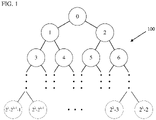
- the nodes will have time values 2 ⁇ ⁇ 2 ⁇ ⁇ 1 ⁇ 1 , 2 ⁇ ⁇ 2 ⁇ ⁇ 1 , ... , 2 ⁇ ⁇ 3 , 2 ⁇ ⁇ 2 .
- t is not necessarily synchronized with a particular unit, such that it increments every second (or other unit).
- t is determined by some time base (including any strictly increasing sequence of numbers generated in any known and secure manner)
- the time between two consecutive time values t need not be constant (although this is, again, an option).
- nodes need not be generated if there is no need for them yet.
- the time t can therefore indicate a slot, that is, period of physical or logical time.
- the height of the tree is unbounded, that is, not fixed a priori and every node in the tree can be used to sign a message, such as a document or any other data set.
- Figure 2 illustrates an example of such a tree that is a binary tree where every node (including the root node N0) is represented by an OTS key pair. Any known method may be used to generate these key pairs, such as the Lamport or Winternitz schemes.
- This signature value S t may not be revealed before time t , but after time t it becomes a part of the public authentication path for all of the node's child nodes.
- the value S t is then combined (for example, concatenated and hashed) with the message being signed and timestamped at time t .
- This signature is preferably comprised of the following values:
- the authentication tree does not have to be binary -- the shape of the data structure thus need not be fixed.
- the data structure from which the signatures are generated could instead be implemented as a chain of nodes (unary tree), or k -ary tree or even as a directed graph.
- the internal authentication methods in the tree are not just limited to one-time signatures.
- the nodes could be implemented, for example, using any signature mechanism or even Merkle trees.
- Merkle trees When using Merkle trees, the hash value of a Merkle tree node may then be used as the public key and the child nodes may be considered as a limited authentication token.
- Such an optimization would replace a complex signature (for example, a Winternitz signature) with only two hash values, thus reducing the overall signature size of the scheme.
- the Merkle tree optimization should preferably be combined using other authentication methods, such as by using Merkle trees of a fixed height).
- every node in the tree it is not necessary for every node in the tree to be created using the same authentication method as long as the algorithm selection is deterministic. For example, every node with an even index might use one method and every node with an uneven index might use another method, different methods might be used for different tree levels, etc.
- function AuthNode ( i ) and function SignChildren(i) shows how the authentication tree may be calculated for a node with index i, that is, generated according to the illustrated function AuthNode ( i ) .
- two main embodiments are described - an "Unbounded” and a "Public Tree” embodiment --, in which the second uses a modification of the first; accordingly, the description of the routines is "split" in two, such that a different version of the signChildren ( i ) is described after the first.
- embodiments may combine the authentication tree with Merkle trees in a way that also uses the internal nodes of the tree.
- Both of the embodiments below associate time values with every node in the tree based on their index in the tree.
- the index of the node is the time value indicating when this node can be used, measured either using physical or network clock time, or as a system time from some chosen genesis time.
- the nodes are preferably indexed from the root, where the root has the index 0 (or any other time value suitable for the particular implementation) and left and right sibling nodes in the binary tree (if chosen to be binary) will have values 2i + 1 and 2i + 2, respectively, for some positive integer i.
- this internal signature scheme may be any stateless signature scheme the system designer prefers that is capable of signing the same message many times without loss of security.
- this internal signature routine generates one-time signatures (OTS's); hence, the function designation Gen OTS .
- OTS's one-time signatures
- Many known OTS schemes are suitable, some examples of which include Lamport, Winternitz, WOTS+, and the above-mentioned BLT-TB schemes. Note that the concept of "one-time” may in some schemes not be absolute, but rather mean "one time per specified signature period”.
- the Unbounded Embodiment provides a signature scheme with a stateless private key (the root of the authentication tree 100) that can sign an arbitrary number of messages for an arbitrary number of time-slots.
- the Public Tree Embodiment additionally provides compensation for timestamping service lag, such that the signer estimates the time value but the embodiment includes an internal mechanism for dealing with short delays. The delay length is selectable, but predetermined while creating the private key.
- the Public Tree Embodiment can produce smaller signatures than the basic Unbounded Embodiment, as its authentication tree height is shorter by one set of public keys and OTS signatures.
- This embodiment uses the OTS signature value of a particular node as the secret value, which is hashed together with the message. The result is then timestamped.
- the authentication tree then associates the signature via the public key of the node with the public key of the root node of the authentication tree.
- SignUnboundedBLT ( m, t ) describes, in order to sign a message m at time t the public and secret keys pk t and sk t are calculated. Then the public keys of the corresponding child nodes ( pk 2t + 1 and pk 2t + 2 ) are signed using sk t .
- the signature value s is hashed together with the message m and the resulting hash value x is sent for timestamping.
- the time-stamping service fails and ⁇ (indicating "invalid result") is returned; otherwise, the authentication information and the timestamp TS are returned as the signature (P, S , TS ).
- a verifier Given this signature and the message, a verifier can recreate the value x, verify the timestamp TS and check the authentication chain up until reaching the public key pk 0 . Note that one may also view the values S and P as the values created by authenticating either the public key pk 2t + 1 or pk 2t + 2 , but as the signature value is also needed the authentication of the last layer is done explicitly here.
- This embodiment is also based on the authentication tree, but differs from the Unbounded embodiment in that the whole tree can be made public, including the signatures. In an extreme case the whole tree could thus be represented as a table that forms the public key, although this would be inefficient. Instead, in this embodiment, additional data d i (which may be empty) is added to every node. In this embodiment, not only are the public keys of the child nodes authenticated, but also the hash values of the public keys and the additional data as well. In this embodiment, to use the AuthNode ( i ) function defined above, the SignChildren(i) function is modified by adding the data value d i to the corresponding child public key value and calculate the hash of it. This modified SignChildren(i) function will therefore operate as defined in the following pseudocode:
- This part of this embodiment thus operates as an endorsement scheme.
- Gen E ( t ) be the routine that generates the z values, using any known method; for example, Gen E ( t ) may be any known pseudo-random function.
- This signing process combines the message m and all of the y values, for example, by hashing them.
- the resulting value x is then timestamped.
- the routine computes the difference ⁇ between the expected time value and the actual one. If the difference is less or equal to n then the signature process returns all of the authentication public keys (P, the authentication tree internal OTS signatures S , the timestamp TS) on value x, which can be calculated using message m and the y values.
- P the authentication public keys
- S the timestamp TS
- the pre-image z t, ⁇ hash ( y t , ⁇ ) is revealed instead of yt, ⁇ , which means the verifier has to hash that particular value before calculating x.
- the procedure just described may be expressed by the following pseudocode:
- the Public Tree Embodiment of the invention offers some advantages as compared with the basic Unbounded Embodiment. These include:
- Timestamping services There are many known timestamping services that may be used in this invention. Just two of many options that may be used in embodiments include using the known RFC 3161 Time Stamp Server, or a time-synchronized, blockchain-based arrangement such as Bitcoin or some other blockchain, or any other timestamping service that users trust and has the required precision.
- the Guardtime's KSI ® system is summarized here in the context of timestamping.
- the KSI system is a hash tree-based signing infrastructure provided by Guardtime AS of Tallinn, Estonia, which is disclosed in U.S. Patent No. 8,719,576 (also Buldas, et al., "Document verification with distributed calendar infrastructure") and is marketed under the registered trademark "KSI”.
- This Guardtime signature infrastructure (and any subsequent improvements to it) is referred to below as the "KSI system”.
- the KSI system inputs digital data sets in aggregation rounds and then, along with other metadata as desired, aggregates these inputs by using them as leaves to a hash tree whose root value for the round forms a current entry in a data structure referred to as a "calendar", which encodes the calendar values of previous rounds as well.
- the calendar is thus a form of blockchain inasmuch as information of previous entries is linked cryptographically with a current value.
- the calendar may be configured as a typical linear blockchain.
- each calendar value is itself forms a current leaf in a progressive hash tree, whose root value, either after each round or after a predetermined number of rounds, is represented as a "publication value" in some immutable, irrefutable medium such as a physical or electronic publication or some other data structure that system participants accept as irrefutable.
- the KSI system then returns, for each input, a digital signature that comprises a vector of its sibling values up through the hash tree to the calendar value of the respective round, and, by extension, optionally to the publication value when it becomes available. Since the KSI system itself synchronizes the calendar with a system time, the KSI system's signatures themselves are also provably bound to a time value and thus may be used as a timestamp.
Landscapes
- Engineering & Computer Science (AREA)
- Computer Security & Cryptography (AREA)
- Computer Networks & Wireless Communication (AREA)
- Signal Processing (AREA)
- Theoretical Computer Science (AREA)
- General Physics & Mathematics (AREA)
- Algebra (AREA)
- Mathematical Analysis (AREA)
- Mathematical Optimization (AREA)
- Mathematical Physics (AREA)
- Pure & Applied Mathematics (AREA)
- Physics & Mathematics (AREA)
- Computing Systems (AREA)
- Storage Device Security (AREA)
Applications Claiming Priority (1)
| Application Number | Priority Date | Filing Date | Title |
|---|---|---|---|
| US202163147986P | 2021-02-10 | 2021-02-10 |
Publications (2)
| Publication Number | Publication Date |
|---|---|
| EP4044501A1 true EP4044501A1 (de) | 2022-08-17 |
| EP4044501B1 EP4044501B1 (de) | 2023-08-16 |
Family
ID=80447091
Family Applications (1)
| Application Number | Title | Priority Date | Filing Date |
|---|---|---|---|
| EP22156095.6A Active EP4044501B1 (de) | 2021-02-10 | 2022-02-10 | Verfahren und system zur erzeugung von datensignaturen unter verwendung eines unbegrenzten zustandslosen privaten schlüssels |
Country Status (2)
| Country | Link |
|---|---|
| US (1) | US12041180B2 (de) |
| EP (1) | EP4044501B1 (de) |
Cited By (1)
| Publication number | Priority date | Publication date | Assignee | Title |
|---|---|---|---|---|
| US12505231B2 (en) | 2023-02-08 | 2025-12-23 | Delease, Llc | Systems and methods for performing distributed computing |
Citations (2)
| Publication number | Priority date | Publication date | Assignee | Title |
|---|---|---|---|---|
| US8719576B2 (en) | 2003-12-22 | 2014-05-06 | Guardtime IP Holdings, Ltd | Document verification with distributed calendar infrastructure |
| US20180183602A1 (en) * | 2016-12-23 | 2018-06-28 | Amazon Technologies, Inc. | Signature delegation |
Family Cites Families (3)
| Publication number | Priority date | Publication date | Assignee | Title |
|---|---|---|---|---|
| US10511445B1 (en) * | 2017-01-05 | 2019-12-17 | Amazon Technologies, Inc. | Signature compression for hash-based signature schemes |
| US11184176B2 (en) * | 2018-09-26 | 2021-11-23 | Guardtime Sa | System and method for generating data signatures over non-continuously bidirectional communication channels |
| US11093638B2 (en) * | 2019-04-05 | 2021-08-17 | Online Media Holdings Ltd | Distributed management of user privacy information |
-
2022
- 2022-02-10 EP EP22156095.6A patent/EP4044501B1/de active Active
- 2022-02-10 US US17/668,486 patent/US12041180B2/en active Active
Patent Citations (2)
| Publication number | Priority date | Publication date | Assignee | Title |
|---|---|---|---|---|
| US8719576B2 (en) | 2003-12-22 | 2014-05-06 | Guardtime IP Holdings, Ltd | Document verification with distributed calendar infrastructure |
| US20180183602A1 (en) * | 2016-12-23 | 2018-06-28 | Amazon Technologies, Inc. | Signature delegation |
Non-Patent Citations (6)
| Title |
|---|
| BERNSTEIN DANIEL J ET AL: "SPHINCS: Practical Stateless Hash-Based Signatures", 14 April 2015, ADVANCES IN DATABASES AND INFORMATION SYSTEMS; [LECTURE NOTES IN COMPUTER SCIENCE; LECT.NOTES COMPUTER], SPRINGER INTERNATIONAL PUBLISHING, CHAM, PAGE(S) 368 - 397, ISBN: 978-3-319-10403-4, XP047504687 * |
| BO GYEONG KANG ET AL: "A New Forward Secure Signature Scheme", IACR, INTERNATIONAL ASSOCIATION FOR CRYPTOLOGIC RESEARCH, vol. 20040807:043130, 30 July 2004 (2004-07-30), pages 1 - 14, XP061000911 * |
| D. J. BERNSTEIN ET AL.: "EUROCRYPT 2015, Proceedings", vol. 9056, 2015, SPRINGER, article "SPHINCS: Practical stateless hash-based signatures", pages: 368 - 397 |
| J. A. BUCHMANN ET AL.: "PQCrypto 2011, Proceedings", vol. 7071, 2011, SPRINGER, article "XMSS — A practical forward secure signature scheme based on minimal security assumptions", pages: 117 - 129 |
| MERKLE R.C.: "Cryptology — CRYPTO '87, CRYPTO", vol. 293, 1987, SPRINGER, article "A Digital Signature Based on a Conventional Encryption Function" |
| ODED GOLDREICH'S, FOUNDATIONS OF CRYPTOGRAPHY, vol. 2 |
Cited By (1)
| Publication number | Priority date | Publication date | Assignee | Title |
|---|---|---|---|---|
| US12505231B2 (en) | 2023-02-08 | 2025-12-23 | Delease, Llc | Systems and methods for performing distributed computing |
Also Published As
| Publication number | Publication date |
|---|---|
| US20220271945A1 (en) | 2022-08-25 |
| US12041180B2 (en) | 2024-07-16 |
| EP4044501B1 (de) | 2023-08-16 |
Similar Documents
| Publication | Publication Date | Title |
|---|---|---|
| Zhu et al. | Enabling generic, verifiable, and secure data search in cloud services | |
| JP7715733B2 (ja) | 秘密共有を伴う(ec)dsaしきい値署名 | |
| EP3629519B1 (de) | System und verfahren zum erzeugen von einmaligen datensignaturen | |
| Wang et al. | Enabling public auditability and data dynamics for storage security in cloud computing | |
| EP3130104B1 (de) | System und verfahren für sequentielle datensignaturen | |
| Barsoum et al. | On verifying dynamic multiple data copies over cloud servers | |
| US5903651A (en) | Apparatus and method for demonstrating and confirming the status of a digital certificates and other data | |
| Zhang et al. | Provable multiple replication data possession with full dynamics for secure cloud storage | |
| US11316698B2 (en) | Delegated signatures for smart devices | |
| US11184176B2 (en) | System and method for generating data signatures over non-continuously bidirectional communication channels | |
| Buldas et al. | Efficient quantum-immune keyless signatures with identity | |
| Sengupta et al. | Secure cloud storage with data dynamics using secure network coding techniques | |
| WO2023016729A1 (en) | Generating digital signature shares | |
| Yang et al. | Efficient verifiable unbounded-size database from authenticated matrix commitment | |
| EP4044501B1 (de) | Verfahren und system zur erzeugung von datensignaturen unter verwendung eines unbegrenzten zustandslosen privaten schlüssels | |
| Peng et al. | Secure deduplication and cloud storage auditing with efficient dynamic ownership management and data dynamics | |
| CN109743327B (zh) | 基于无证书的云存储中共享数据的完整性公开验证方法 | |
| Levi et al. | An efficient, dynamic and trust preserving public key infrastructure | |
| CN112671712B (zh) | 一种支持高效动态更新的云数据完整性验证方法及系统 | |
| US20250125972A1 (en) | Generating digital signatures | |
| Zhou | A Certificate‐Based Provable Data Possession Scheme in the Standard Model | |
| Zhang et al. | Achieving public verifiability and data dynamics for cloud data in the standard model | |
| Lu et al. | A study of two-way authentication for decentralized network identities | |
| Zhang et al. | OGPADSM2: oriented-group public auditing for data sharing with multi-user modification | |
| Zhao et al. | Privacy-preserving TPA Auditing Scheme Based on Skip List for Cloud Storage. |
Legal Events
| Date | Code | Title | Description |
|---|---|---|---|
| PUAI | Public reference made under article 153(3) epc to a published international application that has entered the european phase |
Free format text: ORIGINAL CODE: 0009012 |
|
| STAA | Information on the status of an ep patent application or granted ep patent |
Free format text: STATUS: THE APPLICATION HAS BEEN PUBLISHED |
|
| AK | Designated contracting states |
Kind code of ref document: A1 Designated state(s): AL AT BE BG CH CY CZ DE DK EE ES FI FR GB GR HR HU IE IS IT LI LT LU LV MC MK MT NL NO PL PT RO RS SE SI SK SM TR |
|
| STAA | Information on the status of an ep patent application or granted ep patent |
Free format text: STATUS: REQUEST FOR EXAMINATION WAS MADE |
|
| GRAJ | Information related to disapproval of communication of intention to grant by the applicant or resumption of examination proceedings by the epo deleted |
Free format text: ORIGINAL CODE: EPIDOSDIGR1 |
|
| STAA | Information on the status of an ep patent application or granted ep patent |
Free format text: STATUS: GRANT OF PATENT IS INTENDED |
|
| GRAP | Despatch of communication of intention to grant a patent |
Free format text: ORIGINAL CODE: EPIDOSNIGR1 |
|
| RBV | Designated contracting states (corrected) |
Designated state(s): AL AT BE BG CH CY CZ DE DK EE ES FI FR GB GR HR HU IE IS IT LI LT LU LV MC MK MT NL NO PL PT RO RS SE SI SK SM TR |
|
| 17P | Request for examination filed |
Effective date: 20230216 |
|
| RIC1 | Information provided on ipc code assigned before grant |
Ipc: H04L 9/32 20060101AFI20230309BHEP |
|
| INTG | Intention to grant announced |
Effective date: 20230322 |
|
| GRAS | Grant fee paid |
Free format text: ORIGINAL CODE: EPIDOSNIGR3 |
|
| GRAA | (expected) grant |
Free format text: ORIGINAL CODE: 0009210 |
|
| STAA | Information on the status of an ep patent application or granted ep patent |
Free format text: STATUS: THE PATENT HAS BEEN GRANTED |
|
| AK | Designated contracting states |
Kind code of ref document: B1 Designated state(s): AL AT BE BG CH CY CZ DE DK EE ES FI FR GB GR HR HU IE IS IT LI LT LU LV MC MK MT NL NO PL PT RO RS SE SI SK SM TR |
|
| REG | Reference to a national code |
Ref country code: CH Ref legal event code: EP |
|
| REG | Reference to a national code |
Ref country code: DE Ref legal event code: R096 Ref document number: 602022000326 Country of ref document: DE |
|
| REG | Reference to a national code |
Ref country code: IE Ref legal event code: FG4D |
|
| REG | Reference to a national code |
Ref country code: EE Ref legal event code: FG4A Ref document number: E023599 Country of ref document: EE Effective date: 20230822 |
|
| REG | Reference to a national code |
Ref country code: LT Ref legal event code: MG9D |
|
| REG | Reference to a national code |
Ref country code: NL Ref legal event code: MP Effective date: 20230816 |
|
| REG | Reference to a national code |
Ref country code: AT Ref legal event code: MK05 Ref document number: 1601133 Country of ref document: AT Kind code of ref document: T Effective date: 20230816 |
|
| PG25 | Lapsed in a contracting state [announced via postgrant information from national office to epo] |
Ref country code: GR Free format text: LAPSE BECAUSE OF FAILURE TO SUBMIT A TRANSLATION OF THE DESCRIPTION OR TO PAY THE FEE WITHIN THE PRESCRIBED TIME-LIMIT Effective date: 20231117 |
|
| PG25 | Lapsed in a contracting state [announced via postgrant information from national office to epo] |
Ref country code: IS Free format text: LAPSE BECAUSE OF FAILURE TO SUBMIT A TRANSLATION OF THE DESCRIPTION OR TO PAY THE FEE WITHIN THE PRESCRIBED TIME-LIMIT Effective date: 20231216 |
|
| PG25 | Lapsed in a contracting state [announced via postgrant information from national office to epo] |
Ref country code: SE Free format text: LAPSE BECAUSE OF FAILURE TO SUBMIT A TRANSLATION OF THE DESCRIPTION OR TO PAY THE FEE WITHIN THE PRESCRIBED TIME-LIMIT Effective date: 20230816 Ref country code: RS Free format text: LAPSE BECAUSE OF FAILURE TO SUBMIT A TRANSLATION OF THE DESCRIPTION OR TO PAY THE FEE WITHIN THE PRESCRIBED TIME-LIMIT Effective date: 20230816 Ref country code: PT Free format text: LAPSE BECAUSE OF FAILURE TO SUBMIT A TRANSLATION OF THE DESCRIPTION OR TO PAY THE FEE WITHIN THE PRESCRIBED TIME-LIMIT Effective date: 20231218 Ref country code: NO Free format text: LAPSE BECAUSE OF FAILURE TO SUBMIT A TRANSLATION OF THE DESCRIPTION OR TO PAY THE FEE WITHIN THE PRESCRIBED TIME-LIMIT Effective date: 20231116 Ref country code: NL Free format text: LAPSE BECAUSE OF FAILURE TO SUBMIT A TRANSLATION OF THE DESCRIPTION OR TO PAY THE FEE WITHIN THE PRESCRIBED TIME-LIMIT Effective date: 20230816 Ref country code: LV Free format text: LAPSE BECAUSE OF FAILURE TO SUBMIT A TRANSLATION OF THE DESCRIPTION OR TO PAY THE FEE WITHIN THE PRESCRIBED TIME-LIMIT Effective date: 20230816 Ref country code: LT Free format text: LAPSE BECAUSE OF FAILURE TO SUBMIT A TRANSLATION OF THE DESCRIPTION OR TO PAY THE FEE WITHIN THE PRESCRIBED TIME-LIMIT Effective date: 20230816 Ref country code: IS Free format text: LAPSE BECAUSE OF FAILURE TO SUBMIT A TRANSLATION OF THE DESCRIPTION OR TO PAY THE FEE WITHIN THE PRESCRIBED TIME-LIMIT Effective date: 20231216 Ref country code: HR Free format text: LAPSE BECAUSE OF FAILURE TO SUBMIT A TRANSLATION OF THE DESCRIPTION OR TO PAY THE FEE WITHIN THE PRESCRIBED TIME-LIMIT Effective date: 20230816 Ref country code: GR Free format text: LAPSE BECAUSE OF FAILURE TO SUBMIT A TRANSLATION OF THE DESCRIPTION OR TO PAY THE FEE WITHIN THE PRESCRIBED TIME-LIMIT Effective date: 20231117 Ref country code: FI Free format text: LAPSE BECAUSE OF FAILURE TO SUBMIT A TRANSLATION OF THE DESCRIPTION OR TO PAY THE FEE WITHIN THE PRESCRIBED TIME-LIMIT Effective date: 20230816 Ref country code: AT Free format text: LAPSE BECAUSE OF FAILURE TO SUBMIT A TRANSLATION OF THE DESCRIPTION OR TO PAY THE FEE WITHIN THE PRESCRIBED TIME-LIMIT Effective date: 20230816 |
|
| PG25 | Lapsed in a contracting state [announced via postgrant information from national office to epo] |
Ref country code: PL Free format text: LAPSE BECAUSE OF FAILURE TO SUBMIT A TRANSLATION OF THE DESCRIPTION OR TO PAY THE FEE WITHIN THE PRESCRIBED TIME-LIMIT Effective date: 20230816 |
|
| PG25 | Lapsed in a contracting state [announced via postgrant information from national office to epo] |
Ref country code: ES Free format text: LAPSE BECAUSE OF FAILURE TO SUBMIT A TRANSLATION OF THE DESCRIPTION OR TO PAY THE FEE WITHIN THE PRESCRIBED TIME-LIMIT Effective date: 20230816 |
|
| PG25 | Lapsed in a contracting state [announced via postgrant information from national office to epo] |
Ref country code: SM Free format text: LAPSE BECAUSE OF FAILURE TO SUBMIT A TRANSLATION OF THE DESCRIPTION OR TO PAY THE FEE WITHIN THE PRESCRIBED TIME-LIMIT Effective date: 20230816 Ref country code: RO Free format text: LAPSE BECAUSE OF FAILURE TO SUBMIT A TRANSLATION OF THE DESCRIPTION OR TO PAY THE FEE WITHIN THE PRESCRIBED TIME-LIMIT Effective date: 20230816 Ref country code: ES Free format text: LAPSE BECAUSE OF FAILURE TO SUBMIT A TRANSLATION OF THE DESCRIPTION OR TO PAY THE FEE WITHIN THE PRESCRIBED TIME-LIMIT Effective date: 20230816 Ref country code: DK Free format text: LAPSE BECAUSE OF FAILURE TO SUBMIT A TRANSLATION OF THE DESCRIPTION OR TO PAY THE FEE WITHIN THE PRESCRIBED TIME-LIMIT Effective date: 20230816 Ref country code: CZ Free format text: LAPSE BECAUSE OF FAILURE TO SUBMIT A TRANSLATION OF THE DESCRIPTION OR TO PAY THE FEE WITHIN THE PRESCRIBED TIME-LIMIT Effective date: 20230816 Ref country code: SK Free format text: LAPSE BECAUSE OF FAILURE TO SUBMIT A TRANSLATION OF THE DESCRIPTION OR TO PAY THE FEE WITHIN THE PRESCRIBED TIME-LIMIT Effective date: 20230816 |
|
| REG | Reference to a national code |
Ref country code: DE Ref legal event code: R097 Ref document number: 602022000326 Country of ref document: DE |
|
| PLBE | No opposition filed within time limit |
Free format text: ORIGINAL CODE: 0009261 |
|
| STAA | Information on the status of an ep patent application or granted ep patent |
Free format text: STATUS: NO OPPOSITION FILED WITHIN TIME LIMIT |
|
| 26N | No opposition filed |
Effective date: 20240517 |
|
| PG25 | Lapsed in a contracting state [announced via postgrant information from national office to epo] |
Ref country code: IT Free format text: LAPSE BECAUSE OF FAILURE TO SUBMIT A TRANSLATION OF THE DESCRIPTION OR TO PAY THE FEE WITHIN THE PRESCRIBED TIME-LIMIT Effective date: 20230816 Ref country code: SI Free format text: LAPSE BECAUSE OF FAILURE TO SUBMIT A TRANSLATION OF THE DESCRIPTION OR TO PAY THE FEE WITHIN THE PRESCRIBED TIME-LIMIT Effective date: 20230816 |
|
| PG25 | Lapsed in a contracting state [announced via postgrant information from national office to epo] |
Ref country code: MC Free format text: LAPSE BECAUSE OF FAILURE TO SUBMIT A TRANSLATION OF THE DESCRIPTION OR TO PAY THE FEE WITHIN THE PRESCRIBED TIME-LIMIT Effective date: 20230816 |
|
| PG25 | Lapsed in a contracting state [announced via postgrant information from national office to epo] |
Ref country code: LU Free format text: LAPSE BECAUSE OF NON-PAYMENT OF DUE FEES Effective date: 20240210 |
|
| PG25 | Lapsed in a contracting state [announced via postgrant information from national office to epo] |
Ref country code: LU Free format text: LAPSE BECAUSE OF NON-PAYMENT OF DUE FEES Effective date: 20240210 |
|
| PG25 | Lapsed in a contracting state [announced via postgrant information from national office to epo] |
Ref country code: BG Free format text: LAPSE BECAUSE OF FAILURE TO SUBMIT A TRANSLATION OF THE DESCRIPTION OR TO PAY THE FEE WITHIN THE PRESCRIBED TIME-LIMIT Effective date: 20230816 |
|
| PG25 | Lapsed in a contracting state [announced via postgrant information from national office to epo] |
Ref country code: BG Free format text: LAPSE BECAUSE OF FAILURE TO SUBMIT A TRANSLATION OF THE DESCRIPTION OR TO PAY THE FEE WITHIN THE PRESCRIBED TIME-LIMIT Effective date: 20230816 |
|
| REG | Reference to a national code |
Ref country code: BE Ref legal event code: MM Effective date: 20240229 |
|
| PG25 | Lapsed in a contracting state [announced via postgrant information from national office to epo] |
Ref country code: BE Free format text: LAPSE BECAUSE OF NON-PAYMENT OF DUE FEES Effective date: 20240229 |
|
| PG25 | Lapsed in a contracting state [announced via postgrant information from national office to epo] |
Ref country code: IE Free format text: LAPSE BECAUSE OF NON-PAYMENT OF DUE FEES Effective date: 20240210 |
|
| PG25 | Lapsed in a contracting state [announced via postgrant information from national office to epo] |
Ref country code: IE Free format text: LAPSE BECAUSE OF NON-PAYMENT OF DUE FEES Effective date: 20240210 Ref country code: BE Free format text: LAPSE BECAUSE OF NON-PAYMENT OF DUE FEES Effective date: 20240229 |
|
| PGFP | Annual fee paid to national office [announced via postgrant information from national office to epo] |
Ref country code: DE Payment date: 20250605 Year of fee payment: 4 |
|
| PGFP | Annual fee paid to national office [announced via postgrant information from national office to epo] |
Ref country code: EE Payment date: 20250620 Year of fee payment: 4 Ref country code: FR Payment date: 20250617 Year of fee payment: 4 |
|
| PGFP | Annual fee paid to national office [announced via postgrant information from national office to epo] |
Ref country code: CH Payment date: 20250617 Year of fee payment: 4 |
|
| PG25 | Lapsed in a contracting state [announced via postgrant information from national office to epo] |
Ref country code: CY Free format text: LAPSE BECAUSE OF FAILURE TO SUBMIT A TRANSLATION OF THE DESCRIPTION OR TO PAY THE FEE WITHIN THE PRESCRIBED TIME-LIMIT; INVALID AB INITIO Effective date: 20220210 |
|
| PG25 | Lapsed in a contracting state [announced via postgrant information from national office to epo] |
Ref country code: TR Free format text: LAPSE BECAUSE OF FAILURE TO SUBMIT A TRANSLATION OF THE DESCRIPTION OR TO PAY THE FEE WITHIN THE PRESCRIBED TIME-LIMIT Effective date: 20230816 |
|
| REG | Reference to a national code |
Ref country code: DE Ref legal event code: R082 Ref document number: 602022000326 Country of ref document: DE |