EP4042820B1 - Random access response mapping for two-step random access channel procedure - Google Patents
Random access response mapping for two-step random access channel procedure Download PDFInfo
- Publication number
- EP4042820B1 EP4042820B1 EP20797942.8A EP20797942A EP4042820B1 EP 4042820 B1 EP4042820 B1 EP 4042820B1 EP 20797942 A EP20797942 A EP 20797942A EP 4042820 B1 EP4042820 B1 EP 4042820B1
- Authority
- EP
- European Patent Office
- Prior art keywords
- msgb
- rars
- communication
- msgb communication
- rar
- Prior art date
- Legal status (The legal status is an assumption and is not a legal conclusion. Google has not performed a legal analysis and makes no representation as to the accuracy of the status listed.)
- Active
Links
Images





Classifications
-
- H—ELECTRICITY
- H04—ELECTRIC COMMUNICATION TECHNIQUE
- H04W—WIRELESS COMMUNICATION NETWORKS
- H04W74/00—Wireless channel access
- H04W74/08—Non-scheduled access, e.g. ALOHA
- H04W74/0833—Random access procedures, e.g. with 4-step access
-
- H—ELECTRICITY
- H04—ELECTRIC COMMUNICATION TECHNIQUE
- H04L—TRANSMISSION OF DIGITAL INFORMATION, e.g. TELEGRAPHIC COMMUNICATION
- H04L1/00—Arrangements for detecting or preventing errors in the information received
- H04L1/12—Arrangements for detecting or preventing errors in the information received by using return channel
- H04L1/16—Arrangements for detecting or preventing errors in the information received by using return channel in which the return channel carries supervisory signals, e.g. repetition request signals
- H04L1/18—Automatic repetition systems, e.g. Van Duuren systems
- H04L1/1812—Hybrid protocols; Hybrid automatic repeat request [HARQ]
-
- H—ELECTRICITY
- H04—ELECTRIC COMMUNICATION TECHNIQUE
- H04L—TRANSMISSION OF DIGITAL INFORMATION, e.g. TELEGRAPHIC COMMUNICATION
- H04L1/00—Arrangements for detecting or preventing errors in the information received
- H04L1/12—Arrangements for detecting or preventing errors in the information received by using return channel
- H04L1/16—Arrangements for detecting or preventing errors in the information received by using return channel in which the return channel carries supervisory signals, e.g. repetition request signals
- H04L1/18—Automatic repetition systems, e.g. Van Duuren systems
- H04L1/1829—Arrangements specially adapted for the receiver end
- H04L1/1854—Scheduling and prioritising arrangements
-
- H—ELECTRICITY
- H04—ELECTRIC COMMUNICATION TECHNIQUE
- H04L—TRANSMISSION OF DIGITAL INFORMATION, e.g. TELEGRAPHIC COMMUNICATION
- H04L1/00—Arrangements for detecting or preventing errors in the information received
- H04L1/12—Arrangements for detecting or preventing errors in the information received by using return channel
- H04L1/16—Arrangements for detecting or preventing errors in the information received by using return channel in which the return channel carries supervisory signals, e.g. repetition request signals
- H04L1/18—Automatic repetition systems, e.g. Van Duuren systems
- H04L1/1867—Arrangements specially adapted for the transmitter end
- H04L1/1896—ARQ related signaling
-
- H—ELECTRICITY
- H04—ELECTRIC COMMUNICATION TECHNIQUE
- H04L—TRANSMISSION OF DIGITAL INFORMATION, e.g. TELEGRAPHIC COMMUNICATION
- H04L5/00—Arrangements affording multiple use of the transmission path
- H04L5/003—Arrangements for allocating sub-channels of the transmission path
- H04L5/0053—Allocation of signalling, i.e. of overhead other than pilot signals
-
- H—ELECTRICITY
- H04—ELECTRIC COMMUNICATION TECHNIQUE
- H04L—TRANSMISSION OF DIGITAL INFORMATION, e.g. TELEGRAPHIC COMMUNICATION
- H04L5/00—Arrangements affording multiple use of the transmission path
- H04L5/14—Two-way operation using the same type of signal, i.e. duplex
- H04L5/1469—Two-way operation using the same type of signal, i.e. duplex using time-sharing
-
- H—ELECTRICITY
- H04—ELECTRIC COMMUNICATION TECHNIQUE
- H04W—WIRELESS COMMUNICATION NETWORKS
- H04W56/00—Synchronisation arrangements
- H04W56/001—Synchronization between nodes
-
- H—ELECTRICITY
- H04—ELECTRIC COMMUNICATION TECHNIQUE
- H04W—WIRELESS COMMUNICATION NETWORKS
- H04W72/00—Local resource management
- H04W72/12—Wireless traffic scheduling
- H04W72/1263—Mapping of traffic onto schedule, e.g. scheduled allocation or multiplexing of flows
- H04W72/1273—Mapping of traffic onto schedule, e.g. scheduled allocation or multiplexing of flows of downlink data flows
-
- H—ELECTRICITY
- H04—ELECTRIC COMMUNICATION TECHNIQUE
- H04W—WIRELESS COMMUNICATION NETWORKS
- H04W72/00—Local resource management
- H04W72/20—Control channels or signalling for resource management
- H04W72/23—Control channels or signalling for resource management in the downlink direction of a wireless link, i.e. towards a terminal
-
- H—ELECTRICITY
- H04—ELECTRIC COMMUNICATION TECHNIQUE
- H04W—WIRELESS COMMUNICATION NETWORKS
- H04W72/00—Local resource management
- H04W72/20—Control channels or signalling for resource management
- H04W72/23—Control channels or signalling for resource management in the downlink direction of a wireless link, i.e. towards a terminal
- H04W72/232—Control channels or signalling for resource management in the downlink direction of a wireless link, i.e. towards a terminal the control data signalling from the physical layer, e.g. DCI signalling
-
- H—ELECTRICITY
- H04—ELECTRIC COMMUNICATION TECHNIQUE
- H04W—WIRELESS COMMUNICATION NETWORKS
- H04W74/00—Wireless channel access
- H04W74/002—Transmission of channel access control information
- H04W74/006—Transmission of channel access control information in the downlink, i.e. towards the terminal
-
- H—ELECTRICITY
- H04—ELECTRIC COMMUNICATION TECHNIQUE
- H04W—WIRELESS COMMUNICATION NETWORKS
- H04W76/00—Connection management
- H04W76/20—Manipulation of established connections
- H04W76/27—Transitions between radio resource control [RRC] states
-
- H—ELECTRICITY
- H04—ELECTRIC COMMUNICATION TECHNIQUE
- H04W—WIRELESS COMMUNICATION NETWORKS
- H04W74/00—Wireless channel access
- H04W74/08—Non-scheduled access, e.g. ALOHA
- H04W74/0833—Random access procedures, e.g. with 4-step access
- H04W74/0836—Random access procedures, e.g. with 4-step access with 2-step access
Definitions
- aspects of the present disclosure generally relate to wireless communication and to techniques and apparatuses for random access response mapping for two-step random access channel procedure.
- Wireless communication systems are widely deployed to provide various telecommunication services such as telephony, video, data, messaging, and broadcasts.
- Typical wireless communication systems may employ multiple-access technologies capable of supporting communication with multiple users by sharing available system resources (e.g., bandwidth, transmit power, and/or the like).
- multiple-access technologies include code division multiple access (CDMA) systems, time division multiple access (TDMA) systems, frequency-division multiple access (FDMA) systems, orthogonal frequency-division multiple access (OFDMA) systems, single-carrier frequency-division multiple access (SC-FDMA) systems, time division synchronous code division multiple access (TD-SCDMA) systems, and Long Term Evolution (LTE).
- LTE/LTE-Advanced is a set of enhancements to the Universal Mobile Telecommunications System (UMTS) mobile standard promulgated by the Third Generation Partnership Project (3GPP).
- UMTS Universal Mobile Telecommunications System
- a wireless communication network may include a number of base stations (BSs) that can support communication for a number of user equipments (UEs).
- a user equipment (UE) may communicate with a base station (BS) via the downlink and uplink.
- the downlink (or forward link) refers to the communication link from the BS to the UE
- the uplink (or reverse link) refers to the communication link from the UE to the BS.
- a BS may be referred to as a Node B, a gNB, an access point (AP), a radio head, a transmit receive point (TRP), a New Radio (NR) BS, a 5G Node B, and/or the like.
- New Radio which may also be referred to as 5G, is a set of enhancements to the LTE mobile standard promulgated by the Third Generation Partnership Project (3GPP).
- 3GPP Third Generation Partnership Project
- NR is designed to better support mobile broadband Internet access by improving spectral efficiency, lowering costs, improving services, making use of new spectrum, and better integrating with other open standards using orthogonal frequency division multiplexing (OFDM) with a cyclic prefix (CP) (CP-OFDM) on the downlink (DL), using CP-OFDM and/or SC-FDM (e.g., also known as discrete Fourier transform spread OFDM (DFT-s-OFDM)) on the uplink (UL), as well as supporting beamforming, multiple-input multiple-output (MIMO) antenna technology, and carrier aggregation.
- OFDM orthogonal frequency division multiplexing
- SC-FDM e.g., also known as discrete Fourier transform spread OFDM (DFT-s-OFDM)
- MIMO multiple-input multiple-output
- Observation 1 It will be necessary to enable configurations of the MsgB windows which are longer than the maximum allowable RAR window in legacy NR.
- Observation 2 RA-RNTI can only be used unambiguously during the RAR window.
- Observation 3 SFN, msgB length, indication of RRC and E bit would be useful to have in a new msgB/RAR subheader.
- Observation 4 The legacy E/T/R/R/BI subheader can be coded to prevent legacy Ues to parse beyond the subheader.
- Proposal 1 msgB should include the LSBs of SFN.
- Proposal 2 Adopt the coding of the E/T/R/R/BI subheader to prevent legacy Ues to parse beyond the subheader and use it as identifier of NR-U RAR or msgB.
- Proposal 3 Adopt the subheader for NR-U RAR as shown in Figure 3 of said draft.
- Proposal 4 Adopt the subheader for msgB as shown in Figure 4 .
- Proposal 5 Adopt the subheader for msgB with RRC as shown in Figure 4 of said draft.
- Proposal 6 Adopt the msgB for 2-step back off as shown in Figure 7 of said draft.
- Proposal 7 Adopt the subheader for fallback as shown in Figure 8 of said draft.
- Proposal 8 A UE specific RNTI based on the CR identity may be used additionally to the RA-RNTI/msgB-RNTI.
- a method of wireless communication performed by a base station (BS), is described, as defined in claim 1.
- a method of wireless communication performed by a UE, is described, as defined in claim 8.
- Fig. 1 is a diagram illustrating a wireless network 100 in which aspects of the present disclosure may be practiced.
- the wireless network 100 may be an LTE network or some other wireless network, such as a 5G or NR network.
- the wireless network 100 may include a number of BSs 110 (shown as BS 110a, BS 110b, BS 110c, and BS 110d) and other network entities.
- a BS is an entity that communicates with user equipment (UEs) and may also be referred to as a base station, a NR BS, a Node B, a gNB, a 5G node B (NB), an access point, a transmit receive point (TRP), and/or the like.
- Each BS may provide communication coverage for a particular geographic area.
- the term "cell" can refer to a coverage area of a BS and/or a BS subsystem serving this coverage area, depending on the context in which the term is used.
- a BS may provide communication coverage for a macro cell, a pico cell, a femto cell, and/or another type of cell.
- a macro cell may cover a relatively large geographic area (e.g., several kilometers in radius) and may allow unrestricted access by UEs with service subscription.
- a pico cell may cover a relatively small geographic area and may allow unrestricted access by UEs with service subscription.
- a femto cell may cover a relatively small geographic area (e.g., a home) and may allow restricted access by UEs having association with the femto cell (e.g., UEs in a closed subscriber group (CSG)).
- a BS for a macro cell may be referred to as a macro BS.
- a BS for a pico cell may be referred to as a pico BS.
- a BS for a femto cell may be referred to as a femto BS or a home BS.
- a BS 110a may be a macro BS for a macro cell 102a
- a BS 110b may be a pico BS for a pico cell 102b
- a BS 110c may be a femto BS for a femto cell 102c.
- a BS may support one or multiple (e.g., three) cells.
- the terms "eNB”, “base station”, “NR BS”, “gNB”, “TRP”, “AP”, “node B", “5G NB”, and “cell” may be used interchangeably herein.
- a cell may not necessarily be stationary, and the geographic area of the cell may move according to the location of a mobile BS.
- the BSs may be interconnected to one another and/or to one or more other BSs or network nodes (not shown) in the wireless network 100 through various types of backhaul interfaces such as a direct physical connection, a virtual network, and/or the like using any suitable transport network.
- Wireless network 100 may also include relay stations.
- a relay station is an entity that can receive a transmission of data from an upstream station (e.g., a BS or a UE) and send a transmission of the data to a downstream station (e.g., a UE or a BS).
- a relay station may also be a UE that can relay transmissions for other UEs.
- a relay station 110d may communicate with macro BS 110a and a UE 120d in order to facilitate communication between BS 110a and UE 120d.
- a relay station may also be referred to as a relay BS, a relay base station, a relay, and/or the like.
- Wireless network 100 may be a heterogeneous network that includes BSs of different types, e.g., macro BSs, pico BSs, femto BSs, relay BSs, and/or the like. These different types of BSs may have different transmit power levels, different coverage areas, and different impacts on interference in wireless network 100.
- macro BSs may have a high transmit power level (e.g., 5 to 40 watts) whereas pico BSs, femto BSs, and relay BSs may have lower transmit power levels (e.g., 0.1 to 2 watts).
- a network controller 130 may couple to a set of BSs and may provide coordination and control for these BSs.
- Network controller 130 may communicate with the BSs via a backhaul.
- the BSs may also communicate with one another, e.g., directly or indirectly via a wireless or wireline backhaul.
- UEs 120 may be dispersed throughout wireless network 100, and each UE may be stationary or mobile.
- a UE may also be referred to as an access terminal, a terminal, a mobile station, a subscriber unit, a station, and/or the like.
- a UE may be a cellular phone (e.g., a smart phone), a personal digital assistant (PDA), a wireless modem, a wireless communication device, a handheld device, a laptop computer, a cordless phone, a wireless local loop (WLL) station, a tablet, a camera, a gaming device, a netbook, a smartbook, an ultrabook, a medical device or equipment, biometric sensors/devices, wearable devices (smart watches, smart clothing, smart glasses, smart wrist bands, smart jewelry (e.g., smart ring, smart bracelet)), an entertainment device (e.g., a music or video device, or a satellite radio), a vehicular component or sensor, smart meters/sensors, industrial manufacturing equipment, a global positioning system device, or any other suitable device that is configured to communicate via a wireless or wired medium.
- a cellular phone e.g., a smart phone
- PDA personal digital assistant
- WLL wireless local loop
- MTC and eMTC UEs include, for example, robots, drones, remote devices, sensors, meters, monitors, location tags, and/or the like, that may communicate with a base station, another device (e.g., remote device), or some other entity.
- a wireless node may provide, for example, connectivity for or to a network (e.g., a wide area network such as Internet or a cellular network) via a wired or wireless communication link.
- Some UEs may be considered Internet-of-Things (IoT) devices, and/or may be implemented as NB-IoT (narrowband internet of things) devices.
- Some UEs may be considered a Customer Premises Equipment (CPE).
- UE 120 may be included inside a housing that houses components of UE 120, such as processor components, memory components, and/or the like.
- any number of wireless networks may be deployed in a given geographic area.
- Each wireless network may support a particular RAT and may operate on one or more frequencies.
- a RAT may also be referred to as a radio technology, an air interface, and/or the like.
- a frequency may also be referred to as a carrier, a frequency channel, and/or the like.
- Each frequency may support a single RAT in a given geographic area in order to avoid interference between wireless networks of different RATs.
- NR or 5G RAT networks may be deployed.
- two or more UEs 120 may communicate directly using one or more sidelink channels (e.g., without using a base station 110 as an intermediary to communicate with one another).
- the UEs 120 may communicate using peer-to-peer (P2P) communications, device-to-device (D2D) communications, a vehicle-to-everything (V2X) protocol (e.g., which may include a vehicle-to-vehicle (V2V) protocol, a vehicle-to-infrastructure (V2I) protocol, and/or the like), a mesh network, and/or the like).
- V2X vehicle-to-everything
- the UE 120 may perform scheduling operations, resource selection operations, and/or other operations described elsewhere herein as being performed by the base station 110.
- Fig. 1 is provided as an example. Other examples may differ from what is described with regard to Fig. 1 .
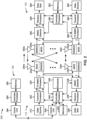
- Fig. 2 shows a block diagram of a design 200 of base station 110 and UE 120, which may be one of the base stations and one of the UEs in Fig. 1 .
- Base station 110 may be equipped with T antennas 234a through 234t
- UE 120 may be equipped with R antennas 252a through 252r, where in general T ⁇ 1 and R ⁇ 1.
- a transmit processor 220 may receive data from a data source 212 for one or more UEs, select one or more modulation and coding schemes (MCS) for each UE based at least in part on channel quality indicators (CQIs) received from the UE, process (e.g., encode and modulate) the data for each UE based at least in part on the MCS(s) selected for the UE, and provide data symbols for all UEs. Transmit processor 220 may also process system information (e.g., for semi-static resource partitioning information (SRPI) and/or the like) and control information (e.g., CQI requests, grants, upper layer signaling, and/or the like) and provide overhead symbols and control symbols.
- MCS modulation and coding schemes
- CQIs channel quality indicators
- Transmit processor 220 may also process system information (e.g., for semi-static resource partitioning information (SRPI) and/or the like) and control information (e.g., CQI requests, grants, upper layer signal
- Transmit processor 220 may also generate reference symbols for reference signals (e.g., the cell-specific reference signal (CRS)) and synchronization signals (e.g., the primary synchronization signal (PSS) and secondary synchronization signal (SSS)).
- a transmit (TX) multiple-input multiple-output (MIMO) processor 230 may perform spatial processing (e.g., precoding) on the data symbols, the control symbols, the overhead symbols, and/or the reference symbols, if applicable, and may provide T output symbol streams to T modulators (MODs) 232a through 232t. Each modulator 232 may process a respective output symbol stream (e.g., for OFDM and/or the like) to obtain an output sample stream.
- Each modulator 232 may further process (e.g., convert to analog, amplify, filter, and upconvert) the output sample stream to obtain a downlink signal.
- T downlink signals from modulators 232a through 232t may be transmitted via T antennas 234a through 234t, respectively.
- the synchronization signals can be generated with location encoding to convey additional information.
- antennas 252a through 252r may receive the downlink signals from base station 110 and/or other base stations and may provide received signals to demodulators (DEMODs) 254a through 254r, respectively.
- Each demodulator 254 may condition (e.g., filter, amplify, downconvert, and digitize) a received signal to obtain input samples.
- Each demodulator 254 may further process the input samples (e.g., for OFDM and/or the like) to obtain received symbols.
- a MIMO detector 256 may obtain received symbols from all R demodulators 254a through 254r, perform MIMO detection on the received symbols if applicable, and provide detected symbols.
- a receive processor 258 may process (e.g., demodulate and decode) the detected symbols, provide decoded data for UE 120 to a data sink 260, and provide decoded control information and system information to a controller/processor 280.
- a channel processor may determine reference signal received power (RSRP), received signal strength indicator (RSSI), reference signal received quality (RSRQ), channel quality indicator (CQI), and/or the like.
- RSRP reference signal received power
- RSSI received signal strength indicator
- RSRQ reference signal received quality indicator
- CQI channel quality indicator
- one or more components of UE 120 may be included in a housing.
- a transmit processor 264 may receive and process data from a data source 262 and control information (e.g., for reports comprising RSRP, RSSI, RSRQ, CQI, and/or the like) from controller/processor 280. Transmit processor 264 may also generate reference symbols for one or more reference signals. The symbols from transmit processor 264 may be precoded by a TX MIMO processor 266 if applicable, further processed by modulators 254a through 254r (e.g., for DFT-s-OFDM, CP-OFDM, and/or the like), and transmitted to base station 110.
- control information e.g., for reports comprising RSRP, RSSI, RSRQ, CQI, and/or the like
- Transmit processor 264 may also generate reference symbols for one or more reference signals.
- the symbols from transmit processor 264 may be precoded by a TX MIMO processor 266 if applicable, further processed by modulators 254a through 254r (e.g., for DFT-
- the uplink signals from UE 120 and other UEs may be received by antennas 234, processed by demodulators 232, detected by a MIMO detector 236 if applicable, and further processed by a receive processor 238 to obtain decoded data and control information sent by UE 120.
- Receive processor 238 may provide the decoded data to a data sink 239 and the decoded control information to controller/processor 240.
- Base station 110 may include communication unit 244 and communicate to network controller 130 via communication unit 244.
- Network controller 130 may include communication unit 294, controller/processor 290, and memory 292.
- Controller/processor 240 of base station 110, controller/processor 280 of UE 120, and/or any other component(s) of Fig. 2 may perform one or more techniques associated with random access response (RAR) mapping for two-step random access channel (RACH) procedures, as described in more detail elsewhere herein.
- controller/processor 240 of base station 110, controller/processor 280 of UE 120, and/or any other component(s) of Fig. 2 may perform or direct operations of, for example, process 400 of Fig. 4 , process 500 of Fig. 5 , and/or other processes as described herein.
- Memories 242 and 282 may store data and program codes for base station 110 and UE 120, respectively.
- memory 242 and/or memory 282 may comprise a non-transitory computer-readable medium storing one or more instructions for wireless communication.
- the one or more instructions when executed by one or more processors of the base station 110 and/or the UE 120, may perform or direct operations of, for example, process 400 of Fig. 4 , process 500 of Fig. 5 , and/or other processes as described herein.
- a scheduler 246 may schedule UEs for data transmission on the downlink and/or uplink.
- UE 120 may include means for receiving, from a BS 110, a message B (msgB) communication associated with a two-step RACH procedure between the UE 120 and the BS 110, means for identifying an RAR, associated with the UE 120, among a plurality of RARs multiplexed in the msgB communication and supplementary scheduling information for other RARs, and/or the like.
- msgB message B
- such means may include one or more components of UE 120 described in connection with Fig. 2 , such as controller/processor 280, transmit processor 264, TX MIMO processor 266, MOD 254, antenna 252, DEMOD 254, MIMO detector 256, receive processor 258, and/or the like.
- base station 110 may include means for grouping and selectively multiplexing a plurality of RARs in a msgB communication, means for transmitting the msgB communication to one or more UEs 120, and/or the like.
- such means may include one or more components of base station 110 described in connection with Fig. 2 , such as antenna 234, DEMOD 232, MIMO detector 236, receive processor 238, controller/processor 240, transmit processor 220, TX MIMO processor 230, MOD 232, antenna 234, and/or the like.
- Fig. 2 is provided as an example. Other examples may differ from what is described with regard to Fig. 2 .
- a UE may access a wireless network by negotiating a connection with a BS included in the wireless network.
- the UE and the BS may synchronize the connection in the downlink direction (that is, from BS to UE) and in the uplink direction (that is, from UE to BS).
- the UE may read a synchronization signal block (SSB) that includes various synchronization signals transmitted from the BS.
- the synchronization signals may include a primary synchronization signal (PSS), a secondary synchronization signal (SSS), a primary broadcast channel (PBCH), and/or the like.
- PSS primary synchronization signal
- SSS secondary synchronization signal
- PBCH primary broadcast channel
- the UE may use the PSS to determine symbol timing in the downlink direction, may use the SSS to determine a physical cell identifier associated with the BS, and may use the PBCH to determine the frame timing.
- the UE and the BS may perform a RACH procedure.
- the UE and the BS may perform a four-step RACH procedure.
- the UE and the BS may exchange four primary RACH communications.
- the UE may transmit a Message 1 (msg1) communication to the BS (e.g., as defined in a 3GPP four-step RACH procedure).
- the msg1 communication may be a RACH preamble communication that is transmitted in a RACH occasion (e.g., a particular set of time-frequency resources), the combination of which may be referred to as a RACH signature.
- the BS may respond to the msg1 communication with a Message 2 (msg2) communication (e.g., as defined in a 3GPP four-step RACH procedure), which may be a random access response (RAR) communication.
- msg2 Message 2
- msg3 Message 3
- RRC radio resource control
- the BS may respond to the msg3 communication with a Message 4 (msg4) communication (e.g., as defined in a 3GPP four-step RACH procedure), which may be a medium access control (MAC) control element (MAC-CE) contention resolution identifier communication and may include an RRCSetup command, and/or the like.
- msg4 communication e.g., as defined in a 3GPP four-step RACH procedure
- MAC-CE medium access control element contention resolution identifier communication
- RRCSetup command e.g., as defined in a 3GPP four-step RACH procedure
- the four-step RACH procedure may not meet the low latency requirements of 5G/NR wireless systems. Accordingly, the UE and the BS may use a two-step RACH procedure to reduce latency in synchronizing the connection in the uplink direction.
- the UE may combine the msg1 communication and the msg3 communication into a communication referred to as a message A (msgA) communication (e.g., as defined in a 3GPP two-step RACH procedure).
- msgA message A
- the msg1 portion of the msgA communication may be referred to as the preamble portion of the msgA communication.
- the msg3 portion of the msgA communication may be referred to as the payload portion of the msgA communication.
- the UE may transmit the msg 1 portion and the msg3 portion sequentially and prior to receiving the msg2 communication and the msg4 communication.
- the BS may receive the msgA communication and may transmit a msgB communication (e.g., as defined in a 3GPP four-step RACH procedure), which may include the msg2 communication and the msg4 communication.
- the msgB communication may include a physical downlink control channel (PDCCH) portion and a physical downlink shared channel (PDSCH) portion.
- the PDSCH portion may carry the payload of the msgB communication, which may include an RAR directed to the UE.
- the RAR may be a fallback RAR, a success RAR (with or without an associated radio resource control (RRC) message), a backoff indicator, and/or the like.
- a fallback RAR may be transmitted if the preamble portion of the msgA communication is detected and decoded but not the payload portion.
- a fallback RAR may indicate to the UE to fall back to a four-step RACH procedure, and may include a random access preamble identifier (RAPID) for the UE, an RAR grant, a timing advance command, and a temporary cell radio network temporary identifier (TC-RNTI) for retransmitting the msg3 or payload portion of the msgA communication.
- RAPID random access preamble identifier
- TC-RNTI temporary cell radio network temporary identifier
- a success RAR may be transmitted if the preamble portion and the payload portion are detected and decoded.
- a success RAR may indicate to the UE to proceed with the two-step RACH procedure, and may identify a contention resolution identifier, a timing advance command, and a cell radio network temporary identifier (C-RNTI).
- C-RNTI cell radio network temporary identifier
- a UE may monitor for a msgB communication during an RAR reception window.
- the starting point of the RAR reception window may be aligned with the first PDCCH symbol of the earliest search space for the msgB communication. If the UE does not receive a success RAR or fallback RAR by the expiration of the RAR reception window, the UE may retransmit the msgA communication.
- a BS may transmit a respective RAR to each of a plurality of UEs, where each RAR is included in a separate msgB communication. This may cause increased power consumption at the plurality of UEs because each UE may have to monitor for and decode a plurality of msgB communications during an associated RAR reception window to receive the RAR directed to the UE.
- the BS may also transmit RAR retransmissions during the RAR reception window in separate msgB communications, which further increases the quantity of msgB communications that each UE may have to monitor for and decode during an associated RAR reception window.
- a BS may multiplex a plurality of RARs into a single msgB communication, and may transmit the msgB communication to one or more UEs. This permits the BS to reduce the quantity of msgB communications transmitted to the UEs relative to transmitting the plurality of RARs in individual and/or separate msgB communications. The reduced quantity of msgB communications in turn decreases processing, memory, and power resource consumption at the UEs because the UEs may monitor for and decode fewer msgB communications during associated RAR reception windows to receive RARs.
- the BS may multiplex the same type of RARs and/or different types of RARs in the same msgB communication, which permits success RARs, fallback RARs, initial RAR transmissions, and/or RAR retransmissions to be included in the same msgB communication.
- the BS may also provide an early indication of which msgB communication will carry an RAR directed to a particular UE or group of UEs, which further decreases processing, memory, and power resource consumption at the UEs.
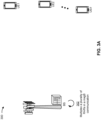
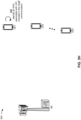
- Figs. 3A-3H are diagrams illustrating one or more examples 300 of RAR mapping for two-step RACH procedures, in accordance with various aspects of the present disclosure.
- example(s) 300 may include communication between a BS (e.g., BS 100) and a plurality of UEs (e.g., UE 120), such as UE1-UEn, and/or the like.
- the BS and the plurality of UEs may be included in a wireless network, such as wireless network 100 and/or the like.
- each of the plurality of UEs may perform a RACH procedure with the BS to establish a wireless connection with the BS.
- the RACH procedure may include, for example, a two-step RACH procedure, a four-step RACH procedure, and/or the like.
- a UE of the plurality of UEs may initiate a two-step RACH procedure by transmitting a msgA communication to the BS.
- the UE may transmit a preamble portion of the msgA communication in a preamble occasion (e.g., one or more time-frequency resources configured for RACH preamble transmission), and may transmit a payload portion of the msgA communication in a physical uplink shared channel (PUSCH) occasion (e.g., one or more time-frequency resources configured for msgA payload transmission).
- a preamble occasion e.g., one or more time-frequency resources configured for RACH preamble transmission
- PUSCH physical uplink shared channel
- the BS may multiplex RARs directed to the plurality of UEs in a msgB communication.
- the BS may multiplex the RARs directed to the plurality of UEs in the same msgB communication.
- the BS may time division multiplex RARs in the msgB communication, may frequency division multiplex RARs in the msgB communication, may spatially multiplex RARs in the msgB communication, or a combination thereof.
- the BS may multiplex subsets of the RARs directed to the plurality of UEs in different msgB communications.
- the BS may scramble the msgB communications with the same RNTI (e.g., same msgB-RNTI and/or another type of RNTI).
- the BS may scramble the msgB communications using the same set of msgB radio network temporary identifiers mapped to the same random access occasion.
- the BS may multiplex the same type of RARs in a msgB communication, may multiplex different types of RARs in the msgB communication, or a combination thereof.
- the BS may multiplex one or more success RARs (with or without an associated RRC message) in a msgB communication, may multiplex one or more fallback RARs in the msgB communication, and/or the like.
- the BS may multiplex initial or first transmissions of one or more RARs in a msgB communication (e.g., one or more initial or first transmissions of a success RAR, a fallback RAR, and/or the like), may multiplex retransmissions of one or more RARs in the msgB communication (e.g., one or more retransmissions of a success RAR, a fallback RAR, and/or the like), and/or the like.
- a msgB communication e.g., one or more initial or first transmissions of a success RAR, a fallback RAR, and/or the like
- retransmissions of one or more RARs in the msgB communication e.g., one or more retransmissions of a success RAR, a fallback RAR, and/or the like
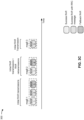
- Figs. 3B and 3C illustrate various examples of RARs multiplexed in one or more msgB communications.
- the BS may multiplex different subsets of RARs directed to five UEs (e.g., RAR 1 through RAR 5) in respective msgB communications.
- the BS may multiplex the initial transmissions of RAR 1, RAR 2, and RAR 3 (e.g., directed to a UE1, a UE2, and a UE3, respectively) in msgB 1, may multiplex the initial transmissions of RAR 4 and RAR 5 (e.g., directed to UE4 and UE5, respectively) in msgB 2, and may multiplex retransmissions of RAR 1, RAR 2, and RAR 3 (e.g., directed to a UE1, a UE2, and a UE3, respectively) in msgB 3.
- RAR 1, RAR 2, and RAR 3 e.g., directed to a UE1, a UE2, and a UE3, respectively
- msgB 1 may include a success RAR without an associated RRC message (e.g., RAR 1), a success RAR with an associated RRC message (e.g., RAR 2), and a fallback RAR (e.g., RAR 3).
- msgB 2 may include a fallback RAR (e.g., RAR 4) and a success RAR with an associated RRC message (e.g., RAR 5).
- msgB 3 may include a success RAR without an associated RRC message (e.g., RAR 1), a success RAR with an associated RRC message (e.g., RAR 2), and a fallback RAR (e.g., RAR 3).
- RAR 1 a success RAR without an associated RRC message
- RAR 2 a success RAR with an associated RRC message
- RAR 3 a fallback RAR
- the BS may multiplex different subsets of RARs directed to five UEs (e.g., RAR 1 through RAR 5) in respective msgB communications.
- the BS may multiplex the initial transmissions of RAR 1, RAR 2, and RAR 3 (e.g., directed to a UE1, a UE2, and a UE3, respectively) in msgB 1, may multiplex a retransmission of RAR 1 with the initial transmissions of RAR 4 (e.g., directed to UE4) in msgB 2, and may include the initial transmission of RAR 5 (e.g., directed to a UE5) in msgB 3.
- msgB 1 may include a success RAR without an associated RRC message (e.g., RAR 1), a success RAR with an associated RRC message (e.g., RAR 2), and a fallback RAR (e.g., RAR 3).
- msgB 2 may include an initial transmission of a fallback RAR (e.g., RAR 4) and a retransmission of a success RAR without an associated RRC message (e.g., RAR 1).
- the BS may use various techniques to identify RARs that are to be multiplexed in the same msgB communication.
- the BS may multiplex RARs in the same msgB communication based at least in part on respective priorities associated with each of the RARs. For example, the BS may multiplex RARs of a high priority in the same msgB communication and may transmit the msgB communication earlier in time relative to a msgB communication carrying multiplexed RARs of a relatively lower priority.
- the BS may multiplex RARs in the same msgB communication based at least in part on respective payload sizes associated with the RARs to efficiently use the available space in the msgB communication.
- the BS may be permitted to include a particular quantity of bits or bytes in the payload portion of a msgB communication, and the BS may multiplex RARs in the msgB communication such that the RARs utilize the most amount of the available space in the msgB communication.
- the BS may group RARs, directed to UEs that transmitted preambles in the same preamble occasion, into one or more sets of RARs.
- the BS may multiplex each set of RARs into a respective msgB communication such that the transmissions of the sets of RARs are ordered in time.
- the order of the sets of RARs may be based at least in part on starting symbols of respective RAR reception windows associated with each of the UEs.
- the BS may multiplex RARs directed to a first group or set of UEs having an associated RAR reception window starting on the same symbol into a first msgB communication, may multiplex RARs directed to a second group or set of UEs having an associated RAR reception window starting on the same symbol into a second msgB communication, and so on.
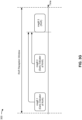
- Figs. 3D and 3E illustrate various examples of grouping RARs into sets based at least in part on a starting symbol of a respective RAR reception window associated with one or more UEs.
- a plurality of UEs may transmit RACH preambles (e.g., preamble portions of a msgA communication in a two-step RACH procedure) in the same preamble occasion X.
- RACH preambles e.g., preamble portions of a msgA communication in a two-step RACH procedure
- a first subset of the UEs may transmit a msgA payload portion in a PUSCH occasion Y
- a second subset of the UEs may transmit a msgA payload portion in a PUSCH occasion Z that occurs after PUSCH occasion Y.
- the starting symbol of a first RAR reception window associated with preamble occasion/PUSCH occasion combination (X,Y) may be a different symbol than the starting symbol of a second RAR reception window associated with preamble occasion/PUSCH occasion combination (X,Z).
- the BS may multiplex RARs directed to the first subset of UEs into a first msgB communication (X,Y) and may transmit the first msgB communication in the first RAR reception window.
- the BS may multiplex RARs directed to the second subset of UEs into a second msgB communication (X,Z) and may transmit the second msgB communication in the second RAR reception window.
- a plurality of UEs may transmit RACH preambles (e.g., preamble portions of a msgA communication in a two-step RACH procedure) in the same preamble occasion X.
- RACH preambles e.g., preamble portions of a msgA communication in a two-step RACH procedure
- a first subset of the UEs may transmit a msgA payload portion in a PUSCH occasion Y
- a second subset of the UEs may transmit a msgA payload portion in a PUSCH occasion Z.
- the starting symbol of a first RAR reception window associated with preamble occasion/PUSCH occasion combination may be the same symbol as the starting symbol of a second RAR reception window associated with preamble occasion/PUSCH occasion combination (X,Z).
- the BS may multiplex RARs directed to the first subset of UEs and the second subset of UEs into the same msgB communication (X,Y) & (X,Z), and may transmit the msgB communication in the RAR reception window.
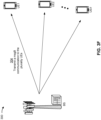
- the BS may transmit a msgB communication to the plurality of UEs.
- the msgB communication may include a multiplexed plurality of RARs directed to the plurality of UEs.
- the BS may transmit the msgB communications to the plurality of UEs.
- the BS may transmit the msgB communication(s) during RAR reception windows associated with each of the plurality of UEs.
- a UE may monitor for and decode msgB communications during an associated RAR reception window.
- a UE may need to decode a plurality of msgB communications before identifying the RAR directed to the UE, which increases processing, memory, and/or power consumption at the UE.
- the BS may include an early indicator, in one or more msgB communications transmitted during the RAR reception window, of a transmission timing for the msgB communication carrying the RAR directed to the UE.
- the UE may decode a msgB communication, may identify the early indicator in the msgB communication (e.g., which may identify a subsequent msgB communication that will carry the RAR directed to the UE), and may refrain from monitoring for and decoding any intervening msgB communications prior to the msgB communication carrying the RAR directed to the UE.
- Fig. 3G illustrates an example of an early indicator of an RAR directed to a UE (or a set or group of UEs).
- the BS may transmit a plurality of msgB communications during an RAR reception window associated with one or more UEs.
- the RAR(s) directed to the UE(s) may be included in msgB 3, which may be transmitted after msgB 1 and msgB 2 in the RAR reception window.
- the BS may include the early indicator, that the RAR(s) will be included in msgB 3, in msgB 1 and msgB 2.
- a UE may receive and decode msgB 1, identify the early indicator, and refrain from receiving and decoding msgB 2 based at least in part on the early indicator. If the UE misses or is unable to decode msgB 1, the UE may receive and decode msgB 2, may identify the early indicator, and may monitor for and receive msgB 3 based at least in part on the early indicator.
- the BS may include an early indicator of a transmission timing for a msgB communication carrying an RAR in a PDCCH portion of another msgB communication, in a PDSCH portion of another msgB communication, and/or the like.
- an early indicator may be included in downlink control information (DCI) in the PDCCH portion of another msgB communication, may be included in a medium access control (MAC) sub-header in the PDCCH portion or PDSCH portion, may be included in a MAC sub-protocol data unit (PDU) in the PDCCH portion or PDSCH portion, and/or the like.
- DCI downlink control information
- MAC medium access control
- PDU MAC sub-protocol data unit
- an early indicator of a transmission timing for a msgB communication carrying an RAR may include a compressed UE identifier associated with the UE (or UEs) to which the RAR is directed.
- the UE may determine that the early indicator is for the UE based at least in part on the compressed UE identifier indicated in the msgB communication carrying the early indicator.
- the compressed UE identifier may include a RAPID associated with the UE, a most significant bit (MSB) of a C-RNTI associated with the UE, a least significant bit (LSB) of the C-RNTI associated with the UE, an MSB of an idle or inactive radio network temporary identifier (I-RNTI) associated with the UE, an LSB of the I-RNTI associated with the UE, and/or another type of compressed UE identifier.
- MSB most significant bit
- LSB least significant bit
- I-RNTI idle or inactive radio network temporary identifier
- the early indicator may include a timing offset between the msgB communication carrying the early indicator and the msgB communication carrying the RAR directed to the UE, and the timing offset may include a slot-level offset, a symbol-level offset, a back off indication, or a combination thereof.
- the timing offset may be specified for a control resource set (CORESET) or search space associated with the msgB communication carrying the RAR directed to the UE, and may be indicated relative to the msgB communication carrying the early indicator.
- the early indicator may include an index of the search space associated with the msgB communication carrying the RAR directed to the UE. Accordingly, the UE may identify the msgB communication carrying the RAR directed to the UE based at least in part on the timing offset and/or the index of the search space.
- UE1 may receive a msgB communication from the BS and may identify an RAR, associated with UE1, included in the msgB communication. In some aspects, UE1 may identify the RAR among a plurality of RARs multiplexed in the msgB communication. In some aspects, UE1 may identify the RAR based at least in part on the RAR being scrambled using an RNTI associated with the UE and/or another type of UE identifier associated with the UE. In some aspects, the other UEs in the plurality of UEs may receive msgB communications from the BS and may identify associated RARs using similar techniques.
- a UE may transmit hybrid automatic repeat request (HARQ) feedback to the BS based at least in part on a msgB communication.
- the HARQ feedback may include an acknowledgement (ACK) if the UE is able to decode the msgB communication, or a negative ACK (NACK) if the UE is unable to decode the msgB communication or did not receive the msgB communication.
- the UE may transmit the HARQ feedback in a physical uplink control channel (PUCCH) communication to the BS (e.g., during a two-step RACH procedure, after the two-step RACH procedure, and/or the like).
- PUCCH physical uplink control channel
- the BS may include one or more PUCCH parameters for the HARQ feedback in the associated msgB communication, in another msgB communication that is transmitted prior to the associated msgB communication (e.g., along with an early indicator), and/or the like.
- the one or more PUCCH parameters may be included in a PDCCH portion of a msgB communication, in a PDSCH portion of a msgB communication, and/or the like.
- a UE may transmit HARQ feedback associated with a msgB communication based at least in part on the one or more PUCCH parameters.
- the BS may configure the one or more PUCCH parameters to include one or more common PUCCH parameters that are shared by a plurality of UEs, and one or more UE-specific PUCCH parameters that are specific to a particular UE.
- the one or more common PUCCH parameters may include a common PUCCH power control parameter (e.g., an indication of a transmit power for the PUCCH communication carrying the HARQ feedback), a PUCCH resource allocation (e.g., an indication of a common set of time-frequency resources for transmitting the PUCCH communication carrying the HARQ feedback), a HARQ feedback timing indicator (e.g., an indication of a timing for transmitting the HARQ feedback), and/or the like.
- a common PUCCH power control parameter e.g., an indication of a transmit power for the PUCCH communication carrying the HARQ feedback
- a PUCCH resource allocation e.g., an indication of a common set of time-frequency resources for transmitting the PUCCH communication carrying the HARQ feedback
- a HARQ feedback timing indicator e.g., an indication of a timing for transmitting the HARQ feedback
- the one or more UE-specific PUCCH parameters may include a UE-specific PUCCH power control parameter, a PDSCH-to-HARQ feedback timing indicator, a UE-specific PUCCH resource allocation, a UE-specific HARQ feedback timing indicator, and/or other UE-specific parameters.
- the one or more common PUCCH parameters may be included in DCI of a PDCCH portion of a msgB communication, in a MAC sub-header of a PDSCH portion of the msgB communication, in a MAC sub-PDU of the PDSCH portion of the msgB communication, and/or the like.
- the one or more UE-specific PUCCH parameters may be included in a MAC sub-header of a PDSCH portion of the msgB communication, in a MAC sub-PDU of the PDSCH portion of the msgB communication, or be derived implicitly from the ordering of UE specific MAC sub-header, the ordering of UE specific MAC sub-PDU, the preamble sequence index, the demodulation reference signal (DMRS) resource index, the PUSCH resource unit index, and/or the like.
- DMRS demodulation reference signal
- the BS may multiplex a plurality of RARs into a single msgB communication, and may transmit the msgB communication to one or more of the plurality of UEs.
- the reduced quantity of msgB communications in turn decreases processing, memory, and power resource consumption at the UEs because the UEs may monitor for and decode fewer msgB communications during associated RAR reception windows to receive RARs.
- the BS may further decrease processing, memory, and power resource consumption at the UEs by multiplexing the same type of RARs and/or different types of RARs in the same msgB communication, which may permit success RARs, fallback RARs, initial RAR transmissions, and/or RAR retransmissions to be included in the same msgB communication.
- the BS may also provide an early indication of which msgB communication will carry an RAR directed to a particular UE or group of UEs, which further decreases processing, memory, and power resource consumption at the UEs.
- Figs. 3A-3H are provided as one or more examples. Other examples may differ from what is described with respect to Figs. 3A-3H .
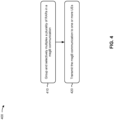
- Fig. 4 is a diagram illustrating an example process 400 performed, for example, by a BS, in accordance with various aspects of the present disclosure.
- Example process 400 is an example where the BS (e.g., BS 110) performs operations associated with RAR mapping for two-step RACH procedures.
- process 400 may include grouping and selectively multiplexing a plurality of RARs in a msgB communication (block 410).
- the BS e.g., using transmit processor 220, receive processor 238, controller/processor 240, memory 242, and/or the like
- process 400 may include transmitting the msgB communication to one or more UEs (block 420).
- the BS e.g., using transmit processor 220, receive processor 238, controller/processor 240, memory 242, and/or the like
- Process 400 may include additional aspects, such as any single aspect or any combination of aspects described below and/or in connection with one or more other processes described elsewhere herein.
- Grouping and selectively multiplexing the plurality of RARs in the msgB communication may comprise multiplexing the plurality of RARs and supplementary scheduling information for other RARs in a plurality of msgB communications, the msgB communication being included in the plurality of msgB communications, wherein the plurality of msgB communications are time division multiplexed.
- Process 400 may include scrambling the plurality of msgB communications using a same msgB radio network temporary identifier or a same set of msgB radio network temporary identifiers mapped to the same random access occasion (RO).
- the plurality of RARs may comprise at least one of one or more fallback RARs, one or more success RARs with an associated RRC message, or one or more success RARs without an RRC message.
- the plurality of RARs may comprise at least one of an initial transmission of one or more RARs of the plurality of RARs or a retransmission of one or more RARs of the plurality of RARs.
- Multiplexing the plurality of RARs in the msgB communication may comprise multiplexing the plurality of RARs in the msgB communication based at least in part on at least one of a starting symbol of a respective RAR reception window associated with each of the one or more UEs sharing a same random access occasion, a respective priority associated with each of the plurality of RARs, a respective quality of service (QoS) class associated with each of the plurality of RARs, or a respective payload size of each of the plurality of RARs.
- QoS quality of service
- Process 400 may include transmitting, to the one or more UEs, an indication of a transmission timing for the msgB communication.
- the indication of the transmission timing for the msgB communication may be included in another msgB communication, and transmitting the indication of the transmission timing for the msgB communication may comprise transmitting the other msgB communication prior to transmitting the msgB communication.
- the indication of the transmission timing for the msgB communication may be included in at least one of DCI of the other msgB communication, a MAC sub-header of the other msgB communication, or a MAC sub-protocol data unit of the other msgB communication.
- the indication of the transmission timing for the msgB communication may comprise at least one of a respective compressed UE identifier associated with each of the one or more UEs, a timing offset, relative to the other msgB communication, of a control resource set or search space associated with the msgB communication, or an index of the search space associated with the msgB communication.
- the respective compressed UE identifier associated with each of the one or more UEs may comprise a random access preamble identifier, an MSB of a C-RNTI, an LSB of the C-RNTI, an MSB of an I-RNTI, or an LSB of the I-RNTI.
- the msgB communication may identify one or more PUCCH parameters for HARQ feedback associated with the msgB communication, wherein the one or more PUCCH parameters may comprise at least one of one or more common PUCCH parameters or one or more UE-specific PUCCH parameters.
- the one or more common PUCCH parameters may comprise at least one of a PUCCH power control parameter, a PUCCH resource allocation, a PDSCH-to-HARQ feedback timing indicator, or a HARQ feedback timing indicator.
- the one or more common PUCCH parameters may be included in at least one of DCI included in a PDCCH portion of the msgB communication, a common MAC sub-header included in a PDSCH portion of the msgB communication, or a common MAC sub-PDU included in the PDSCH portion of the msgB communication
- the one or more UE-specific PUCCH parameters may be included in at least one of a UE-specific MAC sub-header included in the PDSCH portion of the msgB communication or a UE-specific MAC sub-PDU included in the PDSCH portion of the msgB communication.
- the UE-specific PUCCH parameters can also be derived from an implicit indication based on the ordering of UE-specific MAC sub-header, the ordering of UE-specific MAC sub-PDU, the preamble sequence index, the DMRS resource index or the PUSCH resource unit index used by the UE in the two-step random access procedure.
- Process 400 may further comprise transmitting, to the one or more UEs, an indication of a transmission timing for the msgB communication in the supplementary scheduling information for other RARs to be mapped to a different msgB communication.
- process 400 may include additional blocks, fewer blocks, different blocks, or differently arranged blocks than those depicted in Fig. 4 . Additionally, or alternatively, two or more of the blocks of process 400 may be performed in parallel.
- Fig. 5 is a diagram illustrating an example process 500 performed, for example, by a UE, in accordance with various aspects of the present disclosure.
- Example process 500 is an example where the UE (e.g., UE 120) performs operations associated with RAR mapping for two-step RACH procedures.
- process 500 may include receiving, from a BS, a msgB communication associated with a two-step RACH procedure between the UE and the BS (block 510).
- the UE e.g., using receive processor 258, transmit processor 264, controller/processor 280, memory 282, and/or the like
- process 500 may include identifying an RAR, associated with the UE, among a plurality of RARs multiplexed in the msgB communication and supplementary scheduling information for other RARs (block 520).
- the UE e.g., using receive processor 258, transmit processor 264, controller/processor 280, memory 282, and/or the like
- Process 500 may include additional aspects, such as any single aspect or any combination of aspects described below and/or in connection with one or more other processes described elsewhere herein.
- the plurality of RARs may comprise at least one of one or more fallback RARs, one or more success RARs with an associated RRC message, or one or more success RARs without an RRC message.
- the plurality of RARs may comprise at least one of an initial transmission of one or more RARs of the plurality of RARs or a retransmission of one or more RARs of the plurality of RARs.
- Process 500 may include receiving, from the BS, an indication of a transmission timing for the msgB communication; and identifying the msgB communication based at least in part on the indication of the transmission timing for the msgB communication in the supplementary scheduling information multiplexed with RARs.
- Process 500 may include receiving the indication of the transmission timing for the msgB communication in another msgB communication that is transmitted prior to the msgB communication.
- Process 500 may include identifying the indication of the transmission timing for the msgB communication in at least one of DCI of the other msgB communication, a MAC sub-header of the other msgB communication, or a MAC sub-protocol data unit of the other msgB communication.
- the indication of the transmission timing for the msgB communication may comprise at least one of a respective compressed UE identifier associated with each of the one or more UEs, a timing offset, relative to the other msgB communication, of a control resource set or search space associated with the msgB communication, or an index of the search space associated with the msgB communication.
- the respective compressed UE identifier associated with each of the one or more UEs may comprise a random access preamble identifier, an MSB of a C-RNTI, an LSB of the C-RNTI, an MSB of an I-RNTI, or an LSB of the I-RNTI, and wherein the timing offset may comprise at least one of a slot level offset, a symbol level offset, or a back off indicator.
- Process 500 may include identifying one or more PUCCH parameters for HARQ feedback and transmitting, to the BS, HARQ feedback associated with the msgB communication based at least in part on the one or more PUCCH parameters.
- the one or more PUCCH parameters may comprise at least one of one or more common PUCCH parameters or one or more UE-specific PUCCH parameters.
- the one or more PUCCH parameters may comprise at least one of a PUCCH power control parameter, a PUCCH resource allocation, a PDSCH-to-HARQ feedback timing indicator, or a HARQ feedback timing indicator.
- the one or more common PUCCH parameters may be included in at least one of DCI included in a PDCCH portion of the msgB communication, a common MAC sub-header included in a PDSCH portion of the msgB communication, or a common MAC sub-PDU included in the PDSCH portion of the msgB communication
- the one or more UE-specific PUCCH parameters may be included in at least one of a UE-specific MAC sub-header included in the PDSCH portion of the msgB communication or a UE-specific MAC sub-PDU included in the PDSCH portion of the msgB communication.
- the UE specific PUCCH parameters can also be derived from an implicit indication based on the ordering of MAC sub-header, the ordering of MAC sub-PDU, the preamble sequence index, the DMRS resource index, and the PUSCH resource unit index used by the UE in the two-step random access procedure.
- process 500 may include additional blocks, fewer blocks, different blocks, or differently arranged blocks than those depicted in Fig. 5 . Additionally, or alternatively, two or more of the blocks of process 500 may be performed in parallel.
- ком ⁇ онент is intended to be broadly construed as hardware, firmware, and/or a combination of hardware and software.
- a processor is implemented in hardware, firmware, and/or a combination of hardware and software.
- satisfying a threshold may, depending on the context, refer to a value being greater than the threshold, greater than or equal to the threshold, less than the threshold, less than or equal to the threshold, equal to the threshold, not equal to the threshold, and/or the like.
- "at least one of: a, b, or c” is intended to cover a, b, c, a-b, a-c, b-c, and a-b-c, as well as any combination with multiples of the same element (e.g., a-a, a-a-a, a-a-b, a-a-c, a-b-b, a-c-c, b-b, b-b-b, b-b-c, c-c, and c-c-c or any other ordering of a, b, and c).
Landscapes
- Engineering & Computer Science (AREA)
- Signal Processing (AREA)
- Computer Networks & Wireless Communication (AREA)
- Mobile Radio Communication Systems (AREA)
Applications Claiming Priority (3)
| Application Number | Priority Date | Filing Date | Title |
|---|---|---|---|
| US201962912558P | 2019-10-08 | 2019-10-08 | |
| US16/948,956 US11864235B2 (en) | 2019-10-08 | 2020-10-07 | Random access response mapping for two-step random access channel procedure |
| PCT/US2020/054801 WO2021072088A1 (en) | 2019-10-08 | 2020-10-08 | Random access response mapping for two-step random access channel procedure |
Publications (3)
| Publication Number | Publication Date |
|---|---|
| EP4042820A1 EP4042820A1 (en) | 2022-08-17 |
| EP4042820B1 true EP4042820B1 (en) | 2025-02-12 |
| EP4042820C0 EP4042820C0 (en) | 2025-02-12 |
Family
ID=75275144
Family Applications (1)
| Application Number | Title | Priority Date | Filing Date |
|---|---|---|---|
| EP20797942.8A Active EP4042820B1 (en) | 2019-10-08 | 2020-10-08 | Random access response mapping for two-step random access channel procedure |
Country Status (9)
| Country | Link |
|---|---|
| US (2) | US11864235B2 (enExample) |
| EP (1) | EP4042820B1 (enExample) |
| JP (1) | JP7641277B2 (enExample) |
| KR (1) | KR20220079535A (enExample) |
| CN (1) | CN114503768B (enExample) |
| BR (1) | BR112022006315A2 (enExample) |
| PH (1) | PH12022550587A1 (enExample) |
| TW (2) | TWI907361B (enExample) |
| WO (1) | WO2021072088A1 (enExample) |
Families Citing this family (8)
| Publication number | Priority date | Publication date | Assignee | Title |
|---|---|---|---|---|
| EP3836716B1 (en) * | 2018-08-08 | 2025-09-03 | Fujitsu Limited | Base station, terminal, wireless communication system |
| US11864235B2 (en) | 2019-10-08 | 2024-01-02 | Qualcomm Incorporated | Random access response mapping for two-step random access channel procedure |
| US12581529B2 (en) * | 2019-11-07 | 2026-03-17 | Nokia Technologies Oy | Contention resolution in random access procedure |
| CN113329478A (zh) * | 2020-02-28 | 2021-08-31 | 华为技术有限公司 | 一种随机接入响应方法及装置 |
| AU2021359327A1 (en) * | 2020-10-15 | 2023-04-27 | Lenovo (Singapore) Pte. Ltd. | Random access procedure in a non-terrestrial network |
| WO2022232973A1 (en) * | 2021-05-05 | 2022-11-10 | Qualcomm Incorporated | Capability or service indication over random access channel |
| KR102458106B1 (ko) * | 2021-09-07 | 2022-10-24 | 주식회사 블랙핀 | 무선 이동 통신 시스템에서 축소된 성능의 단말이 복수의 pucch 공통 설정 정보를 이용해서 랜덤 액세스를 수행하는 방법 및 장치 |
| WO2023205384A1 (en) | 2022-04-22 | 2023-10-26 | Ofinno, Llc | Uplink transmission scheduling in non-terrestrial networks |
Family Cites Families (22)
| Publication number | Priority date | Publication date | Assignee | Title |
|---|---|---|---|---|
| CN106162840B (zh) | 2015-04-10 | 2019-11-01 | 联想(北京)有限公司 | 信息处理方法、基站及终端 |
| US9743426B2 (en) | 2015-04-19 | 2017-08-22 | Alcatel Lucent | Dynamic determination and signaling of a RAR window size to a coverage enhanced low complexity machine type communication device |
| US9788322B2 (en) | 2015-04-19 | 2017-10-10 | Alcatel Lucent | Random access response position indication for coverage enhanced low complexity machine type communication |
| US10945290B2 (en) * | 2018-02-15 | 2021-03-09 | Comcast Cable Communications, Llc | Random access using supplemental uplink |
| US11497060B2 (en) * | 2018-10-01 | 2022-11-08 | Mediatek Singapore Pte. Ltd. | Multiplexing, addressing and HARQ for MsgB in two-step RACH in mobile communications |
| WO2020147043A1 (zh) * | 2019-01-16 | 2020-07-23 | 北京小米移动软件有限公司 | 关于随机接入的方法及装置 |
| CN111447644A (zh) * | 2019-01-17 | 2020-07-24 | 北京三星通信技术研究有限公司 | 用户设备以及上行数据传输方法 |
| EP3915328B1 (en) * | 2019-02-15 | 2025-09-03 | Nokia Technologies Oy | Structure of message from user equipment to base station in two-step random access |
| CN113439467B (zh) * | 2019-02-19 | 2024-03-19 | 上海诺基亚贝尔股份有限公司 | 在终端和无线网络节点之间的通信 |
| CN113826437B (zh) * | 2019-03-19 | 2023-07-04 | Lg电子株式会社 | 在无线通信系统中发送和接收信号的方法及支持其的装置 |
| CN111757534B (zh) * | 2019-03-27 | 2023-11-14 | 夏普株式会社 | 随机接入方法以及用户设备 |
| US12016055B2 (en) * | 2019-03-29 | 2024-06-18 | Beijing Xiaomi Mobile Software Co., Ltd. | Random access method and device, and computer readable storage medium |
| US11950296B2 (en) * | 2019-04-11 | 2024-04-02 | Lg Electronics Inc. | Method of performing random access procedure, and transmitting device, apparatus and storage medium therefor |
| CN111885737B (zh) * | 2019-05-03 | 2022-12-06 | 华为技术有限公司 | 随机接入的方法和装置 |
| WO2020235965A1 (en) * | 2019-05-23 | 2020-11-26 | Lg Electronics Inc. | Method of performing random access (ra) procedure, and transmitting device, apparatus and storage medium therefor, and method and apparatus for transmitting mac pdu of ra procedure |
| CN114375068B (zh) * | 2019-06-14 | 2024-05-03 | 维沃移动通信有限公司 | 随机接入方法、响应方法、终端及网络设备 |
| CN112399626B (zh) * | 2019-08-13 | 2025-11-07 | 苹果公司 | 2步随机接入中的下行链路无线电资源控制消息传输 |
| FI3780870T3 (fi) * | 2019-08-13 | 2025-05-06 | Apple Inc | Downlink-yhteyden radioresurssien kontrolliviestin lähetys 2-vaiheisessa hajasaannissa |
| PL3895499T3 (pl) * | 2019-08-15 | 2023-08-21 | Beijing Xiaomi Mobile Software Co., Ltd. | Odbiór odpowiedzi dostępu swobodnego |
| US11252765B2 (en) * | 2019-08-15 | 2022-02-15 | Ofinno, Llc | Reception of split random access response |
| JP2022549266A (ja) * | 2019-09-24 | 2022-11-24 | テレフオンアクチーボラゲット エルエム エリクソン(パブル) | ランダムアクセスプロシージャのための方法および装置 |
| US11864235B2 (en) | 2019-10-08 | 2024-01-02 | Qualcomm Incorporated | Random access response mapping for two-step random access channel procedure |
-
2020
- 2020-10-07 US US16/948,956 patent/US11864235B2/en active Active
- 2020-10-08 JP JP2022520916A patent/JP7641277B2/ja active Active
- 2020-10-08 EP EP20797942.8A patent/EP4042820B1/en active Active
- 2020-10-08 PH PH1/2022/550587A patent/PH12022550587A1/en unknown
- 2020-10-08 TW TW109134950A patent/TWI907361B/zh active
- 2020-10-08 KR KR1020227010297A patent/KR20220079535A/ko active Pending
- 2020-10-08 WO PCT/US2020/054801 patent/WO2021072088A1/en not_active Ceased
- 2020-10-08 BR BR112022006315A patent/BR112022006315A2/pt unknown
- 2020-10-08 TW TW114145498A patent/TW202614663A/zh unknown
- 2020-10-08 CN CN202080068800.0A patent/CN114503768B/zh active Active
-
2023
- 2023-11-15 US US18/509,993 patent/US12185383B2/en active Active
Also Published As
| Publication number | Publication date |
|---|---|
| US11864235B2 (en) | 2024-01-02 |
| US20210105824A1 (en) | 2021-04-08 |
| KR20220079535A (ko) | 2022-06-13 |
| JP2022552189A (ja) | 2022-12-15 |
| EP4042820A1 (en) | 2022-08-17 |
| EP4042820C0 (en) | 2025-02-12 |
| BR112022006315A2 (pt) | 2022-06-28 |
| WO2021072088A1 (en) | 2021-04-15 |
| US20240090041A1 (en) | 2024-03-14 |
| US12185383B2 (en) | 2024-12-31 |
| CN114503768A (zh) | 2022-05-13 |
| JP7641277B2 (ja) | 2025-03-06 |
| TWI907361B (zh) | 2025-12-11 |
| TW202118335A (zh) | 2021-05-01 |
| TW202614663A (zh) | 2026-04-01 |
| PH12022550587A1 (en) | 2023-10-02 |
| CN114503768B (zh) | 2025-02-11 |
Similar Documents
| Publication | Publication Date | Title |
|---|---|---|
| US20250185073A1 (en) | Enhanced configuration for physical random access channel mask and random access response window | |
| US11723067B2 (en) | Supporting cross-TAG scheduling and 2-step RACH payload transmission for a PDCCH-ordered contention-free random access procedure | |
| US12185383B2 (en) | Random access response mapping for two-step random access channel procedure | |
| US20200413424A1 (en) | Joint activation and/or release for multiple configured grant and/or semi-persistent scheduling configurations | |
| US11678375B2 (en) | Random access response type differentiation | |
| US12119994B2 (en) | Offset and dynamic feedback information validation for configured grants | |
| US11991768B2 (en) | Handling single uplink transmissions in a dual connectivity mode | |
| US11405893B2 (en) | Receiver-based resource reservation | |
| US12513752B2 (en) | Two-step random access channel signaling | |
| EP4052394B1 (en) | Message b channel structure | |
| US12484074B2 (en) | Resource sharing between base stations and anchor user equipments on sidelink channels | |
| US12549313B2 (en) | Random access procedure using secondary cell downlink channel | |
| US12069728B2 (en) | Techniques for early termination signaling for random access response windows |
Legal Events
| Date | Code | Title | Description |
|---|---|---|---|
| STAA | Information on the status of an ep patent application or granted ep patent |
Free format text: STATUS: UNKNOWN |
|
| STAA | Information on the status of an ep patent application or granted ep patent |
Free format text: STATUS: THE INTERNATIONAL PUBLICATION HAS BEEN MADE |
|
| PUAI | Public reference made under article 153(3) epc to a published international application that has entered the european phase |
Free format text: ORIGINAL CODE: 0009012 |
|
| STAA | Information on the status of an ep patent application or granted ep patent |
Free format text: STATUS: REQUEST FOR EXAMINATION WAS MADE |
|
| 17P | Request for examination filed |
Effective date: 20220309 |
|
| AK | Designated contracting states |
Kind code of ref document: A1 Designated state(s): AL AT BE BG CH CY CZ DE DK EE ES FI FR GB GR HR HU IE IS IT LI LT LU LV MC MK MT NL NO PL PT RO RS SE SI SK SM TR |
|
| DAV | Request for validation of the european patent (deleted) | ||
| DAX | Request for extension of the european patent (deleted) | ||
| STAA | Information on the status of an ep patent application or granted ep patent |
Free format text: STATUS: EXAMINATION IS IN PROGRESS |
|
| 17Q | First examination report despatched |
Effective date: 20240222 |
|
| GRAP | Despatch of communication of intention to grant a patent |
Free format text: ORIGINAL CODE: EPIDOSNIGR1 |
|
| STAA | Information on the status of an ep patent application or granted ep patent |
Free format text: STATUS: GRANT OF PATENT IS INTENDED |
|
| RIC1 | Information provided on ipc code assigned before grant |
Ipc: H04L 5/14 20060101ALN20240913BHEP Ipc: H04L 1/1867 20230101ALN20240913BHEP Ipc: H04L 1/1829 20230101ALN20240913BHEP Ipc: H04W 74/0833 20240101ALN20240913BHEP Ipc: H04W 74/08 20090101AFI20240913BHEP |
|
| INTG | Intention to grant announced |
Effective date: 20241001 |
|
| GRAS | Grant fee paid |
Free format text: ORIGINAL CODE: EPIDOSNIGR3 |
|
| GRAA | (expected) grant |
Free format text: ORIGINAL CODE: 0009210 |
|
| STAA | Information on the status of an ep patent application or granted ep patent |
Free format text: STATUS: THE PATENT HAS BEEN GRANTED |
|
| AK | Designated contracting states |
Kind code of ref document: B1 Designated state(s): AL AT BE BG CH CY CZ DE DK EE ES FI FR GB GR HR HU IE IS IT LI LT LU LV MC MK MT NL NO PL PT RO RS SE SI SK SM TR |
|
| REG | Reference to a national code |
Ref country code: GB Ref legal event code: FG4D |
|
| REG | Reference to a national code |
Ref country code: CH Ref legal event code: EP |
|
| REG | Reference to a national code |
Ref country code: DE Ref legal event code: R096 Ref document number: 602020045993 Country of ref document: DE |
|
| REG | Reference to a national code |
Ref country code: IE Ref legal event code: FG4D |
|
| U01 | Request for unitary effect filed |
Effective date: 20250302 |
|
| U07 | Unitary effect registered |
Designated state(s): AT BE BG DE DK EE FI FR IT LT LU LV MT NL PT RO SE SI Effective date: 20250310 |
|
| PG25 | Lapsed in a contracting state [announced via postgrant information from national office to epo] |
Ref country code: RS Free format text: LAPSE BECAUSE OF FAILURE TO SUBMIT A TRANSLATION OF THE DESCRIPTION OR TO PAY THE FEE WITHIN THE PRESCRIBED TIME-LIMIT Effective date: 20250512 |
|
| PG25 | Lapsed in a contracting state [announced via postgrant information from national office to epo] |
Ref country code: PL Free format text: LAPSE BECAUSE OF FAILURE TO SUBMIT A TRANSLATION OF THE DESCRIPTION OR TO PAY THE FEE WITHIN THE PRESCRIBED TIME-LIMIT Effective date: 20250212 |
|
| PG25 | Lapsed in a contracting state [announced via postgrant information from national office to epo] |
Ref country code: ES Free format text: LAPSE BECAUSE OF FAILURE TO SUBMIT A TRANSLATION OF THE DESCRIPTION OR TO PAY THE FEE WITHIN THE PRESCRIBED TIME-LIMIT Effective date: 20250212 |
|
| PG25 | Lapsed in a contracting state [announced via postgrant information from national office to epo] |
Ref country code: IS Free format text: LAPSE BECAUSE OF FAILURE TO SUBMIT A TRANSLATION OF THE DESCRIPTION OR TO PAY THE FEE WITHIN THE PRESCRIBED TIME-LIMIT Effective date: 20250612 Ref country code: NO Free format text: LAPSE BECAUSE OF FAILURE TO SUBMIT A TRANSLATION OF THE DESCRIPTION OR TO PAY THE FEE WITHIN THE PRESCRIBED TIME-LIMIT Effective date: 20250512 |
|
| PG25 | Lapsed in a contracting state [announced via postgrant information from national office to epo] |
Ref country code: HR Free format text: LAPSE BECAUSE OF FAILURE TO SUBMIT A TRANSLATION OF THE DESCRIPTION OR TO PAY THE FEE WITHIN THE PRESCRIBED TIME-LIMIT Effective date: 20250212 |
|
| PG25 | Lapsed in a contracting state [announced via postgrant information from national office to epo] |
Ref country code: GR Free format text: LAPSE BECAUSE OF FAILURE TO SUBMIT A TRANSLATION OF THE DESCRIPTION OR TO PAY THE FEE WITHIN THE PRESCRIBED TIME-LIMIT Effective date: 20250513 |
|
| PG25 | Lapsed in a contracting state [announced via postgrant information from national office to epo] |
Ref country code: SM Free format text: LAPSE BECAUSE OF FAILURE TO SUBMIT A TRANSLATION OF THE DESCRIPTION OR TO PAY THE FEE WITHIN THE PRESCRIBED TIME-LIMIT Effective date: 20250212 |
|
| PGFP | Annual fee paid to national office [announced via postgrant information from national office to epo] |
Ref country code: GB Payment date: 20250911 Year of fee payment: 6 |
|
| PG25 | Lapsed in a contracting state [announced via postgrant information from national office to epo] |
Ref country code: CZ Free format text: LAPSE BECAUSE OF FAILURE TO SUBMIT A TRANSLATION OF THE DESCRIPTION OR TO PAY THE FEE WITHIN THE PRESCRIBED TIME-LIMIT Effective date: 20250212 |
|
| PGFP | Annual fee paid to national office [announced via postgrant information from national office to epo] |
Ref country code: IE Payment date: 20250912 Year of fee payment: 6 |
|
| U20 | Renewal fee for the european patent with unitary effect paid |
Year of fee payment: 6 Effective date: 20250915 |
|
| PG25 | Lapsed in a contracting state [announced via postgrant information from national office to epo] |
Ref country code: SK Free format text: LAPSE BECAUSE OF FAILURE TO SUBMIT A TRANSLATION OF THE DESCRIPTION OR TO PAY THE FEE WITHIN THE PRESCRIBED TIME-LIMIT Effective date: 20250212 |
|
| PLBE | No opposition filed within time limit |
Free format text: ORIGINAL CODE: 0009261 |
|
| STAA | Information on the status of an ep patent application or granted ep patent |
Free format text: STATUS: NO OPPOSITION FILED WITHIN TIME LIMIT |
|
| REG | Reference to a national code |
Ref country code: CH Ref legal event code: L10 Free format text: ST27 STATUS EVENT CODE: U-0-0-L10-L00 (AS PROVIDED BY THE NATIONAL OFFICE) Effective date: 20251224 |
|
| 26N | No opposition filed |
Effective date: 20251113 |
|
| REG | Reference to a national code |
Ref country code: CH Ref legal event code: H13 Free format text: ST27 STATUS EVENT CODE: U-0-0-H10-H13 (AS PROVIDED BY THE NATIONAL OFFICE) Effective date: 20260527 |
|
| PG25 | Lapsed in a contracting state [announced via postgrant information from national office to epo] |
Ref country code: MC Free format text: LAPSE BECAUSE OF FAILURE TO SUBMIT A TRANSLATION OF THE DESCRIPTION OR TO PAY THE FEE WITHIN THE PRESCRIBED TIME-LIMIT Effective date: 20250212 |
|
| PG25 | Lapsed in a contracting state [announced via postgrant information from national office to epo] |
Ref country code: CH Free format text: LAPSE BECAUSE OF NON-PAYMENT OF DUE FEES Effective date: 20251031 |