EP4040871B1 - Gerät und verfahren zum weiterleiten von dienstregistrierungsereignissen über eine e2-schnittstelle in einem drahtlosen zugangsnetz-kommunikationssystem - Google Patents
Gerät und verfahren zum weiterleiten von dienstregistrierungsereignissen über eine e2-schnittstelle in einem drahtlosen zugangsnetz-kommunikationssystem Download PDFInfo
- Publication number
- EP4040871B1 EP4040871B1 EP20874549.7A EP20874549A EP4040871B1 EP 4040871 B1 EP4040871 B1 EP 4040871B1 EP 20874549 A EP20874549 A EP 20874549A EP 4040871 B1 EP4040871 B1 EP 4040871B1
- Authority
- EP
- European Patent Office
- Prior art keywords
- ric
- ran
- node
- message
- indication
- Prior art date
- Legal status (The legal status is an assumption and is not a legal conclusion. Google has not performed a legal analysis and makes no representation as to the accuracy of the status listed.)
- Active
Links
Images




Classifications
-
- H—ELECTRICITY
- H04—ELECTRIC COMMUNICATION TECHNIQUE
- H04W—WIRELESS COMMUNICATION NETWORKS
- H04W24/00—Supervisory, monitoring or testing arrangements
- H04W24/02—Arrangements for optimising operational condition
-
- H—ELECTRICITY
- H04—ELECTRIC COMMUNICATION TECHNIQUE
- H04W—WIRELESS COMMUNICATION NETWORKS
- H04W60/00—Affiliation to network, e.g. registration; Terminating affiliation with the network, e.g. de-registration
- H04W60/04—Affiliation to network, e.g. registration; Terminating affiliation with the network, e.g. de-registration using triggered events
-
- H—ELECTRICITY
- H04—ELECTRIC COMMUNICATION TECHNIQUE
- H04W—WIRELESS COMMUNICATION NETWORKS
- H04W88/00—Devices specially adapted for wireless communication networks, e.g. terminals, base stations or access point devices
- H04W88/08—Access point devices
- H04W88/085—Access point devices with remote components
-
- H—ELECTRICITY
- H04—ELECTRIC COMMUNICATION TECHNIQUE
- H04W—WIRELESS COMMUNICATION NETWORKS
- H04W88/00—Devices specially adapted for wireless communication networks, e.g. terminals, base stations or access point devices
- H04W88/12—Access point controller devices
-
- H—ELECTRICITY
- H04—ELECTRIC COMMUNICATION TECHNIQUE
- H04W—WIRELESS COMMUNICATION NETWORKS
- H04W92/00—Interfaces specially adapted for wireless communication networks
- H04W92/04—Interfaces between hierarchically different network devices
- H04W92/12—Interfaces between hierarchically different network devices between access points and access point controllers
-
- H—ELECTRICITY
- H04—ELECTRIC COMMUNICATION TECHNIQUE
- H04W—WIRELESS COMMUNICATION NETWORKS
- H04W92/00—Interfaces specially adapted for wireless communication networks
- H04W92/16—Interfaces between hierarchically similar devices
- H04W92/20—Interfaces between hierarchically similar devices between access points
-
- H—ELECTRICITY
- H04—ELECTRIC COMMUNICATION TECHNIQUE
- H04W—WIRELESS COMMUNICATION NETWORKS
- H04W92/00—Interfaces specially adapted for wireless communication networks
- H04W92/16—Interfaces between hierarchically similar devices
- H04W92/24—Interfaces between hierarchically similar devices between backbone network devices
Definitions
- the present disclosure generally relates to a radio access network communication system, and more specifically, message relay apparatus and method if a service event occurs for a base station conforming to an open radio access network (O-RAN) standard using an E2 message of the radio communication system.
- OF-RAN open radio access network
- the 5G or pre-5G communication system is also called a ⁇ Beyond 4G Network' or a ⁇ Post LTE System'.
- the 5G communication system is considered to be implemented in higher frequency (mmWave) bands, e.g., 60GHz bands, so as to accomplish higher data rates.
- mmWave e.g., 60GHz bands
- MIMO massive multiple-input multiple-output
- FD-MIMO Full Dimensional MIMO
- array antenna an analog beam forming, large scale antenna techniques are discussed in 5G communication systems.
- RANs Cloud Radio Access Networks
- D2D device-to-device
- wireless backhaul moving network
- cooperative communication Coordinated Multi-Points (CoMP), reception-end interference cancellation and the like.
- CoMP Coordinated Multi-Points
- FQAM Hybrid FSK and QAM Modulation
- SWSC sliding window superposition coding
- ACM advanced coding modulation
- FBMC filter bank multi carrier
- NOMA non-orthogonal multiple access
- SCMA sparse code multiple access
- the 5G system and new radio or next radio (NR) are commercialized to satisfy demand for wireless data traffic, and provide a high data rate service to a user through the 5G system like 4G, and it is also expected that wireless communication services for various purposes such as internet of things and a service requiring high reliability for a specific purpose may be provided.
- Open radio access network (O-RAN) established by operators and equipment providers in a system where the current 4G communication system and the 5G system are mixed defines a new network element (NE) and an interface standard based on the existing 3rd generation partnership project (3GPP) standard, and suggests an O-RAN structure.
- 3GPP 3rd generation partnership project
- THORALF CZICHY "5G RAN optimization using the O-RAN software community's RIC (RAN Intelligent Controller)", OPEN NETWORKING SUMMIT EUROPE, discloses a RAN communicating with an RIC via E2 messages.
- EP 4 027 715 A1 and EP 4 044 702 A1 published after the priority date of the present application, disclose a method performed by an E2 node, comprising receiving a radio access network (RAN) intelligent controller (RIC) subscription request message from an RIC via an E2 interface, wherein the RIC subscription request message comprises information indicating a network interface type, a RIC Request ID, and E2 Node Function ID and a RIC Subscription Type.
- RAN radio access network
- RIC intelligent controller
- Open-radio access network newly defines the existing 3rd generation partnership project (3GPP) network entity (NE), radio unit (RU), distributed unit (DU), central unit (CU)-control plane (CP), and CU-user plane (UP) as O-RU, O-DU, O-CU-CP, and O-CU-UP respectively, and additionally standardizes a near-real-time RAN intelligent controller (RIC).
- 3GPP 3rd generation partnership project
- the present disclosure relates to an E2 subscription message for requesting a service from the newly defined RIC to the O-DU, the O-CU-CP or the O-CU-UP.
- the present disclosure relates to a method for subdividing and processing an E2 subscription message based on a user equipment (UE), a group, a cell, and a network slice.
- UE user equipment
- the O-RU, the O-DU, the O-CU-CP, and the O-CU-UP may be understood as objects constituting the RAN which may operate according to the O-RAN standard, and may be referred to as E2 nodes.
- the RIC generates an E2 subscription request message, and sets a call processing EVENT by relaying it to the E2 NODE (e.g., the O-CU-CP, the O-CU-UP, the O-DU), and the E2 node relays the subscription request response message relayed to the RIC after the event setup.
- the present disclosure relates to an E2 indication message for a newly defined RIC to divide a call processing message corresponding to an E2 event occurring in O-DU, O-CU-CP, O-CU-UP for a whole message set in a subscription event condition or for each specific application protocol per I/F, and received in a container form in a cell unit, a group ID unit, a network slice unit, and a UE unit.
- An apparatus and a method may indicate a type of a radio access network (RAN) intelligent controller (RIC) service through an indication message of an E2 node, and thus provide an effective service procedure between a near real time (RT) RIC and the E2 node.
- RAN radio access network
- RIC radio access network intelligent controller
- the preset disclosure relates to an apparatus and a method for performing a subscription procedure between a device in a radio access network (RAN) and a device for controlling the RAN in a wireless communication system.
- RAN radio access network
- the present disclosure describes various embodiments using terms used in some communication standard (e.g., 3rd generation partnership project (3GPP)), but this is only an example for description.
- 3GPP 3rd generation partnership project
- Various embodiments of the present disclosure may be easily modified and applied in other communication systems.
- an uplink indicates a radio link for transmitting data or a control signal from a user equipment (UE) or a mobile station (MS) to an eNode B or a base station (BS), and a downlink indicates a radio link for transmitting data or a control signal from the eNode B to the UE in the present disclosure.
- the eNode B is an entity which performs resource allocation of the UE, and may be at least one of an eNode B, a Node B, a BS, a generation node B (gNB) radio access unit, a BS controller, or a node on the network.
- the UE may include a UE, an MS, a cellular phone, a smart phone, a computer, or a multimedia system for performing a communication function.
- a 5 th generation (5G) communication system (hereafter, may be used interchangeably with a 5G system, a new radio or next radio (NR) system) is commercialized to satisfy demand for wireless data traffic, and provides a high data rate service to users through the 5G system like 4G, and it is also predicted that wireless communication services for various purposes such as internet of things and a service requiring high reliability for specific purposes may be provided.
- 5G 5 th generation
- NR next radio
- Open-RAN established by operators and equipment providers in a system where the current 4G communication system and the 5G system are mixed defines a new network element (NE) and an interface standard based on the existing 3GPP standard, and thus presents an O-RAN structure.
- the O-RAN newly defines the existing 3GPP network entity (NE), radio unit (RU), distributed unit (DU), central unit (CU)-control plane (CP), and CU-user plane (UP) as O-RU, O-DU, O-CU-CP, and O-CU-UP respectively, and besides, the O-RAN has standardized a near-real-time RAN intelligent controller (RIC) and a non-real-time (NRT) RIC.
- the RIC may be a server intensively deployed at one physical place.
- the RIC may be a logical node for collecting information on a cell site transmitted and received by a UE and the O-DU, the O-CU-CP or the O-CU-UP.
- the O-DU and the RIC, the O-CU-CP and the RIC, and the O-CU-UP and the RIC may be connected via Ethernet.
- an interface standard for communications between the O-DU and the RIC, between the O-CU-CP and the RIC, and between the O-CU-UP and the RIC are required, and message formats such as E2-DU, E2-CU-CP, E2-CU-UP requires defining procedures between the O-DU, the O-CU-CP, the O-CU-UP and the RIC.
- differentiated service support is required for users in a virtualized network, and it is necessary to define functions of messages of E2-DU, E2-CU-CP and E2-CU-UP to support a service for wide cell coverage, by concentrating a call processing message/function generating in the O-RAN on the RIC.
- the RIC may generate and transmit an E2 subscription message to the O-DU, the O-CU-CP, or the O-CU-UP and thus set an event occurrence condition.
- the O-DU, the O-CU-CP, or the O-CU-UP may determine that the set condition is satisfied, load a 3GPP call processing message corresponding to the satisfied condition in a container to the RIC, classify into a user identifier, a cell identifier, a network slice identifier and so on, and then transmit through an E2 indication/report.
- Call processing message information collected in the O-RAN based on the user identifier may be identified that the RIC is for a specific user/specific cell/specific network slice per I/F.
- the collected information may be transmitted from at least one of the (O-)CU-CP, the (O-)CU-UP, and the (O-)DU.
- the RIC may identify based on the user identifier that information collected from different entities is related to one specific user/specific cell/specific network slice, provide a specialized service for the specific user/specific cell/specific network slice with respect to a plurality of cells/network slices based on the collected information, and determine a key performance indicator (KPI) of the service provided to each user.
- KPI key performance indicator
- the RIC may collect call processing messages (e.g., E1, F 1, X2, XN, RRC, etc.) per I/F or respectively generated by the O-RU, the O-DU, the O-CU-CP or the O-CU-UP, and thus efficiently provide resource optimization and a user specific service or a user requested service with respect to the specific user/specific cell/specific network slices for wide cells.
- call processing messages e.g., E1, F 1, X2, XN, RRC, etc.
- the RIC may configure an additional carrier by efficiently dividing the network slice or by serving a specific terminal through carrier aggregation for the resource optimization, or configure an additional cell for performing dual access to serve a specific terminal through dual connectivity (DC).
- the RIC may configure a specific terminal to avoid connection with a specific cell and to connect with a specific cell in inter-cell movement.
- the RIC may efficiently perform the resource optimization through machine learning through analysis based on the collected information.
- the resource optimization of the present disclosure is not limited to the described content. Also, according to the present disclosure, it is possible not only to collect information per terminal but also to collect and analyze information per bearer.
- the collected information of the specific user may be used at a collection server, the RIC or the NRT-RIC but may be also provided to an operations support system (OSS) or/and a business support system (BSS) to provide the specialized service to the user.
- OSS operations support system
- BSS business support system
- FIG. 1 illustrates an example of a 4th generation (4G) long term evolution (LTE) core system.
- 4G 4th generation
- LTE long term evolution
- the LTE core system includes a base station 110, a terminal 120, a serving gateway (S-GW) 130, a packet data network gateway (P-GW) 140, a mobility management entity (MME). 150, a home subscriber server (HSS) 160, and a policy and charging rule function (PCRF) 170.
- S-GW serving gateway
- P-GW packet data network gateway
- MME mobility management entity
- HSS home subscriber server
- PCRF policy and charging rule function
- the base station 110 is a network infrastructure for providing radio access to the terminal 120.
- the base station 110 is a device which performs scheduling by collecting status information such as a buffer status, an available transmission power, and a channel status of the terminal 110.
- the base station 110 has coverage defined as a specific geographic region based on a signal transmission distance.
- the base station 110 is connected to the MME 150 via an S1-MME interface.
- the base station 110 may be referred to as an ⁇ access point (AP)', an ⁇ eNodeB (eNB)', a ⁇ wireless point', and a 'transmission/reception point (TRP)' or other term having the equivalent technical meaning.
- AP ⁇ access point
- eNB ⁇ eNodeB
- TRP 'transmission/reception point
- the terminal 120 is a device used by the user, and performs communication with the base station 110 over a radio channel. In some cases, the terminal 120 may be operated without user's involvement. That is, at least one of the terminal 120 and the terminal 130 is a device which performs machine type communication (MTC), and may not be carried by the user. Besides the terminal, the terminal 120 may be referred to as a 'UE', a 'mobile station', a ⁇ subscriber station', a ⁇ customer-premises equipment (CPE)', a ⁇ remote terminal', a ⁇ wireless terminal', or a ⁇ user device', or other term having the equivalent technical meaning.
- MTC machine type communication
- the S-GW 130 provides a data bearer, and generates or controls the data bearer under control of the MME 150.
- the S-GW 130 processes a packet arriving from the base station 110 or a packet to be forwarded to the base station 110.
- the S-GW 130 may perform an anchoring role in handover of the terminal 120 between base stations.
- the P-GW 140 may function as a connection point to an external network (e.g., an internet network).
- the P-GW 140 allocates an internet protocol (IP) address to the terminal 120, and serves as an anchor for the S-GW 130.
- the P-GW 140 may apply quality of service (QoS) policy of the terminal 120, and manage account data.
- QoS quality of service
- the MME 150 manages mobility of the terminal 120.
- the MME 150 may perform authentication, bearer management, and the like on the terminal 120. That is, the MME 150 is responsible for mobility management and various control functions of the terminal.
- the MME 150 may interwork with a serving general packet radio service (GPRS) support node (SGSN).
- GPRS general packet radio service
- the HSS 160 stores key information and a subscriber profile for the authentication of the terminal 120.
- the key information and the subscriber profile are transmitted from the HSS 160 to the MME 150 if the terminal 120 accesses the network.
- the PCRF 170 defines a policy and a charging rule.
- the stored information is forwarded from the PCRF 180 to the P-GW 140, and the P-GW 140 may control the terminal 120 (e.g., QoS management, charging, etc.) based on the information provided from the PCRF 180.
- Carrier aggregation (hereafter, 'CA') technology is a technology which combines a plurality of component carriers, and transmits and receives at one terminal a signal using the plurality of the component carriers at the same time and thus increases frequency use efficiency in terms of the terminal or the base station.
- the terminal and the base station may transmit and receive signals using a broadband using the plurality of the component carriers in the uplink (UL) and the downlink (DL), wherein the component carriers are located in different frequency bands respectively.
- the UL indicates a communication link through which the terminal transmits a signal to the base station
- the DL indicates a communication link through which the base station transmits a signal to the terminal.
- the numbers of uplink component carriers and downlink component carriers may be different.
- Dual connectivity or multi connectivity is a technology for increasing the frequency use efficiency in terms of the terminal or the base station, in which one terminal is connected to a plurality of different base stations and transmits and receives signals simultaneously using carriers within the plurality of the base stations positioned in different frequency bands.
- the terminal may be connected to a first base station (e.g., a base station which provides services using the LTE technology or the 4G mobile communication technology) and a second base station (e.g., a base station which provides services using the NR technology or 5G mobile communication technology) at the same time to transmit and receive traffic.
- frequency resources used by each base station may be positioned in different bands.
- the operation scheme based on the dual connectivity scheme of the LTE and the NR may be referred to as 5G non-standalone (NSA).
- NSA non-standalone
- FIG. 2A illustrates an example of a 5G NSA system.
- the 5G NSA system includes an NR RAN 210a, an LTE RAN 210b, a terminal 220, and an evolved packet core network (EPC) 250.
- the NR RAN 210a and the LTE RAN 210b are connected to the EPC 150, and the terminal 220 may be served by any one or both of the NR RAN 210a and the LTE RAN 210b at the same time.
- the NR RAN 210a includes at least one NR base station
- the LTE RAN 210b includes at least one LTE base station.
- the NR base station may be referred to as a '5G node', a 'gNB' or other term having the equivalent technical meaning.
- the NR base station may have a structure divided into a CU and a DU, and the CU may also have a structure divided into a CU-CP unit and a CU-UP unit.
- the terminal 220 may perform radio resource control (RRC) access through the first base station (e.g., a base station belonging to the LTE RAN 210b), and may be served with functions (e.g., connection management, mobility management, etc.) provided in the control plane.
- RRC radio resource control
- the terminal 220 may receive additional radio resources for transmitting and receiving data via a second base station (e.g., a base station belonging to the NR RAN 210a).
- This dual connectivity technology using the LTE and the NR may be referred to as evolved universal terrestrial radio access (E-UTRA)-NR (EN) - dual connectivity (DC).
- E-UTRA evolved universal terrestrial radio access
- EN evolved universal terrestrial radio access
- DC dual connectivity
- NR-E-UTRA NR-E-UTRA
- various embodiments may be applied to the multi connectivity and the CA technology of various types.
- various embodiments may be applicable even if a first system using a first communication technology and a second system using a second communication technology are implemented in one device or if the first base station and the second base station are located at the same geographic location.
- FIG. 2B shows an architecture example for the O-RAN.
- KPIMON E2-SM-KPI monitoring
- the eNB in deployment of the O-RAN non-stand alone mode, is connected with the EPC via an S1-C/S1-U interface, and is connected with the O-CU-CP via an X2 interface.
- the O-CU-CP for the deployment of the O-RAN stand alone mode may be connected with a 5G core (5GC) through an N2/N3 interface.
- 5GC 5G core
- FIG. 3 illustrates a protocol stack of an E2 application protocol message in a radio access network according to various embodiments of the present disclosure.
- a control plane includes a transport network layer and a radio network layer.
- the transport network layer includes a physical layer 310, a data link layer 320, an IP 330, and a stream control transmission protocol (SCTP) 340.
- SCTP stream control transmission protocol
- the radio network layer includes an E2AP 350.
- the E2AP 350 is used to deliver a subscription message, an indication message, a control message, a service update message, and a service query message, and is transmitted in a higher layer of the SCTP 340 and the IP 330.
- FIG. 4 illustrates an example of a connection between a base station and an RIC in a radio access network according to various embodiments of the present disclosure.
- an RIC 440 is connected to an O-CU-CP 420, an O-CU-UP 410, and an O-DU 430.
- the RIC 440 is a device for controlling a RAN node (or a device for performing a RAN function, for example, the O-CU-CP 420, the O-CU-UP 410, and the O-DU 430).
- the RIC 440 may be defined as a deice for customizing RAN functionality for a new service or reginal resource optimization.
- the RIC 440 may provide functions such as network intelligence (e.g., policy enforcement, handover optimization), resource assurance (e.g., radio-link management, advanced self-organized-network (SON)), resource control (e.g., load balancing, slicing policy).
- the RIC 440 may communicate with the O-CU-CP 420, the O-CU-UP 410, and the O-DU 430.
- the RIC 440 may be connected to each node via E2-CP, E2-UP, and E2-DU interfaces.
- the interface between the O-CU-CP and the DU and between the O-CU-UP and the DU may be referred to as an F1 interface.
- the DU and the O-DU, the CU-CP and the O-CU-CP, and the CU-UP and the O-CU-UP may be used interchangeably.
- FIG. 4 illustrates one RIC 440
- a plurality of RICs may exist, according to various embodiments.
- the plurality of the RICs may be implemented with a plurality of hardware located at the same physical location or may be implemented through virtualization using single hardware.
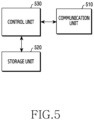
- FIG. 5 illustrates a configuration of a device according to various embodiments of the present disclosure.
- the structure illustrated in FIG. 5 may be understood as a configuration of a device having at least one function of the RIC, the O-CU-CP, the O-CU-UP, and the O-DU of FIG. 5 .
- a term such as ⁇ ...unit' or ⁇ ...er' used hereafter indicates a unit for processing at least one function or operation, and may be implemented using hardware, software, or a combination of hardware and software.
- a core network device includes a communication unit 510, a storage unit 520, and a control unit 530.
- the communication unit 510 provides an interface for performing communication with other devices in the network. That is, the communication unit 510 converts a bit string transmitted from the core network device to other device into a physical signal, and converts a physical signal received from other device into a bit string. That is, the communication unit 510 may transmit and receive signals. Accordingly, the communication unit 510 may be referred to as a modem, a transmitter, a receiver, or a transceiver. In this case, the communication unit 510 enables the core network device to communicate with other devices or systems via a backhaul connection (e.g., wired backhaul or wireless backhaul) or over the network.
- a backhaul connection e.g., wired backhaul or wireless backhaul
- the storage unit 520 stores data such as a basic program, an application program, and setting information for the operations of the core network device.
- the storage unit 520 may include a volatile memory, a nonvolatile memory, or a combination of a volatile memory and a nonvolatile memory.
- the storage unit 520 provides the stored data according to a request of the control unit 530.
- the control unit 530 controls general operations of the core network device. For example, the control unit 530 transmits and receives signals through the communication unit 510. In addition, the control unit 530 records and reads data in and from the storage unit 520. For doing so, the control unit 530 may include at least one processor. According to various embodiments, the control unit 530 may control the device to carry out operations according to various embodiments explained in the present disclosure.
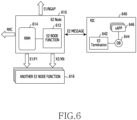
- FIG. 6 illustrates logical functions related to E2 messages of an E2 node and an RIC in a radio access network according to various embodiments of the present disclosure.
- an RIC 640 and an E2 node 610 may transmit or receive an E2 message with each other.
- the E2 node 610 may be an O-CU-CP, an O-CU-UP, an O-DU, or a base station.
- a communication interface of the E2 node may be determined according to the type of the E2 node 610.
- the E2 node 610 may communicate with another E2 node 616 through the E1 interface or the F1 interface.
- the E2 node 610 may communicate with the E2 node 616 through an X2 interface or an XN interface.
- the E2 node 610 may perform communication through an S1 interface or a next generation application protocol (NGAP) interface (i.e., an interface between a next generation (NG) RAN node and an AMF).
- NGAP next generation application protocol
- the E2 node 610 may include an E2 node function 612.
- the E2 node function 612 is a function corresponding to a specific xApp (application S/W) 646 installed in the RIC 640.
- KPI monitor collection S/W may be installed in the RIC 640, and the E2 node 610 may include the E2 node function 612 which generates KPI parameters, and then forwards an E2 message including the KPI parameters to an E2 termination 642 positioned at the RIC 640.
- the E2 node 610 may include the E2 node function 612 which generates KPI parameters and relays an E2 message including the KPI parameters to the E2 termination 642 positioned at the RIC 640.
- the E2 termination 624 positioned in the RIC 640 which is a termination of the RIC 640 for the E2 message, may perform a function of interpreting E2 report/insert messages relayed by the E2 node 610 and relaying them to the xApp 646.
- the E2 node 610 may include a radio resource management (RRM) 614.
- RRM radio resource management
- the E2 node 610 may manage resources provided to the radio network for the terminal.
- the E2 termination 624 positioned in the RIC 640 which is the termination of the RIC 640 for the E2 message, may perform a function of interpreting the E2 message forwarded by the E2 node 610 and then relaying it to the xApp 646.
- a database (DB) 644 positioned in the RIC 640 may be used for the E2 termination 624 or the xApp 616.
- the E2 node 610 shown in FIG. 6 is a termination of at least one interface, and may be understood as a termination of messages relayed to a terminal, a neighbor base station, and a core network.
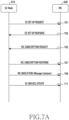
- FIG. 7A illustrates an example of a signaling procedure between an E2 node and an RIC. Specifically, FIG. 7A illustrates a setup procedure and an RIC subscription message relay procedure of E2 I/F between the E2 node and the RIC.
- the E2 node 610 is illustrated as the E2 node
- the RIC 640 is illustrated as the RIC.
- the E2 node 610 may transmit an E2 setup request message to the RIC 640 in step 701.
- An E2 NODE FUNCTION function positioned in the E2 node 610 finds the RIC using an RIC IP address which is set to operations, administration and management (OAM) and transmits the E2 SET UP REQUEST message.
- the E2 SET UP REQUEST message includes RAN function definition which defines the function of the RAN supported by the E2 node, E2 node ID information, and so on.
- a RAN function definition value is a value set to the OAM and the RIC may receive information of the set value with the OAM and determine which call processing function the E2 node supports with the RAN function definition value.
- the RIC may receive an E2 setup response message from the E2 node. If accepting the E2 SETUP REQUEST message transmitted by the E2 node, the RIC may transmit the E2 SETUP RESPONSE message.
- the RIC may transmit a subscription request message to the E2 node.
- a specific xApp positioned in the RIC requests the RIC E2 termination function to subscribe (or subscribe) for a specific RAN function definition function supported by E2.
- the subscription request message of step 705 may be included in the E2 SETUP RESPONSE message of step 703 and transmitted together, according to an embodiment.
- the RAN function may include functions of X2AP, F1AP, E1AP, S1AP, and NGAP interfaces, or an internal RAN function for controlling UEs or cells.
- the E2 node may transmit a subscription request response to the RIC.
- the E2 node function of the E2 node decodes the subscription request message, successfully sets the event condition requested by the RIC to the E2 node function and then relays the subscription response to the RIC that the event trigger condition is successfully set.
- step 709 the E2 node transmits an E2 RIC indication message to the RIC. If a specific event condition occurs, the E2 node relays the E2 RIC indication message to the RIC.
- the E2 node may transmit an E2 service update message to the RIC. If a change occurs in an E2 NODE function capability information element (E2 NodeCapa), the E2 node transmits the changed E2 NodeCapa in the E2 SERVICE UPDATE to the RIC.
- E2 NodeCapa E2 NODE function capability information element
- the E2 node and the RIC may independently perform the E2 setup procedure of step 701 through step 703.
- the E2 node and the RIC may independently perform the subscription procedure of step 705 through step 707.
- the E2 setup response message may include the subscription request message, as described above.
- the E2 node and the RIC may independently perform the RIC indication procedure of step 709.
- the E2 node and the RIC may independently perform the RIC indication procedure of step 709.
- the E2 node and the RIC may perform at least some of the above-described procedures together or separately.
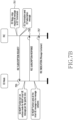
- FIG. 7B illustrates an example of the subscription procedure between the E2 node and the RIC.
- the E2 node 610 is illustrated as the E2 node
- RIC 640 is illustrated as the RIC.
- the RIC may request subscription from the E2 termination.
- the E2 Relay xApp positioned in the RIC may request the subscription for the initial UE message in the NGAP I/F for the E2 Relay message function from the RIC E2 termination function.
- the RIC may transmit an RIC subscription request to the E2 node.
- the RIC E2 termination function generates an initial UE message relay message for the NGAP I/F requested in step 751 as an E2 subscription request message and relays it to the E2 node.
- the E2 node may transmit an RIC subscription response to the RIC.
- the E2 node function of the E2 node receiving the E2 subscription request message may decode the message, successfully set the event condition for transmitting to the RIC in a container including the RIC indication message per UE, per cell or per network slice if the initial UE message occurs in the NGAP I/F, and then relay the subscription response to the RIC that the event trigger condition is successfully set.
- the E2 node transmits an RIC indication to the RIC. If an Initial UE message occurs in the NGAP I/F by the UE, the E2 node may relay the E2 RIC Indication message including the NGAP Initial UE message in the container to the RIC.
- FIG. 7A Some contents described in FIG. 7A may be applied to FIG. 7B in the same or similar manner.
- FIG. 8 illustrates IEs of an E2 indication message.
- the first IE is Message Type
- Message Type has a unique value for each E2 message. Details of the Message Type are shown in FIG. 9 .
- the second IE designates a specific xApp with RIC REQUEST ID. Message details are shown in FIG. 10 .
- the third IE is E2 NODE FUNCTION ID.
- the E2 NODE FUNCTION ID may divide the range value for each E2 node and thus designate a specific E2 NODE FUNCTION to a specific E2 node. Message details are shown in FIG. 11 .
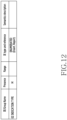
- the fourth IE is RIC INDICATION TYPE (or may be expressed as E2 INDICATION TYPE).
- the RIC INDICATION TYPE designates whether the INDICATION occurrence in the E2 node is REPORT of a specific process or an addition to a message of an existing process. Details of the indication type are shown in FIG. 12 .
- the fifth IE allows the E2 message relay container (or may be expressed as RELAY CONTAINER) defined in the present disclosure to transmit any type of the message designated in the subscription message in the form of an Octet string.
- FIG. 8 all are shown to be included as mandatory, but embodiments of the present disclosure are not limited thereto. According to another embodiment, at least one of the illustrated IEs functions as optional, and for example, the corresponding IE may be omitted in the RIC indication message.
- FIG. 9 is details of Message Type IE.
- the procedure code value which is the first IE is an integer value with the range of 0 ⁇ 255, and a specific MESSAGE TYPE (PROCEDURE CODE) is set.
- the procedure code value 0 may be set to subscription
- the procedure code value 1 may be set to E2 SETUP configuration
- the procedure code value 2 may be set to the indication request message value from 0 to 255, that is, 256 message value configurations in total.
- the O-RAN defines [Table 1] below.
- Type of message which is the second IE in Message Type indicates the Message type, and may define initiating, successful, unsuccessful messages.
- FIG. 10 is an RIC REQUEST ID value.
- the RIC Request ID value is an integer value in the range of 0 ⁇ 65535, and may set a value unique to a specific xApp.
- FIG. 11 is an E2 NODE FUNCTION ID value.
- the E2 NODE FUNCTION ID value is an integer value in the range of 0 ⁇ 4095, and may be set by dividing the range value per E2 node.
- [Table 2] O-CU-CP (1-512) O-CU-UP (513 ⁇ 1024) O-DU (1025-1536) O-RAN eNB (1537-2048)
- the value after 2048 is the reserved value and may be set if an additional E2 node is added.
- FIG. 12 is E2 INDICATION TYPE value.
- the E2 INDICATION TYPE value is a string value in the range of 'Insert' and 'Report', and may be defined as a service value of the indication message for a specific function of a specific E2 NODE FUNCTION of the E2 node.
- the I/F-based message relay function may be defined as a REPORT message.
- Various embodiments of the present disclosure may set the event condition in the call processing function (per I/F, per call processing function) of the O-RU, the O-DU, the O-CU-CP or the O-CU-UP with the E2 SUBSCRIPTION message, relay it to the RIC by including the 3GPP message in the container for a specific call processing function or every call processing function generated for each I/F, and thus efficiently provide the call processing request service of the RIC.
- a computer-readable storage medium storing one or more programs (software modules) may be provided.
- One or more programs stored in the computer-readable storage medium may be configured for execution by one or more processors of an electronic device.
- One or more programs may include instructions for controlling an electronic device to execute the methods according to the embodiments described in the claims or the specification of the present disclosure.
- Such a program may be stored to a random access memory, a non-volatile memory including a flash memory, a read only memory (ROM), an electrically erasable programmable ROM (EEPROM), a magnetic disc storage device, a compact disc (CD)-ROM, digital versatile discs (DVDs) or other optical storage devices, and a magnetic cassette. Alternatively, it may be stored to a memory combining part or all of those recording media. A plurality of memories may be included.
- the program may be stored in an attachable storage device accessible via a communication network such as internet, intranet, local area network (LAN), wide LAN (WLAN), or storage area network (SAN), or a communication network by combining these networks.
- a storage device may access a device which executes an embodiment of the present disclosure through an external port.
- a separate storage device on the communication network may access the device which executes an embodiment of the present disclosure.
- the components included in the present disclosure are expressed in a singular or plural form.
- the singular or plural expression is appropriately selected according to a proposed situation for the convenience of explanation, the present disclosure is not limited to a single component or a plurality of components, the components expressed in the plural form may be configured as a single component, and the components expressed in the singular form may be configured as a plurality of components.
Landscapes
- Engineering & Computer Science (AREA)
- Computer Networks & Wireless Communication (AREA)
- Signal Processing (AREA)
- Mobile Radio Communication Systems (AREA)
Claims (11)
- Verfahren, das von einem E2-Knoten (610) eines offenen Funkzugriffsnetzes, O-RAN, durchgeführt wird, umfassend:Übertragen einer Angabenachricht einer intelligenten Funkzugriffsnetz-, RAN-, Steuerung, RIC, an eine RIC (640) des O-RAN über eine E2-Schnittstelle,wobei die RIC-Angabenachricht Angabetypinformationen umfasst, undwobei der Angabetyp einer der Typen ist, die "einfügen" und "berichten" umfassen,wobei die RIC-Angabenachricht ferner einen Nachrichtentyp, eine RIC-Anforderungskennung, ID, und eine RAN-Funktions-ID umfasst, undwobei der Angabetyp ein Dienstwert einer Funktion ist, die der RAN-Funktions-ID des E2-Knotens entspricht.
- Verfahren nach Anspruch 1, wobei der Angabetyp einen Nachrichtentyp angibt, der sich auf einen an die RIC (640) weitergegebenen RIC-Dienst bezieht.
- Verfahren nach Anspruch 2, wobei die Angabenachricht basierend auf einem Ereignisauslöser übertragen wird.
- Verfahren nach Anspruch 1, wobei die RIC (640) eine Nahe-Echtzeit-, RT-, RIC ist, und
der E2-Knoten (610) eine verteilte O-RAN-Einheit, O-DU, eine Steuerebene einer zentralen O-RAN-Einheit, O-CU-CP, eine Benutzerebene der zentralen O-RAN-Einheit, O-CU-UP, oder einen O-RAN-eNodeB, O-eNB, umfasst. - Verfahren, das von einer intelligenten Funkzugriffsnetz-, RAN-, Steuerung, RIC, (640) eines offenen Funkzugriffsnetzes, O-RAN, durchgeführt wird, wobei das Verfahren Folgendes umfasst:Empfangen einer RIC-Angabenachricht von einem E2-Knoten (610) des O-RAN über eine E2-Schnittstelle,wobei die RIC-Angabenachricht Angabetypinformationen umfasst, undwobei der Angabetyp einer der Typen ist, die "einfügen" und "berichten" umfassen,wobei die RIC-Angabenachricht ferner einen Nachrichtentyp, eine RIC-Anforderungskennung, ID, und eine RAN-Funktions-ID umfasst, undwobei der Angabetyp ein Dienstwert einer Funktion ist, die der RAN-Funktions-ID des E2-Knotens entspricht.
- Verfahren nach Anspruch 5, wobei der Angabetyp einen Nachrichtentyp angibt, der sich auf einen an die RIC (640) weitergegebenen RIC-Dienst bezieht.
- Verfahren nach Anspruch 6, wobei die Angabenachricht basierend auf einem Ereignisauslöser übertragen wird.
- Verfahren nach Anspruch 5, wobei die RIC-Angabenachricht ferner einen Nachrichtentyp, eine RIC-Anforderungskennung, ID, und eine RAN-Funktions-ID umfasst, und
wobei der Angabetyp ein Dienstwert einer Funktion ist, die der RAN-Funktions-ID des E2-Knotens entspricht. - Verfahren nach Anspruch 5, wobei die RIC (640) eine Nahe-Echtzeit-, RT-, RIC ist, und
der E2-Knoten eine verteilte O-RAN-Einheit, O-DU, eine Steuerebene einer zentralen O-RAN-Einheit, O-CU-CP, eine Benutzerebene der zentralen O-RAN-Einheit, O-CU-UP, oder einen O-RAN-eNodeB, O-eNB, umfasst. - Vorrichtung, die als ein E2-Knoten (610) eines offenen Funkzugriffsnetzes, O-RAN, arbeitet, umfassend:mindestens einen Transceiver; undmindestens einen Prozessor, der mit dem mindestens einen Transceiver gekoppelt ist,wobei der mindestens eine Prozessor so konfiguriert ist, dass er das Verfahren nach einem der Ansprüche 1 bis 4 durchführt.
- Vorrichtung, die als eine intelligente Funkzugriffsnetz-, RAN-, Steuerung, RIC, (640) eines offenen Funkzugriffsnetzes, O-RAN, abreitet, umfassend:mindestens einen Transceiver; undmindestens einen Prozessor, der mit dem mindestens einen Transceiver gekoppelt ist,wobei der mindestens eine Prozessor so konfiguriert ist, dass er das Verfahren nach einem der Ansprüche 5 bis 9 durchführt.
Priority Applications (1)
| Application Number | Priority Date | Filing Date | Title |
|---|---|---|---|
| EP25152591.1A EP4518405A3 (de) | 2019-10-08 | 2020-10-08 | Vorrichtung und verfahren zur weiterleitung eines dienstregistrierungsereignisses über eine e2-schnittstelle in einem drahtloszugangsnetzwerkkommunikationssystem |
Applications Claiming Priority (2)
| Application Number | Priority Date | Filing Date | Title |
|---|---|---|---|
| US201962912237P | 2019-10-08 | 2019-10-08 | |
| PCT/KR2020/013816 WO2021071324A1 (ko) | 2019-10-08 | 2020-10-08 | 무선 액세스 네트워크 통신 시스템에서 e2 인터페이스를 통한 서비스 가입 이벤트의 릴레이를 위한 장치 및 방법 |
Related Child Applications (1)
| Application Number | Title | Priority Date | Filing Date |
|---|---|---|---|
| EP25152591.1A Division EP4518405A3 (de) | 2019-10-08 | 2020-10-08 | Vorrichtung und verfahren zur weiterleitung eines dienstregistrierungsereignisses über eine e2-schnittstelle in einem drahtloszugangsnetzwerkkommunikationssystem |
Publications (4)
| Publication Number | Publication Date |
|---|---|
| EP4040871A1 EP4040871A1 (de) | 2022-08-10 |
| EP4040871A4 EP4040871A4 (de) | 2022-11-09 |
| EP4040871C0 EP4040871C0 (de) | 2025-02-12 |
| EP4040871B1 true EP4040871B1 (de) | 2025-02-12 |
Family
ID=75743747
Family Applications (2)
| Application Number | Title | Priority Date | Filing Date |
|---|---|---|---|
| EP20874549.7A Active EP4040871B1 (de) | 2019-10-08 | 2020-10-08 | Gerät und verfahren zum weiterleiten von dienstregistrierungsereignissen über eine e2-schnittstelle in einem drahtlosen zugangsnetz-kommunikationssystem |
| EP25152591.1A Pending EP4518405A3 (de) | 2019-10-08 | 2020-10-08 | Vorrichtung und verfahren zur weiterleitung eines dienstregistrierungsereignisses über eine e2-schnittstelle in einem drahtloszugangsnetzwerkkommunikationssystem |
Family Applications After (1)
| Application Number | Title | Priority Date | Filing Date |
|---|---|---|---|
| EP25152591.1A Pending EP4518405A3 (de) | 2019-10-08 | 2020-10-08 | Vorrichtung und verfahren zur weiterleitung eines dienstregistrierungsereignisses über eine e2-schnittstelle in einem drahtloszugangsnetzwerkkommunikationssystem |
Country Status (3)
| Country | Link |
|---|---|
| EP (2) | EP4040871B1 (de) |
| KR (1) | KR20210042040A (de) |
| CN (2) | CN114731605B (de) |
Families Citing this family (10)
| Publication number | Priority date | Publication date | Assignee | Title |
|---|---|---|---|---|
| WO2021176092A1 (en) * | 2020-03-06 | 2021-09-10 | Nokia Solutions And Networks Oy | Adding per-user equipment controls to radio intelligent controller e2 policy |
| KR20220146984A (ko) | 2021-04-26 | 2022-11-02 | 삼성전자주식회사 | 무선 통신 시스템에서 e2 노드 제어를 위한 장치 및 방법 |
| GB2608268A (en) | 2021-06-10 | 2022-12-28 | Samsung Electronics Co Ltd | Improvements in and relating to cell configuration in a telecommunication system |
| EP4376386B1 (de) | 2021-10-08 | 2025-11-26 | Samsung Electronics Co., Ltd. | Elektronische vorrichtung und betriebsverfahren zum einsatz einer anwendung |
| WO2023064144A1 (en) * | 2021-10-11 | 2023-04-20 | Intel Corporation | Multiple parallel services by a single ric subscription over an e2 interface in o-ran |
| KR20240026030A (ko) * | 2022-08-19 | 2024-02-27 | 삼성전자주식회사 | 규격 버전을 제공하기 위한 장치 및 방법 |
| EP4646882A1 (de) * | 2023-01-06 | 2025-11-12 | Lenovo (Beijing) Limited | Verfahren und vorrichtungen zur unterstützung von ran-analytikinformationsexposition in o-ran |
| KR20240116306A (ko) * | 2023-01-20 | 2024-07-29 | 삼성전자주식회사 | Ric 쿼리를 위한 전자 장치 및 방법 |
| WO2024191074A1 (ko) * | 2023-03-13 | 2024-09-19 | 삼성전자 주식회사 | 무선 통신 시스템에서 네트워크 슬라이스의 서비스 수준 협약 사항 보장을 위한 장치 및 방법 |
| KR20240140712A (ko) * | 2023-03-17 | 2024-09-24 | 삼성전자주식회사 | 무선 통신 시스템에서 단말의 서비스 수준 협약 사항 보장을 위한 장치 및 방법 |
Citations (2)
| Publication number | Priority date | Publication date | Assignee | Title |
|---|---|---|---|---|
| EP4080931A1 (de) * | 2019-12-17 | 2022-10-26 | Samsung Electronics Co., Ltd. | Verfahren und vorrichtung zum messen der leistung in einem drahtlosen kommunikationssystem |
| US20230328580A1 (en) * | 2020-09-02 | 2023-10-12 | Lenovo (Singapore) Pte. Ltd. | Qos profile adaptation |
Family Cites Families (7)
| Publication number | Priority date | Publication date | Assignee | Title |
|---|---|---|---|---|
| JP4092562B2 (ja) * | 2002-12-12 | 2008-05-28 | 日本電気株式会社 | 移動通信システム、端末リソース制御部及び基地局リソース制御部、並びにそれらの制御方法 |
| EP3493649B1 (de) * | 2016-07-29 | 2022-03-02 | LG Electronics Inc. | Verfahren und vorrichtung zur durchführung eines zellspezifischen verfahrens oder mobilitätsverfahrens für netzwerkschichtbasierten neuen funk in einem drahtloskommunikationssystem |
| EP3711347B1 (de) * | 2017-11-17 | 2022-07-20 | Telefonaktiebolaget LM Ericsson (publ) | Benachrichtigungssteuerung über ran-schnittstellen |
| EP3769582A4 (de) * | 2018-03-19 | 2022-03-16 | Mavenir Networks, Inc. | System und verfahren zur reduzierung der fronthaul-schnittstellenbandbreite für cloud-ran |
| US11412554B2 (en) * | 2018-05-10 | 2022-08-09 | Apple Inc. | E1 interface setup in NG-RAN |
| JP7695040B2 (ja) * | 2019-10-01 | 2025-06-18 | サムスン エレクトロニクス カンパニー リミテッド | 無線アクセスネットワーク通信システムにおけるe2インタフェースを介するサービス加入のための装置及び方法 |
| CN120050642A (zh) * | 2019-10-01 | 2025-05-27 | 三星电子株式会社 | 使用e2接口的服务订阅的装置和方法 |
-
2020
- 2020-10-08 EP EP20874549.7A patent/EP4040871B1/de active Active
- 2020-10-08 CN CN202080078740.0A patent/CN114731605B/zh active Active
- 2020-10-08 EP EP25152591.1A patent/EP4518405A3/de active Pending
- 2020-10-08 CN CN202510092171.XA patent/CN119767402A/zh active Pending
- 2020-10-08 KR KR1020200130501A patent/KR20210042040A/ko active Pending
Patent Citations (2)
| Publication number | Priority date | Publication date | Assignee | Title |
|---|---|---|---|---|
| EP4080931A1 (de) * | 2019-12-17 | 2022-10-26 | Samsung Electronics Co., Ltd. | Verfahren und vorrichtung zum messen der leistung in einem drahtlosen kommunikationssystem |
| US20230328580A1 (en) * | 2020-09-02 | 2023-10-12 | Lenovo (Singapore) Pte. Ltd. | Qos profile adaptation |
Non-Patent Citations (1)
| Title |
|---|
| ANONYMOUS: "ORAN-WG3.E2AP-v01.00.00 Technical Specification; O-RAN Working Group 3, Near-Real-time RAN Intelligent Controller, E2 Application Protocol (E2AP)", O-RAN TECHNICAL SPECIFICATION WG3: NEAR-REAL-TIME RIC AND E2 INTERFACE WORKGROUP; ORAN-WG3.E2AP-V01.00.00, 1 February 2020 (2020-02-01), pages 1 - 67, XP055977471, Retrieved from the Internet <URL:https://orandownloadsweb.azurewebsites.net/specifications> [retrieved on 20221103] * |
Also Published As
| Publication number | Publication date |
|---|---|
| CN114731605B (zh) | 2025-02-14 |
| CN114731605A (zh) | 2022-07-08 |
| EP4518405A2 (de) | 2025-03-05 |
| EP4040871C0 (de) | 2025-02-12 |
| CN119767402A (zh) | 2025-04-04 |
| EP4040871A1 (de) | 2022-08-10 |
| KR20210042040A (ko) | 2021-04-16 |
| EP4040871A4 (de) | 2022-11-09 |
| EP4518405A3 (de) | 2025-07-30 |
Similar Documents
| Publication | Publication Date | Title |
|---|---|---|
| US12382416B2 (en) | Apparatus and method for service subscription through E2 interface in radio access network communication system | |
| US12232003B2 (en) | Apparatus and method for service subscription, using E2 interface in wireless access network communication system | |
| EP4040871B1 (de) | Gerät und verfahren zum weiterleiten von dienstregistrierungsereignissen über eine e2-schnittstelle in einem drahtlosen zugangsnetz-kommunikationssystem | |
| US12445906B2 (en) | Apparatus and method for E2 interface configuration including cell information in wireless access network | |
| US12238563B2 (en) | Method and device for measuring performance in wireless communication system | |
| EP4044703B1 (de) | Vorrichtung und verfahren für dienstabonnement mittels einer e2-schnittstelle in einem funkzugangsnetzkommunikationssystem | |
| JP7810489B2 (ja) | 無線アクセスネットワーク通信システムにおけるe2インタフェースを介するサービス加入のための装置及び方法 | |
| EP4294110A1 (de) | Vorrichtung und verfahren zur zelleninformation und einrichtung einer e2-schnittstelle in einem funkzugangsnetz | |
| US20220232508A1 (en) | Device and method for relaying service registration event via e2 interface in wireless access network communication system | |
| EP4221314A1 (de) | Vorrichtung und verfahren zur steuerung eines e2-knotens in einem drahtloskommunikationssystem | |
| KR20210073414A (ko) | 무선 접속 망에서 셀 정보를 포함하는 e2 인터페이스 설정을 위한 장치 및 방법 |
Legal Events
| Date | Code | Title | Description |
|---|---|---|---|
| STAA | Information on the status of an ep patent application or granted ep patent |
Free format text: STATUS: THE INTERNATIONAL PUBLICATION HAS BEEN MADE |
|
| PUAI | Public reference made under article 153(3) epc to a published international application that has entered the european phase |
Free format text: ORIGINAL CODE: 0009012 |
|
| STAA | Information on the status of an ep patent application or granted ep patent |
Free format text: STATUS: REQUEST FOR EXAMINATION WAS MADE |
|
| 17P | Request for examination filed |
Effective date: 20220506 |
|
| AK | Designated contracting states |
Kind code of ref document: A1 Designated state(s): AL AT BE BG CH CY CZ DE DK EE ES FI FR GB GR HR HU IE IS IT LI LT LU LV MC MK MT NL NO PL PT RO RS SE SI SK SM TR |
|
| A4 | Supplementary search report drawn up and despatched |
Effective date: 20221010 |
|
| RIC1 | Information provided on ipc code assigned before grant |
Ipc: H04W 24/02 20090101ALI20221004BHEP Ipc: H04W 92/24 20090101ALI20221004BHEP Ipc: H04W 92/20 20090101ALI20221004BHEP Ipc: H04W 92/12 20090101ALI20221004BHEP Ipc: H04W 88/08 20090101ALI20221004BHEP Ipc: H04W 88/12 20090101ALI20221004BHEP Ipc: H04W 60/04 20090101AFI20221004BHEP |
|
| DAV | Request for validation of the european patent (deleted) | ||
| DAX | Request for extension of the european patent (deleted) | ||
| GRAP | Despatch of communication of intention to grant a patent |
Free format text: ORIGINAL CODE: EPIDOSNIGR1 |
|
| STAA | Information on the status of an ep patent application or granted ep patent |
Free format text: STATUS: GRANT OF PATENT IS INTENDED |
|
| INTG | Intention to grant announced |
Effective date: 20240905 |
|
| GRAS | Grant fee paid |
Free format text: ORIGINAL CODE: EPIDOSNIGR3 |
|
| GRAA | (expected) grant |
Free format text: ORIGINAL CODE: 0009210 |
|
| STAA | Information on the status of an ep patent application or granted ep patent |
Free format text: STATUS: THE PATENT HAS BEEN GRANTED |
|
| AK | Designated contracting states |
Kind code of ref document: B1 Designated state(s): AL AT BE BG CH CY CZ DE DK EE ES FI FR GB GR HR HU IE IS IT LI LT LU LV MC MK MT NL NO PL PT RO RS SE SI SK SM TR |
|
| REG | Reference to a national code |
Ref country code: GB Ref legal event code: FG4D |
|
| REG | Reference to a national code |
Ref country code: CH Ref legal event code: EP |
|
| REG | Reference to a national code |
Ref country code: DE Ref legal event code: R096 Ref document number: 602020046101 Country of ref document: DE |
|
| REG | Reference to a national code |
Ref country code: IE Ref legal event code: FG4D |
|
| U01 | Request for unitary effect filed |
Effective date: 20250228 |
|
| U07 | Unitary effect registered |
Designated state(s): AT BE BG DE DK EE FI FR IT LT LU LV MT NL PT RO SE SI Effective date: 20250310 |
|
| PG25 | Lapsed in a contracting state [announced via postgrant information from national office to epo] |
Ref country code: RS Free format text: LAPSE BECAUSE OF FAILURE TO SUBMIT A TRANSLATION OF THE DESCRIPTION OR TO PAY THE FEE WITHIN THE PRESCRIBED TIME-LIMIT Effective date: 20250512 |
|
| PG25 | Lapsed in a contracting state [announced via postgrant information from national office to epo] |
Ref country code: PL Free format text: LAPSE BECAUSE OF FAILURE TO SUBMIT A TRANSLATION OF THE DESCRIPTION OR TO PAY THE FEE WITHIN THE PRESCRIBED TIME-LIMIT Effective date: 20250212 |
|
| PG25 | Lapsed in a contracting state [announced via postgrant information from national office to epo] |
Ref country code: ES Free format text: LAPSE BECAUSE OF FAILURE TO SUBMIT A TRANSLATION OF THE DESCRIPTION OR TO PAY THE FEE WITHIN THE PRESCRIBED TIME-LIMIT Effective date: 20250212 |
|
| PG25 | Lapsed in a contracting state [announced via postgrant information from national office to epo] |
Ref country code: NO Free format text: LAPSE BECAUSE OF FAILURE TO SUBMIT A TRANSLATION OF THE DESCRIPTION OR TO PAY THE FEE WITHIN THE PRESCRIBED TIME-LIMIT Effective date: 20250512 Ref country code: IS Free format text: LAPSE BECAUSE OF FAILURE TO SUBMIT A TRANSLATION OF THE DESCRIPTION OR TO PAY THE FEE WITHIN THE PRESCRIBED TIME-LIMIT Effective date: 20250612 |
|
| PG25 | Lapsed in a contracting state [announced via postgrant information from national office to epo] |
Ref country code: HR Free format text: LAPSE BECAUSE OF FAILURE TO SUBMIT A TRANSLATION OF THE DESCRIPTION OR TO PAY THE FEE WITHIN THE PRESCRIBED TIME-LIMIT Effective date: 20250212 |
|
| PG25 | Lapsed in a contracting state [announced via postgrant information from national office to epo] |
Ref country code: GR Free format text: LAPSE BECAUSE OF FAILURE TO SUBMIT A TRANSLATION OF THE DESCRIPTION OR TO PAY THE FEE WITHIN THE PRESCRIBED TIME-LIMIT Effective date: 20250513 |
|
| PG25 | Lapsed in a contracting state [announced via postgrant information from national office to epo] |
Ref country code: SM Free format text: LAPSE BECAUSE OF FAILURE TO SUBMIT A TRANSLATION OF THE DESCRIPTION OR TO PAY THE FEE WITHIN THE PRESCRIBED TIME-LIMIT Effective date: 20250212 |
|
| PGFP | Annual fee paid to national office [announced via postgrant information from national office to epo] |
Ref country code: GB Payment date: 20250922 Year of fee payment: 6 |
|
| PG25 | Lapsed in a contracting state [announced via postgrant information from national office to epo] |
Ref country code: CZ Free format text: LAPSE BECAUSE OF FAILURE TO SUBMIT A TRANSLATION OF THE DESCRIPTION OR TO PAY THE FEE WITHIN THE PRESCRIBED TIME-LIMIT Effective date: 20250212 |
|
| PG25 | Lapsed in a contracting state [announced via postgrant information from national office to epo] |
Ref country code: SK Free format text: LAPSE BECAUSE OF FAILURE TO SUBMIT A TRANSLATION OF THE DESCRIPTION OR TO PAY THE FEE WITHIN THE PRESCRIBED TIME-LIMIT Effective date: 20250212 |
|
| U20 | Renewal fee for the european patent with unitary effect paid |
Year of fee payment: 6 Effective date: 20251022 |
|
| PLBE | No opposition filed within time limit |
Free format text: ORIGINAL CODE: 0009261 |
|
| STAA | Information on the status of an ep patent application or granted ep patent |
Free format text: STATUS: NO OPPOSITION FILED WITHIN TIME LIMIT |
|
| 26N | No opposition filed |
Effective date: 20251113 |