EP4040854A1 - Terminal device performing conditional handover, base station device, control method, and program - Google Patents
Terminal device performing conditional handover, base station device, control method, and program Download PDFInfo
- Publication number
- EP4040854A1 EP4040854A1 EP20871860.1A EP20871860A EP4040854A1 EP 4040854 A1 EP4040854 A1 EP 4040854A1 EP 20871860 A EP20871860 A EP 20871860A EP 4040854 A1 EP4040854 A1 EP 4040854A1
- Authority
- EP
- European Patent Office
- Prior art keywords
- base station
- station apparatus
- terminal apparatus
- communication parameter
- identification information
- Prior art date
- Legal status (The legal status is an assumption and is not a legal conclusion. Google has not performed a legal analysis and makes no representation as to the accuracy of the status listed.)
- Granted
Links
Images




Classifications
-
- H—ELECTRICITY
- H04—ELECTRIC COMMUNICATION TECHNIQUE
- H04W—WIRELESS COMMUNICATION NETWORKS
- H04W36/00—Hand-off or reselection arrangements
- H04W36/0005—Control or signalling for completing the hand-off
- H04W36/0055—Transmission or use of information for re-establishing the radio link
- H04W36/0077—Transmission or use of information for re-establishing the radio link of access information of target access point
-
- H—ELECTRICITY
- H04—ELECTRIC COMMUNICATION TECHNIQUE
- H04W—WIRELESS COMMUNICATION NETWORKS
- H04W36/00—Hand-off or reselection arrangements
- H04W36/0005—Control or signalling for completing the hand-off
- H04W36/0055—Transmission or use of information for re-establishing the radio link
- H04W36/0061—Transmission or use of information for re-establishing the radio link of neighbour cell information
-
- H—ELECTRICITY
- H04—ELECTRIC COMMUNICATION TECHNIQUE
- H04B—TRANSMISSION
- H04B10/00—Transmission systems employing electromagnetic waves other than radio-waves, e.g. infrared, visible or ultraviolet light, or employing corpuscular radiation, e.g. quantum communication
- H04B10/27—Arrangements for networking
-
- H—ELECTRICITY
- H04—ELECTRIC COMMUNICATION TECHNIQUE
- H04W—WIRELESS COMMUNICATION NETWORKS
- H04W28/00—Network traffic management; Network resource management
- H04W28/16—Central resource management; Negotiation of resources or communication parameters, e.g. negotiating bandwidth or QoS [Quality of Service]
- H04W28/18—Negotiating wireless communication parameters
-
- H—ELECTRICITY
- H04—ELECTRIC COMMUNICATION TECHNIQUE
- H04W—WIRELESS COMMUNICATION NETWORKS
- H04W36/00—Hand-off or reselection arrangements
- H04W36/34—Reselection control
- H04W36/36—Reselection control by user or terminal equipment
- H04W36/362—Conditional handover
Definitions
- the present invention relates to a terminal apparatus, a base station apparatus, a control method, and a program, and in particular relates to a conditional handover technique.
- handover processing for sequentially switching base station apparatuses to which a terminal apparatus is connected is executed in order to maintain connection even when the terminal apparatus moves.
- a technique has been discussed in which a communication parameter for communication between a base station apparatus that is a handover source and a base station apparatus that is a handover destination and a condition on which handover is to be executed are provided to the terminal apparatus in advance, and when the terminal apparatus confirms that the condition is satisfied, handover is autonomously executed. This technique is called conditional handover.
- a base station apparatus that is a handover source inquires of base station apparatuses that are candidates for handover destination about respective communication parameters that are to be used for communication with a terminal apparatus, and obtains communication parameters when these candidate base station apparatuses and the terminal apparatus are connected (see NPLs 1 and 2). The base station apparatus that is a handover source then notifies the terminal apparatus of these communication parameters.
- a communication parameter that is to be used by a terminal apparatus for communication with a base station apparatus that is a handover candidate can be changed before handover is actually executed (see NPL 3).
- the present invention provides a technique for preventing mismatch between communication parameters that are respectively used by a terminal apparatus and a base station apparatus that is a handover destination during conditional handover.
- a terminal apparatus includes: obtaining means for obtaining, from a base station apparatus that is currently connected to the terminal apparatus, a communication parameter that is to be used when the terminal apparatus is connected to a candidate base station apparatus that is a candidate for handover destination and a condition for executing handover to the candidate base station apparatus; and transmitting means for transmitting, to the candidate base station apparatus, a message that includes identification information associated with the communication parameter, when handover to the candidate base station apparatus is performed based on the condition.
- a base station apparatus is a base station apparatus that is a candidate for destination of handover to be performed by a terminal apparatus, the base station apparatus including: notification means for notifying the terminal apparatus of a communication parameter that is to be used when the terminal apparatus is connected to the base station apparatus, via another base station apparatus that is currently connected to the terminal apparatus; receiving means for receiving, from the terminal apparatus, a message that includes identification information associated with the communication parameter notified from the other base station apparatus to the terminal apparatus, when the terminal apparatus executes handover to the base station apparatus; and communication means for communicating with the terminal apparatus using the communication parameter if the identification information included in the message is associated with the communication parameter notified by the notification means.
- the present invention it is possible to prevent mismatch between communication parameters that are respectively used by a terminal apparatus and a base station apparatus that is a handover destination during handover.
- FIG. 1 shows a configuration example of a wireless communication system according to an embodiment of the present invention. Note that, in the example in FIG. 1 , two base station apparatuses and one terminal apparatus are illustrated, but, as a matter of course, there may be a larger number of base station apparatuses and terminal apparatuses than those illustrated.
- Abase station apparatus 101 and a base station apparatus 102 are wireless base station apparatuses in a fifth-generation (5G) cellular communication system, for example.
- the base station apparatuses 101 and 102 are configured to be communicable with a terminal apparatus that is present in a cell 111 and a cell 112 that respectively represent ranges in which the base station apparatuses 101 and 102 can perform communication.
- a terminal apparatus 121 is connected to a base station apparatus that provides a cell that includes a position at which the terminal apparatus 121 is present, and thereby can perform wireless communication.
- the terminal apparatus 121 can suppress the power consumption by transitioning to a standby state (for example, an RRC_Idle state or an RRC_Inactive state) when there is no user data that is to be transmitted/received, but, in the present embodiment, the terminal apparatus 121 enters a connection state (for example, an RRC Connected state), establishes connection with a base station apparatus, and performs communication.
- a standby state for example, an RRC_Idle state or an RRC_Inactive state
- a connection state for example, an RRC Connected state
- the terminal apparatus 121 moves while being connected to the base station apparatus 101 that forms the cell 111, and enters the range of the cell 112 that is formed by the base station apparatus 102.
- the wireless quality of wireless communication with the base station apparatus 101 deteriorates and the wireless quality of a wireless signal from the base station apparatus 102 improves, and thereby the terminal apparatus 121 performs a switch of base station apparatus to which the terminal apparatus 121 is connected, that is in other words handover.
- this handover may be performed by a handover source, namely the base station apparatus 101 transmitting a handover instruction to the terminal apparatus 121, but handover may be autonomously started when it is determined that a predetermined condition is satisfied by the terminal apparatus 121. Autonomous handover that is performed when the condition is satisfied by the terminal apparatus 121 may be called "conditional handover". In the present embodiment, the terminal apparatus 121 executes this conditional handover.
- the terminal apparatus 121 obtains information regarding a communication parameter that is to be used when the terminal apparatus 121 is connected to that candidate base station apparatus, from the base station apparatus 101 that the terminal apparatus 121 is currently connected.
- the base station apparatus 102 is the candidate base station apparatus.
- a communication parameter is a parameter for wireless resource control (RRC) and includes a frequency bandwidth that is used for communication, the number of layers of MIMO (Multi-Input Multi-Output), and the like.
- This information regarding a communication parameter may be information regarding a communication parameter that can be used by a candidate base station apparatus, and with which the base station apparatus 101 that is currently connected to the terminal apparatus 121 can achieve the communication quality achieved in communication that is currently executed with the terminal apparatus 121, and, for example.
- the base station apparatus 101 that is currently connected to the terminal apparatus 121 may provide a communication parameter that is currently used with the terminal apparatus 121, to the candidate base station apparatus (the base station apparatus 102), and obtain a communication parameter that can achieve communication performance similar to that corresponding to the provided communication parameter, from the candidate base station apparatus, as a communication parameter that is to be used when the terminal apparatus 121 and the candidate base station apparatus are connected.
- the base station apparatus 102 may notify the base station apparatus 101 of the same communication parameter as the communication parameter notified from the base station apparatus 101, for example.
- the base station apparatus 102 may notify the base station apparatus 101 of a communication parameter that is significantly different from the same communication parameter as the communication parameter notified from the base station apparatus 101, but that can achieve the same communication performance, or may notify the base station apparatus 101 of a communication parameter only a portion of which is different from the communication parameter notified from the base station apparatus 101, for example.
- the base station apparatus 102 may notify the base station apparatus 101 of information indicating the difference from the communication parameter notified from the base station apparatus 101.
- the base station apparatus 102 may, for example, periodically notify the base station apparatus 101 of a communication parameter that is to be used, without being notified of a communication parameter from the base station apparatus 101. In this manner, the base station apparatus 101 transfers information regarding a communication parameter obtained from the base station apparatus 102 to the terminal apparatus 121.
- the terminal apparatus 121 executes processing for autonomously switching a base station apparatus to which the terminal apparatus 121 is connected, to the base station apparatus 102, for example, in accordance with a condition that the wireless quality of a wireless signal from the base station apparatus 102 is sufficiently higher than the wireless quality of a wireless signal from the base station apparatus 101 being satisfied by using this information regarding the communication parameter.
- the terminal apparatus 121 transmits a handover success message (for example, an "RRC Reconfiguration Complete" message) to the base station apparatus 102 in accordance with a determination that handover to the base station apparatus 102 is to be performed, and handover is completed by the base station apparatus 102 accepting this message.
- a handover success message for example, an "RRC Reconfiguration Complete" message
- the base station apparatus 101 may notify that a value obtained by subtracting the wireless quality of a wireless signal from the base station apparatus 101 from the wireless quality of a wireless signal from the base station apparatus 102 measured by the terminal apparatus 121 needs to exceed a predetermined value, as a condition of handover, for example.
- the base station apparatus 101 may set the same predetermined value for all of the candidate base station apparatuses, for example, but may set a predetermined value different for each candidate base station apparatus.
- the base station apparatus 101 specifies wireless quality at which communication that uses a communication parameter notified from each candidate base station apparatus will be sufficiently successful, based on the communication parameter, and may set a higher predetermined value for higher wireless quality, for example.
- a configuration may be adopted in which, for example, the predetermined value is set higher for a candidate base station apparatus whose communication parameter represents a high likelihood of failure in demodulating a signal due to the number of layers of MIMO being large, such that handover is started after wireless quality on the candidate base station apparatus side is sufficiently high.
- a configuration may also be adopted in which the predetermined value is set higher for a candidate base station apparatus that uses a communication parameter that cannot achieve the communication performance achieved in the current communication, making it difficult for the terminal apparatus 121 to perform handover to the candidate base station apparatus.
- the terminal apparatus 121 may be connected to a candidate base station apparatus that can achieve the same communication performance as the current communication performance.
- the base station apparatus 101 may set the predetermined value for the candidate base station apparatus lower, making it easy to perform handover to this candidate base station apparatus. Note that a condition that is always constant may be used, and, in this case, information regarding the condition does not need to be notified from the base station apparatus 101 to the terminal apparatus 121.
- the base station apparatus 101 may change the communication parameter, for example, addition of a wireless bearer during communication.
- the base station apparatus 101 may notify a candidate base station apparatus (the base station apparatus 102) of the changed communication parameter, obtain, from that candidate base station apparatus, a changed communication parameter that is to be used when connected to the terminal apparatus 121, and notify the terminal apparatus 121 of the changed communication parameter. Accordingly, in conditional handover, the terminal apparatus 121 can establish connection with the candidate base station apparatus using the changed communication parameter.
- conditional handover the base station apparatus 101 and the base station apparatus 102 cannot be aware of, in advance, the timing when the condition is satisfied in the terminal apparatus 121.
- handover may occur during processing for changing the communication parameter, and mismatch of communication parameters may occur between the terminal apparatus 121 and the base station apparatus 102 that is a handover destination.
- the terminal apparatus 121 may use a communication the parameter before the change to communicate with the base station apparatus 102, and the base station apparatus 102 may use the changed communication parameter.
- Such an event may occur, for example, when handover is executed while the wireless quality between the base station apparatus 101 and the terminal apparatus 121 is reduced and the terminal apparatus 121 is failing to receive the changed communication parameter.
- communication parameters that are used by the terminal apparatus 121 and the base station apparatus 102 are different, and thus communication between these apparatuses cannot be performed.
- the terminal apparatus 121 when the terminal apparatus 121 successfully receives a changed communication parameter, the terminal apparatus 121 transmits, to the base station apparatus 101, information indicating that the changed communication parameter was successfully received, and the base station apparatus 101 transfers the information to the base station apparatus 102, whereby, when the terminal apparatus 121 performs handover in a state where the base station apparatus 102 has not received the information, the base station apparatus 102 can use a communication parameter before change.
- the base station apparatus 101 fails to receive information indicating that the changed communication parameter has been successfully received, and, as a result, such information is not transmitted to the base station apparatus 102.
- the terminal apparatus 121 uses the changed communication parameter, while the base station apparatus 102 that is a handover destination uses the communication parameter before change, and thus communication between these apparatuses fails.
- identification information associated with a communication parameter that is to be used after handover is notified to the base station apparatus 102 that is a handover destination. Notification of this identification information is included in a handover success message, for example.
- the terminal apparatus 121 In accordance with a communication parameter being received from the base station apparatus 101 to which the terminal apparatus 121 is currently connected, for example, the terminal apparatus 121 generates identification information corresponding to the communication parameter, and notifies the base station apparatus 101 of the generated identification information.
- the base station apparatus 101 may notify the base station apparatus 102 of the notified identification information. That is to say, the terminal apparatus 121 may notify the generated identification information to a candidate base station apparatus that has determined a communication parameter corresponding to the identification information, via the base station apparatus 101 to which the terminal apparatus 121 is currently connected.
- the terminal apparatus 121 then transmits, to the base station apparatus 102 that is a handover destination, a handover success message that includes identification information corresponding to the most recent communication parameter that the terminal apparatus 121 has, regarding the base station apparatus 102 that is a handover destination, for example. Accordingly, as a result of the terminal apparatus 121 transmitting the identification information in the handover success message, the base station apparatus 102 that is a handover destination can recognize which communication parameter the terminal apparatus 121 is to use for connection with the base station apparatus 102.
- the base station apparatus 102 can recognize that the terminal apparatus 121 is attempting communication that uses the communication parameter, and can execute communication that uses the communication parameter after handover.
- a configuration may be adopted in which, if the identification information is associated with a past first communication parameter, which is updated to a second communication parameter, but identification information associated with the (second) communication parameter has not been received, the base station apparatus 102 performs communication using the second communication parameter when unknown identification information is received from the terminal apparatus 121.
- the base station apparatus 102 may discard the message.
- the base station apparatus 102 may separately notify the terminal apparatus 121 of a communication parameter that is to be used, for example.
- a configuration may also be adopted in which the base station apparatus 102 that is a candidate for handover destination generates identification information along with communication parameters, and notify the terminal apparatus 121 thereof via the base station apparatus 101.
- identification information is associated with all of the generated communication parameters, and thus the base station apparatus 102 can appropriately select a communication parameter that is to be used, based on identification information included in a handover success message from the terminal apparatus 121. Assuming that, for example, first identification information is associated with the first communication parameter and second identification information is then associated with the second communication parameter to which the first communication parameter is updated, when a handover success message that includes the first identification information is received, the base station apparatus 102 can communicate with the terminal apparatus 121 using the first communication parameter.
- the base station apparatus 101 may discard the message.
- the base station apparatus 102 may discard the message.
- the base station apparatus 102 notifies the first identification information associated with a communication parameter, to the base station apparatus 101 that is currently connected to the terminal apparatus 121, and the base station apparatus 101 generates second identification information associated with the first identification information, and share it with the terminal apparatus 121.
- the terminal apparatus 121 transmits a handover success message that includes this second identification information, to the base station apparatus 102.
- the second identification information may be, for example, an RRC Transaction ID in an RRC message when the base station apparatus 101 notifies the terminal apparatus 121 of a communication parameter. That is to say, when a communication parameter is notified to the terminal apparatus 121, an RRC message is transmitted, and an RRC Transaction ID is given to the message.
- this RRC Transaction ID may be used as the second identification information.
- the base station apparatus 102 Upon receiving a handover success message that includes the second identification information, the base station apparatus 102 notifies the base station apparatus 101 of the second identification information. Then, the base station apparatus 101 may notify the base station apparatus 102 of third identification information associated with the second identification information. If the third identification information matches the first identification information, the base station apparatus 102 specifies that a communication parameter associated with the first identification information is being used by the terminal apparatus 121. In this manner, the base station apparatus 102 can specify which communication parameter the received identification information is associated with, via the base station apparatus 101 that is a handover source.
- the terminal apparatus 121 when executing conditional handover, notifies the base station apparatus 102 that is a handover destination of identification information associated with a communication parameters that the terminal apparatus 121 could receive. Accordingly, the base station apparatus 102 can recognize that the terminal apparatus 121 is about to perform post-handover communication using the communication parameter associated with this identification information. Then, the base station apparatus 102 can communicate with the terminal apparatus 121 that performed handover, using the communication parameter associate with the identification information.
- the base station apparatus 102 holds histories of past communication parameters, for example, whereby, when identification information associated with a past communication parameter is received, the base station apparatus 102 can communicate with the terminal apparatus 121 using the past communication parameter.
- the base station apparatus 102 does not need to hold past communication parameters, and, in this case, when a handover success message that includes identification information associated with a past communication parameter is received, the message can be discarded. Similarly, a handover success message that includes identification information that the base station apparatus 102 cannot recognize is received, the base station apparatus 102 may discard the message. Accordingly, communication can be prevented from being attempted in a state where communication parameters do not match between the terminal apparatus 121 and the base station apparatus 102.
- FIG. 2 shows an exemplary hardware configurations of a base station apparatus (the base station apparatus 101 of the base station apparatus 102) and a terminal apparatus according to the present embodiment.
- These apparatuses each includes a processor 201, a ROM 202, a RAM 203, a storage device 204, and a communication circuit 205, in an example.
- the processor 201 is a computer constituted by one or more processing circuits such as a general-purpose CPU (Central Processing Unit) and an ASIC (application-specific integrated circuit), and executes overall processing of the base station apparatuses/terminal apparatus and each process described above by reading out and executing a program stored in the ROM 202 or the storage device 204.
- CPU Central Processing Unit
- ASIC application-specific integrated circuit
- the ROM 202 is a read only memory that stores information such as programs and various parameters related to processing that is performed by the base station apparatus/terminal apparatus.
- the RAM 203 is a random access memory that functions as a work space when the processor 201 executes a program, and stores temporary information.
- the storage device 204 is constituted by a detachable external storage apparatus, for example.
- the communication circuit 205 is constituted by a circuit for wireless communication, for example.
- the base station apparatuses/terminal apparatus are each constituted by, for example, a baseband circuit, an RF circuit, and the like for cellular communication and an antenna, as the communication circuit 205 for communication with another apparatus. Note that FIG.
- each base station apparatus may include a wired or wireless communication circuit for communication with another base station apparatus.
- the terminal apparatus may include a communication circuit for a wireless LAN, for example.
- FIG. 3 shows an exemplary functional configuration of a base station apparatus (the base station apparatus 102) that is a handover candidate according to the present embodiment.
- the candidate base station apparatus includes, as functions thereof, a communication unit 301, a communication parameter generation unit 302, an information holding unit 303, and a parameter-to-be-used determination unit 304, for example.
- these functions may be realized by the processor 201 executing a program stored in the ROM 202 or the storage device 204, or may also be realized by dedicated hardware, for example.
- FIG. 3 illustrates functions related to a technique according to the present embodiment, and the base station apparatus has functions of an ordinary base station apparatus as a matter of course.
- the communication unit 301 is a function unit for executing wireless communication with the terminal apparatus 121, for example.
- the communication unit 301 can perform wireless communication, for example, using a wireless communication method according to which a terminal apparatus can execute handover to an adjacent base station apparatus, such as a fifth generation cellular communication method.
- a fifth generation cellular communication method is used, but a communication method of each generation such as a third-generation wireless communication method, a long-term evolution communication method, or a fifth generation or later wireless communication method may be used, and a communication method other than a cellular communication method may also be used.
- the communication unit 301 also has a function of executing wired or wireless communication with another base station apparatus (the base station apparatus 101).
- the communication unit 301 performs communication with another base station apparatus through an interface between base station apparatuses stipulated by a cellular communication standard, for example
- the communication parameter generation unit 302 generates a communication parameter that is to be used for communication when the terminal apparatus 121 is connected to the base station apparatus 102.
- the communication parameter generation unit 302 generates a communication parameter, for example, in accordance with the terminal apparatus 121 receiving a handover request for conditional handover from the base station apparatus 101 to which the terminal apparatus 121 is currently connected, adds information regarding the generated communication parameter to a response signal to the handover request, and transmits the response signal.
- the handover request may include information regarding a communication parameter that is being used by the base station apparatus 101 for communication with the terminal apparatus 121, and, in this case, the communication parameter generation unit 302 can generate a communication parameter that is to be used for communication when the terminal apparatus 121 is connected to the base station apparatus 102, based on this received communication parameter.
- the communication parameter generation unit 302 generates a communication parameter, for example, such that communication performance that is equivalent to communication performance obtained in communication between the base station apparatus 101 and the terminal apparatus 121 can be achieved. Then, the communication parameter generation unit 302 may notify the base station apparatus 101 of the value of the difference between the communication parameter received from the base station apparatus 101 and the generated communication parameter, for example.
- the base station apparatus 101 specifies a communication parameter that is to be used by the base station apparatus 102, based on the communication parameter notified to the base station apparatus 102 and the value of the difference (for example, by adding these values).
- the communication parameter generation unit 302 may notify the base station apparatus 101 of the generated communication parameter itself.
- a configuration may also be adopted in which the communication parameter generation unit 302 generates a communication parameter and identification information associated with the communication parameter, and notify the base station apparatus 101 thereof. Note that the communication parameter (and identification information as necessary) notified to the base station apparatus 101 is transferred to the terminal apparatus 121 by the base station apparatus 101.
- identification information may be generated by the base station apparatus 101, and, in this case, for example, the identification information may be notified to the base station apparatus 102 at the time of a handover request. In this case, the communication parameter generation unit 302 does not need to generate identification information.
- the information holding unit 303 holds a communication parameter generated by the communication parameter generation unit 302 and identification information associated with the communication parameter. Note that, for example, when storing identification information generated by the communication parameter generation unit 302, the information holding unit 303 stores the identification information and the communication parameter generated along with that identification information in association. In addition, when identification information notified from the terminal apparatus 121 via the base station apparatus 101 is obtained, the information holding unit 303 stores the identification information in association with the previous communication parameter transmitted to the terminal apparatus 121 via the base station apparatus 101.
- the parameter-to-be-used determination unit 304 determines a communication parameter that is to be used for communication with the terminal apparatus 121, based on identification information included in a handover success message from the terminal apparatus 121. If the received identification information is held in the information holding unit 303, the parameter-to-be-used determination unit 304 determines a communication parameter associated with that identification information, as a communication parameter that is to be used for communication with the terminal apparatus 121, for example. In addition, if the received identification information is not held in the information holding unit 303 and the most recent communication parameter that is not associated with identification information is present, the parameter-to-be-used determination unit 304 determines that this communication parameter is a communication parameter to be used for communication with the terminal apparatus 121.
- the parameter-to-be-used determination unit 304 may discard the handover success message.
- a configuration may be adopted in which the parameter-to-be-used determination unit 304 transfers, to the base station apparatus 101, identification information included in the handover success message from the terminal apparatus 121, obtains other identification information from the base station apparatus 101, and determines a communication parameter that is to be used, in accordance with whether or not the other identification information is held in the information holding unit 303.
- the parameter-to-be-used determination unit 304 determines that a communication parameter associated with the other identification information is a communication parameter that is to be used for communication with the terminal apparatus 121. In addition, if the other identification information obtained from the base station apparatus 101 is not held in the information holding unit 303, the parameter-to-be-used determination unit 304 may discard the handover success message.
- the parameter-to-be-used determination unit 304 may inquire the base station apparatus 101 about a communication parameter used for communication with the terminal apparatus 121 and generate a communication parameter for communication with the terminal apparatus 121.
- FIG. 4 is a diagram showing an exemplary functional configuration of a terminal apparatus.
- the terminal apparatus includes a communication unit 401, an information obtaining unit 402, a condition determination unit 403, and a message generation unit 404, for example. Functions of these units may be realized by the processor 201 executing a program stored in the ROM 202 or the storage device 204, for example, or may also be realized by dedicated hardware. Note that FIG. 4 illustrates functions related to a technique according to the present embodiment, and the terminal apparatus has functions of an ordinary terminal apparatus as a matter of course.
- the communication unit 401 is a function unit for executing wireless communication with a base station apparatus, for example.
- the communication unit 401 can perform wireless communication by using a wireless communication method according to which a terminal apparatus can move to an adjacent cell, in a cellular communication method of each generation such as a third generation wireless communication method, a long term evolution communication method, or a fifth generation wireless communication method. Note that a method other than the cellular communication method may also be used.
- the information obtaining unit 402 obtains information regarding a communication parameter that is to be used when connected to the candidate base station apparatus, from the base station apparatus 101 that is currently connected to the terminal apparatus. Note that this communication parameter is received, for example, from each candidate base station apparatus via the base station apparatus 101 that is currently connected to the terminal apparatus.
- the information obtaining unit 402 may obtain a condition for autonomously starting handover, for example, from the base station apparatus 101 that is currently connected to the terminal apparatus. Note that the condition may be defined for each candidate base station apparatus or may be defined in common with some or all candidate base station apparatuses.
- the information obtaining unit 402 may obtain the identification information along with the communication parameter. In addition, when a communication parameter from one of the candidate base station apparatuses is obtained, the information obtaining unit 402 may generate and obtain identification information associated with that communication parameter, for example. When identification information is generated in this manner, the generated identification information is notified to the base station apparatus 101 by the message generation unit 404 to be described later, before handover is executed. When a communication parameter is received in an RRC Reconfiguration message from the base station apparatus 101, identification information may be notified to the base station apparatus 101 by an RRC Reconfiguration Complete message that is a response to that message, for example.
- the information obtaining unit 402 may share other identification information different from this identification information, with the base station apparatus 101 that is currently connected to the terminal apparatus.
- the information obtaining unit 402 may obtain an RRC Transaction ID of an RRC message when obtaining information regarding a communication parameter of a candidate base station apparatus from the base station apparatus 101, as the other identification information, for example.
- a configuration may be adopted in which, as described above, the information obtaining unit 402 generates and obtains other identification information in accordance with a communication parameter being received, and notifies the generated identification information to the base station apparatus 101, thereby sharing this other identification information with the base station apparatus 101.
- the condition determination unit 403 determines whether or not a condition for starting handover obtained by the information obtaining unit 402 has been satisfied, for example.
- the condition determination unit 403 measures the wireless quality of a wireless signal from the base station apparatus 102 and the wireless quality of a wireless signal from the base station apparatus 101 that is currently connected to the terminal apparatus, and determines whether or not to start handover, based on the measured value and the condition notified in relation to the base station apparatus 102, for example.
- the condition determination unit 403 can determine that handover is to be started, for example, when the difference between the wireless quality of a wireless signal from the base station apparatus 102 and the wireless quality of a wireless signal from the base station apparatus 101 exceeds a predetermined value, when the wireless quality of a wireless signal from the base station apparatus 101 is lower than a predetermined level, when the wireless quality of a wireless signal from the base station apparatus 102 exceeds a predetermined level, and the like.
- the message generation unit 404 When the condition for conditional handover is satisfied and handover processing is started, the message generation unit 404 generates a handover success message that includes identification information associated with the communication parameter notified from the base station apparatus that is a destination of the handover, for example.
- the message generation unit 404 When the communication parameter and the identification information are received from the base station apparatus 102 (via the base station apparatus 101), the message generation unit 404 generates a handover success message that includes the identification information, for example.
- the message generation unit 404 may generate a handover success message that includes this identification information.
- the message generation unit 404 may generate a message for notifying the base station apparatus 101 of the identification information, in accordance with a communication parameter being received, before handover processing is started.
- a communication parameter that is to be used for communication with the base station apparatus 102 is received in an RRC Reconfiguration message from the base station apparatus 101, for example, the message generation unit 404 generates an RRC Reconfiguration Complete message that includes identification information generated in association with the communication parameter.
- the message generation unit 404 may generate a handover success message that includes identification information (for example, an RRC Transaction ID) that is shared with the base station apparatus 101 only, for example.
- the base station apparatus 102 is not aware of that identification information in advance, but can recognize which communication parameter the handover success message corresponds to, by making an inquiry to the base station apparatus 101 that is a handover source.
- the handover success message generated by the message generation unit 404 is transmitted to the base station apparatus 102 via the communication unit 401.
- a message for performing notification of identification information may be transmitted to the base station apparatus 101.
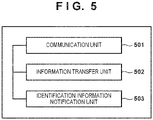
- FIG. 5 is a diagram showing an exemplary functional configuration of the base station apparatus 101 that is a handover source.
- the base station apparatus 101 includes a communication unit 501, an information transfer unit 502, and an identification information notification unit 503, for example. Functions of these units may be realized by the processor 201 executing a program stored in the ROM 202 or the storage device 204, for example, or may be realized by dedicated hardware. Note that FIG. 5 illustrates functions related to the technique according to the present embodiment, and the terminal apparatus has functions of an ordinary terminal apparatus as a matter of course.
- the base station apparatus operates as a base station apparatus that is a handover source when viewed from a terminal apparatus that is currently connected to the base station apparatus, and operates as a base station apparatus that is a handover destination when viewed from a terminal apparatus that is currently connected to another base station apparatus.
- the base station apparatus may be configured to have both of functions in FIGS. 3 and 5 .
- the communication unit 501 is similar to the communication unit 301 in FIG. 3 .
- the information transfer unit 502 receives a communication parameter and identification information from a base station apparatus that is a handover candidate, and transfers the communication parameter and the identification information to a terminal apparatus, for example.
- the information transfer unit 502 may transfer the identification information generated by the terminal apparatus to the candidate base station apparatus.
- the information transfer unit 502 is configured to transfer at least a communication parameter received from the candidate base station apparatus, to the terminal apparatus, and does not need to transfer identification information.
- the identification information notification unit 503 receives, from a base station apparatus to which handover was performed by the terminal apparatus that has been connected to the base station apparatus (that includes this identification information notification unit 503) to this point, identification information included in a handover success message transmitted from the terminal apparatus to the base station apparatus (that is a handover destination), for example, and specifies other identification information corresponding to the received identification information.
- the identification information notification unit 503 then notifies the specified other identification information, to the base station apparatus that is a handover destination. Note that, when identification information that is common between the base station apparatus that is a handover destination and the terminal apparatus is used, the identification information notification unit 503 may be omitted.
- FIG. 6 shows an example in which the terminal apparatus 121 generates identification information in accordance with receiving a communication parameter.
- the terminal apparatus 121 and the base station apparatus 101 are in a connection state (step S601), and are performing user data communication.
- the base station apparatus 101 notifies a communication parameter A that is being used at this time point to the base station apparatus 102 that is a candidate for handover destination, and transmits a handover request message (step S602).
- the base station apparatus 102 then transmits, to the base station apparatus 101, a response message that includes a communication parameter A1 that can achieve communication performance that is equivalent to the communication performance corresponding to this notified communication parameter, for example (step S603).
- the base station apparatus 101 transfers the obtained communication parameter A1 to the terminal apparatus 121 (step S604). Transfer of this communication parameter A1 can be performed using an RRC message such as an RRC Reconfiguration message. Note that, for example, the base station apparatus 101 can also perform notification of a condition for determining whether or not the terminal apparatus 121 also autonomously executes handover at the time of first notification of a communication parameter. Note that this is merely exemplary, and a communication parameter and a condition may be separately notified.
- the terminal apparatus 121 In accordance with receiving the communication parameter A1, the terminal apparatus 121 generates identification information a associated with the communication parameter A1, and notifies the identification information a to the base station apparatus 101 that is currently connected to the terminal apparatus 121 (step S605). This notification of the identification information a can be performed using an RRC message such as an RRC Reconfiguration Complete message.
- the base station apparatus 101 transfers the received identification information a to the base station apparatus 102 (step S606). Due to the procedure in steps S602 to S606, the communication parameter A1 and the identification information a associated therewith are shared between the terminal apparatus 121 and the base station apparatus 102 that is a handover destination.
- the base station apparatus 101 notifies the base station apparatus 102 of a changed communication parameter B (step S607).
- the base station apparatus 101 obtains, from the base station apparatus 102, information regarding a communication parameter B 1 that corresponds to the communication parameter B and is to be used for communication with the terminal apparatus 121 (step S608).
- the base station apparatus 101 then transfers this obtained communication parameter B 1 to the terminal apparatus 121 (step S609). Note that, here, it is assumed that, for example, due to deterioration in the wireless environment, transfer of the communication parameter B 1 from the base station apparatus 101 to the terminal apparatus 121 fails.
- the terminal apparatus 121 determines that the handover start condition is satisfied, before the communication parameter B 1 is successfully received, and starts processing for performing handover to the base station apparatus 102.
- the terminal apparatus 121 determines that the communication parameter A1 that is the most recent from among communication parameters received from the base station apparatus 102 via the base station apparatus 101 is to be used, for example.
- the terminal apparatus 121 transmits, to the base station apparatus 102, a handover success message that includes the identification information a associated with the communication parameter A1 (step S610).
- the handover success message can be a RRC Reconfiguration Complete message, for example.
- the base station apparatus 102 Upon receiving this message, the base station apparatus 102 confirms that the identification information a is included, and determines that communication with the terminal apparatus 121 is to be performed using the communication parameter A1 associated therewith. Accordingly, connection for communication that uses a parameter A1 is established between the terminal apparatus 121 and the base station apparatus 102, (step S611).
- this processing example can also apply when the terminal apparatus 121 has started handover in a state where the communication parameter B1 cannot be received in step S609, but this communication parameter B1 has been successfully received, and when handover is started in a state where identification information b (not illustrated) associated with the communication parameter B 1 does not reach the base station apparatus 101 (or the base station apparatus 102).
- the base station apparatus 102 may determine that the communication parameter B1 that is not associated with identification information is to be used since the identification information b is unknown identification information. In this case, connection for communication that uses a parameter B1 is established between the terminal apparatus 121 and the base station apparatus 102.
- the base station apparatus 102 may discard this message.
- the base station apparatus 102 may newly generate a communication parameter that is to be used for communication with the terminal apparatus 121, notify the terminal apparatus 121 of the generated communication parameter, and start communication.
- step S606 the base station apparatus 101 does not need to hold the received identification information a and transfer it to the base station apparatus 102.
- the base station apparatus 102 may transmit this identification information a to the base station apparatus 101, perform an inquiry, and specify the communication parameter A1 associated with the identification information a. Accordingly, connection for communication that uses the parameter A1 can be established between the terminal apparatus 121 and the base station apparatus 102.
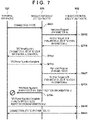
- the base station apparatus 102 when the communication parameter A1 that can achieve communication performance that is equivalent to the communication performance corresponding to the communication parameter A received from the base station apparatus 101 is generated, the base station apparatus 102 generates the identification information a associated with the communication parameter A1. The base station apparatus 102 then notifies the base station apparatus 101 of the generated communication parameter A1 and the identification information a (step S701). The base station apparatus 101 then transfers this communication parameter A1 and the identification information a to the terminal apparatus 121 (step S702), and receives a response signal from the terminal apparatus 121 (step S703).
- the communication parameter A1 and the identification information a associated therewith are shared between the terminal apparatus 121 and the base station apparatus 102, and thus notification of information from the base station apparatus 101 to the base station apparatus 102 as in step S606 does not need to be performed.
- the base station apparatus 102 generates a new communication parameter B1 and identification information b associated therewith, and performs notification to the base station apparatus 101 (step S704).
- the base station apparatus 101 then transfers this received information to the terminal apparatus 121 (step S705).
- the terminal apparatus 121 transmits, to the base station apparatus 102, a handover success message that includes the identification information a associated with the communication parameter A1 (step S610), and connection for communication that uses the communication parameter A1 is established (step S611).
- the terminal apparatus 121 successfully receives the communication parameter B1 and the identification information b thereof, but even when handover is started in a state where a response signal for notifying the success (not illustrated) does not reach the base station apparatus 101, the relationship between the communication parameter B1 and the identification information b is shared between the terminal apparatus 121 and the base station apparatus 102.
- the base station apparatus 102 can determine that the communication parameter B1 associated with the identification information b is to be used.
- the base station apparatus 102 generates the communication parameter A1 and the identification information a1 associated therewith, and performs notification to the base station apparatus 101 (step S801).
- the base station apparatus 101 stores this identification information a1, and, on the other hand, transfers the communication parameter A1 to the terminal apparatus 121 while sharing other identification information a2 with the terminal apparatus 121 (step S802).
- the base station apparatus 101 then receives a response signal from the terminal apparatus 121 (step S803).
- the identification information a2 at this time may be generated by the base station apparatus 101 and notified to the terminal apparatus 121, but may be identification information that is assigned during communication, such as an RRC Transaction ID.
- the base station apparatus 101 stores the identification information a2 shared with the terminal apparatus 121, in association with the identification information a1 shared with the base station apparatus 102. Similarly, when the communication parameter is changed, the base station apparatus 102 notifies the base station apparatus 101 of the communication parameter B1 and the identification information b1 associated therewith (step S804), and the base station apparatus 101 notifies the terminal apparatus 121 of the changed communication parameter B1 while sharing the other identification information b2 with the terminal apparatus 121 (step S805).
- the terminal apparatus 121 starts processing for performing handover to the base station apparatus 101, before information regarding the communication parameter B1 is successfully received.
- the terminal apparatus 121 transmits, to the base station apparatus 102, a handover success message that includes the identification information a2 shared with the base station apparatus 101 (step S806).
- the base station apparatus 102 cannot interpret this identification information a2, thus transfers this identification information a2 to the base station apparatus 101 that is a handover source, makes an inquiry whether or not there is identification information associated with the identification information a2 from among identification information shared between the base station apparatus 101 and the base station apparatus 102 (step S807).
- the base station apparatus 101 transmits the identification information a1 stored in association with the identification information a2, as a response to the inquiry, to the base station apparatus 102 (step S808). Accordingly, the base station apparatus 102 can recognize that the identification information a2 is associated with the communication parameter A1, and, as a result, connection for communication that uses the communication parameter A1 is established between the terminal apparatus 121 and the base station apparatus 101 (step S611).
- a communication parameter that is to be used when the base station apparatus 102 communicates with the terminal apparatus 121 and identification information associated with the communication parameter are shared between the terminal apparatus 121 and the base station apparatus 102 (or the base station apparatus 101) that is a candidate for handover destination, and conditional handover is executed using the identification information. Accordingly, communication parameter that is to be used by the terminal apparatus 121 can be accurately recognized by the base station apparatus 102 that is a handover destination, and thus it is possible to prevent communication between the terminal apparatus 121 and the base station apparatus 102 from being disabled after handover.
Landscapes
- Engineering & Computer Science (AREA)
- Computer Networks & Wireless Communication (AREA)
- Signal Processing (AREA)
- Computing Systems (AREA)
- Physics & Mathematics (AREA)
- Electromagnetism (AREA)
- Quality & Reliability (AREA)
- Mobile Radio Communication Systems (AREA)
Abstract
Description
- The present invention relates to a terminal apparatus, a base station apparatus, a control method, and a program, and in particular relates to a conditional handover technique.
- In a cellular communication system, handover processing for sequentially switching base station apparatuses to which a terminal apparatus is connected is executed in order to maintain connection even when the terminal apparatus moves. In order to shorten the period of a switch, by such handover processing, of a base station apparatus to which the terminal apparatus is connected a technique has been discussed in which a communication parameter for communication between a base station apparatus that is a handover source and a base station apparatus that is a handover destination and a condition on which handover is to be executed are provided to the terminal apparatus in advance, and when the terminal apparatus confirms that the condition is satisfied, handover is autonomously executed. This technique is called conditional handover. In conditional handover, a base station apparatus that is a handover source inquires of base station apparatuses that are candidates for handover destination about respective communication parameters that are to be used for communication with a terminal apparatus, and obtains communication parameters when these candidate base station apparatuses and the terminal apparatus are connected (see NPLs 1 and 2). The base station apparatus that is a handover source then notifies the terminal apparatus of these communication parameters. In addition, a communication parameter that is to be used by a terminal apparatus for communication with a base station apparatus that is a handover candidate can be changed before handover is actually executed (see NPL 3).
-
- NPL1: 3GPP contribute article, R2-1906209
- NPL2: 3GPP contribute article, R3-193147
- NPL3: 3GPP contribute article, R2-1909676
- There can be cases where, when a communication parameter that is to be used by a terminal apparatus for communication with a base station apparatus that is a handover candidate is changed, before the change of the communication parameter is notified to the terminal apparatus, the terminal apparatus executes conditional handover using a communication parameter before the change. In this case, parameter mismatch can occur as a result of the candidate base station apparatus using the changed communication parameter while the terminal apparatus uses the communication parameter before the change.
- The present invention provides a technique for preventing mismatch between communication parameters that are respectively used by a terminal apparatus and a base station apparatus that is a handover destination during conditional handover.
- A terminal apparatus according to one mode of the present invention includes: obtaining means for obtaining, from a base station apparatus that is currently connected to the terminal apparatus, a communication parameter that is to be used when the terminal apparatus is connected to a candidate base station apparatus that is a candidate for handover destination and a condition for executing handover to the candidate base station apparatus; and transmitting means for transmitting, to the candidate base station apparatus, a message that includes identification information associated with the communication parameter, when handover to the candidate base station apparatus is performed based on the condition.
- A base station apparatus according to one mode of the present invention is a base station apparatus that is a candidate for destination of handover to be performed by a terminal apparatus, the base station apparatus including: notification means for notifying the terminal apparatus of a communication parameter that is to be used when the terminal apparatus is connected to the base station apparatus, via another base station apparatus that is currently connected to the terminal apparatus; receiving means for receiving, from the terminal apparatus, a message that includes identification information associated with the communication parameter notified from the other base station apparatus to the terminal apparatus, when the terminal apparatus executes handover to the base station apparatus; and communication means for communicating with the terminal apparatus using the communication parameter if the identification information included in the message is associated with the communication parameter notified by the notification means.
- According to the present invention, it is possible to prevent mismatch between communication parameters that are respectively used by a terminal apparatus and a base station apparatus that is a handover destination during handover.
- Other features and advantages of the present invention will be apparent from the following description taken in conjunction with the accompanying drawings. Note that the same reference numerals denote the same or like components throughout the accompanying drawings.
- The accompanying drawings, which are incorporated in and constitute a part of the specification, illustrate embodiments of the invention and, together with the description, serve to explain principles of the invention.
-
FIG. 1 is a diagram showing a configuration example of a wireless communication system. -
FIG. 2 is a diagram showing an exemplary hardware configuration of a base station apparatus and a terminal apparatus. -
FIG. 3 is a diagram showing a configuration example of a base station apparatus that is a candidate for handover destination. -
FIG. 4 is a diagram showing a configuration example of a terminal apparatus. -
FIG. 5 is a diagram showing a configuration example of a base station apparatus that is a handover source. -
FIG. 6 is a diagram showing an example of flow of processing that is executed by the system. -
FIG. 7 is a diagram showing an example of flow of processing that is executed by the system. -
FIG. 8 is a diagram showing an example of flow of processing that is executed by the system. - Hereinafter, embodiments will be described in detail with reference to the attached drawings. Note, the following embodiments are not intended to limit the scope of the claimed invention, and limitation is not made to an invention that requires a combination of all features described in the embodiments. Two or more of the multiple features described in the embodiments may be combined as appropriate. Furthermore, the same reference numerals are given to the same or similar configurations, and redundant description thereof is omitted.
-
FIG. 1 shows a configuration example of a wireless communication system according to an embodiment of the present invention. Note that, in the example inFIG. 1 , two base station apparatuses and one terminal apparatus are illustrated, but, as a matter of course, there may be a larger number of base station apparatuses and terminal apparatuses than those illustrated. - Abase
station apparatus 101 and abase station apparatus 102 are wireless base station apparatuses in a fifth-generation (5G) cellular communication system, for example. Thebase station apparatuses cell 111 and acell 112 that respectively represent ranges in which thebase station apparatuses terminal apparatus 121 is connected to a base station apparatus that provides a cell that includes a position at which theterminal apparatus 121 is present, and thereby can perform wireless communication. Note that theterminal apparatus 121 can suppress the power consumption by transitioning to a standby state (for example, an RRC_Idle state or an RRC_Inactive state) when there is no user data that is to be transmitted/received, but, in the present embodiment, theterminal apparatus 121 enters a connection state (for example, an RRC Connected state), establishes connection with a base station apparatus, and performs communication. - In the present embodiment, it is assumed that the
terminal apparatus 121 moves while being connected to thebase station apparatus 101 that forms thecell 111, and enters the range of thecell 112 that is formed by thebase station apparatus 102. In this case, as theterminal apparatus 121 moves, the wireless quality of wireless communication with thebase station apparatus 101 deteriorates and the wireless quality of a wireless signal from thebase station apparatus 102 improves, and thereby theterminal apparatus 121 performs a switch of base station apparatus to which theterminal apparatus 121 is connected, that is in other words handover. At this time, this handover may be performed by a handover source, namely thebase station apparatus 101 transmitting a handover instruction to theterminal apparatus 121, but handover may be autonomously started when it is determined that a predetermined condition is satisfied by theterminal apparatus 121. Autonomous handover that is performed when the condition is satisfied by theterminal apparatus 121 may be called "conditional handover". In the present embodiment, theterminal apparatus 121 executes this conditional handover. - In conditional handover, for each of one or more candidate base station apparatuses that are candidates for handover destination, the
terminal apparatus 121 obtains information regarding a communication parameter that is to be used when theterminal apparatus 121 is connected to that candidate base station apparatus, from thebase station apparatus 101 that theterminal apparatus 121 is currently connected. Note that, in the present embodiment, thebase station apparatus 102 is the candidate base station apparatus. In an example, a communication parameter is a parameter for wireless resource control (RRC) and includes a frequency bandwidth that is used for communication, the number of layers of MIMO (Multi-Input Multi-Output), and the like. - This information regarding a communication parameter may be information regarding a communication parameter that can be used by a candidate base station apparatus, and with which the
base station apparatus 101 that is currently connected to theterminal apparatus 121 can achieve the communication quality achieved in communication that is currently executed with theterminal apparatus 121, and, for example. Thus, for example, thebase station apparatus 101 that is currently connected to theterminal apparatus 121 may provide a communication parameter that is currently used with theterminal apparatus 121, to the candidate base station apparatus (the base station apparatus 102), and obtain a communication parameter that can achieve communication performance similar to that corresponding to the provided communication parameter, from the candidate base station apparatus, as a communication parameter that is to be used when theterminal apparatus 121 and the candidate base station apparatus are connected. Thebase station apparatus 102 may notify thebase station apparatus 101 of the same communication parameter as the communication parameter notified from thebase station apparatus 101, for example. In addition, thebase station apparatus 102 may notify thebase station apparatus 101 of a communication parameter that is significantly different from the same communication parameter as the communication parameter notified from thebase station apparatus 101, but that can achieve the same communication performance, or may notify thebase station apparatus 101 of a communication parameter only a portion of which is different from the communication parameter notified from thebase station apparatus 101, for example. In an example, thebase station apparatus 102 may notify thebase station apparatus 101 of information indicating the difference from the communication parameter notified from thebase station apparatus 101. In addition, thebase station apparatus 102 may, for example, periodically notify thebase station apparatus 101 of a communication parameter that is to be used, without being notified of a communication parameter from thebase station apparatus 101. In this manner, thebase station apparatus 101 transfers information regarding a communication parameter obtained from thebase station apparatus 102 to theterminal apparatus 121. - The
terminal apparatus 121 executes processing for autonomously switching a base station apparatus to which theterminal apparatus 121 is connected, to thebase station apparatus 102, for example, in accordance with a condition that the wireless quality of a wireless signal from thebase station apparatus 102 is sufficiently higher than the wireless quality of a wireless signal from thebase station apparatus 101 being satisfied by using this information regarding the communication parameter. In conditional handover, theterminal apparatus 121 transmits a handover success message (for example, an "RRC Reconfiguration Complete" message) to thebase station apparatus 102 in accordance with a determination that handover to thebase station apparatus 102 is to be performed, and handover is completed by thebase station apparatus 102 accepting this message. - Here, information regarding a condition for the
terminal apparatus 121 to execute handover is notified to theterminal apparatus 121 by the base station apparatus 101 (a handover source) that is currently connected to theterminal apparatus 121. Thebase station apparatus 101 may notify that a value obtained by subtracting the wireless quality of a wireless signal from thebase station apparatus 101 from the wireless quality of a wireless signal from thebase station apparatus 102 measured by theterminal apparatus 121 needs to exceed a predetermined value, as a condition of handover, for example. At this time, thebase station apparatus 101 may set the same predetermined value for all of the candidate base station apparatuses, for example, but may set a predetermined value different for each candidate base station apparatus. Thebase station apparatus 101 specifies wireless quality at which communication that uses a communication parameter notified from each candidate base station apparatus will be sufficiently successful, based on the communication parameter, and may set a higher predetermined value for higher wireless quality, for example. A configuration may be adopted in which, for example, the predetermined value is set higher for a candidate base station apparatus whose communication parameter represents a high likelihood of failure in demodulating a signal due to the number of layers of MIMO being large, such that handover is started after wireless quality on the candidate base station apparatus side is sufficiently high. In addition, a configuration may also be adopted in which the predetermined value is set higher for a candidate base station apparatus that uses a communication parameter that cannot achieve the communication performance achieved in the current communication, making it difficult for theterminal apparatus 121 to perform handover to the candidate base station apparatus. This enables theterminal apparatus 121 to be connected to a candidate base station apparatus that can achieve the same communication performance as the current communication performance. In addition, if there is a candidate base station apparatus that is to be preferentially connected, thebase station apparatus 101 may set the predetermined value for the candidate base station apparatus lower, making it easy to perform handover to this candidate base station apparatus. Note that a condition that is always constant may be used, and, in this case, information regarding the condition does not need to be notified from thebase station apparatus 101 to theterminal apparatus 121. - In communication with the
terminal apparatus 121, for example, thebase station apparatus 101 may change the communication parameter, for example, addition of a wireless bearer during communication. In such a case, for example, thebase station apparatus 101 may notify a candidate base station apparatus (the base station apparatus 102) of the changed communication parameter, obtain, from that candidate base station apparatus, a changed communication parameter that is to be used when connected to theterminal apparatus 121, and notify theterminal apparatus 121 of the changed communication parameter. Accordingly, in conditional handover, theterminal apparatus 121 can establish connection with the candidate base station apparatus using the changed communication parameter. - On the other hand, in conditional handover, the
base station apparatus 101 and thebase station apparatus 102 cannot be aware of, in advance, the timing when the condition is satisfied in theterminal apparatus 121. Thus, handover may occur during processing for changing the communication parameter, and mismatch of communication parameters may occur between theterminal apparatus 121 and thebase station apparatus 102 that is a handover destination. - If, for example, handover processing is started during a period from when the
base station apparatus 102 transmits a changed communication parameter to thebase station apparatus 101 until when the communication parameter reaches theterminal apparatus 121, theterminal apparatus 121 may use a communication the parameter before the change to communicate with thebase station apparatus 102, and thebase station apparatus 102 may use the changed communication parameter. Such an event may occur, for example, when handover is executed while the wireless quality between thebase station apparatus 101 and theterminal apparatus 121 is reduced and theterminal apparatus 121 is failing to receive the changed communication parameter. In this case, communication parameters that are used by theterminal apparatus 121 and thebase station apparatus 102 are different, and thus communication between these apparatuses cannot be performed. - In addition, when the
terminal apparatus 121 successfully receives a changed communication parameter, theterminal apparatus 121 transmits, to thebase station apparatus 101, information indicating that the changed communication parameter was successfully received, and thebase station apparatus 101 transfers the information to thebase station apparatus 102, whereby, when theterminal apparatus 121 performs handover in a state where thebase station apparatus 102 has not received the information, thebase station apparatus 102 can use a communication parameter before change. However, for example, there are cases where, in spite of a fact that theterminal apparatus 121 has successfully received a changed communication parameter, thebase station apparatus 101 fails to receive information indicating that the changed communication parameter has been successfully received, and, as a result, such information is not transmitted to thebase station apparatus 102. In this case, theterminal apparatus 121 uses the changed communication parameter, while thebase station apparatus 102 that is a handover destination uses the communication parameter before change, and thus communication between these apparatuses fails. - In the present embodiment, in order to prevent such communication parameter mismatch, when the
terminal apparatus 121 executes handover, identification information associated with a communication parameter that is to be used after handover is notified to thebase station apparatus 102 that is a handover destination. Notification of this identification information is included in a handover success message, for example. - In accordance with a communication parameter being received from the
base station apparatus 101 to which theterminal apparatus 121 is currently connected, for example, theterminal apparatus 121 generates identification information corresponding to the communication parameter, and notifies thebase station apparatus 101 of the generated identification information. In addition, thebase station apparatus 101 may notify thebase station apparatus 102 of the notified identification information. That is to say, theterminal apparatus 121 may notify the generated identification information to a candidate base station apparatus that has determined a communication parameter corresponding to the identification information, via thebase station apparatus 101 to which theterminal apparatus 121 is currently connected. Theterminal apparatus 121 then transmits, to thebase station apparatus 102 that is a handover destination, a handover success message that includes identification information corresponding to the most recent communication parameter that theterminal apparatus 121 has, regarding thebase station apparatus 102 that is a handover destination, for example. Accordingly, as a result of theterminal apparatus 121 transmitting the identification information in the handover success message, thebase station apparatus 102 that is a handover destination can recognize which communication parameter theterminal apparatus 121 is to use for connection with thebase station apparatus 102. If, for example, the received identification information is associated with the most recent communication parameter that is managed by thebase station apparatus 102, thebase station apparatus 102 can recognize that theterminal apparatus 121 is attempting communication that uses the communication parameter, and can execute communication that uses the communication parameter after handover. On the other hand, for example, a configuration may be adopted in which, if the identification information is associated with a past first communication parameter, which is updated to a second communication parameter, but identification information associated with the (second) communication parameter has not been received, thebase station apparatus 102 performs communication using the second communication parameter when unknown identification information is received from theterminal apparatus 121. In addition, when a handover success message to which unknown identification information is added is received, thebase station apparatus 102 may discard the message. In addition, thebase station apparatus 102 may separately notify theterminal apparatus 121 of a communication parameter that is to be used, for example. - In addition, a configuration may also be adopted in which the
base station apparatus 102 that is a candidate for handover destination generates identification information along with communication parameters, and notify theterminal apparatus 121 thereof via thebase station apparatus 101. In this case, identification information is associated with all of the generated communication parameters, and thus thebase station apparatus 102 can appropriately select a communication parameter that is to be used, based on identification information included in a handover success message from theterminal apparatus 121. Assuming that, for example, first identification information is associated with the first communication parameter and second identification information is then associated with the second communication parameter to which the first communication parameter is updated, when a handover success message that includes the first identification information is received, thebase station apparatus 102 can communicate with theterminal apparatus 121 using the first communication parameter. Note that, if a handover success message that includes unknown identification information is received, thebase station apparatus 101 may discard the message. In addition, if a handover success message that includes first identification information associated with a past communication parameter is received, thebase station apparatus 102 may discard the message. - In addition, the
base station apparatus 102 notifies the first identification information associated with a communication parameter, to thebase station apparatus 101 that is currently connected to theterminal apparatus 121, and thebase station apparatus 101 generates second identification information associated with the first identification information, and share it with theterminal apparatus 121. When the handover condition is satisfied, theterminal apparatus 121 transmits a handover success message that includes this second identification information, to thebase station apparatus 102. Note that the second identification information may be, for example, an RRC Transaction ID in an RRC message when thebase station apparatus 101 notifies theterminal apparatus 121 of a communication parameter. That is to say, when a communication parameter is notified to theterminal apparatus 121, an RRC message is transmitted, and an RRC Transaction ID is given to the message. Thus, this RRC Transaction ID may be used as the second identification information. Upon receiving a handover success message that includes the second identification information, thebase station apparatus 102 notifies thebase station apparatus 101 of the second identification information. Then, thebase station apparatus 101 may notify thebase station apparatus 102 of third identification information associated with the second identification information. If the third identification information matches the first identification information, thebase station apparatus 102 specifies that a communication parameter associated with the first identification information is being used by theterminal apparatus 121. In this manner, thebase station apparatus 102 can specify which communication parameter the received identification information is associated with, via thebase station apparatus 101 that is a handover source. - In this manner, when executing conditional handover, the
terminal apparatus 121 notifies thebase station apparatus 102 that is a handover destination of identification information associated with a communication parameters that theterminal apparatus 121 could receive. Accordingly, thebase station apparatus 102 can recognize that theterminal apparatus 121 is about to perform post-handover communication using the communication parameter associated with this identification information. Then, thebase station apparatus 102 can communicate with theterminal apparatus 121 that performed handover, using the communication parameter associate with the identification information. Thebase station apparatus 102 holds histories of past communication parameters, for example, whereby, when identification information associated with a past communication parameter is received, thebase station apparatus 102 can communicate with theterminal apparatus 121 using the past communication parameter. Note that thebase station apparatus 102 does not need to hold past communication parameters, and, in this case, when a handover success message that includes identification information associated with a past communication parameter is received, the message can be discarded. Similarly, a handover success message that includes identification information that thebase station apparatus 102 cannot recognize is received, thebase station apparatus 102 may discard the message. Accordingly, communication can be prevented from being attempted in a state where communication parameters do not match between theterminal apparatus 121 and thebase station apparatus 102. -
FIG. 2 shows an exemplary hardware configurations of a base station apparatus (thebase station apparatus 101 of the base station apparatus 102) and a terminal apparatus according to the present embodiment. These apparatuses each includes aprocessor 201, aROM 202, aRAM 203, astorage device 204, and acommunication circuit 205, in an example. Theprocessor 201 is a computer constituted by one or more processing circuits such as a general-purpose CPU (Central Processing Unit) and an ASIC (application-specific integrated circuit), and executes overall processing of the base station apparatuses/terminal apparatus and each process described above by reading out and executing a program stored in theROM 202 or thestorage device 204. TheROM 202 is a read only memory that stores information such as programs and various parameters related to processing that is performed by the base station apparatus/terminal apparatus. TheRAM 203 is a random access memory that functions as a work space when theprocessor 201 executes a program, and stores temporary information. Thestorage device 204 is constituted by a detachable external storage apparatus, for example. Thecommunication circuit 205 is constituted by a circuit for wireless communication, for example. The base station apparatuses/terminal apparatus are each constituted by, for example, a baseband circuit, an RF circuit, and the like for cellular communication and an antenna, as thecommunication circuit 205 for communication with another apparatus. Note thatFIG. 2 illustrates onecommunication circuit 205, but the base station apparatuses/terminal apparatus may each include a plurality of communication circuits. In addition to the communication circuit for communication with the terminal apparatus, for example, each base station apparatus may include a wired or wireless communication circuit for communication with another base station apparatus. Moreover, in addition to the communication circuit for communication with the base station apparatuses, the terminal apparatus may include a communication circuit for a wireless LAN, for example. -
FIG. 3 shows an exemplary functional configuration of a base station apparatus (the base station apparatus 102) that is a handover candidate according to the present embodiment. The candidate base station apparatus includes, as functions thereof, acommunication unit 301, a communicationparameter generation unit 302, aninformation holding unit 303, and a parameter-to-be-used determination unit 304, for example. Note that these functions may be realized by theprocessor 201 executing a program stored in theROM 202 or thestorage device 204, or may also be realized by dedicated hardware, for example.FIG. 3 illustrates functions related to a technique according to the present embodiment, and the base station apparatus has functions of an ordinary base station apparatus as a matter of course. - The
communication unit 301 is a function unit for executing wireless communication with theterminal apparatus 121, for example. Thecommunication unit 301 can perform wireless communication, for example, using a wireless communication method according to which a terminal apparatus can execute handover to an adjacent base station apparatus, such as a fifth generation cellular communication method. Note that, in the present embodiment, a fifth generation cellular communication method is used, but a communication method of each generation such as a third-generation wireless communication method, a long-term evolution communication method, or a fifth generation or later wireless communication method may be used, and a communication method other than a cellular communication method may also be used. In addition, thecommunication unit 301 also has a function of executing wired or wireless communication with another base station apparatus (the base station apparatus 101). Thecommunication unit 301 performs communication with another base station apparatus through an interface between base station apparatuses stipulated by a cellular communication standard, for example - The communication
parameter generation unit 302 generates a communication parameter that is to be used for communication when theterminal apparatus 121 is connected to thebase station apparatus 102. The communicationparameter generation unit 302 generates a communication parameter, for example, in accordance with theterminal apparatus 121 receiving a handover request for conditional handover from thebase station apparatus 101 to which theterminal apparatus 121 is currently connected, adds information regarding the generated communication parameter to a response signal to the handover request, and transmits the response signal. Note that the handover request may include information regarding a communication parameter that is being used by thebase station apparatus 101 for communication with theterminal apparatus 121, and, in this case, the communicationparameter generation unit 302 can generate a communication parameter that is to be used for communication when theterminal apparatus 121 is connected to thebase station apparatus 102, based on this received communication parameter. The communicationparameter generation unit 302 generates a communication parameter, for example, such that communication performance that is equivalent to communication performance obtained in communication between thebase station apparatus 101 and theterminal apparatus 121 can be achieved. Then, the communicationparameter generation unit 302 may notify thebase station apparatus 101 of the value of the difference between the communication parameter received from thebase station apparatus 101 and the generated communication parameter, for example. In this case, thebase station apparatus 101 specifies a communication parameter that is to be used by thebase station apparatus 102, based on the communication parameter notified to thebase station apparatus 102 and the value of the difference (for example, by adding these values). Note that the communicationparameter generation unit 302 may notify thebase station apparatus 101 of the generated communication parameter itself. Note that a configuration may also be adopted in which the communicationparameter generation unit 302 generates a communication parameter and identification information associated with the communication parameter, and notify thebase station apparatus 101 thereof. Note that the communication parameter (and identification information as necessary) notified to thebase station apparatus 101 is transferred to theterminal apparatus 121 by thebase station apparatus 101. Note that identification information may be generated by thebase station apparatus 101, and, in this case, for example, the identification information may be notified to thebase station apparatus 102 at the time of a handover request. In this case, the communicationparameter generation unit 302 does not need to generate identification information. - The
information holding unit 303 holds a communication parameter generated by the communicationparameter generation unit 302 and identification information associated with the communication parameter. Note that, for example, when storing identification information generated by the communicationparameter generation unit 302, theinformation holding unit 303 stores the identification information and the communication parameter generated along with that identification information in association. In addition, when identification information notified from theterminal apparatus 121 via thebase station apparatus 101 is obtained, theinformation holding unit 303 stores the identification information in association with the previous communication parameter transmitted to theterminal apparatus 121 via thebase station apparatus 101. - The parameter-to-
be-used determination unit 304 determines a communication parameter that is to be used for communication with theterminal apparatus 121, based on identification information included in a handover success message from theterminal apparatus 121. If the received identification information is held in theinformation holding unit 303, the parameter-to-be-used determination unit 304 determines a communication parameter associated with that identification information, as a communication parameter that is to be used for communication with theterminal apparatus 121, for example. In addition, if the received identification information is not held in theinformation holding unit 303 and the most recent communication parameter that is not associated with identification information is present, the parameter-to-be-used determination unit 304 determines that this communication parameter is a communication parameter to be used for communication with theterminal apparatus 121. Note that, if the received identification information is not held in theinformation holding unit 303, the parameter-to-be-used determination unit 304 may discard the handover success message. In addition, a configuration may be adopted in which the parameter-to-be-used determination unit 304 transfers, to thebase station apparatus 101, identification information included in the handover success message from theterminal apparatus 121, obtains other identification information from thebase station apparatus 101, and determines a communication parameter that is to be used, in accordance with whether or not the other identification information is held in theinformation holding unit 303. If the other identification information obtained from thebase station apparatus 101 is held in theinformation holding unit 303, for example, the parameter-to-be-used determination unit 304 determines that a communication parameter associated with the other identification information is a communication parameter that is to be used for communication with theterminal apparatus 121. In addition, if the other identification information obtained from thebase station apparatus 101 is not held in theinformation holding unit 303, the parameter-to-be-used determination unit 304 may discard the handover success message. In addition, a configuration may be adopted in which, if the other identification information obtained from thebase station apparatus 101 is not held in theinformation holding unit 303, the parameter-to-be-used determination unit 304 generates a communication parameter that is to be used for communication with theterminal apparatus 121, notifies theterminal apparatus 121 of the communication parameter as a response to the handover success message, and starts communication. At this time, thebase station apparatus 102 may inquire thebase station apparatus 101 about a communication parameter used for communication with theterminal apparatus 121 and generate a communication parameter for communication with theterminal apparatus 121. -
FIG. 4 is a diagram showing an exemplary functional configuration of a terminal apparatus. The terminal apparatus includes acommunication unit 401, aninformation obtaining unit 402, acondition determination unit 403, and amessage generation unit 404, for example. Functions of these units may be realized by theprocessor 201 executing a program stored in theROM 202 or thestorage device 204, for example, or may also be realized by dedicated hardware. Note thatFIG. 4 illustrates functions related to a technique according to the present embodiment, and the terminal apparatus has functions of an ordinary terminal apparatus as a matter of course. - The
communication unit 401 is a function unit for executing wireless communication with a base station apparatus, for example. Thecommunication unit 401 can perform wireless communication by using a wireless communication method according to which a terminal apparatus can move to an adjacent cell, in a cellular communication method of each generation such as a third generation wireless communication method, a long term evolution communication method, or a fifth generation wireless communication method. Note that a method other than the cellular communication method may also be used. - Regarding at least one candidate base station apparatus (for example, the base station apparatus 102) that is a candidate for handover destination, the
information obtaining unit 402 obtains information regarding a communication parameter that is to be used when connected to the candidate base station apparatus, from thebase station apparatus 101 that is currently connected to the terminal apparatus. Note that this communication parameter is received, for example, from each candidate base station apparatus via thebase station apparatus 101 that is currently connected to the terminal apparatus. In addition, theinformation obtaining unit 402 may obtain a condition for autonomously starting handover, for example, from thebase station apparatus 101 that is currently connected to the terminal apparatus. Note that the condition may be defined for each candidate base station apparatus or may be defined in common with some or all candidate base station apparatuses. In addition, if identification information associated with a communication parameter is generated by each candidate base station apparatus, theinformation obtaining unit 402 may obtain the identification information along with the communication parameter. In addition, when a communication parameter from one of the candidate base station apparatuses is obtained, theinformation obtaining unit 402 may generate and obtain identification information associated with that communication parameter, for example. When identification information is generated in this manner, the generated identification information is notified to thebase station apparatus 101 by themessage generation unit 404 to be described later, before handover is executed. When a communication parameter is received in an RRC Reconfiguration message from thebase station apparatus 101, identification information may be notified to thebase station apparatus 101 by an RRC Reconfiguration Complete message that is a response to that message, for example. - In addition, when a candidate base station apparatus generated identification information, the
information obtaining unit 402 may share other identification information different from this identification information, with thebase station apparatus 101 that is currently connected to the terminal apparatus. Theinformation obtaining unit 402 may obtain an RRC Transaction ID of an RRC message when obtaining information regarding a communication parameter of a candidate base station apparatus from thebase station apparatus 101, as the other identification information, for example. In addition, a configuration may be adopted in which, as described above, theinformation obtaining unit 402 generates and obtains other identification information in accordance with a communication parameter being received, and notifies the generated identification information to thebase station apparatus 101, thereby sharing this other identification information with thebase station apparatus 101. - The
condition determination unit 403 determines whether or not a condition for starting handover obtained by theinformation obtaining unit 402 has been satisfied, for example. Thecondition determination unit 403 measures the wireless quality of a wireless signal from thebase station apparatus 102 and the wireless quality of a wireless signal from thebase station apparatus 101 that is currently connected to the terminal apparatus, and determines whether or not to start handover, based on the measured value and the condition notified in relation to thebase station apparatus 102, for example. Thecondition determination unit 403 can determine that handover is to be started, for example, when the difference between the wireless quality of a wireless signal from thebase station apparatus 102 and the wireless quality of a wireless signal from thebase station apparatus 101 exceeds a predetermined value, when the wireless quality of a wireless signal from thebase station apparatus 101 is lower than a predetermined level, when the wireless quality of a wireless signal from thebase station apparatus 102 exceeds a predetermined level, and the like. - When the condition for conditional handover is satisfied and handover processing is started, the
message generation unit 404 generates a handover success message that includes identification information associated with the communication parameter notified from the base station apparatus that is a destination of the handover, for example. When the communication parameter and the identification information are received from the base station apparatus 102 (via the base station apparatus 101), themessage generation unit 404 generates a handover success message that includes the identification information, for example. In addition, also when the terminal apparatus generates identification information in accordance with a communication parameter being received from thebase station apparatus 102, themessage generation unit 404 may generate a handover success message that includes this identification information. Note that, in this case, themessage generation unit 404 may generate a message for notifying thebase station apparatus 101 of the identification information, in accordance with a communication parameter being received, before handover processing is started. When a communication parameter that is to be used for communication with thebase station apparatus 102 is received in an RRC Reconfiguration message from thebase station apparatus 101, for example, themessage generation unit 404 generates an RRC Reconfiguration Complete message that includes identification information generated in association with the communication parameter. In addition, themessage generation unit 404 may generate a handover success message that includes identification information (for example, an RRC Transaction ID) that is shared with thebase station apparatus 101 only, for example. In this case, thebase station apparatus 102 is not aware of that identification information in advance, but can recognize which communication parameter the handover success message corresponds to, by making an inquiry to thebase station apparatus 101 that is a handover source. The handover success message generated by themessage generation unit 404 is transmitted to thebase station apparatus 102 via thecommunication unit 401. In addition, for example, a message for performing notification of identification information may be transmitted to thebase station apparatus 101. -
FIG. 5 is a diagram showing an exemplary functional configuration of thebase station apparatus 101 that is a handover source. Thebase station apparatus 101 includes acommunication unit 501, aninformation transfer unit 502, and an identificationinformation notification unit 503, for example. Functions of these units may be realized by theprocessor 201 executing a program stored in theROM 202 or thestorage device 204, for example, or may be realized by dedicated hardware. Note thatFIG. 5 illustrates functions related to the technique according to the present embodiment, and the terminal apparatus has functions of an ordinary terminal apparatus as a matter of course. Note that the base station apparatus operates as a base station apparatus that is a handover source when viewed from a terminal apparatus that is currently connected to the base station apparatus, and operates as a base station apparatus that is a handover destination when viewed from a terminal apparatus that is currently connected to another base station apparatus. Thus, the base station apparatus may be configured to have both of functions inFIGS. 3 and5 . - The
communication unit 501 is similar to thecommunication unit 301 inFIG. 3 . Theinformation transfer unit 502 receives a communication parameter and identification information from a base station apparatus that is a handover candidate, and transfers the communication parameter and the identification information to a terminal apparatus, for example. In addition, when identification information is generated in accordance with the terminal apparatus receiving a communication parameter, theinformation transfer unit 502 may transfer the identification information generated by the terminal apparatus to the candidate base station apparatus. Note that theinformation transfer unit 502 is configured to transfer at least a communication parameter received from the candidate base station apparatus, to the terminal apparatus, and does not need to transfer identification information. The identificationinformation notification unit 503 receives, from a base station apparatus to which handover was performed by the terminal apparatus that has been connected to the base station apparatus (that includes this identification information notification unit 503) to this point, identification information included in a handover success message transmitted from the terminal apparatus to the base station apparatus (that is a handover destination), for example, and specifies other identification information corresponding to the received identification information. The identificationinformation notification unit 503 then notifies the specified other identification information, to the base station apparatus that is a handover destination. Note that, when identification information that is common between the base station apparatus that is a handover destination and the terminal apparatus is used, the identificationinformation notification unit 503 may be omitted. - Next, several examples of flow of processing that is executed according to the present embodiment will be described. Note that the following processing is merely exemplary, and, for example, aforementioned deformations may be made, and information may be transmitted using a message that is different from various messages to be described below.
-
FIG. 6 shows an example in which theterminal apparatus 121 generates identification information in accordance with receiving a communication parameter. In this processing, as an initial state, theterminal apparatus 121 and thebase station apparatus 101 are in a connection state (step S601), and are performing user data communication. At this time, for example, thebase station apparatus 101 notifies a communication parameter A that is being used at this time point to thebase station apparatus 102 that is a candidate for handover destination, and transmits a handover request message (step S602). Thebase station apparatus 102 then transmits, to thebase station apparatus 101, a response message that includes a communication parameter A1 that can achieve communication performance that is equivalent to the communication performance corresponding to this notified communication parameter, for example (step S603). Thebase station apparatus 101 transfers the obtained communication parameter A1 to the terminal apparatus 121 (step S604). Transfer of this communication parameter A1 can be performed using an RRC message such as an RRC Reconfiguration message. Note that, for example, thebase station apparatus 101 can also perform notification of a condition for determining whether or not theterminal apparatus 121 also autonomously executes handover at the time of first notification of a communication parameter. Note that this is merely exemplary, and a communication parameter and a condition may be separately notified. - In accordance with receiving the communication parameter A1, the
terminal apparatus 121 generates identification information a associated with the communication parameter A1, and notifies the identification information a to thebase station apparatus 101 that is currently connected to the terminal apparatus 121 (step S605). This notification of the identification information a can be performed using an RRC message such as an RRC Reconfiguration Complete message. Thebase station apparatus 101 transfers the received identification information a to the base station apparatus 102 (step S606). Due to the procedure in steps S602 to S606, the communication parameter A1 and the identification information a associated therewith are shared between theterminal apparatus 121 and thebase station apparatus 102 that is a handover destination. - Thereafter, for example, when a change in the communication parameter such as an increase in the wireless bearer is performed between the
base station apparatus 101 and theterminal apparatus 121 that is currently connected to thebase station apparatus 101, similarly to step S602, thebase station apparatus 101 notifies thebase station apparatus 102 of a changed communication parameter B (step S607). Thebase station apparatus 101 then obtains, from thebase station apparatus 102, information regarding a communication parameter B 1 that corresponds to the communication parameter B and is to be used for communication with the terminal apparatus 121 (step S608). Thebase station apparatus 101 then transfers this obtained communication parameter B 1 to the terminal apparatus 121 (step S609). Note that, here, it is assumed that, for example, due to deterioration in the wireless environment, transfer of the communication parameter B 1 from thebase station apparatus 101 to theterminal apparatus 121 fails. - Here, it is assumed that the
terminal apparatus 121 determines that the handover start condition is satisfied, before the communication parameter B 1 is successfully received, and starts processing for performing handover to thebase station apparatus 102. In this case, theterminal apparatus 121 determines that the communication parameter A1 that is the most recent from among communication parameters received from thebase station apparatus 102 via thebase station apparatus 101 is to be used, for example. As a result, theterminal apparatus 121 transmits, to thebase station apparatus 102, a handover success message that includes the identification information a associated with the communication parameter A1 (step S610). Note that the handover success message can be a RRC Reconfiguration Complete message, for example. Upon receiving this message, thebase station apparatus 102 confirms that the identification information a is included, and determines that communication with theterminal apparatus 121 is to be performed using the communication parameter A1 associated therewith. Accordingly, connection for communication that uses a parameter A1 is established between theterminal apparatus 121 and thebase station apparatus 102, (step S611). - Note that this processing example can also apply when the
terminal apparatus 121 has started handover in a state where the communication parameter B1 cannot be received in step S609, but this communication parameter B1 has been successfully received, and when handover is started in a state where identification information b (not illustrated) associated with the communication parameter B 1 does not reach the base station apparatus 101 (or the base station apparatus 102). In step S610, for example, upon receiving a handover success message that includes the identification information b, thebase station apparatus 102 may determine that the communication parameter B1 that is not associated with identification information is to be used since the identification information b is unknown identification information. In this case, connection for communication that uses a parameter B1 is established between theterminal apparatus 121 and thebase station apparatus 102. Note that, when a handover success message that includes unknown identification information is received, thebase station apparatus 102 may discard this message. In addition, when a handover success message that includes unknown identification information is received, thebase station apparatus 102 may newly generate a communication parameter that is to be used for communication with theterminal apparatus 121, notify theterminal apparatus 121 of the generated communication parameter, and start communication. - In addition, in step S606, the
base station apparatus 101 does not need to hold the received identification information a and transfer it to thebase station apparatus 102. In this case, for example, as will be described later with reference toFIG. 8 , when a handover success message that includes the identification information a is received, thebase station apparatus 102 may transmit this identification information a to thebase station apparatus 101, perform an inquiry, and specify the communication parameter A1 associated with the identification information a. Accordingly, connection for communication that uses the parameter A1 can be established between theterminal apparatus 121 and thebase station apparatus 102. - Next, a processing example in which, when generating a communication parameter, the
base station apparatus 102 also generates identification information, and notifies the identification information to thebase station apparatus 101 and theterminal apparatus 121 will be described with reference toFIG. 7 . Note that processing similar to processing inFIG. 6 is given the same reference sign, and a description thereof is omitted. - In the present embodiment, when the communication parameter A1 that can achieve communication performance that is equivalent to the communication performance corresponding to the communication parameter A received from the
base station apparatus 101 is generated, thebase station apparatus 102 generates the identification information a associated with the communication parameter A1. Thebase station apparatus 102 then notifies thebase station apparatus 101 of the generated communication parameter A1 and the identification information a (step S701). Thebase station apparatus 101 then transfers this communication parameter A1 and the identification information a to the terminal apparatus 121 (step S702), and receives a response signal from the terminal apparatus 121 (step S703). Note that, in this processing example, at this time point, the communication parameter A1 and the identification information a associated therewith are shared between theterminal apparatus 121 and thebase station apparatus 102, and thus notification of information from thebase station apparatus 101 to thebase station apparatus 102 as in step S606 does not need to be performed. - Subsequently, as a communication parameter of communication between the
base station apparatus 101 and theterminal apparatus 121 is changed, thebase station apparatus 102 generates a new communication parameter B1 and identification information b associated therewith, and performs notification to the base station apparatus 101 (step S704). Thebase station apparatus 101 then transfers this received information to the terminal apparatus 121 (step S705). Here, assuming that theterminal apparatus 121 started handover processing before this information is successfully received, similarly to the case inFIG. 6 , theterminal apparatus 121 transmits, to thebase station apparatus 102, a handover success message that includes the identification information a associated with the communication parameter A1 (step S610), and connection for communication that uses the communication parameter A1 is established (step S611). - Note that, in this processing example, the
terminal apparatus 121 successfully receives the communication parameter B1 and the identification information b thereof, but even when handover is started in a state where a response signal for notifying the success (not illustrated) does not reach thebase station apparatus 101, the relationship between the communication parameter B1 and the identification information b is shared between theterminal apparatus 121 and thebase station apparatus 102. Thus, when theterminal apparatus 121 transmits a handover success message that includes the identification information b, thebase station apparatus 102 can determine that the communication parameter B1 associated with the identification information b is to be used. - Next, a processing example when identification information that is shared between the
base station apparatus 101 and thebase station apparatus 102 is different from identification information that is shared between theterminal apparatus 121 and thebase station apparatus 101 will be described with reference toFIG. 8 . Note that processing that is similar to the processing inFIG. 6 is given the same reference sign, and a description thereof is omitted. - In this processing example, the
base station apparatus 102 generates the communication parameter A1 and the identification information a1 associated therewith, and performs notification to the base station apparatus 101 (step S801). Thebase station apparatus 101 stores this identification information a1, and, on the other hand, transfers the communication parameter A1 to theterminal apparatus 121 while sharing other identification information a2 with the terminal apparatus 121 (step S802). Thebase station apparatus 101 then receives a response signal from the terminal apparatus 121 (step S803). Note that the identification information a2 at this time may be generated by thebase station apparatus 101 and notified to theterminal apparatus 121, but may be identification information that is assigned during communication, such as an RRC Transaction ID. Thebase station apparatus 101 stores the identification information a2 shared with theterminal apparatus 121, in association with the identification information a1 shared with thebase station apparatus 102. Similarly, when the communication parameter is changed, thebase station apparatus 102 notifies thebase station apparatus 101 of the communication parameter B1 and the identification information b1 associated therewith (step S804), and thebase station apparatus 101 notifies theterminal apparatus 121 of the changed communication parameter B1 while sharing the other identification information b2 with the terminal apparatus 121 (step S805). - Here, it is assumed that the
terminal apparatus 121 starts processing for performing handover to thebase station apparatus 101, before information regarding the communication parameter B1 is successfully received. In this case, when the communication parameter A1 was obtained immediately before, theterminal apparatus 121 transmits, to thebase station apparatus 102, a handover success message that includes the identification information a2 shared with the base station apparatus 101 (step S806). Thebase station apparatus 102 cannot interpret this identification information a2, thus transfers this identification information a2 to thebase station apparatus 101 that is a handover source, makes an inquiry whether or not there is identification information associated with the identification information a2 from among identification information shared between thebase station apparatus 101 and the base station apparatus 102 (step S807). In response to this inquiry, thebase station apparatus 101 transmits the identification information a1 stored in association with the identification information a2, as a response to the inquiry, to the base station apparatus 102 (step S808). Accordingly, thebase station apparatus 102 can recognize that the identification information a2 is associated with the communication parameter A1, and, as a result, connection for communication that uses the communication parameter A1 is established between theterminal apparatus 121 and the base station apparatus 101 (step S611). - As described above, a communication parameter that is to be used when the
base station apparatus 102 communicates with theterminal apparatus 121 and identification information associated with the communication parameter are shared between theterminal apparatus 121 and the base station apparatus 102 (or the base station apparatus 101) that is a candidate for handover destination, and conditional handover is executed using the identification information. Accordingly, communication parameter that is to be used by theterminal apparatus 121 can be accurately recognized by thebase station apparatus 102 that is a handover destination, and thus it is possible to prevent communication between theterminal apparatus 121 and thebase station apparatus 102 from being disabled after handover. - The invention is not limited to the foregoing embodiments, and various variations/changes are possible within the spirit of the invention.
- This application claims priority from
Japanese Patent Application No. 2019-183267 filed October 3, 2019
Claims (19)
- A terminal apparatus comprising:obtaining means for obtaining, from a base station apparatus that is currently connected to the terminal apparatus, a communication parameter that is to be used when the terminal apparatus is connected to a candidate base station apparatus that is a candidate for handover destination and a condition for executing handover to the candidate base station apparatus; andtransmitting means for transmitting, to the candidate base station apparatus, a message that includes identification information associated with the communication parameter, when handover to the candidate base station apparatus is performed based on the condition.
- The terminal apparatus according to claim 1, further comprising:
notification means for notifying the base station apparatus of the identification information before handover to the candidate base station apparatus is performed, in accordance with the communication parameter being obtained. - The terminal apparatus according to claim 2,
wherein the identification information is notified to the candidate base station apparatus via the base station apparatus before handover to the candidate base station apparatus is performed, in accordance with the communication parameter being obtained. - The terminal apparatus according to claim 1,
wherein the obtaining means obtains the identification information along with the communication parameter from the base station apparatus. - The terminal apparatus according to claim 1,
wherein the obtaining means obtains the identification information along with the communication parameter from the candidate base station apparatus via the base station apparatus. - A base station apparatus that is a candidate for destination of handover to be performed by a terminal apparatus, the base station apparatus comprising:notification means for notifying the terminal apparatus of a communication parameter that is to be used when the terminal apparatus is connected to the base station apparatus, via another base station apparatus that is currently connected to the terminal apparatus;receiving means for receiving, from the terminal apparatus, a message that includes identification information associated with the communication parameter notified from the other base station apparatus to the terminal apparatus, when the terminal apparatus executes handover to the base station apparatus; andcommunication means for communicating with the terminal apparatus using the communication parameter if the identification information included in the message is associated with the communication parameter notified by the notification means.
- The base station apparatus according to claim 6,
wherein the notification means notifies a communication parameter that is to be used when the terminal apparatus is connected to the base station apparatus and identification information associated with the communication parameter, to the terminal apparatus via the other base station apparatus. - The base station apparatus according to claim 7,
wherein the communication means communicates with the terminal apparatus using the communication parameter notified by the notification means, if the identification information notified by the notification means matches the identification information included in the message. - The base station apparatus according to claim 6,
wherein the receiving means receives identification information associated with the communication parameter from the terminal apparatus via the other base station apparatus before the terminal apparatus performs handover to the base station apparatus, in accordance with the terminal apparatus obtaining the communication parameter notified by the notification means. - The base station apparatus according to claim 9,
wherein the communication means communicates with the terminal apparatus using the communication parameter notified by the notification means, when identification information received before the terminal apparatus performs handover to the base station apparatus matches the identification information included in the message. - The base station apparatus according to claim 6,wherein the notification means notifies the other base station apparatus of a first communication parameter that is to be used when the terminal apparatus is connected to the base station apparatus and first identification information associated with the communication parameter,the notification means transmits second identification information included in the message, to the other base station apparatus,the receiving means receives third identification information corresponding to the second identification information from the other base station apparatus, andthe communication means communicates with the terminal apparatus using a communication parameter notified by the notification means, if the third identification information matches the first identification information.
- The base station apparatus according to any one of claims 6 to 11,wherein the notification means notifies the terminal apparatus of first communication parameter that is to be used when the terminal apparatus is connected to the base station apparatus, via the other base station apparatus, and then notifies the terminal apparatus of a second communication parameter changed from the first communication parameter, andthe communication means communicates with the terminal apparatus using the first communication parameter if the identification information included in the message is associated with the first communication parameter.
- The base station apparatus according to any one of claims 6 to 11,wherein the notification means notifies the terminal apparatus of first communication parameter that is to be used when the terminal apparatus is connected to the base station apparatus, via the other base station apparatus, and then notifies the terminal apparatus of a second communication parameter changed from the first communication parameter, via the other base station apparatus, andthe receiving means discards the message if identification information included in the message is associated with the first communication parameter.
- The base station apparatus according to any one of claims 6 to 13,
wherein, if the identification information included in the message is not associated with the communication parameter notified by the notification means, the receiving means discards the message. - The base station apparatus according to claim 13 or 14, further comprising:means for generating a communication parameter that is to be used for communication with the terminal apparatus and notifying the terminal apparatus of the generated communication parameter, in addition to discarding the message,wherein the communication means communicates with the terminal apparatus using the generated communication parameter.
- A control method that is executed by a terminal apparatus, the method comprising:obtaining, from a base station apparatus that is currently connected to the terminal apparatus, a communication parameter that is to be used when the terminal apparatus is connected to a candidate base station apparatus that is a candidate for handover destination and a condition for executing handover to the candidate base station apparatus; andtransmitting, to the candidate base station apparatus, a message that includes identification information associated with the communication parameter, when handover to the candidate base station apparatus is performed based on the condition.
- A control method that is executed by a base station apparatus that is a candidate for destination of handover to be performed by a terminal apparatus, the control method comprising,notifying the terminal apparatus of a communication parameter that is to be used when the terminal apparatus is connected to the base station apparatus, via another base station apparatus that is currently connected to the terminal apparatus;receiving, from the terminal apparatus, a message that includes identification information associated with the communication parameter notified from the other base station apparatus to the terminal apparatus, when the terminal apparatus executes handover to the base station apparatus; andcommunicating with the terminal apparatus using the communication parameter if the identification information included in the message is associated with the notified communication parameter.
- A program for causing a computer provided in a terminal apparatus to:obtain, from a base station apparatus that is currently connected to the terminal apparatus, a communication parameter that is to be used when the terminal apparatus is connected to a candidate base station apparatus that is a candidate for handover destination and a condition for executing handover to the candidate base station apparatus; andtransmit, to the candidate base station apparatus, a message that includes identification information associated with the communication parameter, when handover to the candidate base station apparatus is performed based on the condition.
- A program for causing a computer provided in a base station apparatus that is a candidate for destination of handover to be performed by a terminal apparatus to:notify a communication parameter that is to be used when the terminal apparatus is connected to the base station apparatus, to the terminal apparatus via another base station apparatus that is currently connected to the terminal apparatus;receive, from the terminal apparatus, a message that includes identification information associated with the communication parameter notified from the other base station apparatus to the terminal apparatus, when the terminal apparatus executes handover to the base station apparatus; andcommunicate with the terminal apparatus using the communication parameter if the identification information included in the message is associated with the notified communication parameter.
Applications Claiming Priority (2)
| Application Number | Priority Date | Filing Date | Title |
|---|---|---|---|
| JP2019183267A JP7141378B2 (en) | 2019-10-03 | 2019-10-03 | Terminal device, base station device, control method, and program for executing conditional handover |
| PCT/JP2020/034028 WO2021065385A1 (en) | 2019-10-03 | 2020-09-09 | Terminal device performing conditional handover, base station device, control method, and program |
Publications (3)
| Publication Number | Publication Date |
|---|---|
| EP4040854A1 true EP4040854A1 (en) | 2022-08-10 |
| EP4040854A4 EP4040854A4 (en) | 2022-11-16 |
| EP4040854B1 EP4040854B1 (en) | 2025-01-29 |
Family
ID=75337224
Family Applications (1)
| Application Number | Title | Priority Date | Filing Date |
|---|---|---|---|
| EP20871860.1A Active EP4040854B1 (en) | 2019-10-03 | 2020-09-09 | Terminal device performing conditional handover, base station device, control method, and program |
Country Status (5)
| Country | Link |
|---|---|
| US (2) | US12302178B2 (en) |
| EP (1) | EP4040854B1 (en) |
| JP (2) | JP7141378B2 (en) |
| CN (1) | CN114303417B (en) |
| WO (1) | WO2021065385A1 (en) |
Families Citing this family (1)
| Publication number | Priority date | Publication date | Assignee | Title |
|---|---|---|---|---|
| GB202404099D0 (en) * | 2024-03-22 | 2024-05-08 | Nokia Technologies Oy | Apparatus, method and computer program |
Family Cites Families (17)
| Publication number | Priority date | Publication date | Assignee | Title |
|---|---|---|---|---|
| US6435164B1 (en) * | 2000-12-07 | 2002-08-20 | Ford Global Technologies, Inc. | Fuel weathering method for vehicle evaporative emission system |
| US8891458B2 (en) * | 2007-12-05 | 2014-11-18 | Qualcomm Incorporated | User equipment capability update in wireless communications |
| WO2010126070A1 (en) * | 2009-04-27 | 2010-11-04 | 日本電気株式会社 | Handover control method, mobile communication system, and mobile communication terminal |
| US8582527B2 (en) * | 2011-07-01 | 2013-11-12 | Ofinno Technologies, Llc | Hybrid automatic repeat request in multicarrier systems |
| JP5831090B2 (en) * | 2011-09-22 | 2015-12-09 | 富士通株式会社 | Mobile communication terminal, control method, and communication system |
| JP6042569B2 (en) * | 2014-01-31 | 2016-12-14 | 京セラ株式会社 | Communication control device, master base station, and user terminal |
| WO2016026151A1 (en) * | 2014-08-22 | 2016-02-25 | 华为技术有限公司 | Communication system, local mobile node and base station |
| CN105578536B (en) * | 2014-10-10 | 2019-08-09 | 中兴通讯股份有限公司 | Handover method and system of LTE macro-micro ad hoc network and a micro-station gateway |
| JP6055034B1 (en) * | 2015-06-26 | 2016-12-27 | 株式会社Nttドコモ | User apparatus and uplink control information bit width determination method |
| US20170280310A1 (en) * | 2016-03-24 | 2017-09-28 | Qualcomm Incorporated | Methods and systems for controlling external access to a communcations port |
| BR112018070365A8 (en) * | 2016-04-05 | 2023-04-25 | Sharp Kk | USER EQUIPMENT AND COMMUNICATION METHOD PERFORMED BY A USER EQUIPMENT |
| JP6692728B2 (en) | 2016-09-28 | 2020-05-13 | Kddi株式会社 | Terminal device, network device, control method, and program |
| US10098043B2 (en) * | 2017-02-24 | 2018-10-09 | Verizon Patent And Licensing Inc. | System and method for handover management for wireless device |
| JP2021510272A (en) * | 2018-01-12 | 2021-04-15 | 鴻穎創新有限公司Fg Innovation Company Limited | Conditional handover procedure |
| JP7112862B2 (en) * | 2018-03-19 | 2022-08-04 | シャープ株式会社 | BASE STATION DEVICE, COMMUNICATION SYSTEM, COMMUNICATION METHOD, AND PROGRAM |
| JP6760425B2 (en) | 2018-04-03 | 2020-09-23 | Jfeスチール株式会社 | Hot-rolled steel sheet with excellent scale adhesion and its manufacturing method |
| EP4017112A4 (en) * | 2019-08-14 | 2023-04-26 | Ntt Docomo, Inc. | TERMINAL |
-
2019
- 2019-10-03 JP JP2019183267A patent/JP7141378B2/en active Active
-
2020
- 2020-09-09 WO PCT/JP2020/034028 patent/WO2021065385A1/en not_active Ceased
- 2020-09-09 CN CN202080060063.XA patent/CN114303417B/en active Active
- 2020-09-09 EP EP20871860.1A patent/EP4040854B1/en active Active
-
2022
- 2022-03-02 US US17/685,049 patent/US12302178B2/en active Active
- 2022-09-08 JP JP2022143076A patent/JP7372410B2/en active Active
-
2025
- 2025-05-09 US US19/203,417 patent/US20250267531A1/en active Pending
Also Published As
| Publication number | Publication date |
|---|---|
| CN114303417A (en) | 2022-04-08 |
| JP7372410B2 (en) | 2023-10-31 |
| US12302178B2 (en) | 2025-05-13 |
| CN114303417B (en) | 2023-08-01 |
| US20220191750A1 (en) | 2022-06-16 |
| EP4040854A4 (en) | 2022-11-16 |
| JP2021061486A (en) | 2021-04-15 |
| JP2022168129A (en) | 2022-11-04 |
| US20250267531A1 (en) | 2025-08-21 |
| WO2021065385A1 (en) | 2021-04-08 |
| JP7141378B2 (en) | 2022-09-22 |
| EP4040854B1 (en) | 2025-01-29 |
Similar Documents
| Publication | Publication Date | Title |
|---|---|---|
| EP2911460B1 (en) | Communication apparatus, method of controlling a communication apparatus, and computer program | |
| US20200344827A1 (en) | Communication Method and Communications Apparatus | |
| US10531446B2 (en) | Radio control device, terminal device, and communication method | |
| TWI504294B (en) | Coverage determination technology for radio access technology for energy management (2) | |
| CA3065843C (en) | Multi-connection recovery method in non-activated state and device therefor | |
| US20250008393A1 (en) | Base station apparatus, terminal apparatus, control method, and computer-readable storage medium for efficient tracking | |
| US20250267531A1 (en) | Terminal apparatus, base station apparatus, control method, and computer-readable storage medium for executing conditional handover | |
| JP7383143B2 (en) | Communication methods and devices | |
| US20250358700A1 (en) | Enabling a terminal device to perform efficient communication in a stand-by state | |
| KR20200033883A (en) | Communication method, network device and terminal device | |
| CN111034248B (en) | Method and computing device for performing wireless communication with multiple nodes of a wireless network | |
| US20240260123A1 (en) | Wireless communication device, wireless communication system, and wireless communication method | |
| CN111669808B (en) | Communication device, control method of communication device, and storage medium thereof | |
| JP7617353B2 (en) | Base station device, terminal device, control method, and program for enhancing connection destination change processing | |
| KR20190052076A (en) | Communication device, communication method, and program | |
| CN121400058A (en) | Base station, communication device, communication method, and control program | |
| JP2018186325A (en) | Communication device and communication control method |
Legal Events
| Date | Code | Title | Description |
|---|---|---|---|
| STAA | Information on the status of an ep patent application or granted ep patent |
Free format text: STATUS: THE INTERNATIONAL PUBLICATION HAS BEEN MADE |
|
| PUAI | Public reference made under article 153(3) epc to a published international application that has entered the european phase |
Free format text: ORIGINAL CODE: 0009012 |
|
| STAA | Information on the status of an ep patent application or granted ep patent |
Free format text: STATUS: REQUEST FOR EXAMINATION WAS MADE |
|
| 17P | Request for examination filed |
Effective date: 20220224 |
|
| AK | Designated contracting states |
Kind code of ref document: A1 Designated state(s): AL AT BE BG CH CY CZ DE DK EE ES FI FR GB GR HR HU IE IS IT LI LT LU LV MC MK MT NL NO PL PT RO RS SE SI SK SM TR |
|
| A4 | Supplementary search report drawn up and despatched |
Effective date: 20221014 |
|
| RIC1 | Information provided on ipc code assigned before grant |
Ipc: H04W 8/06 20090101ALI20221010BHEP Ipc: H04B 10/27 20130101ALI20221010BHEP Ipc: H04W 28/18 20090101ALI20221010BHEP Ipc: H04W 36/08 20090101AFI20221010BHEP |
|
| DAV | Request for validation of the european patent (deleted) | ||
| DAX | Request for extension of the european patent (deleted) | ||
| STAA | Information on the status of an ep patent application or granted ep patent |
Free format text: STATUS: EXAMINATION IS IN PROGRESS |
|
| 17Q | First examination report despatched |
Effective date: 20230710 |
|
| GRAP | Despatch of communication of intention to grant a patent |
Free format text: ORIGINAL CODE: EPIDOSNIGR1 |
|
| STAA | Information on the status of an ep patent application or granted ep patent |
Free format text: STATUS: GRANT OF PATENT IS INTENDED |
|
| INTG | Intention to grant announced |
Effective date: 20241002 |
|
| GRAS | Grant fee paid |
Free format text: ORIGINAL CODE: EPIDOSNIGR3 |
|
| GRAA | (expected) grant |
Free format text: ORIGINAL CODE: 0009210 |
|
| STAA | Information on the status of an ep patent application or granted ep patent |
Free format text: STATUS: THE PATENT HAS BEEN GRANTED |
|
| AK | Designated contracting states |
Kind code of ref document: B1 Designated state(s): AL AT BE BG CH CY CZ DE DK EE ES FI FR GB GR HR HU IE IS IT LI LT LU LV MC MK MT NL NO PL PT RO RS SE SI SK SM TR |
|
| REG | Reference to a national code |
Ref country code: GB Ref legal event code: FG4D |
|
| REG | Reference to a national code |
Ref country code: CH Ref legal event code: EP |
|
| REG | Reference to a national code |
Ref country code: DE Ref legal event code: R096 Ref document number: 602020045631 Country of ref document: DE |
|
| REG | Reference to a national code |
Ref country code: IE Ref legal event code: FG4D |
|
| REG | Reference to a national code |
Ref country code: NL Ref legal event code: MP Effective date: 20250129 |
|
| PG25 | Lapsed in a contracting state [announced via postgrant information from national office to epo] |
Ref country code: NL Free format text: LAPSE BECAUSE OF FAILURE TO SUBMIT A TRANSLATION OF THE DESCRIPTION OR TO PAY THE FEE WITHIN THE PRESCRIBED TIME-LIMIT Effective date: 20250129 |
|
| PG25 | Lapsed in a contracting state [announced via postgrant information from national office to epo] |
Ref country code: RS Free format text: LAPSE BECAUSE OF FAILURE TO SUBMIT A TRANSLATION OF THE DESCRIPTION OR TO PAY THE FEE WITHIN THE PRESCRIBED TIME-LIMIT Effective date: 20250429 |
|
| PG25 | Lapsed in a contracting state [announced via postgrant information from national office to epo] |
Ref country code: FI Free format text: LAPSE BECAUSE OF FAILURE TO SUBMIT A TRANSLATION OF THE DESCRIPTION OR TO PAY THE FEE WITHIN THE PRESCRIBED TIME-LIMIT Effective date: 20250129 |
|
| PG25 | Lapsed in a contracting state [announced via postgrant information from national office to epo] |
Ref country code: PL Free format text: LAPSE BECAUSE OF FAILURE TO SUBMIT A TRANSLATION OF THE DESCRIPTION OR TO PAY THE FEE WITHIN THE PRESCRIBED TIME-LIMIT Effective date: 20250129 |
|
| PG25 | Lapsed in a contracting state [announced via postgrant information from national office to epo] |
Ref country code: ES Free format text: LAPSE BECAUSE OF FAILURE TO SUBMIT A TRANSLATION OF THE DESCRIPTION OR TO PAY THE FEE WITHIN THE PRESCRIBED TIME-LIMIT Effective date: 20250129 |
|
| REG | Reference to a national code |
Ref country code: LT Ref legal event code: MG9D |
|
| PG25 | Lapsed in a contracting state [announced via postgrant information from national office to epo] |
Ref country code: IS Free format text: LAPSE BECAUSE OF FAILURE TO SUBMIT A TRANSLATION OF THE DESCRIPTION OR TO PAY THE FEE WITHIN THE PRESCRIBED TIME-LIMIT Effective date: 20250529 Ref country code: NO Free format text: LAPSE BECAUSE OF FAILURE TO SUBMIT A TRANSLATION OF THE DESCRIPTION OR TO PAY THE FEE WITHIN THE PRESCRIBED TIME-LIMIT Effective date: 20250429 |
|
| REG | Reference to a national code |
Ref country code: AT Ref legal event code: MK05 Ref document number: 1764636 Country of ref document: AT Kind code of ref document: T Effective date: 20250129 |
|
| PG25 | Lapsed in a contracting state [announced via postgrant information from national office to epo] |
Ref country code: HR Free format text: LAPSE BECAUSE OF FAILURE TO SUBMIT A TRANSLATION OF THE DESCRIPTION OR TO PAY THE FEE WITHIN THE PRESCRIBED TIME-LIMIT Effective date: 20250129 |
|
| PG25 | Lapsed in a contracting state [announced via postgrant information from national office to epo] |
Ref country code: LV Free format text: LAPSE BECAUSE OF FAILURE TO SUBMIT A TRANSLATION OF THE DESCRIPTION OR TO PAY THE FEE WITHIN THE PRESCRIBED TIME-LIMIT Effective date: 20250129 Ref country code: PT Free format text: LAPSE BECAUSE OF FAILURE TO SUBMIT A TRANSLATION OF THE DESCRIPTION OR TO PAY THE FEE WITHIN THE PRESCRIBED TIME-LIMIT Effective date: 20250529 |
|
| PG25 | Lapsed in a contracting state [announced via postgrant information from national office to epo] |
Ref country code: BG Free format text: LAPSE BECAUSE OF FAILURE TO SUBMIT A TRANSLATION OF THE DESCRIPTION OR TO PAY THE FEE WITHIN THE PRESCRIBED TIME-LIMIT Effective date: 20250129 Ref country code: GR Free format text: LAPSE BECAUSE OF FAILURE TO SUBMIT A TRANSLATION OF THE DESCRIPTION OR TO PAY THE FEE WITHIN THE PRESCRIBED TIME-LIMIT Effective date: 20250430 |
|
| PG25 | Lapsed in a contracting state [announced via postgrant information from national office to epo] |
Ref country code: AT Free format text: LAPSE BECAUSE OF FAILURE TO SUBMIT A TRANSLATION OF THE DESCRIPTION OR TO PAY THE FEE WITHIN THE PRESCRIBED TIME-LIMIT Effective date: 20250129 |
|
| PG25 | Lapsed in a contracting state [announced via postgrant information from national office to epo] |
Ref country code: SE Free format text: LAPSE BECAUSE OF FAILURE TO SUBMIT A TRANSLATION OF THE DESCRIPTION OR TO PAY THE FEE WITHIN THE PRESCRIBED TIME-LIMIT Effective date: 20250129 |
|
| PG25 | Lapsed in a contracting state [announced via postgrant information from national office to epo] |
Ref country code: SM Free format text: LAPSE BECAUSE OF FAILURE TO SUBMIT A TRANSLATION OF THE DESCRIPTION OR TO PAY THE FEE WITHIN THE PRESCRIBED TIME-LIMIT Effective date: 20250129 |
|
| PG25 | Lapsed in a contracting state [announced via postgrant information from national office to epo] |
Ref country code: DK Free format text: LAPSE BECAUSE OF FAILURE TO SUBMIT A TRANSLATION OF THE DESCRIPTION OR TO PAY THE FEE WITHIN THE PRESCRIBED TIME-LIMIT Effective date: 20250129 |
|
| PGFP | Annual fee paid to national office [announced via postgrant information from national office to epo] |
Ref country code: DE Payment date: 20250919 Year of fee payment: 6 |
|
| PG25 | Lapsed in a contracting state [announced via postgrant information from national office to epo] |
Ref country code: IT Free format text: LAPSE BECAUSE OF FAILURE TO SUBMIT A TRANSLATION OF THE DESCRIPTION OR TO PAY THE FEE WITHIN THE PRESCRIBED TIME-LIMIT Effective date: 20250129 |
|
| PGFP | Annual fee paid to national office [announced via postgrant information from national office to epo] |
Ref country code: GB Payment date: 20250919 Year of fee payment: 6 |
|
| PGFP | Annual fee paid to national office [announced via postgrant information from national office to epo] |
Ref country code: FR Payment date: 20250922 Year of fee payment: 6 |
|
| PG25 | Lapsed in a contracting state [announced via postgrant information from national office to epo] |
Ref country code: EE Free format text: LAPSE BECAUSE OF FAILURE TO SUBMIT A TRANSLATION OF THE DESCRIPTION OR TO PAY THE FEE WITHIN THE PRESCRIBED TIME-LIMIT Effective date: 20250129 Ref country code: CZ Free format text: LAPSE BECAUSE OF FAILURE TO SUBMIT A TRANSLATION OF THE DESCRIPTION OR TO PAY THE FEE WITHIN THE PRESCRIBED TIME-LIMIT Effective date: 20250129 |
|
| PG25 | Lapsed in a contracting state [announced via postgrant information from national office to epo] |
Ref country code: RO Free format text: LAPSE BECAUSE OF FAILURE TO SUBMIT A TRANSLATION OF THE DESCRIPTION OR TO PAY THE FEE WITHIN THE PRESCRIBED TIME-LIMIT Effective date: 20250129 |
|
| PG25 | Lapsed in a contracting state [announced via postgrant information from national office to epo] |
Ref country code: SK Free format text: LAPSE BECAUSE OF FAILURE TO SUBMIT A TRANSLATION OF THE DESCRIPTION OR TO PAY THE FEE WITHIN THE PRESCRIBED TIME-LIMIT Effective date: 20250129 |
|
| REG | Reference to a national code |
Ref country code: DE Ref legal event code: R097 Ref document number: 602020045631 Country of ref document: DE |
|
| PLBE | No opposition filed within time limit |
Free format text: ORIGINAL CODE: 0009261 |
|
| STAA | Information on the status of an ep patent application or granted ep patent |
Free format text: STATUS: NO OPPOSITION FILED WITHIN TIME LIMIT |
|
| REG | Reference to a national code |
Ref country code: CH Ref legal event code: L10 Free format text: ST27 STATUS EVENT CODE: U-0-0-L10-L00 (AS PROVIDED BY THE NATIONAL OFFICE) Effective date: 20251210 |
|
| 26N | No opposition filed |
Effective date: 20251030 |
|
| REG | Reference to a national code |
Ref country code: CH Ref legal event code: H13 Free format text: ST27 STATUS EVENT CODE: U-0-0-H10-H13 (AS PROVIDED BY THE NATIONAL OFFICE) Effective date: 20260425 |