EP4040732A1 - Neuronales graphennetzwerk für zeitsensitive vernetzung in industriellen netzwerken - Google Patents
Neuronales graphennetzwerk für zeitsensitive vernetzung in industriellen netzwerken Download PDFInfo
- Publication number
- EP4040732A1 EP4040732A1 EP21155433.2A EP21155433A EP4040732A1 EP 4040732 A1 EP4040732 A1 EP 4040732A1 EP 21155433 A EP21155433 A EP 21155433A EP 4040732 A1 EP4040732 A1 EP 4040732A1
- Authority
- EP
- European Patent Office
- Prior art keywords
- attributes
- node
- current state
- neural network
- graph
- Prior art date
- Legal status (The legal status is an assumption and is not a legal conclusion. Google has not performed a legal analysis and makes no representation as to the accuracy of the status listed.)
- Ceased
Links
Images

Classifications
-
- H—ELECTRICITY
- H04—ELECTRIC COMMUNICATION TECHNIQUE
- H04L—TRANSMISSION OF DIGITAL INFORMATION, e.g. TELEGRAPHIC COMMUNICATION
- H04L41/00—Arrangements for maintenance, administration or management of data switching networks, e.g. of packet switching networks
- H04L41/14—Network analysis or design
- H04L41/142—Network analysis or design using statistical or mathematical methods
-
- G—PHYSICS
- G06—COMPUTING OR CALCULATING; COUNTING
- G06N—COMPUTING ARRANGEMENTS BASED ON SPECIFIC COMPUTATIONAL MODELS
- G06N3/00—Computing arrangements based on biological models
- G06N3/02—Neural networks
- G06N3/04—Architecture, e.g. interconnection topology
-
- G—PHYSICS
- G06—COMPUTING OR CALCULATING; COUNTING
- G06N—COMPUTING ARRANGEMENTS BASED ON SPECIFIC COMPUTATIONAL MODELS
- G06N3/00—Computing arrangements based on biological models
- G06N3/02—Neural networks
- G06N3/08—Learning methods
- G06N3/084—Backpropagation, e.g. using gradient descent
-
- G—PHYSICS
- G06—COMPUTING OR CALCULATING; COUNTING
- G06N—COMPUTING ARRANGEMENTS BASED ON SPECIFIC COMPUTATIONAL MODELS
- G06N3/00—Computing arrangements based on biological models
- G06N3/02—Neural networks
- G06N3/08—Learning methods
- G06N3/0895—Weakly supervised learning, e.g. semi-supervised or self-supervised learning
-
- G—PHYSICS
- G06—COMPUTING OR CALCULATING; COUNTING
- G06N—COMPUTING ARRANGEMENTS BASED ON SPECIFIC COMPUTATIONAL MODELS
- G06N3/00—Computing arrangements based on biological models
- G06N3/02—Neural networks
- G06N3/08—Learning methods
- G06N3/09—Supervised learning
Definitions
- the present invention relates to a computer-implemented method for decreasing the configuration search space explored by the schedule computation algorithm of TSN in a TDMA network.
- the present invention further relates to computational device performing such method and a computer program product and storage medium for carrying out such method.
- Time Sensitive Networking is a set of IEEE 802.1 standards that extend the existing Ethernet capabilities to enable delay- and jitter-bounded, bandwidth-provisioning or resilient communication for targeted industrial and audio/video applications. With its distributed resource reservation protocols, TSN also addresses dynamic Industry 4.0 use cases requiring runtime establishment of communication streams among multiple communication peers. Thus, multiple applications can specify their communication requirements at runtime, get the appropriate resources provisioned by the TSN control plane, and eventually use and share the network resources without impacting other TSN applications' communication invariants on bandwidth, delay, resilience or jitter.
- IEC/IEEE 60802 Use Case Document v1.3 states maximum response time requirements of ⁇ 500 ms for stream computation and deployment for the use case of exchangeable work piece equipment in factory automation networks.
- An objective of the present invention is to provide a solution for reducing TSN configuration computation effort in industrial networks.
- a further objective is to support TSN validation.
- the present invention provides a solution according to the independent claims.
- Advantageous embodiments are provided in the dependent claims.
- the invention addresses the issue of slow convergence time of optimal and heuristics-based algorithms used in computation of transmission schedules in TSNs.
- GCLs Gate Control Lists
- TAS Time Aware Shaper
- the complexity issue is not limited to L2 TSN and is transferable to inter-cell and Layer 3 TSN where backbone TSN network may comprise complex topology structures which must be considered in schedule computation.
- TSN streams may require transmission over the same link (i.e., a shared physical resource). Verification of a TAS schedule that omits queuing to allow for lowest-possible transmission latencies requires identification of potential overlapping stream frame arrivals on each port of the path partaken by a stream.
- transmission slots instead of computing the schedule on a 1 nanosecond or even shorter time base.
- the length of the transmission slot is computed based on the packet transmission times and cycle times of all streams to be embedded.
- the greatest common divisor of all packet transmission and cycle times can be used.
- certain optimizations e.g. rounding up of similar time values, should be considered, even if this comes to the price of a certain waste of reservable resources. Given the combinatory nature of possible path and transmission slot combinations, identifying suitable solutions for many streams is a highly time-consuming process.
- Verifying a single configuration of 500 streams with three priority levels using "RealTime@Work (RTaW)'s commercial scheduler” lasts on average around 470 ms of schedule evaluation time per configuration sample, resulting in 131 hours for validating 10 ⁇ 6 candidate schedules [Navet2019]. Note that this is only the time spent validating a configuration, proposing a configuration adds additional time penalty.
- TAS Time Aware Shaper
- a TAS schedule i.e., the Gate-Control-List
- TSN streams can be assigned to different queues, and opening-and-closing times of the individual queues can be managed by the per-port GCL configuration.
- a transmission time can be computed for frames of a time-sensitive stream so that no impactful contention and queueing effects occur on any links of the path partaken by the time-sensitive traffic.
- the transmission time is represented as a transmission offset with the reference time point presented by the start of the global network cycle.
- TSN end points and bridges synchronize by means of a Time Synchronization Protocol, e.g. the IEEE 802.1AS-2020 protocol.
- the general approach proposed by the invention is as follows. We rely on a generalized neural network approach to assist the TSN configuration computation and validation. Given the feasibility prediction of the trained neural network(s), we decrease the configuration search space that must be explored by the schedule computation algorithm.
- the lengthy analysis of the complete search space i.e., evaluation of each possible path and transmission offset combination
- the lengthy analysis of the complete search space is expedited by leveraging the information on: a) past successes of stream embeddings given stream specification and past occupation of transmission slots on evaluated transmission paths; and b) the present information on occupation of transmission slots on candidate paths, as well as the stream requirements.
- GNN Graph Neural Network
- the TSN scheduler proceeds to evaluate the candidate path for schedule conflicts as per the usual procedure.
- the TSN scheduler skips the candidate path and instead processes another candidate path from the set of affirmative paths.
- schedule proposal and schedule validation step are accelerated by means of skipping the paths predicted infeasible.
- schedule search space decrease, i.e., by skipping evaluation for a particular stream altogether is equally reasonable, albeit not validated by our implementation.
- GNNs graph neural networks
- Message Passing GNN [Battaglia2018] where link and node attributes are updated over multiple message-passing iterations, resulting in a graph representation with iteratively updated graph attributes but unchanged topology structure.
- a trainable global update function takes as input the node and edge attributes to output the feasibility predictions.
- the inventive approach relies on collection of past information so to generate a Graph Neural Network (GNN) model allowing for prediction of feasibility of a candidate path for a successful stream embedding on the given path.
- GNN Graph Neural Network
- Candidate paths predicted infeasible are skipped in the configuration evaluation. This results in a significant efficiency gain (see below) in the schedule proposal & evaluation procedure due to omitting the configuration proposal & evaluation procedure for every candidate path for a stream embedding.
- a Graph Neural Networks - based design capable of accelerating the configuration search space exploration in TSNs can be implemented in beneficial ways.
- a GNN-aware TSN scheduler can be used in different wa ⁇ ys as follows:
- the invention claims a computer implemented method for decreasing the configuration search space explored by the schedule computation algorithm of TSN in an industrial network, comprising following steps:
- Bridges include switches and routers.
- An advantage of the invention is that TSN configuration computation effort in industrial networks is significantly reduced.
- a further benefit of the invention is that a TSN validation is effectively supported.
- the method comprises: c) if the probability is lower than a predetermined threshold, excluding the candidate path from evaluation by the industrial network for the target stream, as candidate path is predicted to not fit the requested TSN stream requirements.
- the method comprises: d) rejecting the target stream, if the target stream is predicted not to fit on any path through the industrial network.
- the Graph Neural Network is trained by samples generated in simulated and non-simulated topologies, with a resulting Graph Neural Network model generalizable to unseen topologies, including multi-ring and meshed networks.
- a trainable edge update function takes as input the current state of its edge attributes, the state of aggregated node attributes for nodes incident to this edge, and current state of global attributes, updating the edge attributes in each iteration step.
- a trainable node update function takes as input the current state of its node attributes, the state of aggregated edge attributes for all edges incident to this node, and current state of the global attributes, updating the node attributes in each iteration step.
- a trainable node-specific aggregation function aggregates the attributes of edges incident to a node.
- a trainable edge and node aggregation function aggregates the current state of all edges' attributes in the graph of the Graph Neural Network, and the current state of all nodes' attributes in the graph, respectively.
- a trainable global update function takes as input the current state of the global attributes, and the aggregated state of all nodes and all edges in the graph outputting updated global attributes in each iteration step.
- the invention claims further a computational device designed to perform an inventive method.
- a further embodiment comprises a trainable edge update function, designed and programmed taking as input the current state of its edge attributes, the state of aggregated node attributes for nodes incident to this edge, and current state of global attributes, to update the edge attributes in each iteration step
- a further embodiment comprises a trainable node update function, designed and programmed taking as input the current state of its node attributes, the state of aggregated edge attributes for all edges incident to this node, and current state of the global attributes, to update the node attributes in each iteration step.
- a further embodiment comprises a trainable node-specific aggregation function, designed and programmed to aggregate the attributes of edges incident to a node.
- a further embodiment comprises a trainable edge and node aggregation function, designed and programmed to aggregate the current state of all edges' attributes in the graph of the GNN, and the current state of all nodes' attributes in the graph, respectively, and a trainable global update function, designed and programmed to take as input the current state of the global attributes, and the aggregated state of all nodes and all edges in the graph outputting updated global attributes in each iteration step.
- the invention further claims a computer program product comprising instructions which, when the program is executed by a computational device, cause the computational device to carry out the steps of the inventive method.
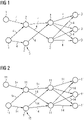
- FIG. 1 shows a schematic diagram of an embodiment of the industrial network designed as a TDMA network for TSN.
- the TDMA network comprises transmitters 1, bridges 2 and receivers 3.
- Transmitters1, receivers 3 and bridges 2 are connected via links 4.
- a feasible subset 4 of bridges 2 and links 4 calculated by a corresponding Graph Neural Network (see FIG. 2 ) according to the invention is shown by the bold line.
- FIG. 2 shows a schematic diagram of the representation of the TDMA network by a Graph Neural network according to the invention.
- Nodes 11 corresponds to receivers 3, bridges 2 and transmitters 1 whereas edges 14 corresponds to links 4.
- a feasible candidate path 13 calculated by the new method is shown by the bold line.
- FIG. 3 shows a basic flow chart of the computer-implemented method according to the invention.
- the method is aimed for reducing the configuration search space explored by the schedule computation algorithm of TSN in a TDMA network.
- a Graph Neural Network with the same topology as the TDMA network is provided. Nodes of the Graph Neural Network are bridges, transmitters, and receivers of the TDMA network and edges of the Graph Neural Network (GNN) are links between bridges, transmitters, and receivers.
- the Graph Neural Network has been trained by according to pre-defined TSN stream requirements feasible paths through the TDMA network.
- step 101 the Graph Neural Network predicting a probability 14 of according to the TSN stream requirements feasibility of a candidate path for a target stream 6 embedding on the candidate path 13, according to the TSN stream requirements, whereby the candidate path 13 corresponds to a subset of potential bridges and links in the TDMA network.
- FIG. 4 shows a block diagram of the computational device 20 executing the method according to FIG. 3 .
- the model is used to speed-up future evaluations in the network it was trained on, and/or can be used in other deployments due to generalization property of GNNs.
- the training process relies on existence of labeled and non-labeled graph structures.
- the update functions of edge, node and global blocks discussed above are then trained to predict the probabilities for infeasibility / feasibility of embedding given a non-labeled graph as input.
- the update functions are realized as multi-layer perceptions (MLPs), i.e., multi-layer neural networks.
- MLPs multi-layer perceptions
- the models can be updated using standard back-propagation-based algorithms, e.g., the ADAM optimizer.
- a training sample comprising a labeled and non-labeled graph is collected for each trial of a stream embedding.
- the collected samples are then used to train the update models individually or in batches.
- the loss function used in the training is e.g., in our proof-of-concept realization is the mean squared error. We execute loss computation and back-propagation on each message passing step, so to minimize the number of message-passing iterations required to label the unlabeled graph correctly.
- the model is trained to increase the number of correctly predicted infeasible paths.
- graphs are enriched with a set of properties.
- Nodes that are the talkers or receivers in the TSN stream that is to be configured are assigned Boolean attribute values in their node feature vectors.
- each node and link of the graph that is corresponding to the path that is to be evaluated in the execution step is assigned a distinguished feature value to differentiate the candidate path nodes from the remainder of graph nodes.
- the global update function is used to predict the probability of feasibility labels (true or false) telling the probability of acceptance or rejection for the current evaluated configuration.
- the output feasibility attributes are thus two float values predicted after a configurable number of message passing iterations.
- the user may optionally configure a 'feasibility threshold', in case of which, if the label probability (True or False) is below the threshold, additional message passing phases may execute for the given path.
- a 'feasibility threshold' in case of which, if the label probability (True or False) is below the threshold, additional message passing phases may execute for the given path.
- path evaluation can simply be enforced without consideration of probability gap for the two labels.
Landscapes
- Engineering & Computer Science (AREA)
- Physics & Mathematics (AREA)
- Theoretical Computer Science (AREA)
- Mathematical Physics (AREA)
- General Physics & Mathematics (AREA)
- Computing Systems (AREA)
- Software Systems (AREA)
- Computational Linguistics (AREA)
- Data Mining & Analysis (AREA)
- Evolutionary Computation (AREA)
- General Health & Medical Sciences (AREA)
- Molecular Biology (AREA)
- Biomedical Technology (AREA)
- General Engineering & Computer Science (AREA)
- Artificial Intelligence (AREA)
- Life Sciences & Earth Sciences (AREA)
- Biophysics (AREA)
- Health & Medical Sciences (AREA)
- Algebra (AREA)
- Mathematical Analysis (AREA)
- Mathematical Optimization (AREA)
- Probability & Statistics with Applications (AREA)
- Pure & Applied Mathematics (AREA)
- Computer Networks & Wireless Communication (AREA)
- Signal Processing (AREA)
- Data Exchanges In Wide-Area Networks (AREA)
Priority Applications (3)
| Application Number | Priority Date | Filing Date | Title |
|---|---|---|---|
| EP21155433.2A EP4040732A1 (de) | 2021-02-05 | 2021-02-05 | Neuronales graphennetzwerk für zeitsensitive vernetzung in industriellen netzwerken |
| EP22703898.1A EP4265040A1 (de) | 2021-02-05 | 2022-01-20 | Neuronales graphnetzwerk für zeitempfindliche vernetzung in industriellen netzwerken |
| PCT/EP2022/051266 WO2022167229A1 (en) | 2021-02-05 | 2022-01-20 | Graph neural network for time sensitive networking in industrial networks |
Applications Claiming Priority (1)
| Application Number | Priority Date | Filing Date | Title |
|---|---|---|---|
| EP21155433.2A EP4040732A1 (de) | 2021-02-05 | 2021-02-05 | Neuronales graphennetzwerk für zeitsensitive vernetzung in industriellen netzwerken |
Publications (1)
| Publication Number | Publication Date |
|---|---|
| EP4040732A1 true EP4040732A1 (de) | 2022-08-10 |
Family
ID=74556724
Family Applications (2)
| Application Number | Title | Priority Date | Filing Date |
|---|---|---|---|
| EP21155433.2A Ceased EP4040732A1 (de) | 2021-02-05 | 2021-02-05 | Neuronales graphennetzwerk für zeitsensitive vernetzung in industriellen netzwerken |
| EP22703898.1A Withdrawn EP4265040A1 (de) | 2021-02-05 | 2022-01-20 | Neuronales graphnetzwerk für zeitempfindliche vernetzung in industriellen netzwerken |
Family Applications After (1)
| Application Number | Title | Priority Date | Filing Date |
|---|---|---|---|
| EP22703898.1A Withdrawn EP4265040A1 (de) | 2021-02-05 | 2022-01-20 | Neuronales graphnetzwerk für zeitempfindliche vernetzung in industriellen netzwerken |
Country Status (2)
| Country | Link |
|---|---|
| EP (2) | EP4040732A1 (de) |
| WO (1) | WO2022167229A1 (de) |
Cited By (5)
| Publication number | Priority date | Publication date | Assignee | Title |
|---|---|---|---|---|
| CN116056214A (zh) * | 2022-12-21 | 2023-05-02 | 西安电子科技大学 | 基于深度展开分布式图神经网络的无线通信资源分配方法 |
| CN116471177A (zh) * | 2023-06-14 | 2023-07-21 | 国网湖北省电力有限公司电力科学研究院 | 时间敏感网络动态配置管理系统、方法及介质 |
| CN119629065A (zh) * | 2024-06-11 | 2025-03-14 | 国网江苏省电力有限公司泰州供电分公司 | 基于tsn的智能变电站数据流调度模型训练方法、调度方法及装置 |
| CN119883660A (zh) * | 2025-03-28 | 2025-04-25 | 山东大学 | 融合图神经和混合专家模型的边缘模型调度方法及系统 |
| CN121664725A (zh) * | 2026-02-05 | 2026-03-13 | 山东省计算中心(国家超级计算济南中心) | 一种时间敏感网络的路由与时隙联合调度方法及系统 |
Families Citing this family (2)
| Publication number | Priority date | Publication date | Assignee | Title |
|---|---|---|---|---|
| CN120639718B (zh) * | 2025-08-11 | 2025-11-07 | 上海大音信息科技有限公司 | 音频传输控制系统、方法及音频设备 |
| CN121194278A (zh) * | 2025-11-21 | 2025-12-23 | 荣耀终端股份有限公司 | 中继管理方法、电子设备、介质、程序产品、芯片 |
Citations (2)
| Publication number | Priority date | Publication date | Assignee | Title |
|---|---|---|---|---|
| CN111245673A (zh) * | 2019-12-30 | 2020-06-05 | 浙江工商大学 | 一种基于图神经网络的sdn时延感知方法 |
| WO2021002784A1 (en) * | 2019-07-01 | 2021-01-07 | Telefonaktiebolaget Lm Ericsson (Publ) | Uplink scheduling |
-
2021
- 2021-02-05 EP EP21155433.2A patent/EP4040732A1/de not_active Ceased
-
2022
- 2022-01-20 WO PCT/EP2022/051266 patent/WO2022167229A1/en not_active Ceased
- 2022-01-20 EP EP22703898.1A patent/EP4265040A1/de not_active Withdrawn
Patent Citations (2)
| Publication number | Priority date | Publication date | Assignee | Title |
|---|---|---|---|---|
| WO2021002784A1 (en) * | 2019-07-01 | 2021-01-07 | Telefonaktiebolaget Lm Ericsson (Publ) | Uplink scheduling |
| CN111245673A (zh) * | 2019-12-30 | 2020-06-05 | 浙江工商大学 | 一种基于图神经网络的sdn时延感知方法 |
Non-Patent Citations (8)
| Title |
|---|
| ANSAH ET AL., SCHEDULABILITY ANALYSIS AND GCL COMPUTATION FOR TIME-SENSITIVE NETWORKS, Retrieved from the Internet <URL:https://ieeexplore.ieee.org/abstract/document/8971965/> |
| BATTAGLIA ET AL., RELATIONAL INDUCTIVE BIASES, DEEP LEARNING, AND GRAPH NETWORKS, Retrieved from the Internet <URL:https://arxiv.org/abs/1806.01261> |
| EISEN MARK ET AL: "Optimal Wireless Resource Allocation With Random Edge Graph Neural Networks", IEEE TRANSACTIONS ON SIGNAL PROCESSING, IEEE SERVICE CENTER, NEW YORK, NY, US, vol. 68, 18 April 2020 (2020-04-18), pages 2977 - 2991, XP011793190, ISSN: 1053-587X, [retrieved on 20200610], DOI: 10.1109/TSP.2020.2988255 * |
| HELLMANNS ET AL., SCALING TSN SCHEDULING FOR FACTORY AUTOMATION NETWORKS, Retrieved from the Internet <URL:https://www.researchgate.net/profile/DavidHellmanns/publication/340023821ScalingTSNSchedulingforFactoryAutomationNetworks/links/5e7349b4299bf1571848cd56/Scaling-TSN-Scheduling-for-Factory-Automation-Networks.pdf> |
| NAVET ET AL., USING MACHINE LEARNING TO SPEED UP THE DESIGN SPACE EXPLORATION OF ETHERNET TSN NETWORKS, Retrieved from the Internet <URL:http://158.64.76.181/handle/10993/38604> |
| OLIVER ET AL., IEEE 802.1 QBV GATE CONTROL LIST SYNTHESIS USING ARRAY THEORY ENCODING, Retrieved from the Internet <URL:https://www.researchgate.net/profile/SilviuCraciunas2/publication/324476736IEEE8021QbvGateControlListSynthesisusingArrayTheoryEncoding/links/5acf2adbaca2723a3344e191/IEEE-8021Qbv-Gate-Control-List-Synthesis-using-Array-Theory-Encoding.pdf> |
| PAHLEVAN ET AL., GENETIC ALGORITHM FOR SCHEDULING TIME-TRIGGERED TRAFFIC IN TIME-SENSITIVE NETWORKS, Retrieved from the Internet <URL:https://networked-embedded.de/paper/pahlevan-etfa-2018.pdf> |
| ZHU TING ET AL: "GCLR: GNN-Based Cross Layer Optimization for Multipath TCP by Routing", IEEE ACCESS, IEEE, USA, vol. 8, 10 January 2020 (2020-01-10), pages 17060 - 17070, XP011768964, DOI: 10.1109/ACCESS.2020.2966045 * |
Cited By (5)
| Publication number | Priority date | Publication date | Assignee | Title |
|---|---|---|---|---|
| CN116056214A (zh) * | 2022-12-21 | 2023-05-02 | 西安电子科技大学 | 基于深度展开分布式图神经网络的无线通信资源分配方法 |
| CN116471177A (zh) * | 2023-06-14 | 2023-07-21 | 国网湖北省电力有限公司电力科学研究院 | 时间敏感网络动态配置管理系统、方法及介质 |
| CN119629065A (zh) * | 2024-06-11 | 2025-03-14 | 国网江苏省电力有限公司泰州供电分公司 | 基于tsn的智能变电站数据流调度模型训练方法、调度方法及装置 |
| CN119883660A (zh) * | 2025-03-28 | 2025-04-25 | 山东大学 | 融合图神经和混合专家模型的边缘模型调度方法及系统 |
| CN121664725A (zh) * | 2026-02-05 | 2026-03-13 | 山东省计算中心(国家超级计算济南中心) | 一种时间敏感网络的路由与时隙联合调度方法及系统 |
Also Published As
| Publication number | Publication date |
|---|---|
| WO2022167229A1 (en) | 2022-08-11 |
| EP4265040A1 (de) | 2023-10-25 |
Similar Documents
| Publication | Publication Date | Title |
|---|---|---|
| EP4265040A1 (de) | Neuronales graphnetzwerk für zeitempfindliche vernetzung in industriellen netzwerken | |
| Stüber et al. | A survey of scheduling algorithms for the time-aware shaper in time-sensitive networking (TSN) | |
| Alawe et al. | Improving traffic forecasting for 5G core network scalability: A machine learning approach | |
| Pop et al. | Design optimisation of cyber‐physical distributed systems using IEEE time‐sensitive networks | |
| Xue et al. | Real-time scheduling for 802.1 Qbv time-sensitive networking (TSN): A systematic review and experimental study | |
| Yang et al. | A multipolicy deep reinforcement learning approach for multiobjective joint routing and scheduling in deterministic networks | |
| Bülbül et al. | SDN-based self-configuration for time-sensitive IoT networks | |
| Bezerra et al. | A machine learning-based optimization for end-to-end latency in TSN networks | |
| Aziz et al. | Content-aware network traffic prediction framework for quality of service-aware dynamic network resource management | |
| Yigit et al. | Digi-infrastructure: Digital twin-enabled traffic shaping with low-latency for 6G smart cities | |
| Feltin et al. | Dnn partitioning for inference throughput acceleration at the edge | |
| Navet et al. | Using machine learning to speed up the design space exploration of Ethernet TSN networks | |
| Mai et al. | Deep learning to predict the feasibility of priority-based Ethernet network configurations | |
| Ashjaei et al. | Improved message forwarding for multi-hop hartes real-time ethernet networks | |
| Fluechter et al. | Autonomous integration of TSN-unaware applications with QoS requirements in TSN networks | |
| Niu et al. | Chainnet: A customized graph neural network model for loss-aware edge ai service deployment | |
| Wang et al. | Hybrid traffic scheduling based on adaptive time slot slicing in time-sensitive networking | |
| Nsaif et al. | SM-FPLF: Link-state prediction for software-defined DCN power optimization | |
| CN120956657A (zh) | 基于时间敏感测发控网络的在线增量式流量调度方法、装置及设备 | |
| Chetty et al. | A DDPG-based zero-touch dynamic Prioritization to address starvation of services for deploying microservices-based VNFs | |
| Zhou et al. | Using network calculus on worst-case latency analysis for TTEthernet in preemption transmission mode | |
| Alexandrov et al. | Development of algorithm for calculating data packet transmission delay in software-defined networks | |
| Debnath et al. | Towards an Optimized Multi-Cyclic Queuing and Forwarding in Time Sensitive Networking with Time Injection | |
| US12113713B2 (en) | Control channel isolation with time-series control traffic prediction in programmable network virtualization | |
| Gärtner | Flexibility in real-time networks: Analytical approaches for adapting time-sensitive networks to dynamic traffic requirements |
Legal Events
| Date | Code | Title | Description |
|---|---|---|---|
| PUAI | Public reference made under article 153(3) epc to a published international application that has entered the european phase |
Free format text: ORIGINAL CODE: 0009012 |
|
| STAA | Information on the status of an ep patent application or granted ep patent |
Free format text: STATUS: THE APPLICATION HAS BEEN PUBLISHED |
|
| AK | Designated contracting states |
Kind code of ref document: A1 Designated state(s): AL AT BE BG CH CY CZ DE DK EE ES FI FR GB GR HR HU IE IS IT LI LT LU LV MC MK MT NL NO PL PT RO RS SE SI SK SM TR |
|
| STAA | Information on the status of an ep patent application or granted ep patent |
Free format text: STATUS: THE APPLICATION HAS BEEN REFUSED |
|
| 18R | Application refused |
Effective date: 20220902 |