EP4040719A1 - Sichere server-client-interaktion - Google Patents
Sichere server-client-interaktion Download PDFInfo
- Publication number
- EP4040719A1 EP4040719A1 EP22163800.0A EP22163800A EP4040719A1 EP 4040719 A1 EP4040719 A1 EP 4040719A1 EP 22163800 A EP22163800 A EP 22163800A EP 4040719 A1 EP4040719 A1 EP 4040719A1
- Authority
- EP
- European Patent Office
- Prior art keywords
- challenge
- server
- browser
- response
- fingerprint
- Prior art date
- Legal status (The legal status is an assumption and is not a legal conclusion. Google has not performed a legal analysis and makes no representation as to the accuracy of the status listed.)
- Pending
Links
Images



Classifications
-
- H—ELECTRICITY
- H04—ELECTRIC COMMUNICATION TECHNIQUE
- H04L—TRANSMISSION OF DIGITAL INFORMATION, e.g. TELEGRAPHIC COMMUNICATION
- H04L63/00—Network architectures or network communication protocols for network security
- H04L63/08—Network architectures or network communication protocols for network security for authentication of entities
- H04L63/0876—Network architectures or network communication protocols for network security for authentication of entities based on the identity of the terminal or configuration, e.g. MAC address, hardware or software configuration or device fingerprint
-
- H—ELECTRICITY
- H04—ELECTRIC COMMUNICATION TECHNIQUE
- H04L—TRANSMISSION OF DIGITAL INFORMATION, e.g. TELEGRAPHIC COMMUNICATION
- H04L67/00—Network arrangements or protocols for supporting network services or applications
- H04L67/14—Session management
- H04L67/146—Markers for unambiguous identification of a particular session, e.g. session cookie or URL-encoding
-
- H—ELECTRICITY
- H04—ELECTRIC COMMUNICATION TECHNIQUE
- H04L—TRANSMISSION OF DIGITAL INFORMATION, e.g. TELEGRAPHIC COMMUNICATION
- H04L63/00—Network architectures or network communication protocols for network security
- H04L63/08—Network architectures or network communication protocols for network security for authentication of entities
-
- G—PHYSICS
- G06—COMPUTING OR CALCULATING; COUNTING
- G06F—ELECTRIC DIGITAL DATA PROCESSING
- G06F21/00—Security arrangements for protecting computers, components thereof, programs or data against unauthorised activity
- G06F21/30—Authentication, i.e. establishing the identity or authorisation of security principals
- G06F21/44—Program or device authentication
-
- H—ELECTRICITY
- H04—ELECTRIC COMMUNICATION TECHNIQUE
- H04L—TRANSMISSION OF DIGITAL INFORMATION, e.g. TELEGRAPHIC COMMUNICATION
- H04L63/00—Network architectures or network communication protocols for network security
- H04L63/12—Applying verification of the received information
-
- H—ELECTRICITY
- H04—ELECTRIC COMMUNICATION TECHNIQUE
- H04L—TRANSMISSION OF DIGITAL INFORMATION, e.g. TELEGRAPHIC COMMUNICATION
- H04L9/00—Cryptographic mechanisms or cryptographic arrangements for secret or secure communications; Network security protocols
- H04L9/32—Cryptographic mechanisms or cryptographic arrangements for secret or secure communications; Network security protocols including means for verifying the identity or authority of a user of the system or for message authentication, e.g. authorization, entity authentication, data integrity or data verification, non-repudiation, key authentication or verification of credentials
- H04L9/3236—Cryptographic mechanisms or cryptographic arrangements for secret or secure communications; Network security protocols including means for verifying the identity or authority of a user of the system or for message authentication, e.g. authorization, entity authentication, data integrity or data verification, non-repudiation, key authentication or verification of credentials using cryptographic hash functions
- H04L9/3242—Cryptographic mechanisms or cryptographic arrangements for secret or secure communications; Network security protocols including means for verifying the identity or authority of a user of the system or for message authentication, e.g. authorization, entity authentication, data integrity or data verification, non-repudiation, key authentication or verification of credentials using cryptographic hash functions involving keyed hash functions, e.g. message authentication codes [MACs], CBC-MAC or HMAC
-
- H—ELECTRICITY
- H04—ELECTRIC COMMUNICATION TECHNIQUE
- H04L—TRANSMISSION OF DIGITAL INFORMATION, e.g. TELEGRAPHIC COMMUNICATION
- H04L9/00—Cryptographic mechanisms or cryptographic arrangements for secret or secure communications; Network security protocols
- H04L9/32—Cryptographic mechanisms or cryptographic arrangements for secret or secure communications; Network security protocols including means for verifying the identity or authority of a user of the system or for message authentication, e.g. authorization, entity authentication, data integrity or data verification, non-repudiation, key authentication or verification of credentials
- H04L9/3271—Cryptographic mechanisms or cryptographic arrangements for secret or secure communications; Network security protocols including means for verifying the identity or authority of a user of the system or for message authentication, e.g. authorization, entity authentication, data integrity or data verification, non-repudiation, key authentication or verification of credentials using challenge-response
-
- H—ELECTRICITY
- H04—ELECTRIC COMMUNICATION TECHNIQUE
- H04W—WIRELESS COMMUNICATION NETWORKS
- H04W12/00—Security arrangements; Authentication; Protecting privacy or anonymity
- H04W12/02—Protecting privacy or anonymity, e.g. protecting personally identifiable information [PII]
-
- G—PHYSICS
- G06—COMPUTING OR CALCULATING; COUNTING
- G06F—ELECTRIC DIGITAL DATA PROCESSING
- G06F2221/00—Indexing scheme relating to security arrangements for protecting computers, components thereof, programs or data against unauthorised activity
- G06F2221/21—Indexing scheme relating to G06F21/00 and subgroups addressing additional information or applications relating to security arrangements for protecting computers, components thereof, programs or data against unauthorised activity
- G06F2221/2103—Challenge-response
-
- H—ELECTRICITY
- H04—ELECTRIC COMMUNICATION TECHNIQUE
- H04L—TRANSMISSION OF DIGITAL INFORMATION, e.g. TELEGRAPHIC COMMUNICATION
- H04L2463/00—Additional details relating to network architectures or network communication protocols for network security covered by H04L63/00
- H04L2463/081—Additional details relating to network architectures or network communication protocols for network security covered by H04L63/00 applying self-generating credentials, e.g. instead of receiving credentials from an authority or from another peer, the credentials are generated at the entity itself
Definitions
- the present disclosure relates to secure interaction between a server and a client.
- the disclosure relates to allowing a server to ensure that interactions with a specific device client can be trusted.
- cookies are generally used for a variety of functions.
- a cookie is a small piece of data held at the client with associated data at the server which allows the server to determine or remember some aspect of the state of the client. This allows new web browsing sessions to use earlier interactions between the client and the server to inform a new session while the underlying protocols can be stateless.
- Cookies are used for a number of purposes, one of which is authentication - for example, to indicate whether a user is logged in to a service, and to indicate an account that the user has used in logging in. This may be a prerequisite for the server to pass sensitive information to the client, which may require the server to be confident in the security of elements of the process, such as that the user browser and device are secure, or that the user is properly authenticated at the user device. Cookies may be encrypted to reduce the risk of attack by third parties, but this requires a mechanism to manage encryption keys and to ensure that they are stored in a secure way on the device client in the event that the client has to access encrypted data.
- This type of approach may be used in a variety of contexts where a user is accessing an online service of some kind where sensitive information is exchanged, or where there are significant consequences to the interaction. Online purchase and access to online transaction systems fall into this category. However, it is relevant to a wide variety of contexts in order to provide security for both service providers and users of a service.
- Such a cookie may be used to assure the server that a trusted relationship has been established between the server and the user device - this may, for example, have established that the server can trust the browser and device combination in the user device.
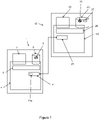
- a typical server client relationship is shown in Figure 1 .
- the user device 1 - in principle, any computing device using a browser 11 in a client-server relationship with a server 12 - has a processor 2 and a memory 3 using an operating system 6 to define a computing environment 4 in which the browser 11 runs, cookies 5 for the browser being stored in the memory in association with the browser 11.
- the server 12 similarly has its own computing environment 14 with processor 22 and memory 23 and operating system 26, in this case running service software 25. Cookies 15 associated with the service software 25 are stored in the server memory 23 with associated data 27.
- This is of course a minimal description of each system - what is described here as "server 12" may be a much more complex system involving multiple computing systems, but for the purposes of describing this interaction, it can be considered as a single system.
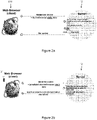
- FIG. 2a A conventional approach to using cookies in this context is shown in Figure 2a , and a potential attack by a third party is shown in Figure 2b .
- the user device 1 To establish a trusted relationship which allows the user device 1 to access a secure service using its browser 11, the user device 1 provides various static data to identify the user device 1 to the server 12. This static data is chosen to identify the user device 1 - or the device/browser combination - uniquely, and the server 12 then uses this static data to generate a device fingerprint which it associates with a cookie, which it then provides to the user device 1.
- the cookie may simply be a UUID or other effectively unique identifier.
- the device fingerprint is held at the server 12 in association with the cookie.
- the browser provides the cookie and access to the secure service is provided if the user device is also able to provide the static data to establish that it is the same browser running on the same device as originally identified.
- a possible attack is shown in Figure 2b .
- a malicious third party 21 acquires a degree of access to the user device 1, allowing it to obtain various information items from that device.
- the third party also develops knowledge of the requirements of the trusted service - for example, by legitimate interaction with another account - and can therefore determine the static data that would be required by the server 12.
- the third party then obtains the cookie and the static data and attempts to emulate the user device/browser combination - the third party is able to provide both the cookie and the device/browser identifying static data as it has already obtained this static data for the user device 1. This allows the attacker to emulate the user device 1 and gain access to sensitive or restricted resources from the server.
- the disclosure provides a method of maintaining a secure relationship between a client device and a server, the client device having a browser installed thereon, the method comprising at the client device: receiving a challenge from the server, wherein the challenge uses a challenge function adapted to provide a fingerprint of a device and browser combination for the client device; determining the fingerprint of the device and browser combination by performing at least a task determined by the challenge function involving rendering by the browser; and providing a response to the challenge including the fingerprint.
- This fingerprint may be determined by characteristics of the device and browser combination that will not change over time or between interactions for the device and browser combination. For example, the fingerprint may be determined by one or more of the following characteristics: screen size; colour depth; canvas hashing; WebGL hashing; and platform. In a preferred arrangement, the fingerprint is determined by one or both of canvas hashing and WebGL hashing. It is determined that these characteristics would be particularly difficult for an attacker to emulate effectively.
- this canvas hashing may comprise rendering of a text image in a canvas.
- the WebGL hashing may comprise performing a function on a clip-space of random shape coordinates and colours. In cases where the fingerprint is determined by both of canvas hashing and WebGL hashing, this may be calculated using an XOR of a canvas hash and a WebGL hash.
- the client device may not store the challenge or the response but may store a cookie associated with the secure relationship between the client device and the server.
- the disclosure provides a computing device comprising a processor, a memory and a communication means, the computing device having a browser installed thereon, wherein the computing device is adapted to carry out the method of the first aspect of the disclosure.
- the disclosure provides a method of maintaining a secure relationship between a client device and a server, the client device having a browser installed thereon, the method comprising at the server: providing a challenge to the client device, wherein the challenge uses a challenge function adapted to provide a fingerprint of a device and browser combination for the client device, the challenge function determining a task to be performed by the client device involving rendering by the browser; receiving a response to the challenge including the fingerprint; and determining whether the response is satisfactory to maintain the secure relationship.
- This fingerprint may be determined by characteristics of the device and browser combination that will not change over time or between interactions for the device and browser combination.
- the fingerprint may be determined by one or both of canvas hashing and WebGL hashing.
- the server may reject the response as unsatisfactory to maintain the secure relationship if the response is received more than a predetermined time after the challenge is sent to the client device. If the response is deemed satisfactory to maintain the secure relationship, a cookie associated with the secure relationship may be established and shared with the client device.
- the disclosure provides a server comprising a processor, a memory and communication means and adapted to perform the method of the third aspect of the disclosure.
- FIG. 1 illustrates the elements of a typical server client architecture, as discussed above.
- any computing device using a browser 11 in a client-server relationship with a server 12 - has a processor 2 and a memory 3 using an operating system 6 to define a computing environment 4 in which the browser 11 runs, cookies 5 for the browser being stored in the memory in association with the browser 11.
- the server 12 similarly has its own computing environment 14 with processor 22 and memory 23 and operating system 26, in this case running service software 25. Cookies 15 associated with the service software 25 are stored in the server memory 23.
- server 12 may be a much more complex system involving multiple computing systems, but for the purposes of describing this interaction, it can be considered as a single system. Cookies may also in some cases not be stored as such, but regenerated as needed based on associated data.
- the first step 31 is to establish a first challenge, and associate it with a cookie.
- a preferred choice of challenge is adapted to identify a device/browser combination, and would be either impossible to emulate or sufficiently challenging that any attempt to emulate it would be detected. This may be achieved by making the challenge dynamic, rather than dependent on static data.
- the next step 32 is for the client/browser combination to provide a first response - based on its own device and/or browser properties - to the first challenge, and to send this to the server.
- Preferably only the cookie is retained at the client, to reduce the risk of attack.
- the server stores 33 the first challenge and the first response with the cookie.
- the device/browser provides 34 the cookie to the server to re-establish the trusted connection between the two, typically in a new browsing session.
- the server establishes a second challenge and provides 35 both the first challenge and the second challenge to the device/browser.
- the device/browser determines both the first response and the second response, and after using the first response to encode the second response, provides 36 this result as a reply to the server.
- the server determines 37 that the first response is correct to re-establish the relationship, uses the first response to determine the second response, and stores the second challenge and the second response with the cookie to use in establishing the relationship the next time.
- This approach combines a dynamic challenge/response mechanism with a reliable device/browser fingerprint to reduce the risk of attack significantly.
- Figure 4 shows interactions between the web browser 11 of the client computer 1 and the server 12.
- a request to be remembered 41 is initiated from the client computer 1 (this may be in response to a request to accept a cookie from the server 12, or may be incorporated as part of another registration process).
- this is likely to be associated with provision of some service by the server 12 to the client computer 1 for which it is desirable that the server 12 establishes that the client computer 1 or more specifically the combination of client computer 1 and browser 11 can be trusted.
- the next step is for the server 12 to set the cookie and to transmit it to the browser 11.
- the cookie can have any conventional format, and will be stored in memory 3 at the client computer 1 in the normal way.
- the cookie may include other technologies to achieve secure and efficient identification and information provision - for example it may be a Nudetect cookie (a technology provided by NuData Security), described in general terms at https://nudatasecurity.com/solutions/nudetect/ .
- the information associated with the cookie and stored in association with it at the server 12 will however be quite different.
- the server 12 sends 42 not only the cookie but also a challenge ( challenge A ) that will be used in a later interaction (the next time that the cookie is presented).
- the challenge comprises details of an image to be rendered at the client computer 1 - a random clip-space set of coordinates and colors to be rendered on the client side using standard JavaScript APIs Canvas and WebGL.
- This process, and alternative approaches that may be used in alternative embodiments, is described further below with reference to Figure 6 .
- the reason for taking this approach is that the resulting rendered image (IMG) is expected to be specific to the graphics processing unit (GPU) (and associated drivers) used by the browser for the hardware acceleration and support a form of identification of a device, so can be used as a fingerprint for the client computer 1 (or, more specifically, the client computer 1 and browser 11 combination).
- GPU graphics processing unit
- the client computer 1 On receiving the cookie and the challenge, the client computer 1 calculates a response ( response A1 ) to the challenge. Here this is done using Canvas and WebGL as a part of a function defined in the challenge, but this function may be derived from a combination of different browser/device fingerprinting techniques.
- the browser 11 then sends 43 this response to the server 12.
- both the challenge challenge A and the response response A1 are stored 44 at the server 12 in association with the cookie, and the server acknowledges 45 to the browser 11 that this has been done.
- the cookie has been set and associated with a fingerprint of the client computer and browser combination, but with only a cookie held at the client device.
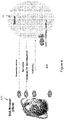
- Figure 5 illustrates a subsequent interaction (in this case, specifically the next interaction, but further interactions adopt a directly comparable pattern) between the client browser 11 and the server 12.
- the browser 11 provides 51 the cookie to the server 12 in a conventional way to indicate that it is known to the server 12 - here, the cookie also indicates that the trusted device/browser relationship with the server should be re-established.
- the server 12 determines 52 what is stored against the cookie - this will be the previous challenge and the response to the previous challenge, in this case challenge A and response A1 .
- response A1 is effectively used as a cryptographic key, and is also termed K CONF below.
- the server 12 sends 53 both the old challenge challenge A and a new challenge challenge B , together with some random data RandomData.
- K CONF is calculated by the client computer 1 using challenge A , so both the client computer 1 and the server 12 have this information.
- the value seed is preferably ephemeral and random.
- the responses to the challenges as provided by the client computer 1 are slightly different in form from those at the setup stage, and now allow for validation at the server 12 together with the storage of a challenge and response pair for use in the next interaction (again, these will only be stored at the server 12, and not at the client computer 1).
- K CONF response B 1 ENC K CONF , Fn challenge B
- the client computer 1 sends 54 seed, response A2 and response B1 to the server 12.
- the server is able to validate 55 the response by evaluating response A2 as it already has K CONF and randomData , and has received seed from the client computer 1, so it can generate an expected value of response A2 itself. If the values of response A2 match, the server will then decrypt 56 response B1 using K CONF . to create the new challenge and response pair, challenge B and response B1 . Consequently, response B1 will be the new value of K CONF for the next challenge.
- the server 12 will then grant access 57 to restricted or sensitive resources as required, as it has re-established a trusted relationship with the computer/browser pair of the client.
- Figure 6 considers different characteristics of a device/browser combination. In general, these will change over time or between interactions for a particular device/browser combination. Various characteristics - Screen Size and Color Depth; Canvas hashing; WebGL hashing; and Platform - will not. Of these characteristics, there is some difference in ease of emulation - in particular, Screen Size and Color Depth may be possible to emulate, as may Platform. This leaves Canvas and WebGL as good candidates for a challenge function, with a combination of the two being particularly attractive.
- GUI Graphicle
- a challenge may contain a random webfont, random text and a text baseline.
- Canvas is generally supported in web browsers.
- WebGL ( https://en.wikipedia.ora/wiki/WebGL ) is JavaScript API for rendering interactive 2D and 3D graphics with any compatible web browser.
- WebGL 1.0 is widely supported in web browsers and would be an appropriate choice -
- WebGL 2.0 is currently less well supported but may be a suitable choice at a future date when support is more general.
- a context of particular interest is that of online transactions made using a transaction scheme (also termed a payment scheme). Such transactions are made using a payment network, the payment network provider enabling transactions between a customer and a merchant supported by their respective banks.
- a transaction scheme also termed a payment scheme.
- Figure 7 is a block diagram of a typical four-party model or four-party payment transaction scheme. The diagram illustrates the entities present in the model and the interactions occurring between entities operating in a card scheme.
- Payment cards such as credit cards and debit cards are very widely used for all forms of financial transaction.
- the use of payment cards has evolved significantly with technological developments over recent years. Originally, transactions were on paper, using an imprint of a transaction card and confirmed by a signature. This approach was largely replaced by use of a magnetic stripe of a transaction card swiped through a magnetic stripe reader on a point of sale (POS) terminal to perform a transaction.
- Transaction cards developed to contain an integrated circuit (“chip cards” or “smart cards”) that communicates with a smart card reader in the POS terminal. Cards of this type typically operate under the EMV standard for interoperation of chip cards and associated apparatus (such as POS terminals and ATMs).
- ISO/IEC 7816 provides a standard for operation of cards of this type.
- EMV specifications relate to contact and contactless payment protocols and are publicly available at the EMVCo website (EMVCo is the industry body tasked with maintaining these specifications with the support of major transaction scheme providers) - https://www.emvco.com/document-search/ - and would readily be consulted by the person skilled in the art. Terminology relating to EMV technology not expressly defined in this document is referenced and defined in EMV specifications, as will be appreciated by the person skilled in the art.
- card schemes - payment networks linked to payment cards - are based on one of two models: a three-party model or a four-party model (adopted by the present applicant).
- a three-party model or a four-party model (adopted by the present applicant).
- the four-party model is described in further detail below.
- the four-party model may be used as a basis for the transaction network.
- the model comprises four entity types: cardholder 110, merchant 120, issuer 130 and acquirer 140.
- the cardholder 110 purchases goods or services from the merchant 120.
- the issuer 130 is the bank or any other financial institution that issued the card to the cardholder 110.
- the acquirer 140 provides services for card processing to the merchant 120.
- the model also comprises a central switch 150 - interactions between the issuer 130 and the acquirer 140 are routed via the switch 150.
- the switch 150 enables a merchant 120 associated with one particular bank acquirer 140 to accept payment transactions from a cardholder 110 associated with a different bank issuer 130.
- a typical transaction between the entities in the four-party model can be divided into two main stages: authorisation and settlement.
- the cardholder 110 initiates a purchase of a good or service from the merchant 120 using their card. Details of the card and the transaction are sent to the issuer 130 via the acquirer 140 and the switch 150 to authorise the transaction. Should the transaction be considered higher risk by the issuer 130, the cardholder 110 may be required to undergo an additional verification process to verify their identity and the details of the transaction. Once the additional verification process is complete the transaction is authorised.
- the transaction details are submitted by the merchant 120 to the acquirer 140 for settlement.
- the transaction details are then routed to the relevant issuer 130 by the acquirer 140 via the switch 150.
- the issuer 130 Upon receipt of these transaction details, the issuer 130 provides the settlement funds to the switch 150, which in turn forwards these funds to the merchant 120 via the acquirer 140.
- the issuer 130 and the cardholder 110 settle the payment amount between them.
- a service fee is paid to the acquirer 140 by the merchant 120 for each transaction, and an interchange fee is paid to the issuer 130 by the acquirer 140 in return for the settlement of funds.
- the roles of a specific party may involve multiple elements acting together. This is typically the case in implementations that have developed beyond a contact-based interaction between a customer card and a merchant terminal to digital implementations using proxy or virtual cards on user computing devices such as a smart phone.
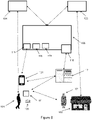
- Figure 8 shows an architecture according to an embodiment of the disclosure appropriate for interaction between a cardholder and a merchant, illustrating specifically how this is adapted to support an online transaction between a consumer device (a computing device used by a consumer to conduct online transactions) and a merchant server.
- a consumer device a computing device used by a consumer to conduct online transactions
- the cardholder 101 uses their computing device - which may be any or all of a cellular telephone handset, a tablet, a laptop, a static personal computer or any other suitable computing device (here a personal computer 111 and a cellular telephone handset or smartphone 121 are shown as alternatives) - this can be used as a way to use card information in a client/server interaction or to act directly as a proxy for a physical payment card 106 or as a virtual payment card operating only in a digital domain.
- the smartphone 121 achieves this with a mobile payment application and a digital wallet, as described below.
- the smart phone 121 is thus able to transact with a merchant POS terminal 107 using NFC or another contactless technology.
- online transactions are of particular interest in connection with embodiments of the disclosure, rather than contact or contactless transactions with a merchant POS terminal 107.
- the user's computing device - for example personal computer 111 - may also be able to interact with a merchant server 12 representing the merchant 2 over any appropriate network connection, such as the public internet. Any other suitable computing device may be used by the cardholder 1 to carry out an online transaction in this way.
- the transaction scheme infrastructure (transaction infrastructure) 105 here provides not only the computing infrastructure necessary to operate the card scheme and provide routing of transactions and other messaging to parties such as the acquirer 103 and the issuer 104, but also a wallet service 117 to support a digital wallet on the cardholder computing device, and an internet gateway 118 to accept internet based transactions for processing by the transaction infrastructure.
- the wallet service 117 may be provided similarly by a third party with an appropriate trust relationship with the transaction scheme provider.
- a token service provider 119 is present (again, this is shown as part of transaction infrastructure 105 but may be provided by a third party with appropriate trust relationships), and the transaction scheme infrastructure provides a digital enablement service 116 to support the performance of tokenised digital transactions, and to interact with other elements of the system to allow transactions to be performed correctly.
- the transaction is validated in the transaction scheme by mapping the cardholder token to their card PAN, checking the status of the token (to ensure that it is in date and otherwise valid), any customer verification approach used and any validation of cryptographic proof to the transaction. This allows the issuer to authorise the transaction in the normal manner.
- the original disclosure further comprises the following auxiliary aspects.
- the disclosure provides a method of maintaining a secure relationship between a client device and a server, the method comprising at the client device: receiving a first challenge from the server and determining and providing a first response to the first challenge; establishing a cookie associated with the secure relationship wherein the cookie is shared with the server; providing the cookie to the server to maintain the secure relationship; receiving the first challenge and a second challenge from the server; and determining the first response and a second response to the second challenge, and providing a composite response from which the first response and the second response are derivable by the server; wherein each challenge uses a challenge function adapted to provide a fingerprint of the client device.
- This approach allows the server to establish that it is interacting with the same client device with which it has originally established a secure relationship, but does so uses a dynamic mechanism so that attacks based on obtaining static data from the client device will not be effective.
- the fingerprint of the client device is a fingerprint of a device and browser combination for the client device. It is typically the device and browser combination, rather than simply the device, that the server will need to rely upon, so it is desirable for the fingerprint to establish this.
- the challenge function may relate to rendering by the browser of the client device. This can be a particularly effective approach because the resulting rendered image should be specific to the graphics processing unit (GPU) (and associated drivers) used by the browser for hardware acceleration, and so well adapted to support a device fingerprint.
- GPU graphics processing unit
- the challenge function may comprise JavaScript routines relating to rendering by the browser, for example by using a process that comprises one or more of Canvas and WebGL functions.
- a challenge function may comprise an XOR of a Canvas challenge and a WebGL challenge, or any other function that combines such challenges in an effective way.
- the client device may be adapted to generate a seed and provide the seed to the server as part of the composite response. This seed may be used to generate a message authentication code derived from the first response.
- the client device may receive random data from the server, and wherein the composite response may then comprise a first response part generated by operation of the message authentication code on the random data. Such an operation may comprise a keyed-hash function.
- the composite response may have a second response part comprising the second response encrypted by the first response.
- the cookie is stored at the client device but none of the challenges or the responses are stored at the client device. This enhances security, as it allows for an effective interaction even if static data at the client device is open to attack by third parties.
- the disclosure provides a computing device comprising a processor, a memory and a communication means, wherein the computing device is adapted to carry out the method of the first aspect as described above.
- the disclosure provides a method of maintaining a secure relationship between a client device and a server, the method comprising at the server: establishing a first challenge and receiving a first response to the first challenge from the client device; establishing a cookie associated with the secure relationship wherein the cookie is shared with the client device; receiving the cookie from the client device to maintain the secure relationship; determining a second challenge, and providing the first challenge and the second challenge to the client device; receiving a composite challenge response from the client device, and deriving the first response and a second response to the second challenge from the composite challenge response; wherein each challenge uses a challenge function adapted to provide a fingerprint of the client device.
- the fingerprint of the client device is a fingerprint of a device and browser combination for the client device.
- the challenge function may relate to rendering by the browser of the client device, and may comprise JavaScript routines relating to rendering by the browser, such as by using a process that comprises one or more of Canvas and WebGL functions.
- the challenge function may comprise an XOR of a Canvas challenge and a WebGL challenge, or any other function that effectively combines both challenge types.
- the server may reject the composite response if it is received more than a predetermined time after the first challenge and second challenge are sent to the client device. This is a further line of defence against the possibility that the client device has been subverted by a third party, and is being controlled remotely. In such a case, the response will be provided more slowly because of the additional messaging and computation required, so the risk can be removed by time limiting the response in this way.
- the predetermined time may be of the order of two seconds to achieve this result.
- the server may provide random data with the first challenge and the second challenge.
- the composite response may then comprise a first response part involving the operation of the first response on the random data by which the server then validates that the client device has produced the first response.
- the composite response may further comprise a seed, wherein a message authentication code is generated from the seed and the first response, and wherein the first response part comprises a hash of the message authentication code and the random data.
- the composite response may comprise a second response part comprising the second response encrypted by the first response, wherein the server uses the first response to decrypt the second response.
- the disclosure provides a server comprising a processor, a memory and communication means and adapted to perform the method of the third aspect as set out above.
Landscapes
- Engineering & Computer Science (AREA)
- Computer Security & Cryptography (AREA)
- Computer Networks & Wireless Communication (AREA)
- Signal Processing (AREA)
- General Engineering & Computer Science (AREA)
- Computer Hardware Design (AREA)
- Computing Systems (AREA)
- Power Engineering (AREA)
- Theoretical Computer Science (AREA)
- Software Systems (AREA)
- Physics & Mathematics (AREA)
- General Physics & Mathematics (AREA)
- Computer And Data Communications (AREA)
- Information Transfer Between Computers (AREA)
Priority Applications (1)
| Application Number | Priority Date | Filing Date | Title |
|---|---|---|---|
| EP22163800.0A EP4040719A1 (de) | 2019-08-05 | 2019-08-05 | Sichere server-client-interaktion |
Applications Claiming Priority (2)
| Application Number | Priority Date | Filing Date | Title |
|---|---|---|---|
| EP22163800.0A EP4040719A1 (de) | 2019-08-05 | 2019-08-05 | Sichere server-client-interaktion |
| EP19190122.2A EP3772832B1 (de) | 2019-08-05 | 2019-08-05 | Sichere client server interaktion |
Related Parent Applications (1)
| Application Number | Title | Priority Date | Filing Date |
|---|---|---|---|
| EP19190122.2A Division EP3772832B1 (de) | 2019-08-05 | 2019-08-05 | Sichere client server interaktion |
Publications (1)
| Publication Number | Publication Date |
|---|---|
| EP4040719A1 true EP4040719A1 (de) | 2022-08-10 |
Family
ID=67658455
Family Applications (2)
| Application Number | Title | Priority Date | Filing Date |
|---|---|---|---|
| EP22163800.0A Pending EP4040719A1 (de) | 2019-08-05 | 2019-08-05 | Sichere server-client-interaktion |
| EP19190122.2A Active EP3772832B1 (de) | 2019-08-05 | 2019-08-05 | Sichere client server interaktion |
Family Applications After (1)
| Application Number | Title | Priority Date | Filing Date |
|---|---|---|---|
| EP19190122.2A Active EP3772832B1 (de) | 2019-08-05 | 2019-08-05 | Sichere client server interaktion |
Country Status (4)
| Country | Link |
|---|---|
| US (1) | US12273342B2 (de) |
| EP (2) | EP4040719A1 (de) |
| CN (1) | CN114073040B (de) |
| WO (1) | WO2021025808A1 (de) |
Citations (1)
| Publication number | Priority date | Publication date | Assignee | Title |
|---|---|---|---|---|
| US20170346804A1 (en) * | 2015-06-02 | 2017-11-30 | ALTR Solutions, Inc. | Credential-free user login to remotely executed applications |
Family Cites Families (21)
| Publication number | Priority date | Publication date | Assignee | Title |
|---|---|---|---|---|
| US7694335B1 (en) * | 2004-03-09 | 2010-04-06 | Cisco Technology, Inc. | Server preventing attacks by generating a challenge having a computational request and a secure cookie for processing by a client |
| US8126145B1 (en) * | 2005-05-04 | 2012-02-28 | Marvell International Ltd. | Enhanced association for access points |
| US9002750B1 (en) * | 2005-12-09 | 2015-04-07 | Citicorp Credit Services, Inc. (Usa) | Methods and systems for secure user authentication |
| WO2010070456A2 (en) * | 2008-12-19 | 2010-06-24 | F2Ware Inc. | Method and apparatus for authenticating online transactions using a browser |
| US20100250921A1 (en) * | 2009-03-27 | 2010-09-30 | Gil Spencer | Authorizing a Login Request of a Remote Device |
| US8412928B1 (en) * | 2010-03-31 | 2013-04-02 | Emc Corporation | One-time password authentication employing local testing of candidate passwords from one-time password server |
| WO2012005739A1 (en) * | 2010-07-09 | 2012-01-12 | Hewlett-Packard Development Company, L.P. | Responses to server challenges included in a hypertext transfer protocol header |
| US8694778B2 (en) * | 2010-11-19 | 2014-04-08 | Nxp B.V. | Enrollment of physically unclonable functions |
| US9219732B2 (en) * | 2012-12-28 | 2015-12-22 | Nok Nok Labs, Inc. | System and method for processing random challenges within an authentication framework |
| US20160048836A1 (en) * | 2013-03-27 | 2016-02-18 | Cleverade | Secure payment transaction system |
| US9807092B1 (en) * | 2013-07-05 | 2017-10-31 | Dcs7, Llc | Systems and methods for classification of internet devices as hostile or benign |
| US9491157B1 (en) * | 2013-09-27 | 2016-11-08 | F5 Networks, Inc. | SSL secured NTLM acceleration |
| US20170364911A1 (en) * | 2014-12-12 | 2017-12-21 | Cryptomathic Ltd | Systems and method for enabling secure transaction |
| US9608975B2 (en) * | 2015-03-30 | 2017-03-28 | Shape Security, Inc. | Challenge-dynamic credential pairs for client/server request validation |
| JP6023853B1 (ja) * | 2015-05-29 | 2016-11-09 | 日本電信電話株式会社 | 認証装置、認証システム、認証方法、およびプログラム |
| US10158487B2 (en) * | 2015-07-16 | 2018-12-18 | Cisco Technology, Inc. | Dynamic second factor authentication for cookie-based authentication |
| US10402555B2 (en) * | 2015-12-17 | 2019-09-03 | Google Llc | Browser attestation challenge and response system |
| US10735382B2 (en) * | 2016-01-29 | 2020-08-04 | Zenedge, Inc. | Detecting human activity to mitigate attacks on a host |
| US10305885B2 (en) * | 2016-03-03 | 2019-05-28 | Blackberry Limited | Accessing enterprise resources using provisioned certificates |
| CN107612926B (zh) * | 2017-10-12 | 2020-09-29 | 成都知道创宇信息技术有限公司 | 一种基于客户端识别的一句话WebShell拦截方法 |
| US10812277B2 (en) * | 2017-11-28 | 2020-10-20 | Taiwan Semiconductor Manufacturing Company Ltd. | Method and system for secure key exchange using physically unclonable function (PUF)-based keys |
-
2019
- 2019-08-05 EP EP22163800.0A patent/EP4040719A1/de active Pending
- 2019-08-05 EP EP19190122.2A patent/EP3772832B1/de active Active
-
2020
- 2020-06-30 WO PCT/US2020/040207 patent/WO2021025808A1/en not_active Ceased
- 2020-06-30 CN CN202080048117.0A patent/CN114073040B/zh active Active
- 2020-06-30 US US17/584,671 patent/US12273342B2/en active Active
Patent Citations (1)
| Publication number | Priority date | Publication date | Assignee | Title |
|---|---|---|---|---|
| US20170346804A1 (en) * | 2015-06-02 | 2017-11-30 | ALTR Solutions, Inc. | Credential-free user login to remotely executed applications |
Non-Patent Citations (3)
| Title |
|---|
| ALACA FURKAN: "STRENGTHENING PASSWORD-BASED WEB AUTHENTICATION THROUGH MULTIPLE SUPPLEMENTARY MECHANISMS", THESIS, 31 May 2018 (2018-05-31), Ottawa, Ontario, Canada, pages 1 - 184, XP055508758, Retrieved from the Internet <URL:https://www.ccsl.carleton.ca/~falaca/alaca_phd_thesis.pdf> * |
| ELBANNA AMR ET AL: "Browsers Fingerprinting Motives, Methods, and Countermeasures", 2018 INTERNATIONAL CONFERENCE ON COMPUTER, INFORMATION AND TELECOMMUNICATION SYSTEMS (CITS), IEEE, 11 July 2018 (2018-07-11), pages 1 - 5, XP033388403, [retrieved on 20180817], DOI: 10.1109/CITS.2018.8440163 * |
| NASSER MOHAMMED AL-FANNAH ET AL: "Not All Browsers Are Created Equal: Comparing Web Browser Fingerprintability", ARXIV.ORG, CORNELL UNIVERSITY LIBRARY, 201 OLIN LIBRARY CORNELL UNIVERSITY ITHACA, NY 14853, 15 March 2017 (2017-03-15), XP081434961 * |
Also Published As
| Publication number | Publication date |
|---|---|
| US20230370451A1 (en) | 2023-11-16 |
| WO2021025808A1 (en) | 2021-02-11 |
| US12273342B2 (en) | 2025-04-08 |
| EP3772832B1 (de) | 2022-04-06 |
| CN114073040B (zh) | 2023-12-05 |
| CN114073040A (zh) | 2022-02-18 |
| EP3772832A1 (de) | 2021-02-10 |
Similar Documents
| Publication | Publication Date | Title |
|---|---|---|
| CN108352024B (zh) | 基于服务器的生物测定认证 | |
| AU2015259162B2 (en) | Master applet for secure remote payment processing | |
| US20170364911A1 (en) | Systems and method for enabling secure transaction | |
| US20150142666A1 (en) | Authentication service | |
| US20130226812A1 (en) | Cloud proxy secured mobile payments | |
| US20160117673A1 (en) | System and method for secured transactions using mobile devices | |
| EP3497645A1 (de) | Kryptografische authentifizierung und tokenisierte transaktionen | |
| US20150142669A1 (en) | Virtual payment chipcard service | |
| AU2015247929A1 (en) | Systems, apparatus and methods for improved authentication | |
| US20250039167A1 (en) | Use of web authentication to enhance security of secure remote platform systems | |
| US20150142667A1 (en) | Payment authorization system | |
| JP2023552054A (ja) | 高リスク通信の認証のための方法及びシステム | |
| US12597022B2 (en) | System, method, and computer program product for authenticating a transaction based on behavioral biometric data | |
| CN114207578B (zh) | 用于移动应用程序集成的方法和装置 | |
| US12273342B2 (en) | Secure server client interaction | |
| RU2795587C1 (ru) | Безопасное взаимодействие сервер-клиент | |
| CN120235618A (zh) | 交易方法、装置、电子设备及存储介质 | |
| HK40096672A (zh) | 通过非接触式卡认证的经认证的消息传递会话 | |
| Almuairfi | IPAS: an intelligent anonymous payment framework for mobile commerce |
Legal Events
| Date | Code | Title | Description |
|---|---|---|---|
| PUAI | Public reference made under article 153(3) epc to a published international application that has entered the european phase |
Free format text: ORIGINAL CODE: 0009012 |
|
| STAA | Information on the status of an ep patent application or granted ep patent |
Free format text: STATUS: THE APPLICATION HAS BEEN PUBLISHED |
|
| AC | Divisional application: reference to earlier application |
Ref document number: 3772832 Country of ref document: EP Kind code of ref document: P |
|
| AK | Designated contracting states |
Kind code of ref document: A1 Designated state(s): AL AT BE BG CH CY CZ DE DK EE ES FI FR GB GR HR HU IE IS IT LI LT LU LV MC MK MT NL NO PL PT RO RS SE SI SK SM TR |
|
| STAA | Information on the status of an ep patent application or granted ep patent |
Free format text: STATUS: REQUEST FOR EXAMINATION WAS MADE |
|
| 17P | Request for examination filed |
Effective date: 20230210 |
|
| RBV | Designated contracting states (corrected) |
Designated state(s): AL AT BE BG CH CY CZ DE DK EE ES FI FR GB GR HR HU IE IS IT LI LT LU LV MC MK MT NL NO PL PT RO RS SE SI SK SM TR |
|
| STAA | Information on the status of an ep patent application or granted ep patent |
Free format text: STATUS: EXAMINATION IS IN PROGRESS |
|
| 17Q | First examination report despatched |
Effective date: 20251204 |