EP4040548B1 - Method for controlling fuel cell system, and fuel cell system - Google Patents
Method for controlling fuel cell system, and fuel cell system Download PDFInfo
- Publication number
- EP4040548B1 EP4040548B1 EP19947516.1A EP19947516A EP4040548B1 EP 4040548 B1 EP4040548 B1 EP 4040548B1 EP 19947516 A EP19947516 A EP 19947516A EP 4040548 B1 EP4040548 B1 EP 4040548B1
- Authority
- EP
- European Patent Office
- Prior art keywords
- fuel cell
- energy cost
- electricity generation
- temperature
- cell stack
- Prior art date
- Legal status (The legal status is an assumption and is not a legal conclusion. Google has not performed a legal analysis and makes no representation as to the accuracy of the status listed.)
- Active
Links
Images



Classifications
-
- B—PERFORMING OPERATIONS; TRANSPORTING
- B60—VEHICLES IN GENERAL
- B60L—PROPULSION OF ELECTRICALLY-PROPELLED VEHICLES; SUPPLYING ELECTRIC POWER FOR AUXILIARY EQUIPMENT OF ELECTRICALLY-PROPELLED VEHICLES; ELECTRODYNAMIC BRAKE SYSTEMS FOR VEHICLES IN GENERAL; MAGNETIC SUSPENSION OR LEVITATION FOR VEHICLES; MONITORING OPERATING VARIABLES OF ELECTRICALLY-PROPELLED VEHICLES; ELECTRIC SAFETY DEVICES FOR ELECTRICALLY-PROPELLED VEHICLES
- B60L53/00—Methods of charging batteries, specially adapted for electric vehicles; Charging stations or on-board charging equipment therefor; Exchange of energy storage elements in electric vehicles
- B60L53/60—Monitoring or controlling charging stations
- B60L53/64—Optimising energy costs, e.g. responding to electricity rates
-
- B—PERFORMING OPERATIONS; TRANSPORTING
- B60—VEHICLES IN GENERAL
- B60L—PROPULSION OF ELECTRICALLY-PROPELLED VEHICLES; SUPPLYING ELECTRIC POWER FOR AUXILIARY EQUIPMENT OF ELECTRICALLY-PROPELLED VEHICLES; ELECTRODYNAMIC BRAKE SYSTEMS FOR VEHICLES IN GENERAL; MAGNETIC SUSPENSION OR LEVITATION FOR VEHICLES; MONITORING OPERATING VARIABLES OF ELECTRICALLY-PROPELLED VEHICLES; ELECTRIC SAFETY DEVICES FOR ELECTRICALLY-PROPELLED VEHICLES
- B60L50/00—Electric propulsion with power supplied within the vehicle
- B60L50/50—Electric propulsion with power supplied within the vehicle using propulsion power supplied by batteries or fuel cells
- B60L50/75—Electric propulsion with power supplied within the vehicle using propulsion power supplied by batteries or fuel cells using propulsion power supplied by both fuel cells and batteries
-
- B—PERFORMING OPERATIONS; TRANSPORTING
- B60—VEHICLES IN GENERAL
- B60L—PROPULSION OF ELECTRICALLY-PROPELLED VEHICLES; SUPPLYING ELECTRIC POWER FOR AUXILIARY EQUIPMENT OF ELECTRICALLY-PROPELLED VEHICLES; ELECTRODYNAMIC BRAKE SYSTEMS FOR VEHICLES IN GENERAL; MAGNETIC SUSPENSION OR LEVITATION FOR VEHICLES; MONITORING OPERATING VARIABLES OF ELECTRICALLY-PROPELLED VEHICLES; ELECTRIC SAFETY DEVICES FOR ELECTRICALLY-PROPELLED VEHICLES
- B60L58/00—Methods or circuit arrangements for monitoring or controlling batteries or fuel cells, specially adapted for electric vehicles
- B60L58/30—Methods or circuit arrangements for monitoring or controlling batteries or fuel cells, specially adapted for electric vehicles for monitoring or controlling fuel cells
- B60L58/31—Methods or circuit arrangements for monitoring or controlling batteries or fuel cells, specially adapted for electric vehicles for monitoring or controlling fuel cells for starting of fuel cells
-
- B—PERFORMING OPERATIONS; TRANSPORTING
- B60—VEHICLES IN GENERAL
- B60L—PROPULSION OF ELECTRICALLY-PROPELLED VEHICLES; SUPPLYING ELECTRIC POWER FOR AUXILIARY EQUIPMENT OF ELECTRICALLY-PROPELLED VEHICLES; ELECTRODYNAMIC BRAKE SYSTEMS FOR VEHICLES IN GENERAL; MAGNETIC SUSPENSION OR LEVITATION FOR VEHICLES; MONITORING OPERATING VARIABLES OF ELECTRICALLY-PROPELLED VEHICLES; ELECTRIC SAFETY DEVICES FOR ELECTRICALLY-PROPELLED VEHICLES
- B60L58/00—Methods or circuit arrangements for monitoring or controlling batteries or fuel cells, specially adapted for electric vehicles
- B60L58/30—Methods or circuit arrangements for monitoring or controlling batteries or fuel cells, specially adapted for electric vehicles for monitoring or controlling fuel cells
- B60L58/32—Methods or circuit arrangements for monitoring or controlling batteries or fuel cells, specially adapted for electric vehicles for monitoring or controlling fuel cells for controlling the temperature of fuel cells, e.g. by controlling the electric load
- B60L58/34—Methods or circuit arrangements for monitoring or controlling batteries or fuel cells, specially adapted for electric vehicles for monitoring or controlling fuel cells for controlling the temperature of fuel cells, e.g. by controlling the electric load by heating
-
- B—PERFORMING OPERATIONS; TRANSPORTING
- B60—VEHICLES IN GENERAL
- B60L—PROPULSION OF ELECTRICALLY-PROPELLED VEHICLES; SUPPLYING ELECTRIC POWER FOR AUXILIARY EQUIPMENT OF ELECTRICALLY-PROPELLED VEHICLES; ELECTRODYNAMIC BRAKE SYSTEMS FOR VEHICLES IN GENERAL; MAGNETIC SUSPENSION OR LEVITATION FOR VEHICLES; MONITORING OPERATING VARIABLES OF ELECTRICALLY-PROPELLED VEHICLES; ELECTRIC SAFETY DEVICES FOR ELECTRICALLY-PROPELLED VEHICLES
- B60L58/00—Methods or circuit arrangements for monitoring or controlling batteries or fuel cells, specially adapted for electric vehicles
- B60L58/40—Methods or circuit arrangements for monitoring or controlling batteries or fuel cells, specially adapted for electric vehicles for controlling a combination of batteries and fuel cells
-
- H—ELECTRICITY
- H01—ELECTRIC ELEMENTS
- H01M—PROCESSES OR MEANS, e.g. BATTERIES, FOR THE DIRECT CONVERSION OF CHEMICAL ENERGY INTO ELECTRICAL ENERGY
- H01M8/00—Fuel cells; Manufacture thereof
- H01M8/04—Auxiliary arrangements, e.g. for control of pressure or for circulation of fluids
- H01M8/04298—Processes for controlling fuel cells or fuel cell systems
- H01M8/043—Processes for controlling fuel cells or fuel cell systems applied during specific periods
- H01M8/04303—Processes for controlling fuel cells or fuel cell systems applied during specific periods applied during shut-down
-
- H—ELECTRICITY
- H01—ELECTRIC ELEMENTS
- H01M—PROCESSES OR MEANS, e.g. BATTERIES, FOR THE DIRECT CONVERSION OF CHEMICAL ENERGY INTO ELECTRICAL ENERGY
- H01M8/00—Fuel cells; Manufacture thereof
- H01M8/04—Auxiliary arrangements, e.g. for control of pressure or for circulation of fluids
- H01M8/04298—Processes for controlling fuel cells or fuel cell systems
- H01M8/04313—Processes for controlling fuel cells or fuel cell systems characterised by the detection or assessment of variables; characterised by the detection or assessment of failure or abnormal function
- H01M8/0432—Temperature; Ambient temperature
-
- H—ELECTRICITY
- H01—ELECTRIC ELEMENTS
- H01M—PROCESSES OR MEANS, e.g. BATTERIES, FOR THE DIRECT CONVERSION OF CHEMICAL ENERGY INTO ELECTRICAL ENERGY
- H01M8/00—Fuel cells; Manufacture thereof
- H01M8/04—Auxiliary arrangements, e.g. for control of pressure or for circulation of fluids
- H01M8/04298—Processes for controlling fuel cells or fuel cell systems
- H01M8/04694—Processes for controlling fuel cells or fuel cell systems characterised by variables to be controlled
- H01M8/04701—Temperature
-
- H—ELECTRICITY
- H01—ELECTRIC ELEMENTS
- H01M—PROCESSES OR MEANS, e.g. BATTERIES, FOR THE DIRECT CONVERSION OF CHEMICAL ENERGY INTO ELECTRICAL ENERGY
- H01M2250/00—Fuel cells for particular applications; Specific features of fuel cell system
- H01M2250/20—Fuel cells in motive systems, e.g. vehicle, ship, plane
-
- Y—GENERAL TAGGING OF NEW TECHNOLOGICAL DEVELOPMENTS; GENERAL TAGGING OF CROSS-SECTIONAL TECHNOLOGIES SPANNING OVER SEVERAL SECTIONS OF THE IPC; TECHNICAL SUBJECTS COVERED BY FORMER USPC CROSS-REFERENCE ART COLLECTIONS [XRACs] AND DIGESTS
- Y02—TECHNOLOGIES OR APPLICATIONS FOR MITIGATION OR ADAPTATION AGAINST CLIMATE CHANGE
- Y02E—REDUCTION OF GREENHOUSE GAS [GHG] EMISSIONS, RELATED TO ENERGY GENERATION, TRANSMISSION OR DISTRIBUTION
- Y02E60/00—Enabling technologies; Technologies with a potential or indirect contribution to GHG emissions mitigation
- Y02E60/30—Hydrogen technology
- Y02E60/50—Fuel cells
-
- Y—GENERAL TAGGING OF NEW TECHNOLOGICAL DEVELOPMENTS; GENERAL TAGGING OF CROSS-SECTIONAL TECHNOLOGIES SPANNING OVER SEVERAL SECTIONS OF THE IPC; TECHNICAL SUBJECTS COVERED BY FORMER USPC CROSS-REFERENCE ART COLLECTIONS [XRACs] AND DIGESTS
- Y02—TECHNOLOGIES OR APPLICATIONS FOR MITIGATION OR ADAPTATION AGAINST CLIMATE CHANGE
- Y02T—CLIMATE CHANGE MITIGATION TECHNOLOGIES RELATED TO TRANSPORTATION
- Y02T90/00—Enabling technologies or technologies with a potential or indirect contribution to GHG emissions mitigation
- Y02T90/40—Application of hydrogen technology to transportation, e.g. using fuel cells
Definitions
- the second wiring 72 is a power supply line that branches from the first wiring 71 and is connected to the fuel cell stack 1.
- the second wiring 72 is provided with the converter 74.
- the converter 74 is a DC/DC converter, which is an electricity converter that converts a voltage (primary voltage) of the fuel cell stack 1 such that an output voltage (secondary voltage) to the first wiring 71 is a predetermined voltage at which electricity of the fuel cell stack 1 can be output.
- the converter 74 transmits the electricity of the fuel cell stack 1 to the battery 5 and the drive device 60 via the first wiring 71.
- the first wiring 71 is provided with a charging connector 75 capable of being connected to a charging gun 81 disposed in the external charger 80.
- the charging connector 75 is an electric connection device, which is disposed in a charging port provided on a vehicle body, and receives electricity from the charging gun 81 when charging by the external charger 80. By connecting a tip end portion of the charging gun 81 to the charging connector 75, the electricity can be supplied from the external charger 80 to the battery 5.
- the charging connector 75 is provided with a connection state detection sensor that detects whether the tip end portion of the charging gun 81 is connected, a current sensor that detects a current flowing from the charging connector 75 to the battery 5, or the like.
- the controller 50 determines whether the battery 5 is charged by the external charger 80 based on detection signals of these sensors.
- the term "at the time of starting the system” refers to a period during which a process (warm-up operation for starting the fuel cell system 100) of increasing temperatures of elements in the fuel cell system 100 such as the fuel cell stack 1 to desired temperatures suitable for respective operations is executed triggered by detection of a system start command from the controller 50, in a state where an operation of the fuel cell system 100 is stopped (a state where an operation of each element in the fuel cell system 100 including the fuel cell stack 1 is stopped).
- the stop control is executed in response to a system stop request or the like based on a key-off operation of a driver.
- the air compressor 3 is driven to continue supplying the cathode gas, and the fuel cell stack 1 is cooled by the cathode gas.
- the first injector 2A is also controlled to supply a small quantity of fuel, and a small quantity of anode gas is supplied to the fuel cell stack 1.
- the cathode gas (air) can be prevented from flowing back from the catalyst combustor 40 into the fuel cell stack 1, and oxidative deterioration of an anode electrode of the fuel cell stack 1 can be prevented.
- a stop control starts from a timing when the system stop request is received (stop request acquisition timing), and ends when, for example, the temperature of the fuel cell stack 1 reaches a temperature at which the oxidative deterioration of the anode electrode can be suppressed or prevented.
- the stop control and the warm-up control are generally executed as described above. Once the system is stopped, it is necessary to warm up the fuel cell stack 1 to the operation temperature before a next vehicle operation starts.
- the solid oxide fuel cell stack 1 used in the fuel cell system 100 has a high operation temperature of about 700°C, and consumes a large quantity of liquid fuel when the warm-up control is executed.
- the fuel cell system 100 is configured to combust the fuel in the catalyst combustor 40 to warm up the fuel cell stack 1, the fuel combusted here is not used for electricity generation, but is mainly used for heating the fuel cell stack 1 and the like.
- a case of maintaining the temperature of the fuel cell stack 1 by continuing the operation (electricity generation) of the fuel cell stack 1 even when the system stop request is issued may be able to reduce the loss of energy costs as compared with a case of executing the stop control immediately when the stop request is issued and then executing the warm-up control.
- FIG. 3 is a diagram illustrating a control method when the system stop request is issued and a change in a fuel quantity consumed at that time.
- Lines L1 to L4 in FIGS. 3(A) to 3(B) show a time change of an integrated value of the fuel quantity.
- the stop control is executed immediately at a time point (time t 1 ) at which a start switch 50C of the vehicle is operated and a system stop request is output
- the supply of the cathode gas and the anode gas to the fuel cell stack 1 is continued during a period before a stack temperature decreases to a predetermined temperature T L .
- a system restart request is issued at a time t2
- the warm-up control is started, and the fuel cell stack 1 is warmed up using the combustion heat of the fuel supplied to the catalyst combustor 40.
- the fuel In the stop control, the fuel is not used for electricity generation, and thus almost all of the consumed fuel is a fuel that is not recovered as generated electricity, and also in the warm-up control, the fuel is used as a heat source for warming up, and thus most of the consumed fuel is not recovered as generated electricity.
- the fuel cell system 100 is stopped and restarted, as shown in the line L1 of FIG. 3(A) , a large quantity of fuel is consumed, and as shown in the line L2, most of the fuel does not contribute to the generated electricity.
- a fuel quantity (line L3) consumed at the timing t13 when a normal operation can be started is less than a fuel quantity (line L1) consumed during a period from when the stop request is issued to when the warming up is completed (from the time t1 to a time t3) in FIG. 3(A) .
- a fuel quantity (line L1) consumed during a period from when the stop request is issued to when the warming up is completed from the time t1 to a time t3) in FIG. 3(A) .
- the continuation of electricity generation or the stop control is executed so as to reduce the energy loss as much as possible, considering the energy cost in the case of stopping and restarting the system, the energy cost in the case of continuing the electricity generation with the fuel cell stack 1, and the like.
- FIG. 4 is a flowchart illustrating a flow of the processing executed when the system stop request is issued.
- the controller 50 of the fuel cell system 100 is programmed to perform the processing in FIG. 4 .
- the controller 50 calculates, in step S104, an energy cost (hereinafter, referred to as a "stop and start energy cost") when the stop and start is executed.
- the stop and start energy cost calculated in step S104 is an energy cost (first energy cost) required from a current time (cost calculation timing) to completion of warming up of the fuel cell stack 1 when a warm-up control is executed using the catalyst combustor 40 in accordance with a next vehicle operation start timing after a stop control for stopping the fuel cell system 100 is executed.
- This stop and start energy cost is calculated, for example, as shown in FIG. 5A .
- the restart timing of the fuel cell stack 1 is calculated as shown in FIG. 5B based on the next vehicle operation start timing acquired in step S102.
- the controller 50 acquires a current stack temperature, and calculates, based on the stack temperature, a temperature decrease characteristic line La when the stop control is executed.
- This characteristic line La may be stored in advance as map data for each current stack temperature, or may be acquired from a heat dissipation simulation obtained based on a heat dissipation quantity of the fuel cell stack 1.
- the stop energy calculation unit 51C calculates a stop energy based on the pre-start stack temperature.
- This stop energy is an energy (fuel quantity or the like) required when the stop control is executed in the fuel cell system 100 and the system 100 is in a stopped state until the restart timing.
- the stop energy is calculated to be smaller.
- this stop energy is calculated so as to be a constant value at a temperature equal to or lower than the predetermined temperature. This is because when the temperature of the fuel cell stack 1 is equal to or lower than the predetermined temperature, cooling by a gas or the like is not performed, and a state of natural cooling is realized, and therefore the energy such as the fuel is not consumed.
- the addition unit 51E adds the stop energy and the start energy to calculate a stop and start energy.
- the stop and start energy calculated in this way is input to the cost calculation unit 51F.
- the cost calculation unit 51F calculates a stop and start energy cost by integrating a cost per unit energy with respect to the stop and start energy.
- the cost per unit energy is, for example, a fuel cost per unit liter, and may be a value stored in the controller 50 in advance or a value appropriately received from an external information terminal or the like.
- FIG. 6 is a diagram illustrating an electricity generation continuation energy cost calculation unit 52 and an external charge energy cost calculation unit 53 of the controller 50.
- the electricity generation continuation energy cost calculation unit 52 includes an electricity quantity calculation unit 52A, a system efficiency calculation unit 52B, a subtraction unit 52C, a non-recovery energy calculation unit 52D, an electricity generation energy calculation unit 52E, a selection unit 52F, and a cost calculation unit 52G.
- the electricity quantity calculation unit 52A calculates a stack electricity quantity by multiplying an electricity generation output of the fuel cell stack 1 by a duration (duration time), which is a difference between a next operation time (next vehicle operation start timing) and a current time (current cost calculation timing).
- a duration duration
- the fuel cell stack 1 generates electricity in a state where the stack temperature is maintained at the warm-up temperature, so that the electricity generation output is stored in the ROM or the like of the controller 50 as a predetermined value set in advance.
- the electricity generation output is calculated based on an output current and an output voltage at the current time, and an electricity generation output value calculated in this way may be used as the electricity generation output used in the electricity quantity calculation unit 52A.
- the subtraction unit 52C calculates a value obtained by subtracting the electricity conversion efficiency from 1, and the non-recovery energy calculation unit 52D calculates a non-recovery energy by multiplying the value calculated by the subtraction unit 52C and the stack electricity quantity.
- This non-recovery energy is an energy (fuel quantity or the like) that is not recovered as electricity, among the energy consumed during the continuation of electricity generation.
- the electricity generation energy calculation unit 52E calculates, by dividing the stack electricity quantity by the electricity conversion efficiency of the entire system, a total electricity generation energy (fuel quantity or the like) required to generate the stack electricity quantity by using the fuel cell stack 1.
- the selection unit 52F outputs one of the non-recovery energy and the total electricity generation energy as the electricity generation continuation energy depending on whether a target charge electricity quantity for the battery 5 is set.
- a minimum battery charge quantity when the system is stopped is set, and a target charge electricity quantity is set so as to satisfy this minimum battery charge quantity.
- the target charge electricity quantity may be set such that a charge quantity of the battery 5 is an allowable upper limit charge quantity.
- the fuel cell system 100 may be configured to notify the driver or the like of charging the battery 5 by the external charger 80 when the target charge electricity quantity is set. Therefore, the selection unit 52F may determine that the target charge electricity quantity is set when the fuel cell system 100 is connected to the external charger 80.
- the selection unit 52F outputs the non-recovery energy as the electricity generation continuation energy when the target charge electricity quantity is not set, and outputs the total electricity generation energy as the electricity generation continuation energy when the target charge electricity quantity is set.
- the cost calculation unit 52G calculates the electricity generation continuation energy cost by integrating a cost per unit energy with respect to the electricity generation continuation energy (fuel quantity or the like).
- the cost per unit energy is, for example, a fuel cost per unit liter, and may be a value stored in the controller 50 in advance or a value appropriately received from an external information terminal or the like.
- the controller 50 executes processing of S106.
- the controller 50 compares the electricity generation continuation energy cost required in a case where electricity generation is continued as it is until the next vehicle operation start timing with the stop and start energy cost required in a case where the warm-up control is performed until the vehicle operation starts after the stop control is performed from the current time.
- step S108 the controller 50 ends the electricity generation of the fuel cell stack 1, and starts the stop control.
- the temperature of the fuel cell stack 1 is decreased to a predetermined temperature by mainly supplying the cathode gas to the fuel cell stack 1, and the operation of the fuel cell system 100 is ended.
- the operation is stopped until the restart timing of the fuel cell stack 1, and the warm-up control is started at the restart timing.
- step S111 the controller 50 calculates an energy cost (hereinafter, referred to as an "external charge energy cost") required when the battery 5 is charged to the target charge quantity from the current time by the external charger 80.
- the external charge energy cost calculated in step S111 is an energy cost (third energy cost) required when the battery 5 is charged by the external charger 80 from the current cost calculation timing to when the target charge quantity is reached. This external charge energy cost is calculated, for example, as shown in FIG. 6 .
- the external charge energy cost calculation unit 53 includes an external charge energy calculation unit 53A and a cost calculation unit 53B.
- the external charge energy calculation unit 53A calculates an external charge energy (electricity quantity or the like) by subtracting the stack electricity quantity (electricity quantity charged from the fuel cell stack 1 to the battery 5) calculated by the electricity generation continuation energy cost calculation unit 52 from the target charge quantity required for charging to the target charge electricity quantity.
- the target charge electricity quantity is calculated based on a difference between the minimum charge quantity (target charge quantity) and a current battery charge quantity.
- the controller 50 calculates the current battery charge quantity based on a detected value of the voltage sensor 50D or the like.
- the cost calculation unit 53B calculates the external charge energy cost by integrating an electricity cost per unit energy with respect to the external charge energy (electricity quantity or the like).
- the electricity cost per unit energy is, for example, an electricity charge per unit electricity quantity, and may be a value stored in the controller 50 in advance or a value appropriately received from an external information terminal or the like.
- step S112 the controller 50 compares the electricity generation continuation energy cost with a sum of the stop and start energy cost and the external charge energy cost.
- the controller 50 determines that the energy loss is smaller when the electricity generation of the fuel cell stack 1 is continued, and executes processing of step S113.
- step S113 the controller 50 continues to supply the anode gas and the cathode gas to the fuel cell stack 1, and continues to generate electricity in the fuel cell stack 1 in an electricity generation state in which the temperature of the fuel cell stack 1 is maintained at the warm-up temperature. At this time, the battery charging by the external charger 80 is also continued. After executing the processing of step S113, the controller 50 executes the processing of step S103.
- the electricity generation continuation energy cost is an energy cost required when the operation of the fuel cell stack 1 is continued so as to maintain the temperature of the fuel cell stack 1 at the warm-up temperature from the predetermined timing to the next vehicle operation start timing.
- the controller 50 continues operation of the fuel cell stack 1 so as to maintain the temperature of the fuel cell stack 1 at the warm-up temperature while the stop and start energy cost is larger than the electricity generation continuation energy cost.
- the fuel cell system 100 continues the operation of the fuel cell stack 1 while the stop and start energy cost is larger than the electricity generation continuation energy cost after the system stop request is acquired, and therefore, the energy loss after the system stop request can be prevented. In this way, it is possible to realize the control of the fuel cell system 100, which can reduced the energy costs in consideration of the energy cost from the system stop to the next vehicle operation start and the energy cost associated with the electricity generation of the fuel cell when the system stop request is received.
- the controller 50 starts the stop control when the stop and start energy cost is equal to or less than the electricity generation continuation energy cost. In this way, by executing the stop control when the stop and start energy cost is equal to or less than the electricity generation continuation energy cost, the energy loss after the system stop request can be prevented.
- the controller 50 calculates, based on the stop time from the predetermined timing (cost calculation timing) to the restart timing (warm-up start timing) of the fuel cell stack 1 and the stack temperature at the predetermined timing, the pre-start stack temperature after executing the stop control, and calculates the stop and start energy cost based on the calculated pre-start stack temperature. In this way, by using the pre-start stack temperature, the energy costs related to the stop control and the warm-up control can be accurately calculated.
- the controller 50 of the fuel cell system 100 calculates the stack electricity quantity based on a duration (duration time) from the predetermined timing (cost calculation timing) to the next vehicle operation start timing and the electricity generation output of the fuel cell stack 1, and calculates the electricity generation continuation energy cost based on the calculated stack electricity quantity and the electricity conversion efficiency of the fuel cell system 100. In this way, by using the stack electricity quantity that can be generated by the fuel cell stack 1 and the electricity conversion efficiency determined in consideration of the entire system, the energy costs can be accurately calculated when the electricity generation is continued in the fuel cell stack 1.
- the fuel cell system 100 further includes the battery 5 as the vehicle power supply, and the charging connector 75 that can be connected to the charging unit 81 of the external charger 80, and the battery 5 is configured to be charged by at least one of the fuel cell stack 1 and the external charger 80.
- the controller 50 calculates the external charge energy cost required to charge the battery 5 to the target charge quantity by the external charger 80, when the fuel cell system 100 is connected to the external charger 80.
- the controller 50 continues the operation of the fuel cell stack 1 so as to maintain the temperature of the fuel cell stack 1 at the warm-up temperature while the sum of the stop and start energy cost and the external charge energy cost is larger than the electricity generation continuation energy cost, and starts the stop control when the sum of the stop and start energy cost and the external charge energy cost is equal to or less than the electricity generation continuation energy cost.
- the fuel cell system 100 when the battery is charged by the external charger 80, it is possible to determine whether to continue the operation of the fuel cell stack 1 or to execute the stop control in consideration of not only the stop and start energy cost and the electricity generation continuation energy cost but also the external charge energy cost. As a result, even when the fuel cell system 100 is connected to the external charger 80, the energy loss after the system stop request can be prevented.
- the controller 50 of the fuel cell system 100 calculates the stack electricity quantity based on the duration from the predetermined timing (cost calculation timing) to the next vehicle operation start timing and the electricity generation output of the fuel cell stack 1, and calculates the external charge energy cost based on the target charge electricity quantity of the battery 5 and the stack electricity quantity. In this way, by using the target charge electricity quantity of the battery 5 and the stack electricity quantity, the energy costs when the battery 5 is charged by the external charger 80 can be accurately calculated.
- FIGS. 7 to 9 the fuel cell system 100 according to a second embodiment of the present invention is described with reference to FIGS. 7 to 9 .
- the same reference numerals are used for configurations and the like that perform the same functions as those in the first embodiment, and duplicate descriptions are omitted as appropriate.
- the fuel cell system 100 is configured to set the electricity generation duration of the fuel cell stack 1 such that the energy loss after the system stop request is minimized when the system is connected to the external charger 80 or the like.
- FIG. 7 is a flowchart illustrating a flow of the processing executed when the system stop request is issued. Since the processing other than that of steps S201 to S208 in FIG. 7 is the same as the processing described in FIG. 4 , the processing of steps S201 to S208 is described here.
- step S103 of FIG. 7 when the external charger 80 is connected and a target electricity quantity of the battery 5 is set, the controller 50 executes the processing of step S201.
- step S201 the controller 50 calculates a maximum electricity generation duration T MAX as a maximum value of a time during which the electricity generation of the fuel cell stack 1 can be continued, for example, by subtracting a time (stop request acquisition timing) when the stop request is acquired from a restart timing of the fuel cell stack 1 that is obtained based on a next operation start time.
- step S203 the controller 50 calculates an energy cost (second stop and start energy cost) required when the stop and start control is executed after electricity is generated only in the electricity generation duration Tk from the stop request acquisition timing.
- the controller 50 stop and start energy cost calculation unit 51
- the second stop and start energy cost is an energy cost required from the stop request timing to the completion of warming up of the fuel cell when the stop control is executed after the set electricity generation duration is elapsed, and the warm-up control is executed using the heater according to the next vehicle operation start timing.
- the electricity generation duration Tk calculated in step S202 is input to the stop time calculation unit 51A in FIG. 8 instead of an actual cost calculation timing (current time).
- step S204 the controller 50 calculates an energy cost (second electricity generation continuation energy cost) required when electricity is generated only in the electricity generation duration Tk from the stop request acquisition timing.
- the controller 50 (electricity generation continuation energy cost calculation unit 52) calculates a stack electricity quantity in the electricity generation duration based on the electricity generation output of the fuel cell stack 1 and the electricity generation duration Tk, and calculates the second electricity generation continuation energy cost (fifth energy cost) by inputting this stack electricity quantity to the electricity generation energy calculation unit 52E.
- the electricity generation duration Tk calculated in step S202 is input to the electricity quantity calculation unit 52A in FIG. 9 instead of a stop time.
- step S205 the controller 50 calculates an energy cost (second external charge energy cost) required when the battery 5 is charged to the target charge quantity by the external charger 80.
- the controller 50 (external charge energy cost calculation unit 53) calculates the second external charge energy cost (sixth energy cost) based on the target charge electricity quantity, and the stack electricity quantity calculated based on the electricity generation output and the electricity generation duration Tk.
- step S206 of FIG. 7 the controller 50 calculates a total energy cost Ck by adding the stop and start energy cost, the electricity generation continuation energy cost, and the external charge energy cost in the electricity generation duration Tk.
- This total energy cost Ck is temporarily stored in a storage medium such as the RAM of the controller 50.
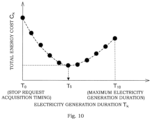
- step S207 the controller 50 determines whether the total energy costs C 0 to C 10 are calculated for all the electricity generation durations T 0 to T 10 , and counts up a variable k and repeats processing of step S203 and subsequent steps when not all the calculations are completed.
- the controller 50 executes processing of step S208.
Landscapes
- Engineering & Computer Science (AREA)
- Sustainable Energy (AREA)
- Life Sciences & Earth Sciences (AREA)
- Sustainable Development (AREA)
- Chemical Kinetics & Catalysis (AREA)
- Chemical & Material Sciences (AREA)
- Manufacturing & Machinery (AREA)
- Electrochemistry (AREA)
- General Chemical & Material Sciences (AREA)
- Power Engineering (AREA)
- Transportation (AREA)
- Mechanical Engineering (AREA)
- Fuel Cell (AREA)
- Electric Propulsion And Braking For Vehicles (AREA)
Description
- The present invention relates to a control method for a fuel cell system, and a fuel cell system.
-
JP H10-40931A EP3396762A1 (Nissan Motor) . - In the system described above, when the system is stopped, it is determined whether the electricity generation of the fuel cell is continued by considering only the remaining capacity of the secondary battery, and execution of a system stop control does not consider an energy cost associated with the electricity generation of the fuel cell, an energy cost from a stop to a restart of the system, and the like. Therefore, depending on a timing from the system stop control to the restart, a waste may occur from the viewpoint of the energy costs.
- Therefore, an object of the present invention is to provide a technique for realizing a system control, which can reduce energy costs as much as possible in consideration of an energy cost from a system stop to a next vehicle operation start and an energy cost associated with electricity generation of a fuel cell when a system stop request is received.
- The invention is defined by
method claim 1 and a corresponding system claim 8. - According to the present invetion, a control method for a fuel cell system for a vehicle is provided, the fuel cell system including a fuel cell, and a heater configured to warm up the fuel cell, and capable of executing a stop control when an operation stop request of the fuel cell system is received. The control method includes acquiring the operation stop request of the fuel cell system, acquiring a next vehicle operation start timing, and calculating a first energy cost and a second energy cost at a predetermined timing after acquiring the operation stop request and the next vehicle operation start timing. The first energy cost is an energy cost required from the predetermined timing to completion of warming up of the fuel cell when a warm-up control is executed using the heater in accordance with the next vehicle operation start timing after the stop control is executed. The second energy cost is an energy cost required when an operation of the fuel cell is continued so as to maintain a temperature of the fuel cell at a warm-up temperature from the predetermined timing to the next vehicle operation start timing. The control method also includes continuing the operation of the fuel cell such that the temperature of the fuel cell is maintained at the warm-up temperature while the first energy cost is larger than the second energy cost after the operation stop request is acquired.
-
-
FIG. 1 is a schematic configuration diagram of a fuel cell system according to a first embodiment. -
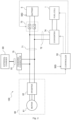
FIG. 2 is a diagram schematically illustrating an electricity system of the fuel cell system according to the first embodiment. -
FIG. 3 is a diagram illustrating a control method when a system stop request is issued and a change in a fuel quantity consumed at that time. -
FIG. 4 is a flowchart illustrating a flow of processing executed when the system stop request is issued in the fuel cell system according to the first embodiment. -
FIG. 5A is a diagram illustrating a stop and start energy cost calculation unit of a controller. -
FIG. 5B is a diagram illustrating a calculation example of a restart timing of the fuel cell system. -
FIG. 6 is a diagram illustrating an electricity generation continuation energy cost calculation unit and an external charge energy cost calculation unit of the controller. -
FIG. 7 is a flowchart illustrating a flow of processing executed when a system stop request is issued in a fuel cell system according to a second embodiment. -
FIG. 8 is a diagram illustrating a stop and start energy cost calculation unit of a controller. -
FIG. 9 is a diagram illustrating an electricity generation continuation energy cost calculation unit and an external charge energy cost calculation unit of the controller. -
FIG. 10 is a diagram illustrating a method for selecting an electricity generation duration in the fuel cell system according to the second embodiment. - Hereinafter, embodiments of the present invention are described with reference to the drawings.
-
FIG. 1 is a schematic configuration diagram of afuel cell system 100 according to a first embodiment of the present invention. - The
fuel cell system 100 shown inFIG. 1 is, for example, a system mounted on a series hybrid vehicle. Thefuel cell system 100 includes afuel cell stack 1 as a solid oxide fuel cell (SOFC), afuel tank 10 that stores a liquid fuel used for electricity generation of thefuel cell stack 1, acontroller 50 that integrally controls thefuel cell system 100, and the like. - The
fuel cell stack 1 is a fuel cell laminate that generates electricity by receiving an anode gas and a cathode gas. The generated electricity of thefuel cell stack 1 is used to charge a battery (seeFIG. 2 ) mounted on the hybrid vehicle. Thefuel cell stack 1 is configured by laminating a plurality of fuel cells, and each fuel cell as an electricity generation source is, for example, a solid oxide fuel cell. - The
fuel tank 10 stores the liquid fuel necessary for generating the anode gas to be supplied to thefuel cell stack 1 or generating a combustion gas used for warming up system components and the like. The liquid fuel is, for example, a fuel consisting of water and ethanol (for example, hydrous ethanol containing 40% by volume of ethanol). The liquid fuel is not limited to hydrous ethanol, and may be a liquid fuel containing gasoline, methanol, or the like. - The
fuel cell stack 1 and thefuel tank 10 are connected to each other through ananode gas passage 11. Theanode gas passage 11 is provided with anevaporator 21, afuel heat exchanger 22, and areformer 23 in the order from an upstream side in a flow direction. Theevaporator 21, thefuel heat exchanger 22, and thereformer 23 are auxiliary machines necessary for supplying the anode gas to thefuel cell stack 1. - On an upstream side of the
evaporator 21, afuel supply path 15 branches from theanode gas passage 11, and thefuel supply path 15 connects theanode gas passage 11 and acatalyst combustor 40. - A
first injector 2A is provided on theanode gas passage 11 between a branch point of thefuel supply path 15 and theevaporator 21, and asecond injector 2B is provided on thefuel supply path 15. Thefirst injector 2A is configured to operate in response to a command signal from thecontroller 50 to supply the liquid fuel by injection to theevaporator 21. Further, thesecond injector 2B is configured to operate in response to a command signal from thecontroller 50 to supply the liquid fuel by injection to thecatalyst combustor 40. - The evaporator 21 heats the liquid fuel supplied from the
first injector 2A to generate a vaporized fuel. The evaporator 21 heats the liquid fuel by heat exchange with a high-temperature combustion gas supplied from thecatalyst combustor 40 through acombustion gas passage 17. - The
fuel heat exchanger 22 receives the heat of the combustion gas generated by the combustion in thecatalyst combustor 40 and further heats the vaporized fuel. - The
reformer 23 has a built-in reforming catalyst, and reforms the vaporized fuel supplied from thefuel heat exchanger 22 to generate an anode gas containing hydrogen, carbon monoxide, or the like. The anode gas generated by thereformer 23 is supplied to thefuel cell stack 1. - Meanwhile, the
fuel cell system 100 includes acathode gas passage 12 for supplying air (cathode gas) to thefuel cell stack 1. Thecathode gas passage 12 is provided with anair heat exchanger 31. - The
air heat exchanger 31 heats the cathode gas flowing through thecathode gas passage 12 by heat exchange with the combustion gas supplied from thecatalyst combustor 40 through thecombustion gas passage 17. In the present embodiment, anair compressor 3 is disposed near an open end of thecathode gas passage 12, and air as the cathode gas is suctioned into thecathode gas passage 12 through theair compressor 3. The cathode gas is heated when passing through theair heat exchanger 31, and is supplied to thefuel cell stack 1. Theair heat exchanger 31 is an auxiliary machine necessary for thefuel cell stack 1 to generate electricity. As a device for suctioning air, a blower may be used instead of theair compressor 3. - An
air supply path 16 branches from thecathode gas passage 12 between theair compressor 3 and theair heat exchanger 31, and theair supply path 16 connects thecathode gas passage 12 and thecatalyst combustor 40. A flow rate control valve 4 for adjusting a flow rate of the air supplied to thecatalyst combustor 40 is disposed in theair supply path 16. - The catalyst combustor 40 has a built-in combustion catalyst containing platinum (Pt), palladium (Pd), or the like. The catalyst combustor 40 generates a combustion gas by combusting the liquid fuel and the air supplied through the
fuel supply path 15 and theair supply path 16. - In the
fuel cell system 100, thecatalyst combustor 40 is connected to theair heat exchanger 31 and theevaporator 21 via thecombustion gas passage 17, and heats theair heat exchanger 31 and theevaporator 21 by the heat of the combustion gas. Meanwhile, thefuel heat exchanger 22 and thereformer 23 are housed in a case shared with the catalyst combustor 40 (one-dot chain line L inFIG. 1 ), and inside the case L, the heat of thecatalyst combustor 40 is transferred to thefuel heat exchanger 22 and thereformer 23. - Further, in the
fuel cell system 100, thefuel cell stack 1 and thecatalyst combustor 40 are connected by an anode off-gas passage 13 and a cathode off-gas passage 14. The catalyst combustor 40 generates a combustion gas by catalytically combusting an anode off-gas and a cathode off-gas discharged from thefuel cell stack 1. The combustion gas generated by thecatalyst combustor 40 is discharged to the outside through thecombustion gas passage 17. - The
controller 50 is an electronic control unit implemented by a microcomputer provided with a central processing unit (CPU), various storage devices such as ROM and RAM, and an input and output interface and the like, and executes various pre-programmed controls. Thecontroller 50 is programmed to control operations of thefirst injector 2A, thesecond injector 2B, theair compressor 3, and the flow rate control valve 4, for example, according to a traveling state of the vehicle and an operating state of thefuel cell system 100. - The
controller 50 detects the operating state of thefuel cell system 100 or the like by acquiring detection signals from various sensors or the like. Thefuel cell system 100 includes, as various sensors, atemperature sensor 50A that detects a temperature of thefuel cell stack 1, atimer 50B that outputs a current time, astart switch 50C for instructing the start and stop of the vehicle, and the like. - Next, an electricity system of the
fuel cell system 100 is described with reference toFIG. 2 . - The
fuel cell system 100 is mounted on the series hybrid vehicle, and thefuel cell stack 1 is electrically connected to abattery 5 of the vehicle as shown inFIG. 2 . In thefuel cell system 100, the electricity generated by thefuel cell stack 1 is basically charged to thebattery 5, but thebattery 5 may also be charged by using electricity from anexternal charger 80. Theexternal charger 80 is a quick charging device disposed in a facility such as a charging stand, or a household power supply having smaller output electricity than the quick charging device. - As shown in
FIG. 2 , the electricity system of thefuel cell system 100 includes thebattery 5 as a vehicle power supply, adrive device 60 as a vehicle driving source, afirst wiring 71 provided between thedrive device 60 and thebattery 5, asecond wiring 72 connecting thefirst wiring 71 and thefuel cell stack 1, arelay 73 provided on thefirst wiring 71, aconverter 74 provided on the second wiring, and a chargingconnector 75 configured to be connected to theexternal charger 80. Various devices constituting the electricity system are also controlled by thecontroller 50 described above. - The
drive device 60 is a load connected to thebattery 5 and thefuel cell stack 1, and drives the vehicle by receiving electricity of at least one of thebattery 5 and thefuel cell stack 1. Thedrive device 60 includes anelectric motor 61 as a drive source, and aninverter 62 that converts DC electricity of at least one of thebattery 5 and thefuel cell 1 into AC electricity to be supplied to theelectric motor 61. - The
first wiring 71 is a power supply line that connects thebattery 5 and theinverter 62. Thebattery 5 is a power supply for supplying electricity to thedrive device 60, and is a lithium ion battery, a lead battery, or the like. Thebattery 5 is provided with avoltage sensor 50D for detecting an output voltage of thebattery 5, and a detection signal of thevoltage sensor 50D is output to thecontroller 50. - The
relay 73 is disposed on thefirst wiring 71, and therelay 73 is a breaker that switches a state between thebattery 5 and thedrive device 60 to a connected state or a disconnected state. Therelay 73 is also a breaker capable of switching a state between theconverter 74 and thebattery 5 in thefirst wiring 71 from a connected state to a disconnected state. - The
second wiring 72 is a power supply line that branches from thefirst wiring 71 and is connected to thefuel cell stack 1. Thesecond wiring 72 is provided with theconverter 74. - The
converter 74 is a DC/DC converter, which is an electricity converter that converts a voltage (primary voltage) of thefuel cell stack 1 such that an output voltage (secondary voltage) to thefirst wiring 71 is a predetermined voltage at which electricity of thefuel cell stack 1 can be output. Theconverter 74 transmits the electricity of thefuel cell stack 1 to thebattery 5 and thedrive device 60 via thefirst wiring 71. - The
first wiring 71 is provided with a chargingconnector 75 capable of being connected to a charginggun 81 disposed in theexternal charger 80. The chargingconnector 75 is an electric connection device, which is disposed in a charging port provided on a vehicle body, and receives electricity from the charginggun 81 when charging by theexternal charger 80. By connecting a tip end portion of the charginggun 81 to the chargingconnector 75, the electricity can be supplied from theexternal charger 80 to thebattery 5. The chargingconnector 75 is provided with a connection state detection sensor that detects whether the tip end portion of the charginggun 81 is connected, a current sensor that detects a current flowing from the chargingconnector 75 to thebattery 5, or the like. Thecontroller 50 determines whether thebattery 5 is charged by theexternal charger 80 based on detection signals of these sensors. - Operations of various devices such as the
relay 73, theinverter 62, and theconverter 74 that constitute the electricity system of thefuel cell system 100 is controlled by thecontroller 50. - In the
fuel cell system 100 as described above, a warm-up control that warms up thefuel cell stack 1 is executed at the time of starting the system, and a system stop control is executed when a system stop request is received. - For example, in the
fuel cell system 100 shown inFIG. 1 , when it is necessary to warm up thefuel cell stack 1 at the time of starting the system, thesecond injector 2B supplies the liquid fuel to thecatalyst combustor 40, and theair compressor 3 is operated to open the flow rate control valve 4 to supply the air to thecatalyst combustor 40. Thus, thefuel heat exchanger 22 and the like can be heated by the combustion gas generated by the combustion of the liquid fuel. As a result, the anode gas and the cathode gas that are heated by these heat exchangers are supplied to thefuel cell stack 1, and thefuel cell stack 1 is warmed up. In this way, the catalyst combustor 40 functions as a heater for warming up thefuel cell stack 1. - Here, the term "at the time of starting the system" refers to a period during which a process (warm-up operation for starting the fuel cell system 100) of increasing temperatures of elements in the
fuel cell system 100 such as thefuel cell stack 1 to desired temperatures suitable for respective operations is executed triggered by detection of a system start command from thecontroller 50, in a state where an operation of thefuel cell system 100 is stopped (a state where an operation of each element in thefuel cell system 100 including thefuel cell stack 1 is stopped). - Further, in the
fuel cell system 100, the stop control is executed in response to a system stop request or the like based on a key-off operation of a driver. In thefuel cell system 100, since an operation temperature of thefuel cell stack 1 is high, cooling processing of thefuel cell stack 1 is executed before the operation of each element of thefuel cell system 100 is completely stopped in the stop control. In the cooling processing of the stop control, theair compressor 3 is driven to continue supplying the cathode gas, and thefuel cell stack 1 is cooled by the cathode gas. At this time, thefirst injector 2A is also controlled to supply a small quantity of fuel, and a small quantity of anode gas is supplied to thefuel cell stack 1. In this way, by supplying the anode gas to thefuel cell stack 1, the cathode gas (air) can be prevented from flowing back from thecatalyst combustor 40 into thefuel cell stack 1, and oxidative deterioration of an anode electrode of thefuel cell stack 1 can be prevented. Such a stop control starts from a timing when the system stop request is received (stop request acquisition timing), and ends when, for example, the temperature of thefuel cell stack 1 reaches a temperature at which the oxidative deterioration of the anode electrode can be suppressed or prevented. - In the
fuel cell system 100, the stop control and the warm-up control are generally executed as described above. Once the system is stopped, it is necessary to warm up thefuel cell stack 1 to the operation temperature before a next vehicle operation starts. The solid oxidefuel cell stack 1 used in thefuel cell system 100 has a high operation temperature of about 700°C, and consumes a large quantity of liquid fuel when the warm-up control is executed. In particular, when thefuel cell system 100 is configured to combust the fuel in the catalyst combustor 40 to warm up thefuel cell stack 1, the fuel combusted here is not used for electricity generation, but is mainly used for heating thefuel cell stack 1 and the like. - Therefore, when the
fuel cell system 100 is stopped and then restarted, depending on a timing at which the next vehicle operation starts, a case of maintaining the temperature of thefuel cell stack 1 by continuing the operation (electricity generation) of thefuel cell stack 1 even when the system stop request is issued may be able to reduce the loss of energy costs as compared with a case of executing the stop control immediately when the stop request is issued and then executing the warm-up control. -
FIG. 3 is a diagram illustrating a control method when the system stop request is issued and a change in a fuel quantity consumed at that time. Lines L1 to L4 inFIGS. 3(A) to 3(B) show a time change of an integrated value of the fuel quantity. - As shown in
FIG. 3(A) , for example, when the stop control is executed immediately at a time point (time t1) at which astart switch 50C of the vehicle is operated and a system stop request is output, the supply of the cathode gas and the anode gas to thefuel cell stack 1 is continued during a period before a stack temperature decreases to a predetermined temperature TL. Thereafter, when a system restart request is issued at a time t2, the warm-up control is started, and thefuel cell stack 1 is warmed up using the combustion heat of the fuel supplied to thecatalyst combustor 40. In the stop control, the fuel is not used for electricity generation, and thus almost all of the consumed fuel is a fuel that is not recovered as generated electricity, and also in the warm-up control, the fuel is used as a heat source for warming up, and thus most of the consumed fuel is not recovered as generated electricity. In this way, when thefuel cell system 100 is stopped and restarted, as shown in the line L1 ofFIG. 3(A) , a large quantity of fuel is consumed, and as shown in the line L2, most of the fuel does not contribute to the generated electricity. - On the other hand, when a time from when the system stop request is issued to when the system is restarted is relatively short or the like, as shown in
FIG. 3(B) , continuing electricity generation to the extent that the temperature of thefuel cell stack 1 is maintained even if the system stop request is issued at a time t11 may be more efficient from the viewpoint of overall energy cost. That is, during a period from when the stop request is issued to when a next vehicle operation is started (from the time t11 to a time t13), the fuel is supplied to thefuel cell stack 1, and the electricity generation is continued to the extent that the temperature of thefuel cell stack 1 is maintained, and thus thefuel cell stack 1 can be normally operated at the same time as a vehicle operation start timing. A fuel quantity (line L3) consumed at the timing t13 when a normal operation can be started is less than a fuel quantity (line L1) consumed during a period from when the stop request is issued to when the warming up is completed (from the time t1 to a time t3) inFIG. 3(A) . In this way, depending on a timing of restarting thefuel cell system 100, electricity generation is continued during a period before the vehicle operation is restarted, and thus it can be said that a fuel quantity that is not recovered as generated electricity can be reduced, and the energy generated from the fuel is efficiently used for electricity generation. - Therefore, in the
fuel cell system 100 according to the present embodiment, when a system stop request is detected, the continuation of electricity generation or the stop control is executed so as to reduce the energy loss as much as possible, considering the energy cost in the case of stopping and restarting the system, the energy cost in the case of continuing the electricity generation with thefuel cell stack 1, and the like. - Hereinafter, the processing executed by the
fuel cell system 100 when a system stop request is detected is described with reference toFIG. 4. FIG. 4 is a flowchart illustrating a flow of the processing executed when the system stop request is issued. Thecontroller 50 of thefuel cell system 100 is programmed to perform the processing inFIG. 4 . - As shown in
FIG. 4 , in step S101, thecontroller 50 determines whether a system stop request is issued. The vehicle is configured to output a stop request for thefuel cell system 100 in order to stop the vehicle when thestart switch 50C is operated by a driver or the like. When a system stop request based on the operation of thestart switch 50C is detected (acquired), thecontroller 50 determines that a system stop request is issued, and then executes processing of step S102. On the other hand, thecontroller 50 repeatedly executes the processing of step S101 when no system stop request is issued while no system stop request is detected. - In step S102, the
controller 50 determines whether a next operation start time (next vehicle operation start timing) is set and registered. The vehicle equipped with thefuel cell system 100 according to the present embodiment is a vehicle capable of storing a vehicle operation plan and the like of a driver in a ROM or the like of thecontroller 50, and is configured such that a driver or the like can set and register date and time when the vehicle is to be used next or the like via a car navigation device or a smartphone owned by the driver. Further, when the vehicle is a vehicle used for car sharing, a next vehicle operation start timing may be set based on a use status of car sharing. This next operation start time means a timing at which a vehicle operation can be restarted after thefuel cell system 100 is warmed up. - When a next vehicle operation start timing is acquired in step S102, the
controller 50 executes processing of step S103. On the other hand, when no next vehicle operation start timing is set and registered, and the time cannot be acquired, thecontroller 50 executes processing of step S108, starts a stop control without considering various energy costs, and ends the operation of thefuel cell system 100 after decreasing the temperature of thefuel cell stack 1 to a predetermined temperature. - In step S103, the
controller 50 determines whether thefuel cell system 100 is connected to theexternal charger 80. This determination is performed, for example, based on an output signal of the connection state detection sensor that detects whether the charginggun 81 of theexternal charger 80 is connected to the chargingconnector 75. When theexternal charger 80 is not connected, thecontroller 50 executes processing of step S104 and subsequent steps. On the other hand, when theexternal charger 80 is connected, thecontroller 50 determines that thebattery 5 needs to be charged to a target charge quantity when the system is stopped, and executes processing of step S109 and subsequent steps. - When the
external charger 80 is not connected, thecontroller 50 calculates, in step S104, an energy cost (hereinafter, referred to as a "stop and start energy cost") when the stop and start is executed. The stop and start energy cost calculated in step S104 is an energy cost (first energy cost) required from a current time (cost calculation timing) to completion of warming up of thefuel cell stack 1 when a warm-up control is executed using thecatalyst combustor 40 in accordance with a next vehicle operation start timing after a stop control for stopping thefuel cell system 100 is executed. This stop and start energy cost is calculated, for example, as shown inFIG. 5A . -
FIG. 5A is a diagram illustrating a stop and start energycost calculation unit 51 of thecontroller 50. As shown inFIG. 5A , the stop and start energycost calculation unit 51 includes a stoptime calculation unit 51A, a pre-start stacktemperature calculation unit 51B, a stopenergy calculation unit 51C, a startenergy calculation unit 51D, anaddition unit 51E, and acost calculation unit 51F. - The stop
time calculation unit 51A calculates a stop time, during which the vehicle and thefuel cell system 100 is in a stopped state, by subtracting a current time (current cost calculation timing) from a restart timing of thefuel cell stack 1 obtained based on a next vehicle operation start timing. The current cost calculation timing is a time from acquisition of a stop request of thefuel cell system 100 to a current time, and is also an electricity generation duration time of thefuel cell stack 1 from a system stop request timing. - The restart timing of the
fuel cell stack 1 is calculated as shown inFIG. 5B based on the next vehicle operation start timing acquired in step S102. As shown inFIG. 5B , thecontroller 50 acquires a current stack temperature, and calculates, based on the stack temperature, a temperature decrease characteristic line La when the stop control is executed. This characteristic line La may be stored in advance as map data for each current stack temperature, or may be acquired from a heat dissipation simulation obtained based on a heat dissipation quantity of thefuel cell stack 1. Thecontroller 50 calculates the restart timing of thefuel cell stack 1, at which the warming up of thefuel cell stack 1 is completed when a vehicle operation starts, based on the temperature decrease characteristic line La, a stack temperature-warm-up time characteristic line Lb, and the acquired next vehicle operation start timing. That is, thecontroller 50 sets, as the restart timing (warm-up start timing) of thefuel cell stack 1, an intersection of the decrease characteristic line La, which indicates the decrease in the stack temperature from the current time, and the stack temperature-warm-up time characteristic line Lb, which indicates that the warm-up temperature is reached when a next vehicle operation starts. The stack temperature-warm-up time characteristic line Lb is data obtained by conducting experiments in advance about a relationship between a time for performing the warm-up control and a degree of increase in the stack temperature. This characteristic line Lb may be obtained from a temperature increase simulation obtained based on a stack heat capacity and a heat quantity that can be supplied to thefuel cell stack 1. - As shown in
FIG. 5A , after the stoptime calculation unit 51A calculates a stop time, the pre-start stacktemperature calculation unit 51B calculates a stack temperature (pre-start stack temperature) at the restart timing (warm-up start timing) of thefuel cell system 100 based on the stop time and the current stack temperature. The current stack temperature may be one acquired by thetemperature sensor 50A provided on thefuel cell stack 1, or may be estimated based on a temperature of an off-gas discharged from thefuel cell stack 1. As shown inFIG. 5A , a characteristic line showing a relationship between the stop time and the pre-start stack temperature has a characteristic that as the stop time increases, the pre-start stack temperature decreases. Further, this characteristic line is set for each predetermined stack temperature. - The stop
energy calculation unit 51C calculates a stop energy based on the pre-start stack temperature. This stop energy is an energy (fuel quantity or the like) required when the stop control is executed in thefuel cell system 100 and thesystem 100 is in a stopped state until the restart timing. As the pre-start stack temperature decreases, the stop energy is calculated to be smaller. Further, this stop energy is calculated so as to be a constant value at a temperature equal to or lower than the predetermined temperature. This is because when the temperature of thefuel cell stack 1 is equal to or lower than the predetermined temperature, cooling by a gas or the like is not performed, and a state of natural cooling is realized, and therefore the energy such as the fuel is not consumed. - The start
energy calculation unit 51D calculates a start energy based on the pre-start stack temperature. This start energy is an energy (fuel quantity or the like) required from the restart timing to the completion of the warming up of thefuel cell stack 1 after the warm-up control is started. As the pre-start stack temperature decreases, the start energy increases. - The
addition unit 51E adds the stop energy and the start energy to calculate a stop and start energy. The stop and start energy calculated in this way is input to thecost calculation unit 51F. Thecost calculation unit 51F calculates a stop and start energy cost by integrating a cost per unit energy with respect to the stop and start energy. The cost per unit energy is, for example, a fuel cost per unit liter, and may be a value stored in thecontroller 50 in advance or a value appropriately received from an external information terminal or the like. - After calculating the stop and start energy cost in S104 in
FIG. 4 , in S105, thecontroller 50 calculates an energy cost (hereinafter, referred to as an "electricity generation continuation energy cost") when electricity generation is continued as it is in thefuel cell stack 1 until a next vehicle operation start timing. The electricity generation continuation energy cost calculated in S105 is an energy cost (second energy cost) required when the electricity generation is continued in a state in which the temperature of thefuel cell stack 1 can be maintained at the warm-up temperature from the current time point (cost calculation timing) to the next vehicle operation start timing. This electricity generation continuation energy cost is calculated, for example, as shown inFIG. 6 . -
FIG. 6 is a diagram illustrating an electricity generation continuation energycost calculation unit 52 and an external charge energycost calculation unit 53 of thecontroller 50. As shown inFIG. 6 , the electricity generation continuation energycost calculation unit 52 includes an electricityquantity calculation unit 52A, a systemefficiency calculation unit 52B, asubtraction unit 52C, a non-recoveryenergy calculation unit 52D, an electricity generationenergy calculation unit 52E, aselection unit 52F, and acost calculation unit 52G. - The electricity
quantity calculation unit 52A calculates a stack electricity quantity by multiplying an electricity generation output of thefuel cell stack 1 by a duration (duration time), which is a difference between a next operation time (next vehicle operation start timing) and a current time (current cost calculation timing). During the continuation of electricity generation, thefuel cell stack 1 generates electricity in a state where the stack temperature is maintained at the warm-up temperature, so that the electricity generation output is stored in the ROM or the like of thecontroller 50 as a predetermined value set in advance. The electricity generation output is calculated based on an output current and an output voltage at the current time, and an electricity generation output value calculated in this way may be used as the electricity generation output used in the electricityquantity calculation unit 52A. - The system
efficiency calculation unit 52B refers to a system efficiency table, and calculates, based on the electricity generation output, electricity conversion efficiency of the entire system in consideration of the electricity loss or the like in various components of thefuel cell system 100. The electricity conversion efficiency is a value of 0 or more and 1 or less. - The
subtraction unit 52C calculates a value obtained by subtracting the electricity conversion efficiency from 1, and the non-recoveryenergy calculation unit 52D calculates a non-recovery energy by multiplying the value calculated by thesubtraction unit 52C and the stack electricity quantity. This non-recovery energy is an energy (fuel quantity or the like) that is not recovered as electricity, among the energy consumed during the continuation of electricity generation. - The electricity generation
energy calculation unit 52E calculates, by dividing the stack electricity quantity by the electricity conversion efficiency of the entire system, a total electricity generation energy (fuel quantity or the like) required to generate the stack electricity quantity by using thefuel cell stack 1. - The
selection unit 52F outputs one of the non-recovery energy and the total electricity generation energy as the electricity generation continuation energy depending on whether a target charge electricity quantity for thebattery 5 is set. In thefuel cell system 100, a minimum battery charge quantity when the system is stopped is set, and a target charge electricity quantity is set so as to satisfy this minimum battery charge quantity. The target charge electricity quantity may be set such that a charge quantity of thebattery 5 is an allowable upper limit charge quantity. Thefuel cell system 100 may be configured to notify the driver or the like of charging thebattery 5 by theexternal charger 80 when the target charge electricity quantity is set. Therefore, theselection unit 52F may determine that the target charge electricity quantity is set when thefuel cell system 100 is connected to theexternal charger 80. Theselection unit 52F outputs the non-recovery energy as the electricity generation continuation energy when the target charge electricity quantity is not set, and outputs the total electricity generation energy as the electricity generation continuation energy when the target charge electricity quantity is set. - The
cost calculation unit 52G calculates the electricity generation continuation energy cost by integrating a cost per unit energy with respect to the electricity generation continuation energy (fuel quantity or the like). The cost per unit energy is, for example, a fuel cost per unit liter, and may be a value stored in thecontroller 50 in advance or a value appropriately received from an external information terminal or the like. - After calculating the stop and start energy cost and the electricity generation continuation energy cost in steps S104 and S105 in
FIG. 4 , thecontroller 50 executes processing of S106. In S106, thecontroller 50 compares the electricity generation continuation energy cost required in a case where electricity generation is continued as it is until the next vehicle operation start timing with the stop and start energy cost required in a case where the warm-up control is performed until the vehicle operation starts after the stop control is performed from the current time. - When the stop and start energy cost is larger than the electricity generation continuation energy cost, the
controller 50 determines that the energy loss is smaller when electricity generation in thefuel cell stack 1 is continued, and executes processing of step S107. On the other hand, when the stop and start energy cost is equal to or less than the electricity generation continuation energy cost, thecontroller 50 determines that the energy loss is smaller when the stop control is started at this stage, and executes processing of step S108. - In step S107, the
controller 50 continues to supply the anode gas and the cathode gas to thefuel cell stack 1, and continues to generate electricity in thefuel cell stack 1 in an electricity generation state in which the temperature of thefuel cell stack 1 is maintained at the warm-up temperature. After executing the processing of step S107, thecontroller 50 executes the processing of step S103. - In step S108, the
controller 50 ends the electricity generation of thefuel cell stack 1, and starts the stop control. In this stop control, the temperature of thefuel cell stack 1 is decreased to a predetermined temperature by mainly supplying the cathode gas to thefuel cell stack 1, and the operation of thefuel cell system 100 is ended. In thefuel cell system 100 whose operation is stopped in this way, the operation is stopped until the restart timing of thefuel cell stack 1, and the warm-up control is started at the restart timing. - On the other hand, when the target charge electricity quantity of the
battery 5 is set by connecting theexternal charger 80 or the like, thecontroller 50 calculates a stop and start energy cost in step S109, and calculates an electricity generation continuation energy cost in step S110. The calculation of the stop and start energy cost in step S109 is the same as the calculation of the stop and start energy cost in step S104, and the calculation of the electricity generation continuation energy cost in step S110 is the same as the calculation of the electricity generation continuation energy cost in step S105. - After the processing of step S110, in step S111, the
controller 50 calculates an energy cost (hereinafter, referred to as an "external charge energy cost") required when thebattery 5 is charged to the target charge quantity from the current time by theexternal charger 80. The external charge energy cost calculated in step S111 is an energy cost (third energy cost) required when thebattery 5 is charged by theexternal charger 80 from the current cost calculation timing to when the target charge quantity is reached. This external charge energy cost is calculated, for example, as shown inFIG. 6 . - As shown in
FIG. 6 , the external charge energycost calculation unit 53 includes an external chargeenergy calculation unit 53A and acost calculation unit 53B. - The external charge
energy calculation unit 53A calculates an external charge energy (electricity quantity or the like) by subtracting the stack electricity quantity (electricity quantity charged from thefuel cell stack 1 to the battery 5) calculated by the electricity generation continuation energycost calculation unit 52 from the target charge quantity required for charging to the target charge electricity quantity. When the battery charge quantity is less than a minimum charge quantity predetermined considering the electricity required at the time of starting the system, the target charge electricity quantity is calculated based on a difference between the minimum charge quantity (target charge quantity) and a current battery charge quantity. Thecontroller 50 calculates the current battery charge quantity based on a detected value of thevoltage sensor 50D or the like. - The
cost calculation unit 53B calculates the external charge energy cost by integrating an electricity cost per unit energy with respect to the external charge energy (electricity quantity or the like). The electricity cost per unit energy is, for example, an electricity charge per unit electricity quantity, and may be a value stored in thecontroller 50 in advance or a value appropriately received from an external information terminal or the like. - After calculating the stop and start energy cost, the electricity generation continuation energy cost, and the external charge energy cost in steps S109 to S111 in
FIG. 4 , thecontroller 50 executes processing of step S112. In step S112, thecontroller 50 compares the electricity generation continuation energy cost with a sum of the stop and start energy cost and the external charge energy cost. - When the sum of the stop and start energy cost and the external charge energy cost is larger than the electricity generation continuation energy cost, the
controller 50 determines that the energy loss is smaller when the electricity generation of thefuel cell stack 1 is continued, and executes processing of step S113. - In step S113, the
controller 50 continues to supply the anode gas and the cathode gas to thefuel cell stack 1, and continues to generate electricity in thefuel cell stack 1 in an electricity generation state in which the temperature of thefuel cell stack 1 is maintained at the warm-up temperature. At this time, the battery charging by theexternal charger 80 is also continued. After executing the processing of step S113, thecontroller 50 executes the processing of step S103. - On the other hand, when it is determined in step S112 that the sum of the stop and start energy cost and the external charge energy cost is equal to or less than the electricity generation continuation energy cost, the
controller 50 determines that the energy loss is smaller when the system stop control is executed at this stage, and executes the processing of step S108. In S108, thecontroller 50 ends the electricity generation of thefuel cell stack 1, and starts the system stop control. Although the electricity generation of thefuel cell stack 1 is stopped by the system stop control, the battery charging by theexternal charger 80 is continued. - According to the
fuel cell system 100 in the present embodiment, the following effects can be obtained. - The
fuel cell system 100 includes thefuel cell stack 1, and thecatalyst combustor 40 for warming up thefuel cell stack 1, and is configured to execute the stop control when the system operation stop request from the driver or the like is received. Thecontroller 50 of thefuel cell system 100 acquires the operation stop request of thefuel cell system 100, acquires the next vehicle operation start timing, and calculates the stop and start energy cost and the electricity generation continuation energy cost at a predetermined timing (current cost calculation timing) after acquiring the operation stop request and the next operation start timing. The stop and start energy cost is an energy cost required from the predetermined timing to the completion of warming up of thefuel cell stack 1 when the warm-up control is executed using thecatalyst combustor 40 in accordance with the next vehicle operation start timing after the stop control is executed. The electricity generation continuation energy cost is an energy cost required when the operation of thefuel cell stack 1 is continued so as to maintain the temperature of thefuel cell stack 1 at the warm-up temperature from the predetermined timing to the next vehicle operation start timing. After acquiring the operation stop request, thecontroller 50 continues operation of thefuel cell stack 1 so as to maintain the temperature of thefuel cell stack 1 at the warm-up temperature while the stop and start energy cost is larger than the electricity generation continuation energy cost. - In this way, the
fuel cell system 100 continues the operation of thefuel cell stack 1 while the stop and start energy cost is larger than the electricity generation continuation energy cost after the system stop request is acquired, and therefore, the energy loss after the system stop request can be prevented. In this way, it is possible to realize the control of thefuel cell system 100, which can reduced the energy costs in consideration of the energy cost from the system stop to the next vehicle operation start and the energy cost associated with the electricity generation of the fuel cell when the system stop request is received. - Further, after acquiring the operation stop request, the
controller 50 starts the stop control when the stop and start energy cost is equal to or less than the electricity generation continuation energy cost. In this way, by executing the stop control when the stop and start energy cost is equal to or less than the electricity generation continuation energy cost, the energy loss after the system stop request can be prevented. - Further, the
controller 50 calculates, based on the stop time from the predetermined timing (cost calculation timing) to the restart timing (warm-up start timing) of thefuel cell stack 1 and the stack temperature at the predetermined timing, the pre-start stack temperature after executing the stop control, and calculates the stop and start energy cost based on the calculated pre-start stack temperature. In this way, by using the pre-start stack temperature, the energy costs related to the stop control and the warm-up control can be accurately calculated. - Further, the
controller 50 of thefuel cell system 100 calculates the stack electricity quantity based on a duration (duration time) from the predetermined timing (cost calculation timing) to the next vehicle operation start timing and the electricity generation output of thefuel cell stack 1, and calculates the electricity generation continuation energy cost based on the calculated stack electricity quantity and the electricity conversion efficiency of thefuel cell system 100. In this way, by using the stack electricity quantity that can be generated by thefuel cell stack 1 and the electricity conversion efficiency determined in consideration of the entire system, the energy costs can be accurately calculated when the electricity generation is continued in thefuel cell stack 1. - Further, the
fuel cell system 100 further includes thebattery 5 as the vehicle power supply, and the chargingconnector 75 that can be connected to the chargingunit 81 of theexternal charger 80, and thebattery 5 is configured to be charged by at least one of thefuel cell stack 1 and theexternal charger 80. Thecontroller 50 calculates the external charge energy cost required to charge thebattery 5 to the target charge quantity by theexternal charger 80, when thefuel cell system 100 is connected to theexternal charger 80. After acquiring the operation stop request, thecontroller 50 continues the operation of thefuel cell stack 1 so as to maintain the temperature of thefuel cell stack 1 at the warm-up temperature while the sum of the stop and start energy cost and the external charge energy cost is larger than the electricity generation continuation energy cost, and starts the stop control when the sum of the stop and start energy cost and the external charge energy cost is equal to or less than the electricity generation continuation energy cost. - In the
fuel cell system 100, when the battery is charged by theexternal charger 80, it is possible to determine whether to continue the operation of thefuel cell stack 1 or to execute the stop control in consideration of not only the stop and start energy cost and the electricity generation continuation energy cost but also the external charge energy cost. As a result, even when thefuel cell system 100 is connected to theexternal charger 80, the energy loss after the system stop request can be prevented. - The
controller 50 of thefuel cell system 100 calculates the stack electricity quantity based on the duration from the predetermined timing (cost calculation timing) to the next vehicle operation start timing and the electricity generation output of thefuel cell stack 1, and calculates the external charge energy cost based on the target charge electricity quantity of thebattery 5 and the stack electricity quantity. In this way, by using the target charge electricity quantity of thebattery 5 and the stack electricity quantity, the energy costs when thebattery 5 is charged by theexternal charger 80 can be accurately calculated. - Next, the
fuel cell system 100 according to a second embodiment of the present invention is described with reference toFIGS. 7 to 9 . In the following embodiment, the same reference numerals are used for configurations and the like that perform the same functions as those in the first embodiment, and duplicate descriptions are omitted as appropriate. - The
fuel cell system 100 according to the second embodiment is configured to set the electricity generation duration of thefuel cell stack 1 such that the energy loss after the system stop request is minimized when the system is connected to theexternal charger 80 or the like. - Processing executed by the
fuel cell system 100 according to the second embodiment when a system stop request is detected is described with reference toFIG. 7. FIG. 7 is a flowchart illustrating a flow of the processing executed when the system stop request is issued. Since the processing other than that of steps S201 to S208 inFIG. 7 is the same as the processing described inFIG. 4 , the processing of steps S201 to S208 is described here. - In step S103 of
FIG. 7 , when theexternal charger 80 is connected and a target electricity quantity of thebattery 5 is set, thecontroller 50 executes the processing of step S201. - In step S201, the
controller 50 calculates a maximum electricity generation duration TMAX as a maximum value of a time during which the electricity generation of thefuel cell stack 1 can be continued, for example, by subtracting a time (stop request acquisition timing) when the stop request is acquired from a restart timing of thefuel cell stack 1 that is obtained based on a next operation start time. - In step S202, the
controller 50 determines an electricity generation duration Tk (for example, k = 0 to 10) obtained by dividing the maximum electricity generation duration TMAX by a predetermined number of times k. The electricity generation duration Tk indicates an elapsed time from the stop request acquisition timing, and for example, when the maximum electricity generation duration TMAX is 10 minutes, values of electricity generation durations are T0 = 0 minutes, T1 = 1 minute, T2 = 2 minutes, ..., T10 = 10 minutes. - In step S203, the
controller 50 calculates an energy cost (second stop and start energy cost) required when the stop and start control is executed after electricity is generated only in the electricity generation duration Tk from the stop request acquisition timing. As shown inFIG. 8 , the controller 50 (stop and start energy cost calculation unit 51) calculates a stop time based on the restart timing and the electricity generation duration Tk, and calculates the second stop and start energy cost (fourth energy cost) by inputting this stop time into the pre-start stacktemperature calculation unit 51B. The second stop and start energy cost is an energy cost required from the stop request timing to the completion of warming up of the fuel cell when the stop control is executed after the set electricity generation duration is elapsed, and the warm-up control is executed using the heater according to the next vehicle operation start timing. Unlike the first embodiment, the electricity generation duration Tk calculated in step S202 is input to the stoptime calculation unit 51A inFIG. 8 instead of an actual cost calculation timing (current time). - After calculating the second stop and start energy cost in step S203, in step S204, the
controller 50 calculates an energy cost (second electricity generation continuation energy cost) required when electricity is generated only in the electricity generation duration Tk from the stop request acquisition timing. As shown inFIG. 9 , the controller 50 (electricity generation continuation energy cost calculation unit 52) calculates a stack electricity quantity in the electricity generation duration based on the electricity generation output of thefuel cell stack 1 and the electricity generation duration Tk, and calculates the second electricity generation continuation energy cost (fifth energy cost) by inputting this stack electricity quantity to the electricity generationenergy calculation unit 52E. Unlike the first embodiment, the electricity generation duration Tk calculated in step S202 is input to the electricityquantity calculation unit 52A inFIG. 9 instead of a stop time. - After calculating the second electricity generation continuation energy cost in step S204, in step S205, the
controller 50 calculates an energy cost (second external charge energy cost) required when thebattery 5 is charged to the target charge quantity by theexternal charger 80. As shown inFIG. 9 , the controller 50 (external charge energy cost calculation unit 53) calculates the second external charge energy cost (sixth energy cost) based on the target charge electricity quantity, and the stack electricity quantity calculated based on the electricity generation output and the electricity generation duration Tk. - After calculating the external charge energy cost as described above, in step S206 of
FIG. 7 , thecontroller 50 calculates a total energy cost Ck by adding the stop and start energy cost, the electricity generation continuation energy cost, and the external charge energy cost in the electricity generation duration Tk. This total energy cost Ck is temporarily stored in a storage medium such as the RAM of thecontroller 50. - In step S207, the
controller 50 determines whether the total energy costs C0 to C10 are calculated for all the electricity generation durations T0 to T10, and counts up a variable k and repeats processing of step S203 and subsequent steps when not all the calculations are completed. When the total energy costs C0 to C10 are calculated for all the electricity generation durations T0 to T10, thecontroller 50 executes processing of step S208. - In step S208, the
controller 50 selects an electricity generation duration with a smallest total energy cost among the total energy costs C0 to C10 in the electricity generation durations T0 to T10, and continues the operation (electricity generation) of thefuel cell stack 1 in an electricity generation state in which the temperature of thefuel cell stack 1 is maintained at the warm-up temperature until the selected electricity generation duration elapses from the stop request acquisition timing. At a timing when the electricity generation duration elapses, thecontroller 50 ends the electricity generation of thefuel cell stack 1, and starts the stop control. - According to the
fuel cell system 100 in the present embodiment described above, as shown inFIG. 10 , when a system stop request is issued by the driver or the like, a sum (total energy cost) of the second stop and start energy cost, the second electricity generation continuation energy cost, and the second external charge energy cost is calculated for each of the electricity generation durations T0 to T10 obtained by dividing the maximum electricity generation duration. Thecontroller 50 selects the electricity generation duration with the smallest total energy cost among the total energy costs in the electricity generation durations T0 to T10. For example, as shown inFIG. 10 , when a total energy cost in an electricity generation duration T5 is the smallest, the operation (electricity generation) of thefuel cell stack 1 is continued from the stop request acquisition timing until the electricity generation duration T5 elapses, and then the stop control is executed. Since thefuel cell system 100 has a configuration in which the operation (electricity generation) of thefuel cell stack 1 is continued only in the electricity generation duration which minimizes the total energy cost, the energy loss after the system stop request can be prevented more reliably. - In the second embodiment, the
controller 50 selects an electricity generation duration Tk with the smallest energy cost as the electricity generation duration, but a method for selecting the electricity generation duration is not limited thereto. For example, in the electricity generation duration Tk, two times including a time with a lowest energy cost and a time with a next lowest energy cost, are extracted, and an average time is calculated from these two times. Then, a total energy cost in this average time is calculated, and a total energy cost in the average time is compared with a minimum total energy cost in the electricity generation duration Tk, and thereby one with a smaller energy cost may be selected as the electricity generation duration. - As described above, the embodiments of the present invention are described, but the above embodiments merely show a part of application examples of the present invention, and do not intend to limit the technical scope of the present invention to the specific configurations of the above embodiments. Various changes and modifications can be made on the above embodiments within the scope of matters described in claims. Further, the technical idea described in the above first embodiment and second embodiment may be combined as appropriate.
- The
fuel cell system 100 according to the above embodiments has a configuration in which thefuel cell stack 1 is warmed up by utilizing the combustion heat of thecatalyst combustor 40, but may have a configuration in which thefuel cell stack 1 is warmed up by using an electric temperature regulator capable of adjusting the temperature of thefuel cell stack 1 itself. In this way, when the electric temperature regulator is used, the start energy and the like are calculated based on electricity consumed by the regulator. - In the above embodiments, the
fuel cell stack 1 is a solid oxide fuel cell, but may be a fuel cell other than the solid oxide fuel cell as long as thefuel cell stack 1 is a fuel cell that executes a predetermined stop control when the system is stopped and a predetermined warm-up control when the system is started.
Claims (8)
- A control method for a fuel cell system (100) for a vehicle including a fuel cell and a heater configured to warm up the fuel cell, the method executing a stop control of the fuel cell system (100) when an operation stop request thereof is received (S101), wherein the method further comprises:determining, after the operation stop request is received, if a next operation start time of the vehicle has been set (S102);calculating a first energy cost and a second energy cost at predetermined intervals, if the next operation start time of the vehicle has been set (S104, S105), whereinthe first energy cost is an energy cost required from a present time when the stop control is started until when warm-up of the fuel cell using the heater is completed prior to the next operation start time of the vehicle, andthe second energy cost is an energy cost required if an operation of the fuel cell is continued to maintain a temperature of the fuel cell at a warm-up temperature from the present time until the next operation start time of the vehicle; andcontinuing the operation of the fuel cell to maintain the temperature of the fuel cell at the warm-up temperature as long as the first energy cost is larger than the second energy cost (S106, S107).
- The control method for a fuel cell system (100) according to claim 1, further comprising:
starting the stop control when the first energy cost becomes equal to or less than the second energy cost (S106, S108). - The control method for a fuel cell system (100) according to claim 1 or 2, wherein
a pre-start temperature of the fuel cell is calculated based on a stop time from the predetermined time until starting of the warm-up of the fuel cell and a temperature of the fuel cell at the predetermined time, and the first energy cost is calculated based on the pre-start temperature of the fuel cell. - The control method for a fuel cell system (100) according to any one of claims 1 to 3, whereinthe fuel cell is provided in the form of a fuel cell stack (1) comprising a plurality of unit cells;a stack electricity output quantity of the fuel cell stack (1) in an electricity generation duration is calculated by multiplying a duration from the predetermined time to the next operation start time of the vehicle and an electricity generation output of the fuel cell stack (1), andthe second energy cost is calculated based on the stack electricity output quantity and electricity conversion efficiency of the fuel cell system (100).
- The control method for a fuel cell system (100) according to claim 4, whereinthe fuel cell system (100) further includes a battery (5) as a vehicle power supply, and a charging connector (75) configured to be connected to a charging unit (81) of an external charger (80).the battery (5) is configured to be charged by at least one of the fuel cell stack (1) and the external charger (80), andthe control method further comprises:determining if the battery (5) is charged by the external charger (80) (S103); andif the battery (5) is charged by the external charger (80),calculating a third energy cost required when the battery (5) is charged to a target charge quantity by the external charger (80) when the fuel cell system (100) is connected to the external charger (80) (S111);continuing the operation of the fuel cell stack (1) such that the temperature of the fuel cell stack (1) is maintained at the warm-up temperature as long as a sum of the first energy cost and the third energy cost is larger than the second energy cost (S112, S113), andstarting the stop control when the sum of the first energy cost and the third energy cost becomes equal to or less than the second energy cost (S112, S108).
- The control method for a fuel cell system (100) according to claim 5, wherein
the third energy cost is calculated based on the target charge electricity quantity of the battery (5) and the stack electricity quantity. - The control method for a fuel cell system (100) according to claim 1, whereinthe fuel cell is provided in the form of a fuel cell stack (1) comprising a plurality of unit cells;the fuel cell system (100) further includes a battery (5) as a vehicle power supply, and a charging connector (75) configured to be connected to a charging unit (81) of an external charger (80),the battery (5) is configured to be charged by at least one of the fuel cell stack (1) and the external charger (80), andthe method further comprises:determining if the battery (5) is charged by the external charger (80) (S103); andif the battery (5) is charged by the external charger (80),setting, when the operation stop request is received, different electricity generation durations during which electricity generation by the fuel cell stack (1) is performed in a state where the fuel cell system (100) is connected to the external charger (80) (S201, S202);sequentially selecting one of the different electricity generation durations as a selected electricity generation duration (S207);calculating a sum of a fourth energy cost, a fifth energy cost, and a sixth energy cost as a total energy cost for the selected electricity generation duration (S203-S206), whereinthe fourth energy cost is an energy cost required from when the stop control is started after the selected electricity generation duration is elapsed until when the warm-up of the fuel cell stack (1) using the heater is completed prior to the next operation start time of the vehicle,the fifth energy cost is an energy cost required by the fuel cell stack (1) to generate electricity during the selected electricity generation duration, andthe sixth energy cost is an energy cost required when the battery (5) is charged to a target charge quantity by the external charger (80);selecting a smallest energy cost electricity generation duration with which a sum of the fourth energy cost, the fifth energy cost, and the sixth energy cost becomes a smallest (S208); andcontinuing the operation of the fuel cell stack (1) such that the temperature of the fuel cell stack (1) is maintained at the warm-up temperature from when the stop request is received until when the smallest energy cost electricity generation duration is elapsed, and starting the stop control after the smallest energy cost electricity generation duration is elapsed (S208).
- A fuel cell system (100) for a vehicle comprising:a fuel cell (1);a heater configured to warm up the fuel cell; anda controller (50) configured to execute an operation stop control of the fuel cell when an operation stop request (S101) thereof is received (S101), whereinthe controller (50) is further configured to:determine, after the operation stop request is received, if a next operation start time (S102) of the vehicle has been set (S102);calculate a first energy cost and a second energy cost (S104, S105) at predetermined intervals if the next operation start time (S102) of the vehicle has been set (S104, S105), whereinthe first energy cost is an energy cost required from a present time when the stop control is started until when warm-up of the fuel cell using the heater is completed prior to the next operation start time of the vehicle, andthe second energy cost is an energy cost required if an operation of the fuel cell is continued to maintain a temperature of the fuel cell at a warm-up temperature from the present time until the next operation start time of the vehicle; andcontinue the operation of the fuel cell to maintain the temperature of the fuel cell at the warm-up temperature as long as the first energy cost is larger than the second energy cost (S106, S107).
Applications Claiming Priority (1)
| Application Number | Priority Date | Filing Date | Title |
|---|---|---|---|
| PCT/IB2019/001155 WO2021064438A1 (en) | 2019-10-04 | 2019-10-04 | Method for controlling fuel cell system, and fuel cell system |
Publications (3)
| Publication Number | Publication Date |
|---|---|
| EP4040548A1 EP4040548A1 (en) | 2022-08-10 |
| EP4040548A4 EP4040548A4 (en) | 2022-10-19 |
| EP4040548B1 true EP4040548B1 (en) | 2025-03-12 |
Family
ID=75337826
Family Applications (1)
| Application Number | Title | Priority Date | Filing Date |
|---|---|---|---|
| EP19947516.1A Active EP4040548B1 (en) | 2019-10-04 | 2019-10-04 | Method for controlling fuel cell system, and fuel cell system |
Country Status (7)
| Country | Link |
|---|---|
| US (1) | US11938840B2 (en) |
| EP (1) | EP4040548B1 (en) |
| JP (1) | JP7163509B2 (en) |
| CN (1) | CN114586208B (en) |
| BR (1) | BR112022006035A2 (en) |
| CA (1) | CA3153429A1 (en) |
| WO (1) | WO2021064438A1 (en) |
Families Citing this family (1)
| Publication number | Priority date | Publication date | Assignee | Title |
|---|---|---|---|---|
| JP7812657B2 (en) * | 2021-12-24 | 2026-02-10 | 三菱マヒンドラ農機株式会社 | Work vehicles |
Citations (5)
| Publication number | Priority date | Publication date | Assignee | Title |
|---|---|---|---|---|
| JP2002343401A (en) * | 2001-05-11 | 2002-11-29 | Toyota Motor Corp | Energy output device with fuel cell |
| JP2003217630A (en) * | 2002-01-23 | 2003-07-31 | Nissan Motor Co Ltd | Fuel reforming system |
| JP3659204B2 (en) * | 2001-08-30 | 2005-06-15 | 日産自動車株式会社 | Mobile fuel cell power plant |
| JP2006196240A (en) * | 2005-01-12 | 2006-07-27 | Toyota Motor Corp | Fuel cell system |
| JP2009140706A (en) * | 2007-12-05 | 2009-06-25 | Nissan Motor Co Ltd | FUEL CELL DEVICE, START-UP DETERMINING DEVICE, AND START-UP DETERMINING METHOD |
Family Cites Families (7)
| Publication number | Priority date | Publication date | Assignee | Title |
|---|---|---|---|---|
| JP3608017B2 (en) | 1996-07-22 | 2005-01-05 | トヨタ自動車株式会社 | Power system |
| JP3891136B2 (en) * | 2003-03-27 | 2007-03-14 | 日産自動車株式会社 | Control device for vehicle fuel cell system |
| US20060046895A1 (en) * | 2004-08-30 | 2006-03-02 | Thacher Russell J | Vehicular control system for regenerative braking |
| EP3070773B1 (en) * | 2013-11-14 | 2018-01-03 | Nissan Motor Co., Ltd | Fuel cell system |
| WO2017110303A1 (en) * | 2015-12-25 | 2017-06-29 | 日産自動車株式会社 | Fuel cell system and method for controlling same |
| JP2017220354A (en) * | 2016-06-07 | 2017-12-14 | 株式会社東芝 | Operation planning device, fuel cell device, operation planning method, and operation planning program |
| CN108232238B (en) * | 2016-12-22 | 2023-09-12 | 宇通客车股份有限公司 | A fuel cell system, control method and fuel cell vehicle |
-
2019
- 2019-10-04 CN CN201980101052.9A patent/CN114586208B/en active Active
- 2019-10-04 BR BR112022006035A patent/BR112022006035A2/en active Search and Examination
- 2019-10-04 CA CA3153429A patent/CA3153429A1/en active Pending
- 2019-10-04 JP JP2021550710A patent/JP7163509B2/en active Active
- 2019-10-04 EP EP19947516.1A patent/EP4040548B1/en active Active
- 2019-10-04 US US17/765,980 patent/US11938840B2/en active Active
- 2019-10-04 WO PCT/IB2019/001155 patent/WO2021064438A1/en not_active Ceased
Patent Citations (5)
| Publication number | Priority date | Publication date | Assignee | Title |
|---|---|---|---|---|
| JP2002343401A (en) * | 2001-05-11 | 2002-11-29 | Toyota Motor Corp | Energy output device with fuel cell |
| JP3659204B2 (en) * | 2001-08-30 | 2005-06-15 | 日産自動車株式会社 | Mobile fuel cell power plant |
| JP2003217630A (en) * | 2002-01-23 | 2003-07-31 | Nissan Motor Co Ltd | Fuel reforming system |
| JP2006196240A (en) * | 2005-01-12 | 2006-07-27 | Toyota Motor Corp | Fuel cell system |
| JP2009140706A (en) * | 2007-12-05 | 2009-06-25 | Nissan Motor Co Ltd | FUEL CELL DEVICE, START-UP DETERMINING DEVICE, AND START-UP DETERMINING METHOD |
Also Published As
| Publication number | Publication date |
|---|---|
| US11938840B2 (en) | 2024-03-26 |
| WO2021064438A1 (en) | 2021-04-08 |
| CN114586208B (en) | 2024-05-14 |
| CN114586208A (en) | 2022-06-03 |
| CA3153429A1 (en) | 2021-04-08 |
| EP4040548A4 (en) | 2022-10-19 |
| JP7163509B2 (en) | 2022-10-31 |
| US20220340047A1 (en) | 2022-10-27 |
| BR112022006035A2 (en) | 2022-07-12 |
| JPWO2021064438A1 (en) | 2021-04-08 |
| EP4040548A1 (en) | 2022-08-10 |
Similar Documents
| Publication | Publication Date | Title |
|---|---|---|
| CN103329395B (en) | The battery charge controller of vehicle | |
| KR101230900B1 (en) | Control method of fuel cell hybrid system | |
| JP4893745B2 (en) | Fuel cell system | |
| CN108432018A (en) | Fuel cell system and control method for fuel cell system | |
| US20130127249A1 (en) | Power Supply System, Controller of Power Supply System, Method of Operating Power Supply System, and Method of Controlling Power Supply System | |
| JP2005071797A (en) | Fuel cell system and vehicle | |
| JP2006054976A (en) | Fuel cell equipment | |
| CN102379061B (en) | Fuel cell system, and electric vehicle equipped with the fuel cell system | |
| CN101627497A (en) | Fuel cell system and starting method of fuel cell system | |
| EP1998397B1 (en) | Fuel cell system and method of starting operation of fuel cell system | |
| CN101322275B (en) | Fuel cell system and mobile body | |
| CN105612653A (en) | Fuel cell system and method for controlling fuel cell system | |
| EP3396760B1 (en) | Fuel cell system and fuel cell system control method | |
| KR100867825B1 (en) | Emergency start control method for fuel cell hybrid electric vehicle | |
| KR102751269B1 (en) | Apparatus for controlling air flow of fuel cell system and method thereof | |
| CN116198343A (en) | Fuel cell vehicle and low-temperature starting method thereof | |
| US20150147670A1 (en) | Solid oxide fuel cell system | |
| WO2017104257A1 (en) | Fuel cell system and control method for fuel cell system | |
| EP4040548B1 (en) | Method for controlling fuel cell system, and fuel cell system | |
| JP2005216828A (en) | Fuel cell system | |
| JP2014166109A (en) | Dual power supply load drive system, and fuel cell vehicle | |
| JP2006280108A (en) | Electric motor system and method for controlling electric motor system | |
| CN114628739A (en) | System and method for controlling cold start of fuel cell | |
| JP2025088627A (en) | Power control method and power control system | |
| US20260058173A1 (en) | Operating method for operating a fuel cell system |
Legal Events
| Date | Code | Title | Description |
|---|---|---|---|
| STAA | Information on the status of an ep patent application or granted ep patent |
Free format text: STATUS: THE INTERNATIONAL PUBLICATION HAS BEEN MADE |
|
| PUAI | Public reference made under article 153(3) epc to a published international application that has entered the european phase |
Free format text: ORIGINAL CODE: 0009012 |
|
| STAA | Information on the status of an ep patent application or granted ep patent |
Free format text: STATUS: REQUEST FOR EXAMINATION WAS MADE |
|
| 17P | Request for examination filed |
Effective date: 20220504 |
|
| AK | Designated contracting states |
Kind code of ref document: A1 Designated state(s): AL AT BE BG CH CY CZ DE DK EE ES FI FR GB GR HR HU IE IS IT LI LT LU LV MC MK MT NL NO PL PT RO RS SE SI SK SM TR |
|
| A4 | Supplementary search report drawn up and despatched |
Effective date: 20220916 |
|
| RIC1 | Information provided on ipc code assigned before grant |
Ipc: H01M 8/04302 20160101ALI20220912BHEP Ipc: B60L 58/31 20190101ALI20220912BHEP Ipc: B60L 58/34 20190101ALI20220912BHEP Ipc: H01M 8/04701 20160101ALI20220912BHEP Ipc: H01M 8/0432 20160101ALI20220912BHEP Ipc: H01M 8/04303 20160101AFI20220912BHEP |
|
| DAV | Request for validation of the european patent (deleted) | ||
| DAX | Request for extension of the european patent (deleted) | ||
| GRAP | Despatch of communication of intention to grant a patent |
Free format text: ORIGINAL CODE: EPIDOSNIGR1 |
|
| STAA | Information on the status of an ep patent application or granted ep patent |
Free format text: STATUS: GRANT OF PATENT IS INTENDED |
|
| INTG | Intention to grant announced |
Effective date: 20240808 |
|
| GRAJ | Information related to disapproval of communication of intention to grant by the applicant or resumption of examination proceedings by the epo deleted |
Free format text: ORIGINAL CODE: EPIDOSDIGR1 |
|
| STAA | Information on the status of an ep patent application or granted ep patent |
Free format text: STATUS: REQUEST FOR EXAMINATION WAS MADE |
|
| GRAP | Despatch of communication of intention to grant a patent |
Free format text: ORIGINAL CODE: EPIDOSNIGR1 |
|
| STAA | Information on the status of an ep patent application or granted ep patent |
Free format text: STATUS: GRANT OF PATENT IS INTENDED |
|
| INTC | Intention to grant announced (deleted) | ||
| INTG | Intention to grant announced |
Effective date: 20241210 |
|
| GRAS | Grant fee paid |
Free format text: ORIGINAL CODE: EPIDOSNIGR3 |
|
| GRAA | (expected) grant |
Free format text: ORIGINAL CODE: 0009210 |
|
| STAA | Information on the status of an ep patent application or granted ep patent |
Free format text: STATUS: THE PATENT HAS BEEN GRANTED |
|
| AK | Designated contracting states |
Kind code of ref document: B1 Designated state(s): AL AT BE BG CH CY CZ DE DK EE ES FI FR GB GR HR HU IE IS IT LI LT LU LV MC MK MT NL NO PL PT RO RS SE SI SK SM TR |
|
| REG | Reference to a national code |
Ref country code: GB Ref legal event code: FG4D |
|
| REG | Reference to a national code |
Ref country code: CH Ref legal event code: EP |
|
| REG | Reference to a national code |
Ref country code: DE Ref legal event code: R096 Ref document number: 602019067359 Country of ref document: DE |
|
| REG | Reference to a national code |
Ref country code: IE Ref legal event code: FG4D |
|
| PG25 | Lapsed in a contracting state [announced via postgrant information from national office to epo] |
Ref country code: RS Free format text: LAPSE BECAUSE OF FAILURE TO SUBMIT A TRANSLATION OF THE DESCRIPTION OR TO PAY THE FEE WITHIN THE PRESCRIBED TIME-LIMIT Effective date: 20250612 |
|
| PG25 | Lapsed in a contracting state [announced via postgrant information from national office to epo] |
Ref country code: FI Free format text: LAPSE BECAUSE OF FAILURE TO SUBMIT A TRANSLATION OF THE DESCRIPTION OR TO PAY THE FEE WITHIN THE PRESCRIBED TIME-LIMIT Effective date: 20250312 |
|
| PG25 | Lapsed in a contracting state [announced via postgrant information from national office to epo] |
Ref country code: ES Free format text: LAPSE BECAUSE OF FAILURE TO SUBMIT A TRANSLATION OF THE DESCRIPTION OR TO PAY THE FEE WITHIN THE PRESCRIBED TIME-LIMIT Effective date: 20250312 |
|
| REG | Reference to a national code |
Ref country code: LT Ref legal event code: MG9D |
|
| PG25 | Lapsed in a contracting state [announced via postgrant information from national office to epo] |
Ref country code: NO Free format text: LAPSE BECAUSE OF FAILURE TO SUBMIT A TRANSLATION OF THE DESCRIPTION OR TO PAY THE FEE WITHIN THE PRESCRIBED TIME-LIMIT Effective date: 20250612 |
|
| PG25 | Lapsed in a contracting state [announced via postgrant information from national office to epo] |
Ref country code: HR Free format text: LAPSE BECAUSE OF FAILURE TO SUBMIT A TRANSLATION OF THE DESCRIPTION OR TO PAY THE FEE WITHIN THE PRESCRIBED TIME-LIMIT Effective date: 20250312 |
|
| REG | Reference to a national code |
Ref country code: NL Ref legal event code: MP Effective date: 20250312 |
|
| PG25 | Lapsed in a contracting state [announced via postgrant information from national office to epo] |
Ref country code: LV Free format text: LAPSE BECAUSE OF FAILURE TO SUBMIT A TRANSLATION OF THE DESCRIPTION OR TO PAY THE FEE WITHIN THE PRESCRIBED TIME-LIMIT Effective date: 20250312 |
|
| PG25 | Lapsed in a contracting state [announced via postgrant information from national office to epo] |
Ref country code: GR Free format text: LAPSE BECAUSE OF FAILURE TO SUBMIT A TRANSLATION OF THE DESCRIPTION OR TO PAY THE FEE WITHIN THE PRESCRIBED TIME-LIMIT Effective date: 20250613 Ref country code: BG Free format text: LAPSE BECAUSE OF FAILURE TO SUBMIT A TRANSLATION OF THE DESCRIPTION OR TO PAY THE FEE WITHIN THE PRESCRIBED TIME-LIMIT Effective date: 20250312 |
|
| REG | Reference to a national code |
Ref country code: AT Ref legal event code: MK05 Ref document number: 1775813 Country of ref document: AT Kind code of ref document: T Effective date: 20250312 |
|
| PG25 | Lapsed in a contracting state [announced via postgrant information from national office to epo] |
Ref country code: NL Free format text: LAPSE BECAUSE OF FAILURE TO SUBMIT A TRANSLATION OF THE DESCRIPTION OR TO PAY THE FEE WITHIN THE PRESCRIBED TIME-LIMIT Effective date: 20250312 |
|
| PG25 | Lapsed in a contracting state [announced via postgrant information from national office to epo] |
Ref country code: SE Free format text: LAPSE BECAUSE OF FAILURE TO SUBMIT A TRANSLATION OF THE DESCRIPTION OR TO PAY THE FEE WITHIN THE PRESCRIBED TIME-LIMIT Effective date: 20250312 |
|
| PG25 | Lapsed in a contracting state [announced via postgrant information from national office to epo] |
Ref country code: SM Free format text: LAPSE BECAUSE OF FAILURE TO SUBMIT A TRANSLATION OF THE DESCRIPTION OR TO PAY THE FEE WITHIN THE PRESCRIBED TIME-LIMIT Effective date: 20250312 |
|
| PG25 | Lapsed in a contracting state [announced via postgrant information from national office to epo] |
Ref country code: PT Free format text: LAPSE BECAUSE OF FAILURE TO SUBMIT A TRANSLATION OF THE DESCRIPTION OR TO PAY THE FEE WITHIN THE PRESCRIBED TIME-LIMIT Effective date: 20250714 |
|
| PG25 | Lapsed in a contracting state [announced via postgrant information from national office to epo] |
Ref country code: IT Free format text: LAPSE BECAUSE OF FAILURE TO SUBMIT A TRANSLATION OF THE DESCRIPTION OR TO PAY THE FEE WITHIN THE PRESCRIBED TIME-LIMIT Effective date: 20250312 Ref country code: PL Free format text: LAPSE BECAUSE OF FAILURE TO SUBMIT A TRANSLATION OF THE DESCRIPTION OR TO PAY THE FEE WITHIN THE PRESCRIBED TIME-LIMIT Effective date: 20250312 |
|
| PGFP | Annual fee paid to national office [announced via postgrant information from national office to epo] |
Ref country code: GB Payment date: 20250923 Year of fee payment: 7 |
|
| PG25 | Lapsed in a contracting state [announced via postgrant information from national office to epo] |
Ref country code: AT Free format text: LAPSE BECAUSE OF FAILURE TO SUBMIT A TRANSLATION OF THE DESCRIPTION OR TO PAY THE FEE WITHIN THE PRESCRIBED TIME-LIMIT Effective date: 20250312 |
|
| PGFP | Annual fee paid to national office [announced via postgrant information from national office to epo] |
Ref country code: FR Payment date: 20250924 Year of fee payment: 7 |
|
| PG25 | Lapsed in a contracting state [announced via postgrant information from national office to epo] |
Ref country code: EE Free format text: LAPSE BECAUSE OF FAILURE TO SUBMIT A TRANSLATION OF THE DESCRIPTION OR TO PAY THE FEE WITHIN THE PRESCRIBED TIME-LIMIT Effective date: 20250312 Ref country code: CZ Free format text: LAPSE BECAUSE OF FAILURE TO SUBMIT A TRANSLATION OF THE DESCRIPTION OR TO PAY THE FEE WITHIN THE PRESCRIBED TIME-LIMIT Effective date: 20250312 |
|
| PG25 | Lapsed in a contracting state [announced via postgrant information from national office to epo] |
Ref country code: RO Free format text: LAPSE BECAUSE OF FAILURE TO SUBMIT A TRANSLATION OF THE DESCRIPTION OR TO PAY THE FEE WITHIN THE PRESCRIBED TIME-LIMIT Effective date: 20250312 |
|
| PG25 | Lapsed in a contracting state [announced via postgrant information from national office to epo] |
Ref country code: SK Free format text: LAPSE BECAUSE OF FAILURE TO SUBMIT A TRANSLATION OF THE DESCRIPTION OR TO PAY THE FEE WITHIN THE PRESCRIBED TIME-LIMIT Effective date: 20250312 |
|
| PG25 | Lapsed in a contracting state [announced via postgrant information from national office to epo] |
Ref country code: IS Free format text: LAPSE BECAUSE OF FAILURE TO SUBMIT A TRANSLATION OF THE DESCRIPTION OR TO PAY THE FEE WITHIN THE PRESCRIBED TIME-LIMIT Effective date: 20250712 |
|
| REG | Reference to a national code |
Ref country code: DE Ref legal event code: R097 Ref document number: 602019067359 Country of ref document: DE |
|
| PGFP | Annual fee paid to national office [announced via postgrant information from national office to epo] |
Ref country code: DE Payment date: 20250923 Year of fee payment: 7 |
|
| PG25 | Lapsed in a contracting state [announced via postgrant information from national office to epo] |
Ref country code: DK Free format text: LAPSE BECAUSE OF FAILURE TO SUBMIT A TRANSLATION OF THE DESCRIPTION OR TO PAY THE FEE WITHIN THE PRESCRIBED TIME-LIMIT Effective date: 20250312 |
|
| PLBE | No opposition filed within time limit |
Free format text: ORIGINAL CODE: 0009261 |
|
| STAA | Information on the status of an ep patent application or granted ep patent |
Free format text: STATUS: NO OPPOSITION FILED WITHIN TIME LIMIT |
|
| REG | Reference to a national code |
Ref country code: CH Ref legal event code: L10 Free format text: ST27 STATUS EVENT CODE: U-0-0-L10-L00 (AS PROVIDED BY THE NATIONAL OFFICE) Effective date: 20260121 |
|
| 26N | No opposition filed |
Effective date: 20251215 |