EP4039826A1 - Penta e polymorphisms for human identification - Google Patents
Penta e polymorphisms for human identification Download PDFInfo
- Publication number
- EP4039826A1 EP4039826A1 EP22157831.3A EP22157831A EP4039826A1 EP 4039826 A1 EP4039826 A1 EP 4039826A1 EP 22157831 A EP22157831 A EP 22157831A EP 4039826 A1 EP4039826 A1 EP 4039826A1
- Authority
- EP
- European Patent Office
- Prior art keywords
- seq
- primer
- amplification
- dna
- labeled
- Prior art date
- Legal status (The legal status is an assumption and is not a legal conclusion. Google has not performed a legal analysis and makes no representation as to the accuracy of the status listed.)
- Withdrawn
Links
- 102000054765 polymorphisms of proteins Human genes 0.000 title abstract description 5
- 238000000034 method Methods 0.000 claims abstract description 65
- 239000000203 mixture Substances 0.000 claims abstract description 21
- 230000003321 amplification Effects 0.000 claims description 106
- 238000003199 nucleic acid amplification method Methods 0.000 claims description 106
- 239000000047 product Substances 0.000 claims description 98
- 238000006243 chemical reaction Methods 0.000 claims description 29
- 150000007523 nucleic acids Chemical class 0.000 claims description 22
- 102000039446 nucleic acids Human genes 0.000 claims description 19
- 108020004707 nucleic acids Proteins 0.000 claims description 19
- 238000007873 sieving Methods 0.000 claims description 15
- 210000004027 cell Anatomy 0.000 claims description 14
- 210000004369 blood Anatomy 0.000 claims description 10
- 239000008280 blood Substances 0.000 claims description 10
- IQFYYKKMVGJFEH-XLPZGREQSA-N Thymidine Chemical group O=C1NC(=O)C(C)=CN1[C@@H]1O[C@H](CO)[C@@H](O)C1 IQFYYKKMVGJFEH-XLPZGREQSA-N 0.000 claims description 8
- 229920000642 polymer Polymers 0.000 claims description 7
- 239000007795 chemical reaction product Substances 0.000 claims description 6
- DWRXFEITVBNRMK-UHFFFAOYSA-N Beta-D-1-Arabinofuranosylthymine Natural products O=C1NC(=O)C(C)=CN1C1C(O)C(O)C(CO)O1 DWRXFEITVBNRMK-UHFFFAOYSA-N 0.000 claims description 4
- OIRDTQYFTABQOQ-KQYNXXCUSA-N adenosine group Chemical group [C@@H]1([C@H](O)[C@H](O)[C@@H](CO)O1)N1C=NC=2C(N)=NC=NC12 OIRDTQYFTABQOQ-KQYNXXCUSA-N 0.000 claims description 4
- IQFYYKKMVGJFEH-UHFFFAOYSA-N beta-L-thymidine Natural products O=C1NC(=O)C(C)=CN1C1OC(CO)C(O)C1 IQFYYKKMVGJFEH-UHFFFAOYSA-N 0.000 claims description 4
- 210000003296 saliva Anatomy 0.000 claims description 4
- 229940104230 thymidine Drugs 0.000 claims description 4
- 210000000601 blood cell Anatomy 0.000 claims description 3
- 210000001519 tissue Anatomy 0.000 claims description 3
- 229930024421 Adenine Natural products 0.000 claims description 2
- 239000002126 C01EB10 - Adenosine Substances 0.000 claims description 2
- 229960000643 adenine Drugs 0.000 claims description 2
- 229960005305 adenosine Drugs 0.000 claims description 2
- GFFGJBXGBJISGV-UHFFFAOYSA-N adenyl group Chemical group N1=CN=C2N=CNC2=C1N GFFGJBXGBJISGV-UHFFFAOYSA-N 0.000 claims description 2
- 238000001818 capillary gel electrophoresis Methods 0.000 claims description 2
- 210000002700 urine Anatomy 0.000 claims description 2
- 108091092878 Microsatellite Proteins 0.000 abstract description 26
- 239000013615 primer Substances 0.000 description 99
- 108020004414 DNA Proteins 0.000 description 47
- 239000000523 sample Substances 0.000 description 34
- 239000000975 dye Substances 0.000 description 31
- 238000003752 polymerase chain reaction Methods 0.000 description 22
- 239000012099 Alexa Fluor family Substances 0.000 description 18
- 238000001514 detection method Methods 0.000 description 16
- 230000008569 process Effects 0.000 description 16
- 239000002609 medium Substances 0.000 description 15
- 108700028369 Alleles Proteins 0.000 description 12
- 238000005382 thermal cycling Methods 0.000 description 12
- 238000003556 assay Methods 0.000 description 11
- 108091028043 Nucleic acid sequence Proteins 0.000 description 9
- 229910019142 PO4 Inorganic materials 0.000 description 9
- NBIIXXVUZAFLBC-UHFFFAOYSA-K phosphate Chemical compound [O-]P([O-])([O-])=O NBIIXXVUZAFLBC-UHFFFAOYSA-K 0.000 description 9
- 239000010452 phosphate Substances 0.000 description 9
- 238000012163 sequencing technique Methods 0.000 description 9
- 108091093088 Amplicon Proteins 0.000 description 8
- 238000004458 analytical method Methods 0.000 description 8
- 239000012634 fragment Substances 0.000 description 7
- 230000002068 genetic effect Effects 0.000 description 7
- 238000011901 isothermal amplification Methods 0.000 description 7
- 239000002773 nucleotide Substances 0.000 description 7
- 125000003729 nucleotide group Chemical group 0.000 description 7
- 230000002441 reversible effect Effects 0.000 description 7
- 102000016928 DNA-directed DNA polymerase Human genes 0.000 description 6
- 102000004190 Enzymes Human genes 0.000 description 6
- 108090000790 Enzymes Proteins 0.000 description 6
- 239000003153 chemical reaction reagent Substances 0.000 description 5
- 230000000295 complement effect Effects 0.000 description 5
- -1 cyanines Chemical class 0.000 description 5
- ZMMJGEGLRURXTF-UHFFFAOYSA-N ethidium bromide Chemical compound [Br-].C12=CC(N)=CC=C2C2=CC=C(N)C=C2[N+](CC)=C1C1=CC=CC=C1 ZMMJGEGLRURXTF-UHFFFAOYSA-N 0.000 description 5
- 229960005542 ethidium bromide Drugs 0.000 description 5
- 239000003550 marker Substances 0.000 description 5
- 210000000582 semen Anatomy 0.000 description 5
- 208000002109 Argyria Diseases 0.000 description 4
- 108010014303 DNA-directed DNA polymerase Proteins 0.000 description 4
- 210000000349 chromosome Anatomy 0.000 description 4
- 238000001962 electrophoresis Methods 0.000 description 4
- 239000012530 fluid Substances 0.000 description 4
- 239000000463 material Substances 0.000 description 4
- 238000012986 modification Methods 0.000 description 4
- 230000004048 modification Effects 0.000 description 4
- BASFCYQUMIYNBI-UHFFFAOYSA-N platinum Chemical compound [Pt] BASFCYQUMIYNBI-UHFFFAOYSA-N 0.000 description 4
- 229920002401 polyacrylamide Polymers 0.000 description 4
- 108091033319 polynucleotide Proteins 0.000 description 4
- 102000040430 polynucleotide Human genes 0.000 description 4
- 239000002157 polynucleotide Substances 0.000 description 4
- 239000011541 reaction mixture Substances 0.000 description 4
- 102000053602 DNA Human genes 0.000 description 3
- 108010017826 DNA Polymerase I Proteins 0.000 description 3
- 102000004594 DNA Polymerase I Human genes 0.000 description 3
- 239000012625 DNA intercalator Substances 0.000 description 3
- PEDCQBHIVMGVHV-UHFFFAOYSA-N Glycerine Chemical compound OCC(O)CO PEDCQBHIVMGVHV-UHFFFAOYSA-N 0.000 description 3
- 108091034117 Oligonucleotide Proteins 0.000 description 3
- 230000027455 binding Effects 0.000 description 3
- 239000012472 biological sample Substances 0.000 description 3
- 238000010367 cloning Methods 0.000 description 3
- 238000007834 ligase chain reaction Methods 0.000 description 3
- 239000007788 liquid Substances 0.000 description 3
- 108090000623 proteins and genes Proteins 0.000 description 3
- PYWVYCXTNDRMGF-UHFFFAOYSA-N rhodamine B Chemical compound [Cl-].C=12C=CC(=[N+](CC)CC)C=C2OC2=CC(N(CC)CC)=CC=C2C=1C1=CC=CC=C1C(O)=O PYWVYCXTNDRMGF-UHFFFAOYSA-N 0.000 description 3
- 229920002477 rna polymer Polymers 0.000 description 3
- 239000000758 substrate Substances 0.000 description 3
- QGKMIGUHVLGJBR-UHFFFAOYSA-M (4z)-1-(3-methylbutyl)-4-[[1-(3-methylbutyl)quinolin-1-ium-4-yl]methylidene]quinoline;iodide Chemical compound [I-].C12=CC=CC=C2N(CCC(C)C)C=CC1=CC1=CC=[N+](CCC(C)C)C2=CC=CC=C12 QGKMIGUHVLGJBR-UHFFFAOYSA-M 0.000 description 2
- SGTNSNPWRIOYBX-UHFFFAOYSA-N 2-(3,4-dimethoxyphenyl)-5-{[2-(3,4-dimethoxyphenyl)ethyl](methyl)amino}-2-(propan-2-yl)pentanenitrile Chemical compound C1=C(OC)C(OC)=CC=C1CCN(C)CCCC(C#N)(C(C)C)C1=CC=C(OC)C(OC)=C1 SGTNSNPWRIOYBX-UHFFFAOYSA-N 0.000 description 2
- 108020000946 Bacterial DNA Proteins 0.000 description 2
- 108091003079 Bovine Serum Albumin Proteins 0.000 description 2
- 241000588724 Escherichia coli Species 0.000 description 2
- 102000003960 Ligases Human genes 0.000 description 2
- 108090000364 Ligases Proteins 0.000 description 2
- TWRXJAOTZQYOKJ-UHFFFAOYSA-L Magnesium chloride Chemical compound [Mg+2].[Cl-].[Cl-] TWRXJAOTZQYOKJ-UHFFFAOYSA-L 0.000 description 2
- BQCADISMDOOEFD-UHFFFAOYSA-N Silver Chemical compound [Ag] BQCADISMDOOEFD-UHFFFAOYSA-N 0.000 description 2
- XSQUKJJJFZCRTK-UHFFFAOYSA-N Urea Chemical compound NC(N)=O XSQUKJJJFZCRTK-UHFFFAOYSA-N 0.000 description 2
- JLCPHMBAVCMARE-UHFFFAOYSA-N [3-[[3-[[3-[[3-[[3-[[3-[[3-[[3-[[3-[[3-[[3-[[5-(2-amino-6-oxo-1H-purin-9-yl)-3-[[3-[[3-[[3-[[3-[[3-[[5-(2-amino-6-oxo-1H-purin-9-yl)-3-[[5-(2-amino-6-oxo-1H-purin-9-yl)-3-hydroxyoxolan-2-yl]methoxy-hydroxyphosphoryl]oxyoxolan-2-yl]methoxy-hydroxyphosphoryl]oxy-5-(5-methyl-2,4-dioxopyrimidin-1-yl)oxolan-2-yl]methoxy-hydroxyphosphoryl]oxy-5-(6-aminopurin-9-yl)oxolan-2-yl]methoxy-hydroxyphosphoryl]oxy-5-(6-aminopurin-9-yl)oxolan-2-yl]methoxy-hydroxyphosphoryl]oxy-5-(6-aminopurin-9-yl)oxolan-2-yl]methoxy-hydroxyphosphoryl]oxy-5-(6-aminopurin-9-yl)oxolan-2-yl]methoxy-hydroxyphosphoryl]oxyoxolan-2-yl]methoxy-hydroxyphosphoryl]oxy-5-(5-methyl-2,4-dioxopyrimidin-1-yl)oxolan-2-yl]methoxy-hydroxyphosphoryl]oxy-5-(4-amino-2-oxopyrimidin-1-yl)oxolan-2-yl]methoxy-hydroxyphosphoryl]oxy-5-(5-methyl-2,4-dioxopyrimidin-1-yl)oxolan-2-yl]methoxy-hydroxyphosphoryl]oxy-5-(5-methyl-2,4-dioxopyrimidin-1-yl)oxolan-2-yl]methoxy-hydroxyphosphoryl]oxy-5-(6-aminopurin-9-yl)oxolan-2-yl]methoxy-hydroxyphosphoryl]oxy-5-(6-aminopurin-9-yl)oxolan-2-yl]methoxy-hydroxyphosphoryl]oxy-5-(4-amino-2-oxopyrimidin-1-yl)oxolan-2-yl]methoxy-hydroxyphosphoryl]oxy-5-(4-amino-2-oxopyrimidin-1-yl)oxolan-2-yl]methoxy-hydroxyphosphoryl]oxy-5-(4-amino-2-oxopyrimidin-1-yl)oxolan-2-yl]methoxy-hydroxyphosphoryl]oxy-5-(6-aminopurin-9-yl)oxolan-2-yl]methoxy-hydroxyphosphoryl]oxy-5-(4-amino-2-oxopyrimidin-1-yl)oxolan-2-yl]methyl [5-(6-aminopurin-9-yl)-2-(hydroxymethyl)oxolan-3-yl] hydrogen phosphate Polymers Cc1cn(C2CC(OP(O)(=O)OCC3OC(CC3OP(O)(=O)OCC3OC(CC3O)n3cnc4c3nc(N)[nH]c4=O)n3cnc4c3nc(N)[nH]c4=O)C(COP(O)(=O)OC3CC(OC3COP(O)(=O)OC3CC(OC3COP(O)(=O)OC3CC(OC3COP(O)(=O)OC3CC(OC3COP(O)(=O)OC3CC(OC3COP(O)(=O)OC3CC(OC3COP(O)(=O)OC3CC(OC3COP(O)(=O)OC3CC(OC3COP(O)(=O)OC3CC(OC3COP(O)(=O)OC3CC(OC3COP(O)(=O)OC3CC(OC3COP(O)(=O)OC3CC(OC3COP(O)(=O)OC3CC(OC3COP(O)(=O)OC3CC(OC3COP(O)(=O)OC3CC(OC3COP(O)(=O)OC3CC(OC3COP(O)(=O)OC3CC(OC3CO)n3cnc4c(N)ncnc34)n3ccc(N)nc3=O)n3cnc4c(N)ncnc34)n3ccc(N)nc3=O)n3ccc(N)nc3=O)n3ccc(N)nc3=O)n3cnc4c(N)ncnc34)n3cnc4c(N)ncnc34)n3cc(C)c(=O)[nH]c3=O)n3cc(C)c(=O)[nH]c3=O)n3ccc(N)nc3=O)n3cc(C)c(=O)[nH]c3=O)n3cnc4c3nc(N)[nH]c4=O)n3cnc4c(N)ncnc34)n3cnc4c(N)ncnc34)n3cnc4c(N)ncnc34)n3cnc4c(N)ncnc34)O2)c(=O)[nH]c1=O JLCPHMBAVCMARE-UHFFFAOYSA-N 0.000 description 2
- 230000015572 biosynthetic process Effects 0.000 description 2
- 229940098773 bovine serum albumin Drugs 0.000 description 2
- 238000004364 calculation method Methods 0.000 description 2
- 238000005119 centrifugation Methods 0.000 description 2
- 210000003756 cervix mucus Anatomy 0.000 description 2
- 150000001875 compounds Chemical class 0.000 description 2
- 235000001671 coumarin Nutrition 0.000 description 2
- 230000001351 cycling effect Effects 0.000 description 2
- RGWHQCVHVJXOKC-SHYZEUOFSA-J dCTP(4-) Chemical compound O=C1N=C(N)C=CN1[C@@H]1O[C@H](COP([O-])(=O)OP([O-])(=O)OP([O-])([O-])=O)[C@@H](O)C1 RGWHQCVHVJXOKC-SHYZEUOFSA-J 0.000 description 2
- 238000006073 displacement reaction Methods 0.000 description 2
- VHJLVAABSRFDPM-QWWZWVQMSA-N dithiothreitol Chemical compound SC[C@@H](O)[C@H](O)CS VHJLVAABSRFDPM-QWWZWVQMSA-N 0.000 description 2
- 230000000694 effects Effects 0.000 description 2
- 239000004744 fabric Substances 0.000 description 2
- MHMNJMPURVTYEJ-UHFFFAOYSA-N fluorescein-5-isothiocyanate Chemical compound O1C(=O)C2=CC(N=C=S)=CC=C2C21C1=CC=C(O)C=C1OC1=CC(O)=CC=C21 MHMNJMPURVTYEJ-UHFFFAOYSA-N 0.000 description 2
- 239000007850 fluorescent dye Substances 0.000 description 2
- PCHJSUWPFVWCPO-UHFFFAOYSA-N gold Chemical compound [Au] PCHJSUWPFVWCPO-UHFFFAOYSA-N 0.000 description 2
- 239000010931 gold Substances 0.000 description 2
- 229910052737 gold Inorganic materials 0.000 description 2
- 238000009396 hybridization Methods 0.000 description 2
- 238000010348 incorporation Methods 0.000 description 2
- 238000011835 investigation Methods 0.000 description 2
- 239000012139 lysis buffer Substances 0.000 description 2
- 239000003415 peat Substances 0.000 description 2
- 239000013612 plasmid Substances 0.000 description 2
- 229910052697 platinum Inorganic materials 0.000 description 2
- 238000006116 polymerization reaction Methods 0.000 description 2
- 230000002285 radioactive effect Effects 0.000 description 2
- 239000012857 radioactive material Substances 0.000 description 2
- 238000003753 real-time PCR Methods 0.000 description 2
- 230000003252 repetitive effect Effects 0.000 description 2
- 230000010076 replication Effects 0.000 description 2
- 229910052709 silver Inorganic materials 0.000 description 2
- 239000004332 silver Substances 0.000 description 2
- 238000001542 size-exclusion chromatography Methods 0.000 description 2
- 239000007787 solid Substances 0.000 description 2
- 238000003786 synthesis reaction Methods 0.000 description 2
- 238000012360 testing method Methods 0.000 description 2
- 238000013518 transcription Methods 0.000 description 2
- 230000035897 transcription Effects 0.000 description 2
- TZMSYXZUNZXBOL-UHFFFAOYSA-N 10H-phenoxazine Chemical compound C1=CC=C2NC3=CC=CC=C3OC2=C1 TZMSYXZUNZXBOL-UHFFFAOYSA-N 0.000 description 1
- AVRPFRMDMNDIDH-UHFFFAOYSA-N 1h-quinazolin-2-one Chemical class C1=CC=CC2=NC(O)=NC=C21 AVRPFRMDMNDIDH-UHFFFAOYSA-N 0.000 description 1
- VGIRNWJSIRVFRT-UHFFFAOYSA-N 2',7'-difluorofluorescein Chemical compound OC(=O)C1=CC=CC=C1C1=C2C=C(F)C(=O)C=C2OC2=CC(O)=C(F)C=C21 VGIRNWJSIRVFRT-UHFFFAOYSA-N 0.000 description 1
- OALHHIHQOFIMEF-UHFFFAOYSA-N 3',6'-dihydroxy-2',4',5',7'-tetraiodo-3h-spiro[2-benzofuran-1,9'-xanthene]-3-one Chemical compound O1C(=O)C2=CC=CC=C2C21C1=CC(I)=C(O)C(I)=C1OC1=C(I)C(O)=C(I)C=C21 OALHHIHQOFIMEF-UHFFFAOYSA-N 0.000 description 1
- NJYVEMPWNAYQQN-UHFFFAOYSA-N 5-carboxyfluorescein Chemical compound C12=CC=C(O)C=C2OC2=CC(O)=CC=C2C21OC(=O)C1=CC(C(=O)O)=CC=C21 NJYVEMPWNAYQQN-UHFFFAOYSA-N 0.000 description 1
- WQZIDRAQTRIQDX-UHFFFAOYSA-N 6-carboxy-x-rhodamine Chemical compound OC(=O)C1=CC=C(C([O-])=O)C=C1C(C1=CC=2CCCN3CCCC(C=23)=C1O1)=C2C1=C(CCC1)C3=[N+]1CCCC3=C2 WQZIDRAQTRIQDX-UHFFFAOYSA-N 0.000 description 1
- BZTDTCNHAFUJOG-UHFFFAOYSA-N 6-carboxyfluorescein Chemical compound C12=CC=C(O)C=C2OC2=CC(O)=CC=C2C11OC(=O)C2=CC=C(C(=O)O)C=C21 BZTDTCNHAFUJOG-UHFFFAOYSA-N 0.000 description 1
- VWOLRKMFAJUZGM-UHFFFAOYSA-N 6-carboxyrhodamine 6G Chemical compound [Cl-].C=12C=C(C)C(NCC)=CC2=[O+]C=2C=C(NCC)C(C)=CC=2C=1C1=CC(C(O)=O)=CC=C1C(=O)OCC VWOLRKMFAJUZGM-UHFFFAOYSA-N 0.000 description 1
- CJIJXIFQYOPWTF-UHFFFAOYSA-N 7-hydroxycoumarin Natural products O1C(=O)C=CC2=CC(O)=CC=C21 CJIJXIFQYOPWTF-UHFFFAOYSA-N 0.000 description 1
- GZSUIHUAFPHZSU-UHFFFAOYSA-N 9-ethyl-2,3-dihydro-1h-carbazol-4-one Chemical compound C12=CC=CC=C2N(CC)C2=C1C(=O)CCC2 GZSUIHUAFPHZSU-UHFFFAOYSA-N 0.000 description 1
- GJCOSYZMQJWQCA-UHFFFAOYSA-N 9H-xanthene Chemical compound C1=CC=C2CC3=CC=CC=C3OC2=C1 GJCOSYZMQJWQCA-UHFFFAOYSA-N 0.000 description 1
- WNDDWSAHNYBXKY-UHFFFAOYSA-N ATTO 425-2 Chemical compound CC1CC(C)(C)N(CCCC(O)=O)C2=C1C=C1C=C(C(=O)OCC)C(=O)OC1=C2 WNDDWSAHNYBXKY-UHFFFAOYSA-N 0.000 description 1
- YIXZUOWWYKISPQ-UHFFFAOYSA-N ATTO 565 para-isomer Chemical compound [O-]Cl(=O)(=O)=O.C=12C=C3CCC[N+](CC)=C3C=C2OC=2C=C3N(CC)CCCC3=CC=2C=1C1=CC(C(O)=O)=CC=C1C(O)=O YIXZUOWWYKISPQ-UHFFFAOYSA-N 0.000 description 1
- PWZJEXGKUHVUFP-UHFFFAOYSA-N ATTO 590 meta-isomer Chemical compound [O-]Cl(=O)(=O)=O.C1=2C=C3C(C)=CC(C)(C)N(CC)C3=CC=2OC2=CC3=[N+](CC)C(C)(C)C=C(C)C3=CC2=C1C1=CC=C(C(O)=O)C=C1C(O)=O PWZJEXGKUHVUFP-UHFFFAOYSA-N 0.000 description 1
- HRPVXLWXLXDGHG-UHFFFAOYSA-N Acrylamide Chemical compound NC(=O)C=C HRPVXLWXLXDGHG-UHFFFAOYSA-N 0.000 description 1
- 241000972773 Aulopiformes Species 0.000 description 1
- 108091026890 Coding region Proteins 0.000 description 1
- 229920000742 Cotton Polymers 0.000 description 1
- 230000004544 DNA amplification Effects 0.000 description 1
- 239000003155 DNA primer Substances 0.000 description 1
- 230000004543 DNA replication Effects 0.000 description 1
- 238000001712 DNA sequencing Methods 0.000 description 1
- 230000004568 DNA-binding Effects 0.000 description 1
- XWKHECGJHWMWTB-UHFFFAOYSA-N DY-480XL Chemical compound O=C1OC2=CC(N(CC)CC)=CC=C2C=C1C=CC1=CC=C(S([O-])(=O)=O)C=[N+]1CCCCCC(O)=O XWKHECGJHWMWTB-UHFFFAOYSA-N 0.000 description 1
- PDKDKIZVZVKGTP-UHFFFAOYSA-N DY-485XL Chemical compound O=C1OC2=CC(N(CCCCCC(O)=O)CC)=CC=C2C=C1C1=CC=[N+](CCCS([O-])(=O)=O)C=C1 PDKDKIZVZVKGTP-UHFFFAOYSA-N 0.000 description 1
- 101000690100 Homo sapiens U1 small nuclear ribonucleoprotein 70 kDa Proteins 0.000 description 1
- SIKJAQJRHWYJAI-UHFFFAOYSA-N Indole Chemical class C1=CC=C2NC=CC2=C1 SIKJAQJRHWYJAI-UHFFFAOYSA-N 0.000 description 1
- 241000551546 Minerva Species 0.000 description 1
- KWYHDKDOAIKMQN-UHFFFAOYSA-N N,N,N',N'-tetramethylethylenediamine Chemical compound CN(C)CCN(C)C KWYHDKDOAIKMQN-UHFFFAOYSA-N 0.000 description 1
- 239000004677 Nylon Substances 0.000 description 1
- 238000012408 PCR amplification Methods 0.000 description 1
- 101100029173 Phaeosphaeria nodorum (strain SN15 / ATCC MYA-4574 / FGSC 10173) SNP2 gene Proteins 0.000 description 1
- 241000205156 Pyrococcus furiosus Species 0.000 description 1
- 241000205192 Pyrococcus woesei Species 0.000 description 1
- 108010066717 Q beta Replicase Proteins 0.000 description 1
- 238000001190 Q-PCR Methods 0.000 description 1
- 108091081062 Repeated sequence (DNA) Proteins 0.000 description 1
- 101100094821 Saccharomyces cerevisiae (strain ATCC 204508 / S288c) SMX2 gene Proteins 0.000 description 1
- 108010006785 Taq Polymerase Proteins 0.000 description 1
- 241000205180 Thermococcus litoralis Species 0.000 description 1
- 241000204666 Thermotoga maritima Species 0.000 description 1
- 241000589500 Thermus aquaticus Species 0.000 description 1
- 241000589499 Thermus thermophilus Species 0.000 description 1
- 102100024121 U1 small nuclear ribonucleoprotein 70 kDa Human genes 0.000 description 1
- 238000002835 absorbance Methods 0.000 description 1
- DZBUGLKDJFMEHC-UHFFFAOYSA-O acridine;hydron Chemical compound C1=CC=CC2=CC3=CC=CC=C3[NH+]=C21 DZBUGLKDJFMEHC-UHFFFAOYSA-O 0.000 description 1
- 150000001251 acridines Chemical class 0.000 description 1
- 239000002313 adhesive film Substances 0.000 description 1
- 230000004075 alteration Effects 0.000 description 1
- 238000000137 annealing Methods 0.000 description 1
- 229940111121 antirheumatic drug quinolines Drugs 0.000 description 1
- FOYVTVSSAMSORJ-UHFFFAOYSA-N atto 655 Chemical compound OC(=O)CCCN1C(C)(C)CC(CS([O-])(=O)=O)C2=C1C=C1OC3=CC4=[N+](CC)CCCC4=CC3=NC1=C2 FOYVTVSSAMSORJ-UHFFFAOYSA-N 0.000 description 1
- 230000001580 bacterial effect Effects 0.000 description 1
- 230000010310 bacterial transformation Effects 0.000 description 1
- 239000011324 bead Substances 0.000 description 1
- ZYGHJZDHTFUPRJ-UHFFFAOYSA-N benzo-alpha-pyrone Natural products C1=CC=C2OC(=O)C=CC2=C1 ZYGHJZDHTFUPRJ-UHFFFAOYSA-N 0.000 description 1
- 239000000872 buffer Substances 0.000 description 1
- 238000005251 capillar electrophoresis Methods 0.000 description 1
- 239000004202 carbamide Substances 0.000 description 1
- 108091092356 cellular DNA Proteins 0.000 description 1
- 210000001175 cerebrospinal fluid Anatomy 0.000 description 1
- 230000008859 change Effects 0.000 description 1
- 238000004587 chromatography analysis Methods 0.000 description 1
- 239000013611 chromosomal DNA Substances 0.000 description 1
- 150000004775 coumarins Chemical class 0.000 description 1
- 125000000332 coumarinyl group Chemical group O1C(=O)C(=CC2=CC=CC=C12)* 0.000 description 1
- 150000001907 coumarones Chemical class 0.000 description 1
- 238000012258 culturing Methods 0.000 description 1
- SUYVUBYJARFZHO-RRKCRQDMSA-N dATP Chemical compound C1=NC=2C(N)=NC=NC=2N1[C@H]1C[C@H](O)[C@@H](COP(O)(=O)OP(O)(=O)OP(O)(O)=O)O1 SUYVUBYJARFZHO-RRKCRQDMSA-N 0.000 description 1
- SUYVUBYJARFZHO-UHFFFAOYSA-N dATP Natural products C1=NC=2C(N)=NC=NC=2N1C1CC(O)C(COP(O)(=O)OP(O)(=O)OP(O)(O)=O)O1 SUYVUBYJARFZHO-UHFFFAOYSA-N 0.000 description 1
- HAAZLUGHYHWQIW-KVQBGUIXSA-N dGTP Chemical compound C1=NC=2C(=O)NC(N)=NC=2N1[C@H]1C[C@H](O)[C@@H](COP(O)(=O)OP(O)(=O)OP(O)(O)=O)O1 HAAZLUGHYHWQIW-KVQBGUIXSA-N 0.000 description 1
- NHVNXKFIZYSCEB-XLPZGREQSA-N dTTP Chemical compound O=C1NC(=O)C(C)=CN1[C@@H]1O[C@H](COP(O)(=O)OP(O)(=O)OP(O)(O)=O)[C@@H](O)C1 NHVNXKFIZYSCEB-XLPZGREQSA-N 0.000 description 1
- 125000001295 dansyl group Chemical group [H]C1=C([H])C(N(C([H])([H])[H])C([H])([H])[H])=C2C([H])=C([H])C([H])=C(C2=C1[H])S(*)(=O)=O 0.000 description 1
- 238000013461 design Methods 0.000 description 1
- 238000011161 development Methods 0.000 description 1
- 230000018109 developmental process Effects 0.000 description 1
- 238000007865 diluting Methods 0.000 description 1
- 230000006806 disease prevention Effects 0.000 description 1
- 239000003814 drug Substances 0.000 description 1
- 238000005516 engineering process Methods 0.000 description 1
- VYXSBFYARXAAKO-UHFFFAOYSA-N ethyl 2-[3-(ethylamino)-6-ethylimino-2,7-dimethylxanthen-9-yl]benzoate;hydron;chloride Chemical compound [Cl-].C1=2C=C(C)C(NCC)=CC=2OC2=CC(=[NH+]CC)C(C)=CC2=C1C1=CC=CC=C1C(=O)OCC VYXSBFYARXAAKO-UHFFFAOYSA-N 0.000 description 1
- 238000000605 extraction Methods 0.000 description 1
- GNBHRKFJIUUOQI-UHFFFAOYSA-N fluorescein Chemical compound O1C(=O)C2=CC=CC=C2C21C1=CC=C(O)C=C1OC1=CC(O)=CC=C21 GNBHRKFJIUUOQI-UHFFFAOYSA-N 0.000 description 1
- 238000001917 fluorescence detection Methods 0.000 description 1
- 238000012632 fluorescent imaging Methods 0.000 description 1
- 238000001215 fluorescent labelling Methods 0.000 description 1
- 150000002240 furans Chemical class 0.000 description 1
- 238000001502 gel electrophoresis Methods 0.000 description 1
- 230000007614 genetic variation Effects 0.000 description 1
- 238000003205 genotyping method Methods 0.000 description 1
- 239000001963 growth medium Substances 0.000 description 1
- 210000003917 human chromosome Anatomy 0.000 description 1
- 238000011534 incubation Methods 0.000 description 1
- 150000002475 indoles Chemical class 0.000 description 1
- 230000000977 initiatory effect Effects 0.000 description 1
- 239000000138 intercalating agent Substances 0.000 description 1
- 238000005342 ion exchange Methods 0.000 description 1
- 238000002372 labelling Methods 0.000 description 1
- 238000009630 liquid culture Methods 0.000 description 1
- 239000006166 lysate Substances 0.000 description 1
- 108010026228 mRNA guanylyltransferase Proteins 0.000 description 1
- 229910001629 magnesium chloride Inorganic materials 0.000 description 1
- 239000000155 melt Substances 0.000 description 1
- 238000002844 melting Methods 0.000 description 1
- 230000008018 melting Effects 0.000 description 1
- 229910021645 metal ion Inorganic materials 0.000 description 1
- 238000002493 microarray Methods 0.000 description 1
- 238000010369 molecular cloning Methods 0.000 description 1
- 238000012544 monitoring process Methods 0.000 description 1
- 230000035772 mutation Effects 0.000 description 1
- ZIUHHBKFKCYYJD-UHFFFAOYSA-N n,n'-methylenebisacrylamide Chemical compound C=CC(=O)NCNC(=O)C=C ZIUHHBKFKCYYJD-UHFFFAOYSA-N 0.000 description 1
- 150000002790 naphthalenes Chemical class 0.000 description 1
- 238000007899 nucleic acid hybridization Methods 0.000 description 1
- 150000004893 oxazines Chemical class 0.000 description 1
- VYNDHICBIRRPFP-UHFFFAOYSA-N pacific blue Chemical compound FC1=C(O)C(F)=C2OC(=O)C(C(=O)O)=CC2=C1 VYNDHICBIRRPFP-UHFFFAOYSA-N 0.000 description 1
- 150000005053 phenanthridines Chemical class 0.000 description 1
- INAAIJLSXJJHOZ-UHFFFAOYSA-N pibenzimol Chemical compound C1CN(C)CCN1C1=CC=C(N=C(N2)C=3C=C4NC(=NC4=CC=3)C=3C=CC(O)=CC=3)C2=C1 INAAIJLSXJJHOZ-UHFFFAOYSA-N 0.000 description 1
- 210000002381 plasma Anatomy 0.000 description 1
- 238000002264 polyacrylamide gel electrophoresis Methods 0.000 description 1
- 238000002360 preparation method Methods 0.000 description 1
- 238000000746 purification Methods 0.000 description 1
- 150000003220 pyrenes Chemical class 0.000 description 1
- 150000003248 quinolines Chemical class 0.000 description 1
- 239000000376 reactant Substances 0.000 description 1
- 239000011535 reaction buffer Substances 0.000 description 1
- 238000011897 real-time detection Methods 0.000 description 1
- 230000008707 rearrangement Effects 0.000 description 1
- 230000001105 regulatory effect Effects 0.000 description 1
- 230000008439 repair process Effects 0.000 description 1
- 108091035233 repetitive DNA sequence Proteins 0.000 description 1
- 102000053632 repetitive DNA sequence Human genes 0.000 description 1
- MYIOYATURDILJN-UHFFFAOYSA-N rhodamine 110 Chemical compound [Cl-].C=12C=CC(N)=CC2=[O+]C2=CC(N)=CC=C2C=1C1=CC=CC=C1C(O)=O MYIOYATURDILJN-UHFFFAOYSA-N 0.000 description 1
- 235000019515 salmon Nutrition 0.000 description 1
- 238000003345 scintillation counting Methods 0.000 description 1
- 238000012216 screening Methods 0.000 description 1
- 238000000926 separation method Methods 0.000 description 1
- 210000002966 serum Anatomy 0.000 description 1
- 230000020509 sex determination Effects 0.000 description 1
- 241000894007 species Species 0.000 description 1
- 238000003860 storage Methods 0.000 description 1
- 239000013589 supplement Substances 0.000 description 1
- 210000004243 sweat Anatomy 0.000 description 1
- 238000001447 template-directed synthesis Methods 0.000 description 1
- MPLHNVLQVRSVEE-UHFFFAOYSA-N texas red Chemical compound [O-]S(=O)(=O)C1=CC(S(Cl)(=O)=O)=CC=C1C(C1=CC=2CCCN3CCCC(C=23)=C1O1)=C2C1=C(CCC1)C3=[N+]1CCCC3=C2 MPLHNVLQVRSVEE-UHFFFAOYSA-N 0.000 description 1
- 238000012546 transfer Methods 0.000 description 1
- 230000032258 transport Effects 0.000 description 1
- ORHBXUUXSCNDEV-UHFFFAOYSA-N umbelliferone Chemical compound C1=CC(=O)OC2=CC(O)=CC=C21 ORHBXUUXSCNDEV-UHFFFAOYSA-N 0.000 description 1
- HFTAFOQKODTIJY-UHFFFAOYSA-N umbelliferone Natural products Cc1cc2C=CC(=O)Oc2cc1OCC=CC(C)(C)O HFTAFOQKODTIJY-UHFFFAOYSA-N 0.000 description 1
- 238000011144 upstream manufacturing Methods 0.000 description 1
- 238000012800 visualization Methods 0.000 description 1
- XLYOFNOQVPJJNP-UHFFFAOYSA-N water Substances O XLYOFNOQVPJJNP-UHFFFAOYSA-N 0.000 description 1
- 150000003732 xanthenes Chemical class 0.000 description 1
Images

Classifications
-
- C—CHEMISTRY; METALLURGY
- C12—BIOCHEMISTRY; BEER; SPIRITS; WINE; VINEGAR; MICROBIOLOGY; ENZYMOLOGY; MUTATION OR GENETIC ENGINEERING
- C12Q—MEASURING OR TESTING PROCESSES INVOLVING ENZYMES, NUCLEIC ACIDS OR MICROORGANISMS; COMPOSITIONS OR TEST PAPERS THEREFOR; PROCESSES OF PREPARING SUCH COMPOSITIONS; CONDITION-RESPONSIVE CONTROL IN MICROBIOLOGICAL OR ENZYMOLOGICAL PROCESSES
- C12Q1/00—Measuring or testing processes involving enzymes, nucleic acids or microorganisms; Compositions therefor; Processes of preparing such compositions
- C12Q1/68—Measuring or testing processes involving enzymes, nucleic acids or microorganisms; Compositions therefor; Processes of preparing such compositions involving nucleic acids
- C12Q1/6876—Nucleic acid products used in the analysis of nucleic acids, e.g. primers or probes
- C12Q1/6888—Nucleic acid products used in the analysis of nucleic acids, e.g. primers or probes for detection or identification of organisms
-
- C—CHEMISTRY; METALLURGY
- C12—BIOCHEMISTRY; BEER; SPIRITS; WINE; VINEGAR; MICROBIOLOGY; ENZYMOLOGY; MUTATION OR GENETIC ENGINEERING
- C12Q—MEASURING OR TESTING PROCESSES INVOLVING ENZYMES, NUCLEIC ACIDS OR MICROORGANISMS; COMPOSITIONS OR TEST PAPERS THEREFOR; PROCESSES OF PREPARING SUCH COMPOSITIONS; CONDITION-RESPONSIVE CONTROL IN MICROBIOLOGICAL OR ENZYMOLOGICAL PROCESSES
- C12Q1/00—Measuring or testing processes involving enzymes, nucleic acids or microorganisms; Compositions therefor; Processes of preparing such compositions
- C12Q1/68—Measuring or testing processes involving enzymes, nucleic acids or microorganisms; Compositions therefor; Processes of preparing such compositions involving nucleic acids
- C12Q1/6844—Nucleic acid amplification reactions
- C12Q1/6858—Allele-specific amplification
-
- C—CHEMISTRY; METALLURGY
- C12—BIOCHEMISTRY; BEER; SPIRITS; WINE; VINEGAR; MICROBIOLOGY; ENZYMOLOGY; MUTATION OR GENETIC ENGINEERING
- C12Q—MEASURING OR TESTING PROCESSES INVOLVING ENZYMES, NUCLEIC ACIDS OR MICROORGANISMS; COMPOSITIONS OR TEST PAPERS THEREFOR; PROCESSES OF PREPARING SUCH COMPOSITIONS; CONDITION-RESPONSIVE CONTROL IN MICROBIOLOGICAL OR ENZYMOLOGICAL PROCESSES
- C12Q1/00—Measuring or testing processes involving enzymes, nucleic acids or microorganisms; Compositions therefor; Processes of preparing such compositions
- C12Q1/68—Measuring or testing processes involving enzymes, nucleic acids or microorganisms; Compositions therefor; Processes of preparing such compositions involving nucleic acids
- C12Q1/6876—Nucleic acid products used in the analysis of nucleic acids, e.g. primers or probes
- C12Q1/6881—Nucleic acid products used in the analysis of nucleic acids, e.g. primers or probes for tissue or cell typing, e.g. human leukocyte antigen [HLA] probes
-
- C—CHEMISTRY; METALLURGY
- C12—BIOCHEMISTRY; BEER; SPIRITS; WINE; VINEGAR; MICROBIOLOGY; ENZYMOLOGY; MUTATION OR GENETIC ENGINEERING
- C12Q—MEASURING OR TESTING PROCESSES INVOLVING ENZYMES, NUCLEIC ACIDS OR MICROORGANISMS; COMPOSITIONS OR TEST PAPERS THEREFOR; PROCESSES OF PREPARING SUCH COMPOSITIONS; CONDITION-RESPONSIVE CONTROL IN MICROBIOLOGICAL OR ENZYMOLOGICAL PROCESSES
- C12Q2600/00—Oligonucleotides characterized by their use
- C12Q2600/156—Polymorphic or mutational markers
Definitions
- DNA typing involves the analysis of alleles of genomic DNA with characteristics of interest, commonly referred to as "markers.” Most typing methods in use today are specifically designed to detect and analyze differences in the length and/or sequence of one or more regions of DNA markers known to appear in at least two different forms in a population. Such length and/or sequence variation is referred to as "polymorphism.” Any region (i.e., "locus") of DNA in which such a variation occurs is referred to as a "polymorphic allele.”
- STRs polymorphic short tandem repeats
- CODIS Combined DNA Index System
- the selected DNA profiles are from convicted offenders, forensic, arrestee, missing or unidentified persons, and missing persons reference DNA (blood relative). Comparison of the DNA profile of an unidentified sample to CODIS DNA profiles has provided potential identification matches or investigative leads of possible perpetrators.
- a method for human identification encompassing hybridizing a first and second primer flanking the Penta E locus and amplifying a the Penta E locus, wherein the amplifying yields at least an amplified product encompassing the sequence AAGAAAATTGTGGACAGGTGCG (SEQ ID NO:1), AAGAAAATTGTGGCCAGGTGTG (SEQ ID NO:2) or AAGAAAATTGTGGACAGGTGTG (SEQ ID NO:3).
- a method for human identification encompassing hybridizing a first and second primer to the Penta E locus and amplifying the Penta E locus, wherein the amplifying yields at least two amplification products, one amplification product encompassing SEQ ID NO:1 and another amplification product encompassing SEQ ID NO:2.
- the amplifying yields at least two amplification products, one amplification product encompassing SEQ ID NO:1 and another amplification product encompassing SEQ ID NO:3.
- the amplifying yields at least two amplification products, one product encompassing SEQ ID NO:2 and another product encompassing SEQ ID NO:3.
- a method encompassing selectively hybridizing at least a first and second primer flanking the Penta E locus, wherein the first primer is within 1,000 base pairs of the closest Penta E repeat and the first primer encompasses the sequence of GGACAGGTGCG (SEQ ID NO:4), GGCCAGGTGTG (SEQ ID NO:5), GGACAGGTGTG (SEQ ID NO:6), GACAGGTGCG (SEQ ID NO:7), GCCAGGTGTG (SEQ ID NO:8), GACAGGTGTG (SEQ ID NO:9), ACAGGTGCG, CCAGGTGTG, or ACAGGTGTG.
- composition encompassing a non-human polymerase, human genomic DNA and a labeled amplified product, wherein the labeled amplified product encompasses SEQ ID NO:1, SEQ ID NO:2 or SEQ ID NO:3.
- the disclosed composition encompasses a non-human polymerase, human genomic DNA and two or more labeled amplification products, wherein one labeled amplification product encompasses SEQ ID NO:1 and another labeled amplification product encompasses SEQ ID NO:2.
- the amplifying yields at least two labeled amplification products, one labeled amplification product encompasses SEQ ID NO:1 and another labeled amplification product encompasses SEQ ID NO:3.
- the amplifying yields at least two labeled amplification products, one labeled amplification product encompasses SEQ ID NO:2 and another labeled amplification product encompasses SEQ ID NO:3.
- FIG. 1 illustrates the relative position of SEQ ID NOs:1, 2 and 3 (indicated as SNP2 and SNP1) to the Penta E short tandem repeat (indicated as "STR repeat"). The relative location of the instantly disclosed SEQ ID NOs: 1-3 to Promega PowerPlex 16 (“PP16”) primers is also shown.
- the human genome is full of repetitive DNA sequences. Because these repeated DNA sequences can vary in number between individuals, these sequences are used in identifying individuals.
- the U.S. Federal Bureau of Investigation (FBI) launched an effort to establish a core set of loci for inclusion within a national database known as CODIS (Combined DNA Index System).
- the 13 CODIS loci are CSF1PO, FGA, TH01, TPOX, VWA, D3S1358, D5S818, D7S820, D8S1179, D13S317, D16S539, D18S51 and D21S11.
- a "locus” is a specific position on a chromosome or a nucleic acid molecule. Alleles of a locus are located at identical sites on homologous chromosomes. Thus, the CODIS loci represent a collection of 13 specific positions on several different chromosomes. Owing to the repetitive nature of these loci, they are referred to as short tandem repeats.
- a "short tandem repeat (STR) locus” is a region of the human genome which contains short, repetitive sequence elements of 3 to 7 basepairs in length. The repeats at a given STR marker do not need to be perfect repeats. Examples of STRs, include but are not limited to, a triplet repeat; atcatcatc, a 4-peat; gatagata and so on.
- Identifying a human or identification of the human source of a biological sample(s) can be facilitated by determining the STR profile (that is, the alleles for a STR locus in the sample) for various loci (for example, CODIS loci), and comparing the results to an STR profile for the same various loci for a known sample or a database of STR profiles for known individuals. Comparing the STR profile of various loci in an unidentified sample with identified STR profiles can identify the human source of the biological sample, identify the human and/or provide investigative leads of possible perpetrators. Efficiency of obtaining the STR profile of an unknown sample can be facilitated by simultaneously analyzing a plurality of loci in a single reaction vessel.
- Penta E locus is a 5-peat (pentanucleotide) STR locus located on human Chromosome 15, with an AAAGA repeat motif. While the Penta E locus is not one of the CODIS loci, it is widely used for human identification purposes.
- polymorphic region closely linked with the Penta E locus. This polymorphic region is significant because failing to account for polymorphisms can render human identification assays, at best, inconclusive.
- a "polymorphism” or “DNA polymorphism” refers to the condition in which two or more different nucleotide sequences in a DNA sequence coexist in the same interbreeding population.
- allelic dropout refers to the failure or significantly reduced amplification of a target nucleic acid. Allelic dropout can result from failure of a primer's 3' terminus to bind to the primer binding site of a target nucleic acid. As a result there is no amplification of the target nucleic acid.
- a method encompassing selectively hybridizing a first and second primer flanking the Penta E locus.
- primer refers to a polynucleotide (oligonucleotide) and analogs thereof that are capable of selectively hybridizing to a target nucleic acid or template.
- a primer allows the synthesis of a sequence the reverse complement to the corresponding polynucleotide template, flanking sequence or amplification product by extension from the primer's 3' end.
- a primer can be between about 10 to 100 nucleotides in length and can provide a point of initiation for template-directed synthesis of a polynucleotide the reverse complement to the template, which can take place in the presence of appropriate enzyme(s), cofactors, and substrates such as nucleotides.
- Primers can be mechanically synthesized. During cellular DNA replication short, newly produced DNA polynucleotides are formed. These naturally occurring DNA polynucleotides are called Okazaki fragments. Mechanically synthesized primers can differ from these naturally occurring Okazaki fragments by the absence of a 5' phosphate or by the presence of modifications, such as a label. These differences render mechanically synthesized primers chemically and functionally distinct from Okazaki fragments. For instance, the absence of a 5' phosphate would hinder the ligation of Okazaki fragments. And Okazaki fragments can contain ribonucleic acids (RNA).
- RNA ribonucleic acids
- disclosed herein is a method encompassing selectively hybridizing a first and second primer flanking the Penta E locus, wherein the first primer does not possess a 5' phosphate. In other embodiments, disclosed herein is a method encompassing selectively hybridizing a first and second primer flanking the Penta E locus, wherein the second primer does not possess a 5' phosphate. In some embodiments, disclosed herein is a method encompassing selectively hybridizing a first and second primer flanking the Penta E locus, wherein the first and second primer do not possess a 5' phosphate.
- a method encompassing selectively hybridizing a first and second primer flanking the Penta E locus and amplifying the Penta E locus, wherein the amplifying yields at least an amplified product encompassing the sequence SEQ ID NO:1, SEQ ID NO:2 or SEQ ID NO:3 and wherein the first primer does not possess a 5' phosphate, the second primer does not possess a 5' phosphate, or the first and second primer do not possess a 5' phosphate.
- a method encompassing selectively hybridizing at least a first and second primer flanking the Penta E locus, wherein the first primer is within 1,000 base pairs of the closest Penta E repeat and possesses the sequence of SEQ ID NO:1, 2, 3, 4, 5, 6, 7, 8, 9, ACAGGTGCG, CCAGGTGTG, or ACAGGTGTG.
- a method encompassing selectively hybridizing at least a first, a second primer and a third primer flanking the Penta E locus, wherein the first primer and second primer are within 1,000 base pairs of the closest Penta E repeat and wherein the first primer possesses the sequence of SEQ ID NO:1, 2, 3, 4, 5, 6, 7, 8, 9, ACAGGTGCG, CCAGGTGTG, or ACAGGTGTG and the second primer possesses the sequence of SEQ ID NO:1, 2, 3, 4, 5, 6, 7, 8, 9, ACAGGTGCG, CCAGGTGTG, or ACAGGTGTG wherein the first and second primers do not share the same SEQ ID NO.
- the first, the second and third primers do not possess a 5' phosphate.
- the first and the second primers are labeled.
- the first, the second and third primers are labeled.
- the first primer is labeled but the second and third primers are not. In some embodiments, the first and second primers are labeled but the third primer is not. In other embodiments, each of the primers is labeled with the same label. In some embodiments, the first and second primers are labeled with the same label.
- sequences for example, but not limited to, a primer
- second sequence comprising a reverse complementary string of nucleotides (for example, but not limited to, a target flanking sequence or a primer-binding site of an amplicon), but does not anneal to undesired sequences, such as non-target nucleic acids.
- stringency refers to the conditions of temperature, ionic strength, and the presence of other compounds, under which nucleic acid hybridizations are conducted. With “high stringency” conditions, nucleic acid base pairing will occur only between nucleic acid fragments that have a high frequency of complementary base sequences. Thus, conditions of "weak” or “low” stringency are often required when it is desired that nucleic acids which are not completely complementary to one another be hybridized or annealed together. The art knows well that numerous equivalent conditions can be employed to comprise low stringency conditions.
- a “label” refers to moieties that be attached to nucleotides directly or indirectly to thereby render the molecule detectable by an instrument or method.
- a label can be a moiety that: (i) provides a detectable signal or (ii) interacts with a second label to modify the detectable signal provided by the first or second label.
- Many different species of labels can be used, either individually or in combination with one or more different labels.
- a fluorophore is an example of a label.
- Fluorophore refers to a moiety that is inherently fluorescent or demonstrates a change in fluorescence upon binding to a biological compound or metal ion, or when metabolized by an enzyme.
- Numerous fluorophores are known, examples of which include coumarins, acridines, furans, dansyls, cyanines, pyrenes, naphthalenes, benzofurans, quinolines, quinazolinones, indoles, benzazoles, borapolyazaindacenes, oxazines and xanthenes, with the latter including fluoresceins, rhodamines, rosamines and rhodols.
- the first and the second primers are labeled with a fluorophore. In some embodiments, the first, the second and third primers are labeled with a fluorophore.
- the first primer is labeled with a fluorophore but the second and third primers are not. In some embodiments, the first and second primers are labeled with a fluorophore but the third primer is not. In other embodiments, each of the primers is labeled with the same fluorophore. In some embodiments, the first and second primers are labeled with the same fluorophore.
- fluorophores include the following: 5- or 6-carboxyfluorescein (FAM TM ), VIC TM (a dye with a molecular weight of 550 and an absorbance maximum of 538 nm and an emission maximum of 554 nm), NED TM , TAZ TM , SID TM , JOE TM , TMR-ET, CXR-ET, BTG, BTY, BTR2, BTP, BTO, fluorescein, fluorescein isothiocyanate (FITC), IRD-700/800, cyanine dyes, such as CY3 TM , CY5 TM , CY3.5 TM , CY5.5 TM , Cy7 TM , xanthen, 6-carboxy-2',4',7',4,7-hexachlorofluorescein (HEX TM ), 6- carboxy-1,4-dichloro-2',7'-dichloro-fluorescein (TET ® ),
- the present disclosure provides for a method, composition and kit for amplifying the polymorphic region of the Penta E STR locus.
- Nucleic acid amplification techniques are traditionally classified according to the temperature requirements of the amplification process. Isothermal amplifications are conducted at a constant temperature, in contrast to amplifications that require cycling between high and low temperatures. Examples of isothermal amplification techniques are: Strand Displacement Amplification, self-sustained sequence replication, the Q ⁇ . replicase system and the techniques disclosed in WO 90/10064 and WO 91/03573 .
- a method for human identification encompassing hybridizing a first and second primer flanking the Penta E locus and amplifying a the Penta E locus, wherein the amplifying yields at least an amplified product encompassing the sequence SEQ ID NO:1, SEQ ID NO:2 or SEQ ID NO:3, and wherein the amplifying is an isothermal amplification process.
- a method for human identification encompassing hybridizing a first and second primer to the Penta E locus and amplifying the Penta E locus, wherein the amplifying yields at least two amplification products, one amplification product encompassing SEQ ID NO:1 and another amplification product encompassing SEQ ID NO:2, and wherein the amplifying is an isothermal amplification process.
- the amplifying yields at least two amplification products, one amplification product encompassing SEQ ID NO:1 and another amplification product encompassing SEQ ID NO:3, and wherein the amplifying is an isothermal amplification process.
- the amplifying yields at least two amplification products, one product encompassing SEQ ID NO:2 and another product encompassing SEQ ID NO:3, and wherein the amplifying is an isothermal amplification process.
- a method encompassing selectively hybridizing at least a first and second primer flanking the Penta E locus and amplifying the Penta E locus, wherein the first primer is within 1,000 base pairs of the closest Penta E repeat and encompasses the sequence of SEQ ID NO:4, SEQ ID NO:5, SEQ ID NO:6, SEQ ID NO:7, SEQ ID NO:8, SEQ ID NO:9, ACAGGTGCG, CCAGGTGTG, or ACAGGTGTG, and wherein the amplifying is an isothermal amplification process.
- amplification techniques that require temperature cycling are: polymerase chain reaction (PCR), ligase chain reaction, ligase detection reaction (LDR), LDR-PCR, strand displacement amplification, transcription-based amplification, restriction amplification ( U.S. Pat. No. 5,102,784 ), self-sustained sequence replication (or "3SR"), nucleic acid transcription-based amplification system, the Q ⁇ replicase system and Rolling Circle Amplification, hybridization signal amplification, nucleic acid sequence-based amplification, the repair chain reaction, boomerang DNA amplification, and branched-DNA methods.
- PCR polymerase chain reaction
- LDR ligase detection reaction
- LDR-PCR LDR-PCR
- strand displacement amplification transcription-based amplification
- restriction amplification U.S. Pat. No. 5,102,784
- 3SR self-sustained sequence replication
- PCR employs a pair of amplification primers including an "upstream” or “forward” primer and a “downstream” or “reverse” primer, which delimit a region of the RNA or DNA to be amplified.
- a first primer and a second primer may be either a forward or reverse primer and are used interchangeably herein and are not to be limiting.
- a method for human identification encompassing hybridizing a first and second primer flanking the Penta E locus and amplifying a the Penta E locus, wherein the amplifying yields at least an amplified product encompassing the sequence SEQ ID NO:1, SEQ ID NO:2 or SEQ ID NO:3, and wherein the amplifying is an amplification process requiring thermal cycling.
- the amplification process requiring thermal cycling is PCR.
- a method for human identification encompassing hybridizing a first and second primer to the Penta E locus and amplifying the Penta E locus, wherein the amplifying yields at least two amplification products, one amplification product encompassing SEQ ID NO:1 and another amplification product encompassing SEQ ID NO:2, and wherein the amplifying is an amplification process requiring thermal cycling.
- the amplification process requiring thermal cycling is PCR.
- the amplifying yields at least two amplification products, one amplification product encompassing SEQ ID NO:1 and another amplification product encompassing SEQ ID NO:3, and wherein the amplifying is an amplification process requiring thermal cycling.
- the amplification process requiring thermal cycling is PCR. In some embodiments, the amplifying yields at least two amplification products, one product encompassing SEQ ID NO:2 and another product encompassing SEQ ID NO:3, and wherein the amplifying is an amplification process requiring thermal cycling. In some embodiments, the amplification process requiring thermal cycling is PCR.
- a method encompassing selectively hybridizing at least a first and second primer flanking the Penta E locus and amplifying the Penta E locus, wherein the first primer is within 1,000 base pairs of the closest Penta E repeat and encompasses the sequence of SEQ ID NO:4, SEQ ID NO:5, SEQ ID NO:6, SEQ ID NO:7, SEQ ID NO:8, SEQ ID NO:9, ACAGGTGCG, CCAGGTGTG, or ACAGGTGTG, and wherein the amplifying is an amplification process requiring thermal cycling.
- the amplification process requiring thermal cycling is PCR.
- sample refers to a solid or liquid suspected of containing a nucleic acid.
- examples of a sample include whole blood, plasma, serum, saliva, buccal cells, sweat, vaginal secretions, vaginal cells, semen, tissues, urine or cerebrospinal fluid.
- a liquid culture medium used to grow cells can be a sample.
- the sample can be a filter paper upon which cells have been collected; for instance, buccal cells, blood cells, semen or vaginal fluids.
- the sample can be a filter paper having been contacted to a surface, for instance a surface on which there is a fingerprint.
- the sample can be cloth upon which cells have been deposited. For instance, the sample can be cloth upon which blood, saliva, semen or vaginal fluids have been applied.
- the sample can be a swab, or a portion thereof, upon which cells have collected; for instance, buccal cells, blood cells, semen or vaginal fluids.
- the swab can be made of materials such as cotton or Nylon TM .
- the sample can be a swab having been contacted to a surface; for instance a surface on which there is a fingerprint, blood, saliva or vaginal fluids.
- the sample can be an extract derived from a paper or a swab contacted to cells; that is, paper or swabs upon which nucleic acid extraction methods have been applied so as to collect released nucleic acids.
- the sample is blood.
- the sample is blood applied to paper.
- the sample is buccal cells.
- the sample is buccal cells applied to paper.
- the sample is paper swiped across a surface.
- the surface possesses a fingerprint.
- the first primer possesses the sequence of SEQ ID NO:1, 2, 3, 4, 5, 6, 7, 8, 9, ACAGGTGCG, CCAGGTGTG, or ACAGGTGTG.
- the reaction product comprises an adenosine at position 14 from the 5' end of SEQ ID NO:1, a thymidine at position 21 from the 5' end of SEQ ID NO:2, or an adenine at position 14 and a thymidine at position 21 of SEQ ID NO:3.
- the reaction product is labeled.
- the label is a fluorophore.
- the amplification reaction is a PCR.
- the sample can be a mixed. That is, the sample can include solids or liquids or both suspected of containing a nucleic acid derived from more than one individual.
- a mixed sample can include vaginal secretions or vaginal cells and semen.
- a mixed sample can be cells from more than two persons.
- the sample is a mixed sample.
- amplicon refers to a broad range of techniques for increasing polynucleotide sequences, either linearly or exponentially and can be the product of an amplification reaction.
- An amplicon can be double-stranded or single-stranded, and can include the separated component strands obtained by denaturing a double-stranded amplification product.
- the amplicon of one amplification cycle can serve as a template in a subsequent amplification cycle.
- Exemplary amplification techniques include, but are not limited to, PCR or any other method employing a primer extension step.
- amplification examples include, but are not limited to, ligase detection reaction (LDR) and ligase chain reaction (LCR).
- LDR ligase detection reaction
- LCR ligase chain reaction
- Amplification methods can comprise thermal-cycling or can be performed isothermally.
- the term "amplification product" includes products from any number of cycles of amplification reactions.
- identification and “identity” are used interchangeably herein and refer to the identification of the individual and/or gender from which a sample or biological sample originated.
- composition encompassing a non-human polymerase, human genomic DNA and an amplified product, wherein the amplified product encompasses SEQ ID NO:1, SEQ ID NO:2 or SEQ ID NO:3.
- the amplified product is labeled.
- the label is a fluorophore.
- a "polymerase” is an enzyme that catalyzes the polymerization of a nucleotide.
- a DNA polymerase catalyzes the polymerization of deoxynucleotides.
- a variety of bacterially derived nucleic acid polymerases can be used in the methods, compositions and kits described herein.
- polymerases isolated from Thermus aquaticus , Thermus thermophilus , Pyrococcus woesei , Pyrococcus furiosus , Thermococcus litoralis , and Thermotoga maritima E. coli DNA polymerase I, the Klenow fragment of E. coli DNA polymerase I, T4 DNA polymerase, T5 DNA polymerase, T7 DNA polymerase, and others.
- compositions encompassing a non-human polymerase, human genomic DNA and an amplified product, wherein the amplified product encompasses SEQ ID NO:1, SEQ ID NO:2 or SEQ ID NO:3 and wherein the non-human polymerase is a bacterial DNA polymerase.
- the bacterial DNA polymerase is a Taq polymerase or variant thereof.
- the polymerase activity of any of the above enzymes can be determined by means known in the art. For example, polymerase activity can be measured as the rate of incorporation of 32 P-dCTP into activated salmon sperm DNA.
- the reaction buffer can be, for example, 50 mM Tris-HCI (pH 8.0), 5 mM MgCl 2 , 1 mM dithiothreitol (DTT), 50 ⁇ g/ml bovine serum albumin (BSA), and 4% (v/v) glycerol.
- Nucleotide substrates and DNA are used in large excess, typically at least 10 times the Km for the polymerase being assayed, e.g., 200 ⁇ M each of dATP, dTTP, and dGTP, 195 ⁇ M of dCTP plus 5 ⁇ M of labeled dCTP, and 250 ⁇ g/ml of activated DNA.
- the reactions are quenched on ice, and aliquots of the reaction mixture are spotted onto ion exchange filters. Unincorporated nucleotide is washed through, followed by scintillation counting to measure incorporated radioactivity.
- Genomic DNA refers to the chromosomal DNA sequence of a gene or segment of a gene, including the DNA sequence of noncoding as well as coding regions. Genomic DNA also refers to DNA isolated directly from cells or chromosomes or the cloned copies of all or part of such DNA.
- a method of human identification encompassing amplifying the Penta E locus from a genomic DNA, detecting the amplification product, an amplicon, wherein the amplicon contains the sequence of SEQ ID NO:1, 2 or 3, and the amplicon is indicative of the identity of a human.
- the amplicon is labeled. In other embodiments, the label is a fluorophore.
- kits refers to any delivery system for delivering materials.
- delivery systems include systems that allow for the storage, transport, or delivery of reaction reagents (e.g., oligonucleotides, enzymes, primer set(s), etc. in the appropriate containers) and/or supporting materials (e.g., buffers, written instructions for performing the assay etc.) from one location to another.
- reaction reagents e.g., oligonucleotides, enzymes, primer set(s), etc.
- supporting materials e.g., buffers, written instructions for performing the assay etc.
- kits can include one or more enclosures (e.g., boxes) containing the relevant reaction reagents and/or supporting materials.
- fragment kit refers to a delivery system comprising two or more separate containers that each contain a subportion of the total kit components.
- the containers may be delivered to the intended recipient together or separately.
- a first container may contain an enzyme for use in an assay, while a second container contains oligonucleotides.
- any delivery system comprising two or more separate containers that each contains a subportion of the total kit components are included in the term “fragmented kit.”
- a “combined kit” refers to a delivery system containing all of the components of a reaction assay in a single container (e.g., in a single box housing each of the desired components).
- kit includes both fragmented and combined kits.
- kits for human identification comprises at least one pair of oligonucleotide primers for PCR amplification of Penta E locus wherein the first primer of the primer pair is within 1,000 base pairs of the closest Penta E repeat and the first primer encompasses the sequence of SEQ ID NO:4, SEQ ID NO:5, SEQ ID NO:6, SEQ ID NO:7, SEQ ID NO:8, SEQ ID NO:9, ACAGGTGCG, CCAGGTGTG, or ACAGGTGTG.
- the kit further comprises an allelic ladder.
- allelic ladder refers to a standard size marker comprising a plurality of amplified alleles from a genetic marker.
- the first primer is labeled. In other embodiments, the label is a fluorophore. In some embodiments, the second primer of the primer pair is labeled. In some embodiments, the second primer but not the first primer of the primer pair is labeled.
- allele refers to a genetic variation associated with a gene or a segment of DNA, that is, one of two or more alternate forms of a DNA sequence occupying the same locus.
- detecting comprises quantitating a detectable signal from the nucleic acid, including without limitation, a real-time detection method, such as quantitative PCR ("Q-PCR").
- detecting comprises determining the sequence of a sequencing product or a family of sequencing products generated using an amplification product as the template; in some embodiments, such detecting comprises obtaining the sequence of a family of sequencing products.
- Methods of detection include fluorescent labeled products, detection of radioisotope labeled products, silver staining of the amplification products, or the use of DNA intercalator dyes such as ethidium bromide (EtBr) and SYBR ® Green cyanine dye to visualize double-stranded amplification products.
- DNA intercalator dyes such as ethidium bromide (EtBr) and SYBR ® Green cyanine dye to visualize double-stranded amplification products.
- Fluorescent labels suitable for attachment to primers for use in the present teachings are numerous. With fluorescent analysis, at least one fluorescent labeled primer can be used for the amplification of each locus. Fluorescent detection may be desirable over radioactive methods of labeling and product detection, for example, because fluorescent detection does not require the use of radioactive materials, and thus avoids the regulatory and safety problems that accompany the use of radioactive materials. Fluorescent detection with labeled primers may also be selected over other non-radioactive methods of detection, such as silver staining and DNA intercalators, because fluorescent methods of detection generally reveal fewer amplification artifacts than do silver staining and DNA intercalators.
- fluorescent labeling of primers in a multiplex amplification reaction refers to at least two or more amplification reactions occurring simultaneously within a single amplification reaction vessel. Generally at least two different labels, at least three different labels, at least four different labels, at least five different labels, and at least six or more different labels can be used to label the two, three, four, five or at least six different primers.
- the primers used to prepare the size marker may be labeled with a different label from the primers that amplify the loci of interest in the reaction.
- a fluorophore can be used to label at least one primer of the multiplex amplification, for example by being covalently bound to the primer, thus creating a fluorescent labeled primer.
- primers for different target loci in a multiplex can be labeled with different fluorophores, each fluorophore producing a different colored product depending on the emission wavelength of the fluorophore.
- These variously labeled primers can be used in the same multiplex reaction, and their respective amplification products subsequently analyzed together. Either the forward or reverse primer of the pair that amplifies a specific locus can be labeled, although the forward can more often be labeled.
- Various embodiments of the present teachings may comprise a single multiplex system comprising at least four different dyes. These at least four dyes may comprise any four of the above-listed dyes, or any other four dyes capable of producing signals that can be distinguished from one another, e.g., 6-FAM TM , VIC ® , NED TM and PET ® dyes. Other embodiments of the present teaching may comprise a single multiplex system comprising at least five different dyes. These at least five dyes may comprise any five of the above-listed dyes, or any other five dyes capable of producing signals that can be distinguished from one another, e.g., 6-FAM TM , VIC ® , NED TM , PET ® and LIZ ® dyes.
- inventions of the present teaching may comprise a single multiplex system comprising at least six different dyes.
- These at least six dyes may comprise any six of the above-listed dyes, or any other six dyes capable of producing signals that can be distinguished from one another, e.g., 6-FAM TM , VIC ® , NED TM , PET ® , LIZ ® dyes and a sixth dye (SID TM ) with maximum emission at approximately 620 nm.
- TED dye or TAZ dye can be used in place of SID dye.
- the various embodiments of the subject method and compositions are not limited to any fixed number of dyes.
- the PCR products can be analyzed on a sieving or non-sieving medium.
- the PCR products can be analyzed by electrophoresis; for example, capillary electrophoresis, as described in H. Wenz et al. (1998), Genome Res. 8:69-80 ( see also E. Buel et al. (1998), J. Forensic Sci. 43:(1), pp. 164-170 )), or slab gel electrophoresis, as described in M. Christensen et al. (1999), Scand. J. Clin. Lab. Invest.
- a composition encompassing a labeled amplified product encompassing SEQ ID NO:1, SEQ ID NO:2 or SEQ ID NO:3 and a sieving or non-sieving medium.
- a composition is disclosed encompassing labeled amplified product encompassing SEQ ID NO:1, SEQ ID NO:2 or SEQ ID NO:3, and a sieving or non-sieving medium and a size standard.
- the medium is Performance Optimized Polymer (POP).
- the medium is polymerized polyacrylamide.
- the disclosed composition encompasses two or more labeled amplification products, wherein one labeled amplification product encompasses SEQ ID NO:1 and another labeled amplification product encompasses SEQ ID NO:2 and a sieving or non-sieving medium.
- the composition further encompasses a size standard.
- the medium is Performance Optimized Polymer (POP).
- POP Performance Optimized Polymer
- the medium is polymerized polyacrylamide.
- the amplifying yields at least two labeled amplification products, one labeled amplification product encompasses SEQ ID NO:1 and another labeled amplification product encompasses SEQ ID NO:3 and a sieving or non-sieving medium.
- the composition further encompasses a size standard.
- the medium is Performance Optimized Polymer (POP).
- the medium is polymerized polyacrylamide.
- the amplifying yields at least two labeled amplification products, one labeled amplification product encompasses SEQ ID NO:2 and another labeled amplification product encompasses SEQ ID NO:3 and a sieving or non-sieving medium.
- the composition further encompasses a size standard.
- the medium is Performance Optimized Polymer (POP). In other embodiments, the medium is polymerized polyacrylamide.
- the electrophoresed and separated products can be analyzed using fluorescence detection equipment such as, for example, the ABI PRISM ® 310 or 3130xl genetic analyzer, or an ABI PRISM ® 377 DNA Sequencer (Applied Biosystems, Foster City, CA); or a Hitachi FMBIO TM II Fluorescent Scanner (Hitachi Software Engineering America, Ltd., South San Francisco, CA).
- fluorescence detection equipment such as, for example, the ABI PRISM ® 310 or 3130xl genetic analyzer, or an ABI PRISM ® 377 DNA Sequencer (Applied Biosystems, Foster City, CA); or a Hitachi FMBIO TM II Fluorescent Scanner (Hitachi Software Engineering America, Ltd., South San Francisco, CA).
- PCR products can be analyzed by a capillary gel electrophoresis protocol in conjunction with such electrophoresis instrumentation as the ABI PRISM ® 3130xl genetic analyzer (Applied Biosystems), and allelic analysis of the electrophoresed amplification products can be performed, for example, with GeneMapper ® ID Software v3.2, from Applied Biosystems.
- the amplification products can be separated by electrophoresis in, for example, about a 4.5%, 29:1 acrylamide:bis acrylamide, 8 M urea gel as prepared for an ABI PRISM ® 377 Automated Fluorescence DNA Sequencer.
- the detecting step can be combined with an amplifying step, for example, but not limited to, a melt curve determination.
- exemplary means for performing a detecting step include the ABI PRISM ® Genetic Analyzer instrument series, the ABI PRISM ® Sequence Detection Systems instrument series, and the StepOne TM and Applied Biosystems Real-Time PCR instrument series (all from Applied Biosystems); and commercially available microarray and analysis systems available from Affymetrix, Agilent, and Amersham Biosciences, among others ( see also Gerry et al., J. Mol. Biol. 292:251-62, 1999 ; De Bellis et al., Minerva Biotec.
- Exemplary software includes GeneMapper TM Software, GeneScan ® Analysis Software, Genotyper ® Software, and RapidFinder TM Software (all from Applied Biosystems).
- the amplified allele is detected by monitoring the increase in the total amount of double-stranded DNA in the reaction mixture as described in Higuchi et al., 1992, BioTechnology 10:413-417 ; Higuchi et al., 1993, BioTechnology 11:1026-1030 ; and European Patent Publication Nos. 487,218 and 512,334 , each incorporated herein by reference.
- the detection of double-stranded target DNA relies on the increased fluorescence that ethidium bromide (EtBr) and other DNA binding labels exhibit when bound to double-stranded DNA.
- EtBr ethidium bromide
- the increase of double-stranded DNA resulting from the synthesis of target sequences results in a detectable increase in fluorescence.
- a PCR reaction mix was prepared based on the following calculation per reaction: Component Volume per reaction Huaxia Platinum Master Mix (2.5X) 10 ⁇ L Huaxia Platinum Primer Set (2.5X) 10 ⁇ L Prep-n-Go lysis buffer 5 ⁇ L
- Enough reagents for an additional 3 reactions were included in the calculation to provide excess volume for potential loss occurring during reagent transfers.
- the reagents were mixed by vortex at medium speed for 10 sec. followed by brief centrifugation to draw down any liquid which may have accumulated in the cap.
- 25 ⁇ L of the PCR reaction mix was placed into each reaction vial or well followed by the addition of a sample (a 1.2 mm disc).
- the tubes or wells were then covered and a brief centrifugation at 3000 rpm for about 30 seconds was performed to remove any air bubbles and to ensure that the disc was at the bottom of the vial or well prior to amplification.
- PCR reactions were set up in MicroAmp TM 96-well reaction plates covered by either MicroAmp 8-cap strips or MicroAmp Clear Adhesive Film.
- the samples are amplified according to the following thermal cycling conditions: an initial incubation step at 95 °C for 1 min, 94 °C for 10 sec. denaturing and 59 °C for 1.5 min. annealing for 30 cycles and a final extension at 60 °C for 10 min.
- the resulting reactants can be held at 4 °C indefinitely.
- the GeneAmp PCR System 9700 select the Max Mode.
- the PCR Cloning and sequencing of the discordant alleles was performed by first PCR amplifying the blood disc samples with primers encompassing the Penta E repeat sequence. The PCR products were cloned using the TOPO TM TA cloning Kit for Sequencing (Thermo Fisher Scientific, Waltham, MA) and the bacterial transformation yielded numerous colonies. For each sample, 10 bacterial colonies were screened for the discordant alleles by diluting the colonies by 10 -6 -fold in water, PCR amplified for 25 cycles using the Penta E primers, and screening with the Applied Biosystems 3500xl Genetic Analyzer (Thermo Fisher Scientific, Waltham, MA).
- the colonies containing the discordant alleles and a number of selected control colonies containing the concordant alleles were picked for culturing overnight and the plasmid DNA of these colonies was purified with a QIAprep ® Spin Miniprep Kit (Qiagen, Valencia, CA). Sequencing was performed using the BigDye Terminator v1.1 Cycle Sequencing Kit (Thermo Fisher Scientific) employing the M13 forward and reverse primers following the recommendations of the manufacturer. The sequencing reactions were carried out using approximately 200 ng of plasmid DNA and the unincorporated dye terminators were removed using the BigDye XTerminator TM Purification Kit (Thermo Fisher Scientific).
Landscapes
- Chemical & Material Sciences (AREA)
- Life Sciences & Earth Sciences (AREA)
- Organic Chemistry (AREA)
- Proteomics, Peptides & Aminoacids (AREA)
- Health & Medical Sciences (AREA)
- Zoology (AREA)
- Wood Science & Technology (AREA)
- Engineering & Computer Science (AREA)
- Analytical Chemistry (AREA)
- Immunology (AREA)
- Molecular Biology (AREA)
- General Health & Medical Sciences (AREA)
- Microbiology (AREA)
- Biochemistry (AREA)
- Bioinformatics & Cheminformatics (AREA)
- General Engineering & Computer Science (AREA)
- Biotechnology (AREA)
- Genetics & Genomics (AREA)
- Biophysics (AREA)
- Physics & Mathematics (AREA)
- Chemical Kinetics & Catalysis (AREA)
- Cell Biology (AREA)
- Measuring Or Testing Involving Enzymes Or Micro-Organisms (AREA)
Abstract
Description
- Disclosed herein are methods and compositions for human identification using polymorphisms in the Penta E short tandem repeat locus.
- The instant application contains a Sequence Listing which has been submitted in ASCII format via EFS-Web and is hereby incorporated by reference in its entirety.
- The fields of forensics, paternity testing, tissue typing, and personalized medicine routinely use DNA-based techniques for identity determinations, genotyping, phenotypic prediction, and in the prediction and/or prevention of disease. DNA typing involves the analysis of alleles of genomic DNA with characteristics of interest, commonly referred to as "markers." Most typing methods in use today are specifically designed to detect and analyze differences in the length and/or sequence of one or more regions of DNA markers known to appear in at least two different forms in a population. Such length and/or sequence variation is referred to as "polymorphism." Any region (i.e., "locus") of DNA in which such a variation occurs is referred to as a "polymorphic allele."
- In recent years, the discovery and development of polymorphic short tandem repeats (STRs) as genetic markers has played an important role in DNA typing. STRs have become the primary means for human identity and forensic DNA testing. The Combined DNA Index System (CODIS) DNA database operated by the Federal Bureau of Investigation stores the DNA profile information of selected individuals. The profile includes 13 STR markers (13 loci with STR repeats), and AMEL, a sex determination locus. The selected DNA profiles are from convicted offenders, forensic, arrestee, missing or unidentified persons, and missing persons reference DNA (blood relative). Comparison of the DNA profile of an unidentified sample to CODIS DNA profiles has provided potential identification matches or investigative leads of possible perpetrators.
- Matching DNA profiles produced from existing commercial STR assays with improved STR assays provides continuity and comparability of the DNA profiles within and between databases. An alteration in the DNA sequence due to, for example, a heretofore unknown mutation, polymorphism or re-arrangement, can result in allelic dropout (the failure or significantly reduced amplification of a target nucleic acid). The occurrence of allelic dropout in new STR assays can make DNA profile matching within and between databases difficult or imprecise. Thus, design of new assays such that all potential amplification products within a population are detected remains an ongoing concern when developing STR assays. Therefore, there exists a need in the art, to improve DNA-based technologies based on the discovery of new variations in human DNA sequences.
- In some embodiments, disclosed herein is a method for human identification encompassing hybridizing a first and second primer flanking the Penta E locus and amplifying a the Penta E locus, wherein the amplifying yields at least an amplified product encompassing the sequence AAGAAAATTGTGGACAGGTGCG (SEQ ID NO:1), AAGAAAATTGTGGCCAGGTGTG (SEQ ID NO:2) or AAGAAAATTGTGGACAGGTGTG (SEQ ID NO:3).
- In some embodiments, a method for human identification is disclosed encompassing hybridizing a first and second primer to the Penta E locus and amplifying the Penta E locus, wherein the amplifying yields at least two amplification products, one amplification product encompassing SEQ ID NO:1 and another amplification product encompassing SEQ ID NO:2. In other embodiments, the amplifying yields at least two amplification products, one amplification product encompassing SEQ ID NO:1 and another amplification product encompassing SEQ ID NO:3. In some embodiments, the amplifying yields at least two amplification products, one product encompassing SEQ ID NO:2 and another product encompassing SEQ ID NO:3.
- In some embodiments, disclosed herein is a method encompassing selectively hybridizing at least a first and second primer flanking the Penta E locus, wherein the first primer is within 1,000 base pairs of the closest Penta E repeat and the first primer encompasses the sequence of GGACAGGTGCG (SEQ ID NO:4), GGCCAGGTGTG (SEQ ID NO:5), GGACAGGTGTG (SEQ ID NO:6), GACAGGTGCG (SEQ ID NO:7), GCCAGGTGTG (SEQ ID NO:8), GACAGGTGTG (SEQ ID NO:9), ACAGGTGCG, CCAGGTGTG, or ACAGGTGTG.
- In some embodiments, disclosed herein is a composition encompassing a non-human polymerase, human genomic DNA and a labeled amplified product, wherein the labeled amplified product encompasses SEQ ID NO:1, SEQ ID NO:2 or SEQ ID NO:3.
- In other embodiments, the disclosed composition encompasses a non-human polymerase, human genomic DNA and two or more labeled amplification products, wherein one labeled amplification product encompasses SEQ ID NO:1 and another labeled amplification product encompasses SEQ ID NO:2. In other embodiments, the amplifying yields at least two labeled amplification products, one labeled amplification product encompasses SEQ ID NO:1 and another labeled amplification product encompasses SEQ ID NO:3. In some embodiments, the amplifying yields at least two labeled amplification products, one labeled amplification product encompasses SEQ ID NO:2 and another labeled amplification product encompasses SEQ ID NO:3.
- The skilled artisan will understand that the drawings described below are for illustration purposes only. The drawings are not intended to limit the scope of the present teachings in any way.
FIG. 1 illustrates the relative position of SEQ ID NOs:1, 2 and 3 (indicated as SNP2 and SNP1) to the Penta E short tandem repeat (indicated as "STR repeat"). The relative location of the instantly disclosed SEQ ID NOs: 1-3 to Promega PowerPlex 16 ("PP16") primers is also shown. - For the purposes of interpreting of this specification, the following definitions will apply and whenever appropriate, terms used in the singular will also include the plural and vice versa. In the event that any definition set forth below conflicts with the usage of that word in any other document, including any document incorporated herein by reference, the definition set forth below shall always control for purposes of interpreting this specification and its associated claims unless a contrary meaning is clearly intended (for example in the document where the term is originally used). It is noted that, as used in this specification and the appended claims, the singular forms "a," "an," and "the, " include plural referents unless expressly and unequivocally limited to one referent. The use of "or" means "and/or" unless stated otherwise. For illustration purposes, but not as a limitation, "X and/or Y" can mean "X" or "Y" or "X and Y".
- The section headings used herein are for organizational purposes only and are not to be construed as limiting the described subject matter in any way. All literature cited in this specification, including but not limited to, patents, patent applications, articles, books, and treatises are expressly incorporated by reference in their entirety for any purpose. In the event that any of the incorporated literature contradicts any term defined herein, this specification controls. While the present teachings are described in conjunction with various embodiments, it is not intended that the present teachings be limited to such embodiments. On the contrary, the present teachings encompass various alternatives, modifications, and equivalents, as will be appreciated by those of skill in the art.
- The human genome is full of repetitive DNA sequences. Because these repeated DNA sequences can vary in number between individuals, these sequences are used in identifying individuals. The U.S. Federal Bureau of Investigation (FBI) launched an effort to establish a core set of loci for inclusion within a national database known as CODIS (Combined DNA Index System). The 13 CODIS loci are CSF1PO, FGA, TH01, TPOX, VWA, D3S1358, D5S818, D7S820, D8S1179, D13S317, D16S539, D18S51 and D21S11.
- A "locus" is a specific position on a chromosome or a nucleic acid molecule. Alleles of a locus are located at identical sites on homologous chromosomes. Thus, the CODIS loci represent a collection of 13 specific positions on several different chromosomes. Owing to the repetitive nature of these loci, they are referred to as short tandem repeats. A "short tandem repeat (STR) locus" is a region of the human genome which contains short, repetitive sequence elements of 3 to 7 basepairs in length. The repeats at a given STR marker do not need to be perfect repeats. Examples of STRs, include but are not limited to, a triplet repeat; atcatcatc, a 4-peat; gatagata and so on.
- Identifying a human or identification of the human source of a biological sample(s) can be facilitated by determining the STR profile (that is, the alleles for a STR locus in the sample) for various loci (for example, CODIS loci), and comparing the results to an STR profile for the same various loci for a known sample or a database of STR profiles for known individuals. Comparing the STR profile of various loci in an unidentified sample with identified STR profiles can identify the human source of the biological sample, identify the human and/or provide investigative leads of possible perpetrators. Efficiency of obtaining the STR profile of an unknown sample can be facilitated by simultaneously analyzing a plurality of loci in a single reaction vessel.
- After CODIS was established, scientists at Promega Corporation characterized the Penta E locus. The Penta E locus is a 5-peat (pentanucleotide) STR locus located on human Chromosome 15, with an AAAGA repeat motif. While the Penta E locus is not one of the CODIS loci, it is widely used for human identification purposes.
- Disclosed herein is a polymorphic region closely linked with the Penta E locus. This polymorphic region is significant because failing to account for polymorphisms can render human identification assays, at best, inconclusive. A "polymorphism" or "DNA polymorphism" refers to the condition in which two or more different nucleotide sequences in a DNA sequence coexist in the same interbreeding population.
- An example how the human identification assay can be rendered inclusive is allelic dropout. "Allelic dropout" refers to the failure or significantly reduced amplification of a target nucleic acid. Allelic dropout can result from failure of a primer's 3' terminus to bind to the primer binding site of a target nucleic acid. As a result there is no amplification of the target nucleic acid.
- In some embodiments, disclosed herein is a method encompassing selectively hybridizing a first and second primer flanking the Penta E locus. The term "primer" refers to a polynucleotide (oligonucleotide) and analogs thereof that are capable of selectively hybridizing to a target nucleic acid or template.
- A primer allows the synthesis of a sequence the reverse complement to the corresponding polynucleotide template, flanking sequence or amplification product by extension from the primer's 3' end. Typically a primer can be between about 10 to 100 nucleotides in length and can provide a point of initiation for template-directed synthesis of a polynucleotide the reverse complement to the template, which can take place in the presence of appropriate enzyme(s), cofactors, and substrates such as nucleotides.
- Primers can be mechanically synthesized. During cellular DNA replication short, newly produced DNA polynucleotides are formed. These naturally occurring DNA polynucleotides are called Okazaki fragments. Mechanically synthesized primers can differ from these naturally occurring Okazaki fragments by the absence of a 5' phosphate or by the presence of modifications, such as a label. These differences render mechanically synthesized primers chemically and functionally distinct from Okazaki fragments. For instance, the absence of a 5' phosphate would hinder the ligation of Okazaki fragments. And Okazaki fragments can contain ribonucleic acids (RNA).
- In some embodiments, disclosed herein is a method encompassing selectively hybridizing a first and second primer flanking the Penta E locus, wherein the first primer does not possess a 5' phosphate. In other embodiments, disclosed herein is a method encompassing selectively hybridizing a first and second primer flanking the Penta E locus, wherein the second primer does not possess a 5' phosphate. In some embodiments, disclosed herein is a method encompassing selectively hybridizing a first and second primer flanking the Penta E locus, wherein the first and second primer do not possess a 5' phosphate. Thus, in some embodiments disclosed herein is a method encompassing selectively hybridizing a first and second primer flanking the Penta E locus and amplifying the Penta E locus, wherein the amplifying yields at least an amplified product encompassing the sequence SEQ ID NO:1, SEQ ID NO:2 or SEQ ID NO:3 and wherein the first primer does not possess a 5' phosphate, the second primer does not possess a 5' phosphate, or the first and second primer do not possess a 5' phosphate.
- In some embodiments, disclosed herein is a method encompassing selectively hybridizing at least a first and second primer flanking the Penta E locus, wherein the first primer is within 1,000 base pairs of the closest Penta E repeat and possesses the sequence of SEQ ID NO:1, 2, 3, 4, 5, 6, 7, 8, 9, ACAGGTGCG, CCAGGTGTG, or ACAGGTGTG. In other embodiments, a method is disclosed encompassing selectively hybridizing at least a first, a second primer and a third primer flanking the Penta E locus, wherein the first primer and second primer are within 1,000 base pairs of the closest Penta E repeat and wherein the first primer possesses the sequence of SEQ ID NO:1, 2, 3, 4, 5, 6, 7, 8, 9, ACAGGTGCG, CCAGGTGTG, or ACAGGTGTG and the second primer possesses the sequence of SEQ ID NO:1, 2, 3, 4, 5, 6, 7, 8, 9, ACAGGTGCG, CCAGGTGTG, or ACAGGTGTG wherein the first and second primers do not share the same SEQ ID NO. In some embodiments, the first, the second and third primers do not possess a 5' phosphate. In other embodiments, the first and the second primers are labeled. In some embodiments, the first, the second and third primers are labeled.
- In other embodiments, the first primer is labeled but the second and third primers are not. In some embodiments, the first and second primers are labeled but the third primer is not. In other embodiments, each of the primers is labeled with the same label. In some embodiments, the first and second primers are labeled with the same label.
- The term "selectively hybridize" and variations thereof means that, under appropriate stringency conditions, a given sequence (for example, but not limited to, a primer) anneals with a second sequence comprising a reverse complementary string of nucleotides (for example, but not limited to, a target flanking sequence or a primer-binding site of an amplicon), but does not anneal to undesired sequences, such as non-target nucleic acids.
- Typically, as the reaction temperature increases toward the melting temperature of a particular double-stranded sequence, the relative amount of selective hybridization generally increases. A statement that one sequence hybridizes or selectively hybridizes with another sequence encompasses embodiments where the entirety of both of the sequences hybridize to one another and embodiments where only a portion of one or both of the sequences hybridizes to the entire other sequence or to a portion of the other sequence.
- As used herein, the term "stringency" refers to the conditions of temperature, ionic strength, and the presence of other compounds, under which nucleic acid hybridizations are conducted. With "high stringency" conditions, nucleic acid base pairing will occur only between nucleic acid fragments that have a high frequency of complementary base sequences. Thus, conditions of "weak" or "low" stringency are often required when it is desired that nucleic acids which are not completely complementary to one another be hybridized or annealed together. The art knows well that numerous equivalent conditions can be employed to comprise low stringency conditions.
- A "label" refers to moieties that be attached to nucleotides directly or indirectly to thereby render the molecule detectable by an instrument or method. For example, a label can be a moiety that: (i) provides a detectable signal or (ii) interacts with a second label to modify the detectable signal provided by the first or second label. Many different species of labels can be used, either individually or in combination with one or more different labels. A fluorophore is an example of a label.
- "Fluorophore" refers to a moiety that is inherently fluorescent or demonstrates a change in fluorescence upon binding to a biological compound or metal ion, or when metabolized by an enzyme. Numerous fluorophores are known, examples of which include coumarins, acridines, furans, dansyls, cyanines, pyrenes, naphthalenes, benzofurans, quinolines, quinazolinones, indoles, benzazoles, borapolyazaindacenes, oxazines and xanthenes, with the latter including fluoresceins, rhodamines, rosamines and rhodols.
- In some embodiments, the first and the second primers are labeled with a fluorophore. In some embodiments, the first, the second and third primers are labeled with a fluorophore.
- In other embodiments, the first primer is labeled with a fluorophore but the second and third primers are not. In some embodiments, the first and second primers are labeled with a fluorophore but the third primer is not. In other embodiments, each of the primers is labeled with the same fluorophore. In some embodiments, the first and second primers are labeled with the same fluorophore.
- Further examples of fluorophores include the following: 5- or 6-carboxyfluorescein (FAM™), VIC™ (a dye with a molecular weight of 550 and an absorbance maximum of 538 nm and an emission maximum of 554 nm), NED™, TAZ™, SID™, JOE™, TMR-ET, CXR-ET, BTG, BTY, BTR2, BTP, BTO, fluorescein, fluorescein isothiocyanate (FITC), IRD-700/800, cyanine dyes, such as CY3™, CY5™, CY3.5™, CY5.5™, Cy7™, xanthen, 6-carboxy-2',4',7',4,7-hexachlorofluorescein (HEX™), 6- carboxy-1,4-dichloro-2',7'-dichloro-fluorescein (TET®), 6-carboxy-4',5'-dichloro-2',7'- dimethodyfluorescein (JOE™), N,N,N',N'-tetramethyl-6-carboxyrhodamine (TAMRA™), 6- carboxy-X-rhodamine (ROX™), 5-carboxyrhodamine-6G (R6G5), 6-carboxyrhodamine- 6G (RG6), rhodamine, rhodamine green, rhodamine red, rhodamine 110, Rhodamin 6G®, BODIPY dyes, such as BODIPY TMR, oregon green, coumarines, such as umbelliferone, benzimides, such as Hoechst 33258; phenanthridines, such as Texas Red®, California Red®, Yakima Yellow, Alexa Fluor® 350, Alexa Fluor® 405, Alexa Fluor® 430, Alexa Fluor® 488, Alexa Fluor® 500, Alexa Fluor® 514, Alexa Fluor®532, Alexa Fluor® 546, Alexa Fluor® 555, Alexa Fluor® 568, Alexa Fluor® 594, Alexa Fluor® 610, Alexa Fluor® 633, Alexa Fluor® 647, Alexa Fluor® 660, Alexa Fluor® 680, Alexa Fluor® 700, Alexa Fluor® 750, PET®, ethidium bromide, acridinium dyes, carbazol dyes, phenoxazine dyes, porphyrine dyes, polymethin dyes, Atto 390, Atto 425, Atto 465, Atto 488, Atto 495, Atto 520, Atto 532, Atto 550, Atto 565, Atto 590, Atto 594, Atto 620, Atto 633, Atto 647N, Atto 655, Atto RhoG6, Atto Rhol I, Atto Rhol2, Atto RhoI0I, BMN™-5, BMN™- 6, CEQ8000 D2, CEQ8000 D3, CEQ8000 D4, DY-480XL, DY-485XL, DY-495, DY-505, DY-510XL, DY-521XL, DY-521XL, DY-530, DY-547, DY-550, DY-555, DY-610, DY- 615, DY-630, DY-631 , DY-633, DY-635, DY-647, DY-651, DY-675, DY-676, DY-680, DY-681, DY-700, DY-701, DY-730, DY-731, DY-732, DY-750, DY-751, DY-776, DY- 780, DY-781 , DY-782, CAL Fluor® Gold 540, CAL Fluor RED 590, CAL Fluor Red 610, CAL Fluor Red 635, IRDye® 700Dx, IRDye® 800CW, Marina Blue®, Pacific Blue®, Yakima Yellow®, 6-(4,7-Dichloro-2',7'-diphenyl-3',6'-dipivaloylfluorescein-6-carboxamido)-hexyl-l-0-(2-cyanoethyl)-(N,N-diisopropyl)-phosphoramidite (SIMA), CAL Fluor® Gold 540, CAL Fluor® Orange 560, CAL Fluor Red 635, Quasar® 570, Quasar® 670, LIZ, Sunnyvale Red, LC Red® 610, LC Red® 640, LC Red®670 and LC Red®705.
- The present disclosure provides for a method, composition and kit for amplifying the polymorphic region of the Penta E STR locus.
- Nucleic acid amplification techniques are traditionally classified according to the temperature requirements of the amplification process. Isothermal amplifications are conducted at a constant temperature, in contrast to amplifications that require cycling between high and low temperatures. Examples of isothermal amplification techniques are: Strand Displacement Amplification, self-sustained sequence replication, the Qβ. replicase system and the techniques disclosed in
WO 90/10064 WO 91/03573 - In some embodiments, disclosed herein is a method for human identification encompassing hybridizing a first and second primer flanking the Penta E locus and amplifying a the Penta E locus, wherein the amplifying yields at least an amplified product encompassing the sequence SEQ ID NO:1, SEQ ID NO:2 or SEQ ID NO:3, and wherein the amplifying is an isothermal amplification process.
- In some embodiments, a method for human identification is disclosed encompassing hybridizing a first and second primer to the Penta E locus and amplifying the Penta E locus, wherein the amplifying yields at least two amplification products, one amplification product encompassing SEQ ID NO:1 and another amplification product encompassing SEQ ID NO:2, and wherein the amplifying is an isothermal amplification process. In other embodiments, the amplifying yields at least two amplification products, one amplification product encompassing SEQ ID NO:1 and another amplification product encompassing SEQ ID NO:3, and wherein the amplifying is an isothermal amplification process. In some embodiments, the amplifying yields at least two amplification products, one product encompassing SEQ ID NO:2 and another product encompassing SEQ ID NO:3, and wherein the amplifying is an isothermal amplification process.
- In some embodiments, disclosed herein is a method encompassing selectively hybridizing at least a first and second primer flanking the Penta E locus and amplifying the Penta E locus, wherein the first primer is within 1,000 base pairs of the closest Penta E repeat and encompasses the sequence of SEQ ID NO:4, SEQ ID NO:5, SEQ ID NO:6, SEQ ID NO:7, SEQ ID NO:8, SEQ ID NO:9, ACAGGTGCG, CCAGGTGTG, or ACAGGTGTG, and wherein the amplifying is an isothermal amplification process.
- Examples of amplification techniques that require temperature cycling are: polymerase chain reaction (PCR), ligase chain reaction, ligase detection reaction (LDR), LDR-PCR, strand displacement amplification, transcription-based amplification, restriction amplification (
U.S. Pat. No. 5,102,784 ), self-sustained sequence replication (or "3SR"), nucleic acid transcription-based amplification system, the Qβ replicase system and Rolling Circle Amplification, hybridization signal amplification, nucleic acid sequence-based amplification, the repair chain reaction, boomerang DNA amplification, and branched-DNA methods. - PCR employs a pair of amplification primers including an "upstream" or "forward" primer and a "downstream" or "reverse" primer, which delimit a region of the RNA or DNA to be amplified. A first primer and a second primer may be either a forward or reverse primer and are used interchangeably herein and are not to be limiting.
- In some embodiments, disclosed herein is a method for human identification encompassing hybridizing a first and second primer flanking the Penta E locus and amplifying a the Penta E locus, wherein the amplifying yields at least an amplified product encompassing the sequence SEQ ID NO:1, SEQ ID NO:2 or SEQ ID NO:3, and wherein the amplifying is an amplification process requiring thermal cycling. In some embodiments, the amplification process requiring thermal cycling is PCR.
- In some embodiments, a method for human identification is disclosed encompassing hybridizing a first and second primer to the Penta E locus and amplifying the Penta E locus, wherein the amplifying yields at least two amplification products, one amplification product encompassing SEQ ID NO:1 and another amplification product encompassing SEQ ID NO:2, and wherein the amplifying is an amplification process requiring thermal cycling. In some embodiments, the amplification process requiring thermal cycling is PCR. In other embodiments, the amplifying yields at least two amplification products, one amplification product encompassing SEQ ID NO:1 and another amplification product encompassing SEQ ID NO:3, and wherein the amplifying is an amplification process requiring thermal cycling. In some embodiments, the amplification process requiring thermal cycling is PCR. In some embodiments, the amplifying yields at least two amplification products, one product encompassing SEQ ID NO:2 and another product encompassing SEQ ID NO:3, and wherein the amplifying is an amplification process requiring thermal cycling. In some embodiments, the amplification process requiring thermal cycling is PCR.
- In some embodiments, disclosed herein is a method encompassing selectively hybridizing at least a first and second primer flanking the Penta E locus and amplifying the Penta E locus, wherein the first primer is within 1,000 base pairs of the closest Penta E repeat and encompasses the sequence of SEQ ID NO:4, SEQ ID NO:5, SEQ ID NO:6, SEQ ID NO:7, SEQ ID NO:8, SEQ ID NO:9, ACAGGTGCG, CCAGGTGTG, or ACAGGTGTG, and wherein the amplifying is an amplification process requiring thermal cycling. In some embodiments, the amplification process requiring thermal cycling is PCR.
- "Sample" refers to a solid or liquid suspected of containing a nucleic acid. Examples of a sample include whole blood, plasma, serum, saliva, buccal cells, sweat, vaginal secretions, vaginal cells, semen, tissues, urine or cerebrospinal fluid. A liquid culture medium used to grow cells can be a sample. The sample can be a filter paper upon which cells have been collected; for instance, buccal cells, blood cells, semen or vaginal fluids. The sample can be a filter paper having been contacted to a surface, for instance a surface on which there is a fingerprint. The sample can be cloth upon which cells have been deposited. For instance, the sample can be cloth upon which blood, saliva, semen or vaginal fluids have been applied. The sample can be a swab, or a portion thereof, upon which cells have collected; for instance, buccal cells, blood cells, semen or vaginal fluids. The swab can be made of materials such as cotton or Nylon™. The sample can be a swab having been contacted to a surface; for instance a surface on which there is a fingerprint, blood, saliva or vaginal fluids. The sample can be an extract derived from a paper or a swab contacted to cells; that is, paper or swabs upon which nucleic acid extraction methods have been applied so as to collect released nucleic acids.
- In some embodiments disclosed herein is a method encompassing contacting a first and a second primer to a sample, subjecting the sample to an amplification reaction and thereby forming a reaction product, wherein the reaction product encompasses SEQ ID NO:1, 2 or 3. In some embodiments the sample is blood. In other embodiments, the sample is blood applied to paper. In some embodiments, the sample is buccal cells. In other embodiments, the sample is buccal cells applied to paper. In some embodiments, the sample is paper swiped across a surface. In some embodiments, the surface possesses a fingerprint. In some embodiments, the first primer possesses the sequence of SEQ ID NO:1, 2, 3, 4, 5, 6, 7, 8, 9, ACAGGTGCG, CCAGGTGTG, or ACAGGTGTG. In other embodiments, the reaction product comprises an adenosine at position 14 from the 5' end of SEQ ID NO:1, a thymidine at position 21 from the 5' end of SEQ ID NO:2, or an adenine at position 14 and a thymidine at position 21 of SEQ ID NO:3. In some embodiments, the reaction product is labeled. In other embodiments, the label is a fluorophore. In some embodiments, the amplification reaction is a PCR.
- The sample can be a mixed. That is, the sample can include solids or liquids or both suspected of containing a nucleic acid derived from more than one individual. For instance, a mixed sample can include vaginal secretions or vaginal cells and semen. Or for instance, a mixed sample can be cells from more than two persons. In some embodiments, the sample is a mixed sample.
- The terms "amplicon," "amplification product" and "reaction product" are used interchangeably herein and refer to a broad range of techniques for increasing polynucleotide sequences, either linearly or exponentially and can be the product of an amplification reaction. An amplicon can be double-stranded or single-stranded, and can include the separated component strands obtained by denaturing a double-stranded amplification product. In certain embodiments, the amplicon of one amplification cycle can serve as a template in a subsequent amplification cycle. Exemplary amplification techniques include, but are not limited to, PCR or any other method employing a primer extension step. Other nonlimiting examples of amplification include, but are not limited to, ligase detection reaction (LDR) and ligase chain reaction (LCR). Amplification methods can comprise thermal-cycling or can be performed isothermally. In various embodiments, the term "amplification product" includes products from any number of cycles of amplification reactions.
- As used herein, the terms "identification" and "identity" are used interchangeably herein and refer to the identification of the individual and/or gender from which a sample or biological sample originated.
- In some embodiments, disclosed herein is a composition encompassing a non-human polymerase, human genomic DNA and an amplified product, wherein the amplified product encompasses SEQ ID NO:1, SEQ ID NO:2 or SEQ ID NO:3. In some embodiments, the amplified product is labeled. In other embodiments, the label is a fluorophore.
- A "polymerase" is an enzyme that catalyzes the polymerization of a nucleotide. A DNA polymerase catalyzes the polymerization of deoxynucleotides.
- A variety of bacterially derived nucleic acid polymerases can be used in the methods, compositions and kits described herein. For example, polymerases isolated from Thermus aquaticus, Thermus thermophilus, Pyrococcus woesei, Pyrococcus furiosus, Thermococcus litoralis, and Thermotoga maritima, E. coli DNA polymerase I, the Klenow fragment of E. coli DNA polymerase I, T4 DNA polymerase, T5 DNA polymerase, T7 DNA polymerase, and others.
- In some embodiments disclosed herein is a composition encompassing a non-human polymerase, human genomic DNA and an amplified product, wherein the amplified product encompasses SEQ ID NO:1, SEQ ID NO:2 or SEQ ID NO:3 and wherein the non-human polymerase is a bacterial DNA polymerase. In some embodiments, the bacterial DNA polymerase is a Taq polymerase or variant thereof.
- The polymerase activity of any of the above enzymes can be determined by means known in the art. For example, polymerase activity can be measured as the rate of incorporation of 32P-dCTP into activated salmon sperm DNA. The reaction buffer can be, for example, 50 mM Tris-HCI (pH 8.0), 5 mM MgCl2, 1 mM dithiothreitol (DTT), 50 µg/ml bovine serum albumin (BSA), and 4% (v/v) glycerol. Nucleotide substrates and DNA are used in large excess, typically at least 10 times the Km for the polymerase being assayed, e.g., 200 µM each of dATP, dTTP, and dGTP, 195 µM of dCTP plus 5 µM of labeled dCTP, and 250 µg/ml of activated DNA. The reactions are quenched on ice, and aliquots of the reaction mixture are spotted onto ion exchange filters. Unincorporated nucleotide is washed through, followed by scintillation counting to measure incorporated radioactivity.
- "Genomic DNA" refers to the chromosomal DNA sequence of a gene or segment of a gene, including the DNA sequence of noncoding as well as coding regions. Genomic DNA also refers to DNA isolated directly from cells or chromosomes or the cloned copies of all or part of such DNA.
- In some embodiments, a method of human identification is disclosed encompassing amplifying the Penta E locus from a genomic DNA, detecting the amplification product, an amplicon, wherein the amplicon contains the sequence of SEQ ID NO:1, 2 or 3, and the amplicon is indicative of the identity of a human. In some embodiments, the amplicon is labeled. In other embodiments, the label is a fluorophore.
- As used herein, the term "kit" refers to any delivery system for delivering materials. In the context of reaction assays, such delivery systems include systems that allow for the storage, transport, or delivery of reaction reagents (e.g., oligonucleotides, enzymes, primer set(s), etc. in the appropriate containers) and/or supporting materials (e.g., buffers, written instructions for performing the assay etc.) from one location to another. For example, kits can include one or more enclosures (e.g., boxes) containing the relevant reaction reagents and/or supporting materials. As used herein, the term "fragmented kit" refers to a delivery system comprising two or more separate containers that each contain a subportion of the total kit components. The containers may be delivered to the intended recipient together or separately. For example, a first container may contain an enzyme for use in an assay, while a second container contains oligonucleotides. Indeed, any delivery system comprising two or more separate containers that each contains a subportion of the total kit components are included in the term "fragmented kit." In contrast, a "combined kit" refers to a delivery system containing all of the components of a reaction assay in a single container (e.g., in a single box housing each of the desired components). The term "kit" includes both fragmented and combined kits.
- In other embodiments, included are kits for human identification. In some embodiments, the kit comprises at least one pair of oligonucleotide primers for PCR amplification of Penta E locus wherein the first primer of the primer pair is within 1,000 base pairs of the closest Penta E repeat and the first primer encompasses the sequence of SEQ ID NO:4, SEQ ID NO:5, SEQ ID NO:6, SEQ ID NO:7, SEQ ID NO:8, SEQ ID NO:9, ACAGGTGCG, CCAGGTGTG, or ACAGGTGTG. In some embodiments, the kit further comprises an allelic ladder. The term "allelic ladder" as used herein refers to a standard size marker comprising a plurality of amplified alleles from a genetic marker. In some embodiments, the first primer is labeled. In other embodiments, the label is a fluorophore. In some embodiments, the second primer of the primer pair is labeled. In some embodiments, the second primer but not the first primer of the primer pair is labeled.
- Various methods can be used to analyze the products of the amplified alleles either by analyzing the individual amplified sequences or by analyses of a mixture of amplification products obtained from a multiplex reaction including. The term "allele" as used herein refers to a genetic variation associated with a gene or a segment of DNA, that is, one of two or more alternate forms of a DNA sequence occupying the same locus.
- The terms "detecting" and "detection" are used in a broad sense herein and encompass any technique by which one can determine the presence of or identify a nucleic acid sequence. In some embodiments, detecting comprises quantitating a detectable signal from the nucleic acid, including without limitation, a real-time detection method, such as quantitative PCR ("Q-PCR"). In some embodiments, detecting comprises determining the sequence of a sequencing product or a family of sequencing products generated using an amplification product as the template; in some embodiments, such detecting comprises obtaining the sequence of a family of sequencing products.
- Methods of detection include fluorescent labeled products, detection of radioisotope labeled products, silver staining of the amplification products, or the use of DNA intercalator dyes such as ethidium bromide (EtBr) and SYBR® Green cyanine dye to visualize double-stranded amplification products.
- Fluorescent labels suitable for attachment to primers for use in the present teachings are numerous. With fluorescent analysis, at least one fluorescent labeled primer can be used for the amplification of each locus. Fluorescent detection may be desirable over radioactive methods of labeling and product detection, for example, because fluorescent detection does not require the use of radioactive materials, and thus avoids the regulatory and safety problems that accompany the use of radioactive materials. Fluorescent detection with labeled primers may also be selected over other non-radioactive methods of detection, such as silver staining and DNA intercalators, because fluorescent methods of detection generally reveal fewer amplification artifacts than do silver staining and DNA intercalators. This is due in part to the fact that only the amplified strands of DNA with labels attached thereto are detected in fluorescent detection, whereas both strands of every amplified product are stained and detected using the silver staining and intercalator methods of detection, which result in visualization of many non-specific amplification artifacts.
- In some embodiments employed, fluorescent labeling of primers in a multiplex amplification reaction. As used herein, the term "multiplex" refers to at least two or more amplification reactions occurring simultaneously within a single amplification reaction vessel. Generally at least two different labels, at least three different labels, at least four different labels, at least five different labels, and at least six or more different labels can be used to label the two, three, four, five or at least six different primers. When a size marker is used to evaluate the products of the multiplex reaction, the primers used to prepare the size marker may be labeled with a different label from the primers that amplify the loci of interest in the reaction. With the advent of automated fluorescent imaging and analysis, faster detection and analysis of multiplex amplification products can be achieved.
- In some embodiments of the present teaching, a fluorophore can be used to label at least one primer of the multiplex amplification, for example by being covalently bound to the primer, thus creating a fluorescent labeled primer. In some embodiments, primers for different target loci in a multiplex can be labeled with different fluorophores, each fluorophore producing a different colored product depending on the emission wavelength of the fluorophore. These variously labeled primers can be used in the same multiplex reaction, and their respective amplification products subsequently analyzed together. Either the forward or reverse primer of the pair that amplifies a specific locus can be labeled, although the forward can more often be labeled.
- Various embodiments of the present teachings may comprise a single multiplex system comprising at least four different dyes. These at least four dyes may comprise any four of the above-listed dyes, or any other four dyes capable of producing signals that can be distinguished from one another, e.g., 6-FAM™, VIC®, NED™ and PET® dyes. Other embodiments of the present teaching may comprise a single multiplex system comprising at least five different dyes. These at least five dyes may comprise any five of the above-listed dyes, or any other five dyes capable of producing signals that can be distinguished from one another, e.g., 6-FAM™, VIC®, NED™, PET® and LIZ® dyes. Other embodiments of the present teaching may comprise a single multiplex system comprising at least six different dyes. These at least six dyes may comprise any six of the above-listed dyes, or any other six dyes capable of producing signals that can be distinguished from one another, e.g., 6-FAM™, VIC®, NED™, PET®, LIZ® dyes and a sixth dye (SID™) with maximum emission at approximately 620 nm. In some embodiments, TED dye or TAZ dye can be used in place of SID dye. The various embodiments of the subject method and compositions are not limited to any fixed number of dyes.
- The PCR products can be analyzed on a sieving or non-sieving medium. In some embodiments of these teachings, for example, the PCR products can be analyzed by electrophoresis; for example, capillary electrophoresis, as described in H. Wenz et al. (1998), Genome Res. 8:69-80 (see also E. Buel et al. (1998), J. Forensic Sci. 43:(1), pp. 164-170)), or slab gel electrophoresis, as described in M. Christensen et al. (1999), Scand. J. Clin. Lab. Invest. 59(3): 167-177, or denaturing polyacrylamide gel electrophoresis (see, e.g., J. Sambrook et al. (1989), in Molecular Cloning: A Laboratory Manual, Second Edition, Cold Spring Harbor Laboratory Press, Cold Spring Harbor, N.Y., pp. 13.45-13.57). The separation of DNA fragments in electrophoresis is based primarily on differential fragment size. Amplification products can also be analyzed by chromatography; for example, by size exclusion chromatography (SEC).
- In some embodiments, disclosed herein is a composition encompassing a labeled amplified product encompassing SEQ ID NO:1, SEQ ID NO:2 or SEQ ID NO:3 and a sieving or non-sieving medium. In other embodiments, a composition is disclosed encompassing labeled amplified product encompassing SEQ ID NO:1, SEQ ID NO:2 or SEQ ID NO:3, and a sieving or non-sieving medium and a size standard. In some embodiments, the medium is Performance Optimized Polymer (POP). In other embodiments, the medium is polymerized polyacrylamide. In other embodiments, the disclosed composition encompasses two or more labeled amplification products, wherein one labeled amplification product encompasses SEQ ID NO:1 and another labeled amplification product encompasses SEQ ID NO:2 and a sieving or non-sieving medium. In other embodiments, the composition further encompasses a size standard. In some embodiments, the medium is Performance Optimized Polymer (POP). In other embodiments, the medium is polymerized polyacrylamide. In other embodiments, the amplifying yields at least two labeled amplification products, one labeled amplification product encompasses SEQ ID NO:1 and another labeled amplification product encompasses SEQ ID NO:3 and a sieving or non-sieving medium. In other embodiments, the composition further encompasses a size standard. In some embodiments, the medium is Performance Optimized Polymer (POP). In other embodiments, the medium is polymerized polyacrylamide. In some embodiments, the amplifying yields at least two labeled amplification products, one labeled amplification product encompasses SEQ ID NO:2 and another labeled amplification product encompasses SEQ ID NO:3 and a sieving or non-sieving medium. In other embodiments, the composition further encompasses a size standard. In some embodiments, the medium is Performance Optimized Polymer (POP). In other embodiments, the medium is polymerized polyacrylamide.
- Where fluorescent dyes are used to label amplification products, the electrophoresed and separated products can be analyzed using fluorescence detection equipment such as, for example, the ABI PRISM® 310 or 3130xl genetic analyzer, or an ABI PRISM® 377 DNA Sequencer (Applied Biosystems, Foster City, CA); or a Hitachi FMBIO™ II Fluorescent Scanner (Hitachi Software Engineering America, Ltd., South San Francisco, CA). In various embodiments of the present teachings, PCR products can be analyzed by a capillary gel electrophoresis protocol in conjunction with such electrophoresis instrumentation as the ABI PRISM® 3130xl genetic analyzer (Applied Biosystems), and allelic analysis of the electrophoresed amplification products can be performed, for example, with GeneMapper® ID Software v3.2, from Applied Biosystems. In other embodiments, the amplification products can be separated by electrophoresis in, for example, about a 4.5%, 29:1 acrylamide:bis acrylamide, 8 M urea gel as prepared for an ABI PRISM® 377 Automated Fluorescence DNA Sequencer.
- In some embodiments, the detecting step can be combined with an amplifying step, for example, but not limited to, a melt curve determination. Exemplary means for performing a detecting step include the ABI PRISM® Genetic Analyzer instrument series, the ABI PRISM® Sequence Detection Systems instrument series, and the StepOne™ and Applied Biosystems Real-Time PCR instrument series (all from Applied Biosystems); and commercially available microarray and analysis systems available from Affymetrix, Agilent, and Amersham Biosciences, among others (see also Gerry et al., J. Mol. Biol. 292:251-62, 1999; De Bellis et al., Minerva Biotec. 14:247-52, 2002; and Stears et al., Nat. Med. 9:140-45, including supplements, 2003) or bead array platforms (Illumina, San Diego, CA). Exemplary software includes GeneMapper™ Software, GeneScan® Analysis Software, Genotyper® Software, and RapidFinder™ Software (all from Applied Biosystems).
- In some embodiments the amplified allele is detected by monitoring the increase in the total amount of double-stranded DNA in the reaction mixture as described in Higuchi et al., 1992, BioTechnology 10:413-417; Higuchi et al., 1993, BioTechnology 11:1026-1030; and
European Patent Publication Nos. 487,218 512,334 - While the principles of this invention have been described in connection with specific embodiments, it should be understood clearly that these descriptions are made only by way of example and are not intended to limit the scope of the invention. What has been disclosed herein has been provided for the purposes of illustration and description. It is not intended to be exhaustive or to limit what is disclosed to the precise forms described. Many modifications and variations will be apparent to the practitioner skilled in the art. What is disclosed was chosen and described in order to best explain the principles and practical application of the disclosed embodiments of the art described, thereby enabling others skilled in the art to understand the various embodiments and various modifications that are suited to the particular use contemplated. It is intended that the scope of what is disclosed be defined by the following claims and their equivalence.
- An extensive population study was performed with a set of approximately 1500 anonymous Chinese ethnic (note the SNP was found only with Tibet sample) human samples, both from whole blood on paper substrate and buccal swabs. The blood on paper was directly PCR amplified. The buccal swabs were processed by Prep-n-Go lysis buffer, and followed with direct amplification of the lysate.
- A PCR reaction mix was prepared based on the following calculation per reaction:
Component Volume per reaction Huaxia Platinum Master Mix (2.5X) 10 µL Huaxia Platinum Primer Set (2.5X) 10 µL Prep-n-Go lysis buffer 5 µL - Enough reagents for an additional 3 reactions were included in the calculation to provide excess volume for potential loss occurring during reagent transfers. The reagents were mixed by vortex at medium speed for 10 sec. followed by brief centrifugation to draw down any liquid which may have accumulated in the cap. 25 µL of the PCR reaction mix was placed into each reaction vial or well followed by the addition of a sample (a 1.2 mm disc). The tubes or wells were then covered and a brief centrifugation at 3000 rpm for about 30 seconds was performed to remove any air bubbles and to ensure that the disc was at the bottom of the vial or well prior to amplification.
- PCR reactions were set up in MicroAmp™ 96-well reaction plates covered by either MicroAmp 8-cap strips or MicroAmp Clear Adhesive Film. The samples are amplified according to the following thermal cycling conditions: an initial incubation step at 95 °C for 1 min, 94 °C for 10 sec. denaturing and 59 °C for 1.5 min. annealing for 30 cycles and a final extension at 60 °C for 10 min. The resulting reactants can be held at 4 °C indefinitely. When using the GeneAmp PCR System 9700 with either 96-well silver or gold-plated silver block, select the Max Mode.
- The PCR Cloning and sequencing of the discordant alleles was performed by first PCR amplifying the blood disc samples with primers encompassing the Penta E repeat sequence. The PCR products were cloned using the TOPO™ TA cloning Kit for Sequencing (Thermo Fisher Scientific, Waltham, MA) and the bacterial transformation yielded numerous colonies. For each sample, 10 bacterial colonies were screened for the discordant alleles by diluting the colonies by 10-6-fold in water, PCR amplified for 25 cycles using the Penta E primers, and screening with the Applied Biosystems 3500xl Genetic Analyzer (Thermo Fisher Scientific, Waltham, MA). The colonies containing the discordant alleles and a number of selected control colonies containing the concordant alleles were picked for culturing overnight and the plasmid DNA of these colonies was purified with a QIAprep® Spin Miniprep Kit (Qiagen, Valencia, CA). Sequencing was performed using the BigDye Terminator v1.1 Cycle Sequencing Kit (Thermo Fisher Scientific) employing the M13 forward and reverse primers following the recommendations of the manufacturer. The sequencing reactions were carried out using approximately 200 ng of plasmid DNA and the unincorporated dye terminators were removed using the BigDye XTerminator™ Purification Kit (Thermo Fisher Scientific). Samples were electrophoresed on the Applied Biosystems 3130xl Genetic Analyzer using Performance Optimized Polymer (POP-4™ polymer) on a 36-cm capillary array. The sequences were analyzed using the DNA Sequencing Analysis software v5.2 (Thermo Fisher Scientific).
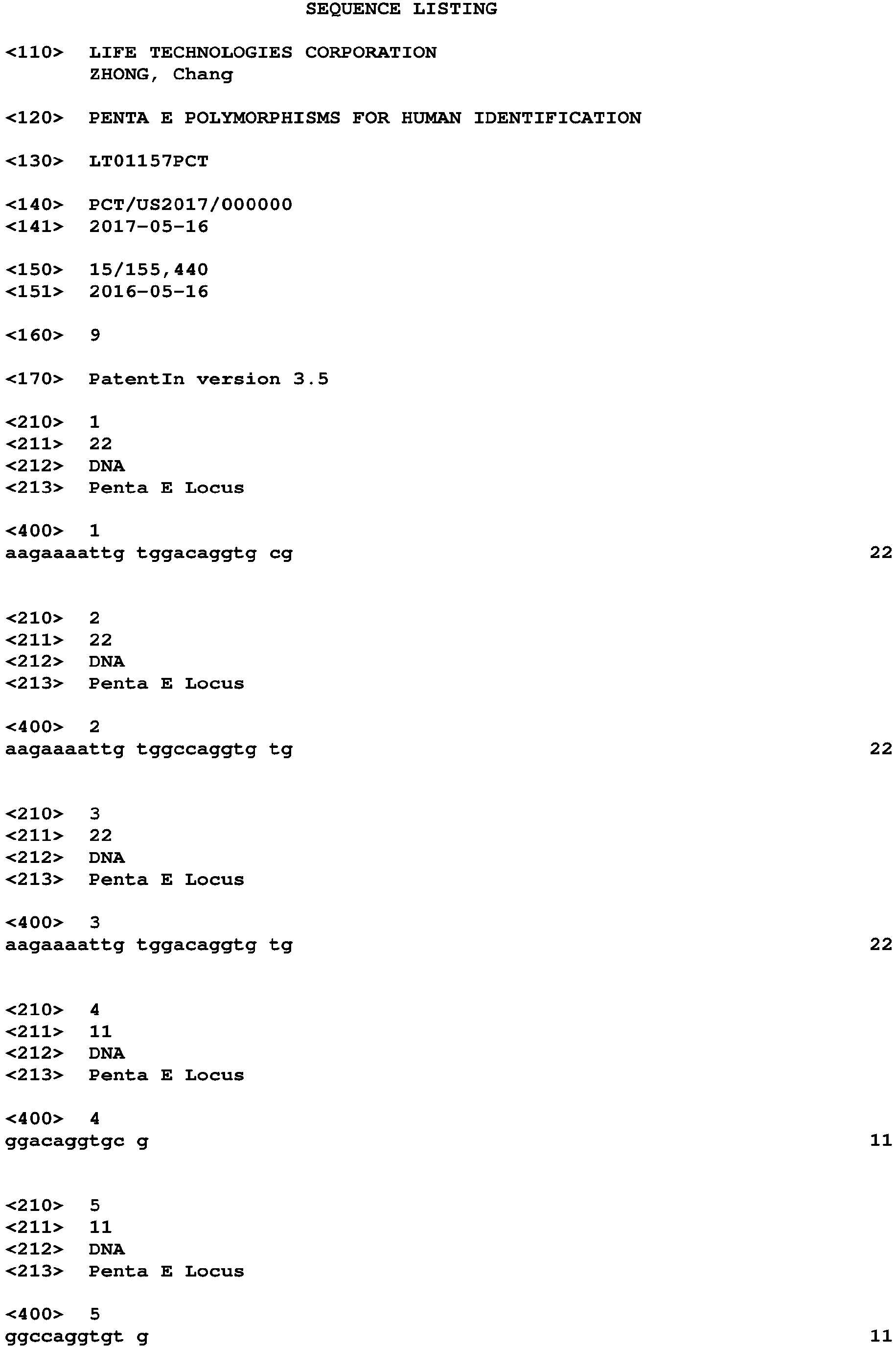


Claims (10)
- A method comprising:a. contacting a first primer to a sample to be analyzed;b. contacting a second primer to the sample;c. subjecting the nucleic acid sample, the first and the second primers to an amplification reaction, and thereby forming a amplification product, wherein the first primer, the second primer or both the first and second primers are labeled with a non-nucleic acid label, wherein the reaction product comprises an adenosine at position 14 from the 5' end of SEQ ID NO:1, a thymidine at position 21 from the 5' end of SEQ ID NO:2, or an adenine at position 14 and a thymidine at position 21 of SEQ ID NO:3.
- The method of Claim 1, further comprising separating the amplification product according to length, and thereby forming a separated amplification product.
- The method of Claim 2, further comprising comparing the amplification product to an allelic ladder and thereby determining the Penta E repeat number.
- The method of Claim 2, wherein the separating is by capillary gel electrophoresis.
- The method of Claim 1, wherein the non-nucleic label is a fluorophore.
- The method of Claim 1, wherein the sample is selected from the group comprising buccal cells, blood, blood on paper, buccal cells on paper, tissue, urine, saliva, vaginal cells, skin, a fingerprint on paper.
- A composition comprising a non-human polymerase, a human genomic DNA and a labeled amplified product, wherein the labeled amplified product encompasses SEQ ID NO:1, SEQ ID NO:2 or SEQ ID NO:3.
- A composition comprising a labeled amplified product encompassing SEQ ID NO:1, SEQ ID NO:2 or SEQ ID NO:3 and a sieving or non-sieving medium.
- The composition of Claim 8, further comprising a size standard.
- The composition of Claim 8, wherein the sieving medium is performance optimized polymer.
Applications Claiming Priority (3)
| Application Number | Priority Date | Filing Date | Title |
|---|---|---|---|
| US15/155,440 US10844441B2 (en) | 2016-05-16 | 2016-05-16 | Penta e polymorphisms for human identification |
| PCT/US2017/032939 WO2017201070A1 (en) | 2016-05-16 | 2017-05-16 | Penta e polymorphisms for human identification |
| EP17726777.0A EP3458603B1 (en) | 2016-05-16 | 2017-05-16 | Penta e polymorphisms for human identification |
Related Parent Applications (1)
| Application Number | Title | Priority Date | Filing Date |
|---|---|---|---|
| EP17726777.0A Division EP3458603B1 (en) | 2016-05-16 | 2017-05-16 | Penta e polymorphisms for human identification |
Publications (1)
| Publication Number | Publication Date |
|---|---|
| EP4039826A1 true EP4039826A1 (en) | 2022-08-10 |
Family
ID=58800929
Family Applications (2)
| Application Number | Title | Priority Date | Filing Date |
|---|---|---|---|
| EP17726777.0A Not-in-force EP3458603B1 (en) | 2016-05-16 | 2017-05-16 | Penta e polymorphisms for human identification |
| EP22157831.3A Withdrawn EP4039826A1 (en) | 2016-05-16 | 2017-05-16 | Penta e polymorphisms for human identification |
Family Applications Before (1)
| Application Number | Title | Priority Date | Filing Date |
|---|---|---|---|
| EP17726777.0A Not-in-force EP3458603B1 (en) | 2016-05-16 | 2017-05-16 | Penta e polymorphisms for human identification |
Country Status (4)
| Country | Link |
|---|---|
| US (2) | US10844441B2 (en) |
| EP (2) | EP3458603B1 (en) |
| CN (1) | CN109312397B (en) |
| WO (1) | WO2017201070A1 (en) |
Families Citing this family (1)
| Publication number | Priority date | Publication date | Assignee | Title |
|---|---|---|---|---|
| US10844441B2 (en) | 2016-05-16 | 2020-11-24 | Life Technologies Corporation | Penta e polymorphisms for human identification |
Citations (8)
| Publication number | Priority date | Publication date | Assignee | Title |
|---|---|---|---|---|
| WO1990010064A1 (en) | 1989-03-03 | 1990-09-07 | Genentech, Inc. | Improved methods for in vitro dna amplification and genomic cloning and mapping |
| WO1991003573A1 (en) | 1989-09-01 | 1991-03-21 | Boehringer Mannheim Gmbh | Process for the replication of nucleic acids |
| US5102784A (en) | 1990-05-04 | 1992-04-07 | Oncor, Inc. | Restriction amplification assay |
| EP0487218A1 (en) | 1990-10-31 | 1992-05-27 | Tosoh Corporation | Method for detecting or quantifying target nucleic acid |
| EP0512334A2 (en) | 1991-05-02 | 1992-11-11 | F. Hoffmann-La Roche Ag | Methods for detecting a target nucleic acid in a sample |
| WO2011070441A2 (en) * | 2009-12-11 | 2011-06-16 | Adam Wasserstrom | Categorization of dna samples |
| CN102286477A (en) * | 2011-07-12 | 2011-12-21 | 公安部物证鉴定中心 | Method for preparing short tandem repeat (STR) parting standard substances |
| US20120122093A1 (en) * | 2010-11-15 | 2012-05-17 | Life Technologies Corporation | Methods and kits for multiplex amplification of short tandem repeat loci |
Family Cites Families (7)
| Publication number | Priority date | Publication date | Assignee | Title |
|---|---|---|---|---|
| US20090123928A1 (en) * | 2007-10-11 | 2009-05-14 | The Johns Hopkins University | Genomic Landscapes of Human Breast and Colorectal Cancers |
| US9752187B2 (en) * | 2009-12-11 | 2017-09-05 | Nucleix | Categorization of DNA samples |
| WO2011101728A2 (en) * | 2010-02-19 | 2011-08-25 | Nucleix | Identification of source of dna samples |
| CN103173556B (en) * | 2013-04-07 | 2014-08-27 | 北京阅微基因技术有限公司 | Amplification composition and rapid detection kit used for trisomy 21 syndrome detection |
| US20160275240A1 (en) * | 2015-02-18 | 2016-09-22 | Nugen Technologies, Inc. | Methods and compositions for pooling amplification primers |
| AU2015246066B2 (en) * | 2015-10-20 | 2017-09-07 | New Frontier Brands Pty Ltd | St. augustine grass named tbll |
| US10844441B2 (en) | 2016-05-16 | 2020-11-24 | Life Technologies Corporation | Penta e polymorphisms for human identification |
-
2016
- 2016-05-16 US US15/155,440 patent/US10844441B2/en active Active
-
2017
- 2017-05-16 WO PCT/US2017/032939 patent/WO2017201070A1/en not_active Ceased
- 2017-05-16 EP EP17726777.0A patent/EP3458603B1/en not_active Not-in-force
- 2017-05-16 EP EP22157831.3A patent/EP4039826A1/en not_active Withdrawn
- 2017-05-16 CN CN201780029966.XA patent/CN109312397B/en active Active
-
2020
- 2020-11-16 US US17/099,621 patent/US11530455B2/en active Active
Patent Citations (8)
| Publication number | Priority date | Publication date | Assignee | Title |
|---|---|---|---|---|
| WO1990010064A1 (en) | 1989-03-03 | 1990-09-07 | Genentech, Inc. | Improved methods for in vitro dna amplification and genomic cloning and mapping |
| WO1991003573A1 (en) | 1989-09-01 | 1991-03-21 | Boehringer Mannheim Gmbh | Process for the replication of nucleic acids |
| US5102784A (en) | 1990-05-04 | 1992-04-07 | Oncor, Inc. | Restriction amplification assay |
| EP0487218A1 (en) | 1990-10-31 | 1992-05-27 | Tosoh Corporation | Method for detecting or quantifying target nucleic acid |
| EP0512334A2 (en) | 1991-05-02 | 1992-11-11 | F. Hoffmann-La Roche Ag | Methods for detecting a target nucleic acid in a sample |
| WO2011070441A2 (en) * | 2009-12-11 | 2011-06-16 | Adam Wasserstrom | Categorization of dna samples |
| US20120122093A1 (en) * | 2010-11-15 | 2012-05-17 | Life Technologies Corporation | Methods and kits for multiplex amplification of short tandem repeat loci |
| CN102286477A (en) * | 2011-07-12 | 2011-12-21 | 公安部物证鉴定中心 | Method for preparing short tandem repeat (STR) parting standard substances |
Non-Patent Citations (11)
| Title |
|---|
| CHRISTENSEN ET AL., SCAND. J. CLIN. LAB. INVEST., vol. 59, no. 3, 1999, pages 167 - 177 |
| DATABASE WPI Week 201228, Derwent World Patents Index; AN 2012-A51731, XP002772200 * |
| DE BELLIS ET AL., MINERVA BIOTEC, vol. 14, 2002, pages 247 - 52 |
| E. BUEL ET AL., J. FORENSIC SCI., vol. 43, no. 1, 1998, pages 164 - 170 |
| GERRY ET AL., J. MOL. BIOL., vol. 292, 1999, pages 251 - 62 |
| H. WENZ ET AL., GENOME RES, vol. 8, 1998, pages 69 - 80 |
| HIGUCHI ET AL., BIOTECHNOLOGY, vol. 10, 1992, pages 413 - 417 |
| HIGUCHI ET AL., BIOTECHNOLOGY, vol. 11, 1993, pages 1026 - 1030 |
| J. SAMBROOK ET AL.: "Molecular Cloning: A Laboratory Manual", 1989, COLD SPRING HARBOR LABORATORY PRESS, pages: 45 - 57 |
| PARK HYUNWOONG ET AL: "Detection of very large off-ladder alleles at the PentaE locus in a 15 locus autosomal STR database of 199 Korean individuals", FORENSIC SCIENCE INTERNATIONAL: GENETICS, vol. 6, no. 6, 26 June 2012 (2012-06-26), XP028945681, ISSN: 1872-4973, DOI: 10.1016/J.FSIGEN.2012.06.004 * |
| STEARS ET AL., NAT. MED., vol. 9, pages 140 - 45 |
Also Published As
| Publication number | Publication date |
|---|---|
| US10844441B2 (en) | 2020-11-24 |
| US20170327902A1 (en) | 2017-11-16 |
| US11530455B2 (en) | 2022-12-20 |
| EP3458603A1 (en) | 2019-03-27 |
| US20210130913A1 (en) | 2021-05-06 |
| EP3458603B1 (en) | 2022-02-23 |
| WO2017201070A1 (en) | 2017-11-23 |
| CN109312397B (en) | 2023-05-30 |
| CN109312397A (en) | 2019-02-05 |
Similar Documents
| Publication | Publication Date | Title |
|---|---|---|
| Thomas et al. | High throughput analysis of 10 microsatellite and 11 diallelic polymorphisms on the human Y-chromosome | |
| US8999644B2 (en) | Method for detecting the presence of a DNA minor contributor in a DNA mixture | |
| JP5509075B2 (en) | Nucleic acid amplification control detection method and use thereof | |
| EP1241266A1 (en) | Method of detecting nucleotide polymorphism | |
| US20120122093A1 (en) | Methods and kits for multiplex amplification of short tandem repeat loci | |
| CN1665938B (en) | Methods of detecting sequence differences | |
| EP2937423A1 (en) | Se33 mutations impacting genotype concordance | |
| EP1358355A2 (en) | New method for genotype determination | |
| EP3755811B1 (en) | Methods and kits for determining the efficiency of plasma separation from whole blood | |
| WO1995015400A1 (en) | Genotyping by simultaneous analysis of multiple microsatellite loci | |
| Sathyanarayana et al. | Laboratory approaches in molecular pathology: the polymerase chain reaction | |
| US9260757B2 (en) | Human single nucleotide polymorphisms | |
| US11530455B2 (en) | Penta E polymorphisms for human identification | |
| CN103966332B (en) | Primers for detecting CTG repetitive sequence and detection kit of primers | |
| EP2789693B1 (en) | Amelogenin SNP on chromosome X | |
| Blömeke et al. | Laboratory methods for the determination of genetic polymorphisms in humans | |
| US9382582B1 (en) | Methods, compositions and kits for enriching for a minor template amplification product in a mixed template amplification reaction | |
| Snowdon et al. | Mitochondrial DNA analysis of acellular laboratory samples | |
| JPH0630797A (en) | Method for analysis of genetic polymorphism | |
| Wu et al. | Diagnostic Methodology and Technology |
Legal Events
| Date | Code | Title | Description |
|---|---|---|---|
| PUAI | Public reference made under article 153(3) epc to a published international application that has entered the european phase |
Free format text: ORIGINAL CODE: 0009012 |
|
| STAA | Information on the status of an ep patent application or granted ep patent |
Free format text: STATUS: REQUEST FOR EXAMINATION WAS MADE |
|
| 17P | Request for examination filed |
Effective date: 20220221 |
|
| AC | Divisional application: reference to earlier application |
Ref document number: 3458603 Country of ref document: EP Kind code of ref document: P |
|
| AK | Designated contracting states |
Kind code of ref document: A1 Designated state(s): AL AT BE BG CH CY CZ DE DK EE ES FI FR GB GR HR HU IE IS IT LI LT LU LV MC MK MT NL NO PL PT RO RS SE SI SK SM TR |
|
| STAA | Information on the status of an ep patent application or granted ep patent |
Free format text: STATUS: THE APPLICATION IS DEEMED TO BE WITHDRAWN |
|
| 18D | Application deemed to be withdrawn |
Effective date: 20230211 |