EP4039671A1 - Manufacturing of unsaturated ketones using an adduct of a tertiary amine with so3 - Google Patents
Manufacturing of unsaturated ketones using an adduct of a tertiary amine with so3 Download PDFInfo
- Publication number
- EP4039671A1 EP4039671A1 EP21155686.5A EP21155686A EP4039671A1 EP 4039671 A1 EP4039671 A1 EP 4039671A1 EP 21155686 A EP21155686 A EP 21155686A EP 4039671 A1 EP4039671 A1 EP 4039671A1
- Authority
- EP
- European Patent Office
- Prior art keywords
- formula
- compound
- group
- methyl
- branched
- Prior art date
- Legal status (The legal status is an assumption and is not a legal conclusion. Google has not performed a legal analysis and makes no representation as to the accuracy of the status listed.)
- Pending
Links
Images

Classifications
-
- C—CHEMISTRY; METALLURGY
- C07—ORGANIC CHEMISTRY
- C07C—ACYCLIC OR CARBOCYCLIC COMPOUNDS
- C07C45/00—Preparation of compounds having >C = O groups bound only to carbon or hydrogen atoms; Preparation of chelates of such compounds
- C07C45/45—Preparation of compounds having >C = O groups bound only to carbon or hydrogen atoms; Preparation of chelates of such compounds by condensation
-
- B—PERFORMING OPERATIONS; TRANSPORTING
- B01—PHYSICAL OR CHEMICAL PROCESSES OR APPARATUS IN GENERAL
- B01J—CHEMICAL OR PHYSICAL PROCESSES, e.g. CATALYSIS OR COLLOID CHEMISTRY; THEIR RELEVANT APPARATUS
- B01J31/00—Catalysts comprising hydrides, coordination complexes or organic compounds
- B01J31/02—Catalysts comprising hydrides, coordination complexes or organic compounds containing organic compounds or metal hydrides
- B01J31/0234—Nitrogen-, phosphorus-, arsenic- or antimony-containing compounds
- B01J31/0235—Nitrogen containing compounds
- B01J31/0244—Nitrogen containing compounds with nitrogen contained as ring member in aromatic compounds or moieties, e.g. pyridine
-
- B—PERFORMING OPERATIONS; TRANSPORTING
- B01—PHYSICAL OR CHEMICAL PROCESSES OR APPARATUS IN GENERAL
- B01J—CHEMICAL OR PHYSICAL PROCESSES, e.g. CATALYSIS OR COLLOID CHEMISTRY; THEIR RELEVANT APPARATUS
- B01J31/00—Catalysts comprising hydrides, coordination complexes or organic compounds
- B01J31/02—Catalysts comprising hydrides, coordination complexes or organic compounds containing organic compounds or metal hydrides
- B01J31/0234—Nitrogen-, phosphorus-, arsenic- or antimony-containing compounds
- B01J31/0235—Nitrogen containing compounds
- B01J31/0237—Amines
-
- B—PERFORMING OPERATIONS; TRANSPORTING
- B01—PHYSICAL OR CHEMICAL PROCESSES OR APPARATUS IN GENERAL
- B01J—CHEMICAL OR PHYSICAL PROCESSES, e.g. CATALYSIS OR COLLOID CHEMISTRY; THEIR RELEVANT APPARATUS
- B01J31/00—Catalysts comprising hydrides, coordination complexes or organic compounds
- B01J31/02—Catalysts comprising hydrides, coordination complexes or organic compounds containing organic compounds or metal hydrides
- B01J31/0234—Nitrogen-, phosphorus-, arsenic- or antimony-containing compounds
- B01J31/0271—Nitrogen-, phosphorus-, arsenic- or antimony-containing compounds also containing elements or functional groups covered by B01J31/0201 - B01J31/0231
-
- C—CHEMISTRY; METALLURGY
- C07—ORGANIC CHEMISTRY
- C07C—ACYCLIC OR CARBOCYCLIC COMPOUNDS
- C07C45/00—Preparation of compounds having >C = O groups bound only to carbon or hydrogen atoms; Preparation of chelates of such compounds
-
- C—CHEMISTRY; METALLURGY
- C07—ORGANIC CHEMISTRY
- C07C—ACYCLIC OR CARBOCYCLIC COMPOUNDS
- C07C45/00—Preparation of compounds having >C = O groups bound only to carbon or hydrogen atoms; Preparation of chelates of such compounds
- C07C45/51—Preparation of compounds having >C = O groups bound only to carbon or hydrogen atoms; Preparation of chelates of such compounds by pyrolysis, rearrangement or decomposition
- C07C45/511—Preparation of compounds having >C = O groups bound only to carbon or hydrogen atoms; Preparation of chelates of such compounds by pyrolysis, rearrangement or decomposition involving transformation of singly bound oxygen functional groups to >C = O groups
- C07C45/513—Preparation of compounds having >C = O groups bound only to carbon or hydrogen atoms; Preparation of chelates of such compounds by pyrolysis, rearrangement or decomposition involving transformation of singly bound oxygen functional groups to >C = O groups the singly bound functional group being an etherified hydroxyl group
-
- C—CHEMISTRY; METALLURGY
- C07—ORGANIC CHEMISTRY
- C07C—ACYCLIC OR CARBOCYCLIC COMPOUNDS
- C07C45/00—Preparation of compounds having >C = O groups bound only to carbon or hydrogen atoms; Preparation of chelates of such compounds
- C07C45/51—Preparation of compounds having >C = O groups bound only to carbon or hydrogen atoms; Preparation of chelates of such compounds by pyrolysis, rearrangement or decomposition
- C07C45/511—Preparation of compounds having >C = O groups bound only to carbon or hydrogen atoms; Preparation of chelates of such compounds by pyrolysis, rearrangement or decomposition involving transformation of singly bound oxygen functional groups to >C = O groups
- C07C45/515—Preparation of compounds having >C = O groups bound only to carbon or hydrogen atoms; Preparation of chelates of such compounds by pyrolysis, rearrangement or decomposition involving transformation of singly bound oxygen functional groups to >C = O groups the singly bound functional group being an acetalised, ketalised hemi-acetalised, or hemi-ketalised hydroxyl group
-
- C—CHEMISTRY; METALLURGY
- C07—ORGANIC CHEMISTRY
- C07C—ACYCLIC OR CARBOCYCLIC COMPOUNDS
- C07C45/00—Preparation of compounds having >C = O groups bound only to carbon or hydrogen atoms; Preparation of chelates of such compounds
- C07C45/61—Preparation of compounds having >C = O groups bound only to carbon or hydrogen atoms; Preparation of chelates of such compounds by reactions not involving the formation of >C = O groups
- C07C45/67—Preparation of compounds having >C = O groups bound only to carbon or hydrogen atoms; Preparation of chelates of such compounds by reactions not involving the formation of >C = O groups by isomerisation; by change of size of the carbon skeleton
-
- C—CHEMISTRY; METALLURGY
- C07—ORGANIC CHEMISTRY
- C07C—ACYCLIC OR CARBOCYCLIC COMPOUNDS
- C07C49/00—Ketones; Ketenes; Dimeric ketenes; Ketonic chelates
- C07C49/20—Unsaturated compounds containing keto groups bound to acyclic carbon atoms
- C07C49/203—Unsaturated compounds containing keto groups bound to acyclic carbon atoms with only carbon-to-carbon double bonds as unsaturation
Definitions
- the present invention relates to the manufacturing of unsaturated ketones.
- Unsaturated ketones of the formula (I) are an important class of industrial chemicals and are central products in the synthesis of vitamins and aroma ingredients. particularly important.
- One of the possible synthetic routes uses tertiary propargyl carbinols respectively tertiary vinyl carbinols as starting products.
- US 6,380,437 discloses the condensation of a tertiary propargyl alcohol and a ketal or an alkenyl alkyl ether to form an allenic ketone in the presence of an aliphatic sulfonic acid or a metal salt thereof.
- WO 2010/046199 A2 discloses inorganic ammonium (NH 4 + ) salts as potential catalysts for this reaction.
- inorganic ammonium salts have typically a disadvantageous solubility and it been shown that the inorganic ammonium salts show lower yields and selectivities particularly when used at concentrations of less than 1 mol-%.
- the problem to be solved by the present invention is to offer a process of manufacturing of unsaturated ketones of the formula (I) in high yield under the absence of strong acids and corrosive conditions and.
- the present invention relates to a process for the manufacture of an unsaturated ketone of the formula (I) by reaction of a compound of the formula (IIa) or (IIb) with a compound of the formula (IIIa) or (IIIb) with a compound of the formula (IIIa) or (IIIb) in the presence of an adduct of a tertiary amine with SO 3 as catalyst; wherein
- C x-y -alkyl is an alkyl group comprising x to y carbon atoms, i.e., for example, a C 1-3 -alkyl group is an alkyl group comprising 1 to 3 carbon atoms.
- the alkyl group can be linear or branched. For example -CH(CH 3 )-CH 2 -CH 3 is considered as a C 4 -alkyl group.
- any dotted line in formulae represents the bond by which a substituent is bound to the rest of a molecule.
- tertiary amine relates in this document to a compound having at least one nitrogen atom which is bound to 3 carbon atoms. Said bonds can be to 3 different carbon atoms by aliphatic bonds or they may be olefinic or aromatic. In case of aromatic or olefinic bonds, two of the 3 bonds are to the same carbon atom.
- Any wavy line in any formula of in this document represents a carbon-carbon bond and which when linked to the carbon-carbon double bond is either in the Z or in the E-configuration. It is preferred in all molecules that the carbon-carbon double bond is in the E-configuration.
- the unsaturated ketone of the formula (I) encompasses two variants, i.e. the compound of the formula (I') and the compound of the formula (I") with Q being
- the compound of the general formula (I) is preferably selected from the group consisting of 6-methylhepta-4,5-dien-2-one, 6,10-dimethylundeca-4,5-dien-2-one, 6,10-dimethylundeca-4,5,9-trien-2-one, 6,10,14-trimethylpentadeca-4,5,9,13-tetraen-2-one, 6,10,14-trimethylpentadeca-4,5,9-trien-2-one, 6,10,14-trimethylpentadeca-4,5,13-trien-2-one and 6,10,14-trimethylpentadeca-4,5-dien-2-one.
- the compound of the general formula (I) is preferably selected from the group consisting of 6-methyl-5-hepten-2-one, 6-methyl-5-octen-2-one, 6,10-dimethyl-5,9-undecadien-2-one, 6,10-dimethyl-5-undecen-2-one, 6,10,14-trimethylpentadeca-5,9-dien-2-one, 6,10,14-trimethylpentadeca-5,13-dien-2-one and 6,10,14-trimethyl-5,9,13-pentadeca-trien-2-one, preferably 6-methyl-5-hepten-2-one.
- R 1 represents a methyl or ethyl group, preferably a methyl group.
- R 2 represents a saturated or unsaturated linear or branched or cyclic hydrocarbyl group with 1 to 46 C atoms, preferably a methyl group.
- R 2 represents a group which is selected from the group consisting of the formula (R2-I), (R2-II), (R2-III) and (R2-IV)
- the dotted line represents the bond by which the substituent of the formula (R2-I), (R2-II), (R2-III) or (R2-IV) is bound to the rest of the compound of the formula (I) or formula (IIa) or (IIb).
- Any double bond having dotted line (------) represents independently from each other either a single carbon-carbon bond or a double carbon-carbon bond.
- Any wavy line represents independently from each other a carbon-carbon bond which when linked to the carbon-carbon double bond is either in the Z or in the E-configuration.
- n 1, 2, 3 or 4, particularly 1 or 2.
- R 2 represents either a group of the formula (R2-I) or of the formula (R2-II).
- R 2 represents either a group of the formula (R2-III) or of the formula (R2-IV).
- the compounds of the formula (IIIa) are substances known to the person skilled in the art.
- R 3 represents a methyl or an ethyl group and R 4 represents H or methyl or an ethyl group and R 5 represents R 5 represents a linear or branched C 1-10 -alkyl group, particularly a methyl or an ethyl group.
- the group R 3 represents a methyl group.
- the group R 4 represents H.
- the group R 5 represents a methyl group.
- the compound of the formula (IIIa) is most preferably either isopropenyl methyl ether ( “IPM” ) or isopropenyl ethyl ether (“ IPE “), particularly isopropenyl methyl ether ( “IPM” ).
- the compounds of the formula (IIIb) are substances known to the person skilled in the art.
- R 3 represents a methyl or an ethyl group and R 4 represents H or methyl or an ethyl group.
- R 5' and R 5" represent in one embodiment each either a linear or branched C 1-10 -alkyl group, particularly a methyl or an ethyl group. In another embodiment, R 5' and R 5" form together a linear or branched C 1-10 -alkylene group, particularly an ethylene or propylene group.
- the group R 3 represents a methyl group.
- the group R 4 represents H.
- R 5' and R 5" form together an ethylene (CH 2 CH 2 ) or propylene (CH 2 CH 2 CH 2 or CH(CH 3 )CH 2 ) group.
- the compound of the formula (IIIb) is most preferably either 2,2-dimethoxypropane or 2,2-diethoxypropane or 2,2-dimethyl-1,3-dioxolane or 2,2,4-trimethyl-1,3-dioxolane or 2,2-dimethyl-1,3-dioxane.
- the compound of the formula (IIIb) is most preferably either 2,2-dimethoxypropane or 2,2-diethoxypropane, particularly 2,2-dimethoxypropane.
- reaction of a compound of the formula (IIa) or (IIb) with a compound of the formula (IIIa) or (IIIb) is performed in the presence of an adduct of a tertiary amine with SO 3 as catalyst.
- any tertiary amine which does not have apart from the tertiary amine any further SO 3 reactive group in its structure, is suitable as tertiary amine for the formation of an adduct with SO 3 .
- tertiary amines which have a molecular structure that sterically hinders the accessibility of the nitrogen electron lone pair to the SO 3 molecule are less suitable.
- Adducts of tertiary amines are known to the person skilled in the art, and can be easily prepared from the tertiary amine and SO 3 , as used in T.T. Tidwell, Synthesis (Germany), 1990, 1990(10):857-870 .
- tertiary amine for the SO 3 -adduct are in one embodiment pyridinic compounds of the formula (V) wherein R 30 , R 31 , R 32 , R 33 and R 34 represent independently from each other either H or a linear or branched C 1-12 -alkyl or C 5-12 -cycloalkyl group.
- one of the groups of R 30 , R 31 , R 32 , R 33 and R 34 is a methyl group.
- R 34 represents a methyl group or H, preferably H.
- tertiary amines of the formula (V) are pyridine or ⁇ -picoline or ⁇ -picoline or ⁇ -picoline. The most preferred is pyridine.
- the adduct of a tertiary amine with SO 3 is
- tertiary amine for the SO 3 -adduct are in another embodiment trialkyl amines.
- Particularly suitable as trialkyl amines are amines having in alpha position to the nitrogen a CH 2 group, preferably triethyl amine.
- the adduct of a tertiary amine with SO 3 is
- DBU 1,8-diazabicyclo[5.4.0]undec-7-ene
- DBN 1,5-diazabicyclo[4.3.0]non-5-ene
- DABCO 1,4-diazabicyclo[2.
- reaction is preferably performed when the molar ratio of the compound of the formula (IIa) or (IIb) to the compound of the formula (IIIa) or (IIIb) is ranging from 1:15 to 1:1.
- said ratio is more preferred in the range from 1:5 to 1:2, more preferably ranging from 1:3.5 to 1:2, most preferably ranging from 1:3 to 1:2, particularly ranging from 1:2.5 to 1:2.
- said ratio is more preferred in the range from 1:10 to 1:2, more preferably ranging from 1:8 to 1:3, most preferably ranging from 1:8 to 1:5.
- the amount the catalyst i.e. the adduct of a tertiary amine with SO 3 , is ranging from 0.005 - 1 mol-%, preferably ranging from 0.01 - 0.6 mol-%, more preferably ranging from 0.005 - 0.6 mol-%, most preferably ranging from 0.01 - 0.15 mol-%. based on the amount of the compound of the formula (IIa) respectively (IIb).
- the reaction is preferably carried out at a temperature ranging from 70 to 170°C.
- the temperature is preferably ranging from 110 to 160°C, most preferably at a temperature ranging from 115 to 150°C. This temperature range is particularly suitable for isopropenyl methyl ether as compound of the formula (IIIa).
- the temperature is preferably ranging from 75 to 100°C, most preferably at a temperature ranging from 80 to 95°C. This temperature range is particularly suitable for butenyl methyl ether as compound of the formula (IIIa).
- the reaction is preferably carried out at a pressure ranging from 5 to 20 bar, more preferably at a pressure ranging from 6 to 15 bar.
- the reaction is in one embodiment preferably carried out at a pressure ranging from 5 to 20 bara, more preferably at a pressure ranging from 6 to 15 bara.
- This pressure range is particularly suitable for isopropenyl methyl ether as compound of the formula (IIIa).
- reaction is in another embodiment preferably carried out at ambient pressure (1 bara). This pressure is particularly suitable for butenyl methyl ether as compound of the formula (IIIa).
- the reaction can be carried out without solvent or in the presence of an organic solvent. Preferably the reaction is carried out without solvent.
- the starting materials, the compounds of the formula (IIa) or (IIb) or (IIIa) or (IIIb), may still be provided in an organic solvent.
- polar aprotic organic solvents such as aliphatic ketones as e.g. acetone are preferred.
- the compound of the formula (I) being selected from the group consisting of 6-methylhepta-4,5-dien-2-one, 6,10-dimethylundeca-4,5-dien-2-one, 6,10-dimethylundeca-4,5,9-trien-2-one, 6,10,14-trimethylpentadeca-4,5,9,13-tetraen-2-one, 6,10,14-trimethylpentadeca-4,5,9-trien-2-one, 6,10,14-trimethylpentadeca-4,5,13-trien-2-one and 6,10,14-trimethylpentadeca-4,5-dien-2-one can be preferably produced.
- reaction mixture itself, with or without an organic solvent, is also an object of the present invention.
- the present invention relates in a further aspect to a reaction mixture comprising
- the compound of the formula (I') can be isomerized in the presence of a base or an acid, preferable a base, to a diene ketone of the formula (IV)
- the present invention relates in a further aspect to a process for the manufacture of a diene ketone of the formula (IV) comprising the steps
- the base used in the isomerization step i.e. step b) is preferably hydroxide or carbonate or hydrogen carbonate, preferably a hydroxide, of an alkali or earth alkali metal, particularly KOH or NaOH.
- the base is a basic ion exchange resin, preferably the basic anion exchange resins Amberlite ® IRA 900, Dowex ® MSA-1, Diaion ® HPA25 or PA308 as well as Amberlysts ® A260H, XE-4, XE-8, XE-8 new and XE-10 from DOW and equivalent resins with same chemical structure and similar physico-chemical properties.
- basic anion exchange resins Amberlite ® IRA 900, Dowex ® MSA-1, Diaion ® HPA25 or PA308 as well as Amberlysts ® A260H, XE-4, XE-8, XE-8 new and XE-10 from DOW and equivalent resins with same chemical structure and similar physico-chemical properties.
- the temperature in this isomerization step is preferably below 30°C, particularly between -10°C and 25°C, preferably in the range of 0°C to 10°C.
- Said isomerization step is preferably performed in a C 1-6 -alcohol, particularly in methanol, or in aqueous media.
- reaction mixture comprising
- the present invention is further illustrated by the following experiments.
- EDLL 3,7-dimethylnon-6-en-1-yn-3-ol
- IPM isopropenyl methyl ether
- THDO 7,11,15-trimethylhexadeca-5,6-dien-3-one
- TMPDO 3,6,10,14-tetramethyl-pentadeca-4,5-dien-2-one
- Table 6 Formation of 7,11,15-trimethylhexadeca-5,6-dien-3-one (TMHDO) and 3,6,10,14-tetramethylpentadeca-4,5-dien-2-one (TMPDO) from 3,7,11-trimethyldodec-1-yn-3-ol and butenyl methyl ether using different catalysts and pressure of 1 bara.
Landscapes
- Chemical & Material Sciences (AREA)
- Organic Chemistry (AREA)
- Chemical Kinetics & Catalysis (AREA)
- Engineering & Computer Science (AREA)
- Materials Engineering (AREA)
- Organic Low-Molecular-Weight Compounds And Preparation Thereof (AREA)
- Catalysts (AREA)
- Low-Molecular Organic Synthesis Reactions Using Catalysts (AREA)
- Pyridine Compounds (AREA)
Abstract
The present invention relates to a process of manufacturing of an unsaturated ketone of the formula (I) using adducts of tertiary amines and SO<sub>3</sub> The reaction provides the unsaturated ketones in high yields and selectivities.
Description
- The present invention relates to the manufacturing of unsaturated ketones.
- Unsaturated ketones of the formula (I) are an important class of industrial chemicals and are central products in the synthesis of vitamins and aroma ingredients. particularly important. One of the possible synthetic routes uses tertiary propargyl carbinols respectively tertiary vinyl carbinols as starting products.
-
US 3,029,287 and G. Saucy et al. disclose in Helv. Chim. Acta 1967, 50(4), 1158-1167 discloses the condensation of a tertiary propargyl alcohol and a ketal or an enol ether to form an allenic ketone in the presence of strong acids, particularly sulfuric acid or phosphoric acid or p-toluenesulfonic acid. -
US 6,380,437 discloses the condensation of a tertiary propargyl alcohol and a ketal or an alkenyl alkyl ether to form an allenic ketone in the presence of an aliphatic sulfonic acid or a metal salt thereof. -
US 3,330,867 andWO 2017/131607 disclose that an allene ketone can be isomerized to a unsaturated ketone with hydrogen. - The use of strong acid in the preparation of allene ketones is disadvantageous as these chemicals are hazardous in the handling and use special protection methods and require specific and corrosion-resistant materials for the equipment used in the manufacturing process.
- G. Saucy et al. disclose in Helv. Chim. Acta 1967, 50, 2091-2095 and Helv. Chim. Acta 1967, 50, 2095-2100 that phosphoric acid or sulfuric acid or p-toluene sulfonic acid can be used as catalyst for the reaction between tertiary vinyl carbinols and isopropenyl ethers.
-
DE 196 49 564 discloses that for this reaction diverse organophosphorous compounds can be used as catalysts. -
WO 2010/046199 A2 discloses inorganic ammonium (NH4 +) salts as potential catalysts for this reaction. - However, inorganic ammonium salts have typically a disadvantageous solubility and it been shown that the inorganic ammonium salts show lower yields and selectivities particularly when used at concentrations of less than 1 mol-%.
- Therefore, the problem to be solved by the present invention is to offer a process of manufacturing of unsaturated ketones of the formula (I) in high yield under the absence of strong acids and corrosive conditions and.
- Surprisingly, it has been found that a process according to the claim 1 and the reaction mixture according to claims 13 and 14 are able to solve this problem.
- It has been found that adducts of tertiary amines and SO3 are particularly well suited as catalyst for said reaction.
- Further aspects of the invention are subject of further independent claims. Particularly preferred embodiments are subject of dependent claims.
- In a first aspect, the present invention relates to a process for the manufacture of an unsaturated ketone of the formula (I)

a compound of the formula (IIa) or (IIb) with a compound of the formula (IIIa) or (IIIb)

- Q represents a group of the formula

- R1 represents a methyl or ethyl group;
- R2 represents a saturated or unsaturated linear or branched or cyclic hydrocarbyl group with 1 to 46 C atoms;
- R3 represents a methyl or an ethyl group;
- R4 represents H or methyl or an ethyl group;
- R5 represents a linear or branched C1-10-alkyl group, particularly a methyl or an ethyl group;
- R5' and R5" represent
- either a linear or branched C1-10-alkyl group, particularly a methyl or an ethyl group;
- or R5' and R5" form together a linear or branched C1-10-alkylene group, particularly an ethylene or propylene group;
- wherein the tertiary amine of said adduct is
either
pyridine
or
a tertiary amine of the formula (X)
and - wherein the wavy line represents a carbon-carbon bond and which when linked to the carbon-carbon double bond is either in the Z or in the E-configuration;
- and any dotted line represents the bond by which the substituent Q is bound to the rest of the compound of the formula (I).
- For sake of clarity, some terms used in the present document are defined as follows:
In the present document, a "Cx-y-alkyl" group is an alkyl group comprising x to y carbon atoms, i.e., for example, a C1-3-alkyl group is an alkyl group comprising 1 to 3 carbon atoms. The alkyl group can be linear or branched. For example -CH(CH3)-CH2-CH3 is considered as a C4-alkyl group. - In case identical labels for symbols or groups are present in several formulae, in the present document, the definition of said group or symbol made in the context of one specific formula applies also to other formulae which comprises the same said label.
- The term "independently from each other" in this document means, in the context of substituents, moieties, or groups, that identically designated substituents, moieties, or groups can occur simultaneously with a different meaning in the same molecule.
- In the present document, any dotted line in formulae represents the bond by which a substituent is bound to the rest of a molecule.
- The term "tertiary amine" relates in this document to a compound having at least one nitrogen atom which is bound to 3 carbon atoms. Said bonds can be to 3 different carbon atoms by aliphatic bonds or they may be olefinic or aromatic. In case of aromatic or olefinic bonds, two of the 3 bonds are to the same carbon atom. Hence, triethyl amine, 1,8-diazabicyclo[5.4.0]undec-7-ene (=DBU) and pyridine are, hence , all example for tertiary amines in the sense of the present invention.
- Any wavy line in any formula of in this document represents a carbon-carbon bond and which when linked to the carbon-carbon double bond is either in the Z or in the E-configuration. It is preferred in all molecules that the carbon-carbon double bond is in the E-configuration.
- The unsaturated ketone of the formula (I) encompasses two variants, i.e. the compound of the formula (I') and the compound of the formula (I")


- The compound of the formula (I') is prepared by reaction of the compound of the formula (IIa) and a compound of the formula (IIIa) or of the formula (IIIb), preferably of the formula (IIIa), in the presence of an adduct of a tertiary amine with SO3 as catalyst (=" Cat ") as discussed later-on in great detail:

- According to this embodiment, the compound of the general formula (I) is preferably selected from the group consisting of 6-methylhepta-4,5-dien-2-one, 6,10-dimethylundeca-4,5-dien-2-one, 6,10-dimethylundeca-4,5,9-trien-2-one, 6,10,14-trimethylpentadeca-4,5,9,13-tetraen-2-one, 6,10,14-trimethylpentadeca-4,5,9-trien-2-one, 6,10,14-trimethylpentadeca-4,5,13-trien-2-one and 6,10,14-trimethylpentadeca-4,5-dien-2-one.
- The compound of the formula (I") is prepared by reaction of a compound of the formula (IIb) and a compound of the formula (IIIa) or of the formula (IIIb), preferably of the formula (IIIa), in the presence of an adduct of a tertiary amine with SO3 as catalyst (=" Cat ") as discussed later-on in great detail:

- According to this embodiment, the compound of the general formula (I) is preferably selected from the group consisting of 6-methyl-5-hepten-2-one, 6-methyl-5-octen-2-one, 6,10-dimethyl-5,9-undecadien-2-one, 6,10-dimethyl-5-undecen-2-one, 6,10,14-trimethylpentadeca-5,9-dien-2-one, 6,10,14-trimethylpentadeca-5,13-dien-2-one and 6,10,14-trimethyl-5,9,13-pentadeca-trien-2-one, preferably 6-methyl-5-hepten-2-one.
- The compounds of the formula (IIa) and (IIb) are substances known to the person skilled in the art.
- R1 represents a methyl or ethyl group, preferably a methyl group.
- R2 represents a saturated or unsaturated linear or branched or cyclic hydrocarbyl group with 1 to 46 C atoms, preferably a methyl group.
- In a preferred embodiment, R2 represents a group which is selected from the group consisting of the formula (R2-I), (R2-II), (R2-III) and (R2-IV)


- The dotted line represents the bond by which the substituent of the formula (R2-I), (R2-II), (R2-III) or (R2-IV) is bound to the rest of the compound of the formula (I) or formula (IIa) or (IIb). Any double bond having dotted line (------) represents independently from each other either a single carbon-carbon bond or a double carbon-carbon bond. Any wavy line represents independently from each other a carbon-carbon bond which when linked to the carbon-carbon double bond is either in the Z or in the E-configuration.
- In the above formulae n represents 1, 2, 3 or 4, particularly 1 or 2.
- In one of the preferred embodiments, R2 represents either a group of the formula (R2-I) or of the formula (R2-II).
- In another preferred embodiment, R2 represents either a group of the formula (R2-III) or of the formula (R2-IV).
- It is preferred that compound of the formula (IIa) is selected from the group consisting of 2-methylbut-3-yn-2-ol (=methylbutynol, "MBY"), 3-methylpent-1-yn-3-ol (=ethylbutynol, "EBY"), 3,5-dimethylhex-1-yn-3-ol, 3,7-dimethyloct-6-en-1-yn-3-ol (= dehydrolinalool, "DLL"), 3,7-dimethyloct-1-yn-3-ol, 3,7-dimethylnon-6-en-1-yn-3-ol (= ethyldehydrolinalool, "EDLL"), 3,7,11-trimethyldodec-1-yn-3-ol, 3,7,11-trimethyldodec-6-en-1-yn-3-ol, 3,7,11-trimethyldodeca-6,10-dien-1-yn-3-ol (= dehydronerolidol, "DNL"), 3,7,11-trimethyldodeca-4,6,10-trien-1-yn-3-ol (= ethinylpseudoionol, "EPI"), 3-methyl-5-(2, 6, 6-trimethylcyclohex-1-en-1-yl)pent-1-yn-3-ol and 3-methyl-1-(2,6,6-trimethylcyclohex-1-en-1-yl)pent-1-en-4-yn-3-ol.
- It is particularly preferred that compound of the formula (IIa) is selected from the group consisting of 2-methylbut-3-yn-2-ol (=methylbutynol, "MBY"), 3-methylpent-1-yn-3-ol (=ethylbutynol, "EBY"), 3,7-dimethyloct-6-en-1-yn-3-ol (= dehydrolinalool, "DLL"), 3,7-dimethylnon-6-en-1-yn-3-ol (= ethyldehydrolinalool, "EDLL") ,3,7,11-trimethyldodeca-6,10-dien-1-yn-3-ol (= dehydronerolidol, "DNL") and 3,7,11-trimethyldodec-1-yn-3-ol.
- It is even more preferred that the compound of the formula (IIa) is selected from the group consisting of 3,7-dimethyloct-6-en-1-yn-3-ol (= dehydrolinalool, "DLL"), 3,7-dimethylnon-6-en-1-yn-3-ol (= ethyldehydrolinalool, "EDLL") and 3,7,11-trimethyldodec-1-yn-3-ol.
- It is particular preferred that compound of the formula (IIb) is selected from the group consisting of 2-methyl-3-buten-2-ol ("MBE"), 3-methyl-4-penten-3-ol ("EBE"), 3,7-dimethyl-1,6-octadien-3-ol (= linalool, "LL"), 3,7-dimethyl-1-octen-3-ol ("DMOE") and 3,7,11-trimethyl-1,6-dodecadien-3-ol (nerolidol, "NL"), particularly (6E)-3,7,11-trimethyl-1,6-dodecadien-3-ol (= E-nerolidol, "E-NL").
- It is even more preferred that compound of the formula (IIb) is selected from the group consisting of 2-methyl-3-buten-2-ol ("MBE"), 3,7-dimethyl-1,6-octadien-3-ol (= linalool, "LL"), 3,7-dimethyl-1-octen-3-ol ("DMOE") and 3,7,11-trimethyl-1,6-dodecadien-3-ol (nerolidol, "NL"), particularly (6E)-3,7,11-trimethyl-1,6-dodecadien-3-ol (= E-nerolidol, "E-NL").
- It is even more preferred that the compound of the formula (IIb) is 2-methyl-3-buten-2-ol ("MBE") or 3,7-dimethyl-1,6-octadien-3-ol (= linalool, "LL").
- The compounds of the formula (IIIa) are substances known to the person skilled in the art.
- In formula (IIIa) R3 represents a methyl or an ethyl group and R4 represents H or methyl or an ethyl group and R5 represents R5 represents a linear or branched C1-10-alkyl group, particularly a methyl or an ethyl group.
- Preferably, the group R3 represents a methyl group.
- Preferably, the group R4 represents H.
- Preferably, the group R5 represents a methyl group.
- The compound of the formula (IIIa) is most preferably either isopropenyl methyl ether ("IPM") or isopropenyl ethyl ether ("IPE"), particularly isopropenyl methyl ether ("IPM").
- Due to the synthesis of compound of the formula (IIIa), very often also mixtures of compounds of the formula (IIIa) are used for the reaction with compound of the formula (IIa) or (IIb). For example, for butenyl methyl ether, often a mixture of 2-methoxybut-1-ene and (E)-2-methoxybut-2-ene and (Z)-2-methoxy-but-2-ene being prepared from methanol and methyl ethyl ketone, is used.
- The compounds of the formula (IIIb) are substances known to the person skilled in the art.
- In formula (IIIb) R3 represents a methyl or an ethyl group and R4 represents H or methyl or an ethyl group.
- R5' and R5" represent in one embodiment each either a linear or branched C1-10-alkyl group, particularly a methyl or an ethyl group. In another embodiment, R5' and R5" form together a linear or branched C1-10-alkylene group, particularly an ethylene or propylene group.
- Preferably, the group R3 represents a methyl group.
- Preferably, the group R4 represents H.
- In one preferred embodiment, R5' = R5" and particularly R5' = R5" = methyl or ethyl, more preferably R5' = R5" = CH3.
- In another preferred embodiment, R5' and R5" form together an ethylene (CH2CH2) or propylene (CH2CH2CH2 or CH(CH3)CH2) group.
- The compound of the formula (IIIb) is most preferably either 2,2-dimethoxypropane or 2,2-diethoxypropane or 2,2-dimethyl-1,3-dioxolane or 2,2,4-trimethyl-1,3-dioxolane or 2,2-dimethyl-1,3-dioxane.
- The compound of the formula (IIIb) is most preferably either 2,2-dimethoxypropane or 2,2-diethoxypropane, particularly 2,2-dimethoxypropane.
- The use of the compound of formula (IIIa) is preferred over the compound of the formula (IIIb).
- The reaction of a compound of the formula (IIa) or (IIb) with a compound of the formula (IIIa) or (IIIb) is performed in the presence of an adduct of a tertiary amine with SO3 as catalyst.
- Principally, any tertiary amine, which does not have apart from the tertiary amine any further SO3 reactive group in its structure, is suitable as tertiary amine for the formation of an adduct with SO3. Of course, tertiary amines, which have a molecular structure that sterically hinders the accessibility of the nitrogen electron lone pair to the SO3 molecule are less suitable.
- Adducts of tertiary amines are known to the person skilled in the art, and can be easily prepared from the tertiary amine and SO3, as used in T.T. Tidwell, Synthesis (Germany), 1990, 1990(10):857-870.
- Particularly suitable as tertiary amine for the SO3-adduct are in one embodiment pyridinic compounds of the formula (V)

- It is preferred that R30=R31=R32=R33, preferably R30=R31=R32=R33=H.
- It is further preferred that one of the groups of R30, R31, R32, R33 and R34 is a methyl group.
- It is also preferred that R34 represents a methyl group or H, preferably H.
- Most preferred as tertiary amines of the formula (V) are pyridine or α-picoline or β-picoline or γ-picoline. The most preferred is pyridine.
- Hence, in one of the preferred embodiment the adduct of a tertiary amine with SO3 is

- Particularly suitable as tertiary amine for the SO3-adduct are in another embodiment trialkyl amines. Particularly suitable as trialkyl amines are amines having in alpha position to the nitrogen a CH2 group, preferably triethyl amine.
- Hence, in another preferred embodiment the adduct of a tertiary amine with SO3 is

- Further particularly suitable as tertiary amines are bridged tertiary amines, particularly the bridged tertiary amines selected from the group consisting of 1,8-diazabicyclo[5.4.0]undec-7-ene (=DBU), 1,5-diazabicyclo[4.3.0]non-5-ene (=DBN), 1,4-diazabicyclo[2.2.2]octane (=DABCO), 1-azabicyclo[2.2.2]octane (=quinuclidine) and sparteine, particularly 1,4-diazabicyclo[2.2.2]octane (=DABCO) or 1-azabicyclo[2.2.2]octane (=quinuclidine).
- It has been found that the reaction is preferably performed when the molar ratio of the compound of the formula (IIa) or (IIb) to the compound of the formula (IIIa) or (IIIb) is ranging from 1:15 to 1:1.
- In case of using the compound of the formula (IIIa), said ratio is more preferred in the range from 1:5 to 1:2, more preferably ranging from 1:3.5 to 1:2, most preferably ranging from 1:3 to 1:2, particularly ranging from 1:2.5 to 1:2.
- In case of use of the compound of the formula (IIIb) said ratio is more preferred in the range from 1:10 to 1:2, more preferably ranging from 1:8 to 1:3, most preferably ranging from 1:8 to 1:5.
- Furthermore, it is preferred that the amount the catalyst, i.e. the adduct of a tertiary amine with SO3, is ranging from 0.005 - 1 mol-%, preferably ranging from 0.01 - 0.6 mol-%, more preferably ranging from 0.005 - 0.6 mol-%, most preferably ranging from 0.01 - 0.15 mol-%. based on the amount of the compound of the formula (IIa) respectively (IIb).
- The reaction is preferably carried out at a temperature ranging from 70 to 170°C. In one embodiment, the temperature is preferably ranging from 110 to 160°C, most preferably at a temperature ranging from 115 to 150°C. This temperature range is particularly suitable for isopropenyl methyl ether as compound of the formula (IIIa).
- In another embodiment, the temperature is preferably ranging from 75 to 100°C, most preferably at a temperature ranging from 80 to 95°C. This temperature range is particularly suitable for butenyl methyl ether as compound of the formula (IIIa).
- The reaction is preferably carried out at a pressure ranging from 5 to 20 bar, more preferably at a pressure ranging from 6 to 15 bar.
- The reaction is in one embodiment preferably carried out at a pressure ranging from 5 to 20 bara, more preferably at a pressure ranging from 6 to 15 bara. This pressure range is particularly suitable for isopropenyl methyl ether as compound of the formula (IIIa).
- The reaction is in another embodiment preferably carried out at ambient pressure (1 bara). This pressure is particularly suitable for butenyl methyl ether as compound of the formula (IIIa).
- The reaction can be carried out without solvent or in the presence of an organic solvent. Preferably the reaction is carried out without solvent.
- Even if the reaction is carried out in the absence of an organic solvent, the starting materials, the compounds of the formula (IIa) or (IIb) or (IIIa) or (IIIb), may still be provided in an organic solvent. Thus, there may be an amount of organic solvent up to 10 weight-%, preferably an amount of organic solvent up to 5 weight-%, more preferably an amount of organic solvent up to 3 weight-%, based on the total weight of the reaction mixture.
- If the reaction is carried out in an organic solvent, polar aprotic organic solvents such as aliphatic ketones as e.g. acetone are preferred.
- It has been found that the above reaction provides the compound of the formula (I) in high conversion, yield and selectivity.
- It has been found that particularly the compound of the formula (I) being selected from the group consisting of 6-methylhepta-4,5-dien-2-one, 6,10-dimethylundeca-4,5-dien-2-one, 6,10-dimethylundeca-4,5,9-trien-2-one, 6,10,14-trimethylpentadeca-4,5,9,13-tetraen-2-one, 6,10,14-trimethylpentadeca-4,5,9-trien-2-one, 6,10,14-trimethylpentadeca-4,5,13-trien-2-one and 6,10,14-trimethylpentadeca-4,5-dien-2-one can be preferably produced.
- The reaction mixture itself, with or without an organic solvent, is also an object of the present invention.
- Thus, the present invention relates in a further aspect to a reaction mixture comprising
- i) a compound of the formula (IIa),

- ii) a compound of the formula (IIIa) or (IIIb)

- iii) an adduct of a tertiary amine with SO3 as catalyst,
- R1 represents a methyl or ethyl group;
- R2 represents a saturated or unsaturated linear or branched or cyclic hydrocarbyl group with 1 to 46 C atoms;
- R3 represents a methyl or an ethyl group;
- R4 represents H or methyl or an ethyl group;
- R5 represents a linear or branched C1-10-alkyl group, particularly a methyl or an ethyl group;
- R5' and R5" represent
- either a linear or branched C1-10-alkyl group, particularly a methyl or an ethyl group;
- or R5' and R5" form together a linear or branched C1-10-alkylene group, particularly an ethylene or propylene group.
- The compound of the formula (IIa) and of the formula (IIIa) or (IIIb) as well as the catalyst have been discussed to a great extend already above.
- This reaction mixture results in the formation of the compound of the formula (I'). The compound of the formula (I') can be isomerized in the presence of a base or an acid, preferable a base, to a diene ketone of the formula (IV)

- Thus, the present invention relates in a further aspect to a process for the manufacture of a diene ketone of the formula (IV)

- a) preparing a compound of the formula (I') as discussed above already in great detail;
followed by - b) isomerization of compound of the formula (I') in the presence of a base or an acid, preferable a base, to yield the diene ketone of the formula (IV).
- The isomerization of the compound of the formula (I') to the compound of the formula (IV) are principally known to the person skilled in the art, e.g. from
US 3,330,867 andWO 2017/131607 , the entire content both of which is hereby incorporated by reference. - The base used in the isomerization step, i.e. step b) is preferably hydroxide or carbonate or hydrogen carbonate, preferably a hydroxide, of an alkali or earth alkali metal, particularly KOH or NaOH.
- In another preferred embodiment, the base is a basic ion exchange resin, preferably the basic anion exchange resins Amberlite® IRA 900, Dowex® MSA-1, Diaion ® HPA25 or PA308 as well as Amberlysts® A260H, XE-4, XE-8, XE-8 new and XE-10 from DOW and equivalent resins with same chemical structure and similar physico-chemical properties.
- The temperature in this isomerization step is preferably below 30°C, particularly between -10°C and 25°C, preferably in the range of 0°C to 10°C.
- Said isomerization step is preferably performed in a C1-6-alcohol, particularly in methanol, or in aqueous media.
- In a further aspect, the present invention relates also to reaction mixture comprising
- α) a compound of the formula (IIb),

- β) a compound of the formula (IIIa) or (IIIb)

- γ) an adduct of a tertiary amine with SO3 as catalyst,
- a pyridinic compound of the formula (V)

or - a tertiary amine of the formula (X)

wherein- R1 represents a methyl or ethyl group;
- R2 represents a saturated or unsaturated linear or branched or cyclic hydrocarbyl group with 1 to 46 C atoms;
- R3 represents a methyl or an ethyl group;
- R4 represents H or methyl or an ethyl group;
- R5 represents a linear or branched C1-10-alkyl group, particularly a methyl or an ethyl group;
- R5' and R5" represent
- either a linear or branched C1-10-alkyl group, particularly a methyl or an ethyl group;
- or R5' and R5" form together a linear or branched C1-10-alkylene group, particularly an ethylene or propylene group.
- The compound of the formula (IIb) and of the formula (IIIa) or (IIIb) as well as the catalyst have been discussed to a great extend already above.
- This reaction mixture results in the formation of the compound of the formula (I").
- Said above processes allows the manufacturing of the compound of the formula (I) or (IV), respectively, in high yields and selectivities in respect to the compound of the formula (IIa) or (IIb). Hence, the present invention is offering big advantages over the processes known to person skilled in the art.
- The present invention is further illustrated by the following experiments.
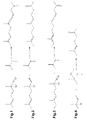
- 3,7-dimethyloct-6-en-1-yn-3-ol ("DLL") was mixed with 4 equivalents of isopropenyl methyl ether ("IPM") in the presence of the respective catalyst in the amount as given in table 1, and stirred at a temperature of 115 °C during 100 minutes. The respective product, i.e. 6,10-dimethylundeca-4,5,9-trien-2-one, was obtained in the yield and selectivity as indicated in table 1 (see
figure 1 ).Table 1. Formation of 6,10-dimethylundeca-4,5,9-trien-2-one from 3,7-dimethyloct-6-en-1-yn-3-ol (DLL) and isopropenyl methyl ether (IPM) using different catalysts at a pressure of 8.5 bara. Example Catalyst Amount1 [mol%] Yield [%] Selectivity [%] 1 pyridine·SO3 0.1 97 97 2 triethylamine·SO3 0.5 62 98 1amount of catalyst relative to DLL - The 6,10-dimethylundeca-4,5,9-trien-2-one from table 1 was quantitatively isomerized to 6,10-dimethylundeca-3,5,9-trien-2-one, by the reaction as indicated in example 2 in
WO 2011/131607 . - 3,7-dimethylocta-1,6-dien-3-ol ("LL") was mixed with the number of equivalents given in table 2 of isopropenyl methyl ether ("IPM") in the presence of 0.01 mol-% (relative to the amount of 3,7-dimethylocta-1,6-dien-3-ol ("LL")) of the respective catalyst, and stirred at a temperature of 150°C during 16 hours. The respective product, i.e. 6,10-dimethylundeca-5,9-dien-2-one, was obtained in the yield and selectivity as indicated in table 2 (see
figure 2 ).Table 2. Formation of 6,10-dimethylundeca-5,9-dien-2-one from 3,7-dimethylocta-1,6-dien-3-ol ("LL") and isopropenyl methyl ether (IPM) using different catalysts at a pressure of 8.5 bara. Example Catalyst Amount IPM1 [eq] Yield [%] Selectivity [%] 3 triethylamine·SO3 2.1 41 44 4 triethylamine·SO3 2.5 44 44 5 pyridine·SO3 2.1 38 28 6 pyridine·SO3 2.5 43 44 1amount of IPM relative to LL - The 6,10-dimethylundeca-5,9-dien-2-one from table 2 was quantitatively isomerized to 6,10-dimethylundeca-4,9-dien-2-one, by the reaction as indicated in example 2 in
WO 2011/131607 . - 3,7-dimethylnon-6-en-1-yn-3-ol ("EDLL") was mixed with 4 equivalents of isopropenyl methyl ether ("IPM") in the presence of 0.1 mol-% the adduct of pyridine and SO3 (relative to the amount of EDLL) and stirred at a temperature of 115 °C during 100 minutes. The respective product, i.e. 6,10-dimethyldodeca-4,5,9-trien-2-one, was obtained in the yield and selectivity as indicated in table 3 (see
figure 3 ).Table 3. Formation of 6,10-dimethyldodeca-4,5,9-trien-2-one from 3,7-dimethylnon-6-en-1-yn-3-ol ("EDLL") and isopropenyl methyl ether (IPM) using pyridine/SO3 adduct at a pressure of 8.5 bara. Example Catalyst Amount1 [mol%] Yield [%] Selectivity [%] 7 pyridine·SO3 0.1 97 98 1 amount of catalyst relative to EDLL - The 6,10-dimethyldodeca-4,5,9-trien-2-one from table 3 was quantitatively isomerized to 6,10-dimethyldodeca-3,5,9-trien-2-one by the reaction as indicated in example 2 in
WO 2011/131607 . - 2-methylbut-3-en-2-ol ("MBE") was mixed with 8.0 equivalents of 2,2-dimethoxypropane ("DMP") in the presence of 0.005 mol-% (relative to the amount of MBE) of pyridine·SO3 as catalyst, and stirred at a temperature of 150°C during 8 hours. The respective product, i.e. 6-methylhept-5-en-2-one was obtained in the yield and selectivity as indicated in table 4 (see
figure 4 ).Table 4. Formation of 6-methylhept-5-en-2-one from MBE and DMP. Example Catalyst Amount DMP1 [eq] Conversion [%] Yield [%] Selectivity [%] 8 pyridine·SO3 8.0 68 23 34 1amount of DMP relative to MBE. - 3,7-dimethyloct-6-en-1-yn-3-ol (= dehydrolinalool, "DLL") was mixed with 2.6 equivalents of butenyl methyl ether (mixture of 2-methoxybut-1-ene / (E)-2-methoxybut-2-ene / (Z)-2-methoxybut-2-ene = 53/37/10 in the presence of the respective catalyst in the amount as given in table 5 and stirred at a temperature of 80-95 °C during the reaction time as indicated in table 5. The respective products, i.e. 7,11-dimethyldodeca-5,6,10-trien-3-one (=DMDTO) and 3,6,10-trimethylunde-ca-4,5,9-trien-2-one (=TMUTO), were obtained in the conversion, yield and selectivity as indicated in table 5 (see
figure 5 ).Table 5. Formation of 3,6,10-trimethylundeca-4,5,9-trien-2-one (=TMUTO) and 7,11-dimethyldodeca-5,6,10-trien-3-one (DMDTO) from 3,7-dimethyl-oct-6-en-1-yn-3-ol and butenyl methyl ether using tertiary amine / SO3 adduct catalysts and pressure of 1 bara. Example Catalyst1 Amount1 [mol%] Reaction time [h] Conversion [%] TMUTO/DMDTO Yield [%] Selectivity [%] 9 triethylamine·SO3 0.5 20 59 33/67 46 77 10 pyridine·SO3 4 2.5 99 97/3 68 69 11 pyridine·SO3 0.5 20 99 87/13 52 53 Ref.1 (Et3NH)2HPO4 4 2.5 0 n.a.2 0 n.a.2 Ref.2 (Et3NH)2HPO4 0.5 20 4.4 56/44 1 20 1 amount of catalyst relative to DLL
2 n.a.= not applicable - The 3,6,10-trimethylundeca-4,5,9-trien-2-one and 7,11-dimethyldodeca-5,6,10-trien-3-one from table 5 were quantitatively isomerized to 3,6,10-trimethylundeca-3,5,9-trien-2-one, respectively 7,11-dimethyldodeca-4,6,10-trien-3-one, by the reaction as indicated in example 2 in
WO 2011/131607 . - 3,7,11-trimethyldodec-1-yn-3-ol was mixed with 2.6 equivalents of butenyl methyl ether (mixture of 2-methoxybut-1-ene / (E)-2-methoxybut-2-ene / (Z)-2-methoxybut-2-ene = 53/37/10) in the presence of the respective ammonium catalyst in the amount as given in table 6 and stirred at a temperature of 80-95 °C during the reaction time as indicated in table 6. The respective products, i.e.
- 7,11,15-trimethylhexadeca-5,6-dien-3-one (TMHDO) and 3,6,10,14-tetramethyl-pentadeca-4,5-dien-2-one (TMPDO), were obtained in the yield and selectivity as indicated in table 6 (see
figure 6 ).Table 6. Formation of 7,11,15-trimethylhexadeca-5,6-dien-3-one (TMHDO) and 3,6,10,14-tetramethylpentadeca-4,5-dien-2-one (TMPDO) from 3,7,11-trimethyldodec-1-yn-3-ol and butenyl methyl ether using different catalysts and pressure of 1 bara. Example Catalyst Amount1 [mol%] Reaction time [h] Conversion [%] TMPDO/TMHDO Yield [%] Selectivity [%] 12 triethylamine·SO3 0.5 2.5 68 31/69 57 84 13 pyridine·SO3 4 20 99 92/8 78 79 14 pyridine·SO3 0.5 20 100 97/17 71 71 Ref.3 (Et3NH)2HPO4 4 2.5 0.1 n.a.2 0 n.a.2 Ref.4 (Et3NH)2HPO4 0.5 20 68.8 32/68 55.6 81 1 amount of catalyst relative to 3,7,11-trimethyldodec-1-yn-3-ol
2 n.a.= not applicable - The 7,11,15-trimethylhexadeca-5,6-dien-3-one and 3,6,10,14-tetramethyl-pentadeca-4,5-dien-2-one from table 6 were quantitatively isomerized to 7,11,15-trimethylhexadeca-4,6-dien-3-one, respectively 3,6,10,14-tetramethylpentadeca-3,5-dien-2-one, by the reaction as indicated in example 2 in
WO 2011/131607 .
either
a pyridinic compound of the formula (V)

or
a tertiary amine of the formula (X)

wherein
either
Claims (15)
- A process for the manufacture of an unsaturated ketone of the formula (I)

a compound of the formula (IIa) or (IIb) with a compound of the formula (IIIa) or (IIIb)
 Q represents a group of the formula
 R1 represents a methyl or ethyl group;R2 represents a saturated or unsaturated linear or branched or cyclic hydrocarbyl group with 1 to 46 C atoms;R3 represents a methyl or an ethyl group;R4 represents H or methyl or an ethyl group;R5 represents a linear or branched C1-10-alkyl group, particularly a methyl or an ethyl group;R5' and R5" representeither a linear or branched C1-10-alkyl group, particularly a methyl or an ethyl group;or R5' and R5" form together a linear or branched C1-10-alkylene group, particularly an ethylene or propylene group;andwherein the tertiary amine of said adduct is
either
pyridine
or
a tertiary amine of the formula (X)
andwherein the wavy line represents a carbon-carbon bond and which when linked to the carbon-carbon double bond is either in the Z or in the E-configuration;and any dotted line represents the bond by which the substituent Q is bound to the rest of the compound of the formula (I). - The process according to any one of the proceeding claims, characterized in that R1 represents a methyl group.
- The process according to any one of the preceding claims 1-2, characterized in R2 = methyl.
- The process according to any one of the preceding claims 1-2, characterized in that R2 is selected from the group consisting of the formula (R2-I), (R2-II), (R2-III) and (R2-IV),


and wherein any double bond having dotted line (------) represents independently from each other either a single carbon-carbon bond or a double carbon-carbon bond;
and wherein any wavy line represents independently from each other a carbon-carbon bond which when linked to the carbon-carbon double bond is either in the Z or in the E-configuration;
and wherein n represents 1, 2, 3 or 4, particularly 1 or 2. - The process according to any one or more of the preceding claims, characterized in that the molar ratio of the compound of the formula (IIa) or (IIb) to the compound of the formula (IIIa) or (IIIb) is ranging from 1:15 to 1:1, and in case of using the compound of the formula (IIIa)said ratio is more preferred in the range from 1:5 to 1:2, more preferably ranging from 1:3.5 to 1:2, most preferably ranging from 1:3 to 1:2, particularly ranging from 1:2.5 to 1:2;
or in case of using the compound of the formula (IIIa)said ratio is more preferred in the range from 1:10 to 1:2, more preferably ranging from 1:8 to 1:3, most preferably ranging from 1:8 to 1:5. - The process according to any one of the preceding claims, characterized in that the amount of the adduct of a tertiary amine with SO3 is ranging from 0.01 - 1 mol-%, preferably ranging from 0.02 - 0.6 mol-%, more preferably ranging from 0.05 - 0.6 mol-%, based on the amount of the compound of the formula (IIa) or (IIb).
- The process according to any one of the preceding claims 1-6, characterized in that the adduct of a tertiary amine with SO3 is

- The process according to any one of the preceding claims 1-6, characterized in that the adduct of a tertiary amine with SO3 is

- The process according to any one of the preceding claims, characterized in that the compound of the formula (I) is formula (I")


- The process according to any one of the preceding claims, characterized in that the compound of the general formula (I) is selected from the group consisting of 6-methyl-5-hepten-2-one, 6-methyl-5-octen-2-one, 6,10-dimethyl-5,9-undecadien-2-one, 6,10-dimethyl-5-undecen-2-one, 6,10,14-trimethylpentadeca-5,9-dien-2-one, 6,10,14-trimethylpentadeca-5,13-dien-2-one and 6,10,14-trimethyl-5,9,13-pentadeca-trien-2-one, preferably 6-methyl-5-hepten-2-one.
- The process according to any one of the preceding claims 1-8, characterized in that the compound of the formula (I) is formula (I')


- The process according to any one of the preceding claims 1-8 or 11, characterized in that the compound of the general formula (I) is selected from the group consisting of 6-methylhepta-4,5-dien-2-one, 6,10-dimethylundeca-4,5-dien-2-one, 6,10-dimethylundeca-4,5,9-trien-2-one, 6,10,14-trimethylpentadeca-4,5,9,13-tetraen-2-one, 6,10,14-trimethylpentadeca-4,5,9-trien-2-one, 6,10,14-trimethylpentadeca-4,5,13-trien-2-one and 6,10,14-trimethylpentadeca-4,5-dien-2-one.
- A reaction mixture comprisingi) a compound of the formula (IIa),
 ii) a compound of the formula (IIIa) or (IIIb)
 iii) an adduct of a tertiary amine with SO3 as catalyst, wherein the tertiary amine of the adduct is eitherwhereina pyridinic compound of the formula (V)
ora tertiary amine of the formula (X) R1 represents a methyl or ethyl group;R2 represents a saturated or unsaturated linear or branched or cyclic hydrocarbyl group with 1 to 46 C atoms;R3 represents a methyl or an ethyl group;R4 represents H or methyl or an ethyl group;R5 represents a linear or branched C1-10-alkyl group, particularly a methyl or an ethyl group;R5' and R5" representeither a linear or branched C1-10-alkyl group, particularly a methyl or an ethyl group;or R5' and R5" form together a linear or branched C1-10-alkylene group, particularly an ethylene or propylene group.
 - A reaction mixture comprisingα) a compound of the formula (IIb),
 β) a compound of the formula (IIIa) or (IIIb)
 γ) an adduct of a tertiary amine with SO3 as catalyst, wherein the tertiary amine of the adduct is eitherwhereina pyridinic compound of the formula (V)
ora tertiary amine of the formula (X) R1 represents a methyl or ethyl group;R2 represents a saturated or unsaturated linear or branched or cyclic hydrocarbyl group with 1 to 46 C atoms;R3 represents a methyl or an ethyl group;R4 represents H or methyl or an ethyl group;R5 represents a linear or branched C1-10-alkyl group, particularly a methyl or an ethyl group;R5' and R5" representeither a linear or branched C1-10-alkyl group, particularly a methyl or an ethyl group;or R5' and R5" form together a linear or branched C1-10-alkylene group, particularly an ethylene or propylene group.
 - A process for the manufacture of an diene ketone of the formula (IV)
 a) preparing a compound of the formula (I') according to anyone of the preceding claims 11 or 12;
followed byb) isomerization of compound of the formula (I') in the presence of a base or an acid, preferable a base, to yield the diene ketone of the formula (IV).
Priority Applications (3)
| Application Number | Priority Date | Filing Date | Title |
|---|---|---|---|
| EP21155686.5A EP4039671A1 (en) | 2021-02-08 | 2021-02-08 | Manufacturing of unsaturated ketones using an adduct of a tertiary amine with so3 |
| JP2022016266A JP7173505B2 (en) | 2021-02-08 | 2022-02-04 | Preparation of unsaturated ketones using SO3 adducts of tertiary amines |
| CN202210117467.9A CN114907195A (en) | 2021-02-08 | 2022-02-08 | Using tertiary amines with SO 3 Preparation of unsaturated ketones |
Applications Claiming Priority (1)
| Application Number | Priority Date | Filing Date | Title |
|---|---|---|---|
| EP21155686.5A EP4039671A1 (en) | 2021-02-08 | 2021-02-08 | Manufacturing of unsaturated ketones using an adduct of a tertiary amine with so3 |
Publications (1)
| Publication Number | Publication Date |
|---|---|
| EP4039671A1 true EP4039671A1 (en) | 2022-08-10 |
Family
ID=74561720
Family Applications (1)
| Application Number | Title | Priority Date | Filing Date |
|---|---|---|---|
| EP21155686.5A Pending EP4039671A1 (en) | 2021-02-08 | 2021-02-08 | Manufacturing of unsaturated ketones using an adduct of a tertiary amine with so3 |
Country Status (3)
| Country | Link |
|---|---|
| EP (1) | EP4039671A1 (en) |
| JP (1) | JP7173505B2 (en) |
| CN (1) | CN114907195A (en) |
Citations (7)
| Publication number | Priority date | Publication date | Assignee | Title |
|---|---|---|---|---|
| US3029287A (en) | 1958-08-01 | 1962-04-10 | Hoffmann La Roche | Preparation of unsaturated ketones |
| US3330867A (en) | 1962-06-28 | 1967-07-11 | Hoffmann La Roche | Olefinic ketones and process for the manufacture thereof |
| DE19649564A1 (en) | 1996-11-29 | 1998-06-04 | Basf Ag | Process for the production of gamma, delta-unsaturated ketones by reacting tertiary allyl alcohols with alkenyl alkyl ethers |
| US6380437B1 (en) | 1999-10-15 | 2002-04-30 | Degussa Ag | Process for the preparation of unsaturated 4,5-allene ketones, 3,5-diene ketones and the corresponding saturated ketones |
| WO2010046199A2 (en) | 2008-10-21 | 2010-04-29 | Dsm Ip Assets B.V. | Manufacture of gamma-delta-unsaturated ketones |
| WO2011131607A1 (en) | 2010-04-19 | 2011-10-27 | Dsm Ip Assets B.V. | ISOMERIZATION OF β-KETO-ALLENES |
| WO2017131607A1 (en) | 2016-01-25 | 2017-08-03 | Alexander Chang | Oxygen masks |
Family Cites Families (2)
| Publication number | Priority date | Publication date | Assignee | Title |
|---|---|---|---|---|
| CN106478514B (en) * | 2016-10-13 | 2019-02-12 | 浙江新和成股份有限公司 | A kind of method for synthesizing γ,δ-unsaturated ketone compounds |
| CN109534977B (en) * | 2018-12-12 | 2022-04-22 | 万华化学集团股份有限公司 | Method for synthesizing alpha, gamma-unsaturated dienone from propargyl alcohol and catalyst used in method |
-
2021
- 2021-02-08 EP EP21155686.5A patent/EP4039671A1/en active Pending
-
2022
- 2022-02-04 JP JP2022016266A patent/JP7173505B2/en active Active
- 2022-02-08 CN CN202210117467.9A patent/CN114907195A/en active Pending
Patent Citations (7)
| Publication number | Priority date | Publication date | Assignee | Title |
|---|---|---|---|---|
| US3029287A (en) | 1958-08-01 | 1962-04-10 | Hoffmann La Roche | Preparation of unsaturated ketones |
| US3330867A (en) | 1962-06-28 | 1967-07-11 | Hoffmann La Roche | Olefinic ketones and process for the manufacture thereof |
| DE19649564A1 (en) | 1996-11-29 | 1998-06-04 | Basf Ag | Process for the production of gamma, delta-unsaturated ketones by reacting tertiary allyl alcohols with alkenyl alkyl ethers |
| US6380437B1 (en) | 1999-10-15 | 2002-04-30 | Degussa Ag | Process for the preparation of unsaturated 4,5-allene ketones, 3,5-diene ketones and the corresponding saturated ketones |
| WO2010046199A2 (en) | 2008-10-21 | 2010-04-29 | Dsm Ip Assets B.V. | Manufacture of gamma-delta-unsaturated ketones |
| WO2011131607A1 (en) | 2010-04-19 | 2011-10-27 | Dsm Ip Assets B.V. | ISOMERIZATION OF β-KETO-ALLENES |
| WO2017131607A1 (en) | 2016-01-25 | 2017-08-03 | Alexander Chang | Oxygen masks |
Non-Patent Citations (3)
| Title |
|---|
| CONGMIN WANG ET AL: "Solvent-free synthesis of unsaturated ketones by the Saucy-Marbet reaction using simple ammonium ionic liquid as a catalyst", GREEN CHEMISTRY, vol. 11, no. 6, 1 January 2009 (2009-01-01), pages 843, XP055181953, ISSN: 1463-9262, DOI: 10.1039/b900042a * |
| G. SAUCY ET AL., HELV. CHIM. ACTA, vol. 50, no. 4, 1967, pages 2095 - 2100 |
| T.T. TIDWELL, SYNTHESIS (GERMANY, vol. 1990, no. 10, 1990, pages 857 - 870 |
Also Published As
| Publication number | Publication date |
|---|---|
| JP2022121398A (en) | 2022-08-19 |
| CN114907195A (en) | 2022-08-16 |
| JP7173505B2 (en) | 2022-11-16 |
Similar Documents
| Publication | Publication Date | Title |
|---|---|---|
| EP3696160B1 (en) | Extraction process for high-boiling aldehyde product separation and catalyst recovery | |
| Clerici et al. | A novel reaction type promoted by aqueous titanium trichloride. Synthesis of unsymmetrical 1, 2-diols | |
| Mele et al. | Fine chemicals and new hybrid materials from cardanol | |
| US20110213185A1 (en) | Manufacture of gamma-delta-unsaturated ketones | |
| HUT77464A (en) | Process for the preparation of 1,3-alkanediols and 3-hydroxy aldehydes | |
| US20050154239A1 (en) | Methods for preparing 1,3 butylene glycol | |
| EP4039670A1 (en) | Manufacturing of allene ketones using copper sulfate or a hydrate thereof | |
| EP2426098B1 (en) | Process for producing polyhydric phenol | |
| Lin et al. | Isolation and chemical properties of ruthenium and iron hydroxymethyl complexes (. eta. 5-C5H5) M (CO) 2CH2OH | |
| CN112661646A (en) | Active methylene type aldehyde remover and application thereof | |
| EP3720836B1 (en) | Improvements in or relating to organic compounds | |
| US4382148A (en) | Process for the preparation of glycol aldehyde | |
| JP7173505B2 (en) | Preparation of unsaturated ketones using SO3 adducts of tertiary amines | |
| US20240116842A1 (en) | Manufacturing of allene ketones using an ammonium (thio)sulfates or hydrogen (thio)sulfates | |
| US20240308948A1 (en) | Organic tertiary or quaternary ammonium salts as catalysts in the formation of gamma, delta-unsaturated ketones | |
| EP3626340B1 (en) | Method for synthesizing propylene glycol phenyl ether | |
| Botteghi et al. | Hydroformylation of phenyl-substituted olefins with cobalt catalysts | |
| EP2935233B1 (en) | Process of asymmetric hydrogenation of ketals and acetals | |
| Haga et al. | Condensations of 1, 4-cyclohexanediones and secondary aromatic amines. The formation of alkyldiarylamines and triarylamines. | |
| EP3401301A1 (en) | Hydroxypivalaldehyde production method | |
| Van Tilborg et al. | Electrosynthesis of cyclopropanone adducts | |
| Jin et al. | One-pot three-component Mannich reaction catalyzed by 2-hydroxylpyridine | |
| KIMURA et al. | The Reactions of Cholesteryl Acetate with tert-Butyl Hydroperoxide and Molybdenum Complexes | |
| EP4151616A1 (en) | Compound and method for producing same | |
| EP2297078B1 (en) | Allyl and propargyl ethers |
Legal Events
| Date | Code | Title | Description |
|---|---|---|---|
| PUAI | Public reference made under article 153(3) epc to a published international application that has entered the european phase |
Free format text: ORIGINAL CODE: 0009012 |
|
| STAA | Information on the status of an ep patent application or granted ep patent |
Free format text: STATUS: THE APPLICATION HAS BEEN PUBLISHED |
|
| AK | Designated contracting states |
Kind code of ref document: A1 Designated state(s): AL AT BE BG CH CY CZ DE DK EE ES FI FR GB GR HR HU IE IS IT LI LT LU LV MC MK MT NL NO PL PT RO RS SE SI SK SM TR |
|
| RBV | Designated contracting states (corrected) |
Designated state(s): AL AT BE BG CH CY CZ DE DK EE ES FI FR GB GR HR HU IE IS IT LI LT LU LV MC MK MT NL NO PL PT RO RS SE SI SK SM TR |
|
| RAP3 | Party data changed (applicant data changed or rights of an application transferred) |
Owner name: DSM IP ASSETS B.V. |