EP4039653B1 - Particle structure of cathode material and preparation method thereof - Google Patents
Particle structure of cathode material and preparation method thereof Download PDFInfo
- Publication number
- EP4039653B1 EP4039653B1 EP21208248.1A EP21208248A EP4039653B1 EP 4039653 B1 EP4039653 B1 EP 4039653B1 EP 21208248 A EP21208248 A EP 21208248A EP 4039653 B1 EP4039653 B1 EP 4039653B1
- Authority
- EP
- European Patent Office
- Prior art keywords
- coating layer
- cathode material
- particle structure
- thickness
- preparation
- Prior art date
- Legal status (The legal status is an assumption and is not a legal conclusion. Google has not performed a legal analysis and makes no representation as to the accuracy of the status listed.)
- Active
Links
Images






Classifications
-
- H—ELECTRICITY
- H01—ELECTRIC ELEMENTS
- H01M—PROCESSES OR MEANS, e.g. BATTERIES, FOR THE DIRECT CONVERSION OF CHEMICAL ENERGY INTO ELECTRICAL ENERGY
- H01M4/00—Electrodes
- H01M4/02—Electrodes composed of, or comprising, active material
- H01M4/36—Selection of substances as active materials, active masses, active liquids
-
- C—CHEMISTRY; METALLURGY
- C01—INORGANIC CHEMISTRY
- C01G—COMPOUNDS CONTAINING METALS NOT COVERED BY SUBCLASSES C01D OR C01F
- C01G53/00—Compounds of nickel
- C01G53/40—Complex oxides containing nickel and at least one other metal element
- C01G53/42—Complex oxides containing nickel and at least one other metal element containing alkali metals, e.g. LiNiO2
- C01G53/44—Complex oxides containing nickel and at least one other metal element containing alkali metals, e.g. LiNiO2 containing manganese
- C01G53/50—Complex oxides containing nickel and at least one other metal element containing alkali metals, e.g. LiNiO2 containing manganese of the type (MnO2)n-, e.g. Li(NixMn1-x)O2 or Li(MyNixMn1-x-y)O2
-
- H—ELECTRICITY
- H01—ELECTRIC ELEMENTS
- H01M—PROCESSES OR MEANS, e.g. BATTERIES, FOR THE DIRECT CONVERSION OF CHEMICAL ENERGY INTO ELECTRICAL ENERGY
- H01M10/00—Secondary cells; Manufacture thereof
- H01M10/05—Accumulators with non-aqueous electrolyte
- H01M10/052—Li-accumulators
- H01M10/0525—Rocking-chair batteries, i.e. batteries with lithium insertion or intercalation in both electrodes; Lithium-ion batteries
-
- H—ELECTRICITY
- H01—ELECTRIC ELEMENTS
- H01M—PROCESSES OR MEANS, e.g. BATTERIES, FOR THE DIRECT CONVERSION OF CHEMICAL ENERGY INTO ELECTRICAL ENERGY
- H01M4/00—Electrodes
- H01M4/02—Electrodes composed of, or comprising, active material
- H01M4/13—Electrodes for accumulators with non-aqueous electrolyte, e.g. for lithium-accumulators; Processes of manufacture thereof
- H01M4/131—Electrodes based on mixed oxides or hydroxides, or on mixtures of oxides or hydroxides, e.g. LiCoOx
-
- H—ELECTRICITY
- H01—ELECTRIC ELEMENTS
- H01M—PROCESSES OR MEANS, e.g. BATTERIES, FOR THE DIRECT CONVERSION OF CHEMICAL ENERGY INTO ELECTRICAL ENERGY
- H01M4/00—Electrodes
- H01M4/02—Electrodes composed of, or comprising, active material
- H01M4/36—Selection of substances as active materials, active masses, active liquids
- H01M4/362—Composites
- H01M4/366—Composites as layered products
-
- H—ELECTRICITY
- H01—ELECTRIC ELEMENTS
- H01M—PROCESSES OR MEANS, e.g. BATTERIES, FOR THE DIRECT CONVERSION OF CHEMICAL ENERGY INTO ELECTRICAL ENERGY
- H01M4/00—Electrodes
- H01M4/02—Electrodes composed of, or comprising, active material
- H01M4/36—Selection of substances as active materials, active masses, active liquids
- H01M4/48—Selection of substances as active materials, active masses, active liquids of inorganic oxides or hydroxides
-
- H—ELECTRICITY
- H01—ELECTRIC ELEMENTS
- H01M—PROCESSES OR MEANS, e.g. BATTERIES, FOR THE DIRECT CONVERSION OF CHEMICAL ENERGY INTO ELECTRICAL ENERGY
- H01M4/00—Electrodes
- H01M4/02—Electrodes composed of, or comprising, active material
- H01M4/36—Selection of substances as active materials, active masses, active liquids
- H01M4/48—Selection of substances as active materials, active masses, active liquids of inorganic oxides or hydroxides
- H01M4/52—Selection of substances as active materials, active masses, active liquids of inorganic oxides or hydroxides of nickel, cobalt or iron
- H01M4/525—Selection of substances as active materials, active masses, active liquids of inorganic oxides or hydroxides of nickel, cobalt or iron of mixed oxides or hydroxides containing iron, cobalt or nickel for inserting or intercalating light metals, e.g. LiNiO2, LiCoO2 or LiCoOxFy
-
- H—ELECTRICITY
- H01—ELECTRIC ELEMENTS
- H01M—PROCESSES OR MEANS, e.g. BATTERIES, FOR THE DIRECT CONVERSION OF CHEMICAL ENERGY INTO ELECTRICAL ENERGY
- H01M4/00—Electrodes
- H01M4/02—Electrodes composed of, or comprising, active material
- H01M4/62—Selection of inactive substances as ingredients for active masses, e.g. binders, fillers
-
- C—CHEMISTRY; METALLURGY
- C01—INORGANIC CHEMISTRY
- C01P—INDEXING SCHEME RELATING TO STRUCTURAL AND PHYSICAL ASPECTS OF SOLID INORGANIC COMPOUNDS
- C01P2002/00—Crystal-structural characteristics
- C01P2002/80—Crystal-structural characteristics defined by measured data other than those specified in group C01P2002/70
- C01P2002/85—Crystal-structural characteristics defined by measured data other than those specified in group C01P2002/70 by XPS, EDX or EDAX data
-
- C—CHEMISTRY; METALLURGY
- C01—INORGANIC CHEMISTRY
- C01P—INDEXING SCHEME RELATING TO STRUCTURAL AND PHYSICAL ASPECTS OF SOLID INORGANIC COMPOUNDS
- C01P2002/00—Crystal-structural characteristics
- C01P2002/80—Crystal-structural characteristics defined by measured data other than those specified in group C01P2002/70
- C01P2002/89—Crystal-structural characteristics defined by measured data other than those specified in group C01P2002/70 by mass-spectroscopy
-
- C—CHEMISTRY; METALLURGY
- C01—INORGANIC CHEMISTRY
- C01P—INDEXING SCHEME RELATING TO STRUCTURAL AND PHYSICAL ASPECTS OF SOLID INORGANIC COMPOUNDS
- C01P2004/00—Particle morphology
- C01P2004/60—Particles characterised by their size
- C01P2004/61—Micrometer sized, i.e. from 1-100 micrometer
-
- C—CHEMISTRY; METALLURGY
- C01—INORGANIC CHEMISTRY
- C01P—INDEXING SCHEME RELATING TO STRUCTURAL AND PHYSICAL ASPECTS OF SOLID INORGANIC COMPOUNDS
- C01P2004/00—Particle morphology
- C01P2004/80—Particles consisting of a mixture of two or more inorganic phases
-
- C—CHEMISTRY; METALLURGY
- C01—INORGANIC CHEMISTRY
- C01P—INDEXING SCHEME RELATING TO STRUCTURAL AND PHYSICAL ASPECTS OF SOLID INORGANIC COMPOUNDS
- C01P2006/00—Physical properties of inorganic compounds
- C01P2006/40—Electric properties
-
- H—ELECTRICITY
- H01—ELECTRIC ELEMENTS
- H01M—PROCESSES OR MEANS, e.g. BATTERIES, FOR THE DIRECT CONVERSION OF CHEMICAL ENERGY INTO ELECTRICAL ENERGY
- H01M10/00—Secondary cells; Manufacture thereof
- H01M10/05—Accumulators with non-aqueous electrolyte
-
- H—ELECTRICITY
- H01—ELECTRIC ELEMENTS
- H01M—PROCESSES OR MEANS, e.g. BATTERIES, FOR THE DIRECT CONVERSION OF CHEMICAL ENERGY INTO ELECTRICAL ENERGY
- H01M4/00—Electrodes
- H01M4/02—Electrodes composed of, or comprising, active material
- H01M2004/021—Physical characteristics, e.g. porosity, surface area
-
- H—ELECTRICITY
- H01—ELECTRIC ELEMENTS
- H01M—PROCESSES OR MEANS, e.g. BATTERIES, FOR THE DIRECT CONVERSION OF CHEMICAL ENERGY INTO ELECTRICAL ENERGY
- H01M4/00—Electrodes
- H01M4/02—Electrodes composed of, or comprising, active material
- H01M2004/026—Electrodes composed of, or comprising, active material characterised by the polarity
- H01M2004/028—Positive electrodes
-
- Y—GENERAL TAGGING OF NEW TECHNOLOGICAL DEVELOPMENTS; GENERAL TAGGING OF CROSS-SECTIONAL TECHNOLOGIES SPANNING OVER SEVERAL SECTIONS OF THE IPC; TECHNICAL SUBJECTS COVERED BY FORMER USPC CROSS-REFERENCE ART COLLECTIONS [XRACs] AND DIGESTS
- Y02—TECHNOLOGIES OR APPLICATIONS FOR MITIGATION OR ADAPTATION AGAINST CLIMATE CHANGE
- Y02E—REDUCTION OF GREENHOUSE GAS [GHG] EMISSIONS, RELATED TO ENERGY GENERATION, TRANSMISSION OR DISTRIBUTION
- Y02E60/00—Enabling technologies; Technologies with a potential or indirect contribution to GHG emissions mitigation
- Y02E60/10—Energy storage using batteries
Definitions
- the present disclosure relates to a cathode material for a secondary battery, and more particularly to a particle structure of cathode material and a preparation method thereof for improving a working voltage and a cycle life of a battery formed thereby.
- Secondary batteries are used in common devices, such as smart phones, laptops, digital cameras, electric cars, etc. However, these devices are required to have certain level of performance to comply with the trend of miniaturization and increasingly complex functional requirements.
- lithium ion battery is a popular and potential choice with its high energy density, high working voltage and long cycle life.
- the surface of the cathode material of the lithium ion battery easily reacts with the electrolyte during charging and discharging.
- the reaction between the cathode material and the electrolyte results in a decrease in battery characteristics such as the working voltage and the cycle life, and the battery performance is adversely affected.
- cathode material for a secondary battery, and more particularly to a particle structure of cathode material and a preparation method thereof for improving a working voltage and a cycle life of a battery formed thereby.
- US 10 756 339 discloses cathode material and its method for preparation.
- the cathode material comprises a core comprising a Li(Ni-Co-Mn)O2 with a coating layer on the core. Said coating layer includes sulfur.
- the coating layer may further include at least one element selected from the group consisting of lithium (Li), sodium (Na), potassium (K), rubidium (Rb), cesium (Cs), magnesium (Mg), calcium (Ca), aluminum (Al), silicon (Si), tin (Sn), lead (Pb), manganese (Mn), iron (Fe), chromium (Cr), nickel (Ni), zinc (Zn), zirconium (Zr), thallium (Tl), and nitrogen (N).
- at least one element selected from the group consisting of lithium (Li), sodium (Na), potassium (K), rubidium (Rb), cesium (Cs), magnesium (Mg), calcium (Ca), aluminum (Al), silicon (Si), tin (Sn), lead (Pb), manganese (Mn), iron (Fe), chromium (Cr), nickel (Ni), zinc (Zn), zirconium (Zr), thallium (Tl), and nitrogen (N).
- An object of the present disclosure is to provide a particle structure of cathode material and a preparation method thereof for improving a working voltage and a cycle life of a battery formed thereby.
- the particle structure of cathode material includes at least two coating layers, and each of the different coating layers has different element composition.
- the at least two coating layers are a first coating layer as an inner coating layer and a second coating layer as an outer coating layer. Since the first coating layer contains potassium and aluminum, it is conducive to the migration of lithium ions.
- the second coating layer contains sulfur, so that the reaction between the cathode material and the electrolyte during charging and discharging is avoided. Accordingly, the purpose of improving the battery performances, such as the cycle life, the capacity and the stability, is achieved.
- Another object of the present disclosure is to provide a particle structure of cathode material and a preparation method thereof for improving a working voltage and a cycle life of a battery formed thereby.
- a metal salt and a lithium ion compound are mixed and added to a precursor, and a mixture is formed.
- the metal salt includes potassium, aluminum and sulfur.
- the precursor includes nickel, cobalt and manganese. After that, the mixture is subjected to a heat treatment, and the particle structure of cathode material is formed.
- the particle structure of cathode material has at least two coating layers.
- Thicknesses and compositions of the at least two coating layers are obtained through analysis results of an X-ray photoelectron spectroscopy (XPS) and a time-of-flight secondary ion mass spectrometer (TOF-SIMS).
- XPS X-ray photoelectron spectroscopy
- TOF-SIMS time-of-flight secondary ion mass spectrometer
- Another object of the present disclosure is to provide a particle structure of cathode material and a preparation method thereof for improving a working voltage and a cycle life of a battery formed thereby.
- a potassium alum in a specific ratio range is added into a precursor, and a mixture is formed.
- the mixture is subjected to two heat treatment steps, and the particle structure of cathode material is formed to have at least two coating layers.
- the particle structure of cathode material has low cation disorder degree and orderly layered structure.
- the preparation method of the particle structure of cathode material is simple and low costing. It is helpful of enhancing the product competitiveness of the battery formed by the particle structure of cathode material.
- a particle structure of cathode material includes a core, a first coating layer and a second coating layer.
- the first coating layer is coated on the core, and the second coating layer is coated on the first coating layer.
- the core includes potassium and aluminum.
- the first coating layer includes potassium and aluminum, and a potassium content of the first coating layer is higher than a potassium content of the core.
- the second coating layer includes sulfur.
- the core includes a Li-M-O based material, wherein M comprises nickel, cobalt and manganese.
- the Li-M-O based material is a lithium nickel manganese cobalt oxide.
- the particle structure of cathode material has a particle size ranged from 3 ⁇ m to 10 ⁇ m.
- the particle structure of cathode material has a potassium content ranged from 0.01 mol% to 0.2 mol% and an aluminum content ranged from 0.01 mol% to 0.2 mol%.
- the first coating layer has a first thickness
- the second coating layer has a second thickness.
- the first thickness is greater than the second thickness.
- the first thickness is ranged from 12 nm to 70 nm.
- the second thickness is ranged from 1 nm to 3 nm. The first thickness and the second thickness are obtained through analysis results of an X-ray photoelectron spectroscopy and a time-of-flight secondary ion mass spectrometer.
- a preparation method of a particle structure of cathode material includes steps of: (a) providing a precursor configured to form a core, wherein the precursor includes at least nickel, cobalt and manganese; (b) providing a metal salt and a lithium ion compound, wherein the metal salt includes at least potassium, aluminum and sulfur; (c) mixing the metal salt, the lithium ion compound and the precursor to form a mixture; and (d) subjecting the mixture to a heat treatment step to form the particle structure of cathode material, wherein the particle structure of cathode material includes the core, a first coating layer and a second coating layer, wherein the core includes potassium and aluminum, wherein the first coating layer is coated on the core, and the second coating layer is coated on the first coating, wherein the first coating layer includes potassium and aluminum, and a potassium content of the first coating layer is higher than a potassium content of the core, wherein the second coating layer includes sulfur.
- the core includes a Li-M-O based material.
- M is one selected from the group consisting of nickel, cobalt, manganese, magnesium, titanium, aluminum, tin, chromium, vanadium, molybdenum and a combination thereof.
- the Li-M-O based material is a lithium nickel manganese cobalt oxide.
- the particle structure of cathode material has a particle size ranged from 3 ⁇ m to 10 ⁇ m.
- the particle structure of cathode material has a potassium content ranged from 0.01 mol% to 0.2 mol% and an aluminum content ranged from 0.01 mol% to 0.2 mol%.
- the first coating layer has a first thickness
- the second coating layer has a second thickness.
- the first thickness is greater than the second thickness.
- the first thickness is ranged from 12 nm to 70 nm.
- the second thickness is ranged from 1 nm to 3 nm. The first thickness and the second thickness are obtained through analysis results of an X-ray photoelectron spectroscopy and a time-of-flight secondary ion mass spectrometer.
- the precursor is formed by a co-precipitation of a first solution and a second solution.
- the first solution includes at least nickel, cobalt and manganese.
- the second solution includes at least oxalic acid.
- the step (b) further includes a step: (b1) dissolving the metal salt and the lithium ion compound in a water to form a third solution.
- the metal salt has a weight percentage relative to the precursor, and the weight percentage is ranged from 0.1 wt% to 2 wt%.
- the heat treatment step includes a temperature-holding step.
- the temperature-holding step has a temperature greater than or equal to 700°C.
- the heat treatment step further includes a first heat treatment step and a second heat treatment step.
- a maximum temperature of the second heat treatment step is greater than a maximum temperature of the first heat treatment step.
- the metal salt is a potassium alum.
- FIG. 1 is a schematic view illustrating a particle structure of cathode material according to an embodiment of the present disclosure.
- the particle structure of cathode material 1 includes a core 10, a first coating layer 20 and a second coating layer 30.
- the first coating layer 20 is coated on the core 10, and the second coating layer 30 is coated on the first coating layer 20.
- the core 10 includes potassium and aluminum.
- the first coating layer 20 includes potassium and aluminum, and a potassium content of the first coating layer 20 is higher than a potassium content of the core 10.
- the second coating layer 30 includes sulfur. Notably, with the potassium and the aluminum contained in the core 10 and the first coating layer 20, the migration of lithium ions is improved.
- FIGS. 2A to 2C are SEM images of the particle structure of cathode material according to an embodiment of the present disclosure.
- the core 10 includes a Li-M-O based material.
- M is one selected from the group consisting of nickel, cobalt, manganese, magnesium, titanium, aluminum, tin, chromium, vanadium, molybdenum and a combination thereof.
- the Li-M-O based material is a lithium nickel manganese cobalt oxide
- the Li-M-O based material is a lithium nickel manganese cobalt oxide with higher nickel content.
- a lithium nickel manganese cobalt oxide with higher nickel content has an 8:1:1 molar ratio among nickel, cobalt and manganese, and the chemical formula of the lithium nickel manganese cobalt oxide is LiNi 0.8 Co 0.1 Mn 0.1 O 2 .
- the particle structure of cathode material 1 has a potassium content ranged from 0.01 mol% to 0.2 mol% and an aluminum content ranged from 0.01 mol% to 0.2 mol%.
- the first coating layer 20 has a first thickness H1
- the second coating layer 30 has a second thickness H2.
- the first thickness H1 is greater than the second thickness H2.
- the first thickness H1 is ranged from 12 nm to 70 nm.
- the second thickness H2 is ranged from 1 nm to 3 nm.
- the first thickness H1 and the second thickness H2 are obtained through a surface analysis of an X-ray photoelectron spectroscopy (XPS) and a depth profiling analysis of a time-of-flight secondary ion mass spectrometer (TOF-SIMS). It is noted that any instrument that can perform surface analysis and depth profiling analysis, such as an Auger electron spectroscopy (AES), is suitable for obtaining the thicknesses, and the present disclosure is not limited thereto.
- XPS X-ray photoelectron spectroscopy
- TOF-SIMS time-of-flight secondary ion mass spectrometer
- FIG. 3 is a flow chart of a preparation method of the particle structure of cathode material according to an embodiment of the present disclosure.
- a preparation method of the particle structure of cathode material 1 is provided.
- the precursor includes at least nickel, cobalt and manganese for preparing a lithium nickel manganese cobalt oxide material.
- the precursor is formed by a co-precipitation of a first solution and a second solution.
- the first solution includes at least nickel, cobalt and manganese.
- the first solution is mixed by a nickel sulfate (NiSO 4 ) solution, a cobalt sulfate (CoSO 4 ) solution, and a manganese sulfate (MnSO 4 ) solution.
- the second solution includes at least oxalic acid (H 2 C 2 O 4 ).
- the second solution is mixed by an oxalic acid solution, a sodium hydroxide solution and ammonia solution.
- the metal salt includes at least potassium, aluminum and sulfur.
- the metal salt is a potassium alum (KAl(SO 4 ) 2 ⁇ 12H 2 O)
- the lithium ion compound is a lithium hydroxide monohydrate (LiOH ⁇ H 2 O).
- the metal salt, the lithium ion compound and the precursor are mixed, and a mixture is formed.
- a third solution is formed by dissolving the metal salt and the lithium ion compound in a water before being mixed with the precursor, so as to improve the uniformity of the mixture.
- the metal salt has a weight percentage relative to the precursor, and the weight percentage is ranged from 0.1 wt% to 2 wt%.
- the heat treatment step further includes a temperature-holding step and a cooling step.
- the temperature-holding step has a temperature greater than or equal to 700°C.
- holding the temperature at 700°C facilitates the formation of an orderly layered structure of the particle structure of cathode material 1.
- the cooling step facilitates the reduction of the oxygen vacancies in the particle structure of cathode material 1.
- the battery performance is improved.
- the heat treatment step further includes a first heat treatment step and a second heat treatment step. A maximum temperature of the second heat treatment step is greater than a maximum temperature of the first heat treatment step.
- the maximum temperature of the first heat treatment step is 700°C
- the maximum temperature of the second heat treatment step is 775°C.
- a first solution and a second solution are mixed for co-precipitation, and a precursor is formed.
- the first solution is a solution including metal ions, which is mixed by a 0.24 M nickel sulfate hexahydrate (NiSO 4 ⁇ 6H 2 O) solution, a 0.03 M cobalt sulfate heptahydrate (CoSO 4 ⁇ 7H 2 O) solution and a 0.03 M hydrated manganese sulfate (MnSO 4 ⁇ H 2 O) solution.
- the second solution is a solution including oxalic acid, which is mixed by a 0.33M oxalic acid (H 2 C 2 O 4 ) solution, a 0.3 M sodium hydroxide (NaOH) solution and a 0.075 M ammonia (NH 4 OH) solution.
- the precursor is Ni 0.8 Co 0.1 Mn 0.1 C 2 O 4 ⁇ 2H 2 O.
- a metal salt and a lithium ion compound are dissolved in a water, and a third solution is formed.
- the metal salt includes at least potassium, aluminum and sulfur, Preferably but not exclusively, the metal salt is a potassium alum (KAl(SO 4 ) 2 ⁇ 12H 2 O).
- the lithium ion compound is a lithium hydroxide monohydrate (LiOH ⁇ H 2 O).
- the weight percentage of the potassium alum relative to the precursor is 0.3 wt%.
- FIG. 4A is a time-temperature curve of a first heat treatment step according to an embodiment of the present disclosure.
- FIG. 4B is a time-temperature curve of a second heat treatment step according to an embodiment of the present disclosure.
- the third solution and the precursor are mixed, and a mixture is formed.
- the mixture is ground and subjected to a first calcination.
- Time-temperature curve of the first calcination is shown in FIG. 4A .
- the mixture is heated from room temperature (25°C), and a heating rate is maintained at 1.94°C/min for 1 hour and 20 minutes to reach 180°C to remove residual moisture on the surface of the mixture.
- the heating rate is maintained at 0.17°C/min for 7 hours, and the mixture is heated to 250°C to remove the water of crystallization in the hydrate.
- the heating rate is maintained at 0.14°C/min for 12 hours, and the mixture is heated to 350°C to pyrolyze the oxalate and oxidize the mixture.
- the heating rate is maintained at 0.4°C/min for 6 hours and 15 minutes, and the mixture is heated to 500°C to melt the lithium hydroxide.
- the heating rate is maintained at 2.22°C/min for 1 hour and 30 minutes, and the mixture is heated to 700°Cto allow lithium ions to be doped into the crystal lattice.
- the mixture is maintained at 700°C for 12 hours to arrange the crystal lattice into a layered structure.
- the mixture is taken out, ground, sieved and subjected to a second calcination.
- Time-temperature curve of the second calcination is shown in FIG. 4B .
- the mixture is heated from room temperature (25°C), and a heating rate is maintained at 5°C/min for 2 hours and 30 minutes to reach 775°C.
- the mixture is maintained at 775°C for 20 hours to arrange the crystal lattice into a better layered structure.
- the heating rate is maintained at -0.78°C/min for 8 hours to reach 400°C to reduce the oxygen vacancies in the crystal lattice.
- the mixture that has been subjected to the second calcination is taken out, ground and sieved, and a particle structure of cathode material 1 with multiple coating layers of different elements is formed.
- cation disorder degree of the particle structure of cathode material 1 is reduced, and the orderly layered structure is formed.
- a preparation method of the example 2 is similar to that of the example 1.
- the weight percentage of the potassium alum relative to the precursor is 0.5 wt%.
- a preparation method of the example 3 is similar to that of the example 1.
- the weight percentage of the potassium alum relative to the precursor is 1 wt%.
- potassium alum is not added in a preparation method of the comparative example.
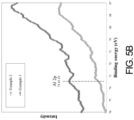
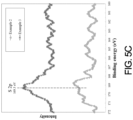
- FIGS. 5A to 5C are XPS spectra of the example 2 and the example 3 of the present disclosure.
- FIGS. 5A to 5C are obtained by performing surface analysis on the example 2 and the example 3 with XPS.
- FIGS. 5A , 5B and 5C there are obvious peaks in the binding energy range of potassium, aluminum and sulfur, respectively. It can be seen that potassium, aluminum and sulfur, which are the constituent elements of the potassium alum (KAl(SO 4 ) 2 ⁇ 12H 2 O), exist in the particle structure of cathode material 1.
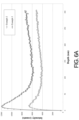
- FIG. 6A is a TOF-SIMS depth profile of potassium in the example 2 and the example 3 of the present disclosure.
- FIG. 6B is a TOF-SIMS depth profile of aluminum in the example 2 and the example 3 of the present disclosure.
- FIGS. 6A and 6B are obtained by performing depth profiling analyses on the example 2 and the example 3 with TOF-SIMS. As shown in FIGS. 6A and 6B , there are signals of potassium and aluminum within a sputter depth of 300 nm, respectively. However, there is no obvious signal of sulfur.
- FIGS. 7A and 7B are charge-discharge characteristic diagrams obtained by performing a test on the comparative example, the example 1, the example 2 and the example 3 at charge and discharge rates (C-rates) of 0.1C, 0.2C, 0.5C, 1C, 2C, 5C and 0.1C in sequence for 5 cycles, respectively.
- the test is performed with a button battery formed by the particle structure of cathode material 1.
- the electrode of the button battery is formed by mixing the particle structure of cathode material 1, a conductive carbon black and a polyvinylidene fluoride (PVDF) in a ratio of 8:1:1.
- PVDF polyvinylidene fluoride
- the electrolyte includes 1.2 M lithium hexafluorophosphate (LiPF 6 ) solution, ethylene carbonate (EC), dimethyl carbonate (DMC), and 4 wt% fluoroethylene carbonate (FEC).
- the test temperature is room temperature (25°C), and the test voltage range is 2.8V to 4.3V
- the capacity and the capacity retention of the example 1, the example 2 and the example 3 are obviously higher than those of the comparative example without addition potassium alum.
- the example 2 with 0.5 wt% potassium alum has the best performance.
- FIGS. 8A and 8B are charge-discharge characteristic diagrams obtained by performing a test on the comparative example, the example 1, the example 2 and the example 3 at a C-rate of 0.3C, a voltage range of 2.8V to 4.3V and a room temperature (25°C).
- the following table 1 shows the testing results.
- the test is performed with a button battery made of the particle structure of cathode material 1.
- the composition of the button battery is the same as above, and is not redundantly described herein.
- the capacities of the example 1, the example 2 and the example 3 are higher than that of the comparative example at a high cycle number. Especially the example 2 has the best performance.
- FIG. 8A the capacities of the example 1, the example 2 and the example 3 are higher than that of the comparative example at a high cycle number. Especially the example 2 has the best performance.
- FIG. 8A the capacities of the example 1, the example 2 and the example 3 are higher than that of the comparative example at a high cycle number. Especially the example
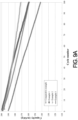
- FIGS. 9A and 9B are charge-discharge characteristic diagrams obtained by performing a test on the comparative example, the example 1, the example 2 and the example 3 at a C-rate of 0.5C, a voltage range of 2.8V to 4.3V and a temperature of 55°C.
- the following table 2 shows the testing results.
- the test is performed with a button battery made of the particle structure of cathode material 1.
- the composition of the button battery is the same as above, and is not redundantly described herein.
- the capacities of the example 1, the example 2 and the example 3 are similar, but all of them are obviously higher than the capacity of the comparative example at a low cycle number. Especially the example 2 has the best performance at a higher cycle number.
- the capacities of the example 1, the example 2 and the example 3 are higher than that of the comparative example at different cycle numbers.
- capacity retentions of the example 1, the example 2 and the example 3 are higher than the comparative example at a high cycle number.
- the example 2 has the best performance.
- the capacity of the comparative example after 100 cycles is 142 mAh/g, and the capacity retention is 75%.
- the capacity of the example 2 after 100 cycles is 172 mAh/g, and the capacity retention is 87%.
- cathode material 1 of the present disclosure facilitates the migration of lithium ions with an inner coating layer including potassium and aluminum, and avoid the reaction between the cathode material and the electrolyte with an outer coating layer including sulfur. Accordingly, the purpose of improving cycle life, capacity and stability of battery is achieved.
- Table 2 Capacity after 1 cycle (mAh/g) Capacity after 100 cycles (mAh/g) Capacity retention after 100 cycles Comparative example 190 142 75%
- FIGS. 10A and 10B are charge-discharge characteristic diagrams obtained by performing a test on the comparative example, the example 1, the example 2 and the example 3 at a C-rate of 0.3C, a voltage range of 2.8V to 4.5V and a room temperature (25°C).
- the following table 3 shows the testing results.
- the test is performed with a button battery made of the particle structure of cathode material 1.
- the composition of the button battery is the same as above, and is not redundantly described herein.
- FIG. 10A the capacities of the example 1, the example 2 and the example 3 are higher than that of the comparative example at a high cycle number. Especially the example 2 has the best performance.
- capacity retentions of the example 1, the example 2 and the example 3 are obviously higher than the comparative example at a high cycle number. Especially the example 2 has the best performance.
- the capacity of the comparative example after 100 cycles is 119 mAh/g, and the capacity retention is 66%.
- the capacity of the example 2 after 100 cycles is 151 mAh/g, and the capacity retention is 82%.
- the particle structure of cathode material includes at least two coating layers, and each of the different coating layers has different element composition.
- the at least two coating layers are a first coating layer as an inner coating layer and a second coating layer as an outer coating layer. Since the first coating layer contains potassium and aluminum, it is conducive to the migration of lithium ions.
- the second coating layer contains sulfur, so that the reaction between the cathode material and the electrolyte during charging and discharging is avoided. Accordingly, the purpose of improving battery performances, such as cycle life, capacity and stability, is achieved.
- a metal salt and a lithium ion compound are mixed and added to a precursor, and a mixture is formed.
- the metal salt includes potassium, aluminum and sulfur.
- the precursor includes nickel, cobalt and manganese.
- the mixture is subjected to a heat treatment, and the particle structure of cathode material is formed.
- the particle structure of cathode material has at least two coating layers. Thicknesses and compositions of the at least two coating layers are obtained through analysis results of an X-ray photoelectron spectroscopy (XPS) and a time-of-flight secondary ion mass spectrometer (TOF-SIMS).
- XPS X-ray photoelectron spectroscopy
- TOF-SIMS time-of-flight secondary ion mass spectrometer
- the migration of lithium ions is improved, and the reaction between the cathode material and the electrolyte during charging and discharging is avoided.
- a potassium alum in a specific ratio range is added into a precursor, and a mixture is formed.
- the mixture is subjected to two heat treatment steps, and the particle structure of cathode material is formed to have at least two coating layers.
- the particle structure of cathode material has low cation disorder degree and orderly layered structure
- the preparation method of the particle structure of cathode material is simple and low costing. It is helpful of enhancing the product competitiveness of the battery formed by the particle structure of cathode material.
Landscapes
- Chemical & Material Sciences (AREA)
- Chemical Kinetics & Catalysis (AREA)
- Electrochemistry (AREA)
- General Chemical & Material Sciences (AREA)
- Composite Materials (AREA)
- Inorganic Chemistry (AREA)
- Engineering & Computer Science (AREA)
- Materials Engineering (AREA)
- Organic Chemistry (AREA)
- Manufacturing & Machinery (AREA)
- Battery Electrode And Active Subsutance (AREA)
- Inorganic Compounds Of Heavy Metals (AREA)
- Secondary Cells (AREA)
Description
- The present disclosure relates to a cathode material for a secondary battery, and more particularly to a particle structure of cathode material and a preparation method thereof for improving a working voltage and a cycle life of a battery formed thereby.
- In recent years, with the advancement of technology and the rise of environmental awareness, the demand for reusable secondary batteries has increased gradually. Secondary batteries are used in common devices, such as smart phones, laptops, digital cameras, electric cars, etc. However, these devices are required to have certain level of performance to comply with the trend of miniaturization and increasingly complex functional requirements.
- Among different types of secondary batteries, lithium ion battery is a popular and potential choice with its high energy density, high working voltage and long cycle life. However, the surface of the cathode material of the lithium ion battery easily reacts with the electrolyte during charging and discharging. The reaction between the cathode material and the electrolyte results in a decrease in battery characteristics such as the working voltage and the cycle life, and the battery performance is adversely affected.
- Therefore, there is a need to provide a cathode material for a secondary battery, and more particularly to a particle structure of cathode material and a preparation method thereof for improving a working voltage and a cycle life of a battery formed thereby.
US 10 756 339 - An object of the present disclosure is to provide a particle structure of cathode material and a preparation method thereof for improving a working voltage and a cycle life of a battery formed thereby. The particle structure of cathode material includes at least two coating layers, and each of the different coating layers has different element composition. Preferably but not exclusively, the at least two coating layers are a first coating layer as an inner coating layer and a second coating layer as an outer coating layer. Since the first coating layer contains potassium and aluminum, it is conducive to the migration of lithium ions. Moreover, the second coating layer contains sulfur, so that the reaction between the cathode material and the electrolyte during charging and discharging is avoided. Accordingly, the purpose of improving the battery performances, such as the cycle life, the capacity and the stability, is achieved.
- Another object of the present disclosure is to provide a particle structure of cathode material and a preparation method thereof for improving a working voltage and a cycle life of a battery formed thereby. Preferably but not exclusively, a metal salt and a lithium ion compound are mixed and added to a precursor, and a mixture is formed. The metal salt includes potassium, aluminum and sulfur. The precursor includes nickel, cobalt and manganese. After that, the mixture is subjected to a heat treatment, and the particle structure of cathode material is formed. The particle structure of cathode material has at least two coating layers. Thicknesses and compositions of the at least two coating layers are obtained through analysis results of an X-ray photoelectron spectroscopy (XPS) and a time-of-flight secondary ion mass spectrometer (TOF-SIMS). With at least two coating layers having different compositions, such as potassium, aluminum and sulfur, respectively, the migration of lithium ions is improved, and the reaction between the cathode material and the electrolyte during charging and discharging is avoided.
- Another object of the present disclosure is to provide a particle structure of cathode material and a preparation method thereof for improving a working voltage and a cycle life of a battery formed thereby. Preferably but not exclusively, a potassium alum in a specific ratio range is added into a precursor, and a mixture is formed. The mixture is subjected to two heat treatment steps, and the particle structure of cathode material is formed to have at least two coating layers. The particle structure of cathode material has low cation disorder degree and orderly layered structure. Moreover, the preparation method of the particle structure of cathode material is simple and low costing. It is helpful of enhancing the product competitiveness of the battery formed by the particle structure of cathode material.
- In accordance with an aspect of the present disclosure, a particle structure of cathode material is provided. The particle structure of cathode material includes a core, a first coating layer and a second coating layer. The first coating layer is coated on the core, and the second coating layer is coated on the first coating layer. The core includes potassium and aluminum. The first coating layer includes potassium and aluminum, and a potassium content of the first coating layer is higher than a potassium content of the core. The second coating layer includes sulfur. With the potassium and the aluminum contained in the core and the first coating layer, the migration of lithium ions is improved. Moreover, with the sulfur contained in the second coating layer, the reaction between the particle structure of cathode material and the electrolyte is avoided. Accordingly, the cycle life and the stability of the battery formed by the particle structure of cathode material are improved.
- According to the claimed invention, the core includes a Li-M-O based material, wherein M comprises nickel, cobalt and manganese.
- In an embodiment, the Li-M-O based material is a lithium nickel manganese cobalt oxide.
- In an embodiment, the particle structure of cathode material has a particle size ranged from 3 µm to 10 µm.
- In an embodiment, the particle structure of cathode material has a potassium content ranged from 0.01 mol% to 0.2 mol% and an aluminum content ranged from 0.01 mol% to 0.2 mol%.
- In an embodiment, the first coating layer has a first thickness, and the second coating layer has a second thickness. The first thickness is greater than the second thickness.
- In an embodiment, the first thickness is ranged from 12 nm to 70 nm. The second thickness is ranged from 1 nm to 3 nm. The first thickness and the second thickness are obtained through analysis results of an X-ray photoelectron spectroscopy and a time-of-flight secondary ion mass spectrometer.
- In accordance with another aspect of the present disclosure, a preparation method of a particle structure of cathode material is provided. The preparation method includes steps of: (a) providing a precursor configured to form a core, wherein the precursor includes at least nickel, cobalt and manganese; (b) providing a metal salt and a lithium ion compound, wherein the metal salt includes at least potassium, aluminum and sulfur; (c) mixing the metal salt, the lithium ion compound and the precursor to form a mixture; and (d) subjecting the mixture to a heat treatment step to form the particle structure of cathode material, wherein the particle structure of cathode material includes the core, a first coating layer and a second coating layer, wherein the core includes potassium and aluminum, wherein the first coating layer is coated on the core, and the second coating layer is coated on the first coating, wherein the first coating layer includes potassium and aluminum, and a potassium content of the first coating layer is higher than a potassium content of the core, wherein the second coating layer includes sulfur.
- In an embodiment, the core includes a Li-M-O based material. M is one selected from the group consisting of nickel, cobalt, manganese, magnesium, titanium, aluminum, tin, chromium, vanadium, molybdenum and a combination thereof.
- In an embodiment, the Li-M-O based material is a lithium nickel manganese cobalt oxide.
- In an embodiment, the particle structure of cathode material has a particle size ranged from 3 µm to 10 µm.
- In an embodiment, the particle structure of cathode material has a potassium content ranged from 0.01 mol% to 0.2 mol% and an aluminum content ranged from 0.01 mol% to 0.2 mol%.
- In an embodiment, the first coating layer has a first thickness, and the second coating layer has a second thickness. The first thickness is greater than the second thickness.
- In an embodiment, the first thickness is ranged from 12 nm to 70 nm. The second thickness is ranged from 1 nm to 3 nm. The first thickness and the second thickness are obtained through analysis results of an X-ray photoelectron spectroscopy and a time-of-flight secondary ion mass spectrometer.
- In an embodiment, the precursor is formed by a co-precipitation of a first solution and a second solution. The first solution includes at least nickel, cobalt and manganese. The second solution includes at least oxalic acid.
- In an embodiment, the step (b) further includes a step: (b1) dissolving the metal salt and the lithium ion compound in a water to form a third solution.
- In an embodiment, the metal salt has a weight percentage relative to the precursor, and the weight percentage is ranged from 0.1 wt% to 2 wt%.
- In an embodiment, the heat treatment step includes a temperature-holding step. The temperature-holding step has a temperature greater than or equal to 700°C.
- In an embodiment, the heat treatment step further includes a first heat treatment step and a second heat treatment step. A maximum temperature of the second heat treatment step is greater than a maximum temperature of the first heat treatment step.
- In an embodiment, the metal salt is a potassium alum.
-
-
FIG. 1 is a schematic view illustrating a particle structure of cathode material according to an embodiment of the present disclosure; -
FIGS. 2A to 2C are SEM images of the particle structure of cathode material according to an embodiment of the present disclosure; -
FIG. 3 is a flow chart of a preparation method of the particle structure of cathode material according to an embodiment of the present disclosure; -
FIG. 4A is a time-temperature curve of a first heat treatment step according to an embodiment of the present disclosure; -
FIG. 4B is a time-temperature curve of a second heat treatment step according to an embodiment of the present disclosure; -
FIGS. 5A to 5C are XPS spectra of an example 2 and an example 3 of the present disclosure; -
FIG. 6A is a TOF-SIMS depth profile of potassium in the example 2 and the example 3 of the present disclosure; -
FIG. 6B is a TOF-SIMS depth profile of aluminum in the example 2 and the example 3 of the present disclosure; -
FIGS. 7A and7B are charge-discharge characteristic diagrams of a comparative example, an example 1, the example 2 and the example 3 at different charge and discharge rates; -
FIGS. 8A and8B are charge-discharge characteristic diagrams of the comparative example, the example 1, the example 2 and the example 3 under a charge and discharge rate, voltage range and temperature condition; -
FIGS. 9A and9B are charge-discharge characteristic diagrams of the comparative example, the example 1, the example 2 and the example 3 under another charge and discharge rate, voltage range and temperature condition; and -
FIGS. 10A and10B are charge-discharge characteristic diagrams of the comparative example, the example 1, the example 2 and the example 3 under another charge and discharge rate, voltage range and temperature condition. - The present disclosure will now be described more specifically with reference to the following embodiments. It is to be noted that the following descriptions of preferred embodiments of the disclosure are presented herein for purpose of illustration and description only. It is not intended to be exhaustive or to be limited to the precise form disclosed.
- Refer to
FIG. 1. FIG. 1 is a schematic view illustrating a particle structure of cathode material according to an embodiment of the present disclosure. The particle structure ofcathode material 1 includes a core 10, afirst coating layer 20 and asecond coating layer 30. Thefirst coating layer 20 is coated on thecore 10, and thesecond coating layer 30 is coated on thefirst coating layer 20. Thecore 10 includes potassium and aluminum. Thefirst coating layer 20 includes potassium and aluminum, and a potassium content of thefirst coating layer 20 is higher than a potassium content of thecore 10. Thesecond coating layer 30 includes sulfur. Notably, with the potassium and the aluminum contained in thecore 10 and thefirst coating layer 20, the migration of lithium ions is improved. On the other hand, with the sulfur contained in thesecond coating layer 30, the reaction between the particle structure ofcathode material 1 and the electrolyte during charging and discharging is avoided. Thus, the cycle life and the stability of the battery formed by the particle structure ofcathode material 1 are improved. - Refer to
FIGS. 2A to 2C. FIGS. 2A to 2C are SEM images of the particle structure of cathode material according to an embodiment of the present disclosure. In the embodiment, thecore 10 includes a Li-M-O based material. M is one selected from the group consisting of nickel, cobalt, manganese, magnesium, titanium, aluminum, tin, chromium, vanadium, molybdenum and a combination thereof. Preferably but not exclusively, the Li-M-O based material is a lithium nickel manganese cobalt oxide, and the chemical formula of the lithium nickel manganese cobalt oxide is LiNixCoyMnzO2 (x+y+z=1, 0<x<1, 0<y<1, 0<z<1). Preferably but not exclusively, the Li-M-O based material is a lithium nickel manganese cobalt oxide with higher nickel content. For example, a lithium nickel manganese cobalt oxide with higher nickel content has an 8:1:1 molar ratio among nickel, cobalt and manganese, and the chemical formula of the lithium nickel manganese cobalt oxide is LiNi0.8Co0.1Mn0.1O2. Scanning the particle structure ofcathode material 1 through a scanning electron microscopy (SEM), and the images are produced as shown inFIGS. 2A to 2C . From the images, it can be seen that the particle structure ofcathode material 1 has a particle size ranged from 3 µm to 10 µm. In the embodiment, the particle structure ofcathode material 1 has a potassium content ranged from 0.01 mol% to 0.2 mol% and an aluminum content ranged from 0.01 mol% to 0.2 mol%. - In the embodiment, the
first coating layer 20 has a first thickness H1, and thesecond coating layer 30 has a second thickness H2. The first thickness H1 is greater than the second thickness H2. The first thickness H1 is ranged from 12 nm to 70 nm. The second thickness H2 is ranged from 1 nm to 3 nm. Preferably but not exclusively, the first thickness H1 and the second thickness H2 are obtained through a surface analysis of an X-ray photoelectron spectroscopy (XPS) and a depth profiling analysis of a time-of-flight secondary ion mass spectrometer (TOF-SIMS). It is noted that any instrument that can perform surface analysis and depth profiling analysis, such as an Auger electron spectroscopy (AES), is suitable for obtaining the thicknesses, and the present disclosure is not limited thereto. - Refer to
FIG. 3. FIG. 3 is a flow chart of a preparation method of the particle structure of cathode material according to an embodiment of the present disclosure. In accordance with the particle structure ofcathode material 1 of the present disclosure, a preparation method of the particle structure ofcathode material 1 is provided. Firstly, a precursor for forming acore 10 is provided, as shown in step S1. Preferably but not exclusively, the precursor includes at least nickel, cobalt and manganese for preparing a lithium nickel manganese cobalt oxide material. In the embodiment, the precursor is formed by a co-precipitation of a first solution and a second solution. The first solution includes at least nickel, cobalt and manganese. Preferably but not exclusively, the first solution is mixed by a nickel sulfate (NiSO4) solution, a cobalt sulfate (CoSO4) solution, and a manganese sulfate (MnSO4) solution. The second solution includes at least oxalic acid (H2C2O4). Preferably but not exclusively, the second solution is mixed by an oxalic acid solution, a sodium hydroxide solution and ammonia solution. - Secondly, a metal salt and a lithium ion compound are provided, as shown in step S2. In the embodiment, the metal salt includes at least potassium, aluminum and sulfur. Preferably but not exclusively, the metal salt is a potassium alum (KAl(SO4)2·12H2O), and the lithium ion compound is a lithium hydroxide monohydrate (LiOH·H2O).
- After that, the metal salt, the lithium ion compound and the precursor are mixed, and a mixture is formed. In the embodiment, a third solution is formed by dissolving the metal salt and the lithium ion compound in a water before being mixed with the precursor, so as to improve the uniformity of the mixture. In the embodiment, the metal salt has a weight percentage relative to the precursor, and the weight percentage is ranged from 0.1 wt% to 2 wt%.
- Finally, the mixture is subjected to a heat treatment step, such as calcination, and the particle structure of
cathode material 1 is formed. In the embodiment, the heat treatment step further includes a temperature-holding step and a cooling step. The temperature-holding step has a temperature greater than or equal to 700°C. Preferably but not exclusively, holding the temperature at 700°C facilitates the formation of an orderly layered structure of the particle structure ofcathode material 1. The cooling step facilitates the reduction of the oxygen vacancies in the particle structure ofcathode material 1. Thus, the battery performance is improved. In the embodiment, the heat treatment step further includes a first heat treatment step and a second heat treatment step. A maximum temperature of the second heat treatment step is greater than a maximum temperature of the first heat treatment step. Preferably but not exclusively, the maximum temperature of the first heat treatment step is 700°C, and the maximum temperature of the second heat treatment step is 775°C. With two-step high-temperature calcination, cation disorder degree of the particle structure ofcathode material 1 is further reduced, and a better orderly layered structure is formed. Thus, the battery performance is further improved. - The following examples illustrate the preparation method and efficacy of the present disclosure.
- A first solution and a second solution are mixed for co-precipitation, and a precursor is formed. The first solution is a solution including metal ions, which is mixed by a 0.24 M nickel sulfate hexahydrate (NiSO4·6H2O) solution, a 0.03 M cobalt sulfate heptahydrate (CoSO4·7H2O) solution and a 0.03 M hydrated manganese sulfate (MnSO4·H2O) solution. The second solution is a solution including oxalic acid, which is mixed by a 0.33M oxalic acid (H2C2O4) solution, a 0.3 M sodium hydroxide (NaOH) solution and a 0.075 M ammonia (NH4OH) solution. Preferably but not exclusively, the precursor is Ni0.8Co0.1Mn0.1C2O4·2H2O.
- A metal salt and a lithium ion compound are dissolved in a water, and a third solution is formed. The metal salt includes at least potassium, aluminum and sulfur, Preferably but not exclusively, the metal salt is a potassium alum (KAl(SO4)2·12H2O). The lithium ion compound is a lithium hydroxide monohydrate (LiOH·H2O). The weight percentage of the potassium alum relative to the precursor is 0.3 wt%.
- Refer to
FIGS. 4A to 4B .FIG. 4A is a time-temperature curve of a first heat treatment step according to an embodiment of the present disclosure.FIG. 4B is a time-temperature curve of a second heat treatment step according to an embodiment of the present disclosure. The third solution and the precursor are mixed, and a mixture is formed. The mixture is ground and subjected to a first calcination. Time-temperature curve of the first calcination is shown inFIG. 4A . Firstly, the mixture is heated from room temperature (25°C), and a heating rate is maintained at 1.94°C/min for 1 hour and 20 minutes to reach 180°C to remove residual moisture on the surface of the mixture. Secondly, the heating rate is maintained at 0.17°C/min for 7 hours, and the mixture is heated to 250°C to remove the water of crystallization in the hydrate. Thirdly, the heating rate is maintained at 0.14°C/min for 12 hours, and the mixture is heated to 350°C to pyrolyze the oxalate and oxidize the mixture. Fourthly, the heating rate is maintained at 0.4°C/min for 6 hours and 15 minutes, and the mixture is heated to 500°C to melt the lithium hydroxide. Fifthly, the heating rate is maintained at 2.22°C/min for 1 hour and 30 minutes, and the mixture is heated to 700°Cto allow lithium ions to be doped into the crystal lattice. Finally, the mixture is maintained at 700°C for 12 hours to arrange the crystal lattice into a layered structure. After being subjected to the first calcination, the mixture is taken out, ground, sieved and subjected to a second calcination. Time-temperature curve of the second calcination is shown inFIG. 4B . Firstly, the mixture is heated from room temperature (25°C), and a heating rate is maintained at 5°C/min for 2 hours and 30 minutes to reach 775°C. Secondly, the mixture is maintained at 775°C for 20 hours to arrange the crystal lattice into a better layered structure. Finally, the heating rate is maintained at -0.78°C/min for 8 hours to reach 400°C to reduce the oxygen vacancies in the crystal lattice. The mixture that has been subjected to the second calcination is taken out, ground and sieved, and a particle structure ofcathode material 1 with multiple coating layers of different elements is formed. With two-step high-temperature calcination, cation disorder degree of the particle structure ofcathode material 1 is reduced, and the orderly layered structure is formed. - Preferably but not exclusively, a preparation method of the example 2 is similar to that of the example 1. However, in the preparation method of the example 2, the weight percentage of the potassium alum relative to the precursor is 0.5 wt%.
- Preferably but not exclusively, a preparation method of the example 3 is similar to that of the example 1. However, in the preparation method of the example 3, the weight percentage of the potassium alum relative to the precursor is 1 wt%.
- Preferably but not exclusively, potassium alum is not added in a preparation method of the comparative example.
- Refer to
FIGS. 5A to 5C. FIGS. 5A to 5C are XPS spectra of the example 2 and the example 3 of the present disclosure.FIGS. 5A to 5C are obtained by performing surface analysis on the example 2 and the example 3 with XPS. As shown inFIGS. 5A ,5B and5C , there are obvious peaks in the binding energy range of potassium, aluminum and sulfur, respectively. It can be seen that potassium, aluminum and sulfur, which are the constituent elements of the potassium alum (KAl(SO4)2· 12H2O), exist in the particle structure ofcathode material 1. - Refer to
FIGS. 6A and6B .FIG. 6A is a TOF-SIMS depth profile of potassium in the example 2 and the example 3 of the present disclosure.FIG. 6B is a TOF-SIMS depth profile of aluminum in the example 2 and the example 3 of the present disclosure.FIGS. 6A and6B are obtained by performing depth profiling analyses on the example 2 and the example 3 with TOF-SIMS. As shown inFIGS. 6A and6B , there are signals of potassium and aluminum within a sputter depth of 300 nm, respectively. However, there is no obvious signal of sulfur. Combined with the XPS analysis results above, it can be seen that sulfur is present in the surface of the particle structure ofcathode material 1 at a depth of about 1 nm to 3 nm, and potassium and aluminum are doped into the particle structure ofcathode material 1. As shown inFIG. 6A , the doping concentration of potassium in the particle structure ofcathode material 1 near the surface is higher than that in the interior, and the part with the higher doping concentration of potassium has a thickness between 30 nm and 70 nm. As shown inFIG. 6B , the doping concentration of aluminum is approximately the same at different depths of the particle structure ofcathode material 1. - Refer to
FIGS. 7A and7B .FIGS. 7A and7B are charge-discharge characteristic diagrams obtained by performing a test on the comparative example, the example 1, the example 2 and the example 3 at charge and discharge rates (C-rates) of 0.1C, 0.2C, 0.5C, 1C, 2C, 5C and 0.1C in sequence for 5 cycles, respectively. The test is performed with a button battery formed by the particle structure ofcathode material 1. The electrode of the button battery is formed by mixing the particle structure ofcathode material 1, a conductive carbon black and a polyvinylidene fluoride (PVDF) in a ratio of 8:1:1. Preferably but not exclusively, the electrolyte includes 1.2 M lithium hexafluorophosphate (LiPF6) solution, ethylene carbonate (EC), dimethyl carbonate (DMC), and 4 wt% fluoroethylene carbonate (FEC). The test temperature is room temperature (25°C), and the test voltage range is 2.8V to 4.3V As shown in the diagrams, the capacity and the capacity retention of the example 1, the example 2 and the example 3 are obviously higher than those of the comparative example without addition potassium alum. The example 2 with 0.5 wt% potassium alum has the best performance. - Refer to
FIGS. 8A and8B .FIGS. 8A and8B are charge-discharge characteristic diagrams obtained by performing a test on the comparative example, the example 1, the example 2 and the example 3 at a C-rate of 0.3C, a voltage range of 2.8V to 4.3V and a room temperature (25°C). The following table 1 shows the testing results. The test is performed with a button battery made of the particle structure ofcathode material 1. The composition of the button battery is the same as above, and is not redundantly described herein. As shown inFIG. 8A , the capacities of the example 1, the example 2 and the example 3 are higher than that of the comparative example at a high cycle number. Especially the example 2 has the best performance. As shown inFIG. 8B , capacity retentions of the example 1, the example 2 and the example 3 are higher than the comparative example at a high cycle number. Especially the example 2 has the best performance. As shown in table 1 below, the capacity of the comparative example after 100 cycles is 143 mAh/g, and the capacity retention is 79%. In contrast, the capacity of the example 2 after 100 cycles is 162 mAh/g, and the capacity retention is 86%. It can be concluded from the above results that the particle structure ofcathode material 1 of the present disclosure facilitates the migration of lithium ions with an inner coating layer including potassium and aluminum, and avoid the reaction between the cathode material and the electrolyte with an outer coating layer including sulfur. Accordingly, the purpose of improving cycle life, capacity and stability of battery is achieved.Table 1 Capacity after 1 cycle (mAh/g) Capacity after 100 cycles (mAh/g) Capacity retention after 100 cycles Comparative example 181 143 79% Example 1 (0.3 wt% potassium alum) 182 150 82% Example 2 (0.5 wt% potassium alum) 188 162 86% Example 3 (1 wt% potassium alum) 183 147 80% -
FIGS. 9A and9B are charge-discharge characteristic diagrams obtained by performing a test on the comparative example, the example 1, the example 2 and the example 3 at a C-rate of 0.5C, a voltage range of 2.8V to 4.3V and a temperature of 55°C. The following table 2 shows the testing results. The test is performed with a button battery made of the particle structure ofcathode material 1. The composition of the button battery is the same as above, and is not redundantly described herein. As shown inFIG. 9A , the capacities of the example 1, the example 2 and the example 3 are similar, but all of them are obviously higher than the capacity of the comparative example at a low cycle number. Especially the example 2 has the best performance at a higher cycle number. It is noted that the capacities of the example 1, the example 2 and the example 3 are higher than that of the comparative example at different cycle numbers. As shown inFIG. 9B , capacity retentions of the example 1, the example 2 and the example 3 are higher than the comparative example at a high cycle number. Especially the example 2 has the best performance. As shown in table 2 below, the capacity of the comparative example after 100 cycles is 142 mAh/g, and the capacity retention is 75%. In contrast, the capacity of the example 2 after 100 cycles is 172 mAh/g, and the capacity retention is 87%. It can be concluded from the above results that the particle structure ofcathode material 1 of the present disclosure facilitates the migration of lithium ions with an inner coating layer including potassium and aluminum, and avoid the reaction between the cathode material and the electrolyte with an outer coating layer including sulfur. Accordingly, the purpose of improving cycle life, capacity and stability of battery is achieved.Table 2 Capacity after 1 cycle (mAh/g) Capacity after 100 cycles (mAh/g) Capacity retention after 100 cycles Comparative example 190 142 75% Example 1 (0.3 wt% potassium alum) 199 160 80% Example 2 (0.5 wt% potassium alum) 198 172 87% Example 3 (1 wt% potassium alum) 198 159 80% -
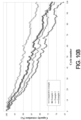
FIGS. 10A and10B are charge-discharge characteristic diagrams obtained by performing a test on the comparative example, the example 1, the example 2 and the example 3 at a C-rate of 0.3C, a voltage range of 2.8V to 4.5V and a room temperature (25°C). The following table 3 shows the testing results. The test is performed with a button battery made of the particle structure ofcathode material 1. The composition of the button battery is the same as above, and is not redundantly described herein. As shown inFIG. 10A , the capacities of the example 1, the example 2 and the example 3 are higher than that of the comparative example at a high cycle number. Especially the example 2 has the best performance. As shown inFIG. 10B , capacity retentions of the example 1, the example 2 and the example 3 are obviously higher than the comparative example at a high cycle number. Especially the example 2 has the best performance. - As shown in table 3 below, the capacity of the comparative example after 100 cycles is 119 mAh/g, and the capacity retention is 66%. In contrast, the capacity of the example 2 after 100 cycles is 151 mAh/g, and the capacity retention is 82%. It can be concluded from the above results that the particle structure of
cathode material 1 of the present disclosure facilitates the migration of lithium ions with an inner coating layer including potassium and aluminum, and avoid the reaction between the cathode material and the electrolyte with an outer coating layer including sulfur. Accordingly, the purpose of improving cycle life, capacity and stability of battery is achieved.Table 3 Capacity after 1 cycle (mAh/g) Capacity after 100 cycles (mAh/g) Capacity retention after 100 cycles Comparative example 180 119 66% Example 1 (0.3 wt% potassium alum) 181 132 73% Example 2 (0.5 wt% potassium alum) 184 151 82% Example 3 (1 wt% potassium alum) 177 126 71% - As stated above, a particle structure of cathode material and a preparation method thereof for improving a working voltage and a cycle life of a battery formed thereby is provided in the present disclosure. The particle structure of cathode material includes at least two coating layers, and each of the different coating layers has different element composition. Preferably but not exclusively, the at least two coating layers are a first coating layer as an inner coating layer and a second coating layer as an outer coating layer. Since the first coating layer contains potassium and aluminum, it is conducive to the migration of lithium ions. Moreover, the second coating layer contains sulfur, so that the reaction between the cathode material and the electrolyte during charging and discharging is avoided. Accordingly, the purpose of improving battery performances, such as cycle life, capacity and stability, is achieved. Preferably but not exclusively, a metal salt and a lithium ion compound are mixed and added to a precursor, and a mixture is formed. The metal salt includes potassium, aluminum and sulfur. The precursor includes nickel, cobalt and manganese. After that, the mixture is subjected to a heat treatment, and the particle structure of cathode material is formed. The particle structure of cathode material has at least two coating layers. Thicknesses and compositions of the at least two coating layers are obtained through analysis results of an X-ray photoelectron spectroscopy (XPS) and a time-of-flight secondary ion mass spectrometer (TOF-SIMS). With at least two coating layers having different compositions, such as potassium, aluminum and sulfur, respectively, the migration of lithium ions is improved, and the reaction between the cathode material and the electrolyte during charging and discharging is avoided. Preferably but not exclusively, a potassium alum in a specific ratio range is added into a precursor, and a mixture is formed. The mixture is subjected to two heat treatment steps, and the particle structure of cathode material is formed to have at least two coating layers. The particle structure of cathode material has low cation disorder degree and orderly layered structure Moreover, the preparation method of the particle structure of cathode material is simple and low costing. It is helpful of enhancing the product competitiveness of the battery formed by the particle structure of cathode material.
Claims (18)
- A preparation method of a particle structure of cathode material (1), characterized by comprising steps of:(a) providing a precursor configured to form a core (10), wherein the precursor comprises at least nickel, cobalt and manganese;(b) providing a metal salt and a lithium ion compound, wherein the metal salt comprises at least potassium, aluminum and sulfur;(c) mixing the metal salt, the lithium ion compound and the precursor to form a mixture; and(d) subjecting the mixture to a heat treatment step to form the particle structure of cathode material (1), wherein the particle structure of cathode material (1) comprises the core (10), a first coating layer (20) and a second coating layer (30), wherein the core (10) comprises potassium, aluminum and a Li-M-O based material, wherein M comprises nickel, cobalt, and manganese, wherein the first coating layer (20) is coated on the core (10), and the second coating layer (30) is coated on the first coating layer (20), wherein the first coating layer (20) comprises potassium and aluminum, and a potassium content of the first coating layer (20) is higher than a potassium content of the core (10), wherein the second coating layer (30) comprises sulfur.
- The preparation method according to claim 1, wherein the Li-M-O based material is a lithium nickel manganese cobalt oxide.
- The preparation method according to claim 1 or 2, wherein the particle structure of cathode material (1) has a particle size ranged from 3 µm to 10 µm.
- The preparation method according to one of the preceding claims, wherein the particle structure of cathode material (1) has a potassium content ranged from 0.01 mol% to 0.2 mol%, wherein the particle structure of cathode material (1) has an aluminum content ranged from 0.01 mol% to 0.2 mol%.
- The preparation method according to one of the preceding claims, wherein the first coating layer (20) has a first thickness (H1), and the second coating layer (30) has a second thickness (H2), wherein the first thickness (H1) is greater than the second thickness (H2).
- The preparation method according to claim 5, wherein the first thickness (H1) is ranged from 12 nm to 70 nm, and the second thickness (H2) is ranged from 1 nm to 3 nm, wherein the first thickness (H1) and the second thickness (H2) are obtained through analysis results of an X-ray photoelectron spectroscopy and a time-of-flight secondary ion mass spectrometer.
- The preparation method according to one of the preceding claims, wherein the precursor is formed by a co-precipitation of a first solution and a second solution, wherein the first solution comprises at least nickel, cobalt and manganese, and the second solution comprises at least oxalic acid.
- The preparation method according to one of the preceding claims, wherein the step (b) further comprises a step:
(b1) dissolving the metal salt and the lithium ion compound in a water to form a third solution. - The preparation method according to claim 1, wherein the metal salt has a weight percentage relative to the precursor, and the weight percentage is ranged from 0.1 wt% to 2 wt%.
- The preparation method according to one of the preceding claims, wherein the heat treatment step comprises a temperature-holding step, and the temperature-holding step has a temperature greater than or equal to 700°C.
- The preparation method according to one of the preceding claims, wherein the heat treatment step further comprises a first heat treatment step and a second heat treatment step, wherein a maximum temperature of the second heat treatment step is greater than a maximum temperature of the first heat treatment step.
- The preparation method according to one of the preceding claims, wherein the metal salt is a potassium alum.
- A particle structure of cathode material (1), characterized by comprising:a core (10) comprising potassium, aluminum and a Li-M-O based material, wherein M comprises nickel, cobalt and manganese;a first coating layer (20) coated on the core (10), wherein the first coating layer (20) comprises potassium and aluminum, and a potassium content of the first coating layer (20) is higher than a potassium content of the core (10); anda second coating layer (30) coated on the first coating layer (20), wherein the second coating layer (30) comprises sulfur.
- The particle structure of cathode material (1) according to claim 13, wherein the Li-M-O based material is a lithium nickel manganese cobalt oxide.
- The particle structure of cathode material (1) according to claim 13 or 14, wherein the particle structure of cathode material (1) has a particle size ranged from 3 µm to 10 µm.
- The particle structure of cathode material (1) according to one of claims 13-15, wherein the particle structure of cathode material (1) has a potassium content ranged from 0.01 mol% to 0.2 mol%, wherein the particle structure of cathode material (1) has an aluminum content ranged from 0.01 mol% to 0.2 mol%.
- The particle structure of cathode material (1) according to one of claims 13-16, wherein the first coating layer (20) has a first thickness (H1), and the second coating layer (30) has a second thickness (H2), wherein the first thickness (H1) is greater than the second thickness (H2).
- The particle structure of cathode material (1) according to claim 17, wherein the first thickness (H1) is ranged from 12 nm to 70 nm, and the second thickness (H2) is ranged from 1 nm to 3 nm, wherein the first thickness (H1) and the second thickness (H2) are obtained through analysis results of an X-ray photoelectron spectroscopy and a time-of-flight secondary ion mass spectrometer.
Priority Applications (1)
| Application Number | Priority Date | Filing Date | Title |
|---|---|---|---|
| HRP20250849TT HRP20250849T1 (en) | 2021-02-08 | 2021-11-15 | PARTICLE STRUCTURE OF CATHODE MATERIAL AND PROCESS FOR ITS PREPARATION |
Applications Claiming Priority (1)
| Application Number | Priority Date | Filing Date | Title |
|---|---|---|---|
| TW110104766A TWI747735B (en) | 2021-02-08 | 2021-02-08 | Particle structure of cathode material and manufacturing method thereof |
Publications (3)
| Publication Number | Publication Date |
|---|---|
| EP4039653A1 EP4039653A1 (en) | 2022-08-10 |
| EP4039653C0 EP4039653C0 (en) | 2025-06-11 |
| EP4039653B1 true EP4039653B1 (en) | 2025-06-11 |
Family
ID=78621802
Family Applications (1)
| Application Number | Title | Priority Date | Filing Date |
|---|---|---|---|
| EP21208248.1A Active EP4039653B1 (en) | 2021-02-08 | 2021-11-15 | Particle structure of cathode material and preparation method thereof |
Country Status (7)
| Country | Link |
|---|---|
| US (1) | US11955634B2 (en) |
| EP (1) | EP4039653B1 (en) |
| JP (1) | JP7222050B2 (en) |
| CN (1) | CN114914409B (en) |
| ES (1) | ES3035165T3 (en) |
| HR (1) | HRP20250849T1 (en) |
| TW (1) | TWI747735B (en) |
Families Citing this family (1)
| Publication number | Priority date | Publication date | Assignee | Title |
|---|---|---|---|---|
| TWI867563B (en) * | 2023-06-02 | 2024-12-21 | 台灣立凱電能科技股份有限公司 | Cathode material and preparation method thereof |
Family Cites Families (18)
| Publication number | Priority date | Publication date | Assignee | Title |
|---|---|---|---|---|
| JP3649953B2 (en) * | 1999-06-23 | 2005-05-18 | 三洋電機株式会社 | Active material, electrode, non-aqueous electrolyte secondary battery, and method for producing active material |
| CN100533822C (en) * | 2006-09-29 | 2009-08-26 | 比亚迪股份有限公司 | Positive electrode active material, preparation method thereof, positive electrode and battery |
| KR101105879B1 (en) * | 2009-08-28 | 2012-01-16 | 주식회사 코캄 | Cathode active material for lithium secondary battery, manufacturing method thereof and lithium secondary battery comprising same |
| KR101475575B1 (en) * | 2009-11-05 | 2014-12-22 | 유미코르 | Double-shell core lithium nickel manganese cobalt oxides |
| DE102011006585A1 (en) * | 2010-03-31 | 2012-01-12 | Chemetall Gmbh | Metallimide compounds as anode materials for lithium batteries and galvanic elements with high storage capacity |
| CN103515606B (en) * | 2012-06-21 | 2016-09-14 | 中国科学院宁波材料技术与工程研究所 | Lithium ion battery with high energy density oxide anode material and preparation method thereof |
| KR101785266B1 (en) * | 2013-01-18 | 2017-11-06 | 삼성에스디아이 주식회사 | composit cathode active material, cathode and lithium battery containing the material, and preparation method thereof |
| KR20150101873A (en) * | 2014-02-27 | 2015-09-04 | 삼성에스디아이 주식회사 | Positive active material, positive electrode and lithium battery including the same and method of manufacture thereof |
| KR102201686B1 (en) * | 2014-06-17 | 2021-01-11 | 삼성에스디아이 주식회사 | Positive active material for rechargeable lithium battery, method of preparing the same, and rechargeable lithium battery including the same |
| JP2016033902A (en) * | 2014-07-31 | 2016-03-10 | ソニー株式会社 | Positive electrode active material, positive electrode and battery |
| KR101913906B1 (en) * | 2015-06-17 | 2018-10-31 | 주식회사 엘지화학 | Positive electrode active material for secondary battery, method for preparing the same, and secondary battery comprising the same |
| KR101982790B1 (en) * | 2015-10-20 | 2019-05-27 | 주식회사 엘지화학 | Positive Electrode Active Material Comprising Layered Lithium Metal Oxides and Positive Electrode having the Same |
| CN108432003B (en) * | 2016-01-06 | 2021-08-24 | 住友金属矿山株式会社 | Positive electrode active material for non-aqueous electrolyte secondary battery, precursor thereof, and method for producing the same |
| CN108269981A (en) * | 2018-01-03 | 2018-07-10 | 中航锂电(洛阳)有限公司 | A kind of nickel cobalt lithium manganate and preparation method thereof, lithium battery |
| CN108400322A (en) * | 2018-02-07 | 2018-08-14 | 成都新柯力化工科技有限公司 | A kind of special nickelic ternary electrode material of dynamic lithium battery and preparation method |
| CN111741927B (en) * | 2018-02-22 | 2024-11-01 | 住友金属矿山株式会社 | Metal composite hydroxide and method for producing the same, positive electrode active material for nonaqueous electrolyte secondary battery and method for producing the same, and nonaqueous electrolyte secondary battery |
| CN108390039A (en) * | 2018-02-23 | 2018-08-10 | 成都新柯力化工科技有限公司 | A kind of nickelic anode material of lithium battery that double oxide coats altogether and preparation method |
| JP7183812B2 (en) * | 2019-01-24 | 2022-12-06 | 住友金属鉱山株式会社 | Nickel-manganese-cobalt-containing composite hydroxide and manufacturing method thereof, positive electrode active material for lithium ion secondary battery and manufacturing method thereof, and lithium ion secondary battery |
-
2021
- 2021-02-08 TW TW110104766A patent/TWI747735B/en active
- 2021-10-28 JP JP2021176679A patent/JP7222050B2/en active Active
- 2021-10-28 CN CN202111262407.8A patent/CN114914409B/en active Active
- 2021-11-15 HR HRP20250849TT patent/HRP20250849T1/en unknown
- 2021-11-15 EP EP21208248.1A patent/EP4039653B1/en active Active
- 2021-11-15 ES ES21208248T patent/ES3035165T3/en active Active
- 2021-11-18 US US17/529,772 patent/US11955634B2/en active Active
Also Published As
| Publication number | Publication date |
|---|---|
| CN114914409A (en) | 2022-08-16 |
| CN114914409B (en) | 2024-02-23 |
| EP4039653C0 (en) | 2025-06-11 |
| HRP20250849T1 (en) | 2025-09-12 |
| JP7222050B2 (en) | 2023-02-14 |
| US11955634B2 (en) | 2024-04-09 |
| ES3035165T3 (en) | 2025-08-29 |
| TWI747735B (en) | 2021-11-21 |
| TW202232806A (en) | 2022-08-16 |
| EP4039653A1 (en) | 2022-08-10 |
| US20220255073A1 (en) | 2022-08-11 |
| JP2022121369A (en) | 2022-08-19 |
Similar Documents
| Publication | Publication Date | Title |
|---|---|---|
| EP3595060B1 (en) | Positive electrode active material for lithium secondary battery and manufacturing method therefor | |
| CN111213264B (en) | Lithium secondary battery | |
| KR102629462B1 (en) | Composite cathode active material, Cathode and Lithium battery containing composite cathode active material and Preparation method thereof | |
| EP4084135A1 (en) | Positive electrode active material, manufacturing method thereof, and lithium secondary battery including positive electrode including same | |
| KR20250138156A (en) | Composite cathode active material, Cathode and Lithium battery containing composite cathode active material and Preparation method thereof | |
| US10741838B2 (en) | Positive-electrode active material powder, positive electrode containing positive-electrode active material powder, and secondary battery | |
| KR20190003110A (en) | Composite cathode active material, Cathode and Lithium battery containing composite cathode active material and Preparation method thereof | |
| KR20130063868A (en) | Positive active material for lithium secondary, method for preparing thereof, and lithium secondary battery containing the same | |
| CN110048087A (en) | Positive active material and battery | |
| KR20220118497A (en) | Positive active material and lithium secondary battery comprising same | |
| JP2025527756A (en) | Sodium layered oxide, its uses and method of manufacture | |
| KR102273775B1 (en) | Composite cathode active material, Cathode and Lithium battery containing composite cathode active material and Preparation method thereof | |
| KR20260049516A (en) | Cathode Active Material Having Composite Coating Layer | |
| KR20210079126A (en) | Cathode active material method for manufacturing the same, and lithium ion battery including the same | |
| KR100872370B1 (en) | Spinel type positive electrode active material for lithium secondary battery and manufacturing method thereof | |
| US11955634B2 (en) | Particle structure of cathode material and preparation method thereof | |
| JP2023162559A (en) | Lithium composite oxide and its manufacturing method | |
| KR20130112583A (en) | Positive active material, method of preparing the same, and lithium battery using the same | |
| EP4037024B1 (en) | Cathode active material, preparation method therefor, and lithium secondary battery comprising same | |
| KR20260064080A (en) | Manufaturing method for positive active material and positive active material | |
| KR20170141116A (en) | Composite cathode active material, Cathode and Lithium battery containing composite cathode active material and Preparation method thereof | |
| WO2023106336A1 (en) | Positive electrode active material for lithium secondary battery, positive electrode for lithium secondary battery, and lithium secondary battery | |
| KR20260061103A (en) | Cathode Active Material Having Composite Coating Layer | |
| KR20260059281A (en) | Positive electrode active material for secondary battery |
Legal Events
| Date | Code | Title | Description |
|---|---|---|---|
| REG | Reference to a national code |
Ref country code: HR Ref legal event code: TUEP Ref document number: P20250849T Country of ref document: HR |
|
| PUAI | Public reference made under article 153(3) epc to a published international application that has entered the european phase |
Free format text: ORIGINAL CODE: 0009012 |
|
| STAA | Information on the status of an ep patent application or granted ep patent |
Free format text: STATUS: REQUEST FOR EXAMINATION WAS MADE |
|
| 17P | Request for examination filed |
Effective date: 20211213 |
|
| AK | Designated contracting states |
Kind code of ref document: A1 Designated state(s): AL AT BE BG CH CY CZ DE DK EE ES FI FR GB GR HR HU IE IS IT LI LT LU LV MC MK MT NL NO PL PT RO RS SE SI SK SM TR |
|
| GRAP | Despatch of communication of intention to grant a patent |
Free format text: ORIGINAL CODE: EPIDOSNIGR1 |
|
| STAA | Information on the status of an ep patent application or granted ep patent |
Free format text: STATUS: GRANT OF PATENT IS INTENDED |
|
| INTG | Intention to grant announced |
Effective date: 20250226 |
|
| GRAS | Grant fee paid |
Free format text: ORIGINAL CODE: EPIDOSNIGR3 |
|
| GRAA | (expected) grant |
Free format text: ORIGINAL CODE: 0009210 |
|
| STAA | Information on the status of an ep patent application or granted ep patent |
Free format text: STATUS: THE PATENT HAS BEEN GRANTED |
|
| AK | Designated contracting states |
Kind code of ref document: B1 Designated state(s): AL AT BE BG CH CY CZ DE DK EE ES FI FR GB GR HR HU IE IS IT LI LT LU LV MC MK MT NL NO PL PT RO RS SE SI SK SM TR |
|
| REG | Reference to a national code |
Ref country code: GB Ref legal event code: FG4D |
|
| REG | Reference to a national code |
Ref country code: CH Ref legal event code: EP |
|
| REG | Reference to a national code |
Ref country code: DE Ref legal event code: R096 Ref document number: 602021032045 Country of ref document: DE |
|
| REG | Reference to a national code |
Ref country code: IE Ref legal event code: FG4D |
|
| U01 | Request for unitary effect filed |
Effective date: 20250708 |
|
| U07 | Unitary effect registered |
Designated state(s): AT BE BG DE DK EE FI FR IT LT LU LV MT NL PT RO SE SI Effective date: 20250714 |
|
| REG | Reference to a national code |
Ref country code: ES Ref legal event code: FG2A Ref document number: 3035165 Country of ref document: ES Kind code of ref document: T3 Effective date: 20250829 |
|
| REG | Reference to a national code |
Ref country code: HR Ref legal event code: T1PR Ref document number: P20250849 Country of ref document: HR |
|
| PG25 | Lapsed in a contracting state [announced via postgrant information from national office to epo] |
Ref country code: GR Free format text: LAPSE BECAUSE OF FAILURE TO SUBMIT A TRANSLATION OF THE DESCRIPTION OR TO PAY THE FEE WITHIN THE PRESCRIBED TIME-LIMIT Effective date: 20250912 |
|
| PG25 | Lapsed in a contracting state [announced via postgrant information from national office to epo] |
Ref country code: RS Free format text: LAPSE BECAUSE OF FAILURE TO SUBMIT A TRANSLATION OF THE DESCRIPTION OR TO PAY THE FEE WITHIN THE PRESCRIBED TIME-LIMIT Effective date: 20250911 |
|
| REG | Reference to a national code |
Ref country code: HR Ref legal event code: ODRP Ref document number: P20250849 Country of ref document: HR Payment date: 20251105 Year of fee payment: 5 |
|
| U20 | Renewal fee for the european patent with unitary effect paid |
Year of fee payment: 5 Effective date: 20251128 |
|
| PG25 | Lapsed in a contracting state [announced via postgrant information from national office to epo] |
Ref country code: IS Free format text: LAPSE BECAUSE OF FAILURE TO SUBMIT A TRANSLATION OF THE DESCRIPTION OR TO PAY THE FEE WITHIN THE PRESCRIBED TIME-LIMIT Effective date: 20251011 |
|
| PGFP | Annual fee paid to national office [announced via postgrant information from national office to epo] |
Ref country code: GB Payment date: 20251128 Year of fee payment: 5 |
|
| PGFP | Annual fee paid to national office [announced via postgrant information from national office to epo] |
Ref country code: NO Payment date: 20251118 Year of fee payment: 5 |
|
| PG25 | Lapsed in a contracting state [announced via postgrant information from national office to epo] |
Ref country code: SM Free format text: LAPSE BECAUSE OF FAILURE TO SUBMIT A TRANSLATION OF THE DESCRIPTION OR TO PAY THE FEE WITHIN THE PRESCRIBED TIME-LIMIT Effective date: 20250611 |
|
| PGFP | Annual fee paid to national office [announced via postgrant information from national office to epo] |
Ref country code: HR Payment date: 20251105 Year of fee payment: 5 |
|
| PGFP | Annual fee paid to national office [announced via postgrant information from national office to epo] |
Ref country code: TR Payment date: 20251111 Year of fee payment: 5 |
|
| PG25 | Lapsed in a contracting state [announced via postgrant information from national office to epo] |
Ref country code: CZ Free format text: LAPSE BECAUSE OF FAILURE TO SUBMIT A TRANSLATION OF THE DESCRIPTION OR TO PAY THE FEE WITHIN THE PRESCRIBED TIME-LIMIT Effective date: 20250611 |
|
| PG25 | Lapsed in a contracting state [announced via postgrant information from national office to epo] |
Ref country code: PL Free format text: LAPSE BECAUSE OF FAILURE TO SUBMIT A TRANSLATION OF THE DESCRIPTION OR TO PAY THE FEE WITHIN THE PRESCRIBED TIME-LIMIT Effective date: 20250611 |
|
| PG25 | Lapsed in a contracting state [announced via postgrant information from national office to epo] |
Ref country code: SK Free format text: LAPSE BECAUSE OF FAILURE TO SUBMIT A TRANSLATION OF THE DESCRIPTION OR TO PAY THE FEE WITHIN THE PRESCRIBED TIME-LIMIT Effective date: 20250611 |
|
| PGFP | Annual fee paid to national office [announced via postgrant information from national office to epo] |
Ref country code: ES Payment date: 20251216 Year of fee payment: 5 |
|
| PLBE | No opposition filed within time limit |
Free format text: ORIGINAL CODE: 0009261 |
|
| STAA | Information on the status of an ep patent application or granted ep patent |
Free format text: STATUS: NO OPPOSITION FILED WITHIN TIME LIMIT |
|
| REG | Reference to a national code |
Ref country code: CH Ref legal event code: L10 Free format text: ST27 STATUS EVENT CODE: U-0-0-L10-L00 (AS PROVIDED BY THE NATIONAL OFFICE) Effective date: 20260423 |