EP4039651A1 - Positive electrode active material for non-aqueous electrolyte secondary batteries, and non-aqueous electrolyte secondary battery - Google Patents
Positive electrode active material for non-aqueous electrolyte secondary batteries, and non-aqueous electrolyte secondary battery Download PDFInfo
- Publication number
- EP4039651A1 EP4039651A1 EP20871657.1A EP20871657A EP4039651A1 EP 4039651 A1 EP4039651 A1 EP 4039651A1 EP 20871657 A EP20871657 A EP 20871657A EP 4039651 A1 EP4039651 A1 EP 4039651A1
- Authority
- EP
- European Patent Office
- Prior art keywords
- containing lithium
- positive electrode
- lithium composite
- composite oxide
- aqueous electrolyte
- Prior art date
- Legal status (The legal status is an assumption and is not a legal conclusion. Google has not performed a legal analysis and makes no representation as to the accuracy of the status listed.)
- Withdrawn
Links
Images
Classifications
-
- H—ELECTRICITY
- H01—ELECTRIC ELEMENTS
- H01M—PROCESSES OR MEANS, e.g. BATTERIES, FOR THE DIRECT CONVERSION OF CHEMICAL ENERGY INTO ELECTRICAL ENERGY
- H01M50/00—Constructional details or processes of manufacture of the non-active parts of electrochemical cells other than fuel cells, e.g. hybrid cells
- H01M50/10—Primary casings; Jackets or wrappings
- H01M50/102—Primary casings; Jackets or wrappings characterised by their shape or physical structure
- H01M50/107—Primary casings; Jackets or wrappings characterised by their shape or physical structure having curved cross-section, e.g. round or elliptic
-
- H—ELECTRICITY
- H01—ELECTRIC ELEMENTS
- H01M—PROCESSES OR MEANS, e.g. BATTERIES, FOR THE DIRECT CONVERSION OF CHEMICAL ENERGY INTO ELECTRICAL ENERGY
- H01M4/00—Electrodes
- H01M4/02—Electrodes composed of, or comprising, active material
- H01M4/36—Selection of substances as active materials, active masses, active liquids
- H01M4/48—Selection of substances as active materials, active masses, active liquids of inorganic oxides or hydroxides
- H01M4/52—Selection of substances as active materials, active masses, active liquids of inorganic oxides or hydroxides of nickel, cobalt or iron
- H01M4/525—Selection of substances as active materials, active masses, active liquids of inorganic oxides or hydroxides of nickel, cobalt or iron of mixed oxides or hydroxides containing iron, cobalt or nickel for inserting or intercalating light metals, e.g. LiNiO2, LiCoO2 or LiCoOxFy
-
- C—CHEMISTRY; METALLURGY
- C01—INORGANIC CHEMISTRY
- C01G—COMPOUNDS CONTAINING METALS NOT COVERED BY SUBCLASSES C01D OR C01F
- C01G53/00—Compounds of nickel
- C01G53/40—Complex oxides containing nickel and at least one other metal element
- C01G53/42—Complex oxides containing nickel and at least one other metal element containing alkali metals, e.g. LiNiO2
-
- C—CHEMISTRY; METALLURGY
- C01—INORGANIC CHEMISTRY
- C01G—COMPOUNDS CONTAINING METALS NOT COVERED BY SUBCLASSES C01D OR C01F
- C01G53/00—Compounds of nickel
- C01G53/40—Complex oxides containing nickel and at least one other metal element
- C01G53/42—Complex oxides containing nickel and at least one other metal element containing alkali metals, e.g. LiNiO2
- C01G53/44—Complex oxides containing nickel and at least one other metal element containing alkali metals, e.g. LiNiO2 containing manganese
-
- C—CHEMISTRY; METALLURGY
- C01—INORGANIC CHEMISTRY
- C01G—COMPOUNDS CONTAINING METALS NOT COVERED BY SUBCLASSES C01D OR C01F
- C01G53/00—Compounds of nickel
- C01G53/40—Complex oxides containing nickel and at least one other metal element
- C01G53/42—Complex oxides containing nickel and at least one other metal element containing alkali metals, e.g. LiNiO2
- C01G53/44—Complex oxides containing nickel and at least one other metal element containing alkali metals, e.g. LiNiO2 containing manganese
- C01G53/50—Complex oxides containing nickel and at least one other metal element containing alkali metals, e.g. LiNiO2 containing manganese of the type (MnO2)n-, e.g. Li(NixMn1-x)O2 or Li(MyNixMn1-x-y)O2
-
- H—ELECTRICITY
- H01—ELECTRIC ELEMENTS
- H01M—PROCESSES OR MEANS, e.g. BATTERIES, FOR THE DIRECT CONVERSION OF CHEMICAL ENERGY INTO ELECTRICAL ENERGY
- H01M10/00—Secondary cells; Manufacture thereof
- H01M10/05—Accumulators with non-aqueous electrolyte
- H01M10/052—Li-accumulators
- H01M10/0525—Rocking-chair batteries, i.e. batteries with lithium insertion or intercalation in both electrodes; Lithium-ion batteries
-
- H—ELECTRICITY
- H01—ELECTRIC ELEMENTS
- H01M—PROCESSES OR MEANS, e.g. BATTERIES, FOR THE DIRECT CONVERSION OF CHEMICAL ENERGY INTO ELECTRICAL ENERGY
- H01M4/00—Electrodes
- H01M4/02—Electrodes composed of, or comprising, active material
- H01M4/36—Selection of substances as active materials, active masses, active liquids
- H01M4/362—Composites
-
- H—ELECTRICITY
- H01—ELECTRIC ELEMENTS
- H01M—PROCESSES OR MEANS, e.g. BATTERIES, FOR THE DIRECT CONVERSION OF CHEMICAL ENERGY INTO ELECTRICAL ENERGY
- H01M4/00—Electrodes
- H01M4/02—Electrodes composed of, or comprising, active material
- H01M4/36—Selection of substances as active materials, active masses, active liquids
- H01M4/48—Selection of substances as active materials, active masses, active liquids of inorganic oxides or hydroxides
- H01M4/485—Selection of substances as active materials, active masses, active liquids of inorganic oxides or hydroxides of mixed oxides or hydroxides for inserting or intercalating light metals, e.g. LiTi2O4 or LiTi2OxFy
-
- H—ELECTRICITY
- H01—ELECTRIC ELEMENTS
- H01M—PROCESSES OR MEANS, e.g. BATTERIES, FOR THE DIRECT CONVERSION OF CHEMICAL ENERGY INTO ELECTRICAL ENERGY
- H01M4/00—Electrodes
- H01M4/02—Electrodes composed of, or comprising, active material
- H01M4/36—Selection of substances as active materials, active masses, active liquids
- H01M4/48—Selection of substances as active materials, active masses, active liquids of inorganic oxides or hydroxides
- H01M4/50—Selection of substances as active materials, active masses, active liquids of inorganic oxides or hydroxides of manganese
- H01M4/505—Selection of substances as active materials, active masses, active liquids of inorganic oxides or hydroxides of manganese of mixed oxides or hydroxides containing manganese for inserting or intercalating light metals, e.g. LiMn2O4 or LiMn2OxFy
-
- H—ELECTRICITY
- H01—ELECTRIC ELEMENTS
- H01M—PROCESSES OR MEANS, e.g. BATTERIES, FOR THE DIRECT CONVERSION OF CHEMICAL ENERGY INTO ELECTRICAL ENERGY
- H01M4/00—Electrodes
- H01M4/02—Electrodes composed of, or comprising, active material
- H01M4/36—Selection of substances as active materials, active masses, active liquids
- H01M4/48—Selection of substances as active materials, active masses, active liquids of inorganic oxides or hydroxides
- H01M4/52—Selection of substances as active materials, active masses, active liquids of inorganic oxides or hydroxides of nickel, cobalt or iron
-
- C—CHEMISTRY; METALLURGY
- C01—INORGANIC CHEMISTRY
- C01P—INDEXING SCHEME RELATING TO STRUCTURAL AND PHYSICAL ASPECTS OF SOLID INORGANIC COMPOUNDS
- C01P2004/00—Particle morphology
- C01P2004/60—Particles characterised by their size
- C01P2004/61—Micrometer sized, i.e. from 1-100 micrometer
-
- C—CHEMISTRY; METALLURGY
- C01—INORGANIC CHEMISTRY
- C01P—INDEXING SCHEME RELATING TO STRUCTURAL AND PHYSICAL ASPECTS OF SOLID INORGANIC COMPOUNDS
- C01P2006/00—Physical properties of inorganic compounds
- C01P2006/12—Surface area
-
- H—ELECTRICITY
- H01—ELECTRIC ELEMENTS
- H01M—PROCESSES OR MEANS, e.g. BATTERIES, FOR THE DIRECT CONVERSION OF CHEMICAL ENERGY INTO ELECTRICAL ENERGY
- H01M4/00—Electrodes
- H01M4/02—Electrodes composed of, or comprising, active material
- H01M2004/021—Physical characteristics, e.g. porosity, surface area
-
- H—ELECTRICITY
- H01—ELECTRIC ELEMENTS
- H01M—PROCESSES OR MEANS, e.g. BATTERIES, FOR THE DIRECT CONVERSION OF CHEMICAL ENERGY INTO ELECTRICAL ENERGY
- H01M4/00—Electrodes
- H01M4/02—Electrodes composed of, or comprising, active material
- H01M2004/026—Electrodes composed of, or comprising, active material characterised by the polarity
- H01M2004/028—Positive electrodes
-
- H—ELECTRICITY
- H01—ELECTRIC ELEMENTS
- H01M—PROCESSES OR MEANS, e.g. BATTERIES, FOR THE DIRECT CONVERSION OF CHEMICAL ENERGY INTO ELECTRICAL ENERGY
- H01M50/00—Constructional details or processes of manufacture of the non-active parts of electrochemical cells other than fuel cells, e.g. hybrid cells
- H01M50/10—Primary casings; Jackets or wrappings
- H01M50/116—Primary casings; Jackets or wrappings characterised by the material
- H01M50/117—Inorganic material
- H01M50/119—Metals
-
- H—ELECTRICITY
- H01—ELECTRIC ELEMENTS
- H01M—PROCESSES OR MEANS, e.g. BATTERIES, FOR THE DIRECT CONVERSION OF CHEMICAL ENERGY INTO ELECTRICAL ENERGY
- H01M50/00—Constructional details or processes of manufacture of the non-active parts of electrochemical cells other than fuel cells, e.g. hybrid cells
- H01M50/10—Primary casings; Jackets or wrappings
- H01M50/183—Sealing members
- H01M50/186—Sealing members characterised by the disposition of the sealing members
-
- Y—GENERAL TAGGING OF NEW TECHNOLOGICAL DEVELOPMENTS; GENERAL TAGGING OF CROSS-SECTIONAL TECHNOLOGIES SPANNING OVER SEVERAL SECTIONS OF THE IPC; TECHNICAL SUBJECTS COVERED BY FORMER USPC CROSS-REFERENCE ART COLLECTIONS [XRACs] AND DIGESTS
- Y02—TECHNOLOGIES OR APPLICATIONS FOR MITIGATION OR ADAPTATION AGAINST CLIMATE CHANGE
- Y02E—REDUCTION OF GREENHOUSE GAS [GHG] EMISSIONS, RELATED TO ENERGY GENERATION, TRANSMISSION OR DISTRIBUTION
- Y02E60/00—Enabling technologies; Technologies with a potential or indirect contribution to GHG emissions mitigation
- Y02E60/10—Energy storage using batteries
Definitions
- the present disclosure relates to a positive electrode active material for a non-aqueous electrolyte secondary battery, and a non-aqueous electrolyte secondary battery.
- Ni-containing lithium composite oxides with high Ni content have been attracting attention as positive electrode active materials for a non-aqueous electrolyte secondary battery that significantly contribute to an increased battery capacity.
- a positive electrode in which two positive electrode active materials having different average particle sizes are used in combination has also been known (see, for example, Patent Literature 1).
- the packing density of the active materials in the positive electrode mixture layer can be increased through a combination of smaller particles and larger particles between which the particle size difference is large, achieving a further increased battery capacity.
- PATENT LITERATURE 1 Japanese Unexamined Patent Application Publication No. 2011- 113825
- particle breakage may occur due to expansion and shrinkage of positive electrode active material particles in response to charge/discharge, causing deterioration of cycle characteristics. Suppressing the occurrence of particle breakage in both of the smaller particles and the larger particles to hinder the deterioration of the capacity is an important goal.
- the technique disclosed in Patent Literature 1 does not take into consideration hindering the deterioration of cycle characteristics, and still has room for improvement.
- a positive electrode active material for a non-aqueous electrolyte secondary battery comprises a Ni-containing lithium composite oxide A and a Ni-containing lithium composite oxide B.
- the Ni-containing lithium composite oxide A and the Ni-containing lithium composite oxide B contain Ni in an amount of 55 mol% or more relative to the total number of moles of one or more metal elements excluding Li, the Ni-containing lithium composite oxide A has an average primary particle size of 2 ⁇ m or greater, an average secondary particle size of 2 ⁇ m to 6 ⁇ m, a particle breaking load of 5 mN to 35 mN, and a BET specific surface area of 0.5 m 2 /g to 1.0 m 2 /g, and the Ni-containing lithium composite oxide B has an average primary particle size of 1 ⁇ m or less, an average secondary particle size of 10 ⁇ m to 20 ⁇ m, a particle breaking load of 10 mN to 35 mN, and a BET specific surface area of 0.1 m 2 /g to 1.0 m
- a non-aqueous electrolyte secondary battery comprises a positive electrode containing the above-described positive electrode active material; a negative electrode; and a non-aqueous electrolyte.
- the positive electrode active material can provide a non-aqueous electrolyte secondary battery with high capacity and good cycle characteristics.
- the particle breaking strength of smaller particles having an average secondary particle size of 2 ⁇ m to 6 ⁇ m can be increased to 5 mN to 35 mN by increasing the primary particle size to 2 ⁇ m or greater and thereby reducing the BET specific surface area to 0.5 m 2 /g to 1.0 m 2 /g.
- the particle breaking strength of larger particles having an average secondary particle size of 10 ⁇ m to 20 ⁇ m can be increased to 10 mN to 35 mN by reducing the primary particle size to 1 ⁇ m or less and thereby reducing the BET specific surface area to 0.1 m 2 /g to 1.0 m 2 /g while increasing the contact area between primary particles.
- a non-aqueous electrolyte secondary battery with high capacity and good cycle characteristics can be achieved through the combined use of smaller particles and larger particles of Ni-containing lithium composite oxides in which the particle breaking load is high and the occurrence of particle breakage is hindered.
- the battery case is not limited to those having a cylindrical shape and may have, for example, a rectangular, coin, or another shape, and the battery case may be composed of a laminate sheet including a metal layer and a resin layer.
- the electrode assembly is not limited to those having a wound configuration and may be a laminated electrode assembly including a plurality of positive electrodes and a plurality of negative electrodes alternately laminated with a separator therebetween.
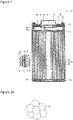
- FIG. 1 is a cross-sectional view of a non-aqueous electrolyte secondary battery 10 according to an example embodiment.
- the non-aqueous electrolyte secondary battery 10 includes the wound electrode assembly 14, a non-aqueous electrolyte (not illustrated), and the battery case 15 that houses the electrode assembly 14 and the non-aqueous electrolyte.
- the electrode assembly 14 has a wound configuration in which a positive electrode 11 and a negative electrode 12 are wound with a separator 13 therebetween.
- the battery case 15 includes an outer can 16 having a cylindrical shape with a closed bottom and a sealing assembly 17 covering the opening of the outer can 16.
- the non-aqueous electrolyte secondary battery 10 also includes a resin gasket 28 that is disposed between the outer can 16 and the sealing assembly 17.
- the electrode assembly 14 is composed of the positive electrode 11 having an elongated shape, the negative electrode 12 having an elongated shape, two separators 13 having an elongated shape, a positive electrode tab 20 joined to the positive electrode 11, and a negative electrode tab 21 joined to the negative electrode 12.
- the negative electrode 12 has a size slightly larger than the positive electrode 11. More specifically, the negative electrode 12 has longer lengths than the positive electrode 11 both in the length direction and in the width direction (shorter length direction).
- the two separators 13 have a size slightly larger than at least the positive electrode 11 and is, for example, disposed so that the positive electrode 11 is interposed between them.
- Insulating plates 18 and 19 are respectively disposed on upper and lower sides of the electrode assembly 14.
- the positive electrode tab 20 attached to the positive electrode 11 passes through a through hole in the insulating plate 18 and extends toward the sealing assembly 17, and the negative electrode tab 21 attached to the negative electrode 12 passes outside the insulating plate 19 and extends toward the bottom of the outer can 16.
- the positive electrode tab 20 is connected to an underside of a bottom plate 23 of the sealing assembly 17 by, for example, welding, and a cap 27 that is the top plate of the sealing assembly 17 electrically connected to the bottom plate 23 serves as a positive electrode terminal.
- the negative electrode tab 21 is connected to an inner surface of the bottom of the outer can 16 by, for example, welding, and the outer can 16 serves as a negative electrode terminal.
- the outer can 16 is, for example, a metal container having a cylindrical shape with a closed bottom. As described above, the gasket 28 is provided between the outer can 16 and the sealing assembly 17, thereby hermetically sealing the space inside the battery case 15.
- the outer can 16 has a groove or inward projection 22 for supporting the sealing assembly 17, the groove or inward projection 22 being formed by, for example, pressing the side surface of the outer can 16 from the outside.
- the groove or inward projection 22 preferably has an annular shape extending along the circumference of the outer can 16, and supports the sealing assembly 17 on its upper surface. An upper end portion of the outer can 16 is bent inwardly and swaged to the periphery of the sealing assembly 17.
- the sealing assembly 17 has a configuration in which the bottom plate 23, a lower vent member 24, an insulating member 25, an upper vent member 26, and the cap 27 are stacked in that order from the side on which the electrode assembly 14 is located.
- the components of the sealing assembly 17 have, for example, either a disc shape or a ring shape and are, except for the insulating member 25, electrically connected to each other.
- the lower vent member 24 and the upper vent member 26 are connected to each other at their center portions, and the insulating member 25 is interposed between their peripheral portions.
- the lower vent member 24 breaks as it is deformed so as to push the upper vent member 26 toward the cap 27, resulting in an interruption of the current path between the lower vent member 24 and the upper vent member 26.
- the upper vent member 26 breaks, letting gas escape through an opening of the cap 27.
- the positive electrode 11, the negative electrode 12, the separator 13, and the non-aqueous electrolyte of the non-aqueous electrolyte secondary battery 10, and, in particular, the positive electrode active material contained in the positive electrode 11 will be described in detail below.
- the positive electrode 11 includes a positive electrode collector 30 and positive electrode mixture layers 31 that are formed on both sides of the positive electrode collector 30.
- the positive electrode collector 30 include foil of metal that is stable in a potential range of the positive electrode 11, such as aluminum or an aluminum alloy, and a film having such metal disposed in its surface layer.
- the positive electrode mixture layers 31 contain a positive electrode active material, a conductive material, and a binder. The thickness of the positive electrode mixture layer 31 formed on each side of the collector is, for example, 10 ⁇ m to 150 ⁇ m.
- the positive electrode 11 can be prepared by applying positive electrode mixture slurry containing, for example, a positive electrode active material, a conductive material, and a binder, to the positive electrode collector 30, drying the coating, and then compressing it to form the positive electrode mixture layers 31 on both sides of the positive electrode collector 30.
- positive electrode mixture slurry containing, for example, a positive electrode active material, a conductive material, and a binder
- Examples of the conductive material contained in the positive electrode mixture layers 31 include carbon materials such as carbon black, acetylene black, Ketjen black, and graphite.
- Examples of the binder contained in the positive electrode mixture layers 31 include polytetrafluoroethylene (PTFE), polyvinylidene fluoride (PVdF), and other fluorocarbon resins, polyacrylonitrile (PAN), polyimides, acrylic resins, and polyolefins.
- PTFE polytetrafluoroethylene
- PVdF polyvinylidene fluoride
- PAN polyacrylonitrile
- PAN polyacrylonitrile
- acrylic resins acrylic resins
- polyolefins polyolefins.
- One or more of these resins may be used in combination with, for example, carboxymethylcellulose (CMC) or a salt thereof, or polyethylene oxide (PEO).
- the positive electrode mixture layers 31 contain two Ni-containing lithium composite oxides A and B as the positive electrode active material, the Ni-containing lithium composite oxides A and B having average primary particle sizes and average secondary particle sizes that are different from each other.
- the Ni-containing lithium composite oxides A and B are composite oxides that contain at least Li and Ni. It should be noted that the positive electrode mixture layers 31 may contain other positive electrode active materials besides the Ni-containing lithium composite oxides A and B without deviating from the intent of the present disclosure, but, in an embodiment herein, contain only the Ni-containing lithium composite oxides A and B as the positive electrode active material.
- FIG. 2A schematically illustrates the Ni-containing lithium composite oxide A
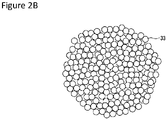
- FIG. 2B schematically illustrates the Ni-containing lithium composite oxide B
- the Ni-containing lithium composite oxides A and B comprise secondary particles that are aggregates of primary particles 32 and 33, respectively.
- the Ni-containing lithium composite oxide A (secondary particle) has a smaller particle size than that of the Ni-containing lithium composite oxide B (secondary particle).
- the primary particles 32 that form the Ni-containing lithium composite oxide A are larger than the primary particles 33 that form the Ni-containing lithium composite oxide B.
- Each of the Ni-containing lithium composite oxides A and B contains Ni in a ratio of 55 mol% or more, preferably 80 mol% or more, and more preferably 85 mol% or more relative to the total number of moles of one or more metal elements excluding Li.
- the Ni-containing lithium composite oxides A and B may contain an element other than Li and Ni, and contain at least one element selected from, for example, Co, Mn, Mg, Zr, Mo, W, Al, Cr, V, Ce, Ti, Fe, Si, K, Ga, In, B, Ca, and Na.
- Ni-containing lithium composite oxides A and B contain at least one of Co and Mn and preferably at least Co, and contain at least one metal element selected from Mg, Zr, Mo, W, Al, Cr, V, Ce, Ti, Fe, K, Ga, In, and B.
- Ni-containing lithium composite oxides A and B is a composite oxide represented by a general formula Li ⁇ Ni x Co y M (1-x-y) O 2 (where 1.00 ⁇ 1.15, 0.8 ⁇ x ⁇ 1.0, 0 ⁇ y ⁇ 0.3, and M represents an element other than Li, Ni, and Co).
- M represents at least one element selected from, for example, Mn, Mg, Zr, Mo, W, Nb, Al, Cr, V, Ce, Ti, Fe, Si, K, Ga, In, B, Ca, and Na.
- the Ni-containing lithium composite oxides A and B may have substantially the same composition.
- the primary particles 32 of the Ni-containing lithium composite oxide A have an average particle size (hereinafter sometimes referred to as "average primary particle size A”) of 2 ⁇ m or greater, and the secondary particles of the Ni-containing lithium composite oxide A have an average particle size (hereinafter sometimes referred to as "average secondary particle size A") of 2 ⁇ m to 6 ⁇ m.
- the primary particles 32 of the Ni-containing lithium composite oxide B have an average particle size (hereinafter sometimes referred to as "average primary particle size B") of 1 ⁇ m or less, and the secondary particles of the Ni-containing lithium composite oxide B have an average particle size (hereinafter sometimes referred to as "average secondary particle size B") of 10 ⁇ m to 20 ⁇ m.
- Ni-containing lithium composite oxides A and B that satisfy the above-described average primary particle size and average secondary particle size requirements and that satisfy predetermined particle breaking load and BET specific surface area requirements which will be described below, the occurrence of particle breakage in the Ni-containing lithium composite oxides A and B can be hindered, thereby improving the cycle characteristics of the battery.
- the average primary particle size A of the Ni-containing lithium composite oxide A is preferably 2 ⁇ m to 6 ⁇ m and more preferably 3 ⁇ m to 5 ⁇ m.
- the average primary particle size B of the Ni-containing lithium composite oxide B is preferably 0.1 ⁇ m to 1 ⁇ m and more preferably 0.2 ⁇ m to 0.7 ⁇ m. With the average primary particle sizes A and B that fall within these ranges, the cycle characteristics of the battery can be further improved.
- the average primary particle sizes A and B are determined by analyzing SEM images of cross sections as observed using a scanning electron microscope (SEM).
- SEM scanning electron microscope
- a positive electrode is embedded in a resin
- a cross section of a positive electrode mixture layer is prepared through, for example, a Cross Section Polisher (CP) process, and an image of this cross section is captured using an SEM.
- powder of the Ni-containing lithium composite oxides A and B is embedded in a resin
- a composite oxide particle cross section is prepared through, for example, a CP process
- an image of this cross section is captured using an SEM. From this cross-section SEM image, 30 primary particles are randomly chosen. The grain boundaries of the chosen 30 primary particles are observed to identify the outer geometries of the primary particles, and then the longitudinal diameter (maximum diameter) of each of the 30 primary particles is determined to obtain an average value thereof as the average primary particle size A or B.
- the average secondary particle sizes A and B are also determined from the above-described cross-section SEM image. Specifically, 30 secondary particles (Ni-containing lithium composite oxide A or B) are randomly chosen from the above-described cross-section SEM image, the grain boundaries of the chosen 30 secondary particles are observed to identify the outer geometries of the secondary particles, and then the longitudinal diameter (maximum diameter) of each of the 30 secondary particles is determined to obtain an average value thereof as the average particle size of the secondary particles.
- the particle breaking load of the Ni-containing lithium composite oxide A is 5 mN to 35 mN
- the particle breaking load of the Ni-containing lithium composite oxide B is 10 mN to 35 mN.
- the particle breaking load is measured using a micro compression testing machine (MCT-W201 manufactured by Shimadzu Corporation) under the following measurement conditions. Specifically, the amount of resin particle deformation occurring when a load is applied to one sample particle at the following loading rate and the load are measured, and the load (N) as measured when the sample particle is deformed and has reached its breaking point (at which the displacement begins abruptly increasing) is the particle breaking load.
- MCT-W201 micro compression testing machine manufactured by Shimadzu Corporation
- the BET specific surface area of the Ni-containing lithium composite oxide A is 0.5 m 2 /g to 1.0 m 2 /g, and the BET specific surface area of the Ni-containing lithium composite oxide B is 0.1 m 2 /g to 1.0 m 2 /g.
- the BET specific surface area can be measured by, for example, a commercially available measuring device such as HM model-1201 manufactured by Macsorb.
- the positive electrode mixture layers 31 contain the Ni-containing lithium composite oxide A in an amount of preferably 5% to 60% by mass, more preferably 10% to 55% by mass, and particularly preferably 30% to 50% by mass relative to the mass of the Ni-containing lithium composite oxide B. With the Ni-containing lithium composite oxides A and B mixed at a ratio that falls within these ranges, the battery capacity and the cycle characteristics are easily achieved at the same time.
- Ni-containing lithium composite oxides A and B An example method of manufacturing the Ni-containing lithium composite oxides A and B will be described in detail below.
- the Ni-containing lithium composite oxide A is synthesized through a two-step calcination process including a first calcination step of calcining a first mixture that includes a lithium compound and a transition metal compound that contains Ni in an amount of 55 mol% or more and preferably 80 mol% or more, and a second calcination step of calcining a second mixture that includes the calcined product obtained in the first calcination step and a lithium compound.
- the Ni-containing lithium composite oxide B is synthesized through a calcination process of calcining a mixture that includes a lithium compound and a transition metal compound that contains Ni in an amount of 55 mol% or more and preferably 80 mol% or more.
- the content of Li in the first mixture is preferably 0.7 to 1.1 and more preferably 0.8 to 1.0 in a molar ratio to the total amount of the transition metal.
- the calcination temperature for the first mixture is preferably 700°C to 1000°C and more preferably 750°C to 900°C.
- the calcination time is, for example, 3 hours to 10 hours.
- lithium compound contained in the first mixture examples include Li 2 CO 3 , LiOH, Li 2 O 3 , Li 2 O, LiNO 3 , LiNO 2 , Li 2 SO 4 , LiOH•H 2 O, LiH, and LiF.
- the transition metal compound contained in the first mixture is any compound that contains Ni in an amount of 55 mol% or more and preferably 80 mol% or more without any other particular limitation, but preferably is a compound that contains, in addition to Ni, at least one of Co and Mn in terms of, for example, improving the stability of the crystal structure of the finally obtained Ni-containing lithium composite oxide.
- the content of Li in the second mixture is preferably 0.01 to 0.3 and more preferably 0.05 to 0.2 in a molar ratio to the total amount of the transition metal.
- the calcination temperature for the second mixture is preferably 600°C to 900°C and more preferably 700°C to 800°C.
- the calcination time is, for example, 5 hours to 20 hours. With, for example, the content of Li in the second mixture and the calcination temperature that fall within these ranges, the average particle sizes of the primary particles and the secondary particles, the particle breaking load, and the BET specific surface area of the Ni-containing lithium composite oxide A are easily adjusted to the above-described ranges.
- the calcination in the second calcination step is performed, for example, at a lower temperature for a longer time than in the first calcination step.
- the lithium compound contained in the second mixture may be the same as or different from the lithium compound contained in the first mixture.
- Examples of the lithium compound contained in the second mixture include Li 2 CO 3 , LiOH, Li 2 O 3 , Li 2 O, LiNO 3 , LiNO 2 , Li 2 SO 4 , LiOH•H 2 O, Li 3 PO 4 , LiH, and LiF.
- the content of Li in the mixture is preferably 0.8 to 1.2 and more preferably 0.9 to 1.1 in a molar ratio to the total amount of the transition metal.
- the calcination temperature for the first mixture is preferably 600°C to 900°C and more preferably 700°C to 800°C.
- the calcination time is, for example, 10 hours to 30 hours. With, for example, the content of Li in the mixture and the calcination temperature that fall within these ranges, the average particle sizes of the primary particles and the secondary particles, the particle breaking load, and the BET specific surface area of the Ni-containing lithium composite oxide B are easily adjusted to the above-described ranges.
- lithium compound contained in the mixture examples include Li 2 CO 3 , LiOH, Li 2 O 3 , Li 2 O, LiNO 3 , LiNO 2 , Li 2 SO 4 , LiOH•H 2 O, LiH, and LiF.
- the negative electrode 12 includes a negative electrode collector 40 and negative electrode mixture layers 41 that are formed on both sides of the negative electrode collector 40.
- the negative electrode collector 40 include foil of metal that is stable in a potential range of the negative electrode 12, such as copper or a copper alloy, and a film having such metal disposed in its surface layer.
- the negative electrode mixture layers 41 contain a negative electrode active material and a binder. The thickness of the negative electrode mixture layer 41 formed on each side of the collector is, for example, 10 ⁇ m to 150 ⁇ m.
- the negative electrode 12 can be prepared by applying negative electrode mixture slurry containing, for example, a negative electrode active material and a binder, to the negative electrode collector 40, drying the coating, and then rolling it to form the negative electrode mixture layers 41 on both sides of the negative electrode collector 40.
- negative electrode mixture slurry containing, for example, a negative electrode active material and a binder
- the negative electrode active material is any material that is capable of reversibly occluding and releasing lithium ions without any other particular limitation; typically, a carbon material such as graphite is used.
- a carbon material such as graphite is used.
- graphite include natural graphite such as flake graphite, massive graphite, and earthy graphite, and artificial graphite such as massive artificial graphite and graphitized mesophase carbon microbeads.
- metal such as Si or Sn that forms an alloy with Li, a metal compound that contains metal such as Si or Sn, a lithium titanium composite oxide, or another material may be used as the negative electrode active material.
- Si-containing compound represented by SiO x (0.5 ⁇ x ⁇ 1.6) or a Si-containing compound including Si microparticles dispersed in a lithium silicate phase represented by Li 2y SiO (2+y) (0 ⁇ y ⁇ 2) may be used in combination with graphite.
- examples of the binder contained in the negative electrode mixture layers 41 include PTFE, PVdF, and other fluorine-containing resins, PAN, polyimides, acrylic resins, and polyolefins, and in a preferred embodiment, styrene-butadiene rubber (SBR) is used.
- the negative electrode mixture layers 41 may contain, for example, CMC or a salt thereof, polyacrylic acid (PAA) or a salt thereof, or polyvinyl alcohol (PVA).
- the negative electrode mixture layers 41 contain, for example, SBR and CMC or a salt thereof.
- a porous sheet having ion permeability and insulating properties is used as the separator 13.
- the porous sheet include a microporous thin film, woven fabric, and nonwoven fabric.
- Suitable examples of the material for the separator include polyethylene, polypropylene, and other polyolefins and cellulose.
- the separator 13 may have either a single-layer structure or a multi-layer structure.
- the separator 13 may have, on its surface, a high heat resistance resin layer of, for example, an aramid resin and a filler layer that contains an inorganic compound filler.
- the non-aqueous electrolyte includes a non-aqueous solvent and an electrolyte salt dissolved in the non-aqueous solvent.
- the non-aqueous solvent include esters, ethers, nitriles such as acetonitrile, amides such as dimethylformamide, and mixed solvents of two or more thereof.
- the non-aqueous solvent may contain a halogen substitution product of these solvents in which hydrogens of the solvents are, at least in part, substituted with a halogen atom such as fluorine.
- halogen substitution product examples include fluorinated cyclic carbonate esters such as fluoroethylene carbonate (FEC), fluorinated chain carbonate esters, and fluorinated chain carboxylate esters such as methyl fluoropropionate (FMP).
- FEC fluoroethylene carbonate
- FMP fluorinated chain carboxylate esters
- esters examples include cyclic carbonate esters such as ethylene carbonate (EC), propylene carbonate (PC), and butylene carbonate, chain carbonate esters such as dimethyl carbonate (DMC), ethyl methyl carbonate (EMC), diethyl carbonate (DEC), methyl propyl carbonate, ethyl propyl carbonate, and methyl isopropyl carbonate, cyclic carboxylate esters such as ⁇ -butyrolactone (GBL) and ⁇ -valerolactone (GVL), and chain carboxylate esters such as methyl acetate, ethyl acetate, propyl acetate, methyl propionate (MP), and ethyl propionate.
- cyclic carbonate esters such as ethylene carbonate (EC), propylene carbonate (PC), and butylene carbonate
- chain carbonate esters such as dimethyl carbonate (DMC), ethyl methyl carbonate (EMC), diethyl carbon
- ethers examples include cyclic ethers such as 1,3-dioxolane, 4-methyl-1,3-dioxolane, tetrahydrofuran, 2-methyltetrahydrofuran, propylene oxide, 1,2-butylene oxide, 1,3-dioxane, 1,4-dioxane, 1,3,5-trioxane, furan, 2-methylfuran, 1,8-cineole, and crown ethers, and chain ethers such as 1,2-dimethoxyethane, diethyl ether, dipropyl ether, diisopropyl ether, dibutyl ether, dihexyl ether, ethyl vinyl ether, butyl vinyl ether, methyl phenyl ether, ethyl phenyl ether, butyl phenyl ether, pentyl phenyl ether, methoxytoluene, benzyl ethyl ether, di
- the electrolyte salt is preferably a lithium salt.
- the lithium salt include LiBF 4 , LiClO 4 , LiPF 6 , LiAsF 6 , LiSbF 6 , LiAlCl 4 , LiSCN, LiCF 3 SO 3 , LiCF 3 CO 2 , Li(P(C 2 O 4 )F 4 ), LiPF 6-x (C n F 2n+1 ) x (where 1 ⁇ x ⁇ 6, and n is 1 or 2), LiB 10 Cl 10 , LiCl, LiBr, LiI, lithium chloroborane, lithium lower aliphatic carboxylates, borates such as Li 2 B 4 O 7 and Li(B(C 2 O 4 )F 2 ), and imide salts such as LiN(SO 2 CF 3 ) 2 and LiN(C 1 F 2l+1 SO 2 )(C m F 2m+1 SO 2 ) ⁇ where 1 and m are integers of 0 or greater ⁇ .
- LiPF 6 is preferably used in terms of, for example, ionic conductivity and electrochemical stability.
- concentration of the lithium salt is, for example, 0.8 mol to 1.8 mol per liter of the non-aqueous solvent.
- the Ni-containing lithium composite oxide A1 comprised secondary particles that were aggregates of primary particles.
- the primary particles of the Ni-containing lithium composite oxide A1 had an average particle size of 3.1 ⁇ m, and the secondary particles of the Ni-containing lithium composite oxide A1 had an average particle size of 4.3 ⁇ m.
- the average particle sizes were measured by the above-described method.
- the Ni-containing lithium composite oxide A1 had a particle breaking load of 20 mN and a BET specific surface area of 0.7 m 2 /g. The particle breaking load and the BET specific surface area were measured by the above-described methods.
- the composition of the Ni-containing lithium composite oxide A1 was determined to be Li 1.05 Ni 0.80 Co 0.10 Mn 0.10 O 2 .
- the Ni-containing lithium composite oxide B1 comprised secondary particles that were aggregates of primary particles.
- the primary particles of the Ni-containing lithium composite oxide B1 had an average particle size of 0.5 ⁇ m
- the secondary particles of the Ni-containing lithium composite oxide B1 had an average particle size of 13.1 ⁇ m.
- the average particle sizes were measured by the above-described method.
- the Ni-containing lithium composite oxide B1 had a particle breaking load of 30 mN and a BET specific surface area of 0.3 m 2 /g. The particle breaking load and the BET specific surface area were measured by the above-described methods.
- the composition of the Ni-containing lithium composite oxide B1 was determined to be Li 1.05 Ni 0.80 Co 0.10 Mn 0.10 O 2 .
- a mixture of the Ni-containing lithium composite oxides A1 and B1 in a mass ratio of 3:7 was used as a positive electrode active material.
- Positive electrode mixture slurry was prepared by mixing 97.5% by mass of the positive electrode active material, 1% by mass of carbon black, and 1.5% by mass of polyvinylidene fluoride and then mixing the resulting mixture with N-methyl-2-pyrrolidone (NMP).
- NMP N-methyl-2-pyrrolidone
- a center portion of the positive electrode collector as viewed in the length direction included a portion where the positive electrode mixture layers were absent, and a positive electrode tab was attached to this portion.
- the thickness of each of the positive electrode mixture layers was about 140 ⁇ m, and the thickness of the positive electrode was about 300 ⁇ m.
- Negative electrode mixture slurry was prepared by mixing 98.2% by mass of graphite, 0.7% by mass of styrene-butadiene rubber, and 1.1% by mass of sodium carboxymethylcellulose and mixing the resulting mixture with water. This slurry was applied to both sides of a negative electrode collector composed of 8 ⁇ m thick copper foil by a doctor blade method, and after the coating was dried, the coating was rolled using a rolling roller to prepare a negative electrode having negative electrode mixture layers on both sides of the negative electrode collector. Each end of the negative electrode collector as viewed in the length direction included a portion where the negative electrode mixture layers were absent, and a negative electrode tab was attached to this portion. The thickness of each of the negative electrode mixture layers was about 120 ⁇ m, and the thickness of the negative electrode was about 250 ⁇ m.
- Ethylene carbonate (EC) and diethyl carbonate (DEC) were mixed in equal volumes, and LiPF 6 was dissolved in the resulting non-aqueous solvent in a concentration of 1.6 mol/L to prepare a non-aqueous electrolyte solution.
- a non-aqueous electrolyte secondary battery was prepared using the above-described positive electrode, the above-described negative electrode, the above-described non-aqueous electrolyte solution, and a separator through the following steps.
- the capacity retention rate of the above-described non-aqueous electrolyte secondary battery was determined by charging and discharging the non-aqueous electrolyte secondary battery under a temperature condition of 25°C and under the following conditions.
- Ni-containing lithium composite oxides A2 to A5 were synthesized in a similar manner to that in which the Ni-containing lithium composite oxide A1 was synthesized.
- the average primary particle size, the average secondary particle size, the particle breaking load, and the BET specific surface area of each of the obtained composite oxides are given in Table 1.
- Ni-containing lithium composite oxides B2 to B5 were synthesized in a similar manner to that in which the Ni-containing lithium composite oxide B1 was synthesized.
- the average primary particle size, the average secondary particle size, the particle breaking load, and the BET specific surface area of each of the obtained composite oxides are given in Table 2.
- a non-aqueous electrolyte secondary battery was prepared in a similar manner to Example 1 except that a mixture of Ni-containing lithium composite oxides A and B listed in Table 3 in a mass ratio listed in Table 3 was used as the positive electrode active material. The performance of the battery was evaluated. The evaluation results are given in Table 3.
Landscapes
- Chemical & Material Sciences (AREA)
- Chemical Kinetics & Catalysis (AREA)
- Electrochemistry (AREA)
- General Chemical & Material Sciences (AREA)
- Inorganic Chemistry (AREA)
- Organic Chemistry (AREA)
- Engineering & Computer Science (AREA)
- Materials Engineering (AREA)
- Manufacturing & Machinery (AREA)
- Composite Materials (AREA)
- Battery Electrode And Active Subsutance (AREA)
- Inorganic Compounds Of Heavy Metals (AREA)
Abstract
Description
- The present disclosure relates to a positive electrode active material for a non-aqueous electrolyte secondary battery, and a non-aqueous electrolyte secondary battery.
- In recent years, Ni-containing lithium composite oxides with high Ni content have been attracting attention as positive electrode active materials for a non-aqueous electrolyte secondary battery that significantly contribute to an increased battery capacity. A positive electrode in which two positive electrode active materials having different average particle sizes are used in combination has also been known (see, for example, Patent Literature 1). In this case, the packing density of the active materials in the positive electrode mixture layer can be increased through a combination of smaller particles and larger particles between which the particle size difference is large, achieving a further increased battery capacity.
- PATENT LITERATURE 1:
Japanese Unexamined Patent Application Publication No. 2011- 113825 - In non-aqueous electrolyte secondary batteries, particle breakage may occur due to expansion and shrinkage of positive electrode active material particles in response to charge/discharge, causing deterioration of cycle characteristics. Suppressing the occurrence of particle breakage in both of the smaller particles and the larger particles to hinder the deterioration of the capacity is an important goal. The technique disclosed in Patent Literature 1 does not take into consideration hindering the deterioration of cycle characteristics, and still has room for improvement.
- According to an aspect of the present disclosure, a positive electrode active material for a non-aqueous electrolyte secondary battery comprises a Ni-containing lithium composite oxide A and a Ni-containing lithium composite oxide B. The Ni-containing lithium composite oxide A and the Ni-containing lithium composite oxide B contain Ni in an amount of 55 mol% or more relative to the total number of moles of one or more metal elements excluding Li, the Ni-containing lithium composite oxide A has an average primary particle size of 2 µm or greater, an average secondary particle size of 2 µm to 6 µm, a particle breaking load of 5 mN to 35 mN, and a BET specific surface area of 0.5 m2/g to 1.0 m2/g, and the Ni-containing lithium composite oxide B has an average primary particle size of 1 µm or less, an average secondary particle size of 10 µm to 20 µm, a particle breaking load of 10 mN to 35 mN, and a BET specific surface area of 0.1 m2/g to 1.0 m2/g.
- According to an aspect of the present disclosure, a non-aqueous electrolyte secondary battery comprises a positive electrode containing the above-described positive electrode active material; a negative electrode; and a non-aqueous electrolyte.
- According to an aspect of the present disclosure, the positive electrode active material can provide a non-aqueous electrolyte secondary battery with high capacity and good cycle characteristics.
-
-
FIG. 1 is a cross-sectional view of a non-aqueous electrolyte secondary battery according to an example embodiment. -
FIG. 2A schematically illustrates a Ni-containing lithium composite oxide A according to an example embodiment. -
FIG. 2B schematically illustrates a Ni-containing lithium composite oxide B according to an example embodiment. - While, as described above, the combined use of two Ni-containing lithium composite oxides having different average particle sizes significantly contributes to an increased battery capacity, it is not easy to suppress the occurrence of particle breakage in both of smaller particles and larger particles to hinder the deterioration of the capacity. After diligent effort to achieve this goal, the present inventors have succeeded in suppressing the occurrence of particle breakage in smaller particles and larger particles through respective different mechanisms. The particle breaking strength of smaller particles having an average secondary particle size of 2 µm to 6 µm can be increased to 5 mN to 35 mN by increasing the primary particle size to 2 µm or greater and thereby reducing the BET specific surface area to 0.5 m2/g to 1.0 m2/g. The particle breaking strength of larger particles having an average secondary particle size of 10 µm to 20 µm can be increased to 10 mN to 35 mN by reducing the primary particle size to 1 µm or less and thereby reducing the BET specific surface area to 0.1 m2/g to 1.0 m2/g while increasing the contact area between primary particles. A non-aqueous electrolyte secondary battery with high capacity and good cycle characteristics can be achieved through the combined use of smaller particles and larger particles of Ni-containing lithium composite oxides in which the particle breaking load is high and the occurrence of particle breakage is hindered.
- An example embodiment of a positive electrode active material and a non-aqueous electrolyte secondary battery according to the present disclosure will be described in detail below.
- Although a cylindrical battery including a
wound electrode assembly 14 housed in abattery case 15 having a cylindrical shape is described by way of example in connection with an embodiment below, the battery case is not limited to those having a cylindrical shape and may have, for example, a rectangular, coin, or another shape, and the battery case may be composed of a laminate sheet including a metal layer and a resin layer. The electrode assembly is not limited to those having a wound configuration and may be a laminated electrode assembly including a plurality of positive electrodes and a plurality of negative electrodes alternately laminated with a separator therebetween. -
FIG. 1 is a cross-sectional view of a non-aqueous electrolytesecondary battery 10 according to an example embodiment. As illustrated inFIG. 1 , the non-aqueous electrolytesecondary battery 10 includes thewound electrode assembly 14, a non-aqueous electrolyte (not illustrated), and thebattery case 15 that houses theelectrode assembly 14 and the non-aqueous electrolyte. Theelectrode assembly 14 has a wound configuration in which apositive electrode 11 and anegative electrode 12 are wound with aseparator 13 therebetween. Thebattery case 15 includes anouter can 16 having a cylindrical shape with a closed bottom and asealing assembly 17 covering the opening of theouter can 16. The non-aqueous electrolytesecondary battery 10 also includes aresin gasket 28 that is disposed between theouter can 16 and thesealing assembly 17. - The
electrode assembly 14 is composed of thepositive electrode 11 having an elongated shape, thenegative electrode 12 having an elongated shape, twoseparators 13 having an elongated shape, apositive electrode tab 20 joined to thepositive electrode 11, and anegative electrode tab 21 joined to thenegative electrode 12. To prevent precipitation of lithium, thenegative electrode 12 has a size slightly larger than thepositive electrode 11. More specifically, thenegative electrode 12 has longer lengths than thepositive electrode 11 both in the length direction and in the width direction (shorter length direction). The twoseparators 13 have a size slightly larger than at least thepositive electrode 11 and is, for example, disposed so that thepositive electrode 11 is interposed between them. -
Insulating plates electrode assembly 14. In the example illustrated inFIG. 1 , thepositive electrode tab 20 attached to thepositive electrode 11 passes through a through hole in theinsulating plate 18 and extends toward thesealing assembly 17, and thenegative electrode tab 21 attached to thenegative electrode 12 passes outside theinsulating plate 19 and extends toward the bottom of theouter can 16. Thepositive electrode tab 20 is connected to an underside of abottom plate 23 of thesealing assembly 17 by, for example, welding, and acap 27 that is the top plate of thesealing assembly 17 electrically connected to thebottom plate 23 serves as a positive electrode terminal. Thenegative electrode tab 21 is connected to an inner surface of the bottom of the outer can 16 by, for example, welding, and theouter can 16 serves as a negative electrode terminal. - The
outer can 16 is, for example, a metal container having a cylindrical shape with a closed bottom. As described above, thegasket 28 is provided between theouter can 16 and thesealing assembly 17, thereby hermetically sealing the space inside thebattery case 15. Theouter can 16 has a groove orinward projection 22 for supporting thesealing assembly 17, the groove orinward projection 22 being formed by, for example, pressing the side surface of theouter can 16 from the outside. The groove orinward projection 22 preferably has an annular shape extending along the circumference of theouter can 16, and supports thesealing assembly 17 on its upper surface. An upper end portion of theouter can 16 is bent inwardly and swaged to the periphery of thesealing assembly 17. - The
sealing assembly 17 has a configuration in which thebottom plate 23, alower vent member 24, aninsulating member 25, anupper vent member 26, and thecap 27 are stacked in that order from the side on which theelectrode assembly 14 is located. The components of thesealing assembly 17 have, for example, either a disc shape or a ring shape and are, except for the insulatingmember 25, electrically connected to each other. Thelower vent member 24 and theupper vent member 26 are connected to each other at their center portions, and theinsulating member 25 is interposed between their peripheral portions. In response to an increase in internal pressure of the battery due to abnormal heat generation, thelower vent member 24 breaks as it is deformed so as to push theupper vent member 26 toward thecap 27, resulting in an interruption of the current path between thelower vent member 24 and theupper vent member 26. In response to a further increase in internal pressure, theupper vent member 26 breaks, letting gas escape through an opening of thecap 27. - The
positive electrode 11, thenegative electrode 12, theseparator 13, and the non-aqueous electrolyte of the non-aqueous electrolytesecondary battery 10, and, in particular, the positive electrode active material contained in thepositive electrode 11 will be described in detail below. - The
positive electrode 11 includes apositive electrode collector 30 and positiveelectrode mixture layers 31 that are formed on both sides of thepositive electrode collector 30. Examples of thepositive electrode collector 30 include foil of metal that is stable in a potential range of thepositive electrode 11, such as aluminum or an aluminum alloy, and a film having such metal disposed in its surface layer. The positiveelectrode mixture layers 31 contain a positive electrode active material, a conductive material, and a binder. The thickness of the positiveelectrode mixture layer 31 formed on each side of the collector is, for example, 10 µm to 150 µm. Thepositive electrode 11 can be prepared by applying positive electrode mixture slurry containing, for example, a positive electrode active material, a conductive material, and a binder, to thepositive electrode collector 30, drying the coating, and then compressing it to form the positiveelectrode mixture layers 31 on both sides of thepositive electrode collector 30. - Examples of the conductive material contained in the positive
electrode mixture layers 31 include carbon materials such as carbon black, acetylene black, Ketjen black, and graphite. Examples of the binder contained in the positiveelectrode mixture layers 31 include polytetrafluoroethylene (PTFE), polyvinylidene fluoride (PVdF), and other fluorocarbon resins, polyacrylonitrile (PAN), polyimides, acrylic resins, and polyolefins. One or more of these resins may be used in combination with, for example, carboxymethylcellulose (CMC) or a salt thereof, or polyethylene oxide (PEO). - The positive electrode mixture layers 31 contain two Ni-containing lithium composite oxides A and B as the positive electrode active material, the Ni-containing lithium composite oxides A and B having average primary particle sizes and average secondary particle sizes that are different from each other. The Ni-containing lithium composite oxides A and B are composite oxides that contain at least Li and Ni. It should be noted that the positive electrode mixture layers 31 may contain other positive electrode active materials besides the Ni-containing lithium composite oxides A and B without deviating from the intent of the present disclosure, but, in an embodiment herein, contain only the Ni-containing lithium composite oxides A and B as the positive electrode active material.
-
FIG. 2A schematically illustrates the Ni-containing lithium composite oxide A, andFIG. 2B schematically illustrates the Ni-containing lithium composite oxide B. As illustrated inFIGs. 2A and2B , the Ni-containing lithium composite oxides A and B comprise secondary particles that are aggregates ofprimary particles primary particles 32 that form the Ni-containing lithium composite oxide A are larger than theprimary particles 33 that form the Ni-containing lithium composite oxide B. By using the Ni-containing lithium composite oxides A and B in combination, the packing density of the positive electrode active material in the positive electrode mixture layers 31 can be increased, achieving an increased capacity of the battery while the battery having good cycle characteristics. - Each of the Ni-containing lithium composite oxides A and B contains Ni in a ratio of 55 mol% or more, preferably 80 mol% or more, and more preferably 85 mol% or more relative to the total number of moles of one or more metal elements excluding Li. The Ni-containing lithium composite oxides A and B may contain an element other than Li and Ni, and contain at least one element selected from, for example, Co, Mn, Mg, Zr, Mo, W, Al, Cr, V, Ce, Ti, Fe, Si, K, Ga, In, B, Ca, and Na. The Ni-containing lithium composite oxides A and B contain at least one of Co and Mn and preferably at least Co, and contain at least one metal element selected from Mg, Zr, Mo, W, Al, Cr, V, Ce, Ti, Fe, K, Ga, In, and B.
- A suitable example of the Ni-containing lithium composite oxides A and B is a composite oxide represented by a general formula LiαNixCoyM(1-x-y)O2 (where 1.00≤α≤1.15, 0.8≤x<1.0, 0≤y≤0.3, and M represents an element other than Li, Ni, and Co). In the formula above, M represents at least one element selected from, for example, Mn, Mg, Zr, Mo, W, Nb, Al, Cr, V, Ce, Ti, Fe, Si, K, Ga, In, B, Ca, and Na. The Ni-containing lithium composite oxides A and B may have substantially the same composition.
- The
primary particles 32 of the Ni-containing lithium composite oxide A have an average particle size (hereinafter sometimes referred to as "average primary particle size A") of 2 µm or greater, and the secondary particles of the Ni-containing lithium composite oxide A have an average particle size (hereinafter sometimes referred to as "average secondary particle size A") of 2 µm to 6 µm. Theprimary particles 32 of the Ni-containing lithium composite oxide B have an average particle size (hereinafter sometimes referred to as "average primary particle size B") of 1 µm or less, and the secondary particles of the Ni-containing lithium composite oxide B have an average particle size (hereinafter sometimes referred to as "average secondary particle size B") of 10 µm to 20 µm. By using the Ni-containing lithium composite oxides A and B that satisfy the above-described average primary particle size and average secondary particle size requirements and that satisfy predetermined particle breaking load and BET specific surface area requirements which will be described below, the occurrence of particle breakage in the Ni-containing lithium composite oxides A and B can be hindered, thereby improving the cycle characteristics of the battery. - The average primary particle size A of the Ni-containing lithium composite oxide A is preferably 2 µm to 6 µm and more preferably 3 µm to 5 µm. The average primary particle size B of the Ni-containing lithium composite oxide B is preferably 0.1 µm to 1 µm and more preferably 0.2 µm to 0.7 µm. With the average primary particle sizes A and B that fall within these ranges, the cycle characteristics of the battery can be further improved.
- The average primary particle sizes A and B are determined by analyzing SEM images of cross sections as observed using a scanning electron microscope (SEM). For example, a positive electrode is embedded in a resin, a cross section of a positive electrode mixture layer is prepared through, for example, a Cross Section Polisher (CP) process, and an image of this cross section is captured using an SEM. Alternatively, powder of the Ni-containing lithium composite oxides A and B is embedded in a resin, a composite oxide particle cross section is prepared through, for example, a CP process, and an image of this cross section is captured using an SEM. From this cross-section SEM image, 30 primary particles are randomly chosen. The grain boundaries of the chosen 30 primary particles are observed to identify the outer geometries of the primary particles, and then the longitudinal diameter (maximum diameter) of each of the 30 primary particles is determined to obtain an average value thereof as the average primary particle size A or B.
- The average secondary particle sizes A and B are also determined from the above-described cross-section SEM image. Specifically, 30 secondary particles (Ni-containing lithium composite oxide A or B) are randomly chosen from the above-described cross-section SEM image, the grain boundaries of the chosen 30 secondary particles are observed to identify the outer geometries of the secondary particles, and then the longitudinal diameter (maximum diameter) of each of the 30 secondary particles is determined to obtain an average value thereof as the average particle size of the secondary particles.
- The particle breaking load of the Ni-containing lithium composite oxide A is 5 mN to 35 mN, and the particle breaking load of the Ni-containing lithium composite oxide B is 10 mN to 35 mN. As a result, the occurrence of particle breakage in the Ni-containing lithium composite oxides A and B can be hindered, thereby improving the cycle characteristics of the battery.
- The particle breaking load is measured using a micro compression testing machine (MCT-W201 manufactured by Shimadzu Corporation) under the following measurement conditions. Specifically, the amount of resin particle deformation occurring when a load is applied to one sample particle at the following loading rate and the load are measured, and the load (N) as measured when the sample particle is deformed and has reached its breaking point (at which the displacement begins abruptly increasing) is the particle breaking load.
-
- Test temperature: room temperature (25°C)
- Upper pressure indenter: 50 µm diameter flat indenter (made of diamond)
- Lower pressure plate: SKS flat plate
- Measurement mode: compression test
- Test load: 10 mN minimum, 50 mN maximum
- Loading rate: 0.178 mN/sec minimum, 0.221 mN/sec minimum
- Displacement full scale: 10 µm
- The BET specific surface area of the Ni-containing lithium composite oxide A is 0.5 m2/g to 1.0 m2/g, and the BET specific surface area of the Ni-containing lithium composite oxide B is 0.1 m2/g to 1.0 m2/g. As a result, the occurrence of particle breakage in the Ni-containing lithium composite oxides A and B can be hindered, thereby improving the cycle characteristics of the battery. The BET specific surface area can be measured by, for example, a commercially available measuring device such as HM model-1201 manufactured by Macsorb.
- The positive electrode mixture layers 31 contain the Ni-containing lithium composite oxide A in an amount of preferably 5% to 60% by mass, more preferably 10% to 55% by mass, and particularly preferably 30% to 50% by mass relative to the mass of the Ni-containing lithium composite oxide B. With the Ni-containing lithium composite oxides A and B mixed at a ratio that falls within these ranges, the battery capacity and the cycle characteristics are easily achieved at the same time.
- An example method of manufacturing the Ni-containing lithium composite oxides A and B will be described in detail below.
- The Ni-containing lithium composite oxide A is synthesized through a two-step calcination process including a first calcination step of calcining a first mixture that includes a lithium compound and a transition metal compound that contains Ni in an amount of 55 mol% or more and preferably 80 mol% or more, and a second calcination step of calcining a second mixture that includes the calcined product obtained in the first calcination step and a lithium compound. The Ni-containing lithium composite oxide B is synthesized through a calcination process of calcining a mixture that includes a lithium compound and a transition metal compound that contains Ni in an amount of 55 mol% or more and preferably 80 mol% or more.
- The content of Li in the first mixture is preferably 0.7 to 1.1 and more preferably 0.8 to 1.0 in a molar ratio to the total amount of the transition metal. The calcination temperature for the first mixture is preferably 700°C to 1000°C and more preferably 750°C to 900°C. The calcination time is, for example, 3 hours to 10 hours. With, for example, the content of Li in the first mixture and the calcination temperature that fall within these ranges, the average particle sizes of the primary particles and the secondary particles, the particle breaking load, and the BET specific surface area of the Ni-containing lithium composite oxide A are easily adjusted to the above-described ranges.
- Examples of the lithium compound contained in the first mixture include Li2CO3, LiOH, Li2O3, Li2O, LiNO3, LiNO2, Li2SO4, LiOH•H2O, LiH, and LiF.
- The transition metal compound contained in the first mixture is any compound that contains Ni in an amount of 55 mol% or more and preferably 80 mol% or more without any other particular limitation, but preferably is a compound that contains, in addition to Ni, at least one of Co and Mn in terms of, for example, improving the stability of the crystal structure of the finally obtained Ni-containing lithium composite oxide.
- The content of Li in the second mixture is preferably 0.01 to 0.3 and more preferably 0.05 to 0.2 in a molar ratio to the total amount of the transition metal. The calcination temperature for the second mixture is preferably 600°C to 900°C and more preferably 700°C to 800°C. The calcination time is, for example, 5 hours to 20 hours. With, for example, the content of Li in the second mixture and the calcination temperature that fall within these ranges, the average particle sizes of the primary particles and the secondary particles, the particle breaking load, and the BET specific surface area of the Ni-containing lithium composite oxide A are easily adjusted to the above-described ranges. The calcination in the second calcination step is performed, for example, at a lower temperature for a longer time than in the first calcination step.
- The lithium compound contained in the second mixture may be the same as or different from the lithium compound contained in the first mixture. Examples of the lithium compound contained in the second mixture include Li2CO3, LiOH, Li2O3, Li2O, LiNO3, LiNO2, Li2SO4, LiOH•H2O, Li3PO4, LiH, and LiF.
- The content of Li in the mixture is preferably 0.8 to 1.2 and more preferably 0.9 to 1.1 in a molar ratio to the total amount of the transition metal. The calcination temperature for the first mixture is preferably 600°C to 900°C and more preferably 700°C to 800°C. The calcination time is, for example, 10 hours to 30 hours. With, for example, the content of Li in the mixture and the calcination temperature that fall within these ranges, the average particle sizes of the primary particles and the secondary particles, the particle breaking load, and the BET specific surface area of the Ni-containing lithium composite oxide B are easily adjusted to the above-described ranges.
- Examples of the lithium compound contained in the mixture include Li2CO3, LiOH, Li2O3, Li2O, LiNO3, LiNO2, Li2SO4, LiOH•H2O, LiH, and LiF.
- The
negative electrode 12 includes anegative electrode collector 40 and negative electrode mixture layers 41 that are formed on both sides of thenegative electrode collector 40. Examples of thenegative electrode collector 40 include foil of metal that is stable in a potential range of thenegative electrode 12, such as copper or a copper alloy, and a film having such metal disposed in its surface layer. The negative electrode mixture layers 41 contain a negative electrode active material and a binder. The thickness of the negativeelectrode mixture layer 41 formed on each side of the collector is, for example, 10 µm to 150 µm. Thenegative electrode 12 can be prepared by applying negative electrode mixture slurry containing, for example, a negative electrode active material and a binder, to thenegative electrode collector 40, drying the coating, and then rolling it to form the negative electrode mixture layers 41 on both sides of thenegative electrode collector 40. - The negative electrode active material is any material that is capable of reversibly occluding and releasing lithium ions without any other particular limitation; typically, a carbon material such as graphite is used. Examples of graphite include natural graphite such as flake graphite, massive graphite, and earthy graphite, and artificial graphite such as massive artificial graphite and graphitized mesophase carbon microbeads. Also, metal such as Si or Sn that forms an alloy with Li, a metal compound that contains metal such as Si or Sn, a lithium titanium composite oxide, or another material may be used as the negative electrode active material. For example, a Si-containing compound represented by SiOx (0.5≤x≤1.6) or a Si-containing compound including Si microparticles dispersed in a lithium silicate phase represented by Li2ySiO(2+y) (0<y<2) may be used in combination with graphite.
- Similar to the
positive electrode 11, examples of the binder contained in the negative electrode mixture layers 41 include PTFE, PVdF, and other fluorine-containing resins, PAN, polyimides, acrylic resins, and polyolefins, and in a preferred embodiment, styrene-butadiene rubber (SBR) is used. The negative electrode mixture layers 41 may contain, for example, CMC or a salt thereof, polyacrylic acid (PAA) or a salt thereof, or polyvinyl alcohol (PVA). The negative electrode mixture layers 41 contain, for example, SBR and CMC or a salt thereof. - A porous sheet having ion permeability and insulating properties is used as the
separator 13. Specific examples of the porous sheet include a microporous thin film, woven fabric, and nonwoven fabric. Suitable examples of the material for the separator include polyethylene, polypropylene, and other polyolefins and cellulose. Theseparator 13 may have either a single-layer structure or a multi-layer structure. Theseparator 13 may have, on its surface, a high heat resistance resin layer of, for example, an aramid resin and a filler layer that contains an inorganic compound filler. - The non-aqueous electrolyte includes a non-aqueous solvent and an electrolyte salt dissolved in the non-aqueous solvent. Examples of the non-aqueous solvent include esters, ethers, nitriles such as acetonitrile, amides such as dimethylformamide, and mixed solvents of two or more thereof. The non-aqueous solvent may contain a halogen substitution product of these solvents in which hydrogens of the solvents are, at least in part, substituted with a halogen atom such as fluorine. Examples of the halogen substitution product include fluorinated cyclic carbonate esters such as fluoroethylene carbonate (FEC), fluorinated chain carbonate esters, and fluorinated chain carboxylate esters such as methyl fluoropropionate (FMP).
- Examples of the esters include cyclic carbonate esters such as ethylene carbonate (EC), propylene carbonate (PC), and butylene carbonate, chain carbonate esters such as dimethyl carbonate (DMC), ethyl methyl carbonate (EMC), diethyl carbonate (DEC), methyl propyl carbonate, ethyl propyl carbonate, and methyl isopropyl carbonate, cyclic carboxylate esters such as γ-butyrolactone (GBL) and γ-valerolactone (GVL), and chain carboxylate esters such as methyl acetate, ethyl acetate, propyl acetate, methyl propionate (MP), and ethyl propionate.
- Examples of the ethers include cyclic ethers such as 1,3-dioxolane, 4-methyl-1,3-dioxolane, tetrahydrofuran, 2-methyltetrahydrofuran, propylene oxide, 1,2-butylene oxide, 1,3-dioxane, 1,4-dioxane, 1,3,5-trioxane, furan, 2-methylfuran, 1,8-cineole, and crown ethers, and chain ethers such as 1,2-dimethoxyethane, diethyl ether, dipropyl ether, diisopropyl ether, dibutyl ether, dihexyl ether, ethyl vinyl ether, butyl vinyl ether, methyl phenyl ether, ethyl phenyl ether, butyl phenyl ether, pentyl phenyl ether, methoxytoluene, benzyl ethyl ether, diphenyl ether, dibenzyl ether, o-dimethoxybenzene, 1,2-diethoxyethane, 1,2-dibutoxyethane, diethylene glycol dimethyl ether, diethylene glycol diethyl ether, diethylene glycol dibutyl ether, 1,1-dimethoxymethane, 1,1-diethoxyethane, triethylene glycol dimethyl ether, and tetraethylene glycol dimethyl ether.
- The electrolyte salt is preferably a lithium salt. Examples of the lithium salt include LiBF4, LiClO4, LiPF6, LiAsF6, LiSbF6, LiAlCl4, LiSCN, LiCF3SO3, LiCF3CO2, Li(P(C2O4)F4), LiPF6-x(CnF2n+1)x (where 1<x<6, and n is 1 or 2), LiB10Cl10, LiCl, LiBr, LiI, lithium chloroborane, lithium lower aliphatic carboxylates, borates such as Li2B4O7 and Li(B(C2O4)F2), and imide salts such as LiN(SO2CF3)2 and LiN(C1F2l+1SO2)(CmF2m+1SO2) {where 1 and m are integers of 0 or greater}. One of these lithium salts may be used alone, or two or more of these lithium salts may be used as a mixture. Among these, LiPF6 is preferably used in terms of, for example, ionic conductivity and electrochemical stability. The concentration of the lithium salt is, for example, 0.8 mol to 1.8 mol per liter of the non-aqueous solvent.
- The present disclosure will be further described below with reference to examples, but the present disclosure is not limited to the following examples.
- After LiOH and Ni0.80Co0.10Mn0.10(OH)2 were mixed so that the molar ratio of Li to the total amount of Ni, Co, and Mn was 0.90, this mixture was kept at 900°C for 5 hours (first calcination step) to obtain a first calcined product of a Ni-containing lithium composite oxide. Next, LiOH and the first calcined product were mixed so that the molar ratio of Li to the total amount of Ni, Co, and Mn was 0.15 mol. This mixture was kept at 750°C for 10 hours (second calcination step) to obtain a Ni-containing lithium composite oxide (second calcined product).
- The Ni-containing lithium composite oxide A1 comprised secondary particles that were aggregates of primary particles. The primary particles of the Ni-containing lithium composite oxide A1 had an average particle size of 3.1 µm, and the secondary particles of the Ni-containing lithium composite oxide A1 had an average particle size of 4.3 µm. The average particle sizes were measured by the above-described method. The Ni-containing lithium composite oxide A1 had a particle breaking load of 20 mN and a BET specific surface area of 0.7 m2/g. The particle breaking load and the BET specific surface area were measured by the above-described methods. As a result of calculation through ICP emission spectrometry (using an ICP emission spectrometer iCAP6300 manufactured by Thermo Fisher Scientific), the composition of the Ni-containing lithium composite oxide A1 was determined to be Li1.05Ni0.80Co0.10Mn0.10O2.
- After LiOH and Ni0.80Co0.10Mn0.10(OH)2 were mixed so that the molar ratio of Li to the total amount of Ni, Co, and Mn was 1.05, this mixture was kept at 780°C for 20 hours to obtain a Ni-containing lithium composite oxide B1.
- Similar to the Ni-containing lithium composite oxide A1, the Ni-containing lithium composite oxide B1 comprised secondary particles that were aggregates of primary particles. The primary particles of the Ni-containing lithium composite oxide B1 had an average particle size of 0.5 µm, and the secondary particles of the Ni-containing lithium composite oxide B1 had an average particle size of 13.1 µm. The average particle sizes were measured by the above-described method. The Ni-containing lithium composite oxide B1 had a particle breaking load of 30 mN and a BET specific surface area of 0.3 m2/g. The particle breaking load and the BET specific surface area were measured by the above-described methods. As a result of calculation through ICP emission spectrometry, the composition of the Ni-containing lithium composite oxide B1 was determined to be Li1.05Ni0.80Co0.10Mn0.10O2.
- A mixture of the Ni-containing lithium composite oxides A1 and B1 in a mass ratio of 3:7 was used as a positive electrode active material. Positive electrode mixture slurry was prepared by mixing 97.5% by mass of the positive electrode active material, 1% by mass of carbon black, and 1.5% by mass of polyvinylidene fluoride and then mixing the resulting mixture with N-methyl-2-pyrrolidone (NMP). This slurry was applied to both sides of a positive electrode collector composed of 15 µm thick aluminum foil by a doctor blade method, and after the coating was dried, the coating was rolled using a rolling roller at a pressure of 500 MPa to prepare a positive electrode having positive electrode mixture layers on both sides of the positive electrode collector. A center portion of the positive electrode collector as viewed in the length direction included a portion where the positive electrode mixture layers were absent, and a positive electrode tab was attached to this portion. The thickness of each of the positive electrode mixture layers was about 140 µm, and the thickness of the positive electrode was about 300 µm.
- Negative electrode mixture slurry was prepared by mixing 98.2% by mass of graphite, 0.7% by mass of styrene-butadiene rubber, and 1.1% by mass of sodium carboxymethylcellulose and mixing the resulting mixture with water. This slurry was applied to both sides of a negative electrode collector composed of 8 µm thick copper foil by a doctor blade method, and after the coating was dried, the coating was rolled using a rolling roller to prepare a negative electrode having negative electrode mixture layers on both sides of the negative electrode collector. Each end of the negative electrode collector as viewed in the length direction included a portion where the negative electrode mixture layers were absent, and a negative electrode tab was attached to this portion. The thickness of each of the negative electrode mixture layers was about 120 µm, and the thickness of the negative electrode was about 250 µm.
- Ethylene carbonate (EC) and diethyl carbonate (DEC) were mixed in equal volumes, and LiPF6 was dissolved in the resulting non-aqueous solvent in a concentration of 1.6 mol/L to prepare a non-aqueous electrolyte solution.
- A non-aqueous electrolyte secondary battery was prepared using the above-described positive electrode, the above-described negative electrode, the above-described non-aqueous electrolyte solution, and a separator through the following steps.
- (1) The positive electrode and the negative electrode were wound together with the separator therebetween to prepare an electrode assembly having a wound configuration.
- (2) The wound electrode assembly was housed in a cylindrical battery outer can having a diameter of 18 mm and a height of 65 mm with insulating plates being respectively disposed on upper and lower sides of the electrode assembly.
- (3) The collector tab of the negative electrode was welded to the inner surface of the bottom of the battery outer can, and the collector tab of the positive electrode was welded to the bottom plate of the sealing assembly.
- (4) The non-aqueous electrolyte solution was injected through the opening of the battery outer can, and then the battery outer can was hermetically sealed by the sealing assembly.
- The performance of the above-described non-aqueous electrolyte secondary battery was evaluated by the following methods. The evaluation results are given in Table 3.
- The discharge capacity (mAh) of the above-described non-aqueous electrolyte secondary battery was determined by charging the non-aqueous electrolyte secondary battery at a constant current of 1 It = 2900 mA under an environment of 25°C until the battery voltage reached 4.2 V, and then discharging the non-aqueous electrolyte secondary battery at a constant current of 1 It until the battery voltage reached 2.5 V.
- The capacity retention rate of the above-described non-aqueous electrolyte secondary battery was determined by charging and discharging the non-aqueous electrolyte secondary battery under a temperature condition of 25°C and under the following conditions.
- Charge: A constant current charging was performed at a constant current of 1 It = 2900 mA until the battery voltage reached 4.2 V. Additionally, a constant voltage charging was performed at a voltage of 4.2 V until the current value reached 145 mA.
- Discharge: A constant current discharging was performed at a constant current of 1 It until the voltage reached 2.5 V.
- This charge/discharge cycle was performed 100 times, and the capacity retention rate was calculated by the following equation.

- The amount of Li added and the calcination temperature were changed to the conditions listed in Table 1, and other than that, Ni-containing lithium composite oxides A2 to A5 were synthesized in a similar manner to that in which the Ni-containing lithium composite oxide A1 was synthesized. The average primary particle size, the average secondary particle size, the particle breaking load, and the BET specific surface area of each of the obtained composite oxides are given in Table 1.
Table 1 Ni-containing lithium composite oxide A Synthesis conditions Primary particle size (µm) Secondary particle size (µm) Particle breaking load (mN) BET specific surface area (m2/g) First calcination step Second calcination step Li molar ratio Calcination temperature (°C) Li molar ratio Calcination temperature (°C) A1 0.90 900 0.15 750 3.1 4.3 20 0.7 A2 0.90 800 0.15 750 2.0 4.1 5 1.0 A3 0.90 950 0.15 750 4.4 4.5 35 0.5 A4 0.90 780 0.15 750 1.9 4.0 4 1.1 A5 0.90 1000 0.15 750 4.9 4.9 40 0.4 - The particle size of Ni raw material and the calcination temperature were changed to the conditions listed in Table 2, and other than that, Ni-containing lithium composite oxides B2 to B5 were synthesized in a similar manner to that in which the Ni-containing lithium composite oxide B1 was synthesized. The average primary particle size, the average secondary particle size, the particle breaking load, and the BET specific surface area of each of the obtained composite oxides are given in Table 2.
Table 2 Ni-containing lithium composite oxide B Synthesis conditions Primary particle size (µm) Secondary particle size (µm) Particle breaking load (mN) BET specific surface area (m2/g) Raw material particle size (µm) Calcination temperature (°C) B1 13.0 780 0.5 13.1 30 0.3 B2 13.0 850 1.0 13.0 10 0.1 B3 13.0 750 0.2 13.0 35 1.0 B4 13.0 900 1.5 12.9 8 0.09 B5 13.0 700 0.3 13.3 40 1.2 - A non-aqueous electrolyte secondary battery was prepared in a similar manner to Example 1 except that a mixture of Ni-containing lithium composite oxides A and B listed in Table 3 in a mass ratio listed in Table 3 was used as the positive electrode active material. The performance of the battery was evaluated. The evaluation results are given in Table 3.
Table 3 Composite oxide A Composite oxide B Mass ratio A:B Discharge capacity (mAh) Capacity retention rate (%) Example 1 A1 B1 4:6 2920 95 Example 2 A1 B2 4:6 2910 90 Example 3 A1 B3 4:6 2900 96 Example 4 A2 B1 4:6 2930 94 Example 5 A2 B2 4:6 2940 93 Example 6 A2 B3 4:6 2920 95 Example 7 A3 B1 4:6 2910 96 Example 8 A3 B2 4:6 2920 94 Example 9 A3 B3 4:6 2900 97 Comparative Example 1 A1 B4 4:6 2910 82 Comparative Example 2 A1 B5 4:6 2820 96 Comparative Example 3 A2 B4 4:6 2940 80 Comparative Example 4 A2 B5 4:6 2840 90 Comparative Example 5 A3 B4 4:6 2930 82 Comparative Example 6 A3 B5 4:6 2840 96 Comparative Example 7 A4 B4 4:6 2950 61 Comparative Example 8 A4 B5 4:6 2800 79 Comparative Example 9 A5 B4 4:6 2790 78 Comparative Example 10 A5 B5 4:6 2720 97 - As shown in Table 3, the discharge capacity and the capacity retention rate of the batteries of the examples were high. In contrast, none of the batteries of the comparative examples satisfied these characteristics.
-
- 10 non-aqueous electrolyte secondary battery
- 11 positive electrode
- 12 negative electrode
- 13 separator
- 14 electrode assembly
- 15 battery case
- 16 outer can
- 17 sealing assembly
- 18, 19 insulating plate
- 20 positive electrode tab
- 21 negative electrode tab
- 22 groove or inward projection
- 23 bottom plate
- 24 lower vent member
- 25 insulating member
- 26 upper vent member
- 27 cap
- 28 gasket
- 30 positive electrode collector
- 31 positive electrode mixture layer
- 32, 33 primary particle
- 40 negative electrode collector
- 41 negative electrode mixture layer
Claims (4)
- A positive electrode active material for a non-aqueous electrolyte secondary battery comprising a Ni-containing lithium composite oxide A and a Ni-containing lithium composite oxide B, whereinthe Ni-containing lithium composite oxide A and the Ni-containing lithium composite oxide B contain Ni in an amount of 55 mol% or more relative to the total number of moles of one or more metal elements excluding Li,the Ni-containing lithium composite oxide A has an average primary particle size of 2 µm or greater, an average secondary particle size of 2 µm to 6 µm, a particle breaking load of 5 mN to 35 mN, and a BET specific surface area of 0.5 m2/g to 1.0 m2/g, andthe Ni-containing lithium composite oxide B has an average primary particle size of 1 µm or less, an average secondary particle size of 10 µm to 20 µm, a particle breaking load of 10 mN to 35 mN, and a BET specific surface area of 0.1 m2/g to 1.0 m2/g.
- The positive electrode active material for a non-aqueous electrolyte secondary battery according to claim 1, wherein the Ni-containing lithium composite oxide A and the Ni-containing lithium composite oxide B contain at least one of Co and Mn and contain at least one metal element selected from Mg, Zr, Mo, W, Nb, Al, Cr, V, Ce, Ti, Fe, Si, K, Ga, In, and B.
- The positive electrode active material for a non-aqueous electrolyte secondary battery according to claim 1 or 2, wherein the Ni-containing lithium composite oxide A and the Ni-containing lithium composite oxide B contain Ni in an amount of 80 mol% or more.
- A non-aqueous electrolyte secondary battery comprising:a positive electrode containing the positive electrode active material for a non-aqueous electrolyte secondary battery according to any one of claims 1 to 3;a negative electrode; anda non-aqueous electrolyte.
Applications Claiming Priority (2)
| Application Number | Priority Date | Filing Date | Title |
|---|---|---|---|
| JP2019183450 | 2019-10-04 | ||
| PCT/JP2020/028208 WO2021065162A1 (en) | 2019-10-04 | 2020-07-21 | Positive electrode active material for non-aqueous electrolyte secondary batteries, and non-aqueous electrolyte secondary battery |
Publications (2)
| Publication Number | Publication Date |
|---|---|
| EP4039651A1 true EP4039651A1 (en) | 2022-08-10 |
| EP4039651A4 EP4039651A4 (en) | 2022-11-30 |
Family
ID=75336396
Family Applications (1)
| Application Number | Title | Priority Date | Filing Date |
|---|---|---|---|
| EP20871657.1A Withdrawn EP4039651A4 (en) | 2019-10-04 | 2020-07-21 | POSITIVE ELECTRODE ACTIVE MATERIAL FOR NON-AQUEOUS ELECTROLYTE SECONDARY BATTERIES, AND NON-AQUEOUS ELECTROLYTE SECONDARY BATTERY |
Country Status (5)
| Country | Link |
|---|---|
| US (1) | US12537195B2 (en) |
| EP (1) | EP4039651A4 (en) |
| JP (1) | JP7574203B2 (en) |
| CN (1) | CN114467196B (en) |
| WO (1) | WO2021065162A1 (en) |
Families Citing this family (6)
| Publication number | Priority date | Publication date | Assignee | Title |
|---|---|---|---|---|
| EP4099444B1 (en) * | 2020-01-31 | 2025-06-25 | SANYO Electric Co., Ltd. | Positive electrode active material for nonaqueous electrolyte secondary batteries, and nonaqueous electrolyte secondary battery |
| US20240105934A1 (en) * | 2021-06-17 | 2024-03-28 | Lg Energy Solution, Ltd. | Positive Electrode Active Material for Lithium Secondary Battery and Positive Electrode Material Mixture, Positive Electrode, Lithium Secondary Battery Comprising the Same |
| KR102869521B1 (en) * | 2021-06-28 | 2025-10-10 | 삼성에스디아이 주식회사 | Cathode active material for lithium secondary battery, preparing method thereof, and lithium secondary battery comprising the positive electrode including the cathode active material |
| JP7503536B2 (en) * | 2021-12-20 | 2024-06-20 | プライムプラネットエナジー&ソリューションズ株式会社 | Positive electrode active material and non-aqueous electrolyte secondary battery using the same |
| JP7495918B2 (en) * | 2021-12-20 | 2024-06-05 | プライムプラネットエナジー&ソリューションズ株式会社 | Positive electrode and non-aqueous electrolyte secondary battery using the same |
| JP2024060967A (en) | 2022-10-20 | 2024-05-07 | プライムプラネットエナジー&ソリューションズ株式会社 | Positive electrode active material, positive electrode and non-aqueous electrolyte secondary battery |
Family Cites Families (19)
| Publication number | Priority date | Publication date | Assignee | Title |
|---|---|---|---|---|
| JPH01134863A (en) * | 1987-11-18 | 1989-05-26 | Matsushita Electric Ind Co Ltd | Nonaqueous electrolyte secondary battery |
| JP2004355824A (en) * | 2003-05-27 | 2004-12-16 | Sumitomo Metal Mining Co Ltd | Cathode active material and cathode for non-aqueous secondary batteries |
| JP4972624B2 (en) * | 2008-09-30 | 2012-07-11 | 日立ビークルエナジー株式会社 | Positive electrode material for lithium secondary battery and lithium secondary battery using the same |
| WO2010134156A1 (en) | 2009-05-19 | 2010-11-25 | トヨタ自動車株式会社 | Cathode active substance powder material for a lithium ion secondary cell |
| JP5389620B2 (en) | 2009-11-27 | 2014-01-15 | 株式会社日立製作所 | Positive electrode material for lithium ion secondary battery and lithium ion secondary battery using the same |
| JP2012253009A (en) | 2011-05-10 | 2012-12-20 | Nippon Chem Ind Co Ltd | Positive electrode active material powder for lithium secondary battery, method for manufacturing the same, and lithium secondary battery |
| JP5439457B2 (en) * | 2011-10-26 | 2014-03-12 | 太陽誘電株式会社 | Lithium titanium composite oxide, battery electrode using the same, and lithium ion secondary battery |
| KR20150084995A (en) * | 2012-11-12 | 2015-07-22 | 미쯔이 죠센 가부시키가이샤 | Electrode material and process for manufacturing electrode material |
| CN109599555A (en) | 2013-02-28 | 2019-04-09 | 日产自动车株式会社 | Positive active material, positive electrode, anode and non-aqueous electrolyte secondary battery |
| JP6186919B2 (en) * | 2013-06-17 | 2017-08-30 | 住友金属鉱山株式会社 | Nickel cobalt manganese composite hydroxide and method for producing the same |
| JP6486653B2 (en) | 2014-01-31 | 2019-03-20 | パナソニック株式会社 | Positive electrode active material for non-aqueous electrolyte secondary battery and non-aqueous electrolyte secondary battery |
| JP2017102995A (en) | 2014-04-11 | 2017-06-08 | 日産自動車株式会社 | Positive electrode for electric device and electric device using the same |
| KR102379798B1 (en) * | 2014-05-29 | 2022-03-28 | 스미또모 가가꾸 가부시끼가이샤 | Positive electrode active material for lithium secondary batteries, positive electrode for lithium secondary batteries, and lithium secondary battery |
| US10615414B2 (en) | 2016-01-15 | 2020-04-07 | Toda Kogyo Corp. | Lithium nickelate-based positive electrode active substance particles and process for producing the same, and non-aqueous electrolyte secondary battery |
| US11005099B2 (en) | 2016-03-31 | 2021-05-11 | Panasonic Intellectual Property Management Co., Ltd. | Nonaqueous electrolyte secondary battery |
| WO2018142929A1 (en) | 2017-01-31 | 2018-08-09 | パナソニックIpマネジメント株式会社 | Positive electrode active material for nonaqueous electrolyte secondary battery and nonaqueous electrolyte secondary battery |
| KR102402388B1 (en) * | 2017-04-28 | 2022-05-26 | 삼성에스디아이 주식회사 | Positive active material, lithium secondary battery containing the material, and method of manufacturing the material |
| JP6708193B2 (en) | 2017-09-28 | 2020-06-10 | 日亜化学工業株式会社 | Positive electrode active material for non-aqueous electrolyte secondary battery and method for producing the same |
| EP3817104B1 (en) * | 2018-06-29 | 2024-08-21 | Panasonic Intellectual Property Management Co., Ltd. | Positive electrode active substance for non-aqueous electrolyte secondary cell, and non-aqueous electrolyte secondary cell |
-
2020
- 2020-07-21 EP EP20871657.1A patent/EP4039651A4/en not_active Withdrawn
- 2020-07-21 WO PCT/JP2020/028208 patent/WO2021065162A1/en not_active Ceased
- 2020-07-21 CN CN202080068028.2A patent/CN114467196B/en active Active
- 2020-07-21 JP JP2021550369A patent/JP7574203B2/en active Active
- 2020-07-21 US US17/764,574 patent/US12537195B2/en active Active
Also Published As
| Publication number | Publication date |
|---|---|
| EP4039651A4 (en) | 2022-11-30 |
| CN114467196A (en) | 2022-05-10 |
| US20220384806A1 (en) | 2022-12-01 |
| CN114467196B (en) | 2024-08-23 |
| US12537195B2 (en) | 2026-01-27 |
| JPWO2021065162A1 (en) | 2021-04-08 |
| JP7574203B2 (en) | 2024-10-28 |
| WO2021065162A1 (en) | 2021-04-08 |
Similar Documents
| Publication | Publication Date | Title |
|---|---|---|
| EP3817104B1 (en) | Positive electrode active substance for non-aqueous electrolyte secondary cell, and non-aqueous electrolyte secondary cell | |
| US12537195B2 (en) | Positive electrode active material for non-aqueous electrolyte secondary batteries, and non-aqueous electrolyte secondary battery | |
| EP3905391A1 (en) | Positive electrode active material for nonaqueous electrolyte secondary battery and nonaqueous electrolyte secondary battery | |
| EP3758122B1 (en) | Nonaqueous electrolyte secondary battery | |
| EP4207355B1 (en) | Positive electrode for nonaqueous electrolyte secondary batteries, and nonaqueous electrolyte secondary battery | |
| EP4099444B1 (en) | Positive electrode active material for nonaqueous electrolyte secondary batteries, and nonaqueous electrolyte secondary battery | |
| EP3780176B1 (en) | Non-aqueous electrolyte secondary battery | |
| EP4167322A1 (en) | Positive electrode active material for non-aqueous electrolyte secondary battery, and non-aqueous electrolyte secondary battery | |
| EP4224572A1 (en) | Positive electrode active material for nonaqueous electrolyte secondary batteries, and nonaqueous electrolyte secondary battery | |
| EP4209461A1 (en) | Positive electrode active material for nonaqueous electrolyte secondary batteries, and nonaqueous electrolyte secondary battery | |
| EP3933977B1 (en) | Positive electrode active material for nonaqueous electrolyte secondary battery and nonaqueous electrolyte secondary battery | |
| JP7584048B2 (en) | Positive electrode active material for non-aqueous electrolyte secondary battery, non-aqueous electrolyte secondary battery, and method for producing positive electrode active material for non-aqueous electrolyte secondary battery | |
| JP7584063B2 (en) | Positive electrode active material for non-aqueous electrolyte secondary battery, non-aqueous electrolyte secondary battery, and method for producing positive electrode active material for non-aqueous electrolyte secondary battery | |
| JP7843471B2 (en) | Positive electrode for non-aqueous electrolyte secondary battery, and non-aqueous electrolyte secondary battery | |
| EP4207370A1 (en) | Positive-electrode active material for nonaqueous-electrolyte secondary cell, and nonaqueous-electrolyte secondary cell | |
| JPWO2019207933A1 (en) | Non-aqueous electrolyte secondary battery | |
| EP4138157A1 (en) | Positive electrode active material for nonaqueous electrolyte secondary batteries, and nonaqueous electrolyte secondary battery | |
| EP4498465A1 (en) | Non-aqueous electrolyte secondary battery | |
| US20250266441A1 (en) | Non-aqueous electrolyte secondary battery | |
| EP4550466A1 (en) | Positive electrode active material for non-aqueous electrolyte secondary cell, and non-aqueous electrolyte secondary cell | |
| EP4550468A1 (en) | Positive electrode active material for non-aqueous electrolyte secondary cell, and non-aqueous electrolyte secondary cell | |
| EP4550464A1 (en) | Positive electrode active material for non-aqueous electrolyte secondary battery, and non-aqueous electrolyte secondary battery | |
| EP4270519A1 (en) | Positive electrode active material for nonaqueous electrolyte secondary batteries, and nonaqueous electrolyte secondary battery | |
| EP3955337B1 (en) | Positive electrode for nonaqueous electrolyte secondary battery and nonaqueous electrolyte secondary battery | |
| EP4270523A1 (en) | Positive electrode active material for non-aqueuous electrolyte secondary battery, and non-aqueous electrolyte secondary battery |
Legal Events
| Date | Code | Title | Description |
|---|---|---|---|
| STAA | Information on the status of an ep patent application or granted ep patent |
Free format text: STATUS: THE INTERNATIONAL PUBLICATION HAS BEEN MADE |
|
| PUAI | Public reference made under article 153(3) epc to a published international application that has entered the european phase |
Free format text: ORIGINAL CODE: 0009012 |
|
| STAA | Information on the status of an ep patent application or granted ep patent |
Free format text: STATUS: REQUEST FOR EXAMINATION WAS MADE |
|
| 17P | Request for examination filed |
Effective date: 20220328 |
|
| AK | Designated contracting states |
Kind code of ref document: A1 Designated state(s): AL AT BE BG CH CY CZ DE DK EE ES FI FR GB GR HR HU IE IS IT LI LT LU LV MC MK MT NL NO PL PT RO RS SE SI SK SM TR |
|
| A4 | Supplementary search report drawn up and despatched |
Effective date: 20221103 |
|
| RIC1 | Information provided on ipc code assigned before grant |
Ipc: H01M 50/107 20210101ALI20221027BHEP Ipc: H01M 10/0525 20100101ALI20221027BHEP Ipc: H01M 4/52 20100101ALI20221027BHEP Ipc: H01M 4/525 20100101ALI20221027BHEP Ipc: H01M 4/505 20100101ALI20221027BHEP Ipc: H01M 4/36 20060101ALI20221027BHEP Ipc: C01G 53/00 20060101AFI20221027BHEP |
|
| DAV | Request for validation of the european patent (deleted) | ||
| DAX | Request for extension of the european patent (deleted) | ||
| STAA | Information on the status of an ep patent application or granted ep patent |
Free format text: STATUS: THE APPLICATION IS DEEMED TO BE WITHDRAWN |
|
| 18D | Application deemed to be withdrawn |
Effective date: 20230603 |