EP4038852B1 - Inhaltsbereitstellung - festlegung der unicast-rate - Google Patents
Inhaltsbereitstellung - festlegung der unicast-rate Download PDFInfo
- Publication number
- EP4038852B1 EP4038852B1 EP20754784.5A EP20754784A EP4038852B1 EP 4038852 B1 EP4038852 B1 EP 4038852B1 EP 20754784 A EP20754784 A EP 20754784A EP 4038852 B1 EP4038852 B1 EP 4038852B1
- Authority
- EP
- European Patent Office
- Prior art keywords
- proxy
- segments
- multicast
- content
- unicast
- Prior art date
- Legal status (The legal status is an assumption and is not a legal conclusion. Google has not performed a legal analysis and makes no representation as to the accuracy of the status listed.)
- Active
Links
Images


Classifications
-
- H—ELECTRICITY
- H04—ELECTRIC COMMUNICATION TECHNIQUE
- H04L—TRANSMISSION OF DIGITAL INFORMATION, e.g. TELEGRAPHIC COMMUNICATION
- H04L65/00—Network arrangements, protocols or services for supporting real-time applications in data packet communication
- H04L65/80—Responding to QoS
-
- H—ELECTRICITY
- H04—ELECTRIC COMMUNICATION TECHNIQUE
- H04L—TRANSMISSION OF DIGITAL INFORMATION, e.g. TELEGRAPHIC COMMUNICATION
- H04L1/00—Arrangements for detecting or preventing errors in the information received
- H04L1/0001—Systems modifying transmission characteristics according to link quality, e.g. power backoff
- H04L1/0002—Systems modifying transmission characteristics according to link quality, e.g. power backoff by adapting the transmission rate
-
- H—ELECTRICITY
- H04—ELECTRIC COMMUNICATION TECHNIQUE
- H04L—TRANSMISSION OF DIGITAL INFORMATION, e.g. TELEGRAPHIC COMMUNICATION
- H04L65/00—Network arrangements, protocols or services for supporting real-time applications in data packet communication
- H04L65/60—Network streaming of media packets
- H04L65/61—Network streaming of media packets for supporting one-way streaming services, e.g. Internet radio
- H04L65/611—Network streaming of media packets for supporting one-way streaming services, e.g. Internet radio for multicast or broadcast
-
- H—ELECTRICITY
- H04—ELECTRIC COMMUNICATION TECHNIQUE
- H04L—TRANSMISSION OF DIGITAL INFORMATION, e.g. TELEGRAPHIC COMMUNICATION
- H04L65/00—Network arrangements, protocols or services for supporting real-time applications in data packet communication
- H04L65/60—Network streaming of media packets
- H04L65/61—Network streaming of media packets for supporting one-way streaming services, e.g. Internet radio
- H04L65/612—Network streaming of media packets for supporting one-way streaming services, e.g. Internet radio for unicast
-
- H—ELECTRICITY
- H04—ELECTRIC COMMUNICATION TECHNIQUE
- H04L—TRANSMISSION OF DIGITAL INFORMATION, e.g. TELEGRAPHIC COMMUNICATION
- H04L65/00—Network arrangements, protocols or services for supporting real-time applications in data packet communication
- H04L65/60—Network streaming of media packets
- H04L65/75—Media network packet handling
- H04L65/762—Media network packet handling at the source
-
- H—ELECTRICITY
- H04—ELECTRIC COMMUNICATION TECHNIQUE
- H04N—PICTORIAL COMMUNICATION, e.g. TELEVISION
- H04N21/00—Selective content distribution, e.g. interactive television or video on demand [VOD]
- H04N21/20—Servers specifically adapted for the distribution of content, e.g. VOD servers; Operations thereof
- H04N21/23—Processing of content or additional data; Elementary server operations; Server middleware
- H04N21/234—Processing of video elementary streams, e.g. splicing of video streams or manipulating encoded video stream scene graphs
- H04N21/2343—Processing of video elementary streams, e.g. splicing of video streams or manipulating encoded video stream scene graphs involving reformatting operations of video signals for distribution or compliance with end-user requests or end-user device requirements
- H04N21/23439—Processing of video elementary streams, e.g. splicing of video streams or manipulating encoded video stream scene graphs involving reformatting operations of video signals for distribution or compliance with end-user requests or end-user device requirements for generating different versions
-
- H—ELECTRICITY
- H04—ELECTRIC COMMUNICATION TECHNIQUE
- H04N—PICTORIAL COMMUNICATION, e.g. TELEVISION
- H04N21/00—Selective content distribution, e.g. interactive television or video on demand [VOD]
- H04N21/60—Network structure or processes for video distribution between server and client or between remote clients; Control signalling between clients, server and network components; Transmission of management data between server and client, e.g. sending from server to client commands for recording incoming content stream; Communication details between server and client
- H04N21/63—Control signaling related to video distribution between client, server and network components; Network processes for video distribution between server and clients or between remote clients, e.g. transmitting basic layer and enhancement layers over different transmission paths, setting up a peer-to-peer communication via Internet between remote STB's; Communication protocols; Addressing
- H04N21/64—Addressing
- H04N21/6405—Multicasting
-
- H—ELECTRICITY
- H04—ELECTRIC COMMUNICATION TECHNIQUE
- H04N—PICTORIAL COMMUNICATION, e.g. TELEVISION
- H04N21/00—Selective content distribution, e.g. interactive television or video on demand [VOD]
- H04N21/60—Network structure or processes for video distribution between server and client or between remote clients; Control signalling between clients, server and network components; Transmission of management data between server and client, e.g. sending from server to client commands for recording incoming content stream; Communication details between server and client
- H04N21/63—Control signaling related to video distribution between client, server and network components; Network processes for video distribution between server and clients or between remote clients, e.g. transmitting basic layer and enhancement layers over different transmission paths, setting up a peer-to-peer communication via Internet between remote STB's; Communication protocols; Addressing
- H04N21/64—Addressing
- H04N21/6408—Unicasting
-
- H—ELECTRICITY
- H04—ELECTRIC COMMUNICATION TECHNIQUE
- H04N—PICTORIAL COMMUNICATION, e.g. TELEVISION
- H04N21/00—Selective content distribution, e.g. interactive television or video on demand [VOD]
- H04N21/60—Network structure or processes for video distribution between server and client or between remote clients; Control signalling between clients, server and network components; Transmission of management data between server and client, e.g. sending from server to client commands for recording incoming content stream; Communication details between server and client
- H04N21/63—Control signaling related to video distribution between client, server and network components; Network processes for video distribution between server and clients or between remote clients, e.g. transmitting basic layer and enhancement layers over different transmission paths, setting up a peer-to-peer communication via Internet between remote STB's; Communication protocols; Addressing
- H04N21/643—Communication protocols
- H04N21/64322—IP
-
- H—ELECTRICITY
- H04—ELECTRIC COMMUNICATION TECHNIQUE
- H04N—PICTORIAL COMMUNICATION, e.g. TELEVISION
- H04N21/00—Selective content distribution, e.g. interactive television or video on demand [VOD]
- H04N21/80—Generation or processing of content or additional data by content creator independently of the distribution process; Content per se
- H04N21/83—Generation or processing of protective or descriptive data associated with content; Content structuring
- H04N21/845—Structuring of content, e.g. decomposing content into time segments
- H04N21/8456—Structuring of content, e.g. decomposing content into time segments by decomposing the content in the time domain, e.g. in time segments
Definitions
- This invention relates to the field of content delivery using a combination of unicast and multicast.
- the graph 100 in Figure 1 shows an example of traffic volumes at gateways close to the edge of a mobile network taken during the Euro 2016 football competition.
- Plot 102 shows traffic volumes on a day (Wed 15 th June) without football
- plot 104 shows the traffic volumes the following day (Thu 16 th June) when there was a football match on (England vs Wales). Both plots show roughly the same traffic volumes through the day, except Plot 104 has a significant additional peak in traffic between around 1400 and 1600 hours, resulting from customers streaming the football match.
- This high peak-to-mean ratio poses a particular challenge at the edge of the network, where such peaks can cause a degradation of the users' quality of experience.
- HTTP HyperText Transfer Protocol
- Client applications will send an HTTP request to a server and a response will be returned containing the content requested.
- request/responses are unicast in nature.
- HTTP(S) can be used for video streaming.
- the client will obtain a manifest file which will allow the URLs of individual files containing video segments to be determined.
- the client will then request these segments in sequence and concatenate them to form a continuous stream for playback.
- Each video segment may also be available at different bitrates to allow the video rate to adapt to the network throughput.
- HTTP Adaptive Streaming HAS
- each client will make their own HTTP requests and get their own HTTP responses, even though a large proportion of the content delivered to them within the HTTP responses will be identical between the clients. This results in very inefficient use of the network.
- IP Multicast Adaptive Bit Rate Architecture Technical Report OC-TR-IP-MULTI-ARCH-C01-161026, 26/10/2016, by Cable Labs ; 3GPP specifications, 23.246 (MBMS Architecture and functional description), 26.346 (MBMS Protocols and codecs) and 26.347 (MBMS APIs); and DVB document A176, " Adaptive Media Streaming over IP Multicast", (8th March 2018 ).
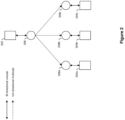
- Figure 2 shows a generalised example of such solutions.
- a content server 202 providing content such as video to client devices 204a, 204b and 204c.
- Multicast Proxy X 206 and three Proxy Ys 208a, 208b, and 208c, are inserted into the otherwise unicast path between content server 202 and the client devices.
- Proxy X 206 acquires unicast content from the content server 202 and makes it available via multicast.
- Proxy Y receives the multicast content from Proxy X and caches it, making it available over unicast to any requesting client devices. All the client devices will receive identical responses to their requests for segments, as the same multicast content is received by all the Proxy Ys from Proxy X.
- the Proxy Ys can be located within the client devices, or separate devices or there may be just a single Proxy Y dependent on set-up.
- Proxy X is pre-configured to act as a client, and independently makes requests for content segments and dispatches the entire response into the multicast network. Proxy X does this by first requesting a manifest file and then making timely requests for the content segments described within it. In some cases, the content server may require client devices to authenticate themselves with valid credentials before content is served. Proxy X 206 effectively acts like a pseudo-client.
- US patent application US2018/205802 describes a cache aware streaming arrangement.
- a client device may measure a transfer rate of a flow corresponding to content.
- the client device may then throttle down the flow to a first encode quality level in response to determining that the measured transfer rate of the flow will not support a current encode quality level of the flow.
- the first encode quality level may be lower than the current encode quality level.
- the client device may determine a recommended encode quality level from a response corresponding to the flow.
- the flow may then be throttled up to the recommended encode quality level by the client device.
- US patent application US2013/246578 describes a bit rate optimization method. First, fragments may be cached in a local cache. Then, a manifest file directed to a client device may be received and filtered to only contain a reference to a profile corresponding to the fragments being cached in the local cache. Next, a request may be received for data corresponding to the profile in the filtered manifest. In response to the request, data fragments may then be transmitted from the local cache.
- US patent application US2018/248806 describes techniques for managing streaming video profile selections of downstream client devices for a network device.
- the network device receives multicast network communications for a first video streaming profile of a plurality of video streaming profiles, for a video content item.
- the network device is subscribed to multicast communications from an upstream network device, for a video stream corresponding to the first video streaming profile.
- Embodiments determine network state information at the network device that specifies at least a measure of upstream network error. Upon determining that the network state information satisfies one or more criteria, data communications from the network device to a downstream client device for the video stream corresponding to the first video streaming profile are throttled.
- a method of managing content delivery at a network element to a client device, wherein the content comprises a plurality of segments comprising:
- the one or more segments received at the first network element may be cached at the first network element.
- the determined bit rate may be the multicast network rate.
- the received segments at the first network element may be transmitted by a second network element.
- the first and second network elements may be proxy servers.
- the content may be media content.
- the media content may comprise a video sequence.
- a network element for managing content delivery to a client device wherein the network element is adapted to:
- Examples of the present invention provide a method of managing a network for delivering content in a hybrid unicast/multicast network, where content is requested by clients over unicast, but all or some of the content is delivered in part over multicast.
- a client requests content (in the form of segments) via a first proxy.
- the segments are delivered to the first proxy over multicast from a second proxy, before onward transmission to the requesting client over unicast.
- the segments are also cached at the first proxy, and can be transmitted over unicast to other clients requesting those segments.
- problems can arise if cached segments are transmitted to clients very quickly, as the cached segments might be exhausted more quickly than they are received.
- the problem is solved here by the first proxy measuring the rate of delivery of segments from the second proxy over multicast, and limiting the transmission rate of segments over unicast to clients to no greater than the measured multicast rate.
- MAUD Multicast Assisted Unicast Delivery
- multicast network is used to assist, rather than substituting for, an otherwise unicast path.
- Content is requested by client devices from a content server over unicast.
- the responses containing the requested content are separated into two components: a first component containing elements that are specific to individual client devices (for example session specific data), and a second component that is common to all client devices (typically this is the video content being requested).
- the first component can be delivered over unicast and the second component over multicast, and later recombined to form the original responses.
- the separation and recombination are handled by suitably configured proxy servers.
- the content can be delivered over unicast to the client devices. Examples of the present invention can be used to set a delivery rate for the content to the client devices over unicast.
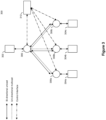
- FIG. 3 shows the main components of a "Multicast Assisted Unicast Delivery” (MAUD) network supporting content delivery.
- the network 300 comprises a content server 302, a Proxy X 306, Proxy Ys 308a, 308b, and 308c, client devices 304a, 304b and 304c, and a multicast controller 312.
- the content server 302 provides content such as video to requesting entities, such as the client devices.
- the content server 302 may be located within a content delivery network (CDN), and there may be more than one content server.
- Proxy X 306 can communicate with the content server 302 over unicast.
- Proxy X 306 can also communicate with the Proxy Ys 308a, 308b, and 308c, over both unicast and multicast.
- the Proxy Ys can be located within the client devices, in separate devices (such as a home gateway), or there may be a single Proxy Y dependent on set-up.
- bi-directional unicast communication paths are marked with solid lines
- uni-directional multicast communication paths are marked with dashed lines
- control interface communications paths are marked with a dot-dash line.
- the control interface communications paths carry control messaging/commands between the multicast controller 312 and other elements in the network.
- the client devices are assumed to be running respective client applications, which are the source of content requests.
- client device from hereon in is used to refer to a client device running a client application.
- the client devices can make HTTP unicast requests for content held at the content server 302.
- the content held at the content server 302 is typically media content (e.g. a TV programme, film or an entire linear TV channel) comprising video sequences encoded according a suitable standard such as the ITU H.264 standard.
- the video sequences are stored in the form of sequential temporal segments at the content server 302, where each segment is typically equivalent to 2 to 10 seconds of decoded video.
- Manifest files are used by clients to identify where segments are located (by a URL in the manifest).
- a client device streams a video sequence by using the manifest to determine where to direct sequential unicast requests for each segment in turn as required.
- HTTP Adaptive Streaming technologies such as MPEG-DASH and Apple's HLS (HTTP Live Streaming).
- the multicast controller 312 monitors the operation of Proxy X and the Proxy Ys to determine which traffic should use multicast assistance (MAUD), and controls the proxies accordingly.
- MOC multicast controller 312
- the client devices may receive some traffic from the content server 302 directly over unicast, and other traffic using MAUD.
- the Proxy Ys can be inserted in the HTTP path using any of a number of well-known techniques, such as using an HTTP redirection from the content server 302.
- the content server 302 would be configured such that requests for potentially popular content are not served directly but instead redirected to a suitable Proxy Y.
- the content server 302 could respond with an HTTP status code 307 which indicates a temporary redirect. This invites the client device to make a new request to the new URL supplied by the content server in its response, thus enabling requests to be made to Proxy Y.
- This technique allows the content server and proxy Y to exist in different domains, which would often be the case.
- Proxy Y configured as a transparent proxy (though all requests are intercepted by it, and only works with unencrypted traffic); Proxy Y configured as a forward proxy (where the client device sends its requests directly to Proxy Y by virtue of being explicitly configured to do so); DNS hijacking (where a DNS server is configured to supply the IP address of Proxy Y for domains of interest); and manifest manipulation (where the manifest file is re-written so that requests are made directly to Proxy Y).
- Figure 4 shows a flow chart summarising the steps of a general example of the invention.
- client devices make requests for segments of content, representing a film or live sports event for example, stored at the content server 302, and receives responses (the segments) over unicast via Proxy Y.
- client device 304a makes HTTP GET requests, which are unicast in nature, directed to segments of content.
- Each HTTP GET request includes the URL of where that segment can be retrieved from.
- the URLs are found in the manifest file associated with the content.
- the requests are received by Proxy Y 308a, and forwarded to the content server 302.
- the content server 302 responds with HTTP responses, each containing a requested segment.
- the HTP response is also effectively a unicast response.
- the responses are received by Proxy Y 308a and sent to the client device 304a.
- the received segments can then be viewed by the client device 304a.
- the client device 304a can continue to request and receive segments according to step 400 until streaming of that content is complete.
- Other client devices can make requests for the same content and receive responses in a similar manner.
- the multicast controller 312 determines whether a multicast group should be used to deliver subsequent segments.
- Proxy Y 308a sends a consumption report data relating to the HTTP request/response pairs that are passing through the proxy e.g. the URL of each HTTP request.
- the consumption report can be sent to the multicast controller 312 at intervals, either time interval or after a certain number of segments have been requested/received.
- Proxy Y 308a and other Proxy Ys (308b or 308c) as appropriate send consumption reports to the multicast controller 312 for their respective client devices, so that the multicast controller 312 can determine whether or not to use multicast to help deliver further content.
- the multicast controller 312 uses the received reports to determine whether the HTTP requests reported from a given population of Proxy Ys justifies the use of multicast for their responses. Such a population of Proxy Ys is referred to as a 'cohort'. Assuming certain conditions are satisfied (for example, greater than a certain number of client devices requesting the same content), the multicast controller 312 will configure Proxy X and any relevant Proxy Ys (that is the cohort) for multicast assisted delivery by setting up a suitable multicast group.
- content is sent from the content server 302 to Proxy X over unicast, and from Proxy X to Proxy Y over multicast, and then sent from Proxy Y to requesting client devices over unicast.
- This advantageously provides multicast delivery efficiencies, without having to disrupt the operation of the client devices.
- the content received over multicast at Proxy Y is cached so that other client devices requesting the same content can have that content delivered from the cache at Proxy Y.
- the multicast controller 312 can add Proxy Y 308a to a cohort by sending Proxy Y 308a instructions to set up an HTTP request route, whereby requests matching a particular URL path/pattern/string are directed to Proxy X 306.
- the multicast controller 312 also sends Proxy Y 308a instructions to provision a multicast listener.
- the instructions tell Proxy Y 308a to prepare to receive multicast.
- the multicast listener causes Proxy Y to issue an IGMP join command to a multicast address specified by the multicast controller.
- Other Proxy Ys can be configured in the same way.
- the multicast controller 312 configures Proxy X 306 to use multicast for certain responses sent by the content server.
- the instruction could be to only use multicast assistance for responses that contain video files or MIME types such as "video/mp4" or "video/MP2T", so that only responses containing video traffic are sent over multicast.
- responses can be selected based on specific Etags or a range of Etags.
- Etags Entity Tags
- Proxy X 306 and one or more of the Proxy Ys are now configured for respectively sending and receiving content over multicast.
- Proxy Y 308a will start receiving content segments over multicast from Proxy X. Note, for simplicity, this and the following steps are described with reference to Proxy Y 308a, although the skilled person will appreciate that any other Proxy Ys configured for multicast assistance will operate in a similar manner. Some or all of these segments are cached at Proxy Y, so that requests from more than one client for the same segment can be fulfilled without having to get the segment again from the content server.
- the segments sent by Proxy X are at a bit rate equal to at least the media (encoding) rate of the segments, to ensure timely delivery of the segments to proxy Y.
- the actual bit rate used could be set in other number of ways, including but not limited to that described in the Applicant's co-pending application EP19194759.7 .
- Proxy Y 308a determines the bit rate of the segments received over multicast from Proxy X. That is, the network bit rate rather than the media encoding rate. For example, if a received segment is 10Mb in size and takes 4 seconds to receive, then the network bit rate is 2.5Mb/s. This network bit rate is also referred to as the multicast rate.
- Proxy Y 308a receives a unicast request from client device for a segment that is cached at Proxy Y 308a.
- Proxy Y 308a could transmit the requested at almost any rate that is supported by the network link between Proxy Y 308 and the client device, as long as the requested segment has been cached. However, doing so would cause the client device to get a false picture of what rate the network as a whole could support, as the client device has no awareness that multicast is being used to assist with delivery over a portion of the route from the content server. Indeed, in an adaptive streaming system, delivering segments at a higher bit rate might cause the client device think the network can support a higher bit rate stream, and start requesting segments of a higher rate.
- the network as a whole might not support delivery of the higher bit rate stream without buffer underflow at the client device. This would cause a client to switch to a lower bit rate stream. This could cause the client to oscillate between higher and lower bit rates streams which would be annoying for end users.
- Proxy Y transmits the requested segment to the client device over unicast at a unicast rate that is no greater than the multicast rate determined in step 408. Requests by the client device for subsequent segments that are cached at Proxy Y 308a can be transmitted with the same bit rate limitation.
- segments are continuously being received at Proxy Y 308a, and simultaneously requests are being made for some
- Examples of the above invention of setting the multicast rate can be applied to other hybrid unicast/multicast arrangements.
- the Applicant's European patent application EP19159748.3 sets out an arrangement referred to as "Multicast Assisted Unicast Delivery” (MAUD).
- Content is requested by client devices from a content server over unicast.
- the responses containing the requested content are separated into two components: a first component containing elements that are specific to individual client devices (for example session specific data), and a second component that is common to all client devices (typically this is the video content being requested).
- the first component can be delivered over unicast and the second component over multicast, and later recombined to form the original responses.
- the client or session specific data is the segment header
- the common component is the payload portion of the segment.
- the above examples could measure the multicast rate as the rate of delivery of the common/payload portions rather than some combined reception rate of the payload plus header. This is because the size of the payload portions are typically be much larger than the header portions, plus the header portions are typically delivered in parallel with the payload portions, so would not contribute to the cost of delivery.
- broadcast used in the described examples is intended to cover point-to-point communications services in general.
- multicast is intended to cover point-to-multipoint services, including broadcast services.
Landscapes
- Engineering & Computer Science (AREA)
- Multimedia (AREA)
- Signal Processing (AREA)
- Computer Networks & Wireless Communication (AREA)
- Quality & Reliability (AREA)
- Two-Way Televisions, Distribution Of Moving Picture Or The Like (AREA)
- Data Exchanges In Wide-Area Networks (AREA)
- Information Transfer Between Computers (AREA)
Claims (7)
- Verfahren zum Verwalten der Lieferung von Inhalten an einem Netzwerkelement (308a) an eine Client-Vorrichtung (304a), wobei der Inhalt mehrere Segmente umfasst, wobei das Verfahren Folgendes umfasst:i) Empfangen (406) eines oder mehrerer Segmente über Multicast an einem ersten Netzwerkelement (308a) und Zwischenspeichern des einen oder der mehreren Segmente an dem ersten Netzwerkelement (308a);ii) Bestimmen (408) der Bitrate, mit der das eine oder die mehreren Segmente empfangen werden;iii) Empfangen (410) von Unicast-Anforderungen für Segmente von einer Client-Vorrichtung an dem ersten Netzwerkelement; undiv) Übertragen (412) der angeforderten Segmente von dem ersten Netzwerkelement an die Client-Vorrichtung über Unicast mit einer Übertragungsrate, die nicht größer als die bestimmte Rate ist.
- Verfahren nach Anspruch 1, wobei die bestimmte Bitrate die Multicast-Netzwerkrate ist.
- Verfahren nach Anspruch 1 oder 2, wobei die empfangenen Segmente an dem ersten Netzwerkelement durch ein zweites Netzwerkelement übertragen werden.
- Verfahren nach Anspruch 3, wobei das erste und das zweite Netzwerkelement Proxy-Server sind.
- Verfahren nach einem der vorhergehenden Ansprüche, wobei es sich bei dem Inhalt um Medieninhalt handelt.
- Verfahren nach Anspruch 5, wobei der Medieninhalt eine Videosequenz umfasst.
- Netzwerkelement (308a) zum Verwalten der Lieferung von Inhalten an eine Client-Vorrichtung (304a), wobei das Netzwerkelement (308) zu Folgendem ausgelegt ist:Empfangen eines oder mehrerer Segmente über Multicast;Zwischenspeichern eines oder mehrerer empfangener Segmente;Bestimmen der Bitrate, mit der das eine oder die mehreren Segmente empfangen werden;Empfangen von Unicast-Anforderungen für Segmente von einer Client-Vorrichtung; undÜbertragen der angeforderten Segmente an die Client-Vorrichtung über Unicast mit einer Übertragungsrate, die nicht größer als die bestimmte Rate ist.
Applications Claiming Priority (2)
| Application Number | Priority Date | Filing Date | Title |
|---|---|---|---|
| EP19200625 | 2019-09-30 | ||
| PCT/EP2020/073238 WO2021063594A1 (en) | 2019-09-30 | 2020-08-19 | Content delivery – setting the unicast rate |
Publications (3)
| Publication Number | Publication Date |
|---|---|
| EP4038852A1 EP4038852A1 (de) | 2022-08-10 |
| EP4038852B1 true EP4038852B1 (de) | 2025-02-19 |
| EP4038852C0 EP4038852C0 (de) | 2025-02-19 |
Family
ID=68109129
Family Applications (1)
| Application Number | Title | Priority Date | Filing Date |
|---|---|---|---|
| EP20754784.5A Active EP4038852B1 (de) | 2019-09-30 | 2020-08-19 | Inhaltsbereitstellung - festlegung der unicast-rate |
Country Status (5)
| Country | Link |
|---|---|
| US (1) | US12003560B2 (de) |
| EP (1) | EP4038852B1 (de) |
| CN (1) | CN114424509B (de) |
| ES (1) | ES3028613T3 (de) |
| WO (1) | WO2021063594A1 (de) |
Families Citing this family (4)
| Publication number | Priority date | Publication date | Assignee | Title |
|---|---|---|---|---|
| GB2596064A (en) | 2020-06-12 | 2021-12-22 | British Telecomm | Content delivery |
| GB2602270B (en) * | 2020-12-18 | 2023-03-29 | British Telecomm | Content delivery |
| US12001590B2 (en) * | 2022-03-29 | 2024-06-04 | NeptuneAds LLC | Preventing unwanted data leakage in data network traffic using cloaked redirects |
| WO2025162630A1 (en) * | 2024-01-31 | 2025-08-07 | British Telecommunications Public Limited Company | Multicast join method |
Family Cites Families (18)
| Publication number | Priority date | Publication date | Assignee | Title |
|---|---|---|---|---|
| JP4126928B2 (ja) * | 2002-02-28 | 2008-07-30 | 日本電気株式会社 | プロキシサーバ及びプロキシ制御プログラム |
| US7472197B2 (en) | 2005-10-31 | 2008-12-30 | Ut Starcom, Inc. | Method and apparatus for automatic switching of multicast/unicast live TV streaming in a TV-over-IP environment |
| US8014393B1 (en) | 2008-08-05 | 2011-09-06 | Cisco Technology, Inc. | Bandwidth optimized rapid channel change in IP-TV network |
| US20100115566A1 (en) | 2008-10-30 | 2010-05-06 | Raziel Haimi-Cohen | Fast Channel Change Request Processing |
| US20100254462A1 (en) * | 2009-04-07 | 2010-10-07 | Cisco Technology, Inc. | Method for reducing memory usage with accelerated channel changes |
| EP2601757B1 (de) * | 2010-08-05 | 2017-10-04 | Thomson Licensing | Verfahren und vorrichtung zur konversion zwischen einer multicast-sitzung und einer unicast-sitzungen |
| US20130246578A1 (en) | 2012-03-16 | 2013-09-19 | Cisco Technology, Inc. | Adaptive Bit Rate Optimizations When Joining Single Profile Multicast Streams |
| WO2013187923A2 (en) | 2012-06-14 | 2013-12-19 | Aerohive Networks, Inc. | Multicast to unicast conversion technique |
| US10291420B2 (en) | 2013-08-12 | 2019-05-14 | Imvision Software Technologies Ltd. | Method and system for managing the delivery of over-the-top streams |
| US9680904B2 (en) * | 2013-09-30 | 2017-06-13 | Verizon Patent And Licensing Inc. | Adaptive buffers for media players |
| US9210460B2 (en) * | 2013-12-12 | 2015-12-08 | Verizon and Redbox Digital Entertainment Services, LLC | Efficient on-demand streaming using multicast |
| GB2521845B (en) * | 2014-01-03 | 2021-07-07 | British Broadcasting Corp | Content delivery |
| US10735823B2 (en) * | 2015-03-13 | 2020-08-04 | Telefonaktiebolaget Lm Ericsson (Publ) | System and method for optimized delivery of live ABR media |
| US9641578B2 (en) * | 2015-04-02 | 2017-05-02 | Arris Enterprises, Inc. | Minimizing unicast bandwidth in an adaptive bit rate system |
| WO2017055887A1 (en) * | 2015-09-28 | 2017-04-06 | Intel Corporation | Multipath traffic management |
| US20180205802A1 (en) | 2017-01-13 | 2018-07-19 | Cisco Technology, Inc. | Cache Aware Streaming |
| US10355998B2 (en) * | 2017-02-27 | 2019-07-16 | Cisco Technology, Inc. | Adaptive video over multicast |
| US11032595B2 (en) * | 2018-09-28 | 2021-06-08 | Rovi Guides, Inc. | Systems and methods for delivery of content via multicast and unicast |
-
2020
- 2020-08-19 US US17/764,821 patent/US12003560B2/en active Active
- 2020-08-19 WO PCT/EP2020/073238 patent/WO2021063594A1/en not_active Ceased
- 2020-08-19 CN CN202080066871.7A patent/CN114424509B/zh active Active
- 2020-08-19 ES ES20754784T patent/ES3028613T3/es active Active
- 2020-08-19 EP EP20754784.5A patent/EP4038852B1/de active Active
Also Published As
| Publication number | Publication date |
|---|---|
| CN114424509B (zh) | 2025-03-21 |
| CN114424509A (zh) | 2022-04-29 |
| ES3028613T3 (en) | 2025-06-19 |
| US20220345508A1 (en) | 2022-10-27 |
| WO2021063594A1 (en) | 2021-04-08 |
| EP4038852A1 (de) | 2022-08-10 |
| US12003560B2 (en) | 2024-06-04 |
| EP4038852C0 (de) | 2025-02-19 |
Similar Documents
| Publication | Publication Date | Title |
|---|---|---|
| EP4038852B1 (de) | Inhaltsbereitstellung - festlegung der unicast-rate | |
| US12113842B2 (en) | Content delivery | |
| CN113475084B (zh) | 多播辅助传送 | |
| EP4409846A1 (de) | Inhaltsbereitstellung | |
| GB2583020A (en) | Multicast assisted delivery | |
| GB2586637A (en) | Content delivery | |
| EP4201001B1 (de) | Inhaltsbereitstellung | |
| EP4165848B1 (de) | Inhaltsbereitstellung | |
| US11638057B2 (en) | Content delivery | |
| US20240397134A1 (en) | Content delivery | |
| US20250055896A1 (en) | Content delivery | |
| WO2025162630A1 (en) | Multicast join method |
Legal Events
| Date | Code | Title | Description |
|---|---|---|---|
| STAA | Information on the status of an ep patent application or granted ep patent |
Free format text: STATUS: UNKNOWN |
|
| STAA | Information on the status of an ep patent application or granted ep patent |
Free format text: STATUS: THE INTERNATIONAL PUBLICATION HAS BEEN MADE |
|
| PUAI | Public reference made under article 153(3) epc to a published international application that has entered the european phase |
Free format text: ORIGINAL CODE: 0009012 |
|
| STAA | Information on the status of an ep patent application or granted ep patent |
Free format text: STATUS: REQUEST FOR EXAMINATION WAS MADE |
|
| 17P | Request for examination filed |
Effective date: 20220317 |
|
| AK | Designated contracting states |
Kind code of ref document: A1 Designated state(s): AL AT BE BG CH CY CZ DE DK EE ES FI FR GB GR HR HU IE IS IT LI LT LU LV MC MK MT NL NO PL PT RO RS SE SI SK SM TR |
|
| DAV | Request for validation of the european patent (deleted) | ||
| DAX | Request for extension of the european patent (deleted) | ||
| P01 | Opt-out of the competence of the unified patent court (upc) registered |
Effective date: 20230623 |
|
| REG | Reference to a national code |
Ref country code: DE Ref legal event code: R079 Free format text: PREVIOUS MAIN CLASS: H04L0029060000 Ipc: H04L0065800000 Ref country code: DE Ref legal event code: R079 Ref document number: 602020046330 Country of ref document: DE Free format text: PREVIOUS MAIN CLASS: H04L0029060000 Ipc: H04L0065800000 |
|
| GRAP | Despatch of communication of intention to grant a patent |
Free format text: ORIGINAL CODE: EPIDOSNIGR1 |
|
| STAA | Information on the status of an ep patent application or granted ep patent |
Free format text: STATUS: GRANT OF PATENT IS INTENDED |
|
| INTG | Intention to grant announced |
Effective date: 20240910 |
|
| RIC1 | Information provided on ipc code assigned before grant |
Ipc: H04L 65/75 20220101ALI20240903BHEP Ipc: H04L 65/612 20220101ALI20240903BHEP Ipc: H04L 65/611 20220101ALI20240903BHEP Ipc: H04L 65/80 20220101AFI20240903BHEP |
|
| GRAS | Grant fee paid |
Free format text: ORIGINAL CODE: EPIDOSNIGR3 |
|
| GRAA | (expected) grant |
Free format text: ORIGINAL CODE: 0009210 |
|
| STAA | Information on the status of an ep patent application or granted ep patent |
Free format text: STATUS: THE PATENT HAS BEEN GRANTED |
|
| AK | Designated contracting states |
Kind code of ref document: B1 Designated state(s): AL AT BE BG CH CY CZ DE DK EE ES FI FR GB GR HR HU IE IS IT LI LT LU LV MC MK MT NL NO PL PT RO RS SE SI SK SM TR |
|
| REG | Reference to a national code |
Ref country code: GB Ref legal event code: FG4D |
|
| REG | Reference to a national code |
Ref country code: CH Ref legal event code: EP |
|
| REG | Reference to a national code |
Ref country code: IE Ref legal event code: FG4D |
|
| REG | Reference to a national code |
Ref country code: DE Ref legal event code: R096 Ref document number: 602020046330 Country of ref document: DE |
|
| U01 | Request for unitary effect filed |
Effective date: 20250311 |
|
| P04 | Withdrawal of opt-out of the competence of the unified patent court (upc) registered |
Free format text: CASE NUMBER: APP_13438/2025 Effective date: 20250318 |
|
| U07 | Unitary effect registered |
Designated state(s): AT BE BG DE DK EE FI FR IT LT LU LV MT NL PT RO SE SI Effective date: 20250321 |
|
| REG | Reference to a national code |
Ref country code: ES Ref legal event code: FG2A Ref document number: 3028613 Country of ref document: ES Kind code of ref document: T3 Effective date: 20250619 |
|
| PG25 | Lapsed in a contracting state [announced via postgrant information from national office to epo] |
Ref country code: RS Free format text: LAPSE BECAUSE OF FAILURE TO SUBMIT A TRANSLATION OF THE DESCRIPTION OR TO PAY THE FEE WITHIN THE PRESCRIBED TIME-LIMIT Effective date: 20250519 |
|
| PG25 | Lapsed in a contracting state [announced via postgrant information from national office to epo] |
Ref country code: PL Free format text: LAPSE BECAUSE OF FAILURE TO SUBMIT A TRANSLATION OF THE DESCRIPTION OR TO PAY THE FEE WITHIN THE PRESCRIBED TIME-LIMIT Effective date: 20250219 |
|
| PG25 | Lapsed in a contracting state [announced via postgrant information from national office to epo] |
Ref country code: NO Free format text: LAPSE BECAUSE OF FAILURE TO SUBMIT A TRANSLATION OF THE DESCRIPTION OR TO PAY THE FEE WITHIN THE PRESCRIBED TIME-LIMIT Effective date: 20250519 Ref country code: IS Free format text: LAPSE BECAUSE OF FAILURE TO SUBMIT A TRANSLATION OF THE DESCRIPTION OR TO PAY THE FEE WITHIN THE PRESCRIBED TIME-LIMIT Effective date: 20250619 |
|
| PG25 | Lapsed in a contracting state [announced via postgrant information from national office to epo] |
Ref country code: HR Free format text: LAPSE BECAUSE OF FAILURE TO SUBMIT A TRANSLATION OF THE DESCRIPTION OR TO PAY THE FEE WITHIN THE PRESCRIBED TIME-LIMIT Effective date: 20250219 |
|
| PG25 | Lapsed in a contracting state [announced via postgrant information from national office to epo] |
Ref country code: GR Free format text: LAPSE BECAUSE OF FAILURE TO SUBMIT A TRANSLATION OF THE DESCRIPTION OR TO PAY THE FEE WITHIN THE PRESCRIBED TIME-LIMIT Effective date: 20250520 |
|
| U20 | Renewal fee for the european patent with unitary effect paid |
Year of fee payment: 6 Effective date: 20250723 |
|
| PG25 | Lapsed in a contracting state [announced via postgrant information from national office to epo] |
Ref country code: SM Free format text: LAPSE BECAUSE OF FAILURE TO SUBMIT A TRANSLATION OF THE DESCRIPTION OR TO PAY THE FEE WITHIN THE PRESCRIBED TIME-LIMIT Effective date: 20250219 |
|
| PGFP | Annual fee paid to national office [announced via postgrant information from national office to epo] |
Ref country code: ES Payment date: 20250901 Year of fee payment: 6 |
|
| PGFP | Annual fee paid to national office [announced via postgrant information from national office to epo] |
Ref country code: GB Payment date: 20250724 Year of fee payment: 6 |
|
| PG25 | Lapsed in a contracting state [announced via postgrant information from national office to epo] |
Ref country code: CZ Free format text: LAPSE BECAUSE OF FAILURE TO SUBMIT A TRANSLATION OF THE DESCRIPTION OR TO PAY THE FEE WITHIN THE PRESCRIBED TIME-LIMIT Effective date: 20250219 |
|
| PG25 | Lapsed in a contracting state [announced via postgrant information from national office to epo] |
Ref country code: SK Free format text: LAPSE BECAUSE OF FAILURE TO SUBMIT A TRANSLATION OF THE DESCRIPTION OR TO PAY THE FEE WITHIN THE PRESCRIBED TIME-LIMIT Effective date: 20250219 |