EP4038348B1 - Verfahren, systeme, geräte und vorrichtungen zur erleichterung der beurteilung eines physikalischen vermögenswertes - Google Patents
Verfahren, systeme, geräte und vorrichtungen zur erleichterung der beurteilung eines physikalischen vermögenswertes Download PDFInfo
- Publication number
- EP4038348B1 EP4038348B1 EP20884634.5A EP20884634A EP4038348B1 EP 4038348 B1 EP4038348 B1 EP 4038348B1 EP 20884634 A EP20884634 A EP 20884634A EP 4038348 B1 EP4038348 B1 EP 4038348B1
- Authority
- EP
- European Patent Office
- Prior art keywords
- assessment
- physical asset
- information
- generating
- sensor
- Prior art date
- Legal status (The legal status is an assumption and is not a legal conclusion. Google has not performed a legal analysis and makes no representation as to the accuracy of the status listed.)
- Active
Links
Images






Classifications
-
- G—PHYSICS
- G01—MEASURING; TESTING
- G01M—TESTING STATIC OR DYNAMIC BALANCE OF MACHINES OR STRUCTURES; TESTING OF STRUCTURES OR APPARATUS, NOT OTHERWISE PROVIDED FOR
- G01M5/00—Investigating the elasticity of structures, e.g. deflection of bridges or air-craft wings
- G01M5/0091—Investigating the elasticity of structures, e.g. deflection of bridges or air-craft wings by using electromagnetic excitation or detection
-
- G—PHYSICS
- G01—MEASURING; TESTING
- G01N—INVESTIGATING OR ANALYSING MATERIALS BY DETERMINING THEIR CHEMICAL OR PHYSICAL PROPERTIES
- G01N3/00—Investigating strength properties of solid materials by application of mechanical stress
- G01N3/56—Investigating resistance to wear or abrasion
-
- G—PHYSICS
- G01—MEASURING; TESTING
- G01M—TESTING STATIC OR DYNAMIC BALANCE OF MACHINES OR STRUCTURES; TESTING OF STRUCTURES OR APPARATUS, NOT OTHERWISE PROVIDED FOR
- G01M5/00—Investigating the elasticity of structures, e.g. deflection of bridges or air-craft wings
- G01M5/0041—Investigating the elasticity of structures, e.g. deflection of bridges or air-craft wings by determining deflection or stress
-
- G—PHYSICS
- G01—MEASURING; TESTING
- G01M—TESTING STATIC OR DYNAMIC BALANCE OF MACHINES OR STRUCTURES; TESTING OF STRUCTURES OR APPARATUS, NOT OTHERWISE PROVIDED FOR
- G01M5/00—Investigating the elasticity of structures, e.g. deflection of bridges or air-craft wings
- G01M5/0066—Investigating the elasticity of structures, e.g. deflection of bridges or air-craft wings by exciting or detecting vibration or acceleration
-
- G—PHYSICS
- G01—MEASURING; TESTING
- G01M—TESTING STATIC OR DYNAMIC BALANCE OF MACHINES OR STRUCTURES; TESTING OF STRUCTURES OR APPARATUS, NOT OTHERWISE PROVIDED FOR
- G01M7/00—Vibration-testing of structures; Shock-testing of structures
- G01M7/08—Shock-testing
-
- G—PHYSICS
- G01—MEASURING; TESTING
- G01N—INVESTIGATING OR ANALYSING MATERIALS BY DETERMINING THEIR CHEMICAL OR PHYSICAL PROPERTIES
- G01N3/00—Investigating strength properties of solid materials by application of mechanical stress
- G01N3/02—Details
- G01N3/06—Special adaptations of indicating or recording means
- G01N3/068—Special adaptations of indicating or recording means with optical indicating or recording means
-
- H—ELECTRICITY
- H04—ELECTRIC COMMUNICATION TECHNIQUE
- H04W—WIRELESS COMMUNICATION NETWORKS
- H04W4/00—Services specially adapted for wireless communication networks; Facilities therefor
- H04W4/02—Services making use of location information
- H04W4/029—Location-based management or tracking services
-
- H—ELECTRICITY
- H04—ELECTRIC COMMUNICATION TECHNIQUE
- H04W—WIRELESS COMMUNICATION NETWORKS
- H04W4/00—Services specially adapted for wireless communication networks; Facilities therefor
- H04W4/02—Services making use of location information
- H04W4/021—Services related to particular areas, e.g. point of interest [POI] services, venue services or geofences
Definitions
- the present disclosure relates to the field of static structures. More specifically, the present disclosure relates to methods, systems, apparatuses, and devices for facilitating assessment of a physical asset. Further, the invention is set out in the appended set of claims.
- a device to monitor and notify of irregular change of behavior of a structure is in demand.
- a stress event may be caused by the application of a force (mass) to a structural member associated with the structure for a duration of time that stimulates the structural member to vibrate and thereby transmit sounds corresponding to the impact of the force.
- a force masses
- structures exposed to repeated loads e.g., temporary loads, of short duration, or moving
- defects are susceptible to defects caused by fatigue of the materials used; such defects adversely affect the load-bearing capabilities (i.e., the structural integrity of the structural member).
- Such defects may be localized structural defects such as cracks and fatigue fractures.
- the one or more steps of the method may be performed one or more number of times. Additionally, the one or more steps may be performed in any order other than as exemplarily disclosed herein, unless explicitly stated otherwise, elsewhere in the present disclosure. Further, two or more steps of the one or more steps may, in some embodiments, be simultaneously performed, at least in part. Further, in some embodiments, there may be one or more time gaps between performance of any two steps of the one or more steps.
- the one or more predefined conditions may be specified by the one or more users. Accordingly, the one or more steps may include receiving, using the communication device, the one or more predefined conditions from one or more and devices operated by the one or more users. Further, the one or more predefined conditions may be stored in the storage device. Alternatively, and/or additionally, in some embodiments, the one or more predefined conditions may be automatically determined, using the processing device, based on historical data corresponding to performance of the one or more steps. For example, the historical data may be collected, using the storage device, from a plurality of instances of performance of the method. Such historical data may include performance actions (e.g.
- machine learning may be performed on the historical data in order to determine the one or more predefined conditions. For instance, machine learning on the historical data may determine a correlation between one or more contextual variables and performance of the one or more steps of the method. Accordingly, the one or more predefined conditions may be generated, using the processing device, based on the correlation.
- one or more steps of the method may be performed at one or more spatial locations.
- the method may be performed by a plurality of devices interconnected through a communication network.
- one or more steps of the method may be performed by a server computer.
- one or more steps of the method may be performed by a client computer.
- one or more steps of the method may be performed by an intermediate entity such as, for example, a proxy server.
- one or more steps of the method may be performed in a distributed fashion across the plurality of devices in order to meet one or more objectives.
- one objective may be to provide load balancing between two or more devices.
- the disclosed system may be applied in fixed civil assets like bridges, electricity pylons, oil pipelines, rail tracks, etc. Further, the disclosed system may be used on moving platforms (e.g., trains, automobiles, airplanes, ships, or installations such as oil platforms).
- the failure detection system may include a data input system, a network, an assessment system, an output system.
- the data input system can be communicatively connected to an asset system via a network.
- the assessment system may be configured to analyze the characteristic information of a structure and communicatively connected via the network to the output system.
- the data input system may include a microphone, a recording device, an internet access device, a laser vibration sensor, a laser interferometer sensor, a wideband audio sensor, historical maintenance data records, and theoretical verification FEA model.
- the data input system may also include an electronic device capable of periodically injecting a small ( ⁇ several volts) alternating current signal into the asset so that the conductivity may be recorded. Further, an electrical current amplitude of the signal may be measured and represented as a time-varying response that may be digitized, recorded, and passed to a neural network for analysis.
- This recording and internet access system may be a low-cost "internet of things" device.
- the IoT devices may be equipped with multiple radio technologies such as Bluetooth ® , Bluetooth ® Low Energy "BLE”, ZigBee ® , Wi-Fi or cellular (2G, 3G and 4G, and 5G).
- the IoT devices may be configured to send temperature, barometric pressure, and other environmental information.
- One or more of the above-described recording devices will record and transmit the data in the manner described above.
- the data are analyzed using the neural network arrangement as described. This data can be used for verification of the models using the minimax network game tree structure as described.
- the data obtained from this process can be fed back into the training models for that asset class to improve the reliability of the assessment.
- the disclosed system may solve the problems associated with conventional detection methods or systems through an innovative configuration of recording devices and neural networks. Further, the disclosed system may detect failures in large physical assets to provide information on asset condition and to reliably predict advance warning of structural failure.
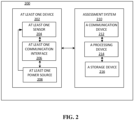
- FIG. 2 is a flowchart of a system 200 for facilitating assessment of a physical asset, in accordance with some embodiments.
- the system 200 includes at least one device 202 disposable on at least one location of the physical asset.
- the at least one device 202 includes at least one sensor 204 configured for generating at least one information associated with at least one characteristic of the physical asset.
- the at least one characteristic may include at least one of at least one structural characteristic, at least one compositional characteristic, at least one mechanical characteristic, at least one electrical characteristic, at least one magnetic characteristic, etc.
- the at least one device 202 includes at least one communication interface 206 communicatively coupled with the at least one sensor 204.
- the at least one communication interface 206 is configured for communicating with an assessment system 210 using at least one communication channel. Further, the at least one communication interface 206 is configured for transmitting the at least one information to the assessment system 210. Further, the at least one device 202 includes at least one power source 208 electrically coupled with the at least one sensor 204 and the at least one communication interface 206. Further, the at least one power source 208 is configured for electrically powering the at least one sensor 204 and the at least one communication interface 206. Further, the at least one device 202 may be an IoT device.
- the system 200 includes the assessment system 210 communicatively coupled with the at least one device 202. Further, the assessment system 210 includes a communication device 212 configured for receiving the at least one information from the at least one communication interface 206. Further, the communication device 212 is configured for transmitting an assessment to at least one user device. Further, the assessment system 210 includes a processing device 214 communicatively coupled with the communication device 212. Further, the processing device 214 is configured for analyzing the at least one information. Further, the processing device 214 is configured for generating the assessment of the physical asset based on the analyzing of the at least one information. Further, the assessment includes at least one of "Structural Failure," "Good Condition” and "Maintenance Reqd". Further, the assessment system 210 includes a storage device 216 communicatively coupled with the processing device 214. Further, the storage device 216 is configured for storing the at least one information and the assessment.
- the system 200 includes at least one stimulator device 302 (as shown in FIG. 3 ) configured for generating at least one stimulus. Further, the at least one stimulator device 302 is electrically coupled to the at least one power source 208. Further, the at least one power source 208 is configured for powering the at least one stimulator device 302. Further, the at least one stimulator device 302 is configured for delivering the at least one stimulus to the physical asset based on the generating of the at least one stimulus. Further, the physical asset generates at least one response based on the at least one stimulus and the at least one characteristic. Further, the at least one response may include at least one vibration generated by the physical asset. Further, the at least one vibration may be associated with at least one vibration pattern.
- the at least one vibration pattern of the at least one vibration may correspond to the at least one characteristic and the at least one stimulus. Further, the generating of the at least one information may be based the at least one response. Further, the at least one information may be associated with the at least one response.
- the communication device 212 is communicatively coupled with the at least one stimulator device 302. Further, the communication device 212 is configured for receiving at least one request from at least one first user device. Further, the communication device 212 is configured for transmitting at least one command to the at least one stimulator device 302. Further, the generating of the at least one stimulus is based on the at least one command. Further, the processing device 214 is configured for analyzing the at least one request. Further, the processing device 214 is configured for generating the at least one command based on the analyzing of the at least one request.
- the generating of the at least one stimulus is based on the at least one schedule.
- the storage device 216 may be configured for retrieving the at least one schedule.
- the system 200 may include an interferometry device 402 (as shown in FIG. 4 ) configured for generating two beams of light.
- the interferometry device 402 may be electrically coupled to the at least one power source 208.
- the at least one power source 208 may be configured for powering the interferometry device 402.
- the two beams comprise a first beam and a second beam.
- the first beam may be directed towards the at least one sensor 204 through a first path.
- the second beam may be directed towards the at least one sensor 204 through a second path.
- the first path and the second path are dissimilar.
- the first beam and the second beam converges on the at least one sensor 204 forming at least one interference fringe.
- the analyzing of the at least one information may be based on at least one artificial intelligence model.
- the at least one artificial intelligence model may be configured for determining a probability for each assessment option of a plurality of assessment options associated with the physical asset.
- the plurality of assessment options may include at least one of "Structural Failure," “Good Condition” and "Maintenance Reqd”.
- the generating of the assessment may be based on the determining of the probability of the each assessment option.
- the storage device 216 may be configured for storing the at least one artificial intelligence model.
- the at least one information may include at least one asset identifier.
- the storage device 216 may be configured for retrieving at least one historical maintenance information based on the at least one asset identifier.
- the at least one historical maintenance information may be associated with at least one historical response generated by the physical asset.
- the processing device 214 may be configured for analyzing the at least one historical maintenance information. Further, the generating of the assessment may be based on the analyzing of the at least one historical maintenance information.
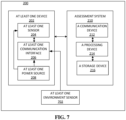
- the at least one device 202 may include at least one environment sensor 702 (as shown in FIG. 7 ). Further, the at least one environment sensor 702 may be communicatively coupled with the at least one communication interface 206. Further, the at least one environment sensor 702 may be configured for generating at least one environmental information based on at least one environmental condition associated with an environment of the physical asset. Further, the at least one environmental condition may include at least one meteorological parameter. Further, the at least one meteorological parameter may include temperature, relative humidity (RH), evapotranspiration (ET), wind speed, solar radiation, precipitation, etc. Further, the at least one communication interface 206 may be configured for transmitting the at least one environmental information to the assessment system 210.
- RH relative humidity
- ET evapotranspiration
- the at least one communication interface 206 may be configured for transmitting the at least one environmental information to the assessment system 210.
- the at least one sensor 204 may be configured for detecting at least one event associated with the physical asset. Further, the generating of the at least one information may be based on the detecting. Further, the at least one information may include at least one of at least one spatial identifier of the at least one event and at least one temporal identifier of the at least one event.
- the communication device 212 may be configured for receiving at least one first request from at least one second user device. Further, the communication device 212 may be configured for transmitting at least one first command to the at least one communication interface 206. Further, the generating of the at least one information may be based on the at least one first command. Further, the processing device 214 may be configured for analyzing the at least one first request. Further, the processing device 214 may be configured for generating the at least one first command based on the analyzing of the at least one first request.
- FIG. 4 is a block diagram of the system 200 for facilitating assessment of the physical asset, in accordance with some embodiments.
- FIG. 5 is a block diagram of the system 200 for facilitating assessment of the physical asset, in accordance with some embodiments.
- FIG. 6 is a block diagram of the system 200 for facilitating assessment of the physical asset, in accordance with some embodiments.
- FIG. 7 is a block diagram of the system 200 for facilitating assessment of the physical asset, in accordance with some embodiments.
- FIG. 8 is a block diagram of a system 800 for facilitating assessment of a physical asset, in accordance with some embodiments.
- the system 800 may include at least one device 802 disposable on at least one location of the physical asset.
- the at least one device 802 may include at least one sensor 804 configured for generating at least one information associated with at least one characteristic of the physical asset.
- the at least one characteristic may include at least one of at least one structural characteristic, at least one compositional characteristic, at least one mechanical characteristic, at least one electrical characteristic, at least one magnetic characteristic, etc.
- the at least one device 802 may include at least one environment sensor 806 configured for generating at least one environmental information based on at least one environmental condition associated with an environment of the physical asset.
- the system 800 may include at least one stimulator device 902 (as shown in FIG. 9 ) configured for generating at least one stimulus. Further, the at least one stimulator device 902 may be configured for delivering the at least one stimulus to the physical asset based on the generating of the at least one stimulus. Further, the physical asset generates at least one response based on the at least one stimulus and the at least one characteristic. Further, the generating of the at least one information may be based the at least one response. Further, the at least one information may be associated with the at least one response.
- the at least one information may include at least one asset identifier.
- the storage device 818 may be configured for retrieving at least one historical maintenance information based on the at least one asset identifier.
- the at least one historical maintenance information may be associated with at least one historical response generated by the physical asset.
- the processing device 816 may be configured for analyzing the at least one historical maintenance information. Further, the generating of the assessment may be based on the analyzing of the at least one historical maintenance information.
- the communication device 814 may be configured for receiving at least one first request from at least one second user device. Further, the communication device 814 may be configured for transmitting at least one first command to the at least one communication interface 808. Further, the generating of the at least one information may be based on the at least one first command. Further, the processing device 816 may be configured for analyzing the at least one first request. Further, the processing device 816 may be configured for generating the at least one first command based on the analyzing of the at least one first request.
- FIG. 9 is a block diagram of the system 800 for facilitating assessment of the physical asset, in accordance with some embodiments.
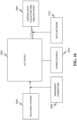
- FIG. 10 illustrates a data connection between a data input system 1004, an IoT device 1002, and an assessment system, in accordance with some embodiments.
- the IoT device 1002 may be connected to the data input system 1004 using a hard-wired connection 1008.
- the IoT device 1002 may be commercially available containing raw data port, ethernet, A to D converter, data compression, GPS, tri-band cellular radio (3G/4G/5G) satellite, clock, Bluetooth TM , temperature reader, barometric pressure, and so on.
- the IoT device 1002 may be powered by power sources 1010.
- the power sources 1010 may include solar/wind power sources.
- the power sources 1010 may include a lithium-ion battery.
- the data input system 1004 may include a wideband audio device, a laser interferometry device, or a laser matrix device. Further, the IoT device 1002 may send a sample of recorded audio over a data network 1012 (such as a public cellular/ satellite network) to a central data collection and analysis point 1006 (or central point). The signals from the data input system 1004 may be communicated over the network connected to the assessment system (such as the assessment system 210) for evaluation. Further, the data network 1012 may include conventional data communications network, including microwave, telephone line, satellite, or recorded magnetic medium, appropriate for transferring any of these signals in any or each of real-time, time delay, timeshare, or batch formats may be used.
- the network may enable the data input system 1004 to communicate with the assessment system. Some embodiments enable communication via cellular and/or Wi-Fi networks. Some embodiments enable communication via the Internet. Several embodiments enable wired communication between the data input system 1004 and the assessment system.
- the network can include the following communication means radio, Wi-Fi (e.g., wireless local area network), cellular, Internet, Bluetooth, telecommunication, electromagnetic, infrared, light, sonic, and microwave. Other communication means are used by some embodiments.
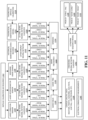
- FIG. 11 illustrates an assessment system with minimax evaluation associated with the system 200, in accordance with some embodiments.
- an assessment system (such as the assessment system 210) associated with the system 200 may include a one-dimensional convolutional neural network (1D-CNN) / dense neural network classifier and a Long Short-Term Memory (LSTM) / Convolutional Neural Network (CNN) / Natural Language Processing (NLP) neural network.
- the assessment system may be configured to analyze structural characteristic information received from the input data system and produce an assessment such as "Structural Failure,” “Good Condition” or "Maintenance Reqd.”
- the assessment system may receive a first data from a laser vibration sensor 1104. Further, the first data from a laser vibration sensor 1104 may be analyzed using a first 1D-CNN classifier and neural network classifier 1116 to generate at least one first probability associated with the first data. Further, the at least one first probability may include a probability of structural fail, a probability of good condition, a probability of maintenance required. Further, the laser vibration sensor 1104 may receive data associated with impulse calibration 1102. Further, the assessment system may receive a second data from a laser interferometer sensor 1106. Further, the second data from the laser interferometer sensor 1106 may be analyzed using a second 1D-CNN classifier and neural network classifier 1118 to generate at least one second probability associated with the second data.
- data may flow from the CNN/Dense Neural network Classifier 1142 to an LSTM/RNN sequence model 1144. Further, at 1148, the assessment system may determine a probability of structure fail. Further, at 1150, the assessment system may determine a probability of good condition. Further, at 1152, the assessment system may determine a probability of maintenance required.
- the assessment system may include minimax to minimize errors.
- a generic model of a given asset class is generated using a finite element analysis (FEA) mesh, using proprietary software such as Ansys.
- FFA finite element analysis
- This model is stimulated by an impulse as would be expected during normal exposure of the asset to the environment or load.
- a statistical, time-series, vibrational response of the model is obtained, exported to, and used to train the same neural network as a separate, independent neural network.
- the model is stimulated as if there were no defects in the structure.
- deliberate failures of varying severity and/or location are injected randomly into the asset class digital model to represent different kinds of failure.
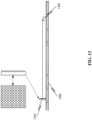
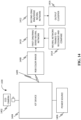
- the IoT device 1404 may be commercially available containing raw data port, ethernet, A to D converter, data compression, GPS, tri-band cellular radio (3G/4G/5G) satellite, clock, Bluetooth TM , temperature reader, barometric pressure, and so on. Further, the IoT device 1404 may be powered by power source 1406. Further, the power source 1406 may include solar/wind power source 1406. Further, the power source 1406 may include a lithium-ion battery.
- the captured image may be compared with either one of i) an image of the object or substance captured at some previous point, ii) a library image of a substance or class of objects, etc. to assess whether it has undergone any distortion or change in composition.
- a convolutional neural network (CNN), or recurrent neural network (RNN), or a combination or compound of such networks can be trained with the previously captured images or library images. If a change is detected in the captured image, then the fact and nature of the change can be identified by the neural network. For example, if distortion is detected in the captured image of a structure, the neural network will be able to discern the type and nature of such distortion.
- the captured image captured by the CCD-type camera device and stored as described, includes a quantity of substance
- the volume of the substance can be estimated directly from an image classifier. If the density of the substance is known, then the mass or weight of the substance can also be determined from the captured image.
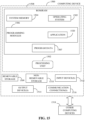
- a system consistent with an embodiment of the disclosure may include a computing device or cloud service, such as computing device 1500.
- computing device 1500 may include at least one processing unit 1502 and a system memory 1504.
- system memory 1504 may comprise, but is not limited to, volatile (e.g. random-access memory (RAM)), non-volatile (e.g. read-only memory (ROM)), flash memory, or any combination.
- System memory 1504 may include operating system 1505, one or more programming modules 1506, and may include a program data 1507. Operating system 1505, for example, may be suitable for controlling computing device 1500's operation.
- programming modules 1506 may include image-processing module, machine learning module.
- embodiments of the disclosure may be practiced in conjunction with a graphics library, other operating systems, or any other application program and is not limited to any particular application or system. This basic configuration is illustrated in FIG. 15 by those components within a dashed line 1508.
- Computing device 1500 may have additional features or functionality.
- computing device 1500 may also include additional data storage devices (removable and/or non-removable) such as, for example, magnetic disks, optical disks, or tape.
- additional storage is illustrated in FIG. 15 by a removable storage 1509 and a non-removable storage 1510.
- Computer storage media may include volatile and non-volatile, removable and non-removable media implemented in any method or technology for storage of information, such as computer-readable instructions, data structures, program modules, or other data.
- System memory 1504, removable storage 1509, and non-removable storage 1510 are all computer storage media examples (i.e., memory storage.)
- Computer storage media may include, but is not limited to, RAM, ROM, electrically erasable read-only memory (EEPROM), flash memory or other memory technology, CD-ROM, digital versatile disks (DVD) or other optical storage, magnetic cassettes, magnetic tape, magnetic disk storage or other magnetic storage devices, or any other medium which can be used to store information and which can be accessed by computing device 1500. Any such computer storage media may be part of device 1500.
- Computing device 1500 may also have input device(s) 1512 such as a keyboard, a mouse, a pen, a sound input device, a touch input device, a location sensor, a camera, a biometric sensor, etc.
- Output device(s) 1514 such as a display, speakers, a printer, etc. may also be included.
- the aforementioned devices are examples and others may be used.
- Computing device 1500 may also contain a communication connection 1516 that may allow device 1500 to communicate with other computing devices 1518, such as over a network in a distributed computing environment, for example, an intranet or the Internet.
- Communication connection 1516 is one example of communication media.
- Communication media may typically be embodied by computer readable instructions, data structures, program modules, or other data in a modulated data signal, such as a carrier wave or other transport mechanism, and includes any information delivery media.
- modulated data signal may describe a signal that has one or more characteristics set or changed in such a manner as to encode information in the signal.
- communication media may include wired media such as a wired network or direct-wired connection, and wireless media such as acoustic, radio frequency (RF), infrared, and other wireless media.
- wireless media such as acoustic, radio frequency (RF), infrared, and other wireless media.
- RF radio frequency
- computer readable media may include both storage media and communication media.
- embodiments of the disclosure may be practiced in an electrical circuit comprising discrete electronic elements, packaged or integrated electronic chips containing logic gates, a circuit utilizing a microprocessor, or on a single chip containing electronic elements or microprocessors.
- Embodiments of the disclosure may also be practiced using other technologies capable of performing logical operations such as, for example, AND, OR, and NOT, including but not limited to mechanical, optical, fluidic, and quantum technologies.
- embodiments of the disclosure may be practiced within a general-purpose computer or in any other circuits or systems.
- Embodiments of the disclosure may be implemented as a computer process (method), a computing system, or as an article of manufacture, such as a computer program product or computer readable media.
- the computer program product may be a computer storage media readable by a computer system and encoding a computer program of instructions for executing a computer process.
- the computer program product may also be a propagated signal on a carrier readable by a computing system and encoding a computer program of instructions for executing a computer process.
- the present disclosure may be embodied in hardware and/or in software (including firmware, resident software, micro-code, etc.).
- embodiments of the present disclosure may take the form of a computer program product on a computer-usable or computer-readable storage medium having computer-usable or computer-readable program code embodied in the medium for use by or in connection with an instruction execution system.
- a computer-usable or computer-readable medium may be any medium that can contain, store, communicate, propagate, or transport the program for use by or in connection with the instruction execution system, apparatus, or device.
- the computer-usable or computer-readable medium may be, for example but not limited to, an electronic, magnetic, optical, electromagnetic, infrared, or semiconductor system, apparatus, device, or propagation medium. More specific computer-readable medium examples (a non-exhaustive list), the computer-readable medium may include the following: an electrical connection having one or more wires, a portable computer diskette, a random-access memory (RAM), a read-only memory (ROM), an erasable programmable read-only memory (EPROM or Flash memory), an optical fiber, and a portable compact disc read-only memory (CD-ROM).
- RAM random-access memory
- ROM read-only memory
- EPROM or Flash memory erasable programmable read-only memory
- CD-ROM portable compact disc read-only memory
- the computer-usable or computer-readable medium could even be paper or another suitable medium upon which the program is printed, as the program can be electronically captured, via, for instance, optical scanning of the paper or other medium, then compiled, interpreted, or otherwise processed in a suitable manner, if necessary, and then stored in a computer memory.
Landscapes
- Physics & Mathematics (AREA)
- General Physics & Mathematics (AREA)
- Engineering & Computer Science (AREA)
- Aviation & Aerospace Engineering (AREA)
- Analytical Chemistry (AREA)
- Pathology (AREA)
- Life Sciences & Earth Sciences (AREA)
- Chemical & Material Sciences (AREA)
- Health & Medical Sciences (AREA)
- Biochemistry (AREA)
- General Health & Medical Sciences (AREA)
- Immunology (AREA)
- Signal Processing (AREA)
- Computer Networks & Wireless Communication (AREA)
- Electromagnetism (AREA)
- Management, Administration, Business Operations System, And Electronic Commerce (AREA)
- Telephonic Communication Services (AREA)
- Medical Treatment And Welfare Office Work (AREA)
Claims (10)
- System (200) zur Erleichterung der Beurteilung eines physischen Vermögenswerts, wobei das System (200) gekennzeichnet ist durch:
mindestens eine Vorrichtung (202), die an mindestens einem Ort des physischen Vermögenswerts angeordnet werden kann, wobei die mindestens eine Vorrichtung (202) umfasst:mindestens einen Sensor (204), der zum Erzeugen mindestens einer Information konfiguriert ist, die mit mindestens einem Charakteristikum des physischen Vermögenswerts assoziiert ist;mindestens eine Kommunikationsschnittstelle (206), die mit dem mindestens einen Sensor (204) kommunikativ gekoppelt ist, wobei die mindestens eine Kommunikationsschnittstelle (206) zum Kommunizieren mit einem Beurteilungssystem (210) unter Verwendung mindestens eines Kommunikationskanals konfiguriert ist, wobei die mindestens eine Kommunikationsschnittstelle (206) zum Übertragen der mindestens eine Information an das Beurteilungssystem (206) konfiguriert ist; undmindestens eine Energiequelle (208), die mit dem mindestens einen Sensor (204) und der mindestens einen Kommunikationsschnittstelle (206) elektrisch gekoppelt ist, wobei die mindestens eine Energiequelle (208) zum elektrischen Antreiben des mindestens einen Sensors (204) und der mindestens einen Kommunikationsschnittstelle (206) konfiguriert ist; unddas Beurteilungssystem (210), das mit der mindestens einen Vorrichtung (202) kommunikativ gekoppelt ist, wobei das Beurteilungssystem (210) umfasst:
eine Kommunikationsvorrichtung (212), die konfiguriert ist zum:Empfangen der mindestens einen Information von der mindestens einen Kommunikationsschnittstelle (206) undÜbertragen einer Beurteilung an mindestens eine Benutzervorrichtung;eine Verarbeitungsvorrichtung (214), die mit der Kommunikationsvorrichtung (212) kommunikativ gekoppelt ist, wobei die Verarbeitungsvorrichtung (214) konfiguriert ist zum:Analysieren der mindestens einen Information mit einer Minimax-Bewertung undErzeugen der Beurteilung des physischen Vermögenswerts auf der Basis des Analysierens der mindestens einen Information, wobei die Beurteilung zu einer Guter-Zustand-Einstufung, einer Instandhaltung-erforderlich-Einstufung oder einer Strukturversagen-Einstufung für den physischen Vermögenswert führt;eine Speichervorrichtung (216), die mit der Verarbeitungsvorrichtung (214) kommunikativ gekoppelt ist, wobei die Speichervorrichtung (216) zum Speichern der mindestens einen Information und der Beurteilung konfiguriert ist; undmindestens eine Stimulatorvorrichtung (302), die mit der kommunikativen Vorrichtung (212) kommunikativ gekoppelt ist, wobei die mindestens eine Stimulatorvorrichtung (302) konfiguriert ist zum:Erzeugen mindestens eines Stimulus, wobei mindestens eine Anforderung von mindestens einer ersten Benutzervorrichtung empfangen wird, wobei mindestens ein Befehl an die mindestens eine Stimulatorvorrichtung (302) übertragen wird, wobei das Erzeugen des mindestens einen Stimulus auf dem mindestens einen Befehl basiert, wobei die Verarbeitungsvorrichtung (214) weiterhin zum Analysieren der mindestens einen Anforderung und Erzeugen des mindestens einen Befehls auf der Basis des Analysierens der mindestens einen Anforderung konfiguriert ist; undAbgeben des mindestens einen Stimulus an den physischen Vermögenswert auf der Basis des Erzeugens des mindestens einen Stimulus, wobei der physische Vermögenswert mindestens eine Antwort auf der Basis des mindestens einen Stimulus und des mindestens einen Charakteristikums erzeugt, wobei das Erzeugen der mindestens einen Information auf der mindestens einen Antwort basiert, wobei die mindestens eine Information mit der mindestens einen Antwort assoziiert ist, wobei die Kommunikationsvorrichtung (212) weiterhin zum Übertragen mindestens eines Plans an die mindestens eine Stimulatorvorrichtung (302) konfiguriert ist, wobei das Erzeugen des mindestens einen Stimulus auf dem mindestens einen Plan basiert, wobei die Speichervorrichtung (216) weiterhin zum Abrufen des mindestens einen Plans konfiguriert ist. - System nach Anspruch 1, weiterhin umfassend eine Interferometrievorrichtung (402), die zum Erzeugen von zwei Lichtstrahlen konfiguriert ist, wobei die zwei Strahlen einen ersten Strahl und einen zweiten Strahl umfassen, wobei der erste Strahl zu dem mindestens einen Sensor (204) hin durch einen ersten Weg gerichtet ist, wobei der zweite Strahl zu dem mindestens einen Sensor (204) hin durch einen zweiten Weg gerichtet ist, wobei der erste Weg und der zweite Weg ungleich sind, wobei der erste Strahl und der zweite Strahl an dem mindestens einen Sensor (204) aufeinandertreffen, wodurch mindestens ein Interferenzstreifen gebildet wird, wobei der mindestens eine Interferenzstreifen mindestens einer Antwort entspricht, die von dem physischen Vermögenswert auf der Basis mindestens eines Stimulus, der von dem physischen Vermögenswert empfangen werden kann, und des mindestens einen Charakteristikums des physischen Vermögenswerts erzeugt wird, wobei die mindestens eine Antwort mindestens eine Vibration umfasst, die von dem physischen Vermögenswert erzeugt wird, wobei das Erzeugen der mindestens einen Information auf dem Bilden des mindestens einen Interferenzstreifens basiert.
- System nach Anspruch 1, weiterhin umfassend eine Laservorrichtung (502), die zum Erzeugen eines Laserstrahls konfiguriert ist, wobei der Laserstrahl zu dem mindestens einen Sensor (204) hin gerichtet ist, wobei der Laserstrahl den mindestens einen Sensor (204) beleuchtet, wodurch mindestens ein Beleuchtungsmuster gebildet wird, wobei das mindestens eine Beleuchtungsmuster mindestens einer Antwort entspricht, die von dem physischen Vermögenswert auf der Basis mindestens eines Stimulus, der von dem physischen Vermögenswert empfangen werden kann, und des mindestens einen Charakteristikums des physischen Vermögenswerts erzeugt wird, wobei die mindestens eine Antwort mindestens eine Vibration umfasst, die von dem physischen Vermögenswert erzeugt wird, wobei das Erzeugen der mindestens einen Information auf dem Bilden des mindestens einen Beleuchtungsmusters basiert.
- System nach Anspruch 1, weiterhin umfassend eine Radarvorrichtung (602), die konfiguriert ist zum:Erzeugen von Radiowellen undRichten der Radiowellen zu dem physischen Vermögenswert hin, wobei der physische Vermögenswert erste Radiowellen durch mindestens eines von einem Übertragen und einem Absorbieren mindestens eines Teils der Radiowellen auf der Basis mindestens eines Strukturcharakteristikums des mindestens einen Charakteristikums des physischen Vermögenswerts erzeugt, wobei die ersten Radiowellen zu dem mindestens einen Sensor (204) hin gerichtet sind, wobei das Erzeugen der mindestens einen Information auf den ersten Radiowellen basiert.
- System nach Anspruch 1, wobei die Minimax-Bewertung auf mindestens einem Modell künstlicher Intelligenz basiert, wobei das mindestens eine Modell künstlicher Intelligenz zum Bestimmen einer Wahrscheinlichkeit für jede Beurteilungsoption einer Vielzahl von Beurteilungsoptionen, die mit dem physischen Vermögenswert assoziiert sind, konfiguriert ist, wobei das Erzeugen der Beurteilung auf dem Bestimmen der Wahrscheinlichkeit der jeden Beurteilungsoption basiert, wobei die Speichervorrichtung (216) weiterhin zum Speichern des mindestens einen Modells künstlicher Intelligenz konfiguriert ist.
- System nach Anspruch 1, wobei die mindestens eine Information mindestens eine Vermögenswertkennung umfasst, wobei die Speichervorrichtung (216) weiterhin zum Abrufen mindestens einer historischen Instandhaltungsinformation auf der Basis der mindestens einen Vermögenswertkennung konfiguriert ist, wobei die mindestens eine historische Instandhaltungsinformation mit mindestens einer historischen Antwort, die von dem physischen Vermögenswert erzeugt wurde, assoziiert ist, wobei die Verarbeitungsvorrichtung (214) weiterhin zum Analysieren der mindestens einen historischen Instandhaltungsinformation konfiguriert ist, wobei das Erzeugen der Beurteilung weiterhin auf dem Analysieren der mindestens einen historischen Instandhaltungsinformation basiert.
- System nach Anspruch 1, wobei die mindestens eine Vorrichtung (202) mit mindestens einem geographischen Ort assoziiert ist, wobei mindestens eine Antwort, die von dem physischen Vermögenswert erzeugt wird und die auf mindestens einem Stimulus, der von dem physischen Vermögenswert empfangen werden kann, und dem mindestens einen Charakteristikum basiert, mindestens eine Umweltantwort umfasst, die von mindestens einer Umweltkomponente einer Umwelt des physischen Vermögenswerts erzeugt wird, wobei die mindestens eine Umweltkomponente mit dem mindestens einen geographischen Ort assoziiert ist, wobei die Beurteilung eine Umweltbeurteilung des mindestens einen geographischen Orts umfasst.
- System nach Anspruch 1, wobei die mindestens eine Vorrichtung (202) weiterhin mindestens einen Umweltsensor (702) umfasst, wobei der mindestens eine Umweltsensor (702) mit der mindestens einen Kommunikationsschnittstelle (206) kommunikativ gekoppelt ist, wobei der mindestens eine Umweltsensor (702) zum Erzeugen mindestens einer Umweltinformation auf der Basis mindestens eines Umweltzustands, der mit einer Umwelt des physischen Vermögenswerts assoziiert ist, konfiguriert ist, wobei die mindestens eine Kommunikationsschnittstelle (206) zum Übertragen der mindestens einen Umweltinformation an das Beurteilungssystem (210) konfiguriert ist, wobei die Kommunikationsvorrichtung (212) weiterhin zum Empfangen der mindestens einen Umweltinformation von der mindestens einen Kommunikationsschnittstelle (206) konfiguriert ist, wobei die Verarbeitungsvorrichtung (214) weiterhin zum Analysieren der mindestens einen Umweltinformation konfiguriert ist, wobei das Erzeugen der Beurteilung weiterhin auf dem Analysieren der mindestens einen Umweltinformation basiert.
- System nach Anspruch 1, wobei der mindestens eine Sensor (204) zum Erkennen mindestens eines Ereignisses, das mit dem physischen Vermögenswert assoziiert ist, konfiguriert ist, wobei das Erzeugen der mindestens einen Information auf dem Erkennen basiert ist, wobei die mindestens eine Information mindestens eine von mindestens einer räumlichen Kennung des mindestens einen Ereignisses und mindestens einer zeitlichen Kennung des mindestens einen Ereignisses umfasst.
- System nach Anspruch 1, wobei die Kommunikationsvorrichtung (212) weiterhin konfiguriert ist zum:Empfangen mindestens einer ersten Anforderung von mindestens einer zweiten Benutzervorrichtung undÜbertragen mindestens eines ersten Befehls an die mindestens eine Kommunikationsschnittstelle (206), wobei das Erzeugen der mindestens einen Information auf dem mindestens einen ersten Befehl basiert, wobei die Verarbeitungsvorrichtung (214) weiterhin konfiguriert ist zum:Analysieren der mindestens einen ersten Anforderung undErzeugen des mindestens einen ersten Befehls auf der Basis des Analysierens der mindestens einen ersten Anforderung.
Priority Applications (1)
| Application Number | Priority Date | Filing Date | Title |
|---|---|---|---|
| EP25166108.8A EP4553474A3 (de) | 2019-11-05 | 2020-11-05 | Verfahren, systeme, vorrichtungen und vorrichtungen zur beurteilung eines physischen assets |
Applications Claiming Priority (2)
| Application Number | Priority Date | Filing Date | Title |
|---|---|---|---|
| US201962930763P | 2019-11-05 | 2019-11-05 | |
| PCT/IB2020/060438 WO2021090247A1 (en) | 2019-11-05 | 2020-11-05 | Methods, systems, apparatuses, and devices for facilitating assessment of a physical asset |
Related Child Applications (1)
| Application Number | Title | Priority Date | Filing Date |
|---|---|---|---|
| EP25166108.8A Division EP4553474A3 (de) | 2019-11-05 | 2020-11-05 | Verfahren, systeme, vorrichtungen und vorrichtungen zur beurteilung eines physischen assets |
Publications (4)
| Publication Number | Publication Date |
|---|---|
| EP4038348A1 EP4038348A1 (de) | 2022-08-10 |
| EP4038348A4 EP4038348A4 (de) | 2022-11-16 |
| EP4038348B1 true EP4038348B1 (de) | 2025-03-26 |
| EP4038348C0 EP4038348C0 (de) | 2025-03-26 |
Family
ID=75688522
Family Applications (2)
| Application Number | Title | Priority Date | Filing Date |
|---|---|---|---|
| EP20884634.5A Active EP4038348B1 (de) | 2019-11-05 | 2020-11-05 | Verfahren, systeme, geräte und vorrichtungen zur erleichterung der beurteilung eines physikalischen vermögenswertes |
| EP25166108.8A Pending EP4553474A3 (de) | 2019-11-05 | 2020-11-05 | Verfahren, systeme, vorrichtungen und vorrichtungen zur beurteilung eines physischen assets |
Family Applications After (1)
| Application Number | Title | Priority Date | Filing Date |
|---|---|---|---|
| EP25166108.8A Pending EP4553474A3 (de) | 2019-11-05 | 2020-11-05 | Verfahren, systeme, vorrichtungen und vorrichtungen zur beurteilung eines physischen assets |
Country Status (3)
| Country | Link |
|---|---|
| US (2) | US11835493B2 (de) |
| EP (2) | EP4038348B1 (de) |
| WO (1) | WO2021090247A1 (de) |
Families Citing this family (1)
| Publication number | Priority date | Publication date | Assignee | Title |
|---|---|---|---|---|
| US12505630B2 (en) * | 2024-04-03 | 2025-12-23 | Dell Products L.P. | Extended reality drive scanner |
Family Cites Families (19)
| Publication number | Priority date | Publication date | Assignee | Title |
|---|---|---|---|---|
| US3686038A (en) * | 1971-02-03 | 1972-08-22 | Du Pont | High energy density battery with trihydrocarbyl carbamate based electrolyte |
| US4901575A (en) * | 1988-11-30 | 1990-02-20 | Gp Taurio, Inc. | Methods and apparatus for monitoring structural members subject to transient loads |
| US6386038B1 (en) | 1999-11-24 | 2002-05-14 | Lewis, Iii Carl Edwin | Acoustic apparatus and inspection methods |
| US6381547B1 (en) | 2000-06-12 | 2002-04-30 | Foster-Miller, Inc. | Tire defect detection system and method |
| US6816862B2 (en) * | 2001-01-17 | 2004-11-09 | Tiax Llc | System for and method of relational database modeling of ad hoc distributed sensor networks |
| US20040078170A1 (en) * | 2002-10-17 | 2004-04-22 | Don Di Marzio | System and method for monitoring a structure |
| EP1774253A2 (de) * | 2004-07-19 | 2007-04-18 | University Of Virginia Patent Foundation | System zur inspektion von strukturen und ausrüstungen und damit verbundenes verfahren |
| US7788002B2 (en) * | 2005-08-08 | 2010-08-31 | The Boeing Company | Fault data management |
| US7276703B2 (en) | 2005-11-23 | 2007-10-02 | Lockheed Martin Corporation | System to monitor the health of a structure, sensor nodes, program product, and related methods |
| ITBO20070756A1 (it) * | 2007-11-16 | 2009-05-17 | Filippo Bastianini | Dispositivo per il monitoraggio dello stato di salute di strutture |
| US8538667B2 (en) * | 2011-07-28 | 2013-09-17 | International Business Machines Corporation | Evaluating road conditions using a mobile vehicle |
| US10002339B2 (en) * | 2013-07-11 | 2018-06-19 | Fluor Technologies Corporation | Post-disaster assessment systems and methods |
| WO2016144972A1 (en) * | 2015-03-09 | 2016-09-15 | Micromem Applied Sensor Technologies Inc. | Cement integrity sensors and methods of manufacture and use thereof |
| WO2017031064A1 (en) * | 2015-08-14 | 2017-02-23 | Intelligent Structures, Inc. | Apparatus and methods for monitoring movement of physical structures by laser deflection |
| CN105737965B (zh) * | 2016-02-29 | 2018-11-13 | 莆田学院 | 一种风力发电机振动检测装置及分析方法 |
| CN106289691B (zh) * | 2016-07-28 | 2018-12-18 | 张建 | 一种基于微波雷达装置的桥梁分块冲击振动检测方法及检测装置 |
| US20180129211A1 (en) * | 2016-11-09 | 2018-05-10 | InfraDrone LLC | Next generation autonomous structural health monitoring and management using unmanned aircraft systems |
| US10895556B2 (en) * | 2017-03-21 | 2021-01-19 | Baker Hughes Oilfield Operations Llc | Predictive integrity analysis |
| US10612995B2 (en) * | 2017-07-12 | 2020-04-07 | Duke Energy Corporation | Nondestructive inspection tools for timber distribution poles, and related methods |
-
2020
- 2020-11-05 EP EP20884634.5A patent/EP4038348B1/de active Active
- 2020-11-05 EP EP25166108.8A patent/EP4553474A3/de active Pending
- 2020-11-05 WO PCT/IB2020/060438 patent/WO2021090247A1/en not_active Ceased
- 2020-11-05 US US17/090,537 patent/US11835493B2/en active Active
-
2023
- 2023-10-19 US US18/490,590 patent/US12146866B2/en active Active
Also Published As
| Publication number | Publication date |
|---|---|
| EP4038348A1 (de) | 2022-08-10 |
| WO2021090247A1 (en) | 2021-05-14 |
| US12146866B2 (en) | 2024-11-19 |
| EP4038348A4 (de) | 2022-11-16 |
| US20210131935A1 (en) | 2021-05-06 |
| EP4038348C0 (de) | 2025-03-26 |
| US20240044761A1 (en) | 2024-02-08 |
| CA3156934A1 (en) | 2021-05-14 |
| EP4553474A2 (de) | 2025-05-14 |
| US11835493B2 (en) | 2023-12-05 |
| EP4553474A3 (de) | 2025-07-16 |
Similar Documents
| Publication | Publication Date | Title |
|---|---|---|
| Gouriveau et al. | From prognostics and health systems management to predictive maintenance 1: Monitoring and prognostics | |
| Voas | Networks of ‘things’ | |
| Dunning et al. | Practical machine learning: a new look at anomaly detection | |
| Raafat et al. | Fog intelligence for real-time IoT sensor data analytics | |
| KR102359090B1 (ko) | 실시간 기업정보시스템 이상행위 탐지 서비스를 제공하는 방법과 시스템 | |
| KR102557151B1 (ko) | 시계열 데이터의 품질을 개선하는 장치 및 방법 | |
| US12146866B2 (en) | Methods, systems, apparatuses, and devices for facilitating assessment of a physical asset | |
| US20210286105A1 (en) | Methods and systems for facilitating forecasting of in-situ environmental conditions using nonlinear artificial neural networks-based models | |
| FR3037679A1 (de) | ||
| US20240031381A1 (en) | Systems and methods for facilitating detection of a security event associated with an iot device | |
| Talebi-Kalaleh et al. | Damage detection in bridge structures through compressed sensing of crowdsourced smartphone data | |
| Legrand et al. | Study of autoencoder neural networks for anomaly detection in connected buildings | |
| Noshad et al. | Analyzing and securing data using data science and blockchain in smart networks | |
| Cañete et al. | Wireless sensor networks and structural health monitoring: Experiences with slab track infrastructures | |
| CN118709045A (zh) | 一种基于人工智能的情报分析系统及方法 | |
| Elbez et al. | Detection of DoS attacks using ARFIMA modeling of GOOSE communication in IEC 61850 substations | |
| Shin et al. | Simulation-based study on false alarms in intrusion detection systems for organizations facing dual phishing and DoS attacks | |
| CA3156934C (en) | Methods, systems, apparatuses, and devices for facilitating assessment of a physical asset | |
| Gao et al. | DCMI: A Differential Calibration Membership Inference Attack Against Retrieval-Augmented Generation | |
| CN120066925B (zh) | 系统性能预测与异常检测的智能化方法及装置 | |
| CN116090353A (zh) | 产品剩余寿命预测方法和装置、电子设备及存储介质 | |
| Römgens et al. | Robust Damage Detection and Localization Under Varying Environmental Conditions Using Neural Networks and Input‐Residual Correlations | |
| Donadel et al. | SimProcess: High fidelity simulation of noisy ICS physical processes | |
| Zhang et al. | Unsupervised structural damage identification based on covariance matrix and deep clustering | |
| Ghosh et al. | Impact of experience sampling methods on tap pattern based emotion recognition |
Legal Events
| Date | Code | Title | Description |
|---|---|---|---|
| STAA | Information on the status of an ep patent application or granted ep patent |
Free format text: STATUS: THE INTERNATIONAL PUBLICATION HAS BEEN MADE |
|
| PUAI | Public reference made under article 153(3) epc to a published international application that has entered the european phase |
Free format text: ORIGINAL CODE: 0009012 |
|
| STAA | Information on the status of an ep patent application or granted ep patent |
Free format text: STATUS: REQUEST FOR EXAMINATION WAS MADE |
|
| 17P | Request for examination filed |
Effective date: 20220503 |
|
| AK | Designated contracting states |
Kind code of ref document: A1 Designated state(s): AL AT BE BG CH CY CZ DE DK EE ES FI FR GB GR HR HU IE IS IT LI LT LU LV MC MK MT NL NO PL PT RO RS SE SI SK SM TR |
|
| STAA | Information on the status of an ep patent application or granted ep patent |
Free format text: STATUS: EXAMINATION IS IN PROGRESS |
|
| A4 | Supplementary search report drawn up and despatched |
Effective date: 20221017 |
|
| RIC1 | Information provided on ipc code assigned before grant |
Ipc: G01M 5/00 20060101ALI20221011BHEP Ipc: G08C 19/00 20060101ALI20221011BHEP Ipc: G01M 11/08 20060101ALI20221011BHEP Ipc: G01D 5/26 20060101ALI20221011BHEP Ipc: G01D 5/00 20060101AFI20221011BHEP |
|
| 17Q | First examination report despatched |
Effective date: 20221031 |
|
| DAV | Request for validation of the european patent (deleted) | ||
| DAX | Request for extension of the european patent (deleted) | ||
| GRAP | Despatch of communication of intention to grant a patent |
Free format text: ORIGINAL CODE: EPIDOSNIGR1 |
|
| STAA | Information on the status of an ep patent application or granted ep patent |
Free format text: STATUS: GRANT OF PATENT IS INTENDED |
|
| INTG | Intention to grant announced |
Effective date: 20241111 |
|
| GRAS | Grant fee paid |
Free format text: ORIGINAL CODE: EPIDOSNIGR3 |
|
| GRAA | (expected) grant |
Free format text: ORIGINAL CODE: 0009210 |
|
| STAA | Information on the status of an ep patent application or granted ep patent |
Free format text: STATUS: THE PATENT HAS BEEN GRANTED |
|
| AK | Designated contracting states |
Kind code of ref document: B1 Designated state(s): AL AT BE BG CH CY CZ DE DK EE ES FI FR GB GR HR HU IE IS IT LI LT LU LV MC MK MT NL NO PL PT RO RS SE SI SK SM TR |
|
| REG | Reference to a national code |
Ref country code: GB Ref legal event code: FG4D |
|
| REG | Reference to a national code |
Ref country code: CH Ref legal event code: EP |
|
| REG | Reference to a national code |
Ref country code: DE Ref legal event code: R096 Ref document number: 602020048513 Country of ref document: DE |
|
| REG | Reference to a national code |
Ref country code: IE Ref legal event code: FG4D |
|
| U01 | Request for unitary effect filed |
Effective date: 20250414 |
|
| U07 | Unitary effect registered |
Designated state(s): AT BE BG DE DK EE FI FR IT LT LU LV MT NL PT RO SE SI Effective date: 20250424 |
|
| PG25 | Lapsed in a contracting state [announced via postgrant information from national office to epo] |
Ref country code: RS Free format text: LAPSE BECAUSE OF FAILURE TO SUBMIT A TRANSLATION OF THE DESCRIPTION OR TO PAY THE FEE WITHIN THE PRESCRIBED TIME-LIMIT Effective date: 20250626 |
|
| PG25 | Lapsed in a contracting state [announced via postgrant information from national office to epo] |
Ref country code: NO Free format text: LAPSE BECAUSE OF FAILURE TO SUBMIT A TRANSLATION OF THE DESCRIPTION OR TO PAY THE FEE WITHIN THE PRESCRIBED TIME-LIMIT Effective date: 20250626 |
|
| PG25 | Lapsed in a contracting state [announced via postgrant information from national office to epo] |
Ref country code: HR Free format text: LAPSE BECAUSE OF FAILURE TO SUBMIT A TRANSLATION OF THE DESCRIPTION OR TO PAY THE FEE WITHIN THE PRESCRIBED TIME-LIMIT Effective date: 20250326 |
|
| PG25 | Lapsed in a contracting state [announced via postgrant information from national office to epo] |
Ref country code: GR Free format text: LAPSE BECAUSE OF FAILURE TO SUBMIT A TRANSLATION OF THE DESCRIPTION OR TO PAY THE FEE WITHIN THE PRESCRIBED TIME-LIMIT Effective date: 20250627 |
|
| PG25 | Lapsed in a contracting state [announced via postgrant information from national office to epo] |
Ref country code: SM Free format text: LAPSE BECAUSE OF FAILURE TO SUBMIT A TRANSLATION OF THE DESCRIPTION OR TO PAY THE FEE WITHIN THE PRESCRIBED TIME-LIMIT Effective date: 20250326 |
|
| PG25 | Lapsed in a contracting state [announced via postgrant information from national office to epo] |
Ref country code: ES Free format text: LAPSE BECAUSE OF FAILURE TO SUBMIT A TRANSLATION OF THE DESCRIPTION OR TO PAY THE FEE WITHIN THE PRESCRIBED TIME-LIMIT Effective date: 20250326 |
|
| PG25 | Lapsed in a contracting state [announced via postgrant information from national office to epo] |
Ref country code: PL Free format text: LAPSE BECAUSE OF FAILURE TO SUBMIT A TRANSLATION OF THE DESCRIPTION OR TO PAY THE FEE WITHIN THE PRESCRIBED TIME-LIMIT Effective date: 20250326 |
|
| PG25 | Lapsed in a contracting state [announced via postgrant information from national office to epo] |
Ref country code: SK Free format text: LAPSE BECAUSE OF FAILURE TO SUBMIT A TRANSLATION OF THE DESCRIPTION OR TO PAY THE FEE WITHIN THE PRESCRIBED TIME-LIMIT Effective date: 20250326 |
|
| PG25 | Lapsed in a contracting state [announced via postgrant information from national office to epo] |
Ref country code: IS Free format text: LAPSE BECAUSE OF FAILURE TO SUBMIT A TRANSLATION OF THE DESCRIPTION OR TO PAY THE FEE WITHIN THE PRESCRIBED TIME-LIMIT Effective date: 20250726 |
|
| U20 | Renewal fee for the european patent with unitary effect paid |
Year of fee payment: 6 Effective date: 20250930 |
|
| PG25 | Lapsed in a contracting state [announced via postgrant information from national office to epo] |
Ref country code: CZ Free format text: LAPSE BECAUSE OF FAILURE TO SUBMIT A TRANSLATION OF THE DESCRIPTION OR TO PAY THE FEE WITHIN THE PRESCRIBED TIME-LIMIT Effective date: 20250326 |
|
| PLBE | No opposition filed within time limit |
Free format text: ORIGINAL CODE: 0009261 |
|
| STAA | Information on the status of an ep patent application or granted ep patent |
Free format text: STATUS: NO OPPOSITION FILED WITHIN TIME LIMIT |
|
| REG | Reference to a national code |
Ref country code: CH Ref legal event code: L10 Free format text: ST27 STATUS EVENT CODE: U-0-0-L10-L00 (AS PROVIDED BY THE NATIONAL OFFICE) Effective date: 20260211 |
|
| PLAA | Information modified related to event that no opposition was filed |
Free format text: ORIGINAL CODE: 0009299DELT |
|
| PLBE | No opposition filed within time limit |
Free format text: ORIGINAL CODE: 0009261 |
|
| 26N | No opposition filed |
Effective date: 20260105 |
|
| REG | Reference to a national code |
Ref country code: CH Ref legal event code: L10 Free format text: ST27 STATUS EVENT CODE: U-0-0-L10-L00 (AS PROVIDED BY THE NATIONAL OFFICE) Effective date: 20260311 Ref country code: CH Ref legal event code: Y10 Free format text: ST27 STATUS EVENT CODE: U-0-0-Y10-Y00 (AS PROVIDED BY THE NATIONAL OFFICE) Effective date: 20260311 |
|
| 26N | No opposition filed |
Effective date: 20260105 |
|
| RIN2 | Information on inventor provided after grant (corrected) |
Inventor name: SUTHERLAND, GRAHAM STUART |