EP4038262B1 - Maschinenlernverfahren zur erkennung von druckanomalien - Google Patents
Maschinenlernverfahren zur erkennung von druckanomalien Download PDFInfo
- Publication number
- EP4038262B1 EP4038262B1 EP20873785.8A EP20873785A EP4038262B1 EP 4038262 B1 EP4038262 B1 EP 4038262B1 EP 20873785 A EP20873785 A EP 20873785A EP 4038262 B1 EP4038262 B1 EP 4038262B1
- Authority
- EP
- European Patent Office
- Prior art keywords
- machine learning
- training
- pressure measurement
- learning system
- data
- Prior art date
- Legal status (The legal status is an assumption and is not a legal conclusion. Google has not performed a legal analysis and makes no representation as to the accuracy of the status listed.)
- Active
Links
Images



Classifications
-
- E—FIXED CONSTRUCTIONS
- E21—EARTH OR ROCK DRILLING; MINING
- E21B—EARTH OR ROCK DRILLING; OBTAINING OIL, GAS, WATER, SOLUBLE OR MELTABLE MATERIALS OR A SLURRY OF MINERALS FROM WELLS
- E21B47/00—Survey of boreholes or wells
- E21B47/06—Measuring temperature or pressure
-
- G—PHYSICS
- G06—COMPUTING OR CALCULATING; COUNTING
- G06N—COMPUTING ARRANGEMENTS BASED ON SPECIFIC COMPUTATIONAL MODELS
- G06N20/00—Machine learning
- G06N20/10—Machine learning using kernel methods, e.g. support vector machines [SVM]
-
- E—FIXED CONSTRUCTIONS
- E21—EARTH OR ROCK DRILLING; MINING
- E21B—EARTH OR ROCK DRILLING; OBTAINING OIL, GAS, WATER, SOLUBLE OR MELTABLE MATERIALS OR A SLURRY OF MINERALS FROM WELLS
- E21B21/00—Methods or apparatus for flushing boreholes, e.g. by use of exhaust air from motor
- E21B21/08—Controlling or monitoring pressure or flow of drilling fluid, e.g. automatic filling of boreholes, automatic control of bottom pressure
-
- E—FIXED CONSTRUCTIONS
- E21—EARTH OR ROCK DRILLING; MINING
- E21B—EARTH OR ROCK DRILLING; OBTAINING OIL, GAS, WATER, SOLUBLE OR MELTABLE MATERIALS OR A SLURRY OF MINERALS FROM WELLS
- E21B2200/00—Special features related to earth drilling for obtaining oil, gas or water
- E21B2200/22—Fuzzy logic, artificial intelligence, neural networks or the like
-
- G—PHYSICS
- G06—COMPUTING OR CALCULATING; COUNTING
- G06N—COMPUTING ARRANGEMENTS BASED ON SPECIFIC COMPUTATIONAL MODELS
- G06N3/00—Computing arrangements based on biological models
- G06N3/02—Neural networks
- G06N3/04—Architecture, e.g. interconnection topology
- G06N3/042—Knowledge-based neural networks; Logical representations of neural networks
-
- G—PHYSICS
- G06—COMPUTING OR CALCULATING; COUNTING
- G06N—COMPUTING ARRANGEMENTS BASED ON SPECIFIC COMPUTATIONAL MODELS
- G06N3/00—Computing arrangements based on biological models
- G06N3/02—Neural networks
- G06N3/04—Architecture, e.g. interconnection topology
- G06N3/045—Combinations of networks
-
- G—PHYSICS
- G06—COMPUTING OR CALCULATING; COUNTING
- G06N—COMPUTING ARRANGEMENTS BASED ON SPECIFIC COMPUTATIONAL MODELS
- G06N3/00—Computing arrangements based on biological models
- G06N3/02—Neural networks
- G06N3/08—Learning methods
- G06N3/09—Supervised learning
Definitions
- Accurate detection of pressure abnormalities in equipment when performing oilfield services, such as drilling a well, may avert detrimental incidents, such as kicks, stuck pipe, drillstring washouts, etc.
- Unsupervised learning is another example ML approach in which no labels are given to the learning algorithm, leaving it on its own to find structure in its input.
- Unsupervised learning can be a goal in of itself (e.g., discovering hidden patterns in data) or a means towards an end (feature learning).
- WO 2015/073017 describes a borehole pressure management method including obtaining a model-based pressure prediction and sensor-based pressure measurements during borehole drilling operations, determining a real-time learning calculation using the model-based pressure prediction and at least some of the sensor-based pressure measurements, updating a formation pressure model based at least in part on the real-time learning calculation and controlling annular pressure for the borehole drilling operations based on a pressure predicted by the updated formation pressure model.
- US 2018/247156 A1 relates to training a neural network using a compressed representation of the inputs either through efficient discretization of the inputs, or choice of compression. This approach allows a multiscale approach where the input discretization is adaptively changed during the learning process, or the loss of the compression is changed during the training.
- Machine learning may be applied to predict pressure abnormalities.
- ML may involve training a machine learning system (e.g., a neural network, a Gaussian process, and/or other type of machine learning system) based on training data points in which a training data point includes a set of data and a "truth" that describes a representation of the set of data (e.g., a pressure measurement).
- Training the machine learning systems may involve constructing a prediction model. That is, a trained machine learning system may implement the prediction model that may be used to predict pressure measurements based on a set of inputs without the time-consuming and computer resource intensive processes to calculate pressure measurements from input data.
- training the machine learning system may involve inputting potentially thousands or even millions of training data points into a machine learning system training system.
- training data may be relatively easy to obtain and produce.
- a reliable and robust machine learning system may require an inordinate number of training data points, which would require time-consuming and expensive experimentation to obtain. In such a situation, obtaining a sufficient quantity of training data points may be impractical, unfeasible, and/or cost prohibitive.
- aspects of the present disclosure may train a machine learning system with a limited set of training data in which each training data point may include a calibration point identifying a truth pump pressure based on a set of inputs (e.g., bit depth, flow rate, flow pressure, surface torque, weight on bit, etc.).
- a vast number of calibration points e.g., thousands of calibration points
- aspects of the present disclosure may initially train the machine learning system based on a significantly fewer number of points (e.g., three or four points). Additional training data points may be estimated from a physical model that produces estimated pump pressures based on a set of input data.
- the machine learning system may be initially trained fairly quickly, and used to estimate pump pressures in real time based on input measurements. Over a period of time, the machine learning system may be updated using real-time measurements of pump pressure based on real-time measurements of input factors associated with the pump pressure measurements (e.g., bit depth, flow rate, flow pressure, surface torque, weight on bit, etc.).
- aspects of the present disclosure may produce a trained machine learning system model that is trained using a hybrid approach of a limited set of training data and estimates from a physical model.
- different machine learning system models may be trained for different types or phases of a drilling operation (e.g., different models may be trained for on-bottom and off-bottom operations).
- the systems and/or methods may be fully automatic or semi-automatic in which little to no human intervention is needed to train and update the machine learning system. Additionally, or alternatively, the trained machine learning system may provide uncertainty margins associated with pressure measurement predictions.
- the systems and/or methods, described herein may implement automatic recalibration or automatic refinement of the machine learning system in which pressure measurements may be used to refine the prediction accuracy of the machine learning system.
- the machine learning system may output use uncertainty prediction to determine whether a pressure measurement may be used as a recalibration point, so as to avoid skewing the machine learning prediction model. For example, if a pressure measurement is anomalous (e.g., outside of thresholds corresponding to the uncertainty prediction), the anomalous pressure measurement may not be used for refining the machine learning prediction model (although the anomalous pressure measurement may be outputted to alert an operator to further investigate the anomalous pressure measurement and/or take corrective action).
- a hybrid machine learning approach may train a machine learning system to predict any variety of outputs based on a given set of inputs.
- the hybrid machine learning approach described herein, may train a machine learning system to predict any variety of equipment analytics measurements other than pressure measurements.
- the hybrid machine learning approach may train a machine learning system to predict measurements for equipment analytics for other types of equipment outside of the oil and gas domain.
- the hybrid machine learning approach may train a machine learning system to predict any other variety of outputs unrelated to equipment analytics and/or or pressure measurements.
- first, second, etc. may be used herein to describe various elements, these elements should not be limited by these terms. These terms are only used to distinguish one element from another.
- a first object or step could be termed a second object or step, and, similarly, a second object or step could be termed a first object or step, without departing from the scope of the present disclosure.
- the first object or step, and the second object or step are both, objects or steps, respectively, but they are not to be considered the same object or step.
- the management components 110 include a seismic data component 112, an additional information component 114 (e.g., well/logging data), a processing component 116, a simulation component 120, an attribute component 130, an analysis/visualization component 142 and a workflow component 144.
- seismic data and other information provided per the components 112 and 114 may be input to the simulation component 120.
- the simulation component 120 may rely on entities 122.
- Entities 122 may include earth entities or geological objects such as wells, surfaces, bodies, reservoirs, etc.
- the entities 122 can include virtual representations of actual physical entities that are reconstructed for purposes of simulation.
- the entities 122 may include entities based on data acquired via sensing, observation, etc. (e.g., the seismic data 112 and other information 114).
- An entity may be characterized by one or more properties (e.g., a geometrical pillar grid entity of an earth model may be characterized by a porosity property). Such properties may represent one or more measurements (e.g., acquired data), calculations, etc.
- various aspects of the management components 110 may include add-ons or plug-ins that operate according to specifications of a framework environment.
- a framework environment e.g., a commercially available framework environment marketed as the OCEAN ® framework environment (Schlumberger Limited, Houston, Texas) allows for integration of add-ons (or plug-ins) into a PETREL ® framework workflow.
- the OCEAN ® framework environment leverages .NET ® tools (Microsoft Corporation, Redmond, Washington) and offers stable, user-friendly interfaces for efficient development.
- various components may be implemented as add-ons (or plug-ins) that conform to and operate according to specifications of a framework environment (e.g., according to application programming interface (API) specifications, etc.).
- API application programming interface
- Figure 1 also shows an example of a framework 170 that includes a model simulation layer 180 along with a framework services layer 190, a framework core layer 195 and a modules layer 175.
- the framework 170 may include the commercially available OCEAN ® framework where the model simulation layer 180 is the commercially available PETREL ® model-centric software package that hosts OCEAN ® framework applications.
- the PETREL ® software may be considered a data-driven application.
- the PETREL ® software can include a framework for model building and visualization.
- a framework may include features for implementing one or more mesh generation techniques.
- a framework may include an input component for receipt of information from interpretation of seismic data, one or more attributes based at least in part on seismic data, log data, image data, etc.
- Such a framework may include a mesh generation component that processes input information, optionally in conjunction with other information, to generate a mesh.
- data may be stored in one or more data sources (or data stores, generally physical data storage devices), which may be at the same or different physical sites and accessible via one or more networks.
- the model simulation layer 180 may be configured to model projects. As such, a particular project may be stored where stored project information may include inputs, models, results and cases. Thus, upon completion of a modeling session, a user may store a project. At a later time, the project can be accessed and restored using the model simulation layer 180, which can recreate instances of the relevant domain objects.
- one or more satellites may be provided for purposes of communications, data acquisition, etc.
- Figure 1 shows a satellite in communication with the network 155 that may be configured for communications, noting that the satellite may additionally or instead include circuitry for imagery (e.g., spatial, spectral, temporal, radiometric, etc.).
- imagery e.g., spatial, spectral, temporal, radiometric, etc.
- a workflow may be a process that includes a number of worksteps.
- a workstep may operate on data, for example, to create new data, to update existing data, etc.
- a may operate on one or more inputs and create one or more results, for example, based on one or more algorithms.
- a system may include a workflow editor for creation, editing, executing, etc. of a workflow.
- the workflow editor may provide for selection of one or more pre-defined worksteps, one or more customized worksteps, etc.
- a workflow may be a workflow implementable in the PETREL ® software, for example, that operates on seismic data, seismic attribute(s), etc.
- a workflow may be a process implementable in the OCEAN ® framework.
- a workflow may include one or more worksteps that access a module such as a plug-in (e.g., external executable code, etc.).
- FIG. 2 illustrates an example machine learning and machine learning-based prediction environment in accordance with aspects of the present disclosure.
- environment 200 includes an equipment analytics measuring system 210, a pressure measurement training and prediction system 220, and a network 230.
- the equipment analytics measuring system 210 may include one or more computing devices that obtains, measures, receives, and/or transmits analytics data (e.g., sensor data) related to equipment in the geological environment 150 (e.g., the equipment 156/157, and/or other equipment).
- analytics data e.g., sensor data
- the equipment analytics measuring system 210 may measure equipment pressure at various calibration points and may also measure analytics data at those pressure measurements (e.g., bit depth, flow rate, flow pressure, surface torque, weight on bit, etc.).
- the equipment analytics measuring system 210 may acquire training analytics data during an experimental operation (e.g., to obtain training analytics data at the calibration points) and provide the training analytics data to the pressure measurement training and prediction system 220 (e.g., such that the pressure measurement training and prediction system 220 may train a machine learning system using the training analytics data). Additionally, or alternatively, the equipment analytics measuring system 210 may measure operational analytics data during a real-time operation and provide the operational analytics data to the pressure measurement training and prediction system 220 (e.g., such that the pressure measurement training and prediction system 220 may predict pressure based on the operational analytics data).
- the pressure measurement training and prediction system 220 may include one or more computing devices that trains a machine learning system to predict pressure using a hybrid training approach based on a limited set of training data (e.g., training analytics data from the equipment analytics measuring system 210) and from supplemental training data (e.g., pressure estimates based on analytics data and derived from a physical model).
- the pressure measurement training and prediction system 220 may train the machine learning system using any suitable machine learning technique (e.g., a Gaussian-based machine learning training operation, neural network training operation, or other type of machine learning training operation).
- the limited training analytics data may include pressure measurement truths from and input analytics data associated with those truths (e.g., bit depth, flow rate, flow pressure, surface torque, weight on bit, etc.).
- the pressure measurement training and prediction system 220 may receive operational analytics data and predict pressure measurements using the trained machine learning system.
- the pressure measurement training and prediction system 220 may store and/or output the pressure measurement predictions and/or uncertainty margins for display (e.g., on a graph, report, etc.). Additionally, or alternatively, the pressure measurement training and prediction system 220 may use the pressure measurement predictions to refine the machine learning system but may exclude abnormal or anomalous pressure measurement predictions from refining the machine learning system. As described herein, abnormal or anomalous pressure measurement predictions may trigger an alert to notify a user (e.g., equipment operator) that an anomalous pressure measurement has been detected (e.g., such that the equipment operator may take appropriate corrective action).
- a user e.g., equipment operator
- the network 230 may include network nodes and one or more wired and/or wireless networks.
- the network 230 may include a cellular network (e.g., a second generation (2G) network, a third generation (3G) network, a fourth generation (4G) network, a fifth generation (5G) network, a long-term evolution (LTE) network, a global system for mobile (GSM) network, a code division multiple access (CDMA) network, an evolution-data optimized (EVDO) network, or the like), a public land mobile network (PLMN), and/or another network.
- a cellular network e.g., a second generation (2G) network, a third generation (3G) network, a fourth generation (4G) network, a fifth generation (5G) network, a long-term evolution (LTE) network, a global system for mobile (GSM) network, a code division multiple access (CDMA) network, an evolution-data optimized (EVDO) network, or the like
- GSM global system for mobile
- the quantity of devices and/or networks in the environment 200 is not limited to what is shown in Figure 2 .
- the environment 200 may include additional devices and/or networks; fewer devices and/or networks; different devices and/or networks; or differently arranged devices and/or networks than illustrated in Figure 2 .
- one or more of the devices of the environment 200 may perform one or more functions described as being performed by another one or more of the devices of the environment 200.
- Devices of the environment 200 may interconnect via wired connections, wireless connections, or a combination of wired and wireless connections.
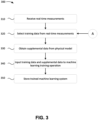
- Figure 3 illustrates an example flowchart of a process for training a machine learning system using a hybrid approach in accordance with aspects of the present disclosure.
- the blocks of Figure 3 may be implemented in the environment of Figure 2 , for example, and are described using reference numbers of elements depicted in Figure 2 .
- the flowchart illustrates the architecture, functionality, and operation of possible implementations of systems, methods, and computer program products according to various embodiments of the present disclosure.
- the process 300 may include receiving training data and truths (as at block 310).
- the pressure measurement training and prediction system 220 may receive real-time measurements from the equipment analytics measuring system 210.
- the real-time measurements may include analytics associated with the pump pressure measurements (e.g., bit depth, flow rate, flow pressure, surface torque, weight on bit, etc.).
- the real-time measurements may further include calculated pressure measurement truths.
- the real-time measurements including the truths may be obtained as part of an experimental process and/or from a real-time operations.
- the process 300 further may include obtaining supplemental data from a physical model (as at block 330).
- the pressure measurement training and prediction system 220 may obtain supplemental data from a physical model by inputting a set of input analytics data into the physical model.
- the physical model may produce estimates of pump pressures based on the set of input data (e.g., bit depth, flow rate, flow pressure, surface torque, weight on bit, etc.). More specifically, the supplemental data may map the input data to pressure estimate "truths.” The supplemental data may include these estimates and may be used to train the machine learning system.
- the process 300 further may include storing the trained machine learning system (as at block 350).
- the pressure measurement training and prediction system 220 may store the trained machine learning system for use in predicting pressure measurements for a real-time operation.
- the process 300 may be repeated to train different machine learning systems for different types of drilling operations. For example, one machine learning system may be trained for an "on-bottom” operation, and another may be trained for an "off-bottom” operation.
- the training data and supplemental data (e.g., from blocks 320 and 330) may be labeled with a type of operation.
- different training operations may be applied (e.g., at block 340) based on the different types of drilling operations. In this way, the training data and supplemental data may be used to train and/or refine the correct machine learning system using the best-suited training operation.
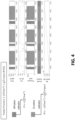
- Figure 4 illustrates an approach for identifying different types of operations for calibrating different machine learning systems.
- one machine learning system may be trained for an "on-bottom” operation, and another may be trained for an "off-bottom” operation.
- input data may data may be obtained and graphed, and this data my be used to identify the different periods in which different operations are occurring (and hence, which machine learning system to train, and which machine learning system training operation to use). For example, during off-bottom situations, little to no pressure drop is present through the drilling equipment (e.g., a mud motor). Thus, the measured pump pressure may be equal to the pressure model dependent on pump flow. Accordingly, a pump flow dependent model or machine learning system may be trained during this period (e.g.
- an extra pressure drop may be present through the drilling equipment (e.g., mud motor).
- the measured pressure less the pressure drop dependent on the mud flow may be used.
- the pressure drop through the mud motor may be dependent on the weight on bit.
- the pressure drop through the motor may be dependent on the torque at bit (or extensively to the surface torque).
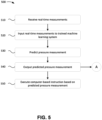
- Figure 5 illustrates an example flowchart of a process for predicting pressure measurements and uncertainty margins using a trained machine learning system in accordance with aspects of the present disclosure.
- the blocks of Figure 5 may be implemented in the environment of Figure 2 , for example, and are described using reference numbers of elements depicted in Figure 2 .
- the flowchart illustrates the architecture, functionality, and operation of possible implementations of systems, methods, and computer program products according to various embodiments of the present disclosure.
- the process 500 may include receiving real-time measurements (as at block 510).
- the pressure measurement training and prediction system 220 may receive real-time operational measurements (e.g., analytics data) related to a real-time drilling operation for drilling equipment from the equipment analytics measuring system 210.
- the pressure measurement training and prediction system 220 may receive the real-time measurements from a live operation.
- the real-time measurements may include any variety of data, such as bit depth, flow rate, flow pressure, surface torque, weight on bit, etc.
- the process 500 also may include inputting the real-time measurements to a trained machine learning system (as at block 520).
- the pressure measurement training and prediction system 220 may input the real-time measurements to a trained machine learning system (e.g., a machine learning system trained in accordance with the process 300 described above).
- the pressure measurement training and prediction system 220 may input the real-time measurements to the trained machine learning system to predict a pressure measurement (e.g., pump pressure measurement) and uncertainty.
- the trained machine learning system may map a pressure measurement truth or prediction and uncertainty margin to the real-time measurements (e.g., received at block 510).
- the process 500 further may include predicting the pressure measurement (as at block 530).
- the pressure measurement training and prediction system 220 may predict a real-time equipment pressure measurement based on inputting the real-time operational measurements to the trained machine learning system.
- the pressure measurement training and prediction system 220 the machine learning system may return a pressure measurement prediction based on the real-time measurements inputted to the machine learning system (e.g., at block 520).
- the process 500 also may include outputting the predicted pressure measurement (as at block 540).
- the pressure measurement training and prediction system 220 may output the predicted pressure measurement to an application for storage and/or display.
- the predicted pressure measurement may be plotted on a graph or chart. In some embodiments, multiple previously predicted pressure measurements may also be plotted.
- the process 500 further may include executing a computer-based instruction based on the predicted pressure measurement (as at block 550).
- the pressure measurement training and prediction system 220 may execute a computer-based instruction based on the predicted pressure measurement.
- the computer-based instruction may include an instruction to display the pressure measurement, store the pressure measurement, refine the trained machine learning system based on the pressure measurement, output an alert (e.g., when the pressure measurement is outside of a threshold), adjust the operation of equipment (e.g., drilling equipment), etc.
- the computer-based instruction may include any other instruction that uses the predicted pressure measurement.
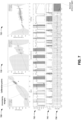
- Figure 6 illustrates a visual representation of identifying abnormal and normal pressure measurements based on a trained machine learning system model.
- the model may include a regression line of modeled pressure at different flow rates, Q (in gallons per minute, or gpm) according to a trained machine learning system.
- the model may illustrate uncertainty and recalibration authorization margins.
- the uncertainty margins may represent a margin of error of the modeled pressure at various flow rates.
- the abnormal or anomalous pressure measurement may be reported or may trigger an alert to notify a user (e.g., equipment operator) that an abnormal pressure has been detected. In this way, the abnormal pressure may be detected reported, but not used to refine or recalibrate the trained model. On the other hand, and referring to the graph 650, if the pressure measurement is within the authorized recalibration margin, the pressure measurement may be used to recalibrate and/or refine the trained model.
- the methods of the present disclosure may be executed by a computing system.
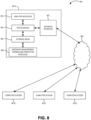
- Figure 8 illustrates an example of such a computing system 800, in accordance with some embodiments.
- the computing system 800 may include a computer or computer system 801A, which may be an individual computer system 801A or an arrangement of distributed computer systems.
- the computer system 801A includes one or more analysis modules 802 that are configured to perform various tasks according to some embodiments, such as one or more methods disclosed herein. To perform these various tasks, the analysis module 602 executes independently, or in coordination with, one or more processors 804, which is (or are) connected to one or more storage media 806.
- a processor may include a microprocessor, microcontroller, processor module or subsystem, programmable integrated circuit, programmable gate array, or another control or computing device.
- Storage media 806 may include one or more different forms of memory including semiconductor memory devices such as dynamic or static random access memories (DRAMs or SRAMs), erasable and programmable read-only memories (EPROMs), electrically erasable and programmable read-only memories (EEPROMs) and flash memories, magnetic disks such as fixed, floppy and removable disks, other magnetic media including tape, optical media such as compact disks (CDs) or digital video disks (DVDs), BLURAY ® disks, or other types of optical storage, or other types of storage devices.
- semiconductor memory devices such as dynamic or static random access memories (DRAMs or SRAMs), erasable and programmable read-only memories (EPROMs), electrically erasable and programmable read-only memories (EEPROMs) and flash memories
- magnetic disks such as fixed, floppy and removable disks, other magnetic media including tape
- optical media such as compact disks (CDs) or digital video disks (DVDs)
- DVDs digital video disks
- computing system 800 is merely one example of a computing system, and that computing system 800 may have more or fewer components than shown, may combine additional components not depicted in the example embodiment of Figure 8 , and/or computing system 800 may have a different configuration or arrangement of the components depicted in Figure 8 .
- the various components shown in Figure 8 may be implemented in hardware, software, or a combination of both hardware and software, including one or more signal processing and/or application specific integrated circuits.
- Computational interpretations, models, and/or other interpretation aids may be refined in an iterative fashion; this concept is applicable to the methods discussed herein. This may include use of feedback loops executed on an algorithmic basis, such as at a computing device (e.g., computing system 800, Figure 8 ), and/or through manual control by a user who may make determinations regarding whether a given step, action, template, model, or set of curves has become sufficiently accurate for the evaluation of the subsurface three-dimensional geologic formation under consideration.
- a computing device e.g., computing system 800, Figure 8
Landscapes
- Engineering & Computer Science (AREA)
- Physics & Mathematics (AREA)
- Life Sciences & Earth Sciences (AREA)
- Geology (AREA)
- Mining & Mineral Resources (AREA)
- Theoretical Computer Science (AREA)
- Environmental & Geological Engineering (AREA)
- Fluid Mechanics (AREA)
- General Life Sciences & Earth Sciences (AREA)
- Geochemistry & Mineralogy (AREA)
- Software Systems (AREA)
- General Physics & Mathematics (AREA)
- Geophysics (AREA)
- General Engineering & Computer Science (AREA)
- Computing Systems (AREA)
- Artificial Intelligence (AREA)
- Evolutionary Computation (AREA)
- Mathematical Physics (AREA)
- Data Mining & Analysis (AREA)
- Mechanical Engineering (AREA)
- Computer Vision & Pattern Recognition (AREA)
- Medical Informatics (AREA)
- Measuring Fluid Pressure (AREA)
- Testing And Monitoring For Control Systems (AREA)
- Computational Linguistics (AREA)
- Business, Economics & Management (AREA)
- Emergency Management (AREA)
Claims (9)
- Verfahren zum Trainieren und Verwenden eines Maschinenlernsystems, um Ausrüstungsdruckmessungen vorherzusagen, umfassend:Eingeben (340) eines Satzes von Trainingsdaten einschließlich eines Satzes von Ausrüstungsdruckmessungen;Eingeben (340) eines Satzes ergänzender Daten, wobei die ergänzenden Daten aus einem physikalischen Modell erhalten werden, das Wahrheiten schätzt, die die Trainingsdaten ergänzen;Trainieren des Maschinenlernsystems basierend auf dem Satz von Trainingsdaten und dem Satz ergänzender Daten, um ein trainiertes Maschinenlernsystem zu erzeugen;Empfangen (510) von Echtzeitbetriebsdaten, die sich auf einen Echtzeitölfeldbohrbetrieb beziehen;Eingeben (520) der Echtzeitbetriebsdaten in das trainierte Maschinenlernsystem;Vorhersagen (530) einer Echtzeitausrüstungsdruckmessung basierend auf dem Eingeben der Echtzeitbetriebsdaten in das trainierte Maschinenlernsystem; undAusführen (550) einer computerbasierten Anweisung basierend auf dem Vorhersagen der Echtzeitausrüstungsdruckmessung, wobei die computerbasierte Anweisung eine Anweisung einschließt, um einen Betrieb von Bohrausrüstung anzupassen.
- Verfahren nach Anspruch 1, wobei die ergänzenden Daten nicht historische oder experimentelle Daten sind und Schätzungen eines zweiten Satzes von Ausrüstungsdruckmessungen einschließen.
- Verfahren nach Anspruch 1, wobei das Maschinenlernsystem ein erstes Maschinenlernsystem ist, das mit einer ersten Art von Ausrüstungsbetrieb verknüpft ist, das Verfahren ferner umfassend das Trainieren eines zweiten Maschinenlernsystems, das mit einer zweiten Art von Ausrüstungsbetrieb verknüpft ist, wobei die erste Art von Ausrüstungsbetrieb ein Betrieb von einem Boden entfernt ist und die zweite Art von Ausrüstungsbetrieb ein Betrieb an dem Boden ist.
- Verfahren nach Anspruch 1, wobei die computerbasierte Anweisung mindestens eines einschließt, das aus der Gruppe ausgewählt ist, bestehend aus:einer Anweisung, um die Echtzeitausrüstungsdruckmessung anzuzeigen;einer Anweisung, um die Echtzeitausrüstungsdruckmessung zu speichern;einer Anweisung, um das trainierte Maschinenlernsystems basierend auf der Echtzeitausrüstungsdruckmessung zu verbessern;einer Anweisung, um eine Warnung auszugeben, wenn die Echtzeitausrüstungsdruckmessung außerhalb eines Schwellenwerts liegt; undeiner Anweisung, um den Betrieb der Ausrüstung anzupassen.
- Verfahren nach Anspruch 1, ferner umfassend:Bestimmen, dass die Echtzeitausrüstungsdruckmessung innerhalb einer Neukalibrierungsautorisierungstoleranz liegt; undVerbessern des Maschinenlernsystems unter Verwendung der Echtzeitausrüstungsdruckmessung als Reaktion auf das Bestimmen, dass die Echtzeitausrüstungsdruckmessung innerhalb der Neukalibrierungsautorisierungstoleranz liegt.
- Verfahren nach Anspruch 1, wobei das Trainieren des Maschinenlernmodells ein Anwenden eines auf Gauß basierenden Maschinenlerntrainingsbetriebs umfasst.
- Verfahren nach Anspruch 1, wobei das Trainieren des Maschinenlernsystems das Bestimmen von Unsicherheitstoleranzen einschließt, die mit Ausrüstungsdruckmessungsvorhersagen verknüpft sind.
- Computersystem (800), umfassend:einen oder mehrere Prozessoren (804); undein Speichersystem (806), umfassend ein oder mehrere nicht flüchtige computerlesbare Medien, die Anweisungen speichern, die, wenn sie durch mindestens einen des einen oder der mehreren Prozessoren (804) ausgeführt werden, das Computersystem (800) veranlassen, Betriebe durchzuführen, die Betriebe umfassend die Schritte des Verfahrens nach einem der vorstehenden Ansprüche.
- Nicht flüchtiges computerlesbares Medium (806), das Anweisungen speichert, die, wenn sie durch einen oder mehrere Prozessoren (804) eines Computersystems (800) ausgeführt werden, das Computersystem (800) veranlassen, Betriebe durchzuführen, die Betriebe umfassend die Schritte des Verfahrens nach einem der Ansprüche 1 bis 7.
Applications Claiming Priority (2)
| Application Number | Priority Date | Filing Date | Title |
|---|---|---|---|
| US201962911341P | 2019-10-06 | 2019-10-06 | |
| PCT/US2020/070615 WO2021072420A1 (en) | 2019-10-06 | 2020-10-05 | Machine learning approaches to detecting pressure anomalies |
Publications (3)
| Publication Number | Publication Date |
|---|---|
| EP4038262A1 EP4038262A1 (de) | 2022-08-10 |
| EP4038262A4 EP4038262A4 (de) | 2023-11-15 |
| EP4038262B1 true EP4038262B1 (de) | 2025-04-09 |
Family
ID=75437577
Family Applications (1)
| Application Number | Title | Priority Date | Filing Date |
|---|---|---|---|
| EP20873785.8A Active EP4038262B1 (de) | 2019-10-06 | 2020-10-05 | Maschinenlernverfahren zur erkennung von druckanomalien |
Country Status (3)
| Country | Link |
|---|---|
| US (1) | US12523142B2 (de) |
| EP (1) | EP4038262B1 (de) |
| WO (1) | WO2021072420A1 (de) |
Families Citing this family (4)
| Publication number | Priority date | Publication date | Assignee | Title |
|---|---|---|---|---|
| US12229689B2 (en) | 2020-02-10 | 2025-02-18 | Schlumberger Technology Corporation | Hybrid modeling process for forecasting physical system parameters |
| CN114482885B (zh) * | 2022-01-25 | 2024-03-29 | 西南石油大学 | 一种控压钻井智能控制系统 |
| EP4411610A1 (de) * | 2023-02-02 | 2024-08-07 | Arinc Incorporated | System und verfahren für intelligente elektrische flugverteilung |
| CN121605238A (zh) * | 2023-07-06 | 2026-03-03 | 阿布扎比国家石油公司 | 用于推荐储层监测计划和井的流量测试计划的系统 |
Family Cites Families (48)
| Publication number | Priority date | Publication date | Assignee | Title |
|---|---|---|---|---|
| US2966059A (en) | 1958-02-10 | 1960-12-27 | Warren Automatic Tool Company | Indicator of drilling mud gain and loss |
| US6234250B1 (en) | 1999-07-23 | 2001-05-22 | Halliburton Energy Services, Inc. | Real time wellbore pit volume monitoring system and method |
| US7027968B2 (en) | 2002-01-18 | 2006-04-11 | Conocophillips Company | Method for simulating subsea mudlift drilling and well control operations |
| US7770666B2 (en) | 2007-04-26 | 2010-08-10 | Barrett Allen | Drilling fluid containing a recoverable lost circulation material and method of using and recovering the same |
| BRPI0914510B1 (pt) | 2008-10-14 | 2019-07-16 | Prad Research And Development Limited | Métodos para automatizar ou parcialmente automatizar a otimização de uma operação de perfuração automatizada ou parcialmente automatizada, sistema para automatizar ouparcialmente automatizar um processo, método para operar um equipamento de perfuração automatizado, método para controlar um processo automatizado para perfurar um furo de poço, e sistema de controle de perfuração |
| CA2786778A1 (en) | 2010-01-13 | 2011-07-21 | Santos Ltd | Measuring gas content of unconventional reservoir rocks |
| US8775145B2 (en) | 2011-02-11 | 2014-07-08 | Schlumberger Technology Corporation | System and apparatus for modeling the behavior of a drilling assembly |
| WO2013066746A1 (en) | 2011-11-02 | 2013-05-10 | Landmark Graphics Corporation | Method and system for predicting a drill string stuck pipe event |
| US9033048B2 (en) | 2011-12-28 | 2015-05-19 | Hydril Usa Manufacturing Llc | Apparatuses and methods for determining wellbore influx condition using qualitative indications |
| US9784100B2 (en) | 2012-06-01 | 2017-10-10 | Baker Hughes Incorporated | Smart flowback alarm to detect kicks and losses |
| US10294742B2 (en) * | 2013-11-15 | 2019-05-21 | Halliburton Energy Services, Inc. | Borehole pressure management methods and systems with adaptive learning |
| WO2015123591A1 (en) | 2014-02-13 | 2015-08-20 | Intelligent Solutions, Inc. | System and method providing real-time assistance to drilling operation |
| WO2015191095A1 (en) | 2014-06-09 | 2015-12-17 | Landmark Graphics Corporation | Employing a target risk attribute predictor while drilling |
| WO2016033199A1 (en) | 2014-08-28 | 2016-03-03 | Adelos, Inc. | Real-time fiber optic interferometry controller |
| WO2016060688A1 (en) | 2014-10-17 | 2016-04-21 | Halliburton Energy Services, Inc. | Methods and systems employing a flow prediction model based on acoustic activity and proppant compensation |
| CN204299513U (zh) | 2014-11-19 | 2015-04-29 | 四川永盛祥科技有限公司 | 钻井溢流监测系统 |
| WO2016153636A1 (en) | 2015-02-17 | 2016-09-29 | Board Of Regents, The University Of Texas System | Method and apparatus for early detection of kicks |
| US10041316B2 (en) | 2015-06-16 | 2018-08-07 | Baker Hughes, A Ge Company, Llc | Combined surface and downhole kick/loss detection |
| US10513920B2 (en) | 2015-06-19 | 2019-12-24 | Weatherford Technology Holdings, Llc | Real-time stuck pipe warning system for downhole operations |
| CA2994479C (en) | 2015-09-01 | 2024-01-02 | Pason Systems Corp. | Method and system for detecting at least one of an influx event and a loss event during well drilling |
| US9946508B1 (en) | 2015-09-30 | 2018-04-17 | Sonos, Inc. | Smart music services preferences |
| US10915829B1 (en) | 2015-12-09 | 2021-02-09 | One Concern, Inc. | Data model update for structural-damage predictor after an earthquake |
| EP3181809A1 (de) | 2015-12-17 | 2017-06-21 | Geoservices Equipements | Verfahren zur erkennung von zunahme oder verlust einer bohrflüssigkeit in einer bohreinrichtung, zugehöriges berechnungssystem und zugehörige bohreinrichtung |
| US10584698B2 (en) * | 2016-04-07 | 2020-03-10 | Schlumberger Technology Corporation | Pump assembly health assessment |
| CN105952436B (zh) | 2016-04-27 | 2019-08-20 | 西南石油大学 | 一种基于瞬时流量进行早期井涌溢流实时监测的方法 |
| WO2017206182A1 (en) | 2016-06-03 | 2017-12-07 | Schlumberger Technology Corporation | Detecting events in well reports |
| CN106683625A (zh) | 2016-12-15 | 2017-05-17 | 惠科股份有限公司 | 一种修正调整灰阶曲线的方法、终端及显示装置 |
| US20180187498A1 (en) | 2017-01-03 | 2018-07-05 | General Electric Company | Systems and methods for early well kick detection |
| US10502009B2 (en) | 2017-02-16 | 2019-12-10 | Saudi Arabian Oil Company | Smart selective drilling fluid system |
| US20180247156A1 (en) | 2017-02-24 | 2018-08-30 | Xtract Technologies Inc. | Machine learning systems and methods for document matching |
| WO2018232198A1 (en) | 2017-06-15 | 2018-12-20 | Schlumberger Technology Corporation | Dynamic field operations system |
| GB201711152D0 (en) | 2017-07-11 | 2017-08-23 | Statoil Petroleum As | Influx and loss detection |
| US11603740B2 (en) | 2017-07-13 | 2023-03-14 | Schlumberger Technology Corporation | Method for real-time interpretation of pressure transient test |
| US10838976B2 (en) | 2017-10-17 | 2020-11-17 | Saudi Arabian Oil Company | Paleo fossil and sedimentary structure data mining and datum for biostratigraphy |
| CN111479982B (zh) | 2017-11-15 | 2023-01-17 | 吉奥奎斯特系统公司 | 具有滤波器的现场操作系统 |
| US11741114B2 (en) * | 2017-12-19 | 2023-08-29 | ExxonMobil Technology and Engineering Company | Data analysis platform |
| GB2585309B (en) * | 2018-04-12 | 2022-09-21 | Landmark Graphics Corp | Recurrent neural network model for bottomhole pressure and temperature in stepdown analysis |
| GB2585581B (en) | 2018-05-09 | 2022-06-01 | Landmark Graphics Corp | Learning based Bayesian optimization for optimizing controllable drilling parameters |
| US11066917B2 (en) | 2018-05-10 | 2021-07-20 | Baker Hughes Holdings Llc | Earth-boring tool rate of penetration and wear prediction system and related methods |
| WO2020018069A1 (en) * | 2018-07-16 | 2020-01-23 | Halliburton Energy Services, Inc. | Optical sensor adaptive calibration |
| CA3098352C (en) | 2018-07-18 | 2023-01-24 | Landmark Graphics Corporation | Adjusting well tool operation to manipulate the rate-of-penetration (rop) of a drill bit based on multiple rop projections |
| US20200080410A1 (en) | 2018-09-10 | 2020-03-12 | Sekal As | Wellbore drilling |
| CN109508827B (zh) | 2018-11-14 | 2022-04-29 | 西南石油大学 | 一种基于时间递归神经网络的钻井事故预警方法 |
| US10871762B2 (en) | 2019-03-07 | 2020-12-22 | Saudi Arabian Oil Company | Real time analysis of fluid properties for drilling control |
| US20220397008A1 (en) | 2019-10-31 | 2022-12-15 | Schlumberger Technology Corporation | Automated kick and loss detection |
| US12229689B2 (en) | 2020-02-10 | 2025-02-18 | Schlumberger Technology Corporation | Hybrid modeling process for forecasting physical system parameters |
| CA3208493A1 (en) | 2021-01-15 | 2022-07-21 | Schlumberger Canada Limited | Abnormal pressure detection using online bayesian linear regression |
| WO2022165495A1 (en) | 2021-01-27 | 2022-08-04 | Schlumberger Technology Corporation | Drilling loss prediction framework |
-
2020
- 2020-10-05 EP EP20873785.8A patent/EP4038262B1/de active Active
- 2020-10-05 US US17/754,582 patent/US12523142B2/en active Active
- 2020-10-05 WO PCT/US2020/070615 patent/WO2021072420A1/en not_active Ceased
Also Published As
| Publication number | Publication date |
|---|---|
| US20230281473A1 (en) | 2023-09-07 |
| EP4038262A4 (de) | 2023-11-15 |
| WO2021072420A1 (en) | 2021-04-15 |
| EP4038262A1 (de) | 2022-08-10 |
| US12523142B2 (en) | 2026-01-13 |
Similar Documents
| Publication | Publication Date | Title |
|---|---|---|
| US12313803B2 (en) | Automated offset well analysis | |
| US12229689B2 (en) | Hybrid modeling process for forecasting physical system parameters | |
| EP4038262B1 (de) | Maschinenlernverfahren zur erkennung von druckanomalien | |
| US20240200438A1 (en) | Real-time drilling parameter adherence | |
| US12116878B2 (en) | Well construction workflow selection and execution | |
| US11920454B2 (en) | System and method for predicting stick-slip | |
| US20200333505A1 (en) | Pore Pressure Prediction | |
| EP4348362A1 (de) | Proxy-modell für maschinelles lernen zur parameterabstimmung in ölfeldproduktionsoperationen | |
| US12252979B2 (en) | Event detection from pump data | |
| EP4049049B1 (de) | Sensorzustandsbestimmung auf der basis von unabhängigen grundfrequenzmessungen | |
| US20240094433A1 (en) | Integrated autonomous operations for injection-production analysis and parameter selection | |
| US20250342285A1 (en) | System and method for computing relative confidence of seismic interpretation | |
| US20230220765A1 (en) | User interface for providing guidance on drilling operations and dynamic reporting of relevant data |
Legal Events
| Date | Code | Title | Description |
|---|---|---|---|
| STAA | Information on the status of an ep patent application or granted ep patent |
Free format text: STATUS: THE INTERNATIONAL PUBLICATION HAS BEEN MADE |
|
| PUAI | Public reference made under article 153(3) epc to a published international application that has entered the european phase |
Free format text: ORIGINAL CODE: 0009012 |
|
| STAA | Information on the status of an ep patent application or granted ep patent |
Free format text: STATUS: REQUEST FOR EXAMINATION WAS MADE |
|
| 17P | Request for examination filed |
Effective date: 20220406 |
|
| AK | Designated contracting states |
Kind code of ref document: A1 Designated state(s): AL AT BE BG CH CY CZ DE DK EE ES FI FR GB GR HR HU IE IS IT LI LT LU LV MC MK MT NL NO PL PT RO RS SE SI SK SM TR |
|
| DAV | Request for validation of the european patent (deleted) | ||
| DAX | Request for extension of the european patent (deleted) | ||
| A4 | Supplementary search report drawn up and despatched |
Effective date: 20231012 |
|
| RIC1 | Information provided on ipc code assigned before grant |
Ipc: G06N 20/10 20190101ALI20231006BHEP Ipc: E21B 21/08 20060101ALI20231006BHEP Ipc: E21B 47/26 20120101ALI20231006BHEP Ipc: G06N 20/00 20190101ALI20231006BHEP Ipc: E21B 47/06 20120101AFI20231006BHEP |
|
| GRAP | Despatch of communication of intention to grant a patent |
Free format text: ORIGINAL CODE: EPIDOSNIGR1 |
|
| STAA | Information on the status of an ep patent application or granted ep patent |
Free format text: STATUS: GRANT OF PATENT IS INTENDED |
|
| INTG | Intention to grant announced |
Effective date: 20241030 |
|
| GRAS | Grant fee paid |
Free format text: ORIGINAL CODE: EPIDOSNIGR3 |
|
| GRAA | (expected) grant |
Free format text: ORIGINAL CODE: 0009210 |
|
| STAA | Information on the status of an ep patent application or granted ep patent |
Free format text: STATUS: THE PATENT HAS BEEN GRANTED |
|
| AK | Designated contracting states |
Kind code of ref document: B1 Designated state(s): AL AT BE BG CH CY CZ DE DK EE ES FI FR GB GR HR HU IE IS IT LI LT LU LV MC MK MT NL NO PL PT RO RS SE SI SK SM TR |
|
| REG | Reference to a national code |
Ref country code: GB Ref legal event code: FG4D |
|
| REG | Reference to a national code |
Ref country code: CH Ref legal event code: EP |
|
| REG | Reference to a national code |
Ref country code: DE Ref legal event code: R096 Ref document number: 602020049294 Country of ref document: DE |
|
| REG | Reference to a national code |
Ref country code: IE Ref legal event code: FG4D |
|
| REG | Reference to a national code |
Ref country code: NL Ref legal event code: MP Effective date: 20250409 |
|
| PG25 | Lapsed in a contracting state [announced via postgrant information from national office to epo] |
Ref country code: NL Free format text: LAPSE BECAUSE OF FAILURE TO SUBMIT A TRANSLATION OF THE DESCRIPTION OR TO PAY THE FEE WITHIN THE PRESCRIBED TIME-LIMIT Effective date: 20250409 |
|
| REG | Reference to a national code |
Ref country code: AT Ref legal event code: MK05 Ref document number: 1783663 Country of ref document: AT Kind code of ref document: T Effective date: 20250409 |
|
| PG25 | Lapsed in a contracting state [announced via postgrant information from national office to epo] |
Ref country code: FI Free format text: LAPSE BECAUSE OF FAILURE TO SUBMIT A TRANSLATION OF THE DESCRIPTION OR TO PAY THE FEE WITHIN THE PRESCRIBED TIME-LIMIT Effective date: 20250409 Ref country code: PT Free format text: LAPSE BECAUSE OF FAILURE TO SUBMIT A TRANSLATION OF THE DESCRIPTION OR TO PAY THE FEE WITHIN THE PRESCRIBED TIME-LIMIT Effective date: 20250811 Ref country code: ES Free format text: LAPSE BECAUSE OF FAILURE TO SUBMIT A TRANSLATION OF THE DESCRIPTION OR TO PAY THE FEE WITHIN THE PRESCRIBED TIME-LIMIT Effective date: 20250409 |
|
| REG | Reference to a national code |
Ref country code: LT Ref legal event code: MG9D |
|
| PG25 | Lapsed in a contracting state [announced via postgrant information from national office to epo] |
Ref country code: GR Free format text: LAPSE BECAUSE OF FAILURE TO SUBMIT A TRANSLATION OF THE DESCRIPTION OR TO PAY THE FEE WITHIN THE PRESCRIBED TIME-LIMIT Effective date: 20250710 |
|
| PG25 | Lapsed in a contracting state [announced via postgrant information from national office to epo] |
Ref country code: PL Free format text: LAPSE BECAUSE OF FAILURE TO SUBMIT A TRANSLATION OF THE DESCRIPTION OR TO PAY THE FEE WITHIN THE PRESCRIBED TIME-LIMIT Effective date: 20250409 |
|
| PG25 | Lapsed in a contracting state [announced via postgrant information from national office to epo] |
Ref country code: BG Free format text: LAPSE BECAUSE OF FAILURE TO SUBMIT A TRANSLATION OF THE DESCRIPTION OR TO PAY THE FEE WITHIN THE PRESCRIBED TIME-LIMIT Effective date: 20250409 |
|
| PGFP | Annual fee paid to national office [announced via postgrant information from national office to epo] |
Ref country code: GB Payment date: 20250821 Year of fee payment: 6 |
|
| PG25 | Lapsed in a contracting state [announced via postgrant information from national office to epo] |
Ref country code: HR Free format text: LAPSE BECAUSE OF FAILURE TO SUBMIT A TRANSLATION OF THE DESCRIPTION OR TO PAY THE FEE WITHIN THE PRESCRIBED TIME-LIMIT Effective date: 20250409 |
|
| PG25 | Lapsed in a contracting state [announced via postgrant information from national office to epo] |
Ref country code: AT Free format text: LAPSE BECAUSE OF FAILURE TO SUBMIT A TRANSLATION OF THE DESCRIPTION OR TO PAY THE FEE WITHIN THE PRESCRIBED TIME-LIMIT Effective date: 20250409 |
|
| PGFP | Annual fee paid to national office [announced via postgrant information from national office to epo] |
Ref country code: FR Payment date: 20250821 Year of fee payment: 6 |
|
| PG25 | Lapsed in a contracting state [announced via postgrant information from national office to epo] |
Ref country code: RS Free format text: LAPSE BECAUSE OF FAILURE TO SUBMIT A TRANSLATION OF THE DESCRIPTION OR TO PAY THE FEE WITHIN THE PRESCRIBED TIME-LIMIT Effective date: 20250709 |
|
| PG25 | Lapsed in a contracting state [announced via postgrant information from national office to epo] |
Ref country code: IS Free format text: LAPSE BECAUSE OF FAILURE TO SUBMIT A TRANSLATION OF THE DESCRIPTION OR TO PAY THE FEE WITHIN THE PRESCRIBED TIME-LIMIT Effective date: 20250809 |
|
| PG25 | Lapsed in a contracting state [announced via postgrant information from national office to epo] |
Ref country code: LV Free format text: LAPSE BECAUSE OF FAILURE TO SUBMIT A TRANSLATION OF THE DESCRIPTION OR TO PAY THE FEE WITHIN THE PRESCRIBED TIME-LIMIT Effective date: 20250409 |
|
| PGFP | Annual fee paid to national office [announced via postgrant information from national office to epo] |
Ref country code: NO Payment date: 20251009 Year of fee payment: 6 |
|
| REG | Reference to a national code |
Ref country code: DE Ref legal event code: R097 Ref document number: 602020049294 Country of ref document: DE |
|
| PG25 | Lapsed in a contracting state [announced via postgrant information from national office to epo] |
Ref country code: DK Free format text: LAPSE BECAUSE OF FAILURE TO SUBMIT A TRANSLATION OF THE DESCRIPTION OR TO PAY THE FEE WITHIN THE PRESCRIBED TIME-LIMIT Effective date: 20250409 Ref country code: SM Free format text: LAPSE BECAUSE OF FAILURE TO SUBMIT A TRANSLATION OF THE DESCRIPTION OR TO PAY THE FEE WITHIN THE PRESCRIBED TIME-LIMIT Effective date: 20250409 |
|
| PG25 | Lapsed in a contracting state [announced via postgrant information from national office to epo] |
Ref country code: CZ Free format text: LAPSE BECAUSE OF FAILURE TO SUBMIT A TRANSLATION OF THE DESCRIPTION OR TO PAY THE FEE WITHIN THE PRESCRIBED TIME-LIMIT Effective date: 20250409 |
|
| PG25 | Lapsed in a contracting state [announced via postgrant information from national office to epo] |
Ref country code: EE Free format text: LAPSE BECAUSE OF FAILURE TO SUBMIT A TRANSLATION OF THE DESCRIPTION OR TO PAY THE FEE WITHIN THE PRESCRIBED TIME-LIMIT Effective date: 20250409 |
|
| PG25 | Lapsed in a contracting state [announced via postgrant information from national office to epo] |
Ref country code: SK Free format text: LAPSE BECAUSE OF FAILURE TO SUBMIT A TRANSLATION OF THE DESCRIPTION OR TO PAY THE FEE WITHIN THE PRESCRIBED TIME-LIMIT Effective date: 20250409 |
|
| PG25 | Lapsed in a contracting state [announced via postgrant information from national office to epo] |
Ref country code: IT Free format text: LAPSE BECAUSE OF FAILURE TO SUBMIT A TRANSLATION OF THE DESCRIPTION OR TO PAY THE FEE WITHIN THE PRESCRIBED TIME-LIMIT Effective date: 20250409 |
|
| PG25 | Lapsed in a contracting state [announced via postgrant information from national office to epo] |
Ref country code: RO Free format text: LAPSE BECAUSE OF FAILURE TO SUBMIT A TRANSLATION OF THE DESCRIPTION OR TO PAY THE FEE WITHIN THE PRESCRIBED TIME-LIMIT Effective date: 20250409 |
|
| PLBE | No opposition filed within time limit |
Free format text: ORIGINAL CODE: 0009261 |
|
| STAA | Information on the status of an ep patent application or granted ep patent |
Free format text: STATUS: NO OPPOSITION FILED WITHIN TIME LIMIT |
|
| REG | Reference to a national code |
Ref country code: CH Ref legal event code: L10 Free format text: ST27 STATUS EVENT CODE: U-0-0-L10-L00 (AS PROVIDED BY THE NATIONAL OFFICE) Effective date: 20260218 |
|
| 26N | No opposition filed |
Effective date: 20260112 |