EP4036945B1 - Electrical storage device - Google Patents
Electrical storage device Download PDFInfo
- Publication number
- EP4036945B1 EP4036945B1 EP20869207.9A EP20869207A EP4036945B1 EP 4036945 B1 EP4036945 B1 EP 4036945B1 EP 20869207 A EP20869207 A EP 20869207A EP 4036945 B1 EP4036945 B1 EP 4036945B1
- Authority
- EP
- European Patent Office
- Prior art keywords
- substrate
- busbar
- energy storage
- protrusion
- opening
- Prior art date
- Legal status (The legal status is an assumption and is not a legal conclusion. Google has not performed a legal analysis and makes no representation as to the accuracy of the status listed.)
- Active
Links
Images



Classifications
-
- H—ELECTRICITY
- H01—ELECTRIC ELEMENTS
- H01M—PROCESSES OR MEANS, e.g. BATTERIES, FOR THE DIRECT CONVERSION OF CHEMICAL ENERGY INTO ELECTRICAL ENERGY
- H01M10/00—Secondary cells; Manufacture thereof
- H01M10/42—Methods or arrangements for servicing or maintenance of secondary cells or secondary half-cells
- H01M10/425—Structural combination with electronic components, e.g. electronic circuits integrated to the outside of the casing
- H01M10/4257—Smart batteries, e.g. electronic circuits inside the housing of the cells or batteries
-
- H—ELECTRICITY
- H01—ELECTRIC ELEMENTS
- H01G—CAPACITORS; CAPACITORS, RECTIFIERS, DETECTORS, SWITCHING DEVICES, LIGHT-SENSITIVE OR TEMPERATURE-SENSITIVE DEVICES OF THE ELECTROLYTIC TYPE
- H01G11/00—Hybrid capacitors, i.e. capacitors having different positive and negative electrodes; Electric double-layer [EDL] capacitors; Processes for the manufacture thereof or of parts thereof
- H01G11/78—Cases; Housings; Encapsulations; Mountings
- H01G11/82—Fixing or assembling a capacitive element in a housing, e.g. mounting electrodes, current collectors or terminals in containers or encapsulations
-
- H—ELECTRICITY
- H01—ELECTRIC ELEMENTS
- H01M—PROCESSES OR MEANS, e.g. BATTERIES, FOR THE DIRECT CONVERSION OF CHEMICAL ENERGY INTO ELECTRICAL ENERGY
- H01M50/00—Constructional details or processes of manufacture of the non-active parts of electrochemical cells other than fuel cells, e.g. hybrid cells
- H01M50/20—Mountings; Secondary casings or frames; Racks, modules or packs; Suspension devices; Shock absorbers; Transport or carrying devices; Holders
- H01M50/249—Mountings; Secondary casings or frames; Racks, modules or packs; Suspension devices; Shock absorbers; Transport or carrying devices; Holders specially adapted for aircraft or vehicles, e.g. cars or trains
-
- H—ELECTRICITY
- H01—ELECTRIC ELEMENTS
- H01G—CAPACITORS; CAPACITORS, RECTIFIERS, DETECTORS, SWITCHING DEVICES, LIGHT-SENSITIVE OR TEMPERATURE-SENSITIVE DEVICES OF THE ELECTROLYTIC TYPE
- H01G11/00—Hybrid capacitors, i.e. capacitors having different positive and negative electrodes; Electric double-layer [EDL] capacitors; Processes for the manufacture thereof or of parts thereof
- H01G11/10—Multiple hybrid or EDL capacitors, e.g. arrays or modules
-
- H—ELECTRICITY
- H01—ELECTRIC ELEMENTS
- H01G—CAPACITORS; CAPACITORS, RECTIFIERS, DETECTORS, SWITCHING DEVICES, LIGHT-SENSITIVE OR TEMPERATURE-SENSITIVE DEVICES OF THE ELECTROLYTIC TYPE
- H01G11/00—Hybrid capacitors, i.e. capacitors having different positive and negative electrodes; Electric double-layer [EDL] capacitors; Processes for the manufacture thereof or of parts thereof
- H01G11/10—Multiple hybrid or EDL capacitors, e.g. arrays or modules
- H01G11/12—Stacked hybrid or EDL capacitors
-
- H—ELECTRICITY
- H01—ELECTRIC ELEMENTS
- H01G—CAPACITORS; CAPACITORS, RECTIFIERS, DETECTORS, SWITCHING DEVICES, LIGHT-SENSITIVE OR TEMPERATURE-SENSITIVE DEVICES OF THE ELECTROLYTIC TYPE
- H01G11/00—Hybrid capacitors, i.e. capacitors having different positive and negative electrodes; Electric double-layer [EDL] capacitors; Processes for the manufacture thereof or of parts thereof
- H01G11/74—Terminals, e.g. extensions of current collectors
- H01G11/76—Terminals, e.g. extensions of current collectors specially adapted for integration in multiple or stacked hybrid or EDL capacitors
-
- H—ELECTRICITY
- H01—ELECTRIC ELEMENTS
- H01G—CAPACITORS; CAPACITORS, RECTIFIERS, DETECTORS, SWITCHING DEVICES, LIGHT-SENSITIVE OR TEMPERATURE-SENSITIVE DEVICES OF THE ELECTROLYTIC TYPE
- H01G11/00—Hybrid capacitors, i.e. capacitors having different positive and negative electrodes; Electric double-layer [EDL] capacitors; Processes for the manufacture thereof or of parts thereof
- H01G11/78—Cases; Housings; Encapsulations; Mountings
- H01G11/80—Gaskets; Sealings
-
- H—ELECTRICITY
- H01—ELECTRIC ELEMENTS
- H01G—CAPACITORS; CAPACITORS, RECTIFIERS, DETECTORS, SWITCHING DEVICES, LIGHT-SENSITIVE OR TEMPERATURE-SENSITIVE DEVICES OF THE ELECTROLYTIC TYPE
- H01G4/00—Fixed capacitors; Processes of their manufacture
- H01G4/002—Details
- H01G4/228—Terminals
-
- H—ELECTRICITY
- H01—ELECTRIC ELEMENTS
- H01M—PROCESSES OR MEANS, e.g. BATTERIES, FOR THE DIRECT CONVERSION OF CHEMICAL ENERGY INTO ELECTRICAL ENERGY
- H01M10/00—Secondary cells; Manufacture thereof
- H01M10/42—Methods or arrangements for servicing or maintenance of secondary cells or secondary half-cells
- H01M10/425—Structural combination with electronic components, e.g. electronic circuits integrated to the outside of the casing
-
- H—ELECTRICITY
- H01—ELECTRIC ELEMENTS
- H01M—PROCESSES OR MEANS, e.g. BATTERIES, FOR THE DIRECT CONVERSION OF CHEMICAL ENERGY INTO ELECTRICAL ENERGY
- H01M50/00—Constructional details or processes of manufacture of the non-active parts of electrochemical cells other than fuel cells, e.g. hybrid cells
- H01M50/20—Mountings; Secondary casings or frames; Racks, modules or packs; Suspension devices; Shock absorbers; Transport or carrying devices; Holders
-
- H—ELECTRICITY
- H01—ELECTRIC ELEMENTS
- H01M—PROCESSES OR MEANS, e.g. BATTERIES, FOR THE DIRECT CONVERSION OF CHEMICAL ENERGY INTO ELECTRICAL ENERGY
- H01M50/00—Constructional details or processes of manufacture of the non-active parts of electrochemical cells other than fuel cells, e.g. hybrid cells
- H01M50/20—Mountings; Secondary casings or frames; Racks, modules or packs; Suspension devices; Shock absorbers; Transport or carrying devices; Holders
- H01M50/204—Racks, modules or packs for multiple batteries or multiple cells
-
- H—ELECTRICITY
- H01—ELECTRIC ELEMENTS
- H01M—PROCESSES OR MEANS, e.g. BATTERIES, FOR THE DIRECT CONVERSION OF CHEMICAL ENERGY INTO ELECTRICAL ENERGY
- H01M50/00—Constructional details or processes of manufacture of the non-active parts of electrochemical cells other than fuel cells, e.g. hybrid cells
- H01M50/20—Mountings; Secondary casings or frames; Racks, modules or packs; Suspension devices; Shock absorbers; Transport or carrying devices; Holders
- H01M50/204—Racks, modules or packs for multiple batteries or multiple cells
- H01M50/207—Racks, modules or packs for multiple batteries or multiple cells characterised by their shape
- H01M50/209—Racks, modules or packs for multiple batteries or multiple cells characterised by their shape adapted for prismatic or rectangular cells
-
- H—ELECTRICITY
- H01—ELECTRIC ELEMENTS
- H01M—PROCESSES OR MEANS, e.g. BATTERIES, FOR THE DIRECT CONVERSION OF CHEMICAL ENERGY INTO ELECTRICAL ENERGY
- H01M50/00—Constructional details or processes of manufacture of the non-active parts of electrochemical cells other than fuel cells, e.g. hybrid cells
- H01M50/20—Mountings; Secondary casings or frames; Racks, modules or packs; Suspension devices; Shock absorbers; Transport or carrying devices; Holders
- H01M50/284—Mountings; Secondary casings or frames; Racks, modules or packs; Suspension devices; Shock absorbers; Transport or carrying devices; Holders with incorporated circuit boards, e.g. printed circuit boards [PCB]
-
- H—ELECTRICITY
- H01—ELECTRIC ELEMENTS
- H01M—PROCESSES OR MEANS, e.g. BATTERIES, FOR THE DIRECT CONVERSION OF CHEMICAL ENERGY INTO ELECTRICAL ENERGY
- H01M50/00—Constructional details or processes of manufacture of the non-active parts of electrochemical cells other than fuel cells, e.g. hybrid cells
- H01M50/50—Current conducting connections for cells or batteries
-
- H—ELECTRICITY
- H01—ELECTRIC ELEMENTS
- H01M—PROCESSES OR MEANS, e.g. BATTERIES, FOR THE DIRECT CONVERSION OF CHEMICAL ENERGY INTO ELECTRICAL ENERGY
- H01M50/00—Constructional details or processes of manufacture of the non-active parts of electrochemical cells other than fuel cells, e.g. hybrid cells
- H01M50/50—Current conducting connections for cells or batteries
- H01M50/502—Interconnectors for connecting terminals of adjacent batteries; Interconnectors for connecting cells outside a battery casing
- H01M50/503—Interconnectors for connecting terminals of adjacent batteries; Interconnectors for connecting cells outside a battery casing characterised by the shape of the interconnectors
-
- H—ELECTRICITY
- H01—ELECTRIC ELEMENTS
- H01M—PROCESSES OR MEANS, e.g. BATTERIES, FOR THE DIRECT CONVERSION OF CHEMICAL ENERGY INTO ELECTRICAL ENERGY
- H01M50/00—Constructional details or processes of manufacture of the non-active parts of electrochemical cells other than fuel cells, e.g. hybrid cells
- H01M50/50—Current conducting connections for cells or batteries
- H01M50/502—Interconnectors for connecting terminals of adjacent batteries; Interconnectors for connecting cells outside a battery casing
- H01M50/505—Interconnectors for connecting terminals of adjacent batteries; Interconnectors for connecting cells outside a battery casing comprising a single busbar
-
- H—ELECTRICITY
- H01—ELECTRIC ELEMENTS
- H01M—PROCESSES OR MEANS, e.g. BATTERIES, FOR THE DIRECT CONVERSION OF CHEMICAL ENERGY INTO ELECTRICAL ENERGY
- H01M50/00—Constructional details or processes of manufacture of the non-active parts of electrochemical cells other than fuel cells, e.g. hybrid cells
- H01M50/50—Current conducting connections for cells or batteries
- H01M50/502—Interconnectors for connecting terminals of adjacent batteries; Interconnectors for connecting cells outside a battery casing
- H01M50/507—Interconnectors for connecting terminals of adjacent batteries; Interconnectors for connecting cells outside a battery casing comprising an arrangement of two or more busbars within a container structure, e.g. busbar modules
-
- H—ELECTRICITY
- H01—ELECTRIC ELEMENTS
- H01M—PROCESSES OR MEANS, e.g. BATTERIES, FOR THE DIRECT CONVERSION OF CHEMICAL ENERGY INTO ELECTRICAL ENERGY
- H01M50/00—Constructional details or processes of manufacture of the non-active parts of electrochemical cells other than fuel cells, e.g. hybrid cells
- H01M50/50—Current conducting connections for cells or batteries
- H01M50/502—Interconnectors for connecting terminals of adjacent batteries; Interconnectors for connecting cells outside a battery casing
- H01M50/519—Interconnectors for connecting terminals of adjacent batteries; Interconnectors for connecting cells outside a battery casing comprising printed circuit boards [PCB]
-
- H—ELECTRICITY
- H01—ELECTRIC ELEMENTS
- H01M—PROCESSES OR MEANS, e.g. BATTERIES, FOR THE DIRECT CONVERSION OF CHEMICAL ENERGY INTO ELECTRICAL ENERGY
- H01M50/00—Constructional details or processes of manufacture of the non-active parts of electrochemical cells other than fuel cells, e.g. hybrid cells
- H01M50/50—Current conducting connections for cells or batteries
- H01M50/569—Constructional details of current conducting connections for detecting conditions inside cells or batteries, e.g. details of voltage sensing terminals
-
- H—ELECTRICITY
- H01—ELECTRIC ELEMENTS
- H01G—CAPACITORS; CAPACITORS, RECTIFIERS, DETECTORS, SWITCHING DEVICES, LIGHT-SENSITIVE OR TEMPERATURE-SENSITIVE DEVICES OF THE ELECTROLYTIC TYPE
- H01G11/00—Hybrid capacitors, i.e. capacitors having different positive and negative electrodes; Electric double-layer [EDL] capacitors; Processes for the manufacture thereof or of parts thereof
- H01G11/74—Terminals, e.g. extensions of current collectors
-
- H—ELECTRICITY
- H01—ELECTRIC ELEMENTS
- H01G—CAPACITORS; CAPACITORS, RECTIFIERS, DETECTORS, SWITCHING DEVICES, LIGHT-SENSITIVE OR TEMPERATURE-SENSITIVE DEVICES OF THE ELECTROLYTIC TYPE
- H01G11/00—Hybrid capacitors, i.e. capacitors having different positive and negative electrodes; Electric double-layer [EDL] capacitors; Processes for the manufacture thereof or of parts thereof
- H01G11/78—Cases; Housings; Encapsulations; Mountings
-
- H—ELECTRICITY
- H01—ELECTRIC ELEMENTS
- H01G—CAPACITORS; CAPACITORS, RECTIFIERS, DETECTORS, SWITCHING DEVICES, LIGHT-SENSITIVE OR TEMPERATURE-SENSITIVE DEVICES OF THE ELECTROLYTIC TYPE
- H01G2/00—Details of capacitors not covered by a single one of groups H01G4/00-H01G11/00
- H01G2/02—Mountings
- H01G2/04—Mountings specially adapted for mounting on a chassis
-
- H—ELECTRICITY
- H01—ELECTRIC ELEMENTS
- H01G—CAPACITORS; CAPACITORS, RECTIFIERS, DETECTORS, SWITCHING DEVICES, LIGHT-SENSITIVE OR TEMPERATURE-SENSITIVE DEVICES OF THE ELECTROLYTIC TYPE
- H01G2/00—Details of capacitors not covered by a single one of groups H01G4/00-H01G11/00
- H01G2/10—Housing; Encapsulation
- H01G2/106—Fixing the capacitor in a housing
-
- H—ELECTRICITY
- H01—ELECTRIC ELEMENTS
- H01M—PROCESSES OR MEANS, e.g. BATTERIES, FOR THE DIRECT CONVERSION OF CHEMICAL ENERGY INTO ELECTRICAL ENERGY
- H01M2220/00—Batteries for particular applications
- H01M2220/20—Batteries in motive systems, e.g. vehicle, ship, plane
-
- Y—GENERAL TAGGING OF NEW TECHNOLOGICAL DEVELOPMENTS; GENERAL TAGGING OF CROSS-SECTIONAL TECHNOLOGIES SPANNING OVER SEVERAL SECTIONS OF THE IPC; TECHNICAL SUBJECTS COVERED BY FORMER USPC CROSS-REFERENCE ART COLLECTIONS [XRACs] AND DIGESTS
- Y02—TECHNOLOGIES OR APPLICATIONS FOR MITIGATION OR ADAPTATION AGAINST CLIMATE CHANGE
- Y02E—REDUCTION OF GREENHOUSE GAS [GHG] EMISSIONS, RELATED TO ENERGY GENERATION, TRANSMISSION OR DISTRIBUTION
- Y02E60/00—Enabling technologies; Technologies with a potential or indirect contribution to GHG emissions mitigation
- Y02E60/10—Energy storage using batteries
-
- Y—GENERAL TAGGING OF NEW TECHNOLOGICAL DEVELOPMENTS; GENERAL TAGGING OF CROSS-SECTIONAL TECHNOLOGIES SPANNING OVER SEVERAL SECTIONS OF THE IPC; TECHNICAL SUBJECTS COVERED BY FORMER USPC CROSS-REFERENCE ART COLLECTIONS [XRACs] AND DIGESTS
- Y02—TECHNOLOGIES OR APPLICATIONS FOR MITIGATION OR ADAPTATION AGAINST CLIMATE CHANGE
- Y02T—CLIMATE CHANGE MITIGATION TECHNOLOGIES RELATED TO TRANSPORTATION
- Y02T10/00—Road transport of goods or passengers
- Y02T10/60—Other road transportation technologies with climate change mitigation effect
- Y02T10/70—Energy storage systems for electromobility, e.g. batteries
Definitions
- the present invention relates to an energy storage apparatus including an energy storage device and a substrate.
- Patent Document 1 discloses a vehicle battery system (energy storage apparatus) including a battery block made up of a plurality of battery cells (energy storage devices) and a circuit board (substrate) that detects a state of each battery cell, with the circuit board fixed to the battery block.
- a vehicle battery system energy storage apparatus
- a battery block made up of a plurality of battery cells (energy storage devices) and a circuit board (substrate) that detects a state of each battery cell, with the circuit board fixed to the battery block.
- Patent Document 1 JP-A-2010-56035
- a member (hereinafter referred to as a lateral member) may be disposed lateral to the substrate.
- a lateral member may be disposed lateral to the substrate.
- An energy storage apparatus includes: an energy storage device; a substrate in which a through hole penetrating a main surface is formed; a through member that penetrates the through hole; and a lateral member disposed lateral to the substrate and covering a side surface of the substrate.
- the lateral member includes an opening through which at least one of two portions of the through member, the two portions sandwiching the through hole, is visually recognizable from an outside, wherein the lateral member is a busbar frame on which a busbar connected to the energy storage device is mounted, and the busbar frame includes: a frame body, and a wall, in which the opening is formed, that projects from the frame body and covers the side surface of the substrate.
- the present invention can be realized not only as such an energy storage apparatus but also as a lateral member including the opening and can also be realized as a lateral member, a substrate, and a through member.
- the state of penetration of the through member into the substrate can be easily grasped.
- a voltage detection line (hereinafter referred to as a through member) connected to an electrode terminal of an energy storage device is fixed to a substrate in a state where the voltage detection line penetrates the through hole of the substrate (cf. Fig. 12 and the like of Patent Document 1).
- a member hereinafter referred to as a lateral member may be disposed lateral to the substrate.
- the inventor of the present application has found that in such a case, there is a possibility that the state of penetration of the through member into the substrate, such as whether the through member is reliably fixed to the substrate, cannot be grasped due to a difficulty in confirming the vicinity of the through hole of the substrate from the side of the substrate.
- the state of penetration of the through member into the substrate cannot be grasped, there is a possibility that a defect due to attachment failure or the like of the through member to the substrate occurs.
- the present invention has been made by the inventor of the present application focusing newly on the above problem, and an object of the present invention is to provide an energy storage apparatus in which a state of penetration of a through member into a substrate can be easily grasped.
- An energy storage apparatus includes: an energy storage device; a substrate in which a through hole penetrating a main surface is formed; a through member that penetrates the through hole; and a lateral member disposed lateral to the substrate and covering a side surface of the substrate.
- the lateral member includes an opening through which at least one of two portions of the through member, the two portions sandwiching the through hole, is visually recognizable from an outside.
- the lateral member disposed lateral to the substrate and covering the side surface of the substrate includes the opening through which at least one of two portions, sandwiching the through hole, in the through member that penetrates the through hole of the substrate is visually recognizable from the outside.
- the opening is formed in the lateral member, and at least one of the two portions of the through member sandwiching the through hole of the substrate is made visually recognizable from the outside.
- the portion penetrating the through hole of the through member is visually recognizable from the outside of the lateral member through the opening, so that the state of penetration of the through member into the substrate can be easily grasped.
- the opening may be formed such that a portion closer to the energy storage device out of the two portions is visually recognizable.
- the opening of the lateral member is formed such that the portion closer to the energy storage device out of the two portions sandwiching the through hole in the through member can be visually recognized.
- the portion closer to the energy storage device out of the two portions sandwiching the through hole is located inside the energy storage apparatus, and it is thus difficult to grasp the state of the through member.
- an opening is formed in the lateral member such that the portion closer to the energy storage device can be visually recognized.
- the through member may be a busbar connected to the energy storage device, and the busbar may include a busbar body, and a protrusion that projects from the busbar body, penetrates the through hole, and is joined to the substrate, and the opening may be formed such that a joined state of the protrusion to the substrate is visually recognizable.
- the through member is the busbar connected to the energy storage device, and the opening of the lateral member is formed such that the joining state of the protrusion, which penetrates the through hole of the busbar and is joined to the substrate, can be visually recognized.
- a protrusion may be formed on the busbar, and the protrusion may be allowed to penetrate the through hole of the substrate and be joined (e.g., soldered) to the substrate.
- the opening is formed in the lateral member, and the joined state of the protrusion to the substrate can be visually recognized.
- the joined state of the protrusion of the busbar to the substrate can be easily grasped, so that it is possible to prevent stress concentration on the protrusion due to joint failure and to prevent the breakage of the protrusion.
- the lateral member is a busbar frame on which a busbar connected to the energy storage device is mounted, and the busbar frame includes a frame body, and a wall that projects from the frame body and covers a side surface of the substrate, and in which the opening is formed.
- the lateral member is the busbar frame on which the busbar is placed, and the busbar frame includes the wall that covers the side surface of the substrate, and in which the opening is formed.
- the busbar frame may be provided with a wall that covers the side surface of the substrate.
- a wall may be provided on the busbar frame, and the wall may be engaged with the cover of the outer case to fix the busbar frame to the outer case.
- a wall may be provided on the busbar frame as a guide for disposing the cover on the outer case.
- the opening may comprise a notch or a through hole formed in the lateral member.
- the opening of the lateral member is a notch or a through hole formed in the lateral member, by forming the notch or the through hole in the lateral member, it is possible to easily form the opening through which the state of penetration of the through member into the substrate can be visually recognized.
- the through member may include a long side surface and a short side surface on a side surface in directions intersecting with a direction of penetration into the through hole, and the opening may be disposed to face the long side surface of the through member.
- the opening of the lateral member is disposed to face the long side surface of the through member.
- the opening of the lateral member by disposing the opening of the lateral member to face the long side surface of the through member instead of the short side surface thereof, it is possible to visually recognize the long side surface side of the through member instead of the short side surface thereof. This makes it easy to visually recognize the state of penetration of the through member, so that the state of penetration of the through member into the substrate can be easily and more reliably grasped.
- a direction in which a pair of (positive-electrode-side and negative-electrode-side) electrode terminals are disposed in one energy storage device or a direction in which the short side surface of a case of the energy storage device faces is defined as an X-axis direction.
- a direction in which the energy storage devices are arranged or a direction in which the long side surface of the case of the energy storage device is defined as a Y-axis direction.
- a direction in which the body and the lid of the outer case of the energy storage apparatus are disposed, a direction in which the energy storage devices, the busbar frame, the busbar, and the substrate are disposed, or a vertical direction is defined as a Z-axis direction.
- the X-axis direction, the Y-axis direction, and the Z-axis direction are mutually intersecting (orthogonal in the present embodiment) directions. It is conceivable that the Z-axis direction may not be the vertical direction depending on the use aspect, but for convenience of description, a description will be given below with the Z-axis direction as the vertical direction.
- an X-axis plus direction indicates an arrow direction of the X-axis
- an X-axis minus direction indicates a direction opposite to the X-axis plus direction.
- Expressions indicating relative directions or postures, such as parallel and orthogonal, strictly include cases where the directions or postures are not the same.
- Two directions being orthogonal to each other not only means that the two directions are completely orthogonal to each other, but also means that the two directions are substantially orthogonal to each other, the two directions being orthogonal includes a difference of about several percent.
- the busbar 430 includes a busbar body 431 and a protrusion 432.
- the busbar body 431 is the body of the busbar 430 and is a flat plate-like portion that is connected (joined) to the electrode terminals 220 of the energy storage devices 200 (specifically, the negative terminal of the energy storage device 202 and the positive terminal of the energy storage device 203 may be used) (cf. Fig. 4 ).
- the protrusion 432 is a protrusion projecting from the busbar body 431 in the Z-axis plus direction, penetrates the through hole 513 formed in the substrate 500 to be described later (cf. Fig. 5 ), and is joined to the substrate 500.
- the substrate 500 includes the substrate body 510, an electronic component 520, and connection members 530, 540.
- the substrate body 510 is the body of the substrate 500 and is a rectangular flat-plate-like portion on which the electronic component 520 is mounted.
- a surface (upper surface) on the Z-axis plus direction side is defined as a main surface 510a
- a side surface on the Y-axis plus direction side is defined as a side surface 510b
- a side surface on the X-axis plus direction side is defined as a side surface 510c
- a side surface on an X-axis minus direction side is defined as a side surface 510d
- a side surface on the Y-axis minus direction side is defined as a side surface 510e.
- the through holes 511 to 514 and 515 penetrating the main surface 510a are formed in the substrate body 510.
- Each of the through holes 511 to 514 is an oval through hole that penetrates the substrate body 510 in the thickness direction (Z-axis direction) and is long in the X-axis direction.
- the through holes 511 to 514 are formed at positions corresponding to the protrusions 413, 422, 432, 442 of the busbars 410 to 440, respectively.
- the through hole 511 is formed in the middle in the X-axis direction of the end of the substrate body 510 on the Y-axis minus direction side.
- the through hole 512 is formed at the end of the substrate body 510 on the Y-axis minus direction side and the X-axis minus direction side.
- the through hole 513 is formed at the end of the substrate body 510 on the Y-axis minus direction side and the X-axis plus direction side.
- the through hole 514 is formed at the end of the substrate body 510 on the Y-axis plus direction side and the X-axis minus direction side.
- the protrusions 413, 422, 432, 442 of the busbars 410 to 440 are inserted into the through holes 511 to 514, respectively (cf. Fig. 5 ), and joined by soldering or the like.
- the busbars 410 to 440 and the substrate body 510 are electrically connected, and hence the substrate 500 can acquire information on the voltage and the like of the energy storage device 200 through the busbars 410 to 440 and the electrode terminals 220 of the energy storage device 200.
- a configuration in which the protrusions of the busbars 410 to 440 are joined to the substrate 500 will be described in detail later.
- the through holes 515 are circular through holes formed at four corners of both ends in the X-axis direction and both ends in the Y-axis direction of the substrate body 510 and penetrating the substrate body 510 in a thickness direction (Z-axis direction) thereof.
- the cylindrical fixing portion 312 provided in the frame body 310 of the busbar frame 300 is inserted into the through hole 515. That is, four through holes 515 are formed at positions corresponding to the four fixing portions 312, and the four fixing portions 312 are inserted into and joined to the four through holes 515, respectively (cf. Fig. 5 ).
- the electronic component 520 is a circuit component mounted on the substrate body 510 and is a fuse, a relay, a semiconductor switch such as a field-effect transistor (FET), a shunt resistor, a thermistor, or the like.
- the connection member 530 is a member to which the connection 452 of the busbar 450 is inserted and connected (fixed). That is, as described above, the connection member 530 fixes the busbar 450 to the substrate body 510 to electrically connect the substrate body 510 and the busbar 450 (cf. Fig. 5 ).
- the connection member 540 is a portion connected to the negative external terminal 122 via another busbar (not illustrated).
- connection member 540 fixes another busbar to the substrate body 510 to electrically connect the substrate body 510 and the negative external terminal 122.
- the connection member 530 and the connection member 540 are electrically connected via the electronic component 520 and the like, whereby the busbar 450 and the negative external terminal 122 are electrically connected.
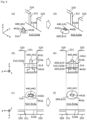
- Fig. 6 is a perspective view, a side view, and a top view illustrating a state where the protrusion 442 of the busbar 440 according to the present embodiment is joined to the substrate body 510 of substrate 500.
- Fig. 6(a) is a perspective view illustrating a state before the protrusion 442 of the busbar 440 is joined to the substrate body 510 of the substrate 500, and is a view similar to Fig. 5(b).
- Fig. 6(b) is a side view of Fig. 6(a) as viewed from the side (Y-axis plus direction)
- Fig. 6(c) is a top view of Fig. 6(a) as viewed from above (Z-axis plus direction).
- Fig. 6 is a perspective view, a side view, and a top view illustrating a state where the protrusion 442 of the busbar 440 according to the present embodiment is joined to the substrate body 510 of substrate 500.
- Fig. 6(b) is a
- FIG. 6(d) is a perspective view illustrating a state after the protrusion 442 of the busbar 440 has been joined to the substrate body 510 of the substrate 500, and corresponds to Fig. 6(a).
- Fig. 6(e) is a side view when Fig. 6(d) is viewed from the side (Y-axis plus direction), and corresponds to Fig. 6(b).
- Fig. 6(f) is a top view when Fig. 6(d) is viewed from above (the Z-axis plus direction), and corresponds to Fig. 6(c) .
- the protrusion 442 of the busbar 440 is disposed on the Y-axis minus direction side of the openings 321 formed in the wall 320 of the busbar frame 300.
- the protrusion 442 of the busbar 440 has a long side surface 442a on the side surface in the Y-axis direction and a short side surface 442b on a side surface in the X-axis direction.
- the opening 321 is disposed at a position facing the long side surface 442a.
- the protrusion 442 of the busbar 440 penetrates the through hole 514 of the substrate body 510 of the substrate 500 from the Z-axis minus direction.
- the protrusion 442 of the busbar 440 has the long side surface 442a and the short side surface 442b on the side surfaces in directions (Y-axis direction and X-axis direction) intersecting with a direction of penetration (Z-axis direction) into the through hole 514, and the opening 321 is disposed to face the long side surface 442a. That is, as viewed in the Z-axis direction, the rectangular protrusion 442 long in the X-axis direction is inserted into the oval through hole 514 long in the X-axis direction.
- the protrusion tip 442c is a portion of the protrusion 442 on the distal end side of the protrusion 442, which is disposed on the Z-axis plus direction side of the through hole 514. That is, the protrusion tip 442c is a portion projecting from the main surface 510a of the substrate body 510 in the Z-axis plus direction (the outside of the substrate 500).
- the protrusion base end 442d is a portion of the protrusion 442 on the base end side of the protrusion 442 disposed on the Z-axis minus direction side of the through hole 514.
- the protrusion base end 442d is a portion disposed in the Z-axis minus direction (inside the substrate 500) of the substrate body 510, in other words, a portion closer to the energy storage device 200 than the protrusion tip 442c.
- the opening 321 is disposed at a position where at least one of the protrusion tip 442c and the protrusion base end 442d can be visually recognized from the outside (Y-axis plus direction).
- the opening 321 is disposed at a position where (the long side surface 442a of) each of the protrusion tip 442c and the protrusion base end 442d can be visually recognized from the outside. That is, the opening 321 is a notch which is deeply cut in the Z-axis direction, and not only the protrusion tip 442c but also the protrusion base end 442d (the portion closer to the energy storage device 200) is formed to be visually recognizable.
- the protrusion 442 is joined (fixed) to the substrate body 510 with solder 600. That is, the solder 600 melted from the protrusion tip 442c side (Z-axis plus direction side) is applied around the through hole 514 on the surface (main surface 510a) of the substrate body 510. Then, due to the action of gravity and surface tension, the solder 600 flows into the through hole 514, and the solder 600 is disposed and solidified around the through hole 514 on a back surface of the substrate body 510 also on the protrusion base end 442d side (Z-axis minus direction side).
- the protrusion tip 442c is joined (fixed) to the substrate body 510 by the solder 610, and the protrusion base end 442d is joined (fixed) to the substrate body 510 by solder 620, thus improving the joint strength of the protrusion 442 to the substrate 500.
- the solder 610 and the solder 620 are solder fillets having an oval frustum shape.
- the opening 321 is formed in the wall 320 of the busbar frame 300 to make the state of penetration of the through member into the substrate 500 visually recognizable. As a result, even when the wall 320 is provided in the busbar frame 300, the state of penetration of the through member into the substrate 500 can be easily grasped.
- the opening 321 comprises a notch formed in the lateral member, by forming the notch in the lateral member, it is possible to easily form the opening 321 through which the state of penetration of the through member into the substrate 500 can be visually recognized.
- the opening 321 is disposed to face the long side surface 442a of the protrusion 442 of the through member. As described above, by disposing the opening 321 to face the long side surface 442a of the protrusion 442 instead of the short side surface 442b thereof, it is possible to visually recognize the long side surface 442a side of the protrusion 442 instead of the short side surface 442b side. This makes it easy to visually recognize the state of penetration of the through member, so that the state of penetration of the through member into the substrate 500 can be easily and more reliably grasped.
- Fig. 7 is a side view illustrating a state where the protrusion 442 of the busbar 440 according to the first modification of the present embodiment is joined to the substrate body 510 of the substrate 500. Specifically, Fig. 7 is a diagram corresponding to Fig. 6(e) .
- Fig. 8 is a side view illustrating a configuration of an opening 323 formed in the wall 320 of the busbar frame 300 according to the second modification of the present embodiment. Specifically, Fig. 8 is a diagram corresponding to Fig. 6(e) .
- the opening 323 is formed in the wall 320 instead of the opening 321 in the above embodiment.
- Other configurations are the same as those of the above embodiment, and thus detailed description thereof is omitted.
- busbar 400 (busbars 410 to 440) has been an example of the through member, but any member may be used as the through member so long as the member penetrates the substrate 500.
- Examples of the through member include a terminal (connector) of a cable connected to the substrate 500, a thermistor, other electronic components, and the like.
Landscapes
- Engineering & Computer Science (AREA)
- Chemical & Material Sciences (AREA)
- Chemical Kinetics & Catalysis (AREA)
- Electrochemistry (AREA)
- General Chemical & Material Sciences (AREA)
- Power Engineering (AREA)
- Microelectronics & Electronic Packaging (AREA)
- Manufacturing & Machinery (AREA)
- Aviation & Aerospace Engineering (AREA)
- Battery Mounting, Suspending (AREA)
- Connection Of Batteries Or Terminals (AREA)
- Electric Double-Layer Capacitors Or The Like (AREA)
Description
- The present invention relates to an energy storage apparatus including an energy storage device and a substrate.
- Conventionally, an energy storage apparatus including an energy storage device and a substrate is widely known.
Patent Document 1 discloses a vehicle battery system (energy storage apparatus) including a battery block made up of a plurality of battery cells (energy storage devices) and a circuit board (substrate) that detects a state of each battery cell, with the circuit board fixed to the battery block. -
CN 107 403 889 A discloses a battery connection module that is used for connecting a plurality of parallel batteries. -
US 2019 135 207 A1 discloses a power supply device including a plurality of electricity storage elements, and a method for producing the same. - Patent Document 1:
JP-A-2010-56035 - SUMMARY OF THE INVENTIONThe present invention is defined by the appended
independent claim 1. Preferred embodiments are defined by the dependent claims. - In the energy storage apparatus, a member (hereinafter referred to as a lateral member) may be disposed lateral to the substrate. In such a case, there is a possibility that the state of penetration of the through member into the substrate cannot be grasped. When the state of penetration of the through member into the substrate cannot be grasped, there is a possibility that a defect due to attachment failure or the like of the through member to the substrate occurs.
- An object of the present invention is to provide an energy storage apparatus in which a state of penetration of a through member into a substrate can be easily grasped.
- An energy storage apparatus according to one aspect of the present invention includes: an energy storage device; a substrate in which a through hole penetrating a main surface is formed; a through member that penetrates the through hole; and a lateral member disposed lateral to the substrate and covering a side surface of the substrate. The lateral member includes an opening through which at least one of two portions of the through member, the two portions sandwiching the through hole, is visually recognizable from an outside, wherein the lateral member is a busbar frame on which a busbar connected to the energy storage device is mounted, and the busbar frame includes: a frame body, and a wall, in which the opening is formed, that projects from the frame body and covers the side surface of the substrate.
- The present invention can be realized not only as such an energy storage apparatus but also as a lateral member including the opening and can also be realized as a lateral member, a substrate, and a through member.
- According to the energy storage apparatus of the present invention, the state of penetration of the through member into the substrate can be easily grasped.
-
-
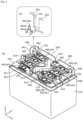
Fig. 1 is a perspective view illustrating an appearance of an energy storage apparatus according to an embodiment. -
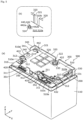
Fig. 2 is an exploded perspective view illustrating each component when the energy storage apparatus according to the embodiment is disassembled. -
Fig. 3 is a perspective view illustrating a configuration of a busbar frame, a busbar, and a substrate according to the embodiment. -
Fig. 4 is a perspective view illustrating a configuration in a state where the busbar mounted on the busbar frame according to the embodiment is joined to the energy storage device. -
Fig. 5 is a perspective view illustrating a configuration in a state where the substrate is fixed to the busbar frame according to the embodiment. -
Fig. 6 is a perspective view, a side view, and a top view illustrating a state where the protrusion of the busbar according to the embodiment is joined to the substrate body of the substrate. -
Fig. 7 is a side view illustrating a state where a protrusion of a busbar according to a first modification of the embodiment is joined to a substrate body of a substrate. -
Fig. 8 is a side view illustrating a configuration of an opening formed in a wall of a busbar frame according to a second modification of the embodiment. - In
Patent Document 1 described above, a voltage detection line (hereinafter referred to as a through member) connected to an electrode terminal of an energy storage device is fixed to a substrate in a state where the voltage detection line penetrates the through hole of the substrate (cf. Fig. 12 and the like of Patent Document 1). In the energy storage apparatus, various members are disposed in a small space in order to achieve space saving or the like, and thus, a member (hereinafter referred to as a lateral member) may be disposed lateral to the substrate. The inventor of the present application has found that in such a case, there is a possibility that the state of penetration of the through member into the substrate, such as whether the through member is reliably fixed to the substrate, cannot be grasped due to a difficulty in confirming the vicinity of the through hole of the substrate from the side of the substrate. When the state of penetration of the through member into the substrate cannot be grasped, there is a possibility that a defect due to attachment failure or the like of the through member to the substrate occurs. - The present invention has been made by the inventor of the present application focusing newly on the above problem, and an object of the present invention is to provide an energy storage apparatus in which a state of penetration of a through member into a substrate can be easily grasped.
- An energy storage apparatus according to one aspect of the present invention includes: an energy storage device; a substrate in which a through hole penetrating a main surface is formed; a through member that penetrates the through hole; and a lateral member disposed lateral to the substrate and covering a side surface of the substrate. The lateral member includes an opening through which at least one of two portions of the through member, the two portions sandwiching the through hole, is visually recognizable from an outside.
- According to this, in the energy storage apparatus, the lateral member disposed lateral to the substrate and covering the side surface of the substrate includes the opening through which at least one of two portions, sandwiching the through hole, in the through member that penetrates the through hole of the substrate is visually recognizable from the outside. In this manner, the opening is formed in the lateral member, and at least one of the two portions of the through member sandwiching the through hole of the substrate is made visually recognizable from the outside. Thereby, the portion penetrating the through hole of the through member is visually recognizable from the outside of the lateral member through the opening, so that the state of penetration of the through member into the substrate can be easily grasped.
- The opening may be formed such that a portion closer to the energy storage device out of the two portions is visually recognizable.
- According to this, the opening of the lateral member is formed such that the portion closer to the energy storage device out of the two portions sandwiching the through hole in the through member can be visually recognized. In the through member, the portion closer to the energy storage device out of the two portions sandwiching the through hole is located inside the energy storage apparatus, and it is thus difficult to grasp the state of the through member. Accordingly, an opening is formed in the lateral member such that the portion closer to the energy storage device can be visually recognized. As a result, the portion of the through member closer to the energy storage device, the portion being in a state of penetration difficult to grasp, is visually recognizable from the outside of the lateral member through the opening, so that the state of penetration of the through member can be easily grasped.
- The through member may be a busbar connected to the energy storage device, and the busbar may include a busbar body, and a protrusion that projects from the busbar body, penetrates the through hole, and is joined to the substrate, and the opening may be formed such that a joined state of the protrusion to the substrate is visually recognizable.
- According to this, the through member is the busbar connected to the energy storage device, and the opening of the lateral member is formed such that the joining state of the protrusion, which penetrates the through hole of the busbar and is joined to the substrate, can be visually recognized. In order to measure the voltage of the energy storage device, a protrusion may be formed on the busbar, and the protrusion may be allowed to penetrate the through hole of the substrate and be joined (e.g., soldered) to the substrate. In this case, it is necessary to check whether the protrusion of the busbar is joined to the substrate (e.g., whether a solder fillet is formed favorably). Therefore, the opening is formed in the lateral member, and the joined state of the protrusion to the substrate can be visually recognized. As a result, the joined state of the protrusion of the busbar to the substrate can be easily grasped, so that it is possible to prevent stress concentration on the protrusion due to joint failure and to prevent the breakage of the protrusion.
- The lateral member is a busbar frame on which a busbar connected to the energy storage device is mounted, and the busbar frame includes a frame body, and a wall that projects from the frame body and covers a side surface of the substrate, and in which the opening is formed.
- According to this, the lateral member is the busbar frame on which the busbar is placed, and the busbar frame includes the wall that covers the side surface of the substrate, and in which the opening is formed. In the energy storage apparatus, the busbar frame may be provided with a wall that covers the side surface of the substrate. For the purpose of preventing the movement (vibration) of the energy storage device in the outer case of the energy storage apparatus, or some other purpose, a wall may be provided on the busbar frame, and the wall may be engaged with the cover of the outer case to fix the busbar frame to the outer case. Alternatively, a wall may be provided on the busbar frame as a guide for disposing the cover on the outer case. In such a case, there is a possibility that the state of penetration of the through member into the substrate cannot be grasped due to the wall of the busbar frame. Therefore, the opening is formed in the wall of the busbar frame to make the state of penetration of the through member into the substrate visually recognizable. As a result, even if the wall is provided in the busbar frame, the state of penetration of the through member into the substrate can be easily grasped.
- The opening may comprise a notch or a through hole formed in the lateral member.
- According to this, since the opening of the lateral member is a notch or a through hole formed in the lateral member, by forming the notch or the through hole in the lateral member, it is possible to easily form the opening through which the state of penetration of the through member into the substrate can be visually recognized.
- The through member may include a long side surface and a short side surface on a side surface in directions intersecting with a direction of penetration into the through hole, and the opening may be disposed to face the long side surface of the through member.
- According to this, the opening of the lateral member is disposed to face the long side surface of the through member. As described above, by disposing the opening of the lateral member to face the long side surface of the through member instead of the short side surface thereof, it is possible to visually recognize the long side surface side of the through member instead of the short side surface thereof. This makes it easy to visually recognize the state of penetration of the through member, so that the state of penetration of the through member into the substrate can be easily and more reliably grasped.
- Hereinafter, an energy storage apparatus according to an embodiment of the present invention (including a modification thereof) will be described with reference to the drawings. An embodiment described below illustrates a comprehensive or specific example. Numeral values, shapes, materials, components, placement positions and connection forms of the components, manufacturing steps, a sequence of the manufacturing steps, and the like shown in the following embodiment are only examples and are not intended to limit the present invention. In the drawings, dimensions and the like are not illustrated strictly. In the drawings, the same or similar components are denoted by the same reference numerals.
- In the following description and drawings, a direction in which a pair of (positive-electrode-side and negative-electrode-side) electrode terminals are disposed in one energy storage device or a direction in which the short side surface of a case of the energy storage device faces is defined as an X-axis direction. A direction in which the energy storage devices are arranged or a direction in which the long side surface of the case of the energy storage device is defined as a Y-axis direction. A direction in which the body and the lid of the outer case of the energy storage apparatus are disposed, a direction in which the energy storage devices, the busbar frame, the busbar, and the substrate are disposed, or a vertical direction is defined as a Z-axis direction. The X-axis direction, the Y-axis direction, and the Z-axis direction are mutually intersecting (orthogonal in the present embodiment) directions. It is conceivable that the Z-axis direction may not be the vertical direction depending on the use aspect, but for convenience of description, a description will be given below with the Z-axis direction as the vertical direction.
- In the following description, an X-axis plus direction indicates an arrow direction of the X-axis, and an X-axis minus direction indicates a direction opposite to the X-axis plus direction. The same applies to the Y-axis direction and the Z-axis direction. Expressions indicating relative directions or postures, such as parallel and orthogonal, strictly include cases where the directions or postures are not the same. Two directions being orthogonal to each other not only means that the two directions are completely orthogonal to each other, but also means that the two directions are substantially orthogonal to each other, the two directions being orthogonal includes a difference of about several percent.
- First, an
energy storage apparatus 10 according to the present embodiment will be generally described.Fig. 1 is a perspective view illustrating the appearance of theenergy storage apparatus 10 according to the present embodiment.Fig. 2 is an exploded perspective view illustrating each component when theenergy storage apparatus 10 according to the present embodiment is disassembled. - The
energy storage apparatus 10 is an apparatus capable of charging electricity from the outside and discharging electricity to the outside and has a substantially rectangular parallelepiped shape in the present embodiment. Theenergy storage apparatus 10 is a battery module (assembled battery) used for power storage application, power supply application, or the like. Specifically, theenergy storage apparatus 10 is used as a battery or the like for driving or starting an engine of a moving body such as an automobile, a motorcycle, a watercraft, a ship, a snowmobile, an agricultural machine, a construction machine, or a railway vehicle for electric railways. Examples of the automobile include an electric vehicle (EV), a hybrid electric vehicle (HEV), a plug-in hybrid electric vehicle (PHEV), and a gasoline vehicle. Examples of the railway vehicle for electric railways include a train, a monorail, and a linear motor car. Theenergy storage apparatus 10 can also be used as a stationary battery or the like used for home use, a generator, or the like. - As illustrated in
Fig. 1 , theenergy storage apparatus 10 includes anouter case 100, and as illustrated inFig. 2 , a plurality ofenergy storage devices 200, abusbar frame 300, abusbar 400, asubstrate 500, and the like are housed inside theouter case 100. Theenergy storage apparatus 10 may include a spacer disposed between the plurality ofenergy storage devices 200, a binding member (side plate, end plate, etc.) binding the plurality ofenergy storage devices 200, and the like. - The
outer case 100 is a case (module case) having a box shape (substantially rectangular parallelepiped shape) which forms an outer case of theenergy storage apparatus 10. That is, theouter case 100 is disposed outside the plurality ofenergy storage devices 200, thebusbar frame 300, thebusbar 400, thesubstrate 500, and the like, and fixes theenergy storage devices 200 and the like at predetermined positions for protection from an impact or the like. Theouter case 100 is formed of, for example, an insulating member such as polycarbonate (PC), polypropylene (PP), polyethylene (PE), polystyrene (PS), a polyphenylene sulfide resin (PPS), polyphenylene ether (PPE (including modified PPE)), polyethylene terephthalate (PET), polybutylene terephthalate (PBT), polyether ether ketone (PEEK), tetrafluoroethylene-perfluoroalkyl vinyl ether (PFA), polytetrafluoroethylene (PTFE), polyethersulfone (PES), an acrylonitrile butadiene styrene (ABS) resin, or a composite material thereof, or an insulation-coated metal. Thereby, theouter case 100 prevents theenergy storage devices 200 and the like from coming into contact with an external metal member or the like. Theouter case 100 may be formed of a conductive member such as metal so long as the electric insulation properties of theenergy storage device 200 and the like are maintained. - The
outer case 100 includes anouter case body 110 constituting the body of theouter case 100 and anouter case lid 120 constituting the lid of theouter case 100. Theouter case body 110 is a bottomed rectangular cylindrical housing (casing) in which an opening is formed, and houses theenergy storage devices 200 and the like therein. Theouter case lid 120 is a flat rectangular member that closes the opening of theouter case body 110. Theouter case lid 120 is engaged with or fitted to theouter case body 110 and is joined to theouter case body 110 by an adhesive, heat sealing, ultrasonic welding, or the like. Theouter case lid 120 is provided with a positiveexternal terminal 121 and a negativeexternal terminal 122. Theenergy storage apparatus 10 charges electricity from the outside and discharges electricity to the outside through the positiveexternal terminal 121 and the negativeexternal terminal 122. - The
energy storage device 200 is a secondary battery (battery cell) capable of charging and discharging electricity and is specifically a nonaqueous electrolyte secondary battery such as a lithium ion secondary battery. Theenergy storage device 200 has a flat rectangular parallelepiped shape (prismatic shape), and in the present embodiment, four energy storage devices 200 (energy storage devices 201 to 204) are arranged side by side in the Y-axis direction. The shape, number, arrangement position, and the like of theenergy storage device 200 are not particularly limited. Theenergy storage device 200 is not limited to the nonaqueous electrolyte secondary battery but may be a secondary battery except for the nonaqueous electrolyte secondary battery or may be a capacitor. Theenergy storage device 200 may be not a secondary battery but a primary battery that can use stored electricity without being charged by a user. Theenergy storage device 200 may be a battery using a solid electrolyte. Theenergy storage device 200 may be a laminate-type energy storage device. - Specifically, the
energy storage device 200 includes acase 210 and a pair of (positive- electrode-side and negative-electrode-side)electrode terminals 220. An electrode assembly, a pair of current collectors, an electrolyte solution (nonaqueous electrolyte), and the like are accommodated in thecase 210, but illustration thereof is omitted. Thecase 210 is a rectangular parallelepiped (prismatic) case and is formed of a metal such as stainless steel, aluminum, an aluminum alloy, iron, or a plated steel plate. Theelectrode terminals 220 are terminals (a positive terminal and a negative terminal) electrically connected to the positive electrode plate and the negative electrode plate of the electrode assembly via the current collector and are made of aluminum, an aluminum alloy, copper, a copper alloy, or the like. - The electrode assembly is an energy storage element (power generating element) formed by stacking a positive electrode plate, a negative electrode plate, and a separator. The positive electrode plate is obtained by forming a positive active material layer on a positive electrode substrate layer that is a current collecting foil made of a metal such as aluminum or an aluminum alloy. The negative electrode plate is obtained by forming a negative active material layer on a negative electrode substrate layer that is a current collecting foil made of a metal such as copper or a copper alloy. As an active material used for each of the positive active material layer and the negative active material layer, a known material can be appropriately used so long as the material can occlude and release lithium ions. The electrode assembly may be an electrode assembly in any form such as a winding-type electrode assembly formed by winding plates (a positive electrode plate and a negative electrode plate), a layering-type (stacking-type) electrode assembly formed by layering a plurality of plate-shaped electrode plates, or a bellows-type electrode assembly formed by folding plates in a bellows shape.
- The current collector is a member having conductivity and rigidity (a positive electrode current collector and a negative electrode current collector) electrically connected to the
electrode terminal 220 and the electrode assembly. The positive electrode current collector is formed of aluminum, an aluminum alloy, or the like, similarly to the positive electrode substrate layer of the positive electrode plate, and the negative electrode current collector is formed of copper, a copper alloy, or the like, similarly to the negative electrode substrate layer of the negative electrode plate. The type of the electrolyte solution is not particularly limited so long as the electrolyte solution does not impair the performance of theenergy storage device 200, and various electrolyte solutions can be selected. - The
busbar frame 300 is a flat rectangular member capable of electrically insulating thebusbar 400 from other members and regulating the positions of thebusbars 400. Thebusbar frame 300 is formed of an insulating member such as PC, PP, or PE, which is similar to theouter case 100. Specifically, thebusbar frame 300 is placed above the plurality ofenergy storage devices 200 and is positioned with respect to the plurality ofenergy storage devices 200. Thebusbar 400 is placed and positioned on thebusbar frame 300. Thereby, thebusbar 400 is positioned with respect to the plurality ofenergy storage devices 200 and are joined to theelectrode terminals 220 included in the plurality of energy storage devices 200 (cf.Fig. 4 ). - After the joining of the
busbar 400 to theelectrode terminals 220 of theenergy storage devices 200, thesubstrate 500 is mounted and fixed on the busbar frame 300 (cf.Fig. 5 ). As described above, thebusbar frame 300 also has a function of mounting and fixing thesubstrate 500. Thebusbar frame 300 has a function of reinforcing theouter case 100 as the inner lid of theouter case 100, and a function of restricting the movement of theenergy storage devices 200 by fixation to theouter case lid 120. The configuration of thebusbar frame 300 will be described in detail later. - The
busbar 400 is a flat-plate-like member that is disposed above the plurality ofenergy storage devices 200 and connected (joined) to theelectrode terminals 220 of the plurality ofenergy storage devices 200. Thus, thebusbar 400 connects theelectrode terminals 220 of the plurality ofenergy storage devices 200 to each other. Thebusbar 400 connects theelectrode terminals 220 of theenergy storage devices 200 positioned at the ends of the plurality ofenergy storage devices 200 to the positiveexternal terminal 121 and the negativeexternal terminal 122. - The
busbar 400 is formed of a metal such as aluminum, an aluminum alloy, copper, a copper alloy, or nickel, a combination thereof, or a conductive member other than the metal. In the present embodiment, thebusbars 400 connect the positive terminal and the negative terminal of theenergy storage devices 200 disposed adjacently to each other to connect the fourenergy storage devices 200 in series. The aspect of the connection of theenergy storage devices 200 is not limited to the above, and series connection and parallel connection may be combined in any manner. The configuration of thebusbar 400 will be described in detail later. - The
substrate 500 is a circuit board that is electrically connected to theenergy storage device 200, monitors the charge state and the discharge state of theenergy storage device 200, and controls the charge and discharge of theenergy storage device 200. As described above, thesubstrate 500 is placed and fixed on thebusbar frame 300. Specifically, thesubstrate 500 includes electric components such as a fuse, a relay, a semiconductor switch such as a field-effect transistor (FET), a shunt resistor, a thermistor, and a connector. - The
substrate 500 monitors states such as the charge state and the discharge state of theenergy storage device 200 by acquiring information of the voltage and the like of theenergy storage device 200 through thebusbar 400 or acquiring the temperature information of theenergy storage device 200 through the thermistor. Thesubstrate 500 is electrically connected to theenergy storage device 200, the positiveexternal terminal 121, and the negative external terminal 122 (that is, connected to the main current path of the energy storage device 200) through thebusbar 400 to control the charge and discharge of theenergy storage device 200. Thesubstrate 500 may only monitor the state of theenergy storage device 200 without controlling the charge and discharge of theenergy storage device 200. The configuration of thesubstrate 500 will be described in detail later. - Next, the configurations of the
busbar frame 300, thebusbar 400, and thesubstrate 500 will be described in detail.Fig. 3 is a perspective view illustrating a configuration of thebusbar frame 300, thebusbar 400, and thesubstrate 500 according to the present embodiment. Specifically,Fig. 3 is an enlarged perspective view illustrating thebusbar frame 300, thebusbar 400, and thesubstrate 500 inFig. 2 in an enlarged manner. -
Fig. 4 is a perspective view illustrating a configuration in a state where thebusbar 400 mounted on thebusbar frame 300 according to the present embodiment is joined to theenergy storage devices 200. Specifically,Fig. 4(a) is a perspective view illustrating a configuration in a state where theouter case body 110, theenergy storage devices 200, thebusbar frame 300, and thebusbar 400 illustrated inFig. 2 have been assembled to each other, that is, in a state where theouter case lid 120 and thesubstrate 500 have been removed from theenergy storage apparatus 10 illustrated inFig. 1 . Fig. 4(b) is an enlarged perspective view illustrating aprotrusion 442 of abusbar 440 and anopening 321 formed in awall 320 of thebusbar frame 300 inFig. 4(a) in an enlarged manner. -
Fig. 5 is a perspective view illustrating a configuration in a state where thesubstrate 500 is fixed to thebusbar frame 300 according to the present embodiment. Specifically,Fig. 5(a) is a perspective view illustrating a configuration in a state where theouter case body 110, theenergy storage devices 200, thebusbar frame 300, thebusbar 400, and thesubstrate 500 illustrated inFig. 2 have been assembled to each other, that is, in a state where theouter case lid 120 has been removed from theenergy storage apparatus 10 illustrated inFig. 1 . Fig. 5(b) is an enlarged perspective view illustrating a state where theprotrusion 442 of thebusbar 440 inFig. 5(a) penetrates a throughhole 514 of thesubstrate 500 in an enlarged manner. - As illustrated in
Fig. 3 , thebusbar frame 300 includes aframe body 310 andwalls frame body 310 is the body of thebusbar frame 300 and is a flat rectangular portion on which thebusbar 400 is placed and to which thesubstrate 500 is fixed. Theframe body 310 has anopening 311 for connecting thebusbar 400 to theelectrode terminal 220 of theenergy storage device 200, and a fixingportion 312 for fixing thesubstrate 500. - The
opening 311 is a rectangular through hole formed in theframe body 310, and eightopenings 311 are formed at positions facing the eightelectrode terminals 220 of the plurality ofenergy storage devices 200, respectively. Thereby, as illustrated inFig. 4 , the busbar 400 (busbars 410 to 450 to be described later) can be connected (joined) to theelectrode terminals 220 of theenergy storage devices 200 through theopenings 311. - The fixing
portion 312 is a cylindrical projection projecting in the Z-axis plus direction, and is inserted into and fixed to a throughhole 515 formed in asubstrate body 510 of thesubstrate 500 to be described later. In the present embodiment, four fixingportions 312 are inserted into and fixed to four throughholes 515 formed in thesubstrate body 510. Specifically, as illustrated inFig. 5 , the fixingportion 312 is inserted into the throughhole 515 of thesubstrate body 510 and then fixed to thesubstrate body 510 by thermal caulking. Thereby, thesubstrate 500 is fixed to thebusbar frame 300. A method of fixing thesubstrate 500 to thebusbar frame 300 is not limited to thermal caulking, and any method such as screw fastening, an adhesive, welding, or the like may be used. - The
walls frame body 310. That is, thewalls substrate 500 and covering at least a part of the side surfaces of thesubstrate 500 when thesubstrate 500 is fixed to theframe body 310. Thebusbar frame 300 is an example of a lateral member covering the side surface of thesubstrate 500. Thewalls outer case lid 120 is disposed on theouter case body 110, the purpose of restricting the movement (vibration) of theenergy storage devices 200 in theouter case 100 by fixation to theouter case lid 120, and some other purpose. - Specifically, the
wall 320 is a sidewall of theframe body 310 on the Y-axis plus direction side and is disposed in the Y-axis plus direction of thesubstrate 500 to cover at least a part of aside surface 510b of thesubstrate 500 to be described later. That is, theopenings wall 320, and theside surface 510b of thesubstrate 500 is exposed from theopenings 321, 322 (cf.Fig. 5 ). Theopenings wall 320 on the X-axis minus direction side. - The
wall 330 is a sidewall of theframe body 310 on the X-axis plus direction side, provided at the end thereof on the Y-axis plus direction side, and is disposed in the X-axis plus direction of thesubstrate 500 to cover at least a part of aside surface 510c of thesubstrate 500 to be described later. That is, since thewall 330 is opened on the Y-axis minus direction side, it can be said that anopening 331 is provided on thewall 330 on the Y-axis minus direction side, and theside surface 510c of thesubstrate 500 is exposed from the opening 331 (cf.Fig. 5 ). - The
wall 340 is a sidewall of theframe body 310 on the X-axis minus direction side, provided at the end thereof on the Y-axis plus direction side, and is disposed in the X-axis minus direction of thesubstrate 500 to cover at least a part of aside surface 510d of thesubstrate 500 to be described later. That is, since thewall 340 is opened on the Y-axis minus direction side, it can be said that theopening 341 is provided on thewall 340 on the Y-axis minus direction side, and theside surface 510d of thesubstrate 500 is exposed from the opening 341 (cf.Fig. 5 ). - The
wall 350 is a sidewall of theframe body 310 on the Y-axis minus direction side, is provided at the center thereof in the X-axis direction, and is disposed in the Y-axis minus direction of thesubstrate 500 to cover at least a part of aside surface 510e of thesubstrate 500 to be described later. That is, since both sides of thewall 350 in the X-axis direction are opened, it can be said thatopenings wall 350 in the X-axis direction, and theside surface 510e of thesubstrate 500 is exposed from theopenings 351, 352 (cf.Fig. 5 ). - The
busbar 400 includes fivebusbars 410 to 450. Thebusbar 410 includes abusbar body 411, aconnection 412, and aprotrusion 413. Thebusbar body 411 is the body of thebusbar 410 and is a flat plate-like portion connected (joined) to theelectrode terminal 220 of the energy storage devices 200 (specifically, the positive terminal of the energy storage device 201) (cf.Fig. 4 ). Theconnection 412 is a cylindrical portion projecting from thebusbar body 411 in the Z-axis plus direction and is connected to another busbar (not illustrated) so as to be connected to the positiveexternal terminal 121 through another busbar. Theprotrusion 413 is a protrusion projecting from thebusbar body 411 in the Z-axis plus direction, penetrates the throughhole 511 formed in thesubstrate 500 to be described later (cf.Fig. 5 ), and is joined to thesubstrate 500. - The
busbar 420 includes abusbar body 421 and aprotrusion 422. Thebusbar body 421 is the body of thebusbar 420 and is a flat plate-like portion connected (joined) to theelectrode terminal 220 of the energy storage devices 200 (specifically, the negative terminal of the energy storage device 201 and the positive terminal of the energy storage device 202 may be used) (cf.Fig. 4 ). Theprotrusion 422 is a protrusion projecting from thebusbar body 421 in the Z-axis plus direction, penetrates the throughhole 512 formed in thesubstrate 500 to be described later (cf.Fig. 5 ), and is joined to thesubstrate 500. - The
busbar 430 includes abusbar body 431 and aprotrusion 432. Thebusbar body 431 is the body of thebusbar 430 and is a flat plate-like portion that is connected (joined) to theelectrode terminals 220 of the energy storage devices 200 (specifically, the negative terminal of the energy storage device 202 and the positive terminal of the energy storage device 203 may be used) (cf.Fig. 4 ). Theprotrusion 432 is a protrusion projecting from thebusbar body 431 in the Z-axis plus direction, penetrates the throughhole 513 formed in thesubstrate 500 to be described later (cf.Fig. 5 ), and is joined to thesubstrate 500. - The
busbar 440 includes abusbar body 441 and aprotrusion 442. Thebusbar body 441 is the body of thebusbar 440 and is a flat plate-like portion that is connected (joined) to theelectrode terminals 220 of the energy storage devices 200 (specifically, the negative terminal of the energy storage device 203 and the positive terminal of the energy storage device 204 may be used) (cf.Fig. 4 ). Theprotrusion 442 is a protrusion projecting from thebusbar body 441 in the Z-axis plus direction, penetrates the throughhole 514 formed in thesubstrate 500 to be described later (cf.Fig. 5 ), and is joined to thesubstrate 500. - The
busbar 450 includes abusbar body 451 and aconnection 452. Thebusbar body 451 is the body of thebusbar 450 and is a flat plate-like portion that is connected (joined) to theelectrode terminal 220 of the energy storage device 200 (specifically, the negative terminal of the energy storage device 204) (cf.Fig. 4 ). Theconnection 452 is a columnar portion projecting from thebusbar body 451 in the Z-axis plus direction and is connected (fixed) to aconnection member 530 of thesubstrate 500 to be described later to electrically connect thebusbar 450 to the substrate 500 (cf.Fig. 5 ). - As described above, the busbar 400 (
busbars 410 to 450) are sequentially connected (joined) to theelectrode terminals 220 of the four energy storage devices 200 (energy storage devices 201 to 204) to connect the fourenergy storage devices 200 in series. As a method of connecting (joining) thebusbar 400 and theelectrode terminals 220 of theenergy storage devices 200, any method may be used, like welding such as ultrasonic welding, laser welding, or resistance welding, or mechanical joining such as screw fastening or caulking joining. Thebusbars 410 to 440 of thebusbar 400 hasprotrusions holes 511 to 514 of thesubstrate 500. Each of thebusbars 410 to 440 as thus described is an example of a through member penetrating the through hole of thesubstrate 500. - The
substrate 500 includes thesubstrate body 510, anelectronic component 520, andconnection members substrate body 510 is the body of thesubstrate 500 and is a rectangular flat-plate-like portion on which theelectronic component 520 is mounted. In thesubstrate body 510, a surface (upper surface) on the Z-axis plus direction side is defined as amain surface 510a, a side surface on the Y-axis plus direction side is defined as aside surface 510b, a side surface on the X-axis plus direction side is defined as aside surface 510c, a side surface on an X-axis minus direction side is defined as aside surface 510d, and a side surface on the Y-axis minus direction side is defined as aside surface 510e. That is, themain surface 510a is a plate surface of thesubstrate body 510 on which theelectronic component 520 is mounted, and the side surfaces 510b, 510c, 510d, 510e are end surfaces surrounding the periphery of thesubstrate body 510. - The through
holes 511 to 514 and 515 penetrating themain surface 510a are formed in thesubstrate body 510. Each of the throughholes 511 to 514 is an oval through hole that penetrates thesubstrate body 510 in the thickness direction (Z-axis direction) and is long in the X-axis direction. The throughholes 511 to 514 are formed at positions corresponding to theprotrusions busbars 410 to 440, respectively. Specifically, the throughhole 511 is formed in the middle in the X-axis direction of the end of thesubstrate body 510 on the Y-axis minus direction side. The throughhole 512 is formed at the end of thesubstrate body 510 on the Y-axis minus direction side and the X-axis minus direction side. The throughhole 513 is formed at the end of thesubstrate body 510 on the Y-axis minus direction side and the X-axis plus direction side. The throughhole 514 is formed at the end of thesubstrate body 510 on the Y-axis plus direction side and the X-axis minus direction side. - As described above, the
protrusions busbars 410 to 440 are inserted into the throughholes 511 to 514, respectively (cf.Fig. 5 ), and joined by soldering or the like. Thereby, thebusbars 410 to 440 and thesubstrate body 510 are electrically connected, and hence thesubstrate 500 can acquire information on the voltage and the like of theenergy storage device 200 through thebusbars 410 to 440 and theelectrode terminals 220 of theenergy storage device 200. A configuration in which the protrusions of thebusbars 410 to 440 are joined to thesubstrate 500 will be described in detail later. - The through
holes 515 are circular through holes formed at four corners of both ends in the X-axis direction and both ends in the Y-axis direction of thesubstrate body 510 and penetrating thesubstrate body 510 in a thickness direction (Z-axis direction) thereof. As described above, thecylindrical fixing portion 312 provided in theframe body 310 of thebusbar frame 300 is inserted into the throughhole 515. That is, four throughholes 515 are formed at positions corresponding to the four fixingportions 312, and the four fixingportions 312 are inserted into and joined to the four throughholes 515, respectively (cf.Fig. 5 ). - The
electronic component 520 is a circuit component mounted on thesubstrate body 510 and is a fuse, a relay, a semiconductor switch such as a field-effect transistor (FET), a shunt resistor, a thermistor, or the like. Theconnection member 530 is a member to which theconnection 452 of thebusbar 450 is inserted and connected (fixed). That is, as described above, theconnection member 530 fixes thebusbar 450 to thesubstrate body 510 to electrically connect thesubstrate body 510 and the busbar 450 (cf.Fig. 5 ). Theconnection member 540 is a portion connected to the negativeexternal terminal 122 via another busbar (not illustrated). That is, theconnection member 540 fixes another busbar to thesubstrate body 510 to electrically connect thesubstrate body 510 and the negativeexternal terminal 122. Theconnection member 530 and theconnection member 540 are electrically connected via theelectronic component 520 and the like, whereby thebusbar 450 and the negativeexternal terminal 122 are electrically connected. - Next, a configuration in which the protrusions (
protrusions busbars 410 to 440) are joined to thesubstrate 500 will be described in detail. Since any of the protrusions has the same configuration to be joined to thesubstrate 500, a configuration in which theprotrusion 442 of thebusbar 440 is joined to thesubstrate 500 will be described below, and description of other configurations will be omitted. -
Fig. 6 is a perspective view, a side view, and a top view illustrating a state where theprotrusion 442 of thebusbar 440 according to the present embodiment is joined to thesubstrate body 510 ofsubstrate 500. Specifically,Fig. 6(a) is a perspective view illustrating a state before theprotrusion 442 of thebusbar 440 is joined to thesubstrate body 510 of thesubstrate 500, and is a view similar to Fig. 5(b).Fig. 6(b) is a side view ofFig. 6(a) as viewed from the side (Y-axis plus direction), andFig. 6(c) is a top view ofFig. 6(a) as viewed from above (Z-axis plus direction).Fig. 6(d) is a perspective view illustrating a state after theprotrusion 442 of thebusbar 440 has been joined to thesubstrate body 510 of thesubstrate 500, and corresponds toFig. 6(a). Fig. 6(e) is a side view whenFig. 6(d) is viewed from the side (Y-axis plus direction), and corresponds toFig. 6(b). Fig. 6(f) is a top view whenFig. 6(d) is viewed from above (the Z-axis plus direction), and corresponds toFig. 6(c) . - First, as illustrated in
Fig. 4(a) , in a state where thebusbar 440 is mounted on thebusbar frame 300 and is joined to theelectrode terminals 220 of theenergy storage devices 200, theprotrusion 442 of thebusbar 440 is disposed on the Y-axis minus direction side of theopenings 321 formed in thewall 320 of thebusbar frame 300. Specifically, theprotrusion 442 of thebusbar 440 has along side surface 442a on the side surface in the Y-axis direction and ashort side surface 442b on a side surface in the X-axis direction. Theopening 321 is disposed at a position facing thelong side surface 442a. - As illustrated in
Fig. 5(a) andFigs. 6(a) to 6(c), when thesubstrate 500 is fixed to thebusbar frame 300, theprotrusion 442 of thebusbar 440 penetrates the throughhole 514 of thesubstrate body 510 of thesubstrate 500 from the Z-axis minus direction. In this state, as described above, theprotrusion 442 of thebusbar 440 has thelong side surface 442a and theshort side surface 442b on the side surfaces in directions (Y-axis direction and X-axis direction) intersecting with a direction of penetration (Z-axis direction) into the throughhole 514, and theopening 321 is disposed to face thelong side surface 442a. That is, as viewed in the Z-axis direction, therectangular protrusion 442 long in the X-axis direction is inserted into the oval throughhole 514 long in the X-axis direction. - As illustrated in
Figs. 6(b) and 6(c) , two portions of theprotrusion 442 of thebusbar 440 sandwiching the throughhole 514 are referred to as aprotrusion tip 442c and aprotrusion base end 442d. That is, theprotrusion tip 442c and theprotrusion base end 442d are two portions of theprotrusion 442 disposed on both sides of the throughhole 514 in the Z-axis direction, in other words, on both sides of thesubstrate body 510 of thesubstrate 500. - Specifically, the
protrusion tip 442c is a portion of theprotrusion 442 on the distal end side of theprotrusion 442, which is disposed on the Z-axis plus direction side of the throughhole 514. That is, theprotrusion tip 442c is a portion projecting from themain surface 510a of thesubstrate body 510 in the Z-axis plus direction (the outside of the substrate 500). Theprotrusion base end 442d is a portion of theprotrusion 442 on the base end side of theprotrusion 442 disposed on the Z-axis minus direction side of the throughhole 514. That is, theprotrusion base end 442d is a portion disposed in the Z-axis minus direction (inside the substrate 500) of thesubstrate body 510, in other words, a portion closer to theenergy storage device 200 than theprotrusion tip 442c. - The
opening 321 is disposed at a position where at least one of theprotrusion tip 442c and theprotrusion base end 442d can be visually recognized from the outside (Y-axis plus direction). In the present embodiment, theopening 321 is disposed at a position where (thelong side surface 442a of) each of theprotrusion tip 442c and theprotrusion base end 442d can be visually recognized from the outside. That is, theopening 321 is a notch which is deeply cut in the Z-axis direction, and not only theprotrusion tip 442c but also theprotrusion base end 442d (the portion closer to the energy storage device 200) is formed to be visually recognizable. - In the above configuration, as illustrated in
Figs. 6(d) to 6(f) , theprotrusion 442 is joined (fixed) to thesubstrate body 510 with solder 600. That is, the solder 600 melted from theprotrusion tip 442c side (Z-axis plus direction side) is applied around the throughhole 514 on the surface (main surface 510a) of thesubstrate body 510. Then, due to the action of gravity and surface tension, the solder 600 flows into the throughhole 514, and the solder 600 is disposed and solidified around the throughhole 514 on a back surface of thesubstrate body 510 also on theprotrusion base end 442d side (Z-axis minus direction side). As a result, theprotrusion tip 442c is joined (fixed) to thesubstrate body 510 by the solder 610, and theprotrusion base end 442d is joined (fixed) to thesubstrate body 510 by solder 620, thus improving the joint strength of theprotrusion 442 to thesubstrate 500. The solder 610 and the solder 620 are solder fillets having an oval frustum shape. - As thus described, the
busbar 440 includes the solder 600 (solder 610 and the solder 620) in the state after theprotrusion 442 has been joined to thesubstrate 500. In this case, the solder 610 and the solder 620 become two portions of thebusbar 440 sandwiching the throughhole 514, and the solder 620 becomes a portion closer to theenergy storage device 200 out of the two portions. - Since the
opening 321 is disposed at a position where both theprotrusion tip 442c and theprotrusion base end 442d are visually recognizable from the outside, the solder 610 and the solder 620 are also disposed at visually recognizable positions. That is, theopening 321 is formed such that the fillet state of the solder 610 and the solder 620 at theprotrusion tip 442c and theprotrusion base end 442d can be visually recognized. In this manner, theopening 321 is formed such that the joined state of theprotrusion 442 to thesubstrate 500 can be visually recognized. - That is, in the state after the
protrusion 442 has been joined to thesubstrate 500, theopening 321 is formed such that theprotrusion tip 442c and theprotrusion base end 442d, which are two portions of thebusbar 440 sandwiching the throughhole 514, can be visually recognized from the outside. In the state after theprotrusion 442 has been joined to thesubstrate 500, theopening 321 is formed such that the solder 610 and the solder 620, which are two portions of thebusbar 440 sandwiching the throughhole 514, can be visually recognized from the outside. Theopening 321 is formed such that portions of theprotrusion tip 442c and theprotrusion base end 442d exposed from the solder 610 and the solder 620 are also visible from the outside. - Similarly to the
opening 321, theopenings busbars 410 to 430, the two portions sandwiching each of the throughhole 511 to 513, can be visually recognized from the outside. That is, theopening 331 is formed such that two portions of thebusbar 410 sandwiching the throughhole 511 are visually recognizable from the X-axis plus direction. Thereby, theopening 331 is formed such that the joined state of theprotrusion 413 of thebusbar 410 to thesubstrate 500 can be visually recognized. Similarly, theopenings busbars holes openings protrusions busbars substrate 500 can be visually recognized. - As described above, the
energy storage apparatus 10 according to the embodiment of the present invention includes the lateral member (thebusbar frame 300 in the present embodiment) disposed lateral to thesubstrate 500 and covering theside surface 510b of thesubstrate 500. The lateral member incudes anopening 321 through which at least one of two portions, sandwiching the throughhole 514, in the through member (thebusbar 440 in the present embodiment) that penetrates the throughhole 514 of thesubstrate 500 can be visually recognized from the outside. In this manner, theopening 321 is formed in the lateral member, and at least one of the two portions of the through member, the two portions sandwiching the throughhole 514 of thesubstrate 500, is made visually recognizable from the outside. Thereby, the portion penetrating the throughhole 514 of the through member can be visually recognized from the outside of the lateral member through theopening 321, so that the state of penetration of the through member into thesubstrate 500 can be easily grasped. When the state of penetration of the through member into thesubstrate 500 can be easily grasped, it is possible to prevent a defect due to attachment failure or the like of the through member to thesubstrate 500. - The
opening 321 of the lateral member is formed such that a portion closer to theenergy storage device 200 out of the two portions sandwiching the throughhole 514 in the through member can be visually recognized. In the through member, a portion closer to theenergy storage device 200 out of two portions sandwiching the throughhole 514 is located inside theenergy storage apparatus 10, and it is thus difficult to grasp a state of the through member. Accordingly, theopening 321 is formed in the lateral member such that the portion close to theenergy storage device 200 can be visually recognized. As a result, the portion of the through member closer to theenergy storage device 200, the portion being in a state of penetration difficult to grasp, can be visually recognized from the outside of the lateral member through theopening 321, so that the state of penetration of the through member can be easily grasped. - The through member is the
busbar 440 connected to theenergy storage device 200, and theopening 321 of the lateral member is formed such that the joined state of theprotrusion 442, which penetrates the throughhole 514 of thebusbar 440 and is joined to thesubstrate 500 to thesubstrate 500, can be visually recognized. In the present embodiment, in order to measure the voltage of theenergy storage device 200, theprotrusion 442 is formed on thebusbar 440, and theprotrusion 442 is allowed to penetrate the throughholes 514 of thesubstrate 500 and is joined (e.g., soldered) to thesubstrate 500. In this case, it is necessary to check whether theprotrusion 442 of thebusbar 440 is joined to the substrate 500 (e.g., whether a solder fillet is formed favorably). Therefore, theopening 321 is formed in the lateral member, and the joined state of theprotrusion 442 to thesubstrate 500 can be visually recognized. As a result, the joined state of theprotrusion 442 of thebusbar 440 to thesubstrate 500 can be easily grasped, so that it is possible to prevent stress concentration on theprotrusion 442 due to joint failure and to prevent the breakage of theprotrusion 442. - The lateral member is the
busbar frame 300 on which thebusbar 440 is placed, and thebusbar frame 300 includes thewall 320 that covers theside surface 510b of thesubstrate 500 and in which theopening 321 is formed. In theenergy storage apparatus 10, thebusbar frame 300 may be provided with thewall 320 that covers theside surface 510b of thesubstrate 500. In the present embodiment, for the purpose of preventing the movement (vibration) of theenergy storage devices 200 in theouter case 100, or some other purpose, for example, thewall 320 is formed on thebusbar frame 300, and thebusbar frame 300 is fixed to theouter case 100 by being engaged with theouter case lid 120. Thewall 320 is provided on thebusbar frame 300 as a guide for disposing theouter case lid 120 on theouter case body 110. In such a case, there is a possibility that the state of penetration of the through member into thesubstrate 500 cannot be grasped due to thewall 320 of thebusbar frame 300. Therefore, theopening 321 is formed in thewall 320 of thebusbar frame 300 to make the state of penetration of the through member into thesubstrate 500 visually recognizable. As a result, even when thewall 320 is provided in thebusbar frame 300, the state of penetration of the through member into thesubstrate 500 can be easily grasped. - Since the
opening 321 comprises a notch formed in the lateral member, by forming the notch in the lateral member, it is possible to easily form theopening 321 through which the state of penetration of the through member into thesubstrate 500 can be visually recognized. - The
opening 321 is disposed to face thelong side surface 442a of theprotrusion 442 of the through member. As described above, by disposing theopening 321 to face thelong side surface 442a of theprotrusion 442 instead of theshort side surface 442b thereof, it is possible to visually recognize thelong side surface 442a side of theprotrusion 442 instead of theshort side surface 442b side. This makes it easy to visually recognize the state of penetration of the through member, so that the state of penetration of the through member into thesubstrate 500 can be easily and more reliably grasped. - In the above description, the effect in the case where the
busbar 440 is an example of the through member has been mainly described, but a similar effect is also obtained when each of thebusbars 410 to 430 is an example of the through member. - Next, a first modification of the above embodiment will be described.
Fig. 7 is a side view illustrating a state where theprotrusion 442 of thebusbar 440 according to the first modification of the present embodiment is joined to thesubstrate body 510 of thesubstrate 500. Specifically,Fig. 7 is a diagram corresponding toFig. 6(e) . - As illustrated in
Fig. 7 , thebusbar 440 in the present modification includes solder 611 and solder 621 instead of the solder 610 and the solder 620 in the above embodiment. The solder 611 has a shape in which the widths in the X-axis direction and the Y-axis direction sharply increase toward the Z-axis minus direction. The solder 621 has a shape in which the widths in the X-axis direction and the Y-axis direction sharply increase toward the Z-axis plus direction. Other configurations are the same as those of the above embodiment, and thus detailed description thereof is omitted. - As described above, according to the energy storage apparatus in the present modification, it is possible to achieve the same effects as in the above embodiment. That is, as described in the present modification, the shape of the solder 600 may be any shape and is not particularly limited. In general, as the shape of the solder fillet, the shape of the solder 611 and the solder 621 illustrated in the present modification is preferably used, and the effect of being able to grasp the shape by visually recognizing the shape is high.
- Next, a second modification of the above embodiment will be described.
Fig. 8 is a side view illustrating a configuration of anopening 323 formed in thewall 320 of thebusbar frame 300 according to the second modification of the present embodiment. Specifically,Fig. 8 is a diagram corresponding toFig. 6(e) . - As illustrated in
Fig. 8 , in thebusbar frame 300 according to the present modification, theopening 323 is formed in thewall 320 instead of theopening 321 in the above embodiment. Other configurations are the same as those of the above embodiment, and thus detailed description thereof is omitted. - The
opening 323 is a rectangular through hole formed in thewall 320 and is disposed at a position facing theprotrusion base end 442d of theprotrusion 442 of thebusbar 440 and the solder 620. Hence theopening 323 is formed such that the state of the fillet of the solder 620 in theprotrusion base end 442d can be visually recognized. That is, theopening 323 is formed such that a portion closer to theenergy storage device 200 out of two portions of thebusbar 440 sandwiching the throughhole 514 can be visually recognized from the outside. - As described above, according to the energy storage apparatus in the present modification, it is possible to achieve the same effects as in the above embodiment. In particular, since the
opening 323 is a through hole formed in the lateral member (busbar frame 300), by forming the through hole in the lateral member, it is possible to easily form theopening 323 through which the state of penetration of the through member (busbar 440) into thesubstrate 500 can be visually recognized. As described above, the solder 620 flows from theprotrusion tip 442c side to theprotrusion base end 442d side and is solidified at the time of application, and it is thus important to visually recognize the state of the fillet of the solder 620 on theprotrusion base end 442d side so as to confirm whether the fillet of the solder 620 is formed favorably. Therefore, since theopening 323 is formed such that the state of the fillet of the solder 620 on theprotrusion base end 442d side can be visually recognized, it is possible to effectively confirm whether the fillet of the solder 620 is formed favorably. - Although the energy storage apparatus according to the present embodiment and the modifications thereof have been described above, the present invention is not limited to the above embodiment and the modifications thereof. That is, the embodiment disclosed herein and the modifications thereof are illustrative in all respects and are not restrictive, and the scope of the present invention is indicated by the claims, and includes all changes within the meaning and scope equivalent to the claims.
- In the above embodiment and the modifications thereof, the busbar 400 (
busbars 410 to 440) has been an example of the through member, but any member may be used as the through member so long as the member penetrates thesubstrate 500. Examples of the through member include a terminal (connector) of a cable connected to thesubstrate 500, a thermistor, other electronic components, and the like. - In the above embodiment and the modifications thereof, the
busbar frame 300 has been an example of the lateral member, but any member may be used as the lateral member so long as the member covers the side surface of thesubstrate 500. Examples of the lateral member include the sidewall of the outer case, a binding member (side plate, end plate) for binding the plurality ofenergy storage devices 200, a spacer, and the like. - In the above embodiment and the modifications thereof, the
busbar 400 has been joined to thesubstrate 500 by soldering, but a method for joining thebusbar 400 to thesubstrate 500 is not limited to soldering. Thebusbar 400 may be joined to thesubstrate 500 by welding, screw fastening, caulking, or the like. Even in this case, the joined state of thebusbar 400 to thesubstrate 500 can be visually recognized. - In the above embodiment and the first modification, the
opening 321 has been formed such that both of the two portions of thebusbar 440 sandwiching the throughhole 514 can be visually recognized. However, theopening 321 may be formed such that only one of the two portions can be visually recognized. In the above second modification, theopening 323 may be formed such that a portion farther from theenergy storage device 200 out of the two portions of thebusbar 440 sandwiching the throughhole 514 can be visually recognized, or may be formed such that both of the two portions can be visually recognized. The same applies to other openings. - In the above embodiment and the modifications thereof, the opening 321 (323) has been disposed to face the
long side surface 442a of theprotrusion 442 of thebusbar 440. However, the opening 321 (323) may be disposed to face theshort side surface 442b of theprotrusion 442. Openings may be disposed so as to be visually recognizable from two directions, such as an opening in which thesame protrusion 442 can be visually recognized from thelong side surface 442a side and an opening in which the same protrusion can be visually recognized from theshort side surface 442b side. The same applies to other openings. - In the above embodiment and the modifications thereof, the
protrusion 442 of thebusbar 440 has been a rectangular portion in a top view having thelong side surfaces 442a and the short side surfaces 442b. However, theprotrusion 442 may be a portion having any shape such as a square shape, a circular shape, an elliptical shape, or an oval shape in a top view. When theprotrusion 442 has an elliptical shape, an oval shape, or the like in a top view, the opening 321 (323) is preferably disposed at a position facing the long side surface. The same applies to the other busbars. - In the above embodiment and the modifications thereof, any of the
busbars 410 to 440 may not have the above configuration, or any of theopenings - The present invention can be applied to an energy storage apparatus including an energy storage device such as a lithium ion secondary battery.
-
- 10: energy storage apparatus
- 200, 201, 202, 203, 204: energy storage device
- 300: busbar frame
- 310: frame body
- 311, 321, 322, 323, 331, 341, 351, 352: opening
- 312: fixing portion
- 320, 330, 340, 350: wall
- 400, 410, 420, 430, 440, 450: busbar
- 411, 421, 431, 441, 451: busbar body
- 413, 422, 432, 442: protrusion
- 442a: long side surface
- 442b: short side surface
- 442c: protrusion tip
- 442d: protrusion base end
- 500: substrate
- 510: substrate body
- 510a: main surface
- 510b, 510c, 510d, 510e: side surface
- 511, 512, 513, 514, 515: through hole
- 600, 610, 611, 620, 621: solder
Claims (5)
- An energy storage apparatus (10) comprising:an energy storage device (200);a substrate (500) in which a through hole (514) penetrating a main surface (510a) is formed;a through member (440) that penetrates the through hole (514); anda lateral member (300) disposed lateral to the substrate (500) and covering a side surface (510b) of the substrate (500),wherein the lateral member (300) is a busbar frame on which a busbar connected to the energy storage device (200) is mounted, andwherein the busbar frame includes: a frame body (310), and a wall (320, 330, 340, 350) that projects from the frame body (310) and covers the side surface (510b) of the substrate (500),characterised in thatthe lateral member (300) includes an opening (321) formed in said wall (320,330,340,350), through which at least one of two portions of the through member (440), the two portions sandwiching the through hole (514), is visually recognizable from an outside.
- The energy storage apparatus (10) according to claim 1, wherein the opening (321) is formed such that a portion closer to the energy storage device (200) out of the two portions is visually recognizable.
- The energy storage apparatus (10) according to claim 1 or 2, wherein the through member (440) is a busbar connected to the energy storage device (200), and
the busbar includes:a busbar body (411, 421, 431, 441, 451), anda protrusion (413, 422, 432, 442) that projects from the busbar body (411, 421, 431, 441, 451), penetrates the through hole (514), and is joined to the substrate (500), andthe opening (321) is formed such that a joined state of the protrusion (413, 422, 432, 442) to the substrate (500) is visually recognizable. - The energy storage apparatus (10) according to any one of claims 1 to 3, wherein the opening (321) comprises a notch or a through hole formed in the lateral member (300).
- The energy storage apparatus (10) according to any one of claims 1 to 4, whereinthe through member (440) includes a long side surface (442a) and a short side surface (442b) on a side surface in directions intersecting with a direction of penetration into the through hole (514), andthe opening (321) is disposed to face the long side surface (442a) of the through member (440).
Applications Claiming Priority (2)
| Application Number | Priority Date | Filing Date | Title |
|---|---|---|---|
| JP2019172668 | 2019-09-24 | ||
| PCT/JP2020/033848 WO2021059948A1 (en) | 2019-09-24 | 2020-09-08 | Electrical storage device |
Publications (3)
| Publication Number | Publication Date |
|---|---|
| EP4036945A1 EP4036945A1 (en) | 2022-08-03 |
| EP4036945A4 EP4036945A4 (en) | 2023-01-04 |
| EP4036945B1 true EP4036945B1 (en) | 2025-07-02 |
Family
ID=75166613
Family Applications (1)
| Application Number | Title | Priority Date | Filing Date |
|---|---|---|---|
| EP20869207.9A Active EP4036945B1 (en) | 2019-09-24 | 2020-09-08 | Electrical storage device |
Country Status (5)
| Country | Link |
|---|---|
| US (1) | US12531281B2 (en) |
| EP (1) | EP4036945B1 (en) |
| JP (1) | JP7567799B2 (en) |
| CN (1) | CN114467159A (en) |
| WO (1) | WO2021059948A1 (en) |
Families Citing this family (4)
| Publication number | Priority date | Publication date | Assignee | Title |
|---|---|---|---|---|
| JP7729742B2 (en) * | 2021-06-30 | 2025-08-26 | 矢崎総業株式会社 | Busbar Module |
| JPWO2024058235A1 (en) * | 2022-09-16 | 2024-03-21 | ||
| WO2024145633A1 (en) * | 2022-12-29 | 2024-07-04 | Cps Technology Holdings Llc | Lead assembly pin guide |
| CN118281509A (en) * | 2022-12-30 | 2024-07-02 | 比亚迪股份有限公司 | Electrical connection components, battery modules, battery packs and vehicles |
Family Cites Families (21)
| Publication number | Priority date | Publication date | Assignee | Title |
|---|---|---|---|---|
| JP2001230555A (en) | 2000-02-14 | 2001-08-24 | Auto Network Gijutsu Kenkyusho:Kk | Electronic unit case |
| JP4145747B2 (en) | 2003-07-23 | 2008-09-03 | 住友電装株式会社 | Electrical junction box |
| JP4835451B2 (en) | 2007-02-01 | 2011-12-14 | 住友電装株式会社 | Electrical junction box for automobile |
| JP5340676B2 (en) | 2008-08-29 | 2013-11-13 | 三洋電機株式会社 | Battery system |
| JP5284053B2 (en) * | 2008-11-17 | 2013-09-11 | 株式会社東芝 | Secondary battery pack |
| JP5590397B2 (en) | 2010-12-10 | 2014-09-17 | 住友電装株式会社 | Electrical junction box |
| JP5888548B2 (en) * | 2011-10-03 | 2016-03-22 | 三洋電機株式会社 | Battery pack |
| JP2013080620A (en) | 2011-10-04 | 2013-05-02 | Auto Network Gijutsu Kenkyusho:Kk | Battery wiring module |
| WO2013054727A1 (en) * | 2011-10-13 | 2013-04-18 | 株式会社ケーヒン | Power supply control device |
| JP5733171B2 (en) | 2011-11-18 | 2015-06-10 | 住友電気工業株式会社 | Battery wiring module, battery wiring module manufacturing method, and power supply device including battery wiring module |
| JP5606576B2 (en) | 2013-04-10 | 2014-10-15 | 株式会社東芝 | Secondary battery pack |
| JP6379766B2 (en) * | 2014-07-10 | 2018-08-29 | 株式会社豊田自動織機 | Battery module |
| JP6686333B2 (en) | 2015-09-01 | 2020-04-22 | 株式会社Gsユアサ | Power storage device |
| JP6686340B2 (en) | 2015-09-15 | 2020-04-22 | 株式会社Gsユアサ | Power storage device |
| JP6572710B2 (en) | 2015-09-29 | 2019-09-11 | 株式会社豊田自動織機 | Terminal structure, power storage device and power storage module |
| JP2017208481A (en) | 2016-05-19 | 2017-11-24 | 株式会社オートネットワーク技術研究所 | Power supply device and manufacturing method thereof |
| CN107403889B (en) * | 2016-05-20 | 2020-06-30 | 莫列斯有限公司 | Battery connection module |
| JP2018006276A (en) | 2016-07-07 | 2018-01-11 | カルソニックカンセイ株式会社 | Battery pack and power supply device |
| JP6926668B2 (en) * | 2016-08-08 | 2021-08-25 | 株式会社Gsユアサ | Power storage device |
| JP6808283B2 (en) | 2016-12-19 | 2021-01-06 | マレリ株式会社 | Batteries |
| JP2019197665A (en) | 2018-05-09 | 2019-11-14 | 株式会社Gsユアサ | Power storage device |
-
2020
- 2020-09-08 JP JP2021548757A patent/JP7567799B2/en active Active
- 2020-09-08 US US17/642,056 patent/US12531281B2/en active Active
- 2020-09-08 EP EP20869207.9A patent/EP4036945B1/en active Active
- 2020-09-08 WO PCT/JP2020/033848 patent/WO2021059948A1/en not_active Ceased
- 2020-09-08 CN CN202080067150.8A patent/CN114467159A/en active Pending
Also Published As
| Publication number | Publication date |
|---|---|
| CN114467159A (en) | 2022-05-10 |
| WO2021059948A1 (en) | 2021-04-01 |
| US12531281B2 (en) | 2026-01-20 |
| JP7567799B2 (en) | 2024-10-16 |
| EP4036945A1 (en) | 2022-08-03 |
| JPWO2021059948A1 (en) | 2021-04-01 |
| US20220407123A1 (en) | 2022-12-22 |
| EP4036945A4 (en) | 2023-01-04 |
Similar Documents
| Publication | Publication Date | Title |
|---|---|---|
| EP4036945B1 (en) | Electrical storage device | |
| JP6269383B2 (en) | Power storage device | |
| CN108028348A (en) | The manufacture method of charge storage element and charge storage element | |
| CN108140794B (en) | Electric storage element and method of manufacturing electric storage element | |
| WO2020196190A1 (en) | Electricity storage device | |
| JP7392662B2 (en) | Power storage device | |
| EP4287230A1 (en) | Power storage device | |
| JP2021132016A (en) | Power storage device | |
| US12155082B2 (en) | Energy storage apparatus | |
| JP2020155283A (en) | Power storage element and power storage device | |
| US20240234979A1 (en) | Energy storage apparatus | |
| JP7524551B2 (en) | Power storage device | |
| CN114287084B (en) | Power storage device | |
| WO2022059319A1 (en) | Power storage device | |
| WO2022030122A1 (en) | Power storage device and method for manufacturing same | |
| JP7172111B2 (en) | power storage device | |
| JP6394749B2 (en) | Power storage device | |
| JP7552032B2 (en) | Power storage device | |
| JP7786049B2 (en) | Power storage device | |
| EP4369511A1 (en) | Power storage device | |
| CN118830126A (en) | Power storage device | |
| JP2021096962A (en) | Power storage device |
Legal Events
| Date | Code | Title | Description |
|---|---|---|---|
| STAA | Information on the status of an ep patent application or granted ep patent |
Free format text: STATUS: THE INTERNATIONAL PUBLICATION HAS BEEN MADE |
|
| PUAI | Public reference made under article 153(3) epc to a published international application that has entered the european phase |
Free format text: ORIGINAL CODE: 0009012 |
|
| STAA | Information on the status of an ep patent application or granted ep patent |
Free format text: STATUS: REQUEST FOR EXAMINATION WAS MADE |
|
| 17P | Request for examination filed |
Effective date: 20220422 |
|
| AK | Designated contracting states |
Kind code of ref document: A1 Designated state(s): AL AT BE BG CH CY CZ DE DK EE ES FI FR GB GR HR HU IE IS IT LI LT LU LV MC MK MT NL NO PL PT RO RS SE SI SK SM TR |
|
| DAV | Request for validation of the european patent (deleted) | ||
| DAX | Request for extension of the european patent (deleted) | ||
| A4 | Supplementary search report drawn up and despatched |
Effective date: 20221201 |
|
| RIC1 | Information provided on ipc code assigned before grant |
Ipc: H01G 11/78 20130101ALN20221125BHEP Ipc: H01G 11/74 20130101ALN20221125BHEP Ipc: H01G 2/10 20060101ALN20221125BHEP Ipc: H01G 2/04 20060101ALN20221125BHEP Ipc: H01G 11/82 20130101ALI20221125BHEP Ipc: H01G 11/80 20130101ALI20221125BHEP Ipc: H01G 4/228 20060101ALI20221125BHEP Ipc: H01M 50/50 20210101ALI20221125BHEP Ipc: H01M 50/20 20210101ALI20221125BHEP Ipc: H01G 11/76 20130101ALI20221125BHEP Ipc: H01G 11/12 20130101AFI20221125BHEP |
|
| REG | Reference to a national code |
Ref country code: DE Ipc: H01G0011120000 Ref country code: DE Ref legal event code: R079 Ref document number: 602020053986 Country of ref document: DE Free format text: PREVIOUS MAIN CLASS: H01G0011100000 Ipc: H01G0011120000 |
|
| GRAP | Despatch of communication of intention to grant a patent |
Free format text: ORIGINAL CODE: EPIDOSNIGR1 |
|
| STAA | Information on the status of an ep patent application or granted ep patent |
Free format text: STATUS: GRANT OF PATENT IS INTENDED |
|
| RIC1 | Information provided on ipc code assigned before grant |
Ipc: H01G 11/78 20130101ALN20250227BHEP Ipc: H01G 11/74 20130101ALN20250227BHEP Ipc: H01G 2/10 20060101ALN20250227BHEP Ipc: H01G 2/04 20060101ALN20250227BHEP Ipc: H01G 11/82 20130101ALI20250227BHEP Ipc: H01G 11/80 20130101ALI20250227BHEP Ipc: H01G 4/228 20060101ALI20250227BHEP Ipc: H01M 50/50 20210101ALI20250227BHEP Ipc: H01M 50/20 20210101ALI20250227BHEP Ipc: H01G 11/76 20130101ALI20250227BHEP Ipc: H01G 11/12 20130101AFI20250227BHEP |
|
| INTG | Intention to grant announced |
Effective date: 20250314 |
|
| GRAS | Grant fee paid |
Free format text: ORIGINAL CODE: EPIDOSNIGR3 |
|
| GRAA | (expected) grant |
Free format text: ORIGINAL CODE: 0009210 |
|
| STAA | Information on the status of an ep patent application or granted ep patent |
Free format text: STATUS: THE PATENT HAS BEEN GRANTED |
|
| AK | Designated contracting states |
Kind code of ref document: B1 Designated state(s): AL AT BE BG CH CY CZ DE DK EE ES FI FR GB GR HR HU IE IS IT LI LT LU LV MC MK MT NL NO PL PT RO RS SE SI SK SM TR |
|
| REG | Reference to a national code |
Ref country code: GB Ref legal event code: FG4D |
|
| REG | Reference to a national code |
Ref country code: CH Ref legal event code: EP |
|
| REG | Reference to a national code |
Ref country code: DE Ref legal event code: R096 Ref document number: 602020053986 Country of ref document: DE |
|
| REG | Reference to a national code |
Ref country code: IE Ref legal event code: FG4D |
|
| PGFP | Annual fee paid to national office [announced via postgrant information from national office to epo] |
Ref country code: DE Payment date: 20250820 Year of fee payment: 6 |
|
| REG | Reference to a national code |
Ref country code: NL Ref legal event code: MP Effective date: 20250702 |
|
| PG25 | Lapsed in a contracting state [announced via postgrant information from national office to epo] |
Ref country code: PT Free format text: LAPSE BECAUSE OF FAILURE TO SUBMIT A TRANSLATION OF THE DESCRIPTION OR TO PAY THE FEE WITHIN THE PRESCRIBED TIME-LIMIT Effective date: 20251103 |
|
| PG25 | Lapsed in a contracting state [announced via postgrant information from national office to epo] |
Ref country code: NL Free format text: LAPSE BECAUSE OF FAILURE TO SUBMIT A TRANSLATION OF THE DESCRIPTION OR TO PAY THE FEE WITHIN THE PRESCRIBED TIME-LIMIT Effective date: 20250702 |
|
| REG | Reference to a national code |
Ref country code: AT Ref legal event code: MK05 Ref document number: 1810252 Country of ref document: AT Kind code of ref document: T Effective date: 20250702 |
|
| PG25 | Lapsed in a contracting state [announced via postgrant information from national office to epo] |
Ref country code: IS Free format text: LAPSE BECAUSE OF FAILURE TO SUBMIT A TRANSLATION OF THE DESCRIPTION OR TO PAY THE FEE WITHIN THE PRESCRIBED TIME-LIMIT Effective date: 20251102 |
|
| PG25 | Lapsed in a contracting state [announced via postgrant information from national office to epo] |
Ref country code: NO Free format text: LAPSE BECAUSE OF FAILURE TO SUBMIT A TRANSLATION OF THE DESCRIPTION OR TO PAY THE FEE WITHIN THE PRESCRIBED TIME-LIMIT Effective date: 20251002 |
|
| REG | Reference to a national code |
Ref country code: LT Ref legal event code: MG9D |
|
| PG25 | Lapsed in a contracting state [announced via postgrant information from national office to epo] |
Ref country code: AT Free format text: LAPSE BECAUSE OF FAILURE TO SUBMIT A TRANSLATION OF THE DESCRIPTION OR TO PAY THE FEE WITHIN THE PRESCRIBED TIME-LIMIT Effective date: 20250702 |
|
| PG25 | Lapsed in a contracting state [announced via postgrant information from national office to epo] |
Ref country code: FI Free format text: LAPSE BECAUSE OF FAILURE TO SUBMIT A TRANSLATION OF THE DESCRIPTION OR TO PAY THE FEE WITHIN THE PRESCRIBED TIME-LIMIT Effective date: 20250702 |
|
| PG25 | Lapsed in a contracting state [announced via postgrant information from national office to epo] |
Ref country code: HR Free format text: LAPSE BECAUSE OF FAILURE TO SUBMIT A TRANSLATION OF THE DESCRIPTION OR TO PAY THE FEE WITHIN THE PRESCRIBED TIME-LIMIT Effective date: 20250702 |
|
| PG25 | Lapsed in a contracting state [announced via postgrant information from national office to epo] |
Ref country code: GR Free format text: LAPSE BECAUSE OF FAILURE TO SUBMIT A TRANSLATION OF THE DESCRIPTION OR TO PAY THE FEE WITHIN THE PRESCRIBED TIME-LIMIT Effective date: 20251003 |
|
| PG25 | Lapsed in a contracting state [announced via postgrant information from national office to epo] |
Ref country code: SE Free format text: LAPSE BECAUSE OF FAILURE TO SUBMIT A TRANSLATION OF THE DESCRIPTION OR TO PAY THE FEE WITHIN THE PRESCRIBED TIME-LIMIT Effective date: 20250702 Ref country code: CZ Free format text: LAPSE BECAUSE OF FAILURE TO SUBMIT A TRANSLATION OF THE DESCRIPTION OR TO PAY THE FEE WITHIN THE PRESCRIBED TIME-LIMIT Effective date: 20250702 |
|
| PG25 | Lapsed in a contracting state [announced via postgrant information from national office to epo] |
Ref country code: LV Free format text: LAPSE BECAUSE OF FAILURE TO SUBMIT A TRANSLATION OF THE DESCRIPTION OR TO PAY THE FEE WITHIN THE PRESCRIBED TIME-LIMIT Effective date: 20250702 |
|
| PG25 | Lapsed in a contracting state [announced via postgrant information from national office to epo] |
Ref country code: PL Free format text: LAPSE BECAUSE OF FAILURE TO SUBMIT A TRANSLATION OF THE DESCRIPTION OR TO PAY THE FEE WITHIN THE PRESCRIBED TIME-LIMIT Effective date: 20250702 Ref country code: BG Free format text: LAPSE BECAUSE OF FAILURE TO SUBMIT A TRANSLATION OF THE DESCRIPTION OR TO PAY THE FEE WITHIN THE PRESCRIBED TIME-LIMIT Effective date: 20250702 |
|
| PG25 | Lapsed in a contracting state [announced via postgrant information from national office to epo] |
Ref country code: RS Free format text: LAPSE BECAUSE OF FAILURE TO SUBMIT A TRANSLATION OF THE DESCRIPTION OR TO PAY THE FEE WITHIN THE PRESCRIBED TIME-LIMIT Effective date: 20251002 |
|
| PG25 | Lapsed in a contracting state [announced via postgrant information from national office to epo] |
Ref country code: ES Free format text: LAPSE BECAUSE OF FAILURE TO SUBMIT A TRANSLATION OF THE DESCRIPTION OR TO PAY THE FEE WITHIN THE PRESCRIBED TIME-LIMIT Effective date: 20250702 |
|
| PG25 | Lapsed in a contracting state [announced via postgrant information from national office to epo] |
Ref country code: RO Free format text: LAPSE BECAUSE OF FAILURE TO SUBMIT A TRANSLATION OF THE DESCRIPTION OR TO PAY THE FEE WITHIN THE PRESCRIBED TIME-LIMIT Effective date: 20250702 |
|
| PG25 | Lapsed in a contracting state [announced via postgrant information from national office to epo] |
Ref country code: SM Free format text: LAPSE BECAUSE OF FAILURE TO SUBMIT A TRANSLATION OF THE DESCRIPTION OR TO PAY THE FEE WITHIN THE PRESCRIBED TIME-LIMIT Effective date: 20250702 |
|
| PG25 | Lapsed in a contracting state [announced via postgrant information from national office to epo] |
Ref country code: DK Free format text: LAPSE BECAUSE OF FAILURE TO SUBMIT A TRANSLATION OF THE DESCRIPTION OR TO PAY THE FEE WITHIN THE PRESCRIBED TIME-LIMIT Effective date: 20250702 |
|
| PG25 | Lapsed in a contracting state [announced via postgrant information from national office to epo] |
Ref country code: IT Free format text: LAPSE BECAUSE OF FAILURE TO SUBMIT A TRANSLATION OF THE DESCRIPTION OR TO PAY THE FEE WITHIN THE PRESCRIBED TIME-LIMIT Effective date: 20250702 |
|
| PG25 | Lapsed in a contracting state [announced via postgrant information from national office to epo] |
Ref country code: SK Free format text: LAPSE BECAUSE OF FAILURE TO SUBMIT A TRANSLATION OF THE DESCRIPTION OR TO PAY THE FEE WITHIN THE PRESCRIBED TIME-LIMIT Effective date: 20250702 Ref country code: EE Free format text: LAPSE BECAUSE OF FAILURE TO SUBMIT A TRANSLATION OF THE DESCRIPTION OR TO PAY THE FEE WITHIN THE PRESCRIBED TIME-LIMIT Effective date: 20250702 |