EP4036752B1 - Verfahren zur analyse von prozessdaten in bezug auf ein segment eines produktionsprozesses - Google Patents
Verfahren zur analyse von prozessdaten in bezug auf ein segment eines produktionsprozesses Download PDFInfo
- Publication number
- EP4036752B1 EP4036752B1 EP21154372.3A EP21154372A EP4036752B1 EP 4036752 B1 EP4036752 B1 EP 4036752B1 EP 21154372 A EP21154372 A EP 21154372A EP 4036752 B1 EP4036752 B1 EP 4036752B1
- Authority
- EP
- European Patent Office
- Prior art keywords
- process data
- metadata
- similarity value
- determined
- data sequences
- Prior art date
- Legal status (The legal status is an assumption and is not a legal conclusion. Google has not performed a legal analysis and makes no representation as to the accuracy of the status listed.)
- Active
Links
Images

Classifications
-
- G—PHYSICS
- G06—COMPUTING OR CALCULATING; COUNTING
- G06F—ELECTRIC DIGITAL DATA PROCESSING
- G06F16/00—Information retrieval; Database structures therefor; File system structures therefor
- G06F16/20—Information retrieval; Database structures therefor; File system structures therefor of structured data, e.g. relational data
- G06F16/24—Querying
- G06F16/245—Query processing
- G06F16/2455—Query execution
- G06F16/24568—Data stream processing; Continuous queries
-
- G—PHYSICS
- G05—CONTROLLING; REGULATING
- G05B—CONTROL OR REGULATING SYSTEMS IN GENERAL; FUNCTIONAL ELEMENTS OF SUCH SYSTEMS; MONITORING OR TESTING ARRANGEMENTS FOR SUCH SYSTEMS OR ELEMENTS
- G05B19/00—Program-control systems
- G05B19/02—Program-control systems electric
- G05B19/418—Total factory control, i.e. centrally controlling a plurality of machines, e.g. direct or distributed numerical control [DNC], flexible manufacturing systems [FMS], integrated manufacturing systems [IMS] or computer integrated manufacturing [CIM]
- G05B19/4184—Total factory control, i.e. centrally controlling a plurality of machines, e.g. direct or distributed numerical control [DNC], flexible manufacturing systems [FMS], integrated manufacturing systems [IMS] or computer integrated manufacturing [CIM] characterised by fault tolerance, reliability of production system
-
- G—PHYSICS
- G06—COMPUTING OR CALCULATING; COUNTING
- G06F—ELECTRIC DIGITAL DATA PROCESSING
- G06F16/00—Information retrieval; Database structures therefor; File system structures therefor
- G06F16/20—Information retrieval; Database structures therefor; File system structures therefor of structured data, e.g. relational data
- G06F16/24—Querying
- G06F16/245—Query processing
- G06F16/2457—Query processing with adaptation to user needs
- G06F16/24573—Query processing with adaptation to user needs using data annotations, e.g. user-defined metadata
Definitions
- production processes are composed of operations for the processing of raw materials, like mixing, heating etc.
- Batch processes organize the production processes into batches and are typically specified in terms of a recipe, which documents steps of an execution of operations using the plant equipment.
- a batch can include several batch phases based on the sequence of operations.
- the production processes are typically monitored using industrial sensors which determine process characteristics like pressure or flow.
- EP3258395A1 deals with a system for processing data streams including key information uniquely given to sensor data.
- Similarity search is an important technique for analysing production process deviations, e.g. for analysing quality issues or unwanted behaviour like unexpected high pressures or unreached target flow rates.
- Time series data sequences generated by industrial sensors can document such situations.
- a plurality of industrial sensors are available for characterising the processes and they determine a multitude of process variables, resulting in multivariate time series. Therefore, similarity search can mean to identify a characteristic process data sequence within a univariate or multivariate set of data related to the processes and to compare at least the characteristic process data sequence with other process data sequences.
- the present invention is directed to a method for analysing process data related to a segment of a production process, a method for generating a control signal and/or a warning signal, an analysis device, a use of a similarity value for labelling, a computer program, and a computer-readable storage medium with subject matter as described in the independent claims.
- Advantageous modifications of the invention are stated in the dependent claims. All combinations of at least two of the features disclosed in the description, the claims, and the figures fall within the scope of the invention. In order to avoid repetition, features disclosed in accordance with the method shall also apply and be claimable in accordance with mentioned systems.
- a method for analysing process data related to a segment of a production process including the following steps.
- a process data sequence of the segment of the production process is provided, which exhibits a data pattern of at least one process variable to be analysed.
- a set of metadata of the segment of the production process related to the provided process data sequence is provided.
- process data sequences are, based on the provided set of metadata of the segment of the production process, determined, which are stored in a first database.
- a start timestamp and end timestamp of each of the determined process data sequence are determined, based on the first database.
- a similarity value for each of the determined process data sequences compared to the provided process data sequence is calculated, which is based on the data pattern of the at least one process variable, and wherein the determined process data sequences for the calculation are provided, based on the related start timestamps and end timestamps, by accessing a second database comprising the process data sequences, for analysing the process data.
- the method provides a smart segmentation of a huge amount of process data to reduce a search space by using metadata of a segment of the production process, like e.g. batch events, for searching similar data patterns.
- This batch events can be provided, e.g., by a batch automation system, based on heuristics and/or based on calculations using algorithms.
- the size of the set of the metadata that means the amount of variables included in the set of the metadata can be adapted to the depth of analysis of the process data and/or an available time span for analysis, resulting in a different reduction of the amount of data to be processed for the analysis of the process data.
- the set of metadata can include batch production process related data, including a start time and an end time of phases of the batch process. Additionally or alternatively, the set of metadata include all data related to a production process, by this allowing to improve the characterization of the analysis - this can include e.g., season, e.g., summer/winter, information, weather information, e.g., external humidity, or relationships between productions, e.g., related productions on different production lines.
- season e.g., summer/winter
- information e.g., weather information, e.g., external humidity
- relationships between productions e.g., related productions on different production lines.
- a segment of the production process can be understood as a time interval of a batch production process, which is selected for analysis when comparing different batch runs, e.g. a specific operation or phase.
- An operation can be a procedural element defining an independent processing task to accomplish all or part of a process operation, typically specifying the initiation, organization, and control of phases.
- the set of metadata can include a material and/or a recipe and/or a phase of the production process to reduce the search space and to improve the quality of the search result.
- An operator using the method advantageously can have quicker access to search results that are more relevant.
- the method can be integrated with various operation scenarios, as e.g. with model building and/or exploration via labelling of batches and/or monitoring via online retrieval of the process data.
- an operator can select a process data sequence of a trajectory of a process variable or of multiple trajectories of multiple process variables of interest and request a search for similar process data sequences in a database storing historical process data.
- the method will retrieve process data of processes of related batches and/or operations and/or segments and will focus the search for similar data pattern limited on these reduced number of process data.
- This method can heavily reduce the search time and increases the quality of results , as users typically are interested in similar plant situations.
- a quality of the search can be measured by a ratio of relevant to irrelevant search results and/or the ratio of found results to all existing results.
- the method can include sorting the determined process data sequences in respect to the calculated similarity value and additional or alternative a similarity value limit can be defined to generate a multitude of determined process data sequences with a similarity value above the similarity value limit.
- the first database and the second database are an identical database.
- the database is identical, but the metadata are not directly associated or linked to the process data.
- the metadata and the process data can be linked by the start timestamp and the end timestamp, which are linked to the metadata and the process data.
- a plurality of the determined process data sequences with a selected similarity value interval is visually displayed for providing a new process data sequence to be analysed according to the preceding claim.
- the metadata includes a batch process and/or batch process interval and/or product type and/or an operation type and/or a phase of an operation and/or a production recipe and/or a process variable.
- the determination of the process data sequences is based on a subset of the provided set of metadata of the segment of the production process, which are stored in a first database.
- such segments of the production process can be chosen for the analysis, which belong to the same product as of the production when the process data sequence exhibiting the data pattern to be analysed was processed.
- the method for analysing process data allows to incorporate and/or take into account additional metadata to reduce the search space. This includes labels, search history, characteristic trajectories, etc.
- the set of metadata can be chosen identical to the metadata of the production process generating the provided process data sequence exhibiting the data pattern to be analyzed.
- the method for analysing process data can be extended by parameterizing the search approach such that a new search can be adjusted by an operator, by considering alternative metadata or by labelling retrieved similar batches.
- detection of characteristic data patterns and/or of previously queried data patterns of the provided process data sequence can be automated and performed by querying for these data pattern.
- this automated detection of characteristic data patterns can be applied to process data, which are online available, characterising actually running batches of production processes, for online an analysis of process data.
- a user interface provides access to the set of metadata and related process variables for defining the subset of the metadata.
- the similarity value is calculated for a sub interval of each of the determined process data sequences.
- the method for analysing process data can be adjusted to focus on a specific set of metadata, as e.g. a specific batch process, or on an time interval selected from a process data sequence, using a windowing approach.
- the sub interval of each of the determined process data sequences can be determined using shapelets and/or heuristics and/or change point detection, for analyzing process data and/or to reduce an amount of process data sequences calculating the similarity.
- the sub interval can be determined if metadata including batch information is not available.
- the sub interval is determined, if a segment of the process defined by the metadata is still rather large and contains data sequences, which are of interest for the similarity search.
- an operator can select a data sequence of interest and the method will start a search process for more detailed metadata, which include the data sequence of interest.
- the method for analysing process data related to a segment of a production process can then be started again with subset of metadata including the more detailed metadata.
- defining such a sub interval of data sequences to be analyzed increases the amount of relevant data sequences to be analyzed to improve a result of the analysis.
- a time span of the sub interval of each of the determined process data sequences is constant.
- calculating the similarity value can be further accelerated if only a specific sub interval is taken into account.
- Such a sub interval can be selected by an operator to restrict the data sequences for calculating the similarity value.
- Such a selection can be a restriction to a sub interval closing, e.g. the last 30% of the processing time of an operation A.
- characteristic shapes of the determined process data sequences are determined to define the sub interval for each of the determined process data sequences.
- such characteristic shapes or data patterns to be analyzed can be automatically detected and used for the calculation of a similarity value.
- Such automatically detected data patterns can be automatically proposed to an operator for confirming.
- Such data patterns to be analyzed can be detected using shapelet methods and/or change point detection methods.
- this provides a method to overcome a problem if the first database does not include a required start timestamp and/or an timestamp for providing the determined process data sequences from the second database.
- a timespan of a resulting sub interval can change from one provided determined process data sequence to another sequence.
- the characteristic shape or data pattern to be analyzed can be preselected, preferably in respect to relevance.
- the similarity value is calculated based on euclidean distance calculation and/or based on a dynamic time warping (DTW) of the process data sequences concerned.
- DTW dynamic time warping
- a dynamic time warping can be defined as a method that calculates an optimal match between two given temporal sequences, e.g. time series, with certain restriction and rules to measuring similarity between two temporal sequences.
- the calculation of the similarity value includes a multivariate analysis of a plurality of process data sequences.
- a method is proposed, wherein, based on a similarity value calculated according to any of methods described above, a control signal for controlling a production process is provided; and/or based on the similarity value, a warning signal for warning operators of the production process is provided.
- specific data patterns of process data sequence can identify process issues, which can be detected by this method right away, which can be able to be resolved.
- An analysis device is proposed, preferably including a computer for calculating the similarity value, which is configured to perform any of the above described methods.
- These analysis device can be a support system, which includes a first database and a second database and/or a computer and/or a user interface, wherein the system is configured to analyse process data.
- a use of the similarity value of the determined process data sequences for labelling a batch process is proposed, whose production process caused a process data sequence comprising a similarity value within a defined similarity value interval.
- a computer program comprising instructions, which, when the program is executed by a computer, cause the computer to carry out any of the described methods above.
- a computer-readable storage medium is disclosed on which the computer program is stored.
- Figure 1 shows a diagram with a plot of first process data sequence including a first process variable V1 110 and a second process variable V2 115 of a segment of a production process exhibiting a data pattern 110, 115 of a regular process including a single peak, which can be shown to an operator on an output of an analysis device, as e.g. a screen.
- This first process data sequence can be compared with a plot of the first process variable V1 and the second process variable V2 of a provided second process data sequence 120 including a data pattern showing two peaks, as for instance resulting from a faulty production process.
- the process variable V1 can be a flow of a component of a process and V2 can be a level of a fluid within a vessel.
- An operator may be interested to analyse how often such data pattern of the provided second process data sequence 120 are included in process data of the past.
- the second process parameter V2 for the first process data sequence 115 and the second process data sequence 125 are also plotted within the diagram for comparison, wherein the second process parameters V2 115 and 125 are at least timely related to the corresponding process parameters V1 110, 120.
- Using such a diagram can provide a selection of a process data sequence exhibiting a data pattern to be analysed to provide this process data sequence for calculating a similarity value according to the method for analysing process data.
- corresponding historic process data sequences stored in a first database can be determined.
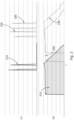
- Figure 2 shows a diagram with a plot of the first process parameter V1 210 and the second process parameter V2 215 of a provided first process data sequence exhibiting the data pattern to be analysed including two peaks.
- plots of two determine process data sequences for the first process parameter V1 220, 230 and the second parameter V2 225, 235 which can comprise a similarity value, which is higher than a defined similarity value limit for analysis of the process data.
- the method as described can provide similarity values corresponding to the two determine process data sequence 210, 220 at an analysis device using an output device, as for instance a screen, and sort the determined process data sequences in accordance to a similarity as calculated by the similarity value.
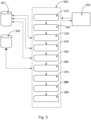
- Figure 3 sketches a flow diagram of a method 300 for analyzing process data related to a segment of a production process.
- a process data sequence of the segment of the production process exhibiting a data pattern of at least one process variable to be analysed is provided, e.g. by a user interface 304, which is configured to plot process data.
- This provision of a process data sequence exhibiting the data pattern to be analysed can be performed using a graphical user interface, which provides access to process data of batches of production processes including related process variables.
- An operator can explore the process variables plotted at the graphical user interface for different batch runs and respective phases of the batches. In particular, the user can examine and/or select a batch with quality problem or undesirable events, which can be shown by the process data.
- a set of metadata of the segment of the production process related to the provided process data sequence including the data pattern for analyse is provided.
- An operator can provide the set of metadata by using a graphical user interface, as e.g. of an analysis device, which can be configured to provide a full set of media data of the process data sequence exhibiting the data pattern to be analysed, as e.g. batch metadata and/or a production material and/or a production recipe and/or a start timestamp and/or an end timestamp of the related batches and/or a start timestamp and/or an end timestamp of the related operations.
- the method can include and/or the analyse device can be configured to select a sub interval of the visualised provided process data sequences including the data pattern to be analysed for calculating the similarity value.
- process data sequences based on the provided set of metadata of the segment of the production process, which are stored in a first database 301 are determined, e.g. by accessing the first database to search for the related process data sequences.
- Meta data can include operation data that record the recipe used in the batches.
- a start timestamp and end timestamp of each of the determined process data sequence are determined, based on the first database 301. Since it is assumed that batches with similar batch metadata should have similar phases, each batch run candidate is expected to have one segment belonging to the batch phase represented by the selected segment. E.g. the user selected two temperature variables, T1 and T2, in the operation "reactor1" for material A, only other T1, T2 temperatures for "reactor1" operations of material A are considered in this process.
- step 350 available process variables and/or names of the process variables are determined based on data stored in the first database.
- the determined process data sequences for analysing the process data are provided, based on the determined start timestamps and end timestamps, which are related to the determined process data sequences, by accessing a second database 300 comprising the process data sequences.
- the set of metadata is adapted to increase or decrease the number of determined process data sequences.
- a methodology for calculating the similarity value is chosen and/or modified, based on at least an analysis of a provided determined process data sequence.
- a similarity value for each of the provided determined process data sequences is calculated by comparing the provided determined process data sequences including the data pattern to be analysed with the provided determined process data sequences of the second database 300, based on the data pattern of the at least one process variable.
- the similarity value is calculated for the provided determined process data sequences of the second database 301 selected by the set of metadata, as e.g. batch runs. If the calculation of the similarity value is chosen to include an overall time range of a batch, the similarity search is applied to this complete operation. If a more focused selection is performed, only a selected part of process data of a segment of a production process is used, according to a windowing approach.
- the calculation of the similarity value related to batch production process quantifies by calculating a similarity value for each of the provided determined process data sequences, by calculating how similar the provided determined process data sequences are to the provided process data sequence exhibiting the data pattern to be analysed, which can be selected by an operator. Using this method and sorting the provided determined process data sequences in respect to the similarity value and operator is able to retrieve process data sequences, which are relevant for further analysis of the production process.
- the method for analysing process data can be extended by parameterizing the search approach such that a new search can be adjusted by an operator, by considering alternative metadata or by labelling retrieved similar batches.
- detection of characteristic data patterns and/or of previously queried data patterns of the provided process data sequence can be automated and performed by querying for these data pattern.
- This automated detection of characteristic data patterns can be applied to process data, which are online available, characterising actually running batches of production processes, for online an analysis of process data.
Landscapes
- Engineering & Computer Science (AREA)
- Theoretical Computer Science (AREA)
- Physics & Mathematics (AREA)
- General Physics & Mathematics (AREA)
- General Engineering & Computer Science (AREA)
- Data Mining & Analysis (AREA)
- Databases & Information Systems (AREA)
- Computational Linguistics (AREA)
- Manufacturing & Machinery (AREA)
- Quality & Reliability (AREA)
- Automation & Control Theory (AREA)
- Library & Information Science (AREA)
- General Factory Administration (AREA)
- Management, Administration, Business Operations System, And Electronic Commerce (AREA)
Claims (13)
- Verfahren (300) zur Analyse von Prozessdaten, die sich auf ein Segment eines Produktionsprozesses beziehen;Bereitstellen einer Prozessdatensequenz des Segments des Produktionsprozesses, die ein Datenmuster von mindestens einer zu analysierenden Prozessvariablen aufweist (310);Bereitstellen eines Satzes von Metadaten des Segments des Produktionsprozesses in Bezug auf die bereitgestellte Prozessdatensequenz (320), wobei die Metadaten Daten in Bezug auf einen Batch-Produktionsprozess umfassen;Bestimmen von Prozessdatensequenzen basierend auf dem bereitgestellten Satz von Metadaten des Segments des Produktionsprozesses (330), wobei die Metadaten in einer ersten Datenbank gespeichert sind;Bestimmen eines Start-Zeitstempels und eines End-Zeitstempels von jeder der bestimmten Prozessdatensequenz (340), basierend auf der ersten Datenbank (301); undBerechnen eines Ähnlichkeitswerts eines Teilintervalls jeder der bestimmten Prozessdatensequenzen im Vergleich zu der bereitgestellten Prozessdatensequenz (390), basierend auf dem Datenmuster der mindestens einen Prozessvariablen,wobei charakteristische Formen der bestimmten Prozessdatensequenzen bestimmt werden, um das Teilintervall für jede der bestimmten Prozessdatensequenzen zu definieren, undwobei die ermittelten Prozessdatensequenzen für die Berechnung basierend auf den zugehörigen Start-Zeitstempeln und End-Zeitstempeln durch Zugriff auf eine zweite Datenbank (302), die die Prozessdatensequenzen enthält, zur Analyse der Prozessdaten bereitgestellt werden, um eine Charge mit einem Qualitätsproblem oder einem unerwünschten Ereignis auszuwählen.
- Verfahren (300) gemäß einem der vorhergehenden Ansprüche, wobei eine Vielzahl der bestimmten Prozessdatensequenzen mit einem ausgewählten Ähnlichkeitswert-Intervall visuell angezeigt wird, um eine neue Prozessdatensequenz bereitzustellen, die gemäß dem vorhergehenden Anspruch zu analysieren ist.
- Verfahren (300) gemäß einem der vorangehenden Ansprüche, wobei die Metadaten einen Batch-Prozess und/oder ein Batch-Prozess-Intervall und/oder einen Produkttyp und/oder einen Operationstyp und/oder eine Phase einer Operation und/oder ein Produktionsrezept und/oder eine Prozessvariable umfassen.
- Verfahren (300) gemäß einem der vorangehenden Ansprüche, wobei die Bestimmung der Prozessdatensequenzen auf einer Teilmenge des bereitgestellten Satzes von Metadaten des Segments des Produktionsprozesses basiert, die in der ersten Datenbank (301) gespeichert sind.
- Verfahren (300) gemäß Anspruch 4, wobei eine Benutzerschnittstelle (304) Zugriff auf den Satz von Metadaten und zugehörigen Prozessvariablen zum Definieren der Teilmenge der Metadaten bietet.
- Das Verfahren (300) gemäß einem der vorhergehenden Ansprüche, wobei eine Zeitspanne des Teilintervalls jeder der bestimmten Prozessdatensequenzen konstant ist.
- Verfahren (300) gemäß einem der vorhergehenden Ansprüche, wobei der Ähnlichkeitswert auf der Grundlage einer euklidischen Abstandsberechnung und/oder auf der Grundlage eines Dynamic Time Warping DTW der betreffenden Prozessdatensequenzen berechnet wird.
- Verfahren (300) gemäß einem der vorangehenden Ansprüche, wobei die Berechnung des Ähnlichkeitswerts eine multivariate Analyse einer Vielzahl von Prozessdatensequenzen umfasst.
- Verfahren, bei dem gemäß einem nach einem der vorhergehenden Ansprüche berechneten Ähnlichkeitswert ein Steuersignal zur Steuerung eines Produktionsprozesses bereitgestellt wird; und/oder auf der Grundlage des Ähnlichkeitswertes ein Warnsignal zur Warnung von Bedienern des Produktionsprozesses bereitgestellt wird.
- Analysevorrichtung, vorzugsweise umfassend einen Computer zur Berechnung eines Ähnlichkeitswerts, konfiguriert zur Durchführung eines Verfahrens gemäß einem der vorangehenden Ansprüche.
- Verwendung eines Ähnlichkeitswerts gemäß Anspruch 1 der ermittelten Prozessdatensequenzen zur Kennzeichnung eines Batch-Prozesses, dessen Produktionsprozess eine Prozessdatensequenz mit einem Ähnlichkeitswert innerhalb eines definierten Ähnlichkeitswert-Intervalls verursacht hat, um eine Charge mit einem Qualitätsproblem oder einem unerwünschten Ereignis auszuwählen.
- Computerprogramm mit Befehlen, die bei Ausführung des Programms durch einen Computer diesen veranlassen, ein Verfahren gemäß einem der Ansprüche 1 bis 9 auszuführen.
- Ein computerlesbares Speichermedium zum Speichern des Computerprogramms gemäß Anspruch 12.
Priority Applications (4)
| Application Number | Priority Date | Filing Date | Title |
|---|---|---|---|
| EP21154372.3A EP4036752B1 (de) | 2021-01-29 | 2021-01-29 | Verfahren zur analyse von prozessdaten in bezug auf ein segment eines produktionsprozesses |
| CN202180092420.5A CN116802625A (zh) | 2021-01-29 | 2021-12-16 | 与生产过程的片段相关的过程数据的分析方法 |
| PCT/EP2021/086161 WO2022161699A1 (en) | 2021-01-29 | 2021-12-16 | Method for analysing process data related to a segment of a production process |
| US18/361,271 US20230367297A1 (en) | 2021-01-29 | 2023-07-28 | Method for Analysing Process Data Related to a Segment of a Production Process |
Applications Claiming Priority (1)
| Application Number | Priority Date | Filing Date | Title |
|---|---|---|---|
| EP21154372.3A EP4036752B1 (de) | 2021-01-29 | 2021-01-29 | Verfahren zur analyse von prozessdaten in bezug auf ein segment eines produktionsprozesses |
Publications (3)
| Publication Number | Publication Date |
|---|---|
| EP4036752A1 EP4036752A1 (de) | 2022-08-03 |
| EP4036752B1 true EP4036752B1 (de) | 2024-10-09 |
| EP4036752C0 EP4036752C0 (de) | 2024-10-09 |
Family
ID=74418328
Family Applications (1)
| Application Number | Title | Priority Date | Filing Date |
|---|---|---|---|
| EP21154372.3A Active EP4036752B1 (de) | 2021-01-29 | 2021-01-29 | Verfahren zur analyse von prozessdaten in bezug auf ein segment eines produktionsprozesses |
Country Status (4)
| Country | Link |
|---|---|
| US (1) | US20230367297A1 (de) |
| EP (1) | EP4036752B1 (de) |
| CN (1) | CN116802625A (de) |
| WO (1) | WO2022161699A1 (de) |
Family Cites Families (8)
| Publication number | Priority date | Publication date | Assignee | Title |
|---|---|---|---|---|
| JP2003058248A (ja) * | 2001-08-10 | 2003-02-28 | Mitsubishi Electric Corp | 運転支援装置 |
| EP2172820A1 (de) * | 2008-10-06 | 2010-04-07 | Basf Se | Verfahren und System zur automatisierten Analyse von Prozessdaten |
| EP2887236A1 (de) * | 2013-12-23 | 2015-06-24 | D square N.V. | System und Verfahren zur Ähnlichkeitssuche in Prozessdaten |
| EP3433711B1 (de) * | 2016-03-23 | 2025-10-01 | Tyco Fire & Security GmbH | Werkzeuge und verfahren für echtzeit-datenflussprogrammiersprache |
| US10747768B2 (en) * | 2016-06-14 | 2020-08-18 | Fuji Xerox Co., Ltd. | Data processing system and data processing method |
| US10853372B1 (en) * | 2016-12-02 | 2020-12-01 | Stc.Unm | Distributed pattern matching over streaming time series |
| CN109241077A (zh) * | 2018-08-30 | 2019-01-18 | 东北大学 | 基于相似性的生产指标变化趋势可视化查询系统及方法 |
| CN109901476B (zh) * | 2019-03-29 | 2020-07-24 | 华能国际电力股份有限公司德州电厂 | 一种基于多变量数据段相似性的异常工况监控方法及系统 |
-
2021
- 2021-01-29 EP EP21154372.3A patent/EP4036752B1/de active Active
- 2021-12-16 CN CN202180092420.5A patent/CN116802625A/zh active Pending
- 2021-12-16 WO PCT/EP2021/086161 patent/WO2022161699A1/en not_active Ceased
-
2023
- 2023-07-28 US US18/361,271 patent/US20230367297A1/en active Pending
Also Published As
| Publication number | Publication date |
|---|---|
| WO2022161699A1 (en) | 2022-08-04 |
| CN116802625A (zh) | 2023-09-22 |
| EP4036752A1 (de) | 2022-08-03 |
| US20230367297A1 (en) | 2023-11-16 |
| EP4036752C0 (de) | 2024-10-09 |
Similar Documents
| Publication | Publication Date | Title |
|---|---|---|
| Hsu et al. | Multiple time-series convolutional neural network for fault detection and diagnosis and empirical study in semiconductor manufacturing | |
| US10482204B2 (en) | System for processing data and modelling for analysis of the energy consumption of a site | |
| US10789257B2 (en) | System and method for similarity search in process data | |
| JP6601433B2 (ja) | イベント解析装置、イベント解析システム、イベント解析方法、イベント解析プログラム及び記録媒体 | |
| US8761909B2 (en) | Batch process monitoring using local multivariate trajectories | |
| US11170332B2 (en) | Data analysis system and apparatus for analyzing manufacturing defects based on key performance indicators | |
| CN109716303A (zh) | 使用k最近邻及逻辑回归方法的时间序列故障检测、故障分类及转变分析 | |
| Graß et al. | Unsupervised anomaly detection in production lines | |
| Kozjek et al. | Interpretative identification of the faulty conditions in a cyclic manufacturing process | |
| US12135536B2 (en) | Method, system and computer program product for monitoring a shaping process | |
| Kozjek et al. | Data mining for fault diagnostics: A case for plastic injection molding | |
| CN107077135A (zh) | 用于识别设备中的干扰的方法和辅助系统 | |
| Zhang et al. | Methodology of data reconciliation and parameter estimation for process systems with multi-operating conditions | |
| Seevers et al. | Automatic detection of manufacturing equipment cycles using time series | |
| CN116982009A (zh) | 工业变点的检测方法与系统 | |
| Sikder et al. | An integrated approach for multivariate statistical process control using Mahalanobis-Taguchi System and Andrews function | |
| US20230367297A1 (en) | Method for Analysing Process Data Related to a Segment of a Production Process | |
| US20100033486A1 (en) | Method and system of determining and visualizing dependencies between industrial process parameters | |
| Ochel et al. | Semantically meaningful segmentation of milling process data | |
| US12607993B2 (en) | Construction method of abnormality diagnosis model, abnormality diagnosis method, construction device of abnormality diagnosis model, and abnormality diagnosis device | |
| CN118760789B (zh) | 一种数据回放时间区域的筛选方法、设备及介质 | |
| CN118820739B (zh) | 基于关键点识别的时序数据可视化回放方法、设备及介质 | |
| CN121563321B (zh) | 一种电缆生产工艺参数优化方法及系统 | |
| CN111108455A (zh) | 数据分类装置 | |
| CN116975561B (zh) | 一种基于step格式的车床工艺识别方法 |
Legal Events
| Date | Code | Title | Description |
|---|---|---|---|
| PUAI | Public reference made under article 153(3) epc to a published international application that has entered the european phase |
Free format text: ORIGINAL CODE: 0009012 |
|
| STAA | Information on the status of an ep patent application or granted ep patent |
Free format text: STATUS: THE APPLICATION HAS BEEN PUBLISHED |
|
| AK | Designated contracting states |
Kind code of ref document: A1 Designated state(s): AL AT BE BG CH CY CZ DE DK EE ES FI FR GB GR HR HU IE IS IT LI LT LU LV MC MK MT NL NO PL PT RO RS SE SI SK SM TR |
|
| STAA | Information on the status of an ep patent application or granted ep patent |
Free format text: STATUS: REQUEST FOR EXAMINATION WAS MADE |
|
| 17P | Request for examination filed |
Effective date: 20230131 |
|
| RBV | Designated contracting states (corrected) |
Designated state(s): AL AT BE BG CH CY CZ DE DK EE ES FI FR GB GR HR HU IE IS IT LI LT LU LV MC MK MT NL NO PL PT RO RS SE SI SK SM TR |
|
| GRAP | Despatch of communication of intention to grant a patent |
Free format text: ORIGINAL CODE: EPIDOSNIGR1 |
|
| STAA | Information on the status of an ep patent application or granted ep patent |
Free format text: STATUS: GRANT OF PATENT IS INTENDED |
|
| INTG | Intention to grant announced |
Effective date: 20240620 |
|
| GRAS | Grant fee paid |
Free format text: ORIGINAL CODE: EPIDOSNIGR3 |
|
| GRAA | (expected) grant |
Free format text: ORIGINAL CODE: 0009210 |
|
| STAA | Information on the status of an ep patent application or granted ep patent |
Free format text: STATUS: THE PATENT HAS BEEN GRANTED |
|
| AK | Designated contracting states |
Kind code of ref document: B1 Designated state(s): AL AT BE BG CH CY CZ DE DK EE ES FI FR GB GR HR HU IE IS IT LI LT LU LV MC MK MT NL NO PL PT RO RS SE SI SK SM TR |
|
| REG | Reference to a national code |
Ref country code: CH Ref legal event code: EP |
|
| REG | Reference to a national code |
Ref country code: DE Ref legal event code: R096 Ref document number: 602021019759 Country of ref document: DE |
|
| REG | Reference to a national code |
Ref country code: IE Ref legal event code: FG4D |
|
| U01 | Request for unitary effect filed |
Effective date: 20241107 |
|
| U07 | Unitary effect registered |
Designated state(s): AT BE BG DE DK EE FI FR IT LT LU LV MT NL PT RO SE SI Effective date: 20241115 |
|
| U20 | Renewal fee for the european patent with unitary effect paid |
Year of fee payment: 5 Effective date: 20250128 |
|
| PG25 | Lapsed in a contracting state [announced via postgrant information from national office to epo] |
Ref country code: IS Free format text: LAPSE BECAUSE OF FAILURE TO SUBMIT A TRANSLATION OF THE DESCRIPTION OR TO PAY THE FEE WITHIN THE PRESCRIBED TIME-LIMIT Effective date: 20250209 Ref country code: HR Free format text: LAPSE BECAUSE OF FAILURE TO SUBMIT A TRANSLATION OF THE DESCRIPTION OR TO PAY THE FEE WITHIN THE PRESCRIBED TIME-LIMIT Effective date: 20241009 |
|
| PG25 | Lapsed in a contracting state [announced via postgrant information from national office to epo] |
Ref country code: ES Free format text: LAPSE BECAUSE OF FAILURE TO SUBMIT A TRANSLATION OF THE DESCRIPTION OR TO PAY THE FEE WITHIN THE PRESCRIBED TIME-LIMIT Effective date: 20241009 |
|
| PG25 | Lapsed in a contracting state [announced via postgrant information from national office to epo] |
Ref country code: GR Free format text: LAPSE BECAUSE OF FAILURE TO SUBMIT A TRANSLATION OF THE DESCRIPTION OR TO PAY THE FEE WITHIN THE PRESCRIBED TIME-LIMIT Effective date: 20250110 |
|
| PG25 | Lapsed in a contracting state [announced via postgrant information from national office to epo] |
Ref country code: PL Free format text: LAPSE BECAUSE OF FAILURE TO SUBMIT A TRANSLATION OF THE DESCRIPTION OR TO PAY THE FEE WITHIN THE PRESCRIBED TIME-LIMIT Effective date: 20241009 |
|
| PG25 | Lapsed in a contracting state [announced via postgrant information from national office to epo] |
Ref country code: RS Free format text: LAPSE BECAUSE OF FAILURE TO SUBMIT A TRANSLATION OF THE DESCRIPTION OR TO PAY THE FEE WITHIN THE PRESCRIBED TIME-LIMIT Effective date: 20250109 |
|
| PG25 | Lapsed in a contracting state [announced via postgrant information from national office to epo] |
Ref country code: SM Free format text: LAPSE BECAUSE OF FAILURE TO SUBMIT A TRANSLATION OF THE DESCRIPTION OR TO PAY THE FEE WITHIN THE PRESCRIBED TIME-LIMIT Effective date: 20241009 |
|
| PG25 | Lapsed in a contracting state [announced via postgrant information from national office to epo] |
Ref country code: SK Free format text: LAPSE BECAUSE OF FAILURE TO SUBMIT A TRANSLATION OF THE DESCRIPTION OR TO PAY THE FEE WITHIN THE PRESCRIBED TIME-LIMIT Effective date: 20241009 |
|
| PG25 | Lapsed in a contracting state [announced via postgrant information from national office to epo] |
Ref country code: CZ Free format text: LAPSE BECAUSE OF FAILURE TO SUBMIT A TRANSLATION OF THE DESCRIPTION OR TO PAY THE FEE WITHIN THE PRESCRIBED TIME-LIMIT Effective date: 20241009 |
|
| PLBE | No opposition filed within time limit |
Free format text: ORIGINAL CODE: 0009261 |
|
| STAA | Information on the status of an ep patent application or granted ep patent |
Free format text: STATUS: NO OPPOSITION FILED WITHIN TIME LIMIT |
|
| REG | Reference to a national code |
Ref country code: CH Ref legal event code: PL |
|
| PG25 | Lapsed in a contracting state [announced via postgrant information from national office to epo] |
Ref country code: MC Free format text: LAPSE BECAUSE OF FAILURE TO SUBMIT A TRANSLATION OF THE DESCRIPTION OR TO PAY THE FEE WITHIN THE PRESCRIBED TIME-LIMIT Effective date: 20241009 |
|
| 26N | No opposition filed |
Effective date: 20250710 |
|
| PG25 | Lapsed in a contracting state [announced via postgrant information from national office to epo] |
Ref country code: CH Free format text: LAPSE BECAUSE OF NON-PAYMENT OF DUE FEES Effective date: 20250131 |
|
| PG25 | Lapsed in a contracting state [announced via postgrant information from national office to epo] |
Ref country code: IE Free format text: LAPSE BECAUSE OF NON-PAYMENT OF DUE FEES Effective date: 20250129 |
|
| U20 | Renewal fee for the european patent with unitary effect paid |
Year of fee payment: 6 Effective date: 20260129 |
|
| PGFP | Annual fee paid to national office [announced via postgrant information from national office to epo] |
Ref country code: GB Payment date: 20260123 Year of fee payment: 6 |
|
| PGFP | Annual fee paid to national office [announced via postgrant information from national office to epo] |
Ref country code: NO Payment date: 20260123 Year of fee payment: 6 |