EP4036740A1 - Informationssicherheit - Google Patents
Informationssicherheit Download PDFInfo
- Publication number
- EP4036740A1 EP4036740A1 EP21216954.4A EP21216954A EP4036740A1 EP 4036740 A1 EP4036740 A1 EP 4036740A1 EP 21216954 A EP21216954 A EP 21216954A EP 4036740 A1 EP4036740 A1 EP 4036740A1
- Authority
- EP
- European Patent Office
- Prior art keywords
- test
- behavioural
- behaviour
- thread
- computer program
- Prior art date
- Legal status (The legal status is an assumption and is not a legal conclusion. Google has not performed a legal analysis and makes no representation as to the accuracy of the status listed.)
- Withdrawn
Links
Images

Classifications
-
- G—PHYSICS
- G06—COMPUTING OR CALCULATING; COUNTING
- G06F—ELECTRIC DIGITAL DATA PROCESSING
- G06F11/00—Error detection; Error correction; Monitoring
- G06F11/36—Prevention of errors by analysis, debugging or testing of software
- G06F11/3668—Testing of software
- G06F11/3672—Test management
- G06F11/3684—Test management for test design, e.g. generating new test cases
-
- G—PHYSICS
- G06—COMPUTING OR CALCULATING; COUNTING
- G06F—ELECTRIC DIGITAL DATA PROCESSING
- G06F21/00—Security arrangements for protecting computers, components thereof, programs or data against unauthorised activity
- G06F21/50—Monitoring users, programs or devices to maintain the integrity of platforms, e.g. of processors, firmware or operating systems
- G06F21/52—Monitoring users, programs or devices to maintain the integrity of platforms, e.g. of processors, firmware or operating systems during program execution, e.g. stack integrity ; Preventing unwanted data erasure; Buffer overflow
- G06F21/53—Monitoring users, programs or devices to maintain the integrity of platforms, e.g. of processors, firmware or operating systems during program execution, e.g. stack integrity ; Preventing unwanted data erasure; Buffer overflow by executing in a restricted environment, e.g. sandbox or secure virtual machine
-
- G—PHYSICS
- G06—COMPUTING OR CALCULATING; COUNTING
- G06F—ELECTRIC DIGITAL DATA PROCESSING
- G06F11/00—Error detection; Error correction; Monitoring
- G06F11/36—Prevention of errors by analysis, debugging or testing of software
- G06F11/362—Debugging of software
- G06F11/3636—Debugging of software by tracing the execution of the program
-
- G—PHYSICS
- G06—COMPUTING OR CALCULATING; COUNTING
- G06F—ELECTRIC DIGITAL DATA PROCESSING
- G06F11/00—Error detection; Error correction; Monitoring
- G06F11/36—Prevention of errors by analysis, debugging or testing of software
- G06F11/3668—Testing of software
- G06F11/3672—Test management
- G06F11/3688—Test management for test execution, e.g. scheduling of test suites
-
- G—PHYSICS
- G06—COMPUTING OR CALCULATING; COUNTING
- G06F—ELECTRIC DIGITAL DATA PROCESSING
- G06F21/00—Security arrangements for protecting computers, components thereof, programs or data against unauthorised activity
- G06F21/50—Monitoring users, programs or devices to maintain the integrity of platforms, e.g. of processors, firmware or operating systems
- G06F21/55—Detecting local intrusion or implementing counter-measures
- G06F21/552—Detecting local intrusion or implementing counter-measures involving long-term monitoring or reporting
-
- G—PHYSICS
- G06—COMPUTING OR CALCULATING; COUNTING
- G06F—ELECTRIC DIGITAL DATA PROCESSING
- G06F21/00—Security arrangements for protecting computers, components thereof, programs or data against unauthorised activity
- G06F21/50—Monitoring users, programs or devices to maintain the integrity of platforms, e.g. of processors, firmware or operating systems
- G06F21/55—Detecting local intrusion or implementing counter-measures
- G06F21/56—Computer malware detection or handling, e.g. anti-virus arrangements
- G06F21/566—Dynamic detection, i.e. detection performed at run-time, e.g. emulation, suspicious activities
-
- H—ELECTRICITY
- H04—ELECTRIC COMMUNICATION TECHNIQUE
- H04L—TRANSMISSION OF DIGITAL INFORMATION, e.g. TELEGRAPHIC COMMUNICATION
- H04L63/00—Network architectures or network communication protocols for network security
- H04L63/14—Network architectures or network communication protocols for network security for detecting or protecting against malicious traffic
- H04L63/1408—Network architectures or network communication protocols for network security for detecting or protecting against malicious traffic by monitoring network traffic
- H04L63/1425—Traffic logging, e.g. anomaly detection
-
- H—ELECTRICITY
- H04—ELECTRIC COMMUNICATION TECHNIQUE
- H04L—TRANSMISSION OF DIGITAL INFORMATION, e.g. TELEGRAPHIC COMMUNICATION
- H04L63/00—Network architectures or network communication protocols for network security
- H04L63/14—Network architectures or network communication protocols for network security for detecting or protecting against malicious traffic
- H04L63/1433—Vulnerability analysis
-
- H—ELECTRICITY
- H04—ELECTRIC COMMUNICATION TECHNIQUE
- H04W—WIRELESS COMMUNICATION NETWORKS
- H04W12/00—Security arrangements; Authentication; Protecting privacy or anonymity
- H04W12/12—Detection or prevention of fraud
- H04W12/121—Wireless intrusion detection systems [WIDS]; Wireless intrusion prevention systems [WIPS]
-
- G—PHYSICS
- G06—COMPUTING OR CALCULATING; COUNTING
- G06F—ELECTRIC DIGITAL DATA PROCESSING
- G06F2221/00—Indexing scheme relating to security arrangements for protecting computers, components thereof, programs or data against unauthorised activity
- G06F2221/03—Indexing scheme relating to G06F21/50, monitoring users, programs or devices to maintain the integrity of platforms
- G06F2221/033—Test or assess software
Definitions
- the present disclosure pertains to information security against maliciously behaving programs.
- a major portion of the software product serves other purposes than client-facing functionalities, such as security controls, high availability defence mechanisms and internal QoS monitoring, for example.
- a method comprising compiling a behavioural baseline database comprising system call behaviours of a computer program, using a first testing process based at least partly on emulated nodes, running a second test, using live nodes, of the computer program and logging system call behaviour of the computer program during the second test, and determining whether the system call behaviour logged during the second test comprises behaviour deviating from the behavioural baseline database.
- an apparatus comprising at least one processing core, at least one memory including computer program code, the at least one memory and the computer program code being configured to, with the at least one processing core, cause the apparatus at least to compile a behavioural baseline database comprising system call behaviours of a computer program, using a first testing process based at least partly on emulated nodes, run a second test of the computer program, using live nodes, and logging system call behaviour of the computer program during the second test, and determine whether the system call behaviour logged during the second test comprises behaviour deviating from the behavioural baseline database.
- the apparatus wherein the at least one memory and the computer program code are configured to, with the at least one processing core, further cause the apparatus to create a report concerning at least one further test case for the first testing as a response to the system call behaviour logged during the second test comprising behaviour deviating from the behavioural baseline database.
- the apparatus according to second or the third aspect, wherein the at least one memory and the computer program code are configured to, with the at least one processing core, further cause the apparatus to compile a further behavioural baseline database of system call behaviour of the computer program, using the first testing process, based at least partly on the emulated nodes, enhanced to reproduce system call behaviours seen during the second test but absent from the behavioural baseline database, and use the further behavioural baseline database to perform intrusion detection in a live computing system, or include the further behavioural baseline database in a same software package with the computer program to enable the intrusion detection when the computer program is run.
- the apparatus according to any of the second to fourth aspects, wherein the first testing process is an integration testing process, and wherein the second test is a validation test.
- the apparatus according to the fifth aspect, wherein the computer program is a software suite configured to control functioning of at least a part of a cellular communication system, where the emulated nodes comprise emulated cellular user equipments and where the live nodes comprise actual cellular user equipments.
- the apparatus according to the sixth aspect, wherein the at least the part of the cellular communication system comprises at least a part of a fifth generation cellular communication system, as specified by the third generation partnership project.
- the apparatus according to any of the second to the seventh aspects, wherein the behavioural baseline database comprises, associated together, thread identifiers and system call sequences invoked by the respective threads during the first testing process.
- the apparatus comprises, for threads observed in the first testing process, further information associated with individual ones of the observed threads, the further information comprising at least one of the following: a thread name, a thread used stack size, a timing information relating to the thread and sequence information indicating a sequence in which the observed threads are observed.
- the apparatus according to any of the second to the ninth aspects, wherein the at least one memory and the computer program code are configured to, with the at least one processing core, further cause the apparatus to include at least one of the following in a set of deviations observed between the behavioural baseline database and behaviour observed during the second test: logs of software components tested in the second test before and up to the time the deviation was observed, traces of software components tested in the second test before and up to the time the deviation was observed and/or a timestamp with thread information.
- the apparatus according to any of the fourth aspect or any of the fifth to tenth aspects as dependent on the fourth aspect, wherein the apparatus is configured to perform the intrusion detection at least in part by detecting that at least one first thread observed during the intrusion detection deviates from the system call behaviour in the further behavioural baseline database, and by flagging the at least one first thread for a security action.
- the apparatus comprises at least one of the following: logging the at least one first thread in a log, providing an indication to human operators of the at least one first thread, reducing an operating priority of the at least one first thread and terminating the at least one first thread.
- the apparatus according to any of the fourth aspect or any of the fifth to twelfth aspects as dependent on the fourth aspect, wherein the apparatus is configured to, before compiling the further behavioural baseline database, compile at least one intermediate behavioural baseline database in an iterative process wherein deviations seen in the second test trigger enhancement of the first testing process, the further behavioural baseline database being generated as a result of the iterative process.
- the apparatus is configured to perform the iterative process by compiling at least three intermediate behavioural baseline databases.
- an apparatus comprising means for compiling a behavioural baseline database comprising system call behaviours of a computer program, using a first testing process based at least partly on emulated nodes, means for running a second test of the computer program using live nodes and logging system call behaviour of the computer program during the second test, and means for determining whether the system call behaviour logged during the second test comprises behaviour deviating from the behavioural baseline database.
- a non-transitory computer readable medium having stored thereon a set of computer readable instructions that, when executed by at least one processor, cause an apparatus to at least compile a behavioural baseline database comprising system call behaviours of a computer program, using a first testing process based at least partly on emulated nodes, run a second test of the computer program using live nodes and logging system call behaviour of the computer program during the second test, and determining whether the system call behaviour logged during the second test comprises behaviour deviating from the behavioural baseline database.
- a computer program configured to cause an apparatus to perform at least the following, when run: compile a behavioural baseline database comprising system call behaviours of a computer program, using a first testing process based at least partly on emulated nodes, run a second test of the computer program using live nodes and logging system call behaviour of the computer program during the second test, and determining whether the system call behaviour logged in the second test comprises behaviour deviating from the behavioural baseline database.
- An enhanced intrusion detection system is obtained in performing validation tests in a controlled environment, such that behavioural deviations from program behaviour seen in integration testing of the tested program can inform and enhance a new round of integration testing, to enhance the understanding of program behaviour.
- the tested program may comprise a multi-thread program, for example.
- the enhanced integration testing process yields a behavioural baseline database against which behaviour of observed threads may be compared to determine if the threads are behaving in potentially malicious ways.
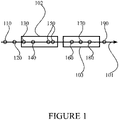
- FIGURE 1 illustrates an example software development pipeline.
- the aim of the development is to produce and/or maintain a computer program, which may comprise plural modules, for example.
- the pipeline 101 comprises a coding phase 110, a committing phase 120, a continuous integration, CI, pipeline 102 which comprises a build phase 130, unit testing 140 of parts of the program separately, and integration tests 150.
- the pipeline comprises a continuous delivery, CD, pipeline comprising a review phase 160, a staging phase 170 and a validation test 180. Release to production 190 takes place after CD pipeline 103.
- the various phases may be performed at least partly concurrently, and in some cases individual ones of the phases may be omitted, for example the review phase 160 may sometimes be omitted.
- integration testing may comprise testing where individual software modules are combined and tested as a group. Validation testing aims to test a software package in an environment close to a realistic deployment environment. In some cases, validation testing may be referred to as verification testing.
- test case coverage of the computer program to be developed is test case coverage of the computer program to be developed. Ideally 100% of the program behaviour would be tested. In real life, test cases rarely cover each and every behaviour of every branch of the code of the program. For example, the code produced to take care of exceptional fail scenarios may be difficult to test in an automated methodology, as are fail-safe complete sequences.
- Unit tests 140 where tools exist for developers to see and measure what code has been triggered, are in this sense different from integration tests 150, that aim at testing every behavior of the overall program, including interactions between units of the program. Further, it may be difficult to know the extent of coverage of test cases used in integration testing 150. Poorly tested programs, especially in the telecommunication industry, are not only harder to maintain but may also delay deployment time, jeopardize contract fulfilment, provoke penalties, and impair relation with customers. Further, importantly, poorly tested programs produce security vulnerabilities.
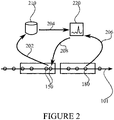
- FIGURE 2 illustrates an example method in accordance with at least some embodiments of the present invention.
- Pipeline 101 corresponds to pipeline 101 in FIGURE 1 .
- Like numbering denotes like functionality as in FIGURE 1 .
- Some phases of pipeline 101 may be omitted in the process of FIGURE 2 .
- Relevant for the process of FIGURE 2 are at least integration tests 150 and validation test 180.
- a monitoring process 202 is performed to log at least system calls made by threads during integration testing 150.
- a system call is a request sent to the kernel of the operating system.
- System call behaviour of threads is compiled into behavioural baseline database 210, which will be referred to herein as database 210 for the sake of brevity.
- Database 210 comprises information on individual threads running during integration testing 150, and system calls made by these threads, recorded in the database per thread.
- Database 210 may store system call sequences per thread, indicating which system calls were invoked by the specific threads, and the order in which the system calls were invoked by the specific thread.
- Duplicates of the same thread may be omitted from database 210 such that database 210 will have a set of thread types and data describing, separately, behaviour of each thread type.
- the system call behaviour may be collected using an automated test environment used to run the integration testing and/or by using a kernel probe, for example.
- An example of a kernel probe is a Berkeley packet filter, eBPF, probe.
- database 210 comprises also further information concerning each observed thread or thread type, such as, for example, at least one of the following: a thread name, a thread used stack size, a timing information relating to the thread and sequence information indicating a sequence in which the observed threads are observed.
- Timing information may indicate, for example, how long the thread remains active between its launching and its termination.
- a sequence in which the observed threads are observed may indicate which thread is a child or parent of another specific thread or thread type, and/or an indication that a certain thread type is launched within a predetermined time interval, such as 10 milliseconds or 100 milliseconds, for example, of launch of another, specific, thread type.
- the further information may also include indications that certain thread types are launched during specific time windows, and certain other thread types are launched during other specific time windows.
- the integration testing 150 may be performed using emulated nodes which interact with the computer program being tested.
- the emulated nodes may be emulated web browsers or emulated user equipments, UEs, of cellular communication systems, for example.
- the computer program may be configured to perform at least a part of the functioning of a cloud computing or cloud service platform.
- Integration testing 150 may be based on set of test cases intended to invoke all functionalities of the program being tested, to produce a comprehensive database 210. However, ensuring that all functionality of the program is invoked in integration testing 150 is a challenge in case the program is complex, as the set of test cases may not be diverse enough to stimulate the program to go through all of its functionality. In the case that the test set is too narrow, a part of the program will remain untested in integration testing 150 and database 210 will not contain all the legitimate, benign behaviour of the program.
- validation testing 180 which may be performed in a secure environment in which it is known that no malicious software is present, once more the behaviour of the program is monitored, as it was during integration testing 150.
- Validation testing 180 mays use live nodes, such as live web browsers with real users or running on automated programs, or live UEs of a cellular communication network.
- the monitoring 206 of the behaviour of the program during validation testing 180 is used to gather information of the program's behaviour, which is compared to behaviour recorded in database 210.
- the contents of database 210 are provided to determining of deviation set 220 in phase 204. In other words, it is checked, if program behaviour is detected during validation testing 180, which was not observed during integration testing 150. In case such behaviour is detected, deviation set 220 is a non-empty set.
- the behaviours may be compared like for like, in other words, the types of behaviour monitored in validation testing 180 may be the same as was monitored in integration tests 150.
- validation testing 180 is performed in the secure environment is here leveraged to dependably enable determination of the deviations 220.
- the validation test was performed in a non-secured environment, it would be more difficult to determine whether any deviations from database 210 are due to an overly narrow test set for integration testing or from maliciously behaving software.
- Deviation set 220 may be a data structure, wherein a thread identifier is stored in association with system call and, optionally, also other behaviour of the thread which behaved in a manner not recorded in database 210. Also metadata, and/or a timestamp may be recorded with the thread information in the deviations set 220.
- the metadata may comprise, for example, a name, the function tested and/or parameters.
- the metadata may further comprise, for example, logs and/or traces of software components tested in the validation test before and up to the time the deviation was observed.
- the deviation set 220 constitutes effectively a proof of lack of integration test coverage, as it reflects behaviour of the program which was not invoked during integration testing 150 but which was seen in the validation test 180, run in a secure environment. The more comprehensive is the validation test 180, the more comprehensive is the deviation set 220. In other words, if the integration testing is insufficiently diverse, a well conducted validation test will uncover the insufficiency of the integration testing more comprehensively.
- each deviation in deviation set 220 is classified as a potential bug for coders to correct in a subsequent round of software development.
- deviation set 220 may be indicated to operators, for example in a dashboard type display.
- the system calls, and optionally also other behaviour, in deviation set 220 may indicate which aspects of the program were not tested in integration testing 150. For example, if it is known that a specific kind of system call is only invoked by one function in the program, and this system call shows up in the data of deviation set 220, it may be determined, for example automatically, that this specific function was not invoked by the integration test set.
- the integration test set is expanded as a response to the contents of deviation set 220.
- a report concerning at least one further integration test case is created as a response to the system call behaviour logged during the validation test comprising behaviour deviating from the behavioural baseline database.
- the report may indicate one or more of a source code structure, such as a loop, a function, an object-oriented class, an event, and an interface, which may contribute to the behavioral deviation(s).
- the information indicated by the report may be found in the corresponding validation test cases that cause the deviations, for example.
- the report may inform enhancement of the integration testing 150. For example, test cases may be added to the integration test set automatically based on the system call behaviour recorded in deviation set 220.
- a human operator may add the test cases to the integration test set.
- a new integration test process is run using the expanded test set, amounting to an enhanced integration testing process 150.
- the enhanced integration testing process is monitored as before, to produce a further behavioural baseline database 210, or further database 210 in brief.
- further database 210 contains the behaviour in deviation set 220, the expanding of the integration test set has been successful in capturing the previously un-tested functionality of the program.
- further database 210 contains in part the behaviour in deviation set 220, the expanding of the integration test set has been partly successful in capturing the previously un-tested functionality of the program.
- phase 208 may be performed again, to once more expand the integration test set with at least one further test case in a bid to replicate the full behaviour detected in validation testing 180 also in integration testing 150.
- deviations from the previous validation test 180 which do not re-occur have been successfully covered in the enhanced integration testing.
- the process may be operated in an iterative manner until deviation set 220 is empty, or has fewer than a threshold number of deviations amounting to a stop condition.
- the further database 210 from the final iteration of the process may be used in an intrusion detection mechanism.
- it may be determined whether one or more threads in the live environment behave in a manner, or manners, not comprised in the further database 210.
- Such threads may then be flagged for a security action, such as logging, de-prioritising or termination, for example.
- a separate determination is made concerning a thread deviating from behaviour in further database 210 and the security action is selected from a list of security actions based on a result of the separate determination. For example, in some embodiments, if the deviating thread behaves in manner which meets certain criteria, it is logged in a log file but if it behaves in a manner that deviated from both further database 210 and the criteria, it is terminated.
- the further database 210 from the final, or only, iteration of the process of FIGURE 2 may be delivered together with the program for use in intrusion detection when the program is run.
- the further database may be included in a same software package with the computer program to enable the enhanced intrusion detection when the computer program is later run in a live setting.
- this deviation is associated with a counter which is incremented each time the validation test is run without the deviation being detected.
- the deviation is then considered fully resolved responsive to the counter reaching the preconfigured counter threshold.
- FIGURE 3 illustrates an example apparatus capable of supporting at least some embodiments of the present invention.
- device 300 which may comprise, for example, computing substrate used to test and/or run the multi-thread computer program.
- processor 310 which may comprise, for example, a single- or multi-core processor wherein a single-core processor comprises one processing core and a multi-core processor comprises more than one processing core.
- Processor 310 may comprise, in general, a control device.
- Processor 310 may comprise more than one processor.
- Processor 310 may be a control device.
- a processing core may comprise, for example, a Cortex-A8 processing core manufactured by ARM Holdings or a Zen processing core designed by Advanced Micro Devices Corporation.
- Processor 310 may comprise at least one Intel Xeon and/or AMD Threadripper processor.
- Processor 310 may comprise at least one application-specific integrated circuit, ASIC.
- Processor 310 may comprise at least one field-programmable gate array, FPGA.
- Processor 310 may be means for performing method steps in device 300, such as compiling, running and using, for example.
- Processor 310 may be configured, at least in part by computer instructions, to perform actions.
- a processor may comprise circuitry, or be constituted as circuitry or circuitries, the circuitry or circuitries being configured to perform phases of methods in accordance with embodiments described herein.
- circuitry may refer to one or more or all of the following: (a) hardware-only circuit implementations, such as implementations in only analogue and/or digital circuitry, and (b) combinations of hardware circuits and software, such as, as applicable: (i) a combination of analogue and/or digital hardware circuit(s) with software/firmware and (ii) any portions of hardware processor(s) with software (including digital signal processor(s)), software, and memory(ies) that work together to cause an apparatus, such as a server, to perform various function(s) and (c) hardware circuit(s) and or processor(s), such as a microprocessor(s) or a portion of a microprocessor(s), that requires software (e.g., firmware) for operation, but the software may not be present when it is not needed for operation.
- firmware firmware
- circuitry also covers an implementation of merely a hardware circuit or processor (or multiple processors) or portion of a hardware circuit or processor and its (or their) accompanying software and/or firmware.
- circuitry also covers, for example and if applicable to the particular claim element, a baseband integrated circuit or processor integrated circuit for a mobile device or a similar integrated circuit in server, a cellular network device, or other computing or network device.
- Device 300 may comprise memory 320.
- Memory 320 may comprise random-access memory and/or permanent memory.
- Memory 320 may comprise at least one RAM chip.
- Memory 320 may comprise solid-state, magnetic, optical and/or holographic memory, for example.
- Memory 320 may be at least in part accessible to processor 310.
- Memory 320 may be at least in part comprised in processor 310.
- Memory 320 may be means for storing information.
- Memory 320 may comprise computer instructions that processor 310 is configured to execute. When computer instructions configured to cause processor 310 to perform certain actions are stored in memory 320, and device 300 overall is configured to run under the direction of processor 310 using computer instructions from memory 320, processor 310 and/or its at least one processing core may be considered to be configured to perform said certain actions.
- Memory 320 may be at least in part comprised in processor 310.
- Memory 320 may be at least in part external to device 300 but accessible to device 300.
- Device 300 may comprise a transmitter 330.
- Device 300 may comprise a receiver 340.
- Transmitter 330 and receiver 340 may be configured to transmit and receive, respectively, information in accordance with at least one cellular or non-cellular standard.
- Transmitter 330 may comprise more than one transmitter.
- Receiver 340 may comprise more than one receiver.
- Device 300 may comprise user interface, UI, 360.
- UI 360 may comprise at least one of a display, a keyboard, a touchscreen, a vibrator arranged to signal to a user by causing device 300 to vibrate, a speaker and a microphone.
- a user may be able to operate device 300 via UI 360, for example to configure intruder detection parameters.
- Processor 310 may be furnished with a transmitter arranged to output information from processor 310, via electrical leads internal to device 300, to other devices comprised in device 300.
- a transmitter may comprise a serial bus transmitter arranged to, for example, output information via at least one electrical lead to memory 320 for storage therein.
- the transmitter may comprise a parallel bus transmitter.
- processor 310 may comprise a receiver arranged to receive information in processor 310, via electrical leads internal to device 300, from other devices comprised in device 300.
- Such a receiver may comprise a serial bus receiver arranged to, for example, receive information via at least one electrical lead from receiver 340 for processing in processor 310.
- the receiver may comprise a parallel bus receiver.
- Device 300 may comprise further devices not illustrated in FIGURE 3 .
- Processor 310, memory 320, transmitter 330, receiver 340 and/or UI 360 may be interconnected by electrical leads internal to device 300 in a multitude of different ways.
- each of the aforementioned devices may be separately connected to a master bus internal to device 300, to allow for the devices to exchange information.
- this is only one example and depending on the embodiment various ways of interconnecting at least two of the aforementioned devices may be selected without departing from the scope of the present invention.
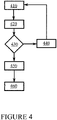
- FIGURE 4 is a flow graph in accordance with at least some embodiments of the present invention.
- integration testing of a multi-thread computer program is conducted.
- a database 210 is compiled of thread behaviours observed during the integration testing. Integration testing may be conducted with emulated nodes interacting with the computer program.
- phase 420 validation testing is conducted.
- behaviour of the computer program is observed and behaviour of threads is recorded, for example in terms of system calls made by the threads.
- Validation testing may be conducted with live nodes interacting with the computer program.
- a deviation set 220 is compiled by including in the deviation set threads, and behaviour of the threads, which behave in a manner not present in the database 210 compiled in connection with the integration testing.
- phase 430 it is determined, if the deviation set 220 is short enough to fulfil a stop condition.
- the stop condition may be that deviation set 220 is empty, that is, comprising zero threads, or that deviation set 220 has fewer than a preconfigured number of threads. In case deviation set 220 fails to fulfil the stop condition, processing advances to phase 440.
- phase 440 at least one additional integration test case is determined responsive to the contents of the deviation set 220.
- the at least one additional integration test case may be automatically generated based on system call types present in deviation set 220.
- the enhanced integration testing is likely to reproduce at least some of the behaviour included in the deviation set 220, and this is included in the further database 210 compiled in connection with the enhanced integration testing process.
- phase 450 the further database 210 is established as the baseline behavioural database of the computer program.
- phase 460 the established baseline behavioural database of the computer program is used in intrusion detection, yielding the benefit and technical effect that the intrusion detection process is more accurate, since the legitimate, benign behaviour is more precisely defined.
- the intrusion detection mechanism produces fewer false positives, enabling more meaningful reaction to findings which are flagged during the intrusion detection. As a result, information security is improved since malicious programs have less possibilities to masquerade as legitimate threads.
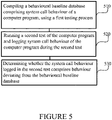
- FIGURE 5 is a flow graph of a method in accordance with at least some embodiments of the present invention.
- the phases of the illustrated method may be performed in a computing substrate such as a server comprising a memory and at least one processor, for example.
- Phase 510 comprises compiling a behavioural baseline database comprising system call behaviours of a computer program, using a first testing process.
- Phase 520 comprises running a second test of the computer program and logging system call behaviour of the computer program during the second test.
- the first testing process may comprise an integration testing process
- the second test may comprise a validation test.
- the validation test may be a software validation test.
- Phase 530 comprises determining whether the system call behaviour logged in the validation test comprises behaviour deviating from the behavioural baseline database. Phase 530 may be optional or implicit in further phases, where present.
- At least some embodiments of the present invention find industrial application in information security, such as, for example, communication network security.
Landscapes
- Engineering & Computer Science (AREA)
- Computer Security & Cryptography (AREA)
- Theoretical Computer Science (AREA)
- General Engineering & Computer Science (AREA)
- Computer Hardware Design (AREA)
- Software Systems (AREA)
- Physics & Mathematics (AREA)
- General Physics & Mathematics (AREA)
- Signal Processing (AREA)
- Computer Networks & Wireless Communication (AREA)
- Quality & Reliability (AREA)
- Computing Systems (AREA)
- Health & Medical Sciences (AREA)
- General Health & Medical Sciences (AREA)
- Virology (AREA)
- Debugging And Monitoring (AREA)
Applications Claiming Priority (1)
| Application Number | Priority Date | Filing Date | Title |
|---|---|---|---|
| FI20215089 | 2021-01-27 |
Publications (1)
| Publication Number | Publication Date |
|---|---|
| EP4036740A1 true EP4036740A1 (de) | 2022-08-03 |
Family
ID=79185636
Family Applications (1)
| Application Number | Title | Priority Date | Filing Date |
|---|---|---|---|
| EP21216954.4A Withdrawn EP4036740A1 (de) | 2021-01-27 | 2021-12-22 | Informationssicherheit |
Country Status (2)
| Country | Link |
|---|---|
| US (1) | US20220237284A1 (de) |
| EP (1) | EP4036740A1 (de) |
Families Citing this family (1)
| Publication number | Priority date | Publication date | Assignee | Title |
|---|---|---|---|---|
| KR20230010603A (ko) * | 2021-07-12 | 2023-01-19 | 서울대학교산학협력단 | 다중-트랜잭션 차등 퍼징을 통한 컨센서스 버그 탐지 |
Citations (4)
| Publication number | Priority date | Publication date | Assignee | Title |
|---|---|---|---|---|
| US20110179488A1 (en) * | 2004-03-25 | 2011-07-21 | Mankins David P | Kernal-based intrusion detection using bloom filters |
| US20120011153A1 (en) * | 2008-09-10 | 2012-01-12 | William Johnston Buchanan | Improvements in or relating to digital forensics |
| US20150254172A1 (en) * | 2014-03-05 | 2015-09-10 | Concurix Corporation | Security Alerting Using N-Gram Analysis of Program Execution Data |
| US20200374298A1 (en) * | 2019-05-20 | 2020-11-26 | Architecture Technology Corporation | Systems and methods for malware detection and mitigation |
Family Cites Families (9)
| Publication number | Priority date | Publication date | Assignee | Title |
|---|---|---|---|---|
| US6775780B1 (en) * | 2000-03-16 | 2004-08-10 | Networks Associates Technology, Inc. | Detecting malicious software by analyzing patterns of system calls generated during emulation |
| US20040194063A1 (en) * | 2003-03-28 | 2004-09-30 | Joel Pereira | System and method for automated testing of a software module |
| US7555777B2 (en) * | 2004-01-13 | 2009-06-30 | International Business Machines Corporation | Preventing attacks in a data processing system |
| US8528086B1 (en) * | 2004-04-01 | 2013-09-03 | Fireeye, Inc. | System and method of detecting computer worms |
| US9781148B2 (en) * | 2008-10-21 | 2017-10-03 | Lookout, Inc. | Methods and systems for sharing risk responses between collections of mobile communications devices |
| US7877642B2 (en) * | 2008-10-22 | 2011-01-25 | International Business Machines Corporation | Automatic software fault diagnosis by exploiting application signatures |
| US9594665B2 (en) * | 2014-03-05 | 2017-03-14 | Microsoft Technology Licensing, Llc | Regression evaluation using behavior models of software applications |
| US10354074B2 (en) * | 2014-06-24 | 2019-07-16 | Virsec Systems, Inc. | System and methods for automated detection of input and output validation and resource management vulnerability |
| US11748473B2 (en) * | 2020-10-15 | 2023-09-05 | International Business Machines Corporation | Intrusion detection in micro-services through container telemetry and behavior modeling |
-
2021
- 2021-12-22 EP EP21216954.4A patent/EP4036740A1/de not_active Withdrawn
-
2022
- 2022-01-19 US US17/578,836 patent/US20220237284A1/en not_active Abandoned
Patent Citations (4)
| Publication number | Priority date | Publication date | Assignee | Title |
|---|---|---|---|---|
| US20110179488A1 (en) * | 2004-03-25 | 2011-07-21 | Mankins David P | Kernal-based intrusion detection using bloom filters |
| US20120011153A1 (en) * | 2008-09-10 | 2012-01-12 | William Johnston Buchanan | Improvements in or relating to digital forensics |
| US20150254172A1 (en) * | 2014-03-05 | 2015-09-10 | Concurix Corporation | Security Alerting Using N-Gram Analysis of Program Execution Data |
| US20200374298A1 (en) * | 2019-05-20 | 2020-11-26 | Architecture Technology Corporation | Systems and methods for malware detection and mitigation |
Also Published As
| Publication number | Publication date |
|---|---|
| US20220237284A1 (en) | 2022-07-28 |
Similar Documents
| Publication | Publication Date | Title |
|---|---|---|
| CN105426760B (zh) | 一种安卓恶意应用的检测方法及装置 | |
| CN110704306B (zh) | 测试中的断言处理方法、装置、设备及存储介质 | |
| US20150378859A1 (en) | Fault injection testing apparatus and method | |
| CN105512045B (zh) | 一种应用程序的测试方法、装置及测试设备 | |
| CN112685745B (zh) | 一种固件检测方法、装置、设备及存储介质 | |
| Stephanow et al. | Towards continuous security certification of software-as-a-service applications using web application testing techniques | |
| CN112131127A (zh) | 接口测试方法、装置、系统及电子设备 | |
| Dauphinais et al. | Automated vulnerability testing and detection digital twin framework for 5G systems | |
| Araujo Rodriguez et al. | Program-aware fuzzing for MQTT applications | |
| Ray et al. | Bluetooth low energy devices security testing framework | |
| Malek et al. | A framework for automated security testing of android applications on the cloud | |
| CN112235300A (zh) | 云虚拟网络漏洞检测方法、系统、装置及电子设备 | |
| US20220237284A1 (en) | Information security | |
| Bakar et al. | Runtime verification of multi-agent systems interaction quality | |
| Ye et al. | Towards automated generation of bug benchmark for smart contracts | |
| Tiwari et al. | Automatic performance verification of industrial gateway using python framework | |
| Athamena et al. | A petri net based multi-agent system behavioral testing | |
| Siboni et al. | Security testbed for the internet of things | |
| CN108366040B (zh) | 一种可编程防火墙的逻辑代码检测方法、装置及电子设备 | |
| CN103220179A (zh) | 基于统计模型检验的不稳定网络鲁棒性评测方法 | |
| Zerzzari et al. | A Methodology for Monitoring IOV Interoperability Testing | |
| Stuckman et al. | A testbed for the evaluation of web intrusion prevention systems | |
| CN120238452B (zh) | 一种故障注入方法、电子设备和计算机可读存储介质 | |
| CN120512697B (zh) | 数据传输安全测试方法、设备、介质及程序产品 | |
| Zulkarneev et al. | Feedback-based greybox fuzzing of ethercat industrial protocol |
Legal Events
| Date | Code | Title | Description |
|---|---|---|---|
| PUAI | Public reference made under article 153(3) epc to a published international application that has entered the european phase |
Free format text: ORIGINAL CODE: 0009012 |
|
| STAA | Information on the status of an ep patent application or granted ep patent |
Free format text: STATUS: THE APPLICATION HAS BEEN PUBLISHED |
|
| AK | Designated contracting states |
Kind code of ref document: A1 Designated state(s): AL AT BE BG CH CY CZ DE DK EE ES FI FR GB GR HR HU IE IS IT LI LT LU LV MC MK MT NL NO PL PT RO RS SE SI SK SM TR |
|
| STAA | Information on the status of an ep patent application or granted ep patent |
Free format text: STATUS: REQUEST FOR EXAMINATION WAS MADE |
|
| 17P | Request for examination filed |
Effective date: 20230113 |
|
| RBV | Designated contracting states (corrected) |
Designated state(s): AL AT BE BG CH CY CZ DE DK EE ES FI FR GB GR HR HU IE IS IT LI LT LU LV MC MK MT NL NO PL PT RO RS SE SI SK SM TR |
|
| STAA | Information on the status of an ep patent application or granted ep patent |
Free format text: STATUS: EXAMINATION IS IN PROGRESS |
|
| 17Q | First examination report despatched |
Effective date: 20250219 |
|
| STAA | Information on the status of an ep patent application or granted ep patent |
Free format text: STATUS: THE APPLICATION HAS BEEN WITHDRAWN |
|
| 18W | Application withdrawn |
Effective date: 20250523 |