EP4036376B1 - Oil-cooled carbon seal - Google Patents
Oil-cooled carbon seal Download PDFInfo
- Publication number
- EP4036376B1 EP4036376B1 EP21214893.6A EP21214893A EP4036376B1 EP 4036376 B1 EP4036376 B1 EP 4036376B1 EP 21214893 A EP21214893 A EP 21214893A EP 4036376 B1 EP4036376 B1 EP 4036376B1
- Authority
- EP
- European Patent Office
- Prior art keywords
- passageways
- seal
- cooling
- seal system
- face
- Prior art date
- Legal status (The legal status is an assumption and is not a legal conclusion. Google has not performed a legal analysis and makes no representation as to the accuracy of the status listed.)
- Active
Links
Images



Classifications
-
- F—MECHANICAL ENGINEERING; LIGHTING; HEATING; WEAPONS; BLASTING
- F01—MACHINES OR ENGINES IN GENERAL; ENGINE PLANTS IN GENERAL; STEAM ENGINES
- F01D—NON-POSITIVE DISPLACEMENT MACHINES OR ENGINES, e.g. STEAM TURBINES
- F01D11/00—Preventing or minimising internal leakage of working-fluid, e.g. between stages
- F01D11/003—Preventing or minimising internal leakage of working-fluid, e.g. between stages by packing rings; Mechanical seals
-
- F—MECHANICAL ENGINEERING; LIGHTING; HEATING; WEAPONS; BLASTING
- F01—MACHINES OR ENGINES IN GENERAL; ENGINE PLANTS IN GENERAL; STEAM ENGINES
- F01D—NON-POSITIVE DISPLACEMENT MACHINES OR ENGINES, e.g. STEAM TURBINES
- F01D25/00—Component parts, details, or accessories, not provided for in, or of interest apart from, other groups
- F01D25/18—Lubricating arrangements
- F01D25/183—Sealing means
-
- F—MECHANICAL ENGINEERING; LIGHTING; HEATING; WEAPONS; BLASTING
- F02—COMBUSTION ENGINES; HOT-GAS OR COMBUSTION-PRODUCT ENGINE PLANTS
- F02C—GAS-TURBINE PLANTS; AIR INTAKES FOR JET-PROPULSION PLANTS; CONTROLLING FUEL SUPPLY IN AIR-BREATHING JET-PROPULSION PLANTS
- F02C7/00—Features, components parts, details or accessories, not provided for in, or of interest apart form groups F02C1/00 - F02C6/00; Air intakes for jet-propulsion plants
- F02C7/12—Cooling of plants
- F02C7/14—Cooling of plants of fluids in the plant, e.g. lubricant or fuel
-
- F—MECHANICAL ENGINEERING; LIGHTING; HEATING; WEAPONS; BLASTING
- F02—COMBUSTION ENGINES; HOT-GAS OR COMBUSTION-PRODUCT ENGINE PLANTS
- F02C—GAS-TURBINE PLANTS; AIR INTAKES FOR JET-PROPULSION PLANTS; CONTROLLING FUEL SUPPLY IN AIR-BREATHING JET-PROPULSION PLANTS
- F02C7/00—Features, components parts, details or accessories, not provided for in, or of interest apart form groups F02C1/00 - F02C6/00; Air intakes for jet-propulsion plants
- F02C7/28—Arrangement of seals
-
- F—MECHANICAL ENGINEERING; LIGHTING; HEATING; WEAPONS; BLASTING
- F16—ENGINEERING ELEMENTS AND UNITS; GENERAL MEASURES FOR PRODUCING AND MAINTAINING EFFECTIVE FUNCTIONING OF MACHINES OR INSTALLATIONS; THERMAL INSULATION IN GENERAL
- F16J—PISTONS; CYLINDERS; SEALINGS
- F16J15/00—Sealings
- F16J15/16—Sealings between relatively-moving surfaces
- F16J15/34—Sealings between relatively-moving surfaces with slip-ring pressed against a more or less radial face on one member
- F16J15/3404—Sealings between relatively-moving surfaces with slip-ring pressed against a more or less radial face on one member and characterised by parts or details relating to lubrication, cooling or venting of the seal
-
- F—MECHANICAL ENGINEERING; LIGHTING; HEATING; WEAPONS; BLASTING
- F05—INDEXING SCHEMES RELATING TO ENGINES OR PUMPS IN VARIOUS SUBCLASSES OF CLASSES F01-F04
- F05D—INDEXING SCHEME FOR ASPECTS RELATING TO NON-POSITIVE-DISPLACEMENT MACHINES OR ENGINES, GAS-TURBINES OR JET-PROPULSION PLANTS
- F05D2230/00—Manufacture
- F05D2230/90—Coating; Surface treatment
-
- F—MECHANICAL ENGINEERING; LIGHTING; HEATING; WEAPONS; BLASTING
- F05—INDEXING SCHEMES RELATING TO ENGINES OR PUMPS IN VARIOUS SUBCLASSES OF CLASSES F01-F04
- F05D—INDEXING SCHEME FOR ASPECTS RELATING TO NON-POSITIVE-DISPLACEMENT MACHINES OR ENGINES, GAS-TURBINES OR JET-PROPULSION PLANTS
- F05D2240/00—Components
- F05D2240/55—Seals
- F05D2240/58—Piston ring seals
-
- F—MECHANICAL ENGINEERING; LIGHTING; HEATING; WEAPONS; BLASTING
- F05—INDEXING SCHEMES RELATING TO ENGINES OR PUMPS IN VARIOUS SUBCLASSES OF CLASSES F01-F04
- F05D—INDEXING SCHEME FOR ASPECTS RELATING TO NON-POSITIVE-DISPLACEMENT MACHINES OR ENGINES, GAS-TURBINES OR JET-PROPULSION PLANTS
- F05D2250/00—Geometry
- F05D2250/20—Three-dimensional
- F05D2250/25—Three-dimensional helical
-
- F—MECHANICAL ENGINEERING; LIGHTING; HEATING; WEAPONS; BLASTING
- F05—INDEXING SCHEMES RELATING TO ENGINES OR PUMPS IN VARIOUS SUBCLASSES OF CLASSES F01-F04
- F05D—INDEXING SCHEME FOR ASPECTS RELATING TO NON-POSITIVE-DISPLACEMENT MACHINES OR ENGINES, GAS-TURBINES OR JET-PROPULSION PLANTS
- F05D2260/00—Function
- F05D2260/20—Heat transfer, e.g. cooling
- F05D2260/221—Improvement of heat transfer
-
- F—MECHANICAL ENGINEERING; LIGHTING; HEATING; WEAPONS; BLASTING
- F05—INDEXING SCHEMES RELATING TO ENGINES OR PUMPS IN VARIOUS SUBCLASSES OF CLASSES F01-F04
- F05D—INDEXING SCHEME FOR ASPECTS RELATING TO NON-POSITIVE-DISPLACEMENT MACHINES OR ENGINES, GAS-TURBINES OR JET-PROPULSION PLANTS
- F05D2260/00—Function
- F05D2260/20—Heat transfer, e.g. cooling
- F05D2260/232—Heat transfer, e.g. cooling characterized by the cooling medium
Definitions
- the invention relates to gas turbine engines. More particularly, the invention relates to cooling of carbon seals in gas turbine engines.
- Carbon seals are commonly used to seal between relatively rotating components in gas turbine engines.
- the annular carbon seal is spring biased into engagement with an annular seat (typically metallic such as a steel).
- the carbon seal is on non-rotating static structure and the seat rotates with one of the engine shafts. The sliding engagement causes frictional heating. The heat must be dissipated. With a rotating seqat, it is common to use oil cooling.
- oil-cooled carbon seals are divided into two categories: “dry face” seals wherein the oil passes through passageways in the seat without encountering the interface between seal face and seat face; and “wet face” seals wherein the oil passes through the seat to the interface so that the oil that flows through the seat cools the seat but then lubricates the interface to further reduce heat generation.
- the oil may be delivered through a nozzle and slung radially outward by the rotating component and collected in a radially outwardly closed and inwardly open collection channel from which the passageways extend further radially outward.
- EP 3 647 634 A1 discloses a prior art seal system as set forth in the preamble of claim 1.
- EP 3 702 586 A1 discloses a prior art gas turbine engine including seal plate providing increased cooling adjacent contact area.
- FIG. 1 shows a seal system 100, falling outside the wording of the claims, having a first member 102 carrying a seal 104.
- the example seal 104 is a carbon seal having a seal surface or face 106.
- the example seal 104 is formed as a body of revolution about an axis 500 which is an axis of relative rotation between the first member 102 and a second member 110.
- FIG. 1 further shows an outward radial direction 502.
- the example seal face 106 is a radial face.
- the second member 110 comprises a piece 112 (seat piece) forming a seat for the seal with a seat surface or face 114 in sliding sealing engagement with the seal face 106 at a sealing interface.
- the example illustrated configuration is a dry face configuration.
- the seal 104 may be biased into axially compressive engagement with the seat face 114 via one or more factors including pressure bias and spring loading.
- the seal 104 is shown as sealing a space or region 120 inboard of the sealing interface from a space or region 122 outboard. Depending upon configuration, the pressure difference may bias the seal in either direction.
- FIG. 1 further shows a spring 124 (e.g., a coil spring) providing the required bias. There may be a circumferential array of such springs about the axis 500 each under axial compression.
- the second member 110 is rotating in an inertial frame of reference while the first member 102 is either stationary or counter-rotating.
- the rotating of the second member 110 may create a centrifugal oil flow action discussed further below.
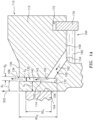
- FIG. 1A shows the seat piece 112 as having an annular channel 130 axially spaced from the seat face 114.
- the example annular channel extends from a radially inboard inner diameter (ID) base 132 to a radially outboard outer diameter (OD) opening 134 in an OD surface 136 of the seat piece 112.
- ID radially inboard inner diameter
- OD radially outboard outer diameter
- the channel 130 also has a first surface or face 140 and a second surface or face 142 axially spaced therefrom.
- the channel 130 may be machined in the piece 112 by conventional methods, such as turning or milling, or advanced methods, such as EDM.
- FIG. 1A further shows a circumferential array of passageway legs (passageways or feed passageways) 150 (e.g., drilled right circular cylindrical passageways) connected to the annular channel 130 at respective first ends 152 and open to a surface portion 156 of the piece 112 at their second ends 154.
- An example number of passageways 150 is 10 to 100, more particularly 20 to 80 or 25 to 55 in seal sizes used on gas turbine engines.
- centrifugal action causes an accumulation 160 of oil to be captured by the second member 110 in a radially outwardly closed collection channel 164.
- the passageway second ends 154 form outlets from the collection channel allowing oil flows 162 to pass outward through the passageways to the channel 130.
- the radial oil flow 165 in the channel cools the seat piece 112 and, thereby, cools the seat face and seal face.
- the example feed passageways 150 are shown oblique to both the axial and radial directions to reduce abrupt flow transitions (e.g., relative to an alternative where they extended axially from the collection channel where there would be an abrupt transition to the channel 130).
- FIG. 1A shows a weir formed by an annular member 170 accommodated partially in a radially inwardly open channel 172 in the seat piece 112. A portion of the member 170 protrudes radially inwardly from an opening of the channel 172 at the surface 156.
- FIG. 1 shows an oil pump 180 delivering oil from a reservoir 182 via a conduit 184.
- the conduit 184 may terminate at one or more nozzles 186.
- Each nozzle may have a respective outlet 188 discharging a spray 167 of the oil.
- the sprayed oil collects on a surface of the first member and is slung radially outward as a flow 168 ( FIG. 1 ) to the channel 164. Oil from the flow 166 may be collected and returned to the reservoir 182 by a conventional collection apparatus (not shown).
- FIG. 1A further shows the seat face 106 having a radial span RS 1 and the channel 130 as having a radial span RS 2 .
- the example radial spans are oriented so that the channel 130 fully radially overlaps the seal face 106. This provides a short thermal conductive flowpath for heat to pass from the seat face 114 to the flow 165 in the channel 130.
- FIG. 1A further shows an angle ⁇ 1 between the seal face/seat face on the one hand and the adjacent channel face 140 on the other hand.
- Example ⁇ 1 is greater than zero. More particularly, with the seal face extending exactly or close to exactly radially, the adjacent portion of the channel face 140 diverges at the angle ⁇ 1 in the radial outward direction.
- Example ⁇ 1 may be fairly small in order to maintain cooling effectiveness as the flow 165 progresses radially outward toward the outer diameter (OD) extent of the seal face.
- example ⁇ 1 is 0-30.0°, more particularly, 0-12.0°, 0.5-10.0°, or 1.0-10.0° or 2.0-8.0°.
- the second face 142 may similarly diverge from the first face at an angle ⁇ 2 . But this divergence ⁇ 2 may represent an artifact of manufacturing such as from a tapered bit.
- Example ⁇ 2 is 0° to 30.0°, more particularly 0° to 15.0° or 0° to 10.0° or 0° to 5.0°. Alternative lower ends on those ranges are 1.0° and 3.0°.
- Example span S 1 between the seat face 114 and the channel face 140 is 0.030 inch to 0.250 inch (0.76 mm to 6.35 mm), more narrowly 2.0 mm to 6.0 mm or 2.5 mm to 5.0mm.
- Example channel width S 2 is 0.030 inch to 0.250 inch (0.76 mm to 6.35 mm), more narrowly 1.0 mm to 6.0 mm or 2.0 mm to 6.0 mm or 2.5 mm to 5.0mm.
- An example member 170 may be formed by spiral winding such as used for retaining rings. Alternatively, a weir may be integrally machined into seat piece 112.
- the use of the annular channel 130 may have one or more of several advantages relative to any particular baseline.
- the channel 130 may provide more circumferential uniformity of cooling which may help reduce heat generation and wear.
- discrete passages may produce a circumferential array of cool zones interspersed with warmer zones.
- the differential thermal expansion of cool portions of the seat and hot portions of the seat may produce an uneven seat surface generating unnecessary heat and potentially compromising sealing.
- FIG. 2 shows a turbofan engine 20 having an engine case 22 containing a rotor shaft assembly 23.
- An example engine is a turbofan. Alternatives include turbojets, turboprops, turboshafts, and industrial gas turbines.
- the example turbofan is a two-spool turbofan. Via high 24 and low 25 shaft portions of the shaft assembly 23, a high pressure turbine (HPT) section 26 and a low pressure turbine (LPT) section 27 respectively drive a high pressure compressor (HPC) section 28 and a low pressure compressor (LPC) section 30.
- the engine extends along a longitudinal axis (centerline) 500 from a fore end to an aft end. Adjacent the fore end, a shroud (fan case) 40 encircles a fan 42 and is supported by vanes 44.
- An aerodynamic nacelle 41 around the fan case is shown and an aerodynamic nacelle 45 around the engine case is shown.
- an alternative variation involves a three spool (plus fan) engine wherein an intermediate spool comprises an intermediate pressure compressor (IPC) between the LPC and HPC and an intermediate pressure turbine (IPT) between the HPT and LPT.
- IPC intermediate pressure compressor
- IPT intermediate pressure turbine
- the IPT drives a low pressure compressor while the LPT drives a fan, in both cases either directly or indirectly via a transmission mechanism, for example a gearbox.
- the low shaft portion 25 of the rotor shaft assembly 23 drives the fan 42 through a reduction transmission 46.
- An example reduction transmission is an epicyclic transmission, namely a planetary or star gear system.
- FIG 2 also shows at their outboard ends, the vanes 44 have flanges 60 bolted to an inner ring structure of the fan case to tie the outboard ends of the vanes together.
- a forward mounting structure 62 e.g., clevises which form part of a four bar mechanism
- the engine e.g., vertical and lateral support
- a pylon 64 is mounted to the structure 62 (e.g., forming the outer part thereof).
- the pylon is also mounted to a rear engine mount 66.
- FIG. 2 shows a location 90 for the seal system 100 wherein the first member 102 may be mounted to (or integrally formed with) a static bearing support 80 and the second member 110 may be mounted to (or integrally formed with) a forward portion of the low shaft 25.
- the first member 102 may be mounted to (or integrally formed with) a static hub 82 and the second member 110 mounted to (or integrally formed with) a fan shaft 81.
- the seal system is positioned adjacent one end of a bearing system to isolate the bearing system. Similar locations may be provided for other bearings in the engine.
- locations 94 and 96 may represent locations where the sealing is between the high spool and static structure on either side of a bearing supporting the high spool.
- FIG. 3 shows an alternate seal system 200 configuration, also falling outside the wording of the claims, otherwise similar to FIG. 1 with several exceptions.
- a first exception is that the cooling channel 130 extends radially outward to a plenum 220 ( FIG. 3A ).
- the plenum 220 is defined by the combination of: a further annular channel in a first seat piece 212; and a second piece 222 encircling and attached to the first piece.
- the example second piece 222 is formed as an annular sleeve having a circumferential array of apertures 224 extending between an inner diameter (ID) surface 226 and an outer diameter (OD) surface 228.
- the apertures e.g., drilled holes
- the ID surface is engaged to the OD surface of the first seat piece 212 fore and aft of the plenum 220 (e.g., via interference fit or a braze j oint).
- Alternative configurations may have the second piece 222 as nondestructively removable from the first piece such as via a retaining clip or wire (e.g. snap ring). Similarly, in such removable configurations, separate seals may be provided between the pieces (e.g., O-rings).
- the apertures 224 are axially offset from the outer diameter opening of the channel 130 to the plenum 220.
- An example number of apertures 224 is 10 to 100, more particularly 20 to 80 or 25 to 55 in seal sizes used on gas turbine engines.
- the plenum 220 and apertures 224 may provide one or more of several functions.
- the apertures may provide a metering function (metering/restricting discharge flows 266) helping ensure the flow has sufficient residence time in the channel 130 to not separate from the face 140 and to provide sufficient cooling. Additionally, residence time in the plenum 220 may further cool the first seat piece 212 to maximize the cooling.
- Example offset S 3 (measured center-to-center) is 0.00 inches to 0.50 inches (0.0 mm to 12.7 mm), more particularly, 0.00 inches to 0.30 inches (0.0 mm to 7.6 mm) or, for non-zero values 0.10 inch to 0.30 inch (2.5 mm to 7.6 mm) or 0.10 inch to 0.50 inch (2.5 mm to 12.7 mm).
- FIG. 3 A further difference between the FIG. 3 and FIG. 1 systems is the FIG. 3 presence of an integral weir formed in the first piece. This may be more representative of conventional weirs.
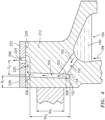
- the plenum 220 could be used with seats having multiple radial passageways 300 ( FIG. 4 , e.g., a circumferential array of passageways) rather than a single continuous annular passageway 130.
- the example passageways 300 may be drilled circular holes.
- Each example passageway 300 has an inlet 302 at the end 152 of a respective associated one of the passageways 150 (feed passageways).
- the inlet 302 may be at or near an inner diameter (ID) end 304 of the passageway.
- the passageway has an outer diameter end 306 forming a passageway outlet.
- the example inlet is in a lateral surface 308 of the passageway.
- Passageway radial span RS 1 and angle ⁇ 1 may be as discussed above for the FIGs. 1 and 3 arrangements.
- the passageway count may also be similar.
- An example diameter of the passageways 300 may be at least 0.060 inch (0.152 centimeters). For example, it may be an example 0.060 inch (0.152 centimeters) to 0.30 inch (0.762 centimeter).
- the diameter may be the same or less than the diameter of the passageways 150 dependent on the cooling needs. This may allow maintenance of flow along the passageway 300 surface.
- the larger cross-sectional area of the feed passageway 150 helps provide sufficient oil.
- the further restriction provided by the plenum outlets may help maintain surface contact along the radial span of the passageways 300.
- the plenum outlets 224 may be smaller in number and/or individual cross-sectional area than the passageways 300.
- total plenum cross-sectional area may be smaller than total passageway 300 cross-sectional area.
- a proximity of the surface of the passageway 300 to the seat face may be of similar span to that S 1 of the channel noted above.
- Manufacture may be via conventional means as noted above with drilling of the feed passageways and cooling passageways into a cast and/or machined precursor of the seat.
- FIG. 4 arrangement is based upon the FIG. 3 configuration having an integral weir, alternative arrangements could be made based upon other seat configurations including the separate weir of FIG. 1 .
- the plenum 220 could be added to yet other configurations of passageways. For example, they may include passageways with a partially tangential orientation such as those of the '316 publication noted above.
- the passageways may have surface-enhanced passageway cross-sections.
- the surface enhancements increase the surface area for a given passage cross-sectional area or transverse linear dimension. Examples include splined or fluted cross-sections, and the like.
- Such surface-enhanced passageways could be formed by techniques such as plunge electrodischarge machining (EDM). Such EDM may be done after drilling a pilot hole or without a pilot hole.
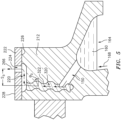
- passageways 320 FIG. 5
- spiral enhancement 322 ridge(s) or projection(s) leaving groove(s) or recess(es)/channel(s) between projections or turns of a projection.
- the example spiral enhancement is spiral/helical splines or fluting shown with a relatively high helix angle ⁇ 3 (a ramping helix angle vs.
- ⁇ 3 an off-axial helix angle of 90°- ⁇ 3 ) that imparts swirl to the fluid flowing radially outward.
- ⁇ 3 is broadly 20.0° to 88.0°, more narrowly 45.0° to 88.0° or 70.0° to 88.0° for EDM-formed enhancements.
- the swirl may help keep the surface of the passageway 320 wetted for high heat transfer and residence time for improved heat absorption.
- FIG. 5 shows the enhancements 322 as including a plurality of alternating ridges/projections and grooves/recesses when viewed in axial section of the passageway.
- the spiral is shown schematically, particularly its intersection with the passageway 150.
- An example spiral ridge/projection count per passageway is four to twenty, more particularly four to ten. Count will generally be geometrically related to the helix angle and projection/groove width.
- Example projection height (radial difference relative to passage way axis of projection apex and recess base) is 5.0% to 30.0% of the radius at the groove base, more narrowly 10.0% to 25%.
- a proximity of the surface of the passageway 320 to the seat face may be of similar span to that S 1 of the channel noted above.
- the passageway cross-sectional area (or minimum passageway cross-sectional area if there is lengthwise/streamwise variation) may be the same in absolute and relative terms as that noted above for the passageway 300.
- Alternative spiral feature(s) include relatively low helix angle features such as thread(s).
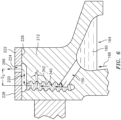
- FIG. 6 shows passageway 340 with such a thread 342.
- Potential threads include single-lead threads, multiple lead threads, and so forth.
- Manufacture techniques include drilling and tapping or, as noted above, EDM. Again, viewed in section, the one or more threads appear as a series of ridges/projections and grooves/recesses.
- the thread(s) may have a relatively low helix angle ⁇ 3 such as found in typical common thread forms 2.0° to 15.0° or 4.0° to 12.0°. Thread height may be as described for the FIG. 5 spiral enhancement.
- Example threads are coarse threads wherein the thread(s) have a larger pitch (few threads per axial distance) than fine threaded tapped holes which have a smaller pitch (more threads per axial distance).
- Relatively coarse threads may limit stress concentrations that may otherwise contribute to cracking.
- coarse threads include, but are not limited to, ACME, worm, ball, and trapezoidal threads of sufficiently coarse pitch to avoid stress concentrations.
- Particular desirable coarseness may be determined by longevity testing such that stress failures in the passageways do not occur over seat face lifetimes. The optimal form may depend on rotational speed of the shaft, radius of the seal interface, oil temperature and viscosity, and seal temperature at target operating conditions.
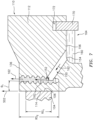
- FIG. 7 shows a passageway 360 having a spiral enhancement 362 similar to that of FIG. 6 but without a plenum.
- Further manufacture variations include additive manufacture of the seat. This allows passageways such as non-straight passageways and/or complex enhancements to be formed with the surface enhancements.
- the passageways may spiral in the circumferential direction.
- Additional variations include seals where the oil is not delivered from a spray nozzle, but instead passes outward from a plenum (e.g., as in the ⁇ 459 and ⁇ 978 patents above) or via other means.
- first, second, and the like in the following claims is for differentiation within the claim only and does not necessarily indicate relative or absolute importance or temporal order. Similarly, the identification in a claim of one element as “first” (or the like) does not preclude such "first” element from identifying an element that is referred to as “second” (or the like) in another claim or in the description.
Landscapes
- Engineering & Computer Science (AREA)
- General Engineering & Computer Science (AREA)
- Mechanical Engineering (AREA)
- Chemical & Material Sciences (AREA)
- Combustion & Propulsion (AREA)
- Turbine Rotor Nozzle Sealing (AREA)
Description
- The invention relates to gas turbine engines. More particularly, the invention relates to cooling of carbon seals in gas turbine engines.
- Carbon seals are commonly used to seal between relatively rotating components in gas turbine engines. In typical situations, the annular carbon seal is spring biased into engagement with an annular seat (typically metallic such as a steel). Often, the carbon seal is on non-rotating static structure and the seat rotates with one of the engine shafts. The sliding engagement causes frictional heating. The heat must be dissipated. With a rotating seqat, it is common to use oil cooling. Generally, oil-cooled carbon seals are divided into two categories: "dry face" seals wherein the oil passes through passageways in the seat without encountering the interface between seal face and seat face; and "wet face" seals wherein the oil passes through the seat to the interface so that the oil that flows through the seat cools the seat but then lubricates the interface to further reduce heat generation.
- For both forms of seals, the oil may be delivered through a nozzle and slung radially outward by the rotating component and collected in a radially outwardly closed and inwardly open collection channel from which the passageways extend further radially outward.
-
United States Patent 4,406,459 (the `459 patent), Davis et al., September 27, 1983 , "Oil Weepage Return for Carbon Seal Plates" shows a seal with two sets of passageways through the seat. One set delivers oil to the interface as a wet face seal. Another set helps centrifugally pump out oil that has weeped radially inward from the interface. -
United States Patent 4,928,978 (the `978 patent), Shaffer et al., May 29, 1990 , "Rotating shaft seal" shows an alternative wet face seal. -
United States Patent Application Publication 20180045316A1 (the '316 publication), Kovacik et al., February 15, 2018 , "Hydrodynamic Seal Seat Cooling Features" shows a dry face seal wherein the oil passageways have two legs: an upstream leg receiving oil from a collection notch which in turn has collected the oil from a nozzle; and a downstream leg extending radially outward from the upstream leg generally close to and parallel to the sealing interface. -
EP 3 647 634 A1 discloses a prior art seal system as set forth in the preamble of claim 1. -
EP 3 702 586 A1 discloses a prior art gas turbine engine including seal plate providing increased cooling adjacent contact area. - From one aspect, there is provided a seal system as recited in claim 1.
- There is also provided a method for manufacturing the seal system as recited in claim 10.
- There is also provided a method for using the seal system as recited in claim 13.
- There is also provided a gas turbine engine as recited in claim 15.
- Features of embodiments are set forth in the dependent claims.
- The details of one or more embodiments are set forth in the accompanying drawings and the description below. Other features, objects, and advantages will be apparent from the description and drawings, and from the claims.
-
-
FIG. 1 is a partial partially schematic central axial sectional view of a first seal system falling outside the wording of the claims. -
FIG. 1A is an enlarged view of a sealing interface area of the seal system ofFIG. 1 . -
FIG. 2 is a partially schematic central axial sectional view of a gas turbine engine. -
FIG. 3 is a partial partially schematic central axial sectional view of a second seal system falling outside the wording of the claims. -
FIG. 3A is an enlarged view of a sealing interface area of the second seal system ofFIG. 3 . -
FIG. 4 is an enlarged central axial sectional view of a third sealing system falling outside the wording of the claims. -
FIG. 5 is an enlarged central axial sectional view of a fourth sealing system within the wording of the claims. -
FIG. 6 is an enlarged central axial sectional view of a fifth sealing system within the wording of the claims. -
FIG. 7 is an enlarged central axial sectional view of a sixth sealing system within the wording of the claims. - Like reference numbers and designations in the various drawings indicate like elements.
-
FIG. 1 shows aseal system 100, falling outside the wording of the claims, having afirst member 102 carrying aseal 104. Theexample seal 104 is a carbon seal having a seal surface orface 106. Theexample seal 104 is formed as a body of revolution about anaxis 500 which is an axis of relative rotation between thefirst member 102 and asecond member 110.FIG. 1 further shows an outwardradial direction 502. Theexample seal face 106 is a radial face. Thesecond member 110 comprises a piece 112 (seat piece) forming a seat for the seal with a seat surface orface 114 in sliding sealing engagement with theseal face 106 at a sealing interface. - The example illustrated configuration is a dry face configuration. The
seal 104 may be biased into axially compressive engagement with theseat face 114 via one or more factors including pressure bias and spring loading. Theseal 104 is shown as sealing a space orregion 120 inboard of the sealing interface from a space orregion 122 outboard. Depending upon configuration, the pressure difference may bias the seal in either direction.FIG. 1 further shows a spring 124 (e.g., a coil spring) providing the required bias. There may be a circumferential array of such springs about theaxis 500 each under axial compression. - In one group of examples discussed below, the
second member 110 is rotating in an inertial frame of reference while thefirst member 102 is either stationary or counter-rotating. The rotating of thesecond member 110 may create a centrifugal oil flow action discussed further below. - In operation, the relative rotation produces frictional heating at the sliding interface between the
faces FIG. 1A , however, shows theseat piece 112 as having anannular channel 130 axially spaced from theseat face 114. The example annular channel extends from a radially inboard inner diameter (ID)base 132 to a radially outboard outer diameter (OD) opening 134 in anOD surface 136 of theseat piece 112. Thechannel 130 also has a first surface orface 140 and a second surface or face 142 axially spaced therefrom. Thechannel 130 may be machined in thepiece 112 by conventional methods, such as turning or milling, or advanced methods, such as EDM. -
FIG. 1A further shows a circumferential array of passageway legs (passageways or feed passageways) 150 (e.g., drilled right circular cylindrical passageways) connected to theannular channel 130 at respectivefirst ends 152 and open to asurface portion 156 of thepiece 112 at theirsecond ends 154. An example number ofpassageways 150 is 10 to 100, more particularly 20 to 80 or 25 to 55 in seal sizes used on gas turbine engines. In operation, centrifugal action causes anaccumulation 160 of oil to be captured by thesecond member 110 in a radially outwardlyclosed collection channel 164. The passageway second ends 154 form outlets from the collection channel allowing oil flows 162 to pass outward through the passageways to thechannel 130. Theflows 162 from theindividual passageways 150 merge to form aflow 165 in thechannel 130. Theflow 165 flows radially outward to be discharged as adischarge flow 166. Theradial oil flow 165 in the channel cools theseat piece 112 and, thereby, cools the seat face and seal face. - The
example feed passageways 150 are shown oblique to both the axial and radial directions to reduce abrupt flow transitions (e.g., relative to an alternative where they extended axially from the collection channel where there would be an abrupt transition to the channel 130). - To form the
channel 164,FIG. 1A shows a weir formed by anannular member 170 accommodated partially in a radially inwardlyopen channel 172 in theseat piece 112. A portion of themember 170 protrudes radially inwardly from an opening of thechannel 172 at thesurface 156. As an oil source,FIG. 1 shows anoil pump 180 delivering oil from areservoir 182 via aconduit 184. Theconduit 184 may terminate at one ormore nozzles 186. Each nozzle may have arespective outlet 188 discharging aspray 167 of the oil. The sprayed oil collects on a surface of the first member and is slung radially outward as a flow 168 (FIG. 1 ) to thechannel 164. Oil from theflow 166 may be collected and returned to thereservoir 182 by a conventional collection apparatus (not shown). -
FIG. 1A further shows theseat face 106 having a radial span RS1 and thechannel 130 as having a radial span RS2. The example radial spans are oriented so that thechannel 130 fully radially overlaps theseal face 106. This provides a short thermal conductive flowpath for heat to pass from theseat face 114 to theflow 165 in thechannel 130.FIG. 1A further shows an angle θ1 between the seal face/seat face on the one hand and theadjacent channel face 140 on the other hand. Example θ1 is greater than zero. More particularly, with the seal face extending exactly or close to exactly radially, the adjacent portion of thechannel face 140 diverges at the angle θ1 in the radial outward direction. This divergence from radial helps cause theflow 165 to remain attached to theface 140. The opposite inclination would potentially risk flow separation and loss of heat conduction. Example θ1, however, may be fairly small in order to maintain cooling effectiveness as theflow 165 progresses radially outward toward the outer diameter (OD) extent of the seal face. Thus, example θ1 is 0-30.0°, more particularly, 0-12.0°, 0.5-10.0°, or 1.0-10.0° or 2.0-8.0°. Thesecond face 142 may similarly diverge from the first face at an angle θ2. But this divergence θ2 may represent an artifact of manufacturing such as from a tapered bit. Example θ2 is 0° to 30.0°, more particularly 0° to 15.0° or 0° to 10.0° or 0° to 5.0°. Alternative lower ends on those ranges are 1.0° and 3.0°. Example span S1 between theseat face 114 and thechannel face 140 is 0.030 inch to 0.250 inch (0.76 mm to 6.35 mm), more narrowly 2.0 mm to 6.0 mm or 2.5 mm to 5.0mm. Example channel width S2 is 0.030 inch to 0.250 inch (0.76 mm to 6.35 mm), more narrowly 1.0 mm to 6.0 mm or 2.0 mm to 6.0 mm or 2.5 mm to 5.0mm. - An
example member 170 may be formed by spiral winding such as used for retaining rings. Alternatively, a weir may be integrally machined intoseat piece 112. - In various implementations, the use of the
annular channel 130 may have one or more of several advantages relative to any particular baseline. For example, when contrasted with a baseline arrangement as in the '316 publication, thechannel 130 may provide more circumferential uniformity of cooling which may help reduce heat generation and wear. For example, discrete passages may produce a circumferential array of cool zones interspersed with warmer zones. The differential thermal expansion of cool portions of the seat and hot portions of the seat may produce an uneven seat surface generating unnecessary heat and potentially compromising sealing. -
FIG. 2 shows aturbofan engine 20 having anengine case 22 containing arotor shaft assembly 23. An example engine is a turbofan. Alternatives include turbojets, turboprops, turboshafts, and industrial gas turbines. The example turbofan is a two-spool turbofan. Via high 24 and low 25 shaft portions of theshaft assembly 23, a high pressure turbine (HPT)section 26 and a low pressure turbine (LPT)section 27 respectively drive a high pressure compressor (HPC)section 28 and a low pressure compressor (LPC)section 30. The engine extends along a longitudinal axis (centerline) 500 from a fore end to an aft end. Adjacent the fore end, a shroud (fan case) 40 encircles afan 42 and is supported byvanes 44. Anaerodynamic nacelle 41 around the fan case is shown and anaerodynamic nacelle 45 around the engine case is shown. - Although a two spool (plus fan) engine is shown, an alternative variation involves a three spool (plus fan) engine wherein an intermediate spool comprises an intermediate pressure compressor (IPC) between the LPC and HPC and an intermediate pressure turbine (IPT) between the HPT and LPT. In another aspect a three-spool engine, the IPT drives a low pressure compressor while the LPT drives a fan, in both cases either directly or indirectly via a transmission mechanism, for example a gearbox.
- In the example embodiment, the
low shaft portion 25 of therotor shaft assembly 23 drives thefan 42 through areduction transmission 46. An example reduction transmission is an epicyclic transmission, namely a planetary or star gear system. -
FIG 2 also shows at their outboard ends, thevanes 44 haveflanges 60 bolted to an inner ring structure of the fan case to tie the outboard ends of the vanes together. Integral therewith or fastened thereto is a forward mounting structure 62 (e.g., clevises which form part of a four bar mechanism) and provides forward support to the engine (e.g., vertical and lateral support). To mount the engine to the aircraft wing, apylon 64 is mounted to the structure 62 (e.g., forming the outer part thereof). The pylon is also mounted to arear engine mount 66. - In one example,
FIG. 2 shows alocation 90 for theseal system 100 wherein thefirst member 102 may be mounted to (or integrally formed with) astatic bearing support 80 and thesecond member 110 may be mounted to (or integrally formed with) a forward portion of thelow shaft 25. Alternatively, in alocation 92, thefirst member 102 may be mounted to (or integrally formed with) astatic hub 82 and thesecond member 110 mounted to (or integrally formed with) afan shaft 81. In these two illustrated examples, the seal system is positioned adjacent one end of a bearing system to isolate the bearing system. Similar locations may be provided for other bearings in the engine. For example,locations -
FIG. 3 shows analternate seal system 200 configuration, also falling outside the wording of the claims, otherwise similar toFIG. 1 with several exceptions. A first exception is that the coolingchannel 130 extends radially outward to a plenum 220 (FIG. 3A ). Theplenum 220 is defined by the combination of: a further annular channel in afirst seat piece 212; and asecond piece 222 encircling and attached to the first piece. The examplesecond piece 222 is formed as an annular sleeve having a circumferential array ofapertures 224 extending between an inner diameter (ID)surface 226 and an outer diameter (OD)surface 228. The apertures (e.g., drilled holes) form plenum outlets. The ID surface is engaged to the OD surface of thefirst seat piece 212 fore and aft of the plenum 220 (e.g., via interference fit or a braze j oint). Alternative configurations may have thesecond piece 222 as nondestructively removable from the first piece such as via a retaining clip or wire (e.g. snap ring). Similarly, in such removable configurations, separate seals may be provided between the pieces (e.g., O-rings). - The
apertures 224 are axially offset from the outer diameter opening of thechannel 130 to theplenum 220. An example number ofapertures 224 is 10 to 100, more particularly 20 to 80 or 25 to 55 in seal sizes used on gas turbine engines. Theplenum 220 andapertures 224 may provide one or more of several functions. First, the apertures may provide a metering function (metering/restricting discharge flows 266) helping ensure the flow has sufficient residence time in thechannel 130 to not separate from theface 140 and to provide sufficient cooling. Additionally, residence time in theplenum 220 may further cool thefirst seat piece 212 to maximize the cooling. The axial offset of theapertures 224 from the outlet or OD end of thechannel 134 helps ensure that flow is along the length of theplenum 220 to again maximize cooling efficiency. Example offset S3 (measured center-to-center) is 0.00 inches to 0.50 inches (0.0 mm to 12.7 mm), more particularly, 0.00 inches to 0.30 inches (0.0 mm to 7.6 mm) or, for non-zero values 0.10 inch to 0.30 inch (2.5 mm to 7.6 mm) or 0.10 inch to 0.50 inch (2.5 mm to 12.7 mm). - A further difference between the
FIG. 3 andFIG. 1 systems is theFIG. 3 presence of an integral weir formed in the first piece. This may be more representative of conventional weirs. - The
plenum 220 could be used with seats having multiple radial passageways 300 (FIG. 4 , e.g., a circumferential array of passageways) rather than a single continuousannular passageway 130. The example passageways 300 may be drilled circular holes. Eachexample passageway 300 has aninlet 302 at theend 152 of a respective associated one of the passageways 150 (feed passageways). Theinlet 302 may be at or near an inner diameter (ID) end 304 of the passageway. The passageway has anouter diameter end 306 forming a passageway outlet. The example inlet is in alateral surface 308 of the passageway. - Passageway radial span RS1 and angle θ1 may be as discussed above for the
FIGs. 1 and3 arrangements. The passageway count may also be similar. However, it is also possible that the angle θ1 have negative values that actually converge toward the radial direction and face 114 in the outward radial direction. - An example diameter of the
passageways 300 may be at least 0.060 inch (0.152 centimeters). For example, it may be an example 0.060 inch (0.152 centimeters) to 0.30 inch (0.762 centimeter). The diameter may be the same or less than the diameter of thepassageways 150 dependent on the cooling needs. This may allow maintenance of flow along thepassageway 300 surface. The larger cross-sectional area of thefeed passageway 150 helps provide sufficient oil. However, the further restriction provided by the plenum outlets may help maintain surface contact along the radial span of thepassageways 300. Thus, theplenum outlets 224 may be smaller in number and/or individual cross-sectional area than thepassageways 300. Thus, total plenum cross-sectional area may be smaller thantotal passageway 300 cross-sectional area. A proximity of the surface of thepassageway 300 to the seat face may be of similar span to that S1 of the channel noted above. Manufacture may be via conventional means as noted above with drilling of the feed passageways and cooling passageways into a cast and/or machined precursor of the seat. - Although the example
FIG. 4 arrangement is based upon theFIG. 3 configuration having an integral weir, alternative arrangements could be made based upon other seat configurations including the separate weir ofFIG. 1 . Similarly, theplenum 220 could be added to yet other configurations of passageways. For example, they may include passageways with a partially tangential orientation such as those of the '316 publication noted above. - However, to increase heat transfer to the flows through the passageways, the passageways may have surface-enhanced passageway cross-sections. The surface enhancements increase the surface area for a given passage cross-sectional area or transverse linear dimension. Examples include splined or fluted cross-sections, and the like. Such surface-enhanced passageways could be formed by techniques such as plunge electrodischarge machining (EDM). Such EDM may be done after drilling a pilot hole or without a pilot hole.
- In addition to cylindrical surface-enhanced passageways (e.g., ridges such as straight splines or fluting (not shown) separated by straight grooves or channels, falling outside the wording of the claims), other enhancements, falling inside the wording of the claims, may take other forms such as passageways 320 (
FIG. 5 ) having a spiral enhancement 322 (ridge(s) or projection(s)) leaving groove(s) or recess(es)/channel(s) between projections or turns of a projection. The example spiral enhancement is spiral/helical splines or fluting shown with a relatively high helix angle θ3 (a ramping helix angle vs. an off-axial helix angle of 90°-θ3) that imparts swirl to the fluid flowing radially outward. An example of θ3 is broadly 20.0° to 88.0°, more narrowly 45.0° to 88.0° or 70.0° to 88.0° for EDM-formed enhancements. The swirl may help keep the surface of thepassageway 320 wetted for high heat transfer and residence time for improved heat absorption. - Such enhancements may, for example, be made via plunge EDM (after pre-drilling of a pilot hole or without pilot hole) with a rotation of the EDM electrode during the plunge.
FIG. 5 shows theenhancements 322 as including a plurality of alternating ridges/projections and grooves/recesses when viewed in axial section of the passageway. The spiral is shown schematically, particularly its intersection with thepassageway 150. An example spiral ridge/projection count per passageway is four to twenty, more particularly four to ten. Count will generally be geometrically related to the helix angle and projection/groove width. Example projection height (radial difference relative to passage way axis of projection apex and recess base) is 5.0% to 30.0% of the radius at the groove base, more narrowly 10.0% to 25%. A proximity of the surface of thepassageway 320 to the seat face (e.g., measured from the adjacent location on the groove base) may be of similar span to that S1 of the channel noted above. - For the example surface-enhanced passageways, the passageway cross-sectional area (or minimum passageway cross-sectional area if there is lengthwise/streamwise variation) may be the same in absolute and relative terms as that noted above for the
passageway 300. - Alternative spiral feature(s) include relatively low helix angle features such as thread(s).
FIG. 6 showspassageway 340 with such athread 342. Potential threads include single-lead threads, multiple lead threads, and so forth. Manufacture techniques include drilling and tapping or, as noted above, EDM. Again, viewed in section, the one or more threads appear as a series of ridges/projections and grooves/recesses. The thread(s) may have a relatively low helix angle θ3 such as found in typical common thread forms 2.0° to 15.0° or 4.0° to 12.0°. Thread height may be as described for theFIG. 5 spiral enhancement. - Example threads are coarse threads wherein the thread(s) have a larger pitch (few threads per axial distance) than fine threaded tapped holes which have a smaller pitch (more threads per axial distance). Relatively coarse threads may limit stress concentrations that may otherwise contribute to cracking. Examples of coarse threads include, but are not limited to, ACME, worm, ball, and trapezoidal threads of sufficiently coarse pitch to avoid stress concentrations. Particular desirable coarseness may be determined by longevity testing such that stress failures in the passageways do not occur over seat face lifetimes. The optimal form may depend on rotational speed of the shaft, radius of the seal interface, oil temperature and viscosity, and seal temperature at target operating conditions.
- Additionally, the surface enhancements may be employed in the absence of the
plenum 220.FIG. 7 shows a passageway 360 having a spiral enhancement 362 similar to that ofFIG. 6 but without a plenum. - Further manufacture variations include additive manufacture of the seat. This allows passageways such as non-straight passageways and/or complex enhancements to be formed with the surface enhancements. For example, the passageways may spiral in the circumferential direction.
- Additional variations include seals where the oil is not delivered from a spray nozzle, but instead passes outward from a plenum (e.g., as in the `459 and `978 patents above) or via other means.
- Further variations include seals where cooling fluids (particularly liquids) other than oil are used.
- The use of "first", "second", and the like in the following claims is for differentiation within the claim only and does not necessarily indicate relative or absolute importance or temporal order. Similarly, the identification in a claim of one element as "first" (or the like) does not preclude such "first" element from identifying an element that is referred to as "second" (or the like) in another claim or in the description.
- Where a measure is given in English units followed by a parenthetical containing SI or other units, the parenthetical's units are a conversion and should not imply a degree of precision not found in the English units.
- One or more embodiments have been described. Nevertheless, it will be understood that various modifications may be made. For example, when applied to an existing baseline seal or machine configuration, details of such baseline may influence details of particular implementations. Accordingly, other embodiments are within the scope of the following claims.
Claims (15)
- A seal system (200) comprising:a first member (102) comprising a carbon seal (104) with a seal face (106); anda second member (110) comprising a seat (112; 212) with a seat face (114) and a plurality of cooling passageways (300; 320; 340; 360),wherein:the second member (110) is rotatable about an axis (500) relative to the first member (102);the seal face (106) and the seat face (114) are in sliding sealing engagement; andthe cooling passageways (300; 320; 340; 360) have respective surface enhancements (322; 342; 362),characterised in that:
each cooling passageway surface enhancement (322; 342; 362) is at least one spiral (322; 342; 362). - The seal system (200) of claim 1, wherein:
each at least one spiral (322; 342; 362) has a helix angle (θ3) of 45.0° to 88.0°. - The seal system (200) of claim 1 or 2, wherein:
each cooling passageway surface enhancement (322; 342; 362) is a thread (322; 342; 362). - The seal system (200) of any preceding claim, wherein:the second member (110) further has a collection channel (164); andthe second member (110) further has a plurality of feed passageways (150), each feed passageway (150) coupling an associated said cooling passageway (300; 320; 340; 360) to the collection channel (164) preferably wherein:the second member has a plenum (220) is defined by the combination of: an annular channel in a first seat piece (212); and a second piece (222) encircling and attached to the first piece;the cooling passageways are in the first piece; andthe second piece (222) is formed as an annular sleeve having a circumferential array of outlet apertures (224) extending between an inner diameter (ID) surface (226) and an outer diameter (OD) surface (228).
- The seal system (200) of claim 4, wherein:
each of said feed passageways (150) is positioned at an oblique angle relative to both the collection channel (164) and the associated cooling passageway (300; 320; 340; 360). - The seal system (200) of claim 4 or 5, including between 10 and 100 cooling passageways (300; 320; 340; 360) and between 10 and 100 feed passageways (150).
- The seal system (200) of any preceding claim, wherein the second member (110) is coupled to and configured to rotate with a rotatable shaft (24; 25), and wherein the first member (102) is configured to remain stationary while the second member (110) rotates with the rotatable shaft (24; 25).
- The seal system (200) of any preceding claim, wherein:the cooling passageways (320; 340; 360) are threaded passageways (320; 340; 360) having grooves;a distance between an outermost edge of the grooves of the threaded passageways (320; 340; 360) and the seat face (114) is between 0.76mm and 6.35mm; andan angle (θ1) formed between a center axis of each cooling passageway (320; 340; 360) and the seat face (114) is greater than zero.
- The seal system (200) of claim 4 or any of claims 5 to 8 as dependent on claim 4, wherein the seal system (200) is a dry face seal, and wherein the feed passageways (150) and cooling passageways (300; 320; 340; 360) are configured to provide cooling fluid such that the cooling fluid remains separate from an interface where the seal face (106) and the seat face (114) are in sliding engagement.
- A method for manufacturing the seal system (200) of any preceding claim, the method comprising:forming a precursor of the second member (110); andforming the surface enhancements (322; 342; 362) by at least one of tapping and EDM.
- The method of claim 10 further comprising forming precursors of the cooling passageways (300; 320; 340; 360) by drilling.
- The method of claim 10 or 11 comprising forming the surface enhancements (322; 342; 362) by EDM, wherein the EDM is plunge EDM with a rotation of an EDM electrode during the plunge.
- A method for using the seal system (200) of any preceding claim, the method comprising:rotating the second member (110) about the axis (500) relative to the first member (102);the rotation driving respective flows of fluid (162, 165) through the passageways (300; 320; 340; 360); andthe flows (162, 165) cooling the second member (110).
- The method of claim 13, wherein:
the surface enhancements (322; 342; 362) induce swirl of the respective flows in the passageways (300; 320; 340; 360). - A gas turbine engine (20) comprising:an engine case (22), a fan (42), a compressor section (28, 30), a turbine section (26, 27) and a rotating shaft (24; 25); andthe seal system (200) of any preceding claim positioned within the compressor section (28, 30) of the gas turbine engine (20).
Applications Claiming Priority (1)
| Application Number | Priority Date | Filing Date | Title |
|---|---|---|---|
| US202063125801P | 2020-12-15 | 2020-12-15 |
Publications (2)
| Publication Number | Publication Date |
|---|---|
| EP4036376A1 EP4036376A1 (en) | 2022-08-03 |
| EP4036376B1 true EP4036376B1 (en) | 2023-11-15 |
Family
ID=79024250
Family Applications (1)
| Application Number | Title | Priority Date | Filing Date |
|---|---|---|---|
| EP21214893.6A Active EP4036376B1 (en) | 2020-12-15 | 2021-12-15 | Oil-cooled carbon seal |
Country Status (1)
| Country | Link |
|---|---|
| EP (1) | EP4036376B1 (en) |
Family Cites Families (6)
| Publication number | Priority date | Publication date | Assignee | Title |
|---|---|---|---|---|
| US4406459A (en) | 1982-06-18 | 1983-09-27 | United Technologies Corporation | Oil weepage return for carbon seal plates |
| US4928978A (en) | 1988-04-07 | 1990-05-29 | United Technologies Corporation | Rotating shaft seal |
| US20180045316A1 (en) | 2016-08-09 | 2018-02-15 | United Technologies Corporation | Hydrodynamic seal seat cooling features |
| US10634005B2 (en) * | 2017-07-13 | 2020-04-28 | United Technologies Corporation | Flow metering and retention system |
| US11236636B2 (en) * | 2018-10-29 | 2022-02-01 | Raytheon Technologies Corporation | Oil-cooled carbon seal |
| US10975723B2 (en) * | 2019-02-26 | 2021-04-13 | Raytheon Technologies Corporation | Gas turbine engine including seal plate providing increased cooling adjacent contact area |
-
2021
- 2021-12-15 EP EP21214893.6A patent/EP4036376B1/en active Active
Also Published As
| Publication number | Publication date |
|---|---|
| EP4036376A1 (en) | 2022-08-03 |
Similar Documents
| Publication | Publication Date | Title |
|---|---|---|
| EP3647634B1 (en) | Oil-cooled carbon seal | |
| EP4257851B1 (en) | Piston seal ring | |
| EP3232011B1 (en) | Hydrodynamic carbon face seal pressure booster | |
| EP3904731B1 (en) | Porous seal element with internal fluid passage | |
| EP3647633A1 (en) | Wet-face/dry-face seal and methods of operation | |
| EP3702586B1 (en) | Gas turbine engine including seal plate providing increased cooling adjacent contact area | |
| CN110778692B (en) | Speed reducing or differential device for a turbine engine of an aircraft | |
| EP3712469B1 (en) | Seal plate lubricant slinger | |
| US12385419B2 (en) | Oil-cooled carbon seal | |
| US11371441B2 (en) | Translating fluid delivery device | |
| EP3954879B1 (en) | Scoop assembly for rotational equipment | |
| EP4036376B1 (en) | Oil-cooled carbon seal | |
| EP3904644A2 (en) | Fluid delivery system for rotational equipment | |
| EP4137675B1 (en) | Feed circuit with slot(s) at interface between journal bearing and rotor | |
| US11255425B2 (en) | Rotary planet carrier for a mechanical reduction gear of a turbomachine | |
| US11326517B2 (en) | Oil distribution device for a rotating planet carrier of a mechanical reduction gear of a turbomachine | |
| EP3712471B1 (en) | Two-piece seat for contacting seal | |
| US11187159B2 (en) | Pivot for sliding bearing and gear train | |
| US12241379B2 (en) | Cooling system for seal assemblies | |
| US20250154879A1 (en) | Bearing assemblies for a turbomachine |
Legal Events
| Date | Code | Title | Description |
|---|---|---|---|
| PUAI | Public reference made under article 153(3) epc to a published international application that has entered the european phase |
Free format text: ORIGINAL CODE: 0009012 |
|
| STAA | Information on the status of an ep patent application or granted ep patent |
Free format text: STATUS: THE APPLICATION HAS BEEN PUBLISHED |
|
| AK | Designated contracting states |
Kind code of ref document: A1 Designated state(s): AL AT BE BG CH CY CZ DE DK EE ES FI FR GB GR HR HU IE IS IT LI LT LU LV MC MK MT NL NO PL PT RO RS SE SI SK SM TR |
|
| STAA | Information on the status of an ep patent application or granted ep patent |
Free format text: STATUS: REQUEST FOR EXAMINATION WAS MADE |
|
| 17P | Request for examination filed |
Effective date: 20230103 |
|
| RBV | Designated contracting states (corrected) |
Designated state(s): AL AT BE BG CH CY CZ DE DK EE ES FI FR GB GR HR HU IE IS IT LI LT LU LV MC MK MT NL NO PL PT RO RS SE SI SK SM TR |
|
| GRAP | Despatch of communication of intention to grant a patent |
Free format text: ORIGINAL CODE: EPIDOSNIGR1 |
|
| STAA | Information on the status of an ep patent application or granted ep patent |
Free format text: STATUS: GRANT OF PATENT IS INTENDED |
|
| INTG | Intention to grant announced |
Effective date: 20230526 |
|
| GRAS | Grant fee paid |
Free format text: ORIGINAL CODE: EPIDOSNIGR3 |
|
| GRAA | (expected) grant |
Free format text: ORIGINAL CODE: 0009210 |
|
| STAA | Information on the status of an ep patent application or granted ep patent |
Free format text: STATUS: THE PATENT HAS BEEN GRANTED |
|
| RAP3 | Party data changed (applicant data changed or rights of an application transferred) |
Owner name: RTX CORPORATION |
|
| AK | Designated contracting states |
Kind code of ref document: B1 Designated state(s): AL AT BE BG CH CY CZ DE DK EE ES FI FR GB GR HR HU IE IS IT LI LT LU LV MC MK MT NL NO PL PT RO RS SE SI SK SM TR |
|
| REG | Reference to a national code |
Ref country code: CH Ref legal event code: EP Ref country code: GB Ref legal event code: FG4D |
|
| REG | Reference to a national code |
Ref country code: DE Ref legal event code: R096 Ref document number: 602021006836 Country of ref document: DE |
|
| REG | Reference to a national code |
Ref country code: IE Ref legal event code: FG4D |
|
| REG | Reference to a national code |
Ref country code: LT Ref legal event code: MG9D |
|
| REG | Reference to a national code |
Ref country code: NL Ref legal event code: MP Effective date: 20231115 |
|
| PG25 | Lapsed in a contracting state [announced via postgrant information from national office to epo] |
Ref country code: GR Free format text: LAPSE BECAUSE OF FAILURE TO SUBMIT A TRANSLATION OF THE DESCRIPTION OR TO PAY THE FEE WITHIN THE PRESCRIBED TIME-LIMIT Effective date: 20240216 |
|
| PG25 | Lapsed in a contracting state [announced via postgrant information from national office to epo] |
Ref country code: IS Free format text: LAPSE BECAUSE OF FAILURE TO SUBMIT A TRANSLATION OF THE DESCRIPTION OR TO PAY THE FEE WITHIN THE PRESCRIBED TIME-LIMIT Effective date: 20240315 |
|
| PG25 | Lapsed in a contracting state [announced via postgrant information from national office to epo] |
Ref country code: LT Free format text: LAPSE BECAUSE OF FAILURE TO SUBMIT A TRANSLATION OF THE DESCRIPTION OR TO PAY THE FEE WITHIN THE PRESCRIBED TIME-LIMIT Effective date: 20231115 |
|
| REG | Reference to a national code |
Ref country code: AT Ref legal event code: MK05 Ref document number: 1631965 Country of ref document: AT Kind code of ref document: T Effective date: 20231115 |
|
| PG25 | Lapsed in a contracting state [announced via postgrant information from national office to epo] |
Ref country code: NL Free format text: LAPSE BECAUSE OF FAILURE TO SUBMIT A TRANSLATION OF THE DESCRIPTION OR TO PAY THE FEE WITHIN THE PRESCRIBED TIME-LIMIT Effective date: 20231115 |
|
| PG25 | Lapsed in a contracting state [announced via postgrant information from national office to epo] |
Ref country code: AT Free format text: LAPSE BECAUSE OF FAILURE TO SUBMIT A TRANSLATION OF THE DESCRIPTION OR TO PAY THE FEE WITHIN THE PRESCRIBED TIME-LIMIT Effective date: 20231115 |
|
| PG25 | Lapsed in a contracting state [announced via postgrant information from national office to epo] |
Ref country code: ES Free format text: LAPSE BECAUSE OF FAILURE TO SUBMIT A TRANSLATION OF THE DESCRIPTION OR TO PAY THE FEE WITHIN THE PRESCRIBED TIME-LIMIT Effective date: 20231115 |
|
| PG25 | Lapsed in a contracting state [announced via postgrant information from national office to epo] |
Ref country code: NL Free format text: LAPSE BECAUSE OF FAILURE TO SUBMIT A TRANSLATION OF THE DESCRIPTION OR TO PAY THE FEE WITHIN THE PRESCRIBED TIME-LIMIT Effective date: 20231115 Ref country code: LT Free format text: LAPSE BECAUSE OF FAILURE TO SUBMIT A TRANSLATION OF THE DESCRIPTION OR TO PAY THE FEE WITHIN THE PRESCRIBED TIME-LIMIT Effective date: 20231115 Ref country code: IS Free format text: LAPSE BECAUSE OF FAILURE TO SUBMIT A TRANSLATION OF THE DESCRIPTION OR TO PAY THE FEE WITHIN THE PRESCRIBED TIME-LIMIT Effective date: 20240315 Ref country code: GR Free format text: LAPSE BECAUSE OF FAILURE TO SUBMIT A TRANSLATION OF THE DESCRIPTION OR TO PAY THE FEE WITHIN THE PRESCRIBED TIME-LIMIT Effective date: 20240216 Ref country code: ES Free format text: LAPSE BECAUSE OF FAILURE TO SUBMIT A TRANSLATION OF THE DESCRIPTION OR TO PAY THE FEE WITHIN THE PRESCRIBED TIME-LIMIT Effective date: 20231115 Ref country code: BG Free format text: LAPSE BECAUSE OF FAILURE TO SUBMIT A TRANSLATION OF THE DESCRIPTION OR TO PAY THE FEE WITHIN THE PRESCRIBED TIME-LIMIT Effective date: 20240215 Ref country code: AT Free format text: LAPSE BECAUSE OF FAILURE TO SUBMIT A TRANSLATION OF THE DESCRIPTION OR TO PAY THE FEE WITHIN THE PRESCRIBED TIME-LIMIT Effective date: 20231115 Ref country code: PT Free format text: LAPSE BECAUSE OF FAILURE TO SUBMIT A TRANSLATION OF THE DESCRIPTION OR TO PAY THE FEE WITHIN THE PRESCRIBED TIME-LIMIT Effective date: 20240315 |
|
| PG25 | Lapsed in a contracting state [announced via postgrant information from national office to epo] |
Ref country code: SE Free format text: LAPSE BECAUSE OF FAILURE TO SUBMIT A TRANSLATION OF THE DESCRIPTION OR TO PAY THE FEE WITHIN THE PRESCRIBED TIME-LIMIT Effective date: 20231115 Ref country code: RS Free format text: LAPSE BECAUSE OF FAILURE TO SUBMIT A TRANSLATION OF THE DESCRIPTION OR TO PAY THE FEE WITHIN THE PRESCRIBED TIME-LIMIT Effective date: 20231115 Ref country code: PL Free format text: LAPSE BECAUSE OF FAILURE TO SUBMIT A TRANSLATION OF THE DESCRIPTION OR TO PAY THE FEE WITHIN THE PRESCRIBED TIME-LIMIT Effective date: 20231115 Ref country code: NO Free format text: LAPSE BECAUSE OF FAILURE TO SUBMIT A TRANSLATION OF THE DESCRIPTION OR TO PAY THE FEE WITHIN THE PRESCRIBED TIME-LIMIT Effective date: 20240215 Ref country code: LV Free format text: LAPSE BECAUSE OF FAILURE TO SUBMIT A TRANSLATION OF THE DESCRIPTION OR TO PAY THE FEE WITHIN THE PRESCRIBED TIME-LIMIT Effective date: 20231115 Ref country code: HR Free format text: LAPSE BECAUSE OF FAILURE TO SUBMIT A TRANSLATION OF THE DESCRIPTION OR TO PAY THE FEE WITHIN THE PRESCRIBED TIME-LIMIT Effective date: 20231115 |
|
| PG25 | Lapsed in a contracting state [announced via postgrant information from national office to epo] |
Ref country code: DK Free format text: LAPSE BECAUSE OF FAILURE TO SUBMIT A TRANSLATION OF THE DESCRIPTION OR TO PAY THE FEE WITHIN THE PRESCRIBED TIME-LIMIT Effective date: 20231115 |
|
| PG25 | Lapsed in a contracting state [announced via postgrant information from national office to epo] |
Ref country code: CZ Free format text: LAPSE BECAUSE OF FAILURE TO SUBMIT A TRANSLATION OF THE DESCRIPTION OR TO PAY THE FEE WITHIN THE PRESCRIBED TIME-LIMIT Effective date: 20231115 |
|
| PG25 | Lapsed in a contracting state [announced via postgrant information from national office to epo] |
Ref country code: SK Free format text: LAPSE BECAUSE OF FAILURE TO SUBMIT A TRANSLATION OF THE DESCRIPTION OR TO PAY THE FEE WITHIN THE PRESCRIBED TIME-LIMIT Effective date: 20231115 |
|
| PG25 | Lapsed in a contracting state [announced via postgrant information from national office to epo] |
Ref country code: SM Free format text: LAPSE BECAUSE OF FAILURE TO SUBMIT A TRANSLATION OF THE DESCRIPTION OR TO PAY THE FEE WITHIN THE PRESCRIBED TIME-LIMIT Effective date: 20231115 Ref country code: SK Free format text: LAPSE BECAUSE OF FAILURE TO SUBMIT A TRANSLATION OF THE DESCRIPTION OR TO PAY THE FEE WITHIN THE PRESCRIBED TIME-LIMIT Effective date: 20231115 Ref country code: RO Free format text: LAPSE BECAUSE OF FAILURE TO SUBMIT A TRANSLATION OF THE DESCRIPTION OR TO PAY THE FEE WITHIN THE PRESCRIBED TIME-LIMIT Effective date: 20231115 Ref country code: IT Free format text: LAPSE BECAUSE OF FAILURE TO SUBMIT A TRANSLATION OF THE DESCRIPTION OR TO PAY THE FEE WITHIN THE PRESCRIBED TIME-LIMIT Effective date: 20231115 Ref country code: EE Free format text: LAPSE BECAUSE OF FAILURE TO SUBMIT A TRANSLATION OF THE DESCRIPTION OR TO PAY THE FEE WITHIN THE PRESCRIBED TIME-LIMIT Effective date: 20231115 Ref country code: DK Free format text: LAPSE BECAUSE OF FAILURE TO SUBMIT A TRANSLATION OF THE DESCRIPTION OR TO PAY THE FEE WITHIN THE PRESCRIBED TIME-LIMIT Effective date: 20231115 Ref country code: CZ Free format text: LAPSE BECAUSE OF FAILURE TO SUBMIT A TRANSLATION OF THE DESCRIPTION OR TO PAY THE FEE WITHIN THE PRESCRIBED TIME-LIMIT Effective date: 20231115 |
|
| REG | Reference to a national code |
Ref country code: DE Ref legal event code: R097 Ref document number: 602021006836 Country of ref document: DE |
|
| PG25 | Lapsed in a contracting state [announced via postgrant information from national office to epo] |
Ref country code: LU Free format text: LAPSE BECAUSE OF NON-PAYMENT OF DUE FEES Effective date: 20231215 |
|
| PG25 | Lapsed in a contracting state [announced via postgrant information from national office to epo] |
Ref country code: MC Free format text: LAPSE BECAUSE OF FAILURE TO SUBMIT A TRANSLATION OF THE DESCRIPTION OR TO PAY THE FEE WITHIN THE PRESCRIBED TIME-LIMIT Effective date: 20231115 |
|
| REG | Reference to a national code |
Ref country code: BE Ref legal event code: MM Effective date: 20231231 |
|
| PG25 | Lapsed in a contracting state [announced via postgrant information from national office to epo] |
Ref country code: MC Free format text: LAPSE BECAUSE OF FAILURE TO SUBMIT A TRANSLATION OF THE DESCRIPTION OR TO PAY THE FEE WITHIN THE PRESCRIBED TIME-LIMIT Effective date: 20231115 Ref country code: LU Free format text: LAPSE BECAUSE OF NON-PAYMENT OF DUE FEES Effective date: 20231215 |
|
| PLBE | No opposition filed within time limit |
Free format text: ORIGINAL CODE: 0009261 |
|
| STAA | Information on the status of an ep patent application or granted ep patent |
Free format text: STATUS: NO OPPOSITION FILED WITHIN TIME LIMIT |
|
| REG | Reference to a national code |
Ref country code: IE Ref legal event code: MM4A |
|
| PG25 | Lapsed in a contracting state [announced via postgrant information from national office to epo] |
Ref country code: IE Free format text: LAPSE BECAUSE OF NON-PAYMENT OF DUE FEES Effective date: 20231215 |
|
| PG25 | Lapsed in a contracting state [announced via postgrant information from national office to epo] |
Ref country code: BE Free format text: LAPSE BECAUSE OF NON-PAYMENT OF DUE FEES Effective date: 20231231 |
|
| 26N | No opposition filed |
Effective date: 20240819 |
|
| PG25 | Lapsed in a contracting state [announced via postgrant information from national office to epo] |
Ref country code: SI Free format text: LAPSE BECAUSE OF FAILURE TO SUBMIT A TRANSLATION OF THE DESCRIPTION OR TO PAY THE FEE WITHIN THE PRESCRIBED TIME-LIMIT Effective date: 20231115 |
|
| PG25 | Lapsed in a contracting state [announced via postgrant information from national office to epo] |
Ref country code: SI Free format text: LAPSE BECAUSE OF FAILURE TO SUBMIT A TRANSLATION OF THE DESCRIPTION OR TO PAY THE FEE WITHIN THE PRESCRIBED TIME-LIMIT Effective date: 20231115 Ref country code: IE Free format text: LAPSE BECAUSE OF NON-PAYMENT OF DUE FEES Effective date: 20231215 Ref country code: BE Free format text: LAPSE BECAUSE OF NON-PAYMENT OF DUE FEES Effective date: 20231231 |
|
| PG25 | Lapsed in a contracting state [announced via postgrant information from national office to epo] |
Ref country code: FI Free format text: LAPSE BECAUSE OF FAILURE TO SUBMIT A TRANSLATION OF THE DESCRIPTION OR TO PAY THE FEE WITHIN THE PRESCRIBED TIME-LIMIT Effective date: 20231115 |
|
| PG25 | Lapsed in a contracting state [announced via postgrant information from national office to epo] |
Ref country code: CY Free format text: LAPSE BECAUSE OF FAILURE TO SUBMIT A TRANSLATION OF THE DESCRIPTION OR TO PAY THE FEE WITHIN THE PRESCRIBED TIME-LIMIT; INVALID AB INITIO Effective date: 20211215 |
|
| REG | Reference to a national code |
Ref country code: CH Ref legal event code: PL |
|
| PG25 | Lapsed in a contracting state [announced via postgrant information from national office to epo] |
Ref country code: CH Free format text: LAPSE BECAUSE OF NON-PAYMENT OF DUE FEES Effective date: 20241231 |
|
| PG25 | Lapsed in a contracting state [announced via postgrant information from national office to epo] |
Ref country code: TR Free format text: LAPSE BECAUSE OF FAILURE TO SUBMIT A TRANSLATION OF THE DESCRIPTION OR TO PAY THE FEE WITHIN THE PRESCRIBED TIME-LIMIT Effective date: 20231115 |
|
| PGFP | Annual fee paid to national office [announced via postgrant information from national office to epo] |
Ref country code: DE Payment date: 20251126 Year of fee payment: 5 |
|
| PGFP | Annual fee paid to national office [announced via postgrant information from national office to epo] |
Ref country code: GB Payment date: 20251120 Year of fee payment: 5 |
|
| PGFP | Annual fee paid to national office [announced via postgrant information from national office to epo] |
Ref country code: FR Payment date: 20251119 Year of fee payment: 5 |
|
| P01 | Opt-out of the competence of the unified patent court (upc) registered |
Free format text: CASE NUMBER: UPC_APP_0018547_4036376/2025 Effective date: 20251219 |