EP4035274B1 - Phasengesteuertes gruppenantennensystem - Google Patents
Phasengesteuertes gruppenantennensystem Download PDFInfo
- Publication number
- EP4035274B1 EP4035274B1 EP20757431.0A EP20757431A EP4035274B1 EP 4035274 B1 EP4035274 B1 EP 4035274B1 EP 20757431 A EP20757431 A EP 20757431A EP 4035274 B1 EP4035274 B1 EP 4035274B1
- Authority
- EP
- European Patent Office
- Prior art keywords
- reference signal
- frequency
- signal
- phase
- divided
- Prior art date
- Legal status (The legal status is an assumption and is not a legal conclusion. Google has not performed a legal analysis and makes no representation as to the accuracy of the status listed.)
- Active
Links
Images



Classifications
-
- H—ELECTRICITY
- H04—ELECTRIC COMMUNICATION TECHNIQUE
- H04L—TRANSMISSION OF DIGITAL INFORMATION, e.g. TELEGRAPHIC COMMUNICATION
- H04L5/00—Arrangements affording multiple use of the transmission path
- H04L5/003—Arrangements for allocating sub-channels of the transmission path
- H04L5/0053—Allocation of signalling, i.e. of overhead other than pilot signals
-
- H—ELECTRICITY
- H04—ELECTRIC COMMUNICATION TECHNIQUE
- H04B—TRANSMISSION
- H04B1/00—Details of transmission systems, not covered by a single one of groups H04B3/00 - H04B13/00; Details of transmission systems not characterised by the medium used for transmission
- H04B1/38—Transceivers, i.e. devices in which transmitter and receiver form a structural unit and in which at least one part is used for functions of transmitting and receiving
- H04B1/40—Circuits
- H04B1/403—Circuits using the same oscillator for generating both the transmitter frequency and the receiver local oscillator frequency
-
- G—PHYSICS
- G01—MEASURING; TESTING
- G01S—RADIO DIRECTION-FINDING; RADIO NAVIGATION; DETERMINING DISTANCE OR VELOCITY BY USE OF RADIO WAVES; LOCATING OR PRESENCE-DETECTING BY USE OF THE REFLECTION OR RERADIATION OF RADIO WAVES; ANALOGOUS ARRANGEMENTS USING OTHER WAVES
- G01S7/00—Details of systems according to groups G01S13/00, G01S15/00, G01S17/00
- G01S7/52—Details of systems according to groups G01S13/00, G01S15/00, G01S17/00 of systems according to group G01S15/00
- G01S7/534—Details of non-pulse systems
-
- H—ELECTRICITY
- H01—ELECTRIC ELEMENTS
- H01Q—ANTENNAS, i.e. RADIO AERIALS
- H01Q21/00—Antenna arrays or systems
- H01Q21/29—Combinations of different interacting antenna units for giving a desired directional characteristic
- H01Q21/293—Combinations of different interacting antenna units for giving a desired directional characteristic one unit or more being an array of identical aerial elements
-
- H—ELECTRICITY
- H01—ELECTRIC ELEMENTS
- H01Q—ANTENNAS, i.e. RADIO AERIALS
- H01Q3/00—Arrangements for changing or varying the orientation or the shape of the directional pattern of the waves radiated from an antenna or antenna system
- H01Q3/26—Arrangements for changing or varying the orientation or the shape of the directional pattern of the waves radiated from an antenna or antenna system varying the relative phase or relative amplitude of energisation between two or more active radiating elements; varying the distribution of energy across a radiating aperture
- H01Q3/30—Arrangements for changing or varying the orientation or the shape of the directional pattern of the waves radiated from an antenna or antenna system varying the relative phase or relative amplitude of energisation between two or more active radiating elements; varying the distribution of energy across a radiating aperture varying the relative phase between the radiating elements of an array
- H01Q3/34—Arrangements for changing or varying the orientation or the shape of the directional pattern of the waves radiated from an antenna or antenna system varying the relative phase or relative amplitude of energisation between two or more active radiating elements; varying the distribution of energy across a radiating aperture varying the relative phase between the radiating elements of an array by electrical means
- H01Q3/36—Arrangements for changing or varying the orientation or the shape of the directional pattern of the waves radiated from an antenna or antenna system varying the relative phase or relative amplitude of energisation between two or more active radiating elements; varying the distribution of energy across a radiating aperture varying the relative phase between the radiating elements of an array by electrical means with variable phase-shifters
-
- H—ELECTRICITY
- H04—ELECTRIC COMMUNICATION TECHNIQUE
- H04L—TRANSMISSION OF DIGITAL INFORMATION, e.g. TELEGRAPHIC COMMUNICATION
- H04L5/00—Arrangements affording multiple use of the transmission path
- H04L5/003—Arrangements for allocating sub-channels of the transmission path
- H04L5/0058—Allocation criteria
- H04L5/0062—Avoidance of ingress interference, e.g. ham radio channels
-
- G—PHYSICS
- G01—MEASURING; TESTING
- G01S—RADIO DIRECTION-FINDING; RADIO NAVIGATION; DETERMINING DISTANCE OR VELOCITY BY USE OF RADIO WAVES; LOCATING OR PRESENCE-DETECTING BY USE OF THE REFLECTION OR RERADIATION OF RADIO WAVES; ANALOGOUS ARRANGEMENTS USING OTHER WAVES
- G01S7/00—Details of systems according to groups G01S13/00, G01S15/00, G01S17/00
- G01S7/02—Details of systems according to groups G01S13/00, G01S15/00, G01S17/00 of systems according to group G01S13/00
- G01S7/03—Details of HF subsystems specially adapted therefor, e.g. common to transmitter and receiver
Definitions
- a phased antenna array is an array antenna whose radiators can be fed with different phase shifts, such that a common antenna pattern can be steered electronically.
- a computer-controlled array of antennas can create a beam of waves that are capable of being electronically steered to point in different directions without physically moving the antennas.
- power from a transmitter can be fed to the antennas through phase shifters, which can be controlled by a computer.
- the phase shifter can alter the phase electronically, thus steering the beam of waves to a different direction.
- the computer can change the pointing angle of the beam.
- Phased array antennas can include tens, hundreds or sometimes tens of thousands of individual antenna elements to achieve increased gain, and phased array antennas can be used at in radar, sonar, data communications, and other applications.
- US 2012/142280 A1 discloses a transmitter system including: a bidirectional signaling (BDS) network having first and second networks for carrying first and second carrier signals, and having a set of n phase synchronous location pairs (ai, bi); and also including tunable transmitter circuits for driving an antenna array, each tunable transmitter circuit having an output line for carrying an output signal and first and second input lines electrically connected to the first and second networks of the BDS network at locations of a corresponding one of the set of phase synchronous location pairs, and including a multiplier having a first input electrically connected to the first input line of that tunable transmitter circuit; a phase setting circuit electrically connected to the multiplier for controlling the phase of the output signal of that tunable transmitter circuit; and an amplitude setting circuit for controlling the amplitude of the output signal of that tunable transmitter circuit.
- BDS bidirectional signaling
- US 2009/086867 A1 discloses a method and system of applying modulated carrier signals to tree networks and processing signals tapped from the tree networks to generate output signals with phase-synchronized carriers.
- US 2017/025749 A1 discloses a removable module for a phased array, the module including: a circuit board having a ground plane formed on one side of the circuit board; an antenna mounted on and extending away from a topside of the circuit board; circuitry on a backside of the circuit board, the circuitry including an RF front end circuit coupled to the antenna; and a group of one or more first connectors mounted on the backside of the circuit board, the first connectors for physically and electrically connecting and disconnecting the module from a master board through a corresponding group of one or more matching second connectors on the master board, the first connectors on the module having electrically conductive lines for carrying an externally supplied LO signal for the RF front end circuit and an IF signal for or from the RF front end circuit.
- the present disclosure provides a reference signal distribution system, comprising: a power splitter configured to create, from a frequency-divided reference signal, a counterclockwise divided reference signal and a clockwise divided reference signal; at least one ring tap; a distribution ring operable to provide the counterclockwise divided reference signal from the power splitter to the ring tap, and to provide the clockwise divided reference signal from the power splitter to the ring tap, wherein the ring tap is configured to produce a phase synchronization signal based on the counterclockwise divided reference signal and the clockwise divided reference signal; and an analog regenerative frequency divider configured to produce a common phase reference signal based in part on the phase synchronization signal.
- the present disclosure provides a phased array antenna system, comprising: a plurality of antenna elements; a reference signal source configured to generate a reference signal; a frequency divider configured to divide the reference signal to produce a frequency-divided reference signal; and a reference signal distribution signal according the first aspect; wherein the analog regenerative frequency divider is configured to receive the phase synchronization signal and the reference signal.
- the present disclosure provides a method for generating a common phase reference signal, the method comprising: generating a reference signal; dividing the reference signal to produce a frequency divided reference signal; using a power splitter, creating, from the frequency-divided reference signal, a counterclockwise divided reference signal and a clockwise divided reference signal; using a distribution ring, providing the counterclockwise divided reference signal from the power splitter to a ring tap and providing the clockwise divided reference signal from the power splitter to the ring tap; using the ring tap, producing a phase synchronization signal based on the counterclockwise divided reference signal and the clockwise divided reference signal; and using an analog regenerative frequency divider, generating a common phase reference signal based in part on the reference signal and the phase synchronization signal.
- first-order theory can neglect practical issues as the finite directivity of directional couplers, the finite isolation between mixer ports, imperfect impedance matching, and the complications of practical mixers.
- a single ring-tap output assembly which includes a coupler, mixer, and band-pass filter
- a coaxial cable ring also referred to as a distribution ring
- b counterclockwise distance
- the output assembly can alternatively be in a fiber-optical transmission media carrying RF-modulated light, or free-space optical beams.
- the coaxial cable ring discussed above need not be round, so long as it has a defined perimeter length.
- a propagation delay constant of the coaxial cable is ⁇ seconds per meter.
- the propagation delay constant of the coaxial cable can be 4 nanoseconds per meter.
- there can be two counter-rotating reference signals where one signal can be propagating CW and the other signal can be propagating CCW.
- the mixer output function includes a first term of e -ck /2, a second term of Cos [( b - a ) ⁇ ], and a third term of Cos [ ⁇ (2 t - ⁇ c )].
- the first term e -ck /2 is a theoretical attenuation from the power splitter output to a ring-tap mixer output, while ignoring mixer practicalities.
- the attenuation is a function of a ring circumference and cable properties alone, and not of the location in the coaxial cable ring at which the ring-tap (and thus its directional coupler) is installed.
- the second term Cos [( b - a ) ⁇ ] is not a function of time, and so is a DC offset that varies periodically around the coaxial cable ring. This second term is rejected by a band pass filter (or alternately a high pass filter) in the ring tap.
- the third term Cos [ ⁇ (2 t - ⁇ c )] is a function of time, and is a sinewave at twice an original signal frequency with a delay that is a function of the ring circumference and cable properties alone, and not of location in the coaxial cable ring at which the ring-tap directional coupler is installed.
- the coaxial cable ring is composed of a collection of cables, couplers, and a power splitter (which are passive components)
- the circumference of the coaxial cable ring is stable, and even if a section of the coaxial cable ring changes length (e.g., due to a local increase in temperature), the time delay change is the same regardless of the location in the coaxial cable ring at which the ring-tap directional coupler is installed.
- the CW and CCW signals are simultaneously present, but this is not limiting. In some cases, having simultaneously present CW and CCW signals leads to practical difficulties when there are an increased number of ring taps per distribution ring. In this case, directionality limitations of practical directional couplers causes excessive phase-angle errors.
- One remedy is to send the CW and CCW signals in time alternation, using a standard coherent oscillator (COHO), to remember a phase of the reference signal not currently being received, and providing a signal with this phase to the mixer in lieu of the missing CW/CCW signal.
- COHO coherent oscillator
- Another option is to use two COHOs, one per direction, which are refreshed in alternation, when data for a particular direction is available. One can determine which direction is currently being transmitted by comparing the received power levels of the clockwise and counterclockwise signals with each another.
- the CW and CCW signal phases are measured directly as in-phase and quadrature (I&Q) values. Later, complex-arithmetic calculations are performed to recover a constant phase. In this case, the constant phase is used and a time offset is not measured.
- I&Q in-phase and quadrature
- the analog regenerative frequency dividers utilize a divide-by-two divisor.
- this is not intended to be limiting, as the analog regenerative frequency dividers can utilize a divide-by-three divisor, a divide-by-four divisor, divide-by-five divisor, and so on.
- the divisor is N
- an unsynchronized f/N frequency divider can come up in any of N different phases and will do so at random, yielding N ambiguous phases separated by integer multiples of (2 ⁇ )/N radians.
- the coaxial cable ring uses two cables, where a first cable is used for CW and a second cable is used for CCW. This approach may improve isolation between the CW and CCW signals, but can necessitate careful matching of cable pairs to ensure that both cables for the coaxial cable ring have the same delay between ring tap pairs.
- the injection signal (or the f/2 phase-synchronization signal) is provided to an otherwise unused port of the directional coupler in the analog regenerative frequency divider.
- the injection signal (or the f/2 phase-synchronization signal) may instead be provided to other locations in the oscillator feedback loop of the analog regenerative frequency divider.
- antenna array elements of the system operate in unison with a controlled phase.
- RF radio frequency
- a single Receiver-Exciter (REX) unit would generate waveforms and a tree of cables, splitters and driver amplifiers would distribute the RF waveforms to an array face.
- references from which the RF waveforms were generated would be provided by a frequency time system or subsystem (FTS) unit situated in proximity to various REX units.
- FTS frequency time system or subsystem
- the DREXs can generate reference signals used internally from at least a single frequency and phase reference provided by a common source, such as a frequency time source or system (FTS).
- a common source such as a frequency time source or system (FTS).
- FTS frequency time source or system
- One advantage of parallel generation of reference signals in the DREXs is that the noise generated by independently-operated generation circuitry is uncorrelated, and so combines as power, not voltage.
- a common phase reference can be provided to the DREXs.
- the common phase reference can be useful when the DREXs contain frequency divider circuits, which can cause a random phase ambiguity to occur unless synchronized.
- a dedicated reference distribution system with controlled path lengths can be used, in which cables can be trimmed to specific insertion phases at multiple RF test frequencies.
- One example of the dedicated reference distribution system is a pilot pulse distribution system.
- the dedicated reference distribution system is expensive and it can be difficult to maintain accurate compensation for temperature variation and aging.
- a pair of counter-rotating or counter-propagating reference signals or linear frequency modulation (LFM) chirps can be used.
- the mathematical complex product of the pair of counter-rotating or counter-propagating reference signals, for instance LFM chirps, can have a constant phase.
- An advantage of the counter-rotating or counter-propagating reference signal approach is that a cable plant is not required to be carefully built, or cut to precise electrical lengths and/or be individually measured and compensated for mathematically. However, this approach may yield phase ambiguities (e.g., 180 degree ambiguities), and it is desirable to eliminate these ambiguities.
- frequency dividers used to generate the various reference signal frequencies are implemented digitally. While convenient and easily synchronized, digital dividers are noisier than analog regenerative frequency dividers.
- analog regenerative frequency dividers can be synchronized to achieve the same phase across an array face (i.e., a face of an array of antenna elements), with low phase noise compared to digital frequency dividers.
- the low phase noise is beneficial to the overall system performance. For example, with a higher phase noise, detection of return signals can become more difficult as the return signals can be masked by the higher phase noise. Therefore, the low phase noise produced by the analog regenerative frequency dividers can improve signal detection.
- Analog regenerative frequency dividers can be a form of an electronic feedback oscillator, such that the analog regenerative frequency dividers can be synchronized by injection of a reference signal.
- the analog regenerative frequency dividers can be synchronized using a counter-rotating reference signal on a ring cable, which can provide an injection signal having a constant phase.
- This approach of analog regenerative frequency divider synchronization using the counter-rotating reference signal on the ring cable can be applicable to phased array antenna systems (e.g., phased array antennas used in wireless communication systems) that include analog regenerative frequency dividers.
- the present constant-phase approach may also be used to synchronize digital dividers. Further, this approach does not involve having precision components or manufacturing techniques, or recalibration necessitated by aging.
- an identical or near-identical phase can be achieved across the array face by injection-locking the analog regenerative frequency dividers in parallel, without the difficulty and expense of exact phase-matching of cables and maintaining the match over age and temperature.
- a technology is provided to synchronize multiple distributed analog frequency dividers to prevent phase ambiguities, without the need for a precision divided-frequency reference distribution system. This is accomplished by using a signal distribution ring using counter-rotating reference signals to distribute a fractional-frequency reference signal that is multiplied back up to the desired frequency with constant phase, this being used to synchronize the analog frequency dividers by injection locking.
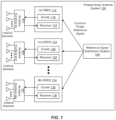
- FIG. 1 illustrates an example of a phased array antenna system 100.
- the phased array antenna system 100 can be included in phased array antennas used in a communication system (e.g., a Fifth Generation (5G) communication system), radar system, sonar system, and others.
- the phased array antenna system 100 can include a plurality of antennas, such as a first antenna 112, a second antenna 122 and an Nth antenna 132, where N is a positive integer.
- the phased array antenna system 100 can include a plurality of DREXs, where a given DREX can be communicatively coupled to a given antenna.
- a first DREX 114 can be communicatively coupled to the first antenna 112
- a second DREX 124 can be communicatively coupled to the second antenna 122
- a third DREX 134 can be communicatively coupled to the third antenna 132.
- the first DREX 114 can include a first exciter 116 and a first receiver 118
- the second DREX 124 can include a second exciter 126 and a second receiver 128,
- the Nth DREX 134 can include an Nth exciter 136 and an Nth receiver 138.
- Figure 1 depicts a phased array antenna system having one antenna subarray (112, 122, 132) per DREX (114,124,134), this is for visual simplicity.
- a subarray is a collection of antenna array elements.
- An antenna element is an actual antenna radiator. For example, one can have ten thousand of these, collected in for instance 100 subarrays, each having 100 elements apiece.
- the phased array antenna system 100 can include a reference signal distribution system 140.
- the reference signal distribution system 140 can provide a common phase reference signal to each of the DREXs, such as the first DREX 114, the second DREX 124, and the third DREX 134.
- the common phase reference signals can be reference signals having a common phase.
- the DREXs can each generate internal signals with a same phase using the common phase reference signal provided from the reference signal distribution system 140.
- the reference signal distribution system 140 can serve as a common source to provide the common phase reference signal to each of the DREXs in the phased array antenna system 100, such that each of the DREXs can generate the internal signals with the same phase.
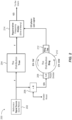
- FIG. 2 illustrates an example of a reference signal distribution system 200 of a phased array antenna system.
- the reference signal distribution system 200 can provide a common phase reference signal, which can be sent to a plurality of DREXs in the phased array antenna system.
- the reference signal distribution system 200 can be communicatively coupled to a plurality of DREXs in the phased array antenna system.
- the reference signal distribution system 200 can include a reference signal source 202, a distribution tree 204, a frequency divider 206 (e.g., a f /4 frequency divider), a power splitter 208 (e.g., a RF component that performs 1:2 power division), a distribution ring 210 (also referred to as a coaxial cable ring), ring tap(s) 212, and a plurality of analog regenerative frequency dividers 214.
- a frequency divider 206 e.g., a f /4 frequency divider
- a power splitter 208 e.g., a RF component that performs 1:2 power division
- a distribution ring 210 also referred to as a coaxial cable ring
- ring tap(s) 212 e.g., a plurality of analog regenerative frequency dividers 214.
- the reference signal source 202 can be a low-noise reference signal source. In other words, the reference signal source 202 can provide a reference signal having a low phase noise. There is typically one reference signal source 202 per phased array antenna system, but this is not intended to be limiting as multiple parallel reference signal sources per phased array antenna system is contemplated.
- the reference signal source 202 can provide a reference signal having a frequency f.
- the reference signal source 202 can drive the distribution tree 204, as well as the distribution ring 210 through the frequency divider 206.
- the distribution tree 204 can receive a reference signal having a frequency f (e.g., the reference signal having the low phase noise) from the reference signal source 202, and the distribution tree 204 can provide a copy of the reference signal having the frequency f to each of the plurality of analog regenerative frequency dividers 214 in the phased array antenna system.
- the distribution tree 204 can be implemented using passive components, for reliability, and if passive they need not be redundant.
- the frequency divider 206 can receive the reference signal having the frequency f (e.g., the reference signal having the low phase noise) from the reference signal source 202.
- the frequency divider 206 can be an f/4 frequency divider.
- the frequency divider 206 can receive the reference signal having the frequency f as an input, and produce an output of a reference signal having a frequency f /4.
- the frequency divider 206 can reduce the frequency of the reference signal (e.g., reducing from f to f /4) before distribution, in order to compensate for later frequency doubling by the ring tap(s) 212.
- the reference signal having the frequency f /4 that is outputted from the frequency divider 206 can be provided to the power splitter 208, and then to the distribution ring 210.
- the distribution ring 210 can be implemented using passive components, for reliability, and if passive need not be redundant.
- the distribution ring 210 can carry the reference signal having the frequency f/4 to the ring tap(s) 212 in the distribution ring 210.
- the reference signal having the frequency f /4 can be carried to the ring tap(s) 212 using a pair of identical signals that propagate in opposite directions around the distribution ring 210, where one signal can travel clockwise (CW) and another signal can travel counterclockwise (CCW), while both signals are in a same physical cable, such as a coaxial or other cable.
- the distribution ring 210 can carry a CW reference signal having the frequency f /4 (also referred to herein as a CW divided reference signal) and a CCW reference signal having the frequency f /4 (also referred to herein as a CCW divided reference signal) to the ring tap(s) 212 in the distribution ring 210.
- the ring tap(s) 212 can receive the CW reference signal having the frequency f /4 and the CCW reference signal having the frequency f/4, and can yield a reference signal of frequency f/2 having a known common phase (or constant phase).
- the ring tap(s) 212 can produce an f/2 phase-synchronization signal, which can be provided to each of the plurality of analog regenerative frequency dividers 214.
- the f/2 phase-synchronization signal can serve to synchronize each of the plurality of analog regenerative frequency dividers 214 to a common phase.
- the f/2 phase-synchronization signal can be at a desired reference frequency with no 180 degree phase ambiguities.
- a given analog regenerative frequency divider 214 can receive the f /2 phase-synchronization signal from a corresponding ring tap 212. Further, the given analog regenerative frequency divider 214 can receive the reference signal having the frequency f from the distribution tree 204. The f/2 phase-synchronization signal and the reference signal having the frequency f can be provided as inputs to the analog regenerative frequency divider 214, and an output of the analog regenerative frequency divider 214 can be a signal having a frequency f /2 (also referred to herein as a common phase reference signal).
- the output of the signal having the frequency f/2 can also have a common phase.
- the signal having the frequency f/2 can be provided to users, such as a corresponding DREX in the phased array antenna system.
- corresponding DREXs in the phased array antenna system can also receive signals having the frequency f /2 with the common phase.
- the distribution ring 210 can include a plurality of ring taps 212, where a given ring tap 212 can correspond with a given analog regenerative frequency divider 214, which can correspond to a given DREX in the phased array antenna system.
- a given ring tap 212 can correspond with a given analog regenerative frequency divider 214, which can correspond to a given DREX in the phased array antenna system.
- the multiple frequency dividers 206 can be synchronized using a divider reset control line.
- the frequency dividers 206 can be digital frequency dividers.
- FIG. 3 illustrates an example of a ring tap 300 of a reference signal distribution system.
- the ring tap 300 can include a directional coupler 302, a mixer 304 and a bandpass filter 306 (e.g., an f /2 bandpass filter).
- the ring tap 300 can be one of multiple ring taps that are inserted into a distribution ring of the reference signal distribution system.
- the directional coupler 302 included in the ring tap 300 can provide a CW reference signal having the frequency f /4 and a CCW reference signal having the frequency f/4 to the mixer 304.
- the mixer 304 can combine the CW and CCW reference signals of frequency f/4, and yield a direct current (DC) offset that varies with the position around the distribution ring.
- the CW and CCW reference signals of frequency f /4 can be combined to produce a (2 ⁇ f /4), or f /2, reference signal (also referred to herein as a combined divided reference signal).
- the reference signal of frequency f /2 produced by the mixer 304 can have a phase that depends on the circumference of the distribution ring and not the location within the distribution ring in which the ring tap 300 resides.
- the reference signal of frequency f /2 produced by the mixer 304 can be provided to the bandpass filter 306.
- the bandpass filter 306 can eliminate the DC offset and reduce random noise, thereby providing an f/2 phase-synchronization signal.
- the f /2 phase-synchronization signal can be provided to an associated analog regenerative frequency divider for injection locking.
- the distribution ring was instead driven at a reference signal of frequency f /2, the result would be a reference frequency of frequency f , and a post-distribution frequency division would have been needed.
- This approach would suffer from the same kind of phase ambiguity as that in the analog regenerative frequency divider.
- performing the frequency division closer to a reference signal source, prior to distribution needs only frequency multiplication to be performed in or after a reference signal distribution system, which is advantageous because frequency multiplication is not phase ambiguous.
- FIG. 4 illustrates an example of an analog regenerative frequency divider 400 of a reference signal distribution system.
- the analog regenerative frequency divider 400 can be one of multiple analog regenerative frequency dividers per a distribution ring of the reference signal distribution system.
- the analog regenerative frequency divider 400 can include a phase detector 402, a bandpass filter 404 (e.g., an f /2 bandpass filter), an amplifier 406, a directional coupler 408, a power detector 410, an analog switch 412, and a feedback network 414.
- the analog regenerative frequency divider 400 can include new components that are not found in standard analog regenerative frequency dividers, such as the power detector 410 and the analog switch 412. Further, the analog regenerative frequency divider 400 can implement a new use for the directional coupler 408, which is not found in standard analog regenerative frequency dividers.
- a reference signal of frequency f can be received at the phase detector 402 from a distribution tree in the reference signal distribution system.
- an f /2 phase-synchronization signal can be received at the directional coupler 408 via the analog switch 412 from an associated ring tap in the reference signal distribution system.
- the f/2 phase-synchronization signal can be received at the directional coupler 408 when the analog switch 412 is closed.
- the f /2 phase-synchronization signal can be directed from the directional coupler 408 to the feedback network 414, and then the f /2 phase-synchronization signal can be directed to the phase detector 402.
- the phase detector 402 can receive the reference signal of frequency f and the f /2 phase-synchronization signal.
- the phase detector 402 can perform a frequency sum and difference operation on the reference signal of frequency f and the f/2 phase-synchronization signal.
- the phase detector 402 can produce an f /2 signal and a 3 f /2 signal.
- the f /2 signal and the 3f/2 signal can be provided to the bandpass filter 404.
- the bandpass filter 404 can be an f /2 bandpass filter.
- the 3f/2 signal can be rejected and the f /2 signal can pass through the bandpass filter 404 and be provided to the amplifier 406.
- the f /2 signal from the amplifier can be provided to the directional coupler 408, and then to users, such as a corresponding DREX in the phased array antenna system.
- the directional coupler 408 can serve two functions.
- a first function of the directional coupler 408 can be to extract a portion of the f /2 signal from the amplifier to feed back to the phase detector 402 via the feedback network 414.
- a second function of the directional coupler 408 can be to serve as an injection port for injection-locking of that same oscillating loop, which can take advantage of reduced loss existing between coupler ports.
- the directional coupler 408 can provide an output signal from the amplifier 406 to the power detector 410 and the analog switch 412, and then to the phase detector 402 via the feedback network 414.
- the signal of frequency f /2 can be provided to the users, such as the corresponding DREX in the phased array antenna system.
- the power detector 410 can be used to measure the power level of the output signal.
- the analog regenerative frequency divider 400 when the analog regenerative frequency divider 400 is starting up, there can initially be an approximately zero output signal (i.e., an output signal from the directional coupler 408), but sufficient loop gain that ordinary noise will be amplified time and time again as the amplified noise circulates around the oscillator loop of the analog regenerative frequency divider 400 until the oscillation amplitude is limited by a circuit component in the analog regenerative frequency divider 400.
- a signal at a correct frequency such as an injected signal
- an oscillation can grow from and thus be in phase with that injected signal, even if that signal is very faint.
- the injected signal can be the f/2 phase-synchronization signal provided by the ring tap.
- an oscillation of the correct phase e.g., for f /2, there are two possibilities
- further injection of the signal from the ring tap can be unneeded and can cause excess phase noise, so a manner to sharply reduce an injection signal amplitude is desired.
- the power detector 410 and the analog switch 412 can be used to reduce the injection signal amplitude.
- a power detector output can also be reduced and the analog switch 412 (also known as an analog transmission gate) can be set to transmit the injection signal at full design amplitude, thereby causing injection locking.
- the injection signal can be the f /2 phase-synchronization signal received from the associated ring tap.
- the analog switch 412 when the oscillation amplitude is below the defined threshold, the analog switch 412 can be closed and the injection signal can be provided to the directional coupler 408 and through the oscillation loop of the analog regenerative frequency divider 400.
- the power detector output can also be increased.
- the analog switch 412 can block the injection signal (or the f/2 phase-synchronization signal from the associated ring tap), and typical self-sustaining regenerative divider operation can commence.
- the analog switch 412 can be open and the injection signal is not provided to the directional coupler 408 or the oscillation loop of the analog regenerative frequency divider 400. If phase noise caused by a weak injected reference signal is not important, one may simply attenuate the incoming reference signal (from the associated ring tap), and feed this directly to the directional coupler 408, omitting the power detector 410 and the analog switch 412.
- the injection signal (or the f/2 phase-synchronization signal) can be received from the ring tap only during a startup period. After the startup period and when the output power has stabilized near full power, the injection signal may not be received from the ring tap.
- an output of the analog regenerative frequency divider 400 can be a signal having a frequency f / 2.
- the signal having the frequency f /2 can be provided to users, such as a corresponding DREX in the phased array antenna system.
- corresponding DREXs in the phased array antenna system can also receive signals having the frequency f /2 with the common phase.
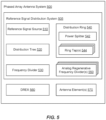
- FIG. 5 illustrates an example of a phased array antenna system 500.
- the phased array antenna system 500 can include a reference signal source 510 configured to generate a reference signal.
- the phased array antenna system 500 can include a distribution tree 520 configured to receive the reference signal from the reference signal source 510 and provide a copy of the reference signal to an analog regenerative frequency divider 550.
- the phased array antenna system 500 can include a frequency divider 530 configured to divide the reference signal to produce a divided reference signal.
- the phased array antenna system 500 can include a distribution ring 540 that includes a power splitter 542 and ring tap(s) 544.
- the power splitter 542 can be configured to create, from the divided reference signal, a counterclockwise divided reference signal and a clockwise divided reference signal.
- the distribution ring 540 can provide the counterclockwise divided reference signal to the ring tap 544, and provide the clockwise divided reference signal to the ring tap 544.
- the ring tap 544 can be configured to produce a phase synchronization signal based on the counterclockwise divided reference signal and the clockwise divided reference signal.
- the analog regenerative frequency divider 550 can be configured to receive the phase synchronization signal and the reference signal and produce a common phase reference signal.
- the reference signal source 510, the distribution tree 520, the frequency divider 530, the distribution ring 540 and the analog regenerative frequency divider 550 can be included in a reference signal distribution system 505 of the phased array antenna system 500.
- the phased array antenna system 500 can include a distributed receiver-exciter (DREX) 560 and antenna element(s) 570.
- the DREX 560 can be configured to receive the common phase reference signal from the analog regenerative frequency divider 550 and generate an internal signal using the common phase reference signal.
- the antenna element 570 can be communicatively coupled to the DREX 560, and the antenna element 570 can be controlled using the internal signal generated at the DREX 560.
- the reference signal can have a frequency f
- the frequency divider can be a f/4 frequency divider
- the counterclockwise divided reference signal can have a frequency f/4
- the clockwise divided reference signal can have a frequency f/4
- the phase synchronization signal can have a frequency f/2
- the common phase reference signal can have a frequency f/2, wherein f is a frequency in Hertz.
- the ring tap 544 can include a directional coupler, a mixer and a bandpass filter.
- the directional coupler can be configured to direct the counterclockwise divided reference signal and the clockwise divided reference signal to the mixer.
- the mixer can be configured to combine the counterclockwise divided reference signal and the clockwise divided reference signal to produce a combined divided reference signal.
- the bandpass filter can be configured to filter the combined divided reference signal to produce the phase synchronization signal.
- the analog regenerative frequency divider 550 includes a phase detector, an analog switch, a directional coupler and a power detector.
- the phase detector can be configured to receive the reference signal from the reference signal source 510 via the distribution tree 520.
- the analog switch can be configured to direct the phase synchronization signal received from the ring tap 544 to the directional coupler when the analog switch is closed.
- the directional coupler can be configured to provide the phase synchronization signal to the phase detector via a feedback network.
- the power detector can be configured to detect a signal power of an output of the directional coupler.
- phase detector can be further configured to provide a signal output that combines the reference signal and the phase synchronization signal, and the signal output is provided to a bandpass filter, an amplifier and the directional coupler to create the output of the directional coupler which corresponds to the common phase reference signal.
- the analog regenerative frequency divider 550 can be configured to receive the phase synchronization signal from the ring tap 544 via the analog switch that is closed during a startup period of the phased array antenna system 500, and the phase synchronization signal can be received when the signal power of the output of the directional coupler is below a defined threshold.
- the analog regenerative frequency divider 550 can be configured to not receive the phase synchronization signal from the ring tap 544 when the analog switch is open after the startup period of the phased array antenna system 500, wherein the phase synchronization signal is not received when the signal power of the output of the directional coupler is above a defined threshold.
- FIG. 6 illustrates a flowchart of a method for generating a common phase reference signal for use in a phased array antenna system.
- the method can include generating a reference signal, as in block 610.
- the method can include dividing the reference signal to produce a divided reference signal, as in block 620.
- the method can include creating, from the divided reference signal, a counterclockwise divided reference signal and a clockwise divided reference signal, as in block 630.
- the method can include producing a phase synchronization signal based the counterclockwise divided reference signal and the clockwise divided reference signal, as in block 640.
- the method can include generating the common phase reference signal based in part on the reference signal and the phase synchronization signal, as in block 650. Further, the method can include generating an internal signal for controlling one or more antenna elements of the phased array antenna system using the common phase reference signal.
- modules may be implemented as a hardware circuit comprising custom Very Large Scale Integration (VLSI) circuits or gate arrays, off-the-shelf semiconductors such as logic chips, transistors, or other discrete components.
- VLSI Very Large Scale Integration
- a module may also be implemented in programmable hardware devices such as field programmable gate arrays, programmable array logic, programmable logic devices or the like.
- Modules may also be implemented in software for execution by various types of processors.
- An identified module of executable code may, for instance, comprise one or more blocks of computer instructions, which may be organized as an object, procedure, or function. Nevertheless, the executables of an identified module need not be physically located together, but may comprise disparate instructions stored in different locations which comprise the module and achieve the stated purpose for the module when joined logically together.
- a module of executable code may be a single instruction, or many instructions, and may even be distributed over several different code segments, among different programs, and across several memory devices.
- operational data may be identified and illustrated herein within modules, and may be embodied in any suitable form and organized within any suitable type of data structure. The operational data may be collected as a single data set, or may be distributed over different locations including over different storage devices.
- the modules may be passive or active, including agents operable to perform desired functions.
- Computer readable storage medium includes volatile and non-volatile, removable and non-removable media implemented with any technology for the storage of information such as computer readable instructions, data structures, program modules, or other data.
- Computer readable storage media include, but is not limited to, RAM, ROM, electrically erasable programmable read-only memory (EEPROM), flash memory or other memory technology, compact disc read-only memory (CD-ROM), digital versatile disks (DVD) or other optical storage, magnetic cassettes, magnetic tapes, magnetic disk storage or other magnetic storage devices, or any other computer storage medium which can be used to store the desired information and described technology.
- the devices described herein may also contain communication connections or networking apparatus and networking connections that allow the devices to communicate with other devices.
- Communication connections are an example of communication media.
- Communication media typically embodies computer readable instructions, data structures, program modules and other data in a modulated data signal such as a carrier wave or other transport mechanism and includes any information delivery media.
- a "modulated data signal” means a signal that has one or more of its characteristics set or changed in such a manner as to encode information in the signal.
- communication media includes wired media such as a wired network or direct-wired connection, and wireless media such as acoustic, radio frequency, infrared, and other wireless media.
- the term computer readable media as used herein includes communication media.
Landscapes
- Engineering & Computer Science (AREA)
- Signal Processing (AREA)
- Computer Networks & Wireless Communication (AREA)
- Physics & Mathematics (AREA)
- General Physics & Mathematics (AREA)
- Radar, Positioning & Navigation (AREA)
- Remote Sensing (AREA)
- Variable-Direction Aerials And Aerial Arrays (AREA)
Claims (15)
- Referenzsignalverteilungssystem (200), umfassend:einen Leistungsteiler (208), der dazu konfiguriert ist, aus einem frequenzgeteilten Referenzsignal ein im Gegenuhrzeigersinn geteiltes Referenzsignal und ein im Uhrzeigersinn geteiltes Referenzsignal zu erzeugen;mindestens einen Ringabgriff (212, 300);einen Ringabgriff (210), der dazu betreibbar ist, das im Gegenuhrzeigersinn geteilte Referenzsignal von dem Leistungsteiler an den Ringabgriff bereitzustellen und das im Uhrzeigersinn geteilte Referenzsignal von dem Leistungsteiler an den Ringabgriff bereitzustellen, wobei der Ringabgriff dazu konfiguriert ist, ein Phasensynchronisationssignal basierend auf dem im Gegenuhrzeigersinn geteilten Referenzsignal und dem im Uhrzeigersinn geteilten Referenzsignal zu erzeugen; undeinen analogen regenerativen Frequenzteiler (214, 400), der dazu konfiguriert ist, ein Referenzsignal der gemeinsamen Phase teilweise basierend auf dem Phasensynchronisationssignal zu erzeugen.
- Referenzsignalverteilungssystem nach Anspruch 1, wobei der analoge regenerative Frequenzteiler ferner dazu konfiguriert ist, das Referenzsignal der gemeinsamen Phase direkt oder indirekt an einen verteilten Empfänger-Erreger "DREX" (114, 124, 134) des Referenzsignalverteilungssystems bereitzustellen.
- Referenzsignalverteilungssystem nach Anspruch 1, ferner umfassend:eine Referenzsignalquelle (202), die dazu konfiguriert ist, ein Referenzsignal zu generieren; undeinen Frequenzteiler (206), der dazu konfiguriert ist, das Referenzsignal zu teilen, um das frequenzgeteilte Referenzsignal zu erzeugen; undvorzugsweise ferner umfassend einen Verteilungsbaum (204), der dazu konfiguriert ist, das Referenzsignal von der Referenzsignalquelle zu empfangen und eine Kopie des Referenzsignals an den analogen regenerativen Frequenzteiler bereitzustellen.
- Referenzsignalverteilungssystem nach Anspruch 1, wobei das frequenzgeteilte Referenzsignal eine Frequenz f/4 aufweist, das im Gegenuhrzeigersinn geteilte Referenzsignal eine Frequenz f/4 aufweist, das im Uhrzeigersinn geteilte Referenzsignal eine Frequenz f/4 aufweist, das Phasensynchronisationssignal eine Frequenz f/2 aufweist und das Referenzsignal der gemeinsamen Phase eine Frequenz f/2 aufweist, wobei f eine Frequenz in Hertz ist; oder
wobei das frequenzgeteilte Referenzsignal eine Frequenz f/n aufweist, das im Gegenuhrzeigersinn geteilte Referenzsignal eine Frequenz f/(2n) aufweist und das im Uhrzeigersinn geteilte Referenzsignal eine Frequenz f/(2n) aufweist, wobei f eine Frequenz in Hertz ist und n eine positive ganze Zahl ist. - Referenzsignalverteilungssystem nach Anspruch 1, wobei der Ringabgriff ein Koaxialkabelring ist, der kommunikativ an den Ringabgriff gekoppelt ist; oder
wobei der Ringabgriff (300) ferner umfasst:einen Richtkoppler (302), der dazu konfiguriert ist, das im Gegenuhrzeigersinn geteilte Referenzsignal und das im Uhrzeigersinn geteilte Referenzsignal an einen Mischer (304) zu leiten;wobei der Mischer dazu konfiguriert ist, das im Gegenuhrzeigersinn geteilte Referenzsignal und das im Uhrzeigersinn geteilte Referenzsignal zu kombinieren, um ein kombiniertes geteiltes Referenzsignal zu erzeugen; undein Bandpassfilter (306), das dazu konfiguriert ist, das kombinierte geteilte Referenzsignal zu filtern, um das Phasensynchronisationssignal zu erzeugen. - Referenzsignalverteilungssystem nach Anspruch 1, wobei der analoge regenerative Frequenzteiler (400) ferner umfasst:einen analogen Schalter (412), der dazu konfiguriert ist, das von dem Ringabgriff empfangene Phasensynchronisationssignal an einen Richtkoppler (408) zu leiten, wenn der analoge Schalter geschlossen ist; undwobei der Richtkoppler dazu konfiguriert ist, das Phasensynchronisationssignal über ein Rückkopplungsnetzwerk (414) an den Phasendetektor bereitzustellen;einen Leistungsdetektor (410), der dazu konfiguriert ist, eine Signalleistung eines Ausgangs des Richtkopplers zu erkennen; undeinen Phasendetektor (402), der dazu konfiguriert ist, eine Signalausgabe bereitzustellen, die teilweise auf einem Referenzsignal und dem Phasensynchronisationssignal basiert, und wobei der Signalausgang an ein Bandpassfilter (404), einen Verstärker (406) und den Richtkoppler bereitgestellt wird, um einen Ausgang des Richtkopplers zu erzeugen, der dem Referenzsignal der gemeinsamen Phase entspricht.
- Referenzsignalverteilungssystem nach Anspruch 6, wobei der analoge regenerative Frequenzteiler dazu konfiguriert ist, das Phasensynchronisationssignal von dem Ringabgriff über den analogen Schalter zu empfangen, der während einer Startperiode des Referenzsignalverteilungssystems geschlossen ist, wobei das Phasensynchronisationssignal empfangen wird, wenn die Signalleistung des Ausgangs des Richtkopplers unter einem definierten Schwellenwert liegt; und
wobei der analoge regenerative Frequenzteiler vorzugsweise dazu konfiguriert ist, das Phasensynchronisationssignal von dem Ringabgriff nicht zu empfangen, wenn der analoge Schalter nach der Startperiode des Referenzsignalverteilungssystems geöffnet ist, wobei das Phasensynchronisationssignal nicht empfangen wird, wenn die Signalleistung des Ausgangs des Richtkopplers über einem definierten Schwellenwert liegt. - Referenzsignalverteilungssystem nach Anspruch 1, wobei das frequenzgeteilte Referenzsignal vor dem Ringabgriff erzeugt wird.
- Phasengesteuertes Gruppenantennensystem (100), umfassend:eine Vielzahl von Antennenelementen;eine Referenzsignalquelle (202), die dazu konfiguriert ist, ein Referenzsignal zu generieren;einen Frequenzteiler (206), der dazu konfiguriert ist, das Referenzsignal zu teilen, um ein frequenzgeteiltes Referenzsignal zu erzeugen; undein Referenzsignalverteilungssystem (200) nach Anspruch 1;wobei der Leistungsteiler des Referenzsignalverteilungssystems dazu konfiguriert ist, aus dem frequenzgeteilten Referenzsignal das im Gegenuhrzeigersinn geteilte Referenzsignal und das im Uhrzeigersinn geteilte Referenzsignal zu erzeugen; undder analoge regenerative Frequenzteiler des Referenzsignalverteilungssystems dazu konfiguriert ist, das Phasensynchronisationssignal und das Referenzsignal zu empfangen.
- Phasengesteuertes Gruppenantennensystem nach Anspruch 9, ferner umfassend:einen verteilten Empfänger-Erreger "DREX" (114, 124, 134), der dazu konfiguriert ist, das Referenzsignal der gemeinsamen Phase direkt oder indirekt von dem analogen regenerativen Frequenzteiler zu empfangen und unter Verwendung des Referenzsignals der gemeinsamen Phase ein internes Signal zu generieren,ein Antennenelement in der Vielzahl von Antennenelementen, das kommunikativ an den DREX gekoppelt ist, wobei das Antennenelement unter Verwendung des an dem DREX generierten internen Signals gesteuert wird; oderferner umfassend einen Verteilungsbaum (204), der dazu konfiguriert ist, das Referenzsignal von der Referenzsignalquelle zu empfangen und eine Kopie des Referenzsignals an den analogen regenerativen Frequenzteiler bereitzustellen.
- Phasengesteuertes Gruppenantennensystem nach Anspruch 9, wobei das Referenzsignal eine Frequenz f aufweist, der Frequenzteiler ein f/4-Frequenzteiler ist, das im Gegenuhrzeigersinn geteilte Referenzsignal eine Frequenz f/4 aufweist, das im Uhrzeigersinn geteilte Referenzsignal eine Frequenz f/4 aufweist, das Phasensynchronisationssignal eine Frequenz f/2 aufweist und das Referenzsignal der gemeinsamen Phase eine Frequenz f/2 aufweist, wobei f eine Frequenz in Hertz ist; oder
wobei der Ringabgriff (300) ferner umfasst:einen Richtkoppler (302), der dazu konfiguriert ist, das im Gegenuhrzeigersinn geteilte Referenzsignal und das im Uhrzeigersinn geteilte Referenzsignal an einen Mischer (304) zu leiten;wobei der Mischer dazu konfiguriert ist, das im Gegenuhrzeigersinn geteilte Referenzsignal und das im Uhrzeigersinn geteilte Referenzsignal zu kombinieren, um ein kombiniertes geteiltes Referenzsignal zu erzeugen; undein Bandpassfilter (306), das dazu konfiguriert ist, das kombinierte geteilte Referenzsignal zu filtern, um das Phasensynchronisationssignal zu erzeugen. - Phasengesteuertes Gruppenantennensystem nach Anspruch 9, wobei der analoge regenerative Frequenzteiler (400) ferner umfasst:einen Phasendetektor (402), der dazu konfiguriert ist, das Referenzsignal von der Referenzsignalquelle über einen Verteilungsbaum zu empfangen;einen analogen Schalter (412), der dazu konfiguriert ist, das von dem Ringabgriff empfangene Phasensynchronisationssignal an einen Richtkoppler (408) zu leiten, wenn der analoge Schalter geschlossen ist; undwobei der Richtkoppler dazu konfiguriert ist, das Phasensynchronisationssignal über ein Rückkopplungsnetzwerk (414) an den Phasendetektor bereitzustellen; undeinen Leistungsdetektor (410), der dazu konfiguriert ist, eine Signalleistung eines Ausgangs des Richtkopplers zu erkennen,wobei der Phasendetektor ferner dazu konfiguriert ist, eine Signalausgabe bereitzustellen, die das Referenzsignal und das Phasensynchronisationssignal kombiniert, und der Signalausgang an ein Bandpassfilter (404), einen Verstärker (406) und den Richtkoppler bereitgestellt wird, um einen Ausgang des Richtkopplers zu erzeugen, der dem Referenzsignal der gemeinsamen Phase entspricht.
- Phasengesteuertes Gruppenantennensystem nach Anspruch 12, wobei der analoge regenerative Frequenzteiler dazu konfiguriert ist, das Phasensynchronisationssignal von dem Ringabgriff über den analogen Schalter zu empfangen, der während einer Startperiode des phasengesteuerten Gruppenantennensystems geschlossen ist, wobei das Phasensynchronisationssignal empfangen wird, wenn die Signalleistung des Ausgangs des Richtkopplers unter einem definierten Schwellenwert liegt; und wobei der analoge regenerative Frequenzteiler vorzugsweise dazu konfiguriert ist, das Phasensynchronisationssignal von dem Ringabgriff nicht zu empfangen, wenn der analoge Schalter nach Abschluss der Startperiode des phasengesteuerten Gruppenantennensystems geöffnet ist, wobei das Phasensynchronisationssignal nicht empfangen wird, wenn die Signalleistung des Ausgangs des Richtkopplers über einem definierten Schwellenwert liegt.
- Verfahren zum Generieren eines Referenzsignals der gemeinsamen Phase, wobei das Verfahren umfasst:Generieren (610) eines Referenzsignals;Teilen (620) des Referenzsignals, um ein frequenzgeteiltes Referenzsignal zu erzeugen;Erzeugen (630) eines im Gegenuhrzeigersinn geteilten Referenzsignals und eines im Uhrzeigersinn geteilten Referenzsignals aus dem frequenzgeteilten Referenzsignal unter Verwendung eines Leistungsteilers (208);Bereitstellen des im Gegenuhrzeigersinn geteilten Referenzsignals von dem Leistungsteiler an einen Ringabgriff (212, 300) und Bereitstellen des im Uhrzeigersinn geteilten Referenzsignals von dem Leistungsteiler an den Ringabgriff unter Verwendung eines Ringabgriffs (210);Erzeugen (640) eines Phasensynchronisationssignals basierend auf dem im Gegenuhrzeigersinn geteilten Referenzsignal und dem im Uhrzeigersinn geteilten Referenzsignal unter Verwendung des Ringabgriffs (212, 300); undGenerieren (650) eines Referenzsignals der gemeinsamen Phase, das teilweise auf dem Referenzsignal und dem Phasensynchronisationssignal basiert, unter Verwendung eines analogen regenerativen Frequenzteilers (214, 400).
- Verfahren nach Anspruch 14, ferner umfassend Generieren eines internen Signals zum Steuern eines oder mehrerer Antennenelemente eines phasengesteuerten Gruppenantennensystems unter Verwendung des Referenzsignals der gemeinsamen Phase umfasst; oder
wobei das Referenzsignal eine Frequenz f aufweist, das frequenzgeteilte Referenzsignal eine Frequenz f/4 aufweist, das im Gegenuhrzeigersinn geteilte Referenzsignal eine Frequenz f/4 aufweist, das im Uhrzeigersinn geteilte Referenzsignal eine Frequenz f/4 aufweist, das Phasensynchronisationssignal eine Frequenz f/2 aufweist und das Referenzsignal der gemeinsamen Phase eine Frequenz f/2 aufweist, wobei f eine Frequenz in Hertz ist.
Applications Claiming Priority (2)
| Application Number | Priority Date | Filing Date | Title |
|---|---|---|---|
| US16/583,207 US11082186B2 (en) | 2019-09-25 | 2019-09-25 | Phased array antenna system |
| PCT/US2020/043332 WO2021061265A1 (en) | 2019-09-25 | 2020-07-23 | Phased array antenna system |
Publications (2)
| Publication Number | Publication Date |
|---|---|
| EP4035274A1 EP4035274A1 (de) | 2022-08-03 |
| EP4035274B1 true EP4035274B1 (de) | 2023-10-25 |
Family
ID=72088364
Family Applications (1)
| Application Number | Title | Priority Date | Filing Date |
|---|---|---|---|
| EP20757431.0A Active EP4035274B1 (de) | 2019-09-25 | 2020-07-23 | Phasengesteuertes gruppenantennensystem |
Country Status (9)
| Country | Link |
|---|---|
| US (1) | US11082186B2 (de) |
| EP (1) | EP4035274B1 (de) |
| JP (1) | JP7462742B2 (de) |
| AU (1) | AU2020352824B2 (de) |
| CA (1) | CA3150793A1 (de) |
| IL (1) | IL291544B (de) |
| PL (1) | PL4035274T3 (de) |
| TW (1) | TWI746114B (de) |
| WO (1) | WO2021061265A1 (de) |
Families Citing this family (3)
| Publication number | Priority date | Publication date | Assignee | Title |
|---|---|---|---|---|
| US11444377B2 (en) * | 2019-10-03 | 2022-09-13 | Aptiv Technologies Limited | Radiation pattern reconfigurable antenna |
| CN114188680A (zh) * | 2020-09-14 | 2022-03-15 | 华为技术有限公司 | 一种通信装置及系统 |
| US12088370B2 (en) * | 2022-09-27 | 2024-09-10 | Qualcomm Incorporated | Parallel shift estimation for LOS MIMO communication |
Family Cites Families (21)
| Publication number | Priority date | Publication date | Assignee | Title |
|---|---|---|---|---|
| US3750178A (en) | 1959-05-22 | 1973-07-31 | Itt | Radio location detection system |
| US4649393A (en) | 1984-02-17 | 1987-03-10 | The United States Of America As Represented By The Secretary Of The Army | Phased array antennas with binary phase shifters |
| US4647868A (en) | 1985-03-25 | 1987-03-03 | General Electric Company | Push-pull radio-frequency power splitter/combiner apparatus |
| EP0276454B1 (de) | 1986-12-22 | 1993-06-09 | Oerlikon-Contraves AG | Zielverfolgungssystem |
| US5248982A (en) | 1991-08-29 | 1993-09-28 | Hughes Aircraft Company | Method and apparatus for calibrating phased array receiving antennas |
| US5623270A (en) * | 1994-10-12 | 1997-04-22 | Riverside Research Institute | Phased array antenna |
| US5671168A (en) | 1995-07-06 | 1997-09-23 | Technion Research & Development Foundation Ltd. | Digital frequency-domain implementation of arrays |
| US7358806B2 (en) | 2004-07-08 | 2008-04-15 | Amalfi Semiconductor, Inc. | Method and apparatus for an improved power amplifier |
| JP5409621B2 (ja) | 2007-07-20 | 2014-02-05 | ブルー ダニューブ ラブズ インク | 位相同期ローカルキャリアを有するマルチポイント信号発生の方法及びシステム |
| US8212716B2 (en) * | 2007-12-31 | 2012-07-03 | Elta Systems Ltd. | System and method for calibration of phased array antenna having integral calibration network in presence of an interfering body |
| US8611959B2 (en) | 2010-07-01 | 2013-12-17 | Blue Danube Labs, Inc. | Low cost, active antenna arrays |
| US8730097B1 (en) | 2011-08-10 | 2014-05-20 | Lockheed Martin Corporation | Distributed phased array testing device |
| US9261587B1 (en) | 2013-03-15 | 2016-02-16 | Raytheon Company | Methods and apparatus for highly reliable signal distribution |
| US9385655B2 (en) | 2013-12-11 | 2016-07-05 | Raytheon Company | Regenerative frequency multiplier |
| WO2015168887A1 (zh) * | 2014-05-07 | 2015-11-12 | 华为技术有限公司 | 一种相控阵校准方法及相控阵校准电路 |
| CN106663871B (zh) * | 2014-11-19 | 2020-03-10 | 华为技术有限公司 | 相位校准方法和装置 |
| US20160218429A1 (en) * | 2015-01-23 | 2016-07-28 | Huawei Technologies Canada Co., Ltd. | Phase control for antenna array |
| IL239596B (en) * | 2015-06-23 | 2020-08-31 | Elta Systems Ltd | Calibration network for a phased array antenna |
| CA2992289A1 (en) | 2015-07-22 | 2017-01-26 | Blue Danube Systems, Inc. | A modular phased array |
| JP6230768B1 (ja) | 2016-02-02 | 2017-11-15 | 三菱電機株式会社 | 同相分配回路及びアレーアンテナ装置 |
| US11223128B2 (en) * | 2018-06-15 | 2022-01-11 | Lockheed Martin Corporation | Multi-frequency multiplexed signal distribution for phased antenna array |
-
2019
- 2019-09-25 US US16/583,207 patent/US11082186B2/en active Active
-
2020
- 2020-07-23 IL IL291544A patent/IL291544B/en unknown
- 2020-07-23 AU AU2020352824A patent/AU2020352824B2/en active Active
- 2020-07-23 JP JP2022519043A patent/JP7462742B2/ja active Active
- 2020-07-23 PL PL20757431.0T patent/PL4035274T3/pl unknown
- 2020-07-23 WO PCT/US2020/043332 patent/WO2021061265A1/en not_active Ceased
- 2020-07-23 EP EP20757431.0A patent/EP4035274B1/de active Active
- 2020-07-23 CA CA3150793A patent/CA3150793A1/en active Pending
- 2020-08-17 TW TW109127873A patent/TWI746114B/zh active
Also Published As
| Publication number | Publication date |
|---|---|
| JP2022550051A (ja) | 2022-11-30 |
| WO2021061265A1 (en) | 2021-04-01 |
| US11082186B2 (en) | 2021-08-03 |
| TWI746114B (zh) | 2021-11-11 |
| IL291544A (en) | 2022-05-01 |
| US20210091908A1 (en) | 2021-03-25 |
| PL4035274T3 (pl) | 2024-02-26 |
| EP4035274A1 (de) | 2022-08-03 |
| JP7462742B2 (ja) | 2024-04-05 |
| IL291544B (en) | 2022-08-01 |
| AU2020352824A1 (en) | 2022-03-24 |
| TW202125900A (zh) | 2021-07-01 |
| CA3150793A1 (en) | 2021-04-01 |
| AU2020352824B2 (en) | 2024-10-10 |
Similar Documents
| Publication | Publication Date | Title |
|---|---|---|
| EP4035274B1 (de) | Phasengesteuertes gruppenantennensystem | |
| US20100026563A1 (en) | Antenna system and radar system incorporating the same | |
| US20080297400A1 (en) | Monostatic Planar Multi-Beam Radar Sensor | |
| US3877813A (en) | Self-compensating interferometer | |
| EP3929622A1 (de) | Radar system | |
| US3371341A (en) | Method and means for extracting velocity sense from a non-coherent janus doppler rada system | |
| US3270336A (en) | Eliminating multiple responses in a grating lobe antenna array | |
| US9261587B1 (en) | Methods and apparatus for highly reliable signal distribution | |
| US3185981A (en) | Doppler navigation system | |
| CN115004478B (zh) | 相控阵天线、发送装置、无线电力传输系统以及无线通信系统 | |
| GB1347078A (en) | Transponder beacons | |
| US20210135691A1 (en) | Scalable mm-wave arrays with large aperture realized by mm-wave dielectric waveguides | |
| US3268890A (en) | Scanning and eliminating multiple responses in a grating lobe antenna array | |
| Bickmore | Adaptive antenna arrays | |
| US3383688A (en) | Systems for controlling the automatic tracking in high frequency antennas | |
| Seeds | Optical beamforming techniques for phased-array antennas | |
| US2940075A (en) | Microwave antenna | |
| CN117590372A (zh) | 激光与微波一体化雷达探测方法及装置 | |
| GB1344092A (en) | Antenna tracking systems | |
| US3373424A (en) | Tracking and synchronizing system | |
| US3076192A (en) | Automatic radio navigation | |
| US3346860A (en) | Radio navigation system | |
| US3102264A (en) | Hybrid pulse-continuous wave doppler radio navigation system | |
| US2422123A (en) | Direction finder | |
| Stringfellow et al. | X-band distributed array Gunn effect transmitter |
Legal Events
| Date | Code | Title | Description |
|---|---|---|---|
| STAA | Information on the status of an ep patent application or granted ep patent |
Free format text: STATUS: UNKNOWN |
|
| STAA | Information on the status of an ep patent application or granted ep patent |
Free format text: STATUS: THE INTERNATIONAL PUBLICATION HAS BEEN MADE |
|
| PUAI | Public reference made under article 153(3) epc to a published international application that has entered the european phase |
Free format text: ORIGINAL CODE: 0009012 |
|
| STAA | Information on the status of an ep patent application or granted ep patent |
Free format text: STATUS: REQUEST FOR EXAMINATION WAS MADE |
|
| 17P | Request for examination filed |
Effective date: 20220414 |
|
| AK | Designated contracting states |
Kind code of ref document: A1 Designated state(s): AL AT BE BG CH CY CZ DE DK EE ES FI FR GB GR HR HU IE IS IT LI LT LU LV MC MK MT NL NO PL PT RO RS SE SI SK SM TR |
|
| DAV | Request for validation of the european patent (deleted) | ||
| DAX | Request for extension of the european patent (deleted) | ||
| GRAP | Despatch of communication of intention to grant a patent |
Free format text: ORIGINAL CODE: EPIDOSNIGR1 |
|
| STAA | Information on the status of an ep patent application or granted ep patent |
Free format text: STATUS: GRANT OF PATENT IS INTENDED |
|
| RIC1 | Information provided on ipc code assigned before grant |
Ipc: G01S 7/03 20060101ALN20230524BHEP Ipc: H01Q 3/36 20060101ALI20230524BHEP Ipc: G01S 7/534 20060101ALI20230524BHEP Ipc: H04B 1/403 20150101AFI20230524BHEP |
|
| INTG | Intention to grant announced |
Effective date: 20230616 |
|
| GRAS | Grant fee paid |
Free format text: ORIGINAL CODE: EPIDOSNIGR3 |
|
| GRAA | (expected) grant |
Free format text: ORIGINAL CODE: 0009210 |
|
| STAA | Information on the status of an ep patent application or granted ep patent |
Free format text: STATUS: THE PATENT HAS BEEN GRANTED |
|
| AK | Designated contracting states |
Kind code of ref document: B1 Designated state(s): AL AT BE BG CH CY CZ DE DK EE ES FI FR GB GR HR HU IE IS IT LI LT LU LV MC MK MT NL NO PL PT RO RS SE SI SK SM TR |
|
| REG | Reference to a national code |
Ref country code: GB Ref legal event code: FG4D |
|
| REG | Reference to a national code |
Ref country code: CH Ref legal event code: EP |
|
| REG | Reference to a national code |
Ref country code: DE Ref legal event code: R096 Ref document number: 602020019881 Country of ref document: DE |
|
| REG | Reference to a national code |
Ref country code: IE Ref legal event code: FG4D |
|
| REG | Reference to a national code |
Ref country code: SE Ref legal event code: TRGR |
|
| RAP4 | Party data changed (patent owner data changed or rights of a patent transferred) |
Owner name: RAYTHEON COMPANY |
|
| REG | Reference to a national code |
Ref country code: NO Ref legal event code: T2 Effective date: 20231025 |
|
| REG | Reference to a national code |
Ref country code: LT Ref legal event code: MG9D |
|
| REG | Reference to a national code |
Ref country code: NL Ref legal event code: MP Effective date: 20231025 |
|
| REG | Reference to a national code |
Ref country code: AT Ref legal event code: MK05 Ref document number: 1625703 Country of ref document: AT Kind code of ref document: T Effective date: 20231025 |
|
| PG25 | Lapsed in a contracting state [announced via postgrant information from national office to epo] |
Ref country code: NL Free format text: LAPSE BECAUSE OF FAILURE TO SUBMIT A TRANSLATION OF THE DESCRIPTION OR TO PAY THE FEE WITHIN THE PRESCRIBED TIME-LIMIT Effective date: 20231025 |
|
| PG25 | Lapsed in a contracting state [announced via postgrant information from national office to epo] |
Ref country code: GR Free format text: LAPSE BECAUSE OF FAILURE TO SUBMIT A TRANSLATION OF THE DESCRIPTION OR TO PAY THE FEE WITHIN THE PRESCRIBED TIME-LIMIT Effective date: 20240126 |
|
| PG25 | Lapsed in a contracting state [announced via postgrant information from national office to epo] |
Ref country code: IS Free format text: LAPSE BECAUSE OF FAILURE TO SUBMIT A TRANSLATION OF THE DESCRIPTION OR TO PAY THE FEE WITHIN THE PRESCRIBED TIME-LIMIT Effective date: 20240225 |
|
| PG25 | Lapsed in a contracting state [announced via postgrant information from national office to epo] |
Ref country code: LT Free format text: LAPSE BECAUSE OF FAILURE TO SUBMIT A TRANSLATION OF THE DESCRIPTION OR TO PAY THE FEE WITHIN THE PRESCRIBED TIME-LIMIT Effective date: 20231025 |
|
| PG25 | Lapsed in a contracting state [announced via postgrant information from national office to epo] |
Ref country code: AT Free format text: LAPSE BECAUSE OF FAILURE TO SUBMIT A TRANSLATION OF THE DESCRIPTION OR TO PAY THE FEE WITHIN THE PRESCRIBED TIME-LIMIT Effective date: 20231025 |
|
| PG25 | Lapsed in a contracting state [announced via postgrant information from national office to epo] |
Ref country code: ES Free format text: LAPSE BECAUSE OF FAILURE TO SUBMIT A TRANSLATION OF THE DESCRIPTION OR TO PAY THE FEE WITHIN THE PRESCRIBED TIME-LIMIT Effective date: 20231025 |
|
| PG25 | Lapsed in a contracting state [announced via postgrant information from national office to epo] |
Ref country code: LT Free format text: LAPSE BECAUSE OF FAILURE TO SUBMIT A TRANSLATION OF THE DESCRIPTION OR TO PAY THE FEE WITHIN THE PRESCRIBED TIME-LIMIT Effective date: 20231025 Ref country code: IS Free format text: LAPSE BECAUSE OF FAILURE TO SUBMIT A TRANSLATION OF THE DESCRIPTION OR TO PAY THE FEE WITHIN THE PRESCRIBED TIME-LIMIT Effective date: 20240225 Ref country code: GR Free format text: LAPSE BECAUSE OF FAILURE TO SUBMIT A TRANSLATION OF THE DESCRIPTION OR TO PAY THE FEE WITHIN THE PRESCRIBED TIME-LIMIT Effective date: 20240126 Ref country code: ES Free format text: LAPSE BECAUSE OF FAILURE TO SUBMIT A TRANSLATION OF THE DESCRIPTION OR TO PAY THE FEE WITHIN THE PRESCRIBED TIME-LIMIT Effective date: 20231025 Ref country code: BG Free format text: LAPSE BECAUSE OF FAILURE TO SUBMIT A TRANSLATION OF THE DESCRIPTION OR TO PAY THE FEE WITHIN THE PRESCRIBED TIME-LIMIT Effective date: 20240125 Ref country code: AT Free format text: LAPSE BECAUSE OF FAILURE TO SUBMIT A TRANSLATION OF THE DESCRIPTION OR TO PAY THE FEE WITHIN THE PRESCRIBED TIME-LIMIT Effective date: 20231025 Ref country code: PT Free format text: LAPSE BECAUSE OF FAILURE TO SUBMIT A TRANSLATION OF THE DESCRIPTION OR TO PAY THE FEE WITHIN THE PRESCRIBED TIME-LIMIT Effective date: 20240226 |
|
| PG25 | Lapsed in a contracting state [announced via postgrant information from national office to epo] |
Ref country code: RS Free format text: LAPSE BECAUSE OF FAILURE TO SUBMIT A TRANSLATION OF THE DESCRIPTION OR TO PAY THE FEE WITHIN THE PRESCRIBED TIME-LIMIT Effective date: 20231025 Ref country code: LV Free format text: LAPSE BECAUSE OF FAILURE TO SUBMIT A TRANSLATION OF THE DESCRIPTION OR TO PAY THE FEE WITHIN THE PRESCRIBED TIME-LIMIT Effective date: 20231025 Ref country code: HR Free format text: LAPSE BECAUSE OF FAILURE TO SUBMIT A TRANSLATION OF THE DESCRIPTION OR TO PAY THE FEE WITHIN THE PRESCRIBED TIME-LIMIT Effective date: 20231025 |
|
| PG25 | Lapsed in a contracting state [announced via postgrant information from national office to epo] |
Ref country code: DK Free format text: LAPSE BECAUSE OF FAILURE TO SUBMIT A TRANSLATION OF THE DESCRIPTION OR TO PAY THE FEE WITHIN THE PRESCRIBED TIME-LIMIT Effective date: 20231025 |
|
| PG25 | Lapsed in a contracting state [announced via postgrant information from national office to epo] |
Ref country code: CZ Free format text: LAPSE BECAUSE OF FAILURE TO SUBMIT A TRANSLATION OF THE DESCRIPTION OR TO PAY THE FEE WITHIN THE PRESCRIBED TIME-LIMIT Effective date: 20231025 |
|
| REG | Reference to a national code |
Ref country code: DE Ref legal event code: R097 Ref document number: 602020019881 Country of ref document: DE |
|
| PG25 | Lapsed in a contracting state [announced via postgrant information from national office to epo] |
Ref country code: SK Free format text: LAPSE BECAUSE OF FAILURE TO SUBMIT A TRANSLATION OF THE DESCRIPTION OR TO PAY THE FEE WITHIN THE PRESCRIBED TIME-LIMIT Effective date: 20231025 |
|
| PG25 | Lapsed in a contracting state [announced via postgrant information from national office to epo] |
Ref country code: SM Free format text: LAPSE BECAUSE OF FAILURE TO SUBMIT A TRANSLATION OF THE DESCRIPTION OR TO PAY THE FEE WITHIN THE PRESCRIBED TIME-LIMIT Effective date: 20231025 Ref country code: SK Free format text: LAPSE BECAUSE OF FAILURE TO SUBMIT A TRANSLATION OF THE DESCRIPTION OR TO PAY THE FEE WITHIN THE PRESCRIBED TIME-LIMIT Effective date: 20231025 Ref country code: RO Free format text: LAPSE BECAUSE OF FAILURE TO SUBMIT A TRANSLATION OF THE DESCRIPTION OR TO PAY THE FEE WITHIN THE PRESCRIBED TIME-LIMIT Effective date: 20231025 Ref country code: IT Free format text: LAPSE BECAUSE OF FAILURE TO SUBMIT A TRANSLATION OF THE DESCRIPTION OR TO PAY THE FEE WITHIN THE PRESCRIBED TIME-LIMIT Effective date: 20231025 Ref country code: EE Free format text: LAPSE BECAUSE OF FAILURE TO SUBMIT A TRANSLATION OF THE DESCRIPTION OR TO PAY THE FEE WITHIN THE PRESCRIBED TIME-LIMIT Effective date: 20231025 Ref country code: DK Free format text: LAPSE BECAUSE OF FAILURE TO SUBMIT A TRANSLATION OF THE DESCRIPTION OR TO PAY THE FEE WITHIN THE PRESCRIBED TIME-LIMIT Effective date: 20231025 Ref country code: CZ Free format text: LAPSE BECAUSE OF FAILURE TO SUBMIT A TRANSLATION OF THE DESCRIPTION OR TO PAY THE FEE WITHIN THE PRESCRIBED TIME-LIMIT Effective date: 20231025 |
|
| PLBE | No opposition filed within time limit |
Free format text: ORIGINAL CODE: 0009261 |
|
| STAA | Information on the status of an ep patent application or granted ep patent |
Free format text: STATUS: NO OPPOSITION FILED WITHIN TIME LIMIT |
|
| 26N | No opposition filed |
Effective date: 20240726 |
|
| PG25 | Lapsed in a contracting state [announced via postgrant information from national office to epo] |
Ref country code: SI Free format text: LAPSE BECAUSE OF FAILURE TO SUBMIT A TRANSLATION OF THE DESCRIPTION OR TO PAY THE FEE WITHIN THE PRESCRIBED TIME-LIMIT Effective date: 20231025 |
|
| PG25 | Lapsed in a contracting state [announced via postgrant information from national office to epo] |
Ref country code: SI Free format text: LAPSE BECAUSE OF FAILURE TO SUBMIT A TRANSLATION OF THE DESCRIPTION OR TO PAY THE FEE WITHIN THE PRESCRIBED TIME-LIMIT Effective date: 20231025 |
|
| PG25 | Lapsed in a contracting state [announced via postgrant information from national office to epo] |
Ref country code: MC Free format text: LAPSE BECAUSE OF FAILURE TO SUBMIT A TRANSLATION OF THE DESCRIPTION OR TO PAY THE FEE WITHIN THE PRESCRIBED TIME-LIMIT Effective date: 20231025 |
|
| REG | Reference to a national code |
Ref country code: CH Ref legal event code: PL |
|
| PG25 | Lapsed in a contracting state [announced via postgrant information from national office to epo] |
Ref country code: LU Free format text: LAPSE BECAUSE OF NON-PAYMENT OF DUE FEES Effective date: 20240723 |
|
| PG25 | Lapsed in a contracting state [announced via postgrant information from national office to epo] |
Ref country code: LU Free format text: LAPSE BECAUSE OF NON-PAYMENT OF DUE FEES Effective date: 20240723 |
|
| PG25 | Lapsed in a contracting state [announced via postgrant information from national office to epo] |
Ref country code: BE Free format text: LAPSE BECAUSE OF NON-PAYMENT OF DUE FEES Effective date: 20240731 Ref country code: CH Free format text: LAPSE BECAUSE OF NON-PAYMENT OF DUE FEES Effective date: 20240731 |
|
| REG | Reference to a national code |
Ref country code: BE Ref legal event code: MM Effective date: 20240731 |
|
| PGFP | Annual fee paid to national office [announced via postgrant information from national office to epo] |
Ref country code: PL Payment date: 20250625 Year of fee payment: 6 |
|
| PGFP | Annual fee paid to national office [announced via postgrant information from national office to epo] |
Ref country code: GB Payment date: 20250619 Year of fee payment: 6 |
|
| PGFP | Annual fee paid to national office [announced via postgrant information from national office to epo] |
Ref country code: NO Payment date: 20250623 Year of fee payment: 6 |
|
| PGFP | Annual fee paid to national office [announced via postgrant information from national office to epo] |
Ref country code: FR Payment date: 20250620 Year of fee payment: 6 |
|
| PG25 | Lapsed in a contracting state [announced via postgrant information from national office to epo] |
Ref country code: IE Free format text: LAPSE BECAUSE OF NON-PAYMENT OF DUE FEES Effective date: 20240723 |
|
| PGFP | Annual fee paid to national office [announced via postgrant information from national office to epo] |
Ref country code: SE Payment date: 20250619 Year of fee payment: 6 |
|
| PG25 | Lapsed in a contracting state [announced via postgrant information from national office to epo] |
Ref country code: FI Free format text: LAPSE BECAUSE OF FAILURE TO SUBMIT A TRANSLATION OF THE DESCRIPTION OR TO PAY THE FEE WITHIN THE PRESCRIBED TIME-LIMIT Effective date: 20231025 |
|
| PGFP | Annual fee paid to national office [announced via postgrant information from national office to epo] |
Ref country code: DE Payment date: 20250620 Year of fee payment: 6 |
|
| P01 | Opt-out of the competence of the unified patent court (upc) registered |
Free format text: CASE NUMBER: UPC_APP_0018777_4035274/2025 Effective date: 20251221 |
|
| PG25 | Lapsed in a contracting state [announced via postgrant information from national office to epo] |
Ref country code: CY Free format text: LAPSE BECAUSE OF FAILURE TO SUBMIT A TRANSLATION OF THE DESCRIPTION OR TO PAY THE FEE WITHIN THE PRESCRIBED TIME-LIMIT; INVALID AB INITIO Effective date: 20200723 |
|
| PG25 | Lapsed in a contracting state [announced via postgrant information from national office to epo] |
Ref country code: HU Free format text: LAPSE BECAUSE OF FAILURE TO SUBMIT A TRANSLATION OF THE DESCRIPTION OR TO PAY THE FEE WITHIN THE PRESCRIBED TIME-LIMIT; INVALID AB INITIO Effective date: 20200723 |