EP4033161A1 - Limescale deposition detection by thermal pulse technology - Google Patents
Limescale deposition detection by thermal pulse technology Download PDFInfo
- Publication number
- EP4033161A1 EP4033161A1 EP21152659.5A EP21152659A EP4033161A1 EP 4033161 A1 EP4033161 A1 EP 4033161A1 EP 21152659 A EP21152659 A EP 21152659A EP 4033161 A1 EP4033161 A1 EP 4033161A1
- Authority
- EP
- European Patent Office
- Prior art keywords
- water heater
- value
- limescale
- household appliance
- temperature
- Prior art date
- Legal status (The legal status is an assumption and is not a legal conclusion. Google has not performed a legal analysis and makes no representation as to the accuracy of the status listed.)
- Pending
Links
Images


Classifications
-
- F—MECHANICAL ENGINEERING; LIGHTING; HEATING; WEAPONS; BLASTING
- F24—HEATING; RANGES; VENTILATING
- F24D—DOMESTIC- OR SPACE-HEATING SYSTEMS, e.g. CENTRAL HEATING SYSTEMS; DOMESTIC HOT-WATER SUPPLY SYSTEMS; ELEMENTS OR COMPONENTS THEREFOR
- F24D19/00—Details
- F24D19/0092—Devices for preventing or removing corrosion, slime or scale
-
- F—MECHANICAL ENGINEERING; LIGHTING; HEATING; WEAPONS; BLASTING
- F24—HEATING; RANGES; VENTILATING
- F24H—FLUID HEATERS, e.g. WATER OR AIR HEATERS, HAVING HEAT-GENERATING MEANS, e.g. HEAT PUMPS, IN GENERAL
- F24H9/00—Details
- F24H9/20—Arrangement or mounting of control or safety devices
- F24H9/2007—Arrangement or mounting of control or safety devices for water heaters
- F24H9/2014—Arrangement or mounting of control or safety devices for water heaters using electrical energy supply
-
- F—MECHANICAL ENGINEERING; LIGHTING; HEATING; WEAPONS; BLASTING
- F24—HEATING; RANGES; VENTILATING
- F24H—FLUID HEATERS, e.g. WATER OR AIR HEATERS, HAVING HEAT-GENERATING MEANS, e.g. HEAT PUMPS, IN GENERAL
- F24H9/00—Details
- F24H9/0005—Details for water heaters
- F24H9/0042—Cleaning arrangements
-
- F—MECHANICAL ENGINEERING; LIGHTING; HEATING; WEAPONS; BLASTING
- F24—HEATING; RANGES; VENTILATING
- F24H—FLUID HEATERS, e.g. WATER OR AIR HEATERS, HAVING HEAT-GENERATING MEANS, e.g. HEAT PUMPS, IN GENERAL
- F24H9/00—Details
- F24H9/18—Arrangement or mounting of grates or heating means
- F24H9/1809—Arrangement or mounting of grates or heating means for water heaters
- F24H9/1818—Arrangement or mounting of electric heating means
-
- F—MECHANICAL ENGINEERING; LIGHTING; HEATING; WEAPONS; BLASTING
- F24—HEATING; RANGES; VENTILATING
- F24H—FLUID HEATERS, e.g. WATER OR AIR HEATERS, HAVING HEAT-GENERATING MEANS, e.g. HEAT PUMPS, IN GENERAL
- F24H9/00—Details
- F24H9/20—Arrangement or mounting of control or safety devices
- F24H9/2007—Arrangement or mounting of control or safety devices for water heaters
- F24H9/2014—Arrangement or mounting of control or safety devices for water heaters using electrical energy supply
- F24H9/2021—Storage heaters
-
- F—MECHANICAL ENGINEERING; LIGHTING; HEATING; WEAPONS; BLASTING
- F24—HEATING; RANGES; VENTILATING
- F24D—DOMESTIC- OR SPACE-HEATING SYSTEMS, e.g. CENTRAL HEATING SYSTEMS; DOMESTIC HOT-WATER SUPPLY SYSTEMS; ELEMENTS OR COMPONENTS THEREFOR
- F24D2220/00—Components of central heating installations excluding heat sources
- F24D2220/04—Sensors
- F24D2220/042—Temperature sensors
Definitions
- the present invention concerns a method of controlling a household appliance (being or comprising a water heater) with regard to limescale deposition.
- the invention further concerns a computer readable medium comprising instructions configured to trigger, when executed by a computer unit, a household appliance to perform such method.
- the invention concerns a household appliance being or comprising a water heater, wherein the household appliance comprises an electrical heating element and a computer unit and is configured to perform said method.
- Accumulation of limescale on surfaces of water heater devices is a well-known phenomenon caused by a respective chemical composition of the tap water used, in particular by a total level of solids dissolved in the water, such as that expressed as a water hardness.
- the respective degree of calcification depends on a temperature gradient pattern on a water heater surface, and on an overall topology and work mode of the respective heating system.
- the respective limescale accumulation layer typically blocks a heat transfer between an electrical heating element of the water heater and water to be heated. As a consequence, efficiency of the heater may diminish, and the heating element may burn out.
- home appliances which may feature a limescale warning or prevention system.
- limescale warning or prevention system are usually based on local water hardness (which may be pre-set by a user of the respective appliance), or on a counting of appliance work/time cycles, for example.
- Such systems may be configured to detect a respective limescale layer, e.g., by means of a respective optical instrument.
- limescale fouling may be ascertained by way of observing long term degradation of the heat transfer between the water heater and water included therein.
- a method according to the present invention serves for controlling a household appliance, which is or which comprises a water heater, with regard to limescale deposition.
- an electrical heating element of the water heater is operated so as to generate at least one thermal pulse during (and preferably lasting) a pulse time interval.
- the thermal pulse may have a duration of at most 5 seconds, at most 4 seconds or at most 3 seconds, and/or of at least 0.5 second, at least 1 second, at least 2 seconds or at least 3 seconds, for instance.
- one or more temperature sensor(s) measure/s, during a measurement time interval comprising the pulse time interval, a plurality of successive temperature values.
- the at least one of the temperature sensor(s) is preferably connected to the electrical heating element and/or to a body structure of the water heater.
- the plurality of successive temperature values may preferably be regular, i.e., measured at equidistant points of time. According to advantageous embodiments, at least 10 and/or at most 100 of the successive temperature values are measured per second.
- the measurement time interval may preferably exceed an end of the thermal pulse by at least a/the duration of the thermal pulse.
- One or more parameter value(s) of a measurement pattern are determined, the measurement pattern arising from (in particular being formed of) the plurality of measured temperature values and their respective time at which they are measured.
- a computer readable medium has stored thereon instructions which are configured to trigger a household appliance being or comprising a water heater with an electrical heating element and a computer unit and executing the instructions, to perform a method according to an embodiment of the present invention.
- the computer readable medium thus provides the method according to the present invention as a software add-on technique, which preferably may be implemented without requiring (significant) modification, preferably in particular without a hardware alteration, of an existing household appliance.
- a household appliance according to the present invention is or at least comprises a water heater.
- the household appliance includes an electrical heating element, one or more temperature sensor(s) and a computer unit, and it is configured to perform a method according to an embodiment of the present invention (by respectively running the electrical heating element, the one or more temperature sensor(s) and the computer unit).
- the computer unit may in particular be or form part of an appliance information system and/or an appliance predictive maintenance system of the household appliance.
- the structure of the water heater together with its heat transient characteristics between the heater body and the water represents a non-homogenous thermal environment, where the heat transfer Fourier equation may have a very complex form, especially in non-equilibrium state, generated by an introduced short thermal pulse.
- the present invention provides for an instant detection of a limescale condition of the water heater, which may take just a few seconds (e.g., at most 15 seconds, at most 12 seconds or at most 10 seconds).
- the generated thermal pulse is very short. It thus generates just a small amount of the heat energy and produces almost zero water temperature change.
- a thermal flow between the water heater and the respective water to be heated may be instantly determined.
- the technique provided by the present invention does not depend on a respective total amount of water respectively contained in the home appliance, and it is further independent of a total appliance content heat capacity under normal working condition.
- the invention provides good reliability, which in particular eliminates redundancy of appliance descaling induced by other, less reliable limescale fouling detection methods.
- the household appliance is a portable appliance (e.g., an electric steam iron or a kitchen appliance such as an electric kettle or a coffee machine), a major appliance (such as a washing machine or a dishwasher) or a domestic water heating appliance (such as a storage water heater or a tankless water heating).
- the household appliance may be configured to hold flowing water, such as within a water guidance system (which may comprise one or more pipes) which may form part of the household appliance.
- the household appliance might comprise a water pump, especially a water circulation pump.
- the one or more parameter value/s determined according to the present invention may comprise a maximum temperature occurring in the measurement pattern, a maximum temperature difference occurring, in the measurement pattern, between a measured temperature value and its antecedent measured temperature value and/or a minimum temperature difference occurring, in the measurement pattern, between a measured temperature value and its antecedent measure temperature value.
- the one or more parameter value/s may comprise a maximum value of a derivative of a function interpolating the measurement pattern, a minimum value of the derivative of the function interpolating the measurement pattern and/or a value of a mathematical function applied to one, two or more of said maximum temperature, said maximum temperature difference, said minimum temperature difference, said maximum value of said derivative and/or said minimum value of said derivative.
- the mathematical function may be a mathematical operator.
- the one or more parameter value/s comprise a moving average (in particular, a rolling median) of the plurality of successive temperature values over time, and/or a moving average (in particular, a rolling median) of differences of successive temperature values over time.
- the method may preferably comprise computing the respective moving average(s).
- the method according to the present invention may advantageously comprise saving the measured plurality of successive temperature values, the determined one or more parameter value/s of the measurement pattern and/or the ascertained limescale deposition state in a data memory.
- the respective values are made available for later use, e.g., to serve as a basis for a further (and possibly improved) ascertaining of a future limescale deposition state.
- the ascertaining of the limescale deposition state may be further based on one or more former parameter value/s determined with regard to at least one former thermal pulse previously generated (i.e., generated prior to the above-mentioned thermal pulse) by means of the electrical heating element, and/or at least one former limescale deposition state.
- the method may comprise generating such former thermal pulse, measuring a corresponding former plurality of successive temperature values, determining said one or more former parameter value/s and/or ascertaining said former limescale deposition state based on the said former parameter value/s.
- the method may comprise saving one or more of said former plurality of successive temperature values, said former parameter value/s and/or said former limescale deposition state in the/a data memory.
- a limescale deposition history of the water heater can be taken into account when the (current) limescale deposition state of the water heater is ascertained.
- the limescale deposition state ascertained according to the present invention may comprise one or more indicators; in particular, the state may be established as a vector comprising one, two or more entries of such indicators. At least one of such indicators may reflect a current value of a limescale accumulation percentage of the water heater with respect to a predefined maximum accumulation (i.e., a pre-set boundary for the limescale accumulation); in the following, such indicator is called a limescale accumulation percentage indicator.
- At least one of such indicators possibly comprised by the limescale deposition state may reflect a stage contained in a predetermined graduation scaling two or more degrees of necessity for decalcification of the water heater.
- such indicator is referred to as a decalcifying need indicator.
- a signal is provided to a user.
- the signal may indicate a respective degree of a decalcifying need.
- the ascertained limescale deposition state includes a decalcifying need indicator, such indicator may be signalled.
- the user can perceive a respective current stage (reflected by said indicator) in a graduation of needs for decalcifying and, thereby, recognise whether and/or when he should decalcify the water heater.
- the provided signal may comprise at least one acoustic signalling (which may be provided by means of a beeper the household appliance may comprise) and/one or visual signalling (which may be provided by means of an analogue gauge and/or digital gauge and/or a by means of at least one indicator lamp the household appliance may comprise).
- the household appliance according to the present invention may be configured to perform the method responsive to a respective user input and/or at least partially automatically, such as responsive to a beginning of a household appliance operating cycle and/or even several times during the appliance working cycle.
- the household appliance may be configured to perform said method according to a predefined control frequency which may depend on a frequency and/or intensity of utilisation of the household appliance.
- the computer unit may be configured to trigger operation of the electrical heating element, so as to generate at least one thermal pulse during a pulse time interval, and/or to trigger the temperature sensor to measure plurality of successive temperature values during a measurement time interval comprising the pulse time interval.
- At least the step of generating the at least one thermal pulse may be performed responsive to a user input initiating an operation cycle of the water heater.
- the method may comprise evaluating a history of utilisation of the water heater (such as with respect to frequency and/or intensity of its utilisation), and concluding based on the evaluation that the at least one thermal pulse is to be generated (so as to monitor the household appliance).
- FIG. 1 an exemplary household appliance 1 according to an embodiment of the present invention is schematically depicted.
- the household appliance 1 is a water heater, which is depicted as filled with water W.
- the various layers of the water heater as well as a currently present limescale accumulation layer L are shown incomplete, such that an insight in the structure is provided.
- the household appliance 1 is embodied as a receptacle such as an electric kettle. It comprises a body structure 11, an electrical insulation layer 12 and an electrical heating element 13 which in the present case is formed as a laminar layer of the water heater, in particular of its wall. As is to be understood, additionally or alternatively, a bottom area of the water heater may comprise at least a part of the/an electrical heating element.
- a housing layer preferably further comprised by the household appliance 1, covering the electrical heating element 13 and insulating it outwardly, is omitted in the figure.
- the household appliance 1 is configured to perform a method according to an embodiment of the present invention.
- the household appliance comprises a temperature sensor 14 connected to the electrical heating element 13 and to the body structure 11, and a computer unit 15 configured to receive a plurality of temperature values measured by the temperature sensor 14, to determine one or more parameter value/s of a measurement pattern arising from the plurality of successive temperature values and their respective time of measurement, to ascertain a (current) limescale deposition state of the water heater based on the determined parameter value/s, and to cause a gauge 16 further comprised by the household appliance 1 to provide a signal based on the ascertained limescale deposition state.
- the household appliance might comprise a digital display, at least one indicator lamp and/or an acoustic signalling means such as a beeper (not shown in Figure 1 ).
- a correlation of parameter values v of a measurement pattern and respective underlying limescale accumulation percentages is depicted along with a graduation G of corresponding needs for decalcifying the water heater.
- the graduation contains three stages g 1 , g 2 , g 3 : If a limescale accumulation percentage is between 0% and 20%, which in the exemplary diagram of Figure 2 is derived from parameter values v being in the range from about 3.2 to 4, the stage g 1 indicates a low need for decalcifying the water heater.
- the parameter values v are in the range from about 1.95 to about 3.2, they indicate a limescale accumulation percentage from 20% to 50%, which means a medium need for decalcification of the water heater, as indicated by the stage g 2 .
- a limescale accumulation percentage higher than 50% can be concluded from parameter values smaller than about 1.95 and requires decalcifying the water heater for maintaining its safe operability, which is reflected by a stage g 3 .
- Figure 3a exemplifies steps carried out according to a method subject to the present invention: Therein, an interrelation between a generated thermal pulse P and a measurement pattern Q arising from successively measured temperature values is illustrated by graphs showing the respective progressions during a measurement time interval I.
- the lower graph in Figure 3a indicates a thermal pulse generated during a pulse time interval D contained by the measurement time interval I.
- the ordinate specifies a voltage ratio for the electrical heater element as compared to a standard operating voltage thereof, and the abscissa specifies the progress in time.
- the upper graph in Figure 3a illustrates a plurality of temperature values measured during said measurement time interval I.
- T n-1 , T n and T k are referenced.
- the abscissa of this graph coincides with that of the lower graph, whereas the ordinate specifies the respective temperature T.
- the respective limescale accumulation on a surface of the water heater may significantly change the thermal transient condition on the heater surface. This may have considerable influence on the measurement pattern Q under non-equilibrium thermal state, generated by the (short) thermal pulse.
- the measurement pattern Q may typically depend on heat propagation through the structure of the water heater, on heater-water transient parameters and/or on heat convection around heater structure caused by flowing (surrounding) water. Therefore, any change in those parameters may have its mirroring response in the measurement pattern Q.
- thermo pulse P is generated before the thermal pulse P is generated.
- a temperature tightly above 0°C is measured.
- the thermal pulse P is then generated during the pulse time interval D (and lasting this interval D), which in the present case has a duration of about 3 seconds.
- the respectively measured temperature values increase.
- a maximum temperature M t is measured at an end of the thermal pulse.
- the measured temperature values decrease over time.
- Said maximum temperature M t may be determined as a parameter value of the measurement pattern Q, based on which a (current) limescale deposition state of the water heater may be ascertained.
- a derivative of a function interpolating the measurement pattern Q may (additionally or alternatively) be considered, as illustrated in the upper graph shown in Figure 3b .
- the above-described graph representing the thermal pulse P is again reproduced, as a lower graph, so as to visualise the correlation of said derivative and the thermal pulse P.
- a maximum value M d and/or a minimum value m d of said derivative may respectively be determined as a parameter value, based on which a current limescale deposition state of the water heater may be ascertained.
- Figure 4 depicts various steps of a method M according to a possible embodiment of the present invention. To increase intelligibility, in the following the steps are described with further reference to Figure 3a .
- a water heater of a household appliance is filled with water (e.g., with tap water), preferably up to a predefined operating level of the water heater.
- a water temperature is pre-monitored during a pre-monitoring time interval i 1 as indicated in Figure 3a ; if included in the household appliance, a circulation pump of the household appliance may further be run.
- a step S 3 then comprises generating a thermal pulse P by operating an electrical heating element of the water heater.
- Said operating the electrical heating element may be performed with a standard operating voltage of the electrical heating element or with a voltage which is reduced in comparison with said standard operating voltage; the latter reduced voltage may be protective and thus advantageous in particular in case of a possible heavy limescale accumulation.
- a step S 4 successive temperature values T n-1 , T n , T k resulting from the thermal pulse are measured during the duration thereof.
- a step S 5 further successive temperature values resulting from the thermal pulse are measured in a subsequent time interval i 2 following an end of the thermal pulse P.
- the time interval I during which the plurality of successive temperature values are measured in accumulated steps S 2 , S 4 and S 5 thus exceeds an end of the thermal pulse P by the subsequent time interval i 2 .
- the temperature values preferably reduce to at most a half or a third of the maximum temperature M t (being a peak value of the measured temperature values).
- the length of the subsequent time interval i 2 is at least as long as the duration of the thermal pulse, as indicated in Figure 3a .
- one or more parameter value/s of a measurement pattern Q comprising the plurality of successive temperature values are determined.
- the parameter value/s may further be stored in a data memory. It/they may comprise a maximum temperature M t occurring in the measurement pattern, a maximum and/or a minimum temperature difference respectively occurring, in the measurement pattern Q, between a measured temperature value and its antecedent measured temperature value, and/or a value of a mathematical function applied to one or more of said values.
- the one or more parameter value/s may comprise a moving average of the plurality of measured successive temperature values T n-1 , T n , T k over time, and/or a moving average of differences of measured successive temperature values over time.
- a step S 7 then comprises ascertaining a (current) limescale deposition state of the water heater based on the determined parameter value/s.
- the such ascertained limescale deposition state may comprise one or more indicators, such as a limescale accumulation percentage indicator reflecting a current value of a limescale accumulation percentage of the water heater with respect to a predefined maximum accumulation. Additionally or alternatively, the ascertained limescale deposition state may comprise a decalcifying need indicator reflecting a respective current degree of need for decalcifying the water heater, as contained in a predetermined graduation (see Figure 2 ).
- Said ascertaining may be further based on one or more previous parameter value/s determined (and stored) with regard to at least one former thermal pulse previously generated by means of the electrical heating element, based on a frequency of utilisation of the water heater and/or based on a duration a last decalcification of the water heater dates back.
- step S 8 based on the ascertained limescale deposition state, a signal is provided to a user, such as by means of an analogue and/or digital gauge (which may, for instance, indicate a respective (current) limescale accumulation percentage) and/or by a graded indication of a degree of need for decalcifying the water heater (such as by means of at least one indicator lamp and/or an acoustic identification).
- an analogue and/or digital gauge which may, for instance, indicate a respective (current) limescale accumulation percentage
- a graded indication of a degree of need for decalcifying the water heater such as by means of at least one indicator lamp and/or an acoustic identification.
- a method M of controlling a household appliance 1 being or comprising a water heater with regard to limescale deposition includes generating at least one thermal pulse P by operation of an electrical heating element 13 of the water heater, and measuring a plurality of successive temperature values T n-1 , T n , T k .
- the method further comprises determining one or more parameter value/s p of a measurement pattern Q arising from the plurality of successive temperature values T n-1 , T n , T k and their respective time of measurement, and ascertaining a limescale deposition state of the water heater based on the determined parameter value/s p.
- a household appliance 1 configured to perform such a method M, and a computer readable medium having stored thereon instructions configured to trigger, when executed, a household appliance to perform such a method M.
Landscapes
- Engineering & Computer Science (AREA)
- Physics & Mathematics (AREA)
- Thermal Sciences (AREA)
- Chemical & Material Sciences (AREA)
- Combustion & Propulsion (AREA)
- Mechanical Engineering (AREA)
- General Engineering & Computer Science (AREA)
- Heat-Pump Type And Storage Water Heaters (AREA)
Abstract
Description
- The present invention concerns a method of controlling a household appliance (being or comprising a water heater) with regard to limescale deposition. The invention further concerns a computer readable medium comprising instructions configured to trigger, when executed by a computer unit, a household appliance to perform such method. Moreover, the invention concerns a household appliance being or comprising a water heater, wherein the household appliance comprises an electrical heating element and a computer unit and is configured to perform said method.
- Accumulation of limescale on surfaces of water heater devices is a well-known phenomenon caused by a respective chemical composition of the tap water used, in particular by a total level of solids dissolved in the water, such as that expressed as a water hardness. The respective degree of calcification depends on a temperature gradient pattern on a water heater surface, and on an overall topology and work mode of the respective heating system.
- The respective limescale accumulation layer typically blocks a heat transfer between an electrical heating element of the water heater and water to be heated. As a consequence, efficiency of the heater may diminish, and the heating element may burn out.
- To avoid such disadvantages, home appliances are known which may feature a limescale warning or prevention system. These systems are usually based on local water hardness (which may be pre-set by a user of the respective appliance), or on a counting of appliance work/time cycles, for example. Such systems may be configured to detect a respective limescale layer, e.g., by means of a respective optical instrument. Moreover, limescale fouling may be ascertained by way of observing long term degradation of the heat transfer between the water heater and water included therein.
- However, such approaches are often not reliable enough, or even not suitable due to many parameters involved, such as total appliance water amount and/or total appliance working space heat capacity.
- It is an object of the present invention to provide an alternative, improved technique facilitating a protection against the drawbacks of a limescale accumulation in a water heater.
- The object is achieved by a method according to
claim 1, by a computer-readable medium according to claim 9 and by a household appliance according toclaim 10. Advantageous embodiments are disclosed in the dependent claims, the description and the figures. - A method according to the present invention serves for controlling a household appliance, which is or which comprises a water heater, with regard to limescale deposition. According to the method, an electrical heating element of the water heater is operated so as to generate at least one thermal pulse during (and preferably lasting) a pulse time interval. Advantageously, the thermal pulse may have a duration of at most 5 seconds, at most 4 seconds or at most 3 seconds, and/or of at least 0.5 second, at least 1 second, at least 2 seconds or at least 3 seconds, for instance.
- Further pursuant to the method according to the present invention, one or more temperature sensor(s) measure/s, during a measurement time interval comprising the pulse time interval, a plurality of successive temperature values. Therein, the at least one of the temperature sensor(s) is preferably connected to the electrical heating element and/or to a body structure of the water heater. The plurality of successive temperature values may preferably be regular, i.e., measured at equidistant points of time. According to advantageous embodiments, at least 10 and/or at most 100 of the successive temperature values are measured per second. The measurement time interval may preferably exceed an end of the thermal pulse by at least a/the duration of the thermal pulse.
- One or more parameter value(s) of a measurement pattern are determined, the measurement pattern arising from (in particular being formed of) the plurality of measured temperature values and their respective time at which they are measured.
- Based on the determined parameter value(s), a (current) limescale deposition state of the water heater is ascertained.
- A computer readable medium according to the present invention has stored thereon instructions which are configured to trigger a household appliance being or comprising a water heater with an electrical heating element and a computer unit and executing the instructions, to perform a method according to an embodiment of the present invention.
- The computer readable medium thus provides the method according to the present invention as a software add-on technique, which preferably may be implemented without requiring (significant) modification, preferably in particular without a hardware alteration, of an existing household appliance.
- A household appliance according to the present invention is or at least comprises a water heater. The household appliance includes an electrical heating element, one or more temperature sensor(s) and a computer unit, and it is configured to perform a method according to an embodiment of the present invention (by respectively running the electrical heating element, the one or more temperature sensor(s) and the computer unit). The computer unit may in particular be or form part of an appliance information system and/or an appliance predictive maintenance system of the household appliance.
- The structure of the water heater together with its heat transient characteristics between the heater body and the water represents a non-homogenous thermal environment, where the heat transfer Fourier equation may have a very complex form, especially in non-equilibrium state, generated by an introduced short thermal pulse.
- By means of the ascertaining the water heater's limescale deposition state, the present invention provides for an instant detection of a limescale condition of the water heater, which may take just a few seconds (e.g., at most 15 seconds, at most 12 seconds or at most 10 seconds). As compared to a standard water heating time of the home appliance, the generated thermal pulse is very short. It thus generates just a small amount of the heat energy and produces almost zero water temperature change. By means of the present invention, in particular, a thermal flow between the water heater and the respective water to be heated may be instantly determined.
- As a consequence, the technique provided by the present invention does not depend on a respective total amount of water respectively contained in the home appliance, and it is further independent of a total appliance content heat capacity under normal working condition. Moreover, the invention provides good reliability, which in particular eliminates redundancy of appliance descaling induced by other, less reliable limescale fouling detection methods.
- According to particular examples of the present invention, the household appliance is a portable appliance (e.g., an electric steam iron or a kitchen appliance such as an electric kettle or a coffee machine), a major appliance (such as a washing machine or a dishwasher) or a domestic water heating appliance (such as a storage water heater or a tankless water heating). According to particular embodiments, the household appliance may be configured to hold flowing water, such as within a water guidance system (which may comprise one or more pipes) which may form part of the household appliance. In particular, the household appliance might comprise a water pump, especially a water circulation pump.
- The one or more parameter value/s determined according to the present invention may comprise a maximum temperature occurring in the measurement pattern, a maximum temperature difference occurring, in the measurement pattern, between a measured temperature value and its antecedent measured temperature value and/or a minimum temperature difference occurring, in the measurement pattern, between a measured temperature value and its antecedent measure temperature value. Additionally or alternatively, the one or more parameter value/s may comprise a maximum value of a derivative of a function interpolating the measurement pattern, a minimum value of the derivative of the function interpolating the measurement pattern and/or a value of a mathematical function applied to one, two or more of said maximum temperature, said maximum temperature difference, said minimum temperature difference, said maximum value of said derivative and/or said minimum value of said derivative. In particular, the mathematical function may be a mathematical operator.
- According to advantageous embodiments of the present invention, the one or more parameter value/s comprise a moving average (in particular, a rolling median) of the plurality of successive temperature values over time, and/or a moving average (in particular, a rolling median) of differences of successive temperature values over time. In such cases, the method may preferably comprise computing the respective moving average(s).
- The method according to the present invention may advantageously comprise saving the measured plurality of successive temperature values, the determined one or more parameter value/s of the measurement pattern and/or the ascertained limescale deposition state in a data memory. Thereby, the respective values are made available for later use, e.g., to serve as a basis for a further (and possibly improved) ascertaining of a future limescale deposition state.
- Analogously, the ascertaining of the limescale deposition state may be further based on one or more former parameter value/s determined with regard to at least one former thermal pulse previously generated (i.e., generated prior to the above-mentioned thermal pulse) by means of the electrical heating element, and/or at least one former limescale deposition state. The method may comprise generating such former thermal pulse, measuring a corresponding former plurality of successive temperature values, determining said one or more former parameter value/s and/or ascertaining said former limescale deposition state based on the said former parameter value/s. The method may comprise saving one or more of said former plurality of successive temperature values, said former parameter value/s and/or said former limescale deposition state in the/a data memory. In particular, a limescale deposition history of the water heater can be taken into account when the (current) limescale deposition state of the water heater is ascertained.
- The limescale deposition state ascertained according to the present invention may comprise one or more indicators; in particular, the state may be established as a vector comprising one, two or more entries of such indicators. At least one of such indicators may reflect a current value of a limescale accumulation percentage of the water heater with respect to a predefined maximum accumulation (i.e., a pre-set boundary for the limescale accumulation); in the following, such indicator is called a limescale accumulation percentage indicator.
- Additionally or alternatively, at least one of such indicators possibly comprised by the limescale deposition state may reflect a stage contained in a predetermined graduation scaling two or more degrees of necessity for decalcification of the water heater. In the following, such indicator is referred to as a decalcifying need indicator.
- According to advantageous embodiments of the present invention, based on the ascertained limescale deposition state, a signal is provided to a user. In particular, the signal may indicate a respective degree of a decalcifying need. For instance, if the ascertained limescale deposition state includes a decalcifying need indicator, such indicator may be signalled. Thereby, the user can perceive a respective current stage (reflected by said indicator) in a graduation of needs for decalcifying and, thereby, recognise whether and/or when he should decalcify the water heater.
- The provided signal may comprise at least one acoustic signalling (which may be provided by means of a beeper the household appliance may comprise) and/one or visual signalling (which may be provided by means of an analogue gauge and/or digital gauge and/or a by means of at least one indicator lamp the household appliance may comprise).
- The household appliance according to the present invention may be configured to perform the method responsive to a respective user input and/or at least partially automatically, such as responsive to a beginning of a household appliance operating cycle and/or even several times during the appliance working cycle.
- Additionally or alternatively, the household appliance may be configured to perform said method according to a predefined control frequency which may depend on a frequency and/or intensity of utilisation of the household appliance. For instance, based on such predefined control frequency, the computer unit may be configured to trigger operation of the electrical heating element, so as to generate at least one thermal pulse during a pulse time interval, and/or to trigger the temperature sensor to measure plurality of successive temperature values during a measurement time interval comprising the pulse time interval.
- Analogously, according to advantageous embodiments of a method according to the present invention, at least the step of generating the at least one thermal pulse may be performed responsive to a user input initiating an operation cycle of the water heater. Additionally or alternatively, the method may comprise evaluating a history of utilisation of the water heater (such as with respect to frequency and/or intensity of its utilisation), and concluding based on the evaluation that the at least one thermal pulse is to be generated (so as to monitor the household appliance).
- In the following, preferred embodiments of the present invention are explained with respect to the accompanying drawings. As is to be understood, the various elements and components are depicted as examples only, may be facultative and/or combined in a manner different than that depicted. Reference signs for related elements are used comprehensively and not defined again for each figure.
- Shown is schematically in
- Fig. 1:
- a configuration of a household appliance according to an exemplary embodiment of the present invention;
- Fig. 2:
- a correlation of parameter values of a measurement pattern and respective underlying limescale accumulation percentages, along with a graduation of corresponding needs for decalcifying the water heater;
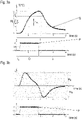
- Fig. 3a:
- a graph of a function interpolating correlations of time values to respectively measured successive temperature values, and an underlying heat pulse entailing the temperature values;
- Fig. 3b:
- a derivative of the function of
Figure 3a , along with the underlying heat pulse; and - Fig. 4:
- steps of a method according to an exemplary embodiment of the present invention.
- In
Figure 1 , anexemplary household appliance 1 according to an embodiment of the present invention is schematically depicted. Thehousehold appliance 1 is a water heater, which is depicted as filled with water W. For illustration, the various layers of the water heater as well as a currently present limescale accumulation layer L are shown incomplete, such that an insight in the structure is provided. - In the example depicted, the
household appliance 1 is embodied as a receptacle such as an electric kettle. It comprises abody structure 11, anelectrical insulation layer 12 and anelectrical heating element 13 which in the present case is formed as a laminar layer of the water heater, in particular of its wall. As is to be understood, additionally or alternatively, a bottom area of the water heater may comprise at least a part of the/an electrical heating element. A housing layer preferably further comprised by thehousehold appliance 1, covering theelectrical heating element 13 and insulating it outwardly, is omitted in the figure. - The
household appliance 1 is configured to perform a method according to an embodiment of the present invention. To this end, the household appliance comprises atemperature sensor 14 connected to theelectrical heating element 13 and to thebody structure 11, and acomputer unit 15 configured to receive a plurality of temperature values measured by thetemperature sensor 14, to determine one or more parameter value/s of a measurement pattern arising from the plurality of successive temperature values and their respective time of measurement, to ascertain a (current) limescale deposition state of the water heater based on the determined parameter value/s, and to cause agauge 16 further comprised by thehousehold appliance 1 to provide a signal based on the ascertained limescale deposition state. Additionally or alternatively to theanalogue gauge 16 shown inFigure 1 , for providing such signal, the household appliance might comprise a digital display, at least one indicator lamp and/or an acoustic signalling means such as a beeper (not shown inFigure 1 ). - In
Figure 2 , a correlation of parameter values v of a measurement pattern and respective underlying limescale accumulation percentages is depicted along with a graduation G of corresponding needs for decalcifying the water heater. In the exemplary case depicted, the graduation contains three stages g1, g2, g3: If a limescale accumulation percentage is between 0% and 20%, which in the exemplary diagram ofFigure 2 is derived from parameter values v being in the range from about 3.2 to 4, the stage g1 indicates a low need for decalcifying the water heater. By contrast, if the parameter values v are in the range from about 1.95 to about 3.2, they indicate a limescale accumulation percentage from 20% to 50%, which means a medium need for decalcification of the water heater, as indicated by the stage g2. A limescale accumulation percentage higher than 50% can be concluded from parameter values smaller than about 1.95 and requires decalcifying the water heater for maintaining its safe operability, which is reflected by a stage g3. -
Figure 3a exemplifies steps carried out according to a method subject to the present invention: Therein, an interrelation between a generated thermal pulse P and a measurement pattern Q arising from successively measured temperature values is illustrated by graphs showing the respective progressions during a measurement time interval I. - Indeed, the lower graph in
Figure 3a indicates a thermal pulse generated during a pulse time interval D contained by the measurement time interval I. Therein, the ordinate specifies a voltage ratio for the electrical heater element as compared to a standard operating voltage thereof, and the abscissa specifies the progress in time. - The upper graph in
Figure 3a illustrates a plurality of temperature values measured during said measurement time interval I. In the figure, to improve clearness of the picture, only temperature values Tn-1, Tn and Tk are referenced. - To visualise the correlation of the thermal pulse P and the measurement pattern Q, the abscissa of this graph coincides with that of the lower graph, whereas the ordinate specifies the respective temperature T.
- The respective limescale accumulation on a surface of the water heater may significantly change the thermal transient condition on the heater surface. This may have considerable influence on the measurement pattern Q under non-equilibrium thermal state, generated by the (short) thermal pulse. However, the measurement pattern Q may typically depend on heat propagation through the structure of the water heater, on heater-water transient parameters and/or on heat convection around heater structure caused by flowing (surrounding) water. Therefore, any change in those parameters may have its mirroring response in the measurement pattern Q.
- As can be seen in
Figure 3a , during a pre-monitoring time interval i1, temperature values are measured before the thermal pulse P is generated. In the present exemplary case, a temperature tightly above 0°C is measured. The thermal pulse P is then generated during the pulse time interval D (and lasting this interval D), which in the present case has a duration of about 3 seconds. During the pulse time interval D, the respectively measured temperature values increase. At an end of the thermal pulse, a maximum temperature Mt is measured. Thereafter, in a subsequent time interval i2, the measured temperature values decrease over time. - Said maximum temperature Mt may be determined as a parameter value of the measurement pattern Q, based on which a (current) limescale deposition state of the water heater may be ascertained.
- Additionally or alternatively, further characteristics of the measurement pattern may be considered to ascertain the limescale deposition state. For instance, a plurality of temperature differences between subsequent (neighboured) measured temperature values may be calculated, such as the difference Δn=Tn-Tn-1. These differences may be compared with each other. For instance, a maximum and/or a minimum temperature difference occurring, in the measurement pattern Q, between a measured temperature value and its antecedent measured temperature value may respectively be determined as a parameter value, based on which a current limescale deposition state of the water heater may be ascertained.
- Similarly, a derivative of a function interpolating the measurement pattern Q may (additionally or alternatively) be considered, as illustrated in the upper graph shown in
Figure 3b . Therein, the above-described graph representing the thermal pulse P is again reproduced, as a lower graph, so as to visualise the correlation of said derivative and the thermal pulse P. - A maximum value Md and/or a minimum value md of said derivative may respectively be determined as a parameter value, based on which a current limescale deposition state of the water heater may be ascertained.
-
Figure 4 depicts various steps of a method M according to a possible embodiment of the present invention. To increase intelligibility, in the following the steps are described with further reference toFigure 3a . - In a step S1, a water heater of a household appliance is filled with water (e.g., with tap water), preferably up to a predefined operating level of the water heater.
- Thereafter, in a step S2, a water temperature is pre-monitored during a pre-monitoring time interval i1 as indicated in
Figure 3a ; if included in the household appliance, a circulation pump of the household appliance may further be run. - A step S3 then comprises generating a thermal pulse P by operating an electrical heating element of the water heater. Said operating the electrical heating element may be performed with a standard operating voltage of the electrical heating element or with a voltage which is reduced in comparison with said standard operating voltage; the latter reduced voltage may be protective and thus advantageous in particular in case of a possible heavy limescale accumulation.
- In a step S4, successive temperature values Tn-1, Tn, Tk resulting from the thermal pulse are measured during the duration thereof.
- In a step S5, further successive temperature values resulting from the thermal pulse are measured in a subsequent time interval i2 following an end of the thermal pulse P. The time interval I during which the plurality of successive temperature values are measured in accumulated steps S2, S4 and S5, thus exceeds an end of the thermal pulse P by the subsequent time interval i2. During the time interval i2, the temperature values preferably reduce to at most a half or a third of the maximum temperature Mt (being a peak value of the measured temperature values). Preferably, the length of the subsequent time interval i2 is at least as long as the duration of the thermal pulse, as indicated in
Figure 3a . - In a step S6, one or more parameter value/s of a measurement pattern Q comprising the plurality of successive temperature values are determined. The parameter value/s may further be stored in a data memory. It/they may comprise a maximum temperature Mt occurring in the measurement pattern, a maximum and/or a minimum temperature difference respectively occurring, in the measurement pattern Q, between a measured temperature value and its antecedent measured temperature value, and/or a value of a mathematical function applied to one or more of said values. In particular, the one or more parameter value/s may comprise a moving average of the plurality of measured successive temperature values Tn-1, Tn, Tk over time, and/or a moving average of differences of measured successive temperature values over time.
- A step S7 then comprises ascertaining a (current) limescale deposition state of the water heater based on the determined parameter value/s. The such ascertained limescale deposition state may comprise one or more indicators, such as a limescale accumulation percentage indicator reflecting a current value of a limescale accumulation percentage of the water heater with respect to a predefined maximum accumulation. Additionally or alternatively, the ascertained limescale deposition state may comprise a decalcifying need indicator reflecting a respective current degree of need for decalcifying the water heater, as contained in a predetermined graduation (see
Figure 2 ). - Said ascertaining may be further based on one or more previous parameter value/s determined (and stored) with regard to at least one former thermal pulse previously generated by means of the electrical heating element, based on a frequency of utilisation of the water heater and/or based on a duration a last decalcification of the water heater dates back.
- In step S8, based on the ascertained limescale deposition state, a signal is provided to a user, such as by means of an analogue and/or digital gauge (which may, for instance, indicate a respective (current) limescale accumulation percentage) and/or by a graded indication of a degree of need for decalcifying the water heater (such as by means of at least one indicator lamp and/or an acoustic identification).
- Disclosed is a method M of controlling a
household appliance 1 being or comprising a water heater with regard to limescale deposition. The method includes generating at least one thermal pulse P by operation of anelectrical heating element 13 of the water heater, and measuring a plurality of successive temperature values Tn-1, Tn, Tk. The method further comprises determining one or more parameter value/s p of a measurement pattern Q arising from the plurality of successive temperature values Tn-1, Tn, Tk and their respective time of measurement, and ascertaining a limescale deposition state of the water heater based on the determined parameter value/s p. - Further disclosed are a
household appliance 1 configured to perform such a method M, and a computer readable medium having stored thereon instructions configured to trigger, when executed, a household appliance to perform such a method M. -
- 1
- household appliance
- 11
- body structure
- 12
- electrical insulation layer
- 13
- electrical heating element
- 14
- temperature sensor
- 15
- computer unit
- 16
- gauge
- D
- pulse time interval
- Δn
- difference between subsequent measured temperatures
- g1, g2, g3
- stage
- G
- predetermined graduation
- i1
- pre-monitoring interval
- i2
- subsequent time interval
- I
- measurement time interval
- L
- limescale accumulation layer
- M
- method
- md
- minimum value of the derivative of a function interpolating the measurement pattern Q
- Md
- maximum value of the derivative of a function interpolating the measurement pattern Q
- Mt
- maximum temperature
- p
- parameter value
- P
- thermal pulse
- Q
- measurement pattern
- S1 - S8
- method steps
- T
- temperature
- Tk, Tn-1, Tn
- measured temperature value
- W
- water
Claims (10)
- Method (M) of controlling a household appliance (1) being or comprising a water heater with regard to limescale deposition, the method including- generating (S3) at least one thermal pulse (P) by operation of an electrical heating element (13) of the water heater during a pulse time interval (D);- measuring (S2, S4, S5), during a measurement time interval (I) comprising the pulse time interval (D) and by at least one temperature sensor (14), a plurality of successive temperature values (Tn-1, Tn, Tk);- determining (S6) one or more parameter value/s (p) of a measurement pattern (Q) arising from the plurality of successive temperature values (Tn-1, Tn, Tk) and their respective time of measurement;- ascertaining (S7) a limescale deposition state of the water heater based on the determined parameter value/s (p).
- Method according to claim 1, wherein the ascertained limescale deposition state comprises- a limescale accumulation percentage indicator reflecting a current value of a limescale accumulation percentage of the water heater with respect to a predefined maximum accumulation; and/or- a decalcifying need indicator reflecting a stage (g1, g2, g3) contained in a predetermined graduation (G) of needs for decalcifying the water heater.
- Method according to one of claims 1 or 2, further comprising providing (S8) a signal to a user based on the ascertained limescale deposition state.
- Method according to one of the preceding claims, wherein the one or more parameter value/s (p) comprise- a maximum temperature (Mt) occurring in the measurement pattern (Q);- a maximum temperature difference occurring, in the measurement pattern, between a measured temperature (Tn) value and its antecedent measured temperature value (Tn-1);- a minimum temperature difference occurring, in the measurement pattern, between a measured temperature value (Tn) and its antecedent measured temperature value (Tn-1);- a maximum value (Md) of a derivative of a function interpolating the measurement pattern (Q);- a minimum value (md) of the derivative of a/the function interpolating the measurement pattern (Q); and/or- a value of a mathematical function applied to one, two or more of said maximum temperature (Mt), said maximum temperature difference, said minimum temperature difference, said maximum value (Md) and/or said minimum value (md).
- Method according to one of the preceding claims, wherein the one or more parameter value/s (p) comprise a moving average of the plurality of successive temperature values (Tn-1, Tn, Tk) over time, and/or a moving average of differences (Δn) of successive temperature values over time.
- Method according to one of the preceding claims, wherein the ascertaining of the limescale deposition state is further based on one or more previous parameter value/s determined with regard to at least one former thermal pulse previously generated by means of the electrical heating element.
- Method according to one of the preceding claims, wherein the thermal pulse has a duration of- at most 5 seconds, at most 4 seconds or at most 3 seconds; and/or- at least 0.5 second, 1 second, at least 2 seconds or at least 3 seconds.
- Method according to one of the preceding claims, wherein during said measurement time interval (I), at least 10 and/or at most 100 of the successive temperature values (Tn-1, Tn, Tk) are measured per second.
- Computer readable medium having stored thereon instructions configured to trigger, when executed, a household appliance (1) being or comprising a water heater with an electrical heating element (13), at least one temperature sensor (14) and a computer unit (15) to perform a method (M) according to one of the preceding claims.
- Household appliance (1) being or comprising a water heater, the household appliance including an electrical heating element (13), at least one temperature sensor (14) and a computer unit (16), wherein the household appliance is configured to perform a method according to one of claims 1-8.
Priority Applications (3)
| Application Number | Priority Date | Filing Date | Title |
|---|---|---|---|
| EP21152659.5A EP4033161A1 (en) | 2021-01-21 | 2021-01-21 | Limescale deposition detection by thermal pulse technology |
| US17/452,445 US20220228774A1 (en) | 2021-01-21 | 2021-10-27 | Method, computer readable medium and household appliance for performing limescale deposition detection by thermal pulse technology |
| CN202210065469.8A CN114877531A (en) | 2021-01-21 | 2022-01-20 | Scale deposition detection by thermal pulse technique |
Applications Claiming Priority (1)
| Application Number | Priority Date | Filing Date | Title |
|---|---|---|---|
| EP21152659.5A EP4033161A1 (en) | 2021-01-21 | 2021-01-21 | Limescale deposition detection by thermal pulse technology |
Publications (1)
| Publication Number | Publication Date |
|---|---|
| EP4033161A1 true EP4033161A1 (en) | 2022-07-27 |
Family
ID=74194639
Family Applications (1)
| Application Number | Title | Priority Date | Filing Date |
|---|---|---|---|
| EP21152659.5A Pending EP4033161A1 (en) | 2021-01-21 | 2021-01-21 | Limescale deposition detection by thermal pulse technology |
Country Status (3)
| Country | Link |
|---|---|
| US (1) | US20220228774A1 (en) |
| EP (1) | EP4033161A1 (en) |
| CN (1) | CN114877531A (en) |
Cited By (1)
| Publication number | Priority date | Publication date | Assignee | Title |
|---|---|---|---|---|
| EP4573992A1 (en) | 2023-12-22 | 2025-06-25 | BSH Hausgeräte GmbH | Method for cleaning/descaling a hot beverage maker, and hot beverage maker for carrying out the method |
Citations (4)
| Publication number | Priority date | Publication date | Assignee | Title |
|---|---|---|---|---|
| US6649881B2 (en) * | 1998-06-04 | 2003-11-18 | American Water Heater Company | Electric water heater with pulsed electronic control and detection |
| WO2013014411A2 (en) * | 2011-07-26 | 2013-01-31 | Isis Innovation Limited | System, method, and apparatus for heating |
| EP2842474A1 (en) * | 2013-08-29 | 2015-03-04 | BSH Bosch und Siemens Hausgeräte GmbH | Water-bearing household device with a heating device |
| WO2020242851A1 (en) * | 2019-05-24 | 2020-12-03 | Battelle Memorial Institute | Estimation of temperature states for an electric water heater from inferred resistance measurement |
Family Cites Families (5)
| Publication number | Priority date | Publication date | Assignee | Title |
|---|---|---|---|---|
| NZ540977A (en) * | 2005-06-24 | 2008-01-31 | Jubilee Bathrooms Ltd | Water controller |
| US7434544B2 (en) * | 2006-06-27 | 2008-10-14 | Emerson Electric Co. | Water heater with dry tank or sediment detection feature |
| CN207766826U (en) * | 2018-01-19 | 2018-08-28 | 郑州工程技术学院 | A kind of wind pushing box |
| CN209459230U (en) * | 2019-01-23 | 2019-10-01 | 沈阳新光电气制造有限公司 | Explosion-proof oil storage tank electric heater |
| IT201900020829A1 (en) * | 2019-11-11 | 2021-05-11 | Irca Spa | METHOD AND DEVICE FOR DETECTION OF THE QUANTITY OF LIMESCALE IN DEVICES FOR HEATING LIQUIDS |
-
2021
- 2021-01-21 EP EP21152659.5A patent/EP4033161A1/en active Pending
- 2021-10-27 US US17/452,445 patent/US20220228774A1/en not_active Abandoned
-
2022
- 2022-01-20 CN CN202210065469.8A patent/CN114877531A/en active Pending
Patent Citations (4)
| Publication number | Priority date | Publication date | Assignee | Title |
|---|---|---|---|---|
| US6649881B2 (en) * | 1998-06-04 | 2003-11-18 | American Water Heater Company | Electric water heater with pulsed electronic control and detection |
| WO2013014411A2 (en) * | 2011-07-26 | 2013-01-31 | Isis Innovation Limited | System, method, and apparatus for heating |
| EP2842474A1 (en) * | 2013-08-29 | 2015-03-04 | BSH Bosch und Siemens Hausgeräte GmbH | Water-bearing household device with a heating device |
| WO2020242851A1 (en) * | 2019-05-24 | 2020-12-03 | Battelle Memorial Institute | Estimation of temperature states for an electric water heater from inferred resistance measurement |
Cited By (3)
| Publication number | Priority date | Publication date | Assignee | Title |
|---|---|---|---|---|
| EP4573992A1 (en) | 2023-12-22 | 2025-06-25 | BSH Hausgeräte GmbH | Method for cleaning/descaling a hot beverage maker, and hot beverage maker for carrying out the method |
| DE102023213311A1 (en) * | 2023-12-22 | 2025-06-26 | BSH Hausgeräte GmbH | Method for cleaning/descaling a hot beverage maker and hot beverage maker for carrying out the method |
| DE102023213311B4 (en) * | 2023-12-22 | 2025-07-03 | BSH Hausgeräte GmbH | Method for cleaning/descaling a hot beverage maker and hot beverage maker for carrying out the method |
Also Published As
| Publication number | Publication date |
|---|---|
| CN114877531A (en) | 2022-08-09 |
| US20220228774A1 (en) | 2022-07-21 |
Similar Documents
| Publication | Publication Date | Title |
|---|---|---|
| US8473229B2 (en) | Storage device energized actuator having diagnostics | |
| US10331116B2 (en) | Method, computer program product and arrangement for guarding an automated process to operate a household appliance based on a sensor measurement to provide an expected process parameter | |
| CN111743384B (en) | Multipurpose kitchen machine with boiling point identification | |
| JP4186879B2 (en) | Living information collection system | |
| EP3616023B1 (en) | Method for determining an amount of deposition of scale on a heating element and household appliance comprising a heating element | |
| CN108506963B (en) | Range hood, control method and system thereof, and fire-off detection method and device | |
| US5723847A (en) | Method for determining and displaying the remaining time in a treatment program in a household appliance and electronic control unit for performing the method | |
| US20220228774A1 (en) | Method, computer readable medium and household appliance for performing limescale deposition detection by thermal pulse technology | |
| CN109798552A (en) | A kind of kitchen range are from pot determination method and device | |
| CA2718491C (en) | Method for controlling an induction heating system | |
| KR20090074189A (en) | Heating device protection method and heating element | |
| US4781469A (en) | Detecting proximity or occurrence of change of phase within a fluid | |
| EP3735759A1 (en) | Detecting inefficient appliances | |
| JPH06265437A (en) | Gas leak detecting method | |
| CN114251685A (en) | Stove and control method and control device for preventing dry burning of stove | |
| JP5169049B2 (en) | Flow measuring device | |
| JP2026076320A (en) | Specific equipment determination method | |
| EP2296435B1 (en) | Method for detecting and compensating noises in induction heating systems for domestic and professional kitchen and induction heating system using such method | |
| CN116379606A (en) | Devices for heating water, methods for identifying calcifications, electric appliances | |
| JP5094483B2 (en) | Flow measuring device | |
| CN118935741A (en) | Gas water heater self-test method and device based on proportional valve current, and storage medium | |
| JP5272874B2 (en) | Flow measuring device | |
| WO2025133885A1 (en) | Method for determining a condition of calcification in a thermo-hydraulic system adapted to convey and heat liquid in a beverage preparation machine for professional or household use | |
| CN121897946A (en) | Dry heating prevention method, system, terminal and storage medium for cookware | |
| JP5131976B2 (en) | Flow measuring device |
Legal Events
| Date | Code | Title | Description |
|---|---|---|---|
| PUAI | Public reference made under article 153(3) epc to a published international application that has entered the european phase |
Free format text: ORIGINAL CODE: 0009012 |
|
| STAA | Information on the status of an ep patent application or granted ep patent |
Free format text: STATUS: THE APPLICATION HAS BEEN PUBLISHED |
|
| AK | Designated contracting states |
Kind code of ref document: A1 Designated state(s): AL AT BE BG CH CY CZ DE DK EE ES FI FR GB GR HR HU IE IS IT LI LT LU LV MC MK MT NL NO PL PT RO RS SE SI SK SM TR |
|
| STAA | Information on the status of an ep patent application or granted ep patent |
Free format text: STATUS: REQUEST FOR EXAMINATION WAS MADE |
|
| 17P | Request for examination filed |
Effective date: 20230127 |
|
| RBV | Designated contracting states (corrected) |
Designated state(s): AL AT BE BG CH CY CZ DE DK EE ES FI FR GB GR HR HU IE IS IT LI LT LU LV MC MK MT NL NO PL PT RO RS SE SI SK SM TR |
|
| STAA | Information on the status of an ep patent application or granted ep patent |
Free format text: STATUS: EXAMINATION IS IN PROGRESS |
|
| 17Q | First examination report despatched |
Effective date: 20240228 |