EP4032770B1 - Automatic emergency braking using a time-to-collision threshold based on target acceleration - Google Patents
Automatic emergency braking using a time-to-collision threshold based on target acceleration Download PDFInfo
- Publication number
- EP4032770B1 EP4032770B1 EP21214783.9A EP21214783A EP4032770B1 EP 4032770 B1 EP4032770 B1 EP 4032770B1 EP 21214783 A EP21214783 A EP 21214783A EP 4032770 B1 EP4032770 B1 EP 4032770B1
- Authority
- EP
- European Patent Office
- Prior art keywords
- ttc
- vehicle
- target
- threshold
- recited
- Prior art date
- Legal status (The legal status is an assumption and is not a legal conclusion. Google has not performed a legal analysis and makes no representation as to the accuracy of the status listed.)
- Active
Links
Images



Classifications
-
- B—PERFORMING OPERATIONS; TRANSPORTING
- B60—VEHICLES IN GENERAL
- B60T—VEHICLE BRAKE CONTROL SYSTEMS OR PARTS THEREOF; BRAKE CONTROL SYSTEMS OR PARTS THEREOF, IN GENERAL; ARRANGEMENT OF BRAKING ELEMENTS ON VEHICLES IN GENERAL; PORTABLE DEVICES FOR PREVENTING UNWANTED MOVEMENT OF VEHICLES; VEHICLE MODIFICATIONS TO FACILITATE COOLING OF BRAKES
- B60T7/00—Brake-action initiating means
- B60T7/12—Brake-action initiating means for automatic initiation; for initiation not subject to will of driver or passenger
- B60T7/22—Brake-action initiating means for automatic initiation; for initiation not subject to will of driver or passenger initiated by contact of vehicle, e.g. bumper, with an external object, e.g. another vehicle, or by means of contactless obstacle detectors mounted on the vehicle
-
- B—PERFORMING OPERATIONS; TRANSPORTING
- B60—VEHICLES IN GENERAL
- B60T—VEHICLE BRAKE CONTROL SYSTEMS OR PARTS THEREOF; BRAKE CONTROL SYSTEMS OR PARTS THEREOF, IN GENERAL; ARRANGEMENT OF BRAKING ELEMENTS ON VEHICLES IN GENERAL; PORTABLE DEVICES FOR PREVENTING UNWANTED MOVEMENT OF VEHICLES; VEHICLE MODIFICATIONS TO FACILITATE COOLING OF BRAKES
- B60T7/00—Brake-action initiating means
- B60T7/12—Brake-action initiating means for automatic initiation; for initiation not subject to will of driver or passenger
-
- B—PERFORMING OPERATIONS; TRANSPORTING
- B60—VEHICLES IN GENERAL
- B60T—VEHICLE BRAKE CONTROL SYSTEMS OR PARTS THEREOF; BRAKE CONTROL SYSTEMS OR PARTS THEREOF, IN GENERAL; ARRANGEMENT OF BRAKING ELEMENTS ON VEHICLES IN GENERAL; PORTABLE DEVICES FOR PREVENTING UNWANTED MOVEMENT OF VEHICLES; VEHICLE MODIFICATIONS TO FACILITATE COOLING OF BRAKES
- B60T8/00—Arrangements for adjusting wheel-braking force to meet varying vehicular or ground-surface conditions, e.g. limiting or varying distribution of braking force
- B60T8/17—Using electrical or electronic regulation means to control braking
- B60T8/171—Detecting parameters used in the regulation; Measuring values used in the regulation
-
- B—PERFORMING OPERATIONS; TRANSPORTING
- B60—VEHICLES IN GENERAL
- B60T—VEHICLE BRAKE CONTROL SYSTEMS OR PARTS THEREOF; BRAKE CONTROL SYSTEMS OR PARTS THEREOF, IN GENERAL; ARRANGEMENT OF BRAKING ELEMENTS ON VEHICLES IN GENERAL; PORTABLE DEVICES FOR PREVENTING UNWANTED MOVEMENT OF VEHICLES; VEHICLE MODIFICATIONS TO FACILITATE COOLING OF BRAKES
- B60T8/00—Arrangements for adjusting wheel-braking force to meet varying vehicular or ground-surface conditions, e.g. limiting or varying distribution of braking force
- B60T8/17—Using electrical or electronic regulation means to control braking
- B60T8/172—Determining control parameters used in the regulation, e.g. by calculations involving measured or detected parameters
-
- B—PERFORMING OPERATIONS; TRANSPORTING
- B60—VEHICLES IN GENERAL
- B60T—VEHICLE BRAKE CONTROL SYSTEMS OR PARTS THEREOF; BRAKE CONTROL SYSTEMS OR PARTS THEREOF, IN GENERAL; ARRANGEMENT OF BRAKING ELEMENTS ON VEHICLES IN GENERAL; PORTABLE DEVICES FOR PREVENTING UNWANTED MOVEMENT OF VEHICLES; VEHICLE MODIFICATIONS TO FACILITATE COOLING OF BRAKES
- B60T8/00—Arrangements for adjusting wheel-braking force to meet varying vehicular or ground-surface conditions, e.g. limiting or varying distribution of braking force
- B60T8/32—Arrangements for adjusting wheel-braking force to meet varying vehicular or ground-surface conditions, e.g. limiting or varying distribution of braking force responsive to a speed condition, e.g. acceleration or deceleration
- B60T8/3205—Arrangements for adjusting wheel-braking force to meet varying vehicular or ground-surface conditions, e.g. limiting or varying distribution of braking force responsive to a speed condition, e.g. acceleration or deceleration acceleration
-
- B—PERFORMING OPERATIONS; TRANSPORTING
- B60—VEHICLES IN GENERAL
- B60T—VEHICLE BRAKE CONTROL SYSTEMS OR PARTS THEREOF; BRAKE CONTROL SYSTEMS OR PARTS THEREOF, IN GENERAL; ARRANGEMENT OF BRAKING ELEMENTS ON VEHICLES IN GENERAL; PORTABLE DEVICES FOR PREVENTING UNWANTED MOVEMENT OF VEHICLES; VEHICLE MODIFICATIONS TO FACILITATE COOLING OF BRAKES
- B60T8/00—Arrangements for adjusting wheel-braking force to meet varying vehicular or ground-surface conditions, e.g. limiting or varying distribution of braking force
- B60T8/32—Arrangements for adjusting wheel-braking force to meet varying vehicular or ground-surface conditions, e.g. limiting or varying distribution of braking force responsive to a speed condition, e.g. acceleration or deceleration
- B60T8/58—Arrangements for adjusting wheel-braking force to meet varying vehicular or ground-surface conditions, e.g. limiting or varying distribution of braking force responsive to a speed condition, e.g. acceleration or deceleration responsive to speed and another condition or to plural speed conditions
-
- B—PERFORMING OPERATIONS; TRANSPORTING
- B60—VEHICLES IN GENERAL
- B60T—VEHICLE BRAKE CONTROL SYSTEMS OR PARTS THEREOF; BRAKE CONTROL SYSTEMS OR PARTS THEREOF, IN GENERAL; ARRANGEMENT OF BRAKING ELEMENTS ON VEHICLES IN GENERAL; PORTABLE DEVICES FOR PREVENTING UNWANTED MOVEMENT OF VEHICLES; VEHICLE MODIFICATIONS TO FACILITATE COOLING OF BRAKES
- B60T2201/00—Particular use of vehicle brake systems; Special systems using also the brakes; Special software modules within the brake system controller
- B60T2201/02—Active or adaptive cruise control system; Distance control
- B60T2201/022—Collision avoidance systems
-
- B—PERFORMING OPERATIONS; TRANSPORTING
- B60—VEHICLES IN GENERAL
- B60T—VEHICLE BRAKE CONTROL SYSTEMS OR PARTS THEREOF; BRAKE CONTROL SYSTEMS OR PARTS THEREOF, IN GENERAL; ARRANGEMENT OF BRAKING ELEMENTS ON VEHICLES IN GENERAL; PORTABLE DEVICES FOR PREVENTING UNWANTED MOVEMENT OF VEHICLES; VEHICLE MODIFICATIONS TO FACILITATE COOLING OF BRAKES
- B60T2210/00—Detection or estimation of road or environment conditions; Detection or estimation of road shapes
- B60T2210/30—Environment conditions or position therewithin
- B60T2210/32—Vehicle surroundings
-
- B—PERFORMING OPERATIONS; TRANSPORTING
- B60—VEHICLES IN GENERAL
- B60T—VEHICLE BRAKE CONTROL SYSTEMS OR PARTS THEREOF; BRAKE CONTROL SYSTEMS OR PARTS THEREOF, IN GENERAL; ARRANGEMENT OF BRAKING ELEMENTS ON VEHICLES IN GENERAL; PORTABLE DEVICES FOR PREVENTING UNWANTED MOVEMENT OF VEHICLES; VEHICLE MODIFICATIONS TO FACILITATE COOLING OF BRAKES
- B60T2250/00—Monitoring, detecting, estimating vehicle conditions
-
- B—PERFORMING OPERATIONS; TRANSPORTING
- B60—VEHICLES IN GENERAL
- B60T—VEHICLE BRAKE CONTROL SYSTEMS OR PARTS THEREOF; BRAKE CONTROL SYSTEMS OR PARTS THEREOF, IN GENERAL; ARRANGEMENT OF BRAKING ELEMENTS ON VEHICLES IN GENERAL; PORTABLE DEVICES FOR PREVENTING UNWANTED MOVEMENT OF VEHICLES; VEHICLE MODIFICATIONS TO FACILITATE COOLING OF BRAKES
- B60T2250/00—Monitoring, detecting, estimating vehicle conditions
- B60T2250/04—Vehicle reference speed; Vehicle body speed
Definitions
- AEB Automatic emergency braking
- a vehicle may determine that a collision with another vehicle is imminent and apply a braking force in an attempt to avoid the collision.
- Traditional AEB systems are based on non-linear ideal braking profiles of the respective vehicles (e.g., maximum decelerations in ideal conditions).
- the nonlinearity of the ideal braking profiles makes determining accurate time-to-collision (TTC) thresholds for activation of AEB systems difficult.
- TTC time-to-collision
- actual braking performances of vehicles often deviate from their ideal braking profiles.
- Publication EP 3 539 837 A1 pertains to a vehicle environment detection system comprising a control unit arrangement and at least one sensor arrangement that is arranged to be mounted in an ego vehicle and to provide sensor detections for at least two preceding target vehicles.
- the vehicle environment detection system is arranged to acquire an ego velocity and an ego acceleration for the ego vehicle, and, by means of said sensor detections, to determine vehicle data comprising: corresponding distances between the ego vehicle and said preceding target vehicles; and corresponding target velocity and target acceleration for each of said preceding target vehicles.
- the control unit arrangement is arranged to determine a corresponding TTC (time to collision) between at least two different pairs of said vehicles, and to determine if any determined TTC falls below at least one threshold value.
- Apparatuses and techniques enabling automatic emergency braking (AEB) using a time-to-collision (TTC) threshold based on target acceleration are described below.
- Some aspects described below include a method of AEB performed by a vehicle. The method determines, based on sensor data received from one or more sensors that are local to the vehicle, a target acceleration of a target object proximate to the vehicle. Based at least on the target acceleration, the method determines a TTC with the target object and a TTC threshold for the target object. The method further compares the TTC to the TTC threshold and causes, based on determining that the TTC satisfies the TTC threshold, a braking system of the vehicle to apply a braking force effective to avoid a collision with the target object.
- AEB systems enable vehicles to determine that collisions with objects are imminent and provide braking forces in order to avoid the collisions.
- AEB systems generally calculate time-to-collision (TTC) estimates for targets and compare them with TTC thresholds to determine when to apply braking forces.
- TTC time-to-collision
- these systems (or portions thereof) determine TTC thresholds based on ideal braking profiles and velocities of the vehicles and the targets. While these systems may work in many situations, there are situations where they may fail to apply braking forces soon enough to avoid a collision. For example, a system tuned for a moderate breaking of a front-traveling vehicle may be unable to stop when that front-traveling vehicle brakes aggressively. Accordingly, traditional AEB systems often produce non-optimal braking results in many situations.
- the TTC threshold may be based on a vehicle velocity, a relative velocity between the vehicle and the target object, an acceleration of the target, and a distance between the vehicle and the target object.
- the techniques and systems described herein are able to compensate for aggressive stopping of the target, thereby allowing AEB to function as planned in more situations.
- Fig. 1 is an example environment 100 where AEB using a time-to-collision threshold based on target acceleration may be used.
- the environment contains a vehicle 102 (e.g., host vehicle) that includes an AEB system 104, which is discussed further in regard to Fig. 2 , and a target 106 (e.g., target object or target vehicle) that is in a path of travel of the vehicle 102.
- vehicle 102 may be any type of system with autonomous braking ability (car, truck, motorcycle, e-bike, boat, etc.)
- the target 106 may be any type of moving object (another car, truck, motorcycle, e-bike, or boat, pedestrian, cyclist, boulder, etc.).
- the vehicle 102 is traveling with a vehicle velocity 108 and accelerating with a vehicle acceleration 110.
- the target 106 is traveling with a target velocity 112 and accelerating with a target acceleration 114.
- a distance 116 exists between the vehicle 102 and the target 106.
- a relative velocity 118 exists that is based on a difference between the target velocity 112 and the vehicle velocity 108, and a relative acceleration 120 exists that is based on a difference between the target acceleration 114 and the vehicle acceleration 110.
- a positive velocity has a direction of up the page
- a negative velocity has a direction down the page.
- the vehicle velocity 108 is positive (because it gives a reference direction), and the target velocity 112 can be either positive or negative depending on whether it is traveling in the same direction as the vehicle 102.
- the relative velocity 118 is negative when the target 106 has a lower speed than the vehicle 102 or is traveling in the opposite direction (e.g., is headed towards the vehicle 102).
- a positive acceleration has a direction of up the page
- a negative acceleration has a direction of down the page.
- the accelerations are positive when the respective entities are accelerating in the direction of the vehicle velocity 108 and negative when the respective entities are decelerating in the direction of the vehicle velocity 108.
- the target acceleration 114 is less than the vehicle acceleration 110 (e.g., the target 106 is decelerating faster than the vehicle 102).
- the conventions used may differ without departing from the scope of the disclosure.
- the vehicle 102 is traveling faster than the target 106 and in a same direction. Also, the target 106 is decelerating more aggressively than the vehicle 102.
- the example illustration may be indicative of a panic stop by the target 106, e.g., to avoid its own collision.
- the vehicle 102 is able to determine a more accurate TTC threshold for the example environment 100. In doing so, the vehicle 102 may be able to avoid colliding with the target 106, which may not be possible with traditional AEB systems.
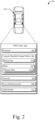
- Fig. 2 is an example illustration 200 of the AEB system 104 in which AEB using a time-to-collision threshold based on target acceleration can be implemented.
- the AEB system 104 of the vehicle 102 includes at least one processor 202, at least one computer-readable storage medium 204, one or more sensors 206, a power-braking system 208, and an AEB module 210.
- the processor 202 executes instructions 212 (e.g., code) stored within the computer-readable storage medium 204 (e.g., a non-transitory storage devices such as a hard drive, SSD, flash memory, read-only memory (ROM), EPROM, or EEPROM) to cause the AEB system 104 to perform the techniques described herein.
- the instructions 212 may be part of an operating system and/or one or more applications of the AEB system 104.
- the instructions 212 cause the AEB system 104 to act upon (e.g., create, receive, modify, delete, transmit, or display) data 214 (e.g., application data, module data, sensor data 216 from sensors 206, or I/O data). Although shown as being within the computer-readable storage medium 204, portions of the data 214 may be within a random-access memory (RAM) or a cache of the AEB system 104 (not shown). Furthermore, the instructions 212 and/or the data 214 may be remote to the AEB system 104.
- data 214 e.g., application data, module data, sensor data 216 from sensors 206, or I/O data.
- RAM random-access memory
- the instructions 212 and/or the data 214 may be remote to the AEB system 104.
- the AEB module 210 may be comprised by the computer-readable storage medium 204 or be a stand-alone component (e.g., executed in dedicated hardware in communication with the processor 202 and computer-readable storage medium 204).
- the instructions 212 may cause the processor 202 to implement or otherwise cause the AEB module 210 to receive the sensor data 216 and implement AEB, as described below.
- the sensors 206 provide the sensor data 216 that enables the determination of the attributes described in Fig. 1 (e.g., distance 116, vehicle velocity 108, vehicle acceleration 110, target velocity 112, target acceleration 114, relative velocity 118, and relative acceleration 120).
- the sensors 206 may comprise a ranging sensor to indicate the distance 116, the target velocity 112, and the target acceleration 114.
- a speedometer may be implemented to indicate the vehicle velocity 108, and an accelerometer may be implemented to indicate the vehicle acceleration 110.
- the sensors 206 may comprise instructions that interface with another module or system of the vehicle 102 to determine the attributes described in Fig. 1 .
- the sensors 206 may comprise instructions to receive the vehicle acceleration 110 from an airbag module or vehicle dynamics module that contains an accelerometer.
- the sensors 206 may comprise instructions to receive information from the target 106 via a communication system (not shown).
- a vehicle-to-vehicle communication system may be used to obtain the target velocity 112 and the target acceleration 114.
- the power-braking system 208 may be any type of system known by those of ordinary skill in the art.
- the power-braking system may be a hydraulic, pneumatic, or electric braking system or some combination thereof. Regardless of implementation, the power-braking system 208 provides braking forces to the vehicle that are effective to slow the vehicle 102.
- the power-braking system 208 may apply the braking forces earlier than traditional AEB systems. In doing so, the AEB system 104 is able to mitigate front-end collisions with better efficacy.
- Fig. 3 is an example illustration 300 of a data flow and actions for AEB using a TTC threshold based on target acceleration.
- the example illustration 300 is generally comprised by the AEB module 210.
- the example illustration 300 starts with the sensor data 216 being received at an input to an attribute module 302 of the AEB module 210.
- the attribute module 302 uses the sensor data 216 to determine attributes 304 of the vehicle 102 and the target 106, including those discussed in regard to Fig. 1 .
- the attributes 304 may comprise the vehicle velocity 108, the vehicle acceleration 110, the target velocity 112, the target acceleration 114, the distance 116, the relative velocity 118, and the relative acceleration 120.
- the attributes 304 may be directly determined from the sensor data 216 (e.g., the vehicle velocity 108 determined from a speedometer output), and some of the attributes 304 may be derived from the sensor data 216 (e.g., the relative velocity 118 determined from a speedometer output and a ranging sensor output). Regardless of how the attributes 304 are determined, derived, or calculated, the attribute module 302 is configured to output the attributes 304 to a TTC threshold module 306 and a TTC module 308 of the AEB module 210.
- the TTC threshold module 306 and the TTC module 308 receive the attributes 304 as inputs, or otherwise have access to a shared memory that stores the attributes 304.
- the attribute module 302 may allocate a shared memory space as registers for containing the attributes 304, e.g., within computer readable storage medium 204.
- the TTC threshold module 306 and/or the TTC module 308 can access the registers in order to determine a TTC threshold 310 and/or a TTC 312 for the target 106.
- the TTC threshold module 306 may use the vehicle velocity 108, the relative velocity 118, the target acceleration 114, and the distance 116 to determine the TTC threshold 310 for the target 106.
- the TTC module 308 may use the relative acceleration 120, the relative velocity 118, and the distance 116 to determine the TTC 312 for the target 106.
- the TTC 312 is an estimated time-to-collision with the target 106
- the TTC threshold 310 is a threshold for the target 106 that is used to activate AEB once the TTC 312 crosses the determined TTC threshold 310.
- the TTC module 308 outputs the TTC 312 to a comparison module 318.
- the TTC threshold module 306 determines the TTC threshold 310 for the target 106 based on a sum of a one of first TTC sub-thresholds 314 and a one of second TTC sub-thresholds 316. By using two sub-thresholds, the TTC threshold module 306 is able to factor the target acceleration 114 into the determination of the TTC threshold 310. The TTC threshold 310 determination is discussed below in regard to Fig. 4 . The TTC threshold module 306 outputs the TTC threshold 310 to the comparison module 318.
- the TTC threshold 310 and the TTC 312 for the target 106 are received by the comparison module 318 of the AEB module 210, which determines if the TTC 312 has met or is lower than the TTC threshold 310.
- the TTC threshold 310 and the TTC 312 may be constantly or intermittently calculated and updated for receipt by the comparison module 318.
- the comparison module 318 may evaluate the TTC threshold 310 against the TTC 312 constantly or intermittently, as well. If or when the TTC 312 for the target 106 has met or is lower than the TTC threshold 310 for the target 106, the comparison module 318 sends an activation signal 320 to the power-braking system 208 to apply a braking force to stop the vehicle 102.
- the AEB module 210 is able to compensate for situations where the target 106 is decelerating aggressively. In this way, the AEB module 210 is able to cause the vehicle 102 to avoid collisions more effectively than traditional AEB systems.
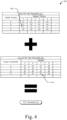
- Fig. 4 is an example illustration 400 of look-up tables that may be used to determine the TTC threshold 310 for the target 106.
- the TTC threshold 310 for the target 106 may be a sum of a determined one of first TTC sub-thresholds 314 and a determined one of second TTC sub-thresholds 316.
- the one of the TTC sub-thresholds 314 is selected based on the vehicle velocity 108 and the relative velocity 118.
- the one of the second TTC sub-thresholds 316 is selected based on the target acceleration 114 and the distance 116.
- the first TTC sub-thresholds 314 and the second TTC sub-thresholds 316 are organized into respective two-dimensional look-up tables. Accordingly, the one of the first TTC sub-thresholds 314 for the target 106 is at an intersection of the vehicle velocity 108 and the relative velocity 118. Similarly, the one of the second TTC sub-thresholds 316 for the target 106 is at an intersection of the target acceleration 114 and the distance 116.
- the first TTC sub-threshold for the target 106 would be c1 (e.g., first TTC sub-threshold 402), and the second TTC sub-threshold for the target 106 would be h7 (e.g., second TTC sub-threshold 404). Accordingly, the TTC threshold 310 for the target 106 would be a sum of the first TTC sub-threshold 402 and the second TTC sub-threshold 404 (e.g., c1 + h7).
- the first TTC sub-thresholds 314 are pre-determined based on Equation 2: d ideal v r where d ideal is an ideal braking distance based on an ideal braking profile of the vehicle 102.
- the ideal braking distance is calculated based on Equation 3: d safe + v h t delay + ⁇ ⁇ 0 t req a t d 2 t
- d safe is a desired minimum safe distance between the vehicle 102 and the target 106 after stopping
- v h is the vehicle velocity 108
- t delay is a delay between the AEB system 104 activating and the power-braking system 208 applying braking forces
- a ( t ) is a time-based ideal braking profile with maximum acceleration of the vehicle achieved by the AEB system 104 (either single or multiple stage)
- t req is a required time to brake the vehicle 102 from the relative velocity 118 to zero.
- the first TTC sub-thresholds 314 may be adjusted based on empirical data for the vehicle 102, another vehicle, or many vehicles. For example, the above equations may be used to provide baseline values, and the empirical data may be used to "tune" the first TTC sub-thresholds 314. For example, initial values may be established based on the above equations. Actual braking performance for each of the input pairs (vehicle velocity/relative velocity pairs) may be determined, and any differences may be used to adjust the values.
- the second TTC sub-thresholds 316 may be pre-determined based on empirical data for the vehicle 102, another vehicle, or for many vehicles. For example, test scenarios may be set up for each of the input pairs (target acceleration/distance pairs) and used to determine values that produce the desired braking. Real-world or simulated data associated with each of the test scenarios may be fed into a machine learning model to determine the second TTC sub-thresholds 316.
- modeling equations known by those of ordinary skill in the art may be used instead of, or in conjunction with, the empirical data to determine the values .
- the second TTC sub-thresholds 316 may be based on other attributes.
- the example illustration 400 shows a sum of values from two two-dimensional look-up tables
- a single four-dimensional look-up table may be used with vehicle velocity, relative velocity, target acceleration, and distance as the respective dimensions.
- the TTC threshold 310 in such a case, would become a value within the four-dimensional look-up table that corresponds to the vehicle velocity 108, the relative velocity 118, the target acceleration 114, and the distance 116.
- the look-up tables may be stored within the computer-readable storage medium 204, e.g., as data 212. By doing so, the TTC threshold module 306 may determine the first TTC sub-threshold 402 and the second TTC sub-threshold 404 for the target 106 quickly without having to solve the equations above. It should be noted, however, that one or more of the look-up tables may not be used in some implementations. For example, one or more of the first TTC sub-threshold 314 and the second TTC sub-threshold 316 for the target 106 may be calculated in real-time by the TTC threshold module 306 using the above equations and techniques.
- Fig. 5 illustrates an example method 500 for AEB using a TTC threshold based on target acceleration.
- Method 500 may be implemented utilizing the previously described examples, such as the environment 100, the AEB system 104, the process flow of illustration 300, and determination of the TTC threshold 310 of illustration 400.
- Operations 502 through 510 may be performed by one or more entities of a vehicle (e.g., portions of the AEB system 104).
- the order in which the operations are shown and/or described is not intended to be construed as a limitation, and any number or combination of the operations can be combined in any order to implement the method 500 or an alternate method.
- a target acceleration of a target object proximate to a vehicle is determined based on sensor data received from one or more sensors that are local to the vehicle.
- the attribute module 302 may receive the sensor data 216 and determine the target acceleration 114.
- Other attributes 304 may also be determined by the attribute module 302, such as the vehicle velocity 108, the vehicle acceleration 110, the target velocity 112, the distance 116, the relative velocity 118, and the relative acceleration 120.
- the vehicle 102 may be approaching the target 106 that is decelerating aggressively.
- a TTC is determined for the target object based on the target acceleration 114.
- the TTC module 308 may receive the relative acceleration 120 (which is based on the target acceleration 114) from the attribute module 302 and determine the TTC 312.
- the TTC 312 may further be based on the relative velocity 118 and the distance 116. Continuing with the example of Fig. 1 , consider that the TTC 312 is determined to be 2 seconds.
- a TTC threshold is determined for the target object based on the target acceleration 114.
- the TTC threshold module 306 may receive the target acceleration 114 and determine the first TTC sub-threshold 402 for the target 106 and the second TTC sub-threshold 404 for the target 106.
- the first TTC sub-threshold 402 may be based on the vehicle velocity 108 and the relative velocity 118.
- the second TTC sub-threshold 404 may be based on the target acceleration 114 and the distance 116.
- the first and second TTC sub-thresholds 402,404 may be added by the TTC threshold module 306 to determine the TTC threshold 310.
- the first TTC sub-threshold 402 is determined to be 1.8 seconds and that the second TTC sub-threshold 404 is determined to be 0.3 seconds.
- the comparison module 318 may receive the TTC threshold 310 and the TTC 312 and determine if the TTC 312 is less than or equal to the TTC threshold 310.
- the comparison module 318 would receive the first TTC sub-threshold 402 as the TTC threshold 310. As such, the comparison module 318 would fail to provide an activation signal 320 because 1.8 seconds is less than 2 seconds. However, by incorporating the second TTC sub-threshold 402, the TTC threshold 310 becomes 1.1 seconds (0.8+0.3). As such, the comparison module 318 does provide the activation signal 320.
- a braking system is caused to apply a braking force.
- the comparison module 318 may provide the activation signal 320 to the power-braking system 208 that is effective to slow the vehicle to avoid the target 106.
- the AEB module 210 is able to mitigate a collision that may not have been mitigated by conventional AEB systems.
Landscapes
- Engineering & Computer Science (AREA)
- Transportation (AREA)
- Mechanical Engineering (AREA)
- Regulating Braking Force (AREA)
- Traffic Control Systems (AREA)
Description
- Driver-assistance technologies are increasingly implemented in vehicles to increase safety. Automatic emergency braking (AEB) is one driver-assistance technology that enables vehicles to automatically slow to avoid collisions with other vehicles or objects. For example, a vehicle may determine that a collision with another vehicle is imminent and apply a braking force in an attempt to avoid the collision.
- Traditional AEB systems are based on non-linear ideal braking profiles of the respective vehicles (e.g., maximum decelerations in ideal conditions). The nonlinearity of the ideal braking profiles makes determining accurate time-to-collision (TTC) thresholds for activation of AEB systems difficult. Furthermore, actual braking performances of vehicles often deviate from their ideal braking profiles.
-
Publication EP 3 539 837 A1 pertains to a vehicle environment detection system comprising a control unit arrangement and at least one sensor arrangement that is arranged to be mounted in an ego vehicle and to provide sensor detections for at least two preceding target vehicles. The vehicle environment detection system is arranged to acquire an ego velocity and an ego acceleration for the ego vehicle, and, by means of said sensor detections, to determine vehicle data comprising: corresponding distances between the ego vehicle and said preceding target vehicles; and corresponding target velocity and target acceleration for each of said preceding target vehicles. The control unit arrangement is arranged to determine a corresponding TTC (time to collision) between at least two different pairs of said vehicles, and to determine if any determined TTC falls below at least one threshold value. - Apparatuses and techniques enabling automatic emergency braking (AEB) using a time-to-collision (TTC) threshold based on target acceleration are described below. Some aspects described below include a method of AEB performed by a vehicle. The method determines, based on sensor data received from one or more sensors that are local to the vehicle, a target acceleration of a target object proximate to the vehicle. Based at least on the target acceleration, the method determines a TTC with the target object and a TTC threshold for the target object. The method further compares the TTC to the TTC threshold and causes, based on determining that the TTC satisfies the TTC threshold, a braking system of the vehicle to apply a braking force effective to avoid a collision with the target object.
- Apparatuses and techniques enabling automatic emergency braking (AEB) using a time-to-collision (TTC) threshold based on target acceleration are described with reference to the following drawings. The same numbers are used throughout the drawings to reference like features and components:
-
Fig. 1 illustrates an example environment where AEB using a TTC threshold based on target acceleration may be used; -
Fig. 2 illustrates an example AEB system configured to perform AEB using a TTC threshold based on target acceleration; -
Fig. 3 illustrates an example data flow and actions for AEB using a TTC threshold based on target acceleration; -
Fig. 4 illustrates example look-up tables used to determine a TTC threshold based on target acceleration; and -
Fig. 5 illustrates an example method of AEB using a TTC threshold based on target acceleration. - Automatic emergency braking (AEB) systems enable vehicles to determine that collisions with objects are imminent and provide braking forces in order to avoid the collisions. AEB systems generally calculate time-to-collision (TTC) estimates for targets and compare them with TTC thresholds to determine when to apply braking forces. Often times, however, these systems (or portions thereof) determine TTC thresholds based on ideal braking profiles and velocities of the vehicles and the targets. While these systems may work in many situations, there are situations where they may fail to apply braking forces soon enough to avoid a collision. For example, a system tuned for a moderate breaking of a front-traveling vehicle may be unable to stop when that front-traveling vehicle brakes aggressively. Accordingly, traditional AEB systems often produce non-optimal braking results in many situations.
- Techniques and systems are described that enable AEB using a TTC threshold that is based on target acceleration. More specifically, the TTC threshold may be based on a vehicle velocity, a relative velocity between the vehicle and the target object, an acceleration of the target, and a distance between the vehicle and the target object. By accounting for target acceleration, the techniques and systems described herein are able to compensate for aggressive stopping of the target, thereby allowing AEB to function as planned in more situations.
-
Fig. 1 is anexample environment 100 where AEB using a time-to-collision threshold based on target acceleration may be used. The environment contains a vehicle 102 (e.g., host vehicle) that includes anAEB system 104, which is discussed further in regard toFig. 2 , and a target 106 (e.g., target object or target vehicle) that is in a path of travel of thevehicle 102. Although shown as automobiles, thevehicle 102 may be any type of system with autonomous braking ability (car, truck, motorcycle, e-bike, boat, etc.), and thetarget 106 may be any type of moving object (another car, truck, motorcycle, e-bike, or boat, pedestrian, cyclist, boulder, etc.). - In the illustrated example, the
vehicle 102 is traveling with avehicle velocity 108 and accelerating with avehicle acceleration 110. Thetarget 106 is traveling with atarget velocity 112 and accelerating with atarget acceleration 114. Adistance 116 exists between thevehicle 102 and thetarget 106. Arelative velocity 118 exists that is based on a difference between thetarget velocity 112 and thevehicle velocity 108, and arelative acceleration 120 exists that is based on a difference between thetarget acceleration 114 and thevehicle acceleration 110. - In the illustrated example, a positive velocity has a direction of up the page, and a negative velocity has a direction down the page. The
vehicle velocity 108 is positive (because it gives a reference direction), and thetarget velocity 112 can be either positive or negative depending on whether it is traveling in the same direction as thevehicle 102. As such, therelative velocity 118 is negative when thetarget 106 has a lower speed than thevehicle 102 or is traveling in the opposite direction (e.g., is headed towards the vehicle 102). - Similarly, a positive acceleration has a direction of up the page, and a negative acceleration has a direction of down the page. The accelerations are positive when the respective entities are accelerating in the direction of the
vehicle velocity 108 and negative when the respective entities are decelerating in the direction of thevehicle velocity 108. - The magnitudes of the respective vectors are shown for illustration purposes only. For example, in the illustrated example, the
target acceleration 114 is less than the vehicle acceleration 110 (e.g., thetarget 106 is decelerating faster than the vehicle 102). Furthermore, the conventions used may differ without departing from the scope of the disclosure. - Based on the above, the
vehicle 102 is traveling faster than thetarget 106 and in a same direction. Also, thetarget 106 is decelerating more aggressively than thevehicle 102. The example illustration may be indicative of a panic stop by thetarget 106, e.g., to avoid its own collision. - By utilizing the techniques described herein, the
vehicle 102 is able to determine a more accurate TTC threshold for theexample environment 100. In doing so, thevehicle 102 may be able to avoid colliding with thetarget 106, which may not be possible with traditional AEB systems. -
Fig. 2 is anexample illustration 200 of the AEBsystem 104 in which AEB using a time-to-collision threshold based on target acceleration can be implemented. As shown underneath, the AEBsystem 104 of thevehicle 102 includes at least oneprocessor 202, at least one computer-readable storage medium 204, one ormore sensors 206, a power-braking system 208, and anAEB module 210. - The processor 202 (e.g., an application processor, microprocessor, digital-signal processor (DSP), or controller) executes instructions 212 (e.g., code) stored within the computer-readable storage medium 204 (e.g., a non-transitory storage devices such as a hard drive, SSD, flash memory, read-only memory (ROM), EPROM, or EEPROM) to cause the
AEB system 104 to perform the techniques described herein. Theinstructions 212 may be part of an operating system and/or one or more applications of the AEBsystem 104. - The
instructions 212 cause the AEBsystem 104 to act upon (e.g., create, receive, modify, delete, transmit, or display) data 214 (e.g., application data, module data,sensor data 216 fromsensors 206, or I/O data). Although shown as being within the computer-readable storage medium 204, portions of thedata 214 may be within a random-access memory (RAM) or a cache of the AEB system 104 (not shown). Furthermore, theinstructions 212 and/or thedata 214 may be remote to the AEBsystem 104. - The AEB module 210 (or portions thereof) may be comprised by the computer-
readable storage medium 204 or be a stand-alone component (e.g., executed in dedicated hardware in communication with theprocessor 202 and computer-readable storage medium 204). For example, theinstructions 212 may cause theprocessor 202 to implement or otherwise cause theAEB module 210 to receive thesensor data 216 and implement AEB, as described below. - The
sensors 206 provide thesensor data 216 that enables the determination of the attributes described inFig. 1 (e.g.,distance 116,vehicle velocity 108,vehicle acceleration 110,target velocity 112,target acceleration 114,relative velocity 118, and relative acceleration 120). For example, thesensors 206 may comprise a ranging sensor to indicate thedistance 116, thetarget velocity 112, and thetarget acceleration 114. A speedometer may be implemented to indicate thevehicle velocity 108, and an accelerometer may be implemented to indicate thevehicle acceleration 110. - In some implementations, the
sensors 206 may comprise instructions that interface with another module or system of thevehicle 102 to determine the attributes described inFig. 1 . For example, thesensors 206 may comprise instructions to receive thevehicle acceleration 110 from an airbag module or vehicle dynamics module that contains an accelerometer. - Furthermore, in some implementations, the
sensors 206 may comprise instructions to receive information from thetarget 106 via a communication system (not shown). For example, a vehicle-to-vehicle communication system may be used to obtain thetarget velocity 112 and thetarget acceleration 114. - The power-
braking system 208 may be any type of system known by those of ordinary skill in the art. For example, the power-braking system may be a hydraulic, pneumatic, or electric braking system or some combination thereof. Regardless of implementation, the power-braking system 208 provides braking forces to the vehicle that are effective to slow thevehicle 102. - By determining the TTC threshold for the
target 106 using the techniques described herein, the power-braking system 208 may apply the braking forces earlier than traditional AEB systems. In doing so, theAEB system 104 is able to mitigate front-end collisions with better efficacy. -
Fig. 3 is anexample illustration 300 of a data flow and actions for AEB using a TTC threshold based on target acceleration. Theexample illustration 300 is generally comprised by theAEB module 210. Various other entities, however, may perform one or more of the actions described below. - The
example illustration 300 starts with thesensor data 216 being received at an input to anattribute module 302 of theAEB module 210. Theattribute module 302 uses thesensor data 216 to determineattributes 304 of thevehicle 102 and thetarget 106, including those discussed in regard toFig. 1 . For example, theattributes 304 may comprise thevehicle velocity 108, thevehicle acceleration 110, thetarget velocity 112, thetarget acceleration 114, thedistance 116, therelative velocity 118, and therelative acceleration 120. Some of theattributes 304 may be directly determined from the sensor data 216 (e.g., thevehicle velocity 108 determined from a speedometer output), and some of theattributes 304 may be derived from the sensor data 216 (e.g., therelative velocity 118 determined from a speedometer output and a ranging sensor output). Regardless of how theattributes 304 are determined, derived, or calculated, theattribute module 302 is configured to output theattributes 304 to aTTC threshold module 306 and aTTC module 308 of theAEB module 210. - The
TTC threshold module 306 and theTTC module 308 receive theattributes 304 as inputs, or otherwise have access to a shared memory that stores theattributes 304. For example, theattribute module 302 may allocate a shared memory space as registers for containing theattributes 304, e.g., within computerreadable storage medium 204. TheTTC threshold module 306 and/or theTTC module 308 can access the registers in order to determine aTTC threshold 310 and/or aTTC 312 for thetarget 106. - The
TTC threshold module 306 may use thevehicle velocity 108, therelative velocity 118, thetarget acceleration 114, and thedistance 116 to determine theTTC threshold 310 for thetarget 106. TheTTC module 308 may use therelative acceleration 120, therelative velocity 118, and thedistance 116 to determine theTTC 312 for thetarget 106. TheTTC 312 is an estimated time-to-collision with thetarget 106, and theTTC threshold 310 is a threshold for thetarget 106 that is used to activate AEB once theTTC 312 crosses thedetermined TTC threshold 310. - The
TTC module 308 calculates theTTC 312 for thetarget 106 by solving the quadratic equation ofEquation 1 for t (TTC 312):
relative acceleration 120, vr is therelative velocity 118, and s is thedistance 116. TheTTC module 308 outputs theTTC 312 to acomparison module 318. - The
TTC threshold module 306 determines theTTC threshold 310 for thetarget 106 based on a sum of a one of first TTC sub-thresholds 314 and a one of second TTC sub-thresholds 316. By using two sub-thresholds, theTTC threshold module 306 is able to factor thetarget acceleration 114 into the determination of theTTC threshold 310. TheTTC threshold 310 determination is discussed below in regard toFig. 4 . TheTTC threshold module 306 outputs theTTC threshold 310 to thecomparison module 318. - The
TTC threshold 310 and theTTC 312 for thetarget 106 are received by thecomparison module 318 of theAEB module 210, which determines if theTTC 312 has met or is lower than theTTC threshold 310. TheTTC threshold 310 and theTTC 312 may be constantly or intermittently calculated and updated for receipt by thecomparison module 318. As such, thecomparison module 318 may evaluate theTTC threshold 310 against theTTC 312 constantly or intermittently, as well. If or when theTTC 312 for thetarget 106 has met or is lower than theTTC threshold 310 for thetarget 106, thecomparison module 318 sends anactivation signal 320 to the power-braking system 208 to apply a braking force to stop thevehicle 102. - By utilizing the
target acceleration 114 for theTTC threshold 310 determination for thetarget 106, theAEB module 210 is able to compensate for situations where thetarget 106 is decelerating aggressively. In this way, theAEB module 210 is able to cause thevehicle 102 to avoid collisions more effectively than traditional AEB systems. -
Fig. 4 is anexample illustration 400 of look-up tables that may be used to determine theTTC threshold 310 for thetarget 106. As stated above, theTTC threshold 310 for thetarget 106 may be a sum of a determined one of first TTC sub-thresholds 314 and a determined one of second TTC sub-thresholds 316. The one of the TTC sub-thresholds 314 is selected based on thevehicle velocity 108 and therelative velocity 118. The one of the second TTC sub-thresholds 316 is selected based on thetarget acceleration 114 and thedistance 116. By basing theTTC threshold 310 on the sum of the first and second TTC sub-thresholds 314, 316, proportionate weighting may be given to thetarget acceleration 114 and thedistance 116 relative to thevehicle velocity 108 and therelative velocity 118. - As illustrated, the first TTC sub-thresholds 314 and the second TTC sub-thresholds 316 are organized into respective two-dimensional look-up tables. Accordingly, the one of the first TTC sub-thresholds 314 for the
target 106 is at an intersection of thevehicle velocity 108 and therelative velocity 118. Similarly, the one of the second TTC sub-thresholds 316 for thetarget 106 is at an intersection of thetarget acceleration 114 and thedistance 116. - Consider an example where the
vehicle velocity 108 is c, therelative velocity 118 is 1, thetarget acceleration 114 is h, and thedistance 116 is 7. By using the illustrated look-up tables, the first TTC sub-threshold for thetarget 106 would be c1 (e.g., first TTC sub-threshold 402), and the second TTC sub-threshold for thetarget 106 would be h7 (e.g., second TTC sub-threshold 404). Accordingly, theTTC threshold 310 for thetarget 106 would be a sum of the first TTC sub-threshold 402 and the second TTC sub-threshold 404 (e.g., c1 + h7). - The first TTC sub-thresholds 314 (e.g., values within the upper look-up table) are pre-determined based on Equation 2:

vehicle 102. - The ideal braking distance is calculated based on Equation 3:

vehicle 102 and thetarget 106 after stopping, vh is thevehicle velocity 108, tdelay is a delay between theAEB system 104 activating and the power-braking system 208 applying braking forces, and a(t) is a time-based ideal braking profile with maximum acceleration of the vehicle achieved by the AEB system 104 (either single or multiple stage), and treq is a required time to brake thevehicle 102 from therelative velocity 118 to zero. - The treq is based on solving
Equation 4 for treq :
- The first TTC sub-thresholds 314 may be adjusted based on empirical data for the
vehicle 102, another vehicle, or many vehicles. For example, the above equations may be used to provide baseline values, and the empirical data may be used to "tune" the first TTC sub-thresholds 314. For example, initial values may be established based on the above equations. Actual braking performance for each of the input pairs (vehicle velocity/relative velocity pairs) may be determined, and any differences may be used to adjust the values. - The second TTC sub-thresholds 316 (e.g., values within the lower look-up table) may be pre-determined based on empirical data for the
vehicle 102, another vehicle, or for many vehicles. For example, test scenarios may be set up for each of the input pairs (target acceleration/distance pairs) and used to determine values that produce the desired braking. Real-world or simulated data associated with each of the test scenarios may be fed into a machine learning model to determine the second TTC sub-thresholds 316. - In some implementations, modeling equations known by those of ordinary skill in the art may be used instead of, or in conjunction with, the empirical data to determine the values . Although described in terms of target acceleration/distance inputs, the second TTC sub-thresholds 316 may be based on other attributes.
- Although the
example illustration 400 shows a sum of values from two two-dimensional look-up tables, a single four-dimensional look-up table may be used with vehicle velocity, relative velocity, target acceleration, and distance as the respective dimensions. TheTTC threshold 310, in such a case, would become a value within the four-dimensional look-up table that corresponds to thevehicle velocity 108, therelative velocity 118, thetarget acceleration 114, and thedistance 116. - The look-up tables (e.g., the first TTC sub-thresholds 314 and the second TTC sub-thresholds 316) may be stored within the computer-
readable storage medium 204, e.g., asdata 212. By doing so, theTTC threshold module 306 may determine the first TTC sub-threshold 402 and the second TTC sub-threshold 404 for thetarget 106 quickly without having to solve the equations above. It should be noted, however, that one or more of the look-up tables may not be used in some implementations. For example, one or more of the first TTC sub-threshold 314 and the second TTC sub-threshold 316 for thetarget 106 may be calculated in real-time by theTTC threshold module 306 using the above equations and techniques. -
Fig. 5 illustrates anexample method 500 for AEB using a TTC threshold based on target acceleration.Method 500 may be implemented utilizing the previously described examples, such as theenvironment 100, theAEB system 104, the process flow ofillustration 300, and determination of theTTC threshold 310 ofillustration 400.Operations 502 through 510 may be performed by one or more entities of a vehicle (e.g., portions of the AEB system 104). The order in which the operations are shown and/or described is not intended to be construed as a limitation, and any number or combination of the operations can be combined in any order to implement themethod 500 or an alternate method. - At 502, a target acceleration of a target object proximate to a vehicle is determined based on sensor data received from one or more sensors that are local to the vehicle. For example, the
attribute module 302 may receive thesensor data 216 and determine thetarget acceleration 114.Other attributes 304 may also be determined by theattribute module 302, such as thevehicle velocity 108, thevehicle acceleration 110, thetarget velocity 112, thedistance 116, therelative velocity 118, and therelative acceleration 120. Using the example ofFig. 1 , thevehicle 102 may be approaching thetarget 106 that is decelerating aggressively. - At 504, a TTC is determined for the target object based on the
target acceleration 114. For example, theTTC module 308 may receive the relative acceleration 120 (which is based on the target acceleration 114) from theattribute module 302 and determine theTTC 312. TheTTC 312 may further be based on therelative velocity 118 and thedistance 116. Continuing with the example ofFig. 1 , consider that theTTC 312 is determined to be 2 seconds. - At 506, a TTC threshold is determined for the target object based on the
target acceleration 114. For example, theTTC threshold module 306 may receive thetarget acceleration 114 and determine the first TTC sub-threshold 402 for thetarget 106 and the second TTC sub-threshold 404 for thetarget 106. The first TTC sub-threshold 402 may be based on thevehicle velocity 108 and therelative velocity 118. The second TTC sub-threshold 404 may be based on thetarget acceleration 114 and thedistance 116. The first and second TTC sub-thresholds 402,404 may be added by theTTC threshold module 306 to determine theTTC threshold 310. Continuing with the example ofFig. 1 , consider that the first TTC sub-threshold 402 is determined to be 1.8 seconds and that the second TTC sub-threshold 404 is determined to be 0.3 seconds. - At 508, an establishment is made that the TTC meets or is lower than the TTC threshold. For example, the
comparison module 318 may receive theTTC threshold 310 and theTTC 312 and determine if theTTC 312 is less than or equal to theTTC threshold 310. - Consider again the example of
Fig. 1 . Without utilizing the second TTC sub-threshold 404, thecomparison module 318 would receive the first TTC sub-threshold 402 as theTTC threshold 310. As such, thecomparison module 318 would fail to provide anactivation signal 320 because 1.8 seconds is less than 2 seconds. However, by incorporating the second TTC sub-threshold 402, theTTC threshold 310 becomes 1.1 seconds (0.8+0.3). As such, thecomparison module 318 does provide theactivation signal 320. - At 510, a braking system is caused to apply a braking force. For example, the
comparison module 318 may provide theactivation signal 320 to the power-braking system 208 that is effective to slow the vehicle to avoid thetarget 106. By activating thebraking system 208 based on a combination of the first and second TTC sub-thresholds, theAEB module 210 is able to mitigate a collision that may not have been mitigated by conventional AEB systems. - While various embodiments of the invention are described in the foregoing description and shown in the drawings, it is to be understood that this invention is not limited thereto but may be variously embodied to practice within the scope of the following claims. From the foregoing description, it will be apparent that various changes may be made without departing from that scope.
Claims (15)
- A method of automatic emergency braking (AEB) performed by a vehicle, the method comprising:determining, based on sensor data received from one or more sensors that are local to the vehicle, a target acceleration of a target object proximate to the vehicle;determining, based at least on the target acceleration, a time to collision (TTC) with the target object;determining, based at least on the target acceleration, a TTC threshold for the target object;comparing the TTC to the TTC threshold; andcausing, based on determining that the TTC satisfies the TTC threshold, a braking system of the vehicle to apply a braking force effective to avoid a collision with the target object.
- The method as recited in claim 1, further comprising:determining, based on the sensor data, a relative acceleration of the target object with respect to the vehicle, a relative velocity of the target object with respect to the vehicle, and a distance between the target object and the vehicle,wherein the TTC is based at least on the relative acceleration, the target acceleration, the relative velocity, and the distance.
- The method as recited in claim 1 or 2, wherein the determining the TTC comprises solving a quadratic equation.
- The method as recited in any one of the preceding claims, further comprising:determining, based on the sensor data, a vehicle velocity of the vehicle, a relative velocity of the target object with respect to the vehicle, and a distance between the target object and the vehicle,wherein the TTC threshold is based at least on the vehicle velocity, the relative velocity, the target acceleration, and the distance.
- The method as recited in any one of the preceding claims, wherein the TTC threshold is further based on one or more values within one or more sets of values.
- The method as recited in claim 5, wherein:the sets of values comprise first and second sets of values; andthe TTC threshold is a sum of a first TTC sub-threshold determined from the first set of values and a second TTC sub-threshold determined from the second set of values.
- The method as recited in claim 6, wherein the first and second sets of values comprise first and second two-dimensional look-up tables.
- The method as recited in claim 7, wherein the vehicle velocity and the relative velocity correspond to respective dimensions of the first two-dimensional look-up table.
- The method as recited in claim 7 or 8, wherein the target acceleration and the distance correspond to respective dimensions of the second two-dimensional look-up table.
- The method as recited in any one of claims 7 to 9, wherein the first sets of values within the first two-dimensional look-up table are based on an ideal braking profile of the vehicle.
- The method as recited in any one of claims 7 to 10, wherein the second sets of values within the second two-dimensional look-up table are based on empirical data.
- The method as recited in any one of the preceding claims, wherein the causing comprises interfacing with an AEB braking module, component, or system of the vehicle.
- A data processing system comprising means for performing the method as recited in any one of claims 1 to 12.
- A data processing system comprising at least one processor configured to perform the method as recited in any one of claims 1 to 12.
- Computer-readable storage media comprising instructions that, when executed by at least one processor, cause the at least one processor to perform the method as recited in any one of claims 1 to 12.
Applications Claiming Priority (1)
| Application Number | Priority Date | Filing Date | Title |
|---|---|---|---|
| US17/158,617 US11724673B2 (en) | 2021-01-26 | 2021-01-26 | Automatic emergency braking using a time-to-collision threshold based on target acceleration |
Publications (2)
| Publication Number | Publication Date |
|---|---|
| EP4032770A1 EP4032770A1 (en) | 2022-07-27 |
| EP4032770B1 true EP4032770B1 (en) | 2023-09-13 |
Family
ID=79024307
Family Applications (1)
| Application Number | Title | Priority Date | Filing Date |
|---|---|---|---|
| EP21214783.9A Active EP4032770B1 (en) | 2021-01-26 | 2021-12-15 | Automatic emergency braking using a time-to-collision threshold based on target acceleration |
Country Status (3)
| Country | Link |
|---|---|
| US (1) | US11724673B2 (en) |
| EP (1) | EP4032770B1 (en) |
| CN (1) | CN114789712B (en) |
Families Citing this family (7)
| Publication number | Priority date | Publication date | Assignee | Title |
|---|---|---|---|---|
| KR20210080032A (en) * | 2019-12-20 | 2021-06-30 | 주식회사 만도 | Driver assistance apparatus and method of thereof |
| US12122425B2 (en) * | 2022-04-20 | 2024-10-22 | GM Global Technology Operations LLC | Vehicle systems and related methods of dynamic path construction |
| DE102022112104A1 (en) * | 2022-05-13 | 2023-11-16 | Zf Cv Systems Global Gmbh | Method and device for preventing an ego vehicle from colliding with a vehicle in front, as well as vehicle and electronic processing unit |
| CN115723723B (en) * | 2022-11-18 | 2026-04-17 | 北京经纬恒润科技股份有限公司 | A method and apparatus for calibrating parameters of a braking system |
| CN116620274B (en) * | 2023-05-19 | 2026-04-21 | 上海工程技术大学 | A method, device, and medium for triggering AEB (Automatic Emergency Braking) based on traffic conflicts |
| CN117068134B (en) * | 2023-07-24 | 2025-07-01 | 东风汽车集团股份有限公司 | Crossroad steering automatic braking system and method based on vehicle speed |
| WO2025075621A1 (en) * | 2023-10-05 | 2025-04-10 | Mobileye Vision Technologies Ltd. | Selectable multi-mode policy control for an autonomous vehicle |
Family Cites Families (12)
| Publication number | Priority date | Publication date | Assignee | Title |
|---|---|---|---|---|
| US7034668B2 (en) * | 2003-10-27 | 2006-04-25 | Ford Global Technologies, Llc | Threat level identification and quantifying system |
| US8082101B2 (en) * | 2004-04-08 | 2011-12-20 | Mobileye Technologies Ltd. | Collision warning system |
| DE102010008208A1 (en) | 2010-02-17 | 2011-08-18 | Daimler AG, 70327 | A method for preventing collisions or reducing a collision strength of a vehicle |
| US9514647B2 (en) * | 2010-10-20 | 2016-12-06 | GM Global Technology Operations LLC | Optimal acceleration profile for enhanced collision avoidance |
| DE102012216386A1 (en) | 2012-09-14 | 2014-03-20 | Robert Bosch Gmbh | Method for operating a driver assistance system of a vehicle |
| JP6048370B2 (en) * | 2013-10-24 | 2016-12-21 | トヨタ自動車株式会社 | Braking device |
| US9656673B2 (en) | 2013-12-04 | 2017-05-23 | Mobileye Vision Technologies Ltd. | Systems and methods for navigating a vehicle to a default lane |
| JP6372228B2 (en) * | 2014-08-01 | 2018-08-15 | 株式会社デンソー | Estimated collision time calculation device |
| CN108263360B (en) * | 2017-01-04 | 2022-02-25 | 本田技研工业株式会社 | System and method for vehicle control in a follow-up scenario |
| EP3539837B1 (en) | 2018-03-13 | 2023-07-19 | Veoneer Sweden AB | A vehicle radar system for detecting preceding vehicles |
| CN113924604A (en) | 2019-06-14 | 2022-01-11 | Kpit技术有限责任公司 | System and method for automatic emergency braking |
| CN112046454B (en) | 2020-09-21 | 2021-12-07 | 武汉大学 | Automatic emergency braking method based on vehicle environment recognition |
-
2021
- 2021-01-26 US US17/158,617 patent/US11724673B2/en active Active
- 2021-12-15 EP EP21214783.9A patent/EP4032770B1/en active Active
- 2021-12-28 CN CN202111627875.0A patent/CN114789712B/en active Active
Also Published As
| Publication number | Publication date |
|---|---|
| CN114789712A (en) | 2022-07-26 |
| EP4032770A1 (en) | 2022-07-27 |
| US11724673B2 (en) | 2023-08-15 |
| US20220234556A1 (en) | 2022-07-28 |
| CN114789712B (en) | 2024-06-25 |
Similar Documents
| Publication | Publication Date | Title |
|---|---|---|
| EP4032770B1 (en) | Automatic emergency braking using a time-to-collision threshold based on target acceleration | |
| USRE47473E1 (en) | Method and apparatus of predicting collision for omnidirectional application within emergency brake system | |
| US10739778B2 (en) | Method and device for controlling a trajectory planning process of an ego-vehicle | |
| US9566981B2 (en) | Method and system for post-collision manoeuvre planning and vehicle equipped with such system | |
| US9566959B2 (en) | Method for determining an emergency braking situation of a vehicle | |
| CN107406077B (en) | Method of controlling the gap between vehicles in a fleet | |
| CN103192826B (en) | A kind of method avoiding main vehicle and target vehicle collision | |
| CN111169462B (en) | Safe distance calculation module and calculation method thereof | |
| EP2208654B1 (en) | Method and system for avoiding host vehicle collisions with a target | |
| US10336324B2 (en) | Calculation of the time to collision for a vehicle | |
| US20230347883A1 (en) | Method and arrangement to timely trigger automatic emergency braking operation and to control the longitudinal movement of a vehicle | |
| EP4144601B1 (en) | Estimated-acceleration determination for automatic emergency braking | |
| US8200420B2 (en) | Collision avoidance system in a vehicle | |
| Kim et al. | Vehicle stability control of heading angle and lateral deviation to mitigate secondary collisions | |
| WO2019138262A1 (en) | Method for controlling a vehicle | |
| KR101519292B1 (en) | Method for preventing collision of vehicle | |
| EP4194297B1 (en) | Collision indication based on yaw rate and lateral velocity thresholds | |
| Kim et al. | Prediction based advanced emergency braking for vulnerable road users | |
| CN120462341A (en) | Braking control method, equipment, device and storage medium based on EMB system | |
| 이태영 | Robust Autonomous Emergency Braking Algorithm using the Tire-road Friction Estimation and the Sensor Uncertainties | |
| Giugliano et al. | Dynamic rear-end collision mitigation for a vehicle about to be struck | |
| Kim et al. | Development of robust lateral collision risk assessment method | |
| Moon et al. | Study on Active Crash Avoidance Performance by Emergency Braking System. |
Legal Events
| Date | Code | Title | Description |
|---|---|---|---|
| PUAI | Public reference made under article 153(3) epc to a published international application that has entered the european phase |
Free format text: ORIGINAL CODE: 0009012 |
|
| STAA | Information on the status of an ep patent application or granted ep patent |
Free format text: STATUS: THE APPLICATION HAS BEEN PUBLISHED |
|
| AK | Designated contracting states |
Kind code of ref document: A1 Designated state(s): AL AT BE BG CH CY CZ DE DK EE ES FI FR GB GR HR HU IE IS IT LI LT LU LV MC MK MT NL NO PL PT RO RS SE SI SK SM TR |
|
| STAA | Information on the status of an ep patent application or granted ep patent |
Free format text: STATUS: REQUEST FOR EXAMINATION WAS MADE |
|
| 17P | Request for examination filed |
Effective date: 20221021 |
|
| RBV | Designated contracting states (corrected) |
Designated state(s): AL AT BE BG CH CY CZ DE DK EE ES FI FR GB GR HR HU IE IS IT LI LT LU LV MC MK MT NL NO PL PT RO RS SE SI SK SM TR |
|
| RAP3 | Party data changed (applicant data changed or rights of an application transferred) |
Owner name: APTIV TECHNOLOGIES LIMITED |
|
| REG | Reference to a national code |
Ref country code: DE Ref legal event code: R079 Free format text: PREVIOUS MAIN CLASS: B60W0030090000 Ipc: B60T0007220000 Ref country code: DE Ref legal event code: R079 Ref document number: 602021005140 Country of ref document: DE Free format text: PREVIOUS MAIN CLASS: B60W0030090000 Ipc: B60T0007220000 |
|
| GRAP | Despatch of communication of intention to grant a patent |
Free format text: ORIGINAL CODE: EPIDOSNIGR1 |
|
| STAA | Information on the status of an ep patent application or granted ep patent |
Free format text: STATUS: GRANT OF PATENT IS INTENDED |
|
| RIC1 | Information provided on ipc code assigned before grant |
Ipc: B60T 7/22 20060101AFI20230509BHEP |
|
| INTG | Intention to grant announced |
Effective date: 20230605 |
|
| GRAS | Grant fee paid |
Free format text: ORIGINAL CODE: EPIDOSNIGR3 |
|
| GRAA | (expected) grant |
Free format text: ORIGINAL CODE: 0009210 |
|
| STAA | Information on the status of an ep patent application or granted ep patent |
Free format text: STATUS: THE PATENT HAS BEEN GRANTED |
|
| P01 | Opt-out of the competence of the unified patent court (upc) registered |
Effective date: 20230727 |
|
| AK | Designated contracting states |
Kind code of ref document: B1 Designated state(s): AL AT BE BG CH CY CZ DE DK EE ES FI FR GB GR HR HU IE IS IT LI LT LU LV MC MK MT NL NO PL PT RO RS SE SI SK SM TR |
|
| REG | Reference to a national code |
Ref country code: CH Ref legal event code: EP |
|
| REG | Reference to a national code |
Ref country code: DE Ref legal event code: R096 Ref document number: 602021005140 Country of ref document: DE |
|
| REG | Reference to a national code |
Ref country code: IE Ref legal event code: FG4D |
|
| REG | Reference to a national code |
Ref country code: LT Ref legal event code: MG9D |
|
| REG | Reference to a national code |
Ref country code: NL Ref legal event code: MP Effective date: 20230913 |
|
| PG25 | Lapsed in a contracting state [announced via postgrant information from national office to epo] |
Ref country code: GR Free format text: LAPSE BECAUSE OF FAILURE TO SUBMIT A TRANSLATION OF THE DESCRIPTION OR TO PAY THE FEE WITHIN THE PRESCRIBED TIME-LIMIT Effective date: 20231214 |
|
| PG25 | Lapsed in a contracting state [announced via postgrant information from national office to epo] |
Ref country code: SE Free format text: LAPSE BECAUSE OF FAILURE TO SUBMIT A TRANSLATION OF THE DESCRIPTION OR TO PAY THE FEE WITHIN THE PRESCRIBED TIME-LIMIT Effective date: 20230913 Ref country code: RS Free format text: LAPSE BECAUSE OF FAILURE TO SUBMIT A TRANSLATION OF THE DESCRIPTION OR TO PAY THE FEE WITHIN THE PRESCRIBED TIME-LIMIT Effective date: 20230913 Ref country code: NO Free format text: LAPSE BECAUSE OF FAILURE TO SUBMIT A TRANSLATION OF THE DESCRIPTION OR TO PAY THE FEE WITHIN THE PRESCRIBED TIME-LIMIT Effective date: 20231213 Ref country code: LV Free format text: LAPSE BECAUSE OF FAILURE TO SUBMIT A TRANSLATION OF THE DESCRIPTION OR TO PAY THE FEE WITHIN THE PRESCRIBED TIME-LIMIT Effective date: 20230913 Ref country code: LT Free format text: LAPSE BECAUSE OF FAILURE TO SUBMIT A TRANSLATION OF THE DESCRIPTION OR TO PAY THE FEE WITHIN THE PRESCRIBED TIME-LIMIT Effective date: 20230913 Ref country code: HR Free format text: LAPSE BECAUSE OF FAILURE TO SUBMIT A TRANSLATION OF THE DESCRIPTION OR TO PAY THE FEE WITHIN THE PRESCRIBED TIME-LIMIT Effective date: 20230913 Ref country code: GR Free format text: LAPSE BECAUSE OF FAILURE TO SUBMIT A TRANSLATION OF THE DESCRIPTION OR TO PAY THE FEE WITHIN THE PRESCRIBED TIME-LIMIT Effective date: 20231214 Ref country code: FI Free format text: LAPSE BECAUSE OF FAILURE TO SUBMIT A TRANSLATION OF THE DESCRIPTION OR TO PAY THE FEE WITHIN THE PRESCRIBED TIME-LIMIT Effective date: 20230913 |
|
| REG | Reference to a national code |
Ref country code: AT Ref legal event code: MK05 Ref document number: 1610969 Country of ref document: AT Kind code of ref document: T Effective date: 20230913 |
|
| PG25 | Lapsed in a contracting state [announced via postgrant information from national office to epo] |
Ref country code: NL Free format text: LAPSE BECAUSE OF FAILURE TO SUBMIT A TRANSLATION OF THE DESCRIPTION OR TO PAY THE FEE WITHIN THE PRESCRIBED TIME-LIMIT Effective date: 20230913 |
|
| PG25 | Lapsed in a contracting state [announced via postgrant information from national office to epo] |
Ref country code: IS Free format text: LAPSE BECAUSE OF FAILURE TO SUBMIT A TRANSLATION OF THE DESCRIPTION OR TO PAY THE FEE WITHIN THE PRESCRIBED TIME-LIMIT Effective date: 20240113 |
|
| PG25 | Lapsed in a contracting state [announced via postgrant information from national office to epo] |
Ref country code: AT Free format text: LAPSE BECAUSE OF FAILURE TO SUBMIT A TRANSLATION OF THE DESCRIPTION OR TO PAY THE FEE WITHIN THE PRESCRIBED TIME-LIMIT Effective date: 20230913 |
|
| PG25 | Lapsed in a contracting state [announced via postgrant information from national office to epo] |
Ref country code: ES Free format text: LAPSE BECAUSE OF FAILURE TO SUBMIT A TRANSLATION OF THE DESCRIPTION OR TO PAY THE FEE WITHIN THE PRESCRIBED TIME-LIMIT Effective date: 20230913 |
|
| PG25 | Lapsed in a contracting state [announced via postgrant information from national office to epo] |
Ref country code: SM Free format text: LAPSE BECAUSE OF FAILURE TO SUBMIT A TRANSLATION OF THE DESCRIPTION OR TO PAY THE FEE WITHIN THE PRESCRIBED TIME-LIMIT Effective date: 20230913 Ref country code: RO Free format text: LAPSE BECAUSE OF FAILURE TO SUBMIT A TRANSLATION OF THE DESCRIPTION OR TO PAY THE FEE WITHIN THE PRESCRIBED TIME-LIMIT Effective date: 20230913 Ref country code: IS Free format text: LAPSE BECAUSE OF FAILURE TO SUBMIT A TRANSLATION OF THE DESCRIPTION OR TO PAY THE FEE WITHIN THE PRESCRIBED TIME-LIMIT Effective date: 20240113 Ref country code: ES Free format text: LAPSE BECAUSE OF FAILURE TO SUBMIT A TRANSLATION OF THE DESCRIPTION OR TO PAY THE FEE WITHIN THE PRESCRIBED TIME-LIMIT Effective date: 20230913 Ref country code: EE Free format text: LAPSE BECAUSE OF FAILURE TO SUBMIT A TRANSLATION OF THE DESCRIPTION OR TO PAY THE FEE WITHIN THE PRESCRIBED TIME-LIMIT Effective date: 20230913 Ref country code: CZ Free format text: LAPSE BECAUSE OF FAILURE TO SUBMIT A TRANSLATION OF THE DESCRIPTION OR TO PAY THE FEE WITHIN THE PRESCRIBED TIME-LIMIT Effective date: 20230913 Ref country code: AT Free format text: LAPSE BECAUSE OF FAILURE TO SUBMIT A TRANSLATION OF THE DESCRIPTION OR TO PAY THE FEE WITHIN THE PRESCRIBED TIME-LIMIT Effective date: 20230913 Ref country code: PT Free format text: LAPSE BECAUSE OF FAILURE TO SUBMIT A TRANSLATION OF THE DESCRIPTION OR TO PAY THE FEE WITHIN THE PRESCRIBED TIME-LIMIT Effective date: 20240115 Ref country code: SK Free format text: LAPSE BECAUSE OF FAILURE TO SUBMIT A TRANSLATION OF THE DESCRIPTION OR TO PAY THE FEE WITHIN THE PRESCRIBED TIME-LIMIT Effective date: 20230913 |
|
| PG25 | Lapsed in a contracting state [announced via postgrant information from national office to epo] |
Ref country code: PL Free format text: LAPSE BECAUSE OF FAILURE TO SUBMIT A TRANSLATION OF THE DESCRIPTION OR TO PAY THE FEE WITHIN THE PRESCRIBED TIME-LIMIT Effective date: 20230913 Ref country code: IT Free format text: LAPSE BECAUSE OF FAILURE TO SUBMIT A TRANSLATION OF THE DESCRIPTION OR TO PAY THE FEE WITHIN THE PRESCRIBED TIME-LIMIT Effective date: 20230913 |
|
| REG | Reference to a national code |
Ref country code: DE Ref legal event code: R097 Ref document number: 602021005140 Country of ref document: DE |
|
| PG25 | Lapsed in a contracting state [announced via postgrant information from national office to epo] |
Ref country code: DK Free format text: LAPSE BECAUSE OF FAILURE TO SUBMIT A TRANSLATION OF THE DESCRIPTION OR TO PAY THE FEE WITHIN THE PRESCRIBED TIME-LIMIT Effective date: 20230913 |
|
| PLBE | No opposition filed within time limit |
Free format text: ORIGINAL CODE: 0009261 |
|
| STAA | Information on the status of an ep patent application or granted ep patent |
Free format text: STATUS: NO OPPOSITION FILED WITHIN TIME LIMIT |
|
| PG25 | Lapsed in a contracting state [announced via postgrant information from national office to epo] |
Ref country code: DK Free format text: LAPSE BECAUSE OF FAILURE TO SUBMIT A TRANSLATION OF THE DESCRIPTION OR TO PAY THE FEE WITHIN THE PRESCRIBED TIME-LIMIT Effective date: 20230913 |
|
| 26N | No opposition filed |
Effective date: 20240614 |
|
| PG25 | Lapsed in a contracting state [announced via postgrant information from national office to epo] |
Ref country code: LU Free format text: LAPSE BECAUSE OF NON-PAYMENT OF DUE FEES Effective date: 20231215 |
|
| PG25 | Lapsed in a contracting state [announced via postgrant information from national office to epo] |
Ref country code: MC Free format text: LAPSE BECAUSE OF FAILURE TO SUBMIT A TRANSLATION OF THE DESCRIPTION OR TO PAY THE FEE WITHIN THE PRESCRIBED TIME-LIMIT Effective date: 20230913 |
|
| REG | Reference to a national code |
Ref country code: BE Ref legal event code: MM Effective date: 20231231 |
|
| PG25 | Lapsed in a contracting state [announced via postgrant information from national office to epo] |
Ref country code: MC Free format text: LAPSE BECAUSE OF FAILURE TO SUBMIT A TRANSLATION OF THE DESCRIPTION OR TO PAY THE FEE WITHIN THE PRESCRIBED TIME-LIMIT Effective date: 20230913 Ref country code: LU Free format text: LAPSE BECAUSE OF NON-PAYMENT OF DUE FEES Effective date: 20231215 |
|
| REG | Reference to a national code |
Ref country code: IE Ref legal event code: MM4A |
|
| PG25 | Lapsed in a contracting state [announced via postgrant information from national office to epo] |
Ref country code: IE Free format text: LAPSE BECAUSE OF NON-PAYMENT OF DUE FEES Effective date: 20231215 |
|
| PG25 | Lapsed in a contracting state [announced via postgrant information from national office to epo] |
Ref country code: BE Free format text: LAPSE BECAUSE OF NON-PAYMENT OF DUE FEES Effective date: 20231231 |
|
| PG25 | Lapsed in a contracting state [announced via postgrant information from national office to epo] |
Ref country code: SI Free format text: LAPSE BECAUSE OF FAILURE TO SUBMIT A TRANSLATION OF THE DESCRIPTION OR TO PAY THE FEE WITHIN THE PRESCRIBED TIME-LIMIT Effective date: 20230913 |
|
| PG25 | Lapsed in a contracting state [announced via postgrant information from national office to epo] |
Ref country code: SI Free format text: LAPSE BECAUSE OF FAILURE TO SUBMIT A TRANSLATION OF THE DESCRIPTION OR TO PAY THE FEE WITHIN THE PRESCRIBED TIME-LIMIT Effective date: 20230913 Ref country code: IE Free format text: LAPSE BECAUSE OF NON-PAYMENT OF DUE FEES Effective date: 20231215 Ref country code: BE Free format text: LAPSE BECAUSE OF NON-PAYMENT OF DUE FEES Effective date: 20231231 |
|
| PG25 | Lapsed in a contracting state [announced via postgrant information from national office to epo] |
Ref country code: BG Free format text: LAPSE BECAUSE OF FAILURE TO SUBMIT A TRANSLATION OF THE DESCRIPTION OR TO PAY THE FEE WITHIN THE PRESCRIBED TIME-LIMIT Effective date: 20230913 |
|
| PG25 | Lapsed in a contracting state [announced via postgrant information from national office to epo] |
Ref country code: BG Free format text: LAPSE BECAUSE OF FAILURE TO SUBMIT A TRANSLATION OF THE DESCRIPTION OR TO PAY THE FEE WITHIN THE PRESCRIBED TIME-LIMIT Effective date: 20230913 |
|
| REG | Reference to a national code |
Ref country code: DE Ref legal event code: R081 Ref document number: 602021005140 Country of ref document: DE Owner name: APTIV TECHNOLOGIES AG, CH Free format text: FORMER OWNER: APTIV TECHNOLOGIES LIMITED, ST. MICHAEL, BB |
|
| PG25 | Lapsed in a contracting state [announced via postgrant information from national office to epo] |
Ref country code: CY Free format text: LAPSE BECAUSE OF FAILURE TO SUBMIT A TRANSLATION OF THE DESCRIPTION OR TO PAY THE FEE WITHIN THE PRESCRIBED TIME-LIMIT; INVALID AB INITIO Effective date: 20211215 |
|
| REG | Reference to a national code |
Ref country code: CH Ref legal event code: PL |
|
| PG25 | Lapsed in a contracting state [announced via postgrant information from national office to epo] |
Ref country code: CH Free format text: LAPSE BECAUSE OF NON-PAYMENT OF DUE FEES Effective date: 20241231 |
|
| PG25 | Lapsed in a contracting state [announced via postgrant information from national office to epo] |
Ref country code: TR Free format text: LAPSE BECAUSE OF FAILURE TO SUBMIT A TRANSLATION OF THE DESCRIPTION OR TO PAY THE FEE WITHIN THE PRESCRIBED TIME-LIMIT Effective date: 20230913 |
|
| PGFP | Annual fee paid to national office [announced via postgrant information from national office to epo] |
Ref country code: DE Payment date: 20251117 Year of fee payment: 5 |
|
| PGFP | Annual fee paid to national office [announced via postgrant information from national office to epo] |
Ref country code: GB Payment date: 20251107 Year of fee payment: 5 |
|
| PGFP | Annual fee paid to national office [announced via postgrant information from national office to epo] |
Ref country code: FR Payment date: 20251112 Year of fee payment: 5 |