EP4032744B1 - Charging system and electric vehicle - Google Patents
Charging system and electric vehicle Download PDFInfo
- Publication number
- EP4032744B1 EP4032744B1 EP22152396.2A EP22152396A EP4032744B1 EP 4032744 B1 EP4032744 B1 EP 4032744B1 EP 22152396 A EP22152396 A EP 22152396A EP 4032744 B1 EP4032744 B1 EP 4032744B1
- Authority
- EP
- European Patent Office
- Prior art keywords
- switch
- voltage
- battery
- power supply
- inductor
- Prior art date
- Legal status (The legal status is an assumption and is not a legal conclusion. Google has not performed a legal analysis and makes no representation as to the accuracy of the status listed.)
- Active
Links
Images








Classifications
-
- B—PERFORMING OPERATIONS; TRANSPORTING
- B60—VEHICLES IN GENERAL
- B60L—PROPULSION OF ELECTRICALLY-PROPELLED VEHICLES; SUPPLYING ELECTRIC POWER FOR AUXILIARY EQUIPMENT OF ELECTRICALLY-PROPELLED VEHICLES; ELECTRODYNAMIC BRAKE SYSTEMS FOR VEHICLES IN GENERAL; MAGNETIC SUSPENSION OR LEVITATION FOR VEHICLES; MONITORING OPERATING VARIABLES OF ELECTRICALLY-PROPELLED VEHICLES; ELECTRIC SAFETY DEVICES FOR ELECTRICALLY-PROPELLED VEHICLES
- B60L53/00—Methods of charging batteries, specially adapted for electric vehicles; Charging stations or on-board charging equipment therefor; Exchange of energy storage elements in electric vehicles
- B60L53/20—Methods of charging batteries, specially adapted for electric vehicles; Charging stations or on-board charging equipment therefor; Exchange of energy storage elements in electric vehicles characterised by converters located in the vehicle
- B60L53/22—Constructional details or arrangements of charging converters specially adapted for charging electric vehicles
-
- B—PERFORMING OPERATIONS; TRANSPORTING
- B60—VEHICLES IN GENERAL
- B60L—PROPULSION OF ELECTRICALLY-PROPELLED VEHICLES; SUPPLYING ELECTRIC POWER FOR AUXILIARY EQUIPMENT OF ELECTRICALLY-PROPELLED VEHICLES; ELECTRODYNAMIC BRAKE SYSTEMS FOR VEHICLES IN GENERAL; MAGNETIC SUSPENSION OR LEVITATION FOR VEHICLES; MONITORING OPERATING VARIABLES OF ELECTRICALLY-PROPELLED VEHICLES; ELECTRIC SAFETY DEVICES FOR ELECTRICALLY-PROPELLED VEHICLES
- B60L50/00—Electric propulsion with power supplied within the vehicle
- B60L50/50—Electric propulsion with power supplied within the vehicle using propulsion power supplied by batteries or fuel cells
- B60L50/60—Electric propulsion with power supplied within the vehicle using propulsion power supplied by batteries or fuel cells using power supplied by batteries
-
- B—PERFORMING OPERATIONS; TRANSPORTING
- B60—VEHICLES IN GENERAL
- B60L—PROPULSION OF ELECTRICALLY-PROPELLED VEHICLES; SUPPLYING ELECTRIC POWER FOR AUXILIARY EQUIPMENT OF ELECTRICALLY-PROPELLED VEHICLES; ELECTRODYNAMIC BRAKE SYSTEMS FOR VEHICLES IN GENERAL; MAGNETIC SUSPENSION OR LEVITATION FOR VEHICLES; MONITORING OPERATING VARIABLES OF ELECTRICALLY-PROPELLED VEHICLES; ELECTRIC SAFETY DEVICES FOR ELECTRICALLY-PROPELLED VEHICLES
- B60L53/00—Methods of charging batteries, specially adapted for electric vehicles; Charging stations or on-board charging equipment therefor; Exchange of energy storage elements in electric vehicles
- B60L53/10—Methods of charging batteries, specially adapted for electric vehicles; Charging stations or on-board charging equipment therefor; Exchange of energy storage elements in electric vehicles characterised by the energy transfer between the charging station and the vehicle
- B60L53/14—Conductive energy transfer
- B60L53/16—Connectors, e.g. plugs or sockets, specially adapted for charging electric vehicles
-
- B—PERFORMING OPERATIONS; TRANSPORTING
- B60—VEHICLES IN GENERAL
- B60L—PROPULSION OF ELECTRICALLY-PROPELLED VEHICLES; SUPPLYING ELECTRIC POWER FOR AUXILIARY EQUIPMENT OF ELECTRICALLY-PROPELLED VEHICLES; ELECTRODYNAMIC BRAKE SYSTEMS FOR VEHICLES IN GENERAL; MAGNETIC SUSPENSION OR LEVITATION FOR VEHICLES; MONITORING OPERATING VARIABLES OF ELECTRICALLY-PROPELLED VEHICLES; ELECTRIC SAFETY DEVICES FOR ELECTRICALLY-PROPELLED VEHICLES
- B60L53/00—Methods of charging batteries, specially adapted for electric vehicles; Charging stations or on-board charging equipment therefor; Exchange of energy storage elements in electric vehicles
- B60L53/10—Methods of charging batteries, specially adapted for electric vehicles; Charging stations or on-board charging equipment therefor; Exchange of energy storage elements in electric vehicles characterised by the energy transfer between the charging station and the vehicle
- B60L53/14—Conductive energy transfer
- B60L53/18—Cables specially adapted for charging electric vehicles
-
- B—PERFORMING OPERATIONS; TRANSPORTING
- B60—VEHICLES IN GENERAL
- B60L—PROPULSION OF ELECTRICALLY-PROPELLED VEHICLES; SUPPLYING ELECTRIC POWER FOR AUXILIARY EQUIPMENT OF ELECTRICALLY-PROPELLED VEHICLES; ELECTRODYNAMIC BRAKE SYSTEMS FOR VEHICLES IN GENERAL; MAGNETIC SUSPENSION OR LEVITATION FOR VEHICLES; MONITORING OPERATING VARIABLES OF ELECTRICALLY-PROPELLED VEHICLES; ELECTRIC SAFETY DEVICES FOR ELECTRICALLY-PROPELLED VEHICLES
- B60L53/00—Methods of charging batteries, specially adapted for electric vehicles; Charging stations or on-board charging equipment therefor; Exchange of energy storage elements in electric vehicles
- B60L53/20—Methods of charging batteries, specially adapted for electric vehicles; Charging stations or on-board charging equipment therefor; Exchange of energy storage elements in electric vehicles characterised by converters located in the vehicle
- B60L53/24—Using the vehicle's propulsion converter for charging
-
- B—PERFORMING OPERATIONS; TRANSPORTING
- B60—VEHICLES IN GENERAL
- B60L—PROPULSION OF ELECTRICALLY-PROPELLED VEHICLES; SUPPLYING ELECTRIC POWER FOR AUXILIARY EQUIPMENT OF ELECTRICALLY-PROPELLED VEHICLES; ELECTRODYNAMIC BRAKE SYSTEMS FOR VEHICLES IN GENERAL; MAGNETIC SUSPENSION OR LEVITATION FOR VEHICLES; MONITORING OPERATING VARIABLES OF ELECTRICALLY-PROPELLED VEHICLES; ELECTRIC SAFETY DEVICES FOR ELECTRICALLY-PROPELLED VEHICLES
- B60L53/00—Methods of charging batteries, specially adapted for electric vehicles; Charging stations or on-board charging equipment therefor; Exchange of energy storage elements in electric vehicles
- B60L53/30—Constructional details of charging stations
-
- B—PERFORMING OPERATIONS; TRANSPORTING
- B60—VEHICLES IN GENERAL
- B60L—PROPULSION OF ELECTRICALLY-PROPELLED VEHICLES; SUPPLYING ELECTRIC POWER FOR AUXILIARY EQUIPMENT OF ELECTRICALLY-PROPELLED VEHICLES; ELECTRODYNAMIC BRAKE SYSTEMS FOR VEHICLES IN GENERAL; MAGNETIC SUSPENSION OR LEVITATION FOR VEHICLES; MONITORING OPERATING VARIABLES OF ELECTRICALLY-PROPELLED VEHICLES; ELECTRIC SAFETY DEVICES FOR ELECTRICALLY-PROPELLED VEHICLES
- B60L53/00—Methods of charging batteries, specially adapted for electric vehicles; Charging stations or on-board charging equipment therefor; Exchange of energy storage elements in electric vehicles
- B60L53/30—Constructional details of charging stations
- B60L53/31—Charging columns specially adapted for electric vehicles
-
- H—ELECTRICITY
- H02—GENERATION; CONVERSION OR DISTRIBUTION OF ELECTRIC POWER
- H02J—ELECTRIC POWER NETWORKS; CIRCUIT ARRANGEMENTS OR SYSTEMS FOR SUPPLYING OR DISTRIBUTING ELECTRIC POWER; SYSTEMS FOR STORING ELECTRIC ENERGY
- H02J7/00—Circuit arrangements for charging or discharging batteries or for supplying loads from batteries
- H02J7/02—Circuit arrangements for charging or discharging batteries or for supplying loads from batteries for charging batteries from AC mains by converters
- H02J7/04—Regulation of charging current or voltage
-
- H—ELECTRICITY
- H02—GENERATION; CONVERSION OR DISTRIBUTION OF ELECTRIC POWER
- H02M—APPARATUS FOR CONVERSION BETWEEN AC AND AC, BETWEEN AC AND DC, OR BETWEEN DC AND DC, AND FOR USE WITH MAINS OR SIMILAR POWER SUPPLY SYSTEMS; CONVERSION OF DC OR AC INPUT POWER INTO SURGE OUTPUT POWER; CONTROL OR REGULATION THEREOF
- H02M3/00—Conversion of DC power input into DC power output
- H02M3/02—Conversion of DC power input into DC power output without intermediate conversion into AC
- H02M3/04—Conversion of DC power input into DC power output without intermediate conversion into AC by static converters
- H02M3/10—Conversion of DC power input into DC power output without intermediate conversion into AC by static converters using discharge tubes with control electrode or semiconductor devices with control electrode
- H02M3/145—Conversion of DC power input into DC power output without intermediate conversion into AC by static converters using discharge tubes with control electrode or semiconductor devices with control electrode using devices of a triode or transistor type requiring continuous application of a control signal
- H02M3/155—Conversion of DC power input into DC power output without intermediate conversion into AC by static converters using discharge tubes with control electrode or semiconductor devices with control electrode using devices of a triode or transistor type requiring continuous application of a control signal using semiconductor devices only
- H02M3/156—Conversion of DC power input into DC power output without intermediate conversion into AC by static converters using discharge tubes with control electrode or semiconductor devices with control electrode using devices of a triode or transistor type requiring continuous application of a control signal using semiconductor devices only with automatic control of output voltage or current, e.g. switching regulators
- H02M3/158—Conversion of DC power input into DC power output without intermediate conversion into AC by static converters using discharge tubes with control electrode or semiconductor devices with control electrode using devices of a triode or transistor type requiring continuous application of a control signal using semiconductor devices only with automatic control of output voltage or current, e.g. switching regulators including plural semiconductor devices as final control devices for a single load
- H02M3/1582—Buck-boost converters
-
- Y—GENERAL TAGGING OF NEW TECHNOLOGICAL DEVELOPMENTS; GENERAL TAGGING OF CROSS-SECTIONAL TECHNOLOGIES SPANNING OVER SEVERAL SECTIONS OF THE IPC; TECHNICAL SUBJECTS COVERED BY FORMER USPC CROSS-REFERENCE ART COLLECTIONS [XRACs] AND DIGESTS
- Y02—TECHNOLOGIES OR APPLICATIONS FOR MITIGATION OR ADAPTATION AGAINST CLIMATE CHANGE
- Y02T—CLIMATE CHANGE MITIGATION TECHNOLOGIES RELATED TO TRANSPORTATION
- Y02T10/00—Road transport of goods or passengers
- Y02T10/60—Other road transportation technologies with climate change mitigation effect
- Y02T10/70—Energy storage systems for electromobility, e.g. batteries
Definitions
- This invention relates to the field of new energy vehicle technologies, and in particular, to a charging system and an electric vehicle.
- a power battery is disposed in the electric vehicle, and the power battery can receive and store electric energy provided by a charging pile, and in a traveling process of the electric vehicle, the power battery releases the stored electric energy to drive the electric vehicle to travel.
- a maximum battery voltage of the power battery is 800 V, and a charging voltage required by the power battery may exceed 800 V.
- most fast direct current charging piles in the market have an output voltage of 500 V. These charging piles cannot directly charge the 800 V high-voltage power battery.
- the electric vehicle equipped with the high-voltage power battery faces a difficulty of being charged, which is not conducive to improvement in user experience.
- the document US 2014/062183 A1 shows a power supply device for a vehicle. Especially, a charging of a vehicle battery using a charger is shown.
- this invention provides a charging system and an electric vehicle.
- a power supply voltage is less than a minimum charging voltage of a power battery
- the electric vehicle can still support the power supply voltage in charging the power battery.
- an electric vehicle which may also be referred to as a new energy vehicle, is a vehicle driven by electric energy.
- an electric vehicle 10 mainly includes a power battery 12, a motor 13, and a wheel 14.
- the power battery 12 is a battery with a large capacity and high power.
- the power battery 12 may provide power to the motor 13 by using a motor control unit (MCU) 111.
- the motor 13 converts electric energy provided by the power battery 12 into mechanical energy, to drive the wheel 14 to rotate, so that the vehicle travels.
- a charging pile 20 When the electric vehicle 10 is charged, a charging pile 20 usually may be used to charge the electric vehicle 10.
- the charging pile 20 mainly includes a power supply circuit 21 and a charging gun 22.
- One end of the power supply circuit 21 is connected to a power frequency grid 30, and the other end of the power supply circuit 21 is connected to the charging gun 22 through a cable.
- the power supply circuit 21 may convert alternating current provided by the power frequency grid 30 into direct current.
- An operator may insert the charging gun 22 into a charging socket of the electric vehicle 10, so that the charging gun 22 is connected to the power battery 12 in the electric vehicle 10, and then the power supply circuit 21 of the charging pile 20 can charge the power battery 12 by using the charging gun 22.
- An output voltage of the charging pile 20 may be understood as a power supply voltage received by the electric vehicle 10.
- the power supply voltage received by the electric vehicle 10 falls within a charging voltage range of the power battery 12, and the power battery 12 can directly use the output voltage of the charging pile 20 to complete charging.
- a lower limit of the charging voltage range of the power battery 12 is a minimum charging voltage, and the minimum charging voltage may be understood as a minimum charging voltage value that can be adapted to the power battery 12.
- An upper limit of the charging voltage range of the power battery 12 is a maximum charging voltage, and the maximum charging voltage may be understood as a maximum charging voltage value that can be adapted to the power battery 12.
- a voltage level of the power battery 12 gradually increases from current 500 V to 800 V.
- a battery voltage of the power battery 12 can reach 800 V, and a required charging voltage is usually not less than 800 V.
- voltage levels of charging piles 20 that support fast direct current charging in the market are usually 500 V, that is, maximum output voltages of most charging piles 20 that support fast direct current charging are 500 V.
- many electric vehicles 10 equipped with a high-voltage power battery face a difficulty of being charged.
- the embodiments of this invention provide a charging system 11, and the charging system 11 is connected to the power battery 12.
- the charging system 11 may receive a power supply voltage.
- the charging system 11 may perform boost conversion on the power supply voltage, and provide the power supply voltage obtained after boost conversion to the power battery 12 as a first output voltage.
- the output voltage of the charging pile 20 is 500 V, that is, the power supply voltage received by the charging system 11 is 500 V.
- the charging system 11 may convert the power supply voltage into 960 V through boosting, to provide a 960 V first output voltage to the power battery 12, so that the power battery 12 can use the first output voltage to complete charging.
- the charging system 11 in the embodiments of this application may be implemented based on the MCU 111 in the electric vehicle 10.
- the MCU 111 and the motor 13 are generally integrated into an electrical drive system.
- the charging system 11 in the embodiments of this application may be implemented by improving a conventional electrical drive system.
- the motor 13 converts electric energy into mechanical energy based on an electromagnetic induction effect. Therefore, a motor winding is disposed in the motor 13.
- a motor winding is disposed in the motor 13.
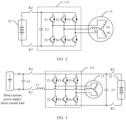
- the MCU 111 includes three bridge arms, the motor 13 includes three motor windings (N1 to N3), and the three bridge arms in the MCU 111 are respectively connected to the three motor windings in the motor 13 in a one-to-one correspondence.
- a first bridge arm includes a switch transistor T1 and a switch transistor T2.
- a first electrode of the switch transistor T1 is configured to connect to a positive electrode of the power battery 12
- a second electrode of the switch transistor T1 is connected to a first electrode of the switch transistor T2
- a second electrode of the switch transistor T2 is configured to connect to a negative electrode of the power battery 12.
- a middle point of the first bridge arm is a point connecting the switch transistor T1 and the switch transistor T2. The middle point of the first bridge arm is connected to one end of the motor winding N1.
- a second bridge arm includes a switch transistor T3 and a switch transistor T4.
- a first electrode of the switch transistor T3 is configured to connect to the positive electrode of the power battery 12
- a second electrode of the switch transistor T3 is connected to a first electrode of the switch transistor T4
- a second electrode of the switch transistor T4 is configured to connect to the negative electrode of the power battery 12.
- a middle point of the second bridge arm is a point connecting the switch transistor T3 and the switch transistor T4. The middle point of the second bridge arm is connected to one end of the motor winding N2.
- a third bridge arm includes a switch transistor T5 and a switch transistor T6.
- a first electrode of the switch transistor T5 is configured to connect to the positive electrode of the power battery 12
- a second electrode of the switch transistor T5 is connected to a first electrode of the switch transistor T6, and a second electrode of the switch transistor T6 is configured to connect to the negative electrode of the power battery 12.
- a middle point of the third bridge arm is a point connecting the switch transistor T5 and the switch transistor T6. The middle point of the third bridge arm is connected to one end of the motor winding N3, and the other ends of the three motor windings are connected to each other.
- the MCU 111 includes a control board (not shown in the figure).
- the control board is separately connected to control electrodes of the switch transistor T1 to the switch transistor T6, to separately control on and off of the switch transistor T1 to the switch transistor T6, so that the three bridge arms can convert the battery voltage that is output by the power battery 12 into three-phase alternating current.
- Each bridge arm corresponds to one phase of the three-phase alternating current.
- the MCU 111 outputs the three-phase alternating current to the motor 13, so that the motor windings N1 to N3 generate a space rotational magnetic field, so as to drive a motor rotor to rotate, thereby converting electric energy into mechanical energy.
- the switch transistor in the embodiments may be one or more of a plurality of types of switch transistors such as a relay, a metal oxide semiconductor field effect transistor (metal oxide semiconductor field effect transistor, MOSFET), a bipolar junction transistor (bipolar junction transistor, BJT), or an insulated gate bipolar transistor (insulated gate bipolar transistor, IGBT), which are not enumerated one by one in the embodiments
- Each switch transistor may include a first electrode, a second electrode, and a control electrode. The control electrode is configured to control on or off of the switch transistor. When the switch transistor is turned on, current may be transmitted between the first electrode and the second electrode of the switch transistor.
- the switch transistor When the switch transistor is turned off, the current cannot be transmitted between the first electrode and the second electrode of the switch transistor.
- the IGBT is used as an example.
- the first electrode of the switch transistor may be a collector electrode
- the second electrode of the switch transistor may be an emitter electrode
- the control electrode of the switch transistor may be a gate electrode.
- a switch K2 and a switch K5 may be disposed between the power battery 12 and the MCU 111.
- the switch K2 and the switch K5 may be relays.
- the switch K2 and the switch K5 may be integrated with the power battery 12 in a battery pack, or may be independently disposed. This is not limited in the embodiments
- One end of the switch K2 is connected to an anode of the power battery 12, and the other end of the switch K2 is connected to high-potential ends of the three bridge arms.
- One end of the switch K5 is connected to a cathode of the power battery 12, and the other end of the switch K5 is connected to low-potential ends of the three bridge arms.
- the MCU 111 includes N bridge arms, and N is an integer greater than or equal to one. It can be understood that when the electric vehicle 10 is charged, the electric vehicle 10 usually does not need to be moved. In other words, in this case, the MCU 111 does not need to provide the three-phase current to the motor 13. Therefore, in the embodiments of this invention the power battery 12 can be charged based on the N bridge arms in the MCU without affecting a traveling function of the electric vehicle 10.
- a charging system 11 provided in this example which is not covered by the claims and includes an MCU 111 and a motor 13.
- the MCU 111 includes N bridge arms
- the motor 13 includes N motor windings
- the N bridge arms are respectively connected to the N motor windings in a one-to-one correspondence
- N is an integer greater than or equal to one.
- the charging system 11 includes the MCU 111 and the motor 13.
- a first battery end of the charging system 11 is connected to a positive electrode of the power battery 12
- a second battery end of the charging system 11 is connected to a negative electrode of the power battery 12
- a first power supply end of the charging system 11 is connected to a positive electrode of a direct current power supply
- a second power supply end of the charging system is connected to a negative electrode of the direct current power supply.
- the direct current power supply may be a charging pile, another electric vehicle, or the like. This is not limited in this example.
- the direct current power supply can output a power supply voltage.
- the charging system 11 receives the power supply voltage by using the first power supply end and the second power supply end, converts the power supply voltage into a first output voltage adapted to the power battery 12, and outputs the first output voltage to the power battery 12 by using the first battery end and the second battery end.
- the power battery 12 can receive the first output voltage provided by the charging system 11 to complete charging.
- the MCU 111 includes three bridge arms.
- high-potential ends of the three bridge arms in MCU 111 are connected to the first power supply end, and low-potential ends of the three bridge arms are connected to the second battery end of the charging system 11.
- the charging system 11 includes an inductor L1.
- One end of the inductor L1 is connected to the second power supply end, and the other end of the inductor L1 is connected to a middle point of any bridge arm in the MCU 111.
- the other end of the inductor L1 is connected to a middle point of a bridge arm 2 in which a switch transistor T3 and a switch transistor T4 are located.
- the three bridge arms in the MCU 111 and the inductor L1 may constitute a voltage conversion circuit, so that the MCU 111 can control on and off of each of switch transistors T1 to T6, and the voltage conversion circuit converts the power supply voltage.
- the MCU 111 may perform boost conversion on the power supply voltage by using the voltage conversion circuit, and output the power supply voltage obtained after boost conversion to the power battery as the first output voltage, where the first output voltage is not less than the minimum charging voltage of the power battery 12.
- the power supply voltage is 500 V
- the minimum charging voltage of the power battery 12 is 960 V.
- the MCU 111 may convert the power supply voltage into 960 V or above 960 V through boosting to provide an adaptive first output voltage to the power battery 12, so that the power battery 12 can complete charging.
- the charging system 11 includes a switch K3 and a switch K4.
- the switch K3 and the switch K4 may also be referred to as fast contactors.
- One end of the switch K3 is connected to a point connecting motor windings N1 to N3, and the other end of the switch K3 is connected to the second power supply end.
- One end of the switch K4 is connected to the high-potential ends of the three bridge arms, and the other end of the switch K4 is connected to the first power supply end.
- the switch K3 and the switch K4 are turned on, the direct current power supply can provide power to the charging system 11.
- the switch K3 and the switch K4 are turned off, the direct current power supply can stop providing power to the charging system 11.
- the bridge arm 2 including the switch transistor T3 and the switch transistor T4 is used as an example to illustrate a boost conversion process.
- the middle point of the bridge arm 2 is a point connecting the switch transistor T3 and the switch transistor T4.
- One end of the inductor L1 is connected to the second power supply end, and the other end of the inductor L1 is connected to the middle point of the bridge arm 2.
- boost conversion is performed on the power supply voltage, the following two stages are mainly included.
- Stage 1 The inductor L1 is charged.
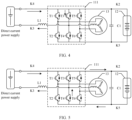
- the MCU 111 may turn on the switch transistor T3 to charge the inductor L1. It can be understood that in this case, the switch transistor T4 is turned off. As shown in FIG. 4 , current is output from the positive electrode of the direct current power supply, and flows back to the negative electrode of the direct current power supply after being transmitted by the switch transistor T3 and the inductor L1, so as to form a charging loop to charge the inductor L1.
- Stage 2 The inductor L1 discharges electricity.
- the MCU 111 may turn off the switch transistor T3, and the inductor L1 cannot continue to receive the current through the switch transistor T3.
- the inductor L1 starts to discharge electricity due to a freewheeling feature of the inductor.
- the current is output from an end that is of the inductor L1 and that is close to the second power supply end, and flows back to an end that is of the inductor L1 and that is close to the switch transistor T4 after being transmitted by the direct current power supply, the power battery 12, and a diode in the switch transistor T4.
- the first output voltage of the charging system 11 is the sum of the power supply voltage of the direct current power supply and a voltage of the inductor L1. Hence, the first output voltage is greater than the power supply voltage of the direct current power supply, so that boost conversion is implemented.
- the MCU 111 may also synchronously control a plurality of bridge arms to perform boost conversion.
- the MCU 111 includes three inductors (inductors L1-1 to L1-3) and three switches K3 (a switch K3-1 to a switch K3-3).
- One end of each of the switches K3-1 to K3-3 is connected to the second power supply end, and the other end of each of the switches K3-1 to K3-3 is connected to one end of each of the three inductors (the inductors L1-1 to L1-3) in a one-to-one correspondence.
- the switch K3-1 is connected to one end of the inductor L1-1
- the switch K3-2 is connected to one end of the inductor L1-2
- the switch K3-3 is connected to one end of the inductor L1-3.
- the three inductors are respectively connected to middle points of the three bridge arms in the MCU 111 in a one-to-one correspondence.
- One end of the inductor L1-1 is connected to the second power supply end of the charging system 11, and the other end of the inductor L1-1 is connected to a middle point between the switch transistor T1 and the switch transistor T2.
- One end of the inductor L1-2 is connected to the second power supply end of the charging system 11, and the other end of the inductor L1-2 is connected to a middle point between the switch transistor T3 and the switch transistor T4.
- One end of the inductor L1-3 is connected to the second power supply end of the charging system 11, and the other end of the inductor L1-3 is connected to a middle point between the switch transistor T5 and the switch transistor T6.
- the MCU 111 may turn on the switch K3-1 to the switch K3-3.
- the MCU 111 may synchronously control on and off of the switch transistor T1, the switch transistor T3, and the switch transistor T5, so that the inductor L1-1 to the inductor L1-3 are simultaneously charged and simultaneously discharge electricity. This case is equivalent to that the three inductors work in parallel to support voltage conversion in a high power scenario.
- the MCU 111 may turn off the switch K3-1 to the switch K3-3. In this case, the inductor L1-1 to the inductor L1-3 are disconnected from each other, so that impact of the inductor L1-1 to the inductor L1-3 on an inversion process of the MCU 111 can be reduced.
- the charging system 11 in this example may perform boost conversion on the power supply voltage of the direct current power supply to charge the high-voltage power battery 12, thereby helping improve convenience of charging the high-voltage power battery 12.
- the charging system 11 is implemented by multiplexing the N bridge arms in the MCU 111, thereby helping reduce space occupied by the charging system 11 and costs of the charging system 11.
- the power supply voltage provided by the direct current power supply may be adapted to the power battery 12.
- the charging voltage range of the power battery 12 is 700 V to 1000 V
- the power supply voltage of the direct current power supply (charging pile) is 800 V. In this case, boost conversion does not need to be performed on the power supply voltage.
- the charging system 11 may include a switch K1.
- a first end of the switch K1 is connected to the second battery end, and a second end of the switch K1 is connected to the second power supply end.
- the MCU 111 may control on and off of the switch K1.
- the MCU 111 may turn on the switch K1 when the power supply voltage falls within the charging voltage range of the power battery 12, and turn off the switch K1 when the power supply voltage is beyond the charging voltage range of the power battery 12.
- a scenario in which the power supply voltage falls within the charging voltage range of the power battery 12 may be a scenario in which the power supply voltage is equal to the minimum charging voltage of the power battery 12, may be a scenario in which the power supply voltage is equal to the maximum charging voltage of the power battery 12, or may be a scenario in which the power supply voltage is greater than the minimum charging voltage of the power battery 12 and is less than the maximum charging voltage of the power battery 12.
- a scenario in which the power supply voltage is beyond the charging voltage range of the power battery 12 may be a scenario in which the power supply voltage is less than the minimum charging voltage of the power battery 12, or may be a scenario in which the power supply voltage is greater than the maximum charging voltage of the power battery 12.
- the switch K5 when the power battery 12 is charged, the switch K5 is turned on by default.
- the power battery 12 can be directly connected to the direct current power supply, and therefore can directly receive the power supply voltage provided by the direct current power supply to complete charging. Therefore, the MCU 111 may turn on the switch K1 when the power supply voltage falls within the charging voltage range of the power battery 12.
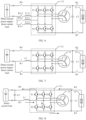
- the charging system 11 shown in FIG. 7 is equivalent to the charging system 11 shown in FIG. 3 , and the MCU 111 may perform boost conversion on the power supply voltage. Details are not described again.
- the charging system 11 may include a filter capacitor C1.
- One end of the filter capacitor C1 is connected to the first battery end, and the other end of the filter capacitor C1 is connected to the second battery end.
- the filter capacitor C1 may filter the first output voltage.
- the charging system 11 may include a filter capacitor C2.
- One end of the filter capacitor C2 is connected to the first power supply end, and the other end of the filter capacitor C2 is connected to the second power supply end.
- the filter capacitor C2 may filter the received power supply voltage.
- the electric vehicle 10 provides power to a direct current load.
- the direct current load may be another electric vehicle.
- the first power supply end of the charging system 11 may be connected to a positive electrode of the direct current load, and the second power supply end of the charging system 11 may be connected to a negative electrode of the direct current load.
- the power battery 12 may output the battery voltage to the charging system 11.
- the charging system 11 may perform buck conversion on the battery voltage to obtain a second output voltage that is adapted to the direct current load, and output the second output voltage to the direct current load by using the first power supply end and the second power supply end.
- a working voltage range of the direct current load may be understood as a charging voltage range of a power battery in the another electric vehicle.
- a lower limit of the working voltage range of the direct current load is a minimum working voltage, and the minimum working voltage may be understood as a minimum working voltage value that can be adapted to the direct current load.
- An upper limit of the working voltage range of the direct current load is the maximum working voltage, and the maximum working voltage may be understood as a maximum working voltage value that can be adapted to the direct current load.
- the MCU 111 may perform buck conversion on the battery voltage to obtain the second output voltage falling within the working voltage range.
- the charging system 11 outputs the second output voltage to the direct current load to provide an adaptive working voltage to the direct current load.
- the bridge arm 2 including the switch transistor T3 and the switch transistor T4 in FIG. 3 is used as an example to illustrate a buck conversion process. It can be understood that in this case, the switches K2 to K5 are turned on, and details are not described again.
- buck conversion is performed on the battery voltage, the following two stages are mainly included.
- Stage 1 The inductor L1 is charged.
- the MCU 111 turns on the switch transistor T4. In this case, the switch transistor T3 remains off.
- current is output from the positive electrode of the power battery 12, and flows back to the negative electrode of the power battery 12 after being transmitted by the direct current load, the inductor L1, and the switch transistor T4. In this stage, the inductor L1 is charged.
- the second output voltage that is output by the charging system 11 is a difference obtained after a voltage of the inductor L1 is subtracted from the battery voltage. Hence, the second output voltage is less than the battery voltage. Therefore, the charging system 11 can implement buck conversion on the battery voltage.
- Stage 2 The inductor L1 discharges electricity.
- the MCU 111 may turn off the switch transistor T4, and the charging loop of the inductor L1 is turned off.
- the inductor L1 starts to discharge electricity due to a freewheeling feature of the inductor.
- the current is output from an end that is of the inductor L1 and that is close to the switch transistor T3, and flows back to an end that is of the inductor L1 and that is close to the second power supply end after being transmitted by a diode in the switch transistor T3 and the direct current load.
- the second output voltage of the charging system 11 is the voltage of the inductor L1.
- the voltage of the inductor L1 is less than the battery voltage. Therefore, the charging system 11 can implement buck conversion on the battery voltage.
- the MCU 111 may also synchronously control a plurality of bridge arms to perform boost conversion.
- the MCU 111 may synchronously control on and off of the switch transistor T2, the switch transistor T4, and the switch transistor T6, so that the inductor L1-1 to the inductor L1-3 are simultaneously charged and simultaneously discharge electricity. This case is equivalent to that the three inductors work in parallel to support voltage conversion in a high power scenario.
- the charging system 11 shown in FIG. 7 is also applicable to buck conversion on the battery voltage.
- the MCU 111 may turn on the switch K1, so that the power battery 12 directly provides power to the direct current load.
- the MCU 111 may turn off the switch K1, so that the MCU 111 can perform voltage conversion on the battery voltage. Details are not described again.
- a scenario in which the battery voltage falls within the working voltage range of the direct current load may be a scenario in which the battery voltage is equal to the minimum working voltage of the direct current load, may be a scenario in which the battery voltage is equal to the maximum working voltage of the direct current load, or may be a scenario in which the battery voltage is greater than the minimum working voltage of the direct current load and is less than the maximum working voltage of the direct current load.
- a scenario in which the battery voltage is beyond the working voltage range of the direct current load may be a scenario in which the battery voltage is less than the minimum working voltage of the direct current load, or may be a scenario in which the battery voltage is greater than the maximum working voltage of the direct current load.
- an embodiment provides a charging system 11.
- a connection relationship between the charging system 11 and each of a direct current power supply and the power battery 12 is the same as that in the foregoing embodiment. Details are not described again.
- the charging system 11 may perform buck conversion on the power supply voltage.
- the charging system 11 may perform boost conversion on the power supply voltage. Therefore, the charging system 11 can provide the power battery 12 with a first output voltage adapted to the power battery 12.
- the charging system 11 in this embodiment may include an MCU 111 and an inductor L1. A connection relationship between the inductor L1 and the N bridge arms in the MCU 111 is not described again.
- the charging system 11 may include a switch K1 and a switch K2. A first end of the switch K1 is connected to a second battery end of the charging system 11, and a second end of the switch K1 is connected to a second power supply end.
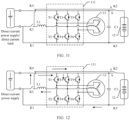
- the switch K2 is a single-pole double-throw switch. A first end of the switch K2 is connected to a first battery end, a second end a of the switch K2 is connected to one end of the inductor L1, and a third end b of the switch K2 is connected to a first power supply end.
- the switch K2 and the power battery 12 may be independently disposed.
- the first end of the switch K2 may be understood as the first battery end of the charging system 11.
- the switch K2 and the power battery 12 may be integrated into a power battery pack.
- the charging system 11 provided in this embodiment includes two first battery ends, where one first battery end is connected to the second end a of the switch K2, and the other first battery end is connected to the third end b of the switch K2.
- the MCU 111 may turn on the switch K1, and turn on the first end and the second end a of the switch K2.
- a circuit state may be shown in FIG. 11 .
- a switch K3 to a switch K5 may be disposed in the charging system 11. In this case, the switch K4 and the switch K5 should remain on, and the switch K3 should remain off.
- the buck conversion process mainly includes the following two stages.
- Stage 1 The inductor L1 is charged.
- the MCU 111 turns on the switch transistor T3, so that the inductor L1 is charged.
- current is output from a positive electrode of the direct current power supply, and flows back to a negative electrode of the direct current power supply after being transmitted by the switch transistor T3, the inductor L 1, the switch K2, and the power battery 12, so as to form a charging loop to charge the inductor L1.
- the first output voltage of the charging system 11 is a difference obtained after a voltage of the inductor L1 is subtracted from the power supply voltage. Hence, the first output voltage is less than the power supply voltage. Therefore, the charging system 11 can implement buck conversion.
- Stage 2 The inductor L1 discharges electricity.
- the MCU 111 turns off the switch transistor T3, so that the inductor L1 discharges electricity.
- the charging loop is turned off.
- the inductor L 1 discharges electricity due to a freewheeling feature of the inductor.
- the current is output from an end that is of the inductor L1 and that is close to the second power supply end, and flows back to an end that is of the inductor L1 and that is close to the switch transistor T4 after being transmitted by the switch K2, the power battery 12, and a diode in the switch transistor T4.
- the first output voltage of the charging system 11 is the voltage of the inductor L1. Hence, the first output voltage is less than the power supply voltage. Therefore, the charging system 11 can implement buck conversion on the power supply voltage.
- the charging system 11 may include a switch K3.
- a first end of the switch K3 is connected to a point connecting motor windings N1 to N3, and a second end of the switch K3 is connected to the second power supply end.
- the MCU 111 may turn on the first end and the third end b of the switch K2, turn on the switch K3, and turn off the switch K1.
- a circuit state may be shown in FIG. 14 . It can be learned from FIG. 14 that the circuit state in this case is equivalent to the charging system 11 shown in FIG. 3 . Therefore, reference may be made to the boost conversion process provided in example 1. Details are not described again.
- the charging system 11 shown in FIG. 10 may support voltage conversion in a buck-boost (buck-boost) mode on the power supply voltage.
- buck-boost buck-boost
- the MCU 111 may turn on the first end and the second end a of the switch K2, and turn on the switch K3.
- a circuit state may be shown in FIG. 15 .
- the buck-boost conversion mainly includes the following two stages.
- Stage 1 The inductor L1 is charged.
- the MCU 111 turns on the switch transistor T3, so that the inductor L1 is charged. As shown in FIG. 16 , current is output from a positive electrode of the direct current power supply, and flows back to a negative electrode of the direct current power supply after being transmitted by the switch transistor T3 and the inductor L1, so as to form a charging loop of the inductor L1 to charge the inductor L1.
- Stage 2 The inductor L1 discharges electricity.
- the MCU 111 turns off the switch transistor T3, so that the inductor L1 discharges electricity. As shown in FIG. 17 , the current is output from an end that is of the inductor L1 and that is close to the second power supply end, and flows back to an end that is of the inductor L1 and that is close to the switch transistor T4 after being transmitted by the switch K2, the power battery 12, and a diode in the switch transistor T4. It can be learned that the first output voltage of the charging system 11 is equal to the voltage of the inductor L1.
- the MCU 111 can control the voltage of the inductor L1 by controlling charging time of the inductor L1 in stage 1, so as to control the first output voltage.
- the first output voltage may be greater than the power supply voltage, or may be less than the power supply voltage.
- the MCU 111 may turn on the first end and the third end b of the switch K2, and turn on the switch K1, so that the power battery 12 can directly receive the power supply voltage to complete charging.
- the switch K2 may turn on the first end and the third end b of the switch K2, and turn on the switch K1, so that the power battery 12 can directly receive the power supply voltage to complete charging.
- the charging system 11 shown in FIG. 10 may also support a discharging function of the electric vehicle 10.
- a connection relationship between the charging system 11 and each of the power battery 12 and a direct current load is similar to that in Example 2. Details are not described again.
- the charging system 11 provided in FIG. 10 not only can perform buck conversion on a battery voltage, but also can perform boost conversion on the battery voltage, so that both a battery voltage that is output by a high-voltage power battery and a battery voltage that is output by a low-voltage power battery can be adapted to the direct current load in different working voltage ranges.
- boost conversion and buck conversion on the battery voltage are separately described by using FIG. 10 as an example.
- the MCU 111 may turn on the switch K1, and turn on the first end and the second end a of the switch K2.
- a circuit state may be shown in FIG. 11 .
- the boost conversion process mainly includes the following two stages.
- Stage 1 The inductor L1 is charged.
- the MCU 111 turns on the switch transistor T4, so that the inductor L1 is charged. As shown in FIG. 18 , current is output from a positive electrode of the power battery 12, and flows back to a negative electrode of the power battery 12 after being transmitted by the switch K2, the inductor L1, and the switch transistor T4, so as to form a charging loop to charge the inductor L1.
- Stage 2 The inductor L1 discharges electricity.
- the MCU 111 turns off the switch transistor T4, so that the inductor L1 discharges electricity.
- the charging loop is turned off.
- the inductor L1 discharges electricity due to a freewheeling feature of the inductor.
- the current is output from the positive electrode of the power battery 12, and flows back to the negative electrode of the power battery 12 after being transmitted by the switch K2, the inductor L1, a diode in the switch transistor T3, and the direct current load.
- a second output voltage of the charging system 11 is the sum of the battery voltage of the power battery 12 and the voltage of the inductor L1. Apparently, the second output voltage is greater than the battery voltage. Therefore, the charging system 11 can implement boost conversion on the battery voltage.
- the charging system 11 may include a switch K3.
- a first end of the switch K3 is connected to a point connecting motor windings N1 to N3, and a second end of the switch K3 is connected to the second power supply end.
- the MCU 111 may turn on the first end and the third end b of the switch K2, turn on the switch K3, and turn off the switch K1.
- a circuit state may be shown in FIG. 14 . It can be learned from FIG. 14 that the circuit state in this case is equivalent to the charging system 11 shown in FIG. 3 . Therefore, reference may be made to the buck conversion process provided in Example 2. Details are not described again.
- the charging system 11 shown in FIG. 10 may support voltage conversion in a buck-boost mode on the battery voltage.
- the MCU 111 may turn on the first end and the second end a of the switch K2, and turn on the switch K3.
- a circuit state may be shown in FIG. 15 .
- the buck-boost conversion mainly includes the following two stages.
- Stage 1 The inductor L1 is charged.
- the MCU 111 turns on the switch transistor T4, so that the inductor L1 is charged. As shown in FIG. 20 , current is output from a positive electrode of the power battery 12, and flows back to a negative electrode of the power battery 12 after being transmitted by the switch K2, the inductor L1, and the switch transistor T4, so as to form a charging loop of the inductor L1.
- Stage 2 The inductor L1 discharges electricity.
- the MCU 111 turns off the switch transistor T4, so that the inductor L1 discharges electricity. As shown in FIG. 21 , the current is output from an end that is of the inductor L1 and that is close to the switch transistor T3, and flows back to an end that is of the inductor L1 and that is close to the second power supply end after being transmitted by a diode in the switch transistor T3 and the direct current load. It can be learned that the second output voltage of the charging system 11 is equal to the voltage of the inductor L1.
- the MCU 111 can control the voltage of the inductor L1 by controlling charging time of the inductor L1 in stage 1, so as to control the second output voltage.
- the second output voltage may be greater than the battery voltage, or may be less than the battery voltage.
- the MCU 111 may turn on the first end and the third end b of the switch K2, and turn on the switch K1, so that the power battery 12 can directly provide power to the direct current load.
- the switch K2 may turn on the first end and the third end b of the switch K2, and turn on the switch K1, so that the power battery 12 can directly provide power to the direct current load.
- the inductor L1 is connected to the second power supply end. Based on a similar concept, the inductor L1 may also be connected to the first power supply end. In this case, the charging system 11 may be shown in FIG. 22 .
- This Example 3 is not covered by the appended claims.
- the charging system 11 includes a switch K5 and a switch K6.
- the switch K5 is a single-pole double-throw switch, a first end of the switch K5 is connected to the second battery end, a second end a of the switch K5 is connected to low-potential ends of the N bridge arms, a third end b of the switch K5 is connected to one end of the inductor L1, a second end of the switch K6 is connected to the second power supply end, a first end of the switch K6 is connected to the first battery end, and the second end of the switch K6 is connected to the first power supply end.
- the switch K5 and the power battery 12 may be independently disposed.
- the first end of the switch K5 may be understood as the second battery end of the charging system 11.
- the switch K5 and the power battery 12 may be integrated into a power battery pack.
- the charging system 11 provided in this example includes two second battery ends, where one second battery end is connected to the second end a of the switch K5, and the other second battery end is connected to the third end b of the switch K5.
- the MCU 111 may perform buck conversion on the power supply voltage.
- the MCU 111 may turn on the switch K6, and turn on the first end and the third end b of the switch K5.
- a circuit state may be shown in FIG. 23 .
- a switch K2 to a switch K4 may be disposed in the charging system 11. In this case, the switch K2 and the switch K3 should remain on, and the switch K4 should remain off.
- the buck conversion process mainly includes the following two stages.
- Stage 1 The inductor L1 is charged.
- the MCU 111 turns on the switch transistor T4, so that the inductor L1 is charged.
- current is output from a positive electrode of the direct current power supply, and flows back to a negative electrode of the direct current power supply after being transmitted by the power battery 12, the switch K5, the inductor L1, and the switch transistor T4, so as to form a charging loop to charge the inductor L1.
- the first output voltage of the charging system 11 is a difference obtained after a voltage of the inductor L1 is subtracted from the power supply voltage. Hence, the first output voltage is less than the power supply voltage. Therefore, the charging system 11 can implement buck conversion.
- Stage 2 The inductor L1 discharges electricity.
- the MCU 111 turns off the switch transistor T4, so that the inductor L1 discharges electricity; and turns off a second switch transistor, so that the inductor L1 discharges electricity.
- the charging loop is turned off.
- the inductor L1 discharges electricity due to a freewheeling feature of the inductor.
- the current is output from an end that is of the inductor L1 and that is close to the switch transistor T3, and flows back to an end that is of the inductor L1 and that is close to the first power supply end after being transmitted by a diode in the switch transistor T3, the power battery 12, and the switch K5.
- the first output voltage of the charging system 11 is the voltage of the inductor L1. Hence, the first output voltage is less than the power supply voltage. Therefore, the charging system 11 can implement buck conversion on the power supply voltage.
- the charging system 11 may include a switch K4.
- a first end of the switch K4 is connected to a point connecting the N motor windings, and a second end of the switch K4 is connected to the first power supply end.
- the MCU 111 may turn on the first end and the second end of the switch K5, turn on the switch K4, and turn off the switch K6.
- a circuit state may be shown in FIG. 26 . It can be learned from FIG. 26 that the circuit state in this case is equivalent to the charging system 11 shown in FIG. 3 . Therefore, reference may be made to the boost conversion process provided in Example 1. Details are not described again.
- the charging system 11 shown in FIG. 22 may support voltage conversion in a buck-boost (buck-boost) mode on the power supply voltage.
- buck-boost buck-boost
- the MCU 111 may turn on the first end and the third end b of the switch K5, and turn on the switch K4.
- a circuit state may be shown in FIG. 27 .
- the buck-boost conversion mainly includes the following two stages.
- Stage 1 The inductor L1 is charged.
- the MCU 111 turns on the switch transistor T4, so that the inductor L1 is charged. As shown in FIG. 28 , current is output from a positive electrode of the direct current power supply, and flows back to a negative electrode of the direct current power supply after being transmitted by the inductor L1 and the switch transistor T4, so as to form a charging loop of the inductor L1.
- Stage 2 The inductor L1 discharges electricity.
- the MCU 111 turns off the switch transistor T3, so that the inductor L1 discharges electricity. As shown in FIG. 29 , the current is output from an end that is of the inductor L1 and that is close to the switch transistor T3, and flows back to an end that is of the inductor L1 and that is close to the first power supply end after being transmitted by a diode in the switch transistor T3, the power battery 12, and the switch K5. It can be learned that the first output voltage of the charging system 11 is equal to the voltage of the inductor L1.
- the MCU 111 can control the voltage of the inductor L1 by controlling charging time of the inductor L1 in stage 1, so as to control the first output voltage.
- the first output voltage may be greater than the power supply voltage, or may be less than the power supply voltage.
- the MCU 111 may turn on the first end and the second end a of the switch K5, and turn on the switch K6, so that the power battery 12 can directly receive the power supply voltage to complete charging.
- the switch K5 may turn on the first end and the second end a of the switch K5, and turn on the switch K6, so that the power battery 12 can directly receive the power supply voltage to complete charging.
- the charging system 11 shown in FIG. 22 also not only can perform buck conversion on a battery voltage, but also can perform boost conversion on the battery voltage, so that both a battery voltage that is output by a high-voltage power battery and a battery voltage that is output by a low-voltage power battery can be adapted to the direct current load in different working voltage ranges.
- This Example 4 is not covered by the appended claims.
- boost conversion and buck conversion on the battery voltage are separately described by using FIG. 22 as an example.
- the MCU 111 may turn on the switch K6, and turn on the first end and the third end b of the switch K5.
- a circuit state may be shown in FIG. 23 .
- the boost conversion process mainly includes the following two stages.
- Stage 1 The inductor L1 is charged.
- the MCU 111 turns on the switch transistor T3, so that the inductor L1 is charged. As shown in FIG. 30 , current is output from a positive electrode of the power battery 12, and flows back to a negative electrode of the power battery 12 after being transmitted by the switch transistor T3, the inductor L1, and the switch K5, so as to form a charging loop to charge the inductor L1.
- Stage 2 The inductor L1 discharges electricity.
- the MCU 111 turns off the switch transistor T3, so that the inductor L1 discharges electricity.
- the charging loop is turned off.
- the inductor L1 discharges electricity due to a freewheeling feature of the inductor.
- the current is output from the positive electrode of the power battery 12, and flows back to the negative electrode of the power battery 12 after being transmitted by the direct current load, a diode in the switch transistor T4, the inductor L1, and the switch transistor T5.
- a second output voltage of the charging system 11 is the sum of the battery voltage of the power battery 12 and the voltage of the inductor L1. Hence, the second output voltage is greater than the battery voltage. Therefore, the charging system 11 can implement boost conversion on the battery voltage.
- the charging system 11 may include a switch K4.
- a first end of the switch K4 is connected to a point connecting the N motor windings, and a second end of the switch K4 is connected to the first power supply end.
- the MCU 111 may turn on the first end and the second end a of the switch K5, turn on the switch K4, and turn off the switch K6.
- a circuit state may be shown in FIG. 26 . It can be learned from FIG. 26 that the circuit state in this case is equivalent to the charging system 11 shown in FIG. 3 . Therefore, reference may be made to the buck conversion process provided in Example 2. Details are not described again.
- the charging system 11 shown in FIG. 22 may also support voltage conversion in a buck-boost mode on the battery voltage.
- the MCU 111 may turn on the first end and the third end b of the switch K5, and turn on the switch K4.
- a circuit state may be shown in FIG. 27 .
- the buck-boost conversion mainly includes the following two stages.
- Stage 1 The inductor L1 is charged.
- the MCU 111 turns on the switch transistor T3, so that the inductor L1 is charged. As shown in FIG. 32 , current is output from a positive electrode of the power battery 12, and flows back to a negative electrode of the power battery 12 after being transmitted by the switch transistor T3, the inductor L1, and the switch K5, so as to form a charging loop of the inductor L1.
- Stage 2 The inductor L1 discharges electricity.
- the MCU 111 turns off the switch transistor T3, so that the inductor L1 discharges electricity. As shown in FIG. 33 , the current is output from an end that is of the inductor L1 and that is close to the first power supply end, and flows back to an end that is of the inductor L1 and that is close to the switch transistor T4 after being transmitted by the direct current load and a diode in the switch transistor T4. It can be learned that the second output voltage of the charging system 11 is equal to the voltage of the inductor L1.
- the MCU 111 can control the voltage of the inductor L1 by controlling charging time of the inductor L1 in stage 1, so as to control the second output voltage.
- the second output voltage may be greater than the battery voltage, or may be less than the battery voltage.
- the MCU 111 may turn on the first end and the second end a of the switch K5, and turn on the switch K6, so that the power battery 12 can directly provide power to the direct current load.
- the switch K5 may turn on the first end and the second end a of the switch K5, and turn on the switch K6, so that the power battery 12 can directly provide power to the direct current load.
Landscapes
- Engineering & Computer Science (AREA)
- Power Engineering (AREA)
- Transportation (AREA)
- Mechanical Engineering (AREA)
- Life Sciences & Earth Sciences (AREA)
- Sustainable Development (AREA)
- Sustainable Energy (AREA)
- Charge And Discharge Circuits For Batteries Or The Like (AREA)
- Dc-Dc Converters (AREA)
Description
- This invention relates to the field of new energy vehicle technologies, and in particular, to a charging system and an electric vehicle.
- With development of new energy technologies, electric vehicles have received increasingly more attention. A power battery is disposed in the electric vehicle, and the power battery can receive and store electric energy provided by a charging pile, and in a traveling process of the electric vehicle, the power battery releases the stored electric energy to drive the electric vehicle to travel.
- To improve a charging speed of the electric vehicle, increasingly more electric vehicles use an 800 V high-voltage power battery. A maximum battery voltage of the power battery is 800 V, and a charging voltage required by the power battery may exceed 800 V. However, currently, most fast direct current charging piles in the market have an output voltage of 500 V. These charging piles cannot directly charge the 800 V high-voltage power battery. As a result, the electric vehicle equipped with the high-voltage power battery faces a difficulty of being charged, which is not conducive to improvement in user experience.
- Therefore, currently, a charging solution to the electric vehicle needs to be studied.
- The document
US 2014/062183 A1 shows a power supply device for a vehicle. Especially, a charging of a vehicle battery using a charger is shown. - The present invention is defined by the independent claims. further advantageous developments are shown by the dependent claims.
- In view of this, this invention provides a charging system and an electric vehicle. When a power supply voltage is less than a minimum charging voltage of a power battery, the electric vehicle can still support the power supply voltage in charging the power battery.
-
-
FIG. 1 is a schematic diagram of a charging scenario of an electric vehicle; -
FIG. 2 is a schematic diagram of an electrical drive system; -
FIG. 3 is a schematic diagram of a charging system according to an example which is not part of the claimed invention; -
FIG. 4 shows a first boost conversion state of a charging system according to the example ofFig. 3 ; -
FIG. 5 shows a second boost conversion state of a charging system according to the example ofFig. 3 ; -
FIG. 6 is a schematic diagram of a specific charging system according to another example which is not part of the claimed invention; -
FIG. 7 is a schematic diagram of a specific charging system according to another example ; -
FIG. 8 shows a first buck conversion state of a charging system according to another example ; -
FIG. 9 shows a second buck conversion state of a charging system according to another example ; -
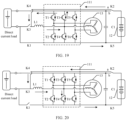
FIG. 10 is a schematic diagram of a specific charging system according to an embodiment of this invention; -
FIG. 11 shows a first switch state of a charging system according to an embodiment of this invention; -
FIG. 12 shows a third buck conversion state of a charging system according to an embodiment of this invention; -
FIG. 13 shows a fourth buck conversion state of a charging system according to an embodiment of this invention; -
FIG. 14 shows a second switch state of a charging system according to an embodiment of this invention; -
FIG. 15 shows a third switch state of a charging system according to an embodiment of this invention; -
FIG. 16 shows a first buckboost conversion state of a charging system according to an embodiment of this invention; -
FIG. 17 shows a second buck-boost conversion state of a charging system according to an embodiment of this invention; -
FIG. 18 shows a third boost conversion state of a charging system according to an embodiment of this invention; -
FIG. 19 shows a fourth boost conversion state of a charging system according to an embodiment of this invention; -
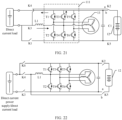
FIG. 20 shows a third buckboost conversion state of a charging system according to an embodiment of this invention; -
FIG. 21 shows a fourth buck-boost conversion state of a charging system according to an embodiment of this invention; -
FIG. 22 is a schematic diagram of another charging system according to an example which is not part of the claimed invention; -
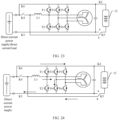
FIG. 23 shows a fourth switch state of a charging system according to another example ; -
FIG. 24 shows a fifth buck conversion state of a charging system according to another example ; -
FIG. 25 shows a sixth buck conversion state of a charging system according to another example ; -
FIG. 26 shows a fifth switch state of a charging system according to another example ; -
FIG. 27 shows a sixth switch state of a charging system according to another example ; -
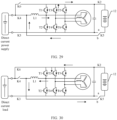
FIG. 28 shows a fifth buck-boost conversion state of a charging system according to another example ; -
FIG. 29 shows a sixth buck-boost conversion state of a charging system according to another example ; -
FIG. 30 shows a fifth boost conversion state of a charging system according to another example ; -
FIG. 31 shows a sixth boost conversion state of a charging system according to another example ; -
FIG. 32 shows a seventh buck-boost conversion state of a charging system according to another example ; and -
FIG. 33 shows an eighth buck-boost conversion state of a charging system according to another example . - To make objectives, technical solutions, and advantages of this invention more clearly, the following describes this invention in detail with reference to the accompanying drawings. A specific operation method in a method embodiment may also be applied to an apparatus embodiment or a system embodiment. It should be noted that in this description, "at least one" means one or more, and "a plurality of" means two or more. In view of this, "a plurality of" may also be understood as "at least two" in the embodiments of the present invention. "And/or" describes an association relationship between associated objects and represents that three relationships may exist. For example, A and/or B may represent the following three cases: Only A exists, both A and B exist, and only B exists. In addition, unless otherwise specified, the character "/" usually indicates an "or" relationship between the associated objects. In addition, it should be understood that, in this description, terms "first", "second", and the like are only used for a purpose of distinguishing between descriptions, but cannot be understood as an indication or implication of relative importance, and cannot be understood as an indication or implication of a
- The following clearly describes the technical solutions in the embodiments with reference to the accompanying drawings.
- An electric vehicle, which may also be referred to as a new energy vehicle, is a vehicle driven by electric energy. As shown in
FIG. 1 , anelectric vehicle 10 mainly includes apower battery 12, amotor 13, and awheel 14. Thepower battery 12 is a battery with a large capacity and high power. When theelectric vehicle 10 travels, thepower battery 12 may provide power to themotor 13 by using a motor control unit (MCU) 111. Themotor 13 converts electric energy provided by thepower battery 12 into mechanical energy, to drive thewheel 14 to rotate, so that the vehicle travels. - When the
electric vehicle 10 is charged, a chargingpile 20 usually may be used to charge theelectric vehicle 10. As shown inFIG. 1 , the chargingpile 20 mainly includes apower supply circuit 21 and a charginggun 22. One end of thepower supply circuit 21 is connected to apower frequency grid 30, and the other end of thepower supply circuit 21 is connected to the charginggun 22 through a cable. Currently, most charging piles 20 are direct current charging piles, and thepower supply circuit 21 may convert alternating current provided by thepower frequency grid 30 into direct current. An operator may insert the charginggun 22 into a charging socket of theelectric vehicle 10, so that the charginggun 22 is connected to thepower battery 12 in theelectric vehicle 10, and then thepower supply circuit 21 of the chargingpile 20 can charge thepower battery 12 by using the charginggun 22. - An output voltage of the charging
pile 20 may be understood as a power supply voltage received by theelectric vehicle 10. In a fast direct current charging scenario, the power supply voltage received by theelectric vehicle 10 falls within a charging voltage range of thepower battery 12, and thepower battery 12 can directly use the output voltage of the chargingpile 20 to complete charging. - A lower limit of the charging voltage range of the
power battery 12 is a minimum charging voltage, and the minimum charging voltage may be understood as a minimum charging voltage value that can be adapted to thepower battery 12. An upper limit of the charging voltage range of thepower battery 12 is a maximum charging voltage, and the maximum charging voltage may be understood as a maximum charging voltage value that can be adapted to thepower battery 12. - Currently, to improve a charging speed of the
electric vehicle 10, a voltage level of thepower battery 12 gradually increases from current 500 V to 800 V. Using thepower battery 12 of an 800 V voltage level as an example, a battery voltage of thepower battery 12 can reach 800 V, and a required charging voltage is usually not less than 800 V. However, currently, voltage levels of chargingpiles 20 that support fast direct current charging in the market are usually 500 V, that is, maximum output voltages of most charging piles 20 that support fast direct current charging are 500 V. As a result, manyelectric vehicles 10 equipped with a high-voltage power battery face a difficulty of being charged. - In view of this, the embodiments of this invention provide a
charging system 11, and the chargingsystem 11 is connected to thepower battery 12. When charging theelectric vehicle 10, the chargingsystem 11 may receive a power supply voltage. When the power supply voltage is less than the minimum charging voltage of thepower battery 12, the chargingsystem 11 may perform boost conversion on the power supply voltage, and provide the power supply voltage obtained after boost conversion to thepower battery 12 as a first output voltage. - In the foregoing example, the output voltage of the charging
pile 20 is 500 V, that is, the power supply voltage received by the chargingsystem 11 is 500 V. Assuming that a charging voltage that can be adapted to thepower battery 12 is 960 V, the chargingsystem 11 may convert the power supply voltage into 960 V through boosting, to provide a 960 V first output voltage to thepower battery 12, so that thepower battery 12 can use the first output voltage to complete charging. - It should be noted that to reduce space occupied by the charging
system 11 in theelectric vehicle 10 and control costs of the chargingsystem 11, the chargingsystem 11 in the embodiments of this application may be implemented based on theMCU 111 in theelectric vehicle 10. TheMCU 111 and themotor 13 are generally integrated into an electrical drive system. In other words, the chargingsystem 11 in the embodiments of this application may be implemented by improving a conventional electrical drive system. - The
motor 13 converts electric energy into mechanical energy based on an electromagnetic induction effect. Therefore, a motor winding is disposed in themotor 13. Currently, there are three or six motor windings in themotor 13. A three-phase motor is used as an example. As shown inFIG. 2 , theMCU 111 includes three bridge arms, themotor 13 includes three motor windings (N1 to N3), and the three bridge arms in theMCU 111 are respectively connected to the three motor windings in themotor 13 in a one-to-one correspondence. - A first bridge arm includes a switch transistor T1 and a switch transistor T2. A first electrode of the switch transistor T1 is configured to connect to a positive electrode of the
power battery 12, a second electrode of the switch transistor T1 is connected to a first electrode of the switch transistor T2, and a second electrode of the switch transistor T2 is configured to connect to a negative electrode of thepower battery 12. A middle point of the first bridge arm is a point connecting the switch transistor T1 and the switch transistor T2. The middle point of the first bridge arm is connected to one end of the motor winding N1. - A second bridge arm includes a switch transistor T3 and a switch transistor T4. A first electrode of the switch transistor T3 is configured to connect to the positive electrode of the
power battery 12, a second electrode of the switch transistor T3 is connected to a first electrode of the switch transistor T4, and a second electrode of the switch transistor T4 is configured to connect to the negative electrode of thepower battery 12. A middle point of the second bridge arm is a point connecting the switch transistor T3 and the switch transistor T4. The middle point of the second bridge arm is connected to one end of the motor winding N2. - A third bridge arm includes a switch transistor T5 and a switch transistor T6. A first electrode of the switch transistor T5 is configured to connect to the positive electrode of the
power battery 12, a second electrode of the switch transistor T5 is connected to a first electrode of the switch transistor T6, and a second electrode of the switch transistor T6 is configured to connect to the negative electrode of thepower battery 12. A middle point of the third bridge arm is a point connecting the switch transistor T5 and the switch transistor T6. The middle point of the third bridge arm is connected to one end of the motor winding N3, and the other ends of the three motor windings are connected to each other. - The
MCU 111 includes a control board (not shown in the figure). The control board is separately connected to control electrodes of the switch transistor T1 to the switch transistor T6, to separately control on and off of the switch transistor T1 to the switch transistor T6, so that the three bridge arms can convert the battery voltage that is output by thepower battery 12 into three-phase alternating current. Each bridge arm corresponds to one phase of the three-phase alternating current. TheMCU 111 outputs the three-phase alternating current to themotor 13, so that the motor windings N1 to N3 generate a space rotational magnetic field, so as to drive a motor rotor to rotate, thereby converting electric energy into mechanical energy. - It should be noted that the switch transistor in the embodiments may be one or more of a plurality of types of switch transistors such as a relay, a metal oxide semiconductor field effect transistor (metal oxide semiconductor field effect transistor, MOSFET), a bipolar junction transistor (bipolar junction transistor, BJT), or an insulated gate bipolar transistor (insulated gate bipolar transistor, IGBT), which are not enumerated one by one in the embodiments Each switch transistor may include a first electrode, a second electrode, and a control electrode. The control electrode is configured to control on or off of the switch transistor. When the switch transistor is turned on, current may be transmitted between the first electrode and the second electrode of the switch transistor. When the switch transistor is turned off, the current cannot be transmitted between the first electrode and the second electrode of the switch transistor. The IGBT is used as an example. In the embodiment the first electrode of the switch transistor may be a collector electrode, the second electrode of the switch transistor may be an emitter electrode, and the control electrode of the switch transistor may be a gate electrode.
- Generally, as shown in
FIG. 2 , a switch K2 and a switch K5 may be disposed between thepower battery 12 and theMCU 111. For example, the switch K2 and the switch K5 may be relays. The switch K2 and the switch K5 may be integrated with thepower battery 12 in a battery pack, or may be independently disposed. This is not limited in the embodiments - One end of the switch K2 is connected to an anode of the
power battery 12, and the other end of the switch K2 is connected to high-potential ends of the three bridge arms. One end of the switch K5 is connected to a cathode of thepower battery 12, and the other end of the switch K5 is connected to low-potential ends of the three bridge arms. When the switch K2 and the switch K5 are turned on, thepower battery 12 can provide power to theMCU 111. When the switch K2 and the switch K5 are turned off, thepower battery 12 stops providing power to theMCU 111. - It can be learned from the foregoing description of the
MCU 111 and themotor 13 that theMCU 111 includes N bridge arms, and N is an integer greater than or equal to one. It can be understood that when theelectric vehicle 10 is charged, theelectric vehicle 10 usually does not need to be moved. In other words, in this case, theMCU 111 does not need to provide the three-phase current to themotor 13. Therefore, in the embodiments of this invention thepower battery 12 can be charged based on the N bridge arms in the MCU without affecting a traveling function of theelectric vehicle 10. - Next, the charging
system 11 provided in the embodiments of this invention is described by using the following examples. - For example, a charging
system 11 provided in this example which is not covered by the claims and includes anMCU 111 and amotor 13. TheMCU 111 includes N bridge arms, themotor 13 includes N motor windings, the N bridge arms are respectively connected to the N motor windings in a one-to-one correspondence, and N is an integer greater than or equal to one. - For example, N=3. As shown in
FIG. 3 , the chargingsystem 11 includes theMCU 111 and themotor 13. A first battery end of the chargingsystem 11 is connected to a positive electrode of thepower battery 12, a second battery end of the chargingsystem 11 is connected to a negative electrode of thepower battery 12, a first power supply end of the chargingsystem 11 is connected to a positive electrode of a direct current power supply, and a second power supply end of the charging system is connected to a negative electrode of the direct current power supply. - The direct current power supply may be a charging pile, another electric vehicle, or the like. This is not limited in this example. The direct current power supply can output a power supply voltage. The charging
system 11 receives the power supply voltage by using the first power supply end and the second power supply end, converts the power supply voltage into a first output voltage adapted to thepower battery 12, and outputs the first output voltage to thepower battery 12 by using the first battery end and the second battery end. Thepower battery 12 can receive the first output voltage provided by the chargingsystem 11 to complete charging. - As shown in
FIG. 3 , theMCU 111 includes three bridge arms. In this example, high-potential ends of the three bridge arms inMCU 111 are connected to the first power supply end, and low-potential ends of the three bridge arms are connected to the second battery end of the chargingsystem 11. The charging system 11includes an inductor L1. One end of the inductor L1 is connected to the second power supply end, and the other end of the inductor L1 is connected to a middle point of any bridge arm in theMCU 111. In the example shown inFIG. 3 , the other end of the inductor L1 is connected to a middle point of a bridge arm 2 in which a switch transistor T3 and a switch transistor T4 are located. - In this case, the three bridge arms in the
MCU 111 and the inductor L1 may constitute a voltage conversion circuit, so that theMCU 111 can control on and off of each of switch transistors T1 to T6, and the voltage conversion circuit converts the power supply voltage. - Therefore, when the power supply voltage is less than the minimum charging voltage of the
power battery 12, theMCU 111 may perform boost conversion on the power supply voltage by using the voltage conversion circuit, and output the power supply voltage obtained after boost conversion to the power battery as the first output voltage, where the first output voltage is not less than the minimum charging voltage of thepower battery 12. - For example, the power supply voltage is 500 V, and the minimum charging voltage of the
power battery 12 is 960 V. TheMCU 111 may convert the power supply voltage into 960 V or above 960 V through boosting to provide an adaptive first output voltage to thepower battery 12, so that thepower battery 12 can complete charging. - Generally, as shown in
FIG. 3 , the chargingsystem 11 includes a switch K3 and a switch K4. The switch K3 and the switch K4 may also be referred to as fast contactors. One end of the switch K3 is connected to a point connecting motor windings N1 to N3, and the other end of the switch K3 is connected to the second power supply end. One end of the switch K4 is connected to the high-potential ends of the three bridge arms, and the other end of the switch K4 is connected to the first power supply end. When the switch K3 and the switch K4 are turned on, the direct current power supply can provide power to the chargingsystem 11. When the switch K3 and the switch K4 are turned off, the direct current power supply can stop providing power to the chargingsystem 11. - Next, the bridge arm 2 including the switch transistor T3 and the switch transistor T4 is used as an example to illustrate a boost conversion process. The middle point of the bridge arm 2 is a point connecting the switch transistor T3 and the switch transistor T4. One end of the inductor L1 is connected to the second power supply end, and the other end of the inductor L1 is connected to the middle point of the bridge arm 2. When boost conversion is performed on the power supply voltage, the following two stages are mainly included.
- The
MCU 111 may turn on the switch transistor T3 to charge the inductor L1. It can be understood that in this case, the switch transistor T4 is turned off. As shown inFIG. 4 , current is output from the positive electrode of the direct current power supply, and flows back to the negative electrode of the direct current power supply after being transmitted by the switch transistor T3 and the inductor L1, so as to form a charging loop to charge the inductor L1. - The
MCU 111 may turn off the switch transistor T3, and the inductor L1 cannot continue to receive the current through the switch transistor T3. The inductor L1 starts to discharge electricity due to a freewheeling feature of the inductor. As shown inFIG. 5 , the current is output from an end that is of the inductor L1 and that is close to the second power supply end, and flows back to an end that is of the inductor L1 and that is close to the switch transistor T4 after being transmitted by the direct current power supply, thepower battery 12, and a diode in the switch transistor T4. In this process, the first output voltage of the chargingsystem 11 is the sum of the power supply voltage of the direct current power supply and a voltage of the inductor L1. Apparently, the first output voltage is greater than the power supply voltage of the direct current power supply, so that boost conversion is implemented. - It can be understood that when power of the direct current power supply is relatively large, the
MCU 111 may also synchronously control a plurality of bridge arms to perform boost conversion. For example, as shown inFIG. 6 , theMCU 111 includes three inductors (inductors L1-1 to L1-3) and three switches K3 (a switch K3-1 to a switch K3-3). One end of each of the switches K3-1 to K3-3 is connected to the second power supply end, and the other end of each of the switches K3-1 to K3-3 is connected to one end of each of the three inductors (the inductors L1-1 to L1-3) in a one-to-one correspondence. The switch K3-1 is connected to one end of the inductor L1-1, the switch K3-2 is connected to one end of the inductor L1-2, and the switch K3-3 is connected to one end of the inductor L1-3. - The three inductors are respectively connected to middle points of the three bridge arms in the
MCU 111 in a one-to-one correspondence. One end of the inductor L1-1 is connected to the second power supply end of the chargingsystem 11, and the other end of the inductor L1-1 is connected to a middle point between the switch transistor T1 and the switch transistor T2. One end of the inductor L1-2 is connected to the second power supply end of the chargingsystem 11, and the other end of the inductor L1-2 is connected to a middle point between the switch transistor T3 and the switch transistor T4. One end of the inductor L1-3 is connected to the second power supply end of the chargingsystem 11, and the other end of the inductor L1-3 is connected to a middle point between the switch transistor T5 and the switch transistor T6. - When charging the
power battery 12, theMCU 111 may turn on the switch K3-1 to the switch K3-3. TheMCU 111 may synchronously control on and off of the switch transistor T1, the switch transistor T3, and the switch transistor T5, so that the inductor L1-1 to the inductor L1-3 are simultaneously charged and simultaneously discharge electricity. This case is equivalent to that the three inductors work in parallel to support voltage conversion in a high power scenario. After stopping charging thepower battery 12, theMCU 111 may turn off the switch K3-1 to the switch K3-3. In this case, the inductor L1-1 to the inductor L1-3 are disconnected from each other, so that impact of the inductor L1-1 to the inductor L1-3 on an inversion process of theMCU 111 can be reduced. - In conclusion, the charging
system 11 in this example may perform boost conversion on the power supply voltage of the direct current power supply to charge the high-voltage power battery 12, thereby helping improve convenience of charging the high-voltage power battery 12. In addition, in this example, the chargingsystem 11 is implemented by multiplexing the N bridge arms in theMCU 111, thereby helping reduce space occupied by the chargingsystem 11 and costs of the chargingsystem 11. - It can be understood that the power supply voltage provided by the direct current power supply may be adapted to the
power battery 12. For example, the charging voltage range of thepower battery 12 is 700 V to 1000 V, and the power supply voltage of the direct current power supply (charging pile) is 800 V. In this case, boost conversion does not need to be performed on the power supply voltage. - To be compatible with this scenario, as shown in
FIG. 7 , the chargingsystem 11 provided in this example may include a switch K1. A first end of the switch K1 is connected to the second battery end, and a second end of the switch K1 is connected to the second power supply end. TheMCU 111 may control on and off of the switch K1. TheMCU 111 may turn on the switch K1 when the power supply voltage falls within the charging voltage range of thepower battery 12, and turn off the switch K1 when the power supply voltage is beyond the charging voltage range of thepower battery 12. - A scenario in which the power supply voltage falls within the charging voltage range of the
power battery 12 may be a scenario in which the power supply voltage is equal to the minimum charging voltage of thepower battery 12, may be a scenario in which the power supply voltage is equal to the maximum charging voltage of thepower battery 12, or may be a scenario in which the power supply voltage is greater than the minimum charging voltage of thepower battery 12 and is less than the maximum charging voltage of thepower battery 12. A scenario in which the power supply voltage is beyond the charging voltage range of thepower battery 12 may be a scenario in which the power supply voltage is less than the minimum charging voltage of thepower battery 12, or may be a scenario in which the power supply voltage is greater than the maximum charging voltage of thepower battery 12. - As shown in
FIG. 7 , when thepower battery 12 is charged, the switch K5 is turned on by default. When the switch K1 is turned on, thepower battery 12 can be directly connected to the direct current power supply, and therefore can directly receive the power supply voltage provided by the direct current power supply to complete charging. Therefore, theMCU 111 may turn on the switch K1 when the power supply voltage falls within the charging voltage range of thepower battery 12. - When the switch K1 is turned off, the charging
system 11 shown inFIG. 7 is equivalent to the chargingsystem 11 shown inFIG. 3 , and theMCU 111 may perform boost conversion on the power supply voltage. Details are not described again. - In a possible implementation, as shown in
FIG. 3 , the chargingsystem 11 may include a filter capacitor C1. One end of the filter capacitor C1 is connected to the first battery end, and the other end of the filter capacitor C1 is connected to the second battery end. When thepower battery 12 is charged, the filter capacitor C1 may filter the first output voltage. - Similarly, as shown in
FIG. 3 , the chargingsystem 11 may include a filter capacitor C2. One end of the filter capacitor C2 is connected to the first power supply end, and the other end of the filter capacitor C2 is connected to the second power supply end. When thepower battery 12 is charged, the filter capacitor C2 may filter the received power supply voltage. - With development of charging and discharging technologies of the
electric vehicle 10, increasingly moreelectric vehicles 10 can also support a discharging function, that is, theelectric vehicle 10 provides power to a direct current load. In some scenarios, the direct current load may be another electric vehicle. For example, as shown inFIG. 3 , the first power supply end of the chargingsystem 11 may be connected to a positive electrode of the direct current load, and the second power supply end of the chargingsystem 11 may be connected to a negative electrode of the direct current load. This Example 2 is not covered by the appended claims. - The
power battery 12 may output the battery voltage to the chargingsystem 11. When the battery voltage of thepower battery 12 is greater than a maximum working voltage of the direct current load, the chargingsystem 11 may perform buck conversion on the battery voltage to obtain a second output voltage that is adapted to the direct current load, and output the second output voltage to the direct current load by using the first power supply end and the second power supply end. When the direct current load is another electric vehicle, a working voltage range of the direct current load may be understood as a charging voltage range of a power battery in the another electric vehicle. - A lower limit of the working voltage range of the direct current load is a minimum working voltage, and the minimum working voltage may be understood as a minimum working voltage value that can be adapted to the direct current load. An upper limit of the working voltage range of the direct current load is the maximum working voltage, and the maximum working voltage may be understood as a maximum working voltage value that can be adapted to the direct current load.
- For example, if the battery voltage of the
power battery 12 is 800 V and the working voltage range of the direct current load is 400 V to 600 V, theMCU 111 may perform buck conversion on the battery voltage to obtain the second output voltage falling within the working voltage range. The chargingsystem 11 outputs the second output voltage to the direct current load to provide an adaptive working voltage to the direct current load. - Next, the bridge arm 2 including the switch transistor T3 and the switch transistor T4 in
FIG. 3 is used as an example to illustrate a buck conversion process. It can be understood that in this case, the switches K2 to K5 are turned on, and details are not described again. When buck conversion is performed on the battery voltage, the following two stages are mainly included. - The
MCU 111 turns on the switch transistor T4. In this case, the switch transistor T3 remains off. As shown inFIG. 8 , current is output from the positive electrode of thepower battery 12, and flows back to the negative electrode of thepower battery 12 after being transmitted by the direct current load, the inductor L1, and the switch transistor T4. In this stage, the inductor L1 is charged. The second output voltage that is output by the chargingsystem 11 is a difference obtained after a voltage of the inductor L1 is subtracted from the battery voltage. Apparently, the second output voltage is less than the battery voltage. Therefore, the chargingsystem 11 can implement buck conversion on the battery voltage. - The
MCU 111 may turn off the switch transistor T4, and the charging loop of the inductor L1 is turned off. The inductor L1 starts to discharge electricity due to a freewheeling feature of the inductor. As shown inFIG. 9 , the current is output from an end that is of the inductor L1 and that is close to the switch transistor T3, and flows back to an end that is of the inductor L1 and that is close to the second power supply end after being transmitted by a diode in the switch transistor T3 and the direct current load. In this process, the second output voltage of the chargingsystem 11 is the voltage of the inductor L1. Apparently, the voltage of the inductor L1 is less than the battery voltage. Therefore, the chargingsystem 11 can implement buck conversion on the battery voltage. - It can be understood that in the charging
system 11 shown inFIG. 6 , theMCU 111 may also synchronously control a plurality of bridge arms to perform boost conversion. For example, theMCU 111 may synchronously control on and off of the switch transistor T2, the switch transistor T4, and the switch transistor T6, so that the inductor L1-1 to the inductor L1-3 are simultaneously charged and simultaneously discharge electricity. This case is equivalent to that the three inductors work in parallel to support voltage conversion in a high power scenario. - It should be noted that the charging
system 11 shown inFIG. 7 is also applicable to buck conversion on the battery voltage. When the battery voltage falls within the working voltage range of the direct current load, theMCU 111 may turn on the switch K1, so that thepower battery 12 directly provides power to the direct current load. When the battery voltage is beyond the working voltage range of the direct current load, theMCU 111 may turn off the switch K1, so that theMCU 111 can perform voltage conversion on the battery voltage. Details are not described again. - A scenario in which the battery voltage falls within the working voltage range of the direct current load may be a scenario in which the battery voltage is equal to the minimum working voltage of the direct current load, may be a scenario in which the battery voltage is equal to the maximum working voltage of the direct current load, or may be a scenario in which the battery voltage is greater than the minimum working voltage of the direct current load and is less than the maximum working voltage of the direct current load. A scenario in which the battery voltage is beyond the working voltage range of the direct current load may be a scenario in which the battery voltage is less than the minimum working voltage of the direct current load, or may be a scenario in which the battery voltage is greater than the maximum working voltage of the direct current load.
- As mentioned above, not only a low-voltage charging pile but also a high-voltage charging pile exists in the market. Not only a high-voltage power battery but also a low-voltage power battery may be configured in the
electric vehicle 10. Therefore, it is also a common scenario in which a high-voltage charging pile charges a low-voltage power battery. - In view of this, an embodiment provides a charging
system 11. A connection relationship between the chargingsystem 11 and each of a direct current power supply and thepower battery 12 is the same as that in the foregoing embodiment. Details are not described again. When a power supply voltage of the direct current power supply is greater than the maximum charging voltage of thepower battery 12, the chargingsystem 11 may perform buck conversion on the power supply voltage. When the power supply voltage of the direct current power supply is less than the minimum charging voltage of thepower battery 12, the chargingsystem 11 may perform boost conversion on the power supply voltage. Therefore, the chargingsystem 11 can provide thepower battery 12 with a first output voltage adapted to thepower battery 12. - For example, as shown in
FIG. 10 , the chargingsystem 11 in this embodiment may include anMCU 111 and an inductor L1. A connection relationship between the inductor L1 and the N bridge arms in theMCU 111 is not described again. In addition, the chargingsystem 11 may include a switch K1 and a switch K2. A first end of the switch K1 is connected to a second battery end of the chargingsystem 11, and a second end of the switch K1 is connected to a second power supply end. The switch K2 is a single-pole double-throw switch. A first end of the switch K2 is connected to a first battery end, a second end a of the switch K2 is connected to one end of the inductor L1, and a third end b of the switch K2 is connected to a first power supply end. - It should be noted that the switch K2 and the
power battery 12 may be independently disposed. In this case, the first end of the switch K2 may be understood as the first battery end of the chargingsystem 11. It can be understood that the switch K2 and thepower battery 12 may be integrated into a power battery pack. In this case, it can be considered that the chargingsystem 11 provided in this embodiment includes two first battery ends, where one first battery end is connected to the second end a of the switch K2, and the other first battery end is connected to the third end b of the switch K2. - Next, buck conversion and boost conversion on the power supply voltage are separately described by using
FIG. 10 as an example. - In a buck conversion process, the
MCU 111 may turn on the switch K1, and turn on the first end and the second end a of the switch K2. A circuit state may be shown inFIG. 11 . It should be noted that in some scenarios, a switch K3 to a switch K5 may be disposed in the chargingsystem 11. In this case, the switch K4 and the switch K5 should remain on, and the switch K3 should remain off. Based on the circuit state shown inFIG. 11 and using a bridge arm 2 including a switch transistor T3 and a switch transistor T4 as an example, the buck conversion process mainly includes the following two stages. - The
MCU 111 turns on the switch transistor T3, so that the inductor L1 is charged. As shown inFIG. 12 , current is output from a positive electrode of the direct current power supply, and flows back to a negative electrode of the direct current power supply after being transmitted by the switch transistor T3, the inductor L 1, the switch K2, and thepower battery 12, so as to form a charging loop to charge the inductor L1. In this process, the first output voltage of the chargingsystem 11 is a difference obtained after a voltage of the inductor L1 is subtracted from the power supply voltage. Apparently, the first output voltage is less than the power supply voltage. Therefore, the chargingsystem 11 can implement buck conversion. - The
MCU 111 turns off the switch transistor T3, so that the inductor L1 discharges electricity. After theMCU 111 turns off the switch transistor T3, the charging loop is turned off. The inductor L 1 discharges electricity due to a freewheeling feature of the inductor. As shown inFIG. 13 , the current is output from an end that is of the inductor L1 and that is close to the second power supply end, and flows back to an end that is of the inductor L1 and that is close to the switch transistor T4 after being transmitted by the switch K2, thepower battery 12, and a diode in the switch transistor T4. In this process, the first output voltage of the chargingsystem 11 is the voltage of the inductor L1. Apparently, the first output voltage is less than the power supply voltage. Therefore, the chargingsystem 11 can implement buck conversion on the power supply voltage. - As shown in
FIG. 10 , the chargingsystem 11 may include a switch K3. A first end of the switch K3 is connected to a point connecting motor windings N1 to N3, and a second end of the switch K3 is connected to the second power supply end. In a boost conversion process, theMCU 111 may turn on the first end and the third end b of the switch K2, turn on the switch K3, and turn off the switch K1. A circuit state may be shown inFIG. 14 . It can be learned fromFIG. 14 that the circuit state in this case is equivalent to the chargingsystem 11 shown inFIG. 3 . Therefore, reference may be made to the boost conversion process provided in example 1. Details are not described again. - In addition, the charging
system 11 shown inFIG. 10 may support voltage conversion in a buck-boost (buck-boost) mode on the power supply voltage. - When buck-boost conversion is performed on the power supply voltage, the
MCU 111 may turn on the first end and the second end a of the switch K2, and turn on the switch K3. A circuit state may be shown inFIG. 15 . Based on the circuit state shown inFIG. 15 , the buck-boost conversion mainly includes the following two stages. - The
MCU 111 turns on the switch transistor T3, so that the inductor L1 is charged. As shown inFIG. 16 , current is output from a positive electrode of the direct current power supply, and flows back to a negative electrode of the direct current power supply after being transmitted by the switch transistor T3 and the inductor L1, so as to form a charging loop of the inductor L1 to charge the inductor L1. - The
MCU 111 turns off the switch transistor T3, so that the inductor L1 discharges electricity. As shown inFIG. 17 , the current is output from an end that is of the inductor L1 and that is close to the second power supply end, and flows back to an end that is of the inductor L1 and that is close to the switch transistor T4 after being transmitted by the switch K2, thepower battery 12, and a diode in the switch transistor T4. It can be learned that the first output voltage of the chargingsystem 11 is equal to the voltage of the inductor L1. TheMCU 111 can control the voltage of the inductor L1 by controlling charging time of the inductor L1 in stage 1, so as to control the first output voltage. The first output voltage may be greater than the power supply voltage, or may be less than the power supply voltage. - Similar to Example 1, when the power supply voltage of the direct current power supply falls within the charging voltage range of the
power battery 12, theMCU 111 may turn on the first end and the third end b of the switch K2, and turn on the switch K1, so that thepower battery 12 can directly receive the power supply voltage to complete charging. For specific implementation, refer to Example 1. Details are not described again. - It should be noted that the charging
system 11 shown inFIG. 10 may also support a discharging function of theelectric vehicle 10. When theelectric vehicle 10 discharges electricity, a connection relationship between the chargingsystem 11 and each of thepower battery 12 and a direct current load is similar to that in Example 2. Details are not described again. - Different from Example 2, the charging
system 11 provided inFIG. 10 not only can perform buck conversion on a battery voltage, but also can perform boost conversion on the battery voltage, so that both a battery voltage that is output by a high-voltage power battery and a battery voltage that is output by a low-voltage power battery can be adapted to the direct current load in different working voltage ranges. - Next, boost conversion and buck conversion on the battery voltage are separately described by using
FIG. 10 as an example. - In a boost conversion process, the
MCU 111 may turn on the switch K1, and turn on the first end and the second end a of the switch K2. A circuit state may be shown inFIG. 11 . Based on the circuit state shown inFIG. 11 and using a bridge arm 2 including a switch transistor T3 and a switch transistor T4 as an example, the boost conversion process mainly includes the following two stages. - The
MCU 111 turns on the switch transistor T4, so that the inductor L1 is charged. As shown inFIG. 18 , current is output from a positive electrode of thepower battery 12, and flows back to a negative electrode of thepower battery 12 after being transmitted by the switch K2, the inductor L1, and the switch transistor T4, so as to form a charging loop to charge the inductor L1. - The
MCU 111 turns off the switch transistor T4, so that the inductor L1 discharges electricity. After theMCU 111 turns off the switch transistor T4, the charging loop is turned off. The inductor L1 discharges electricity due to a freewheeling feature of the inductor. As shown inFIG. 19 , the current is output from the positive electrode of thepower battery 12, and flows back to the negative electrode of thepower battery 12 after being transmitted by the switch K2, the inductor L1, a diode in the switch transistor T3, and the direct current load. In this process, a second output voltage of the chargingsystem 11 is the sum of the battery voltage of thepower battery 12 and the voltage of the inductor L1. Apparently, the second output voltage is greater than the battery voltage. Therefore, the chargingsystem 11 can implement boost conversion on the battery voltage. - As shown in
FIG. 10 , the chargingsystem 11 may include a switch K3. A first end of the switch K3 is connected to a point connecting motor windings N1 to N3, and a second end of the switch K3 is connected to the second power supply end. In a buck conversion process, theMCU 111 may turn on the first end and the third end b of the switch K2, turn on the switch K3, and turn off the switch K1. A circuit state may be shown inFIG. 14 . It can be learned fromFIG. 14 that the circuit state in this case is equivalent to the chargingsystem 11 shown inFIG. 3 . Therefore, reference may be made to the buck conversion process provided in Example 2. Details are not described again. - In addition, the charging
system 11 shown inFIG. 10 may support voltage conversion in a buck-boost mode on the battery voltage. - When buck-boost conversion is performed on the battery voltage, the
MCU 111 may turn on the first end and the second end a of the switch K2, and turn on the switch K3. A circuit state may be shown inFIG. 15 . Based on the circuit state shown inFIG. 15 , the buck-boost conversion mainly includes the following two stages. - The
MCU 111 turns on the switch transistor T4, so that the inductor L1 is charged. As shown inFIG. 20 , current is output from a positive electrode of thepower battery 12, and flows back to a negative electrode of thepower battery 12 after being transmitted by the switch K2, the inductor L1, and the switch transistor T4, so as to form a charging loop of the inductor L1. - The
MCU 111 turns off the switch transistor T4, so that the inductor L1 discharges electricity. As shown inFIG. 21 , the current is output from an end that is of the inductor L1 and that is close to the switch transistor T3, and flows back to an end that is of the inductor L1 and that is close to the second power supply end after being transmitted by a diode in the switch transistor T3 and the direct current load. It can be learned that the second output voltage of the chargingsystem 11 is equal to the voltage of the inductor L1. TheMCU 111 can control the voltage of the inductor L1 by controlling charging time of the inductor L1 in stage 1, so as to control the second output voltage. The second output voltage may be greater than the battery voltage, or may be less than the battery voltage. - Similar to Example 2, when the battery voltage of the
power battery 12 falls within the working voltage range of the direct current load, theMCU 111 may turn on the first end and the third end b of the switch K2, and turn on the switch K1, so that thepower battery 12 can directly provide power to the direct current load. For specific implementation, refer to Example 2. Details are not described again. - In Embodiment 1 and Embodiment 2, the inductor L1 is connected to the second power supply end. Based on a similar concept, the inductor L1 may also be connected to the first power supply end. In this case, the charging
system 11 may be shown inFIG. 22 . This Example 3 is not covered by the appended claims. - The charging
system 11 includes a switch K5 and a switch K6. The switch K5 is a single-pole double-throw switch, a first end of the switch K5 is connected to the second battery end, a second end a of the switch K5 is connected to low-potential ends of the N bridge arms, a third end b of the switch K5 is connected to one end of the inductor L1, a second end of the switch K6 is connected to the second power supply end, a first end of the switch K6 is connected to the first battery end, and the second end of the switch K6 is connected to the first power supply end. - It should be noted that the switch K5 and the
power battery 12 may be independently disposed. In this case, the first end of the switch K5 may be understood as the second battery end of the chargingsystem 11. It can be understood that the switch K5 and thepower battery 12 may be integrated into a power battery pack. In this case, it can be considered that the chargingsystem 11 provided in this example includes two second battery ends, where one second battery end is connected to the second end a of the switch K5, and the other second battery end is connected to the third end b of the switch K5. - Next, buck conversion and boost conversion on the power supply voltage are separately described by using
FIG. 22 as an example. - When the power supply voltage is greater than the maximum charging voltage, the
MCU 111 may perform buck conversion on the power supply voltage. In a buck conversion process, theMCU 111 may turn on the switch K6, and turn on the first end and the third end b of the switch K5. A circuit state may be shown inFIG. 23 . It should be noted that in some scenarios, a switch K2 to a switch K4 may be disposed in the chargingsystem 11. In this case, the switch K2 and the switch K3 should remain on, and the switch K4 should remain off. Based on the circuit state shown inFIG. 23 and using a bridge arm 2 including a switch transistor T3 and a switch transistor T4 as an example, the buck conversion process mainly includes the following two stages. - The
MCU 111 turns on the switch transistor T4, so that the inductor L1 is charged. As shown inFIG. 24 , current is output from a positive electrode of the direct current power supply, and flows back to a negative electrode of the direct current power supply after being transmitted by thepower battery 12, the switch K5, the inductor L1, and the switch transistor T4, so as to form a charging loop to charge the inductor L1. In this process, the first output voltage of the chargingsystem 11 is a difference obtained after a voltage of the inductor L1 is subtracted from the power supply voltage. Apparently, the first output voltage is less than the power supply voltage. Therefore, the chargingsystem 11 can implement buck conversion. - The
MCU 111 turns off the switch transistor T4, so that the inductor L1 discharges electricity; and turns off a second switch transistor, so that the inductor L1 discharges electricity. After theMCU 111 turns off the switch transistor T4, the charging loop is turned off. The inductor L1 discharges electricity due to a freewheeling feature of the inductor. As shown inFIG. 25 , the current is output from an end that is of the inductor L1 and that is close to the switch transistor T3, and flows back to an end that is of the inductor L1 and that is close to the first power supply end after being transmitted by a diode in the switch transistor T3, thepower battery 12, and the switch K5. In this process, the first output voltage of the chargingsystem 11 is the voltage of the inductor L1. Apparently, the first output voltage is less than the power supply voltage. Therefore, the chargingsystem 11 can implement buck conversion on the power supply voltage. - As shown in
FIG. 22 , the chargingsystem 11 may include a switch K4. A first end of the switch K4 is connected to a point connecting the N motor windings, and a second end of the switch K4 is connected to the first power supply end. In a boost conversion process, theMCU 111 may turn on the first end and the second end of the switch K5, turn on the switch K4, and turn off the switch K6. A circuit state may be shown inFIG. 26 . It can be learned fromFIG. 26 that the circuit state in this case is equivalent to the chargingsystem 11 shown inFIG. 3 . Therefore, reference may be made to the boost conversion process provided in Example 1. Details are not described again. - In addition, the charging
system 11 shown inFIG. 22 may support voltage conversion in a buck-boost (buck-boost) mode on the power supply voltage. - When buck-boost conversion is performed on the power supply voltage, the
MCU 111 may turn on the first end and the third end b of the switch K5, and turn on the switch K4. A circuit state may be shown inFIG. 27 . Based on the circuit state shown inFIG. 27 , the buck-boost conversion mainly includes the following two stages. - The
MCU 111 turns on the switch transistor T4, so that the inductor L1 is charged. As shown inFIG. 28 , current is output from a positive electrode of the direct current power supply, and flows back to a negative electrode of the direct current power supply after being transmitted by the inductor L1 and the switch transistor T4, so as to form a charging loop of the inductor L1. - The
MCU 111 turns off the switch transistor T3, so that the inductor L1 discharges electricity. As shown inFIG. 29 , the current is output from an end that is of the inductor L1 and that is close to the switch transistor T3, and flows back to an end that is of the inductor L1 and that is close to the first power supply end after being transmitted by a diode in the switch transistor T3, thepower battery 12, and the switch K5. It can be learned that the first output voltage of the chargingsystem 11 is equal to the voltage of the inductor L1. TheMCU 111 can control the voltage of the inductor L1 by controlling charging time of the inductor L1 in stage 1, so as to control the first output voltage. The first output voltage may be greater than the power supply voltage, or may be less than the power supply voltage. - Similar to Example 1, when the power supply voltage of the direct current power supply falls within the charging voltage range of the
power battery 12, theMCU 111 may turn on the first end and the second end a of the switch K5, and turn on the switch K6, so that thepower battery 12 can directly receive the power supply voltage to complete charging. For specific implementation, refer to Example 1. Details are not described again. - It should be noted that the charging
system 11 shown inFIG. 22 also not only can perform buck conversion on a battery voltage, but also can perform boost conversion on the battery voltage, so that both a battery voltage that is output by a high-voltage power battery and a battery voltage that is output by a low-voltage power battery can be adapted to the direct current load in different working voltage ranges. This Example 4 is not covered by the appended claims. - Next, boost conversion and buck conversion on the battery voltage are separately described by using
FIG. 22 as an example. - In a boost conversion process, the
MCU 111 may turn on the switch K6, and turn on the first end and the third end b of the switch K5. A circuit state may be shown inFIG. 23 . Based on the circuit state shown inFIG. 23 and using a bridge arm 2 including a switch transistor T3 and a switch transistor T4 as an example, the boost conversion process mainly includes the following two stages. - The
MCU 111 turns on the switch transistor T3, so that the inductor L1 is charged. As shown inFIG. 30 , current is output from a positive electrode of thepower battery 12, and flows back to a negative electrode of thepower battery 12 after being transmitted by the switch transistor T3, the inductor L1, and the switch K5, so as to form a charging loop to charge the inductor L1. - The
MCU 111 turns off the switch transistor T3, so that the inductor L1 discharges electricity. After theMCU 111 turns off the switch transistor T3, the charging loop is turned off. The inductor L1 discharges electricity due to a freewheeling feature of the inductor. As shown inFIG. 32 , the current is output from the positive electrode of thepower battery 12, and flows back to the negative electrode of thepower battery 12 after being transmitted by the direct current load, a diode in the switch transistor T4, the inductor L1, and the switch transistor T5. In this process, a second output voltage of the chargingsystem 11 is the sum of the battery voltage of thepower battery 12 and the voltage of the inductor L1. Apparently, the second output voltage is greater than the battery voltage. Therefore, the chargingsystem 11 can implement boost conversion on the battery voltage. - As shown in
FIG. 22 , the chargingsystem 11 may include a switch K4. A first end of the switch K4 is connected to a point connecting the N motor windings, and a second end of the switch K4 is connected to the first power supply end. In a buck conversion process, theMCU 111 may turn on the first end and the second end a of the switch K5, turn on the switch K4, and turn off the switch K6. A circuit state may be shown inFIG. 26 . It can be learned fromFIG. 26 that the circuit state in this case is equivalent to the chargingsystem 11 shown inFIG. 3 . Therefore, reference may be made to the buck conversion process provided in Example 2. Details are not described again. - In addition, the charging
system 11 shown inFIG. 22 may also support voltage conversion in a buck-boost mode on the battery voltage. - When buck-boost conversion is performed on the battery voltage, the
MCU 111 may turn on the first end and the third end b of the switch K5, and turn on the switch K4. A circuit state may be shown inFIG. 27 . Based on the circuit state shown inFIG. 27 , the buck-boost conversion mainly includes the following two stages. - The
MCU 111 turns on the switch transistor T3, so that the inductor L1 is charged. As shown inFIG. 32 , current is output from a positive electrode of thepower battery 12, and flows back to a negative electrode of thepower battery 12 after being transmitted by the switch transistor T3, the inductor L1, and the switch K5, so as to form a charging loop of the inductor L1. - The
MCU 111 turns off the switch transistor T3, so that the inductor L1 discharges electricity. As shown inFIG. 33 , the current is output from an end that is of the inductor L1 and that is close to the first power supply end, and flows back to an end that is of the inductor L1 and that is close to the switch transistor T4 after being transmitted by the direct current load and a diode in the switch transistor T4. It can be learned that the second output voltage of the chargingsystem 11 is equal to the voltage of the inductor L1. TheMCU 111 can control the voltage of the inductor L1 by controlling charging time of the inductor L1 in stage 1, so as to control the second output voltage. The second output voltage may be greater than the battery voltage, or may be less than the battery voltage. - Similar to Example 2, when the battery voltage of the
power battery 12 falls within the working voltage range of the direct current load, theMCU 111 may turn on the first end and the second end a of the switch K5, and turn on the switch K6, so that thepower battery 12 can directly provide power to the direct current load. For specific implementation, refer to Example 2. Details are not described again.
Claims (6)
- A charging system (11), comprising a motor control unit, MCU and a first inductor (L1), wherein the MCU comprises N bridge arms, and N is an integer greater than or equal to one, whereinhigh-potential ends of the N bridge arms are connected to a first power supply end and a first battery end of the charging system (11), the first power supply end is configured to connect to a positive electrode of a direct current power supply, the first battery end is configured to connect to a positive electrode of a power battery (12), the direct current power supply is configured to output a power supply voltage, and the power battery (12) is configured to receive a first output voltage of the charging system (11);low-potential ends of the N bridge arms are connected to a second battery end of the charging system (11), and the second battery end is configured to connect to a negative electrode of the power battery (12);one end of the first inductor (L1) is connected to a second power supply end, the other end of the first inductor (L1) is connected to a middle point of a first bridge arm, the second power supply end is configured to connect to a negative electrode of the direct current power supply, and the first bridge arm is any of the N bridge arms; andthe first bridge arm and the first inductor (L1) constitute a voltage conversion circuit, and the MCU is configured to:when the power supply voltage is less than a minimum charging voltage of the power battery (12), perform boost conversion on the power supply voltage by using the voltage conversion circuit, and output the power supply voltage obtained after boost conversion to the power battery (12) as the first output voltage, wherein the first output voltage is not less than the minimum charging voltage,wherein the MCU is configured to:when the power supply voltage is greater than a maximum charging voltage of the power battery (12), perform buck conversion on the power supply voltage by using the voltage conversion circuit, and output the power supply voltage obtained after buck conversion to the power battery (12) as the first output voltage, wherein the first output voltage is not greater than the maximum charging voltage,wherein the first bridge arm comprises a first switch transistor (T1) and a second switch transistor (T2), a first electrode of the first switch transistor (T1) is separately connected to the first battery end and the first power supply end, a second electrode of the first switch transistor (T1) is connected to a first electrode of the second switch transistor (T2), and the middle point is located between the first switch transistor (T1) and the second switch transistor (T2),wherein the charging system (11) comprises a first switch (K1) and a second switch (K2), a first end of the first switch (K1) is connected to the second battery end, a second end of the first switch (K1) is connected to the second power supply end, a first end of the second switch (K2) is connected to the first battery end, a second end of the second switch (K2) is connected to one end of the first inductor (L1), and a third end of the second switch (K2) is connected to the first power supply end, wherein the second switch is configured to switchably connect the first end of the second switch (K2) to either the second end of the second switch (K2) or the third end of the second switch (K2);wherein the charging system (11) comprises a third switch (K3), a first end of the third switch (K3) is connected to one end of the first inductor (L1), and a second end of the third switch (K3) is connected to the second power supply end; andwhen the power supply voltage is less than the minimum charging voltage, the MCU is configured to:turn on the first end and the third end of the second switch (K2), turn on the third switch (K3), and turn off the first switch (K1);turn on the first switch transistor (T1), so that the first inductor is charged; andturn off the first switch transistor (T1), so that the first inductor discharges electricity, andwherein the charging system (11) comprises a fourth switch (K4), wherein a first end of the fourth switch (K4) is connected to the high-potential ends of the at least one bridge arm, and wherein a second end of the fourth switch (K4) is connected to the first power supply end.
- The charging system (11) according to claim 1, wherein when the power supply voltage is greater than the maximum charging voltage, the MCU is configured to:turn on the first switch (K1), and turn on the first end and the second end of the second switch (K2);turn on the first switch transistor (T1), so that the first inductor (L1) is charged; andturn off the first switch transistor (T1), so that the first inductor (L1) discharges electricity.
- The charging system (11) according to any one of claims 1 and 2, wherein the MCU is configured to:
when the power supply voltage falls within a charging voltage range of the power battery (12), turn on the first end and the third end of the second switch (K2), and turn on the first switch (K1). - A charging system (11), comprising a motor control unit, MCU and a first inductor (L1), wherein the MCU comprises N bridge arms, and N is an integer greater than or equal to one, whereinhigh-potential ends of the N bridge arms are connected to a first power supply end and a first battery end of the charging system (11), the first power supply end is configured to connect to a positive electrode of a direct current load, the first battery end is configured to connect to a positive electrode of a power battery (12), the direct current load is configured to receive a second output voltage of the charging system (11), and the power battery (12) is configured to output a battery voltage to the charging system (11);low-potential ends of the N bridge arms are connected to a second battery end of the charging system (11), and the second battery end is configured to connect to a negative electrode of the power battery (12);one end of the first inductor (L1) is connected to a second power supply end, the other end of the first inductor (L1) is connected to a middle point of a first bridge arm, the second power supply end is configured to connect to a negative electrode of the direct current load, and the first bridge arm is any of the N bridge arms; andthe first bridge arm and the first inductor (L1) constitute a voltage conversion circuit, and the MCU is configured to:when the battery voltage is greater than a maximum working voltage of the direct current load, perform buck conversion on the battery voltage by using the voltage conversion circuit, and output the battery voltage obtained after buck conversion to the direct current load as the second output voltage, wherein the second output voltage is not greater than the maximum working voltage,wherein the MCU is configured to:when the battery voltage is less than a minimum working voltage of the direct current load, perform boost conversion on the battery voltage by using the voltage conversion circuit, and output the battery voltage obtained after boost conversion to the direct current load as the second output voltage, wherein the second output voltage is not less than the minimum working voltage,wherein the first bridge arm comprises a first switch transistor (T1) and a second switch transistor (T2), a first electrode of the first switch transistor (T1) is separately connected to the first battery end and the first power supply end, a second electrode of the first switch transistor (T1) is connected to a first electrode of the second switch transistor (T2), and the middle point is located between the first switch transistor (T1) and the second switch transistor (T2);the charging system (11) comprises a first switch (K1) and a second switch (K2), a first end of the first switch (K1) is connected to the second battery end, a second end of the first switch (K1) is connected to the second power supply end, a first end of the second switch (K2) is connected to the first battery end, a second end of the second switch (K2) is connected to one end of the first inductor (L1), and a third end of the second switch (K2) is connected to the first power supply end, wherein the second switch (K2) is configured to switchably connect the first end of the second switch (K2) to either the second end of the second switch (K2) or the third end of the second switch (K2),wherein the charging system (11) comprises a third switch (K3), a first end of the third switch (K3) is connected to one end of the first inductor (L1), and a second end of the third switch (K3) is connected to the second power supply end; andwhen the battery voltage is greater than the maximum working voltage, the MCU is configured to:turn on the first end and the third end of the second switch (K2), turn on the third switch (K3), and turn off the first switch (K1);turn on the second switch transistor (T2), so that the first inductor (L1) is charged; andturn off the second switch transistor (T2), so that the first inductor (L1) discharges electricity, andwherein the charging system (11) comprises a fourth switch (K4), wherein a first end of the fourth switch (K4) is connected to the high-potential ends of the at least one bridge arm, and wherein a second end of the fourth switch (K4) is connected to the first power supply end.
- The charging system (11) according to claim 4, wherein when the battery voltage is less than the minimum working voltage, the MCU is configured to:turn on the first switch (K1), and turn on the first end and the second end of the second switch (K2);turn on the second switch transistor (T2), so that the first inductor (L1) is charged; andturn off the second switch transistor (T2), so that the first inductor (L1) discharges electricity.
- The charging system (11) according to any one of claims 4 and 5, wherein the MCU is configured to:
when the battery voltage falls within a charging voltage range of the power battery (12), turn on the first end and the third end of the second switch (K2), and turn on the first switch (K1).
Priority Applications (1)
| Application Number | Priority Date | Filing Date | Title |
|---|---|---|---|
| EP23203967.7A EP4365012A1 (en) | 2021-01-21 | 2022-01-20 | Charging system and electric vehicle |
Applications Claiming Priority (1)
| Application Number | Priority Date | Filing Date | Title |
|---|---|---|---|
| CN202110083917.2A CN112937332B (en) | 2021-01-21 | 2021-01-21 | Charging system and electric vehicle |
Related Child Applications (1)
| Application Number | Title | Priority Date | Filing Date |
|---|---|---|---|
| EP23203967.7A Division EP4365012A1 (en) | 2021-01-21 | 2022-01-20 | Charging system and electric vehicle |
Publications (2)
| Publication Number | Publication Date |
|---|---|
| EP4032744A1 EP4032744A1 (en) | 2022-07-27 |
| EP4032744B1 true EP4032744B1 (en) | 2023-11-01 |
Family
ID=76235829
Family Applications (2)
| Application Number | Title | Priority Date | Filing Date |
|---|---|---|---|
| EP23203967.7A Pending EP4365012A1 (en) | 2021-01-21 | 2022-01-20 | Charging system and electric vehicle |
| EP22152396.2A Active EP4032744B1 (en) | 2021-01-21 | 2022-01-20 | Charging system and electric vehicle |
Family Applications Before (1)
| Application Number | Title | Priority Date | Filing Date |
|---|---|---|---|
| EP23203967.7A Pending EP4365012A1 (en) | 2021-01-21 | 2022-01-20 | Charging system and electric vehicle |
Country Status (3)
| Country | Link |
|---|---|
| US (1) | US12479320B2 (en) |
| EP (2) | EP4365012A1 (en) |
| CN (1) | CN112937332B (en) |
Families Citing this family (14)
| Publication number | Priority date | Publication date | Assignee | Title |
|---|---|---|---|---|
| CN113765177B (en) * | 2021-07-30 | 2024-06-11 | 华为数字能源技术有限公司 | A battery module and a charging system |
| JP7446390B2 (en) * | 2021-11-08 | 2024-03-08 | 台達電子工業股▲ふん▼有限公司 | Integrated power system with motor drive and battery charging/discharging |
| CN114701377B (en) * | 2021-11-12 | 2023-08-15 | 上海汽车集团股份有限公司 | Electric automobile charging system and electric automobile |
| CN114701375B (en) * | 2021-11-12 | 2023-07-07 | 上海汽车集团股份有限公司 | A kind of electric vehicle charging system and electric vehicle |
| CN114475303B (en) * | 2022-01-30 | 2023-09-12 | 华为数字能源技术有限公司 | Control method and device for power supply circuit and electric automobile |
| CN117121265A (en) * | 2022-03-09 | 2023-11-24 | 宁德时代新能源科技股份有限公司 | Power battery voltage regulation system and control method and control device thereof |
| EP4379998A4 (en) | 2022-03-09 | 2025-01-22 | Contemporary Amperex Technology (Hong Kong) Limited | POWER BATTERY VOLTAGE REGULATION CIRCUIT AND SYSTEM, RELATED CONTROL METHOD AND RELATED CONTROL APPARATUS |
| CN114889458B (en) * | 2022-06-16 | 2024-08-06 | 重庆长安新能源汽车科技有限公司 | High-voltage direct-current charging compatible adapting device, system and method, vehicle and memory |
| CN115149606A (en) * | 2022-06-28 | 2022-10-04 | 华为数字能源技术有限公司 | Energy conversion system and power system |
| CN116923122B (en) * | 2023-08-30 | 2026-03-31 | 深蓝汽车科技有限公司 | Charging control methods, devices, equipment and storage media |
| CN117656897A (en) * | 2023-12-06 | 2024-03-08 | 深圳威迈斯软件有限公司 | A DCDC converter and control method |
| DE102023135948A1 (en) | 2023-12-20 | 2025-06-26 | Seg Automotive Germany Gmbh | Electrical machine unit, vehicle and method for operating an electrical machine unit |
| CN118636714B (en) * | 2024-07-31 | 2024-12-10 | 比亚迪股份有限公司 | Charging circuit and vehicle |
| CN119872258A (en) * | 2025-01-08 | 2025-04-25 | 广州汽车集团股份有限公司 | Motor controller, circuit, discharge system, method, device, system and automobile |
Family Cites Families (15)
| Publication number | Priority date | Publication date | Assignee | Title |
|---|---|---|---|---|
| US4920475A (en) * | 1988-03-07 | 1990-04-24 | California Institute Of Technology | Integrated traction inverter and battery charger apparatus |
| JP5713102B2 (en) | 2011-05-19 | 2015-05-07 | トヨタ自動車株式会社 | Vehicle power supply |
| US10507716B2 (en) * | 2016-04-25 | 2019-12-17 | General Electric Company | Integrated charger for vehicles and method of making same |
| US10369900B1 (en) * | 2018-02-20 | 2019-08-06 | GM Global Technology Operations LLC | Onboard DC charging circuit using traction drive components |
| KR102643490B1 (en) | 2018-12-04 | 2024-03-05 | 현대자동차주식회사 | Charging system using motor driving system |
| CN111347924B (en) * | 2018-12-21 | 2022-09-09 | 比亚迪股份有限公司 | Motor control circuit, vehicle, heating method and charging and discharging method |
| CN110971173B (en) | 2018-12-21 | 2021-01-19 | 比亚迪股份有限公司 | Charging method of power battery, motor control circuit and vehicle |
| CN111347890B (en) * | 2018-12-21 | 2022-03-15 | 比亚迪股份有限公司 | Vehicle, charging device and motor control circuit thereof |
| CN111347887B (en) | 2018-12-21 | 2021-06-18 | 比亚迪股份有限公司 | Motor drive device, control method, vehicle, and readable storage medium |
| CN111347926B (en) * | 2018-12-21 | 2022-04-15 | 比亚迪股份有限公司 | Power battery charging and discharging device, vehicle and heating device |
| CN112072767A (en) * | 2019-06-11 | 2020-12-11 | 乐金电子研发中心(上海)有限公司 | Vehicle-mounted quick charging system |
| JP7160007B2 (en) | 2019-09-20 | 2022-10-25 | トヨタ自動車株式会社 | power supply |
| CN110949157B (en) | 2019-12-27 | 2021-06-29 | 成都图翎数控科技有限公司 | Charging device, system and method for traction locomotive |
| CN111660875B (en) * | 2020-06-04 | 2021-04-20 | 比亚迪股份有限公司 | Vehicle, energy conversion device and control method thereof |
| CN215793212U (en) * | 2021-01-21 | 2022-02-11 | 华为数字能源技术有限公司 | Charging system and electric automobile |
-
2021
- 2021-01-21 CN CN202110083917.2A patent/CN112937332B/en active Active
-
2022
- 2022-01-20 US US17/579,935 patent/US12479320B2/en active Active
- 2022-01-20 EP EP23203967.7A patent/EP4365012A1/en active Pending
- 2022-01-20 EP EP22152396.2A patent/EP4032744B1/en active Active
Also Published As
| Publication number | Publication date |
|---|---|
| US12479320B2 (en) | 2025-11-25 |
| EP4032744A1 (en) | 2022-07-27 |
| CN112937332A (en) | 2021-06-11 |
| EP4365012A1 (en) | 2024-05-08 |
| CN112937332B (en) | 2025-05-13 |
| US20220216723A1 (en) | 2022-07-07 |
| CN120517232A (en) | 2025-08-22 |
Similar Documents
| Publication | Publication Date | Title |
|---|---|---|
| EP4032743B1 (en) | Charging system and electric vehicle | |
| EP4032744B1 (en) | Charging system and electric vehicle | |
| EP4032745A1 (en) | Motor control unit, electric drive system, powertrain, and electric vehicle | |
| US11431184B2 (en) | Power supply device | |
| CN215793212U (en) | Charging system and electric automobile | |
| US11161424B2 (en) | On-board vehicle electrical system for charging an electrically operated vehicle, and method | |
| US11207985B2 (en) | Power supply device | |
| RU175680U1 (en) | VOLTAGE VOLTAGE CONVERTER WITH INTEGRATED CHARGER | |
| CN112297894B (en) | An integrated on-board charger with wide output range | |
| WO2024233749A1 (en) | Vehicle high voltage electronics box with an open-end winding machine | |
| CN215904328U (en) | Charging system and electric automobile | |
| US12609621B2 (en) | Converting circuit and charging apparatus | |
| Shah et al. | Integrated power converter with G2V, V2G and direct V2V capabilities for SRM drive based electric vehicle application | |
| US6593722B2 (en) | Charging system for battery-powered drive system | |
| US20240131962A1 (en) | Vehicle Battery Charging System and Battery Charging Method Thereof | |
| Xia et al. | An integrated modular converter for switched reluctance motor drives in range-extended electric vehicles | |
| CN120517232B (en) | A charging system and an electric vehicle | |
| CN113133333A (en) | Rectifier, charging system and electric motor car | |
| CN116278844A (en) | Charging control device for battery, charging control method and power system | |
| US20250211018A1 (en) | Charging system | |
| US20260125010A1 (en) | Electrical power supply system for a vehicle | |
| CN221487400U (en) | Control circuit, charging, discharging and driving integrated system and vehicle | |
| CN223124643U (en) | Electric drive assembly and electric vehicle | |
| US20260116194A1 (en) | Electric power supply system for a vehicle | |
| KR20240085705A (en) | Electrified vehicle and method controlling for the same |
Legal Events
| Date | Code | Title | Description |
|---|---|---|---|
| PUAI | Public reference made under article 153(3) epc to a published international application that has entered the european phase |
Free format text: ORIGINAL CODE: 0009012 |
|
| STAA | Information on the status of an ep patent application or granted ep patent |
Free format text: STATUS: REQUEST FOR EXAMINATION WAS MADE |
|
| 17P | Request for examination filed |
Effective date: 20220120 |
|
| AK | Designated contracting states |
Kind code of ref document: A1 Designated state(s): AL AT BE BG CH CY CZ DE DK EE ES FI FR GB GR HR HU IE IS IT LI LT LU LV MC MK MT NL NO PL PT RO RS SE SI SK SM TR |
|
| STAA | Information on the status of an ep patent application or granted ep patent |
Free format text: STATUS: EXAMINATION IS IN PROGRESS |
|
| 17Q | First examination report despatched |
Effective date: 20221223 |
|
| GRAP | Despatch of communication of intention to grant a patent |
Free format text: ORIGINAL CODE: EPIDOSNIGR1 |
|
| STAA | Information on the status of an ep patent application or granted ep patent |
Free format text: STATUS: GRANT OF PATENT IS INTENDED |
|
| INTG | Intention to grant announced |
Effective date: 20230616 |
|
| GRAS | Grant fee paid |
Free format text: ORIGINAL CODE: EPIDOSNIGR3 |
|
| GRAA | (expected) grant |
Free format text: ORIGINAL CODE: 0009210 |
|
| STAA | Information on the status of an ep patent application or granted ep patent |
Free format text: STATUS: THE PATENT HAS BEEN GRANTED |
|
| P01 | Opt-out of the competence of the unified patent court (upc) registered |
Effective date: 20230901 |
|
| AK | Designated contracting states |
Kind code of ref document: B1 Designated state(s): AL AT BE BG CH CY CZ DE DK EE ES FI FR GB GR HR HU IE IS IT LI LT LU LV MC MK MT NL NO PL PT RO RS SE SI SK SM TR |
|
| REG | Reference to a national code |
Ref country code: GB Ref legal event code: FG4D |
|
| REG | Reference to a national code |
Ref country code: CH Ref legal event code: EP |
|
| REG | Reference to a national code |
Ref country code: IE Ref legal event code: FG4D |
|
| REG | Reference to a national code |
Ref country code: DE Ref legal event code: R096 Ref document number: 602022000798 Country of ref document: DE |
|
| REG | Reference to a national code |
Ref country code: LT Ref legal event code: MG9D |
|
| REG | Reference to a national code |
Ref country code: NL Ref legal event code: MP Effective date: 20231101 |
|
| PG25 | Lapsed in a contracting state [announced via postgrant information from national office to epo] |
Ref country code: GR Free format text: LAPSE BECAUSE OF FAILURE TO SUBMIT A TRANSLATION OF THE DESCRIPTION OR TO PAY THE FEE WITHIN THE PRESCRIBED TIME-LIMIT Effective date: 20240202 |
|
| PG25 | Lapsed in a contracting state [announced via postgrant information from national office to epo] |
Ref country code: IS Free format text: LAPSE BECAUSE OF FAILURE TO SUBMIT A TRANSLATION OF THE DESCRIPTION OR TO PAY THE FEE WITHIN THE PRESCRIBED TIME-LIMIT Effective date: 20240301 |
|
| PG25 | Lapsed in a contracting state [announced via postgrant information from national office to epo] |
Ref country code: LT Free format text: LAPSE BECAUSE OF FAILURE TO SUBMIT A TRANSLATION OF THE DESCRIPTION OR TO PAY THE FEE WITHIN THE PRESCRIBED TIME-LIMIT Effective date: 20231101 |
|
| REG | Reference to a national code |
Ref country code: AT Ref legal event code: MK05 Ref document number: 1626851 Country of ref document: AT Kind code of ref document: T Effective date: 20231101 |
|
| PG25 | Lapsed in a contracting state [announced via postgrant information from national office to epo] |
Ref country code: NL Free format text: LAPSE BECAUSE OF FAILURE TO SUBMIT A TRANSLATION OF THE DESCRIPTION OR TO PAY THE FEE WITHIN THE PRESCRIBED TIME-LIMIT Effective date: 20231101 |
|
| PG25 | Lapsed in a contracting state [announced via postgrant information from national office to epo] |
Ref country code: AT Free format text: LAPSE BECAUSE OF FAILURE TO SUBMIT A TRANSLATION OF THE DESCRIPTION OR TO PAY THE FEE WITHIN THE PRESCRIBED TIME-LIMIT Effective date: 20231101 |
|
| PG25 | Lapsed in a contracting state [announced via postgrant information from national office to epo] |
Ref country code: ES Free format text: LAPSE BECAUSE OF FAILURE TO SUBMIT A TRANSLATION OF THE DESCRIPTION OR TO PAY THE FEE WITHIN THE PRESCRIBED TIME-LIMIT Effective date: 20231101 |
|
| PG25 | Lapsed in a contracting state [announced via postgrant information from national office to epo] |
Ref country code: NL Free format text: LAPSE BECAUSE OF FAILURE TO SUBMIT A TRANSLATION OF THE DESCRIPTION OR TO PAY THE FEE WITHIN THE PRESCRIBED TIME-LIMIT Effective date: 20231101 Ref country code: LT Free format text: LAPSE BECAUSE OF FAILURE TO SUBMIT A TRANSLATION OF THE DESCRIPTION OR TO PAY THE FEE WITHIN THE PRESCRIBED TIME-LIMIT Effective date: 20231101 Ref country code: IS Free format text: LAPSE BECAUSE OF FAILURE TO SUBMIT A TRANSLATION OF THE DESCRIPTION OR TO PAY THE FEE WITHIN THE PRESCRIBED TIME-LIMIT Effective date: 20240301 Ref country code: GR Free format text: LAPSE BECAUSE OF FAILURE TO SUBMIT A TRANSLATION OF THE DESCRIPTION OR TO PAY THE FEE WITHIN THE PRESCRIBED TIME-LIMIT Effective date: 20240202 Ref country code: ES Free format text: LAPSE BECAUSE OF FAILURE TO SUBMIT A TRANSLATION OF THE DESCRIPTION OR TO PAY THE FEE WITHIN THE PRESCRIBED TIME-LIMIT Effective date: 20231101 Ref country code: BG Free format text: LAPSE BECAUSE OF FAILURE TO SUBMIT A TRANSLATION OF THE DESCRIPTION OR TO PAY THE FEE WITHIN THE PRESCRIBED TIME-LIMIT Effective date: 20240201 Ref country code: AT Free format text: LAPSE BECAUSE OF FAILURE TO SUBMIT A TRANSLATION OF THE DESCRIPTION OR TO PAY THE FEE WITHIN THE PRESCRIBED TIME-LIMIT Effective date: 20231101 Ref country code: PT Free format text: LAPSE BECAUSE OF FAILURE TO SUBMIT A TRANSLATION OF THE DESCRIPTION OR TO PAY THE FEE WITHIN THE PRESCRIBED TIME-LIMIT Effective date: 20240301 |
|
| PG25 | Lapsed in a contracting state [announced via postgrant information from national office to epo] |
Ref country code: SE Free format text: LAPSE BECAUSE OF FAILURE TO SUBMIT A TRANSLATION OF THE DESCRIPTION OR TO PAY THE FEE WITHIN THE PRESCRIBED TIME-LIMIT Effective date: 20231101 Ref country code: RS Free format text: LAPSE BECAUSE OF FAILURE TO SUBMIT A TRANSLATION OF THE DESCRIPTION OR TO PAY THE FEE WITHIN THE PRESCRIBED TIME-LIMIT Effective date: 20231101 Ref country code: PL Free format text: LAPSE BECAUSE OF FAILURE TO SUBMIT A TRANSLATION OF THE DESCRIPTION OR TO PAY THE FEE WITHIN THE PRESCRIBED TIME-LIMIT Effective date: 20231101 Ref country code: NO Free format text: LAPSE BECAUSE OF FAILURE TO SUBMIT A TRANSLATION OF THE DESCRIPTION OR TO PAY THE FEE WITHIN THE PRESCRIBED TIME-LIMIT Effective date: 20240201 Ref country code: LV Free format text: LAPSE BECAUSE OF FAILURE TO SUBMIT A TRANSLATION OF THE DESCRIPTION OR TO PAY THE FEE WITHIN THE PRESCRIBED TIME-LIMIT Effective date: 20231101 Ref country code: HR Free format text: LAPSE BECAUSE OF FAILURE TO SUBMIT A TRANSLATION OF THE DESCRIPTION OR TO PAY THE FEE WITHIN THE PRESCRIBED TIME-LIMIT Effective date: 20231101 |
|
| PG25 | Lapsed in a contracting state [announced via postgrant information from national office to epo] |
Ref country code: DK Free format text: LAPSE BECAUSE OF FAILURE TO SUBMIT A TRANSLATION OF THE DESCRIPTION OR TO PAY THE FEE WITHIN THE PRESCRIBED TIME-LIMIT Effective date: 20231101 |
|
| PG25 | Lapsed in a contracting state [announced via postgrant information from national office to epo] |
Ref country code: CZ Free format text: LAPSE BECAUSE OF FAILURE TO SUBMIT A TRANSLATION OF THE DESCRIPTION OR TO PAY THE FEE WITHIN THE PRESCRIBED TIME-LIMIT Effective date: 20231101 |
|
| PG25 | Lapsed in a contracting state [announced via postgrant information from national office to epo] |
Ref country code: SK Free format text: LAPSE BECAUSE OF FAILURE TO SUBMIT A TRANSLATION OF THE DESCRIPTION OR TO PAY THE FEE WITHIN THE PRESCRIBED TIME-LIMIT Effective date: 20231101 |
|
| PG25 | Lapsed in a contracting state [announced via postgrant information from national office to epo] |
Ref country code: SM Free format text: LAPSE BECAUSE OF FAILURE TO SUBMIT A TRANSLATION OF THE DESCRIPTION OR TO PAY THE FEE WITHIN THE PRESCRIBED TIME-LIMIT Effective date: 20231101 Ref country code: SK Free format text: LAPSE BECAUSE OF FAILURE TO SUBMIT A TRANSLATION OF THE DESCRIPTION OR TO PAY THE FEE WITHIN THE PRESCRIBED TIME-LIMIT Effective date: 20231101 Ref country code: IT Free format text: LAPSE BECAUSE OF FAILURE TO SUBMIT A TRANSLATION OF THE DESCRIPTION OR TO PAY THE FEE WITHIN THE PRESCRIBED TIME-LIMIT Effective date: 20231101 Ref country code: EE Free format text: LAPSE BECAUSE OF FAILURE TO SUBMIT A TRANSLATION OF THE DESCRIPTION OR TO PAY THE FEE WITHIN THE PRESCRIBED TIME-LIMIT Effective date: 20231101 Ref country code: DK Free format text: LAPSE BECAUSE OF FAILURE TO SUBMIT A TRANSLATION OF THE DESCRIPTION OR TO PAY THE FEE WITHIN THE PRESCRIBED TIME-LIMIT Effective date: 20231101 Ref country code: CZ Free format text: LAPSE BECAUSE OF FAILURE TO SUBMIT A TRANSLATION OF THE DESCRIPTION OR TO PAY THE FEE WITHIN THE PRESCRIBED TIME-LIMIT Effective date: 20231101 |
|
| REG | Reference to a national code |
Ref country code: DE Ref legal event code: R119 Ref document number: 602022000798 Country of ref document: DE |
|
| PG25 | Lapsed in a contracting state [announced via postgrant information from national office to epo] |
Ref country code: MC Free format text: LAPSE BECAUSE OF FAILURE TO SUBMIT A TRANSLATION OF THE DESCRIPTION OR TO PAY THE FEE WITHIN THE PRESCRIBED TIME-LIMIT Effective date: 20231101 |
|
| PG25 | Lapsed in a contracting state [announced via postgrant information from national office to epo] |
Ref country code: MC Free format text: LAPSE BECAUSE OF FAILURE TO SUBMIT A TRANSLATION OF THE DESCRIPTION OR TO PAY THE FEE WITHIN THE PRESCRIBED TIME-LIMIT Effective date: 20231101 |
|
| PLBE | No opposition filed within time limit |
Free format text: ORIGINAL CODE: 0009261 |
|
| STAA | Information on the status of an ep patent application or granted ep patent |
Free format text: STATUS: NO OPPOSITION FILED WITHIN TIME LIMIT |
|
| PG25 | Lapsed in a contracting state [announced via postgrant information from national office to epo] |
Ref country code: LU Free format text: LAPSE BECAUSE OF NON-PAYMENT OF DUE FEES Effective date: 20240120 |
|
| PG25 | Lapsed in a contracting state [announced via postgrant information from national office to epo] |
Ref country code: LU Free format text: LAPSE BECAUSE OF NON-PAYMENT OF DUE FEES Effective date: 20240120 |
|
| 26N | No opposition filed |
Effective date: 20240802 |
|
| PG25 | Lapsed in a contracting state [announced via postgrant information from national office to epo] |
Ref country code: DE Free format text: LAPSE BECAUSE OF NON-PAYMENT OF DUE FEES Effective date: 20240801 |
|
| PG25 | Lapsed in a contracting state [announced via postgrant information from national office to epo] |
Ref country code: BE Free format text: LAPSE BECAUSE OF NON-PAYMENT OF DUE FEES Effective date: 20240131 |
|
| PG25 | Lapsed in a contracting state [announced via postgrant information from national office to epo] |
Ref country code: FR Free format text: LAPSE BECAUSE OF NON-PAYMENT OF DUE FEES Effective date: 20240131 |
|
| PG25 | Lapsed in a contracting state [announced via postgrant information from national office to epo] |
Ref country code: SI Free format text: LAPSE BECAUSE OF FAILURE TO SUBMIT A TRANSLATION OF THE DESCRIPTION OR TO PAY THE FEE WITHIN THE PRESCRIBED TIME-LIMIT Effective date: 20231101 |
|
| PG25 | Lapsed in a contracting state [announced via postgrant information from national office to epo] |
Ref country code: SI Free format text: LAPSE BECAUSE OF FAILURE TO SUBMIT A TRANSLATION OF THE DESCRIPTION OR TO PAY THE FEE WITHIN THE PRESCRIBED TIME-LIMIT Effective date: 20231101 Ref country code: FR Free format text: LAPSE BECAUSE OF NON-PAYMENT OF DUE FEES Effective date: 20240131 Ref country code: DE Free format text: LAPSE BECAUSE OF NON-PAYMENT OF DUE FEES Effective date: 20240801 Ref country code: BE Free format text: LAPSE BECAUSE OF NON-PAYMENT OF DUE FEES Effective date: 20240131 |
|
| REG | Reference to a national code |
Ref country code: BE Ref legal event code: MM Effective date: 20240131 |
|
| PG25 | Lapsed in a contracting state [announced via postgrant information from national office to epo] |
Ref country code: IE Free format text: LAPSE BECAUSE OF NON-PAYMENT OF DUE FEES Effective date: 20240120 |
|
| PG25 | Lapsed in a contracting state [announced via postgrant information from national office to epo] |
Ref country code: IE Free format text: LAPSE BECAUSE OF NON-PAYMENT OF DUE FEES Effective date: 20240120 |
|
| PG25 | Lapsed in a contracting state [announced via postgrant information from national office to epo] |
Ref country code: RO Free format text: LAPSE BECAUSE OF FAILURE TO SUBMIT A TRANSLATION OF THE DESCRIPTION OR TO PAY THE FEE WITHIN THE PRESCRIBED TIME-LIMIT Effective date: 20231101 |
|
| PG25 | Lapsed in a contracting state [announced via postgrant information from national office to epo] |
Ref country code: CY Free format text: LAPSE BECAUSE OF FAILURE TO SUBMIT A TRANSLATION OF THE DESCRIPTION OR TO PAY THE FEE WITHIN THE PRESCRIBED TIME-LIMIT; INVALID AB INITIO Effective date: 20220120 |
|
| REG | Reference to a national code |
Ref country code: CH Ref legal event code: PL |
|
| PG25 | Lapsed in a contracting state [announced via postgrant information from national office to epo] |
Ref country code: FI Free format text: LAPSE BECAUSE OF FAILURE TO SUBMIT A TRANSLATION OF THE DESCRIPTION OR TO PAY THE FEE WITHIN THE PRESCRIBED TIME-LIMIT Effective date: 20231101 |
|
| PG25 | Lapsed in a contracting state [announced via postgrant information from national office to epo] |
Ref country code: CH Free format text: LAPSE BECAUSE OF NON-PAYMENT OF DUE FEES Effective date: 20250131 |
|
| PG25 | Lapsed in a contracting state [announced via postgrant information from national office to epo] |
Ref country code: TR Free format text: LAPSE BECAUSE OF FAILURE TO SUBMIT A TRANSLATION OF THE DESCRIPTION OR TO PAY THE FEE WITHIN THE PRESCRIBED TIME-LIMIT Effective date: 20231101 |
|
| PGFP | Annual fee paid to national office [announced via postgrant information from national office to epo] |
Ref country code: GB Payment date: 20251204 Year of fee payment: 5 |