EP4032276B1 - Chroma-restskalierung mit vorhersage eines korrekturwerts, der zu luma-mapping-steigungswerten hinzugefügt wird - Google Patents
Chroma-restskalierung mit vorhersage eines korrekturwerts, der zu luma-mapping-steigungswerten hinzugefügt wird Download PDFInfo
- Publication number
- EP4032276B1 EP4032276B1 EP20768635.3A EP20768635A EP4032276B1 EP 4032276 B1 EP4032276 B1 EP 4032276B1 EP 20768635 A EP20768635 A EP 20768635A EP 4032276 B1 EP4032276 B1 EP 4032276B1
- Authority
- EP
- European Patent Office
- Prior art keywords
- luma
- chroma
- chroma residual
- parameters
- residual scaling
- Prior art date
- Legal status (The legal status is an assumption and is not a legal conclusion. Google has not performed a legal analysis and makes no representation as to the accuracy of the status listed.)
- Active
Links
Images




Classifications
-
- H—ELECTRICITY
- H04—ELECTRIC COMMUNICATION TECHNIQUE
- H04N—PICTORIAL COMMUNICATION, e.g. TELEVISION
- H04N19/00—Methods or arrangements for coding, decoding, compressing or decompressing digital video signals
- H04N19/10—Methods or arrangements for coding, decoding, compressing or decompressing digital video signals using adaptive coding
- H04N19/102—Methods or arrangements for coding, decoding, compressing or decompressing digital video signals using adaptive coding characterised by the element, parameter or selection affected or controlled by the adaptive coding
- H04N19/124—Quantisation
- H04N19/126—Details of normalisation or weighting functions, e.g. normalisation matrices or variable uniform quantisers
-
- H—ELECTRICITY
- H04—ELECTRIC COMMUNICATION TECHNIQUE
- H04N—PICTORIAL COMMUNICATION, e.g. TELEVISION
- H04N19/00—Methods or arrangements for coding, decoding, compressing or decompressing digital video signals
- H04N19/10—Methods or arrangements for coding, decoding, compressing or decompressing digital video signals using adaptive coding
- H04N19/102—Methods or arrangements for coding, decoding, compressing or decompressing digital video signals using adaptive coding characterised by the element, parameter or selection affected or controlled by the adaptive coding
- H04N19/132—Sampling, masking or truncation of coding units, e.g. adaptive resampling, frame skipping, frame interpolation or high-frequency transform coefficient masking
-
- H—ELECTRICITY
- H04—ELECTRIC COMMUNICATION TECHNIQUE
- H04N—PICTORIAL COMMUNICATION, e.g. TELEVISION
- H04N19/00—Methods or arrangements for coding, decoding, compressing or decompressing digital video signals
- H04N19/10—Methods or arrangements for coding, decoding, compressing or decompressing digital video signals using adaptive coding
- H04N19/169—Methods or arrangements for coding, decoding, compressing or decompressing digital video signals using adaptive coding characterised by the coding unit, i.e. the structural portion or semantic portion of the video signal being the object or the subject of the adaptive coding
- H04N19/186—Methods or arrangements for coding, decoding, compressing or decompressing digital video signals using adaptive coding characterised by the coding unit, i.e. the structural portion or semantic portion of the video signal being the object or the subject of the adaptive coding the unit being a colour or a chrominance component
-
- H—ELECTRICITY
- H04—ELECTRIC COMMUNICATION TECHNIQUE
- H04N—PICTORIAL COMMUNICATION, e.g. TELEVISION
- H04N19/00—Methods or arrangements for coding, decoding, compressing or decompressing digital video signals
- H04N19/42—Methods or arrangements for coding, decoding, compressing or decompressing digital video signals characterised by implementation details or hardware specially adapted for video compression or decompression, e.g. dedicated software implementation
-
- H—ELECTRICITY
- H04—ELECTRIC COMMUNICATION TECHNIQUE
- H04N—PICTORIAL COMMUNICATION, e.g. TELEVISION
- H04N19/00—Methods or arrangements for coding, decoding, compressing or decompressing digital video signals
- H04N19/44—Decoders specially adapted therefor, e.g. video decoders which are asymmetric with respect to the encoder
-
- H—ELECTRICITY
- H04—ELECTRIC COMMUNICATION TECHNIQUE
- H04N—PICTORIAL COMMUNICATION, e.g. TELEVISION
- H04N19/00—Methods or arrangements for coding, decoding, compressing or decompressing digital video signals
- H04N19/65—Methods or arrangements for coding, decoding, compressing or decompressing digital video signals using error resilience
-
- H—ELECTRICITY
- H04—ELECTRIC COMMUNICATION TECHNIQUE
- H04N—PICTORIAL COMMUNICATION, e.g. TELEVISION
- H04N19/00—Methods or arrangements for coding, decoding, compressing or decompressing digital video signals
- H04N19/70—Methods or arrangements for coding, decoding, compressing or decompressing digital video signals characterised by syntax aspects related to video coding, e.g. related to compression standards
-
- H—ELECTRICITY
- H04—ELECTRIC COMMUNICATION TECHNIQUE
- H04N—PICTORIAL COMMUNICATION, e.g. TELEVISION
- H04N19/00—Methods or arrangements for coding, decoding, compressing or decompressing digital video signals
- H04N19/80—Details of filtering operations specially adapted for video compression, e.g. for pixel interpolation
- H04N19/82—Details of filtering operations specially adapted for video compression, e.g. for pixel interpolation involving filtering within a prediction loop
-
- H—ELECTRICITY
- H04—ELECTRIC COMMUNICATION TECHNIQUE
- H04N—PICTORIAL COMMUNICATION, e.g. TELEVISION
- H04N19/00—Methods or arrangements for coding, decoding, compressing or decompressing digital video signals
- H04N19/30—Methods or arrangements for coding, decoding, compressing or decompressing digital video signals using hierarchical techniques, e.g. scalability
- H04N19/36—Scalability techniques involving formatting the layers as a function of picture distortion after decoding, e.g. signal-to-noise [SNR] scalability
Definitions
- At least one of the present embodiments generally relates to a method or an apparatus for video encoding or decoding, and more particularly, to a method or an apparatus for efficiently providing chroma component residual scaling taking into account chroma quantization parameter (QP) derivation and/or luma mapping, for the video encoding or decoding.
- QP quantization parameter
- image and video coding schemes usually employ prediction, including motion vector prediction, and transform to leverage spatial and temporal redundancy in the video content.
- prediction including motion vector prediction, and transform
- intra or inter prediction is used to exploit the intra or inter frame correlation, then the differences between the original image and the predicted image, often denoted as prediction errors or prediction residuals, are transformed, quantized, and entropy coded.
- the compressed data are decoded by inverse processes corresponding to the entropy coding, quantization, transform, and prediction.
- Recent additions to video compression technology include various industry standards, versions of the reference software and/or documentations such as Joint Exploration Model (JEM) and later VTM (Versatile Video Coding (VVC) Test Model) being developed by the JVET (Joint Video Exploration Team) group.
- JEM Joint Exploration Model
- VTM Very Video Coding
- JVET Joint Video Exploration Team
- the aim is to make further improvements to the existing HEVC (High Efficiency Video Coding) standard.
- the general aspects described here are in the field of video compression. These aspects aim at improving compression and/or decompression efficiency compared to existing video compression systems.
- Present embodiments relate to interactions between chroma residual scaling and chroma quantization parameter (QP) derivation.
- QP quantization parameter
- Luma mapping with Chroma scaling is a tool of VVC specification JVET-O2001. It includes two aspects: luma mapping (LM), and luma-dependent chroma residual scaling (sometime abbreviated as CS, or CRS as used in the current specification).
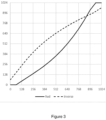
- Luma mapping consists of applying a luma forward mapping function Map fwd (.) to the prediction luma samples.
- the luma forward mapping function Map fwd (.) is based on a table, lumaMapTable, coded in the data stream, in which lumaMapTable indicates the slopes of the piece-wise linear luma mapping function Map fwd (.).
- CRS is described, for instance, in contribution JVET-O0098.
- CRS consists in using a luma-dependent scaling (in an encoder) or inverse scaling (in a decoder).
- the inverse scaling factors are derived from a table, chromaScaleTable, indexed by index values derived from luma values.
- the scaling factors at the encoder side are the inverse of the inverse scaling factors used at the decoder.
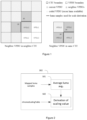
- a CRS factor for each 64x64 block (called Virtual Processing Decoding Unit - VPDU) is derived from luma sample values from previously reconstructed VPDU neighbors (see the illustration in Figure 1 ). If the Coding Tree Unit (CTU) partition is inter 128x128, inter 128x64 and inter 64x128, then the CRS factor derived for the Coding Unit (CU) associated with the first VPDU is used for all chroma Transform Blocks (TBs) in that CU. For each VPDU, the left and top neighboring reconstructed luma samples are used.
- CTU Coding Tree Unit
- TBs chroma Transform Blocks
- the index idx in the chroma scaling table is computed.
- the avgY is derived from luma values that are in the forward mapped domain. Therefore, the index idx is computed as the value such that avgY belongs to the interval [Map fwd (Y idx ), Map fwd (Y idx+1 - 1)].
- the picture boundary sample is padded until M.
- the picture boundary samples is padded until M.
- the leftmost column VPDU only M top neighboring samples are used for average value.
- the top row VPDU only M left neighboring samples are used for average value.
- avgY is directly set as 1 ⁇ (bitdepth-1).
- FIG. 6 illustrates an example of a VVC encoder (100).
- An uncompressed video signal is received and used as an input to a mapping function (101).
- the mapping function may be, e.g., as described above, to be further described, and/or as shown in Figure 3 .
- the mapped signal is then partitioned at 102.
- CRS corresponds to block 104.
- the scaling factor applied in 104 is based on reconstructed mapped luma samples.
- CRS applies to the chroma residual signal obtained in 103 from the substraction of the chroma prediction to the input chroma samples, possibly processed by an out-of-loop mapping (101).
- the result after the CRS processing in 104 is the scaled chroma residual signal.
- the scaled chroma residual signal is then processed by a transform (105) and quantization (106), and the resulting signal is coded in the entropy coding (120).
- This signal is also processed by inverse quantization (107) and inverse transform (108) to produce the decoded chroma residual.
- An inverse CRS is applied in 109 to the decoded chroma residual signal.
- the inverse scaling factor applied in 109 is based on reconstructed mapped luma samples.
- the inverse scaled decoded chroma residual signal is then added in an adder (110) to the prediction chroma signal resulting from either the intra prediction (114) or from the motion estimation (115) and motion compensation (116), depending on the mode selection (intra or inter prediction) made at 117.
- the resulting signal is processed by in-loop filters (112) and the resulting signal is stored in the reference picture buffer (113).
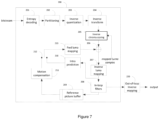
- FIG 7 illustrates an example of a VVC decoder (200).
- a received bitstream (e.g., from an encoder 100 in Figure 6 ) is first entropy decoded (201) and partitioned (202).
- the inverse CRS (205) is applied to the decoded chroma residual samples resulting from the inverse quantization (203) and inverse transform (204) of the decoded chroma coefficients.
- the inverse scaling factor applied in 205 is based on reconstructed mapped luma samples.
- the decoded chroma residual samples are then added in 206 to the prediction signal resulting either from the intra prediction (210) or from the motion compensation (211) depending on the coding mode selection (212).
- the resulting reconstructed chroma signal is then processed by the in-loop filtering (208) and the resulting signal is stored in the reference picture buffer (209).
- the signal from the in-loop filtering (208) may be additionally processed by an out-of-loop inverse mapping (220) to produce a decoded output.
- Process 302 is made of the following steps:
- Table 1 An example of lumaMapTable is given in Table 1 below.
- the table corresponds to the slope values of the forward mapping function Map fwd (.), defined from index 0 to 15.
- Map fwd For 10-bit signal, one index range corresponds to 64 luma values range (1024/16).
- the values are scaled by 64 (which means that 64 is equivalent to a slope value of 1), as shown in "normalized slope" row in Table 1.
- lumaMapTable and chromaScaleTable are made of normalized, floating-point values. It is straightforward to generalize the concepts discussed below for values represented in integer/fixed-point.
- the chroma QP value is derived from the luma QP value and from QP offset parameters, using chroma QP mapping tables.
- the chroma QP mapping tables are signalled in the bitstream at the SPS level, as illustrated in underlined portions of the syntax table, Table 3, below.
- Cb residual defined by a chroma index cldx equals to 1
- Cr residual defined by a chroma index cldx equals to 2
- joint Cb-Cr residual defined by a chroma index cldx equals to 3
- the joint Cb-Cr residual is used when the joint Cb-Cr coding mode is applied to the chroma block.
- both Cb residual and Cr residuals exist.
- the chroma QP QPC cldx is computed as follows (e.g., see section "Derivation process for quantization parameters" of JVET-O2001).
- Luma and chroma QPs are derived per area called quantization groups (QGs). This process applies to elements 106 and 107 of the encoder 100 of Figure 6 and elelment 203 of the decoder 200 of Figure 7 .
- the chroma QP, QPC cldx , derivation process 301 is illustrated in Figure 4 .
- the process 301 comprises the following:
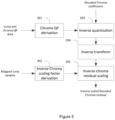
- Figure 5 depicts a simplified block diagram of the chroma residual inverse quantization and inverse scaling of a chroma component of index cldx.
- the chroma QP, QPC cldx is derived (301) from luma and chroma QP data obtained from the entropy decoding and from the decoding of previously decoded CUs.
- the decoded chroma coefficients are inverse quantized in 203 using the chroma QP, QPC cldx .
- the inverse quantized coefficients are then inverse transformed (204).
- Step 302 derives the inverse chroma scaling value from mapped luma samples neighboring the current VPDU (302).
- the inverse CRS applies to the chroma residual resulting from the inverse transform, in step 205, with the inverse scaling value as input.
- the output of this process is the inverse scaled decoded chroma residual.
- At least one of the present embodiments relates to the interaction between the chroma residual scaling and the chroma QP derivation.
- both tools are fully independent, but both have an impact on the chroma residual scaling.
- At least one of the present embodiments defines a process for taking into account the interaction between the chroma residual scaling and the chroma QP derivation.
- the chroma QP is currently derived from luma QP information, QP Y , deduced from the slice level, or luma coding blocks neighboring, or inside the luma area covering chroma block.
- the luma samples are processed by a forward luma mapping (118 in encoder 100 of Figure 6 , or 213 in decoder 200) derived from a luma mapping table, lumaMapTable.
- This process of mapping is in a way similar to a quantization of the luma samples.
- this additional quantization of luma samples is not taken into account in the process of deriving the chroma QP value. This may result in wrong luma/chroma bitrate balance or luma/chroma quality balance.
- JVET-J0067 another investigated solution consists in modifying the chroma residual scaling factor based on the value of the QP used for the collocated luma samples of the chroma samples. This solution creates a dependency on the luma QP of collocated luma samples, which can be problematic for implementation throughput.
- At least one of the present embodiments consists in adjusting the chroma residual scaling factor based on the chroma QP table and luma QP parameters.
- Present exemplary embodiments comprise:
- Advantages of the proposed embodiments include gaining a better luma-chroma quality balance.
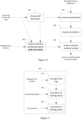
- step 301 "chroma QP derivation" is modified/replaced by a step 601 of "chroma QP derivation with correction", as shown in Figure 8 .
- Information from the inverse chroma scaling factor derivation (e.g., 302 of Figure 2 ) may be used in 601 of Figure 8 .
- the value of QP Y is corrected based on a value of the chroma residual scaling factor, or on a value depending on luma samples close to the relative location in the picture of the chroma samples, for instance, avgY.
- the expected effect of function f is to decrease the QP value when the Y values used to derive the CRS factor have been forward mapped using a forward mapping function slope larger than 1, or to increase the QP value when the Y values used to derive the CRS factor have been forward mapped using a forward mapping function slope lower than 1.
- fwpMappingSlope(Y) corresponds to the slope of the luma forward mapping function at value Y
- invMap fwd corresponds to the function approximating the inverse of the function Map fwd .
- fwpMappingSlope(Y) is equal to IumaMapTable[ i ].
- Log2(x) is the logarithmic function of base 2
- round(x) is the nearest integer to x.
- fwpMappingSlope( invMap fwd (avgY) ) is equivalent to ( 1 / chromaScaleTable[ idx( avgY) ] ), that is, ( 1 / invScale ).
- a luma representative value refValY of the luma samples collocated or close to the chroma block can be used instead. For instance,
- the value of qP cldx is corrected based on the value of the chroma residual scaling factor, or on the value of avgY.
- Figure 9 illustrates a modified process according to Example 1 or Example 2 above, with difference of one step, which is either step 701, or step 702. Only one of them should be used depending on the implementation choice.
- step 302 of inverse chroma residual scaling derivation (e.g., in Figure 2 and Figure 8 ) is modified/replaced by a step 602 of inverse chroma residual scaling derivation with correction, as shown in Figure 10 and Figure 11 .
- the value of invScale is corrected based on the value of a luma QP value, noted QP ref , that is not dependent on the luma QP used for the collocated luma samples of the chroma block.
- QP ref is the luma QP defined for the slice, SliceOp Y or for the tile or for the brick.
- QP ref is derived from the luma QP of last luma block of the previous quantization group.
- QP ref is derived from the luma QP values used for the luma samples used to derive the CRS inverse scaling value of the current VDPU.
- QPref is selected at the encoder and coded in the stream, at SPS, PPS, APS, slice header, tile header, brick header or CTU level. It is then used to derive the scaling and inverse scaling factors at the encoder and at the decoder.
- QPref can for example be set to the slice luma QP SliceQp Y of the I-slice arising at each intra period, with a pre-defined offset added:
- QPref SliceQp Y + QPoffset
- Typical values of QPoffset are from 0 to 5.
- qP cldx ChromaQpTable cIdx ⁇ 1 Qp Y (if we neglect the effect of clipping (step 402)).
- the luma signal used for deriving the chroma scaling value has been forward mapped, which is equivalent to a scaling.
- the luma scaling can be approximated as fwpMappingSlope( invMap fwd (avgY) ) (which is equivalent to IumaMapTable[ idx( avgY ) ] ).
- qP cldx ChromaQpTable Qp Y ⁇ dQp Y
- the scaling factor should have been proportional to: 2 ⁇ ( ChromaQpTable[ Qp Y - dQp Y ] / 6 ) / 2 ⁇ ( ChromaQpTable[ Qp Y ] / 6 ) ⁇ 2 ⁇ ( ( ChromaQpTable[ Qp Y - dQp Y ] - ChromaQpTable[ Qp Y ] ) / 6 )
- the inverse scaling factor should have been proportional to 2 ⁇ ChromaQpTable Qp Y ⁇ ChromaQpTable Qp Y ⁇ dQp Y / 6
- the rounding is required because dQp Y may be not an integer value.
- the factors are computed using linear interpolation, as follows:
- Qp 0 ChromaQpTable Qp Y ⁇ floor dQpY
- QP Y If it is considered that most of the time, QP Y is relatively close to QP ref , QP Y can be replaced by QP ref which does not relate to collocated luma samples of the chroma block. This approximation can apply to the variants of function g described above.
- dQp Y 6*Log2( IumaMapTable[ idx( avgY ) ]
- dQp Y - 6*Log2( chromaScaleTable[ idx( avgY ) ]
- FIG. 11 depicts the modified block diagram 602 of Figure 2 , according to the above disclosed embodiments, with the addition of step 801 in Figure 11 .
- a luma representative value refValY of the luma samples collocated or close to the chroma block may be used. For instance:
- one syntax element e.g. named reference_qp_table_for_chroma
- the syntax element can be for instance inserted in the SPS or in the slice header, and can take values 0 to 2.
- corrective parameters of the chroma scaling table chromaScaleTable are signalled in the bitstream. For instance, one to three corrective tables chromaScaleCorrectionTable[ cldx - 1 ] are signaled, of same size N as chromaScaleTable.
- a chroma scaling table table chromaScaleTable[ cldx - 1 ] is initialized in the same way as in VVC, based on the table lumaMapTable. For instance:
- a high-level flag (chroma_res_scaling_correction_flag) is added to indicate if the correction is activated or not.
- same_crs_table_for_chroma is not signalled but inferred to be of same value as same_qp_table_for_chroma.
- the correction values that are signalled in the stream are defined in the scaling domain, not in the inverse scaling domain. This advantageously enabling limiting the range of the coded values.
- An example of related syntax for coding the chroma residual coding correction table is provided below. New syntax compared to a version of VVC syntax is underlined in the structure Imcs_data() contained in the APS.
- a constraint is set on the corrective value to avoid computation overflow as follows.
- lmcsDeltaCrs[ i ] is added to the term lmcsCW[ i ], that corresponds in the VVC specification to the slope of the ith segment of the luma mapping function.
- OrgCW represents in the VVC specification the neutral value of scaling.
- Imcs_min_bin_idx, LmcsMaxBinldx represent the minimum and maximum indexes for which the LMCS syntax elements related to the LMCS tables are signalled.
- the process is modifed as follows (with the parameter offset denoted as ImcsDeltaCrs):
- ImcsDeltaCrs 1 ⁇ 2 * Imcs_delta_sign_crs_flag * Imcs_delta_abs_crs
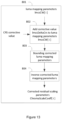
- FIG. 13 depicts another example of correction step 801 of chroma residual scaling parameters of Figure 11 , according to the above disclosed embodiments wherein a parameter offset denoted as ImcsDeltaCrs is used as corrective value of chroma residual scaling in the scaling domain.
- a parameter offset denoted as ImcsDeltaCrs is used as corrective value of chroma residual scaling in the scaling domain.
- a step 802 the corrective value ImcsDeltaCrs of the one or more chroma residual scaling parameters is added to the luma mapping parameters lmcsCW[ i ] representative of the slope of the ith segment of the luma forward mapping function a luma forward mapping function applied to a prediction of luma samples.
- Step 802 results in resulting in corrected luma mapping slope values (lmcsCW[ i ] + ImcsDeltaCrs).
- the offset parameter ImcsDeltaCrs is signalled in the stream, at any of SPS, PPS, APS, slice header, tile header, brick header or CTU level as other variant of corrective values (for instance QPref).
- Advantageously offset parameter ImcsDeltaCrs is signaled with LMCS parameters in the Adaptation Parameter Set APS.
- the corrected luma mapping slope values are bounded to avoid computation overflow. For instance, when lmcsCW[ i ] is not equal to 0, a corrected luma mapping slope value ( lmcsCW[ i ] + ImcsDeltaCrs) is in the range of (OrgCW>>3) to (OrgCW ⁇ 3 - 1), inclusive where OrgCW represents a neutral value of scaling.
- chroma residual scaling parameters ChromaScaleCoeff[ i ] are derived by inverting the corrected luma mapping slope values as follows:
- the CRS processing 104 is applied to the chroma residuals, resulting the scaled chroma residuals to further process in the encoding method.
- an inverse CRS processing is applied to the decoded chroma residuals, to obtain the inverse scaled decoded chroma residuals with optimal accuracy.
- the index idx in the chroma scaling parameters is computed from the value avgY.
- the avgY is derived from luma values that are in the forward mapped domain.
- the index idx is computed as the value such that avgY belongs to the interval [Map fwd (Y idx ), Map fwd (Y idx+1 - 1)].
- ChromaScaleCoeff[ i ] The initial generation of ChromaScaleCoeff[ i ] is unchanged compared to a version of VVC specification:
- varScale ChromaScaleCoeff idxYInv + ImcsDeltaCrs * K ⁇ idxYInv being the index in the table ChromaScaleCoeff for the chroma block, derived as specified by the VVC specification, in the section 8.7.5.3 "Picture reconstruction with luma dependent chroma residual scaling process for chroma samples".
- K is a pre-defined value enabling to limit the number of bits B (bitdepth) needed to signal the offset parameter ImcsDeltaCrs.
- ChromaScaleCoeff i OrgCW * 1 ⁇ 11 / ImcsCW i + ImcsDeltaCrs * K
- K is a power of 2.
- the signaling is slightly modified as follows: lmcs_delta_abs_crs u(B) if ( lmcs_delta_abs_crs ) > 0 ) lmcs_delta_sign_crs_flag u(1)
- the parameter ImcsDeltaCrs is a pre-defined value not signalled in the bitstream.
- modifiedCW can be clipped between (OrgCW>>3) to (OrgCW ⁇ 3 - 1), inclusive.
- the description above relates to the derivation of the chroma residual inverse scaling factor or scale.
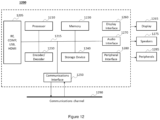
- FIG. 12 illustrates a block diagram of an example of a system 1200 in which various aspects and embodiments are implemented.
- System 1200 can be embodied as a device including the various components described below and is configured to perform one or more of the aspects described in this document. Examples of such devices, include, but are not limited to, various electronic devices such as personal computers, laptop computers, smartphones, tablet computers, digital multimedia set top boxes, digital television receivers, personal video recording systems, connected home appliances, and servers.
- Elements of system 1200, singly or in combination can be embodied in a single integrated circuit, multiple ICs, and/or discrete components.
- the processing and encoder/decoder elements of system 1200 are distributed across multiple ICs and/or discrete components.
- system 1200 is communicatively coupled to other similar systems, or to other electronic devices, via, for example, a communications bus or through dedicated input and/or output ports.
- system 1200 is configured to implement one or more of the aspects described in this document.
- the system 1200 includes at least one processor 1210 configured to execute instructions loaded therein for implementing, for example, the various aspects described in this document.
- Processor 1210 can include embedded memory, input output interface, and various other circuitries as known in the art.
- the system 1200 includes at least one memory 1220 (e.g., a volatile memory device, and/or a non-volatile memory device).
- System 1200 includes a storage device 1240, which can include non-volatile memory and/or volatile memory, including, but not limited to, EEPROM, ROM, PROM, RAM, DRAM, SRAM, flash, magnetic disk drive, and/or optical disk drive.
- the storage device 1240 can include an internal storage device, an attached storage device, and/or a network accessible storage device, as non-limiting examples.
- System 1200 includes an encoder/decoder module 1230 configured, for example, to process data to provide an encoded video or decoded video, and the encoder/decoder module 1230 can include its own processor and memory.
- the encoder/decoder module 1230 represents module(s) that can be included in a device to perform the encoding and/or decoding functions. As is known, a device can include one or both of the encoding and decoding modules. Additionally, encoder/decoder module 1230 can be implemented as a separate element of system 1200 or can be incorporated within processor 1210 as a combination of hardware and software as known to those skilled in the art.
- processor 1210 Program code to be loaded onto processor 1210 or encoder/decoder 1230 to perform the various aspects described in this document can be stored in storage device 1240 and subsequently loaded onto memory 1220 for execution by processor 1210.
- processor 1210, memory 1220, storage device 1240, and encoder/decoder module 1230 can store one or more of various items during the performance of the processes described in this document.
- Such stored items can include, but are not limited to, the input video, the decoded video or portions of the decoded video, the bitstream, matrices, variables, and intermediate or final results from the processing of equations, formulas, operations, and operational logic.
- memory inside of the processor 1210 and/or the encoder/decoder module 1230 is used to store instructions and to provide working memory for processing that is needed during encoding or decoding.
- a memory external to the processing device (for example, the processing device can be either the processor 1210 or the encoder/decoder module 1230) is used for one or more of these functions.
- the external memory can be the memory 1220 and/or the storage device 1240, for example, a dynamic volatile memory and/or a non-volatile flash memory.
- an external non-volatile flash memory is used to store the operating system of a television.
- a fast, external dynamic volatile memory such as a RAM is used as working memory for video coding and decoding operations, such as for MPEG-2, HEVC, or VVC (Versatile Video Coding).
- the input to the elements of system 1200 can be provided through various input devices as indicated in block 1205.
- Such input devices include, but are not limited to, (i) an RF portion that receives an RF signal transmitted, for example, over the air by a broadcaster, (ii) a Composite input terminal, (iii) a USB input terminal, and/or (iv) an HDMI input terminal.
- the input devices of block 1205 have associated respective input processing elements as known in the art.
- the RF portion can be associated with elements necessary for (i) selecting a desired frequency (also referred to as selecting a signal, or band-limiting a signal to a band of frequencies), (ii) downconverting the selected signal, (iii) band-limiting again to a narrower band of frequencies to select (for example) a signal frequency band which can be referred to as a channel in certain embodiments, (iv) demodulating the downconverted and bandlimited signal, (v) performing error correction, and (vi) demultiplexing to select the desired stream of data packets.
- the RF portion of various embodiments includes one or more elements to perform these functions, for example, frequency selectors, signal selectors, band-limiters, channel selectors, filters, downconverters, demodulators, error correctors, and demultiplexers.
- the RF portion can include a tuner that performs various of these functions, including, for example, downconverting the received signal to a lower frequency (for example, an intermediate frequency or a near-baseband frequency) or to baseband.
- the RF portion and its associated input processing element receives an RF signal transmitted over a wired (for example, cable) medium, and performs frequency selection by filtering, downconverting, and filtering again to a desired frequency band.
- Adding elements can include inserting elements in between existing elements, for example, inserting amplifiers and an analog-to-digital converter.
- the RF portion includes an antenna.
- USB and/or HDMI terminals can include respective interface processors for connecting system 1200 to other electronic devices across USB and/or HDMI connections.
- various aspects of input processing for example, Reed-Solomon error correction, can be implemented, for example, within a separate input processing IC or within processor 1210 as necessary.
- aspects of USB or HDMI interface processing can be implemented within separate interface ICs or within processor 1210 as necessary.
- the demodulated, error corrected, and demultiplexed stream is provided to various processing elements, including, for example, processor 1210, and encoder/decoder 1230 operating in combination with the memory and storage elements to process the datastream as necessary for presentation on an output device.
- connection arrangement 1140 for example, an internal bus as known in the art, including the I2C bus, wiring, and printed circuit boards.
- the system 1200 includes communication interface 1250 that enables communication with other devices via communication channel 1260.
- the communication interface 1250 can include, but is not limited to, a transceiver configured to transmit and to receive data over communication channel 1260.
- the communication interface 1250 can include, but is not limited to, a modem or network card and the communication channel 1260 can be implemented, for example, within a wired and/or a wireless medium.
- Data is streamed to the system 1200, in various embodiments, using a Wi-Fi network such as IEEE 802.11.
- the Wi-Fi signal of these embodiments is received over the communications channel 1260 and the communications interface 1250 which are adapted for Wi-Fi communications.
- the communications channel 1260 of these embodiments is typically connected to an access point or router that provides access to outside networks including the Internet for allowing streaming applications and other over-the-top communications.
- Other embodiments provide streamed data to the system 1200 using a set-top box that delivers the data over the HDMI connection of the input block 1205.
- Still other embodiments provide streamed data to the system 1200 using the RF connection of the input block 1205.
- the system 1200 can provide an output signal to various output devices, including a display 1265, speakers 1275, and other peripheral devices 1285.
- the other peripheral devices 1285 include, in various examples of embodiments, one or more of a stand-alone DVR, a disk player, a stereo system, a lighting system, and other devices that provide a function based on the output of the system 1200.
- control signals are communicated between the system 1200 and the display 1265, speakers 1275, or other peripheral devices 1285 using signaling such as AV.Link, CEC, or other communications protocols that enable device-to-device control with or without user intervention.
- the output devices can be communicatively coupled to system 1200 via dedicated connections through respective interfaces 1260, 1270, and 1280.
- the output devices can be connected to system 1200 using the communications channel 1290 via the communications interface 1250.
- the display 1265 and speakers 1275 can be integrated in a single unit with the other components of system 1200 in an electronic device, for example, a television.
- the display interface 1260 includes a display driver, for example, a timing controller (T Con) chip.
- the display 1265 and speaker 1275 can alternatively be separate from one or more of the other components, for example, if the RF portion of input 1205 is part of a separate set-top box.
- the output signal can be provided via dedicated output connections, including, for example, HDMI ports, USB ports, or COMP outputs.
- the embodiments can be carried out by computer software implemented by the processor 1210 or by hardware, or by a combination of hardware and software. As a non-limiting example, the embodiments can be implemented by one or more integrated circuits.
- the memory 1220 can be of any type appropriate to the technical environment and can be implemented using any appropriate data storage technology, such as optical memory devices, magnetic memory devices, semiconductor-based memory devices, fixed memory, and removable memory, as non-limiting examples.
- the processor 1210 can be of any type appropriate to the technical environment, and can encompass one or more of microprocessors, general purpose computers, special purpose computers, and processors based on a multi-core architecture, as non-limiting examples.
- Decoding can encompass all or part of the processes performed, for example, on a received encoded sequence in order to produce a final output suitable for display.
- processes include one or more of the processes typically performed by a decoder, for example, entropy decoding, inverse quantization, inverse transformation, and differential decoding.
- processes also, or alternatively, include processes performed by a decoder of various implementations described in this application.
- decoding refers only to entropy decoding
- decoding refers only to differential decoding
- decoding refers to a combination of entropy decoding and differential decoding.
- encoding can encompass all or part of the processes performed, for example, on an input video sequence in order to produce an encoded bitstream.
- processes include one or more of the processes typically performed by an encoder, for example, partitioning, differential encoding, transformation, quantization, and entropy encoding.
- processes also, or alternatively, include processes performed by an encoder of various implementations described in this application.
- encoding refers only to entropy encoding
- encoding refers only to differential encoding
- encoding refers to a combination of differential encoding and entropy encoding.
- syntax elements as used herein are descriptive terms. As such, they do not preclude the use of other syntax element names.
- Various embodiments refer to rate distortion optimization.
- the rate distortion optimization is usually formulated as minimizing a rate distortion function, which is a weighted sum of the rate and of the distortion.
- the approaches may be based on an extensive testing of all encoding options, including all considered modes or coding parameters values, with a complete evaluation of their coding cost and related distortion of the reconstructed signal after coding and decoding.
- Faster approaches may also be used, to save encoding complexity, in particular with computation of an approximated distortion based on the prediction or the prediction residual signal, not the reconstructed one.
- the implementations and aspects described herein can be implemented in, for example, a method or a process, an apparatus, a software program, a data stream, or a signal. Even if only discussed in the context of a single form of implementation (for example, discussed only as a method), the implementation of features discussed can also be implemented in other forms (for example, an apparatus or program).
- An apparatus can be implemented in, for example, appropriate hardware, software, and firmware.
- the methods can be implemented in, for example, a processor, which refers to processing devices in general, including, for example, a computer, a microprocessor, an integrated circuit, or a programmable logic device. Processors also include communication devices, such as, for example, computers, cell phones, portable/personal digital assistants ("PDAs”), and other devices that facilitate communication of information between end-users.
- PDAs portable/personal digital assistants
- references to "one embodiment” or “an embodiment” or “one implementation” or “an implementation”, as well as other variations thereof, means that a particular feature, structure, characteristic, and so forth described in connection with the embodiment is included in at least one embodiment.
- the appearances of the phrase “in one embodiment” or “in an embodiment” or “in one implementation” or “in an implementation”, as well any other variations, appearing in various places throughout this document are not necessarily all referring to the same embodiment.
- Determining the information can include one or more of, for example, estimating the information, calculating the information, predicting the information, or retrieving the information from memory.
- Accessing the information can include one or more of, for example, receiving the information, retrieving the information (for example, from memory), storing the information, moving the information, copying the information, calculating the information, determining the information, predicting the information, or estimating the information.
- Receiving is, as with “accessing”, intended to be a broad term.
- Receiving the information can include one or more of, for example, accessing the information, or retrieving the information (for example, from memory).
- “receiving” is typically involved, in one way or another, during operations such as, for example, storing the information, processing the information, transmitting the information, moving the information, copying the information, erasing the information, calculating the information, determining the information, predicting the information, or estimating the information.
- such phrasing is intended to encompass the selection of the first listed option (A) only, or the selection of the second listed option (B) only, or the selection of the third listed option (C) only, or the selection of the first and the second listed options (A and B) only, or the selection of the first and third listed options (A and C) only, or the selection of the second and third listed options (B and C) only, or the selection of all three options (A and B and C).
- This may be extended, as is clear to one of ordinary skill in this and related arts, for as many items as are listed.
- the word "signal" refers to, among other things, indicating something to a corresponding decoder.
- the encoder signals a particular one of a plurality of parameters.
- the same parameter is used at both the encoder side and the decoder side.
- an encoder can transmit (explicit signaling) a particular parameter to the decoder so that the decoder can use the same particular parameter.
- signaling can be used without transmitting (implicit signaling) to simply allow the decoder to know and select the particular parameter. By avoiding transmission of any actual functions, a bit savings is realized in various embodiments.
- signaling can be accomplished in a variety of ways. For example, one or more syntax elements, flags, and so forth are used to signal information to a corresponding decoder in various embodiments. While the preceding relates to the verb form of the word "signal”, the word “signal” can also be used herein as a noun.
- implementations can produce a variety of signals formatted to carry information that can be, for example, stored or transmitted.
- the information can include, for example, instructions for performing a method, or data produced by one of the described implementations.
- a signal can be formatted to carry the bitstream of a described embodiment.
- Such a signal can be formatted, for example, as an electromagnetic wave (for example, using a radio frequency portion of spectrum) or as a baseband signal.
- the formatting can include, for example, encoding a data stream and modulating a carrier with the encoded data stream.
- the information that the signal carries can be, for example, analog or digital information.
- the signal can be transmitted over a variety of different wired or wireless links, as is known.
- the signal can be stored on a processor-readable medium.
Landscapes
- Engineering & Computer Science (AREA)
- Multimedia (AREA)
- Signal Processing (AREA)
- Compression Or Coding Systems Of Tv Signals (AREA)
- Color Television Systems (AREA)
Claims (13)
- Verfahren zur Videocodierung, das umfasst:Bestimmen eines oder mehrerer Chroma-Restskalierungsparameter auf der Grundlage eines oder mehrerer Luma-Abbildungsparameter und auf der Grundlage eines Korrekturwerts des einen oder der mehreren Chroma-Restskalierungsparameter, wobei der eine oder die mehreren Luma-Abbildungsparameter einen Anstieg einer Luma-Vorwärtsabbildungsfunktion, angewendet auf eine Vorhersage von Luma-Abtastwerten, repräsentieren, undCodieren des Videos auf der Grundlage der bestimmten einen oder mehreren Chroma-Restskalierungsparameter,dadurch gekennzeichnet, dassder Korrekturwert des einen oder der mehreren Chroma-Restskalierungsparameter ein Wert ist, der zu dem einen oder den mehreren Luma-Abbildungsparametern zu addieren ist, was zu korrigierten Luma-Abbildungsanstiegswerten führt.
- Verfahren zur Videodecodierung, das umfasst:Bestimmen eines oder mehrerer Chroma-Restskalierungsparameter auf der Grundlage eines oder mehrerer Luma-Abbildungsparameter und auf der Grundlage eines Korrekturwerts des einen oder der mehreren Chroma-Restskalierungsparameter, wobei der eine oder die mehreren Luma-Abbildungsparameter einen Anstieg einer Luma-Vorwärtsabbildungsfunktion, angewendet auf eine Vorhersage von Luma-Abtastwerten, repräsentieren, undDecodieren des Videos auf der Grundlage der bestimmten einen oder mehreren Chroma-Restskalierungsparameter,dadurch gekennzeichnet, dassder Korrekturwert des einen oder der mehreren Chroma-Restskalierungsparameter ein Wert ist, der zu dem einen oder den mehreren Luma-Abbildungsparametern zu addieren ist, was zu korrigierten Luma-Abbildungsanstiegswerten führt.
- Vorrichtung für die Videocodierung, wobei die Vorrichtung einen oder mehrere Prozessoren umfasst, wobei der eine oder die mehreren Prozessoren konfiguriert sind zum:Bestimmen eines oder mehrerer Chroma-Restskalierungsparameter auf der Grundlage eines oder mehrerer Luma-Abbildungsparameter und auf der Grundlage eines Korrekturwerts des einen oder der mehreren Chroma-Restskalierungsparameter, wobei der eine oder die mehreren Luma-Abbildungsparameter einen Anstieg einer Luma-Vorwärtsabbildungsfunktion, angewendet auf eine Vorhersage von Luma, repräsentieren, undCodieren des Videos auf der Grundlage der bestimmten einen oder mehreren Chroma-Restskalierungsparameter,dadurch gekennzeichnet, dassder Korrekturwert des einen oder der mehreren Chroma-Restskalierungsparameter ein Wert ist, der zu dem einen oder den mehreren Luma-Abbildungsparametern zu addieren ist, was zu korrigierten Luma-Abbildungsanstiegswerten führt.
- Vorrichtung für die Videodecodierung, wobei die Vorrichtung einen oder mehrere Prozessoren umfasst, wobei der eine oder die mehreren Prozessoren konfiguriert sind zum:Bestimmen eines oder mehrerer Chroma-Restskalierungsparameter auf der Grundlage eines oder mehrerer Luma-Abbildungsparameter und auf der Grundlage eines Korrekturwerts des einen oder der mehreren Chroma-Restskalierungsparameter, wobei der eine oder die mehreren Luma-Abbildungsparameter einen Anstieg einer Luma-Vorwärtsabbildungsfunktion, angewendet auf eine Vorhersage von Luma-Abtastwerten, repräsentieren, undDecodieren des Videos auf der Grundlage der bestimmten einen oder mehreren Chroma-Restskalierungsparameter,dadurch gekennzeichnet, dassder Korrekturwert des einen oder der mehreren Chroma-Restskalierungsparameter ein Wert ist, der zu dem einen oder den mehreren Luma-Abbildungsparametern zu addieren ist, was zu korrigierten Luma-Abbildungsanstiegswerten führt.
- Verfahren nach Anspruch 1 oder Vorrichtung nach Anspruch 3, wobei der Korrekturwert des einen oder der mehreren Chroma-Restskalierungsparameter auf der Grundlage eines Luma-Quantisierungsparameterwerts bestimmt wird.
- Verfahren oder Vorrichtung nach Anspruch 5, wobei der Korrekturwert des einen oder der mehreren Chroma-Restskalierungsparameter auf einem Mittelwert ausgewählter Luma-Abtastwerte beruht.
- Verfahren nach einem der Ansprüche 1, 2, 5-6 oder Vorrichtung nach einem der Ansprüche 3, 4, 5-6, wobei der Korrekturwert des einen oder der mehreren Chroma-Restskalierungsparameter als adaptiver Parameter in APS signalisiert wird.
- Verfahren nach einem der Ansprüche 1, 2, 5-7 oder Vorrichtung nach einem der Ansprüche 3, 4, 5-7, wobei die Chroma-Restskalierungsparameter durch Invertieren korrigierter Luma-Abbildungsanstiegswerte, die sich aus dem Addieren des Korrekturwerts des einen oder der mehreren Chroma-Restskalierungsparameter zu dem einen oder den mehreren Luma-Abbildungsparametern ergeben, abgeleitet werden.
- Verfahren nach Anspruch 8 oder Vorrichtung nach Anspruch 8, wobei der Korrekturwert des einen oder der mehreren Chroma-Restskalierungsparameter in einem Bereich [-7, 7] liegt.
- Verfahren nach Anspruch 9 oder Vorrichtung nach Anspruch 9, wobei die korrigierten Luma-Abbildungsanstiegswerte beschränkt sind.
- Verfahren nach Anspruch 10 oder Vorrichtung nach Anspruch 10, wobei die korrigierten Luma-Abbildungsanstiegswerte in einem Bereich OrgCW»3 bis OrgCW«3 - 1 einschließlich liegen, wobei OrgCW einen Neutralwert der Skalierung repräsentiert.
- Bitstrom, wobei der Bitstrom gebildet ist durch:Bestimmen eines oder mehrerer Chroma-Restskalierungsparameter auf der Grundlage eines oder mehrerer Luma-Abbildungsparameter und auf der Grundlage eines Korrekturwerts des einen oder der mehreren Chroma-Restskalierungsparameter, wobei der eine oder die mehreren Luma-Abbildungsparameter einen Anstieg einer Luma-Vorwärtsabbildungsfunktion, angewendet auf eine Vorhersage von Luma-Abtastwerten, repräsentieren und wobei der Korrekturwert des einen oder der mehreren Chroma-Restskalierungsparameter ein Wert ist, der zu dem einen oder den mehreren Luma-Abbildungsparametern zu addieren ist; undCodieren eines Videos auf der Grundlage der bestimmten einen oder mehreren Chroma-Restskalierungsparameter; undwobei das Bilden des Bitstroms das codierte Video umfasst, wobei der Bitstrom ferner den Korrekturwert des einen oder der mehreren Chroma-Restskalierungsparameter umfasst.
- Computerprogrammprodukt, das Anweisungen zum Ausführen des Verfahrens nach einem der Ansprüche 1, 2 und 5-11, wenn sie durch einen oder mehrere Prozessoren ausgeführt werden, umfasst.
Priority Applications (1)
| Application Number | Priority Date | Filing Date | Title |
|---|---|---|---|
| EP25170314.6A EP4561075A3 (de) | 2019-09-17 | 2020-09-16 | Chroma-restskalierung zur bestimmung eines korrekturwertes zur hinzufügung zu luma-kartierungssteigungswerten |
Applications Claiming Priority (6)
| Application Number | Priority Date | Filing Date | Title |
|---|---|---|---|
| EP19306117 | 2019-09-17 | ||
| EP19306170 | 2019-09-23 | ||
| EP19306288 | 2019-10-04 | ||
| EP19306325 | 2019-10-10 | ||
| EP19306324 | 2019-10-10 | ||
| PCT/EP2020/075841 WO2021053002A1 (en) | 2019-09-17 | 2020-09-16 | Chroma residual scaling foreseeing a corrective value to be added to luma mapping slope values |
Related Child Applications (2)
| Application Number | Title | Priority Date | Filing Date |
|---|---|---|---|
| EP25170314.6A Division-Into EP4561075A3 (de) | 2019-09-17 | 2020-09-16 | Chroma-restskalierung zur bestimmung eines korrekturwertes zur hinzufügung zu luma-kartierungssteigungswerten |
| EP25170314.6A Division EP4561075A3 (de) | 2019-09-17 | 2020-09-16 | Chroma-restskalierung zur bestimmung eines korrekturwertes zur hinzufügung zu luma-kartierungssteigungswerten |
Publications (2)
| Publication Number | Publication Date |
|---|---|
| EP4032276A1 EP4032276A1 (de) | 2022-07-27 |
| EP4032276B1 true EP4032276B1 (de) | 2025-05-21 |
Family
ID=72432939
Family Applications (2)
| Application Number | Title | Priority Date | Filing Date |
|---|---|---|---|
| EP25170314.6A Pending EP4561075A3 (de) | 2019-09-17 | 2020-09-16 | Chroma-restskalierung zur bestimmung eines korrekturwertes zur hinzufügung zu luma-kartierungssteigungswerten |
| EP20768635.3A Active EP4032276B1 (de) | 2019-09-17 | 2020-09-16 | Chroma-restskalierung mit vorhersage eines korrekturwerts, der zu luma-mapping-steigungswerten hinzugefügt wird |
Family Applications Before (1)
| Application Number | Title | Priority Date | Filing Date |
|---|---|---|---|
| EP25170314.6A Pending EP4561075A3 (de) | 2019-09-17 | 2020-09-16 | Chroma-restskalierung zur bestimmung eines korrekturwertes zur hinzufügung zu luma-kartierungssteigungswerten |
Country Status (7)
| Country | Link |
|---|---|
| US (2) | US12238304B2 (de) |
| EP (2) | EP4561075A3 (de) |
| KR (1) | KR20220058958A (de) |
| CN (2) | CN114731423A (de) |
| BR (1) | BR112022004635A2 (de) |
| CA (1) | CA3152413A1 (de) |
| WO (1) | WO2021053002A1 (de) |
Families Citing this family (6)
| Publication number | Priority date | Publication date | Assignee | Title |
|---|---|---|---|---|
| US11425424B2 (en) * | 2019-05-17 | 2022-08-23 | Panasonic Intellectual Property Corporation Of America | System and method for video coding |
| KR20250057134A (ko) * | 2019-09-23 | 2025-04-28 | 후아웨이 테크놀러지 컴퍼니 리미티드 | 색차 양자화 파라미터 시그널링을 위한 방법 및 장치 |
| EP4104439A4 (de) | 2020-03-11 | 2023-08-16 | Beijing Bytedance Network Technology Co., Ltd. | Hochstufige bitstromsyntax für quantisierungsparameter |
| KR20230016655A (ko) | 2020-05-31 | 2023-02-02 | 베이징 바이트댄스 네트워크 테크놀로지 컴퍼니, 리미티드 | 로컬 이중 트리 모드 유형 정의가 있는 팔레트 모드 |
| CN122372741A (zh) | 2022-12-16 | 2026-07-10 | 杭州海康威视数字技术股份有限公司 | 一种解码、编码方法、装置及其设备 |
| US12368892B2 (en) * | 2023-10-04 | 2025-07-22 | Tencent America LLC | Flexible transform scheme for residual blocks |
Family Cites Families (7)
| Publication number | Priority date | Publication date | Assignee | Title |
|---|---|---|---|---|
| JP2011130437A (ja) * | 2009-12-21 | 2011-06-30 | Toshiba Corp | 画像処理装置及び画像処理方法 |
| US9648330B2 (en) * | 2013-07-15 | 2017-05-09 | Qualcomm Incorporated | Inter-color component residual prediction |
| US10397607B2 (en) * | 2013-11-01 | 2019-08-27 | Qualcomm Incorporated | Color residual prediction for video coding |
| JP6383116B2 (ja) * | 2015-04-06 | 2018-08-29 | ドルビー ラボラトリーズ ライセンシング コーポレイション | ハイダイナミックレンジ映像符号化における、ループ内ブロックベース画像再構成 |
| ES2984654T3 (es) * | 2016-05-19 | 2024-10-30 | Dolby Laboratories Licensing Corp | Remodelación de croma para imágenes de alto rango dinámico |
| WO2020246790A1 (ko) * | 2019-06-03 | 2020-12-10 | 엘지전자 주식회사 | 맵핑된 루마 성분 및 스케일링된 크로마 성분 기반 비디오 또는 영상 코딩 |
| US11122270B2 (en) * | 2019-06-05 | 2021-09-14 | Dolby Laboratories Licensing Corporation | In-loop reshaping with local illumination compensation in image coding |
-
2020
- 2020-09-16 EP EP25170314.6A patent/EP4561075A3/de active Pending
- 2020-09-16 EP EP20768635.3A patent/EP4032276B1/de active Active
- 2020-09-16 CN CN202080065361.8A patent/CN114731423A/zh active Pending
- 2020-09-16 CN CN202310409707.7A patent/CN116489376A/zh active Pending
- 2020-09-16 CA CA3152413A patent/CA3152413A1/en active Pending
- 2020-09-16 KR KR1020227012376A patent/KR20220058958A/ko active Pending
- 2020-09-16 WO PCT/EP2020/075841 patent/WO2021053002A1/en not_active Ceased
- 2020-09-16 BR BR112022004635A patent/BR112022004635A2/pt unknown
- 2020-09-16 US US17/760,702 patent/US12238304B2/en active Active
-
2025
- 2025-01-15 US US19/021,873 patent/US20250159209A1/en active Pending
Also Published As
| Publication number | Publication date |
|---|---|
| EP4032276A1 (de) | 2022-07-27 |
| US12238304B2 (en) | 2025-02-25 |
| CA3152413A1 (en) | 2021-03-25 |
| BR112022004635A2 (pt) | 2022-05-31 |
| CN116489376A (zh) | 2023-07-25 |
| US20250159209A1 (en) | 2025-05-15 |
| WO2021053002A1 (en) | 2021-03-25 |
| CN114731423A (zh) | 2022-07-08 |
| US20220329829A1 (en) | 2022-10-13 |
| EP4561075A2 (de) | 2025-05-28 |
| KR20220058958A (ko) | 2022-05-10 |
| EP4561075A3 (de) | 2025-08-06 |
Similar Documents
| Publication | Publication Date | Title |
|---|---|---|
| US20250159209A1 (en) | Chroma residual scaling foreseeing a corrective value to be added to luma mapping slope values | |
| US20220078405A1 (en) | Simplifications of coding modes based on neighboring samples dependent parametric models | |
| EP3906691B1 (de) | Umkehrabbildungsvereinfachung | |
| US12081744B2 (en) | In-loop reshaping adaptive reshaper direction | |
| US20250260818A1 (en) | High-level constraint flag for local chroma quantization parameter control | |
| US20230188734A1 (en) | Refinement mode processing in video encoding and decoding | |
| EP4690786A1 (de) | Codierungs- und decodierungsverfahren mit durch quantisierung eingeschränkter korrektur und entsprechende vorrichtungen | |
| WO2020068531A1 (en) | Method and apparatus for determining chroma quantization parameters when using separate coding trees for luma and chroma | |
| CN117897955A (zh) | 用于视频编码和解码的方法和装置 | |
| EP3808088B1 (de) | Beleuchtungskompensation bei der videocodierung | |
| WO2020117781A1 (en) | Method and apparatus for video encoding and decoding with adjusting the quantization parameter to block size | |
| US20250030871A1 (en) | Luma to chroma quantization parameter table signaling | |
| US20230232045A1 (en) | Scaling process for joint chroma coded blocks | |
| EP3641312A1 (de) | Verfahren und vorrichtung zur bestimmung von chromaquantisierungsparametern bei getrennten codierungsbäumen für luma und chroma | |
| EP4118823A1 (de) | Verfahren und vorrichtung zur videocodierung oder -decodierung | |
| EP4038876B1 (de) | Ableitung von quantisierungsmatrizen für gemeinsame cb-cr-codierung | |
| US12047612B2 (en) | Luma mapping with chroma scaling (LMCS) lut extension and clipping | |
| EP3618443A1 (de) | Beleuchtungskompensation bei der videocodierung | |
| WO2025067866A1 (en) | Implicit lmcs codewords | |
| WO2025061505A1 (en) | Coding mode dependent adaptive filtering | |
| WO2025082854A1 (en) | Quantization-constrained correction from filtered and non-filtered reconstructed pictures | |
| EP3700217A1 (de) | Umkehrabbildungsvereinfachung | |
| EP3709655A1 (de) | Adaptive umformerrichtung zur in-loop-umformung | |
| CN121420544A (zh) | 环路滤波器训练改进 | |
| EP3627837A1 (de) | Verfeinerungsmodusverarbeitung bei der videocodierung und -decodierung |
Legal Events
| Date | Code | Title | Description |
|---|---|---|---|
| STAA | Information on the status of an ep patent application or granted ep patent |
Free format text: STATUS: UNKNOWN |
|
| STAA | Information on the status of an ep patent application or granted ep patent |
Free format text: STATUS: THE INTERNATIONAL PUBLICATION HAS BEEN MADE |
|
| PUAI | Public reference made under article 153(3) epc to a published international application that has entered the european phase |
Free format text: ORIGINAL CODE: 0009012 |
|
| STAA | Information on the status of an ep patent application or granted ep patent |
Free format text: STATUS: REQUEST FOR EXAMINATION WAS MADE |
|
| 17P | Request for examination filed |
Effective date: 20220315 |
|
| AK | Designated contracting states |
Kind code of ref document: A1 Designated state(s): AL AT BE BG CH CY CZ DE DK EE ES FI FR GB GR HR HU IE IS IT LI LT LU LV MC MK MT NL NO PL PT RO RS SE SI SK SM TR |
|
| DAV | Request for validation of the european patent (deleted) | ||
| DAX | Request for extension of the european patent (deleted) | ||
| RAP1 | Party data changed (applicant data changed or rights of an application transferred) |
Owner name: INTERDIGITAL CE PATENT HOLDINGS, SAS |
|
| RAP1 | Party data changed (applicant data changed or rights of an application transferred) |
Owner name: INTERDIGITAL MADISON PATENT HOLDINGS, SAS |
|
| GRAP | Despatch of communication of intention to grant a patent |
Free format text: ORIGINAL CODE: EPIDOSNIGR1 |
|
| STAA | Information on the status of an ep patent application or granted ep patent |
Free format text: STATUS: GRANT OF PATENT IS INTENDED |
|
| INTG | Intention to grant announced |
Effective date: 20241216 |
|
| P01 | Opt-out of the competence of the unified patent court (upc) registered |
Free format text: CASE NUMBER: APP_5052/2025 Effective date: 20250130 |
|
| GRAS | Grant fee paid |
Free format text: ORIGINAL CODE: EPIDOSNIGR3 |
|
| GRAA | (expected) grant |
Free format text: ORIGINAL CODE: 0009210 |
|
| STAA | Information on the status of an ep patent application or granted ep patent |
Free format text: STATUS: THE PATENT HAS BEEN GRANTED |
|
| AK | Designated contracting states |
Kind code of ref document: B1 Designated state(s): AL AT BE BG CH CY CZ DE DK EE ES FI FR GB GR HR HU IE IS IT LI LT LU LV MC MK MT NL NO PL PT RO RS SE SI SK SM TR |
|
| REG | Reference to a national code |
Ref country code: GB Ref legal event code: FG4D |
|
| REG | Reference to a national code |
Ref country code: CH Ref legal event code: EP |
|
| REG | Reference to a national code |
Ref country code: DE Ref legal event code: R096 Ref document number: 602020051667 Country of ref document: DE |
|
| REG | Reference to a national code |
Ref country code: IE Ref legal event code: FG4D |
|
| REG | Reference to a national code |
Ref country code: NL Ref legal event code: FP |
|
| PG25 | Lapsed in a contracting state [announced via postgrant information from national office to epo] |
Ref country code: ES Free format text: LAPSE BECAUSE OF FAILURE TO SUBMIT A TRANSLATION OF THE DESCRIPTION OR TO PAY THE FEE WITHIN THE PRESCRIBED TIME-LIMIT Effective date: 20250521 Ref country code: FI Free format text: LAPSE BECAUSE OF FAILURE TO SUBMIT A TRANSLATION OF THE DESCRIPTION OR TO PAY THE FEE WITHIN THE PRESCRIBED TIME-LIMIT Effective date: 20250521 Ref country code: PT Free format text: LAPSE BECAUSE OF FAILURE TO SUBMIT A TRANSLATION OF THE DESCRIPTION OR TO PAY THE FEE WITHIN THE PRESCRIBED TIME-LIMIT Effective date: 20250922 |
|
| PGFP | Annual fee paid to national office [announced via postgrant information from national office to epo] |
Ref country code: DE Payment date: 20250926 Year of fee payment: 6 |
|
| REG | Reference to a national code |
Ref country code: LT Ref legal event code: MG9D |
|
| PG25 | Lapsed in a contracting state [announced via postgrant information from national office to epo] |
Ref country code: NO Free format text: LAPSE BECAUSE OF FAILURE TO SUBMIT A TRANSLATION OF THE DESCRIPTION OR TO PAY THE FEE WITHIN THE PRESCRIBED TIME-LIMIT Effective date: 20250821 Ref country code: GR Free format text: LAPSE BECAUSE OF FAILURE TO SUBMIT A TRANSLATION OF THE DESCRIPTION OR TO PAY THE FEE WITHIN THE PRESCRIBED TIME-LIMIT Effective date: 20250822 |
|
| PG25 | Lapsed in a contracting state [announced via postgrant information from national office to epo] |
Ref country code: PL Free format text: LAPSE BECAUSE OF FAILURE TO SUBMIT A TRANSLATION OF THE DESCRIPTION OR TO PAY THE FEE WITHIN THE PRESCRIBED TIME-LIMIT Effective date: 20250521 |
|
| PGFP | Annual fee paid to national office [announced via postgrant information from national office to epo] |
Ref country code: NL Payment date: 20250925 Year of fee payment: 6 |
|
| PG25 | Lapsed in a contracting state [announced via postgrant information from national office to epo] |
Ref country code: BG Free format text: LAPSE BECAUSE OF FAILURE TO SUBMIT A TRANSLATION OF THE DESCRIPTION OR TO PAY THE FEE WITHIN THE PRESCRIBED TIME-LIMIT Effective date: 20250521 |
|
| PGFP | Annual fee paid to national office [announced via postgrant information from national office to epo] |
Ref country code: GB Payment date: 20250923 Year of fee payment: 6 |
|
| PG25 | Lapsed in a contracting state [announced via postgrant information from national office to epo] |
Ref country code: HR Free format text: LAPSE BECAUSE OF FAILURE TO SUBMIT A TRANSLATION OF THE DESCRIPTION OR TO PAY THE FEE WITHIN THE PRESCRIBED TIME-LIMIT Effective date: 20250521 |
|
| PGFP | Annual fee paid to national office [announced via postgrant information from national office to epo] |
Ref country code: FR Payment date: 20250925 Year of fee payment: 6 |
|
| PG25 | Lapsed in a contracting state [announced via postgrant information from national office to epo] |
Ref country code: RS Free format text: LAPSE BECAUSE OF FAILURE TO SUBMIT A TRANSLATION OF THE DESCRIPTION OR TO PAY THE FEE WITHIN THE PRESCRIBED TIME-LIMIT Effective date: 20250821 |
|
| PG25 | Lapsed in a contracting state [announced via postgrant information from national office to epo] |
Ref country code: IS Free format text: LAPSE BECAUSE OF FAILURE TO SUBMIT A TRANSLATION OF THE DESCRIPTION OR TO PAY THE FEE WITHIN THE PRESCRIBED TIME-LIMIT Effective date: 20250921 |
|
| PG25 | Lapsed in a contracting state [announced via postgrant information from national office to epo] |
Ref country code: LV Free format text: LAPSE BECAUSE OF FAILURE TO SUBMIT A TRANSLATION OF THE DESCRIPTION OR TO PAY THE FEE WITHIN THE PRESCRIBED TIME-LIMIT Effective date: 20250521 |
|
| REG | Reference to a national code |
Ref country code: AT Ref legal event code: MK05 Ref document number: 1797858 Country of ref document: AT Kind code of ref document: T Effective date: 20250521 |
|
| PG25 | Lapsed in a contracting state [announced via postgrant information from national office to epo] |
Ref country code: AT Free format text: LAPSE BECAUSE OF FAILURE TO SUBMIT A TRANSLATION OF THE DESCRIPTION OR TO PAY THE FEE WITHIN THE PRESCRIBED TIME-LIMIT Effective date: 20250521 Ref country code: DK Free format text: LAPSE BECAUSE OF FAILURE TO SUBMIT A TRANSLATION OF THE DESCRIPTION OR TO PAY THE FEE WITHIN THE PRESCRIBED TIME-LIMIT Effective date: 20250521 Ref country code: SM Free format text: LAPSE BECAUSE OF FAILURE TO SUBMIT A TRANSLATION OF THE DESCRIPTION OR TO PAY THE FEE WITHIN THE PRESCRIBED TIME-LIMIT Effective date: 20250521 |
|
| PG25 | Lapsed in a contracting state [announced via postgrant information from national office to epo] |
Ref country code: CZ Free format text: LAPSE BECAUSE OF FAILURE TO SUBMIT A TRANSLATION OF THE DESCRIPTION OR TO PAY THE FEE WITHIN THE PRESCRIBED TIME-LIMIT Effective date: 20250521 |
|
| PG25 | Lapsed in a contracting state [announced via postgrant information from national office to epo] |
Ref country code: EE Free format text: LAPSE BECAUSE OF FAILURE TO SUBMIT A TRANSLATION OF THE DESCRIPTION OR TO PAY THE FEE WITHIN THE PRESCRIBED TIME-LIMIT Effective date: 20250521 |
|
| PG25 | Lapsed in a contracting state [announced via postgrant information from national office to epo] |
Ref country code: SK Free format text: LAPSE BECAUSE OF FAILURE TO SUBMIT A TRANSLATION OF THE DESCRIPTION OR TO PAY THE FEE WITHIN THE PRESCRIBED TIME-LIMIT Effective date: 20250521 |
|
| PG25 | Lapsed in a contracting state [announced via postgrant information from national office to epo] |
Ref country code: IT Free format text: LAPSE BECAUSE OF FAILURE TO SUBMIT A TRANSLATION OF THE DESCRIPTION OR TO PAY THE FEE WITHIN THE PRESCRIBED TIME-LIMIT Effective date: 20250521 |
|
| PG25 | Lapsed in a contracting state [announced via postgrant information from national office to epo] |
Ref country code: RO Free format text: LAPSE BECAUSE OF FAILURE TO SUBMIT A TRANSLATION OF THE DESCRIPTION OR TO PAY THE FEE WITHIN THE PRESCRIBED TIME-LIMIT Effective date: 20250521 |
|
| REG | Reference to a national code |
Ref country code: DE Ref legal event code: R097 Ref document number: 602020051667 Country of ref document: DE |
|
| PLBE | No opposition filed within time limit |
Free format text: ORIGINAL CODE: 0009261 |
|
| STAA | Information on the status of an ep patent application or granted ep patent |
Free format text: STATUS: NO OPPOSITION FILED WITHIN TIME LIMIT |
|
| REG | Reference to a national code |
Ref country code: CH Ref legal event code: L10 Free format text: ST27 STATUS EVENT CODE: U-0-0-L10-L00 (AS PROVIDED BY THE NATIONAL OFFICE) Effective date: 20260402 |
|
| 26N | No opposition filed |
Effective date: 20260224 |
|
| REG | Reference to a national code |
Ref country code: CH Ref legal event code: H13 Free format text: ST27 STATUS EVENT CODE: U-0-0-H10-H13 (AS PROVIDED BY THE NATIONAL OFFICE) Effective date: 20260504 |
|
| PG25 | Lapsed in a contracting state [announced via postgrant information from national office to epo] |
Ref country code: LU Free format text: LAPSE BECAUSE OF NON-PAYMENT OF DUE FEES Effective date: 20250916 |
|
| REG | Reference to a national code |
Ref country code: BE Ref legal event code: MM Effective date: 20250930 |
|
| PG25 | Lapsed in a contracting state [announced via postgrant information from national office to epo] |
Ref country code: LT Free format text: LAPSE BECAUSE OF FAILURE TO SUBMIT A TRANSLATION OF THE DESCRIPTION OR TO PAY THE FEE WITHIN THE PRESCRIBED TIME-LIMIT Effective date: 20250521 |
|
| PG25 | Lapsed in a contracting state [announced via postgrant information from national office to epo] |
Ref country code: MC Free format text: LAPSE BECAUSE OF FAILURE TO SUBMIT A TRANSLATION OF THE DESCRIPTION OR TO PAY THE FEE WITHIN THE PRESCRIBED TIME-LIMIT Effective date: 20250521 |
|
| PG25 | Lapsed in a contracting state [announced via postgrant information from national office to epo] |
Ref country code: BE Free format text: LAPSE BECAUSE OF NON-PAYMENT OF DUE FEES Effective date: 20250930 Ref country code: IE Free format text: LAPSE BECAUSE OF NON-PAYMENT OF DUE FEES Effective date: 20250916 Ref country code: CH Free format text: LAPSE BECAUSE OF NON-PAYMENT OF DUE FEES Effective date: 20250930 |
|
| PG25 | Lapsed in a contracting state [announced via postgrant information from national office to epo] |
Ref country code: SE Free format text: LAPSE BECAUSE OF FAILURE TO SUBMIT A TRANSLATION OF THE DESCRIPTION OR TO PAY THE FEE WITHIN THE PRESCRIBED TIME-LIMIT Effective date: 20250521 |