EP4030438A1 - Systeme und verfahren für sequenzentwurf - Google Patents
Systeme und verfahren für sequenzentwurf Download PDFInfo
- Publication number
- EP4030438A1 EP4030438A1 EP22158108.5A EP22158108A EP4030438A1 EP 4030438 A1 EP4030438 A1 EP 4030438A1 EP 22158108 A EP22158108 A EP 22158108A EP 4030438 A1 EP4030438 A1 EP 4030438A1
- Authority
- EP
- European Patent Office
- Prior art keywords
- sequence
- dfa
- cfg
- codon
- mrna
- Prior art date
- Legal status (The legal status is an assumption and is not a legal conclusion. Google has not performed a legal analysis and makes no representation as to the accuracy of the status listed.)
- Ceased
Links
Images











Classifications
-
- G—PHYSICS
- G16—INFORMATION AND COMMUNICATION TECHNOLOGY [ICT] SPECIALLY ADAPTED FOR SPECIFIC APPLICATION FIELDS
- G16B—BIOINFORMATICS, i.e. INFORMATION AND COMMUNICATION TECHNOLOGY [ICT] SPECIALLY ADAPTED FOR GENETIC OR PROTEIN-RELATED DATA PROCESSING IN COMPUTATIONAL MOLECULAR BIOLOGY
- G16B30/00—ICT specially adapted for sequence analysis involving nucleotides or amino acids
-
- G—PHYSICS
- G06—COMPUTING OR CALCULATING; COUNTING
- G06N—COMPUTING ARRANGEMENTS BASED ON SPECIFIC COMPUTATIONAL MODELS
- G06N3/00—Computing arrangements based on biological models
- G06N3/12—Computing arrangements based on biological models using genetic models
- G06N3/123—DNA computing
-
- G—PHYSICS
- G16—INFORMATION AND COMMUNICATION TECHNOLOGY [ICT] SPECIALLY ADAPTED FOR SPECIFIC APPLICATION FIELDS
- G16B—BIOINFORMATICS, i.e. INFORMATION AND COMMUNICATION TECHNOLOGY [ICT] SPECIALLY ADAPTED FOR GENETIC OR PROTEIN-RELATED DATA PROCESSING IN COMPUTATIONAL MOLECULAR BIOLOGY
- G16B30/00—ICT specially adapted for sequence analysis involving nucleotides or amino acids
- G16B30/20—Sequence assembly
-
- A—HUMAN NECESSITIES
- A61—MEDICAL OR VETERINARY SCIENCE; HYGIENE
- A61K—PREPARATIONS FOR MEDICAL, DENTAL OR TOILETRY PURPOSES
- A61K39/00—Medicinal preparations containing antigens or antibodies
- A61K39/12—Viral antigens
- A61K39/215—Coronaviridae, e.g. avian infectious bronchitis virus
-
- G—PHYSICS
- G16—INFORMATION AND COMMUNICATION TECHNOLOGY [ICT] SPECIALLY ADAPTED FOR SPECIFIC APPLICATION FIELDS
- G16B—BIOINFORMATICS, i.e. INFORMATION AND COMMUNICATION TECHNOLOGY [ICT] SPECIALLY ADAPTED FOR GENETIC OR PROTEIN-RELATED DATA PROCESSING IN COMPUTATIONAL MOLECULAR BIOLOGY
- G16B40/00—ICT specially adapted for biostatistics; ICT specially adapted for bioinformatics-related machine learning or data mining, e.g. knowledge discovery or pattern finding
- G16B40/20—Supervised data analysis
-
- G—PHYSICS
- G16—INFORMATION AND COMMUNICATION TECHNOLOGY [ICT] SPECIALLY ADAPTED FOR SPECIFIC APPLICATION FIELDS
- G16B—BIOINFORMATICS, i.e. INFORMATION AND COMMUNICATION TECHNOLOGY [ICT] SPECIALLY ADAPTED FOR GENETIC OR PROTEIN-RELATED DATA PROCESSING IN COMPUTATIONAL MOLECULAR BIOLOGY
- G16B50/00—ICT programming tools or database systems specially adapted for bioinformatics
- G16B50/40—Encryption of genetic data
-
- A—HUMAN NECESSITIES
- A61—MEDICAL OR VETERINARY SCIENCE; HYGIENE
- A61K—PREPARATIONS FOR MEDICAL, DENTAL OR TOILETRY PURPOSES
- A61K39/00—Medicinal preparations containing antigens or antibodies
- A61K2039/51—Medicinal preparations containing antigens or antibodies comprising whole cells, viruses or DNA/RNA
- A61K2039/53—DNA (RNA) vaccination
-
- G—PHYSICS
- G16—INFORMATION AND COMMUNICATION TECHNOLOGY [ICT] SPECIALLY ADAPTED FOR SPECIFIC APPLICATION FIELDS
- G16B—BIOINFORMATICS, i.e. INFORMATION AND COMMUNICATION TECHNOLOGY [ICT] SPECIALLY ADAPTED FOR GENETIC OR PROTEIN-RELATED DATA PROCESSING IN COMPUTATIONAL MOLECULAR BIOLOGY
- G16B15/00—ICT specially adapted for analysing two-dimensional [2D] or three-dimensional [3D] molecular structures, e.g. structural or functional relations or structure alignment
- G16B15/10—Nucleic acid folding
Definitions
- the present disclosure relates generally to systems and methods for sequence design. More particularly, the present disclosure relates to systems and methods for sequence design that can provide improved features, efficiency or uses.
- the 2019 novel Coronavirus caused an outbreak of viral pneumonia since late 2019 and has become a global pandemic.
- a messenger ribonucleic acid (mRNA) vaccine has emerged as a promising approach thanks to its rapid and scalable production and non-infectious and non-integrating properties.
- designing an mRNA sequence to achieve high stability and protein production remains a challenging problem.
- greater secondary structure folding stability and optimal codon usage synergize to increase protein expression.
- the design problem can therefore be formulated as finding the mRNA sequence(s) that are good in both secondary structure stability and codon optimality among the exponentially many synonymous sequences that encode the same protein.
- Each amino acid may be translated by a codon, which has 3 adjacent mRNA nucleotides.
- the start codon AUG translates into methionine, the first amino acid in any protein sequence.
- most amino acids may be translated from multiple codons. This fact makes the search space of mRNA design increase exponentially with protein length.
- the spike protein of SARS-CoV-2 (the virus that causes the COVID-19 pandemic) contains 1,273 amino acids (plus the stop codon which is part of the mRNA but not part of a protein). There are about 2.4 ⁇ 10 632 mRNA candidates.
- the mRNA design problem therefore, aims to exploit the redundancies in the genetic code to find more stable and productive mRNA sequences than the wild type in nature.
- a computer-implemented method for sequence design including:
- non-transitory computer-readable medium or media comprising one or more sequences of instructions which, when executed by at least one processor, causes steps for sequence design described in the above aspects are implemented.
- components, or modules, shown in diagrams are illustrative of exemplary embodiments of the disclosure and are meant to avoid obscuring the disclosure. It shall also be understood that throughout this discussion that components may be described as separate functional units, which may comprise sub-units, but those skilled in the art will recognize that various components, or portions thereof, may be divided into separate components or may be integrated together, including, for example, being in a single system or component. It should be noted that functions or operations discussed herein may be implemented as components. Components may be implemented in software, hardware, or a combination thereof.
- connections between components or systems within the figures are not intended to be limited to direct connections. Rather, data between these components may be modified, re-formatted, or otherwise changed by intermediary components. Also, additional or fewer connections may be used. It shall also be noted that the terms “coupled,” “connected,” “communicatively coupled,” “interfacing,” “interface,” or any of their derivatives shall be understood to include direct connections, indirect connections through one or more intermediary devices, and wireless connections. It shall also be noted that any communication, such as a signal, response, reply, acknowledgement, message, query, etc., may comprise one or more exchanges of information.
- a service, function, or resource is not limited to a single service, function, or resource; usage of these terms may refer to a grouping of related services, functions, or resources, which may be distributed or aggregated.
- the terms “include,” “including,” “comprise,” and “comprising” shall be understood to be open terms and any lists the follow are examples and not meant to be limited to the listed items.
- a “layer” may comprise one or more operations.
- the words “optimal,” “optimize,” “optimization,” and the like refer to an improvement of an outcome or a process and do not require that the specified outcome or process has achieved an “optimal” or peak state.
- the use of memory, database, information base, data store, tables, hardware, cache, and the like may be used herein to refer to system component or components into which information may be entered or otherwise recorded.
- a stop condition may include: (1) a set number of iterations have been performed; (2) an amount of processing time has been reached; (3) convergence (e.g., the difference between consecutive iterations is less than a first threshold value); (4) divergence (e.g., the performance deteriorates); and (5) an acceptable outcome has been reached.
- the 2019 novel Coronavirus (SARS-CoV-2) caused an outbreak of viral pneumonia since late 2019 and has become the global COVID-19 pandemic.
- a messenger RNA (mRNA) vaccine has emerged as a promising approach thanks to its rapid and scalable production and non-infectious and non-integrating properties.
- designing an mRNA sequence to achieve high stability and protein production remains a challenging problem.
- greater secondary structure folding stability and optimal codon usage synergize to increase protein expression.
- the design problem can therefore be formulated as finding the mRNA sequence(s) that are good in both secondary structure stability and codon optimality among the exponentially many synonymous sequences that encode the same protein.
- Each amino acid may be translated by a codon, which has 3 adjacent mRNA nucleotides.
- the start codon AUG translates into methionine, the first amino acid in any protein sequence.
- most amino acids may be translated from multiple codons. This fact makes the search space of mRNA design increase exponentially with protein length.
- the spike protein (GenBank QHD43416.1) of SARS-CoV-2 (the virus that causes the COVID-19 pandemic) contains 1,273 amino acids (plus the stop codon which is part of the mRNA but not part of a protein). There are about 2.4 ⁇ 10 632 mRNA candidates.
- the mRNA design problem therefore, aims to exploit the redundancies in the genetic code to find more stable and productive mRNA sequences than the wild type in nature.
- the present patent disclosure shows that this design problem may be reduced to a classical notion in formal language theory and computational linguistics, namely the intersection between a Stochastic Context Free Grammar (SCFG) and a Deterministic Finite Automaton (DFA).
- SCFG Stochastic Context Free Grammar
- DFA Deterministic Finite Automaton
- SCFG represents the folding free energy model
- DFA represents the set of all possible synonymous mRNA sequences that code a given protein.
- Novelty of the present patent disclosure includes the use of DFA to encode the mRNA search space and solving the design problem via the intersection of SCFG and DFA.
- LinearDesign also referred as "LinearDesign” hereinafter
- the present disclosure further discloses various methodologies for incorporating the codon optimality into the design, including one methodology based on k-best parsing to find alternative sequences and one methodology directly incorporating codon optimality into the dynamic programming.
- CDSfold an algorithm for designing a proteincoding sequence with the most stable secondary structure. Bioinformatics, 32(6):828-834, 2016 , which is incorporated by reference herein in its entirety), for most stable RNA design.
- CDG-DFA intersection a classical problem in formal language theory and computational linguistics, which is very general and may be applied to other scenarios with alternative inputs. While algorithms adopted in prior efforts were ad hoc.
- codon optimality is integrated in the optimization in the present disclosure.
- embodiments of a linear-time approximate version with greatly reduced runtime for long sequences with small or no sacrifices in search quality are disclosed in the present disclosure.
- protein( r ) p ⁇ is the search space, structure( r ) is the set of all possible secondary structure for RNA sequence r , and ⁇ G ° ( r , s ) is
- Disclosure hereinafter shows embodiments of how to represent the exponentially large search space RNA(p) compactly via DFAs, and embodiments of how to do this argmin search (over the product of two exponentially large spaces) efficiently via dynamic programming, which may be reduced to the CFG intersection with DFA.
- the DFA graph is typically used to encode ambiguities in languages. It is noticed that the ambiguity of target sequence unit (e.g., a codon) choice for a source sequence unit (e.g., an amino acid) may be similar as to the language ambiguity problem, and may be represented with a DFA graph. Described hereinafter are embodiments of representing source and target sequence units (e.g., amino acid codons) using DFAs.
- target sequence unit e.g., a codon
- source sequence unit e.g., an amino acid
- a DFA may be referred as a directed graph with labeled edges and distinct start and end nodes.
- each edge may be labeled by a nucleotide, such that each start-to-end path represents a triplet codon.
- the DFA is a 5-tuple ⁇ Q, ⁇ , ⁇ ,q 0 ,F ⁇
- Q is the set of nodes
- q 0 is the start node
- F is the set of end nodes (in this work the end node is unique, i.e.,
- 1)
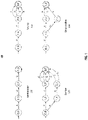
- FIG. 1 depicts exemplary unit DFAs representing 4 different types of amino acids and their codons, according to embodiments of the present disclosure. All these unit DFAs have (0, 0) and (3, 0) as their start node and end node, respectively.
- the DFA representation 105 for methionine has only one path (AUG). Besides methionine, tryptophan is the only other amino acid with a single codon path in the standard genetic code.
- the unit DFA 110 for amino acid valine codon has multiple choices at the third nucleotide. Most amino acids (15 out of 21) are of this type, with 2-4 paths.
- the unit DFA 115 for serine has the most complex case with 6 paths and branching happens at the start node. Leucine and arginine also have similar DFAs, with 6 paths and branching happens at the start node.
- the unit DFA 120 for the stop codon is special because branching happens at the second step, at node (1, 0).
- the DFAs are concatenated into a single DFA D ( p ) for a source sequence p (e.g., an amino acid sequence for a protein).
- the single DFA D ( p ) may be formed by stitching the end node of each unit DFA with the start node of the next.
- the new end node of the single DFA may be expressed as (3( m + 1), 0).
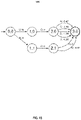
- FIG. 2 depicts a single DFA of a protein sequence "methionine leucine", according to embodiments of the present disclosure.
- the single DFA comprise a unit DFA 210 for methionine, a unit DFA 220 for leucine, and a unit DFA 230 for the stop codon.
- the single DFA may have multiple paths with each path having 9 nucleotides.
- the thick arrows indicate the best mRNA sequence (AUGCUGUGA, as shown in FIG. 3 ) after intersecting this DFA with the context-free grammar.
- out_edges( q ) is defined to be set of outgoing edges from node q
- ⁇ q ′ , a q
- FIG. 3 depicts a process for establishing DFA representation for source and target sequence search space, according to embodiments of the present disclosure.
- a source sequence comprising multiple source sequence units is received.
- the source sequence may be a protein sequence and the source sequence units are amino acids.
- a unit DFA is built for each of the multiple source sequence units.
- Each unit DFA comprises multiple nodes including a start node and an end node.
- Each DFA has one or more paths between the start node and the end node with each path representing one target sequence that translates into the source sequence unit.
- Each path comprises multiple edges with each edge coupled between two different nodes.
- each DFA comprises all possible codons that may translate into a corresponding amino acid.
- unit DFAs for the multiple source sequence units are concatenated into a single DFA by stitching the end node of each unit DFA with the start node of the next unit.
- a stochastic context-free grammar is a CFG in which each rule is augmented with a weight.
- an SCFG may be expressed as a 4-tuple ⁇ N, ⁇ ,P,S ⁇ where N is the set of non-terminals, ⁇ is the set of terminals (identical to the alphabet in the DFA, which may be expressed as ⁇ A, C, G, U ⁇ for mRNA sequences), P is the set of weight-associated context-free writing rules, and S ⁇ N is the start symbol.
- Each rule in P has the form A ⁇ W N ⁇ ⁇ * where A ⁇ N is a non-terminal that may be rewritten according to this rule into a sequence of non-terminals and terminals ( ⁇ means repeating zero or more times) and w ⁇ is the weight associated with this rule.
- SCFGs may be used to represent RNA folding, a process by which a linear RNA molecule acquires secondary structure through intra-molecular interactions.
- the weight of a derivation (parse tree, or a secondary structure in this case) may be a sum of weights of the productions used in that derivation.
- SCFG G may be defined as: S ⁇ 0 S S S ⁇ ⁇ 1 S U A
- expression (6) is the bifurcating case
- expression (7) is the base-pairing case (with weight -1, and the negative score mirrors the free energy minimization problem);
- expression (8) is the unpaired cases; and
- expression (9) is for terminal rule.
- the unpaired expression S ⁇ 0 N N N makes sure the minimum hairpin length is 3, i.e., no sharp turn is allowed.
- Hairpins are a common type of secondary structure in RNA molecules.
- a hairpin also referred as a hairpin loop
- a hairpin is an unpaired loop of mRNA that is created when an mRNA strand folds and forms base pairs with another section of the same strand.
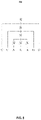
- the standard RNA secondary structure prediction problem under a Nussinov model may be casted as a parsing problem: given the above SCFG G and an input RNA sequence, what is the minimum-weight derivation in G that may generate sequence? For example, for an input CCAAAGG sequence, the best secondary structure derivation using the Nussinov- Jacobson grammar is showed in FIG. 5 .
- each nonterminal has a form q 1 Aq 2 , where A ⁇ N is an original nonterminal in G ; q 1 and q 2 are two nodes in D; and the new start symbol is q 0 Sq n , where S is the original start symbol in G ; q 0 and q n are the start and end nodes in D .
- the bifurcation rule S ⁇ 0 S S may become: q 1 Sq 3 ⁇ 0 q 1 Sq 2 q 2 Sq 3 for all ( q 1 , q 2 , q 3 ) node triplets in D. It may be seen that this intersection construction generalizes a Cocke-Kasami-Younger (CKY) algorithm where the triple of states ( q 1 , q 2 , q 3 ) generalizes the triple of string indices ( i,k,j ) .
- CKY Cocke-Kasami-Younger
- the CKY algorithm is a special case of intersection when the DFA only encodes one string, e.g., when a protein is made of amino acids that have only one codon (methionion and tryptophan).
- this intersection construction is used for parsing in a DFA to account for ambiguity in target sequence (e.g., mRNA codon) choice.
- the intersected grammar G' will have N
- n ). Indeed, intersection is a generalization of CKY from fixed input (RNA folding) to lattice input (mRNA design).
- FIG. 4 depicts one of the best derivations for the single DFA in Fig. 2 , according to embodiments of the present disclosure.
- the derivation shown in thick black arrows (410, 411...) demonstrates the path through the SCFG and the DFA (there may be multiple best trees due to the simple energy model).
- the corresponding secondary structure is shown in dot-bracket format (421, 422%) below the solid arrows.
- the rest of the DFA are shown in light gray.
- Dot-bracket notation is a way of representing secondary structure of RNA.
- Each character represents a base. Open parentheses indicate that the base is paired to another base ahead of it. Closed parentheses indicate that a base is paired to another base behind it. Dots indicate an unpaired base. The number of open and closed parentheses will always be equal.
- FIG. 6 depicts a process for CFG intersection with DFA, according to embodiments of the present disclosure.
- the CFG is a SCFG.
- each nonterminal in G' is defined as a form ( q 1 Aq 2 ) comprising two nodes ( q 1 and q 2 ) in D and an original nonterminal ( A ⁇ N ) in G ;
- the new nonterminal in G' is defined as a combination ( q 0 Sq n ) comprising the start and end nodes ( q 0 and q n ) in D and the original start ( S ) symbol in G .
- one or more rules e.g., a bifurcation rule, a pairing rule, a termination rule, etc., in the intersected CFG G' are defined.
- Described in this subsection are embodiments of dynamic methodology based on CFG intersection with DFA.
- a bottom-up dynamic programming on the Nussinov-Jacobson energy model is used first as an introduction.
- FIG. 7 depicts a process for a bottom-up dynamic methodology for mRNA design, according to embodiments of the present disclosure.
- a source sequence e.g., a protein sequence
- a single DFA for the source sequence is built (710) afterwards.
- the single DFA may be built according to the steps shown in FIG. 3 .
- Two hash tables, best to store the best score for each state ( q i ,q j ), and back to store the best backpointer for each state ( q i ,q j ) between two different nodes q i and q j are initialized (715).
- the base case (singleton rule) for a state ( q i ,q i +1 ) for each adjacent node pair is initialized (720) with the best score for the state setting as zero initially and the best backpointer for the state setting as nuc i initially ( best [ q i ,q i +1 ] ⁇ 0 and back [ q i , q i +1 ] ⁇ nuc i for each state ( q i ,q i +1 ), where nuc i is the edge between q i and q i +1 ).
- the best target sequence e.g., mRNA sequence
- the constraint of difference between j and i being larger than a predetermined value, e.g., j - i > 4, is required in RNA folding to ensure "no sharp turn".
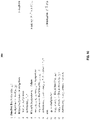
- FIG. 8 gives an exemplary pseudocode for the bottom-up dynamic methodology, according to embodiments of the present disclosure.
- FIG. 9 and FIG. 10 respectively depict exemplary pseudocodes for Update function and Backtrace function in a bottom-up dynamic methodology, according to embodiments of the present disclosure.
- the pseudocode may be created using a computer language other than the language shown in FIGs.8-10 .
- Algorithm based on bottom-up dynamic methodology runs in cubic time, and may be still slow for long sequences.
- the present patent document discloses embodiments of a linear-time approximation methodology, which may be used for various applications including mRNA design.
- beam pruning may be applied to significantly narrow down the search space without sacrificing too much search quality.
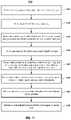
- FIG. 11 depicts a LinearDesign process using a left-to-right dynamic methodology for mRNA design, according to embodiments of the present disclosure. Steps 1105-1120 may be similar to steps 705-720 for the bottom-up dynamic process shown in FIG. 7 . LinearDesign replaces at least part of the bottom-up dynamic programming with a left-to-right parsing.
- each state between any two nodes, which are before the current position goes through (1125) one or more pairing rules (if the node number difference between the two nodes is larger than a predetermined value, e.g., 4) and then goes through (1130) one or more bifurcation rules for state and backpointer updates if a better score is found.
- a predetermined value e.g. 4
- the beam size is a user-adjustable parameter to balance runtime and search quality. This approximation leads to a significant runtime reduction from O ( n 3 ) to O ( nb 2 ) .
- a beam size b larger than 100 may usually be used because of the large search space.
- the best target sequence (e.g., mRNA sequence) together with stored backpointers may be back traced (1140).
- FIG. 12 gives the pseudocode of a LinearDesign methodology for the Nussinov model based on left-to-right dynamic programming and beam pruning, according to embodiments of the present disclosure.
- FIG. 9 and FIGs.13-14 respectively depict exemplary pseudocodes for Update function, Backtrace function (named as "BACKTRACE2" in FIG. 13 to differentiate from the BACKTRACE function listed in FIG. 10 ) and Beamprune function in a LinearDesign methodology, according to embodiments of the present disclosure.
- the pseudocode may be created using a computer language other than the language shown in FIG. 9 and FIGs.13-14 .
- a left-to-right dynamic methodology with beam pruning is used on a Turner nearest neighbor free energy model.
- thermodynamic parameters following Vienna RNAfold Ronny Lorenz, et al., ViennaRNA package 2.0. Algorithms for Molecular Biology, 6(1):1, 2011 , which is incorporated by reference in its entirety
- Dangling ends refer to stabilizing interactions for multiloops and external loops, which require knowledge of the nucleotide sequence outside of the state ( q i ,q j ) . Though it may be integrated in LinearDesign, the implementation may become more involved.
- Special hairpins are hairpin loop sequences of length 3, 4, or 6 unpaired nucleotides with folding free energies stored in lookup tables, rather than estimated from features like other sequences. Special hairpins may be also integrated in LinearDesign with some preprocessing. In one or more embodiment, both dangling end and special hairpin stabilities may be included in one or more embodiments of LinearDesign.
- an additive regularization term e.g., CAI
- CAI an additive regularization term
- r * p arg min r ⁇ RNA p MFE r ⁇ m + 1 ⁇ log
- m is the source sequence (e.g., a protein sequence) length
- log w i ( r ) is the measurement of deviation from the optimal codon (0 is optimal) for the i -th amino acid (given an mRNA candidate)
- ⁇ i 1 m + 1 log w i ( r ) is an additive regularization term
- this equation may be integrated into a LinearDesign dynamic process, i.e., each DFA graph's edge may have a cost such that the combined cost of traversing a local path (choosing a codon) equals log w i .
- each edge cost is the "best" of the paths (i.e., codons) that uses this edge.
- FIGs. 15 and 16 use amino acid serine as an example, showing how to integrating CAI as an edge cost in a DFA graph.
- the CAI for each edge e.g., a codon
- the source target unit e.g., all codons translated into an amino acid in the protein sequence.
- a serine has 6 corresponding codons, which are listed with their CAI in Table 1 below.
- Each codon has a corresponding path in the DFA graph (see FIG. 15 ).
- codon UCU has a frequency of 0.18, which means the codon UCG accounts for 18% of all codons in human translated into the amino acid serine.
- the best codon AGC has a log w i of 0, meaning that choosing AGC would not have a cost.
- Table 1 Codon table of amino acid serine. Codon freq.
- edge costs are incurred as early as possible in a path such that the states with better CAI paths are more likely to survive in each step.
- the weights only differ at the last edges.
- the edge costs are rearranged to fit better for LinearDesign. It shall be noted that different edge costs in FIG. 15 and FIG. 16 would not affect exact search.
- FIG. 17 depicts a process of shifting edge weight difference for edges in a DFA (or a unit DFA), according to embodiments of the present disclosure.
- an edge cost of a path with the highest edge cost among the plurality of paths is adjusted (1705) by an adjustment amount.
- the adjustment amount is a value needed to change the highest edge cost to zero.
- Edge costs of other paths among the plurality of paths are adjusted (1710) using the adjustment amount.
- the adjustment amount is applied (1715) to one shared edge as an edge cost for the shared edge such that the overall cost for each of the paths is unchanged.
- the plurality of paths have more than one share path and the earliest share path is the path that is chosen to apply the adjustment amount as the edge cost.
- the edge costs in UCA, UCC, UCG, and UCU are -0.47, -0.09, -1.39, and -0.29, respectively, and differ at the last edges (between (2, 0) and (3, 0)).
- the highest cost e.g., -0.09 for path UCC
- the highest cost e.g., -0.09 for path UCC
- paths UCA, UCC, UCG, and UCU now have costs of -0.38, 0, -1.30, and -0.20, respectively, for the last edge.
- the first edge sharesd for all these fourth paths
- has a cost adjusted from 0 into "-0.09" such that the overall cost for each of the paths (UCA, UCC, UCG, and UCU) is unchanged.
- An alternative solution for finding mRNA candidates with both stable secondary structure and high CAI is to provide the top k mRNA candidates with the lowest MFE, and post-process them by features such as CAI. Although this is not as principled as the algorithm described in subsection B.6, this solution is easier to implement, and is more flexible in the sense that users may be free to add other customized filters.
- an efficient methodology is presented to find suboptimal candidates in a sorted order.
- forward-phase instead of just saving the single best prestate as the backpointer for each state, alternative prestates that all transit to this state are stored.
- backtrace process starting from the last state, the second best is queried.
- the answer is one of the two cases: (1) the second best is from another prestate S 1 ; or (2) the second best is from the same prestate S 0 .
- the second best may be found by backtracing the best path going through prestate S 1 .
- querying is implemented for the second best from the prestate S 0 .
- solutions, as many as needed, may be computed and obtained.
- the LinearDesign may be innovative to output suboptimal results in mRNA design. Some previous algorithms explored searching suboptimal secondary structure for RNA folding. Some found diverse suboptimal secondary structures, and some found all secondary structures in a given free energy gap. Differences between LinearDesign embodiments and these previous efforts include: (1) LinearDesign embodiments are for mRNA design, which is quite different from RNA folding; and (2) in LinearDesign embodiments, all top k best candidates may be output in a sorted order.
- LinearDesign is able to quickly design a large set of mRNA candidates, which may provide a set of alternative designs for follow up with wet lab experiments.
- LinearDesign may be used to design an open reading frame (ORF) with an absence of base pairing in the 5'-end leader region by utilizing a simple strategy.
- the 5'-end leader region (e.g., the first 15 nt) is left unchanged from the wildtype, since the wildtype usually has less structure in this region.
- LinearDesign may then be used for the rest of the coding region. Because the designed region is composed of strong base pairs (generally maximizing GC content), it is unlikely for a global structure change when concatenating with the wildtype 5'-end head region, which is often depleted of GC content under observation. Refolding using secondary structure prediction tools for the concatenated sequence, its corresponding secondary structure may be obtained and it is observed that the first 15 nucleotides are unpaired.
- LinearDesign may be used in individually, in combination or sub-combination, or in combination with one or more additional approaches for desirable functionalities.
- FIG. 18 shows runtime comparison between CDSfold and LinearDesign on Uniprot dataset. It may be observed that CDSfold, as shown in the left plot of FIG.
- CDSfold takes 31 hours for the longest sequence in the dataset (8,484 nt )
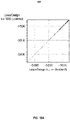
- FIGs. 19A , 19B , and 19C represent the folding free energy differences between the exact search and approximation.
- the x-axis is the free energy of exact search, while the y-axis corresponds to the free energy of approximation. It may be seen that all plots are on or close to the diagonal, which confirms that the folding free energy differences are 0 or small.
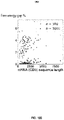
- Fig. 19B shows the trend of free energy differences increases linearly with mRNA sequence length.
- the y-axis is the percentage of free energy change gap, which is the free energy change gap ( ⁇ G 0 ) divided by the total free energy change of the MFE structure ( ⁇ G 0 ).
- the spike protein of SARS-CoV-2 which has 1,273 amino acid residues, is a target of mRNA vaccines. Therefore, the spike protein (GenBank QHD43416.1) of SARS-CoV-2 was used as an example for LinearDesign, and designed sequences were compared with the wildtype sequence and random generated sequences.
- the mRNA sequence from a reference genome (GenBank MN908947.3) of SARSCoV-2 is used as the wildtype sequence, which contains 3,822 nucleotides (including the stop codon).
- two different strategies are used to generate random sequences (5,000 sequences for each strategy) as other baselines.
- One of the two strategies named “pure random”, is to randomly (with equal probabilities) choose a codon for each amino acid in the spike protein, and form an mRNA sequence by concatenation.
- the other strategy, called “codon-biased random” is to choose a codon the probability proportional to its usage frequency.
- LinearDesign in both exact mode and approximation mode) is run to evaluate the best sequences which may be achieved. Since previous studies show that both the folding free energy change of mRNA secondary structure and codon optimality influence the vaccine effectiveness, a two-dimensional comparison, MFE and CAI, is implemented between mRNA sequences.
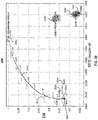
- FIG. 20 depicts two-dimensional comparisons (MFE and CAI) between wildtype mRNA sequence 2002, random sequences (cloud 2004 and cloud 2006), and designed sequences (spots 2012, 2014, 2016, and 2018, curve 2010, curve 2020) on the spike protein of SARS-CoV-2.
- the wildtype sequence 2002 folds into a structure with the minimum free energy change of - 967.80 kcal/mol, and has a low CAI of 0.655.
- Most "pure random" sequences, denoted in cloud 2004, have similar free energy changes (-987.90 kcal/mol on average) as the wildtype, but with higher CAI (0.671 on average). This may be because SARS-CoV-2 just recently infected human cells and does not have enough mutations to optimize for human codons.
- FIG. 20 also shows CAI-greedy design result as a point 2022.
- LinearDesign designed sequences were plotted.
- the plots 2012, 2014, 2016, and 2018 are optimized by MFE only.
- the leftmost one 2012 is the sequence designed in exact search mode, which has the lowest MFE of -2,477.70 kcal/mol and a CAI of 0.726.
- FIG. 20 shows the top 10, 000, 000 suboptimal sequences for exact mode (the dark cloud 2024 on the right of exact design sequence).
- the MFE of the sequences are very close to the optimal one, and the free energy gaps are within 20 kcal/mol.
- Some of the sequences have higher CAI, e.g., some have the CAI higher than 0.730. This shows that the k best algorithm may be used to select sequences with low MFE and relative higher CAI as vaccine candidates
- Curve 2010 is joint optimization design using exact mode. Each point on the curve is with a different ⁇ , which balances the importance of MFE and CAI. It may be seen that the curve is on the top-left of the figure, indicating that the sequences on the curve have both stable secondary structures and higher CAI. In fact, this curve is the accessible boundary of all possible sequences, i.e., no sequences can achieve the region beyond (to the top-left) the curve. The points on the curve 2010 are good candidates for an mRNA vaccine.
- Structure 2110 is the whole secondary structure of the designed sequence with the goal of leaving the 5' end unpaired (the first 15 nucleotides kept identical to the wildtype and the remaining nucleotides designed by LinearDesign), and the 5'-end is zoomed in, as shown in Structure 2112.
- the 5'-end of designed sequence without constraint is also zoomed in as shown in Structure 2108. This demonstrates that the strategy may keep the 5' end unstructured, whereas designing the complete sequence results in base pairing at the 5' end.
- the mRNA design problem is of utmost importance, especially for mRNA vaccines during the current COVID-19 pandemic.
- this problem is reduced into a classical problem in formal language theory and computational linguistics, namely the intersection of a CFG (encoding the energy model) with a DFA (encoding the mRNA search space).
- This reduction provides a natural O ( n 3 )-time CKY-style bottom-up algorithm, where n is the mRNA sequence length, but this algorithm might still be too slow for long proteins such as the spike protein of SARS-CoV-2, a promising candidate for an mRNA vaccine.
- a left-to-right algorithm is developed with employment of beam search to reduce the runtime to O ( n ), with the cost of exact search.
- Two algorithms are also presented for incorporating codon optimality (CAI) into the consideration, one using k-best algorithms to compute suboptimal sequences and one directly integrating CAI into dynamic programming. Embodiments of the present patent document may provide efficient computational tools to speed up and improve mRNA vaccine development.
- the LinearDesign may be used for other vaccine study and antibody development.
- One or more embodiments of the LinearDesign may be applicable, individually or in combination, for antibody sequence design.
- aspects of the present patent document may be directed to, may include, or may be implemented on one or more information handling systems (or computing systems).
- An information handling system/computing system may include any instrumentality or aggregate of instrumentalities operable to compute, calculate, determine, classify, process, transmit, receive, retrieve, originate, route, switch, store, display, communicate, manifest, detect, record, reproduce, handle, or utilize any form of information, intelligence, or data.
- a computing system may be or may include a personal computer (e.g., laptop), tablet computer, mobile device (e.g., personal digital assistant (PDA), smart phone, phablet, tablet, etc.), smart watch, server (e.g., blade server or rack server), a network storage device, camera, or any other suitable device and may vary in size, shape, performance, functionality, and price.
- the computing system may include random access memory (RAM), one or more processing resources such as a central processing unit (CPU) or hardware or software control logic, read only memory (ROM), and/or other types of memory.
- Additional components of the computing system may include one or more disk drives, one or more network ports for communicating with external devices as well as various input and output (I/O) devices, such as a keyboard, mouse, stylus, touchscreen and/or video display.
- the computing system may also include one or more buses operable to transmit communications between the various hardware components.
- FIG. 22 depicts a simplified block diagram of an information handling system (or computing system), according to embodiments of the present disclosure. It will be understood that the functionalities shown for system 2200 may operate to support various embodiments of a computing system-although it shall be understood that a computing system may be differently configured and include different components, including having fewer or more components as depicted in FIG. 22 .
- the computing system 2200 includes one or more central processing units (CPU) 2201 that provides computing resources and controls the computer.
- CPU 2201 may be implemented with a microprocessor or the like, and may also include one or more graphics processing units (GPU) 2202 and/or a floating-point coprocessor for mathematical computations.
- GPU graphics processing units
- one or more GPUs 2202 may be incorporated within the display controller 2209, such as part of a graphics card or cards.
- Thy system 2200 may also include a system memory 2219, which may comprise RAM, ROM, or both.
- An input controller 2203 represents an interface to various input device(s) 2204, such as a keyboard, mouse, touchscreen, and/or stylus.
- the computing system 2200 may also include a storage controller 2207 for interfacing with one or more storage devices 2208 each of which includes a storage medium such as magnetic tape or disk, or an optical medium that might be used to record programs of instructions for operating systems, utilities, and applications, which may include embodiments of programs that implement various aspects of the present disclosure.
- Storage device(s) 2208 may also be used to store processed data or data to be processed in accordance with the disclosure.
- the system 2200 may also include a display controller 2209 for providing an interface to a display device 2211, which may be a cathode ray tube (CRT) display, a thin film transistor (TFT) display, organic light-emitting diode, electroluminescent panel, plasma panel, or any other type of display.
- the computing system 2200 may also include one or more peripheral controllers or interfaces 2205 for one or more peripherals 2206. Examples of peripherals may include one or more printers, scanners, input devices, output devices, sensors, and the like.
- a communications controller 2214 may interface with one or more communication devices 2215, which enables the system 2200 to connect to remote devices through any of a variety of networks including the Internet, a cloud resource (e.g., an Ethernet cloud, a Fiber Channel over Ethernet (FCoE)/Data Center Bridging (DCB) cloud, etc.), a local area network (LAN), a wide area network (WAN), a storage area network (SAN) or through any suitable electromagnetic carrier signals including infrared signals.
- the computing system 2200 comprises one or more fans or fan trays 2218 and a cooling subsystem controller or controllers 2217 that monitors thermal temperature(s) of the system 2200 (or components thereof) and operates the fans/fan trays 2218 to help regulate the temperature.
- bus 2216 which may represent more than one physical bus.
- various system components may or may not be in physical proximity to one another.
- input data and/or output data may be remotely transmitted from one physical location to another.
- programs that implement various aspects of the disclosure may be accessed from a remote location (e.g., a server) over a network.
- Such data and/or programs may be conveyed through any of a variety of machine-readable medium including, for example: magnetic media such as hard disks, floppy disks, and magnetic tape; optical media such as CD-ROMs and holographic devices; magneto-optical media; and hardware devices that are specially configured to store or to store and execute program code, such as application specific integrated circuits (ASICs), programmable logic devices (PLDs), flash memory devices, other non-volatile memory (NVM) devices (such as 3D XPoint-based devices), and ROM and RAM devices.
- ASICs application specific integrated circuits
- PLDs programmable logic devices
- NVM non-volatile memory
- aspects of the present disclosure may be encoded upon one or more non-transitory computer-readable media with instructions for one or more processors or processing units to cause steps to be performed.
- the one or more non-transitory computer-readable media shall include volatile and/or non-volatile memory.
- alternative implementations are possible, including a hardware implementation or a software/hardware implementation.
- Hardware-implemented functions may be realized using ASIC(s), programmable arrays, digital signal processing circuitry, or the like. Accordingly, the "means” terms in any claims are intended to cover both software and hardware implementations.
- computer-readable medium or media includes software and/or hardware having a program of instructions embodied thereon, or a combination thereof.
- embodiments of the present disclosure may further relate to computer products with a non-transitory, tangible computer-readable medium that have computer code thereon for performing various computer-implemented operations.
- the media and computer code may be those specially designed and constructed for the purposes of the present disclosure, or they may be of the kind known or available to those having skill in the relevant arts.
- tangible computer-readable media include, for example: magnetic media such as hard disks, floppy disks, and magnetic tape; optical media such as CD-ROMs and holographic devices; magneto-optical media; and hardware devices that are specially configured to store or to store and execute program code, such as application specific integrated circuits (ASICs), programmable logic devices (PLDs), flash memory devices, other non-volatile memory (NVM) devices (such as 3D XPoint-based devices), and ROM and RAM devices.
- ASICs application specific integrated circuits
- PLDs programmable logic devices
- NVM non-volatile memory
- Examples of computer code include machine code, such as produced by a compiler, and files containing higher level code that are executed by a computer using an interpreter.
- Embodiments of the present disclosure may be implemented in whole or in part as machine-executable instructions that may be in program modules that are executed by a processing device.
- Examples of program modules include libraries, programs, routines, objects, components, and data structures.
- program modules may be physically located in settings that are local, remote, or both.
Landscapes
- Life Sciences & Earth Sciences (AREA)
- Health & Medical Sciences (AREA)
- Engineering & Computer Science (AREA)
- Physics & Mathematics (AREA)
- Biophysics (AREA)
- General Health & Medical Sciences (AREA)
- Theoretical Computer Science (AREA)
- Bioinformatics & Cheminformatics (AREA)
- Bioinformatics & Computational Biology (AREA)
- Evolutionary Biology (AREA)
- Medical Informatics (AREA)
- Biotechnology (AREA)
- Spectroscopy & Molecular Physics (AREA)
- Chemical & Material Sciences (AREA)
- Data Mining & Analysis (AREA)
- Bioethics (AREA)
- Virology (AREA)
- Genetics & Genomics (AREA)
- Software Systems (AREA)
- Evolutionary Computation (AREA)
- Artificial Intelligence (AREA)
- Epidemiology (AREA)
- Public Health (AREA)
- Proteomics, Peptides & Aminoacids (AREA)
- Databases & Information Systems (AREA)
- Analytical Chemistry (AREA)
- Microbiology (AREA)
- Computational Linguistics (AREA)
- Animal Behavior & Ethology (AREA)
- Mycology (AREA)
- Veterinary Medicine (AREA)
- Medicinal Chemistry (AREA)
- Immunology (AREA)
- Mathematical Physics (AREA)
- Pulmonology (AREA)
- Communicable Diseases (AREA)
- Biomedical Technology (AREA)
- Pharmacology & Pharmacy (AREA)
- Molecular Biology (AREA)
- Computing Systems (AREA)
Priority Applications (1)
| Application Number | Priority Date | Filing Date | Title |
|---|---|---|---|
| EP25221495.2A EP4682890A3 (de) | 2021-02-24 | 2022-02-23 | Systeme und verfahren zum sequenzentwurf |
Applications Claiming Priority (1)
| Application Number | Priority Date | Filing Date | Title |
|---|---|---|---|
| US17/184,505 US20220269951A1 (en) | 2021-02-24 | 2021-02-24 | Systems and methods for sequence design |
Related Child Applications (1)
| Application Number | Title | Priority Date | Filing Date |
|---|---|---|---|
| EP25221495.2A Division EP4682890A3 (de) | 2021-02-24 | 2022-02-23 | Systeme und verfahren zum sequenzentwurf |
Publications (1)
| Publication Number | Publication Date |
|---|---|
| EP4030438A1 true EP4030438A1 (de) | 2022-07-20 |
Family
ID=80446948
Family Applications (2)
| Application Number | Title | Priority Date | Filing Date |
|---|---|---|---|
| EP22158108.5A Ceased EP4030438A1 (de) | 2021-02-24 | 2022-02-23 | Systeme und verfahren für sequenzentwurf |
| EP25221495.2A Pending EP4682890A3 (de) | 2021-02-24 | 2022-02-23 | Systeme und verfahren zum sequenzentwurf |
Family Applications After (1)
| Application Number | Title | Priority Date | Filing Date |
|---|---|---|---|
| EP25221495.2A Pending EP4682890A3 (de) | 2021-02-24 | 2022-02-23 | Systeme und verfahren zum sequenzentwurf |
Country Status (4)
| Country | Link |
|---|---|
| US (2) | US20220269951A1 (de) |
| EP (2) | EP4030438A1 (de) |
| JP (1) | JP7367090B2 (de) |
| CN (1) | CN114974428A (de) |
Families Citing this family (5)
| Publication number | Priority date | Publication date | Assignee | Title |
|---|---|---|---|---|
| CN115814074B (zh) * | 2022-10-17 | 2023-08-11 | 北京大学 | 密码子优化的针对新型冠状病毒的mRNA疫苗 |
| CN116072231B (zh) * | 2022-10-17 | 2024-02-13 | 中国医学科学院病原生物学研究所 | 基于氨基酸序列的密码子优化设计mRNA疫苗的方法 |
| CN119541638B (zh) * | 2023-08-31 | 2025-07-29 | 深圳智药信息科技有限公司 | 信使核糖核酸序列设计方法、装置、计算设备及存储介质 |
| CN118038986B (zh) * | 2024-02-05 | 2025-09-02 | 北京百度网讯科技有限公司 | mRNA序列的确定方法、装置、设备和介质 |
| CN119479809B (zh) * | 2024-10-22 | 2025-11-18 | 上海算法创新研究院 | 一种mRNA疫苗设计任务的处理方法和装置 |
Family Cites Families (3)
| Publication number | Priority date | Publication date | Assignee | Title |
|---|---|---|---|---|
| WO2017218727A1 (en) * | 2016-06-15 | 2017-12-21 | President And Fellows Of Harvard College | Methods for rule-based genome design |
| US20190147974A1 (en) | 2017-10-13 | 2019-05-16 | Virginia Polytechnic Institute And State Universit | Systems And Methods For Characterizing And Sampling Nucleic Acid Sequences And Structures Of Same |
| CN111554346B (zh) * | 2020-04-29 | 2023-05-23 | 上海交通大学 | 基于多目标优化的蛋白质序列设计实现方法 |
-
2021
- 2021-02-24 US US17/184,505 patent/US20220269951A1/en active Pending
-
2022
- 2022-02-04 JP JP2022015998A patent/JP7367090B2/ja active Active
- 2022-02-23 CN CN202210167835.0A patent/CN114974428A/zh active Pending
- 2022-02-23 EP EP22158108.5A patent/EP4030438A1/de not_active Ceased
- 2022-02-23 EP EP25221495.2A patent/EP4682890A3/de active Pending
-
2024
- 2024-08-06 US US18/795,898 patent/US20240394558A1/en active Pending
Non-Patent Citations (5)
| Title |
|---|
| "GenBank", Database accession no. MN908947.3 |
| GORO TERAI ET AL.: "CDSfold: an algorithm for designing a proteincoding sequence with the most stable secondary structure", BIOINFORMATICS, vol. 32, no. 6, 2016, pages 828 - 834 |
| HE ZHANG ET AL: "LinearDesign: Efficient Algorithms for Optimized mRNA Sequence Design", ARXIV.ORG, CORNELL UNIVERSITY LIBRARY, 201 OLIN LIBRARY CORNELL UNIVERSITY ITHACA, NY 14853, 21 April 2020 (2020-04-21), XP081659324 * |
| NUCLEIC ACIDS RESEARCH, vol. 42, 2005, pages D204 - D12 |
| ZHOU YU ET AL: "Flexible RNA design under structure and sequence constraints using formal languages", INTERACTIVE 3D GRAPHICS AND GAMES, ACM, 2 PENN PLAZA, SUITE 701 NEW YORK NY 10121-0701 USA, 22 September 2013 (2013-09-22), pages 229 - 238, XP058501273, ISBN: 978-1-4503-2717-6, DOI: 10.1145/2506583.2506623 * |
Also Published As
| Publication number | Publication date |
|---|---|
| CN114974428A (zh) | 2022-08-30 |
| EP4682890A2 (de) | 2026-01-21 |
| JP7367090B2 (ja) | 2023-10-23 |
| EP4682890A3 (de) | 2026-04-01 |
| JP2022058896A (ja) | 2022-04-12 |
| US20240394558A1 (en) | 2024-11-28 |
| US20220269951A1 (en) | 2022-08-25 |
Similar Documents
| Publication | Publication Date | Title |
|---|---|---|
| EP4030438A1 (de) | Systeme und verfahren für sequenzentwurf | |
| Pompe et al. | A framework for adaptive MCMC targeting multimodal distributions | |
| Alser et al. | Shouji: a fast and efficient pre-alignment filter for sequence alignment | |
| Yi et al. | Binary embedding: Fundamental limits and fast algorithm | |
| ES3050587T3 (en) | Genomic information compression by configurable machine learning-based arithmetic coding | |
| Terai et al. | CDSfold: an algorithm for designing a protein-coding sequence with the most stable secondary structure | |
| Lember et al. | Bridging Viterbi and posterior decoding: a generalized risk approach to hidden path inference based on hidden Markov models | |
| Hajiaghayi et al. | Efficient continuous-time Markov chain estimation | |
| Kiryu et al. | Rfold: an exact algorithm for computing local base pairing probabilities | |
| US20210124802A1 (en) | Natural language polishing using vector spaces having relative similarity vectors | |
| WO2022159635A1 (en) | Systems and methods for evaluation of structure and property of polynucleotides | |
| US20180025008A1 (en) | Systems and methods for homogeneous entity grouping | |
| Gross et al. | Training conditional random fields for maximum labelwise accuracy | |
| Ward et al. | mRNA folding algorithms for structure and codon optimization | |
| Dai et al. | Messenger RNA design via expected partition function and continuous optimization | |
| Riquelme et al. | On the max–min influence spread problem: A multi-objective optimization approach | |
| Park et al. | HMMerge: an ensemble method for multiple sequence alignment | |
| EP4109239A1 (de) | Verfahren zur erzeugung und verarbeitung von einzelbefehl-mehrfachdaten (simd)-befehlen und zugehörige vorrichtung | |
| Ju et al. | A More Efficient Dynamic Programming Algorithm for Designing a Coding Sequence by Jointly Optimizing Its Structural Stability and Codon Usage | |
| Kazanskii et al. | AutoRNA: RNA tertiary structure prediction using variational autoencoder | |
| Zhang et al. | GC-balanced polar codes correcting insertions, deletions and substitutions for DNA storage | |
| Balashankar et al. | Pareto-efficient fairness for skewed subgroup data | |
| CN114049516A (zh) | 训练方法、图像处理方法、装置、电子设备以及存储介质 | |
| HK40070340A (en) | Systems and methods for sequence design | |
| Rahman et al. | HaVec: an efficient de Bruijn graph construction algorithm for genome assembly |
Legal Events
| Date | Code | Title | Description |
|---|---|---|---|
| PUAI | Public reference made under article 153(3) epc to a published international application that has entered the european phase |
Free format text: ORIGINAL CODE: 0009012 |
|
| STAA | Information on the status of an ep patent application or granted ep patent |
Free format text: STATUS: THE APPLICATION HAS BEEN PUBLISHED |
|
| AK | Designated contracting states |
Kind code of ref document: A1 Designated state(s): AL AT BE BG CH CY CZ DE DK EE ES FI FR GB GR HR HU IE IS IT LI LT LU LV MC MK MT NL NO PL PT RO RS SE SI SK SM TR |
|
| STAA | Information on the status of an ep patent application or granted ep patent |
Free format text: STATUS: REQUEST FOR EXAMINATION WAS MADE |
|
| 17P | Request for examination filed |
Effective date: 20230119 |
|
| RBV | Designated contracting states (corrected) |
Designated state(s): AL AT BE BG CH CY CZ DE DK EE ES FI FR GB GR HR HU IE IS IT LI LT LU LV MC MK MT NL NO PL PT RO RS SE SI SK SM TR |
|
| STAA | Information on the status of an ep patent application or granted ep patent |
Free format text: STATUS: EXAMINATION IS IN PROGRESS |
|
| 17Q | First examination report despatched |
Effective date: 20230727 |
|
| STAA | Information on the status of an ep patent application or granted ep patent |
Free format text: STATUS: THE APPLICATION HAS BEEN REFUSED |
|
| 18R | Application refused |
Effective date: 20250925 |