EP4030353A2 - Datenerzeugungsassistenzvorrichtung und datenerzeugungsassistenzverfahren - Google Patents
Datenerzeugungsassistenzvorrichtung und datenerzeugungsassistenzverfahren Download PDFInfo
- Publication number
- EP4030353A2 EP4030353A2 EP21216309.1A EP21216309A EP4030353A2 EP 4030353 A2 EP4030353 A2 EP 4030353A2 EP 21216309 A EP21216309 A EP 21216309A EP 4030353 A2 EP4030353 A2 EP 4030353A2
- Authority
- EP
- European Patent Office
- Prior art keywords
- data
- test data
- uncertainty
- neural network
- minutely changed
- Prior art date
- Legal status (The legal status is an assumption and is not a legal conclusion. Google has not performed a legal analysis and makes no representation as to the accuracy of the status listed.)
- Pending
Links
Images





Classifications
-
- G—PHYSICS
- G06—COMPUTING OR CALCULATING; COUNTING
- G06N—COMPUTING ARRANGEMENTS BASED ON SPECIFIC COMPUTATIONAL MODELS
- G06N5/00—Computing arrangements using knowledge-based models
- G06N5/04—Inference or reasoning models
- G06N5/048—Fuzzy inferencing
-
- G—PHYSICS
- G06—COMPUTING OR CALCULATING; COUNTING
- G06F—ELECTRIC DIGITAL DATA PROCESSING
- G06F18/00—Pattern recognition
- G06F18/20—Analysing
- G06F18/21—Design or setup of recognition systems or techniques; Extraction of features in feature space; Blind source separation
- G06F18/217—Validation; Performance evaluation; Active pattern learning techniques
- G06F18/2193—Validation; Performance evaluation; Active pattern learning techniques based on specific statistical tests
-
- G—PHYSICS
- G06—COMPUTING OR CALCULATING; COUNTING
- G06N—COMPUTING ARRANGEMENTS BASED ON SPECIFIC COMPUTATIONAL MODELS
- G06N3/00—Computing arrangements based on biological models
- G06N3/02—Neural networks
- G06N3/04—Architecture, e.g. interconnection topology
- G06N3/047—Probabilistic or stochastic networks
-
- G—PHYSICS
- G06—COMPUTING OR CALCULATING; COUNTING
- G06N—COMPUTING ARRANGEMENTS BASED ON SPECIFIC COMPUTATIONAL MODELS
- G06N3/00—Computing arrangements based on biological models
- G06N3/02—Neural networks
- G06N3/08—Learning methods
- G06N3/084—Backpropagation, e.g. using gradient descent
-
- G—PHYSICS
- G06—COMPUTING OR CALCULATING; COUNTING
- G06N—COMPUTING ARRANGEMENTS BASED ON SPECIFIC COMPUTATIONAL MODELS
- G06N3/00—Computing arrangements based on biological models
- G06N3/02—Neural networks
- G06N3/08—Learning methods
- G06N3/09—Supervised learning
-
- G—PHYSICS
- G06—COMPUTING OR CALCULATING; COUNTING
- G06N—COMPUTING ARRANGEMENTS BASED ON SPECIFIC COMPUTATIONAL MODELS
- G06N7/00—Computing arrangements based on specific mathematical models
- G06N7/01—Probabilistic graphical models, e.g. probabilistic networks
Definitions
- the present invention relates to a data-creation assistance apparatus and a data-creation assistance method.
- IoT Internet of Things
- machine learning that is, supervised machine learning, by giving a training data group to which a label is attached to a learning model, learning that recognizes features of an event indicated by the training data with high accuracy and derives a correct inference result, that is, a value of the label proceeds.
- the "ground truth” may also include, for example, a result of a "ground truth” even for data (having a different distribution) that is not included in the training data and that would otherwise be difficult to derive the ground truth.
- This technique is a management method that initializes deep learning architecture parameters of a predefined base architecture, performs a model training based on the deep learning architecture parameters to generate a trained model, iteratively applies Monte Carlo (MC) dropout to the generated trained model to acquire the accuracy and the uncertainty of the prediction, configures a fitness function to evaluate the accuracy and the uncertainty of the prediction of the trained model, in which when the fitness function indicates that the trained model is not optimized, the deep learning architecture parameters is updated to iterate over the generation of the trained model and the evaluation of the fitness function, and when the fitness function indicates that the trained model has been optimized, the trained model for the prediction is provided.
- Monte Carlo MC
- a point in recognizing a problem related to the "correct answer" described above is a difference between the accuracy and the uncertainty.
- a case where the correct answer is given regardless of an intention of a developer, even though learning has not been performed, is a situation in which the accuracy is high but the uncertainty is also high, which is undesirable.
- a learning method for optimizing the uncertainty and the accuracy at the same time is presented, but no mechanism is disclosed to verify what kind of data indicates the uncertainty or certainty (and how the data indicates the uncertainty or certainty in the inference result). As a result, it is not possible to efficiently verify and improve a robustness of the learning model.
- an object of the invention is to provide a technique for efficiently verifying and improving the robustness of the learning model for supervised machine learning.
- a data-creation assistance apparatus of the invention includes: a storage device configured to store neural network model used for supervised machine learning and test data attached with a label of ground truth; and a computing device configured to execute a process of specifying an uncertainty of an inference result from the neural network model by inputting the test data to the neural network model; a process of acquiring gradient information of the test data by a back propagation process using the uncertainty as a loss; a process of generating a plurality of minutely changed test data obtained by applying a minute change to the test data and calculating deviations between each of the plurality of minutely changed test data and the test data; and a process of specifying, based on the uncertainty information, the gradient information, and the deviations, the minute change that increases or decreases the uncertainty or minutely changed test data to which the minute change is applied.
- a data-creation assistance method of the invention is realized by an information processing apparatus configured to execute: a process of storing a neural network model used for supervised machine learning and test data attached with a label of ground truth, and inputting the test data into the neural network model to specify an uncertainty of an inference result from the neural network model; a process of acquiring gradient information of the test data by a back propagation process using the uncertainty as a loss; a process of generating a plurality of minutely changed test data obtained by applying a minute change to the test data, and calculating deviations between each of the plurality of pieces minutely changed test data and the test data; and a process of specifying, based on information of the uncertainty, the gradient information, and the deviations, a minute change that increases or decreases the uncertainty or minutely changed test data to which the minute change is applied.
- FIG. 1 is a diagram illustrating a configuration example of hardware of a data-creation assistance apparatus 100 according to the present embodiment.
- the data-creation assistance apparatus 100 illustrated in FIG. 1 is a computer device that efficiently verifies and improves a robustness of a learning model for supervised machine learning.
- the hardware configuration of the data-creation assistance apparatus 100 is as follows. That is, the data-creation assistance apparatus 100 includes a storage device 101, a memory 103, a computing device 104, an input device 105, and an output device 106.
- the storage device 101 includes an appropriate nonvolatile storage element such as a solid-state drive (SSD) or a hard disk drive.
- SSD solid-state drive
- hard disk drive a nonvolatile storage element
- the memory 103 includes a volatile storage element such as a RAM.
- the computing device 104 is a CPU that executes a program 102 stored in the storage device 101 by, for example, reading the program 102 into the memory 103, and performs a general control of the device itself as well as various determinations, calculations, and control processes.
- the program 102 includes a machine learning program 1021 in addition to an operating system (OS) naturally provided in an information processing apparatus and a program that operates on the OS and implements a data-creation assistance method.
- the machine learning program 1021 is an algorithm that, for example, gives appropriate data such as test data to an appropriate learned model 110 such as a neural network model to perform a predetermined determination, estimation, and the like on the data.
- the input device 105 is an appropriate device such as a keyboard, a mouse, or a microphone that receives a key input or a voice input from a user.
- the output device 106 is an appropriate device such as a display or a speaker that displays processed data in the computing device 104.
- the storage device 101 is capable of storing the learned model 110, test data 120, and training data 130. Specific contents of these will be described later.
- FIG. 2 is a diagram illustrating a functional configuration example of the data-creation assistance apparatus 100 according to the present embodiment.
- the data-creation assistance apparatus 100 according to the present embodiment further includes an uncertainty back propagation unit 111, an uncertainty inference unit 112, a minute change applying unit 113, a gradient deviation comparison unit 114, an uncertainty data display unit 115, an uncertainty convergence determination unit 116, and a model learning unit 117.
- the data-creation assistance apparatus 100 including such functional units gives the training data 130 to the machine learning program 1021 to advance learning of the learned model 110, which is a neural network model, at any time.
- the training data 130 is data to which a label of ground truth is attached, such as, image data in which a name or an attribute of a subject is defined as a ground truth, IoT data in which a possibility of occurrence of a failure in an equipment is defined as a ground truth.
- the learned model 110 that is updated in this way is the neural network model as described above, as the estimation results for the test data 120, in addition to information that can be uniquely specified as described above, an average and a variance of a distribution of the estimation results can be obtained as uncertainty information.
- the data-creation assistance apparatus 100 executes, for example, a back propagation process using a value of the variance described above as a loss, and acquires gradient data 123 of the test data 120.
- An existing technique may be appropriately adopted for the back propagation process in the machine learning algorithm and a method itself for obtaining gradient data in accordance with the back propagation process.
- the data-creation assistance apparatus 100 applies predetermined minute changes to the test data 120 described above, and generates a plurality of minutely changed test data 122.
- a direction of the minute change is different from a development intention of the user or the like or that becomes unfavorable from data characteristics (example: characters and images have completely different main shapes and change in a direction that makes it difficult for humans to recognize. For example, the presence or absence of ear images of animals having distinctive ears and changes that clearly change an outer shape, etc.).
- the data-creation assistance apparatus 100 acquires a minute change candidate vector 121 indicating the direction suitable for such minute changes by receiving a designation from the user in advance or by a predetermined method, and applies the minute change candidate vector 121 in the case of the minute change described above.
- This method specifies, for example, a direction, that is, a vector of the minute changes similar to the gradient indicated by the gradient data described above.
- the data-creation assistance apparatus 100 calculates a deviation between each of the plurality of minutely changed test data 122 created as described above and the test data 120, and acquires and stores, based on the variance (uncertainty information) of the estimation results, the gradient data 123, and the deviations obtained so far, the minute change by which the variance (uncertainty) of the estimation results increases or decreases or the minutely changed test data to which the minute change is applied, as uncertainty test data 125.
- the data-creation assistance apparatus 100 generates visualization data 126 by, for example, setting information of the uncertainty test data 125 in a predetermined screen format, and displaying the visualization data 126 on the output device 106.
- the data-creation assistance apparatus 100 uses the training data 130 (attached with the label of ground truth) stored in the storage device 101 as an input, and uses a minute change vector 131 included in the minutely changed test data 122 to generate minutely changed training data 132 obtained by applying a minute change to the training data 130.
- the data-creation assistance apparatus 100 further executes a relearning process of the learned model 110 (that is, the neural network model) by giving the minutely changed training data 132 to the learned model 110 by the machine learning program 1021.
- the learned model 110 that is, the neural network model
- the data-creation assistance apparatus 100 uses the learned model 110 that has undergone the relearning to specify an evaluation value 124 of the uncertainty such as the variance described above by using a predetermined test data as an input, and determines whether the uncertainty is above or below a predetermined threshold.
- the data-creation assistance apparatus 100 acquires a determination result as a determination result 134 of an uncertainty convergence, and displays the determination result on, for example, the output device 106.
- the data-creation assistance apparatus 100 further advances the relearning process of the learned model 110 by giving the minutely changed training data 132 to the learned model 110.
- FIG. 3 is a diagram illustrating a functional configuration example of the data-creation assistance apparatus 100 according to the first embodiment
- FIG. 4 is a diagram illustrating an example of a flow of the data-creation assistance method according to the first embodiment. Further, actions of each function illustrated in FIG. 3 have already been described.
- the data-creation assistance apparatus 100 acquires, via the input device 105, for example, by an operation of a user, the learned model 110 that is a neural network model and the test data 120 thereof (s10).
- the uncertainty inference unit 112 of the data-creation assistance apparatus 100 gives the test data 120 to the learned model 110, and obtains a variance of a distribution of estimation results as the evaluation value 124 of the uncertainty of the estimation results for the test data 120 described above(s11).
- the uncertainty back propagation unit 111 of the data-creation assistance apparatus 100 executes a back propagation process using the value of the variance obtained in s11 described above as a loss, and acquires the gradient data 123 of the test data 120 (s12).
- an existing technique may be appropriately adopted for the back propagation process in a machine learning algorithm and a method itself for obtaining gradient data in accordance with the back propagation process.
- the minute change applying unit 113 of the data-creation assistance apparatus 100 gives a predetermined minute change to the test data 120 described above and generates the plurality of minutely changed test data 122 (s13).
- a direction of the minute change is different from a development intention of the user or the like or that becomes unfavorable from data characteristics (example: characters and images have completely different main shapes and change in a direction that makes it difficult for humans to recognize. For example, the presence or absence of ear images of animals having distinctive ears and changes that clearly change an outer shape, or the like).
- the data-creation assistance apparatus 100 acquires the minute change candidate vector 121 indicating the direction suitable for such minute change by receiving a designation from the user in advance or by a predetermined method, and applies the minute change candidate vector 121 in the case of the minute change described above.
- This method can be assumed to specify, for example, a direction, that is, a vector of the minute changes similar to a gradient indicated by the gradient data described above.
- the gradient deviation comparison unit 114 of the data-creation assistance apparatus 100 calculates deviations between each of the plurality of minutely changed test data 122 created as described above and the test data 120 and specifies and stores, based on the variance (uncertainty information) of the estimation results, the gradient data 123, and the deviations obtained so far, the minute change by which the variance (uncertainty) of the estimation results increases or decreases or the minutely changed test data to which the minute change is given, as the uncertainty test data 125 (s14), and this process is ended.
- the gradient deviation comparison unit 114 of the data-creation assistance apparatus 100 compares, in response to specify one among the plurality of minutely changed test data 122 as the uncertainty test data 125, each of the plurality of minutely changed test data 122 with the gradient data and identifies minutely changed test data 122 that is most similar to the gradient indicated by the gradient data.
- similarity for example, a concept may be adopted in which the inner product of each vector from each of the plurality of minutely changed test data 122 to the gradient data is calculated, and the one with the largest calculated value has the maximum similarity.
- a Bayesian neural network or Monte Carlo dropout sampling (MC dropout) of an approximation method thereof may be adopted. Therefore, the machine learning program 1021 in the data-creation assistance apparatus 100 is capable of mounting in advance and using such an algorithm of the MC dropout.
- test data X1 which is a base
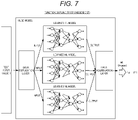
- the learned model 110 In response to specify the uncertainty shown in the flow described above or generate the minutely changed test data 122, as shown in FIG. 5 , first, test data X1, which is a base, is given to the learned model 110, and through a process with the MC dropout described above, the average value and the variance value of an inference result obtained for the test data X1 are identified.
- the gradient data is acquired by using the obtained variance, which is the value of the uncertainty, as a loss and executing the back propagation process related to the test data X1.
- the minute change applying unit 113 of the data-creation assistance apparatus 100 applies predetermined various minute changes to the test data X1 described above and generates a plurality of minutely changed test data X2.
- a minute change by which the variance (uncertainty) of the estimation results increases or the minutely changed test data to which the minute change is given is acquired and stored as the uncertainty test data 125.
- test data is used as an input
- an output of neurons in an intermediate layer included in the learned model 110 is randomly set to 0, and an inference result is output.
- the data-creation assistance apparatus 100 acquires a plurality of the dropout inference results, and specifies the variance related to the plurality of dropout inference results as the uncertainty.
- the data-creation assistance apparatus 100 may assume a configuration in which a plurality of learned models 110 are stored in advance.
- the data-creation assistance apparatus 100 acquires the inference results from each of the plurality of learned models 110 by inputting the test data to each of the plurality of learned models 110, and acquires uncertainty data of the test data by aggregating the variances related to the inference results (for example, calculating an average of values of the variances).
- FIG. 8 is a diagram illustrating a functional configuration example of the data-creation assistance apparatus 100 according to the second embodiment
- FIG. 9 is a diagram illustrating an example of a flow of the data-creation assistance method according to the second embodiment.
- the uncertainty data display unit 115 is a difference from the configuration in the first embodiment (the configuration of FIG. 3 ).
- the uncertainty data display unit 115 generates visualization data 126 by, for example, setting information of the uncertainty test data 125 obtained by the gradient deviation comparison unit 114 to a screen format stored in advance (s20).
- the uncertainty data display unit 115 displays the visualization data 126 described above on the output device 106 (s21), and this process is ended.
- FIG. 10 An example of a screen G10 on which the visualization data 126 is displayed is illustrated in FIG. 10 .
- the visualization data 126 includes, for example, images G11 indicating "5" as a plurality of minutely changed test data, which are disposed on an axis plane for each direction of minute changes thereof.
- the axis plane is assumed in which changes in rotation angles of the images of "5" are on a horizontal axis and changes in brightness are on a vertical axis.
- the images of "5" are rotated to the right as they move to the right, and rotated to the left as they move to the left on the axis plane. Further, the brightness of such images of "5" increase as they move upward, and decrease as they move downward on the axis plane.
- each image G11 which is each piece of minutely changed test data, is associated with a variance value G12, which is an evaluation value of an uncertainty thereof.
- each image G11 which is each piece of minutely changed test data and each variance value G12 of each image G11
- highlighting is performed to make a color or a pattern of an image G11 different from that of another image G11.
- a user specifies that variances of images within the range of broken lines G13 are within an allowable range, but specific images are not within the allowable range.
- each variance value of each image G11 may be sequentially changed and displayed in a color corresponding to a magnitude of each variance value.
- a heat map is displayed like the screen G20.
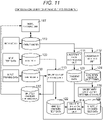
- FIG. 11 is a diagram illustrating a functional configuration example of a data-creation assistance apparatus 100 according to the third embodiment
- FIG. 12 is a diagram illustrating an example of a flow of the data-creation assistance method according to the third embodiment
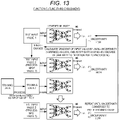
- FIG. 13 is a diagram illustrating an example of function outline according to the third embodiment.
- the third embodiment corresponds to an aspect in which training data is created separately from test data.
- the data-creation assistance apparatus 100 stores, in the storage device 101, a plurality of training data 130 used for supervised machine learning together with labels of ground truth.
- the minute change applying unit 113 of the data-creation assistance apparatus 100 uses the training data 130 (attached with a label of ground truth) stored in the storage device 101 as an input, uses the minute change vector 131 included in the minutely changed test data 122 to generate the minutely changed training data 132 obtained by minutely changing the training data 130 (s30).
- the model learning unit 117 of the data-creation assistance apparatus 100 further executes a relearning process of the learned model 110 (that is, neural network model) by giving the minutely changed training data 132 obtained in s30 described above to the learned model 110 by the machine learning program 1021 (s31).
- the learned model 110 that is, neural network model
- the uncertainty inference unit 112 of the data-creation assistance apparatus 100 uses the learned model 110 that has undergone the relearning to specify the evaluation value 124 of the uncertainty such as the variance described above by using a predetermined test data as an input (s32).
- the uncertainty convergence determination unit 116 determines whether the uncertainty, that is, the variance is above or below a predetermined threshold, and acquires a determination result as the determination result 134 of the uncertainty convergence (s33). Each process up to this determination is, for example, repeatedly executed until the variance value reaches the threshold.
- the uncertainty convergence determination unit 116 displays the acquired determination result 134 on, for example, the output device 106.
- the model learning unit 117 of the data-creation assistance apparatus 100 further advances, the relearning process of the learned model 110 by giving the minutely changed training data 132 to the learned model 110 (S34), and this process is ended.
- the present embodiment it is possible to verify a robustness of a learning model with respect to specifications (various minute changes) without preparing a large amount of test data in advance, and it is possible to improve the robustness by using uncertainty data (weakness) for the learning model.
- the computing device may, in the process of specifying the uncertainty, execute a dropout inference process a plurality of times, acquire a plurality of dropout inference results, and specify a variance related to the plurality of dropout inference results as an uncertainty.
- the test data is used as an input, an output of neurons included in the neural network model is randomly set to 0, and an inference result is output.
- the computing device may, in response to acquire the gradient information, calculate a gradient of the test data by a back propagation process in which the variance of the acquired dropout inference results is used as a loss function, and in response to specify one piece of the plurality of minutely changed test data, compare the plurality of minutely changed test data with the gradient information, and specify one piece of minutely changed test data and a minute change vector that are most similar to the gradient indicated by the gradient information.
- the computing device may, in the process of the dropout inference, use an inference result to an intermediate layer of the neural network.
- the computing device may, acquire inference results from each of the plurality of neural networks by inputting the test data into each of the plurality of neural network models, and specify a variance related to the inference results as the uncertainty.
- the computing device may further execute a process of displaying a set of the minutely changed test data and the uncertainty information of the minutely changed test data.
- a person in charge of managing and constructing the machine learning model is capable of obtaining visual information about directions of the minute changes in the test data and a viewpoint of the uncertainty in that case, and is capable of easily confirming the visual information. Further, a result confirmed in such a way can be fed back to a subsequent operation. As a result, it is possible to more efficiently verify and improve the robustness of the learning model for supervised machine learning.
- the computing device may further execute a process of displaying the set of the minutely changed test data and the uncertainty information of the minutely changed test data, and displaying that the uncertainty information is above or below a predetermined threshold.
- the person in charge of managing and constructing the machine learning model is capable of obtaining the visual information about directions of the minute changes in the test data and the viewpoint of the uncertainty in that case, and is capable of accurately determining the quality of the direction of the minute change and feeding the visual information back to the subsequent operation.
- the storage device may store a plurality of training data used for supervised machine learning together with labels of ground truth, and the computing device may further execute a relearning process of the neural network model by using the training data as an input, using the minute change vector included in the minutely changed test data to generate minutely changed training data obtained by minutely changing the training data, and giving the minutely changed training data to the neural network model.
- the training data are also slightly changed in the same manner as the test data, so that it is possible to efficiently verify and improve the robustness.
- the computing device may execute a process of using the neural network model that has undergone the relearning, specifying an uncertainty by using the test data as an input, and displaying information indicating that the uncertainty is above or below the predetermined threshold; and a process of relearning of the neural network model by giving the minutely changed training data to the neural network model in a case where the uncertainty is above or below the predetermined threshold.
Landscapes
- Engineering & Computer Science (AREA)
- Theoretical Computer Science (AREA)
- Physics & Mathematics (AREA)
- Data Mining & Analysis (AREA)
- Software Systems (AREA)
- Artificial Intelligence (AREA)
- Evolutionary Computation (AREA)
- General Engineering & Computer Science (AREA)
- General Physics & Mathematics (AREA)
- Mathematical Physics (AREA)
- Computing Systems (AREA)
- Computational Linguistics (AREA)
- Life Sciences & Earth Sciences (AREA)
- Health & Medical Sciences (AREA)
- Biomedical Technology (AREA)
- Biophysics (AREA)
- General Health & Medical Sciences (AREA)
- Molecular Biology (AREA)
- Probability & Statistics with Applications (AREA)
- Fuzzy Systems (AREA)
- Automation & Control Theory (AREA)
- Computer Vision & Pattern Recognition (AREA)
- Bioinformatics & Cheminformatics (AREA)
- Bioinformatics & Computational Biology (AREA)
- Evolutionary Biology (AREA)
- Management, Administration, Business Operations System, And Electronic Commerce (AREA)
- Combined Controls Of Internal Combustion Engines (AREA)
- Image Analysis (AREA)
Applications Claiming Priority (1)
| Application Number | Priority Date | Filing Date | Title |
|---|---|---|---|
| JP2021003982A JP7544607B2 (ja) | 2021-01-14 | 2021-01-14 | データ作成支援装置及びデータ作成支援方法 |
Publications (2)
| Publication Number | Publication Date |
|---|---|
| EP4030353A2 true EP4030353A2 (de) | 2022-07-20 |
| EP4030353A3 EP4030353A3 (de) | 2022-08-03 |
Family
ID=78957451
Family Applications (1)
| Application Number | Title | Priority Date | Filing Date |
|---|---|---|---|
| EP21216309.1A Pending EP4030353A3 (de) | 2021-01-14 | 2021-12-21 | Datenerzeugungsassistenzvorrichtung und datenerzeugungsassistenzverfahren |
Country Status (3)
| Country | Link |
|---|---|
| US (1) | US12423602B2 (de) |
| EP (1) | EP4030353A3 (de) |
| JP (1) | JP7544607B2 (de) |
Families Citing this family (4)
| Publication number | Priority date | Publication date | Assignee | Title |
|---|---|---|---|---|
| US11922314B1 (en) * | 2018-11-30 | 2024-03-05 | Ansys, Inc. | Systems and methods for building dynamic reduced order physical models |
| US20230281310A1 (en) * | 2022-03-01 | 2023-09-07 | Meta Plataforms, Inc. | Systems and methods of uncertainty-aware self-supervised-learning for malware and threat detection |
| JPWO2024214545A1 (de) * | 2023-04-13 | 2024-10-17 | ||
| CN120316844B (zh) * | 2025-03-28 | 2025-11-04 | 广东维创兴电子科技有限公司 | 一种触控屏幕生产优化方法及其系统 |
Citations (1)
| Publication number | Priority date | Publication date | Assignee | Title |
|---|---|---|---|---|
| JP2018200677A (ja) | 2017-05-25 | 2018-12-20 | 株式会社日立製作所 | 管理方法、非一時的コンピュータ可読媒体および管理装置 |
Family Cites Families (7)
| Publication number | Priority date | Publication date | Assignee | Title |
|---|---|---|---|---|
| US20140052425A1 (en) * | 2012-08-16 | 2014-02-20 | Sankar Selvaraj | Method and apparatus for evaluating a model of an industrial plant process |
| JP6704341B2 (ja) | 2016-12-27 | 2020-06-03 | 株式会社デンソーアイティーラボラトリ | 情報推定装置及び情報推定方法 |
| US20210216901A1 (en) | 2018-06-01 | 2021-07-15 | Kabushiki Kaisha Toshiba | Estimation system, estimation method, and estimation program |
| US11410040B2 (en) * | 2018-10-23 | 2022-08-09 | Qualcomm Incorporated | Efficient dropout inference for bayesian deep learning |
| JP7215098B2 (ja) * | 2018-11-12 | 2023-01-31 | 富士通株式会社 | 学習プログラム、学習方法および学習装置 |
| US10970837B2 (en) * | 2019-03-18 | 2021-04-06 | Siemens Healthcare Gmbh | Automated uncertainty estimation of lesion segmentation |
| JP2020154386A (ja) | 2019-03-18 | 2020-09-24 | キオクシア株式会社 | 情報処理方法及び情報処理装置 |
-
2021
- 2021-01-14 JP JP2021003982A patent/JP7544607B2/ja active Active
- 2021-12-14 US US17/550,285 patent/US12423602B2/en active Active
- 2021-12-21 EP EP21216309.1A patent/EP4030353A3/de active Pending
Patent Citations (1)
| Publication number | Priority date | Publication date | Assignee | Title |
|---|---|---|---|---|
| JP2018200677A (ja) | 2017-05-25 | 2018-12-20 | 株式会社日立製作所 | 管理方法、非一時的コンピュータ可読媒体および管理装置 |
Also Published As
| Publication number | Publication date |
|---|---|
| JP7544607B2 (ja) | 2024-09-03 |
| US12423602B2 (en) | 2025-09-23 |
| EP4030353A3 (de) | 2022-08-03 |
| JP2022108816A (ja) | 2022-07-27 |
| US20220222552A1 (en) | 2022-07-14 |
Similar Documents
| Publication | Publication Date | Title |
|---|---|---|
| US12423602B2 (en) | Data-creation assistance apparatus and data-creation assistance method | |
| US12518397B2 (en) | Automated determination of a base assessment for a pose or movement | |
| CN111310808B (zh) | 图片识别模型的训练方法、装置、计算机系统及存储介质 | |
| US10824669B2 (en) | Sticker recommendation method and apparatus, server cluster, and storage medium | |
| JP6994588B2 (ja) | 顔特徴抽出モデル訓練方法、顔特徴抽出方法、装置、機器および記憶媒体 | |
| CN110210625B (zh) | 基于迁移学习的建模方法、装置、计算机设备和存储介质 | |
| CN109086711B (zh) | 人脸特征分析方法、装置、计算机设备和存储介质 | |
| US12436967B2 (en) | Visualizing feature variation effects on computer model prediction | |
| US9189750B1 (en) | Methods and systems for sequential feature selection based on significance testing | |
| CN107679466B (zh) | 信息输出方法和装置 | |
| WO2020006961A1 (zh) | 用于提取图像的方法和装置 | |
| US20200334557A1 (en) | Chained influence scores for improving synthetic data generation | |
| CN109766754B (zh) | 人脸五官聚类方法、装置、计算机设备及存储介质 | |
| CN107590807A (zh) | 用于检测图像质量的方法和装置 | |
| US20250165375A1 (en) | Detecting model deviation with inter-group metrics | |
| CN112270686A (zh) | 图像分割模型训练、图像分割方法、装置及电子设备 | |
| CN114463798A (zh) | 人脸识别模型的训练方法、装置、设备及存储介质 | |
| US20220285024A1 (en) | Facilitating interpretability of classification model | |
| CN116563604B (zh) | 端到端目标检测模型训练、图像目标检测方法及相关设备 | |
| US20220114836A1 (en) | Method for processing image, and apparatus therefor | |
| HK1220528A1 (zh) | 基於感受的多媒體處理 | |
| JP7379300B2 (ja) | 推定装置、推定方法及びプログラム | |
| WO2022190301A1 (ja) | 学習装置、学習方法、及びコンピュータ可読媒体 | |
| CN114528973B (zh) | 业务处理模型的生成方法、业务处理方法和装置 | |
| WO2022162839A1 (ja) | 学習装置、学習方法、及び、記録媒体 |
Legal Events
| Date | Code | Title | Description |
|---|---|---|---|
| PUAI | Public reference made under article 153(3) epc to a published international application that has entered the european phase |
Free format text: ORIGINAL CODE: 0009012 |
|
| STAA | Information on the status of an ep patent application or granted ep patent |
Free format text: STATUS: REQUEST FOR EXAMINATION WAS MADE |
|
| PUAL | Search report despatched |
Free format text: ORIGINAL CODE: 0009013 |
|
| 17P | Request for examination filed |
Effective date: 20211221 |
|
| AK | Designated contracting states |
Kind code of ref document: A2 Designated state(s): AL AT BE BG CH CY CZ DE DK EE ES FI FR GB GR HR HU IE IS IT LI LT LU LV MC MK MT NL NO PL PT RO RS SE SI SK SM TR |
|
| AK | Designated contracting states |
Kind code of ref document: A3 Designated state(s): AL AT BE BG CH CY CZ DE DK EE ES FI FR GB GR HR HU IE IS IT LI LT LU LV MC MK MT NL NO PL PT RO RS SE SI SK SM TR |
|
| RIC1 | Information provided on ipc code assigned before grant |
Ipc: G06N 7/00 20060101ALN20220628BHEP Ipc: G06N 3/08 20060101ALI20220628BHEP Ipc: G06N 3/04 20060101AFI20220628BHEP |
|
| STAA | Information on the status of an ep patent application or granted ep patent |
Free format text: STATUS: EXAMINATION IS IN PROGRESS |
|
| 17Q | First examination report despatched |
Effective date: 20251216 |