EP4030291A1 - Verfahren und system zur erzeugung von ressourcenzuweisungsempfehlungen - Google Patents
Verfahren und system zur erzeugung von ressourcenzuweisungsempfehlungen Download PDFInfo
- Publication number
- EP4030291A1 EP4030291A1 EP22152131.3A EP22152131A EP4030291A1 EP 4030291 A1 EP4030291 A1 EP 4030291A1 EP 22152131 A EP22152131 A EP 22152131A EP 4030291 A1 EP4030291 A1 EP 4030291A1
- Authority
- EP
- European Patent Office
- Prior art keywords
- applications
- computing system
- resource
- generating
- neural network
- Prior art date
- Legal status (The legal status is an assumption and is not a legal conclusion. Google has not performed a legal analysis and makes no representation as to the accuracy of the status listed.)
- Pending
Links
Images



Classifications
-
- G—PHYSICS
- G06—COMPUTING OR CALCULATING; COUNTING
- G06F—ELECTRIC DIGITAL DATA PROCESSING
- G06F9/00—Arrangements for program control, e.g. control units
- G06F9/06—Arrangements for program control, e.g. control units using stored programs, i.e. using an internal store of processing equipment to receive or retain programs
- G06F9/46—Multiprogramming arrangements
- G06F9/50—Allocation of resources, e.g. of the central processing unit [CPU]
-
- G—PHYSICS
- G06—COMPUTING OR CALCULATING; COUNTING
- G06N—COMPUTING ARRANGEMENTS BASED ON SPECIFIC COMPUTATIONAL MODELS
- G06N3/00—Computing arrangements based on biological models
- G06N3/02—Neural networks
- G06N3/08—Learning methods
Definitions
- the disclosure herein generally relates to resource allocation in computing systems, and, more particularly, to a method and system for generating automated resource allocation recommendations for computing systems based on dynamically determined resource requirements.
- each of the devices may be required to have specific resources to perform the assigned task(s).
- Resource requirements may be task specific and can be different for different tasks.
- a static approach of pre-assigning certain amount of resources to each of the devices has the disadvantage that this approach fails to accommodate changing resource requirements.
- Dynamic resource allocation approach permits allocation of resources on a need to basis. In this approach, actual resource requirements are determined, and accordingly the resources are allocated.
- a disadvantage of the existing systems that perform the dynamic resource allocation is that they rely on factors such as number of applications running on a system, number of tasks being serviced and so on. In an implementation scenario, irrespective of the factors such as number of applications running on a system, number of tasks being serviced, the resource requirement may still vary, as in some dynamic scenarios the amount of data to be processed vary.
- Another disadvantage of the existing systems is that visibility of data at front end is high, which may cause security concerns. For example, consider applications that processes customer data in healthcare industry. In addition to physiological data, personal data such as but not limited to name, age, gender, and so on, of each of the customers of the applications. As the applications may have been managed by third-party service providers, exposing such personal data may pose serious data privacy/security issues.
- Embodiments of the present disclosure present technological improvements as solutions to one or more of the above-mentioned technical problems recognized by the inventors in conventional systems.
- a method of generating resource allocation recommendations is provided.
- a neural network model of a computing system is generated initially.
- Generating the neural network model involves the following steps. A plurality of application instances of each of a plurality of applications in the computing system are monitored, and instance level data from each of the plurality of application instances, of each of the plurality of applications, is collected using a dedicated set of agents for each of the plurality of application instances. Further, a plurality of local models of each of the plurality of applications are generated by a plurality of monitor modules dedicated to process the collected instance level data of each of the plurality of applications.
- a global model each of the plurality of applications is generated, using an application modeler. Then the neural network model representing the computing system is generated based on the global models of the plurality of applications in the computing system. Once the neural network model is generated, then resource requirements of the computing system are determined based on a determined workload of the computing system. The workload is determined by emulating working of the plurality of applications using the global model of the plurality of applications.
- a system for generating neural network model for resource allocation recommendations includes a plurality of agents, a plurality of monitor modules, and an application modeler.
- the plurality of agents, the plurality of monitor modules, and the application modeler are configured by a plurality of instructions to collect data for resource allocation.
- the system generates a neural network model of a computing system from this collected data.
- Generating the neural network model involves the following steps. A plurality of application instances of each of a plurality of applications in the computing system are monitored, and instance level data from each of the plurality of application instances, of each of the plurality of applications, is collected using a dedicated set of agents for each of the plurality of application instances.
- a plurality of local models of each of the plurality of applications are generated by a plurality of monitor modules dedicated to process the collected instance level data from each of the plurality of applications. Further, by processing the plurality of local models of each of the plurality of applications, a global model each of the plurality of applications is generated, using an application modeler. Then the neural network model representing the computing system is generated based on the global models of the plurality of applications in the computing system. Once the neural network model is generated, then resource requirements of the computing system are determined based on a determined workload of the computing system. The workload is determined by emulating working of the plurality of applications using the global model of the plurality of applications.
- a non-transitory computer readable medium for generating resource allocation recommendations.
- the non-transitory computer readable medium includes a plurality of instructions, which when executed, causes the resource allocation, and various steps in the resource allocation are explained below.
- a neural network model of a computing system is generated initially. Generating the neural network model involves the following steps. A plurality of application instances of each of a plurality of applications in the computing system are monitored, and instance level data from each of the plurality of application instances, of each of the plurality of applications, is collected using a dedicated set of agents for each of the plurality of application instances.
- a plurality of local models of each of the plurality of applications are generated by a plurality of monitor modules dedicated to process the collected instance level data of each of the plurality of applications. Further, by processing the plurality of local models of each of the plurality of applications, a global model each of the plurality of applications is generated, using an application modeler. Then the neural network model representing the computing system is generated based on the global models of the plurality of applications in the computing system. Once the neural network model is generated, then resource requirements of the computing system are determined based on a determined workload of the computing system. The workload is determined by emulating working of the plurality of applications using the global model of the plurality of applications.
- FIG. 1 through FIG. 4 where similar reference characters denote corresponding features consistently throughout the figures, there are shown preferred embodiments and these embodiments are described in the context of the following exemplary system and/or method.
- FIG. 1 illustrates an exemplary system for resource allocation, according to some embodiments of the present disclosure.
- the system 100 includes one or more hardware processors 102, communication interface(s) or input/output (I/O) interface(s) 103, and one or more data storage devices or memory 101 operatively coupled to the one or more hardware processors 102.
- the one or more hardware processors 102 can be implemented as one or more microprocessors, microcomputers, microcontrollers, digital signal processors, central processing units, state machines, graphics controllers, logic circuitries, and/or any devices that manipulate signals based on operational instructions.
- the processor(s) are configured to fetch and execute computer-readable instructions stored in the memory.
- the system 100 can be implemented in a variety of computing systems, such as laptop computers, notebooks, hand-held devices, workstations, mainframe computers, servers, a network cloud and the like.
- the communication interface(s) 103 can include a variety of software and hardware interfaces, for example, a web interface, a graphical user interface, and the like and can facilitate multiple communications within a wide variety of networks N/W and protocol types, including wired networks, for example, LAN, cable, etc., and wireless networks, such as WLAN, cellular, or satellite.
- the communication interface(s) 103 can include one or more ports for connecting a number of devices to one another or to another server.
- the memory 101 may include any computer-readable medium known in the art including, for example, volatile memory, such as static random access memory (SRAM) and dynamic random access memory (DRAM), and/or non-volatile memory, such as read only memory (ROM), erasable programmable ROM, flash memories, hard disks, optical disks, and magnetic tapes.
- volatile memory such as static random access memory (SRAM) and dynamic random access memory (DRAM)
- non-volatile memory such as read only memory (ROM), erasable programmable ROM, flash memories, hard disks, optical disks, and magnetic tapes.
- ROM read only memory
- erasable programmable ROM erasable programmable ROM
- flash memories hard disks, optical disks, and magnetic tapes.
- hard disks hard disks
- optical disks optical disks
- magnetic tapes such as magnetic tapes.
- one or more components (not shown) of the system 100 can be stored in the memory 101.
- the memory 101 is configured to store a
- the modules of the memory 101 are agents, application modeler, monitor module(s), and a recommender.
- the system 100 can be implemented in a variety of ways as per requirements. An example implementation of the system 100 is depicted in FIG. 4 . Various steps involved in the process of resource recommendation being performed by the system 100 of FIG. 1 are depicted in FIG. 2 and FIG. 3 , and are explained with reference to the hardware components depicted in FIG. 1 and FIG. 4 .
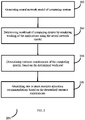
- FIG. 2 is a flow diagram depicting steps involved in the process of allocating resources using the system of FIG. 1 , according to some embodiments of the present disclosure.
- the computing system is monitored using the system 100, and at step 202, a neural network model of the computing system is generated by the system100.
- a neural network model of the computing system is generated by the system100.
- the system implementation depicted in FIG. 4 may be used for monitoring the computing system.
- the computing system may contain a plurality of applications. Monitoring the computing system involves monitoring each of the plurality of applications, and monitoring each application involves monitoring different application instances of each of the applications at step 302.
- a dedicated set of agents is used to monitor each of the application instances. For example, consider FIG. 4 . Agents 1 to 5 are used for monitoring application instance 1, agents 6 to 10 are used for monitoring application instance 2, agents 11 to 15 are used for monitoring application instance 3 and so on. Likewise, all application instances of each application in the computing system are monitored using dedicated sets of agents. By monitoring the application instances, each of the agents collects application instance level data at step 304. The instance level data correspond to data from different application instances. Monitoring and collecting data at application instance level adds an additional layer of security as whole application data is not available to the components at the front end which may be being accessed by different users. Further, the application instance level data collected by each set of agents is sent to a corresponding monitor from a set of monitors.
- Each monitor collects the instance level data from the corresponding set of agents, and then at step 306, generates local models of each of the applications.
- each of the local models is a model of the application instance.
- the local model generated by each of the monitors is then transmitted to the application modeler.
- the application modeler at step 308, generates a global model of the application, by combining the local models obtained from the monitors.
- the system 100 uses the steps 302 to 308, the system 100 generates the global model for all the applications being monitored.
- the recommender queries the global models and generates one or more recommendations, if any user request is received for the recommendations.
- the system 100 generates the neural network by using the global models of all the applications in the computing system.
- the system may use any suitable machine learning technique to process data of the updated global models, to generate the neural network.
- the generated neural network is then used to determine workload of the computing system, by emulating working of the applications using the neural network.
- the system 100 determines resource requirements to handle the determined workload. Further, the system 100 compares the determined resource requirements with resource availability in the computing system, and based on difference between the determined resource requirements and the resource availability in the computing system, determines resource requirements at step 206.
- one or more resource allocation recommendations are generated by the system 100.
- another system that handles the resource allocation may use the resource allocation recommendations generated by the system 100 to allocate required resources to each of the computing systems.
- a user may perform the resource allocation based on the resource allocation recommendations that are generated by the system 100. As the neural network model is updated from time to time, the resource requirements are updated, and accordingly the resource allocation recommendations are generated.
- the recommendations that are generated by the recommender may be provided to the user, using suitable user interface.
- the steps in method 200 may be performed in the same order as depicted in FIG. 2 or in any alternate order technically feasible. In another embodiment, one or more steps in method 200 may be omitted.
- the system 100 may be configured to consider a scenario where the supercomputing users would like to estimate the best configuration e.g. number of processors, number of nodes, amount of memory, estimated time for running a particular application (e.g. Molecular dynamic, Molecular docking, Computational Fluid Dynamics, etc.) with a certain set of inputs (data points for the simulation).
- the user based on input parameters for the simulation, rely on the recommendations provided by the system 100.
- the system 100 can generate estimates for number of nodes, number of processors, amount of memory, time estimates etc. as resource allocation recommendations depending on the applicability from the end users' perspective. The end user may use these recommendations to decide on running an application.
- the system 100 builds model of each of the applications running on the system, by considering the application instances.
- the system 100 is developed in such a way that the privacy of the user and user data for all the prior simulations running of the particular application is maintained. Further, the requisite information is derived from the running of the application and is used to build a model of the application. This ensures that adequate privacy is maintained with respect to the running of application by end users.
- a set of users are running same application (say Molecular Docking) on a cluster.
- Each user has his own proprietary data for running simulations and may like to hide it from other users.
- Some users use the resources efficiently.
- the efficient usages are monitored and data is collected for the inputs such as number of processors, amount of memory, time taken to the complete the simulation, etc.
- the system 100 is able to obtain data required to train a model which can provide recommendations for future simulations can be obtained by the system, while hiding the simulation characteristics.
- a user who wants to run a Molecular Docking application on a supercomputer/cluster can utilize the system 100 to obtain resource allocation recommendations.
- the user first connects to the system 100 and provides necessary details such as application name, the size of the input data, and such other details.
- the recommender of the system 100 queries the global model that has been generated by the system 100.
- the Global model helps the user to know the best configurations that can be used for running a particular simulation based on the past experience that is embedded in the global model. Simultaneously, following actions occur whenever a particular application instance is run on the system 100.
- the system 100 generates a model of the application using the monitors and agents designed to capture the runtime parameters of each of the instances of the application. Based on the captured parameters, a global model is made for each of the applications.
- the embodiments of present disclosure herein addresses unresolved problem of resource allocation in computing systems.
- the embodiment thus provides a mechanism to generate a neural network model representing working of a computing system being monitored.
- the embodiments herein further provides a mechanism to determine resource requirements of the computing system based on the generated neural network and accordingly generate one or more resource allocation recommendations.
- the hardware device can be any kind of device which can be programmed including e.g. any kind of computer like a server or a personal computer, or the like, or any combination thereof.
- the device may also include means which could be e.g. hardware means like e.g. an application-specific integrated circuit (ASIC), a field-programmable gate array (FPGA), or a combination of hardware and software means, e.g.
- ASIC application-specific integrated circuit
- FPGA field-programmable gate array
- the means can include both hardware means and software means.
- the method embodiments described herein could be implemented in hardware and software.
- the device may also include software means.
- the embodiments may be implemented on different hardware devices, e.g. using a plurality of CPUs.
- the embodiments herein can comprise hardware and software elements.
- the embodiments that are implemented in software include but are not limited to, firmware, resident software, microcode, etc.
- the functions performed by various components described herein may be implemented in other components or combinations of other components.
- a computer-usable or computer readable medium can be any apparatus that can comprise, store, communicate, propagate, or transport the program for use by or in connection with the instruction execution system, apparatus, or device.
- a computer-readable storage medium refers to any type of physical memory on which information or data readable by a processor may be stored.
- a computer-readable storage medium may store instructions for execution by one or more processors, including instructions for causing the processor(s) to perform steps or stages consistent with the embodiments described herein.
- the term "computer-readable medium” should be understood to include tangible items and exclude carrier waves and transient signals, i.e., be non-transitory. Examples include random access memory (RAM), read-only memory (ROM), volatile memory, nonvolatile memory, hard drives, CD ROMs, DVDs, flash drives, disks, and any other known physical storage media.
Landscapes
- Engineering & Computer Science (AREA)
- Software Systems (AREA)
- Theoretical Computer Science (AREA)
- Physics & Mathematics (AREA)
- General Engineering & Computer Science (AREA)
- General Physics & Mathematics (AREA)
- Debugging And Monitoring (AREA)
Applications Claiming Priority (1)
| Application Number | Priority Date | Filing Date | Title |
|---|---|---|---|
| IN202121002501 | 2021-01-19 |
Publications (1)
| Publication Number | Publication Date |
|---|---|
| EP4030291A1 true EP4030291A1 (de) | 2022-07-20 |
Family
ID=79730438
Family Applications (1)
| Application Number | Title | Priority Date | Filing Date |
|---|---|---|---|
| EP22152131.3A Pending EP4030291A1 (de) | 2021-01-19 | 2022-01-19 | Verfahren und system zur erzeugung von ressourcenzuweisungsempfehlungen |
Country Status (1)
| Country | Link |
|---|---|
| EP (1) | EP4030291A1 (de) |
Cited By (1)
| Publication number | Priority date | Publication date | Assignee | Title |
|---|---|---|---|---|
| CN121029428A (zh) * | 2025-10-29 | 2025-11-28 | 宁波科瑞特动物药业有限公司 | 面向低功耗物联网的宠物生理数据边缘计算方法及系统 |
Citations (1)
| Publication number | Priority date | Publication date | Assignee | Title |
|---|---|---|---|---|
| WO2020198610A1 (en) * | 2019-03-28 | 2020-10-01 | Amazon Technologies, Inc. | Compute platform recommendations for new workloads in a distributed computing environment |
-
2022
- 2022-01-19 EP EP22152131.3A patent/EP4030291A1/de active Pending
Patent Citations (1)
| Publication number | Priority date | Publication date | Assignee | Title |
|---|---|---|---|---|
| WO2020198610A1 (en) * | 2019-03-28 | 2020-10-01 | Amazon Technologies, Inc. | Compute platform recommendations for new workloads in a distributed computing environment |
Non-Patent Citations (1)
| Title |
|---|
| DRAINAKIS GEORGIOS ET AL: "Federated vs. Centralized Machine Learning under Privacy-elastic Users: A Comparative Analysis", 2020 IEEE 19TH INTERNATIONAL SYMPOSIUM ON NETWORK COMPUTING AND APPLICATIONS (NCA), IEEE, 24 November 2020 (2020-11-24), pages 1 - 8, XP033871284, DOI: 10.1109/NCA51143.2020.9306745 * |
Cited By (1)
| Publication number | Priority date | Publication date | Assignee | Title |
|---|---|---|---|---|
| CN121029428A (zh) * | 2025-10-29 | 2025-11-28 | 宁波科瑞特动物药业有限公司 | 面向低功耗物联网的宠物生理数据边缘计算方法及系统 |
Similar Documents
| Publication | Publication Date | Title |
|---|---|---|
| US10977389B2 (en) | Anonymity assessment system | |
| US11449379B2 (en) | Root cause and predictive analyses for technical issues of a computing environment | |
| JP7850266B2 (ja) | クライアント非依存型機械学習モデルを用いた自制を伴う説明可能な分類 | |
| US10656979B2 (en) | Structural and temporal semantics heterogeneous information network (HIN) for process trace clustering | |
| US10891560B2 (en) | Supervised learning system training using chatbot interaction | |
| CN114640713B (zh) | 数据访问监视和控制 | |
| US11636386B2 (en) | Determining data representative of bias within a model | |
| US10243819B1 (en) | Template generation based on analysis | |
| US11614963B2 (en) | Machine learning based runtime optimization | |
| CN110389748A (zh) | 业务数据处理方法及终端设备 | |
| WO2023093354A1 (en) | Avoidance of workload duplication among split-clusters | |
| US11212162B2 (en) | Bayesian-based event grouping | |
| US11978060B2 (en) | Dynamic categorization of it service tickets using natural language description | |
| US12210939B2 (en) | Explaining machine learning based time series models | |
| JP2023538941A (ja) | コンテナ化された環境のインテリジェントバックアップ及び復元 | |
| CN112433733A (zh) | 经由预测模型控制边缘设备上部署的深度学习模型的性能 | |
| US10938655B2 (en) | Enterprise cloud garbage collector | |
| US12260258B2 (en) | Distributed system workload management via node autonomy | |
| EP4030291A1 (de) | Verfahren und system zur erzeugung von ressourcenzuweisungsempfehlungen | |
| EP3473035B1 (de) | Anwendungsresilienzsystem und verfahren dafür für den einsatz von anwendungen auf einer cloud-plattform | |
| CN111095310A (zh) | 实现动态和自动地更改用户简档以增强性能 | |
| US20220215286A1 (en) | Active learning improving similar task recommendations | |
| CN115280343A (zh) | 故障事件管理中的事件相关性 | |
| US12566977B2 (en) | Optimizing CogBot retraining | |
| US20200394532A1 (en) | Detaching Social Media Content Creation from Publication |
Legal Events
| Date | Code | Title | Description |
|---|---|---|---|
| PUAI | Public reference made under article 153(3) epc to a published international application that has entered the european phase |
Free format text: ORIGINAL CODE: 0009012 |
|
| STAA | Information on the status of an ep patent application or granted ep patent |
Free format text: STATUS: THE APPLICATION HAS BEEN PUBLISHED |
|
| AK | Designated contracting states |
Kind code of ref document: A1 Designated state(s): AL AT BE BG CH CY CZ DE DK EE ES FI FR GB GR HR HU IE IS IT LI LT LU LV MC MK MT NL NO PL PT RO RS SE SI SK SM TR |
|
| STAA | Information on the status of an ep patent application or granted ep patent |
Free format text: STATUS: REQUEST FOR EXAMINATION WAS MADE |
|
| 17P | Request for examination filed |
Effective date: 20220930 |
|
| RBV | Designated contracting states (corrected) |
Designated state(s): AL AT BE BG CH CY CZ DE DK EE ES FI FR GB GR HR HU IE IS IT LI LT LU LV MC MK MT NL NO PL PT RO RS SE SI SK SM TR |
|
| STAA | Information on the status of an ep patent application or granted ep patent |
Free format text: STATUS: EXAMINATION IS IN PROGRESS |
|
| 17Q | First examination report despatched |
Effective date: 20240506 |