EP4030281B1 - Verfahren und system zum inferencing-logik aus einem anwendungsquellcode - Google Patents
Verfahren und system zum inferencing-logik aus einem anwendungsquellcode Download PDFInfo
- Publication number
- EP4030281B1 EP4030281B1 EP21163591.7A EP21163591A EP4030281B1 EP 4030281 B1 EP4030281 B1 EP 4030281B1 EP 21163591 A EP21163591 A EP 21163591A EP 4030281 B1 EP4030281 B1 EP 4030281B1
- Authority
- EP
- European Patent Office
- Prior art keywords
- code
- source code
- application source
- capsules
- logical blocks
- Prior art date
- Legal status (The legal status is an assumption and is not a legal conclusion. Google has not performed a legal analysis and makes no representation as to the accuracy of the status listed.)
- Active
Links
Images



Classifications
-
- G—PHYSICS
- G06—COMPUTING OR CALCULATING; COUNTING
- G06F—ELECTRIC DIGITAL DATA PROCESSING
- G06F8/00—Arrangements for software engineering
- G06F8/70—Software maintenance or management
- G06F8/74—Reverse engineering; Extracting design information from source code
-
- G—PHYSICS
- G06—COMPUTING OR CALCULATING; COUNTING
- G06F—ELECTRIC DIGITAL DATA PROCESSING
- G06F8/00—Arrangements for software engineering
- G06F8/70—Software maintenance or management
- G06F8/73—Program documentation
-
- G—PHYSICS
- G06—COMPUTING OR CALCULATING; COUNTING
- G06F—ELECTRIC DIGITAL DATA PROCESSING
- G06F8/00—Arrangements for software engineering
- G06F8/70—Software maintenance or management
- G06F8/75—Structural analysis for program understanding
-
- G—PHYSICS
- G06—COMPUTING OR CALCULATING; COUNTING
- G06N—COMPUTING ARRANGEMENTS BASED ON SPECIFIC COMPUTATIONAL MODELS
- G06N20/00—Machine learning
-
- G—PHYSICS
- G06—COMPUTING OR CALCULATING; COUNTING
- G06N—COMPUTING ARRANGEMENTS BASED ON SPECIFIC COMPUTATIONAL MODELS
- G06N5/00—Computing arrangements using knowledge-based models
- G06N5/04—Inference or reasoning models
Definitions
- the disclosure herein generally relates to field of source code analysis, and, more particularly, to a method and system for inferencing logic out of an application source code.
- Code analysis has been important for coders to get important information out of the source code. Code analysis can be done using the field of machine learning, but it is tricky and complex. This is especially due to the complexity of the various ways in which a code can be written to define a particular requirement. The 'grammar' does help in understanding the syntax but fails to help much due to the usage of variables. Though variables give a huge amount of information, the naming conventions and purposes differ from coder to coder. Hence, to tap the full information of code along with the business context, understanding the different coding styles and the variables used in a sensible manner is indispensable.
- COBOL Common Business-Oriented Language
- TreeCaps Tree-Based Capsule Networks for Source Code Processing
- semantic information e.g., Dependency Graphs
- TreeCaps A new learning technique, named TreeCaps is proposed, by fusing together capsule networks with tree-based convolutional neural networks, to achieve learning accuracy higher than existing graph-based techniques while it is based only on trees. TreeCaps introduces novel variable-to-static routing algorithms into the capsule networks to compensate for the loss of previous routing algorithms. Aside from accuracy, TreeCaps is the most robust to withstand those semantic-preserving program transformations that change code syntax without modifying the semantics.
- TreeCaps models outperform prior deep learning models of program source code, in terms of both accuracy and robustness for program comprehension tasks such as code functionality classification and function name prediction.
- One of the prior art paper titled " TreeCaps: Tree-Structured Capsule Networks for Program Source Code Processing" by Vinoj Jayasundara ET AL teaches about program comprehension being a fundamental task in software development and maintenance processes. Software developers often need to understand a large amount of existing code before they can develop new features or fix bugs in existing programs. Being able to process programming language code automatically and provide summaries of code functionality accurately can significantly help developers to reduce time spent in code navigation and understanding, and thus increase productivity.
- TreeCaps novel tree-based capsule networks
- SiCaGCN Graph Convolutional Neural Networks
- GCN Graph Convolutional Neural Networks
- Capsule networks attention mechanism, and neural tensor networks.
- Embodiments of the present disclosure present technological improvements as solutions to one or more of the above-mentioned technical problems recognized by the inventors in conventional systems.
- a system for inferencing logic out of an application source code comprises an input/output interface, one or more hardware processors and a memory.
- the input/output interface provides, the application source code as an input.
- the memory in communication with the one or more hardware processors, wherein the one or more first hardware processors are configured to execute programmed instructions stored in the one or more first memories, to: parse the application source code using parsers, wherein the parsing results in generation of a code language independent repository, wherein the code language independent repository comprising information about the application source code; link the information related to each other present in the repository to extract a plurality of logical blocks, wherein the plurality of logical blocks comprising a plurality of leaf nodes and sequential distances between each of the plurality of leaf nodes; create a plurality of capsules for each pair of the plurality of leaf nodes from the plurality of logical blocks based on a scope of the leaf nodes and sequential distance between the leaf nodes of each leaf node couple; calculate an optimized set of hyper parameters of a machine learning model using an optimizer model; train the machine learning model using the calculated hyper parameters; predict the functionality of the plurality of logical blocks by vectorizing the plurality of logical blocks using the plurality of capsules and
- a method for inferencing logic out of an application source code has been provided.
- the application source code is provided as an input.
- the application source code is then parsed using parsers, wherein the parsing results in generation of a code language independent repository, wherein the code language independent repository comprising information about the application source code.
- the information related to each other present in the repository is linked to extract a plurality of logical blocks, wherein the plurality of logical blocks comprising a plurality of leaf nodes and sequential distances between each of the plurality of leaf nodes.
- a plurality of capsules is created for each pair of the plurality of leaf nodes from the plurality of logical blocks based on a scope of the leaf nodes and sequential distance between the leaf nodes of each leaf node couple.
- an optimized set of hyper parameters is calculated of a machine learning model using an optimizer model.
- the machine learning model is trained using the calculated hyper parameters.
- the functionality of the plurality of logical blocks is then predicted by vectorizing the plurality of logical blocks using the plurality of capsules and the trained machine learning model.
- the predicted functionality is merged with a plurality of external inputs to determine code logic inference of the application source code, wherein the plurality of external inputs are taken from one or more external learning models.
- one or more non-transitory machine readable information storage mediums comprising one or more instructions which when executed by one or more hardware processors cause inferencing logic out of an application source code.
- the application source code is provided as an input.
- the application source code is then parsed using parsers, wherein the parsing results in generation of a code language independent repository, wherein the code language independent repository comprising information about the application source code.
- the information related to each other present in the repository is linked to extract a plurality of logical blocks, wherein the plurality of logical blocks comprising a plurality of leaf nodes and sequential distances between each of the plurality of leaf nodes.
- a plurality of capsules is created for each pair of the plurality of leaf nodes from the plurality of logical blocks based on a scope of the leaf nodes and sequential distance between the leaf nodes of each leaf node couple.
- an optimized set of hyper parameters is calculated of a machine learning model using an optimizer model.
- the machine learning model is trained using the calculated hyper parameters.
- the functionality of the plurality of logical blocks is then predicted by vectorizing the plurality of logical blocks using the plurality of capsules and the trained machine learning model.
- the predicted functionality is merged with a plurality of external inputs to determine code logic inference of the application source code, wherein the plurality of external inputs are taken from one or more external learning models.
- the present disclosure provides a machine learning based automated code logic inference technique which extracts the required information from the single source of truth - "application source code”. This starts with the analysis of the source code and breaking the code into logical blocks. Further the logical blocks are processed into vectors and fed into pre trained models built based on the experience in transformation
- the pre-trained models already have a knowledge about similar applications/domain. This enables reduced dependency on the SME. Further the system and method can also be extended to various other applications in application maintenance, aiding the SME, inducting a new resource, documentation etc.
- FIG. 1 through FIG. 7 where similar reference characters denote corresponding features consistently throughout the figures, there are shown preferred embodiments and these embodiments are described in the context of the following exemplary system and/or method.
- FIG. 1 illustrates a network diagram of a system 100 for inferencing logic out of an application source code in accordance with few embodiments of the present disclosure.
- the present disclosure provides a system and method to convert code into meaningful numerical representations through deep learning neural networks which further helps a user categorize the functionalities involved in the code. This vectorization technique strives to bring in the maximum scope of context in the code, and variable information to help the model analyze a code accurately.
- the system 100 comprises one or more computing devices 102, such as a laptop computer, a desktop computer, a notebook, a workstation, a cloud-based computing environment and the like. It will be understood that the system 100 may be accessed through one or more input/output interfaces or user interfaces 104-1, 104-2... 104-N, collectively referred to as I/O interface 104. Examples of the I/O interface 104 may include, but are not limited to, a user interface, a portable computer, a personal digital assistant, a handheld device, a smartphone, a tablet computer, a workstation and the like. The I/O interface 104 are communicatively coupled to the system 100 through a network 106.
- the network 106 may be a wireless or a wired network, or a combination thereof.
- the network 106 can be implemented as a computer network, as one of the different types of networks, such as virtual private network (VPN), intranet, local area network (LAN), wide area network (WAN), the internet, and such.
- the network 106 may either be a dedicated network or a shared network, which represents an association of the different types of networks that use a variety of protocols, for example, Hypertext Transfer Protocol (HTTP), Transmission Control Protocol/Internet Protocol (TCP/IP), and Wireless Application Protocol (WAP), to communicate with each other.
- the network 106 may include a variety of network devices, including routers, bridges, servers, computing devices, storage devices. The network devices within the network 106 may interact with the system 100 through communication links.
- the system 100 may be implemented in a workstation, a mainframe computer, a server, and a network server.
- the computing device 102 further comprises one or more hardware processors 108, one or more memory 110, hereinafter referred as a memory 110 and a data repository 112, for example, a repository 112.
- the memory 110 is in communication with the one or more hardware processors 108, wherein the one or more hardware processors 108 are configured to execute programmed instructions stored in the memory 110, to perform various functions as explained in the later part of the disclosure.
- the repository 112 may store data processed, received, and generated by the system 100.
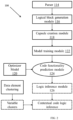
- the memory 110 further comprising a plurality of modules for performing various functions as shown in FIG. 2 .
- the plurality of modules comprising a parser 114, a logical block generation module 116, a capsule creation module 118, a model optimizer 120, a model training module 122, a functionality prediction module 124 and logic inference module 126 as shown in the block diagram of FIG. 2 .
- the system 100 supports various connectivity options such as BLUETOOTH ® , USB, ZigBee and other cellular services.
- the network environment enables connection of various components of the system 100 using any communication link including Internet, WAN, MAN, and so on.
- the system 100 is implemented to operate as a stand-alone device.
- the system 100 may be implemented to work as a loosely coupled device to a smart computing environment.
- the components and functionalities of the system 100 are described further in detail.
- the memory 110 further comprises a plurality of modules. The plurality of modules are configured to perform various functions.
- FIG. 3 a flowchart 300 for inferencing logic out of the application source code is shown in FIG. 3 in accordance with an embodiment of the present disclosure.
- the application source code is provided as an input via the user interface 104.
- the application source code is parsed using the parsers 114.
- the parsing results in generation of a code language independent repository.
- the code language independent repository comprising information about the application source code.
- the application source code is fed into technology specific parsers which can understand the syntax of the application source code.
- the parsers scan through each and every character in the code and generates a language independent repository. This repository has the complete information about the source code including its flow, dependencies and structural aspects.
- the information related to each other present in the repository is linked together to extract a plurality of logical blocks using the logical block generation module 116 as shown in FIG. 4 .
- the repository with the complete blueprint of the source code is available. It is essential to link the items within the generated repository and start extracting out blocks based on logical relationships.
- the plurality of logical blocks comprises a plurality of leaf nodes, its corresponding scope till the root node of the block and sequential distances between each nodes of the plurality of leaf nodes.
- the logical block generation module 116 categorizes the source code into logical blocks from which the code logic is predicted.
- the application source code in its raw form generally does not have any uniformity or information on the underlying complexity and the slightest mistake in analyzing / modifying it may have a huge impact for the existing and interfacing applications.
- the logical block generation module 116 understands the syntax and the impact of a statement and groups the statements based on the logical linkage into data blocks, control blocks and condition blocks.
- Data block The code functionality generally begins with receiving the input to be processed. Once the input is received, it is prepared for processing. All the code statements which are involved in receiving the input, receiving the input into local variables in the code, preparing the inputs for processing etc. are grouped together as data blocks. These data blocks will further feed in the information to different type of evaluation, comparison and computations downstream in the code flow
- Control block Understanding of these control transferring statements and the decoding the logical execution is essential to create logical blocks of code. Control transferred through these statements can be permanent or temporary transfer and maintaining the point of entry / point of return during the control transfer is essential. These control transferring statements along with the information about the point of entry / point of return forms the control blocks.
- the condition block refers to statements / blocks in the code containing the conditional decision-making points.
- the action blocks that are executed conditionally and performed as a part of the condition success / failure also form a part of these blocks.
- the logical block generation module 116 organizes these blocks that are segregated as the data blocks, the condition blocks and the control blocks by decoding the execution sequence and generated logical units / logical blocks of code.
- the logical block generation module 116 also has a defined optimal threshold limit. This threshold limit will help the module decide the size of the logical block. This limit will also internally govern the decision whether the control block should be expanded in a logical unit that is created / left unexpanded. The need for source code in its raw form is discarded from this step and the logical blocks of code generated from the logical block generation module will be used for further processing.
- the capsule creation module 118 converts the hierarchical structure into the consumable vectors for the model.
- a plurality of capsules is created using the capsule creation module 118.
- the plurality of capsules is created for each pair of the plurality of leaf nodes from the plurality of logical blocks based on a scope of the leaf nodes and sequential distance between the leaf nodes of each pair of the plurality of leaf nodes.
- the plurality of capsules further comprising one or more of a plurality of leaf node sub-capsules, a plurality of path sub-capsules, or a plurality of sequential distance sub-capsules.
- a schematic block diagram of the capsule creation module 118 is shown in FIG. 5 . It receives the plurality of logical blocks as input. Further, it identifies leaf node couples and root node based scope. Further, the capsule creation module 118 also identifies the sequential distances between each of the leaf node couples. Thus, all the leaf nodes within each of the logical block in the code are taken and a capsule is created for each pair based on its unique identity in the block, the scope and sequential distances.
- the capsule creation module 118 also configured to convert the hierarchical structure into capsules, which is of the following types:
- an optimized set of hyper parameters of a machine learning model is calculated using the model optimizer 120 as shown in schematic diagram of FIG. 7 .
- the machine learning model is trained using the calculated hyper parameters using the model training module 122.
- the accuracy of the results of a neural network model is dependent on the tunable hyper parameters assigned to the model.
- These tunable hyper parameters of the code logic inference model have to be iteratively tuned for the training data given to the code logic inference model. Even a small change or addition in the training data may warrant a huge effort to achieve the same or similar output precision.
- the present disclosure is utilizing the model optimizer 120 which helps the model to learn from any new / additional labelled training data seamlessly.
- These hyper parameters are automatically decided by the model optimizer based on the accuracy, loss and base model architecture.
- Bayesian optimization which tries to do a search on a space.
- Bayesian optimization is efficient in tuning few hyper-parameters but its efficiency degrades a lot when the search dimension increases too much, up to a point where it is on par with random search. This allows to leverage the usage neural network.
- the optimizer model doesn't scan through the dataset for fine-tuning.
- the process enumerated is an iterative, intuitive way of fine-tuning the parameters to do optimization.
- Model centric parameters such as number of layers, number of layer configuration etc. and training centric parameters such as number of epochs, batch size etc. are automatically generated and tuned based on the feedback. The much difficult task of reconfiguring the model without disturbing the base stature of the architecture is achieved through this.
- the system 100 is utilizing a capsule creation and embedding approach that is different from existing vectorization approaches for source code.
- Existing Random walk-based algorithms generate vector representations of nodes in a graph. These frameworks learn low-dimensional representations for nodes in a graph through the use of random walks through a graph starting at a target node.
- the embedding is learnt for the syntactical path (Not node). The idea of random walk to structured walk (Single Path) is restricted between two leaf nodes, thereby capturing the semantics/syntax of a code block.
- the capsule creation process is also unique in capturing the scope and linking that with the other sub-capsules.
- This Scope based addition contributes in the process of differentiating same leaf node present in different parts of the structure of a block. Addition of executional flow of the statement clearly differentiates two leaf nodes which are closer in the execution and the leaf nodes which are farther in the execution. To do this, the complete information until the root node of the logical block is captured. The root node and the depth of the scope is dependent on the logical block, unlike the existing works, which go just until the immediate common parent. This helps in retaining the contextual positions of the statements in the block and differentiate the statements, even though they might be the same exact statement repeated in different contexts. For example, PARA3.
- the present disclosure adapts a memory efficient way in handling these variables by using encoding techniques which assigns values relative to each new code block depending on its position of occurrence. This helps in maintaining the information of the variable, without disturbing the semantics nor is biasing the model towards what variable name is being used. This also solves the Out of Vocabulary problem since it doesn't depend on the variable name to assign a value but only on the position of its occurrence in a block.
- the variables AC-BALANCE, NEW-TBALANCE might have any hash value associated with it ranging from a possibility of 0 to the maximum vocabulary size (which often-times is very big - depending on the training data used).
- FLAG gets an encoding value of 1, AC-BALANCE as 2, NEW-TBALANCE as 3 and AMOUNT as 4.
- it is limited to a specific number for each block (presently 100, which is decided based on, the optimum size of a logical block) and this surpasses the above discussed problems.
- the optimizer model takes in the base model architecture, the desired loss, the desired accuracy to be achieved as the input. Given the current loss and the current accuracy, it starts to generate a specific combination of parameters which is sent back to the Code logic inference module. Once another set of loss and accuracy is obtained the gradient descent tries to intuitively modify the architecture in the given set of trials. The reinitialization happens in given set trials, best initialization is found out to be the best suited architecture for code logic Inference.
- the system 100 comprises a metrics analyser 702 and an init module 704.
- the metrics analyser 702 takes in the desired accuracy and the desired loss to be achieved and the current accuracy, loss of the model with the given set of parameters.
- the mentioned inputs are taken in, and suitable tunings for the optimizer model's weights are obtained by the process of back-propagation which is then sent to the init module 704.
- the init module 704 tunes the weights with respect to the gradients obtained from the metrics analyzer 702 and gives outputs in float values - which is rounded off to the nearest integer. These values are sent in as hyper-parameters of the code logic inference model. For a given set of Input, the maximum achievable accuracy is also determined by the optimizer model. Specification of the model optimizer: Dimensions of the weights in the model attributed to the output features:
- the set C represents the entire block into these capsules.
- Each capsule has 5 different parts: 1) Start Leaf Node, 2) Scope of Start Leaf Node, 3) Sequential Executional Distance between Start and the End Leaf Node, 4) Scope of End Leaf Node, and 5) End Leaf Node.
- Feed forward network (Leaf): The feed forward network contains a set of feed forward layers wherein the input is the encoding of each leaf node (Start and End) to obtain the representation of each leaf sub-capsule.
- Path embedding The scope based path information about each leaf node is given into the embedding layer which produces embedding for each scope sub-capsule.
- the Embedding is of the size which is product of length of the scope sub-capsule and the embedding dimension.
- Feed forward network (Sequential distance): This takes in the sequential distance sub-capsule as the input and gives out a representation based on the sequential path traced between start and end leaf nodes.
- Attention This takes in feed forward network's (Leaf) output and path embedding concatenated into one vector. The concatenated vector is then given more attention based on the backpropagation of the training process.
- Code Functionality Head The output of feed forward network (Sequential Distance) and the attention (concatenated together) passed into a set of feed forward layers makes a representation for each capsule.
- the code functionality head expects each block to have uniform number of capsules. Based on the summed-attention of each capsule, capsule set of size n gets filtered to the most important set of capsules of size m. Wherein, m is the maximum attentive capsules based on summed-attention and n is always greater than or equal to m. These vectors are passed into code functionality head and classified.
- the functionality of the plurality of logical blocks is predicted by vectorizing the plurality of logical blocks using the plurality of capsules and the trained machine learning model, via the functionality prediction module 124.
- the trained machine learning module is used for predicting the functionality of the extracted code blocks and establish the functionality as shown in schematic diagram of FIG. 6 .
- Code functionality prediction The outputs from the capsule creation module 118 and the model training module 122 act as an input to this phase.
- the plurality of logical blocks is further split into capsules based on the leaf nodes. These capsules are fed into a neural network where they go through the embedding, attention layer and classification stages based on the weights assigned by the pre-trained model. As an output of the neural network, code functionality classifications are achieved.
- the predicted functionality of the plurality of logical blocks is merged with a plurality of external inputs to determine context specific code logic inference of the application source code, wherein the plurality of external inputs are taken from one or more external learning models.
- the embodiments of present disclosure herein addresses unresolved problem of effectively getting inference out of the application source code.
- the embodiment thus provides the method and system for inferencing logic out of an application source code.
- the hardware device can be any kind of device which can be programmed including e.g. any kind of computer like a server or a personal computer, or the like, or any combination thereof.
- the device may also include means which could be e.g. hardware means like e.g. an application-specific integrated circuit (ASIC), a field-programmable gate array (FPGA), or a combination of hardware and software means, e.g.
- ASIC application-specific integrated circuit
- FPGA field-programmable gate array
- the means can include both hardware means and software means.
- the method embodiments described herein could be implemented in hardware and software.
- the device may also include software means.
- the embodiments may be implemented on different hardware devices, e.g. using a plurality of CPUs, GPUs etc.
- the embodiments herein can comprise hardware and software elements.
- the embodiments that are implemented in software include but are not limited to, firmware, resident software, microcode, etc.
- the functions performed by various components described herein may be implemented in other components or combinations of other components.
- a computer-usable or computer readable medium can be any apparatus that can comprise, store, communicate, propagate, or transport the program for use by or in connection with the instruction execution system, apparatus, or device.
- a computer-readable storage medium refers to any type of physical memory on which information or data readable by a processor may be stored.
- a computer-readable storage medium may store instructions for execution by one or more processors, including instructions for causing the processor(s) to perform steps or stages consistent with the embodiments described herein.
- the term "computer-readable medium” should be understood to include tangible items and exclude carrier waves and transient signals, i.e., be non-transitory. Examples include random access memory (RAM), read-only memory (ROM), volatile memory, nonvolatile memory, hard drives, CD ROMs, DVDs, flash drives, disks, and any other known physical storage media.
Landscapes
- Engineering & Computer Science (AREA)
- Theoretical Computer Science (AREA)
- Software Systems (AREA)
- General Engineering & Computer Science (AREA)
- General Physics & Mathematics (AREA)
- Physics & Mathematics (AREA)
- Evolutionary Computation (AREA)
- Computing Systems (AREA)
- Data Mining & Analysis (AREA)
- Mathematical Physics (AREA)
- Artificial Intelligence (AREA)
- Computational Linguistics (AREA)
- Computer Vision & Pattern Recognition (AREA)
- Medical Informatics (AREA)
- Library & Information Science (AREA)
- Stored Programmes (AREA)
Claims (5)
- Prozessorimplementiertes Verfahren (300) zum Inferenzieren von Logik aus einem Anwendungsquellcode, wobei das Verfahren Folgendes umfasst:Bereitstellen des Anwendungsquellcodes als eine Eingabe (302) über eine Benutzerschnittstelle;Parsen des Anwendungsquellcodes unter Verwendung von Parsern über einen oder mehrere Hardwareprozessoren, wobei das Parsen zur Erzeugung eines codesprachenunabhängigen Speichers führt, wobei der codesprachenunabhängige Speicher Informationen über den Anwendungsquellcode umfasst, wobei die Parser jedes Zeichen in dem Anwendungsquellcode abtasten und wobei der codesprachenunabhängige Speicher Informationen über den Anwendungsquellcode umfasst, wobei die Informationen mindestens eines von Fluss, Abhängigkeiten und strukturellen Aspekten des Anwendungsquellcodes (304) umfassen;Verknüpfen der Informationen, die sich auf einander beziehen und in dem codesprachenunabhängigen Speicher vorhanden sind, über den einen oder die mehreren Hardwareprozessoren, um eine Mehrzahl von logischen Blöcken zu extrahieren, wobei die Mehrzahl von logischen Blöcken eine Mehrzahl von Blattknoten, einen Umfang bis zu einem Wurzelknoten des logischen Blocks und sequentielle Abstände zwischen jedem Knoten der Mehrzahl von Blattknoten umfasst, wobei die Mehrzahl von logischen Blöcken, die eine oder mehrere einer Mehrzahl von logisch verknüpften Codeanweisungen umfassen, zur Definition von Datenblöcken, Steuerblöcken und Bedingungsblöcken führt, wobei die Größe der Mehrzahl von logischen Blöcken durch einen Satz von Schwellenwerten (306) bestimmt wird;Umwandeln des logischen Blocks, der in Form einer hierarchischen Struktur angeordnet ist, über den einen oder die mehreren Hardwareprozessoren in einen oder mehrere Verbrauchsvektoren;Erzeugen einer Mehrzahl von Kapseln für jedes Paar der Mehrzahl von Blattknoten aus der Mehrzahl von logischen Blöcken basierend auf dem Umfang der Blattknoten und dem sequentiellen Abstand zwischen den Blattknoten jedes Paars der Mehrzahl von Blattknoten über den einen oder die mehreren Hardwareprozessoren, wobei die Mehrzahl von Kapseln eine oder mehrere Blattknotenunterkapseln, eine Mehrzahl von Pfadunterkapseln und eine Mehrzahl von sequentiellen Abstandsunterkapseln (308) umfasst;Berechnen eines optimierten Satzes von Hyperparametern eines Maschinenlernmodells unter Verwendung eines Optimierermodells (310) über den einen oder die mehreren Hardwareprozessoren;Trainieren des Maschinenlernmodells unter Verwendung der berechneten Hyperparameter (312) über den einen oder die mehreren Hardwareprozessoren;Vorhersagen der Funktionalität der Mehrzahl von logischen Blöcken über den einen oder die mehreren Hardwareprozessoren durch Vektorisieren der Mehrzahl von logischen Blöcken unter Verwendung der Mehrzahl von Kapseln und des trainierten Maschinenlernmodells (314); undZusammenführen der vorhergesagten Funktionalität mit einer Mehrzahl von externen Eingaben über den einen oder die mehreren Hardwareprozessoren, um eine Codelogikinferenz des Anwendungsquellcodes (316) zu bestimmen.
- Verfahren nach Anspruch 1, wobei das Parsen unter Verwendung einer Mehrzahl von technologiespezifischen Parsern durchgeführt wird, um die Syntax des Anwendungsquellcodes zu verstehen.
- Verfahren nach Anspruch 1, ferner umfassend das Neutrainieren des Maschinenlernmodells mit zusätzlicher Eingabe unter Verwendung des Optimierermodells.
- System (100) zum Inferenzieren von Logik aus einem Anwendungsquellcode, wobei das System Folgendes umfasst:eine Benutzerschnittstelle (104) zum Bereitstellen des Anwendungsquellcodes als eine Eingabe;einen oder mehrere Hardwareprozessoren (108);einen Speicher (110) in Kommunikation mit dem einen oder den mehreren Hardwareprozessoren, wobei der eine oder die mehreren ersten Hardwareprozessoren konfiguriert sind, um programmierte Anweisungen auszuführen, die in dem einen oder den mehreren ersten Speichern gespeichert sind, um:den Anwendungsquellcode unter Verwendung von Parsern zu parsen, wobei das Parsen zur Erzeugung eines codesprachenunabhängigen Speichers führt, wobei der codesprachenunabhängige Speicher Informationen über den Anwendungsquellcode umfasst, wobei die Parser jedes Zeichen in dem Anwendungsquellcode abtasten und wobei der codesprachenunabhängige Speicher vollständige Informationen über den Anwendungsquellcode umfasst, wobei die Informationen mindestens eines von Fluss, Abhängigkeiten und strukturellen Aspekten des Anwendungsquellcodes umfassen;die Informationen, die sich auf einander beziehen und in dem codesprachenunabhängigen Speicher vorhanden sind, zu verknüpfen, um eine Mehrzahl von logischen Blöcken zu extrahieren, wobei die Mehrzahl von logischen Blöcken eine Mehrzahl von Blattknoten, einen Umfang bis zu einem Wurzelknoten des logischen Blocks und sequentielle Abstände zwischen jedem Knoten der Mehrzahl von Blattknoten umfasst, wobei die Mehrzahl von logischen Blöcken, die eine oder mehrere einer Mehrzahl von logisch verknüpften Codeanweisungen umfassen, zur Definition von Datenblöcken, Steuerblöcken und Bedingungsblöcken führt, wobei die Größe der Mehrzahl von logischen Blöcken durch einen Satz von Schwellenwerten bestimmt wird;den logischen Block, der in Form einer hierarchischen Struktur angeordnet ist, in einen oder mehrere Verbrauchsvektoren umzuwandeln;eine Mehrzahl von Kapseln für jedes Paar der Mehrzahl von Blattknoten aus der Mehrzahl von logischen Blöcken basierend auf dem Umfang der Blattknoten und dem sequentiellen Abstand zwischen den Blattknoten jedes Paars der Mehrzahl von Blattknoten zu erzeugen, wobei die Mehrzahl von Kapseln eine oder mehrere Blattknotenunterkapseln, eine Mehrzahl von Pfadunterkapseln und eine Mehrzahl von sequentiellen Abstandsunterkapseln umfasst;einen optimierten Satz von Hyperparametern eines Maschinenlernmodells unter Verwendung eines Optimierermodells zu berechnen;das Maschinenlernmodell unter Verwendung der berechneten Hyperparameter zu trainieren;die Funktionalität der Mehrzahl von logischen Blöcken durch Vektorisieren der Mehrzahl von logischen Blöcken unter Verwendung der Mehrzahl von Kapseln und des trainierten Maschinenlernmodells vorherzusagen; unddie vorhergesagte Funktionalität mit einer Mehrzahl von externen Eingaben zusammenzuführen, um eine Codelogikinferenz des Anwendungsquellcodes zu bestimmen.
- Computerprogrammprodukt, umfassend ein nichtflüchtiges computerlesbares Medium mit einem darin verkörperten computerlesbaren Programm, wobei das computerlesbare Programm, wenn es auf einer Rechenvorrichtung ausgeführt wird, die Rechenvorrichtung zu Folgendem veranlasst:Parsen des Anwendungsquellcodes unter Verwendung von Parsern, wobei das Parsen zur Erzeugung eines codesprachenunabhängigen Speichers führt, wobei der codesprachenunabhängige Speicher Informationen über den Anwendungsquellcode umfasst, wobei die Parser jedes Zeichen in dem Anwendungsquellcode abtasten und wobei der codesprachenunabhängige Speicher vollständige Informationen über den Anwendungsquellcode umfasst, wobei die Informationen mindestens eines von Fluss, Abhängigkeiten und strukturellen Aspekten des Anwendungsquellcodes umfassen;Verknüpfen der Informationen, die sich auf einander beziehen und in dem codesprachenunabhängigen Speicher vorhanden sind, um eine Mehrzahl von logischen Blöcken zu extrahieren, wobei die Mehrzahl von logischen Blöcken eine Mehrzahl von Blattknoten, einen Umfang bis zu einem Wurzelknoten des logischen Blocks und sequentielle Abstände zwischen jedem Knoten der Mehrzahl von Blattknoten umfasst, wobei die Mehrzahl von logischen Blöcken, die eine oder mehrere einer Mehrzahl von logisch verknüpften Codeanweisungen umfassen, zur Definition von Datenblöcken, Steuerblöcken und Bedingungsblöcken führt, wobei die Größe der Mehrzahl von logischen Blöcken durch einen Satz von Schwellenwerten bestimmt wird;Umwandeln des logischen Blocks, der in Form einer hierarchischen Struktur angeordnet ist, in einen oder mehrere Verbrauchsvektoren;Erzeugen einer Mehrzahl von Kapseln für jedes Paar der Mehrzahl von Blattknoten aus der Mehrzahl von logischen Blöcken basierend auf dem Umfang der Blattknoten und dem sequentiellen Abstand zwischen den Blattknoten jedes Paars der Mehrzahl von Blattknoten, wobei die Mehrzahl von Kapseln eine oder mehrere Blattknotenunterkapseln, eine Mehrzahl von Pfadunterkapseln und eine Mehrzahl von sequentiellen Abstandsunterkapseln umfasst;Berechnen eines optimierten Satzes von Hyperparametern eines Maschinenlernmodells unter Verwendung eines Optimierermodells;Trainieren des Maschinenlernmodells unter Verwendung der berechneten Hyperparameter;Vorhersagen der Funktionalität der Mehrzahl von logischen Blöcken durch Vektorisieren der Mehrzahl von logischen Blöcken unter Verwendung der Mehrzahl von Kapseln und des trainierten Maschinenlernmodells; undZusammenführen der vorhergesagten Funktionalität mit einer Mehrzahl von externen Eingaben, um eine Codelogikinferenz des Anwendungsquellcodes zu bestimmen.
Applications Claiming Priority (1)
| Application Number | Priority Date | Filing Date | Title |
|---|---|---|---|
| IN202121001729 | 2021-01-13 |
Publications (3)
| Publication Number | Publication Date |
|---|---|
| EP4030281A1 EP4030281A1 (de) | 2022-07-20 |
| EP4030281C0 EP4030281C0 (de) | 2024-07-31 |
| EP4030281B1 true EP4030281B1 (de) | 2024-07-31 |
Family
ID=75111429
Family Applications (1)
| Application Number | Title | Priority Date | Filing Date |
|---|---|---|---|
| EP21163591.7A Active EP4030281B1 (de) | 2021-01-13 | 2021-03-19 | Verfahren und system zum inferencing-logik aus einem anwendungsquellcode |
Country Status (2)
| Country | Link |
|---|---|
| US (1) | US11487533B2 (de) |
| EP (1) | EP4030281B1 (de) |
Families Citing this family (2)
| Publication number | Priority date | Publication date | Assignee | Title |
|---|---|---|---|---|
| WO2022221603A1 (en) * | 2021-04-16 | 2022-10-20 | Cognizer, Inc. | System and method for nested named entity recognition |
| US12204434B2 (en) * | 2022-08-04 | 2025-01-21 | Karma Automotive Llc | Build system supporting code audits, code verification, and software forensics |
Family Cites Families (10)
| Publication number | Priority date | Publication date | Assignee | Title |
|---|---|---|---|---|
| US20040031015A1 (en) | 2001-05-24 | 2004-02-12 | Conexant Systems, Inc. | System and method for manipulation of software |
| US20030083900A1 (en) | 2001-10-26 | 2003-05-01 | Ismail Khriss | Template-based method and system for reverse engineering |
| JP6996936B2 (ja) | 2017-10-25 | 2022-01-17 | 株式会社日立製作所 | ソースコード解析装置、ソースコード解析方法、ソースコード解析プログラム |
| US11270217B2 (en) | 2017-11-17 | 2022-03-08 | Intel Corporation | Systems and methods implementing an intelligent machine learning tuning system providing multiple tuned hyperparameter solutions |
| CN108062587A (zh) | 2017-12-15 | 2018-05-22 | 清华大学 | 一种无监督机器学习的超参数自动优化方法及系统 |
| US11256502B2 (en) * | 2018-10-25 | 2022-02-22 | Affirm, Inc. | Automatic generation of documentation and aggregation of community content |
| US11099820B2 (en) * | 2019-06-19 | 2021-08-24 | International Business Machines Corporation | Reconfiguring application software into microservice architecture |
| US11003444B2 (en) * | 2019-06-28 | 2021-05-11 | Intel Corporation | Methods and apparatus for recommending computer program updates utilizing a trained model |
| US20200327118A1 (en) * | 2020-06-27 | 2020-10-15 | Intel Corporation | Similarity search using guided reinforcement learning |
| US11513774B2 (en) * | 2021-01-03 | 2022-11-29 | Microsoft Technology Licensing, Llc. | Multi-lingual code generation with zero-shot inference |
-
2021
- 2021-03-18 US US17/205,455 patent/US11487533B2/en active Active
- 2021-03-19 EP EP21163591.7A patent/EP4030281B1/de active Active
Also Published As
| Publication number | Publication date |
|---|---|
| EP4030281A1 (de) | 2022-07-20 |
| US20220222069A1 (en) | 2022-07-14 |
| US11487533B2 (en) | 2022-11-01 |
| EP4030281C0 (de) | 2024-07-31 |
Similar Documents
| Publication | Publication Date | Title |
|---|---|---|
| US12536377B2 (en) | Extracting definitions from documents utilizing definition-labeling-dependent machine learning background | |
| US20240020096A1 (en) | Systems and methods for generating code using language models trained on computer code | |
| US11720346B2 (en) | Semantic code retrieval using graph matching | |
| US12175214B2 (en) | Unit test case generation with transformers | |
| US11321625B2 (en) | Quantum circuit optimization using machine learning | |
| KR102173555B1 (ko) | 머신 러닝 기반 네트워크 모델 구축 방법 및 장치 | |
| US11573771B2 (en) | Predicting code editor | |
| US12217007B2 (en) | Providing a semantic encoding and language neural network | |
| Borovits et al. | DeepIaC: deep learning-based linguistic anti-pattern detection in IaC | |
| US12008580B2 (en) | Natural language processing machine learning to convert service recommendations to actionable objects | |
| US20220277176A1 (en) | Log classification using machine learning | |
| KR20220050915A (ko) | 계층적 클러스터링을 사용한 희귀 토픽 탐지 | |
| US12314154B2 (en) | Code execution trace generation with pre-trained large language model | |
| EP4030281B1 (de) | Verfahren und system zum inferencing-logik aus einem anwendungsquellcode | |
| US11861378B2 (en) | Vector-space representations of graphical user interfaces | |
| WO2016093839A1 (en) | Structuring of semi-structured log messages | |
| Johansson et al. | Mapping source code to software architecture by leveraging large language models | |
| Li et al. | Extracting features from requirements: Achieving accuracy and automation with neural networks | |
| Aladics et al. | An AST-based code change representation and its performance in just-in-time vulnerability prediction | |
| CN117609005B (zh) | 一种代码相似度检测方法 | |
| Cheng et al. | DLLog: An Online Log Parsing Approach for Large‐Scale System | |
| Nguyen et al. | Efficient log-based anomaly detection with knowledge distillation | |
| Nazar et al. | NextG-GPT: Leveraging GenAI for Advancing Wireless Networks and Communication Research | |
| Malik et al. | Application of containerized microservice approach to airline sentiment analysis | |
| Nagy et al. | A survey on code representation |
Legal Events
| Date | Code | Title | Description |
|---|---|---|---|
| PUAI | Public reference made under article 153(3) epc to a published international application that has entered the european phase |
Free format text: ORIGINAL CODE: 0009012 |
|
| STAA | Information on the status of an ep patent application or granted ep patent |
Free format text: STATUS: THE APPLICATION HAS BEEN PUBLISHED |
|
| AK | Designated contracting states |
Kind code of ref document: A1 Designated state(s): AL AT BE BG CH CY CZ DE DK EE ES FI FR GB GR HR HU IE IS IT LI LT LU LV MC MK MT NL NO PL PT RO RS SE SI SK SM TR |
|
| STAA | Information on the status of an ep patent application or granted ep patent |
Free format text: STATUS: REQUEST FOR EXAMINATION WAS MADE |
|
| 17P | Request for examination filed |
Effective date: 20220817 |
|
| RBV | Designated contracting states (corrected) |
Designated state(s): AL AT BE BG CH CY CZ DE DK EE ES FI FR GB GR HR HU IE IS IT LI LT LU LV MC MK MT NL NO PL PT RO RS SE SI SK SM TR |
|
| STAA | Information on the status of an ep patent application or granted ep patent |
Free format text: STATUS: EXAMINATION IS IN PROGRESS |
|
| 17Q | First examination report despatched |
Effective date: 20231026 |
|
| GRAP | Despatch of communication of intention to grant a patent |
Free format text: ORIGINAL CODE: EPIDOSNIGR1 |
|
| STAA | Information on the status of an ep patent application or granted ep patent |
Free format text: STATUS: GRANT OF PATENT IS INTENDED |
|
| INTG | Intention to grant announced |
Effective date: 20240220 |
|
| GRAS | Grant fee paid |
Free format text: ORIGINAL CODE: EPIDOSNIGR3 |
|
| GRAA | (expected) grant |
Free format text: ORIGINAL CODE: 0009210 |
|
| STAA | Information on the status of an ep patent application or granted ep patent |
Free format text: STATUS: THE PATENT HAS BEEN GRANTED |
|
| AK | Designated contracting states |
Kind code of ref document: B1 Designated state(s): AL AT BE BG CH CY CZ DE DK EE ES FI FR GB GR HR HU IE IS IT LI LT LU LV MC MK MT NL NO PL PT RO RS SE SI SK SM TR |
|
| REG | Reference to a national code |
Ref country code: CH Ref legal event code: EP Ref country code: GB Ref legal event code: FG4D |
|
| REG | Reference to a national code |
Ref country code: DE Ref legal event code: R096 Ref document number: 602021016329 Country of ref document: DE |
|
| REG | Reference to a national code |
Ref country code: IE Ref legal event code: FG4D |
|
| U01 | Request for unitary effect filed |
Effective date: 20240731 |
|
| U07 | Unitary effect registered |
Designated state(s): AT BE BG DE DK EE FI FR IT LT LU LV MT NL PT SE SI Effective date: 20240807 |
|
| PG25 | Lapsed in a contracting state [announced via postgrant information from national office to epo] |
Ref country code: NO Free format text: LAPSE BECAUSE OF FAILURE TO SUBMIT A TRANSLATION OF THE DESCRIPTION OR TO PAY THE FEE WITHIN THE PRESCRIBED TIME-LIMIT Effective date: 20241031 |
|
| PG25 | Lapsed in a contracting state [announced via postgrant information from national office to epo] |
Ref country code: GR Free format text: LAPSE BECAUSE OF FAILURE TO SUBMIT A TRANSLATION OF THE DESCRIPTION OR TO PAY THE FEE WITHIN THE PRESCRIBED TIME-LIMIT Effective date: 20241101 Ref country code: PL Free format text: LAPSE BECAUSE OF FAILURE TO SUBMIT A TRANSLATION OF THE DESCRIPTION OR TO PAY THE FEE WITHIN THE PRESCRIBED TIME-LIMIT Effective date: 20240731 |
|
| PG25 | Lapsed in a contracting state [announced via postgrant information from national office to epo] |
Ref country code: IS Free format text: LAPSE BECAUSE OF FAILURE TO SUBMIT A TRANSLATION OF THE DESCRIPTION OR TO PAY THE FEE WITHIN THE PRESCRIBED TIME-LIMIT Effective date: 20241130 |
|
| PG25 | Lapsed in a contracting state [announced via postgrant information from national office to epo] |
Ref country code: HR Free format text: LAPSE BECAUSE OF FAILURE TO SUBMIT A TRANSLATION OF THE DESCRIPTION OR TO PAY THE FEE WITHIN THE PRESCRIBED TIME-LIMIT Effective date: 20240731 |
|
| PG25 | Lapsed in a contracting state [announced via postgrant information from national office to epo] |
Ref country code: RS Free format text: LAPSE BECAUSE OF FAILURE TO SUBMIT A TRANSLATION OF THE DESCRIPTION OR TO PAY THE FEE WITHIN THE PRESCRIBED TIME-LIMIT Effective date: 20241031 Ref country code: ES Free format text: LAPSE BECAUSE OF FAILURE TO SUBMIT A TRANSLATION OF THE DESCRIPTION OR TO PAY THE FEE WITHIN THE PRESCRIBED TIME-LIMIT Effective date: 20240731 |
|
| PG25 | Lapsed in a contracting state [announced via postgrant information from national office to epo] |
Ref country code: RS Free format text: LAPSE BECAUSE OF FAILURE TO SUBMIT A TRANSLATION OF THE DESCRIPTION OR TO PAY THE FEE WITHIN THE PRESCRIBED TIME-LIMIT Effective date: 20241031 Ref country code: PL Free format text: LAPSE BECAUSE OF FAILURE TO SUBMIT A TRANSLATION OF THE DESCRIPTION OR TO PAY THE FEE WITHIN THE PRESCRIBED TIME-LIMIT Effective date: 20240731 Ref country code: NO Free format text: LAPSE BECAUSE OF FAILURE TO SUBMIT A TRANSLATION OF THE DESCRIPTION OR TO PAY THE FEE WITHIN THE PRESCRIBED TIME-LIMIT Effective date: 20241031 Ref country code: IS Free format text: LAPSE BECAUSE OF FAILURE TO SUBMIT A TRANSLATION OF THE DESCRIPTION OR TO PAY THE FEE WITHIN THE PRESCRIBED TIME-LIMIT Effective date: 20241130 Ref country code: HR Free format text: LAPSE BECAUSE OF FAILURE TO SUBMIT A TRANSLATION OF THE DESCRIPTION OR TO PAY THE FEE WITHIN THE PRESCRIBED TIME-LIMIT Effective date: 20240731 Ref country code: GR Free format text: LAPSE BECAUSE OF FAILURE TO SUBMIT A TRANSLATION OF THE DESCRIPTION OR TO PAY THE FEE WITHIN THE PRESCRIBED TIME-LIMIT Effective date: 20241101 Ref country code: ES Free format text: LAPSE BECAUSE OF FAILURE TO SUBMIT A TRANSLATION OF THE DESCRIPTION OR TO PAY THE FEE WITHIN THE PRESCRIBED TIME-LIMIT Effective date: 20240731 |
|
| PG25 | Lapsed in a contracting state [announced via postgrant information from national office to epo] |
Ref country code: SM Free format text: LAPSE BECAUSE OF FAILURE TO SUBMIT A TRANSLATION OF THE DESCRIPTION OR TO PAY THE FEE WITHIN THE PRESCRIBED TIME-LIMIT Effective date: 20240731 |
|
| PG25 | Lapsed in a contracting state [announced via postgrant information from national office to epo] |
Ref country code: CZ Free format text: LAPSE BECAUSE OF FAILURE TO SUBMIT A TRANSLATION OF THE DESCRIPTION OR TO PAY THE FEE WITHIN THE PRESCRIBED TIME-LIMIT Effective date: 20240731 |
|
| PG25 | Lapsed in a contracting state [announced via postgrant information from national office to epo] |
Ref country code: SK Free format text: LAPSE BECAUSE OF FAILURE TO SUBMIT A TRANSLATION OF THE DESCRIPTION OR TO PAY THE FEE WITHIN THE PRESCRIBED TIME-LIMIT Effective date: 20240731 |
|
| PGFP | Annual fee paid to national office [announced via postgrant information from national office to epo] |
Ref country code: GB Payment date: 20250325 Year of fee payment: 5 |
|
| U20 | Renewal fee for the european patent with unitary effect paid |
Year of fee payment: 5 Effective date: 20250325 |
|
| PLBE | No opposition filed within time limit |
Free format text: ORIGINAL CODE: 0009261 |
|
| STAA | Information on the status of an ep patent application or granted ep patent |
Free format text: STATUS: NO OPPOSITION FILED WITHIN TIME LIMIT |
|
| 26N | No opposition filed |
Effective date: 20250501 |
|
| PGFP | Annual fee paid to national office [announced via postgrant information from national office to epo] |
Ref country code: CH Payment date: 20250401 Year of fee payment: 5 |
|
| PG25 | Lapsed in a contracting state [announced via postgrant information from national office to epo] |
Ref country code: MC Free format text: LAPSE BECAUSE OF FAILURE TO SUBMIT A TRANSLATION OF THE DESCRIPTION OR TO PAY THE FEE WITHIN THE PRESCRIBED TIME-LIMIT Effective date: 20240731 |
|
| PG25 | Lapsed in a contracting state [announced via postgrant information from national office to epo] |
Ref country code: IE Free format text: LAPSE BECAUSE OF NON-PAYMENT OF DUE FEES Effective date: 20250319 |