EP4030071A1 - Shift lever bearing - Google Patents
Shift lever bearing Download PDFInfo
- Publication number
- EP4030071A1 EP4030071A1 EP20877097.4A EP20877097A EP4030071A1 EP 4030071 A1 EP4030071 A1 EP 4030071A1 EP 20877097 A EP20877097 A EP 20877097A EP 4030071 A1 EP4030071 A1 EP 4030071A1
- Authority
- EP
- European Patent Office
- Prior art keywords
- side wall
- shift lever
- wall portion
- peripheral side
- bearing
- Prior art date
- Legal status (The legal status is an assumption and is not a legal conclusion. Google has not performed a legal analysis and makes no representation as to the accuracy of the status listed.)
- Pending
Links
Images




Classifications
-
- F—MECHANICAL ENGINEERING; LIGHTING; HEATING; WEAPONS; BLASTING
- F16—ENGINEERING ELEMENTS AND UNITS; GENERAL MEASURES FOR PRODUCING AND MAINTAINING EFFECTIVE FUNCTIONING OF MACHINES OR INSTALLATIONS; THERMAL INSULATION IN GENERAL
- F16C—SHAFTS; FLEXIBLE SHAFTS; ELEMENTS OR CRANKSHAFT MECHANISMS; ROTARY BODIES OTHER THAN GEARING ELEMENTS; BEARINGS
- F16C11/00—Pivots; Pivotal connections
- F16C11/04—Pivotal connections
- F16C11/06—Ball-joints; Other joints having more than one degree of angular freedom, i.e. universal joints
- F16C11/0619—Ball-joints; Other joints having more than one degree of angular freedom, i.e. universal joints the female part comprising a blind socket receiving the male part
- F16C11/0623—Construction or details of the socket member
-
- F—MECHANICAL ENGINEERING; LIGHTING; HEATING; WEAPONS; BLASTING
- F16—ENGINEERING ELEMENTS AND UNITS; GENERAL MEASURES FOR PRODUCING AND MAINTAINING EFFECTIVE FUNCTIONING OF MACHINES OR INSTALLATIONS; THERMAL INSULATION IN GENERAL
- F16C—SHAFTS; FLEXIBLE SHAFTS; ELEMENTS OR CRANKSHAFT MECHANISMS; ROTARY BODIES OTHER THAN GEARING ELEMENTS; BEARINGS
- F16C11/00—Pivots; Pivotal connections
- F16C11/04—Pivotal connections
- F16C11/06—Ball-joints; Other joints having more than one degree of angular freedom, i.e. universal joints
- F16C11/0614—Ball-joints; Other joints having more than one degree of angular freedom, i.e. universal joints the female part of the joint being open on two sides
-
- F—MECHANICAL ENGINEERING; LIGHTING; HEATING; WEAPONS; BLASTING
- F16—ENGINEERING ELEMENTS AND UNITS; GENERAL MEASURES FOR PRODUCING AND MAINTAINING EFFECTIVE FUNCTIONING OF MACHINES OR INSTALLATIONS; THERMAL INSULATION IN GENERAL
- F16C—SHAFTS; FLEXIBLE SHAFTS; ELEMENTS OR CRANKSHAFT MECHANISMS; ROTARY BODIES OTHER THAN GEARING ELEMENTS; BEARINGS
- F16C11/00—Pivots; Pivotal connections
- F16C11/04—Pivotal connections
- F16C11/06—Ball-joints; Other joints having more than one degree of angular freedom, i.e. universal joints
- F16C11/0619—Ball-joints; Other joints having more than one degree of angular freedom, i.e. universal joints the female part comprising a blind socket receiving the male part
- F16C11/0623—Construction or details of the socket member
- F16C11/0628—Construction or details of the socket member with linings
- F16C11/0633—Construction or details of the socket member with linings the linings being made of plastics
-
- F—MECHANICAL ENGINEERING; LIGHTING; HEATING; WEAPONS; BLASTING
- F16—ENGINEERING ELEMENTS AND UNITS; GENERAL MEASURES FOR PRODUCING AND MAINTAINING EFFECTIVE FUNCTIONING OF MACHINES OR INSTALLATIONS; THERMAL INSULATION IN GENERAL
- F16C—SHAFTS; FLEXIBLE SHAFTS; ELEMENTS OR CRANKSHAFT MECHANISMS; ROTARY BODIES OTHER THAN GEARING ELEMENTS; BEARINGS
- F16C11/00—Pivots; Pivotal connections
- F16C11/04—Pivotal connections
- F16C11/06—Ball-joints; Other joints having more than one degree of angular freedom, i.e. universal joints
- F16C11/08—Ball-joints; Other joints having more than one degree of angular freedom, i.e. universal joints with resilient bearings
-
- B—PERFORMING OPERATIONS; TRANSPORTING
- B60—VEHICLES IN GENERAL
- B60K—ARRANGEMENT OR MOUNTING OF PROPULSION UNITS OR OF TRANSMISSIONS IN VEHICLES; ARRANGEMENT OR MOUNTING OF PLURAL DIVERSE PRIME-MOVERS IN VEHICLES; AUXILIARY DRIVES FOR VEHICLES; INSTRUMENTATION OR DASHBOARDS FOR VEHICLES; ARRANGEMENTS IN CONNECTION WITH COOLING, AIR INTAKE, GAS EXHAUST OR FUEL SUPPLY OF PROPULSION UNITS IN VEHICLES
- B60K20/00—Arrangement or mounting of change-speed gearing control devices in vehicles
- B60K20/02—Arrangement or mounting of change-speed gearing control devices in vehicles of initiating means
-
- Y—GENERAL TAGGING OF NEW TECHNOLOGICAL DEVELOPMENTS; GENERAL TAGGING OF CROSS-SECTIONAL TECHNOLOGIES SPANNING OVER SEVERAL SECTIONS OF THE IPC; TECHNICAL SUBJECTS COVERED BY FORMER USPC CROSS-REFERENCE ART COLLECTIONS [XRACs] AND DIGESTS
- Y02—TECHNOLOGIES OR APPLICATIONS FOR MITIGATION OR ADAPTATION AGAINST CLIMATE CHANGE
- Y02T—CLIMATE CHANGE MITIGATION TECHNOLOGIES RELATED TO TRANSPORTATION
- Y02T10/00—Road transport of goods or passengers
- Y02T10/80—Technologies aiming to reduce greenhouse gasses emissions common to all road transportation technologies
- Y02T10/86—Optimisation of rolling resistance, e.g. weight reduction
Definitions
- the present invention relates to a bearing for a shift lever that swingably supports an automobile shift lever, and more particularly relates to a bearing for a shift lever arranged between the automobile shift lever and a housing on the vehicle side.
- a bearing member for supporting a shift lever a bearing member which is provided inside with an inner spherical sheet for receiving an outer spherical surface of a spherical portion provided at a base end portion of the shift lever (for example, see Patent Literature 1).
- a bearing member for supporting a shift lever is required to prevent the axial movement of the shift lever and to support the shift lever smoothly and tiltably.
- the bearing member in order to suitably ensure the strength to prevent the shift lever from being pulled out from the bearing member, the bearing member is divided into a plurality of pieces, and the plurality of pieces are integrally formed together with a connecting member for connecting the pieces, and the connecting member is in contact with the shift lever over the entire circumference.
- the bearing member is in a state of holding the spherical portion of the shift lever therein, and the frictional resistance with respect to the shift lever is increased.
- the present invention solves the problem of the prior art as described above, that is, the object of the present invention is to provide a bearing for a shift lever that can achieve with a single member the function of restricting the movement of the automobile shift lever in the lever axial direction and the function of smoothly operating a shift change when performing a shift change.
- a bearing is for a shift lever and made of synthetic resin, the bearing being arranged between an automobile shift lever, which has a spherical portion serving as a center of swing in the shift lever body, and a housing on the vehicle side so that the bearing swingably supports the automobile shift lever, wherein the bearing is composed of: an annular inner peripheral side wall portion in contact with the automobile shift lever; an annular outer peripheral side wall portion in contact with the housing; and an annular rib portion, with which the inner peripheral side wall portion and the outer peripheral side wall portion are concentrically spaced apart from each other and which integrally connects the inner peripheral side wall portion and the outer peripheral side wall portion, and wherein the inner peripheral side wall portion has an upper contact area and a lower contact area, which come into contact with and interfere with the spherical portion of the automobile shift lever, and a shift lever separation area separated from the spherical portion of the automobile shift lever, and is formed to be elastically deformable so as to come into contact with the outer peripheral side wall portion.
- the outer peripheral side wall portion has a housing contact area, which is elastically deformable and comes into contact with the housing, and a housing separation area separated from the housing.
- the rib portion connects the lower side of the inner peripheral side wall portion and the lower side of the outer peripheral side wall portion.
- the upper contact area of the inner peripheral side wall portion has an upper curved surface for coming into contact with the spherical portion of the automobile shift lever
- the lower contact area of the inner peripheral side wall portion has a lower curved surface for coming into contact with the spherical portion of the automobile shift lever
- the curvature center of the upper curved surface and the curvature center of the lower curved surface are separated in the vertical direction.
- the inner peripheral side wall portion is divided at predetermined intervals along the circumferential direction, and the rib portion integrally connects the adjacent inner peripheral side wall portions.
- a protrusion protruding in the vertical direction is formed on at least one of a top surface and a bottom surface of the outer peripheral side wall portion.
- the bearing for a shift lever of the present invention is arranged between an automobile shift lever, which has a spherical portion serving as a center of swing in the shift lever body, and a housing on the vehicle side.
- the bearing can swingably support the automobile shift lever, and the following effects peculiar to the present invention can be obtained.
- the bearing is composed of: an annular inner peripheral side wall portion in contact with the automobile shift lever; an annular outer peripheral side wall portion in contact with the housing; and an annular rib portion, with which the inner peripheral side wall portion and the outer peripheral side wall portion are concentrically spaced apart from each other and which integrally connects the inner peripheral side wall portion and the outer peripheral side wall portion.
- the inner peripheral side wall portion has an upper contact area and a lower contact area, which come into contact with and interfere with the spherical portion of the automobile shift lever.
- the inner peripheral side wall portion interferes with the spherical portion of the automobile shift lever, it is possible to suppress rattling between the automobile shift lever and the bearing for a shift lever when performing a shift change.
- the inner peripheral side wall portion has a shift lever separation area separated from the spherical portion of the automobile shift lever.
- the inner peripheral side wall portion is formed to be elastically deformable so as to come into contact with the outer peripheral side wall portion.
- this excessive load makes the upper contact area or the lower contact area of the inner peripheral side wall portion elastically deformed toward the outer peripheral side wall portion and brought into contact with the outer peripheral side wall portion.
- the excessive load applied from the automobile shift lever can be received by both the inner peripheral side wall portion and the outer peripheral side wall portion.
- the movement of the automobile shift lever in the lever axis direction can be suppressed so that it is possible to elastically hold the automobile shift lever and to prevent the automobile shift lever from being taken out from the bearing for a shift lever.
- the automobile shift lever is tilted in a predetermined direction for a shift change or the like, compared to the case where the automobile shift lever is moved in the lever axis direction, lower load is applied to the inner peripheral side wall portion and the inner peripheral side wall portion does not come into contact with the outer peripheral side wall portion in the elastic deformation.
- the frictional resistance between the automobile shift lever and the bearing for a shift lever does not increase, and the automobile shift lever can be supported in a low friction state.
- the outer peripheral side wall portion has a housing contact area, which is elastically deformable and comes into contact with the housing.
- the outer peripheral side wall portion has a housing separation area separated from the housing.
- the rib portion connects the lower side of the inner peripheral side wall portion and the lower side of the outer peripheral side wall portion.
- the curvature center of the upper curved surface and the curvature center of the lower curved surface are separated in the vertical direction.
- the inner peripheral side wall portion is divided at predetermined intervals along the circumferential direction, and the rib portion integrally connects the adjacent inner peripheral side wall portions.
- a protrusion protruding in the vertical direction is formed on at least one of a top surface and a bottom surface of the outer peripheral side wall portion.
- the present invention may have any specific embodiment as long as a bearing for a shift lever and made of synthetic resin is arranged between an automobile shift lever, which has a spherical portion serving as a center of swing in the shift lever body, and a housing on the vehicle side so that the bearing swingably supports the automobile shift lever, wherein the bearing is composed of: an annular inner peripheral side wall portion in contact with the automobile shift lever; an annular outer peripheral side wall portion in contact with the housing; and an annular rib portion, with which the inner peripheral side wall portion and the outer peripheral side wall portion are concentrically spaced apart from each other and which integrally connects the inner peripheral side wall portion and the outer peripheral side wall portion, and wherein the inner peripheral side wall portion has an upper contact area and a lower contact area, which come into contact with and interfere with the spherical portion of the automobile shift lever, and a shift lever separation area separated from the spherical portion of the automobile shift lever, and is formed to be elastically deformable so as to come into contact with the outer peripheral side wall portion
- the bearing for a shift lever of the present invention may be made of any material as long as the material is a synthetic resin having low sliding resistance.
- the material is preferably a polyolefin resin, a polyacetal resin, a polyester resin, a polyamide resin, a urethane resin or the like.
- bearing 100 for a shift lever (hereinafter referred to as "bearing") according to the first example of the present invention will be described with reference to Figs. 1 to 6 .
- Fig. 1 is an exploded perspective view illustrating assembly of the bearing according to the first example of the present invention
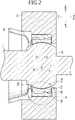
- Fig. 2 is a sectional view taken along the line II-II of Fig. 1 .
- the bearing 100 according to the first example of the present invention is an annular member, and is clamped in the vertical direction by a housing H attached to a vehicle body.
- the vertical direction in the present example is the central axis direction of the bearing 100.
- the direction in which a protrusion 123 described later is provided is referred to as "upper direction”, and the direction in which the protrusion 123 is not provided is referred to as “lower direction”.
- the housing H is composed of a lower housing H1, into which the bearing 100 is inserted from above, and an upper housing H2 for holding the bearing 100 from above.
- the lower housing H1 is a C-shaped member in a plan view and is formed of a bearing accommodating portion H1a, which is columnar-shaped and into which the bearing 100 is inserted, and an upper housing accommodating portion H1b, which is columnar-shaped in a plan view and into which the upper housing H2 is partially inserted.
- the bearing accommodating portion H1a is located below the upper housing accommodating portion H1b, has the same central axis as the upper housing accommodating portion H1b and has a smaller diameter than the upper housing accommodating portion H1b.
- the upper housing H2 is a C-shaped member in a plan view and is formed of a cylindrical insertion portion H2a, which is inserted into the lower housing H1, and a flange portion H2b, which is rectangular-shaped in a plan view and has a mouth whose opening area increases toward the upper direction from the insertion portion H2a.
- the bearing 100 swingably supports a shift lever L for manual vehicles (automobile shift lever).
- the bearing 100 is arranged between the shift lever L and the housing H.
- the shift lever L is composed of a shift knob L1, which is gripped by a driver when he performs a shift change, and a shift lever body L2, which extends downward from the shift knob L1.
- the shift lever body L2 is composed of a small spherical portion L2a formed at the lower end, a large spherical portion (spherical portion) L2b formed above the small spherical portion L2a, and a connecting shaft L2c extending horizontally from the large spherical portion L2b.
- the small spherical portion L2a is connected to a not-shown shift cable.
- the large spherical portion L2b has a larger diameter than the small spherical portion L2a, and is supported by the bearing 100 as shown in Fig. 2 .
- the large spherical portion L2b serves as a center of swing for the shift lever L.
- connecting shaft L2c is connected to a not-shown select lever.
- Fig. 3 is a perspective view of the bearing according to the first example of the present invention
- Fig. 4 is a partially enlarged view of Fig. 2 .
- the bearing 100 is made of synthetic resin, and as shown in Fig. 3 and the like, the bearing 100 is single member composed of a C-shaped inner peripheral side wall portion 110 in contact with the shift lever L, a C-shaped outer peripheral side wall portion 120 in contact with the lower housing H1, and an annular rib portion 130, with which the inner peripheral side wall portion 110 and the outer peripheral side wall portion 120 are concentrically spaced apart from each other and which integrally connects the inner peripheral side wall portion 110 and the outer peripheral side wall portion 120.
- the inner peripheral side wall portion 110 is divided at predetermined intervals along the circumferential direction.
- each inner peripheral side wall portion is E-shaped (110A), U-shaped (110B), or simply thin-walled (110C) depending on the location.
- the U-shaped inner peripheral side wall portions 110B are provided on both sides of an opening 111 of the inner peripheral side wall portion 110, and the thin-walled inner peripheral side wall portion 110C is provided at a position facing the opening 111 of the inner peripheral side wall portion 110.
- the inner peripheral side wall portion 110 has an upper contact area 112, which is I-shaped in a cross-sectional view and is in contact with the large spherical portion L2b of the shift lever L on the vertically upper side, an lower contact area 113, which is in contact with the large spherical portion L2b of the shift lever L on the vertically lower side, and a shift lever separation area 114 which is separated from the large spherical portion L2b of the shift lever L.
- an upper contact area 112 which is I-shaped in a cross-sectional view and is in contact with the large spherical portion L2b of the shift lever L on the vertically upper side
- an lower contact area 113 which is in contact with the large spherical portion L2b of the shift lever L on the vertically lower side
- a shift lever separation area 114 which is separated from the large spherical portion L2b of the shift lever L.
- the upper contact area 112 is elastically deformable and is in contact with and interferes with the large spherical portion L2b of the shift lever L in a state of being elastically deformed toward the outer peripheral side wall portion 120.
- the curvature center O1 of an upper curved surface 112a of the upper contact area 112 for coming into contact with the shift lever L is located below the curvature center OL of the large spherical portion L2b of the shift lever L.
- curvature center O1 of the upper curved surface 112a is also separated from the curvature center OL of the large spherical portion L2b of the shift lever L in the horizontal direction.
- the curvature center O1 of the upper curved surface 112a is arranged on a single virtual circle A1 (see Fig. 2 ) in the plan view of the bearing 100.
- the curvature radius of the upper curved surface 112a is larger than the curvature radius of the large spherical portion L2b of the shift lever L.
- the curvature center O1 of the upper curved surface 112a and the upper curved surface 112a are always located at positions with the central axis X of the virtual circle A1 being therebetween.
- the lower contact area 113 is also elastically deformable and is in contact with and interferes with the large spherical portion L2b of the shift lever L in a state of being elastically deformed toward the outer peripheral side wall portion 120.
- the curvature center 02 of a lower curved surface 113a of the lower contact area 113 for coming into contact with the shift lever L is located above the curvature center OL of the large spherical portion L2b of the shift lever L.
- curvature center 02 of the lower curved surface 113a is also separated from the curvature center OL of the large spherical portion L2b of the shift lever L in the horizontal direction, similarly to the curvature center O1 of the upper curved surface 112a.
- the curvature center 02 of the lower curved surface 113a is also arranged on a single virtual circle A2 (see Fig. 2 ) having the same central axis and the same diameter as the virtual circle A1, on which the curvature center O1 of the upper curved surface 112a is arranged, in the plan view of the bearing 100.
- the curvature radius of the lower curved surface 113a is equal to the curvature radius of the upper curved surface 112a, and is larger than the curvature radius of the large spherical portion L2b of the shift lever L.
- the curvature center 02 of the lower curved surface 113a and the lower curved surface 113a are always located at positions with the central axis X of the virtual circle A2 being therebetween.
- the central axis X of the virtual circle A1 and the virtual circle A2 substantially coincides with the central axis of the bearing 100 in the plan view.
- the curvature center OL of the large spherical portion L2b of the shift lever L is also located on the central axis X of the virtual circle A1 and the virtual circle A2.
- the curvature center O1 of the upper curved surface 112a and the curvature center 02 of the lower curved surface 113a are separated not only in the vertical direction but also in the horizontal direction from the curvature center OL of the large spherical portion L2b of the shift lever L.
- the shift lever separation area 114 is provided substantially in the center of the vertical direction in the inner peripheral side wall portion 110, and a gap C is formed between the shift lever separation area 114 and the large spherical portion L2b of the shift lever L.
- This gap C becomes largest near the center of the vertical direction in the inner peripheral side wall portion 110, and becomes smaller as the distance in the vertical direction from the vicinity of the center increases.
- the inner peripheral side wall portion 110 has the upper contact area 112 and the lower contact area 113 that come into contact with and interfere with the large spherical portion L2b of the shift lever L, the inner peripheral side wall portion 110 interferes with the large spherical portion L2b of the shift lever L.
- the outer peripheral side wall portion 120 is I-shaped in a cross-sectional view and has a housing contact area 121, which is horizontally in contact with the lower housing H1, and a housing separation area 122, which is horizontally separated from the lower housing H1.
- the housing contact area 121 is an area below a rib portion 130 as shown in Figs. 3 and 4 , and is intermittently divided along the circumferential direction as shown in Fig. 3 .
- the housing contact area 121 is elastically deformable with respect to the rib portion 130, and is in contact with the lower housing H1 in a state where the housing contact area 121 interferes with the lower housing H1(that is, in a state of being elastically deformed).
- the housing contact area 121 is pressed against the lower housing H1 by an elastic force, and the bearing 100 is securely held in close contact with the housing H.
- a bottom surface 121a of the housing contact area 121 is located below a bottom surface 113b of the lower contact area 113 of the inner peripheral side wall portion 110.
- the housing separation area 122 is horizontally separated from the lower housing H1, from the state where the outer peripheral side wall portion 120 is held by the lower housing H1, the outer peripheral side wall portion 120 can be further elastically deformed toward the lower housing H1 side.
- a top surface 122a of the housing separation area 122 is located above a top surface 112b of the upper contact area 112 of the inner peripheral side wall portion 110.
- a plurality of the spherical protrusions 123 protruding vertically upward are formed on the top surface 122a of the housing separation area 122.
- the protrusion 123 is in contact with the upper housing H2 in a state where the protrusion 123 is crushed to some extent.
- the elastic deformation of the protrusion 123 makes it easy to position the bearing 100 with respect to the housing H.
- prismatic positioning protrusions 125 which position the bearing 100 when the bearing 100 is inserted into the lower housing H1, project in the horizontal direction.
- the rib portion 130 connects the lower side of the inner peripheral side wall portion 110 and the lower side of the outer peripheral side wall portion 120.
- the rib portion 130 integrally connects the adjacent inner peripheral side wall portions 110.
- the height HR of the rib portion 130 is larger than the width WR of the rib portion 130.
- the rib portion 130 separates the inner peripheral side wall portion 110 and the outer peripheral side wall portion 120.
- the outer peripheral side of the inner peripheral side wall portion 110 extends substantially vertically upward in the shift lever separation area 114, and is inclined toward the inner peripheral side from a bending point P in the upper contact area 112.
- the inner peripheral side of the outer peripheral side wall portion 120 extends substantially vertically upward.
- a horizontal distance CH between the inner peripheral side wall portion 110 and the outer peripheral side wall portion 120 is substantially same up to the bending point P, and above the bending point P, the horizontal distance CH increases upward.
- the outer peripheral side of the inner peripheral side wall portion 110 extends substantially vertically downward.
- the inner peripheral side of the outer peripheral side wall portion 120 is inclined toward the outer peripheral side.
- the horizontal distance CH between the inner peripheral side wall portion 110 and the outer peripheral side wall portion 120 is a distance such that, when the upper contact area 112 of the inner peripheral side wall portion 110 is deformed toward the outer peripheral side wall portion 120, the upper contact area 112 can come into contact with the outer peripheral side wall portion 120 during the elastic deformation.
- the horizontal distance CL between the inner peripheral side wall portion 110 and the outer peripheral side wall portion 120 is a distance such that, when the lower contact area 113 of the inner peripheral side wall portion 110 is deformed toward the outer peripheral side wall portion 120, the lower contact area 113 can come into contact with the outer peripheral side wall portion 120 during the elastic deformation.
- the function of restricting the movement of the automobile shift lever in the lever axial direction (the direction in which the shift lever L is pulled out from the bearing 100 or the direction in which the shift lever L is pushed toward the bearing 100) and the function of smoothly operating a shift change when performing a shift change can be achieved with a single member.
- the inner peripheral side wall portion 110 is divided at predetermined intervals along the circumferential direction.
- the contact resistance of the large spherical portion L2b of the shift lever L with respect to the inner peripheral side wall portion 110 is reduced because of arranging the upper contact area 112 and the lower contact area 113 of the inner peripheral side wall portion 110 at predetermined intervals along the circumferential direction.
- the shift lever separation area 114 of the inner peripheral side wall portion 110 is separated from the large spherical portion L2b of the shift lever L.
- the contact resistance of the large spherical portion L2b of the shift lever L with respect to the inner peripheral side wall portion 110 is reduced because the large spherical portion L2b separates from the shift lever separation area 114 by the gap C.
- the curvature center O1 of the upper curved surface 112a and the curvature center 02 of the lower curved surface 113a are separated from the curvature center OL of the large spherical portion L2b of the shift lever L in the vertical direction.
- the contact resistance of the large spherical portion L2b of the shift lever L with respect to the inner peripheral side wall portion 110 is reduced because the upper curved surface 112a and the lower curved surface 113a of the inner peripheral side wall portion 110 are in line contact (not in surface contact) with the large spherical portion L2b of the shift lever L.
- the inner peripheral side wall portion 110 is elastically deformed toward the outer peripheral side wall portion 120, but the inner peripheral side wall portion 110 and the outer peripheral side wall portion 120 are separated from each other over the entire vertical direction.
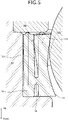
- Fig. 5 is a cross-sectional view of a main part while the shift lever is being pulled out from the bearing.
- the upper contact area 112 side of the inner peripheral side wall portion 110 is elastically deformed and inclines toward the outer peripheral side wall portion 120 with the rib portion 130 serving as a base point, and the bending point P of the inner peripheral side wall portion 110 first comes into contact with the outer peripheral side wall portion 120.
- the inner peripheral side wall portion 110 further inclines toward the outer peripheral side wall portion 120 with the rib portion 130 serving as a base point, and the area above the bending point P of the inner peripheral side wall portion 110 comes into surface contact with the outer peripheral side wall portion 120. Then, the outer peripheral side wall portion 120 that is in contact with the inner peripheral side wall portion 110 is elastically deformed and inclines toward the lower housing H1 side.
- the housing separation area 122 of the outer peripheral side wall portion 120 that was separated from the lower housing H1 comes into contact with the lower housing H1.
- the inner peripheral side wall portion 110 is formed to be elastically deformable so as to come into contact with the outer peripheral side wall portion 120, in a case where an excessive load is applied to the upper contact area 112 of the inner peripheral side wall portion 110 as a result of inadvertently pulling out operation of the shift lever L, this excessive load makes the upper contact area 112 of the inner peripheral side wall portion 110 elastically deformed toward the outer peripheral side wall portion 120 and brought into contact with the outer peripheral side wall portion 120. As a result, the excessive load applied from the shift lever L can be received by both the inner peripheral side wall portion 110 and the outer peripheral side wall portion 120 and by the lower housing H1.
- Fig. 6 is a cross-sectional view of a main part while the shift lever is being pushed toward the bearing.
- the lower contact area 113 side of the inner peripheral side wall portion 110 is elastically deformed and inclines toward the outer peripheral side wall portion 120 with the rib portion 130 serving as a base point, and an edge Q on the outer peripheral side of the inner peripheral side wall portion 110 first comes into contact with the outer peripheral side wall portion 120.
- the inner peripheral side wall portion 110 is formed to be elastically deformable so as to come into contact with the outer peripheral side wall portion 120, in a case where an excessive load is applied to the lower contact area 113 of the inner peripheral side wall portion 110 as a result of inadvertently pushing in operation of the shift lever L, this excessive load makes the lower contact area 113 of the inner peripheral side wall portion 110 elastically deformed toward the outer peripheral side wall portion 120 and brought into contact with the outer peripheral side wall portion 120. As a result, the excessive load applied from the shift lever L can be received by both the inner peripheral side wall portion 110 and the outer peripheral side wall portion 120 and by the lower housing H1.
- the bearing 100 in the present example is composed of: the annular inner peripheral side wall portion 110 in contact with the shift lever L; the annular outer peripheral side wall portion 120 in contact with the housing H; and the annular rib portion 130, with which the inner peripheral side wall portion 110 and the outer peripheral side wall portion 120 are concentrically spaced apart from each other and which integrally connects the inner peripheral side wall portion 110 and the outer peripheral side wall portion 120.
- the inner peripheral side wall portion 110 has the upper contact area 112 and the lower contact area 113, which come into contact with and interfere with the large spherical portion L2b of the shift lever L.
- the inner peripheral side wall portion 110 interferes with the large spherical portion L2b of the shift lever L, it is possible to suppress rattling between the shift lever L and the bearing 100 when performing a shift change.
- the inner peripheral side wall portion 110 has the shift lever separation area 114 separated from the large spherical portion L2b of the shift lever L, the smooth shift change operation of the shift lever L when performing a shift change can be achieved.
- the inner peripheral side wall portion 110 is formed to be elastically deformable so as to come into contact with the outer peripheral side wall portion 120, the movement of the shift lever L in the lever axis direction can be suppressed so that it is possible to elastically hold the shift lever L and to prevent the shift lever L from being taken out from the bearing 100 and to support the shift lever L only with the elastic deformation of the inner peripheral side wall portion 110.
- the outer peripheral side wall portion 120 has the housing contact area 121, which is elastically deformable and comes into contact with the housing H, it is possible to suppress rattling between the housing H and the bearing 100.
- the bearing 100 can elastically support a larger load.
- the rib portion 130 connects the lower side of the inner peripheral side wall portion 110 and the lower side of the outer peripheral side wall portion 120, the predetermined swing position of the shift lever L can be maintained without the shift lever L being taken out from the bearing 100 vertically downward.
- the bearing 100 can be stably mounted on the housing H in a state where the vertical rattling between the housing H and the bearing 100 is absorbed.
- the bearing 100 holds the large spherical portion L2b of the shift lever L.
- the bearing 100 may hold the small spherical portion L2a.
- the inner peripheral side wall portion 110 and the outer peripheral side wall portion 120 are C-shaped in a plan view. However, this is due to the shape of the shift lever. Thus, they may be O-shaped, which do not have a notch.
- the inner peripheral side wall portion 110 is divided along the circumferential direction.
- the inner peripheral side wall portion 110 may not be divided along the circumferential direction.
- the housing contact area 121 of the outer peripheral side wall portion 120 is divided along the circumferential direction.
- the housing contact area 121 may not be divided along the circumferential direction.
- the protrusion 123 protrudes vertically upward from the top surface 122a of the housing separation area 122.
- the protrusion 123 may protrude vertically downward from the bottom surface of the housing contact area 121 or may protrude from both of the bottom surface of the housing contact area 121 and the top surface 122a of the housing separation area 122.
- the shape of the protrusion 123 is spherical.
- the shape of the protrusion 123 is not limited to the spherical shape.
- the housing contact area 121 of the outer peripheral side wall portion 120 is formed on the lower side.
- the position of the housing contact area 121 of the bearing 100 is not limited to this position.
- the housing contact area 121 may be in contact with the lower housing H1 at the same height as the rib portion 130 and or may be in contact with the lower housing H1 at a position higher than the rib portion 130.
Landscapes
- Engineering & Computer Science (AREA)
- General Engineering & Computer Science (AREA)
- Mechanical Engineering (AREA)
- Arrangement Or Mounting Of Control Devices For Change-Speed Gearing (AREA)
- Pivots And Pivotal Connections (AREA)
Abstract
Description
- The present invention relates to a bearing for a shift lever that swingably supports an automobile shift lever, and more particularly relates to a bearing for a shift lever arranged between the automobile shift lever and a housing on the vehicle side.
- Conventionally, as a bearing member for supporting a shift lever, a bearing member is known which is provided inside with an inner spherical sheet for receiving an outer spherical surface of a spherical portion provided at a base end portion of the shift lever (for example, see Patent Literature 1).
- [Patent Literature 1]
JP 2014-151708 A - In general, a bearing member for supporting a shift lever is required to prevent the axial movement of the shift lever and to support the shift lever smoothly and tiltably.
- However, in the above-described bearing member, in order to suitably ensure the strength to prevent the shift lever from being pulled out from the bearing member, the bearing member is divided into a plurality of pieces, and the plurality of pieces are integrally formed together with a connecting member for connecting the pieces, and the connecting member is in contact with the shift lever over the entire circumference.
- As a result, the bearing member is in a state of holding the spherical portion of the shift lever therein, and the frictional resistance with respect to the shift lever is increased.
- The present invention solves the problem of the prior art as described above, that is, the object of the present invention is to provide a bearing for a shift lever that can achieve with a single member the function of restricting the movement of the automobile shift lever in the lever axial direction and the function of smoothly operating a shift change when performing a shift change.
- In the invention according to claim 1, a bearing is for a shift lever and made of synthetic resin, the bearing being arranged between an automobile shift lever, which has a spherical portion serving as a center of swing in the shift lever body, and a housing on the vehicle side so that the bearing swingably supports the automobile shift lever, wherein the bearing is composed of: an annular inner peripheral side wall portion in contact with the automobile shift lever; an annular outer peripheral side wall portion in contact with the housing; and an annular rib portion, with which the inner peripheral side wall portion and the outer peripheral side wall portion are concentrically spaced apart from each other and which integrally connects the inner peripheral side wall portion and the outer peripheral side wall portion, and wherein the inner peripheral side wall portion has an upper contact area and a lower contact area, which come into contact with and interfere with the spherical portion of the automobile shift lever, and a shift lever separation area separated from the spherical portion of the automobile shift lever, and is formed to be elastically deformable so as to come into contact with the outer peripheral side wall portion. Thereby, the above-described problem can be solved.
- In the invention according to claim 2, in addition to the configuration of the bearing for a shift lever according to claim 1, the outer peripheral side wall portion has a housing contact area, which is elastically deformable and comes into contact with the housing, and a housing separation area separated from the housing. Thereby, the above-described problem can be further solved.
- In the invention according to claim 3, in addition to the configuration of the bearing for a shift lever according to claim 1 or 2, the rib portion connects the lower side of the inner peripheral side wall portion and the lower side of the outer peripheral side wall portion. Thereby, the above-described problem can be further solved.
- In the invention according to claim 4, in addition to the configuration of the bearing for a shift lever according to any one of claims 1 to 3, the upper contact area of the inner peripheral side wall portion has an upper curved surface for coming into contact with the spherical portion of the automobile shift lever, and the lower contact area of the inner peripheral side wall portion has a lower curved surface for coming into contact with the spherical portion of the automobile shift lever, and the curvature center of the upper curved surface and the curvature center of the lower curved surface are separated in the vertical direction. Thereby, the above-described problem can be further solved.
- In the invention according to claim 5, in addition to the configuration of the bearing for a shift lever according to any one of claims 1 to 4, the inner peripheral side wall portion is divided at predetermined intervals along the circumferential direction, and the rib portion integrally connects the adjacent inner peripheral side wall portions. Thereby, the above-described problem can be further solved.
- In the invention according to claim 6, in addition to the configuration of the bearing for a shift lever according to any one of claims 1 to 5, a protrusion protruding in the vertical direction is formed on at least one of a top surface and a bottom surface of the outer peripheral side wall portion. Thereby, the above-described problem can be further solved.
- The bearing for a shift lever of the present invention is arranged between an automobile shift lever, which has a spherical portion serving as a center of swing in the shift lever body, and a housing on the vehicle side. Thus, the bearing can swingably support the automobile shift lever, and the following effects peculiar to the present invention can be obtained.
- According to the bearing for a shift lever of the invention according to claim 1, the bearing is composed of: an annular inner peripheral side wall portion in contact with the automobile shift lever; an annular outer peripheral side wall portion in contact with the housing; and an annular rib portion, with which the inner peripheral side wall portion and the outer peripheral side wall portion are concentrically spaced apart from each other and which integrally connects the inner peripheral side wall portion and the outer peripheral side wall portion. Thus, since the bearing for a shift lever is treated as a single member, the assembling operation of the housing on the vehicle side and the automobile shift lever can be easily carried out, and the burden of parts management can be reduced because the number of parts is minimized.
- Further, the inner peripheral side wall portion has an upper contact area and a lower contact area, which come into contact with and interfere with the spherical portion of the automobile shift lever. Thus, since the inner peripheral side wall portion interferes with the spherical portion of the automobile shift lever, it is possible to suppress rattling between the automobile shift lever and the bearing for a shift lever when performing a shift change.
- Further, the inner peripheral side wall portion has a shift lever separation area separated from the spherical portion of the automobile shift lever. Thus, since the contact resistance of the spherical portion of the automobile shift lever with respect to the inner peripheral side wall portion is reduced because the spherical portion separates from the shift lever separation area, the smooth shift change operation of the automobile shift lever when performing a shift change can be achieved.
- Further, the inner peripheral side wall portion is formed to be elastically deformable so as to come into contact with the outer peripheral side wall portion. Thus, in a case where an excessive load is applied to the upper contact area or the lower contact area of the inner peripheral side wall portion as a result of inadvertently applying large power to the automobile shift lever in the lever axis direction, this excessive load makes the upper contact area or the lower contact area of the inner peripheral side wall portion elastically deformed toward the outer peripheral side wall portion and brought into contact with the outer peripheral side wall portion. As a result, the excessive load applied from the automobile shift lever can be received by both the inner peripheral side wall portion and the outer peripheral side wall portion. Therefore, the movement of the automobile shift lever in the lever axis direction can be suppressed so that it is possible to elastically hold the automobile shift lever and to prevent the automobile shift lever from being taken out from the bearing for a shift lever. In addition, in a case where the automobile shift lever is tilted in a predetermined direction for a shift change or the like, compared to the case where the automobile shift lever is moved in the lever axis direction, lower load is applied to the inner peripheral side wall portion and the inner peripheral side wall portion does not come into contact with the outer peripheral side wall portion in the elastic deformation. Thus, the frictional resistance between the automobile shift lever and the bearing for a shift lever does not increase, and the automobile shift lever can be supported in a low friction state.
- Therefore, it is possible to achieve with a single member the function of restricting the movement of the automobile shift lever in the lever axial direction and the function of smoothly operating a shift change when performing a shift change.
- According to the bearing for a shift lever of the invention according to claim 2, the outer peripheral side wall portion has a housing contact area, which is elastically deformable and comes into contact with the housing. Thus, in addition to the effect of the bearing for a shift lever of the invention according to claim 1, since the bearing for a shift lever is firmly held in close contact with the housing, it is possible to suppress rattling between the housing and the bearing for a shift lever.
- Further, the outer peripheral side wall portion has a housing separation area separated from the housing. Thus, since the outer peripheral side wall portion can be elastically deformed toward the housing side from the state of being held by the housing, the bearing for a shift lever can elastically support a larger load.
- According to the bearing for a shift lever of the invention according to claim 3, the rib portion connects the lower side of the inner peripheral side wall portion and the lower side of the outer peripheral side wall portion. Thus, in addition to the effect of the bearing for a shift lever of the invention according to claim 1 or 2, since the rigidity of the lower side of the inner peripheral side wall portion is increased, the predetermined swing position of the automobile shift lever can be maintained without the automobile shift lever being taken out from the bearing vertically downward.
- According to the bearing for a shift lever of the invention according to claim 4, the curvature center of the upper curved surface and the curvature center of the lower curved surface are separated in the vertical direction. Thus, in addition to the effect of the bearing for a shift lever of the invention according to any one of claims 1 to 3, since the contact resistance of the spherical portion of the automobile shift lever with respect to the inner peripheral side wall portion is reduced because the upper curved surface and the lower curved surface of the inner peripheral side wall portion are in line contact (not in surface contact) with the spherical portion of the automobile shift lever, further smooth shift change operation with the automobile shift lever can be achieved when performing a shift change.
- According to the bearing for a shift lever of the invention according to claim 5, the inner peripheral side wall portion is divided at predetermined intervals along the circumferential direction, and the rib portion integrally connects the adjacent inner peripheral side wall portions. Thus, in addition to the effect of the bearing for a shift lever of the invention according to any one of claims 1 to 4, compared to the case where the entire circumference of the spherical portion of the automobile shift lever is held by the inner peripheral side wall portion, the contact resistance of the spherical portion of the automobile shift lever with respect to the inner peripheral side wall portion is reduced because of arranging the upper contact area and the lower contact area of the inner peripheral side wall portion at predetermined intervals along the circumferential direction. Therefore, further smooth shift change operation with the automobile shift lever can be achieved when performing a shift change.
- According to the bearing for a shift lever of the invention according to claim 6, a protrusion protruding in the vertical direction is formed on at least one of a top surface and a bottom surface of the outer peripheral side wall portion. Thus, in addition to the effect of the bearing for a shift lever of the invention according to any one of claims 1 to 5, when the bearing for a shift lever is held from the vertical direction, since the protrusion is elastically deformed and the bearing for a shift lever is positioned with respect to the housing, the bearing for a shift lever can be stably mounted on the housing in a state where the vertical rattling between the housing and the bearing of a shift lever is absorbed.
-
-
Figure 1 is an exploded perspective view illustrating assembly of a bearing according to the first example of the present invention. -
Figure 2 is a cross-sectional view taken along the line II-II ofFigure 1 . -
Figure 3 is a perspective view of the bearing according to the first example of the present invention. -
Figure 4 is a partially enlarged view ofFigure 2 . -
Figure 5 is a cross-sectional view of a main part while the shift lever is being pulled out from the bearing. -
Figure 6 is a cross-sectional view of a main part while the shift lever is being pushed toward the bearing. - The present invention may have any specific embodiment as long as a bearing for a shift lever and made of synthetic resin is arranged between an automobile shift lever, which has a spherical portion serving as a center of swing in the shift lever body, and a housing on the vehicle side so that the bearing swingably supports the automobile shift lever, wherein the bearing is composed of: an annular inner peripheral side wall portion in contact with the automobile shift lever; an annular outer peripheral side wall portion in contact with the housing; and an annular rib portion, with which the inner peripheral side wall portion and the outer peripheral side wall portion are concentrically spaced apart from each other and which integrally connects the inner peripheral side wall portion and the outer peripheral side wall portion, and wherein the inner peripheral side wall portion has an upper contact area and a lower contact area, which come into contact with and interfere with the spherical portion of the automobile shift lever, and a shift lever separation area separated from the spherical portion of the automobile shift lever, and is formed to be elastically deformable so as to come into contact with the outer peripheral side wall portion, so that the function of restricting the movement of the automobile shift lever in the lever axial direction and the function of smoothly operating a shift change when performing a shift change are achieved with a single member.
- For example, the bearing for a shift lever of the present invention may be made of any material as long as the material is a synthetic resin having low sliding resistance. However, the material is preferably a polyolefin resin, a polyacetal resin, a polyester resin, a polyamide resin, a urethane resin or the like.
- Hereinafter, a
bearing 100 for a shift lever (hereinafter referred to as "bearing") according to the first example of the present invention will be described with reference toFigs. 1 to 6 . - First, the peripheral structure of the
bearing 100 according to the first example of the present invention will be described with reference toFigs. 1 and2 . -
Fig. 1 is an exploded perspective view illustrating assembly of the bearing according to the first example of the present invention, andFig. 2 is a sectional view taken along the line II-II ofFig. 1 . - As shown in
Fig. 1 and the like, the bearing 100 according to the first example of the present invention is an annular member, and is clamped in the vertical direction by a housing H attached to a vehicle body. - The vertical direction in the present example is the central axis direction of the
bearing 100. - The direction in which a
protrusion 123 described later is provided is referred to as "upper direction", and the direction in which theprotrusion 123 is not provided is referred to as "lower direction". - The housing H is composed of a lower housing H1, into which the
bearing 100 is inserted from above, and an upper housing H2 for holding the bearing 100 from above. - The lower housing H1 is a C-shaped member in a plan view and is formed of a bearing accommodating portion H1a, which is columnar-shaped and into which the
bearing 100 is inserted, and an upper housing accommodating portion H1b, which is columnar-shaped in a plan view and into which the upper housing H2 is partially inserted. - The bearing accommodating portion H1a is located below the upper housing accommodating portion H1b, has the same central axis as the upper housing accommodating portion H1b and has a smaller diameter than the upper housing accommodating portion H1b.
- The upper housing H2 is a C-shaped member in a plan view and is formed of a cylindrical insertion portion H2a, which is inserted into the lower housing H1, and a flange portion H2b, which is rectangular-shaped in a plan view and has a mouth whose opening area increases toward the upper direction from the insertion portion H2a.
- Further, the bearing 100 swingably supports a shift lever L for manual vehicles (automobile shift lever).
- Therefore, the
bearing 100 is arranged between the shift lever L and the housing H. - The shift lever L is composed of a shift knob L1, which is gripped by a driver when he performs a shift change, and a shift lever body L2, which extends downward from the shift knob L1.
- The shift lever body L2 is composed of a small spherical portion L2a formed at the lower end, a large spherical portion (spherical portion) L2b formed above the small spherical portion L2a, and a connecting shaft L2c extending horizontally from the large spherical portion L2b.
- The small spherical portion L2a is connected to a not-shown shift cable.
- The large spherical portion L2b has a larger diameter than the small spherical portion L2a, and is supported by the bearing 100 as shown in
Fig. 2 . - Therefore, while the shift lever L is supported by the
bearing 100, the large spherical portion L2b serves as a center of swing for the shift lever L. - Further, the connecting shaft L2c is connected to a not-shown select lever.
- Next, the structure of the
bearing 100 will be described with reference toFigs. 2 to 4 . -
Fig. 3 is a perspective view of the bearing according to the first example of the present invention, andFig. 4 is a partially enlarged view ofFig. 2 . - In
Figs. 2 and4 , a state is illustrated in which no load is applied to the bearing 100 from the shift lever L. - The
bearing 100 is made of synthetic resin, and as shown inFig. 3 and the like, thebearing 100 is single member composed of a C-shaped inner peripheralside wall portion 110 in contact with the shift lever L, a C-shaped outer peripheralside wall portion 120 in contact with the lower housing H1, and anannular rib portion 130, with which the inner peripheralside wall portion 110 and the outer peripheralside wall portion 120 are concentrically spaced apart from each other and which integrally connects the inner peripheralside wall portion 110 and the outer peripheralside wall portion 120. - As shown in
Fig. 3 , the inner peripheralside wall portion 110 is divided at predetermined intervals along the circumferential direction. - As shown in
Fig. 3 , each inner peripheral side wall portion is E-shaped (110A), U-shaped (110B), or simply thin-walled (110C) depending on the location. - Among these, the U-shaped inner peripheral
side wall portions 110B are provided on both sides of anopening 111 of the inner peripheralside wall portion 110, and the thin-walled inner peripheralside wall portion 110C is provided at a position facing theopening 111 of the inner peripheralside wall portion 110. - Hereinafter, with reference to the E-shaped inner peripheral
side wall portion 110A, the detailed structure of the inner peripheralside wall portion 110 will be described. - As shown in
Figs. 3 and4 , the inner peripheralside wall portion 110 has anupper contact area 112, which is I-shaped in a cross-sectional view and is in contact with the large spherical portion L2b of the shift lever L on the vertically upper side, anlower contact area 113, which is in contact with the large spherical portion L2b of the shift lever L on the vertically lower side, and a shiftlever separation area 114 which is separated from the large spherical portion L2b of the shift lever L. - The
upper contact area 112 is elastically deformable and is in contact with and interferes with the large spherical portion L2b of the shift lever L in a state of being elastically deformed toward the outer peripheralside wall portion 120. - As shown in
Fig. 2 , the curvature center O1 of an uppercurved surface 112a of theupper contact area 112 for coming into contact with the shift lever L is located below the curvature center OL of the large spherical portion L2b of the shift lever L. - Further, the curvature center O1 of the upper
curved surface 112a is also separated from the curvature center OL of the large spherical portion L2b of the shift lever L in the horizontal direction. - Therefore, the curvature center O1 of the upper
curved surface 112a is arranged on a single virtual circle A1 (seeFig. 2 ) in the plan view of thebearing 100. - Further, in the present example, the curvature radius of the upper
curved surface 112a is larger than the curvature radius of the large spherical portion L2b of the shift lever L. - That is, the curvature center O1 of the upper
curved surface 112a and the uppercurved surface 112a are always located at positions with the central axis X of the virtual circle A1 being therebetween. - Like the
upper contact area 112, thelower contact area 113 is also elastically deformable and is in contact with and interferes with the large spherical portion L2b of the shift lever L in a state of being elastically deformed toward the outer peripheralside wall portion 120. - As shown in
Fig. 2 , thecurvature center 02 of a lowercurved surface 113a of thelower contact area 113 for coming into contact with the shift lever L is located above the curvature center OL of the large spherical portion L2b of the shift lever L. - Further, the
curvature center 02 of the lowercurved surface 113a is also separated from the curvature center OL of the large spherical portion L2b of the shift lever L in the horizontal direction, similarly to the curvature center O1 of the uppercurved surface 112a. - Therefore, the
curvature center 02 of the lowercurved surface 113a is also arranged on a single virtual circle A2 (seeFig. 2 ) having the same central axis and the same diameter as the virtual circle A1, on which the curvature center O1 of the uppercurved surface 112a is arranged, in the plan view of thebearing 100. - Further, in the present example, the curvature radius of the lower
curved surface 113a is equal to the curvature radius of the uppercurved surface 112a, and is larger than the curvature radius of the large spherical portion L2b of the shift lever L. - Therefore, the
curvature center 02 of the lowercurved surface 113a and the lowercurved surface 113a are always located at positions with the central axis X of the virtual circle A2 being therebetween. - Further, the central axis X of the virtual circle A1 and the virtual circle A2 substantially coincides with the central axis of the
bearing 100 in the plan view. - In a state where the shift lever L is assembled to the
bearing 100, the curvature center OL of the large spherical portion L2b of the shift lever L is also located on the central axis X of the virtual circle A1 and the virtual circle A2. - Therefore, as shown in
Fig. 2 , the curvature center O1 of the uppercurved surface 112a and thecurvature center 02 of the lowercurved surface 113a are separated not only in the vertical direction but also in the horizontal direction from the curvature center OL of the large spherical portion L2b of the shift lever L. - As shown in
Fig. 4 , the shiftlever separation area 114 is provided substantially in the center of the vertical direction in the inner peripheralside wall portion 110, and a gap C is formed between the shiftlever separation area 114 and the large spherical portion L2b of the shift lever L. - This gap C becomes largest near the center of the vertical direction in the inner peripheral
side wall portion 110, and becomes smaller as the distance in the vertical direction from the vicinity of the center increases. - As described above, since the inner peripheral
side wall portion 110 has theupper contact area 112 and thelower contact area 113 that come into contact with and interfere with the large spherical portion L2b of the shift lever L, the inner peripheralside wall portion 110 interferes with the large spherical portion L2b of the shift lever L. - As shown in
Fig. 4 , the outer peripheralside wall portion 120 is I-shaped in a cross-sectional view and has ahousing contact area 121, which is horizontally in contact with the lower housing H1, and ahousing separation area 122, which is horizontally separated from the lower housing H1. - The
housing contact area 121 is an area below arib portion 130 as shown inFigs. 3 and4 , and is intermittently divided along the circumferential direction as shown inFig. 3 . - The
housing contact area 121 is elastically deformable with respect to therib portion 130, and is in contact with the lower housing H1 in a state where thehousing contact area 121 interferes with the lower housing H1(that is, in a state of being elastically deformed). - As a result, the
housing contact area 121 is pressed against the lower housing H1 by an elastic force, and thebearing 100 is securely held in close contact with the housing H. - Further, a
bottom surface 121a of thehousing contact area 121 is located below abottom surface 113b of thelower contact area 113 of the inner peripheralside wall portion 110. - As a result, the inner peripheral
side wall portion 110 of thebearing 100 is separated from the lower housing H1. - Since the
housing separation area 122 is horizontally separated from the lower housing H1, from the state where the outer peripheralside wall portion 120 is held by the lower housing H1, the outer peripheralside wall portion 120 can be further elastically deformed toward the lower housing H1 side. - Further, a
top surface 122a of thehousing separation area 122 is located above a top surface 112b of theupper contact area 112 of the inner peripheralside wall portion 110. - As a result, the inner peripheral
side wall portion 110 of thebearing 100 is separated from the upper housing H2. - Further, as shown in
Fig. 3 , a plurality of thespherical protrusions 123 protruding vertically upward are formed on thetop surface 122a of thehousing separation area 122. - When the
bearing 100 is clamped between the lower housing H1 and the upper housing H2, since the outer peripheralside wall portion 120 is made of synthetic resin, theprotrusion 123 is in contact with the upper housing H2 in a state where theprotrusion 123 is crushed to some extent. - That is, when the
bearing 100 is held by the housing H in the vertical direction, the elastic deformation of theprotrusion 123 makes it easy to position the bearing 100 with respect to the housing H. - Further, as shown in
Fig. 3 , on both sides of anopening 124 of the outer peripheralside wall portion 120,prismatic positioning protrusions 125, which position thebearing 100 when thebearing 100 is inserted into the lower housing H1, project in the horizontal direction. - The
rib portion 130 connects the lower side of the inner peripheralside wall portion 110 and the lower side of the outer peripheralside wall portion 120. - Further, as shown in
Fig. 3 , therib portion 130 integrally connects the adjacent inner peripheralside wall portions 110. - Further, the height HR of the
rib portion 130 is larger than the width WR of therib portion 130. - The
rib portion 130 separates the inner peripheralside wall portion 110 and the outer peripheralside wall portion 120. - Above the
rib portion 130, the outer peripheral side of the inner peripheralside wall portion 110 extends substantially vertically upward in the shiftlever separation area 114, and is inclined toward the inner peripheral side from a bending point P in theupper contact area 112. On the other hand, the inner peripheral side of the outer peripheralside wall portion 120 extends substantially vertically upward. - Therefore, above the
rib portion 130, a horizontal distance CH between the inner peripheralside wall portion 110 and the outer peripheralside wall portion 120 is substantially same up to the bending point P, and above the bending point P, the horizontal distance CH increases upward. - Further, below the
rib portion 130, the outer peripheral side of the inner peripheralside wall portion 110 extends substantially vertically downward. On the other hand, the inner peripheral side of the outer peripheralside wall portion 120 is inclined toward the outer peripheral side. - Therefore, below the
rib portion 130, a horizontal distance CL between the inner peripheralside wall portion 110 and the outer peripheralside wall portion 120 increases downward. - Below the bending point P and above the
rib portion 130, the horizontal distance CH between the inner peripheralside wall portion 110 and the outer peripheralside wall portion 120 is a distance such that, when theupper contact area 112 of the inner peripheralside wall portion 110 is deformed toward the outer peripheralside wall portion 120, theupper contact area 112 can come into contact with the outer peripheralside wall portion 120 during the elastic deformation. - Similarly, below the
rib portion 130, the horizontal distance CL between the inner peripheralside wall portion 110 and the outer peripheralside wall portion 120 is a distance such that, when thelower contact area 113 of the inner peripheralside wall portion 110 is deformed toward the outer peripheralside wall portion 120, thelower contact area 113 can come into contact with the outer peripheralside wall portion 120 during the elastic deformation. - According to the
bearing 100 in the present example described above, the function of restricting the movement of the automobile shift lever in the lever axial direction (the direction in which the shift lever L is pulled out from the bearing 100 or the direction in which the shift lever L is pushed toward the bearing 100) and the function of smoothly operating a shift change when performing a shift change can be achieved with a single member. - Next, the holding of the shift lever L by the bearing 100 in the present example will be described with respect to a case where the shift lever L is swung, a case where the shift lever L is to be pulled out, and a case where the shift lever L is to be pushed in.
- First, a case where the shift lever L is swung will be described with reference to
Fig. 4 . - The inner peripheral
side wall portion 110 is divided at predetermined intervals along the circumferential direction. Thus, when the shift lever L is swung for a shift change, compared to the case where the entire circumference of the large spherical portion L2b of the shift lever L is held by the inner peripheralside wall portion 110, the contact resistance of the large spherical portion L2b of the shift lever L with respect to the inner peripheralside wall portion 110 is reduced because of arranging theupper contact area 112 and thelower contact area 113 of the inner peripheralside wall portion 110 at predetermined intervals along the circumferential direction. - Further, the shift
lever separation area 114 of the inner peripheralside wall portion 110 is separated from the large spherical portion L2b of the shift lever L. Thus, the contact resistance of the large spherical portion L2b of the shift lever L with respect to the inner peripheralside wall portion 110 is reduced because the large spherical portion L2b separates from the shiftlever separation area 114 by the gap C. - Further, the curvature center O1 of the upper
curved surface 112a and thecurvature center 02 of the lowercurved surface 113a are separated from the curvature center OL of the large spherical portion L2b of the shift lever L in the vertical direction. Thus, the contact resistance of the large spherical portion L2b of the shift lever L with respect to the inner peripheralside wall portion 110 is reduced because the uppercurved surface 112a and the lowercurved surface 113a of the inner peripheralside wall portion 110 are in line contact (not in surface contact) with the large spherical portion L2b of the shift lever L. - Due to the above-described plurality of structures that reduce the contact resistance of the large spherical portion L2b of the shift lever L with respect to the inner peripheral
side wall portion 110, by adopting thebearing 100 in the present example, smooth shift change operation with the shift lever L can be achieved when performing a shift change. - When the shift lever L is swung for a shift change, a load is applied to the inner peripheral
side wall portion 110 from the shift lever L, but the load applied to the inner peripheralside wall portion 110 in this case is smaller than the cases described later where the shift lever L is to be pulled out from the bearing or where the shift lever L is to be pushed toward the bearing. - Therefore, in the case where the shift lever L is swung, the inner peripheral
side wall portion 110 is elastically deformed toward the outer peripheralside wall portion 120, but the inner peripheralside wall portion 110 and the outer peripheralside wall portion 120 are separated from each other over the entire vertical direction. - Next, a case where the shift lever L is to be pulled out will be described with reference to
Fig. 5 . -
Fig. 5 is a cross-sectional view of a main part while the shift lever is being pulled out from the bearing. - When the shift lever L is pulled to be taken out, the shift lever L is moved upward with respect to the
bearing 100. - At this time, as shown in
Fig. 5 , theupper contact area 112 side of the inner peripheralside wall portion 110 is elastically deformed and inclines toward the outer peripheralside wall portion 120 with therib portion 130 serving as a base point, and the bending point P of the inner peripheralside wall portion 110 first comes into contact with the outer peripheralside wall portion 120. - Then, when the shift lever L is further moved upward with respect to the
bearing 100, the inner peripheralside wall portion 110 further inclines toward the outer peripheralside wall portion 120 with therib portion 130 serving as a base point, and the area above the bending point P of the inner peripheralside wall portion 110 comes into surface contact with the outer peripheralside wall portion 120. Then, the outer peripheralside wall portion 120 that is in contact with the inner peripheralside wall portion 110 is elastically deformed and inclines toward the lower housing H1 side. - As a result, as shown in
Fig. 5 , thehousing separation area 122 of the outer peripheralside wall portion 120 that was separated from the lower housing H1 comes into contact with the lower housing H1. - Therefore, since the inner peripheral
side wall portion 110 is formed to be elastically deformable so as to come into contact with the outer peripheralside wall portion 120, in a case where an excessive load is applied to theupper contact area 112 of the inner peripheralside wall portion 110 as a result of inadvertently pulling out operation of the shift lever L, this excessive load makes theupper contact area 112 of the inner peripheralside wall portion 110 elastically deformed toward the outer peripheralside wall portion 120 and brought into contact with the outer peripheralside wall portion 120. As a result, the excessive load applied from the shift lever L can be received by both the inner peripheralside wall portion 110 and the outer peripheralside wall portion 120 and by the lower housing H1. - Next, a case where the shift lever L is to be pushed toward the
bearing 100 will be described with reference toFig. 6 . -
Fig. 6 is a cross-sectional view of a main part while the shift lever is being pushed toward the bearing. - When the shift lever L is pushed in, the shift lever L is moved downward with respect to the
bearing 100. - At this time, as shown in
Fig. 6 , thelower contact area 113 side of the inner peripheralside wall portion 110 is elastically deformed and inclines toward the outer peripheralside wall portion 120 with therib portion 130 serving as a base point, and an edge Q on the outer peripheral side of the inner peripheralside wall portion 110 first comes into contact with the outer peripheralside wall portion 120. - Therefore, since the inner peripheral
side wall portion 110 is formed to be elastically deformable so as to come into contact with the outer peripheralside wall portion 120, in a case where an excessive load is applied to thelower contact area 113 of the inner peripheralside wall portion 110 as a result of inadvertently pushing in operation of the shift lever L, this excessive load makes thelower contact area 113 of the inner peripheralside wall portion 110 elastically deformed toward the outer peripheralside wall portion 120 and brought into contact with the outer peripheralside wall portion 120. As a result, the excessive load applied from the shift lever L can be received by both the inner peripheralside wall portion 110 and the outer peripheralside wall portion 120 and by the lower housing H1. - As described above, the bearing 100 in the present example is composed of: the annular inner peripheral
side wall portion 110 in contact with the shift lever L; the annular outer peripheralside wall portion 120 in contact with the housing H; and theannular rib portion 130, with which the inner peripheralside wall portion 110 and the outer peripheralside wall portion 120 are concentrically spaced apart from each other and which integrally connects the inner peripheralside wall portion 110 and the outer peripheralside wall portion 120. Thus, the assembling operation of the housing H on the vehicle side and the shift lever L can be easily carried out, and the burden of parts management can be reduced because the number of parts is minimized. - Further, the inner peripheral
side wall portion 110 has theupper contact area 112 and thelower contact area 113, which come into contact with and interfere with the large spherical portion L2b of the shift lever L. Thus, since the inner peripheralside wall portion 110 interferes with the large spherical portion L2b of the shift lever L, it is possible to suppress rattling between the shift lever L and thebearing 100 when performing a shift change. - Further, since the inner peripheral
side wall portion 110 has the shiftlever separation area 114 separated from the large spherical portion L2b of the shift lever L, the smooth shift change operation of the shift lever L when performing a shift change can be achieved. - Further, since the inner peripheral
side wall portion 110 is formed to be elastically deformable so as to come into contact with the outer peripheralside wall portion 120, the movement of the shift lever L in the lever axis direction can be suppressed so that it is possible to elastically hold the shift lever L and to prevent the shift lever L from being taken out from thebearing 100 and to support the shift lever L only with the elastic deformation of the inner peripheralside wall portion 110. - Further, since the outer peripheral
side wall portion 120 has thehousing contact area 121, which is elastically deformable and comes into contact with the housing H, it is possible to suppress rattling between the housing H and thebearing 100. - Further, since the outer peripheral
side wall portion 120 has thehousing separation area 122 separated from the housing H, the bearing 100 can elastically support a larger load. - Further, since the
rib portion 130 connects the lower side of the inner peripheralside wall portion 110 and the lower side of the outer peripheralside wall portion 120, the predetermined swing position of the shift lever L can be maintained without the shift lever L being taken out from the bearing 100 vertically downward. - Further, since the
protrusion 123 protruding in the vertical direction is formed on thetop surface 122a of the outer peripheralside wall portion 120, the bearing 100 can be stably mounted on the housing H in a state where the vertical rattling between the housing H and thebearing 100 is absorbed. - The example of the present invention has been described above. However, the present invention is not limited to the above-described example.
- For example, in the above-described example, the
bearing 100 holds the large spherical portion L2b of the shift lever L. However, thebearing 100 may hold the small spherical portion L2a. - For example, in the above-described example, the inner peripheral
side wall portion 110 and the outer peripheralside wall portion 120 are C-shaped in a plan view. However, this is due to the shape of the shift lever. Thus, they may be O-shaped, which do not have a notch. - For example, in the above-described example, the inner peripheral
side wall portion 110 is divided along the circumferential direction. However, the inner peripheralside wall portion 110 may not be divided along the circumferential direction. - For example, in the above-described example, the
housing contact area 121 of the outer peripheralside wall portion 120 is divided along the circumferential direction. However, thehousing contact area 121 may not be divided along the circumferential direction. - For example, in the above-described example, the
protrusion 123 protrudes vertically upward from thetop surface 122a of thehousing separation area 122. However, but theprotrusion 123 may protrude vertically downward from the bottom surface of thehousing contact area 121 or may protrude from both of the bottom surface of thehousing contact area 121 and thetop surface 122a of thehousing separation area 122. - Further, in the above-described example, the shape of the
protrusion 123 is spherical. However, the shape of theprotrusion 123 is not limited to the spherical shape. - For example, in the
bearing 100 of the above-described example, thehousing contact area 121 of the outer peripheralside wall portion 120 is formed on the lower side. However, the position of thehousing contact area 121 of thebearing 100 is not limited to this position. For example, thehousing contact area 121 may be in contact with the lower housing H1 at the same height as therib portion 130 and or may be in contact with the lower housing H1 at a position higher than therib portion 130. -
- 100
- bearing (bearing for shift lever)
- 110
- inner peripheral side wall portion
- 111
- opening
- 112
- upper contact area
- 112a
- upper curved surface
- 112b
- top surface
- 113
- lower contact area
- 113a
- lower curved surface
- 113b
- bottom surface
- 114
- shift lever separation area
- 120
- outer peripheral side wall portion
- 121
- housing contact area
- 121a
- bottom surface
- 122
- housing separation area
- 122a
- top surface
- 123
- protrusion
- 124
- opening
- 125
- positioning protrusion
- 130
- rib portion
- H
- housing
- H1
- lower housing
- H1a
- bearing accommodating portion
- H1b
- upper housing accommodating portion
- H2
- upper housing
- H2a
- insertion portion
- H2b
- flange portion
- L
- shift lever (automobile shift lever)
- L1
- shift knob
- L2
- shift lever body
- L2a
- small spherical portion
- L2b
- large spherical portion (spherical portion)
- L2c
- connecting shaft
- OL
- curvature center of large spherical portion
- O1
- curvature center of upper curved surface
- 02
- curvature center of lower curved surface
- A1
- virtual circle
- A2
- virtual circle
- X
- central axis of virtual circle
- HR
- height of rib portion
- WR
- width of rib portion
- P
- bending point
- Q
- edge
- C
- gap between inner peripheral side wall portion and shift lever
- CH
- horizontal distance between inner peripheral side wall portion and outer peripheral side wall portion above rib portion
- CL
- horizontal distance between inner peripheral side wall portion and outer peripheral side wall portion below rib portion
Claims (6)
- A bearing for a shift lever and made of synthetic resin, the bearing being arranged between an automobile shift lever, which has a spherical portion serving as a center of swing in the shift lever body, and a housing on the vehicle side so that the bearing swingably supports the automobile shift lever, wherein the bearing is composed of:an annular inner peripheral side wall portion in contact with the automobile shift lever;an annular outer peripheral side wall portion in contact with the housing; andan annular rib portion, with which the inner peripheral side wall portion and the outer peripheral side wall portion are concentrically spaced apart from each other and which integrally connects the inner peripheral side wall portion and the outer peripheral side wall portion, and whereinthe inner peripheral side wall portion has an upper contact area and a lower contact area, which come into contact with and interfere with the spherical portion of the automobile shift lever, and a shift lever separation area separated from the spherical portion of the automobile shift lever, and is formed to be elastically deformable so as to come into contact with the outer peripheral side wall portion.
- The bearing for a shift lever according to claim 1, wherein the outer peripheral side wall portion has a housing contact area, which is elastically deformable and comes into contact with the housing, and a housing separation area separated from the housing.
- The bearing for a shift lever according to claim 1 or 2, wherein the rib portion connects the lower side of the inner peripheral side wall portion and the lower side of the outer peripheral side wall portion.
- The bearing for a shift lever according to any one of claims 1 to 3, wherein the upper contact area of the inner peripheral side wall portion has an upper curved surface for coming into contact with the spherical portion of the automobile shift lever, whereinthe lower contact area of the inner peripheral side wall portion has a lower curved surface for coming into contact with the spherical portion of the automobile shift lever, and whereinthe curvature center of the upper curved surface and the curvature center of the lower curved surface are separated in the vertical direction.
- The bearing for a shift lever according to any one of claims 1 to 4, wherein the inner peripheral side wall portion is divided at predetermined intervals along the circumferential direction, and wherein
the rib portion integrally connects the adjacent inner peripheral side wall portions. - The bearing for a shift lever according to any one of claims 1 to 5, wherein a protrusion protruding in the vertical direction is formed on at least one of a top surface and a bottom surface of the outer peripheral side wall portion.
Applications Claiming Priority (2)
| Application Number | Priority Date | Filing Date | Title |
|---|---|---|---|
| JP2019191085A JP7408343B2 (en) | 2019-10-18 | 2019-10-18 | Bearing for shift lever |
| PCT/JP2020/032233 WO2021075158A1 (en) | 2019-10-18 | 2020-08-26 | Shift lever bearing |
Publications (2)
| Publication Number | Publication Date |
|---|---|
| EP4030071A1 true EP4030071A1 (en) | 2022-07-20 |
| EP4030071A4 EP4030071A4 (en) | 2023-10-11 |
Family
ID=75537779
Family Applications (1)
| Application Number | Title | Priority Date | Filing Date |
|---|---|---|---|
| EP20877097.4A Pending EP4030071A4 (en) | 2019-10-18 | 2020-08-26 | SELECTOR LEVER BEARING |
Country Status (3)
| Country | Link |
|---|---|
| EP (1) | EP4030071A4 (en) |
| JP (1) | JP7408343B2 (en) |
| WO (1) | WO2021075158A1 (en) |
Families Citing this family (1)
| Publication number | Priority date | Publication date | Assignee | Title |
|---|---|---|---|---|
| CN113483711B (en) * | 2021-06-30 | 2023-07-07 | 大陆汽车电子(连云港)有限公司 | A flexible coupling mechanism and displacement sensing device with the same |
Family Cites Families (9)
| Publication number | Priority date | Publication date | Assignee | Title |
|---|---|---|---|---|
| JPS5344620B2 (en) * | 1973-02-06 | 1978-11-30 | ||
| JPS523970A (en) * | 1975-06-24 | 1977-01-12 | Garufu Ando Uesutan Mfg C0 | Holder for ball joint |
| JPS59171217U (en) * | 1983-05-02 | 1984-11-15 | 市光工業株式会社 | Ball joint part fall prevention device |
| JPS6228223U (en) * | 1985-07-30 | 1987-02-20 | ||
| DE3742084A1 (en) * | 1987-12-11 | 1989-06-22 | Skf Gleitlager Gmbh | Swivel bearing, especially gear lever bearing for motor vehicle gear boxes |
| DE9308035U1 (en) * | 1993-05-27 | 1993-07-22 | Heidemann-Werke GmbH & Co KG, 37574 Einbeck | Bearing for the manual gearshift lever of a motor vehicle's mechanical transmission |
| DE29614638U1 (en) * | 1996-08-23 | 1996-11-07 | SKF Gleitlager GmbH, 66346 Püttlingen | Swivel bearing, in particular gear lever bearing for gearboxes of motor vehicles |
| JP6100545B2 (en) | 2013-02-06 | 2017-03-22 | トヨタ自動車株式会社 | Shift operation device for transmission |
| JP2015123912A (en) * | 2013-12-27 | 2015-07-06 | 富士機工株式会社 | Shift lever device |
-
2019
- 2019-10-18 JP JP2019191085A patent/JP7408343B2/en active Active
-
2020
- 2020-08-26 EP EP20877097.4A patent/EP4030071A4/en active Pending
- 2020-08-26 WO PCT/JP2020/032233 patent/WO2021075158A1/en not_active Ceased
Also Published As
| Publication number | Publication date |
|---|---|
| JP2021066239A (en) | 2021-04-30 |
| EP4030071A4 (en) | 2023-10-11 |
| JP7408343B2 (en) | 2024-01-05 |
| WO2021075158A1 (en) | 2021-04-22 |
| BR112022006971A2 (en) | 2022-07-05 |
Similar Documents
| Publication | Publication Date | Title |
|---|---|---|
| JPH0712621U (en) | Ball joint | |
| EP3312055B1 (en) | Vehicle attachment component | |
| US8876211B2 (en) | Seat assembly having a guide bushing | |
| EP1295053B1 (en) | Gearshift assembly | |
| US8657249B2 (en) | Low profile pivoting detent joint for a vehicle mirror assembly | |
| US20170361801A1 (en) | Mounting structure for driver-seat airbag device | |
| US20120213609A1 (en) | Push-in fastener assembly | |
| EP2555345B1 (en) | Rotary connector device | |
| US8807622B2 (en) | Urging device | |
| US9070496B2 (en) | Rotatable connector device | |
| EP2757274A1 (en) | Fastener | |
| EP4030071A1 (en) | Shift lever bearing | |
| EP0675296A1 (en) | Ball joint | |
| EP3705736B1 (en) | Fixation structure | |
| US20080044255A1 (en) | Plastic clip for fastening an object to a stud and fastening arrangement using such clip | |
| JP5798773B2 (en) | Bolt clip | |
| EP3444485B1 (en) | Fastener and fastening arrangement | |
| EP2927520A1 (en) | Ball joint | |
| US11358446B2 (en) | Slide door structure | |
| US10562471B2 (en) | Grommet | |
| JP2017020590A (en) | Block fixing structure for block type ball screw | |
| US11577563B2 (en) | Installation unit with latching elements for carrier unit mounted on a motor vehicle | |
| JP2899803B1 (en) | Vehicle cup holder | |
| US10518723B2 (en) | Grommet | |
| CA3232907A1 (en) | Method for reducing localized deformation in snap-in features |
Legal Events
| Date | Code | Title | Description |
|---|---|---|---|
| STAA | Information on the status of an ep patent application or granted ep patent |
Free format text: STATUS: THE INTERNATIONAL PUBLICATION HAS BEEN MADE |
|
| PUAI | Public reference made under article 153(3) epc to a published international application that has entered the european phase |
Free format text: ORIGINAL CODE: 0009012 |
|
| STAA | Information on the status of an ep patent application or granted ep patent |
Free format text: STATUS: REQUEST FOR EXAMINATION WAS MADE |
|
| 17P | Request for examination filed |
Effective date: 20220411 |
|
| AK | Designated contracting states |
Kind code of ref document: A1 Designated state(s): AL AT BE BG CH CY CZ DE DK EE ES FI FR GB GR HR HU IE IS IT LI LT LU LV MC MK MT NL NO PL PT RO RS SE SI SK SM TR |
|
| DAV | Request for validation of the european patent (deleted) | ||
| DAX | Request for extension of the european patent (deleted) | ||
| A4 | Supplementary search report drawn up and despatched |
Effective date: 20230908 |
|
| RIC1 | Information provided on ipc code assigned before grant |
Ipc: F16C 11/08 20060101ALI20230904BHEP Ipc: B60K 20/02 20060101ALI20230904BHEP Ipc: F16C 11/10 20060101ALI20230904BHEP Ipc: F16C 11/06 20060101AFI20230904BHEP |
|
| STAA | Information on the status of an ep patent application or granted ep patent |
Free format text: STATUS: EXAMINATION IS IN PROGRESS |
|
| 17Q | First examination report despatched |
Effective date: 20251027 |