EP4029704A1 - Combination of thermal transfer sheet and intermediate transfer medium and method for producing printed product using said combination - Google Patents
Combination of thermal transfer sheet and intermediate transfer medium and method for producing printed product using said combination Download PDFInfo
- Publication number
- EP4029704A1 EP4029704A1 EP20863042.6A EP20863042A EP4029704A1 EP 4029704 A1 EP4029704 A1 EP 4029704A1 EP 20863042 A EP20863042 A EP 20863042A EP 4029704 A1 EP4029704 A1 EP 4029704A1
- Authority
- EP
- European Patent Office
- Prior art keywords
- layer
- transfer
- melt
- intermediate transfer
- combination
- Prior art date
- Legal status (The legal status is an assumption and is not a legal conclusion. Google has not performed a legal analysis and makes no representation as to the accuracy of the status listed.)
- Pending
Links
Images


Classifications
-
- B—PERFORMING OPERATIONS; TRANSPORTING
- B41—PRINTING; LINING MACHINES; TYPEWRITERS; STAMPS
- B41M—PRINTING, DUPLICATING, MARKING, OR COPYING PROCESSES; COLOUR PRINTING
- B41M5/00—Duplicating or marking methods; Sheet materials for use therein
- B41M5/26—Thermography ; Marking by high energetic means, e.g. laser otherwise than by burning, and characterised by the material used
- B41M5/382—Contact thermal transfer or sublimation processes
- B41M5/38235—Contact thermal transfer or sublimation processes characterised by transferable colour-forming materials
-
- B—PERFORMING OPERATIONS; TRANSPORTING
- B44—DECORATIVE ARTS
- B44C—PRODUCING DECORATIVE EFFECTS; MOSAICS; TARSIA WORK; PAPERHANGING
- B44C1/00—Processes, not specifically provided for elsewhere, for producing decorative surface effects
- B44C1/16—Processes, not specifically provided for elsewhere, for producing decorative surface effects for applying transfer pictures or the like
- B44C1/165—Processes, not specifically provided for elsewhere, for producing decorative surface effects for applying transfer pictures or the like for decalcomanias; sheet material therefor
- B44C1/17—Dry transfer
- B44C1/1712—Decalcomanias applied under heat and pressure, e.g. provided with a heat activable adhesive
- B44C1/1725—Decalcomanias applied under heat and pressure, e.g. provided with a heat activable adhesive using an intermediate support
-
- B—PERFORMING OPERATIONS; TRANSPORTING
- B41—PRINTING; LINING MACHINES; TYPEWRITERS; STAMPS
- B41M—PRINTING, DUPLICATING, MARKING, OR COPYING PROCESSES; COLOUR PRINTING
- B41M5/00—Duplicating or marking methods; Sheet materials for use therein
- B41M5/26—Thermography ; Marking by high energetic means, e.g. laser otherwise than by burning, and characterised by the material used
- B41M5/382—Contact thermal transfer or sublimation processes
-
- B—PERFORMING OPERATIONS; TRANSPORTING
- B41—PRINTING; LINING MACHINES; TYPEWRITERS; STAMPS
- B41M—PRINTING, DUPLICATING, MARKING, OR COPYING PROCESSES; COLOUR PRINTING
- B41M5/00—Duplicating or marking methods; Sheet materials for use therein
- B41M5/26—Thermography ; Marking by high energetic means, e.g. laser otherwise than by burning, and characterised by the material used
- B41M5/382—Contact thermal transfer or sublimation processes
- B41M5/38257—Contact thermal transfer or sublimation processes characterised by the use of an intermediate receptor
-
- B—PERFORMING OPERATIONS; TRANSPORTING
- B41—PRINTING; LINING MACHINES; TYPEWRITERS; STAMPS
- B41M—PRINTING, DUPLICATING, MARKING, OR COPYING PROCESSES; COLOUR PRINTING
- B41M5/00—Duplicating or marking methods; Sheet materials for use therein
- B41M5/26—Thermography ; Marking by high energetic means, e.g. laser otherwise than by burning, and characterised by the material used
- B41M5/382—Contact thermal transfer or sublimation processes
- B41M5/392—Additives, other than colour forming substances, dyes or pigments, e.g. sensitisers, transfer promoting agents
-
- B—PERFORMING OPERATIONS; TRANSPORTING
- B41—PRINTING; LINING MACHINES; TYPEWRITERS; STAMPS
- B41M—PRINTING, DUPLICATING, MARKING, OR COPYING PROCESSES; COLOUR PRINTING
- B41M5/00—Duplicating or marking methods; Sheet materials for use therein
- B41M5/26—Thermography ; Marking by high energetic means, e.g. laser otherwise than by burning, and characterised by the material used
- B41M5/382—Contact thermal transfer or sublimation processes
- B41M5/392—Additives, other than colour forming substances, dyes or pigments, e.g. sensitisers, transfer promoting agents
- B41M5/395—Macromolecular additives, e.g. binders
-
- B—PERFORMING OPERATIONS; TRANSPORTING
- B41—PRINTING; LINING MACHINES; TYPEWRITERS; STAMPS
- B41M—PRINTING, DUPLICATING, MARKING, OR COPYING PROCESSES; COLOUR PRINTING
- B41M5/00—Duplicating or marking methods; Sheet materials for use therein
- B41M5/50—Recording sheets characterised by the coating used to improve ink, dye or pigment receptivity, e.g. for ink-jet or thermal dye transfer recording
- B41M5/52—Macromolecular coatings
-
- B—PERFORMING OPERATIONS; TRANSPORTING
- B41—PRINTING; LINING MACHINES; TYPEWRITERS; STAMPS
- B41M—PRINTING, DUPLICATING, MARKING, OR COPYING PROCESSES; COLOUR PRINTING
- B41M7/00—After-treatment of prints, e.g. heating, irradiating, setting of the ink, protection of the printed stock
- B41M7/0027—After-treatment of prints, e.g. heating, irradiating, setting of the ink, protection of the printed stock using protective coatings or layers by lamination or by fusion of the coatings or layers
-
- B—PERFORMING OPERATIONS; TRANSPORTING
- B44—DECORATIVE ARTS
- B44C—PRODUCING DECORATIVE EFFECTS; MOSAICS; TARSIA WORK; PAPERHANGING
- B44C1/00—Processes, not specifically provided for elsewhere, for producing decorative surface effects
- B44C1/16—Processes, not specifically provided for elsewhere, for producing decorative surface effects for applying transfer pictures or the like
- B44C1/165—Processes, not specifically provided for elsewhere, for producing decorative surface effects for applying transfer pictures or the like for decalcomanias; sheet material therefor
- B44C1/17—Dry transfer
-
- B—PERFORMING OPERATIONS; TRANSPORTING
- B41—PRINTING; LINING MACHINES; TYPEWRITERS; STAMPS
- B41M—PRINTING, DUPLICATING, MARKING, OR COPYING PROCESSES; COLOUR PRINTING
- B41M2205/00—Printing methods or features related to printing methods; Location or type of the layers
- B41M2205/02—Dye diffusion thermal transfer printing (D2T2)
-
- B—PERFORMING OPERATIONS; TRANSPORTING
- B41—PRINTING; LINING MACHINES; TYPEWRITERS; STAMPS
- B41M—PRINTING, DUPLICATING, MARKING, OR COPYING PROCESSES; COLOUR PRINTING
- B41M2205/00—Printing methods or features related to printing methods; Location or type of the layers
- B41M2205/06—Printing methods or features related to printing methods; Location or type of the layers relating to melt (thermal) mass transfer
-
- B—PERFORMING OPERATIONS; TRANSPORTING
- B41—PRINTING; LINING MACHINES; TYPEWRITERS; STAMPS
- B41M—PRINTING, DUPLICATING, MARKING, OR COPYING PROCESSES; COLOUR PRINTING
- B41M2205/00—Printing methods or features related to printing methods; Location or type of the layers
- B41M2205/10—Post-imaging transfer of imaged layer; transfer of the whole imaged layer
-
- B—PERFORMING OPERATIONS; TRANSPORTING
- B41—PRINTING; LINING MACHINES; TYPEWRITERS; STAMPS
- B41M—PRINTING, DUPLICATING, MARKING, OR COPYING PROCESSES; COLOUR PRINTING
- B41M5/00—Duplicating or marking methods; Sheet materials for use therein
- B41M5/50—Recording sheets characterised by the coating used to improve ink, dye or pigment receptivity, e.g. for ink-jet or thermal dye transfer recording
- B41M5/52—Macromolecular coatings
- B41M5/5254—Macromolecular coatings characterised by the use of polymers obtained by reactions only involving carbon-to-carbon unsaturated bonds, e.g. vinyl polymers
-
- B—PERFORMING OPERATIONS; TRANSPORTING
- B41—PRINTING; LINING MACHINES; TYPEWRITERS; STAMPS
- B41M—PRINTING, DUPLICATING, MARKING, OR COPYING PROCESSES; COLOUR PRINTING
- B41M5/00—Duplicating or marking methods; Sheet materials for use therein
- B41M5/50—Recording sheets characterised by the coating used to improve ink, dye or pigment receptivity, e.g. for ink-jet or thermal dye transfer recording
- B41M5/52—Macromolecular coatings
- B41M5/529—Macromolecular coatings characterised by the use of fluorine- or silicon-containing organic compounds
Definitions
- the present disclosure relates to a combination of a thermal transfer sheet and an intermediate transfer medium, and a method for producing a printed material using the combination.
- thermal transfer recording methods such as a hot-melt transfer method
- a hot-melt transfer method for example, an image is formed by superimposing a thermal transfer sheet including a melt transfer coloring layer on a transfer-receiving article, then passing them between a thermal head and a platen roller of a thermal transfer printer, and heating the thermal transfer sheet with the thermal head to transfer the melt transfer coloring layer onto the transfer-receiving article.
- a printed material is produced in this way.
- Printed materials are also widely produced by using a combination of a thermal transfer sheet including a melt transfer coloring layer and an intermediate transfer medium including a transfer layer.
- an image is formed by first superimposing a thermal transfer sheet on an intermediate transfer medium, then passing them between a thermal head and a platen roller of a thermal transfer printer, and heating the thermal transfer sheet with the thermal head to transfer a melt transfer coloring layer onto a transfer layer including a receiving layer of the intermediate transfer medium.
- the intermediate transfer medium is then heated to transfer the transfer layer and the melt transfer coloring layer forming an image on the transfer layer onto a transfer-receiving article.
- a printed material is produced in this way.
- the temperature of the thermal head rises at an image forming position on a transfer-receiving article, and the melt transfer coloring layer is transferred onto the transfer-receiving article.
- the temperature of the thermal head does not reach the transfer temperature of the melt transfer coloring layer, and the melt transfer coloring layer may not be successfully transferred at the image forming position.
- the temperature of the thermal head is generally maintained at a certain temperature that is equal to or lower than the transfer temperature of the melt transfer coloring layer but is not too low even at a position on which an image is not formed.
- the thermal head is maintained at a moderately high temperature even at the position on which an image is not formed.
- the thermal transfer sheet and the intermediate transfer medium in close contact with each other are transported between the thermal head maintained at the moderately high temperature and the platen roller.
- the melt transfer coloring layer of the thermal transfer sheet may adhere to the receiving layer of the intermediate transfer medium, and the transfer layer including the receiving layer and the like may be separated from the intermediate transfer medium (hereinafter referred to as transfer layer peeling). Furthermore, at the position on which an image is not formed, a coloring material contained in the melt transfer coloring layer of the thermal transfer sheet may move onto the receiving layer of the intermediate transfer medium (hereinafter referred to as scumming).
- scumming a coloring material contained in the melt transfer coloring layer of the thermal transfer sheet may move onto the receiving layer of the intermediate transfer medium
- An object of the present disclosure is to provide a combination of a thermal transfer sheet and an intermediate transfer medium that can effectively prevent transfer layer peeling and scumming at a position on which an image is not formed.
- Another object of the present disclosure is to provide a method for producing a printed material using the combination of the thermal transfer sheet and the intermediate transfer medium.
- thermo transfer sheet includes a first substrate and a melt transfer coloring layer
- the intermediate transfer medium includes a second substrate and a transfer layer including a receiving layer
- the melt transfer coloring layer and the receiving layer contain a release material
- a method for producing a printed material according to the present disclosure includes the steps of: providing the combination of the thermal transfer sheet and the intermediate transfer medium; transferring the melt transfer coloring layer from the thermal transfer sheet onto the receiving layer of the intermediate transfer medium to form an image; and transferring the transfer layer including the receiving layer, onto which the melt transfer coloring layer is transferred, from the intermediate transfer medium onto a transfer-receiving article.
- the present disclosure can provide a combination of a thermal transfer sheet and an intermediate transfer medium that can effectively prevent transfer layer peeling and scumming at a position on which an image is not formed.
- the present disclosure can provide a method for producing a printed material using the combination of the thermal transfer sheet and the intermediate transfer medium.
- Fig. 1 is a schematic cross-sectional view of an embodiment of a combination of a thermal transfer sheet and an intermediate transfer medium according to the present disclosure.
- Figs. 2 to 5 are schematic cross-sectional views of an embodiment of the thermal transfer sheet.
- Figs. 6 and 7 are schematic cross-sectional views of an embodiment of the intermediate transfer medium.
- a combination of a thermal transfer sheet 10 and an intermediate transfer medium 20 includes
- the thermal transfer sheet 10 includes a peeling layer 13 between the first substrate 11 and the melt transfer coloring layer 12.
- the thermal transfer sheet 10 includes a release layer 14 between the first substrate 11 and the melt transfer coloring layer 12.
- the thermal transfer sheet 10 includes a sublimation transfer coloring layer 15 in a plane sequential manner with the melt transfer coloring layer 12. As illustrated in Fig. 5 , a plurality of sublimation transfer coloring layers 15 may be provided.
- the thermal transfer sheet 10 includes a back layer 16 on the opposite surface of the first substrate 11 from the surface on which the melt transfer coloring layer 12 is provided.
- the transfer layer 22 of the intermediate transfer medium 20 includes a peeling layer 24 under the receiving layer 23.
- the transfer layer 22 of the intermediate transfer medium 20 includes a protective layer 25 under the receiving layer 23.
- the transfer layer 22 includes the peeling layer 24 and the protective layer 25, as illustrated in Fig. 7 , the protective layer 25 and the peeling layer 24 are located in this order under the receiving layer 23.
- Each layer of the thermal transfer sheet and the intermediate transfer medium is described below.
- Each layer may contain one or two or more of the components described below.
- the thermal transfer sheet includes a first substrate and a melt transfer coloring layer located on the first substrate.
- the thermal transfer sheet includes a peeling layer between the first substrate and the melt transfer coloring layer.
- the thermal transfer sheet includes a release layer between the first substrate and the melt transfer coloring layer or between the first substrate and the peeling layer.
- the thermal transfer sheet includes a sublimation transfer coloring layer in a plane sequential manner with the melt transfer coloring layer.
- the thermal transfer sheet includes a back layer on the opposite surface of the first substrate from the surface on which the melt transfer coloring layer is provided.
- the first substrate may be any substrate that has heat resistance to withstand thermal energy applied during thermal transfer (for example, heat generated by a thermal head), mechanical strength to support a coloring layer and the like on the first substrate, and solvent resistance.
- the first substrate may be a film comprising a resin (hereinafter referred to simply as a "resin film”).
- the resin include polyesters, such as poly(ethylene terephthalate) (PET), poly(butylene terephthalate) (PBT), poly(ethylene naphthalate) (PEN), 1,4-poly(cyclohexylenedimethylene terephthalate), and terephthalic acid-cyclohexanedimethanol-ethylene glycol copolymers; polyamides, such as nylon 6 and nylon 6,6; polyolefins, such as polyethylene (PE), polypropylene (PP) and polymethylpentene; vinyl resins, such as poly(vinyl chloride), poly(vinyl alcohol) (PVA), poly(vinyl acetate), vinyl chloride-vinyl acetate copolymers, poly(vinyl butyral), and polyvinylpyrrolidone (PVP); (meth)acrylic resins, such as polyacryl
- polyesters such as PET and PEN
- PET is particularly preferred.
- (meth)acrylic includes both “acrylic” and “methacrylic”.
- (Meth)acrylate includes both “acrylate” and “methacrylate”.
- the first substrate may be a laminate of the resin films.
- the laminate of the resin films can be formed by a dry lamination method, a wet lamination method, or an extrusion method.
- the resin film may be a stretched film or an unstretched film.
- the resin film is preferably a uniaxially or biaxially stretched film in terms of strength.
- the first substrate preferably has a thickness in the range of 2 to 25 ⁇ m, more preferably 3 to 10 ⁇ m. This can improve the mechanical strength of the first substrate and the transfer of thermal energy during thermal transfer.
- the thermal transfer sheet includes a melt transfer coloring layer containing a release material on the first substrate.
- release material examples include fluorine compounds, phosphoric acid ester compounds, silicone oils, higher fatty acid amide compounds, metallic soaps, and waxes, such as paraffin waxes.
- silicone oils are preferred in terms of transfer layer peeling inhibitory properties and scumming inhibitory properties.
- the melt transfer coloring layer may contain two or more release materials.
- silicone oils examples include straight silicon oils, such as dimethyl silicone oil and methylphenyl silicone oil; and modified silicone oils, such as amino-modified silicone oils, epoxy-modified silicone oils, carboxy-modified silicone oils, (meth)acrylic-modified silicone oils, mercapto-modified silicone oils, carbinol-modified silicone oils, fluorine-modified silicone oils, methylstyryl-modified silicone oils, and polyether-modified silicone oils.
- the modified silicone oils may be of one-end type, both-end type, or side-chain one-end type.
- modified silicone oils are preferred, and epoxy-modified silicone oils are particularly preferred, in terms of transfer layer peeling inhibitory properties and scumming inhibitory properties.
- the melt transfer coloring layer preferably has a release material content (A) in the range of 0.5% to 10% by mass, more preferably 1% to 5% by mass, particularly preferably 1% to 4% by mass. This can further improve the transfer layer peeling inhibitory properties and scumming inhibitory properties. This can also improve the adhesion between the melt transfer coloring layer and the receiving layer and reduce blurring or the like in an image formed.
- A release material content
- the melt transfer coloring layer contains a coloring material.
- the coloring material may be a pigment or a dye.
- coloring material examples include carbon black, acetylene black, lampblack, graphite, iron black, aniline black, silica, calcium carbonate, titanium oxide, cadmium red, cadmopone red, chromium red, vermilion, colcothar, azo pigments, alizarin lake, quinacridone, cochineal lake perylene, yellow ochre, aureolin, cadmium yellow, cadmium orange, chromium yellow, zinc yellow, Naples yellow, nickel yellow, azo pigments, greenish yellow, ultramarine, mountain blue, cobalt, phthalocyanine, anthraquinone, indigoid, cinnabar green, cadmium green, chromium green, phthalocyanine, azomethine, perylene, and aluminum pigments.
- the coloring material content of the melt transfer coloring layer preferably ranges from 10% to 50% by mass, more preferably 20% to 45% by mass. This can improve the image density on the receiving layer.
- the melt transfer coloring layer contains a resin material.
- the resin material include polyesters, polyamides, polyolefins, vinyl resins, vinyl acetal resins, (meth)acrylic resins, cellulose resins, styrene resins, polycarbonates, phenoxy resins, and ionomer resins.
- vinyl resins are preferred, and vinyl chloride-vinyl acetate copolymers are particularly preferred.
- the resin material content of the melt transfer coloring layer preferably ranges from 20% to 75% by mass, more preferably 30% to 60% by mass. This can further improve the adhesion between the melt transfer coloring layer and the receiving layer.
- the melt transfer coloring layer may contain additive materials, such as a filler, a plasticizing material, an ultraviolet absorbing material, inorganic particles, organic particles, and a dispersing material.
- additive materials such as a filler, a plasticizing material, an ultraviolet absorbing material, inorganic particles, organic particles, and a dispersing material.
- the melt transfer coloring layer preferably has a thickness in the range of 0.1 to 5 ⁇ m, more preferably 0.5 to 2 ⁇ m. This can further improve the transfer layer peeling inhibitory properties and scumming inhibitory properties. This can also improve the adhesion between the melt transfer coloring layer and the receiving layer and reduce blurring or the like in an image formed.
- the melt transfer coloring layer can be formed by dispersing or dissolving the above materials in water or an appropriate organic solvent to prepare a coating liquid, applying the coating liquid to the first substrate or the like by a known coating means to form a coating film, and drying the coating film.
- the known coating means may be a roll coating method, a reverse roll coating method, a gravure coating method, a reverse gravure coating method, a bar coating method, or a rod coating method.
- the peeling layer is a layer that is located between the first substrate and the melt transfer coloring layer and that is transferred together with the melt transfer coloring layer when the melt transfer coloring layer is transferred onto the receiving layer of the intermediate transfer medium.
- the peeling layer is provided to improve the transferability of the melt transfer coloring layer.
- the peeling layer contains a resin material.
- the resin material include polyesters, polyamides, polyolefins, vinyl resins, (meth)acrylic resins, imide resins, cellulose resins, styrene resins, polycarbonates, and ionomer resins.
- the resin material content of the peeling layer may range from 50% to 99% by mass, for example.
- the peeling layer contains the release material. This can further improve the transferability of the melt transfer coloring layer.
- the release material content of the peeling layer preferably ranges from 0.1% to 10% by mass, more preferably 0.5% to 5% by mass. This can further improve the transferability of the melt transfer coloring layer.
- the peeling layer may contain the additive materials.
- the peeling layer preferably has a thickness in the range of 0.1 to 3 ⁇ m, more preferably 0.3 to 1.5 ⁇ m. This can further improve the transferability of the melt transfer coloring layer.
- the peeling layer can be formed by dispersing or dissolving the above materials in water or an appropriate organic solvent to prepare a coating liquid, applying the coating liquid to the first substrate or the like by the known coating means to form a coating film, and drying the coating film.
- the release layer is a layer that is located between the first substrate and the melt transfer coloring layer and that remains on the first substrate when the melt transfer coloring layer is transferred onto the receiving layer of the intermediate transfer medium.
- the release layer is provided to improve the transferability of the melt transfer coloring layer.
- the release layer contains a resin material.
- the resin material include (meth)acrylic resins, polyurethanes, acetal resins, polyamides, polyesters, melamine resins, polyol resins, cellulose resins, and silicone resins.
- the release layer may contain at least one component selected from the release materials and the additive materials.
- the release layer preferably has a thickness in the range of 0.1 to 2 ⁇ m.
- the release layer can be formed by dispersing or dissolving the above materials in water or an appropriate organic solvent to prepare a coating liquid, applying the coating liquid to the first substrate by the known coating means to form a coating film, and drying the coating film.
- the thermal transfer sheet according to the present disclosure includes a sublimation transfer coloring layer on a first substrate in a plane sequential manner with the melt transfer coloring layer.
- the sublimation transfer coloring layer contains a sublimation dye.
- the sublimation dye include diarylmethane dyes, triarylmethane dyes, thiazole dyes, merocyanine dyes, pyrazolone dyes, methine dyes, indoaniline dyes, acetophenone azomethine dyes, pyrazoloazomethine dyes, xanthene dyes, oxazine dyes, thiazine dyes, azine dyes, acridine dyes, azo dyes, spiropyran dyes, indolinospiropyran dyes, fluoran dyes, naphthoquinone dyes, anthraquinone dyes, and quinophthalone dyes.
- the sublimation transfer coloring layer contains a resin material.
- the resin material include (meth)acrylic resins, polyurethanes, acetal resins, polyamides, polyesters, melamine resins, polyol resins, cellulose resins, and silicone resins.
- the sublimation transfer coloring layer contains the release material. This can reduce the adhesion between the receiving layer of the intermediate transfer medium and the sublimation transfer coloring layer during image formation.
- the release material content of the sublimation transfer coloring layer preferably ranges from 0.01% to 1% by mass, more preferably 0.05% to 0.5% by mass. This can further reduce the adhesion between the receiving layer of the intermediate transfer medium and the sublimation transfer coloring layer during image formation.
- the sublimation transfer coloring layer may contain the additive materials.
- the sublimation transfer coloring layer can be formed by dispersing or dissolving the above materials in water or an appropriate organic solvent to prepare a coating liquid, applying the coating liquid to the first substrate or the like by the known coating means to form a coating film, and drying the coating film.
- the thermal transfer sheet according to the present disclosure includes a back layer on the opposite surface of the first substrate from the surface on which the melt transfer coloring layer and the like is provided. This can reduce the occurrence of sticking and wrinkles due to heating during thermal transfer.
- the back layer contains a resin material.
- the resin material include vinyl resins, polyesters, polyamides, polyolefins, (meth)acrylic resins, polyolefins, polyurethanes, cellulose resins, and phenolic resins.
- the back layer contains an isocyanate compound.
- isocyanate compounds include xylene diisocyanate, toluene diisocyanate, isophorone diisocyanate, and hexamethylene diisocyanate.
- the back layer may contain at least one component selected from the release materials and the additive materials.
- the back layer preferably has a thickness in the range of 0.3 to 3 ⁇ m.
- the back layer can be formed by dispersing or dissolving the above materials in water or an appropriate organic solvent to prepare a coating liquid, applying the coating liquid to the first substrate by the known coating means to form a coating film, and drying the coating film.
- the intermediate transfer medium includes a second substrate and a transfer layer including at least a receiving layer.
- the transfer layer of the intermediate transfer medium includes a peeling layer under the receiving layer as a layer closest to the second substrate.
- the transfer layer includes a protective layer under the receiving layer. When the transfer layer includes both the peeling layer and the protective layer, the transfer layer includes the peeling layer, the protective layer, and the receiving layer in this order from the second substrate side.
- the second substrate may be a substrate that can be used for the first substrate.
- the second substrate preferably has a thickness in the range of 1 to 50 ⁇ m, more preferably 6 to 25 ⁇ m. This can effectively reduce the occurrence of thermal wrinkling on the transfer layer while maintaining the transferability of the transfer layer when the transfer layer is transferred from the intermediate transfer medium to the transfer-receiving layer.
- the receiving layer contains the release material.
- the release material is preferably a silicone oil, more preferably a modified silicone oil, particularly preferably an epoxy-modified silicone oil, among those described above.
- the release material contained in the receiving layer may be the same as or different from the release material contained in the melt transfer coloring layer.
- the receiving layer preferably has a release material content (B) in the range of 0.5% to 17% by mass, more preferably 1% to 12% by mass, particularly preferably 1% to 9% by mass. This can further improve the transfer layer peeling inhibitory properties and scumming inhibitory properties. This can also improve the adhesion between the melt transfer coloring layer and the receiving layer and reduce blurring or the like in an image formed.
- B release material content
- the ratio (B/A) of the release material content (B) of the receiving layer to the release material content (A) of the melt transfer coloring layer preferably ranges from 0.2 to 12, more preferably 0.3 to 11, particularly preferably 0.3 to 3. This can further improve the transfer layer peeling inhibitory properties and scumming inhibitory properties. This can also improve the adhesion between the melt transfer coloring layer and the receiving layer and reduce blurring or the like in an image formed.
- the sum (A + B) of the release material content (A) of the melt transfer coloring layer and the release material content (B) of the receiving layer preferably ranges from 2% to 13% by mass, more preferably 3% to 11.5% by mass, particularly preferably 3% to 9% by mass. This can further improve the transfer layer peeling inhibitory properties and scumming inhibitory properties. This can also improve the adhesion between the melt transfer coloring layer and the receiving layer and reduce blurring or the like in an image formed.
- the receiving layer contains a resin material.
- the resin material include polyolefins, vinyl resins, such as poly(vinyl chloride) and vinyl chloride-vinyl acetate copolymers, (meth)acrylic resins, cellulose resins, polyesters, polyamides, polycarbonates, styrene resins, epoxy resins, polyurethanes, epoxy resins, and ionomer resins.
- vinyl resins are preferred, and vinyl chloride-vinyl acetate copolymers are particularly preferred.
- the resin material content of the receiving layer preferably ranges from 80% to 99.5% by mass, more preferably 85% to 99% by mass. This can further improve the adhesiveness to the melt transfer coloring layer and the receptivity to the sublimation dye.
- the receiving layer may contain the additive materials.
- the receiving layer preferably has a thickness in the range of 0.5 to 20 ⁇ m, more preferably 1 to 10 ⁇ m. This can further improve the transfer layer peeling inhibitory properties and scumming inhibitory properties. This can also improve the adhesion between the melt transfer coloring layer and the receiving layer and reduce blurring or the like in an image formed. This can also improve the image density.
- the receiving layer can be formed by dispersing or dissolving the above materials in water or an appropriate organic solvent to prepare a coating liquid, applying the coating liquid to a layer on the second substrate or the like by the known coating means to form a coating film, and drying the coating film.
- the transfer layer includes a peeling layer.
- the peeling layer is a layer that is transferred from the intermediate transfer medium onto a transfer-receiving article and that is to be located on the top of a printed material.
- the peeling layer contains a resin material.
- the resin materials include polyesters, polyamides, polyolefins, vinyl resins, (meth)acrylic resins, imide resins, cellulose resins, styrene resins, polycarbonates, and ionomer resins.
- the peeling layer may contain at least one component selected from the release materials and the additive materials.
- the peeling layer can be formed by dispersing or dissolving the above materials in water or an appropriate organic solvent to prepare a coating liquid, applying the coating liquid to the second substrate by the known coating means to form a coating film, and drying the coating film.
- the transfer layer of the intermediate transfer medium includes a protective layer between the peeling layer and the receiving layer.
- the protective layer contains a resin material.
- the resin materials include polyesters, (meth)acrylic resins, epoxy resins, styrene resins, acrylic polyol resins, polyurethanes, ionizing radiation curable resins, and ultraviolet absorbing resins.
- the protective layer may contain the additive materials.
- the protective layer preferably has a thickness in the range of 0.5 to 7 ⁇ m, more preferably 1 to 5 ⁇ m. This can further improve the durability of the protective layer.
- the protective layer can be formed by dispersing or dissolving the above materials in water or an appropriate organic solvent to prepare a coating liquid, applying the coating liquid to the second substrate or the like by the known coating means to form a coating film, and drying the coating film.
- a method for producing a printed material according to the present disclosure includes the steps of: providing the combination of the thermal transfer sheet and the intermediate transfer medium; transferring the melt transfer coloring layer from the thermal transfer sheet onto the receiving layer of the intermediate transfer medium to form an image; and transferring the transfer layer including the receiving layer, onto which the melt transfer coloring layer is transferred, from the intermediate transfer medium onto a transfer-receiving article.
- the method for producing a printed material according to the present disclosure includes the step of providing the thermal transfer sheet and the intermediate transfer medium. Methods for producing the thermal transfer sheet and the intermediate transfer medium are described above and are not described here.
- the method for producing a printed material according to the present disclosure includes the step of transferring the melt transfer coloring layer from the thermal transfer sheet onto the receiving layer of the intermediate transfer medium to form an image.
- a sublimation dye may be sublimated and transferred from the sublimation transfer coloring layer onto the receiving layer to form an image, and then the melt transfer coloring layer may be transferred to form another image.
- the transfer can be performed by a known method using a commercial thermal transfer printer or the like with a thermal head and a platen roller.
- the method for producing a printed material according to the present disclosure includes the step of transferring the transfer layer including the receiving layer, onto which the melt transfer coloring layer is transferred, from the intermediate transfer medium onto a transfer-receiving article.
- the transfer can be performed by a known method using a commercial thermal transfer printer or the like.
- the transfer-receiving article can be appropriately selected according to the intended use and may be a paper substrate, such as high-quality paper, art paper, coated paper, resin-coated paper, cast-coated paper, paperboard, synthetic paper, or impregnated paper, or the resin film, or a laminate thereof.
- a paper substrate such as high-quality paper, art paper, coated paper, resin-coated paper, cast-coated paper, paperboard, synthetic paper, or impregnated paper, or the resin film, or a laminate thereof.
- the present disclosure relates to the following [1] to [8], for example.
- thermal transfer sheet and the intermediate transfer medium are described in more detail in the following examples. However, the combination and the like are not limited to these examples.
- a PET film with a thickness of 6 ⁇ m was provided as a first substrate.
- Coating liquids A, B, and C with the following compositions for forming sublimation transfer coloring layers were applied to one surface of the first substrate in a plane sequential manner and were dried to form sublimation transfer coloring layers A, B, and C each with a thickness of 0.7 ⁇ m.
- a coating liquid with the following composition for forming a release layer was applied to the first substrate, on which the sublimation transfer coloring layers A, B, and C were formed, in a plane sequential manner with the sublimation transfer coloring layers thus formed, and was dried to form a release layer with a thickness of 0.2 ⁇ m.
- a coating liquid with the following composition for forming a peeling layer was applied to the release layer thus formed and was dried to form a peeling layer with a thickness of 0.6 ⁇ m.
- a coating liquid with the following composition for forming a melt transfer coloring layer was applied to the peeling layer thus formed and was dried to form a melt transfer coloring layer with a thickness of 0.8 ⁇ m.
- Vinyl chloride-vinyl acetate copolymer (Solbin (registered trademark) CNL manufactured by Nissin Chemical Industry Co., Ltd.) 60 parts by mass • Epoxy-modified silicone oil (KP-1800U manufactured by Shin-Etsu Chemical Co., Ltd.) 1 part by mass • Carbon black 40 parts by mass • Toluene 100 parts by mass
- a coating liquid with the following composition for forming a back layer was applied to the other surface of the first substrate and was dried to form a back layer with a thickness of 1 ⁇ m. Thus, a thermal transfer sheet was obtained.
- a PET film with a thickness of 12 ⁇ m was provided as a second substrate.
- a coating liquid with the following composition for forming a peeling layer was applied to a surface of the second substrate and was dried to form a peeling layer with a thickness of 1.6 ⁇ m.
- Vinyl chloride-vinyl acetate copolymer (Solbin (registered trademark) CNL manufactured by Nissin Chemical Industry Co., Ltd.) 85 parts by mass .
- (Meth)acrylic resin (Vanaresin GH-8701 manufactured by Shin-Nakamura Chemical Co., Ltd.) 15 parts by mass • Epoxy-modified silicone oil (KP-1800U manufactured by Shin-Etsu Chemical Co., Ltd.) 2 parts by mass • MEK 150 parts by mass • Toluene 150 parts by mass
- a coating liquid with the following composition for forming a protective layer was applied to the peeling layer thus formed and was dried to form a protective layer with a thickness of 4 ⁇ m.
- Polyester 20 parts by mass (Elitel (registered trademark) UE-9885 manufactured by Unitika Ltd.) • MEK 40 parts by mass • Toluene 40 parts by mass
- a coating liquid with the following composition for forming a receiving layer was applied to the protective layer thus formed and was dried to form a receiving layer with a thickness of 2 ⁇ m. Thus, an intermediate transfer medium was obtained.
- a combination of a thermal transfer sheet and an intermediate transfer medium was produced in the same manner as in Example 1 except that the composition of the melt transfer coloring layer of the thermal transfer sheet and the composition of the receiving layer of the intermediate transfer medium were changed as shown in Table 1.
- thermo transfer sheet and the intermediate transfer medium produced in the examples and comparative examples, a poly(vinyl chloride) (PVC) card (54 mm in length x 86 mm in width) serving as a transfer-receiving article, and a thermal transfer printer with a thermal head and a platen roller (PR-C201 manufactured by Canon Finetech Nisca Inc.) were provided.
- PVC poly(vinyl chloride)
- the sublimation dyes contained in the sublimation transfer coloring layers and the melt transfer coloring layer were transferred at a temperature of 10°C and at a relative humidity of 30% from the thermal transfer sheet onto the receiving layer of the intermediate transfer medium to form a "pattern A" image.
- the transfer layer on which the image was formed was transferred from the intermediate transfer medium onto the PVC card to produce a printed material.
- the "pattern A" formed on the printed material was a black solid character image formed by the melt transfer coloring layer, which was formed at the center of a background image of a gray solid uniform image (128/255 image gray level) formed by the sublimation dyes.
- the background image formed by the sublimation dyes in the printed material was observed by the naked eye and with a 20x magnifier and was evaluated on the basis of the following evaluation criteria. Table 1 shows the evaluation results.
- the background image forming portion of the printed material produced for the evaluation of the transfer layer peeling inhibitory properties was observed by the naked eye and was evaluated on the basis of the following evaluation criteria. Table 1 shows the evaluation results.
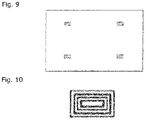
- a printed material was produced in the same manner as in the evaluation of the transfer layer peeling inhibitory properties except that the temperature was changed to 20°C, the relative humidity was changed to 50%, and the formed image was changed to a pattern image illustrated in Figs. 9 and 10 .
- An image formed in a printed material is formed by the melt transfer coloring layer and has a pattern as illustrated in Fig. 10 near four corners of the printed material (see Fig. 9 ).
- the pattern image (line thickness: 2 dots) of the printed material was observed by the naked eye and was evaluated on the basis of the following evaluation criteria. Table 1 shows the evaluation results.
Landscapes
- Physics & Mathematics (AREA)
- Optics & Photonics (AREA)
- Thermal Transfer Or Thermal Recording In General (AREA)
Abstract
Description
- The present disclosure relates to a combination of a thermal transfer sheet and an intermediate transfer medium, and a method for producing a printed material using the combination.
- Various thermal transfer recording methods, such as a hot-melt transfer method, have been known. In the hot-melt transfer method, for example, an image is formed by superimposing a thermal transfer sheet including a melt transfer coloring layer on a transfer-receiving article, then passing them between a thermal head and a platen roller of a thermal transfer printer, and heating the thermal transfer sheet with the thermal head to transfer the melt transfer coloring layer onto the transfer-receiving article. A printed material is produced in this way.
- Printed materials are also widely produced by using a combination of a thermal transfer sheet including a melt transfer coloring layer and an intermediate transfer medium including a transfer layer.
- More specifically, an image is formed by first superimposing a thermal transfer sheet on an intermediate transfer medium, then passing them between a thermal head and a platen roller of a thermal transfer printer, and heating the thermal transfer sheet with the thermal head to transfer a melt transfer coloring layer onto a transfer layer including a receiving layer of the intermediate transfer medium. The intermediate transfer medium is then heated to transfer the transfer layer and the melt transfer coloring layer forming an image on the transfer layer onto a transfer-receiving article. A printed material is produced in this way.
- In such production of a printed material, the temperature of the thermal head rises at an image forming position on a transfer-receiving article, and the melt transfer coloring layer is transferred onto the transfer-receiving article. When the temperature is increased from an excessively low temperature, however, the temperature of the thermal head does not reach the transfer temperature of the melt transfer coloring layer, and the melt transfer coloring layer may not be successfully transferred at the image forming position. To avoid such a problem, the temperature of the thermal head is generally maintained at a certain temperature that is equal to or lower than the transfer temperature of the melt transfer coloring layer but is not too low even at a position on which an image is not formed.
- As described above, when the thermal transfer sheet and the intermediate transfer medium are passed between the thermal head and the platen roller, the thermal head is maintained at a moderately high temperature even at the position on which an image is not formed. The thermal transfer sheet and the intermediate transfer medium in close contact with each other are transported between the thermal head maintained at the moderately high temperature and the platen roller.
- Thus, at the position on which an image is not formed, the melt transfer coloring layer of the thermal transfer sheet may adhere to the receiving layer of the intermediate transfer medium, and the transfer layer including the receiving layer and the like may be separated from the intermediate transfer medium (hereinafter referred to as transfer layer peeling). Furthermore, at the position on which an image is not formed, a coloring material contained in the melt transfer coloring layer of the thermal transfer sheet may move onto the receiving layer of the intermediate transfer medium (hereinafter referred to as scumming). The present inventors have found a new problem that transfer layer peeling or scumming impairs the appearance of a printed material.
- An object of the present disclosure is to provide a combination of a thermal transfer sheet and an intermediate transfer medium that can effectively prevent transfer layer peeling and scumming at a position on which an image is not formed.
- Another object of the present disclosure is to provide a method for producing a printed material using the combination of the thermal transfer sheet and the intermediate transfer medium.
- A combination of a thermal transfer sheet and an intermediate transfer medium according to the present disclosure is characterized in that the thermal transfer sheet includes a first substrate and a melt transfer coloring layer, the intermediate transfer medium includes a second substrate and a transfer layer including a receiving layer, and the melt transfer coloring layer and the receiving layer contain a release material.
- A method for producing a printed material according to the present disclosure includes the steps of: providing the combination of the thermal transfer sheet and the intermediate transfer medium; transferring the melt transfer coloring layer from the thermal transfer sheet onto the receiving layer of the intermediate transfer medium to form an image; and transferring the transfer layer including the receiving layer, onto which the melt transfer coloring layer is transferred, from the intermediate transfer medium onto a transfer-receiving article.
- The present disclosure can provide a combination of a thermal transfer sheet and an intermediate transfer medium that can effectively prevent transfer layer peeling and scumming at a position on which an image is not formed.
- The present disclosure can provide a method for producing a printed material using the combination of the thermal transfer sheet and the intermediate transfer medium.
-
- [
Fig. 1] Fig. 1 is a schematic cross-sectional view of an embodiment of a combination of a thermal transfer sheet and an intermediate transfer medium according to the present disclosure. - [
Fig. 2] Fig. 2 is a schematic cross-sectional view of an embodiment of a thermal transfer sheet constituting a combination of the thermal transfer sheet and an intermediate transfer medium according to the present disclosure. - [
Fig. 3] Fig. 3 is a schematic cross-sectional view of an embodiment of a thermal transfer sheet constituting a combination of the thermal transfer sheet and an intermediate transfer medium according to the present disclosure. - [
Fig. 4] Fig. 4 is a schematic cross-sectional view of an embodiment of a thermal transfer sheet constituting a combination of the thermal transfer sheet and an intermediate transfer medium according to the present disclosure. - [
Fig. 5] Fig. 5 is a schematic cross-sectional view of an embodiment of a thermal transfer sheet constituting a combination of the thermal transfer sheet and an intermediate transfer medium according to the present disclosure. - [
Fig. 6] Fig. 6 is a schematic cross-sectional view of an embodiment of an intermediate transfer medium constituting a combination of a thermal transfer sheet and the intermediate transfer medium according to the present disclosure. - [
Fig. 7] Fig. 7 is a schematic cross-sectional view of an embodiment of an intermediate transfer medium constituting a combination of a thermal transfer sheet and the intermediate transfer medium according to the present disclosure. - [
Fig. 8] Fig. 8 is a front view of a printed material with a "pattern A" image produced for the evaluation of transfer layer peeling inhibitory properties and scumming inhibitory properties. - [
Fig. 9] Fig. 9 is a front view of a printed material with a pattern image produced for the evaluation of adhesion. - [
Fig. 10] Fig. 10 is an enlarged view of the pattern image on the printed material ofFig. 9 . - An embodiment of a combination of a thermal transfer sheet and an intermediate transfer medium according to the present disclosure is described with reference to the accompanying drawings.
-
Fig. 1 is a schematic cross-sectional view of an embodiment of a combination of a thermal transfer sheet and an intermediate transfer medium according to the present disclosure.Figs. 2 to 5 are schematic cross-sectional views of an embodiment of the thermal transfer sheet.Figs. 6 and 7 are schematic cross-sectional views of an embodiment of the intermediate transfer medium. - As illustrated in
Fig. 1 , a combination of athermal transfer sheet 10 and anintermediate transfer medium 20 according to the present disclosure includes - the
thermal transfer sheet 10 including afirst substrate 11 and a melttransfer coloring layer 12 located on thefirst substrate 11, and - the
intermediate transfer medium 20 including asecond substrate 21 and atransfer layer 22. Thetransfer layer 22 includes at least a receivinglayer 23. - In one embodiment, as illustrated in
Fig. 2 , thethermal transfer sheet 10 includes apeeling layer 13 between thefirst substrate 11 and the melttransfer coloring layer 12. In one embodiment, as illustrated inFig. 3 , thethermal transfer sheet 10 includes arelease layer 14 between thefirst substrate 11 and the melttransfer coloring layer 12. When thethermal transfer sheet 10 includes thepeeling layer 13 and therelease layer 14, as illustrated inFig. 4 , therelease layer 14 and thepeeling layer 13 are located in this order between thefirst substrate 11 and the melttransfer coloring layer 12. - In one embodiment, as illustrated in
Fig. 5 , thethermal transfer sheet 10 includes a sublimationtransfer coloring layer 15 in a plane sequential manner with the melttransfer coloring layer 12. As illustrated inFig. 5 , a plurality of sublimationtransfer coloring layers 15 may be provided. - In one embodiment, as illustrated in
Figs. 1 to 5 , thethermal transfer sheet 10 includes aback layer 16 on the opposite surface of thefirst substrate 11 from the surface on which the melttransfer coloring layer 12 is provided. - In one embodiment, as illustrated in
Fig. 6 , thetransfer layer 22 of theintermediate transfer medium 20 includes apeeling layer 24 under the receivinglayer 23. - In one embodiment, as illustrated in
Fig. 7 , thetransfer layer 22 of theintermediate transfer medium 20 includes aprotective layer 25 under the receivinglayer 23. When thetransfer layer 22 includes thepeeling layer 24 and theprotective layer 25, as illustrated inFig. 7 , theprotective layer 25 and thepeeling layer 24 are located in this order under the receivinglayer 23. - Each layer of the thermal transfer sheet and the intermediate transfer medium is described below. Each layer may contain one or two or more of the components described below.
- The thermal transfer sheet includes a first substrate and a melt transfer coloring layer located on the first substrate. In one embodiment, the thermal transfer sheet includes a peeling layer between the first substrate and the melt transfer coloring layer. In one embodiment, the thermal transfer sheet includes a release layer between the first substrate and the melt transfer coloring layer or between the first substrate and the peeling layer. In one embodiment, the thermal transfer sheet includes a sublimation transfer coloring layer in a plane sequential manner with the melt transfer coloring layer. In one embodiment, the thermal transfer sheet includes a back layer on the opposite surface of the first substrate from the surface on which the melt transfer coloring layer is provided.
- The first substrate may be any substrate that has heat resistance to withstand thermal energy applied during thermal transfer (for example, heat generated by a thermal head), mechanical strength to support a coloring layer and the like on the first substrate, and solvent resistance.
- The first substrate may be a film comprising a resin (hereinafter referred to simply as a "resin film"). Examples of the resin include polyesters, such as poly(ethylene terephthalate) (PET), poly(butylene terephthalate) (PBT), poly(ethylene naphthalate) (PEN), 1,4-poly(cyclohexylenedimethylene terephthalate), and terephthalic acid-cyclohexanedimethanol-ethylene glycol copolymers; polyamides, such as nylon 6 and nylon 6,6; polyolefins, such as polyethylene (PE), polypropylene (PP) and polymethylpentene; vinyl resins, such as poly(vinyl chloride), poly(vinyl alcohol) (PVA), poly(vinyl acetate), vinyl chloride-vinyl acetate copolymers, poly(vinyl butyral), and polyvinylpyrrolidone (PVP); (meth)acrylic resins, such as polyacrylates, polymethacrylates, and poly(methyl methacrylate); imide resins, such as polyimides and polyetherimides; cellulose resins, such as cellophane, cellulose acetate, nitrocellulose, cellulose acetate propionate (CAP), and cellulose acetate butyrate (CAB); styrene resins, such as polystyrene (PS); polycarbonates; and ionomer resins.
- Among these resins, in terms of heat resistance and mechanical strength, polyesters, such as PET and PEN, are preferred, and PET is particularly preferred.
- In the present disclosure, "(meth)acrylic" includes both "acrylic" and "methacrylic". "(Meth)acrylate" includes both "acrylate" and "methacrylate".
- The first substrate may be a laminate of the resin films. The laminate of the resin films can be formed by a dry lamination method, a wet lamination method, or an extrusion method.
- When the first substrate is a resin film, the resin film may be a stretched film or an unstretched film. The resin film is preferably a uniaxially or biaxially stretched film in terms of strength.
- The first substrate preferably has a thickness in the range of 2 to 25 µm, more preferably 3 to 10 µm. This can improve the mechanical strength of the first substrate and the transfer of thermal energy during thermal transfer.
- The thermal transfer sheet includes a melt transfer coloring layer containing a release material on the first substrate.
- Examples of the release material include fluorine compounds, phosphoric acid ester compounds, silicone oils, higher fatty acid amide compounds, metallic soaps, and waxes, such as paraffin waxes.
- Among these, silicone oils are preferred in terms of transfer layer peeling inhibitory properties and scumming inhibitory properties.
- The melt transfer coloring layer may contain two or more release materials.
- Examples of the silicone oils include straight silicon oils, such as dimethyl silicone oil and methylphenyl silicone oil; and modified silicone oils, such as amino-modified silicone oils, epoxy-modified silicone oils, carboxy-modified silicone oils, (meth)acrylic-modified silicone oils, mercapto-modified silicone oils, carbinol-modified silicone oils, fluorine-modified silicone oils, methylstyryl-modified silicone oils, and polyether-modified silicone oils. The modified silicone oils may be of one-end type, both-end type, or side-chain one-end type.
- Among these, modified silicone oils are preferred, and epoxy-modified silicone oils are particularly preferred, in terms of transfer layer peeling inhibitory properties and scumming inhibitory properties.
- The melt transfer coloring layer preferably has a release material content (A) in the range of 0.5% to 10% by mass, more preferably 1% to 5% by mass, particularly preferably 1% to 4% by mass. This can further improve the transfer layer peeling inhibitory properties and scumming inhibitory properties. This can also improve the adhesion between the melt transfer coloring layer and the receiving layer and reduce blurring or the like in an image formed.
- The melt transfer coloring layer contains a coloring material.
- The coloring material may be a pigment or a dye.
- Examples of the coloring material include carbon black, acetylene black, lampblack, graphite, iron black, aniline black, silica, calcium carbonate, titanium oxide, cadmium red, cadmopone red, chromium red, vermilion, colcothar, azo pigments, alizarin lake, quinacridone, cochineal lake perylene, yellow ochre, aureolin, cadmium yellow, cadmium orange, chromium yellow, zinc yellow, Naples yellow, nickel yellow, azo pigments, greenish yellow, ultramarine, mountain blue, cobalt, phthalocyanine, anthraquinone, indigoid, cinnabar green, cadmium green, chromium green, phthalocyanine, azomethine, perylene, and aluminum pigments.
- The coloring material content of the melt transfer coloring layer preferably ranges from 10% to 50% by mass, more preferably 20% to 45% by mass. This can improve the image density on the receiving layer.
- In one embodiment, the melt transfer coloring layer contains a resin material. Examples of the resin material include polyesters, polyamides, polyolefins, vinyl resins, vinyl acetal resins, (meth)acrylic resins, cellulose resins, styrene resins, polycarbonates, phenoxy resins, and ionomer resins.
- Among these, in terms of adhesiveness to the receiving layer, vinyl resins are preferred, and vinyl chloride-vinyl acetate copolymers are particularly preferred.
- The resin material content of the melt transfer coloring layer preferably ranges from 20% to 75% by mass, more preferably 30% to 60% by mass. This can further improve the adhesion between the melt transfer coloring layer and the receiving layer.
- The melt transfer coloring layer may contain additive materials, such as a filler, a plasticizing material, an ultraviolet absorbing material, inorganic particles, organic particles, and a dispersing material.
- The melt transfer coloring layer preferably has a thickness in the range of 0.1 to 5 µm, more preferably 0.5 to 2 µm. This can further improve the transfer layer peeling inhibitory properties and scumming inhibitory properties. This can also improve the adhesion between the melt transfer coloring layer and the receiving layer and reduce blurring or the like in an image formed.
- In one embodiment, the melt transfer coloring layer can be formed by dispersing or dissolving the above materials in water or an appropriate organic solvent to prepare a coating liquid, applying the coating liquid to the first substrate or the like by a known coating means to form a coating film, and drying the coating film. The known coating means may be a roll coating method, a reverse roll coating method, a gravure coating method, a reverse gravure coating method, a bar coating method, or a rod coating method.
- The peeling layer is a layer that is located between the first substrate and the melt transfer coloring layer and that is transferred together with the melt transfer coloring layer when the melt transfer coloring layer is transferred onto the receiving layer of the intermediate transfer medium. The peeling layer is provided to improve the transferability of the melt transfer coloring layer.
- In one embodiment, the peeling layer contains a resin material. Examples of the resin material include polyesters, polyamides, polyolefins, vinyl resins, (meth)acrylic resins, imide resins, cellulose resins, styrene resins, polycarbonates, and ionomer resins.
- The resin material content of the peeling layer may range from 50% to 99% by mass, for example.
- In one embodiment, the peeling layer contains the release material. This can further improve the transferability of the melt transfer coloring layer.
- The release material content of the peeling layer preferably ranges from 0.1% to 10% by mass, more preferably 0.5% to 5% by mass. This can further improve the transferability of the melt transfer coloring layer.
- The peeling layer may contain the additive materials.
- The peeling layer preferably has a thickness in the range of 0.1 to 3 µm, more preferably 0.3 to 1.5 µm. This can further improve the transferability of the melt transfer coloring layer.
- In one embodiment, the peeling layer can be formed by dispersing or dissolving the above materials in water or an appropriate organic solvent to prepare a coating liquid, applying the coating liquid to the first substrate or the like by the known coating means to form a coating film, and drying the coating film.
- The release layer is a layer that is located between the first substrate and the melt transfer coloring layer and that remains on the first substrate when the melt transfer coloring layer is transferred onto the receiving layer of the intermediate transfer medium. The release layer is provided to improve the transferability of the melt transfer coloring layer.
- In one embodiment, the release layer contains a resin material. Examples of the resin material include (meth)acrylic resins, polyurethanes, acetal resins, polyamides, polyesters, melamine resins, polyol resins, cellulose resins, and silicone resins.
- The release layer may contain at least one component selected from the release materials and the additive materials.
- The release layer preferably has a thickness in the range of 0.1 to 2 µm.
- In one embodiment, the release layer can be formed by dispersing or dissolving the above materials in water or an appropriate organic solvent to prepare a coating liquid, applying the coating liquid to the first substrate by the known coating means to form a coating film, and drying the coating film.
- In one embodiment, the thermal transfer sheet according to the present disclosure includes a sublimation transfer coloring layer on a first substrate in a plane sequential manner with the melt transfer coloring layer.
- The sublimation transfer coloring layer contains a sublimation dye. Examples of the sublimation dye include diarylmethane dyes, triarylmethane dyes, thiazole dyes, merocyanine dyes, pyrazolone dyes, methine dyes, indoaniline dyes, acetophenone azomethine dyes, pyrazoloazomethine dyes, xanthene dyes, oxazine dyes, thiazine dyes, azine dyes, acridine dyes, azo dyes, spiropyran dyes, indolinospiropyran dyes, fluoran dyes, naphthoquinone dyes, anthraquinone dyes, and quinophthalone dyes.
- In one embodiment, the sublimation transfer coloring layer contains a resin material. Examples of the resin material include (meth)acrylic resins, polyurethanes, acetal resins, polyamides, polyesters, melamine resins, polyol resins, cellulose resins, and silicone resins.
- In one embodiment, the sublimation transfer coloring layer contains the release material. This can reduce the adhesion between the receiving layer of the intermediate transfer medium and the sublimation transfer coloring layer during image formation.
- The release material content of the sublimation transfer coloring layer preferably ranges from 0.01% to 1% by mass, more preferably 0.05% to 0.5% by mass. This can further reduce the adhesion between the receiving layer of the intermediate transfer medium and the sublimation transfer coloring layer during image formation.
- The sublimation transfer coloring layer may contain the additive materials.
- In one embodiment, the sublimation transfer coloring layer can be formed by dispersing or dissolving the above materials in water or an appropriate organic solvent to prepare a coating liquid, applying the coating liquid to the first substrate or the like by the known coating means to form a coating film, and drying the coating film.
- In one embodiment, the thermal transfer sheet according to the present disclosure includes a back layer on the opposite surface of the first substrate from the surface on which the melt transfer coloring layer and the like is provided. This can reduce the occurrence of sticking and wrinkles due to heating during thermal transfer.
- In one embodiment, the back layer contains a resin material. Examples of the resin material include vinyl resins, polyesters, polyamides, polyolefins, (meth)acrylic resins, polyolefins, polyurethanes, cellulose resins, and phenolic resins.
- In one embodiment, the back layer contains an isocyanate compound. Examples of the isocyanate compounds include xylene diisocyanate, toluene diisocyanate, isophorone diisocyanate, and hexamethylene diisocyanate.
- The back layer may contain at least one component selected from the release materials and the additive materials.
- The back layer preferably has a thickness in the range of 0.3 to 3 µm.
- In one embodiment, the back layer can be formed by dispersing or dissolving the above materials in water or an appropriate organic solvent to prepare a coating liquid, applying the coating liquid to the first substrate by the known coating means to form a coating film, and drying the coating film.
- The intermediate transfer medium includes a second substrate and a transfer layer including at least a receiving layer. In one embodiment, the transfer layer of the intermediate transfer medium includes a peeling layer under the receiving layer as a layer closest to the second substrate. In one embodiment, the transfer layer includes a protective layer under the receiving layer. When the transfer layer includes both the peeling layer and the protective layer, the transfer layer includes the peeling layer, the protective layer, and the receiving layer in this order from the second substrate side.
- The second substrate may be a substrate that can be used for the first substrate.
- The second substrate preferably has a thickness in the range of 1 to 50 µm, more preferably 6 to 25 µm. This can effectively reduce the occurrence of thermal wrinkling on the transfer layer while maintaining the transferability of the transfer layer when the transfer layer is transferred from the intermediate transfer medium to the transfer-receiving layer.
- The receiving layer contains the release material. The release material is preferably a silicone oil, more preferably a modified silicone oil, particularly preferably an epoxy-modified silicone oil, among those described above. The release material contained in the receiving layer may be the same as or different from the release material contained in the melt transfer coloring layer.
- The receiving layer preferably has a release material content (B) in the range of 0.5% to 17% by mass, more preferably 1% to 12% by mass, particularly preferably 1% to 9% by mass. This can further improve the transfer layer peeling inhibitory properties and scumming inhibitory properties. This can also improve the adhesion between the melt transfer coloring layer and the receiving layer and reduce blurring or the like in an image formed.
- The ratio (B/A) of the release material content (B) of the receiving layer to the release material content (A) of the melt transfer coloring layer preferably ranges from 0.2 to 12, more preferably 0.3 to 11, particularly preferably 0.3 to 3. This can further improve the transfer layer peeling inhibitory properties and scumming inhibitory properties. This can also improve the adhesion between the melt transfer coloring layer and the receiving layer and reduce blurring or the like in an image formed.
- The sum (A + B) of the release material content (A) of the melt transfer coloring layer and the release material content (B) of the receiving layer preferably ranges from 2% to 13% by mass, more preferably 3% to 11.5% by mass, particularly preferably 3% to 9% by mass. This can further improve the transfer layer peeling inhibitory properties and scumming inhibitory properties. This can also improve the adhesion between the melt transfer coloring layer and the receiving layer and reduce blurring or the like in an image formed.
- In one embodiment, the receiving layer contains a resin material. Examples of the resin material include polyolefins, vinyl resins, such as poly(vinyl chloride) and vinyl chloride-vinyl acetate copolymers, (meth)acrylic resins, cellulose resins, polyesters, polyamides, polycarbonates, styrene resins, epoxy resins, polyurethanes, epoxy resins, and ionomer resins.
- Among these, in terms of adhesiveness to the melt transfer coloring layer and receptivity to the sublimation dye, vinyl resins are preferred, and vinyl chloride-vinyl acetate copolymers are particularly preferred.
- The resin material content of the receiving layer preferably ranges from 80% to 99.5% by mass, more preferably 85% to 99% by mass. This can further improve the adhesiveness to the melt transfer coloring layer and the receptivity to the sublimation dye.
- The receiving layer may contain the additive materials.
- The receiving layer preferably has a thickness in the range of 0.5 to 20 µm, more preferably 1 to 10 µm. This can further improve the transfer layer peeling inhibitory properties and scumming inhibitory properties. This can also improve the adhesion between the melt transfer coloring layer and the receiving layer and reduce blurring or the like in an image formed. This can also improve the image density.
- In one embodiment, the receiving layer can be formed by dispersing or dissolving the above materials in water or an appropriate organic solvent to prepare a coating liquid, applying the coating liquid to a layer on the second substrate or the like by the known coating means to form a coating film, and drying the coating film.
- In one embodiment, the transfer layer includes a peeling layer. The peeling layer is a layer that is transferred from the intermediate transfer medium onto a transfer-receiving article and that is to be located on the top of a printed material.
- In one embodiment, the peeling layer contains a resin material. Examples of the resin materials include polyesters, polyamides, polyolefins, vinyl resins, (meth)acrylic resins, imide resins, cellulose resins, styrene resins, polycarbonates, and ionomer resins.
- The peeling layer may contain at least one component selected from the release materials and the additive materials.
- In one embodiment, the peeling layer can be formed by dispersing or dissolving the above materials in water or an appropriate organic solvent to prepare a coating liquid, applying the coating liquid to the second substrate by the known coating means to form a coating film, and drying the coating film.
- In one embodiment, the transfer layer of the intermediate transfer medium includes a protective layer between the peeling layer and the receiving layer.
- In one embodiment, the protective layer contains a resin material. Examples of the resin materials include polyesters, (meth)acrylic resins, epoxy resins, styrene resins, acrylic polyol resins, polyurethanes, ionizing radiation curable resins, and ultraviolet absorbing resins.
- The protective layer may contain the additive materials.
- The protective layer preferably has a thickness in the range of 0.5 to 7 µm, more preferably 1 to 5 µm. This can further improve the durability of the protective layer.
- The protective layer can be formed by dispersing or dissolving the above materials in water or an appropriate organic solvent to prepare a coating liquid, applying the coating liquid to the second substrate or the like by the known coating means to form a coating film, and drying the coating film.
- A method for producing a printed material according to the present disclosure includes the steps of: providing the combination of the thermal transfer sheet and the intermediate transfer medium; transferring the melt transfer coloring layer from the thermal transfer sheet onto the receiving layer of the intermediate transfer medium to form an image; and transferring the transfer layer including the receiving layer, onto which the melt transfer coloring layer is transferred, from the intermediate transfer medium onto a transfer-receiving article.
- The steps of a method for producing a printed material according to the present disclosure are described below.
- The method for producing a printed material according to the present disclosure includes the step of providing the thermal transfer sheet and the intermediate transfer medium. Methods for producing the thermal transfer sheet and the intermediate transfer medium are described above and are not described here.
- The method for producing a printed material according to the present disclosure includes the step of transferring the melt transfer coloring layer from the thermal transfer sheet onto the receiving layer of the intermediate transfer medium to form an image.
- When the thermal transfer sheet includes a sublimation transfer coloring layer, a sublimation dye may be sublimated and transferred from the sublimation transfer coloring layer onto the receiving layer to form an image, and then the melt transfer coloring layer may be transferred to form another image.
- The transfer can be performed by a known method using a commercial thermal transfer printer or the like with a thermal head and a platen roller.
- The method for producing a printed material according to the present disclosure includes the step of transferring the transfer layer including the receiving layer, onto which the melt transfer coloring layer is transferred, from the intermediate transfer medium onto a transfer-receiving article. The transfer can be performed by a known method using a commercial thermal transfer printer or the like.
- The transfer-receiving article can be appropriately selected according to the intended use and may be a paper substrate, such as high-quality paper, art paper, coated paper, resin-coated paper, cast-coated paper, paperboard, synthetic paper, or impregnated paper, or the resin film, or a laminate thereof.
- The present disclosure relates to the following [1] to [8], for example.
- [1] A combination of a thermal transfer sheet and an intermediate transfer medium, the thermal transfer sheet including a first substrate and a melt transfer coloring layer, the intermediate transfer medium including a second substrate and a transfer layer including a receiving layer, and the melt transfer coloring layer and the receiving layer containing a release material.
- [2] The combination of the thermal transfer sheet and the intermediate transfer medium according to [1], wherein the melt transfer coloring layer has a release material content (A) in the range of 0.5% to 10% by mass.
- [3] The combination of the thermal transfer sheet and the intermediate transfer medium according to [1] or [2], wherein the receiving layer has a release material content (B) in the range of 0.5% to 17% by mass.
- [4] The combination of the thermal transfer sheet and the intermediate transfer medium according to any one of [1] to [3], wherein a ratio (B/A) of a release material content (B) of the receiving layer to a release material content (A) of the melt transfer coloring layer ranges from 0.2 to 12.
- [5] The combination of the thermal transfer sheet and the intermediate transfer medium according to any one of [1] to [4], wherein a sum (A + B) of a release material content (A) of the melt transfer coloring layer and a release material content (B) of the receiving layer ranges from 2% to 13% by mass.
- [6] The combination of the thermal transfer sheet and the intermediate transfer medium according to any one of [1] to [5], wherein the release material is a silicone oil.
- [7] The combination of the thermal transfer sheet and the intermediate transfer medium according to any one of [1] to [6], wherein the melt transfer coloring layer and the receiving layer contain a vinyl resin.
- [8] A method for producing a printed material, including the steps of: providing the combination of the thermal transfer sheet and the intermediate transfer medium according to any one of [1] to [7]; transferring the melt transfer coloring layer from the thermal transfer sheet onto the receiving layer of the intermediate transfer medium to form an image; and transferring the transfer layer including the receiving layer, onto which the melt transfer coloring layer is transferred, from the intermediate transfer medium onto a transfer-receiving article.
- The combination of the thermal transfer sheet and the intermediate transfer medium according to the present disclosure and the like are described in more detail in the following examples. However, the combination and the like are not limited to these examples.
- A PET film with a thickness of 6 µm was provided as a first substrate. Coating liquids A, B, and C with the following compositions for forming sublimation transfer coloring layers were applied to one surface of the first substrate in a plane sequential manner and were dried to form sublimation transfer coloring layers A, B, and C each with a thickness of 0.7 µm.
-
• Yellow sublimation dye 6 parts by mass • Poly(vinyl acetal) (S-Lec (registered trademark) KS-6 manufactured by Sekisui Chemical Co., Ltd.) 4 parts by mass • Methyl ethyl ketone (MEK) 45 parts by mass • Toluene 45 parts by mass -
• Magenta sublimation dye 6 parts by mass • Poly(vinyl acetal) (S-Lec (registered trademark) KS-6 manufactured by Sekisui Chemical Co., Ltd.) 4 parts by mass • MEK 45 parts by mass • Toluene 45 parts by mass -
• Cyan sublimation dye 6 parts by mass • Poly(vinyl acetal) (S-Lec (registered trademark) KS-6 manufactured by Sekisui Chemical Co., Ltd.) 4 parts by mass • MEK 45 parts by mass • Toluene 45 parts by mass - A coating liquid with the following composition for forming a release layer was applied to the first substrate, on which the sublimation transfer coloring layers A, B, and C were formed, in a plane sequential manner with the sublimation transfer coloring layers thus formed, and was dried to form a release layer with a thickness of 0.2 µm.
-
• Urethane resin (glass transition temperature (Tg): -30°C) 23 parts by mass • Urethane resin (Tg: 92°C) 7 parts by mass • Poly(vinyl acetal) (S-Lec (registered trademark) KS-5 manufactured by Sekisui Chemical Co., Ltd.) 70 parts by mass • MEK 950 parts by mass • Toluene 950 parts by mass - A coating liquid with the following composition for forming a peeling layer was applied to the release layer thus formed and was dried to form a peeling layer with a thickness of 0.6 µm.
-
• Vinyl chloride-vinyl acetate copolymer (Solbin (registered trademark) CNL manufactured by Nissin Chemical Industry Co., Ltd.) 85 parts by mass • Acrylic resin (Vanaresin GH-8701 manufactured by Shin-Nakamura Chemical Co., Ltd.) 15 parts by mass • Epoxy-modified silicone oil (KP-1800U manufactured by Shin-Etsu Chemical Co., Ltd.) 2 parts by mass • MEK 150 parts by mass • Toluene 150 parts by mass - A coating liquid with the following composition for forming a melt transfer coloring layer was applied to the peeling layer thus formed and was dried to form a melt transfer coloring layer with a thickness of 0.8 µm.
-
• Vinyl chloride-vinyl acetate copolymer (Solbin (registered trademark) CNL manufactured by Nissin Chemical Industry Co., Ltd.) 60 parts by mass • Epoxy-modified silicone oil (KP-1800U manufactured by Shin-Etsu Chemical Co., Ltd.) 1 part by mass • Carbon black 40 parts by mass • Toluene 100 parts by mass - A coating liquid with the following composition for forming a back layer was applied to the other surface of the first substrate and was dried to form a back layer with a thickness of 1 µm. Thus, a thermal transfer sheet was obtained.
-
. Poly(vinyl butyral) (S-Lec (registered trademark) BX-1 manufactured by Sekisui Chemical Co., Ltd.) 20 parts by mass • Polyisocyanate (Burnock (registered trademark) D750 manufactured by DIC Corporation) 44 parts by mass • Phosphate surfactant (Plysurf (registered trademark) A208N manufactured by Dai-ichi Kogyo Seiyaku Co., Ltd.) 13 parts by mass • Talc (Micro Ace (registered trademark) P-3 manufactured by Nippon Talc Co., Ltd.) 3 parts by mass • MEK 460 parts by mass • Toluene 460 parts by mass - A PET film with a thickness of 12 µm was provided as a second substrate. A coating liquid with the following composition for forming a peeling layer was applied to a surface of the second substrate and was dried to form a peeling layer with a thickness of 1.6 µm.
-
· Vinyl chloride-vinyl acetate copolymer (Solbin (registered trademark) CNL manufactured by Nissin Chemical Industry Co., Ltd.) 85 parts by mass . (Meth)acrylic resin (Vanaresin GH-8701 manufactured by Shin-Nakamura Chemical Co., Ltd.) 15 parts by mass • Epoxy-modified silicone oil (KP-1800U manufactured by Shin-Etsu Chemical Co., Ltd.) 2 parts by mass • MEK 150 parts by mass • Toluene 150 parts by mass - A coating liquid with the following composition for forming a protective layer was applied to the peeling layer thus formed and was dried to form a protective layer with a thickness of 4 µm.
-
• Polyester 20 parts by mass (Elitel (registered trademark) UE-9885 manufactured by Unitika Ltd.) • MEK 40 parts by mass • Toluene 40 parts by mass - A coating liquid with the following composition for forming a receiving layer was applied to the protective layer thus formed and was dried to form a receiving layer with a thickness of 2 µm. Thus, an intermediate transfer medium was obtained.
-
• Vinyl chloride-vinyl acetate copolymer (Solbin (registered trademark) CNL manufactured by Nissin Chemical Industry Co., Ltd.) 95 parts by mass • Epoxy-modified silicone oil (KP-1800U manufactured by Shin-Etsu Chemical Co., Ltd.) 5 parts by mass • MEK 200 parts by mass • Toluene 200 parts by mass - A combination of a thermal transfer sheet and an intermediate transfer medium was produced in the same manner as in Example 1 except that the composition of the melt transfer coloring layer of the thermal transfer sheet and the composition of the receiving layer of the intermediate transfer medium were changed as shown in Table 1.
- The combinations of the thermal transfer sheet and the intermediate transfer medium produced in the examples and comparative examples, a poly(vinyl chloride) (PVC) card (54 mm in length x 86 mm in width) serving as a transfer-receiving article, and a thermal transfer printer with a thermal head and a platen roller (PR-C201 manufactured by Canon Finetech Nisca Inc.) were provided.
- With the thermal transfer printer, the sublimation dyes contained in the sublimation transfer coloring layers and the melt transfer coloring layer were transferred at a temperature of 10°C and at a relative humidity of 30% from the thermal transfer sheet onto the receiving layer of the intermediate transfer medium to form a "pattern A" image. After image formation, the transfer layer on which the image was formed was transferred from the intermediate transfer medium onto the PVC card to produce a printed material.
- As illustrated in
Fig. 8 , the "pattern A" formed on the printed material was a black solid character image formed by the melt transfer coloring layer, which was formed at the center of a background image of a gray solid uniform image (128/255 image gray level) formed by the sublimation dyes. - The background image formed by the sublimation dyes in the printed material was observed by the naked eye and with a 20x magnifier and was evaluated on the basis of the following evaluation criteria. Table 1 shows the evaluation results.
- A: Separation of the transfer layer was not observed in the background image forming portion by the naked eye and with the 20x magnifier.
- B: Although separation of the transfer layer was not observed in the background image forming portion by the naked eye, separation of the transfer layer was observed with the 20x magnifier.
- NG: Separation of the transfer layer was observed in the background image forming portion.
- The background image forming portion of the printed material produced for the evaluation of the transfer layer peeling inhibitory properties was observed by the naked eye and was evaluated on the basis of the following evaluation criteria. Table 1 shows the evaluation results.
-
- A: No scumming was observed.
- NG: Scumming was observed.
- A printed material was produced in the same manner as in the evaluation of the transfer layer peeling inhibitory properties except that the temperature was changed to 20°C, the relative humidity was changed to 50%, and the formed image was changed to a pattern image illustrated in
Figs. 9 and 10 . - An image formed in a printed material is formed by the melt transfer coloring layer and has a pattern as illustrated in
Fig. 10 near four corners of the printed material (seeFig. 9 ). - The pattern image (line thickness: 2 dots) of the printed material was observed by the naked eye and was evaluated on the basis of the following evaluation criteria. Table 1 shows the evaluation results.
-
- A: No blurring was observed in the pattern image, and a good image was formed.
- B: Slight blurring was observed in the pattern image.
- C: Blurring was observed in the pattern image.
- Those skilled in the art will appreciate that a combination of a thermal transfer sheet and an intermediate transfer medium and the like according to the present disclosure are not limited to these examples, that the examples and the specification only illustrate the principles of the present disclosure, that various modifications and improvements may be made without departing from the gist and scope of the present disclosure, and that all the modifications and improvements fall within the scope of the present disclosure for which protection is sought. Furthermore, the scope for which protection is sought by the present disclosure includes not only the claims but also equivalents thereof.
-
- 10
- thermal transfer sheet
- 11
- first substrate
- 12
- melt transfer coloring layer
- 13
- peeling layer
- 14
- release layer
- 15
- sublimation transfer coloring layer
- 16
- back layer
- 20
- intermediate transfer medium
- 21
- second substrate
- 22
- transfer layer
- 23
- receiving layer
- 24
- peeling layer
- 25
- protective layer
| Table 1 | Release material content A of melt transfer coloring layer (mass%) | Release material content B of receiving layer (mass%) | B/A | A+B | Evaluation of transfer layer peeling inhibitory properties | Evaluation of scumming inhibitory properties | Evaluation of adhesion |
| Example 1 | 1 | 5 | 5 | 6 | A | A | A |
| Example 2 | 1 | 10 | 10 | 11 | A | A | A |
| Example 3 | 1 | 1 | 1 | 2 | A | A | A |
| Example 4 | 2.9 | 5 | 1.7 | 7.9 | A | A | A |
| Example 5 | 2.9 | 10 | 3.4 | 12.9 | A | A | B |
| Example 6 | 2.9 | 1 | 0.3 | 3.9 | A | A | A |
| Example 7 | 4.8 | 5 | 1 | 9.8 | A | A | B |
| Example 8 | 4.8 | 8 | 1.7 | 12.8 | A | A | B |
| Example 9 | 4.8 | 1 | 0.2 | 5.8 | A | A | B |
| Example 10 | 6 | 2 | 0.3 | 8 | A | A | B |
| Example 11 | 7.4 | 1 | 0.1 | 8.4 | A | A | C |
| Example 12 | 1 | 15 | 15 | 16 | A | A | C |
| Example 13 | 4.8 | 10 | 2.1 | 14.8 | A | A | C |
| Example 14 | 0.5 | 1 | 2 | 1.5 | B | A | A |
| Comparative example 1 | - | 5 | - | 5 | NG | NG | A |
Claims (8)
- A combination of a thermal transfer sheet and an intermediate transfer medium,the thermal transfer sheet including a first substrate and a melt transfer coloring layer,the intermediate transfer medium including a second substrate and a transfer layer including a receiving layer, andthe melt transfer coloring layer and the receiving layer containing a release material.
- The combination of the thermal transfer sheet and the intermediate transfer medium according to Claim 1, wherein the melt transfer coloring layer has a release material content (A) in the range of 0.5% to 10% by mass.
- The combination of the thermal transfer sheet and the intermediate transfer medium according to Claim 1 or 2, wherein the receiving layer has a release material content (B) in the range of 0.5% to 17% by mass.
- The combination of the thermal transfer sheet and the intermediate transfer medium according to any one of Claims 1 to 3, wherein a ratio (B/A) of a release material content (B) of the receiving layer to a release material content (A) of the melt transfer coloring layer ranges from 0.2 to 12.
- The combination of the thermal transfer sheet and the intermediate transfer medium according to any one of Claims 1 to 4, wherein a sum (A + B) of a release material content (A) of the melt transfer coloring layer and a release material content (B) of the receiving layer ranges from 2% to 13% by mass.
- The combination of the thermal transfer sheet and the intermediate transfer medium according to any one of Claims 1 to 5, wherein the release material is a silicone oil.
- The combination of the thermal transfer sheet and the intermediate transfer medium according to any one of Claims 1 to 6, wherein the melt transfer coloring layer and the receiving layer contain a vinyl resin.
- A method for producing a printed material, comprising the steps of:providing the combination of the thermal transfer sheet and the intermediate transfer medium according to any one of Claims 1 to 7;transferring the melt transfer coloring layer from the thermal transfer sheet onto the receiving layer of the intermediate transfer medium to form an image; andtransferring the transfer layer including the receiving layer, onto which the melt transfer coloring layer is transferred, from the intermediate transfer medium onto a transfer-receiving article.
Applications Claiming Priority (2)
| Application Number | Priority Date | Filing Date | Title |
|---|---|---|---|
| JP2019167597 | 2019-09-13 | ||
| PCT/JP2020/032736 WO2021049334A1 (en) | 2019-09-13 | 2020-08-28 | Combination of thermal transfer sheet and intermediate transfer medium and method for producing printed product using said combination |
Publications (2)
| Publication Number | Publication Date |
|---|---|
| EP4029704A1 true EP4029704A1 (en) | 2022-07-20 |
| EP4029704A4 EP4029704A4 (en) | 2023-10-11 |
Family
ID=74866144
Family Applications (1)
| Application Number | Title | Priority Date | Filing Date |
|---|---|---|---|
| EP20863042.6A Pending EP4029704A4 (en) | 2019-09-13 | 2020-08-28 | COMBINATION OF A THERMAL TRANSFER SHEET AND AN INTERMEDIATE TRANSFER MEDIUM AND METHOD FOR PRODUCING A PRINTED PRODUCT USING SAID COMBINATION |
Country Status (5)
| Country | Link |
|---|---|
| US (1) | US12533903B2 (en) |
| EP (1) | EP4029704A4 (en) |
| JP (1) | JP6924428B1 (en) |
| KR (1) | KR20220045224A (en) |
| WO (1) | WO2021049334A1 (en) |
Family Cites Families (11)
| Publication number | Priority date | Publication date | Assignee | Title |
|---|---|---|---|---|
| JP2559694B2 (en) * | 1985-07-22 | 1996-12-04 | 大日本印刷株式会社 | Thermal transfer sheet |
| JPH0596857A (en) * | 1991-10-09 | 1993-04-20 | Konica Corp | Heat sensitive transfer recording method |
| JP3475298B2 (en) | 1993-08-19 | 2003-12-08 | 大日本印刷株式会社 | Image forming method using intermediate transfer recording medium |
| JP3404602B2 (en) | 1993-12-02 | 2003-05-12 | 大日本印刷株式会社 | Intermediate transfer recording medium and image formed matter |
| JP2001058467A (en) * | 1999-08-23 | 2001-03-06 | Konica Corp | Laser thermal transfer recording medium |
| WO2013129415A1 (en) | 2012-02-29 | 2013-09-06 | 大日本印刷株式会社 | Intermediate transfer medium |
| JP5686168B2 (en) * | 2013-08-29 | 2015-03-18 | 大日本印刷株式会社 | Combination of intermediate transfer medium and thermal transfer sheet |
| JP6677919B2 (en) * | 2015-09-18 | 2020-04-08 | 大日本印刷株式会社 | Transfer sheet |
| JP6315162B2 (en) * | 2016-02-25 | 2018-04-25 | 大日本印刷株式会社 | Combination of sublimation thermal transfer sheet and intermediate transfer medium, and method for producing printed matter |
| CN108602368B (en) * | 2016-03-18 | 2021-12-21 | 大日本印刷株式会社 | Method for forming printed matter |
| CN108602371B (en) | 2016-03-18 | 2020-03-24 | 大日本印刷株式会社 | Intermediate transfer medium, combination of intermediate transfer medium and thermal transfer sheet, and method of forming printed matter |
-
2020
- 2020-08-28 JP JP2021504846A patent/JP6924428B1/en active Active
- 2020-08-28 US US17/753,182 patent/US12533903B2/en active Active
- 2020-08-28 KR KR1020227008758A patent/KR20220045224A/en not_active Ceased
- 2020-08-28 EP EP20863042.6A patent/EP4029704A4/en active Pending
- 2020-08-28 WO PCT/JP2020/032736 patent/WO2021049334A1/en not_active Ceased
Also Published As
| Publication number | Publication date |
|---|---|
| KR20220045224A (en) | 2022-04-12 |
| US12533903B2 (en) | 2026-01-27 |
| JP6924428B1 (en) | 2021-08-25 |
| EP4029704A4 (en) | 2023-10-11 |
| WO2021049334A1 (en) | 2021-03-18 |
| US20220194110A1 (en) | 2022-06-23 |
| JPWO2021049334A1 (en) | 2021-09-27 |
Similar Documents
| Publication | Publication Date | Title |
|---|---|---|
| EP3431303B1 (en) | Intermediate transfer medium, combination of intermediate transfer medium and thermal transfer sheet, and method for forming print | |
| EP3348412B1 (en) | Method for forming print, method for peeling off transfer layer, and thermal transfer printer | |
| EP3348413B1 (en) | Transfer sheet | |
| EP4151424A1 (en) | Heat transfer sheet, and combination of said heat transfer sheet and intermediate transfer medium | |
| EP2937222B1 (en) | Thermal transfer sheet | |
| JP5793913B2 (en) | Thermal transfer sheet | |
| EP4088926A1 (en) | Peel-off sheet, and combination of peel-off sheet and intermediate transfer medium | |
| US6346316B1 (en) | Protective layer transfer sheet and print | |
| US20250340079A1 (en) | Thermal transfer sheet, discolored or decolorized printed material, and method for producing discolored or decolorized printed material | |
| JP3830985B2 (en) | Protective layer transfer film and printed matter | |
| EP4029701B1 (en) | Thermal transfer sheet, combination of thermal transfer sheet and intermediate transfer medium, and method for producing a printed material | |
| US12055875B2 (en) | Intermediate transfer medium, printed material, and method for producing printed material | |
| EP4019264B1 (en) | Heat transfer sheet | |
| US12533903B2 (en) | Combination of thermal transfer sheet and intermediate transfer medium, and method for producing printed material using combination | |
| EP3932667B1 (en) | Thermal transfer sheet | |
| EP3753745B1 (en) | Protective layer transfer sheet | |
| KR20230020541A (en) | Method for manufacturing thermal transfer sheet, color-changing phosphite and color-changing phosphide | |
| JP2022043878A (en) | Thermal transfer sheet | |
| JP7616563B2 (en) | Peel-off sheet, combination of said peel-off sheet and intermediate transfer medium, and method for producing printed matter using said combination | |
| JP7777294B1 (en) | Intermediate transfer medium, set, printed matter, and method for manufacturing printed matter | |
| JP7631967B2 (en) | How to prevent information leakage from used thermal transfer sheets | |
| JP7421750B2 (en) | A thermal transfer sheet and a combination of the thermal transfer sheet and an intermediate transfer medium | |
| WO2025206307A1 (en) | Intermediate transfer medium, printed matter, and method for producing printed matter | |
| JP2002283750A (en) | Thermal transfer image receiving sheet and dye receiving layer transfer sheet |
Legal Events
| Date | Code | Title | Description |
|---|---|---|---|
| STAA | Information on the status of an ep patent application or granted ep patent |
Free format text: STATUS: THE INTERNATIONAL PUBLICATION HAS BEEN MADE |
|
| PUAI | Public reference made under article 153(3) epc to a published international application that has entered the european phase |
Free format text: ORIGINAL CODE: 0009012 |
|
| STAA | Information on the status of an ep patent application or granted ep patent |
Free format text: STATUS: REQUEST FOR EXAMINATION WAS MADE |
|
| 17P | Request for examination filed |
Effective date: 20220317 |
|
| AK | Designated contracting states |
Kind code of ref document: A1 Designated state(s): AL AT BE BG CH CY CZ DE DK EE ES FI FR GB GR HR HU IE IS IT LI LT LU LV MC MK MT NL NO PL PT RO RS SE SI SK SM TR |
|
| DAV | Request for validation of the european patent (deleted) | ||
| DAX | Request for extension of the european patent (deleted) | ||
| REG | Reference to a national code |
Ref country code: DE Ref legal event code: R079 Free format text: PREVIOUS MAIN CLASS: B44C0001170000 Ipc: B41M0005382000 |
|
| A4 | Supplementary search report drawn up and despatched |
Effective date: 20230908 |
|
| RIC1 | Information provided on ipc code assigned before grant |
Ipc: B41M 5/395 20060101ALN20230904BHEP Ipc: B41M 7/00 20060101ALI20230904BHEP Ipc: B44C 1/17 20060101ALI20230904BHEP Ipc: B41M 5/52 20060101ALI20230904BHEP Ipc: B41M 5/392 20060101ALI20230904BHEP Ipc: B41M 5/382 20060101AFI20230904BHEP |
|
| STAA | Information on the status of an ep patent application or granted ep patent |
Free format text: STATUS: EXAMINATION IS IN PROGRESS |