EP4029597B1 - Use of an agitator for batch suspension polymerization of vinyl chloride resin and method and reactor for batch suspension polymerization of vinyl chloride resin - Google Patents
Use of an agitator for batch suspension polymerization of vinyl chloride resin and method and reactor for batch suspension polymerization of vinyl chloride resin Download PDFInfo
- Publication number
- EP4029597B1 EP4029597B1 EP20862200.1A EP20862200A EP4029597B1 EP 4029597 B1 EP4029597 B1 EP 4029597B1 EP 20862200 A EP20862200 A EP 20862200A EP 4029597 B1 EP4029597 B1 EP 4029597B1
- Authority
- EP
- European Patent Office
- Prior art keywords
- agitator
- reactor
- blades
- angle
- top impeller
- Prior art date
- Legal status (The legal status is an assumption and is not a legal conclusion. Google has not performed a legal analysis and makes no representation as to the accuracy of the status listed.)
- Active
Links
Images

Classifications
-
- B—PERFORMING OPERATIONS; TRANSPORTING
- B01—PHYSICAL OR CHEMICAL PROCESSES OR APPARATUS IN GENERAL
- B01F—MIXING, e.g. DISSOLVING, EMULSIFYING OR DISPERSING
- B01F33/00—Other mixers; Mixing plants; Combinations of mixers
- B01F33/80—Mixing plants; Combinations of mixers
-
- B—PERFORMING OPERATIONS; TRANSPORTING
- B01—PHYSICAL OR CHEMICAL PROCESSES OR APPARATUS IN GENERAL
- B01F—MIXING, e.g. DISSOLVING, EMULSIFYING OR DISPERSING
- B01F27/00—Mixers with rotary stirring devices in fixed receptacles; Kneaders
- B01F27/80—Mixers with rotary stirring devices in fixed receptacles; Kneaders with stirrers rotating about a substantially vertical axis
- B01F27/808—Mixers with rotary stirring devices in fixed receptacles; Kneaders with stirrers rotating about a substantially vertical axis with stirrers driven from the bottom of the receptacle
-
- B—PERFORMING OPERATIONS; TRANSPORTING
- B01—PHYSICAL OR CHEMICAL PROCESSES OR APPARATUS IN GENERAL
- B01F—MIXING, e.g. DISSOLVING, EMULSIFYING OR DISPERSING
- B01F27/00—Mixers with rotary stirring devices in fixed receptacles; Kneaders
- B01F27/05—Stirrers
- B01F27/07—Stirrers characterised by their mounting on the shaft
- B01F27/072—Stirrers characterised by their mounting on the shaft characterised by the disposition of the stirrers with respect to the rotating axis
- B01F27/0723—Stirrers characterised by their mounting on the shaft characterised by the disposition of the stirrers with respect to the rotating axis oblique with respect to the rotating axis
-
- B—PERFORMING OPERATIONS; TRANSPORTING
- B01—PHYSICAL OR CHEMICAL PROCESSES OR APPARATUS IN GENERAL
- B01F—MIXING, e.g. DISSOLVING, EMULSIFYING OR DISPERSING
- B01F27/00—Mixers with rotary stirring devices in fixed receptacles; Kneaders
- B01F27/05—Stirrers
- B01F27/11—Stirrers characterised by the configuration of the stirrers
- B01F27/112—Stirrers characterised by the configuration of the stirrers with arms, paddles, vanes or blades
-
- B—PERFORMING OPERATIONS; TRANSPORTING
- B01—PHYSICAL OR CHEMICAL PROCESSES OR APPARATUS IN GENERAL
- B01F—MIXING, e.g. DISSOLVING, EMULSIFYING OR DISPERSING
- B01F27/00—Mixers with rotary stirring devices in fixed receptacles; Kneaders
- B01F27/05—Stirrers
- B01F27/11—Stirrers characterised by the configuration of the stirrers
- B01F27/112—Stirrers characterised by the configuration of the stirrers with arms, paddles, vanes or blades
- B01F27/1125—Stirrers characterised by the configuration of the stirrers with arms, paddles, vanes or blades with vanes or blades extending parallel or oblique to the stirrer axis
- B01F27/11253—Stirrers characterised by the configuration of the stirrers with arms, paddles, vanes or blades with vanes or blades extending parallel or oblique to the stirrer axis the blades extending oblique to the stirrer axis
-
- B—PERFORMING OPERATIONS; TRANSPORTING
- B01—PHYSICAL OR CHEMICAL PROCESSES OR APPARATUS IN GENERAL
- B01F—MIXING, e.g. DISSOLVING, EMULSIFYING OR DISPERSING
- B01F27/00—Mixers with rotary stirring devices in fixed receptacles; Kneaders
- B01F27/05—Stirrers
- B01F27/11—Stirrers characterised by the configuration of the stirrers
- B01F27/19—Stirrers with two or more mixing elements mounted in sequence on the same axis
- B01F27/192—Stirrers with two or more mixing elements mounted in sequence on the same axis with dissimilar elements
-
- B—PERFORMING OPERATIONS; TRANSPORTING
- B01—PHYSICAL OR CHEMICAL PROCESSES OR APPARATUS IN GENERAL
- B01F—MIXING, e.g. DISSOLVING, EMULSIFYING OR DISPERSING
- B01F27/00—Mixers with rotary stirring devices in fixed receptacles; Kneaders
- B01F27/80—Mixers with rotary stirring devices in fixed receptacles; Kneaders with stirrers rotating about a substantially vertical axis
- B01F27/90—Mixers with rotary stirring devices in fixed receptacles; Kneaders with stirrers rotating about a substantially vertical axis with paddles or arms
-
- B—PERFORMING OPERATIONS; TRANSPORTING
- B01—PHYSICAL OR CHEMICAL PROCESSES OR APPARATUS IN GENERAL
- B01F—MIXING, e.g. DISSOLVING, EMULSIFYING OR DISPERSING
- B01F33/00—Other mixers; Mixing plants; Combinations of mixers
- B01F33/80—Mixing plants; Combinations of mixers
- B01F33/836—Mixing plants; Combinations of mixers combining mixing with other treatments
- B01F33/8362—Mixing plants; Combinations of mixers combining mixing with other treatments with chemical reactions
-
- B—PERFORMING OPERATIONS; TRANSPORTING
- B01—PHYSICAL OR CHEMICAL PROCESSES OR APPARATUS IN GENERAL
- B01F—MIXING, e.g. DISSOLVING, EMULSIFYING OR DISPERSING
- B01F35/00—Accessories for mixers; Auxiliary operations or auxiliary devices; Parts or details of general application
-
- B—PERFORMING OPERATIONS; TRANSPORTING
- B01—PHYSICAL OR CHEMICAL PROCESSES OR APPARATUS IN GENERAL
- B01J—CHEMICAL OR PHYSICAL PROCESSES, e.g. CATALYSIS OR COLLOID CHEMISTRY; THEIR RELEVANT APPARATUS
- B01J19/00—Chemical, physical or physico-chemical processes in general; Their relevant apparatus
- B01J19/0053—Details of the reactor
- B01J19/0066—Stirrers
-
- B—PERFORMING OPERATIONS; TRANSPORTING
- B01—PHYSICAL OR CHEMICAL PROCESSES OR APPARATUS IN GENERAL
- B01J—CHEMICAL OR PHYSICAL PROCESSES, e.g. CATALYSIS OR COLLOID CHEMISTRY; THEIR RELEVANT APPARATUS
- B01J19/00—Chemical, physical or physico-chemical processes in general; Their relevant apparatus
- B01J19/18—Stationary reactors having moving elements inside
-
- C—CHEMISTRY; METALLURGY
- C08—ORGANIC MACROMOLECULAR COMPOUNDS; THEIR PREPARATION OR CHEMICAL WORKING-UP; COMPOSITIONS BASED THEREON
- C08F—MACROMOLECULAR COMPOUNDS OBTAINED BY REACTIONS ONLY INVOLVING CARBON-TO-CARBON UNSATURATED BONDS
- C08F14/00—Homopolymers and copolymers of compounds having one or more unsaturated aliphatic radicals, each having only one carbon-to-carbon double bond, and at least one being terminated by a halogen
- C08F14/02—Monomers containing chlorine
- C08F14/04—Monomers containing two carbon atoms
- C08F14/06—Vinyl chloride
-
- C—CHEMISTRY; METALLURGY
- C08—ORGANIC MACROMOLECULAR COMPOUNDS; THEIR PREPARATION OR CHEMICAL WORKING-UP; COMPOSITIONS BASED THEREON
- C08F—MACROMOLECULAR COMPOUNDS OBTAINED BY REACTIONS ONLY INVOLVING CARBON-TO-CARBON UNSATURATED BONDS
- C08F2/00—Processes of polymerisation
- C08F2/01—Processes of polymerisation characterised by special features of the polymerisation apparatus used
-
- C—CHEMISTRY; METALLURGY
- C08—ORGANIC MACROMOLECULAR COMPOUNDS; THEIR PREPARATION OR CHEMICAL WORKING-UP; COMPOSITIONS BASED THEREON
- C08F—MACROMOLECULAR COMPOUNDS OBTAINED BY REACTIONS ONLY INVOLVING CARBON-TO-CARBON UNSATURATED BONDS
- C08F2/00—Processes of polymerisation
- C08F2/12—Polymerisation in non-solvents
- C08F2/16—Aqueous medium
- C08F2/18—Suspension polymerisation
-
- B—PERFORMING OPERATIONS; TRANSPORTING
- B01—PHYSICAL OR CHEMICAL PROCESSES OR APPARATUS IN GENERAL
- B01F—MIXING, e.g. DISSOLVING, EMULSIFYING OR DISPERSING
- B01F2101/00—Mixing characterised by the nature of the mixed materials or by the application field
- B01F2101/2204—Mixing chemical components in generals in order to improve chemical treatment or reactions, independently from the specific application
-
- B—PERFORMING OPERATIONS; TRANSPORTING
- B01—PHYSICAL OR CHEMICAL PROCESSES OR APPARATUS IN GENERAL
- B01F—MIXING, e.g. DISSOLVING, EMULSIFYING OR DISPERSING
- B01F2215/00—Auxiliary or complementary information in relation with mixing
- B01F2215/04—Technical information in relation with mixing
- B01F2215/0413—Numerical information
- B01F2215/0418—Geometrical information
- B01F2215/0422—Numerical values of angles
-
- B—PERFORMING OPERATIONS; TRANSPORTING
- B01—PHYSICAL OR CHEMICAL PROCESSES OR APPARATUS IN GENERAL
- B01F—MIXING, e.g. DISSOLVING, EMULSIFYING OR DISPERSING
- B01F2215/00—Auxiliary or complementary information in relation with mixing
- B01F2215/04—Technical information in relation with mixing
- B01F2215/0413—Numerical information
- B01F2215/0418—Geometrical information
- B01F2215/0431—Numerical size values, e.g. diameter of a hole or conduit, area, volume, length, width, or ratios thereof
-
- B—PERFORMING OPERATIONS; TRANSPORTING
- B01—PHYSICAL OR CHEMICAL PROCESSES OR APPARATUS IN GENERAL
- B01J—CHEMICAL OR PHYSICAL PROCESSES, e.g. CATALYSIS OR COLLOID CHEMISTRY; THEIR RELEVANT APPARATUS
- B01J2219/00—Chemical, physical or physico-chemical processes in general; Their relevant apparatus
- B01J2219/00274—Sequential or parallel reactions; Apparatus and devices for combinatorial chemistry or for making arrays; Chemical library technology
- B01J2219/00277—Apparatus
- B01J2219/00479—Means for mixing reactants or products in the reaction vessels
- B01J2219/00481—Means for mixing reactants or products in the reaction vessels by the use of moving stirrers within the reaction vessels
-
- B—PERFORMING OPERATIONS; TRANSPORTING
- B01—PHYSICAL OR CHEMICAL PROCESSES OR APPARATUS IN GENERAL
- B01J—CHEMICAL OR PHYSICAL PROCESSES, e.g. CATALYSIS OR COLLOID CHEMISTRY; THEIR RELEVANT APPARATUS
- B01J2219/00—Chemical, physical or physico-chemical processes in general; Their relevant apparatus
- B01J2219/00761—Details of the reactor
- B01J2219/00763—Baffles
- B01J2219/00779—Baffles attached to the stirring means
Definitions
- the present invention relates to a batch suspension polymerization reactor for preparing a vinyl chloride resin, a batch suspension polymerization method using the same and to the use of an agitator for batch suspension polymerization for preparing a vinyl chloride resin in a batch suspension polymerization reactor.
- the present invention relates to a batch reactor for performing a vinyl chloride-based polymerization reaction while controlling an exothermic temperature inside the reactor.
- the present invention is intended to improve productivity and improve polymerization efficiency by designing a structure of a reflux condenser, among jacket, baffle, and reflux condenser devices which are in charge of heat removal of a reactor.
- a vinyl chloride-based polymer is prepared by a batch reaction by suspension polymerization, and in order to improve productivity of the vinyl chloride-based polymer, a method of making a polymerization reactor larger or raising a polymerization temperature to shorten a polymerization time is mainly adopted.
- WO 2019 003209 A1 describes a oligomerizer with improved mixing performance.
- KR 930002381 A describes a reactor system for suspension polymerization of vinyl chloride.
- JP 2007 260646 A describes a reactor and method for producing polymer by using the same.
- KR 2016 0000596 A and KR 2016 0004074 A describe a stirred tank reactor and method for preparing PVC resin using the same.
- KR 2016 0111664 A describes a polymerization reactor.
- An object of the present invention is to provide a reactor having a new type of agitator, the reactor which, when a vinyl chloride-based polymer is produced by conventional batch suspension polymerization and productivity is increased in the same reactor, for example, preferably, the productivity is increased by 30% or more, may increase heat removal ability of a maximum heating value increased by heat of reaction of the reactor while having the same size of a separate reflux condenser (RC) and minimize scale formation.
- RC reflux condenser
- the object of the present invention is to provide a batch reactor having improved productivity, improved heat removal ability, and no scale formation simply by partly changing a form of an agitator without changing a size of the reflux condenser and by specifying an agitator position.
- Another object of the present invention is to provide a novel use of an agitator which may solve a non-uniformity problem of a concentration and a temperature inside a reactor which occurs due to inferiority of a heat removal capacity, by solving an inferiority problem of the heat removal capacity of the reflux condenser, when productivity is increased using the same reactor, differently from conventional technology, and a reaction system including the same.
- Another object of the present invention is to provide a novel use of an agitator which prevents bubbles, that is, foam formed on an upper surface of a reactor liquid, so that scale is not formed and fish eye formation is significantly improved by the foaming, and a reaction system including the same.
- Another object of the present invention is to provide a reactor having a novel agitator which may increase production by 30% or more in the same reactor.
- Another object of the present invention is to provide a polymerization reactor adopting an agitator which may control heat of reaction even when the production is increased by 30% or more in the same reactor and may obtain homogeneous particles.
- Another object of the present invention is to provide a method of preparing a vinyl chloride-based polymer by suspension polymerization, having a design of an agitator for polymerizing a vinyl chloride resin which solves problems that when productivity is increased by increasing a concentration of a monomer in the same reaction, due to a rapid increase of a heat removal amount of a reflux condenser, non-uniformity of a temperature and a concentration inside the reactor is increased to cause poor quality, increased fish eyes, or the like.
- Still another object of the present invention is to provide a method of preparing a vinyl chloride-based polymer by suspension polymerization, having a design of a vinyl chloride resin (PVC) polymerization agitator, in which when productivity is increased by increasing the concentration of the monomer in the same reaction, a linear velocity of gaseous vinyl chloride monomer (VCM) is increased to solve problem such as formation of upper scale of the reflux condenser due to occurrence of foam on an upper portion of the reactor.
- PVC vinyl chloride resin
- the object of the present invention is to provide a suspension polymerizer having a reactor agitator which may increase production by for example, 30% or more in the same polymerizer.
- the present invention is to provide the use of an agitator which may increase heat removal efficiency of a reflux condenser (RC) following a production increase in a commercial plant scale by reactor efficiency analysis according to a design of an agitator, and a polymerization reactor having the agitator.
- the invention provides the batch suspension polymerization reactor for preparing a vinyl chloride resin according to claim 1, the batch suspension polymerization method for preparing a vinyl chloride resin according to claim 6 and the use of an agitator for batch suspension polymerization for preparing a vinyl chloride resin in a batch suspension polymerization reactor according to claim 10.
- Preferred embodiments of the invention are defined in the dependent claims.
- the present invention relates to a novel polymerization reactor which is a pitched paddle type agitator having a plurality of stages, in which a tilt angle of an impeller forming each stage is adjusted and a ratio between a distance between a fluid interface inside the reactor and an upper portion of a top impeller and a diameter of the reactor is adjusted to increase production, and thus, even when a heat removal amount of the reaction is increased, a non-uniformity problem of a temperature and a concentration inside the reactor is solved, a particle size of a polymer to be prepared is made uniform, and scale formation inside the reactor or on an upper portion of a reflux condenser may be prevented.
- a paddle type agitator having two or more stages of impellers, in which in the agitator, an angle (pitched angle) of blades of a top impeller is 5 to 20° with respect
- the angle of blades refers to an angle inclined with respect to a vertical direction of the agitator as shown in FIG. 3 .
- the polymerization reactor may be provided with a reflux condenser.
- the angle of blades being 20° refers to "the paddle type blade formed on the agitator shaft being inclined to 20° with respect to the vertical direction”.
- the polymerization reactor may have an efficiency of a relative heat removal ratio of twice or more that of the case in which the blades are formed vertically with respect to the agitator shaft.
- the angle of the blades of the top impeller is inclined at 5 to 20° with respect to the vertical direction of the agitator, while a distance (t) between an upper portion of the top impeller and a liquid interface inside the reactor relative to a reactor diameter (D) has a specific ratio, whereby the reflux condenser may have an efficiency of a relative heat removal ratio of twice or more, specifically twice to 10 times, and even in the case of increasing productivity by 30% or more, foam may be prevented from being formed on the upper portion of the reactor.
- the angle of the top blades of the agitator may be 5 to 20°, and also may be 5 to 15°.
- the polymerization reactor may remove heat in a reflux condenser to perform circulation to the reactor.
- an angle of blades of the top impeller of the agitator may be 15 to 20°.
- an angle of blades of the top impeller of the agitator may be 5 to 15°.
- the invention further provides the use of an agitator for batch suspension polymerization for preparing a vinyl chloride resin in a batch suspension polymerization reactor, which includes a jacket, a baffle, and a reflux condenser, in which the agitator is a paddle type agitator having two or more stages of paddle type impellers, and in the agitator, an angle (pitched angle) of blades of a top impeller is 5 to 20° and an angle of blades of the other lower impellers except the top impeller is 0° (that is, in a vertical direction with respect to a shaft) as further defined in claim 10.
- the agitator is a paddle type agitator having two or more stages of paddle type impellers, and in the agitator, an angle (pitched angle) of blades of a top impeller is 5 to 20° and an angle of blades of the other lower impellers except the top impeller is 0° (that is, in a vertical direction with respect to a shaft) as further defined in claim 10.
- an angle of blades of the top impeller of the agitator may be 15 to 20°.
- an angle of blades of the top impeller of the agitator may be 5 to 15°.
- the agitator is a paddle type agitator having two stages of more of impellers, and in the agitator, blades of a top impeller is tilted at an angle (pitched angle) 5 to 20° with respect to an agitator shaft and an angle of blades of the other lower impellers except the top impeller are 0° with respect to the agitator shaft.
- the angle of blades of the top impeller of the agitator may be 15 to 20°.
- the angle of blades of the top impeller of the agitator may be 5 to 15°.
- the present invention may provide the use of an agitator in which when productivity is increased using the same reactor, an inferiority problem of a heat removal capacity of a reflux condenser is solved, thereby solving a non-uniformity problem of a concentration and a temperature inside a reactor which occurs due to the inferiority of the heat removal capacity, and foam formed on an upper surface of a reactor liquid is prevented so that scale is not formed and fish eye formation by foaming is significantly improved, and a batch suspension polymerization reactor including the same.
- the present invention provides a reaction system having a agitator which may increase productivity by 30% or more in the same reactor, and may provide a polymerization system adopting an agitator having a specific form to control heat or reaction and to obtain homogeneous particles and a specific value of a specification with the reactor therefrom.
- the present invention is to provide a batch suspension polymerization reactor having a reactor agitator which may increase production by for example, 30% or more in the same polymerizer.
- the present invention relates to a paddle type agitator having a plurality of stages, and has been completed by changing a tilt angle of each stage and adjusting a ratio of a distance (t) between a liquid interface inside the reactor and an upper portion of the top impeller of the paddle type agitator immersed in a fluid to a reactor diameter (D).
- the present invention provides a novel batch suspension polymerization reactor in which production is increased in spite of the use of the same reactor and the same reflux condenser, and thus, a heat removal quantity of the reactor is increased to solve a non-uniformity problem, a particle size of the polymer to be prepared is made uniform, and scale inside the reactor or on the upper portion of the reflux condenser may be prevented.
- the present invention found a pitched paddle type agitator having two or more stages of impellers, in which blades forming a top impeller is formed to be tilted at an angle (pitched angle) of 5 to 20°, blades of the other lower impellers are formed to be vertical with respect to an agitator shaft (0°), and the impellers are disposed so that a distance between an upper portion of blades of the top impeller and a liquid interface inside a reactor is 0.22 to 0.3 of a reactor diameter, thereby solving the problems.
- a batch suspension polymerization reactor for preparing a vinyl chloride resin in which the polymerization reactor has a paddle type agitator having two or more stages of impellers, in the agitator, usually three blades are formed to be tilted at an angle (pitched angle) of 5 to 20° with respect to the agitator shaft, and simultaneously, the upper portion of the blades of the top impeller of the agitator is disposed in a lower portion of the liquid interface in the reactor, but the disposed position satisfies a distance (t) between the upper portion of the blades of the top impeller and the liquid interface to the reactor diameter (D) (t/D) of 0.22 to 0.3.
- the polymerization reactor may be a batch suspension polymerization reactor for preparing a vinyl chloride further including a reflux condenser.
- the present invention may be a batch suspension polymerization reactor for preparing vinyl chloride, in which in the agitator, the angle of the blades of the top impeller is 15 to 20° and t/D of 0.22 to 0.30.
- the polymerization reactor of the present invention may be a batch suspension polymerization reactor for preparing vinyl chloride, in which a relative heat removal ratio of the reflux condenser has an efficiency of twice or more the efficiency when the angle of the blades of the top impeller is 0°.
- the polymerization reactor may remove heat in the reflux condenser and circulate the heat to the reactor.
- the present invention may be a batch suspension polymerization reactor for preparing a vinyl chloride resin which satisfies the conditions that the angle of the blades forming the top impeller of the agitator is 15 to 20°, the angle of the blades forming the other lower impellers is 0° in a vertical direction with respect to the agitating shaft, and t/D as defined above is 0.22 to 0.30, and a polymerization method using the same.
- the present inventors used a batch reactor adopting the agitator having the specification described above, thereby improving productivity by 30% or more and minimizing a temperature deviation and a concentration deviation to prepare a polymer having uniform suspended particles.
- the present inventors adopted a changed agitator, thereby improving a heat removal effect of the reflux condenser as compared with a conventional agitator and minimizing a fraction of an abnormal temperature and an abnormal concentration inside the polymerization reactor.
- the reactor may include a batch reactor body having the agitator and containing reactants, a reflux condenser formed on an upper portion of the body, and a driving motor driving the agitator.
- the batch reactor of the present invention is a component for controlling the temperature of the reactant and may include a reactor jacket, a baffle, and the like.
- the present invention provides the use of an agitator for batch suspension polymerization for preparing a vinyl chloride resin, in which the agitator is a paddle type agitator having two stages of more of impellers, in the agitator, blades of a top impeller are tilted at an angle (pitched angle) of 5 to 20° with respect to an agitator shaft and an angle of blades of the other lower impellers except the top impeller is 0° with respect to the agitator shaft as further defined in claim 10.
- an angle of blades of the top impeller of the agitator may be 15 to 20°.
- an angle of blades of the top impeller of the agitator may be 5 to 15°.
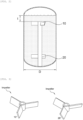
- FIG. 1 is an agitator of a conventional reactor, which is a paddle type agitator having a plurality of stages of impellers, in which an angle of all blades of the impeller of each stage is identically formed vertical with respect to an agitator shaft (the blades are formed at 0° with respect to the agitator shaft).
- blades 10 of a top impeller and blades 20 of the other lower impellers are formed at a uniform angle vertically in an axial direction.
- a ratio of a distance (t) between the blade 10 of the top impeller and an interface of a reaction solution to a reactor diameter (D), that is, t/D is about 0.35, and when production is increased, uniform agitation is not performed, so that a heat removal effect of the reflux condenser of the reactor is not sufficient, and a temperature deviation and a concentration deviation of a polymerization solution occur, so that it is difficult to prepare a polymer having uniform particles.
- FIG. 2 illustrates an agitator used in an exemplary embodiment of the present invention.
- an angle of blades 10 of a top impeller is inclined at 5 to 20° with respect to a vertical direction relative to an angle of the other lower blades 20.
- blades formed in impellers illustrated in FIG. 3 are formed to be inclined at 5 to 20° (the cases of being inclined at 10° and 20° are only illustrated).
- the angle of the blades of the top impeller is 5 to 20° and a ratio of a distance (t) between an upper portion 10 of the top impeller and the interface of the reaction solution to a reactor diameter (D), that is, t/D is adjusted to 0.22 to 0.30, so that the top impeller is disposed inside the reaction solution, thereby significantly decreasing a power/volume (P/V) value and also significantly decreasing an abnormal concentration volume ratio (%) and an abnormal temperature volume ratio (%).
- P/V power/volume
- the angle of the blades forming the top impeller is tilted at 5 to 20° with respect to the agitator shaft, and simultaneously the top impeller is disposed inside the reaction solution, and the disposed position is specified so that a ratio of a distance (t) from the interface of the polymerization solution to the upper portion of the blades of the top impeller to the reactor diameter (D) is adjusted to 0.22 to 0.30, thereby improving heat removal efficiency by a reflux condenser, improving polymerization process productivity during preparation of a vinyl chloride-based polymer, preventing deposition of scale, and improving a fish eye of the obtained vinyl chloride-based polymer.
- Table 1 shows a P/V ratio change, a volume ratio (%) having an abnormal concentration, a volume ratio (%) of the reaction solution having an abnormal temperature, and a heat removal efficiency of the reflux condenser, when the angle of the top blades according to the present invention was changed to 5 to 20°.
- Table 1 shows a power ratio per unit volume, a concentration/temperature non-uniformity, and RC heat removal ratio, depending on the angle of the agitator blades, and measurement methods thereof are as follows:
- the abnormal concentration volume ratio was measured using a software, FLUENT from ANSYS.
- An average concentration of a fluid inside the reactor was measured, a concentration gradient of the fluid inside the reactor was predicted, a volume ratio at which the concentration gradient of about 2% or more relative to the average concentration measured above is shown was measured, and the volume ratio was divided by a total volume of the reactor to obtain the abnormal concentration volume ratio.
- the abnormal temperature volume ratio was measured using a software, FLUENT from ANSYS.
- An average temperature of a fluid inside the reactor was measured, a temperature gradient of the fluid inside the reactor was predicted for each section (for example, a gradient of 1°C or more, a gradient of 0.5°C or more, and a gradient of 0.2°C or more), a volume ratio at which a temperature gradient of about 0.5°C or more relative to the average temperature measured above is shown was measured, and the volume ratio was divided by a total volume of the reactor to obtain the abnormal temperature volume ratio.
- a heating ratio between a reflux condenser which is a constitutional element in charge of heat removal from a total heating quantity and a cooling baffle was calculated and obtained.
- an angle of 15 to 20° may be more preferred, and though not separately described, considering foam occurrence in the interface, an angle of 5 to 15°, more preferably 5 to 10° may be preferred.
- FIG. 3 a paddle type agitator in which the angle of the blades in a top stage is changed by 5 to 20° is shown as an example.
- a P/V ratio at which a distance (t) between the interface and the upper blade position of the top impeller and the reactor diameter (D) when the angle of the blade of the present invention was 10° was 0.22 to 0.3
- the abnormal concentration volume ratio, and the abnormal temperature volume ratio were calculated and are listed in the following Table 2.
- Table 2 shows a power ratio per unit volume and concentration/temperature non-uniformity depending t/D, and a RC heat removal ratio.
- Table 2 t/D P/V ratio Abnormal concentrati on volume ratio (%) Abnormal temperature volume ratio (%) RC heat removal ratio
- Example 5 0.26 93 0.567 15.580 1
- Example 6 0.30 99 0.686 16.093 1
- Example 7 0.22 93 0.548 15.199 1 Comparative Example 3 0.34 104 0.703 17.446 0.4
- the polymerization reactor used in the present invention was a polymerization reactor in which a reflux condenser was built, and the reaction tank was a batch reactor having a convent volume of 10 m 3 or more, in particular 100 m 3 or more.
- the polymerization reactor may be provided with a baffle, and also provided with a jacket for heating and cooling, and as the jacket for heating and cooling, for example, an outer jacket, an inner jacket, and the like may be used.
Landscapes
- Chemical & Material Sciences (AREA)
- Chemical Kinetics & Catalysis (AREA)
- Organic Chemistry (AREA)
- Health & Medical Sciences (AREA)
- Medicinal Chemistry (AREA)
- Polymers & Plastics (AREA)
- Polymerisation Methods In General (AREA)
- Mixers Of The Rotary Stirring Type (AREA)
Description
- The present invention relates to a batch suspension polymerization reactor for preparing a vinyl chloride resin, a batch suspension polymerization method using the same and to the use of an agitator for batch suspension polymerization for preparing a vinyl chloride resin in a batch suspension polymerization reactor.
- Particularly, the present invention relates to a batch reactor for performing a vinyl chloride-based polymerization reaction while controlling an exothermic temperature inside the reactor.
- More particularly, the present invention is intended to improve productivity and improve polymerization efficiency by designing a structure of a reflux condenser, among jacket, baffle, and reflux condenser devices which are in charge of heat removal of a reactor.
- A vinyl chloride-based polymer is prepared by a batch reaction by suspension polymerization, and in order to improve productivity of the vinyl chloride-based polymer, a method of making a polymerization reactor larger or raising a polymerization temperature to shorten a polymerization time is mainly adopted.
- However, either method is adopted, it is difficult to remove heat well, for example, when the polymerization reactor is made larger, non-uniformity of an internal concentration and temperature occurs, and when a polymerization temperature is raised to shorten the time, heat generated by heat of reaction may not be removed well to cause defects. In order to solve the above problems, a reflux condenser is used in the reactor to remove heat to attempt productivity improvement, but in this case also, the size of the reflux condenser should be increased due to the increase in the size of the reactor, and in the case of raising a reaction temperature, the device should be made larger, which thus has a limitation, and moreover, when the reflux condenser is used, a problem of scale formation inside the condenser or the reactor has to be serious.
- In order to prevent scale formation described above,
Japanese Patent Laid-Open Publication No. 1991-212409 (September 18, 1991
US 6 082 890 A describes a high axial flow glass coated impeller.EP 2 007 822 A1 describes a polymerization process.WO 2014 094793 A1 describes an apparatus and method for solvent extraction processing.WO 2018 038460 A1 describes a method for producing vinylidene chloride.WO 2019 003209 A1 describes a oligomerizer with improved mixing performance.KR 930002381 A JP 2007 260646 A KR 2016 0000596 A KR 2016 0004074 A KR 2016 0111664 A - An object of the present invention is to provide a reactor having a new type of agitator, the reactor which, when a vinyl chloride-based polymer is produced by conventional batch suspension polymerization and productivity is increased in the same reactor, for example, preferably, the productivity is increased by 30% or more, may increase heat removal ability of a maximum heating value increased by heat of reaction of the reactor while having the same size of a separate reflux condenser (RC) and minimize scale formation.
- Specifically, the object of the present invention is to provide a batch reactor having improved productivity, improved heat removal ability, and no scale formation simply by partly changing a form of an agitator without changing a size of the reflux condenser and by specifying an agitator position.
- Another object of the present invention is to provide a novel use of an agitator which may solve a non-uniformity problem of a concentration and a temperature inside a reactor which occurs due to inferiority of a heat removal capacity, by solving an inferiority problem of the heat removal capacity of the reflux condenser, when productivity is increased using the same reactor, differently from conventional technology, and a reaction system including the same.
- Another object of the present invention is to provide a novel use of an agitator which prevents bubbles, that is, foam formed on an upper surface of a reactor liquid, so that scale is not formed and fish eye formation is significantly improved by the foaming, and a reaction system including the same.
- Another object of the present invention is to provide a reactor having a novel agitator which may increase production by 30% or more in the same reactor.
- Another object of the present invention is to provide a polymerization reactor adopting an agitator which may control heat of reaction even when the production is increased by 30% or more in the same reactor and may obtain homogeneous particles.
- Another object of the present invention is to provide a method of preparing a vinyl chloride-based polymer by suspension polymerization, having a design of an agitator for polymerizing a vinyl chloride resin which solves problems that when productivity is increased by increasing a concentration of a monomer in the same reaction, due to a rapid increase of a heat removal amount of a reflux condenser, non-uniformity of a temperature and a concentration inside the reactor is increased to cause poor quality, increased fish eyes, or the like.
- Still another object of the present invention is to provide a method of preparing a vinyl chloride-based polymer by suspension polymerization, having a design of a vinyl chloride resin (PVC) polymerization agitator, in which when productivity is increased by increasing the concentration of the monomer in the same reaction, a linear velocity of gaseous vinyl chloride monomer (VCM) is increased to solve problem such as formation of upper scale of the reflux condenser due to occurrence of foam on an upper portion of the reactor.
- That is, the object of the present invention is to provide a suspension polymerizer having a reactor agitator which may increase production by for example, 30% or more in the same polymerizer.
- The present invention is to provide the use of an agitator which may increase heat removal efficiency of a reflux condenser (RC) following a production increase in a commercial plant scale by reactor efficiency analysis according to a design of an agitator, and a polymerization reactor having the agitator.
To this end, the invention provides the batch suspension polymerization reactor for preparing a vinyl chloride resin according to claim 1, the batch suspension polymerization method for preparing a vinyl chloride resin according to claim 6 and the use of an agitator for batch suspension polymerization for preparing a vinyl chloride resin in a batch suspension polymerization reactor according toclaim 10. Preferred embodiments of the invention are defined in the dependent claims. - Thus, the present invention relates to a novel polymerization reactor which is a pitched paddle type agitator having a plurality of stages, in which a tilt angle of an impeller forming each stage is adjusted and a ratio between a distance between a fluid interface inside the reactor and an upper portion of a top impeller and a diameter of the reactor is adjusted to increase production, and thus, even when a heat removal amount of the reaction is increased, a non-uniformity problem of a temperature and a concentration inside the reactor is solved, a particle size of a polymer to be prepared is made uniform, and scale formation inside the reactor or on an upper portion of a reflux condenser may be prevented.
- In particular, the invention provides a batch suspension polymerization reactor for preparing a vinyl chloride resin which includes: a paddle type agitator having two or more stages of impellers, in which in the agitator, an angle (pitched angle) of blades of a top impeller is 5 to 20° with respect to an agitator shaft and an angle of blades of the other lower impellers except the top impeller is 0° with respect to the agitator shaft in a vertical direction, and the top impeller of the agitator is disposed in a lower portion of a liquid interface inside the reactor, so that the position of the top impeller satisfies a relationship between a distance (t) between an upper portion of blades of the top impeller and the liquid interface inside the reactor and a reactor diameter (D) which is t/D = 0.22 to 0.3.
- That is, in an agitator having two or more stages of pitched paddle type impellers to an agitator shaft, when an angle of blades (usually having three blades) forming impellers in the other stages except a top impeller is 0°, the blades forming the top impeller is formed to be tilted at an angle of 5 to 20°.
- Here, the angle of blades refers to an angle inclined with respect to a vertical direction of the agitator as shown in
FIG. 3 . - In an exemplary embodiment of the present invention, the polymerization reactor may be provided with a reflux condenser.
- As an example, "the angle of blades being 20°" refers to "the paddle type blade formed on the agitator shaft being inclined to 20° with respect to the vertical direction".
- In an exemplary embodiment of the present invention, in the case of the present invention in which for example, three blades forming the top impeller are formed to be tilted at 5 to 20° with respect to the agitator shaft and the blades of impellers forming the other stages are formed in a vertical direction with respect to the agitator shaft, the polymerization reactor may have an efficiency of a relative heat removal ratio of twice or more that of the case in which the blades are formed vertically with respect to the agitator shaft.
- That is, as shown in
FIG. 1 , in the case of conventional batch suspension polymerization of a polyvinyl chloride resin, the angles of all blades of the paddle type agitator are the same vertically with respect to the agitator shaft; however, in contrast, as shown inFIG. 2 , in the present invention, the angle of the blades of the top impeller is inclined at 5 to 20° with respect to the vertical direction of the agitator, while a distance (t) between an upper portion of the top impeller and a liquid interface inside the reactor relative to a reactor diameter (D) has a specific ratio, whereby the reflux condenser may have an efficiency of a relative heat removal ratio of twice or more, specifically twice to 10 times, and even in the case of increasing productivity by 30% or more, foam may be prevented from being formed on the upper portion of the reactor. - In an exemplary embodiment of the present invention, the angle of the top blades of the agitator may be 5 to 20°, and also may be 5 to 15°.
- The invention also provides a batch suspension polymerization method for preparing a vinyl chloride resin which includes performing polymerization by adding a reaction monomer to a polymerization reactor having two or more stages of pitched paddle type agitator (hereinafter, expressed as a pitched paddle type agitator or a paddle type agitator), in which the agitator has blades of a top impeller which is tilted at 5 to 20° and a distance (t) between a top blade of the agitator and a liquid interface inside the reactor to a reactor diameter (D) is t/D = 0.22 to 0.3, and a batch suspension polymerizer for preparing a vinyl chloride resin.
- In an exemplary embodiment of the present invention, the polymerization reactor may remove heat in a reflux condenser to perform circulation to the reactor.
- In an exemplary embodiment of the present invention, an angle of blades of the top impeller of the agitator may be 15 to 20°.
- In an exemplary embodiment of the present invention, an angle of blades of the top impeller of the agitator may be 5 to 15°.
- The invention further provides the use of an agitator for batch suspension polymerization for preparing a vinyl chloride resin in a batch suspension polymerization reactor, which includes a jacket, a baffle, and a reflux condenser, in which the agitator is a paddle type agitator having two or more stages of paddle type impellers, and in the agitator, an angle (pitched angle) of blades of a top impeller is 5 to 20° and an angle of blades of the other lower impellers except the top impeller is 0° (that is, in a vertical direction with respect to a shaft) as further defined in
claim 10. - In an exemplary embodiment of the present invention, an angle of blades of the top impeller of the agitator may be 15 to 20°.
- In an exemplary embodiment of the present invention, an angle of blades of the top impeller of the agitator may be 5 to 15°.
- In one embodiment, the agitator is a paddle type agitator having two stages of more of impellers, and in the agitator, blades of a top impeller is tilted at an angle (pitched angle) 5 to 20° with respect to an agitator shaft and an angle of blades of the other lower impellers except the top impeller are 0° with respect to the agitator shaft.
- In one embodiment, the angle of blades of the top impeller of the agitator may be 15 to 20°.
- In another embodiment, the angle of blades of the top impeller of the agitator may be 5 to 15°.
- The present invention may provide the use of an agitator in which when productivity is increased using the same reactor, an inferiority problem of a heat removal capacity of a reflux condenser is solved, thereby solving a non-uniformity problem of a concentration and a temperature inside a reactor which occurs due to the inferiority of the heat removal capacity, and foam formed on an upper surface of a reactor liquid is prevented so that scale is not formed and fish eye formation by foaming is significantly improved, and a batch suspension polymerization reactor including the same.
- In addition, the present invention provides a reaction system having a agitator which may increase productivity by 30% or more in the same reactor, and may provide a polymerization system adopting an agitator having a specific form to control heat or reaction and to obtain homogeneous particles and a specific value of a specification with the reactor therefrom.
- The present invention is to provide a batch suspension polymerization reactor having a reactor agitator which may increase production by for example, 30% or more in the same polymerizer.
- Therefore, the present invention relates to a paddle type agitator having a plurality of stages, and has been completed by changing a tilt angle of each stage and adjusting a ratio of a distance (t) between a liquid interface inside the reactor and an upper portion of the top impeller of the paddle type agitator immersed in a fluid to a reactor diameter (D).
- Accordingly, the present invention provides a novel batch suspension polymerization reactor in which production is increased in spite of the use of the same reactor and the same reflux condenser, and thus, a heat removal quantity of the reactor is increased to solve a non-uniformity problem, a particle size of the polymer to be prepared is made uniform, and scale inside the reactor or on the upper portion of the reflux condenser may be prevented.
-
-
FIG. 1 shows a conventional agitator of a reactor. (t/D=0.35, angles of blades of all impellers are all 0°.) -
FIG. 2 shows an embodiment of an agitator used according to the present invention. (t/D=0.22, blades of a top impeller are tilted at an angle of 15° with respect to an agitator shaft direction, and an angle of blades of the other lower impellers is 0°.) -
FIG. 3 shows an embodiment of a top paddle type impeller having different tilt angles. - Hereinafter, the present invention will be described in more detail with reference to specific examples and exemplary embodiments including the accompanying drawings. However, the following specific examples or exemplary embodiments are only a reference for describing the present invention in detail, and the present invention is not limited thereto, and may be implemented in various forms.
- In addition, unless otherwise defined, all technical terms and scientific terms have the same meanings as those commonly understood by a person skilled in the art to which the present invention pertains.
- The terms used herein are only for effectively describing a certain specific example, and are not intended to limit the present invention.
- In addition, the singular form used in the specification and claims appended thereto may be intended to also include a plural form, unless otherwise indicated in the context.
- In addition, unless particularly described to the contrary, "comprising" any elements will be understood to imply further inclusion of other elements rather than the exclusion of any other elements.
- As a result of conducting many studies for solving the above problems, the present invention found a pitched paddle type agitator having two or more stages of impellers, in which blades forming a top impeller is formed to be tilted at an angle (pitched angle) of 5 to 20°, blades of the other lower impellers are formed to be vertical with respect to an agitator shaft (0°), and the impellers are disposed so that a distance between an upper portion of blades of the top impeller and a liquid interface inside a reactor is 0.22 to 0.3 of a reactor diameter, thereby solving the problems.
- That is, the above problems may be solved by providing a batch suspension polymerization reactor for preparing a vinyl chloride resin, in which the polymerization reactor has a paddle type agitator having two or more stages of impellers, in the agitator, usually three blades are formed to be tilted at an angle (pitched angle) of 5 to 20° with respect to the agitator shaft, and simultaneously, the upper portion of the blades of the top impeller of the agitator is disposed in a lower portion of the liquid interface in the reactor, but the disposed position satisfies a distance (t) between the upper portion of the blades of the top impeller and the liquid interface to the reactor diameter (D) (t/D) of 0.22 to 0.3.
- In the present invention, the polymerization reactor may be a batch suspension polymerization reactor for preparing a vinyl chloride further including a reflux condenser.
- The present invention may be a batch suspension polymerization reactor for preparing vinyl chloride, in which in the agitator, the angle of the blades of the top impeller is 15 to 20° and t/D of 0.22 to 0.30.
- The polymerization reactor of the present invention may be a batch suspension polymerization reactor for preparing vinyl chloride, in which a relative heat removal ratio of the reflux condenser has an efficiency of twice or more the efficiency when the angle of the blades of the top impeller is 0°.
- In the batch suspension polymerization method for preparing a vinyl chloride resin, the polymerization reactor may remove heat in the reflux condenser and circulate the heat to the reactor.
- The present invention may be a batch suspension polymerization reactor for preparing a vinyl chloride resin which satisfies the conditions that the angle of the blades forming the top impeller of the agitator is 15 to 20°, the angle of the blades forming the other lower impellers is 0° in a vertical direction with respect to the agitating shaft, and t/D as defined above is 0.22 to 0.30, and a polymerization method using the same.
- In addition, the present inventors used a batch reactor adopting the agitator having the specification described above, thereby improving productivity by 30% or more and minimizing a temperature deviation and a concentration deviation to prepare a polymer having uniform suspended particles.
- In addition, the present inventors adopted a changed agitator, thereby improving a heat removal effect of the reflux condenser as compared with a conventional agitator and minimizing a fraction of an abnormal temperature and an abnormal concentration inside the polymerization reactor.
- In the present invention, the reactor may include a batch reactor body having the agitator and containing reactants, a reflux condenser formed on an upper portion of the body, and a driving motor driving the agitator.
- In addition, the batch reactor of the present invention is a component for controlling the temperature of the reactant and may include a reactor jacket, a baffle, and the like.
- In addition, the present invention provides the use of an agitator for batch suspension polymerization for preparing a vinyl chloride resin, in which the agitator is a paddle type agitator having two stages of more of impellers, in the agitator, blades of a top impeller are tilted at an angle (pitched angle) of 5 to 20° with respect to an agitator shaft and an angle of blades of the other lower impellers except the top impeller is 0° with respect to the agitator shaft as further defined in
claim 10. - In the agitator for batch suspension polymerization for preparing a vinyl chloride resin, an angle of blades of the top impeller of the agitator may be 15 to 20°.
- In the agitator for batch suspension polymerization for preparing a vinyl chloride resin, an angle of blades of the top impeller of the agitator may be 5 to 15°.
- Hereinafter, the present invention will be described in detail with reference to the drawings of the present invention.
-
FIG. 1 is an agitator of a conventional reactor, which is a paddle type agitator having a plurality of stages of impellers, in which an angle of all blades of the impeller of each stage is identically formed vertical with respect to an agitator shaft (the blades are formed at 0° with respect to the agitator shaft). - Specifically,
blades 10 of a top impeller andblades 20 of the other lower impellers are formed at a uniform angle vertically in an axial direction. - In addition, a ratio of a distance (t) between the
blade 10 of the top impeller and an interface of a reaction solution to a reactor diameter (D), that is, t/D is about 0.35, and when production is increased, uniform agitation is not performed, so that a heat removal effect of the reflux condenser of the reactor is not sufficient, and a temperature deviation and a concentration deviation of a polymerization solution occur, so that it is difficult to prepare a polymer having uniform particles. - In addition, on the interface of the polymerization solution, a large amount of bubbles was formed and when the bubbles were accompanied on the upper portion, scale was formed on a reactor wall surface, the reflux, and the like.
-
FIG. 2 illustrates an agitator used in an exemplary embodiment of the present invention. As shown inFIG. 2 , in the paddle type agitator used according to an exemplary embodiment, an angle ofblades 10 of a top impeller is inclined at 5 to 20° with respect to a vertical direction relative to an angle of the otherlower blades 20. - More specifically, blades formed in impellers illustrated in
FIG. 3 are formed to be inclined at 5 to 20° (the cases of being inclined at 10° and 20° are only illustrated). - As such, the angle of the blades of the top impeller is 5 to 20° and a ratio of a distance (t) between an
upper portion 10 of the top impeller and the interface of the reaction solution to a reactor diameter (D), that is, t/D is adjusted to 0.22 to 0.30, so that the top impeller is disposed inside the reaction solution, thereby significantly decreasing a power/volume (P/V) value and also significantly decreasing an abnormal concentration volume ratio (%) and an abnormal temperature volume ratio (%). In addition, it was confirmed that when a monomer from which heat is removed in a reflux condenser enters the reactor, a temperature or concentration deviation is significantly decreased, and in spite of decreased P/V, the abnormal concentration volume ratio and the abnormal temperature volume ratio show an excellent effect as compared with the conventional agitator (comparative example). - That is, in the present invention, the angle of the blades forming the top impeller is tilted at 5 to 20° with respect to the agitator shaft, and simultaneously the top impeller is disposed inside the reaction solution, and the disposed position is specified so that a ratio of a distance (t) from the interface of the polymerization solution to the upper portion of the blades of the top impeller to the reactor diameter (D) is adjusted to 0.22 to 0.30, thereby improving heat removal efficiency by a reflux condenser, improving polymerization process productivity during preparation of a vinyl chloride-based polymer, preventing deposition of scale, and improving a fish eye of the obtained vinyl chloride-based polymer.
- It was almost impossible to increase productivity preferably by 30% or more using the same reactor, but in the present invention, it was found that by changing the design of the agitator, the productivity may be improved by 30% or more in spite of use of the same reflux condenser and the same size of the polymerization reactor, whereby the present invention has been completed.
- The following Table 1 shows a P/V ratio change, a volume ratio (%) having an abnormal concentration, a volume ratio (%) of the reaction solution having an abnormal temperature, and a heat removal efficiency of the reflux condenser, when the angle of the top blades according to the present invention was changed to 5 to 20°.
- The following Table 1 shows a power ratio per unit volume, a concentration/temperature non-uniformity, and RC heat removal ratio, depending on the angle of the agitator blades, and measurement methods thereof are as follows:
- The abnormal concentration volume ratio was measured using a software, FLUENT from ANSYS.
- An average concentration of a fluid inside the reactor was measured, a concentration gradient of the fluid inside the reactor was predicted, a volume ratio at which the concentration gradient of about 2% or more relative to the average concentration measured above is shown was measured, and the volume ratio was divided by a total volume of the reactor to obtain the abnormal concentration volume ratio.
- The abnormal temperature volume ratio was measured using a software, FLUENT from ANSYS.
- An average temperature of a fluid inside the reactor was measured, a temperature gradient of the fluid inside the reactor was predicted for each section (for example, a gradient of 1°C or more, a gradient of 0.5°C or more, and a gradient of 0.2°C or more), a volume ratio at which a temperature gradient of about 0.5°C or more relative to the average temperature measured above is shown was measured, and the volume ratio was divided by a total volume of the reactor to obtain the abnormal temperature volume ratio.
- A heating ratio between a reflux condenser which is a constitutional element in charge of heat removal from a total heating quantity and a cooling baffle was calculated and obtained.
-
- P = 2 πτn (τ: torque, predictive value [Nm], n: rps,1/s), the unit of P is Nm/s = Watt
- V = volume (m3) occupied by a reaction fluid
- As the torque, a value applied to an impeller of each stage is measured, and was calculated by dividing the sum by a total volume of the fluid.
Table 1 Top blade angle (°) P/V ratio Abnormal concentrat ion volume ratio (%) Abnormal temperatur e volume ratio (%) RC heat removal ratio Example 1 5 98 0.633 16.709 1 Example 2 10 97 0.631 15.912 1 Example 3 15 94 0.620 15.866 1 Example 4 20 93 0.305 16.087 1 Comparative Example 1 0 100 0.637 16.846 0.4 Comparative Example 2 25 95 0.701 17.323 0.6 (Abnormal concentration volume ratio: a volume ratio of a monomer having a concentration difference of 2% or more relative to the average monomer concentration inside the reactor, abnormal temperature volume ratio: a monomer volume ratio having a temperature difference of 0.5°C or more lower or higher than the reactor average temperature) - As seen in Table 1, when the angle of the top blades of the agitator was increased to 5 to 20°, the P/V ratio value was relatively decreased from 98 to 93, and an excellent characteristic of an agitation efficiency increased by 6 to 7% relative to 100 in the case in which the angle of the blade was 0° (standing vertically) as in Comparative Example 1 was shown. In addition, when a monomer condensed in the reflux condenser inside the reactor entered the reactor in a heated state, the abnormal concentration volume fraction and the abnormal temperature volume ratio were decreased at a certain point as compared with Comparative Example 1 and Comparative Example 2, and thus, when the agitator used in the present invention was used, a change rate of the abnormal concentration and the abnormal temperature inside the reactor was significantly decreased, and an excellent characteristic was shown also in agitation force. In addition, in the heat removal effect, the heat removal effect of the present invention has efficiency of twice or more Comparative Example 1, and thus, it was found that a significant heat removal effect may be prevented.
- In the present invention, considering the P/V ratio and the abnormal concentration volume ratio, an angle of 15 to 20° may be more preferred, and though not separately described, considering foam occurrence in the interface, an angle of 5 to 15°, more preferably 5 to 10° may be preferred.
- In addition, in
FIG. 3 , a paddle type agitator in which the angle of the blades in a top stage is changed by 5 to 20° is shown as an example. - A P/V ratio at which a distance (t) between the interface and the upper blade position of the top impeller and the reactor diameter (D) when the angle of the blade of the present invention was 10° was 0.22 to 0.3, the abnormal concentration volume ratio, and the abnormal temperature volume ratio were calculated and are listed in the following Table 2.
- The following Table 2 shows a power ratio per unit volume and concentration/temperature non-uniformity depending t/D, and a RC heat removal ratio.
Table 2 t/D P/V ratio Abnormal concentrati on volume ratio (%) Abnormal temperature volume ratio (%) RC heat removal ratio Example 5 0.26 93 0.567 15.580 1 Example 6 0.30 99 0.686 16.093 1 Example 7 0.22 93 0.548 15.199 1 Comparative Example 3 0.34 104 0.703 17.446 0.4 - As shown in Table 2, when polymerization was performed with the t/D value of the present invention changed to 0.22 to 0.3, an agitation force was shown better in the P/V ratio, and occurrence of the abnormal concentration and the abnormal temperature was also significantly decreased as compared with Comparative Example 3. The polymerization reactor used in the present invention was a polymerization reactor in which a reflux condenser was built, and the reaction tank was a batch reactor having a convent volume of 10 m3 or more, in particular 100 m3 or more. In addition, in the present invention, the polymerization reactor may be provided with a baffle, and also provided with a jacket for heating and cooling, and as the jacket for heating and cooling, for example, an outer jacket, an inner jacket, and the like may be used.
Claims (12)
- A batch suspension polymerization reactor for preparing a vinyl chloride resin, the reactor comprising: a paddle type agitator having two or more stages of impellers, wherein in the agitator, an angle (pitched angle) of blades of a top impeller is 5 to 20° with respect to an agitator shaft and an angle of blades of the other lower impellers except the top impeller is 0° with respect to the agitator shaft in a vertical direction, and the top impeller of the agitator is disposed in a lower portion of a liquid interface inside the reactor, so that a position of the top impeller satisfies a relationship between a distance (t) between an upper portion of blades of the top impeller and the liquid interface inside the reactor and a reactor diameter (D) which is t/D = 0.22 to 0.3.
- The batch suspension polymerization reactor for preparing vinyl chloride resin of claim 1, further comprising a reflux condenser.
- The batch suspension polymerization reactor for preparing vinyl chloride resin of claim 1, wherein the angle of the blades of the top impeller of the agitator is 15 to 20°.
- The batch suspension polymerization reactor for preparing vinyl chloride resin of claim 1, wherein the polymerization reactor has a relative heat removal ratio of the reflux condenser having an efficiency of twice or more the efficiency when the angle of the blades of the top impeller is 0°.
- The batch suspension polymerization reactor for preparing vinyl chloride resin of claim 1, wherein the angle of blades of the top impeller of the agitator is 5 to 15°.
- A batch suspension polymerization method for preparing a vinyl chloride resin, the method comprising performing a reaction by adding a monomer, wherein a batch suspension polymerization reactor for preparing a vinyl chloride resin includes a paddle type agitator having two or more stages of impellers, in the agitator, an angle (pitched angle) of blades of a top impeller is 5 to 20° with respect to an agitator shaft and an angle of blades of the other lower impellers except the top impeller is 0° with respect to the agitator shaft in a vertical direction, and the top impeller of the agitator is disposed in a lower portion of a liquid interface inside the reactor and a position of the top impeller satisfies a relationship between a distance (t) between an upper portion of blades of the top impeller and the liquid interface inside the reactor and a reactor diameter (D) which is t/D = 0.22 to 0.3.
- The batch suspension polymerization method for preparing a vinyl chloride resin of claim 6, wherein in the polymerization reactor, heat is removed in the reflux condenser and is circulated to the reactor.
- The batch suspension polymerization method for preparing a vinyl chloride resin of claim 6, wherein the angle of the blades of the top impeller of the agitator is 15 to 20°.
- The batch suspension polymerization method for preparing a vinyl chloride resin of claim 6, wherein the angle of the blades of the top impeller of the agitator is 5 to 15°.
- Use of an agitator for batch suspension polymerization for preparing a vinyl chloride resin in a batch suspension polymerization reactor, the agitator comprising: a jacket, a baffle, and a reflux condenser, wherein the agitator is a paddle type agitator having two stages of more of impellers, and in the agitator, an angle (pitched angle) of blades of a top impeller is tilted at 5 to 20° with respect to an agitator shaft and an angle of blades of the other lower impellers except the top impeller is 0° with respect to the agitator shaft, and wherein the top impeller of the agitator is disposed in a lower portion of a liquid interface inside the reactor, so that a position of the top impeller satisfies a relationship between a distance (t) between an upper portion of blades of the top impeller and the liquid interface inside the reactor and a reactor diameter (D) which is t/D = 0.22 to 0.3.
- The use of claim 10, wherein the angle of the blades of the top impeller of the agitator is 15 to 20°.
- The use of claim 10, wherein the angle of the blades of the top impeller of the agitator is 5 to 15°.
Applications Claiming Priority (3)
| Application Number | Priority Date | Filing Date | Title |
|---|---|---|---|
| KR20190112289 | 2019-09-10 | ||
| KR1020200115185A KR102543296B1 (en) | 2019-09-10 | 2020-09-09 | Agitator for Batch Suspension Polymerization for Production of Vinyl Chloride Resin and Batch Suspension Polymerization Reactor Using the Same |
| PCT/KR2020/012209 WO2021049883A1 (en) | 2019-09-10 | 2020-09-10 | Batch-type stirrer for suspension polymerization of polyvinyl chloride resin, and batch-type suspension polymerization reactor using same |
Publications (3)
| Publication Number | Publication Date |
|---|---|
| EP4029597A1 EP4029597A1 (en) | 2022-07-20 |
| EP4029597A4 EP4029597A4 (en) | 2023-11-01 |
| EP4029597B1 true EP4029597B1 (en) | 2025-03-12 |
Family
ID=74866717
Family Applications (1)
| Application Number | Title | Priority Date | Filing Date |
|---|---|---|---|
| EP20862200.1A Active EP4029597B1 (en) | 2019-09-10 | 2020-09-10 | Use of an agitator for batch suspension polymerization of vinyl chloride resin and method and reactor for batch suspension polymerization of vinyl chloride resin |
Country Status (6)
| Country | Link |
|---|---|
| US (1) | US20230053926A1 (en) |
| EP (1) | EP4029597B1 (en) |
| JP (1) | JP7386973B2 (en) |
| CN (1) | CN114390945B (en) |
| TW (1) | TWI751686B (en) |
| WO (1) | WO2021049883A1 (en) |
Families Citing this family (1)
| Publication number | Priority date | Publication date | Assignee | Title |
|---|---|---|---|---|
| CN115920805B (en) * | 2023-03-15 | 2023-05-12 | 山东广浦生物科技有限公司 | Preparation device and preparation process of glycidyl methacrylate |
Citations (1)
| Publication number | Priority date | Publication date | Assignee | Title |
|---|---|---|---|---|
| EP2007822B1 (en) * | 2006-04-11 | 2010-07-21 | Solvay Solexis S.p.A. | Polymerisation process |
Family Cites Families (30)
| Publication number | Priority date | Publication date | Assignee | Title |
|---|---|---|---|---|
| DE3132421A1 (en) * | 1981-08-17 | 1983-02-24 | Hoechst Ag, 6000 Frankfurt | CONTINUOUS METHOD FOR PRODUCING VINYL CHLORIDE POLYMERISATS IN AQUEOUS SUSPENSION |
| JP2807526B2 (en) | 1990-01-18 | 1998-10-08 | 信越化学工業株式会社 | Method for producing vinyl chloride polymer |
| JPH0678388B2 (en) * | 1990-08-31 | 1994-10-05 | 信越化学工業株式会社 | Method for producing vinyl chloride polymer |
| JP2836765B2 (en) * | 1991-07-05 | 1998-12-14 | 信越化学工業株式会社 | Equipment for manufacturing vinyl chloride polymer |
| CH686117A5 (en) * | 1993-07-08 | 1996-01-15 | Biazzi Sa | gas-liquid reaction apparatus. |
| JPH0731132U (en) * | 1993-11-09 | 1995-06-13 | 綜研化学株式会社 | Stirrer |
| EP0659476A1 (en) * | 1993-12-27 | 1995-06-28 | Shin-Etsu Chemical Co., Ltd. | Polymerization apparatus and method of producing vinyl chloride polymer by using the same |
| JP3388663B2 (en) * | 1994-09-14 | 2003-03-24 | 信越化学工業株式会社 | Method for producing vinyl chloride polymer |
| TW315372B (en) * | 1995-08-31 | 1997-09-11 | Lg Chemical Ltd | |
| JPH11189606A (en) * | 1997-10-23 | 1999-07-13 | Sekisui Chem Co Ltd | Suspension polymerization of vinyl chloride resin |
| US6082890A (en) * | 1999-03-24 | 2000-07-04 | Pfaudler, Inc. | High axial flow glass coated impeller |
| JP2001179069A (en) | 1999-12-28 | 2001-07-03 | Nippon Zeon Co Ltd | Stirrer, polymer coagulation and separation method |
| CN1124295C (en) * | 2000-03-21 | 2003-10-15 | 青岛海晶化工集团有限公司 | Medium size polymerizing still for suspension polymerizing vinyl chloride and relevant polymerization process |
| US6997444B2 (en) * | 2003-04-29 | 2006-02-14 | Spx Corporation | Radial disc impeller apparatus and method |
| CN100487029C (en) * | 2003-08-29 | 2009-05-13 | 积水化成品工业株式会社 | Pre-expanded particles of polyolefin resin-modified polystyrene resin, process for producing the same, and molded foam |
| CN2680666Y (en) * | 2004-03-02 | 2005-02-23 | 锦西化工机械(集团)有限责任公司 | Large-scale aggregation still for vinyl chloride suspension polymerization |
| JP2006111661A (en) * | 2004-10-12 | 2006-04-27 | Kaneka Corp | Reflux condenser equipped polymerizer and method for producing polymer by the polymerizer |
| CN100341905C (en) * | 2005-10-25 | 2007-10-10 | 上海氯碱化工股份有限公司 | Polymerization reactor for producing suspension type polyvinyl-chloride |
| FI123662B (en) * | 2006-02-17 | 2013-08-30 | Outotec Oyj | Process and mixing plant for mixing gas in sludge in a closed reactor |
| JP2007260646A (en) | 2006-03-30 | 2007-10-11 | Kaneka Corp | Reactor and method for producing polymer by using the same |
| CN201760281U (en) | 2010-07-09 | 2011-03-16 | 杭州原正化学工程技术装备有限公司 | Axial flow type polymerizing kettle |
| WO2014094793A1 (en) * | 2012-12-19 | 2014-06-26 | Flsmidth A/S | Apparatus and method for solvent extraction processing |
| KR101659150B1 (en) * | 2014-06-25 | 2016-09-22 | 주식회사 엘지화학 | Stirred tank reactor and method for preparing pvc resin using the same |
| KR101656930B1 (en) * | 2014-07-02 | 2016-09-12 | 주식회사 엘지화학 | Stirred tank reactor and meth1od for preparing pvc resin using th1e same |
| KR101888348B1 (en) * | 2015-03-17 | 2018-08-14 | 주식회사 엘지화학 | Polymerization reactor |
| EP3093336A1 (en) * | 2015-05-11 | 2016-11-16 | Wintershall Holding GmbH | Fermenter for producing a structurally viscous medium |
| CN109563013B (en) * | 2016-08-22 | 2021-11-02 | 韩华化学株式会社 | The preparation method of vinylidene chloride |
| KR102106457B1 (en) * | 2016-09-02 | 2020-05-04 | 주식회사 엘지화학 | Method for preparing vinyl chloride polymer and manufacturing apparatus for the vinyl chloride polymer |
| US11859048B2 (en) * | 2017-06-30 | 2024-01-02 | Sabic Global Technologies B.V. | Oligomeriser with improved mixing performance |
| KR20190058800A (en) * | 2017-11-22 | 2019-05-30 | 한국기계연구원 | Stirring device for manufacturing metal matrix composites |
-
2020
- 2020-09-10 TW TW109131081A patent/TWI751686B/en active
- 2020-09-10 CN CN202080063978.6A patent/CN114390945B/en active Active
- 2020-09-10 JP JP2022515491A patent/JP7386973B2/en active Active
- 2020-09-10 WO PCT/KR2020/012209 patent/WO2021049883A1/en not_active Ceased
- 2020-09-10 EP EP20862200.1A patent/EP4029597B1/en active Active
- 2020-09-10 US US17/641,132 patent/US20230053926A1/en active Pending
Patent Citations (1)
| Publication number | Priority date | Publication date | Assignee | Title |
|---|---|---|---|---|
| EP2007822B1 (en) * | 2006-04-11 | 2010-07-21 | Solvay Solexis S.p.A. | Polymerisation process |
Also Published As
| Publication number | Publication date |
|---|---|
| CN114390945B (en) | 2023-12-12 |
| US20230053926A1 (en) | 2023-02-23 |
| JP2022547935A (en) | 2022-11-16 |
| TW202126707A (en) | 2021-07-16 |
| JP7386973B2 (en) | 2023-11-27 |
| EP4029597A4 (en) | 2023-11-01 |
| WO2021049883A1 (en) | 2021-03-18 |
| CN114390945A (en) | 2022-04-22 |
| EP4029597A1 (en) | 2022-07-20 |
| TWI751686B (en) | 2022-01-01 |
Similar Documents
| Publication | Publication Date | Title |
|---|---|---|
| EP2572779A1 (en) | Vertical countercurrent solid-liquid contact method, method for washing solid particles, method for producing polyarylene sulfide, and device therefor | |
| US5420215A (en) | Process for producing vinyl chloride-based polymer | |
| EP2543432A1 (en) | Column type solid-liquid countercurrent contact apparatus, and apparatus and method for cleaning solid particles | |
| KR102543296B1 (en) | Agitator for Batch Suspension Polymerization for Production of Vinyl Chloride Resin and Batch Suspension Polymerization Reactor Using the Same | |
| EP4029597A1 (en) | Batch-type stirrer for suspension polymerization of polyvinyl chloride resin, and batch-type suspension polymerization reactor using same | |
| EP2918334A1 (en) | Eyebrow coil jacket, heat control apparatus and manufacturing method for reactor using same | |
| EP2145874A1 (en) | A process for preparation of polymethylene polyphenyl polyamine | |
| EP0421184B1 (en) | Process for producing vinyl chloride resin | |
| CN1294606A (en) | Process for producing aromatic polycarbonate | |
| KR102256402B1 (en) | Batch reactor | |
| KR20180021646A (en) | Method for preparing vinylidene chloride | |
| JP3389629B2 (en) | Method for producing vinyl chloride resin | |
| KR19980079952A (en) | Reactor | |
| EP3659701A1 (en) | Process for providing a homogenous slurry containing particles | |
| US11400427B2 (en) | Process for providing a homogenous slurry containing particles | |
| CN101098749A (en) | Process for the polymerization of vinyl-containing monomers | |
| KR102911267B1 (en) | Reactor | |
| TWM492823U (en) | Apparatus for manufacturing uniform polyamide pellets | |
| CN120242890B (en) | A tower-type reaction system and reaction method for the polymerization of ethylene to produce PAO or POE. | |
| CN224100687U (en) | Tower type reaction system for producing PAO or POE by ethylene polymerization | |
| TWI853224B (en) | Method of assembling polycarbonate manufacturing apparatus and polycarbonate manufacturing apparatus | |
| JP2011116915A (en) | Polymerizer of polyester | |
| JP4766461B2 (en) | Method for producing polyester or copolymer thereof | |
| JP4312288B2 (en) | Flame retardant polycarbonate composition | |
| JPH03103408A (en) | Device and method for preparing vinyl chloride resin |
Legal Events
| Date | Code | Title | Description |
|---|---|---|---|
| STAA | Information on the status of an ep patent application or granted ep patent |
Free format text: STATUS: THE INTERNATIONAL PUBLICATION HAS BEEN MADE |
|
| PUAI | Public reference made under article 153(3) epc to a published international application that has entered the european phase |
Free format text: ORIGINAL CODE: 0009012 |
|
| STAA | Information on the status of an ep patent application or granted ep patent |
Free format text: STATUS: REQUEST FOR EXAMINATION WAS MADE |
|
| 17P | Request for examination filed |
Effective date: 20220316 |
|
| AK | Designated contracting states |
Kind code of ref document: A1 Designated state(s): AL AT BE BG CH CY CZ DE DK EE ES FI FR GB GR HR HU IE IS IT LI LT LU LV MC MK MT NL NO PL PT RO RS SE SI SK SM TR |
|
| DAV | Request for validation of the european patent (deleted) | ||
| DAX | Request for extension of the european patent (deleted) | ||
| REG | Reference to a national code |
Ref legal event code: R079 Free format text: PREVIOUS MAIN CLASS: B01F0007180000 Ipc: C08F0014060000 Ref country code: DE Ref document number: 602020047721 Country of ref document: DE |
|
| A4 | Supplementary search report drawn up and despatched |
Effective date: 20231002 |
|
| RIC1 | Information provided on ipc code assigned before grant |
Ipc: C08F 2/01 20060101ALI20230926BHEP Ipc: B01J 19/18 20060101ALI20230926BHEP Ipc: C08F 14/06 20060101AFI20230926BHEP |
|
| STAA | Information on the status of an ep patent application or granted ep patent |
Free format text: STATUS: EXAMINATION IS IN PROGRESS |
|
| 17Q | First examination report despatched |
Effective date: 20240510 |
|
| GRAP | Despatch of communication of intention to grant a patent |
Free format text: ORIGINAL CODE: EPIDOSNIGR1 |
|
| STAA | Information on the status of an ep patent application or granted ep patent |
Free format text: STATUS: GRANT OF PATENT IS INTENDED |
|
| INTG | Intention to grant announced |
Effective date: 20241004 |
|
| GRAS | Grant fee paid |
Free format text: ORIGINAL CODE: EPIDOSNIGR3 |
|
| GRAA | (expected) grant |
Free format text: ORIGINAL CODE: 0009210 |
|
| STAA | Information on the status of an ep patent application or granted ep patent |
Free format text: STATUS: THE PATENT HAS BEEN GRANTED |
|
| P01 | Opt-out of the competence of the unified patent court (upc) registered |
Free format text: CASE NUMBER: APP_4379/2025 Effective date: 20250127 |
|
| AK | Designated contracting states |
Kind code of ref document: B1 Designated state(s): AL AT BE BG CH CY CZ DE DK EE ES FI FR GB GR HR HU IE IS IT LI LT LU LV MC MK MT NL NO PL PT RO RS SE SI SK SM TR |
|
| REG | Reference to a national code |
Ref country code: GB Ref legal event code: FG4D |
|
| REG | Reference to a national code |
Ref country code: CH Ref legal event code: EP |
|
| REG | Reference to a national code |
Ref country code: DE Ref legal event code: R096 Ref document number: 602020047721 Country of ref document: DE |
|
| REG | Reference to a national code |
Ref country code: IE Ref legal event code: FG4D |
|
| PG25 | Lapsed in a contracting state [announced via postgrant information from national office to epo] |
Ref country code: RS Free format text: LAPSE BECAUSE OF FAILURE TO SUBMIT A TRANSLATION OF THE DESCRIPTION OR TO PAY THE FEE WITHIN THE PRESCRIBED TIME-LIMIT Effective date: 20250612 |
|
| PG25 | Lapsed in a contracting state [announced via postgrant information from national office to epo] |
Ref country code: FI Free format text: LAPSE BECAUSE OF FAILURE TO SUBMIT A TRANSLATION OF THE DESCRIPTION OR TO PAY THE FEE WITHIN THE PRESCRIBED TIME-LIMIT Effective date: 20250312 |
|
| PG25 | Lapsed in a contracting state [announced via postgrant information from national office to epo] |
Ref country code: ES Free format text: LAPSE BECAUSE OF FAILURE TO SUBMIT A TRANSLATION OF THE DESCRIPTION OR TO PAY THE FEE WITHIN THE PRESCRIBED TIME-LIMIT Effective date: 20250312 |
|
| REG | Reference to a national code |
Ref country code: LT Ref legal event code: MG9D |
|
| PG25 | Lapsed in a contracting state [announced via postgrant information from national office to epo] |
Ref country code: NO Free format text: LAPSE BECAUSE OF FAILURE TO SUBMIT A TRANSLATION OF THE DESCRIPTION OR TO PAY THE FEE WITHIN THE PRESCRIBED TIME-LIMIT Effective date: 20250612 |
|
| PG25 | Lapsed in a contracting state [announced via postgrant information from national office to epo] |
Ref country code: HR Free format text: LAPSE BECAUSE OF FAILURE TO SUBMIT A TRANSLATION OF THE DESCRIPTION OR TO PAY THE FEE WITHIN THE PRESCRIBED TIME-LIMIT Effective date: 20250312 |
|
| REG | Reference to a national code |
Ref country code: NL Ref legal event code: MP Effective date: 20250312 |
|
| PG25 | Lapsed in a contracting state [announced via postgrant information from national office to epo] |
Ref country code: LV Free format text: LAPSE BECAUSE OF FAILURE TO SUBMIT A TRANSLATION OF THE DESCRIPTION OR TO PAY THE FEE WITHIN THE PRESCRIBED TIME-LIMIT Effective date: 20250312 |
|
| PG25 | Lapsed in a contracting state [announced via postgrant information from national office to epo] |
Ref country code: GR Free format text: LAPSE BECAUSE OF FAILURE TO SUBMIT A TRANSLATION OF THE DESCRIPTION OR TO PAY THE FEE WITHIN THE PRESCRIBED TIME-LIMIT Effective date: 20250613 Ref country code: BG Free format text: LAPSE BECAUSE OF FAILURE TO SUBMIT A TRANSLATION OF THE DESCRIPTION OR TO PAY THE FEE WITHIN THE PRESCRIBED TIME-LIMIT Effective date: 20250312 |
|
| REG | Reference to a national code |
Ref country code: AT Ref legal event code: MK05 Ref document number: 1774978 Country of ref document: AT Kind code of ref document: T Effective date: 20250312 |
|
| PG25 | Lapsed in a contracting state [announced via postgrant information from national office to epo] |
Ref country code: NL Free format text: LAPSE BECAUSE OF FAILURE TO SUBMIT A TRANSLATION OF THE DESCRIPTION OR TO PAY THE FEE WITHIN THE PRESCRIBED TIME-LIMIT Effective date: 20250312 |
|
| PG25 | Lapsed in a contracting state [announced via postgrant information from national office to epo] |
Ref country code: SE Free format text: LAPSE BECAUSE OF FAILURE TO SUBMIT A TRANSLATION OF THE DESCRIPTION OR TO PAY THE FEE WITHIN THE PRESCRIBED TIME-LIMIT Effective date: 20250312 |
|
| PG25 | Lapsed in a contracting state [announced via postgrant information from national office to epo] |
Ref country code: SM Free format text: LAPSE BECAUSE OF FAILURE TO SUBMIT A TRANSLATION OF THE DESCRIPTION OR TO PAY THE FEE WITHIN THE PRESCRIBED TIME-LIMIT Effective date: 20250312 |
|
| PG25 | Lapsed in a contracting state [announced via postgrant information from national office to epo] |
Ref country code: PT Free format text: LAPSE BECAUSE OF FAILURE TO SUBMIT A TRANSLATION OF THE DESCRIPTION OR TO PAY THE FEE WITHIN THE PRESCRIBED TIME-LIMIT Effective date: 20250714 |
|
| PGFP | Annual fee paid to national office [announced via postgrant information from national office to epo] |
Ref country code: DE Payment date: 20250702 Year of fee payment: 6 |
|
| PG25 | Lapsed in a contracting state [announced via postgrant information from national office to epo] |
Ref country code: IT Free format text: LAPSE BECAUSE OF FAILURE TO SUBMIT A TRANSLATION OF THE DESCRIPTION OR TO PAY THE FEE WITHIN THE PRESCRIBED TIME-LIMIT Effective date: 20250312 Ref country code: PL Free format text: LAPSE BECAUSE OF FAILURE TO SUBMIT A TRANSLATION OF THE DESCRIPTION OR TO PAY THE FEE WITHIN THE PRESCRIBED TIME-LIMIT Effective date: 20250312 |
|
| PGFP | Annual fee paid to national office [announced via postgrant information from national office to epo] |
Ref country code: GB Payment date: 20250703 Year of fee payment: 6 |
|
| PG25 | Lapsed in a contracting state [announced via postgrant information from national office to epo] |
Ref country code: AT Free format text: LAPSE BECAUSE OF FAILURE TO SUBMIT A TRANSLATION OF THE DESCRIPTION OR TO PAY THE FEE WITHIN THE PRESCRIBED TIME-LIMIT Effective date: 20250312 |
|
| PGFP | Annual fee paid to national office [announced via postgrant information from national office to epo] |
Ref country code: FR Payment date: 20250703 Year of fee payment: 6 |
|
| PG25 | Lapsed in a contracting state [announced via postgrant information from national office to epo] |
Ref country code: CZ Free format text: LAPSE BECAUSE OF FAILURE TO SUBMIT A TRANSLATION OF THE DESCRIPTION OR TO PAY THE FEE WITHIN THE PRESCRIBED TIME-LIMIT Effective date: 20250312 Ref country code: EE Free format text: LAPSE BECAUSE OF FAILURE TO SUBMIT A TRANSLATION OF THE DESCRIPTION OR TO PAY THE FEE WITHIN THE PRESCRIBED TIME-LIMIT Effective date: 20250312 |
|
| PG25 | Lapsed in a contracting state [announced via postgrant information from national office to epo] |
Ref country code: RO Free format text: LAPSE BECAUSE OF FAILURE TO SUBMIT A TRANSLATION OF THE DESCRIPTION OR TO PAY THE FEE WITHIN THE PRESCRIBED TIME-LIMIT Effective date: 20250312 |
|
| PG25 | Lapsed in a contracting state [announced via postgrant information from national office to epo] |
Ref country code: SK Free format text: LAPSE BECAUSE OF FAILURE TO SUBMIT A TRANSLATION OF THE DESCRIPTION OR TO PAY THE FEE WITHIN THE PRESCRIBED TIME-LIMIT Effective date: 20250312 |
|
| PG25 | Lapsed in a contracting state [announced via postgrant information from national office to epo] |
Ref country code: IS Free format text: LAPSE BECAUSE OF FAILURE TO SUBMIT A TRANSLATION OF THE DESCRIPTION OR TO PAY THE FEE WITHIN THE PRESCRIBED TIME-LIMIT Effective date: 20250712 |
|
| REG | Reference to a national code |
Ref country code: DE Ref legal event code: R097 Ref document number: 602020047721 Country of ref document: DE |
|
| PG25 | Lapsed in a contracting state [announced via postgrant information from national office to epo] |
Ref country code: DK Free format text: LAPSE BECAUSE OF FAILURE TO SUBMIT A TRANSLATION OF THE DESCRIPTION OR TO PAY THE FEE WITHIN THE PRESCRIBED TIME-LIMIT Effective date: 20250312 |
|
| PLBE | No opposition filed within time limit |
Free format text: ORIGINAL CODE: 0009261 |
|
| STAA | Information on the status of an ep patent application or granted ep patent |
Free format text: STATUS: NO OPPOSITION FILED WITHIN TIME LIMIT |
|
| REG | Reference to a national code |
Ref country code: CH Ref legal event code: L10 Free format text: ST27 STATUS EVENT CODE: U-0-0-L10-L00 (AS PROVIDED BY THE NATIONAL OFFICE) Effective date: 20260121 |
|
| 26N | No opposition filed |
Effective date: 20251215 |
|
| REG | Reference to a national code |
Ref country code: CH Ref legal event code: H13 Free format text: ST27 STATUS EVENT CODE: U-0-0-H10-H13 (AS PROVIDED BY THE NATIONAL OFFICE) Effective date: 20260504 |