EP4026623A1 - Coating agent for modifying heat seal base material, laminate, and method for producing same - Google Patents
Coating agent for modifying heat seal base material, laminate, and method for producing same Download PDFInfo
- Publication number
- EP4026623A1 EP4026623A1 EP20861737.3A EP20861737A EP4026623A1 EP 4026623 A1 EP4026623 A1 EP 4026623A1 EP 20861737 A EP20861737 A EP 20861737A EP 4026623 A1 EP4026623 A1 EP 4026623A1
- Authority
- EP
- European Patent Office
- Prior art keywords
- block
- meth
- monomer units
- acrylic monomer
- heat sealable
- Prior art date
- Legal status (The legal status is an assumption and is not a legal conclusion. Google has not performed a legal analysis and makes no representation as to the accuracy of the status listed.)
- Pending
Links
Images
Classifications
-
- B—PERFORMING OPERATIONS; TRANSPORTING
- B05—SPRAYING OR ATOMISING IN GENERAL; APPLYING FLUENT MATERIALS TO SURFACES, IN GENERAL
- B05D—PROCESSES FOR APPLYING FLUENT MATERIALS TO SURFACES, IN GENERAL
- B05D7/00—Processes, other than flocking, specially adapted for applying liquids or other fluent materials to particular surfaces or for applying particular liquids or other fluent materials
- B05D7/02—Processes, other than flocking, specially adapted for applying liquids or other fluent materials to particular surfaces or for applying particular liquids or other fluent materials to macromolecular substances, e.g. rubber
- B05D7/04—Processes, other than flocking, specially adapted for applying liquids or other fluent materials to particular surfaces or for applying particular liquids or other fluent materials to macromolecular substances, e.g. rubber to surfaces of films or sheets
-
- B—PERFORMING OPERATIONS; TRANSPORTING
- B32—LAYERED PRODUCTS
- B32B—LAYERED PRODUCTS, i.e. PRODUCTS BUILT-UP OF STRATA OF FLAT OR NON-FLAT, e.g. CELLULAR OR HONEYCOMB, FORM
- B32B33/00—Layered products characterised by particular properties or particular surface features, e.g. particular surface coatings; Layered products designed for particular purposes not covered by another single class
-
- B—PERFORMING OPERATIONS; TRANSPORTING
- B05—SPRAYING OR ATOMISING IN GENERAL; APPLYING FLUENT MATERIALS TO SURFACES, IN GENERAL
- B05D—PROCESSES FOR APPLYING FLUENT MATERIALS TO SURFACES, IN GENERAL
- B05D3/00—Pretreatment of surfaces to which liquids or other fluent materials are to be applied; After-treatment of applied coatings, e.g. intermediate treating of an applied coating preparatory to subsequent applications of liquids or other fluent materials
- B05D3/02—Pretreatment of surfaces to which liquids or other fluent materials are to be applied; After-treatment of applied coatings, e.g. intermediate treating of an applied coating preparatory to subsequent applications of liquids or other fluent materials by baking
- B05D3/0254—After-treatment
-
- B—PERFORMING OPERATIONS; TRANSPORTING
- B29—WORKING OF PLASTICS; WORKING OF SUBSTANCES IN A PLASTIC STATE IN GENERAL
- B29C—SHAPING OR JOINING OF PLASTICS; SHAPING OF MATERIAL IN A PLASTIC STATE, NOT OTHERWISE PROVIDED FOR; AFTER-TREATMENT OF THE SHAPED PRODUCTS, e.g. REPAIRING
- B29C48/00—Extrusion moulding, i.e. expressing the moulding material through a die or nozzle which imparts the desired form; Apparatus therefor
- B29C48/03—Extrusion moulding, i.e. expressing the moulding material through a die or nozzle which imparts the desired form; Apparatus therefor characterised by the shape of the extruded material at extrusion
- B29C48/07—Flat, e.g. panels
- B29C48/08—Flat, e.g. panels flexible, e.g. films
-
- B—PERFORMING OPERATIONS; TRANSPORTING
- B29—WORKING OF PLASTICS; WORKING OF SUBSTANCES IN A PLASTIC STATE IN GENERAL
- B29C—SHAPING OR JOINING OF PLASTICS; SHAPING OF MATERIAL IN A PLASTIC STATE, NOT OTHERWISE PROVIDED FOR; AFTER-TREATMENT OF THE SHAPED PRODUCTS, e.g. REPAIRING
- B29C48/00—Extrusion moulding, i.e. expressing the moulding material through a die or nozzle which imparts the desired form; Apparatus therefor
- B29C48/16—Articles comprising two or more components, e.g. co-extruded layers
- B29C48/18—Articles comprising two or more components, e.g. co-extruded layers the components being layers
-
- B—PERFORMING OPERATIONS; TRANSPORTING
- B32—LAYERED PRODUCTS
- B32B—LAYERED PRODUCTS, i.e. PRODUCTS BUILT-UP OF STRATA OF FLAT OR NON-FLAT, e.g. CELLULAR OR HONEYCOMB, FORM
- B32B27/00—Layered products comprising a layer of synthetic resin
- B32B27/06—Layered products comprising a layer of synthetic resin as the main or only constituent of a layer, which is next to another layer of the same or of a different material
- B32B27/08—Layered products comprising a layer of synthetic resin as the main or only constituent of a layer, which is next to another layer of the same or of a different material of synthetic resin
-
- B—PERFORMING OPERATIONS; TRANSPORTING
- B32—LAYERED PRODUCTS
- B32B—LAYERED PRODUCTS, i.e. PRODUCTS BUILT-UP OF STRATA OF FLAT OR NON-FLAT, e.g. CELLULAR OR HONEYCOMB, FORM
- B32B27/00—Layered products comprising a layer of synthetic resin
- B32B27/30—Layered products comprising a layer of synthetic resin comprising vinyl (co)polymers; comprising acrylic (co)polymers
- B32B27/306—Layered products comprising a layer of synthetic resin comprising vinyl (co)polymers; comprising acrylic (co)polymers comprising vinyl acetate or vinyl alcohol (co)polymers
-
- B—PERFORMING OPERATIONS; TRANSPORTING
- B32—LAYERED PRODUCTS
- B32B—LAYERED PRODUCTS, i.e. PRODUCTS BUILT-UP OF STRATA OF FLAT OR NON-FLAT, e.g. CELLULAR OR HONEYCOMB, FORM
- B32B27/00—Layered products comprising a layer of synthetic resin
- B32B27/30—Layered products comprising a layer of synthetic resin comprising vinyl (co)polymers; comprising acrylic (co)polymers
- B32B27/308—Layered products comprising a layer of synthetic resin comprising vinyl (co)polymers; comprising acrylic (co)polymers comprising acrylic (co)polymers
-
- B—PERFORMING OPERATIONS; TRANSPORTING
- B32—LAYERED PRODUCTS
- B32B—LAYERED PRODUCTS, i.e. PRODUCTS BUILT-UP OF STRATA OF FLAT OR NON-FLAT, e.g. CELLULAR OR HONEYCOMB, FORM
- B32B27/00—Layered products comprising a layer of synthetic resin
- B32B27/32—Layered products comprising a layer of synthetic resin comprising polyolefins
-
- B—PERFORMING OPERATIONS; TRANSPORTING
- B32—LAYERED PRODUCTS
- B32B—LAYERED PRODUCTS, i.e. PRODUCTS BUILT-UP OF STRATA OF FLAT OR NON-FLAT, e.g. CELLULAR OR HONEYCOMB, FORM
- B32B27/00—Layered products comprising a layer of synthetic resin
- B32B27/32—Layered products comprising a layer of synthetic resin comprising polyolefins
- B32B27/325—Layered products comprising a layer of synthetic resin comprising polyolefins comprising polycycloolefins
-
- B—PERFORMING OPERATIONS; TRANSPORTING
- B32—LAYERED PRODUCTS
- B32B—LAYERED PRODUCTS, i.e. PRODUCTS BUILT-UP OF STRATA OF FLAT OR NON-FLAT, e.g. CELLULAR OR HONEYCOMB, FORM
- B32B27/00—Layered products comprising a layer of synthetic resin
- B32B27/36—Layered products comprising a layer of synthetic resin comprising polyesters
-
- B—PERFORMING OPERATIONS; TRANSPORTING
- B32—LAYERED PRODUCTS
- B32B—LAYERED PRODUCTS, i.e. PRODUCTS BUILT-UP OF STRATA OF FLAT OR NON-FLAT, e.g. CELLULAR OR HONEYCOMB, FORM
- B32B37/00—Methods or apparatus for laminating, e.g. by curing or by ultrasonic bonding
-
- B—PERFORMING OPERATIONS; TRANSPORTING
- B32—LAYERED PRODUCTS
- B32B—LAYERED PRODUCTS, i.e. PRODUCTS BUILT-UP OF STRATA OF FLAT OR NON-FLAT, e.g. CELLULAR OR HONEYCOMB, FORM
- B32B38/00—Ancillary operations in connection with laminating processes
- B32B38/0008—Electrical discharge treatment, e.g. corona, plasma treatment; wave energy or particle radiation
-
- B—PERFORMING OPERATIONS; TRANSPORTING
- B65—CONVEYING; PACKING; STORING; HANDLING THIN OR FILAMENTARY MATERIAL
- B65D—CONTAINERS FOR STORAGE OR TRANSPORT OF ARTICLES OR MATERIALS, e.g. BAGS, BARRELS, BOTTLES, BOXES, CANS, CARTONS, CRATES, DRUMS, JARS, TANKS, HOPPERS, FORWARDING CONTAINERS; ACCESSORIES, CLOSURES, OR FITTINGS THEREFOR; PACKAGING ELEMENTS; PACKAGES
- B65D65/00—Wrappers or flexible covers; Packaging materials of special type or form
- B65D65/38—Packaging materials of special type or form
- B65D65/40—Applications of laminates for particular packaging purposes
-
- C—CHEMISTRY; METALLURGY
- C08—ORGANIC MACROMOLECULAR COMPOUNDS; THEIR PREPARATION OR CHEMICAL WORKING-UP; COMPOSITIONS BASED THEREON
- C08F—MACROMOLECULAR COMPOUNDS OBTAINED BY REACTIONS ONLY INVOLVING CARBON-TO-CARBON UNSATURATED BONDS
- C08F220/00—Copolymers of compounds having one or more unsaturated aliphatic radicals, each having only one carbon-to-carbon double bond, and only one being terminated by only one carboxyl radical or a salt, anhydride ester, amide, imide or nitrile thereof
- C08F220/02—Monocarboxylic acids having less than ten carbon atoms; Derivatives thereof
- C08F220/10—Esters
- C08F220/12—Esters of monohydric alcohols or phenols
- C08F220/16—Esters of monohydric alcohols or phenols of phenols or of alcohols containing two or more carbon atoms
- C08F220/18—Esters of monohydric alcohols or phenols of phenols or of alcohols containing two or more carbon atoms with acrylic or methacrylic acids
- C08F220/1804—C4-(meth)acrylate, e.g. butyl (meth)acrylate, isobutyl (meth)acrylate or tert-butyl (meth)acrylate
-
- C—CHEMISTRY; METALLURGY
- C08—ORGANIC MACROMOLECULAR COMPOUNDS; THEIR PREPARATION OR CHEMICAL WORKING-UP; COMPOSITIONS BASED THEREON
- C08F—MACROMOLECULAR COMPOUNDS OBTAINED BY REACTIONS ONLY INVOLVING CARBON-TO-CARBON UNSATURATED BONDS
- C08F220/00—Copolymers of compounds having one or more unsaturated aliphatic radicals, each having only one carbon-to-carbon double bond, and only one being terminated by only one carboxyl radical or a salt, anhydride ester, amide, imide or nitrile thereof
- C08F220/02—Monocarboxylic acids having less than ten carbon atoms; Derivatives thereof
- C08F220/42—Nitriles
- C08F220/44—Acrylonitrile
-
- C—CHEMISTRY; METALLURGY
- C08—ORGANIC MACROMOLECULAR COMPOUNDS; THEIR PREPARATION OR CHEMICAL WORKING-UP; COMPOSITIONS BASED THEREON
- C08L—COMPOSITIONS OF MACROMOLECULAR COMPOUNDS
- C08L53/00—Compositions of block copolymers containing at least one sequence of a polymer obtained by reactions only involving carbon-to-carbon unsaturated bonds; Compositions of derivatives of such polymers
-
- C—CHEMISTRY; METALLURGY
- C09—DYES; PAINTS; POLISHES; NATURAL RESINS; ADHESIVES; COMPOSITIONS NOT OTHERWISE PROVIDED FOR; APPLICATIONS OF MATERIALS NOT OTHERWISE PROVIDED FOR
- C09D—COATING COMPOSITIONS, e.g. PAINTS, VARNISHES OR LACQUERS; FILLING PASTES; CHEMICAL PAINT OR INK REMOVERS; INKS; CORRECTING FLUIDS; WOODSTAINS; PASTES OR SOLIDS FOR COLOURING OR PRINTING; USE OF MATERIALS THEREFOR
- C09D153/00—Coating compositions based on block copolymers containing at least one sequence of a polymer obtained by reactions only involving carbon-to-carbon unsaturated bonds; Coating compositions based on derivatives of such polymers
-
- C—CHEMISTRY; METALLURGY
- C09—DYES; PAINTS; POLISHES; NATURAL RESINS; ADHESIVES; COMPOSITIONS NOT OTHERWISE PROVIDED FOR; APPLICATIONS OF MATERIALS NOT OTHERWISE PROVIDED FOR
- C09D—COATING COMPOSITIONS, e.g. PAINTS, VARNISHES OR LACQUERS; FILLING PASTES; CHEMICAL PAINT OR INK REMOVERS; INKS; CORRECTING FLUIDS; WOODSTAINS; PASTES OR SOLIDS FOR COLOURING OR PRINTING; USE OF MATERIALS THEREFOR
- C09D201/00—Coating compositions based on unspecified macromolecular compounds
-
- B—PERFORMING OPERATIONS; TRANSPORTING
- B05—SPRAYING OR ATOMISING IN GENERAL; APPLYING FLUENT MATERIALS TO SURFACES, IN GENERAL
- B05D—PROCESSES FOR APPLYING FLUENT MATERIALS TO SURFACES, IN GENERAL
- B05D1/00—Processes for applying liquids or other fluent materials
- B05D1/26—Processes for applying liquids or other fluent materials performed by applying the liquid or other fluent material from an outlet device in contact with, or almost in contact with, the surface
- B05D1/265—Extrusion coatings
-
- B—PERFORMING OPERATIONS; TRANSPORTING
- B05—SPRAYING OR ATOMISING IN GENERAL; APPLYING FLUENT MATERIALS TO SURFACES, IN GENERAL
- B05D—PROCESSES FOR APPLYING FLUENT MATERIALS TO SURFACES, IN GENERAL
- B05D1/00—Processes for applying liquids or other fluent materials
- B05D1/28—Processes for applying liquids or other fluent materials performed by transfer from the surfaces of elements carrying the liquid or other fluent material, e.g. brushes, pads, rollers
-
- B—PERFORMING OPERATIONS; TRANSPORTING
- B05—SPRAYING OR ATOMISING IN GENERAL; APPLYING FLUENT MATERIALS TO SURFACES, IN GENERAL
- B05D—PROCESSES FOR APPLYING FLUENT MATERIALS TO SURFACES, IN GENERAL
- B05D2201/00—Polymeric substrate or laminate
- B05D2201/02—Polymeric substrate
-
- B—PERFORMING OPERATIONS; TRANSPORTING
- B05—SPRAYING OR ATOMISING IN GENERAL; APPLYING FLUENT MATERIALS TO SURFACES, IN GENERAL
- B05D—PROCESSES FOR APPLYING FLUENT MATERIALS TO SURFACES, IN GENERAL
- B05D2252/00—Sheets
- B05D2252/02—Sheets of indefinite length
-
- B—PERFORMING OPERATIONS; TRANSPORTING
- B05—SPRAYING OR ATOMISING IN GENERAL; APPLYING FLUENT MATERIALS TO SURFACES, IN GENERAL
- B05D—PROCESSES FOR APPLYING FLUENT MATERIALS TO SURFACES, IN GENERAL
- B05D2350/00—Pretreatment of the substrate
- B05D2350/30—Change of the surface
-
- B—PERFORMING OPERATIONS; TRANSPORTING
- B05—SPRAYING OR ATOMISING IN GENERAL; APPLYING FLUENT MATERIALS TO SURFACES, IN GENERAL
- B05D—PROCESSES FOR APPLYING FLUENT MATERIALS TO SURFACES, IN GENERAL
- B05D2350/00—Pretreatment of the substrate
- B05D2350/60—Adding a layer before coating
-
- B—PERFORMING OPERATIONS; TRANSPORTING
- B05—SPRAYING OR ATOMISING IN GENERAL; APPLYING FLUENT MATERIALS TO SURFACES, IN GENERAL
- B05D—PROCESSES FOR APPLYING FLUENT MATERIALS TO SURFACES, IN GENERAL
- B05D2502/00—Acrylic polymers
- B05D2502/005—Acrylic polymers modified
-
- B—PERFORMING OPERATIONS; TRANSPORTING
- B05—SPRAYING OR ATOMISING IN GENERAL; APPLYING FLUENT MATERIALS TO SURFACES, IN GENERAL
- B05D—PROCESSES FOR APPLYING FLUENT MATERIALS TO SURFACES, IN GENERAL
- B05D7/00—Processes, other than flocking, specially adapted for applying liquids or other fluent materials to particular surfaces or for applying particular liquids or other fluent materials
- B05D7/50—Multilayers
- B05D7/52—Two layers
- B05D7/54—No clear coat specified
- B05D7/546—No clear coat specified each layer being cured, at least partially, separately
-
- B—PERFORMING OPERATIONS; TRANSPORTING
- B32—LAYERED PRODUCTS
- B32B—LAYERED PRODUCTS, i.e. PRODUCTS BUILT-UP OF STRATA OF FLAT OR NON-FLAT, e.g. CELLULAR OR HONEYCOMB, FORM
- B32B37/00—Methods or apparatus for laminating, e.g. by curing or by ultrasonic bonding
- B32B37/14—Methods or apparatus for laminating, e.g. by curing or by ultrasonic bonding characterised by the properties of the layers
- B32B37/24—Methods or apparatus for laminating, e.g. by curing or by ultrasonic bonding characterised by the properties of the layers with at least one layer not being coherent before laminating, e.g. made up from granular material sprinkled onto a substrate
- B32B2037/243—Coating
-
- B—PERFORMING OPERATIONS; TRANSPORTING
- B32—LAYERED PRODUCTS
- B32B—LAYERED PRODUCTS, i.e. PRODUCTS BUILT-UP OF STRATA OF FLAT OR NON-FLAT, e.g. CELLULAR OR HONEYCOMB, FORM
- B32B2250/00—Layers arrangement
- B32B2250/02—2 layers
-
- B—PERFORMING OPERATIONS; TRANSPORTING
- B32—LAYERED PRODUCTS
- B32B—LAYERED PRODUCTS, i.e. PRODUCTS BUILT-UP OF STRATA OF FLAT OR NON-FLAT, e.g. CELLULAR OR HONEYCOMB, FORM
- B32B2250/00—Layers arrangement
- B32B2250/24—All layers being polymeric
-
- B—PERFORMING OPERATIONS; TRANSPORTING
- B32—LAYERED PRODUCTS
- B32B—LAYERED PRODUCTS, i.e. PRODUCTS BUILT-UP OF STRATA OF FLAT OR NON-FLAT, e.g. CELLULAR OR HONEYCOMB, FORM
- B32B2255/00—Coating on the layer surface
- B32B2255/10—Coating on the layer surface on synthetic resin layer or on natural or synthetic rubber layer
-
- B—PERFORMING OPERATIONS; TRANSPORTING
- B32—LAYERED PRODUCTS
- B32B—LAYERED PRODUCTS, i.e. PRODUCTS BUILT-UP OF STRATA OF FLAT OR NON-FLAT, e.g. CELLULAR OR HONEYCOMB, FORM
- B32B2255/00—Coating on the layer surface
- B32B2255/26—Polymeric coating
-
- B—PERFORMING OPERATIONS; TRANSPORTING
- B32—LAYERED PRODUCTS
- B32B—LAYERED PRODUCTS, i.e. PRODUCTS BUILT-UP OF STRATA OF FLAT OR NON-FLAT, e.g. CELLULAR OR HONEYCOMB, FORM
- B32B2307/00—Properties of the layers or laminate
- B32B2307/30—Properties of the layers or laminate having particular thermal properties
- B32B2307/31—Heat sealable
-
- B—PERFORMING OPERATIONS; TRANSPORTING
- B32—LAYERED PRODUCTS
- B32B—LAYERED PRODUCTS, i.e. PRODUCTS BUILT-UP OF STRATA OF FLAT OR NON-FLAT, e.g. CELLULAR OR HONEYCOMB, FORM
- B32B2331/00—Polyvinylesters
- B32B2331/04—Polymers of vinyl acetate, e.g. PVA
-
- B—PERFORMING OPERATIONS; TRANSPORTING
- B32—LAYERED PRODUCTS
- B32B—LAYERED PRODUCTS, i.e. PRODUCTS BUILT-UP OF STRATA OF FLAT OR NON-FLAT, e.g. CELLULAR OR HONEYCOMB, FORM
- B32B2333/00—Polymers of unsaturated acids or derivatives thereof
- B32B2333/04—Polymers of esters
- B32B2333/08—Polymers of acrylic acid esters, e.g. PMA, i.e. polymethylacrylate
-
- B—PERFORMING OPERATIONS; TRANSPORTING
- B32—LAYERED PRODUCTS
- B32B—LAYERED PRODUCTS, i.e. PRODUCTS BUILT-UP OF STRATA OF FLAT OR NON-FLAT, e.g. CELLULAR OR HONEYCOMB, FORM
- B32B2367/00—Polyesters, e.g. PET, i.e. polyethylene terephthalate
-
- B—PERFORMING OPERATIONS; TRANSPORTING
- B32—LAYERED PRODUCTS
- B32B—LAYERED PRODUCTS, i.e. PRODUCTS BUILT-UP OF STRATA OF FLAT OR NON-FLAT, e.g. CELLULAR OR HONEYCOMB, FORM
- B32B2439/00—Containers; Receptacles
- B32B2439/80—Medical packaging
-
- B—PERFORMING OPERATIONS; TRANSPORTING
- B32—LAYERED PRODUCTS
- B32B—LAYERED PRODUCTS, i.e. PRODUCTS BUILT-UP OF STRATA OF FLAT OR NON-FLAT, e.g. CELLULAR OR HONEYCOMB, FORM
- B32B2553/00—Packaging equipment or accessories not otherwise provided for
-
- C—CHEMISTRY; METALLURGY
- C08—ORGANIC MACROMOLECULAR COMPOUNDS; THEIR PREPARATION OR CHEMICAL WORKING-UP; COMPOSITIONS BASED THEREON
- C08J—WORKING-UP; GENERAL PROCESSES OF COMPOUNDING; AFTER-TREATMENT NOT COVERED BY SUBCLASSES C08B, C08C, C08F, C08G or C08H
- C08J2331/00—Characterised by the use of copolymers of compounds having one or more unsaturated aliphatic radicals, each having only one carbon-to-carbon double bond, and at least one being terminated by an acyloxy radical of a saturated carboxylic acid, or carbonic acid, or of a haloformic acid
- C08J2331/02—Characterised by the use of omopolymers or copolymers of esters of monocarboxylic acids
- C08J2331/04—Homopolymers or copolymers of vinyl acetate
-
- C—CHEMISTRY; METALLURGY
- C08—ORGANIC MACROMOLECULAR COMPOUNDS; THEIR PREPARATION OR CHEMICAL WORKING-UP; COMPOSITIONS BASED THEREON
- C08J—WORKING-UP; GENERAL PROCESSES OF COMPOUNDING; AFTER-TREATMENT NOT COVERED BY SUBCLASSES C08B, C08C, C08F, C08G or C08H
- C08J2353/00—Characterised by the use of block copolymers containing at least one sequence of a polymer obtained by reactions only involving carbon-to-carbon unsaturated bonds; Derivatives of such polymers
-
- C—CHEMISTRY; METALLURGY
- C08—ORGANIC MACROMOLECULAR COMPOUNDS; THEIR PREPARATION OR CHEMICAL WORKING-UP; COMPOSITIONS BASED THEREON
- C08J—WORKING-UP; GENERAL PROCESSES OF COMPOUNDING; AFTER-TREATMENT NOT COVERED BY SUBCLASSES C08B, C08C, C08F, C08G or C08H
- C08J2423/00—Characterised by the use of homopolymers or copolymers of unsaturated aliphatic hydrocarbons having only one carbon-to-carbon double bond; Derivatives of such polymers
Definitions
- the present invention relates to coating agents for modifying a heat sealable substrate, laminates, and methods of producing the laminates.
- Packaging materials for packaging pharmaceuticals, cosmetics, and the like have outermost layers containing non-adsorptive materials which are less likely to adsorb functional ingredients contained in the medicaments, cosmetics, and the like, to prevent the functional ingredients from being adsorbed by the packaging materials and losing functions thereof.
- non-adsorptive materials there are known, for example, ethylene-vinyl alcohol copolymers (EVOH), polyacrylonitrile (PAN), cyclic olefin copolymers (COC, e.g., ethylene-norbornene copolymer), and the like.
- EVOH ethylene-vinyl alcohol copolymers
- PAN polyacrylonitrile
- COC cyclic olefin copolymers
- PAN is known to have good non-adsorption characteristics. Therefore, PAN as a sealant layer is extruded for lamination with other plastic films and such laminated films are used as packaging materials for medicines such as transdermal drugs, or packaging materials for
- PAN films which are formed by extrusion and have a thickness of about 20 ⁇ m to 30 ⁇ m, use expensive PAN resins, and therefore cost reduction is required.
- PAN resins since there is a limitation in reducing the thickness of films formed by extrusion, it is difficult to meet the demand for cost reduction when using extrusion.
- a method of forming a non-adsorptive layer by coating a substrate with a non-adsorptive layer-forming coating agent which contains a main resin formed of a polymer obtained by copolymerizing a nitrile group-containing acrylic monomer with a reactive functional group-containing acrylic monomer, an isocyanate-based curing agent, and a dispersion medium (PTLs 3 and 4).
- the sealant layer which is formed of a non-adsorptive heat sealable composition described in PTL 2, is a film of a mixture of PAN and a polyester resin, and therefore, is inferior in non-adsorptivity to a film made of only PAN.
- the non-adsorptive layer formed of a coating agent described in PTL 3 or 4 lacks heat sealability. Therefore, in order to subject the obtained laminate to heat sealing processing, the coating agent is required to be applied in a pattern in which the non-adsorptive layer is not formed in heat sealing portions. Therefore, this process complexity raises issues of cost increase, deterioration in non-adsorptivity that would be caused by misalignment, and other issues.
- the present invention aims to provide a coating agent for modifying a heat sealable substrate, which is capable of imparting good non-adsorptivity to a heat sealing surface of the heat sealable substrate and also has good heat sealability after being imparted with non-adsorptivity, and to provide a laminate having a heat sealing surface having good non-adsorptivity and good heat sealability, and a method of producing the laminate.
- the present invention has the following aspects.
- the present invention has the following another aspect.
- the coating agent for modifying a heat sealable substrate according to the present invention can impart good non-adsorptivity to the heat sealing surface of a heat sealable substrate, and can impart good heat sealability thereto after impartment of non-adsorptivity.
- the laminate of the present invention has a heat sealing surface having good non-adsorptivity and good heat sealability.
- the method of producing a laminate of the present invention can produce a laminate with a heat sealing surface having good non-adsorptivity and good heat sealability.
- non-adsorptive layer refers to a layer having non-adsorptivity.
- non-adsorptivity refers to properties which resist adsorption of prescribed substances such as active ingredients contained in pharmaceuticals, cosmetics, foods, and the like.
- heat sealable substrate refers to a substrate having heat sealability.
- heat sealability refers to properties which make substrates fusible with each other due to heat.
- weight average molecular weight refers to a value measured using gel permeation chromatography (GPC) and expressed relative to a polyethylene glycol standard.
- (meth)acrylic monomer refers to a compound having a (meth)acryloyl group.
- (meth)acryloyl group is a general term used for acryloyl groups and methacryloyl groups.
- (meth)acrylate is a general term used for acrylates and methacrylates.
- the coating agent for modifying a heat sealable substrate according to an embodiment of the present invention (which may also be termed the present coating agent hereinafter, or may simply be termed coating agent for modifying a substrate) is applied to heat sealing surfaces of heat sealable substrates.
- the present coating agent contains a block copolymer and a liquid medium.
- the present coating agent may further contain a curing agent.
- the present coating agent may further contain components other than the block copolymer, the liquid medium, and the curing agent.
- the block copolymer of the present embodiment contains a block (A) and a block (B).
- the block copolymer is a copolymer that can form a lamellar microphase separation structure (also termed lamellar structure hereinafter).
- the block copolymer may further contain blocks other than the block (A) and the block (B), within a range not impairing the advantageous effects of the present invention.
- the block (A) forms a non-adsorptive layer.
- the block (B) forms a layer that can be adhered to or fused to a heat sealable substrate (also termed adhesive/fusible layer hereinafter). Therefore, the lamellar structure formed of the block copolymer includes a non-adsorptive layer and an adhesive/fusible layer. Details of these blocks will be described later.
- block copolymers in which two or more types of blocks having low compatibility with each other are bonded at their ends, are heated to their phase transition temperatures or higher, they form periodic microphase separation structures due to self-organization. In such a microphase separation structure, the blocks in the block copolymer form microregions without being mixed with each other.
- microphase separation structures formed due to self-organization of block copolymers there are known a spherical structure, cylindrical structure (also called columnar structure), gyroidal structure, lamellar structure (also called tabular structure), and the like.
- the type of the microphase separation structure to be formed depends on the Flory-Huggins interaction parameter ⁇ that is defined between the blocks forming the block copolymer, the polymerization degree N of the block copolymer, and the phase diagram expressed by the volume fractions of the blocks.
- the dimensions of the microregions depend on the polymer chain lengths (i.e., molecular weights of the polymer chains) of the blocks.
- the blocks (A) and (B) have low compatibility with each other. When they are heated to their phase transition temperatures or higher, they separate from each other and form a microphase separation structure due to the self-organization phenomenon without being mixed with each other. Furthermore, since the block (A) has low affinity for a heat sealable substrate compared to the block (B), the block (A) is densely oriented at the air interface (at the interface with the contents of the packaging material, when the present coating agent is applied to the heat sealable substrate for use as the packaging material) during formation of a microphase separation structure to thereby form a non-adsorptive layer. Necessarily, the block (B) is oriented at the interface with the heat sealable substrate to form an adhesive/fusible layer.
- a coating layer can be formed, including a lamellar structure, in which two different functional layers (a non-adsorptive layer and an adhesive/fusible layer) are laminated.
- the block copolymer may contain one or more blocks (A).
- the block copolymer may contain one or more blocks (B).
- the bonding form of the blocks forming the block copolymer only needs to be able to form a lamellar structure.
- the bonding form may be a form in which two or more blocks are bonded in series (also termed linear block copolymer), a form in which three or more blocks are bonded at one point (also termed star-shaped block copolymer), or the like.
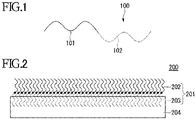
- Fig. 1 shows an example of the block copolymer.
- This example shows a block copolymer 100 as a diblock copolymer in which one block (A) 101 and one polymer (B) 102 are bonded at their ends.
- the block (B) forming the adhesive/fusible layer entangles with the thermoplastic resin forming the heat sealable substrate to maintain high heat sealing strength.
- the block copolymer is preferred to have a fewer number of blocks and, in particular, two blocks are preferred.
- a diblock copolymer is particularly preferred as the block copolymer.
- the volume fraction of the block (A) is preferred to be 0.35 or more and 0.65 or less, more preferred to be 0.40 or more and 0.60 or less, and even more preferred to be 0.45 or more and 0.60 or less.
- the microphase separation structure formed of a diblock copolymer depends on the volume fractions of the two blocks in the diblock copolymer, and accordingly differences in volume fraction lead to forming different microphase separation structures. If the volume fraction of the block (A) is 0.35 or more and 0.65 or less, a lamellar structure can be easily formed. If the volume fraction of the block (A) is less than 0.35 or more than 0.65, a spherical or cylindrical microphase separation structure can be easily formed.
- the volume fraction of the block (A) refers to a fraction of the volume of the block (A) with respect to the total volume of all the blocks forming the block copolymer.
- the volume fraction of the block (A) is calculated from the Mw and the densities of the blocks forming the block copolymer.
- the density of a block is calculated from the mole fraction of the monomer forming the block and the density of the homopolymer.
- literature values e.g., values described in the polymer database PolyInfo may be used.
- the Mw of the block copolymer is preferred to be 1,000 or more, more preferred to be 1,000 or more and less than 1,000,000, even more preferred to be 5,000 or more and 500,000 or less, and most preferred to be 10,000 or more and 100,000 or less.
- the Mw of the block copolymer is 1,000 or more, a continuous lamellar structure can be easily formed and non-adsorptivity can be further improved. Furthermore, the present coating agent has good coating suitability.
- the block copolymer in self-organization of the block copolymer, the block copolymer will have high fluidity when being heat-treated at the phase transition temperature or higher, thereby inducing a microphase separation structure, but the fluidity will decrease as the molecular weight of the block copolymer increases. If the Mw of the block copolymer is less than 1,000,000, the rate of self-organization may become higher and high productivity can be achieved.
- the block (A) is a block forming a non-adsorptive layer.
- the block copolymer containing the block (A) can impart non-adsorptivity thereto.
- the block (A) is a first block (A1) in the present embodiment.
- the first block (A1) is formed of a copolymer having nitrile group-containing (meth)acrylic monomer units and alkyl group-containing (meth)acrylic monomer units.
- the nitrile group-containing (meth)acrylic monomer may be, for example, an acrylonitrile or methacrylonitrile. These monomers may be used singly or in combination of two or more.
- the alkyl group of the alkyl group-containing (meth)acrylic monomer may have a linear or branched chain.
- the number of carbons in the alkyl group is preferred to be 1 or more and 18 or less, and more preferred to be 4 or more and 12 or less.
- alkyl group-containing (meth)acrylic monomer examples include alkyl (meth)acrylates such as methyl (meth)acrylate, ethyl (meth)acrylate, butyl (meth)acrylate, hexyl (meth)acrylate, octyl (meth)acrylate, isononyl (meth)acrylate, dodecyl (meth)acrylate, hexadecyl (meth)acrylate, stearyl (meth)acrylate, and docosyl (meth)acrylate. These monomers may be used singly or in combination of two or more.
- the first block (A1) may contain monomer units other than the nitrile group-containing (meth)acrylic monomer units and the alkyl group-containing (meth)acrylic monomer units, within a range not impairing non-adsorptivity.
- the other monomers may be, for example, polar functional group-containing (meth)acrylic monomers, polar functional group-containing vinyl monomers, ethylene, propylene, or the like.
- the polar functional group may be, for example, a hydroxy group, carboxy group, or the like.
- the proportion of the alkyl group-containing (meth)acrylic monomer units is preferred to be 0.1 mol or more and 0.8 mol or less, and more preferred to be 0.2 mol or more and 0.5 mol or less, with respect to 1 mol of the nitrile group-containing (meth)acrylic monomer units. If the proportion of the alkyl group-containing (meth)acrylic monomer units is equal to or more than the above lower limit, the block copolymer will have high solubility in the liquid medium, the present coating agent will have high coating suitability, and the heat sealing surface to which the present coating agent has been applied will have high non-adsorptivity and high heat sealability. If the proportion of the alkyl group-containing (meth)acrylic monomer units is equal to or less than the above upper limit, the heat sealing surface to which the present coating agent has been applied will have high non-adsorptivity.
- the total proportion of the nitrile group-containing (meth)acrylic monomer units and the alkyl group-containing (meth)acrylic monomer units is preferred to be 50 mol% or more, more preferred to be 80 mol% or more, and even more preferred to be 100 mol%, with respect to 100 mol% of all the monomer units forming the block (A1).
- the block (B) is a block forming an adhesive/fusible layer.
- the block copolymer having the block (B) can secure good heat sealability even when the present coating agent is applied to the heat sealing surface.
- the polymer forming the block (B) is selected so that, in the combination with the block (A), the blocks (A) and (B) will have "low compatibility with each other" as described above and thus that a microphase separation structure can be formed.
- the block (B) is a block (B1) in the present embodiment.
- the polymer forming the block (B1) may include polymers having nitrile group-containing (meth)acrylic monomer units, copolymers having reactive functional group-containing (meth)acrylic monomer units and nitrile group-containing (meth)acrylic monomer units, polymers having (meth)acrylic monomer units containing a side group that can be adhered to or fused to a heat sealable substrate, polymers having functional group-containing vinyl monomer units, and polymers having cyclic olefin units.
- the polymers having functional group-containing vinyl monomer units, or the polymers having cyclic olefin units are preferred, from the perspective of compatibility with the block (A1).
- the nitrile group-containing (meth)acrylic monomer may be, for example, an acrylonitrile or methacrylonitrile. These monomers may be used singly or in combination of two or more.
- the polymers having nitrile group-containing (meth)acrylic monomer units may further contain other monomer units.
- the polymer having nitrile group-containing (meth)acrylic monomer units may be, for example, polyacrylonitrile or polymethacrylonitrile.
- the reactive functional group of the reactive functional group-containing (meth)acrylic monomer is a functional group which can react with the reactive functional group on the heat sealing surface of the heat sealable substrate, or other reactive functional groups in the present coating agent (e.g., the reactive functional group of another reactive functional group-containing (meth)acrylic monomer, or the reactive functional group of a curing agent in the case where the present coating agent contains the curing agent).
- the reactive functional group may be, for example, at least one selected from the group consisting of hydroxy groups, carboxy groups, epoxy groups, and amino groups.
- Examples of the reactive functional group-containing (meth)acrylic monomer may include hydroxy group-containing (meth)acrylic monomers such as 2-hydroxyethyl (meth)acrylate and hydroxypropyl (meth)acrylate; carboxy group-containing (meth)acrylic monomers such as (meth)acrylic acid, maleic acid, and itaconic acid; epoxy group-containing (meth)acrylic monomers such as glycidyl (meth)acrylate; and amino group-containing (meth)acrylic monomers such as 2-(dimethylamino) ethyl methacrylate. These monomers may be used singly or in combination of two or more.
- the copolymer having the reactive functional group-containing (meth)acrylic monomer units and the nitrile group-containing (meth)acrylic monomer units may further contain other monomer units.
- the side group contained in the (meth)acrylic monomer, which can be adhered to or fused to the heat sealable substrate may be, for example, a long chain alkyl group.
- the number of carbons in the long chain alkyl group is preferred to be 4 or more, and more preferred to be 4 or more and 18 or less.
- the long chain alkyl group may be a linear or branched chain alkyl group .
- Examples of the adhesive/fusible side group-containing (meth)acrylic monomer may include long chain alkyl (meth)acrylates such as hexyl (meth)acrylate, octyl (meth)acrylate, dodecyl (meth)acrylate, stearyl (meth)acrylate, and docosyl (meth)acrylate. These monomers may be used singly or in combination of two or more.
- the polymer having an adhesive/fusible side group-containing (meth)acrylic monomer may further contain other monomer units.
- the functional group of the functional group-containing vinyl monomer may be, for example, a hydroxy group, acyl group (acetyl group, etc.), isocyanate group, or the like.
- the functional group-containing vinyl monomer may be, for example, a vinyl alcohol or vinyl acetate.
- the polymer having functional group-containing vinyl monomer units may further contain other monomer units.
- the other monomers may include, for example, olefins such as ethylene and propylene.
- Examples of the functional group-containing vinyl monomer units may include polyvinyl alcohols, ethylene-vinyl alcohol copolymers, polyvinyl acetates, and ethylene-vinyl acetate copolymers.
- the cyclic olefin may be a monocyclic or polycyclic olefin.
- the number of carbons in the cyclic framework of the cyclic olefin may be, for example, 4 or more and 8 or less.
- the cyclic olefin may have a substituent group such as an alkyl group.
- cyclic olefin examples include norbornene, tetracyclododecene, methyltetracyclododecene, dimethylcyclotetradodecene, dimethanooctahydronaphthalene, cyclobutene, cyclopentene, and cyclooctene. These cyclic olefins may be used singly or in combination of two or more.
- the polymer having cyclic olefin units may further contain other monomer units.
- the other monomers may include olefins such as ethylene and propylene; and cyclic unsaturated hydrocarbons other than the cyclic olefins, such as dicyclopentadiene, dihydrodicyclopentadiene, methyldicyclopentadiene, dimethyldicyclopentadiene, tricyclopentadiene, tetracyclopentadiene, and cyclooctadiene.
- the block (B 1) may be formed of polymers other than those mentioned above.
- Examples of the other polymers may include (co)polymers of a short chain alkyl group-containing (meth)acrylate having 1 or more and 3 or less carbons; (co)polymers of aromatic vinyl-based monomers such as styrene and vinyltoluene; (co)polymers of acrylamide-based monomers such as acrylamide, N-methylolacrylamide, and diacetoneacrylamide; and polymers having an adhesive functional group such as a catechol group at the end or at the side chain.
- the polymer forming the block (B 1) is preferred to be a polymer that is of the same type as the thermoplastic resin forming the heat sealable substrate, from the perspective of ease of adhesion or fusion to the heat sealable substrate.
- the expression "the same type” refers to having a similar main-chain structure or a similar side-chain structure. As examples of "the same type", the following cases may be mentioned.
- thermoplastic resin of the heat sealable substrate is an ethylene-vinyl acetate copolymer
- block (B1) is a polymer having vinyl acetate units (polyvinyl acetate, etc.).
- thermoplastic resin of the heat sealable substrate is a cyclic olefin copolymer
- block (B 1) is a polymer having cyclic olefin units
- the block copolymer can be prepared using known methods such as living radical polymerization, living anionic polymerization, or living cationic polymerization.
- block copolymer can be prepared according to the synthesis example of Example 2 and the like described in JP 2006-299278 A .
- the liquid medium may only need to be able to dissolve the block copolymer. If the present coating agent contains a curing agent, it is preferred that the liquid medium can dissolve the block copolymer and the curing agent.
- the liquid medium may be, for example, a ketone solvent, ester solvent, glycol solvent, or hydrocarbon solvent.
- the ketone solvent may be acetone, methyl ethyl ketone, methyl isobutyl ketone, anone, or the like.
- the ester solvent may be ethyl acetate, n-propyl acetate, n-butyl acetate, isobutyl acetate, or the like.
- the glycol solvent may be butyl cellosolve, propylene glycol monomethyl ether, propylene glycol-1-monomethyl ether-2-acetate, or the like.
- the hydrocarbon solvent may be toluene, xylene, n-hexane, methylcyclohexane, or the like. These liquid media may be used singly or in combination of two or more, and can be suitably selected according to the solubility of the block copolymer.
- the liquid medium is preferred to be a ketone solvent, ester solvent, or hydrocarbon solvent.
- the liquid medium may be referred to as a dispersion medium.
- the boiling point of the liquid medium is preferred to be 120°C or less, and more preferred to be 100°C or less, from the perspective of reducing processing load during coating.
- the lower limit of the boiling point of the liquid medium is not particularly limited but may be, for example, 40°C.
- the liquid medium having a boiling point of 120°C or less may be, for example, methyl ethyl ketone or methyl isobutyl ketone.
- the curing agent is used for crosslinking and curing the block copolymer in the case where the block copolymer has a reactive functional group (e.g., in the case where the first block (A1) or (B 1) has reactive functional group-containing (meth)acrylic monomer units).
- Crosslinkage of the block copolymer in which a microphase separation structure is formed can increase the density of the coating layer and can enhance non-adsorptivity.
- the curing agent is preferred to be a polyisocyanate compound having two or more isocyanate groups.
- the polyisocyanate compound include diisocyanate compounds, including aromatic diisocyanates such as tolylene diisocyanate and 4,4'-diphenylmethane diisocyanate; aliphatic diisocyanates such as xylylene diisocyanate and hexamethylene diisocyanate; alicyclic diisocyanates such as isophorone diisocyanate; and polymers, derivatives, and mixtures of these diisocyanate compounds.
- aromatic diisocyanates such as tolylene diisocyanate and 4,4'-diphenylmethane diisocyanate
- aliphatic diisocyanates such as xylylene diisocyanate and hexamethylene diisocyanate
- alicyclic diisocyanates such as isophorone diisocyanate
- the content of the curing agent can be suitably selected according to the content of the reactive functional group of the block copolymer.
- the molar ratio as expressed by "reactive functional group of curing agent / reactive functional group of block copolymer” is preferred to be 0.5 or more and 5.0 or less, and more preferred to be 0.8 or more and 3.5 or less. If the molar ratio is 0.5 or more, the block copolymer can be sufficiently cured, and if it is 5.0 or less, blocking can be prevented from occurring on the surface of the coating layer.
- Other components may be an antiblocking agent, UV absorber, antistatic agent, antioxidizing agent, antibacterial agent, pigment, dye, antifoam agent, leveling agent, and the like. These components per type may be used singly or in combination of two or more.
- the solid content concentration of the present coating agent is preferred to be 0.1 mass% or more and 20 mass% or less, and more preferred to be 1 mass% or more and 10 mass% or less. If the solid content concentration is 0.1 mass% or more, the block copolymer as a main resin of the present coating agent can be uniformly applied without unevenness and thus a continuous film can be easily obtained. If the solid content concentration is 20 mass% or less, the block copolymer and the like can be sufficiently dissolved. Furthermore, a thin film can be easily formed and thus the microphase separation structure formed by self-organization is less likely to be disturbed and will have good non-adsorptivity, and further, sufficient heat sealing strength can be easily obtained. It should be noted that the expression solid content concentration refers to the ratio of the solid content to the total amount of the present coating agent.
- the present coating agent can be produced by mixing a block copolymer, liquid medium, and, as necessary, curing agent and other components.
- the present coating agent described above contains a specific block copolymer, good non-adsorptivity can be imparted to the heat sealing surface of the heat sealable substrate when it is applied thereto, and good heat sealability can be imparted thereto after impartment of non-adsorptivity.
- the self-organization phenomenon can be caused to the surface to thereby form a coating layer having a lamellar structure in which two different functional layers (a non-adsorptive layer and an adhesive/fusible layer) are laminated.
- the non-adsorptive layer is formed without defects on the overall air interface above the heat sealable substrate to exhibit good non-adsorptivity. Furthermore, since the adhesive/fusible layer is formed on the overall interface with the heat sealable substrate, good adhesion can be achieved between the coating layer and the heat sealable substrate and accordingly defects, such as separation, are unlikely to occur.
- the block (B) When the laminate including the coating layer is heat-sealed to the heat sealing surface of the heat sealable substrate, the block (B) fluidizes and entangles with the thermoplastic resin forming the heat sealable substrate, and becomes mixed. With this mixing, the block (A) chemically bonded to the block (B) is also mixed with the thermoplastic resin. Therefore, heat sealing inhibition by the block (A) is mitigated, and high heat sealing strength is maintained even in the portion where the coating layer is formed.
- a laminate 200 includes a heat sealable substrate 204, and a coating layer 201 formed on the heat sealing surface of the heat sealable substrate 204.
- the coating layer 201 is formed using a coating agent that contains a block copolymer similar to the block copolymer 100 shown in Fig. 1 .
- the coating layer 201 has a lamellar structure in which an adhesive/fusible layer 203 formed of the block (B) and a non-adsorptive layer 202 formed of the block (A) of the block copolymer are laminated in this order from the heat sealable substrate 204 side.
- the block (B) of the adhesive/fusible layer 203 fluidizes and entangles with part of the thermoplastic resin of the heat sealable substrate 204 for mixing, while the block (A) of the non-absorption layer 202 also mixes with the thermoplastic resin of the heat sealable substrate 204, so that these layers are fused.
- a layer formed of fused substances of the block copolymer and the thermoplastic resin is formed, in which the non-adsorptive layer 202, the adhesive/fusible layer 203, and part of the heat sealable substrate are integrated.
- the block (A) has a low density at the outermost surface of the laminate 200, without exhibiting non-adsorptivity, and high heat sealing strength is achieved.
- the block (A) is less likely to mix with the thermoplastic resin of the heat sealable substrate 204 during heat sealing, and heat sealing strength is reduced.
- the laminated film in which two different functional layers are sequentially laminated can also be formed using a multilayer extrusion method in which different types of resins are simultaneously extruded onto a substrate.
- a multilayer extrusion method it is difficult to form a thin multilayer film having a thickness of a few micrometers or less, and to form two different functional layers in the state of being chemically bonded.
- the present coating agent utilizing the self-organization phenomenon, it is possible to form a laminated film in which two different functional layers are chemically bonded using only one coating and heat treatment.
- the present coating agent contains the first block (A1) having 0.1 mol or more of the alkyl group-containing (meth)acrylic monomer units with respect to 1 mol of the nitrile group-containing (meth)acrylic monomer units, the block copolymer sufficiently dissolves into a low-boiling solvent such as methyl ethyl ketone or methyl isobutyl ketone. Therefore, such a low-boiling solvent can be used as a liquid medium to reduce the processing load during coating.
- a low-boiling solvent such as methyl ethyl ketone or methyl isobutyl ketone. Therefore, such a low-boiling solvent can be used as a liquid medium to reduce the processing load during coating.
- a coating agent for modifying a heat sealable substrate according to a second embodiment is applied to a heat sealing surface of a heat sealable substrate and contains a block copolymer and a liquid medium.
- the block copolymer contains a second block (A2) forming a non-adsorptive layer and a block (B2) forming a layer that can be adhered to or fused to the heat sealable substrate, with the second block (A2) having a volume fraction of 0.35 or more and 0.65 or less.
- the present embodiment is different from the first embodiment in that the second block (A2) is used as the block (A), and the block (B2) is used as the block (B).
- the description of the first embodiment can be applied to the present embodiment unless otherwise described.
- the coating agent for modifying a heat sealable substrate of the present embodiment can impart non-adsorptivity to a sealant film and can balance heat sealability with non-adsorptivity.
- the coating agent for modifying a heat sealable substrate contains a block copolymer composed of two or more polymer blocks, and a dispersion medium.
- the coating agent for modifying a heat sealable substrate according to the present embodiment is applied to a heat sealing surface of a heat sealable substrate and contains a block copolymer and a liquid medium.
- the block copolymer contains a second block (A2) forming a non-adsorptive layer and a block (B2) forming a layer that can be adhered to or fused to the heat sealable substrate.
- the polymer blocks forming a block copolymer 100 include a polymer block 101 having non-adsorptivity, and a polymer block 102 that can be adhered to or fused to a sealant film.
- the block copolymer used for the coating agent of the present embodiment is a polymer in which two or more different polymer blocks having low compatibility with each other are bonded at their ends.
- the block copolymer is a polymer in which two or more blocks, i.e., the second block (A2) and the block (B2), different from each other and having low compatibility with each other are bonded at their ends.
- Such a block copolymer forms a periodic microphase separation structure in a self-organization manner by being heated to its phase transition temperature or higher, i.e., annealed.
- the blocks (A2) and (B2) which are polymer blocks having low compatibility with each other, form microregions so as not to mix with each other.
- microphase separation structure The dimensions of the microregions depend on the polymer chain lengths of the polymer blocks. Furthermore, the microphase separation structure to be formed is determined by the volume fractions of the polymer blocks forming the block copolymer. The microphase separation structure is as described in the first embodiment.
- use of the self-organization phenomenon described above can form a coating layer in which two different functional layers (i.e., a non-adsorptive layer and a layer that can be adhered to or fused to a thermoplastic resin substrate) are laminated.
- the coating agent of the present embodiment can form a laminated film, in which two different functional layers are chemically bonded, through only one application and annealing treatment of the coating agent, and thus is preferred to the multilayer extrusion method mentioned above.
- the block copolymer may include one or more blocks (A2).
- the block copolymer may include one or more blocks (B2).
- the block copolymer may be, for example, a linear block copolymer in which two or more polymer blocks, i.e., the second block (A2) and the block (B2), are bonded in series at their ends, a star-shaped block copolymer in which three or more polymer blocks are bonded at one point, or the like.
- Either of the block copolymers can be used in the present embodiment, but it is preferred to use the diblock copolymer in which two different polymer blocks, i.e., the second block (A2) and the block (B2), are bonded at their ends.
- the polymer block forming the non-adsorptive layer of the block copolymer that can be used in the present embodiment may be a nitrile group-containing (meth)acrylic polymer, a copolymer obtained by copolymerizing reactive functional group-containing (meth)acrylic monomer units, which can react with a curing agent, with nitrile group-containing (meth)acrylic monomer units, a functional group-containing vinyl polymer, a cyclic olefin copolymer, or the like.
- the nitrile group-containing (meth)acrylic monomer may be, for example, an acrylonitrile or methacrylonitrile. These monomers may be used singly or in combination of two or more.
- the polymer having nitrile group-containing (meth)acrylic monomer units may further contain other monomer units.
- the nitrile group-containing (meth)acrylic polymer may be, specifically, polyacrylonitrile, polymethacrylonitrile, or the like.
- the copolymer obtained by copolymerizing reactive functional group-containing (meth)acrylic monomer units, which can react with a curing agent, with nitrile group-containing (meth)acrylic monomer units may be copolymers containing a hydroxy group-containing (meth)acrylic monomer, carboxy group-containing (meth)acrylic monomer, epoxy group-containing (meth)acrylic monomer, amino group-containing (meth)acrylic monomer, or the like.
- Examples of the reactive functional group-containing (meth)acrylic monomer may include hydroxy group-containing (meth)acrylic monomers such as 2-hydroxyethyl(meth)acrylate and hydroxypropyl(meth)acrylate; amino group-containing (meth)acrylic monomers such as 2-(dimethylamino)ethylmethacrylate; carboxy group-containing (meth)acrylic monomers such as (meth)acrylic acid, maleic acid, and itaconic acid; and epoxy group-containing (meth)acrylic monomers such as glycidyl(meth)acrylate. These monomers may be used singly or in combination of two or more.
- the functional group of the functional group-containing vinyl monomer in the functional group-containing vinyl polymer may be, for example, a hydroxy group, acyl group (acetyl group, etc.), isocyanate group, or the like.
- the functional group-containing vinyl monomer may be, for example, a vinyl alcohol or vinyl acetate.
- the polymer having functional group-containing vinyl monomer units may further contain other monomer units.
- the other monomers may be, for example, olefins such as ethylene and propylene.
- the functional group-containing vinyl polymer may be a polyvinyl alcohol, polyvinyl acetate, ethylene-vinyl acetate copolymer, ethylene-vinyl alcohol copolymer, or the like.
- the cyclic olefin may be a monocyclic or polycyclic olefin.
- the number of carbons in the cyclic framework of the cyclic olefin may be, for example, 4 or more and 8 or less.
- the cyclic olefin may have a substituent group such as an alkyl group.
- cyclic olefin examples include norbornene, tetracyclododecene, methyltetracyclododecene, dimethylcyclotetradodecene, dimethanooctahydronaphthalene, cyclobutene, cyclopentene, and cyclooctene. These cyclic olefins may be used singly or in combination of two or more.
- the polymer having cyclic olefin units may further contain other monomer units.
- the other monomers may include olefins such as ethylene and propylene; and cyclic unsaturated hydrocarbons other than the cyclic olefins, such as dicyclopentadiene, dihydrodicyclopentadiene, methyldicyclopentadiene, dimethyldicyclopentadiene, tricyclopentadiene, tetracyclopentadiene, and cyclooctadiene.
- Examples of the other polymers may include (co)polymers of short chain alkyl group-containing (meth)acrylates having 1 or more and 3 or less carbons; (co)polymers of aromatic vinyl-based monomers such as styrene and vinyltoluene; (co)polymers of acrylamide-based monomers such as acrylamide, N-methylolacrylamide, and diacetoneacrylamide; and polymers having an adhesive functional group such as a catechol group at the end or side chain.
- the polymer block forming the layer that can be adhered to or fused to the thermoplastic resin substrate of the block copolymer may be a nitrile group-containing (meth)acrylic polymer (also termed polymer having nitrile group-containing (meth)acrylic monomer units), copolymer obtained by copolymerizing reactive functional group-containing (meth)acrylic monomer units, which can react with a curing agent or the reactive functional group on the surface of the substrate, with nitrile group-containing (meth)acrylic monomer units, (meth)acrylic polymer containing a side chain that can be adhered to or fused to the thermoplastic resin substrate or a copolymer thereof, functional group-containing vinyl polymer (also termed polymer having functional group-containing vinyl monomer units), cyclic olefin polymer (also termed polymer having cyclic olefin units), or the like.
- functional group-containing vinyl polymer also termed polymer having functional group-containing vinyl monomer units
- the nitrile group-containing (meth)acrylic monomer may be, for example, an acrylonitrile or methacrylonitrile. These monomers may be used singly or in combination of two or more.
- the polymer having nitrile group-containing (meth)acrylic monomer units may further contain other monomer units.
- the nitrile group-containing (meth)acrylic polymer may be, specifically, polyacrylonitrile, polymethacrylonitrile, or the like.
- the copolymer obtained by copolymerizing reactive functional group-containing (meth)acrylic monomer units, which can react with a curing agent or the reactive functional group on the substrate surface, with nitrile group-containing (meth)acrylic monomer units may be a copolymer containing a hydroxy group-containing (meth)acrylic monomer, carboxy group-containing (meth)acrylic monomer, epoxy group-containing (meth)acrylic monomer, amino group-containing (meth)acrylic monomer, or the like.
- the reactive functional group-containing (meth)acrylic monomer may be hydroxy group-containing (meth)acrylic monomers such as 2-hydroxyethyl(meth)acrylate and hydroxypropyl(meth)acrylate; carboxy group-containing (meth)acrylic monomers such as (meth)acrylic acid, maleic acid, and itaconic acid; epoxy group-containing (meth)acrylic monomers such as glycidyl(meth)acrylate; amino group-containing (meth)acrylic monomers such as 2-(dimethylamino)ethylmethacrylate; and the like.
- hydroxy group-containing (meth)acrylic monomers such as 2-hydroxyethyl(meth)acrylate and hydroxypropyl(meth)acrylate
- carboxy group-containing (meth)acrylic monomers such as (meth)acrylic acid, maleic acid, and itaconic acid
- epoxy group-containing (meth)acrylic monomers such as glycidyl(meth
- the (meth)acrylic polymer containing a side chain (also termed side group) that can be adhered to or fused to the thermoplastic resin substrate (i.e., heat sealable substrate) may be a (meth)acrylic monomer or copolymer having a branched or linear long chain alkyl group.
- the number of carbons in the long chain alkyl group is preferred to be 4 or more, and more preferred to be 4 or more and 18 or less.
- the adhesive/fusible side group-containing (meth)acrylic monomer may be hexyl (meth)acrylate, octyl (meth)acrylate, dodecyl (meth)acrylate, stearyl (meth)acrylate, docosyl (meth)acrylate, or the like. These monomers may be used singly or in combination of two or more.
- the polymer having a (meth)acrylic monomer that contains an adhesive/fusible side group may further contain other monomer units.
- the functional group of the functional group-containing vinyl monomer may be, for example, a hydroxy group, acyl group (acetyl group, etc.), isocyanate group, or the like.
- the functional group-containing vinyl monomer may be, for example, a vinyl alcohol or vinyl acetate.
- the polymer having functional group-containing vinyl monomer units may further contain other monomer units.
- the other monomers may be, for example, olefins such as ethylene and propylene.
- the functional group-containing vinyl polymer may be a polyvinyl alcohol, polyvinyl acetate, ethylene-vinyl acetate copolymer, ethylene-vinyl alcohol copolymer, or the like.
- the cyclic olefin may be a monocyclic or polycyclic olefin.
- the number of carbons in the cyclic framework of the cyclic olefin may be, for example, 4 or more and 8 or less.
- the cyclic olefin may have a substituent group such as an alkyl group.
- cyclic olefin examples include norbornene, tetracyclododecene, methyltetracyclododecene, dimethylcyclotetradodecene, dimethanooctahydronaphthalene, cyclobutene, cyclopentene, and cyclooctene. These cyclic olefins may be used singly or in combination of two or more.
- the polymer having cyclic olefin units may further contain other monomer units.
- the other monomers may include olefins such as ethylene and propylene; and cyclic unsaturated hydrocarbons other than the cyclic olefins, such as dicyclopentadiene, dihydrodicyclopentadiene, methyldicyclopentadiene, dimethyldicyclopentadiene, tricyclopentadiene, tetracyclopentadiene, and cyclooctadiene.
- the block (B2) may be formed of polymers other than those mentioned above.
- Examples of the other polymers may include (co)polymers of linear alkyl group-containing (meth)acrylates; (co)polymers of aromatic vinyl-based monomers such as styrene and vinyltoluene; (co)polymers of acrylamide-based monomers such as acrylamide, N-methylolacrylamide, and diacetoneacrylamide; and polymers having an adhesive functional group such as a catechol group at the end or side chain.
- the polymer blocks, that is, the second block (A2) and the block (B2), in the block copolymer are required to be selected as a combination of polymers which have low compatibility with each other and can form the microphase separation structure described above.
- the block (B2) serving as a polymer block of the fusible layer it is more preferred to select a polymer that is the same type as (has a similar main-chain structure or a similar side-chain structure to) the thermoplastic resin material of the substrate used.
- the expression "the same type" is as stated above.
- the diblock copolymer preferred to be used in the present embodiment depends on the volume fractions of the two polymer blocks, and the difference in volume fraction produces different fine structures (also termed microphase separation structures).
- a diblock copolymer that can form a lamellar structure is preferred.
- the non-adsorptive layer as a single film is required to be formed on the overall surface of the sealant film with no defects.
- the lamination structure is oriented in the in-plane direction of the sealant film to form a layer in which the second block (A2) is densely oriented at the interface with the contents (the air interface). Accordingly, the non-adsorptive layer can be formed on the overall surface of the sealant film.
- the block (B2) that is the other polymer block of the block copolymer is necessarily oriented at the interface with the sealant film to improve adhesion between the coating layer and the sealant film, thereby achieving an advantageous effect that defects, such as separation, are less likely to occur therebetween.
- the volume fraction of the second block (A2) of the diblock copolymer is preferred to be 0.35 or more and 0.65 or less, more preferred to be 0.40 or more and 0.65, and even more preferred to be 0.45 or more and 0.64. If the volume fraction of the second block (A2) is 0.35 or more and 0.65 or less, the lamellar structure can be easily formed. If the volume fraction of the second block (A2) is less than 0.35 or 0.65 or more, a spherical or cylindrical structure can be easily formed.
- the block copolymer is preferred to have a weight average molecular weight of 1,000 or more and less than 1,000,000. If the Mw of the block copolymer is 1,000 or more, a continuous lamellar structure can be easily formed and non-adsorptivity can be further improved. Furthermore, the present coating agent has good coating suitability.
- the weight average molecular weight is less than 1,000, it may be difficult to form a continuous lamellar structure film and thus non-adsorptive performance may be impaired. Furthermore, as described above, fluidity of the block copolymer will be enhanced in the self-organization by performing annealing (heat treatment) at the phase transition temperature or higher, so that a microphase separation structure will be induced. However, as the molecular weight of the block copolymer increases, the fluidity will decrease, and therefore, in the case of a block copolymer having a high weight average molecular weight of 1,000,000 or more, the rate of self-organization may be lowered and thus productivity may be significantly lowered. If the Mw of the block copolymer is less than 1,000,000, the rate of self-organization may become higher and high productivity can be achieved.
- a curing agent may be added to the coating agent of the present embodiment.
- the curing agent is used for crosslinking and curing the polymer blocks by reaction with the reactive functional group, in the case where a polymer block of the block copolymer has the reactive functional group (e.g., in the case where the second block (A2) or (B2) has reactive functional group-containing (meth)acrylic monomer units).
- Addition of a curing agent can crosslink the polymer chains in the blocks to increase the density of the layer and improve non-adsorption characteristics for the contents such as active ingredients.
- the curing agent is preferred to be a polyisocyanate compound having two or more isocyanate groups.
- the polyisocyanate compound include aromatic diisocyanates such as tolylene diisocyanate and 4,4'-diphenylmethane diisocyanate; aliphatic diisocyanates such as xylylene diisocyanate and hexamethylene diisocyanate; alicyclic diisocyanates such as isophorone diisocyanate; and polymers, derivatives, and mixtures of these diisocyanate compounds.
- aromatic diisocyanates such as tolylene diisocyanate and 4,4'-diphenylmethane diisocyanate
- aliphatic diisocyanates such as xylylene diisocyanate and hexamethylene diisocyanate
- alicyclic diisocyanates such as isophorone diisocyanate
- polymers, derivatives, and mixtures of these diisocyanate compounds may
- the content of the curing agent can be suitably selected according to the content of the reactive functional group of the block copolymer.
- the ratio between the polymer blocks and the curing agent i.e., the molar ratio as expressed by "reactive functional group of curing agent / reactive functional group of block copolymer" is preferred to be 0.5 or more and 5.0 or less, and more preferred to be 0.8 or more and 3.5 or less. If the molar ratio is 0.5 or more, the block copolymer can be sufficiently cured, and if it is 5.0 or less, blocking can be prevented from occurring on the surface of the non-adsorptive layer, i.e., the coating layer.
- a laminate also termed the present laminate hereinafter
- the present laminate may further include substrates or layers other than the heat sealable substrate and the coating layer.
- the heat sealable substrate is a substrate having heat sealability.
- the heat sealable substrate may be a resin substrate having heat sealability.
- heat sealable substrates include a thermoplastic resin.
- the thermoplastic resin is preferred to be a resin that can be processed into a shape by thermal compression or the like, and may be, for example, a polyethylene resin, polypropylene resin, cyclic polyolefin resin, polyester resin, or vinyl acetate resin. These thermoplastic resins per type may be used singly or in combination of two or more.
- the thickness of the heat sealable substrate is not particularly limited, but may be, for example, 1 ⁇ m or more and 100 ⁇ m or less.
- the coating layer is formed of a block copolymer.
- the coating layer has a lamellar structure.
- the block copolymer is the same as the block copolymer of the present coating agent.
- the lamellar structure includes a non-adsorptive layer formed of a block (A) and an adhesive/fusible layer formed of a block (B).
- the layer nearest the air interface is the non-adsorptive layer.
- the layer nearest the heat sealable substrate is the adhesive/fusible layer.
- the number of the non-adsorptive layers of the lamellar structure may be one or more.
- the number of the adhesive/fusible layers of the lamellar structure may be one or more.
- the lamellar structure is preferred to have a two-layer structure in which one adhesive/fusible layer and one non-adsorptive layer are laminated from the heat sealable substrate side.
- the thickness of the coating layer is preferred to be around 0.01 ⁇ m or more and 10 ⁇ m or less, and more preferred to be around 0.1 ⁇ m or more and 1 ⁇ m or less.
- the thickness of the coating layer is not limited to the above range.
- the thickness of the coating layer can be selected so as to match the Mw of the block copolymer.
- fluidization and entanglement of the block (B) and the thermoplastic resin of the heat sealable substrate can mix the block copolymer with the heat sealing resin. Therefore, heat sealing inhibition by the non-adsorption block is mitigated, and high heat sealing strength is maintained even in the portion where the coating layer is formed.
- the thickness of the coating layer is preferred to be selected, matching the Mw of the block copolymer, so that orientation can be achieved with a fewer number of layers.
- the present laminate may further include a support substrate on a surface of the heat sealable substrate opposite to the coating layer.
- the present laminate may further include a support substrate on a surface of the heat sealable substrate facing away from the surface where the coating layer is formed.
- the support substrate may have a single-layer structure or a multilayer structure.
- the single-layer support substrate various plastic films can be used.
- the single-layer support substrate may include polyolefin films such as a polyethylene film and polypropylene film; polyester films such as a polyethylene terephthalate film, polybutylene terephthalate film, and polyethylene naphthalate film; polyamide films such as a nylon-6 film and nylon-66 film; and polyimide films.
- a polypropylene film or a polyethylene terephthalate film is preferred from the perspective of film strength and cost. From the perspective of improving mechanical strength or imparting the packaging bag with durability against piercing or other external forces, a polyamide film is preferred.
- the support substrate has a multilayer structure
- one layer of the multilayer structure is preferred to be formed of a plastic film mentioned above.
- other layers may be formed of any materials.
- metal foil an aluminum foil or copper foil can be used. These metal foils can be laminated to the plastic film using an adhesive.
- the present laminate may include a printed layer.
- the printed layer may be located at a position recognizable from the outer surface (from the surface facing away from the coating layer).
- the printed layer may be provided between the support substrate and the heat sealable substrate.
- the method of printing the printed layer and the printing ink used are suitably selected from known printing methods, considering printing suitability for the films, aesthetic factors such as color hue, adhesion, safety as pharmaceutical or cosmetic containers, and the like.
- Examples of the printing method may include gravure printing, offset printing, gravure offset printing, flexographic printing, and ink jet printing.
- the method of producing a laminate according to an embodiment of the present invention includes applying the present coating agent to the heat sealing surface of a heat sealable substrate, and heat-treating the applied coating agent. With this method, a coating layer is formed on the heat sealing surface of the heat sealable substrate.
- the coating method may be solution casting, laminate molding, cast molding, injection molding, use of 3D printer, or the like. If the coating layer is formed into a film shape, solution casting is suitable, which specifically may be bar coating, dip coating, spin coating, flow coating, spray coating, roll coating, gravure roll coating, air doctor coating, blade coating, wire doctor coating, knife coating, reverse coating, transfer roll coating, microgravure coating, kiss coating, cast coating, slot orifice coating, calender coating, die coating, or the like.
- Heat treatment is performed for the purpose of drying the present coating agent applied to the heat sealing surface (i.e., removing liquid medium), and forming a lamellar structure by promoting self-organization of the block copolymer.
- a known drying method can be suitably used, including, for example, heating, blowing, hot blasting, combinations of these methods, or the like.
- the heat treatment temperature is selected from the range of the phase transition temperature or higher of the block copolymer used and the melting temperature or less of the heat sealable substrate.
- the heat treatment time is selected according to the time taken for forming the microphase separation structure.
- the phase transition temperature of the block copolymer can be obtained using differential scanning calorimetry (DSC).
- heat treatment may be performed under solvent vapor having affinity for the block copolymer.
- Such heat treatment may be called a solvent annealing process.
- Heat treatment under solvent vapor having affinity for the block copolymer can improve fluidity of the block copolymer due to the presence of the solvent vapor, thereby promoting self-organization. This can reduce time and temperature of the heat treatment.
- the solvent used in this case is not particularly limited as long as the solvent has affinity for the block copolymer.
- the solvent may include chloroform, toluene, tetrahydrofuran, and propylene glycol-1-monomethyl ether-2-acetate (PGMEA).
- the heat treatment temperature is preferred to be less than the boiling point of the solvent used. If heat treatment is performed at the boiling temperature or more of the solvent, the solvent may be vaporized around the coating film, preventing sufficient permeation of the solvent vapor into the coating film, and thus the effect of improving fluidity of the block copolymer is not necessarily achieved.
- the present laminate can be used as a packaging material.
- the present laminate is used as a packaging material, it may be used in the form of a film, or it may be used after being processed into a shape of a bag or the like by heat sealing.
- a packaging bag can be produced by having two sheets of the present laminate overlapped with each other so that the coating layer-side surfaces face each other, and heat-sealing the peripheral edges of the sheets.
- the packaging bag which has been produced so that the coating layers formed of the present coating agent are located inside, has non-adsorptivity in the inner surfaces (surfaces contacting the contents) and has high heat sealing strength, and accordingly, it is suitable for use as a packaging material for liquid contents containing fragrance and active ingredients.
- the liquid contents may be liquid pharmaceuticals containing medical ingredients (infusions, pharmaceuticals, or the like used for intravenous drips, or the like), insecticides, liquid cosmetics containing active ingredients (skin toner, emulsion, or the like), liquors containing flavor ingredients, aromatic oils, or the like.
- the medical ingredients may be terpenes such as methyl salicylate, limonene, citral, 1-menthol, and d1-camphor, aromatic compounds such as salicylic acid and naphthalene, vitamins, or the like.
- the present invention includes another aspect as follows.
- the present invention includes still another aspect as follows.
- EVA (NOVATEC TM EVA manufactured by Mitsubishi Chemical Corporation) was extruded onto a PET film (E5100 with a thickness of 12 ⁇ m manufactured by Toyobo Co., Ltd.) to obtain a laminated film (EVA thickness: 30 ⁇ m).
- EVA thickness 30 ⁇ m.
- the EVA surface of the obtained laminated film was corona-treated.
- the 5 mass% solution was applied once to the corona-treated EVA surface of the laminated film using a #6 wire bar, followed by heat treatment at 105°C for 10 minutes to form a coating layer with a thickness of 0.5 ⁇ m.
- a coating layer with a thickness of 0.5 ⁇ m.
- a PET film (E5100 with a thickness of 12 ⁇ m manufactured by Toyobo Co., Ltd.) and a COC film (Coxec TCS-2 with a thickness of 20 ⁇ m manufactured by Kurabo Industries Ltd.) were bonded together to obtain a laminated film.
- the COC surface of the obtained laminated film was corona-treated.
- the 1 mass% solution was applied once to the corona-treated COC surface of the laminated film using a #6 wire bar, followed by heat treatment at 110°C for 10 minutes to form a coating layer with a thickness of 0.6 ⁇ m. Through these processes, there was obtained a laminate in which PET / COC / coating layer were laminated in this order.
- a 5 mass% solution (coating agent) was attempted to be prepared by dissolving this block copolymer into MEK; however, the block copolymer was not dissolved. Therefore, no coating layer was formed.
- EVA (NOVATEC TM EVA manufactured by Mitsubishi Chemical Corporation) was extruded onto a PET film (E5100 with a thickness of 12 ⁇ m manufactured by Toyobo Co., Ltd.) to obtain a laminated film (EVA thickness: 30 ⁇ m).
- EVA thickness 30 ⁇ m.
- the EVA surface of the obtained laminated film was corona-treated.
- PVAc-b-PAN polyvinyl acetate-b-polyacrylonitrile block copolymer
- the 1 mass% solution was applied once to the corona-treated EVA surface of the laminated film using a #6 wire bar. Then, heat treatment was performed at 105°C for 10 minutes to form a coating layer with a thickness of 0.5 ⁇ m. Through these processes, there was obtained a laminate in which PET / EVA / block copolymer layer were laminated in this order.
- EVA (NOVATEC TM EVA manufactured by Mitsubishi Chemical Corporation) was extruded onto a PET film (E5100 with a thickness of 12 ⁇ m manufactured by Toyobo Co., Ltd.) to obtain a laminated film (EVA thickness: 30 ⁇ m).
- the 1.2 mass% solution was applied once to a corona-treated EVA surface of the laminated film using a #6 wire bar. Then, heat treatment was performed at 105°C for 10 minutes to form a coating layer with a thickness of 1.1 ⁇ m. Through these processes, there was obtained a laminate in which PET / EVA / block copolymer layer were laminated in this order.
- a PET film (E5100 with a thickness of 12 ⁇ m manufactured by Toyobo Col, Ltd.) and a linear low density polyethylene (LLDPE) film were bonded together to obtain a laminated film.
- the LLDPE surface of the obtained laminated film was corona-treated.
- PAN-b-PDMA polyacrylonitrile-b-poly dodecyl methacrylate block copolymer
- the 1 mass% solution was applied once to the corona-treated LLDPE surface of the laminated film using a #6 wire bar. Then, heat treatment was performed at 110°C for 10 minutes to form a coating layer with a thickness of 0.6 ⁇ m. Through these processes, there was obtained a laminate in which PET / LLDPE / block copolymer layer were laminated in this order.
- a PET film (E5100 with a thickness of 12 ⁇ m manufactured by Toyobo Co., Ltd.) and a COC film (Coxec TCS-2 with a thickness of 20 ⁇ m manufactured by Kurabo Industries Ltd.) were bonded together to obtain a laminated film.
- the COC surface of the laminated film was corona-treated.
- the 1 mass% solution was applied once to the corona-treated COC surface of the laminated film using a #6 wire bar. Then, heat treatment was performed at 110°C for 10 minutes to form a coating layer with a thickness of 0.6 ⁇ m. Through these processes, there was obtained a laminate in which PET / COC / block copolymer layer were laminated in this order.
- a laminate to which a block copolymer PVAc-b-PAN was applied was obtained as in Example 1B except that, in the block copolymer, Mw of PVAc was 500, and Mw of PAN was 400.
- a laminate to which a block copolymer PVAc-b-PAN was applied was obtained as in Example 1B except that, in the black copolymer, Mw of PVAc was 14,000, Mw of PAN was 7,000, and volume fraction of PVAc was 0.66.
- Table 5 shows laminated films (support substrate / heat sealable substrate), and block copolymers used for the coating agents of Examples 1B to 5B and Comparative Example 1B.
- block copolymer the polymers forming the blocks (A) and (B), Mw thereof, volume fraction of the block (A), and Mw of the whole block copolymer are shown.
- the volume fraction of the block (A) of each block copolymer was obtained through the following procedure.
- the respective volumes of AN and BA in the block (A) were firstly calculated to be 4,727 cm 3 /g and 6,078 cm 3 /g using the molecular weights and the densities of the monomers AN and BA, and then the obtained volumes were added up to thereby obtain a volume of the block (A).
- the volume fraction of the block (A) was calculated by dividing the volume of the block (A) by the sum of the volumes of the blocks (A) and (B).
- a sample was prepared for the laminate of each example by embedding the laminate in a UV curable resin, and curing the UV curable resin by UV irradiation.
- the obtained sample was sliced using a microtome to expose a cross section of the laminate.
- the cross section was dyed using iodine or ruthenium oxide, and the coating layer was observed using a scanning electron microscope (SEM). If a lamellar structure (lamellar microphase separation structure) was uniformly formed, the sample was evaluated to be good, and if no lamellar structure was formed, the sample was evaluated to be poor.
- SEM scanning electron microscope
- Comparative Example 1A having no coating layer is shown as being poor.
- the block copolymer solution was transparent and no precipitation or turbidity was visually observed.
- solubility of each block copolymer to the liquid media was evaluated according to the following criteria.
- the results of Examples 1A to 8A and Comparative Examples 1A to 4A are shown in Table 3, and the results of Examples 1B to 5B and Comparative Example 1B are shown in Table 4.
- the coating layer formed in each example was visually observed, and coating suitability of the coating agent of the example was evaluated according to the following criteria.
- the results of Examples 1A to 8A and Comparative Examples 1A to 4A are shown in Table 3, and the results of Examples 1B to 5B and Comparative Example 1B are shown in Table 4.
- Comparative Example 1A having no coating layer is shown as being poor.
- each example was cut into two rectangular segments (100 mm ⁇ 100 mm) for use as a sample, and these segments were overlapped with each other so that the coating layers faced each other, followed by heat-sealing three of the four sides of the segments under the conditions of 0.15 MPa, 190°C, and 1 second to form a packaging bag.
- Comparative Example 1A having no coating layer was not evaluated for non-adsorptivity.
- the laminate of each example was cut into two rectangular segments (50 mm ⁇ 50 mm) for use as a sample, and these segments were overlapped with each other so that the coating layers faced each other, followed by heat-sealing one edge of the segments over a width of 15 mm under the conditions of 0.15 MPa, 190°C, and 1 second.
- the heat-sealed sample was cut into strips each having a width of 15 mm which were subjected to T-type peeling test using a tension tester under the conditions of 23°C, 65% RH, and 300 mm/min tensile rate, to measure peeling strength. 10 samples were prepared for measurement, and an average of the measured values was taken to be the heat sealing strength of the laminate.
- the laminated film (before forming a coating layer) of each example was cut into two rectangular segments (50 mm ⁇ 50 mm) for use as a sample, and these segments were overlapped with each other so that the heat sealing surfaces (EVA surfaces, COC surfaces, or LLDPE surfaces) faced each other, followed by heat-sealing one edge of the segments over a width of 15 mm under the conditions of 0.15 MPa, 190°C, and 1 second.
- the heat-sealed sample was cut into strips each having a width of 15 mm, followed by measuring the peeling strength as described above, and an average of the measured values was taken to be the heat sealing strength of the laminated film.
- Rate of decrease in heat sealing strength was less than 10%.
- PET/EVA PVAc 12,500 P(AN -rand-OA) 10,000 1/0.10 0.48 22,500 MEK Good
- 7A PET/COC COP 10,000 P(AN-rand-BA) 9,900 1/0.5 0.48 19,900 PGMEA Good
- 5A PET/EVA PVAc 12,500 P(AN -rand-OA) 13,000 1/0.5 0.52 25,500 MEK Good
- 6A PET/EVA PVAc 12,500 P(AN -rand-OA) 12,000 1/0.78 0.47 24,500 MEK Good
- 7A PET/COC COP 10,000 P(AN-rand
- the block (A) having 0.1 mol or more of alkyl group-containing (meth)acrylic monomer units with respect to 1 mol of nitrile group-containing (meth)acrylic monomer units could improve solubility of the block copolymer to various liquid media.
- Examples 1A to 7A showed good solubility, coating suitability, non-adsorptivity, and heat sealing strength.
- Example 8A showed good solubility and heat sealing strength. However, due to the Mw of the block copolymer being less than 1,000, Example 8A was poor in coating suitability and inferior in non-adsorptivity to Examples 1A to 7A. This is considered to be because coating unevenness occurred during application of the coating agent to produce areas having no non-adsorptive layer on the sealant surface of the laminate, and thus adsorption of the 1-menthol into the laminate progressed.
- Comparative Example 1A was poor in solubility because, in the block (A), the proportion of the alkyl group-containing (meth)acrylic monomer units was less than 0.1 mol with respect to 1 mol of the nitrile group-containing (meth)acrylic monomer units.
- Comparative Example 2A was poor in non-adsorptivity because, in the block (A), the proportion of the alkyl group-containing (meth)acrylic monomer units was more than 0.8 mol with respect to 1 mol of the nitrile group-containing (meth)acrylic monomer units.
- Comparative Example 3A was poor in non-adsorptivity because the volume fraction of the block (A) was high, and no lamellar structure was formed. This is considered to be because the block (A) could not form a continuous film, and thus adsorption of the 1-menthol progressed from the areas having no non-adsorptive layer.
- Comparative Example 4A showed poor heat sealing strength because the volume fraction of the block (A) was low, and no lamellar structure was formed. Also, Comparative Example 4A was inferior in non-adsorptivity to Examples 1A to 7A.
- Example 5B showed good solubility and heat sealing strength. However, due to the block copolymer having a weight average molecular weight of less than 1,000, Example 5B showed poor coating suitability, and caused coating unevenness due to the lamellar film becoming considerably thin. Consequently, it is considered that, in Example 5B, adsorption of the 1-menthol into the sealant film progressed in the areas having no non-adsorptive layer, and thus Example 5B was inferior in non-adsorptivity to Examples 1B to 4B.
- the block copolymer of Comparative Example B1 had a volume fraction out of the range of 0.35 or more and 0.65 or less, and thus formed no lamellar structure and exhibited no non-adsorptivity. This is considered to be because the non-adsorptive block could not form a continuous film, and thus adsorption of the 1-menthol progressed from the areas having no non-adsorptive layer.
- the coating agent for modifying a substrate and the laminate according to the present invention could achieve non-adsorption characteristics without deteriorating the sealing strength of the heat sealing film.
- the coating agent for modifying a substrate according to the present invention can impart good non-adsorptivity to the heat sealing surface of a heat sealable substrate. Furthermore, after impartment of non-adsorptivity, the heat sealing surface has good heat sealability and accordingly, for example, when such heat sealing surfaces are heat-sealed together, high heat sealing strength can be achieved. Furthermore, since the block copolymer sufficiently dissolves into a low-boiling solvent, such as MEK, a low-boiling solvent can be used as a liquid medium to thereby reduce processing load during coating.
- a low-boiling solvent such as MEK
- the laminate of the present invention has a heat sealing surface having good non-adsorptivity and good heat sealability. Therefore, the laminate of the present invention can be used as packaging materials for pharmaceuticals, cosmetics, and the like, and, in particular, as packaging materials for liquids. When the laminate of the present invention is used as packaging materials for pharmaceuticals, cosmetics, and the like, the medical ingredients can be prevented from being adsorbed to the packaging materials, which would otherwise cause functional deterioration.
Landscapes
- Chemical & Material Sciences (AREA)
- Engineering & Computer Science (AREA)
- Organic Chemistry (AREA)
- Chemical Kinetics & Catalysis (AREA)
- Polymers & Plastics (AREA)
- Health & Medical Sciences (AREA)
- Medicinal Chemistry (AREA)
- Life Sciences & Earth Sciences (AREA)
- Wood Science & Technology (AREA)
- Materials Engineering (AREA)
- Mechanical Engineering (AREA)
- Physics & Mathematics (AREA)
- Plasma & Fusion (AREA)
- Thermal Sciences (AREA)
- Laminated Bodies (AREA)
- Paints Or Removers (AREA)
Abstract
Description
- The present invention relates to coating agents for modifying a heat sealable substrate, laminates, and methods of producing the laminates.
- The present application is based on and claims the benefits of priorities from earlier
Japanese Patent Application Nos. 2019-160616 2020-075518 filed September 3, 2019 - Packaging materials for packaging pharmaceuticals, cosmetics, and the like have outermost layers containing non-adsorptive materials which are less likely to adsorb functional ingredients contained in the medicaments, cosmetics, and the like, to prevent the functional ingredients from being adsorbed by the packaging materials and losing functions thereof. As non-adsorptive materials, there are known, for example, ethylene-vinyl alcohol copolymers (EVOH), polyacrylonitrile (PAN), cyclic olefin copolymers (COC, e.g., ethylene-norbornene copolymer), and the like. Of these materials, PAN is known to have good non-adsorption characteristics. Therefore, PAN as a sealant layer is extruded for lamination with other plastic films and such laminated films are used as packaging materials for medicines such as transdermal drugs, or packaging materials for cosmetics containing medicinal ingredients or aroma ingredients (PTL 1).
- PAN films, which are formed by extrusion and have a thickness of about 20 µm to 30 µm, use expensive PAN resins, and therefore cost reduction is required. However, since there is a limitation in reducing the thickness of films formed by extrusion, it is difficult to meet the demand for cost reduction when using extrusion.
- In this regard, there has been proposed a method of reducing cost by reducing the volume of the sealant layer by coating a substrate with a non-adsorptive heat sealable composition containing PAN resin particles, polyester resin particles, and a solvent (PTL 2).
- Furthermore, there has also been proposed a method of forming a non-adsorptive layer by coating a substrate with a non-adsorptive layer-forming coating agent which contains a main resin formed of a polymer obtained by copolymerizing a nitrile group-containing acrylic monomer with a reactive functional group-containing acrylic monomer, an isocyanate-based curing agent, and a dispersion medium (PTLs 3 and 4).
-
- PTL 1:
JP H8-143452 A - PTL 2:
JP 5656694 B - PTL 3 :
JP 6241590 B - PTL 4:
JP 6402973 B - However, the sealant layer, which is formed of a non-adsorptive heat sealable composition described in PTL 2, is a film of a mixture of PAN and a polyester resin, and therefore, is inferior in non-adsorptivity to a film made of only PAN.
- The non-adsorptive layer formed of a coating agent described in PTL 3 or 4 lacks heat sealability. Therefore, in order to subject the obtained laminate to heat sealing processing, the coating agent is required to be applied in a pattern in which the non-adsorptive layer is not formed in heat sealing portions. Therefore, this process complexity raises issues of cost increase, deterioration in non-adsorptivity that would be caused by misalignment, and other issues.
- The present invention aims to provide a coating agent for modifying a heat sealable substrate, which is capable of imparting good non-adsorptivity to a heat sealing surface of the heat sealable substrate and also has good heat sealability after being imparted with non-adsorptivity, and to provide a laminate having a heat sealing surface having good non-adsorptivity and good heat sealability, and a method of producing the laminate.
- The present invention has the following aspects.
- [1] A coating agent for modifying a heat sealable substrate, the coating agent being applied to a heat sealing surface of a heat sealable substrate, wherein
- the coating agent contains a block copolymer that can form a lamellar microphase separation structure, and a liquid medium;
- the block copolymer contains a first block (A1) forming a non-adsorptive layer, and a block (B1) forming a layer that can be adhered to or fused to the heat sealable substrate; and
- the first block (A1) is formed of a copolymer having nitrile group-containing (meth)acrylic monomer units and alkyl group-containing (meth)acrylic monomer units, the alkyl group-containing (meth)acrylic monomer units being contained in a proportion of 0.1 mol or more and 0.8 mol or less with respect to 1 mol of the nitrile group-containing (meth)acrylic monomer units.
- [2] The coating agent for modifying a heat sealable substrate according to [1], wherein the block copolymer has a weight average molecular weight of 1,000 or more.
- [3] The coating agent for modifying a heat sealable substrate according to [1] or [2], wherein the block copolymer is a diblock copolymer in which, the first block (A1) has a volume fraction of 0.35 or more and 0.65 or less.
- [4] The coating agent for modifying a heat sealable substrate according to any one of [1] to [3], wherein the block (B1) is formed of a polymer having nitrile group-containing (meth)acrylic monomer units, a copolymer having reactive functional group-containing (meth)acrylic monomer units and nitrile group-containing (meth)acrylic monomer units, a polymer having (meth)acrylic monomer units containing a side group that can be adhered to or fused to the heat sealable substrate, a polymer having functional group-containing vinyl monomer units, or a polymer having cyclic olefin units.
- [5] A laminate, wherein
- the laminate includes a heat sealable substrate, and a coating layer formed on a heat sealing surface of the heat sealable substrate;
- the coating layer has a lamellar microphase separation structure formed of a block copolymer;
- the block copolymer contains a first block (A1) forming a non-adsorptive layer, and a block (B1) forming a layer that can be adhered to or fused to the heat sealable substrate; and
- the first block (A1) is formed of a copolymer having nitrile group-containing (meth)acrylic monomer units and alkyl group-containing (meth)acrylic monomer units, the alkyl group-containing (meth)acrylic monomer units being contained in a proportion of 0.1 mol or more and 0.8 mol or less with respect to 1 mol of the nitrile group-containing (meth)acrylic monomer units.
- [6] A method of producing a laminate, including applying the coating agent for modifying a heat sealable substrate according to any of [1] to [4] to a heat sealing surface of a heat sealable substrate, and heat-treating the applied coating agent.
- [7] A coating agent for modifying a heat sealable substrate, the coating agent being applied to a heat sealing surface of a heat sealable substrate, wherein
- the coating agent contains a block copolymer, and a liquid medium;
- the block copolymer contains a second block (A2) forming a non-adsorptive layer, and a block (B2) forming a layer that can be adhered to or fused to the heat sealable substrate;
- the second block (A2) is any one of a nitrile group-containing (meth)acrylic polymer, a copolymer obtained by copolymerizing reactive functional group-containing (meth)acrylic monomer units, which can react with a curing agent, with nitrile group-containing (meth), a functional group-containing vinyl polymer, and a cyclic olefin polymer; and
- the second block (A2) has a volume fraction of 0.35 or more and 0.65 or less.
- [8] The coating agent for modifying a substrate according to [7], wherein the block copolymer has a weight average molecular weight of 1,000 or more.
- [9] The coating agent for modifying a substrate according to [7] or [8], wherein the block (B2) is a block different from the second block (A2) and is any one of a nitrile group-containing (meth)acrylic polymer, a copolymer obtained by copolymerizing reactive functional group-containing (meth)acrylic monomer units, which can react with a curing agent and a reactive functional group on a substrate surface, with nitrile group-containing (meth)acrylic monomer units, a (meth)acrylic polymer containing a side chain that can be adhered to or fused to a thermoplastic resin substrate or a copolymer thereof, a functional group-containing vinyl polymer, and a cyclic olefin copolymer.
- [10] A laminate, wherein
- the laminate includes a heat sealable substrate, and a coating layer formed on a heat sealing surface of the heat sealable substrate;
- the coating layer has a lamellar microphase separation structure formed of a block copolymer;
- the block copolymer contains a second block (A2) forming a non-adsorptive layer, and a block (B2) forming a layer that can be adhered to or fused to the heat sealable substrate;
- the second block (A2) is any one of a nitrile group-containing (meth)acrylic polymer, a copolymer obtained by copolymerizing reactive functional group-containing (meth)acrylic monomer units, which can react with a curing agent, with nitrile group-containing (meth), a functional group-containing vinyl polymer, and a cyclic olefin polymer; and
- the second block (A2) has a volume fraction of 0.35 or more and 0.65 or less.
- [11] A method of producing a laminate, including applying the coating agent for modifying a heat sealable substrate according to any of [7] to [9] to a heat sealing surface of a heat sealable substrate, and heat-treating the applied coating agent.
- The present invention has the following another aspect.
- [12] A coating agent for modifying a substrate, the coating agent being applied to a heat sealing surface of a resin substrate having heat sealability, characterized in that
- the coating agent contains a block copolymer, and a dispersion medium; and
- the block copolymer contains a block forming a non-adsorptive layer, and a block forming a layer that can be adhered to or fused to the resin substrate;
- [13] The coating agent for modifying a substrate according to [12], characterized in that the block copolymer has a weight average molecular weight of 1,000 or more, and the block forming the non-adsorptive layer of the block copolymer has a volume fraction in the range of 0.35 to 0.65.
- [14] The coating agent for modifying a substrate according to [12] or [13], characterized in that the block forming the non-adsorptive layer of the block copolymer is formed of any one of a nitrile group-containing (meth)acrylic polymer, a copolymer obtained by copolymerizing reactive functional group-containing (meth)acrylic monomer units, which can react with a curing agent, with nitrile group-containing (meth), a functional group-containing vinyl polymer, and a cyclic olefin polymer.
- [15] The coating agent for modifying a substrate according to any one of [12] to [14], characterized in that the block forming a layer that can be adhered to or fused to the resin substrate of the block copolymer is a block different from the block forming a non-adsorptive layer, and is formed of any one of a nitrile group-containing (meth)acrylic polymer, a copolymer obtained by copolymerizing reactive functional group-containing (meth)acrylic monomer units, which can react with a curing agent or a reactive functional group on a substrate surface, with nitrile group-containing (meth)acrylic monomer units, a (meth)acrylic polymer containing a side chain that can be adhered to or fused to a thermoplastic resin substrate or a copolymer thereof, a functional group-containing vinyl polymer, and a cyclic olefin copolymer.
- [16] A laminate, characterized in that
- the laminate includes
- a resin substrate having heat sealability, and
- a lamellar microphase separation structure formed of a block copolymer on a heat sealing surface of the resin substrate; and
- the block copolymer contains a block forming a non-adsorptive layer, and a block forming a layer that can be adhered to or fused to the resin substrate.
- the laminate includes
- The coating agent for modifying a heat sealable substrate according to the present invention can impart good non-adsorptivity to the heat sealing surface of a heat sealable substrate, and can impart good heat sealability thereto after impartment of non-adsorptivity.
- The laminate of the present invention has a heat sealing surface having good non-adsorptivity and good heat sealability.
- The method of producing a laminate of the present invention can produce a laminate with a heat sealing surface having good non-adsorptivity and good heat sealability.
-
-
Fig. 1 is a schematic diagram illustrating an example of a block copolymer according to an aspect of the present invention. -
Fig. 2 is a schematic diagram illustrating an example of a laminate according to an aspect of the present invention. - The present invention will be described, referring to some embodiments. The present embodiment is described in detail for better understanding of the principle of the invention, and should not be construed to limit the present invention unless otherwise specified.
- In the present invention, the term non-adsorptive layer refers to a layer having non-adsorptivity.
- The term non-adsorptivity refers to properties which resist adsorption of prescribed substances such as active ingredients contained in pharmaceuticals, cosmetics, foods, and the like.
- The term heat sealable substrate refers to a substrate having heat sealability.
- The term heat sealability refers to properties which make substrates fusible with each other due to heat.
- The term weight average molecular weight (also termed Mw hereinafter) refers to a value measured using gel permeation chromatography (GPC) and expressed relative to a polyethylene glycol standard.
- The term (meth)acrylic monomer refers to a compound having a (meth)acryloyl group.
- The term (meth)acryloyl group is a general term used for acryloyl groups and methacryloyl groups.
- The term (meth)acrylate is a general term used for acrylates and methacrylates.
- The dimensional ratio in
Figs. 1 and 2 is not to scale for convenience of explanation. - The coating agent for modifying a heat sealable substrate according to an embodiment of the present invention (which may also be termed the present coating agent hereinafter, or may simply be termed coating agent for modifying a substrate) is applied to heat sealing surfaces of heat sealable substrates. The present coating agent contains a block copolymer and a liquid medium.
- As necessary, the present coating agent may further contain a curing agent.
- As necessary, the present coating agent may further contain components other than the block copolymer, the liquid medium, and the curing agent.
- The block copolymer of the present embodiment contains a block (A) and a block (B). The block copolymer is a copolymer that can form a lamellar microphase separation structure (also termed lamellar structure hereinafter). The block copolymer may further contain blocks other than the block (A) and the block (B), within a range not impairing the advantageous effects of the present invention.
- The block (A) forms a non-adsorptive layer. The block (B) forms a layer that can be adhered to or fused to a heat sealable substrate (also termed adhesive/fusible layer hereinafter). Therefore, the lamellar structure formed of the block copolymer includes a non-adsorptive layer and an adhesive/fusible layer. Details of these blocks will be described later.
- In general, if block copolymers, in which two or more types of blocks having low compatibility with each other are bonded at their ends, are heated to their phase transition temperatures or higher, they form periodic microphase separation structures due to self-organization. In such a microphase separation structure, the blocks in the block copolymer form microregions without being mixed with each other.
- As microphase separation structures formed due to self-organization of block copolymers, there are known a spherical structure, cylindrical structure (also called columnar structure), gyroidal structure, lamellar structure (also called tabular structure), and the like. The type of the microphase separation structure to be formed depends on the Flory-Huggins interaction parameter χ that is defined between the blocks forming the block copolymer, the polymerization degree N of the block copolymer, and the phase diagram expressed by the volume fractions of the blocks. Furthermore, the dimensions of the microregions depend on the polymer chain lengths (i.e., molecular weights of the polymer chains) of the blocks.
- The expression "have low compatibility with each other" refers to that the formula χ×N> 10.5 is satisfied (see "Theory of Microphase Separation in Block Copolymers" by L. Leibler, Macromolecules (1980), Vol. 13, pp. 1602-1617). Herein, χ represents the Flory Huggins interaction parameter defined between different types of blocks, and N represents a polymerization degree of the block copolymer.
- The blocks (A) and (B) have low compatibility with each other. When they are heated to their phase transition temperatures or higher, they separate from each other and form a microphase separation structure due to the self-organization phenomenon without being mixed with each other. Furthermore, since the block (A) has low affinity for a heat sealable substrate compared to the block (B), the block (A) is densely oriented at the air interface (at the interface with the contents of the packaging material, when the present coating agent is applied to the heat sealable substrate for use as the packaging material) during formation of a microphase separation structure to thereby form a non-adsorptive layer. Necessarily, the block (B) is oriented at the interface with the heat sealable substrate to form an adhesive/fusible layer. Accordingly, by applying the present coating agent to the heat sealing surface and heat-treating the applied coating agent (also termed annealing), a coating layer can be formed, including a lamellar structure, in which two different functional layers (a non-adsorptive layer and an adhesive/fusible layer) are laminated.
- The block copolymer may contain one or more blocks (A). The block copolymer may contain one or more blocks (B).
- The bonding form of the blocks forming the block copolymer only needs to be able to form a lamellar structure. For example, the bonding form may be a form in which two or more blocks are bonded in series (also termed linear block copolymer), a form in which three or more blocks are bonded at one point (also termed star-shaped block copolymer), or the like.
-
Fig. 1 shows an example of the block copolymer. This example shows ablock copolymer 100 as a diblock copolymer in which one block (A) 101 and one polymer (B) 102 are bonded at their ends. - During heat sealing, the block (B) forming the adhesive/fusible layer entangles with the thermoplastic resin forming the heat sealable substrate to maintain high heat sealing strength. The fewer the number of layers forming the lamellar structure is, the more easily the block (B) entangles with the thermoplastic resin.
- Accordingly, the block copolymer is preferred to have a fewer number of blocks and, in particular, two blocks are preferred. In other words, a diblock copolymer is particularly preferred as the block copolymer.
- If the block copolymer is a diblock copolymer, the volume fraction of the block (A) is preferred to be 0.35 or more and 0.65 or less, more preferred to be 0.40 or more and 0.60 or less, and even more preferred to be 0.45 or more and 0.60 or less.
- The microphase separation structure formed of a diblock copolymer depends on the volume fractions of the two blocks in the diblock copolymer, and accordingly differences in volume fraction lead to forming different microphase separation structures. If the volume fraction of the block (A) is 0.35 or more and 0.65 or less, a lamellar structure can be easily formed. If the volume fraction of the block (A) is less than 0.35 or more than 0.65, a spherical or cylindrical microphase separation structure can be easily formed.
- The volume fraction of the block (A) refers to a fraction of the volume of the block (A) with respect to the total volume of all the blocks forming the block copolymer.
- The volume fraction of the block (A) is calculated from the Mw and the densities of the blocks forming the block copolymer. The density of a block is calculated from the mole fraction of the monomer forming the block and the density of the homopolymer. As densities of homopolymers, literature values (e.g., values described in the polymer database PolyInfo) may be used.
- The Mw of the block copolymer is preferred to be 1,000 or more, more preferred to be 1,000 or more and less than 1,000,000, even more preferred to be 5,000 or more and 500,000 or less, and most preferred to be 10,000 or more and 100,000 or less.
- If the Mw of the block copolymer is 1,000 or more, a continuous lamellar structure can be easily formed and non-adsorptivity can be further improved. Furthermore, the present coating agent has good coating suitability.
- On the other hand, in self-organization of the block copolymer, the block copolymer will have high fluidity when being heat-treated at the phase transition temperature or higher, thereby inducing a microphase separation structure, but the fluidity will decrease as the molecular weight of the block copolymer increases. If the Mw of the block copolymer is less than 1,000,000, the rate of self-organization may become higher and high productivity can be achieved.
- The block (A) is a block forming a non-adsorptive layer.
- When the present coating agent is applied to the heat sealing surface, the block copolymer containing the block (A) can impart non-adsorptivity thereto.
- A description will be given of the case where the block (A) is a first block (A1) in the present embodiment. The first block (A1) is formed of a copolymer having nitrile group-containing (meth)acrylic monomer units and alkyl group-containing (meth)acrylic monomer units.
- The nitrile group-containing (meth)acrylic monomer may be, for example, an acrylonitrile or methacrylonitrile. These monomers may be used singly or in combination of two or more.
- The alkyl group of the alkyl group-containing (meth)acrylic monomer may have a linear or branched chain. The number of carbons in the alkyl group is preferred to be 1 or more and 18 or less, and more preferred to be 4 or more and 12 or less.
- Examples of the alkyl group-containing (meth)acrylic monomer include alkyl (meth)acrylates such as methyl (meth)acrylate, ethyl (meth)acrylate, butyl (meth)acrylate, hexyl (meth)acrylate, octyl (meth)acrylate, isononyl (meth)acrylate, dodecyl (meth)acrylate, hexadecyl (meth)acrylate, stearyl (meth)acrylate, and docosyl (meth)acrylate. These monomers may be used singly or in combination of two or more.
- The first block (A1) may contain monomer units other than the nitrile group-containing (meth)acrylic monomer units and the alkyl group-containing (meth)acrylic monomer units, within a range not impairing non-adsorptivity.
- The other monomers may be, for example, polar functional group-containing (meth)acrylic monomers, polar functional group-containing vinyl monomers, ethylene, propylene, or the like. The polar functional group may be, for example, a hydroxy group, carboxy group, or the like.
- In the block (A1), the proportion of the alkyl group-containing (meth)acrylic monomer units is preferred to be 0.1 mol or more and 0.8 mol or less, and more preferred to be 0.2 mol or more and 0.5 mol or less, with respect to 1 mol of the nitrile group-containing (meth)acrylic monomer units. If the proportion of the alkyl group-containing (meth)acrylic monomer units is equal to or more than the above lower limit, the block copolymer will have high solubility in the liquid medium, the present coating agent will have high coating suitability, and the heat sealing surface to which the present coating agent has been applied will have high non-adsorptivity and high heat sealability. If the proportion of the alkyl group-containing (meth)acrylic monomer units is equal to or less than the above upper limit, the heat sealing surface to which the present coating agent has been applied will have high non-adsorptivity.
- The total proportion of the nitrile group-containing (meth)acrylic monomer units and the alkyl group-containing (meth)acrylic monomer units is preferred to be 50 mol% or more, more preferred to be 80 mol% or more, and even more preferred to be 100 mol%, with respect to 100 mol% of all the monomer units forming the block (A1).
- The block (B) is a block forming an adhesive/fusible layer.
- The block copolymer having the block (B) can secure good heat sealability even when the present coating agent is applied to the heat sealing surface.
- The polymer forming the block (B) is selected so that, in the combination with the block (A), the blocks (A) and (B) will have "low compatibility with each other" as described above and thus that a microphase separation structure can be formed.
- A description will be given of the case where the block (B) is a block (B1) in the present embodiment. Examples of the polymer forming the block (B1) may include polymers having nitrile group-containing (meth)acrylic monomer units, copolymers having reactive functional group-containing (meth)acrylic monomer units and nitrile group-containing (meth)acrylic monomer units, polymers having (meth)acrylic monomer units containing a side group that can be adhered to or fused to a heat sealable substrate, polymers having functional group-containing vinyl monomer units, and polymers having cyclic olefin units. Of these materials, the polymers having functional group-containing vinyl monomer units, or the polymers having cyclic olefin units are preferred, from the perspective of compatibility with the block (A1).
- The nitrile group-containing (meth)acrylic monomer may be, for example, an acrylonitrile or methacrylonitrile. These monomers may be used singly or in combination of two or more.
- The polymers having nitrile group-containing (meth)acrylic monomer units may further contain other monomer units.
- The polymer having nitrile group-containing (meth)acrylic monomer units may be, for example, polyacrylonitrile or polymethacrylonitrile.
- The reactive functional group of the reactive functional group-containing (meth)acrylic monomer is a functional group which can react with the reactive functional group on the heat sealing surface of the heat sealable substrate, or other reactive functional groups in the present coating agent (e.g., the reactive functional group of another reactive functional group-containing (meth)acrylic monomer, or the reactive functional group of a curing agent in the case where the present coating agent contains the curing agent). The reactive functional group may be, for example, at least one selected from the group consisting of hydroxy groups, carboxy groups, epoxy groups, and amino groups.
- Examples of the reactive functional group-containing (meth)acrylic monomer may include hydroxy group-containing (meth)acrylic monomers such as 2-hydroxyethyl (meth)acrylate and hydroxypropyl (meth)acrylate; carboxy group-containing (meth)acrylic monomers such as (meth)acrylic acid, maleic acid, and itaconic acid; epoxy group-containing (meth)acrylic monomers such as glycidyl (meth)acrylate; and amino group-containing (meth)acrylic monomers such as 2-(dimethylamino) ethyl methacrylate. These monomers may be used singly or in combination of two or more.
- The copolymer having the reactive functional group-containing (meth)acrylic monomer units and the nitrile group-containing (meth)acrylic monomer units may further contain other monomer units.
- The side group contained in the (meth)acrylic monomer, which can be adhered to or fused to the heat sealable substrate (also termed adhesive/fusible side group) may be, for example, a long chain alkyl group. The number of carbons in the long chain alkyl group is preferred to be 4 or more, and more preferred to be 4 or more and 18 or less. The long chain alkyl group may be a linear or branched chain alkyl group.
- Examples of the adhesive/fusible side group-containing (meth)acrylic monomer may include long chain alkyl (meth)acrylates such as hexyl (meth)acrylate, octyl (meth)acrylate, dodecyl (meth)acrylate, stearyl (meth)acrylate, and docosyl (meth)acrylate. These monomers may be used singly or in combination of two or more.
- The polymer having an adhesive/fusible side group-containing (meth)acrylic monomer may further contain other monomer units.
- The functional group of the functional group-containing vinyl monomer may be, for example, a hydroxy group, acyl group (acetyl group, etc.), isocyanate group, or the like.
- The functional group-containing vinyl monomer may be, for example, a vinyl alcohol or vinyl acetate.
- The polymer having functional group-containing vinyl monomer units may further contain other monomer units. The other monomers may include, for example, olefins such as ethylene and propylene.
- Examples of the functional group-containing vinyl monomer units may include polyvinyl alcohols, ethylene-vinyl alcohol copolymers, polyvinyl acetates, and ethylene-vinyl acetate copolymers.
- The cyclic olefin may be a monocyclic or polycyclic olefin. The number of carbons in the cyclic framework of the cyclic olefin may be, for example, 4 or more and 8 or less. The cyclic olefin may have a substituent group such as an alkyl group.
- Examples of the cyclic olefin may include norbornene, tetracyclododecene, methyltetracyclododecene, dimethylcyclotetradodecene, dimethanooctahydronaphthalene, cyclobutene, cyclopentene, and cyclooctene. These cyclic olefins may be used singly or in combination of two or more.
- The polymer having cyclic olefin units may further contain other monomer units. Examples of the other monomers may include olefins such as ethylene and propylene; and cyclic unsaturated hydrocarbons other than the cyclic olefins, such as dicyclopentadiene, dihydrodicyclopentadiene, methyldicyclopentadiene, dimethyldicyclopentadiene, tricyclopentadiene, tetracyclopentadiene, and cyclooctadiene.
- The block (B 1) may be formed of polymers other than those mentioned above.
- Examples of the other polymers may include (co)polymers of a short chain alkyl group-containing (meth)acrylate having 1 or more and 3 or less carbons; (co)polymers of aromatic vinyl-based monomers such as styrene and vinyltoluene; (co)polymers of acrylamide-based monomers such as acrylamide, N-methylolacrylamide, and diacetoneacrylamide; and polymers having an adhesive functional group such as a catechol group at the end or at the side chain.
- The polymer forming the block (B 1) is preferred to be a polymer that is of the same type as the thermoplastic resin forming the heat sealable substrate, from the perspective of ease of adhesion or fusion to the heat sealable substrate. The expression "the same type" refers to having a similar main-chain structure or a similar side-chain structure. As examples of "the same type", the following cases may be mentioned.
- The case where the thermoplastic resin of the heat sealable substrate is an ethylene-vinyl acetate copolymer, and the block (B1) is a polymer having vinyl acetate units (polyvinyl acetate, etc.).
- The case where the thermoplastic resin of the heat sealable substrate is a cyclic olefin copolymer, and the block (B 1) is a polymer having cyclic olefin units.
- The block copolymer can be prepared using known methods such as living radical polymerization, living anionic polymerization, or living cationic polymerization.
- For example, the block copolymer can be prepared according to the synthesis example of Example 2 and the like described in
JP 2006-299278 A - The liquid medium may only need to be able to dissolve the block copolymer. If the present coating agent contains a curing agent, it is preferred that the liquid medium can dissolve the block copolymer and the curing agent.
- The liquid medium may be, for example, a ketone solvent, ester solvent, glycol solvent, or hydrocarbon solvent. The ketone solvent may be acetone, methyl ethyl ketone, methyl isobutyl ketone, anone, or the like. The ester solvent may be ethyl acetate, n-propyl acetate, n-butyl acetate, isobutyl acetate, or the like. The glycol solvent may be butyl cellosolve, propylene glycol monomethyl ether, propylene glycol-1-monomethyl ether-2-acetate, or the like. The hydrocarbon solvent may be toluene, xylene, n-hexane, methylcyclohexane, or the like. These liquid media may be used singly or in combination of two or more, and can be suitably selected according to the solubility of the block copolymer.
- The liquid medium is preferred to be a ketone solvent, ester solvent, or hydrocarbon solvent.
- The liquid medium may be referred to as a dispersion medium.
- The boiling point of the liquid medium is preferred to be 120°C or less, and more preferred to be 100°C or less, from the perspective of reducing processing load during coating.
- The lower limit of the boiling point of the liquid medium is not particularly limited but may be, for example, 40°C.
- The liquid medium having a boiling point of 120°C or less may be, for example, methyl ethyl ketone or methyl isobutyl ketone.
- The curing agent is used for crosslinking and curing the block copolymer in the case where the block copolymer has a reactive functional group (e.g., in the case where the first block (A1) or (B 1) has reactive functional group-containing (meth)acrylic monomer units). Crosslinkage of the block copolymer in which a microphase separation structure is formed can increase the density of the coating layer and can enhance non-adsorptivity.
- In the case where the reactive functional group of the block copolymer is a hydroxy group, the curing agent is preferred to be a polyisocyanate compound having two or more isocyanate groups. Examples of the polyisocyanate compound include diisocyanate compounds, including aromatic diisocyanates such as tolylene diisocyanate and 4,4'-diphenylmethane diisocyanate; aliphatic diisocyanates such as xylylene diisocyanate and hexamethylene diisocyanate; alicyclic diisocyanates such as isophorone diisocyanate; and polymers, derivatives, and mixtures of these diisocyanate compounds. These curing agents may be used singly or in combination of two or more.
- The content of the curing agent can be suitably selected according to the content of the reactive functional group of the block copolymer.
- The molar ratio as expressed by "reactive functional group of curing agent / reactive functional group of block copolymer" is preferred to be 0.5 or more and 5.0 or less, and more preferred to be 0.8 or more and 3.5 or less. If the molar ratio is 0.5 or more, the block copolymer can be sufficiently cured, and if it is 5.0 or less, blocking can be prevented from occurring on the surface of the coating layer.
- Other components may be an antiblocking agent, UV absorber, antistatic agent, antioxidizing agent, antibacterial agent, pigment, dye, antifoam agent, leveling agent, and the like. These components per type may be used singly or in combination of two or more.
- The solid content concentration of the present coating agent is preferred to be 0.1 mass% or more and 20 mass% or less, and more preferred to be 1 mass% or more and 10 mass% or less. If the solid content concentration is 0.1 mass% or more, the block copolymer as a main resin of the present coating agent can be uniformly applied without unevenness and thus a continuous film can be easily obtained. If the solid content concentration is 20 mass% or less, the block copolymer and the like can be sufficiently dissolved. Furthermore, a thin film can be easily formed and thus the microphase separation structure formed by self-organization is less likely to be disturbed and will have good non-adsorptivity, and further, sufficient heat sealing strength can be easily obtained. It should be noted that the expression solid content concentration refers to the ratio of the solid content to the total amount of the present coating agent.
- The present coating agent can be produced by mixing a block copolymer, liquid medium, and, as necessary, curing agent and other components.
- Since the present coating agent described above contains a specific block copolymer, good non-adsorptivity can be imparted to the heat sealing surface of the heat sealable substrate when it is applied thereto, and good heat sealability can be imparted thereto after impartment of non-adsorptivity.
- As described above, by applying the present coating agent to the heat sealing surface, followed by heat treatment (also termed annealing), the self-organization phenomenon can be caused to the surface to thereby form a coating layer having a lamellar structure in which two different functional layers (a non-adsorptive layer and an adhesive/fusible layer) are laminated.
- In the lamellar structure, the non-adsorptive layer is formed without defects on the overall air interface above the heat sealable substrate to exhibit good non-adsorptivity. Furthermore, since the adhesive/fusible layer is formed on the overall interface with the heat sealable substrate, good adhesion can be achieved between the coating layer and the heat sealable substrate and accordingly defects, such as separation, are unlikely to occur.
- When the laminate including the coating layer is heat-sealed to the heat sealing surface of the heat sealable substrate, the block (B) fluidizes and entangles with the thermoplastic resin forming the heat sealable substrate, and becomes mixed. With this mixing, the block (A) chemically bonded to the block (B) is also mixed with the thermoplastic resin. Therefore, heat sealing inhibition by the block (A) is mitigated, and high heat sealing strength is maintained even in the portion where the coating layer is formed.
- Referring to
Fig. 2 , formation of the lamellar structure will be described more in detail. - A laminate 200 includes a
heat sealable substrate 204, and acoating layer 201 formed on the heat sealing surface of theheat sealable substrate 204. Thecoating layer 201 is formed using a coating agent that contains a block copolymer similar to theblock copolymer 100 shown inFig. 1 . Thecoating layer 201 has a lamellar structure in which an adhesive/fusible layer 203 formed of the block (B) and anon-adsorptive layer 202 formed of the block (A) of the block copolymer are laminated in this order from theheat sealable substrate 204 side. During heat sealing of the laminate 200, the block (B) of the adhesive/fusible layer 203 fluidizes and entangles with part of the thermoplastic resin of theheat sealable substrate 204 for mixing, while the block (A) of thenon-absorption layer 202 also mixes with the thermoplastic resin of theheat sealable substrate 204, so that these layers are fused. Thus, a layer formed of fused substances of the block copolymer and the thermoplastic resin is formed, in which thenon-adsorptive layer 202, the adhesive/fusible layer 203, and part of the heat sealable substrate are integrated. As a result, it is considered that, in the heat-sealed portion, the block (A) has a low density at the outermost surface of the laminate 200, without exhibiting non-adsorptivity, and high heat sealing strength is achieved. - On the other hand, it is considered that, if there is no block (B) in the block copolymer, the block (A) is less likely to mix with the thermoplastic resin of the
heat sealable substrate 204 during heat sealing, and heat sealing strength is reduced. - It should be noted that the laminated film in which two different functional layers are sequentially laminated can also be formed using a multilayer extrusion method in which different types of resins are simultaneously extruded onto a substrate. However, in the multilayer extrusion method, it is difficult to form a thin multilayer film having a thickness of a few micrometers or less, and to form two different functional layers in the state of being chemically bonded.
- According to the present coating agent utilizing the self-organization phenomenon, it is possible to form a laminated film in which two different functional layers are chemically bonded using only one coating and heat treatment.
- Also, since the present coating agent contains the first block (A1) having 0.1 mol or more of the alkyl group-containing (meth)acrylic monomer units with respect to 1 mol of the nitrile group-containing (meth)acrylic monomer units, the block copolymer sufficiently dissolves into a low-boiling solvent such as methyl ethyl ketone or methyl isobutyl ketone. Therefore, such a low-boiling solvent can be used as a liquid medium to reduce the processing load during coating.
- A coating agent for modifying a heat sealable substrate according to a second embodiment is applied to a heat sealing surface of a heat sealable substrate and contains a block copolymer and a liquid medium. The block copolymer contains a second block (A2) forming a non-adsorptive layer and a block (B2) forming a layer that can be adhered to or fused to the heat sealable substrate, with the second block (A2) having a volume fraction of 0.35 or more and 0.65 or less.
- The present embodiment is different from the first embodiment in that the second block (A2) is used as the block (A), and the block (B2) is used as the block (B). For the configuration other than this, the description of the first embodiment can be applied to the present embodiment unless otherwise described.
- The coating agent for modifying a heat sealable substrate of the present embodiment can impart non-adsorptivity to a sealant film and can balance heat sealability with non-adsorptivity. The coating agent for modifying a heat sealable substrate contains a block copolymer composed of two or more polymer blocks, and a dispersion medium. In other words, the coating agent for modifying a heat sealable substrate according to the present embodiment is applied to a heat sealing surface of a heat sealable substrate and contains a block copolymer and a liquid medium. The block copolymer contains a second block (A2) forming a non-adsorptive layer and a block (B2) forming a layer that can be adhered to or fused to the heat sealable substrate. As schematically shown in
Fig. 1 , the polymer blocks forming ablock copolymer 100 include apolymer block 101 having non-adsorptivity, and apolymer block 102 that can be adhered to or fused to a sealant film. - The block copolymer used for the coating agent of the present embodiment is a polymer in which two or more different polymer blocks having low compatibility with each other are bonded at their ends. In other words, the block copolymer is a polymer in which two or more blocks, i.e., the second block (A2) and the block (B2), different from each other and having low compatibility with each other are bonded at their ends.
- Such a block copolymer forms a periodic microphase separation structure in a self-organization manner by being heated to its phase transition temperature or higher, i.e., annealed. In the microphase separation structure, the blocks (A2) and (B2), which are polymer blocks having low compatibility with each other, form microregions so as not to mix with each other.
- The dimensions of the microregions depend on the polymer chain lengths of the polymer blocks. Furthermore, the microphase separation structure to be formed is determined by the volume fractions of the polymer blocks forming the block copolymer. The microphase separation structure is as described in the first embodiment.
- In the present embodiment, use of the self-organization phenomenon described above can form a coating layer in which two different functional layers (i.e., a non-adsorptive layer and a layer that can be adhered to or fused to a thermoplastic resin substrate) are laminated. The coating agent of the present embodiment can form a laminated film, in which two different functional layers are chemically bonded, through only one application and annealing treatment of the coating agent, and thus is preferred to the multilayer extrusion method mentioned above.
- The block copolymer may include one or more blocks (A2). The block copolymer may include one or more blocks (B2).
- The block copolymer may be, for example, a linear block copolymer in which two or more polymer blocks, i.e., the second block (A2) and the block (B2), are bonded in series at their ends, a star-shaped block copolymer in which three or more polymer blocks are bonded at one point, or the like.
- Either of the block copolymers can be used in the present embodiment, but it is preferred to use the diblock copolymer in which two different polymer blocks, i.e., the second block (A2) and the block (B2), are bonded at their ends.
- The polymer block forming the non-adsorptive layer of the block copolymer that can be used in the present embodiment (termed second block (A2) hereinafter) may be a nitrile group-containing (meth)acrylic polymer, a copolymer obtained by copolymerizing reactive functional group-containing (meth)acrylic monomer units, which can react with a curing agent, with nitrile group-containing (meth)acrylic monomer units, a functional group-containing vinyl polymer, a cyclic olefin copolymer, or the like.
- The nitrile group-containing (meth)acrylic monomer may be, for example, an acrylonitrile or methacrylonitrile. These monomers may be used singly or in combination of two or more.
- The polymer having nitrile group-containing (meth)acrylic monomer units may further contain other monomer units.
- The nitrile group-containing (meth)acrylic polymer may be, specifically, polyacrylonitrile, polymethacrylonitrile, or the like.
- The copolymer obtained by copolymerizing reactive functional group-containing (meth)acrylic monomer units, which can react with a curing agent, with nitrile group-containing (meth)acrylic monomer units may be copolymers containing a hydroxy group-containing (meth)acrylic monomer, carboxy group-containing (meth)acrylic monomer, epoxy group-containing (meth)acrylic monomer, amino group-containing (meth)acrylic monomer, or the like. Examples of the reactive functional group-containing (meth)acrylic monomer may include hydroxy group-containing (meth)acrylic monomers such as 2-hydroxyethyl(meth)acrylate and hydroxypropyl(meth)acrylate; amino group-containing (meth)acrylic monomers such as 2-(dimethylamino)ethylmethacrylate; carboxy group-containing (meth)acrylic monomers such as (meth)acrylic acid, maleic acid, and itaconic acid; and epoxy group-containing (meth)acrylic monomers such as glycidyl(meth)acrylate. These monomers may be used singly or in combination of two or more.
- The functional group of the functional group-containing vinyl monomer in the functional group-containing vinyl polymer may be, for example, a hydroxy group, acyl group (acetyl group, etc.), isocyanate group, or the like.
- The functional group-containing vinyl monomer may be, for example, a vinyl alcohol or vinyl acetate.
- The polymer having functional group-containing vinyl monomer units may further contain other monomer units. The other monomers may be, for example, olefins such as ethylene and propylene.
- The functional group-containing vinyl polymer may be a polyvinyl alcohol, polyvinyl acetate, ethylene-vinyl acetate copolymer, ethylene-vinyl alcohol copolymer, or the like.
- The cyclic olefin may be a monocyclic or polycyclic olefin. The number of carbons in the cyclic framework of the cyclic olefin may be, for example, 4 or more and 8 or less. The cyclic olefin may have a substituent group such as an alkyl group.
- Examples of the cyclic olefin may include norbornene, tetracyclododecene, methyltetracyclododecene, dimethylcyclotetradodecene, dimethanooctahydronaphthalene, cyclobutene, cyclopentene, and cyclooctene. These cyclic olefins may be used singly or in combination of two or more.
- The polymer having cyclic olefin units may further contain other monomer units. Examples of the other monomers may include olefins such as ethylene and propylene; and cyclic unsaturated hydrocarbons other than the cyclic olefins, such as dicyclopentadiene, dihydrodicyclopentadiene, methyldicyclopentadiene, dimethyldicyclopentadiene, tricyclopentadiene, tetracyclopentadiene, and cyclooctadiene.
- Examples of the other polymers may include (co)polymers of short chain alkyl group-containing (meth)acrylates having 1 or more and 3 or less carbons; (co)polymers of aromatic vinyl-based monomers such as styrene and vinyltoluene; (co)polymers of acrylamide-based monomers such as acrylamide, N-methylolacrylamide, and diacetoneacrylamide; and polymers having an adhesive functional group such as a catechol group at the end or side chain.
- On the other hand, the polymer block forming the layer that can be adhered to or fused to the thermoplastic resin substrate of the block copolymer (termed block (B2) hereinafter) may be a nitrile group-containing (meth)acrylic polymer (also termed polymer having nitrile group-containing (meth)acrylic monomer units), copolymer obtained by copolymerizing reactive functional group-containing (meth)acrylic monomer units, which can react with a curing agent or the reactive functional group on the surface of the substrate, with nitrile group-containing (meth)acrylic monomer units, (meth)acrylic polymer containing a side chain that can be adhered to or fused to the thermoplastic resin substrate or a copolymer thereof, functional group-containing vinyl polymer (also termed polymer having functional group-containing vinyl monomer units), cyclic olefin polymer (also termed polymer having cyclic olefin units), or the like. However, for the block (B2), a polymer different from that of the second block (A2) is selected from the above polymers.
- The nitrile group-containing (meth)acrylic monomer may be, for example, an acrylonitrile or methacrylonitrile. These monomers may be used singly or in combination of two or more.
- The polymer having nitrile group-containing (meth)acrylic monomer units may further contain other monomer units.
- The nitrile group-containing (meth)acrylic polymer may be, specifically, polyacrylonitrile, polymethacrylonitrile, or the like.
- The copolymer obtained by copolymerizing reactive functional group-containing (meth)acrylic monomer units, which can react with a curing agent or the reactive functional group on the substrate surface, with nitrile group-containing (meth)acrylic monomer units may be a copolymer containing a hydroxy group-containing (meth)acrylic monomer, carboxy group-containing (meth)acrylic monomer, epoxy group-containing (meth)acrylic monomer, amino group-containing (meth)acrylic monomer, or the like.
- Specifically, the reactive functional group-containing (meth)acrylic monomer may be hydroxy group-containing (meth)acrylic monomers such as 2-hydroxyethyl(meth)acrylate and hydroxypropyl(meth)acrylate; carboxy group-containing (meth)acrylic monomers such as (meth)acrylic acid, maleic acid, and itaconic acid; epoxy group-containing (meth)acrylic monomers such as glycidyl(meth)acrylate; amino group-containing (meth)acrylic monomers such as 2-(dimethylamino)ethylmethacrylate; and the like.
- The (meth)acrylic polymer containing a side chain (also termed side group) that can be adhered to or fused to the thermoplastic resin substrate (i.e., heat sealable substrate) may be a (meth)acrylic monomer or copolymer having a branched or linear long chain alkyl group. The number of carbons in the long chain alkyl group is preferred to be 4 or more, and more preferred to be 4 or more and 18 or less. Specifically, the adhesive/fusible side group-containing (meth)acrylic monomer may be hexyl (meth)acrylate, octyl (meth)acrylate, dodecyl (meth)acrylate, stearyl (meth)acrylate, docosyl (meth)acrylate, or the like. These monomers may be used singly or in combination of two or more.
- The polymer having a (meth)acrylic monomer that contains an adhesive/fusible side group may further contain other monomer units.
- The functional group of the functional group-containing vinyl monomer may be, for example, a hydroxy group, acyl group (acetyl group, etc.), isocyanate group, or the like.
- The functional group-containing vinyl monomer may be, for example, a vinyl alcohol or vinyl acetate.
- The polymer having functional group-containing vinyl monomer units may further contain other monomer units. The other monomers may be, for example, olefins such as ethylene and propylene.
- The functional group-containing vinyl polymer may be a polyvinyl alcohol, polyvinyl acetate, ethylene-vinyl acetate copolymer, ethylene-vinyl alcohol copolymer, or the like.
- The cyclic olefin may be a monocyclic or polycyclic olefin. The number of carbons in the cyclic framework of the cyclic olefin may be, for example, 4 or more and 8 or less. The cyclic olefin may have a substituent group such as an alkyl group.
- Examples of the cyclic olefin may include norbornene, tetracyclododecene, methyltetracyclododecene, dimethylcyclotetradodecene, dimethanooctahydronaphthalene, cyclobutene, cyclopentene, and cyclooctene. These cyclic olefins may be used singly or in combination of two or more.
- The polymer having cyclic olefin units may further contain other monomer units. Examples of the other monomers may include olefins such as ethylene and propylene; and cyclic unsaturated hydrocarbons other than the cyclic olefins, such as dicyclopentadiene, dihydrodicyclopentadiene, methyldicyclopentadiene, dimethyldicyclopentadiene, tricyclopentadiene, tetracyclopentadiene, and cyclooctadiene.
- The block (B2) may be formed of polymers other than those mentioned above.
- Examples of the other polymers may include (co)polymers of linear alkyl group-containing (meth)acrylates; (co)polymers of aromatic vinyl-based monomers such as styrene and vinyltoluene; (co)polymers of acrylamide-based monomers such as acrylamide, N-methylolacrylamide, and diacetoneacrylamide; and polymers having an adhesive functional group such as a catechol group at the end or side chain.
- It should be noted that the polymer blocks, that is, the second block (A2) and the block (B2), in the block copolymer are required to be selected as a combination of polymers which have low compatibility with each other and can form the microphase separation structure described above. Furthermore, for the block (B2) serving as a polymer block of the fusible layer, it is more preferred to select a polymer that is the same type as (has a similar main-chain structure or a similar side-chain structure to) the thermoplastic resin material of the substrate used. The expression "the same type" is as stated above.
- As in the first embodiment, the diblock copolymer preferred to be used in the present embodiment depends on the volume fractions of the two polymer blocks, and the difference in volume fraction produces different fine structures (also termed microphase separation structures).
- In the present embodiment, as in the first embodiment, a diblock copolymer that can form a lamellar structure is preferred. In order to impart non-adsorptivity to the sealant film (i.e., heat sealable substrate), the non-adsorptive layer as a single film is required to be formed on the overall surface of the sealant film with no defects. In the lamellar structure, the lamination structure is oriented in the in-plane direction of the sealant film to form a layer in which the second block (A2) is densely oriented at the interface with the contents (the air interface). Accordingly, the non-adsorptive layer can be formed on the overall surface of the sealant film.
- In the case of forming a lamellar structure in which the second block (A2) is oriented at the air interface, the block (B2) that is the other polymer block of the block copolymer is necessarily oriented at the interface with the sealant film to improve adhesion between the coating layer and the sealant film, thereby achieving an advantageous effect that defects, such as separation, are less likely to occur therebetween.
- The volume fraction of the second block (A2) of the diblock copolymer is preferred to be 0.35 or more and 0.65 or less, more preferred to be 0.40 or more and 0.65, and even more preferred to be 0.45 or more and 0.64. If the volume fraction of the second block (A2) is 0.35 or more and 0.65 or less, the lamellar structure can be easily formed. If the volume fraction of the second block (A2) is less than 0.35 or 0.65 or more, a spherical or cylindrical structure can be easily formed.
- The block copolymer is preferred to have a weight average molecular weight of 1,000 or more and less than 1,000,000. If the Mw of the block copolymer is 1,000 or more, a continuous lamellar structure can be easily formed and non-adsorptivity can be further improved. Furthermore, the present coating agent has good coating suitability.
- If the weight average molecular weight is less than 1,000, it may be difficult to form a continuous lamellar structure film and thus non-adsorptive performance may be impaired. Furthermore, as described above, fluidity of the block copolymer will be enhanced in the self-organization by performing annealing (heat treatment) at the phase transition temperature or higher, so that a microphase separation structure will be induced. However, as the molecular weight of the block copolymer increases, the fluidity will decrease, and therefore, in the case of a block copolymer having a high weight average molecular weight of 1,000,000 or more, the rate of self-organization may be lowered and thus productivity may be significantly lowered. If the Mw of the block copolymer is less than 1,000,000, the rate of self-organization may become higher and high productivity can be achieved.
- The block copolymer of the present embodiment can be prepared according to the
- As in the first embodiment, a curing agent may be added to the coating agent of the present embodiment. The curing agent is used for crosslinking and curing the polymer blocks by reaction with the reactive functional group, in the case where a polymer block of the block copolymer has the reactive functional group (e.g., in the case where the second block (A2) or (B2) has reactive functional group-containing (meth)acrylic monomer units). Addition of a curing agent can crosslink the polymer chains in the blocks to increase the density of the layer and improve non-adsorption characteristics for the contents such as active ingredients.
- In the case where the second block (A2) or the block (B2) has a hydroxy group-containing (meth)acrylate, the curing agent is preferred to be a polyisocyanate compound having two or more isocyanate groups. Examples of the polyisocyanate compound include aromatic diisocyanates such as tolylene diisocyanate and 4,4'-diphenylmethane diisocyanate; aliphatic diisocyanates such as xylylene diisocyanate and hexamethylene diisocyanate; alicyclic diisocyanates such as isophorone diisocyanate; and polymers, derivatives, and mixtures of these diisocyanate compounds. These curing agents may be used singly or in combination of two or more.
- The content of the curing agent can be suitably selected according to the content of the reactive functional group of the block copolymer.
- The ratio between the polymer blocks and the curing agent, i.e., the molar ratio as expressed by "reactive functional group of curing agent / reactive functional group of block copolymer", is preferred to be 0.5 or more and 5.0 or less, and more preferred to be 0.8 or more and 3.5 or less. If the molar ratio is 0.5 or more, the block copolymer can be sufficiently cured, and if it is 5.0 or less, blocking can be prevented from occurring on the surface of the non-adsorptive layer, i.e., the coating layer.
- The descriptions provided for (Liquid medium), (Other components) and (Solid content concentration) in the first embodiment can be applied to the present embodiment.
- A laminate (also termed the present laminate hereinafter) according to an embodiment of the present invention includes a heat sealable substrate, and a coating layer formed on the heat sealing surface of the heat sealable substrate.
- As necessary, the present laminate may further include substrates or layers other than the heat sealable substrate and the coating layer.
- The heat sealable substrate is a substrate having heat sealability. The heat sealable substrate may be a resin substrate having heat sealability.
- Usually, heat sealable substrates include a thermoplastic resin. The thermoplastic resin is preferred to be a resin that can be processed into a shape by thermal compression or the like, and may be, for example, a polyethylene resin, polypropylene resin, cyclic polyolefin resin, polyester resin, or vinyl acetate resin. These thermoplastic resins per type may be used singly or in combination of two or more.
- The thickness of the heat sealable substrate is not particularly limited, but may be, for example, 1 µm or more and 100 µm or less.
- The coating layer is formed of a block copolymer. The coating layer has a lamellar structure. The block copolymer is the same as the block copolymer of the present coating agent.
- As described above, the lamellar structure includes a non-adsorptive layer formed of a block (A) and an adhesive/fusible layer formed of a block (B). In the lamellar structure, the layer nearest the air interface is the non-adsorptive layer. In the lamellar structure, the layer nearest the heat sealable substrate is the adhesive/fusible layer.
- The number of the non-adsorptive layers of the lamellar structure may be one or more. The number of the adhesive/fusible layers of the lamellar structure may be one or more.
- As described above, the fewer the number of layers forming the lamellar structure is, the more easily the block (B) entangles with the thermoplastic resin of the heat sealable substrate.
- Accordingly, the lamellar structure is preferred to have a two-layer structure in which one adhesive/fusible layer and one non-adsorptive layer are laminated from the heat sealable substrate side.
- If a coating layer is formed using a roll-to-roll method, for example, the thickness of the coating layer is preferred to be around 0.01 µm or more and 10 µm or less, and more preferred to be around 0.1 µm or more and 1 µm or less.
- However, the thickness of the coating layer is not limited to the above range. For example, the thickness of the coating layer can be selected so as to match the Mw of the block copolymer. As described above, fluidization and entanglement of the block (B) and the thermoplastic resin of the heat sealable substrate can mix the block copolymer with the heat sealing resin. Therefore, heat sealing inhibition by the non-adsorption block is mitigated, and high heat sealing strength is maintained even in the portion where the coating layer is formed. In order to maintain high heat sealing strength, the lower the number of layers of the lamellar structure the better. Accordingly, the thickness of the coating layer is preferred to be selected, matching the Mw of the block copolymer, so that orientation can be achieved with a fewer number of layers.
- For ease of processing the present laminate into a packaging bag or the like, the present laminate may further include a support substrate on a surface of the heat sealable substrate opposite to the coating layer. In other words, the present laminate may further include a support substrate on a surface of the heat sealable substrate facing away from the surface where the coating layer is formed.
- The support substrate may have a single-layer structure or a multilayer structure.
- As the single-layer support substrate, various plastic films can be used. Examples of the single-layer support substrate may include polyolefin films such as a polyethylene film and polypropylene film; polyester films such as a polyethylene terephthalate film, polybutylene terephthalate film, and polyethylene naphthalate film; polyamide films such as a nylon-6 film and nylon-66 film; and polyimide films.
- Of these films, a polypropylene film or a polyethylene terephthalate film is preferred from the perspective of film strength and cost. From the perspective of improving mechanical strength or imparting the packaging bag with durability against piercing or other external forces, a polyamide film is preferred.
- If the support substrate has a multilayer structure, one layer of the multilayer structure is preferred to be formed of a plastic film mentioned above. In this case, other layers may be formed of any materials. For example, a plastic film, a coating film, paper, a metal foil, a vapor-deposited layer, or the like. If a metal foil, a vapor-deposited metal film, a vapor-deposited inorganic film, or the like is used, good gas barrier properties can be imparted to the laminate.
- As the metal foil, an aluminum foil or copper foil can be used. These metal foils can be laminated to the plastic film using an adhesive.
- The present laminate may include a printed layer.
- When the laminate is used as a packaging bag or the like, the printed layer may be located at a position recognizable from the outer surface (from the surface facing away from the coating layer). For example, if a transparent substrate is used as the support substrate, the printed layer may be provided between the support substrate and the heat sealable substrate.
- The method of printing the printed layer and the printing ink used are suitably selected from known printing methods, considering printing suitability for the films, aesthetic factors such as color hue, adhesion, safety as pharmaceutical or cosmetic containers, and the like. Examples of the printing method may include gravure printing, offset printing, gravure offset printing, flexographic printing, and ink jet printing.
- The method of producing a laminate according to an embodiment of the present invention (also termed the present production method) includes applying the present coating agent to the heat sealing surface of a heat sealable substrate, and heat-treating the applied coating agent. With this method, a coating layer is formed on the heat sealing surface of the heat sealable substrate.
- The coating method may be solution casting, laminate molding, cast molding, injection molding, use of 3D printer, or the like. If the coating layer is formed into a film shape, solution casting is suitable, which specifically may be bar coating, dip coating, spin coating, flow coating, spray coating, roll coating, gravure roll coating, air doctor coating, blade coating, wire doctor coating, knife coating, reverse coating, transfer roll coating, microgravure coating, kiss coating, cast coating, slot orifice coating, calender coating, die coating, or the like.
- Heat treatment is performed for the purpose of drying the present coating agent applied to the heat sealing surface (i.e., removing liquid medium), and forming a lamellar structure by promoting self-organization of the block copolymer.
- As the heat treatment method, a known drying method can be suitably used, including, for example, heating, blowing, hot blasting, combinations of these methods, or the like.
- Self-organization of the block copolymer progresses by heating the block copolymer at its phase transition temperature or higher for impartment of fluidity thereto. Therefore, the heat treatment temperature is selected from the range of the phase transition temperature or higher of the block copolymer used and the melting temperature or less of the heat sealable substrate. The heat treatment time is selected according to the time taken for forming the microphase separation structure.
- The phase transition temperature of the block copolymer can be obtained using differential scanning calorimetry (DSC).
- In order to progress the self-organization phenomenon, heat treatment may be performed under solvent vapor having affinity for the block copolymer. Such heat treatment may be called a solvent annealing process. Heat treatment under solvent vapor having affinity for the block copolymer can improve fluidity of the block copolymer due to the presence of the solvent vapor, thereby promoting self-organization. This can reduce time and temperature of the heat treatment.
- The solvent used in this case is not particularly limited as long as the solvent has affinity for the block copolymer. Examples of the solvent may include chloroform, toluene, tetrahydrofuran, and propylene glycol-1-monomethyl ether-2-acetate (PGMEA).
- If heat treatment is performed under solvent vapor, the heat treatment temperature is preferred to be less than the boiling point of the solvent used. If heat treatment is performed at the boiling temperature or more of the solvent, the solvent may be vaporized around the coating film, preventing sufficient permeation of the solvent vapor into the coating film, and thus the effect of improving fluidity of the block copolymer is not necessarily achieved.
- For example, the present laminate can be used as a packaging material.
- If the present laminate is used as a packaging material, it may be used in the form of a film, or it may be used after being processed into a shape of a bag or the like by heat sealing.
- For example, a packaging bag can be produced by having two sheets of the present laminate overlapped with each other so that the coating layer-side surfaces face each other, and heat-sealing the peripheral edges of the sheets.
- The packaging bag, which has been produced so that the coating layers formed of the present coating agent are located inside, has non-adsorptivity in the inner surfaces (surfaces contacting the contents) and has high heat sealing strength, and accordingly, it is suitable for use as a packaging material for liquid contents containing fragrance and active ingredients.
- The liquid contents may be liquid pharmaceuticals containing medical ingredients (infusions, pharmaceuticals, or the like used for intravenous drips, or the like), insecticides, liquid cosmetics containing active ingredients (skin toner, emulsion, or the like), liquors containing flavor ingredients, aromatic oils, or the like. The medical ingredients may be terpenes such as methyl salicylate, limonene, citral, 1-menthol, and d1-camphor, aromatic compounds such as salicylic acid and naphthalene, vitamins, or the like.
- The present invention includes another aspect as follows.
- [17] A coating agent for modifying a heat sealable substrate, the coating agent being applied to a heat sealing surface of a heat sealable substrate, wherein
- the coating agent contains a block copolymer that can form a lamellar microphase separation structure, and a liquid medium;
- the block copolymer contains a first block (A1) forming a non-adsorptive layer, and a block (B1) forming a layer that can be adhered to or fused to the heat sealable substrate; and
- the first block (A1) is formed of a copolymer having nitrile group-containing (meth)acrylic monomer units and alkyl group-containing (meth)acrylic monomer units, the alkyl group-containing (meth)acrylic monomer units being contained in a proportion of 0.11 mol or more and 0.78 mol or less with respect to 1 mol of the nitrile group-containing (meth)acrylic monomer units.
- [18] The coating agent for modifying a heat sealable substrate according to [17], wherein the block copolymer has a weight average molecular weight of 10,000 or more and 100,000 or less.
- [19] The coating agent for modifying a heat sealable substrate according to [17] or [18], wherein the block copolymer is a diblock copolymer in which the first block (A1) has a volume fraction of 0.45 or more and 0.60 or less.
- [20] The coating agent for modifying a heat sealable substrate according to any one of [17] to [19], wherein the block (B 1) is formed of a polymer having nitrile group-containing (meth)acrylic monomer units, a copolymer having reactive functional group-containing (meth)acrylic monomer units and nitrile group-containing (meth)acrylic monomer units, a polymer having (meth)acrylic monomer units containing a side group that can be adhered to or fused to the heat sealable substrate, a polymer having functional group-containing vinyl monomer units, or a polymer having cyclic olefin units.
- [21] The coating agent for modifying a heat sealable substrate according to any one of [17] to [20], wherein the number of carbons in an alkyl group of the alkyl group-containing (meth)acrylic monomer units is 4 or more and 12 or less.
- [22] A laminate, wherein
- the laminate includes a heat sealable substrate, and a coating layer formed on a heat sealing surface of the heat sealable substrate;
- the coating layer has a lamellar microphase separation structure formed of a block copolymer;
- the block copolymer contains a first block (A1) forming a non-adsorptive layer, and a block (B1) forming a layer that can be adhered to or fused to the heat sealable substrate; and
- the first block (A1) is formed of a copolymer having nitrile group-containing (meth)acrylic monomer units and alkyl group-containing (meth)acrylic monomer units, the alkyl group-containing (meth)acrylic monomer units being contained in a proportion of 0.11 mol or more and 0.78 mol or less with respect to 1 mol of the nitrile group-containing (meth)acrylic monomer units.
- [23] A method of producing a laminate, including applying the coating agent for modifying a heat sealable substrate according to any one of [17] to [21] to a heat sealing surface of a heat sealable substrate, and heat-treating the applied coating agent.
- The present invention includes still another aspect as follows.
- [24] A coating agent for modifying a heat sealable substrate, the coating agent being applied to a heat sealing surface of a heat sealable substrate, wherein
- the coating agent contains a block copolymer, and a liquid medium;
- the block copolymer contains a second block (A2) forming a non-adsorptive layer, and a block (B2) forming a layer that can be adhered to or fused to the heat sealable substrate;
- the second block (A2) is any one of a nitrile group-containing (meth)acrylic polymer, a copolymer obtained by copolymerizing reactive functional group-containing (meth)acrylic monomer units, which can react with a curing agent, with nitrile group-containing (meth), a functional group-containing vinyl polymer, and a cyclic olefin polymer; and
- the second block (A2) has a volume fraction of 0.45 or more and 0.64 or less.
- [25] The coating agent for modifying a substrate according to [24], wherein the block copolymer has a weight average molecular weight of 1,000 or more.
- [26] The coating agent for modifying a substrate according to [24] or [25], wherein the block (B2) is a block different from the second block (A2) and is any one of a nitrile group-containing (meth)acrylic polymer, a copolymer obtained by copolymerizing reactive functional group-containing (meth)acrylic monomer units, which can react with a curing agent and a reactive functional group on a substrate surface, with nitrile group-containing (meth)acrylic monomer units, a (meth)acrylic polymer containing a side chain that can be adhered to or fused to a thermoplastic resin substrate or a copolymer thereof, a functional group-containing vinyl polymer, and a cyclic olefin copolymer.
- [27] A laminate, wherein
- the laminate includes a heat sealable substrate, and a coating layer formed on a heat sealing surface of the heat sealable substrate;
- the coating layer has a lamellar microphase separation structure formed of a block copolymer;
- the block copolymer contains a second block (A2) forming a non-adsorptive layer, and a block (B2) forming a layer that can be adhered to or fused to the heat sealable substrate;
- the second block (A2) is any one of a nitrile group-containing (meth)acrylic polymer, a copolymer obtained by copolymerizing reactive functional group-containing (meth)acrylic monomer units, which can react with a curing agent, with nitrile group-containing (meth), a functional group-containing vinyl polymer, and a cyclic olefin polymer; and
- the second block (A2) has a volume fraction of 0.45 or more and 0.64 or less.
- [28] A method of producing a laminate, including applying the coating agent for modifying a heat sealable substrate according to any of [24] to [26] to a heat sealing surface of a heat sealable substrate, and heat-treating the applied coating agent.
- In the following, the details of the present invention will be more specifically described based on examples. However, the present invention is not limited only to the examples shown herein.
- The abbreviations used in the examples are shown below.
- PET: Polyethylene terephthalate
- COC: Cyclic olefin copolymer
- LLDPE: Linear low density polyethylene
- MEK: Methyl ethyl ketone
- PGMEA: Propylene glycol-1-monomethyl ether-2-acetate
- EVA: Ethylene-vinyl acetate copolymer
- AN: Acrylonitrile
- BA: Butyl acrylate
- OA: Octyl acrylate
- PAN: Polyacrylonitrile
- PDMA: Poly dodecyl methacrylate
- PVAc: Polyvinyl acetate
- P(AN-rand-BA): Poly(acrylonitrile-rand-butyl acrylate)
- P(AN-rand-OA): Poly(acrylonitrile-rand-octyl acrylate)
- (P(MMA-HEMA-AN): Poly(methacrylic acid 2-hydroxyethyl-methyl methacrylate-acrylonitrile)
- COC: Cyclic olefin copolymer
- COP: Cyclic olefin polymer
- P1-b-P2 (where P1 and P2 each represent any polymer) represents a block copolymer in which a block formed of P1 and a block formed of P2 are bonded to each other. For example, PVAc-b-P(AN-rand-BA) represents a block copolymer in which a block formed of PVAc and a block formed of P(AN-rand-BA) are bonded to each other.
- P(m1-rand-m2) (where m1 and m2 each represents any monomer) represents a random copolymer of m1 and m2. For example, P(AN-rand-BA) is a random copolymer of AN and BA.
- EVA (NOVATEC™ EVA manufactured by Mitsubishi Chemical Corporation) was extruded onto a PET film (E5100 with a thickness of 12 µm manufactured by Toyobo Co., Ltd.) to obtain a laminated film (EVA thickness: 30 µm). The EVA surface of the obtained laminated film was corona-treated.
- Separately, PVAc-b-P(AN-rand-BA) (Mw of PVAc: 12,500; Mw of P(AN-rand-BA): 11,000; AN/BA molar ratio=1/0.11; and volume fraction of P(AN-rand-BA): 0.48) as a block copolymer was dissolved into MEK to obtain a 5 mass% solution (coating agent).
- The 5 mass% solution was applied once to the corona-treated EVA surface of the laminated film using a #6 wire bar, followed by heat treatment at 105°C for 10 minutes to form a coating layer with a thickness of 0.5 µm. Through these processes, there was obtained a laminate in which PET / EVA / coating layer were laminated in this order.
- A coating layer was formed on a corona-treated EVA surface of a laminated film as in Example 1A, except that PVAc-b-P(AN-rand-BA) (Mw of PVAc: 12,500; Mw of P(AN-rand-BA): 12,000; AN/BA molar ratio=1/0.5; and volume fraction of P(AN-rand-BA): 0.50) was used as a block copolymer.
- A coating layer was formed on a corona-treated EVA surface of a laminated film as in Example 1A, except that PVAc-b-P(AN-rand-BA) (Mw of PVAc: 12,500; Mw of P(AN-rand-BA): 11,500; AN/BA molar ratio=1/0.8; and volume fraction of P(AN-rand-BA): 0.49) was used as a block copolymer.
- A coating layer was formed on a corona-treated EVA surface of a laminated film as in Example 1A, except that PVAc-b-P(AN-rand-OA) (Mw of PVAc: 12,500; Mw of P(AN-rand-OA): 10,000; AN/OA molar ratio=1/0.10; and volume fraction of P(AN-rand-OA): 0.48) was used as a block copolymer.
- A coating layer was formed on a corona-treated EVA surface of a laminated film as in Example 1A, except that PVAc-b-P(AN-rand-OA) (Mw of PVAc: 12,500; Mw of P(AN-rand-OA): 13,000; AN/OA molar ratio=1/0.5; and volume fraction of P(AN-rand-OA): 0.52) was used as a block copolymer.
- A coating layer was formed on a corona-treated EVA surface of a laminated film as in Example 1A, except that PVAc-b-P(AN-rand-OA) (Mw of PVAc: 12,500; Mw of P(AN-rand-OA): 12,000; AN/OA molar ratio=1/0.78; and volume fraction of P(AN-rand-OA): 0.47) was used as a block copolymer.
- A PET film (E5100 with a thickness of 12 µm manufactured by Toyobo Co., Ltd.) and a COC film (Coxec TCS-2 with a thickness of 20 µm manufactured by Kurabo Industries Ltd.) were bonded together to obtain a laminated film. The COC surface of the obtained laminated film was corona-treated.
- Separately, COP-b-P(AN-rand-BA) (Mw of COP: 10,000; Mw of P(AN-rand-BA): 9,900; AN/BA molar ratio=1/0.5; and volume fraction of P(AN-rand-BA): 0.48) as a block copolymer was dissolved into PGMEA to obtain a 1 mass% solution (coating agent).
- The 1 mass% solution was applied once to the corona-treated COC surface of the laminated film using a #6 wire bar, followed by heat treatment at 110°C for 10 minutes to form a coating layer with a thickness of 0.6 µm. Through these processes, there was obtained a laminate in which PET / COC / coating layer were laminated in this order.
- A coating layer was formed on a corona-treated EVA surface of a laminated film as in Example 1A, except that PVAc-b-P(AN-rand-BA) (Mw of PVAc: 500; Mw of P(AN-rand-BA): 400; AN/BA molar ratio=1/0.11; and volume fraction of P(AN-rand-BA): 0.48) was used as a block copolymer.
- As a block copolymer, PVAc-b-P(AN-rand-BA) (Mw of PVAc: 12,500; Mw of P(AN-rand-BA): 12,000; AN/BA molar ratio=1/0.09; and volume fraction of P(AN-rand-BA): 0.50) was prepared. As in Example 1A, a 5 mass% solution (coating agent) was attempted to be prepared by dissolving this block copolymer into MEK; however, the block copolymer was not dissolved. Therefore, no coating layer was formed.
- A coating layer was formed on a corona-treated EVA surface of a laminated film as in Example 1A, except that PVAc-b-P(AN-rand-BA) (Mw of PVAc: 12,500; Mw of P(AN-rand-BA): 11,000; AN/BA molar ratio=1/0.9; and volume fraction of P(AN-rand-BA): 0.49) was used as a block copolymer.
- A coating layer was formed on a corona-treated EVA surface of a laminated film as in Example 1A, except that PVAc-b-P(AN-rand-BA) (Mw of PVAc: 15,000; Mw of P(AN-rand-BA): 7,500; AN/BA molar ratio=1/0.5; and volume fraction of P(AN-rand-BA): 0.34) was used as a block copolymer.
- A coating layer was formed on a corona-treated EVA surface of a laminated film as in Example 1A, except that PVAc-b-P(AN-rand-BA) (Mw of PVAc: 7,500; Mw of P(AN-rand-BA): 15,000; AN/BA molar ratio=1/0.5; and volume fraction of P(AN-rand-BA): 0.68) was used as a block copolymer.
- Table 1 shows laminated films (support substrate / heat sealable substrate), and block copolymers and liquid media used for the coating agents of Examples 1A to 8A and Comparative Examples 1A to 4A. For each block copolymer, the polymers forming the blocks (A) and (B), Mw thereof, nitrile/alkyl molar ratio (AN/BA molar ratio or AN/OA molar ratio) and volume fraction of the block (A), and Mw of the whole block copolymer are shown. The nitrile/alkyl molar ratio is a molar ratio of the nitrile group-containing (meth)acrylic monomer units / alkyl group-containing (meth)acrylic monomer units.
- EVA (NOVATEC™ EVA manufactured by Mitsubishi Chemical Corporation) was extruded onto a PET film (E5100 with a thickness of 12 µm manufactured by Toyobo Co., Ltd.) to obtain a laminated film (EVA thickness: 30 µm). The EVA surface of the obtained laminated film was corona-treated.
- Separately, a polyvinyl acetate-b-polyacrylonitrile (PVAc-b-PAN) block copolymer (Mw of PVAc: 12,500; Mw of PAN: 11,000, and volume fraction of PAN: 0.48) was dissolved into ethyl acetate to obtain a 1 mass% solution (coating agent).
- The 1 mass% solution was applied once to the corona-treated EVA surface of the laminated film using a #6 wire bar. Then, heat treatment was performed at 105°C for 10 minutes to form a coating layer with a thickness of 0.5 µm. Through these processes, there was obtained a laminate in which PET / EVA / block copolymer layer were laminated in this order.
- EVA (NOVATEC™ EVA manufactured by Mitsubishi Chemical Corporation) was extruded onto a PET film (E5100 with a thickness of 12 µm manufactured by Toyobo Co., Ltd.) to obtain a laminated film (EVA thickness: 30 µm).
- Separately, 100 parts of polyvinyl acetate-b-poly(methacrylic acid 2-hydroxyethyl-methyl methacrylate-acrylonitrile) (PVAc-b-P(MMA-HEMA-AN)) block copolymer (Mw of PVAc: 40,000; Mw of P(MMA-HEMA-AN): 23,000; and volume fraction of PVAc: 0.63), and 15 parts of hexamethylene diisocyanate trimer (CORONATE HL manufactured by Nippon Polyurethane Co., Ltd.) were dissolved into ethyl acetate to obtain a solution (coating agent) with a solid content of 1.2 mass%.
- The 1.2 mass% solution was applied once to a corona-treated EVA surface of the laminated film using a #6 wire bar. Then, heat treatment was performed at 105°C for 10 minutes to form a coating layer with a thickness of 1.1 µm. Through these processes, there was obtained a laminate in which PET / EVA / block copolymer layer were laminated in this order.
- A PET film (E5100 with a thickness of 12 µm manufactured by Toyobo Col, Ltd.) and a linear low density polyethylene (LLDPE) film were bonded together to obtain a laminated film. The LLDPE surface of the obtained laminated film was corona-treated.
- Separately, a polyacrylonitrile-b-poly dodecyl methacrylate (PAN-b-PDMA) block copolymer (Mw of PAN: 11,000; Mw of PDMA: 10,000, and volume fraction of PAN: 0.53) was dissolved into PGMEA to obtain a 1 mass% solution (coating agent).
- The 1 mass% solution was applied once to the corona-treated LLDPE surface of the laminated film using a #6 wire bar. Then, heat treatment was performed at 110°C for 10 minutes to form a coating layer with a thickness of 0.6 µm. Through these processes, there was obtained a laminate in which PET / LLDPE / block copolymer layer were laminated in this order.
- A PET film (E5100 with a thickness of 12 µm manufactured by Toyobo Co., Ltd.) and a COC film (Coxec TCS-2 with a thickness of 20 µm manufactured by Kurabo Industries Ltd.) were bonded together to obtain a laminated film. The COC surface of the laminated film was corona-treated.
- Separately, a polyacrylonitrile-b-polycycloolefin (PAN-b-COP) block copolymer (Mw of PAN: 9,900; Mw of COP: 10,000, and volume fraction of PAN: 0.47) was dissolved into PGMEA to obtain a 1 mass% solution (coating agent).
- The 1 mass% solution was applied once to the corona-treated COC surface of the laminated film using a #6 wire bar. Then, heat treatment was performed at 110°C for 10 minutes to form a coating layer with a thickness of 0.6 µm. Through these processes, there was obtained a laminate in which PET / COC / block copolymer layer were laminated in this order.
- A laminate to which a block copolymer PVAc-b-PAN was applied was obtained as in Example 1B except that, in the block copolymer, Mw of PVAc was 500, and Mw of PAN was 400.
- A laminate to which a block copolymer PVAc-b-PAN was applied was obtained as in Example 1B except that, in the black copolymer, Mw of PVAc was 14,000, Mw of PAN was 7,000, and volume fraction of PVAc was 0.66.
- Table 5 shows laminated films (support substrate / heat sealable substrate), and block copolymers used for the coating agents of Examples 1B to 5B and Comparative Example 1B. For each block copolymer, the polymers forming the blocks (A) and (B), Mw thereof, volume fraction of the block (A), and Mw of the whole block copolymer are shown.
- The block copolymers of these examples were prepared according to the procedure described in Example 2 of
JP 2006-299278 A - The volume fraction of the block (A) of each block copolymer was obtained through the following procedure.
- For example, in the case where the AN/BA molar ratio was 1/0.5 and the Mw was 12,000, the respective volumes of AN and BA in the block (A) were firstly calculated to be 4,727 cm3/g and 6,078 cm3/g using the molecular weights and the densities of the monomers AN and BA, and then the obtained volumes were added up to thereby obtain a volume of the block (A). The volume fraction of the block (A) was calculated by dividing the volume of the block (A) by the sum of the volumes of the blocks (A) and (B).
- A sample was prepared for the laminate of each example by embedding the laminate in a UV curable resin, and curing the UV curable resin by UV irradiation. The obtained sample was sliced using a microtome to expose a cross section of the laminate. The cross section was dyed using iodine or ruthenium oxide, and the coating layer was observed using a scanning electron microscope (SEM). If a lamellar structure (lamellar microphase separation structure) was uniformly formed, the sample was evaluated to be good, and if no lamellar structure was formed, the sample was evaluated to be poor. The results of Examples 1A to 8A and Comparative Examples 1A to 4A are shown in Table 1, and the results of Examples 1B to 5B and Comparative Example 1B are shown in Table 4.
- Comparative Example 1A having no coating layer is shown as being poor.
- 3 parts by mass of the block copolymer of each example was mixed with 97 parts by mass of a liquid medium to prepare a block copolymer solution which was left to stand for 1 hour under a room temperature (25°C) environment. Then, the block copolymer solution was visually observed and evaluated according to the following criteria. As liquid media, MEK, toluene, ethyl acetate, anone (cyclohexanone), and PGMEA were used. The results of Examples 1A to 8A and Comparative Examples 1A to 4A are shown in Table 2.
- Good: The block copolymer solution was transparent and no precipitation or turbidity was visually observed.
- Poor: Precipitation or turbidity was visually observed in the block copolymer solution.
- From the above results, solubility of each block copolymer to the liquid media was evaluated according to the following criteria. The results of Examples 1A to 8A and Comparative Examples 1A to 4A are shown in Table 3, and the results of Examples 1B to 5B and Comparative Example 1B are shown in Table 4.
- Good: Solubility in any of the liquid media of MEK, toluene, ethyl acetate, anone, and PGMEA was good.
- Poor: Solubility in at least one of the liquid media of MEK, toluene, ethyl acetate, anone, and PGMEA was poor.
- The coating layer formed in each example was visually observed, and coating suitability of the coating agent of the example was evaluated according to the following criteria. The results of Examples 1A to 8A and Comparative Examples 1A to 4A are shown in Table 3, and the results of Examples 1B to 5B and Comparative Example 1B are shown in Table 4.
- Good: Coating was uniform without unevenness.
- Poor: Coating was not uniform with the occurrence of unevenness and mixing of foreign matter.
- Comparative Example 1A having no coating layer is shown as being poor.
- The laminate of each example was cut into two rectangular segments (100 mm × 100 mm) for use as a sample, and these segments were overlapped with each other so that the coating layers faced each other, followed by heat-sealing three of the four sides of the segments under the conditions of 0.15 MPa, 190°C, and 1 second to form a packaging bag.
- 0.1 g of 1-menthol was encapsulated in the obtained packaging bag, followed by tightly heat-sealing the remaining one side under the same conditions as above, and the packaging bag was left to stand for 3 days in a 40°C and 75% RH environment. Then, the packaging bag was opened and the 1-menthol was removed. Then, after the packaging bag was exposed to air for 10 minutes, the residual scent of the 1-menthol was sensorily evaluated according to the following criteria. The fewer the residual scent is, the better the non-adsorptivity becomes. The results of Examples 1A to 8A and Comparative Examples 1A to 4A are shown in Table 3, and the results of Examples 1B to 5B and Comparative Example 1B are shown in Table 4.
- Good: Almost no residual scent was sensed.
- Fair: A little residual scent was sensed.
- Poor: A considerable amount of residual scent was sensed.
- Comparative Example 1A having no coating layer was not evaluated for non-adsorptivity.
- The laminate of each example was cut into two rectangular segments (50 mm × 50 mm) for use as a sample, and these segments were overlapped with each other so that the coating layers faced each other, followed by heat-sealing one edge of the segments over a width of 15 mm under the conditions of 0.15 MPa, 190°C, and 1 second. The heat-sealed sample was cut into strips each having a width of 15 mm which were subjected to T-type peeling test using a tension tester under the conditions of 23°C, 65% RH, and 300 mm/min tensile rate, to measure peeling strength. 10 samples were prepared for measurement, and an average of the measured values was taken to be the heat sealing strength of the laminate.
- Separately, the laminated film (before forming a coating layer) of each example was cut into two rectangular segments (50 mm × 50 mm) for use as a sample, and these segments were overlapped with each other so that the heat sealing surfaces (EVA surfaces, COC surfaces, or LLDPE surfaces) faced each other, followed by heat-sealing one edge of the segments over a width of 15 mm under the conditions of 0.15 MPa, 190°C, and 1 second. The heat-sealed sample was cut into strips each having a width of 15 mm, followed by measuring the peeling strength as described above, and an average of the measured values was taken to be the heat sealing strength of the laminated film.
- From the measurement results, rate of decrease in heat sealing strength was calculated from the following formula. The results are shown in Table 3.

- Based on the calculated rate of decrease, heat sealing strength of each laminate was evaluated according to the following criteria. The results of Examples 1A to 8A and Comparative Examples 1A to 4A are shown in Table 3, and the results of Examples 1B to 5B and Comparative Example 1B are shown in Table 4.
- Good: Rate of decrease in heat sealing strength was less than 10%.
- Poor: Rate of decrease in heat sealing strength was 10% or more.
- Comparative Example 1A having no coating layer was not evaluated for heat sealing strength.
[Table 1] Laminated film Coating agent Coating layer Block copolymer Liquid medium Block (B) Block (A) Mw Polymer Mw Polymer Mw Nitril/alkyl molar ratio Volume fraction Lamellar structure Ex. 1A PET/EVA PVAc 12,500 P(AN-rand-BA) 11,000 1/0.11 0.48 23,500 MEK Good Ex. 2A PET/EVA PVAc 12,500 P(AN-rand-BA) 12,000 1/0.5 0.50 24,500 MEK Good Ex. 3A PET/EVA PVAc 12,500 P(AN-rand-BA) 11,500 1/0.8 0.49 24,000 MEK Good Ex. 4A PET/EVA PVAc 12,500 P(AN -rand-OA) 10,000 1/0.10 0.48 22,500 MEK Good Ex. 5A PET/EVA PVAc 12,500 P(AN -rand-OA) 13,000 1/0.5 0.52 25,500 MEK Good Ex. 6A PET/EVA PVAc 12,500 P(AN -rand-OA) 12,000 1/0.78 0.47 24,500 MEK Good Ex. 7A PET/COC COP 10,000 P(AN-rand-BA) 9,900 1/0.5 0.48 19,900 PGMEA Good Ex. 8A PET/EVA PVAc 500 P(AN-rand-BA) 400 1/0.11 0.48 900 MEK Good Comp. Ex. 1A PET/EVA PVAc 12,500 P(AN-rand-BA) 12,000 1/0.09 0.50 24,500 MEK Poor Comp. Ex. 2A PET/EVA PVAc 12,500 P(AN-rand-BA) 11,000 1/0.9 0.49 23,500 MEK Good Comp. Ex. 3A PET/EVA PVAc 15,000 P(AN-rand-BA) 7,500 1/0.5 0.34 22,500 MEK Poor Comp. Ex. 4A PET/EVA PVAc 7,500 P(AN-rand-BA) 15,000 1/0.5 0.68 22,500 MEK Poor [Table 2] Solubility MEK Toluene Ethyl acetate Anon PGMEA Ex. 1A Good Good Good Good Good Ex. 2A Good Good Good Good Good Ex. 3A Good Good Good Good Good Ex. 4A Good Good Good Good Good Ex. 5A Good Good Good Good Good Ex. 6A Good Good Good Good Good Ex. 7A Good Good Good Good Good Ex. 8A Good Good Good Good Good Comp. Ex. 1A Poor Poor Good Poor Poor Comp. Ex. 2A Good Good Good Good Good Comp. Ex. 3A Good Good Good Good Good Comp. Ex. 4A Good Good Good Good Good [Table 3] Solubility Coating suitability Non-adsorptivity Heat sealing strength (Rate of decrease %) Ex. 1A Good Good Good Good (3) Ex. 2A Good Good Good Good (6) Ex. 3A Good Good Good Good (8) Ex. 4A Good Good Good Good (4) Ex. 5A Good Good Good Good (7) Ex. 6A Good Good Good Good (9) Ex. 7A Good Good Good Good (6) Ex. 8A Good Poor Fair Good (3) Comp. Ex. 1A Poor Poor Poor Poor (-) Comp. Ex. 2A Good Good Poor Good (5) Comp. Ex. 3A Good Good Poor Good (4) Comp. Ex. 4A Good Good Fair Poor (21) [Table 4] Lamellar structure Coating suitability Non-adsorptivity Heat sealing strength Ex. 1B Good Good Good Good Ex. 2B Good Good Good Good Ex. 3B Good Good Good Good Ex. 4B Good Good Good Good Ex. 5B Good Poor Fair Good Comp. Ex. 1B Poor Good Poor Good [Table 5] Block copolymer Block (B) Block (A) Mw Polymer Mw Polymer Mw Volume fraction Ex. 1B PET/EVA PVAc 12,500 PAN 11,000 0.48 23,500 Ex. 2B PET/EVA PVAc 40,000 P(MMA-HEMA-AN) 23,000 0.63 63,000 Ex. 3B PET/LLDPE PDMA 10,000 PAN 11,000 0.53 21,000 Ex. 4B PET/COC COP 10,000 PAN 9,900 0.47 19,900 Ex. 5B PET/EVA PVAc 500 PAN 400 0.48 900 Comp. Ex. 1B PET/EVA PVAc 14,000 PAN 7,000 0.66 21,000 - As can be understood from the results shown in Table 2, the block (A) having 0.1 mol or more of alkyl group-containing (meth)acrylic monomer units with respect to 1 mol of nitrile group-containing (meth)acrylic monomer units could improve solubility of the block copolymer to various liquid media.
- As shown in Table 3, Examples 1A to 7A showed good solubility, coating suitability, non-adsorptivity, and heat sealing strength.
- Example 8A showed good solubility and heat sealing strength. However, due to the Mw of the block copolymer being less than 1,000, Example 8A was poor in coating suitability and inferior in non-adsorptivity to Examples 1A to 7A. This is considered to be because coating unevenness occurred during application of the coating agent to produce areas having no non-adsorptive layer on the sealant surface of the laminate, and thus adsorption of the 1-menthol into the laminate progressed.
- Comparative Example 1A was poor in solubility because, in the block (A), the proportion of the alkyl group-containing (meth)acrylic monomer units was less than 0.1 mol with respect to 1 mol of the nitrile group-containing (meth)acrylic monomer units.
- Comparative Example 2A was poor in non-adsorptivity because, in the block (A), the proportion of the alkyl group-containing (meth)acrylic monomer units was more than 0.8 mol with respect to 1 mol of the nitrile group-containing (meth)acrylic monomer units.
- Comparative Example 3A was poor in non-adsorptivity because the volume fraction of the block (A) was high, and no lamellar structure was formed. This is considered to be because the block (A) could not form a continuous film, and thus adsorption of the 1-menthol progressed from the areas having no non-adsorptive layer.
- Comparative Example 4A showed poor heat sealing strength because the volume fraction of the block (A) was low, and no lamellar structure was formed. Also, Comparative Example 4A was inferior in non-adsorptivity to Examples 1A to 7A.
- As can be understood from the results of Examples 1B to 4B shown in Table 4, use of the block copolymer formed of a polymer block having a main-chain or side-chain structure similar to the sealant film and a non-adsorptive polymer block could achieve non-adsorption characteristics while maintaining heat sealing strength.
- Example 5B showed good solubility and heat sealing strength. However, due to the block copolymer having a weight average molecular weight of less than 1,000, Example 5B showed poor coating suitability, and caused coating unevenness due to the lamellar film becoming considerably thin. Consequently, it is considered that, in Example 5B, adsorption of the 1-menthol into the sealant film progressed in the areas having no non-adsorptive layer, and thus Example 5B was inferior in non-adsorptivity to Examples 1B to 4B.
- On the other hand, the block copolymer of Comparative Example B1 had a volume fraction out of the range of 0.35 or more and 0.65 or less, and thus formed no lamellar structure and exhibited no non-adsorptivity. This is considered to be because the non-adsorptive block could not form a continuous film, and thus adsorption of the 1-menthol progressed from the areas having no non-adsorptive layer.
- From the studies shown above, it became obvious that the coating agent for modifying a substrate and the laminate according to the present invention could achieve non-adsorption characteristics without deteriorating the sealing strength of the heat sealing film.
- The coating agent for modifying a substrate according to the present invention can impart good non-adsorptivity to the heat sealing surface of a heat sealable substrate. Furthermore, after impartment of non-adsorptivity, the heat sealing surface has good heat sealability and accordingly, for example, when such heat sealing surfaces are heat-sealed together, high heat sealing strength can be achieved. Furthermore, since the block copolymer sufficiently dissolves into a low-boiling solvent, such as MEK, a low-boiling solvent can be used as a liquid medium to thereby reduce processing load during coating.
- The laminate of the present invention has a heat sealing surface having good non-adsorptivity and good heat sealability. Therefore, the laminate of the present invention can be used as packaging materials for pharmaceuticals, cosmetics, and the like, and, in particular, as packaging materials for liquids. When the laminate of the present invention is used as packaging materials for pharmaceuticals, cosmetics, and the like, the medical ingredients can be prevented from being adsorbed to the packaging materials, which would otherwise cause functional deterioration.
-
- 100
- Block copolymer
- 101
- Block (A)
- 102
- Block (B)
- 200
- Laminate
- 201
- Coating layer
- 202
- Non-adsorptive layer
- 203
- Adhesive/fusible layer
- 204
- Heat sealable substrate
Claims (11)
- A coating agent for modifying a heat sealable substrate, the coating agent being applied to a heat sealing surface of a heat sealable substrate, whereinthe coating agent contains a block copolymer that can form a lamellar microphase separation structure, and a liquid medium;the block copolymer has a first block (A1) forming a non-adsorptive layer, and a block (B1) forming a layer that can be adhered to or fused to the heat sealable substrate; andthe first block (A1) is formed of a copolymer having nitrile group-containing (meth)acrylic monomer units and alkyl group-containing (meth)acrylic monomer units, the alkyl group-containing (meth)acrylic monomer units being contained in a proportion of 0.1 mol or more and 0.8 mol or less with respect to 1 mol of the nitrile group-containing (meth)acrylic monomer units.
- The coating agent for modifying a heat sealable substrate according to claim 1, wherein the block copolymer has a weight average molecular weight of 1,000 or more.
- The coating agent for modifying a heat sealable substrate according to claim 1 or 2, wherein the block copolymer is a diblock copolymer in which the first block (A1) has a volume fraction of 0.35 or more and 0.65 or less.
- The coating agent for modifying a heat sealable substrate according to any one of claims 1 to 3, wherein the block (B 1) is formed of a polymer having nitrile group-containing (meth)acrylic monomer units, a copolymer having reactive functional group-containing (meth)acrylic monomer units and nitrile group-containing (meth)acrylic monomer units, a polymer having (meth)acrylic monomer units containing a side group that can be adhered to or fused to the heat sealable substrate, a polymer having functional group-containing vinyl monomer units, or a polymer having cyclic olefin units.
- A laminate, whereinthe laminate includes a heat sealable substrate and a coating layer formed on a heat sealing surface of the heat sealable substrate;the coating layer has a lamellar microphase separation structure formed of a block copolymer;the block copolymer has a first block (A1) forming a non-adsorptive layer, and a block (B1) forming a layer that can be adhered to or fused to the heat sealable substrate; andthe first block (A1) is formed of a copolymer having nitrile group-containing (meth)acrylic monomer units and alkyl group-containing (meth)acrylic monomer units, the alkyl group-containing (meth)acrylic monomer units being contained in a proportion of 0.1 mol or more and 0.8 mol or less with respect to 1 mol of the nitrile group-containing (meth)acrylic monomer units.
- A method of producing a laminate, comprising applying the coating agent for modifying a heat sealable substrate according to any one of claims 1 to 4 to a heat sealing surface of a heat sealable substrate, and heat-treating the applied coating agent.
- A coating agent for modifying a heat sealable substrate, the coating agent being applied to a heat sealing surface of a heat sealable substrate, whereinthe coating agent contains a block copolymer and a liquid medium;the block copolymer has a second block (A2) forming a non-adsorptive layer, and a block (B2) forming a layer that can be adhered to or fused to the heat sealable substrate; andthe second block (A2) is any one of a nitrile group-containing (meth)acrylic polymer, a copolymer obtained by copolymerizing reactive functional group-containing (meth)acrylic monomer units, which can react with a curing agent, with nitrile group-containing (meth), a functional group-containing vinyl polymer, and a cyclic olefin polymer; andthe second block (A2) has a volume fraction of 0.35 or more and 0.65 or less.
- The coating agent for modifying a substrate according to claim 7, wherein the block copolymer has a weight average molecular weight of 1,000 or more.
- The coating agent for modifying a substrate according to claim 7 or 8, wherein the block (B2) is a block different from the second block (A2) and is any one of a nitrile group-containing (meth)acrylic polymer, a copolymer obtained by copolymerizing reactive functional group-containing (meth)acrylic monomer units, which can react with a curing agent and a reactive functional group on a substrate surface, with nitrile group-containing (meth)acrylic monomer units, a (meth)acrylic polymer containing a side chain that can be adhered to or fused to a thermoplastic resin substrate or a copolymer thereof, a functional group-containing vinyl polymer, and a cyclic olefin copolymer.
- A laminate, whereinthe laminate includes a heat sealable substrate and a coating layer formed on a heat sealing surface of the heat sealable substrate;the coating layer has a lamellar microphase separation structure formed of a block copolymer;the block copolymer has a second block (A2) forming a non-adsorptive layer, and a block (B2) forming a layer that can be adhered to or fused to the heat sealable substrate;the second block (A2) is any one of a nitrile group-containing (meth)acrylic polymer, a copolymer obtained by copolymerizing reactive functional group-containing (meth)acrylic monomer units, which can react with a curing agent, with nitrile group-containing (meth), a functional group-containing vinyl polymer, and a cyclic olefin polymer; andthe second block (A2) has a volume fraction of 0.35 or more and 0.65 or less.
- A method of producing a laminate, comprising applying the coating agent for modifying a heat sealable substrate according to any one of claims 7 to 9 to a heat sealing surface of a heat sealable substrate, and heat-treating the applied coating agent.
Applications Claiming Priority (3)
| Application Number | Priority Date | Filing Date | Title |
|---|---|---|---|
| JP2019160616 | 2019-09-03 | ||
| JP2020075518 | 2020-04-21 | ||
| PCT/JP2020/033173 WO2021045072A1 (en) | 2019-09-03 | 2020-09-02 | Coating agent for modifying heat seal base material, laminate, and method for producing same |
Publications (2)
| Publication Number | Publication Date |
|---|---|
| EP4026623A1 true EP4026623A1 (en) | 2022-07-13 |
| EP4026623A4 EP4026623A4 (en) | 2022-11-09 |
Family
ID=74852216
Family Applications (1)
| Application Number | Title | Priority Date | Filing Date |
|---|---|---|---|
| EP20861737.3A Pending EP4026623A4 (en) | 2019-09-03 | 2020-09-02 | COATING AGENT FOR MODIFYING A HEAT SEALING BASE MATERIAL, LAMINATE AND METHOD FOR THE PRODUCTION THEREOF |
Country Status (5)
| Country | Link |
|---|---|
| US (1) | US20220266581A1 (en) |
| EP (1) | EP4026623A4 (en) |
| JP (1) | JPWO2021045072A1 (en) |
| CN (1) | CN114258348B (en) |
| WO (1) | WO2021045072A1 (en) |
Family Cites Families (21)
| Publication number | Priority date | Publication date | Assignee | Title |
|---|---|---|---|---|
| WO2003008474A1 (en) * | 2001-07-16 | 2003-01-30 | Kaneka Corporation | Block copolymer |
| US6790908B2 (en) * | 2002-05-09 | 2004-09-14 | Rhodia Inc. | Block copolymer |
| JP2006299278A (en) | 2002-08-08 | 2006-11-02 | Otsuka Chemical Co Ltd | Process for production of living radical polymer |
| JP5017916B2 (en) * | 2006-04-21 | 2012-09-05 | ユニチカ株式会社 | Resin aqueous dispersion and laminate |
| DE102006035726A1 (en) * | 2006-07-28 | 2008-01-31 | Evonik Röhm Gmbh | Process for the preparation of (meth) acrylate-based ABA triblock copolymers |
| JP2008069297A (en) * | 2006-09-15 | 2008-03-27 | Toyo Ink Mfg Co Ltd | Block resin and manufacturing method thereof |
| JP2010084139A (en) * | 2008-09-02 | 2010-04-15 | Nippon Paper Chemicals Co Ltd | Aqueous dispersion |
| JP6241590B2 (en) * | 2013-03-07 | 2017-12-06 | 凸版印刷株式会社 | Non-adsorbing layer forming coating agent, non-adsorbing laminate and packaging bag |
| CN105229104B (en) * | 2013-05-13 | 2017-05-17 | 株式会社可乐丽 | Adhesive containing block copolymer |
| US10350864B2 (en) * | 2013-09-25 | 2019-07-16 | Kuraray Co., Ltd. | Thermoplastic polymer composition, layered body, and protective film |
| MX2016014977A (en) * | 2014-05-21 | 2017-03-31 | Univ Iowa State Res Found Inc | Poly(acrylated polyol) and method for making and using thereof as asphalt rubber modifiers, adhesives, fracking additives, or fracking fluids. |
| JP6402973B2 (en) * | 2014-06-06 | 2018-10-10 | 凸版印刷株式会社 | Non-adsorbing layer forming coating agent and non-adsorbing laminate |
| JP6671680B2 (en) * | 2015-03-02 | 2020-03-25 | 東京応化工業株式会社 | Block copolymer, method for producing block copolymer, and method for producing structure including phase-separated structure |
| JP2017095649A (en) * | 2015-11-27 | 2017-06-01 | 凸版印刷株式会社 | Non-adsorptive adhesive coating agent, non-adsorptive laminate using the same, and packaging bag using the same |
| KR102097817B1 (en) * | 2016-09-08 | 2020-04-07 | 주식회사 엘지화학 | Polymer composition |
| JP7037805B2 (en) * | 2017-01-16 | 2022-03-17 | ユニチカ株式会社 | Coating liquids, laminates and packaging materials |
| JP2020075518A (en) | 2017-03-14 | 2020-05-21 | ヤマハ発動機株式会社 | Front two-wheel reverse steering lean vehicle |
| JP2018172591A (en) * | 2017-03-31 | 2018-11-08 | 日本ゼオン株式会社 | Block copolymer, block copolymer composition and thin film using them |
| JP6869540B2 (en) * | 2017-08-25 | 2021-05-12 | ユニチカ株式会社 | Adhesives for packaging materials, packaging materials and methods for manufacturing packaging materials |
| JP6847806B2 (en) * | 2017-10-17 | 2021-03-24 | 日本カーバイド工業株式会社 | Adhesive composition for decorative film, decorative film, and decorative molded product |
| JP2019160616A (en) | 2018-03-14 | 2019-09-19 | Tdk株式会社 | Lithium ion secondary battery |
-
2020
- 2020-09-02 JP JP2021543794A patent/JPWO2021045072A1/ja active Pending
- 2020-09-02 CN CN202080058373.8A patent/CN114258348B/en active Active
- 2020-09-02 EP EP20861737.3A patent/EP4026623A4/en active Pending
- 2020-09-02 WO PCT/JP2020/033173 patent/WO2021045072A1/en not_active Ceased
-
2022
- 2022-03-02 US US17/684,707 patent/US20220266581A1/en not_active Abandoned
Also Published As
| Publication number | Publication date |
|---|---|
| CN114258348B (en) | 2024-08-06 |
| EP4026623A4 (en) | 2022-11-09 |
| CN114258348A (en) | 2022-03-29 |
| US20220266581A1 (en) | 2022-08-25 |
| JPWO2021045072A1 (en) | 2021-03-11 |
| WO2021045072A1 (en) | 2021-03-11 |
Similar Documents
| Publication | Publication Date | Title |
|---|---|---|
| TWI488744B (en) | Laminated film | |
| EP2305729A1 (en) | Hydrogenated norbornene-based ring-opening polymerization polymer, resin composition, and molded object | |
| KR20180128027A (en) | Biaxially oriented polypropylene film | |
| WO2006035684A1 (en) | Layered film | |
| CN111372766A (en) | Method for producing release film and laminate | |
| CN1271429C (en) | Preventive film for polarizer and polarizing plate using the same | |
| CN110248990A (en) | Biaxially oriented polypropylene film | |
| CN111941972B (en) | Easy-adhesion nylon film and preparation method thereof, nylon-based composite film and preparation method thereof | |
| KR100818881B1 (en) | Laminated biaxially oriented polyamide film and its manufacturing method | |
| TWI833704B (en) | Peel detection label | |
| CN103717652A (en) | Film for forming and forming transfer foil using same | |
| JP6030843B2 (en) | Flexographic printing sheet and method for producing the same | |
| JP2016049780A (en) | Laminated film | |
| TWI906203B (en) | Peeling off test labels | |
| TW201423172A (en) | Laminate, method for producing same, retardation film, polarizing plate, and ips liquid crystal panel | |
| EP3593995A1 (en) | Laminate, packaging body, and packaged item | |
| US20220266581A1 (en) | Coating agent for modifying heat sealable substrate, laminate, and method of producing the laminate | |
| JP7666221B2 (en) | Laminate and its manufacturing method, packaging body and packaged article | |
| US20250187304A1 (en) | Assembly and method for manufacturing same | |
| JP7552162B2 (en) | Coating agent for modifying heat-sealable substrate, laminate and method for producing same | |
| KR20250169203A (en) | Optical laminates and image display devices | |
| WO2022210197A1 (en) | Laminate and method for manufacturing same | |
| TWI914534B (en) | Methods for manufacturing adhesive sheets, methods for manufacturing optical laminates, and methods for manufacturing image display devices. | |
| TWI920317B (en) | Adhesive sheets, optical laminates, and image display devices | |
| JPH1120103A (en) | Easily-printable biaxially oriented polyamide film |
Legal Events
| Date | Code | Title | Description |
|---|---|---|---|
| STAA | Information on the status of an ep patent application or granted ep patent |
Free format text: STATUS: THE INTERNATIONAL PUBLICATION HAS BEEN MADE |
|
| PUAI | Public reference made under article 153(3) epc to a published international application that has entered the european phase |
Free format text: ORIGINAL CODE: 0009012 |
|
| STAA | Information on the status of an ep patent application or granted ep patent |
Free format text: STATUS: REQUEST FOR EXAMINATION WAS MADE |
|
| 17P | Request for examination filed |
Effective date: 20220315 |
|
| AK | Designated contracting states |
Kind code of ref document: A1 Designated state(s): AL AT BE BG CH CY CZ DE DK EE ES FI FR GB GR HR HU IE IS IT LI LT LU LV MC MK MT NL NO PL PT RO RS SE SI SK SM TR |
|
| A4 | Supplementary search report drawn up and despatched |
Effective date: 20221012 |
|
| RIC1 | Information provided on ipc code assigned before grant |
Ipc: B05D 7/00 20060101ALI20221005BHEP Ipc: B05D 7/04 20060101ALI20221005BHEP Ipc: B05D 1/28 20060101ALI20221005BHEP Ipc: B05D 1/26 20060101ALI20221005BHEP Ipc: B05D 3/02 20060101ALI20221005BHEP Ipc: C08L 53/00 20060101ALI20221005BHEP Ipc: C08L 31/04 20060101ALI20221005BHEP Ipc: C08L 23/00 20060101ALI20221005BHEP Ipc: C09D 201/00 20060101ALI20221005BHEP Ipc: C09D 153/00 20060101ALI20221005BHEP Ipc: B32B 27/30 20060101ALI20221005BHEP Ipc: B32B 27/00 20060101ALI20221005BHEP Ipc: B05D 7/24 20060101AFI20221005BHEP |
|
| DAV | Request for validation of the european patent (deleted) | ||
| DAX | Request for extension of the european patent (deleted) | ||
| STAA | Information on the status of an ep patent application or granted ep patent |
Free format text: STATUS: EXAMINATION IS IN PROGRESS |
|
| 17Q | First examination report despatched |
Effective date: 20230824 |