EP4025121B1 - Detection of reliable blood pressure measurements - Google Patents
Detection of reliable blood pressure measurements Download PDFInfo
- Publication number
- EP4025121B1 EP4025121B1 EP20767990.3A EP20767990A EP4025121B1 EP 4025121 B1 EP4025121 B1 EP 4025121B1 EP 20767990 A EP20767990 A EP 20767990A EP 4025121 B1 EP4025121 B1 EP 4025121B1
- Authority
- EP
- European Patent Office
- Prior art keywords
- blood pressure
- clinical event
- patient
- measurements
- processor
- Prior art date
- Legal status (The legal status is an assumption and is not a legal conclusion. Google has not performed a legal analysis and makes no representation as to the accuracy of the status listed.)
- Active
Links
Images


Classifications
-
- A—HUMAN NECESSITIES
- A61—MEDICAL OR VETERINARY SCIENCE; HYGIENE
- A61B—DIAGNOSIS; SURGERY; IDENTIFICATION
- A61B5/00—Measuring for diagnostic purposes; Identification of persons
- A61B5/02—Detecting, measuring or recording for evaluating the cardiovascular system, e.g. pulse, heart rate, blood pressure or blood flow
- A61B5/021—Measuring pressure in heart or blood vessels
-
- A—HUMAN NECESSITIES
- A61—MEDICAL OR VETERINARY SCIENCE; HYGIENE
- A61B—DIAGNOSIS; SURGERY; IDENTIFICATION
- A61B5/00—Measuring for diagnostic purposes; Identification of persons
- A61B5/72—Signal processing specially adapted for physiological signals or for diagnostic purposes
- A61B5/7221—Determining signal validity, reliability or quality
-
- A—HUMAN NECESSITIES
- A61—MEDICAL OR VETERINARY SCIENCE; HYGIENE
- A61B—DIAGNOSIS; SURGERY; IDENTIFICATION
- A61B5/00—Measuring for diagnostic purposes; Identification of persons
- A61B5/72—Signal processing specially adapted for physiological signals or for diagnostic purposes
- A61B5/7271—Specific aspects of physiological measurement analysis
- A61B5/7285—Specific aspects of physiological measurement analysis for synchronizing or triggering a physiological measurement or image acquisition with a physiological event or waveform, e.g. an ECG signal
-
- A—HUMAN NECESSITIES
- A61—MEDICAL OR VETERINARY SCIENCE; HYGIENE
- A61B—DIAGNOSIS; SURGERY; IDENTIFICATION
- A61B2560/00—Constructional details of operational features of apparatus; Accessories for medical measuring apparatus
- A61B2560/02—Operational features
- A61B2560/0223—Operational features of calibration, e.g. protocols for calibrating sensors
Definitions
- Embodiments described herein generally relate to systems and methods for determining the blood pressure of a patient and, more particularly but not exclusively, to systems and methods for determining accurate blood pressure measurements.
- a blood pressure measurement might come from an invasive or non-invasive measurement. For example, throughout most of a patient's stay in an intensive care unit, arterial blood pressure and non-invasive blood pressure are measured at the same time and the two measures generally agree.
- US 2018/078155 discloses a device capable of use in estimating blood pressure.
- the device includes one or more arterial sensors configured to obtain arterial measurements at two or more elevations.
- the device additionally includes one or more processors configured to determine one or more calibration parameters for a first blood pressure model based on the arterial measurements and a hydrostatic pressure difference between at least two of the elevations.
- the processors also are configured to determine a first blood pressure based on the first blood pressure model, the calibration parameters and the arterial measurements.
- the processors also are configured to determine a second blood pressure based in part on a second blood pressure model, one or more calibration parameters and the arterial measurements.
- the processors are further configured to provide a final blood pressure based on the first and second blood pressures.
- US 2010/081944 discloses a method for recalibrating a non-invasive blood pressure monitor. Data corresponding to a patient is received and whether the blood pressure monitor needs to be recalibrated is determined based on the received data.
- WO 2019/016802 discloses a wearable sensor array for measuring blood pressure.
- a pressure sensor array on a wrist band comprises a plurality of sensors configured to receive signals from all sensors simultaneously. One of the signals is selected as the blood pressure waveform for further processing or a composite signal made up of a weighted sum of all the signals is used to generate a blood pressure signal.
- embodiments relate to a method for determining blood pressure of a patient.
- the method includes collecting, with a first device, a first plurality of blood pressure measurements of the patient; collecting, with a second device, a second plurality of blood pressure measurements of the patient; identifying, with a processor, a divergence between the first plurality and the second plurality; retrieving, from a memory, a clinical event; comparing, using the processor, the first plurality and the second plurality to the clinical event; and determining that the first plurality is more accurate than the second plurality based on comparison.
- identifying a divergence between the first plurality and the second plurality includes identifying, with a processor, a difference between the first plurality and the second plurality that persists for longer than a predetermined duration.
- identifying a divergence between the first plurality and the second plurality includes identifying, with a processor, a difference between the first blood pressure measurement and the second blood pressure measurement that exceeds a predetermined value.
- the clinical event is the administration of a blood pressure changing medication.
- comparing blood pressure measurements to the at least one clinical event includes identifying a change in the measurements of the first plurality; and comparing a time of the identified change with a time of the clinical event.
- determining that the first plurality is more accurate includes determining that the time of the identified change in the first plurality is roughly coincident with the time of the clinical event.
- comparing blood pressure measurements to the at least one clinical event includes comparing a directionality of the change in the measurements of the first plurality with a directionality expected from the clinical event.
- determining that the first plurality is more accurate includes determining that the directionality of the identified change in the first plurality is roughly concordant with the expected directionality of the clinical event.
- comparing the first plurality and the second plurality to the clinical event includes supplying the first plurality, the second plurality, and the clinical event to a trained machine learning model; and receiving, from the trained machine learning model, an indication that the second plurality is less accurate than the first plurality.
- identifying a difference between the first plurality and the second plurality includes at least one of using rule-based signal-quality indices, signal processing techniques, and machine learning algorithms.
- inventions relate to a blood pressure assessment system.
- the system includes a first device configured to collect a first plurality of blood pressure measurements of the patient; a second device configured to collect a second plurality of blood pressure measurements of the patient; and a processor configured to identify a divergence between the first plurality and the second plurality; compare the first plurality and the second plurality to a clinical event; and determine that the first plurality is more accurate than the second plurality based on the comparison.
- the processor is further configured to identify a divergence between the first plurality and the second plurality by identifying a difference between the first plurality and the second plurality that persists for longer than a predetermined duration.
- the processor is further configured to identify a divergence between the first plurality and the second plurality by identifying a difference between the first blood pressure measurement and the second blood pressure measurement that exceeds a predetermined value.
- the clinical event is the administration of a blood pressure changing medication.
- the processor is further configured to compare blood pressure measurements to the clinical event by identifying a change in the measurements of at least one of the first plurality and the second plurality; and comparing a time of the identified change with a time of the clinical event.
- the processor is further configured to determine that the first plurality is more accurate by determining that the time of the identified change in the first plurality is roughly coincident with the time of the clinical event.
- the processor is further configured to compare blood pressure measurements to the clinical event by comparing a directionality of the change in the measurements of the first plurality with a directionality expected from the clinical event.
- the processor is further configured to determine that the first plurality is more accurate by determining that the directionality of the identified change in the first plurality is roughly concordant with the expected directionality of the clinical event.
- the processor is further configured to compare the first plurality and the second plurality to the clinical event by processing the first plurality, the second plurality, and the clinical event using a trained machine learning model; and receiving, from the trained machine learning model, an indication that the second plurality is less accurate than the first plurality.
- the processor is further configured to identify a difference between the first plurality and the second plurality using at least one of rule-based signal-quality indices, signal processing techniques, and machine learning algorithms.
- the present disclosure also relates to an apparatus for performing the operations herein.
- This apparatus may be specially constructed for the required purposes, or it may comprise a general-purpose computer selectively activated or reconfigured by a computer program stored in the computer.
- a computer program may be stored in a computer readable storage medium, such as, but is not limited to, any type of disk including floppy disks, optical disks, CD-ROMs, magnetic-optical disks, read-only memories (ROMs), random access memories (RAMs), EPROMs, EEPROMs, magnetic or optical cards, application specific integrated circuits (ASICs), or any type of media suitable for storing electronic instructions, and each may be coupled to a computer system bus.
- the computers referred to in the specification may include a single processor or may be architectures employing multiple processor designs for increased computing capability.
- the blood pressure measurement could be an invasive blood pressure measurement or a non-invasive blood pressure measurement.
- multiple types of invasive blood pressure measurements may be simultaneously taken for a patient.
- multiple types of blood pressure measurements may be taken simultaneously because the patient can have both a blood pressure cuff and one or more arterial lines available for measurements.
- multiple types of blood pressure measurements are used to measure the same quantity through different means.
- arterial blood pressure may be measured both invasively and non-invasively. Any divergence between measurements might be an indication of a clinically relevant event and its automatic correct identification may enable the clinician to take faster and more effective action.
- the method may be used in conjunction with disease-detecting algorithms to preprocess data from an electronic medical record before analysis. In some embodiments, an application of this method may reduce the number of false-positive alerts related to a patient's risk of disease.
- the system may use real-time monitoring to identify divergent blood pressure signals in real time. In some embodiments, the system may use predictive methods to alert that a divergence in blood pressure signals is likely for a patient. In some embodiments, the system may help a medical professional determine which blood pressure signal is most likely to be accurate. The system may then discard blood pressures determined to be inaccurate, such that a medical professional may obtain accurate blood pressure data regarding the patient.
- the system may use additional information from electronic medical records to select a blood pressure waveform from a plurality of blood pressure waveforms for diagnostic purposes.
- the electronic medical records may provide historical information and/or medical statistics about a plurality of patients.
- the electronic medical records may include drug use of the patient, previous blood pressure variations of the patient, and the duration of any blood pressure variations.
- the use of drugs by a plurality of other patients and the effects of those drugs may also be used by a system to determine the accuracy of a type of blood pressure measurements.
- the system may ignore a blood pressure determined to be inaccurate and, in some embodiments, delete the incorrect blood pressure measurement from the medical records of the patient.
- a blood pressure measurement determined to be incorrect may be corrected by the system after recording the inaccurate blood pressure.
- all types of blood pressure measurements are recorded, but only the most accurate one may be used for future treatment of the patient.
- the system may advise a clinician regarding the blood pressure of the patient and the reasons for selecting one type of blood pressure measurements. In some embodiments, the clinician may then convey the information from the system to the patient.
- FIG. 1 illustrates a exemplary chart 100 of the blood pressure measurements of a patient during the course of a hospital stay in accordance with one embodiment.
- systolic blood pressure measurements 102, 104 may be taken from a single patient throughout the course of their stay in a hospital.
- the systolic blood pressure measurements are a non-invasive blood pressure measurement 104 and an arterial blood pressure measurement 102.
- both the arterial blood pressure measurement 102 and the non-invasive blood pressure measurement 104 may correlate.
- a plateau can be observed in FIG. 1 at the beginning of the patient visit 106, wherein the arterial blood pressure measurement 102 is higher than the non-invasive blood pressure 104.
- the plateau 106 can be expected and, in some embodiments, may be ignored during analysis of the patient blood pressure.
- FIG. 2 illustrates an exemplary chart 200 of diverging blood pressure measurements 202, 204 in accordance with one embodiment.
- the arterial blood pressure measurement 202 is lower than the non-invasive blood pressure measurement 204 over the course of several days of monitoring.
- the arterial blood pressure measurement 202 may be higher than the non-invasive blood pressure measurement 202.
- attempting to find the patient's "true" blood pressure by averaging the non-invasive blood pressure 204 and the arterial blood pressure 202 may result in misleading data.
- at least one of the measured blood pressures is more accurate than the other. By weighting both of the measured blood pressures 202, 204 equally, an averaging calculation may lead to an inaccurate result.
- clinicians may use clinical judgment to determine the relative accuracy of the arterial blood pressure measurement 202 and the non-invasive blood pressure measurement 204. Simply averaging the two time series may lead to inaccurate results because, e.g., one of the time series measurements may be inaccurate.
- information from a database may be used to determine a reliable blood pressure measurement.
- This information may include the condition of the patient, the time of medication dosing, and medical procedures done with the patient. In some embodiments, it may not be clear to a physician or other medical professional which of the plurality of blood pressure measurements may be the most accurate for the patient.
- two blood pressure measurements must diverge for a certain length of time before a system uses only one blood pressure measurement to determine the blood pressure of a patient.
- the length of time may be between one and six hours. In some embodiments, the length of time may be between five and thirty minutes.
- the divergence monitoring may begin when two blood pressure measurements are simultaneously taken from a patient. In some embodiments, the divergence monitoring begins after a set amount of time to account for a potential plateau and expected divergence in blood pressure measurements at the beginning of a pressure assessment.
- FIG. 3 illustrates a method 300 for measuring the blood pressure of a patient using additional information in accordance with one embodiment.
- the system may detect large differences between blood pressure types in a patient 302. In some embodiments, the large differences may not occur for a significant length of time. If the system determines that the large differences between blood pressure types in a patient 302 are significant, the system may attempt to attribute changes or differences to clinical events 304.
- external information concerning the administration of medication, procedures done, and activity of the patient may be used to assess the reliability of a blood pressure measurement 304.
- a system may collect information about whether a vasopressor or vasodilator was used by a patient around the time of the divergence. Additionally, the system may collect information regarding the length of time of divergence between two measurements. In some embodiments, the system may collect information regarding the magnitude of divergence between the two measurements.
- FIG. 4 illustrates a method 400 for detecting reliable blood pressure measurements of patients in accordance with one embodiment.
- the system may detect a subset of patients having multiple blood pressure measurements at the same time 404.
- the system may ignore the subset of patients with one or zero blood pressure measurements 406, as well as patients with blood pressure measurements that largely agree 410.
- some patients may have blood pressure measurements that diverge 408. In some embodiments, these may be referred to as patients with divergent blood pressure types. In some embodiments, patients with divergent blood pressure types may take medication that affects blood pressure 412. In some embodiments, if a patient with divergent blood pressure types was given medication that affects blood pressure within a timespan during which their blood pressure became divergent 416, and their medications affect blood pressure in the same way 420, the system may select the blood pressure type that agrees with the expected blood pressure change in some embodiments 424. In some embodiments, this may allow a system to attribute changes or differences in blood pressure of a patient to at least one clinical event 428.
- a patient with divergent blood pressure types may be flagged for manual review 432.
- a patient having divergent blood pressure types may be flagged for manual review because the patient has not received any medications that affect blood pressure 414.
- a patient having divergent blood pressure types may be flagged for manual review because the patient has received medications that disagree on the direction of the blood pressure change 422. For example, if a patient was given a vasodilator and then blood pressure increased, the patient may be flagged for manual review in some embodiments. Additionally, in some embodiments, a patient may be flagged for manual review if the patient received medication after the blood pressure types diverged or received medication too far before the divergence detection 418.
- a system may find all subjects with large differences between blood pressure types for a certain amount of time.
- these patients are those for whom x it b 1 ⁇ x it b 2 ⁇ C i for t ⁇ [ t i 1 , t i 2 ] where C i is a (possibly subject-specific) cutoff, and [ t i 1 , t i 2 ] is an interval of at least duration T i .
- duration T i may be a time interval during which two blood pressure type measurements diverged.
- a patient may have three or more blood pressure type measurements diverging over T i .
- the system may identify any medications affecting blood pressure given to the patient, the time of administration to the patient, and the expected direction of change in blood pressure for the patient.
- vasopressors are medications meant to increase blood pressure and vasodilators are medications meant to decrease blood pressure.
- Vasopressors increase blood pressure by constricting blood vessels and vasodilators decrease blood pressure by dilating blood vessels. If a patient were given a vasodilator and then the patient had divergent blood pressure types where the blood pressure in one blood measurement increased, in some embodiments, the patient would be flagged for manual review. Moreover, if a patient with divergent blood pressure types was given two or more medications and some medications may lead to an increased blood pressure, whereas others may lead to a decreased blood pressure, the patient would be flagged for manual review in some embodiments.
- a system includes a database of medications affecting blood pressure.
- the database may be updated and maintained by clinical collaborators.
- the expected blood pressure direction of medication m at time t for subject i is y it m (+1 indicating an increase and -1 a decrease).
- the system may find t i 1 m , ... , t iK m , the set of times when the medication is administered.
- K may be the number of times of administration, and this set may be the empty set if a patient never receives the drug.
- the system may align medication administration to a patient and blood pressure measurements of the patient. In some embodiments, if no medication was administered to the patient, further investigation might be warranted because other factors may be present to indicate the more reliable measurement.
- the system may collect all directional information within a certain time interval before t i 1 : y it m t ⁇ t i 0 t i 1 , where [ t i 0 , t i 1 ] is a time interval of a pre-determined length (such as 3 hours). In some embodiments, the system may use the resulting directional information to determine which blood pressure is most reliable.
- the system may use the higher blood pressure measurements if y it m is +1, and the lower blood pressure measurements if y it m is -1. In some embodiments, the system may use the higher blood pressure measurements if y it m is +1, and the lower blood pressure measurements if y it m is -1 if the patient has received multiple medications all having the same direction.
- additional information may need to be ascertained.
- Other factors may help, in some embodiments, to determine the accuracy of a blood pressure measurement, including but not limited to the strength of the effect of medication, how long its effect lasts, and other diagnoses of the patient.
- the additional factors may be inputted into the system automatically and analyzed automatically. In some embodiments, additional factors may need to be manually assessed.
- machine-learning techniques may be used to detect reliable blood pressure measurements.
- a system may use rule-based signal-quality indices, standard signal-processing techniques, and/or machine-learning algorithms.
- a system may extract additional data and train a neural network to forecast blood pressure signals due to clinical events, such as dosing medication, the movement of a patient, or a scheduled procedure.
- systems may extract concurrent clinical events such as lab values, medications, and information on interventions to identify potential factors which could influence the blood pressure measurement of a patient.
- data may be aligned with a blood pressure measurement time series to train a recurrent neural network (RNN) with long short-term memory (LSTM).
- RNN recurrent neural network
- LSTM may include a standard forget gate wherein the system may determine the amount of past data to retain and rely upon when calculating predicted future blood pressure measurements.
- the system may capture the temporal effect of medications and labs and use that captured effect to predict future blood pressure measurements and determine the accuracy of diverging blood pressure measurements.
- a system may be trained to forecast a blood pressure signal for a given set of clinical events.
- FIG. 5 schematically illustrates a recurrent neural network architecture 500 trained to forecast blood pressure using a given set of features in accordance with one embodiment.
- a forecasted signal 524 may be compared to the recorded signals to determine which is a better match to the expected trend.
- the system may predict the divergence of blood pressure measurements of a patient.
- an input processing block 510 may receive a plurality of blood pressure signals 502.
- the input processing block 510 may discretize the blood pressure signals by dividing them into windows 504.
- the discretized blood pressure signals may then, in some embodiments, be aligned 508 with factors influencing blood pressure 506.
- this information may be fed to a plurality of recurrent neural networks 520.
- each recurrent neural network 520 may provide a predicted blood pressure measurement of a patient 522.
- a system may generate a blood pressure trend forecast based on the prediction 524.
- recurrent neural networks 520 may send information to other recurrent neural networks 520 and the subsequent neural networks 520 may use additional information to predict the blood pressure of a patient.
- the system may detect the divergence and attempt to consolidate any disparities in the blood pressure measurements. In some embodiments, the system may determine the likelihood of accuracy between two or more blood pressure measurements. In some embodiments, the system may predict the likelihood of accuracy of blood pressure measurements. In some embodiments, the system may determine which of the plurality of blood pressure measurements may be first manually checked.
- the system may detect rapid termination of a collected blood pressure type.
- a blood pressure may only be measured for a few hours before a physician or other medical professional ceases to measure it.
- rapid termination of one blood pressure type 604 may indicate that a medical professional thought the collected blood pressure type was unreliable 600.
- the system may ignore divergent measurements of the continued blood pressure types 602, 606 for a period of time.
- divergence of blood pressure types 604 may be short and a plateau, especially at the beginning of the hospital visit.
- a plateau 604 may indicate that the physician or other medical professional made an adjustment to the system.
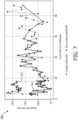
- the plateau 702 may occur for only a few hours for the patient before the blood pressure types converge 700.
- the arterial blood pressure type 702 may initially register higher than the non-invasive blood pressure type 704. After a certain length of time, as can be shown by the chart 700, the plateau may resolve itself. In such a case, in some embodiments, the system may disregard one of the blood pressure measurements before the plateau resolved and may continue to use both blood pressure measurements after the plateau resolved.
- Embodiments of the present disclosure are described above with reference to block diagrams and/or operational illustrations of methods, systems, and computer program products according to embodiments of the present disclosure.
- the functions/acts noted in the blocks may occur out of the order as shown in any flowchart.
- two blocks shown in succession may in fact be executed substantially concurrent or the blocks may sometimes be executed in the reverse order, depending upon the functionality/acts involved.
- not all of the blocks shown in any flowchart need to be performed and/or executed. For example, if a given flowchart has five blocks containing functions/acts, it may be the case that only three of the five blocks are performed and/or executed. In this example, any of the three of the five blocks may be performed and/or executed.
- a statement that a value exceeds (or is more than) a first threshold value is equivalent to a statement that the value meets or exceeds a second threshold value that is slightly greater than the first threshold value, e.g., the second threshold value being one value higher than the first threshold value in the resolution of a relevant system.
- a statement that a value is less than (or is within) a first threshold value is equivalent to a statement that the value is less than or equal to a second threshold value that is slightly lower than the first threshold value, e.g., the second threshold value being one value lower than the first threshold value in the resolution of the relevant system.
- the above elements may be components of a larger system, wherein other rules may take precedence over or otherwise modify the application of various implementations or techniques of the present disclosure. Also, a number of steps may be undertaken before, during, or after the above elements are considered.
Landscapes
- Health & Medical Sciences (AREA)
- Life Sciences & Earth Sciences (AREA)
- Engineering & Computer Science (AREA)
- Surgery (AREA)
- Animal Behavior & Ethology (AREA)
- Veterinary Medicine (AREA)
- Public Health (AREA)
- Physics & Mathematics (AREA)
- General Health & Medical Sciences (AREA)
- Biophysics (AREA)
- Pathology (AREA)
- Biomedical Technology (AREA)
- Heart & Thoracic Surgery (AREA)
- Medical Informatics (AREA)
- Molecular Biology (AREA)
- Physiology (AREA)
- Cardiology (AREA)
- Artificial Intelligence (AREA)
- Computer Vision & Pattern Recognition (AREA)
- Signal Processing (AREA)
- Psychiatry (AREA)
- Vascular Medicine (AREA)
- Measuring Pulse, Heart Rate, Blood Pressure Or Blood Flow (AREA)
Applications Claiming Priority (2)
| Application Number | Priority Date | Filing Date | Title |
|---|---|---|---|
| US201962894989P | 2019-09-03 | 2019-09-03 | |
| PCT/EP2020/074256 WO2021043729A1 (en) | 2019-09-03 | 2020-09-01 | Detection of reliable blood pressure measurements |
Publications (2)
| Publication Number | Publication Date |
|---|---|
| EP4025121A1 EP4025121A1 (en) | 2022-07-13 |
| EP4025121B1 true EP4025121B1 (en) | 2025-02-12 |
Family
ID=72422156
Family Applications (1)
| Application Number | Title | Priority Date | Filing Date |
|---|---|---|---|
| EP20767990.3A Active EP4025121B1 (en) | 2019-09-03 | 2020-09-01 | Detection of reliable blood pressure measurements |
Country Status (5)
| Country | Link |
|---|---|
| US (1) | US20220338741A1 (https=) |
| EP (1) | EP4025121B1 (https=) |
| JP (1) | JP7474841B2 (https=) |
| CN (1) | CN114340477A (https=) |
| WO (1) | WO2021043729A1 (https=) |
Families Citing this family (2)
| Publication number | Priority date | Publication date | Assignee | Title |
|---|---|---|---|---|
| EP4208825A4 (en) * | 2020-09-02 | 2024-10-23 | Twin Health, Inc. | Virtually monitoring blood pressure levels in a patient using machine learning and digital twin technology |
| CN119564176B (zh) * | 2024-12-10 | 2026-02-10 | 深圳市乐中行科技有限公司 | 血压检测方法、装置、设备和介质 |
Family Cites Families (17)
| Publication number | Priority date | Publication date | Assignee | Title |
|---|---|---|---|---|
| US5533511A (en) * | 1994-01-05 | 1996-07-09 | Vital Insite, Incorporated | Apparatus and method for noninvasive blood pressure measurement |
| JP3700048B2 (ja) | 1999-06-28 | 2005-09-28 | オムロンヘルスケア株式会社 | 電子血圧計 |
| JP4455971B2 (ja) | 2004-10-06 | 2010-04-21 | テルモ株式会社 | 血圧測定装置および血圧測定方法、並びに制御プログラムおよびコンピュータ読取可能な記憶媒体 |
| US9301697B2 (en) * | 2008-09-30 | 2016-04-05 | Nellcor Puritan Bennett Ireland | Systems and methods for recalibrating a non-invasive blood pressure monitor |
| US20110040197A1 (en) * | 2009-07-20 | 2011-02-17 | Masimo Corporation | Wireless patient monitoring system |
| US8668649B2 (en) * | 2010-02-04 | 2014-03-11 | Siemens Medical Solutions Usa, Inc. | System for cardiac status determination |
| US9615756B2 (en) * | 2012-10-31 | 2017-04-11 | Cnsystems Medizintechnik Ag | Device and method for the continuous non-invasive measurement of blood pressure |
| CN103892811B (zh) * | 2014-01-22 | 2016-09-07 | 杭州优体科技有限公司 | 一种动态血压联合检测与分析系统 |
| CN108366749A (zh) * | 2015-10-12 | 2018-08-03 | 西北大学 | 动态血压与生命体征监测装置、系统和方法 |
| WO2017109064A1 (en) * | 2015-12-23 | 2017-06-29 | Koninklijke Philips N.V. | A method of assessing the reliability of a blood pressure measurement and an apparatus for implementing the same |
| JP2019513433A (ja) | 2016-04-15 | 2019-05-30 | コーニンクレッカ フィリップス エヌ ヴェKoninklijke Philips N.V. | 対象の心拍数の変化を評価するシステム及び方法 |
| US11844591B2 (en) | 2016-09-16 | 2023-12-19 | Qualcomm Incorporated | Multi-model blood pressure estimation |
| JP7157051B2 (ja) * | 2016-10-10 | 2022-10-19 | コーニンクレッカ フィリップス エヌ ヴェ | 血圧測定装置に対する較正パラメータを決定するための装置及び方法 |
| WO2018132352A1 (en) * | 2017-01-11 | 2018-07-19 | Mayo Foundation For Medical Education And Research | Blood pressure measurement techniques and devices |
| WO2019016802A1 (en) * | 2017-07-17 | 2019-01-24 | Livemetric (Medical) S.A. | METHOD AND SYSTEM FOR ADJUSTING A VENTRICULAR ASSISTANCE DEVICE USING A CLOTHING DEVICE |
| CN108577820A (zh) * | 2018-03-26 | 2018-09-28 | 何史林 | 一种实时血压快速预警系统及其方法 |
| CN109935327B (zh) * | 2019-03-15 | 2023-08-08 | 南方医科大学顺德医院(佛山市顺德区第一人民医院) | 基于智能决策支持的高血压患者心血管危险分层评估方法 |
-
2020
- 2020-09-01 WO PCT/EP2020/074256 patent/WO2021043729A1/en not_active Ceased
- 2020-09-01 JP JP2022514219A patent/JP7474841B2/ja active Active
- 2020-09-01 EP EP20767990.3A patent/EP4025121B1/en active Active
- 2020-09-01 CN CN202080061845.5A patent/CN114340477A/zh active Pending
- 2020-09-01 US US17/639,617 patent/US20220338741A1/en not_active Abandoned
Also Published As
| Publication number | Publication date |
|---|---|
| JP2022547032A (ja) | 2022-11-10 |
| US20220338741A1 (en) | 2022-10-27 |
| JP7474841B2 (ja) | 2024-04-25 |
| EP4025121A1 (en) | 2022-07-13 |
| WO2021043729A1 (en) | 2021-03-11 |
| CN114340477A (zh) | 2022-04-12 |
Similar Documents
| Publication | Publication Date | Title |
|---|---|---|
| AU2001251046B2 (en) | Method, system, and computer program product for the evaluation of glycemic control in diabetes from self-monitoring data | |
| US12539087B2 (en) | ECG-based age and sex estimation | |
| EP4025121B1 (en) | Detection of reliable blood pressure measurements | |
| US20070150314A1 (en) | Method for carrying out quality control of medical data records collected from different but comparable patient collectives within the bounds of a medical plan | |
| US20060259329A1 (en) | System and Method for Determining the Degree of Abnormality of a Patient's Vital Signs | |
| CN120954764B (zh) | 一种基于多模态数据融合的重症医学科患者监控管理系统 | |
| CN119230104A (zh) | 一种用于管理医疗风险的方法 | |
| US8428965B2 (en) | System for clinical research and clinical management of cardiovascular risk using ambulatory blood pressure monitoring and actigraphy | |
| Dummitt et al. | Using survival analysis to predict septic shock onset in ICU patients | |
| US20030191666A1 (en) | System and method for evaluating pretest probabilities of life-threatening diseases | |
| CN111524585A (zh) | 用于重症医学科的自动质控管理系统及方法 | |
| US20230395267A1 (en) | Procedure and Prediction System to Determine the Probability of a Patient Suffering from Sepsis | |
| KR20130048597A (ko) | 의료 검사 데이터 분석결과 표현 방법 및 장치 | |
| CN118553372A (zh) | 基于人工智能的医疗数据管理系统 | |
| JP7420753B2 (ja) | 臨床アセスメントへのコンテキストデータの組み込み | |
| Saeed et al. | Artificial intelligence and machine learning for predicting intracranial pressure crises in TBI patients. | |
| US20260033785A1 (en) | Weight measurement apparatus, biological information processing apparatus, and biological information processing method | |
| LaRovere et al. | Heart rate change as a potential digital biomarker of brain death in critically ill children with acute catastrophic brain injury | |
| US20180366211A1 (en) | Behavior trained clinical support | |
| Jeong et al. | Temporal progress model of metabolic syndrome for clinical decision support system | |
| Hemphill III et al. | MULTIMODAL NEUROMONITORING AND ARTIFICIAL INTE LLIGENCE | |
| Zhang et al. | MSR21 Comparing Methods for eGFR Slope Estimates Among Adult CKD Patients in a UK Electronic Health Record System: Challenges and Opportunities | |
| CA2458066C (en) | System and method for evaluating pretest probabilities of life-threatening diseases | |
| CN120221085A (zh) | 一种基于深度学习的妊娠高血压风险预测方法及系统 | |
| CN121483601A (zh) | 一种基于多指数计算的胃癌化疗效益分析方法及系统 |
Legal Events
| Date | Code | Title | Description |
|---|---|---|---|
| STAA | Information on the status of an ep patent application or granted ep patent |
Free format text: STATUS: UNKNOWN |
|
| STAA | Information on the status of an ep patent application or granted ep patent |
Free format text: STATUS: THE INTERNATIONAL PUBLICATION HAS BEEN MADE |
|
| PUAI | Public reference made under article 153(3) epc to a published international application that has entered the european phase |
Free format text: ORIGINAL CODE: 0009012 |
|
| STAA | Information on the status of an ep patent application or granted ep patent |
Free format text: STATUS: REQUEST FOR EXAMINATION WAS MADE |
|
| 17P | Request for examination filed |
Effective date: 20220404 |
|
| AK | Designated contracting states |
Kind code of ref document: A1 Designated state(s): AL AT BE BG CH CY CZ DE DK EE ES FI FR GB GR HR HU IE IS IT LI LT LU LV MC MK MT NL NO PL PT RO RS SE SI SK SM TR |
|
| DAV | Request for validation of the european patent (deleted) | ||
| DAX | Request for extension of the european patent (deleted) | ||
| GRAP | Despatch of communication of intention to grant a patent |
Free format text: ORIGINAL CODE: EPIDOSNIGR1 |
|
| STAA | Information on the status of an ep patent application or granted ep patent |
Free format text: STATUS: GRANT OF PATENT IS INTENDED |
|
| INTG | Intention to grant announced |
Effective date: 20240906 |
|
| GRAS | Grant fee paid |
Free format text: ORIGINAL CODE: EPIDOSNIGR3 |
|
| GRAA | (expected) grant |
Free format text: ORIGINAL CODE: 0009210 |
|
| STAA | Information on the status of an ep patent application or granted ep patent |
Free format text: STATUS: THE PATENT HAS BEEN GRANTED |
|
| AK | Designated contracting states |
Kind code of ref document: B1 Designated state(s): AL AT BE BG CH CY CZ DE DK EE ES FI FR GB GR HR HU IE IS IT LI LT LU LV MC MK MT NL NO PL PT RO RS SE SI SK SM TR |
|
| REG | Reference to a national code |
Ref country code: GB Ref legal event code: FG4D |
|
| REG | Reference to a national code |
Ref country code: CH Ref legal event code: EP |
|
| REG | Reference to a national code |
Ref country code: DE Ref legal event code: R096 Ref document number: 602020045949 Country of ref document: DE |
|
| REG | Reference to a national code |
Ref country code: IE Ref legal event code: FG4D |
|
| REG | Reference to a national code |
Ref country code: DE Ref legal event code: R084 Ref document number: 602020045949 Country of ref document: DE |
|
| REG | Reference to a national code |
Ref country code: NL Ref legal event code: MP Effective date: 20250212 |
|
| PG25 | Lapsed in a contracting state [announced via postgrant information from national office to epo] |
Ref country code: RS Free format text: LAPSE BECAUSE OF FAILURE TO SUBMIT A TRANSLATION OF THE DESCRIPTION OR TO PAY THE FEE WITHIN THE PRESCRIBED TIME-LIMIT Effective date: 20250512 |
|
| PG25 | Lapsed in a contracting state [announced via postgrant information from national office to epo] |
Ref country code: FI Free format text: LAPSE BECAUSE OF FAILURE TO SUBMIT A TRANSLATION OF THE DESCRIPTION OR TO PAY THE FEE WITHIN THE PRESCRIBED TIME-LIMIT Effective date: 20250212 |
|
| PG25 | Lapsed in a contracting state [announced via postgrant information from national office to epo] |
Ref country code: PL Free format text: LAPSE BECAUSE OF FAILURE TO SUBMIT A TRANSLATION OF THE DESCRIPTION OR TO PAY THE FEE WITHIN THE PRESCRIBED TIME-LIMIT Effective date: 20250212 |
|
| PG25 | Lapsed in a contracting state [announced via postgrant information from national office to epo] |
Ref country code: ES Free format text: LAPSE BECAUSE OF FAILURE TO SUBMIT A TRANSLATION OF THE DESCRIPTION OR TO PAY THE FEE WITHIN THE PRESCRIBED TIME-LIMIT Effective date: 20250212 |
|
| REG | Reference to a national code |
Ref country code: LT Ref legal event code: MG9D |
|
| PG25 | Lapsed in a contracting state [announced via postgrant information from national office to epo] |
Ref country code: IS Free format text: LAPSE BECAUSE OF FAILURE TO SUBMIT A TRANSLATION OF THE DESCRIPTION OR TO PAY THE FEE WITHIN THE PRESCRIBED TIME-LIMIT Effective date: 20250612 Ref country code: NO Free format text: LAPSE BECAUSE OF FAILURE TO SUBMIT A TRANSLATION OF THE DESCRIPTION OR TO PAY THE FEE WITHIN THE PRESCRIBED TIME-LIMIT Effective date: 20250512 |
|
| PG25 | Lapsed in a contracting state [announced via postgrant information from national office to epo] |
Ref country code: NL Free format text: LAPSE BECAUSE OF FAILURE TO SUBMIT A TRANSLATION OF THE DESCRIPTION OR TO PAY THE FEE WITHIN THE PRESCRIBED TIME-LIMIT Effective date: 20250212 |
|
| PG25 | Lapsed in a contracting state [announced via postgrant information from national office to epo] |
Ref country code: HR Free format text: LAPSE BECAUSE OF FAILURE TO SUBMIT A TRANSLATION OF THE DESCRIPTION OR TO PAY THE FEE WITHIN THE PRESCRIBED TIME-LIMIT Effective date: 20250212 |
|
| PG25 | Lapsed in a contracting state [announced via postgrant information from national office to epo] |
Ref country code: LV Free format text: LAPSE BECAUSE OF FAILURE TO SUBMIT A TRANSLATION OF THE DESCRIPTION OR TO PAY THE FEE WITHIN THE PRESCRIBED TIME-LIMIT Effective date: 20250212 Ref country code: PT Free format text: LAPSE BECAUSE OF FAILURE TO SUBMIT A TRANSLATION OF THE DESCRIPTION OR TO PAY THE FEE WITHIN THE PRESCRIBED TIME-LIMIT Effective date: 20250612 |
|
| PG25 | Lapsed in a contracting state [announced via postgrant information from national office to epo] |
Ref country code: GR Free format text: LAPSE BECAUSE OF FAILURE TO SUBMIT A TRANSLATION OF THE DESCRIPTION OR TO PAY THE FEE WITHIN THE PRESCRIBED TIME-LIMIT Effective date: 20250513 Ref country code: BG Free format text: LAPSE BECAUSE OF FAILURE TO SUBMIT A TRANSLATION OF THE DESCRIPTION OR TO PAY THE FEE WITHIN THE PRESCRIBED TIME-LIMIT Effective date: 20250212 |
|
| REG | Reference to a national code |
Ref country code: AT Ref legal event code: MK05 Ref document number: 1765251 Country of ref document: AT Kind code of ref document: T Effective date: 20250212 |
|
| PG25 | Lapsed in a contracting state [announced via postgrant information from national office to epo] |
Ref country code: SE Free format text: LAPSE BECAUSE OF FAILURE TO SUBMIT A TRANSLATION OF THE DESCRIPTION OR TO PAY THE FEE WITHIN THE PRESCRIBED TIME-LIMIT Effective date: 20250212 |
|
| PG25 | Lapsed in a contracting state [announced via postgrant information from national office to epo] |
Ref country code: SM Free format text: LAPSE BECAUSE OF FAILURE TO SUBMIT A TRANSLATION OF THE DESCRIPTION OR TO PAY THE FEE WITHIN THE PRESCRIBED TIME-LIMIT Effective date: 20250212 |
|
| PG25 | Lapsed in a contracting state [announced via postgrant information from national office to epo] |
Ref country code: DK Free format text: LAPSE BECAUSE OF FAILURE TO SUBMIT A TRANSLATION OF THE DESCRIPTION OR TO PAY THE FEE WITHIN THE PRESCRIBED TIME-LIMIT Effective date: 20250212 |
|
| PGFP | Annual fee paid to national office [announced via postgrant information from national office to epo] |
Ref country code: DE Payment date: 20250926 Year of fee payment: 6 |
|
| PG25 | Lapsed in a contracting state [announced via postgrant information from national office to epo] |
Ref country code: IT Free format text: LAPSE BECAUSE OF FAILURE TO SUBMIT A TRANSLATION OF THE DESCRIPTION OR TO PAY THE FEE WITHIN THE PRESCRIBED TIME-LIMIT Effective date: 20250212 |
|
| PG25 | Lapsed in a contracting state [announced via postgrant information from national office to epo] |
Ref country code: AT Free format text: LAPSE BECAUSE OF FAILURE TO SUBMIT A TRANSLATION OF THE DESCRIPTION OR TO PAY THE FEE WITHIN THE PRESCRIBED TIME-LIMIT Effective date: 20250212 |
|
| PG25 | Lapsed in a contracting state [announced via postgrant information from national office to epo] |
Ref country code: CZ Free format text: LAPSE BECAUSE OF FAILURE TO SUBMIT A TRANSLATION OF THE DESCRIPTION OR TO PAY THE FEE WITHIN THE PRESCRIBED TIME-LIMIT Effective date: 20250212 Ref country code: EE Free format text: LAPSE BECAUSE OF FAILURE TO SUBMIT A TRANSLATION OF THE DESCRIPTION OR TO PAY THE FEE WITHIN THE PRESCRIBED TIME-LIMIT Effective date: 20250212 |
|
| PG25 | Lapsed in a contracting state [announced via postgrant information from national office to epo] |
Ref country code: RO Free format text: LAPSE BECAUSE OF FAILURE TO SUBMIT A TRANSLATION OF THE DESCRIPTION OR TO PAY THE FEE WITHIN THE PRESCRIBED TIME-LIMIT Effective date: 20250212 |
|
| PG25 | Lapsed in a contracting state [announced via postgrant information from national office to epo] |
Ref country code: SK Free format text: LAPSE BECAUSE OF FAILURE TO SUBMIT A TRANSLATION OF THE DESCRIPTION OR TO PAY THE FEE WITHIN THE PRESCRIBED TIME-LIMIT Effective date: 20250212 |
|
| REG | Reference to a national code |
Ref country code: DE Ref legal event code: R097 Ref document number: 602020045949 Country of ref document: DE |
|
| PLBE | No opposition filed within time limit |
Free format text: ORIGINAL CODE: 0009261 |
|
| STAA | Information on the status of an ep patent application or granted ep patent |
Free format text: STATUS: NO OPPOSITION FILED WITHIN TIME LIMIT |
|
| 26N | No opposition filed |
Effective date: 20251113 |