EP4024525A1 - Quaternary positive electrode material, positive electrode, and battery - Google Patents

Quaternary positive electrode material, positive electrode, and battery Download PDF

Info

Publication number
EP4024525A1
EP4024525A1 EP20901485.1A EP20901485A EP4024525A1 EP 4024525 A1 EP4024525 A1 EP 4024525A1 EP 20901485 A EP20901485 A EP 20901485A EP 4024525 A1 EP4024525 A1 EP 4024525A1
Authority
EP
European Patent Office
Prior art keywords
cathode material
quaternary
quaternary cathode
battery
dopant
Prior art date
Legal status (The legal status is an assumption and is not a legal conclusion. Google has not performed a legal analysis and makes no representation as to the accuracy of the status listed.)
Pending
Application number
EP20901485.1A
Other languages
German (de)
French (fr)
Other versions
EP4024525A4 (en
Inventor
Yan Bai
Shutao ZHANG
Hailong Pan
Zhuang Wang
Current Assignee (The listed assignees may be inaccurate. Google has not performed a legal analysis and makes no representation or warranty as to the accuracy of the list.)
Svolt Energy Technology Co Ltd
Original Assignee
Svolt Energy Technology Co Ltd
Priority date (The priority date is an assumption and is not a legal conclusion. Google has not performed a legal analysis and makes no representation as to the accuracy of the date listed.)
Filing date
Publication date
Application filed by Svolt Energy Technology Co Ltd filed Critical Svolt Energy Technology Co Ltd
Publication of EP4024525A1 publication Critical patent/EP4024525A1/en
Publication of EP4024525A4 publication Critical patent/EP4024525A4/en
Pending legal-status Critical Current

Links

Images

Classifications

    • CCHEMISTRY; METALLURGY
    • C01INORGANIC CHEMISTRY
    • C01GCOMPOUNDS CONTAINING METALS NOT COVERED BY SUBCLASSES C01D OR C01F
    • C01G53/00Compounds of nickel
    • C01G53/40Complex oxides containing nickel and at least one other metal element
    • C01G53/42Complex oxides containing nickel and at least one other metal element containing alkali metals, e.g. LiNiO2
    • C01G53/44Complex oxides containing nickel and at least one other metal element containing alkali metals, e.g. LiNiO2 containing manganese
    • C01G53/50Complex oxides containing nickel and at least one other metal element containing alkali metals, e.g. LiNiO2 containing manganese of the type (MnO2)n-, e.g. Li(NixMn1-x)O2 or Li(MyNixMn1-x-y)O2
    • HELECTRICITY
    • H01ELECTRIC ELEMENTS
    • H01MPROCESSES OR MEANS, e.g. BATTERIES, FOR THE DIRECT CONVERSION OF CHEMICAL ENERGY INTO ELECTRICAL ENERGY
    • H01M4/00Electrodes
    • H01M4/02Electrodes composed of, or comprising, active material
    • H01M4/36Selection of substances as active materials, active masses, active liquids
    • H01M4/48Selection of substances as active materials, active masses, active liquids of inorganic oxides or hydroxides
    • H01M4/52Selection of substances as active materials, active masses, active liquids of inorganic oxides or hydroxides of nickel, cobalt or iron
    • H01M4/525Selection of substances as active materials, active masses, active liquids of inorganic oxides or hydroxides of nickel, cobalt or iron of mixed oxides or hydroxides containing iron, cobalt or nickel for inserting or intercalating light metals, e.g. LiNiO2, LiCoO2 or LiCoOxFy
    • HELECTRICITY
    • H01ELECTRIC ELEMENTS
    • H01MPROCESSES OR MEANS, e.g. BATTERIES, FOR THE DIRECT CONVERSION OF CHEMICAL ENERGY INTO ELECTRICAL ENERGY
    • H01M4/00Electrodes
    • H01M4/02Electrodes composed of, or comprising, active material
    • H01M4/36Selection of substances as active materials, active masses, active liquids
    • H01M4/48Selection of substances as active materials, active masses, active liquids of inorganic oxides or hydroxides
    • H01M4/50Selection of substances as active materials, active masses, active liquids of inorganic oxides or hydroxides of manganese
    • H01M4/505Selection of substances as active materials, active masses, active liquids of inorganic oxides or hydroxides of manganese of mixed oxides or hydroxides containing manganese for inserting or intercalating light metals, e.g. LiMn2O4 or LiMn2OxFy
    • CCHEMISTRY; METALLURGY
    • C01INORGANIC CHEMISTRY
    • C01GCOMPOUNDS CONTAINING METALS NOT COVERED BY SUBCLASSES C01D OR C01F
    • C01G53/00Compounds of nickel
    • C01G53/40Complex oxides containing nickel and at least one other metal element
    • C01G53/42Complex oxides containing nickel and at least one other metal element containing alkali metals, e.g. LiNiO2
    • HELECTRICITY
    • H01ELECTRIC ELEMENTS
    • H01MPROCESSES OR MEANS, e.g. BATTERIES, FOR THE DIRECT CONVERSION OF CHEMICAL ENERGY INTO ELECTRICAL ENERGY
    • H01M10/00Secondary cells; Manufacture thereof
    • H01M10/05Accumulators with non-aqueous electrolyte
    • H01M10/052Li-accumulators
    • H01M10/0525Rocking-chair batteries, i.e. batteries with lithium insertion or intercalation in both electrodes; Lithium-ion batteries
    • HELECTRICITY
    • H01ELECTRIC ELEMENTS
    • H01MPROCESSES OR MEANS, e.g. BATTERIES, FOR THE DIRECT CONVERSION OF CHEMICAL ENERGY INTO ELECTRICAL ENERGY
    • H01M4/00Electrodes
    • H01M4/02Electrodes composed of, or comprising, active material
    • H01M4/13Electrodes for accumulators with non-aqueous electrolyte, e.g. for lithium-accumulators; Processes of manufacture thereof
    • H01M4/131Electrodes based on mixed oxides or hydroxides, or on mixtures of oxides or hydroxides, e.g. LiCoOx
    • HELECTRICITY
    • H01ELECTRIC ELEMENTS
    • H01MPROCESSES OR MEANS, e.g. BATTERIES, FOR THE DIRECT CONVERSION OF CHEMICAL ENERGY INTO ELECTRICAL ENERGY
    • H01M4/00Electrodes
    • H01M4/02Electrodes composed of, or comprising, active material
    • H01M4/36Selection of substances as active materials, active masses, active liquids
    • H01M4/362Composites
    • H01M4/366Composites as layered products
    • HELECTRICITY
    • H01ELECTRIC ELEMENTS
    • H01MPROCESSES OR MEANS, e.g. BATTERIES, FOR THE DIRECT CONVERSION OF CHEMICAL ENERGY INTO ELECTRICAL ENERGY
    • H01M4/00Electrodes
    • H01M4/02Electrodes composed of, or comprising, active material
    • H01M4/62Selection of inactive substances as ingredients for active masses, e.g. binders, fillers
    • CCHEMISTRY; METALLURGY
    • C01INORGANIC CHEMISTRY
    • C01PINDEXING SCHEME RELATING TO STRUCTURAL AND PHYSICAL ASPECTS OF SOLID INORGANIC COMPOUNDS
    • C01P2002/00Crystal-structural characteristics
    • C01P2002/50Solid solutions
    • C01P2002/52Solid solutions containing elements as dopants
    • CCHEMISTRY; METALLURGY
    • C01INORGANIC CHEMISTRY
    • C01PINDEXING SCHEME RELATING TO STRUCTURAL AND PHYSICAL ASPECTS OF SOLID INORGANIC COMPOUNDS
    • C01P2002/00Crystal-structural characteristics
    • C01P2002/50Solid solutions
    • C01P2002/52Solid solutions containing elements as dopants
    • C01P2002/54Solid solutions containing elements as dopants one element only
    • CCHEMISTRY; METALLURGY
    • C01INORGANIC CHEMISTRY
    • C01PINDEXING SCHEME RELATING TO STRUCTURAL AND PHYSICAL ASPECTS OF SOLID INORGANIC COMPOUNDS
    • C01P2002/00Crystal-structural characteristics
    • C01P2002/70Crystal-structural characteristics defined by measured X-ray, neutron or electron diffraction data
    • C01P2002/74Crystal-structural characteristics defined by measured X-ray, neutron or electron diffraction data by peak-intensities or a ratio thereof only
    • CCHEMISTRY; METALLURGY
    • C01INORGANIC CHEMISTRY
    • C01PINDEXING SCHEME RELATING TO STRUCTURAL AND PHYSICAL ASPECTS OF SOLID INORGANIC COMPOUNDS
    • C01P2002/00Crystal-structural characteristics
    • C01P2002/70Crystal-structural characteristics defined by measured X-ray, neutron or electron diffraction data
    • C01P2002/76Crystal-structural characteristics defined by measured X-ray, neutron or electron diffraction data by a space-group or by other symmetry indications
    • CCHEMISTRY; METALLURGY
    • C01INORGANIC CHEMISTRY
    • C01PINDEXING SCHEME RELATING TO STRUCTURAL AND PHYSICAL ASPECTS OF SOLID INORGANIC COMPOUNDS
    • C01P2002/00Crystal-structural characteristics
    • C01P2002/70Crystal-structural characteristics defined by measured X-ray, neutron or electron diffraction data
    • C01P2002/77Crystal-structural characteristics defined by measured X-ray, neutron or electron diffraction data by unit-cell parameters, atom positions or structure diagrams
    • CCHEMISTRY; METALLURGY
    • C01INORGANIC CHEMISTRY
    • C01PINDEXING SCHEME RELATING TO STRUCTURAL AND PHYSICAL ASPECTS OF SOLID INORGANIC COMPOUNDS
    • C01P2004/00Particle morphology
    • C01P2004/80Particles consisting of a mixture of two or more inorganic phases
    • C01P2004/82Particles consisting of a mixture of two or more inorganic phases two phases having the same anion, e.g. both oxidic phases
    • C01P2004/84Particles consisting of a mixture of two or more inorganic phases two phases having the same anion, e.g. both oxidic phases one phase coated with the other
    • CCHEMISTRY; METALLURGY
    • C01INORGANIC CHEMISTRY
    • C01PINDEXING SCHEME RELATING TO STRUCTURAL AND PHYSICAL ASPECTS OF SOLID INORGANIC COMPOUNDS
    • C01P2006/00Physical properties of inorganic compounds
    • C01P2006/40Electric properties
    • HELECTRICITY
    • H01ELECTRIC ELEMENTS
    • H01MPROCESSES OR MEANS, e.g. BATTERIES, FOR THE DIRECT CONVERSION OF CHEMICAL ENERGY INTO ELECTRICAL ENERGY
    • H01M10/00Secondary cells; Manufacture thereof
    • H01M10/05Accumulators with non-aqueous electrolyte
    • H01M10/052Li-accumulators
    • HELECTRICITY
    • H01ELECTRIC ELEMENTS
    • H01MPROCESSES OR MEANS, e.g. BATTERIES, FOR THE DIRECT CONVERSION OF CHEMICAL ENERGY INTO ELECTRICAL ENERGY
    • H01M4/00Electrodes
    • H01M4/02Electrodes composed of, or comprising, active material
    • H01M2004/026Electrodes composed of, or comprising, active material characterised by the polarity
    • H01M2004/028Positive electrodes
    • YGENERAL TAGGING OF NEW TECHNOLOGICAL DEVELOPMENTS; GENERAL TAGGING OF CROSS-SECTIONAL TECHNOLOGIES SPANNING OVER SEVERAL SECTIONS OF THE IPC; TECHNICAL SUBJECTS COVERED BY FORMER USPC CROSS-REFERENCE ART COLLECTIONS [XRACs] AND DIGESTS
    • Y02TECHNOLOGIES OR APPLICATIONS FOR MITIGATION OR ADAPTATION AGAINST CLIMATE CHANGE
    • Y02EREDUCTION OF GREENHOUSE GAS [GHG] EMISSIONS, RELATED TO ENERGY GENERATION, TRANSMISSION OR DISTRIBUTION
    • Y02E60/00Enabling technologies; Technologies with a potential or indirect contribution to GHG emissions mitigation
    • Y02E60/10Energy storage using batteries

Definitions

  • the present invention relates to the technical field of batteries and in particular relates to a quaternary cathode material, a cathode and a battery.
  • a lithium ion battery is widely applied to equipment such as a camera, a mobile phone, a notebook computer and an electric transportation means due to advantages, for example, stable voltage, high specific capacity, high energy density, long cycle life, environment-friendliness, of the lithium ion battery.
  • the key factor which determines the performance of the lithium ion battery is the cathode material of the lithium ion battery.
  • the used cathode material includes LiMn 2 O 4 of a spinel structure, LiCoO 2 and LiNiO 2 of layered structures and the like.
  • the lithium ion secondary battery with LiNiO 2 of the layered structure as the cathode material is given a lot of attention as a result of high charge and discharge capacity.
  • LiNiO 2 cathode material is unstable in crystal structure and low in cycle life in a process of removing lithium repeatedly (i.e. repeated charging and discharging). Therefore, at present, part of Ni in LiNiO 2 is usually replaced by Co, Al and/or Mn to obtain a high nickel ternary cathode material or a quaternary cathode material, for example, part of Ni in LiNiO 2 is replaced by Co, Al and Mn jointly to obtain the quaternary cathode material NCMA.
  • the quaternary cathode material not only keeps a characteristic of high specific capacity, but also can improve the stability of the crystalline texture, such that the cycle life of the battery using the quaternary cathode material can be prolonged and the thermal stability of the battery using the quaternary cathode material can be improved, and the specific capacity of the battery is improved and the cycle life of the battery is prolonged.
  • the present invention mainly aims to provide a quaternary cathode material, an cathode and a battery to solve the problem of insufficient cycling stability and thermal stability in the prior art.
  • the disclosure is made by the inventor based on discovery and cognition of the following truths and problems: At present, part of Ni in LiNiO 2 is replaced by Co, Al and Mn jointly to obtain the quaternary cathode material. There is still a problem of poor structural stability, cycling stability of the battery taking the quaternary cathode material as the cathode, service life and service safety. Therefore, if a novel quaternary cathode material can be put forward, the structural stability of the quaternary cathode material can be better and has a better layered crystal structure, so that the cycling stability and thermal stability of the battery using the quaternary cathode material can be improved better and the solve can be solved to a great extent.
  • the present invention provides a quaternary cathode material.
  • M is a dopant selecting from at least one of Zr, Al, B, Ti, Mg, Nb, Ba, Si, P, W, Sr and F.
  • the quaternary cathode material has an ⁇ -NaFeO 2 type crystal structure.
  • the space group of an X-ray diffraction pattern of the quaternary cathode material is R-3m, and in the X-ray diffraction pattern of the quaternary cathode material, the relationship between a cell parameter c of an axis c and a cell parameter a of an axis a is as follows: c/a >4.943.
  • the dopant can inhibit mixed arrangement of kations and can better improve the structural stability of the quaternary cathode material.
  • the quaternary cathode material has a better layered crystal structure and is better in structural stability, and the cycling stability and the thermal stability of the battery using the quaternary cathode material can be improved, so that the specific capacity of the battery is improved and the cycle life of the battery is prolonged.
  • the relationship between the cell parameter c of the axis c and the cell parameter a of the axis a is as follows: 3a+5.555 ⁇ c ⁇ 3a+5.590. Therefore, when the relationship between the cell parameter c of the axis c and the cell parameter a of the axis a is met, the quaternary cathode material has a better layered crystal structure and lithium ions are easily diffused in the layered structure, such that the specific discharge capacity of the battery using the quaternary cathode material can be improved.
  • a numerical range of the cell parameter a of the axis a is 2.80-2.90, preferably 2.86-2.87, and a numerical range of the cell parameter c of the axis c is 14.10-14.30, preferably 14.19-14.20. Therefore, when the cell parameter c of the axis c and the cell parameter a of the axis a are in the range, the specific discharge capacity of the battery using the quaternary cathode material is further improved and the cycle life of the battery using the quaternary cathode material is further prolonged.
  • diffraction peak intensities of a surface a surface I 103 and a surface I 104 meets a following relationship: 1.921 ⁇ I 003/ I 104 ⁇ 2. Therefore, when the diffraction peak intensities of the surface 1103 and the surface 1104 meet the relationship, there is little mixed arrangement of lithium ions and nickel ions in the quaternary cathode material.
  • the structural stability of the quaternary cathode material is high, and the cycling stability of the battery using the quaternary cathode material is better and the cycle life of the battery using the quaternary cathode material is longer.
  • a mass fraction of the dopant is 3000-8000ppm. Therefore, when the content of the dopant is in the range, the structural stability of the quaternary cathode material can be better improved. The specific discharge capacity of the battery using the quaternary cathode material is not reduced.
  • the dopant is comprised of Al and Zr or Al, Mg and Zr. Therefore, in the quaternary cathode material formed by co-doping Al, Mg and Zr, the doped zirconium can enter a transition metal layer of the quaternary cathode material to stabilize the hexagonal structure thereof.
  • the doped aluminum can enter a surface lithium layer of a quaternary cathode material matrix to further support the lithium layer better, and in a high voltage charging and discharging process, when a lot of lithium ions are embedded out, the doped aluminum can keep the stability of a lattice structure of the lithium layer; the doped magnesium can enable the valence state of the transition metal ions in the quaternary cathode material to be increased or decreased so as to further generate holes or electrons to change the energy band structure of the quaternary cathode material, and thus, the intrinsic electron conductivity is improved.
  • the doped aluminum and magnesium further can inhibit mixed arrangement of Li + and Ni 2+ and more reversible lithium positions can be reserved, so that the reversible specific discharge capacity of the battery using the quaternary cathode material is improved.
  • co-doping of aluminum, magnesium and zirconium can better improve the structural stability of the quaternary cathode material, the cycling stability and the thermal stability of the battery using the quaternary cathode material and the specific capacity of the battery at high voltage multiplying power.
  • the battery using the quaternary cathode material is good in performance.
  • a mass fraction of the dopant Al is 2500-3500ppm
  • a mass fraction of the dopant Mg is 300-500ppm
  • a mass fraction of the dopant Zr is 2500-3500ppm. Therefore, when the content of the dopant is in the range, the structural stability of the quaternary cathode material can be better improved, and the specific discharge capacity of the battery using the quaternary cathode material is not reduced. The comprehensive performance of the battery using the quaternary cathode material is improved favorably.
  • a method for preparing any one quaternary cathode material comprises the following steps of performing dry mixing on a nickel-cobalt-manganese-aluminum quaternary precursor, a lithium source and a dopant source to obtain a dry mixture; calcining the dry mixture in an oxygen containing atmosphere for 10-15 hours at 700-800°C to obtain a quaternary cathode material precursor; and cladding and calcining the quaternary cathode material precursor in the oxygen containing atmosphere by using an aluminum source and a boron source to obtain the quaternary cathode material, wherein a cladding and calcining temperature is 250-350°C and time is 4-8 hours.
  • the present invention provides an cathode.
  • the cathode includes any one quaternary cathode material. Therefore, the cathode has all characteristics and advantages of any one quaternary cathode material, and no more detailed description is provided. In general, the cathode is stable in structure and has more excellent cycle performance and rate capability.
  • the present invention provides a battery.
  • the battery includes an cathode, a anode, a diaphragm and an electrolyte, wherein the diaphragm is arranged between the cathode and the anode; at least a part of the cathode, at least a part of the anode and at least a part of the diaphragm are immersed in the electrolyte. Therefore, the battery has all characteristics and advantages of any one cathode, and no more detailed description is provided. In general, the battery has good cycling stability and thermal stability and has a higher specific capacity at high voltage multiplying power.
  • the present invention provides a quaternary cathode material.
  • M is a dopant selecting from at least one of Zr, Al, B, Ti, Mg, Nb, Ba, Si, P, W, Sr and F.
  • the quaternary cathode material has a ⁇ -NaFeO 2 type crystal structure.
  • the space group of an X-ray diffraction pattern of the quaternary cathode material is R-3m, and in the X-ray diffraction pattern of the quaternary cathode material, the relationship between a cell parameter c of an axis c and a cell parameter a of an axis a is as follows: c/a>4.943.
  • the dopant can inhibit mixed arrangement of kations and can better improve the structural stability of the quaternary cathode material.
  • the quaternary cathode material has a better laminar crystal structure and is better in structural stability, which can improve the cycling stability and the thermal stability of the battery using the quaternary cathode material, increase the specific capacity of the battery and prolong the cycle life of the battery.
  • the dopant is added into a conventional nickel-cobalt-manganese-aluminum quaternary cathode material, the dopant selecting from at least one of Zr, Al, B, Ti, Mg, Nb, Ba, Si, P, W, Sr and F.
  • the dopant can improve the structural stability of the quaternary cathode material, for example, the doped Zr can enter a transition metal layer of the quaternary cathode material to stabilize the hexagonal structure thereof.
  • the doped aluminum can enter a surface lithium layer of a quaternary cathode material matrix to further support the lithium layer better, and in a high voltage charging and discharging process, when a lot of lithium ions are embedded out, the doped aluminum can keep the stability of a lattice structure of the lithium layer; the doped magnesium can enable the valence state of the transition metal ions in the quaternary cathode material to be increased or decreased so as to further generate holes or electrons to change the energy band structure of the quaternary cathode material, and thus, the intrinsic electron conductivity is improved.
  • the doped aluminum and magnesium further can inhibit mixed arrangement of Li + and Ni 2+ and more reversible lithium positions can be reserved, so that the reversible specific discharge capacity of the battery using the quaternary cathode material is improved.
  • the dopant can better improve the structural stability of the quaternary cathode material, and can improve the cycling stability and the thermal stability of the battery using the quaternary cathode material.
  • the relationship: c/a>4.943 between the cell parameter c of the axis c and the cell parameter a of the axis a is met.
  • the quaternary cathode material has a better laminar crystal structure and lithium ions are easily diffused in the layered structure, such that the specific discharge capacity of the battery using the quaternary cathode material can be improved.
  • the relationship between the cell parameter c of the axis c and the cell parameter a of the axis a in the quaternary cathode material can be adjusted simply, so that the relationship: c/a>4.943 between the cell parameter c of the axis c and the cell parameter a of the axis a in the quaternary cathode material can be met simply, the cycling stability and the thermal stability of the battery using the quaternary cathode material can be further improved, and the specific capacity of the battery at high voltage multiplying power can be improved.
  • the battery using the quaternary cathode material is good in performance.
  • the molar content of Li. i.e. x value in the structural formula, in the quaternary cathode material meets the relationship below: 1 ⁇ x ⁇ 1.05.
  • 1.01 ⁇ x ⁇ 1.035 for example, x can be equal to 1.02, 1.025 and 1.03.
  • the battery using the quaternary cathode material has a relatively high charge and discharge specific capacity and excellent using performance.
  • the Li content in the quaternary cathode material is too small, for example x is smaller than 1.0, Ni enters a Li layer easily, which increases the occupancy of transitional metal elements in lithium position, and the charge and discharge specific capacity of the quaternary cathode material is relatively low.
  • the Li content in the quaternary cathode material is too large, for example x is greater than 1.05, the blended amount of Li in the transitional metal position is too large, Ni evicted by Li from the transitional metal position is more, and Ni enters the Li layer easily, which makes the occupancy of transitional metal elements in lithium position great, so that the charge and discharge specific capacity of the quaternary cathode material is affected.
  • the molar content of Co. i.e. value b in the structural formula, in the quaternary cathode material meets the relationship below: 0.03 ⁇ b ⁇ 0.1.
  • 0.05 ⁇ b ⁇ 0.06, for example, x can be equal to and 0.055 and the like. Therefore, when the molar content of Co in the quaternary cathode material is within the range, Co can improve the structural stability of the quaternary cathode material and does not affect the specific discharge capacity of the quaternary cathode material obviously.
  • the molar content of Mn. i.e. value c in the structural formula, in the quaternary cathode material meets the relationship below: 0.01 ⁇ c' ⁇ 0.05.
  • 0.02 ⁇ c' ⁇ 0.03, for example, c' can be equal to and 0.025 and the like.
  • the molar content of Al. i.e. value d in the structural formula, in the quaternary cathode material meets the relationship below: 0.01 ⁇ d ⁇ 0.05.
  • 0.02 ⁇ d ⁇ 0.03, for example, d can be equal to and 0.025 and the like.
  • the structural stability of the quaternary cathode material can be improved and the specific discharge capacity of the quaternary cathode material is not affected obviously.
  • the molar content of Ni. i.e. value a' in the structural formula, in the quaternary cathode material meets the relationship below: 0.3 ⁇ a' ⁇ 0.95.
  • M is the dopant selected from one or more of Zr, Al, B, Ti, Mg, Nb, B, Si, P, W, Sr and F, and the molar content of M.
  • value y in the structural formula, in the quaternary cathode material meets the relationship below: 0 ⁇ y ⁇ 0.0250.
  • 0.003 ⁇ y ⁇ 0.0220 for example, y can be equal to 0.005, 0.01, 0.015, 0.02 and the like.
  • the mass fraction of the dopant in the quaternary cathode material can be 3000-8000ppm, for example, 3500ppm, 4000ppm, 4500ppm, 5000ppm, 5500ppm, 6000ppm, 6500ppm, 7000ppm, 7500ppm and the like. Therefore, when the content of the dopant is in the range, the structural stability of the quaternary cathode material can be better improved. The specific discharge capacity of the battery using the quaternary cathode material is not reduced.
  • the content of the dopant in the quaternary cathode material is too small, for example, the mass fraction of the dopant in the quaternary cathode material is smaller than 3000ppm, the improving effect to the crystal structural stability of the quaternary cathode material is not remarkable at all.
  • the content of the dopant in the quaternary cathode material is too large, for example, the mass fraction of the dopant in the quaternary cathode material is greater than 8000ppm, the specific discharge capacity of the battery using the quaternary cathode material will be affected.
  • the mass fraction of the dopant in the foregoing quaternary cathode material is a total mass fraction of all the dopants in the quaternary cathode material, for example, when the dopants include various elements co-doped, the mass fraction of the dopant is the mass fraction of all doped elements.
  • the dopant can be foregoing one, two, three or four of the dopants, for example, the dopant can be Al and Zr co-doped, AL, Mg and Zr co-doped, Al, Mg, Zr and Ti co-doped and the like.
  • the dopant can be comprised of Al and Zr or Al, Mg and Zr. Therefore, in the quaternary cathode material formed by co-doping Al, Mg and Zr, the dopants Al, Mg and Zr have a synergistic effect.
  • the doped zirconium can enter a transition metal layer of the quaternary cathode material to stabilize the hexagonal structure thereof.
  • the doped aluminum can enter a surface lithium layer of a quaternary cathode material matrix to further support the lithium layer better, and in a high voltage charging and discharging process, when a lot of lithium ions are embedded out, the doped aluminum can keep the stability of a lattice structure of the lithium layer; the doped magnesium can enable the valence state of the transition metal ions in the quaternary cathode material to be increased or decreased so as to further generate holes or electrons to change the energy band structure of the quaternary cathode material, and thus, the intrinsic electron conductivity is improved.
  • the doped aluminum and magnesium further can inhibit mixed arrangement of Li + and Ni 2+ and more reversible lithium positions can be reserved, so that the reversible specific discharge capacity of the battery using the quaternary cathode material is improved.
  • co-doping of aluminum, magnesium and zirconium can better improve the structural stability of the quaternary cathode material, the cycling stability and the thermal stability of the battery using the quaternary cathode material and the specific capacity of the battery at high voltage multiplying power.
  • the battery using the quaternary cathode material is good in performance.
  • the mass fraction of the dopant Al can be 2500-3500 ppm, for example 3000 ppm; the mass fraction of the dopant Mg can be 300-500 ppm, for example 350 ppm, 400 ppm, 450 ppm and the like; and the mass fraction of the dopant Zr can be 2500-3500 ppm, for example 3000 ppm. Therefore, when the contents of the dopants Al, Mg and Zr are in the range respectively, the structural stability of the quaternary cathode material can be better improved, and the specific discharge capacity of the battery using the quaternary cathode material is not reduced. The comprehensive performance of the battery using the quaternary cathode material is improved favorably.
  • the quaternary cathode material has an ⁇ -NaFeO 2 crystal structure, and the space group of the X-ray diffraction pattern of the quaternary cathode material is R-3m.
  • the crystal structure characteristics of the quaternary cathode material can be represented by cell parameters of axes a and c.
  • the crystalline structure of R-3m is a laminar structure formed jointly by a transitional metal-oxygen octahedronal layer taking a transitional metal as a center and the lithium layer.
  • the cell parameter a of axis a is determined according to a distance between the transitional metals, a distance between lithium and a distance between oxygen, and the cell parameter c of axis c is determined according to transitional metal-oxygen-lithium-oxygen.
  • transitional metals or excessive lithium in the crystalline structure exist in the transitional metal positions, the contents of the transitional metals and lithium, the radiuses of the element ions and the valence states of the transitional metals will affect the distances between the transitional metals and the transitional metals and oxygen, so that the cell parameters are changed finally.
  • the relationship between the cell parameter c of the axis c and the cell parameter a of the axis a is as follows: c/a>4.943. Therefore, the quaternary cathode material has a better laminar crystal structure and lithium ions are easily diffused in the layered structure, such that the specific discharge capacity of the battery using the quaternary cathode material can be improved.
  • the crystalline structure of R-3m changes along with changes of proportions of the transitional metals (Me) and Li and the types and contents of the dopant elements. Therefore, the relationship between the cell parameter c of the axis c and the cell parameter a of the axis a can be adjusted by adjusting the proportions of the transitional metals (Me) and Li and the types and contents of the dopant elements, such that the cell parameter c of the axis c and the cell parameter a of the axis a meet the condition to form a better laminar crystal structure.
  • the relationship between the cell parameter c of the axis c and the cell parameter a of the axis a further meets a relationship: 3a+5.555 ⁇ c ⁇ 3a+5.590. Therefore, when the relationship between the cell parameter c of the axis c and the cell parameter a of the axis a is met, the quaternary cathode material has a better layered crystal structure and lithium ions are easily diffused in the layered structure, such that the specific discharge capacity of the battery using the quaternary cathode material can be improved.
  • the numerical range of the cell parameter a of the axis a can be 2.80-2.90, preferably, 2.86-2.87, for example, 2.85, 2.86, 2.87 and the like, and the numerical range of the cell parameter c of the axis c can be 14.10-14.30, preferably, 14.19-14.20, for example, 14.19, 14.2, 14.25 and the like. Therefore, when the cell parameter c of the axis c and the cell parameter a of the axis a are within the range, the quaternary cathode material has a better layered crystal structure and lithium ions are easily diffused in the layered structure, such that the specific discharge capacity of the battery using the quaternary cathode material can be improved.
  • diffraction peak intensities of a surface a surface I 103 and a surface I 104 meets a following relationship: 1.921 ⁇ I 003/ I 104 ⁇ 2.
  • a diffraction peak of the surface I 003 reflects a hexagonal structure
  • a diffraction peak of the surface I 104 reflects a hexagonal structure and a cubic structure.
  • the dopant can inhibit mixed arrangement of kations and can better improve the structural stability of the quaternary cathode material.
  • the quaternary cathode material has a better laminar crystal structure and is better in structural stability, which can improve the cycling stability and the thermal stability of the battery using the quaternary cathode material, increase the specific capacity of the battery and prolong the cycle life of the battery.
  • a method for preparing any one quaternary cathode material comprises the following steps of performing dry mixing on a nickel-cobalt-manganese-aluminum quaternary precursor, a lithium source and a dopant source to obtain a dry mixture; calcining the dry mixture in an oxygen containing atmosphere for 10-15 hours at 700-800°C to obtain a quaternary cathode material precursor; and cladding and calcining the quaternary cathode material precursor in the oxygen containing atmosphere by using an aluminum source and a boron source to obtain the quaternary cathode material, wherein a cladding and calcining temperature is 250-350°C and time is 4-8 hours.
  • the dopant can be doped into the quaternary cathode material by adopting a conventional flow to obtain the quaternary cathode material of the present disclosure.
  • the preparation method is simple, which facilitates industrial implementation.
  • the last step cladding treatment does not mean formation of a cladding layer with a clear cladding structure on the surface of the quaternary cathode material precursor but mean doping an aluminum source and a boron source to the surface of the quaternary cathode material precursor, which can inhibit side reactions between the surfaces of particles and the electrolyte and reduce oxygen release amount, thereby improving the conductivity of the particles and the lithium ion diffusion rate of an interface, and improving the electrical prpoperty.
  • the present invention provides a quaternary cathode material.
  • the cathode includes any one quaternary cathode material. Therefore, the cathode has all characteristics and advantages of any one quaternary cathode material, and no more detailed description is provided. In general, the cathode is stable in structure and has more excellent cycle performance and rate capability.
  • the present invention provides a battery.
  • the battery includes the cathode, the anode and the diaphragm, wherein the diaphragm is arranged between the cathode and the anode; at least a part of the cathode, at least a part of the anode and at least a part of the diaphragm are immersed in the electrolyte. Therefore, the battery has all characteristics and advantages of any one cathode, and no more detailed description is provided. In general, the battery has good cycling stability and thermal stability and has a higher specific capacity at high voltage multiplying power.
  • the Fig. 1 illustrates the X-ray diffraction pattern of the quaternary cathode materials prepared by the example 1
  • the Fig. 1 illustrates the X-ray diffraction pattern of the quaternary cathode materials prepared by the example 1
  • Table 1 X-ray diffraction pattern data table of the quaternary cathode materials prepared in the examples 1-9 and the comparative example 1 I 003 /I 104 R a c c/a Comparative example 1 1.9210. 0.413. 2.871. 14.1911. 4.9429.
  • Example 1 1.9750. 0.419. 2.871. 14.1968. 4.9449.
  • Example 2 1.9220. 0.406. 2.871. 14.1931. 4.9436.
  • Example 3 1.9200.
  • Example 4 1.9570. 0.42. 2.87. 14.1986. 4.9472.
  • Example 5 1.9948. 0.406. 2.869. 14.1998. 4.9494.
  • Example 6 1.9870. 0.411. 2.87. 14.1928. 4.9452.
  • Example 7 1.9500. 0.405. 2.869. 14.1956. 4.9479.
  • Example 8 1.9500. 0.413. 2.869. 14.1902. 4.9460.
  • Example 9 1.9740. 0.405. 2.87. 14.1971. 4.9467.
  • the quaternary cathode material of the embodiment of the present invention by adding the dopants into the conventional nickel-cobalt-manganese-aluminum quaternary cathode material and making the relationship between the cell parameter c of the axis c and the cell parameter a of the axis a of the quaternary cathode material in the X-diffraction pattern of the quaternary cathode material to meet a relationship: c/a is greater than 4.943, the quaternary cathode material has a better laminar crystal structure and is better in structural stability, which can improve the cycling stability and the thermal stability of the battery using the quaternary cathode material, increase the specific capacity of the battery.
  • I 003 /I 104 values in the X-diffraction patterns of the quaternary cathode materials in the examples 1 and 2 and 4-9 are greater than the I 003 /I 104 value in the X-diffraction pattern of the quaternary cathode material in the comparative example 1, i.e.
  • the battery is subjected to the electrochemical property test.
  • the electrochemical property test is carried out at 25°C by adopting an indicolite battery test system, and the test voltage range is 3V-4.3V.
  • the specific charge capacities, the specific discharge capacities of the batteries manufactured by the quaternary cathode materials prepared in the examples 1-9 and the comparative example 1 and the cycle performance of the batteries at different multiplying power and the like are tested respectively, and the first time efficiencies and the 50-times cycle retention rates of the batteries manufactured by the quaternary cathode materials prepared in the examples 1-9 and the comparative example 1 are calculated.
  • Table 2 Electrochemical property data table of the quaternary cathode materials prepared in the examples 1-9 and the comparative example 1 First time charge and discharge 50-times cycle retention rate Specific charge capacity (mAh/g) Specific discharge capacity (mAh/g) First time efficiency (%) % Comparative Example 1 230.7 209 90.59 84.02 Example 1 232.3 210.7 90.70 88.44 Example 2 225.6 204.6 90.69 86.23 Example 3 220.5 200.8 91.07 92.35 Example 4 225.8 207.5 91.90 97.44 Example 5 236.3 219.5 92.88 99.84 Example 6 224.8 204.5 90.97 92.68 Example 7 224.8 200.1 89.01 97.95 Example 8 223.4 204.8 91.67 92.80 Example 9 223.4 205.2 91.85 93.14
  • the dopants can inhibit mixed arrangement of kations and can better improve the structural stability of the quaternary cathode material.
  • the quaternary cathode material has a better laminar crystal structure and is better in structural stability, which can improve the cycling stability and the thermal stability of the battery using the quaternary cathode material, increase the specific capacity of the battery and prolong the service life of the battery.
  • the electrochemical property test data of the examples 1 and 2 with those (the electrochemical property test data generally refer to the specific charge and discharge capacities, the first time efficiencies and the 50-times cycle retention rates) of the examples 3-9, that the electrochemical property of the quaternary cathode material including two or more elements is superior to that of the quaternary cathode material including only one element.
  • the quaternary cathode materials in the examples 5-8 are doped by three elements: Al, Mg and Zr and the electrochemical properties of the quaternary cathode materials are superior to those of single-doped and double-doped quaternary cathode materials in other examples.
  • the electrochemical property test data of the quaternary cathode material in the example 6 is obvious superior to those of other examples. Therefore, it is verified that in the quaternary cathode material formed by co-doping Al, Mg and Zr, the mass fraction of the dopant Al is 2500-3500 ppm, the mass fraction of the dopant Mg is 300-500 ppm and the mass fraction of the dopant Zr is 2500-3500 ppm, so that the structural stability of the quaternary cathode material can be better improved, and the specific discharge capacity of the battery using the quaternary cathode material is not reduced.
  • the comprehensive performance of the battery using the quaternary cathode material is improved favorably.
  • the mass fractions of the dopants are too large or too small relative to the range, which is harmful to improve the comprehensive performance of the battery.
  • the peak temperature values of exothermic peak in the table are the exothermic peak temperatures at which the quaternary cathode materials are reacted with the electrolyte. The higher the values are, the better the thermal stability of the quaternary cathode materials are. It can be known from the test data in the above table that the thermal stability of the quaternary cathode materials in the examples 1, 2, 4 and 5 and 7-9 is higher than that in the comparative example 1.
  • the quaternary cathode material of the embodiment of the present invention by adding the dopants into the conventional nickel-cobalt-manganese-aluminum quaternary cathode material and making the relationship between the cell parameter c of the axis c and the cell parameter a of the axis a of the quaternary cathode material in the X-diffraction pattern of the quaternary cathode material to meet a relationship: c/a is greater than 4.943, the quaternary cathode material is better in structural stability.
  • the thermal stability of the quaternary cathode material formed by doping the three elements: Al, Mg and Zr in a specific proportion in the example 5 is superior to that of other examples.
  • the mass fraction of the dopant Al is 2500-3500 ppm
  • the mass fraction of the dopant Mg is 300-500 ppm
  • the mass fraction of the dopant Zr is 2500-3500 ppm, which can better improve the structural stability of the quaternary cathode material.

Landscapes

  • Chemical & Material Sciences (AREA)
  • Chemical Kinetics & Catalysis (AREA)
  • Electrochemistry (AREA)
  • General Chemical & Material Sciences (AREA)
  • Engineering & Computer Science (AREA)
  • Inorganic Chemistry (AREA)
  • Materials Engineering (AREA)
  • Organic Chemistry (AREA)
  • Manufacturing & Machinery (AREA)
  • Composite Materials (AREA)
  • Battery Electrode And Active Subsutance (AREA)

Abstract

The present invention discloses a quaternary cathode material, an cathode and a battery. Particularly, the present invention provides the quaternary cathode material with a chemical structural formula: Li<sub>x</sub>Ni<sub>a'</sub>Co<sub>b</sub>Mn<sub>c'</sub>Al<sub>d</sub>M<sub>y</sub>O<sub>2</sub>, wherein 1≤x≤1.05,0<y≤0.025,0.3≤a'≤0.95,0.03≤b≤0.1,0.01≤c'≤0.05,0.01 ≤d≤0.05 and a'+b+c'+d=1; M is a dopant selecting from at least one of Zr, Al, B, Ti, Mg, Nb, Ba, Si, P, W, Sr and F. The quaternary cathode material has an α-NaFeO<sub>2</sub> type crystal structure. The space group of an X-ray diffraction pattern of the quaternary cathode material is R-3m, and the relationship between a cell parameter c of an axis c and a cell parameter a of an axis a is as follows: c/a>4.943. Therefore, the dopant can better improve the structural stability of the quaternary cathode material, and the quaternary cathode material has a better laminar crystal structure, which can improve the cycling stability and the thermal stability of the battery using the quaternary cathode material, increase the specific capacity of the battery and prolong the cycle life of the battery.

Description

    Technical Field
  • The present invention relates to the technical field of batteries and in particular relates to a quaternary cathode material, a cathode and a battery.
  • Background
  • At present, a lithium ion battery is widely applied to equipment such as a camera, a mobile phone, a notebook computer and an electric transportation means due to advantages, for example, stable voltage, high specific capacity, high energy density, long cycle life, environment-friendliness, of the lithium ion battery. The key factor which determines the performance of the lithium ion battery is the cathode material of the lithium ion battery. In a high energy lithium ion secondary battery, the used cathode material includes LiMn2O4 of a spinel structure, LiCoO2 and LiNiO2 of layered structures and the like. The lithium ion secondary battery with LiNiO2 of the layered structure as the cathode material is given a lot of attention as a result of high charge and discharge capacity. However, LiNiO2 cathode material is unstable in crystal structure and low in cycle life in a process of removing lithium repeatedly (i.e. repeated charging and discharging). Therefore, at present, part of Ni in LiNiO2 is usually replaced by Co, Al and/or Mn to obtain a high nickel ternary cathode material or a quaternary cathode material, for example, part of Ni in LiNiO2 is replaced by Co, Al and Mn jointly to obtain the quaternary cathode material NCMA. The quaternary cathode material not only keeps a characteristic of high specific capacity, but also can improve the stability of the crystalline texture, such that the cycle life of the battery using the quaternary cathode material can be prolonged and the thermal stability of the battery using the quaternary cathode material can be improved, and the specific capacity of the battery is improved and the cycle life of the battery is prolonged.
  • However, there is still improvement in current quaternary cathode material, cathode and battery.
  • Summary
  • The present invention mainly aims to provide a quaternary cathode material, an cathode and a battery to solve the problem of insufficient cycling stability and thermal stability in the prior art.
  • The disclosure is made by the inventor based on discovery and cognition of the following truths and problems:
    At present, part of Ni in LiNiO2 is replaced by Co, Al and Mn jointly to obtain the quaternary cathode material. There is still a problem of poor structural stability, cycling stability of the battery taking the quaternary cathode material as the cathode, service life and service safety. Therefore, if a novel quaternary cathode material can be put forward, the structural stability of the quaternary cathode material can be better and has a better layered crystal structure, so that the cycling stability and thermal stability of the battery using the quaternary cathode material can be improved better and the solve can be solved to a great extent.
  • In one aspect of the present invention, the present invention provides a quaternary cathode material. According to the embodiment of the present invention, a chemical structural formula of the quaternary cathode material is LixNia' CobMnc' AldMyO2, in which 1≤x≤1.05,0<y≤0.025,0.3≤a'≤ 0.95,0.03≤b≤0.1,0.01≤c'≤0.05,0.01≤d≤0.05 and a'+b+c'+d=1; M is a dopant selecting from at least one of Zr, Al, B, Ti, Mg, Nb, Ba, Si, P, W, Sr and F. The quaternary cathode material has an α-NaFeO2 type crystal structure. The space group of an X-ray diffraction pattern of the quaternary cathode material is R-3m, and in the X-ray diffraction pattern of the quaternary cathode material, the relationship between a cell parameter c of an axis c and a cell parameter a of an axis a is as follows: c/a>4.943.
  • Therefore, the dopant can inhibit mixed arrangement of kations and can better improve the structural stability of the quaternary cathode material. When the relationship between the cell parameter c of the axis c and the cell parameter a of the axis a of the quaternary cathode material is met, the quaternary cathode material has a better layered crystal structure and is better in structural stability, and the cycling stability and the thermal stability of the battery using the quaternary cathode material can be improved, so that the specific capacity of the battery is improved and the cycle life of the battery is prolonged.
  • According to the embodiment of the present invention, in the X-ray diffraction pattern of the quaternary cathode material, the relationship between the cell parameter c of the axis c and the cell parameter a of the axis a is as follows: 3a+5.555≤c≤3a+5.590. Therefore, when the relationship between the cell parameter c of the axis c and the cell parameter a of the axis a is met, the quaternary cathode material has a better layered crystal structure and lithium ions are easily diffused in the layered structure, such that the specific discharge capacity of the battery using the quaternary cathode material can be improved.
  • According to the embodiment of the present invention, a numerical range of the cell parameter a of the axis a is 2.80-2.90, preferably 2.86-2.87, and a numerical range of the cell parameter c of the axis c is 14.10-14.30, preferably 14.19-14.20. Therefore, when the cell parameter c of the axis c and the cell parameter a of the axis a are in the range, the specific discharge capacity of the battery using the quaternary cathode material is further improved and the cycle life of the battery using the quaternary cathode material is further prolonged.
  • According to the embodiment of the present invention, in the X-ray diffraction pattern of the quaternary cathode material, diffraction peak intensities of a surface I102, a surface I006 and a surface I101 meets a following relationship: R= (I102+I006)/I101 and 0.4≤R≤0.44. Therefore, when the R value is in the range, the orderliness of a hexagonal crystal structure of the quaternary cathode material is high, so that de-intercalation of lithium ions in the crystal structure is facilitated and the structural stability and the thermal stability of the quaternary cathode material can be further improved. Therefore, the specific discharge capacity of the battery using the quaternary cathode material is improved and the cycle life of the battery using the quaternary cathode material is prolonged.
  • According to the embodiment of the present invention, in the X-ray diffraction pattern of the quaternary cathode material, diffraction peak intensities of a surface a surface I103 and a surface I104 meets a following relationship: 1.921<I003/I104≤2. Therefore, when the diffraction peak intensities of the surface 1103 and the surface 1104 meet the relationship, there is little mixed arrangement of lithium ions and nickel ions in the quaternary cathode material. The structural stability of the quaternary cathode material is high, and the cycling stability of the battery using the quaternary cathode material is better and the cycle life of the battery using the quaternary cathode material is longer.
  • According to the embodiment of the present invention, in the quaternary cathode material, a mass fraction of the dopant is 3000-8000ppm. Therefore, when the content of the dopant is in the range, the structural stability of the quaternary cathode material can be better improved. The specific discharge capacity of the battery using the quaternary cathode material is not reduced.
  • According to the embodiment of the present invention, the dopant is comprised of Al and Zr or Al, Mg and Zr. Therefore, in the quaternary cathode material formed by co-doping Al, Mg and Zr, the doped zirconium can enter a transition metal layer of the quaternary cathode material to stabilize the hexagonal structure thereof. The doped aluminum can enter a surface lithium layer of a quaternary cathode material matrix to further support the lithium layer better, and in a high voltage charging and discharging process, when a lot of lithium ions are embedded out, the doped aluminum can keep the stability of a lattice structure of the lithium layer; the doped magnesium can enable the valence state of the transition metal ions in the quaternary cathode material to be increased or decreased so as to further generate holes or electrons to change the energy band structure of the quaternary cathode material, and thus, the intrinsic electron conductivity is improved. The doped aluminum and magnesium further can inhibit mixed arrangement of Li+ and Ni2+ and more reversible lithium positions can be reserved, so that the reversible specific discharge capacity of the battery using the quaternary cathode material is improved. Thus, co-doping of aluminum, magnesium and zirconium can better improve the structural stability of the quaternary cathode material, the cycling stability and the thermal stability of the battery using the quaternary cathode material and the specific capacity of the battery at high voltage multiplying power. The battery using the quaternary cathode material is good in performance.
  • According to the embodiment of the present invention, in the quaternary cathode material, a mass fraction of the dopant Al is 2500-3500ppm, a mass fraction of the dopant Mg is 300-500ppm and a mass fraction of the dopant Zr is 2500-3500ppm. Therefore, when the content of the dopant is in the range, the structural stability of the quaternary cathode material can be better improved, and the specific discharge capacity of the battery using the quaternary cathode material is not reduced. The comprehensive performance of the battery using the quaternary cathode material is improved favorably.
  • According to another aspect of the present disclosure, a method for preparing any one quaternary cathode material is further provided. The method comprises the following steps of performing dry mixing on a nickel-cobalt-manganese-aluminum quaternary precursor, a lithium source and a dopant source to obtain a dry mixture; calcining the dry mixture in an oxygen containing atmosphere for 10-15 hours at 700-800°C to obtain a quaternary cathode material precursor; and cladding and calcining the quaternary cathode material precursor in the oxygen containing atmosphere by using an aluminum source and a boron source to obtain the quaternary cathode material, wherein a cladding and calcining temperature is 250-350°C and time is 4-8 hours.
  • In one aspect of the present invention, the present invention provides an cathode. According to the embodiment of the present invention, the cathode includes any one quaternary cathode material. Therefore, the cathode has all characteristics and advantages of any one quaternary cathode material, and no more detailed description is provided. In general, the cathode is stable in structure and has more excellent cycle performance and rate capability.
  • In another aspect of the present invention, the present invention provides a battery. According to the embodiment of the present invention, the battery includes an cathode, a anode, a diaphragm and an electrolyte, wherein the diaphragm is arranged between the cathode and the anode; at least a part of the cathode, at least a part of the anode and at least a part of the diaphragm are immersed in the electrolyte. Therefore, the battery has all characteristics and advantages of any one cathode, and no more detailed description is provided. In general, the battery has good cycling stability and thermal stability and has a higher specific capacity at high voltage multiplying power.
  • Brief Description of the Drawings
  • The drawings of the description constituting a part of the disclosure are to provide further understanding of the present invention. The schematic embodiment and description thereof are used for explaining the present invention and do not limit the present invention improperly. In the drawings,
    • Fig. 1 illustrates an X-ray diffraction pattern of the quaternary cathode material prepared according to embodiment 1 of the present invention; and
    • Fig. 2 illustrates an X-ray diffraction pattern of the quaternary cathode material prepared according to a comparative example 1 of the present invention.
    Detailed Description of the Embodiments
  • It should be noted that in the absence of conflict, the embodiments of the present disclosure and features in the embodiments can be combined with one another. The present invention will be described in detail below with reference to the accompanying drawings and the examples.
  • In one aspect of the present invention, the present invention provides a quaternary cathode material. According to the embodiment of the present invention, a chemical structural formula of the quaternary cathode material is LixNia'CObMnc'AldMyO2, in which 1≤x≤1.05,0<y≤0.025,0.3≤a'≤ 0.95,0.03≤b≤0.1,0.01≤c'≤0.05,0.01≤d≤0.05 and a'+b+c'+d=1; M is a dopant selecting from at least one of Zr, Al, B, Ti, Mg, Nb, Ba, Si, P, W, Sr and F. The quaternary cathode material has a α-NaFeO2 type crystal structure. The space group of an X-ray diffraction pattern of the quaternary cathode material is R-3m, and in the X-ray diffraction pattern of the quaternary cathode material, the relationship between a cell parameter c of an axis c and a cell parameter a of an axis a is as follows: c/a>4.943.
  • Therefore, the dopant can inhibit mixed arrangement of kations and can better improve the structural stability of the quaternary cathode material. When the relationship between the cell parameter c of the axis c and the cell parameter a of the axis a of the quaternary cathode material is met, the quaternary cathode material has a better laminar crystal structure and is better in structural stability, which can improve the cycling stability and the thermal stability of the battery using the quaternary cathode material, increase the specific capacity of the battery and prolong the cycle life of the battery.
  • In order to easily understood, brief description is made below on a principle of the quaternary cathode material capable of achieving beneficial effects according to the embodiment of the present invention:
  • At present, part of Ni in LiNiO2 is replaced by Co, Al and Mn jointly to obtain the quaternary cathode material. There is still a problem of poor structural stability, cycling stability of the battery taking the quaternary cathode material as the cathode, service life and service safety. As for the quaternary cathode material according to the embodiment of the present invention, on the one hand, the dopant is added into a conventional nickel-cobalt-manganese-aluminum quaternary cathode material, the dopant selecting from at least one of Zr, Al, B, Ti, Mg, Nb, Ba, Si, P, W, Sr and F. The dopant can improve the structural stability of the quaternary cathode material, for example, the doped Zr can enter a transition metal layer of the quaternary cathode material to stabilize the hexagonal structure thereof. The doped aluminum can enter a surface lithium layer of a quaternary cathode material matrix to further support the lithium layer better, and in a high voltage charging and discharging process, when a lot of lithium ions are embedded out, the doped aluminum can keep the stability of a lattice structure of the lithium layer; the doped magnesium can enable the valence state of the transition metal ions in the quaternary cathode material to be increased or decreased so as to further generate holes or electrons to change the energy band structure of the quaternary cathode material, and thus, the intrinsic electron conductivity is improved. The doped aluminum and magnesium further can inhibit mixed arrangement of Li+ and Ni2+ and more reversible lithium positions can be reserved, so that the reversible specific discharge capacity of the battery using the quaternary cathode material is improved. Thus, the dopant can better improve the structural stability of the quaternary cathode material, and can improve the cycling stability and the thermal stability of the battery using the quaternary cathode material. On the other hand, in the X-ray diffraction pattern of the quaternary cathode material according to the embodiment of the present invention, the relationship: c/a>4.943 between the cell parameter c of the axis c and the cell parameter a of the axis a is met. The inventor finds that when the relationship between the cell parameter c of the axis c and the cell parameter a of the axis a is met, the quaternary cathode material has a better laminar crystal structure and lithium ions are easily diffused in the layered structure, such that the specific discharge capacity of the battery using the quaternary cathode material can be improved. Specifically, by controlling types and amounts of the dopants added, the relationship between the cell parameter c of the axis c and the cell parameter a of the axis a in the quaternary cathode material can be adjusted simply, so that the relationship: c/a>4.943 between the cell parameter c of the axis c and the cell parameter a of the axis a in the quaternary cathode material can be met simply, the cycling stability and the thermal stability of the battery using the quaternary cathode material can be further improved, and the specific capacity of the battery at high voltage multiplying power can be improved. The battery using the quaternary cathode material is good in performance.
  • According to the embodiment of the present invention, a chemical structural formula of the quaternary cathode material being LixNia'CobMnc'AldMyO2, wherein 1≤x≤1.05, 0<y≤0.025, 0.3≤a'≤ 0.95, 0.03≤b≤0.1, 0.01≤c'≤0.05, 0.01≤d≤0.05 and a'+b+c'+d=1.
  • In particular, the molar content of Li. i.e. x value in the structural formula, in the quaternary cathode material, meets the relationship below: 1≤x≤1.05. In particular, 1.01≤x≤1.035, for example, x can be equal to 1.02, 1.025 and 1.03. Thus, when the molar content of Li. in the quaternary cathode material is within the range, the battery using the quaternary cathode material has a relatively high charge and discharge specific capacity and excellent using performance. When the Li content in the quaternary cathode material is too small, for example x is smaller than 1.0, Ni enters a Li layer easily, which increases the occupancy of transitional metal elements in lithium position, and the charge and discharge specific capacity of the quaternary cathode material is relatively low. When the Li content in the quaternary cathode material is too large, for example x is greater than 1.05, the blended amount of Li in the transitional metal position is too large, Ni evicted by Li from the transitional metal position is more, and Ni enters the Li layer easily, which makes the occupancy of transitional metal elements in lithium position great, so that the charge and discharge specific capacity of the quaternary cathode material is affected.
  • In particular, the molar content of Co. i.e. value b in the structural formula, in the quaternary cathode material, meets the relationship below: 0.03≤b≤0.1. In particular, 0.05≤b≤0.06, for example, x can be equal to and 0.055 and the like. Therefore, when the molar content of Co in the quaternary cathode material is within the range, Co can improve the structural stability of the quaternary cathode material and does not affect the specific discharge capacity of the quaternary cathode material obviously. When the content of Co is too small, for example, b is smaller than 0.03, Co is easily polarized, which makes the charge and discharge specific capacity of the quaternary cathode material small and the first time discharging efficiency small. When the content of Co is too large, the cost of the quaternary cathode material is high, which does not facilitate scaled production.
  • In particular, the molar content of Mn. i.e. value c in the structural formula, in the quaternary cathode material, meets the relationship below: 0.01≤c'≤0.05. In particular, 0.02≤c'≤0.03, for example, c' can be equal to and 0.025 and the like. In particular, the molar content of Al. i.e. value d in the structural formula, in the quaternary cathode material, meets the relationship below: 0.01≤d≤ 0.05. In particular, 0.02≤d≤0.03, for example, d can be equal to and 0.025 and the like. Therefore, when the molar contents of Mn and Al in the quaternary cathode material are within the range, the structural stability of the quaternary cathode material can be improved and the specific discharge capacity of the quaternary cathode material is not affected obviously.
  • In particular, the molar content of Ni. i.e. value a' in the structural formula, in the quaternary cathode material, meets the relationship below: 0.3≤a'≤0.95. In particular, 0.8≤a'≤0.92, for example, a' can be equal to 0.85, 0.9 and the like, and a'+b+c'+d=1.
  • In particular, in the quaternary cathode material, M is the dopant selected from one or more of Zr, Al, B, Ti, Mg, Nb, B, Si, P, W, Sr and F, and the molar content of M. i.e. value y in the structural formula, in the quaternary cathode material, meets the relationship below: 0<y≤0.0250. In particular, 0.003≤y≤ 0.0220, for example, y can be equal to 0.005, 0.01, 0.015, 0.02 and the like. According to the embodiment of the present invention, the mass fraction of the dopant in the quaternary cathode material can be 3000-8000ppm, for example, 3500ppm, 4000ppm, 4500ppm, 5000ppm, 5500ppm, 6000ppm, 6500ppm, 7000ppm, 7500ppm and the like. Therefore, when the content of the dopant is in the range, the structural stability of the quaternary cathode material can be better improved. The specific discharge capacity of the battery using the quaternary cathode material is not reduced. When the content of the dopant in the quaternary cathode material is too small, for example, the mass fraction of the dopant in the quaternary cathode material is smaller than 3000ppm, the improving effect to the crystal structural stability of the quaternary cathode material is not remarkable at all. When the content of the dopant in the quaternary cathode material is too large, for example, the mass fraction of the dopant in the quaternary cathode material is greater than 8000ppm, the specific discharge capacity of the battery using the quaternary cathode material will be affected. It should be noted that the mass fraction of the dopant in the foregoing quaternary cathode material is a total mass fraction of all the dopants in the quaternary cathode material, for example, when the dopants include various elements co-doped, the mass fraction of the dopant is the mass fraction of all doped elements.
  • According to the embodiment of the present invention, the dopant can be foregoing one, two, three or four of the dopants, for example, the dopant can be Al and Zr co-doped, AL, Mg and Zr co-doped, Al, Mg, Zr and Ti co-doped and the like. According to the embodiment of the present invention, the dopant can be comprised of Al and Zr or Al, Mg and Zr. Therefore, in the quaternary cathode material formed by co-doping Al, Mg and Zr, the dopants Al, Mg and Zr have a synergistic effect. The doped zirconium can enter a transition metal layer of the quaternary cathode material to stabilize the hexagonal structure thereof. The doped aluminum can enter a surface lithium layer of a quaternary cathode material matrix to further support the lithium layer better, and in a high voltage charging and discharging process, when a lot of lithium ions are embedded out, the doped aluminum can keep the stability of a lattice structure of the lithium layer; the doped magnesium can enable the valence state of the transition metal ions in the quaternary cathode material to be increased or decreased so as to further generate holes or electrons to change the energy band structure of the quaternary cathode material, and thus, the intrinsic electron conductivity is improved. The doped aluminum and magnesium further can inhibit mixed arrangement of Li+ and Ni2+ and more reversible lithium positions can be reserved, so that the reversible specific discharge capacity of the battery using the quaternary cathode material is improved. Thus, co-doping of aluminum, magnesium and zirconium can better improve the structural stability of the quaternary cathode material, the cycling stability and the thermal stability of the battery using the quaternary cathode material and the specific capacity of the battery at high voltage multiplying power. The battery using the quaternary cathode material is good in performance. In particular, in the quaternary cathode material formed by co-doping Al, Mg and Zr, the mass fraction of the dopant Al can be 2500-3500 ppm, for example 3000 ppm; the mass fraction of the dopant Mg can be 300-500 ppm, for example 350 ppm, 400 ppm, 450 ppm and the like; and the mass fraction of the dopant Zr can be 2500-3500 ppm, for example 3000 ppm. Therefore, when the contents of the dopants Al, Mg and Zr are in the range respectively, the structural stability of the quaternary cathode material can be better improved, and the specific discharge capacity of the battery using the quaternary cathode material is not reduced. The comprehensive performance of the battery using the quaternary cathode material is improved favorably.
  • According to the embodiment of the present invention, the quaternary cathode material has an α-NaFeO2 crystal structure, and the space group of the X-ray diffraction pattern of the quaternary cathode material is R-3m. It should be noted that the crystal structure characteristics of the quaternary cathode material can be represented by cell parameters of axes a and c. The crystalline structure of R-3m is a laminar structure formed jointly by a transitional metal-oxygen octahedronal layer taking a transitional metal as a center and the lithium layer. The cell parameter a of axis a is determined according to a distance between the transitional metals, a distance between lithium and a distance between oxygen, and the cell parameter c of axis c is determined according to transitional metal-oxygen-lithium-oxygen. When the transitional metals or excessive lithium in the crystalline structure exist in the transitional metal positions, the contents of the transitional metals and lithium, the radiuses of the element ions and the valence states of the transitional metals will affect the distances between the transitional metals and the transitional metals and oxygen, so that the cell parameters are changed finally. In particular, in the X-ray diffraction pattern of the quaternary cathode material, the relationship between the cell parameter c of the axis c and the cell parameter a of the axis a is as follows: c/a>4.943. Therefore, the quaternary cathode material has a better laminar crystal structure and lithium ions are easily diffused in the layered structure, such that the specific discharge capacity of the battery using the quaternary cathode material can be improved.
  • The crystalline structure of R-3m changes along with changes of proportions of the transitional metals (Me) and Li and the types and contents of the dopant elements. Therefore, the relationship between the cell parameter c of the axis c and the cell parameter a of the axis a can be adjusted by adjusting the proportions of the transitional metals (Me) and Li and the types and contents of the dopant elements, such that the cell parameter c of the axis c and the cell parameter a of the axis a meet the condition to form a better laminar crystal structure.
  • In particular, in the X-ray diffraction pattern of the quaternary cathode material, the relationship between the cell parameter c of the axis c and the cell parameter a of the axis a further meets a relationship: 3a+5.555≤c≤3a+5.590. Therefore, when the relationship between the cell parameter c of the axis c and the cell parameter a of the axis a is met, the quaternary cathode material has a better layered crystal structure and lithium ions are easily diffused in the layered structure, such that the specific discharge capacity of the battery using the quaternary cathode material can be improved. More in particular, the numerical range of the cell parameter a of the axis a can be 2.80-2.90, preferably, 2.86-2.87, for example, 2.85, 2.86, 2.87 and the like, and the numerical range of the cell parameter c of the axis c can be 14.10-14.30, preferably, 14.19-14.20, for example, 14.19, 14.2, 14.25 and the like. Therefore, when the cell parameter c of the axis c and the cell parameter a of the axis a are within the range, the quaternary cathode material has a better layered crystal structure and lithium ions are easily diffused in the layered structure, such that the specific discharge capacity of the battery using the quaternary cathode material can be improved.
  • According to the embodiment of the present invention, in the X-ray diffraction pattern of the quaternary cathode material, diffraction peak intensities of a surface I102, a surface I006 and a surface I101 meets a following relationship: R=(I102+I006)/I101 and 0.4≤R≤0.44. Therefore, when the R value is in the range, the orderliness of a hexagonal crystal structure of the quaternary cathode material is high, so that de-intercalation of lithium ions in the crystal structure is facilitated and the structural stability and the thermal stability of the quaternary cathode material can be further improved. Therefore, the specific discharge capacity of the battery using the quaternary cathode material is improved and the cycle life of the battery using the quaternary cathode material is prolonged.
  • According to the embodiment of the present invention, in the X-ray diffraction pattern of the quaternary cathode material, diffraction peak intensities of a surface a surface I103 and a surface I104 meets a following relationship: 1.921<I003/I104≤2. In particular, a diffraction peak of the surface I003 reflects a hexagonal structure, and a diffraction peak of the surface I104 reflects a hexagonal structure and a cubic structure. When 1.921<I003/I104≤2, there is little mixed arrangement of lithium ions and nickel ions in the quaternary cathode material. The structural stability of the quaternary cathode material is high, and the cycling stability of the battery using the quaternary cathode material is better and the cycle life of the battery using the quaternary cathode material is longer.
  • To sump up, in the quaternary cathode material according to the embodiment of the present invention, the dopant can inhibit mixed arrangement of kations and can better improve the structural stability of the quaternary cathode material. When the relationship between the cell parameter c of the axis c and the cell parameter a of the axis a of the quaternary cathode material is met, the quaternary cathode material has a better laminar crystal structure and is better in structural stability, which can improve the cycling stability and the thermal stability of the battery using the quaternary cathode material, increase the specific capacity of the battery and prolong the cycle life of the battery.
  • According to another typical embodiment of the present disclosure, a method for preparing any one quaternary cathode material is further provided. The method comprises the following steps of performing dry mixing on a nickel-cobalt-manganese-aluminum quaternary precursor, a lithium source and a dopant source to obtain a dry mixture; calcining the dry mixture in an oxygen containing atmosphere for 10-15 hours at 700-800°C to obtain a quaternary cathode material precursor; and cladding and calcining the quaternary cathode material precursor in the oxygen containing atmosphere by using an aluminum source and a boron source to obtain the quaternary cathode material, wherein a cladding and calcining temperature is 250-350°C and time is 4-8 hours. The dopant can be doped into the quaternary cathode material by adopting a conventional flow to obtain the quaternary cathode material of the present disclosure. The preparation method is simple, which facilitates industrial implementation. The last step cladding treatment does not mean formation of a cladding layer with a clear cladding structure on the surface of the quaternary cathode material precursor but mean doping an aluminum source and a boron source to the surface of the quaternary cathode material precursor, which can inhibit side reactions between the surfaces of particles and the electrolyte and reduce oxygen release amount, thereby improving the conductivity of the particles and the lithium ion diffusion rate of an interface, and improving the electrical prpoperty.
  • In one aspect of the present invention, the present invention provides a quaternary cathode material. According to the embodiment of the present invention, the cathode includes any one quaternary cathode material. Therefore, the cathode has all characteristics and advantages of any one quaternary cathode material, and no more detailed description is provided. In general, the cathode is stable in structure and has more excellent cycle performance and rate capability.
  • In another aspect of the present invention, the present invention provides a battery. According to the embodiment of the present invention, the battery includes the cathode, the anode and the diaphragm, wherein the diaphragm is arranged between the cathode and the anode; at least a part of the cathode, at least a part of the anode and at least a part of the diaphragm are immersed in the electrolyte. Therefore, the battery has all characteristics and advantages of any one cathode, and no more detailed description is provided. In general, the battery has good cycling stability and thermal stability and has a higher specific capacity at high voltage multiplying power.
  • Explanation will be made on scheme of the present invention below in combination with the embodiments of the present invention. Those skilled in the art will understand that the embodiments below are merely used for explaining the present invention and are not to limit the scope of the present invention. The embodiments without specific technologies or conditions indicated are carried out according to technologies or conditions described by literature in the field or description of a product. The used reagents or instruments not indicated by manufacturers are conventional products which can be purchased in the market.
  • Example 1 Preparation of a quaternary cathode material A
    1. (1) A high nickel precursor Ni0.88Co0.06Mn0.03Al0.03(OH)2, a Li source (LiOH) and a Zr source (Zr(OH)4) are mixed by a dry process to form a mixture, wherein the molar ratio of the high nickel precursor Ni0.88Co0.06Mn0.03Al0.03(OH)2, the Li source (LiOH) and the Zr source (Zr(OH)4) is 1:0.003:1.025; and the mixture is calcined, cooled, smashed and screened to obtain a Zr-doped quaternary cathode material matrix, wherein calcining is continued for 8 hours in an oxygen atmosphere at 700°C, and in the Zr-doped quaternary cathode material matrix, the mass fraction of Zr is 3000 ppm; and
    2. (2) The Zr-doped quaternary cathode material matrix formed in the step (1) is coated with the Al source (Al2O3) and the boron source (H3BO3) successively, wherein the mass ratio of the quaternary cathode material matrix, the Al source (Al2O3) and the boron source (H3BO3) is 100:0.01:0.01, and calcining treatment is performed to obtain a final quaternary cathode material A, wherein calcining treatment is continued for 6 hours at an oxygen atmosphere at 300°C.
    Example 2 Preparation of a quaternary cathode material B
    1. (1) A high nickel precursor Ni0.88Co0.06Mn0.03Al0.03(OH)2, a Li source (LiOH) and an Al source (Al2O3) are mixed to form a mixture, wherein the molar ratio of the high nickel precursor Ni0.88Co0.06Mn0.03Al0.03(OH)2, the Li source (LiOH) and the Al source (Al2O3) is 1:0.003:1.025; and the mixture is calcined, cooled, smashed and screened to obtain an Al-doped quaternary cathode material matrix, wherein calcining is continued for 8 hours in an oxygen atmosphere at 700°C, and in the Al-doped quaternary cathode material matrix, the mass fraction of Al is 3000 ppm; and
    2. (2) The Al-doped quaternary cathode material matrix formed in the step (1) is coated with the Al source (Al2O3) and the boron source (H3BO3) successively, wherein the mass ratio of the quaternary cathode material matrix, the Al source (Al2O3) and the boron source (H3BO3) is 100:0.01:0.01, and calcining treatment is performed to obtain a final quaternary cathode material B, wherein calcining treatment is continued for 6 hours at an oxygen atmosphere at 300°C.
    Example 3 Preparation of a quaternary cathode material C
    1. (1) A high nickel precursor Ni0.88Co0.06Mn0.03Al0.03(OH)2, a Li source (LiOH) and a Zr source (Zr(OH)4) are mixed to form a mixture, wherein the molar ratio of the high nickel precursor Ni0.88Co0.06Mn0.03Al0.03(OH)2, the Li source (LiOH) is 1: 1.025; and the mixture is calcined, cooled, smashed and screened to obtain an Al and Zr co-doped quaternary cathode material matrix, wherein calcining is continued for 8 hours in an oxygen atmosphere at 700°C, and in the Al and Zr co-doped quaternary cathode material matrix, the mass fraction of Al is 3000 ppm, and the mass fraction of Zr is 1500 ppm; and
    2. (2) The Al and Zr co-doped quaternary cathode material matrix formed in the step (1) is coated with the Al source (Al2O3) and the boron source (H3BO3) successively, wherein the mass ratio of the quaternary cathode material matrix, the Al source (Al2O3) and the boron source (H3BO3) is 100:0.01:0.01, and calcining treatment is performed to obtain a final quaternary cathode material C, wherein calcining treatment is continued for 6 hours at an oxygen atmosphere at 300°C.
    Example 4 Preparation of a quaternary cathode material D
    1. (1) A high nickel precursor Ni0.88Co0.06Mn0.03Al0.03(OH)2, a Li source (LiOH) and a Zr source (Zr(OH)4) are mixed to form a mixture, wherein the molar ratio of the high nickel precursor Ni0.88Co0.06Mn0.03Al0.03(OH)2, the Li source (LiOH) is 1: 1.025; and the mixture is calcined, cooled, smashed and screened to obtain an Al and Zr co-doped quaternary cathode material matrix, wherein calcining is continued for 8 hours in an oxygen atmosphere at 700°C, and in the Al and Zr co-doped quaternary cathode material matrix, the mass fraction of Al is 3000 ppm, and the mass fraction of Zr is 3000 ppm; and
    2. (2) The Al and Zr co-doped quaternary cathode material matrix formed in the step (1) is coated with the Al source (Al2O3) and the boron source (H3BO3) successively, wherein the mass ratio of the quaternary cathode material matrix, the Al source (Al2O3) and the boron source (H3BO3) is 100:0.01:0.01, and calcining treatment is performed to obtain a final quaternary cathode material D, wherein calcining treatment is continued for 6 hours at an oxygen atmosphere at 300°C.
    Example 5 Preparation of a quaternary cathode material E
    1. (1) A high nickel precursor Ni0.88Co0.06Mn0.03Al0.03(OH)2, a Li source (LiOH), an Al source (Al2O3), a Mg source (Mg(OH)2) and a Zr source (Zr(OH)4 are mixed to form a mixture, wherein the molar ratio of the high nickel precursor Ni0.88Co0.06Mn0.03Al0.03(OH)2, and the Li source (LiOH) is 1: 1.025; and the mixture is calcined, cooled, smashed and screened to obtain an Al and Zr co-doped quaternary cathode material matrix, wherein calcining is continued for 8 hours in an oxygen atmosphere at 700°C, and in the Al and Zr co-doped quaternary cathode material matrix, the mass fraction of Al is 3000 ppm, the mass fraction of Mg is 400 ppm and the mass fraction of Zr is 3000 ppm; and
    2. (2) The Al, Mg and Zr co-doped quaternary cathode material matrix formed in the step (1) is coated with the Al source (Al2O3) and the boron source (H3BO3) successively, wherein the mass ratio of the quaternary cathode material matrix, the Al source (Al2O3) and the boron source (H3BO3) is 100:0.01:0.01, and calcining treatment is performed to obtain a final quaternary cathode material E, wherein calcining treatment is continued for 6 hours at an oxygen atmosphere at 300°C.
    Example 6 Preparation of a quaternary cathode material F
    1. (1) A high nickel precursor Ni0.88Co0.06Mn0.03Al0.03(OH)2, a Li source (LiOH), a Alsource (Al2O3) , a Mg source (Mg(OH)2) and a Zr source (Zr(OH)4) are mixed to form a mixture, wherein the molar ratio of the high nickel precursor Ni0.88Co0.06Mn0.03Al0.03(OH)2 and the Li source (LiOH) is 1:1.025; and the mixture is calcined, cooled, smashed and screened to obtain an Al, Mg and Zr co-doped quaternary cathode material matrix, wherein calcining is continued for 8 hours in an oxygen atmosphere at 700°C, and in the Al, Mg and Zr co-doped quaternary cathode material matrix, the mass fraction of Al is 3000 ppm, the mass fraction of Mg is 900 ppm and the mass fraction of Zr is 3000 ppm; and
    2. (2) The Al, Mg and Zr co-doped quaternary cathode material matrix formed in the step (1) is coated with the Al source (Al2O3) and the boron source (H3BO3) successively, wherein the mass ratio of the quaternary cathode material matrix, the Al source (Al2O3) and the boron source (H3BO3) is 100:0.01:0.01, and calcining treatment is performed to obtain a final quaternary cathode material F, wherein calcining treatment is continued for 6 hours at an oxygen atmosphere at 300°C.
    Example 7 Preparation of a quaternary cathode material G
    1. (1) A high nickel precursor Ni0.88Co0.06Mn0.03Al0.03(OH)2, a Li source (LiOH), a Mg source (Mg(OH)2) and a Zr source (Zr(OH)4) are mixed to form a mixture, wherein the molar ratio of the high nickel precursor Ni0.88Co0.06Mn0.03Al0.03(OH)2 and the Li source (LiOH) is 1:1.025; and the mixture is calcined, cooled, smashed and screened to obtain an Al, Mg and Zr co-doped quaternary cathode material matrix, wherein calcining is continued for 8 hours in an oxygen atmosphere at 700°C, and in the Al, Mg and Zr co-doped quaternary cathode material matrix, the mass fraction of Al is 2000 ppm, the mass fraction of Mg is 400 ppm and the mass fraction of Zr is 3000 ppm; and
    2. (2) The Al, Mg and Zr co-doped quaternary cathode material matrix formed in the step (1) is coated with the Al source (Al2O3) and the boron source (H3BO3) successively, wherein the mass ratio of the quaternary cathode material matrix, the Al source (Al2O3) and the boron source (H3BO3) is 100:0.01:0.01, and calcining treatment is performed to obtain a final quaternary cathode material F, wherein calcining treatment is continued for 6 hours at an oxygen atmosphere at 300°C.
    Example 8 Preparation of a quaternary cathode material H
    1. (1) A high nickel precursor Ni0.88Co0.06Mn0.03Al0.03(OH)2, a Li source (LiOH), a Alsource (Al2O3) , a Mg source (Mg(OH)2) and a Zr source (Zr(OH)4) are mixed to form a mixture, wherein the molar ratio of the high nickel precursor Ni0.88Co0.06Mn0.03Al0.03(OH)2 and the Li source (LiOH) is 1:1.025; and the mixture is calcined, cooled, smashed and screened to obtain an Al, Mg and Zr co-doped quaternary cathode material matrix, wherein calcining is continued for 8 hours in an oxygen atmosphere at 700°C, and in the Al, Mg and Zr co-doped quaternary cathode material matrix, the mass fraction of Al is 4500 ppm, the mass fraction of Mg is 400 ppm and the mass fraction of Zr is 3000 ppm; and
    2. (2) The Al, Mg and Zr co-doped quaternary cathode material matrix formed in the step (1) is coated with the Al source (Al2O3) and the boron source (H3BO3) successively, wherein the mass ratio of the quaternary cathode material matrix, the Al source (Al2O3) and the boron source (H3BO3) is 100:0.01:0.01, and calcining treatment is performed to obtain a final quaternary cathode material H, wherein calcining treatment is continued for 6 hours at an oxygen atmosphere at 300°C.
    Example 9 Preparation of a quaternary cathode material I
    1. (1) A high nickel precursor Ni0.88Co0.06Mn0.03Al0.03(OH)2, a Li source (LiOH), an Al source (Al2O3), a Mg source (Mg(OH)2), a Zr source (Zr(OH)4) and a Ti source (TiO2) are mixed to form a mixture, wherein the molar ratio of the high nickel precursor Ni0.88Co0.06Mn0.03Al0.03(OH)2 and the Li source (LiOH) is 1:1.025; and the mixture is calcined, cooled, smashed and screened to obtain an Al, Mg, Zr and Ti co-doped quaternary cathode material matrix, wherein calcining is continued for 8 hours in an oxygen atmosphere at 700°C, and in the Al, Mg, Zr and Ti co-doped quaternary cathode material matrix, the mass fraction of Al is 3000 ppm, the mass fraction of Mg is 400 ppm, the mass fraction of Zr is 1500 ppm, and the mass fraction of Ti is 1500 ppm; and
    2. (2) The Al, Mg, Zr and Ti co-doped quaternary cathode material matrix formed in the step (1) is coated with the Al source (Al2O3) and the boron source (H3BO3) successively, wherein the mass ratio of the quaternary cathode material matrix, the Al source (Al2O3) and the boron source (H3BO3) is 100:0.01:0.01, and calcining treatment is performed to obtain a final quaternary cathode material I, wherein calcining treatment is continued for 6 hours at an oxygen atmosphere at 300°C.
    Comparative example 1 Preparation of a quaternary cathode material J
    1. (1) A high nickel precursor Ni0.88Co0.06Mn0.03Al0.03(OH)2 and a Li source (LiOH) are calcined, cooled, smashed and screened, wherein the molar ratio of the high nickel precursor Ni0.88Co0.06Mn0.03Al0.03(OH)2 and the Li source (LiOH) is 1:1.025, wherein calcining is continued for 8 hours in an oxygen atmosphere at 700°C to obtain the quaternary cathode material matrix; and
    2. (2) The Al-doped quaternary cathode material matrix formed in the step (1) is coated with the Al source (Al2O3) and the boron source (H3BO3) successively, wherein the mass ratio of the quaternary cathode material matrix, the Al source (Al2O3) and the boron source (H3BO3) is 100:0.01:0.01, and calcining treatment is performed to obtain a final quaternary cathode material J.
    X-ray diffraction test:
  • X-ray diffraction patterns of the quaternary cathode materials prepared in the examples 1-9 and the comparative example 1 are tested separately, the Fig. 1 illustrates the X-ray diffraction pattern of the quaternary cathode materials prepared by the example 1, the Fig. 2 illustrates the X-ray diffraction pattern of the quaternary cathode materials prepared by the comparative example 1 and the measured feature diffraction peak in the X-ray diffraction pattern and its intensity data are with reference to a table 1: Table 1: X-ray diffraction pattern data table of the quaternary cathode materials prepared in the examples 1-9 and the comparative example 1
    I003/I104 R a c c/a
    Comparative example 1
    1.9210. 0.413. 2.871. 14.1911. 4.9429.
    Example 1 1.9750. 0.419. 2.871. 14.1968. 4.9449.
    Example 2 1.9220. 0.406. 2.871. 14.1931. 4.9436.
    Example 3 1.9200. 0.419. 2.87. 14.1947. 4.9459.
    Example 4 1.9570. 0.42. 2.87. 14.1986. 4.9472.
    Example 5 1.9948. 0.406. 2.869. 14.1998. 4.9494.
    Example 6 1.9870. 0.411. 2.87. 14.1928. 4.9452.
    Example 7 1.9500. 0.405. 2.869. 14.1956. 4.9479.
    Example 8 1.9500. 0.413. 2.869. 14.1902. 4.9460.
    Example 9 1.9740. 0.405. 2.87. 14.1971. 4.9467.
  • It can be known from the test data in the above table that c/a values in the X-diffraction patterns of the quaternary cathode materials in the examples 1-9 are greater than the c/a value in the X-diffraction pattern of the quaternary cathode material in the comparative example 1, i.e. c/a in the X-diffraction patterns of the quaternary cathode materials in the examples 1-9 is greater than 4.943. It can be known from a subsequent electrochemical property test result that the specific charge and discharge capacities, the first time efficiencies and 50-times cycle retention rates of the quaternary cathode materials in the examples 1-9 are higher than those of the quaternary cathode material in the comparative example 1. It can be verified that according to the quaternary cathode material of the embodiment of the present invention, by adding the dopants into the conventional nickel-cobalt-manganese-aluminum quaternary cathode material and making the relationship between the cell parameter c of the axis c and the cell parameter a of the axis a of the quaternary cathode material in the X-diffraction pattern of the quaternary cathode material to meet a relationship: c/a is greater than 4.943, the quaternary cathode material has a better laminar crystal structure and is better in structural stability, which can improve the cycling stability and the thermal stability of the battery using the quaternary cathode material, increase the specific capacity of the battery.
  • Similarly, it can be known from the test data in the above table that I003/I104 values in the X-diffraction patterns of the quaternary cathode materials in the examples 1 and 2 and 4-9 are greater than the I003/I104 value in the X-diffraction pattern of the quaternary cathode material in the comparative example 1, i.e. when diffraction peak intensities of the surfaces I003 and I104 in the X-diffraction patterns of the quaternary cathode materials in the examples 1 and 2 and 4-9 meet the relationship: 1.921< I003/I104≤2, the quaternary cathode material is relatively high in structural stability, and the battery using the quaternary cathode material is better in cycling stability and longer in cycle life.
  • Electrochemical property test
  • The quaternary cathode materials prepared in the examples 1-9 and the comparative example 1, a conductive agent and a binder are prepared into slurry in a certain proportion respectively, the slurry is coated to an aluminum foil, the aluminum foil is subjected to vacuum drying and rolling to prepare an cathode pole piece, and by taking a lithium metal piece as a anode, the electrolyte includes a 1.15 M lithium Hexafluorophosphate (LiPF6) solution, a solvent is a mixed solvent of ethylene carbonate (EC) and dimethyl carbonate (DMC), the volume ratio of EC and DMC is 1: 1, and a button battery is assembled. The battery is subjected to the electrochemical property test. The electrochemical property test is carried out at 25°C by adopting an indicolite battery test system, and the test voltage range is 3V-4.3V.
  • The specific charge capacities, the specific discharge capacities of the batteries manufactured by the quaternary cathode materials prepared in the examples 1-9 and the comparative example 1 and the cycle performance of the batteries at different multiplying power and the like are tested respectively, and the first time efficiencies and the 50-times cycle retention rates of the batteries manufactured by the quaternary cathode materials prepared in the examples 1-9 and the comparative example 1 are calculated. The test result is as shown in a table 2: Table 2: Electrochemical property data table of the quaternary cathode materials prepared in the examples 1-9 and the comparative example 1
    First time charge and discharge 50-times cycle retention rate
    Specific charge capacity (mAh/g) Specific discharge capacity (mAh/g) First time efficiency (%) %
    Comparative Example 1 230.7 209 90.59 84.02
    Example 1 232.3 210.7 90.70 88.44
    Example 2 225.6 204.6 90.69 86.23
    Example 3 220.5 200.8 91.07 92.35
    Example 4 225.8 207.5 91.90 97.44
    Example 5 236.3 219.5 92.88 99.84
    Example 6 224.8 204.5 90.97 92.68
    Example 7 224.8 200.1 89.01 97.95
    Example 8 223.4 204.8 91.67 92.80
    Example 9 223.4 205.2 91.85 93.14
  • It can be known from the test data in the above table that the specific charge and discharge capacities, the first time efficiencies and the 50-times cycle retention rates of the quaternary cathode materials in the examples 1-9 are higher than those of the quaternary cathode material in the comparative example 1. It can be verified that according to the quaternary cathode material of the embodiment of the present invention, by adding the dopants into the conventional nickel-cobalt-manganese-aluminum quaternary cathode material and making the relationship between the cell parameter c of the axis c and the cell parameter a of the axis a of the quaternary cathode material in the X-diffraction pattern of the quaternary cathode material to meet a relationship: c/a is greater than 4.943, the dopant can inhibit mixed arrangement of kations and can better improve the structural stability of the quaternary cathode material. The quaternary cathode material has a better laminar crystal structure and is better in structural stability, which can improve the cycling stability and the thermal stability of the battery using the quaternary cathode material, increase the specific capacity of the battery and prolong the service life of the battery.
  • It can be known, by comparing the electrochemical property test data of the examples 1 and 2 with those (the electrochemical property test data generally refer to the specific charge and discharge capacities, the first time efficiencies and the 50-times cycle retention rates) of the examples 3-9, that the electrochemical property of the quaternary cathode material including two or more elements is superior to that of the quaternary cathode material including only one element. The quaternary cathode materials in the examples 5-8 are doped by three elements: Al, Mg and Zr and the electrochemical properties of the quaternary cathode materials are superior to those of single-doped and double-doped quaternary cathode materials in other examples. Furthermore, the electrochemical property test data of the quaternary cathode material in the example 6 is obvious superior to those of other examples. Therefore, it is verified that in the quaternary cathode material formed by co-doping Al, Mg and Zr, the mass fraction of the dopant Al is 2500-3500 ppm, the mass fraction of the dopant Mg is 300-500 ppm and the mass fraction of the dopant Zr is 2500-3500 ppm, so that the structural stability of the quaternary cathode material can be better improved, and the specific discharge capacity of the battery using the quaternary cathode material is not reduced. The comprehensive performance of the battery using the quaternary cathode material is improved favorably. The mass fractions of the dopants are too large or too small relative to the range, which is harmful to improve the comprehensive performance of the battery.
  • Thermal stability test
  • The quaternary cathode materials in the examples 1, 2, 4 and 5, 7-9 and the comparative example 1 are subjected to the thermal stability test separately by differential scanning calorimetry, and the test result is as shown in a table 3:
    Comparative example 1 Example 1 Example 2 Example 4 Example 5 Example 7 Example 8 Example 9
    Peak temperature (°C) of exothermic peak 203.04 206.24 205.78 226.63 232.36 229 214.81 216.71
  • The peak temperature values of exothermic peak in the table are the exothermic peak temperatures at which the quaternary cathode materials are reacted with the electrolyte. The higher the values are, the better the thermal stability of the quaternary cathode materials are. It can be known from the test data in the above table that the thermal stability of the quaternary cathode materials in the examples 1, 2, 4 and 5 and 7-9 is higher than that in the comparative example 1. It can be verified that according to the quaternary cathode material of the embodiment of the present invention, by adding the dopants into the conventional nickel-cobalt-manganese-aluminum quaternary cathode material and making the relationship between the cell parameter c of the axis c and the cell parameter a of the axis a of the quaternary cathode material in the X-diffraction pattern of the quaternary cathode material to meet a relationship: c/a is greater than 4.943, the quaternary cathode material is better in structural stability. Further, the thermal stability of the quaternary cathode material formed by doping the three elements: Al, Mg and Zr in a specific proportion in the example 5 is superior to that of other examples. Thus, it is verified that in the quaternary cathode material formed by co-doping Al, Mg and Zr, the mass fraction of the dopant Al is 2500-3500 ppm, the mass fraction of the dopant Mg is 300-500 ppm and the mass fraction of the dopant Zr is 2500-3500 ppm, which can better improve the structural stability of the quaternary cathode material.
  • In the description, description with reference to "one embodiment", "some embodiments" and the like means specific features, structures, materials or characteristics described in combination with the embodiments or the exemplary embodiments are included in at least one embodiment or the exemplary embodiment of the present invention. In the present specification, the schematic representation of the above terms does not necessarily mean the same embodiment or example. Furthermore, the particular features, structures, materials, or characteristics described may be combined in a suitable manner in any one or more embodiments or examples. In addition, various embodiments or examples described in the specification, as well as features of various embodiments or examples, may be combined and combined by those skilled in the art without contradicting each other.
  • The foregoing is merely illustrative of the preferred embodiments of the present invention and is not intended to be limiting of the present invention, and for those skilled in the art, the present invention may have various changes and modifications. Any modifications, equivalent substitutions, improvements, and the like within the spirit and principles of the invention are intended to be included within the scope of the present invention.
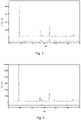
Claims (10)

  1. A quaternary cathode material, a chemical structural formula of the quaternary cathode material being LixNia'CobMnc'AldMyO2, 1≤x≤1.05, 0<y≤0.025, 0.3≤a'≤0.95, 0.03≤b≤0.1, 0.01≤c'≤0.05, 0.01 ≤d≤0.05 and a'+b+c'+d=1;
    and M is a dopant selecting from at least one of Zr, Al, B, Ti, Mg, Nb, Ba, Si, P, W, Sr and F;
    and the quaternary cathode material has an α-NaFeO2 type crystal structure; a space group of an X-ray diffraction pattern of the quaternary cathode material is R-3m, and a relationship between a cell parameter c of an axis c and a cell parameter a of an axis a is as follows: c/a>4.943.
  2. The quaternary cathode material according to claim 1, wherein in the X-ray diffraction pattern of the quaternary cathode material, the relationship between a cell parameter c of an axis c and a cell parameter a of an axis a is as follows: 3a+5.555≤c≤3a+5.590.
  3. The quaternary cathode material according to claim 2, wherein a numerical range of the cell parameter a of the axis a is 2.80-2.90, preferably 2.86-2.87, and a numerical range of the cell parameter c of the axis c is 14.10-14.30, preferably 14.19-14.20.
  4. The quaternary cathode material according to claim 1, wherein in the X-ray diffraction pattern of the quaternary cathode material, diffraction peak intensities of a surface I003 and a surface I104 meets a following relationship: 1.921<I003/I104≤2.
  5. The quaternary cathode material according to claim 1, wherein in the quaternary cathode material, a mass fraction of the dopant is 3000-8000ppm.
  6. The quaternary cathode material according to claim 1, wherein the dopant is comprised of Al and Zr, or the dopant is comprised of Al, Mg and Zr.
  7. The quaternary cathode material according to claim 5 or 6, wherein in the quaternary cathode material, a mass fraction of the dopant Al is 2500-3500ppm, a mass fraction of the dopant Mg is 300-500ppm and a mass fraction of the dopant Zr is 2500-3500ppm.
  8. A method for preparing the quaternary cathode material as defined in any one of claims 1-7, the method comprising:
    performing dry mixing on a nickel-cobalt-manganese-aluminum quaternary precursor, a lithium source and a dopant source to obtain a dry mixture;
    calcining the dry mixture in an oxygen-containing atmosphere for 10-15 hours at 700-800°C to obtain the quaternary cathode material precursor; and
    cladding and calcining the quaternary cathode material precursor in the oxygen-containing atmosphere by using an aluminum source and a boron source to obtain the quaternary cathode material, wherein a cladding and calcining temperature is 250-350°C and time is 4-8 hours.
  9. An cathode, comprising the quaternary cathode material as defined in any one of claims 1-7.
  10. A battery, comprising an cathode, a anode, a diaphragm and an electrolyte, wherein the diaphragm is arranged between the cathode and the anode; at least a part of the cathode, at least a part of the anode and at least a part of the diaphragm are immersed in the electrolyte, the cathode being the cathode defined in claim 9.
EP20901485.1A 2019-12-19 2020-12-11 QUATERNARY POSITIVE ELECTRODE MATERIAL, POSITIVE ELECTRODE AND BATTERY Pending EP4024525A4 (en)

Applications Claiming Priority (2)

Application Number Priority Date Filing Date Title
CN201911316650.6A CN111435743B (en) 2019-12-19 2019-12-19 Quaternary cathode material, cathode, battery
PCT/CN2020/135883 WO2021121168A1 (en) 2019-12-19 2020-12-11 Quaternary positive electrode material, positive electrode, and battery

Publications (2)

Publication Number Publication Date
EP4024525A1 true EP4024525A1 (en) 2022-07-06
EP4024525A4 EP4024525A4 (en) 2023-11-08

Family

ID=71580930

Family Applications (1)

Application Number Title Priority Date Filing Date
EP20901485.1A Pending EP4024525A4 (en) 2019-12-19 2020-12-11 QUATERNARY POSITIVE ELECTRODE MATERIAL, POSITIVE ELECTRODE AND BATTERY

Country Status (5)

Country Link
US (1) US20220363562A1 (en)
EP (1) EP4024525A4 (en)
KR (1) KR102767839B1 (en)
CN (1) CN111435743B (en)
WO (1) WO2021121168A1 (en)

Cited By (1)

* Cited by examiner, † Cited by third party
Publication number Priority date Publication date Assignee Title
EP4280304A4 (en) * 2021-12-08 2024-07-31 Btr Nano Tech Co., Ltd. NICKEL-RICH POSITIVE ELECTRODE MATERIAL, PREPARATION METHOD THEREFOR AND LITHIUM-ION BATTERY

Families Citing this family (19)

* Cited by examiner, † Cited by third party
Publication number Priority date Publication date Assignee Title
CN111435743B (en) * 2019-12-19 2022-06-21 蜂巢能源科技有限公司 Quaternary cathode material, cathode, battery
KR102580743B1 (en) * 2020-12-21 2023-09-19 포스코홀딩스 주식회사 Cathode active material, and lithium ion battery including the same
KR102580745B1 (en) * 2020-12-21 2023-09-19 포스코홀딩스 주식회사 Cathode active material, and lithium ion battery including the same
KR102580744B1 (en) * 2020-12-21 2023-09-19 포스코홀딩스 주식회사 Cathode active material, and lithium ion battery including the same
CN112563474B (en) * 2021-02-22 2021-06-04 湖南长远锂科股份有限公司 In-situ coated composite NCMA quaternary positive electrode material and preparation method thereof
CN113258055A (en) * 2021-04-25 2021-08-13 浙江帕瓦新能源股份有限公司 Strontium-doped battery quaternary positive electrode material precursor and preparation method thereof
CN113224287A (en) * 2021-05-06 2021-08-06 上海应用技术大学 Strontium-doped ternary lithium ion battery positive electrode material and preparation method and application thereof
CN112993259B (en) * 2021-05-12 2021-08-06 蜂巢能源科技有限公司 Coated ternary positive electrode material, its preparation method and lithium ion battery
KR102683926B1 (en) * 2021-08-05 2024-07-11 코스모신소재 주식회사 Cathode active material for secondary battery and method for manufacturing thereof
CN115832275B (en) * 2021-09-18 2023-11-21 宁德时代新能源科技股份有限公司 Modified high-nickel ternary positive electrode material, preparation method thereof and electric device
KR102736805B1 (en) * 2021-09-22 2024-12-03 가부시키가이샤 프로테리아루 Positive electrode active material for lithium ion secondary battery and lithium ion secondary battery
CN113903904B (en) * 2021-12-09 2022-03-11 华北电力大学 Application of NaLuO2 as cathode material for sodium ion battery
CN115832231B (en) * 2021-12-27 2025-08-26 北京当升材料科技股份有限公司 Positive electrode materials, preparation methods and applications thereof, lithium-ion batteries
CN114335547A (en) * 2022-03-08 2022-04-12 宜宾锂宝新材料有限公司 High-rate ternary positive electrode material, and preparation method and application thereof
KR102796389B1 (en) * 2022-08-26 2025-04-14 삼성에스디아이 주식회사 Positive active material for rechargeable lithium battery and rechargeable lithium battery including the same
CN116247199A (en) * 2023-03-31 2023-06-09 天津巴莫科技有限责任公司 A high-nickel single crystal layered positive electrode material co-doped with two elements in different crystal orientations and its preparation method
KR20250020185A (en) * 2023-08-03 2025-02-11 삼성에스디아이 주식회사 Positive active material, preparation method thereof, positive electrode, and rechargeable lithium batteries
CN118117075B (en) * 2024-03-07 2025-08-01 宁波容百新能源科技股份有限公司 High-nickel positive electrode active material, preparation method and application thereof
CN118888742B (en) * 2024-08-28 2025-12-12 比亚迪股份有限公司 A positive electrode material and its preparation method, a positive electrode sheet, a battery, and an electrical device thereof.

Family Cites Families (18)

* Cited by examiner, † Cited by third party
Publication number Priority date Publication date Assignee Title
EP2144314B1 (en) * 2001-04-20 2015-01-28 GS Yuasa International Ltd. Positive active materials and process for producing the same, positive electrode for non-aqueous electrolyte secondary battery, and non-aqueous electrolyte secondary battery
CN100377390C (en) * 2004-12-07 2008-03-26 深圳市比克电池有限公司 Preparation method of lithium composite oxide containing manganese, cobalt and nickel
KR100822012B1 (en) * 2006-03-30 2008-04-14 한양대학교 산학협력단 Cathode active material for lithium battery, manufacturing method thereof, and lithium secondary battery comprising same
JP5213103B2 (en) * 2007-12-19 2013-06-19 日立マクセル株式会社 Positive electrode for non-aqueous electrolyte secondary battery, non-aqueous electrolyte secondary battery and electronic device
CN101320807B (en) * 2008-07-04 2011-01-12 深圳市贝特瑞新能源材料股份有限公司 Positive electrode material of multi-component composite lithium ion cell and its preparation method
CN101483265B (en) * 2009-01-13 2011-06-29 深圳市贝特瑞新能源材料股份有限公司 Metal oxide lithium ionic cell positive pole material and preparation thereof
KR101367393B1 (en) * 2010-12-20 2014-02-24 히다치 막셀 가부시키가이샤 Nonaqueous secondary battery
CN109599555A (en) * 2013-02-28 2019-04-09 日产自动车株式会社 Positive active material, positive electrode, anode and non-aqueous electrolyte secondary battery
CN104409700B (en) * 2014-11-20 2018-07-24 深圳市贝特瑞新能源材料股份有限公司 A kind of Ni-based anode material for lithium-ion batteries and preparation method thereof
KR20180027261A (en) * 2016-09-06 2018-03-14 삼성에스디아이 주식회사 Positive active material for rechargeable lithium battery, method of preparing the same and rechargeable lithium battery including the same
CN109643794B (en) * 2017-02-02 2021-11-23 株式会社Lg化学 Positive electrode active material for secondary battery and method for preparing same
WO2019132332A1 (en) * 2017-12-26 2019-07-04 주식회사 포스코 Cathode active material for lithium secondary battery, production method therefor, and lithium secondary battery comprising same
KR102713885B1 (en) * 2018-03-07 2024-10-08 가부시키가이샤 프로테리아루 Positive electrode active material for lithium ion secondary battery and lithium ion secondary battery
CN110462894B (en) * 2018-03-07 2024-05-24 株式会社博迈立铖 Positive electrode active material for lithium ion secondary battery and lithium ion secondary battery
JP6968844B2 (en) * 2018-03-15 2021-11-17 Basf戸田バッテリーマテリアルズ合同会社 Positive electrode active material particles for non-aqueous electrolyte secondary batteries and their manufacturing methods, and non-aqueous electrolyte secondary batteries
CN109665570A (en) * 2018-12-03 2019-04-23 林奈(中国)新能源有限公司 A kind of nickelic quaternary positive electrode, the Preparation method and use of doping vario-property
CN109888235A (en) * 2019-03-06 2019-06-14 广东邦普循环科技有限公司 A kind of nickelic tertiary cathode material of gradation and its preparation method and application
CN111435743B (en) * 2019-12-19 2022-06-21 蜂巢能源科技有限公司 Quaternary cathode material, cathode, battery

Cited By (1)

* Cited by examiner, † Cited by third party
Publication number Priority date Publication date Assignee Title
EP4280304A4 (en) * 2021-12-08 2024-07-31 Btr Nano Tech Co., Ltd. NICKEL-RICH POSITIVE ELECTRODE MATERIAL, PREPARATION METHOD THEREFOR AND LITHIUM-ION BATTERY

Also Published As

Publication number Publication date
CN111435743A (en) 2020-07-21
US20220363562A1 (en) 2022-11-17
WO2021121168A1 (en) 2021-06-24
EP4024525A4 (en) 2023-11-08
CN111435743B (en) 2022-06-21
KR102767839B1 (en) 2025-02-12
KR20210134660A (en) 2021-11-10

Similar Documents

Publication Publication Date Title
EP4024525A1 (en) Quaternary positive electrode material, positive electrode, and battery
KR102641955B1 (en) Positive active material for rechargeable lithium battery, method of preparing the same, and rechargeable lithium battery including the same
KR102350597B1 (en) A cathode active material, method of preparing the same, and lithium secondary battery comprising a cathode comprising the cathode active material
EP1189296B9 (en) Lithiated oxide materials and methods of manufacture
KR102010690B1 (en) Divalent metal doping for sodium manganese oxide as cathode material for sodium ion batteries
US11492266B2 (en) Processes for preparing positive electrode active substance for non-aqueous electrolyte secondary batteries
KR101794097B1 (en) Positive active material for rechargeable lithium battery, method of preparing the same, and positive electrode for rechargeable lithium battery and rechargeable lithium battery including the same
US12559430B2 (en) Doped titanium niobate and battery
EP3336939B1 (en) Positive electrode active material for lithium-ion secondary battery and preparation method and use thereof
EP2006937A2 (en) Lithium transition metal-based compound powder for positive electrode material in lithium rechargeable battery, method for manufacturing the powder, spray dried product of the powder, firing precursor of the powder, and positive electrode for lithium rechargeable battery and lithium rechargeable battery using the powder
KR101925105B1 (en) Positive active material, method of preparing the same, and rechargeable lithium battery including the same
KR20150100406A (en) Positive active material, preparing method thereof, positive electrode for lithium secondary battery including the same, and lithium secondary battery employing the same
KR102523095B1 (en) A cathode active material, method of preparing the same, lithium secondary battery comprising the cathode active material
KR102279132B1 (en) Cathode Active Material for Lithium Secondary Battery and Lithium Secondary Battery Comprising the Same
KR20200105390A (en) A cathode active material, method of preparing the same, and lithium secondary battery comprising a cathode comprising the cathode active material
KR20160081111A (en) Composite positive active material, preparing method thereof, positive electrode including the same, and lithium secondary battery including the positive electrode
KR20220089242A (en) Cathode active material, and lithium ion battery including the same
KR20160025893A (en) Composite positive electrode active material, positive electrode and lithium battery employing the same
KR102168640B1 (en) Positive active material comprising spinel complex-oxide, method for preparing same, and rechargeable lithium battery comprising same
KR20220089244A (en) Cathode active material, and lithium ion battery including the same
KR20180094567A (en) Positive active material for lithium secondary battery
KR20230071485A (en) A cathode active material, method of preparing the same, and lithium secondary battery including the cathode active material
KR102317416B1 (en) A Negative Electrode Active Material With A High Energy Density And A Lithium Ion Secondary Battery Having The Same
KR20220012055A (en) Spinel complex-oxide, method for preparing the same, positive active material, and rechargeable lithium battery comprising the same
KR101863625B1 (en) Anatase-bronze phase titanium oxide composite doped with copper, and method for preparing the same

Legal Events

Date Code Title Description
STAA Information on the status of an ep patent application or granted ep patent

Free format text: STATUS: THE INTERNATIONAL PUBLICATION HAS BEEN MADE

PUAI Public reference made under article 153(3) epc to a published international application that has entered the european phase

Free format text: ORIGINAL CODE: 0009012

STAA Information on the status of an ep patent application or granted ep patent

Free format text: STATUS: REQUEST FOR EXAMINATION WAS MADE

17P Request for examination filed

Effective date: 20220331

AK Designated contracting states

Kind code of ref document: A1

Designated state(s): AL AT BE BG CH CY CZ DE DK EE ES FI FR GB GR HR HU IE IS IT LI LT LU LV MC MK MT NL NO PL PT RO RS SE SI SK SM TR

DAV Request for validation of the european patent (deleted)
DAX Request for extension of the european patent (deleted)
A4 Supplementary search report drawn up and despatched

Effective date: 20231006

RIC1 Information provided on ipc code assigned before grant

Ipc: C01G 53/00 20060101ALI20230929BHEP

Ipc: H01M 4/505 20100101AFI20230929BHEP