EP4023454A1 - Thermosensitive recording medium and image-forming method - Google Patents
Thermosensitive recording medium and image-forming method Download PDFInfo
- Publication number
- EP4023454A1 EP4023454A1 EP21209654.9A EP21209654A EP4023454A1 EP 4023454 A1 EP4023454 A1 EP 4023454A1 EP 21209654 A EP21209654 A EP 21209654A EP 4023454 A1 EP4023454 A1 EP 4023454A1
- Authority
- EP
- European Patent Office
- Prior art keywords
- electron
- recording medium
- compound
- group
- thermosensitive recording
- Prior art date
- Legal status (The legal status is an assumption and is not a legal conclusion. Google has not performed a legal analysis and makes no representation as to the accuracy of the status listed.)
- Withdrawn
Links
- 238000000034 method Methods 0.000 title claims description 32
- 150000001875 compounds Chemical class 0.000 claims abstract description 142
- 238000004040 coloring Methods 0.000 claims abstract description 112
- 239000002243 precursor Substances 0.000 claims abstract description 56
- 239000003999 initiator Substances 0.000 claims abstract description 35
- 229940126062 Compound A Drugs 0.000 claims abstract description 17
- NLDMNSXOCDLTTB-UHFFFAOYSA-N Heterophylliin A Natural products O1C2COC(=O)C3=CC(O)=C(O)C(O)=C3C3=C(O)C(O)=C(O)C=C3C(=O)OC2C(OC(=O)C=2C=C(O)C(O)=C(O)C=2)C(O)C1OC(=O)C1=CC(O)=C(O)C(O)=C1 NLDMNSXOCDLTTB-UHFFFAOYSA-N 0.000 claims abstract description 17
- -1 oxime ester compound Chemical class 0.000 claims description 75
- 239000002245 particle Substances 0.000 claims description 45
- 230000005855 radiation Effects 0.000 claims description 29
- 125000004432 carbon atom Chemical group C* 0.000 claims description 22
- 238000010438 heat treatment Methods 0.000 claims description 13
- 125000004435 hydrogen atom Chemical group [H]* 0.000 claims description 13
- 125000001570 methylene group Chemical group [H]C([H])([*:1])[*:2] 0.000 claims description 13
- 125000002496 methyl group Chemical group [H]C([H])([H])* 0.000 claims description 8
- 125000000623 heterocyclic group Chemical group 0.000 claims description 4
- 230000001678 irradiating effect Effects 0.000 claims description 3
- 125000001183 hydrocarbyl group Chemical group 0.000 claims 8
- 239000010410 layer Substances 0.000 description 139
- 150000003254 radicals Chemical class 0.000 description 107
- 239000007788 liquid Substances 0.000 description 82
- 239000000975 dye Substances 0.000 description 58
- 239000002609 medium Substances 0.000 description 56
- 239000011248 coating agent Substances 0.000 description 42
- 238000000576 coating method Methods 0.000 description 42
- 239000011241 protective layer Substances 0.000 description 38
- 239000000463 material Substances 0.000 description 24
- 230000000052 comparative effect Effects 0.000 description 22
- XEKOWRVHYACXOJ-UHFFFAOYSA-N Ethyl acetate Chemical compound CCOC(C)=O XEKOWRVHYACXOJ-UHFFFAOYSA-N 0.000 description 21
- 239000000203 mixture Substances 0.000 description 20
- 239000006185 dispersion Substances 0.000 description 18
- 229920002451 polyvinyl alcohol Polymers 0.000 description 18
- 238000001035 drying Methods 0.000 description 17
- XLYOFNOQVPJJNP-UHFFFAOYSA-N water Substances O XLYOFNOQVPJJNP-UHFFFAOYSA-N 0.000 description 17
- 150000002430 hydrocarbons Chemical group 0.000 description 16
- 229920005989 resin Polymers 0.000 description 16
- 239000011347 resin Substances 0.000 description 16
- 239000007787 solid Substances 0.000 description 15
- 238000006116 polymerization reaction Methods 0.000 description 14
- VFHVQBAGLAREND-UHFFFAOYSA-N diphenylphosphoryl-(2,4,6-trimethylphenyl)methanone Chemical compound CC1=CC(C)=CC(C)=C1C(=O)P(=O)(C=1C=CC=CC=1)C1=CC=CC=C1 VFHVQBAGLAREND-UHFFFAOYSA-N 0.000 description 13
- FWQHNLCNFPYBCA-UHFFFAOYSA-N fluoran Chemical compound C12=CC=CC=C2OC2=CC=CC=C2C11OC(=O)C2=CC=CC=C21 FWQHNLCNFPYBCA-UHFFFAOYSA-N 0.000 description 13
- 239000001993 wax Substances 0.000 description 13
- 239000000047 product Substances 0.000 description 12
- 238000006243 chemical reaction Methods 0.000 description 11
- 230000015572 biosynthetic process Effects 0.000 description 10
- 238000003860 storage Methods 0.000 description 10
- 239000006097 ultraviolet radiation absorber Substances 0.000 description 10
- 239000000049 pigment Substances 0.000 description 9
- 238000010526 radical polymerization reaction Methods 0.000 description 9
- 239000000126 substance Substances 0.000 description 9
- 239000005995 Aluminium silicate Substances 0.000 description 8
- 239000004698 Polyethylene Substances 0.000 description 8
- 235000012211 aluminium silicate Nutrition 0.000 description 8
- 239000012752 auxiliary agent Substances 0.000 description 8
- KZTYYGOKRVBIMI-UHFFFAOYSA-N diphenyl sulfone Chemical group C=1C=CC=CC=1S(=O)(=O)C1=CC=CC=C1 KZTYYGOKRVBIMI-UHFFFAOYSA-N 0.000 description 8
- 239000002270 dispersing agent Substances 0.000 description 8
- NLYAJNPCOHFWQQ-UHFFFAOYSA-N kaolin Chemical compound O.O.O=[Al]O[Si](=O)O[Si](=O)O[Al]=O NLYAJNPCOHFWQQ-UHFFFAOYSA-N 0.000 description 8
- 229920000573 polyethylene Polymers 0.000 description 8
- 238000012360 testing method Methods 0.000 description 8
- MTMKZABGIQJAEX-UHFFFAOYSA-N 4,4'-sulfonylbis[2-(prop-2-en-1-yl)phenol] Chemical compound C1=C(CC=C)C(O)=CC=C1S(=O)(=O)C1=CC=C(O)C(CC=C)=C1 MTMKZABGIQJAEX-UHFFFAOYSA-N 0.000 description 7
- VYPSYNLAJGMNEJ-UHFFFAOYSA-N Silicium dioxide Chemical compound O=[Si]=O VYPSYNLAJGMNEJ-UHFFFAOYSA-N 0.000 description 7
- 239000003795 chemical substances by application Substances 0.000 description 7
- 229920001577 copolymer Polymers 0.000 description 7
- 239000000839 emulsion Substances 0.000 description 7
- 238000005259 measurement Methods 0.000 description 7
- 239000003094 microcapsule Substances 0.000 description 7
- 230000004048 modification Effects 0.000 description 7
- 238000012986 modification Methods 0.000 description 7
- 239000002904 solvent Substances 0.000 description 7
- XOOUIPVCVHRTMJ-UHFFFAOYSA-L zinc stearate Chemical compound [Zn+2].CCCCCCCCCCCCCCCCCC([O-])=O.CCCCCCCCCCCCCCCCCC([O-])=O XOOUIPVCVHRTMJ-UHFFFAOYSA-L 0.000 description 7
- UHOVQNZJYSORNB-UHFFFAOYSA-N Benzene Chemical compound C1=CC=CC=C1 UHOVQNZJYSORNB-UHFFFAOYSA-N 0.000 description 6
- VTYYLEPIZMXCLO-UHFFFAOYSA-L Calcium carbonate Chemical compound [Ca+2].[O-]C([O-])=O VTYYLEPIZMXCLO-UHFFFAOYSA-L 0.000 description 6
- 238000004458 analytical method Methods 0.000 description 6
- 239000007864 aqueous solution Substances 0.000 description 6
- 239000011247 coating layer Substances 0.000 description 6
- 239000003112 inhibitor Substances 0.000 description 6
- 230000003287 optical effect Effects 0.000 description 6
- 238000007127 saponification reaction Methods 0.000 description 6
- 239000000853 adhesive Substances 0.000 description 5
- RWCCWEUUXYIKHB-UHFFFAOYSA-N benzophenone Chemical compound C=1C=CC=CC=1C(=O)C1=CC=CC=C1 RWCCWEUUXYIKHB-UHFFFAOYSA-N 0.000 description 5
- 239000012965 benzophenone Substances 0.000 description 5
- 239000003431 cross linking reagent Substances 0.000 description 5
- 230000007423 decrease Effects 0.000 description 5
- 238000009826 distribution Methods 0.000 description 5
- 238000007639 printing Methods 0.000 description 5
- 239000004094 surface-active agent Substances 0.000 description 5
- WNZQDUSMALZDQF-UHFFFAOYSA-N 2-benzofuran-1(3H)-one Chemical compound C1=CC=C2C(=O)OCC2=C1 WNZQDUSMALZDQF-UHFFFAOYSA-N 0.000 description 4
- VVBLNCFGVYUYGU-UHFFFAOYSA-N 4,4'-Bis(dimethylamino)benzophenone Chemical compound C1=CC(N(C)C)=CC=C1C(=O)C1=CC=C(N(C)C)C=C1 VVBLNCFGVYUYGU-UHFFFAOYSA-N 0.000 description 4
- KWOLFJPFCHCOCG-UHFFFAOYSA-N Acetophenone Chemical compound CC(=O)C1=CC=CC=C1 KWOLFJPFCHCOCG-UHFFFAOYSA-N 0.000 description 4
- NIXOWILDQLNWCW-UHFFFAOYSA-M Acrylate Chemical compound [O-]C(=O)C=C NIXOWILDQLNWCW-UHFFFAOYSA-M 0.000 description 4
- QIGBRXMKCJKVMJ-UHFFFAOYSA-N Hydroquinone Chemical compound OC1=CC=C(O)C=C1 QIGBRXMKCJKVMJ-UHFFFAOYSA-N 0.000 description 4
- ISWSIDIOOBJBQZ-UHFFFAOYSA-N Phenol Chemical compound OC1=CC=CC=C1 ISWSIDIOOBJBQZ-UHFFFAOYSA-N 0.000 description 4
- HEDRZPFGACZZDS-MICDWDOJSA-N Trichloro(2H)methane Chemical compound [2H]C(Cl)(Cl)Cl HEDRZPFGACZZDS-MICDWDOJSA-N 0.000 description 4
- 230000001070 adhesive effect Effects 0.000 description 4
- 125000002490 anilino group Chemical group [H]N(*)C1=C([H])C([H])=C([H])C([H])=C1[H] 0.000 description 4
- 239000003963 antioxidant agent Substances 0.000 description 4
- 235000006708 antioxidants Nutrition 0.000 description 4
- RTZKZFJDLAIYFH-UHFFFAOYSA-N ether Substances CCOCC RTZKZFJDLAIYFH-UHFFFAOYSA-N 0.000 description 4
- 238000004519 manufacturing process Methods 0.000 description 4
- 230000007246 mechanism Effects 0.000 description 4
- LYRFLYHAGKPMFH-UHFFFAOYSA-N octadecanamide Chemical compound CCCCCCCCCCCCCCCCCC(N)=O LYRFLYHAGKPMFH-UHFFFAOYSA-N 0.000 description 4
- 150000002989 phenols Chemical class 0.000 description 4
- 239000011734 sodium Substances 0.000 description 4
- 229910052708 sodium Inorganic materials 0.000 description 4
- YRHRIQCWCFGUEQ-UHFFFAOYSA-N thioxanthen-9-one Chemical class C1=CC=C2C(=O)C3=CC=CC=C3SC2=C1 YRHRIQCWCFGUEQ-UHFFFAOYSA-N 0.000 description 4
- NLGDWWCZQDIASO-UHFFFAOYSA-N 2-hydroxy-1-(7-oxabicyclo[4.1.0]hepta-1,3,5-trien-2-yl)-2-phenylethanone Chemical class OC(C(=O)c1cccc2Oc12)c1ccccc1 NLGDWWCZQDIASO-UHFFFAOYSA-N 0.000 description 3
- RCVMSMLWRJESQC-UHFFFAOYSA-N 7-[4-(diethylamino)-2-ethoxyphenyl]-7-(1-ethyl-2-methylindol-3-yl)furo[3,4-b]pyridin-5-one Chemical compound CCOC1=CC(N(CC)CC)=CC=C1C1(C=2C3=CC=CC=C3N(CC)C=2C)C2=NC=CC=C2C(=O)O1 RCVMSMLWRJESQC-UHFFFAOYSA-N 0.000 description 3
- SYAOBLHWASSYCO-UHFFFAOYSA-N 7-[4-(diethylamino)-2-methylphenyl]-7-(1-ethyl-2-methylindol-3-yl)furo[3,4-b]pyridin-5-one Chemical compound CC1=CC(N(CC)CC)=CC=C1C1(C=2C3=CC=CC=C3N(CC)C=2C)C2=NC=CC=C2C(=O)O1 SYAOBLHWASSYCO-UHFFFAOYSA-N 0.000 description 3
- YMWUJEATGCHHMB-UHFFFAOYSA-N Dichloromethane Chemical compound ClCCl YMWUJEATGCHHMB-UHFFFAOYSA-N 0.000 description 3
- OKKJLVBELUTLKV-UHFFFAOYSA-N Methanol Chemical compound OC OKKJLVBELUTLKV-UHFFFAOYSA-N 0.000 description 3
- 229920003171 Poly (ethylene oxide) Polymers 0.000 description 3
- 244000028419 Styrax benzoin Species 0.000 description 3
- 235000000126 Styrax benzoin Nutrition 0.000 description 3
- 235000008411 Sumatra benzointree Nutrition 0.000 description 3
- YXFVVABEGXRONW-UHFFFAOYSA-N Toluene Chemical compound CC1=CC=CC=C1 YXFVVABEGXRONW-UHFFFAOYSA-N 0.000 description 3
- ZMANZCXQSJIPKH-UHFFFAOYSA-N Triethylamine Chemical compound CCN(CC)CC ZMANZCXQSJIPKH-UHFFFAOYSA-N 0.000 description 3
- 150000001412 amines Chemical class 0.000 description 3
- 239000011324 bead Substances 0.000 description 3
- 150000001558 benzoic acid derivatives Chemical class 0.000 description 3
- 229960002130 benzoin Drugs 0.000 description 3
- 150000008366 benzophenones Chemical class 0.000 description 3
- 239000011230 binding agent Substances 0.000 description 3
- 229910000019 calcium carbonate Inorganic materials 0.000 description 3
- 230000003247 decreasing effect Effects 0.000 description 3
- ISAOCJYIOMOJEB-UHFFFAOYSA-N desyl alcohol Natural products C=1C=CC=CC=1C(O)C(=O)C1=CC=CC=C1 ISAOCJYIOMOJEB-UHFFFAOYSA-N 0.000 description 3
- 235000014113 dietary fatty acids Nutrition 0.000 description 3
- 239000002612 dispersion medium Substances 0.000 description 3
- 239000000194 fatty acid Substances 0.000 description 3
- 229930195729 fatty acid Natural products 0.000 description 3
- 239000010419 fine particle Substances 0.000 description 3
- 230000006870 function Effects 0.000 description 3
- 235000019382 gum benzoic Nutrition 0.000 description 3
- VLKZOEOYAKHREP-UHFFFAOYSA-N n-Hexane Chemical compound CCCCCC VLKZOEOYAKHREP-UHFFFAOYSA-N 0.000 description 3
- 239000003921 oil Substances 0.000 description 3
- 229920003023 plastic Polymers 0.000 description 3
- 239000004033 plastic Substances 0.000 description 3
- 238000002360 preparation method Methods 0.000 description 3
- 239000002994 raw material Substances 0.000 description 3
- 230000001235 sensitizing effect Effects 0.000 description 3
- 239000000377 silicon dioxide Substances 0.000 description 3
- 238000012546 transfer Methods 0.000 description 3
- 238000011282 treatment Methods 0.000 description 3
- WXPWZZHELZEVPO-UHFFFAOYSA-N (4-methylphenyl)-phenylmethanone Chemical compound C1=CC(C)=CC=C1C(=O)C1=CC=CC=C1 WXPWZZHELZEVPO-UHFFFAOYSA-N 0.000 description 2
- OHBQPCCCRFSCAX-UHFFFAOYSA-N 1,4-Dimethoxybenzene Chemical compound COC1=CC=C(OC)C=C1 OHBQPCCCRFSCAX-UHFFFAOYSA-N 0.000 description 2
- AZQWKYJCGOJGHM-UHFFFAOYSA-N 1,4-benzoquinone Chemical compound O=C1C=CC(=O)C=C1 AZQWKYJCGOJGHM-UHFFFAOYSA-N 0.000 description 2
- WJFKNYWRSNBZNX-UHFFFAOYSA-N 10H-phenothiazine Chemical compound C1=CC=C2NC3=CC=CC=C3SC2=C1 WJFKNYWRSNBZNX-UHFFFAOYSA-N 0.000 description 2
- GSCLSACFHWKTQU-UHFFFAOYSA-N 2'-chloro-6'-(diethylamino)spiro[2-benzofuran-3,9'-xanthene]-1-one Chemical compound O1C(=O)C2=CC=CC=C2C21C1=CC(Cl)=CC=C1OC1=CC(N(CC)CC)=CC=C21 GSCLSACFHWKTQU-UHFFFAOYSA-N 0.000 description 2
- VQWGCFKMUFNLIK-UHFFFAOYSA-N 2-[2-(4-dodecoxy-3-methoxyphenyl)ethenyl]quinoline Chemical group C1=C(OC)C(OCCCCCCCCCCCC)=CC=C1C=CC1=CC=C(C=CC=C2)C2=N1 VQWGCFKMUFNLIK-UHFFFAOYSA-N 0.000 description 2
- GRIKUIPJBHJPPN-UHFFFAOYSA-N 3',6'-dimethoxyspiro[2-benzofuran-3,9'-xanthene]-1-one Chemical compound O1C(=O)C2=CC=CC=C2C21C1=CC=C(OC)C=C1OC1=CC(OC)=CC=C21 GRIKUIPJBHJPPN-UHFFFAOYSA-N 0.000 description 2
- JZEPXWWZAJGALH-UHFFFAOYSA-N 3,3-bis(1-butyl-2-methylindol-3-yl)-2-benzofuran-1-one Chemical compound C1=CC=C2C(C3(C4=CC=CC=C4C(=O)O3)C3=C(C)N(C4=CC=CC=C43)CCCC)=C(C)N(CCCC)C2=C1 JZEPXWWZAJGALH-UHFFFAOYSA-N 0.000 description 2
- GNZQDEXHTZDQRB-UHFFFAOYSA-N 3-[4-(diethylamino)-2-methylphenyl]-6-(dimethylamino)-3-[4-(dimethylamino)phenyl]-2-benzofuran-1-one Chemical compound CC1=CC(N(CC)CC)=CC=C1C1(C=2C=CC(=CC=2)N(C)C)C2=CC=C(N(C)C)C=C2C(=O)O1 GNZQDEXHTZDQRB-UHFFFAOYSA-N 0.000 description 2
- UPMLOUAZCHDJJD-UHFFFAOYSA-N 4,4'-Diphenylmethane Diisocyanate Chemical compound C1=CC(N=C=O)=CC=C1CC1=CC=C(N=C=O)C=C1 UPMLOUAZCHDJJD-UHFFFAOYSA-N 0.000 description 2
- RBDYMRWHRDPLOS-UHFFFAOYSA-N 4-(dimethylamino)-3-ethyl-2-hexylbenzoic acid Chemical compound CCCCCCC1=C(CC)C(N(C)C)=CC=C1C(O)=O RBDYMRWHRDPLOS-UHFFFAOYSA-N 0.000 description 2
- BOTGCZBEERTTDQ-UHFFFAOYSA-N 4-Methoxy-1-naphthol Chemical compound C1=CC=C2C(OC)=CC=C(O)C2=C1 BOTGCZBEERTTDQ-UHFFFAOYSA-N 0.000 description 2
- XUFBVJQHCCCPNM-UHFFFAOYSA-N 6'-(diethylamino)-1',3'-dimethylspiro[2-benzofuran-3,9'-xanthene]-1-one Chemical compound O1C(=O)C2=CC=CC=C2C21C1=C(C)C=C(C)C=C1OC1=CC(N(CC)CC)=CC=C21 XUFBVJQHCCCPNM-UHFFFAOYSA-N 0.000 description 2
- SKVLHBJJOXTLKQ-UHFFFAOYSA-N 7,7-bis[4-(diethylamino)-2-ethoxyphenyl]furo[3,4-b]pyridin-5-one Chemical compound CCOC1=CC(N(CC)CC)=CC=C1C1(C=2C(=CC(=CC=2)N(CC)CC)OCC)C2=NC=CC=C2C(=O)O1 SKVLHBJJOXTLKQ-UHFFFAOYSA-N 0.000 description 2
- YDYKGVWORCQOTN-UHFFFAOYSA-N 7-[4-(diethylamino)-2-hexoxyphenyl]-7-(1-ethyl-2-methylindol-3-yl)furo[3,4-b]pyridin-5-one Chemical compound CCCCCCOC1=CC(N(CC)CC)=CC=C1C1(C=2C3=CC=CC=C3N(CC)C=2C)C2=NC=CC=C2C(=O)O1 YDYKGVWORCQOTN-UHFFFAOYSA-N 0.000 description 2
- KXDAEFPNCMNJSK-UHFFFAOYSA-N Benzamide Chemical compound NC(=O)C1=CC=CC=C1 KXDAEFPNCMNJSK-UHFFFAOYSA-N 0.000 description 2
- HEDRZPFGACZZDS-UHFFFAOYSA-N Chloroform Chemical compound ClC(Cl)Cl HEDRZPFGACZZDS-UHFFFAOYSA-N 0.000 description 2
- IPAJDLMMTVZVPP-UHFFFAOYSA-N Crystal violet lactone Chemical compound C1=CC(N(C)C)=CC=C1C1(C=2C=CC(=CC=2)N(C)C)C2=CC=C(N(C)C)C=C2C(=O)O1 IPAJDLMMTVZVPP-UHFFFAOYSA-N 0.000 description 2
- 239000004593 Epoxy Substances 0.000 description 2
- IMROMDMJAWUWLK-UHFFFAOYSA-N Ethenol Chemical compound OC=C IMROMDMJAWUWLK-UHFFFAOYSA-N 0.000 description 2
- LYCAIKOWRPUZTN-UHFFFAOYSA-N Ethylene glycol Chemical compound OCCO LYCAIKOWRPUZTN-UHFFFAOYSA-N 0.000 description 2
- 108010010803 Gelatin Proteins 0.000 description 2
- 239000005057 Hexamethylene diisocyanate Substances 0.000 description 2
- TWRXJAOTZQYOKJ-UHFFFAOYSA-L Magnesium chloride Chemical compound [Mg+2].[Cl-].[Cl-] TWRXJAOTZQYOKJ-UHFFFAOYSA-L 0.000 description 2
- NQSMEZJWJJVYOI-UHFFFAOYSA-N Methyl 2-benzoylbenzoate Chemical compound COC(=O)C1=CC=CC=C1C(=O)C1=CC=CC=C1 NQSMEZJWJJVYOI-UHFFFAOYSA-N 0.000 description 2
- IMNFDUFMRHMDMM-UHFFFAOYSA-N N-Heptane Chemical compound CCCCCCC IMNFDUFMRHMDMM-UHFFFAOYSA-N 0.000 description 2
- 238000005481 NMR spectroscopy Methods 0.000 description 2
- OFSAUHSCHWRZKM-UHFFFAOYSA-N Padimate A Chemical compound CC(C)CCOC(=O)C1=CC=C(N(C)C)C=C1 OFSAUHSCHWRZKM-UHFFFAOYSA-N 0.000 description 2
- NBIIXXVUZAFLBC-UHFFFAOYSA-N Phosphoric acid Chemical compound OP(O)(O)=O NBIIXXVUZAFLBC-UHFFFAOYSA-N 0.000 description 2
- 229920002396 Polyurea Polymers 0.000 description 2
- WYURNTSHIVDZCO-UHFFFAOYSA-N Tetrahydrofuran Chemical compound C1CCOC1 WYURNTSHIVDZCO-UHFFFAOYSA-N 0.000 description 2
- GWEVSGVZZGPLCZ-UHFFFAOYSA-N Titan oxide Chemical compound O=[Ti]=O GWEVSGVZZGPLCZ-UHFFFAOYSA-N 0.000 description 2
- XLOMVQKBTHCTTD-UHFFFAOYSA-N Zinc monoxide Chemical compound [Zn]=O XLOMVQKBTHCTTD-UHFFFAOYSA-N 0.000 description 2
- DBHQYYNDKZDVTN-UHFFFAOYSA-N [4-(4-methylphenyl)sulfanylphenyl]-phenylmethanone Chemical compound C1=CC(C)=CC=C1SC1=CC=C(C(=O)C=2C=CC=CC=2)C=C1 DBHQYYNDKZDVTN-UHFFFAOYSA-N 0.000 description 2
- 125000005907 alkyl ester group Chemical group 0.000 description 2
- WNROFYMDJYEPJX-UHFFFAOYSA-K aluminium hydroxide Chemical compound [OH-].[OH-].[OH-].[Al+3] WNROFYMDJYEPJX-UHFFFAOYSA-K 0.000 description 2
- ROOXNKNUYICQNP-UHFFFAOYSA-N ammonium persulfate Chemical compound [NH4+].[NH4+].[O-]S(=O)(=O)OOS([O-])(=O)=O ROOXNKNUYICQNP-UHFFFAOYSA-N 0.000 description 2
- MWPLVEDNUUSJAV-UHFFFAOYSA-N anthracene Chemical compound C1=CC=CC2=CC3=CC=CC=C3C=C21 MWPLVEDNUUSJAV-UHFFFAOYSA-N 0.000 description 2
- 239000002518 antifoaming agent Substances 0.000 description 2
- 125000003118 aryl group Chemical group 0.000 description 2
- TZCXTZWJZNENPQ-UHFFFAOYSA-L barium sulfate Chemical compound [Ba+2].[O-]S([O-])(=O)=O TZCXTZWJZNENPQ-UHFFFAOYSA-L 0.000 description 2
- VYHBFRJRBHMIQZ-UHFFFAOYSA-N bis[4-(diethylamino)phenyl]methanone Chemical compound C1=CC(N(CC)CC)=CC=C1C(=O)C1=CC=C(N(CC)CC)C=C1 VYHBFRJRBHMIQZ-UHFFFAOYSA-N 0.000 description 2
- 239000004327 boric acid Substances 0.000 description 2
- 239000005018 casein Substances 0.000 description 2
- BECPQYXYKAMYBN-UHFFFAOYSA-N casein, tech. Chemical compound NCCCCC(C(O)=O)N=C(O)C(CC(O)=O)N=C(O)C(CCC(O)=N)N=C(O)C(CC(C)C)N=C(O)C(CCC(O)=O)N=C(O)C(CC(O)=O)N=C(O)C(CCC(O)=O)N=C(O)C(C(C)O)N=C(O)C(CCC(O)=N)N=C(O)C(CCC(O)=N)N=C(O)C(CCC(O)=N)N=C(O)C(CCC(O)=O)N=C(O)C(CCC(O)=O)N=C(O)C(COP(O)(O)=O)N=C(O)C(CCC(O)=N)N=C(O)C(N)CC1=CC=CC=C1 BECPQYXYKAMYBN-UHFFFAOYSA-N 0.000 description 2
- 235000021240 caseins Nutrition 0.000 description 2
- 239000004927 clay Substances 0.000 description 2
- 239000003086 colorant Substances 0.000 description 2
- 239000013065 commercial product Substances 0.000 description 2
- 238000011161 development Methods 0.000 description 2
- WOZVHXUHUFLZGK-UHFFFAOYSA-N dimethyl terephthalate Chemical compound COC(=O)C1=CC=C(C(=O)OC)C=C1 WOZVHXUHUFLZGK-UHFFFAOYSA-N 0.000 description 2
- 230000000694 effects Effects 0.000 description 2
- 238000010894 electron beam technology Methods 0.000 description 2
- 238000011156 evaluation Methods 0.000 description 2
- 150000004665 fatty acids Chemical class 0.000 description 2
- 239000008273 gelatin Substances 0.000 description 2
- 229920000159 gelatin Polymers 0.000 description 2
- 235000019322 gelatine Nutrition 0.000 description 2
- 235000011852 gelatine desserts Nutrition 0.000 description 2
- LEQAOMBKQFMDFZ-UHFFFAOYSA-N glyoxal Chemical compound O=CC=O LEQAOMBKQFMDFZ-UHFFFAOYSA-N 0.000 description 2
- 238000009499 grossing Methods 0.000 description 2
- 229910052736 halogen Inorganic materials 0.000 description 2
- 229930195733 hydrocarbon Natural products 0.000 description 2
- 125000002887 hydroxy group Chemical group [H]O* 0.000 description 2
- VKOBVWXKNCXXDE-UHFFFAOYSA-N icosanoic acid Chemical compound CCCCCCCCCCCCCCCCCCCC(O)=O VKOBVWXKNCXXDE-UHFFFAOYSA-N 0.000 description 2
- 239000000976 ink Substances 0.000 description 2
- RBTARNINKXHZNM-UHFFFAOYSA-K iron trichloride Chemical compound Cl[Fe](Cl)Cl RBTARNINKXHZNM-UHFFFAOYSA-K 0.000 description 2
- ZFSLODLOARCGLH-UHFFFAOYSA-N isocyanuric acid Chemical compound OC1=NC(O)=NC(O)=N1 ZFSLODLOARCGLH-UHFFFAOYSA-N 0.000 description 2
- 238000004811 liquid chromatography Methods 0.000 description 2
- 239000000314 lubricant Substances 0.000 description 2
- 238000004949 mass spectrometry Methods 0.000 description 2
- 229910052751 metal Inorganic materials 0.000 description 2
- 239000002184 metal Substances 0.000 description 2
- 229920000609 methyl cellulose Polymers 0.000 description 2
- 239000001923 methylcellulose Substances 0.000 description 2
- 235000010981 methylcellulose Nutrition 0.000 description 2
- 239000000178 monomer Substances 0.000 description 2
- GOCLJAKNIYYTMF-UHFFFAOYSA-N n,n-dimethyl-4-[2-(2-octoxyphenyl)-6-phenylpyridin-4-yl]aniline Chemical compound CCCCCCCCOC1=CC=CC=C1C1=CC(C=2C=CC(=CC=2)N(C)C)=CC(C=2C=CC=CC=2)=N1 GOCLJAKNIYYTMF-UHFFFAOYSA-N 0.000 description 2
- RKISUIUJZGSLEV-UHFFFAOYSA-N n-[2-(octadecanoylamino)ethyl]octadecanamide Chemical compound CCCCCCCCCCCCCCCCCC(=O)NCCNC(=O)CCCCCCCCCCCCCCCCC RKISUIUJZGSLEV-UHFFFAOYSA-N 0.000 description 2
- 150000002894 organic compounds Chemical class 0.000 description 2
- FZUGPQWGEGAKET-UHFFFAOYSA-N parbenate Chemical compound CCOC(=O)C1=CC=C(N(C)C)C=C1 FZUGPQWGEGAKET-UHFFFAOYSA-N 0.000 description 2
- 229950000688 phenothiazine Drugs 0.000 description 2
- 125000001997 phenyl group Chemical group [H]C1=C([H])C([H])=C(*)C([H])=C1[H] 0.000 description 2
- LYXOWKPVTCPORE-UHFFFAOYSA-N phenyl-(4-phenylphenyl)methanone Chemical compound C=1C=C(C=2C=CC=CC=2)C=CC=1C(=O)C1=CC=CC=C1 LYXOWKPVTCPORE-UHFFFAOYSA-N 0.000 description 2
- 239000004014 plasticizer Substances 0.000 description 2
- 229920001495 poly(sodium acrylate) polymer Polymers 0.000 description 2
- 229920000768 polyamine Polymers 0.000 description 2
- 229920000139 polyethylene terephthalate Polymers 0.000 description 2
- 239000005020 polyethylene terephthalate Substances 0.000 description 2
- 229920000642 polymer Polymers 0.000 description 2
- 229920000036 polyvinylpyrrolidone Polymers 0.000 description 2
- 239000001267 polyvinylpyrrolidone Substances 0.000 description 2
- 235000013855 polyvinylpyrrolidone Nutrition 0.000 description 2
- 230000008569 process Effects 0.000 description 2
- BBEAQIROQSPTKN-UHFFFAOYSA-N pyrene Chemical compound C1=CC=C2C=CC3=CC=CC4=CC=C1C2=C43 BBEAQIROQSPTKN-UHFFFAOYSA-N 0.000 description 2
- 239000007870 radical polymerization initiator Substances 0.000 description 2
- 230000009257 reactivity Effects 0.000 description 2
- 230000027756 respiratory electron transport chain Effects 0.000 description 2
- YGSDEFSMJLZEOE-UHFFFAOYSA-N salicylic acid Chemical compound OC(=O)C1=CC=CC=C1O YGSDEFSMJLZEOE-UHFFFAOYSA-N 0.000 description 2
- 230000035945 sensitivity Effects 0.000 description 2
- 239000000344 soap Substances 0.000 description 2
- NNMHYFLPFNGQFZ-UHFFFAOYSA-M sodium polyacrylate Chemical compound [Na+].[O-]C(=O)C=C NNMHYFLPFNGQFZ-UHFFFAOYSA-M 0.000 description 2
- 229940037312 stearamide Drugs 0.000 description 2
- 125000000446 sulfanediyl group Chemical group *S* 0.000 description 2
- OGIDPMRJRNCKJF-UHFFFAOYSA-N titanium oxide Inorganic materials [Ti]=O OGIDPMRJRNCKJF-UHFFFAOYSA-N 0.000 description 2
- DVKJHBMWWAPEIU-UHFFFAOYSA-N toluene 2,4-diisocyanate Chemical compound CC1=CC=C(N=C=O)C=C1N=C=O DVKJHBMWWAPEIU-UHFFFAOYSA-N 0.000 description 2
- 125000000391 vinyl group Chemical group [H]C([*])=C([H])[H] 0.000 description 2
- 229920002554 vinyl polymer Polymers 0.000 description 2
- 229920003176 water-insoluble polymer Polymers 0.000 description 2
- 229920003169 water-soluble polymer Polymers 0.000 description 2
- SCYULBFZEHDVBN-UHFFFAOYSA-N 1,1-Dichloroethane Chemical compound CC(Cl)Cl SCYULBFZEHDVBN-UHFFFAOYSA-N 0.000 description 1
- JDZUWXRNKHXZFE-UHFFFAOYSA-N 1,2,3,4,5-pentachloro-6-(2,4,6-trichlorophenyl)benzene Chemical compound ClC1=CC(Cl)=CC(Cl)=C1C1=C(Cl)C(Cl)=C(Cl)C(Cl)=C1Cl JDZUWXRNKHXZFE-UHFFFAOYSA-N 0.000 description 1
- JYEUMXHLPRZUAT-UHFFFAOYSA-N 1,2,3-triazine Chemical compound C1=CN=NN=C1 JYEUMXHLPRZUAT-UHFFFAOYSA-N 0.000 description 1
- JTWBMEAENZGSOQ-UHFFFAOYSA-N 1,2-bis(phenoxymethyl)benzene Chemical compound C=1C=CC=C(COC=2C=CC=CC=2)C=1COC1=CC=CC=C1 JTWBMEAENZGSOQ-UHFFFAOYSA-N 0.000 description 1
- MSAHTMIQULFMRG-UHFFFAOYSA-N 1,2-diphenyl-2-propan-2-yloxyethanone Chemical compound C=1C=CC=CC=1C(OC(C)C)C(=O)C1=CC=CC=C1 MSAHTMIQULFMRG-UHFFFAOYSA-N 0.000 description 1
- YJTKZCDBKVTVBY-UHFFFAOYSA-N 1,3-Diphenylbenzene Chemical group C1=CC=CC=C1C1=CC=CC(C=2C=CC=CC=2)=C1 YJTKZCDBKVTVBY-UHFFFAOYSA-N 0.000 description 1
- RYHBNJHYFVUHQT-UHFFFAOYSA-N 1,4-Dioxane Chemical compound C1COCCO1 RYHBNJHYFVUHQT-UHFFFAOYSA-N 0.000 description 1
- USUVZXVXRBAIEE-UHFFFAOYSA-N 1,4-bis(2-ethenoxyethoxy)benzene Chemical compound C=COCCOC1=CC=C(OCCOC=C)C=C1 USUVZXVXRBAIEE-UHFFFAOYSA-N 0.000 description 1
- VWGNFIQXBYRDCH-UHFFFAOYSA-N 1,4-diethoxybenzene Chemical compound CCOC1=CC=C(OCC)C=C1 VWGNFIQXBYRDCH-UHFFFAOYSA-N 0.000 description 1
- LJSLYKNKVQMIJY-UHFFFAOYSA-N 1,4-diethoxynaphthalene Chemical compound C1=CC=C2C(OCC)=CC=C(OCC)C2=C1 LJSLYKNKVQMIJY-UHFFFAOYSA-N 0.000 description 1
- FWWRTYBQQDXLDD-UHFFFAOYSA-N 1,4-dimethoxynaphthalene Chemical compound C1=CC=C2C(OC)=CC=C(OC)C2=C1 FWWRTYBQQDXLDD-UHFFFAOYSA-N 0.000 description 1
- APQSQLNWAIULLK-UHFFFAOYSA-N 1,4-dimethoxynaphthalene Natural products C1=CC=C2C(C)=CC=C(C)C2=C1 APQSQLNWAIULLK-UHFFFAOYSA-N 0.000 description 1
- LMGYOBQJBQAZKC-UHFFFAOYSA-N 1-(2-ethylphenyl)-2-hydroxy-2-phenylethanone Chemical compound CCC1=CC=CC=C1C(=O)C(O)C1=CC=CC=C1 LMGYOBQJBQAZKC-UHFFFAOYSA-N 0.000 description 1
- VMCRQYHCDSXNLW-UHFFFAOYSA-N 1-(4-tert-butylphenyl)-2,2-dichloroethanone Chemical compound CC(C)(C)C1=CC=C(C(=O)C(Cl)Cl)C=C1 VMCRQYHCDSXNLW-UHFFFAOYSA-N 0.000 description 1
- UAQARUFKZPUPHY-UHFFFAOYSA-N 1-[4-(2-hydroxyethoxy)phenyl]-2-methylpropan-2-ol Chemical compound CC(C)(O)CC1=CC=C(OCCO)C=C1 UAQARUFKZPUPHY-UHFFFAOYSA-N 0.000 description 1
- AGPLQTQFIZBOLI-UHFFFAOYSA-N 1-benzyl-4-phenylbenzene Chemical group C=1C=C(C=2C=CC=CC=2)C=CC=1CC1=CC=CC=C1 AGPLQTQFIZBOLI-UHFFFAOYSA-N 0.000 description 1
- KXCSYFARFKNDBV-UHFFFAOYSA-N 1-chloro-4-[2-(4-chlorophenoxy)ethoxy]benzene Chemical compound C1=CC(Cl)=CC=C1OCCOC1=CC=C(Cl)C=C1 KXCSYFARFKNDBV-UHFFFAOYSA-N 0.000 description 1
- 239000012956 1-hydroxycyclohexylphenyl-ketone Substances 0.000 description 1
- WWHWOXMOOULLJQ-UHFFFAOYSA-N 1-methoxy-4-[2-(3-methylphenoxy)ethoxy]benzene Chemical compound C1=CC(OC)=CC=C1OCCOC1=CC=CC(C)=C1 WWHWOXMOOULLJQ-UHFFFAOYSA-N 0.000 description 1
- VGMACPCJKUXETI-UHFFFAOYSA-N 1-methoxy-4-[2-(4-methoxyphenoxy)ethoxy]benzene Chemical compound C1=CC(OC)=CC=C1OCCOC1=CC=C(OC)C=C1 VGMACPCJKUXETI-UHFFFAOYSA-N 0.000 description 1
- AJXHXSKQHBJNPB-UHFFFAOYSA-N 1-methoxy-4-[2-[2-(4-methoxyphenoxy)ethoxy]ethoxy]benzene Chemical compound C1=CC(OC)=CC=C1OCCOCCOC1=CC=C(OC)C=C1 AJXHXSKQHBJNPB-UHFFFAOYSA-N 0.000 description 1
- IXPNQXFRVYWDDI-UHFFFAOYSA-N 1-methyl-2,4-dioxo-1,3-diazinane-5-carboximidamide Chemical compound CN1CC(C(N)=N)C(=O)NC1=O IXPNQXFRVYWDDI-UHFFFAOYSA-N 0.000 description 1
- KSCKDOYDPGLDKS-UHFFFAOYSA-N 1-methyl-2-(4-phenylphenyl)benzene Chemical group CC1=CC=CC=C1C1=CC=C(C=2C=CC=CC=2)C=C1 KSCKDOYDPGLDKS-UHFFFAOYSA-N 0.000 description 1
- OAGNKYSIOSDNIG-UHFFFAOYSA-N 1-methyl-3-[2-(3-methylphenoxy)ethoxy]benzene Chemical compound CC1=CC=CC(OCCOC=2C=C(C)C=CC=2)=C1 OAGNKYSIOSDNIG-UHFFFAOYSA-N 0.000 description 1
- UIFAEJQCFLEWCF-UHFFFAOYSA-N 1-methyl-4-[2-(4-methylphenoxy)ethoxy]benzene Chemical compound C1=CC(C)=CC=C1OCCOC1=CC=C(C)C=C1 UIFAEJQCFLEWCF-UHFFFAOYSA-N 0.000 description 1
- GKPLCUHNOAYHBI-UHFFFAOYSA-N 1-methylsulfanyl-4-phenylmethoxybenzene Chemical compound C1=CC(SC)=CC=C1OCC1=CC=CC=C1 GKPLCUHNOAYHBI-UHFFFAOYSA-N 0.000 description 1
- YIKSHDNOAYSSPX-UHFFFAOYSA-N 1-propan-2-ylthioxanthen-9-one Chemical compound S1C2=CC=CC=C2C(=O)C2=C1C=CC=C2C(C)C YIKSHDNOAYSSPX-UHFFFAOYSA-N 0.000 description 1
- 238000001644 13C nuclear magnetic resonance spectroscopy Methods 0.000 description 1
- 238000005160 1H NMR spectroscopy Methods 0.000 description 1
- JFNWGAYGVJGNBG-UHFFFAOYSA-N 2'-anilino-3'-methyl-6'-pyrrolidin-1-ylspiro[2-benzofuran-3,9'-xanthene]-1-one Chemical compound CC1=CC=2OC3=CC(N4CCCC4)=CC=C3C3(C4=CC=CC=C4C(=O)O3)C=2C=C1NC1=CC=CC=C1 JFNWGAYGVJGNBG-UHFFFAOYSA-N 0.000 description 1
- CEGHCPGGKKWOKF-UHFFFAOYSA-N 2'-anilino-6'-[cyclohexyl(methyl)amino]-3'-methylspiro[2-benzofuran-3,9'-xanthene]-1-one Chemical compound C=1C=C(C2(C3=CC=CC=C3C(=O)O2)C2=CC(NC=3C=CC=CC=3)=C(C)C=C2O2)C2=CC=1N(C)C1CCCCC1 CEGHCPGGKKWOKF-UHFFFAOYSA-N 0.000 description 1
- HUOKHAMXPNSWBJ-UHFFFAOYSA-N 2'-chloro-6'-(diethylamino)-3'-methylspiro[2-benzofuran-3,9'-xanthene]-1-one Chemical compound O1C(=O)C2=CC=CC=C2C21C1=CC(Cl)=C(C)C=C1OC1=CC(N(CC)CC)=CC=C21 HUOKHAMXPNSWBJ-UHFFFAOYSA-N 0.000 description 1
- PIZHFBODNLEQBL-UHFFFAOYSA-N 2,2-diethoxy-1-phenylethanone Chemical compound CCOC(OCC)C(=O)C1=CC=CC=C1 PIZHFBODNLEQBL-UHFFFAOYSA-N 0.000 description 1
- KWVGIHKZDCUPEU-UHFFFAOYSA-N 2,2-dimethoxy-2-phenylacetophenone Chemical compound C=1C=CC=CC=1C(OC)(OC)C(=O)C1=CC=CC=C1 KWVGIHKZDCUPEU-UHFFFAOYSA-N 0.000 description 1
- BTJPUDCSZVCXFQ-UHFFFAOYSA-N 2,4-diethylthioxanthen-9-one Chemical compound C1=CC=C2C(=O)C3=CC(CC)=CC(CC)=C3SC2=C1 BTJPUDCSZVCXFQ-UHFFFAOYSA-N 0.000 description 1
- BVYHLNUUYGZVSL-UHFFFAOYSA-N 2-(1-propan-2-ylcyclohexa-2,4-dien-1-yl)ethylbenzene Chemical compound C=1C=CC=CC=1CCC1(C(C)C)CC=CC=C1 BVYHLNUUYGZVSL-UHFFFAOYSA-N 0.000 description 1
- XCQKMQIXOQGJRK-UHFFFAOYSA-N 2-(3-naphthalen-2-yloxypropoxy)naphthalene Chemical compound C1=CC=CC2=CC(OCCCOC=3C=C4C=CC=CC4=CC=3)=CC=C21 XCQKMQIXOQGJRK-UHFFFAOYSA-N 0.000 description 1
- PUBNJSZGANKUGX-UHFFFAOYSA-N 2-(dimethylamino)-2-[(4-methylphenyl)methyl]-1-(4-morpholin-4-ylphenyl)butan-1-one Chemical compound C=1C=C(N2CCOCC2)C=CC=1C(=O)C(CC)(N(C)C)CC1=CC=C(C)C=C1 PUBNJSZGANKUGX-UHFFFAOYSA-N 0.000 description 1
- UHFFVFAKEGKNAQ-UHFFFAOYSA-N 2-benzyl-2-(dimethylamino)-1-(4-morpholin-4-ylphenyl)butan-1-one Chemical compound C=1C=C(N2CCOCC2)C=CC=1C(=O)C(CC)(N(C)C)CC1=CC=CC=C1 UHFFVFAKEGKNAQ-UHFFFAOYSA-N 0.000 description 1
- QKJAZPHKNWSXDF-UHFFFAOYSA-N 2-bromoquinoline Chemical compound C1=CC=CC2=NC(Br)=CC=C21 QKJAZPHKNWSXDF-UHFFFAOYSA-N 0.000 description 1
- DZZAHLOABNWIFA-UHFFFAOYSA-N 2-butoxy-1,2-diphenylethanone Chemical compound C=1C=CC=CC=1C(OCCCC)C(=O)C1=CC=CC=C1 DZZAHLOABNWIFA-UHFFFAOYSA-N 0.000 description 1
- ZCDADJXRUCOCJE-UHFFFAOYSA-N 2-chlorothioxanthen-9-one Chemical compound C1=CC=C2C(=O)C3=CC(Cl)=CC=C3SC2=C1 ZCDADJXRUCOCJE-UHFFFAOYSA-N 0.000 description 1
- KMNCBSZOIQAUFX-UHFFFAOYSA-N 2-ethoxy-1,2-diphenylethanone Chemical compound C=1C=CC=CC=1C(OCC)C(=O)C1=CC=CC=C1 KMNCBSZOIQAUFX-UHFFFAOYSA-N 0.000 description 1
- VZMLJEYQUZKERO-UHFFFAOYSA-N 2-hydroxy-1-(2-methylphenyl)-2-phenylethanone Chemical compound CC1=CC=CC=C1C(=O)C(O)C1=CC=CC=C1 VZMLJEYQUZKERO-UHFFFAOYSA-N 0.000 description 1
- PCKZAVNWRLEHIP-UHFFFAOYSA-N 2-hydroxy-1-[4-[[4-(2-hydroxy-2-methylpropanoyl)phenyl]methyl]phenyl]-2-methylpropan-1-one Chemical compound C1=CC(C(=O)C(C)(O)C)=CC=C1CC1=CC=C(C(=O)C(C)(C)O)C=C1 PCKZAVNWRLEHIP-UHFFFAOYSA-N 0.000 description 1
- XMLYCEVDHLAQEL-UHFFFAOYSA-N 2-hydroxy-2-methyl-1-phenylpropan-1-one Chemical compound CC(C)(O)C(=O)C1=CC=CC=C1 XMLYCEVDHLAQEL-UHFFFAOYSA-N 0.000 description 1
- BQZJOQXSCSZQPS-UHFFFAOYSA-N 2-methoxy-1,2-diphenylethanone Chemical compound C=1C=CC=CC=1C(OC)C(=O)C1=CC=CC=C1 BQZJOQXSCSZQPS-UHFFFAOYSA-N 0.000 description 1
- JQXYBDVZAUEPDL-UHFFFAOYSA-N 2-methylidene-5-phenylpent-4-enoic acid Chemical compound OC(=O)C(=C)CC=CC1=CC=CC=C1 JQXYBDVZAUEPDL-UHFFFAOYSA-N 0.000 description 1
- MYISVPVWAQRUTL-UHFFFAOYSA-N 2-methylthioxanthen-9-one Chemical compound C1=CC=C2C(=O)C3=CC(C)=CC=C3SC2=C1 MYISVPVWAQRUTL-UHFFFAOYSA-N 0.000 description 1
- XCSGHNKDXGYELG-UHFFFAOYSA-N 2-phenoxyethoxybenzene Chemical compound C=1C=CC=CC=1OCCOC1=CC=CC=C1 XCSGHNKDXGYELG-UHFFFAOYSA-N 0.000 description 1
- WLTCCDHHWYAMCG-UHFFFAOYSA-N 2-phenylmethoxynaphthalene Chemical compound C=1C=C2C=CC=CC2=CC=1OCC1=CC=CC=C1 WLTCCDHHWYAMCG-UHFFFAOYSA-N 0.000 description 1
- PFANXOISJYKQRP-UHFFFAOYSA-N 2-tert-butyl-4-[1-(5-tert-butyl-4-hydroxy-2-methylphenyl)butyl]-5-methylphenol Chemical compound C=1C(C(C)(C)C)=C(O)C=C(C)C=1C(CCC)C1=CC(C(C)(C)C)=C(O)C=C1C PFANXOISJYKQRP-UHFFFAOYSA-N 0.000 description 1
- IMYNRKANUSOMGU-UHFFFAOYSA-N 3',6'-bis(diethylamino)-2-phenylspiro[isoindole-3,9'-xanthene]-1-one Chemical compound C=1C(N(CC)CC)=CC=C2C=1OC1=CC(N(CC)CC)=CC=C1C2(C1=CC=CC=C1C1=O)N1C1=CC=CC=C1 IMYNRKANUSOMGU-UHFFFAOYSA-N 0.000 description 1
- CONFUNYOPVYVDC-UHFFFAOYSA-N 3,3-bis(1-ethyl-2-methylindol-3-yl)-2-benzofuran-1-one Chemical compound C1=CC=C2C(C3(C4=CC=CC=C4C(=O)O3)C3=C(C)N(C4=CC=CC=C43)CC)=C(C)N(CC)C2=C1 CONFUNYOPVYVDC-UHFFFAOYSA-N 0.000 description 1
- PYSRRFNXTXNWCD-UHFFFAOYSA-N 3-(2-phenylethenyl)furan-2,5-dione Chemical compound O=C1OC(=O)C(C=CC=2C=CC=CC=2)=C1 PYSRRFNXTXNWCD-UHFFFAOYSA-N 0.000 description 1
- HOUWRQXIBSGOHF-UHFFFAOYSA-N 3-[4-(diethylamino)phenyl]-3-(1-ethyl-2-methylindol-3-yl)-2-benzofuran-1-one Chemical compound C1=CC(N(CC)CC)=CC=C1C1(C=2C3=CC=CC=C3N(CC)C=2C)C2=CC=CC=C2C(=O)O1 HOUWRQXIBSGOHF-UHFFFAOYSA-N 0.000 description 1
- ARXVXVOLXMVYIT-UHFFFAOYSA-N 3-methylbutyl 2-(dimethylamino)benzoate Chemical compound CC(C)CCOC(=O)C1=CC=CC=C1N(C)C ARXVXVOLXMVYIT-UHFFFAOYSA-N 0.000 description 1
- NWKIYBPNACDLOB-UHFFFAOYSA-N 4-(2,6-diphenylpyridin-4-yl)-n,n-dimethylaniline Chemical compound C1=CC(N(C)C)=CC=C1C1=CC(C=2C=CC=CC=2)=NC(C=2C=CC=CC=2)=C1 NWKIYBPNACDLOB-UHFFFAOYSA-N 0.000 description 1
- ILYAEOXWJYZALF-UHFFFAOYSA-N 4-[2,6-bis(2-butoxyphenyl)pyridin-4-yl]-n,n-dimethylaniline Chemical compound CCCCOC1=CC=CC=C1C1=CC(C=2C=CC(=CC=2)N(C)C)=CC(C=2C(=CC=CC=2)OCCCC)=N1 ILYAEOXWJYZALF-UHFFFAOYSA-N 0.000 description 1
- KNKCKJLEAAAJQH-UHFFFAOYSA-N 4-[2,6-bis(2-ethoxyphenyl)pyridin-4-yl]-n,n-dimethylaniline Chemical compound CCOC1=CC=CC=C1C1=CC(C=2C=CC(=CC=2)N(C)C)=CC(C=2C(=CC=CC=2)OCC)=N1 KNKCKJLEAAAJQH-UHFFFAOYSA-N 0.000 description 1
- DIRVGAKFGHUCID-UHFFFAOYSA-N 4-[2,6-bis(2-hexoxyphenyl)pyridin-4-yl]-n,n-dimethylaniline Chemical compound CCCCCCOC1=CC=CC=C1C1=CC(C=2C=CC(=CC=2)N(C)C)=CC(C=2C(=CC=CC=2)OCCCCCC)=N1 DIRVGAKFGHUCID-UHFFFAOYSA-N 0.000 description 1
- ATFDPFAMCUBULV-UHFFFAOYSA-N 4-[2,6-bis(2-octoxyphenyl)pyridin-4-yl]-n,n-dimethylaniline Chemical compound CCCCCCCCOC1=CC=CC=C1C1=CC(C=2C=CC(=CC=2)N(C)C)=CC(C=2C(=CC=CC=2)OCCCCCCCC)=N1 ATFDPFAMCUBULV-UHFFFAOYSA-N 0.000 description 1
- UVVRZOACJSZYFA-UHFFFAOYSA-N 4-[2-(2-butoxyphenyl)-6-phenylpyridin-4-yl]-N,N-dimethylaniline Chemical compound C(CCC)OC1=C(C=CC=C1)C1=NC(=CC(=C1)C1=CC=C(C=C1)N(C)C)C1=CC=CC=C1 UVVRZOACJSZYFA-UHFFFAOYSA-N 0.000 description 1
- RQAASTMPVBJFEH-UHFFFAOYSA-N 4-[2-(2-ethoxyphenyl)-6-phenylpyridin-4-yl]-N,N-dimethylaniline Chemical compound C(C)OC1=C(C=CC=C1)C1=NC(=CC(=C1)C1=CC=C(C=C1)N(C)C)C1=CC=CC=C1 RQAASTMPVBJFEH-UHFFFAOYSA-N 0.000 description 1
- CNBVSRUWIBJJFE-UHFFFAOYSA-N 4-[2-(2-hexoxyphenyl)-6-phenylpyridin-4-yl]-N,N-dimethylaniline Chemical compound C(CCCCC)OC1=C(C=CC=C1)C1=NC(=CC(=C1)C1=CC=C(C=C1)N(C)C)C1=CC=CC=C1 CNBVSRUWIBJJFE-UHFFFAOYSA-N 0.000 description 1
- MOPBWASVAUDDTC-UHFFFAOYSA-N 4-[2-(3,4-dimethylphenyl)ethyl]-1,2-dimethylbenzene Chemical compound C1=C(C)C(C)=CC=C1CCC1=CC=C(C)C(C)=C1 MOPBWASVAUDDTC-UHFFFAOYSA-N 0.000 description 1
- PVFQHGDIOXNKIC-UHFFFAOYSA-N 4-[2-[3-[2-(4-hydroxyphenyl)propan-2-yl]phenyl]propan-2-yl]phenol Chemical compound C=1C=CC(C(C)(C)C=2C=CC(O)=CC=2)=CC=1C(C)(C)C1=CC=C(O)C=C1 PVFQHGDIOXNKIC-UHFFFAOYSA-N 0.000 description 1
- PRMDDINQJXOMDC-UHFFFAOYSA-N 4-[4,4-bis(5-cyclohexyl-4-hydroxy-2-methylphenyl)butan-2-yl]-2-cyclohexyl-5-methylphenol Chemical compound C=1C(C2CCCCC2)=C(O)C=C(C)C=1C(C)CC(C=1C(=CC(O)=C(C2CCCCC2)C=1)C)C(C(=CC=1O)C)=CC=1C1CCCCC1 PRMDDINQJXOMDC-UHFFFAOYSA-N 0.000 description 1
- PRWJPWSKLXYEPD-UHFFFAOYSA-N 4-[4,4-bis(5-tert-butyl-4-hydroxy-2-methylphenyl)butan-2-yl]-2-tert-butyl-5-methylphenol Chemical compound C=1C(C(C)(C)C)=C(O)C=C(C)C=1C(C)CC(C=1C(=CC(O)=C(C=1)C(C)(C)C)C)C1=CC(C(C)(C)C)=C(O)C=C1C PRWJPWSKLXYEPD-UHFFFAOYSA-N 0.000 description 1
- BJRCVRAOOWXXBB-UHFFFAOYSA-N 4-[5-[4-(dimethylamino)phenyl]-3-(4-methylphenyl)sulfonylpenta-1,4-dienyl]-n,n-dimethylaniline Chemical compound C1=CC(N(C)C)=CC=C1C=CC(S(=O)(=O)C=1C=CC(C)=CC=1)C=CC1=CC=C(N(C)C)C=C1 BJRCVRAOOWXXBB-UHFFFAOYSA-N 0.000 description 1
- YICAMJWHIUMFDI-UHFFFAOYSA-N 4-acetamidotoluene Chemical compound CC(=O)NC1=CC=C(C)C=C1 YICAMJWHIUMFDI-UHFFFAOYSA-N 0.000 description 1
- XYHQAQRXVQZBQV-UHFFFAOYSA-N 4-ethoxynaphthalen-1-ol Chemical compound C1=CC=C2C(OCC)=CC=C(O)C2=C1 XYHQAQRXVQZBQV-UHFFFAOYSA-N 0.000 description 1
- PRYWJRJCDPRFBO-UHFFFAOYSA-N 4-phenylsulfanylbutylsulfanylbenzene Chemical compound C=1C=CC=CC=1SCCCCSC1=CC=CC=C1 PRYWJRJCDPRFBO-UHFFFAOYSA-N 0.000 description 1
- 244000215068 Acacia senegal Species 0.000 description 1
- IKHGUXGNUITLKF-UHFFFAOYSA-N Acetaldehyde Chemical compound CC=O IKHGUXGNUITLKF-UHFFFAOYSA-N 0.000 description 1
- 229920002126 Acrylic acid copolymer Polymers 0.000 description 1
- GIXXQTYGFOHYPT-UHFFFAOYSA-N Bisphenol P Chemical compound C=1C=C(C(C)(C)C=2C=CC(O)=CC=2)C=CC=1C(C)(C)C1=CC=C(O)C=C1 GIXXQTYGFOHYPT-UHFFFAOYSA-N 0.000 description 1
- ZOXJGFHDIHLPTG-UHFFFAOYSA-N Boron Chemical compound [B] ZOXJGFHDIHLPTG-UHFFFAOYSA-N 0.000 description 1
- JYSDROPYFMOQPO-UHFFFAOYSA-N CC1=C(C(=O)C=2C(=C(C=CC=2)P(C2=CC=CC=C2)=O)C(C2=C(C=C(C=C2C)C)C)=O)C(=CC(=C1)C)C Chemical compound CC1=C(C(=O)C=2C(=C(C=CC=2)P(C2=CC=CC=C2)=O)C(C2=C(C=C(C=C2C)C)C)=O)C(=CC(=C1)C)C JYSDROPYFMOQPO-UHFFFAOYSA-N 0.000 description 1
- 229920002134 Carboxymethyl cellulose Polymers 0.000 description 1
- 229920001651 Cyanoacrylate Polymers 0.000 description 1
- ORAWFNKFUWGRJG-UHFFFAOYSA-N Docosanamide Chemical compound CCCCCCCCCCCCCCCCCCCCCC(N)=O ORAWFNKFUWGRJG-UHFFFAOYSA-N 0.000 description 1
- VGGSQFUCUMXWEO-UHFFFAOYSA-N Ethene Chemical compound C=C VGGSQFUCUMXWEO-UHFFFAOYSA-N 0.000 description 1
- 239000001856 Ethyl cellulose Substances 0.000 description 1
- ZZSNKZQZMQGXPY-UHFFFAOYSA-N Ethyl cellulose Chemical compound CCOCC1OC(OC)C(OCC)C(OCC)C1OC1C(O)C(O)C(OC)C(CO)O1 ZZSNKZQZMQGXPY-UHFFFAOYSA-N 0.000 description 1
- 239000005977 Ethylene Substances 0.000 description 1
- 239000004716 Ethylene/acrylic acid copolymer Substances 0.000 description 1
- 238000005033 Fourier transform infrared spectroscopy Methods 0.000 description 1
- PEDCQBHIVMGVHV-UHFFFAOYSA-N Glycerol Natural products OCC(O)CO PEDCQBHIVMGVHV-UHFFFAOYSA-N 0.000 description 1
- 229920000084 Gum arabic Polymers 0.000 description 1
- 229920000663 Hydroxyethyl cellulose Polymers 0.000 description 1
- 239000004354 Hydroxyethyl cellulose Substances 0.000 description 1
- 229920002153 Hydroxypropyl cellulose Polymers 0.000 description 1
- DGAQECJNVWCQMB-PUAWFVPOSA-M Ilexoside XXIX Chemical compound C[C@@H]1CC[C@@]2(CC[C@@]3(C(=CC[C@H]4[C@]3(CC[C@@H]5[C@@]4(CC[C@@H](C5(C)C)OS(=O)(=O)[O-])C)C)[C@@H]2[C@]1(C)O)C)C(=O)O[C@H]6[C@@H]([C@H]([C@@H]([C@H](O6)CO)O)O)O.[Na+] DGAQECJNVWCQMB-PUAWFVPOSA-M 0.000 description 1
- 229910021578 Iron(III) chloride Inorganic materials 0.000 description 1
- VQTUBCCKSQIDNK-UHFFFAOYSA-N Isobutene Chemical group CC(C)=C VQTUBCCKSQIDNK-UHFFFAOYSA-N 0.000 description 1
- 239000005909 Kieselgur Substances 0.000 description 1
- 150000000996 L-ascorbic acids Chemical class 0.000 description 1
- 229920000877 Melamine resin Polymers 0.000 description 1
- CERQOIWHTDAKMF-UHFFFAOYSA-M Methacrylate Chemical compound CC(=C)C([O-])=O CERQOIWHTDAKMF-UHFFFAOYSA-M 0.000 description 1
- MWCLLHOVUTZFKS-UHFFFAOYSA-N Methyl cyanoacrylate Chemical compound COC(=O)C(=C)C#N MWCLLHOVUTZFKS-UHFFFAOYSA-N 0.000 description 1
- 229920000881 Modified starch Polymers 0.000 description 1
- CTQNGGLPUBDAKN-UHFFFAOYSA-N O-Xylene Chemical compound CC1=CC=CC=C1C CTQNGGLPUBDAKN-UHFFFAOYSA-N 0.000 description 1
- 229920002873 Polyethylenimine Polymers 0.000 description 1
- 229920001214 Polysorbate 60 Polymers 0.000 description 1
- XBDQKXXYIPTUBI-UHFFFAOYSA-M Propionate Chemical compound CCC([O-])=O XBDQKXXYIPTUBI-UHFFFAOYSA-M 0.000 description 1
- 206010070834 Sensitisation Diseases 0.000 description 1
- 229920002125 Sokalan® Polymers 0.000 description 1
- 229920002472 Starch Polymers 0.000 description 1
- 229920000147 Styrene maleic anhydride Polymers 0.000 description 1
- ULUAUXLGCMPNKK-UHFFFAOYSA-N Sulfobutanedioic acid Chemical class OC(=O)CC(C(O)=O)S(O)(=O)=O ULUAUXLGCMPNKK-UHFFFAOYSA-N 0.000 description 1
- NINIDFKCEFEMDL-UHFFFAOYSA-N Sulfur Chemical compound [S] NINIDFKCEFEMDL-UHFFFAOYSA-N 0.000 description 1
- GSEJCLTVZPLZKY-UHFFFAOYSA-N Triethanolamine Chemical compound OCCN(CCO)CCO GSEJCLTVZPLZKY-UHFFFAOYSA-N 0.000 description 1
- 239000007983 Tris buffer Substances 0.000 description 1
- XTXRWKRVRITETP-UHFFFAOYSA-N Vinyl acetate Chemical compound CC(=O)OC=C XTXRWKRVRITETP-UHFFFAOYSA-N 0.000 description 1
- 229920002433 Vinyl chloride-vinyl acetate copolymer Polymers 0.000 description 1
- FZQSLXQPHPOTHG-UHFFFAOYSA-N [K+].[K+].O1B([O-])OB2OB([O-])OB1O2 Chemical compound [K+].[K+].O1B([O-])OB2OB([O-])OB1O2 FZQSLXQPHPOTHG-UHFFFAOYSA-N 0.000 description 1
- YKTSYUJCYHOUJP-UHFFFAOYSA-N [O--].[Al+3].[Al+3].[O-][Si]([O-])([O-])[O-] Chemical compound [O--].[Al+3].[Al+3].[O-][Si]([O-])([O-])[O-] YKTSYUJCYHOUJP-UHFFFAOYSA-N 0.000 description 1
- LOCXTTRLSIDGPS-UHFFFAOYSA-N [[1-oxo-1-(4-phenylsulfanylphenyl)octan-2-ylidene]amino] benzoate Chemical compound C=1C=C(SC=2C=CC=CC=2)C=CC=1C(=O)C(CCCCCC)=NOC(=O)C1=CC=CC=C1 LOCXTTRLSIDGPS-UHFFFAOYSA-N 0.000 description 1
- 238000010521 absorption reaction Methods 0.000 description 1
- 235000010489 acacia gum Nutrition 0.000 description 1
- 239000000205 acacia gum Substances 0.000 description 1
- KXKVLQRXCPHEJC-UHFFFAOYSA-N acetic acid trimethyl ester Natural products COC(C)=O KXKVLQRXCPHEJC-UHFFFAOYSA-N 0.000 description 1
- 239000002253 acid Substances 0.000 description 1
- 229920006243 acrylic copolymer Polymers 0.000 description 1
- 230000009471 action Effects 0.000 description 1
- 238000013019 agitation Methods 0.000 description 1
- 150000005215 alkyl ethers Chemical class 0.000 description 1
- 125000000217 alkyl group Chemical group 0.000 description 1
- 229940045714 alkyl sulfonate alkylating agent Drugs 0.000 description 1
- 125000005211 alkyl trimethyl ammonium group Chemical group 0.000 description 1
- 229910000147 aluminium phosphate Inorganic materials 0.000 description 1
- CEGOLXSVJUTHNZ-UHFFFAOYSA-K aluminium tristearate Chemical compound [Al+3].CCCCCCCCCCCCCCCCCC([O-])=O.CCCCCCCCCCCCCCCCCC([O-])=O.CCCCCCCCCCCCCCCCCC([O-])=O CEGOLXSVJUTHNZ-UHFFFAOYSA-K 0.000 description 1
- 229940063655 aluminum stearate Drugs 0.000 description 1
- 125000003277 amino group Chemical group 0.000 description 1
- 229910001870 ammonium persulfate Inorganic materials 0.000 description 1
- 239000002280 amphoteric surfactant Substances 0.000 description 1
- 239000003945 anionic surfactant Substances 0.000 description 1
- 238000000149 argon plasma sintering Methods 0.000 description 1
- 150000004982 aromatic amines Chemical class 0.000 description 1
- 235000010323 ascorbic acid Nutrition 0.000 description 1
- 125000005235 azinium group Chemical group 0.000 description 1
- 150000001541 aziridines Chemical class 0.000 description 1
- 150000001555 benzenes Chemical class 0.000 description 1
- QRUDEWIWKLJBPS-UHFFFAOYSA-N benzotriazole Chemical compound C1=CC=C2N[N][N]C2=C1 QRUDEWIWKLJBPS-UHFFFAOYSA-N 0.000 description 1
- 239000012964 benzotriazole Substances 0.000 description 1
- BPLKDVGMXNZCQO-UHFFFAOYSA-N benzyl 4-phenylmethoxybenzoate Chemical compound C=1C=C(OCC=2C=CC=CC=2)C=CC=1C(=O)OCC1=CC=CC=C1 BPLKDVGMXNZCQO-UHFFFAOYSA-N 0.000 description 1
- 235000010290 biphenyl Nutrition 0.000 description 1
- 239000004305 biphenyl Substances 0.000 description 1
- ZCILODAAHLISPY-UHFFFAOYSA-N biphenyl ether Natural products C1=C(CC=C)C(O)=CC(OC=2C(=CC(CC=C)=CC=2)O)=C1 ZCILODAAHLISPY-UHFFFAOYSA-N 0.000 description 1
- 125000006267 biphenyl group Chemical group 0.000 description 1
- MQDJYUACMFCOFT-UHFFFAOYSA-N bis[2-(1-hydroxycyclohexyl)phenyl]methanone Chemical compound C=1C=CC=C(C(=O)C=2C(=CC=CC=2)C2(O)CCCCC2)C=1C1(O)CCCCC1 MQDJYUACMFCOFT-UHFFFAOYSA-N 0.000 description 1
- 229910021538 borax Inorganic materials 0.000 description 1
- KGBXLFKZBHKPEV-UHFFFAOYSA-N boric acid Chemical compound OB(O)O KGBXLFKZBHKPEV-UHFFFAOYSA-N 0.000 description 1
- 229910052796 boron Inorganic materials 0.000 description 1
- 150000001642 boronic acid derivatives Chemical class 0.000 description 1
- CJZGTCYPCWQAJB-UHFFFAOYSA-L calcium stearate Chemical compound [Ca+2].CCCCCCCCCCCCCCCCCC([O-])=O.CCCCCCCCCCCCCCCCCC([O-])=O CJZGTCYPCWQAJB-UHFFFAOYSA-L 0.000 description 1
- 239000008116 calcium stearate Substances 0.000 description 1
- 235000013539 calcium stearate Nutrition 0.000 description 1
- 238000003490 calendering Methods 0.000 description 1
- 150000001720 carbohydrates Chemical class 0.000 description 1
- 239000001768 carboxy methyl cellulose Substances 0.000 description 1
- 235000010948 carboxy methyl cellulose Nutrition 0.000 description 1
- 125000002843 carboxylic acid group Chemical group 0.000 description 1
- 239000008112 carboxymethyl-cellulose Substances 0.000 description 1
- 239000004203 carnauba wax Substances 0.000 description 1
- 235000013869 carnauba wax Nutrition 0.000 description 1
- 239000004359 castor oil Substances 0.000 description 1
- 235000019438 castor oil Nutrition 0.000 description 1
- 239000003093 cationic surfactant Substances 0.000 description 1
- 239000001913 cellulose Substances 0.000 description 1
- 229920002678 cellulose Polymers 0.000 description 1
- CEZCCHQBSQPRMU-UHFFFAOYSA-L chembl174821 Chemical compound [Na+].[Na+].COC1=CC(S([O-])(=O)=O)=C(C)C=C1N=NC1=C(O)C=CC2=CC(S([O-])(=O)=O)=CC=C12 CEZCCHQBSQPRMU-UHFFFAOYSA-L 0.000 description 1
- 230000000295 complement effect Effects 0.000 description 1
- 239000008139 complexing agent Substances 0.000 description 1
- 238000006482 condensation reaction Methods 0.000 description 1
- 239000000470 constituent Substances 0.000 description 1
- 238000003851 corona treatment Methods 0.000 description 1
- 229920006037 cross link polymer Polymers 0.000 description 1
- 150000007973 cyanuric acids Chemical class 0.000 description 1
- 238000009792 diffusion process Methods 0.000 description 1
- IQDGSYLLQPDQDV-UHFFFAOYSA-N dimethylazanium;chloride Chemical class Cl.CNC IQDGSYLLQPDQDV-UHFFFAOYSA-N 0.000 description 1
- OEIWPNWSDYFMIL-UHFFFAOYSA-N dioctyl benzene-1,4-dicarboxylate Chemical compound CCCCCCCCOC(=O)C1=CC=C(C(=O)OCCCCCCCC)C=C1 OEIWPNWSDYFMIL-UHFFFAOYSA-N 0.000 description 1
- UQGFMSUEHSUPRD-UHFFFAOYSA-N disodium;3,7-dioxido-2,4,6,8,9-pentaoxa-1,3,5,7-tetraborabicyclo[3.3.1]nonane Chemical compound [Na+].[Na+].O1B([O-])OB2OB([O-])OB1O2 UQGFMSUEHSUPRD-UHFFFAOYSA-N 0.000 description 1
- 238000004090 dissolution Methods 0.000 description 1
- 238000004945 emulsification Methods 0.000 description 1
- 239000003995 emulsifying agent Substances 0.000 description 1
- 150000002148 esters Chemical class 0.000 description 1
- 150000002170 ethers Chemical class 0.000 description 1
- ORBFAMHUKZLWSD-UHFFFAOYSA-N ethyl 2-(dimethylamino)benzoate Chemical compound CCOC(=O)C1=CC=CC=C1N(C)C ORBFAMHUKZLWSD-UHFFFAOYSA-N 0.000 description 1
- 229920001249 ethyl cellulose Polymers 0.000 description 1
- 235000019325 ethyl cellulose Nutrition 0.000 description 1
- GVEPBJHOBDJJJI-UHFFFAOYSA-N fluoranthrene Natural products C1=CC(C2=CC=CC=C22)=C3C2=CC=CC3=C1 GVEPBJHOBDJJJI-UHFFFAOYSA-N 0.000 description 1
- 239000007850 fluorescent dye Substances 0.000 description 1
- 239000006260 foam Substances 0.000 description 1
- NVVZQXQBYZPMLJ-UHFFFAOYSA-N formaldehyde;naphthalene-1-sulfonic acid Chemical class O=C.C1=CC=C2C(S(=O)(=O)O)=CC=CC2=C1 NVVZQXQBYZPMLJ-UHFFFAOYSA-N 0.000 description 1
- 229910052732 germanium Inorganic materials 0.000 description 1
- GNPVGFCGXDBREM-UHFFFAOYSA-N germanium atom Chemical compound [Ge] GNPVGFCGXDBREM-UHFFFAOYSA-N 0.000 description 1
- 230000009477 glass transition Effects 0.000 description 1
- 235000011187 glycerol Nutrition 0.000 description 1
- ZEMPKEQAKRGZGQ-XOQCFJPHSA-N glycerol triricinoleate Natural products CCCCCC[C@@H](O)CC=CCCCCCCCC(=O)OC[C@@H](COC(=O)CCCCCCCC=CC[C@@H](O)CCCCCC)OC(=O)CCCCCCCC=CC[C@H](O)CCCCCC ZEMPKEQAKRGZGQ-XOQCFJPHSA-N 0.000 description 1
- 229940015043 glyoxal Drugs 0.000 description 1
- 125000001487 glyoxylate group Chemical class O=C([O-])C(=O)[*] 0.000 description 1
- HHLFWLYXYJOTON-UHFFFAOYSA-N glyoxylic acid Chemical class OC(=O)C=O HHLFWLYXYJOTON-UHFFFAOYSA-N 0.000 description 1
- 238000007646 gravure printing Methods 0.000 description 1
- 150000002367 halogens Chemical class 0.000 description 1
- 150000002391 heterocyclic compounds Chemical class 0.000 description 1
- RRAMGCGOFNQTLD-UHFFFAOYSA-N hexamethylene diisocyanate Chemical compound O=C=NCCCCCCN=C=O RRAMGCGOFNQTLD-UHFFFAOYSA-N 0.000 description 1
- WGCNASOHLSPBMP-UHFFFAOYSA-N hydroxyacetaldehyde Natural products OCC=O WGCNASOHLSPBMP-UHFFFAOYSA-N 0.000 description 1
- 235000019447 hydroxyethyl cellulose Nutrition 0.000 description 1
- 150000002443 hydroxylamines Chemical class 0.000 description 1
- 229920003063 hydroxymethyl cellulose Polymers 0.000 description 1
- 229940031574 hydroxymethyl cellulose Drugs 0.000 description 1
- 239000001863 hydroxypropyl cellulose Substances 0.000 description 1
- 235000010977 hydroxypropyl cellulose Nutrition 0.000 description 1
- 150000002466 imines Chemical class 0.000 description 1
- 150000002484 inorganic compounds Chemical class 0.000 description 1
- 229910010272 inorganic material Inorganic materials 0.000 description 1
- 239000001023 inorganic pigment Substances 0.000 description 1
- 125000003010 ionic group Chemical group 0.000 description 1
- 239000012948 isocyanate Substances 0.000 description 1
- IQPQWNKOIGAROB-UHFFFAOYSA-N isocyanate group Chemical group [N-]=C=O IQPQWNKOIGAROB-UHFFFAOYSA-N 0.000 description 1
- NIMLQBUJDJZYEJ-UHFFFAOYSA-N isophorone diisocyanate Chemical compound CC1(C)CC(N=C=O)CC(C)(CN=C=O)C1 NIMLQBUJDJZYEJ-UHFFFAOYSA-N 0.000 description 1
- 238000003475 lamination Methods 0.000 description 1
- 238000004895 liquid chromatography mass spectrometry Methods 0.000 description 1
- ZLNQQNXFFQJAID-UHFFFAOYSA-L magnesium carbonate Chemical compound [Mg+2].[O-]C([O-])=O ZLNQQNXFFQJAID-UHFFFAOYSA-L 0.000 description 1
- 239000001095 magnesium carbonate Substances 0.000 description 1
- 229910000021 magnesium carbonate Inorganic materials 0.000 description 1
- 229910001629 magnesium chloride Inorganic materials 0.000 description 1
- 238000002844 melting Methods 0.000 description 1
- 230000008018 melting Effects 0.000 description 1
- 229910001507 metal halide Inorganic materials 0.000 description 1
- 150000005309 metal halides Chemical class 0.000 description 1
- 229940117841 methacrylic acid copolymer Drugs 0.000 description 1
- 229920003145 methacrylic acid copolymer Polymers 0.000 description 1
- 229940086559 methyl benzoin Drugs 0.000 description 1
- YLHXLHGIAMFFBU-UHFFFAOYSA-N methyl phenylglyoxalate Chemical compound COC(=O)C(=O)C1=CC=CC=C1 YLHXLHGIAMFFBU-UHFFFAOYSA-N 0.000 description 1
- 239000004200 microcrystalline wax Substances 0.000 description 1
- 235000019808 microcrystalline wax Nutrition 0.000 description 1
- 239000012046 mixed solvent Substances 0.000 description 1
- 238000002156 mixing Methods 0.000 description 1
- 235000019426 modified starch Nutrition 0.000 description 1
- RQAQWBFHPMSXKR-UHFFFAOYSA-N n-(4-chlorophenyl)-3-(phosphonooxy)naphthalene-2-carboxamide Chemical compound OP(O)(=O)OC1=CC2=CC=CC=C2C=C1C(=O)NC1=CC=C(Cl)C=C1 RQAQWBFHPMSXKR-UHFFFAOYSA-N 0.000 description 1
- MJGLMEMIYDUEHA-UHFFFAOYSA-N n-(4-methylphenyl)-3-oxobutanamide Chemical compound CC(=O)CC(=O)NC1=CC=C(C)C=C1 MJGLMEMIYDUEHA-UHFFFAOYSA-N 0.000 description 1
- JHOKTNSTUVKGJC-UHFFFAOYSA-N n-(hydroxymethyl)octadecanamide Chemical compound CCCCCCCCCCCCCCCCCC(=O)NCO JHOKTNSTUVKGJC-UHFFFAOYSA-N 0.000 description 1
- YKYONYBAUNKHLG-UHFFFAOYSA-N n-Propyl acetate Natural products CCCOC(C)=O YKYONYBAUNKHLG-UHFFFAOYSA-N 0.000 description 1
- FTQWRYSLUYAIRQ-UHFFFAOYSA-N n-[(octadecanoylamino)methyl]octadecanamide Chemical compound CCCCCCCCCCCCCCCCCC(=O)NCNC(=O)CCCCCCCCCCCCCCCCC FTQWRYSLUYAIRQ-UHFFFAOYSA-N 0.000 description 1
- DVVFBRPYROBXHJ-UHFFFAOYSA-N n-octadecanoylbenzamide Chemical compound CCCCCCCCCCCCCCCCCC(=O)NC(=O)C1=CC=CC=C1 DVVFBRPYROBXHJ-UHFFFAOYSA-N 0.000 description 1
- PCILLCXFKWDRMK-UHFFFAOYSA-N naphthalene-1,4-diol Chemical compound C1=CC=C2C(O)=CC=C(O)C2=C1 PCILLCXFKWDRMK-UHFFFAOYSA-N 0.000 description 1
- 150000002790 naphthalenes Chemical class 0.000 description 1
- 150000002826 nitrites Chemical class 0.000 description 1
- 229910052757 nitrogen Inorganic materials 0.000 description 1
- 239000002736 nonionic surfactant Substances 0.000 description 1
- 150000001451 organic peroxides Chemical class 0.000 description 1
- 239000012860 organic pigment Substances 0.000 description 1
- 239000005026 oriented polypropylene Substances 0.000 description 1
- 150000002923 oximes Chemical class 0.000 description 1
- QUBQYFYWUJJAAK-UHFFFAOYSA-N oxymethurea Chemical class OCNC(=O)NCO QUBQYFYWUJJAAK-UHFFFAOYSA-N 0.000 description 1
- NWVVVBRKAWDGAB-UHFFFAOYSA-N p-methoxyphenol Chemical compound COC1=CC=C(O)C=C1 NWVVVBRKAWDGAB-UHFFFAOYSA-N 0.000 description 1
- LXTZRIBXKVRLOA-UHFFFAOYSA-N padimate a Chemical compound CCCCCOC(=O)C1=CC=C(N(C)C)C=C1 LXTZRIBXKVRLOA-UHFFFAOYSA-N 0.000 description 1
- FJKROLUGYXJWQN-UHFFFAOYSA-N papa-hydroxy-benzoic acid Natural products OC(=O)C1=CC=C(O)C=C1 FJKROLUGYXJWQN-UHFFFAOYSA-N 0.000 description 1
- 239000012188 paraffin wax Substances 0.000 description 1
- 235000019809 paraffin wax Nutrition 0.000 description 1
- 125000002080 perylenyl group Chemical group C1(=CC=C2C=CC=C3C4=CC=CC5=CC=CC(C1=C23)=C45)* 0.000 description 1
- CSHWQDPOILHKBI-UHFFFAOYSA-N peryrene Natural products C1=CC(C2=CC=CC=3C2=C2C=CC=3)=C3C2=CC=CC3=C1 CSHWQDPOILHKBI-UHFFFAOYSA-N 0.000 description 1
- 235000019271 petrolatum Nutrition 0.000 description 1
- CPJSUEIXXCENMM-UHFFFAOYSA-N phenacetin Chemical compound CCOC1=CC=C(NC(C)=O)C=C1 CPJSUEIXXCENMM-UHFFFAOYSA-N 0.000 description 1
- 150000002990 phenothiazines Chemical class 0.000 description 1
- QHDYIMWKSCJTIM-UHFFFAOYSA-N phenyl 1-hydroxynaphthalene-2-carboxylate Chemical compound C1=CC2=CC=CC=C2C(O)=C1C(=O)OC1=CC=CC=C1 QHDYIMWKSCJTIM-UHFFFAOYSA-N 0.000 description 1
- ZUOUZKKEUPVFJK-UHFFFAOYSA-N phenylbenzene Natural products C1=CC=CC=C1C1=CC=CC=C1 ZUOUZKKEUPVFJK-UHFFFAOYSA-N 0.000 description 1
- 150000004986 phenylenediamines Chemical class 0.000 description 1
- 229920001490 poly(butyl methacrylate) polymer Polymers 0.000 description 1
- 229920001200 poly(ethylene-vinyl acetate) Polymers 0.000 description 1
- 229920002401 polyacrylamide Polymers 0.000 description 1
- 229920000058 polyacrylate Polymers 0.000 description 1
- 229920001281 polyalkylene Polymers 0.000 description 1
- 229920006122 polyamide resin Polymers 0.000 description 1
- 229920000098 polyolefin Polymers 0.000 description 1
- 229920002503 polyoxyethylene-polyoxypropylene Polymers 0.000 description 1
- 229920005990 polystyrene resin Polymers 0.000 description 1
- 239000004814 polyurethane Substances 0.000 description 1
- 229920002635 polyurethane Polymers 0.000 description 1
- 239000011118 polyvinyl acetate Substances 0.000 description 1
- 229920002689 polyvinyl acetate Polymers 0.000 description 1
- 230000002265 prevention Effects 0.000 description 1
- 239000001294 propane Substances 0.000 description 1
- 229940090181 propyl acetate Drugs 0.000 description 1
- 230000001681 protective effect Effects 0.000 description 1
- 125000000168 pyrrolyl group Chemical group 0.000 description 1
- 150000004053 quinones Chemical class 0.000 description 1
- 238000003303 reheating Methods 0.000 description 1
- 239000005871 repellent Substances 0.000 description 1
- 230000002940 repellent Effects 0.000 description 1
- 229960004889 salicylic acid Drugs 0.000 description 1
- 150000003839 salts Chemical class 0.000 description 1
- 230000008313 sensitization Effects 0.000 description 1
- 239000010703 silicon Substances 0.000 description 1
- 229910052710 silicon Inorganic materials 0.000 description 1
- 235000010413 sodium alginate Nutrition 0.000 description 1
- 239000000661 sodium alginate Substances 0.000 description 1
- 229940005550 sodium alginate Drugs 0.000 description 1
- 159000000000 sodium salts Chemical class 0.000 description 1
- 239000004328 sodium tetraborate Substances 0.000 description 1
- 235000010339 sodium tetraborate Nutrition 0.000 description 1
- 239000008107 starch Substances 0.000 description 1
- 235000019698 starch Nutrition 0.000 description 1
- 239000008117 stearic acid Substances 0.000 description 1
- 229920003048 styrene butadiene rubber Polymers 0.000 description 1
- 229920000468 styrene butadiene styrene block copolymer Polymers 0.000 description 1
- LSNNMFCWUKXFEE-UHFFFAOYSA-L sulfite Chemical class [O-]S([O-])=O LSNNMFCWUKXFEE-UHFFFAOYSA-L 0.000 description 1
- 229940124530 sulfonamide Drugs 0.000 description 1
- 150000003456 sulfonamides Chemical class 0.000 description 1
- 125000000542 sulfonic acid group Chemical group 0.000 description 1
- 229910052717 sulfur Inorganic materials 0.000 description 1
- 239000011593 sulfur Substances 0.000 description 1
- 238000001308 synthesis method Methods 0.000 description 1
- 230000002194 synthesizing effect Effects 0.000 description 1
- 239000000454 talc Substances 0.000 description 1
- 229910052623 talc Inorganic materials 0.000 description 1
- 125000000999 tert-butyl group Chemical group [H]C([H])([H])C(*)(C([H])([H])[H])C([H])([H])[H] 0.000 description 1
- YLQBMQCUIZJEEH-UHFFFAOYSA-N tetrahydrofuran Natural products C=1C=COC=1 YLQBMQCUIZJEEH-UHFFFAOYSA-N 0.000 description 1
- 125000001544 thienyl group Chemical group 0.000 description 1
- 150000003567 thiocyanates Chemical class 0.000 description 1
- 150000003568 thioethers Chemical class 0.000 description 1
- 150000004764 thiosulfuric acid derivatives Chemical class 0.000 description 1
- 150000003585 thioureas Chemical class 0.000 description 1
- 238000002834 transmittance Methods 0.000 description 1
- 150000003672 ureas Chemical class 0.000 description 1
- NQPDZGIKBAWPEJ-UHFFFAOYSA-N valeric acid Chemical compound CCCCC(O)=O NQPDZGIKBAWPEJ-UHFFFAOYSA-N 0.000 description 1
- 239000004034 viscosity adjusting agent Substances 0.000 description 1
- 239000008096 xylene Substances 0.000 description 1
- 239000011787 zinc oxide Substances 0.000 description 1
- NWONKYPBYAMBJT-UHFFFAOYSA-L zinc sulfate Chemical compound [Zn+2].[O-]S([O-])(=O)=O NWONKYPBYAMBJT-UHFFFAOYSA-L 0.000 description 1
- 229960001763 zinc sulfate Drugs 0.000 description 1
- 229910000368 zinc sulfate Inorganic materials 0.000 description 1
- LPEBYPDZMWMCLZ-CVBJKYQLSA-L zinc;(z)-octadec-9-enoate Chemical compound [Zn+2].CCCCCCCC\C=C/CCCCCCCC([O-])=O.CCCCCCCC\C=C/CCCCCCCC([O-])=O LPEBYPDZMWMCLZ-CVBJKYQLSA-L 0.000 description 1
Images
Classifications
-
- B—PERFORMING OPERATIONS; TRANSPORTING
- B41—PRINTING; LINING MACHINES; TYPEWRITERS; STAMPS
- B41M—PRINTING, DUPLICATING, MARKING, OR COPYING PROCESSES; COLOUR PRINTING
- B41M5/00—Duplicating or marking methods; Sheet materials for use therein
- B41M5/26—Thermography ; Marking by high energetic means, e.g. laser otherwise than by burning, and characterised by the material used
- B41M5/40—Thermography ; Marking by high energetic means, e.g. laser otherwise than by burning, and characterised by the material used characterised by the base backcoat, intermediate, or covering layers, e.g. for thermal transfer dye-donor or dye-receiver sheets; Heat, radiation filtering or absorbing means or layers; combined with other image registration layers or compositions; Special originals for reproduction by thermography
- B41M5/46—Thermography ; Marking by high energetic means, e.g. laser otherwise than by burning, and characterised by the material used characterised by the base backcoat, intermediate, or covering layers, e.g. for thermal transfer dye-donor or dye-receiver sheets; Heat, radiation filtering or absorbing means or layers; combined with other image registration layers or compositions; Special originals for reproduction by thermography characterised by the light-to-heat converting means; characterised by the heat or radiation filtering or absorbing means or layers
-
- B—PERFORMING OPERATIONS; TRANSPORTING
- B41—PRINTING; LINING MACHINES; TYPEWRITERS; STAMPS
- B41M—PRINTING, DUPLICATING, MARKING, OR COPYING PROCESSES; COLOUR PRINTING
- B41M5/00—Duplicating or marking methods; Sheet materials for use therein
- B41M5/26—Thermography ; Marking by high energetic means, e.g. laser otherwise than by burning, and characterised by the material used
- B41M5/30—Thermography ; Marking by high energetic means, e.g. laser otherwise than by burning, and characterised by the material used using chemical colour formers
- B41M5/323—Organic colour formers, e.g. leuco dyes
-
- B—PERFORMING OPERATIONS; TRANSPORTING
- B41—PRINTING; LINING MACHINES; TYPEWRITERS; STAMPS
- B41J—TYPEWRITERS; SELECTIVE PRINTING MECHANISMS, i.e. MECHANISMS PRINTING OTHERWISE THAN FROM A FORME; CORRECTION OF TYPOGRAPHICAL ERRORS
- B41J2/00—Typewriters or selective printing mechanisms characterised by the printing or marking process for which they are designed
- B41J2/315—Typewriters or selective printing mechanisms characterised by the printing or marking process for which they are designed characterised by selective application of heat to a heat sensitive printing or impression-transfer material
- B41J2/32—Typewriters or selective printing mechanisms characterised by the printing or marking process for which they are designed characterised by selective application of heat to a heat sensitive printing or impression-transfer material using thermal heads
-
- B—PERFORMING OPERATIONS; TRANSPORTING
- B41—PRINTING; LINING MACHINES; TYPEWRITERS; STAMPS
- B41M—PRINTING, DUPLICATING, MARKING, OR COPYING PROCESSES; COLOUR PRINTING
- B41M5/00—Duplicating or marking methods; Sheet materials for use therein
- B41M5/26—Thermography ; Marking by high energetic means, e.g. laser otherwise than by burning, and characterised by the material used
- B41M5/30—Thermography ; Marking by high energetic means, e.g. laser otherwise than by burning, and characterised by the material used using chemical colour formers
- B41M5/333—Colour developing components therefor, e.g. acidic compounds
-
- B—PERFORMING OPERATIONS; TRANSPORTING
- B41—PRINTING; LINING MACHINES; TYPEWRITERS; STAMPS
- B41M—PRINTING, DUPLICATING, MARKING, OR COPYING PROCESSES; COLOUR PRINTING
- B41M5/00—Duplicating or marking methods; Sheet materials for use therein
- B41M5/26—Thermography ; Marking by high energetic means, e.g. laser otherwise than by burning, and characterised by the material used
- B41M5/30—Thermography ; Marking by high energetic means, e.g. laser otherwise than by burning, and characterised by the material used using chemical colour formers
- B41M5/333—Colour developing components therefor, e.g. acidic compounds
- B41M5/3333—Non-macromolecular compounds
-
- B—PERFORMING OPERATIONS; TRANSPORTING
- B41—PRINTING; LINING MACHINES; TYPEWRITERS; STAMPS
- B41M—PRINTING, DUPLICATING, MARKING, OR COPYING PROCESSES; COLOUR PRINTING
- B41M5/00—Duplicating or marking methods; Sheet materials for use therein
- B41M5/26—Thermography ; Marking by high energetic means, e.g. laser otherwise than by burning, and characterised by the material used
- B41M5/30—Thermography ; Marking by high energetic means, e.g. laser otherwise than by burning, and characterised by the material used using chemical colour formers
- B41M5/337—Additives; Binders
- B41M5/3375—Non-macromolecular compounds
-
- B—PERFORMING OPERATIONS; TRANSPORTING
- B41—PRINTING; LINING MACHINES; TYPEWRITERS; STAMPS
- B41M—PRINTING, DUPLICATING, MARKING, OR COPYING PROCESSES; COLOUR PRINTING
- B41M2205/00—Printing methods or features related to printing methods; Location or type of the layers
- B41M2205/04—Direct thermal recording [DTR]
-
- B—PERFORMING OPERATIONS; TRANSPORTING
- B41—PRINTING; LINING MACHINES; TYPEWRITERS; STAMPS
- B41M—PRINTING, DUPLICATING, MARKING, OR COPYING PROCESSES; COLOUR PRINTING
- B41M2205/00—Printing methods or features related to printing methods; Location or type of the layers
- B41M2205/38—Intermediate layers; Layers between substrate and imaging layer
-
- B—PERFORMING OPERATIONS; TRANSPORTING
- B41—PRINTING; LINING MACHINES; TYPEWRITERS; STAMPS
- B41M—PRINTING, DUPLICATING, MARKING, OR COPYING PROCESSES; COLOUR PRINTING
- B41M5/00—Duplicating or marking methods; Sheet materials for use therein
- B41M5/26—Thermography ; Marking by high energetic means, e.g. laser otherwise than by burning, and characterised by the material used
- B41M5/30—Thermography ; Marking by high energetic means, e.g. laser otherwise than by burning, and characterised by the material used using chemical colour formers
- B41M5/323—Organic colour formers, e.g. leuco dyes
- B41M5/327—Organic colour formers, e.g. leuco dyes with a lactone or lactam ring
- B41M5/3275—Fluoran compounds
-
- B—PERFORMING OPERATIONS; TRANSPORTING
- B41—PRINTING; LINING MACHINES; TYPEWRITERS; STAMPS
- B41M—PRINTING, DUPLICATING, MARKING, OR COPYING PROCESSES; COLOUR PRINTING
- B41M7/00—After-treatment of prints, e.g. heating, irradiating, setting of the ink, protection of the printed stock
- B41M7/0081—After-treatment of prints, e.g. heating, irradiating, setting of the ink, protection of the printed stock using electromagnetic radiation or waves, e.g. ultraviolet radiation, electron beams
Definitions
- the present disclosure relates to a thermosensitive recording medium and an image-forming method using the thermosensitive recording medium.
- Thermosensitive recording media utilizing a color development mechanism in which a leuco colorant is allowed to react with a developer have been widely used.
- Thermosensitive recording media do not require consumables, such as inks and toners, and are relatively inexpensive.
- Thermosensitive recording media are therefore widely used as recording media for facsimile, receipts, and other applications.
- Typical thermosensitive recording media are produced by printing or coating and drying a thermosensitive coloring composition liquid containing water on a supporting member to form a thermosensitive coloring layer.
- thermosensitive coloring layer by ultraviolet radiation of an ultraviolet-curable thermosensitive coloring composition
- Japanese Patent Laid-Open No. 3-72358 discloses (1) a photocurable composition containing an electron-accepting polymerizable vinyl monomer and a photopolymerizable compound and (2) a photosensitive/thermosensitive recording material having a photosensitive/thermosensitive layer containing microcapsules containing an electron-donating colorless dye.
- Japanese Patent Laid-Open No. 3-72358 discloses that ultraviolet exposure retards the diffusion of the electron-accepting polymerizable vinyl monomer and thereby prevents contact with an electron-donating dye precursor. Thus, even heating after the ultraviolet exposure does not cause coloring of a cured portion.
- Japanese Patent Laid-Open No. 2003-012609 discloses a polymerizable phenol derivative with high polymerization reactivity and storage stability in a system for converting a photo-cured polymer image into a visible image by heat development, a photopolymerizable composition containing the derivative, and a recording material.
- thermosensitive recording medium that has fewer troubles, such as background fogging, during storage before image formation and can form an image with high color developability.
- thermosensitive recording medium that can prevent coloring due to heating after ultraviolet radiation even when the amount of ultraviolet radiation is small.
- present disclosure also provides an image-forming method using the thermosensitive recording medium.
- thermosensitive recording medium as specified in claims 1 to 6.
- the present disclosure in its second aspect provides an image-forming method as specified in claims 7 to 9.
- thermosensitive recording medium is a thermosensitive recording medium including a thermosensitive coloring layer containing an electron-donating dye precursor, a radical photopolymerization initiator, and an electron-accepting compound with a radical polymerizable group.
- the electron-accepting compound with a radical polymerizable group includes a compound A ((meth)acrylate compound A) represented by the formula (1):
- (meth)acrylate compound refers to "acrylate” and "methacrylate”.
- the electron-accepting compound with a radical polymerizable group has in its molecule both a structure serving as an electron-accepting compound (developer) that comes into contact with an electron-donating dye precursor and develops color and a structure serving as a radical polymerizable compound that reacts with a radical polymerizable initiator and initiates a polymerization reaction.
- This makes easy to fix the electron-accepting compound with a radical polymerizable group in an ultraviolet cured product.
- the electron-accepting compound with a radical polymerizable group is less likely to move in the thermosensitive recording layer, and coloring due to contact with an electron-donating dye precursor while heating can be prevented.
- the thermosensitive coloring layer contains an electron-donating dye precursor (a leuco colorant).
- the electron-donating dye precursor is typically colorless or pale.
- the electron-donating dye precursor has a property of donating an electron or accepting a proton from an acid or the like and thereby developing color. Specific examples of the electron-donating dye precursor are described below.
- Examples of the electron-donating dye precursor that can produce a red or vermilion color tone include 3,6-bis(diethylamino)fluoran- ⁇ -anilinolactam, 3,6-bis(diethylamino)fluoran- ⁇ -(p-nitro)anilinolactam, 3,6-bis(diethylamino)fluoran- ⁇ -(o-chloro)anilinolactam, 3-dimethylamino-7-bromofluoran, 3-diethylaminofluoran, 3-diethylamino-6-methylfluoran, 3-diethylamino-7-methylfluoran, 3-diethylamino-7-chlorofluoran, 3-diethylamino-7-bromofluoran, 3-diethylamino-7,8-benzofluoran, 3-diethylamino-6,8-dimethylfluoran, and 3-diethylamino-6-methyl-7-chlorofluoran, 3-
- electron-donating dye precursor that can produce a red or vermilion color tone
- 3-cyclohexylamino-6-chlorofluoran 3-di(n-butyl)amino-6-methyl-7-bromofluoran, 3-di(n-butyl)amino-7,8-benzofluoran, 3-tolylamino-7-methylfluoran, 3-tolylamino-7-ethylfluoran, 2-(N-acetylanilino)-3-methyl-6-di(n-butyl)aminofluoran, 2-(N-propionylanilino)-3-methyl-6-di(n-butyl)aminofluoran, 2-(N-benzoylanilino)-3-methyl-6-di(n-butyl)aminofluoran, 2-(N-carbobutoxyanilino)-3-methyl-6-di(n-butyl)aminofluoran, 2-(N-carbo
- Examples of the electron-donating dye precursor that can produce a magenta color tone include 3,3-bis(1-ethyl-2-methylindol-3-yl)phthalide, 3,3-bis(1-n-octyl-2-methylindol-3-yl)phthalide, 7-(N-ethyl-N-isoamylamino)-3-methyl-1-phenylspiro[(1,4-dihydrochromeno[2,3-c]pyrazole)-4,3'-phthalide], 7-(N-ethyl-N-isoamylamino)-3-methyl-1-p-methylphenylspiro[(1,4-dihydrochromeno[2,3-c]pyrazole)-4,3'-phthalide], and 7-(N-ethyl-N-n-hexylamino)-3-methyl-1-phenylspiro[(1,4-dihydrochromeno[2,3-c]pyrazole)
- Examples of the electron-donating dye precursor that can produce a magenta color tone include 3-(N-ethyl-N-isoamylamino)-7,8-benzofluoran, 3,3-bis(1-n-butyl-2-methylindol-3-yl)phthalide, and 3-(N-ethyl-N-isoamylamino)-7-phenoxyfluoran.
- the electron-donating dye precursor that can produce a red, vermilion, or magenta color tone can be at least one selected from the group consisting of 3-diethylamino-7-chlorofluoran, 3-diethylamino-6,8-dimethylfluoran, 3-(N-ethyl-N-isoamylamino)-7,8-benzofluoran, 2-methyl-6-(N-p-tolyl-N-ethylamino)-fluoran, 3-di(n-butyl)amino-6-methyl-7-bromofluoran, and 3,3-bis(1-n-butyl-2-methylindol-3-yl)phthalide.
- Examples of the electron-donating dye precursor that can produce a blue color tone include 3,3-bis(p-dimethylaminophenyl)-6-dimethylaminophthalide, 3-(4-diethylamino-2-methylphenyl)-3-(4-dimethylaminophenyl)-6-dimethylaminophthalide, 3-(4-diethylamino-2-ethoxyphenyl)-3-(1-ethyl-2-methylindol-3-yl)-4-azaphthalide, 3-(1-ethyl-2-methylindol-3-yl)-3-(4-diethylaminophenyl)phthalide, 3-(1-ethyl-2-methylindol-3-yl)-3-(2-methyl-4-diethylaminophenyl)-4-azaphthalide, 3-(1-ethyl-2-methylindol-3-yl)-3-(2-ethoxy-4-diethylaminophenyl)
- Examples of the electron-donating dye precursor that can produce a cyan color tone include 3-(1-ethyl-2-methylindol-3-yl)-3-(4-diethylamino-2-methylphenyl)-4-azaphthalide, 3-[1,1-bis(p-diethylaminophenyl)ethylene-2-yl]-6-dimethylaminophthalide, 3,3-bis(4-diethylamino-2-ethoxyphenyl)-4-azaphthalide, and 3,3'-bis(4-diethylamino-2-ethoxyphenyl)-4-azaphthalide.
- the electron-donating dye precursor that can produce a blue or cyan color tone can be at least one selected from the group consisting of 3,3-bis(p-dimethylaminophenyl)-6-dimethylaminophthalide, 3-(4-diethylamino-2-methylphenyl)-3-(4-dimethylaminophenyl)-6-dimethylaminophthalide, 3-(4-diethylamino-2-ethoxyphenyl)-3-(1-ethyl-2-methylindol-3-yl)-4-azaphthalide, 3-(1-ethyl-2-methylindol-3-yl)-3-(4-diethylamino-2-methylphenyl)-4-azaphthalide, 3-(1-ethyl-2-methylindol-3-yl)-3-(2-n-hexyloxy-4-diethylaminophenyl)-4-azaphthalide, 3-[1,1-bis(p-diethylaminoph
- Examples of the electron-donating dye precursor that can produce a yellow color tone include 4-[2-[2-(butoxy)phenyl]-6-phenyl-4-pyridinyl]-N,N-dimethylbenzenamine, 4-[2-[2-(octyloxy)phenyl]-6-phenyl-4-pyridinyl]-N,N-dimethylbenzenamine, 4-[2-[2-(ethoxy)phenyl]-6-phenyl-4-pyridinyl]-N,N-dimethylbenzenamine, 4-[2,6-bis(2-ethoxyphenyl)-4-pyridinyl]-N,N-dimethylbenzenamine, 4-(2,6-diphenyl-4-pyridinyl)-N,N-dimethylbenzenamine, 4-[2,6-bis(2-butoxyphenyl)-4-pyridinyl]-N,N-dimethylbenzenamine, 4-[2,6-bis(2-octyloxyphenyl)-4-
- the electron-donating dye precursor that can produce a yellow color tone can be at least one selected from the group consisting of 4-[2-[2-(octyloxy)phenyl]-6-phenyl-4-pyridinyl]-N,N-dimethylbenzenamine, 3,6-dimethoxyfluoran, and 1-(4-n-dodecyloxy-3-methoxyphenyl)-2-(2-quinolyl)ethylene.
- Examples of the electron-donating dye precursor that can produce a green color tone include 3-(N-ethyl-N-n-hexylamino)-7-anilinofluoran, 3-diethylamino-7-dibenzylaminofluoran, 3-pyrrolidino-7-dibenzylaminofluoran, 3,3-bis(4-diethylamino-2-ethoxyphenyl)-4-azaphthalide, 3-(N-ethyl-N-p-tolylamino)-7-(N-phenyl-N-methylamino)fluoran, 3-[p-(p-anilinoanilino)anilino]-6-methyl-7-chlorofluoran, and 3,6-bis(dimethylamino)fluorene-9-spiro-3'-(6'-dimethylamino)phthalide.
- the electron-donating dye precursor that can produce a green color tone can be at least one selected from the group consisting of 3-diethylamino-7-dibenzylaminofluoran and 3-pyrrolidino-7-dibenzylaminofluoran.
- Examples of the electron-donating dye precursor that can produce a black color tone include 3-pyrrolidino-6-methyl-7-anilinofluoran, 3-diethylamino-7-(m-trifluoromethylanilino)fluoran, 3-diethylamino-6-methyl-7-(m-methylanilino)fluoran, 3-(N-isoamyl-N-ethylamino)-7-(o-chloroanilino)fluoran, 3-(N-ethyl-p-toluidino)-6-methyl-7-anilinofluoran, 3-(N-ethyl-N-2-tetrahydrofurfurylamino)-6-methyl-7-anilinofluoran, 3-diethylamino-6-chloro-7-anilinofluoran, 3-di(n-butyl)amino-6-methyl-7-anilinofluoran, 3-di(n-amyl)amino-6-methyl-7
- the electron-donating dye precursor that can produce a black color tone can be at least one with relatively high light resistance selected from the group consisting of 3-di(n-butyl)amino-6-methyl-7-anilinofluoran, 3-di(n-amyl)amino-6-methyl-7-anilinofluoran, 3-diethylamino-6-methyl-7-(2,6-dimethylanilino)fluoran, 3-diethylamino-6-methyl-7-(2,4-dimethylanilino)fluoran, and 2,4-dimethyl-6-(4-dimethylaminoanilino)fluoran.
- Examples of the electron-donating dye precursor with absorption in the near-infrared region include 3,3-bis[1,1-bis(4-pyrrolidinophenyl)ethylene-2-yl]-4,5,6,7-tetrabromophthalide, 3,3-bis[1-(4-methoxyphenyl)-1-(4-dimethylaminophenyl)ethylene-2-yl]-4,5,6,7-tetrachlorophthalide, 3,3-bis[1-(4-methoxyphenyl)-1-(4-pyrrolidinophenyl)ethylene-2-yl]-4,5,6,7-tetrachlorophthalide, 3-[p-(p-anilinoanilino)anilino]-6-methyl-7-chlorofluoran, 3-[p-(p-dimethylaminoanilino)anilino]-6-methyl-7-chlorofluoran, 3,6-bis(dimethylamino)fluorene-9-
- the electron-donating dye precursor content of the thermosensitive coloring layer preferably ranges from 0.01 to 2.00 g/m 2 to form an image with a more sufficient optical density.
- the thermosensitive coloring layer contains a radical photopolymerization initiator.
- the radical photopolymerization initiator may be a compound that can produce a radical by the action of light.
- the radical photopolymerization initiator may be a known compound such as a radical generator, a radical polymerization initiator, or a radical photopolymerization initiator.
- examples of the radical photopolymerization initiator include oxime ester compounds, aromatic ketone compounds, acylphosphine oxide compounds, benzoin alkyl ether compounds, benzoin ether compounds, thioxanthone compounds, benzophenone compounds, benzoate compounds, aromatic onium salt compounds, organic peroxides, thio compounds (such as compounds with a thiophenyl group), ⁇ -aminoalkylphenone compounds, hexaaryl biimidazole compounds, borate compounds, azinium compounds, metallocene compounds, active ester compounds, compounds with a carbon-halogen bond, and alkylamine compounds.
- 2018-35369 and No. 2018-39265 may also be used.
- aromatic ketone compounds, oxime ester compounds, acylphosphine oxide compounds, benzoin alkyl ether compounds, benzoin ether compounds, thioxanthone compounds, benzophenone compounds, and benzoate compounds can be used.
- oxime ester compounds can be used.
- radical photopolymerization initiators may be used alone or in combination.
- the radical photopolymerization initiator content of the thermosensitive coloring layer preferably ranges from 10% to 200% by mass, more preferably 25% to 100% by mass, of the electron-accepting compound with a radical polymerizable group.
- oxime ester compounds examples include 1,2-octanedione,1-[4-(phenylthio)phenyl]-,2-(o-benzoyloxime), ethanone,1-[9-ethyl-6-(2-ethylbenzoyl)-9H-carbazol-3-yl]-,1-(o-acetyloxime), (9-ethyl-6-nitro-9H-carbazole-3-yl)-(4-((1-methoxypropan-2-yl)oxy)-2-methylphenyl)methanone-o-acetyl oxime, and 1-[4-[[4-(2-hydroxyethoxy)phenyl]thio]phenyl-1]-1,2-propanedione-2-(o-acetyl oxime).
- aromatic ketone compounds examples include acetophenone, 2-hydroxy-2-methyl-1-phenyl-1-propanone, 2,2-diethoxyacetophenone, 2,2-dimethoxy-2-phenylacetophenone, 4-methylbenzophenone, 2,2'-phenylp-tert-butyltrichloroacetophenone, p-tert-butyldichloroacetophenone, benzophenone, 4-phenylbenzophenone, methyl benzoylformate, 4-[(4-methylphenyl)thio]benzophenone, 4,4'-bis(diethylamino)benzophenone, N,N'-tetramethyl-4,4'-diaminobenzophenone (Michler's ketone), 1-hydroxycyclohexyl phenyl ketone, 1-[4-(2-hydroxyethoxy)-phenyl]-2-hydroxy-2-methylpropane, 2-benzyl-2-dimethylamino-1-(4-
- acylphosphine oxide compounds examples include 2,4,6-trimethylbenzoyl diphenylphosphine oxide and bis(2,4,6-trimethylbenzoyl)-diphenylphosphine oxide.
- benzoin alkyl ether compounds examples include benzoin methyl ether, benzoin ethyl ether, benzoin butyl ether, and benzoin isopropyl ether.
- benzoin ether compounds examples include methylbenzoin and ethylbenzoin.
- thioxanthone compounds examples include 2-chlorothioxanthone, 2,4-diethylthioxanthone, isopropylthioxanthone, and 2-methylthioxanthone.
- benzophenone compounds examples include benzophenone, 4-methylbenzophenone, 4-phenylbenzophenone, 4-(4-methylphenylthio)benzophenone, and 4,4'-bis(diethylamino)benzophenone.
- benzoate compounds examples include ethyl-4-(dimethylamino)-benzoate, ethylhexyl-4-dimethylaminobenzoate, methyl-o-benzoylbenzoate, and 3-methylbutyl p-(dimethylamino)benzoate.
- Examples of commercially available oxime ester compounds, which are radical photopolymerization initiators, include Irgacure OXE01 manufactured by BASF Japan Ltd., Irgacure OXE02 manufactured by BASF Japan Ltd., Irgacure OXE03 manufactured by BASF Japan Ltd., Irgacure OXE04 manufactured by BASF Japan Ltd., Adeka Arcs N-1919 manufactured by ADEKA Co., Ltd., Adeka Arcs NCI-831 manufactured by ADEKA Co., Ltd., and Adeka Arcs NCI-930 manufactured by ADEKA Co., Ltd.
- the thermosensitive coloring layer contains an electron-accepting compound with a radical polymerizable group.
- the electron-accepting compound with a radical polymerizable group has in its molecule both a structure serving as an electron-accepting compound (developer) that comes into contact with an electron-donating dye precursor and develops color and a structure serving as a radical polymerizable compound that reacts with a radical polymerizable initiator and initiates a polymerization reaction.
- thermosensitive recording medium brings the electron-donating dye precursor contained in the thermosensitive coloring layer into contact with the electron-accepting compound with a radical polymerizable group and causes a reaction therebetween, thereby developing color in the heated portion and forming an image.
- reheating the thermosensitive recording medium on which an image is formed may cause coloring of an uncolored region.
- a method for forming an image on a thermosensitive recording medium can be an image-forming method including the step of applying a heat pulse to the thermosensitive recording medium using a thermal head to form an image and the step of irradiating the thermosensitive recording medium on which the image is formed with ultraviolet radiation to fix a thermosensitive coloring layer.
- the thermosensitive coloring layer in the thermosensitive recording medium can contain a radical photopolymerization initiator and an electron-accepting compound with a radical polymerizable group.
- the thermosensitive coloring layer in a region to be colored is heated with the thermal head.
- thermosensitive recording medium A region not heated with the thermal head does not develop color.
- An image is formed on the thermosensitive recording medium in accordance with the presence or absence of coloring of the thermosensitive coloring layer.
- the thermosensitive recording medium on which the image is formed is irradiated with ultraviolet radiation. This cleaves a radical photopolymerization initiator in the thermosensitive coloring layer and produces a radical.
- the produced radical initiates the propagation of an electron-accepting compound with a radical polymerizable group in the thermosensitive coloring layer and forms a cured product with a three-dimensional network of a cross-linked polymer chain.
- the electron-accepting compound with a radical polymerizable group is fixed in the cured product. This decreases contact opportunities between the electron-donating dye precursor and the electron-accepting compound with a radical polymerizable group.
- the electron-accepting compound with a radical polymerizable group is one molecule and is almost impossible to move in the thermosensitive recording layer after curing. This further decreases contact opportunities with the electron-accepting compound. This can prevent coloring of the thermosensitive coloring layer even by heating after ultraviolet radiation, and the coloring state of the thermosensitive coloring layer before ultraviolet radiation can be maintained.
- the electron-accepting compound with a radical polymerizable group includes a compound A represented by the formula (1):
- Specific examples of the compound A represented by the formula (1) include the following compounds (D-1) to (D-5).
- X 1 in the compound (D-5) is a hydrocarbon group having two carbon atoms in which one methylene group is substituted with -O- and the other methylene group is substituted with a pyrrole ring.
- the compound A represented by the formula (1) can be represented by the formula (2).
- -NHCOO- (a urethane bond) in the molecule of the (meth)acrylate compound A improves the flexibility of the molecule, accelerates the radical polymerization reaction, and can more efficiently promote the curing reaction.
- R 21 and R 22 independently denote a hydrocarbon group having 1 to 8 carbon atoms
- Specific examples of the compound A represented by the formula (2) include the following compounds (D-6) to (D-38).
- the compound A represented by the formula (1) can be represented by the formula (3).
- the formula (3) when X 3 in the molecule of the (meth)acrylate compound A is a methylene group or a methylene group substituted with -O- (an ether bond), X 3 improves the flexibility of the molecule, further accelerates the radical polymerization reaction, and can more efficiently promote the curing reaction.
- R 31 and R 32 independently denote a hydrocarbon group having 1 to 8 carbon atoms
- Specific examples of the compound A represented by the formula (3) include the following compounds (D-39) to (D-48).
- the electron-accepting compound with a radical polymerizable group in the thermosensitive coloring layer may have any form and may be particles or a layer.
- a thermosensitive coloring layer containing a layer of an electron-accepting compound with a radical polymerizable group can have a first layer containing an electron-donating dye precursor and a second layer containing the electron-accepting compound with a radical polymerizable group.
- the first layer containing the electron-donating dye precursor is hereinafter also referred to as an "electron-donating dye precursor layer" or a "leuco layer”.
- the second layer containing the electron-accepting compound with a radical polymerizable group is hereinafter also referred to as an "electron-accepting compound layer with a radical polymerizable group" or a "developer layer”.
- the thermosensitive coloring layer can contain particles containing an electron-accepting compound with a radical polymerizable group and a radical photopolymerization initiator.
- the particles containing an electron-accepting compound with a radical polymerizable group and a radical photopolymerization initiator can be prepared by any method, for example, by an O/W emulsion method.
- the radical photopolymerization initiator can be mixed in advance with the electron-accepting compound with a radical polymerizable group.
- the particles containing the electron-accepting compound with a radical polymerizable group and the radical photopolymerization initiator preferably have a particle size in the range of 10 to 1,000 nm, more preferably 50 to 300 nm.
- the particles with a particle size of 10 nm or more or even 50 nm or more can have high radical polymerization reactivity and improve the storage stability of an image.
- the particles with a particle size of 1,000 nm or less or even 300 nm or less can reduce unnecessary light scattering in the thermosensitive coloring layer and increase the image density.
- the term "particle size”, as used herein, refers to the 50% particle size (D50) based on the volume distribution.
- the electron-accepting compound with a radical polymerizable group may be used alone or in combination.
- the amount of the electron-accepting compound with a radical polymerizable group in the thermosensitive coloring layer is preferably 500% or more by mass, more preferably 1500% or more by mass, of the amount of the electron-donating dye precursor.
- the upper limit of the amount of the electron-accepting compound with a radical polymerizable group is not particularly limited but is preferably, for example, 5000% or less by mass of the amount of the electron-donating dye precursor.
- a compound A represented by the formula (1) can be obtained as a commercial product.
- a compound A that is not a commercial product can also be produced by a known synthesis method.
- the compounds (D-6) to (D-38) can be produced by a reaction of at least one of the following compounds (a) to (c).
- Compound (a) A polyfunctional acrylate compound having at least one -OH or - COOH group in the molecule.
- Examples of commercial products include SR295 manufactured by Sartomer, SR399 manufactured by Sartomer, and ARONIX M510 manufactured by Toagosei Co., Ltd.
- Compound (b) A diisocyanate compound, such as hexamethylene diisocyanate
- HDI diphenylmethane diisocyanate
- MDI diphenylmethane diisocyanate
- PDI 1,5-pentamethylene diisocyanate
- IPDI isophorone diisocyanate
- TDI toluene diisocyanate
- Compound (c) An electron-accepting compound with a diphenyl sulfone backbone and two or more OH groups in the molecule.
- Examples of commercial products include TGSH(H) manufactured by Nippon Kayaku Co., Ltd. and BPS-24C manufactured by Nicca Chemical Co., Ltd.
- the compounds (D-39) to (D-48) can be produced, for example, by the scheme of the following method (i).
- R 31 and R 32 independently denote a hydrocarbon group having 1 to 8 carbon atoms
- a compound represented by the formula (3) can be produced by adding a compound represented by the formula (5) to a compound represented by the formula (4) and by agitation for a predetermined time.
- a condensation reaction occurs between the -OH group in the compound represented by the formula (4) and the -NCO group in the compound represented by the formula (5).
- the amount of the compound represented by the formula (5) to be added preferably ranges from 100% to 150% by mole of the compound represented by the formula (4).
- the method (i) may be performed without a solvent
- the method (i) can be performed in the presence of a solvent to prevent rapid progress of the reaction.
- a solvent Any solvent that does not inhibit the reaction may be used.
- the solvent include esters, such as methyl acetate, ethyl acetate, and propyl acetate, ethers, such as diethyl ether, tetrahydrofuran, and dioxane, hydrocarbons, such as benzene, toluene, xylene, hexane, and heptane, and halogen-containing hydrocarbons, such as dichloromethane, dichloroethane, and chloroform. These solvents may be used alone or in combination.
- the mixing ratio may be determined in accordance with the solubility of the solute.
- the amount of the solvent to be used may be appropriately determined and, in terms of reaction rate, can range from 100% to 1000% by mass of the compound represented by the formula (4).
- the method (i) is typically performed in the temperature range of 20°C to 100°C and is typically completed within 48 hours.
- Examples of commercial products of the compound represented by the formula (4) include TGSH(H) manufactured by Nippon Kayaku Co., Ltd. and BPS-24C manufactured by Nicca Chemical Co., Ltd.
- Examples of commercial products of the compound represented by the formula (5) include Karenz BEI manufactured by Showa Denko K.K., Karenz AOI manufactured by Showa Denko K.K., Karenz MOI manufactured by Showa Denko K.K., and Karenz MOI-EG manufactured by Showa Denko K.K.
- the molecular structure of the synthesized compound represented by the formula (1) can be identified with a nuclear magnetic resonance spectrometer (NMR), an infrared spectrophotometer (IR), or a mass spectrometer (MS)
- the thermosensitive coloring layer may contain a storage stability improving agent.
- the storage stability improving agent in the thermosensitive coloring layer can further improve the storage stability of a colored image.
- the storage stability improving agent include phenolic compounds, such as 1,1,3-tris(2-methyl-4-hydroxy-5-cyclohexylphenyl)butane, 1,1,3-tris(2-methyl-4-hydroxy-5-tert-butylphenyl)butane, 1,1-bis(2-methyl-4-hydroxy-5-tert-butylphenyl)butane, 4,4'-[1,4-phenylenebis(1-methylethylidene)]bisphenol, and 4,4'-[1,3-phenylenebis(1-methylethylidene)]bisphenol; epoxy compounds, such as 4-benzyloxyphenyl-4'-(2-methyl-2,3-epoxypropyloxy)phenyl sulfone, 4-(2-methyl-1,2-epoxyethyl)diphenyl sulf
- the thermosensitive coloring layer may contain a thermal sensitizer.
- the thermal sensitizer in the thermosensitive coloring layer can enhance recording sensitivity.
- the thermal sensitizers include stearamide, methoxycarbonyl-N-stearic acid benzamide, N-benzoyl stearamide, N-eicosanoic acid amide, ethylenebisstearamide, behenic acid amide, methylenebisstearamide, N-methylol stearamide, dibenzyl terephthalate, dimethyl terephthalate, dioctyl terephthalate, diphenyl sulfone, benzyl p-benzyloxybenzoate, phenyl 1-hydroxy-2-naphthoate, 2-naphthylbenzyl ether, m-terphenyl, p-benzylbiphenyl, di-p-chlorobenzyl oxalate, di-p-methylbenzyl oxalate,
- the thermal sensitizer content of the thermosensitive coloring layer may be an amount effective for thermal sensitization. More specifically, the thermal sensitizer content preferably ranges from 2% to 40% by mass, more preferably 5% to 25% by mass, of the total solid content of the thermosensitive coloring layer.
- auxiliary agents such as a storage stability improving agent and a thermal sensitizer
- auxiliary agents may be mixed in the form of fine particles dispersed in water (solid dispersed fine particles) with a coating liquid for forming the thermosensitive coloring layer.
- auxiliary agents may be dissolved in a solvent and may be emulsified using a water-soluble polymer as an emulsifier.
- the storage stability improving agent and the thermal sensitizer may be contained in particles containing an electron-donating dye precursor and/or an electron-accepting compound.
- the thermosensitive coloring layer may contain a polymerization accelerator.
- the polymerization accelerator may be a benzoate compound or an amine compound.
- benzoate compound and the amine compound examples include ethyl-4-(dimethylamino)-benzoate, ethylhexyl-4-dimethylaminobenzoate, methyl-o-benzoylbenzoate, 3-methylbutyl p-(dimethylamino)benzoate, ethyl N,N-dimethylaminobenzoate, isoamyl N,N-dimethylaminobenzoate, pentyl 4-dimethylaminobenzoate, triethylamine, and triethanolamine.
- the thermosensitive coloring layer may contain a sensitizer.
- the sensitizer may be any sensitizer that sensitizes the radical photopolymerization initiator by an electron transfer mechanism or an energy transfer mechanism.
- the sensitizer include aromatic poly-fused-ring compounds, such as anthracene, 9,10-dialkoxyanthracene, pyrene, and perylene; aromatic ketone compounds, such as acetophenone, benzophenone, thioxanthone, and Michler's ketone; and heterocyclic compounds, such as phenothiazine and N-aryl oxazolidinone.
- the sensitizer content of the thermosensitive coloring layer preferably ranges from 10% to 1000% by mass, more preferably 100% to 500% by mass, of the radical photopolymerization initiator content.
- the thermosensitive coloring layer can contain a sensitizing auxiliary agent.
- the sensitizing auxiliary agent include naphthalene compounds, such as 1,4-dihydroxynaphthalene, 1,4-dimethoxynaphthalene, 1,4-diethoxynaphthalene, 4-methoxy-1-naphthol, and 4-ethoxy-1-naphthol; and benzene compounds, such as 1,4-dihydroxybenzene, 1,4-dimethoxybenzene, 1,4-diethoxybenzene, 1-methoxy-4-phenol, and 1-ethoxy-4-phenol.
- the sensitizing auxiliary agent content of the thermosensitive coloring layer preferably ranges from 10% to 1000% by mass, more preferably 50% to 500% by mass, of the sensitizer content.
- the thermosensitive coloring layer may contain a radical polymerization inhibitor.
- the radical photopolymerization initiator is slightly decomposed into a radical compound during storage of the thermosensitive recording medium.
- the radical compound may cause polymerization.
- the thermosensitive coloring layer can contain a radical polymerization inhibitor to prevent the polymerization.
- radical polymerization inhibitor examples include phenolic compounds with a hydroxy group, quinones, such as methoquinone (hydroquinone monomethyl ether), hydroquinone, and 4-methoxy-1-naphthol, hindered amine antioxidants, 1,1-diphenyl-2-picrylhydrazyl free radical, N-oxyl free radical compounds, nitrogen-containing heterocyclic mercapto compounds, thioether antioxidants, hindered phenol antioxidants, ascorbic acids, zinc sulfate, thiocyanates, thiourea derivatives, various saccharides, phosphoric acid antioxidants, nitrites, sulfites, thiosulfates, hydroxylamine derivatives, aromatic amines, phenylenediamines, imines, sulfonamides, urea derivatives, oximes, polycondensates of dicyandiamides and polyalkylene polyamines, sulfur-containing compounds, such as phenoquino
- the radical polymerization inhibitor can be a phenol, an N-oxyl free radical compound, a 1,1-diphenyl-2-picrylhydrazyl free radical, phenothiazine, quinone, or a hindered amine.
- the radical polymerization inhibitor can be an N-oxyl free radical compound.
- the radical polymerization inhibitor content of the thermosensitive coloring layer can range from 1 to 5,000 ppm of the radical polymerizable compound content.
- the thermosensitive coloring layer may contain a pigment with a high degree of whiteness with an average particle size of 10 ⁇ m or less.
- a pigment can improve the degree of whiteness of the thermosensitive coloring layer and improve the uniformity of an image.
- the pigment include inorganic pigments, such as calcium carbonate, magnesium carbonate, kaolin, clay, talc, calcined clay, silica, diatomaceous earth, synthetic aluminum silicate, zinc oxide, titanium oxide, aluminum hydroxide, barium sulfate, and surface-treated calcium carbonate and silica; and organic pigments, such as urea-formalin resins, styrene-methacrylic acid copolymer resins, and polystyrene resins.
- the pigment content of the thermosensitive coloring layer can be such that the color density of an image is not decreased. More specifically, the pigment content can be 50% or less by mass of the total solids of the thermosensitive coloring layer.
- the thermosensitive coloring layer may contain a binder as a constituent. If necessary, a crosslinking agent, a wax, a metallic soap, a color dye, a color pigment, and a fluorescent dye can be contained.
- the binder include poly(vinyl alcohol) and derivatives thereof; starch and derivatives thereof; cellulose derivatives, such as hydroxymethylcellulose, hydroxyethylcellulose, hydroxypropylcellulose, methylcellulose, and ethylcellulose; water-soluble polymeric materials, such as sodium polyacrylate, polyvinylpyrrolidone, acrylamide-acrylate copolymers, acrylamide-acrylate-methacrylate copolymers, styrene-maleic anhydride copolymers, isobutylenemaleic anhydride copolymers, casein, gelatin, and derivatives thereof; emulsions of poly(vinyl acetate), polyurethane, poly(acrylic acid), polyacrylate, vinyl chloride-vinyl acetate copo
- a crosslinking agent in the thermosensitive coloring layer can improve the water resistance of the thermosensitive coloring layer.
- the crosslinking agent include organic compounds, for example, aldehyde compounds, such as glyoxal, polyamine compounds, such as polyethyleneimine, epoxy compounds, polyamide resins, melamine resins, glyoxylates, dimethylolurea compounds, aziridine compounds, and blocked isocyanate compounds; inorganic compounds, such as ammonium persulfate, iron (III) chloride, magnesium chloride, sodium tetraborate, and potassium tetraborate; and boric acid, boric acid triesters, boron polymers, hydrazide compounds, and glyoxylate salts.
- the crosslinking agent content of the thermosensitive coloring layer preferably ranges from 1% to 10% by mass of the total solids of the thermosensitive coloring layer.
- waxes such as paraffin wax, carnauba wax, microcrystalline wax, polyolefin wax, and polyethylene wax
- higher fatty acid amides such as stearamide and ethylenebisstearamide
- higher fatty acid esters and derivatives thereof examples include higher fatty acid polyvalent metal salts, such as zinc stearate, aluminum stearate, calcium stearate, and zinc oleate.
- the thermosensitive coloring layer can contain a color dye or a color pigment with a color tone complementary to a low-temperature color tone.
- the color tone of the thermosensitive recording medium before and after image formation can be adjusted with such a color dye or a color pigment contained in the thermosensitive coloring layer.
- the thermosensitive coloring layer can contain various auxiliary agents, such as an oil repellent agent, an antifoaming agent, and a viscosity modifier.
- the thermosensitive coloring layer can be formed, for example, by applying a coating liquid for a thermosensitive coloring layer containing water as a dispersion medium and containing the components of the thermosensitive coloring layer onto a supporting member to form a coating layer and then drying the coating layer.
- the amount of the coating liquid to be applied preferably ranges from 2 to 20 g/m 2 , more preferably 2 to 15 g/m 2 , particularly preferably 2 to 10 g/m 2 , on a dry mass basis.
- a surfactant can be used.
- the surfactant include anionic surfactants, such as sodium alkyl sulfonates, sodium alkylbenzene sulfonates, sodium dialkyl sulfosuccinates, and sodium alkyl carboxylates; nonionic surfactants, such as polyoxyethylene alkyl ethers, polyoxyethylene alkyl esters, polyoxyethylene polyoxypropylene glycol, sorbitan alkyl esters, polyoxyethylene sorbitan alkyl esters, glycerin alkyl esters, and polyoxyethylene hydrogenated castor oil; cationic surfactants, such as alkyl trimethylammonium chlorides, dialkyl dimethylammonium chlorides, and alkylbenzyl dimethylammonium chlorides; and amphoteric surfactants, such as alkyl betaines and al
- radical polymerizable compound to which an ionic group, such as a sulfonic acid group, a carboxylic acid group, or an amino group, or a hydrophilic nonionic group, such as a polyoxyethylene group or a polyglyceryl group, is bonded to provide surface activity.
- an ionic group such as a sulfonic acid group, a carboxylic acid group, or an amino group
- a hydrophilic nonionic group such as a polyoxyethylene group or a polyglyceryl group
- a dispersing aid can also be used.
- the dispersing aid include water-soluble polymers, such as poly(vinyl alcohol) and modified products thereof, polyacrylamide and derivatives thereof, ethylene/vinyl acetate copolymers, styrene/maleic anhydride copolymers, ethylene/maleic anhydride copolymers, isobutylene/maleic anhydride copolymers, polyvinylpyrrolidone, ethylene/acrylic acid copolymers, vinyl acetate/acrylic acid copolymers, carboxymethylcellulose, methylcellulose, casein, gelatin, starch derivatives, gum arabic, and sodium alginate.
- water-soluble polymers such as poly(vinyl alcohol) and modified products thereof, polyacrylamide and derivatives thereof, ethylene/vinyl acetate copolymers, styrene/maleic anhydride copolymers, ethylene/maleic anhydride copolymers, isobutylene/maleic anhydr
- the amount of the surfactant or the dispersing aid to be added preferably ranges from 0.1% to 10% by mass, more preferably 0.5% to 5% by mass, of the mass of each of the particle.
- thermosensitive coloring layer includes an electron-donating dye precursor layer (leuco layer) and an electron-accepting compound layer with a radical polymerizable group (developer layer), an intermediate layer can be provided between these layers.
- the intermediate layer may be formed of a water-soluble polymeric material or a water-insoluble polymer used in a known thermosensitive recording medium. Specific examples of the material constituting the intermediate layer include the materials for the binder constituting the thermosensitive coloring layer.
- the intermediate layer may contain, as auxiliary agents, particles with high porosity, such as silica and calcined kaolin, or an organic compound, such as a plastic pigment, hollow particles, foam, or a polyethylene wax with a glass transition point or a melting point.
- the intermediate layer can be formed, for example, by applying a coating liquid for an intermediate layer containing water as a dispersion medium and containing the components of the intermediate layer to form a coating layer and then drying the coating layer.
- the amount of the coating liquid to be applied preferably ranges from 1 to 40 g/m 2 , more preferably 2 to 10 g/m 2 , on a dry mass basis.
- an intermediate layer may also be provided between two thermosensitive coloring layers.
- the intermediate layer between thermosensitive coloring layers can contain an ultraviolet absorber.
- the ultraviolet absorber in the intermediate layer can control the ultraviolet transmittance of the intermediate layer to a desired value.
- the ultraviolet absorber may be a benzotriazole ultraviolet absorber, a triazine ultraviolet absorber, a benzophenone ultraviolet absorber, a cyanoacrylate ultraviolet absorber, a salicylic acid ultraviolet absorber, or titanium oxide.
- a protective layer can be provided on the thermosensitive coloring layer.
- the protective layer may be a protective layer used in a known thermosensitive recording medium.
- the protective layer can contain a water-soluble polymeric material and particles.
- the water-soluble polymeric material and particles may be a material that can be contained in the thermosensitive coloring layer.
- a crosslinking agent can be added to provide the protective layer with water resistance.
- Microcapsules containing an ultraviolet absorber or solid dispersed fine particles of an ultraviolet absorber in the protective layer can greatly improve light resistance.
- microcapsules with a wall film formed of a polyurethane-polyurea resin or an amino-aldehyde resin have high heat resistance and good accompanying effects, such as prevention of sticking to a thermal head.
- microcapsules with a wall film formed of a polyurethane-polyurea resin or an amino-aldehyde resin have a lower refractive index than microcapsules with a wall film formed of another resin.
- such microcapsules are spherical, and even the addition of a large number of such microcapsules to the protective layer rarely causes a decrease in density due to diffused reflection of light.
- particles in the protective layer can prevent adhesion and sticking of dirt to a thermal head.
- the particles can preferably absorb at least 50 mL/100 g of oil.
- the particle content of the protective layer can be such that the color density is not decreased and, more specifically, is preferably 60% or less by mass of the total solids of the protective layer.
- the protective layer can be formed, for example, by applying a coating liquid for a protective layer containing water as a dispersion medium and containing the components of the protective layer onto the thermosensitive coloring layer to form a coating layer and then drying the coating layer.
- the amount of the coating liquid to be applied preferably ranges from 0.1 to 15 g/m 2 , more preferably 0.5 to 8 g/m 2 , on a dry mass basis.
- a resin layer formed of a resin cured by an electron beam or ultraviolet radiation can be provided on each of the thermosensitive coloring layer, the intermediate layer, and the protective layer.
- the resin to be cured by an electron beam may be a resin described in Japanese Patent Laid-Open No. 58-177392 .
- Auxiliary agents such as a non-electron-beam-curable resin, particles, an antifoaming agent, a leveling agent, a lubricant, a surfactant, and a plasticizer, may be appropriately added to the resin constituting the resin layer.
- the addition of particles of calcium carbonate, aluminum hydroxide, or the like or a lubricant, such as a wax or silicon can prevent sticking to a thermal head.
- thermosensitive recording medium may be processed to have a higher function and a higher added value.
- an adhesive, a remoistening adhesive agent, or a delayed-tack adhesive may be applied to the back surface to produce adhesive paper, remoistening adhesive paper, or delayed-tack paper.
- a function of thermal transfer paper, ink jet recording paper, carbonless paper, electrostatic recording paper, or xerography paper may be provided on the back surface to produce double-sided recording paper.
- a thermosensitive coloring layer may also be provided on the back surface to produce a double-sided thermosensitive recording medium.
- a back layer may be provided on the back surface of the thermosensitive recording medium to prevent permeation of oil or a plasticizer from the back surface, to control curling, or to prevent charging.
- thermosensitive recording medium 100 in Fig. 1 includes a sheet-like supporting member 101. On one surface of the supporting member 101, an electron-donating dye precursor layer 102, an intermediate layer 103, an electron-accepting compound layer 104 with a radical polymerizable group, and a protective layer 105 are laminated in this order.
- the order of the electron-donating dye precursor layer 102 and the electron-accepting compound layer 104 with a radical polymerizable group may be reversed, and the protective layer 105 as illustrated in Fig. 1 may be omitted.
- thermosensitive recording medium 200 in Fig. 2 includes a sheet-like supporting member 201 and includes an electron-donating dye precursor layer 202, an electron-accepting compound layer 203 with a radical polymerizable group, and a protective layer 204 laminated in this order on one surface of the supporting member 201.
- the order of the electron-donating dye precursor layer 202 and the electron-accepting compound layer 203 with a radical polymerizable group may be reversed, and the protective layer 204 as illustrated in Fig. 2 may be omitted.
- the supporting members 101 and 201 may be formed of a material on which a coating film can be formed using a coating liquid for a thermosensitive coloring layer (a thermosensitive coloring composition).
- a material constituting the supporting members 101 and 201 may be paper, synthetic paper, or a plastic.
- the plastic may be poly(ethylene terephthalate) (PET) or oriented polypropylene (OPP).
- PET poly(ethylene terephthalate)
- OPP oriented polypropylene
- the surfaces of the supporting members 101 and 201 can be subjected to corona discharge treatment, sandblast treatment, primer treatment (lamination of an undercoat layer), or the like. These treatments can improve the wettability of the surfaces of the supporting members 101 and 201, roughen the surfaces, or improve the adhesiveness of the surfaces, and can improve the formability of a coating film of a thermosensitive coloring composition.
- a coating film can be formed by applying or printing a thermosensitive coloring composition on the supporting members 101 and 201.
- the thermosensitive coloring composition may be applied or printed with a blade coater, a rod coater, a reverse roll coater, a die coater, an offset press, a gravure printing machine, a flexo printing machine, a relief printing machine, or a silkscreen printing machine.
- the intermediate layer (including a protective intermediate layer) and the protective layer can be formed using an intermediate layer composition and an overcoat composition, which are prepared by a method for preparing the thermosensitive coloring composition.
- the intermediate layer composition and the overcoat composition can be applied to a predetermined portion to form a coating film.
- the coating film thus formed can be dried to form each layer and thereby complete an intended thermosensitive recording medium.
- Each coating film may be formed by application and drying, or the same coating liquid may be applied and dried two times or more. Furthermore, simultaneous multilayer coating in which two or more coating liquids are simultaneously applied may be performed.
- a smoothing process can be performed by a known method, such as supercalendering or soft calendaring, after each layer is formed, after all layers are formed, or the like. The surface smoothing process can improve recording sensitivity and the uniformity of an image to be formed.
- An image-forming method includes the step of heating the thermosensitive recording medium to form an image (an image forming step).
- the thermosensitive recording medium may be heated by any method, for example, a known heating method.
- the thermosensitive recording medium can be heated with a thermal head. More specifically, the thermosensitive recording medium can be heated by applying a heat pulse to the heated recording medium using a thermal head.
- the temperature of the heat pulse applied to the thermosensitive recording medium in the image forming step may range from 80°C to 120°C. While the thermosensitive recording medium is in contact with the thermal head, the heat pulse can be applied to the thermosensitive coloring layer of the thermosensitive recording medium to form a desired image. More specifically, heating by the heat pulse dissolves a radical polymerizable compound in the thermosensitive coloring layer. The dissolution of the radical polymerizable compound can bring the electron-donating dye precursor into contact with the electron-accepting compound and enables the thermosensitive coloring layer to develop color and form an image.
- the image-forming method can further include the step of irradiating the thermosensitive recording medium on which an image is formed with ultraviolet radiation to fix the thermosensitive coloring layer (a fixing step).
- the thermosensitive recording medium on which an image is formed is irradiated with ultraviolet radiation.
- the ultraviolet radiation may have a wavelength at which a radical polymerization initiator in the thermosensitive coloring layer can react, for example, a wavelength in the range of 365 to 425 nm.
- the ultraviolet radiation can cause a polymerization reaction of the radical polymerizable compound and fix the thermosensitive coloring layer.
- the present disclosure can provide a thermosensitive recording medium that can prevent coloring due to heating after ultraviolet radiation even when the amount of ultraviolet radiation is small.
- the present disclosure can also provide an image-forming method using the thermosensitive recording medium.
- Liquids [A] to [D] were prepared in the following manner.
- Liquid [A] A composition containing an electron-accepting compound with a radical polymerizable group
- Liquid [B] A dispersion liquid of particles containing an electron-donating dye precursor
- the particle size (D50) of the dispersion liquid of particles containing an electron-donating dye precursor was approximately 700 nm as measured with a particle size distribution measuring apparatus (Nanotrac, manufactured by Microtrac).
- the liquid [B] was applied to a synthetic paper (YUPO manufactured by Yupo Corporation) 130 ⁇ m in thickness with a printability testing machine and was dried with a dryer.
- the coating amount of the liquid [B] after drying was 40.0 g/m 2
- the coating amount of BLUE 220 was 1.2 g/m 2 .
- the liquid [C] was then applied with the printability testing machine and was dried with the dryer.
- the coating amount of the liquid [C] after drying was 0.2 g/m 2 .
- the liquid [A] was applied with the printability testing machine and was dried with the dryer to form a thermosensitive coloring layer.
- the coating amount of the liquid [A] after drying was 60.0 g/m 2
- the amount of the compound (D-39) was 18.0 g/m 2 .
- 210 parts of a 10% aqueous solution of acetoacetyl-modified poly(vinyl alcohol) A, 80 parts of a 20% aqueous solution of acetoacetyl-modified poly(vinyl alcohol) B, 100 parts of the liquid [D], 5.6 parts of an aqueous dispersion of zinc stearate, and 2.5 parts of a polyethylene wax emulsion were prepared. These components were mixed and stirred to prepare a coating liquid for a protective layer.
- the acetoacetyl-modified poly(vinyl alcohol) A was "Gohsefimer Z-200" (trade name, degree of saponification: 99.4% by mole, average degree of polymerization: 1,000, degree of modification: 5% by mole, manufactured by The Nippon Synthetic Chemical Industry Co., Ltd.).
- the acetoacetyl-modified poly(vinyl alcohol) B was "Gohsefimer Z-100" (trade name, degree of saponification: 99.4% by mole, average degree of polymerization: 500, degree of modification: 5% by mole, manufactured by The Nippon Synthetic Chemical Industry Co., Ltd.).
- the aqueous dispersion of zinc stearate was "Hidorin Z-8-36" (trade name, manufactured by Chukyo Yushi Co., Ltd., solid content: 36%).
- the polyethylene wax emulsion was "Chemipearl W-400" (trade name, solid content: 40%, manufactured by Mitsui Chemicals, Inc.).
- thermosensitive coloring layer The coating liquid for a protective layer was applied to the thermosensitive coloring layer such that the coating amount after drying was 1.5 g/m 2 and was dried to form a protective layer.
- the surface of the protective layer was smoothed by supercalendering to prepare a thermosensitive recording medium.
- the electron-donating dye precursor, the radical photopolymerization initiator, and the electron-accepting compound with a radical polymerizable group used in Exemplary Embodiment 1 were changed as shown in Table 1 to prepare thermosensitive recording media of Exemplary Embodiments 2 to 16.
- Liquids [E] to [I] were prepared in the following manner.
- Liquid [F] A dispersion liquid of particles containing an electron-donating dye precursor
- liquid [F] A liquid containing a dispersant
- Liquid [H] A dispersion liquid of particles containing an electron-accepting compound with a radical polymerizable group
- the liquid [F] was applied to a synthetic paper (YUPO manufactured by Yupo Corporation) 130 ⁇ m in thickness with the printability testing machine and was dried with the dryer.
- the coating amount of the liquid [F] after drying was 40.0 g/m 2
- the coating amount of BLUE 220 was 1.2 g/m 2 .
- the liquid [H] was applied with the printability testing machine and was dried with the dryer to form a thermosensitive coloring layer.
- the coating amount of the liquid [H] after drying was 60.0 g/m 2
- the amount of the compound (D-39) was 18.0 g/m 2 .
- the acetoacetyl-modified poly(vinyl alcohol) A was "Gohsefimer Z-200" (trade name, degree of saponification: 99.4% by mole, average degree of polymerization: 1,000, degree of modification: 5% by mole, manufactured by The Nippon Synthetic Chemical Industry Co., Ltd.).
- the acetoacetyl-modified poly(vinyl alcohol) B was "Gohsefimer Z-100" (trade name, degree of saponification: 99.4% by mole, average degree of polymerization: 500, degree of modification: 5% by mole, manufactured by The Nippon Synthetic Chemical Industry Co., Ltd.).
- the aqueous dispersion of zinc stearate was "Hidorin Z-8-36" (trade name, manufactured by Chukyo Yushi Co., Ltd., solid content: 36%).
- the polyethylene wax emulsion was "Chemipearl W-400" (trade name, solid content: 40%, manufactured by Mitsui Chemicals, Inc.).
- the coating liquid for a protective layer was applied to the thermosensitive coloring layer such that the coating amount after drying was 1.5 g/m 2 and was dried to form a protective layer.
- the surface of the protective layer was smoothed by supercalendering to prepare a thermosensitive recording medium.
- thermosensitive coloring layer The coating liquid for a protective layer was applied to the thermosensitive coloring layer such that the coating amount after drying was 1.5 g/m 2 and was dried to form a protective layer.
- the surface of the protective layer was smoothed by supercalendering to prepare a thermosensitive recording medium. Comparative Examples 1 to 4
- Liquids [J] to [M] were prepared in the following manner.
- Liquid [J] A composition containing an electron-donating dye precursor
- Liquid [K] A dispersion liquid of particles containing an electron-accepting compound
- the particle size (D50) of the dispersion liquid of particles containing an electron-accepting compound was approximately 700 nm as measured with a particle size distribution measuring apparatus (Nanotrac, manufactured by Microtrac).
- Liquid [L] A coating liquid for an intermediate layer
- Liquid [M] A kaolin dispersion liquid
- the liquid [J] was applied to a synthetic paper (YUPO manufactured by Yupo Corporation) 130 ⁇ m in thickness with the printability testing machine and was dried with the dryer to evaporate ethyl acetate.
- the coating amount of the liquid [J] after drying was 40.0 g/m 2
- the coating amount of BLUE 220 was 1.20 g/m 2 .
- the liquid [L] was then applied with the printability testing machine and was dried with the dryer.
- the coating amount of the liquid [L] after drying was 0.2 g/m 2 .
- the liquid [K] was then applied with the printability testing machine and was dried with the dryer.
- the coating amount of the liquid [K] after drying was 30.0 g/m 2
- the amount of TGSH(H) was 12.0 g/m 2 .
- the acetoacetyl-modified poly(vinyl alcohol) A was "Gohsefimer Z-200" (trade name, degree of saponification: 99.4% by mole, average degree of polymerization: 1,000, degree of modification: 5% by mole, manufactured by The Nippon Synthetic Chemical Industry Co., Ltd.).
- the acetoacetyl-modified poly(vinyl alcohol) B was "Gohsefimer Z-100" (trade name, degree of saponification: 99.4% by mole, average degree of polymerization: 500, degree of modification: 5% by mole, manufactured by The Nippon Synthetic Chemical Industry Co., Ltd.).
- the aqueous dispersion of zinc stearate was "Hidorin Z-8-36" (trade name, manufactured by Chukyo Yushi Co., Ltd., solid content: 36%).
- the polyethylene wax emulsion was "Chemipearl W-400" (trade name, solid content: 40%, manufactured by Mitsui Chemicals, Inc.).
- the coating liquid for a protective layer was applied to the thermosensitive coloring layer such that the coating amount after drying was 1.5 g/m 2 and was dried to form a protective layer.
- the surface of the protective layer was smoothed by supercalendering to prepare a thermosensitive recording medium.
- thermosensitive recording media prepared in Exemplary Embodiments 1 to 17 and Comparative Examples 1 to 5 to form an image.
- the applied electric power and the pulse width of the thermal head were set such that the recording energy per unit area was 150 mJ/mm 2 .
- the optical density of the formed image was measured with a reflection densitometer (trade name "Xrite 530", manufactured by Sakata Inx Eng. Co., Ltd.). Table 2 shows the measurement results.
- thermosensitive recording media prepared in Exemplary Embodiments 1 to 17 and Comparative Examples 1 to 5 were irradiated once with ultraviolet radiation at a conveyor speed of 100 or 10 m/min using three ultraviolet radiation apparatuses (ME12-L61, manufactured by Eye Graphics Co., Ltd.) equipped with a metal halide lamp (120 W/cm).
- the integrated light quantity separately measured under the same conditions with an ultraviolet integrated light meter (C9536-01, manufactured by Hamamatsu Photonics K.K.) was 100 mJ/cm 2 and 1,000 mJ/cm 2 , respectively.
- the thermal head (KPE type, manufactured by Kyocera Corporation) was used to form a 2 cm ⁇ 2 cm image on the thermosensitive recording media prepared in Exemplary Embodiments 1 to 17 and Comparative Examples 1 to 5 irradiated with ultraviolet radiation.
- the applied electric power and the pulse width were set such that the recording energy per unit area was 150 mJ/mm 2 .
- the optical density of the formed image was measured with a reflection densitometer (trade name "Xrite 530", manufactured by Sakata Inx Eng. Co., Ltd.).
- Table 2 shows a difference from the optical density of the synthetic paper (YUPO manufactured by Yupo) as " ⁇ optical density".
- Comparative Examples 1 to 4 Although phenolic compounds (D-49) and (D-50) are used as electron-accepting compounds with a radical polymerizable group, the ⁇ optical density at an integrated light quantity of 1,000 mJ/cm 2 is 0.17 or more, which shows poorer coloring than Exemplary Embodiments 1 to 17. Furthermore, the ⁇ optical density at an integrated light quantity of 100 mJ/cm 2 is 0.45 or more, which shows much poorer coloring than Exemplary Embodiments 1 to 17. In other words, coloring due to heating after ultraviolet radiation was much poorer at a lower integrated light quantity of 100 mJ/cm 2 .
- Comparative Example 5 although an electron-accepting compound with no radical polymerizable group and a radical polymerizable compound are used instead of the electron-accepting compound with a radical polymerizable group, the ⁇ optical density is 0.18 at an integrated light quantity of 1,000 mJ/cm 2 and 0.20 at an integrated light quantity of 100 mJ/cm 2 , which are slightly poorer coloring than Exemplary Embodiments 1 to 17.
- Table 1 Configuration of thermosensitive recording medium Electron-accepting compound with a radical polymerizable group Electron-donating dye precurso r Radical photopolymerizatio n initiator Electron-accepting compound with no radical polymerizabl e group Radical polymerizabl e compound Compoun d No.
- Exemplary embodiment 1 1500 C Irgacure OXE01 - - Exemplary embodiment 2 (D-39) 1500 M-1 Irgacure OXE01 - - Exemplary embodiment 3 (D-39) 1500 M-2 Irgacure OXE01 - - Exemplary embodiment 4 (D-39) 1500 Y Irgacure OXE01 - - Exemplary embodiment 5 (D-40) 1500 C Irgacure OXE01 - - Exemplary embodiment 6 (D-41) 1500 C Irgacure OXE01 - - Exemplary embodiment 7 (D-42) 1500 C Irgacure OXE01 - - Exemplary embodiment 8 (D-43) 1500 C Irgacure OXE01 - - Exemplary embodiment 9 (D-44) 1500 C Irgacure OXE01 - - Exemplary embodiment 10 (D-39) 2000 C Irgacure OXE01 - - Exemplary embodiment 10 (D-39) 2000 C
- the electron-accepting compounds with a radical polymerizable group (D-39) to (D-44) in Table 1 are the same as the exemplary compounds (D-39) to (D-44) of the electron-accepting compound with a radical polymerizable group described above.
- Table 3 shows the structures of electron-accepting compounds with a radical polymerizable group other than (D-39) to (D-44) shown in Table 1.
- Table 3 Type of electron-accepting compound with radical polymerizable group used in comparative examples Structure (D-49) (D-50)
- Table 4 shows the details of the electron-donating dye precursors shown in Table 1.
- Table 4 Type of electron-donating dye precursor Product name Manufacturer C BLUE220 Fukui Yamada Chemical Co., Ltd. M-1 RED500 Fukui Yamada Chemical Co., Ltd. M-2 RED40 Fukui Yamada Chemical Co., Ltd. Y YELLOW435 Fukui Yamada Chemical Co., Ltd.
- Table 5 shows the details of the radical photopolymerization initiators shown in Table 1.
- Table 5 Type of radical photopolymerization initiator Product name Manufacturer Compound name Irgacure OXE01 BASF Japan Ltd. Ketoxime compound Omnirad TPO IGM Resins B.V. Acylphosphine oxide compound Omnirad 819 IGM Resins B.V. Acylphosphine oxide compound
- Table 6 shows the details of the electron-accepting compound with no radical polymerizable group shown in Table 1.
- Table 6 Type of electron-accepting compound with no radical polymerizable group used in comparative example Product name Manufacturer TGSH(H) Nippon Kayaku Co., Ltd.
- Table 7 shows the details of the radical polymerizable compound shown in Table 1.
- Table 7 Type of radical polymerizable compound used in comparative example Product name Manufacturer 8KX-078 Taisei Fine Chemical Co., Ltd.
Landscapes
- Physics & Mathematics (AREA)
- Optics & Photonics (AREA)
- Chemical & Material Sciences (AREA)
- Chemical Kinetics & Catalysis (AREA)
- General Chemical & Material Sciences (AREA)
- Heat Sensitive Colour Forming Recording (AREA)
Abstract
A thermosensitive recording medium (100) having a thermosensitive coloring layer (102, 104) containing an electron-donating dye precursor, a radical photopolymerization initiator, and an electron-accepting compound with a radical polymerizable group, wherein the electron-accepting compound with a radical polymerizable group includes a compound A represented by the formula (1):

Description
- The present disclosure relates to a thermosensitive recording medium and an image-forming method using the thermosensitive recording medium.
- Thermosensitive recording media utilizing a color development mechanism in which a leuco colorant is allowed to react with a developer have been widely used. Thermosensitive recording media do not require consumables, such as inks and toners, and are relatively inexpensive. Thermosensitive recording media are therefore widely used as recording media for facsimile, receipts, and other applications. Typical thermosensitive recording media are produced by printing or coating and drying a thermosensitive coloring composition liquid containing water on a supporting member to form a thermosensitive coloring layer.
- Furthermore, a method for forming a thermosensitive coloring layer by ultraviolet radiation of an ultraviolet-curable thermosensitive coloring composition is also being studied. For example,
Japanese Patent Laid-Open No. 3-72358 Japanese Patent Laid-Open No. 3-72358 -
Japanese Patent Laid-Open No. 2003-012609 -
Japanese Patent Laid-Open No. 2020-142513 - The present disclosure provides a thermosensitive recording medium that can prevent coloring due to heating after ultraviolet radiation even when the amount of ultraviolet radiation is small. The present disclosure also provides an image-forming method using the thermosensitive recording medium.
- The present disclosure in its first aspect provides a thermosensitive recording medium as specified in claims 1 to 6.
- The present disclosure in its second aspect provides an image-forming method as specified in claims 7 to 9.
- Further features of the present disclosure will become apparent from the following description of exemplary embodiments with reference to the attached drawings.
-
-
Fig. 1 is a cross-sectional view of a thermosensitive recording medium according to an embodiment of the present disclosure. -
Fig. 2 is a cross-sectional view of a thermosensitive recording medium according to another embodiment of the present disclosure. - Studies by the present inventors show that the photosensitive/thermosensitive recording materials disclosed in
Japanese Patent Laid-Open No. 3-72358 No. 2003-012609 No. 2020-142513 - The present disclosure is described in detail below with reference to preferred embodiments. However, the present disclosure is not limited to these embodiments. A thermosensitive recording medium according to the present disclosure is a thermosensitive recording medium including a thermosensitive coloring layer containing an electron-donating dye precursor, a radical photopolymerization initiator, and an electron-accepting compound with a radical polymerizable group.
- The electron-accepting compound with a radical polymerizable group includes a compound A ((meth)acrylate compound A) represented by the formula (1):

- wherein R11 and R12 independently denote a hydrocarbon group having 1 to 8 carbon atoms,
- R13 denotes a hydrogen atom or a methyl group,
- X1 denotes a single bond or a hydrocarbon group having 1 to 50 carbon atoms,
- a methylene group in the group denoted by X1 is optionally substituted with a heterocycle, -NHCOO-, -NHCO-, -O-, -CO-, -COO-, or -NR14-,
- R14 denotes a hydrogen atom or a hydrocarbon group having 1 to 8 carbon atoms,
- a and b independently denote an integer in the range of 0 to 4, and
- c denotes an integer in the range of 1 to 10.
- The term "(meth)acrylate compound" refers to "acrylate" and "methacrylate".
- In the present disclosure, the electron-accepting compound with a radical polymerizable group has in its molecule both a structure serving as an electron-accepting compound (developer) that comes into contact with an electron-donating dye precursor and develops color and a structure serving as a radical polymerizable compound that reacts with a radical polymerizable initiator and initiates a polymerization reaction. This makes easy to fix the electron-accepting compound with a radical polymerizable group in an ultraviolet cured product. Thus, even at a low ultraviolet irradiation quantity, the electron-accepting compound with a radical polymerizable group is less likely to move in the thermosensitive recording layer, and coloring due to contact with an electron-donating dye precursor while heating can be prevented.
- The thermosensitive coloring layer contains an electron-donating dye precursor (a leuco colorant). The electron-donating dye precursor is typically colorless or pale. The electron-donating dye precursor has a property of donating an electron or accepting a proton from an acid or the like and thereby developing color. Specific examples of the electron-donating dye precursor are described below.
- Examples of the electron-donating dye precursor that can produce a red or vermilion color tone include 3,6-bis(diethylamino)fluoran-γ-anilinolactam, 3,6-bis(diethylamino)fluoran-γ-(p-nitro)anilinolactam, 3,6-bis(diethylamino)fluoran-γ-(o-chloro)anilinolactam, 3-dimethylamino-7-bromofluoran, 3-diethylaminofluoran, 3-diethylamino-6-methylfluoran, 3-diethylamino-7-methylfluoran, 3-diethylamino-7-chlorofluoran, 3-diethylamino-7-bromofluoran, 3-diethylamino-7,8-benzofluoran, 3-diethylamino-6,8-dimethylfluoran, and 3-diethylamino-6-methyl-7-chlorofluoran, 3-diethylamino-7-tert-butylfluoran, 3-(N-ethyl-N-tolylamino)-7-ethylfluoran, 3-(N-ethyl-N-isobutylamino)-6-methyl-7-chlorofluoran.
- Other examples of the electron-donating dye precursor that can produce a red or vermilion color tone include 3-cyclohexylamino-6-chlorofluoran, 3-di(n-butyl)amino-6-methyl-7-bromofluoran, 3-di(n-butyl)amino-7,8-benzofluoran, 3-tolylamino-7-methylfluoran, 3-tolylamino-7-ethylfluoran, 2-(N-acetylanilino)-3-methyl-6-di(n-butyl)aminofluoran, 2-(N-propionylanilino)-3-methyl-6-di(n-butyl)aminofluoran, 2-(N-benzoylanilino)-3-methyl-6-di(n-butyl)aminofluoran, 2-(N-carbobutoxyanilino)-3-methyl-6-di(n-butyl)aminofluoran, 2-(N-formylanilino)-3-methyl-6-di(n-butyl)aminofluoran, 2-(N-benzylanilino)-3-methyl-6-di(n-butyl)aminofluoran, 2-(N-allylanilino)-3-methyl-6-di(n-butyl)aminofluoran, 2-(N-methylanilino)-3-methyl-6-di(n-butyl)aminofluoran, 3-diethylamino-7-phenoxyfluoran, and 2-methyl-6-(N-p-tolyl-N-ethylamino)-fluoran.
- Examples of the electron-donating dye precursor that can produce a magenta color tone include 3,3-bis(1-ethyl-2-methylindol-3-yl)phthalide, 3,3-bis(1-n-octyl-2-methylindol-3-yl)phthalide, 7-(N-ethyl-N-isoamylamino)-3-methyl-1-phenylspiro[(1,4-dihydrochromeno[2,3-c]pyrazole)-4,3'-phthalide], 7-(N-ethyl-N-isoamylamino)-3-methyl-1-p-methylphenylspiro[(1,4-dihydrochromeno[2,3-c]pyrazole)-4,3'-phthalide], and 7-(N-ethyl-N-n-hexylamino)-3-methyl-1-phenylspiro[(1,4-dihydrochromeno[2,3-c]pyrazole)-4,3'-phthalide].
- Examples of the electron-donating dye precursor that can produce a magenta color tone include 3-(N-ethyl-N-isoamylamino)-7,8-benzofluoran, 3,3-bis(1-n-butyl-2-methylindol-3-yl)phthalide, and 3-(N-ethyl-N-isoamylamino)-7-phenoxyfluoran.
- The electron-donating dye precursor that can produce a red, vermilion, or magenta color tone can be at least one selected from the group consisting of 3-diethylamino-7-chlorofluoran, 3-diethylamino-6,8-dimethylfluoran, 3-(N-ethyl-N-isoamylamino)-7,8-benzofluoran, 2-methyl-6-(N-p-tolyl-N-ethylamino)-fluoran, 3-di(n-butyl)amino-6-methyl-7-bromofluoran, and 3,3-bis(1-n-butyl-2-methylindol-3-yl)phthalide.
- Examples of the electron-donating dye precursor that can produce a blue color tone include 3,3-bis(p-dimethylaminophenyl)-6-dimethylaminophthalide, 3-(4-diethylamino-2-methylphenyl)-3-(4-dimethylaminophenyl)-6-dimethylaminophthalide, 3-(4-diethylamino-2-ethoxyphenyl)-3-(1-ethyl-2-methylindol-3-yl)-4-azaphthalide, 3-(1-ethyl-2-methylindol-3-yl)-3-(4-diethylaminophenyl)phthalide, 3-(1-ethyl-2-methylindol-3-yl)-3-(2-methyl-4-diethylaminophenyl)-4-azaphthalide, 3-(1-ethyl-2-methylindol-3-yl)-3-(2-ethoxy-4-diethylaminophenyl)-4-azaphthalide, 3-(1-ethyl-2-methylindol-3-yl)-3-(2-n-hexyloxy-4-diethylaminophenyl)-4-azaphthalide, and 3-diphenylamino-6-diphenylaminofluoran.
- Examples of the electron-donating dye precursor that can produce a cyan color tone include 3-(1-ethyl-2-methylindol-3-yl)-3-(4-diethylamino-2-methylphenyl)-4-azaphthalide, 3-[1,1-bis(p-diethylaminophenyl)ethylene-2-yl]-6-dimethylaminophthalide, 3,3-bis(4-diethylamino-2-ethoxyphenyl)-4-azaphthalide, and 3,3'-bis(4-diethylamino-2-ethoxyphenyl)-4-azaphthalide.
- The electron-donating dye precursor that can produce a blue or cyan color tone can be at least one selected from the group consisting of 3,3-bis(p-dimethylaminophenyl)-6-dimethylaminophthalide, 3-(4-diethylamino-2-methylphenyl)-3-(4-dimethylaminophenyl)-6-dimethylaminophthalide, 3-(4-diethylamino-2-ethoxyphenyl)-3-(1-ethyl-2-methylindol-3-yl)-4-azaphthalide, 3-(1-ethyl-2-methylindol-3-yl)-3-(4-diethylamino-2-methylphenyl)-4-azaphthalide, 3-(1-ethyl-2-methylindol-3-yl)-3-(2-n-hexyloxy-4-diethylaminophenyl)-4-azaphthalide, 3-[1,1-bis(p-diethylaminophenyl)ethylene-2-yl]-6-dimethylaminophthalide, and 3,3'-bis(4-diethylamino-2-ethoxyphenyl)-4-azaphthalide.
- Examples of the electron-donating dye precursor that can produce a yellow color tone include 4-[2-[2-(butoxy)phenyl]-6-phenyl-4-pyridinyl]-N,N-dimethylbenzenamine, 4-[2-[2-(octyloxy)phenyl]-6-phenyl-4-pyridinyl]-N,N-dimethylbenzenamine, 4-[2-[2-(ethoxy)phenyl]-6-phenyl-4-pyridinyl]-N,N-dimethylbenzenamine, 4-[2,6-bis(2-ethoxyphenyl)-4-pyridinyl]-N,N-dimethylbenzenamine, 4-(2,6-diphenyl-4-pyridinyl)-N,N-dimethylbenzenamine, 4-[2,6-bis(2-butoxyphenyl)-4-pyridinyl]-N,N-dimethylbenzenamine, 4-[2,6-bis(2-octyloxyphenyl)-4-pyridinyl]-N,N-dimethylbenzenamine, 4-[2-[2-(hexyloxy)phenyl]-6-phenyl-4-pyridinyl]-N,N-dimethylbenzenamine, 4-[2,6-bis(2-hexyloxyphenyl)-4-pyridinyl]-N,N-dimethylbenzenamine, 3,6-dimethoxyfluoran, and 1-(4-n-dodecyloxy-3-methoxyphenyl)-2-(2-quinolyl)ethylene.
- The electron-donating dye precursor that can produce a yellow color tone can be at least one selected from the group consisting of 4-[2-[2-(octyloxy)phenyl]-6-phenyl-4-pyridinyl]-N,N-dimethylbenzenamine, 3,6-dimethoxyfluoran, and 1-(4-n-dodecyloxy-3-methoxyphenyl)-2-(2-quinolyl)ethylene.
- Examples of the electron-donating dye precursor that can produce a green color tone include 3-(N-ethyl-N-n-hexylamino)-7-anilinofluoran, 3-diethylamino-7-dibenzylaminofluoran, 3-pyrrolidino-7-dibenzylaminofluoran, 3,3-bis(4-diethylamino-2-ethoxyphenyl)-4-azaphthalide, 3-(N-ethyl-N-p-tolylamino)-7-(N-phenyl-N-methylamino)fluoran, 3-[p-(p-anilinoanilino)anilino]-6-methyl-7-chlorofluoran, and 3,6-bis(dimethylamino)fluorene-9-spiro-3'-(6'-dimethylamino)phthalide.
- The electron-donating dye precursor that can produce a green color tone can be at least one selected from the group consisting of 3-diethylamino-7-dibenzylaminofluoran and 3-pyrrolidino-7-dibenzylaminofluoran.
- Examples of the electron-donating dye precursor that can produce a black color tone include 3-pyrrolidino-6-methyl-7-anilinofluoran, 3-diethylamino-7-(m-trifluoromethylanilino)fluoran, 3-diethylamino-6-methyl-7-(m-methylanilino)fluoran, 3-(N-isoamyl-N-ethylamino)-7-(o-chloroanilino)fluoran, 3-(N-ethyl-p-toluidino)-6-methyl-7-anilinofluoran, 3-(N-ethyl-N-2-tetrahydrofurfurylamino)-6-methyl-7-anilinofluoran, 3-diethylamino-6-chloro-7-anilinofluoran, 3-di(n-butyl)amino-6-methyl-7-anilinofluoran, 3-di(n-amyl)amino-6-methyl-7-anilinofluoran, 3-(N-isoamyl-N-ethylamino)-6-methyl-7-anilinofluoran, 3-(N-n-hexyl-N-ethylamino)-6-methyl-7-anilinofluoran, 3-[N-(3-ethoxypropyl)-N-ethylamino]-6-methyl-7-anilinofluoran, 3-[N-(3-ethoxypropyl)-N-methylamino]-6-methyl-7-anilinofluoran, 3-diethylamino-7-(2-chloroanilino)fluoran, 3-di(n-butyl)amino-7-(2-chloroanilino)fluoran, 3-diethylamino-6-methyl-7-anilinofluoran, 3-diethylamino-6-methyl-7-(2,6-dimethylanilino)fluoran, 3-diethylamino-6-methyl-7-(2,4-dimethylanilino)fluoran, 2,4-dimethyl-6-(4-dimethylaminoanilino)fluoran, and 3-(N-cyclohexyl-N-methylamino)-6-methyl-7-anilinofluoran.
- The electron-donating dye precursor that can produce a black color tone can be at least one with relatively high light resistance selected from the group consisting of 3-di(n-butyl)amino-6-methyl-7-anilinofluoran, 3-di(n-amyl)amino-6-methyl-7-anilinofluoran, 3-diethylamino-6-methyl-7-(2,6-dimethylanilino)fluoran, 3-diethylamino-6-methyl-7-(2,4-dimethylanilino)fluoran, and 2,4-dimethyl-6-(4-dimethylaminoanilino)fluoran.
- Examples of the electron-donating dye precursor with absorption in the near-infrared region include 3,3-bis[1,1-bis(4-pyrrolidinophenyl)ethylene-2-yl]-4,5,6,7-tetrabromophthalide, 3,3-bis[1-(4-methoxyphenyl)-1-(4-dimethylaminophenyl)ethylene-2-yl]-4,5,6,7-tetrachlorophthalide, 3,3-bis[1-(4-methoxyphenyl)-1-(4-pyrrolidinophenyl)ethylene-2-yl]-4,5,6,7-tetrachlorophthalide, 3-[p-(p-anilinoanilino)anilino]-6-methyl-7-chlorofluoran, 3-[p-(p-dimethylaminoanilino)anilino]-6-methyl-7-chlorofluoran, 3,6-bis(dimethylamino)fluorene-9-spiro-3'-(6'-dimethylamino)phthalide, bis(p-dimethylaminostyryl)-p-tolylsulfonylmethane, 3-[p-(p-dimethylaminoanilino)anilino]-6-methylfluoran, 3-di(n-pentyl)amino-6,8,8-trimethyl-8,9-dihydro-(3,2,e)pyridofluoran, 3-di(n-butyl)amino-6,8,8-trimethyl-8,9-dihydro-(3,2,e)pyridofluoran, 3-(p-n-butylaminoanilino)-6-methyl-7-chlorofluoran, and 2-mesidino-8-diethylaminobenzo[c]fluoran.
- The electron-donating dye precursor content of the thermosensitive coloring layer preferably ranges from 0.01 to 2.00 g/m2 to form an image with a more sufficient optical density.
- The thermosensitive coloring layer contains a radical photopolymerization initiator. The radical photopolymerization initiator may be a compound that can produce a radical by the action of light. The radical photopolymerization initiator may be a known compound such as a radical generator, a radical polymerization initiator, or a radical photopolymerization initiator.
- For an efficient curing reaction by ultraviolet radiation, examples of the radical photopolymerization initiator include oxime ester compounds, aromatic ketone compounds, acylphosphine oxide compounds, benzoin alkyl ether compounds, benzoin ether compounds, thioxanthone compounds, benzophenone compounds, benzoate compounds, aromatic onium salt compounds, organic peroxides, thio compounds (such as compounds with a thiophenyl group), α-aminoalkylphenone compounds, hexaaryl biimidazole compounds, borate compounds, azinium compounds, metallocene compounds, active ester compounds, compounds with a carbon-halogen bond, and alkylamine compounds. Radical generators described in
Japanese Patent Laid-Open No. 2018-35369 No. 2018-39265 - These radical photopolymerization initiators may be used alone or in combination. The radical photopolymerization initiator content of the thermosensitive coloring layer preferably ranges from 10% to 200% by mass, more preferably 25% to 100% by mass, of the electron-accepting compound with a radical polymerizable group.
- Examples of the oxime ester compounds include 1,2-octanedione,1-[4-(phenylthio)phenyl]-,2-(o-benzoyloxime), ethanone,1-[9-ethyl-6-(2-ethylbenzoyl)-9H-carbazol-3-yl]-,1-(o-acetyloxime), (9-ethyl-6-nitro-9H-carbazole-3-yl)-(4-((1-methoxypropan-2-yl)oxy)-2-methylphenyl)methanone-o-acetyl oxime, and 1-[4-[[4-(2-hydroxyethoxy)phenyl]thio]phenyl-1]-1,2-propanedione-2-(o-acetyl oxime).
- Examples of the aromatic ketone compounds include acetophenone, 2-hydroxy-2-methyl-1-phenyl-1-propanone, 2,2-diethoxyacetophenone, 2,2-dimethoxy-2-phenylacetophenone, 4-methylbenzophenone, 2,2'-phenylp-tert-butyltrichloroacetophenone, p-tert-butyldichloroacetophenone, benzophenone, 4-phenylbenzophenone, methyl benzoylformate, 4-[(4-methylphenyl)thio]benzophenone, 4,4'-bis(diethylamino)benzophenone, N,N'-tetramethyl-4,4'-diaminobenzophenone (Michler's ketone), 1-hydroxycyclohexyl phenyl ketone, 1-[4-(2-hydroxyethoxy)-phenyl]-2-hydroxy-2-methylpropane, 2-benzyl-2-dimethylamino-1-(4-morpholinophenyl)-butanone-1, 2-methyl-[4-(methylthio)phenyl]-2-morpholino-1-propane, 2-(dimethylamino)-2-[(4-methylphenyl)methyl]-1-[4-(4-morpholinyl)phenyl]-1-butanone, and 2-hydroxy-1-{4-[4-(2-hydroxy-2-methyl-propionyl)-benzyl]-phenyl}-2-methyl-propan-1-one.
- Examples of the acylphosphine oxide compounds include 2,4,6-trimethylbenzoyl diphenylphosphine oxide and bis(2,4,6-trimethylbenzoyl)-diphenylphosphine oxide.
- Examples of the benzoin alkyl ether compounds include benzoin methyl ether, benzoin ethyl ether, benzoin butyl ether, and benzoin isopropyl ether.
- Examples of the benzoin ether compounds include methylbenzoin and ethylbenzoin.
- Examples of the thioxanthone compounds include 2-chlorothioxanthone, 2,4-diethylthioxanthone, isopropylthioxanthone, and 2-methylthioxanthone.
- Examples of the benzophenone compounds include benzophenone, 4-methylbenzophenone, 4-phenylbenzophenone, 4-(4-methylphenylthio)benzophenone, and 4,4'-bis(diethylamino)benzophenone.
- Examples of the benzoate compounds include ethyl-4-(dimethylamino)-benzoate, ethylhexyl-4-dimethylaminobenzoate, methyl-o-benzoylbenzoate, and 3-methylbutyl p-(dimethylamino)benzoate.
- Examples of commercially available oxime ester compounds, which are radical photopolymerization initiators, include Irgacure OXE01 manufactured by BASF Japan Ltd., Irgacure OXE02 manufactured by BASF Japan Ltd., Irgacure OXE03 manufactured by BASF Japan Ltd., Irgacure OXE04 manufactured by BASF Japan Ltd., Adeka Arcs N-1919 manufactured by ADEKA Co., Ltd., Adeka Arcs NCI-831 manufactured by ADEKA Co., Ltd., and Adeka Arcs NCI-930 manufactured by ADEKA Co., Ltd.
- The thermosensitive coloring layer contains an electron-accepting compound with a radical polymerizable group. The electron-accepting compound with a radical polymerizable group has in its molecule both a structure serving as an electron-accepting compound (developer) that comes into contact with an electron-donating dye precursor and develops color and a structure serving as a radical polymerizable compound that reacts with a radical polymerizable initiator and initiates a polymerization reaction.
- The mechanism is described in detail below.
- Heating the thermosensitive recording medium brings the electron-donating dye precursor contained in the thermosensitive coloring layer into contact with the electron-accepting compound with a radical polymerizable group and causes a reaction therebetween, thereby developing color in the heated portion and forming an image. However, reheating the thermosensitive recording medium on which an image is formed may cause coloring of an uncolored region. Thus, a method for forming an image on a thermosensitive recording medium can be an image-forming method including the step of applying a heat pulse to the thermosensitive recording medium using a thermal head to form an image and the step of irradiating the thermosensitive recording medium on which the image is formed with ultraviolet radiation to fix a thermosensitive coloring layer. In this image-forming method, the thermosensitive coloring layer in the thermosensitive recording medium can contain a radical photopolymerization initiator and an electron-accepting compound with a radical polymerizable group. In the image-forming method, first, the thermosensitive coloring layer in a region to be colored is heated with the thermal head.
- A region not heated with the thermal head does not develop color. An image is formed on the thermosensitive recording medium in accordance with the presence or absence of coloring of the thermosensitive coloring layer. Next, to maintain the coloring state of the thermosensitive coloring layer, the thermosensitive recording medium on which the image is formed is irradiated with ultraviolet radiation. This cleaves a radical photopolymerization initiator in the thermosensitive coloring layer and produces a radical.
- The produced radical initiates the propagation of an electron-accepting compound with a radical polymerizable group in the thermosensitive coloring layer and forms a cured product with a three-dimensional network of a cross-linked polymer chain. The electron-accepting compound with a radical polymerizable group is fixed in the cured product. This decreases contact opportunities between the electron-donating dye precursor and the electron-accepting compound with a radical polymerizable group. The electron-accepting compound with a radical polymerizable group is one molecule and is almost impossible to move in the thermosensitive recording layer after curing. This further decreases contact opportunities with the electron-accepting compound. This can prevent coloring of the thermosensitive coloring layer even by heating after ultraviolet radiation, and the coloring state of the thermosensitive coloring layer before ultraviolet radiation can be maintained.
- In the present disclosure, the electron-accepting compound with a radical polymerizable group includes a compound A represented by the formula (1):

- wherein R11 and R12 independently denote a hydrocarbon group having 1 to 8 carbon atoms,
- R13 denotes a hydrogen atom or a methyl group,
- X1 denotes a single bond or a hydrocarbon group having 1 to 50 carbon atoms,
- a methylene group in the group denoted by X1 is optionally substituted with a heterocycle, -NHCOO-, -NHCO-, -O-, -CO-, -COO-, or -NR14-,
- R14 denotes a hydrogen atom or a hydrocarbon group having 1 to 8 carbon atoms,
- a and b independently denote an integer in the range of 0 to 4, and
- c denotes an integer in the range of 1 to 10.
- Specific examples of the compound A represented by the formula (1) include the following compounds (D-1) to (D-5).


- When a methylene group in the group denoted by X1 in the formula (1), for example, in the compound (D-5) is substituted with a heterocycle, -NHCOO-, -NHCO-, -O-, -CO-, -COO-, or -NR14-, X1 in the compound (D-5) is a hydrocarbon group having two carbon atoms in which one methylene group is substituted with -O- and the other methylene group is substituted with a pyrrole ring.
- For a more efficient curing reaction by ultraviolet radiation, the compound A represented by the formula (1) can be represented by the formula (2). In the formula (2), -NHCOO- (a urethane bond) in the molecule of the (meth)acrylate compound A improves the flexibility of the molecule, accelerates the radical polymerization reaction, and can more efficiently promote the curing reaction.

- In the formula (2), R21 and R22 independently denote a hydrocarbon group having 1 to 8 carbon atoms,
- R23 denotes a hydrogen atom or a methyl group,
- X2 denotes a hydrocarbon group having 1 to 49 carbon atoms,
- a methylene group in the group denoted by X2 is optionally substituted with - NHCOO-, -NHCO-, -O-, -CO-, -COO-, or -NR24-,
- R24 denotes a hydrogen atom or a hydrocarbon group having 1 to 8 carbon atoms,
- d and e independently denote an integer in the range of 0 to 4, and
- f denotes an integer in the range of 1 to 10.
- Specific examples of the compound A represented by the formula (2) include the following compounds (D-6) to (D-38).


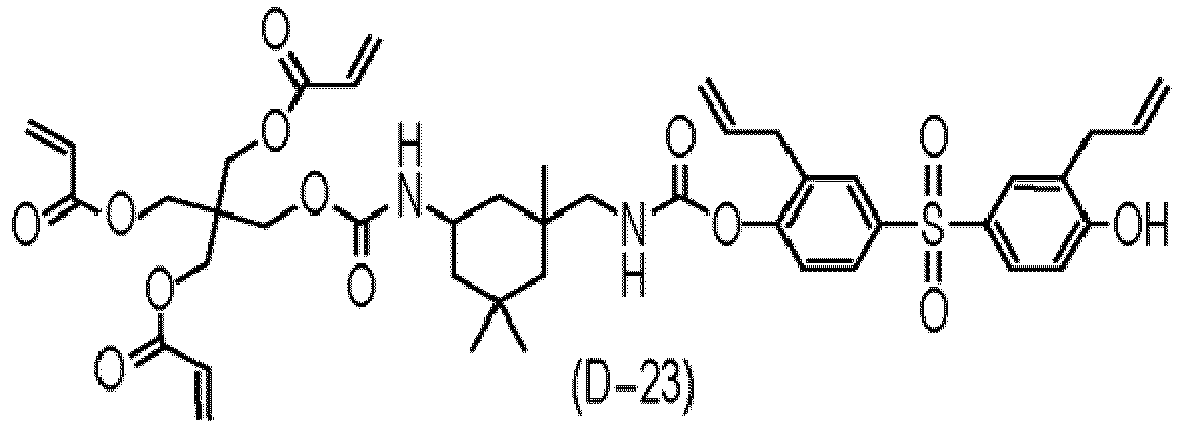


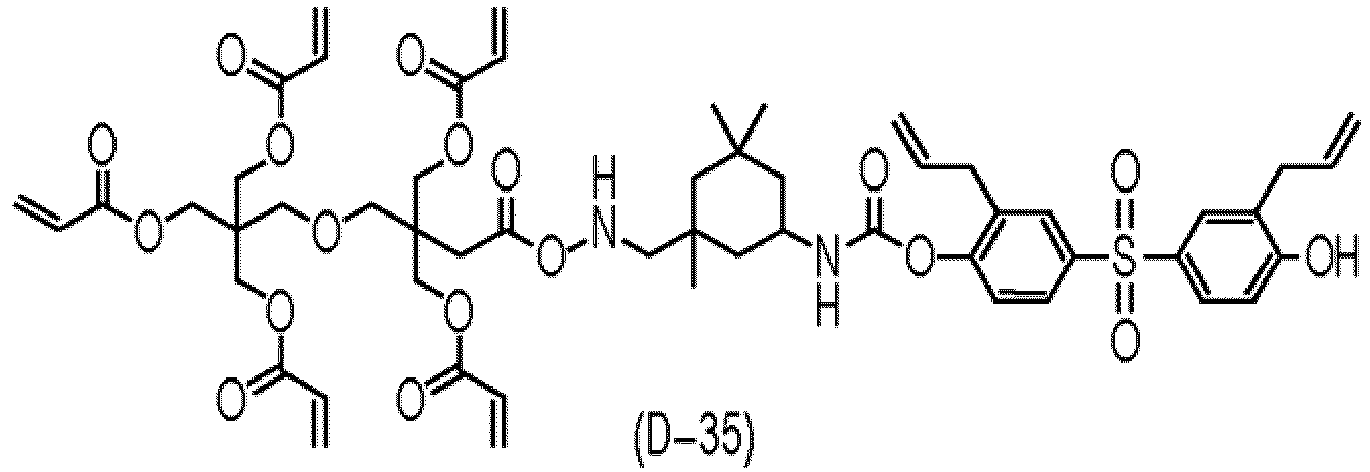


- For a much more efficient curing reaction by ultraviolet radiation, the compound A represented by the formula (1) can be represented by the formula (3). In the formula (3), when X3 in the molecule of the (meth)acrylate compound A is a methylene group or a methylene group substituted with -O- (an ether bond), X3 improves the flexibility of the molecule, further accelerates the radical polymerization reaction, and can more efficiently promote the curing reaction.

- In the formula (3), R31 and R32 independently denote a hydrocarbon group having 1 to 8 carbon atoms,
- R33 denotes a hydrogen atom or a methyl group,
- X3 denotes a hydrocarbon group having 1 to 49 carbon atoms,
- a methylene group in the group denoted by X3 is optionally substituted with -O-, g and h independently denote an integer in the range of 0 to 4, and i denotes an integer in the range of 1 to 10.
- Specific examples of the compound A represented by the formula (3) include the following compounds (D-39) to (D-48).


- Next, the electron-accepting compound with a radical polymerizable group in the thermosensitive coloring layer is described below. The electron-accepting compound with a radical polymerizable group in the thermosensitive coloring layer may have any form and may be particles or a layer. For example, a thermosensitive coloring layer containing a layer of an electron-accepting compound with a radical polymerizable group can have a first layer containing an electron-donating dye precursor and a second layer containing the electron-accepting compound with a radical polymerizable group. The first layer containing the electron-donating dye precursor is hereinafter also referred to as an "electron-donating dye precursor layer" or a "leuco layer". The second layer containing the electron-accepting compound with a radical polymerizable group is hereinafter also referred to as an "electron-accepting compound layer with a radical polymerizable group" or a "developer layer".
- The thermosensitive coloring layer can contain particles containing an electron-accepting compound with a radical polymerizable group and a radical photopolymerization initiator. The particles containing an electron-accepting compound with a radical polymerizable group and a radical photopolymerization initiator can be prepared by any method, for example, by an O/W emulsion method. The radical photopolymerization initiator can be mixed in advance with the electron-accepting compound with a radical polymerizable group. The particles containing the electron-accepting compound with a radical polymerizable group and the radical photopolymerization initiator preferably have a particle size in the range of 10 to 1,000 nm, more preferably 50 to 300 nm. The particles with a particle size of 10 nm or more or even 50 nm or more can have high radical polymerization reactivity and improve the storage stability of an image. The particles with a particle size of 1,000 nm or less or even 300 nm or less can reduce unnecessary light scattering in the thermosensitive coloring layer and increase the image density. The term "particle size", as used herein, refers to the 50% particle size (D50) based on the volume distribution.
- The electron-accepting compound with a radical polymerizable group may be used alone or in combination. For efficient curing by ultraviolet radiation, the amount of the electron-accepting compound with a radical polymerizable group in the thermosensitive coloring layer is preferably 500% or more by mass, more preferably 1500% or more by mass, of the amount of the electron-donating dye precursor. The upper limit of the amount of the electron-accepting compound with a radical polymerizable group is not particularly limited but is preferably, for example, 5000% or less by mass of the amount of the electron-donating dye precursor.
- A compound A represented by the formula (1) can be obtained as a commercial product. A compound A that is not a commercial product can also be produced by a known synthesis method.
- For example, the compounds (D-6) to (D-38) can be produced by a reaction of at least one of the following compounds (a) to (c).
- Compound (a): A polyfunctional acrylate compound having at least one -OH or - COOH group in the molecule. Examples of commercial products include SR295 manufactured by Sartomer, SR399 manufactured by Sartomer, and ARONIX M510 manufactured by Toagosei Co., Ltd.
- Compound (b): A diisocyanate compound, such as hexamethylene diisocyanate
- (HDI), diphenylmethane diisocyanate (MDI), 1,5-pentamethylene diisocyanate (PDI), isophorone diisocyanate (IPDI), or toluene diisocyanate (TDI).
- Compound (c): An electron-accepting compound with a diphenyl sulfone backbone and two or more OH groups in the molecule. Examples of commercial products include TGSH(H) manufactured by Nippon Kayaku Co., Ltd. and BPS-24C manufactured by Nicca Chemical Co., Ltd.
- The compounds (D-39) to (D-48) can be produced, for example, by the scheme of the following method (i).
-

- In the formulae (3) to (5), R31 and R32 independently denote a hydrocarbon group having 1 to 8 carbon atoms,
- R33 denotes a hydrogen atom or a methyl group,
- X3 denotes a hydrocarbon group having 1 to 49 carbon atoms,
- a methylene group in the group denoted by X3 is optionally substituted with -O-, g and h independently denote an integer in the range of 0 to 4, and i denotes an integer in the range of 1 to 10.
- A compound represented by the formula (3) can be produced by adding a compound represented by the formula (5) to a compound represented by the formula (4) and by agitation for a predetermined time. A condensation reaction occurs between the -OH group in the compound represented by the formula (4) and the -NCO group in the compound represented by the formula (5).
- To react approximately 50% of the -OH group in the compound represented by the formula (4), the amount of the compound represented by the formula (5) to be added preferably ranges from 100% to 150% by mole of the compound represented by the formula (4).
- Although the method (i) may be performed without a solvent, the method (i) can be performed in the presence of a solvent to prevent rapid progress of the reaction. Any solvent that does not inhibit the reaction may be used. Examples of the solvent include esters, such as methyl acetate, ethyl acetate, and propyl acetate, ethers, such as diethyl ether, tetrahydrofuran, and dioxane, hydrocarbons, such as benzene, toluene, xylene, hexane, and heptane, and halogen-containing hydrocarbons, such as dichloromethane, dichloroethane, and chloroform. These solvents may be used alone or in combination. For a mixed solvent, the mixing ratio may be determined in accordance with the solubility of the solute. The amount of the solvent to be used may be appropriately determined and, in terms of reaction rate, can range from 100% to 1000% by mass of the compound represented by the formula (4).
- The method (i) is typically performed in the temperature range of 20°C to 100°C and is typically completed within 48 hours.
- Next, the compounds represented by the formulae (4) and (5) are described below. Examples of commercial products of the compound represented by the formula (4) include TGSH(H) manufactured by Nippon Kayaku Co., Ltd. and BPS-24C manufactured by Nicca Chemical Co., Ltd. Examples of commercial products of the compound represented by the formula (5) include Karenz BEI manufactured by Showa Denko K.K., Karenz AOI manufactured by Showa Denko K.K., Karenz MOI manufactured by Showa Denko K.K., and Karenz MOI-EG manufactured by Showa Denko K.K.
- The molecular structure of the synthesized compound represented by the formula (1) can be identified with a nuclear magnetic resonance spectrometer (NMR), an infrared spectrophotometer (IR), or a mass spectrometer (MS)
- The thermosensitive coloring layer may contain a storage stability improving agent. The storage stability improving agent in the thermosensitive coloring layer can further improve the storage stability of a colored image. Examples of the storage stability improving agent include phenolic compounds, such as 1,1,3-tris(2-methyl-4-hydroxy-5-cyclohexylphenyl)butane, 1,1,3-tris(2-methyl-4-hydroxy-5-tert-butylphenyl)butane, 1,1-bis(2-methyl-4-hydroxy-5-tert-butylphenyl)butane, 4,4'-[1,4-phenylenebis(1-methylethylidene)]bisphenol, and 4,4'-[1,3-phenylenebis(1-methylethylidene)]bisphenol; epoxy compounds, such as 4-benzyloxyphenyl-4'-(2-methyl-2,3-epoxypropyloxy)phenyl sulfone, 4-(2-methyl-1,2-epoxyethyl)diphenyl sulfone, and 4-(2-ethyl-1,2-epoxyethyl)diphenyl sulfone; and isocyanuric acid compounds, such as 1,3,5-tris(2,6-dimethylbenzyl-3-hydroxy-4-tert-butyl)isocyanuric acid.
- The thermosensitive coloring layer may contain a thermal sensitizer. The thermal sensitizer in the thermosensitive coloring layer can enhance recording sensitivity. Examples of the thermal sensitizers include stearamide, methoxycarbonyl-N-stearic acid benzamide, N-benzoyl stearamide, N-eicosanoic acid amide, ethylenebisstearamide, behenic acid amide, methylenebisstearamide, N-methylol stearamide, dibenzyl terephthalate, dimethyl terephthalate, dioctyl terephthalate, diphenyl sulfone, benzyl p-benzyloxybenzoate, phenyl 1-hydroxy-2-naphthoate, 2-naphthylbenzyl ether, m-terphenyl, p-benzylbiphenyl, di-p-chlorobenzyl oxalate, di-p-methylbenzyl oxalate, dibenzyl oxalate, p-tolyl biphenyl ether, di(p-methoxyphenoxyethyl) ether, 1,2-di(3-methylphenoxy)ethane, 1,2-di(4-methylphenoxy)ethane, 1,2-di(4-methoxyphenoxy)ethane, 1,2-di(4-chlorophenoxy)ethane, 1,2-diphenoxyethane, 1-(4-methoxyphenoxy)-2-(3-methylphenoxy)ethane, p-methylthiophenyl benzyl ether, 1,4-di(phenylthio)butane, p-acetotoluidide, p-acetophenetidide, N-acetoacetyl-p-toluidine, 1,2-diphenoxymethylbenzene, di(β-biphenylethoxy)benzene, p-di(vinyloxyethoxy)benzene, 1-isopropylphenyl-2-phenylethane, di-o-chlorobenzyl adipate, 1,2-bis(3,4-dimethylphenyl)ethane, 1,3-bis(2-naphthoxy)propane, diphenyl, and benzophenone. The thermal sensitizer content of the thermosensitive coloring layer may be an amount effective for thermal sensitization. More specifically, the thermal sensitizer content preferably ranges from 2% to 40% by mass, more preferably 5% to 25% by mass, of the total solid content of the thermosensitive coloring layer.
- Auxiliary agents, such as a storage stability improving agent and a thermal sensitizer, may be mixed in the form of fine particles dispersed in water (solid dispersed fine particles) with a coating liquid for forming the thermosensitive coloring layer. These auxiliary agents may be dissolved in a solvent and may be emulsified using a water-soluble polymer as an emulsifier. Furthermore, the storage stability improving agent and the thermal sensitizer may be contained in particles containing an electron-donating dye precursor and/or an electron-accepting compound.
- The thermosensitive coloring layer may contain a polymerization accelerator. The polymerization accelerator may be a benzoate compound or an amine compound.
- Examples of the benzoate compound and the amine compound include ethyl-4-(dimethylamino)-benzoate, ethylhexyl-4-dimethylaminobenzoate, methyl-o-benzoylbenzoate, 3-methylbutyl p-(dimethylamino)benzoate, ethyl N,N-dimethylaminobenzoate, isoamyl N,N-dimethylaminobenzoate, pentyl 4-dimethylaminobenzoate, triethylamine, and triethanolamine.
- The thermosensitive coloring layer may contain a sensitizer. The sensitizer may be any sensitizer that sensitizes the radical photopolymerization initiator by an electron transfer mechanism or an energy transfer mechanism. Examples of the sensitizer include aromatic poly-fused-ring compounds, such as anthracene, 9,10-dialkoxyanthracene, pyrene, and perylene; aromatic ketone compounds, such as acetophenone, benzophenone, thioxanthone, and Michler's ketone; and heterocyclic compounds, such as phenothiazine and N-aryl oxazolidinone. The sensitizer content of the thermosensitive coloring layer preferably ranges from 10% to 1000% by mass, more preferably 100% to 500% by mass, of the radical photopolymerization initiator content.
- To improve the electron transfer efficiency or the energy transfer efficiency between the sensitizer and the radical photopolymerization initiator, the thermosensitive coloring layer can contain a sensitizing auxiliary agent. Examples of the sensitizing auxiliary agent include naphthalene compounds, such as 1,4-dihydroxynaphthalene, 1,4-dimethoxynaphthalene, 1,4-diethoxynaphthalene, 4-methoxy-1-naphthol, and 4-ethoxy-1-naphthol; and benzene compounds, such as 1,4-dihydroxybenzene, 1,4-dimethoxybenzene, 1,4-diethoxybenzene, 1-methoxy-4-phenol, and 1-ethoxy-4-phenol. The sensitizing auxiliary agent content of the thermosensitive coloring layer preferably ranges from 10% to 1000% by mass, more preferably 50% to 500% by mass, of the sensitizer content.
- The thermosensitive coloring layer may contain a radical polymerization inhibitor. The radical photopolymerization initiator is slightly decomposed into a radical compound during storage of the thermosensitive recording medium. The radical compound may cause polymerization. Thus, the thermosensitive coloring layer can contain a radical polymerization inhibitor to prevent the polymerization.
- Examples of the radical polymerization inhibitor include phenolic compounds with a hydroxy group, quinones, such as methoquinone (hydroquinone monomethyl ether), hydroquinone, and 4-methoxy-1-naphthol, hindered amine antioxidants, 1,1-diphenyl-2-picrylhydrazyl free radical, N-oxyl free radical compounds, nitrogen-containing heterocyclic mercapto compounds, thioether antioxidants, hindered phenol antioxidants, ascorbic acids, zinc sulfate, thiocyanates, thiourea derivatives, various saccharides, phosphoric acid antioxidants, nitrites, sulfites, thiosulfates, hydroxylamine derivatives, aromatic amines, phenylenediamines, imines, sulfonamides, urea derivatives, oximes, polycondensates of dicyandiamides and polyalkylene polyamines, sulfur-containing compounds, such as phenothiazines, complexing agents based on tetraazaannulene (TAA), and hindered amines.
- Among these, the radical polymerization inhibitor can be a phenol, an N-oxyl free radical compound, a 1,1-diphenyl-2-picrylhydrazyl free radical, phenothiazine, quinone, or a hindered amine. The radical polymerization inhibitor can be an N-oxyl free radical compound. The radical polymerization inhibitor content of the thermosensitive coloring layer can range from 1 to 5,000 ppm of the radical polymerizable compound content.
- The thermosensitive coloring layer may contain a pigment with a high degree of whiteness with an average particle size of 10 µm or less. Such a pigment can improve the degree of whiteness of the thermosensitive coloring layer and improve the uniformity of an image. Examples of the pigment include inorganic pigments, such as calcium carbonate, magnesium carbonate, kaolin, clay, talc, calcined clay, silica, diatomaceous earth, synthetic aluminum silicate, zinc oxide, titanium oxide, aluminum hydroxide, barium sulfate, and surface-treated calcium carbonate and silica; and organic pigments, such as urea-formalin resins, styrene-methacrylic acid copolymer resins, and polystyrene resins. The pigment content of the thermosensitive coloring layer can be such that the color density of an image is not decreased. More specifically, the pigment content can be 50% or less by mass of the total solids of the thermosensitive coloring layer.
- The thermosensitive coloring layer may contain a binder as a constituent. If necessary, a crosslinking agent, a wax, a metallic soap, a color dye, a color pigment, and a fluorescent dye can be contained. Examples of the binder include poly(vinyl alcohol) and derivatives thereof; starch and derivatives thereof; cellulose derivatives, such as hydroxymethylcellulose, hydroxyethylcellulose, hydroxypropylcellulose, methylcellulose, and ethylcellulose; water-soluble polymeric materials, such as sodium polyacrylate, polyvinylpyrrolidone, acrylamide-acrylate copolymers, acrylamide-acrylate-methacrylate copolymers, styrene-maleic anhydride copolymers, isobutylenemaleic anhydride copolymers, casein, gelatin, and derivatives thereof; emulsions of poly(vinyl acetate), polyurethane, poly(acrylic acid), polyacrylate, vinyl chloride-vinyl acetate copolymers, poly(butyl methacrylate), and ethylene-vinyl acetate copolymers; and latexes of water-insoluble polymers, such as styrene-butadiene copolymers and styrene-butadiene-acrylic copolymers.
- A crosslinking agent in the thermosensitive coloring layer can improve the water resistance of the thermosensitive coloring layer. Examples of the crosslinking agent include organic compounds, for example, aldehyde compounds, such as glyoxal, polyamine compounds, such as polyethyleneimine, epoxy compounds, polyamide resins, melamine resins, glyoxylates, dimethylolurea compounds, aziridine compounds, and blocked isocyanate compounds; inorganic compounds, such as ammonium persulfate, iron (III) chloride, magnesium chloride, sodium tetraborate, and potassium tetraborate; and boric acid, boric acid triesters, boron polymers, hydrazide compounds, and glyoxylate salts. The crosslinking agent content of the thermosensitive coloring layer preferably ranges from 1% to 10% by mass of the total solids of the thermosensitive coloring layer.
- Examples of the wax include waxes, such as paraffin wax, carnauba wax, microcrystalline wax, polyolefin wax, and polyethylene wax; higher fatty acid amides, such as stearamide and ethylenebisstearamide; and higher fatty acid esters and derivatives thereof. Examples of the metal soap include higher fatty acid polyvalent metal salts, such as zinc stearate, aluminum stearate, calcium stearate, and zinc oleate.
- When the thermosensitive recording medium is a two-color thermosensitive recording medium, the thermosensitive coloring layer can contain a color dye or a color pigment with a color tone complementary to a low-temperature color tone. The color tone of the thermosensitive recording medium before and after image formation can be adjusted with such a color dye or a color pigment contained in the thermosensitive coloring layer. Furthermore, if necessary, the thermosensitive coloring layer can contain various auxiliary agents, such as an oil repellent agent, an antifoaming agent, and a viscosity modifier.
- The thermosensitive coloring layer can be formed, for example, by applying a coating liquid for a thermosensitive coloring layer containing water as a dispersion medium and containing the components of the thermosensitive coloring layer onto a supporting member to form a coating layer and then drying the coating layer. The amount of the coating liquid to be applied preferably ranges from 2 to 20 g/m2, more preferably 2 to 15 g/m2, particularly preferably 2 to 10 g/m2, on a dry mass basis.
- To prepare a particle containing an electron-accepting compound with a radical polymerizable group and a radical photopolymerization initiator, a surfactant can be used. Examples of the surfactant include anionic surfactants, such as sodium alkyl sulfonates, sodium alkylbenzene sulfonates, sodium dialkyl sulfosuccinates, and sodium alkyl carboxylates; nonionic surfactants, such as polyoxyethylene alkyl ethers, polyoxyethylene alkyl esters, polyoxyethylene polyoxypropylene glycol, sorbitan alkyl esters, polyoxyethylene sorbitan alkyl esters, glycerin alkyl esters, and polyoxyethylene hydrogenated castor oil; cationic surfactants, such as alkyl trimethylammonium chlorides, dialkyl dimethylammonium chlorides, and alkylbenzyl dimethylammonium chlorides; and amphoteric surfactants, such as alkyl betaines and alkyl dimethylamine oxides. Furthermore, polymeric surfactants, such as sodium salts of naphthalene sulfonic acid formalin condensates and sodium polyacrylate, can be used.
- It is also possible to use a radical polymerizable compound to which an ionic group, such as a sulfonic acid group, a carboxylic acid group, or an amino group, or a hydrophilic nonionic group, such as a polyoxyethylene group or a polyglyceryl group, is bonded to provide surface activity.
- To prepare the particle, a dispersing aid can also be used. Examples of the dispersing aid include water-soluble polymers, such as poly(vinyl alcohol) and modified products thereof, polyacrylamide and derivatives thereof, ethylene/vinyl acetate copolymers, styrene/maleic anhydride copolymers, ethylene/maleic anhydride copolymers, isobutylene/maleic anhydride copolymers, polyvinylpyrrolidone, ethylene/acrylic acid copolymers, vinyl acetate/acrylic acid copolymers, carboxymethylcellulose, methylcellulose, casein, gelatin, starch derivatives, gum arabic, and sodium alginate.
- The amount of the surfactant or the dispersing aid to be added preferably ranges from 0.1% to 10% by mass, more preferably 0.5% to 5% by mass, of the mass of each of the particle.
- When the thermosensitive coloring layer includes an electron-donating dye precursor layer (leuco layer) and an electron-accepting compound layer with a radical polymerizable group (developer layer), an intermediate layer can be provided between these layers. The intermediate layer may be formed of a water-soluble polymeric material or a water-insoluble polymer used in a known thermosensitive recording medium. Specific examples of the material constituting the intermediate layer include the materials for the binder constituting the thermosensitive coloring layer. Furthermore, the intermediate layer may contain, as auxiliary agents, particles with high porosity, such as silica and calcined kaolin, or an organic compound, such as a plastic pigment, hollow particles, foam, or a polyethylene wax with a glass transition point or a melting point.
- The intermediate layer can be formed, for example, by applying a coating liquid for an intermediate layer containing water as a dispersion medium and containing the components of the intermediate layer to form a coating layer and then drying the coating layer. The amount of the coating liquid to be applied preferably ranges from 1 to 40 g/m2, more preferably 2 to 10 g/m2, on a dry mass basis.
- Furthermore, an intermediate layer may also be provided between two thermosensitive coloring layers. The intermediate layer between thermosensitive coloring layers can contain an ultraviolet absorber. The ultraviolet absorber in the intermediate layer can control the ultraviolet transmittance of the intermediate layer to a desired value.
- The ultraviolet absorber may be a benzotriazole ultraviolet absorber, a triazine ultraviolet absorber, a benzophenone ultraviolet absorber, a cyanoacrylate ultraviolet absorber, a salicylic acid ultraviolet absorber, or titanium oxide.
- A protective layer can be provided on the thermosensitive coloring layer. The protective layer may be a protective layer used in a known thermosensitive recording medium. For example, the protective layer can contain a water-soluble polymeric material and particles. The water-soluble polymeric material and particles may be a material that can be contained in the thermosensitive coloring layer. Furthermore, a crosslinking agent can be added to provide the protective layer with water resistance.
- Microcapsules containing an ultraviolet absorber or solid dispersed fine particles of an ultraviolet absorber in the protective layer can greatly improve light resistance. In particular, microcapsules with a wall film formed of a polyurethane-polyurea resin or an amino-aldehyde resin have high heat resistance and good accompanying effects, such as prevention of sticking to a thermal head. Furthermore, microcapsules with a wall film formed of a polyurethane-polyurea resin or an amino-aldehyde resin have a lower refractive index than microcapsules with a wall film formed of another resin. Furthermore, such microcapsules are spherical, and even the addition of a large number of such microcapsules to the protective layer rarely causes a decrease in density due to diffused reflection of light.
- Furthermore, particles in the protective layer can prevent adhesion and sticking of dirt to a thermal head. The particles can preferably absorb at least 50 mL/100 g of oil. The particle content of the protective layer can be such that the color density is not decreased and, more specifically, is preferably 60% or less by mass of the total solids of the protective layer.
- The protective layer can be formed, for example, by applying a coating liquid for a protective layer containing water as a dispersion medium and containing the components of the protective layer onto the thermosensitive coloring layer to form a coating layer and then drying the coating layer. The amount of the coating liquid to be applied preferably ranges from 0.1 to 15 g/m2, more preferably 0.5 to 8 g/m2, on a dry mass basis.
- A resin layer formed of a resin cured by an electron beam or ultraviolet radiation can be provided on each of the thermosensitive coloring layer, the intermediate layer, and the protective layer. The resin to be cured by an electron beam may be a resin described in
Japanese Patent Laid-Open No. 58-177392 - A thermosensitive recording medium may be processed to have a higher function and a higher added value. For example, an adhesive, a remoistening adhesive agent, or a delayed-tack adhesive may be applied to the back surface to produce adhesive paper, remoistening adhesive paper, or delayed-tack paper. Furthermore, a function of thermal transfer paper, ink jet recording paper, carbonless paper, electrostatic recording paper, or xerography paper may be provided on the back surface to produce double-sided recording paper. Furthermore, a thermosensitive coloring layer may also be provided on the back surface to produce a double-sided thermosensitive recording medium. Furthermore, a back layer may be provided on the back surface of the thermosensitive recording medium to prevent permeation of oil or a plasticizer from the back surface, to control curling, or to prevent charging.
-
Fig. 1 is a cross-sectional view of a thermosensitive recording medium according to an embodiment of the present disclosure. Athermosensitive recording medium 100 inFig. 1 includes a sheet-like supportingmember 101. On one surface of the supportingmember 101, an electron-donatingdye precursor layer 102, anintermediate layer 103, an electron-acceptingcompound layer 104 with a radical polymerizable group, and aprotective layer 105 are laminated in this order. In a thermosensitive recording medium according to an embodiment of the present disclosure, the order of the electron-donatingdye precursor layer 102 and the electron-acceptingcompound layer 104 with a radical polymerizable group may be reversed, and theprotective layer 105 as illustrated inFig. 1 may be omitted. -
Fig. 2 is a cross-sectional view of a thermosensitive recording medium according to another embodiment of the present disclosure. Athermosensitive recording medium 200 inFig. 2 includes a sheet-like supportingmember 201 and includes an electron-donatingdye precursor layer 202, an electron-acceptingcompound layer 203 with a radical polymerizable group, and aprotective layer 204 laminated in this order on one surface of the supportingmember 201. In a thermosensitive recording medium according to an embodiment of the present disclosure, the order of the electron-donatingdye precursor layer 202 and the electron-acceptingcompound layer 203 with a radical polymerizable group may be reversed, and theprotective layer 204 as illustrated inFig. 2 may be omitted. - The supporting
members members members members - A coating film can be formed by applying or printing a thermosensitive coloring composition on the supporting
members - Next, an image-forming method according to the present disclosure is described. An image-forming method according to the present disclosure includes the step of heating the thermosensitive recording medium to form an image (an image forming step). The thermosensitive recording medium may be heated by any method, for example, a known heating method. In particular, from the perspective of downsizing an image-forming apparatus, the thermosensitive recording medium can be heated with a thermal head. More specifically, the thermosensitive recording medium can be heated by applying a heat pulse to the heated recording medium using a thermal head.
- The temperature of the heat pulse applied to the thermosensitive recording medium in the image forming step may range from 80°C to 120°C. While the thermosensitive recording medium is in contact with the thermal head, the heat pulse can be applied to the thermosensitive coloring layer of the thermosensitive recording medium to form a desired image. More specifically, heating by the heat pulse dissolves a radical polymerizable compound in the thermosensitive coloring layer. The dissolution of the radical polymerizable compound can bring the electron-donating dye precursor into contact with the electron-accepting compound and enables the thermosensitive coloring layer to develop color and form an image.
- The image-forming method can further include the step of irradiating the thermosensitive recording medium on which an image is formed with ultraviolet radiation to fix the thermosensitive coloring layer (a fixing step).
- In the fixing step, the thermosensitive recording medium on which an image is formed is irradiated with ultraviolet radiation. The ultraviolet radiation may have a wavelength at which a radical polymerization initiator in the thermosensitive coloring layer can react, for example, a wavelength in the range of 365 to 425 nm. The ultraviolet radiation can cause a polymerization reaction of the radical polymerizable compound and fix the thermosensitive coloring layer. Once the thermosensitive coloring layer is fixed, subsequently applied thermal energy corresponding to the coloring start temperature does not cause coloring of the thermosensitive coloring layer, and the formed image can maintain its color developability for extended periods. The term the "wavelength" of ultraviolet radiation, as used herein, refers to the peak wavelength of the ultraviolet radiation. The phrase "fix a thermosensitive coloring layer", as used herein, refers to fixing the coloring state of the thermosensitive coloring layer.
- The present disclosure can provide a thermosensitive recording medium that can prevent coloring due to heating after ultraviolet radiation even when the amount of ultraviolet radiation is small. The present disclosure can also provide an image-forming method using the thermosensitive recording medium.
- Although the present disclosure is further described below in the exemplary embodiments and comparative examples, the present disclosure is not limited to these exemplary embodiments within the gist of the present disclosure. Unless otherwise specified, "part(s)" and "%" with respect to the amount of component are based on mass.
- The compound (D-39), which is an exemplary compound of the electron-accepting compound with a radical polymerizable group, was produced by the following method.
- First, 55 parts of TGSH(H) (manufactured by Nippon Kayaku Co., Ltd.) was dissolved in 202 parts of ethyl acetate, and 43 parts of Karenz BEI (manufactured by Showa Denko K.K.) was added. The mixture was stirred at 55°C for 24 hours to prepare the compound (D-39).
- To confirm that the prepared compound had the structure of the compound (D-39), the following analyses (1) to (4) were performed after appropriate pretreatment.
-

-

- The analyses (1) and (2) show the formation of -NHCO- (a urethane bond).
-
- Liquid chromatography (LC) measurement conditions: Unison UK-Phenyl (particle size: 3 µm × 150 mm) column, 40°C, water/methanol = 40/60
- Mass spectrometry (MS) measurement conditions: ESI, Positive, 380°C
- The analysis results of (3) show that the molecular weight was the same as that of the compound (D-39).
- The analysis results of (4) show that the reaction decreased the -NCO (isocyanate group) peak of Karenz BEI (manufactured by Showa Denko K.K.).
- These analyses show that the compound had the structure of the compound (D-39).
- Liquids [A] to [D] were prepared in the following manner.
- Liquid [A]: A composition containing an electron-accepting compound with a radical polymerizable group
- Compound (D-39) 30 parts
- Radical photopolymerization initiator (Irgacure OXE01 manufactured by BASF Japan Ltd.) 8 parts
- Ethyl acetate 62 parts
- These materials were mixed and dissolved to prepare the liquid [A].
- Liquid [B]: A dispersion liquid of particles containing an electron-donating dye precursor
- Electron-donating dye precursor (BLUE 220, manufactured by Fukui Yamada Chemical Co., Ltd.) 3 parts
- Dispersant (Pelex NBL, manufactured by Kao Corporation) 0.3 parts
- Water 96.7 parts
- These materials were mixed and were ground and dispersed in a bead mill to prepare the liquid [B]. The particle size (D50) of the dispersion liquid of particles containing an electron-donating dye precursor was approximately 700 nm as measured with a particle size distribution measuring apparatus (Nanotrac, manufactured by Microtrac).
- Liquid [C]: A coating liquid for an intermediate layer
- · Poly(vinyl alcohol) (Kuraray Poval 5-88 manufactured by Kuraray Co., Ltd.) 10 parts
- · Water 90 parts
- These materials were mixed and dissolved to prepare the liquid [C].
- Liquid [D]: A kaolin dispersion liquid
- · Kaolin (HYDRAGLOSS 90, manufactured by KaMin, LLC) 59.5 parts
- · Dispersant (Aron T-50, manufactured by Toagosei Co., Ltd., solid content: 40%) 0.5 parts
- · Water 40 parts
- These materials were dispersed with a Cowles disperser for one hour to prepare the liquid [D].
- The liquid [B] was applied to a synthetic paper (YUPO manufactured by Yupo Corporation) 130 µm in thickness with a printability testing machine and was dried with a dryer. The coating amount of the liquid [B] after drying was 40.0 g/m2, and the coating amount of BLUE 220 was 1.2 g/m2. The liquid [C] was then applied with the printability testing machine and was dried with the dryer. The coating amount of the liquid [C] after drying was 0.2 g/m2. Subsequently, the liquid [A] was applied with the printability testing machine and was dried with the dryer to form a thermosensitive coloring layer. The coating amount of the liquid [A] after drying was 60.0 g/m2, and the amount of the compound (D-39) was 18.0 g/m2.
- 210 parts of a 10% aqueous solution of acetoacetyl-modified poly(vinyl alcohol) A, 80 parts of a 20% aqueous solution of acetoacetyl-modified poly(vinyl alcohol) B, 100 parts of the liquid [D], 5.6 parts of an aqueous dispersion of zinc stearate, and 2.5 parts of a polyethylene wax emulsion were prepared. These components were mixed and stirred to prepare a coating liquid for a protective layer. The acetoacetyl-modified poly(vinyl alcohol) A was "Gohsefimer Z-200" (trade name, degree of saponification: 99.4% by mole, average degree of polymerization: 1,000, degree of modification: 5% by mole, manufactured by The Nippon Synthetic Chemical Industry Co., Ltd.). The acetoacetyl-modified poly(vinyl alcohol) B was "Gohsefimer Z-100" (trade name, degree of saponification: 99.4% by mole, average degree of polymerization: 500, degree of modification: 5% by mole, manufactured by The Nippon Synthetic Chemical Industry Co., Ltd.). The aqueous dispersion of zinc stearate was "Hidorin Z-8-36" (trade name, manufactured by Chukyo Yushi Co., Ltd., solid content: 36%). The polyethylene wax emulsion was "Chemipearl W-400" (trade name, solid content: 40%, manufactured by Mitsui Chemicals, Inc.).
- The coating liquid for a protective layer was applied to the thermosensitive coloring layer such that the coating amount after drying was 1.5 g/m2 and was dried to form a protective layer. The surface of the protective layer was smoothed by supercalendering to prepare a thermosensitive recording medium. Exemplary Embodiments 2 to 16
- The electron-donating dye precursor, the radical photopolymerization initiator, and the electron-accepting compound with a radical polymerizable group used in Exemplary Embodiment 1 were changed as shown in Table 1 to prepare thermosensitive recording media of Exemplary Embodiments 2 to 16.
- Liquids [E] to [I] were prepared in the following manner.
- Liquid [E]: A composition containing an electron-accepting compound with a radical polymerizable group
- · Compound (D-39) 30 parts
- · Radical photopolymerization initiator (Irgacure OXE01 manufactured by BASF Japan Ltd.) 8 parts
- · Ethyl acetate 62 parts
- These materials were mixed and dissolved to prepare the liquid [E].
- Liquid [F]: A dispersion liquid of particles containing an electron-donating dye precursor
- Electron-donating dye precursor (BLUE 220, manufactured by Fukui Yamada Chemical Co., Ltd.) 3 parts
- Dispersant (Pelex NBL, manufactured by Kao Corporation) 0.3 parts
- Water 96.7 parts
- These materials were mixed and were ground and dispersed in a bead mill to prepare the liquid [F]. The particle size (D50) of the dispersion liquid of particles containing an electron-donating dye precursor was approximately 700 nm as measured with a particle size distribution measuring apparatus (Nanotrac, manufactured by Microtrac). Liquid [G]: A liquid containing a dispersant
- Dispersant (Pelex NBL, manufactured by Kao Corporation) 10 parts
-
Water 100 parts - These materials were mixed and dissolved to prepare the liquid [G].
Liquid [H]: A dispersion liquid of particles containing an electron-accepting compound with a radical polymerizable group - 50 parts of the liquid [E] and 50 parts of the liquid [G] were mixed and emulsified with an ultrasonic homogenizer (UH-600S, manufactured by SMT Co., Ltd.). Then, ethyl acetate was removed under reduced pressure with a rotary evaporator to prepare a dispersion liquid [H] of particles containing an electron-accepting compound with a radical polymerizable group. The particle size (D50) of the particles in the dispersion liquid of particles containing an electron-accepting compound with a radical polymerizable group was 160 nm as measured with a particle size distribution measuring apparatus (Nanotrack, manufactured by Microtrac).
- Liquid [I]: A kaolin dispersion liquid
- · Kaolin (HYDRAGLOSS 90, manufactured by KaMin, LLC) 59.5 parts
- · Dispersant (Aron T-50, manufactured by Toagosei Co., Ltd., solid content: 40%) 0.5 parts
- · Water 40 parts
- These materials were dispersed with a Cowles disperser for one hour to prepare the liquid [I].
- The liquid [F] was applied to a synthetic paper (YUPO manufactured by Yupo Corporation) 130 µm in thickness with the printability testing machine and was dried with the dryer. The coating amount of the liquid [F] after drying was 40.0 g/m2, and the coating amount of BLUE 220 was 1.2 g/m2. Subsequently, the liquid [H] was applied with the printability testing machine and was dried with the dryer to form a thermosensitive coloring layer. The coating amount of the liquid [H] after drying was 60.0 g/m2, and the amount of the compound (D-39) was 18.0 g/m2.
- 210 parts of a 10% aqueous solution of acetoacetyl-modified poly(vinyl alcohol) A, 80 parts of a 20% aqueous solution of acetoacetyl-modified poly(vinyl alcohol) B, 100 parts of the liquid [I], 5.6 parts of an aqueous dispersion of zinc stearate, and 2.5 parts of a polyethylene wax emulsion were prepared. These components were mixed and stirred to prepare a coating liquid for a protective layer. The acetoacetyl-modified poly(vinyl alcohol) A was "Gohsefimer Z-200" (trade name, degree of saponification: 99.4% by mole, average degree of polymerization: 1,000, degree of modification: 5% by mole, manufactured by The Nippon Synthetic Chemical Industry Co., Ltd.). The acetoacetyl-modified poly(vinyl alcohol) B was "Gohsefimer Z-100" (trade name, degree of saponification: 99.4% by mole, average degree of polymerization: 500, degree of modification: 5% by mole, manufactured by The Nippon Synthetic Chemical Industry Co., Ltd.). The aqueous dispersion of zinc stearate was "Hidorin Z-8-36" (trade name, manufactured by Chukyo Yushi Co., Ltd., solid content: 36%). The polyethylene wax emulsion was "Chemipearl W-400" (trade name, solid content: 40%, manufactured by Mitsui Chemicals, Inc.). The coating liquid for a protective layer was applied to the thermosensitive coloring layer such that the coating amount after drying was 1.5 g/m2 and was dried to form a protective layer. The surface of the protective layer was smoothed by supercalendering to prepare a thermosensitive recording medium.
- The coating liquid for a protective layer was applied to the thermosensitive coloring layer such that the coating amount after drying was 1.5 g/m2 and was dried to form a protective layer. The surface of the protective layer was smoothed by supercalendering to prepare a thermosensitive recording medium. Comparative Examples 1 to 4
- The electron-donating dye precursor, the radical photopolymerization initiator, and the electron-accepting compound with a radical polymerizable group used in Exemplary Embodiment 1 were changed as shown in Table 1 to prepare thermosensitive recording media of Comparative Examples 1 to 4.
- Liquids [J] to [M] were prepared in the following manner.
- Liquid [J]: A composition containing an electron-donating dye precursor
- Electron-donating dye precursor (BLUE 220, manufactured by Fukui Yamada Chemical Co., Ltd.) 3 parts
- Radical polymerizable compound (8KX-078, manufactured by Taisei Fine Chemical Co., Ltd.) 30 parts
- Radical photopolymerization initiator (Omnirad TPO, manufactured by IGM Resins) 9 parts
- Ethyl acetate 58 parts
- These materials were mixed and dissolved to prepare the liquid [J].
- Liquid [K]: A dispersion liquid of particles containing an electron-accepting compound
- Electron-accepting compound (TGSH(H), manufactured by Nippon Kayaku Co., Ltd.) 40 parts
- Dispersant (Pelex NBL, manufactured by Kao Corporation) 4 parts
- Water 56 parts
- These materials were mixed and were ground and dispersed in a bead mill to prepare the liquid [K]. The particle size (D50) of the dispersion liquid of particles containing an electron-accepting compound was approximately 700 nm as measured with a particle size distribution measuring apparatus (Nanotrac, manufactured by Microtrac).
- Liquid [L]: A coating liquid for an intermediate layer
- Poly(vinyl alcohol) (Kuraray Poval 5-88 manufactured by Kuraray Co., Ltd.) 10 parts
- Water 90 parts
- These materials were mixed and dissolved to prepare the liquid [L].
- Liquid [M]: A kaolin dispersion liquid
- · Kaolin (HYDRAGLOSS 90, manufactured by KaMin, LLC) 59.5 parts
- · Dispersant (Aron T-50, manufactured by Toagosei Co., Ltd., solid content: 40%) 0.5 parts
- · Water 40 parts
- These materials were dispersed with a Cowles disperser for one hour to prepare the liquid [M].
- The liquid [J] was applied to a synthetic paper (YUPO manufactured by Yupo Corporation) 130 µm in thickness with the printability testing machine and was dried with the dryer to evaporate ethyl acetate. The coating amount of the liquid [J] after drying was 40.0 g/m2, and the coating amount of BLUE 220 was 1.20 g/m2. The liquid [L] was then applied with the printability testing machine and was dried with the dryer. The coating amount of the liquid [L] after drying was 0.2 g/m2. The liquid [K] was then applied with the printability testing machine and was dried with the dryer. The coating amount of the liquid [K] after drying was 30.0 g/m2, and the amount of TGSH(H) was 12.0 g/m2.
- 210 parts of a 10% aqueous solution of acetoacetyl-modified poly(vinyl alcohol) A, 80 parts of a 20% aqueous solution of acetoacetyl-modified poly(vinyl alcohol) B, 100 parts of the liquid [M], 5.6 parts of an aqueous dispersion of zinc stearate, and 2.5 parts of a polyethylene wax emulsion were prepared. These components were mixed and stirred to prepare a coating liquid for a protective layer. The acetoacetyl-modified poly(vinyl alcohol) A was "Gohsefimer Z-200" (trade name, degree of saponification: 99.4% by mole, average degree of polymerization: 1,000, degree of modification: 5% by mole, manufactured by The Nippon Synthetic Chemical Industry Co., Ltd.). The acetoacetyl-modified poly(vinyl alcohol) B was "Gohsefimer Z-100" (trade name, degree of saponification: 99.4% by mole, average degree of polymerization: 500, degree of modification: 5% by mole, manufactured by The Nippon Synthetic Chemical Industry Co., Ltd.). The aqueous dispersion of zinc stearate was "Hidorin Z-8-36" (trade name, manufactured by Chukyo Yushi Co., Ltd., solid content: 36%). The polyethylene wax emulsion was "Chemipearl W-400" (trade name, solid content: 40%, manufactured by Mitsui Chemicals, Inc.).
- The coating liquid for a protective layer was applied to the thermosensitive coloring layer such that the coating amount after drying was 1.5 g/m2 and was dried to form a protective layer. The surface of the protective layer was smoothed by supercalendering to prepare a thermosensitive recording medium.
- A thermal head (KPE type, manufactured by Kyocera Corporation) was used to heat a 2 cm × 2 cm region on the surfaces of the thermosensitive recording media prepared in Exemplary Embodiments 1 to 17 and Comparative Examples 1 to 5 to form an image. The applied electric power and the pulse width of the thermal head were set such that the recording energy per unit area was 150 mJ/mm2. The optical density of the formed image was measured with a reflection densitometer (trade name "Xrite 530", manufactured by Sakata Inx Eng. Co., Ltd.). Table 2 shows the measurement results.
- As shown in Table 2, a comparison of the results of Exemplary Embodiments 1 to 12 and 17 with the results of Exemplary Embodiments 13 to 16 shows that the optical density is higher when the amount of the electron-accepting compound with a radical polymerizable group is 1500% or more by mass of the amount of the electron-donating dye precursor than when the amount is less than 1500% by mass.
- The thermosensitive recording media prepared in Exemplary Embodiments 1 to 17 and Comparative Examples 1 to 5 were irradiated once with ultraviolet radiation at a conveyor speed of 100 or 10 m/min using three ultraviolet radiation apparatuses (ME12-L61, manufactured by Eye Graphics Co., Ltd.) equipped with a metal halide lamp (120 W/cm). The integrated light quantity separately measured under the same conditions with an ultraviolet integrated light meter (C9536-01, manufactured by Hamamatsu Photonics K.K.) was 100 mJ/cm2 and 1,000 mJ/cm2, respectively.
- Subsequently, the thermal head (KPE type, manufactured by Kyocera Corporation) was used to form a 2 cm × 2 cm image on the thermosensitive recording media prepared in Exemplary Embodiments 1 to 17 and Comparative Examples 1 to 5 irradiated with ultraviolet radiation. The applied electric power and the pulse width were set such that the recording energy per unit area was 150 mJ/mm2. The optical density of the formed image was measured with a reflection densitometer (trade name "Xrite 530", manufactured by Sakata Inx Eng. Co., Ltd.). Table 2 shows a difference from the optical density of the synthetic paper (YUPO manufactured by Yupo) as "Δoptical density".
- As shown in Table 2, sufficient fixing was proved in Exemplary Embodiments 1 to 17 by the absolute values of Δoptical densities of the images after irradiation at the integrated light quantity of 100 or 1,000 mJ/cm2. More specifically, ultraviolet radiation even at a low integrated light quantity of 100 mJ/cm2 could prevent coloring due to heating after ultraviolet radiation.
- By contrast, in Comparative Examples 1 to 4, although phenolic compounds (D-49) and (D-50) are used as electron-accepting compounds with a radical polymerizable group, the Δoptical density at an integrated light quantity of 1,000 mJ/cm2 is 0.17 or more, which shows poorer coloring than Exemplary Embodiments 1 to 17. Furthermore, the Δoptical density at an integrated light quantity of 100 mJ/cm2 is 0.45 or more, which shows much poorer coloring than Exemplary Embodiments 1 to 17. In other words, coloring due to heating after ultraviolet radiation was much poorer at a lower integrated light quantity of 100 mJ/cm2.
- Furthermore, in Comparative Example 5, although an electron-accepting compound with no radical polymerizable group and a radical polymerizable compound are used instead of the electron-accepting compound with a radical polymerizable group, the Δoptical density is 0.18 at an integrated light quantity of 1,000 mJ/cm2 and 0.20 at an integrated light quantity of 100 mJ/cm2, which are slightly poorer coloring than Exemplary Embodiments 1 to 17.
Table 1: Configuration of thermosensitive recording medium Electron-accepting compound with a radical polymerizable group Electron-donating dye precurso r Radical photopolymerizatio n initiator Electron-accepting compound with no radical polymerizabl e group Radical polymerizabl e compound Compoun d No. Amount [mass% ] Exemplary embodiment 1 (D-39) 1500 C Irgacure OXE01 - - Exemplary embodiment 2 (D-39) 1500 M-1 Irgacure OXE01 - - Exemplary embodiment 3 (D-39) 1500 M-2 Irgacure OXE01 - - Exemplary embodiment 4 (D-39) 1500 Y Irgacure OXE01 - - Exemplary embodiment 5 (D-40) 1500 C Irgacure OXE01 - - Exemplary embodiment 6 (D-41) 1500 C Irgacure OXE01 - - Exemplary embodiment 7 (D-42) 1500 C Irgacure OXE01 - - Exemplary embodiment 8 (D-43) 1500 C Irgacure OXE01 - - Exemplary embodiment 9 (D-44) 1500 C Irgacure OXE01 - - Exemplary embodiment 10 (D-39) 2000 C Irgacure OXE01 - - Exemplary embodiment 11 (D-39) 1500 C Omnirad TPO - - Exemplary embodiment 12 (D-39) 1500 C Omnirad 819 - - Exemplary embodiment 13 (D-39) 800 C Omnirad TPO - - Exemplary embodiment 14 (D-39) 1000 C Omnirad TPO - - Exemplary embodiment 15 (D-1) 1000 C Omnirad TPO - - Exemplary embodiment 16 (D-2) 1000 C Omnirad TPO - - Exemplary embodiment 17 (D-39) 1500 C Irgacure OXE01 - - Comparative example 1 (D-49) 1500 C Omnirad TPO - - Comparative example 2 (D-49) 2000 C Omnirad TPO - - Comparative example 3 (D-50) 1500 C Omnirad TPO - - Comparative example 4 (D-50) 2000 C Omnirad TPO - - Comparative example 5 - - C Omnirad TPO TGSH(H) 8KX-078 Table 2: Evaluation results Color developability (Optical density) UV fixability (Δoptical density) Integrated light quantity 100mJ/cm2 Integrated light quantity 1000mJ/cm2 Exemplary embodiment 1 1.80 0.01 0.01 Exemplary embodiment 2 1.80 0.02 0.02 Exemplary embodiment 3 1.80 0.02 0.02 Exemplary embodiment 4 1.80 0.01 0.01 Exemplary embodiment 5 1.80 0.02 0.02 Exemplary embodiment 6 1.80 0.02 0.02 Exemplary embodiment 7 1.80 0.01 0.01 Exemplary embodiment 8 1.80 0.02 0.02 Exemplary embodiment 9 1.80 0.01 0.01 Exemplary embodiment 10 1.90 0.02 0.02 Exemplary embodiment 11 1.80 0.10 0.08 Exemplary embodiment 12 1.80 0.10 0.07 Exemplary embodiment 13 1.15 0.10 0.08 Exemplary embodiment 14 1.20 0.10 0.07 Exemplary embodiment 15 1.20 0.15 0.12 Exemplary embodiment 16 1.20 0.15 0.12 Exemplary embodiment 17 1.80 0.01 0.01 Comparative example 1 1.80 0.55 0.25 Comparative example 2 1.90 0.48 0.18 Comparative example 3 1.80 0.50 0.24 Comparative example 4 1.90 0.45 0.17 Comparative example 5 1.87 0.20 0.18 - The electron-accepting compounds with a radical polymerizable group (D-39) to (D-44) in Table 1 are the same as the exemplary compounds (D-39) to (D-44) of the electron-accepting compound with a radical polymerizable group described above.
- Table 3 shows the structures of electron-accepting compounds with a radical polymerizable group other than (D-39) to (D-44) shown in Table 1.
Table 3: Type of electron-accepting compound with radical polymerizable group used in comparative examples Structure (D-49) 
(D-50) 
- Table 4 shows the details of the electron-donating dye precursors shown in Table 1.
Table 4: Type of electron-donating dye precursor Product name Manufacturer C BLUE220 Fukui Yamada Chemical Co., Ltd. M-1 RED500 Fukui Yamada Chemical Co., Ltd. M-2 RED40 Fukui Yamada Chemical Co., Ltd. Y YELLOW435 Fukui Yamada Chemical Co., Ltd. - Table 5 shows the details of the radical photopolymerization initiators shown in Table 1.
Table 5: Type of radical photopolymerization initiator Product name Manufacturer Compound name Irgacure OXE01 BASF Japan Ltd. Ketoxime compound Omnirad TPO IGM Resins B.V. Acylphosphine oxide compound Omnirad 819 IGM Resins B.V. Acylphosphine oxide compound - Table 6 shows the details of the electron-accepting compound with no radical polymerizable group shown in Table 1.
Table 6: Type of electron-accepting compound with no radical polymerizable group used in comparative example Product name Manufacturer TGSH(H) Nippon Kayaku Co., Ltd. - Table 7 shows the details of the radical polymerizable compound shown in Table 1.
Table 7: Type of radical polymerizable compound used in comparative example Product name Manufacturer 8KX-078 Taisei Fine Chemical Co., Ltd. - While the present disclosure has been described with reference to exemplary embodiments, it is to be understood that the disclosure is not limited to the disclosed exemplary embodiments. The scope of the following claims is to be accorded the broadest interpretation so as to encompass all such modifications and equivalent structures and functions.
Claims (9)
- A thermosensitive recording medium comprising: a thermosensitive coloring layer containing an electron-donating dye precursor, a radical photopolymerization initiator, and an electron-accepting compound with a radical polymerizable group,wherein the electron-accepting compound with a radical polymerizable group includes a compound A represented by the formula (1):
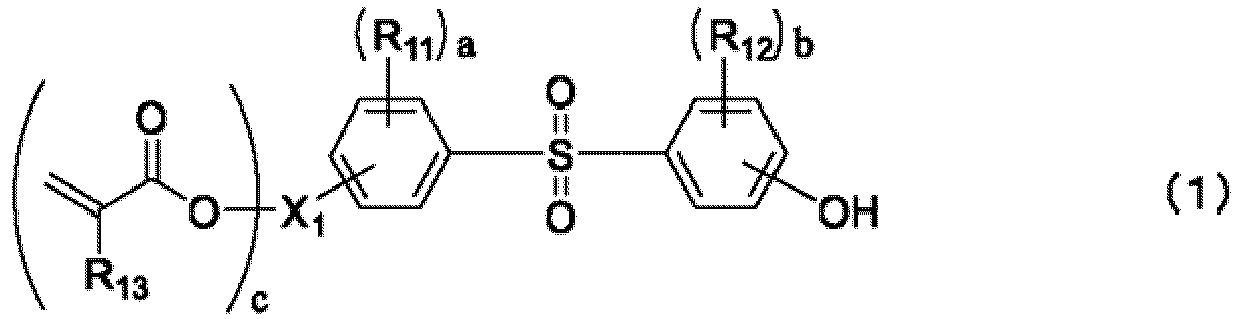 wherein R11 and R12 independently denote a hydrocarbon group having 1 to 8 carbon atoms,R13 denotes a hydrogen atom or a methyl group,X1 denotes a single bond or a hydrocarbon group having 1 to 50 carbon atoms,a methylene group in the group denoted by X1 is optionally substituted with a heterocycle, -NHCOO-, -NHCO-, -O-, -CO-, -COO-, or -NR14-,R14 denotes a hydrogen atom or a hydrocarbon group having 1 to 8 carbon atoms,a and b independently denote an integer in the range of 0 to 4, andc denotes an integer in the range of 1 to 10.
 - The thermosensitive recording medium according to Claim 1, wherein the compound A is represented by the formula (2):
 wherein R21 and R22 independently denote a hydrocarbon group having 1 to 8 carbon atoms,R23 denotes a hydrogen atom or a methyl group,X2 denotes a hydrocarbon group having 1 to 49 carbon atoms,a methylene group in the group denoted by X2 is optionally substituted with - NHCOO-, -NHCO-, -O-, -CO-, -COO-, or -NR24-,R24 denotes a hydrogen atom or a hydrocarbon group having 1 to 8 carbon atoms,d and e independently denote an integer in the range of 0 to 4, andf denotes an integer in the range of 1 to 10.
 - The thermosensitive recording medium according to Claim 1 or 2, wherein the compound A is represented by the formula (3):
 wherein R31 and R32 independently denote a hydrocarbon group having 1 to 8 carbon atoms,R33 denotes a hydrogen atom or a methyl group,X3 denotes a hydrocarbon group having 1 to 49 carbon atoms,a methylene group in the group denoted by X3 is optionally substituted with -O-,g and h independently denote an integer in the range of 0 to 4, andi denotes an integer in the range of 1 to 10.
 - The thermosensitive recording medium according to any one of Claims 1 to 3, wherein an amount of the electron-accepting compound with a radical polymerizable group is 1500% or more by mass of an amount of the electron-donating dye precursor.
- The thermosensitive recording medium according to any one of Claims 1 to 4, wherein the radical photopolymerization initiator includes an oxime ester compound.
- The thermosensitive recording medium according to any one of Claims 1 to 5, wherein the thermosensitive coloring layer contains particles containing the electron-accepting compound with a radical polymerizable group and the radical photopolymerization initiator.
- An image-forming method comprising the step of heating the thermosensitive recording medium according to any one of Claims 1 to 6 to form an image.
- The image-forming method according to Claim 7, wherein the heating is performed by applying a heat pulse to the thermosensitive recording medium using a thermal head.
- The image-forming method according to Claim 7 or 8, further comprising the step of irradiating the thermosensitive recording medium on which the image is formed with ultraviolet radiation to fix the thermosensitive coloring layer.
Applications Claiming Priority (2)
| Application Number | Priority Date | Filing Date | Title |
|---|---|---|---|
| JP2020197404 | 2020-11-27 | ||
| JP2021171010A JP7764192B2 (en) | 2020-11-27 | 2021-10-19 | Thermal recording medium and image forming method |
Publications (1)
| Publication Number | Publication Date |
|---|---|
| EP4023454A1 true EP4023454A1 (en) | 2022-07-06 |
Family
ID=78725364
Family Applications (1)
| Application Number | Title | Priority Date | Filing Date |
|---|---|---|---|
| EP21209654.9A Withdrawn EP4023454A1 (en) | 2020-11-27 | 2021-11-22 | Thermosensitive recording medium and image-forming method |
Country Status (2)
| Country | Link |
|---|---|
| US (1) | US20220169060A1 (en) |
| EP (1) | EP4023454A1 (en) |
Citations (7)
| Publication number | Priority date | Publication date | Assignee | Title |
|---|---|---|---|---|
| JPS58177392A (en) | 1982-04-10 | 1983-10-18 | Kanzaki Paper Mfg Co Ltd | Heat-sensitive recording medium and manufacture thereof |
| JPH0372358A (en) | 1989-08-11 | 1991-03-27 | Fuji Photo Film Co Ltd | Photosensitive and thermosensitive recording material |
| JP2003012609A (en) | 2001-06-25 | 2003-01-15 | Fuji Photo Film Co Ltd | Polymerizable phenol derivative, photopolymerizable composition, and recording material |
| JP2018035369A (en) | 2014-01-31 | 2018-03-08 | 富士フイルム株式会社 | Inkjet ink composition for printing on building materials, inkjet ink set for printing on building materials, inkjet recording method, and decorative building materials |
| JP2018039265A (en) | 2017-10-05 | 2018-03-15 | セイコーエプソン株式会社 | Ink container and ink jet recording method |
| JP2020142513A (en) | 2019-02-28 | 2020-09-10 | キヤノン株式会社 | Thermosensitive recording body and image forming method |
| JP2020142512A (en) * | 2019-02-28 | 2020-09-10 | キヤノン株式会社 | Thermosensitive recording body and image forming method |
Family Cites Families (3)
| Publication number | Priority date | Publication date | Assignee | Title |
|---|---|---|---|---|
| JP4589192B2 (en) * | 2005-08-02 | 2010-12-01 | 富士フイルム株式会社 | THERMAL RECORDING MATERIAL, THERMAL RECORDING METHOD, AND THERMAL RECORDING MATERIAL MANUFACTURING METHOD |
| EP2075139B1 (en) * | 2007-12-28 | 2010-09-15 | FUJIFILM Corporation | Method of forming image by heat-sensitive transfer system |
| JP5954186B2 (en) * | 2013-01-10 | 2016-07-20 | 王子ホールディングス株式会社 | Multicolor thermosensitive recording material and method for coloring the multicolor thermosensitive recording material |
-
2021
- 2021-11-19 US US17/531,562 patent/US20220169060A1/en not_active Abandoned
- 2021-11-22 EP EP21209654.9A patent/EP4023454A1/en not_active Withdrawn
Patent Citations (7)
| Publication number | Priority date | Publication date | Assignee | Title |
|---|---|---|---|---|
| JPS58177392A (en) | 1982-04-10 | 1983-10-18 | Kanzaki Paper Mfg Co Ltd | Heat-sensitive recording medium and manufacture thereof |
| JPH0372358A (en) | 1989-08-11 | 1991-03-27 | Fuji Photo Film Co Ltd | Photosensitive and thermosensitive recording material |
| JP2003012609A (en) | 2001-06-25 | 2003-01-15 | Fuji Photo Film Co Ltd | Polymerizable phenol derivative, photopolymerizable composition, and recording material |
| JP2018035369A (en) | 2014-01-31 | 2018-03-08 | 富士フイルム株式会社 | Inkjet ink composition for printing on building materials, inkjet ink set for printing on building materials, inkjet recording method, and decorative building materials |
| JP2018039265A (en) | 2017-10-05 | 2018-03-15 | セイコーエプソン株式会社 | Ink container and ink jet recording method |
| JP2020142513A (en) | 2019-02-28 | 2020-09-10 | キヤノン株式会社 | Thermosensitive recording body and image forming method |
| JP2020142512A (en) * | 2019-02-28 | 2020-09-10 | キヤノン株式会社 | Thermosensitive recording body and image forming method |
Also Published As
| Publication number | Publication date |
|---|---|
| US20220169060A1 (en) | 2022-06-02 |
Similar Documents
| Publication | Publication Date | Title |
|---|---|---|
| JP7634941B2 (en) | Thermal recording medium and image forming method | |
| JP4464301B2 (en) | Thermal recording material | |
| EP1535748B1 (en) | Thermal recording medium | |
| US20210380824A1 (en) | Thermosensitive recording medium and image forming method | |
| EP0776769A2 (en) | Thermal recording medium containing fatty acid amide | |
| EP4023454A1 (en) | Thermosensitive recording medium and image-forming method | |
| JP7764192B2 (en) | Thermal recording medium and image forming method | |
| KR100549037B1 (en) | New colorants and recording materials | |
| JP2022040036A (en) | Thermosensitive recording medium and image forming method | |
| JP7718908B2 (en) | Thermal recording medium and image forming method | |
| JP2023154230A (en) | Thermal recording body and image formation method | |
| JP2023154231A (en) | Thermal recording body and image formation method | |
| JP2023154229A (en) | Thermal recording body and image formation method | |
| JP2023154232A (en) | Thermal recording body and image formation method | |
| JP2024120491A (en) | Thermal recording medium, method for producing thermal recording medium, and image forming method | |
| JP2022040034A (en) | Thermosensitive recording medium and image forming method | |
| WO2022045186A1 (en) | Heat-sensitive recording body and image formation method | |
| JP2000025336A (en) | Reversible thermosensitive recording medium | |
| JP5772679B2 (en) | Multicolor thermal recording material | |
| JP2022040035A (en) | Thermal recording body and image forming method | |
| WO2022045189A1 (en) | Heat-sensitive recording body and image formation method | |
| JP2022040033A (en) | Thermal recording body and image forming method | |
| JP2002332271A (en) | New color formers and recording materials | |
| WO2022045191A1 (en) | Heat-sensitive recording body and image forming method | |
| JP2002144746A (en) | New color formers and recording materials |
Legal Events
| Date | Code | Title | Description |
|---|---|---|---|
| PUAI | Public reference made under article 153(3) epc to a published international application that has entered the european phase |
Free format text: ORIGINAL CODE: 0009012 |
|
| STAA | Information on the status of an ep patent application or granted ep patent |
Free format text: STATUS: THE APPLICATION HAS BEEN PUBLISHED |
|
| AK | Designated contracting states |
Kind code of ref document: A1 Designated state(s): AL AT BE BG CH CY CZ DE DK EE ES FI FR GB GR HR HU IE IS IT LI LT LU LV MC MK MT NL NO PL PT RO RS SE SI SK SM TR |
|
| STAA | Information on the status of an ep patent application or granted ep patent |
Free format text: STATUS: THE APPLICATION HAS BEEN WITHDRAWN |
|
| 18W | Application withdrawn |
Effective date: 20221021 |