EP4023275A1 - Liquid for atomization - Google Patents
Liquid for atomization Download PDFInfo
- Publication number
- EP4023275A1 EP4023275A1 EP20857683.5A EP20857683A EP4023275A1 EP 4023275 A1 EP4023275 A1 EP 4023275A1 EP 20857683 A EP20857683 A EP 20857683A EP 4023275 A1 EP4023275 A1 EP 4023275A1
- Authority
- EP
- European Patent Office
- Prior art keywords
- atomization
- liquid
- section
- triglyceride
- weight
- Prior art date
- Legal status (The legal status is an assumption and is not a legal conclusion. Google has not performed a legal analysis and makes no representation as to the accuracy of the status listed.)
- Granted
Links
Images


Classifications
-
- A—HUMAN NECESSITIES
- A24—TOBACCO; CIGARS; CIGARETTES; SIMULATED SMOKING DEVICES; SMOKERS' REQUISITES
- A24F—SMOKERS' REQUISITES; MATCH BOXES; SIMULATED SMOKING DEVICES
- A24F40/00—Electrically operated smoking devices; Component parts thereof; Manufacture thereof; Maintenance or testing thereof; Charging means specially adapted therefor
- A24F40/05—Devices without heating means
-
- A—HUMAN NECESSITIES
- A24—TOBACCO; CIGARS; CIGARETTES; SIMULATED SMOKING DEVICES; SMOKERS' REQUISITES
- A24B—MANUFACTURE OR PREPARATION OF TOBACCO FOR SMOKING OR CHEWING; TOBACCO; SNUFF
- A24B15/00—Chemical features or treatment of tobacco; Tobacco substitutes, e.g. in liquid form
- A24B15/10—Chemical features of tobacco products or tobacco substitutes
- A24B15/16—Chemical features of tobacco products or tobacco substitutes of tobacco substitutes
- A24B15/167—Chemical features of tobacco products or tobacco substitutes of tobacco substitutes in liquid or vaporisable form, e.g. liquid compositions for electronic cigarettes
-
- A—HUMAN NECESSITIES
- A24—TOBACCO; CIGARS; CIGARETTES; SIMULATED SMOKING DEVICES; SMOKERS' REQUISITES
- A24B—MANUFACTURE OR PREPARATION OF TOBACCO FOR SMOKING OR CHEWING; TOBACCO; SNUFF
- A24B15/00—Chemical features or treatment of tobacco; Tobacco substitutes, e.g. in liquid form
- A24B15/18—Treatment of tobacco products or tobacco substitutes
- A24B15/28—Treatment of tobacco products or tobacco substitutes by chemical substances
- A24B15/30—Treatment of tobacco products or tobacco substitutes by chemical substances by organic substances
-
- A—HUMAN NECESSITIES
- A24—TOBACCO; CIGARS; CIGARETTES; SIMULATED SMOKING DEVICES; SMOKERS' REQUISITES
- A24B—MANUFACTURE OR PREPARATION OF TOBACCO FOR SMOKING OR CHEWING; TOBACCO; SNUFF
- A24B15/00—Chemical features or treatment of tobacco; Tobacco substitutes, e.g. in liquid form
- A24B15/18—Treatment of tobacco products or tobacco substitutes
- A24B15/28—Treatment of tobacco products or tobacco substitutes by chemical substances
- A24B15/30—Treatment of tobacco products or tobacco substitutes by chemical substances by organic substances
- A24B15/32—Treatment of tobacco products or tobacco substitutes by chemical substances by organic substances by acyclic compounds
-
- A—HUMAN NECESSITIES
- A24—TOBACCO; CIGARS; CIGARETTES; SIMULATED SMOKING DEVICES; SMOKERS' REQUISITES
- A24F—SMOKERS' REQUISITES; MATCH BOXES; SIMULATED SMOKING DEVICES
- A24F40/00—Electrically operated smoking devices; Component parts thereof; Manufacture thereof; Maintenance or testing thereof; Charging means specially adapted therefor
- A24F40/10—Devices using liquid inhalable precursors
Definitions
- the present invention relates to a liquid for atomization and more specifically to a liquid for atomization for a flavor inhaler, containing nicotine.
- a non-combustion flavor inhaler uses, as an aerosol source, glycerol, propylene glycol, or water, for example.
- Patent Literature (PTL) 1 discloses an electronic cigarette that heats a liquid material containing glycerin.
- PTL 2 discloses a non-combustion flavor inhaler including capsules that contain water, a triglyceride, and a flavor, where a user inhales the flavor inside the capsules by breaking the capsules. In this case, the triglyceride acts as a diluent for the flavor.
- PTL 3 discloses an inhibitor of peristalsis in gastrointestinal tract smooth muscle, containing water, a triglyceride, and an emulsifier but does not suggest anything about nicotine to be contained or flavor inhalation.
- an aerosol source In a non-heating type flavor inhaler that utilizes vibrations, such as ultrasonic vibrations, an aerosol source needs to have low viscosity in view of efficient aerosol generation, and thus, a water-based aerosol source is used.
- a water-based aerosol source is used.
- the present inventors found that when a water-based aerosol source is used, visible smoke exhibits low visibility and a short duration time compared with cases in which a glycerol- or propylene glycol-based aerosol source is used, and as a result, a user might not be fully satisfied.
- an object of the present invention is to provide a liquid for atomization that can form visible smoke exhibiting high visibility and a long persistent state of high visibility.
- the present inventors found that the object is attained by a liquid for atomization containing a water-based aerosol source, nicotine, a triglyceride, and an emulsifier. In other words, the object is attained by the present invention below.
- Embodiment 1 A liquid for atomization containing nicotine, a triglyceride, an emulsifier, and a water-based aerosol source.
- Embodiment 2 The liquid for atomization according to Embodiment 1, where the concentration of nicotine is 5 weight% or less in the liquid for atomization.
- Embodiment 3 The liquid for atomization according to Embodiment 1 or 2, where the concentration of the triglyceride is 10 weight% or less in the liquid for atomization.
- Embodiment 4 The liquid for atomization according to any of Embodiments 1 to 3, where the aerosol source contains 80 weight% or more of water in the aerosol source.
- Embodiment 5 The liquid for atomization according to any of Embodiments 1 to 4, where the liquid for atomization contains 70 weight% or more of water in the liquid.
- Embodiment 6 The liquid for atomization according to any of Embodiments 1 to 5, where the triglyceride has an aliphatic group that is derived from a fatty acid and that has a carbon number of 6 or more.
- Embodiment 7 The liquid for atomization according to any of Embodiments 1 to 6, further containing a flavor.
- Embodiment 8 A non-heating type flavor inhaler including a liquid storage section for storing the liquid for atomization according to Embodiments 1 to 7 and an atomization section for atomizing the liquid for atomization.
- the source of nicotine is not limited but is preferably derived from tobacco materials. Nicotine effectively enhances the visibility of visible smoke formed from a liquid for atomization and increases the duration time of a state in which the visibility of visible smoke is high. Meanwhile, when the concentration of nicotine is excessively high in a liquid for atomization, an unpleasant flavor results. In view of this, the concentration of nicotine in a liquid for atomization is preferably 0.1 to 5 weight% and more preferably 0.5 to 2 weight%.
- a triglyceride is a compound in which three hydroxy groups of glycerol are esterified with fatty acids and is represented by the following formula.
- R 1 to R 3 are aliphatic groups derived from fatty acids, and the carbon numbers are not limited. However, at least one of R 1 to R 3 is preferably a group having the carbon number of 6 or more, at least two of R 1 to R 3 are preferably groups having the carbon number of 6 or more, and all of R 1 to R 3 are more preferably groups having the carbon number of 6 or more.
- the upper limit of the carbon number is not limited but is preferably 12 or less. When the carbon number is excessively large, dispersion stability in a liquid decreases. In light of this, three aliphatic groups of a triglyceride preferably have the carbon number within the above-mentioned range.
- a triglyceride in which all of R 1 to R 3 are groups having the carbon number of 6 or more is also called a medium-chain triglyceride.
- Such a medium-chain triglyceride has a feature that a user does not feel the taste or flavor during smoking.
- the concentration of a triglyceride in a liquid for atomization is not limited. However, when the concentration of a triglyceride is excessively high, the viscosity of the liquid increases. This causes a problem in which the amount to be atomized decreases in a non-heating type flavor inhaler that utilizes vibrations, such as ultrasonic vibrations.
- the upper limit of the concentration in a liquid for atomization is preferably 10 weight% or less and more preferably 5 weight% or less. Meanwhile, the lower limit of the concentration is not limited but is preferably 1 weight% or more and more preferably 2 weight% or more.
- An emulsifier has an affinity with both water in a liquid for atomization and hydrophobic substances of nicotine and a triglyceride.
- any publicly known emulsifier can be used, and examples include anionic surfactants (sodium lauryl sulfate and alkyl ether carboxylates, for example), cationic surfactants (benzalkonium chloride, for example), amphoteric surfactants (lecithin, for example), and nonionic surfactants (polyglycerol fatty acid esters, sucrose fatty acid esters, calcium stearoyl lactylate, sorbitan fatty acid esters, propylene glycol fatty acid esters, polyoxyethylene alkyl ethers, polyoxyethylene sorbitan fatty acid esters, and saponins, for example).
- anionic surfactants sodium lauryl sulfate and alkyl ether carboxylates, for example
- cationic surfactants benzalkonium chloride
- the concentration of an emulsifier in a liquid for atomization is not limited but is preferably 2 weight% or less and more preferably 1 weight% or less.
- the lower limit of the concentration is not limited but is preferably 0.1 weight% or more and more preferably 0.2 weight% or more.
- a water-based aerosol source is used.
- the expression of "water-based” herein means that 70 weight% or more of water is contained in an aerosol source. Water preferably accounts for 80 weight% or more relative to the entire aerosol source. Exemplary aerosol sources other than water include glycerol and propylene glycol. The amount of these is preferably 30 weight% or less and more preferably 20 weight% or less in an aerosol source. Alternatively, an aerosol source may solely consist of water. Moreover, water preferably accounts for 70 weight% or more in a liquid for atomization. Since water preferably contains no impurity, deionized water or the like may be used.
- a liquid for atomization of the present invention may contain any flavor publicly known in the field concerned. Such a flavor is not limited, and examples include menthol.
- the amount may be a publicly known amount but is preferably 8 weight% or less and more preferably 5 weight% or less in a liquid for atomization.
- the lower limit of the concentration is not limited, and other components (flavor) need not be contained. In the present invention, such flavors do not include nicotine.
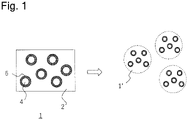
- a liquid for atomization 1 originally has a structure in which an oil droplet 4 of a hydrophobic substance (nicotine or a triglyceride) having a low vapor pressure is finely dispersed in a water-based aerosol source 2. Such oil droplets exist in a stable manner by means of an emulsifier 6. The liquid for atomization is then atomized to form an atomized product of aggregated particles 1'.
- the diameter of the particles 1' is 0.1 to 10 ⁇ m, and the diameter of oil droplets 4 present within each particle 1' is 0.01 to 1 ⁇ m.
- oil droplets 4 act as nuclei and suppress vaporization of the surrounding aerosol source 2. Further, due to the low vapor pressure, oil droplets 4 alone remain there without vaporization even after the aerosol source 2 is vaporized. Consequently, it is presumed that the visibility of visible smoke is enhanced and the duration time of such a high visibility state increases.
- a non-heating type flavor inhaler is an apparatus that makes a flavor component contained in a liquid for atomization inhalable and that includes a liquid storage section for storing the liquid for atomization and an atomization section for atomizing the liquid for atomization.
- the flavor inhaler is thus used in the state in which the liquid storage section is filled with the liquid for atomization.
- the atomization section may have a vibration generating mechanism that can apply vibration to the liquid for atomization. Such an atomization section having a vibration generating mechanism is preferable since atomization efficiency is high.
- the atomization section preferably does not have a heating mechanism. By including an atomization section that does not have a heating mechanism, a flavor component that is unsuitable for heating also becomes inhalable.
- a heating mechanism herein means a mechanism that can alone atomize a liquid for atomization. For example, the temperature of a liquid rises in some cases when vibration is applied by a vibration generating mechanism. In this case, however, such a vibration generating mechanism is not regarded as a heating mechanism.
- auxiliary heating mechanism herein means a heating mechanism that can heat a liquid for atomization but cannot alone atomize the liquid for atomization.
- exemplary auxiliary heating mechanisms include a heating mechanism that does not heat a liquid for atomization to its boiling point.
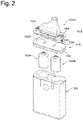
- Fig. 2 illustrates an embodiment of a non-heating type flavor inhaler.
- 1000 is a non-heating type flavor inhaler
- 1001D is a mouthpiece
- 1100 is an atomization section
- 1200A and 1200B are each a liquid storage section
- 1202 is a housing
- 1102 and 1104 are each an opening
- 1106 is a top surface cover of the atomization section
- 1107 is a bottom surface cover of the atomization section
- 1004 is a screw.
- the liquid storage sections 1200A and 1200B are placed in holding sections provided in the housing 1202, and to the top surfaces thereof, the atomization section 1100 and the mouthpiece 1001D are connected in this order using screws 1004.
- the atomization section 1100 is shielded with the top surface cover 1106 of the atomization section and the bottom surface cover 1107 of the atomization section.
- Fig. 3 illustrates, in the atomization section 1100, components disposed between the top surface cover 1106 of the atomization section and the bottom surface cover 1107 of the atomization section.
- the atomization section 1100 includes a PCB 1109, a piezoelectric element substrate 1031 equipped with an interdigital electrode 1033, and a pair of guide walls 1711A and 1711B.
- a top cover and a base component or the like may be disposed above and below these components, respectively.
- a sensor and/or a seal may be disposed, as necessary, between these components and the top cover.
- Fig. 4 illustrates the connection between the atomization section and the liquid storage section.
- the figure illustrates only the liquid storage section 1200A, but in fact, the liquid storage section 1200B is also connected with the atomization section 1100.
- the liquid storage section 1200A is connected with the atomization section 1100 such that a liquid discharge section provided on the top surface of the liquid storage section 1200A is in communication with a penetrating hole 1713A.
- Fig. 5 is an enlarged view of a portion of the atomization section 1100 illustrated in Fig. 3 . Specifically, Fig.
- FIG. 5 illustrates, from the atomization section 1100 illustrated in Fig. 3 , the PCB 1109, the piezoelectric element substrate 1031 equipped with the interdigital electrode 1033, the guide wall 1711A, a seal 1111, and a sensor 1070.
- the atomization section 1100 includes the piezoelectric element substrate 1031 equipped with the interdigital electrode 1033 and is configured to atomize a liquid by surface acoustic waves (SAWs) generated under application of voltage at a high frequency to the interdigital electrode 1033.
- SAWs surface acoustic waves
- a liquid for atomization inside the liquid storage sections 1200A and 1200B is atomized by surface acoustic waves, and the atomized product reaches the mouthpiece.
- the piezoelectric element substrate 1031 is configured to atomize a liquid by SAWs generated under application of voltage at a high frequency (resonance frequency) to the interdigital electrode 1033.
- the piezoelectric element substrate 1031 includes a piezoelectric body that expands and contracts by voltage application.
- a piezoelectric body any known piezoelectric body formed of, for example, ceramic, such as quartz, barium titanate, or lithium niobate, can be used.
- the interdigital electrode 1033 is electrically connected with a power source (not illustrated) provided inside the housing 1202 and is supplied with power.
- a power source not illustrated
- the interdigital electrode 1033 is formed of a gold-plated metal or the like.
- the piezoelectric element substrate 1031 has a pair of edges 1031A and 1031B that face each other.
- the guide wall 1711A is provided on the edge 1031A side of the piezoelectric element substrate 1031, and the guide wall 1711B is provided on the edge 1031B side.
- the guide walls 1711A and 1711B respectively have penetrating holes 1713A and 1713B that extend between the upper and lower surfaces.
- the guide walls 1711A and 1711B respectively have recesses 1714A and 1714B in communication with the penetrating holes 1713A and 1713B.
- the liquid storage sections 1200A and 1200B are respectively connected to the lower surfaces of the guide walls 1711A and 1711B.
- a liquid for atomization supplied from the liquid storage sections 1200A and 1200B by a syringe pump (not illustrated) passes through each penetrating hole 1713A or 1713B upward and reaches the recess 1714A or 1714B.
- the liquid that has reached the recess 1714A or 1714B then reaches the edge 1031A or 1031B of the piezoelectric element substrate 1031 and is atomized by the energy of the interdigital electrode 1033.
- the syringe pump is configured to supply the liquid for atomization to the edges 1031A and 1031B of the piezoelectric element substrate 1031.
- a non-heating type flavor inhaler like this is disclosed in PCT/JP 2019/015377 , for example.
- the figures illustrate an embodiment including two liquid storage sections, one liquid storage section may be included.
- a non-heating type flavor inhaler including an atomization section having a vibration generating mechanism that utilizes ultrasonic vibrations, for example, may be used as well.
- Such an atomization section is used in an ultrasonic nebulizer (for example, NE-U17 and NE-U22 from Omron Corporation) and so forth.
- a non-heating type flavor inhaler including an atomization section that uses a nozzle may also be used.
- Such an atomization section includes a liquid storage section, a nozzle for ejecting compressed air, and a suction tube that is provided adjacent to the nozzle and is in communication with the liquid for atomization holding section; and atomizes the liquid for atomization by pressure differences generated between the nozzle section and the suction tube when compressed air is ejected from the nozzle.
- Such an atomization section is used in a compressor nebulizer and so forth.
- the "non-heating type flavor inhaler" of the present invention may include a heating mechanism in portions excluding the atomization section.
- the flavor inhaler of Fig. 2 may be provided, around the liquid storage sections 1200A and 1200B, with a heating mechanism for heating a liquid or may be provided with a heating mechanism in the flow channel of the mouthpiece 1001D.
- a medium-chain triglyceride 5 g of Coconad ® MT (C 8 /C 10 triglyceride) from Kao Corporation, 5 g of an emulsifier (Emasol S-120V from Kao Corporation), 10 g of nicotine, and 480 g of water were mixed and emulsified with a homogenizer (Dostormix B DMM from Atech Japan). The obtained liquid was further emulsified with a high pressure homogenizer (Panda Plus 2000 from GEA Niro Soavi) at a pressure of 50 MPa to yield a liquid for atomization.
- a homogenizer Dostormix B DMM from Atech Japan
- FIG. 6 An apparatus as illustrated in Fig. 6 was prepared.
- 200 is a nebulizer (NE-U22 mesh nebulizer from Omron Corporation)
- 202 is a laser source
- 204 is a light receiving section
- 206 is a transparent chamber (5 cm ⁇ 5 cm ⁇ 24 cm)
- 208 is a tube.
- a liquid filling section of the nebulizer 200 was filled with the liquid for atomization, and smoke was generated through atomization. The smoke was sucked for 2 seconds at a rate of 55 mL/2 sec from the upper side of the chamber.
- the position 8.5 cm from the chamber bottom surface was irradiated with a laser from the start of sucking (0 second later) to measure light transmittance 5 seconds later in the center of the chamber 206.
- the light transmittance was assessed using Spraytec from Malvern Panalytical, which includes a laser source 202 and a light receiving section 204.
- the light transmittance of the chamber in the absence of smoke was set to 100%.
- the result is shown in Table 1.
- a lower light transmittance indicates higher visibility of visible smoke.
- light transmittance was continuously measured from the start of sucking (0 second later) to 30 seconds later to record the total time (T) for the light transmittance being 85% or less until 30 seconds later. The result is shown in Table 1.
- Example 2 An assessment was made in the same manner as Example 1 except for changing the concentration of a medium-chain triglyceride as shown in Table 1.
- Example 2 An assessment was made in the same manner as Example 1 except for using Coconad ® RK (Cs triglyceride) from Kao Corporation as a medium-chain triglyceride.
- Coconad ® RK Coconad ® RK (Cs triglyceride) from Kao Corporation as a medium-chain triglyceride.
- Example 2 An assessment was made in the same manner as Example 1 except for using MT-N (C 8 /C 10 triglyceride) from Kao Corporation as a medium-chain triglyceride.
- MT-N C 8 /C 10 triglyceride
- Example 2 An assessment was made in the same manner as Example 1 except for using Coconad ® ML (C 8 /C 10 /C 12 triglyceride) from Kao Corporation as a medium-chain triglyceride.
- Coconad ® ML C 8 /C 10 /C 12 triglyceride
- Example 1 An assessment was made in the same manner as Example 1 except for changing the composition of a liquid for atomization as shown in Table 1.
- Example Comparative Example 1 1) 2 1) 3 2) 4 3) 5 4) 1 2 Nicotine (weight%) 2 2 2 2 0 2 Triglyceride (weight%) 1 5 5 5 5 0 0 Emulsifier (weight%) 1 1 1 1 1 1 1 1 Water (weight%) 96 92 92 92 99 97 Light transmittance (%) 5 seconds later from the start of sucking 78.76 69.23 61.72 55.73 47.23 89.99 86.46 Total time (T) for light transmittance being 85% or less (sec) 6.02 16.46 12.62 18.69 22.9 3.92 4.09 1) Coconad ® MT 2) Coconad ® RK 3) MT-N 4) Coconad ® ML
- Comparative Examples 1 and 2 reveal that the presence of nicotine results in lowering in light transmittance (%) 5 seconds later from the start of sucking. In other words, nicotine effectively enhances the visibility of visible smoke. Moreover, the presence of nicotine results in an increased total time (T) for the light transmittance being 85% or less. In other words, nicotine effectively increases the duration time of a state in which the visibility of visible smoke is high (i.e. the state in which light transmittance is 85% or less).
- Example 1 and Comparative Example 2 reveal that the presence of a triglyceride results in lowering in light transmittance (%) 5 seconds later from the start of sucking.
- a triglyceride effectively enhances the visibility of visible smoke.
- the presence of a triglyceride results in an increased T mentioned above.
- a triglyceride effectively increases the duration time of a state in which the visibility of visible smoke is high (i.e. the state in which light transmittance is 85% or less).
- Example 1 and Comparative Example 1 reveal that the presence of both nicotine and a triglyceride results in significant lowering in light transmittance (%) 5 seconds later from the start of sucking.
- the presence of both nicotine and a triglyceride effectively and significantly enhances the visibility of visible smoke.
- the presence of both nicotine and a triglyceride results in a significantly increased T mentioned above.
- the presence of both nicotine and a triglyceride effectively and significantly increases the duration time of a state in which the visibility of visible smoke is high (i.e. the state in which light transmittance is 85% or less).
- the light transmittance (%) decreases and the above-mentioned T increases as the carbon numbers of aliphatic groups derived from fatty acids become larger.
Landscapes
- Chemical & Material Sciences (AREA)
- Chemical Kinetics & Catalysis (AREA)
- General Chemical & Material Sciences (AREA)
- Health & Medical Sciences (AREA)
- General Health & Medical Sciences (AREA)
- Toxicology (AREA)
- Medicinal Preparation (AREA)
- Pharmaceuticals Containing Other Organic And Inorganic Compounds (AREA)
- Manufacture Of Tobacco Products (AREA)
- Disinfection, Sterilisation Or Deodorisation Of Air (AREA)
Abstract
Description
- The present invention relates to a liquid for atomization and more specifically to a liquid for atomization for a flavor inhaler, containing nicotine.
- A non-combustion flavor inhaler uses, as an aerosol source, glycerol, propylene glycol, or water, for example. Patent Literature (PTL) 1, for example, discloses an electronic cigarette that heats a liquid material containing glycerin. Moreover,
PTL 2 discloses a non-combustion flavor inhaler including capsules that contain water, a triglyceride, and a flavor, where a user inhales the flavor inside the capsules by breaking the capsules. In this case, the triglyceride acts as a diluent for the flavor. As another liquid material containing a triglyceride, PTL 3 discloses an inhibitor of peristalsis in gastrointestinal tract smooth muscle, containing water, a triglyceride, and an emulsifier but does not suggest anything about nicotine to be contained or flavor inhalation. - Meanwhile, during the use of a non-combustion flavor inhaler, a user tends to be highly satisfied when the visibility of visible smoke is high and such a high visibility state of visible smoke persists (highly persistent). For this reason, there is a need for a non-combustion flavor inhaler that exhibits high visibility of visible smoke and that can maintain such a high visibility state.
-
- PTL 1:
Japanese Unexamined Patent Application Publication No. 2018-078902 - PTL 2:
U.S. Patent Application No. 2017/064995 - PTL 3:
Japanese Patent No. 4526120 - In a non-heating type flavor inhaler that utilizes vibrations, such as ultrasonic vibrations, an aerosol source needs to have low viscosity in view of efficient aerosol generation, and thus, a water-based aerosol source is used. However, the present inventors found that when a water-based aerosol source is used, visible smoke exhibits low visibility and a short duration time compared with cases in which a glycerol- or propylene glycol-based aerosol source is used, and as a result, a user might not be fully satisfied. In view of this, an object of the present invention is to provide a liquid for atomization that can form visible smoke exhibiting high visibility and a long persistent state of high visibility.
- The present inventors found that the object is attained by a liquid for atomization containing a water-based aerosol source, nicotine, a triglyceride, and an emulsifier. In other words, the object is attained by the present invention below.
- (Embodiment 1) A liquid for atomization containing nicotine, a triglyceride, an emulsifier, and a water-based aerosol source.
- (Embodiment 2) The liquid for atomization according to
Embodiment 1, where the concentration of nicotine is 5 weight% or less in the liquid for atomization. - (Embodiment 3) The liquid for atomization according to
Embodiment - (Embodiment 4) The liquid for atomization according to any of
Embodiments 1 to 3, where the aerosol source contains 80 weight% or more of water in the aerosol source. - (Embodiment 5) The liquid for atomization according to any of
Embodiments 1 to 4, where the liquid for atomization contains 70 weight% or more of water in the liquid. - (Embodiment 6) The liquid for atomization according to any of
Embodiments 1 to 5, where the triglyceride has an aliphatic group that is derived from a fatty acid and that has a carbon number of 6 or more. - (Embodiment 7) The liquid for atomization according to any of
Embodiments 1 to 6, further containing a flavor. - (Embodiment 8) A non-heating type flavor inhaler including a liquid storage section for storing the liquid for atomization according to
Embodiments 1 to 7 and an atomization section for atomizing the liquid for atomization. - (Embodiment 9) The non-heating type flavor inhaler according to Embodiment 8, where the atomization section has an atomizing mechanism by vibrations.
- According to the present invention, it is possible to provide a liquid for atomization that can form visible smoke exhibiting high visibility and a long persistent state of high visibility.
-
-
Fig. 1 schematically illustrates a liquid for atomization of the present invention and the atomized product thereof. -
Fig. 2 illustrates an embodiment of a non-heating type flavor inhaler of the present invention. -
Fig. 3 illustrates components disposed between the top surface cover and the bottom surface cover of an atomization section. -
Fig. 4 illustrates the connection between the atomization section and a liquid storage section. -
Fig. 5 is an enlarged view of a portion of the atomization section. -
Fig. 6 illustrates a method for measuring the duration time of visible smoke. - Hereinafter, the present invention will be described in detail. In the present invention, the expression of "X to Y" includes the lower and the upper limits of X and Y.
- The source of nicotine is not limited but is preferably derived from tobacco materials. Nicotine effectively enhances the visibility of visible smoke formed from a liquid for atomization and increases the duration time of a state in which the visibility of visible smoke is high. Meanwhile, when the concentration of nicotine is excessively high in a liquid for atomization, an unpleasant flavor results. In view of this, the concentration of nicotine in a liquid for atomization is preferably 0.1 to 5 weight% and more preferably 0.5 to 2 weight%.
- A triglyceride is a compound in which three hydroxy groups of glycerol are esterified with fatty acids and is represented by the following formula.

- R1 to R3 are aliphatic groups derived from fatty acids, and the carbon numbers are not limited. However, at least one of R1 to R3 is preferably a group having the carbon number of 6 or more, at least two of R1 to R3 are preferably groups having the carbon number of 6 or more, and all of R1 to R3 are more preferably groups having the carbon number of 6 or more. The upper limit of the carbon number is not limited but is preferably 12 or less. When the carbon number is excessively large, dispersion stability in a liquid decreases. In light of this, three aliphatic groups of a triglyceride preferably have the carbon number within the above-mentioned range. A triglyceride in which all of R1 to R3 are groups having the carbon number of 6 or more is also called a medium-chain triglyceride. Such a medium-chain triglyceride has a feature that a user does not feel the taste or flavor during smoking.
- The concentration of a triglyceride in a liquid for atomization is not limited. However, when the concentration of a triglyceride is excessively high, the viscosity of the liquid increases. This causes a problem in which the amount to be atomized decreases in a non-heating type flavor inhaler that utilizes vibrations, such as ultrasonic vibrations. In light of these, the upper limit of the concentration in a liquid for atomization is preferably 10 weight% or less and more preferably 5 weight% or less. Meanwhile, the lower limit of the concentration is not limited but is preferably 1 weight% or more and more preferably 2 weight% or more.
- An emulsifier has an affinity with both water in a liquid for atomization and hydrophobic substances of nicotine and a triglyceride. As an emulsifier, any publicly known emulsifier can be used, and examples include anionic surfactants (sodium lauryl sulfate and alkyl ether carboxylates, for example), cationic surfactants (benzalkonium chloride, for example), amphoteric surfactants (lecithin, for example), and nonionic surfactants (polyglycerol fatty acid esters, sucrose fatty acid esters, calcium stearoyl lactylate, sorbitan fatty acid esters, propylene glycol fatty acid esters, polyoxyethylene alkyl ethers, polyoxyethylene sorbitan fatty acid esters, and saponins, for example). The concentration of an emulsifier in a liquid for atomization is not limited but is preferably 2 weight% or less and more preferably 1 weight% or less. The lower limit of the concentration is not limited but is preferably 0.1 weight% or more and more preferably 0.2 weight% or more.
- In the present invention, a water-based aerosol source is used. The expression of "water-based" herein means that 70 weight% or more of water is contained in an aerosol source. Water preferably accounts for 80 weight% or more relative to the entire aerosol source. Exemplary aerosol sources other than water include glycerol and propylene glycol. The amount of these is preferably 30 weight% or less and more preferably 20 weight% or less in an aerosol source. Alternatively, an aerosol source may solely consist of water. Moreover, water preferably accounts for 70 weight% or more in a liquid for atomization. Since water preferably contains no impurity, deionized water or the like may be used.
- A liquid for atomization of the present invention may contain any flavor publicly known in the field concerned. Such a flavor is not limited, and examples include menthol. The amount may be a publicly known amount but is preferably 8 weight% or less and more preferably 5 weight% or less in a liquid for atomization. The lower limit of the concentration is not limited, and other components (flavor) need not be contained. In the present invention, such flavors do not include nicotine.
- The mechanism in which the liquid for atomization can enhance the visibility of visible smoke and increase the duration time of a state in which the visibility of visible smoke is high is not limited but is presumably as follows. As illustrated in
Fig. 1 , it is considered that a liquid foratomization 1 originally has a structure in which anoil droplet 4 of a hydrophobic substance (nicotine or a triglyceride) having a low vapor pressure is finely dispersed in a water-basedaerosol source 2. Such oil droplets exist in a stable manner by means of anemulsifier 6. The liquid for atomization is then atomized to form an atomized product of aggregated particles 1'. In an embodiment, the diameter of the particles 1' is 0.1 to 10 µm, and the diameter ofoil droplets 4 present within each particle 1' is 0.01 to 1 µm. In the particle 1',oil droplets 4 act as nuclei and suppress vaporization of thesurrounding aerosol source 2. Further, due to the low vapor pressure,oil droplets 4 alone remain there without vaporization even after theaerosol source 2 is vaporized. Consequently, it is presumed that the visibility of visible smoke is enhanced and the duration time of such a high visibility state increases. - A non-heating type flavor inhaler is an apparatus that makes a flavor component contained in a liquid for atomization inhalable and that includes a liquid storage section for storing the liquid for atomization and an atomization section for atomizing the liquid for atomization. The flavor inhaler is thus used in the state in which the liquid storage section is filled with the liquid for atomization. The atomization section may have a vibration generating mechanism that can apply vibration to the liquid for atomization. Such an atomization section having a vibration generating mechanism is preferable since atomization efficiency is high. The atomization section preferably does not have a heating mechanism. By including an atomization section that does not have a heating mechanism, a flavor component that is unsuitable for heating also becomes inhalable. A heating mechanism herein means a mechanism that can alone atomize a liquid for atomization. For example, the temperature of a liquid rises in some cases when vibration is applied by a vibration generating mechanism. In this case, however, such a vibration generating mechanism is not regarded as a heating mechanism.
- Further, the atomization section may have an auxiliary heating mechanism. The "auxiliary heating mechanism" herein means a heating mechanism that can heat a liquid for atomization but cannot alone atomize the liquid for atomization. Exemplary auxiliary heating mechanisms include a heating mechanism that does not heat a liquid for atomization to its boiling point.
-
Fig. 2 illustrates an embodiment of a non-heating type flavor inhaler. In the figure, 1000 is a non-heating type flavor inhaler, 1001D is a mouthpiece, 1100 is an atomization section, 1200A and 1200B are each a liquid storage section, 1202 is a housing, 1102 and 1104 are each an opening, 1106 is a top surface cover of the atomization section, 1107 is a bottom surface cover of the atomization section, and 1004 is a screw. Theliquid storage sections housing 1202, and to the top surfaces thereof, theatomization section 1100 and themouthpiece 1001D are connected in thisorder using screws 1004. As illustrated inFig. 2 , theatomization section 1100 is shielded with thetop surface cover 1106 of the atomization section and thebottom surface cover 1107 of the atomization section.Fig. 3 illustrates, in theatomization section 1100, components disposed between thetop surface cover 1106 of the atomization section and thebottom surface cover 1107 of the atomization section. As illustrated inFig. 3 , theatomization section 1100 includes aPCB 1109, apiezoelectric element substrate 1031 equipped with aninterdigital electrode 1033, and a pair ofguide walls Fig. 4 illustrates the connection between the atomization section and the liquid storage section. For simplicity, the figure illustrates only theliquid storage section 1200A, but in fact, theliquid storage section 1200B is also connected with theatomization section 1100. As illustrated inFig. 4 , theliquid storage section 1200A is connected with theatomization section 1100 such that a liquid discharge section provided on the top surface of theliquid storage section 1200A is in communication with a penetratinghole 1713A.Fig. 5 is an enlarged view of a portion of theatomization section 1100 illustrated inFig. 3 . Specifically,Fig. 5 illustrates, from theatomization section 1100 illustrated inFig. 3 , thePCB 1109, thepiezoelectric element substrate 1031 equipped with theinterdigital electrode 1033, theguide wall 1711A, aseal 1111, and asensor 1070. - The
atomization section 1100 includes thepiezoelectric element substrate 1031 equipped with theinterdigital electrode 1033 and is configured to atomize a liquid by surface acoustic waves (SAWs) generated under application of voltage at a high frequency to theinterdigital electrode 1033. A liquid for atomization inside theliquid storage sections - The
piezoelectric element substrate 1031 is configured to atomize a liquid by SAWs generated under application of voltage at a high frequency (resonance frequency) to theinterdigital electrode 1033. - The
piezoelectric element substrate 1031 includes a piezoelectric body that expands and contracts by voltage application. As the piezoelectric body, any known piezoelectric body formed of, for example, ceramic, such as quartz, barium titanate, or lithium niobate, can be used. - The
interdigital electrode 1033 is electrically connected with a power source (not illustrated) provided inside thehousing 1202 and is supplied with power. For example, theinterdigital electrode 1033 is formed of a gold-plated metal or the like. - The
piezoelectric element substrate 1031 has a pair ofedges guide wall 1711A is provided on theedge 1031A side of thepiezoelectric element substrate 1031, and theguide wall 1711B is provided on theedge 1031B side. Theguide walls holes 1713A and 1713B that extend between the upper and lower surfaces. In addition, theguide walls recesses holes 1713A and 1713B. As illustrated inFig. 4 , theliquid storage sections guide walls liquid storage sections hole 1713A or 1713B upward and reaches therecess recess edge piezoelectric element substrate 1031 and is atomized by the energy of theinterdigital electrode 1033. Here, the syringe pump is configured to supply the liquid for atomization to theedges piezoelectric element substrate 1031. - A non-heating type flavor inhaler like this is disclosed in
PCT/JP 2019/015377 - In addition to the flavor inhaler illustrated in
Fig. 2 , a non-heating type flavor inhaler including an atomization section having a vibration generating mechanism that utilizes ultrasonic vibrations, for example, may be used as well. Such an atomization section is used in an ultrasonic nebulizer (for example, NE-U17 and NE-U22 from Omron Corporation) and so forth. - Further, a non-heating type flavor inhaler including an atomization section that uses a nozzle may also be used. Such an atomization section includes a liquid storage section, a nozzle for ejecting compressed air, and a suction tube that is provided adjacent to the nozzle and is in communication with the liquid for atomization holding section; and atomizes the liquid for atomization by pressure differences generated between the nozzle section and the suction tube when compressed air is ejected from the nozzle. Such an atomization section is used in a compressor nebulizer and so forth.
- The "non-heating type flavor inhaler" of the present invention may include a heating mechanism in portions excluding the atomization section. For example, the flavor inhaler of
Fig. 2 may be provided, around theliquid storage sections mouthpiece 1001D. - As a medium-chain triglyceride, 5 g of Coconad® MT (C8/C10 triglyceride) from Kao Corporation, 5 g of an emulsifier (Emasol S-120V from Kao Corporation), 10 g of nicotine, and 480 g of water were mixed and emulsified with a homogenizer (Dostormix B DMM from Atech Japan). The obtained liquid was further emulsified with a high pressure homogenizer (Panda Plus 2000 from GEA Niro Soavi) at a pressure of 50 MPa to yield a liquid for atomization.
- An apparatus as illustrated in
Fig. 6 was prepared. In the figure, 200 is a nebulizer (NE-U22 mesh nebulizer from Omron Corporation), 202 is a laser source, 204 is a light receiving section, 206 is a transparent chamber (5 cm × 5 cm × 24 cm), and 208 is a tube. A liquid filling section of thenebulizer 200 was filled with the liquid for atomization, and smoke was generated through atomization. The smoke was sucked for 2 seconds at a rate of 55 mL/2 sec from the upper side of the chamber. The position 8.5 cm from the chamber bottom surface was irradiated with a laser from the start of sucking (0 second later) to measure light transmittance 5 seconds later in the center of thechamber 206. The light transmittance was assessed using Spraytec from Malvern Panalytical, which includes alaser source 202 and alight receiving section 204. Here, the light transmittance of the chamber in the absence of smoke was set to 100%. The result is shown in Table 1. A lower light transmittance indicates higher visibility of visible smoke. Moreover, light transmittance was continuously measured from the start of sucking (0 second later) to 30 seconds later to record the total time (T) for the light transmittance being 85% or less until 30 seconds later. The result is shown in Table 1. - An assessment was made in the same manner as Example 1 except for changing the concentration of a medium-chain triglyceride as shown in Table 1.
- An assessment was made in the same manner as Example 1 except for using Coconad® RK (Cs triglyceride) from Kao Corporation as a medium-chain triglyceride.
- An assessment was made in the same manner as Example 1 except for using MT-N (C8/C10 triglyceride) from Kao Corporation as a medium-chain triglyceride.
- An assessment was made in the same manner as Example 1 except for using Coconad® ML (C8/C10/C12 triglyceride) from Kao Corporation as a medium-chain triglyceride.
- An assessment was made in the same manner as Example 1 except for changing the composition of a liquid for atomization as shown in Table 1.
- An assessment was made in the same manner as Example 1 except for changing the composition of a liquid for atomization as shown in Table 1. These results are shown in Table 1.
[Table 1] Example Comparative Example 11) 21) 32) 43) 54) 1 2 Nicotine (weight%) 2 2 2 2 2 0 2 Triglyceride (weight%) 1 5 5 5 5 0 0 Emulsifier (weight%) 1 1 1 1 1 1 1 Water (weight%) 96 92 92 92 92 99 97 Light transmittance (%) 5 seconds later from the start of sucking 78.76 69.23 61.72 55.73 47.23 89.99 86.46 Total time (T) for light transmittance being 85% or less (sec) 6.02 16.46 12.62 18.69 22.9 3.92 4.09 1) Coconad® MT
2) Coconad® RK
3) MT-N
4) Coconad® ML - The results of Comparative Examples 1 and 2 reveal that the presence of nicotine results in lowering in light transmittance (%) 5 seconds later from the start of sucking. In other words, nicotine effectively enhances the visibility of visible smoke. Moreover, the presence of nicotine results in an increased total time (T) for the light transmittance being 85% or less. In other words, nicotine effectively increases the duration time of a state in which the visibility of visible smoke is high (i.e. the state in which light transmittance is 85% or less).
- The results of Example 1 and Comparative Example 2 reveal that the presence of a triglyceride results in lowering in light transmittance (%) 5 seconds later from the start of sucking. In other words, a triglyceride effectively enhances the visibility of visible smoke. Moreover, the presence of a triglyceride results in an increased T mentioned above. In other words, a triglyceride effectively increases the duration time of a state in which the visibility of visible smoke is high (i.e. the state in which light transmittance is 85% or less).
- The results of Example 1 and Comparative Example 1 reveal that the presence of both nicotine and a triglyceride results in significant lowering in light transmittance (%) 5 seconds later from the start of sucking. In other words, the presence of both nicotine and a triglyceride effectively and significantly enhances the visibility of visible smoke. Moreover, the presence of both nicotine and a triglyceride results in a significantly increased T mentioned above. In other words, the presence of both nicotine and a triglyceride effectively and significantly increases the duration time of a state in which the visibility of visible smoke is high (i.e. the state in which light transmittance is 85% or less). Further, it is evident from the comparison among Examples 2 to 5 that the light transmittance (%) decreases and the above-mentioned T increases as the carbon numbers of aliphatic groups derived from fatty acids become larger.
-
- 1 Liquid for atomization
- 1' Particle
- 2 Aerosol source
- 4 Oil droplet
- 6 Emulsifier
- 200 Nebulizer
- 202 Laser source
- 204 Light receiving section
- 206 Transparent chamber
- 208 Tube
- 1000 Non-heating type flavor inhaler
- 1001D Mouthpiece
- 1004 Screw
- 1033 Interdigital electrode
- 1031 Piezoelectric element substrate
- 1031A, B Edge
- 1100 Atomization section
- 1102, 1104 Opening
- 1106 Top surface cover of atomization section
- 1107 Bottom surface cover of atomization section
- 1109 PCB
- 1111 Seal
- 1200A, B Liquid storage section
- 1202 Housing
- 1711A, B Guide wall
- 1070 Sensor
- 1713A, B Penetrating hole
- 1714A, B Recess
Claims (9)
- A liquid for atomization comprising nicotine, a triglyceride, an emulsifier, and a water-based aerosol source.
- The liquid for atomization according to Claim 1, wherein the concentration of nicotine is 5 weight% or less in the liquid for atomization.
- The liquid for atomization according to Claim 1 or 2, wherein the concentration of the triglyceride is 10 weight% or less in the liquid for atomization.
- The liquid for atomization according to any of Claims 1 to 3, wherein the aerosol source contains 80 weight% or more of water in the aerosol source.
- The liquid for atomization according to any of Claims 1 to 4, wherein the liquid for atomization contains 70 weight% or more of water in the liquid.
- The liquid for atomization according to any of Claims 1 to 5, wherein the triglyceride has an aliphatic group that is derived from a fatty acid and that has a carbon number of 6 or more.
- The liquid for atomization according to any of Claims 1 to 6, further comprising a flavor.
- A non-heating type flavor inhaler comprising a liquid storage section for storing the liquid for atomization according to Claims 1 to 7 and an atomization section for atomizing the liquid for atomization.
- The non-heating type flavor inhaler according to Claim 8, wherein the atomization section has an atomizing mechanism by vibrations.
Applications Claiming Priority (2)
| Application Number | Priority Date | Filing Date | Title |
|---|---|---|---|
| JP2019158150A JP2022177327A (en) | 2019-08-30 | 2019-08-30 | liquid for atomization |
| PCT/JP2020/030150 WO2021039340A1 (en) | 2019-08-30 | 2020-08-06 | Liquid for atomization |
Publications (3)
| Publication Number | Publication Date |
|---|---|
| EP4023275A1 true EP4023275A1 (en) | 2022-07-06 |
| EP4023275A4 EP4023275A4 (en) | 2023-09-06 |
| EP4023275B1 EP4023275B1 (en) | 2025-11-26 |
Family
ID=74683447
Family Applications (1)
| Application Number | Title | Priority Date | Filing Date |
|---|---|---|---|
| EP20857683.5A Active EP4023275B1 (en) | 2019-08-30 | 2020-08-06 | Liquid for atomization |
Country Status (5)
| Country | Link |
|---|---|
| EP (1) | EP4023275B1 (en) |
| JP (1) | JP2022177327A (en) |
| CN (1) | CN114286627B (en) |
| TW (1) | TW202121994A (en) |
| WO (1) | WO2021039340A1 (en) |
Families Citing this family (3)
| Publication number | Priority date | Publication date | Assignee | Title |
|---|---|---|---|---|
| CN118076246A (en) | 2021-10-08 | 2024-05-24 | 日本烟草产业株式会社 | Liquid for atomization and method for producing the same |
| WO2024138377A1 (en) * | 2022-12-27 | 2024-07-04 | 思摩尔国际控股有限公司 | Atomization liquid, atomizer, and electronic atomization device |
| CN118266624A (en) * | 2023-10-17 | 2024-07-02 | 比亚迪精密制造有限公司 | Atomized liquid and preparation method thereof, and liquid storage part |
Family Cites Families (11)
| Publication number | Priority date | Publication date | Assignee | Title |
|---|---|---|---|---|
| DK174559B1 (en) | 2000-02-11 | 2003-06-02 | Danfoss As | System for measuring portions of fluid |
| US20080038363A1 (en) * | 2001-05-24 | 2008-02-14 | Zaffaroni Alejandro C | Aerosol delivery system and uses thereof |
| JP4526120B2 (en) | 2002-05-22 | 2010-08-18 | 日本製薬株式会社 | L-Menthol oil-in-water emulsion |
| HUE058753T2 (en) * | 2011-01-31 | 2022-09-28 | Avalyn Pharma Inc | Pirfenidone and pyridone analog compounds in aerosol form and their applications |
| CN103813726B (en) * | 2011-09-09 | 2018-01-05 | 菲利普莫里斯生产公司 | Include the smoking product of flavor delivery material |
| US9282772B2 (en) | 2012-01-31 | 2016-03-15 | Altria Client Services Llc | Electronic vaping device |
| GB2524856B (en) * | 2014-04-02 | 2021-04-07 | Twenty Sixteen 2016 Pharma Ltd | Pulmonary delivery devices |
| CN106455705A (en) * | 2014-01-22 | 2017-02-22 | 方特慕控股第私人有限公司 | Methods and devices for smoking urge relief |
| CA2956048C (en) * | 2014-07-31 | 2023-01-24 | Amorphical Ltd. | Encapsulated amorphous calcium carbonate compositions |
| KR20170108057A (en) * | 2015-01-23 | 2017-09-26 | 윌리엄 탄 | Ultrasonic evaporation element |
| JP6661598B2 (en) * | 2015-02-27 | 2020-03-11 | 日本たばこ産業株式会社 | Non-burning type flavor inhaler |
-
2019
- 2019-08-30 JP JP2019158150A patent/JP2022177327A/en active Pending
-
2020
- 2020-08-06 EP EP20857683.5A patent/EP4023275B1/en active Active
- 2020-08-06 CN CN202080059687.XA patent/CN114286627B/en active Active
- 2020-08-06 TW TW109126708A patent/TW202121994A/en unknown
- 2020-08-06 WO PCT/JP2020/030150 patent/WO2021039340A1/en not_active Ceased
Also Published As
| Publication number | Publication date |
|---|---|
| EP4023275A4 (en) | 2023-09-06 |
| TW202121994A (en) | 2021-06-16 |
| JP2022177327A (en) | 2022-12-01 |
| WO2021039340A1 (en) | 2021-03-04 |
| CN114286627A (en) | 2022-04-05 |
| CN114286627B (en) | 2024-02-02 |
| EP4023275B1 (en) | 2025-11-26 |
Similar Documents
| Publication | Publication Date | Title |
|---|---|---|
| EP4023274A1 (en) | Non-heating type flavor inhaler | |
| EP4023275B1 (en) | Liquid for atomization | |
| KR102515974B1 (en) | mist suction device | |
| TWI842756B (en) | Electronic device for producing an aerosol for inhalation by a person | |
| US11690963B2 (en) | Electronic device for producing an aerosol for inhalation by a person | |
| US11517685B2 (en) | Electronic device for producing an aerosol for inhalation by a person | |
| EP2218760A1 (en) | Aerosol-generating solution for aerosol aspirator | |
| US12501929B2 (en) | Electronic device for producing an aerosol for inhalation by a person | |
| EP3228345A1 (en) | Inhaler and liquid composition | |
| WO2021081009A1 (en) | Electronic devices for aerosolizing and inhaling liquid | |
| ES3017733T3 (en) | Ultrasonic mist inhaler | |
| JP2023506330A (en) | ultrasonic mist inhaler | |
| WO2006108556A2 (en) | Pharmaceutical aerosol composition | |
| EP1879603A1 (en) | Ejection liquid, ejection method, method for forming liquid droplets, liquid ejection cartridge and ejection apparatus | |
| EP4501138A1 (en) | Liquid-type inhalation formulation for use in surface wave atomizer, and cartridge and aerosol-generating apparatus comprising same | |
| CA3155363C (en) | Electronic devices for aerosolizing and inhaling liquid | |
| CN110623304A (en) | A Flavored Atomizer | |
| JP2008201685A (en) | Discharge liquid and discharge method |
Legal Events
| Date | Code | Title | Description |
|---|---|---|---|
| STAA | Information on the status of an ep patent application or granted ep patent |
Free format text: STATUS: THE INTERNATIONAL PUBLICATION HAS BEEN MADE |
|
| PUAI | Public reference made under article 153(3) epc to a published international application that has entered the european phase |
Free format text: ORIGINAL CODE: 0009012 |
|
| STAA | Information on the status of an ep patent application or granted ep patent |
Free format text: STATUS: REQUEST FOR EXAMINATION WAS MADE |
|
| 17P | Request for examination filed |
Effective date: 20220318 |
|
| AK | Designated contracting states |
Kind code of ref document: A1 Designated state(s): AL AT BE BG CH CY CZ DE DK EE ES FI FR GB GR HR HU IE IS IT LI LT LU LV MC MK MT NL NO PL PT RO RS SE SI SK SM TR |
|
| DAV | Request for validation of the european patent (deleted) | ||
| DAX | Request for extension of the european patent (deleted) | ||
| A4 | Supplementary search report drawn up and despatched |
Effective date: 20230808 |
|
| RIC1 | Information provided on ipc code assigned before grant |
Ipc: A24F 40/05 20200101ALI20230802BHEP Ipc: A24B 15/30 20060101ALI20230802BHEP Ipc: A24F 40/10 20200101ALI20230802BHEP Ipc: A24F 47/00 20200101ALI20230802BHEP Ipc: A24B 15/32 20060101ALI20230802BHEP Ipc: A24B 15/167 20200101ALI20230802BHEP Ipc: A61K 47/14 20170101ALI20230802BHEP Ipc: A61K 9/72 20060101ALI20230802BHEP Ipc: A61M 15/00 20060101ALI20230802BHEP Ipc: A61M 11/00 20060101AFI20230802BHEP |
|
| GRAP | Despatch of communication of intention to grant a patent |
Free format text: ORIGINAL CODE: EPIDOSNIGR1 |
|
| STAA | Information on the status of an ep patent application or granted ep patent |
Free format text: STATUS: GRANT OF PATENT IS INTENDED |
|
| INTG | Intention to grant announced |
Effective date: 20250620 |
|
| GRAS | Grant fee paid |
Free format text: ORIGINAL CODE: EPIDOSNIGR3 |
|
| GRAA | (expected) grant |
Free format text: ORIGINAL CODE: 0009210 |
|
| STAA | Information on the status of an ep patent application or granted ep patent |
Free format text: STATUS: THE PATENT HAS BEEN GRANTED |
|
| AK | Designated contracting states |
Kind code of ref document: B1 Designated state(s): AL AT BE BG CH CY CZ DE DK EE ES FI FR GB GR HR HU IE IS IT LI LT LU LV MC MK MT NL NO PL PT RO RS SE SI SK SM TR |
|
| REG | Reference to a national code |
Ref country code: CH Ref legal event code: F10 Free format text: ST27 STATUS EVENT CODE: U-0-0-F10-F00 (AS PROVIDED BY THE NATIONAL OFFICE) Effective date: 20251126 Ref country code: GB Ref legal event code: FG4D |
|
| REG | Reference to a national code |
Ref country code: DE Ref legal event code: R096 Ref document number: 602020062943 Country of ref document: DE |
|
| REG | Reference to a national code |
Ref country code: IE Ref legal event code: FG4D |
|
| REG | Reference to a national code |
Ref country code: NL Ref legal event code: MP Effective date: 20251126 |
|
| PG25 | Lapsed in a contracting state [announced via postgrant information from national office to epo] |
Ref country code: ES Free format text: LAPSE BECAUSE OF FAILURE TO SUBMIT A TRANSLATION OF THE DESCRIPTION OR TO PAY THE FEE WITHIN THE PRESCRIBED TIME-LIMIT Effective date: 20251126 |
|
| REG | Reference to a national code |
Ref country code: LT Ref legal event code: MG9D |
|
| PG25 | Lapsed in a contracting state [announced via postgrant information from national office to epo] |
Ref country code: NO Free format text: LAPSE BECAUSE OF FAILURE TO SUBMIT A TRANSLATION OF THE DESCRIPTION OR TO PAY THE FEE WITHIN THE PRESCRIBED TIME-LIMIT Effective date: 20260226 |
|
| PG25 | Lapsed in a contracting state [announced via postgrant information from national office to epo] |
Ref country code: HR Free format text: LAPSE BECAUSE OF FAILURE TO SUBMIT A TRANSLATION OF THE DESCRIPTION OR TO PAY THE FEE WITHIN THE PRESCRIBED TIME-LIMIT Effective date: 20251126 Ref country code: FI Free format text: LAPSE BECAUSE OF FAILURE TO SUBMIT A TRANSLATION OF THE DESCRIPTION OR TO PAY THE FEE WITHIN THE PRESCRIBED TIME-LIMIT Effective date: 20251126 Ref country code: AT Free format text: LAPSE BECAUSE OF FAILURE TO SUBMIT A TRANSLATION OF THE DESCRIPTION OR TO PAY THE FEE WITHIN THE PRESCRIBED TIME-LIMIT Effective date: 20251126 |
|
| REG | Reference to a national code |
Ref country code: AT Ref legal event code: MK05 Ref document number: 1860482 Country of ref document: AT Kind code of ref document: T Effective date: 20251126 |
|
| PG25 | Lapsed in a contracting state [announced via postgrant information from national office to epo] |
Ref country code: NL Free format text: LAPSE BECAUSE OF FAILURE TO SUBMIT A TRANSLATION OF THE DESCRIPTION OR TO PAY THE FEE WITHIN THE PRESCRIBED TIME-LIMIT Effective date: 20251126 |
|
| PG25 | Lapsed in a contracting state [announced via postgrant information from national office to epo] |
Ref country code: RS Free format text: LAPSE BECAUSE OF FAILURE TO SUBMIT A TRANSLATION OF THE DESCRIPTION OR TO PAY THE FEE WITHIN THE PRESCRIBED TIME-LIMIT Effective date: 20260226 |
|
| PG25 | Lapsed in a contracting state [announced via postgrant information from national office to epo] |
Ref country code: IS Free format text: LAPSE BECAUSE OF FAILURE TO SUBMIT A TRANSLATION OF THE DESCRIPTION OR TO PAY THE FEE WITHIN THE PRESCRIBED TIME-LIMIT Effective date: 20260326 |
|
| PG25 | Lapsed in a contracting state [announced via postgrant information from national office to epo] |
Ref country code: PT Free format text: LAPSE BECAUSE OF FAILURE TO SUBMIT A TRANSLATION OF THE DESCRIPTION OR TO PAY THE FEE WITHIN THE PRESCRIBED TIME-LIMIT Effective date: 20260326 |
|
| PG25 | Lapsed in a contracting state [announced via postgrant information from national office to epo] |
Ref country code: PL Free format text: LAPSE BECAUSE OF FAILURE TO SUBMIT A TRANSLATION OF THE DESCRIPTION OR TO PAY THE FEE WITHIN THE PRESCRIBED TIME-LIMIT Effective date: 20251126 |
|
| PG25 | Lapsed in a contracting state [announced via postgrant information from national office to epo] |
Ref country code: LV Free format text: LAPSE BECAUSE OF FAILURE TO SUBMIT A TRANSLATION OF THE DESCRIPTION OR TO PAY THE FEE WITHIN THE PRESCRIBED TIME-LIMIT Effective date: 20251126 |
|
| PG25 | Lapsed in a contracting state [announced via postgrant information from national office to epo] |
Ref country code: BG Free format text: LAPSE BECAUSE OF FAILURE TO SUBMIT A TRANSLATION OF THE DESCRIPTION OR TO PAY THE FEE WITHIN THE PRESCRIBED TIME-LIMIT Effective date: 20251126 |
|
| PG25 | Lapsed in a contracting state [announced via postgrant information from national office to epo] |
Ref country code: LT Free format text: LAPSE BECAUSE OF FAILURE TO SUBMIT A TRANSLATION OF THE DESCRIPTION OR TO PAY THE FEE WITHIN THE PRESCRIBED TIME-LIMIT Effective date: 20251126 |
|
| PG25 | Lapsed in a contracting state [announced via postgrant information from national office to epo] |
Ref country code: SM Free format text: LAPSE BECAUSE OF FAILURE TO SUBMIT A TRANSLATION OF THE DESCRIPTION OR TO PAY THE FEE WITHIN THE PRESCRIBED TIME-LIMIT Effective date: 20251126 |
|
| PG25 | Lapsed in a contracting state [announced via postgrant information from national office to epo] |
Ref country code: DK Free format text: LAPSE BECAUSE OF FAILURE TO SUBMIT A TRANSLATION OF THE DESCRIPTION OR TO PAY THE FEE WITHIN THE PRESCRIBED TIME-LIMIT Effective date: 20251126 |
|
| PG25 | Lapsed in a contracting state [announced via postgrant information from national office to epo] |
Ref country code: IT Free format text: LAPSE BECAUSE OF FAILURE TO SUBMIT A TRANSLATION OF THE DESCRIPTION OR TO PAY THE FEE WITHIN THE PRESCRIBED TIME-LIMIT Effective date: 20251126 |
|
| PG25 | Lapsed in a contracting state [announced via postgrant information from national office to epo] |
Ref country code: EE Free format text: LAPSE BECAUSE OF FAILURE TO SUBMIT A TRANSLATION OF THE DESCRIPTION OR TO PAY THE FEE WITHIN THE PRESCRIBED TIME-LIMIT Effective date: 20251126 |
|
| PG25 | Lapsed in a contracting state [announced via postgrant information from national office to epo] |
Ref country code: CZ Free format text: LAPSE BECAUSE OF FAILURE TO SUBMIT A TRANSLATION OF THE DESCRIPTION OR TO PAY THE FEE WITHIN THE PRESCRIBED TIME-LIMIT Effective date: 20251126 |
|
| PG25 | Lapsed in a contracting state [announced via postgrant information from national office to epo] |
Ref country code: SK Free format text: LAPSE BECAUSE OF FAILURE TO SUBMIT A TRANSLATION OF THE DESCRIPTION OR TO PAY THE FEE WITHIN THE PRESCRIBED TIME-LIMIT Effective date: 20251126 |
|
| PG25 | Lapsed in a contracting state [announced via postgrant information from national office to epo] |
Ref country code: SE Free format text: LAPSE BECAUSE OF FAILURE TO SUBMIT A TRANSLATION OF THE DESCRIPTION OR TO PAY THE FEE WITHIN THE PRESCRIBED TIME-LIMIT Effective date: 20251126 |