EP4022936B1 - Dynamische drahtlose informationsübertragung - Google Patents
Dynamische drahtlose informationsübertragung Download PDFInfo
- Publication number
- EP4022936B1 EP4022936B1 EP20811904.0A EP20811904A EP4022936B1 EP 4022936 B1 EP4022936 B1 EP 4022936B1 EP 20811904 A EP20811904 A EP 20811904A EP 4022936 B1 EP4022936 B1 EP 4022936B1
- Authority
- EP
- European Patent Office
- Prior art keywords
- information
- application
- instrument
- protocol structure
- devices
- Prior art date
- Legal status (The legal status is an assumption and is not a legal conclusion. Google has not performed a legal analysis and makes no representation as to the accuracy of the status listed.)
- Active
Links
Images
Classifications
-
- H—ELECTRICITY
- H04—ELECTRIC COMMUNICATION TECHNIQUE
- H04L—TRANSMISSION OF DIGITAL INFORMATION, e.g. TELEGRAPHIC COMMUNICATION
- H04L67/00—Network arrangements or protocols for supporting network services or applications
- H04L67/01—Protocols
- H04L67/12—Protocols specially adapted for proprietary or special-purpose networking environments, e.g. medical networks, sensor networks, networks in vehicles or remote metering networks
-
- H—ELECTRICITY
- H04—ELECTRIC COMMUNICATION TECHNIQUE
- H04L—TRANSMISSION OF DIGITAL INFORMATION, e.g. TELEGRAPHIC COMMUNICATION
- H04L67/00—Network arrangements or protocols for supporting network services or applications
- H04L67/50—Network services
- H04L67/55—Push-based network services
-
- H—ELECTRICITY
- H04—ELECTRIC COMMUNICATION TECHNIQUE
- H04Q—SELECTING
- H04Q9/00—Arrangements in telecontrol or telemetry systems for selectively calling a substation from a main station, in which substation desired apparatus is selected for applying a control signal thereto or for obtaining measured values therefrom
-
- H—ELECTRICITY
- H04—ELECTRIC COMMUNICATION TECHNIQUE
- H04W—WIRELESS COMMUNICATION NETWORKS
- H04W12/00—Security arrangements; Authentication; Protecting privacy or anonymity
- H04W12/03—Protecting confidentiality, e.g. by encryption
- H04W12/033—Protecting confidentiality, e.g. by encryption of the user plane, e.g. user's traffic
-
- H—ELECTRICITY
- H04—ELECTRIC COMMUNICATION TECHNIQUE
- H04W—WIRELESS COMMUNICATION NETWORKS
- H04W4/00—Services specially adapted for wireless communication networks; Facilities therefor
- H04W4/30—Services specially adapted for particular environments, situations or purposes
- H04W4/38—Services specially adapted for particular environments, situations or purposes for collecting sensor information
-
- H—ELECTRICITY
- H04—ELECTRIC COMMUNICATION TECHNIQUE
- H04W—WIRELESS COMMUNICATION NETWORKS
- H04W4/00—Services specially adapted for wireless communication networks; Facilities therefor
- H04W4/80—Services using short range communication, e.g. near-field communication [NFC], radio-frequency identification [RFID] or low energy communication
-
- H—ELECTRICITY
- H04—ELECTRIC COMMUNICATION TECHNIQUE
- H04W—WIRELESS COMMUNICATION NETWORKS
- H04W76/00—Connection management
- H04W76/10—Connection setup
- H04W76/14—Direct-mode setup
-
- H—ELECTRICITY
- H04—ELECTRIC COMMUNICATION TECHNIQUE
- H04W—WIRELESS COMMUNICATION NETWORKS
- H04W8/00—Network data management
- H04W8/005—Discovery of network devices, e.g. terminals
-
- H—ELECTRICITY
- H04—ELECTRIC COMMUNICATION TECHNIQUE
- H04W—WIRELESS COMMUNICATION NETWORKS
- H04W84/00—Network topologies
- H04W84/18—Self-organising networks, e.g. ad-hoc networks or sensor networks
-
- Y—GENERAL TAGGING OF NEW TECHNOLOGICAL DEVELOPMENTS; GENERAL TAGGING OF CROSS-SECTIONAL TECHNOLOGIES SPANNING OVER SEVERAL SECTIONS OF THE IPC; TECHNICAL SUBJECTS COVERED BY FORMER USPC CROSS-REFERENCE ART COLLECTIONS [XRACs] AND DIGESTS
- Y04—INFORMATION OR COMMUNICATION TECHNOLOGIES HAVING AN IMPACT ON OTHER TECHNOLOGY AREAS
- Y04S—SYSTEMS INTEGRATING TECHNOLOGIES RELATED TO POWER NETWORK OPERATION, COMMUNICATION OR INFORMATION TECHNOLOGIES FOR IMPROVING THE ELECTRICAL POWER GENERATION, TRANSMISSION, DISTRIBUTION, MANAGEMENT OR USAGE, i.e. SMART GRIDS
- Y04S40/00—Systems for electrical power generation, transmission, distribution or end-user application management characterised by the use of communication or information technologies, or communication or information technology specific aspects supporting them
- Y04S40/18—Network protocols supporting networked applications, e.g. including control of end-device applications over a network
Definitions
- This application relates generally to obtaining information over a wireless transmission, and, more particularly, to obtaining information from devices through data formatted in view of a central protocol structure over a wireless transmission, without establishing a direct connection.
- the information may provide indications of parameters that are important to monitor and track.
- the instrument may be designed for measuring water parameters (e.g., chlorine, pH, fluoride, turbidity, etc.) that are important indicators of water quality.
- the instrument may be designed for detecting and measuring contaminants or parameters that would indicate contaminants in a water source, machine effluent, facility effluent, or the like. While the primary examples used here throughout are focused on water quality or water instruments, it should be understood that the described system and method can be applied to any instruments or devices that can obtain and transmit information.
- the instrument or device may be designed for measuring parameters of a system, where the parameters can be used to identify if the system is working properly or may need cleaning or maintenance performed.
- a person In order to obtain the information from the instrument or other device, a person generally has to make a connection to the instrument or device to pull the information from the instrument or device.
- the present disclosure provides a method for transferring information from at least one instrument or device to an application, comprising the steps described at claim 1.
- the dependent claims outline advantageous ways of carrying out the method.
- each instrument or device is designed for measuring a single or only a few parameters.
- the term instrument will be used here throughout to increase readability, but it should be understood that this term is not intended to be limiting and can include any device that a user may want to receive information from.
- a facility or instrument location may have many different instruments that are in proximity to one another, with each instrument designed for measuring a particular parameter. The information from all of these instruments together can provide an overall picture regarding the health or operation of a system, water source, machine, facility, or the like. With all of these instruments in a single location, it can be difficult to determine what information from what instrument would be best for a user.
- making a connection, or targeted interaction, with the instrument takes time and the user is unable to obtain information from the instrument without making this connection.
- the number of direct connections that can be made simultaneously is limited and, once a direct connection is made, other systems, devices, users, or the like, are unable to connect to the instrument/device at the same time. Since there are generally many different instruments within a single instrument location, connecting to each of these instruments individually can take a significant amount of time. Additionally, since the information cannot be obtained until a connection to the instrument is made the user cannot determine beforehand whether a connection to the instrument needs to be made at all. In other words, the user may connect to the instrument to collect or look at the information being provided by the instrument and determine that the information was not useful to the user.
- the present invention provides a system and method for obtaining information from an instrument through a wireless transmission utilizing a central protocol structure.
- the system establishes a central protocol structure, also referred to as a wire protocol, which defines a format for information that is transmitted utilizing the central protocol structure.
- the central protocol structure is known to both the instruments/devices and a central device, for example, an application running on a mobile device, remote computer, over a network, or the like. In other words, both the instruments/devices and central device know the format for information transmitted utilizing the central protocol structure.
- the information is contained within a broadcast packet, for example, an advertising packet, that is formatted per the central protocol structure.
- An advertising packet can include both advertising and scan response packets, both including advertising data or information. While the term advertising packet is used for ease of readability, any broadcast packet can be utilized and the system does not require the explicit use of an advertising packet.
- the broadcast packet type that is used is generally based upon the wireless transmission type.
- the application or central device receives the broadcast/advertising packet, the application deciphers the information utilizing the format of the central protocol structure and then displays, or otherwise acts upon, the information received by the instrument.
- the user never has to make a direct connection to the instrument to obtain the information and, since the central protocol structure can be an encrypted protocol, the security of the information can be maintained.
- the user can then decide what instrument, if any, the user wants to make a direct connection to in order to obtain more detailed information.
- the number of devices that the user can receive transmissions from is limitless and multiple users and/or devices can receive the information at the same time since the information is being broadcast.
- the application receives information from a number of instruments, wherein the number of instruments the application can receive information from at a single time is greater than 10 instruments, 20 instruments, 50 instruments, or 100 instruments.
- the application may be contained, or in communication with, a device such as a cellular phone, tablet, a laboratory instrument, or the like, that allows a user to view data from the instruments.
- a central protocol structure also referred to as a wire protocol
- the central protocol structure defines a format for information that is transmitted utilizing the central protocol structure.
- the wire protocol is established between both the instruments and a central device or application.
- the format defined by the central protocol structure is known to any of the devices, systems, or applications that will be sending, receiving, or otherwise manipulating information that is formatted per the central protocol structure.
- the central protocol structure may include encryption.
- the central protocol structure identifies how information will be encrypted so that it can be decrypted by a system, device, or application that is also utilizing the central protocol structure, upon receipt of the information.
- the device may be any suitable device for sensing and transmitting data.
- the device may be a water quality measurement device, such as for measuring a property such as pH, turbidity, conductivity, dissolved oxygen, alkalinity, hardness, organic content, or the amount of an element or compound such as chlorine, chloramine, ammonia, sulfur, fluoride, lead, copper, nitrate, arsenic, or similar properties.
- the device may be a personal activity tracker or smartwatch that measures the location, heart rate, blood oxygen levels, activity, or similar properties of a human or animal.
- the device may be a medical diagnostic device that measures the properties (such as oxygen level, composition, or presence of pathogens) of blood, urine, or other biological sample.
- the device may be a material sensing device that measures properties such as temperature or concentration of an amount of material (such as in a tank or reactor).
- the device may be a laboratory testing device for measuring the properties of a sample.
- the device may be a patient monitoring device for measuring the temperature, heart rate, blood oxygen, respiration, brain activity, or the like of a patient.
- the device may be an environmental sensing device for measuring precipitation, the properties of environmental air or water (such as lakes or rivers), or solar radiation.
- the device may be a location sensing device that transmits information on the location of the device.
- the central protocol structure can be a known wire protocol, for example a GOOGLE ® protocol buffer, or may be specially defined or created for a facility, instrument set, application, or the like. Even if the wire protocol is a known wire protocol, the user or system customizes the wire protocol to define what information is included in the wire protocol, where the information within the wire protocol is included, and the like. In other words, a user or system must set up the wire protocol for the use case. Therefore, while a standard wire protocol may define how many bytes can be included, how data packets are divided and defined, and the like, the user or system must identify what information each of the data packets and/or bytes transmitted using the wire protocol correspond to.
- a standard wire protocol may define how many bytes can be included, how data packets are divided and defined, and the like, the user or system must identify what information each of the data packets and/or bytes transmitted using the wire protocol correspond to.
- the user may define that the first data packet or byte transmitted using the wire protocol may correspond to the instrument identifier.
- application when the data packet is received by another instrument, central device, system, or application (collectively referred to as "application” herein for ease of readability), that application knows that the information included in that data packet corresponds to the instrument identifier.
- data packets may include more than one piece of information.
- the data packet may include both the instrument identifier and timestamp information.
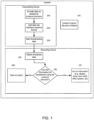
- the instrument can format the information in view of the central protocol structure or format the information per the format defined by the central protocol structure at 102.
- the instrument or transmitting device can then add the data, for example, encoded data, to advertising data at 103.
- the transmitting device can place the information within the broadcast packet at 103.
- the instrument can then broadcast the advertising data within the broadcast packet at 104.
- Different information can be placed within the advertising packet, for example, the information defined by the central protocol structure, in the location and format defined by the central protocol structure.
- Putting the information may include serializing the information into byte data and inserting the information into the broadcast packets defined by the communication channel, for example, an advertising packet defined by the Bluetooth ® peripheral.
- the receiving device receives a broadcast packet, for example, an advertising packet, from at least one transmitting device or instrument.
- a broadcast packet for example, an advertising packet
- An advertising packet is effectively a broadcast packet that can be transmitted by a device with broadcasting capabilities.
- an advertising, or broadcast, packet can be transmitted by a device regardless of whether another device is requesting the packet or even within proximity to receive the packet.
- the application or system that is receiving the broadcast packet does not have to be directly connected to the instrument to receive the information contained within the broadcast packet, thereby, reducing the length of time required to obtain the information.
- the wireless communication channel includes a near-field wireless communication channel, short-range wireless communication channel, long-range wireless communication channel, or the like.
- the wireless communication channel may include Bluetooth ® or other short-range communication channel, a wireless network, or the like.
- the short-range wireless communication channel may use UHF radio waves, which may be in the range of between 2.400 and 2.4835 GHz.
- the receiving device having the application may have to be within a predetermined proximity of the instrument.
- a user may be carrying a mobile device (such as a cellular phone or a tablet) that includes the application and, in the case that the wireless communication channel is a Bluetooth ® channel, the user may have to be within a short distance of the instrument(s).
- the wireless communication channel is not a cellular, ethernet, or WiFi network.
- the information included within the broadcast packet may include, but is not limited to, instrument identifiers or other identification information, measurement data obtained by the instrument, timestamp information which may identify when the broadcast packet was created/transmitted or may identify when the measurement data was obtained, parameters of the instruments or devices of the instrument (e.g., probes, sensors, meters, lamps, etc.), information about the data accuracy or error of measurement data obtained by the device; location information of the device; calibration data of the device; a warning signal; a combination thereof, or the like.
- the instrument may be configured to test a sample of water, either in a laboratory sample or in a continuous water stream, such as in a drinking water or wastewater treatment plant.
- Measurement data include any data that the instrument is designed to capture, for example, pH values of a water source, turbidity values of a fluid, lamp intensity output, specific indicator (e.g., chlorine, fluoride, iron, etc.) values, or any other measurement data.
- Parameters of the instruments include information identifying what is being measured by the instrument, ranges or scales of the measurement data, measurement data unit information, information identifying what is being measured by each device of the instrument, and the like.
- the type of information that is included in the broadcast packet can be any type of information and may vary across different instruments.
- the instrument does not include a user interface and the user interacts with the device/instrument (such as receiving information from the device/ instrument) via the wireless connection between the device/instrument and the application.
- the broadcast packet can be dynamically updated as new information is produced by the instrument, for example, a new measurement is taken.
- the broadcast packet contains information that is substantially provided in real-time, with the only lag being the time to create the broadcast packet and a timing policy that indicates how frequently a broadcast packet should be generated.
- the timing policy may be a default policy or may be programmed by a user and each instrument may have a different timing policy.
- the timing policy may indicate that a broadcast packet should be generated and broadcast at a predetermined time interval (e.g., every two seconds, every minute, etc.), upon receipt of a trigger event (e.g., new measurement data is obtained, upon detection of a receiving device in proximity to the instrument, etc.), a combination thereof, or the like.
- a predetermined time interval e.g., every two seconds, every minute, etc.
- a trigger event e.g., new measurement data is obtained, upon detection of a receiving device in proximity to the instrument, etc.
- each device since each device creates its own broadcast packet, there is no limit to how many broadcast packets can be received by the application. In other words, using conventional systems that require a direct connection, the application is limited to how many devices it may be connected to at a single time. Since the described system does not require a direct connection to receive the broadcast packets, and, therefore, the instrument information, there is no limit to the number of device that the application can receive information from at a single time. Additionally, since the information is contained within a broadcast packet, there is no limit to the number of devices or applications that can receive the broadcast packet at a single time.
- the system determines if the broadcast packet, and, therefore, the information, can be deciphered using the central protocol structure. This determination may include determining whether the broadcast packet is formatted per the format defined by the central protocol structure. If the broadcast packet cannot be deciphered using the central protocol structure, the system may take no action at 108. If, on the other hand, the broadcast packet can be deciphered using the central protocol structure, the system deciphers the information and performs an action with respect to the information at 107. Performing an action may include deciphering the information based upon the format defined by the central protocol structure. Deciphering may include de-serializing the information. Additionally, if the information is encrypted per the central protocol structure, the deciphering may also include decrypting the information utilizing the encryption protocol or algorithm defined by the central protocol structure.
- the information can be read by the application so that it can be acted upon, for example, displayed (e.g., within a window of the application, on a display screen associated with the application, etc.), stored, utilized to manipulate another system (e.g., turn off another system, trigger an event on another system, etc.), or the like.
- the application may be contained, or in communication with, a device such as a cellular phone, tablet, or the like.
- the application may also be contained on a benchtop instrument or laboratory testing device that also serves as a receiver of information from multiple sensing devices. It should be understood that any type of graphical user interface or application that has been created to display information can be used.
- the format of how the information is displayed may vary based upon the programming of the application. Since the broadcast packet, and, therefore, information contained within the broadcast packet, can be dynamically updated, the information acted upon can also be dynamically updated, for example, every time a broadcast packet is updated. Additionally, in the event that the information is displayed, the displayed information can also be dynamically updated. Thus, the information displayed within the application can be updated as frequently as the broadcast packet and may provide almost real-time instrument information.
- the system may also take additional or alternative actions other than simply displaying the information in the application.
- the system and/or application may use the information to perform some function or take some action.
- the system and/or application may store the information to be used in historical trending, continuous device monitoring, to be used by another system or device, or the like.
- the system and/or application may analyze the information and, based upon the analysis, perform an action in response to the information. In other words, the system and/or application can make a decision with regard to the instrument, device, or system based upon the information.
- the system and/or application may send a signal to turn on/off the instrument or device or another instrument, device, or system, request a new measurement from the instrument or device, change a parameter on the instrument or device or other instrument, device, or system, send an urgent warning to an operator, or the like.
- the information may be used by the application to make a decision and trigger another event, such as activating or deactivating another system or device.
- the application receives the information from a plurality of the devices and combines the information from the plurality of the devices into a combined data file.
- the data may be combined into a spreadsheet, document, archive system, database, or the like.
- the combined data file may be transferred via a network to a server remote from the devices, such as to a cloud storage device.
- the information from the plurality of the devices may be compared and an action taken based on the comparison. For example, if multiple sensors are used in a sample of water or other materials, or in a container such as a tank or reactor, the sensor data may be compared and used to take an action such as issuing an alert to service a device, changing a reaction parameter, modifying a process, or the like.
- the various embodiments described herein thus represent a technical improvement to conventional techniques for obtaining information from instruments.
- the described system and method provides a technique that allows a user to obtain information from instruments without making a connection to the instrument.
- the system can receive information from multiple instruments at the same time without a limit to the number of instruments that information can be received from at a single time.
- the lack of a direct connection also means that data from a transmitting device can be received and acted upon by multiple other devices. This allows a user, or multiple users simultaneously, to determine what, if any, instrument or devices the user(s) may want to make a direct connection to in order to get more detailed information without having to directly connect to every instrument.
- the described system provides a technique that is more efficient than conventional techniques while still maintaining security of the information.
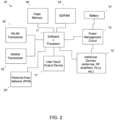
- Device circuitry 10' may include a measurement system on a chip design found, for example, a particular computing platform (e.g., mobile computing, desktop computing, etc.) Software and processor(s) are combined in a single chip 11'.
- Processors comprise internal arithmetic units, registers, cache memory, busses, I/O ports, etc., as is well known in the art. Internal busses and the like depend on different vendors, but essentially all the peripheral devices (12') may attach to a single chip 11'.
- the circuitry 10' combines the processor, memory control, and I/O controller hub all into a single chip 11'. Also, systems 10' of this type do not typically use SATA or PCI or LPC. Common interfaces, for example, include SDIO and I2C.
- power management chip(s) 13' e.g., a battery management unit, BMU, which manage power as supplied, for example, via a rechargeable battery 14', which may be recharged by a connection to a power source (not shown).
- BMU battery management unit
- a single chip, such as 11' is used to supply BIOS like functionality and DRAM memory.
- System 10' typically includes one or more of a WWAN transceiver 15' and a WLAN transceiver 16' for connecting to various networks, such as telecommunications networks and wireless Internet devices, e.g., access points.
- the system 10' may also include transmission devices for a personal area network 20', for example, BLUETOOTH ® .
- devices 12' are commonly included, e.g., a transmit and receive antenna, oscillators, PLLs, etc.
- System 10' includes input/output devices 17' for data input and display/rendering (e.g., a computing location located away from the single beam system that is easily accessible by a user).
- System 10' also typically includes various memory devices, for example flash memory 18' and SDRAM 19'.
- electronic components of one or more systems or devices may include, but are not limited to, at least one processing unit, a memory, and a communication bus or communication means that couples various components including the memory to the processing unit(s).
- a system or device may include or have access to a variety of device readable media.
- System memory may include device readable storage media in the form of volatile and/or nonvolatile memory such as read only memory (ROM) and/or random access memory (RAM).
- ROM read only memory
- RAM random access memory
- system memory may also include an operating system, application programs, other program modules, and program data.
- the disclosed system may be used in an embodiment to perform total chlorine measurement of a sample of seawater.
- aspects may be embodied as a system, method or device program product. Accordingly, aspects may take the form of an entirely hardware embodiment or an embodiment including software that may all generally be referred to herein as a "circuit,” “module” or “system.” Furthermore, aspects may take the form of a device program product embodied in one or more device readable medium(s) having device readable program code embodied therewith.
- a storage device is not a signal and "non-transitory" includes all media except signal media.
- Program code for carrying out operations may be written in any combination of one or more programming languages.
- the program code may execute entirely on a single device, partly on a single device, as a stand-alone software package, partly on single device and partly on another device, or entirely on the other device.
- the devices may be connected through any type of connection or network, including a local area network (LAN), a wide area network (WAN), personal area connection (PAN), or the connection may be made through other devices (for example, through the Internet using an Internet Service Provider), through wireless transmissions, e.g., near-field communication, or through a hard wire connection, such as over a USB connection.
- LAN local area network
- WAN wide area network
- PAN personal area connection
- Internet Service Provider for example, AT&T, MCI, Sprint, EarthLink, MSN, etc.
- wireless transmissions e.g., near-field communication
- a hard wire connection such as over a USB connection.
- Example embodiments are described herein with reference to the figures, which illustrate example methods, devices and products according to various example embodiments. It will be understood that the actions and functionality may be implemented at least in part by program instructions. These program instructions may be provided to a processor of a device, e.g., a hand held measurement device, or other programmable data processing device to produce a machine, such that the instructions, which execute via a processor of the device, implement the functions/acts specified.
- a processor of a device e.g., a hand held measurement device, or other programmable data processing device to produce a machine, such that the instructions, which execute via a processor of the device, implement the functions/acts specified.
Landscapes
- Engineering & Computer Science (AREA)
- Computer Networks & Wireless Communication (AREA)
- Signal Processing (AREA)
- Computer Security & Cryptography (AREA)
- Health & Medical Sciences (AREA)
- Computing Systems (AREA)
- General Health & Medical Sciences (AREA)
- Medical Informatics (AREA)
- Databases & Information Systems (AREA)
- Arrangements For Transmission Of Measured Signals (AREA)
- Mobile Radio Communication Systems (AREA)
Claims (13)
- Verfahren zum Übertragen von Informationen von mindestens einem Instrument oder Gerät zu einer Anwendung, die auf einem mobilen Gerät, einem entfernten Computer, über ein Netzwerk oder dergleichen läuft, umfassend:Erstellen einer zentralen Protokollstruktur, wobei die zentrale Protokollstruktur ein Format für Informationen definiert, die unter Verwendung der zentralen Protokollstruktur übertragen werden, wobei das Format, dem mindestens einem Gerät oder der mindestens einen Vorrichtung und der Anwendung bekannt ist:
Anpassen der zentralen Protokollstruktur durch Identifizieren, welcher Information ein unter Verwendung der zentralen Protokollstruktur übertragenes Datenpaket und/oder Byte entspricht:Übertragen von Informationen von dem mindestens einem Gerät über einen drahtlosen Kurzstrecken-Kommunikationskanal an die Anwendung, wobei die Informationen in einem Broadcast-Paket enthalten sind, das gemäß dem, durch die zentrale Protokollstruktur definierten Format, formatiert ist:Empfangen, des Rundsteckenpakets bei der Anwendung und über den drahtlosen Kurzstrecken-Kommunikationskanal, das Informationen von dem mindestens einem Instrument oder Gerät enthält, unabhängig davon, ob ein anderes Gerät das Rundsendepaket anfordert oder sich in der Nähe befindet, um das Rundsendepaket zu empfangen; undDurchführen einer Aktion innerhalb der Anwendung in Bezug auf die Informationen innerhalb der Anwendung, wobei das Durchführen das Entschlüsseln der enthaltenen Informationen unter Verwendung des Formats der zentralen Protokollstruktur umfasst, wodurch das Rundsendepaket dynamisch aktualisiert wird, wenn neue Informationen von dem mindestens einem Instrument oder Gerät erzeugt werden:wobei das Gerät ausgewählt ist aus einem Gerät zur Messung der Wasserqualität, einem persönlichen Aktivitäts-Tracker, einer Smartwatch, einem medizinischen Diagnosegerät,einem Materialerfassungsgerät, einem Labortestgerät, einem Patientenüberwachungsgerät,einem Umwelterfassungsgerät und einem Standort-Erfassungsgerät. - Verfahren nach Anspruch 1, wobei der drahtlose Kurzstrecken-Kommunikationskanal UHF-Funkwellen verwendet.
- Verfahren nach Anspruch 2, wobei der drahtlose Kommunikationskanal einen Bluetooth®-Kommunikationskanal umfasst und das Broadcast-Paket ein Werbepaket umfasst.
- Verfahren nach Anspruch 3, wobei das Ausführen einer Aktion das Anzeigen der Informationen umfasst und wobei die innerhalb der Anwendung angezeigten Informationen dynamisch aktualisiert werden, wenn die Informationen dynamisch aktualisiert werden.
- Verfahren nach Anspruch 1, wobei die Anwendung die Informationen empfängt, ohne sich mit dem mindestens einem Gerät zu verbinden.
- Verfahren nach Anspruch 1, wobei die Anwendung die Informationen von mehreren Geräten empfängt und die Informationen von den mehreren Geräten zu einer kombinierten Datendatei kombiniert.
- Verfahren nach Anspruch 6, das ferner das Übertragen der kombinierten Datendatei über ein Netzwerk an einen von der Mehrzahl der Geräte entfernten Server umfasst.
- Verfahren nach Anspruch 6, ferner umfassend das Vergleichen der Informationen aus der Vielzahl der Vorrichtungen und das Ergreifen einer Maßnahme auf der Grundlage des Vergleichs.
- Verfahren nach Anspruch 1, wobei sich die Anwendung auf einem Labortestgerät befindet.
- Verfahren nach Anspruch 1, wobei die Informationen einen Alarm umfassen und die Anwendung eine Benachrichtigung an einen Benutzer sendet, damit dieser eine dringende Maßnahme ergreift.
- Verfahren nach Anspruch 1, wobei die zentrale Protokollstruktur einen verschlüsselten Protokollpuffer umfasst, der Informationen verschlüsselt, die unter Verwendung der zentralen Protokollstruktur übertragen werden; und wobei die Durchführung das Entschlüsseln der Informationen umfasst.
- Verfahren nach Anspruch 1, wobei die Anwendung Informationen von einer Anzahl von Vorrichtungen empfängt, wobei die Anzahl von Vorrichtungen, von denen die Anwendung Informationen zu einem einzigen Zeitpunkt empfangen kann, größer als 20 Vorrichtungen ist.
- Verfahren nach Anspruch 1, wobei die Informationen mindestens eines der folgenden Elemente umfassen:eine Gerätekennung, von dem Gerät erhaltene Messdaten; Informationen über die Datengenauigkeit oder den Fehler der von dem Gerät erhaltenen Messdaten;Zeitstempelinformationen; Standortinformationen des Geräts; Kalibrierungsdaten des Geräts; ein Warnsignal; und einen Parameter des Geräts.
Applications Claiming Priority (2)
| Application Number | Priority Date | Filing Date | Title |
|---|---|---|---|
| US201962929603P | 2019-11-01 | 2019-11-01 | |
| PCT/US2020/058307 WO2021087324A1 (en) | 2019-11-01 | 2020-10-30 | Dynamic wireless information transmission |
Publications (2)
| Publication Number | Publication Date |
|---|---|
| EP4022936A1 EP4022936A1 (de) | 2022-07-06 |
| EP4022936B1 true EP4022936B1 (de) | 2024-08-07 |
Family
ID=73544382
Family Applications (2)
| Application Number | Title | Priority Date | Filing Date |
|---|---|---|---|
| EP20811904.0A Active EP4022936B1 (de) | 2019-11-01 | 2020-10-30 | Dynamische drahtlose informationsübertragung |
| EP20811902.4A Pending EP4018624A1 (de) | 2019-11-01 | 2020-10-30 | Verbindungsloses erhalten von dynamischen informationen über drahtlose übertragung |
Family Applications After (1)
| Application Number | Title | Priority Date | Filing Date |
|---|---|---|---|
| EP20811902.4A Pending EP4018624A1 (de) | 2019-11-01 | 2020-10-30 | Verbindungsloses erhalten von dynamischen informationen über drahtlose übertragung |
Country Status (4)
| Country | Link |
|---|---|
| US (3) | US11595798B2 (de) |
| EP (2) | EP4022936B1 (de) |
| CN (2) | CN114503533B (de) |
| WO (2) | WO2021087307A1 (de) |
Families Citing this family (2)
| Publication number | Priority date | Publication date | Assignee | Title |
|---|---|---|---|---|
| EP4022936B1 (de) | 2019-11-01 | 2024-08-07 | Hach Company | Dynamische drahtlose informationsübertragung |
| CN117376880A (zh) * | 2022-06-30 | 2024-01-09 | 华为技术有限公司 | 安全业务的切换方法及终端 |
Family Cites Families (48)
| Publication number | Priority date | Publication date | Assignee | Title |
|---|---|---|---|---|
| EP1304856A4 (de) | 2000-05-31 | 2006-07-19 | Arkray Inc | Ferndatensteuersystem und messdatensammelverfahren |
| US20070155372A1 (en) * | 2006-01-04 | 2007-07-05 | Mobile Action Technology Inc. | Method and system for detecting a mobile model |
| WO2009036316A1 (en) | 2007-09-14 | 2009-03-19 | Corventis, Inc. | Energy management, tracking and security for adherent patient monitor |
| CN101232452B (zh) * | 2008-01-25 | 2011-02-09 | 华中科技大学 | 工业无线传感器网络的广播信道数据传输方法 |
| US8806506B2 (en) * | 2008-09-30 | 2014-08-12 | Ebay Inc. | System and method for processing messages using a common interface platform supporting multiple pluggable data formats in a service-oriented pipeline architecture |
| CN101951556B (zh) * | 2010-09-28 | 2013-01-02 | 湖南大学 | 基于网络编码的无线传感器网络数据分发方法 |
| US9445305B2 (en) * | 2011-09-12 | 2016-09-13 | Microsoft Corporation | Low energy beacon encoding |
| GB2494645A (en) * | 2011-09-13 | 2013-03-20 | Skype | Application layer handoff between wireless networks |
| US8929192B2 (en) * | 2012-01-25 | 2015-01-06 | Nokia Corporation | Method, apparatus, and computer program product for short-range communication based direction finding |
| US9544075B2 (en) | 2012-02-22 | 2017-01-10 | Qualcomm Incorporated | Platform for wireless identity transmitter and system using short range wireless broadcast |
| US20130214909A1 (en) * | 2012-02-22 | 2013-08-22 | Qualcomm Incorporated | Airplane mode for wireless transmitter device and system using short-range wireless broadcasts |
| US8898766B2 (en) | 2012-04-10 | 2014-11-25 | Spotify Ab | Systems and methods for controlling a local application through a web page |
| CN102665206B (zh) * | 2012-04-26 | 2015-06-03 | 北京邮电大学 | 用于无线传感器网络数据采集的网络编码方法 |
| GB201209042D0 (en) * | 2012-05-22 | 2012-07-04 | Nec Corp | Apparatus and method for transmitting messages |
| US9769123B2 (en) * | 2012-09-06 | 2017-09-19 | Intel Corporation | Mitigating unauthorized access to data traffic |
| GB201304219D0 (en) * | 2013-03-08 | 2013-04-24 | Tomtom Int Bv | Methods for communicating sensor data between devices |
| US9154547B2 (en) | 2013-03-14 | 2015-10-06 | Blossom Coffee, Inc. | Methods for brewing coffee |
| US9730268B2 (en) * | 2013-06-07 | 2017-08-08 | Apple Inc. | Communication between host and accessory devices using accessory protocols via wireless transport |
| US9749237B2 (en) * | 2014-02-21 | 2017-08-29 | Marvell World Trade Ltd. | Method and apparatus for aggregating and encoding received symbols including generation of a pointer for a control code |
| CN103906000B (zh) * | 2014-04-17 | 2017-09-29 | 福建联迪商用设备有限公司 | 一种移动终端与pos终端的通信方法及系统 |
| US9426749B2 (en) * | 2014-05-05 | 2016-08-23 | Intel IP Corporation | Method and apparatus for Bluetooth-based Wi-Fi synchronization |
| GB2526562A (en) * | 2014-05-28 | 2015-12-02 | I Spy Digital Ltd | Interactive display telecommunication method and system |
| KR20170032304A (ko) * | 2014-07-14 | 2017-03-22 | 엘지전자 주식회사 | 블루투스 le(low energy) 기술을 이용하여 디바이스의 위치를 측정하기 위한 방법 및 장치 |
| CN104218979A (zh) * | 2014-07-31 | 2014-12-17 | 北京升哲科技有限公司 | 在非连接状态下获取传感数据的传感器、智能设备及方法 |
| US9762557B2 (en) * | 2014-10-28 | 2017-09-12 | Microsoft Technology Licensing, Llc | Policy settings configuration with signals |
| US10616697B2 (en) * | 2014-11-14 | 2020-04-07 | Gn Resound A/S | Hearing instrument with an authentication protocol |
| GB2535472A (en) * | 2015-02-16 | 2016-08-24 | Camlab Ltd | A sensor interface for interfacing with a sensor |
| CN106211019A (zh) * | 2015-04-29 | 2016-12-07 | 展讯通信(深圳)有限公司 | 一种数据传输方法 |
| US9924342B2 (en) | 2015-06-16 | 2018-03-20 | Google Llc | Establishing a connection over a low power communication type |
| WO2017079354A1 (en) | 2015-11-02 | 2017-05-11 | Rapidsos, Inc. | Method and system for situational awareness for emergency response |
| US10033706B2 (en) | 2015-12-04 | 2018-07-24 | Samsara Networks Inc. | Secure offline data offload in a sensor network |
| US9848035B2 (en) | 2015-12-24 | 2017-12-19 | Intel Corporation | Measurements exchange network, such as for internet-of-things (IoT) devices |
| WO2017153838A1 (en) * | 2016-03-09 | 2017-09-14 | Sourcepoint Technologies Inc. | Content blocker detection and circumvention |
| JP2017192117A (ja) | 2016-04-15 | 2017-10-19 | 富士通株式会社 | センサ装置、情報収集システム、および情報収集方法 |
| US10560829B2 (en) * | 2016-04-19 | 2020-02-11 | Qualcomm Incorporated | Wireless communication for angle of arrival determination |
| US10154384B2 (en) | 2016-06-22 | 2018-12-11 | Qualcomm Incorporated | Systems and methods for back channel communication |
| EP4542931A3 (de) * | 2016-10-18 | 2025-06-18 | DexCom, Inc. | System und verfahren zur kommunikation von analytdaten |
| US9882610B1 (en) | 2016-11-08 | 2018-01-30 | Welch Allyn, Inc. | Near field communication sensor system |
| EP3563605B1 (de) * | 2016-12-27 | 2021-07-21 | Denso Corporation | System und verfahren für mikrostandortsensorkommunikation |
| US10678735B2 (en) * | 2017-06-27 | 2020-06-09 | Vmware, Inc. | Asynchronous channel based bus architecture enabling decoupled services |
| CN108391237A (zh) * | 2018-01-29 | 2018-08-10 | 北京怡和嘉业医疗科技股份有限公司 | 医疗器械数据的发送、接收方法和发送、接收设备 |
| US20190274030A1 (en) * | 2018-03-05 | 2019-09-05 | Swishh, Inc. | System and Method for Contact Information Exchange Using Ultrasonic Waves |
| KR102570561B1 (ko) * | 2018-06-26 | 2023-08-24 | 삼성전자주식회사 | 무선 통신 시스템에서 코디네이션을 통한 와이파이 핸드오프를 위한 방법 및 장치 |
| US11159658B2 (en) | 2018-07-23 | 2021-10-26 | Moj.Io, Inc. | Homogenization of telematics data through unified messaging protocol |
| WO2020039252A1 (en) | 2018-08-22 | 2020-02-27 | Estimote Polska Sp Z.O.O. | System and method for verifying device security |
| CN109348433A (zh) * | 2018-11-23 | 2019-02-15 | 深圳市椰壳信息科技有限公司 | 一种基于蓝牙广播的传感器信息共享方法及系统 |
| US10827324B1 (en) * | 2019-07-01 | 2020-11-03 | Samsara Networks Inc. | Method and apparatus for tracking assets |
| EP4022936B1 (de) * | 2019-11-01 | 2024-08-07 | Hach Company | Dynamische drahtlose informationsübertragung |
-
2020
- 2020-10-30 EP EP20811904.0A patent/EP4022936B1/de active Active
- 2020-10-30 WO PCT/US2020/058284 patent/WO2021087307A1/en not_active Ceased
- 2020-10-30 WO PCT/US2020/058307 patent/WO2021087324A1/en not_active Ceased
- 2020-10-30 EP EP20811902.4A patent/EP4018624A1/de active Pending
- 2020-10-30 US US17/085,760 patent/US11595798B2/en active Active
- 2020-10-30 CN CN202080069417.7A patent/CN114503533B/zh active Active
- 2020-10-30 US US17/085,612 patent/US11689908B2/en active Active
- 2020-10-30 CN CN202080069463.7A patent/CN114503615A/zh active Pending
-
2022
- 2022-12-15 US US18/081,996 patent/US12108318B2/en active Active
Also Published As
| Publication number | Publication date |
|---|---|
| US20210136552A1 (en) | 2021-05-06 |
| WO2021087307A1 (en) | 2021-05-06 |
| US20210136540A1 (en) | 2021-05-06 |
| EP4022936A1 (de) | 2022-07-06 |
| US12108318B2 (en) | 2024-10-01 |
| WO2021087324A1 (en) | 2021-05-06 |
| US11689908B2 (en) | 2023-06-27 |
| CN114503615A (zh) | 2022-05-13 |
| CN114503533B (zh) | 2024-04-19 |
| US11595798B2 (en) | 2023-02-28 |
| EP4018624A1 (de) | 2022-06-29 |
| CN114503533A (zh) | 2022-05-13 |
| US20230122443A1 (en) | 2023-04-20 |
Similar Documents
| Publication | Publication Date | Title |
|---|---|---|
| US12108318B2 (en) | Dynamic wireless information transmission | |
| CN106662564B (zh) | 对水质测量数据的基于移动的收集 | |
| US20130325924A1 (en) | Method and system for server-assisted remote probing and data collection in a cloud computing environment | |
| US12044622B2 (en) | Method for measuring monochloramine with a thiocarbamate indicator and iodide | |
| RU2016130081A (ru) | Биомедицинские устройства для определения случаев воздействия для передачи биометрической информации | |
| CN114424050A (zh) | 海水中的总氯的检测 | |
| US11431596B1 (en) | Real-time management of device maintenance | |
| EP3752050A1 (de) | Vorrichtungen und verfahren für datenrouter-vermittelte veröffentlicher-/teilnehmerübertragungsarchitektur | |
| JP5803986B2 (ja) | 設備管理システム | |
| US20150227709A1 (en) | Network-based healthcare monitoring system | |
| US20210003529A1 (en) | pH MEASUREMENT OF AN AQUEOUS SAMPLE | |
| CN115023910B (zh) | 串行命令协议封装线传输协议 | |
| US20250185950A1 (en) | System and method for wireless transmission of glucose data | |
| US20210333231A1 (en) | pH MEASUREMENT OF AN AQUEOUS SAMPLE | |
| EP2763065A1 (de) | Verfahren und System zur Identifizierung einer Flüssigkeitsprobe | |
| WO2025128082A1 (en) | System and method for wireless transmission of glucose data | |
| KR102551105B1 (ko) | 이종 데이터 기반의 메타데이터 획득 장치 | |
| Singh et al. | IoT-Based Water Quality Index Predictions with Secure Data Transmission | |
| PUTRI et al. | IMPLEMENTATION OF THE INTERNET OF THINGS (IoT) IN MONITORING AND CONTROL OF WATER TURBIDITY LEVELS IN KOI FISH BREEDING POND | |
| Nagar et al. | IoT-Based Water Quality Index | |
| Bhargavi | INTEGRATED INTELLIGENT SALINE STAND | |
| US20220334059A1 (en) | Mercury measurement | |
| GLONȚ et al. | INFORMATION SYSTEM FOR EVALUATING THE SAFETY CONDITIONS OF MINING OBJECTIVES. | |
| KR100708525B1 (ko) | 구취/공기 오염 감지장치를 이용한 건강 관리 방법 및 그시스템 | |
| CN121460200A (zh) | 医疗设备的数据管理方法、设备及系统 |
Legal Events
| Date | Code | Title | Description |
|---|---|---|---|
| STAA | Information on the status of an ep patent application or granted ep patent |
Free format text: STATUS: UNKNOWN |
|
| STAA | Information on the status of an ep patent application or granted ep patent |
Free format text: STATUS: THE INTERNATIONAL PUBLICATION HAS BEEN MADE |
|
| PUAI | Public reference made under article 153(3) epc to a published international application that has entered the european phase |
Free format text: ORIGINAL CODE: 0009012 |
|
| STAA | Information on the status of an ep patent application or granted ep patent |
Free format text: STATUS: REQUEST FOR EXAMINATION WAS MADE |
|
| 17P | Request for examination filed |
Effective date: 20220330 |
|
| AK | Designated contracting states |
Kind code of ref document: A1 Designated state(s): AL AT BE BG CH CY CZ DE DK EE ES FI FR GB GR HR HU IE IS IT LI LT LU LV MC MK MT NL NO PL PT RO RS SE SI SK SM TR |
|
| DAV | Request for validation of the european patent (deleted) | ||
| DAX | Request for extension of the european patent (deleted) | ||
| P01 | Opt-out of the competence of the unified patent court (upc) registered |
Effective date: 20230528 |
|
| GRAP | Despatch of communication of intention to grant a patent |
Free format text: ORIGINAL CODE: EPIDOSNIGR1 |
|
| STAA | Information on the status of an ep patent application or granted ep patent |
Free format text: STATUS: GRANT OF PATENT IS INTENDED |
|
| GRAS | Grant fee paid |
Free format text: ORIGINAL CODE: EPIDOSNIGR3 |
|
| RIC1 | Information provided on ipc code assigned before grant |
Ipc: H04W 4/38 20180101ALI20240522BHEP Ipc: H04L 67/12 20220101ALI20240522BHEP Ipc: H04Q 9/00 20060101AFI20240522BHEP |
|
| INTG | Intention to grant announced |
Effective date: 20240606 |
|
| GRAA | (expected) grant |
Free format text: ORIGINAL CODE: 0009210 |
|
| STAA | Information on the status of an ep patent application or granted ep patent |
Free format text: STATUS: THE PATENT HAS BEEN GRANTED |
|
| AK | Designated contracting states |
Kind code of ref document: B1 Designated state(s): AL AT BE BG CH CY CZ DE DK EE ES FI FR GB GR HR HU IE IS IT LI LT LU LV MC MK MT NL NO PL PT RO RS SE SI SK SM TR |
|
| REG | Reference to a national code |
Ref country code: GB Ref legal event code: FG4D |
|
| REG | Reference to a national code |
Ref country code: CH Ref legal event code: EP |
|
| REG | Reference to a national code |
Ref country code: IE Ref legal event code: FG4D |
|
| REG | Reference to a national code |
Ref country code: DE Ref legal event code: R096 Ref document number: 602020035451 Country of ref document: DE |
|
| REG | Reference to a national code |
Ref country code: LT Ref legal event code: MG9D |
|
| REG | Reference to a national code |
Ref country code: NL Ref legal event code: MP Effective date: 20240807 |
|
| PG25 | Lapsed in a contracting state [announced via postgrant information from national office to epo] |
Ref country code: NO Free format text: LAPSE BECAUSE OF FAILURE TO SUBMIT A TRANSLATION OF THE DESCRIPTION OR TO PAY THE FEE WITHIN THE PRESCRIBED TIME-LIMIT Effective date: 20241107 |
|
| REG | Reference to a national code |
Ref country code: AT Ref legal event code: MK05 Ref document number: 1712206 Country of ref document: AT Kind code of ref document: T Effective date: 20240807 |
|
| PG25 | Lapsed in a contracting state [announced via postgrant information from national office to epo] |
Ref country code: GR Free format text: LAPSE BECAUSE OF FAILURE TO SUBMIT A TRANSLATION OF THE DESCRIPTION OR TO PAY THE FEE WITHIN THE PRESCRIBED TIME-LIMIT Effective date: 20241108 Ref country code: NL Free format text: LAPSE BECAUSE OF FAILURE TO SUBMIT A TRANSLATION OF THE DESCRIPTION OR TO PAY THE FEE WITHIN THE PRESCRIBED TIME-LIMIT Effective date: 20240807 Ref country code: FI Free format text: LAPSE BECAUSE OF FAILURE TO SUBMIT A TRANSLATION OF THE DESCRIPTION OR TO PAY THE FEE WITHIN THE PRESCRIBED TIME-LIMIT Effective date: 20240807 Ref country code: PT Free format text: LAPSE BECAUSE OF FAILURE TO SUBMIT A TRANSLATION OF THE DESCRIPTION OR TO PAY THE FEE WITHIN THE PRESCRIBED TIME-LIMIT Effective date: 20241209 Ref country code: PL Free format text: LAPSE BECAUSE OF FAILURE TO SUBMIT A TRANSLATION OF THE DESCRIPTION OR TO PAY THE FEE WITHIN THE PRESCRIBED TIME-LIMIT Effective date: 20240807 |
|
| PG25 | Lapsed in a contracting state [announced via postgrant information from national office to epo] |
Ref country code: BG Free format text: LAPSE BECAUSE OF FAILURE TO SUBMIT A TRANSLATION OF THE DESCRIPTION OR TO PAY THE FEE WITHIN THE PRESCRIBED TIME-LIMIT Effective date: 20240807 |
|
| PG25 | Lapsed in a contracting state [announced via postgrant information from national office to epo] |
Ref country code: LV Free format text: LAPSE BECAUSE OF FAILURE TO SUBMIT A TRANSLATION OF THE DESCRIPTION OR TO PAY THE FEE WITHIN THE PRESCRIBED TIME-LIMIT Effective date: 20240807 |
|
| PG25 | Lapsed in a contracting state [announced via postgrant information from national office to epo] |
Ref country code: AT Free format text: LAPSE BECAUSE OF FAILURE TO SUBMIT A TRANSLATION OF THE DESCRIPTION OR TO PAY THE FEE WITHIN THE PRESCRIBED TIME-LIMIT Effective date: 20240807 Ref country code: IS Free format text: LAPSE BECAUSE OF FAILURE TO SUBMIT A TRANSLATION OF THE DESCRIPTION OR TO PAY THE FEE WITHIN THE PRESCRIBED TIME-LIMIT Effective date: 20241207 |
|
| PG25 | Lapsed in a contracting state [announced via postgrant information from national office to epo] |
Ref country code: HR Free format text: LAPSE BECAUSE OF FAILURE TO SUBMIT A TRANSLATION OF THE DESCRIPTION OR TO PAY THE FEE WITHIN THE PRESCRIBED TIME-LIMIT Effective date: 20240807 |
|
| PG25 | Lapsed in a contracting state [announced via postgrant information from national office to epo] |
Ref country code: RS Free format text: LAPSE BECAUSE OF FAILURE TO SUBMIT A TRANSLATION OF THE DESCRIPTION OR TO PAY THE FEE WITHIN THE PRESCRIBED TIME-LIMIT Effective date: 20241107 Ref country code: ES Free format text: LAPSE BECAUSE OF FAILURE TO SUBMIT A TRANSLATION OF THE DESCRIPTION OR TO PAY THE FEE WITHIN THE PRESCRIBED TIME-LIMIT Effective date: 20240807 |
|
| PG25 | Lapsed in a contracting state [announced via postgrant information from national office to epo] |
Ref country code: RS Free format text: LAPSE BECAUSE OF FAILURE TO SUBMIT A TRANSLATION OF THE DESCRIPTION OR TO PAY THE FEE WITHIN THE PRESCRIBED TIME-LIMIT Effective date: 20241107 Ref country code: PT Free format text: LAPSE BECAUSE OF FAILURE TO SUBMIT A TRANSLATION OF THE DESCRIPTION OR TO PAY THE FEE WITHIN THE PRESCRIBED TIME-LIMIT Effective date: 20241209 Ref country code: PL Free format text: LAPSE BECAUSE OF FAILURE TO SUBMIT A TRANSLATION OF THE DESCRIPTION OR TO PAY THE FEE WITHIN THE PRESCRIBED TIME-LIMIT Effective date: 20240807 Ref country code: NO Free format text: LAPSE BECAUSE OF FAILURE TO SUBMIT A TRANSLATION OF THE DESCRIPTION OR TO PAY THE FEE WITHIN THE PRESCRIBED TIME-LIMIT Effective date: 20241107 Ref country code: NL Free format text: LAPSE BECAUSE OF FAILURE TO SUBMIT A TRANSLATION OF THE DESCRIPTION OR TO PAY THE FEE WITHIN THE PRESCRIBED TIME-LIMIT Effective date: 20240807 Ref country code: LV Free format text: LAPSE BECAUSE OF FAILURE TO SUBMIT A TRANSLATION OF THE DESCRIPTION OR TO PAY THE FEE WITHIN THE PRESCRIBED TIME-LIMIT Effective date: 20240807 Ref country code: IS Free format text: LAPSE BECAUSE OF FAILURE TO SUBMIT A TRANSLATION OF THE DESCRIPTION OR TO PAY THE FEE WITHIN THE PRESCRIBED TIME-LIMIT Effective date: 20241207 Ref country code: HR Free format text: LAPSE BECAUSE OF FAILURE TO SUBMIT A TRANSLATION OF THE DESCRIPTION OR TO PAY THE FEE WITHIN THE PRESCRIBED TIME-LIMIT Effective date: 20240807 Ref country code: GR Free format text: LAPSE BECAUSE OF FAILURE TO SUBMIT A TRANSLATION OF THE DESCRIPTION OR TO PAY THE FEE WITHIN THE PRESCRIBED TIME-LIMIT Effective date: 20241108 Ref country code: FI Free format text: LAPSE BECAUSE OF FAILURE TO SUBMIT A TRANSLATION OF THE DESCRIPTION OR TO PAY THE FEE WITHIN THE PRESCRIBED TIME-LIMIT Effective date: 20240807 Ref country code: ES Free format text: LAPSE BECAUSE OF FAILURE TO SUBMIT A TRANSLATION OF THE DESCRIPTION OR TO PAY THE FEE WITHIN THE PRESCRIBED TIME-LIMIT Effective date: 20240807 Ref country code: BG Free format text: LAPSE BECAUSE OF FAILURE TO SUBMIT A TRANSLATION OF THE DESCRIPTION OR TO PAY THE FEE WITHIN THE PRESCRIBED TIME-LIMIT Effective date: 20240807 Ref country code: AT Free format text: LAPSE BECAUSE OF FAILURE TO SUBMIT A TRANSLATION OF THE DESCRIPTION OR TO PAY THE FEE WITHIN THE PRESCRIBED TIME-LIMIT Effective date: 20240807 |
|
| PG25 | Lapsed in a contracting state [announced via postgrant information from national office to epo] |
Ref country code: DK Free format text: LAPSE BECAUSE OF FAILURE TO SUBMIT A TRANSLATION OF THE DESCRIPTION OR TO PAY THE FEE WITHIN THE PRESCRIBED TIME-LIMIT Effective date: 20240807 Ref country code: SM Free format text: LAPSE BECAUSE OF FAILURE TO SUBMIT A TRANSLATION OF THE DESCRIPTION OR TO PAY THE FEE WITHIN THE PRESCRIBED TIME-LIMIT Effective date: 20240807 |
|
| PG25 | Lapsed in a contracting state [announced via postgrant information from national office to epo] |
Ref country code: EE Free format text: LAPSE BECAUSE OF FAILURE TO SUBMIT A TRANSLATION OF THE DESCRIPTION OR TO PAY THE FEE WITHIN THE PRESCRIBED TIME-LIMIT Effective date: 20240807 |
|
| PG25 | Lapsed in a contracting state [announced via postgrant information from national office to epo] |
Ref country code: CZ Free format text: LAPSE BECAUSE OF FAILURE TO SUBMIT A TRANSLATION OF THE DESCRIPTION OR TO PAY THE FEE WITHIN THE PRESCRIBED TIME-LIMIT Effective date: 20240807 |
|
| PG25 | Lapsed in a contracting state [announced via postgrant information from national office to epo] |
Ref country code: SK Free format text: LAPSE BECAUSE OF FAILURE TO SUBMIT A TRANSLATION OF THE DESCRIPTION OR TO PAY THE FEE WITHIN THE PRESCRIBED TIME-LIMIT Effective date: 20240807 |
|
| REG | Reference to a national code |
Ref country code: DE Ref legal event code: R097 Ref document number: 602020035451 Country of ref document: DE |
|
| REG | Reference to a national code |
Ref country code: CH Ref legal event code: PL |
|
| PLBE | No opposition filed within time limit |
Free format text: ORIGINAL CODE: 0009261 |
|
| STAA | Information on the status of an ep patent application or granted ep patent |
Free format text: STATUS: NO OPPOSITION FILED WITHIN TIME LIMIT |
|
| PG25 | Lapsed in a contracting state [announced via postgrant information from national office to epo] |
Ref country code: MC Free format text: LAPSE BECAUSE OF FAILURE TO SUBMIT A TRANSLATION OF THE DESCRIPTION OR TO PAY THE FEE WITHIN THE PRESCRIBED TIME-LIMIT Effective date: 20240807 |
|
| PG25 | Lapsed in a contracting state [announced via postgrant information from national office to epo] |
Ref country code: LU Free format text: LAPSE BECAUSE OF NON-PAYMENT OF DUE FEES Effective date: 20241030 Ref country code: BE Free format text: LAPSE BECAUSE OF NON-PAYMENT OF DUE FEES Effective date: 20241031 |
|
| 26N | No opposition filed |
Effective date: 20250508 |
|
| PG25 | Lapsed in a contracting state [announced via postgrant information from national office to epo] |
Ref country code: CH Free format text: LAPSE BECAUSE OF NON-PAYMENT OF DUE FEES Effective date: 20241031 |
|
| REG | Reference to a national code |
Ref country code: BE Ref legal event code: MM Effective date: 20241031 |
|
| PG25 | Lapsed in a contracting state [announced via postgrant information from national office to epo] |
Ref country code: SE Free format text: LAPSE BECAUSE OF FAILURE TO SUBMIT A TRANSLATION OF THE DESCRIPTION OR TO PAY THE FEE WITHIN THE PRESCRIBED TIME-LIMIT Effective date: 20240807 |
|
| PG25 | Lapsed in a contracting state [announced via postgrant information from national office to epo] |
Ref country code: IE Free format text: LAPSE BECAUSE OF NON-PAYMENT OF DUE FEES Effective date: 20241030 |
|
| PG25 | Lapsed in a contracting state [announced via postgrant information from national office to epo] |
Ref country code: RO Free format text: LAPSE BECAUSE OF FAILURE TO SUBMIT A TRANSLATION OF THE DESCRIPTION OR TO PAY THE FEE WITHIN THE PRESCRIBED TIME-LIMIT Effective date: 20240807 |
|
| PGFP | Annual fee paid to national office [announced via postgrant information from national office to epo] |
Ref country code: DE Payment date: 20251021 Year of fee payment: 6 |
|
| PGFP | Annual fee paid to national office [announced via postgrant information from national office to epo] |
Ref country code: GB Payment date: 20251022 Year of fee payment: 6 |
|
| PGFP | Annual fee paid to national office [announced via postgrant information from national office to epo] |
Ref country code: FR Payment date: 20251030 Year of fee payment: 6 |
|
| PG25 | Lapsed in a contracting state [announced via postgrant information from national office to epo] |
Ref country code: IT Free format text: LAPSE BECAUSE OF FAILURE TO SUBMIT A TRANSLATION OF THE DESCRIPTION OR TO PAY THE FEE WITHIN THE PRESCRIBED TIME-LIMIT Effective date: 20240807 |